US10196276B2 - Synthesis of a boron-containing zeolite with an MWW framework structure - Google Patents
Synthesis of a boron-containing zeolite with an MWW framework structure Download PDFInfo
- Publication number
- US10196276B2 US10196276B2 US15/316,220 US201515316220A US10196276B2 US 10196276 B2 US10196276 B2 US 10196276B2 US 201515316220 A US201515316220 A US 201515316220A US 10196276 B2 US10196276 B2 US 10196276B2
- Authority
- US
- United States
- Prior art keywords
- mww
- framework structure
- boron
- zeolitic material
- seed crystals
- Prior art date
- Legal status (The legal status is an assumption and is not a legal conclusion. Google has not performed a legal analysis and makes no representation as to the accuracy of the status listed.)
- Active, expires
Links
- 229910052796 boron Inorganic materials 0.000 title claims abstract description 58
- ZOXJGFHDIHLPTG-UHFFFAOYSA-N Boron Chemical compound [B] ZOXJGFHDIHLPTG-UHFFFAOYSA-N 0.000 title claims abstract description 54
- 239000010457 zeolite Substances 0.000 title abstract description 63
- HNPSIPDUKPIQMN-UHFFFAOYSA-N dioxosilane;oxo(oxoalumanyloxy)alumane Chemical compound O=[Si]=O.O=[Al]O[Al]=O HNPSIPDUKPIQMN-UHFFFAOYSA-N 0.000 title abstract description 51
- 229910021536 Zeolite Inorganic materials 0.000 title abstract description 50
- 230000015572 biosynthetic process Effects 0.000 title description 28
- 238000003786 synthesis reaction Methods 0.000 title description 23
- 238000000034 method Methods 0.000 claims abstract description 134
- 230000008569 process Effects 0.000 claims abstract description 109
- 239000000463 material Substances 0.000 claims abstract description 100
- 239000013078 crystal Substances 0.000 claims abstract description 94
- 239000000203 mixture Substances 0.000 claims abstract description 93
- 239000002243 precursor Substances 0.000 claims abstract description 88
- JKWMSGQKBLHBQQ-UHFFFAOYSA-N diboron trioxide Chemical compound O=BOB=O JKWMSGQKBLHBQQ-UHFFFAOYSA-N 0.000 claims abstract description 61
- 238000001354 calcination Methods 0.000 claims abstract description 21
- 125000000217 alkyl group Chemical group 0.000 claims abstract description 5
- 125000000753 cycloalkyl group Chemical group 0.000 claims abstract description 5
- VYPSYNLAJGMNEJ-UHFFFAOYSA-N Silicium dioxide Chemical compound O=[Si]=O VYPSYNLAJGMNEJ-UHFFFAOYSA-N 0.000 claims description 158
- 239000000377 silicon dioxide Substances 0.000 claims description 65
- 239000002904 solvent Substances 0.000 claims description 45
- 239000007788 liquid Substances 0.000 claims description 16
- KGBXLFKZBHKPEV-UHFFFAOYSA-N boric acid Chemical compound OB(O)O KGBXLFKZBHKPEV-UHFFFAOYSA-N 0.000 claims description 12
- 239000004327 boric acid Substances 0.000 claims description 9
- RMAQACBXLXPBSY-UHFFFAOYSA-N silicic acid Chemical compound O[Si](O)(O)O RMAQACBXLXPBSY-UHFFFAOYSA-N 0.000 claims description 9
- 235000012239 silicon dioxide Nutrition 0.000 claims description 9
- 238000005406 washing Methods 0.000 claims description 9
- 238000001035 drying Methods 0.000 claims description 8
- 229910052710 silicon Inorganic materials 0.000 claims description 8
- 229910052810 boron oxide Inorganic materials 0.000 claims description 7
- 229910052732 germanium Inorganic materials 0.000 claims description 7
- 229910052718 tin Inorganic materials 0.000 claims description 7
- 229910052719 titanium Inorganic materials 0.000 claims description 7
- 229910052726 zirconium Inorganic materials 0.000 claims description 7
- 229910052782 aluminium Inorganic materials 0.000 claims description 6
- 229910052733 gallium Inorganic materials 0.000 claims description 6
- -1 borate ester Chemical class 0.000 claims description 5
- 229910052738 indium Inorganic materials 0.000 claims description 5
- BPQQTUXANYXVAA-UHFFFAOYSA-N Orthosilicate Chemical compound [O-][Si]([O-])([O-])[O-] BPQQTUXANYXVAA-UHFFFAOYSA-N 0.000 claims description 2
- BTBUEUYNUDRHOZ-UHFFFAOYSA-N Borate Chemical compound [O-]B([O-])[O-] BTBUEUYNUDRHOZ-UHFFFAOYSA-N 0.000 claims 1
- 238000004519 manufacturing process Methods 0.000 abstract description 7
- 239000000047 product Substances 0.000 description 63
- PAFZNILMFXTMIY-UHFFFAOYSA-N cyclohexylamine Chemical compound NC1CCCCC1 PAFZNILMFXTMIY-UHFFFAOYSA-N 0.000 description 61
- 229910052681 coesite Inorganic materials 0.000 description 51
- 229910052906 cristobalite Inorganic materials 0.000 description 51
- 229910052682 stishovite Inorganic materials 0.000 description 51
- 229910052905 tridymite Inorganic materials 0.000 description 51
- XLYOFNOQVPJJNP-UHFFFAOYSA-N water Substances O XLYOFNOQVPJJNP-UHFFFAOYSA-N 0.000 description 47
- OKKJLVBELUTLKV-UHFFFAOYSA-N Methanol Chemical compound OC OKKJLVBELUTLKV-UHFFFAOYSA-N 0.000 description 39
- 229910001868 water Inorganic materials 0.000 description 39
- 238000002441 X-ray diffraction Methods 0.000 description 35
- LFQSCWFLJHTTHZ-UHFFFAOYSA-N Ethanol Chemical compound CCO LFQSCWFLJHTTHZ-UHFFFAOYSA-N 0.000 description 31
- 238000002425 crystallisation Methods 0.000 description 25
- 230000008025 crystallization Effects 0.000 description 25
- 239000000499 gel Substances 0.000 description 18
- KKCBUQHMOMHUOY-UHFFFAOYSA-N Na2O Inorganic materials [O-2].[Na+].[Na+] KKCBUQHMOMHUOY-UHFFFAOYSA-N 0.000 description 17
- 238000010502 deborylation reaction Methods 0.000 description 17
- 229910052783 alkali metal Inorganic materials 0.000 description 15
- 150000001340 alkali metals Chemical class 0.000 description 15
- 239000011734 sodium Substances 0.000 description 14
- ZSIQJIWKELUFRJ-UHFFFAOYSA-N azepane Chemical compound C1CCCNCC1 ZSIQJIWKELUFRJ-UHFFFAOYSA-N 0.000 description 13
- BDERNNFJNOPAEC-UHFFFAOYSA-N propan-1-ol Chemical compound CCCO BDERNNFJNOPAEC-UHFFFAOYSA-N 0.000 description 13
- HEMHJVSKTPXQMS-UHFFFAOYSA-M Sodium hydroxide Chemical compound [OH-].[Na+] HEMHJVSKTPXQMS-UHFFFAOYSA-M 0.000 description 12
- 229910000272 alkali metal oxide Inorganic materials 0.000 description 12
- 239000008119 colloidal silica Substances 0.000 description 12
- 229910021485 fumed silica Inorganic materials 0.000 description 12
- 239000000523 sample Substances 0.000 description 11
- NQRYJNQNLNOLGT-UHFFFAOYSA-N Piperidine Chemical compound C1CCNCC1 NQRYJNQNLNOLGT-UHFFFAOYSA-N 0.000 description 10
- 125000000113 cyclohexyl group Chemical group [H]C1([H])C([H])([H])C([H])([H])C([H])(*)C([H])([H])C1([H])[H] 0.000 description 10
- KFZMGEQAYNKOFK-UHFFFAOYSA-N Isopropanol Chemical compound CC(C)O KFZMGEQAYNKOFK-UHFFFAOYSA-N 0.000 description 9
- 150000001298 alcohols Chemical class 0.000 description 9
- 239000003054 catalyst Substances 0.000 description 9
- 238000002360 preparation method Methods 0.000 description 9
- 238000003756 stirring Methods 0.000 description 9
- 238000010438 heat treatment Methods 0.000 description 8
- 229910052744 lithium Inorganic materials 0.000 description 8
- 229910002027 silica gel Inorganic materials 0.000 description 8
- 239000000741 silica gel Substances 0.000 description 8
- 239000000126 substance Substances 0.000 description 8
- 150000005846 sugar alcohols Polymers 0.000 description 8
- 238000005804 alkylation reaction Methods 0.000 description 7
- 239000008367 deionised water Substances 0.000 description 7
- 229910021641 deionized water Inorganic materials 0.000 description 7
- 238000006735 epoxidation reaction Methods 0.000 description 7
- UHOVQNZJYSORNB-UHFFFAOYSA-N Benzene Chemical compound C1=CC=CC=C1 UHOVQNZJYSORNB-UHFFFAOYSA-N 0.000 description 6
- LYCAIKOWRPUZTN-UHFFFAOYSA-N Ethylene glycol Chemical compound OCCO LYCAIKOWRPUZTN-UHFFFAOYSA-N 0.000 description 6
- MUBZPKHOEPUJKR-UHFFFAOYSA-N Oxalic acid Chemical compound OC(=O)C(O)=O MUBZPKHOEPUJKR-UHFFFAOYSA-N 0.000 description 6
- DNIAPMSPPWPWGF-UHFFFAOYSA-N Propylene glycol Chemical compound CC(O)CO DNIAPMSPPWPWGF-UHFFFAOYSA-N 0.000 description 6
- 230000029936 alkylation Effects 0.000 description 6
- 238000006243 chemical reaction Methods 0.000 description 6
- 239000003795 chemical substances by application Substances 0.000 description 6
- 125000000582 cycloheptyl group Chemical group [H]C1([H])C([H])([H])C([H])([H])C([H])([H])C([H])(*)C([H])([H])C1([H])[H] 0.000 description 6
- 230000000694 effects Effects 0.000 description 6
- 238000001914 filtration Methods 0.000 description 6
- 229910052701 rubidium Inorganic materials 0.000 description 6
- 229910052708 sodium Inorganic materials 0.000 description 6
- VXVVUHQULXCUPF-UHFFFAOYSA-N cycloheptanamine Chemical compound NC1CCCCCC1 VXVVUHQULXCUPF-UHFFFAOYSA-N 0.000 description 5
- 239000011148 porous material Substances 0.000 description 5
- 238000001228 spectrum Methods 0.000 description 5
- 239000004215 Carbon black (E152) Substances 0.000 description 4
- VEXZGXHMUGYJMC-UHFFFAOYSA-N Hydrochloric acid Chemical compound Cl VEXZGXHMUGYJMC-UHFFFAOYSA-N 0.000 description 4
- LRHPLDYGYMQRHN-UHFFFAOYSA-N N-Butanol Chemical compound CCCCO LRHPLDYGYMQRHN-UHFFFAOYSA-N 0.000 description 4
- AMQJEAYHLZJPGS-UHFFFAOYSA-N N-Pentanol Chemical compound CCCCCO AMQJEAYHLZJPGS-UHFFFAOYSA-N 0.000 description 4
- NBIIXXVUZAFLBC-UHFFFAOYSA-N Phosphoric acid Chemical compound OP(O)(O)=O NBIIXXVUZAFLBC-UHFFFAOYSA-N 0.000 description 4
- 239000004115 Sodium Silicate Substances 0.000 description 4
- QAOWNCQODCNURD-UHFFFAOYSA-N Sulfuric acid Chemical compound OS(O)(=O)=O QAOWNCQODCNURD-UHFFFAOYSA-N 0.000 description 4
- 239000003463 adsorbent Substances 0.000 description 4
- 150000003973 alkyl amines Chemical class 0.000 description 4
- PNEYBMLMFCGWSK-UHFFFAOYSA-N aluminium oxide Inorganic materials [O-2].[O-2].[O-2].[Al+3].[Al+3] PNEYBMLMFCGWSK-UHFFFAOYSA-N 0.000 description 4
- 150000001642 boronic acid derivatives Chemical class 0.000 description 4
- 229910052792 caesium Inorganic materials 0.000 description 4
- 125000004432 carbon atom Chemical group C* 0.000 description 4
- 150000003946 cyclohexylamines Chemical class 0.000 description 4
- 125000001511 cyclopentyl group Chemical group [H]C1([H])C([H])([H])C([H])([H])C([H])(*)C1([H])[H] 0.000 description 4
- XBDQKXXYIPTUBI-UHFFFAOYSA-N dimethylselenoniopropionate Natural products CCC(O)=O XBDQKXXYIPTUBI-UHFFFAOYSA-N 0.000 description 4
- 229930195733 hydrocarbon Natural products 0.000 description 4
- 150000002430 hydrocarbons Chemical class 0.000 description 4
- BDAGIHXWWSANSR-UHFFFAOYSA-N methanoic acid Natural products OC=O BDAGIHXWWSANSR-UHFFFAOYSA-N 0.000 description 4
- 239000002808 molecular sieve Substances 0.000 description 4
- 229910052700 potassium Inorganic materials 0.000 description 4
- 238000000926 separation method Methods 0.000 description 4
- URGAHOPLAPQHLN-UHFFFAOYSA-N sodium aluminosilicate Chemical compound [Na+].[Al+3].[O-][Si]([O-])=O.[O-][Si]([O-])=O URGAHOPLAPQHLN-UHFFFAOYSA-N 0.000 description 4
- PEDCQBHIVMGVHV-UHFFFAOYSA-N Glycerine Chemical compound OCC(O)CO PEDCQBHIVMGVHV-UHFFFAOYSA-N 0.000 description 3
- 238000005004 MAS NMR spectroscopy Methods 0.000 description 3
- GRYLNZFGIOXLOG-UHFFFAOYSA-N Nitric acid Chemical compound O[N+]([O-])=O GRYLNZFGIOXLOG-UHFFFAOYSA-N 0.000 description 3
- 239000004146 Propane-1,2-diol Substances 0.000 description 3
- QVGXLLKOCUKJST-UHFFFAOYSA-N atomic oxygen Chemical compound [O] QVGXLLKOCUKJST-UHFFFAOYSA-N 0.000 description 3
- 238000009835 boiling Methods 0.000 description 3
- 229910052799 carbon Inorganic materials 0.000 description 3
- 238000006555 catalytic reaction Methods 0.000 description 3
- 150000001875 compounds Chemical class 0.000 description 3
- 238000009833 condensation Methods 0.000 description 3
- 230000005494 condensation Effects 0.000 description 3
- 229910052593 corundum Inorganic materials 0.000 description 3
- NISGSNTVMOOSJQ-UHFFFAOYSA-N cyclopentanamine Chemical group NC1CCCC1 NISGSNTVMOOSJQ-UHFFFAOYSA-N 0.000 description 3
- 238000005906 dihydroxylation reaction Methods 0.000 description 3
- 238000000921 elemental analysis Methods 0.000 description 3
- 239000007789 gas Substances 0.000 description 3
- 229960005150 glycerol Drugs 0.000 description 3
- 235000011187 glycerol Nutrition 0.000 description 3
- 125000002887 hydroxy group Chemical group [H]O* 0.000 description 3
- 238000005342 ion exchange Methods 0.000 description 3
- 238000006317 isomerization reaction Methods 0.000 description 3
- 150000007522 mineralic acids Chemical class 0.000 description 3
- 229910017604 nitric acid Inorganic materials 0.000 description 3
- 150000007524 organic acids Chemical class 0.000 description 3
- 229910052760 oxygen Inorganic materials 0.000 description 3
- 239000001301 oxygen Substances 0.000 description 3
- 235000019353 potassium silicate Nutrition 0.000 description 3
- 229960004063 propylene glycol Drugs 0.000 description 3
- 235000013772 propylene glycol Nutrition 0.000 description 3
- 239000011541 reaction mixture Substances 0.000 description 3
- 150000003839 salts Chemical class 0.000 description 3
- 235000019351 sodium silicates Nutrition 0.000 description 3
- 239000007787 solid Substances 0.000 description 3
- 239000012265 solid product Substances 0.000 description 3
- 238000012982 x-ray structure analysis Methods 0.000 description 3
- 229910001845 yogo sapphire Inorganic materials 0.000 description 3
- 125000006273 (C1-C3) alkyl group Chemical group 0.000 description 2
- OSWFIVFLDKOXQC-UHFFFAOYSA-N 4-(3-methoxyphenyl)aniline Chemical compound COC1=CC=CC(C=2C=CC(N)=CC=2)=C1 OSWFIVFLDKOXQC-UHFFFAOYSA-N 0.000 description 2
- OKTJSMMVPCPJKN-UHFFFAOYSA-N Carbon Chemical compound [C] OKTJSMMVPCPJKN-UHFFFAOYSA-N 0.000 description 2
- FEWJPZIEWOKRBE-JCYAYHJZSA-N Dextrotartaric acid Chemical compound OC(=O)[C@H](O)[C@@H](O)C(O)=O FEWJPZIEWOKRBE-JCYAYHJZSA-N 0.000 description 2
- YNQLUTRBYVCPMQ-UHFFFAOYSA-N Ethylbenzene Chemical compound CCC1=CC=CC=C1 YNQLUTRBYVCPMQ-UHFFFAOYSA-N 0.000 description 2
- FEWJPZIEWOKRBE-UHFFFAOYSA-N Tartaric acid Natural products [H+].[H+].[O-]C(=O)C(O)C(O)C([O-])=O FEWJPZIEWOKRBE-UHFFFAOYSA-N 0.000 description 2
- MCMNRKCIXSYSNV-UHFFFAOYSA-N Zirconium dioxide Chemical compound O=[Zr]=O MCMNRKCIXSYSNV-UHFFFAOYSA-N 0.000 description 2
- 239000002253 acid Substances 0.000 description 2
- 238000013019 agitation Methods 0.000 description 2
- 229910052910 alkali metal silicate Inorganic materials 0.000 description 2
- 229910000147 aluminium phosphate Inorganic materials 0.000 description 2
- 125000004429 atom Chemical group 0.000 description 2
- HQABUPZFAYXKJW-UHFFFAOYSA-N butan-1-amine Chemical compound CCCCN HQABUPZFAYXKJW-UHFFFAOYSA-N 0.000 description 2
- UNXHWFMMPAWVPI-UHFFFAOYSA-N butane-1,2,3,4-tetrol Chemical compound OCC(O)C(O)CO UNXHWFMMPAWVPI-UHFFFAOYSA-N 0.000 description 2
- 230000000052 comparative effect Effects 0.000 description 2
- 238000012937 correction Methods 0.000 description 2
- HSOHBWMXECKEKV-UHFFFAOYSA-N cyclooctanamine Chemical compound NC1CCCCCCC1 HSOHBWMXECKEKV-UHFFFAOYSA-N 0.000 description 2
- 125000000640 cyclooctyl group Chemical group [H]C1([H])C([H])([H])C([H])([H])C([H])([H])C([H])(*)C([H])([H])C([H])([H])C1([H])[H] 0.000 description 2
- HEBKCHPVOIAQTA-UHFFFAOYSA-N d-arabitol Chemical compound OCC(O)C(O)C(O)CO HEBKCHPVOIAQTA-UHFFFAOYSA-N 0.000 description 2
- 230000018044 dehydration Effects 0.000 description 2
- 238000006297 dehydration reaction Methods 0.000 description 2
- 125000003700 epoxy group Chemical group 0.000 description 2
- 230000032050 esterification Effects 0.000 description 2
- 238000005886 esterification reaction Methods 0.000 description 2
- 238000006266 etherification reaction Methods 0.000 description 2
- 125000001495 ethyl group Chemical group [H]C([H])([H])C([H])([H])* 0.000 description 2
- 235000019253 formic acid Nutrition 0.000 description 2
- 150000002500 ions Chemical class 0.000 description 2
- 125000002496 methyl group Chemical group [H]C([H])([H])* 0.000 description 2
- 238000002429 nitrogen sorption measurement Methods 0.000 description 2
- 239000003960 organic solvent Substances 0.000 description 2
- 235000006408 oxalic acid Nutrition 0.000 description 2
- 230000003647 oxidation Effects 0.000 description 2
- 238000007254 oxidation reaction Methods 0.000 description 2
- 235000011007 phosphoric acid Nutrition 0.000 description 2
- 230000000704 physical effect Effects 0.000 description 2
- 230000010287 polarization Effects 0.000 description 2
- YPFDHNVEDLHUCE-UHFFFAOYSA-N propane-1,3-diol Chemical compound OCCCO YPFDHNVEDLHUCE-UHFFFAOYSA-N 0.000 description 2
- 235000019260 propionic acid Nutrition 0.000 description 2
- 125000001436 propyl group Chemical group [H]C([*])([H])C([H])([H])C([H])([H])[H] 0.000 description 2
- QQONPFPTGQHPMA-UHFFFAOYSA-N propylene Natural products CC=C QQONPFPTGQHPMA-UHFFFAOYSA-N 0.000 description 2
- 125000004805 propylene group Chemical group [H]C([H])([H])C([H])([*:1])C([H])([H])[*:2] 0.000 description 2
- 238000000746 purification Methods 0.000 description 2
- IUVKMZGDUIUOCP-BTNSXGMBSA-N quinbolone Chemical compound O([C@H]1CC[C@H]2[C@H]3[C@@H]([C@]4(C=CC(=O)C=C4CC3)C)CC[C@@]21C)C1=CCCC1 IUVKMZGDUIUOCP-BTNSXGMBSA-N 0.000 description 2
- 239000000376 reactant Substances 0.000 description 2
- 238000010992 reflux Methods 0.000 description 2
- 238000007142 ring opening reaction Methods 0.000 description 2
- 150000004760 silicates Chemical class 0.000 description 2
- 229910001388 sodium aluminate Inorganic materials 0.000 description 2
- NTHWMYGWWRZVTN-UHFFFAOYSA-N sodium silicate Chemical compound [Na+].[Na+].[O-][Si]([O-])=O NTHWMYGWWRZVTN-UHFFFAOYSA-N 0.000 description 2
- 238000001694 spray drying Methods 0.000 description 2
- 230000003068 static effect Effects 0.000 description 2
- 239000000725 suspension Substances 0.000 description 2
- 235000002906 tartaric acid Nutrition 0.000 description 2
- 239000011975 tartaric acid Substances 0.000 description 2
- 231100000331 toxic Toxicity 0.000 description 2
- 230000002588 toxic effect Effects 0.000 description 2
- AJSTXXYNEIHPMD-UHFFFAOYSA-N triethyl borate Chemical compound CCOB(OCC)OCC AJSTXXYNEIHPMD-UHFFFAOYSA-N 0.000 description 2
- WRECIMRULFAWHA-UHFFFAOYSA-N trimethyl borate Chemical compound COB(OC)OC WRECIMRULFAWHA-UHFFFAOYSA-N 0.000 description 2
- WKBPZYKAUNRMKP-UHFFFAOYSA-N 1-[2-(2,4-dichlorophenyl)pentyl]1,2,4-triazole Chemical compound C=1C=C(Cl)C=C(Cl)C=1C(CCC)CN1C=NC=N1 WKBPZYKAUNRMKP-UHFFFAOYSA-N 0.000 description 1
- KZMGYPLQYOPHEL-UHFFFAOYSA-N Boron trifluoride etherate Chemical compound FB(F)F.CCOCC KZMGYPLQYOPHEL-UHFFFAOYSA-N 0.000 description 1
- GYHNNYVSQQEPJS-UHFFFAOYSA-N Gallium Chemical compound [Ga] GYHNNYVSQQEPJS-UHFFFAOYSA-N 0.000 description 1
- FUJCRWPEOMXPAD-UHFFFAOYSA-N Li2O Inorganic materials [Li+].[Li+].[O-2] FUJCRWPEOMXPAD-UHFFFAOYSA-N 0.000 description 1
- 238000005481 NMR spectroscopy Methods 0.000 description 1
- 239000002250 absorbent Substances 0.000 description 1
- 230000002745 absorbent Effects 0.000 description 1
- 150000001336 alkenes Chemical class 0.000 description 1
- XAGFODPZIPBFFR-UHFFFAOYSA-N aluminium Chemical compound [Al] XAGFODPZIPBFFR-UHFFFAOYSA-N 0.000 description 1
- 229910000323 aluminium silicate Inorganic materials 0.000 description 1
- ANBBXQWFNXMHLD-UHFFFAOYSA-N aluminum;sodium;oxygen(2-) Chemical compound [O-2].[O-2].[Na+].[Al+3] ANBBXQWFNXMHLD-UHFFFAOYSA-N 0.000 description 1
- 239000012080 ambient air Substances 0.000 description 1
- 238000004517 catalytic hydrocracking Methods 0.000 description 1
- 125000002091 cationic group Chemical group 0.000 description 1
- 238000005119 centrifugation Methods 0.000 description 1
- 239000000470 constituent Substances 0.000 description 1
- 238000010908 decantation Methods 0.000 description 1
- 230000003247 decreasing effect Effects 0.000 description 1
- 238000011026 diafiltration Methods 0.000 description 1
- JQDCIBMGKCMHQV-UHFFFAOYSA-M diethyl(dimethyl)azanium;hydroxide Chemical compound [OH-].CC[N+](C)(C)CC JQDCIBMGKCMHQV-UHFFFAOYSA-M 0.000 description 1
- XUCJHNOBJLKZNU-UHFFFAOYSA-M dilithium;hydroxide Chemical compound [Li+].[Li+].[OH-] XUCJHNOBJLKZNU-UHFFFAOYSA-M 0.000 description 1
- 239000012153 distilled water Substances 0.000 description 1
- 230000005284 excitation Effects 0.000 description 1
- 238000002474 experimental method Methods 0.000 description 1
- 239000000945 filler Substances 0.000 description 1
- 238000004231 fluid catalytic cracking Methods 0.000 description 1
- 238000004108 freeze drying Methods 0.000 description 1
- 239000011521 glass Substances 0.000 description 1
- 230000036541 health Effects 0.000 description 1
- 239000012535 impurity Substances 0.000 description 1
- 238000011065 in-situ storage Methods 0.000 description 1
- 238000002955 isolation Methods 0.000 description 1
- JJWLVOIRVHMVIS-UHFFFAOYSA-N isopropylamine Chemical compound CC(C)N JJWLVOIRVHMVIS-UHFFFAOYSA-N 0.000 description 1
- 239000007791 liquid phase Substances 0.000 description 1
- 238000005259 measurement Methods 0.000 description 1
- 238000002156 mixing Methods 0.000 description 1
- 230000004048 modification Effects 0.000 description 1
- 238000012986 modification Methods 0.000 description 1
- 238000000655 nuclear magnetic resonance spectrum Methods 0.000 description 1
- 238000010899 nucleation Methods 0.000 description 1
- 230000006911 nucleation Effects 0.000 description 1
- 238000012856 packing Methods 0.000 description 1
- 239000002245 particle Substances 0.000 description 1
- 239000003208 petroleum Substances 0.000 description 1
- 238000011085 pressure filtration Methods 0.000 description 1
- 125000001453 quaternary ammonium group Chemical group 0.000 description 1
- 230000009257 reactivity Effects 0.000 description 1
- 238000004064 recycling Methods 0.000 description 1
- 238000007670 refining Methods 0.000 description 1
- 238000011160 research Methods 0.000 description 1
- 239000010703 silicon Substances 0.000 description 1
- 229910052911 sodium silicate Inorganic materials 0.000 description 1
- 235000019794 sodium silicate Nutrition 0.000 description 1
- 238000000371 solid-state nuclear magnetic resonance spectroscopy Methods 0.000 description 1
- 238000000967 suction filtration Methods 0.000 description 1
- 230000002194 synthesizing effect Effects 0.000 description 1
- 229910019655 synthetic inorganic crystalline material Inorganic materials 0.000 description 1
- 238000007669 thermal treatment Methods 0.000 description 1
- 238000000108 ultra-filtration Methods 0.000 description 1
Images




Classifications
-
- B—PERFORMING OPERATIONS; TRANSPORTING
- B01—PHYSICAL OR CHEMICAL PROCESSES OR APPARATUS IN GENERAL
- B01D—SEPARATION
- B01D15/00—Separating processes involving the treatment of liquids with solid sorbents; Apparatus therefor
- B01D15/08—Selective adsorption, e.g. chromatography
- B01D15/26—Selective adsorption, e.g. chromatography characterised by the separation mechanism
- B01D15/36—Selective adsorption, e.g. chromatography characterised by the separation mechanism involving ionic interaction, e.g. ion-exchange, ion-pair, ion-suppression or ion-exclusion
- B01D15/361—Ion-exchange
-
- B—PERFORMING OPERATIONS; TRANSPORTING
- B01—PHYSICAL OR CHEMICAL PROCESSES OR APPARATUS IN GENERAL
- B01D—SEPARATION
- B01D53/00—Separation of gases or vapours; Recovering vapours of volatile solvents from gases; Chemical or biological purification of waste gases, e.g. engine exhaust gases, smoke, fumes, flue gases, aerosols
- B01D53/34—Chemical or biological purification of waste gases
- B01D53/74—General processes for purification of waste gases; Apparatus or devices specially adapted therefor
- B01D53/86—Catalytic processes
-
- B—PERFORMING OPERATIONS; TRANSPORTING
- B01—PHYSICAL OR CHEMICAL PROCESSES OR APPARATUS IN GENERAL
- B01J—CHEMICAL OR PHYSICAL PROCESSES, e.g. CATALYSIS OR COLLOID CHEMISTRY; THEIR RELEVANT APPARATUS
- B01J20/00—Solid sorbent compositions or filter aid compositions; Sorbents for chromatography; Processes for preparing, regenerating or reactivating thereof
- B01J20/02—Solid sorbent compositions or filter aid compositions; Sorbents for chromatography; Processes for preparing, regenerating or reactivating thereof comprising inorganic material
- B01J20/10—Solid sorbent compositions or filter aid compositions; Sorbents for chromatography; Processes for preparing, regenerating or reactivating thereof comprising inorganic material comprising silica or silicate
- B01J20/16—Alumino-silicates
- B01J20/18—Synthetic zeolitic molecular sieves
-
- B—PERFORMING OPERATIONS; TRANSPORTING
- B01—PHYSICAL OR CHEMICAL PROCESSES OR APPARATUS IN GENERAL
- B01J—CHEMICAL OR PHYSICAL PROCESSES, e.g. CATALYSIS OR COLLOID CHEMISTRY; THEIR RELEVANT APPARATUS
- B01J29/00—Catalysts comprising molecular sieves
- B01J29/86—Borosilicates; Aluminoborosilicates
-
- C—CHEMISTRY; METALLURGY
- C01—INORGANIC CHEMISTRY
- C01B—NON-METALLIC ELEMENTS; COMPOUNDS THEREOF; METALLOIDS OR COMPOUNDS THEREOF NOT COVERED BY SUBCLASS C01C
- C01B39/00—Compounds having molecular sieve and base-exchange properties, e.g. crystalline zeolites; Their preparation; After-treatment, e.g. ion-exchange or dealumination
- C01B39/02—Crystalline aluminosilicate zeolites; Isomorphous compounds thereof; Direct preparation thereof; Preparation thereof starting from a reaction mixture containing a crystalline zeolite of another type, or from preformed reactants; After-treatment thereof
- C01B39/06—Preparation of isomorphous zeolites characterised by measures to replace the aluminium or silicon atoms in the lattice framework by atoms of other elements, i.e. by direct or secondary synthesis
- C01B39/12—Preparation of isomorphous zeolites characterised by measures to replace the aluminium or silicon atoms in the lattice framework by atoms of other elements, i.e. by direct or secondary synthesis the replacing atoms being at least boron atoms
-
- C—CHEMISTRY; METALLURGY
- C01—INORGANIC CHEMISTRY
- C01B—NON-METALLIC ELEMENTS; COMPOUNDS THEREOF; METALLOIDS OR COMPOUNDS THEREOF NOT COVERED BY SUBCLASS C01C
- C01B39/00—Compounds having molecular sieve and base-exchange properties, e.g. crystalline zeolites; Their preparation; After-treatment, e.g. ion-exchange or dealumination
- C01B39/02—Crystalline aluminosilicate zeolites; Isomorphous compounds thereof; Direct preparation thereof; Preparation thereof starting from a reaction mixture containing a crystalline zeolite of another type, or from preformed reactants; After-treatment thereof
- C01B39/46—Other types characterised by their X-ray diffraction pattern and their defined composition
- C01B39/48—Other types characterised by their X-ray diffraction pattern and their defined composition using at least one organic template directing agent
-
- B—PERFORMING OPERATIONS; TRANSPORTING
- B01—PHYSICAL OR CHEMICAL PROCESSES OR APPARATUS IN GENERAL
- B01D—SEPARATION
- B01D2255/00—Catalysts
- B01D2255/50—Zeolites
-
- C—CHEMISTRY; METALLURGY
- C01—INORGANIC CHEMISTRY
- C01P—INDEXING SCHEME RELATING TO STRUCTURAL AND PHYSICAL ASPECTS OF SOLID INORGANIC COMPOUNDS
- C01P2002/00—Crystal-structural characteristics
- C01P2002/70—Crystal-structural characteristics defined by measured X-ray, neutron or electron diffraction data
- C01P2002/72—Crystal-structural characteristics defined by measured X-ray, neutron or electron diffraction data by d-values or two theta-values, e.g. as X-ray diagram
Definitions
- the present invention relates to a synthetic process for the production of a boron-containing zeolitic material having an MWW framework structure. Specifically, the present synthetic process involves the use of a combination of specific organotemplates and seed crystals in the reactant mixture. The present invention also relates to the boron-containing zeolitic Jo material having an MWW framework structure obtained or obtainable by said synthetic process and to its use in various applications, and in particular in catalysis.
- Zeolites are microporous crystalline solids which are characterized by a well-defined pore or cavity or channel structure of molecular dimensions. Zeolites have been widely used in petro-chemistry (e.g., fluid catalytic cracking and hydrocracking), ion-exchange (e.g., water softening and purification), and in the separation and removal of gases and solvents.
- the industrial application value of a zeolite is generally associated with its structure uniqueness as well as the production cost of the zeolite.
- some zeolitic materials for example, with an MFI, FAU, or MOR framework structure, have been found to be very versatile in industrial applications, since the chemical properties of such zeolites can be tuned for meeting different requirements.
- the MWW framework structure is characterized by two independent pore systems. Specifically, one pore system comprises two-dimensional sinusoidal 10-member ring (10-MR) channels with an elliptical ring cross section of 4.1 ⁇ 5.1 ⁇ . The other pore system comprises large 12-MR super-cages connected by 10-MR windows. More structural details of the MWW framework structure were described by M. E. Leonowicz et al. in Science, vol. 264 (1994), pages 1910-1913.
- MWW zeolites are usually synthesized by first forming layered precursors intercalated with organic template molecules after a crystallization process. Upon a further calcination, the dehydroxylation and condensation between the two dimensional layered precursors lead to the formation of the zeolitic product with a three-dimensional MWW framework.
- MWW zeolites Owing to the unique combination of 10-MR and 12-MR channel systems, MWW zeolites, in particular aluminosilicate MCM-22, have been investigated as shape selective catalysts for hydrocarbon conversions, also as adsorbents for separation and purification processes in the petroleum, petrochemical and refining industries.
- U.S. Pat. No. 5,107,047 discloses the application of zeolite MCM-22 for isomerization of olefins.
- U.S. Pat. No. 4,992,615 discloses alkylation of iso- and ethyl benzene in liquid phase by alkylation of benzene with propylene.
- zeolite MCM-22 has already been extensively investigated.
- U.S. Pat. No. 4,954,325 discloses the synthesis of zeolite MCM-22 using hexamethyleneimine as an organotemplate under hydrothermal conditions at a temperature in the range of 80-225° C. for 24 hours to 60 days.
- hexamethyleneimine is highly toxic and expensive, which render it unsuitable for a large scale synthesis of MWW zeolites including MCM-22.
- CN 1789126 A discloses the use of a mixture of two types of organotemplates for the synthesis of zeolite MCM-22, one organotemplate being hexamethyleneimine, the other one being one selected from the group consisting of cyclohexylamine, butylamine and isopropylamine. Said document further discloses that the use of two types of organotemplates can reduce the amount of hexamethyleneimine needed for the zeolite production, as well as reduce the crystallization period the synthetic process.
- CN 102351210 A discloses the use of cyclohexylamine as an organotemplate for the synthesis of zeolite MCM-22 with different Si/Al ratios.
- a silica gel is used as the silica source
- sodium aluminate is used as the alumina source in the synthetic mixture.
- the zeolite MCM-22 synthesized by using cyclohexylamine as an organotemplate displays an improved reactivity and selectivity in an alkylation reaction between propylene and benzene, when compared to the zeolite MCM-22 synthesized with hexamethyleneimine.
- EP 293,032 A2 discloses the synthesis of a zeolite containing oxides of silicon and boron by using piperidine or hexamethyleneimine as an organotemplate.
- CN 102874834 A discloses the synthesis of an Si/B zeolite using diethyldimethylammonium hydroxide as an organotemplate.
- U.S. Pat. No. 5,173,281 A relates to a method for preparing a synthetic crystalline material from a reaction mixture including an organic directing agent selected from a group of compounds including cyclopentyl-, cyclohexyl-, and cycloheptylamine.
- U.S. Pat. No. 5,284,643 A concerns a gallium-containing MCM-22 zeolite and to methods for its synthesis. Lawton et al. in Journal of Physical Chemistry 1996, vol. 100, no. 9, pp. 3788-3798 relates to a three-dimensional MCM-22 analogue synthesized by in situ crystallization.
- WO 2008/013644 A1 concerns an MCM-22 family molecular sieve composition, a method for its synthesis, as well as its us for hydrocarbon conversions.
- Zones et al. in Chemistry of Materials 2002, vol. 14. no. 1, pp. 313-320 relates to the synthesis of high silica zeolites using a mixed quaternary ammonium cation, and in particular the synthesis of SSZ-47.
- a boron-containing zeolite having an MWW framework structure can be obtained, such that a facile and inexpensive method for the production of such a material is provided which employs an organotemplate which is not only inexpensive but also in particular less critical with respect to health and safety issues compared to organotemplates currently employed in the art.
- the combination of the one or more specific cycloalkylamine organotemplates with the seed crystals is essential for a successful synthesis of the boron-containing zeolite having an MWW framework structure. Otherwise, neither the use of the one or more specific cycloalkylamine organotemplates but without any seed crystal, nor the use of seed crystals but without the one or more specific cycloalkylamine organotemplates, in the synthetic mixture would lead to the formation of a boron-containing zeolite having an MWW framework structure.
- the present invention relates to a process for the production of a boron-containing zeolitic material having an MWW framework structure comprising YO 2 and B 2 O 3 , wherein Y stands for a tetravalent element, wherein said process comprises
- the MWW framework structure of the boron-containing zeolitic material comprises Y and oxygen, preferably in a form that the Y atoms are interconnected via oxygen. More preferably, the Y atoms are tetrahedrally coordinated and interconnected via oxygen in the MWW framework structure.
- Y element in the zeolitic material no restriction applies according to the present invention as to the type or types of Y element which may be employed, provided that at least a portion thereof may be incorporated into the MWW framework structure as YO 2 .
- any conceivable tetravalent element Y may be employed, wherein said element is preferably selected from the group consisting of Si, Sn, Ti, Zr, Ge and combinations of two or more thereof.
- Y is however more preferably Si and/or Ti, and is more preferably Si.
- boron is contained in the zeolitic material having an MWW framework, wherein boron is contained in the MWW framework structure of the zeolitic material.
- one or more sources for YO 2 are comprised in the mixture of said step, Y being preferably selected from the group consisting of Si, Sn, Ti, Zr, Ge and combinations of two or more thereof, wherein Y is more preferably Si and/or Ti, and more preferably Si.
- the one or more sources for YO 2 in the mixture are one or more sources for SiO 2 .
- said one or more sources of SiO 2 are preferably selected from the group consisting of silicas, silicates, silicic acid and combinations of two or more thereof, more preferably selected from the group consisting of silicas, alkali metal silicates, silicic acid, and combinations of two or more thereof, more preferably selected from the group consisting of fumed silica, silica hydrosol, colloidal silica, reactive amorphous solid silica, silica gel, pyrogenic silica, lithium silicates, sodium silicates, potassium silicates, silicic acid, and combinations of two or more thereof, more preferably selected from the group consisting of fumed silica, silica hydrosol, colloidal silica, silica gel, pyrogenic silica, sodium silicate, water glass, silicic acid, and combinations of two or more thereof, more preferably selected from the group consisting of fumed silica, silica hydrosol, colloidal silica, silica gel, pyrogenic silica, sodium si
- one or more sources for B 2 O 3 are comprised in mixture of said step.
- the one or more sources for B 2 O 3 which may be employed according to the inventive process, again no particular restriction applies in their respect provided that at least a portion of the B 2 O 3 contained therein or which may be provided by said source by appropriate chemical transformation thereof may be incorporated into the MWW framework structure as B 2 O 3 .
- said one or more sources for B 2 O 3 are preferably selected from the group consisting of boric acid, boron oxide, borates, borate esters, and combinations of two or more thereof, preferably selected from the group consisting of boric acid, boron oxide, orthoborates, diborates, triborates, tetraborates, trimethyl borate, triethyl borate, and combinations of two or more thereof, wherein more preferably the one or more sources for B 2 O 3 are boron oxide and/or boric acid. More preferably, boric acid is employed as the source for B 2 O 3 in the mixture of step (a).
- YO 2 and B 2 O 3 may be employed in the inventive process, these may be used in any suitable amounts provided that a boron-containing zeolitic material may be obtained according to the inventive process in which both YO 2 and B 2 O 3 are contained in the MWW framework structure of the resulting material.
- the molar ratio YO 2 :B 2 O 3 of the one or more sources of YO 2 to the one or more sources for B 2 O 3 in the mixture provided in step (a) is in the range of from 1:1 to 300:1, preferably from 1.2:1 to 100:1, more preferably from 1.4:1 to 50:1, more preferably from 1.6:1 to 20:1, more preferably from 1.8:1 to 10:1, more preferably from 2.0:1 to 8:1. More preferably, the molar ratio YO 2 :B 2 O 3 of the one or more sources of YO 2 to the one or more sources for B 2 O 3 in the mixture provided in step (a) is in the range of from 2.1:1 to 7:1.
- one or more organotemplates are comprised in the mixture of said step, wherein the one or more organotemplates have the formula (I) R 1 R 2 R 3 N (I) wherein R 1 is (C 5 -C 8 )cycloalkyl, and wherein R 2 and R 3 are independently from each other H or alkyl.
- group R 1 in formula (I) of the one or more organotemplates said group is preferably selected from the group consisting of substituted and/or unsubstituted cyclopentyl, cyclohexyl, cycloheptyl, and cyclooctyl, more preferably from the group consisting of substituted and/or unsubstituted cyclopentyl, cyclohexyl and cycloheptyl, wherein more preferably R 1 is substituted or unsubstituted cyclohexyl or cycloheptyl, more preferably substituted or unsubstituted cyclohexyl. More preferably, group R 1 in formula (I) of the one or more organotemplates is unsubstituted cyclohexyl.
- R 2 and R 3 in formula (I) of the one or more organotemplates are preferably, independently from each other, H or (C 1 -C 3 ) alkyl. More preferably, R 2 and R 3 are independently from each other selected from the group consisting of H, methyl, ethyl and propyl. More preferably, R 2 and R 3 in formula (I) of the one or more organotemplates are H.
- the one or more organotemplates in the mixture of step (a) are selected from the group consisting of substituted and/or unsubstituted (C 5 -C 8 )cycloalkylamines, preferably selected from the group consisting of substituted and/or unsubstituted cyclopentylamine, cyclohexylamine, cycloheptylamine, cyclooctylamine, and combinations of two or more thereof, more preferably substituted and/or unsubstituted cyclohexylamine and/or cycloheptylamine. More preferably, unsubstituted cyclohexylamine is the organotemplate in the mixture of step (a).
- the molar ratio organotemplate:YO 2 of the one or more organotemplates to the one or more sources for YO 2 in the mixture provided in step (a) is in the range of from 0.02:1 to 10:1, preferably from 0.05:1 to 4:1, more preferably from 0.1:1 to 2:1, more preferably from 0.15:1 to 1:1, more preferably from 0.2:1 to 0.8:1, more preferably from 0.23:1 to 0.7:1, more preferably from 0.25:1 to 0.6:1, wherein the one or more organotemplates do not include organotemplate optionally contained in the seed crystals, wherein said one or more sources for YO 2 may include or not include the amount of YO 2 provided in the seed crystals in step (a), and preferably do not include the amount of YO 2 provided to the mixture by the seed crystals in step (a).
- the molar ratio YO 2 :B 2 O 3 : organotemplate of the one or more sources of YO 2 to the one or more sources of B 2 O 3 to the one or more organotemplates in the mixture provided according to step (a) is in the range of 1: (0.003-2):(0.02-10), preferably in the range of 1: (0.01-1.6):(0.05-4), more preferably in the range of 1: (0.02-1.3):(0.1-2), more preferably in the range of 1: (0.05-1):(0.15-1), more preferably in the range of 1: (0.1-0.8):(0.2-0.8), more preferably in the range of 1:(0.13-0.6):(0.23-0.7), more preferably in the range of 1: (0.14-0.48):(0.25-0.6), wherein the one or more organotemplates do not include the organotemplate optionally contained in the seed crystals, wherein said one or more sources for YO 2 may include or not
- the one or more sources for YO 2 do not include the amount of YO 2 provided to the mixture by the seed crystals in step (a), nor does the one or more sources of B 2 O 3 include the amount of B 2 O 3 which may be contained in the seed crystals in step (a).
- step (a) of the present inventive process seed crystals are comprised in the mixture of the said step.
- any suitable material may be employed to this effect, provided that it may induce nucleation of the layered precursor of the boron-containing zeolitic material obtained in step (b), from which the zeolitic material having an MWW framework structure may then be obtained in step (c) after calcination thereof.
- the seed crystals comprise one or more zeolitic materials, wherein independently from one another said one or more zeolitic materials preferably comprise YO 2 and X 2 O 3 in their framework structure, wherein X is a trivalent element, and Y is a tetravalent element.
- the trivalent element X which may be contained as X 2 O 3 in the one or more zeolitic materials preferably comprised in the seed crystals
- any suitable trivalent element X may be employed, provided that it is contained as X 2 O 3 in the zeolitic material's framework structure.
- the X element in the seed crystals is selected from the group consisting of Al, B, In, Ga, and combinations of two or more thereof, wherein more preferably the trivalent element comprises Al and/or B. More preferably, the trivalent element X in the seed crystals is B.
- the tetravalent element Y which may be contained as YO 2 in the one or more zeolitic materials preferably comprised in the seed crystals
- any suitable tetravalent element Y may be employed, provided that it is contained as X 2 O 3 in the zeolitic material's framework structure.
- the Y element in the seed crystals is selected from the group consisting of Si, Sn, Ti, Zr, Ge and combinations of two or more thereof, wherein more preferably the tetravalent element Y comprises Si and/or Ti. More preferably, the tetravalent element Y in the seed crystals is Si.
- the amount of seed crystals provided in (a) may range anywhere from 0.05 to 60 weight-% based on 100 weight-% of YO 2 in the one or more sources for YO 2 , wherein preferably the amount of seed crystals ranges from 0.1 to 50 weight-%, more preferably from 0.2 to 35 weight-%, more preferably from 0.5 to 25 weight-%, more preferably from 1 to 20 weight-%, more preferably from 2 to 15 weight-%, more preferably from 4 to 12 weight-%. More preferably, the amount of seed crystals in the mixture provided in step (a) is in the range of from 5 to 10 weight-%.
- the seed crystals in the mixture of step (a) comprise a zeolitic material having an MWW framework structure and/or a layered precursor of a zeolitic material having an MWW framework structure. More preferably, the seed crystals comprise a zeolitic material having an MWW framework structure which is obtained or obtainable according to the present inventive process, and/or a layered precursor which is obtained or obtainable according to step (b) of the present inventive process. Even more preferably, the seed crystals comprise a layered precursor which is obtained or obtainable according to step (b) of the present inventive process.
- the term “layered precursor” with respect to the zeolitic material having an MWW framework structure refers to a material obtainable and/or obtained in the course of the synthesis of a zeolitic material having an MWW framework structure with the use of an organotemplate, wherein said precursor material is initially crystallized and forms layered precursors intercalated with the organic template molecules.
- the zeolitic material having an MWW framework structure may be obtained by dehydroxylation and condensation between the two-dimensional layered precursors leading to the formation of the three-dimensional MWW-framework.
- the dehydroxylation and condensation is achieved by thermal treatment of the layered precursor, in particular by calcination thereof, wherein said calcination may be conducted at a temperature in the range of anywhere from 300 to 900° C., more preferably from 400 to 700° C., more preferably from 450 to 650° C., and more preferably from 500 to 600° C.
- the crystallization of a layered precursor of the boron-containing MWW-type zeolitic material in step (b) may be achieved.
- the seed crystals comprise a zeolitic material having an MWW framework structure and/or a layered precursor of a zeolitic material having an MWW framework structure
- said layered precursor and/or zeolitic material is in principle not restricted with respect to its constituent components.
- the preferred layered precursor and/or zeolitic material of the seed crystals comprises YO 2 and X 2 O 3 , wherein Y is a tetravalent element and X is a trivalent element. More preferably, the layered precursor and/or zeolitic material comprises said YO 2 and X 2 O 3 in its respective layered precursor and MWW framework structure.
- Y element in the preferred layered precursor and/or zeolitic material of the seed crystals said element is preferably selected from the group consisting of Si, Sn, Ti, Zr, Ge and combinations of two or more thereof. More preferably, Y is Si for the preferred layered precursor and/or zeolitic material of the seed crystals.
- X element in the preferred layered precursor and/or zeolitic material of the seed crystals said element is preferably selected from the group consisting of Al, B, In, Ga, and combinations of two or more thereof. More preferably, X is B and/or Al, more preferably B for the preferred layered precursor and/or zeolitic material of the seed crystals.
- YO 2 :X 2 O 3 molar ratio of the preferred layered precursor and/or zeolitic material of the seed crystals no specific restrictions exist.
- Said YO 2 :X 2 O 3 molar ratio is, however, preferably in the range of 4 to 600, more preferably from 6 to 200, more preferably from 10 to 100, more preferably from 16 to 60, more preferably from 20 to 50, more preferably from 24 to 40. More preferably, the YO 2 :X 2 O 3 molar ratio of the preferred layered precursor and/or zeolitic material of the seed crystals is in the range of from 28 to 34.
- the preferred layered precursor and/or zeolitic material of the seed crystals comprises one or more alkali metals M as respective extra-layered precursor or extra-framework ion.
- the one or more alkali metals M are preferably selected from the group consisting of Li, Na, K, Rb, Cs, and combinations of two or more thereof, more preferably Na and/or Li. More preferably, Na is the alkali metal in the preferred layered precursor and/or zeolitic material of the seed crystals.
- the lattice parameter for the c-axis of the preferred zeolitic material of the seed crystals is in the range of from 25.0 to 27.8 Angstrom, and more preferably in the range of from 26.0 to 27.5 Angstrom, more preferably from 26.5 to 27.2 Angstrom, more preferably from 26.8 to 27.1 Angstrom, and more preferably from 26.9 to 27.05 Angstrom.
- the lattice parameter of the c-axis of the preferred layered zeolitic material of the seed crystals is in the range of from 26.99 to 27.03 Angstrom.
- the seed crystals in instances wherein the seed crystals contain one or more zeolitic materials, there is no restriction as to whether said seed crystals contain an organotemplate or not, depending on whether an organotemplate was employed in the preparation of the one or more zeolitic materials. Therefore, the seed crystals can principally be used in an uncalcined form which contains an organotemplate, or in a calcined form which does not contain organotemplates due to the calcination conditions under which the organotemplates are burned out of the seed crystals.
- any further suitable further organotemplate or organotemplates may be provided in step (a), provided that a layer precursor of the boron-containing zeolitic material may be obtained in (b) and a zeolitic material having an MWW framework structure may be obtained in (c) after calcination thereof.
- said one or more further organotemplates may independently thereof also be provided via the seed crystals.
- the mixture provided according to step (a) does not contain piperidine or hexamethyleneimine, preferably does not contain both piperidine and hexamethyleneimine, and more preferably does not contain (C 4 -C 7 )alkyleneimines and (C 5 -C 8 )alkylamines other than the one or more organotemplates according to formula (I), and more preferably does not contain alkyleneimines and alkylamines other than the one or more organotemplates according to formula (I).
- the mixture provided in (a) does not contain any further organotemplates than the one or more organotemplates according to formula (I), including organotemplates optionally present in the seed crystals.
- step (a) of the inventive process there is no restriction as to further components which may be provided in step (a) of the inventive process, provided that a layered precursor of the boron-containing zeolitic material may be obtained in (b) and subsequently a boron-containing zeolitic material having an MWW framework structure may be obtained in (c).
- the mixture provided in step (a) comprises one or more sources for M 2 O, wherein M stands for one or more alkali metals M.
- the one or more alkali metals M are preferably selected from the group consisting of Li, Na, K, Rb, Cs, and combinations of two or more thereof, more preferably from the group consisting of Li, Na, Rb and combinations of two or more thereof, wherein more preferably the one or more alkali metals M are Li and/or Na. More preferably, the mixture provided in step (a) of the present inventive process comprises one or more sources of Na 2 O.
- M 2 O does not refer to the oxide as such but, as for the terms “YO 2 ” and “X 2 O 3 ” such as B 2 O 3 to the presence of said compounds as constituting elements of the framework structure of the zeolitic material, wherein “M 2 O” refers to M as extra-framework element which is ionically bound to the negatively charged framework and which may accordingly be ion-exchanged against one or more further cationic elements and/or moieties.
- the molar ratio M 2 O:YO 2 of the mixture provided in step (a) may range anywhere from 0.01:1 to 5:1, preferably from 0.02:1 to 2:1, more preferably from 0.04:1 to 1:1, more preferably from 0.06:1 to 0.6:1, more preferably from 0.08:1 to 0.4:1. More preferably, the molar ratio M 2 O:YO 2 of the mixture provided in step (a) is in the range of from 0.1:1 to 0.25:1.
- the molar ratio YO 2 :B 2 O 3 :M 2 O of the mixture provided in step (a) is in the range of (2-300):1:(0.01-200), preferably in the range of (5-200):1:(0.1-100), more preferably in the range of (10-150):1:(0.5-60), more preferably in the range of (20-100):1:(1-40), more preferably in the range of (40-90):1:(2-30), more preferably in the range of (50-80):1: 4-20). More preferably, the molar ratio YO 2 :B 2 O 3 :M 2 O of the mixture provided in step (a) is in the range of (60-70):1:(5-15).
- the mixture provided in step (a) comprises one or more solvents.
- the mixture provided in step (a) comprises one or more solvents.
- Said one or more solvents however preferably comprise water and/or one or more organic solvents, and more preferably comprise one or more solvents selected from the group consisting of water, monohydric alcohols, polyhydric alcohols, and combinations of two or more thereof, more preferably selected from the group consisting of water, methanol, ethanol, propanol, butanol, pentanol, ethane-1,2-diol, propane-1,2-diol, propane-1,2,3-triol, butane-1,2,3,4-tetraol, pentane-1,2,3,4,5-pentol, and combinations of two or more thereof, more preferably selected from the group consisting of water, methanol, ethanol, 2-propanol, and mixtures of two or more thereof, wherein more preferably the one or more solvents comprise water. More preferably, water is contained as the solvent in the mixture of step (a) of the present inventive process.
- any suitable amount of the one or more solvents may be employed in (a), wherein it is preferred according to the the present inventive process, that the molar ratio solvent:YO 2 of the one or more solvents to the one or more sources of YO 2 in the mixture provided in step (a) ranges from 1:1 to 250:1, preferably from 2:1 to 200:1, more preferably from 5:1 to 150:1, more preferably from 10:1 to 100:1, more preferably from 20:1 to 70:1, more preferably from 30:1 to 50:1. More preferably, the molar ratio solvent:YO 2 of the one or more solvents to the one or more sources of YO 2 in the mixture provided in step (a) is in the range of from 35:1 to 45:1.
- step (a) As regards the mixing sequence of the components of the synthetic mixture in step (a), no specific restrictions exist. It is preferred that during the preparation of the synthetic mixture, the mixture is stirred at least part of the time. Depending on the scale of the process, it may be advantageous that after having added a given component of the synthetic mixture, the mixture is stirred for a certain period before the next component is added.
- the mixture obtained in step (a) is crystallized in step (b), for obtaining a layered precursor of a boron-containing MWW-type zeolitic material.
- step (b) said procedure is preferred to involve heating of the mixture of step (a), wherein any suitable temperature may be employed provided that a layered precursor of the boron-containing zeolitic material may be obtained in (b).
- the crystallization in (b) may be conducted at a temperature in the range of from 80 to 250° C., wherein the temperature of heating preferably ranges from 100 to 230° C., more preferably from 115 to 210° C., more preferably from 130 to 200° C., more preferably from 140 to 190° C.
- the crystallization process of step (b) involves heating of the mixture of step (a) at a temperature in the range from 150 to 180° C.
- the mixture in step (a) comprises one or more solvents and the crystallization in (b) is conducted under heating conditions
- the crystallization process in step (b) is conducted under solvothermal conditions.
- the one or more solvents comprise water, and in particular, when water is employed as the solvent in (a), the crystallization process in step (b) is conducted under hydrothermal conditions.
- step (b) Concerning the crystallization procedure in step (b), it is preferred that said procedure is carried out under non-static conditions, more preferably under agitation, more preferably under rotating and/or stirring. More preferably, the crystallization in step (b) is carried out under stirring.
- step (b) Concerning the duration of the crystallization procedure in step (b), no specific restrictions exist. It is however preferred that said procedure is carried out for a period in the range of from 4 h to 20 d, preferably from 12 h to 10 d, more preferably from 1 d to 8 d, more preferably from 2 d to 6 d, more preferably from 3 to 5 d. More preferably, the crystallization procedure in step (b) is carried out for a period in the range of from 3.5 to 4.5 d.
- step (b) and prior to step (c) the inventive process further comprises
- the layered precursor obtained in step (b) may be isolated by any conceivable means, such as filtration, ultrafiltration, diafiltration, centrifugation, spray-drying and/or decantation methods, wherein the filtration methods may involve suction and/or pressure filtration steps.
- the isolation of the layered precursor obtained step (b) is achieved by filtration and/or spray drying, more preferably by filtration.
- washing of the layered precursor may be achieved by any conceivable means using any suitable washing agents.
- Washing agents which may be used are, for example, water, alcohols, and mixtures of two or more thereof. Jo More specifically, the washing agents may be selected from the group consisting of water, methanol, ethanol, propanol, or mixtures of two or more thereof.
- mixtures are mixtures of two or more alcohols, such as methanol and ethanol, or methanol and propanol, or ethanol and propanol, or methanol and ethanol and propanol, or mixtures of water and at least one alcohol, such as water and methanol, or water and ethanol, or water and propanol, or water and methanol and ethanol, or water and methanol and propanol, or water and methanol and ethanol and propanol.
- the washing agents are water and/or at least one alcohol, more preferably water and/or ethanol. Even more preferably, the washing agent is water in optional step (ii).
- the drying of the layered precursor may be achieved by any conceivable temperature, provided that the solvent residues and/or moisture comprised in the layered precursor is removed. Accordingly, said drying procedure may principally be achieved by any one of for example desiccation, freeze-drying, heating, and/or applying vacuum to the layered precursor obtained in step (i) or (ii).
- drying in step (iii) is achieved by heating of the layered precursor to a temperature in the range of from 50 to 250° C., preferably from 80 to 200° C., more preferably from 100 to 150° C., more preferably from 110 to 130° C.
- the drying procedure of optional step (iii) is performed for a duration which allows for the substantial removal of any solvent and/or moisture from the layered precursor.
- drying is performed for a duration in the range of from 1 to 48 h, more preferably from 2 to 24 h, more preferably from 5 to 16 h.
- the layered precursor obtained in step (b) is calcined for obtaining a boron-containing zeolitic material having an MWW framework structure.
- calcination may be performed under any suitable conditions, wherein said process is preferably carried out at a temperature in the range of from 300 to 900° C., preferably from 400 to 700° C., more preferably from 450 to 650° C. More preferably, the calcination procedure in step (c) is carried out at a temperature from 500 to 600° C.
- inventive process may further comprise after step (c) the following step:
- the deboronation procedure of the present invention relates to a procedure wherein at least a portion of the boron atoms contained in the zeolitic framework structure is removed.
- the liquid solvent system used in step (iv) is preferably selected from the group consisting of water, monohydric alcohols, polyhydric alcohols, and mixtures of two or more thereof.
- these alcohols contain from 1 to 6 carbon atoms, more preferably from 1 to 5 carbon atoms, more preferably from 1 to 4 carbon atoms, and more preferably from 1 to 3 carbon atoms.
- the polyhydric alcohols preferably comprise from 2 to 5 hydroxyl groups, more preferably from 2 to 4 hydroxyl groups, preferably 2 or 3 hydroxyl groups.
- Especially preferred monohydric alcohols are methanol, ethanol, and propanol like 1-propanol and 2-propanol.
- polyhydric alcohols are ethane-1,2-diol, propane-1,2-diol, propane-1,3-diol, propane-1,2,3-triol. If mixtures of two or more of above-described compounds are employed, it is preferred that these mixtures comprise water and at least one monohydric and/or at least one polyhydric alcohol. Even more preferably, the liquid solvent system consists of water.
- liquid solvent system used for the deboronation procedure of step (iv) in principle no particular restriction applies with respect to further components which may be contained in said liquid solvent system in addition to the particular and preferred solvents and combinations of solvent and in particular water which is particularly preferred as the solvent system. It is, however, preferred according to the present invention that the liquid solvent system does not contain an inorganic or organic acid or a salt thereof, the acid being selected from the group consisting of hydrochloric acid, sulfuric acid, nitric acid, phosphoric acid, formic acid, propionic acid, oxalic acid, and tartaric acid.
- the solvent system used for the deboronation procedure does not contain an inorganic or organic acid or a salt thereof, wherein even more preferably the solvent system used for the deboronation procedure consists of water such that it does not contain any further components other than possible traces of impurities which may be present in distilled water.
- the weight ratio of the boron-containing zeolitic material having an MWW framework structure relative to the liquid solvent system is in the range of from 1:5 to 1:40, more preferably from 1:10 to 1:30, more preferably from 1:10 to 1:20 such as from 1:10 to 1:15, from 1:11 to 1:16, from 1:12 to 1:17, from 1:13 to 1:18, from 1:14 to 1:19, from 1:15 to 1:20.
- step (iv) said process is preferably carried out at a temperature in the range of from 50 to 125° C., more preferably from 70 to 120° C., more preferably from 90 to 115° C., more preferably from 90 to 110° C., more preferably from 95 to 105° C. More preferably, the deboronation according to step (iv) is carried out at the boiling point of the solvent system. If the solvent system comprises 2 or more components, the deboronation according to step (iv) is preferably carried out at the boiling point of the component having the lowest boiling point. According to a further preferred embodiment of the present invention, the deboronation according to step (iv) is carried out under reflux.
- the preferred vessel used for the deboronation according to step (iv) is equipped with a reflux condenser.
- the temperature of the liquid solvent system is kept essentially constant or changed. More preferably, the temperature is kept essentially constant.
- said deboronation procedure is carried out for a time period in the range of from 6 to 20 h, preferably from 7 to 17 h, more preferably from 8 to 14 h. More preferably, the deboronation procedure in step (iv) is carried out at a time period in the range of from 9 to 12 h.
- the time period is to be understood as the time where the liquid solvent system is maintained under the above-described deboronation temperature.
- the present invention also relates to the a synthetic boron-containing zeolitic material having an MWW framework structure obtainable and/or obtained according to any of the particular and preferred embodiments of the inventive process as described in the foregoing.
- the present invention further relates to a boron-containing zeolitic material having an MWW framework structure comprising YO 2 and B 2 O 3 which is obtainable according to the inventive process, independently of the actual process according to which is has been obtained.
- said zeolite comprises YO 2 and X 2 O 3 , wherein Y is a tetravalent element and X is a trivalent element. More preferably, the inventive zeolite comprises said YO 2 and X 2 O 3 in its MWW framework structure.
- said element is preferably selected from the group consisting of Si, Sn, Ti, Zr, Ge and combinations of two or more thereof. More preferably, Y is Si for the inventive zeolite.
- said element is preferably selected from the group consisting of Al, B, In, Ga, and combinations of two or more thereof. More preferably, X is B and/or Al, more preferably B for the inventive zeolite.
- YO 2 :X 2 O 3 molar ratio of the inventive zeolite no specific restrictions exist.
- Said YO 2 :X 2 O 3 molar ratio is, however, preferably in the range of 2 to 300, more preferably from 5 to 200, more preferably from 10 to 150, more preferably from 20 to 100, more preferably from 40 to 90, more preferably from 50 to 80. More preferably, the YO 2 :X 2 O 3 molar ratio of the inventive zeolite is in the range of from 60 to 70.
- said zeolite comprises one or more alkali metals M as extra-framework ion.
- the one or more alkali metals M are preferably selected from the group consisting of Li, Na, K, Rb, Cs, and combinations of two or more thereof, more preferably Na and/or Li. More preferably, Na is the alkali metal in the present inventive zeolite.
- the lattice parameter for the c-axis of the zeolitic structure is in the range of from 25.0 to 27.8 Angstrom, and more preferably in the range of from 26.0 to 27.5 Angstrom, more preferably from 26.5 to 27.2 Angstrom, more preferably from 26.8 to 27.1 Angstrom, and more preferably from 26.9 to 27.05 Angstrom.
- the lattice parameter of the c-axis of the inventive zeolite is in the range of from 26.99 to 27.03 Angstrom.
- said zeolite preferably has a BET surface area, determined according to DIN-ISO 9277:2010, in the range of from 50 to 1000 m 2 /g, more preferably from 100 to 800 m 2 /g, more preferably from 150 to 600 m 2 /g, more preferably from 200 to 500 m 2 /g, more preferably from 250 to 450 m 2 /g, and more preferably from 300 to 400 m 2 /g. More preferably, the present inventive zeolite is characterized by a BET surface area in the range of from 340 to 370 m 2 /g, as determined according to DIN-ISO 9277:2010.
- the present invention further relates to the use of the aforementioned boron-containing zeolitic material having an MWW framework structure.
- inventive materials may be used in any suitable application.
- the synthetic boron-containing zeolitic material according to any of the particular and preferred embodiments of the present invention may be used as a precursor for further structural modification, as a catalyst, as a catalyst support, as an adsorbent, as an absorbent, as a filler, and/or as a molecular sieve.
- the inventive zeolitic material is used as a molecular sieve, as an adsorbent, more preferably for ion-exchange and/or for separation of gas or liquid mixtures, as a catalyst and/or as a catalyst component, more preferably for hydrocarbon conversion, dehydration, epoxidation, epoxide ring opening, etherification, esterification, ammoxidation, or diesel oxidation catalysis, and more preferably for isomerization, alkylation, or epoxidation.
- the zeolitic material having an MWW framework structure is used as a catalyst for epoxidation or alkylation, and more preferably for epoxidation.
- the present invention is further characterized by the following preferred embodiments, including the combinations of embodiments indicated by the respective dependencies:
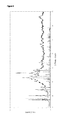
- FIG. 1 shows the XRD (X-Ray Diffraction) pattern of the calcined Al-MWW seed crystals obtained in reference Example 1, wherein the line pattern of MCM-22 has been included as a reference.
- the diffraction angle 2 theta in ° is shown along the abscissa and the intensities are plotted along the ordinate.
- FIG. 2 shows the XRD pattern of the B-MWW zeolitic product obtained in Example 1.
- the diffraction angle 2 theta in ° is shown along the abscissa and the intensities are plotted along the ordinate.
- FIG. 3 shows the nitrogen sorption isotherm of the calcined MWW zeolitic product obtained in Example 1.
- the relative pressure p/p° is plotted along the abscissa and the pore volume in cm 3 /g is plotted along the ordinate.
- FIG. 4 shows the 11 B MAS NMR of the calcined MWW product obtained according to Example 1.
- the chemical shift in ppm is plotted along the abscissa and the relative intensity is plotted along the ordinate.
- a blow-up of the NMR for the range of ppm values between 5 and 10 ppm is shown, wherein again the chemical shift in ppm is plotted along the abscissa and the relative intensity in arbitrary units is plotted along the ordinate
- FIG. 5 shows the XRD pattern of the MWW zeolitic product obtained in Example 2, wherein the line pattern of the MWW framework structure has been included as a reference.
- the diffraction angle 2 theta in ° is shown along the abscissa and the intensities are plotted along the ordinate.
- FIG. 6 shows the XRD patterns of the MWW zeolitic products synthesized with a SiO 2 /B 2 O 3 molar ratio of (a) 6.7, (b) 4.4, (c) 3.35, (d) 2.8, (e) 2.2, and (f) 1.9, according to Example 3.
- the diffraction angle 2 theta in ° is shown along the abscissa and the intensities are plotted along the ordinate.
- FIG. 7 shows the XRD patterns of the MWW zeolitic products synthesized with a CHA/SiO 2 molar ratio of (a) 0.184, (b) 0.294, and (c) 0.514, according to Example 4.
- the diffraction angle 2 theta in ° is shown along the abscissa and the intensities are plotted along the ordinate.
- FIG. 8 shows the XRD patterns of the MWW zeolitic products synthesized with a Na 2 O/SiO 2 molar ratio of (a) 0.052, (b) 0.105, (c) 0.131, (d) 0.166, and (e) 0.219, according to Example 5.
- the diffraction angle 2 theta in ° is shown along the abscissa and the intensities are plotted along the ordinate.
- FIG. 9 shows the XRD patterns of the products synthesized with a seed content of (a) 0 weight-%, (b) 2.5 weight-%, (c) 5 weight-%, and (d) 10 weight-%, according to Example 6.
- the diffraction angle 2 theta in ° is shown along the abscissa and the intensities are plotted along the ordinate.
- FIG. 10 shows the XRD pattern of the MWW zeolitic product obtained in Example 7.
- the diffraction angle 2 theta in ° is shown along the abscissa and the intensities are plotted along the ordinate.
- FIG. 11 shows the XRD pattern of the MWW zeolitic product obtained in Example 8.
- the diffraction angle 2 theta in ° is shown along the abscissa and the intensities are plotted along the ordinate.
- FIG. 12 shows the XRD patterns of the three products obtained in Comparative Example 1. Specifically, FIG. 12( a ) (top) is the XRD pattern of the product obtained with seed crystals and the organotemplate CHA; FIG. 12( b ) (middle) is the XRD pattern of the product obtained with the organotemplate CHA but without seed crystals; FIG. 12( c ) (bottom) is the XRD pattern of the product obtained with seed crystals but without the organotemplate CHA.
- the diffraction angle 2 theta in ° is shown along the abscissa and the intensities are plotted along the ordinate.
- the particle size and the crystallinity of the zeolitic materials according to the present invention were determined by XRD analysis.
- the data were collected using a standard Bragg-Brentano diffractometer with a Cu-X-ray source and an energy dispersive point detector. The angular range of 2° to 70° (2 theta) was scanned with a step size of 0.02°, while the variable divergence slit was set to a constant illuminated sample length of 20 mm.
- Solid-state NMR experiments were conducted by packing samples in ZrO 2 rotors under ambient air. Measurements were performed using a 14.1 Tesla Bruker Avance III spectrometer equipped with a 4 mm Bruker MAS probe, at 6 kHz Magic Angle Spinning, at approximately 298 K sample temperature. 11 B direct polarization spectra were obtained using ( ⁇ /2)-pulse excitation with 6 ⁇ s pulse width, with 11 B carrier frequency corresponding to ⁇ 4 ppm in the spectrum. Signal was acquired for 34 ms, recycling ca. 1500 scans with a delay of 2 s. Spectra were processed using Bruker Topspin with 20 Hz exponential line broadening, manual phasing, and manual baseline correction over the full spectrum width. The 11 B resonance frequency was referenced to BF 3 .Et 2 O as an external zero standard.
- the white suspension obtained was adjusted with an HNO 3 solution to reach a pH of about 6.0. Said suspension was then filtered, and washed with deionized water. The solid product, i.e., an Al-MWW precursor, was dried at 120° C. for 16 h.
- Calcination of the Al-MWW precursor affords the Al-MWW zeolite.
- the calcination may be carried out by heating up the Al-MWW precursor to 500° C. with a ramping rate of 1° C./min, and then maintaining it at 500° C. for 10 h. When doing so, 112 g of solid product was obtained.
- FIG. 1 shows the XRD pattern of the calcined product, from which it is apparent that said product has a MWW framework structure.
- the lattice constants a and c of the MWW product are determined to be 14.224 and 26.221 ⁇ , respectively.
- the crystallinity of the MWW product is 82%, as measured from the XRD results.
- the average crystal size is measured to be 16.5 nm.
- the calcined MWW product contains 38 weight-% of Si, 2.5 weight-% of Al, 0.22 weight-% of Na, and less than 0.5 weight-% of carbon.
- the calcined MWW product displays an SiO 2 :Al 2 O 3 molar ratio of 29.2.
- Example 1 Preparation of B-MWW Using the Layered Precursor of Al-MWW as Seed Crystals
- FIG. 2 shows the XRD pattern of the calcined product, from which it is apparent that said product has a MWW framework structure.
- the Si:B molar ratio of the obtained product is 32.8, as measured by the ICP.
- the yield of the product with respect to SiO 2 is 98%.
- FIG. 3 shows the N 2 sorption isotherm of the calcined MWW product.
- the BET specific surface area of said product according to DIN-ISO 9277:2010 is 356 m 2 /g. Furthermore, the product displays a micropore volume of 0.15 m 3 /g.
- FIG. 4 shows the 11 B MAS NMR of the calcined MWW product.
- B[ 4 ] tetrahedral boron coordination
- no signals from trigonal coordination sites (B[ 3 ]) are observed in the spectrum, such that according to the NMR spectrum, boron contained in the sample is exclusively present in the framework structure, where it is tetrahedrally coordinated.
- FIG. 5 shows the XRD pattern of the zeolitic product, from which it is apparent that the product has an MWW framework structure.
- the crystallinity of the MWW zeolite product is 76%.
- the average crystal size of the product is measured to be 22.5 nm.
- the lattice constants a and c of the MWW zeolite product are 14.087 and 26.109 ⁇ , respectively.
- the BET surface area of the MWW zeolite product is determined to be 209 m 2 /g.
- the MWW zeolite product contains 44 weight-% of Si, 0.78 weight-% of B, 0.12 weight-% of Al, and less than 0.1 weight-% of C, as measured by the elemental analysis.
- Example 1 was repeated but with different SiO 2 :B 2 O 3 molar ratios used for the gel precursor.
- SiO 2 :B 2 O 3 molar ratios of 6.7, 4.4, 3.35, 2.8, 2.2 and 1.9 were employed for the synthesis in order to investigate the effect of different SiO 2 :B 2 O 3 molar ratios on the crystallinity of the zeolitic products.
- FIG. 6 shows the XRD patterns of the zeolitic products obtained with different SiO 2 :B 2 O 3 molar ratios in the gel precursor. It can be seen from the XDR patterns that the MWW zeolites prepared with a higher SiO 2 :B 2 O 3 molar ratio displays a higher crystallinity based on the reflection intensity. For the zeolite prepared with a lower SiO 2 :B 2 O 3 molar ratio, the reflection peaks associated with the MWW framework structure can still be resolved, but with a relatively less intensity.
- sample a therein displays a high crystallinity in particular when compared to samples d-f prepared with low SiO 2 :B 2 O 3 molar ratios.
- said sample a is measured to have lattice parameter a of 13.986 ⁇ , and lattice parameter c of 25.969 Angstrom, based on its XRD pattern of FIG. 6 .
- Example 1 was repeated but with different CHA:SiO 2 molar ratios used for the gel precursor.
- CHA:SiO 2 molar ratios of 0.184, 0.294 and 0.514 were employed for the synthesis in order to investigate the effect of different CHA:SiO 2 molar ratios on the crystallinity of the zeolitic products.
- FIG. 7 shows the XRD patterns of the zeolitic products obtained with different CHA:SiO 2 molar ratios in the gel precursor. It can be seen from the XRD patterns that the MWW zeolite prepared with a high CHA:SiO 2 molar ratios such as 0.514 and 0.294 displays a relatively high crystallinity based on the intensity of the reflection peaks. For the zeolite prepared with a relatively low CHA:SiO 2 molar ratio such as 0.184, the reflection peaks associated with the MWW framework structure can still be resolved, but with a relatively less intensity.
- sample c therein displays a high crystallinity when compared to the samples prepared with a lower CHA/SiO 2 ratio.
- said sample c is measured to have lattice parameter a of 14.056 ⁇ , and lattice parameter c of 27.010 ⁇ , based on its XRD pattern of FIG. 7 .
- Example 1 was repeated but with different Na 2 O:SiO 2 molar ratios used for the gel precursor.
- Na 2 O:SiO 2 molar ratios of 0.052, 0.105, 0.131, 0.166 and 0.219 were employed for the preparation in order to investigate the effect of different Na 2 O:SiO 2 molar ratios on the crystallinity of the zeolitic products.
- FIG. 8 shows the XRD patterns of the zeolitic products obtained with different Na 2 O:SiO 2 molar ratios in the gel precursor. It can be seen from the XRD patterns that the MWW zeolite prepared with a high Na 2 O:SiO 2 molar ratios such as 0.514 and 0.294 displays a relatively high crystallinity based on the intensity of the reflection peaks. For the zeolite prepared with a relatively low Na 2 O:SiO 2 molar ratio such as 0.052, the intensity of the reflections peaks associated with the MWW framework structure is significantly decreased.
- sample e therein displays a high crystallinity in particular when compared to samples a and b prepared with lower Na 2 O/SiO 2 ratios.
- said sample e is measured to have lattice parameter a of 14.072 ⁇ , and lattice parameter c of 26.077 ⁇ , based on the XRD pattern of FIG. 8 .
- Example 1 was repeated but with different contents of Al-MWW precursors in the gel precursor. 0 weight-%, 2.5 weight-%, 5 weight-% and 10 weight-% of Al-MWW precursors with respect to the SiO 2 source of the colloidal silica were used for the samples in order to investigate the effect of seed contents on the crystallinity of the zeolitic products.
- FIG. 9 shows the XRD patterns of the products obtained with different seed contents in the gel precursor. It can be seen from the XDR patterns that the zeolite prepared with a high seed contents such as 5 weight-% and 10 weight-% displays a relatively high crystallinity based on the intensity of the reflection peaks. For the synthesis in the absence of seeds, the obtained product is amorphous, as demonstrated by the XRD pattern of sample a with 0 weight-% seeds in FIG. 9 .
- Example 1 was repeated but by using the calcined Al-MWW zeolite as seed crystals (obtained from Reference Example 1). Since the Al-MWW seed crystals have been calcined under high temperatures, no additional organotemplate is introduced from the seed crystals, as supported by the very low carbon content of the seed crystals measured by the elemental analysis (see Reference Example 1).
- FIG. 10 shows the XRD pattern of the obtained product, from which it is apparent that said product has an MWW framework structure.
- FIG. 11 shows the XRD pattern of the product after calcination thereof, from which the typical pattern of the MWW framework structure is apparent.
- Example 1 was repeated but using Li as the alkali metal in the synthetic gel having a molar composition of 0.156 Li 2 O:1 SiO 2 :0.22B 2 O 3 :40:H 2 O:0.33 CHA, to which 5 weight-% of Al-MWW layered precursor relative SiO 2 of the gel was added.
- the obtained zeolitic product is characterized by a typical MWW framework structure, as measured by the XRD. Therefore, Li can also be used as the alkali metal for the synthesis of B-MWW zeolitic materials.
- Example 1 was repeated but using a molar composition of 0.131 Na 2 O:1 SiO 2 :0.354B 2 O 3 : 41 H 2 O:0.514 CHA for the synthetic gel, to which 5 weight-% of Al-MWW layered precursor relative to SiO 2 of the get was added.
- FIG. 12( a ) shows the XRD pattern of the obtained zeolitic product, from which it is apparent that said product has a MWW framework structure.
- FIGS. 12( b ) and 12( c ) show the XRD patterns of the final products obtained without seed crystals and without the organotemplate CHA, respectively, it may be taken from FIGS. 12( b ) and 12( c ) that both products are amorphous.
- a comparison of the XRD results of FIG. 12 shows that the use of a combination of seed crystals and the organotemplate is essential for the successful synthesis of the B-MWW zeolitic product. Therefore, the use of seed crystals but without the organotemplate, as well as the use of the organotemplate but without seed crystals, does not lead to the formation of the MWW zeolitic product.
Landscapes
- Chemical & Material Sciences (AREA)
- Organic Chemistry (AREA)
- General Life Sciences & Earth Sciences (AREA)
- Geology (AREA)
- Life Sciences & Earth Sciences (AREA)
- Chemical Kinetics & Catalysis (AREA)
- Engineering & Computer Science (AREA)
- Inorganic Chemistry (AREA)
- Materials Engineering (AREA)
- Analytical Chemistry (AREA)
- Environmental & Geological Engineering (AREA)
- Health & Medical Sciences (AREA)
- Biomedical Technology (AREA)
- General Chemical & Material Sciences (AREA)
- Oil, Petroleum & Natural Gas (AREA)
- Silicates, Zeolites, And Molecular Sieves (AREA)
- Catalysts (AREA)
- Solid-Sorbent Or Filter-Aiding Compositions (AREA)
Abstract
Description
-
- (a) providing a mixture comprising one or more sources for YO2, one or more sources for B2O3, one or more organotemplates, and seed crystals,
- (b) crystallizing the mixture obtained in (a) for obtaining a layered precursor of the boron-containing MWW-type zeolitic material,
- (c) calcining the layered precursor obtained in (b) for obtaining the boron-containing zeolitic material having an MWW framework structure,
wherein the one or more organotemplates have the formula (I)
R1R2R3N (I)
wherein R1 is (C5-C8)cycloalkyl, and
wherein R2 and R3 are independently from each other H or alkyl.
R1R2R3N (I)
wherein R1 is (C5-C8)cycloalkyl, and
wherein R2 and R3 are independently from each other H or alkyl.
-
- (i) isolating the layered precursor obtained in step (b), preferably by filtration,
- (ii) optionally washing the layered precursor obtained in step (i),
- (iii) optionally drying the layered precursor obtained in step (i) or (ii).
-
- (iv) deboronating the boron-containing zeolitic material having an MWW framework structure obtained in step (c) with a liquid solvent system, thereby obtaining a deboronated zeolitic material having an MWW framework structure.
- 1. A process for the production of a boron-containing zeolitic material having an MWW framework structure comprising YO2 and B2O3, wherein Y stands for a tetravalent element, wherein said process comprises
- (a) providing a mixture comprising one or more sources for YO2, one or more sources for B2O3, one or more organotemplates, and seed crystals,
- (b) crystallizing the mixture obtained in (a) for obtaining a layered precursor of the boron-containing MWW-type zeolitic material,
- (c) calcining the layered precursor obtained in (b) for obtaining the boron-containing zeolitic material having an MWW framework structure,
- wherein the one or more organotemplates have the formula (I)
R1R2R3N (I)
wherein R1 is (C5-C8)cycloalkyl, and
wherein R2 and R3 are independently from each other H or alkyl.
- 2. The process of embodiment 1, wherein R1 is selected from the group consisting of substituted and/or unsubstituted cyclopentyl, cyclohexyl, cycloheptyl, and cyclooctyl, more preferably from the group consisting of substituted and/or unsubstituted cyclopentyl, cyclohexyl and cycloheptyl, wherein more preferably R1 is substituted or unsubstituted cyclohexyl or cycloheptyl, more preferably substituted or unsubstituted cyclohexyl, more preferably unsubstituted cyclohexyl.
- 3. The process of
embodiment 1 or 2, wherein R2 and R3 are independently from each other H or (C1-C3) alkyl, wherein more preferably R2 and R3 are independently from each other selected from the group consisting of H, methyl, ethyl and propyl, wherein more preferably R2 and R3 are H. - 4. The process of any one of embodiments 1 to 3, wherein the seed crystals comprise YO2 and X2O3, wherein X is a trivalent element, wherein X is preferably selected from the group consisting of Al, B, In, Ga, and combinations of two or more thereof, X more preferably being Al and/or B, more preferably being B.
- 5. The process of any one of embodiments 1 to 4, wherein Y is selected from the group consisting of Si, Sn, Ti, Zr, Ge and combinations of two or more thereof, Y preferably being Si and/or Ti, wherein more preferably Y is Si.
- 6. The process of any one of embodiments 1 to 5, wherein Y is Si, and wherein the one or more sources for YO2 according to (a) are selected from the group consisting of silicas, silicates, silicic acid and combinations of two or more thereof, preferably selected from the group consisting of silicas, alkali metal silicates, silicic acid, and combinations of two or more thereof, more preferably selected from the group consisting of fumed silica, silica hydrosol, colloidal silica, reactive amorphous solid silica, silica gel, pyrogenic silica, lithium silicates, sodium silicates, potassium silicates, silicic acid, and combinations of two or more thereof, more preferably selected from the group consisting of fumed silica, silica hydrosol, colloidal silica, silica gel, pyrogenic silica, sodium silicates, silicic acid, and combinations of two or more thereof, more preferably selected from the group consisting of fumed silica, silica hydrosol, colloidal silica, silica gel, pyrogenic silica, and combinations of two or more thereof, wherein more preferably the one or more sources for YO2 are silica hydrosol and/or colloidal silica, more preferably colloidal silica.
- 7. The process of any one of embodiments 1 to 6, wherein the one or more sources for B2O3 according to (a) are selected from the group consisting of boric acid, boron oxide, borates, borate esters, and combinations of two or more thereof, preferably selected from the group consisting of boric acid, boron oxide, orthoborates, diborates, triborates, tetraborates, trimethyl borate, triethyl borate, and combinations of two or more thereof, wherein more preferably the one or more sources for B2O3 are boron oxide and/or boric acid, more preferably boric acid.
- 8. The process of any one of embodiments 1 to 7, wherein the molar ratio YO2:B2O3 of the one or more sources of YO2 to the one or more sources for B2O3 in the mixture provided according to (a) is in the range of from 1:1 to 300:1, preferably from 1.2:1 to 100:1, more preferably from 1.4:1 to 50:1, more preferably from 1.6:1 to 20:1, more preferably from 1.8:1 to 10:1, more preferably from 2.0:1 to 8:1, more preferably from 2.1:1 to 7:1.
- 9. The process of any one of embodiments 1 to 8, wherein the one or more organotemplates are selected from the group consisting of substituted and/or unsubstituted (C5-C8)cycloalkylamines, preferably selected from the group consisting of substituted and/or unsubstituted cyclopentylamine, cyclohexylamine, cycloheptylamine, cyclooctylamine, and combinations of two or more thereof, wherein more preferably the one or more organotemplates are substituted and/or unsubstituted cyclohexylamine and/or cycloheptylamine, more preferably unsubstituted cyclohexylamine.
- 10. The process of any one of embodiments 1 to 9, wherein apart from organotemplate optionally contained in the seed crystals, the mixture provided according to (a) does not contain piperidine or hexamethyleneimine, preferably does not contain piperidine and hexamethyleneimine, more preferably does not contain (C4-C7)alkyleneimines and (C5-C8)alkylamines other than the one or more organotemplates according to formula (I), and more preferably does not contain alkyleneimines and alkylamines other than the one or more organotemplates according to formula (I).
- 11. The process of any one of embodiments 1 to 10, wherein the molar ratio organotemplate:YO2 of the one or more organotemplates to the one or more sources for YO2 in the mixture provided according to (a) is in the range of from 0.02:1 to 10:1, preferably from 0.05:1 to 4:1, more preferably from 0.1:1 to 2:1, more preferably from 0.15:1 to 1:1, more preferably from 0.2:1 to 0.8:1, more preferably from 0.23:1 to 0.7:1, more preferably from 0.25:1 to 0.6:1, wherein the one or more organotemplates do not include organotemplate optionally contained in the seed crystals.
- 12. The process of any one of embodiments 1 to 11, wherein the molar ratio YO2:B2O3:organotemplate of the one or more sources of YO2 to the one or more sources of B2O3 to the one or more organotemplates in the mixture provided according to (a) is in the range of 0.003-2):(0.02-10), preferably in the range of 1:(0.01-1.6):(0.05-4), more preferably in the range of 1:(0.02-1.3):(0.1-2), more preferably in the range of 1:(0.05-1):(0.15-1), more preferably in the range of 1:(0.1-0.8):(0.2-0.8), more preferably in the range of 1:(0.13-0.6):(0.23-0.7), more preferably in the range of 1:(0.14-0.48):(0.25-0.6), wherein the one or more organotemplates do not include organotemplate optionally contained in the seed crystals.
- 13. The process of any one of embodiments 1 to 12, wherein the mixture provided according to (a) comprises one or more sources for M2O, wherein M stands for one or more alkali metals M, wherein the one or more alkali metals M are preferably selected from the group consisting of Li, Na, K, Rb, Cs, and combinations of two or more thereof, more preferably from the group consisting of Li, Na, Rb and combinations of two or more thereof, wherein more preferably the one or more alkali metals M are Li and/or Na, more preferably Na.
- 14. The process of embodiment 13, wherein the molar ratio M2O:YO2 of the mixture provided according to (a) is in the range of from 0.01:1 to 5:1, preferably from 0.02:1 to 2:1, more preferably from 0.04:1 to 1:1, more preferably from 0.06:1 to 0.6:1, more preferably from 0.08:1 to 0.4:1, more preferably from 0.1:1 to 0.25:1.
- 15. The process of embodiment 13 or 14, wherein the molar ratio YO2:B2O3:M2O of the mixture provided in (a) is in the range of (2-300):1:(0.01-200), preferably in the range of (5-200):1:(0.1-100), more preferably in the range of (10-150):1:(0.5-60), more preferably in the range of (20-100):1:(1-40), more preferably in the range of (40-90):1:(2-30), more preferably in the range of (50-80):1:(4-20), more preferably in the range of (60-70):1:(5-15).
- 16. The process of any one of embodiments 1 to 15, wherein the amount of seed crystals in the mixture provided in (a) is in the range of from 0.05 to 80 weight-% based on 100 weight-% of YO2 in the one or more sources for YO2, preferably from 0.1 to 60 weight-%, more preferably from 0.2 to 40 weight-%, more preferably from 0.5 to 25 weight-%, more preferably from 1 to 20 weight-%, more preferably from 2 to 15 weight-%, more preferably from 4 to 12 weight-%, more preferably from 5 to 10 weight-%.
- 17. The process of any one of embodiments 1 to 16, wherein the mixture provided in (a) further comprises one or more solvents, wherein the one or more solvents preferably comprise water and/or one or more organic solvents, more preferably comprises one or more solvents selected from the group consisting of water, monohydric alcohols, polyhydric alcohols, and combinations of two or more thereof, more preferably selected from the group consisting of water, methanol, ethanol, propanol, butanol, pentanol, ethane-1,2-diol, propane-1,2-diol, propane-1,2,3-triol, butane-1,2,3,4-tetraol, pentane-1,2,3,4,5-pentol, and combinations of two or more thereof, more preferably selected from the group consisting of water, methanol, ethanol, 2-propanol, and mixtures of two or more thereof, wherein more preferably the one or more solvents comprise water, wherein more preferably water is contained as the one or more solvents further provided in (a).
- 18. The process of embodiment 17, wherein the molar ratio solvent:YO2 of the one or more solvents to the one or more sources of YO2 in the mixture provided in (a) is in the range of from 1:1 to 250:1, preferably from 2:1 to 200:1, more preferably from 5:1 to 150:1, more preferably from 10:1 to 100:1, more preferably from 20:1 to 70:1, more preferably from 30:1 to 50:1, and more preferably from 35:1 to 45:1.
- 19. The process of any one of embodiments 1 to 18, wherein the crystallization in (b) involves heating of the mixture, preferably at a temperature in the range of from 80 to 250° C., preferably from 100 to 230° C., more preferably from 115 to 210° C., more preferably from 130 to 200° C., more preferably from 140 to 190° C., more preferably from 150 to 180° C.
- 20. The process of any one of embodiments 1 to 19, wherein the crystallization in (b) is conducted under solvothermal conditions, preferably under hydrothermal conditions.
- 21. The process of any one of embodiments 1 to 20, wherein the crystallization in (b) is carried out under non-static conditions, preferably under agitation, more preferably under rotating and/or stirring, wherein more preferably the crystallization in (b) is carried out under stirring.
- 22. The process of any one of embodiments 1 to 21, wherein the crystallization in (b) is carried out for a period in the range of from 4 h to 20 d, preferably from 12 h to 10 d, more preferably from 1 d to 8 d, more preferably from 2 d to 6 d, more preferably from 3 to 5 d, more preferably from 3.5 to 4.5 d.
- 23. The process of any one of embodiments 1 to 22, wherein after step (b) and prior to step (c) the process further comprises
- (i) isolating the layered precursor obtained in (b), preferably by filtration,
- (ii) optionally washing the layered precursor obtained in (i),
- (iii) optionally drying the layered precursor obtained in (i) or (ii).
- 24. The process of any one of embodiments 1 to 23, wherein the calcination in (c) is carried out at a temperature in the range of from 300 to 900° C., preferably from 400 to 700° C., more preferably from 450 to 650° C., more preferably from 500 to 600° C.
- 25. The process of any one of embodiments 1 to 24, wherein after step (c) the process further comprises
- (iv) deboronating the boron-containing zeolitic material having an MWW framework structure obtained in (c) with a liquid solvent system, thereby obtaining a deboronated zeolitic material having an MWW framework structure.
- 26. The process of
embodiment 25, wherein the liquid solvent system in (iv) is selected from the group consisting of water, monohydric alcohols, polyhydric alcohols, and mixtures of two or more thereof, and wherein said liquid solvent system does not contain an inorganic or organic acid or a salt thereof, the acid being selected from the group consisting of hydrochloric acid, sulfuric acid, nitric acid, phosphoric acid, formic acid, propionic acid, oxalic acid, and tartaric acid. - 27. The process of
embodiment 25 or 26, wherein the deboronation in (iv) is carried out at a temperature in the range of from 50 to 125° C., preferably from 70 to 120° C., more preferably from 90 to 115° C., more preferably from 90 to 110° C. - 28. The process of any one of
embodiments 25 to 27, wherein the deboronation in (iv) is carried out for a time period in the range of from 6 to 20 h, preferably from 7 to 17 h, more preferably from 8 to 14 h, more preferably from 9 to 12 h. - 29. The process of any one of embodiments 1 to 28, wherein the seed crystals comprise a zeolitic material having an MWW framework structure and/or a layered precursor of a zeolitic material having an MWW framework structure, and wherein preferably the seed crystals comprise a layered precursor of a zeolitic material having an MWW framework structure.
- 30. The process of embodiment 29, wherein the layered precursor of a zeolitic material having an MWW framework structure is obtainable according to step (b) of the process of any one of embodiments 1 to 23 and/or the zeolitic material having an MWW framework structure is obtainable according to the process of any one of embodiments 1 to 28.
- 31. A synthetic boron-containing zeolitic material having an MWW framework structure obtainable and/or obtained according to the process of any one of embodiments 1 to 30.
- 32. The synthetic zeolitic material of embodiment 31, wherein the lattice parameter for the c-axis of the crystal structure as obtained from X-ray structure analysis is in the range of from 25.0 to 27.8 Angstrom, preferably from 26.0 to 27.5 Angstrom, more preferably from 26.5 to 27.2 Angstrom, more preferably from 26.8 to 27.1 Angstrom, more preferably from 26.9 to 27.05 Angstrom, and more preferably from 26.99 to 27.03 Angstrom.
- 33. Use of a synthetic zeolitic material having an MWW framework structure according to embodiment 31 or 32 as a molecular sieve, as an adsorbent, preferably for ion-exchange and/or for separation of gas or liquid mixtures, as a catalyst and/or as a catalyst component, preferably for hydrocarbon conversion, dehydration, epoxidation, epoxide ring opening, etherification, esterification, ammoxidation, or diesel oxidation catalysis, more preferably for isomerization, alkylation, or epoxidation, and wherein more preferably the zeolitic material having an MWW framework structure is used as a catalyst for epoxidation or alkylation.
Claims (14)
R1R2R3N formula (I)
Applications Claiming Priority (7)
| Application Number | Priority Date | Filing Date | Title |
|---|---|---|---|
| EP14171555 | 2014-06-06 | ||
| EP14171555.7 | 2014-06-06 | ||
| EP14171555 | 2014-06-06 | ||
| CNPCT/CN2014/089783 | 2014-10-29 | ||
| CN2014089783 | 2014-10-29 | ||
| WOPCT/CN2014/089783 | 2014-10-29 | ||
| PCT/EP2015/062385 WO2015185633A1 (en) | 2014-06-06 | 2015-06-03 | Synthesis of a boron-containing zeolite with an mww framework structure |
Related Parent Applications (1)
| Application Number | Title | Priority Date | Filing Date |
|---|---|---|---|
| PCT/EP2015/062385 A-371-Of-International WO2015185633A1 (en) | 2014-06-06 | 2015-06-03 | Synthesis of a boron-containing zeolite with an mww framework structure |
Related Child Applications (1)
| Application Number | Title | Priority Date | Filing Date |
|---|---|---|---|
| US16/202,918 Division US10793443B2 (en) | 2014-06-06 | 2018-11-28 | Synthesis of a boron-containing zeolite with an MWW framework structure |
Publications (2)
| Publication Number | Publication Date |
|---|---|
| US20180134570A1 US20180134570A1 (en) | 2018-05-17 |
| US10196276B2 true US10196276B2 (en) | 2019-02-05 |
Family
ID=53366020
Family Applications (2)
| Application Number | Title | Priority Date | Filing Date |
|---|---|---|---|
| US15/316,220 Active 2035-06-26 US10196276B2 (en) | 2014-06-06 | 2015-06-03 | Synthesis of a boron-containing zeolite with an MWW framework structure |
| US16/202,918 Active US10793443B2 (en) | 2014-06-06 | 2018-11-28 | Synthesis of a boron-containing zeolite with an MWW framework structure |
Family Applications After (1)
| Application Number | Title | Priority Date | Filing Date |
|---|---|---|---|
| US16/202,918 Active US10793443B2 (en) | 2014-06-06 | 2018-11-28 | Synthesis of a boron-containing zeolite with an MWW framework structure |
Country Status (5)
| Country | Link |
|---|---|
| US (2) | US10196276B2 (en) |
| EP (1) | EP3152161A1 (en) |
| JP (1) | JP6629304B2 (en) |
| CN (1) | CN106536411B (en) |
| WO (1) | WO2015185633A1 (en) |
Cited By (4)
| Publication number | Priority date | Publication date | Assignee | Title |
|---|---|---|---|---|
| US10544116B2 (en) | 2016-07-20 | 2020-01-28 | Basf Se | Process for purifying propylene oxide |
| US10793443B2 (en) * | 2014-06-06 | 2020-10-06 | Basf Se | Synthesis of a boron-containing zeolite with an MWW framework structure |
| US10875777B2 (en) | 2016-07-29 | 2020-12-29 | Basf Corporation | Process for the preparation of a zeolitic material having a FAU-type framework structure and use thereof in the selective catalytic reduction of NOx |
| US20220064011A1 (en) * | 2016-09-06 | 2022-03-03 | Basf Se | Solidothermal synthesis of a boron-containing zeolite with an mww framework structure |
Families Citing this family (10)
| Publication number | Priority date | Publication date | Assignee | Title |
|---|---|---|---|---|
| KR102558113B1 (en) | 2015-02-12 | 2023-07-24 | 바스프 에스이 | Method for producing dealuminated zeolitic materials having a BEA framework structure |
| JP6741687B2 (en) | 2015-05-04 | 2020-08-19 | ビーエーエスエフ ソシエタス・ヨーロピアBasf Se | How to prepare melon |
| US10202323B2 (en) | 2015-07-15 | 2019-02-12 | Basf Se | Process for preparing an arylpropene |
| CN108290134A (en) | 2015-11-27 | 2018-07-17 | 巴斯夫欧洲公司 | The ultrafast high space time yield synthesis of metal-organic framework |
| EP3178788A1 (en) | 2015-12-08 | 2017-06-14 | Basf Se | A tin-containing zeolitic material having a bea framework structure |
| ES2899827T3 (en) | 2015-12-08 | 2022-03-14 | Basf Se | Tin-containing zeolitic material having a BEA framework structure |
| CN109250726B (en) * | 2017-07-12 | 2020-10-27 | 中国石油大学(华东) | Synthesis method of TS-1 zeolite molecular sieve |
| CN118973959A (en) * | 2022-04-05 | 2024-11-15 | 埃克森美孚化学专利公司 | MWW zeolite nanoparticles with non-compacted layer structure and preparation method thereof |
| CN118002192B (en) * | 2022-11-08 | 2025-05-09 | 中国石油天然气股份有限公司 | A solid acid alkylation catalyst and its preparation method and application |
| WO2024126475A1 (en) | 2022-12-13 | 2024-06-20 | Basf Se | Process for the production of an alkylstyrene and of an alkylphenyl propionic acid |
Citations (13)
| Publication number | Priority date | Publication date | Assignee | Title |
|---|---|---|---|---|
| EP0293032A2 (en) | 1987-05-26 | 1988-11-30 | ENIRICERCHE S.p.A. | Synthetic, crystalline, porous material containing oxides of silicon and boron |
| US4954325A (en) | 1986-07-29 | 1990-09-04 | Mobil Oil Corp. | Composition of synthetic porous crystalline material, its synthesis and use |
| US4992615A (en) | 1990-01-25 | 1991-02-12 | Mobil Oil Corp. | Isoparaffin-olefin alkylation process |
| US5107047A (en) | 1990-08-23 | 1992-04-21 | Mobil Oil Corporation | Zeolite MCM-22 catalysts for olefin isomerization |
| US5173281A (en) | 1991-10-07 | 1992-12-22 | Mobil Oil Corp. | Synthesis of a synthetic porous crystalline material |
| US5284643A (en) | 1992-12-10 | 1994-02-08 | Mobil Oil Corp. | Gallium-containing zeolite MCM-22 |
| WO2007094937A1 (en) | 2006-02-14 | 2007-08-23 | Exxonmobil Chemical Patents Inc. | A process for manufacturing mcm-22 family molecular sieves |
| US20080027260A1 (en) | 2006-07-28 | 2008-01-31 | Wenyih Frank Lai | MCM-22 family molecular sieve composition, its method of making, and use for hydrocarbon conversions |
| US20100260665A1 (en) * | 2009-04-09 | 2010-10-14 | Raymond Archer | Molecular sieves and related methods and structure directing agents |
| CN102351210A (en) | 2011-07-18 | 2012-02-15 | 天津市福生染料厂 | Preparation method for synthesizing MCM-22 molecular sieves by using cyclohexane as template agent |
| CN102874834A (en) | 2011-07-11 | 2013-01-16 | 中国石油化工股份有限公司 | Synthetic method of MWW structured Si/B molecular sieve |
| US20140128622A1 (en) * | 2012-11-05 | 2014-05-08 | Basf Se | Process for the Oxidation of Organic Carbonyl Compounds |
| US20170001873A1 (en) * | 2013-09-24 | 2017-01-05 | China Petroleum & Chemical Corporation | Molecular sieve, manufacturing method therefor, and uses thereof |
Family Cites Families (6)
| Publication number | Priority date | Publication date | Assignee | Title |
|---|---|---|---|---|
| DE69525860T2 (en) * | 1995-03-17 | 2002-06-27 | Chevron U.S.A. Inc., San Ramon | PRODUCTION OF ZEOLITES USING ORGANIC TEMPLATE AND AMINE |
| BRPI0407183B8 (en) * | 2003-02-03 | 2016-05-17 | Showa Denko Kk | process for producing a modified layered metallosilicate material as well as modified layered metallosilicate material obtained by said process |
| CN100453462C (en) * | 2006-03-09 | 2009-01-21 | 北京化工大学 | A method for synthesizing zeolite |
| US9522390B2 (en) * | 2010-12-10 | 2016-12-20 | The Regents Of The University Of California | Oxide materials and synthesis by fluoride/chloride anion promoted exfoliation |
| RU2638851C2 (en) * | 2012-10-18 | 2017-12-18 | Басф Се | Post-treatment of deborated zeolite mww |
| US10196276B2 (en) * | 2014-06-06 | 2019-02-05 | Basf Se | Synthesis of a boron-containing zeolite with an MWW framework structure |
-
2015
- 2015-06-03 US US15/316,220 patent/US10196276B2/en active Active
- 2015-06-03 JP JP2017516194A patent/JP6629304B2/en active Active
- 2015-06-03 WO PCT/EP2015/062385 patent/WO2015185633A1/en not_active Ceased
- 2015-06-03 EP EP15727636.1A patent/EP3152161A1/en active Pending
- 2015-06-03 CN CN201580042035.4A patent/CN106536411B/en active Active
-
2018
- 2018-11-28 US US16/202,918 patent/US10793443B2/en active Active
Patent Citations (16)
| Publication number | Priority date | Publication date | Assignee | Title |
|---|---|---|---|---|
| US4954325A (en) | 1986-07-29 | 1990-09-04 | Mobil Oil Corp. | Composition of synthetic porous crystalline material, its synthesis and use |
| EP0293032A2 (en) | 1987-05-26 | 1988-11-30 | ENIRICERCHE S.p.A. | Synthetic, crystalline, porous material containing oxides of silicon and boron |
| US4992615A (en) | 1990-01-25 | 1991-02-12 | Mobil Oil Corp. | Isoparaffin-olefin alkylation process |
| US5107047A (en) | 1990-08-23 | 1992-04-21 | Mobil Oil Corporation | Zeolite MCM-22 catalysts for olefin isomerization |
| US5173281A (en) | 1991-10-07 | 1992-12-22 | Mobil Oil Corp. | Synthesis of a synthetic porous crystalline material |
| US5284643A (en) | 1992-12-10 | 1994-02-08 | Mobil Oil Corp. | Gallium-containing zeolite MCM-22 |
| US5382742A (en) | 1992-12-10 | 1995-01-17 | Mobil Oil Corp. | Gallium-containing zeolite MCM-22 |
| CN101384367A (en) | 2006-02-14 | 2009-03-11 | 埃克森美孚化学专利公司 | A kind of method of manufacturing MCM-22 family molecular sieve |
| WO2007094937A1 (en) | 2006-02-14 | 2007-08-23 | Exxonmobil Chemical Patents Inc. | A process for manufacturing mcm-22 family molecular sieves |
| US20080027260A1 (en) | 2006-07-28 | 2008-01-31 | Wenyih Frank Lai | MCM-22 family molecular sieve composition, its method of making, and use for hydrocarbon conversions |
| WO2008013644A1 (en) | 2006-07-28 | 2008-01-31 | Exxonmobil Chemical Patents Inc. | A mcm-22 family molecular sieve composition, its method of making, and use for hydrocarbon conversions |
| US20100260665A1 (en) * | 2009-04-09 | 2010-10-14 | Raymond Archer | Molecular sieves and related methods and structure directing agents |
| CN102874834A (en) | 2011-07-11 | 2013-01-16 | 中国石油化工股份有限公司 | Synthetic method of MWW structured Si/B molecular sieve |
| CN102351210A (en) | 2011-07-18 | 2012-02-15 | 天津市福生染料厂 | Preparation method for synthesizing MCM-22 molecular sieves by using cyclohexane as template agent |
| US20140128622A1 (en) * | 2012-11-05 | 2014-05-08 | Basf Se | Process for the Oxidation of Organic Carbonyl Compounds |
| US20170001873A1 (en) * | 2013-09-24 | 2017-01-05 | China Petroleum & Chemical Corporation | Molecular sieve, manufacturing method therefor, and uses thereof |
Non-Patent Citations (6)
| Title |
|---|
| International Search Report and Written Opinion dated Jul. 3, 2015 in PCT/EP2015/062385. |
| LAWTON S L, ET AL: "Zeolite MCM-49: A Three-Dimensional MCM-22 Analogue Synthesized by in Situ Crystallization", JOURNAL OF PHYSICAL CHEMISTRY, AMERICAN CHEMICAL SOCIETY, US, vol. 100, no. 9, 29 February 1996 (1996-02-29), US, pages 3788 - 3798, XP002526409, ISSN: 0022-3654, DOI: 10.1021/jp952871e |
| Michael E. Leonowicz, et al., "MCM-22: A Molecular Sieve with Two Independent Multidimensional Channel Systems" Science, vol. 264, Jun. 24, 1994, Downloaded from http://science.sciencemag.org/content/264/5167/1910 on Nov. 30, 2016, pp. 1910-1913. |
| S. I. Zones, et al., "Synthesis of High Silica Zeolites Using a Mixed Quaternary Ammonium Cation, Amine Approach: Discovery of Zeolite SSZ-47" Chem. Mater. , vol. 14, No. 1, XP001092671, Jan. 1, 2002, pp. 313-320. |
| Stephen L. Lawton, et al., "Zeolite MCM-49: A Three-Dimensional Mcm-22 Analogue Synthesized by in Situ Crystallization" J. Phys. Chem. , vol. 100, No. 9, XP002526409,Feb. 29, 1996, pp. 3788-3798. |
| ZONES S I, HWANG S-J: "SYNTHESIS OF HIGH SILICA ZEOLITES USING A MIXED QUATERNARY AMMONIUM CATION, AMINE APPROACH: DISCOVERY F ZEOLITE SSZ-47", CHEMISTRY OF MATERIALS, AMERICAN CHEMICAL SOCIETY, vol. 14, no. 01, 1 January 2002 (2002-01-01), pages 313 - 320, XP001092671, ISSN: 0897-4756, DOI: 10.1021/cm011166h |
Cited By (5)
| Publication number | Priority date | Publication date | Assignee | Title |
|---|---|---|---|---|
| US10793443B2 (en) * | 2014-06-06 | 2020-10-06 | Basf Se | Synthesis of a boron-containing zeolite with an MWW framework structure |
| US10544116B2 (en) | 2016-07-20 | 2020-01-28 | Basf Se | Process for purifying propylene oxide |
| US10875777B2 (en) | 2016-07-29 | 2020-12-29 | Basf Corporation | Process for the preparation of a zeolitic material having a FAU-type framework structure and use thereof in the selective catalytic reduction of NOx |
| US20220064011A1 (en) * | 2016-09-06 | 2022-03-03 | Basf Se | Solidothermal synthesis of a boron-containing zeolite with an mww framework structure |
| US12157674B2 (en) * | 2016-09-06 | 2024-12-03 | Basf Se | Solidothermal synthesis of a boron-containing zeolite with an MWW framework structure |
Also Published As
| Publication number | Publication date |
|---|---|
| WO2015185633A1 (en) | 2015-12-10 |
| US20180134570A1 (en) | 2018-05-17 |
| WO2015185633A9 (en) | 2016-05-26 |
| JP6629304B2 (en) | 2020-01-15 |
| EP3152161A1 (en) | 2017-04-12 |
| US20190177174A1 (en) | 2019-06-13 |
| CN106536411B (en) | 2020-05-12 |
| JP2017518255A (en) | 2017-07-06 |
| CN106536411A (en) | 2017-03-22 |
| US10793443B2 (en) | 2020-10-06 |
Similar Documents
| Publication | Publication Date | Title |
|---|---|---|
| US10793443B2 (en) | Synthesis of a boron-containing zeolite with an MWW framework structure | |
| US12157674B2 (en) | Solidothermal synthesis of a boron-containing zeolite with an MWW framework structure | |
| KR101627953B1 (en) | Molecular sieve material, its synthesis and use | |
| CN109890756B (en) | Aluminum substituted molecular sieve CIT-13 | |
| KR102172784B1 (en) | Emm-25 molecular sieve material, its synthesis and use | |
| US9475041B2 (en) | Zeolitic materials and methods for their preparation using alkenyltrialkylammonium compounds | |
| JP7138697B2 (en) | Molecular sieve SSZ-112, its synthesis and use | |
| KR102676404B1 (en) | Molecular sieve SSZ-110, its synthesis and uses | |
| JP6285028B2 (en) | Zeolite SSZ-70 with increased outer surface area | |
| RU2622300C2 (en) | Zeolite materials, and manufacturing methods using alcenyiltriammonium compounds | |
| JP2019511990A (en) | Small crystals, high surface area EMM-30 zeolites, their synthesis and use | |
| JP2026509429A (en) | EMM-74 Molecular Sieve Composition, Synthesis and Use thereof | |
| CN113966251A (en) | Direct synthesis of aluminosilicate zeolitic materials of the IWR framework structure type and their use in catalysis | |
| EP4486698A1 (en) | Emm-73 molecular sieve compositions, syntheses, and uses | |
| CN117651692B (en) | Use of 1-methyl-6, 7-dihydro-5H-cyclopenta [ B ] pyridin-1-ium cations as structure directing agents for the preparation of zeolites and zeolites obtained therewith | |
| KR20160066043A (en) | Molecular sieve ssz-96 composition of matter and synthesis thereof | |
| CN117651692A (en) | The use of 1-methyl-6,7-dihydro-5H-cyclopenta[B]pyridin-1-ium cation as a structure directing agent for the preparation of zeolites and the zeolites obtained therefrom |
Legal Events
| Date | Code | Title | Description |
|---|---|---|---|
| AS | Assignment |
Owner name: ZHEJIANG UNIVERSITY, CHINA Free format text: ASSIGNMENT OF ASSIGNORS INTEREST;ASSIGNORS:MENG, XIANGJU;XIAO, FENG-SHOU;WANG, YEQING;SIGNING DATES FROM 20170207 TO 20170220;REEL/FRAME:042758/0274 Owner name: BASF SE, GERMANY Free format text: ASSIGNMENT OF ASSIGNORS INTEREST;ASSIGNORS:MAURER, STEFAN;PARVULESCU, ANDREI-NICOLAE;MUELLER, ULRICH;SIGNING DATES FROM 20160910 TO 20161027;REEL/FRAME:042758/0285 |
|
| AS | Assignment |
Owner name: ZHEJIANG UNIVERSITY, CHINA Free format text: CORRECTIVE ASSIGNMENT TO CORRECT THE ASSIGNEE'S ADDRESS PREVIOUSLY RECORDED ON REEL 042758 FRAME 0274. ASSIGNOR(S) HEREBY CONFIRMS THE ASSIGNMENT;ASSIGNORS:MENG, XIANGJU;XIAO, FENG-SHOU;WANG, YEQING;REEL/FRAME:044957/0691 Effective date: 20170224 |
|
| AS | Assignment |
Owner name: BASF SE, GERMANY Free format text: ASSIGNMENT OF ASSIGNORS INTEREST;ASSIGNOR:BASF (CHINA) COMPANY LIMITED;REEL/FRAME:045105/0842 Effective date: 20171204 Owner name: BASF (CHINA) COMPANY LIMITED, CHINA Free format text: ASSIGNMENT OF ASSIGNORS INTEREST;ASSIGNOR:ZHEJIANG UNIVERSITY;REEL/FRAME:045105/0768 Effective date: 20171130 |
|
| STCF | Information on status: patent grant |
Free format text: PATENTED CASE |
|
| CC | Certificate of correction | ||
| MAFP | Maintenance fee payment |
Free format text: PAYMENT OF MAINTENANCE FEE, 4TH YEAR, LARGE ENTITY (ORIGINAL EVENT CODE: M1551); ENTITY STATUS OF PATENT OWNER: LARGE ENTITY Year of fee payment: 4 |