US10195286B2 - Compounds and methods for trans-membrane delivery of molecules - Google Patents
Compounds and methods for trans-membrane delivery of molecules Download PDFInfo
- Publication number
- US10195286B2 US10195286B2 US15/691,821 US201715691821A US10195286B2 US 10195286 B2 US10195286 B2 US 10195286B2 US 201715691821 A US201715691821 A US 201715691821A US 10195286 B2 US10195286 B2 US 10195286B2
- Authority
- US
- United States
- Prior art keywords
- formula
- set forth
- solvates
- hydrates
- group
- Prior art date
- Legal status (The legal status is an assumption and is not a legal conclusion. Google has not performed a legal analysis and makes no representation as to the accuracy of the status listed.)
- Active
Links
- 0 *[W](*)CCCC(C)(C)SSC(C)(C)C[U]CCOC1=CC=C2C(=C1)CCC1([H])C2([H])CCC2(C)C(OCCCOC(C(F)(F)F)(C(F)(F)F)C(F)(F)F)CCC21[H] Chemical compound *[W](*)CCCC(C)(C)SSC(C)(C)C[U]CCOC1=CC=C2C(=C1)CCC1([H])C2([H])CCC2(C)C(OCCCOC(C(F)(F)F)(C(F)(F)F)C(F)(F)F)CCC21[H] 0.000 description 46
- ZOHIJOYVKDEADT-AZXPZELESA-N C[2H](C)C Chemical compound C[2H](C)C ZOHIJOYVKDEADT-AZXPZELESA-N 0.000 description 3
- SOIHPYLZBJCDMT-ZKPFNJDISA-N [3H]C[2H]OCC(CCCCCCSSC(C)(C)CCN(C)CCOC1=CC=C2C(=C1)CCC1C2CCC2(C)C(OCCCOC(C(F)(F)F)(C(F)(F)F)C(F)(F)F)CCC12)COP(OCC[N+]#[C-])N(CC)C(C)C Chemical compound [3H]C[2H]OCC(CCCCCCSSC(C)(C)CCN(C)CCOC1=CC=C2C(=C1)CCC1C2CCC2(C)C(OCCCOC(C(F)(F)F)(C(F)(F)F)C(F)(F)F)CCC12)COP(OCC[N+]#[C-])N(CC)C(C)C SOIHPYLZBJCDMT-ZKPFNJDISA-N 0.000 description 3
- BNJOEEDDYQGHJD-RNRNVVNHSA-N [3H]C[2H]OCC(CCCCCCSSCCCCCCN(C)CCOC1=CC=C2C(=C1)CCC1C2CCC2(C)C(OCCCOC(C(F)(F)F)(C(F)(F)F)C(F)(F)F)CCC12)COP(OCC[N+]#[C-])N(CC)C(C)C Chemical compound [3H]C[2H]OCC(CCCCCCSSCCCCCCN(C)CCOC1=CC=C2C(=C1)CCC1C2CCC2(C)C(OCCCOC(C(F)(F)F)(C(F)(F)F)C(F)(F)F)CCC12)COP(OCC[N+]#[C-])N(CC)C(C)C BNJOEEDDYQGHJD-RNRNVVNHSA-N 0.000 description 3
- VZOHKKDCPHYOTD-UHFFFAOYSA-N CC(CCCCSSCCCOC1=CC=C2C(=C1)CCC1C2CCC2(C)C(OCCN(C)CCOC(C)(C)C(F)(F)F)CCC12)COOCC([Y])CCCCSSCCCOC1=CC=C2C(=C1)CCC1C2CCC2(C)C(OCCN(C)CCOC(C)(C(F)(F)F)C(F)(F)F)CCC12 Chemical compound CC(CCCCSSCCCOC1=CC=C2C(=C1)CCC1C2CCC2(C)C(OCCN(C)CCOC(C)(C)C(F)(F)F)CCC12)COOCC([Y])CCCCSSCCCOC1=CC=C2C(=C1)CCC1C2CCC2(C)C(OCCN(C)CCOC(C)(C(F)(F)F)C(F)(F)F)CCC12 VZOHKKDCPHYOTD-UHFFFAOYSA-N 0.000 description 2
- HYFFNAVAMIJUIP-UHFFFAOYSA-N CCC(CO)CO Chemical compound CCC(CO)CO HYFFNAVAMIJUIP-UHFFFAOYSA-N 0.000 description 2
- HTXYROOBYCRORA-UHFFFAOYSA-N CCC(COC)COC Chemical compound CCC(COC)COC HTXYROOBYCRORA-UHFFFAOYSA-N 0.000 description 2
- OOODWMQURJHGNI-UHFFFAOYSA-N CN(CCOC1=CC=C2C(=C1)CCC1C2CCC2(C)C(OCCCOC(C(F)(F)F)(C(F)(F)F)C(F)(F)F)CCC12)CCC(C)(C)SSCCCCCCC(CO)CO Chemical compound CN(CCOC1=CC=C2C(=C1)CCC1C2CCC2(C)C(OCCCOC(C(F)(F)F)(C(F)(F)F)C(F)(F)F)CCC12)CCC(C)(C)SSCCCCCCC(CO)CO OOODWMQURJHGNI-UHFFFAOYSA-N 0.000 description 2
- XPMQLJCOGPQATB-HUPRUAEHSA-N [3H]C.[H]C12CCC3(C)C(OCCCOC(C(F)(F)F)(C(F)(F)F)C(F)(F)F)CCC3([H])C1([H])CCC1=CC(OCC[U]CC(C)(C)SSCCCCCC(CO[2H])COP(OCC[N+]#[C-])N(C(C)C)C(C)C)=CC=C12 Chemical compound [3H]C.[H]C12CCC3(C)C(OCCCOC(C(F)(F)F)(C(F)(F)F)C(F)(F)F)CCC3([H])C1([H])CCC1=CC(OCC[U]CC(C)(C)SSCCCCCC(CO[2H])COP(OCC[N+]#[C-])N(C(C)C)C(C)C)=CC=C12 XPMQLJCOGPQATB-HUPRUAEHSA-N 0.000 description 2
- RNAIFKQHKDZKTJ-PWWRAKCFSA-N BrCC1=CC=CC=C1.C.C=CCO[C@H]1CCC2C3CCC4=CC(C)=CC=C4C3CC[C@@]21C.CC(=O)OB[Na].CC(=O)OOC(C)=O.CC1=CC=C2C(=C1)CCC1C2CC[C@@]2(C)C1CC[C@@H]2O.CC1=CC=C2C(=C1)CCC1C2CC[C@@]2(C)C1CC[C@@H]2OCC=O.CC1=CC=C2C(=C1)CCC1C2CC[C@@]2(C)C1CC[C@@H]2OCCN(C)CCO.CC1=CC=C2C(=C1)CCC1C2CC[C@@]2(C)C1CC[C@@H]2OCCN(C)CCOC(C(F)(F)F)(C(F)(F)F)C(F)(F)F.CNCCO.C[C@]12CCC3C4=CC=C(O)C=C4CCC3C1CC[C@@H]2O.O=[Os](=O)(=O)=O.OC(C(F)(F)F)(C(F)(F)F)C(F)(F)F Chemical compound BrCC1=CC=CC=C1.C.C=CCO[C@H]1CCC2C3CCC4=CC(C)=CC=C4C3CC[C@@]21C.CC(=O)OB[Na].CC(=O)OOC(C)=O.CC1=CC=C2C(=C1)CCC1C2CC[C@@]2(C)C1CC[C@@H]2O.CC1=CC=C2C(=C1)CCC1C2CC[C@@]2(C)C1CC[C@@H]2OCC=O.CC1=CC=C2C(=C1)CCC1C2CC[C@@]2(C)C1CC[C@@H]2OCCN(C)CCO.CC1=CC=C2C(=C1)CCC1C2CC[C@@]2(C)C1CC[C@@H]2OCCN(C)CCOC(C(F)(F)F)(C(F)(F)F)C(F)(F)F.CNCCO.C[C@]12CCC3C4=CC=C(O)C=C4CCC3C1CC[C@@H]2O.O=[Os](=O)(=O)=O.OC(C(F)(F)F)(C(F)(F)F)C(F)(F)F RNAIFKQHKDZKTJ-PWWRAKCFSA-N 0.000 description 1
- JIFAHRNBGZHQBY-GRWMMLCVSA-M BrCCCCCBr.CC(=O)S[Na].CC1=CC=C(S(=O)(=O)SCCCCCCC(CO)CO)C=C1.[2H]C([3H])Cl.[H][C@]12CC[C@]3(C)[C@@H](OCCCOC(C(F)(F)F)(C(F)(F)F)C(F)(F)F)CC[C@@]3([H])[C@]1([H])CCC1=CC(OCCN(C)CCCCCCBr)=CC=C12.[H][C@]12CC[C@]3(C)[C@@H](OCCCOC(C(F)(F)F)(C(F)(F)F)C(F)(F)F)CC[C@@]3([H])[C@]1([H])CCC1=CC(OCCN(C)CCCCCCC)=CC=C12.[H][C@]12CC[C@]3(C)[C@@H](OCCCOC(C(F)(F)F)(C(F)(F)F)C(F)(F)F)CC[C@@]3([H])[C@]1([H])CCC1=CC(OCCN(C)CCCCCCSSCCCCCCC(CO)CO)=CC=C12.[H][C@]12CC[C@]3(C)[C@@H](OCCCOC(C(F)(F)F)(C(F)(F)F)C(F)(F)F)CC[C@@]3([H])[C@]1([H])CCC1=CC(OCCNC)=CC=C12 Chemical compound BrCCCCCBr.CC(=O)S[Na].CC1=CC=C(S(=O)(=O)SCCCCCCC(CO)CO)C=C1.[2H]C([3H])Cl.[H][C@]12CC[C@]3(C)[C@@H](OCCCOC(C(F)(F)F)(C(F)(F)F)C(F)(F)F)CC[C@@]3([H])[C@]1([H])CCC1=CC(OCCN(C)CCCCCCBr)=CC=C12.[H][C@]12CC[C@]3(C)[C@@H](OCCCOC(C(F)(F)F)(C(F)(F)F)C(F)(F)F)CC[C@@]3([H])[C@]1([H])CCC1=CC(OCCN(C)CCCCCCC)=CC=C12.[H][C@]12CC[C@]3(C)[C@@H](OCCCOC(C(F)(F)F)(C(F)(F)F)C(F)(F)F)CC[C@@]3([H])[C@]1([H])CCC1=CC(OCCN(C)CCCCCCSSCCCCCCC(CO)CO)=CC=C12.[H][C@]12CC[C@]3(C)[C@@H](OCCCOC(C(F)(F)F)(C(F)(F)F)C(F)(F)F)CC[C@@]3([H])[C@]1([H])CCC1=CC(OCCNC)=CC=C12 JIFAHRNBGZHQBY-GRWMMLCVSA-M 0.000 description 1
- BZMFJPUYTDQCOP-VQHFXWCYSA-N C.C.C.C.C.[3H]C.[H]C12CCC3(C)C(OCCCOC(C(F)(F)F)(C(F)(F)F)C(F)(F)F)CCC3([H])C1([H])CCC1=CC(OCC[U]CC(C)(C)SSCCCCC3=CN(C4CC(OP(OCC[N+]#[C-])N(C(C)C)C(C)C)C(CO[2H])O4)C(=O)CC3=O)=CC=C12 Chemical compound C.C.C.C.C.[3H]C.[H]C12CCC3(C)C(OCCCOC(C(F)(F)F)(C(F)(F)F)C(F)(F)F)CCC3([H])C1([H])CCC1=CC(OCC[U]CC(C)(C)SSCCCCC3=CN(C4CC(OP(OCC[N+]#[C-])N(C(C)C)C(C)C)C(CO[2H])O4)C(=O)CC3=O)=CC=C12 BZMFJPUYTDQCOP-VQHFXWCYSA-N 0.000 description 1
- OZNRHFPBEZUEQC-QVABHUGISA-N C.C.C.C.C.[3H]C.[H]C12CCC3(C)C(OCCCOC(C(F)(F)F)(C(F)(F)F)C(F)(F)F)CCC3([H])C1([H])CCC1=CC(OCC[U]CC(C)(C)SSCCCCCC(CO[2H])COP(OCC[N+]#[C-])N(C(C)C)C(C)C)=CC=C12 Chemical compound C.C.C.C.C.[3H]C.[H]C12CCC3(C)C(OCCCOC(C(F)(F)F)(C(F)(F)F)C(F)(F)F)CCC3([H])C1([H])CCC1=CC(OCC[U]CC(C)(C)SSCCCCCC(CO[2H])COP(OCC[N+]#[C-])N(C(C)C)C(C)C)=CC=C12 OZNRHFPBEZUEQC-QVABHUGISA-N 0.000 description 1
- JVEIGRFMKZHKNJ-UHFFFAOYSA-N C.C.C.C.C.[H]C12CCC3(C)C(OCCCOC(C(F)(F)F)(C(F)(F)F)C(F)(F)F)CCC3([H])C1([H])CCC1=CC(OCC[U]CC(C)(C)SSC(C)(C)CCC[W](C)C)=CC=C12 Chemical compound C.C.C.C.C.[H]C12CCC3(C)C(OCCCOC(C(F)(F)F)(C(F)(F)F)C(F)(F)F)CCC3([H])C1([H])CCC1=CC(OCC[U]CC(C)(C)SSC(C)(C)CCC[W](C)C)=CC=C12 JVEIGRFMKZHKNJ-UHFFFAOYSA-N 0.000 description 1
- XQLUPDRTBNIKJL-UHFFFAOYSA-N C.C.C.C.C.[H]C12CCC3(C)C(OCCCOC(C(F)(F)F)(C(F)(F)F)C(F)(F)F)CCC3([H])C1([H])CCC1=CC(OCC[U]CC(C)(C)SSCCCCC(COC)COC)=CC=C12 Chemical compound C.C.C.C.C.[H]C12CCC3(C)C(OCCCOC(C(F)(F)F)(C(F)(F)F)C(F)(F)F)CCC3([H])C1([H])CCC1=CC(OCC[U]CC(C)(C)SSCCCCC(COC)COC)=CC=C12 XQLUPDRTBNIKJL-UHFFFAOYSA-N 0.000 description 1
- WTEXNHXWQVQZIC-UHFFFAOYSA-N C.C.C.C.C.[H]C12CCC3(C)C(OCCCOC(C(F)(F)F)(C(F)(F)F)C(F)(F)F)CCC3([H])C1([H])CCC1=CC(OCC[U]CC(C)(C)SSCCCCC3=CN(C4CC(OC)C(COC)O4)C(=O)CC3=O)=CC=C12 Chemical compound C.C.C.C.C.[H]C12CCC3(C)C(OCCCOC(C(F)(F)F)(C(F)(F)F)C(F)(F)F)CCC3([H])C1([H])CCC1=CC(OCC[U]CC(C)(C)SSCCCCC3=CN(C4CC(OC)C(COC)O4)C(=O)CC3=O)=CC=C12 WTEXNHXWQVQZIC-UHFFFAOYSA-N 0.000 description 1
- UBUQJUDSGXFKOW-UHFFFAOYSA-N C.C.C.C.C.[H]C12CCC3(C)C(OCCCOC(C(F)(F)F)(C(F)(F)F)C(F)(F)F)CCC3([H])C1([H])CCC1=CC(OCC[U]CC(C)(C)SSCCCC[W](C)C)=CC=C12 Chemical compound C.C.C.C.C.[H]C12CCC3(C)C(OCCCOC(C(F)(F)F)(C(F)(F)F)C(F)(F)F)CCC3([H])C1([H])CCC1=CC(OCC[U]CC(C)(C)SSCCCC[W](C)C)=CC=C12 UBUQJUDSGXFKOW-UHFFFAOYSA-N 0.000 description 1
- RDYLGNITVIUESD-UHFFFAOYSA-N C.C.C.C.[H]C12CCC3(C)C(OCCCOC(C(F)(F)F)(C(F)(F)F)C(F)(F)F)CCC3([H])C1([H])CCC1=CC(OCC[U]CC(C)(C)SSCCCCOC)=CC=C12 Chemical compound C.C.C.C.[H]C12CCC3(C)C(OCCCOC(C(F)(F)F)(C(F)(F)F)C(F)(F)F)CCC3([H])C1([H])CCC1=CC(OCC[U]CC(C)(C)SSCCCCOC)=CC=C12 RDYLGNITVIUESD-UHFFFAOYSA-N 0.000 description 1
- YTEZLXOUHMTEMZ-UHFFFAOYSA-N C.C.CC(CCCCSSCCCN(C)CCOC1=CC=C2C(=C1)CCC1C2CCC2(C)C(OCCCOC(C)(C(F)(F)F)C(F)(F)F)CCC12)COOCC([Y])CCCCSSCCCN(C)CCOC1=CC=C2C(=C1)CCC1C2CCC2(C)C(OCCCOC(C)(C)C(F)(F)F)CCC12 Chemical compound C.C.CC(CCCCSSCCCN(C)CCOC1=CC=C2C(=C1)CCC1C2CCC2(C)C(OCCCOC(C)(C(F)(F)F)C(F)(F)F)CCC12)COOCC([Y])CCCCSSCCCN(C)CCOC1=CC=C2C(=C1)CCC1C2CCC2(C)C(OCCCOC(C)(C)C(F)(F)F)CCC12 YTEZLXOUHMTEMZ-UHFFFAOYSA-N 0.000 description 1
- VCJRIFRKUPMUJB-UHFFFAOYSA-N C.[H]C12CCC3(C)C(OCCCOC(C(F)(F)F)(C(F)(F)F)C(F)(F)F)CCC3([H])C1([H])CCC1=CC(OCC[U]CC(C)(C)SSCCCCOP(OCC[N+]#[C-])N(C(C)C)C(C)C)=CC=C12 Chemical compound C.[H]C12CCC3(C)C(OCCCOC(C(F)(F)F)(C(F)(F)F)C(F)(F)F)CCC3([H])C1([H])CCC1=CC(OCC[U]CC(C)(C)SSCCCCOP(OCC[N+]#[C-])N(C(C)C)C(C)C)=CC=C12 VCJRIFRKUPMUJB-UHFFFAOYSA-N 0.000 description 1
- XMRVAUIEISLTJU-GOYGGPHLSA-L C=CC(=O)OC.CC1=CC=C(S(=O)(=O)S[K])C=C1.CCCCCCCNC(=O)CCC1=CN([C@H]2C[C@H](O)[C@@H](CO)O2)C(=O)NC1=O.COC(=O)/C=C/C1=CN([C@H]2C[C@H](O)[C@@H](CO)O2)C(=O)NC1=O.II.NClCCCCCCCl.O=C(CCC1=CN([C@H]2C[C@H](O)[C@@H](CO)O2)C(=O)NC1=O)NCCCCCCCl.O=C(O)/C=C/C1=CN([C@H]2C[C@H](O)[C@@H](CO)O2)C(=O)NC1=O.O=C(O)CCC1=CN([C@H]2C[C@H](O)[C@@H](CO)O2)C(=O)NC1=O.O=C1C=CN([C@H]2C[C@H](O)[C@@H](CO)O2)C(=O)N1.O=C1NC(=O)N([C@H]2C[C@H](O)[C@@H](CO)O2)C=C1I.O[Na].[KH29-29][U].[U-2].[U-3].[U-4].[U-5].[U-6].[U-] Chemical compound C=CC(=O)OC.CC1=CC=C(S(=O)(=O)S[K])C=C1.CCCCCCCNC(=O)CCC1=CN([C@H]2C[C@H](O)[C@@H](CO)O2)C(=O)NC1=O.COC(=O)/C=C/C1=CN([C@H]2C[C@H](O)[C@@H](CO)O2)C(=O)NC1=O.II.NClCCCCCCCl.O=C(CCC1=CN([C@H]2C[C@H](O)[C@@H](CO)O2)C(=O)NC1=O)NCCCCCCCl.O=C(O)/C=C/C1=CN([C@H]2C[C@H](O)[C@@H](CO)O2)C(=O)NC1=O.O=C(O)CCC1=CN([C@H]2C[C@H](O)[C@@H](CO)O2)C(=O)NC1=O.O=C1C=CN([C@H]2C[C@H](O)[C@@H](CO)O2)C(=O)N1.O=C1NC(=O)N([C@H]2C[C@H](O)[C@@H](CO)O2)C=C1I.O[Na].[KH29-29][U].[U-2].[U-3].[U-4].[U-5].[U-6].[U-] XMRVAUIEISLTJU-GOYGGPHLSA-L 0.000 description 1
- PYKKEHMEFDVMGS-QGOBMZGOSA-N C=CCBr.[H][C@]12CC[C@]3(C)C(OCCCOC(C(F)(F)F)(C(F)(F)F)C(F)(F)F)CC[C@@]3([H])[C@]1([H])CCC1=CC(O)=CC=C12.[H][C@]12CC[C@]3(C)C(OCCCOC(C)(C(F)(F)F)C(F)(F)F)CC[C@@]3([H])[C@]1([H])CCC1=CC(C)=CC=C12.[H][C@]12CC[C@]3(C)[C@@H](O)CC[C@@]3([H])[C@]1([H])CCC1=CC(C)=CC=C12.[H][C@]12CC[C@]3(C)[C@@H](O)CC[C@@]3([H])[C@]1([H])CCC1=CC(O)=CC=C12.[H][C@]12CC[C@]3(C)[C@@H](OCC=C)CC[C@@]3([H])[C@]1([H])CCC1=CC(C)=CC=C12.[H][C@]12CC[C@]3(C)[C@@H](OCCCO)CC[C@@]3([H])[C@]1([H])CCC1=CC(C)=CC=C12 Chemical compound C=CCBr.[H][C@]12CC[C@]3(C)C(OCCCOC(C(F)(F)F)(C(F)(F)F)C(F)(F)F)CC[C@@]3([H])[C@]1([H])CCC1=CC(O)=CC=C12.[H][C@]12CC[C@]3(C)C(OCCCOC(C)(C(F)(F)F)C(F)(F)F)CC[C@@]3([H])[C@]1([H])CCC1=CC(C)=CC=C12.[H][C@]12CC[C@]3(C)[C@@H](O)CC[C@@]3([H])[C@]1([H])CCC1=CC(C)=CC=C12.[H][C@]12CC[C@]3(C)[C@@H](O)CC[C@@]3([H])[C@]1([H])CCC1=CC(O)=CC=C12.[H][C@]12CC[C@]3(C)[C@@H](OCC=C)CC[C@@]3([H])[C@]1([H])CCC1=CC(C)=CC=C12.[H][C@]12CC[C@]3(C)[C@@H](OCCCO)CC[C@@]3([H])[C@]1([H])CCC1=CC(C)=CC=C12 PYKKEHMEFDVMGS-QGOBMZGOSA-N 0.000 description 1
- CMTHFZYAYHDODW-UHFFFAOYSA-M CC(=O)C(CCCCCCCl)C(C)=O.CC1=CC=C(S(=O)(=O)SCCCCCCC(CO)CO)C=C1.CC1=CC=C(S(=O)(=O)S[K])C=C1.CCOC(=O)CC(C)=O.ClCCCCCCBr.OCC(CO)CCCCCCCl.[AlH3].[LiH] Chemical compound CC(=O)C(CCCCCCCl)C(C)=O.CC1=CC=C(S(=O)(=O)SCCCCCCC(CO)CO)C=C1.CC1=CC=C(S(=O)(=O)S[K])C=C1.CCOC(=O)CC(C)=O.ClCCCCCCBr.OCC(CO)CCCCCCCl.[AlH3].[LiH] CMTHFZYAYHDODW-UHFFFAOYSA-M 0.000 description 1
- FWGXIOVUVJGMDQ-PKSUTYOJSA-N CC(C)(C)CC=O.CC1=CC=C(S(=O)(=O)SCCCCCCC(CO)CO)C=C1.CCCCO.[H][C@]12CC[C@]3(C)[C@@H](OCCCOC(C(F)(F)F)(C(F)(F)F)C(F)(F)F)CC[C@@]3(C)[C@]1([H])CCC1=CC(O)=CC=C12.[H][C@]12CC[C@]3(C)[C@@H](OCCCOC(C(F)(F)F)(C(F)(F)F)C(F)(F)F)CC[C@@]3([H])[C@]1([H])CCC1=CC(OCCCC)=CC=C12.[H][C@]12CC[C@]3(C)[C@@H](OCCCOC(C(F)(F)F)(C(F)(F)F)C(F)(F)F)CC[C@@]3([H])[C@]1([H])CCC1=CC(OCCN(C)CCC(C)(C)C)=CC=C12.[H][C@]12CC[C@]3(C)[C@@H](OCCCOC(C(F)(F)F)(C(F)(F)F)C(F)(F)F)CC[C@@]3([H])[C@]1([H])CCC1=CC(OCCNC)=CC=C12.[KH6-5] Chemical compound CC(C)(C)CC=O.CC1=CC=C(S(=O)(=O)SCCCCCCC(CO)CO)C=C1.CCCCO.[H][C@]12CC[C@]3(C)[C@@H](OCCCOC(C(F)(F)F)(C(F)(F)F)C(F)(F)F)CC[C@@]3(C)[C@]1([H])CCC1=CC(O)=CC=C12.[H][C@]12CC[C@]3(C)[C@@H](OCCCOC(C(F)(F)F)(C(F)(F)F)C(F)(F)F)CC[C@@]3([H])[C@]1([H])CCC1=CC(OCCCC)=CC=C12.[H][C@]12CC[C@]3(C)[C@@H](OCCCOC(C(F)(F)F)(C(F)(F)F)C(F)(F)F)CC[C@@]3([H])[C@]1([H])CCC1=CC(OCCN(C)CCC(C)(C)C)=CC=C12.[H][C@]12CC[C@]3(C)[C@@H](OCCCOC(C(F)(F)F)(C(F)(F)F)C(F)(F)F)CC[C@@]3([H])[C@]1([H])CCC1=CC(OCCNC)=CC=C12.[KH6-5] FWGXIOVUVJGMDQ-PKSUTYOJSA-N 0.000 description 1
- CXCUCTBCQBUPDP-PKSUTYOJSA-N CC(C)(C)CC=O.CC1=CC=C(S(=O)(=O)SCCCCCCO)C=C1.CCCCO.[H][C@]12CC[C@]3(C)[C@@H](OCCCOC(C(F)(F)F)(C(F)(F)F)C(F)(F)F)CC[C@@]3(C)[C@]1([H])CCC1=CC(O)=CC=C12.[H][C@]12CC[C@]3(C)[C@@H](OCCCOC(C(F)(F)F)(C(F)(F)F)C(F)(F)F)CC[C@@]3([H])[C@]1([H])CCC1=CC(OCCCC)=CC=C12.[H][C@]12CC[C@]3(C)[C@@H](OCCCOC(C(F)(F)F)(C(F)(F)F)C(F)(F)F)CC[C@@]3([H])[C@]1([H])CCC1=CC(OCCN(C)CCC(C)(C)C)=CC=C12.[H][C@]12CC[C@]3(C)[C@@H](OCCCOC(C(F)(F)F)(C(F)(F)F)C(F)(F)F)CC[C@@]3([H])[C@]1([H])CCC1=CC(OCCNC)=CC=C12.[KH6-5].[KH7-6] Chemical compound CC(C)(C)CC=O.CC1=CC=C(S(=O)(=O)SCCCCCCO)C=C1.CCCCO.[H][C@]12CC[C@]3(C)[C@@H](OCCCOC(C(F)(F)F)(C(F)(F)F)C(F)(F)F)CC[C@@]3(C)[C@]1([H])CCC1=CC(O)=CC=C12.[H][C@]12CC[C@]3(C)[C@@H](OCCCOC(C(F)(F)F)(C(F)(F)F)C(F)(F)F)CC[C@@]3([H])[C@]1([H])CCC1=CC(OCCCC)=CC=C12.[H][C@]12CC[C@]3(C)[C@@H](OCCCOC(C(F)(F)F)(C(F)(F)F)C(F)(F)F)CC[C@@]3([H])[C@]1([H])CCC1=CC(OCCN(C)CCC(C)(C)C)=CC=C12.[H][C@]12CC[C@]3(C)[C@@H](OCCCOC(C(F)(F)F)(C(F)(F)F)C(F)(F)F)CC[C@@]3([H])[C@]1([H])CCC1=CC(OCCNC)=CC=C12.[KH6-5].[KH7-6] CXCUCTBCQBUPDP-PKSUTYOJSA-N 0.000 description 1
- XKKSJZAWVDGHCL-NJVBXPPJSA-N CC(C)(C)CC=O.CC1=CC=C(S(=O)(=O)SCCCOCCNC(=O)CCC2=CN([C@H]3C[C@H](O)[C@@H](CO)O3)C(=O)NC2=O)C=C1.CCCCO.CO[Na].[H][C@]12CC[C@]3(C)[C@@H](OCCCOC(C(F)(F)F)(C(F)(F)F)C(F)(F)F)CC[C@@]3(C)[C@]1([H])CCC1=CC(O)=CC=C12.[H][C@]12CC[C@]3(C)[C@@H](OCCCOC(C(F)(F)F)(C(F)(F)F)C(F)(F)F)CC[C@@]3([H])[C@]1([H])CCC1=CC(OCCCC)=CC=C12.[H][C@]12CC[C@]3(C)[C@@H](OCCCOC(C(F)(F)F)(C(F)(F)F)C(F)(F)F)CC[C@@]3([H])[C@]1([H])CCC1=CC(OCCN(C)CCC(C)(C)C)=CC=C12.[H][C@]12CC[C@]3(C)[C@@H](OCCCOC(C(F)(F)F)(C(F)(F)F)C(F)(F)F)CC[C@@]3([H])[C@]1([H])CCC1=CC(OCCNC)=CC=C12.[KH29-29][U].[KH6-5] Chemical compound CC(C)(C)CC=O.CC1=CC=C(S(=O)(=O)SCCCOCCNC(=O)CCC2=CN([C@H]3C[C@H](O)[C@@H](CO)O3)C(=O)NC2=O)C=C1.CCCCO.CO[Na].[H][C@]12CC[C@]3(C)[C@@H](OCCCOC(C(F)(F)F)(C(F)(F)F)C(F)(F)F)CC[C@@]3(C)[C@]1([H])CCC1=CC(O)=CC=C12.[H][C@]12CC[C@]3(C)[C@@H](OCCCOC(C(F)(F)F)(C(F)(F)F)C(F)(F)F)CC[C@@]3([H])[C@]1([H])CCC1=CC(OCCCC)=CC=C12.[H][C@]12CC[C@]3(C)[C@@H](OCCCOC(C(F)(F)F)(C(F)(F)F)C(F)(F)F)CC[C@@]3([H])[C@]1([H])CCC1=CC(OCCN(C)CCC(C)(C)C)=CC=C12.[H][C@]12CC[C@]3(C)[C@@H](OCCCOC(C(F)(F)F)(C(F)(F)F)C(F)(F)F)CC[C@@]3([H])[C@]1([H])CCC1=CC(OCCNC)=CC=C12.[KH29-29][U].[KH6-5] XKKSJZAWVDGHCL-NJVBXPPJSA-N 0.000 description 1
- LOXHQEZLPGRGDS-UHBUMKBPSA-N CC(C)(CCO)SCC1C2=C(C=CC=C2)C2=C1C=CC=C2.CC1=CC=C(S(=O)(=O)SCCCCC(CO)CO)C=C1.CN(CCO[C@H]1CCC2C3CCC4=CC(OCCC(C)(C)SSCCCCC(CO)CO)=CC=C4C3CC[C@@]21C)CCOC(C(F)(F)F)(C(F)(F)F)C(F)(F)F.CO[Na].[2H]C([3H])Cl.[H][C@@]12CC[C@H](OCCN(C)CCOC(C(F)(F)F)(C(F)(F)F)C(F)(F)F)[C@@]1(C)CCC1C3=CC=C(O)C=C3CCC12.[H][C@@]12CC[C@H](OCCN(C)CCOC(C(F)(F)F)(C(F)(F)F)C(F)(F)F)[C@@]1(C)CCC1C3=CC=C(OCCC(C)(C)SCC4C5=C(C=CC=C5)C5=C4C=CC=C5)C=C3CCC12 Chemical compound CC(C)(CCO)SCC1C2=C(C=CC=C2)C2=C1C=CC=C2.CC1=CC=C(S(=O)(=O)SCCCCC(CO)CO)C=C1.CN(CCO[C@H]1CCC2C3CCC4=CC(OCCC(C)(C)SSCCCCC(CO)CO)=CC=C4C3CC[C@@]21C)CCOC(C(F)(F)F)(C(F)(F)F)C(F)(F)F.CO[Na].[2H]C([3H])Cl.[H][C@@]12CC[C@H](OCCN(C)CCOC(C(F)(F)F)(C(F)(F)F)C(F)(F)F)[C@@]1(C)CCC1C3=CC=C(O)C=C3CCC12.[H][C@@]12CC[C@H](OCCN(C)CCOC(C(F)(F)F)(C(F)(F)F)C(F)(F)F)[C@@]1(C)CCC1C3=CC=C(OCCC(C)(C)SCC4C5=C(C=CC=C5)C5=C4C=CC=C5)C=C3CCC12 LOXHQEZLPGRGDS-UHBUMKBPSA-N 0.000 description 1
- RREAXESZWIDPQQ-XWAJVQNWSA-N CC(C)(CCO)SCC1C2=C(C=CC=C2)C2=C1C=CC=C2.CC1=CC=C(S(=O)(=O)SCCCCCCNC(=O)CCC2=CN([C@H]3C[C@H](O)[C@@H](CO)O3)C(=O)NC2=O)C=C1.CO[Na].[2H]C([3H])Cl.[H][C@@]12CC[C@H](OCCN(C)CCOC(C(F)(F)F)(C(F)(F)F)C(F)(F)F)[C@@]1(C)CCC1C3=CC=C(O)C=C3CCC12.[H][C@@]12CC[C@H](OCCN(C)CCOC(C(F)(F)F)(C(F)(F)F)C(F)(F)F)[C@@]1(C)CCC1C3=CC=C(OCCC(C)(C)SCC4C5=C(C=CC=C5)C5=C4C=CC=C5)C=C3CCC12.[H][C@@]12CC[C@H](OCCN(C)CCOC(C(F)(F)F)(C(F)(F)F)C(F)(F)F)[C@@]1(C)CCC1C3=CC=C(OCCC(C)(C)SSCCCCCCNC(=O)CCC4=CN([C@H]5C[C@H](O)[C@@H](CO)O5)C(=O)NC4=O)C=C3CCC12 Chemical compound CC(C)(CCO)SCC1C2=C(C=CC=C2)C2=C1C=CC=C2.CC1=CC=C(S(=O)(=O)SCCCCCCNC(=O)CCC2=CN([C@H]3C[C@H](O)[C@@H](CO)O3)C(=O)NC2=O)C=C1.CO[Na].[2H]C([3H])Cl.[H][C@@]12CC[C@H](OCCN(C)CCOC(C(F)(F)F)(C(F)(F)F)C(F)(F)F)[C@@]1(C)CCC1C3=CC=C(O)C=C3CCC12.[H][C@@]12CC[C@H](OCCN(C)CCOC(C(F)(F)F)(C(F)(F)F)C(F)(F)F)[C@@]1(C)CCC1C3=CC=C(OCCC(C)(C)SCC4C5=C(C=CC=C5)C5=C4C=CC=C5)C=C3CCC12.[H][C@@]12CC[C@H](OCCN(C)CCOC(C(F)(F)F)(C(F)(F)F)C(F)(F)F)[C@@]1(C)CCC1C3=CC=C(OCCC(C)(C)SSCCCCCCNC(=O)CCC4=CN([C@H]5C[C@H](O)[C@@H](CO)O5)C(=O)NC4=O)C=C3CCC12 RREAXESZWIDPQQ-XWAJVQNWSA-N 0.000 description 1
- KDKATLRHBPUQFA-XLKGMSGCSA-N CC(C)(CCO)SCC1C2=C(C=CC=C2)C2=C1C=CC=C2.CC1=CC=C(S(=O)(=O)SCCCCCCO)C=C1.CCC1=CC(OCCC(C)(C)SSCCCCCCO)=CC=C1C1CC[C@@]2(C)C(CC[C@@H]2OCCN(C)CCOC(C(F)(F)F)(C(F)(F)F)C(F)(F)F)C1.CN(CCO[C@H]1CCC2C3CCC4=CC(O)=CC=C4C3CC[C@@]21C)CCOC(C(F)(F)F)(C(F)(F)F)C(F)(F)F.CN(CCO[C@H]1CCC2C3CCC4=CC(OCCC(C)(C)SCC5C6=C(C=CC=C6)C6=C5C=CC=C6)=CC=C4C3CC[C@@]21C)CCOC(C(F)(F)F)(C(F)(F)F)C(F)(F)F.CO[Na].[C-]#[N+]CCOP(N(C(C)C)C(C)C)N(C(C)C)C(C)C.[KH7-6] Chemical compound CC(C)(CCO)SCC1C2=C(C=CC=C2)C2=C1C=CC=C2.CC1=CC=C(S(=O)(=O)SCCCCCCO)C=C1.CCC1=CC(OCCC(C)(C)SSCCCCCCO)=CC=C1C1CC[C@@]2(C)C(CC[C@@H]2OCCN(C)CCOC(C(F)(F)F)(C(F)(F)F)C(F)(F)F)C1.CN(CCO[C@H]1CCC2C3CCC4=CC(O)=CC=C4C3CC[C@@]21C)CCOC(C(F)(F)F)(C(F)(F)F)C(F)(F)F.CN(CCO[C@H]1CCC2C3CCC4=CC(OCCC(C)(C)SCC5C6=C(C=CC=C6)C6=C5C=CC=C6)=CC=C4C3CC[C@@]21C)CCOC(C(F)(F)F)(C(F)(F)F)C(F)(F)F.CO[Na].[C-]#[N+]CCOP(N(C(C)C)C(C)C)N(C(C)C)C(C)C.[KH7-6] KDKATLRHBPUQFA-XLKGMSGCSA-N 0.000 description 1
- TYFKIEHVIQMPAR-UHFFFAOYSA-N CC(C)(S)CCO.CCCC(C)(C)SCC1C2=C(C=CC=C2)C2=C1C=CC=C2 Chemical compound CC(C)(S)CCO.CCCC(C)(C)SCC1C2=C(C=CC=C2)C2=C1C=CC=C2 TYFKIEHVIQMPAR-UHFFFAOYSA-N 0.000 description 1
- FIQXFUSYSNOKEN-OUEGEJFUSA-N CC(C)N(C(C)C)P(OCCC#N)N(C(C)C)C(C)C.[2H]C([3H])Cl.[3H]OC.[3H]OC.[H][C@@]12CC[C@H](OCCCOC(C(F)(F)F)(C(F)(F)F)C(F)(F)F)[C@@]1(C)CCC1C3=CC=C(OCCN(C)CCC(C)(C)SSCCCCCCNC(=O)CCC4=CN([C@H]5C[C@H](O)[C@@H](CO)O5)C(=O)NC4=O)C=C3CCC12.[H][C@@]12CC[C@H](OCCCOC(C(F)(F)F)(C(F)(F)F)C(F)(F)F)[C@@]1(C)CCC1C3=CC=C(OCCN(C)CCC(C)(C)SSCCCCCCNC(=O)CCC4=CN([C@H]5C[C@H](O)[C@@H](C[2H])O5)C(=O)NC4=O)C=C3CCC12.[H][C@@]12CC[C@H](OCCCOC(C(F)(F)F)(C(F)(F)F)C(F)(F)F)[C@@]1(C)CCC1C3=CC=C(OCCN(C)CCC(C)(C)SSCCCCCCNC(=O)CCC4=CN([C@H]5C[C@H](OP(OCCC#N)N(C(C)C)C(C)C)[C@@H](C[2H])O5)C(=O)NC4=O)C=C3CCC12 Chemical compound CC(C)N(C(C)C)P(OCCC#N)N(C(C)C)C(C)C.[2H]C([3H])Cl.[3H]OC.[3H]OC.[H][C@@]12CC[C@H](OCCCOC(C(F)(F)F)(C(F)(F)F)C(F)(F)F)[C@@]1(C)CCC1C3=CC=C(OCCN(C)CCC(C)(C)SSCCCCCCNC(=O)CCC4=CN([C@H]5C[C@H](O)[C@@H](CO)O5)C(=O)NC4=O)C=C3CCC12.[H][C@@]12CC[C@H](OCCCOC(C(F)(F)F)(C(F)(F)F)C(F)(F)F)[C@@]1(C)CCC1C3=CC=C(OCCN(C)CCC(C)(C)SSCCCCCCNC(=O)CCC4=CN([C@H]5C[C@H](O)[C@@H](C[2H])O5)C(=O)NC4=O)C=C3CCC12.[H][C@@]12CC[C@H](OCCCOC(C(F)(F)F)(C(F)(F)F)C(F)(F)F)[C@@]1(C)CCC1C3=CC=C(OCCN(C)CCC(C)(C)SSCCCCCCNC(=O)CCC4=CN([C@H]5C[C@H](OP(OCCC#N)N(C(C)C)C(C)C)[C@@H](C[2H])O5)C(=O)NC4=O)C=C3CCC12 FIQXFUSYSNOKEN-OUEGEJFUSA-N 0.000 description 1
- KWFKFUVKGBPOFC-UHFFFAOYSA-N CC(CC1)(C(CC2)C(CC3)C1c1c3cc(C)cc1)C2OCCCOC(C(F)(F)F)(C(F)(F)F)C(F)(F)F Chemical compound CC(CC1)(C(CC2)C(CC3)C1c1c3cc(C)cc1)C2OCCCOC(C(F)(F)F)(C(F)(F)F)C(F)(F)F KWFKFUVKGBPOFC-UHFFFAOYSA-N 0.000 description 1
- CREOKVTWPWKVOI-UHFFFAOYSA-N CC(CCCCSSC(C)(C)CCN(C)CCOC1=CC=C2C(=C1)CCC1C2CCC2(C)C(OCCCOC(C)(C(F)(F)F)C(F)(F)F)CCC12)COOCC([Y])CCCCSSC(C)(C)CCN(C)CCOC1=CC=C2C(=C1)CCC1C2CCC2(C)C(OCCCOC(C)(C(F)(F)F)C(F)(F)F)CCC12 Chemical compound CC(CCCCSSC(C)(C)CCN(C)CCOC1=CC=C2C(=C1)CCC1C2CCC2(C)C(OCCCOC(C)(C(F)(F)F)C(F)(F)F)CCC12)COOCC([Y])CCCCSSC(C)(C)CCN(C)CCOC1=CC=C2C(=C1)CCC1C2CCC2(C)C(OCCCOC(C)(C(F)(F)F)C(F)(F)F)CCC12 CREOKVTWPWKVOI-UHFFFAOYSA-N 0.000 description 1
- MBINJLXAGLUTKY-UHFFFAOYSA-N CC(CCCCSSC(C)(C)CCN(C)CCOC1=CC=C2C(=C1)CCC1C2CCC2(C)C(OCCCOC(C)(C(F)(F)F)C(F)(F)F)CCC12)COOCC([Y])CCCCSSC(C)(C)CCN(C)CCOC1=CC=C2C(=C1)CCC1C2CCC2(C)C(OCCCOC(C)(C)C(F)(F)F)CCC12 Chemical compound CC(CCCCSSC(C)(C)CCN(C)CCOC1=CC=C2C(=C1)CCC1C2CCC2(C)C(OCCCOC(C)(C(F)(F)F)C(F)(F)F)CCC12)COOCC([Y])CCCCSSC(C)(C)CCN(C)CCOC1=CC=C2C(=C1)CCC1C2CCC2(C)C(OCCCOC(C)(C)C(F)(F)F)CCC12 MBINJLXAGLUTKY-UHFFFAOYSA-N 0.000 description 1
- JGEVTGLOIGKNCS-UHFFFAOYSA-N CC(CCCCSSCCCN(C)CCOC1=CC=C2C(=C1)CCC1C2CCC2(C)C(OCCCOC(C)(C(F)(F)F)C(F)(F)F)CCC12)COOCC([Y])CCCCSSCCCN(C)CCOC1=CC=C2C(=C1)CCC1C2CCC2(C)C(OCCCOC(C)(C(F)(F)F)C(F)(F)F)CCC12 Chemical compound CC(CCCCSSCCCN(C)CCOC1=CC=C2C(=C1)CCC1C2CCC2(C)C(OCCCOC(C)(C(F)(F)F)C(F)(F)F)CCC12)COOCC([Y])CCCCSSCCCN(C)CCOC1=CC=C2C(=C1)CCC1C2CCC2(C)C(OCCCOC(C)(C(F)(F)F)C(F)(F)F)CCC12 JGEVTGLOIGKNCS-UHFFFAOYSA-N 0.000 description 1
- OEKRUTPXHLGYHJ-UHFFFAOYSA-M CC1=CC=C(S(=O)(=O)SCCCCCCC(CO)CO)C=C1.CC1=CC=C(S(=O)(=O)S[K])C=C1.CCOC(=O)C(CCCCCCCl)C(=O)OCC.CCOC(=O)CC(=O)OCC.ClCCCCCCBr.OCC(CO)CCCCCCCl.[AlH3].[LiH].[NaH] Chemical compound CC1=CC=C(S(=O)(=O)SCCCCCCC(CO)CO)C=C1.CC1=CC=C(S(=O)(=O)S[K])C=C1.CCOC(=O)C(CCCCCCCl)C(=O)OCC.CCOC(=O)CC(=O)OCC.ClCCCCCCBr.OCC(CO)CCCCCCCl.[AlH3].[LiH].[NaH] OEKRUTPXHLGYHJ-UHFFFAOYSA-M 0.000 description 1
- KFMZGBSSYTYMPR-UHFFFAOYSA-M CC1=CC=C(S(=O)(=O)S[K])C=C1.CCCCCCCO.OCCCCCCCl.[KH7-6] Chemical compound CC1=CC=C(S(=O)(=O)S[K])C=C1.CCCCCCCO.OCCCCCCCl.[KH7-6] KFMZGBSSYTYMPR-UHFFFAOYSA-M 0.000 description 1
- SCRVIZAGFPMQCM-IFQIPOJISA-N CFF.CN(CCOC1=CC=C2C(=C1)CCC1C2CC[C@@]2(C)C1CC[C@@H]2OCCCOC(F)(C(F)(F)F)C(F)(F)F)CCC(C)(C)SSCCCCCCO.CN(CCO[C@H]1CCC2C3CCC4=CC(OCCC(C)(C)SSCCCCCCO)=CC=C4C3CC[C@@]21C)CCOC(C)(C(F)(F)F)C(F)(F)F Chemical compound CFF.CN(CCOC1=CC=C2C(=C1)CCC1C2CC[C@@]2(C)C1CC[C@@H]2OCCCOC(F)(C(F)(F)F)C(F)(F)F)CCC(C)(C)SSCCCCCCO.CN(CCO[C@H]1CCC2C3CCC4=CC(OCCC(C)(C)SSCCCCCCO)=CC=C4C3CC[C@@]21C)CCOC(C)(C(F)(F)F)C(F)(F)F SCRVIZAGFPMQCM-IFQIPOJISA-N 0.000 description 1
- HIEGBIFCHYFLDK-QQIYJKDKSA-N CFF.CN(CCO[C@H]1CCC2C3CCC4=CC(OCCCCO)=CC=C4C3CC[C@@]21C)CCOC(C(F)(F)F)(C(F)(F)F)C(F)(F)F.CN(CCO[C@H]1CCC2C3CCC4=CC(OCCN(C)CCC(C)(C)SSCCCCCCO)=CC=C4C3CC[C@@]21C)CCOC(F)(C(F)(F)F)C(F)(F)F.C[C@]12CCC3C4=CC=C(OCCCSSC5CCCC5)C=C4CCC3C1CC[C@@H]2OCCCOC(C(F)(F)F)(C(F)(F)F)C(F)(F)F Chemical compound CFF.CN(CCO[C@H]1CCC2C3CCC4=CC(OCCCCO)=CC=C4C3CC[C@@]21C)CCOC(C(F)(F)F)(C(F)(F)F)C(F)(F)F.CN(CCO[C@H]1CCC2C3CCC4=CC(OCCN(C)CCC(C)(C)SSCCCCCCO)=CC=C4C3CC[C@@]21C)CCOC(F)(C(F)(F)F)C(F)(F)F.C[C@]12CCC3C4=CC=C(OCCCSSC5CCCC5)C=C4CCC3C1CC[C@@H]2OCCCOC(C(F)(F)F)(C(F)(F)F)C(F)(F)F HIEGBIFCHYFLDK-QQIYJKDKSA-N 0.000 description 1
- ZUDQLBRIMIPLGV-UHFFFAOYSA-N CN(CCCCCCSSCCCCCCC(CO)CO)CCOC1=CC=C2C(=C1)CCC1C2CCC2(C)C(OCCCOC(C(F)(F)F)(C(F)(F)F)C(F)(F)F)CCC12 Chemical compound CN(CCCCCCSSCCCCCCC(CO)CO)CCOC1=CC=C2C(=C1)CCC1C2CCC2(C)C(OCCCOC(C(F)(F)F)(C(F)(F)F)C(F)(F)F)CCC12 ZUDQLBRIMIPLGV-UHFFFAOYSA-N 0.000 description 1
- XDVFGLVCMCCZKP-UHFFFAOYSA-N CN(CCCCCCSSCCCCCCCC(=O)CCC1=CN(C2CC(O)C(CO)O2)C(=O)CC1=O)CCOC1=CC=C2C(=C1)CCC1C2CCC2(C)C(OCCCOC(C)(C(F)(F)F)C(F)(F)F)CCC12 Chemical compound CN(CCCCCCSSCCCCCCCC(=O)CCC1=CN(C2CC(O)C(CO)O2)C(=O)CC1=O)CCOC1=CC=C2C(=C1)CCC1C2CCC2(C)C(OCCCOC(C)(C(F)(F)F)C(F)(F)F)CCC12 XDVFGLVCMCCZKP-UHFFFAOYSA-N 0.000 description 1
- ZYVJOFMFCXQUDY-UHFFFAOYSA-N CN(CCCCCCSSCCCCCCO)CCCOC1=CC=C2C(=C1)CCC1C2CCC2(C)C(OCCCOC(C(F)(F)F)(C(F)(F)F)C(F)(F)F)CCC12 Chemical compound CN(CCCCCCSSCCCCCCO)CCCOC1=CC=C2C(=C1)CCC1C2CCC2(C)C(OCCCOC(C(F)(F)F)(C(F)(F)F)C(F)(F)F)CCC12 ZYVJOFMFCXQUDY-UHFFFAOYSA-N 0.000 description 1
- SDXJERUREBESFZ-UHFFFAOYSA-N CN(CCOC1=CC=C2C(=C1)CCC1C2CCC2(C)C(OCCCOC(C)(C(F)(F)F)C(F)(F)F)CCC12)CCC(C)(C)SSCCCCCCCC(=O)CCC1=CN(C2CC(O)C(CO)O2)C(=O)CC1=O Chemical compound CN(CCOC1=CC=C2C(=C1)CCC1C2CCC2(C)C(OCCCOC(C)(C(F)(F)F)C(F)(F)F)CCC12)CCC(C)(C)SSCCCCCCCC(=O)CCC1=CN(C2CC(O)C(CO)O2)C(=O)CC1=O SDXJERUREBESFZ-UHFFFAOYSA-N 0.000 description 1
- FDJVUFUMLNWMIB-UHFFFAOYSA-N CN(CCOC1=CC=C2C(=C1)CCC1C2CCC2(C)C(OCCCOC(C)(C(F)(F)F)C(F)(F)F)CCC12)CCC(C)(C)SSCCCCCCO Chemical compound CN(CCOC1=CC=C2C(=C1)CCC1C2CCC2(C)C(OCCCOC(C)(C(F)(F)F)C(F)(F)F)CCC12)CCC(C)(C)SSCCCCCCO FDJVUFUMLNWMIB-UHFFFAOYSA-N 0.000 description 1
- GNMOMQFGHAYLEW-UHFFFAOYSA-N CN(CCOC1CCC2C3CCC4=CC(OCCC(C)(C)SSCCCCCCO)=CC=C4C3CCC12C)CCOC(C(F)(F)F)(C(F)(F)F)C(F)(F)F Chemical compound CN(CCOC1CCC2C3CCC4=CC(OCCC(C)(C)SSCCCCCCO)=CC=C4C3CCC12C)CCOC(C(F)(F)F)(C(F)(F)F)C(F)(F)F GNMOMQFGHAYLEW-UHFFFAOYSA-N 0.000 description 1
- CFGHKBRVAQHSFG-UHFFFAOYSA-N CN(CCOC1CCC2C3CCC4=CC(OCCCSSCCCCCCC(CO)CO)=CC=C4C3CCC12C)CCOC(C(F)(F)F)(C(F)(F)F)C(F)(F)F Chemical compound CN(CCOC1CCC2C3CCC4=CC(OCCCSSCCCCCCC(CO)CO)=CC=C4C3CCC12C)CCOC(C(F)(F)F)(C(F)(F)F)C(F)(F)F CFGHKBRVAQHSFG-UHFFFAOYSA-N 0.000 description 1
- XVEVIDUYVHRMOP-UHFFFAOYSA-N CN(CCOC1CCC2C3CCC4=CC(OCCCSSCCCCCCCC(=O)CCC5=CN(C6CC(O)C(CO)O6)C(=O)CC5=O)=CC=C4C3CCC12C)CCOC(C)(C(F)(F)F)C(F)(F)F Chemical compound CN(CCOC1CCC2C3CCC4=CC(OCCCSSCCCCCCCC(=O)CCC5=CN(C6CC(O)C(CO)O6)C(=O)CC5=O)=CC=C4C3CCC12C)CCOC(C)(C(F)(F)F)C(F)(F)F XVEVIDUYVHRMOP-UHFFFAOYSA-N 0.000 description 1
- RSNDHRGFFAUZLO-WBLOSPSNSA-N CN(CCO[C@H]1CCC2C3CCC4=CC(O)=CC=C4C3CC[C@@]21C)CCOC(C(F)(F)F)(C(F)(F)F)C(F)(F)F Chemical compound CN(CCO[C@H]1CCC2C3CCC4=CC(O)=CC=C4C3CC[C@@]21C)CCOC(C(F)(F)F)(C(F)(F)F)C(F)(F)F RSNDHRGFFAUZLO-WBLOSPSNSA-N 0.000 description 1
- MYUVYQBURTXXRY-UHFFFAOYSA-N COCC(CCCCCCSSC(C)(C)CCN(C)CCOC1=CC=C2C(=C1)CCC1C2CCC2(C)C(OCCCOC(C(F)(F)F)(C(F)(F)F)C(F)(F)F)CCC12)COC Chemical compound COCC(CCCCCCSSC(C)(C)CCN(C)CCOC1=CC=C2C(=C1)CCC1C2CCC2(C)C(OCCCOC(C(F)(F)F)(C(F)(F)F)C(F)(F)F)CCC12)COC MYUVYQBURTXXRY-UHFFFAOYSA-N 0.000 description 1
- NOUXJTFVVIPNHS-UHFFFAOYSA-K COCC(CCCCCCSSC(C)(C)CCN(C)CCOC1=CC=C2C(=C1)CCC1C2CCC2(C)C(OCCCOC(C)(C(F)(F)F)C(F)(F)F)CCC12)COP(=O)(O)OC.COP(=O)([O-])OCC(CCCCCCSSC(C)(C)CCN(C)CCOC1=CC=C2C(=C1)CCC1C2CCC2(C)C(OCCCOC(C)(C)C(F)(F)F)CCC12)COP(=O)(O)OOP(=O)([O-])OCC(CCCCCCSSC(C)(C)CCN(C)CCOC1=CC=C2C(=C1)CCC1C2CCC2(C)C(OCCCOC(C)(C)C(F)(F)F)CCC12)COP(=O)([O-])O Chemical compound COCC(CCCCCCSSC(C)(C)CCN(C)CCOC1=CC=C2C(=C1)CCC1C2CCC2(C)C(OCCCOC(C)(C(F)(F)F)C(F)(F)F)CCC12)COP(=O)(O)OC.COP(=O)([O-])OCC(CCCCCCSSC(C)(C)CCN(C)CCOC1=CC=C2C(=C1)CCC1C2CCC2(C)C(OCCCOC(C)(C)C(F)(F)F)CCC12)COP(=O)(O)OOP(=O)([O-])OCC(CCCCCCSSC(C)(C)CCN(C)CCOC1=CC=C2C(=C1)CCC1C2CCC2(C)C(OCCCOC(C)(C)C(F)(F)F)CCC12)COP(=O)([O-])O NOUXJTFVVIPNHS-UHFFFAOYSA-K 0.000 description 1
- UXHMOBIDZINJOM-UHFFFAOYSA-N COCC(CCCCCCSSCCCCCCN(C)CCOC1=CC=C2C(=C1)CCC1C2CCC2(C)C(OCCCOC(C(F)(F)F)(C(F)(F)F)C(F)(F)F)CCC12)COC Chemical compound COCC(CCCCCCSSCCCCCCN(C)CCOC1=CC=C2C(=C1)CCC1C2CCC2(C)C(OCCCOC(C(F)(F)F)(C(F)(F)F)C(F)(F)F)CCC12)COC UXHMOBIDZINJOM-UHFFFAOYSA-N 0.000 description 1
- JBQDZWPTJBUOQT-UHFFFAOYSA-N COCC(CCCCCCSSCCCOC1=CC=C2C(=C1)CCC1C2CCC2(C)C(OCCN(C)CCOC(C(F)(F)F)(C(F)(F)F)C(F)(F)F)CCC12)COC Chemical compound COCC(CCCCCCSSCCCOC1=CC=C2C(=C1)CCC1C2CCC2(C)C(OCCN(C)CCOC(C(F)(F)F)(C(F)(F)F)C(F)(F)F)CCC12)COC JBQDZWPTJBUOQT-UHFFFAOYSA-N 0.000 description 1
- APCPVLHBZJSZOB-UHFFFAOYSA-N COCC1OC(N2C=C(CCC(=O)CCCCCCCSSC(C)(C)CCN(C)CCOC3=CC=C4C(=C3)CCC3C4CCC4(C)C(OCCCOC(C)(C(F)(F)F)C(F)(F)F)CCC34)C(=O)CC2=O)CC1OC Chemical compound COCC1OC(N2C=C(CCC(=O)CCCCCCCSSC(C)(C)CCN(C)CCOC3=CC=C4C(=C3)CCC3C4CCC4(C)C(OCCCOC(C)(C(F)(F)F)C(F)(F)F)CCC34)C(=O)CC2=O)CC1OC APCPVLHBZJSZOB-UHFFFAOYSA-N 0.000 description 1
- WSOTZMUWHZTQLP-UHFFFAOYSA-N COCC1OC(N2C=C(CCC(=O)CCCCCCCSSCCCOC3=CC=C4C(=C3)CCC3C4CCC4(C)C(OCCN(C)CCOC(C)(C(F)(F)F)C(F)(F)F)CCC34)C(=O)CC2=O)CC1OC Chemical compound COCC1OC(N2C=C(CCC(=O)CCCCCCCSSCCCOC3=CC=C4C(=C3)CCC3C4CCC4(C)C(OCCN(C)CCOC(C)(C(F)(F)F)C(F)(F)F)CCC34)C(=O)CC2=O)CC1OC WSOTZMUWHZTQLP-UHFFFAOYSA-N 0.000 description 1
- RVWUWXCQHSWXGU-UHFFFAOYSA-N COCCCCCCSSC(C)(C)CCN(C)CCOC1=CC=C2C(=C1)CCC1C2CCC2(C)C(OCCCOC(C)(C(F)(F)F)C(F)(F)F)CCC12 Chemical compound COCCCCCCSSC(C)(C)CCN(C)CCOC1=CC=C2C(=C1)CCC1C2CCC2(C)C(OCCCOC(C)(C(F)(F)F)C(F)(F)F)CCC12 RVWUWXCQHSWXGU-UHFFFAOYSA-N 0.000 description 1
- YXQBKTZULDDMNT-UHFFFAOYSA-N COCCCCCCSSC(C)(C)CCOC1=CC=C2C(=C1)CCC1C2CCC2(C)C(OCCN(C)CCOC(C(F)(F)F)(C(F)(F)F)C(F)(F)F)CCC12 Chemical compound COCCCCCCSSC(C)(C)CCOC1=CC=C2C(=C1)CCC1C2CCC2(C)C(OCCN(C)CCOC(C(F)(F)F)(C(F)(F)F)C(F)(F)F)CCC12 YXQBKTZULDDMNT-UHFFFAOYSA-N 0.000 description 1
- UCETXMLLWNUWTR-UHFFFAOYSA-N COCCCCCCSSCCCCCCN(C)CCOC1=CC=C2C(=C1)CCC1C2CCC2(C)C(OCCCOC(C(F)(F)F)(C(F)(F)F)C(F)(F)F)CCC12 Chemical compound COCCCCCCSSCCCCCCN(C)CCOC1=CC=C2C(=C1)CCC1C2CCC2(C)C(OCCCOC(C(F)(F)F)(C(F)(F)F)C(F)(F)F)CCC12 UCETXMLLWNUWTR-UHFFFAOYSA-N 0.000 description 1
- AHHGPELXXKYKDU-UHFFFAOYSA-N COCC[U]CC(C)(C)SSC(C)(C)CCC[W].[H]C12CCC3(C)C(OCCCOC(C(F)(F)F)(C(F)(F)F)C(F)(F)F)CCC3([H])C1([H])CCC1=CC(C)=CC=C12 Chemical compound COCC[U]CC(C)(C)SSC(C)(C)CCC[W].[H]C12CCC3(C)C(OCCCOC(C(F)(F)F)(C(F)(F)F)C(F)(F)F)CCC3([H])C1([H])CCC1=CC(C)=CC=C12 AHHGPELXXKYKDU-UHFFFAOYSA-N 0.000 description 1
- XOEIFTJTXMWSKF-UHFFFAOYSA-N NOCC(CON)[IH2] Chemical compound NOCC(CON)[IH2] XOEIFTJTXMWSKF-UHFFFAOYSA-N 0.000 description 1
- JLFATOBMTOCMFC-CHZORHCSSA-N [2H]C([3H])Cl.[3H]OC.[3H]OC.[C-]#[N+]CCOP(N(C(C)C)C(C)C)N(C(C)C)C(C)C.[H][C@]12CC[C@]3(C)[C@@H](OCCCOC(C(F)(F)F)(C(F)(F)F)C(F)(F)F)CC[C@@]3([H])[C@]1([H])CCC1=CC(OCCN(C)CCC(C)(C)SSCCCCCCC(CO)CO)=CC=C12.[H][C@]12CC[C@]3(C)[C@@H](OCCCOC(C(F)(F)F)(C(F)(F)F)C(F)(F)F)CC[C@@]3([H])[C@]1([H])CCC1=CC(OCCN(C)CCC(C)(C)SSCCCCCCC(C[2H])CO)=CC=C12.[H][C@]12CC[C@]3(C)[C@@H](OCCCOC(C(F)(F)F)(C(F)(F)F)C(F)(F)F)CC[C@@]3([H])[C@]1([H])CCC1=CC(OCCN(C)CCC(C)(C)SSCCCCCCC(C[2H])COP(OCC[N+]#[C-])N(C(C)C)C(C)C)=CC=C12 Chemical compound [2H]C([3H])Cl.[3H]OC.[3H]OC.[C-]#[N+]CCOP(N(C(C)C)C(C)C)N(C(C)C)C(C)C.[H][C@]12CC[C@]3(C)[C@@H](OCCCOC(C(F)(F)F)(C(F)(F)F)C(F)(F)F)CC[C@@]3([H])[C@]1([H])CCC1=CC(OCCN(C)CCC(C)(C)SSCCCCCCC(CO)CO)=CC=C12.[H][C@]12CC[C@]3(C)[C@@H](OCCCOC(C(F)(F)F)(C(F)(F)F)C(F)(F)F)CC[C@@]3([H])[C@]1([H])CCC1=CC(OCCN(C)CCC(C)(C)SSCCCCCCC(C[2H])CO)=CC=C12.[H][C@]12CC[C@]3(C)[C@@H](OCCCOC(C(F)(F)F)(C(F)(F)F)C(F)(F)F)CC[C@@]3([H])[C@]1([H])CCC1=CC(OCCN(C)CCC(C)(C)SSCCCCCCC(C[2H])COP(OCC[N+]#[C-])N(C(C)C)C(C)C)=CC=C12 JLFATOBMTOCMFC-CHZORHCSSA-N 0.000 description 1
- WHJMLGRNCIBLEM-NFCLNJGWSA-N [2H]OC.[C-]#[N+]CCOP(N(C(C)C)C(C)C)N(C(C)C)C(C)C.[H][C@]12CC[C@]3(C)[C@@H](OCCCOC(C(F)(F)F)(C(F)(F)F)C(F)(F)F)CC[C@@]3([H])[C@]1([H])CCC1=CC(OCCN(C)CCCCCCSSCCCCCCC(CO)CO[2H]C[3H])=CC=C12.[H][C@]12CC[C@]3(C)[C@@H](OCCCOC(C(F)(F)F)(C(F)(F)F)C(F)(F)F)CC[C@@]3([H])[C@]1([H])CCC1=CC(OCCN(C)CCCCCCSSCCCCCCC(C[3H])COP(OCC[N+]#[C-])N(C(C)C)C(C)C)=CC=C12 Chemical compound [2H]OC.[C-]#[N+]CCOP(N(C(C)C)C(C)C)N(C(C)C)C(C)C.[H][C@]12CC[C@]3(C)[C@@H](OCCCOC(C(F)(F)F)(C(F)(F)F)C(F)(F)F)CC[C@@]3([H])[C@]1([H])CCC1=CC(OCCN(C)CCCCCCSSCCCCCCC(CO)CO[2H]C[3H])=CC=C12.[H][C@]12CC[C@]3(C)[C@@H](OCCCOC(C(F)(F)F)(C(F)(F)F)C(F)(F)F)CC[C@@]3([H])[C@]1([H])CCC1=CC(OCCN(C)CCCCCCSSCCCCCCC(C[3H])COP(OCC[N+]#[C-])N(C(C)C)C(C)C)=CC=C12 WHJMLGRNCIBLEM-NFCLNJGWSA-N 0.000 description 1
- UNMIFSAQXABEEN-FFOMYUEOSA-N [2H]OCC(CCCCCCSSC(C)(C)CCOC1=CC=C2C(=C1)CCC1C2CCC2(C)C(OCCN(C)CCOC(C(F)(F)F)(C(F)(F)F)C(F)(F)F)CCC12)COP(OCC[N+]#[C-])N(C(C)C)C(C)C.[3H]C Chemical compound [2H]OCC(CCCCCCSSC(C)(C)CCOC1=CC=C2C(=C1)CCC1C2CCC2(C)C(OCCN(C)CCOC(C(F)(F)F)(C(F)(F)F)C(F)(F)F)CCC12)COP(OCC[N+]#[C-])N(C(C)C)C(C)C.[3H]C UNMIFSAQXABEEN-FFOMYUEOSA-N 0.000 description 1
- LXNJOWVFBGUOSX-IFMJAVFPSA-N [2H]OCC(CCCCCCSSCCCOC1=CC=C2C(=C1)CCC1C2CCC2(C)C(OCCN(C)CCOC(C(F)(F)F)(C(F)(F)F)C(F)(F)F)CCC12)COP(OCC[N+]#[C-])N(C(C)C)C(C)C.[3H]C Chemical compound [2H]OCC(CCCCCCSSCCCOC1=CC=C2C(=C1)CCC1C2CCC2(C)C(OCCN(C)CCOC(C(F)(F)F)(C(F)(F)F)C(F)(F)F)CCC12)COP(OCC[N+]#[C-])N(C(C)C)C(C)C.[3H]C LXNJOWVFBGUOSX-IFMJAVFPSA-N 0.000 description 1
- BZXJFWZOARCXOK-DCQMXWALSA-N [2H]OCC(CCCCSSC(C)(C)CCOC1=CC=C2C(=C1)CCC1C2CC[C@@]2(C)C1CC[C@@H]2OCCN(C)CCOC(C(F)(F)F)(C(F)(F)F)C(F)(F)F)COP(OCCC#N)N(C(C)C)C(C)C.[2H]OCC(CO)CCCCSSC(C)(C)CCOC1=CC=C2C(=C1)CCC1C2CC[C@@]2(C)C1CC[C@@H]2OCCN(C)CCOC(C(F)(F)F)(C(F)(F)F)C(F)(F)F.[3H]C.[3H]C.[C-]#[N+]CCOP(N(C(C)C)C(C)C)N(C(C)C)C(C)C Chemical compound [2H]OCC(CCCCSSC(C)(C)CCOC1=CC=C2C(=C1)CCC1C2CC[C@@]2(C)C1CC[C@@H]2OCCN(C)CCOC(C(F)(F)F)(C(F)(F)F)C(F)(F)F)COP(OCCC#N)N(C(C)C)C(C)C.[2H]OCC(CO)CCCCSSC(C)(C)CCOC1=CC=C2C(=C1)CCC1C2CC[C@@]2(C)C1CC[C@@H]2OCCN(C)CCOC(C(F)(F)F)(C(F)(F)F)C(F)(F)F.[3H]C.[3H]C.[C-]#[N+]CCOP(N(C(C)C)C(C)C)N(C(C)C)C(C)C BZXJFWZOARCXOK-DCQMXWALSA-N 0.000 description 1
- XIOOIFBRZRRGII-XCCKZAGLSA-N [2H]OCC(CCCCSSC(C)(C)CCOC1=CC=C2C(=C1)CCC1C2CC[C@@]2(C)C1CC[C@@H]2OCCN(C)CCOC(C(F)(F)F)(C(F)(F)F)C(F)(F)F)COP(OCCC#N)N(C(C)C)C(C)C.[3H]C Chemical compound [2H]OCC(CCCCSSC(C)(C)CCOC1=CC=C2C(=C1)CCC1C2CC[C@@]2(C)C1CC[C@@H]2OCCN(C)CCOC(C(F)(F)F)(C(F)(F)F)C(F)(F)F)COP(OCCC#N)N(C(C)C)C(C)C.[3H]C XIOOIFBRZRRGII-XCCKZAGLSA-N 0.000 description 1
- JLUVIMXWBCOPDU-PGVRYALPSA-N [3H]C.[3H]C.[C-]#[N+]CCOP(N(C(C)C)C(C)C)N(C(C)C)C(C)C.[H][C@@]12CC[C@H](OCCN(C)CCOC(C(F)(F)F)(C(F)(F)F)C(F)(F)F)[C@@]1(C)CCC1C3=CC=C(OCCC(C)(C)SSCCCCCCNC(=O)CCC4=CN([C@H]5C[C@H](O)[C@@H](CO[2H])O5)C(=O)NC4=O)C=C3CCC12.[H][C@@]12CC[C@H](OCCN(C)CCOC(C(F)(F)F)(C(F)(F)F)C(F)(F)F)[C@@]1(C)CCC1C3=CC=C(OCCC(C)(C)SSCCCCCCNC(=O)CCC4=CN([C@H]5C[C@H](OP(CCC#N)N(C(C)C)C(C)C)[C@@H](CO[2H])O5)C(=O)NC4=O)C=C3CCC12 Chemical compound [3H]C.[3H]C.[C-]#[N+]CCOP(N(C(C)C)C(C)C)N(C(C)C)C(C)C.[H][C@@]12CC[C@H](OCCN(C)CCOC(C(F)(F)F)(C(F)(F)F)C(F)(F)F)[C@@]1(C)CCC1C3=CC=C(OCCC(C)(C)SSCCCCCCNC(=O)CCC4=CN([C@H]5C[C@H](O)[C@@H](CO[2H])O5)C(=O)NC4=O)C=C3CCC12.[H][C@@]12CC[C@H](OCCN(C)CCOC(C(F)(F)F)(C(F)(F)F)C(F)(F)F)[C@@]1(C)CCC1C3=CC=C(OCCC(C)(C)SSCCCCCCNC(=O)CCC4=CN([C@H]5C[C@H](OP(CCC#N)N(C(C)C)C(C)C)[C@@H](CO[2H])O5)C(=O)NC4=O)C=C3CCC12 JLUVIMXWBCOPDU-PGVRYALPSA-N 0.000 description 1
- RSIUVMDWLVZQQY-FDXQGNEQSA-N [3H]C.[H]C12CCC3(C)C(OCCCOC(C(F)(F)F)(C(F)(F)F)C(F)(F)F)CCC3([H])C1([H])CCC1=CC(OCC[U]CC(C)(C)SSCCCCC3=CN(C4CC(OP(OCC[N+]#[C-])N(C(C)C)C(C)C)C(CO[2H])O4)C(=O)CC3=O)=CC=C12 Chemical compound [3H]C.[H]C12CCC3(C)C(OCCCOC(C(F)(F)F)(C(F)(F)F)C(F)(F)F)CCC3([H])C1([H])CCC1=CC(OCC[U]CC(C)(C)SSCCCCC3=CN(C4CC(OP(OCC[N+]#[C-])N(C(C)C)C(C)C)C(CO[2H])O4)C(=O)CC3=O)=CC=C12 RSIUVMDWLVZQQY-FDXQGNEQSA-N 0.000 description 1
- OEOAIEDYHJJIGW-MQJXWQJNSA-N [3H]C.[H][C@@]12CC[C@H](OCCN(C)CCOC(C(F)(F)F)(C(F)(F)F)C(F)(F)F)[C@@]1(C)CCC1C3=CC=C(OCCC(C)(C)SSCCCCCCNC(=O)CCC4=CN([C@H]5C[C@H](OP(CCC#N)N(C(C)C)C(C)C)[C@@H](CO[2H])O5)C(=O)NC4=O)C=C3CCC12 Chemical compound [3H]C.[H][C@@]12CC[C@H](OCCN(C)CCOC(C(F)(F)F)(C(F)(F)F)C(F)(F)F)[C@@]1(C)CCC1C3=CC=C(OCCC(C)(C)SSCCCCCCNC(=O)CCC4=CN([C@H]5C[C@H](OP(CCC#N)N(C(C)C)C(C)C)[C@@H](CO[2H])O5)C(=O)NC4=O)C=C3CCC12 OEOAIEDYHJJIGW-MQJXWQJNSA-N 0.000 description 1
- WYKNYTCJBTZRQJ-VADGNDCOSA-N [3H]C.[H][C@@]12CC[C@H](OCCN(C)CCOC(C)(C(F)(F)F)C(F)(F)F)[C@@]1(C)CCC1C3=CC=C(OCCC(C)(C)SSCCCCCCCC(=O)CCC4=CN([C@H]5C[C@H](OP(OCCC#N)N(C(C)C)C(C)C)[C@@H](CO[2H])O5)C(=O)CC4=O)C=C3CCC12 Chemical compound [3H]C.[H][C@@]12CC[C@H](OCCN(C)CCOC(C)(C(F)(F)F)C(F)(F)F)[C@@]1(C)CCC1C3=CC=C(OCCC(C)(C)SSCCCCCCCC(=O)CCC4=CN([C@H]5C[C@H](OP(OCCC#N)N(C(C)C)C(C)C)[C@@H](CO[2H])O5)C(=O)CC4=O)C=C3CCC12 WYKNYTCJBTZRQJ-VADGNDCOSA-N 0.000 description 1
- XQDPRRRGPRERGQ-SOJKOGHHSA-N [3H]C[2H]OCC(CCCCCCSSCCCCCCN(C)CCOC1=CC=C2C(=C1)CCC1C2CCC2(C)C(OCCCOC(C)(C(F)(F)F)C(F)(F)F)CCC12)COP(OCC[N+]#[C-])N(CC)C(C)C Chemical compound [3H]C[2H]OCC(CCCCCCSSCCCCCCN(C)CCOC1=CC=C2C(=C1)CCC1C2CCC2(C)C(OCCCOC(C)(C(F)(F)F)C(F)(F)F)CCC12)COP(OCC[N+]#[C-])N(CC)C(C)C XQDPRRRGPRERGQ-SOJKOGHHSA-N 0.000 description 1
- FKBFHOMNHXZHQP-YEXKRMGRSA-N [3H]OC.[H][C@@]12CC[C@H](OCCCOC(C(F)(F)F)(C(F)(F)F)C(F)(F)F)[C@@]1(C)CCC1C3=CC=C(OCCN(C)CCC(C)(C)SSCCCCCCNC(=O)CCC4=CN([C@H]5C[C@H](OP(OCCC#N)N(C(C)C)C(C)C)[C@@H](C[2H])O5)C(=O)NC4=O)C=C3CCC12 Chemical compound [3H]OC.[H][C@@]12CC[C@H](OCCCOC(C(F)(F)F)(C(F)(F)F)C(F)(F)F)[C@@]1(C)CCC1C3=CC=C(OCCN(C)CCC(C)(C)SSCCCCCCNC(=O)CCC4=CN([C@H]5C[C@H](OP(OCCC#N)N(C(C)C)C(C)C)[C@@H](C[2H])O5)C(=O)NC4=O)C=C3CCC12 FKBFHOMNHXZHQP-YEXKRMGRSA-N 0.000 description 1
- UCPLFOCVEAJSDH-KHPCSAACSA-N [C-]#[N+]CCOP(N(C(C)C)C(C)C)N(C(C)C)C(C)C.[H][C@]12CC[C@]3(C)[C@@H](OCCCOC(C(F)(F)F)(C(F)(F)F)C(F)(F)F)CC[C@@]3([H])[C@]1([H])CCC1=CC(OCCN(C)CCC(C)(C)SSCCCCCCO)=CC=C12.[H][C@]12CC[C@]3(C)[C@@H](OCCCOC(C(F)(F)F)(C(F)(F)F)C(F)(F)F)CC[C@@]3([H])[C@]1([H])CCC1=CC(OCCN(C)CCC(C)(C)SSCCCCCCOP(OCC[N+]#[C-])N(C(C)C)C(C)C)=CC=C12 Chemical compound [C-]#[N+]CCOP(N(C(C)C)C(C)C)N(C(C)C)C(C)C.[H][C@]12CC[C@]3(C)[C@@H](OCCCOC(C(F)(F)F)(C(F)(F)F)C(F)(F)F)CC[C@@]3([H])[C@]1([H])CCC1=CC(OCCN(C)CCC(C)(C)SSCCCCCCO)=CC=C12.[H][C@]12CC[C@]3(C)[C@@H](OCCCOC(C(F)(F)F)(C(F)(F)F)C(F)(F)F)CC[C@@]3([H])[C@]1([H])CCC1=CC(OCCN(C)CCC(C)(C)SSCCCCCCOP(OCC[N+]#[C-])N(C(C)C)C(C)C)=CC=C12 UCPLFOCVEAJSDH-KHPCSAACSA-N 0.000 description 1
- IRLYBGACEAILHJ-ADWIIFLBSA-N [C-]#[N+]CCOP(OCCCCCCSSC(C)(C)CCOC1=CC=C2C(=C1)CCC1C2CC[C@@]2(C)C1CC[C@@H]2OCCN(C)CCOC(C(F)(F)F)(C(F)(F)F)C(F)(F)F)N(C(C)C)C(C)C Chemical compound [C-]#[N+]CCOP(OCCCCCCSSC(C)(C)CCOC1=CC=C2C(=C1)CCC1C2CC[C@@]2(C)C1CC[C@@H]2OCCN(C)CCOC(C(F)(F)F)(C(F)(F)F)C(F)(F)F)N(C(C)C)C(C)C IRLYBGACEAILHJ-ADWIIFLBSA-N 0.000 description 1
- KQDNJLQDCBVQPU-VXUBHVSPSA-N [C-]#[N+]CCOP(OCCCCCCSSC(C)(C)CCOC1=CC=C2C(=C1)CCC1C2CC[C@@]2(C)C1CC[C@@H]2OCCN(C)CCOC(C)(C(F)(F)F)C(F)(F)F)N(C(C)C)C(C)C Chemical compound [C-]#[N+]CCOP(OCCCCCCSSC(C)(C)CCOC1=CC=C2C(=C1)CCC1C2CC[C@@]2(C)C1CC[C@@H]2OCCN(C)CCOC(C)(C(F)(F)F)C(F)(F)F)N(C(C)C)C(C)C KQDNJLQDCBVQPU-VXUBHVSPSA-N 0.000 description 1
- AIPUJCXULKSPJR-UHFFFAOYSA-N [H]C12CCC3(C)C(OCCCOC(C(F)(F)F)(C(F)(F)F)C(F)(F)F)CCC3([H])C1([H])CCC1=CC(OCC[U]CC(C)(C)SSCCCCC3=CN(C4CC(O)C(CO)O4)C(=O)CC3=O)=CC=C12 Chemical compound [H]C12CCC3(C)C(OCCCOC(C(F)(F)F)(C(F)(F)F)C(F)(F)F)CCC3([H])C1([H])CCC1=CC(OCC[U]CC(C)(C)SSCCCCC3=CN(C4CC(O)C(CO)O4)C(=O)CC3=O)=CC=C12 AIPUJCXULKSPJR-UHFFFAOYSA-N 0.000 description 1
- DAQXOTSWHCAUES-UHFFFAOYSA-N [H]C12CCC3(C)C(OCCCOC(C(F)(F)F)(C(F)(F)F)C(F)(F)F)CCC3([H])C1([H])CCC1=CC(OCC[U]CC(C)(C)SSCCCCO)=CC=C12 Chemical compound [H]C12CCC3(C)C(OCCCOC(C(F)(F)F)(C(F)(F)F)C(F)(F)F)CCC3([H])C1([H])CCC1=CC(OCC[U]CC(C)(C)SSCCCCO)=CC=C12 DAQXOTSWHCAUES-UHFFFAOYSA-N 0.000 description 1
- WDSGQYWADVPECF-UHFFFAOYSA-N [H]C12CCC3(C)C(OCCCOC(C(F)(F)F)(C(F)(F)F)C(F)(F)F)CCC3([H])C1([H])CCC1=CC(OCC[U]CC(C)(C)SSCCCCOP(OCC[N+]#[C-])N(C(C)C)C(C)C)=CC=C12 Chemical compound [H]C12CCC3(C)C(OCCCOC(C(F)(F)F)(C(F)(F)F)C(F)(F)F)CCC3([H])C1([H])CCC1=CC(OCC[U]CC(C)(C)SSCCCCOP(OCC[N+]#[C-])N(C(C)C)C(C)C)=CC=C12 WDSGQYWADVPECF-UHFFFAOYSA-N 0.000 description 1
- TWPJEEJLRLYOTH-UHFFFAOYSA-N [H]C12CCC3(C)C(OCCCOC(C(F)(F)F)(C(F)(F)F)C(F)(F)F)CCC3([H])C1([H])CCC1=CC(OCC[U]CC(C)(C)SSCCCC[W])=CC=C12 Chemical compound [H]C12CCC3(C)C(OCCCOC(C(F)(F)F)(C(F)(F)F)C(F)(F)F)CCC3([H])C1([H])CCC1=CC(OCC[U]CC(C)(C)SSCCCC[W])=CC=C12 TWPJEEJLRLYOTH-UHFFFAOYSA-N 0.000 description 1
- SDJDSQHZSGKWJW-SKTUBWGHSA-N [H][C@]12CC[C@]3(C)[C@@H](OCCCOC(C(F)(F)F)(C(F)(F)F)C(F)(F)F)CC[C@@]3([H])[C@]1([H])CCC1=CC(OCCN(C)CCC(C)(C)SSCCCCCCC(CO[2H]C[3H])P(OCC[N+]#[C-])N(CC)C(C)C)=CC=C12 Chemical compound [H][C@]12CC[C@]3(C)[C@@H](OCCCOC(C(F)(F)F)(C(F)(F)F)C(F)(F)F)CC[C@@]3([H])[C@]1([H])CCC1=CC(OCCN(C)CCC(C)(C)SSCCCCCCC(CO[2H]C[3H])P(OCC[N+]#[C-])N(CC)C(C)C)=CC=C12 SDJDSQHZSGKWJW-SKTUBWGHSA-N 0.000 description 1
- IJDAIKHCUNOVCU-KIOOCUCUSA-N [H][C@]12CC[C@]3(C)[C@@H](OCCCOC(C(F)(F)F)(C(F)(F)F)C(F)(F)F)CC[C@@]3([H])[C@]1([H])CCC1=CC(OCCN(C)CCC(C)(C)SSCCCCCCOP(OCC[N+]#[C-])N(C(C)C)C(C)C)=CC=C12 Chemical compound [H][C@]12CC[C@]3(C)[C@@H](OCCCOC(C(F)(F)F)(C(F)(F)F)C(F)(F)F)CC[C@@]3([H])[C@]1([H])CCC1=CC(OCCN(C)CCC(C)(C)SSCCCCCCOP(OCC[N+]#[C-])N(C(C)C)C(C)C)=CC=C12 IJDAIKHCUNOVCU-KIOOCUCUSA-N 0.000 description 1
Images


Classifications
-
- C—CHEMISTRY; METALLURGY
- C07—ORGANIC CHEMISTRY
- C07J—STEROIDS
- C07J51/00—Normal steroids with unmodified cyclopenta(a)hydrophenanthrene skeleton not provided for in groups C07J1/00 - C07J43/00
-
- A—HUMAN NECESSITIES
- A61—MEDICAL OR VETERINARY SCIENCE; HYGIENE
- A61K—PREPARATIONS FOR MEDICAL, DENTAL OR TOILETRY PURPOSES
- A61K47/00—Medicinal preparations characterised by the non-active ingredients used, e.g. carriers or inert additives; Targeting or modifying agents chemically bound to the active ingredient
- A61K47/50—Medicinal preparations characterised by the non-active ingredients used, e.g. carriers or inert additives; Targeting or modifying agents chemically bound to the active ingredient the non-active ingredient being chemically bound to the active ingredient, e.g. polymer-drug conjugates
- A61K47/51—Medicinal preparations characterised by the non-active ingredients used, e.g. carriers or inert additives; Targeting or modifying agents chemically bound to the active ingredient the non-active ingredient being chemically bound to the active ingredient, e.g. polymer-drug conjugates the non-active ingredient being a modifying agent
- A61K47/54—Medicinal preparations characterised by the non-active ingredients used, e.g. carriers or inert additives; Targeting or modifying agents chemically bound to the active ingredient the non-active ingredient being chemically bound to the active ingredient, e.g. polymer-drug conjugates the non-active ingredient being a modifying agent the modifying agent being an organic compound
- A61K47/554—Medicinal preparations characterised by the non-active ingredients used, e.g. carriers or inert additives; Targeting or modifying agents chemically bound to the active ingredient the non-active ingredient being chemically bound to the active ingredient, e.g. polymer-drug conjugates the non-active ingredient being a modifying agent the modifying agent being an organic compound the modifying agent being a steroid plant sterol, glycyrrhetic acid, enoxolone or bile acid
-
- A—HUMAN NECESSITIES
- A61—MEDICAL OR VETERINARY SCIENCE; HYGIENE
- A61K—PREPARATIONS FOR MEDICAL, DENTAL OR TOILETRY PURPOSES
- A61K48/00—Medicinal preparations containing genetic material which is inserted into cells of the living body to treat genetic diseases; Gene therapy
- A61K48/0008—Medicinal preparations containing genetic material which is inserted into cells of the living body to treat genetic diseases; Gene therapy characterised by an aspect of the 'non-active' part of the composition delivered, e.g. wherein such 'non-active' part is not delivered simultaneously with the 'active' part of the composition
- A61K48/0025—Medicinal preparations containing genetic material which is inserted into cells of the living body to treat genetic diseases; Gene therapy characterised by an aspect of the 'non-active' part of the composition delivered, e.g. wherein such 'non-active' part is not delivered simultaneously with the 'active' part of the composition wherein the non-active part clearly interacts with the delivered nucleic acid
- A61K48/0033—Medicinal preparations containing genetic material which is inserted into cells of the living body to treat genetic diseases; Gene therapy characterised by an aspect of the 'non-active' part of the composition delivered, e.g. wherein such 'non-active' part is not delivered simultaneously with the 'active' part of the composition wherein the non-active part clearly interacts with the delivered nucleic acid the non-active part being non-polymeric
-
- C—CHEMISTRY; METALLURGY
- C07—ORGANIC CHEMISTRY
- C07J—STEROIDS
- C07J41/00—Normal steroids containing one or more nitrogen atoms not belonging to a hetero ring
- C07J41/0033—Normal steroids containing one or more nitrogen atoms not belonging to a hetero ring not covered by C07J41/0005
- C07J41/0072—Normal steroids containing one or more nitrogen atoms not belonging to a hetero ring not covered by C07J41/0005 the A ring of the steroid being aromatic
-
- C—CHEMISTRY; METALLURGY
- C07—ORGANIC CHEMISTRY
- C07J—STEROIDS
- C07J43/00—Normal steroids having a nitrogen-containing hetero ring spiro-condensed or not condensed with the cyclopenta(a)hydrophenanthrene skeleton
- C07J43/003—Normal steroids having a nitrogen-containing hetero ring spiro-condensed or not condensed with the cyclopenta(a)hydrophenanthrene skeleton not condensed
-
- C—CHEMISTRY; METALLURGY
- C12—BIOCHEMISTRY; BEER; SPIRITS; WINE; VINEGAR; MICROBIOLOGY; ENZYMOLOGY; MUTATION OR GENETIC ENGINEERING
- C12N—MICROORGANISMS OR ENZYMES; COMPOSITIONS THEREOF; PROPAGATING, PRESERVING, OR MAINTAINING MICROORGANISMS; MUTATION OR GENETIC ENGINEERING; CULTURE MEDIA
- C12N15/00—Mutation or genetic engineering; DNA or RNA concerning genetic engineering, vectors, e.g. plasmids, or their isolation, preparation or purification; Use of hosts therefor
- C12N15/09—Recombinant DNA-technology
- C12N15/11—DNA or RNA fragments; Modified forms thereof; Non-coding nucleic acids having a biological activity
- C12N15/111—General methods applicable to biologically active non-coding nucleic acids
-
- C—CHEMISTRY; METALLURGY
- C12—BIOCHEMISTRY; BEER; SPIRITS; WINE; VINEGAR; MICROBIOLOGY; ENZYMOLOGY; MUTATION OR GENETIC ENGINEERING
- C12N—MICROORGANISMS OR ENZYMES; COMPOSITIONS THEREOF; PROPAGATING, PRESERVING, OR MAINTAINING MICROORGANISMS; MUTATION OR GENETIC ENGINEERING; CULTURE MEDIA
- C12N15/00—Mutation or genetic engineering; DNA or RNA concerning genetic engineering, vectors, e.g. plasmids, or their isolation, preparation or purification; Use of hosts therefor
- C12N15/09—Recombinant DNA-technology
- C12N15/11—DNA or RNA fragments; Modified forms thereof; Non-coding nucleic acids having a biological activity
- C12N15/113—Non-coding nucleic acids modulating the expression of genes, e.g. antisense oligonucleotides; Antisense DNA or RNA; Triplex- forming oligonucleotides; Catalytic nucleic acids, e.g. ribozymes; Nucleic acids used in co-suppression or gene silencing
-
- C—CHEMISTRY; METALLURGY
- C12—BIOCHEMISTRY; BEER; SPIRITS; WINE; VINEGAR; MICROBIOLOGY; ENZYMOLOGY; MUTATION OR GENETIC ENGINEERING
- C12N—MICROORGANISMS OR ENZYMES; COMPOSITIONS THEREOF; PROPAGATING, PRESERVING, OR MAINTAINING MICROORGANISMS; MUTATION OR GENETIC ENGINEERING; CULTURE MEDIA
- C12N2310/00—Structure or type of the nucleic acid
- C12N2310/10—Type of nucleic acid
- C12N2310/11—Antisense
-
- C—CHEMISTRY; METALLURGY
- C12—BIOCHEMISTRY; BEER; SPIRITS; WINE; VINEGAR; MICROBIOLOGY; ENZYMOLOGY; MUTATION OR GENETIC ENGINEERING
- C12N—MICROORGANISMS OR ENZYMES; COMPOSITIONS THEREOF; PROPAGATING, PRESERVING, OR MAINTAINING MICROORGANISMS; MUTATION OR GENETIC ENGINEERING; CULTURE MEDIA
- C12N2310/00—Structure or type of the nucleic acid
- C12N2310/10—Type of nucleic acid
- C12N2310/14—Type of nucleic acid interfering nucleic acids [NA]
-
- C—CHEMISTRY; METALLURGY
- C12—BIOCHEMISTRY; BEER; SPIRITS; WINE; VINEGAR; MICROBIOLOGY; ENZYMOLOGY; MUTATION OR GENETIC ENGINEERING
- C12N—MICROORGANISMS OR ENZYMES; COMPOSITIONS THEREOF; PROPAGATING, PRESERVING, OR MAINTAINING MICROORGANISMS; MUTATION OR GENETIC ENGINEERING; CULTURE MEDIA
- C12N2310/00—Structure or type of the nucleic acid
- C12N2310/30—Chemical structure
- C12N2310/35—Nature of the modification
- C12N2310/351—Conjugate
- C12N2310/3515—Lipophilic moiety, e.g. cholesterol
-
- C—CHEMISTRY; METALLURGY
- C12—BIOCHEMISTRY; BEER; SPIRITS; WINE; VINEGAR; MICROBIOLOGY; ENZYMOLOGY; MUTATION OR GENETIC ENGINEERING
- C12N—MICROORGANISMS OR ENZYMES; COMPOSITIONS THEREOF; PROPAGATING, PRESERVING, OR MAINTAINING MICROORGANISMS; MUTATION OR GENETIC ENGINEERING; CULTURE MEDIA
- C12N2320/00—Applications; Uses
- C12N2320/30—Special therapeutic applications
- C12N2320/32—Special delivery means, e.g. tissue-specific
Definitions
- the invention relates to compounds and conjugates that comprise compounds and macromolecules, a delivery system, and methods for delivery of molecules and macromolecules across biological membranes into cells, destined for utilizations in vitro and in vivo.
- OD Oligonucleotide drugs
- OD are macromolecule drugs that comprise sequences of nucleosides or nucleotides. OD may hold the promise for revolutionary medical treatments for numerous medical disorders. OD are single-stranded or double-stranded, natural or modified RNA or DNA molecules, or combinations thereof, as known in the art. Examples for OD are, among others, siRNA (small interfering RNA), siRNA substrates for the Dicer enzyme (dsiRNA), microRNA (miRNA), messenger RNA (mRNA) drugs, or DNA sequences designed to serve as antisense oligonucleotides (ASO), all of which are active in down-regulation of expression of target genes.
- siRNA small interfering RNA
- dsiRNA siRNA substrates for the Dicer enzyme
- miRNA microRNA
- mRNA messenger RNA
- ASO antisense oligonucleotides
- Unmodified (“naked”) oligonucleotides do not bind significantly to plasma proteins.
- modification of an OD by adding lipophilic moieties, such as cholesterol, modifications that are often required for the trans-membrane delivery of the OD leads to avid binding to plasma proteins, mainly to albumin.
- Strong binding of an OD to plasma proteins can prohibit drug availability for binding to the membranes of its target cells, with respective inhibition of effective OD uptake into the cells, potentially leading to lack of efficacy of the OD.
- many delivery systems for OD cannot overcome this challenge, and therefore require serum-free conditions, in order to preserve biological activity of the OD.
- the invention is based on a molecular delivery system [(MDS), described in Formula (II)], that when conjugated to an OD, entails delivery of the OD across phospholipid membranes into cells, and respective activity in gene silencing, in both serum free [(S ⁇ ) conditions], and in the presence of serum [(S+) conditions].
- MDS molecular delivery system
- Chemical entities of similar structures, but devoid of the MDS, are either entirely biologically inactive (e.g., in gene silencing), or alternatively, are active in (S ⁇ ) conditions, but less active or not active at all in (S+) conditions, as exemplified in Example 6.
- Conjugates having the structure as set forth in Formula (I):
- D is a drug to be delivered across biological membranes (i.e., a cargo drug), selected from a group consisting of a small-molecule drug, a peptide, a protein, and OD (i.e., a native or modified, single-stranded or double-stranded DNA or RNA, siRNA, dsiRNA, or ASO);
- y, z and w are each an integer, independently selected from 0, 1, 2, 3 or 4, wherein if any of y, z or w or combination thereof is 0, it means that the respective E moiety (or moieties) is (are) null; at least one of y, z or w is different from 0;
- E, E′, or E′′ can be the same or different, each having independently a structure as set forth in general Formula (II):
- W is a nucleoside, selected from natural or modified adenine, cytosine, thymine and uracil; and the sugar moiety is ribose or 2′-deoxyribose.
- W is 2′-deoxyuridine.
- W has the structure as set forth in Formula (II′), wherein J is —CH 2 —.
- the Invention also provides E, E′ or E′′ according to Formula (IVb), having the structure as set forth in Formula (Vb′):
- the Invention also provides E, E′ or E′′ according to Formula (IVb), having the structure as set forth in Formula (Vb′′):
- a Precursor molecule comprising an E, E′ or E′′ moiety of the Invention, linked to one or more protecting groups for alcohol, as defined herein, wherein said group(s) is (are) destined to be removed or modified during conjugation of the E, E′ or E′′ moiety to a cargo drug (e.g., a macromolecule drug).
- a cargo drug e.g., a macromolecule drug
- the Precursor molecule comprises E, E′ or E′′ according to Formula (IVc), and has the following structure, as set forth in Formula (IVcP):
- the Precursor molecule is according to Formula (IVcP), having the following structure, as set forth in Formula (PP-2):
- This Precursor molecule may serve to attach the E, E′, or E′′ moiety at either the 5′-end or the 3′-end, or at an internal position within the oligonucleotide chain.
- This Precursor molecule, as shown in Formula (PP-2), is designated Apo-Si-K-43-Precursor.
- the Precursor molecule is according to Formula (IVcP), having the following structure, as set forth in Formula (PP-3):
- This Precursor molecule as shown in Formula (PP-3), is designated Apo-Si-K-63-Precursor.
- RNA duplex such as siRNA or a substrate for the Dicer enzyme (dsiRNA)
- dsiRNA Dicer enzyme
- the RNA duplex has a length of 24-27 or 25-27 nucleotides, and is linked at two of its strand ends to an E, E′ or E′′ moiety, each having the structure according to any of Formulae (II), (III), (IVa), (IVb), (IVc), (Va′), (Va′′), (Va′′′), (Vb′), (Vb′′), (Vb′′′), (Vc′), (Vc′′) or (Vc′′′).
- a Conjugate as described above comprising E, E′ or E′′ moieties according to one of the following options: (1). two E, E′ or E′′ moieties, positioned at the ends of the RNA strands; or (2).
- each of E, E′ or E′′ moieties has the structure according to any of Formulae (II), (III), (IVa), (IVb), (IVc), (Va′), (Va′′), (Va′′′), (Vb′), (Vb′′), (Vb′′′), (Vc′), (Vc′′) or (Vc′′′).
- Some embodiments of the invention relate to a method for delivery of a drug across a biological membrane into cells, either in vitro or in vivo; the method comprising contacting the cells with a Conjugate as described herein.
- Another embodiment relates to a method for treating a medical disorder in a patient in need; the method comprising administering to the patient a therapeutically-effective amount of a pharmaceutical composition, that comprises a Conjugate as described herein.
- FIGS. 1 a and 1 b demonstrate a Conjugate of the Invention:
- FIG. 1 a shows a Conjugate of the Invention, comprising two E moieties, each positioned at the 5′-end of a strand of an siRNA; and
- FIG. 1 a shows a Conjugate of the Invention, comprising two E moieties, each positioned at the 5′-end of a strand of an siRNA;
- 1 b shows the Conjugate upon its approaching the membrane, with the siRNA being parallel to the membrane surface, before the trans-membrane delivery process; wherein the blue and the brown colors indicate each an oligonucleotide strand of the RNA Duplex of the siRNA; yellow atoms are sulfur atoms of red-ox sensitive modules, designed to disengage in the reductive conditions within the cytoplasm, thus releasing the RNA from the MDS, to exert its gene silencing activity; grey and white atoms are carbon and hydrogen atoms, respectively; red and green atoms are atoms of oxygen and fluorine, respectively.
- FIGS. 2 a and 2 b exemplify the mode of linkage of an E moiety of the Invention, according to Formula (Va′), and respective red-ox-mediated cleavage of an E moiety.
- FIG. 2 a shows an RNA strand, wherein an E moiety according to Formula (Va′), is linked at an internal position;
- FIG. 2 b exemplifies red-ox-mediated cleavage of the disulfide group of an E moiety according to Formula (Va′) in reductive conditions, such as those prevailing within the cytoplasm, with consequent release of an RNA drug.
- FIGS. 3 a , 3 b , 3 c and 3 d exemplify the Mechanism of Action (MOA) of a Conjugate of the Invention.
- MOA Mechanism of Action
- a Conjugate according to Formula (Cn-3) wherein the RNA Duplex is a Dicer substrate of 25/27-nucleotide long, with a phosphate group linked at the 5′-end of the passenger strand:
- FIG. 3( a ) demonstrates cleavage and removal of the E, E′ and E′′ moieties in the reductive conditions that prevail in the cytoplasm;
- FIG. 3( b ) demonstrates interaction of the RNA Duplex with the Dicer endonuclease, that induces a double-strand break, leaving a 21/21 RNA Duplex, with one remaining residue of E moiety, linked at the 5′-end of the passenger strand;
- FIG. 3( c ) demonstrates the removal of the sense strand by the enzyme helicase (i.e., a cytoplasmatic enzyme, capable of separating RNA strands). This event leads to the removal of the residue of the stump of the second E moiety, thus releasing the intact antisense strand, to enter the RNA-induced silencing complex (RISC), in order to induce the desired gene silencing [ FIG. 3( d ) ].
- RISC RNA-induced silencing complex
- FIGS. 4 a , 4 b , 4 c and 4 d exemplify the Mechanism of Action (MOA) of a Conjugate of the Invention, wherein a Conjugate is according to Formula (Cn-8).
- the RNA Duplex is a Dicer substrate of 25/27-nucleotide long, with a phosphate group linked at the 5′-end of the passenger strand:
- FIG. 4( a ) demonstrates cleavage and removal of the E, E′ and E′′ moieties in the reductive conditions that prevail in the cytoplasm;
- FIG. 4( a ) demonstrates cleavage and removal of the E, E′ and E′′ moieties in the reductive conditions that prevail in the cytoplasm;
- FIG. 4( b ) demonstrates interaction of the RNA Duplex with the Dicer endonuclease, that induces a double-strand break, leaving a 21/21 RNA Duplex, with one remaining residue of E moiety, linked at the 5′-end of the passenger strand;
- FIG. 4( c ) demonstrates the removal of the sense strand by the enzyme helicase (i.e., a cytoplasmatic enzyme, capable of separating RNA strands). This event leads to the removal of the residue of the stump of the second E moiety, thus releasing the intact antisense strand, to enter the RNA-induced silencing complex (RISC), in order to induce the desired gene silencing [ FIG. 4( d ) ].
- RISC RNA-induced silencing complex
- FIG. 5 presents gel electrophoresis of RNA Duplexes, each composed of one 25-nucleotide-long strand and one 27-nucleotide-long strand, specific for silencing the EGFP gene (as described in Example 6). Electrophoresis was performed with the Conjugates which were either dissolved in water (Lanes A), or in the presence of 10% bovine serum albumin (BSA) (Lanes B).
- BSA bovine serum albumin
- Duplexes were either non-conjugated (Lane 1); conjugated to two Control Apo-Si-S-1 E moieties (Lane 2); conjugated to two Apo-Si-K-13 E moieties of the Invention (Lane 3); or conjugated to two Apo-Si-K-18 E moieties of the Invention (Lane 4).
- Apo-Si-S-1 Conjugate manifested tight binding to albumin, and therefore did not have an albumin-free fraction
- Apo-Si-K-13 and Apo-Si-K-18 Conjugates manifested both an albumin-bound fraction (Arrow #1), and an albumin-free fraction (Arrow #2).
- the invention relates to Conjugates and Precursors thereof, comprising macromolecule drugs such as OD, linked to a molecular delivery system (MDS) that can deliver the drug across phospholipid biological membranes into cells, to exert biological performance, in both serum-free conditions, and in the presence of plasma proteins.
- MDS molecular delivery system
- This delivery system enables the trans-membrane delivery of macromolecule drugs, such as genetic drugs, for example, siRNA or dsiRNA, antisense oligonucleotides (ASO), or therapeutic proteins.
- ASO antisense oligonucleotides
- Activity in the presence of plasma proteins is specifically important for utilization of the Conjugates of the Invention in vivo, for local or systemic administration (e.g., via intravenous injection), to a living animal or a human subject.
- Conjugates having the structure as set forth in Formula (I):
- D is a drug to be delivered across biological membranes (i.e., a cargo drug), selected from a group consisting of a small-molecule drug, a peptide, a protein, and OD (i.e., a native or modified, single-stranded or double-stranded DNA or RNA, siRNA, dsiRNA, or ASO);
- y, z and w are each an integer, independently selected from 0, 1, 2, 3 or 4, wherein if any of y, z or w or combination thereof is 0, it means that the respective E moiety (or moieties) is (are) null; at least one of y, z or w is different from 0;
- E, E′, or E′′ can be the same or different, each having independently a structure as set forth in general Formula (II):
- W is a nucleoside, selected from natural or modified adenine, cytosine, thymine and uracil, and the sugar moiety is ribose or 2′-deoxyribose.
- W is 2′-deoxyuridine.
- W has the structure set forth in Formula (II′), wherein J is —CH 2 —.
- Example 6 The role of chemical moieties according to Formula (II) in enabling trans-membrane delivery of the Conjugates of the Invention in both (S+) and (S ⁇ ) conditions is exemplified in Example 6.
- This Example shows that E moieties that comply with the structure of Formula (II), manifest robust performance of the related Conjugates, in both delivery across cell membranes into cells, and in induction of a biological effect such as, for example, gene silencing. This performance is observed in both (S ⁇ ) conditions and (S+) conditions.
- Example 6 describes two Conjugates of the Invention, both having E moieties that comply with Formula (II), linked to a Dicer substrate, which is a Duplex, designed to silence the expression of the gene for Enhanced fluorescent Green Protein (EGFP).
- One is the Apo-Si-K-18 Conjugate, having two E moieties of Apo-Si-K-18, according to Formula (Vb′), and the second is the Apo-Si-K-13 Conjugate, having two E moieties of Apo-Si-K-13, according to Formula (Vb′′).
- the Example compares the performance of these Conjugates in gene silencing, to the performance of three structurally-related Control Conjugates, comprising Apo-Si-K-19, Apo-Si-W and Apo-Si-G moieties.
- These moieties albeit being structurally-similar to the E moieties of the Invention, do not fully comply with Formula (II), and respectively fail to perform effectively in delivery into cells, and in gene silencing, in the presence of plasma proteins [S (+) conditions].
- E moieties of all Conjugates comprise a sterol backbone and a nona-fluorotert-butanol residue.
- this is not sufficient to confer biological activity (e.g., in gene silencing), even in serum-free conditions.
- Conjugate of Apo-Si-W was inactive, in either presence or absence of plasma proteins.
- Adding a disulfide group per E moiety entailed activity (e.g., in gene silencing) in serum-free conditions, as reflected in the performance of the Conjugates of the Invention, as well as the performance of the Control Conjugate Apo-Si-G, which manifested activity without serum.
- installment of a disulfide moiety per se was not sufficient to enable performance in the presence of plasma proteins.
- adding for each E moiety one Q or U moiety that is not null did confer activity in the presence of plasma proteins, reflected by effective performance in gene silencing in Serum (+) conditions, exerted by the Conjugates that comprise Apo-Si-K-18 or Apo-Si-K-13 moieties.
- Formula (II) indeed represents a unique, novel and unpredictable balance, between various determinants required for the trans-membrane delivery of an Oligonucleotide Drug, and for exerting respective favorable biological performance (e.g., in gene silencing).
- Drug or “Cargo Drug” (i.e., moiety D) in the context of the present Invention, refers to a molecule(s) to be delivered by the Conjugates of the Invention, being either small-molecule drugs, or macromolecules, such as peptides, proteins or oligonucleotide drugs.
- a “drug” or “medicament” in the context of the present invention relate to a chemical substance, that when administered to a patient suffering from a disease, is capable of exerting beneficial effects on the patient.
- the beneficial effects can be amelioration of symptoms, or counteracting the effects of an agent or substance, that play(s) a role in the disease process.
- the drug may comprise a small molecule, or a macromolecule, such as a protein, or single- or double-stranded RNA or DNA, administered to inhibit gene expression.
- the drug may comprise siRNA or ASO.
- the drug is aimed at treating degenerative disorders, cancer, ischemic, infectious, toxic insults, metabolic disease or immune-mediated disorders.
- Oligonucleotide drug refers to a drug that comprises nucleosides or nucleotides.
- Oligonucleotide drugs are single-stranded or double-stranded, natural or modified RNA or DNA.
- Examples for OD are siRNA (small interfering RNA), a substrate for the Dicer enzyme (dsiRNA), microRNA (miRNA), messenger RNA (mRNA), or DNA sequences designed to serve as antisense oligonucleotides (ASO).
- Linkage between the nucleotide building blocks of the OD can be, among others, via phosphate-triester, or phosphorothioate bonds.
- RNA being an RNA duplex, wherein each RNA strand is 19-21-nucleotide long, aimed at silencing gene expression via the RISC (RNA-induced silencing complex) protein complex;
- siRNA substrate for Dicer (“dsiRNA”), being an RNA duplex, wherein each RNA strand is 24-30-nucleotide long.
- the dsiRNA Duplex consists of one strand of 25 nucleotides, while the second strand consists of 27 nucleotides.
- the dsiRNA Duplex consists of one strand of 24 nucleotides, while the second strand consists of 27 nucleotides;
- ASO Antisense Oligonucleotide
- ASO being a synthetic, single stranded, natural or modified DNA or RNA oligonucleotide, usually 15-20 nucleotide long.
- the sequence of the ASO is antisense, i.e., it is complementary to the sense sequence of a specific mRNA of a protein, which synthesis is sought to be inhibited. Binding of the ASO to said complementary sequence blocks the ability of ribosomes to move along the mRNA, thus preventing synthesis of the protein, or hastens the rate of degradation of the mRNA.
- nucleoside in the context of the present invention, is defined as a chemical moiety, that comprises a nitrogenous base (nucleobase), and a sugar of five- or six-carbon atoms (e.g., ribose or deoxyribose).
- the nucleobases are selected from natural or modified purines (e.g., adenine, guanine) and natural or modified pyrimidines (e.g., thymine, cytosine, uracil).
- the nucleobase can be modified by various modifications, as known in the art (e.g., methylation, acetylation).
- the sugar moiety of the nucleoside can also be modified, as known in the art [e.g., 2′-deoxy derivative, methylation at the 2′ position of the ribose, installment of a 2′-fluoro atom, or having a bridge connecting the 2′ oxygen and 4′ carbon atoms, thus generating locked nucleic acid (LNA)].
- LNA locked nucleic acid
- the nucleoside comprises a pyrimidine derivative, selected from natural or modified cytosine, thymine and uracil, and the sugar moiety is either ribose or deoxyribose.
- nucleotide in the context of the Invention, is a nucleoside as defined above, linked to a phosphate group. Nucleotides are the building blocks of the oligonucleotides.
- a “Precursor molecule” in the context of the invention is defined as an E, E′ or E′′ moiety, having the structure as set forth in any of Formulae (II), (III), (IVa), (IVb), (IVc), (Va′), (Va′′), (Va′′′), (Vb′), (Vb′′), (Vb′′′), (Vc′), (Vc′′) or (Vc′′′), of the invention, that is attached via linkage point * to a protecting group, as defined below.
- a “protecting group” in the context of the invention is defined as a chemical group that is destined to be removed or modified during the synthesis of the Conjugate. Such removal or modification may occur at various stages of the synthesis; for example without limitation, during the attachment of E, E′ or E′′ moieties to D, in the case that D is a macromolecule drug, such as an oligonucleotide drug.
- the protecting group is a protecting group for alcohol, as defined below.
- a “protecting group for alcohol” in the context of the Invention refers to a chemical group attached to a hydroxyl group, in order to “mask” it during certain chemical reactions, and which is potentially removed thereafter, as known in the art.
- protecting groups are Acetyl (Ac), Benzoyl (Bz), Benzyl (Bn), 3-Methoxyethoxymethyl ether (MEM), Dimethoxytrityl [bis-(4-methoxyphenyl) phenylmethyl] (DMT), Methoxymethyl ether (MOM), Methoxytrityl [(4-methoxyphenyl)diphenylmethyl] (MMT), p-Methoxy-benzyl ether (PMB), Pivaloyl (Piv), Tetrahydropyranyl (THP), Tetrahydrofuran (THF), Trityl (triphenylmethyl, Tr), Silyl ether [e.g., trimethylsilyl (TMS), tert-
- linkage point to a solid support in the context of the Invention means a point of attachment of an E, E′ or E′′ moiety to a solid support during chemical synthesis.
- CPG Controlled Pore Glass
- CPG may be used as a solid support, for attachment at the 3′-end of the oligonucleotide during the synthesis of the conjugate of the invention.
- biological membrane refers to any phospholipid membrane related to a biological system.
- phospholipid membranes are the plasma membrane of cells, intracellular membranes, or phospholipid membranes associated with biological barriers, such as the blood-brain-barrier (BBB), the blood-ocular-barrier (BOB), or the blood-placenta barrier.
- the Invention also provides E, E′ or E′′ according to Formula (IVa), having the structure as set forth in Formula (Va′):
- the Invention also provides E, E′ or E′′ according to Formula (IVa), having the structure as set forth in Formula (Va′′):
- the Invention also provides E, E′ or E′′ according to Formula (IVa), having the structure as set forth in Formula (Va′′′):
- the Invention also provides E, E′ or E′′ according to Formula (IVb), having the structure as set forth in Formula (Vb′):
- the Invention also provides E, E′ or E′′ according to Formula (IVb), having the structure as set forth in Formula (Vb′′):
- the Invention also provides E, E′ or E′′ according to Formula (IVb), having the structure as set forth in Formula (Vb′′′):
- the Invention provides E, E′ or E′′ according to Formula (IVc), having the structure as set forth in Formula (Vc′):
- the Invention provides E, E′ or E′′ according to Formula (IVc), having the structure as set forth in Formula (Vc′′):
- the Invention provides a Precursor molecule, that comprises E, E′ or E′′ according to Formula (IVa), and has the following structure, as set forth in Formula (IVaP):
- This Precursor molecule may serve to attach the E, E′, or E′′ moiety at either the 5′-end or the 3′-end, or at an internal position within an oligonucleotide chain.
- the Invention provides a Precursor molecule, that comprises E, E′ or E′′ according to Formula (IVb), and has the following structure, as set forth in Formula (IVbP):
- the Invention provides a Precursor molecule, that comprises E, E′ or E′′ according to Formula (IVc), and has the following structure, as set forth in Formula (IVcP):
- This Precursor molecule may serve to attach the E, E′, or E′′ moiety at either the 5′-end or the 3′-end, or at an internal position within the oligonucleotide chain.
- the Precursor molecule is according to Formula (IVcP), having the following structure, as set forth in Formula (PP-1):
- This Precursor molecule may serve to attach the E, E′, or E′′ moiety at either the 5′-end or the 3′-end, or at an internal position within the oligonucleotide chain.
- This Precursor molecule, as shown in Formula (PP-1), is designated Apo-Si-K-40-Precursor.
- the Precursor molecule is according to Formula (IVcP), having the following structure, as set forth in Formula (PP-2):
- This Precursor molecule may serve to attach the E, E′, or E′′ moiety at either the 5′-end or the 3′-end, or at an internal position within the oligonucleotide chain.
- This Precursor molecule, as shown in Formula (PP-2), is designated Apo-Si-K-43-Precursor.
- the Precursor molecule is according to Formula (IVcP), having the following structure, as set forth in Formula (PP-3):
- This Precursor molecule as shown in Formula (PP-3), is designated Apo-Si-K-63-Precursor.
- Conjugates can be according to any one of the following options:
- D is linked to a single E, E′, or E′′ moiety.
- D is linked to two E and E′ moieties, being the same or different; optionally at one end (e.g., the 5′-end) of each oligonucleotide chain.
- D is linked to E, E′ and E′′ moieties, being the same or different; E and E′ moieties are linked at the end (e.g., at the 5-end) of each oligonucleotide chain, while E′′ is linked at an internal position within the oligonucleotide chain.
- D is linked to several (n>3) E moieties, being the same or different; E moieties are linked at the end (e.g., at the 5-end) of each oligonucleotide chain, while several other E moieties are linked at several internal positions along the oligonucleotide chain.
- RNA Duplex RNA Duplex
- Conjugate that comprises linkage of D to E and E′ moieties according to Formula (Va′), at the 5′-ends of an RNA Duplex; said Conjugate having the following structure, as set forth in Formula (Cn-1):
- R and R′ are each selected independently from the group consisting of hydrogen, phosphate, sulfate or carboxyl group.
- R and R′ are each selected independently from the group consisting of hydrogen, phosphate, sulfate or carboxyl group.
- this Conjugate provides a Conjugate, that comprises linkage of D to E and E′ moieties, each having a structure as set forth in Formula (Vc′), being linked to the 5′-ends of the RNA Duplex; and an E′′ moiety, having the structure as set forth in Formula (Va′), being linked at an internal position along the oligonucleotide chain;
- this Conjugate has the following structure, as set forth in Formula (Cn-3):
- R and R′ are each selected independently from the group consisting of hydrogen, phosphate, sulfate or carboxyl group.
- Conjugate that comprises linkage of D to E and E′ moieties according to Formula (Vc′), at the 5′-ends of the RNA Duplex; and an E′′ moiety according to Formula (Vc′), linked at an internal position along the oligonucleotide chain; said Conjugate having the following structure, as set forth in Formula (Cn-4):
- R and R′ are each selected independently from the group consisting of hydrogen, phosphate, sulfate or carboxyl group.
- a Conjugate that comprises D that is an antisense oligonucleotide (ASO) as defined above, comprising a single-stranded oligonucleotide of 15-25 nucleotide long, selected from the group consisting of natural or modified DNA, RNA, locked nucleic acid nucleotides (LNA), phosphorothioate nucleotides, or combinations thereof.
- ASO antisense oligonucleotide
- LNA locked nucleic acid nucleotides
- phosphorothioate nucleotides or combinations thereof.
- Y and Y′ are each selected independently from the group consisting of hydrogen, —CH 2 —Z; —CH 2 —Z′; —CH 2 —O—Z; and —CH 2 —O—Z′; wherein Z and Z′ are each selected independently from the group consisting of hydrogen, phosphate, sulfate, carboxyl, 1′,2′-Dideoxyribose, nucleotide, or combinations thereof; g is an integer, selected from the group consisting of 0, 1, 2, 3, 4, 5 and 6.
- R and R′ are each selected independently from the group consisting of hydrogen, phosphate, sulfate and carboxyl group.
- R and R′ are each selected independently from the group consisting of hydrogen, phosphate, sulfate or carboxyl group.
- this Conjugate provides a Conjugate, that comprises linkage of D to E and E′ moieties, each having a structure as set forth in Formula (Vc′′), and being linked to the 5′-ends of the RNA Duplex; and an E′′ moiety according to Formula (Va′′), being linked at an internal position along the oligonucleotide chain;
- this Conjugate has the following structure, as set forth in Formula (Cn-8):
- R and R′ are each selected independently from the group consisting of hydrogen, phosphate, sulfate or carboxyl group.
- the Invention provides a Conjugate that comprises linkage of D to E and E′ moieties according to Formula (Vc′′), at the 5′-ends of the RNA Duplex; and an E′′ moiety according to Formula (Vc′′), being linked at an internal position along the oligonucleotide chain; said Conjugate having the following structure, as set forth in Formula (Cn-9):
- R and R′ are each selected independently from the group consisting of hydrogen, phosphate, sulfate or carboxyl group.
- a Conjugate that comprises D that is an antisense oligonucleotide (ASO) as defined above, comprising a single-stranded oligonucleotide of 15-25 nucleotide long, selected from the group consisting of natural or modified DNA, RNA, locked nucleic acid (LNA) nucleotides, phosphorothioate nucleotides, or combinations thereof.
- ASO antisense oligonucleotide
- LNA locked nucleic acid
- Y and Y′ are each selected independently from the group consisting of hydrogen, —CH 2 —Z; —CH 2 —Z′; —CH 2 —O—Z; and —CH 2 —O—Z′; wherein Z and Z′ are each selected independently from the group consisting of hydrogen, phosphate, sulfate, carboxyl, 1′,2′-Dideoxyribose, nucleotide, or combinations thereof; g is an integer, selected from the group consisting of 0, 1, 2, 3, 4, 5 and 6.
- this Conjugate provides a Conjugate that comprises linkage of D to E and E′ moieties, each having a structure as set forth in Formula (Va′′′), and being linked to the 5′-ends of the RNA Duplex;
- this Conjugate has the following structure, as set forth in Formula (Cn-11):
- R and R′ are each selected independently from the group consisting of hydrogen, phosphate, sulfate and carboxyl group.
- this Conjugate provides a Conjugate, that comprises linkage of D to E and E′ moieties, each having a structure as set forth in Formula (Vc′′′), and being linked to the 5′-ends of the RNA Duplex; and an E′′ moiety according to Formula (Va′′′) being linked at an internal position along the oligonucleotide chain;
- this Conjugate has the following structure, as set forth in Formula (Cn-13):
- R and R′ are each selected independently from the group consisting of hydrogen, phosphate, sulfate and carboxyl group.
- this Conjugate provides a Conjugate, that comprises linkage of D to E and E′ moieties, each having a structure as set forth in Formula (Vc′′′), and being linked to the 5′-ends of the RNA Duplex; and an E′′ moiety according to Formula (Vc′′′), being linked at an internal position along the oligonucleotide chain;
- this Conjugate has the following structure, as set forth in Formula (Cn-14):
- Another embodiment of the Invention provides a Conjugate, that comprises D that is an antisense oligonucleotide (ASO) as defined above, comprising a single-stranded oligonucleotide of 15-25 nucleotide long, selected from the group consisting of natural or modified DNA, RNA, locked nucleic acid (LNA) nucleotides, phosphorothioate nucleotides, or combinations thereof.
- ASO antisense oligonucleotide
- LNA locked nucleic acid
- This Conjugate having the following structure, as set forth in Formula (Cn-15):
- Y and Y′ are each selected independently from the group consisting of hydrogen, —CH 2 —Z; —CH 2 —Z′; —CH 2 —O—Z; and —CH 2 —O—Z′; wherein Z and Z′ are each selected independently from the group consisting of hydrogen, phosphate, sulfate, carboxyl, 1′,2′-Dideoxyribose, nucleotide, or combinations thereof; g is an integer, selected from the group consisting of 0, 1, 2, 3, 4, 5 and 6.
- RNA duplex such as siRNA, or a substrate for the Dicer enzyme (dsiRNA), wherein said RNA duplex is a 27-25 or 27-24 nucleotide long, linked at two of its ends to an E, E′ or E′′ moiety, each having the structure according to any of Formulae (II), (III), (IVa), (IVb), (IVc), (Va′), (Va′′), (Va′′′), (Vb′), (Vb′′), (Vb′′′), (Vc′), (Vc′′) or (Vc′′′), with potential additional linkage of a phosphate, sulfate or carboxyl group at the 5′-end of the Passenger (Sense) strand, and/or at the 5′-end of the Guide (Antisense) strand.
- RNA duplex such as siRNA
- dsiRNA Dicer enzyme
- the Conjugate as described above being also linked at two of its ends, and also at one or more internal position(s) within the siRNA duplex, to an E, E′ or E′′ moiety, each having the structure according to any Formulae (II), (III), (IVa), (IVb), (IVc), (Va′), (Va′′), (Va′′′), (Vb′), (Vb′′), (Vb′′′), (Vc′), (Vc′′) or (Vc′′′), with potential additional linkage of a phosphate, sulfate or carboxyl group at the 5′-end of the Passenger (Sense) strand, and/or at the 5′-end of the Guide (Antisense) strand.
- Embodiments of the invention further relate to the use of Conjugates according to the invention, comprising therapeutically-useful drugs, such as proteins or OD (e.g., siRNA, dsiRNA or ASO), for the treatment of medical disorders in a subject in need thereof.
- the medical disorders may be, without limitation, degenerative disorders, cancer, vascular disorders, metabolic disorders, traumatic, toxic or ischemic insults, infections (e.g., viral or bacterial) or immune-mediated disorders, in which specific protein(s) play(s) a role in either disease etiology or pathogenesis.
- modulation of expression of the respective gene(s) through siRNA or antisense mechanisms, or modulation of the activity of the respective protein by a therapeutic protein, such as by an antibody, or by a protein that functions in signal transduction, or by protein replacement therapy, may have beneficial effects in inhibiting disease-related processes, or in treating an underlying cause of the disease.
- Conjugates according to embodiments of the invention may be used as antisense, siRNA or dsiRNA therapy, which is a form of medical treatment, that comprises the administration of a single-stranded or a double-stranded nucleic acid sequences (DNA, RNA or chemical analogues), that bind either to a DNA sequence that encodes for a specific protein, or to a messenger RNA (mRNA) that translates it into a protein.
- mRNA messenger RNA
- This treatment may act to inhibit the expression of disease-related genes, thereby preventing the production of disease-related proteins, that may play a role in disease etiology or pathogenesis.
- the Conjugates of the invention may comprise therapeutic proteins, or protein/nucleic acid complexes, such as the Cas9-RNA complex, capable of performing gene editing.
- Embodiments of the invention provide pharmaceutical compositions, comprising the Conjugates described herein, and pharmaceutically-acceptable carrier(s) or salt(s).
- the Conjugates and pharmaceutical compositions of the invention may be used in vivo, in the living subject, including in the clinical setting.
- Conjugates of the invention or pharmaceutical compositions comprising Conjugates of the invention, for use for the treatment of medical disorders, in a patient in need thereof.
- Further embodiments of the invention include the use of Conjugates of the invention, in the preparation of pharmaceutical compositions for the treatment of medical disorders, in a patient in need thereof.
- the medical disorder is cancer, metabolic disease, infectious disease, degenerative disease, vascular disease, or an immune mediated disease.
- a Conjugate according to embodiments of the invention may be advantageous in improving the delivery of siRNA, dsiRNA, ASO, or a therapeutic protein such as an antibody, through cell membranes, or through biological barriers, such as the Blood-Brain-Barrier (BBB), in comparison to the performance of the same therapeutic agents, without the E, E′ or E′′ moieties of the Invention.
- the Conjugates of the Invention may improve the performance of the macromolecule drug in one or more aspects, such as, for example, efficacy, toxicity, or pharmacokinetics.
- Conjugates of the Invention wherein D moieties are oligonucleotides can be synthesized, in a non-limiting manner, according to the following method: initially, a gene to be silenced is chosen, based on its role in disease etiology or pathogenesis. Then, based on bioinformatic methodologies, as known in the art, the nucleotide sequences to be incorporated in the Conjugate are designed and determined [typically 19-21 base-pairs double-stranded siRNA for a RISC substrate, or 24-29 base-pairs double-stranded RNA for a Dicer substrate (dsiRNA)]. Synthesis is carried-out in the 3′ to 5′ direction of the oligonucleotide.
- dsiRNA Dicer substrate
- Solid phase synthesis is applied, using protected building blocks, derived from protected 2′-deoxynucleosides (dA, dC, dG, and dT), ribonucleosides (A, C, G, and U), or chemically modified nucleosides, e.g. [LNA (locked nucleic acids), or BNA (bridged-nucleic-acids)].
- the building blocks are provided as nucleoside precursors, wherein the 5′- and the 3′-hydroxyl groups are protected by DMT and phosphoramidite, respectively. These groups are sequentially removed during the reactions of coupling the nucleotide to the growing oligonucleotide chain, in an order as determined by the desired nucleotide sequence.
- the E groups are provided as Precursor molecules, each being an E, E′ or E′′ moiety of the Invention, linked to protecting group, as described above.
- the protecting group can be any protecting group for hydroxyl known in the art, phosphoramidite and DMT [Dimethoxytrityl bis-(4-methoxyphenyl) phenyl methyl] are customarily used in oligonucleotide synthesis.
- Conjugates of the current Invention provide, as described for Formulae (IVa) and (IVc) above, the option of linking E, E′, or E′′ moieties to either the 5′-end of an oligonucleotide strand, to the 3′-end of an oligonucleotide strand, or at internal position along the oligonucleotide.
- the E moieties of the Invention can become integrated within the oligonucleotide chain, similar to any inherent, natural oligonucleotide building block.
- the desired Conjugate is then isolated by high-performance liquid chromatography (HPLC), to obtain the desired Conjugate of the Invention in high purity.
- HPLC high-performance liquid chromatography
- each of a complementary RNA strands is synthesized separately, and then annealing of the two strands is performed in standard conditions, as known in the art, to yield the desired double-stranded siRNA or dsiRNA, which is then subjected to purification and aliquoting.
- the invention provides a method for delivery of drugs across phospholipid biological membranes, selected from a group consisting of cell membranes, and biological barriers, wherein said biological barriers are selected from the blood-brain-barrier, the blood-ocular-barrier or the blood-fetal-barrier; the method comprising contacting the cells with a Conjugate of the invention.
- the invention provides a method for delivery of a drug into biological cells, wherein said cells are in culture, or in a living animal, or in a human subject; the method comprising contacting the cells with a Conjugate or with a pharmaceutical composition that comprises the Conjugate of the invention.
- a Conjugate of the Invention or a pharmaceutical composition that includes a Conjugate according to Formula (I), wherein E, E′ or E′′ each having independently the structure as set forth in any of Formulae (II), (III), (IVa), (IVb), (IVc), (Va′), (Va′′), (Va′′′), (Vb′), (Vb′′), (Vb′′′), (Vc′), (Vc′′) or (Vc′′′).
- the invention also comprises methods for specific inhibition of gene expression, in vitro or in vivo.
- the method may include utilization of a Conjugate according to any of Formulae (I), (II), (III), (IVa), (IVb), (IVc),), (Va′), (Va′′), (Va′′′), (Vb′), (Vb′′), (Vb′′′), (Vc′), (Vc′′) or (Vc′′′), (Cn-1), (Cn-2), (Cn-3), (Cn-4), (Cn-5), (Cn-6), (Cn-7), (Cn-8), (Cn-9), (Cn-10), (Cn-11), (Cn-12), (Cn-13), (Cn-14) or (Cn-15), or a pharmaceutical composition that includes said Conjugate, wherein D is siRNA, dsiRNA or an ASO, designed to silence the expression of a specific gene.
- the gene encodes for a pathogenic protein that has a role in
- the Invention provides, in a non-limiting manner, a method for induction of endocytosis or flip-flop within a biological membrane; said method comprising contacting a Conjugate of the Invention, or a pharmaceutical composition that includes said Conjugate, with the biological membrane, wherein the Conjugate comprises an siRNA or dsiRNA Duplex, linked in at two of its two ends, and potentially also at an internal position within the siRNA duplex, to E, E′ or E′′ moieties, wherein each having the structure as set forth in any of Formulae (II), (III), (IVa), (IVb), (IVc), (Va′), (Va′′), (Va′′′), (Vb′), (Vb′′), (Vb′′′), (Vc′), (Vc′′) or (Vc′′′).
- the siRNA approaches the membrane parallel to its surface, with the E, E′ or E′′ moieties oriented towards the membrane core, perpendicular to the membrane surface (demonstrated in FIG. 1 ).
- the resultant forced proximity of the highly negatively-charged RNA to the membrane surface can induce formation of membrane vesicles within the cell (endosomes, generated by endocytosis), and also movement of the Conjugate from one membrane leaflet to the other (flip-flop). Both processes can be highly-useful for the initiation and/or propagation of trans-membrane delivery of siRNA or other macromolecule drugs of the Invention, into the cell.
- Conjugates may be used for the treatment of a medical disorder.
- Embodiments of the invention include methods for medical treatment, comprising the administration to a patient in need, therapeutically effective amounts of a pharmaceutical composition, comprising a Conjugate according to any of Formulae (I), (II), (III), (IVa), (IVb), (IVc),), (Va′), (Va′′), (Va′′′), (Vb′), (Vb′′), (Vb′′′), (Vc′), (Vc′′) or (Vc′′′), (Cn-1), (Cn-2), (Cn-3), (Cn-4), (Cn-5), (Cn-6), (Cn-7), (Cn-8), (Cn-9), (Cn-10), (Cn-11), (Cn-12), (Cn-13), (Cn-14) or (Cn-15); wherein D is a drug useful for treatment of the respective medical disorder.
- the method is for genetic medical treatment with siRNA, dsiRNA or ASO; said method comprising the administration to a patient in need, therapeutically effective amounts of a pharmaceutical composition, comprising a Conjugate of the invention, according to any of Formulae (I), (II), (III), (IVa), (IVb), (IVc),), (Va′), (Va′′), (Va′′′), (Vb′), (Vb′′), (Vb′′′), (Vc′), (Vc′′) or (Vc′′′), (Cn-1), (Cn-2), (Cn-3), (Cn-4), (Cn-5), (Cn-6), (Cn-7), (Cn-8), (Cn-9), (Cn-10), (Cn-11), (Cn-12), (Cn-13), (Cn-14) or (Cn-15); wherein D is siRNA, dsiRNA, ASO or a therapeutic protein, useful in inhibition of the expression of a gene, or blocking activity of a protein which plays a
- the invention includes a method for medical treatment of a disease by a Conjugate of the invention, according to any of Formulae (I), (II), (III), (IVa), (IVb), (IVc),), (Va′), (Va′′), (Va′′′), (Vb′), (Vb′′), (Vb′′′), (Vc′), (Vc′′) or (Vc′′′), (Cn-1), (Cn-2), (Cn-3), (Cn-4), (Cn-5), (Cn-6), (Cn-7), (Cn-8), (Cn-9), (Cn-10), (Cn-11), (Cn-12), (Cn-13), (Cn-14) or (Cn-15); wherein D is siRNA, dsiRNA, ASO or a therapeutic protein, that has to be delivered across biological phospholipid membranes into cells, or through biological barriers, such as the blood-brain barrier.
- D is siRNA, dsiRNA, ASO or a therapeutic protein, that has to be delivered across
- Said cells are either cells in culture in vitro, or cells in a living animal or a human subject in vivo.
- the cell is a neoplastic cell.
- the neoplastic cell is a tumor cell.
- the neoplastic cell is a cell within a metastasis.
- the cell may be a eukaryotic cell, a eukaryotic cell transfected by an oncogenic agent, a human cell, a cell that is a pre-cancerous cell, or any combination thereof.
- the cell may be in vitro, i.e., within a cell culture, ex vivo, namely taken-out from a living subject, or in vivo, namely within a living animal or a human subject.
- D is a protein, administered as a replacement therapy, e.g., to replace a mutated, malfunctioning protein, thus addressing a physiological need.
- D is a protein that has as role in gene regulation, including, among others, proteins that have a role in DNA or RNA editing (adding, disrupting or changing the sequence of specific genes).
- said protein may be a member of the CRISPRs (clustered regularly interspaced short palindromic repeats)-related proteins.
- said protein can be the Cas9 protein (CRISPR associated protein 9), an RNA-guided DNA nuclease enzyme, or an analogue thereof, potentially loaded with its guide oligonucloetide sequence.
- a method for genetic treatment of a medical disorder comprising administration to a patient in need, therapeutically effective amounts of a pharmaceutical composition, comprising a Conjugate according to any of Formulae (I), (II), (III), (IVa), (IVb), (IVc),), (Va′), (Va′′), (Va′′′), (Vb′), (Vb′′), (Vb′′′), (Vc′), (Vc′′) or (Vc′′′), (Cn-1), (Cn-2), (Cn-3), (Cn-4), (Cn-5), (Cn-6), (Cn-7), (Cn-8), (Cn-9), (Cn-10), (Cn-11), (Cn-12), (Cn-13), (Cn-14) or (Cn-15), wherein D is a CRISPR protein, such as Cas9, administered together with an appropriate guide oligonucleotide, thus achieving delivery of the protein, loaded with a respective guide oligonucleotide, thus achieving delivery of the protein
- a guide oligonucleotide in this context is a sequence of RNA or DNA, that guides the Cas9 protein to a specific locus (place) on the genomic DNA, in order to induce a double-strand DNA cleavage at that site, thus enabling repair of the local defect in the genetic material.
- the guide oligonucleotide is a short segment of RNA, the sequence of which is complementary to the sequence of the target DNA locus.
- Conjugates according to embodiments of the invention and the respective pharmaceutical compositions, as well as the respective methods may be beneficial, among others, in the treatment of medical disorders, selected, among others, from cancer, toxic insults, metabolic disease, ischemic disease, infectious disease, vascular disorders, protein storage disease, trauma, immune-mediated disease, or degenerative diseases.
- a method for treatment of a medical disorder comprising administration to a patient in need, therapeutically effective amounts of a pharmaceutical composition, that comprises an Conjugate according to any of any of Formulae (I), (II), (III), (IVa), (IVb), (IVc),), (Va′), (Va′′), (Va′′′), (Vb′), (Vb′′), (Vb′′′), (Vc′), (Vc′′) or (Vc′′′), (Cn-1), (Cn-2), (Cn-3), (Cn-4), (Cn-5), (Cn-6), (Cn-7), (Cn-8), (Cn-9), (Cn-10), (Cn-11), (Cn-12), (Cn-13), (Cn-14) or (Cn-15); wherein D is drug useful for the treatment of this medical disorder.
- a pharmaceutical composition that comprises an Conjugate according to any of any of Formulae (I), (II), (III), (IVa), (IVb), (IVc),), (Va′),
- the medical disorder is cancer.
- cancer refers to the presence of cells that manifest characteristics that are typical of cancer-causing cells, such as uncontrolled proliferation, loss of specialized functions, immortality, significant metastatic potential, significant increase in anti-apoptotic activity, rapid growth and proliferation rate, or certain characteristic morphology and cellular markers known to be associated with cancer.
- cancer cells are in the form of a tumor, existing either locally within an animal, or circulating in the bloodstream as independent cells, as are, for example, leukemic cells.
- Conjugates according to embodiments of the invention may be useful, among others, in the treatment of neurodegenerative disorders, such as Alzheimer's disease, Motor Neuron Disease, Parkinson's disease, Huntington's disease, multiple sclerosis and Creutzfeldt-Jacob disease.
- Conjugates according to embodiments of the invention may be useful, among others, for the delivery of antibiotics to combat bacterial, fungal, or other parasitic infections; or delivery of antiviral agents to combat viral infractions. Accordingly, the Conjugates of the invention may have anti-infective properties, thus being useful for the treatment of infectious diseases, such as bacterial or viral infections.
- HIV human immunodeficiency virus
- HCV hepatitis C virus
- HBV hepatitis B virus
- infection by orthomyxoviridae such as influenza virus A, influenza virus B, or influenza virus C
- influenza virus C infections by parainfluenza viruses.
- an embodiment of the Invention is a Conjugate of E, E′ or E′′ moiety (or moieties), linked to an antiviral or antibacterial drug.
- Such drug can be, among others, a genetic sequence(s), aimed at interacting with the genetic material of the infective agent, thus interfering with genetic processes that have a role in replication, metabolism, infectiveness, or survival of said pathogen.
- a genetic sequence(s) aimed at interacting with the genetic material of the infective agent, thus interfering with genetic processes that have a role in replication, metabolism, infectiveness, or survival of said pathogen.
- Such genetic sequences can be siRNA or dsiRNA, specifically-designed to silence the expression of the viral genes.
- the utility of the Conjugates of the Invention in combating infection can be in at least one of the following utilizations: either in the delivery of therapeutically-useful agents across biological membranes into cells of the host (e.g., a human patient); or across biological membranes into cells of the pathogen (e.g., bacteria or virus).
- the host e.g., a human patient
- the pathogen e.g., bacteria or virus
- Conjugates according to embodiments of the invention may be useful, among others, for the delivery genetic treatments, aimed at down-regulation the expression of a gene or genes responsible for said metabolic disorder, or for administration of a protein, to replace a defective mutated protein, that has a role in the disease etiology or pathogenesis.
- the Invention relates to utilization of the Compounds of the Invention to enhance delivery of chemical compounds across phospholipid membranes into cells of plants, thus being beneficial for utilizations in agriculture.
- delivery can have various useful utilizations in agriculture.
- such delivery in plants can assist in improving crop quality and quantity, among others, by improving plant's genetics, or by eradication of various insects, bacteria or fungi.
- a gene to be silenced is chosen, based on its role in disease etiology or pathogenesis. Then, based on bioinformatic methodologies known in the art, the nucleotide sequences to be incorporated in the Conjugate are designed and determined [typically 19-21 base-pairs double-stranded siRNA for a RISC substrate, or 24-29 base-pairs double-stranded RNA for a Dicer substrate (dsiRNA)].
- dsiRNA Dicer substrate
- Synthesis is carried-out in the 3′ to 5′ direction of the oligonucleotide.
- Solid phase synthesis is applied, using protected building blocks, derived from protected 2′-deoxynucleosides (dA, dC, dG, and dT), ribonucleosides (A, C, G, and U), or chemically modified nucleosides, e.g. [LNA (locked nucleic acids), or BNA (bridged-nucleic-acids)].
- the building blocks are provided as nucleoside precursors, wherein the 5′- and the 3′-hydroxyl groups are protected by DMT and phosphoramidite, respectively. These groups are sequentially removed during the reactions of coupling the nucleotide to the growing oligonucleotide chain, in an order as determined by the desired nucleotide sequence.
- the E groups are provided as Precursor molecules, each being an E, E′ or E′′ moiety of the Invention, linked to protecting group, as described above.
- the protecting group can be any protecting group for hydroxyl known in the art, phosphoramidite and DMT [Dimethoxytrityl bis-(4-methoxyphenyl) phenyl methyl] are customarily used in oligonucleotide synthesis.
- Conjugates of the current Invention provide, as described for Formulae (IVa) and (IVc) above, the option of linking E, E′, or E′′ moieties to either the 5′-end of an oligonucleotide strand, to the 3′-end of an oligonucleotide strand, or at internal position along the oligonucleotide.
- the E moieties of the Invention can become integrated within the oligonucleotide chain, similar to any inherent, natural oligonucleotide building block.
- the desired Conjugate is then isolated by high-performance liquid chromatography (HPLC), to obtain the desired Conjugate of the Invention in high purity.
- HPLC high-performance liquid chromatography
- each of a complementary RNA strands is synthesized separately, and then annealing of the two strands is performed in standard conditions, as known in the art, to yield the desired double-stranded siRNA or dsiRNA, which is then subjected to purification and aliquoting.
- Estradiol was treated with benzyl bromide and potassium carbonate in a mixture of acetonitrile and methanol. Methanol was employed as co-solvent to facilitate solubility leading to full and clean conversion. After filtration and concentrated of the filtrate, the crude product (2) was used in the next step.
- estradiol (2, 300 g, 1.1 mol), benzyl bromide (200 mL, 1.68 mol) and potassium carbonate (304 g, 2.2 mol) in acetone (2 L) and MeOH (0.5 L) was heated at reflux for 18 h. After cooling at room temperature, the reaction mixture was filtered and concentrated in vacuo. The concentrate was dissolved in hot toluene and concentrated under reduced pressure. The crude material (compound 2, 508 g) was used as such in the next reaction.
- Phenol 2 and building block K-1-7 were coupled under Mitsunobu conditions to provide protected thiol K-29E-1.
- the fluorenyl group can be removed in situ by NaOMe in the presence of K-29U to afford disulfide K-29E-2.
- DMT group was attached using standard phosphoramidate moiety were attached using standard procedures, as known in the art.
- Estradiol was treated with excess of sodium hydride, followed by addition of allylbromide, which resulted in clean conversion towards compound 3. Subsequent hydroboration with 1.5 equivalents of 9-BBN solely resulted in the terminal hydroxy group, while hydroboration with BH 3 is much less selective and provided a mixture of adducts.
- Alcohol 5 was submitted to Mitsunobu-reaction conditions, to couple it with perfluorinated tert-butanol to receive compound 6. Hydrogenolysis of the benzyl group of compound 8 furnished phenol 1. In conclusion, phenol 1 was prepared from estradiol via 5 synthetic steps in 45% overall yield.
- building block K-29U was described herein above in section 2aC (2aC1-2aC8).
- the last building block K-6 was prepared by substitution reaction of potassium thiotosylate to chlorohexanol.
- Phenol 1 was coupled to Boc-protected methylaminoethanol using Mitsunobu-reaction conditions to compound K-13-1 in moderate yield (43%). Removal of the Boc-group using trufluoroacetuc acid (TFA) gave K-13-2 as TFA-salt, which was used in the subsequent reductive amination with K-5 using sodium triacetoxyborohydride as reducing agent. The yield of the pure product was rather low due to acetate transfer from the thiol to the amine, blocking part of the substrate to react further to the desired product.
- TFA trufluoroacetuc acid
- 3-Chlorohexan-1-ol (5.0 mL, 36.6 mmol) was dissolved in DMF (150 mL) and KSTs (12.4 g, 54.9 mmol, 1.5 eq.) and TBAI (1.35 g, 3.66 mmol, 0.1 eq.) were added. The resulting mixture was stirred at 80° C. overnight. H 2 O (500 mL) and EtOAc/heptane (800 mL, 1/1, v/v) were added.
- Chloride K-40-6 (6.1 g, 31 mmol) was dissolved in DMF (200 mL) and potassium thiotosylate (10.7 g, 47 mmol, 2 eq.) and TBAI (1.2 g, 3.1 mmol, 0.1 eq.) were added. The resulting mixture was stirred for 24 hours at 80° C., after which it was concentrated in vacuo. The crude material was purified using column chromatography (7:3 EtOAc:heptane) to provide one fraction containing mainly the product (5.6 g) and a second fraction containing both the product and the starting material (3.3 g).
- the crude material was combined with the product-containing fraction from the first column and the crude material was purified using column chromatography (7:3 EtOAc:heptane) to provide K-40-2 (8.2 g, 24 mmol, 75%) as a pinkish oil.
- Phenol 2 and building block K-1-7 were coupled before under Mitsunobu conditions to provide protected thiol K-40-1.
- the fluorenyl group was removed in situ, by NaOMe in the presence of K-40-2, to afford disulfide K-40-3.
- the DMT protecting group and the phosphoramidite groups were attached to provide the final compound Apo-Si-K-40-Precursor:
- K-43-8 (6.1 g, 31 mmol) in DMF (200 mL) were added potassium thiotosylate (11 g, 47 mmol, 1.5 eq.) and TBAI (1.2 g, 3.1 mmol). The resulting mixture was stirred at 80° C. overnight, after which the mixture was concentrated. Purification by column chromatography provided K-43-4 (5.6 g, 16 mmol, 52%) as a pinkish oil.
- Phenol 1 was coupled to Boc-protected methylaminoethanol using Mitsunobu-reaction conditions to compound K-13-1 in moderate yield (43%). Removal of the Boc-group using TFA gave K-13-2 as TFA-salt, which was used in the subsequent reductive amination with K-5 using sodium triacetoxyborohydride as reducing agent.
- building block K-43-4 was described herein above in section 2fB (2fB1-2fB3).
- 1,6-dibromohexane is commercially-available.
- Exemplified is a Precursor for an E moiety, having the structure as set forth in Formula (Va′P). Initially, the E moiety is at its protected form, with 4,4′-Dimethoxytrityl (DMT) and phosphoramidie groups at 3′- and 5′-positions of deoxyribose moiety, respectively:
- DMT 4,4′-Dimethoxytrityl
- phosphoramidie groups at 3′- and 5′-positions of deoxyribose moiety, respectively:
- Integration within the oligonucleotide chain is performed similar to incorporation of any nucleoside building block in customary oligonucleotide synthesis, leading to the resultant configuration, as described in FIGS. 2 a and 2 b.
- Example 4 Red-Ox-Mediated Detachment and Removal of the E Moiety within the Cytoplasm, to Release the Cargo Drug. (e.g, siRNA)
- Cargo Drug e.g, siRNA
- E, E′ or E′′ moiety is required for the trans-membrane passage of siRNA or dsiRNA Conjugates, it is desirable to remove these moieties once the Conjugate reaches the cytoplasm, and excrete them from the body.
- the cargo drug is siRNA, or dsiRNA
- this cleavage is beneficial for avoiding steric issues in the interaction of the siRNA or dsiRNA with the gene silencing protein complexes (Dicer and RISC).
- detachment of the cargo drug from the E moieties would minimize burden of Conjugates on cellular phospholipid membranes, which is advantageous from the safety perspective.
- the E moieties of the Invention comprise a disulfide moiety.
- the disulfide Under oxidative conditions, such as those that prevail in the extracellular environment, the disulfide is stable, and therefore enabling the Conjugate, upon its systemic administration in vivo, to distribute in the body, and cross cellular phospholipid membranes into cells.
- the cytoplasm is a highly reductive environment, mainly due to its high concentrations of reduced glutathione, being continuously generated within the cytoplasm of any living cell, reaching a concentration gradient of about four-orders of magnitude between the cytoplasm and the extracellular space. Due to these remarkable reductive conditions within the cytoplasm, disulfide groups of E moieties undergo robust reduction in the cytoplasmatic milieu.
- the Cargo drug e.g., dsiRNA
- the E moieties of the Invention are excreted from the body via the bile and/or the urine, similar to other sterol-based molecules (e.g., estrogens), either directly or following metabolism (e.g., cytochrome-P-450-mediated hydroxylation in the liver). This redox-mediated cleavage is exemplified in FIGS. 2 a and 2 b , FIGS.
- FIGS. 4 a , 4 b , 4 c and 4 d demonstrate RNA duplexes, harboring E moieties according to Formula (Va′), Formula (Vc′), or Formula (Vc′′). While the Conjugate is intact in oxidative conditions, as those present in the extracellular space ( FIG. 2 a ), entry into the cytoplasm, due to its characteristic reductive conditions, leads to cleavage of the disulfide bond ( FIGS.
- the cargo drug is released to exert its pharmacological activity at its cytoplasmatic target sites (e.g., RISC), while the E moiety is excreted form the body, similar to other sterol-based compounds.
- cytoplasmatic target sites e.g., RISC
- Example 5 An Example of the Structure of a Conjugate of the Invention
- Conjugate according to Formula (Cn-14).
- the Conjugate comprises linkage of D (dsiRNA) to E, E′ and E′′ moieties according to Formula (Vc′′′), located at the 5′-ends of the RNA Duplex, and at an internal position along the oligonucleotide chain:
- R is a phosphate group
- R′ is hydrogen
- a phosphate group at the 5′-end of the passenger (sense) strand of the Dicer's substrate RNA Duplex (dsiRNA) may interact with a positively-charged pocket in the Dicer's RNA binding site, thus facilitating its activity, and the consequent overall gene silencing, mediated by this enzyme (see Example 7).
- E, E′ or E′′ moieties of the Invention comply with all structural features as set forth in Formula (II). Their structures are as follows:
- RNA Duplexes each composed of one 25-nucleotide long strand and one 27-nucleotide long strand were designed as Dicer's Substrates (dsiRNA), aimed at silencing expression of the gene encoding for EGFP (Enhanced Green Fluorescent Protein). Oligonucleotide sequences were as follows:
- E means an E, E′ or E′′ of the Invention, or a respective Control
- r ribose
- m for example mG
- Each Duplex was attached to two identical E moieties, being either E moieties of the Invention (Apo-Si-K-18 or Apo-Si-K-13); or the respective control moieties (Apo-Si-K-19, Apo-Si-W, or Apo-Si-G).
- Conjugates were therefore synthesized, each comprising dsiRNA for silencing the EGFP gene, and each is attached to two E moieties.
- Two were Conjugates of the Invention, comprising either Apo-Si-K-13 or Apo-Si-K-18 moieties, while three Conjugates were Control Conjugates, wherein the dsiRNA duplex was attached to either Apo-Si-G, Apo-Si-K-19, or Apo-Si-W moieties.
- Each Conjugate was named as according to its E moiety.
- HeLa-EGFP cell line was obtained from Cell Biolabs. Cells were grown in Dulbecco's modified Eagle's medium (Gibco) supplemented with 10% FBS (Gibco), 100 U/ml penicillin, 100 mg/ml streptomycin (Biological Industries, Israel), and blasticidin 10 ⁇ g/ml. Cells were maintained in a 37° C. incubator, with 5% CO 2 humidified air.
- Apo-Si-K-13 and Apo-Si-K-18 Conjugates manifested robust uptake by the cells, and respective effective gene silencing.
- Apo-Si-K-13 Conjugate manifested 75.5 ⁇ 2.0% silencing at 40 nM of the Conjugate (mean ⁇ SD). Silencing was increased to 86.6 ⁇ 0.5% at 150 nM of the Conjugate.
- Apo-Si-K-18 Conjugate manifested a similar silencing efficacy of 68.4 ⁇ 0.5% at 40 nM of the Conjugate (mean ⁇ SD), which was increased to 84.7 ⁇ 0.2% silencing at 150 nM of the Conjugate; [p ⁇ 0.001, t-test as compared to Control, untreated cells].
- Apo-Si-K-13 and Apo-Si-K-18 Conjugates provided significant gene silencing.
- Apo-Si-K-13 Conjugate provided 15.5 ⁇ 3.2% gene silencing at 300 nM, increasing to 44 ⁇ 1.5% at 600 nM, while Apo-Si-K-18 Conjugate provided 65.4 ⁇ 0.6% gene silencing at 300 nM (mean ⁇ SD); (p ⁇ 0.001 t-test as compared to Control, untreated cells).
- Control Conjugates Apo-Si-G, Apo-Si-K-19, Apo-Si-W:
- Apo-Si-G Conjugate manifested robust uptake by the cells, and respective effective gene silencing.
- Apo-Si-G Conjugate manifested 40.7 ⁇ 2.2% silencing at 40 nM (mean ⁇ SD), which was increased to 70.9 ⁇ 1.1% at 150 nM.
- Apo-Si-K-19 manifested gene silencing of 37.7 ⁇ 0.8% at 150 nM (mean ⁇ SD); (p ⁇ 0.001 as compared to Control, untreated cells).
- Apo-Si-G and Apo-Si-K-19 Conjugates but not Apo-Si-W Conjugate were active in gene silencing in serum-free (S ⁇ ) conditions; None of the Control Conjugates was active in gene silencing in the presence of plasma proteins [(S+) conditions].
- the key chemical moiety of the Invention indeed entails robust performance of the related Conjugates, in delivery across cell membranes into cells, and in inducing biological effect: gene silencing. This performance was observed in both (S ⁇ ) conditions and in (S+) conditions.
- the Conjugates of the Invention and the Panel of Control Conjugates provide important structure/function perspectives on the key chemical moiety of the Invention according to Formula (II): E moieties of all Conjugates, both Conjugates of the Invention, and the Control Conjugates, comprise a sterol backbone and a nona-fluorotert-butanol residue.
- Example 7 Positive Impact of 5′-Phosphate on the Performance of a Dicer Substrate of the Invention
- Dicer substrates having the structures as set forth in any of Formulae Cn-1, Cn-2, Cn-3, Cn-4, Cn-6, Cn-7, Cn-8, or Cn-9 may also comprise a phosphate, sulfate or a carboxyl group at the 5′-end of the Passenger (Sense) RNA strand, aimed to interact with a binding pocket, lined with positively-charged amino acid residues, that resides at the RNA anchoring site on the Dicer Enzyme.
- Sense Passenger
- Two Dicer substrates were used in the experiment, each having the specific sequence to silence the expression of the EGFP gene, as described in Example 6.
- One of the dsiRNA had, in addition, a phosphate group attached to the 5′-end of the Passenger (Sense) strand [designated (P+) dsiRNA], while the other dsiRNA, the 5′-end of the Passenger (Sense) strand was the 5′-hydroxyl of the terminal nucleotide [designated (P ⁇ ) dsiRNA].
- HeLa-GFP cell lines obtained from Cell Biolabs, were grown in Dulbecco's modified Eagle's medium (Gibco), supplemented with 10% FBS (Gibco), 100 U/ml penicillin, 100 mg/ml streptomycin (Biological Industries, Israel) and blasticidin 10 ⁇ g/ml. Cells were maintained in a 37° C. incubator with 5% CO 2 humidified air. One day before transfection, cells (40,000 cells/well) were plated on 24-well black-glass bottom plate, with complete medium, without the supplement of antibiotics.
- RNAiMAX Lipofectamine, Invitrogen
- RNAiMAX Lipofectamine, Invitrogen
- Cells were then incubated with transfection mix for 24 hours, followed by addition of complete medium without antibiotics (1 ml/well).
- Protein down-regulation was measured at 72 hours post transfection: for this purpose, medium was aspirated, and the cells were washed with HBSS.
- EGFP fluorescence intensity was quantified by the infinite M200-Pro Multimode Reader (Tecan), at excitation wavelength of 488 nm, emission wavelength 535 nm.
- Dicer substrate that comprises a phosphate group at the 5′-end of the passenger (sense) strand, manifests advantageous performance in gene silencing, as compared to dsiRNA devoid of this group.
- Example 8 The Mechanism of Action of a Conjugate of the Invention, being a Dicer Substrate
- FIGS. 3 a , 3 b , 3 c and 3 d and FIGS. 4 a , 4 b , 4 c and 4 d exemplify the Mechanism of Action (MOA) of a Conjugate of the Invention.
- RNA Duplex is a Dicer substrate of 25/27-nucleotide long, with a phosphate group linked to the 5′-end of the passenger strand:
- cleavage and removal of the E, E′ and E′′ moieties take place, leaving a short stump per each E moiety, comprising a thiol group, linked to a 6-carbon hydrocarbon chain ( FIGS. 3 a and 4 a ).
- the RNA Duplex then interacts with the Dicer endonuclease.
- FIGS. 3 c and 4 c demonstrate the removal of the sense strand by the enzyme helicase (a cytoplasmatic enzyme, capable of separating RNA strands). This action removes the second E residue stump, thus releasing the intact antisense strand, to enter the RNA-induced silencing complex (RISC), in order to induce the desired gene silencing [ FIGS. 3 d and 4 d].
- helicase a cytoplasmatic enzyme, capable of separating RNA strands
- a major advantage of the Conjugates of the Invention is their ability to manifest biological activity in both absence and presence of plasma proteins. Binding of a drug to plasma proteins can be advantageous in various aspects, such as prolongation of the drug's half-life in the circulation and protection from degradation. However, binding affinity to albumin that is too high, can untowardly limit the availability of the drug to interact with its target cells. It is therefore desirable for the Conjugates of the Invention, to have, upon their interaction with albumin, both a fraction that is bound to the plasma protein (albumin-bound fraction), and a fraction that is free to diffuse in extracellular fluids, to reach and interact with the target cells (albumin-fee fraction).
- the present Example was performed in order to demonstrate these features of the Conjugates of the Invention.
- BSA bovine serum Albumin
- RNA Samples of all lanes were then loaded (19 pmol per lane) on 12% native poly-acryl-amide gel, and induced to migrate in an electric field 5V/cm for 1 hour (Bio-Rad mini-protean instrument, Israel).
- Example 10 Conjugates of the Invention that Comprise Three E Moieties are Superior Over Conjugates that Comprise Only Two E Moieties; in Both Serum-Free [(S ⁇ ) Conditions], and in the Presence of Plasma Proteins [(S+) Conditions]
- Each Conjugate comprised a Dicer's substrate RNA Duplex (dsiRNA), comprising one 25-nucleotide-long strand and one 27-nucleotide-long strand, aimed at silencing the expression of the gene encoding for EGFP (Enhanced Green Fluorescent Protein).
- dsiRNA Dicer's substrate RNA Duplex
- silencing of the expression of the EGFP gene was chosen as the biological function to be evaluated following the trans-membrane delivery in vitro, enabled by the E moieties of the invention.
- the nucleotide sequence of said dsiRNA was as described above in Example 6.
- Conjugate (Cn-7) One of the Conjugates was Conjugate (Cn-7), having the following structure (i.e., having two E moieties):
- the second Conjugate was Conjugate (Cn-9), having the following structure (i.e., having three E moieties):
- HeLa-EGFP cell line was obtained from Cell Biolabs. Cells were grown in Dulbecco's modified Eagle's medium (Gibco), supplemented with 10% FBS (Gibco), 100 U/ml penicillin, 100 mg/ml streptomycin (Biological Industries, Israel), and blasticidin 10 ⁇ g/ml. Cells were maintained in a 37° C. incubator, with 5% CO 2 humidified air.
- Conjugates Cn-7 and Cn-9 manifested significant uptake by the cells, and respective effective gene silencing.
- Conjugate Cn-7 manifested 41.4 ⁇ 1.0% gene silencing at 150 nM of the Conjugate (mean ⁇ SD).
- Conjugate Cn-9 manifested higher silencing efficacy, of 61.0 ⁇ 0.5% at 150 nM of the Conjugate. The difference between Conjugates was statistically significant [p ⁇ 0.001, t-test of comparison between the Cn-7 and Cn-9 Conjugates].
- Conjugates Cn-7 and Cn-9 manifested significant uptake by the cells, and respective effective gene silencing.
- Conjugate Cn-7 provided 12.3 ⁇ 1.6% gene silencing at concentration of 600 nM of the Conjugate, while Cn-9 provided stronger gene silencing, of 25.4 ⁇ 1.0% at that concentration (mean ⁇ SD); [p ⁇ 0.001, t-test comparison between the Cn-7 and Cn-9 Conjugates].
Landscapes
- Health & Medical Sciences (AREA)
- Life Sciences & Earth Sciences (AREA)
- Engineering & Computer Science (AREA)
- Genetics & Genomics (AREA)
- Chemical & Material Sciences (AREA)
- Biomedical Technology (AREA)
- Organic Chemistry (AREA)
- Bioinformatics & Cheminformatics (AREA)
- General Health & Medical Sciences (AREA)
- Molecular Biology (AREA)
- Biotechnology (AREA)
- Zoology (AREA)
- Wood Science & Technology (AREA)
- General Engineering & Computer Science (AREA)
- Biochemistry (AREA)
- Plant Pathology (AREA)
- Microbiology (AREA)
- Physics & Mathematics (AREA)
- Biophysics (AREA)
- Medicinal Chemistry (AREA)
- Veterinary Medicine (AREA)
- Public Health (AREA)
- Animal Behavior & Ethology (AREA)
- Epidemiology (AREA)
- Pharmacology & Pharmacy (AREA)
- Botany (AREA)
- Pharmaceuticals Containing Other Organic And Inorganic Compounds (AREA)
- Medicinal Preparation (AREA)
- Medicines That Contain Protein Lipid Enzymes And Other Medicines (AREA)
- Saccharide Compounds (AREA)
Abstract
Description

including pharmaceutically acceptable salts, hydrates, solvates and metal chelates of the compound represented by the structure as set forth in Formula (I), and solvates and hydrates of the salts, wherein:
D is a drug to be delivered across biological membranes (i.e., a cargo drug), selected from a group consisting of a small-molecule drug, a peptide, a protein, and OD (i.e., a native or modified, single-stranded or double-stranded DNA or RNA, siRNA, dsiRNA, or ASO);
y, z and w are each an integer, independently selected from 0, 1, 2, 3 or 4, wherein if any of y, z or w or combination thereof is 0, it means that the respective E moiety (or moieties) is (are) null; at least one of y, z or w is different from 0;
E, E′, or E″ can be the same or different, each having independently a structure as set forth in general Formula (II):

including pharmaceutically acceptable salts, hydrates, solvates and metal chelates of the compound represented by the structure as set forth in Formula (II), and solvates and hydrates of the salts, wherein:
-
- one of U or Q is independently null, and the other one is a selected from the group consisting of —NH—, —N(CH3)—, —N(CH2—CH3)—, —NH—(CH2)2—NH—, or —N(CH3)—(CH2)2—N(CH3)—;
- G1, G2, G3 and G4 are each independently selected from the group consisting of hydrogen, methyl or ethyl; G1, G2, G3 and G4 moieties can be the same or different; at least two of G1, G2, G3, and G4 are hydrogen atoms;
- is selected from the group consisting of null, ether, ester, amine, and amide;
- a, b, c, d are integers, each being independently selected from the group consisting of 0, 1, 2, 3, 4, 5, 6 or 7, wherein 0=null; a, b, c, d can be the same or different;
- e and f are integers, each being independently selected from the group consisting of 1, 2 and 3; e and f can be the same or different;
- if any of each a or b is ≥2, then the respective hydrocarbon chain can be either saturated or non-saturated;
- W is selected from a group comprising null, hydroxyl, di-hydroxyl, natural or modified nucleoside, and the structure as set forth in Formula (II′):

-
- wherein J is selected from null, —CH2—, a secondary or tertiary amine, and oxygen;
- * is selected from the group consisting of null; hydrogen; a linkage point to D; a linkage point to a protecting group, as defined herein (e.g., a protecting group for alcohol); a linkage point to a phosphate, sulfate or carboxyl group; and a linkage point to a solid support. In the context of the Invention, an E, E′ or E″ moiety may be linked to one D moiety via one or two points.

including pharmaceutically acceptable salts, hydrates, solvates and metal chelates of the compound represented by the structure as set forth in Formula (III), and solvates and hydrates of the salts, wherein:
-
- one of U or Q is independently null, and the other one is a selected from the group consisting of —NH—, —N(CH3)—, —N(CH2—CH3)—, —NH—(CH2)2—NH—, or —N(CH3)—(CH2)2—N(CH3)—;
- Z is selected from the group consisting of null, ether, ester, amine and amide;
- G3 and G4 are each independently selected from the group consisting of hydrogen, methyl or ethyl; G3 and G4 moieties can be the same or different;
- a, b, c, d are integers, each being independently selected from the group consisting of 0, 1, 2, 3, 4, 5, 6 or 7, wherein 0=null; a, b, c, d can be the same or different;
- e and f are integers, each being independently selected from the group consisting of 1, 2 and 3; e and f can be the same or different;
- if any of each a or b is ≥2, then the respective hydrocarbon chain can be either saturated or non-saturated;
- W is selected from a group comprising null, hydroxyl, di-hydroxyl, natural or modified nucleoside, and the structure set forth in Formula (II′):

-
- wherein J is selected from null, —CH2—, a secondary or tertiary amine, and oxygen;
- * is selected from the group consisting of null; hydrogen; a linkage point to D; a linkage point to a protecting group, as defined herein (e.g., a protecting group for alcohol); a linkage point to a phosphate, sulfate or carboxyl group; and a linkage point to a solid support. In the context of the Invention, an E, E′ or E″ moiety may be linked to one D moiety via one or two points.

including pharmaceutically acceptable salts, hydrates, solvates and metal chelates of the compound represented by the structure as set forth in Formula (IVb), and solvates and hydrates of the salts; wherein U, Q, G3, G4, b, c, d, e, f and *, each having the same meaning as in Formula (III).

including pharmaceutically acceptable salts, hydrates, solvates and metal chelates of the compound represented by the structure as set forth in Formula (Vb′); * has the same meaning as in Formula (IVb). This E, E′, or E″ moiety, as shown in Formula (Vb′), is designated Apo-Si-K-18. In the case that * is a linkage point to a phosphoramidite group, the compound is designated Apo-Si-K-18-Precursor.

including pharmaceutically acceptable salts, hydrates, solvates and metal chelates of the compound represented by the structure as set forth in Formula (Vb″); * has the same meaning as in Formula (IVb). This E, E′, or E″ moiety, as shown in Formula (Vb″), is designated Apo-Si-K-13. In the case that * is a linkage point to a phosphoramidite group, the compound is designated Apo-Si-K-13-Precursor.

including pharmaceutically acceptable salts, hydrates, solvates and metal chelates of the compound represented by the structure as set forth in Formula (IVc), and solvates and hydrates of the salts; wherein U, Q, G3, G4, b, c, d, e, f, and *, each having the same meaning as in Formula (III); J is selected from the group consisting of null, —CH2— and oxygen.

including pharmaceutically acceptable salts, hydrates, solvates and metal chelates of the compound represented by the structure as set forth in Formula (Vc″); wherein * has the same meaning as in Formula (IVc). This E, E′, or E″ moiety, as shown in Formula (Vc″), is designated Apo-Si-K-43. In the case that one of * is a linkage point to a phosphoramidite group, and the second * is a linkage point to a DMT group, the compound is designated Apo-Si-K-43-Precursor.

including pharmaceutically acceptable salts, hydrates, solvates and metal chelates of the compound represented by the structure as set forth in Formula (Vc′″); wherein * has the same meaning as in Formula (IVc). This E, E′, or E″ moiety, as shown in Formula (Vc′″), is designated Apo-Si-K-63. In the case that one of * is a linkage point to a phosphoramidite group, and the second * is a linkage point to a DMT group, the compound is designated Apo-Si-K-63-Precursor.

including pharmaceutically acceptable salts, hydrates, solvates and metal chelates of the compound represented by the structure as set forth in Formula (IVcP), and solvates and hydrates of the salts, wherein: Z, U, Q, G3, G4, a, b, c, d, e, f each having the same meaning as in Formula (IVc); DMT is a protecting group for alcohol [Dimethoxytrityl [bis-(4-methoxyphenyl) phenylmethyl]. This Precursor molecule may serve to attach the E, E′, or E″ moiety at either the 5′-end or the 3′-end, or at an internal position within the oligonucleotide chain.
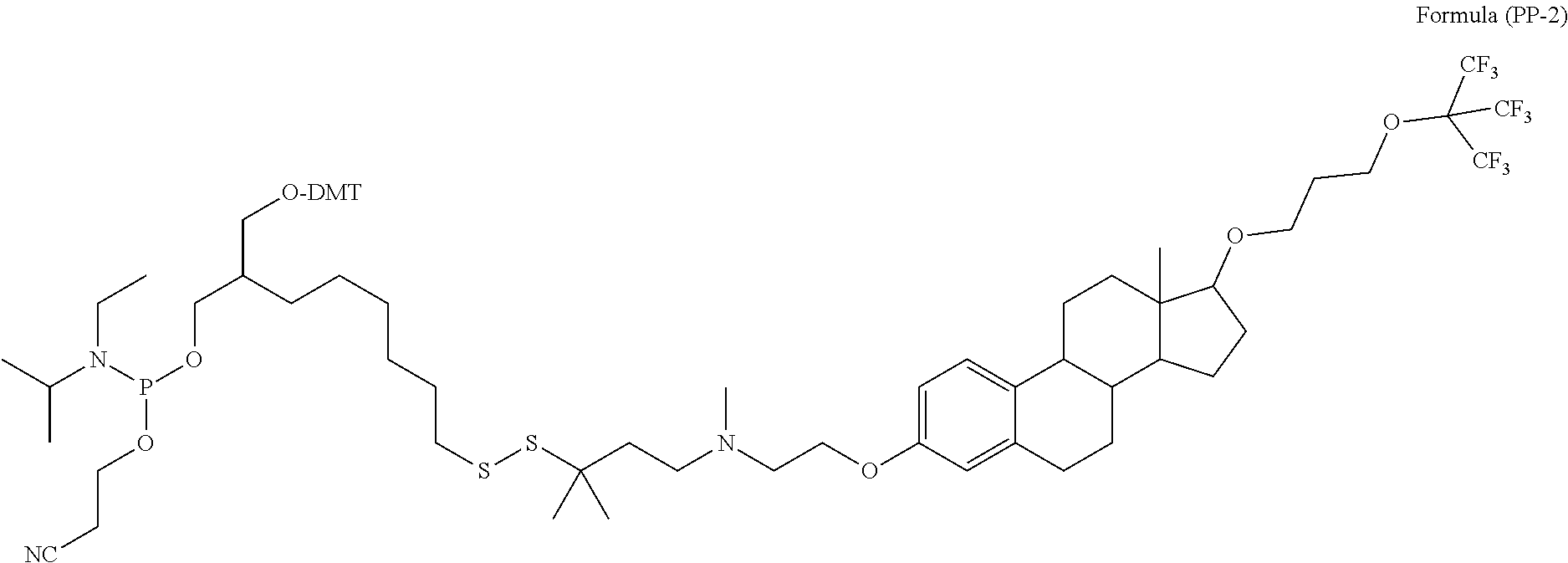
including pharmaceutically acceptable salts, hydrates, solvates and metal chelates of the compound represented by the structure as set forth in Formula (PP-2), and solvates and hydrates of the salts. This Precursor molecule may serve to attach the E, E′, or E″ moiety at either the 5′-end or the 3′-end, or at an internal position within the oligonucleotide chain. This Precursor molecule, as shown in Formula (PP-2), is designated Apo-Si-K-43-Precursor.

including pharmaceutically acceptable salts, hydrates, solvates and metal chelates of the compound represented by the structure as set forth in Formula (PP-3), and solvates and hydrates of the salts. This Precursor molecule, as shown in Formula (PP-3), is designated Apo-Si-K-63-Precursor.

including pharmaceutically acceptable salts, hydrates, solvates and metal chelates of the compound represented by the structure as set forth in Formula (Cn-12), and solvates and hydrates of the salts, wherein R and R′ are each selected independently from the group consisting of hydrogen, phosphate, sulfate and carboxyl group. This Conjugate, as shown in Formula (Cn-12), is designated Apo-Si-K-63-B.

including pharmaceutically acceptable salts, hydrates, solvates and metal chelates of the compound represented by the structure as set forth in Formula (Cn-14), and solvates and hydrates of the salts, wherein R and R′ are each selected independently from the group consisting of hydrogen, phosphate, sulfate and carboxyl group. This Conjugate, as shown in Formula (Cn-14), is designated Apo-Si-K-63-C.

including pharmaceutically acceptable salts, hydrates, solvates and metal chelates of the compound represented by the structure as set forth in Formula (I), and solvates and hydrates of the salts, wherein:
D is a drug to be delivered across biological membranes (i.e., a cargo drug), selected from a group consisting of a small-molecule drug, a peptide, a protein, and OD (i.e., a native or modified, single-stranded or double-stranded DNA or RNA, siRNA, dsiRNA, or ASO);
y, z and w are each an integer, independently selected from 0, 1, 2, 3 or 4, wherein if any of y, z or w or combination thereof is 0, it means that the respective E moiety (or moieties) is (are) null; at least one of y, z or w is different from 0;
E, E′, or E″ can be the same or different, each having independently a structure as set forth in general Formula (II):

including pharmaceutically acceptable salts, hydrates, solvates and metal chelates of the compound represented by the structure as set forth in Formula (II), and solvates and hydrates of the salts, wherein:
-
- one of U or Q is independently null, and the other one is a selected from the group consisting of —NH—, —N(CH3)—, —N(CH2—CH3)—, —NH—(CH2)2—NH—, or —N(CH3)—(CH2)2—N(CH3)—;
- G1, G2, G3 and G4 are each independently selected from the group consisting of hydrogen, methyl or ethyl; G1, G2, G3 and G4 moieties can be the same or different; at least two of G1, G2, G3, and G4 are hydrogen atoms;
- Z is selected from the group consisting of null, ether, ester, amine and amide;
- a, b, c, d are integers, each being independently selected from the group consisting of 0, 1, 2, 3, 4, 5, 6 or 7, wherein 0=null; a, b, c, d can be the same or different;
- e and f are integers, each being independently selected from the group consisting of 1, 2 and 3; e and f can be the same or different;
- if any of each a or b is ≥2, then the respective hydrocarbon chain can be either saturated or non-saturated;
- W is selected from a group comprising null, hydroxyl, di-hydroxyl, natural or modified nucleoside, and the structure set forth in Formula (II′):

-
- wherein J is selected from null, —CH2—, a secondary or tertiary amine, and oxygen;
- * is selected from the group consisting of null; hydrogen; a linkage point to D; a linkage point to a protecting group, as defined herein (e.g., a protecting group for alcohol); a linkage point to a phosphate, sulfate or carboxyl group; and a linkage point to a solid support. In the context of the Invention, an E, E′ or E″ moiety may be linked to one D moiety via one or two points.

including pharmaceutically acceptable salts, hydrates, solvates and metal chelates of the compound represented by the structure as set forth in Formula (III), and solvates and hydrates of the salts, wherein:
-
- one of U or Q is independently null, and the other one is a selected from the group consisting of —NH—, —N(CH3)—, —N(CH2—CH3)—, —NH—(CH2)2—NH—, or —N(CH3)—(CH2)2—N(CH3)—;
- Z is selected from the group consisting of null, ether, ester, amine and amide;
- G3 and G4 are each independently selected from the group consisting of hydrogen, methyl or ethyl; G3 and G4 moieties can be the same or different;
- a, b, c, d are integers, each being independently selected from the group consisting of 0, 1, 2, 3, 4, 5, 6 or 7, wherein 0=null; a, b, c, d can be the same or different;
- e and f are integers, each being independently selected from the group consisting of 1, 2 and 3; e and f can be the same or different;
- if any of a, b is ≥2, then the respective hydrocarbon chain can be either saturated or non-saturated;
- W is selected from a group comprising null, hydroxyl, di-hydroxyl, natural or modified nucleoside, and the structure set forth in Formula (II′):

-
- wherein J is selected from null, —CH2—, a secondary or tertiary amine, and oxygen;
- * is selected from the group consisting of null; hydrogen; a linkage point to D; a linkage point to a protecting group, as defined herein (e.g., a protecting group for alcohol); a linkage point to a phosphate, sulfate or carboxyl group; and a linkage point to a solid support. In the context of the Invention, an E, E′ or E″ moiety may be linked to one D moiety via one or two points.

including pharmaceutically acceptable salts, hydrates, solvates and metal chelates of the compound represented by the structure as set forth in Formula (IVa), and solvates and hydrates of the salts; wherein: Z, U, Q, G3, G4, a, b, c, d, e, f and *, each having the same meaning as in Formula (III).

including pharmaceutically acceptable salts, hydrates, solvates and metal chelates of the compound represented by the structure as set forth in Formula (IVb), and solvates and hydrates of the salts; wherein U, Q, G3, G4, b, c, d, e, f and *, each having the same meaning as in Formula (III).

including pharmaceutically acceptable salts, hydrates, solvates and metal chelates of the compound represented by the structure as set forth in Formula (IVc), and solvates and hydrates of the salts; wherein U, Q, G3, G4, b, c, d, e, f, and *, each having the same meaning as in Formula (III); J is selected from the group consisting of null, —CH2—, and oxygen.

including pharmaceutically acceptable salts, hydrates, solvates and metal chelates of the compound represented by the structure as set forth in Formula (Va′); wherein * has the same meaning as in Formula (IVa).

including pharmaceutically acceptable salts, hydrates, solvates and metal chelates of the compound represented by the structure as set forth in Formula (Va″); wherein * has the same meaning as in Formula (IVa). In the case that one of * is a linkage point to a phosphoramidite group, and the second * is a linkage point to a DMT group, the compound is designated Apo-Si-K-29D-Precursor.

including pharmaceutically acceptable salts, hydrates, solvates and metal chelates of the compound represented by the structure as set forth in Formula (Va′″); wherein * has the same meaning as in Formula (IVa).

including pharmaceutically acceptable salts, hydrates, solvates and metal chelates of the compound represented by the structure as set forth in Formula (Vb′); * has the same meaning as in Formula (IVb). This E, E′, or E″ moiety, as shown in Formula (Vb′), is designated Apo-Si-K-18. In the case that * is a phosphoramidite group, the compound is designated Apo-Si-K-18-Precursor.

including pharmaceutically acceptable salts, hydrates, solvates and metal chelates of the compound represented by the structure as set forth in Formula (Vb″); * has the same meaning as in Formula (IVb). This E, E′, or E″ moiety, as shown in Formula (Vb″), is designated Apo-Si-K-13. In the case that * is a phosphoramidite group, the compound is designated Apo-Si-K-13-Precursor.

including pharmaceutically acceptable salts, hydrates, solvates and metal chelates of the compound represented by the structure as set forth in Formula (Vb′″); * has the same meaning as in Formula (IVb). This E, E′, or E″ moiety, as shown in Formula (Vb″), is designated Apo-Si-K-11. In the case that * is a phosphoramidite group, the compound is designated Apo-Si-K-11-Precursor.

including pharmaceutically acceptable salts, hydrates, solvates and metal chelates of the compound represented by the structure as set forth in Formula (Vc′); wherein * has the same meaning as in Formula (IVc). This E, E′, or E″ moiety, as shown in Formula (Vc′), is designated Apo-Si-K-40. In the case that one of * is a linkage point to a phosphoramidite group, and the second * is a linkage point to a DMT group, the compound is designated Apo-Si-K-40-Precursor.

including pharmaceutically acceptable salts, hydrates, solvates and metal chelates of the compound represented by the structure as set forth in Formula (Vc″); wherein * has the same meaning as in Formula (IVc). This E, E′, or E″ moiety, as shown in Formula (Vc″), is designated Apo-Si-K-43. In the case that one of * is a linkage point to a phosphoramidite group, and the second * is a linkage point to a DMT group, the compound is designated Apo-Si-K-43-Precursor.

including pharmaceutically acceptable salts, hydrates, solvates and metal chelates of the compound represented by the structure as set forth in Formula (Vc′″); wherein * has the same meaning as in Formula (IVc). This E, E′, or E″ moiety, as shown in Formula (Vc′″), is designated Apo-Si-K-63. In the case that one of * is a linkage point to a phosphoramidite group, and the second * is a linkage point to a DMT group, the compound is designated Apo-Si-K-63-Precursor.

including pharmaceutically acceptable salts, hydrates, solvates and metal chelates of the compound represented by the structure as set forth in Formula (IVaP), and solvates and hydrates of the salts, wherein: Z, U, Q, G3, G4, a, b, c, d, e, f, each having the same meaning as in Formula (IVa). This Precursor molecule may serve to attach the E, E′, or E″ moiety at either the 5′-end or the 3′-end, or at an internal position within an oligonucleotide chain.

including pharmaceutically acceptable salts, hydrates, solvates and metal chelates of the compound represented by the structure as set forth in Formula (IVbP), and solvates and hydrates of the salts, wherein U, Q, G3, G4, b, c, d, e, f, each having the same meaning as in Formula (IVb).

including pharmaceutically acceptable salts, hydrates, solvates and metal chelates of the compound represented by the structure as set forth in Formula (IVcP), and solvates and hydrates of the salts, wherein: Z, U, Q, G3, G4, a, b, c, d, e, f each having the same meaning as in Formula (IVc); This Precursor molecule may serve to attach the E, E′, or E″ moiety at either the 5′-end or the 3′-end, or at an internal position within the oligonucleotide chain.

including pharmaceutically acceptable salts, hydrates, solvates and metal chelates of the compound represented by the structure as set forth in Formula (PP-1), and solvates and hydrates of the salts. This Precursor molecule may serve to attach the E, E′, or E″ moiety at either the 5′-end or the 3′-end, or at an internal position within the oligonucleotide chain. This Precursor molecule, as shown in Formula (PP-1), is designated Apo-Si-K-40-Precursor.

including pharmaceutically acceptable salts, hydrates, solvates and metal chelates of the compound represented by the structure as set forth in Formula (PP-2), and solvates and hydrates of the salts. This Precursor molecule may serve to attach the E, E′, or E″ moiety at either the 5′-end or the 3′-end, or at an internal position within the oligonucleotide chain. This Precursor molecule, as shown in Formula (PP-2), is designated Apo-Si-K-43-Precursor.

including pharmaceutically acceptable salts, hydrates, solvates and metal chelates of the compound represented by the structure as set forth in Formula (PP-3), and solvates and hydrates of the salts. This Precursor molecule, as shown in Formula (PP-3), is designated Apo-Si-K-63-Precursor.

including pharmaceutically acceptable salts, hydrates, solvates and metal chelates of the compound represented by the structure as set forth in Formula (Cn-1), and solvates and hydrates of the salts, wherein R and R′ are each selected independently from the group consisting of hydrogen, phosphate, sulfate or carboxyl group.

including pharmaceutically acceptable salts, hydrates, solvates and metal chelates of the compound represented by the structure as set forth in Formula (Cn-2), and solvates and hydrates of the salts, wherein R and R′ are each selected independently from the group consisting of hydrogen, phosphate, sulfate or carboxyl group.

including pharmaceutically acceptable salts, hydrates, solvates and metal chelates of the compound represented by the structure as set forth in Formula (Cn-3), and solvates and hydrates of the salts, wherein R and R′ are each selected independently from the group consisting of hydrogen, phosphate, sulfate or carboxyl group.

including pharmaceutically acceptable salts, hydrates, solvates and metal chelates of the compound represented by the structure as set forth in Formula (Cn-4), and solvates and hydrates of the salts, wherein R and R′ are each selected independently from the group consisting of hydrogen, phosphate, sulfate or carboxyl group.

including pharmaceutically acceptable salts, hydrates, solvates and metal chelates of the compound represented by the structure as set forth in Formula (Cn-5), and solvates and hydrates of the salts; wherein Y and Y′ are each selected independently from the group consisting of hydrogen, —CH2—Z; —CH2—Z′; —CH2—O—Z; and —CH2—O—Z′; wherein Z and Z′ are each selected independently from the group consisting of hydrogen, phosphate, sulfate, carboxyl, 1′,2′-Dideoxyribose, nucleotide, or combinations thereof; g is an integer, selected from the group consisting of 0, 1, 2, 3, 4, 5 and 6.

including pharmaceutically acceptable salts, hydrates, solvates and metal chelates of the compound represented by the structure as set forth in Formula (Cn-6), and solvates and hydrates of the salts, wherein R and R′ are each selected independently from the group consisting of hydrogen, phosphate, sulfate and carboxyl group.

including pharmaceutically acceptable salts, hydrates, solvates and metal chelates of the compound represented by the structure as set forth in Formula (Cn-7), and solvates and hydrates of the salts, wherein R and R′ are each selected independently from the group consisting of hydrogen, phosphate, sulfate or carboxyl group.

including pharmaceutically acceptable salts, hydrates, solvates and metal chelates of the compound represented by the structure as set forth in Formula (Cn-8), and solvates and hydrates of the salts, wherein R and R′ are each selected independently from the group consisting of hydrogen, phosphate, sulfate or carboxyl group.

including pharmaceutically acceptable salts, hydrates, solvates and metal chelates of the compound represented by the structure as set forth in Formula (Cn-9), and solvates and hydrates of the salts, wherein R and R′ are each selected independently from the group consisting of hydrogen, phosphate, sulfate or carboxyl group.

including pharmaceutically acceptable salts, hydrates, solvates and metal chelates of the compound represented by the structure as set forth in Formula (Cn-10), and solvates and hydrates of the salts; wherein Y and Y′ are each selected independently from the group consisting of hydrogen, —CH2—Z; —CH2—Z′; —CH2—O—Z; and —CH2—O—Z′; wherein Z and Z′ are each selected independently from the group consisting of hydrogen, phosphate, sulfate, carboxyl, 1′,2′-Dideoxyribose, nucleotide, or combinations thereof; g is an integer, selected from the group consisting of 0, 1, 2, 3, 4, 5 and 6.

including pharmaceutically acceptable salts, hydrates, solvates and metal chelates of the compound represented by the structure as set forth in Formula (Cn-11), and solvates and hydrates of the salts, wherein R and R′ are each selected independently from the group consisting of hydrogen, phosphate, sulfate and carboxyl group.

including pharmaceutically acceptable salts, hydrates, solvates and metal chelates of the compound represented by the structure as set forth in Formula (Cn-12), and solvates and hydrates of the salts, wherein R and R′ are each selected independently from the group consisting of hydrogen, phosphate, sulfate and carboxyl group. This Conjugate, as shown in Formula (Cn-12), is designated Apo-Si-K-63-B.

including pharmaceutically acceptable salts, hydrates, solvates and metal chelates of the compound represented by the structure as set forth in Formula (Cn-13), and solvates and hydrates of the salts, wherein R and R′ are each selected independently from the group consisting of hydrogen, phosphate, sulfate and carboxyl group.

including pharmaceutically acceptable salts, hydrates, solvates and metal chelates of the compound represented by the structure as set forth in Formula (Cn-14), and solvates and hydrates of the salts, wherein R and R′ are each selected independently from the group consisting of hydrogen, phosphate, sulfate and carboxyl group. This Conjugate, as shown in Formula (Cn-14), is designated Apo-Si-K-63-C.

including pharmaceutically acceptable salts, hydrates, solvates and metal chelates of the compound represented by the structure as set forth in Formula (Cn-15), and solvates and hydrates of the salts; wherein Y and Y′ are each selected independently from the group consisting of hydrogen, —CH2—Z; —CH2—Z′; —CH2—O—Z; and —CH2—O—Z′; wherein Z and Z′ are each selected independently from the group consisting of hydrogen, phosphate, sulfate, carboxyl, 1′,2′-Dideoxyribose, nucleotide, or combinations thereof; g is an integer, selected from the group consisting of 0, 1, 2, 3, 4, 5 and 6.


2-Deoxyuridine was treated with I2 in the presence of HNO3, to provide iodo-derivative of deoxyuridine U-1. Iodide U-1 was coupled to methylacrylate using a Heck reaction to provide methyl ester U-2 after purification by column chromatography. The methyl ester of U-2 was hydrolyzed with NaOH, and the resulting compound U-3 was hydrogenated using Pd/C and H2 to provide intermediate U-4. Intermediates U-4 and U-5 (commercially-available) were coupled using 1-Ethyl-3-(3-dimethylaminopropropyl) carbodiimide (ED(CI) as a coupling reagent to afford chloride U-6. Chloride U-6 was treated with potassium thiotosylate at elevated temperatures to provide building block K-29U.


Estradiol was treated with excess of sodium hydride, followed by addition of allylbromide, which resulted in clean conversion towards


wherein * is a linkage point of each E moiety, to the 5′-end of an oligonucleotide strand of a dsiRNA Duplex. Apo-Si-K-18 and Apo-Si-K-13 were synthesized according to the previous Examples.

| |
|
| 1 | 2 | 3 | 4 | |
| Conjugate | 25/27 | Apo-Si-G | Apo-Si-K-13 | Apo-Si-18 |
| nucleotide | Conjugate | Conjugate | Conjugate | |
| “naked RNA” | ||||


-
- DsiRNAs, comprising either 2 or 3 E moieties of the invention, manifest significant gene silencing in vitro.
- Said gene silencing is encountered in either presence or absence of plasma proteins in the culture medium.
- A Conjugate that comprises three E moieties is advantageous over a Conjugate that comprises only two E moieties in providing significant gene silencing.
Claims (48)


Priority Applications (9)
| Application Number | Priority Date | Filing Date | Title |
|---|---|---|---|
| US15/691,821 US10195286B2 (en) | 2017-07-04 | 2017-08-31 | Compounds and methods for trans-membrane delivery of molecules |
| AU2018295899A AU2018295899B2 (en) | 2017-07-04 | 2018-07-02 | Compounds and methods for trans-membrane delivery of molecules |
| JP2019572458A JP7191869B2 (en) | 2017-07-04 | 2018-07-02 | Compounds and methods for transmembrane delivery of molecules |
| EA202090159A EA202090159A1 (en) | 2017-08-31 | 2018-07-02 | COMPOUNDS AND METHODS FOR TRANSMEMBRANE DELIVERY OF MOLECULES |
| EP18828375.8A EP3648773A4 (en) | 2017-07-04 | 2018-07-02 | COMPOUNDS AND METHODS FOR THE TRANSMEMBRANARY ADMINISTRATION OF MOLECULES |
| PCT/IL2018/050714 WO2019008574A1 (en) | 2017-07-04 | 2018-07-02 | Compounds and methods for trans-membrane delivery of molecules |
| CA3068165A CA3068165A1 (en) | 2017-07-04 | 2018-07-02 | Compounds and methods for trans-membrane delivery of molecules |
| CN201880057472.7A CN111246855A (en) | 2017-07-04 | 2018-07-02 | Compounds and methods for transmembrane delivery of molecules |
| IL271788A IL271788B1 (en) | 2017-07-04 | 2019-12-31 | Compounds and methods for trans-membrane delivery of molecules |
Applications Claiming Priority (4)
| Application Number | Priority Date | Filing Date | Title |
|---|---|---|---|
| US15/641,251 US20190125884A1 (en) | 2017-07-04 | 2017-07-04 | Compounds and methods for trans-membrane delivery of molecules |
| US201715662665A | 2017-07-28 | 2017-07-28 | |
| US201715679192A | 2017-08-17 | 2017-08-17 | |
| US15/691,821 US10195286B2 (en) | 2017-07-04 | 2017-08-31 | Compounds and methods for trans-membrane delivery of molecules |
Related Parent Applications (1)
| Application Number | Title | Priority Date | Filing Date |
|---|---|---|---|
| US201715679192A Continuation-In-Part | 2017-07-04 | 2017-08-17 |
Publications (2)
| Publication Number | Publication Date |
|---|---|
| US20190008976A1 US20190008976A1 (en) | 2019-01-10 |
| US10195286B2 true US10195286B2 (en) | 2019-02-05 |
Family
ID=64903980
Family Applications (1)
| Application Number | Title | Priority Date | Filing Date |
|---|---|---|---|
| US15/691,821 Active US10195286B2 (en) | 2017-07-04 | 2017-08-31 | Compounds and methods for trans-membrane delivery of molecules |
Country Status (8)
| Country | Link |
|---|---|
| US (1) | US10195286B2 (en) |
| EP (1) | EP3648773A4 (en) |
| JP (1) | JP7191869B2 (en) |
| CN (1) | CN111246855A (en) |
| AU (1) | AU2018295899B2 (en) |
| CA (1) | CA3068165A1 (en) |
| IL (1) | IL271788B1 (en) |
| WO (1) | WO2019008574A1 (en) |
Families Citing this family (6)
| Publication number | Priority date | Publication date | Assignee | Title |
|---|---|---|---|---|
| AU2018205898B2 (en) | 2017-01-09 | 2020-12-10 | Aposense Ltd. | Compounds and methods for trans-membrane delivery of molecules |
| EP3674407A4 (en) * | 2017-08-22 | 2022-01-12 | National University Corporation Nagoya University | Modified polynucleotide |
| CN111615404A (en) * | 2018-01-01 | 2020-09-01 | 艾博森斯有限公司 | Compounds and methods for transmembrane delivery of molecules |
| WO2020044349A1 (en) * | 2018-08-30 | 2020-03-05 | Aposense Ltd. | Compounds, cojugates and compositions for use in the methods for trans-membrane delivery of molecules |
| EP4337646A4 (en) * | 2021-05-13 | 2025-05-21 | Promega Corporation | BIOLUMINESCENT DETECTION OF DNA SYNTHESIS |
| JPWO2023022055A1 (en) * | 2021-08-17 | 2023-02-23 |
Citations (4)
| Publication number | Priority date | Publication date | Assignee | Title |
|---|---|---|---|---|
| WO2005041859A2 (en) | 2003-04-30 | 2005-05-12 | Sirna Therapeutics, Inc. | Conjugates and compositions for cellular delivery. |
| US20120035362A1 (en) | 2010-08-03 | 2012-02-09 | Berry And Associates, Inc. | Phosphoramidite derivatives of folic acid |
| US20130178512A1 (en) | 2007-12-04 | 2013-07-11 | Alnylam Pharmaceuticals, Inc | Carbohydrate conjugates as delivery agents for oligonucleotides |
| US20170100486A1 (en) | 2014-03-28 | 2017-04-13 | Aposense Ltd. | Compounds and methods for trans-membrane delivery of molecules |
Family Cites Families (2)
| Publication number | Priority date | Publication date | Assignee | Title |
|---|---|---|---|---|
| JP6669719B2 (en) * | 2014-03-28 | 2020-03-18 | アポセンス リミテッドAposense Ltd. | Compounds and methods for transmembrane delivery of molecules |
| AU2018205898B2 (en) * | 2017-01-09 | 2020-12-10 | Aposense Ltd. | Compounds and methods for trans-membrane delivery of molecules |
-
2017
- 2017-08-31 US US15/691,821 patent/US10195286B2/en active Active
-
2018
- 2018-07-02 JP JP2019572458A patent/JP7191869B2/en active Active
- 2018-07-02 EP EP18828375.8A patent/EP3648773A4/en active Pending
- 2018-07-02 WO PCT/IL2018/050714 patent/WO2019008574A1/en not_active Ceased
- 2018-07-02 CN CN201880057472.7A patent/CN111246855A/en active Pending
- 2018-07-02 AU AU2018295899A patent/AU2018295899B2/en active Active
- 2018-07-02 CA CA3068165A patent/CA3068165A1/en active Pending
-
2019
- 2019-12-31 IL IL271788A patent/IL271788B1/en unknown
Patent Citations (4)
| Publication number | Priority date | Publication date | Assignee | Title |
|---|---|---|---|---|
| WO2005041859A2 (en) | 2003-04-30 | 2005-05-12 | Sirna Therapeutics, Inc. | Conjugates and compositions for cellular delivery. |
| US20130178512A1 (en) | 2007-12-04 | 2013-07-11 | Alnylam Pharmaceuticals, Inc | Carbohydrate conjugates as delivery agents for oligonucleotides |
| US20120035362A1 (en) | 2010-08-03 | 2012-02-09 | Berry And Associates, Inc. | Phosphoramidite derivatives of folic acid |
| US20170100486A1 (en) | 2014-03-28 | 2017-04-13 | Aposense Ltd. | Compounds and methods for trans-membrane delivery of molecules |
Non-Patent Citations (3)
| Title |
|---|
| International Search Report for PCT Application No. PCT/IL2018/50714 dated Nov. 20, 2018. |
| Yue-Ming, Dimpan Bhatia Li, and Krishna N. Ganesh. "Steroid-DNA conjugates: improved triplex formation with 5-amido-(7-deoxycholic acid)-dU incorporated oligonucleotides." Bioorganic & medicinal chemistry letters, vol. 9, No. 13 (1999): pp. 1789-1794. |
| Yue-Ming, Dimpan Bhatia Li, and Krishna N. Ganesh. "Steroid—DNA conjugates: improved triplex formation with 5-amido-(7-deoxycholic acid)-dU incorporated oligonucleotides." Bioorganic & medicinal chemistry letters, vol. 9, No. 13 (1999): pp. 1789-1794. |
Also Published As
| Publication number | Publication date |
|---|---|
| EP3648773A4 (en) | 2021-06-09 |
| JP2020525502A (en) | 2020-08-27 |
| CN111246855A (en) | 2020-06-05 |
| IL271788A (en) | 2020-02-27 |
| IL271788B1 (en) | 2026-01-01 |
| AU2018295899B2 (en) | 2024-03-21 |
| JP7191869B2 (en) | 2022-12-19 |
| US20190008976A1 (en) | 2019-01-10 |
| WO2019008574A1 (en) | 2019-01-10 |
| AU2018295899A1 (en) | 2020-02-20 |
| EP3648773A1 (en) | 2020-05-13 |
| CA3068165A1 (en) | 2019-01-10 |
Similar Documents
| Publication | Publication Date | Title |
|---|---|---|
| US10195286B2 (en) | Compounds and methods for trans-membrane delivery of molecules | |
| US9687556B2 (en) | Compounds and methods for trans-membrane delivery of molecules | |
| TWI882566B (en) | Galnac compounds containing a ribose ring or its derivative structure and oligonucleotide conjugates thereof | |
| AU2018205898B2 (en) | Compounds and methods for trans-membrane delivery of molecules | |
| EP3603648B1 (en) | Complex of nucleic acid medicine and multibranched lipid | |
| US9889202B2 (en) | Compounds and methods for trans-membrane delivery of molecules | |
| US20190125884A1 (en) | Compounds and methods for trans-membrane delivery of molecules | |
| US12337036B2 (en) | Compounds and methods for trans-membrane delivery of molecules | |
| WO2020044349A1 (en) | Compounds, cojugates and compositions for use in the methods for trans-membrane delivery of molecules | |
| HK40027749A (en) | Compounds and methods for trans-membrane delivery of molecules | |
| HK40034155A (en) | Compounds and methods for trans-membrane delivery of molecules |
Legal Events
| Date | Code | Title | Description |
|---|---|---|---|
| FEPP | Fee payment procedure |
Free format text: ENTITY STATUS SET TO UNDISCOUNTED (ORIGINAL EVENT CODE: BIG.); ENTITY STATUS OF PATENT OWNER: SMALL ENTITY |
|
| FEPP | Fee payment procedure |
Free format text: ENTITY STATUS SET TO SMALL (ORIGINAL EVENT CODE: SMAL); ENTITY STATUS OF PATENT OWNER: SMALL ENTITY |
|
| AS | Assignment |
Owner name: APOSENSE LTD., ISRAEL Free format text: ASSIGNMENT OF ASSIGNORS INTEREST;ASSIGNORS:ZIV, ILAN;GRIMBERG, HAGIT;DUBROVSKY, JOSEPH;REEL/FRAME:044046/0985 Effective date: 20170831 |
|
| FEPP | Fee payment procedure |
Free format text: PETITION RELATED TO MAINTENANCE FEES GRANTED (ORIGINAL EVENT CODE: PTGR); ENTITY STATUS OF PATENT OWNER: SMALL ENTITY |
|
| STCF | Information on status: patent grant |
Free format text: PATENTED CASE |
|
| FEPP | Fee payment procedure |
Free format text: MAINTENANCE FEE REMINDER MAILED (ORIGINAL EVENT CODE: REM.); ENTITY STATUS OF PATENT OWNER: SMALL ENTITY |
|
| FEPP | Fee payment procedure |
Free format text: SURCHARGE FOR LATE PAYMENT, SMALL ENTITY (ORIGINAL EVENT CODE: M2554); ENTITY STATUS OF PATENT OWNER: SMALL ENTITY |
|
| MAFP | Maintenance fee payment |
Free format text: PAYMENT OF MAINTENANCE FEE, 4TH YR, SMALL ENTITY (ORIGINAL EVENT CODE: M2551); ENTITY STATUS OF PATENT OWNER: SMALL ENTITY Year of fee payment: 4 |