US10195200B2 - Covalent inhibitors of CDK-7 - Google Patents
Covalent inhibitors of CDK-7 Download PDFInfo
- Publication number
- US10195200B2 US10195200B2 US15/706,980 US201715706980A US10195200B2 US 10195200 B2 US10195200 B2 US 10195200B2 US 201715706980 A US201715706980 A US 201715706980A US 10195200 B2 US10195200 B2 US 10195200B2
- Authority
- US
- United States
- Prior art keywords
- compound
- alkyl
- pharmaceutically acceptable
- acceptable salt
- compounds
- Prior art date
- Legal status (The legal status is an assumption and is not a legal conclusion. Google has not performed a legal analysis and makes no representation as to the accuracy of the status listed.)
- Expired - Fee Related
Links
- 0 *C.*C1=CC(C2=CN([2*])C(=O)C(CC3=CC=CC=C3)=N2)=CC=C1.[1*]/C=C/C(=O)*C.[3*]C Chemical compound *C.*C1=CC(C2=CN([2*])C(=O)C(CC3=CC=CC=C3)=N2)=CC=C1.[1*]/C=C/C(=O)*C.[3*]C 0.000 description 43
- SRYKMCHPDRDPKY-UHFFFAOYSA-N *.CC.CC(=O)O.CCC(C)=O Chemical compound *.CC.CC(=O)O.CCC(C)=O SRYKMCHPDRDPKY-UHFFFAOYSA-N 0.000 description 2
- HFXBFRUPIJCDDC-IYCYPFIPSA-N C=CC(=O)N1CC(N(C)CCNC2=CC3=CC(=C2)CNC/C=C/CCOC2=CC=CC(=C2)C2=CC=NC(=N2)N3)C1.C=CC(=O)N1CCC(N(C)CCNC2=CC3=CC(=C2)CNC/C=C/CCOC2=CC=CC(=C2)C2=CC=NC(=N2)N3)C1.CC#CC(=O)N1CC(N(C)CCNC2=CC3=CC(=C2)CNC/C=C/CCOC2=CC=CC(=C2)C2=CC=NC(=N2)N3)C1.CC#CC(=O)N1CCC(N(C)CCNC2=CC3=CC(=C2)CNC/C=C/CCOC2=CC=CC(=C2)C2=CC=NC(=N2)N3)C1 Chemical compound C=CC(=O)N1CC(N(C)CCNC2=CC3=CC(=C2)CNC/C=C/CCOC2=CC=CC(=C2)C2=CC=NC(=N2)N3)C1.C=CC(=O)N1CCC(N(C)CCNC2=CC3=CC(=C2)CNC/C=C/CCOC2=CC=CC(=C2)C2=CC=NC(=N2)N3)C1.CC#CC(=O)N1CC(N(C)CCNC2=CC3=CC(=C2)CNC/C=C/CCOC2=CC=CC(=C2)C2=CC=NC(=N2)N3)C1.CC#CC(=O)N1CCC(N(C)CCNC2=CC3=CC(=C2)CNC/C=C/CCOC2=CC=CC(=C2)C2=CC=NC(=N2)N3)C1 HFXBFRUPIJCDDC-IYCYPFIPSA-N 0.000 description 2
- XSPPIHQSIKOUBU-SNAWJCMRSA-N C=CC(=O)N1CCC(N(C)CCNC2=CC3=CC(=C2)COC/C=C/CCOC2=CC=CC(=C2)C2=CC=NC(=N2)N3)CC1 Chemical compound C=CC(=O)N1CCC(N(C)CCNC2=CC3=CC(=C2)COC/C=C/CCOC2=CC=CC(=C2)C2=CC=NC(=N2)N3)CC1 XSPPIHQSIKOUBU-SNAWJCMRSA-N 0.000 description 2
- RMFZTVVKTUFXNV-IYCYPFIPSA-N C=CC(=O)N1CCCN(CCNC2=CC3=CC(=C2)CN(C)C/C=C/CCOC2=CC=CC(=C2)C2=CC=NC(=N2)N3)CC1.C=CC(=O)N1CCN(CCCNC2=CC3=CC(=C2)CN(C)C/C=C/CCOC2=CC=CC(=C2)C2=CC=NC(=N2)N3)CC1.CC#CC(=O)N1CCCN(CCNC2=CC3=CC(=C2)CN(C)C/C=C/CCOC2=CC=CC(=C2)C2=CC=NC(=N2)N3)CC1.CC#CC(=O)N1CCN(CCCNC2=CC3=CC(=C2)CN(C)C/C=C/CCOC2=CC=CC(=C2)C2=CC=NC(=N2)N3)CC1 Chemical compound C=CC(=O)N1CCCN(CCNC2=CC3=CC(=C2)CN(C)C/C=C/CCOC2=CC=CC(=C2)C2=CC=NC(=N2)N3)CC1.C=CC(=O)N1CCN(CCCNC2=CC3=CC(=C2)CN(C)C/C=C/CCOC2=CC=CC(=C2)C2=CC=NC(=N2)N3)CC1.CC#CC(=O)N1CCCN(CCNC2=CC3=CC(=C2)CN(C)C/C=C/CCOC2=CC=CC(=C2)C2=CC=NC(=N2)N3)CC1.CC#CC(=O)N1CCN(CCCNC2=CC3=CC(=C2)CN(C)C/C=C/CCOC2=CC=CC(=C2)C2=CC=NC(=N2)N3)CC1 RMFZTVVKTUFXNV-IYCYPFIPSA-N 0.000 description 2
- UOSHEMUZXZPQMS-SNAWJCMRSA-N C=CC(=O)N1CCN(CCCNC2=CC3=CC(=C2)CN(C)C/C=C/CCOC2=CC=CC(=C2)C2=CC=NC(=N2)N3)CC1 Chemical compound C=CC(=O)N1CCN(CCCNC2=CC3=CC(=C2)CN(C)C/C=C/CCOC2=CC=CC(=C2)C2=CC=NC(=N2)N3)CC1 UOSHEMUZXZPQMS-SNAWJCMRSA-N 0.000 description 2
- SBOVPSYPRVDULY-SNAWJCMRSA-N C=CC(=O)N1CCN(CCNC2=CC3=CC(=C2)CN(C)C/C=C/CCOC2=CC=CC(=C2)C2=CC=NC(=N2)N3)CC1 Chemical compound C=CC(=O)N1CCN(CCNC2=CC3=CC(=C2)CN(C)C/C=C/CCOC2=CC=CC(=C2)C2=CC=NC(=N2)N3)CC1 SBOVPSYPRVDULY-SNAWJCMRSA-N 0.000 description 2
- JFTIJJDLRFBGAL-FKGCTPSKSA-N C=CC(=O)NC1=CC=C(C(=O)NC2=CC3=CC(=C2)CN(C)C/C=C/CCOC2=CC=CC(=C2)C2=CC=NC(=N2)N3)C=C1.C=CC(=O)NC1=CC=C(C(=O)NC2=CC3=CC(=C2)COC/C=C/CCOC2=CC=CC(=C2)C2=CC=NC(=N2)N3)C=C1 Chemical compound C=CC(=O)NC1=CC=C(C(=O)NC2=CC3=CC(=C2)CN(C)C/C=C/CCOC2=CC=CC(=C2)C2=CC=NC(=N2)N3)C=C1.C=CC(=O)NC1=CC=C(C(=O)NC2=CC3=CC(=C2)COC/C=C/CCOC2=CC=CC(=C2)C2=CC=NC(=N2)N3)C=C1 JFTIJJDLRFBGAL-FKGCTPSKSA-N 0.000 description 2
- ZFTKIZLFGJUTLU-SNAWJCMRSA-N CC#CC(=O)N1CC(N(C)CCNC2=CC3=CC(=C2)CNC/C=C/CCOC2=CC=CC(=C2)C2=CC=NC(=N2)N3)C1 Chemical compound CC#CC(=O)N1CC(N(C)CCNC2=CC3=CC(=C2)CNC/C=C/CCOC2=CC=CC(=C2)C2=CC=NC(=N2)N3)C1 ZFTKIZLFGJUTLU-SNAWJCMRSA-N 0.000 description 2
- WCXGJAOCDLBMIF-AATRIKPKSA-N CC#CC(=O)N1CCCC(N(C)CCNC2=CC3=CC(=C2)CN(C)C/C=C/CCOC2=CC=CC(=C2)C2=CC=NC(=N2)N3)C1 Chemical compound CC#CC(=O)N1CCCC(N(C)CCNC2=CC3=CC(=C2)CN(C)C/C=C/CCOC2=CC=CC(=C2)C2=CC=NC(=N2)N3)C1 WCXGJAOCDLBMIF-AATRIKPKSA-N 0.000 description 2
- CRSOQBOWXPBRES-UHFFFAOYSA-N CC(C)(C)C Chemical compound CC(C)(C)C CRSOQBOWXPBRES-UHFFFAOYSA-N 0.000 description 2
- BTHKIGITMCPREB-UHFFFAOYSA-N *.*.*.*.C.CC.CC.CC.CC.CCC.CCC(C)=O.CCC(C)=O.CCC(C)=O.CCC(C)=O.CN.[H]C(C)=O Chemical compound *.*.*.*.C.CC.CC.CC.CC.CCC.CCC(C)=O.CCC(C)=O.CCC(C)=O.CCC(C)=O.CN.[H]C(C)=O BTHKIGITMCPREB-UHFFFAOYSA-N 0.000 description 1
- OFKLJNHTLAEPTQ-UHFFFAOYSA-N *.*.*.*.CC.CC.CC.CC.CC(=O)Cl.CC(=O)O.CC(=O)O.CC(=O)O.CC(=O)O.CC(N)=O.CC(N)=O.COC(C)=O.N.N Chemical compound *.*.*.*.CC.CC.CC.CC.CC(=O)Cl.CC(=O)O.CC(=O)O.CC(=O)O.CC(=O)O.CC(N)=O.CC(N)=O.COC(C)=O.N.N OFKLJNHTLAEPTQ-UHFFFAOYSA-N 0.000 description 1
- UQXQPCBVGDGCQU-UHFFFAOYSA-N C.C=CCCCC1=CC([N+](=O)[O-])=CC([N+](=O)[O-])=C1.C=CCN.C=CCN(CC1=CC([N+](=O)[O-])=CC(N)=C1)C(=O)OC(C)(C)C.C=CCN(CC1=CC([N+](=O)[O-])=CC([N+](=O)[O-])=C1)C(=O)OC(C)(C)C.CC(=O)OB[Na].CC(=O)OOC(C)=O.CC(C)(C)OC(=O)OC(=O)OC(C)(C)C.CO.O=CC1=CC([N+](=O)[O-])=CC([N+](=O)[O-])=C1.O=[Mn]=O.O=[N+]([O-])C1=CC(CO)=CC([N+](=O)[O-])=C1 Chemical compound C.C=CCCCC1=CC([N+](=O)[O-])=CC([N+](=O)[O-])=C1.C=CCN.C=CCN(CC1=CC([N+](=O)[O-])=CC(N)=C1)C(=O)OC(C)(C)C.C=CCN(CC1=CC([N+](=O)[O-])=CC([N+](=O)[O-])=C1)C(=O)OC(C)(C)C.CC(=O)OB[Na].CC(=O)OOC(C)=O.CC(C)(C)OC(=O)OC(=O)OC(C)(C)C.CO.O=CC1=CC([N+](=O)[O-])=CC([N+](=O)[O-])=C1.O=[Mn]=O.O=[N+]([O-])C1=CC(CO)=CC([N+](=O)[O-])=C1 UQXQPCBVGDGCQU-UHFFFAOYSA-N 0.000 description 1
- ZCIGHOKPZKQSKQ-UHFFFAOYSA-N C1=CC=NC=C1.C1=CN=CN=C1.C1=COC=C1.C1=CSC=C1.CC(C)(C)C.CC(C)(C)C.CC(C)(C)C.CC(C)(C)C.CC(C)(C)C.CC(C)(C)C.CC(C)(C)C.CC(C)(C)C.CC(C)(C)C.CC(C)(C)C.CC(C)(C)C.CC(C)(C)C.CC(C)(C)C.CC(C)(C)C.CC(C)(C)C.CC(C)(C)C.CC(C)(C)C.CC(C)(C)C.CC(C)(C)C12CC(C(C)(C)C)(C1)C2.CC(C)(C)C1=CC=CC=C1.CC(C)(C)C1CC1C(C)(C)C.CC(C)(C)C1CCC1.CC(C)(C)C1CCCC1.CC(C)(C)C1CCCCC1.CC(C)(C)N1CC2=CC=CC=C2C1.CC(C)(C)N1CCC1.CC(C)(C)N1CCC2=CC=CC=C2C1.CC(C)(C)N1CCCC1.CC(C)(C)N1CCCCC1.CC(C)(C)N1CCCN(C(C)(C)C)CC1.CC(C)(C)N1CCN(C(C)(C)C)CC1.CC(C)(C)N1CCNCC1 Chemical compound C1=CC=NC=C1.C1=CN=CN=C1.C1=COC=C1.C1=CSC=C1.CC(C)(C)C.CC(C)(C)C.CC(C)(C)C.CC(C)(C)C.CC(C)(C)C.CC(C)(C)C.CC(C)(C)C.CC(C)(C)C.CC(C)(C)C.CC(C)(C)C.CC(C)(C)C.CC(C)(C)C.CC(C)(C)C.CC(C)(C)C.CC(C)(C)C.CC(C)(C)C.CC(C)(C)C.CC(C)(C)C.CC(C)(C)C12CC(C(C)(C)C)(C1)C2.CC(C)(C)C1=CC=CC=C1.CC(C)(C)C1CC1C(C)(C)C.CC(C)(C)C1CCC1.CC(C)(C)C1CCCC1.CC(C)(C)C1CCCCC1.CC(C)(C)N1CC2=CC=CC=C2C1.CC(C)(C)N1CCC1.CC(C)(C)N1CCC2=CC=CC=C2C1.CC(C)(C)N1CCCC1.CC(C)(C)N1CCCCC1.CC(C)(C)N1CCCN(C(C)(C)C)CC1.CC(C)(C)N1CCN(C(C)(C)C)CC1.CC(C)(C)N1CCNCC1 ZCIGHOKPZKQSKQ-UHFFFAOYSA-N 0.000 description 1
- WHOQECOLQCTIBH-UHFFFAOYSA-N C1CC2(CCNC2)CN1.C1CC2(CCNC2)CN1.CC(C)(C)C.CC(C)(C)C.CC(C)(C)N1CC2(C1)CN(C(C)(C)C)C2.CC(C)(C)N1CC2(CCCNC2)C1.CC(C)(C)N1CC2(CCNC2)C1.CC(C)(C)N1CC2(CCNCC2)C1.CC(C)(C)N1CCC2(CCCC2)CC1.CC(C)(C)N1CCC2(CCCCC2)CC1.CC(C)(C)N1CCC2(CCNC2)CC1.CC(C)(C)N1CCC2(CCNCC2)CC1.CC(C)(C)N1CCCC2(CCNC2)C1.CC(C)C.CC(C)C.CC(C)C.CC(C)C.CC(C)C.CC(C)C.CC(C)C.CC(C)C.CC(C)C.CC(C)C Chemical compound C1CC2(CCNC2)CN1.C1CC2(CCNC2)CN1.CC(C)(C)C.CC(C)(C)C.CC(C)(C)N1CC2(C1)CN(C(C)(C)C)C2.CC(C)(C)N1CC2(CCCNC2)C1.CC(C)(C)N1CC2(CCNC2)C1.CC(C)(C)N1CC2(CCNCC2)C1.CC(C)(C)N1CCC2(CCCC2)CC1.CC(C)(C)N1CCC2(CCCCC2)CC1.CC(C)(C)N1CCC2(CCNC2)CC1.CC(C)(C)N1CCC2(CCNCC2)CC1.CC(C)(C)N1CCCC2(CCNC2)C1.CC(C)C.CC(C)C.CC(C)C.CC(C)C.CC(C)C.CC(C)C.CC(C)C.CC(C)C.CC(C)C.CC(C)C WHOQECOLQCTIBH-UHFFFAOYSA-N 0.000 description 1
- KMNOWOLJUFLBOO-UHFFFAOYSA-N C1CC2CNC2CN1.C1CC2NCC2CN1.CC(C)(C)C.CC(C)(C)C.CC(C)(C)C.CC(C)(C)C.CC(C)(C)C.CC(C)(C)C1C2CN(C(C)(C)C)CC21.CC(C)(C)C1CC2CN(C(C)(C)C)CC2C1.CC(C)(C)C1CCOC1.CC(C)(C)N1CC2CC1CN2C(C)(C)C.CC(C)(C)N1CC2CCC1CN2.CC(C)(C)N1CC2CCC2C1.CC(C)(C)N1CC2CCCCC2C1.CC(C)(C)N1CC2CCNCC2C1.CC(C)(C)N1CC2CN(C(C)(C)C)CC2C1.CC(C)(C)N1CC2CNC2C1.CC(C)(C)N1CCOCC1.CC(C)C.CC(C)C.CC(C)C.CC(C)C.CC(C)C.CC(C)C.CC(C)C.CN1CCC(C(C)(C)C)C1 Chemical compound C1CC2CNC2CN1.C1CC2NCC2CN1.CC(C)(C)C.CC(C)(C)C.CC(C)(C)C.CC(C)(C)C.CC(C)(C)C.CC(C)(C)C1C2CN(C(C)(C)C)CC21.CC(C)(C)C1CC2CN(C(C)(C)C)CC2C1.CC(C)(C)C1CCOC1.CC(C)(C)N1CC2CC1CN2C(C)(C)C.CC(C)(C)N1CC2CCC1CN2.CC(C)(C)N1CC2CCC2C1.CC(C)(C)N1CC2CCCCC2C1.CC(C)(C)N1CC2CCNCC2C1.CC(C)(C)N1CC2CN(C(C)(C)C)CC2C1.CC(C)(C)N1CC2CNC2C1.CC(C)(C)N1CCOCC1.CC(C)C.CC(C)C.CC(C)C.CC(C)C.CC(C)C.CC(C)C.CC(C)C.CN1CCC(C(C)(C)C)C1 KMNOWOLJUFLBOO-UHFFFAOYSA-N 0.000 description 1
- MIEUWEAYMJEOTK-UHFFFAOYSA-N C1CCC2(C1)CCNC2.CC(C)(C)C.CC(C)(C)C.CC(C)(C)C1CC12CCN(C(C)(C)C)CC2.CC(C)(C)C1CC12CCNC2.CC(C)(C)C1CC2(CCNC2)C1.CC(C)(C)C1CC2CNCCN2C1.CC(C)(C)C1CCC2(CCNC2)CC1.CC(C)(C)N1CC2CCCN(C(C)(C)C)C2C1.CC(C)(C)N1CCC2(CCC2)CC1.CC(C)(C)N1CCC2CCN(C(C)(C)C)CC2C1.CC(C)(C)N1CCC2CNCCC2C1.CC(C)C.CC(C)C.CC(C)C.CC(C)C.CC(C)C.CC(C)C Chemical compound C1CCC2(C1)CCNC2.CC(C)(C)C.CC(C)(C)C.CC(C)(C)C1CC12CCN(C(C)(C)C)CC2.CC(C)(C)C1CC12CCNC2.CC(C)(C)C1CC2(CCNC2)C1.CC(C)(C)C1CC2CNCCN2C1.CC(C)(C)C1CCC2(CCNC2)CC1.CC(C)(C)N1CC2CCCN(C(C)(C)C)C2C1.CC(C)(C)N1CCC2(CCC2)CC1.CC(C)(C)N1CCC2CCN(C(C)(C)C)CC2C1.CC(C)(C)N1CCC2CNCCC2C1.CC(C)C.CC(C)C.CC(C)C.CC(C)C.CC(C)C.CC(C)C MIEUWEAYMJEOTK-UHFFFAOYSA-N 0.000 description 1
- ATXKZYKNLDZYMC-MYOHQUCZSA-N C=CC(=O)CC1=CC(C(=O)NC2=CC3=CC(=C2)CN(C)C/C=C/CCOC2=CC=CC(=C2)C2=C(C(F)(F)F)C=NC(=N2)N3)=CC=C1.C=CC(=O)CC1=CC(C(=O)NC2=CC3=CC(=C2)CN(C)C/C=C/CCOC2=CC=CC(=C2)C2=C(C)C=NC(=N2)N3)=CC=C1.C=CC(=O)CC1=CC(C(=O)NC2=CC3=CC(=C2)CN(C)C/C=C/CCOC2=CC=CC(=C2)C2=C(Cl)C=NC(=N2)N3)=CC=C1.C=CC(=O)CC1=CC(C(=O)NC2=CC3=CC(=C2)CN(C)C/C=C/CCOC2=CC=CC(=C2)C2=CC=NC(=N2)N3)=CC=C1.C=CC(=O)CCC1=CC=C(C(=O)NC2=CC3=CC(=C2)CN(C)C/C=C/CCOC2=CC=CC(=C2)C2=CC=NC(=N2)N3)C=C1.C=CC(=O)NC1=CC=C(C(=O)NC2=CC3=CC(=C2)CN(C)C/C=C/CCOC2=CC=CC(=C2)C2=C(C(F)(F)F)C=NC(=N2)N3)C=C1.C=CC(=O)NC1=CC=C(C(=O)NC2=CC3=CC(=C2)CN(C)C/C=C/CCOC2=CC=CC(=C2)C2=C(C)C=NC(=N2)N3)C=C1.C=CC(=O)NC1=CC=C(C(=O)NC2=CC3=CC(=C2)CN(C)C/C=C/CCOC2=CC=CC(=C2)C2=C(Cl)C=NC(=N2)N3)C=C1.C=CC(=O)NC1=CC=C(C(=O)NC2=CC3=CC(=C2)CN(C)C/C=C/CCOC2=CC=CC(=C2)C2=CC=NC(=N2)N3)C=C1.C=CC(=O)NCC1=CC(C(=O)NC2=CC3=CC(=C2)CN(C)C/C=C/CCOC2=CC=CC(=C2)C2=CC=NC(=N2)N3)=CC=C1 Chemical compound C=CC(=O)CC1=CC(C(=O)NC2=CC3=CC(=C2)CN(C)C/C=C/CCOC2=CC=CC(=C2)C2=C(C(F)(F)F)C=NC(=N2)N3)=CC=C1.C=CC(=O)CC1=CC(C(=O)NC2=CC3=CC(=C2)CN(C)C/C=C/CCOC2=CC=CC(=C2)C2=C(C)C=NC(=N2)N3)=CC=C1.C=CC(=O)CC1=CC(C(=O)NC2=CC3=CC(=C2)CN(C)C/C=C/CCOC2=CC=CC(=C2)C2=C(Cl)C=NC(=N2)N3)=CC=C1.C=CC(=O)CC1=CC(C(=O)NC2=CC3=CC(=C2)CN(C)C/C=C/CCOC2=CC=CC(=C2)C2=CC=NC(=N2)N3)=CC=C1.C=CC(=O)CCC1=CC=C(C(=O)NC2=CC3=CC(=C2)CN(C)C/C=C/CCOC2=CC=CC(=C2)C2=CC=NC(=N2)N3)C=C1.C=CC(=O)NC1=CC=C(C(=O)NC2=CC3=CC(=C2)CN(C)C/C=C/CCOC2=CC=CC(=C2)C2=C(C(F)(F)F)C=NC(=N2)N3)C=C1.C=CC(=O)NC1=CC=C(C(=O)NC2=CC3=CC(=C2)CN(C)C/C=C/CCOC2=CC=CC(=C2)C2=C(C)C=NC(=N2)N3)C=C1.C=CC(=O)NC1=CC=C(C(=O)NC2=CC3=CC(=C2)CN(C)C/C=C/CCOC2=CC=CC(=C2)C2=C(Cl)C=NC(=N2)N3)C=C1.C=CC(=O)NC1=CC=C(C(=O)NC2=CC3=CC(=C2)CN(C)C/C=C/CCOC2=CC=CC(=C2)C2=CC=NC(=N2)N3)C=C1.C=CC(=O)NCC1=CC(C(=O)NC2=CC3=CC(=C2)CN(C)C/C=C/CCOC2=CC=CC(=C2)C2=CC=NC(=N2)N3)=CC=C1 ATXKZYKNLDZYMC-MYOHQUCZSA-N 0.000 description 1
- JPOGCURPDZPMPB-CIEGDBMDSA-N C=CC(=O)CC1=CC(C(=O)NC2=CC3=CC(=C2)COC/C=C/CCOC2=CC=CC(=C2)C2=C(C(F)(F)F)C=NC(=N2)N3)=CC=C1.C=CC(=O)CCC1=CC=C(C(=O)NC2=CC3=CC(=C2)COC/C=C/CCOC2=CC=CC(=C2)C2=CC=NC(=N2)N3)C=C1.C=CC(=O)NC1=C(C)C=C(C(=O)NC2=CC3=CC(=C2)COC/C=C/CCOC2=CC=CC(=C2)C2=CC=NC(=N2)N3)C=C1.C=CC(=O)NC1=C(F)C=C(C(=O)NC2=CC3=CC(=C2)COC/C=C/CCOC2=CC=CC(=C2)C2=CC=NC(=N2)N3)C=C1.C=CC(=O)NC1=C(OC)C=C(C(=O)NC2=CC3=CC(=C2)COC/C=C/CCOC2=CC=CC(=C2)C2=CC=NC(=N2)N3)C=C1.C=CC(=O)NC1=CC(C)=C(C(=O)NC2=CC3=CC(=C2)COC/C=C/CCOC2=CC=CC(=C2)C2=CC=NC(=N2)N3)C=C1.C=CC(=O)NC1=CC=C(C(=O)NC2=C(F)C3=CC(=C2)COC/C=C/CCOC2=CC=CC(=C2)C2=CC=NC(=N2)N3)C=C1.C=CC(=O)NC1=CC=C(C(=O)NC2=CC3=CC(=C2)COC/C=C/CCOC2=CC=CC(=C2)C2=C(C(F)(F)F)C=NC(=N2)N3)C=C1.C=CC(=O)NC1=CC=C(C(=O)NC2=CC3=CC(=C2)COC/C=C/CCOC2=CC=CC(=C2)C2=CC=NC(=N2)O3)C=C1.C=CC(=O)NCC1=CC(C(=O)NC2=CC3=CC(=C2)COC/C=C/CCOC2=CC=CC(=C2)C2=CC=NC(=N2)N3)=CC=C1 Chemical compound C=CC(=O)CC1=CC(C(=O)NC2=CC3=CC(=C2)COC/C=C/CCOC2=CC=CC(=C2)C2=C(C(F)(F)F)C=NC(=N2)N3)=CC=C1.C=CC(=O)CCC1=CC=C(C(=O)NC2=CC3=CC(=C2)COC/C=C/CCOC2=CC=CC(=C2)C2=CC=NC(=N2)N3)C=C1.C=CC(=O)NC1=C(C)C=C(C(=O)NC2=CC3=CC(=C2)COC/C=C/CCOC2=CC=CC(=C2)C2=CC=NC(=N2)N3)C=C1.C=CC(=O)NC1=C(F)C=C(C(=O)NC2=CC3=CC(=C2)COC/C=C/CCOC2=CC=CC(=C2)C2=CC=NC(=N2)N3)C=C1.C=CC(=O)NC1=C(OC)C=C(C(=O)NC2=CC3=CC(=C2)COC/C=C/CCOC2=CC=CC(=C2)C2=CC=NC(=N2)N3)C=C1.C=CC(=O)NC1=CC(C)=C(C(=O)NC2=CC3=CC(=C2)COC/C=C/CCOC2=CC=CC(=C2)C2=CC=NC(=N2)N3)C=C1.C=CC(=O)NC1=CC=C(C(=O)NC2=C(F)C3=CC(=C2)COC/C=C/CCOC2=CC=CC(=C2)C2=CC=NC(=N2)N3)C=C1.C=CC(=O)NC1=CC=C(C(=O)NC2=CC3=CC(=C2)COC/C=C/CCOC2=CC=CC(=C2)C2=C(C(F)(F)F)C=NC(=N2)N3)C=C1.C=CC(=O)NC1=CC=C(C(=O)NC2=CC3=CC(=C2)COC/C=C/CCOC2=CC=CC(=C2)C2=CC=NC(=N2)O3)C=C1.C=CC(=O)NCC1=CC(C(=O)NC2=CC3=CC(=C2)COC/C=C/CCOC2=CC=CC(=C2)C2=CC=NC(=N2)N3)=CC=C1 JPOGCURPDZPMPB-CIEGDBMDSA-N 0.000 description 1
- MHBFWXPTFIXMLV-QWVJNEFPSA-N C=CC(=O)CC1=CC(C(=O)NC2=CC3=CC(=C2)COC/C=C/CCOC2=CC=CC(=C2)C2=C(C)C=NC(=N2)N3)=CC=C1.C=CC(=O)CC1=CC(C(=O)NC2=CC3=CC(=C2)COC/C=C/CCOC2=CC=CC(=C2)C2=C(Cl)C=NC(=N2)N3)=CC=C1.C=CC(=O)CC1=CC(C(=O)NC2=CC3=CC(=C2)COC/C=C/CCOC2=CC=CC(=C2)C2=CC=NC(=N2)N3)=CC=C1.C=CC(=O)NC1=CC=C(C(=O)NC2=CC3=CC(=C2)CN(C)C/C=C/CCOC2=CC=CC(=C2)C2=NC=NC(=C2)N3)C=C1.C=CC(=O)NC1=CC=C(C(=O)NC2=CC3=CC(=C2)CN(C)C/C=C/CCOC2=CC=CC(=C2)C2=NC=NC(=N2)N3)C=C1.C=CC(=O)NC1=CC=C(C(=O)NC2=CC3=CC(=C2)COC/C=C/CCOC2=CC=CC(=C2)C2=C(C)C=NC(=N2)N3)C=C1.C=CC(=O)NC1=CC=C(C(=O)NC2=CC3=CC(=C2)COC/C=C/CCOC2=CC=CC(=C2)C2=C(Cl)C=NC(=N2)N3)C=C1.C=CC(=O)NC1=CC=C(C(=O)NC2=CC3=CC(=C2)COC/C=C/CCOC2=CC=CC(=C2)C2=CC=NC(=N2)N3)C=C1.C=CC(=O)NC1=CC=C(C(=O)NC2=CC3=CC(=C2)OCC/C=C/CCCC2=CC=CC(=C2)C2=CC=NC(=N2)N3)C=C1.C=CC(=O)NC1=CC=C(C(=O)NC2=CC3=CC(=C2)OCC/C=C/CN(C)CC2=CC=CC(=C2)C2=CC=NC(=N2)N3)C=C1 Chemical compound C=CC(=O)CC1=CC(C(=O)NC2=CC3=CC(=C2)COC/C=C/CCOC2=CC=CC(=C2)C2=C(C)C=NC(=N2)N3)=CC=C1.C=CC(=O)CC1=CC(C(=O)NC2=CC3=CC(=C2)COC/C=C/CCOC2=CC=CC(=C2)C2=C(Cl)C=NC(=N2)N3)=CC=C1.C=CC(=O)CC1=CC(C(=O)NC2=CC3=CC(=C2)COC/C=C/CCOC2=CC=CC(=C2)C2=CC=NC(=N2)N3)=CC=C1.C=CC(=O)NC1=CC=C(C(=O)NC2=CC3=CC(=C2)CN(C)C/C=C/CCOC2=CC=CC(=C2)C2=NC=NC(=C2)N3)C=C1.C=CC(=O)NC1=CC=C(C(=O)NC2=CC3=CC(=C2)CN(C)C/C=C/CCOC2=CC=CC(=C2)C2=NC=NC(=N2)N3)C=C1.C=CC(=O)NC1=CC=C(C(=O)NC2=CC3=CC(=C2)COC/C=C/CCOC2=CC=CC(=C2)C2=C(C)C=NC(=N2)N3)C=C1.C=CC(=O)NC1=CC=C(C(=O)NC2=CC3=CC(=C2)COC/C=C/CCOC2=CC=CC(=C2)C2=C(Cl)C=NC(=N2)N3)C=C1.C=CC(=O)NC1=CC=C(C(=O)NC2=CC3=CC(=C2)COC/C=C/CCOC2=CC=CC(=C2)C2=CC=NC(=N2)N3)C=C1.C=CC(=O)NC1=CC=C(C(=O)NC2=CC3=CC(=C2)OCC/C=C/CCCC2=CC=CC(=C2)C2=CC=NC(=N2)N3)C=C1.C=CC(=O)NC1=CC=C(C(=O)NC2=CC3=CC(=C2)OCC/C=C/CN(C)CC2=CC=CC(=C2)C2=CC=NC(=N2)N3)C=C1 MHBFWXPTFIXMLV-QWVJNEFPSA-N 0.000 description 1
- BUPLRDFSTARDRU-FOSXJRJXSA-N C=CC(=O)CC1=CC(C(=O)NC2=CC3=CC(=C2)COC/C=C/CCOC2=CC=CC(=C2)C2=CC=NC(=N2)N3)=NC=C1.C=CC(=O)CC1=CC(S(=O)(=O)NC2=CC3=CC(=C2)COC/C=C/CCOC2=CC=CC(=C2)C2=CC=NC(=N2)N3)=CC=C1.C=CC(=O)NC1=CC=C(S(=O)(=O)NC2=CC3=CC(=C2)COC/C=C/CCOC2=CC=CC(=C2)C2=CC=NC(=N2)N3)C=C1.C=CC(=O)NC1=CN=C(C(=O)NC2=CC3=CC(=C2)COC/C=C/CCOC2=CC=CC(=C2)C2=CC=NC(=N2)N3)C=C1.C=CC(=O)NC1CC(C(=O)NC2=CC3=CC(=C2)CN(C)C/C=C/CCOC2=CC=CC(=C2)C2=CC=NC(=N2)N3)C1.C=CC(=O)NC1CCC(C(=O)NC2=CC3=CC(=C2)CN(C)C/C=C/CCOC2=CC=CC(=C2)C2=CC=NC(=N2)N3)C1.C=CC(=O)NCC1=CC(NC2=CC3=CC(=C2)COC/C=C/CCOC2=CC=CC(=C2)C2=CC=NC(=N2)N3)=CC=C1.C=CC(=O)NCC1=CC=C(NC2=CC3=CC(=C2)COC/C=C/CCOC2=CC=CC(=C2)C2=CC=NC(=N2)N3)C=C1 Chemical compound C=CC(=O)CC1=CC(C(=O)NC2=CC3=CC(=C2)COC/C=C/CCOC2=CC=CC(=C2)C2=CC=NC(=N2)N3)=NC=C1.C=CC(=O)CC1=CC(S(=O)(=O)NC2=CC3=CC(=C2)COC/C=C/CCOC2=CC=CC(=C2)C2=CC=NC(=N2)N3)=CC=C1.C=CC(=O)NC1=CC=C(S(=O)(=O)NC2=CC3=CC(=C2)COC/C=C/CCOC2=CC=CC(=C2)C2=CC=NC(=N2)N3)C=C1.C=CC(=O)NC1=CN=C(C(=O)NC2=CC3=CC(=C2)COC/C=C/CCOC2=CC=CC(=C2)C2=CC=NC(=N2)N3)C=C1.C=CC(=O)NC1CC(C(=O)NC2=CC3=CC(=C2)CN(C)C/C=C/CCOC2=CC=CC(=C2)C2=CC=NC(=N2)N3)C1.C=CC(=O)NC1CCC(C(=O)NC2=CC3=CC(=C2)CN(C)C/C=C/CCOC2=CC=CC(=C2)C2=CC=NC(=N2)N3)C1.C=CC(=O)NCC1=CC(NC2=CC3=CC(=C2)COC/C=C/CCOC2=CC=CC(=C2)C2=CC=NC(=N2)N3)=CC=C1.C=CC(=O)NCC1=CC=C(NC2=CC3=CC(=C2)COC/C=C/CCOC2=CC=CC(=C2)C2=CC=NC(=N2)N3)C=C1 BUPLRDFSTARDRU-FOSXJRJXSA-N 0.000 description 1
- DFGZVIFNONBHMG-JBIFBYMDSA-N C=CC(=O)CC1=CC(CNC2=CC3=CC(=C2)CN(C)C/C=C/CCOC2=CC=CC(=C2)C2=CC=NC(=N2)N3)=CC=C1.C=CC(=O)N1CC2=CC=C(C(=O)NC3=CC4=CC(=C3)CN(C)C/C=C/CCOC3=CC=CC(=C3)C3=CC=NC(=N3)N4)C=C2C1.C=CC(=O)N1CCC(C(=O)NC2=CC3=CC(=C2)CN(C)C/C=C/CCOC2=CC=CC(=C2)C2=CC=NC(=N2)N3)CC1.C=CC(=O)N1CCC(CNC2=CC3=CC(=C2)CN(C)C/C=C/CCOC2=CC=CC(=C2)C2=CC=NC(=N2)N3)C1.C=CC(=O)N1CCC(CNC2=CC3=CC(=C2)CN(C)C/C=C/CCOC2=CC=CC(=C2)C2=CC=NC(=N2)N3)CC1.C=CC(=O)NC1=CC=C(C(=O)NC2=CC3=CC(=C2)CN(C)C/C=C/CCOC2=CC=CC(=C2)C2=CC=NC(=N2)N3)C=N1.C=CC(=O)NC1=CC=C(C(=O)NC2=CC3=CC(=C2)CN(C)C/C=C/CCOC2=CC=CC(=C2)C2=CC=NC(=N2)O3)C=C1.C=CC(=O)NC1=CC=C(CNC2=CC3=CC(=C2)CN(C)C/C=C/CCOC2=CC=CC(=C2)C2=CC=NC(=N2)N3)C=C1.C=CC(=O)NC1CCC(C(=O)NC2=CC3=CC(=C2)CN(C)C/C=C/CCOC2=CC=CC(=C2)C2=CC=NC(=N2)N3)CC1.C=CC(=O)NCC1=CC(NC2=CC3=CC(=C2)CN(C)C/C=C/CCOC2=CC=CC(=C2)C2=CC=NC(=N2)N3)=CC=C1 Chemical compound C=CC(=O)CC1=CC(CNC2=CC3=CC(=C2)CN(C)C/C=C/CCOC2=CC=CC(=C2)C2=CC=NC(=N2)N3)=CC=C1.C=CC(=O)N1CC2=CC=C(C(=O)NC3=CC4=CC(=C3)CN(C)C/C=C/CCOC3=CC=CC(=C3)C3=CC=NC(=N3)N4)C=C2C1.C=CC(=O)N1CCC(C(=O)NC2=CC3=CC(=C2)CN(C)C/C=C/CCOC2=CC=CC(=C2)C2=CC=NC(=N2)N3)CC1.C=CC(=O)N1CCC(CNC2=CC3=CC(=C2)CN(C)C/C=C/CCOC2=CC=CC(=C2)C2=CC=NC(=N2)N3)C1.C=CC(=O)N1CCC(CNC2=CC3=CC(=C2)CN(C)C/C=C/CCOC2=CC=CC(=C2)C2=CC=NC(=N2)N3)CC1.C=CC(=O)NC1=CC=C(C(=O)NC2=CC3=CC(=C2)CN(C)C/C=C/CCOC2=CC=CC(=C2)C2=CC=NC(=N2)N3)C=N1.C=CC(=O)NC1=CC=C(C(=O)NC2=CC3=CC(=C2)CN(C)C/C=C/CCOC2=CC=CC(=C2)C2=CC=NC(=N2)O3)C=C1.C=CC(=O)NC1=CC=C(CNC2=CC3=CC(=C2)CN(C)C/C=C/CCOC2=CC=CC(=C2)C2=CC=NC(=N2)N3)C=C1.C=CC(=O)NC1CCC(C(=O)NC2=CC3=CC(=C2)CN(C)C/C=C/CCOC2=CC=CC(=C2)C2=CC=NC(=N2)N3)CC1.C=CC(=O)NCC1=CC(NC2=CC3=CC(=C2)CN(C)C/C=C/CCOC2=CC=CC(=C2)C2=CC=NC(=N2)N3)=CC=C1 DFGZVIFNONBHMG-JBIFBYMDSA-N 0.000 description 1
- RHGYBCYZVHYWIQ-MXROFBGHSA-N C=CC(=O)CC1CCN(CCNC2=CC3=CC(=C2)CN(C)C/C=C/CCOC2=CC=CC(=C2)C2=CC=NC(=N2)N3)CC1.C=CC(=O)N1CC(CNC2=CC3=CC(=C2)CN(C)C/C=C/CCOC2=CC=CC(=C2)C2=CC=NC(=N2)N3)C1.C=CC(=O)N1CCC(CNC2=CC3=CC(=C2)CN(C)C/C=C/CCOC2=CC=CC(=C2)C2=CC=NC(=N2)N3)C1.C=CC(=O)N1CCC(CNC2=CC3=CC(=C2)CN(C)C/C=C/CCOC2=CC=CC(=C2)C2=CC=NC(=N2)N3)CC1.C=CC(=O)N1CCCC(CNC2=CC3=CC(=C2)CN(C)C/C=C/CCOC2=CC=CC(=C2)C2=CC=NC(=N2)N3)C1.C=CC(=O)NC1CCCN(CCNC2=CC3=CC(=C2)CN(C)C/C=C/CCOC2=CC=CC(=C2)C2=CC=NC(=N2)N3)C1.C=CC(=O)NC1CCN(CCNC2=CC3=CC(=C2)CN(C)C/C=C/CCOC2=CC=CC(=C2)C2=CC=NC(=N2)N3)C1.C=CC(=O)NC1CN(CCNC2=CC3=CC(=C2)CN(C)C/C=C/CCOC2=CC=CC(=C2)C2=CC=NC(=N2)N3)C1 Chemical compound C=CC(=O)CC1CCN(CCNC2=CC3=CC(=C2)CN(C)C/C=C/CCOC2=CC=CC(=C2)C2=CC=NC(=N2)N3)CC1.C=CC(=O)N1CC(CNC2=CC3=CC(=C2)CN(C)C/C=C/CCOC2=CC=CC(=C2)C2=CC=NC(=N2)N3)C1.C=CC(=O)N1CCC(CNC2=CC3=CC(=C2)CN(C)C/C=C/CCOC2=CC=CC(=C2)C2=CC=NC(=N2)N3)C1.C=CC(=O)N1CCC(CNC2=CC3=CC(=C2)CN(C)C/C=C/CCOC2=CC=CC(=C2)C2=CC=NC(=N2)N3)CC1.C=CC(=O)N1CCCC(CNC2=CC3=CC(=C2)CN(C)C/C=C/CCOC2=CC=CC(=C2)C2=CC=NC(=N2)N3)C1.C=CC(=O)NC1CCCN(CCNC2=CC3=CC(=C2)CN(C)C/C=C/CCOC2=CC=CC(=C2)C2=CC=NC(=N2)N3)C1.C=CC(=O)NC1CCN(CCNC2=CC3=CC(=C2)CN(C)C/C=C/CCOC2=CC=CC(=C2)C2=CC=NC(=N2)N3)C1.C=CC(=O)NC1CN(CCNC2=CC3=CC(=C2)CN(C)C/C=C/CCOC2=CC=CC(=C2)C2=CC=NC(=N2)N3)C1 RHGYBCYZVHYWIQ-MXROFBGHSA-N 0.000 description 1
- FABSRMGFCSRSIP-DXFAGMMNSA-N C=CC(=O)Cl.C=CC(=O)NC1=CC=C(C(=O)NC2=CC3=CC(=C2)CN(C)C/C=C/CCOC2=CC=CC(=C2)C2=CC=NC(=N2)N3)C=C1.CC(C)(C)OC(=O)NC1=CC=C(C(=O)O)C=C1.CN1C/C=C/CCOC2=CC=CC(=C2)C2=CC=NC(=N2)NC2=CC(=CC(N)=C2)C1.CN1C/C=C/CCOC2=CC=CC(=C2)C2=CC=NC(=N2)NC2=CC(=CC(NC(=O)C3=CC=C(N)C=C3)=C2)C1.CN1C/C=C/CCOC2=CC=CC(=C2)C2=CC=NC(=N2)NC2=CC(=CC(NC(=O)C3=CC=C(NC(=O)OC(C)(C)C)C=C3)=C2)C1 Chemical compound C=CC(=O)Cl.C=CC(=O)NC1=CC=C(C(=O)NC2=CC3=CC(=C2)CN(C)C/C=C/CCOC2=CC=CC(=C2)C2=CC=NC(=N2)N3)C=C1.CC(C)(C)OC(=O)NC1=CC=C(C(=O)O)C=C1.CN1C/C=C/CCOC2=CC=CC(=C2)C2=CC=NC(=N2)NC2=CC(=CC(N)=C2)C1.CN1C/C=C/CCOC2=CC=CC(=C2)C2=CC=NC(=N2)NC2=CC(=CC(NC(=O)C3=CC=C(N)C=C3)=C2)C1.CN1C/C=C/CCOC2=CC=CC(=C2)C2=CC=NC(=N2)NC2=CC(=CC(NC(=O)C3=CC=C(NC(=O)OC(C)(C)C)C=C3)=C2)C1 FABSRMGFCSRSIP-DXFAGMMNSA-N 0.000 description 1
- CNOFMWNKNLWKFI-MXROFBGHSA-N C=CC(=O)N1CC(C(=O)NC2=CC3=CC(=C2)CN(C)C/C=C/CCOC2=CC=CC(=C2)C2=CC=NC(=N2)N3)C1.C=CC(=O)N1CC(CC(=O)NC2=CC3=CC(=C2)CN(C)C/C=C/CCOC2=CC=CC(=C2)C2=CC=NC(=N2)N3)C1.C=CC(=O)N1CCC(C(=O)NC2=CC3=CC(=C2)CN(C)C/C=C/CCOC2=CC=CC(=C2)C2=CC=NC(=N2)N3)C1.C=CC(=O)N1CCC(C(=O)NC2=CC3=CC(=C2)CN(C)C/C=C/CCOC2=CC=CC(=C2)C2=CC=NC(=N2)N3)CC1.C=CC(=O)N1CCC(CC(=O)NC2=CC3=CC(=C2)CN(C)C/C=C/CCOC2=CC=CC(=C2)C2=CC=NC(=N2)N3)C1.C=CC(=O)N1CCCC(C(=O)NC2=CC3=CC(=C2)CN(C)C/C=C/CCOC2=CC=CC(=C2)C2=CC=NC(=N2)N3)C1.C=CC(=O)NC1CCC(C(=O)NC2=CC3=CC(=C2)CN(C)C/C=C/CCOC2=CC=CC(=C2)C2=CC=NC(=N2)N3)CC1.C=CC(=O)NC1CCCC(C(=O)NC2=CC3=CC(=C2)CN(C)C/C=C/CCOC2=CC=CC(=C2)C2=CC=NC(=N2)N3)C1 Chemical compound C=CC(=O)N1CC(C(=O)NC2=CC3=CC(=C2)CN(C)C/C=C/CCOC2=CC=CC(=C2)C2=CC=NC(=N2)N3)C1.C=CC(=O)N1CC(CC(=O)NC2=CC3=CC(=C2)CN(C)C/C=C/CCOC2=CC=CC(=C2)C2=CC=NC(=N2)N3)C1.C=CC(=O)N1CCC(C(=O)NC2=CC3=CC(=C2)CN(C)C/C=C/CCOC2=CC=CC(=C2)C2=CC=NC(=N2)N3)C1.C=CC(=O)N1CCC(C(=O)NC2=CC3=CC(=C2)CN(C)C/C=C/CCOC2=CC=CC(=C2)C2=CC=NC(=N2)N3)CC1.C=CC(=O)N1CCC(CC(=O)NC2=CC3=CC(=C2)CN(C)C/C=C/CCOC2=CC=CC(=C2)C2=CC=NC(=N2)N3)C1.C=CC(=O)N1CCCC(C(=O)NC2=CC3=CC(=C2)CN(C)C/C=C/CCOC2=CC=CC(=C2)C2=CC=NC(=N2)N3)C1.C=CC(=O)NC1CCC(C(=O)NC2=CC3=CC(=C2)CN(C)C/C=C/CCOC2=CC=CC(=C2)C2=CC=NC(=N2)N3)CC1.C=CC(=O)NC1CCCC(C(=O)NC2=CC3=CC(=C2)CN(C)C/C=C/CCOC2=CC=CC(=C2)C2=CC=NC(=N2)N3)C1 CNOFMWNKNLWKFI-MXROFBGHSA-N 0.000 description 1
- NMMWMCPSFYZYNG-CGFNICNOSA-N C=CC(=O)N1CC(CCNC2=CC3=CC(=C2)CN(C)C/C=C/CCOC2=CC=CC(=C2)C2=CC=NC(=N2)N3)C1.C=CC(=O)N1CCC(CCNC2=CC3=CC(=C2)CN(C)C/C=C/CCOC2=CC=CC(=C2)C2=CC=NC(=N2)N3)C1.C=CC(=O)N1CCC(CCNC2=CC3=CC(=C2)CN(C)C/C=C/CCOC2=CC=CC(=C2)C2=CC=NC(=N2)N3)CC1.C=CC(=O)N1CCC2(CC(CNC3=CC4=CC(=C3)CN(C)C/C=C/CCOC3=CC=CC(=C3)C3=CC=NC(=N3)N4)C2)C1.C=CC(=O)N1CCC2CC(CNC3=CC4=CC(=C3)CN(C)C/C=C/CCOC3=CC=CC(=C3)C3=CC=NC(=N3)N4)CC21.C=CC(=O)N1CCCC(CCNC2=CC3=CC(=C2)CN(C)C/C=C/CCOC2=CC=CC(=C2)C2=CC=NC(=N2)N3)C1.C=CC(=O)N1CCN(C)C(CCNC2=CC3=CC(=C2)CN(C)C/C=C/CCOC2=CC=CC(=C2)C2=CC=NC(=N2)N3)C1.C=CC(=O)N1CCN(C)CC1CCNC1=CC2=CC(=C1)CN(C)C/C=C/CCOC1=CC=CC(=C1)C1=CC=NC(=N1)N2 Chemical compound C=CC(=O)N1CC(CCNC2=CC3=CC(=C2)CN(C)C/C=C/CCOC2=CC=CC(=C2)C2=CC=NC(=N2)N3)C1.C=CC(=O)N1CCC(CCNC2=CC3=CC(=C2)CN(C)C/C=C/CCOC2=CC=CC(=C2)C2=CC=NC(=N2)N3)C1.C=CC(=O)N1CCC(CCNC2=CC3=CC(=C2)CN(C)C/C=C/CCOC2=CC=CC(=C2)C2=CC=NC(=N2)N3)CC1.C=CC(=O)N1CCC2(CC(CNC3=CC4=CC(=C3)CN(C)C/C=C/CCOC3=CC=CC(=C3)C3=CC=NC(=N3)N4)C2)C1.C=CC(=O)N1CCC2CC(CNC3=CC4=CC(=C3)CN(C)C/C=C/CCOC3=CC=CC(=C3)C3=CC=NC(=N3)N4)CC21.C=CC(=O)N1CCCC(CCNC2=CC3=CC(=C2)CN(C)C/C=C/CCOC2=CC=CC(=C2)C2=CC=NC(=N2)N3)C1.C=CC(=O)N1CCN(C)C(CCNC2=CC3=CC(=C2)CN(C)C/C=C/CCOC2=CC=CC(=C2)C2=CC=NC(=N2)N3)C1.C=CC(=O)N1CCN(C)CC1CCNC1=CC2=CC(=C1)CN(C)C/C=C/CCOC1=CC=CC(=C1)C1=CC=NC(=N1)N2 NMMWMCPSFYZYNG-CGFNICNOSA-N 0.000 description 1
- JWVWFJQBOHXOPX-WNIRZMRFSA-N C=CC(=O)N1CC(N(C)CCN(C)C2=CC3=CC(=C2)COC/C=C/CCOC2=CC=CC(=C2)C2=CC=NC(=N2)N3)C1.C=CC(=O)N1CCC(N(C)CCN(C)C2=CC3=CC(=C2)COC/C=C/CCOC2=CC=CC(=C2)C2=CC=NC(=N2)N3)C1.C=CC(=O)N1CCC(N(C)CCNC2=CC3=CC(=C2)COC/C=C/CCOC2=CC=CC(=C2)C2=CC=NC(=N2)N3)C1.C=CC(=O)N1CCC(N(C)CCNC2=CC3=CC(=C2)COC/C=C/CCOC2=CC=CC(=C2)C2=CC=NC(=N2)N3)CC1.C=CC(=O)N1CCCC(N(C)CCNC2=CC3=CC(=C2)COC/C=C/CCOC2=CC=CC(=C2)C2=CC=NC(=N2)N3)C1.CC#CC(=O)N1CC(N(C)CCN(C)C2=CC3=CC(=C2)COC/C=C/CCOC2=CC=CC(=C2)C2=CC=NC(=N2)N3)C1.CC#CC(=O)N1CCC(N(C)CCN(C)C2=CC3=CC(=C2)COC/C=C/CCOC2=CC=CC(=C2)C2=CC=NC(=N2)N3)C1.CC#CC(=O)N1CCC(N(C)CCNC2=CC3=CC(=C2)COC/C=C/CCOC2=CC=CC(=C2)C2=CC=NC(=N2)N3)C1.CC#CC(=O)N1CCC(N(C)CCNC2=CC3=CC(=C2)COC/C=C/CCOC2=CC=CC(=C2)C2=CC=NC(=N2)N3)CC1.CC#CC(=O)N1CCCC(N(C)CCNC2=CC3=CC(=C2)COC/C=C/CCOC2=CC=CC(=C2)C2=CC=NC(=N2)N3)C1 Chemical compound C=CC(=O)N1CC(N(C)CCN(C)C2=CC3=CC(=C2)COC/C=C/CCOC2=CC=CC(=C2)C2=CC=NC(=N2)N3)C1.C=CC(=O)N1CCC(N(C)CCN(C)C2=CC3=CC(=C2)COC/C=C/CCOC2=CC=CC(=C2)C2=CC=NC(=N2)N3)C1.C=CC(=O)N1CCC(N(C)CCNC2=CC3=CC(=C2)COC/C=C/CCOC2=CC=CC(=C2)C2=CC=NC(=N2)N3)C1.C=CC(=O)N1CCC(N(C)CCNC2=CC3=CC(=C2)COC/C=C/CCOC2=CC=CC(=C2)C2=CC=NC(=N2)N3)CC1.C=CC(=O)N1CCCC(N(C)CCNC2=CC3=CC(=C2)COC/C=C/CCOC2=CC=CC(=C2)C2=CC=NC(=N2)N3)C1.CC#CC(=O)N1CC(N(C)CCN(C)C2=CC3=CC(=C2)COC/C=C/CCOC2=CC=CC(=C2)C2=CC=NC(=N2)N3)C1.CC#CC(=O)N1CCC(N(C)CCN(C)C2=CC3=CC(=C2)COC/C=C/CCOC2=CC=CC(=C2)C2=CC=NC(=N2)N3)C1.CC#CC(=O)N1CCC(N(C)CCNC2=CC3=CC(=C2)COC/C=C/CCOC2=CC=CC(=C2)C2=CC=NC(=N2)N3)C1.CC#CC(=O)N1CCC(N(C)CCNC2=CC3=CC(=C2)COC/C=C/CCOC2=CC=CC(=C2)C2=CC=NC(=N2)N3)CC1.CC#CC(=O)N1CCCC(N(C)CCNC2=CC3=CC(=C2)COC/C=C/CCOC2=CC=CC(=C2)C2=CC=NC(=N2)N3)C1 JWVWFJQBOHXOPX-WNIRZMRFSA-N 0.000 description 1
- BTLTWOGSRCSDDO-AATRIKPKSA-N C=CC(=O)N1CC(N(C)CCNC2=CC3=CC(=C2)CN(C)C/C=C/CCOC2=CC=CC(=C2)C2=CC=NC(=N2)N3)C1 Chemical compound C=CC(=O)N1CC(N(C)CCNC2=CC3=CC(=C2)CN(C)C/C=C/CCOC2=CC=CC(=C2)C2=CC=NC(=N2)N3)C1 BTLTWOGSRCSDDO-AATRIKPKSA-N 0.000 description 1
- RCVIVXVSGRXFQQ-RVEMHQFOSA-N C=CC(=O)N1CC(N(C)CCNC2=CC3=CC(=C2)CN(C)C/C=C/CCOC2=CC=CC(=C2)C2=CC=NC(=N2)N3)C1.C=CC(=O)N1CCC(N(C)CCNC2=CC3=CC(=C2)CN(C)C/C=C/CCOC2=CC=CC(=C2)C2=CC=NC(=N2)N3)C1.C=CC(=O)N1CCC(N(C)CCNC2=CC3=CC(=C2)CN(C)C/C=C/CCOC2=CC=CC(=C2)C2=CC=NC(=N2)N3)CC1.C=CC(=O)N1CCC(N(C)CCNC2=CC3=CC(=C2)CNC/C=C/CCOC2=CC=CC(=C2)C2=CC=NC(=N2)N3)CC1.C=CC(=O)N1CCCC(N(C)CCNC2=CC3=CC(=C2)CNC/C=C/CCOC2=CC=CC(=C2)C2=CC=NC(=N2)N3)C1.CC#CC(=O)N1CC(N(C)CCNC2=CC3=CC(=C2)CN(C)C/C=C/CCOC2=CC=CC(=C2)C2=CC=NC(=N2)N3)C1.CC#CC(=O)N1CCC(N(C)CCNC2=CC3=CC(=C2)CN(C)C/C=C/CCOC2=CC=CC(=C2)C2=CC=NC(=N2)N3)C1.CC#CC(=O)N1CCC(N(C)CCNC2=CC3=CC(=C2)CN(C)C/C=C/CCOC2=CC=CC(=C2)C2=CC=NC(=N2)N3)CC1.CC#CC(=O)N1CCC(N(C)CCNC2=CC3=CC(=C2)CNC/C=C/CCOC2=CC=CC(=C2)C2=CC=NC(=N2)N3)CC1.CC#CC(=O)N1CCCC(N(C)CCNC2=CC3=CC(=C2)CNC/C=C/CCOC2=CC=CC(=C2)C2=CC=NC(=N2)N3)C1 Chemical compound C=CC(=O)N1CC(N(C)CCNC2=CC3=CC(=C2)CN(C)C/C=C/CCOC2=CC=CC(=C2)C2=CC=NC(=N2)N3)C1.C=CC(=O)N1CCC(N(C)CCNC2=CC3=CC(=C2)CN(C)C/C=C/CCOC2=CC=CC(=C2)C2=CC=NC(=N2)N3)C1.C=CC(=O)N1CCC(N(C)CCNC2=CC3=CC(=C2)CN(C)C/C=C/CCOC2=CC=CC(=C2)C2=CC=NC(=N2)N3)CC1.C=CC(=O)N1CCC(N(C)CCNC2=CC3=CC(=C2)CNC/C=C/CCOC2=CC=CC(=C2)C2=CC=NC(=N2)N3)CC1.C=CC(=O)N1CCCC(N(C)CCNC2=CC3=CC(=C2)CNC/C=C/CCOC2=CC=CC(=C2)C2=CC=NC(=N2)N3)C1.CC#CC(=O)N1CC(N(C)CCNC2=CC3=CC(=C2)CN(C)C/C=C/CCOC2=CC=CC(=C2)C2=CC=NC(=N2)N3)C1.CC#CC(=O)N1CCC(N(C)CCNC2=CC3=CC(=C2)CN(C)C/C=C/CCOC2=CC=CC(=C2)C2=CC=NC(=N2)N3)C1.CC#CC(=O)N1CCC(N(C)CCNC2=CC3=CC(=C2)CN(C)C/C=C/CCOC2=CC=CC(=C2)C2=CC=NC(=N2)N3)CC1.CC#CC(=O)N1CCC(N(C)CCNC2=CC3=CC(=C2)CNC/C=C/CCOC2=CC=CC(=C2)C2=CC=NC(=N2)N3)CC1.CC#CC(=O)N1CCCC(N(C)CCNC2=CC3=CC(=C2)CNC/C=C/CCOC2=CC=CC(=C2)C2=CC=NC(=N2)N3)C1 RCVIVXVSGRXFQQ-RVEMHQFOSA-N 0.000 description 1
- NROJNZKDIOHKCY-WNIRZMRFSA-N C=CC(=O)N1CC(N(C)CCNC2=CC3=CC(=C2)CN(C)C/C=C/CCOC2=CC=CC(=C2)C2=CC=NC(=N2)N3)C1.C=CC(=O)N1CCC(N(C)CCNC2=CC3=CC(=C2)CN(C)C/C=C/CCOC2=CC=CC(=C2)C2=CC=NC(=N2)N3)C1.C=CC(=O)N1CCC(N(C)CCNC2=CC3=CC(=C2)CNC/C=C/CCOC2=CC=CC(=C2)C2=CC=NC(=N2)N3)C1.C=CC(=O)N1CCC(N(C)CCNC2=CC3=CC(=C2)CNC/C=C/CCOC2=CC=CC(=C2)C2=CC=NC(=N2)N3)CC1.C=CC(=O)N1CCCC(N(C)CCNC2=CC3=CC(=C2)CNC/C=C/CCOC2=CC=CC(=C2)C2=CC=NC(=N2)N3)C1.CC#CC(=O)N1CC(N(C)CCNC2=CC3=CC(=C2)CN(C)C/C=C/CCOC2=CC=CC(=C2)C2=CC=NC(=N2)N3)C1.CC#CC(=O)N1CCC(N(C)CCNC2=CC3=CC(=C2)CN(C)C/C=C/CCOC2=CC=CC(=C2)C2=CC=NC(=N2)N3)C1.CC#CC(=O)N1CCC(N(C)CCNC2=CC3=CC(=C2)CNC/C=C/CCOC2=CC=CC(=C2)C2=CC=NC(=N2)N3)C1.CC#CC(=O)N1CCC(N(C)CCNC2=CC3=CC(=C2)CNC/C=C/CCOC2=CC=CC(=C2)C2=CC=NC(=N2)N3)CC1.CC#CC(=O)N1CCCC(N(C)CCNC2=CC3=CC(=C2)CNC/C=C/CCOC2=CC=CC(=C2)C2=CC=NC(=N2)N3)C1 Chemical compound C=CC(=O)N1CC(N(C)CCNC2=CC3=CC(=C2)CN(C)C/C=C/CCOC2=CC=CC(=C2)C2=CC=NC(=N2)N3)C1.C=CC(=O)N1CCC(N(C)CCNC2=CC3=CC(=C2)CN(C)C/C=C/CCOC2=CC=CC(=C2)C2=CC=NC(=N2)N3)C1.C=CC(=O)N1CCC(N(C)CCNC2=CC3=CC(=C2)CNC/C=C/CCOC2=CC=CC(=C2)C2=CC=NC(=N2)N3)C1.C=CC(=O)N1CCC(N(C)CCNC2=CC3=CC(=C2)CNC/C=C/CCOC2=CC=CC(=C2)C2=CC=NC(=N2)N3)CC1.C=CC(=O)N1CCCC(N(C)CCNC2=CC3=CC(=C2)CNC/C=C/CCOC2=CC=CC(=C2)C2=CC=NC(=N2)N3)C1.CC#CC(=O)N1CC(N(C)CCNC2=CC3=CC(=C2)CN(C)C/C=C/CCOC2=CC=CC(=C2)C2=CC=NC(=N2)N3)C1.CC#CC(=O)N1CCC(N(C)CCNC2=CC3=CC(=C2)CN(C)C/C=C/CCOC2=CC=CC(=C2)C2=CC=NC(=N2)N3)C1.CC#CC(=O)N1CCC(N(C)CCNC2=CC3=CC(=C2)CNC/C=C/CCOC2=CC=CC(=C2)C2=CC=NC(=N2)N3)C1.CC#CC(=O)N1CCC(N(C)CCNC2=CC3=CC(=C2)CNC/C=C/CCOC2=CC=CC(=C2)C2=CC=NC(=N2)N3)CC1.CC#CC(=O)N1CCCC(N(C)CCNC2=CC3=CC(=C2)CNC/C=C/CCOC2=CC=CC(=C2)C2=CC=NC(=N2)N3)C1 NROJNZKDIOHKCY-WNIRZMRFSA-N 0.000 description 1
- MMLRTEDONWUIGF-BLTHDUHDSA-N C=CC(=O)N1CC(N(C)CCNC2=CC3=CC(=C2)CN(C)C/C=C/CCOC2=CC=CC(=C2)C2=CC=NC(=N2)N3)C1.C=CC(=O)N1CCC(N(C)CCNC2=CC3=CC(=C2)CN(C)C/C=C/CCOC2=CC=CC(=C2)C2=CC=NC(=N2)N3)C1.CC#CC(=O)N1CC(N(C)CCNC2=CC3=CC(=C2)CN(C)C/C=C/CCOC2=CC=CC(=C2)C2=CC=NC(=N2)N3)C1.CC#CC(=O)N1CCC(N(C)CCNC2=CC3=CC(=C2)CN(C)C/C=C/CCOC2=CC=CC(=C2)C2=CC=NC(=N2)N3)C1 Chemical compound C=CC(=O)N1CC(N(C)CCNC2=CC3=CC(=C2)CN(C)C/C=C/CCOC2=CC=CC(=C2)C2=CC=NC(=N2)N3)C1.C=CC(=O)N1CCC(N(C)CCNC2=CC3=CC(=C2)CN(C)C/C=C/CCOC2=CC=CC(=C2)C2=CC=NC(=N2)N3)C1.CC#CC(=O)N1CC(N(C)CCNC2=CC3=CC(=C2)CN(C)C/C=C/CCOC2=CC=CC(=C2)C2=CC=NC(=N2)N3)C1.CC#CC(=O)N1CCC(N(C)CCNC2=CC3=CC(=C2)CN(C)C/C=C/CCOC2=CC=CC(=C2)C2=CC=NC(=N2)N3)C1 MMLRTEDONWUIGF-BLTHDUHDSA-N 0.000 description 1
- BOWDPKIGZYQPIV-SNAWJCMRSA-N C=CC(=O)N1CC(N(C)CCNC2=CC3=CC(=C2)CNC/C=C/CCOC2=CC=CC(=C2)C2=CC=NC(=N2)N3)C1 Chemical compound C=CC(=O)N1CC(N(C)CCNC2=CC3=CC(=C2)CNC/C=C/CCOC2=CC=CC(=C2)C2=CC=NC(=N2)N3)C1 BOWDPKIGZYQPIV-SNAWJCMRSA-N 0.000 description 1
- WTXRUFNNWYIRBI-AXXWIZQRSA-N C=CC(=O)N1CC(N(C)CCNC2=CC3=CC(=C2)CNC/C=C/CCOC2=CC=CC(=C2)C2=CC=NC(=N2)N3)C1.C=CC(=O)N1CCCN(CCNC2=CC3=CC(=C2)CN(C)C/C=C/CCOC2=CC=CC(=C2)C2=CC=NC(=N2)N3)CC1.C=CC(=O)N1CCN(CCCNC2=CC3=CC(=C2)CN(C)C/C=C/CCOC2=CC=CC(=C2)C2=CC=NC(=N2)N3)CC1.C=CC(=O)N1CCN(CCCNC2=CC3=CC(=C2)CNC/C=C/CCOC2=CC=CC(=C2)C2=CC=NC(=N2)N3)CC1.C=CC(=O)N1CCN(CCNC2=CC3=CC(=C2)CN(C)C/C=C/CCOC2=CC=CC(=C2)C2=CC=NC(=N2)N3)CC1.CC#CC(=O)N1CC(N(C)CCNC2=CC3=CC(=C2)CNC/C=C/CCOC2=CC=CC(=C2)C2=CC=NC(=N2)N3)C1.CC#CC(=O)N1CCCN(CCNC2=CC3=CC(=C2)CN(C)C/C=C/CCOC2=CC=CC(=C2)C2=CC=NC(=N2)N3)CC1.CC#CC(=O)N1CCN(CCCNC2=CC3=CC(=C2)CN(C)C/C=C/CCOC2=CC=CC(=C2)C2=CC=NC(=N2)N3)CC1.CC#CC(=O)N1CCN(CCCNC2=CC3=CC(=C2)CNC/C=C/CCOC2=CC=CC(=C2)C2=CC=NC(=N2)N3)CC1.CC#CC(=O)N1CCN(CCNC2=CC3=CC(=C2)CN(C)C/C=C/CCOC2=CC=CC(=C2)C2=CC=NC(=N2)N3)CC1 Chemical compound C=CC(=O)N1CC(N(C)CCNC2=CC3=CC(=C2)CNC/C=C/CCOC2=CC=CC(=C2)C2=CC=NC(=N2)N3)C1.C=CC(=O)N1CCCN(CCNC2=CC3=CC(=C2)CN(C)C/C=C/CCOC2=CC=CC(=C2)C2=CC=NC(=N2)N3)CC1.C=CC(=O)N1CCN(CCCNC2=CC3=CC(=C2)CN(C)C/C=C/CCOC2=CC=CC(=C2)C2=CC=NC(=N2)N3)CC1.C=CC(=O)N1CCN(CCCNC2=CC3=CC(=C2)CNC/C=C/CCOC2=CC=CC(=C2)C2=CC=NC(=N2)N3)CC1.C=CC(=O)N1CCN(CCNC2=CC3=CC(=C2)CN(C)C/C=C/CCOC2=CC=CC(=C2)C2=CC=NC(=N2)N3)CC1.CC#CC(=O)N1CC(N(C)CCNC2=CC3=CC(=C2)CNC/C=C/CCOC2=CC=CC(=C2)C2=CC=NC(=N2)N3)C1.CC#CC(=O)N1CCCN(CCNC2=CC3=CC(=C2)CN(C)C/C=C/CCOC2=CC=CC(=C2)C2=CC=NC(=N2)N3)CC1.CC#CC(=O)N1CCN(CCCNC2=CC3=CC(=C2)CN(C)C/C=C/CCOC2=CC=CC(=C2)C2=CC=NC(=N2)N3)CC1.CC#CC(=O)N1CCN(CCCNC2=CC3=CC(=C2)CNC/C=C/CCOC2=CC=CC(=C2)C2=CC=NC(=N2)N3)CC1.CC#CC(=O)N1CCN(CCNC2=CC3=CC(=C2)CN(C)C/C=C/CCOC2=CC=CC(=C2)C2=CC=NC(=N2)N3)CC1 WTXRUFNNWYIRBI-AXXWIZQRSA-N 0.000 description 1
- MJIZYKIMZOFMSI-AXXWIZQRSA-N C=CC(=O)N1CC(N(C)CCNC2=CC3=CC(=C2)COC/C=C/CCOC2=CC=CC(=C2)C2=CC=NC(=N2)N3)C1.C=CC(=O)N1CCCN(CCN(C)C2=CC3=CC(=C2)COC/C=C/CCOC2=CC=CC(=C2)C2=CC=NC(=N2)N3)CC1.C=CC(=O)N1CCN(CCCN(C)C2=CC3=CC(=C2)COC/C=C/CCOC2=CC=CC(=C2)C2=CC=NC(=N2)N3)CC1.C=CC(=O)N1CCN(CCCNC2=CC3=CC(=C2)COC/C=C/CCOC2=CC=CC(=C2)C2=CC=NC(=N2)N3)CC1.C=CC(=O)N1CCN(CCN(C)C2=CC3=CC(=C2)COC/C=C/CCOC2=CC=CC(=C2)C2=CC=NC(=N2)N3)CC1.CC#CC(=O)N1CC(N(C)CCNC2=CC3=CC(=C2)COC/C=C/CCOC2=CC=CC(=C2)C2=CC=NC(=N2)N3)C1.CC#CC(=O)N1CCCN(CCN(C)C2=CC3=CC(=C2)COC/C=C/CCOC2=CC=CC(=C2)C2=CC=NC(=N2)N3)CC1.CC#CC(=O)N1CCN(CCCN(C)C2=CC3=CC(=C2)COC/C=C/CCOC2=CC=CC(=C2)C2=CC=NC(=N2)N3)CC1.CC#CC(=O)N1CCN(CCCNC2=CC3=CC(=C2)COC/C=C/CCOC2=CC=CC(=C2)C2=CC=NC(=N2)N3)CC1.CC#CC(=O)N1CCN(CCN(C)C2=CC3=CC(=C2)COC/C=C/CCOC2=CC=CC(=C2)C2=CC=NC(=N2)N3)CC1 Chemical compound C=CC(=O)N1CC(N(C)CCNC2=CC3=CC(=C2)COC/C=C/CCOC2=CC=CC(=C2)C2=CC=NC(=N2)N3)C1.C=CC(=O)N1CCCN(CCN(C)C2=CC3=CC(=C2)COC/C=C/CCOC2=CC=CC(=C2)C2=CC=NC(=N2)N3)CC1.C=CC(=O)N1CCN(CCCN(C)C2=CC3=CC(=C2)COC/C=C/CCOC2=CC=CC(=C2)C2=CC=NC(=N2)N3)CC1.C=CC(=O)N1CCN(CCCNC2=CC3=CC(=C2)COC/C=C/CCOC2=CC=CC(=C2)C2=CC=NC(=N2)N3)CC1.C=CC(=O)N1CCN(CCN(C)C2=CC3=CC(=C2)COC/C=C/CCOC2=CC=CC(=C2)C2=CC=NC(=N2)N3)CC1.CC#CC(=O)N1CC(N(C)CCNC2=CC3=CC(=C2)COC/C=C/CCOC2=CC=CC(=C2)C2=CC=NC(=N2)N3)C1.CC#CC(=O)N1CCCN(CCN(C)C2=CC3=CC(=C2)COC/C=C/CCOC2=CC=CC(=C2)C2=CC=NC(=N2)N3)CC1.CC#CC(=O)N1CCN(CCCN(C)C2=CC3=CC(=C2)COC/C=C/CCOC2=CC=CC(=C2)C2=CC=NC(=N2)N3)CC1.CC#CC(=O)N1CCN(CCCNC2=CC3=CC(=C2)COC/C=C/CCOC2=CC=CC(=C2)C2=CC=NC(=N2)N3)CC1.CC#CC(=O)N1CCN(CCN(C)C2=CC3=CC(=C2)COC/C=C/CCOC2=CC=CC(=C2)C2=CC=NC(=N2)N3)CC1 MJIZYKIMZOFMSI-AXXWIZQRSA-N 0.000 description 1
- CUOWGENSMDQMRS-DZTUUJMOSA-N C=CC(=O)N1CCC(CC(=O)NC2=CC3=CC(=C2)CN(C)C/C=C/CCOC2=CC=CC(=C2)C2=CC=NC(=N2)N3)CC1.C=CC(=O)N1CCCC(CC(=O)NC2=CC3=CC(=C2)CN(C)C/C=C/CCOC2=CC=CC(=C2)C2=CC=NC(=N2)N3)C1.C=CC(=O)N1CCN(C)C(CC(=O)NC2=CC3=CC(=C2)CN(C)C/C=C/CCOC2=CC=CC(=C2)C2=CC=NC(=N2)N3)C1.C=CC(=O)N1CCN(C)CC1CC(=O)NC1=CC2=CC(=C1)CN(C)C/C=C/CCOC1=CC=CC(=C1)C1=CC=NC(=N1)N2.C=CC(=O)NC1CC(CNC2=CC3=CC(=C2)CN(C)C/C=C/CCOC2=CC=CC(=C2)C2=CC=NC(=N2)N3)C1.C=CC(=O)NC1CCC(CNC2=CC3=CC(=C2)CN(C)C/C=C/CCOC2=CC=CC(=C2)C2=CC=NC(=N2)N3)C1.C=CC(=O)NC1CCC(CNC2=CC3=CC(=C2)CN(C)C/C=C/CCOC2=CC=CC(=C2)C2=CC=NC(=N2)N3)CC1.C=CC(=O)NC1CCCC(C(=O)NC2=CC3=CC(=C2)CN(C)C/C=C/CCOC2=CC=CC(=C2)C2=CC=NC(=N2)N3)C1 Chemical compound C=CC(=O)N1CCC(CC(=O)NC2=CC3=CC(=C2)CN(C)C/C=C/CCOC2=CC=CC(=C2)C2=CC=NC(=N2)N3)CC1.C=CC(=O)N1CCCC(CC(=O)NC2=CC3=CC(=C2)CN(C)C/C=C/CCOC2=CC=CC(=C2)C2=CC=NC(=N2)N3)C1.C=CC(=O)N1CCN(C)C(CC(=O)NC2=CC3=CC(=C2)CN(C)C/C=C/CCOC2=CC=CC(=C2)C2=CC=NC(=N2)N3)C1.C=CC(=O)N1CCN(C)CC1CC(=O)NC1=CC2=CC(=C1)CN(C)C/C=C/CCOC1=CC=CC(=C1)C1=CC=NC(=N1)N2.C=CC(=O)NC1CC(CNC2=CC3=CC(=C2)CN(C)C/C=C/CCOC2=CC=CC(=C2)C2=CC=NC(=N2)N3)C1.C=CC(=O)NC1CCC(CNC2=CC3=CC(=C2)CN(C)C/C=C/CCOC2=CC=CC(=C2)C2=CC=NC(=N2)N3)C1.C=CC(=O)NC1CCC(CNC2=CC3=CC(=C2)CN(C)C/C=C/CCOC2=CC=CC(=C2)C2=CC=NC(=N2)N3)CC1.C=CC(=O)NC1CCCC(C(=O)NC2=CC3=CC(=C2)CN(C)C/C=C/CCOC2=CC=CC(=C2)C2=CC=NC(=N2)N3)C1 CUOWGENSMDQMRS-DZTUUJMOSA-N 0.000 description 1
- UAEPBNASRQNBFD-BLTHDUHDSA-N C=CC(=O)N1CCC(N(C)CCN(C)C2=CC3=CC(=C2)COC/C=C/CCOC2=CC=CC(=C2)C2=CC=NC(=N2)N3)CC1.C=CC(=O)N1CCCC(N(C)CCN(C)C2=CC3=CC(=C2)COC/C=C/CCOC2=CC=CC(=C2)C2=CC=NC(=N2)N3)C1.CC#CC(=O)N1CCC(N(C)CCN(C)C2=CC3=CC(=C2)COC/C=C/CCOC2=CC=CC(=C2)C2=CC=NC(=N2)N3)CC1.CC#CC(=O)N1CCCC(N(C)CCN(C)C2=CC3=CC(=C2)COC/C=C/CCOC2=CC=CC(=C2)C2=CC=NC(=N2)N3)C1 Chemical compound C=CC(=O)N1CCC(N(C)CCN(C)C2=CC3=CC(=C2)COC/C=C/CCOC2=CC=CC(=C2)C2=CC=NC(=N2)N3)CC1.C=CC(=O)N1CCCC(N(C)CCN(C)C2=CC3=CC(=C2)COC/C=C/CCOC2=CC=CC(=C2)C2=CC=NC(=N2)N3)C1.CC#CC(=O)N1CCC(N(C)CCN(C)C2=CC3=CC(=C2)COC/C=C/CCOC2=CC=CC(=C2)C2=CC=NC(=N2)N3)CC1.CC#CC(=O)N1CCCC(N(C)CCN(C)C2=CC3=CC(=C2)COC/C=C/CCOC2=CC=CC(=C2)C2=CC=NC(=N2)N3)C1 UAEPBNASRQNBFD-BLTHDUHDSA-N 0.000 description 1
- QASNTXZJMAMTFH-AATRIKPKSA-N C=CC(=O)N1CCC(N(C)CCNC2=CC3=CC(=C2)CN(C)C/C=C/CCOC2=CC=CC(=C2)C2=CC=NC(=N2)N3)C1 Chemical compound C=CC(=O)N1CCC(N(C)CCNC2=CC3=CC(=C2)CN(C)C/C=C/CCOC2=CC=CC(=C2)C2=CC=NC(=N2)N3)C1 QASNTXZJMAMTFH-AATRIKPKSA-N 0.000 description 1
- PVKRQEJMFNACFO-AATRIKPKSA-N C=CC(=O)N1CCC(N(C)CCNC2=CC3=CC(=C2)CN(C)C/C=C/CCOC2=CC=CC(=C2)C2=CC=NC(=N2)N3)CC1 Chemical compound C=CC(=O)N1CCC(N(C)CCNC2=CC3=CC(=C2)CN(C)C/C=C/CCOC2=CC=CC(=C2)C2=CC=NC(=N2)N3)CC1 PVKRQEJMFNACFO-AATRIKPKSA-N 0.000 description 1
- VWXYWTSZPJNEAJ-BOJWZCPOSA-N C=CC(=O)N1CCC(N(C)CCNC2=CC3=CC(=C2)CN(C)C/C=C/CCOC2=CC=CC(=C2)C2=CC=NC(=N2)N3)CC1.C=CC(=O)N1CCCC(N(C)CCNC2=CC3=CC(=C2)CN(C)C/C=C/CCOC2=CC=CC(=C2)C2=CC=NC(=N2)N3)C1.C=CC(=O)N1CCCN(CCNC2=CC3=CC(=C2)COC/C=C/CCOC2=CC=CC(=C2)C2=CC=NC(=N2)N3)CC1.C=CC(=O)N1CCN(CC(=O)NC2=CC3=CC(=C2)COC/C=C/CCOC2=CC=CC(=C2)C2=CC=NC(=N2)N3)CC1.C=CC(=O)N1CCN(CCNC2=CC3=CC(=C2)COC/C=C/CCOC2=CC=CC(=C2)C2=CC=NC(=N2)N3)CC1.CC#CC(=O)N1CCC(N(C)CCNC2=CC3=CC(=C2)CN(C)C/C=C/CCOC2=CC=CC(=C2)C2=CC=NC(=N2)N3)CC1.CC#CC(=O)N1CCCC(N(C)CCNC2=CC3=CC(=C2)CN(C)C/C=C/CCOC2=CC=CC(=C2)C2=CC=NC(=N2)N3)C1.CC#CC(=O)N1CCCN(CCNC2=CC3=CC(=C2)COC/C=C/CCOC2=CC=CC(=C2)C2=CC=NC(=N2)N3)CC1.CC#CC(=O)N1CCN(CC(=O)NC2=CC3=CC(=C2)COC/C=C/CCOC2=CC=CC(=C2)C2=CC=NC(=N2)N3)CC1.CC#CC(=O)N1CCN(CCNC2=CC3=CC(=C2)COC/C=C/CCOC2=CC=CC(=C2)C2=CC=NC(=N2)N3)CC1 Chemical compound C=CC(=O)N1CCC(N(C)CCNC2=CC3=CC(=C2)CN(C)C/C=C/CCOC2=CC=CC(=C2)C2=CC=NC(=N2)N3)CC1.C=CC(=O)N1CCCC(N(C)CCNC2=CC3=CC(=C2)CN(C)C/C=C/CCOC2=CC=CC(=C2)C2=CC=NC(=N2)N3)C1.C=CC(=O)N1CCCN(CCNC2=CC3=CC(=C2)COC/C=C/CCOC2=CC=CC(=C2)C2=CC=NC(=N2)N3)CC1.C=CC(=O)N1CCN(CC(=O)NC2=CC3=CC(=C2)COC/C=C/CCOC2=CC=CC(=C2)C2=CC=NC(=N2)N3)CC1.C=CC(=O)N1CCN(CCNC2=CC3=CC(=C2)COC/C=C/CCOC2=CC=CC(=C2)C2=CC=NC(=N2)N3)CC1.CC#CC(=O)N1CCC(N(C)CCNC2=CC3=CC(=C2)CN(C)C/C=C/CCOC2=CC=CC(=C2)C2=CC=NC(=N2)N3)CC1.CC#CC(=O)N1CCCC(N(C)CCNC2=CC3=CC(=C2)CN(C)C/C=C/CCOC2=CC=CC(=C2)C2=CC=NC(=N2)N3)C1.CC#CC(=O)N1CCCN(CCNC2=CC3=CC(=C2)COC/C=C/CCOC2=CC=CC(=C2)C2=CC=NC(=N2)N3)CC1.CC#CC(=O)N1CCN(CC(=O)NC2=CC3=CC(=C2)COC/C=C/CCOC2=CC=CC(=C2)C2=CC=NC(=N2)N3)CC1.CC#CC(=O)N1CCN(CCNC2=CC3=CC(=C2)COC/C=C/CCOC2=CC=CC(=C2)C2=CC=NC(=N2)N3)CC1 VWXYWTSZPJNEAJ-BOJWZCPOSA-N 0.000 description 1
- YGWNBFYYTJSVTR-BLTHDUHDSA-N C=CC(=O)N1CCC(N(C)CCNC2=CC3=CC(=C2)CN(C)C/C=C/CCOC2=CC=CC(=C2)C2=CC=NC(=N2)N3)CC1.C=CC(=O)N1CCCC(N(C)CCNC2=CC3=CC(=C2)CN(C)C/C=C/CCOC2=CC=CC(=C2)C2=CC=NC(=N2)N3)C1.CC#CC(=O)N1CCC(N(C)CCNC2=CC3=CC(=C2)CN(C)C/C=C/CCOC2=CC=CC(=C2)C2=CC=NC(=N2)N3)CC1.CC#CC(=O)N1CCCC(N(C)CCNC2=CC3=CC(=C2)CN(C)C/C=C/CCOC2=CC=CC(=C2)C2=CC=NC(=N2)N3)C1 Chemical compound C=CC(=O)N1CCC(N(C)CCNC2=CC3=CC(=C2)CN(C)C/C=C/CCOC2=CC=CC(=C2)C2=CC=NC(=N2)N3)CC1.C=CC(=O)N1CCCC(N(C)CCNC2=CC3=CC(=C2)CN(C)C/C=C/CCOC2=CC=CC(=C2)C2=CC=NC(=N2)N3)C1.CC#CC(=O)N1CCC(N(C)CCNC2=CC3=CC(=C2)CN(C)C/C=C/CCOC2=CC=CC(=C2)C2=CC=NC(=N2)N3)CC1.CC#CC(=O)N1CCCC(N(C)CCNC2=CC3=CC(=C2)CN(C)C/C=C/CCOC2=CC=CC(=C2)C2=CC=NC(=N2)N3)C1 YGWNBFYYTJSVTR-BLTHDUHDSA-N 0.000 description 1
- FQVIDONRHHHKOZ-SNAWJCMRSA-N C=CC(=O)N1CCC(N(C)CCNC2=CC3=CC(=C2)CNC/C=C/CCOC2=CC=CC(=C2)C2=CC=NC(=N2)N3)C1 Chemical compound C=CC(=O)N1CCC(N(C)CCNC2=CC3=CC(=C2)CNC/C=C/CCOC2=CC=CC(=C2)C2=CC=NC(=N2)N3)C1 FQVIDONRHHHKOZ-SNAWJCMRSA-N 0.000 description 1
- BJXFLLQRZVYPGK-SNAWJCMRSA-N C=CC(=O)N1CCC(N(C)CCNC2=CC3=CC(=C2)CNC/C=C/CCOC2=CC=CC(=C2)C2=CC=NC(=N2)N3)CC1 Chemical compound C=CC(=O)N1CCC(N(C)CCNC2=CC3=CC(=C2)CNC/C=C/CCOC2=CC=CC(=C2)C2=CC=NC(=N2)N3)CC1 BJXFLLQRZVYPGK-SNAWJCMRSA-N 0.000 description 1
- APSRAEAYAOSTEV-IYCYPFIPSA-N C=CC(=O)N1CCC(N(C)CCNC2=CC3=CC(=C2)CNC/C=C/CCOC2=CC=CC(=C2)C2=CC=NC(=N2)N3)CC1.C=CC(=O)N1CCCC(N(C)CCNC2=CC3=CC(=C2)CNC/C=C/CCOC2=CC=CC(=C2)C2=CC=NC(=N2)N3)C1.CC#CC(=O)N1CCC(N(C)CCNC2=CC3=CC(=C2)CNC/C=C/CCOC2=CC=CC(=C2)C2=CC=NC(=N2)N3)CC1.CC#CC(=O)N1CCCC(N(C)CCNC2=CC3=CC(=C2)CNC/C=C/CCOC2=CC=CC(=C2)C2=CC=NC(=N2)N3)C1 Chemical compound C=CC(=O)N1CCC(N(C)CCNC2=CC3=CC(=C2)CNC/C=C/CCOC2=CC=CC(=C2)C2=CC=NC(=N2)N3)CC1.C=CC(=O)N1CCCC(N(C)CCNC2=CC3=CC(=C2)CNC/C=C/CCOC2=CC=CC(=C2)C2=CC=NC(=N2)N3)C1.CC#CC(=O)N1CCC(N(C)CCNC2=CC3=CC(=C2)CNC/C=C/CCOC2=CC=CC(=C2)C2=CC=NC(=N2)N3)CC1.CC#CC(=O)N1CCCC(N(C)CCNC2=CC3=CC(=C2)CNC/C=C/CCOC2=CC=CC(=C2)C2=CC=NC(=N2)N3)C1 APSRAEAYAOSTEV-IYCYPFIPSA-N 0.000 description 1
- MCAPSKRNQHYTHQ-AATRIKPKSA-N C=CC(=O)N1CCCC(N(C)CCNC2=CC3=CC(=C2)CN(C)C/C=C/CCOC2=CC=CC(=C2)C2=CC=NC(=N2)N3)C1 Chemical compound C=CC(=O)N1CCCC(N(C)CCNC2=CC3=CC(=C2)CN(C)C/C=C/CCOC2=CC=CC(=C2)C2=CC=NC(=N2)N3)C1 MCAPSKRNQHYTHQ-AATRIKPKSA-N 0.000 description 1
- JIEUTMZHMSRXRW-HBVWGTQWSA-N C=CC(=O)N1CCCC(N(C)CCNC2=CC3=CC(=C2)CN(C)C/C=C/CCOC2=CC=CC(=C2)C2=CC=NC(=N2)N3)C1.CC#CC(=O)N1CCCC(N(C)CCNC2=CC3=CC(=C2)CN(C)C/C=C/CCOC2=CC=CC(=C2)C2=CC=NC(=N2)N3)C1 Chemical compound C=CC(=O)N1CCCC(N(C)CCNC2=CC3=CC(=C2)CN(C)C/C=C/CCOC2=CC=CC(=C2)C2=CC=NC(=N2)N3)C1.CC#CC(=O)N1CCCC(N(C)CCNC2=CC3=CC(=C2)CN(C)C/C=C/CCOC2=CC=CC(=C2)C2=CC=NC(=N2)N3)C1 JIEUTMZHMSRXRW-HBVWGTQWSA-N 0.000 description 1
- VZXMIDOWYMXQSI-SNAWJCMRSA-N C=CC(=O)N1CCCC(N(C)CCNC2=CC3=CC(=C2)CNC/C=C/CCOC2=CC=CC(=C2)C2=CC=NC(=N2)N3)C1 Chemical compound C=CC(=O)N1CCCC(N(C)CCNC2=CC3=CC(=C2)CNC/C=C/CCOC2=CC=CC(=C2)C2=CC=NC(=N2)N3)C1 VZXMIDOWYMXQSI-SNAWJCMRSA-N 0.000 description 1
- DZZGQZKEPPZLSX-SNAWJCMRSA-N C=CC(=O)N1CCCN(CCNC2=CC3=CC(=C2)CN(C)C/C=C/CCOC2=CC=CC(=C2)C2=CC=NC(=N2)N3)CC1 Chemical compound C=CC(=O)N1CCCN(CCNC2=CC3=CC(=C2)CN(C)C/C=C/CCOC2=CC=CC(=C2)C2=CC=NC(=N2)N3)CC1 DZZGQZKEPPZLSX-SNAWJCMRSA-N 0.000 description 1
- KFCNTZRPPIJTGM-ONEGZZNKSA-N C=CC(=O)N1CCCN(CCNC2=CC3=CC(=C2)CNC/C=C/CCOC2=CC=CC(=C2)C2=CC=NC(=N2)N3)CC1 Chemical compound C=CC(=O)N1CCCN(CCNC2=CC3=CC(=C2)CNC/C=C/CCOC2=CC=CC(=C2)C2=CC=NC(=N2)N3)CC1 KFCNTZRPPIJTGM-ONEGZZNKSA-N 0.000 description 1
- SFWGJTXXGZCERB-KCKGDZNZSA-N C=CC(=O)N1CCCN(CCNC2=CC3=CC(=C2)CNC/C=C/CCOC2=CC=CC(=C2)C2=CC=NC(=N2)N3)CC1.C=CC(=O)N1CCN(CCCNC2=CC3=CC(=C2)CNC/C=C/CCOC2=CC=CC(=C2)C2=CC=NC(=N2)N3)CC1.C=CC(=O)N1CCN(CCNC2=CC3=CC(=C2)CN(C)C/C=C/CCOC2=CC=CC(=C2)C2=CC=NC(=N2)N3)CC1.C=CC(=O)N1CCN(CCNC2=CC3=CC(=C2)CNC/C=C/CCOC2=CC=CC(=C2)C2=CC=NC(=N2)N3)CC1.CC#CC(=O)N1CCCN(CCNC2=CC3=CC(=C2)CNC/C=C/CCOC2=CC=CC(=C2)C2=CC=NC(=N2)N3)CC1.CC#CC(=O)N1CCN(CCCNC2=CC3=CC(=C2)CNC/C=C/CCOC2=CC=CC(=C2)C2=CC=NC(=N2)N3)CC1.CC#CC(=O)N1CCN(CCNC2=CC3=CC(=C2)CN(C)C/C=C/CCOC2=CC=CC(=C2)C2=CC=NC(=N2)N3)CC1.CC#CC(=O)N1CCN(CCNC2=CC3=CC(=C2)CNC/C=C/CCOC2=CC=CC(=C2)C2=CC=NC(=N2)N3)CC1 Chemical compound C=CC(=O)N1CCCN(CCNC2=CC3=CC(=C2)CNC/C=C/CCOC2=CC=CC(=C2)C2=CC=NC(=N2)N3)CC1.C=CC(=O)N1CCN(CCCNC2=CC3=CC(=C2)CNC/C=C/CCOC2=CC=CC(=C2)C2=CC=NC(=N2)N3)CC1.C=CC(=O)N1CCN(CCNC2=CC3=CC(=C2)CN(C)C/C=C/CCOC2=CC=CC(=C2)C2=CC=NC(=N2)N3)CC1.C=CC(=O)N1CCN(CCNC2=CC3=CC(=C2)CNC/C=C/CCOC2=CC=CC(=C2)C2=CC=NC(=N2)N3)CC1.CC#CC(=O)N1CCCN(CCNC2=CC3=CC(=C2)CNC/C=C/CCOC2=CC=CC(=C2)C2=CC=NC(=N2)N3)CC1.CC#CC(=O)N1CCN(CCCNC2=CC3=CC(=C2)CNC/C=C/CCOC2=CC=CC(=C2)C2=CC=NC(=N2)N3)CC1.CC#CC(=O)N1CCN(CCNC2=CC3=CC(=C2)CN(C)C/C=C/CCOC2=CC=CC(=C2)C2=CC=NC(=N2)N3)CC1.CC#CC(=O)N1CCN(CCNC2=CC3=CC(=C2)CNC/C=C/CCOC2=CC=CC(=C2)C2=CC=NC(=N2)N3)CC1 SFWGJTXXGZCERB-KCKGDZNZSA-N 0.000 description 1
- XYDCUHSUPSEWRF-YFICFDGTSA-N C=CC(=O)N1CCCN(CCNC2=CC3=CC(=C2)CNC/C=C/CCOC2=CC=CC(=C2)C2=CC=NC(=N2)N3)CC1.C=CC(=O)N1CCN(CCNC2=CC3=CC(=C2)CNC/C=C/CCOC2=CC=CC(=C2)C2=CC=NC(=N2)N3)CC1.CC#CC(=O)N1CC(CCNC2=CC3=CC(=C2)CN(C)C/C=C/CCOC2=CC=CC(=C2)C2=CC=NC(=N2)N3)C1.CC#CC(=O)N1CCC(CCNC2=CC3=CC(=C2)CN(C)C/C=C/CCOC2=CC=CC(=C2)C2=CC=NC(=N2)N3)C1.CC#CC(=O)N1CCC(CCNC2=CC3=CC(=C2)CN(C)C/C=C/CCOC2=CC=CC(=C2)C2=CC=NC(=N2)N3)CC1.CC#CC(=O)N1CCC(CNC2=CC3=CC(=C2)CN(C)C/C=C/CCOC2=CC=CC(=C2)C2=CC=NC(=N2)N3)CC1.CC#CC(=O)N1CCCN(CCNC2=CC3=CC(=C2)CNC/C=C/CCOC2=CC=CC(=C2)C2=CC=NC(=N2)N3)CC1.CC#CC(=O)N1CCN(CCNC2=CC3=CC(=C2)CNC/C=C/CCOC2=CC=CC(=C2)C2=CC=NC(=N2)N3)CC1 Chemical compound C=CC(=O)N1CCCN(CCNC2=CC3=CC(=C2)CNC/C=C/CCOC2=CC=CC(=C2)C2=CC=NC(=N2)N3)CC1.C=CC(=O)N1CCN(CCNC2=CC3=CC(=C2)CNC/C=C/CCOC2=CC=CC(=C2)C2=CC=NC(=N2)N3)CC1.CC#CC(=O)N1CC(CCNC2=CC3=CC(=C2)CN(C)C/C=C/CCOC2=CC=CC(=C2)C2=CC=NC(=N2)N3)C1.CC#CC(=O)N1CCC(CCNC2=CC3=CC(=C2)CN(C)C/C=C/CCOC2=CC=CC(=C2)C2=CC=NC(=N2)N3)C1.CC#CC(=O)N1CCC(CCNC2=CC3=CC(=C2)CN(C)C/C=C/CCOC2=CC=CC(=C2)C2=CC=NC(=N2)N3)CC1.CC#CC(=O)N1CCC(CNC2=CC3=CC(=C2)CN(C)C/C=C/CCOC2=CC=CC(=C2)C2=CC=NC(=N2)N3)CC1.CC#CC(=O)N1CCCN(CCNC2=CC3=CC(=C2)CNC/C=C/CCOC2=CC=CC(=C2)C2=CC=NC(=N2)N3)CC1.CC#CC(=O)N1CCN(CCNC2=CC3=CC(=C2)CNC/C=C/CCOC2=CC=CC(=C2)C2=CC=NC(=N2)N3)CC1 XYDCUHSUPSEWRF-YFICFDGTSA-N 0.000 description 1
- ZWSNXWRUEPTHIK-FHKUSWKHSA-N C=CC(=O)N1CCCN(CCNC2=CC3=CC(=C2)CNC/C=C/CCOC2=CC=CC(=C2)C2=CC=NC(=N2)N3)CC1.C=CC(=O)N1CCN(CCNC2=CC3=CC(=C2)CNC/C=C/CCOC2=CC=CC(=C2)C2=CC=NC(=N2)N3)CC1.CC#CC(=O)N1CCCN(CCNC2=CC3=CC(=C2)CNC/C=C/CCOC2=CC=CC(=C2)C2=CC=NC(=N2)N3)CC1.CC#CC(=O)N1CCN(CCNC2=CC3=CC(=C2)CNC/C=C/CCOC2=CC=CC(=C2)C2=CC=NC(=N2)N3)CC1 Chemical compound C=CC(=O)N1CCCN(CCNC2=CC3=CC(=C2)CNC/C=C/CCOC2=CC=CC(=C2)C2=CC=NC(=N2)N3)CC1.C=CC(=O)N1CCN(CCNC2=CC3=CC(=C2)CNC/C=C/CCOC2=CC=CC(=C2)C2=CC=NC(=N2)N3)CC1.CC#CC(=O)N1CCCN(CCNC2=CC3=CC(=C2)CNC/C=C/CCOC2=CC=CC(=C2)C2=CC=NC(=N2)N3)CC1.CC#CC(=O)N1CCN(CCNC2=CC3=CC(=C2)CNC/C=C/CCOC2=CC=CC(=C2)C2=CC=NC(=N2)N3)CC1 ZWSNXWRUEPTHIK-FHKUSWKHSA-N 0.000 description 1
- FSLGHRLACZNJAA-ONEGZZNKSA-N C=CC(=O)N1CCN(CCCNC2=CC3=CC(=C2)CNC/C=C/CCOC2=CC=CC(=C2)C2=CC=NC(=N2)N3)CC1 Chemical compound C=CC(=O)N1CCN(CCCNC2=CC3=CC(=C2)CNC/C=C/CCOC2=CC=CC(=C2)C2=CC=NC(=N2)N3)CC1 FSLGHRLACZNJAA-ONEGZZNKSA-N 0.000 description 1
- XDGNZAWJKCWWQN-SXERPMLFSA-N C=CC(=O)N1CCN(CCCNC2=CC3=CC(=C2)CNC/C=C/CCOC2=CC=CC(=C2)C2=CC=NC(=N2)N3)CC1.C=CC(=O)N1CCN(CCNC2=CC3=CC(=C2)CN(C)C/C=C/CCOC2=CC=CC(=C2)C2=CC=NC(=N2)N3)CC1.CC#CC(=O)N1CCN(CCCNC2=CC3=CC(=C2)CNC/C=C/CCOC2=CC=CC(=C2)C2=CC=NC(=N2)N3)CC1.CC#CC(=O)N1CCN(CCNC2=CC3=CC(=C2)CN(C)C/C=C/CCOC2=CC=CC(=C2)C2=CC=NC(=N2)N3)CC1 Chemical compound C=CC(=O)N1CCN(CCCNC2=CC3=CC(=C2)CNC/C=C/CCOC2=CC=CC(=C2)C2=CC=NC(=N2)N3)CC1.C=CC(=O)N1CCN(CCNC2=CC3=CC(=C2)CN(C)C/C=C/CCOC2=CC=CC(=C2)C2=CC=NC(=N2)N3)CC1.CC#CC(=O)N1CCN(CCCNC2=CC3=CC(=C2)CNC/C=C/CCOC2=CC=CC(=C2)C2=CC=NC(=N2)N3)CC1.CC#CC(=O)N1CCN(CCNC2=CC3=CC(=C2)CN(C)C/C=C/CCOC2=CC=CC(=C2)C2=CC=NC(=N2)N3)CC1 XDGNZAWJKCWWQN-SXERPMLFSA-N 0.000 description 1
- BAFNGACVSQMUDH-ONEGZZNKSA-N C=CC(=O)N1CCN(CCNC2=CC3=CC(=C2)CNC/C=C/CCOC2=CC=CC(=C2)C2=CC=NC(=N2)N3)CC1 Chemical compound C=CC(=O)N1CCN(CCNC2=CC3=CC(=C2)CNC/C=C/CCOC2=CC=CC(=C2)C2=CC=NC(=N2)N3)CC1 BAFNGACVSQMUDH-ONEGZZNKSA-N 0.000 description 1
- FIBFONYOXQDTQY-FMGUEQJOSA-N C=CC(=O)NC1=C(C)C=C(C(=O)NC2=CC3=CC(=C2)CN(C)C/C=C/CCOC2=CC=CC(=C2)C2=CC=NC(=N2)N3)C=C1.C=CC(=O)NC1=C(F)C=C(C(=O)NC2=CC3=CC(=C2)CN(C)C/C=C/CCOC2=CC=CC(=C2)C2=CC=NC(=N2)N3)C=C1.C=CC(=O)NC1=C(OC)C=C(C(=O)NC2=CC3=CC(=C2)CN(C)C/C=C/CCOC2=CC=CC(=C2)C2=CC=NC(=N2)N3)C=C1.C=CC(=O)NC1=CC=C(C(=O)NC2=C(F)C3=CC(=C2)CN(C)C/C=C/CCOC2=CC=CC(=C2)C2=CC=NC(=N2)N3)C=C1.C=CC(=O)NC1=CC=C(C(=O)NC2=CC3=CC(=C2)CN(C)C/C=C/CCOC2=CC(F)=CC(=C2)C2=CC=NC(=N2)N3)C=C1.C=CC(=O)NC1=CC=C(C(=O)NC2=CC3=CC(=C2)CN(C2CC2)C/C=C/CCOC2=CC=CC(=C2)C2=CC=NC(=N2)N3)C=C1.C=CC(=O)NC1=CC=C(C(=O)NC2=CC3=CC(=C2)CN(CC)C/C=C/CCOC2=CC=CC(=C2)C2=CC=NC(=N2)N3)C=C1.C=CC(=O)NC1=CC=C(C(=O)NC2=CC3=CC(=C2)CN(CC2CC2)C/C=C/CCOC2=CC=CC(=C2)C2=CC=NC(=N2)N3)C=C1.C=CC(=O)NC1=CC=C(C(=O)NC2=CC3=CC(=C2)CNC/C=C/CCOC2=CC=CC(=C2)C2=CC=NC(=N2)N3)C=C1.CN(C)C/C=C/C(=O)NC1=CC=C(C(=O)NC2=CC3=CC(=C2)CN(C)C/C=C/CCOC2=CC=CC(=C2)C2=CC=NC(=N2)N3)C=C1 Chemical compound C=CC(=O)NC1=C(C)C=C(C(=O)NC2=CC3=CC(=C2)CN(C)C/C=C/CCOC2=CC=CC(=C2)C2=CC=NC(=N2)N3)C=C1.C=CC(=O)NC1=C(F)C=C(C(=O)NC2=CC3=CC(=C2)CN(C)C/C=C/CCOC2=CC=CC(=C2)C2=CC=NC(=N2)N3)C=C1.C=CC(=O)NC1=C(OC)C=C(C(=O)NC2=CC3=CC(=C2)CN(C)C/C=C/CCOC2=CC=CC(=C2)C2=CC=NC(=N2)N3)C=C1.C=CC(=O)NC1=CC=C(C(=O)NC2=C(F)C3=CC(=C2)CN(C)C/C=C/CCOC2=CC=CC(=C2)C2=CC=NC(=N2)N3)C=C1.C=CC(=O)NC1=CC=C(C(=O)NC2=CC3=CC(=C2)CN(C)C/C=C/CCOC2=CC(F)=CC(=C2)C2=CC=NC(=N2)N3)C=C1.C=CC(=O)NC1=CC=C(C(=O)NC2=CC3=CC(=C2)CN(C2CC2)C/C=C/CCOC2=CC=CC(=C2)C2=CC=NC(=N2)N3)C=C1.C=CC(=O)NC1=CC=C(C(=O)NC2=CC3=CC(=C2)CN(CC)C/C=C/CCOC2=CC=CC(=C2)C2=CC=NC(=N2)N3)C=C1.C=CC(=O)NC1=CC=C(C(=O)NC2=CC3=CC(=C2)CN(CC2CC2)C/C=C/CCOC2=CC=CC(=C2)C2=CC=NC(=N2)N3)C=C1.C=CC(=O)NC1=CC=C(C(=O)NC2=CC3=CC(=C2)CNC/C=C/CCOC2=CC=CC(=C2)C2=CC=NC(=N2)N3)C=C1.CN(C)C/C=C/C(=O)NC1=CC=C(C(=O)NC2=CC3=CC(=C2)CN(C)C/C=C/CCOC2=CC=CC(=C2)C2=CC=NC(=N2)N3)C=C1 FIBFONYOXQDTQY-FMGUEQJOSA-N 0.000 description 1
- KZVIRIPGRZDXQL-SMTVKKRPSA-N C=CC(=O)NC1=CC=C(C(=O)NC2=CC3=CC(=C2)C(=O)NC/C=C/CCOC2=CC=CC(=C2)C2=CC=NC(=N2)N3)C=C1.C=CC(=O)NC1=CC=C(C(=O)NC2=CC3=CC(=C2)C(=O)NCC/C=C\COC2=CC=CC(=C2)C2=CC=NC(=N2)N3)C=C1.C=CC(=O)NC1=CC=C(C(=O)NC2=CC3=CC(=C2)CN(C)C/C=C/CCOC2=CC=CC(=C2)C2=CC=NC(=N2)N3)C=C1.C=CC(=O)NC1=CC=C(C(=O)NC2=CC3=CC(=C2)N(C)C/C=C/CCCOC2=CC=CC(=C2)C2=CC=NC(=N2)N3)C=C1.C=CC(=O)NC1=CC=C(C(=O)NC2=CC3=CC(=C2)N(C)C/C=C/CCCOC2=CC=CC(=C2)C2=CC=NC(=N2)N3)C=C1.C=CC(=O)NC1=CC=C(C(=O)NC2=CC3=CC(=C2)NC(=O)/C=C/CCCOC2=CC=CC(=C2)C2=CC=NC(=N2)N3)C=C1.C=CC(=O)NC1=CC=C(C(=O)NC2=CC3=CC(=C2)NC(=O)C/C=C/CCOC2=CC=CC(=C2)C2=CC=NC(=N2)N3)C=C1.C=CC(=O)NC1=CC=C(C(=O)NC2=CC3=CC(=C2)NC/C=C/CCCOC2=CC=CC(=C2)C2=CC=NC(=N2)N3)C=C1.C=CC(=O)NC1=CC=C(C(=O)NC2=CC3=CC(=C2)NCC/C=C/CCOC2=CC=CC(=C2)C2=CC=NC(=N2)N3)C=C1.CN(C)C/C=C/C(=O)NC1=CC=C(C(=O)NC2=CC3=CC(=C2)C/C=C/CC2=CC=CC(=C2)C2=CC=NC(=N2)N3)C=C1 Chemical compound C=CC(=O)NC1=CC=C(C(=O)NC2=CC3=CC(=C2)C(=O)NC/C=C/CCOC2=CC=CC(=C2)C2=CC=NC(=N2)N3)C=C1.C=CC(=O)NC1=CC=C(C(=O)NC2=CC3=CC(=C2)C(=O)NCC/C=C\COC2=CC=CC(=C2)C2=CC=NC(=N2)N3)C=C1.C=CC(=O)NC1=CC=C(C(=O)NC2=CC3=CC(=C2)CN(C)C/C=C/CCOC2=CC=CC(=C2)C2=CC=NC(=N2)N3)C=C1.C=CC(=O)NC1=CC=C(C(=O)NC2=CC3=CC(=C2)N(C)C/C=C/CCCOC2=CC=CC(=C2)C2=CC=NC(=N2)N3)C=C1.C=CC(=O)NC1=CC=C(C(=O)NC2=CC3=CC(=C2)N(C)C/C=C/CCCOC2=CC=CC(=C2)C2=CC=NC(=N2)N3)C=C1.C=CC(=O)NC1=CC=C(C(=O)NC2=CC3=CC(=C2)NC(=O)/C=C/CCCOC2=CC=CC(=C2)C2=CC=NC(=N2)N3)C=C1.C=CC(=O)NC1=CC=C(C(=O)NC2=CC3=CC(=C2)NC(=O)C/C=C/CCOC2=CC=CC(=C2)C2=CC=NC(=N2)N3)C=C1.C=CC(=O)NC1=CC=C(C(=O)NC2=CC3=CC(=C2)NC/C=C/CCCOC2=CC=CC(=C2)C2=CC=NC(=N2)N3)C=C1.C=CC(=O)NC1=CC=C(C(=O)NC2=CC3=CC(=C2)NCC/C=C/CCOC2=CC=CC(=C2)C2=CC=NC(=N2)N3)C=C1.CN(C)C/C=C/C(=O)NC1=CC=C(C(=O)NC2=CC3=CC(=C2)C/C=C/CC2=CC=CC(=C2)C2=CC=NC(=N2)N3)C=C1 KZVIRIPGRZDXQL-SMTVKKRPSA-N 0.000 description 1
- DGXFRNPWVLBGIU-MNYZVWPSSA-N C=CC(=O)NC1=CC=C(C(=O)NC2=CC3=CC(=C2)CN(C)C/C=C/CCOC2=CC=CC(=C2)C2=CC=NC(=N2)N3)C=C1.CN1C/C=C/CCOC2=CC=CC(=C2)C2=CC=NC(=N2)NC2=CC(=CC(N)=C2)C1 Chemical compound C=CC(=O)NC1=CC=C(C(=O)NC2=CC3=CC(=C2)CN(C)C/C=C/CCOC2=CC=CC(=C2)C2=CC=NC(=N2)N3)C=C1.CN1C/C=C/CCOC2=CC=CC(=C2)C2=CC=NC(=N2)NC2=CC(=CC(N)=C2)C1 DGXFRNPWVLBGIU-MNYZVWPSSA-N 0.000 description 1
- VCHNHXMGDMHXRM-GITXEXRUSA-N C=CC(=O)NC1=CC=C(C(=O)NC2=CC3=CC(=C2)COC/C=C/CCOC2=CC=CC(=C2)C2=CC=NC(=N2)N3)C=C1.C=CC(=O)NC1=CC=C(C(=O)O)C=C1.NC1=CC2=CC(=C1)COC/C=C/CCOC1=CC=CC(=C1)C1=CC=NC(=N1)N2 Chemical compound C=CC(=O)NC1=CC=C(C(=O)NC2=CC3=CC(=C2)COC/C=C/CCOC2=CC=CC(=C2)C2=CC=NC(=N2)N3)C=C1.C=CC(=O)NC1=CC=C(C(=O)O)C=C1.NC1=CC2=CC(=C1)COC/C=C/CCOC1=CC=CC(=C1)C1=CC=NC(=N1)N2 VCHNHXMGDMHXRM-GITXEXRUSA-N 0.000 description 1
- WVEBPSRIYMYGCN-UHFFFAOYSA-N C=CC(=O)NC1=CC=C(C(=O)O)C=C1.NC1=CC=C(C(=O)O)C=C1 Chemical compound C=CC(=O)NC1=CC=C(C(=O)O)C=C1.NC1=CC=C(C(=O)O)C=C1 WVEBPSRIYMYGCN-UHFFFAOYSA-N 0.000 description 1
- CBOXDEPULMJXMN-ONEGZZNKSA-N C=CC(Nc(cc1)ccc1C(Nc1cc(Nc2nccc(-c3cccc(OCC/C=C/COC4)c3)n2)cc4c1)=O)=O Chemical compound C=CC(Nc(cc1)ccc1C(Nc1cc(Nc2nccc(-c3cccc(OCC/C=C/COC4)c3)n2)cc4c1)=O)=O CBOXDEPULMJXMN-ONEGZZNKSA-N 0.000 description 1
- HVEOKGRTQVWYDA-UHFFFAOYSA-N C=CCCBr.C=CCCOC1=CC(C2=NC(Cl)=NC=C2)=CC=C1.ClC1=CC=NC(Cl)=N1.OB(O)C1=CC(O)=CC=C1.OC1=CC=CC(C2=CC=NC(Cl)=N2)=C1 Chemical compound C=CCCBr.C=CCCOC1=CC(C2=NC(Cl)=NC=C2)=CC=C1.ClC1=CC=NC(Cl)=N1.OB(O)C1=CC(O)=CC=C1.OC1=CC=CC(C2=CC=NC(Cl)=N2)=C1 HVEOKGRTQVWYDA-UHFFFAOYSA-N 0.000 description 1
- ZUYLSUFAYJVDGY-NZEQLVMWSA-N C=CCCOC1=CC(C2=NC(Cl)=NC=C2)=CC=C1.C=CCCOC1=CC(C2=NC(NC3=CC(COCC=C)=CC(NC(=O)OCC4C5=C(C=CC=C5)C5=C4C=CC=C5)=C3)=NC=C2)=CC=C1.C=CCOCC1=CC(N)=CC(N)=C1.C=CCOCC1=CC(NC(=O)OCC2C3=C(C=CC=C3)C3=C2C=CC=C3)=CC(N)=C1.NC1=CC2=CC(=C1)COC/C=C/CCOC1=CC=CC(=C1)C1=CC=NC(=N1)N2.O=C(Cl)OCC1C2=CC=CC=C2C2=C1C=CC=C2.O=C(NC1=CC2=CC(=C1)COC/C=C/CCOC1=CC=CC(=C1)C1=CC=NC(=N1)N2)OCC1C2=C(C=CC=C2)C2=C1C=CC=C2 Chemical compound C=CCCOC1=CC(C2=NC(Cl)=NC=C2)=CC=C1.C=CCCOC1=CC(C2=NC(NC3=CC(COCC=C)=CC(NC(=O)OCC4C5=C(C=CC=C5)C5=C4C=CC=C5)=C3)=NC=C2)=CC=C1.C=CCOCC1=CC(N)=CC(N)=C1.C=CCOCC1=CC(NC(=O)OCC2C3=C(C=CC=C3)C3=C2C=CC=C3)=CC(N)=C1.NC1=CC2=CC(=C1)COC/C=C/CCOC1=CC=CC(=C1)C1=CC=NC(=N1)N2.O=C(Cl)OCC1C2=CC=CC=C2C2=C1C=CC=C2.O=C(NC1=CC2=CC(=C1)COC/C=C/CCOC1=CC=CC(=C1)C1=CC=NC(=N1)N2)OCC1C2=C(C=CC=C2)C2=C1C=CC=C2 ZUYLSUFAYJVDGY-NZEQLVMWSA-N 0.000 description 1
- ZKEBJVIHKPUEQV-BZZWUUPTSA-N C=CCCOC1=CC(C2=NC(Cl)=NC=C2)=CC=C1.C=CCCOC1=CC(C2=NC(NC3=CC([N+](=O)[O-])=CC(CN(C)CC=C)=C3)=NC=C2)=CC=C1.CN1C/C=C/CCOC2=CC=CC(=C2)C2=CC=NC(=N2)NC2=CC(=CC(N)=C2)C1.CN1C/C=C/CCOC2=CC=CC(=C2)C2=CC=NC(=N2)NC2=CC(=CC([N+](=O)[O-])=C2)C1 Chemical compound C=CCCOC1=CC(C2=NC(Cl)=NC=C2)=CC=C1.C=CCCOC1=CC(C2=NC(NC3=CC([N+](=O)[O-])=CC(CN(C)CC=C)=C3)=NC=C2)=CC=C1.CN1C/C=C/CCOC2=CC=CC(=C2)C2=CC=NC(=N2)NC2=CC(=CC(N)=C2)C1.CN1C/C=C/CCOC2=CC=CC(=C2)C2=CC=NC(=N2)NC2=CC(=CC([N+](=O)[O-])=C2)C1 ZKEBJVIHKPUEQV-BZZWUUPTSA-N 0.000 description 1
- ICXOEIGXYQDMGK-UHFFFAOYSA-N C=CCN(C)CC1=CC([N+](=O)[O-])=CC(N)=C1.C=CCN(C)CC1=CC([N+](=O)[O-])=CC([N+](=O)[O-])=C1.C=CCNC.O=CC1=CC([N+](=O)[O-])=CC([N+](=O)[O-])=C1.O=[N+]([O-])C1=CC(CO)=CC([N+](=O)[O-])=C1 Chemical compound C=CCN(C)CC1=CC([N+](=O)[O-])=CC(N)=C1.C=CCN(C)CC1=CC([N+](=O)[O-])=CC([N+](=O)[O-])=C1.C=CCNC.O=CC1=CC([N+](=O)[O-])=CC([N+](=O)[O-])=C1.O=[N+]([O-])C1=CC(CO)=CC([N+](=O)[O-])=C1 ICXOEIGXYQDMGK-UHFFFAOYSA-N 0.000 description 1
- GJYLXODRDSQNKO-MXROFBGHSA-N CC#CC(=O)N1CC(C(=O)NC2=CC3=CC(=C2)CN(C)C/C=C/CCOC2=CC=CC(=C2)C2=CC=NC(=N2)N3)C1.CC#CC(=O)N1CC(CC(=O)NC2=CC3=CC(=C2)CN(C)C/C=C/CCOC2=CC=CC(=C2)C2=CC=NC(=N2)N3)C1.CC#CC(=O)N1CC(CNC2=CC3=CC(=C2)CN(C)C/C=C/CCOC2=CC=CC(=C2)C2=CC=NC(=N2)N3)C1.CC#CC(=O)N1CCC(C(=O)NC2=CC3=CC(=C2)CN(C)C/C=C/CCOC2=CC=CC(=C2)C2=CC=NC(=N2)N3)C1.CC#CC(=O)N1CCC(C(=O)NC2=CC3=CC(=C2)CN(C)C/C=C/CCOC2=CC=CC(=C2)C2=CC=NC(=N2)N3)CC1.CC#CC(=O)N1CCC(CC(=O)NC2=CC3=CC(=C2)CN(C)C/C=C/CCOC2=CC=CC(=C2)C2=CC=NC(=N2)N3)C1.CC#CC(=O)N1CCC(CC(=O)NC2=CC3=CC(=C2)CN(C)C/C=C/CCOC2=CC=CC(=C2)C2=CC=NC(=N2)N3)CC1.CC#CC(=O)N1CCC(CNC2=CC3=CC(=C2)CN(C)C/C=C/CCOC2=CC=CC(=C2)C2=CC=NC(=N2)N3)C1 Chemical compound CC#CC(=O)N1CC(C(=O)NC2=CC3=CC(=C2)CN(C)C/C=C/CCOC2=CC=CC(=C2)C2=CC=NC(=N2)N3)C1.CC#CC(=O)N1CC(CC(=O)NC2=CC3=CC(=C2)CN(C)C/C=C/CCOC2=CC=CC(=C2)C2=CC=NC(=N2)N3)C1.CC#CC(=O)N1CC(CNC2=CC3=CC(=C2)CN(C)C/C=C/CCOC2=CC=CC(=C2)C2=CC=NC(=N2)N3)C1.CC#CC(=O)N1CCC(C(=O)NC2=CC3=CC(=C2)CN(C)C/C=C/CCOC2=CC=CC(=C2)C2=CC=NC(=N2)N3)C1.CC#CC(=O)N1CCC(C(=O)NC2=CC3=CC(=C2)CN(C)C/C=C/CCOC2=CC=CC(=C2)C2=CC=NC(=N2)N3)CC1.CC#CC(=O)N1CCC(CC(=O)NC2=CC3=CC(=C2)CN(C)C/C=C/CCOC2=CC=CC(=C2)C2=CC=NC(=N2)N3)C1.CC#CC(=O)N1CCC(CC(=O)NC2=CC3=CC(=C2)CN(C)C/C=C/CCOC2=CC=CC(=C2)C2=CC=NC(=N2)N3)CC1.CC#CC(=O)N1CCC(CNC2=CC3=CC(=C2)CN(C)C/C=C/CCOC2=CC=CC(=C2)C2=CC=NC(=N2)N3)C1 GJYLXODRDSQNKO-MXROFBGHSA-N 0.000 description 1
- QHGVBKUAVRMZNV-AATRIKPKSA-N CC#CC(=O)N1CC(N(C)CCNC2=CC3=CC(=C2)CN(C)C/C=C/CCOC2=CC=CC(=C2)C2=CC=NC(=N2)N3)C1 Chemical compound CC#CC(=O)N1CC(N(C)CCNC2=CC3=CC(=C2)CN(C)C/C=C/CCOC2=CC=CC(=C2)C2=CC=NC(=N2)N3)C1 QHGVBKUAVRMZNV-AATRIKPKSA-N 0.000 description 1
- BIRQDKDMBJMIRA-AATRIKPKSA-N CC#CC(=O)N1CCC(N(C)CCNC2=CC3=CC(=C2)CN(C)C/C=C/CCOC2=CC=CC(=C2)C2=CC=NC(=N2)N3)C1 Chemical compound CC#CC(=O)N1CCC(N(C)CCNC2=CC3=CC(=C2)CN(C)C/C=C/CCOC2=CC=CC(=C2)C2=CC=NC(=N2)N3)C1 BIRQDKDMBJMIRA-AATRIKPKSA-N 0.000 description 1
- RKUUVPOXIILPCW-AATRIKPKSA-N CC#CC(=O)N1CCC(N(C)CCNC2=CC3=CC(=C2)CN(C)C/C=C/CCOC2=CC=CC(=C2)C2=CC=NC(=N2)N3)CC1 Chemical compound CC#CC(=O)N1CCC(N(C)CCNC2=CC3=CC(=C2)CN(C)C/C=C/CCOC2=CC=CC(=C2)C2=CC=NC(=N2)N3)CC1 RKUUVPOXIILPCW-AATRIKPKSA-N 0.000 description 1
- AUSPJWAUSFNHNC-SNAWJCMRSA-N CC#CC(=O)N1CCC(N(C)CCNC2=CC3=CC(=C2)CNC/C=C/CCOC2=CC=CC(=C2)C2=CC=NC(=N2)N3)C1 Chemical compound CC#CC(=O)N1CCC(N(C)CCNC2=CC3=CC(=C2)CNC/C=C/CCOC2=CC=CC(=C2)C2=CC=NC(=N2)N3)C1 AUSPJWAUSFNHNC-SNAWJCMRSA-N 0.000 description 1
- HSSWYZZHJGTXAZ-SNAWJCMRSA-N CC#CC(=O)N1CCC(N(C)CCNC2=CC3=CC(=C2)CNC/C=C/CCOC2=CC=CC(=C2)C2=CC=NC(=N2)N3)CC1 Chemical compound CC#CC(=O)N1CCC(N(C)CCNC2=CC3=CC(=C2)CNC/C=C/CCOC2=CC=CC(=C2)C2=CC=NC(=N2)N3)CC1 HSSWYZZHJGTXAZ-SNAWJCMRSA-N 0.000 description 1
- CDUGNBWKTZWQLX-SNAWJCMRSA-N CC#CC(=O)N1CCCC(N(C)CCNC2=CC3=CC(=C2)CNC/C=C/CCOC2=CC=CC(=C2)C2=CC=NC(=N2)N3)C1 Chemical compound CC#CC(=O)N1CCCC(N(C)CCNC2=CC3=CC(=C2)CNC/C=C/CCOC2=CC=CC(=C2)C2=CC=NC(=N2)N3)C1 CDUGNBWKTZWQLX-SNAWJCMRSA-N 0.000 description 1
- GDCMDTFXUZMIDT-SNAWJCMRSA-N CC#CC(=O)N1CCCN(CCNC2=CC3=CC(=C2)CN(C)C/C=C/CCOC2=CC=CC(=C2)C2=CC=NC(=N2)N3)CC1 Chemical compound CC#CC(=O)N1CCCN(CCNC2=CC3=CC(=C2)CN(C)C/C=C/CCOC2=CC=CC(=C2)C2=CC=NC(=N2)N3)CC1 GDCMDTFXUZMIDT-SNAWJCMRSA-N 0.000 description 1
- DUNPJYHHXDCQJJ-ONEGZZNKSA-N CC#CC(=O)N1CCCN(CCNC2=CC3=CC(=C2)CNC/C=C/CCOC2=CC=CC(=C2)C2=CC=NC(=N2)N3)CC1 Chemical compound CC#CC(=O)N1CCCN(CCNC2=CC3=CC(=C2)CNC/C=C/CCOC2=CC=CC(=C2)C2=CC=NC(=N2)N3)CC1 DUNPJYHHXDCQJJ-ONEGZZNKSA-N 0.000 description 1
- BYYYPBSSFULXMZ-SNAWJCMRSA-N CC#CC(=O)N1CCN(CCCNC2=CC3=CC(=C2)CN(C)C/C=C/CCOC2=CC=CC(=C2)C2=CC=NC(=N2)N3)CC1 Chemical compound CC#CC(=O)N1CCN(CCCNC2=CC3=CC(=C2)CN(C)C/C=C/CCOC2=CC=CC(=C2)C2=CC=NC(=N2)N3)CC1 BYYYPBSSFULXMZ-SNAWJCMRSA-N 0.000 description 1
- QKQJDEFBAZEZHX-ONEGZZNKSA-N CC#CC(=O)N1CCN(CCCNC2=CC3=CC(=C2)CNC/C=C/CCOC2=CC=CC(=C2)C2=CC=NC(=N2)N3)CC1 Chemical compound CC#CC(=O)N1CCN(CCCNC2=CC3=CC(=C2)CNC/C=C/CCOC2=CC=CC(=C2)C2=CC=NC(=N2)N3)CC1 QKQJDEFBAZEZHX-ONEGZZNKSA-N 0.000 description 1
- ILRDUHMHBSSGTQ-SNAWJCMRSA-N CC#CC(=O)N1CCN(CCNC2=CC3=CC(=C2)CN(C)C/C=C/CCOC2=CC=CC(=C2)C2=CC=NC(=N2)N3)CC1 Chemical compound CC#CC(=O)N1CCN(CCNC2=CC3=CC(=C2)CN(C)C/C=C/CCOC2=CC=CC(=C2)C2=CC=NC(=N2)N3)CC1 ILRDUHMHBSSGTQ-SNAWJCMRSA-N 0.000 description 1
- GKSIZXSAFDCLCE-ONEGZZNKSA-N CC#CC(=O)N1CCN(CCNC2=CC3=CC(=C2)CNC/C=C/CCOC2=CC=CC(=C2)C2=CC=NC(=N2)N3)CC1 Chemical compound CC#CC(=O)N1CCN(CCNC2=CC3=CC(=C2)CNC/C=C/CCOC2=CC=CC(=C2)C2=CC=NC(=N2)N3)CC1 GKSIZXSAFDCLCE-ONEGZZNKSA-N 0.000 description 1
- KVJWQMJIQXJKME-AYHAZODQSA-N CC#CC(=O)NC1CC(C(=O)NC2=CC3=CC(=C2)CN(C)C/C=C/CCOC2=CC=CC(=C2)C2=CC=NC(=N2)N3)C1.CC#CC(=O)NC1CCC(C(=O)NC2=CC3=CC(=C2)CN(C)C/C=C/CCOC2=CC=CC(=C2)C2=CC=NC(=N2)N3)CC1.CN(C)C/C=C/C(=O)N1CC(CCNC2=CC3=CC(=C2)CN(C)C/C=C/CCOC2=CC=CC(=C2)C2=CC=NC(=N2)N3)C1.CN(C)C/C=C/C(=O)N1CCC(CCNC2=CC3=CC(=C2)CN(C)C/C=C/CCOC2=CC=CC(=C2)C2=CC=NC(=N2)N3)C1.CN(C)C/C=C/C(=O)N1CCC(CCNC2=CC3=CC(=C2)CN(C)C/C=C/CCOC2=CC=CC(=C2)C2=CC=NC(=N2)N3)CC1.CN(C)C/C=C/C(=O)N1CCC(CCNC2=CC3=CC(=C2)CN(C)C/C=C/CCOC2=CC=CC(=C2)C2=CC=NC(=N2)N3)CC1.CN(C)C/C=C/C(=O)N1CCC(CNC2=CC3=CC(=C2)CN(C)C/C=C/CCOC2=CC=CC(=C2)C2=CC=NC(=N2)N3)CC1.CN(C)C/C=C/C(=O)NC1CCC(C(=O)NC2=CC3=CC(=C2)CN(C)C/C=C/CCOC2=CC=CC(=C2)C2=CC=NC(=N2)N3)CC1 Chemical compound CC#CC(=O)NC1CC(C(=O)NC2=CC3=CC(=C2)CN(C)C/C=C/CCOC2=CC=CC(=C2)C2=CC=NC(=N2)N3)C1.CC#CC(=O)NC1CCC(C(=O)NC2=CC3=CC(=C2)CN(C)C/C=C/CCOC2=CC=CC(=C2)C2=CC=NC(=N2)N3)CC1.CN(C)C/C=C/C(=O)N1CC(CCNC2=CC3=CC(=C2)CN(C)C/C=C/CCOC2=CC=CC(=C2)C2=CC=NC(=N2)N3)C1.CN(C)C/C=C/C(=O)N1CCC(CCNC2=CC3=CC(=C2)CN(C)C/C=C/CCOC2=CC=CC(=C2)C2=CC=NC(=N2)N3)C1.CN(C)C/C=C/C(=O)N1CCC(CCNC2=CC3=CC(=C2)CN(C)C/C=C/CCOC2=CC=CC(=C2)C2=CC=NC(=N2)N3)CC1.CN(C)C/C=C/C(=O)N1CCC(CCNC2=CC3=CC(=C2)CN(C)C/C=C/CCOC2=CC=CC(=C2)C2=CC=NC(=N2)N3)CC1.CN(C)C/C=C/C(=O)N1CCC(CNC2=CC3=CC(=C2)CN(C)C/C=C/CCOC2=CC=CC(=C2)C2=CC=NC(=N2)N3)CC1.CN(C)C/C=C/C(=O)NC1CCC(C(=O)NC2=CC3=CC(=C2)CN(C)C/C=C/CCOC2=CC=CC(=C2)C2=CC=NC(=N2)N3)CC1 KVJWQMJIQXJKME-AYHAZODQSA-N 0.000 description 1
- VGDLMNZBSIAQBL-UHFFFAOYSA-N CC(C)C.CC(C)C.CC(C)N1CCCC2(CCCNC2)C1.CC(C)N1CCCC2(CCNCC2)C1 Chemical compound CC(C)C.CC(C)C.CC(C)N1CCCC2(CCCNC2)C1.CC(C)N1CCCC2(CCNCC2)C1 VGDLMNZBSIAQBL-UHFFFAOYSA-N 0.000 description 1
- LXBJOINUCONTFV-DVOWMXEUSA-N CN(C)C/C=C/C(=O)N1CC(C(=O)NC2=CC3=CC(=C2)CN(C)C/C=C/CCOC2=CC=CC(=C2)C2=CC=NC(=N2)N3)C1.CN(C)C/C=C/C(=O)N1CC(CC(=O)NC2=CC3=CC(=C2)CN(C)C/C=C/CCOC2=CC=CC(=C2)C2=CC=NC(=N2)N3)C1.CN(C)C/C=C/C(=O)N1CC(CNC2=CC3=CC(=C2)CN(C)C/C=C/CCOC2=CC=CC(=C2)C2=CC=NC(=N2)N3)C1.CN(C)C/C=C/C(=O)N1CCC(C(=O)NC2=CC3=CC(=C2)CN(C)C/C=C/CCOC2=CC=CC(=C2)C2=CC=NC(=N2)N3)C1.CN(C)C/C=C/C(=O)N1CCC(C(=O)NC2=CC3=CC(=C2)CN(C)C/C=C/CCOC2=CC=CC(=C2)C2=CC=NC(=N2)N3)CC1.CN(C)C/C=C/C(=O)N1CCC(CC(=O)NC2=CC3=CC(=C2)CN(C)C/C=C/CCOC2=CC=CC(=C2)C2=CC=NC(=N2)N3)CC1.CN(C)C/C=C/C(=O)N1CCC(CNC2=CC3=CC(=C2)CN(C)C/C=C/CCOC2=CC=CC(=C2)C2=CC=NC(=N2)N3)C1.CN(C)CC/C=C/C(=O)N1CCC(CC(=O)NC2=CC3=CC(=C2)CN(C)C/C=C/CCOC2=CC=CC(=C2)C2=CC=NC(=N2)N3)C1 Chemical compound CN(C)C/C=C/C(=O)N1CC(C(=O)NC2=CC3=CC(=C2)CN(C)C/C=C/CCOC2=CC=CC(=C2)C2=CC=NC(=N2)N3)C1.CN(C)C/C=C/C(=O)N1CC(CC(=O)NC2=CC3=CC(=C2)CN(C)C/C=C/CCOC2=CC=CC(=C2)C2=CC=NC(=N2)N3)C1.CN(C)C/C=C/C(=O)N1CC(CNC2=CC3=CC(=C2)CN(C)C/C=C/CCOC2=CC=CC(=C2)C2=CC=NC(=N2)N3)C1.CN(C)C/C=C/C(=O)N1CCC(C(=O)NC2=CC3=CC(=C2)CN(C)C/C=C/CCOC2=CC=CC(=C2)C2=CC=NC(=N2)N3)C1.CN(C)C/C=C/C(=O)N1CCC(C(=O)NC2=CC3=CC(=C2)CN(C)C/C=C/CCOC2=CC=CC(=C2)C2=CC=NC(=N2)N3)CC1.CN(C)C/C=C/C(=O)N1CCC(CC(=O)NC2=CC3=CC(=C2)CN(C)C/C=C/CCOC2=CC=CC(=C2)C2=CC=NC(=N2)N3)CC1.CN(C)C/C=C/C(=O)N1CCC(CNC2=CC3=CC(=C2)CN(C)C/C=C/CCOC2=CC=CC(=C2)C2=CC=NC(=N2)N3)C1.CN(C)CC/C=C/C(=O)N1CCC(CC(=O)NC2=CC3=CC(=C2)CN(C)C/C=C/CCOC2=CC=CC(=C2)C2=CC=NC(=N2)N3)C1 LXBJOINUCONTFV-DVOWMXEUSA-N 0.000 description 1
- PVRJKFUTSFKLDZ-SNAWJCMRSA-N CN(C/C=C/CCOc1cc(-c2nc(N3)ncc2)ccc1)Cc1cc3cc(NC(c(cc2)ccc2NC(C=C)=O)=O)c1 Chemical compound CN(C/C=C/CCOc1cc(-c2nc(N3)ncc2)ccc1)Cc1cc3cc(NC(c(cc2)ccc2NC(C=C)=O)=O)c1 PVRJKFUTSFKLDZ-SNAWJCMRSA-N 0.000 description 1
Classifications
-
- A—HUMAN NECESSITIES
- A61—MEDICAL OR VETERINARY SCIENCE; HYGIENE
- A61K—PREPARATIONS FOR MEDICAL, DENTAL OR TOILETRY PURPOSES
- A61K31/00—Medicinal preparations containing organic active ingredients
- A61K31/33—Heterocyclic compounds
- A61K31/395—Heterocyclic compounds having nitrogen as a ring hetero atom, e.g. guanethidine or rifamycins
- A61K31/495—Heterocyclic compounds having nitrogen as a ring hetero atom, e.g. guanethidine or rifamycins having six-membered rings with two or more nitrogen atoms as the only ring heteroatoms, e.g. piperazine or tetrazines
- A61K31/505—Pyrimidines; Hydrogenated pyrimidines, e.g. trimethoprim
- A61K31/506—Pyrimidines; Hydrogenated pyrimidines, e.g. trimethoprim not condensed and containing further heterocyclic rings
-
- A—HUMAN NECESSITIES
- A61—MEDICAL OR VETERINARY SCIENCE; HYGIENE
- A61K—PREPARATIONS FOR MEDICAL, DENTAL OR TOILETRY PURPOSES
- A61K31/00—Medicinal preparations containing organic active ingredients
- A61K31/16—Amides, e.g. hydroxamic acids
- A61K31/165—Amides, e.g. hydroxamic acids having aromatic rings, e.g. colchicine, atenolol, progabide
-
- C—CHEMISTRY; METALLURGY
- C07—ORGANIC CHEMISTRY
- C07D—HETEROCYCLIC COMPOUNDS
- C07D325/00—Heterocyclic compounds containing rings having oxygen as the only ring hetero atom according to more than one of groups C07D303/00 - C07D323/00
-
- C—CHEMISTRY; METALLURGY
- C07—ORGANIC CHEMISTRY
- C07D—HETEROCYCLIC COMPOUNDS
- C07D491/00—Heterocyclic compounds containing in the condensed ring system both one or more rings having oxygen atoms as the only ring hetero atoms and one or more rings having nitrogen atoms as the only ring hetero atoms, not provided for by groups C07D451/00 - C07D459/00, C07D463/00, C07D477/00 or C07D489/00
- C07D491/02—Heterocyclic compounds containing in the condensed ring system both one or more rings having oxygen atoms as the only ring hetero atoms and one or more rings having nitrogen atoms as the only ring hetero atoms, not provided for by groups C07D451/00 - C07D459/00, C07D463/00, C07D477/00 or C07D489/00 in which the condensed system contains two hetero rings
- C07D491/06—Peri-condensed systems
-
- C—CHEMISTRY; METALLURGY
- C07—ORGANIC CHEMISTRY
- C07D—HETEROCYCLIC COMPOUNDS
- C07D498/00—Heterocyclic compounds containing in the condensed system at least one hetero ring having nitrogen and oxygen atoms as the only ring hetero atoms
- C07D498/02—Heterocyclic compounds containing in the condensed system at least one hetero ring having nitrogen and oxygen atoms as the only ring hetero atoms in which the condensed system contains two hetero rings
- C07D498/08—Bridged systems
-
- A—HUMAN NECESSITIES
- A61—MEDICAL OR VETERINARY SCIENCE; HYGIENE
- A61K—PREPARATIONS FOR MEDICAL, DENTAL OR TOILETRY PURPOSES
- A61K31/00—Medicinal preparations containing organic active ingredients
- A61K31/33—Heterocyclic compounds
- A61K31/395—Heterocyclic compounds having nitrogen as a ring hetero atom, e.g. guanethidine or rifamycins
- A61K31/397—Heterocyclic compounds having nitrogen as a ring hetero atom, e.g. guanethidine or rifamycins having four-membered rings, e.g. azetidine
-
- A—HUMAN NECESSITIES
- A61—MEDICAL OR VETERINARY SCIENCE; HYGIENE
- A61K—PREPARATIONS FOR MEDICAL, DENTAL OR TOILETRY PURPOSES
- A61K31/00—Medicinal preparations containing organic active ingredients
- A61K31/33—Heterocyclic compounds
- A61K31/395—Heterocyclic compounds having nitrogen as a ring hetero atom, e.g. guanethidine or rifamycins
- A61K31/40—Heterocyclic compounds having nitrogen as a ring hetero atom, e.g. guanethidine or rifamycins having five-membered rings with one nitrogen as the only ring hetero atom, e.g. sulpiride, succinimide, tolmetin, buflomedil
- A61K31/4015—Heterocyclic compounds having nitrogen as a ring hetero atom, e.g. guanethidine or rifamycins having five-membered rings with one nitrogen as the only ring hetero atom, e.g. sulpiride, succinimide, tolmetin, buflomedil having oxo groups directly attached to the heterocyclic ring, e.g. piracetam, ethosuximide
-
- A—HUMAN NECESSITIES
- A61—MEDICAL OR VETERINARY SCIENCE; HYGIENE
- A61K—PREPARATIONS FOR MEDICAL, DENTAL OR TOILETRY PURPOSES
- A61K31/00—Medicinal preparations containing organic active ingredients
- A61K31/33—Heterocyclic compounds
- A61K31/395—Heterocyclic compounds having nitrogen as a ring hetero atom, e.g. guanethidine or rifamycins
- A61K31/435—Heterocyclic compounds having nitrogen as a ring hetero atom, e.g. guanethidine or rifamycins having six-membered rings with one nitrogen as the only ring hetero atom
- A61K31/44—Non condensed pyridines; Hydrogenated derivatives thereof
- A61K31/445—Non condensed piperidines, e.g. piperocaine
- A61K31/45—Non condensed piperidines, e.g. piperocaine having oxo groups directly attached to the heterocyclic ring, e.g. cycloheximide
-
- A—HUMAN NECESSITIES
- A61—MEDICAL OR VETERINARY SCIENCE; HYGIENE
- A61K—PREPARATIONS FOR MEDICAL, DENTAL OR TOILETRY PURPOSES
- A61K31/00—Medicinal preparations containing organic active ingredients
- A61K31/33—Heterocyclic compounds
- A61K31/395—Heterocyclic compounds having nitrogen as a ring hetero atom, e.g. guanethidine or rifamycins
- A61K31/495—Heterocyclic compounds having nitrogen as a ring hetero atom, e.g. guanethidine or rifamycins having six-membered rings with two or more nitrogen atoms as the only ring heteroatoms, e.g. piperazine or tetrazines
- A61K31/4965—Non-condensed pyrazines
- A61K31/497—Non-condensed pyrazines containing further heterocyclic rings
Definitions
- CDK cyclin-dependent kinase
- CDK7 exists as a heterotrimeric complex and is believed to function as a CDK1/2-activating kinase (CAK), whereby phosphorylation of conserved residues in CDK1/2 by CDK7 is required for full catalytic CDK activity and cell cycle progression (Desai et al., “Effects of phosphorylation by CAK on cyclin binding by CDC2 and CDK2 ,” Mol. Cell Biol., 15:345-350 (1995); Kaldis et al., “Analysis of CAK activities from human cells,” Eur. J.
- CDK7 forms the kinase core of the RNA polymerase (RNAP) II general transcription factor complex and is charged with phosphorylating the C-terminal domain (CTD) of RNAP II, a requisite step in gene transcriptional initiation (Serizawa et al., “Association of CDK-activating kinase subunits with transcription factor TFIIH,” Nature, 374:280-282 (1995); Shiekhattar et al., “CDK-activating kinase complex is a component of human transcription factor TFIIH,” Nature, 374:283-287 (1995); Drapkin et al., “Human cyclin-dependent kinase-activating kinase exists in three distinct complexes,” Proc.
- RNAP RNA polymerase
- CDK7 i.e., CAK and CTD phosphorylation
- RNAP II CTD phosphorylation has been shown to preferentially effect proteins with short half-lives, including those of the anti-apoptotic BCL-2 family
- Konig et al. “The novel cyclin-dependent kinase inhibitor flavopiridol downregulates Bcl-2 and induces growth arrest and apoptosis in chronic B-cell leukemia lines,” Blood, 1:4307-4312 (1997); Gojo et al., “The cyclin-dependent kinase inhibitor flavopiridol induces apoptosis in multiple myeloma cells through transcriptional repression and down-regulation of Mcl-1 ,” Clin.
- a covalent/selective CDK7 inhibitor may hold promise as a therapeutic agent for the treatment of cancers associated with aberrant activity of CDK 7.
- This invention provides compounds of the Formula (I), or an N-oxide thereof, or a pharmaceutically acceptable salt, solvate, polymorph, tautomer, stereoisomer, an isotopic form, or a prodrug of said compound of Formula (I) or N-oxide thereof:
- A is cycloalkyl, heterocycloalkyl, cycloalkenyl, heterocycloalkenyl, aryl, heteroaryl, fused hetero-bicyclic, or spiro-heterocyclic;
- each of B, and C is cycloalkyl, cycloalkenyl, heterocycloalkyl, heterocycloalkenyl, aryl, or heteroaryl;
- each of Z 1 , Z 2 , Z 3 , and Z 4 independently, is a bond, (CR a R b ) p , (CR a R b ) p N(R a )(CR a R b ) q , N(R a )(CR a R b ) q N(R a ), (CR a R b ) p O(CR a R b ) q , (CR a R b ) p C ⁇ C(CR a R b ) q , (CR a R b ) p C ⁇ C(CR a R b ) q , (CR a R b ) p C ⁇ C(CR a R b ) q , C(R a ) ⁇ N, O, S, C(O), N(R a ), S(O 2 ), OC(O), C(O)O, OSO 2 , S(O 2 )O,
- each of m, n, p, and q independently, is 0, 1, 2, 3, or 4;
- L 1 is N(R 7 ) if the atom which L 1 connects to ring A is a carbon atom; or L 1 is a direct bond if ring A is a heterocycloalkyl, heterocycloalkenyl, or heteroaryl and the atom which L 1 connects to ring A is a nitrogen atom;
- L 2 is (CR a R b ) s C ⁇ C(CR a R b ) r in which each of r, and s independently, is 1, 2, 3, or 4;
- each of W 1 , and W 2 independently, is C(R 4 ) or N;
- each of R 1 , R 2 , R 3 , R 4 , R 5 , R 6 , and R 7 is H, alkyl, alkenyl, alkynyl, cycloalkyl, cycloalkenyl, heterocycloalkyl, heterocycloalkenyl, aryl, heteroaryl, halo, nitro, oxo, cyano, —OR a , —SR a , —NR b R c , —C(O)R a , —S(O)R a , —SO 2 R a , —P(O)R b R c , —C(O)N(R b )R c , —N(R b )C(O)R c , —C(O)OR a , —OC(O)R a , —SO 2 N(R b )R c , —N(R b
- each of R a , R b , R a , R b , and R c is H, alkyl, alkenyl, alkynyl, cycloalkyl, cycloalkenyl, heterocycloalkyl, heterocycloalkenyl, aryl, heteroaryl, halo, cyano, amine, nitro, hydroxy, —C(O)NHOH, alkoxy, alkoxyalkyl, haloalkyl, hydroxyalkyl, aminoalkyl, alkylcarbonyl, alkoxycarbonyl, alkylcarbonylamino, dialkylamino, or alkylamino.
- the compound is represented by Formula (II)
- each of Z 1 , Z 2 , Z 3 , and Z 4 independently, is a bond, (CH 2 ) p , (CH 2 ) p NR a (CH 2 ) q , NR a (CH 2 ) q NR a , (CH 2 ) p O(CH 2 ) q , CH ⁇ N, O, S, C(O), NH, S(O 2 ), OC(O), C(O)O, OSO 2 , S(O 2 )O, C(O)S, SC(O), C(O)C(O), C(O)NH, NHC(O), S(O 2 )NH, NHS(O 2 ), OC(O)O, OC(O)S, OC(O)NH, OC(O)NH(CH 2 ) p+1 NH(CH 2 ) q , NHC(O)O, NHC(O)S, NHC(O)NH, (CH 2 ) p NHC(O)
- the compound is represented by Formula (III)
- R 1 is H, low alkyl, or low alkyl-NR b R c ; each of R 3 , R 4 , and R 5 , independently, is H, alkyl, alkenyl, alkynyl, halo, or haloalkyl; and M is (CH 2 ) p , O, or N(R a ).
- the compound is represented by Formula (IV)
- R 1 is H, CH 3 , or CH 2 —N(CH 3 )CH 3 ;
- R 4 is H, CH 3 , CF 3 , CN, or halo.
- A may be any of the preceding embodiments.
- L 1 and Z 1 can be linked to A via either left
- Compounds of the invention may contain one or more asymmetric carbon atoms. Accordingly, the compounds may exist as diastereomers, enantiomers, or mixtures thereof. Each of the asymmetric carbon atoms may be in the R or S configuration, and both of these configurations are within the scope of the invention.
- a modified compound of any one of such compounds including a modification having an improved (e.g., enhanced, greater) pharmaceutical solubility, stability, bioavailability, and/or therapeutic index as compared to the unmodified compound is also contemplated.
- exemplary modifications include (but are not limited to) applicable prodrug derivatives, and deuterium-enriched compounds.
- the compounds of the present invention may be present and optionally administered in the form of salts or solvates.
- the invention encompasses any pharmaceutically acceptable salts and solvates of any one of the above-described compounds and modifications thereof.
- compositions containing one or more of the compounds, modifications, and/or salts and thereof described above for use in treating a neoplastic disease, therapeutic uses thereof, and use of the compounds for the manufacture of a medicament for treating the disease/disorder.
- This invention also relates to a method of treating a neoplastic disease, including but not limited to lung cancer, head and neck cancer, central nervous system cancer, prostate cancer, testicular cancer, colorectal cancer, pancreatic cancer, liver cancer, stomach cancer, biliary tract cancer, esophageal cancer, gastrointestinal stromal tumor, breast cancer, cervical cancer, ovarian cancer, uterine cancer, leukemia, lymphomas, multiple myeloma, melanoma, basal cell carcinoma, squamous cell carcinoma, bladder cancer, renal cancer, sarcoma, mesothelioma, thymoma, myelodysplastic syndrome, or myeloproliferative disease, by administering to a subject in need thereof an effective amount of one or more of the compounds, modifications, and/or salts, and compositions thereof described above.
- a neoplastic disease including but not limited to lung cancer, head and neck cancer, central nervous system cancer, prostate cancer, testicular cancer
- Exemplary compounds described herein include, but are not limited to, the following:
- Compounds of the invention may contain one or more asymmetric carbon atoms. Accordingly, the compounds may exist as diastereomers, enantiomers or mixtures thereof.
- the syntheses of the compounds may employ racemates, diastereomers or enantiomers as starting materials or as intermediates. Diastereomeric compounds may be separated by chromatographic or crystallization methods. Similarly, enantiomeric mixtures may be separated using the same techniques or others known in the art.
- Each of the asymmetric carbon atoms may be in the R or S configuration and both of these configurations are within the scope of the invention.
- a modified compound of any one of such compounds including a modification having an improved (e.g., enhanced, greater) pharmaceutical solubility, stability, bioavailability and/or therapeutic index as compared to the unmodified compound is also contemplated.
- the examples of modifications include but not limited to the prodrug derivatives, and the deuterium-enriched compounds. For example:
- the compounds of the present invention may be present and optionally administered in the form of salts, and solvates.
- the compounds of the present invention possess a free base form
- the compounds can be prepared as a pharmaceutically acceptable acid addition salt by reacting the free base form of the compound with a pharmaceutically acceptable inorganic or organic acid, e.g., hydrohalides such as hydrochloride, hydrobromide, hydroiodide; other mineral acids such as sulfate, nitrate, phosphate, etc.; and alkyl and monoarylsulfonates such as ethanesulfonate, toluenesulfonate and benzenesulfonate; and other organic acids and their corresponding salts such as acetate, tartrate, maleate, succinate, citrate, benzoate, salicylate and ascorbate.
- a pharmaceutically acceptable inorganic or organic acid e.g., hydrohalides such as hydrochloride, hydrobromide, hydroiodide
- other mineral acids such as sulfate, nitrate, phosphate, etc.
- Further acid addition salts of the present invention include, but are not limited to: adipate, alginate, arginate, aspartate, bisulfate, bisulfite, bromide, butyrate, camphorate, camphorsulfonate, caprylate, chloride, chlorobenzoate, cyclopentanepropionate, digluconate, dihydrogenphosphate, dinitrobenzoate, dodecylsulfate, fumarate, galacterate (from mucic acid), galacturonate, glucoheptaoate, gluconate, glutamate, glycerophosphate, hemisuccinate, hemisulfate, heptanoate, hexanoate, hippurate, 2-hydroxyethanesulfonate, iodide, isethionate, iso-butyrate, lactate, lactobionate, malonate, mandelate, metaphosphate, methanesulfonate, methylbenz
- a pharmaceutically acceptable base addition salt can be prepared by reacting the free acid form of the compound with a pharmaceutically acceptable inorganic or organic base.
- bases include alkali metal hydroxides including potassium, sodium and lithium hydroxides; alkaline earth metal hydroxides such as barium and calcium hydroxides; alkali metal alkoxides, e.g., potassium ethanolate and sodium propanolate; and various organic bases such as ammonium hydroxide, piperidine, diethanolamine and N-methylglutamine.
- aluminum salts of the compounds of the present invention are alkali metal hydroxides including potassium, sodium and lithium hydroxides; alkaline earth metal hydroxides such as barium and calcium hydroxides; alkali metal alkoxides, e.g., potassium ethanolate and sodium propanolate; and various organic bases such as ammonium hydroxide, piperidine, diethanolamine and N-methylglutamine.
- aluminum salts of the compounds of the present invention are also included.
- Organic base salts of the present invention include, but are not limited to: copper, ferric, ferrous, lithium, magnesium, manganic, manganous, potassium, sodium and zinc salts.
- Organic base salts include, but are not limited to, salts of primary, secondary and tertiary amines, substituted amines including naturally occurring substituted amines, cyclic amines and basic ion exchange resins, e.g., arginine, betaine, caffeine, chloroprocaine, choline, N,N′-dibenzylethylenediamine (benzathine), dicyclohexylamine, diethanolamine, 2-diethylaminoethanol, 2-dimethylaminoethanol, ethanolamine, ethylenediamine, N-ethylmorpholine, N-ethylpiperidine, glucamine, glucosamine, histidine, hydrabamine, iso-propylamine, lidocaine, lysine, meglumine, N-methyl
- a pharmaceutically acceptable salt is a hydrochloride salt, hydrobromide salt, methanesulfonate, toluenesulfonate, acetate, fumarate, sulfate, bisulfate, succinate, citrate, phosphate, maleate, nitrate, tartrate, benzoate, biocarbonate, carbonate, sodium hydroxide salt, calcium hydroxide salt, potassium hydroxide salt, tromethamine salt, or mixtures thereof.
- Compounds of the present invention that comprise tertiary nitrogen-containing groups may be quaternized with such agents as (C 1-4 ) alkyl halides, e.g., methyl, ethyl, iso-propyl and tert-butyl chlorides, bromides and iodides; di-(C 1-4 ) alkyl sulfates, e.g., dimethyl, diethyl and diamyl sulfates; alkyl halides, e.g., decyl, dodecyl, lauryl, myristyl and stearyl chlorides, bromides and iodides; and aryl (C 1-4 ) alkyl halides, e.g., benzyl chloride and phenethyl bromide.
- Such salts permit the preparation of both water- and oil-soluble compounds of the invention.
- Amine oxides also known as amine-N-oxide and N-oxide, of anti-cancer agents with tertiary nitrogen atoms have been developed as prodrugs ( Mol. Cancer Therapy, 2004 March; 3(3):233-244).
- Compounds of the present invention that comprise tertiary nitrogen atoms may be oxidized by such agents as hydrogen peroxide (H 2 O 2 ), Caro's acid or peracids like meta-Chloroperoxybenzoic acid (mCPBA) to from amine oxide.
- H 2 O 2 hydrogen peroxide
- Caro's acid or peracids like meta-Chloroperoxybenzoic acid (mCPBA)
- the invention encompasses pharmaceutical compositions comprising the compound of the present invention and pharmaceutical excipients, as well as other conventional pharmaceutically inactive agents.
- Any inert excipient that is commonly used as a carrier or diluent may be used in compositions of the present invention, such as sugars, polyalcohols, soluble polymers, salts and lipids.
- Sugars and polyalcohols which may be employed include, without limitation, lactose, sucrose, mannitol, and sorbitol.
- Illustrative of the soluble polymers which may be employed are polyoxyethylene, poloxamers, polyvinylpyrrolidone, and dextran.
- Useful salts include, without limitation, sodium chloride, magnesium chloride, and calcium chloride.
- Lipids which may be employed include, without limitation, fatty acids, glycerol fatty acid esters, glycolipids, and phospholipids.
- compositions may further comprise binders (e.g., acacia, cornstarch, gelatin, carbomer, ethyl cellulose, guar gum, hydroxypropyl cellulose, hydroxypropyl methyl cellulose, povidone), disintegrating agents (e.g., cornstarch, potato starch, alginic acid, silicon dioxide, croscarmellose sodium, crospovidone, guar gum, sodium starch glycolate, Primogel), buffers (e.g., tris-HCL, acetate, phosphate) of various pH and ionic strength, additives such as albumin or gelatin to prevent absorption to surfaces, detergents (e.g., Tween 20, Tween 80, Pluronic F68, bile acid salts), protease inhibitors, surfactants (e.g., sodium lauryl sulfate), permeation enhancers, solubilizing agents (e.g., glycerol, polyethylene binders (e
- the pharmaceutical compositions are prepared with carriers that will protect the compound against rapid elimination from the body, such as a controlled release formulation, including implants and microencapsulated delivery systems.
- a controlled release formulation including implants and microencapsulated delivery systems.
- Biodegradable, biocompatible polymers can be used, such as ethylene vinyl acetate, polyanhydrides, polyglycolic acid, collagen, polyorthoesters, and polylactic acid. Methods for preparation of such formulations will be apparent to those skilled in the art.
- the materials can also be obtained commercially from Alza Corporation and Nova Pharmaceuticals, Inc.
- Liposomal suspensions (including liposomes targeted to infected cells with monoclonal antibodies to viral antigens) can also be used as pharmaceutically acceptable carriers. These can be prepared according to methods known to those skilled in the art, for example, as described in U.S. Pat. No. 4,522,811.
- the invention encompasses pharmaceutical compositions comprising any solid or liquid physical form of the compound of the invention.
- the compounds can be in a crystalline form, in amorphous form, and have any particle size.
- the particles may be micronized, or may be agglomerated, particulate granules, powders, oils, oily suspensions or any other form of solid or liquid physical form.
- methods for solubilizing the compounds may be used. Such methods are known to those of skill in this art, and include, but are not limited to, pH adjustment and salt formation, using co-solvents, such as ethanol, propylene glycol, polyethylene glycol (PEG) 300, PEG 400, DMA (10-30%), DMSO (10-20%), NMP (10-20%), using surfactants, such as polysorbate 80, polysorbate 20 (1-10%), cremophor EL, Cremophor RH40, Cremophor RH60 (5-10%), Pluronic F68/Poloxamer 188 (20-50%), Solutol HS15 (20-50%), Vitamin E TPGS, and d- ⁇ -tocopheryl PEG 1000 succinate (20-50%), using complexation such as HP ⁇ CD and SBE ⁇ CD (10-40%), and using advanced approaches such as micelle, addition of a polymer, nanoparticle suspensions, and liposome formation.
- co-solvents such as ethanol, propylene glycol, polyethylene
- Compounds of the present invention may be administered or coadministered orally, parenterally, intraperitoneally, intravenously, intraarterially, transdermally, sublingually, intramuscularly, rectally, transbuccally, intranasally, liposomally, via inhalation, vaginally, intraoccularly, via local delivery (for example by catheter or stent), subcutaneously, intraadiposally, intraarticularly, or intrathecally.
- the compounds according to the invention may also be administered or coadministered in slow release dosage forms.
- Compounds may be in gaseous, liquid, semi-liquid or solid form, formulated in a manner suitable for the route of administration to be used.
- suitable solid oral formulations include tablets, capsules, pills, granules, pellets, sachets and effervescent, powders, and the like.
- suitable liquid oral formulations include solutions, suspensions, dispersions, emulsions, oils and the like.
- reconstitution of a lyophilized powder is typically used.
- acyl means a carbonyl containing substituent represented by the formula —C(O)—R in which R is H, alkyl, a carbocycle, a heterocycle, carbocycle-substituted alkyl or heterocycle-substituted alkyl wherein the alkyl, alkoxy, carbocycle and heterocycle are as defined herein.
- Acyl groups include alkanoyl (e.g. acetyl), aroyl (e.g. benzoyl), and heteroaroyl.
- “Aliphatic” means a moiety characterized by a straight or branched chain arrangement of constituent carbon atoms and may be saturated or partially unsaturated with one or more double or triple bonds.
- alkyl refers to a straight or branched hydrocarbon containing 1-20 carbon atoms (e.g., C 1 -C 10 ).
- alkyl include, but are not limited to, methyl, methylene, ethyl, ethylene, n-propyl, i-propyl, n-butyl, i-butyl, and t-butyl.
- the alkyl group has one to ten carbon atoms. More preferably, the alkyl group has one to four carbon atoms.
- alkenyl refers to a straight or branched hydrocarbon containing 2-20 carbon atoms (e.g., C 2 -C 10 ) and one or more double bonds. Examples of alkenyl include, but are not limited to, ethenyl, propenyl, and allyl.
- the alkylene group has two to ten carbon atoms. More preferably, the alkylene group has two to four carbon atoms.
- alkynyl refers to a straight or branched hydrocarbon containing 2-20 carbon atoms (e.g., C 2 -C 10 ) and one or more triple bonds.
- alkynyl include, but are not limited to, ethynyl, 1-propynyl, 1- and 2-butynyl, and 1-methyl-2-butynyl.
- the alkynyl group has two to ten carbon atoms. More preferably, the alkynyl group has two to four carbon atoms.
- alkylamino refers to an —N(R)-alkyl in which R can be H, alkyl, alkenyl, alkynyl, cycloalkyl, cycloalkenyl, heterocycloalkyl, heterocycloalkenyl, aryl, or heteroaryl.
- Alkoxy means an oxygen moiety having a further alkyl substituent.
- Alkoxycarbonyl means an alkoxy group attached to a carbonyl group.
- Oxoalkyl means an alkyl, further substituted with a carbonyl group.
- the carbonyl group may be an aldehyde, ketone, ester, amide, acid or acid chloride.
- cycloalkyl refers to a saturated hydrocarbon ring system having 3 to 30 carbon atoms (e.g., C 3 -C 12 , C 3 -C 8 , C 3 -C 6 ).
- Examples of cycloalkyl include, but are not limited to, cyclopropyl, cyclobutyl, cyclopentyl, cyclohexyl, cycloheptyl, and cyclooctyl.
- cycloalkenyl refers to a non-aromatic hydrocarbon ring system having 3 to 30 carbons (e.g., C 3 -C 12 ) and one or more double bonds. Examples include cyclopentenyl, cyclohexenyl, and cycloheptenyl.
- heterocycloalkyl refers to a nonaromatic 5-8 membered monocyclic, 8-12 membered bicyclic, or 11-14 membered tricyclic ring system having one or more heteroatoms (such as O, N, S, P, or Se).
- heterocycloalkyl groups include, but are not limited to, piperazinyl, pyrrolidinyl, dioxanyl, morpholinyl, and tetrahydrofuranyl.
- heterocycloalkenyl refers to a nonaromatic 5-8 membered monocyclic, 8-12 membered bicyclic, or 11-14 membered tricyclic ring system having one or more heteroatoms (such as O, N, S, P, or Se) and one or more double bonds.
- aryl refers to a 6-carbon monocyclic, 10-carbon bicyclic, 14-carbon tricyclic aromatic ring system.
- aryl groups include, but are not limited to, phenyl, naphthyl, and anthracenyl.
- heteroaryl refers to an aromatic 5-8 membered monocyclic, 8-12 membered bicyclic, or 11-14 membered tricyclic ring system having one or more heteroatoms (such as O, N, S, P, or Se).
- heteroaryl groups include pyridyl, furyl, imidazolyl, benzimidazolyl, pyrimidinyl, thienyl, quinolinyl, indolyl, and thiazolyl.
- Alkyl, alkenyl, alkynyl, cycloalkyl, heterocycloalkyl, cycloalkenyl, heterocycloalkenyl, alkylamino, aryl, and heteroaryl mentioned above include both substituted and unsubstituted moieties.
- alkylamino, cycloalkyl, heterocycloalkyl, cycloalkenyl, heterocycloalkenyl, aryl, and heteroaryl include, but are not limited to, C 1 -C 10 alkyl, C 2 -C 10 alkenyl, C 2 -C 10 alkynyl, C 3 -C 20 cycloalkyl, C 3 -C 20 cycloalkenyl, C 1 -C 20 heterocycloalkyl, C 1 -C 20 heterocycloalkenyl, C 1 -C 10 alkoxy, aryl, aryloxy, heteroaryl, heteroaryloxy, amino, C 1 -C 10 alkylamino, arylamino, hydroxy, halo, oxo (O ⁇ ), thioxo (S ⁇ ), thio, silyl, C 1 -C 10 alkylthio, arylthio, C 1 -C 10 alkylsulfon
- alkyl, alkenyl, or alkynyl include all of the above-recited substituents except C 1 -C 10 alkyl.
- Cycloalkyl, cycloalkenyl, heterocycloalkyl, heterocycloalkenyl, aryl, and heteroaryl can also be fused with each other.
- amino means a nitrogen moiety having two further substituents where each substituent has a hydrogen or carbon atom alpha bonded to the nitrogen.
- the compounds of the invention containing amino moieties may include protected derivatives thereof. Suitable protecting groups for amino moieties include acetyl, tert-butoxycarbonyl, benzyloxycarbonyl, and the like.
- “Aromatic” means a moiety wherein the constituent atoms make up an unsaturated ring system, all atoms in the ring system are sp2 hybridized and the total number of pi electrons is equal to 4n+2.
- An aromatic ring may be such that the ring atoms are only carbon atoms or may include carbon and non-carbon atoms (see Heteroaryl).
- Carbamoyl means the radical —OC(O)NR a R b where R a and R b are each independently two further substituents where a hydrogen or carbon atom is alpha to the nitrogen. It is noted that carbamoyl moieties may include protected derivatives thereof. Examples of suitable protecting groups for carbamoyl moieties include acetyl, tert-butoxycarbonyl, benzyloxycarbonyl, and the like. It is noted that both the unprotected and protected derivatives fall within the scope of the invention.
- Carbonyl means the radical —C(O)—. It is noted that the carbonyl radical may be further substituted with a variety of substituents to form different carbonyl groups including acids, acid halides, amides, esters, and ketones.
- Carboxy means the radical —C(O)O—. It is noted that compounds of the invention containing carboxy moieties may include protected derivatives thereof, i.e., where the oxygen is substituted with a protecting group. Suitable protecting groups for carboxy moieties include benzyl, tert-butyl, and the like.
- Forml means the radical —CH ⁇ O.
- Formimino means the radical —HC ⁇ NH.
- Halo means fluoro, chloro, bromo or iodo.
- Halo-substituted alkyl as an isolated group or part of a larger group, means “alkyl” substituted by one or more “halo” atoms, as such terms are defined in this Application.
- Halo-substituted alkyl includes haloalkyl, dihaloalkyl, trihaloalkyl, perhaloalkyl and the like.
- Haldroxy means the radical —OH.
- Imine derivative means a derivative comprising the moiety —C( ⁇ NR)—, wherein R comprises a hydrogen or carbon atom alpha to the nitrogen.
- “Isomers” mean any compound having identical molecular formulae but differing in the nature or sequence of bonding of their atoms or in the arrangement of their atoms in space. Isomers that differ in the arrangement of their atoms in space are termed “stereoisomers.” Stereoisomers that are not mirror images of one another are termed “diastereomers” and stereoisomers that are nonsuperimposable mirror images are termed “enantiomers” or sometimes “optical isomers.” A carbon atom bonded to four nonidentical substituents is termed a “chiral center.” A compound with one chiral center has two enantiomeric forms of opposite chirality. A mixture of the two enantiomeric forms is termed a “racemic mixture.”
- Niro means the radical —NO 2 .
- Protected derivatives means derivatives of compounds in which a reactive site are blocked with protecting groups. Protected derivatives are useful in the preparation of pharmaceuticals or in themselves may be active as inhibitors. A comprehensive list of suitable protecting groups can be found in T. W. Greene, Protecting Groups in Organic Synthesis, 3rd edition, Wiley & Sons, 1999.
- substituted means that an atom or group of atoms has replaced hydrogen as the substituent attached to another group.
- substituted refers to any level of substitution, namely mono-, di-, tri-, tetra-, or penta-substitution, where such substitution is permitted.
- the substituents are independently selected, and substitution may be at any chemically accessible position.
- unsubstituted means that a given moiety may consist of only hydrogen substituents through available valencies (unsubstituted).
- a functional group is described as being “optionally substituted,” the function group may be either (1) not substituted, or (2) substituted. If a carbon of a functional group is described as being optionally substituted with one or more of a list of substituents, one or more of the hydrogen atoms on the carbon (to the extent there are any) may separately and/or together be replaced with an independently selected optional substituent.
- “Sulfide” means —S—R wherein R is H, alkyl, carbocycle, heterocycle, carbocycloalkyl or heterocycloalkyl. Particular sulfide groups are mercapto, alkylsulfide, for example methylsulfide (—S-Me); arylsulfide, e.g., phenylsulfide; aralkylsulfide, e.g., benzylsulfide.
- “Sulfinyl” means the radical —S(O)—. It is noted that the sulfinyl radical may be further substituted with a variety of substituents to form different sulfinyl groups including sulfinic acids, sulfinamides, sulfinyl esters, and sulfoxides.
- “Sulfonyl” means the radical —S(O)(O)—. It is noted that the sulfonyl radical may be further substituted with a variety of substituents to form different sulfonyl groups including sulfonic acids, sulfonamides, sulfonate esters, and sulfones.
- Thiocarbonyl means the radical —C(S)—. It is noted that the thiocarbonyl radical may be further substituted with a variety of substituents to form different thiocarbonyl groups including thioacids, thioamides, thioesters, and thioketones.
- Bioavailability is the fraction or percentage of an administered dose of a drug or pharmaceutical composition that reaches the systemic circulation intact. In general, when a medication is administered intravenously, its bioavailability is 100%. However, when a medication is administered via other routes (e.g., orally), its bioavailability decreases (e.g., due to incomplete absorption and first-pass metabolism). Methods to improve the bioavailability include prodrug approach, salt synthesis, particle size reduction, complexation, change in physical form, solid dispersions, spray drying, and hot-melt extrusion.
- “Pharmaceutically acceptable” means that which is useful in preparing a pharmaceutical composition that is generally safe, non-toxic and neither biologically nor otherwise undesirable and includes that which is acceptable for veterinary use as well as human pharmaceutical use.
- “Pharmaceutically acceptable salts” means organic or inorganic salts of compounds of the present invention which are pharmaceutically acceptable, as defined above, and which possess the desired pharmacological activity. Such salts include acid addition salts formed with inorganic acids, or with organic acids. Pharmaceutically acceptable salts also include base addition salts which may be formed when acidic protons present are capable of reacting with inorganic or organic bases.
- Exemplary salts include, but are not limited, to sulfate, citrate, acetate, oxalate, chloride, bromide, iodide, nitrate, bisulfate, phosphate, acid phosphate, isonicotinate, lactate, salicylate, acid citrate, tartrate, oleate, tannate, pantothenate, bitartrate, ascorbate, succinate, maleate, gentisinate, fumarate, gluconate, glucuronate, saccharate, formate, benzoate, glutamate, methanesulfonate “mesylate,” ethanesulfonate, benzenesulfonate, p-toluenesulfonate, pamoate (i.e., 1,1′-methylene-bis-(2-hydroxy-3-naphthoate)) salts, alkali metal (e.g., sodium and potassium) salts, alkaline earth
- a pharmaceutically acceptable salt may involve the inclusion of another molecule such as an acetate ion, a succinate ion or other counter ion.
- the counter ion may be any organic or inorganic moiety that stabilizes the charge on the parent compound.
- a pharmaceutically acceptable salt may have more than one charged atom in its structure. Instances where multiple charged atoms are part of the pharmaceutically acceptable salt can have multiple counter ions. Hence, a pharmaceutically acceptable salt can have one or more charged atoms and/or one or more counter ion.
- “Pharmaceutically acceptable carrier” means a non-toxic solvent, dispersant, excipient, adjuvant, or other material which is mixed with the compounds of the present invention in order to form a pharmaceutical composition, i.e., a dose form capable of administration to the patient.
- suitable polyethylene glycol e.g., PEG400
- surfactant e.g., Cremophor
- cyclopolysaccharide e.g., hydroxypropyl- ⁇ -cyclodextrin or sulfobutyl ether ⁇ -cyclodextrins
- polymer liposome, micelle, nanosphere, etc.
- Camptothecin is the pharmacophore of the well known drug topotecan and irinotecan.
- Mechlorethamine is the pharmacophore of a list of widely used nitrogen mustard drugs like Melphalan, Cyclophosphamide, Bendamustine, and so on.
- Prodrug means a compound that is convertible in vivo metabolically into an active pharmaceutical according to the present invention.
- an inhibitor comprising a hydroxyl group may be administered as an ester that is converted by hydrolysis in vivo to the hydroxyl compound.
- “Stability” in general refers to the length of time a drug retains its properties without loss of potency. Sometimes this is referred to as shelf life. Factors affecting drug stability include, among other things, the chemical structure of the drug, impurity in the formulation, pH, moisture content, as well as environmental factors such as temperature, oxidization, light, and relative humidity. Stability can be improved by providing suitable chemical and/or crystal modifications (e.g., surface modifications that can change hydration kinetics; different crystals that can have different properties), excipients (e.g., anything other than the active substance in the dosage form), packaging conditions, storage conditions, etc.
- suitable chemical and/or crystal modifications e.g., surface modifications that can change hydration kinetics; different crystals that can have different properties
- excipients e.g., anything other than the active substance in the dosage form
- “Therapeutically effective amount” of a composition described herein is meant an amount of the composition which confers a therapeutic effect on the treated subject, at a reasonable benefit/risk ratio applicable to any medical treatment.
- the therapeutic effect may be objective (i.e., measurable by some test or marker) or subjective (i.e., subject gives an indication of or feels an effect).
- An effective amount of the composition described above may range from about 0.1 mg/kg to about 500 mg/kg, preferably from about 0.2 to about 50 mg/kg. Effective doses will also vary depending on route of administration, as well as the possibility of co-usage with other agents. It will be understood, however, that the total daily usage of the compositions of the present invention will be decided by the attending physician within the scope of sound medical judgment.
- the specific therapeutically effective dose level for any particular patient will depend upon a variety of factors including the disorder being treated and the severity of the disorder; the activity of the specific compound employed; the specific composition employed; the age, body weight, general health, sex and diet of the patient; the time of administration, route of administration, and rate of excretion of the specific compound employed; the duration of the treatment; drugs used in combination or contemporaneously with the specific compound employed; and like factors well known in the medical arts.
- treating refers to administering a compound to a subject that has a neoplastic or immune disorder, or has a symptom of or a predisposition toward it, with the purpose to cure, heal, alleviate, relieve, alter, remedy, ameliorate, improve, or affect the disorder, the symptoms of or the predisposition toward the disorder.
- an effective amount refers to the amount of the active agent that is required to confer the intended therapeutic effect in the subject. Effective amounts may vary, as recognized by those skilled in the art, depending on route of administration, excipient usage, and the possibility of co-usage with other agents.
- a “subject” refers to a human and a non-human animal.
- a non-human animal include all vertebrates, e.g., mammals, such as non-human primates (particularly higher primates), dog, rodent (e.g., mouse or rat), guinea pig, cat, and non-mammals, such as birds, amphibians, reptiles, etc.
- the subject is a human.
- the subject is an experimental animal or animal suitable as a disease model.
- “Combination therapy” includes the administration of the subject compounds of the present invention in further combination with other biologically active ingredients (such as, but not limited to, a second and different antineoplastic agent) and non-drug therapies (such as, but not limited to, surgery or radiation treatment).
- the compounds of the invention can be used in combination with other pharmaceutically active compounds, or non-drug therapies, preferably compounds that are able to enhance the effect of the compounds of the invention.
- the compounds of the invention can be administered simultaneously (as a single preparation or separate preparation) or sequentially to the other therapies.
- a combination therapy envisions administration of two or more drugs/treatments during a single cycle or course of therapy.
- the compounds of the invention are administered in combination with one or more of traditional chemotherapeutic agents.
- the traditional chemotherapeutic agents encompass a wide range of therapeutic treatments in the field of oncology. These agents are administered at various stages of the disease for the purposes of shrinking tumors, destroying remaining cancer cells left over after surgery, inducing remission, maintaining remission and/or alleviating symptoms relating to the cancer or its treatment.
- alkylating agents such as Nitrogen Mustards (e.g., Bendamustine, Cyclophosphamide, Melphalan, Chlorambucil, Isofosfamide), Nitrosureas (e.g., Carmustine, Lomustine and Streptozocin), ethylenimines (e.g., thiotepa, hexamethylmelanine), Alkylsulfonates (e.g., Busulfan), Hydrazines and Triazines (e.g., Altretamine, Procarbazine, dacarbazine and Temozolomide), and platinum based agents (e.g., Carboplatin, Cisplatin, and Oxaliplatin); plant alkaloids such as Podophyllotoxins (e.g., Etoposide and Tenisopide), Taxanes (e.g., Paclitaxel and Docetaxel), Vinca alkaloids (
- the compounds may be administered in combination with one or more targeted anti-cancer agents that modulate protein kinases involved in various disease states.
- kinases may include, but are not limited ABL1, ABL2/ARG, ACK1, AKT1, AKT2, AKT3, ALK, ALK1/ACVRL1, ALK2/ACVR1, ALK4/ACVR1B, ALK5/TGFBR1, ALK6/BMPR1B, AMPK(A1/B1/G1), AMPK(A1/B1/G2), AMPK(A1/B1/G3), AMPK(A1/B2/G1), AMPK(A2/B1/G1), AMPK(A2/B2/G1), AMPK(A2/B2/G2), ARAF, ARK5/NUAK1, ASK1/MAP3K5, ATM, Aurora A, Aurora B, Aurora C, AXL, BLK, BMPR2, BMX/ETK, BRAF, BRK, BRSK1, BRSK2, BTK
- the subject compounds may be administered in combination with one or more targeted anti-cancer agents that modulate non-kinase biological targets, pathway, or processes.
- targets pathways, or processes include but not limited to heat shock proteins (e.g., HSP90), poly-ADP (adenosine diphosphate)-ribose polymerase (PARP), hypoxia-inducible factors (HIF), proteasome, Wnt/Hedgehog/Notch signaling proteins, TNF-alpha, matrix metalloproteinase, farnesyl transferase, apoptosis pathway (e.g., Bcl-xL, Bcl-2, Bcl-w), histone deacetylases (HDAC), histone acetyltransferases (HAT), and methyltransferase (e.g., histone lysine methyltransferases, histone arginine methyltransferase, DNA methyltransferase, etc.
- HSP90
- the compounds of the invention are administered in combination with one or more of other anti-cancer agents that include, but are not limited to, gene therapy, RNAi cancer therapy, chemoprotective agents (e.g., amfostine, mesna, and dexrazoxane), antibody conjugate (e.g., brentuximab vedotin, ibritumomab tioxetan), cancer immunotherapy such as Interleukin-2, cancer vaccines (e.g., sipuleucel-T) or monoclonal antibodies (e.g., Bevacizumab, Alemtuzumab, Rituximab, Trastuzumab, etc.).
- chemoprotective agents e.g., amfostine, mesna, and dexrazoxane
- antibody conjugate e.g., brentuximab vedotin, ibritumomab tioxetan
- the subject compounds are administered in combination with radiation therapy or surgeries.
- Radiation is commonly delivered internally (implantation of radioactive material near cancer site) or externally from a machine that employs photon (x-ray or gamma-ray) or particle radiation.
- the combination therapy further comprises radiation treatment
- the radiation treatment may be conducted at any suitable time so long as a beneficial effect from the co-action of the combination of the therapeutic agents and radiation treatment is achieved. For example, in appropriate cases, the beneficial effect is still achieved when the radiation treatment is temporally removed from the administration of the therapeutic agents, perhaps by days or even weeks.
- the compounds of the invention are administered in combination with one or more of radiation therapy, surgery, or anti-cancer agents that include, but are not limited to, DNA damaging agents, anti-metabolites, topoisomerase inhibitors, anti-microtubule agents, kinase inhibitors, epigenetic agents, HSP90 inhibitors, PARP inhibitors, and antibodies targeting VEGF, HER2, EGFR, CD50, CD20, CD30, CD33, etc.
- the compounds of the invention are administered in combination with one or more of abarelix, abiraterone acetate, aldesleukin, alemtuzumab, altretamine, anastrozole, asparaginase, bendamustine, bevacizumab, bexarotene, bicalutamide, bleomycin, bortezombi, brentuximab vedotin, busulfan, capecitabine, carboplatin, carmustine, cetuximab, chlorambucil, cisplatin, cladribine, clofarabine, clomifene, crizotinib, cyclophosphamide, dasatinib, daunorubicin liposomal, decitabine, degarelix, denileukin diftitox, denileukin diftitox, denosumab, docetaxel, doxorubicin,
- the invention further provides methods for the prevention or treatment of a neoplastic disease.
- the invention relates to a method of treating a neoplastic disease, in a subject in need of treatment comprising administering to said subject a therapeutically effective amount of a compound of the invention.
- the invention further provides for the use of a compound of the invention in the manufacture of a medicament for halting or decreasing a neoplastic disease.
- the neoplastic disease is a lung cancer, head and neck cancer, central nervous system cancer, prostate cancer, testicular cancer, colorectal cancer, pancreatic cancer, liver cancer, stomach cancer, biliary tract cancer, esophageal cancer, gastrointestinal stromal tumor, breast cancer, cervical cancer, ovarian cancer, uterine cancer, leukemia, lymphomas, multiple myeloma, melanoma, basal cell carcinoma, squamous cell carcinoma, bladder cancer, renal cancer, sarcoma, mesothelioma, thymoma, myelodysplastic syndrome, or myeloproliferative disease.
- the compounds according to the present invention may be synthesized according to a variety of reaction schemes. Necessary starting materials may be obtained by standard procedures of organic chemistry.
- the compounds and processes of the present invention will be better understood in connection with the following representative synthetic schemes and examples, which are intended as an illustration only and not limiting of the scope of the invention.
- Various changes and modifications to the disclosed embodiments will be apparent to those skilled in the art and such changes and modifications including, without limitation, those relating to the chemical structures, substituents, derivatives, and/or methods of the invention may be made without departing from the spirit of the invention and the scope of the appended claims.
- an appropriately substituted 2,4-dichloropyrimidine (A-1) is treated under Suzuki coupling conditions with a suitably functionalized boronic acids of type to afford biaryl compounds of A-2, which on treatment with an appropriate alkene in the presence of a base such as Cs 2 CO 3 to obtain A-3.
- Both the compound of A-2 and the alkene are functionalized with appropriate leaving group LG 2 and LG 1 groups respectively to produce the desired Z 3 group after reaction. Variation of the identity of the groups LG 2 and LG 1 easily allows for entry into the wide range of different Z 3 groups contemplated by the present invention.
- Z 4 (R 6 ) is —(CH 2 ) p N(R 6 )(CH 2 ) q —
- the OH group of di-nitro staring material 1 can be converted to a leading group LG 3 or an aldehyde, which can react with appropriate NH(R 6 )(CH 2 ) q CH ⁇ CH2 to form the intermediate 3.
- the reduction of one nitro group of 3 will lead to a-1.
- This general procedure can be modified to produce other compounds of the invention with different values for Z 4 by appropriate modification of the reagents and starting materials used. A skilled addressee would readily be able to make these changes.
- the carboxylic acid a-2 in Scheme A can be prepared by the reaction of amino acid with appropriate acryloyl chloride, as shown the scheme below.
- the aniline (b-1) in Scheme B in which Z 4 (R 6 ) is —(CH 2 ) p N(R 6 )(CH 2 ) q — can be prepared by the following scheme.
- the OH group of di-nitro staring material 1 can be converted to a leading group LG 3 or an aldehyde, which can react with appropriate NH(R 6 )(CH 2 ) q CH ⁇ CH2 to form the intermediate 3.
- the reduction of one nitro group of 3 will lead to b-1.
- This general procedure can be modified to produce other compounds of the invention with different values for Z 4 by appropriate modification of the reagents and starting materials used. A skilled addressee would readily be able to make these changes.
- the carboxylic acid c-2 in in Scheme C can be prepared by the reaction of amino acid with appropriate acryloyl chloride, as shown the scheme below.
- IM-16-(II)-1/2/3 can be used to produce other intermediates such as IM-16-(II)-4, IM-16-(II)-5, and IM-16-(II)-6 by appropriate starting materials and modification of the reagents used. A skilled addressee would be readily able to make these changes.
- IM-16-(II)-4, IM-16-(II)-5, and IM-16-(II)-6 are shown below:
- IM-16-(IV) can be modified to produce other similar intermediate with different values for M by using different starting materials such as IM-16-(II)-2 and IM-16-(II)-3 and appropriate modification of the reagents used. A skilled addressee would readily be able to make these changes.
- IM-16-(IV) can be converted to other intermediate IM-16-(IV)-1 by standard organic reactions, in which X can be halo, —CHO, COOH, etc.
- Formula (III) compounds in which L 1 is NH can be prepared by the Scheme 2 as shown below.
- R 2 , R 3 , R 4 , R 5 , m, n, s, t, and r in Scheme 2 are the same as those described in the Summary section above.
- Formula (III) compounds in which L 1 is a direct bond can be prepared by the Scheme 3 as shown below.
- R 2 , R 3 , R 4 , R 5 , m, n, s, t, and r in Scheme 3 are the same as those described in the Summary section above
- Step 1 an oven dried 250 mL round bottom flask that was dried under nitrogen with a magnetic stir bar was charged with 10 mmol of 3,5-dinitrobenzyl alcohol and 25 mL of freshly distilled (over calcium hydride) dichloromethane was added. The mixture was allowed to stir at room temperature under nitrogen until most of the alcohol was dissolved. Subsequently, 16 mmol of pyridinium chlorochromate was added rapidly to the flask and an additional 25 mL of freshly distilled dichloromethane was also transferred to the reaction mixture. The flask was placed under nitrogen and was allowed to stir vigorously at room temperature overnight.
- Step 3 To a solution of intermediate 3 (1.2 mmol) in MeOH/CH 2 CI 2 (1:1, 10 mL) at ambient temperature was added SnCl 2 .2H 2 O (3.6 mmol) and the resulting mixture was stirred overnight. The reaction mixture was cooled to 0° C. and quenched with saturated Na 2 CO 3 .
- reaction mixture was quenched by addition water (1 L), and then adjusted pH to 8 by addition NaHCO 3 and extracted with DCM (1500 mL). The combined organic layers were washed with brine (700 mL), dried over Na 2 SO 4 , filtered and concentrated under reduced pressure to give compound 4 (181.0 g, crude) an oil. And the oil was used for nest step.
- Step 1 to a degassed solution of 2,4-dichloropyrimidine (7 mmol) and (3-hydroxyphenyl)boronic acid (8 mmol) in 1,2 dimethoxy ethane (10 mL) was added sequentially, aqueous Na 2 CO 3 (10 mmol) and Pd(PPh 3 ) 4 (0.335 mmol). The resultant mixture was stirred at 80-85° C. for 4 h, cooled to 0° C. and quenched with saturated aqueous NH 4 CI solution. The product was extracted with CH 2 CI 2 thrice and the combined organic extracts were washed with brine, dried over Na 2 SO 4 and concentrated under reduced pressure.
- Step 2 to a mixture of intermediate 5 (10 mmol) and 4-bromobut-1-ene (6 mmol) in dry DMF (10 mL) at ambient temperature was added Cesium carbonate (44 mmol) and the resulting mixture was stirred at 40° C. for 6 h. The reaction mixture was cooled to 0° C. and quenched with H 2 O. The product was extracted with CH 2 CI 2 thrice and the combined organic extracts were washed with H 2 O followed by brine, dried over Na 2 SO 4 and concentrated under reduced pressure to furnish an oil, which was purified by column (EtOAc/Hexane) to obtain 1.6g of intermediate 7.
- Step 1 to a mixture of intermediate 7 (4.5 mmol) and intermediate 4 (6.8 mmol) in n-butanol (15 mL) at ambient temperature was added 1N HCl (5.0 mL) and the resulting mixture was stirred at 100° C. for overnight. The reaction mixture was cooled to 0° C. and quenched with H 2 O. The product was extracted with CH 2 CI 2 thrice and the combined organic extracts were washed with saturated NaHCO 3 followed by brine, dried over Na 2 S04 and concentrated under reduced pressure to furnish an oil, which was purified by column (EtOAc/Hexane) to obtain intermediate 8, MS (m/z): 446 [MH] + . 1 H NMR: CDCL 3 400 MHz.
- Step 2 To a degassed solution of intermediate 8 (3 mmol) and TFA (7.5 mmol) in CH 2 CI 2 (1000 mL) at ambient temperature was added Grubbs 2 nd generation catalyst (0.3 mmol). The resulting mixture was stirred at 50° C. for overnight. The reaction mixture was cooled and concentrated under reduced pressure to furnish an oil, which was purified by preparative HPLC to obtain intermediate 10, MS (m/z): 418 [MH] + .
- Step 4 To a stirred solution of intermediate 11 (0.3 mmol) and intermediate 9 (0.4 mmol) in 10 mL pyridine was added 250 mg (0.4 mmol) propylphosphonic anhydride. The resulting solution was stirred at RT for 72 hr. The solvent was removed in vacuo and the residue was stirred with 50 mL water to give a yellow solid that was isolated by filtration. Purification of the crude product by silica gel chromatography using 5% CH 3 OH—CH 2 Cl 2 gave title compound, MS (m/z): 561 [MH] + .
- reaction mixture was poured into cold water, solid material filtered; dry under vacuum to give intermediate-5 (0.120 g, crude) was obtained as a light yellow solid, which was purified by preparing HPLC using following method. After purification, NEWAVE-1604 (27.7 mg) was obtained as an off white solid.
- the K d of the compounds were determined by KINOMEscanTM assay, the industry's most comprehensive high-throughput system for screening compounds against large numbers of human kinases.
- KINOMEscanTM assay is based on a competition binding assay that quantitatively measures the ability of a compound to compete with an immobilized, active-site directed ligand. The assay is performed by combining three components: DNA-tagged kinase; immobilized ligand; and a test compound. The ability of the test compound to compete with the immobilized ligand is measured via quantitative PCR of the DNA tag.
- the kinase-tagged T7 phage strains were prepared in an E. coli host derived from the BL21 strain. E. coli were grown to log-phase and infected with T7 phage and incubated with shaking at 32° C. until lysis. The lysates were centrifuged and filtered to remove cell debris. The remaining kinases were produced in HEK-293 cells and subsequently tagged with DNA for qPCR detection. Streptavidin-coated magnetic beads were treated with biotinylated small molecule ligands for 30 minutes at room temperature to generate affinity resins for kinase assays.
- Binding reactions were assembled by combining kinases, liganded affinity beads, and test compounds in 1 ⁇ binding buffer (20% SeaBlock, 0.17 ⁇ PBS, 0.05% Tween 20, 6 mM DTT). All reactions were performed in polystyrene 96-well plates in a final volume of 0.135 ml. The assay plates were incubated at room temperature with shaking for 1 hour and the affinity beads were washed with wash buffer (1 ⁇ PBS, 0.05% Tween 20).
- blocking buffer SeaBlock (Pierce), 1% BSA, 0.05% Tween 20, 1 mM DTT
- elution buffer (1 ⁇ PBS, 0.05% Tween 20, 0.5 ⁇ M nonbiotinylated affinity ligand
- the kinase concentration in the eluates was measured by qPCR.
- K d K d s
- Binding constants K d s
- Response Background+(Signal ⁇ Background)/[1+(K d Hill slope /Dose Hill Slope )].
- the Hill Slope was set to 1. Curves were fitted using a non-linear least square fit with the Levenberg-Marquardt algorithm. Such assays, carried out with a range of doses of test compounds, allow the determination of an approximate K d value.
- THZ-1(a CDK-7 inhibitor reported in the literature) was used as reference compound
- Specific activity of recombinant enzyme complex was measured to be equal to 94 nmole of phosphate transferred to CDK7/9tide substrate (YSPTSPSYSPTSPSYSPTSPSKKKK) per minute per mg of total protein at 30° C. Activity was determined with a final protein concentration at 3.33 ⁇ g/mL. Enzyme was stored at a concentration of 0.42 mg/ml in 50 rnM Tris (pH 7.5), 150 mM NaCl, 0.5 mM EDTA, 0.02% Triton X-100, 2 mM DTT, 50% Glycerol.
- p33 ATP tracers were incubated with purified recombinant specific combination of purified CDK kinases, cyclins and substrates to monitor the enzyme activity.
- individual reactions were carried out in specific conditions describe below with reaction buffer: 20 mM HEPES (pH 7.5), 10 mM MgCl 2 , 1 mM EGTA, 0.02% Brij 35, 0.02 mg/ml BSA, 0.1 mM Na 3 VO 4 , 2 mM DTT.
- An equal volume of 25% TCA was added to stop the reaction and precipitate the labeled peptides.
- Precipitated proteins were trapped onto glass fiber B filterplates and excess unlabeled p33 ATP was washed off. The plates were allowed to air-dry prior to the addition of 30 uL/well of Packard Microscint 20. The amount of incorporated isotope was measured using a Perkin Elmer TopCount plate reader. Different concentrations of compounds were added to reaction to assess the activity of compounds to inhibit PDGF-beta kinase. IC50 was calculated using Prism software with sigmoidal dose-response curve fitting.
- IC50 value of CY-16-1 clearly shows that CY-16-1 is a potent CDK inhibitor.
- Covalent kinase inhibitors have several characteristics that functionally differentiate themselves from their reversible counterparts. Generally, (1) covalent kinase inhibitors have electrophilic substituents that react covalently with nucleophilic centers on their target kinase; (2) covalent kinase inhibitors exhibit two-step inhibitory kinetics marked by a fast reversible binding event, followed by a slow covalent (irreversible) binding event, which causes the overall kinetics of target inactivation to be slow relative to noncovalent inhibitors; and (3) once covalently bound, covalent kinase inhibitors are impervious to washout of the inhibitors and are no longer ATP-competitive.
- the scanKINETICTM assay is used to determine whether the compound is an irreversible inhibitor or reversible inhibitor.
- Four sets of dose-response curve study Arms (A, B, C, D) comprise a scanKINETIC experiment. Arm A addresses association and dissociation kinetics; Arm B addresses dissociation kinetics; Arm C (in concert with Arm A) addresses association kinetics; and Arm D addresses dissociation kinetics & serves as a control for reagent dilution.
- 700 nM CY-16-1 compound was pre-incubated with 50 nM CDK7/CycH/MAT1 enzyme for 2 h in a buffer comprising: 100 mM HEPES pH7.5, 0.1% BSA, 5 mM MgCl2, 1 mM DTT, 0.01% Triton X-100 and dialyzed at RT against the same buffer for a total time of 24 h (3 changes of the dialysis buffer, nominal cumulative dialysis factor: 30,000).
- CDK7 activity was measured in real-time format in the presence of 100 uM ATP and 1 uM substrate peptide. Initial velocity was determined in the samples.
- the dialysis assay of CY-16-1 clearly shows that CY-16-1 is an irreversible inhibitor of CDK7
- Cell antiproliferation is assayed by PerkinElmer ATPliteTM Luminescence Assay System. Briefly, the various test cancer cell lines are plated at a density of about 1 ⁇ 10 4 cells per well in Costar 96-well plates, and are incubated with different concentrations of compounds for about 72 hours in medium supplemented with 5% FBS. One lyophilized substrate solution vial is then reconstituted by adding 5 mL of substrate buffer solution, and is agitated gently until the solution is homogeneous. About 50 ⁇ L of mammalian cell lysis solution is added to 100 ⁇ L of cell suspension per well of a microplate, and the plate is shaken for about five minutes in an orbital shaker at ⁇ 700 rpm.
- the CY-16-1 has potent anticancer activity in small cell lung cancer (SCLC) cell lines.
- SCLC small cell lung cancer
- Athymic nude mice CD-1 nu/nu
- SCID mice are obtained at age 6-8 weeks from vendors and acclimated for a minimum 7-day period.
- the cancer cells are then implanted into the nude mice.
- tumors are typically detectable about two weeks following implantation.
- tumor sizes reach ⁇ 100-200 mm 3
- the animals with appreciable tumor size and shape are randomly assigned into groups of 8 mice each, including one vehicle control group and treatment groups. Dosing varies depending on the purpose and length of each study, which typically proceeds for about 3-4 weeks. Tumor sizes and body weight are typically measured three times per week.
- T/C value a standard metric developed by the National Cancer Institute for xenograft tumor evaluation.
Landscapes
- Chemical & Material Sciences (AREA)
- Organic Chemistry (AREA)
- Health & Medical Sciences (AREA)
- Medicinal Chemistry (AREA)
- Pharmacology & Pharmacy (AREA)
- Epidemiology (AREA)
- Life Sciences & Earth Sciences (AREA)
- Animal Behavior & Ethology (AREA)
- General Health & Medical Sciences (AREA)
- Public Health (AREA)
- Veterinary Medicine (AREA)
- Pharmaceuticals Containing Other Organic And Inorganic Compounds (AREA)
Abstract

-
- wherein R0, R1, R2, R3, R4, R5, and L are defined herein. Also disclosed is a method for treating a neoplastic disease, autoimmune disease, and inflammatory disorder with these compounds.
Description

wherein


in which each of Z1, Z2, Z3, and Z4 independently, is a bond, (CH2)p, (CH2)pNRa(CH2)q, NRa(CH2)qNRa, (CH2)pO(CH2)q, CH═N, O, S, C(O), NH, S(O2), OC(O), C(O)O, OSO2, S(O2)O, C(O)S, SC(O), C(O)C(O), C(O)NH, NHC(O), S(O2)NH, NHS(O2), OC(O)O, OC(O)S, OC(O)NH, OC(O)NH(CH2)p+1NH(CH2)q, NHC(O)O, NHC(O)S, NHC(O)NH, (CH2)pNHC(O)(CH2)q, or (CH2)pC(O)NH(CH2)q; R1 is H, alkyl, or alkyl-NRbRc; and each of R2, R3, R4, R5, R6, and R7, independently, is H, alkyl, alkenyl, alkynyl, cycloalkyl, cycloalkenyl, heterocycloalkyl, heterocycloalkenyl, halo, nitro, oxo, cyano, —ORa, —SRa, —NRbRc, —C(O)Ra, —SO2Ra, —C(O)NHRc, —NHC(O)Rc, —SO2NHRc, —NHSO2Rc, -alkyl-Ra, -alkyl-C(O)Ra, -alkyl-NHRc, -alkyl-C(O)NHRc, -alkyl-NHC(O), or -alkyl-NHSO2Rc.

in which t, is 0, 1, 2, 3 or 4; R1 is H, low alkyl, or low alkyl-NRbRc; each of R3, R4, and R5, independently, is H, alkyl, alkenyl, alkynyl, halo, or haloalkyl; and M is (CH2)p, O, or N(Ra).

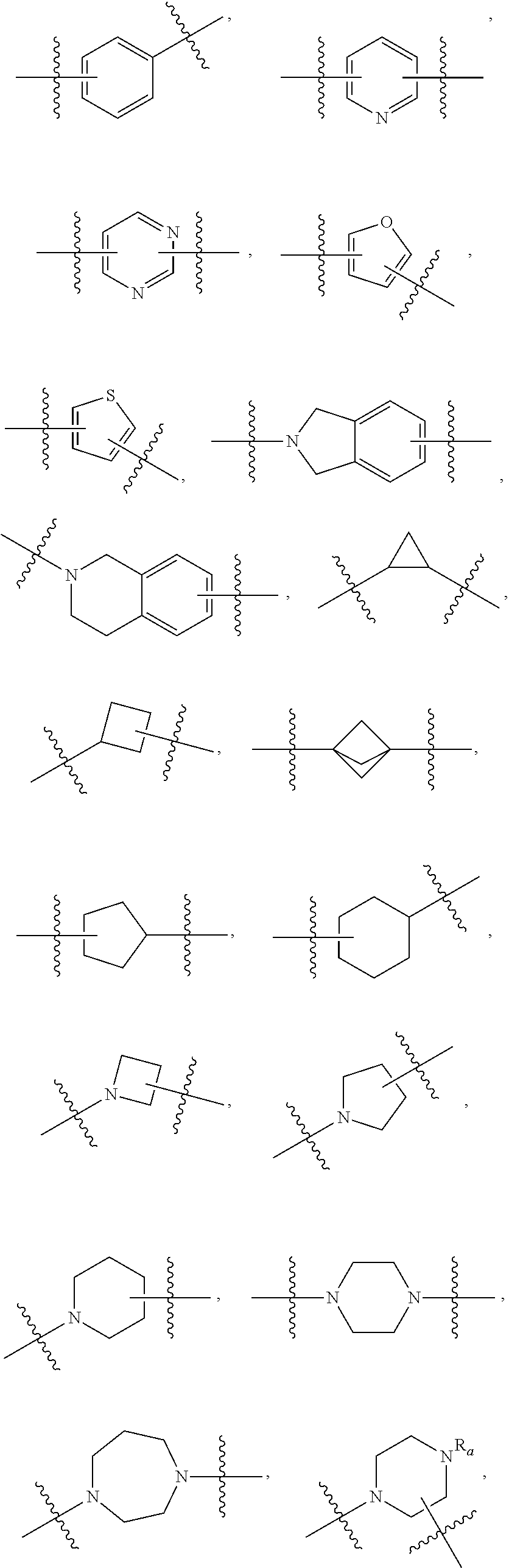


or, in which L1 and Z1 can be linked to A via either left

or right


-
- Prodrug derivatives: prodrugs, upon administration to a subject, will converted in vivo into active compounds of the present invention (Nature Reviews of Drug Discovery, 2008, 7:255). It is noted that in many instances, the prodrugs themselves also fall within the scope of the range of compounds according to the present invention. The prodrugs of the compounds of the present invention can be prepared by standard organic reaction, for example, by reacting with a carbamylating agent (e.g., 1,1-acyloxyalkylcarbonochloridate, para-nitrophenyl carbonate, or the like) or an acylating agent. Further examples of methods and strategies of making prodrugs are described in Bioorganic and Medicinal Chemistry Letters, 1994, 4:1985.
- Deuterium-enriched compounds: deuterium (D or 2H) is H) a stable, non-radioactive isotope of hydrogen and has an atomic weight of 2.0144. Hydrogen naturally occurs as a mixture of the isotopes XH (hydrogen or protium), D (2H or deuterium), and T (3H or tritium). The natural abundance of deuterium is 0.015%. One of ordinary skill in the art recognizes that in all chemical compounds with a H atom, the H atom actually represents a mixture of H and D, with about 0.015% being D. Thus, compounds with a level of deuterium that has been enriched to be greater than its natural abundance of 0.015%, should be considered unnatural and, as a result, novel over their nonenriched counterparts.

in which Z1 is CONH, Z2 is NH, L2 is —CH═CH—, and R6 is attached to Z4, is described in Scheme A. A, B, C, R1, R1, R2, R3, R4, R5, R6, m, n, Z3, Z4, and L1 in Scheme A are the same as those described in the Summary section above. This general procedure can be modified to produce other compounds of the invention with different values for Z1, Z2, L2, and R6 by appropriate modification of the reagents and starting materials used. A skilled addressee would readily be able to make these changes.


in which Z4(R6) is —(CH2)pN(R6)(CH2)q— can be prepared by the following scheme. The OH group of di-nitro staring material 1 can be converted to a leading group LG3 or an aldehyde, which can react with appropriate NH(R6)(CH2)qCH═CH2 to form the intermediate 3. Finally, the reduction of one nitro group of 3 will lead to a-1. This general procedure can be modified to produce other compounds of the invention with different values for Z4 by appropriate modification of the reagents and starting materials used. A skilled addressee would readily be able to make these changes.


in which Z1 is CONH, Z2 is NH, and R6 is attached to Z4, is described in Scheme B. A, R1, R2, R3, R4, R5, R6, m, n, Z3, Z4, and L1, in Scheme A are the same as those described in the Summary section above. This general procedure can be modified to produce other compounds of the invention with different values for Z1, Z2, and R6 by appropriate modification of the reagents and starting materials used. A skilled addressee would readily be able to make these changes.


in which Z1 is CONH, Z2 is NH is described in Scheme C. R1, R2, R3, R4, R5, R6, m, n, p, q, r, and L1 in Scheme C are the same as those described in the Summary section above. This general procedure can be modified to produce other compounds of the invention with different values for Z1, and Z2 by appropriate modification of the reagents and starting materials used. A skilled addressee would readily be able to make these changes.


in which C, R5, R4, Z3, W1, W2, n, r, and s are the same as those described in the Summary section above.


in which B, R3, Z4, Z2, and s are the same as those described in the Summary section above.


in which Warhead, L1, A, R2, p and m are the same as those described in the Summary section above.


in which Z1 is CONH is described in Scheme 1. R2, R3, R4, R5, m, n, s, t, r, and L1 in Scheme 1 are the same as those described in the Summary section above.


by appropriate starting materials such as IM-16-(IV)-1, IM-16-(III)-3, IM-16-(III)-4, IM-16-(III)-5, IM-16-(III)-6, etc., and modification of the reagents used. A skilled addressee would readily be able to make these changes.

by appropriate starting materials such as IM-16-(I)-1 and IM-16-(II)-4 and modification of the reagents used. A skilled addressee would readily be able to make these changes.

with different L2, B, C, Z3 and Z4 by appropriate starting materials such as IM-16-(I)-2 and IM-16-(II)-5/6 and modification of the reagents used. A skilled addressee would readily be able to make these changes.


| Example | Structure | m/z (MH+) |
| CY-16-3 |
 |
540 |
| CY-16-4 |
 |
552 |
| CY-16-5 |
 |
554 |
| CY-16-6 |
 |
566 |
| CY-16-7 |
 |
554 |
| CY-16-8 |
 |
566 |
| CY-16-9 |
 |
554 |
| CY-16-10 |
 |
566 |
| CY-16-11 |
 |
568 |
| CY-16-12 |
 |
580 |
| CY-16-13 |
 |
568 |
| CY-16-14 |
 |
580 |
| CY-16-15 |
 |
540 |
| CY-16-16 |
 |
552 |
| CY-16-17 |
 |
554 |
| CY-16-18 |
 |
566 |
| CY-16-19 |
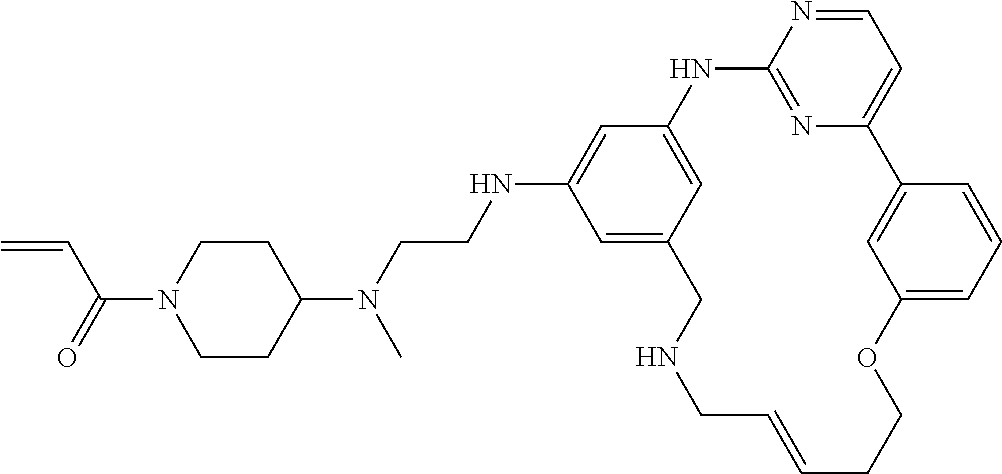 |
568 |
| CY-16-20 |
 |
580 |
| CY-16-21 |
 |
568 |
| CY-16-22 |
 |
580 |
| CY-16-23 |
 |
554 |
| CY-16-24 |
 |
566 |
| CY-16-25 |
 |
568 |
| CY-16-26 |
 |
580 |
| CY-16-27 |
 |
582 |
| CY-16-28 |
 |
594 |
| CY-16-29 |
 |
582 |
| CY-16-30 |
 |
594 |
| CY-16-1 | THZ-1 | ||
| CDK7 | <1 nM | 48 nM | ||
| CY-16-1 | THZ-1 | ||
| CDK7 | <15 nM | <15 nM | ||
| SCLC Cell line | CY-16-1 (uM) | Cisplatin (uM) | ||
| NCI-H209 | 0.030 | 0.274 | ||
| NCI-H69 | 0.032 | 6.996 | ||
| NCI-H69 | 0.018 | 7.700 | ||
| NCI-H82 | 0.028 | 4.508 | ||
| NCI-H446 | 0.019 | 7.452 | ||
| DMS 114 | 0.029 | 5.954 | ||
Claims (18)


Priority Applications (3)
| Application Number | Priority Date | Filing Date | Title |
|---|---|---|---|
| US15/706,980 US10195200B2 (en) | 2015-03-18 | 2017-09-18 | Covalent inhibitors of CDK-7 |
| US16/243,782 US10456397B2 (en) | 2015-03-18 | 2019-01-09 | Covalent inhibitors of CDK-7 |
| US16/661,054 US20200297724A1 (en) | 2015-03-18 | 2019-10-23 | Covalent inhibitors of cdk-7 |
Applications Claiming Priority (3)
| Application Number | Priority Date | Filing Date | Title |
|---|---|---|---|
| US201562135147P | 2015-03-18 | 2015-03-18 | |
| PCT/US2016/021722 WO2016149031A1 (en) | 2015-03-18 | 2016-03-10 | Covalent inhibitors of cdk-7 |
| US15/706,980 US10195200B2 (en) | 2015-03-18 | 2017-09-18 | Covalent inhibitors of CDK-7 |
Related Parent Applications (1)
| Application Number | Title | Priority Date | Filing Date |
|---|---|---|---|
| PCT/US2016/021722 Continuation WO2016149031A1 (en) | 2015-03-18 | 2016-03-10 | Covalent inhibitors of cdk-7 |
Related Child Applications (1)
| Application Number | Title | Priority Date | Filing Date |
|---|---|---|---|
| US16/243,782 Division US10456397B2 (en) | 2015-03-18 | 2019-01-09 | Covalent inhibitors of CDK-7 |
Publications (2)
| Publication Number | Publication Date |
|---|---|
| US20180008604A1 US20180008604A1 (en) | 2018-01-11 |
| US10195200B2 true US10195200B2 (en) | 2019-02-05 |
Family
ID=56920266
Family Applications (3)
| Application Number | Title | Priority Date | Filing Date |
|---|---|---|---|
| US15/706,980 Expired - Fee Related US10195200B2 (en) | 2015-03-18 | 2017-09-18 | Covalent inhibitors of CDK-7 |
| US16/243,782 Expired - Fee Related US10456397B2 (en) | 2015-03-18 | 2019-01-09 | Covalent inhibitors of CDK-7 |
| US16/661,054 Abandoned US20200297724A1 (en) | 2015-03-18 | 2019-10-23 | Covalent inhibitors of cdk-7 |
Family Applications After (2)
| Application Number | Title | Priority Date | Filing Date |
|---|---|---|---|
| US16/243,782 Expired - Fee Related US10456397B2 (en) | 2015-03-18 | 2019-01-09 | Covalent inhibitors of CDK-7 |
| US16/661,054 Abandoned US20200297724A1 (en) | 2015-03-18 | 2019-10-23 | Covalent inhibitors of cdk-7 |
Country Status (2)
| Country | Link |
|---|---|
| US (3) | US10195200B2 (en) |
| WO (1) | WO2016149031A1 (en) |
Families Citing this family (1)
| Publication number | Priority date | Publication date | Assignee | Title |
|---|---|---|---|---|
| WO2016149031A1 (en) | 2015-03-18 | 2016-09-22 | Newave Pharmaceutical Llc | Covalent inhibitors of cdk-7 |
Citations (3)
| Publication number | Priority date | Publication date | Assignee | Title |
|---|---|---|---|---|
| US20040209895A1 (en) | 2002-08-21 | 2004-10-21 | Schering Ag | Macrocyclic pyrimidines, their production and use as pharmaceutical agents |
| WO2008060248A1 (en) | 2006-11-15 | 2008-05-22 | S*Bio Pte Ltd. | Indole sustituted pyrimidines and use thereof in the treatment of cancer |
| US20130172338A1 (en) | 2005-11-16 | 2013-07-04 | Cell Therapeutics, Inc. | Oxygen linked pyrimidine derivatives |
Family Cites Families (1)
| Publication number | Priority date | Publication date | Assignee | Title |
|---|---|---|---|---|
| WO2016149031A1 (en) | 2015-03-18 | 2016-09-22 | Newave Pharmaceutical Llc | Covalent inhibitors of cdk-7 |
-
2016
- 2016-03-10 WO PCT/US2016/021722 patent/WO2016149031A1/en not_active Ceased
-
2017
- 2017-09-18 US US15/706,980 patent/US10195200B2/en not_active Expired - Fee Related
-
2019
- 2019-01-09 US US16/243,782 patent/US10456397B2/en not_active Expired - Fee Related
- 2019-10-23 US US16/661,054 patent/US20200297724A1/en not_active Abandoned
Patent Citations (4)
| Publication number | Priority date | Publication date | Assignee | Title |
|---|---|---|---|---|
| US20040209895A1 (en) | 2002-08-21 | 2004-10-21 | Schering Ag | Macrocyclic pyrimidines, their production and use as pharmaceutical agents |
| US20130172338A1 (en) | 2005-11-16 | 2013-07-04 | Cell Therapeutics, Inc. | Oxygen linked pyrimidine derivatives |
| US9133214B2 (en) * | 2005-11-16 | 2015-09-15 | S*Bio Pte Ltd | Heteroalkyl linked pyrimidine derivatives |
| WO2008060248A1 (en) | 2006-11-15 | 2008-05-22 | S*Bio Pte Ltd. | Indole sustituted pyrimidines and use thereof in the treatment of cancer |
Non-Patent Citations (3)
| Title |
|---|
| Banker, Gilbert S. et al., Modern Pharmaceutics, Marcel Dekker, New York, 1996. (Year: 1996). * |
| West, Anthony R., Solid State Chemistry and Its Applications, Wiley, New York, 1988, 358. (Year: 1988). * |
| Wolff, Manfred E., Burger's Medicinal Chemistry and Drug Discovery, Fifth Ed., vol. 1: Principles and Practice, John Wiley & Sons, 1995, 975. (Year: 1995). * |
Also Published As
| Publication number | Publication date |
|---|---|
| US20180008604A1 (en) | 2018-01-11 |
| US20200297724A1 (en) | 2020-09-24 |
| US10456397B2 (en) | 2019-10-29 |
| WO2016149031A1 (en) | 2016-09-22 |
| US20190151316A1 (en) | 2019-05-23 |
Similar Documents
| Publication | Publication Date | Title |
|---|---|---|
| US10377755B2 (en) | BCL-2 inhibitors | |
| US11479555B2 (en) | Substituted 1,2-dihydro-3H-pyrazolo[3,4-D]pyrimidin-3-ones as inhibitors of WEE-1 kinase | |
| US12583853B2 (en) | 1H-pyrrolo[2,3-b]pyridine derivatives and related compounds as BCL-2 inhibitors for the treatment of neoplastic and autoimmune diseases | |
| US12086788B2 (en) | Substituted pyrazines as inhibitors of BTK, and mutants thereof | |
| US11365206B2 (en) | BCL-2 inhibitors | |
| US10253029B2 (en) | Dual-warhead covalent inhibitors of FGFR-4 | |
| WO2013113841A1 (en) | Novel therapeutic agents | |
| US20160214963A1 (en) | Inhibitors of bruton's tyrosine kinase | |
| US10456397B2 (en) | Covalent inhibitors of CDK-7 | |
| US20240390368A1 (en) | Inhibitor of btk and mutants thereof | |
| US20230382900A1 (en) | Inhibitors of btk | |
| US20260014260A1 (en) | Mdm2 degrader | |
| US20250177429A1 (en) | Orally active prodrug of gemcitabine | |
| US20250129047A1 (en) | Isoquinoline derivatives as mutant egfr modulators and uses thereof | |
| US20250145639A1 (en) | Mutant kras modulators and uses thereof | |
| HK1203963B (en) | Novel therapeutic agents |
Legal Events
| Date | Code | Title | Description |
|---|---|---|---|
| FEPP | Fee payment procedure |
Free format text: ENTITY STATUS SET TO UNDISCOUNTED (ORIGINAL EVENT CODE: BIG.); ENTITY STATUS OF PATENT OWNER: SMALL ENTITY |
|
| FEPP | Fee payment procedure |
Free format text: ENTITY STATUS SET TO SMALL (ORIGINAL EVENT CODE: SMAL); ENTITY STATUS OF PATENT OWNER: SMALL ENTITY |
|
| AS | Assignment |
Owner name: NEWAVE PHARMACEUTICAL INC., CALIFORNIA Free format text: ASSIGNMENT OF ASSIGNORS INTEREST;ASSIGNORS:CHEN, YI;LOU, YAN;SIGNING DATES FROM 20171017 TO 20171024;REEL/FRAME:044408/0342 |
|
| AS | Assignment |
Owner name: NEWAVE PHARMACEUTICAL INC., CALIFORNIA Free format text: CHANGE OF NAME;ASSIGNOR:NEWAVE PHARMACEUTICAL LLC;REEL/FRAME:048891/0270 Effective date: 20160524 Owner name: NEWAVE PHARMACEUTICAL LLC, CALIFORNIA Free format text: ASSIGNMENT OF ASSIGNORS INTEREST;ASSIGNORS:CHEN, YI;LOU, YAN;SIGNING DATES FROM 20171017 TO 20171024;REEL/FRAME:048891/0239 |
|
| STCF | Information on status: patent grant |
Free format text: PATENTED CASE |
|
| FEPP | Fee payment procedure |
Free format text: MAINTENANCE FEE REMINDER MAILED (ORIGINAL EVENT CODE: REM.); ENTITY STATUS OF PATENT OWNER: SMALL ENTITY |
|
| LAPS | Lapse for failure to pay maintenance fees |
Free format text: PATENT EXPIRED FOR FAILURE TO PAY MAINTENANCE FEES (ORIGINAL EVENT CODE: EXP.); ENTITY STATUS OF PATENT OWNER: SMALL ENTITY |
|
| STCH | Information on status: patent discontinuation |
Free format text: PATENT EXPIRED DUE TO NONPAYMENT OF MAINTENANCE FEES UNDER 37 CFR 1.362 |
|
| FP | Lapsed due to failure to pay maintenance fee |
Effective date: 20230205 |