US10189828B2 - 1-methylpyrazole-piperazine compounds having multimodal activity against pain - Google Patents
1-methylpyrazole-piperazine compounds having multimodal activity against pain Download PDFInfo
- Publication number
- US10189828B2 US10189828B2 US15/531,571 US201515531571A US10189828B2 US 10189828 B2 US10189828 B2 US 10189828B2 US 201515531571 A US201515531571 A US 201515531571A US 10189828 B2 US10189828 B2 US 10189828B2
- Authority
- US
- United States
- Prior art keywords
- methyl
- unsubstituted
- substituted
- pyrazol
- alkyl
- Prior art date
- Legal status (The legal status is an assumption and is not a legal conclusion. Google has not performed a legal analysis and makes no representation as to the accuracy of the status listed.)
- Expired - Fee Related
Links
- 0 [1*]C(C)(C)N(C)C Chemical compound [1*]C(C)(C)N(C)C 0.000 description 20
- LVZWSLJZHVFIQJ-UHFFFAOYSA-N C1CC1 Chemical compound C1CC1 LVZWSLJZHVFIQJ-UHFFFAOYSA-N 0.000 description 3
- GJHVUQNGRIAZRI-UHFFFAOYSA-N CN1N=CC=C1C(C1=CC=CC=C1)N1CCN(CCC2=C(Cl)C=CC=N2)CC1 Chemical compound CN1N=CC=C1C(C1=CC=CC=C1)N1CCN(CCC2=C(Cl)C=CC=N2)CC1 GJHVUQNGRIAZRI-UHFFFAOYSA-N 0.000 description 2
- ULLIUIILTFRXHS-UHFFFAOYSA-N CN1N=CC=C1C(C1=CC=CN=C1C(F)(F)F)N1CCN(CCC2=CC=CC=C2)CC1 Chemical compound CN1N=CC=C1C(C1=CC=CN=C1C(F)(F)F)N1CCN(CCC2=CC=CC=C2)CC1 ULLIUIILTFRXHS-UHFFFAOYSA-N 0.000 description 2
- LBLJFRAHZQEGCF-UHFFFAOYSA-N CN1N=CC=C1C(C1=CN=CC=C1)N1CCN(CCC2=CC=CC=C2)CC1 Chemical compound CN1N=CC=C1C(C1=CN=CC=C1)N1CCN(CCC2=CC=CC=C2)CC1 LBLJFRAHZQEGCF-UHFFFAOYSA-N 0.000 description 2
- LUBVWIZYDJFODB-UHFFFAOYSA-N CN1N=CC=C1C(C1=NC(C(F)(F)F)=CC=C1)N1CCN(CCC2=CC=CC=C2)CC1 Chemical compound CN1N=CC=C1C(C1=NC(C(F)(F)F)=CC=C1)N1CCN(CCC2=CC=CC=C2)CC1 LUBVWIZYDJFODB-UHFFFAOYSA-N 0.000 description 2
- NXOODVABNOFINN-UHFFFAOYSA-N CN1N=CC=C1C(C1=NC=C(F)C=C1)N1CCN(CCC2=C(Cl)C=CC=N2)CC1 Chemical compound CN1N=CC=C1C(C1=NC=C(F)C=C1)N1CCN(CCC2=C(Cl)C=CC=N2)CC1 NXOODVABNOFINN-UHFFFAOYSA-N 0.000 description 2
- QFWKBOYLZXGMAG-UHFFFAOYSA-N CN1N=CC=C1C(C1=NC=CC=C1F)N1CCN(CCC2=CC=CC=C2)CC1 Chemical compound CN1N=CC=C1C(C1=NC=CC=C1F)N1CCN(CCC2=CC=CC=C2)CC1 QFWKBOYLZXGMAG-UHFFFAOYSA-N 0.000 description 2
- UQINMCNMEGBRAT-UHFFFAOYSA-N CN1N=CC=C1C(O)C1=CC=C(F)C=N1 Chemical compound CN1N=CC=C1C(O)C1=CC=C(F)C=N1 UQINMCNMEGBRAT-UHFFFAOYSA-N 0.000 description 2
- UTDLBKVWHYRUKP-UHFFFAOYSA-N CC1=C(C(O)C2=CC=NN2C)C=NC=C1 Chemical compound CC1=C(C(O)C2=CC=NN2C)C=NC=C1 UTDLBKVWHYRUKP-UHFFFAOYSA-N 0.000 description 1
- KHMQARZXEDAMJX-UHFFFAOYSA-N CN1N=CC=C1C(C1=CC(O)=CC=C1)N1CCN(CCC2=CC=CC=C2)CC1 Chemical compound CN1N=CC=C1C(C1=CC(O)=CC=C1)N1CCN(CCC2=CC=CC=C2)CC1 KHMQARZXEDAMJX-UHFFFAOYSA-N 0.000 description 1
- PVEPUZNOONQGNU-UHFFFAOYSA-N CN1N=CC=C1C(C1=CC=CC=C1)N1CCN(CC(O)C2=CC=CC=C2)CC1 Chemical compound CN1N=CC=C1C(C1=CC=CC=C1)N1CCN(CC(O)C2=CC=CC=C2)CC1 PVEPUZNOONQGNU-UHFFFAOYSA-N 0.000 description 1
- AKEWVWBNVRAZSR-UHFFFAOYSA-N CN1N=CC=C1C(C1=CC=CC=C1)N1CCN(CC2=CC=CC=C2)CC1 Chemical compound CN1N=CC=C1C(C1=CC=CC=C1)N1CCN(CC2=CC=CC=C2)CC1 AKEWVWBNVRAZSR-UHFFFAOYSA-N 0.000 description 1
- CCOMYTFILSSLGA-UHFFFAOYSA-N CN1N=CC=C1C(C1=CC=CC=C1)N1CCN(CCC2=C(F)C=CC=N2)CC1 Chemical compound CN1N=CC=C1C(C1=CC=CC=C1)N1CCN(CCC2=C(F)C=CC=N2)CC1 CCOMYTFILSSLGA-UHFFFAOYSA-N 0.000 description 1
- FKTAAHOEDHPVBD-UHFFFAOYSA-N CN1N=CC=C1C(C1=CC=CC=C1)N1CCN(CCC2=CC=C(C(F)(F)F)N=C2)CC1 Chemical compound CN1N=CC=C1C(C1=CC=CC=C1)N1CCN(CCC2=CC=C(C(F)(F)F)N=C2)CC1 FKTAAHOEDHPVBD-UHFFFAOYSA-N 0.000 description 1
- OVGYIBBTRZDDCU-UHFFFAOYSA-N CN1N=CC=C1C(C1=CC=CC=C1)N1CCN(CCC2=CC=C(F)C=C2)CC1 Chemical compound CN1N=CC=C1C(C1=CC=CC=C1)N1CCN(CCC2=CC=C(F)C=C2)CC1 OVGYIBBTRZDDCU-UHFFFAOYSA-N 0.000 description 1
- QUXBLOOZMHXDRL-UHFFFAOYSA-N CN1N=CC=C1C(C1=CC=CC=C1)N1CCN(CCC2=CC=C(F)C=N2)CC1 Chemical compound CN1N=CC=C1C(C1=CC=CC=C1)N1CCN(CCC2=CC=C(F)C=N2)CC1 QUXBLOOZMHXDRL-UHFFFAOYSA-N 0.000 description 1
- ZKBSBRWAFYETGW-UHFFFAOYSA-N CN1N=CC=C1C(C1=CC=CC=C1)N1CCN(CCC2=CC=CC(C(F)(F)F)=N2)CC1 Chemical compound CN1N=CC=C1C(C1=CC=CC=C1)N1CCN(CCC2=CC=CC(C(F)(F)F)=N2)CC1 ZKBSBRWAFYETGW-UHFFFAOYSA-N 0.000 description 1
- OZFFUEXNNDJRDM-UHFFFAOYSA-N CN1N=CC=C1C(C1=CC=CC=C1)N1CCN(CCC2=CC=CC(CS(C)(=O)=O)=N2)CC1 Chemical compound CN1N=CC=C1C(C1=CC=CC=C1)N1CCN(CCC2=CC=CC(CS(C)(=O)=O)=N2)CC1 OZFFUEXNNDJRDM-UHFFFAOYSA-N 0.000 description 1
- KQXQTWLEHLXMHG-UHFFFAOYSA-N CN1N=CC=C1C(C1=CC=CC=C1)N1CCN(CCC2=CC=CC(F)=C2)CC1 Chemical compound CN1N=CC=C1C(C1=CC=CC=C1)N1CCN(CCC2=CC=CC(F)=C2)CC1 KQXQTWLEHLXMHG-UHFFFAOYSA-N 0.000 description 1
- NFNNEUAZEVKJGT-UHFFFAOYSA-N CN1N=CC=C1C(C1=CC=CC=C1)N1CCN(CCC2=CC=CC(N(S(C)(=O)=O)S(C)(=O)=O)=N2)CC1 Chemical compound CN1N=CC=C1C(C1=CC=CC=C1)N1CCN(CCC2=CC=CC(N(S(C)(=O)=O)S(C)(=O)=O)=N2)CC1 NFNNEUAZEVKJGT-UHFFFAOYSA-N 0.000 description 1
- ZHBGGIFFGZMMPW-UHFFFAOYSA-N CN1N=CC=C1C(C1=CC=CC=C1)N1CCN(CCC2=CC=CC(N)=N2)CC1 Chemical compound CN1N=CC=C1C(C1=CC=CC=C1)N1CCN(CCC2=CC=CC(N)=N2)CC1 ZHBGGIFFGZMMPW-UHFFFAOYSA-N 0.000 description 1
- TXRMCVWAIPHRKZ-UHFFFAOYSA-N CN1N=CC=C1C(C1=CC=CC=C1)N1CCN(CCC2=CC=CC(O)=C2)CC1 Chemical compound CN1N=CC=C1C(C1=CC=CC=C1)N1CCN(CCC2=CC=CC(O)=C2)CC1 TXRMCVWAIPHRKZ-UHFFFAOYSA-N 0.000 description 1
- ROESJGYUHMMCGC-UHFFFAOYSA-N CN1N=CC=C1C(C1=CC=CC=C1)N1CCN(CCC2=CC=CC=C2)CC1 Chemical compound CN1N=CC=C1C(C1=CC=CC=C1)N1CCN(CCC2=CC=CC=C2)CC1 ROESJGYUHMMCGC-UHFFFAOYSA-N 0.000 description 1
- RZMQBRCEAZMEOK-UHFFFAOYSA-N CN1N=CC=C1C(C1=CC=CC=C1)N1CCN(CCC2=CC=CC=C2F)CC1 Chemical compound CN1N=CC=C1C(C1=CC=CC=C1)N1CCN(CCC2=CC=CC=C2F)CC1 RZMQBRCEAZMEOK-UHFFFAOYSA-N 0.000 description 1
- MJIUFBCGPKHDFQ-UHFFFAOYSA-N CN1N=CC=C1C(C1=CC=CC=C1)N1CCN(CCC2=CC=CC=C2O)CC1 Chemical compound CN1N=CC=C1C(C1=CC=CC=C1)N1CCN(CCC2=CC=CC=C2O)CC1 MJIUFBCGPKHDFQ-UHFFFAOYSA-N 0.000 description 1
- SJOQIWRTLINCFJ-UHFFFAOYSA-N CN1N=CC=C1C(C1=CC=CC=C1)N1CCN(CCC2=CC=CC=N2)CC1 Chemical compound CN1N=CC=C1C(C1=CC=CC=C1)N1CCN(CCC2=CC=CC=N2)CC1 SJOQIWRTLINCFJ-UHFFFAOYSA-N 0.000 description 1
- NZVQTISASHNIGC-UHFFFAOYSA-N CN1N=CC=C1C(C1=CC=CC=C1)N1CCN(CCC2=CC=CN=C2)CC1 Chemical compound CN1N=CC=C1C(C1=CC=CC=C1)N1CCN(CCC2=CC=CN=C2)CC1 NZVQTISASHNIGC-UHFFFAOYSA-N 0.000 description 1
- BRFQZIMECRTLHC-UHFFFAOYSA-N CN1N=CC=C1C(C1=CC=CC=C1)N1CCN(CCC2=CC=NC=C2)CC1 Chemical compound CN1N=CC=C1C(C1=CC=CC=C1)N1CCN(CCC2=CC=NC=C2)CC1 BRFQZIMECRTLHC-UHFFFAOYSA-N 0.000 description 1
- VDAZGNRRKAWQFX-UHFFFAOYSA-N CN1N=CC=C1C(C1=CC=CC=C1)N1CCN(CCC2=CSC(CC(=O)OC(C)(C)C)=N2)CC1 Chemical compound CN1N=CC=C1C(C1=CC=CC=C1)N1CCN(CCC2=CSC(CC(=O)OC(C)(C)C)=N2)CC1 VDAZGNRRKAWQFX-UHFFFAOYSA-N 0.000 description 1
- JBSHALRJJDJKRY-UHFFFAOYSA-N CN1N=CC=C1C(C1=CC=CC=C1)N1CCN(CCC2=CSC(N)=N2)CC1 Chemical compound CN1N=CC=C1C(C1=CC=CC=C1)N1CCN(CCC2=CSC(N)=N2)CC1 JBSHALRJJDJKRY-UHFFFAOYSA-N 0.000 description 1
- LXBNLFMAZWZTDQ-UHFFFAOYSA-N CN1N=CC=C1C(C1=CC=CC=C1)N1CCNCC1.Cl Chemical compound CN1N=CC=C1C(C1=CC=CC=C1)N1CCNCC1.Cl LXBNLFMAZWZTDQ-UHFFFAOYSA-N 0.000 description 1
- XQPKWKGMLGYMNK-UHFFFAOYSA-N CN1N=CC=C1C(C1=CC=NC=C1)N1CCN(CCC2=CC=CC=C2)CC1 Chemical compound CN1N=CC=C1C(C1=CC=NC=C1)N1CCN(CCC2=CC=CC=C2)CC1 XQPKWKGMLGYMNK-UHFFFAOYSA-N 0.000 description 1
- DYUGJYKPHVWYGE-UHFFFAOYSA-N CN1N=CC=C1C(C1=CN=C(C(F)(F)F)C=C1)N1CCN(CCC2=CC=CC=C2)CC1 Chemical compound CN1N=CC=C1C(C1=CN=C(C(F)(F)F)C=C1)N1CCN(CCC2=CC=CC=C2)CC1 DYUGJYKPHVWYGE-UHFFFAOYSA-N 0.000 description 1
- WCMYWRJINRDXDS-UHFFFAOYSA-N CN1N=CC=C1C(C1=CN=CC(F)=C1)N1CCN(CCC2=CC=CC=C2)CC1 Chemical compound CN1N=CC=C1C(C1=CN=CC(F)=C1)N1CCN(CCC2=CC=CC=C2)CC1 WCMYWRJINRDXDS-UHFFFAOYSA-N 0.000 description 1
- XEVWTSABTHLNNN-UHFFFAOYSA-N CN1N=CC=C1C(C1=CN=CC=C1C(F)(F)F)N1CCN(CCC2=CC=CC=C2)CC1 Chemical compound CN1N=CC=C1C(C1=CN=CC=C1C(F)(F)F)N1CCN(CCC2=CC=CC=C2)CC1 XEVWTSABTHLNNN-UHFFFAOYSA-N 0.000 description 1
- IQCNDQHTTPIEFA-UHFFFAOYSA-N CN1N=CC=C1C(C1=NC=C(C(F)(F)F)C=C1)N1CCN(CCC2=CC=CC=C2)CC1 Chemical compound CN1N=CC=C1C(C1=NC=C(C(F)(F)F)C=C1)N1CCN(CCC2=CC=CC=C2)CC1 IQCNDQHTTPIEFA-UHFFFAOYSA-N 0.000 description 1
- UNXTXKAQWUTPAJ-UHFFFAOYSA-N CN1N=CC=C1C(C1=NC=C(Cl)C=C1)N1CCN(CCC2=CC=CC=C2)CC1 Chemical compound CN1N=CC=C1C(C1=NC=C(Cl)C=C1)N1CCN(CCC2=CC=CC=C2)CC1 UNXTXKAQWUTPAJ-UHFFFAOYSA-N 0.000 description 1
- RWIWHYJFBAMYPI-UHFFFAOYSA-N CN1N=CC=C1C(C1=NC=C(F)C=C1)N1CCN(CCC2=CC=CC(F)=C2)CC1 Chemical compound CN1N=CC=C1C(C1=NC=C(F)C=C1)N1CCN(CCC2=CC=CC(F)=C2)CC1 RWIWHYJFBAMYPI-UHFFFAOYSA-N 0.000 description 1
- OLARAXYONANTDO-UHFFFAOYSA-N CN1N=CC=C1C(C1=NC=C(F)C=C1)N1CCN(CCC2=CC=CC(O)=C2)CC1 Chemical compound CN1N=CC=C1C(C1=NC=C(F)C=C1)N1CCN(CCC2=CC=CC(O)=C2)CC1 OLARAXYONANTDO-UHFFFAOYSA-N 0.000 description 1
- JRNLVQSYVACKOJ-UHFFFAOYSA-N CN1N=CC=C1C(C1=NC=C(F)C=C1)N1CCN(CCC2=CC=CC=C2)CC1 Chemical compound CN1N=CC=C1C(C1=NC=C(F)C=C1)N1CCN(CCC2=CC=CC=C2)CC1 JRNLVQSYVACKOJ-UHFFFAOYSA-N 0.000 description 1
- KIMHRPPUXGNBOP-UHFFFAOYSA-N CN1N=CC=C1C(C1=NC=C(F)C=C1)N1CCN(CCC2=CC=CC=C2F)CC1 Chemical compound CN1N=CC=C1C(C1=NC=C(F)C=C1)N1CCN(CCC2=CC=CC=C2F)CC1 KIMHRPPUXGNBOP-UHFFFAOYSA-N 0.000 description 1
- CAFHCEDZKBMFSA-UHFFFAOYSA-N CN1N=CC=C1C(C1=NC=C(F)C=C1)N1CCN(CCC2=CC=CC=N2)CC1 Chemical compound CN1N=CC=C1C(C1=NC=C(F)C=C1)N1CCN(CCC2=CC=CC=N2)CC1 CAFHCEDZKBMFSA-UHFFFAOYSA-N 0.000 description 1
- MQHSHNKNDHCYPB-UHFFFAOYSA-N CN1N=CC=C1C(C1=NC=C(F)C=C1)N1CCNCC1 Chemical compound CN1N=CC=C1C(C1=NC=C(F)C=C1)N1CCNCC1 MQHSHNKNDHCYPB-UHFFFAOYSA-N 0.000 description 1
- GAYPANVHQXHTPI-UHFFFAOYSA-N CN1N=CC=C1C(C1=NC=CC=C1)N1CCN(CCC2=CC=CC=C2)CC1 Chemical compound CN1N=CC=C1C(C1=NC=CC=C1)N1CCN(CCC2=CC=CC=C2)CC1 GAYPANVHQXHTPI-UHFFFAOYSA-N 0.000 description 1
- AYJICOWAGOVTGU-UHFFFAOYSA-N CN1N=CC=C1C(O)C1=C(F)C=CC=N1 Chemical compound CN1N=CC=C1C(O)C1=C(F)C=CC=N1 AYJICOWAGOVTGU-UHFFFAOYSA-N 0.000 description 1
- RTWBLUBGLDPEQG-UHFFFAOYSA-N CN1N=CC=C1C(O)C1=CC(Cl)=CN=C1 Chemical compound CN1N=CC=C1C(O)C1=CC(Cl)=CN=C1 RTWBLUBGLDPEQG-UHFFFAOYSA-N 0.000 description 1
- FOUOWNKUBPNLDC-UHFFFAOYSA-N CN1N=CC=C1C(O)C1=CC(F)=CN=C1 Chemical compound CN1N=CC=C1C(O)C1=CC(F)=CN=C1 FOUOWNKUBPNLDC-UHFFFAOYSA-N 0.000 description 1
- YYLQMHXGTHPSLI-UHFFFAOYSA-N CN1N=CC=C1C(O)C1=CC=C(C(F)(F)F)C=N1 Chemical compound CN1N=CC=C1C(O)C1=CC=C(C(F)(F)F)C=N1 YYLQMHXGTHPSLI-UHFFFAOYSA-N 0.000 description 1
- KJZAOJNGVGRQPS-UHFFFAOYSA-N CN1N=CC=C1C(O)C1=CC=C(C(F)(F)F)N=C1 Chemical compound CN1N=CC=C1C(O)C1=CC=C(C(F)(F)F)N=C1 KJZAOJNGVGRQPS-UHFFFAOYSA-N 0.000 description 1
- SCZGBFFIJDKAQR-UHFFFAOYSA-N CN1N=CC=C1C(O)C1=CC=CC(C(F)(F)F)=N1 Chemical compound CN1N=CC=C1C(O)C1=CC=CC(C(F)(F)F)=N1 SCZGBFFIJDKAQR-UHFFFAOYSA-N 0.000 description 1
- UYVGFRVKQOCGDA-UHFFFAOYSA-N CN1N=CC=C1C(O)C1=CC=CC=C1 Chemical compound CN1N=CC=C1C(O)C1=CC=CC=C1 UYVGFRVKQOCGDA-UHFFFAOYSA-N 0.000 description 1
- RVONLUCCVPQWLX-UHFFFAOYSA-N CN1N=CC=C1C(O)C1=CC=CC=N1 Chemical compound CN1N=CC=C1C(O)C1=CC=CC=N1 RVONLUCCVPQWLX-UHFFFAOYSA-N 0.000 description 1
- DIYBRKJFFWMIPH-UHFFFAOYSA-N CN1N=CC=C1C(O)C1=CC=CN=C1 Chemical compound CN1N=CC=C1C(O)C1=CC=CN=C1 DIYBRKJFFWMIPH-UHFFFAOYSA-N 0.000 description 1
- LGRVISXBFIRQIG-UHFFFAOYSA-N CN1N=CC=C1C(O)C1=CC=CN=C1C(F)(F)F Chemical compound CN1N=CC=C1C(O)C1=CC=CN=C1C(F)(F)F LGRVISXBFIRQIG-UHFFFAOYSA-N 0.000 description 1
- ZEALIPSLYAVDTC-UHFFFAOYSA-N CN1N=CC=C1C(O)C1=CC=NC=C1 Chemical compound CN1N=CC=C1C(O)C1=CC=NC=C1 ZEALIPSLYAVDTC-UHFFFAOYSA-N 0.000 description 1
- CFELEZFQHNNVEX-UHFFFAOYSA-N CN1N=CC=C1N(C1=CC=CC=C1)C1CCN(CC2=CC=CC=C2)CC1 Chemical compound CN1N=CC=C1N(C1=CC=CC=C1)C1CCN(CC2=CC=CC=C2)CC1 CFELEZFQHNNVEX-UHFFFAOYSA-N 0.000 description 1
- GBGNPPMKCUIOKO-UHFFFAOYSA-N CN1N=CC=C1N(C1=CC=CC=C1)C1CCN(CCC2=CC=CC=C2)CC1 Chemical compound CN1N=CC=C1N(C1=CC=CC=C1)C1CCN(CCC2=CC=CC=C2)CC1 GBGNPPMKCUIOKO-UHFFFAOYSA-N 0.000 description 1
- UZGLHYJRNLTAPX-UHFFFAOYSA-N COC1=CC(C(O)C2=CC=NN2C)=CC=C1 Chemical compound COC1=CC(C(O)C2=CC=NN2C)=CC=C1 UZGLHYJRNLTAPX-UHFFFAOYSA-N 0.000 description 1
- NHFNFMMEZZEAQV-UHFFFAOYSA-N COC1=CC(CCN2CCN(C(C3=CC=NN3C)C3=NC=C(F)C=C3)CC2)=CC=C1 Chemical compound COC1=CC(CCN2CCN(C(C3=CC=NN3C)C3=NC=C(F)C=C3)CC2)=CC=C1 NHFNFMMEZZEAQV-UHFFFAOYSA-N 0.000 description 1
- KJRKVARPZWUGBG-UHFFFAOYSA-N COC1=CC=C(C(C2=CC=NN2C)N2CCN(CCC3=CC=CC=C3)CC2)C=C1 Chemical compound COC1=CC=C(C(C2=CC=NN2C)N2CCN(CCC3=CC=CC=C3)CC2)C=C1 KJRKVARPZWUGBG-UHFFFAOYSA-N 0.000 description 1
- JUCIFKDNNZUYCN-UHFFFAOYSA-N COC1=CC=C(C(O)C2=CC=NN2C)C=C1 Chemical compound COC1=CC=C(C(O)C2=CC=NN2C)C=C1 JUCIFKDNNZUYCN-UHFFFAOYSA-N 0.000 description 1
- QKTXWFSBXWWIET-UHFFFAOYSA-N COC1=CC=CC(C(C2=CC=NN2C)N2CCN(CCC3=CC=CC=C3)CC2)=C1 Chemical compound COC1=CC=CC(C(C2=CC=NN2C)N2CCN(CCC3=CC=CC=C3)CC2)=C1 QKTXWFSBXWWIET-UHFFFAOYSA-N 0.000 description 1
- AHKSLYJZDBPTEO-UHFFFAOYSA-N COC1=CC=CC(CCN2CCN(C(C3=CC=CC=C3)C3=CC=NN3C)CC2)=C1 Chemical compound COC1=CC=CC(CCN2CCN(C(C3=CC=CC=C3)C3=CC=NN3C)CC2)=C1 AHKSLYJZDBPTEO-UHFFFAOYSA-N 0.000 description 1
- ZEXXQFVDQMQSKW-UHFFFAOYSA-N COC1=CC=CC=C1C(C1=CC=NN1C)N1CCN(CCC2=CC=CC=C2)CC1 Chemical compound COC1=CC=CC=C1C(C1=CC=NN1C)N1CCN(CCC2=CC=CC=C2)CC1 ZEXXQFVDQMQSKW-UHFFFAOYSA-N 0.000 description 1
- QVWSBFIGLPUHRW-UHFFFAOYSA-N COC1=CC=CC=C1C(O)C1=CC=NN1C Chemical compound COC1=CC=CC=C1C(O)C1=CC=NN1C QVWSBFIGLPUHRW-UHFFFAOYSA-N 0.000 description 1
- WTPKEPFZXYBGDW-UHFFFAOYSA-N COC1=CC=CC=C1CCN1CCN(C(C2=CC=CC=C2)C2=CC=NN2C)CC1 Chemical compound COC1=CC=CC=C1CCN1CCN(C(C2=CC=CC=C2)C2=CC=NN2C)CC1 WTPKEPFZXYBGDW-UHFFFAOYSA-N 0.000 description 1
Classifications
-
- C—CHEMISTRY; METALLURGY
- C07—ORGANIC CHEMISTRY
- C07D—HETEROCYCLIC COMPOUNDS
- C07D417/00—Heterocyclic compounds containing two or more hetero rings, at least one ring having nitrogen and sulfur atoms as the only ring hetero atoms, not provided for by group C07D415/00
- C07D417/02—Heterocyclic compounds containing two or more hetero rings, at least one ring having nitrogen and sulfur atoms as the only ring hetero atoms, not provided for by group C07D415/00 containing two hetero rings
- C07D417/12—Heterocyclic compounds containing two or more hetero rings, at least one ring having nitrogen and sulfur atoms as the only ring hetero atoms, not provided for by group C07D415/00 containing two hetero rings linked by a chain containing hetero atoms as chain links
-
- A—HUMAN NECESSITIES
- A61—MEDICAL OR VETERINARY SCIENCE; HYGIENE
- A61K—PREPARATIONS FOR MEDICAL, DENTAL OR TOILETRY PURPOSES
- A61K31/00—Medicinal preparations containing organic active ingredients
- A61K31/33—Heterocyclic compounds
- A61K31/395—Heterocyclic compounds having nitrogen as a ring hetero atom, e.g. guanethidine or rifamycins
- A61K31/435—Heterocyclic compounds having nitrogen as a ring hetero atom, e.g. guanethidine or rifamycins having six-membered rings with one nitrogen as the only ring hetero atom
- A61K31/44—Non condensed pyridines; Hydrogenated derivatives thereof
- A61K31/445—Non condensed piperidines, e.g. piperocaine
- A61K31/4523—Non condensed piperidines, e.g. piperocaine containing further heterocyclic ring systems
-
- A—HUMAN NECESSITIES
- A61—MEDICAL OR VETERINARY SCIENCE; HYGIENE
- A61K—PREPARATIONS FOR MEDICAL, DENTAL OR TOILETRY PURPOSES
- A61K31/00—Medicinal preparations containing organic active ingredients
- A61K31/33—Heterocyclic compounds
- A61K31/395—Heterocyclic compounds having nitrogen as a ring hetero atom, e.g. guanethidine or rifamycins
- A61K31/495—Heterocyclic compounds having nitrogen as a ring hetero atom, e.g. guanethidine or rifamycins having six-membered rings with two or more nitrogen atoms as the only ring heteroatoms, e.g. piperazine or tetrazines
- A61K31/496—Non-condensed piperazines containing further heterocyclic rings, e.g. rifampin, thiothixene or sparfloxacin
-
- C—CHEMISTRY; METALLURGY
- C07—ORGANIC CHEMISTRY
- C07D—HETEROCYCLIC COMPOUNDS
- C07D231/00—Heterocyclic compounds containing 1,2-diazole or hydrogenated 1,2-diazole rings
- C07D231/02—Heterocyclic compounds containing 1,2-diazole or hydrogenated 1,2-diazole rings not condensed with other rings
- C07D231/10—Heterocyclic compounds containing 1,2-diazole or hydrogenated 1,2-diazole rings not condensed with other rings having two or three double bonds between ring members or between ring members and non-ring members
- C07D231/12—Heterocyclic compounds containing 1,2-diazole or hydrogenated 1,2-diazole rings not condensed with other rings having two or three double bonds between ring members or between ring members and non-ring members with only hydrogen atoms, hydrocarbon or substituted hydrocarbon radicals, directly attached to ring carbon atoms
-
- C—CHEMISTRY; METALLURGY
- C07—ORGANIC CHEMISTRY
- C07D—HETEROCYCLIC COMPOUNDS
- C07D401/00—Heterocyclic compounds containing two or more hetero rings, having nitrogen atoms as the only ring hetero atoms, at least one ring being a six-membered ring with only one nitrogen atom
- C07D401/02—Heterocyclic compounds containing two or more hetero rings, having nitrogen atoms as the only ring hetero atoms, at least one ring being a six-membered ring with only one nitrogen atom containing two hetero rings
- C07D401/06—Heterocyclic compounds containing two or more hetero rings, having nitrogen atoms as the only ring hetero atoms, at least one ring being a six-membered ring with only one nitrogen atom containing two hetero rings linked by a carbon chain containing only aliphatic carbon atoms
-
- C—CHEMISTRY; METALLURGY
- C07—ORGANIC CHEMISTRY
- C07D—HETEROCYCLIC COMPOUNDS
- C07D401/00—Heterocyclic compounds containing two or more hetero rings, having nitrogen atoms as the only ring hetero atoms, at least one ring being a six-membered ring with only one nitrogen atom
- C07D401/02—Heterocyclic compounds containing two or more hetero rings, having nitrogen atoms as the only ring hetero atoms, at least one ring being a six-membered ring with only one nitrogen atom containing two hetero rings
- C07D401/12—Heterocyclic compounds containing two or more hetero rings, having nitrogen atoms as the only ring hetero atoms, at least one ring being a six-membered ring with only one nitrogen atom containing two hetero rings linked by a chain containing hetero atoms as chain links
-
- C—CHEMISTRY; METALLURGY
- C07—ORGANIC CHEMISTRY
- C07D—HETEROCYCLIC COMPOUNDS
- C07D401/00—Heterocyclic compounds containing two or more hetero rings, having nitrogen atoms as the only ring hetero atoms, at least one ring being a six-membered ring with only one nitrogen atom
- C07D401/14—Heterocyclic compounds containing two or more hetero rings, having nitrogen atoms as the only ring hetero atoms, at least one ring being a six-membered ring with only one nitrogen atom containing three or more hetero rings
-
- C—CHEMISTRY; METALLURGY
- C07—ORGANIC CHEMISTRY
- C07D—HETEROCYCLIC COMPOUNDS
- C07D403/00—Heterocyclic compounds containing two or more hetero rings, having nitrogen atoms as the only ring hetero atoms, not provided for by group C07D401/00
- C07D403/02—Heterocyclic compounds containing two or more hetero rings, having nitrogen atoms as the only ring hetero atoms, not provided for by group C07D401/00 containing two hetero rings
- C07D403/06—Heterocyclic compounds containing two or more hetero rings, having nitrogen atoms as the only ring hetero atoms, not provided for by group C07D401/00 containing two hetero rings linked by a carbon chain containing only aliphatic carbon atoms
-
- C—CHEMISTRY; METALLURGY
- C07—ORGANIC CHEMISTRY
- C07D—HETEROCYCLIC COMPOUNDS
- C07D417/00—Heterocyclic compounds containing two or more hetero rings, at least one ring having nitrogen and sulfur atoms as the only ring hetero atoms, not provided for by group C07D415/00
- C07D417/14—Heterocyclic compounds containing two or more hetero rings, at least one ring having nitrogen and sulfur atoms as the only ring hetero atoms, not provided for by group C07D415/00 containing three or more hetero rings
Definitions
- the present invention relates to compounds having dual pharmacological activity towards both the sigma ( ⁇ ) receptor, and the ⁇ -opiod receptor (MOR or mu-opioid receptor) and more particularly to 1-methylpyrazole-piperazine derivatives having this pharmacological activity, to processes of preparation of such compounds, to pharmaceutical compositions comprising them, and to their use in therapy, in particular for the treatment of pain.
- NSAIDs non-steroidal anti-inflammatory drugs
- opioid agonists opioid agonists
- calcium channel blockers and antidepressants
- antidepressants but they are much less than optimal regarding their safety ratio. All of them show limited efficacy and a range of secondary effects that preclude their use, especially in chronic settings.
- MOR ⁇ -opioid receptor
- MOR agonists are not optimal for the treatment of chronic pain as indicated by the diminished effectiveness of morphine against chronic pain conditions. This is especially proven for the chronic pain condidtions of neuropathic or inflammatory origin, in comparison to its high potency against acute pain.
- the finding that chronic pain can lead to MOR down-regulation may offer a molecular basis for the relative lack of efficacy of morphine in long-term treatment settings [Dickenson, A. H., Suzuki, R. Opioids in neuropathic pain: Clues from animal studies . Eur J Pain 9, 113-6 (2005)].
- prolonged treatment with morphine may result in tolerance to its analgesic effects, most likely due to treatment-induced MOR down-regulation, internalization and other regulatory mechanisms.
- long-term treatment can result in substantial increases in dosing in order to maintain a clinically satisfactory pain relief, but the narrow therapeutic window of MOR agonists finally results in unacceptable side effects and poor patient compliance.
- the sigma-1 ( ⁇ 1 ) receptor was discovered 35 years ago and initially assigned to a new subtype of the opioid family, but later on and based on the studies of the enantiomers of SKF-10,047, its independent nature was established.
- the first link of the or receptor to analgesia was established by Chien and Pasternak [Chien C C, Pasternak G W. Sigma antagonists potentiate opioid analgesia in rats. Neurosci. Lett. 190, 137-9 (1995)], who described it as an endogenous anti-opioid system, based on the finding that ⁇ 1 receptor agonists counteracted opioid receptor mediated analgesia, while ⁇ 1 receptor antagonists, such as haloperidol, potentiated it.
- capsaicin did not induce mechanical hypersensitivity, both phases of formalin-induced pain were reduced, and cold and mechanical hypersensitivity were strongly attenuated after partial sciatic nerve ligation or after treatment with paclitaxel, which are models of neuropathic pain. Many of these actions were confirmed by the use of ⁇ 1 receptor antagonists and led to the advancement of one compound, S1RA, into clinical trials for the treatment of different pain states.
- Compound S1RA exerted a substantial reduction of neuropathic pain and anhedonic state following nerve injury (i.e., neuropathic pain conditions) and, as demonstrated in an operant self-administration model, the nerve-injured mice, but not sham-operated mice, acquired the operant responding to obtain it (presumably to get pain relief), indicating that ⁇ 1 receptor antagonism relieves neuropathic pain and also address some of the comorbidities (i.e., anhedonia, a core symptom in depression) related to pain states.
- therapies are a common clinical practice and many efforts are directed to assess the best combination of available drugs in clinical studies [Mao J, Gold MS, Backonja M. Combination drug therapy for chronic pain: a call for more clinical studies. J. Pain 12, 157-166 (2011)].
- opioids are among the most potent analgesics but they are also responsible for various adverse effects which seriously limit their use.
- the technical problem can therefore be formulated as finding compounds that have an alternative or improved pharmacological activity in the treatment of pain.
- the present invention offers a solution by combining in a single compound binding to two different receptors relevant for the treatment of pain. This was mainly achieved by providing the compounds according to the invention that bind both to the ⁇ -opiod receptor and to the ⁇ 1 receptor.
- the invention is in one aspect directed to a compound having a dual activity binding to the ⁇ 1 receptor and the ⁇ -opioid receptor for use in the treatment of pain.
- the compound has a binding expressed as K i which is preferably ⁇ 1000 nM for both receptors, more preferably ⁇ 500 nM, even more preferably ⁇ 100 nM.
- the invention is directed in a main aspect to a compound of general formula (I),
- the invention is directed to a family of structurally distinct 1-methylpyrazole-piperazine derivatives which have a dual pharmacological activity towards both the sigma ( ⁇ ) receptor and the ⁇ -opiod receptor, thus solving the above problem of identifying alternative or improved pain treatments by offering such dual compounds.
- the invention is in one aspect directed to a compound having a dual activity binding to the ⁇ 1 receptor and the ⁇ -opioid receptor for use in the treatment of pain.
- the compound has a binding expressed as K i which is preferably ⁇ 1000 nM for both receptors, more preferably ⁇ 500 nM, even more preferably ⁇ 100 nM.
- the applicant has surprisingly found that the problem on which the present invention is based can be solved by using a multimodal balanced analgesic approach combining two different synergistic activities in a single drug (i.e., dual ligands which are bifunctional and bind to ⁇ -opioid receptor and to ⁇ 1 receptor), thereby enhancing the opioid analgesia through the ⁇ 1 activation without increasing the undesirable side effects.
- This supports the therapeutic value of a dual MOR/ ⁇ 1 receptor compound whereby the ⁇ 1 receptor binding component acts as an intrinsic adjuvant of the MOR binding component.
- a dual compound that possess binding to both the ⁇ -opiod receptor and to the ⁇ 1 receptor shows a highly valuable therapeutic potential by achieving an outstanding analgesia (enhanced in respect to the potency of the opioid component alone) with a reduced side-effect profile (safety margin increased compared to that of the opioid component alone) versus existing opioid therapies.
- the dual compounds according to the present invention would in addition show one or more the following functionalities: ⁇ 1 receptor antagonism and ⁇ -opioid receptor agonism. It has to be noted, though, that both functionalities “antagonism” and “agonism” are also sub-divided in their effect into subfunctionalities like partial agonism or inverse agonism. Accordingly, the functionalities of the dual compound should be considered within a relatively broad bandwidth.
- An antagonist on one of the named receptors blocks or dampens agonist-mediated responses.
- Known subfunctionalities are neutral antagonists or inverse agonists.
- An agonist on one of the named receptors increases the activity of the receptor above its basal level.
- Known subfunctionalities are full agonists, or partial agonists.
- the two mechanisms complement each other since MOR agonists are only marginally effective in the treatment of neuropathic pain, while ⁇ 1 receptor antagonists show outstanding effects in preclinical neuropathic pain models.
- the ⁇ 1 receptor component adds unique analgesic actions in opioid-resistant pain.
- the dual approach has clear advantages over MOR agonists in the treatment of chronic pain as lower and better tolerated doses would be needed based on the potentiation of analgesia but not of the adverse events of MOR agonists.
- a further advantage of using designed multiple ligands is a lower risk of drug-drug interactions compared to cocktails or multi-component drugs, thus involving simpler pharmacokinetics and less variability among patients. Additionally, this approach may improve patient compliance and broaden the therapeutic application in relation to monomechanistic drugs, by addressing more complex aetiologies. It is also seen as a way of improving the R&D output obtained using the “one drug-one target” approach, which has been questioned over the last years [Bornot A, Bauer U, Brown A, Firth M, Hellawell C, Engkvist O. Systematic Exploration of Dual-Acting Modulators from a Combined Medicinal Chemistry and Biology Perspective. J. Med. Chem, 56, 1197-1210 (2013)].
- stereoisomers optionally in form of one of the stereoisomers, preferably enantiomers or diastereomers, a racemate or in form of a mixture of at least two of the stereoisomers, preferably enantiomers and/or diastereomers, in any mixing ratio, or a corresponding salt thereof, or a corresponding solvate thereof.
- alkyl is understood as meaning saturated, linear or branched hydrocarbons, which may be unsubstituted or substituted once or several times. It encompasses e.g. —CH 3 and —CH 2 —CH 3 .
- C 1-2 -alkyl represents C1- or C2-alkyl
- C 1-3 -alkyl represents C1-, C2- or C3-alkyl
- C 1-4 -alkyl represents C1-, C2-, C3- or C4-alkyl
- C 1-5 -alkyl represents C1-, C2-, C3-, C4-, or C5-alkyl
- C 1-6 -alkyl represents C1-, C2-, C3-, C4-, C5- or C6-alkyl
- C 1-7 -alkyl represents C1-, C2-, C3-, C4-, C5-, C6- or C7-alkyl
- C 1-7 -alkyl represents C1-, C2-, C3-, C4-, C5-, C6-, C7- or C8-alkyl
- C 1-10 -alkyl represents C1-, C2-, C3-, C4-, C5-, C
- the alkyl radicals are preferably methyl, ethyl, propyl, methylethyl, butyl, 1-methylpropyl, 2-methylpropyl, 1,1-dimethylethyl, pentyl, 1,1-dimethylpropyl, 1,2-dimethylpropyl, 2,2-dimethylpropyl, hexyl, 1-methylpentyl, if substituted also CHF 2 , CF 3 or CH 2 OH etc.
- alkyl is understood in the context of this invention as C 1-8 alkyl like methyl, ethyl, propyl, butyl, pentyl, hexyl, heptyl, or octyl; preferably is C 1-6 alkyl like methyl, ethyl, propyl, butyl, pentyl, or hexyl; more preferably is C 1-4 alkyl like methyl, ethyl, propyl or butyl.
- Alkenyl is understood as meaning unsaturated, linear or branched hydrocarbons, which may be unsubstituted or substituted once or several times. It encompasses groups like e.g. —CH ⁇ CH—CH 3 .
- the alkenyl radicals are preferably vinyl (ethenyl), allyl (2-propenyl).
- alkenyl is C 2-10 -alkenyl or C 2-8 -alkenyl like ethylene, propylene, butylene, pentylene, hexylene, heptylene or octylene; or is C 2-6 -alkenyl like ethylene, propylene, butylene, pentylene, or hexylene; or is C 2-4 -alkenyl, like ethylene, propylene, or butylenes.
- Alkynyl is understood as meaning unsaturated, linear or branched hydrocarbons, which may be unsubstituted or substituted once or several times. It encompasses groups like e.g. —C ⁇ C—CH 3 (1-propinyl).
- alkynyl in the context of this invention is C 2-10 -alkynyl or C 2-8 -alkynyl like ethyne, propyne, butyene, pentyne, hexyne, heptyne, or octyne; or is C 2-6 -alkynyl like ethyne, propyne, butyene, pentyne, or hexyne; or is C 2-4 -alkynyl like ethyne, propyne, butyene, pentyne, or hexyne.
- cycloalkyl is understood as meaning saturated and unsaturated (but not aromatic) cyclic hydrocarbons (without a heteroatom in the ring), which can be unsubstituted or once or several times substituted.
- C 3-4 -cycloalkyl represents C3- or C4-cycloalkyl
- C 3-5 -cycloalkyl represents C3-, C4- or C5-cycloalkyl
- C 3-6 -cycloalkyl represents C3-, C4-, C5- or C6-cycloalkyl
- C 3-7 -cycloalkyl represents C3-, C4-, C5-, C6- or C7-cycloalkyl
- C 3-8 -cycloalkyl represents C3-, C4-, C5-, C6-, C7- or C8-cycloalkyl
- C 4-5 -cycloalkyl represents C4- or C5-cycloalkyl
- Examples are cyclopropyl, 2-methylcyclopropyl, cyclopropylmethyl, cyclobutyl, cyclopentyl, cyclopentylmethyl, cyclohexyl, cycloheptyl, cyclooctyl, and also adamantly.
- cycloalkyl is C 3-8 cycloalkyl like cyclopropyl, cyclobutyl, cyclopentyl, cyclohexyl, cycloheptyl, or cyclooctyl; or is C 3-7 cycloalkyl like cyclopropyl, cyclobutyl, cyclopentyl, cyclohexyl, or cycloheptyl; or is C 3-6 cycloalkyl like cyclopropyl, cyclobutyl, cyclopentyl or cyclohexyl, especially cyclopentyl or cyclohexyl.
- alkyl also in alkylaryl, alkylheterocyclyl or alkylcycloalkyl
- alkenyl, alkynyl and O-alkyl unless defined otherwise—the term substituted in the context of this invention is understood as meaning replacement of at least one hydrogen radical on a carbon atom by halogen (F, Cl, Br, I), —NR c R c′′′ , —SR c , —S(O)R c , —S(O) 2 R c , —OR c , —C(O)OR c , —CN, —C(O)NR c R c′ , haloalkyl, haloalkoxy or —OC 1-4 alkyl being unsubstituted or substituted by one or more of —OR c or halogen (F, Cl, I, Br), being R c one of R 9 or R 10 , (being R c′ one of R 9′ or R 10
- More than one replacement on the same molecule and also on the same carbon atom is possible with the same or different substituents.
- haloalkyl is understood as meaning an alkyl being substituted once or several times by a halogen (selected from F, Cl, Br, I). It encompasses e.g. —CH 2 Cl, —CH 2 F, —CHCl 2 , —CHF 2 , —CCl 3 , —CF 3 and —CH 2 —CHCl 2 .
- haloalkyl is understood in the context of this invention as halogen-substituted C 1-4 -alkyl representing halogen substituted C1-, C2-, C3- or C4-alkyl.
- the halogen-substituted alkyl radicals are thus preferably methyl, ethyl, propyl, and butyl.
- Preferred examples include —CH 2 Cl, —CH 2 F, —CHCl 2 , —CHF 2 , and —CF 3 .
- haloalkoxy is understood as meaning an —O-alkyl being substituted once or several times by a halogen (selected from F, Cl, Br, I). It encompasses e.g. —OCH 2 Cl, —OCH 2 F, —OCHCl 2 , —OCHF 2 , —OCCl 3 , —OCF 3 and —OCH 2 —CHCl 2 .
- haloalkoxy is understood in the context of this invention as halogen-substituted —OC 1-4 -alkyl representing halogen substituted C1-, C2-, C3- or C4-alkoxy.
- the halogen-substituted alkyl radicals are thus preferably O-methyl, O-ethyl, O-propyl, and O-butyl.
- Preferred examples include —OCH 2 Cl, —OCH 2 F, —OCHCl 2 , —OCHF 2 , and —OCF 3 .
- alkyl also in alkylaryl, alkylheterocyclyl or alkylcycloalkyl
- alkenyl, alkynyl or O-alkyl substituted is understood in the context of this invention that any alkyl (also in alkylaryl, alkylheterocyclyl or alkylcycloalkyl), alkenyl, alkynyl or O-alkyl which is substituted is substituted with one or more of halogen (F, Cl, Br, I), —OR c , —CN, haloalkyl, haloalkoxy or —OC 1-4 alkyl being unsubstituted or substituted by one or more of —OR c or halogen (F, Cl, I, Br), being R c one of R 9 or R 10 , (being R c′ one of R 9′ or R 10′ ; being R c′′ one of R 9′′ or R 10′′ ; being R c′′′ one of
- Aryl is understood as meaning ring systems with at least one aromatic ring but without heteroatoms even in only one of the rings. Examples are phenyl, naphthyl, fluoranthenyl, fluorenyl, tetralinyl or indanyl, in particular 9H-fluorenyl or anthracenyl radicals, which can be unsubstituted or once or several times substituted. Most preferably aryl is understood in the context of this invention as phenyl, naphtyl or anthracenyl, preferably is phenyl.
- alkylaryl is understood as meaning an aryl group (see above) being connected to another atom through 1 to 4 (—CH 2 —) groups.
- alkylaryl is benzyl (i.e. —CH 2 -phenyl).
- alkylaryl is understood as meaning an aryl group (see above) being connected to another atom through a C 1-6 -alkyl (see above) which may be branched or linear and is unsubstituted or substituted once or several times.
- alkylaryl is understood as meaning an aryl group (see above) being connected to another atom through 1 to 4 (—CH 2 —) groups.
- alkylaryl is benzyl (i.e. —CH 2 -phenyl).
- alkylheterocyclyl is understood as meaning an heterocyclyl group being connected to another atom through a C 1-6 -alkyl (see above) which may be branched or linear and is unsubstituted or substituted once or several times.
- alkylheterocyclyl is understood as meaning an heterocyclyl group (see above) being connected to another atom through 1 to 4 (—CH 2 —) groups.
- alkylheterocyclyl is —CH 2 -pyridine.
- alkylcycloalkyl is understood as meaning an cycloalkyl group being connected to another atom through a C 1-6 -alkyl (see above) which may be branched or linear and is unsubstituted or substituted once or several times.
- alkylcycloalkyl is understood as meaning an cycloalkyl group (see above) being connected to another atom through 1 to 4 (—CH 2 —) groups.
- alkylcycloalkyl is —CH 2 -cyclopropyl.
- heterocyclyl radical or group (also called heterocyclyl hereinafter) is understood as meaning heterocyclic ring systems, with at least one saturated or unsaturated ring which contains one or more heteroatoms from the group consisting of nitrogen, oxygen and/or sulfur in the ring.
- a heterocyclic group can also be substituted once or several times.
- Examples include non-aromatic heterocyclyls such as tetrahydropyrane, oxazepane, morpholine, piperidine, pyrrolidine as well as heteroaryls such as furan, benzofuran, thiophene, benzothiophene, pyrrole, pyridine, pyrimidine, pyrazine, quinoline, isoquinoline, phthalazine, thiazole, benzothiazole, indole, benzotriazole, carbazole and quinazoline.
- non-aromatic heterocyclyls such as tetrahydropyrane, oxazepane, morpholine, piperidine, pyrrolidine as well as heteroaryls such as furan, benzofuran, thiophene, benzothiophene, pyrrole, pyridine, pyrimidine, pyrazine, quinoline, isoquinoline, phthalazine, thiazo
- heterocyclyls as understood herein include heteroaryls and non-aromatic heterocyclyls.
- heterocyclyl is defined as a heterocyclic ring system of one or more saturated or unsaturated rings of which at least one ring contains one or more heteroatoms from the group consisting of nitrogen, oxygen and/or sulfur in the ring.
- it is a heterocyclic ring system of one or two saturated or unsaturated rings of which at least one ring contains one or more heteroatoms from the group consisting of nitrogen, oxygen and/or sulfur in the ring.
- heterocyclyls include oxazepan, pyrrolidine, imidazole, oxadiazole, tetrazole, pyridine, pyrimidine, piperidine, piperazine, benzofuran, benzimidazole, indazole, benzodiazole, thiazole, benzothiazole, tetrahydropyrane, morpholine, indoline, furan, triazole, isoxazole, pyrazole, thiophene, benzothiophene, pyrrole, pyrazine, pyrrolo[2,3b]pyridine, quinoline, isoquinoline, phthalazine, benzo-1,2,5-thiadiazole, indole, benzotriazole, benzoxazole oxopyrrolidine, pyrimidine, benzodioxolane, benzodioxane, carbazole and quinazoline, especially is pyridine,
- oxopyrrolidine is understood as meaning pyrrolidin-2-one.
- the ring system is defined first as an aromatic heterocyclyl (heteroaryl) if at least one aromatic ring contains a heteroatom. If no aromatic ring contains a heteroatom, then the ring system is defined as a non-aromatic heterocyclyl if at least one non-aromatic ring contains a heteroatom. If no non-aromatic ring contains a heteroatom, then the ring system is defined as an aryl if it contains at least one aryl cycle. If no aryl is present, then the ring system is defined as a cycloalkyl if at least one non-aromatic cyclic hydrocarbon is present.
- the aryl is a monocyclic aryl.
- the heteroaryl is a monocyclic heteroaryl.
- the non-aromatic heterocyclyl is a monocyclic non-aromatic heterocyclyl.
- the cycloalkyl is a monocyclic cycloalkyl.
- aryl including alkyl-aryl
- cycloalkyl including alkyl-cycloalkyl
- heterocyclyl including alkyl-heterocyclyl
- substituted is understood—unless defined otherwise—as meaning substitution of the ring-system of the aryl or alkyl-aryl, cycloalkyl or alkyl-cycloalkyl; heterocyclyl or alkyl-heterocyclyl with one or more of halogen (F, Cl, Br, I), —R c , —OR c , —CN, —NO 2 , —NR c R c′′′ , —C(O)OR c , NR c C(O)R c′ , —C(O)NR c R c′ , —NR c S(O) 2 R c′ , ⁇ O, —OCH 2 CH 2 OH, —NR c C(O)NR c′ R c′′
- aryl including alkyl-aryl
- cycloalkyl including alkyl-cycloalkyl
- heterocyclyl including alkyl-heterocyclyl
- any aryl, cycloalkyl and heterocyclyl which is substituted is substituted (also in an alyklaryl, alkylcycloalkyl or alkylheterocyclyl) with one or more of halogen (F, Cl, Br, I), —R c , —OR c , —CN, —NO 2 , —NR c R c′′′ , NR c C(O)R c′ , —N(S(O) 2 R c )(S(O) 2 R c′ ), —NR c S(O) 2 R c′ , ⁇ O, haloalkyl, haloalkoxy, or C(CH 3 )OR c
- substitutions in connection with cycloalkyl (including alkyl-cycloalkyl), or heterocycly (including alkylheterocyclyl) namely non-aromatic heterocyclyl (including non-aromatic alkyl-heterocyclyl), substituted is also understood—unless defined otherwise—as meaning substitution of the ring-system of the cycloalkyl or alkyl-cycloalkyl; non-aromatic heterocyclyl or non aromatic alkyl-heterocyclyl with
- leaving group means a molecular fragment that departs with a pair of electrons in heterolytic bond cleavage.
- Leaving groups can be anions or neutral molecules. Common anionic leaving groups are halides such as Cl—, Br—, and I—, and sulfonate esters, such as tosylate (TsO—) or mesylate.
- the compounds of the invention may be present in crystalline form or in the form of free compounds like a free base or acid.
- salt is to be understood as meaning any form of the active compound used according to the invention in which it assumes an ionic form or is charged and is coupled with a counter-ion (a cation or anion) or is in solution.
- a counter-ion a cation or anion
- complexes of the active compound with other molecules and ions in particular complexes via ionic interactions.
- physiologically acceptable salt means in the context of this invention any salt that is physiologically tolerated (most of the time meaning not being toxic-especially not caused by the counter-ion) if used appropriately for a treatment especially if used on or applied to humans and/or mammals.
- physiologically acceptable salts can be formed with cations or bases and in the context of this invention is understood as meaning salts of at least one of the compounds used according to the invention—usually a (deprotonated) acid—as an anion with at least one, preferably inorganic, cation which is physiologically tolerated—especially if used on humans and/or mammals.
- the salts of the alkali metals and alkaline earth metals are particularly preferred, and also those with NH 4 , but in particular (mono)- or (di)sodium, (mono)- or (di)potassium, magnesium or calcium salts.
- Physiologically acceptable salts can also be formed with anions or acids and in the context of this invention is understood as meaning salts of at least one of the compounds used according to the invention as the cation with at least one anion which are physiologically tolerated—especially if used on humans and/or mammals.
- the salt formed with a physiologically tolerated acid that is to say salts of the particular active compound with inorganic or organic acids which are physiologically tolerated—especially if used on humans and/or mammals.
- physiologically tolerated salts of particular acids are salts of: hydrochloric acid, hydrobromic acid, sulfuric acid, methanesulfonic acid, formic acid, acetic acid, oxalic acid, succinic acid, malic acid, tartaric acid, mandelic acid, fumaric acid, lactic acid or citric acid.
- solvate any compound that is a solvate of a compound according to the invention like a compound according to general formula I defined above is understood to be also covered by the scope of the invention. Methods of solvation are generally known within the art. Suitable solvates are pharmaceutically acceptable solvates.
- the term “solvate” according to this invention is to be understood as meaning any form of the active compound according to the invention in which this compound has attached to it via non-covalent binding another molecule (most likely a polar solvent). Especially preferred examples include hydrates and alcoholates, like methanolates or ethanolates.
- prodrug is used in its broadest sense and encompasses those derivatives that are converted in vivo to the compounds of the invention. Such derivatives would readily occur to those skilled in the art, and include, depending on the functional groups present in the molecule and without limitation, the following derivatives of the present compounds: esters, amino acid esters, phosphate esters, metal salts sulfonate esters, carbamates, and amides. Examples of well known methods of producing a prodrug of a given acting compound are known to those skilled in the art and can be found e.g. in Krogsgaard-Larsen et al. “Textbook of Drug design and Discovery” Taylor & Francis (April 2002).
- the compounds of the invention are also meant to include compounds which differ only in the presence of one or more isotopically enriched atoms.
- compounds having the present structures except for the replacement of a hydrogen by a deuterium or tritium, or the replacement of a carbon by 13 C- or 14 C-enriched carbon or of a nitrogen by 15 N-enriched nitrogen are within the scope of this invention.
- the compounds of formula (I) as well as their salts or solvates of the compounds are preferably in pharmaceutically acceptable or substantially pure form.
- pharmaceutically acceptable form is meant, inter alia, having a pharmaceutically acceptable level of purity excluding normal pharmaceutical additives such as diluents and carriers, and including no material considered toxic at normal dosage levels.
- Purity levels for the drug substance are preferably above 50%, more preferably above 70%, most preferably above 90%. In a preferred embodiment it is above 95% of the compound of formula (I), or of its salts. This applies also to its solvates or prodrugs.
- R 2 is substituted or unsubstituted C 1-6 alkyl, substituted or unsubstituted C 2-6 alkenyl, substituted or unsubstituted C 2-6 alkynyl, substituted or unsubstituted cycloalkyl, substituted or unsubstituted aryl or substituted or unsubstituted heterocyclyl;
- alkyl, alkylene or alkynyl, other than those defined in R 1 or R 2 if substituted, is substituted with one or more substituents selected from —OR 10 , halogen, —CN, haloalkyl, haloalkoxy, —NR 10 R 10′′′ , —SR 10 , —S(O)R 10 , and —S(O) 2 R 10 ;
- aryl, heterocyclyl or cycloalkyl also in alkylaryl, alkylcycloalkyl and alkylheterocyclyl, other than those defined in R 1 or R 2 , if substituted, is substituted with one or more substituents selected from halogen, —R 11 , —OR 11 , —NO 2 , —NR 11 R 11′′′ , NR 11 C(O)R 11′ , —NR 11 S(O) 2 R 11′ , —S(O) 2 NR 11 R 11′ , —NR 11 C(O)NR 11′ R 11′′ , —SR 11 , —S(O)R 11 , S(O) 2 R11, —CN, haloalkyl, haloalkoxy, —C(O)OR 11 , —C(O)NR 11 R 11′ , —OCH 2 CH 2 OH, —NR 11 S(O) 2 NR 11′ R 11′′ and
- stereoisomers optionally in form of one of the stereoisomers, preferably enantiomers or diastereomers, a racemate or in form of a mixture of at least two of the stereoisomers, preferably enantiomers and/or diastereomers, in any mixing ratio, or a corresponding salt thereof, or a corresponding solvate thereof.
- stereoisomers optionally in form of one of the stereoisomers, preferably enantiomers or diastereomers, a racemate or in form of a mixture of at least two of the stereoisomers, preferably enantiomers and/or diastereomers, in any mixing ratio, or a corresponding salt thereof, or a corresponding solvate thereof.
- stereoisomers optionally in form of one of the stereoisomers, preferably enantiomers or diastereomers, a racemate or in form of a mixture of at least two of the stereoisomers, preferably enantiomers and/or diastereomers, in any mixing ratio, or a corresponding salt thereof, or a corresponding solvate thereof.
- stereoisomers optionally in form of one of the stereoisomers, preferably enantiomers or diastereomers, a racemate or in form of a mixture of at least two of the stereoisomers, preferably enantiomers and/or diastereomers, in any mixing ratio, or a corresponding salt thereof, or a corresponding solvate thereof.
- stereoisomers optionally in form of one of the stereoisomers, preferably enantiomers or diastereomers, a racemate or in form of a mixture of at least two of the stereoisomers, preferably enantiomers and/or diastereomers, in any mixing ratio, or a corresponding salt thereof, or a corresponding solvate thereof.
- stereoisomers optionally in form of one of the stereoisomers, preferably enantiomers or diastereomers, a racemate or in form of a mixture of at least two of the stereoisomers, preferably enantiomers and/or diastereomers, in any mixing ratio, or a corresponding salt thereof, or a corresponding solvate thereof.
- stereoisomers optionally in form of one of the stereoisomers, preferably enantiomers or diastereomers, a racemate or in form of a mixture of at least two of the stereoisomers, preferably enantiomers and/or diastereomers, in any mixing ratio, or a corresponding salt thereof, or a corresponding solvate thereof.
- stereoisomers optionally in form of one of the stereoisomers, preferably enantiomers or diastereomers, a racemate or in form of a mixture of at least two of the stereoisomers, preferably enantiomers and/or diastereomers, in any mixing ratio, or a corresponding salt thereof, or a corresponding solvate thereof.
- stereoisomers optionally in form of one of the stereoisomers, preferably enantiomers or diastereomers, a racemate or in form of a mixture of at least two of the stereoisomers, preferably enantiomers and/or diastereomers, in any mixing ratio, or a corresponding salt thereof, or a corresponding solvate thereof.
- stereoisomers optionally in form of one of the stereoisomers, preferably enantiomers or diastereomers, a racemate or in form of a mixture of at least two of the stereoisomers, preferably enantiomers and/or diastereomers, in any mixing ratio, or a corresponding salt thereof, or a corresponding solvate thereof.
- stereoisomers optionally in form of one of the stereoisomers, preferably enantiomers or diastereomers, a racemate or in form of a mixture of at least two of the stereoisomers, preferably enantiomers and/or diastereomers, in any mixing ratio, or a corresponding salt thereof, or a corresponding solvate thereof.
- stereoisomers optionally in form of one of the stereoisomers, preferably enantiomers or diastereomers, a racemate or in form of a mixture of at least two of the stereoisomers, preferably enantiomers and/or diastereomers, in any mixing ratio, or a corresponding salt thereof, or a corresponding solvate thereof.
- stereoisomers optionally in form of one of the stereoisomers, preferably enantiomers or diastereomers, a racemate or in form of a mixture of at least two of the stereoisomers, preferably enantiomers and/or diastereomers, in any mixing ratio, or a corresponding salt thereof, or a corresponding solvate thereof.
- stereoisomers optionally in form of one of the stereoisomers, preferably enantiomers or diastereomers, a racemate or in form of a mixture of at least two of the stereoisomers, preferably enantiomers and/or diastereomers, in any mixing ratio, or a corresponding salt thereof, or a corresponding solvate thereof.
- stereoisomers optionally in form of one of the stereoisomers, preferably enantiomers or diastereomers, a racemate or in form of a mixture of at least two of the stereoisomers, preferably enantiomers and/or diastereomers, in any mixing ratio, or a corresponding salt thereof, or a corresponding solvate thereof.
- stereoisomers optionally in form of one of the stereoisomers, preferably enantiomers or diastereomers, a racemate or in form of a mixture of at least two of the stereoisomers, preferably enantiomers and/or diastereomers, in any mixing ratio, or a corresponding salt thereof, or a corresponding solvate thereof.
- stereoisomers optionally in form of one of the stereoisomers, preferably enantiomers or diastereomers, a racemate or in form of a mixture of at least two of the stereoisomers, preferably enantiomers and/or diastereomers, in any mixing ratio, or a corresponding salt thereof, or a corresponding solvate thereof.
- stereoisomers optionally in form of one of the stereoisomers, preferably enantiomers or diastereomers, a racemate or in form of a mixture of at least two of the stereoisomers, preferably enantiomers and/or diastereomers, in any mixing ratio, or a corresponding salt thereof, or a corresponding solvate thereof.
- stereoisomers optionally in form of one of the stereoisomers, preferably enantiomers or diastereomers, a racemate or in form of a mixture of at least two of the stereoisomers, preferably enantiomers and/or diastereomers, in any mixing ratio, or a corresponding salt thereof, or a corresponding solvate thereof.
- stereoisomers optionally in form of one of the stereoisomers, preferably enantiomers or diastereomers, a racemate or in form of a mixture of at least two of the stereoisomers, preferably enantiomers and/or diastereomers, in any mixing ratio, or a corresponding salt thereof, or a corresponding solvate thereof.
- stereoisomers optionally in form of one of the stereoisomers, preferably enantiomers or diastereomers, a racemate or in form of a mixture of at least two of the stereoisomers, preferably enantiomers and/or diastereomers, in any mixing ratio, or a corresponding salt thereof, or a corresponding solvate thereof.
- stereoisomers optionally in form of one of the stereoisomers, preferably enantiomers or diastereomers, a racemate or in form of a mixture of at least two of the stereoisomers, preferably enantiomers and/or diastereomers, in any mixing ratio, or a corresponding salt thereof, or a corresponding solvate thereof.
- stereoisomers optionally in form of one of the stereoisomers, preferably enantiomers or diastereomers, a racemate or in form of a mixture of at least two of the stereoisomers, preferably enantiomers and/or diastereomers, in any mixing ratio, or a corresponding salt thereof, or a corresponding solvate thereof.
- stereoisomers optionally in form of one of the stereoisomers, preferably enantiomers or diastereomers, a racemate or in form of a mixture of at least two of the stereoisomers, preferably enantiomers and/or diastereomers, in any mixing ratio, or a corresponding salt thereof, or a corresponding solvate thereof.
- stereoisomers optionally in form of one of the stereoisomers, preferably enantiomers or diastereomers, a racemate or in form of a mixture of at least two of the stereoisomers, preferably enantiomers and/or diastereomers, in any mixing ratio, or a corresponding salt thereof, or a corresponding solvate thereof.
- stereoisomers optionally in form of one of the stereoisomers, preferably enantiomers or diastereomers, a racemate or in form of a mixture of at least two of the stereoisomers, preferably enantiomers and/or diastereomers, in any mixing ratio, or a corresponding salt thereof, or a corresponding solvate thereof.
- stereoisomers optionally in form of one of the stereoisomers, preferably enantiomers or diastereomers, a racemate or in form of a mixture of at least two of the stereoisomers, preferably enantiomers and/or diastereomers, in any mixing ratio, or a corresponding salt thereof, or a corresponding solvate thereof.
- stereoisomers optionally in form of one of the stereoisomers, preferably enantiomers or diastereomers, a racemate or in form of a mixture of at least two of the stereoisomers, preferably enantiomers and/or diastereomers, in any mixing ratio, or a corresponding salt thereof, or a corresponding solvate thereof.
- stereoisomers optionally in form of one of the stereoisomers, preferably enantiomers or diastereomers, a racemate or in form of a mixture of at least two of the stereoisomers, preferably enantiomers and/or diastereomers, in any mixing ratio, or a corresponding salt thereof, or a corresponding solvate thereof.
- stereoisomers optionally in form of one of the stereoisomers, preferably enantiomers or diastereomers, a racemate or in form of a mixture of at least two of the stereoisomers, preferably enantiomers and/or diastereomers, in any mixing ratio, or a corresponding salt thereof, or a corresponding solvate thereof.
- stereoisomers optionally in form of one of the stereoisomers, preferably enantiomers or diastereomers, a racemate or in form of a mixture of at least two of the stereoisomers, preferably enantiomers and/or diastereomers, in any mixing ratio, or a corresponding salt thereof, or a corresponding solvate thereof.
- stereoisomers optionally in form of one of the stereoisomers, preferably enantiomers or diastereomers, a racemate or in form of a mixture of at least two of the stereoisomers, preferably enantiomers and/or diastereomers, in any mixing ratio, or a corresponding salt thereof, or a corresponding solvate thereof.
- stereoisomers optionally in form of one of the stereoisomers, preferably enantiomers or diastereomers, a racemate or in form of a mixture of at least two of the stereoisomers, preferably enantiomers and/or diastereomers, in any mixing ratio, or a corresponding salt thereof, or a corresponding solvate thereof.
- stereoisomers optionally in form of one of the stereoisomers, preferably enantiomers or diastereomers, a racemate or in form of a mixture of at least two of the stereoisomers, preferably enantiomers and/or diastereomers, in any mixing ratio, or a corresponding salt thereof, or a corresponding solvate thereof.
- stereoisomers optionally in form of one of the stereoisomers, preferably enantiomers or diastereomers, a racemate or in form of a mixture of at least two of the stereoisomers, preferably enantiomers and/or diastereomers, in any mixing ratio, or a corresponding salt thereof, or a corresponding solvate thereof.
- stereoisomers optionally in form of one of the stereoisomers, preferably enantiomers or diastereomers, a racemate or in form of a mixture of at least two of the stereoisomers, preferably enantiomers and/or diastereomers, in any mixing ratio, or a corresponding salt thereof, or a corresponding solvate thereof.
- stereoisomers optionally in form of one of the stereoisomers, preferably enantiomers or diastereomers, a racemate or in form of a mixture of at least two of the stereoisomers, preferably enantiomers and/or diastereomers, in any mixing ratio, or a corresponding salt thereof, or a corresponding solvate thereof.
- stereoisomers optionally in form of one of the stereoisomers, preferably enantiomers or diastereomers, a racemate or in form of a mixture of at least two of the stereoisomers, preferably enantiomers and/or diastereomers, in any mixing ratio, or a corresponding salt thereof, or a corresponding solvate thereof.
- stereoisomers optionally in form of one of the stereoisomers, preferably enantiomers or diastereomers, a racemate or in form of a mixture of at least two of the stereoisomers, preferably enantiomers and/or diastereomers, in any mixing ratio, or a corresponding salt thereof, or a corresponding solvate thereof.
- stereoisomers optionally in form of one of the stereoisomers, preferably enantiomers or diastereomers, a racemate or in form of a mixture of at least two of the stereoisomers, preferably enantiomers and/or diastereomers, in any mixing ratio, or a corresponding salt thereof, or a corresponding solvate thereof.
- stereoisomers optionally in form of one of the stereoisomers, preferably enantiomers or diastereomers, a racemate or in form of a mixture of at least two of the stereoisomers, preferably enantiomers and/or diastereomers, in any mixing ratio, or a corresponding salt thereof, or a corresponding solvate thereof.
- stereoisomers optionally in form of one of the stereoisomers, preferably enantiomers or diastereomers, a racemate or in form of a mixture of at least two of the stereoisomers, preferably enantiomers and/or diastereomers, in any mixing ratio, or a corresponding salt thereof, or a corresponding solvate thereof.
- stereoisomers optionally in form of one of the stereoisomers, preferably enantiomers or diastereomers, a racemate or in form of a mixture of at least two of the stereoisomers, preferably enantiomers and/or diastereomers, in any mixing ratio, or a corresponding salt thereof, or a corresponding solvate thereof.
- stereoisomers optionally in form of one of the stereoisomers, preferably enantiomers or diastereomers, a racemate or in form of a mixture of at least two of the stereoisomers, preferably enantiomers and/or diastereomers, in any mixing ratio, or a corresponding salt thereof, or a corresponding solvate thereof.
- stereoisomers optionally in form of one of the stereoisomers, preferably enantiomers or diastereomers, a racemate or in form of a mixture of at least two of the stereoisomers, preferably enantiomers and/or diastereomers, in any mixing ratio, or a corresponding salt thereof, or a corresponding solvate thereof.
- stereoisomers optionally in form of one of the stereoisomers, preferably enantiomers or diastereomers, a racemate or in form of a mixture of at least two of the stereoisomers, preferably enantiomers and/or diastereomers, in any mixing ratio, or a corresponding salt thereof, or a corresponding solvate thereof.
- stereoisomers optionally in form of one of the stereoisomers, preferably enantiomers or diastereomers, a racemate or in form of a mixture of at least two of the stereoisomers, preferably enantiomers and/or diastereomers, in any mixing ratio, or a corresponding salt thereof, or a corresponding solvate thereof.
- stereoisomers optionally in form of one of the stereoisomers, preferably enantiomers or diastereomers, a racemate or in form of a mixture of at least two of the stereoisomers, preferably enantiomers and/or diastereomers, in any mixing ratio, or a corresponding salt thereof, or a corresponding solvate thereof.
- stereoisomers optionally in form of one of the stereoisomers, preferably enantiomers or diastereomers, a racemate or in form of a mixture of at least two of the stereoisomers, preferably enantiomers and/or diastereomers, in any mixing ratio, or a corresponding salt thereof, or a corresponding solvate thereof.
- stereoisomers optionally in form of one of the stereoisomers, preferably enantiomers or diastereomers, a racemate or in form of a mixture of at least two of the stereoisomers, preferably enantiomers and/or diastereomers, in any mixing ratio, or a corresponding salt thereof, or a corresponding solvate thereof.
- stereoisomers optionally in form of one of the stereoisomers, preferably enantiomers or diastereomers, a racemate or in form of a mixture of at least two of the stereoisomers, preferably enantiomers and/or diastereomers, in any mixing ratio, or a corresponding salt thereof, or a corresponding solvate thereof.
- stereoisomers optionally in form of one of the stereoisomers, preferably enantiomers or diastereomers, a racemate or in form of a mixture of at least two of the stereoisomers, preferably enantiomers and/or diastereomers, in any mixing ratio, or a corresponding salt thereof, or a corresponding solvate thereof.
- stereoisomers optionally in form of one of the stereoisomers, preferably enantiomers or diastereomers, a racemate or in form of a mixture of at least two of the stereoisomers, preferably enantiomers and/or diastereomers, in any mixing ratio, or a corresponding salt thereof, or a corresponding solvate thereof.
- stereoisomers optionally in form of one of the stereoisomers, preferably enantiomers or diastereomers, a racemate or in form of a mixture of at least two of the stereoisomers, preferably enantiomers and/or diastereomers, in any mixing ratio, or a corresponding salt thereof, or a corresponding solvate thereof.
- the compound is a compound, wherein in R 1 as defined in any of the embodiments,
- stereoisomers optionally in form of one of the stereoisomers, preferably enantiomers or diastereomers, a racemate or in form of a mixture of at least two of the stereoisomers, preferably enantiomers and/or diastereomers, in any mixing ratio, or a corresponding salt thereof, or a corresponding solvate thereof.
- the compound is a compound, wherein in R 2 as defined in any of the embodiments,
- stereoisomers optionally in form of one of the stereoisomers, preferably enantiomers or diastereomers, a racemate or in form of a mixture of at least two of the stereoisomers, preferably enantiomers and/or diastereomers, in any mixing ratio, or a corresponding salt thereof, or a corresponding solvate thereof.
- the compound is a compound, wherein in R 3 as defined in any of the embodiments,
- stereoisomers optionally in form of one of the stereoisomers, preferably enantiomers or diastereomers, a racemate or in form of a mixture of at least two of the stereoisomers, preferably enantiomers and/or diastereomers, in any mixing ratio, or a corresponding salt thereof, or a corresponding solvate thereof.
- the compound is a compound, wherein in R 4 , R 4′ , R 4′′ and R 4′′′ as defined in any of the embodiments,
- the C 2-6 -alkenyl is preferably selected from ethylene, propylene, butylene, pentylene or hexylene;
- the C 2-6 -alkynyl is preferably selected from ethyne, propyne, butyne, pentyne or hexyne;
- stereoisomers optionally in form of one of the stereoisomers, preferably enantiomers or diastereomers, a racemate or in form of a mixture of at least two of the stereoisomers, preferably enantiomers and/or diastereomers, in any mixing ratio, or a corresponding salt thereof, or a corresponding solvate thereof.
- the compound is a compound, wherein in R 5 and R 5′ as defined in any of the embodiments,
- stereoisomers optionally in form of one of the stereoisomers, preferably enantiomers or diastereomers, a racemate or in form of a mixture of at least two of the stereoisomers, preferably enantiomers and/or diastereomers, in any mixing ratio, or a corresponding salt thereof, or a corresponding solvate thereof.
- the compound is a compound, wherein in R 6 and R 6′ as defined in any of the embodiments,
- stereoisomers optionally in form of one of the stereoisomers, preferably enantiomers or diastereomers, a racemate or in form of a mixture of at least two of the stereoisomers, preferably enantiomers and/or diastereomers, in any mixing ratio, or a corresponding salt thereof, or a corresponding solvate thereof.
- the compound is a compound, wherein in R 7 , R 7′ , R 7′′ and R 7′′′ as defined in any of the embodiments,
- stereoisomers optionally in form of one of the stereoisomers, preferably enantiomers or diastereomers, a racemate or in form of a mixture of at least two of the stereoisomers, preferably enantiomers and/or diastereomers, in any mixing ratio, or a corresponding salt thereof, or a corresponding solvate thereof.
- the compound is a compound, wherein in R 8 , R 8′ , R 8′′ and R 8′′′ as defined in any of the embodiments,
- stereoisomers optionally in form of one of the stereoisomers, preferably enantiomers or diastereomers, a racemate or in form of a mixture of at least two of the stereoisomers, preferably enantiomers and/or diastereomers, in any mixing ratio, or a corresponding salt thereof, or a corresponding solvate thereof.
- the compound is a compound, wherein in R 9 , R 9′ , R 9′′ and R 9′′′ as defined in any of the embodiments,
- stereoisomers optionally in form of one of the stereoisomers, preferably enantiomers or diastereomers, a racemate or in form of a mixture of at least two of the stereoisomers, preferably enantiomers and/or diastereomers, in any mixing ratio, or a corresponding salt thereof, or a corresponding solvate thereof.
- the compound is a compound, wherein in R 10 , R 10′ , R 10′′ and R 10′′′ as defined in any of the embodiments,
- stereoisomers optionally in form of one of the stereoisomers, preferably enantiomers or diastereomers, a racemate or in form of a mixture of at least two of the stereoisomers, preferably enantiomers and/or diastereomers, in any mixing ratio, or a corresponding salt thereof, or a corresponding solvate thereof.
- the compound is a compound, wherein in R 11 , R 11′ , R 11′′ and R 11′′′ as defined in any of the embodiments,
- stereoisomers optionally in form of one of the stereoisomers, preferably enantiomers or diastereomers, a racemate or in form of a mixture of at least two of the stereoisomers, preferably enantiomers and/or diastereomers, in any mixing ratio, or a corresponding salt thereof, or a corresponding solvate thereof.
- the compound is a compound, wherein in R y as defined in any of the above embodiments,
- stereoisomers optionally in form of one of the stereoisomers, preferably enantiomers or diastereomers, a racemate or in form of a mixture of at least two of the stereoisomers, preferably enantiomers and/or diastereomers, in any mixing ratio, or a corresponding salt thereof, or a corresponding solvate thereof.
- the compound is a compound, wherein in R w as defined in any of the embodiments,
- stereoisomers optionally in form of one of the stereoisomers, preferably enantiomers or diastereomers, a racemate or in form of a mixture of at least two of the stereoisomers, preferably enantiomers and/or diastereomers, in any mixing ratio, or a corresponding salt thereof, or a corresponding solvate thereof.
- the compound is a compound, wherein
- stereoisomers optionally in form of one of the stereoisomers, preferably enantiomers or diastereomers, a racemate or in form of a mixture of at least two of the stereoisomers, preferably enantiomers and/or diastereomers, in any mixing ratio, or a corresponding salt thereof, or a corresponding solvate thereof.
- the compound is a compound, wherein
- stereoisomers optionally in form of one of the stereoisomers, preferably enantiomers or diastereomers, a racemate or in form of a mixture of at least two of the stereoisomers, preferably enantiomers and/or diastereomers, in any mixing ratio, or a corresponding salt thereof, or a corresponding solvate thereof.
- the compound is a compound, wherein
- stereoisomers optionally in form of one of the stereoisomers, preferably enantiomers or diastereomers, a racemate or in form of a mixture of at least two of the stereoisomers, preferably enantiomers and/or diastereomers, in any mixing ratio, or a corresponding salt thereof, or a corresponding solvate thereof.
- the compound is a compound, wherein
- stereoisomers optionally in form of one of the stereoisomers, preferably enantiomers or diastereomers, a racemate or in form of a mixture of at least two of the stereoisomers, preferably enantiomers and/or diastereomers, in any mixing ratio, or a corresponding salt thereof, or a corresponding solvate thereof.
- the compound is a compound, wherein
- stereoisomers optionally in form of one of the stereoisomers, preferably enantiomers or diastereomers, a racemate or in form of a mixture of at least two of the stereoisomers, preferably enantiomers and/or diastereomers, in any mixing ratio, or a corresponding salt thereof, or a corresponding solvate thereof.
- the compounds of the general formula I are compounds of general Formula Ia
- stereoisomers optionally in form of one of the stereoisomers, preferably enantiomers or diastereomers, a racemate or in form of a mixture of at least two of the stereoisomers, preferably enantiomers and/or diastereomers, in any mixing ratio, or a corresponding salt thereof, or a corresponding solvate thereof.
- the compounds of the general formula I are selected from
- stereoisomers optionally in form of one of the stereoisomers, preferably enantiomers or diastereomers, a racemate or in form of a mixture of at least two of the stereoisomers, preferably enantiomers and/or diastereomers, in any mixing ratio, or a corresponding salt thereof, or a corresponding solvate thereof.
- the compound according to the invention of general formula I is a compound wherein
- stereoisomers optionally in form of one of the stereoisomers, preferably enantiomers or diastereomers, a racemate or in form of a mixture of at least two of the stereoisomers, preferably enantiomers and/or diastereomers, in any mixing ratio, or a corresponding salt thereof, or a corresponding solvate thereof.
- the compound according to the invention of general formula I is a compound wherein
- stereoisomers optionally in form of one of the stereoisomers, preferably enantiomers or diastereomers, a racemate or in form of a mixture of at least two of the stereoisomers, preferably enantiomers and/or diastereomers, in any mixing ratio, or a corresponding salt thereof, or a corresponding solvate thereof.
- the compound according to the invention of general formula I is a compound wherein
- stereoisomers optionally in form of one of the stereoisomers, preferably enantiomers or diastereomers, a racemate or in form of a mixture of at least two of the stereoisomers, preferably enantiomers and/or diastereomers, in any mixing ratio, or a corresponding salt thereof, or a corresponding solvate thereof.
- the compound according to the invention of general formula I is a compound wherein
- stereoisomers optionally in form of one of the stereoisomers, preferably enantiomers or diastereomers, a racemate or in form of a mixture of at least two of the stereoisomers, preferably enantiomers and/or diastereomers, in any mixing ratio, or a corresponding salt thereof, or a corresponding solvate thereof.
- the compound according to the invention of general formula I is a compound wherein
- stereoisomers optionally in form of one of the stereoisomers, preferably enantiomers or diastereomers, a racemate or in form of a mixture of at least two of the stereoisomers, preferably enantiomers and/or diastereomers, in any mixing ratio, or a corresponding salt thereof, or a corresponding solvate thereof.
- the compound according to the invention of general formula I is a compound wherein
- stereoisomers optionally in form of one of the stereoisomers, preferably enantiomers or diastereomers, a racemate or in form of a mixture of at least two of the stereoisomers, preferably enantiomers and/or diastereomers, in any mixing ratio, or a corresponding salt thereof, or a corresponding solvate thereof.
- the compound according to the invention of general formula I is a compound wherein
- stereoisomers optionally in form of one of the stereoisomers, preferably enantiomers or diastereomers, a racemate or in form of a mixture of at least two of the stereoisomers, preferably enantiomers and/or diastereomers, in any mixing ratio, or a corresponding salt thereof, or a corresponding solvate thereof.
- the compound according to the invention of general formula I is a compound wherein
- stereoisomers optionally in form of one of the stereoisomers, preferably enantiomers or diastereomers, a racemate or in form of a mixture of at least two of the stereoisomers, preferably enantiomers and/or diastereomers, in any mixing ratio, or a corresponding salt thereof, or a corresponding solvate thereof.
- R 1 is substituted or unsubstituted cycloalkyl, substituted or unsubstituted aryl, or substituted or unsubstituted heterocyclyl;
- stereoisomers optionally in form of one of the stereoisomers, preferably enantiomers or diastereomers, a racemate or in form of a mixture of at least two of the stereoisomers, preferably enantiomers and/or diastereomers, in any mixing ratio, or a corresponding salt thereof, or a corresponding solvate thereof.
- stereoisomers optionally in form of one of the stereoisomers, preferably enantiomers or diastereomers, a racemate or in form of a mixture of at least two of the stereoisomers, preferably enantiomers and/or diastereomers, in any mixing ratio, or a corresponding salt thereof, or a corresponding solvate thereof.
- stereoisomers optionally in form of one of the stereoisomers, preferably enantiomers or diastereomers, a racemate or in form of a mixture of at least two of the stereoisomers, preferably enantiomers and/or diastereomers, in any mixing ratio, or a corresponding salt thereof, or a corresponding solvate thereof.
- stereoisomers optionally in form of one of the stereoisomers, preferably enantiomers or diastereomers, a racemate or in form of a mixture of at least two of the stereoisomers, preferably enantiomers and/or diastereomers, in any mixing ratio, or a corresponding salt thereof, or a corresponding solvate thereof.
- stereoisomers optionally in form of one of the stereoisomers, preferably enantiomers or diastereomers, a racemate or in form of a mixture of at least two of the stereoisomers, preferably enantiomers and/or diastereomers, in any mixing ratio, or a corresponding salt thereof, or a corresponding solvate thereof.
- stereoisomers optionally in form of one of the stereoisomers, preferably enantiomers or diastereomers, a racemate or in form of a mixture of at least two of the stereoisomers, preferably enantiomers and/or diastereomers, in any mixing ratio, or a corresponding salt thereof, or a corresponding solvate thereof.
- stereoisomers optionally in form of one of the stereoisomers, preferably enantiomers or diastereomers, a racemate or in form of a mixture of at least two of the stereoisomers, preferably enantiomers and/or diastereomers, in any mixing ratio, or a corresponding salt thereof, or a corresponding solvate thereof.
- cycloalkyl or non-aromatic heterocyclyl in R 2 may be substituted with
- stereoisomers optionally in form of one of the stereoisomers, preferably enantiomers or diastereomers, a racemate or in form of a mixture of at least two of the stereoisomers, preferably enantiomers and/or diastereomers, in any mixing ratio, or a corresponding salt thereof, or a corresponding solvate thereof.
- stereoisomers optionally in form of one of the stereoisomers, preferably enantiomers or diastereomers, a racemate or in form of a mixture of at least two of the stereoisomers, preferably enantiomers and/or diastereomers, in any mixing ratio, or a corresponding salt thereof, or a corresponding solvate thereof.
- stereoisomers optionally in form of one of the stereoisomers, preferably enantiomers or diastereomers, a racemate or in form of a mixture of at least two of the stereoisomers, preferably enantiomers and/or diastereomers, in any mixing ratio, or a corresponding salt thereof, or a corresponding solvate thereof.
- stereoisomers optionally in form of one of the stereoisomers, preferably enantiomers or diastereomers, a racemate or in form of a mixture of at least two of the stereoisomers, preferably enantiomers and/or diastereomers, in any mixing ratio, or a corresponding salt thereof, or a corresponding solvate thereof.
- this invention is aimed at providing a compound or a chemically related series of compounds which act as dual ligands of the ⁇ 1 receptor and the ⁇ -opiod receptor it is a very preferred embodiment in which the compounds are selected which act as dual ligands of the ⁇ 1 receptor and the ⁇ -opiod receptor and especially compounds which have a binding expressed as K i which is preferably ⁇ 1000 nM for both receptors, more preferably ⁇ 500 nM, even more preferably ⁇ 100 nM.
- the compounds of the invention represented by the above described formula (I) may include enantiomers depending on the presence of chiral centres or isomers depending on the presence of multiple bonds (e.g. Z, E).
- the single isomers, enantiomers or diastereoisomers and mixtures thereof fall within the scope of the present invention.
- a preferred aspect of the invention is also a process for the production of a compound of formula I,
- n, X, R 1 , R 2 , R 3 , R 4 , R 4′ , R 4′′ , R 4′′′ , R 5 and R 5′ are as defined in the description, and Y—W is CR Y —N, said process comprises reducing a compound of formula VI
- n, X, R 1 , R 2 , R 3 , R 4 , R 4′ , R 4′′ , R 4′′′ , R 5 and R 5′ are as defined above in the description.
- n, X, R 1 , R 2 , R 3 , R 4 , R 4′ , R 4′′ , R 4′′′ , R 5 and R 5′ are as defined above in the description, and Y—W is CR Y —N, said process comprises reacting a compound of general formula IV,
- R 1 , R 3 , R 4 , R 4′ , R 4′′ R 4′′′ are as defined above in the description, with a suitable reagent of formula Va, Vb or Vc,
- n, X, R 2 , R 5 and R 5′ are as defined in the description, and wherein L is a leaving group such as chloro, bromo, mesylate of tosylate.
- n, X, R 1 , R 2 , R 3 , R 4 , R 4′ , R 4′′ , R 4′′′ , R 5 and R 5′ are as defined in the description, and Y—W is CR Y —N, said process comprises reacting a compound of general formula II
- n, X, R 2 , R 4 , R 4′ , R 4′′ , R 4′′′ , R 5 and R 5′ are as defined above in the description.
- R 1 , R 3 , R 4 , R 4′ , R 4′′ and R 4′′′ are as defined above in the description, by treating a carbinol of general formula II
- R 4 , R 4′ , R 4′′ and R 4′′′ are as defined above in the description, and P represents a suitable protecting group, preferably Boc (tert-butoxycarbonyl).
- n, X, R 1 , R 2 , R 3 , R 4 , R 4′ , R 4′′ , R 4′′′ , R 5 and R 5′ are as defined above in the description, and Y—W is N—CR w , by a reduction reaction of compounds of formula XII
- n, X, R 1 , R 2 , R 3 , R 4 , R 4′ , R 4′′ , R 4′′′ , R 5 and R 5′ are as defined above in the description.
- n, X, R 1 , R 2 , R 3 , R 4 , R 4′ , R 4′′ , R 4′′′ , R 5 and R 5′ are as defined above in the description, by reacting a compound of formula X
- n, X, R 2 , R 3 , R 4 , R 4′ , R 4′′ , R 4′′′ , R 5 and R 5′ are as defined above in the description, with an arylating agent of formula XI R 1 —Z (XI)
- R 1 is defined above in the description, and Z is halogen, preferably bromo, iodo or triflate.
- n, X, R 2 , R 3 , R 4 , R 4′ , R 4′′ , R 4′′′ , R 5 and R 5′ are as defined above in the description, by reductive amination reaction between a compound of general formula VIII
- n, X, R 2 , R 4 , R 4′ , R 4′′ , R 4′′′ , R 5 and R 5′ are as defined above in the description, and a compound of general formula IX,
- R 3 is as defined above in the description.
- R 1 and R 3 are as defined above in the description, is used for the preparation of compounds of Formula (I) wherein Y—W is CR Y —N.
- R 4 , R 4′ , R 4′′ and R 4′′′ are as defined above in the description and P is a protecting group, is used for the preparation of compounds of Formula (I) wherein Y—W is CR Y —N.
- n, X, R 1 , R 3 , R 4 , R 4′ , R 4′′ and R 4′′′ are as defined above in the description, is used for the preparation of compounds of Formula (I) wherein Y—W is CR Y —N.
- n, X, R 2 , R 5 and R 5′ are as defined above in the description, and wherein L is a leaving group such as chloro, bromo, mesylate of tosylate, is used for the preparation of compounds of Formula (I) wherein Y—W is CR Y —N.
- n, X, R 2 , R 5 and R 5′ are as defined above in the description, is used for the preparation of compounds of Formula (I) wherein Y—W is CR Y —N.
- R 2 is as defined above in the description, is used for the preparation of compounds of Formula (I) wherein Y—W is CR Y —N.
- n, R 2 , R 5 and R 5′ are as defined above in the description, is used for the preparation of compounds of Formula (I) wherein Y—W is CR Y —N.
- n, X, R 1 , R 2 , R 3 , R 4 , R 4′ , R 4′′ , R 4′′′ , R 5 and R 5′ are as defined above in the description, is used for the preparation of compounds of Formula (I) wherein Y—W is CR Y —N.
- n, X, R 2 , R 4 , R 4′ , R 4′′ , R 4′′′ , R 5 and R 5′ are as defined above in the description, is used for the preparation of compounds of Formula (I) wherein Y—W is CR Y —N.
- n, X, R 2 , R 4 , R 4′ , R 4′′ , R 4′′′ , R 5 and R 5′ are as defined above in the description, is used for the preparation of compounds of Formula (I) wherein Y—W is —N—CRw.
- R 3 is as defined above in the description, is used for the preparation of compounds of Formula (I) wherein Y—W is —N—CRw.
- n, X, R 2 , R 3 , R 4 , R 4′ , R 4′′ , R 4′′′ , R 5 and R 5′ are as defined above in the description, is used for the preparation of compounds of Formula (I) wherein Y—W is —N—CRw.
- a compound of Formula (XI) R 1 —Z (XI) wherein R 1 is as defined above in the description, and Z is halogen (preferably bromo or iodo) or triflate, is used for the preparation of compounds of Formula (I) wherein Y—W is —N—CRw.
- n, X, R 1 , R 2 , R 3 , R 4 , R 4′ , R 4′′ , R 4′′′ , R 5 and R 5′ are as defined above in the description, is used for the preparation of compounds of Formula (I) wherein Y—W is —N—CRw.
- reaction products may, if desired, be purified by conventional methods, such as crystallisation and chromatography.
- these isomers may be separated by conventional techniques such as preparative chromatography. If there are chiral centers the compounds may be prepared in racemic form, or individual enantiomers may be prepared either by enantiospecific synthesis or by resolution.
- One preferred pharmaceutically acceptable form of a compound of the invention is the crystalline form, including such form in pharmaceutical composition.
- the additional ionic and solvent moieties must also be non-toxic.
- the compounds of the invention may present different polymorphic forms, it is intended that the invention encompasses all such forms.
- Another aspect of the invention refers to a pharmaceutical composition which comprises a compound according to the invention as described above according to general formula I (or of Formula Ia) or a pharmaceutically acceptable salt or steroisomer thereof, and a pharmaceutically acceptable carrier, adjuvant or vehicle.
- the present invention thus provides pharmaceutical compositions comprising a compound of this invention, or a pharmaceutically acceptable salt or stereoisomers thereof together with a pharmaceutically acceptable carrier, adjuvant, or vehicle, for administration to a patient.
- compositions include any solid (tablets, pills, capsules, granules etc.) or liquid (solutions, suspensions or emulsions) composition for oral, topical or parenteral administration.
- the pharmaceutical compositions are in oral form, either solid or liquid.
- Suitable dose forms for oral administration may be tablets, capsules, syrops or solutions and may contain conventional excipients known in the art such as binding agents, for example syrup, acacia, gelatin, sorbitol, tragacanth, or polyvinylpyrrolidone; fillers, for example lactose, sugar, maize starch, calcium phosphate, sorbitol or glycine; tabletting lubricants, for example magnesium stearate; disintegrants, for example starch, polyvinylpyrrolidone, sodium starch glycollate or microcrystalline cellulose; or pharmaceutically acceptable wetting agents such as sodium lauryl sulfate.
- binding agents for example syrup, acacia, gelatin, sorbitol, tragacanth, or polyvinylpyrrolidone
- fillers for example lactose, sugar, maize starch, calcium phosphate, sorbitol or
- the solid oral compositions may be prepared by conventional methods of blending, filling or tabletting. Repeated blending operations may be used to distribute the active agent throughout those compositions employing large quantities of fillers. Such operations are conventional in the art.
- the tablets may for example be prepared by wet or dry granulation and optionally coated according to methods well known in normal pharmaceutical practice, in particular with an enteric coating.
- compositions may also be adapted for parenteral administration, such as sterile solutions, suspensions or lyophilized products in the apropriate unit dosage form.
- Adequate excipients can be used, such as bulking agents, buffering agents or surfactants.
- Administration of the compounds or compositions of the present invention may be by any suitable method, such as intravenous infusion, oral preparations, and intraperitoneal and intravenous administration. Oral administration is preferred because of the convenience for the patient and the chronic character of the diseases to be treated.
- an effective administered amount of a compound of the invention will depend on the relative efficacy of the compound chosen, the severity of the disorder being treated and the weight of the sufferer.
- active compounds will typically be administered once or more times a day for example 1, 2, 3 or 4 times daily, with typical total daily doses in the range of from 0.1 to 1000 mg/kg/day.
- the compounds and compositions of this invention may be used with other drugs to provide a combination therapy.
- the other drugs may form part of the same composition, or be provided as a separate composition for administration at the same time or at different time.
- Another aspect of the invention refers to the use of a compound of the invention or a pharmaceutically acceptable salt or isomer thereof in the manufacture of a medicament.
- Another aspect of the invention refers to a compound of the invention according as described above according to general formula I (or of Formula (Ia)), or a pharmaceutically acceptable salt or isomer thereof, for use as a medicament for the treatment of pain.
- the pain is medium to severe pain, visceral pain, chronic pain, cancer pain, migraine, inflammatory pain, acute pain or neuropathic pain, allodynia or hyperalgesia. This may include mechanical allodynia or thermal hyperalgesia.
- Another aspect of the invention refers to the use of a compound of the invention in the manufacture of a medicament for the treatment or prophylaxis of pain.
- the pain is selected from medium to severe pain, visceral pain, chronic pain, cancer pain, migraine, inflammatory pain, acute pain or neuropathic pain, allodynia or hyperalgesia, also preferably including mechanical allodynia or thermal hyperalgesia.
- Another aspect of this invention relates to a method of treating or preventing pain which method comprises administering to a patient in need of such a treatment a therapeutically effective amount of a compound as above defined or a pharmaceutical composition thereof.
- a compound as above defined or a pharmaceutical composition thereof are medium to severe pain, visceral pain, chronic pain, cancer pain, migraine, inflammatory pain, acute pain or neuropathic pain, allodynia or hyperalgesia, whereas this could also include mechanical allodynia or thermal hyperalgesia.
- L is a leaving group such as chloro, bromo, mesylate or tosylate, preferably selected from chloro, bromo, mesylate and tosylate.
- Step 1 A compound of formula IV is prepared from a carbinol of general formula II by a 3-step procedure in which no intermediate is purified.
- a carbinol of general formula II with methanesulfonyl chloride in a suitable solvent such as dichloromethane, in the presence of an organic base such as triethylamine or diisopropylethylamine, preferably triethylamine, at a suitable temperature comprised between 0° C. and room temperature, preferably at 0° C. gives a mesylate intermediate, which is treated with a protected piperazine of formula Ill, wherein P represents a suitable protecting group, preferably Boc (tert-butoxycarbonyl).
- P represents a suitable protecting group, preferably Boc (tert-butoxycarbonyl).
- the alkylation reaction is carried out in a suitable solvent, such as acetonitrile, dichloromethane, 1,4-dioxane or dimethylformamide, preferably in acetonitrile; in the presence of an inorganic base such as K 2 CO 3 or Cs 2 CO 3 , or an organic base such as triethylamine or diisopropylethylamine, preferably K 2 CO 3 ; at a suitable temperature comprised between room temperature and the reflux temperature, preferably heating, or alternatively, the reactions can be carried out in a microwave reactor. Additionally, an activating agent such as NaI or KI can be used.
- a suitable solvent such as acetonitrile, dichloromethane, 1,4-dioxane or dimethylformamide, preferably in acetonitrile
- an inorganic base such as K 2 CO 3 or Cs 2 CO 3
- an organic base such as triethylamine or diisopropylethylamine, preferably K 2
- the compounds of formula IV are obtained by deprotection of the piperazine group.
- the protecting group is Boc
- the deprotection is carried out in the presence of an inorganic acid such as HCl or TFA, preferably HCl, in a suitable solvent, such as AcOEt, ethanol, methanol or diethyl ether, at a suitable temperature comprised between room temperature and the reflux temperature, preferably at room temperature.
- Step 2 The compounds of general formula I, wherein Y—W is CR Y —N, are prepared by reacting a compound of general formula IV with a suitable reagent of formula Va-c, using different conditions depending on the reagent nature.
- the alkylation reaction between a compound of formula IV (or a suitable salt such as trifluoroacetate or hydrochloride) and a compound of formula Va is carried out in a suitable solvent, such as ethanol, acetonitrile, dichloromethane, 1,4-dioxane or dimethylformamide, preferably in ethanol; in the presence of an inorganic base such as K 2 CO 3 or Cs 2 CO 3 , or an organic base such as triethylamine or diisopropylethylamine, at a suitable temperature comprised between room temperature and the reflux temperature, preferably in a microwave reactor. Additionally, an activating agent such as NaI or KI can be used.
- a suitable solvent such as ethanol, acetonitrile, dichloromethane, 1,4-dioxane or dimethylformamide, preferably in ethanol
- an inorganic base such as K 2 CO 3 or Cs 2 CO 3
- an organic base such as triethylamine or diiso
- the condensation reaction between a compound of general formula IV and a compound of formula Vb is carried out in a suitable solvent, such as isopropanol, n-butanol or 2-methoxyethanol, optionally in the presence of an organic base such as triethylamine or diisopropylethylamine, at a suitable temperature comprised between room temperature and the reflux temperature, preferably heating, or alternatively, the reactions can be carried out in a microwave reactor.
- a suitable solvent such as isopropanol, n-butanol or 2-methoxyethanol
- an organic base such as triethylamine or diisopropylethylamine
- the compounds of general formula I, wherein X is —CH(OH)— and R 5 and R 5′ are hydrogen, are prepared through opening of a epoxide of formula Vc, by a compound of general formula IV.
- This reaction is carried out in a suitable solvent, such as toluene, at a suitable temperature comprised between room temperature and the reflux temperature, preferably at reflux temperature.
- the transformation of a compound of formula IV to a compound of formula I, wherein Y—W is CR Y —N can be effected in a two step procedure, involving acylation of IV with a compound of formula Vd to give a compound of formula VI, which is then reduced.
- the acylation reaction can be carried out using amide coupling conditions, such as EDC/HOBt/DIPEA in a suitable solvent, such as DMF, at a suitable temperature, preferably room temperature.
- the reduction reaction can be effected with a reducing agent such as aluminium hydride, in a suitable solvent such as tetrahydrofurane, at a suitable temperature comprised between 0° C. and room temperature, preferably at 0° C.
- steps 1 to 2 represents the most general route for the preparation of compounds of formula I. Additionally, compounds of general formula I, wherein Y—W is CR Y —N, can be obtained in a single step procedure, involving preparation of a mesylate derivative of carbinol II, in the conditions described in step 1, and subsequent alkylation reaction with compounds of formula VII, in the conditions also described in step 1.
- Z is halogen (preferably bromo or iodo) or triflate.
- Step 1 A compound of formula X is prepared by reductive amination reaction between a compound of general formula VIII and a compound of general formula IX in the presence of a reductive reagent, preferably NaBH 4 , in a suitable solvent, such as methanol, at a suitable temperature comprised between room temperature and the reflux temperature, preferably at the reflux temperature.
- a reductive reagent preferably NaBH 4
- a suitable solvent such as methanol
- Step 2 A compound of formula XII is prepared by reacting a compound of formula X with an arylating agent of formula XI.
- This arylation reaction is carried out under catalytic conditions using a palladium or copper catalyst, preferably palladium catalysts such as tris(dibenzylideneacetone)dipalladium or palladium diacetate; in the presence of a suitable ligand such as 4,5-bis(diphenylphosphino)-9,9-dimethylxanthene (Xantphos) or BINAP; and a suitable base such as cessium carbonate or sodium tert-butoxide; in a suitable solvent such as 1,4-dioxane or toluene, and at a suitable temperature, preferably heating at the reflux temperature or in a microwave reactor.
- a palladium or copper catalyst preferably palladium catalysts such as tris(dibenzylideneacetone)dipalladium or palladium diacetate
- Step 3 The compounds of general formula I, wherein Y—W is N—CR w . are prepared by a reduction reaction of compounds of formula XII.
- the reduction reaction is preferably carried out by hydrogenation under hydrogen atmosphere and metal catalysis, preferably by use of palladium over charcoal as catalyst in a suitable solvent such as methanol or ethanol.
- certain compounds of the present invention can also be obtained starting from other compounds of formula (I) by appropriate conversion reactions of functional groups, in one or several steps, using well-known reactions in organic chemistry under standard experimental conditions.
- some of these conversions include the demethylation of a methoxy group to yield an hydroxy group, the reduction of a nitro group to yield an amino group, the acylation of an amino group to yield an acylamino group, the sulfonylation of an amino group to yield a sulfonylamino derivative and the reduction of a keto group to an hydroxy group.
- a microwave vial was charged with 1-((1-methyl-1H-pyrazol-5-yl)(phenyl)methyl)piperazine hydrochloride (intermediate 2A, 50 mg, 0.152 mmol) in ethanol (5 mL) and triethylamine was added dropwise (63.5 ⁇ L, 0.456 mmol).
- 1-(2-Bromoethyl)-3-methoxybenzene 47.6 ⁇ L, 0.304 mmol
- the solvents were concentrated in vacuo and the residue was partioned between DCM and saturated solution of NaHCO 3 .
- Example 34 was prepared by the same method, using 2-(2-chloroethyl)-5-fluoropyridine as alkylating agent
- N-(1-methyl-1H-pyrazol-5-yl)-1-phenethyl-1,2,3,6-tetrahydropyridin-4-amine obtained in the previous step, 174 mg, 0.616 mmol
- Pd 2 (dba) 3 (22.5 mg, 0.025 mmol)
- 4,5-bis(diphenylphosphino)-9,9-dimethylxanthene (Xantphos) (28.5 mg, 0.049 mmol)
- tBuOK 96.8 mg, 0.863 mmol
- Example 47 was prepared by the same method, using 1-benzylpiperidin-4-one in step a
- transfected HEK-293 membranes and [ 3 H](+)-pentazocine (Perkin Elmer, NET-1056), as the radioligand, were used.
- the assay was carried out with 7 ⁇ g of membrane suspension, 5 nM of [ 3 H](+)-pentazocine in either absence or presence of either buffer or 10 ⁇ M Haloperidol for total and non-specific binding, respectively.
- Binding buffer contained Tris-HCl 50 mM at pH 8. Plates were incubated at 37° C. for 120 minutes.
- reaction mix was then transferred to MultiScreen HTS, FC plates (Millipore), filtered and plates were washed 3 times with ice-cold 10 mM Tris-HCL (pH7.4). Filters were dried and counted at approximately 40% efficiency in a MicroBeta scintillation counter (Perkin-Elmer) using EcoScint liquid scintillation cocktail
- transfected CHO-K1 cell membranes and [ 3 H]-DAMGO Perkin Elmer, ES-542-C
- the assay was carried out with 20 ⁇ g of membrane suspension, 1 nM of [ 3 H]-DAMGO in either absence or presence of either buffer or 10 ⁇ M Naloxone for total and non-specific binding, respectively.
- Binding buffer contained Tris-HCl 50 mM, MgCl2 5 mM at pH 7.4. Plates were incubated at 27° C. for 60 minutes.
- reaction mix was then transferred to MultiScreen HTS, FC plates (Millipore), filtered and plates were washed 3 times with ice-cold 10 mM Tris-HCL (pH 7.4). Filters were dried and counted at approximately 40% efficiency in a MicroBeta scintillation counter (Perkin-Elmer) using EcoScint liquid scintillation cocktail.
- this invention is aimed at providing a compound or a chemically related series of compounds which act as dual ligands of the ⁇ 1 receptor and the ⁇ -opiod receptor it is a very preferred embodiment in which the compounds are selected which act as dual ligands of the ⁇ 1 receptor and the ⁇ -opiod receptor and especially compounds which have a binding expressed as K i which is preferably ⁇ 1000 nM for both receptors, more preferably ⁇ 500 nM, even more preferably ⁇ 100 nM.
Landscapes
- Chemical & Material Sciences (AREA)
- Organic Chemistry (AREA)
- Health & Medical Sciences (AREA)
- Medicinal Chemistry (AREA)
- Pharmacology & Pharmacy (AREA)
- Epidemiology (AREA)
- Life Sciences & Earth Sciences (AREA)
- Animal Behavior & Ethology (AREA)
- General Health & Medical Sciences (AREA)
- Public Health (AREA)
- Veterinary Medicine (AREA)
- Pharmaceuticals Containing Other Organic And Inorganic Compounds (AREA)
Abstract
Description

-
- wherein R1, R2, R3, R4, R4′, R4″, R4′″, R5, R5′, W, X, Y and n are as defined below in the detailed description.

wherein
- n is 1, 2, 3, 4, 5 or 6;
- Y—W is CRy—N or N—CRw;
- X is a bond or —CR6R6′—;
- R1 is substituted or unsubstituted cycloalkyl, substituted or unsubstituted aryl, or substituted or unsubstituted heterocyclyl;
- R2 is substituted or unsubstituted C1-6 alkyl, substituted or unsubstituted C2-6 alkenyl, substituted or unsubstituted C2-6 alkynyl, substituted or unsubstituted cycloalkyl, substituted or unsubstituted aryl or substituted or unsubstituted heterocyclyl;
- R3 is hydrogen, substituted or unsubstituted C1-6 alkyl, substituted or unsubstituted C2-6 alkenyl, substituted or unsubstituted C2-6 alkynyl, substituted or unsubstituted cycloalkyl, substituted or unsubstituted aryl, substituted or unsubstituted heterocyclyl, substituted or unsubstituted alkylcycloalkyl, substituted or unsubstituted alkylaryl, or substituted or unsubstituted alkylheterocyclyl;
- R4, R4′, R4″ and R4′″ are independently selected from hydrogen or unsubstituted C1-6 alkyl, unsubstituted C2-6 alkenyl, and unsubstituted C2-6 alkynyl;
- R5′ and R5′ are independently selected from hydrogen or unsubstituted C1-6 alkyl, unsubstituted C2-6 alkenyl, and unsubstituted C2-6 alkynyl;
- R6 is selected from hydrogen, halogen, —OR7, substituted or unsubstituted C1-6 alkyl, substituted or unsubstituted C2-6 alkenyl, substituted or unsubstituted C2-6 alkynyl, —C(O)OR7, —C(O)NR7R7′, —NR7C(O)R7′, and —NR7R7′″;
- R6″ is selected from hydrogen, substituted or unsubstituted C1-6 alkyl, substituted or unsubstituted C2-6 alkenyl and substituted or unsubstituted C2-6 alkynyl;
- wherein R7, R7′ and R7″ are independently selected from hydrogen, unsubstituted C1-6 alkyl, unsubstituted C2-6 alkenyl, unsubstituted C2-6 alkynyl, and unsubstituted acyl;
- and R7′″ is selected from hydrogen, unsubstituted C1-6 alkyl, unsubstituted C2-6 alkenyl and unsubstituted C2-6 alkynyl and -Boc;
- Ry is selected from hydrogen, substituted or unsubstituted C1-6 alkyl, substituted or unsubstituted C2-6 alkenyl, and substituted or unsubstituted C2-6 alkynyl;
- Rw is selected from hydrogen, substituted or unsubstituted C1-6 alkyl, substituted or unsubstituted C2-6 alkenyl, and substituted or unsubstituted C2-6 alkynyl;

in Formula (I).

in Formula (I).
-
- the heteroaryl (being equivalent to heteroaromatic radicals or aromatic heterocyclyls) is an aromatic heterocyclic ring system of one or more rings of which at least one aromatic ring contains one or more heteroatoms from the group consisting of nitrogen, oxygen and/or sulfur in the ring; preferably is an aromatic heterocyclic ring system of one or two rings of which at least one aromatic ring contains one or more heteroatoms from the group consisting of nitrogen, oxygen and/or sulfur in the ring, more preferably is selected from furan, benzofuran, thiophene, benzothiophene, pyrrole, pyridine, pyrimidine, pyrazine, quinoline, isoquinoline, phthalazine, benzothiazole, indole, benzotriazole, carbazole, quinazoline, thiazole, imidazole, pyrazole, oxazole, thiophene and benzimidazole;
- the non-aromatic heterocyclyl is a heterocyclic ring system of one or more rings of which at least one ring—with this (or these) ring(s) then not being aromatic—contains one or more heteroatoms from the group consisting of nitrogen, oxygen and/or sulfur in the ring; preferably is a heterocyclic ring system of one or two rings of which one or both rings—with this one or two rings then not being aromatic—contain/s one or more heteroatoms from the group consisting of nitrogen, oxygen and/or sulfur in the ring, more preferably is selected from oxazepam, pyrrolidine, piperidine, piperazine, tetrahydropyran, morpholine, indoline, oxopyrrolidine, benzodioxane, especially is benzodioxane, morpholine, tetrahydropyran, piperidine, oxopyrrolidine, and pyrrolidine.

or ═O.
- n is 1, 2, 3, 4, 5 or 6;
- Y—W is CRy—N or N—CRw;
- X is a bond or —CR6R6′—;
- R1 is substituted or unsubstituted cycloalkyl, substituted or unsubstituted aryl, or substituted or unsubstituted heterocyclyl;
- wherein said cycloalkyl, aryl or heterocyclyl in R1, if substituted, being substituted with one or more substituents selected from halogen, —R8, —OR8, —NO2, —NR8R8′″, NR8C(O)R8′, —NR8S(O)2R8′, —S(O)2NR8R8′, —NR8C(O)NR8′R8″, —SR8, —S(O)R8, —S(O)2R8, —CN, haloalkyl, haloalkoxy, —C(O)OR8, —C(O)NR8R8′, —OCH2CH2OH, —NR8S(O)2NR8′R8″ and C(CH3)2OR8;
- wherein R8, R8′, and R8″ are independently selected from hydrogen, unsubstituted C1-6 alkyl, unsubstituted C2-6 alkenyl, unsubstituted C2-6 alkynyl, unsubstituted aryl or unsubstituted alkylaryl, unsubstituted cycloalkyl or unsubstituted alkylcycloalkyl, unsubstituted heterocyclyl and unsubstituted alkyheterocylcyl;
- and wherein R8′″, is selected from hydrogen, unsubstituted C1-6 alkyl, unsubstituted C2-6 alkenyl, unsubstituted C2-6 alkynyl and -Boc;
-
- wherein said cycloalkyl, aryl or heterocyclyl in R2, if substituted, is substituted with one or more substituents selected from halogen, —R9, —OR9, —NO2, —NR9R9′″, NR9C(O)R9′, —NR9S(O)2R9′, —N(S(O)2R9)(S(O)2R9′), —S(O)2NR9R9′, —NR9C(O)NR9′ R9″, —SR9, —S(O)R9, S(O)2R9, —CN, haloalkyl, haloalkoxy, —C(O)OR9, —C(O)NR9R9′, —OCH2CH2OH, —NR9S(O)2NR9′R9″ and C(CH3)2OR9;
- wherein the alkyl, alkylene or alkynyl in R2, if substituted, is substituted with one or more substituents selected from —OR9, halogen, —CN, haloalkyl, haloalkoxy, —NR9R9′″, —SR9, —S(O)R9, and —S(O)2R9;
- wherein R9, R9′ and R9″ are independently selected from hydrogen, unsubstituted C1-6 alkyl unsubstituted C2-6 alkenyl, and unsubstituted C2-6 alkynyl;
- and wherein R9′″ is selected from hydrogen, unsubstituted C1-6 alkyl, unsubstituted C2-6 alkenyl, unsubstituted C2-6 alkynyl and -Boc;
- R3 is hydrogen, substituted or unsubstituted C1-6 alkyl, substituted or unsubstituted C2-6 alkenyl, substituted or unsubstituted C2-6 alkynyl, substituted or unsubstituted cycloalkyl, substituted or unsubstituted aryl, substituted or unsubstituted heterocyclyl, substituted or unsubstituted alkylcycloalkyl, substituted or unsubstituted alkylaryl, or substituted or unsubstituted alkylheterocyclyl;
- R4, R4′, R4″ and R4′″ are independently selected from hydrogen or unsubstituted C1-6 alkyl, unsubstituted C2-6 alkenyl, and unsubstituted C2-6 alkynyl;
- R5′ and R5′ are independently selected from hydrogen or unsubstituted C1-6 alkyl, unsubstituted C2-6 alkenyl, and unsubstituted C2-6 alkynyl;
- R6 is selected from hydrogen, halogen, —OR7, substituted or unsubstituted C1-6 alkyl, substituted or unsubstituted C2-6 alkenyl, substituted or unsubstituted C2-6 alkynyl, —C(O)OR7, —C(O)NR7R7′, —NR7C(O)R7′, and —NR7R7′″;
- R6″ is selected from hydrogen, substituted or unsubstituted C1-6 alkyl, substituted or unsubstituted C2-6 alkenyl and substituted or unsubstituted C2-6 alkynyl;
- wherein R7, R7′ and R7″ are independently selected from hydrogen, unsubstituted C1-6 alkyl, unsubstituted C2-6 alkenyl, unsubstituted C2-6 alkynyl, and unsubstituted acetyl;
- and R7′″ is selected from hydrogen, unsubstituted C1-6 alkyl, unsubstituted C2-6 alkenyl, unsubstituted C2-6 alkynyl and -Boc;
- Ry is selected from hydrogen, substituted or unsubstituted C1-6 alkyl, substituted or unsubstituted C2-6 alkenyl, and substituted or unsubstituted C2-6 alkynyl;
- Rw is selected from hydrogen, substituted or unsubstituted C1-6 alkyl, substituted or unsubstituted C2-6 alkenyl, and substituted or unsubstituted C2-6 alkynyl;
-
- wherein R10, R10′ and R10″ are independently selected from hydrogen, unsubstituted C1-6 alkyl, unsubstituted C2-6 alkenyl, and unsubstituted C2-6 alkynyl;
- and wherein R10′″ is selected from hydrogen, unsubstituted C1-6 alkyl, unsubstituted C2-6 alkenyl, unsubstituted C2-6 alkynyl and -Boc;
-
- wherein R11, R11′ and R11″ are independently selected from hydrogen, unsubstituted C1-6 alkyl, unsubstituted C2-6 alkenyl, unsubstituted C2-6 alkynyl, unsubstituted aryl, unsubstituted alkylaryl, unsubstituted cycloalkyl and unsubstituted alkylcycloalkyl, unsubstituted heterocyclyl and unsubstituted alkyheterocylcyl;
- and wherein R11′″ is selected from hydrogen, unsubstituted C1-6 alkyl, unsubstituted C2-6 alkenyl, unsubstituted C2-6 alkynyl and -Boc;
- n is 1, 2, 3, 4, 5 or 6;
- Y—W is CRy—N or N—CRw;
- X is a bond or —CR6R6′—;
- R1 is substituted or unsubstituted cycloalkyl, substituted or unsubstituted aryl, or substituted or unsubstituted heterocyclyl;
- R1 is substituted or unsubstituted aryl or substituted or unsubstituted heterocyclyl;
- R2 is substituted or unsubstituted C1-6 alkyl, substituted or unsubstituted C2-6 alkenyl, substituted or unsubstituted C2-6 alkynyl, substituted or unsubstituted cycloalkyl, substituted or unsubstituted aryl or substituted or unsubstituted heterocyclyl, preferably R2 is substituted or unsubstituted C1-6 alkyl, substituted or unsubstituted cycloalkyl, substituted or unsubstituted aryl or substituted or unsubstituted heterocyclyl;
- R2 is substituted or unsubstituted aryl or substituted or unsubstituted heterocyclyl;
- R3 is hydrogen, substituted or unsubstituted C1-6 alkyl, substituted or unsubstituted C2-6 alkenyl, substituted or unsubstituted C2-6 alkynyl, substituted or unsubstituted cycloalkyl, substituted or unsubstituted aryl, substituted or unsubstituted heterocyclyl, substituted or unsubstituted alkylcycloalkyl, substituted or unsubstituted alkylaryl, or substituted or unsubstituted alkylheterocyclyl;
- R3 is hydrogen, substituted or unsubstituted C1-6 alkyl, substituted or unsubstituted C2-6 alkenyl, or substituted or unsubstituted C2-6 alkynyl;
- R3 is hydrogen or substituted or unsubstituted C1-6 alkyl;
- R4, R4′, R4″ and R4′″ are independently selected from hydrogen or unsubstituted C1-6 alkyl, unsubstituted C2-6 alkenyl, and unsubstituted C2-6 alkynyl, preferably R4, R4′, R4″, and R4′″ are independently selected from hydrogen and unsubstituted C1-6 alkyl;
- R5′ and R5′ are independently selected from hydrogen or unsubstituted C1-6 alkyl, unsubstituted C2-6 alkenyl, and unsubstituted C2-6 alkynyl, preferably R5′ and R5′ are independently selected from hydrogen and unsubstituted C1-6 alkyl;
- R6 is selected from hydrogen, halogen, —OR7, substituted or unsubstituted C1-6 alkyl, substituted or unsubstituted C2-6 alkenyl, substituted or unsubstituted C2-6 alkynyl, —C(O)OR7, —C(O)NR7R7′, —NR7C(O)R7′, and —NR7R7′″;
- R6″ is selected from hydrogen, substituted or unsubstituted C1-6 alkyl, substituted or unsubstituted C2-6 alkenyl and substituted or unsubstituted C2-6 alkynyl;
- R6 is selected from hydrogen, halogen, —OR7, substituted or unsubstituted C1-6 alkyl, substituted or unsubstituted C2-6 alkenyl, substituted or unsubstituted C2-6 alkynyl, —C(O)OR7, —C(O)NR7R7′, —NR7C(O)R7′, and —NR7R7′″, preferably R6 is selected from hydrogen, halogen, —OR7, substituted or unsubstituted C1-6 alkyl, —C(O)OR7, —C(O)NR7R7′, —NR7C(O)R7′, and —NR7R7′″;
- R6 is selected from hydrogen and —OR7;
- R6′ is selected from hydrogen, substituted or unsubstituted C1-6 alkyl, substituted or unsubstituted C2-6 alkenyl and substituted or unsubstituted C2-6 alkynyl, preferably R6′ is selected from hydrogen and substituted or unsubstituted C1-6 alkyl;
- R6 and R6′, taken together with the carbon atom to which they are attached, may form a C═O group;
-
- R7, R7′ and R7″ are independently selected from hydrogen, unsubstituted C1-6 alkyl, unsubstituted C2-6 alkenyl, unsubstituted C2-6 alkynyl, and unsubstituted acetyl;
- and R7′″ is selected from hydrogen, unsubstituted C1-6 alkyl, unsubstituted C2-6 alkenyl, unsubstituted C2-6 alkynyl and -Boc;
- R7, R7′ and R7″ are independently selected from hydrogen, unsubstituted C1-6 alkyl, unsubstituted C2-6 alkenyl, unsubstituted C2-6 alkynyl and unsubstituted acetyl, preferably R7, R7′ and R7″ are independently selected from hydrogen, unsubstituted C1-6 alkyl and unsubstituted acetyl;
- R7′″ is selected from hydrogen, unsubstituted C1-6 alkyl, unsubstituted C2-6 alkenyl, unsubstituted C2-6 alkynyl and -Boc, preferably R7′″, is selected from hydrogen, unsubstituted C1-6 alkyl and -Boc;
-
- R8, R8′ and R8″ are independently selected from hydrogen, unsubstituted C1-6 alkyl, unsubstituted C2-6 alkenyl, unsubstituted C2-6 alkynyl, unsubstituted aryl or unsubstituted alkylaryl, unsubstituted cycloalkyl or unsubstituted alkylcycloalkyl, unsubstituted heterocyclyl and unsubstituted alkyheterocylcyl;
- and wherein R8′″ is selected from hydrogen, unsubstituted C1-6 alkyl, unsubstituted C2-6 alkenyl, unsubstituted C2-6 alkynyl and -Boc;
- R8, R8′ and R8″ are independently selected from hydrogen, unsubstituted C1-6 alkyl, unsubstituted C2-6 alkenyl, unsubstituted C2-6 alkynyl, unsubstituted aryl or unsubstituted alkylaryl, unsubstituted cycloalkyl or unsubstituted alkylcycloalkyl, unsubstituted heterocyclyl and unsubstituted alkyheterocylcyl;
- R8, R8′ and R8″ are independently selected from hydrogen, unsubstituted C1-6 alkyl, unsubstituted C2-6 alkenyl and unsubstituted C2-6 alkynyl;
- R8, R8′ and R8″ are independently selected from hydrogen and unsubstituted C1-6 alkyl;
- R8′″ is selected from hydrogen, unsubstituted C1-6 alkyl, unsubstituted C2-6 alkenyl, unsubstituted C2-6 alkynyl and -Boc, preferably R8′″ is selected from hydrogen, unsubstituted C1-6 alkyl and -Boc;
-
- R9, R9′ and R9″ are independently selected from hydrogen, unsubstituted C1-6 alkyl, unsubstituted C2-6 alkenyl, and unsubstituted C2-6 alkynyl;
- and wherein R9′″ is selected from hydrogen, unsubstituted C1-6 alkyl, unsubstituted C2-6 alkenyl, unsubstituted C2-6 alkynyl and -Boc;
- R9, R9′ and R9″ are independently selected from hydrogen, unsubstituted C1-6 alkyl, unsubstituted C2-6 alkenyl and unsubstituted C2-6 alkynyl;
- R9, R9′ and R9″ are independently selected from hydrogen and unsubstituted C1-6 alkyl;
- R9′″ is selected from hydrogen, unsubstituted C1-6 alkyl, unsubstituted C2-6 alkenyl, unsubstituted C2-6 alkynyl and -Boc, preferably R9′″ is selected from hydrogen, unsubstituted C1-6 alkyl and -Boc;
-
- R10, R10′ and R10″ are independently selected from hydrogen, unsubstituted C1-6 alkyl, unsubstituted C2-6 alkenyl, and unsubstituted C2-6 alkynyl;
- and wherein R10′″ is selected from hydrogen, unsubstituted C1-6 alkyl, unsubstituted C2-6 alkenyl, unsubstituted C2-6 alkynyl and -Boc;
- R10, R10′ and R10″ are independently selected from hydrogen, unsubstituted C1-6 alkyl, unsubstituted C2-6 alkenyl, and unsubstituted C2-6 alkynyl, preferably R10, R10′ and R11″ are independently selected from hydrogen and unsubstituted C1-6 alkyl;
- R10′″ is selected from hydrogen, unsubstituted C1-6 alkyl, unsubstituted C2-6 alkenyl, unsubstituted C2-6 alkynyl and -Boc, preferably R10′″ is selected from hydrogen, unsubstituted C1-6 alkyl and -Boc;
-
- R11, R11′ and R11″ are independently selected from hydrogen, unsubstituted C1-6 alkyl, unsubstituted C2-6 alkenyl, unsubstituted C2-6 alkynyl, unsubstituted aryl, unsubstituted alkylaryl, unsubstituted cycloalkyl and unsubstituted alkylcycloalkyl, unsubstituted heterocyclyl and unsubstituted alkyheterocylcyl;
- and wherein R11′″ is selected from hydrogen, unsubstituted C1-6 alkyl, unsubstituted C2-6 alkenyl, unsubstituted C2-6 alkynyl and -Boc;
- R11, R11′ and R11″ are independently selected from hydrogen, unsubstituted C1-6 alkyl, unsubstituted C2-6 alkenyl, unsubstituted C2-6 alkynyl, unsubstituted aryl, unsubstituted alkylaryl, unsubstituted cycloalkyl and unsubstituted alkylcycloalkyl, unsubstituted heterocyclyl and unsubstituted alkyheterocylcyl, preferably R11, R11′ and R11″ are independently selected from hydrogen, unsubstituted C1-6 alkyl, unsubstituted aryl, unsubstituted alkylaryl, unsubstituted cycloalkyl and unsubstituted alkylcycloalkyl, unsubstituted heterocyclyl and unsubstituted alkyheterocylcyl;
- R11′″ is selected from hydrogen, unsubstituted C1-6 alkyl, unsubstituted C2-6 alkenyl, unsubstituted C2-6 alkynyl and -Boc, preferably R11′″ is selected from hydrogen, unsubstituted C1-6 alkyl and -Boc;
- Ry is selected from hydrogen, substituted or unsubstituted C1-6 alkyl, substituted or unsubstituted C2-6 alkenyl, and substituted or unsubstituted C2-6 alkynyl, preferably Ry is selected from hydrogen and substituted or unsubstituted C1-6 alkyl;
- Rw is selected from hydrogen, substituted or unsubstituted C1-6 alkyl, substituted or unsubstituted C2-6 alkenyl, and substituted or unsubstituted C2-6 alkynyl, preferably Rw is selected from hydrogen and substituted or unsubstituted C1-6 alkyl;
- X is a bond;
- X is —CR6R6′—;
- X is —CH2—;
- X is —CH(OH)—;
- Y—W is CRy—N;
- Y—W is N—CRw;
- n is 1;
- n is 2;
- n is 1 or 2, X is a bond and R2 is a substituted or unsubstituted group selected from phenyl, pyridine and thiazole;
- n is 1 or 2, X is a bond and R1 is a substituted or unsubstituted group selected from phenyl and pyridine;
- n is 1 or 2, X is a bond, R1 is a substituted or unsubstituted group selected from phenyl and pyridine, and R2 is a substituted or unsubstituted group selected from phenyl, pyridine and thiazole;
- n is 1 or 2, X is a bond, Y—W is —CH—N—, R1 is a substituted or unsubstituted group selected from phenyl and pyridine, and R2 is a substituted or unsubstituted group selected from phenyl, pyridine and thiazole;
- R3 is substituted or unsubstituted alkyl and R4, R4′, R4″ and R4′″ are all hydrogen;
- R3 is substituted or unsubstituted methyl and R4, R4′, R4″ and R4′″ are all hydrogen;
- R3 is methyl and R4, R4′, R4″ and R4′″ are all hydrogen;
- R1 is substituted or unsubstituted cycloalkyl, substituted or unsubstituted aryl, or substituted or unsubstituted heterocyclyl;
wherein - the aryl is selected from phenyl, naphtyl, or anthracene; preferably is napthyl and phenyl; more preferably is phenyl;
and/or - the heterocyclyl is a heterocyclic ring system of one or more saturated or unsaturated rings of which at least one ring contains one or more heteroatoms from the group consisting of nitrogen, oxygen and/or sulfur in the ring; preferably is a heterocyclic ring system of one or two saturated or unsaturated rings of which at least one ring contains one or more heteroatoms from the group consisting of nitrogen, oxygen and/or sulfur in the ring, more preferably is selected from oxazepan, pyrrolidine, imidazole, oxadiazole, tetrazole, pyridine, pyrimidine, piperidine, piperazine, benzofuran, benzimidazole, indazole, benzothiazole, benzodiazole, thiazole, benzothiazole, tetrahydropyrane, morpholine, indoline, furan, triazole, isoxazole, pyrazole, thiophene, benzothiophene, pyrrole, pyrazine, pyrrolo[2,3b]pyridine, quinoline, isoquinoline, phthalazine, benzo-1,2,5-thiadiazole, indole, benzotriazole, benzoxazole oxopyrrolidine, pyrimidine, benzodioxolane, benzodioxane, carbazole and quinazoline, more preferably the heterocyclyl is pyridine;
and/or - the cycloalkyl is C3-8 cycloalkyl like cyclopropyl, cyclobutyl, cyclopentyl, cyclohexyl, cycloheptyl, or cyclooctyl; preferably is C3-7 cycloalkyl like cyclopropyl, cyclobutyl, cyclopentyl, cyclohexyl, or cycloheptyl; more preferably from C3-6 cycloalkyl like cyclopropyl, cyclobutyl, cyclopentyl or cyclohexyl:
and/or - R2 is substituted or unsubstituted C1-6 alkyl, substituted or unsubstituted C2-6 alkenyl, substituted or unsubstituted C2-6 alkynyl, substituted or unsubstituted cycloalkyl, substituted or unsubstituted aryl or substituted or unsubstituted heterocyclyl; wherein the C1-6 alkyl is preferably selected from methyl, ethyl, propyl, butyl, pentyl, hexyl, isopropyl, or 2-methylpropyl;
and/or - the C2-6-alkenyl is preferably selected from ethylene, propylene, butylene, pentylene or hexylene;
and/or - the C2-6-alkynyl is preferably selected from ethyne, propyne, butyne, pentyne or hexyne;
and/or - the aryl is selected from phenyl, naphtyl, or anthracene; preferably is napthyl and phenyl; more preferably is phenyl;
and/or - the heterocyclyl is a heterocyclic ring system of one or more saturated or unsaturated rings of which at least one ring contains one or more heteroatoms from the group consisting of nitrogen, oxygen and/or sulfur in the ring; preferably is a heterocyclic ring system of one or two saturated or unsaturated rings of which at least one ring contains one or more heteroatoms from the group consisting of nitrogen, oxygen and/or sulfur in the ring, more preferably is selected from oxazepan, pyrrolidine, imidazole, oxadiazole, tetrazole, pyridine, pyrimidine, piperidine, piperazine, benzofuran, benzimidazole, indazole, benzothiazole, benzodiazole, thiazole, benzothiazole, tetrahydropyrane, morpholine, indoline, furan, triazole, isoxazole, pyrazole, thiophene, benzothiophene, pyrrole, pyrazine, pyrrolo[2,3b]pyridine, quinoline, isoquinoline, phthalazine, benzo-1,2,5-thiadiazole, indole, benzotriazole, benzoxazole oxopyrrolidine, pyrimidine, benzodioxolane, benzodioxane, carbazole and quinazoline, more preferably the heterocyclyl is pyridine or thiazole;
and/or - the cycloalkyl is C3-8 cycloalkyl like cyclopropyl, cyclobutyl, cyclopentyl, cyclohexyl, cycloheptyl, or cyclooctyl; preferably is C3-7 cycloalkyl like cyclopropyl, cyclobutyl, cyclopentyl, cyclohexyl, or cycloheptyl; more preferably from C3-6 cycloalkyl like cyclopropyl, cyclobutyl, cyclopentyl or cyclohexyl;
and/or - R3 is hydrogen, or substituted or unsubstituted C1-6 alkyl, substituted or unsubstituted C2-6 alkenyl, and substituted or unsubstituted C2-6 alkynyl, substituted or unsubstituted cycloalkyl, substituted or unsubstituted aryl, substituted or unsubstituted heterocyclyl, substituted or unsubstituted alkylcycloalkyl, substituted or unsubstituted alkylaryl, or substituted or unsubstituted alkylheterocyclyl;
wherein - the alkyl is C1-6 alkyl like methyl, ethyl, propyl, butyl, pentyl or hexyl;
and/or - the C1-6 alkyl is preferably selected from methyl, ethyl, propyl, butyl, pentyl, hexyl, isopropyl, or 2-methylpropyl, preferably the C1-6 alkyl is methyl;
and/or - the C2-6-alkenyl is preferably selected from ethylene, propylene, butylene, pentylene or hexylene;
and/or - the C2-6-alkynyl is preferably selected from ethyne, propyne, butyne, pentyne or hexyne;
and/or - the aryl is selected from phenyl, naphtyl, or anthracene; preferably is napthyl and phenyl; more preferably is phenyl;
and/or - the heterocyclyl is a heterocyclic ring system of one or more saturated or unsaturated rings of which at least one ring contains one or more heteroatoms from the group consisting of nitrogen, oxygen and/or sulfur in the ring; preferably is a heterocyclic ring system of one or two saturated or unsaturated rings of which at least one ring contains one or more heteroatoms from the group consisting of nitrogen, oxygen and/or sulfur in the ring, more preferably is selected from oxazepan, pyrrolidine, imidazole, oxadiazole, tetrazole, pyridine, pyrimidine, piperidine, piperazine, benzofuran, benzimidazole, indazole, benzothiazole, benzodiazole, thiazole, benzothiazole, tetrahydropyrane, morpholine, indoline, furan, triazole, isoxazole, pyrazole, thiophene, benzothiophene, pyrrole, pyrazine, pyrrolo[2,3b]pyridine, quinoline, isoquinoline, phthalazine, benzo-1,2,5-thiadiazole, indole, benzotriazole, benzoxazole oxopyrrolidine, pyrimidine, benzodioxolane, benzodioxane, carbazole and quinazoline;
and/or - the cycloalkyl is C3-8 cycloalkyl like cyclopropyl, cyclobutyl, cyclopentyl, cyclohexyl, cycloheptyl, or cyclooctyl; preferably is C3-7 cycloalkyl like cyclopropyl, cyclobutyl, cyclopentyl, cyclohexyl, or cycloheptyl; more preferably from C3-6 cycloalkyl like cyclopropyl, cyclobutyl, cyclopentyl or cyclohexyl;
and/or - R4, R4′, R4″ and R4′″ are independently selected from hydrogen or unsubstituted C1-6 alkyl, unsubstituted C2-6 alkenyl, and unsubstituted C2-6 alkynyl;
wherein - the C1-6 alkyl is preferably selected from methyl, ethyl, propyl, butyl, pentyl, hexyl, isopropyl, 2-methylpropyl, isopentyl or 3-pentanyl;
and/or - the C2-6-alkenyl is preferably selected from ethylene, propylene, butylene, pentylene or hexylene;
and/or - the C2-6-alkynyl is preferably selected from ethyne, propyne, butyne, pentyne or hexyne;
and/or - R5′ and R5′ are independently selected from hydrogen, unsubstituted C1-6 alkyl, unsubstituted C2-6 alkenyl, and unsubstituted C2-6 alkynyl;
wherein - the C1-6 alkyl is preferably selected from methyl, ethyl, propyl, butyl, pentyl, hexyl, isopropyl, 2-methylpropyl, isopentyl or 3-pentanyl;
and/or - the C2-6-alkenyl is preferably selected from ethylene, propylene, butylene, pentylene or hexylene;
and/or - the C2-6-alkynyl is preferably selected from ethyne, propyne, butyne, pentyne or hexyne;
and/or - R6 is selected from hydrogen, halogen, —OR7, substituted or unsubstituted C1-6 alkyl, substituted or unsubstituted C2-6 alkenyl, substituted or unsubstituted C2-6 alkynyl, —C(O)OR7, —C(O)NR7R7′, —NR7C(O)R7′, and —NR7R7′″;
- R6′ is selected from hydrogen, substituted or unsubstituted C1-6 alkyl, substituted or unsubstituted C2-6 alkenyl and substituted or unsubstituted C2-6 alkynyl;
wherein - the C1-6 alkyl is preferably selected from methyl, ethyl, propyl, butyl, pentyl, hexyl, isopropyl, 2-methylpropyl, isopentyl or 3-pentanyl;
and/or - the C2-6-alkenyl is preferably selected from ethylene, propylene, butylene, pentylene or hexylene;
and/or - the C2-6-alkynyl is preferably selected from ethyne, propyne, butyne, pentyne or hexyne;
and/or - R7, R7′ and R7″ are independently selected from hydrogen, unsubstituted C1-6 alkyl, unsubstituted C2-6 alkenyl, unsubstituted C2-6 alkynyl, and unsubstituted acetyl;
- R7′″ is selected from hydrogen, unsubstituted C1-6 alkyl, unsubstituted C2-6 alkenyl, unsubstituted C2-6 alkynyl and -Boc;
wherein - the C1-6 alkyl is preferably selected from methyl, ethyl, propyl, butyl, pentyl, hexyl, isopropyl, 2-methylpropyl, isopentyl or 3-pentanyl;
and/or - the C2-6-alkenyl is preferably selected from ethylene, propylene, butylene, pentylene or hexylene;
and/or - the C2-6-alkynyl is preferably selected from ethyne, propyne, butyne, pentyne or hexyne;
and/or - R8, R8′ and R8″ are independently selected from hydrogen, unsubstituted C1-6 alkyl, unsubstituted C2-6 alkenyl, unsubstituted C2-6 alkynyl, unsubstituted aryl or unsubstituted alkylaryl, unsubstituted cycloalkyl or unsubstituted alkylcycloalkyl, unsubstituted heterocyclyl and unsubstituted alkyheterocylcyl;
- R8′″ is selected from hydrogen, unsubstituted C1-6 alkyl, unsubstituted C2-6 alkenyl, unsubstituted C2-6 alkynyl and -Boc;
wherein - the alkyl is C1-6 alkyl like methyl, ethyl, propyl, butyl, pentyl or hexyl;
and/or - the C1-6 alkyl is preferably selected from methyl, ethyl, propyl, butyl, pentyl, hexyl, isopropyl, or 2-methylpropyl, preferably the C1-6 alkyl is methyl;
and/or - the C2-6-alkenyl is preferably selected from ethylene, propylene, butylene, pentylene or hexylene;
and/or - the C2-6-alkynyl is preferably selected from ethyne, propyne, butyne, pentyne or hexyne;
and/or - the aryl is selected from phenyl, naphtyl, or anthracene; preferably is napthyl and phenyl; more preferably is phenyl;
and/or - the heterocyclyl is a heterocyclic ring system of one or more saturated or unsaturated rings of which at least one ring contains one or more heteroatoms from the group consisting of nitrogen, oxygen and/or sulfur in the ring; preferably is a heterocyclic ring system of one or two saturated or unsaturated rings of which at least one ring contains one or more heteroatoms from the group consisting of nitrogen, oxygen and/or sulfur in the ring, more preferably is selected from oxazepan, pyrrolidine, imidazole, oxadiazole, tetrazole, pyridine, pyrimidine, piperidine, piperazine benzofuran, benzimidazole, indazole, benzothiazole, benzodiazole, thiazole, benzothiazole, tetrahydropyrane, morpholine, indoline, furan, triazole, isoxazole, pyrazole, thiophene, benzothiophene, pyrrole, pyrazine, pyrrolo[2,3b]pyridine, quinoline, isoquinoline, phthalazine, benzo-1,2,5-thiadiazole, indole, benzotriazole, benzoxazole oxopyrrolidine, pyrimidine, benzodioxolane, benzodioxane, carbazole and quinazoline;
and/or - the cycloalkyl is C3-8 cycloalkyl like cyclopropyl, cyclobutyl, cyclopentyl, cyclohexyl, cycloheptyl, or cyclooctyl; preferably is C3-7 cycloalkyl like cyclopropyl, cyclobutyl, cyclopentyl, cyclohexyl, or cycloheptyl; more preferably from C3-6 cycloalkyl like cyclopropyl, cyclobutyl, cyclopentyl or cyclohexyl;
and/or - R9, R9′ and R9″ are independently selected from hydrogen, unsubstituted C1-6 alkyl, unsubstituted C2-6 alkenyl and unsubstituted C2-6 alkynyl;
- R9′″ is selected from hydrogen, unsubstituted C1-6 alkyl, unsubstituted C2-6 alkenyl, unsubstituted C2-6 alkynyl and -Boc;
wherein - the C1-6 alkyl is preferably selected from methyl, ethyl, propyl, butyl, pentyl, hexyl, isopropyl, or 2-methylpropyl, more preferably the alkyl is methyl;
and/or - the C2-6-alkenyl is preferably selected from ethylene, propylene, butylene, pentylene or hexylene;
and/or - the C2-6-alkynyl is preferably selected from ethyne, propyne, butyne, pentyne or hexyne;
and/or - R10, R10′ and R10″ are independently selected from hydrogen, unsubstituted C1-6 alkyl, unsubstituted C2-6 alkenyl, and unsubstituted C2-6 alkynyl;
- R10′″ is selected from hydrogen, unsubstituted C1-6 alkyl, unsubstituted C2-6 alkenyl, unsubstituted C2-6 alkynyl and -Boc;
wherein - the C1-6 alkyl is preferably selected from methyl, ethyl, propyl, butyl, pentyl, hexyl, isopropyl, 2-methylpropyl, isopentyl or 3-pentanyl;
and/or - the C2-6-alkenyl is preferably selected from ethylene, propylene, butylene, pentylene or hexylene;
and/or - the C2-6-alkynyl is preferably selected from ethyne, propyne, butyne, pentyne or hexyne;
and/or - R11, R11′ and R11″ are independently selected from hydrogen, unsubstituted C1-6 alkyl, unsubstituted C2-6 alkenyl, unsubstituted C2-6 alkynyl, unsubstituted aryl, unsubstituted alkylaryl, unsubstituted cycloalkyl and unsubstituted alkylcycloalkyl, unsubstituted heterocyclyl and unsubstituted alkyheterocylcyl;
- R11′″ is selected from hydrogen, unsubstituted C1-6 alkyl, unsubstituted C2-6 alkenyl, unsubstituted C2-6 alkynyl and -Boc;
wherein - the alkyl is C1-6 alkyl like methyl, ethyl, propyl, butyl, pentyl or hexyl;
and/or - the C1-6 alkyl is preferably selected from methyl, ethyl, propyl, butyl, pentyl, hexyl, isopropyl, or 2-methylpropyl, preferably the C1-6 alkyl is X;
and/or - the C2-6-alkenyl is preferably selected from ethylene, propylene, butylene, pentylene or hexylene;
and/or - the C2-6-alkynyl is preferably selected from ethyne, propyne, butyne, pentyne or hexyne;
and/or - the aryl is selected from phenyl, naphtyl, or anthracene; preferably is phenyl;
and/or - the heterocyclyl is a heterocyclic ring system of one or more saturated or unsaturated rings of which at least one ring contains one or more heteroatoms from the group consisting of nitrogen, oxygen and/or sulfur in the ring; preferably is a heterocyclic ring system of one or two saturated or unsaturated rings of which at least one ring contains one or more heteroatoms from the group consisting of nitrogen, oxygen and/or sulfur in the ring, more preferably is selected from oxazepan, pyrrolidine, imidazole, oxadiazole, tetrazole, pyridine, pyrimidine, piperidine, piperazine, benzofuran, benzimidazole, indazole, benzothiazole, benzodiazole, thiazole, benzothiazole, tetrahydropyrane, morpholine, indoline, furan, triazole, isoxazole, pyrazole, thiophene, benzothiophene, pyrrole, pyrazine, pyrrolo[2,3b]pyridine, quinoline, isoquinoline, phthalazine, benzo-1,2,5-thiadiazole, indole, benzotriazole, benzoxazole oxopyrrolidine, pyrimidine, benzodioxolane, benzodioxane, carbazole and quinazoline;
and/or - the cycloalkyl is C3-8 cycloalkyl like cyclopropyl, cyclobutyl, cyclopentyl, cyclohexyl, cycloheptyl, or cyclooctyl; preferably is C3-7 cycloalkyl like cyclopropyl, cyclobutyl, cyclopentyl, cyclohexyl, or cycloheptyl; more preferably from C3-6 cycloalkyl like cyclopropyl, cyclobutyl, cyclopentyl or cyclohexyl;
and/or - Ry is selected from hydrogen, substituted or unsubstituted C1-6 alkyl, substituted or unsubstituted C2-6 alkenyl, and substituted or unsubstituted C2-6 alkynyl;
wherein - the C1-6 alkyl is preferably selected from methyl, ethyl, propyl, butyl, pentyl, hexyl, isopropyl, or 2-methylpropyl;
and/or - the C2-6-alkenyl is preferably selected from ethylene, propylene, butylene, pentylene or hexylene;
and/or - the C2-6-alkynyl is preferably selected from ethyne, propyne, butyne, pentyne or hexyne;
and/or - Rw is selected from hydrogen, substituted or unsubstituted C1-6 alkyl, substituted or unsubstituted C2-6 alkenyl, and substituted or unsubstituted C2-6 alkynyl;
wherein - the C1-6 alkyl is preferably selected from methyl, ethyl, propyl, butyl, pentyl, hexyl, isopropyl, or 2-methylpropyl;
and/or - the C2-6-alkenyl is preferably selected from ethylene, propylene, butylene, pentylene or hexylene;
and/or - the C2-6-alkynyl is preferably selected from ethyne, propyne, butyne, pentyne or hexyne;
and/or - n is 1, 2, 3, 4, 5 or 6, preferably n is 1 or 2;
and/or - X is a bond or —CR6R6′—, preferably X is a bond;
and/or - Y—W is CRy—N or N—CRw;
- the aryl is selected from phenyl, naphtyl, or anthracene; preferably is napthyl and phenyl; more preferably is phenyl;
and/or - the heterocyclyl is a heterocyclic ring system of one or more saturated or unsaturated rings of which at least one ring contains one or more heteroatoms from the group consisting of nitrogen, oxygen and/or sulfur in the ring; preferably is a heterocyclic ring system of one or two saturated or unsaturated rings of which at least one ring contains one or more heteroatoms from the group consisting of nitrogen, oxygen and/or sulfur in the ring, more preferably is selected from oxazepan, pyrrolidine, imidazole, oxadiazole, tetrazole, pyridine, pyrimidine, piperidine, piperazine, benzofuran, benzimidazole, indazole, benzothiazole, benzodiazole, thiazole, benzothiazole, tetrahydropyrane, morpholine, indoline, furan, triazole, isoxazole, pyrazole, thiophene, benzothiophene, pyrrole, pyrazine, pyrrolo[2,3b]pyridine, quinoline, isoquinoline, phthalazine, benzo-1,2,5-thiadiazole, indole, benzotriazole, benzoxazole oxopyrrolidine, pyrimidine, benzodioxolane, benzodioxane, carbazole and quinazoline, more preferably the heterocyclyl is pyridine;
and/or - the cycloalkyl is C3-8 cycloalkyl like cyclopropyl, cyclobutyl, cyclopentyl, cyclohexyl, cycloheptyl, or cyclooctyl; preferably is C3-7 cycloalkyl like cyclopropyl, cyclobutyl, cyclopentyl, cyclohexyl, or cycloheptyl; more preferably from C3-6 cycloalkyl like cyclopropyl, cyclobutyl, cyclopentyl or cyclohexyl:
- the C1-6 alkyl is preferably selected from methyl, ethyl, propyl, butyl, pentyl, hexyl, isopropyl, or 2-methylpropyl;
and/or - the C2-6-alkenyl is preferably selected from ethylene, propylene, butylene, pentylene or hexylene;
and/or - the C2-6-alkynyl is preferably selected from ethyne, propyne, butyne, pentyne or hexyne;
and/or - the aryl is selected from phenyl, naphtyl, or anthracene; preferably is napthyl and phenyl; more preferably is phenyl;
and/or - the heterocyclyl is a heterocyclic ring system of one or more saturated or unsaturated rings of which at least one ring contains one or more heteroatoms from the group consisting of nitrogen, oxygen and/or sulfur in the ring; preferably is a heterocyclic ring system of one or two saturated or unsaturated rings of which at least one ring contains one or more heteroatoms from the group consisting of nitrogen, oxygen and/or sulfur in the ring, more preferably is selected from oxazepan, pyrrolidine, imidazole, oxadiazole, tetrazole, pyridine, pyrimidine, piperidine, piperazine, benzofuran, benzimidazole, indazole, benzothiazole, benzodiazole, thiazole, benzothiazole, tetrahydropyrane, morpholine, indoline, furan, triazole, isoxazole, pyrazole, thiophene, benzothiophene, pyrrole, pyrazine, pyrrolo[2,3b]pyridine, quinoline, isoquinoline, phthalazine, benzo-1,2,5-thiadiazole, indole, benzotriazole, benzoxazole oxopyrrolidine, pyrimidine, benzodioxolane, benzodioxane, carbazole and quinazoline, more preferably the heterocyclyl is pyridine or thiazole;
and/or - the cycloalkyl is C3-8 cycloalkyl like cyclopropyl, cyclobutyl, cyclopentyl, cyclohexyl, cycloheptyl, or cyclooctyl; preferably is C3-7 cycloalkyl like cyclopropyl, cyclobutyl, cyclopentyl, cyclohexyl, or cycloheptyl; more preferably from C3-6 cycloalkyl like cyclopropyl, cyclobutyl, cyclopentyl or cyclohexyl;
- the alkyl is C1-6 alkyl like methyl, ethyl, propyl, butyl, pentyl or hexyl;
and/or - the C1-6 alkyl is preferably selected from methyl, ethyl, propyl, butyl, pentyl, hexyl, isopropyl, or 2-methylpropyl, preferably the C1-6 alkyl is methyl;
and/or - the C2-6-alkenyl is preferably selected from ethylene, propylene, butylene, pentylene or hexylene;
and/or - the C2-6-alkynyl is preferably selected from ethyne, propyne, butyne, pentyne or hexyne;
and/or - the aryl is selected from phenyl, naphtyl, or anthracene; preferably is napthyl and phenyl; more preferably is phenyl;
and/or - the heterocyclyl is a heterocyclic ring system of one or more saturated or unsaturated rings of which at least one ring contains one or more heteroatoms from the group consisting of nitrogen, oxygen and/or sulfur in the ring; preferably is a heterocyclic ring system of one or two saturated or unsaturated rings of which at least one ring contains one or more heteroatoms from the group consisting of nitrogen, oxygen and/or sulfur in the ring, more preferably is selected from oxazepan, pyrrolidine, imidazole, oxadiazole, tetrazole, pyridine, pyrimidine, piperidine, piperazine, benzofuran, benzimidazole, indazole, benzothiazole, benzodiazole, thiazole, benzothiazole, tetrahydropyrane, morpholine, indoline, furan, triazole, isoxazole, pyrazole, thiophene, benzothiophene, pyrrole, pyrazine, pyrrolo[2,3b]pyridine, quinoline, isoquinoline, phthalazine, benzo-1,2,5-thiadiazole, indole, benzotriazole, benzoxazole oxopyrrolidine, pyrimidine, benzodioxolane, benzodioxane, carbazole and quinazoline;
and/or - the cycloalkyl is C3-8 cycloalkyl like cyclopropyl, cyclobutyl, cyclopentyl, cyclohexyl, cycloheptyl, or cyclooctyl; preferably is C3-7 cycloalkyl like cyclopropyl, cyclobutyl, cyclopentyl, cyclohexyl, or cycloheptyl; more preferably from C3-6 cycloalkyl like cyclopropyl, cyclobutyl, cyclopentyl or cyclohexyl;
- the C1-6 alkyl is preferably selected from methyl, ethyl, propyl, butyl, pentyl, hexyl, isopropyl, 2-methylpropyl, isopentyl or 3-pentanyl;
and/or
- the C1-6 alkyl is preferably selected from methyl, ethyl, propyl, butyl, pentyl, hexyl, isopropyl, 2-methylpropyl, isopentyl or 3-pentanyl;
and/or - the C2-6-alkenyl is preferably selected from ethylene, propylene, butylene, pentylene or hexylene;
and/or - the C2-6-alkynyl is preferably selected from ethyne, propyne, butyne, pentyne or hexyne;
- the C1-6 alkyl is preferably selected from methyl, ethyl, propyl, butyl, pentyl, hexyl, isopropyl, 2-methylpropyl, isopentyl or 3-pentanyl;
and/or - the C2-6-alkenyl is preferably selected from ethylene, propylene, butylene, pentylene or hexylene;
and/or - the C2-6-alkynyl is preferably selected from ethyne, propyne, butyne, pentyne or hexyne;
- the C1-6 alkyl is preferably selected from methyl, ethyl, propyl, butyl, pentyl, hexyl, isopropyl, 2-methylpropyl, isopentyl or 3-pentanyl;
and/or - the C2-6-alkenyl is preferably selected from ethylene, propylene, butylene, pentylene or hexylene;
and/or - the C2-6-alkynyl is preferably selected from ethyne, propyne, butyne, pentyne or hexyne;
- the alkyl is C1-6 alkyl like methyl, ethyl, propyl, butyl, pentyl or hexyl;
and/or - the C1-6 alkyl is preferably selected from methyl, ethyl, propyl, butyl, pentyl, hexyl, isopropyl, or 2-methylpropyl, preferably the C1-6 alkyl is methyl;
and/or - the C2-6-alkenyl is preferably selected from ethylene, propylene, butylene, pentylene or hexylene;
and/or - the C2-6-alkynyl is preferably selected from ethyne, propyne, butyne, pentyne or hexyne;
and/or - the aryl is selected from phenyl, naphtyl, or anthracene; preferably is napthyl and phenyl; more preferably is phenyl;
and/or - the heterocyclyl is a heterocyclic ring system of one or more saturated or unsaturated rings of which at least one ring contains one or more heteroatoms from the group consisting of nitrogen, oxygen and/or sulfur in the ring; preferably is a heterocyclic ring system of one or two saturated or unsaturated rings of which at least one ring contains one or more heteroatoms from the group consisting of nitrogen, oxygen and/or sulfur in the ring, more preferably is selected from oxazepan, pyrrolidine, imidazole, oxadiazole, tetrazole, pyridine, pyrimidine, piperidine, piperazine benzofuran, benzimidazole, indazole, benzothiazole, benzodiazole, thiazole, benzothiazole, tetrahydropyrane, morpholine, indoline, furan, triazole, isoxazole, pyrazole, thiophene, benzothiophene, pyrrole, pyrazine, pyrrolo[2,3b]pyridine, quinoline, isoquinoline, phthalazine, benzo-1,2,5-thiadiazole, indole, benzotriazole, benzoxazole oxopyrrolidine, pyrimidine, benzodioxolane, benzodioxane, carbazole and quinazoline;
and/or - the cycloalkyl is C3-8 cycloalkyl like cyclopropyl, cyclobutyl, cyclopentyl, cyclohexyl, cycloheptyl, or cyclooctyl; preferably is C3-7 cycloalkyl like cyclopropyl, cyclobutyl, cyclopentyl, cyclohexyl, or cycloheptyl; more preferably from C3-6 cycloalkyl like cyclopropyl, cyclobutyl, cyclopentyl or cyclohexyl;
- the C1-6 alkyl is preferably selected from methyl, ethyl, propyl, butyl, pentyl, hexyl, isopropyl, or 2-methylpropyl, more preferably the alkyl is methyl;
- the C2-6-alkenyl is preferably selected from ethylene, propylene, butylene, pentylene or hexylene;
and/or - the C2-6-alkynyl is preferably selected from ethyne, propyne, butyne, pentyne or hexyne;
- the C1-6 alkyl is preferably selected from methyl, ethyl, propyl, butyl, pentyl, hexyl, isopropyl, 2-methylpropyl, isopentyl or 3-pentanyl;
and/or - the C2-6-alkenyl is preferably selected from ethylene, propylene, butylene, pentylene or hexylene;
and/or - the C2-6-alkynyl is preferably selected from ethyne, propyne, butyne, pentyne or hexyne;
- the alkyl is C1-6 alkyl like methyl, ethyl, propyl, butyl, pentyl or hexyl;
and/or - the C1-6 alkyl is preferably selected from methyl, ethyl, propyl, butyl, pentyl, hexyl, isopropyl, or 2-methylpropyl, preferably the C1-6 alkyl is X;
and/or - the C2-6-alkenyl is preferably selected from ethylene, propylene, butylene, pentylene or hexylene;
and/or - the C2-6-alkynyl is preferably selected from ethyne, propyne, butyne, pentyne or hexyne;
and/or - the aryl is selected from phenyl, naphtyl, or anthracene; preferably is phenyl;
and/or - the heterocyclyl is a heterocyclic ring system of one or more saturated or unsaturated rings of which at least one ring contains one or more heteroatoms from the group consisting of nitrogen, oxygen and/or sulfur in the ring; preferably is a heterocyclic ring system of one or two saturated or unsaturated rings of which at least one ring contains one or more heteroatoms from the group consisting of nitrogen, oxygen and/or sulfur in the ring, more preferably is selected from oxazepan, pyrrolidine, imidazole, oxadiazole, tetrazole, pyridine, pyrimidine, piperidine, piperazine, benzofuran, benzimidazole, indazole, benzothiazole, benzodiazole, thiazole, benzothiazole, tetrahydropyrane, morpholine, indoline, furan, triazole, isoxazole, pyrazole, thiophene, benzothiophene, pyrrole, pyrazine, pyrrolo[2,3b]pyridine, quinoline, isoquinoline, phthalazine, benzo-1,2,5-thiadiazole, indole, benzotriazole, benzoxazole oxopyrrolidine, pyrimidine, benzodioxolane, benzodioxane, carbazole and quinazoline;
and/or - the cycloalkyl is C3-8 cycloalkyl like cyclopropyl, cyclobutyl, cyclopentyl, cyclohexyl, cycloheptyl, or cyclooctyl; preferably is C3-7 cycloalkyl like cyclopropyl, cyclobutyl, cyclopentyl, cyclohexyl, or cycloheptyl; more preferably from C3-6 cycloalkyl like cyclopropyl, cyclobutyl, cyclopentyl or cyclohexyl;
- the C1-6 alkyl is preferably selected from methyl, ethyl, propyl, butyl, pentyl, hexyl, isopropyl, or 2-methylpropyl;
and/or - the C2-6-alkenyl is preferably selected from ethylene, propylene, butylene, pentylene or hexylene;
and/or - the C2-6-alkynyl is preferably selected from ethyne, propyne, butyne, pentyne or hexyne;
- the C1-6 alkyl is preferably selected from methyl, ethyl, propyl, butyl, pentyl, hexyl, isopropyl, or 2-methylpropyl;
and/or - the C2-6-alkenyl is preferably selected from ethylene, propylene, butylene, pentylene or hexylene;
and/or - the C2-6-alkynyl is preferably selected from ethyne, propyne, butyne, pentyne or hexyne;
- n is 1, 2, 3, 4, 5 or 6, preferably n is lor 2;
- X is a bond or —CR6R6′—, preferably X is a bond;
- X is a bond or —CR6R6′—, preferably X is a —CR6R6′—;
- Y—W is CRy—N or N—CRw, preferably Y—W is —CRy—N—;
- Y—W is CRy—N or N—CRw, preferably Y—W is —N—CRw—;
- R1 is a substituted or unsubstituted group selected from phenyl and pyridine.
- R2 is a substituted or unsubstituted group selected from phenyl, pyridine or thiazole.
- R3 is substituted or unsubstituted methyl.
- R4, R4′, R4″ and R4′″ are all hydrogen.
- R5 and R5′ are both hydrogen.
- R6 is selected from hydrogen and hydroxy.
- R6′ is hydrogen.
- R6 is hydroxy while and R6′ is hydrogen.
- R6 and R6′ are both hydrogen.
- R7 is hydrogen.
- R8 is hydrogen or substituted or unsubstituted methyl.
- R9 is hydrogen or substituted or unsubstituted methyl.
- R9′ is substituted or unsubstituted methyl.
- R9′″ is hydrogen.
- R9 is hydrogen while R9′ is substituted or unsubstituted methyl.
- R9 and R9′″ are both hydrogen.
- Ry is hydrogen.
- Rw is hydrogen.
- n is 1 or 2.
- Y—W is —CH—N— or —N—CH—.
- X is a bond, —CH2—, or —CH(OH)—.
- X is a bond or —CH2—.
- X is a bond.
- X is —CH2—.
- X is —CH(OH)—.
- the halogen is fluorine, chlorine, iodine or bromine.
- the halogen is fluorine or chlorine.

wherein
- n is 1 or 2;
- Y—W is CH—N or N—CH;
- X is a bond or —CR6H—;
- R1 is substituted or unsubstituted cycloalkyl, substituted or unsubstituted aryl, or substituted or unsubstituted heterocyclyl;
- wherein said cycloalkyl, aryl or heterocyclyl in R1, if substituted, being substituted with one or more substituents selected from halogen, —R8, —OR8, —NO2, —NR8R8′″, NR8C(O)R8′, —NR8S(O)2R8′, —S(O)2NR8R8′, —NR8C(O)NR8′R8″, —SR8, —S(O)R8, —S(O)2R8, —CN, haloalkyl, haloalkoxy, —C(O)OR8, —C(O)NR8R8′, —OCH2CH2OH, —NR8S(O)2NR8′R8″ and C(CH3)2OR8;
- wherein R8, R8′ and R8″ are independently selected from hydrogen, unsubstituted C1-6 alkyl, unsubstituted C2-6 alkenyl, unsubstituted C2-6 alkynyl, unsubstituted aryl or unsubstituted alkylaryl, unsubstituted cycloalkyl or unsubstituted alkylcycloalkyl, unsubstituted heterocyclyl and unsubstituted alkyheterocylcyl;
- and wherein R8′″ is selected from hydrogen, unsubstituted C1-6 alkyl, unsubstituted C2-6 alkenyl, unsubstituted C2-6 alkynyl and -Boc;
- R2 is substituted or unsubstituted C1-6 alkyl, substituted or unsubstituted C2-6 alkenyl, substituted or unsubstituted C2-6 alkynyl, substituted or unsubstituted cycloalkyl, substituted or unsubstituted aryl or substituted or unsubstituted heterocyclyl;
- wherein said cycloalkyl, aryl or heterocyclyl in R2, if substituted, is substituted with one or more substituents selected from halogen, —R9, —OR9, —NO2, —NR9R9′″, NR9C(O)R9′, —NR9S(O)2R9′, —N(S(O)2R9)(S(O)2R9′), —S(O)2NR9R9′, —NR9C(O)NR9′R9″, —SR9, —S(O)R9, S(O)2R9, —CN, haloalkyl, haloalkoxy, —C(O)OR9, —C(O)NR9R9′, —OCH2CH2OH, —NR9S(O)2NR9′R9″ and C(CH3)2OR9;
- wherein the alkyl, alkylene or alkynyl in R2, if substituted, is substituted with one or more substituents selected from —OR9, halogen, —CN, haloalkyl, haloalkoxy, —NR9R9′″, —SR9, —S(O)R9, and —S(O)2R9;
- wherein R9, R9′ and R9″ are independently selected from hydrogen, unsubstituted C1-6 alkyl, unsubstituted C2-6 alkenyl, and unsubstituted C2-6 alkynyl;
- and wherein R9′″ is selected from hydrogen, unsubstituted C1-6 alkyl, unsubstituted C2-6 alkenyl, unsubstituted C2-6 alkynyl and -Boc;
- R6 is selected from hydrogen, halogen, —OR7, and substituted or unsubstituted C1-6 alkyl;
- wherein R7, R7′ and R7″ are independently selected from hydrogen, and unsubstituted C1-6 alkyl;
and
- wherein R7, R7′ and R7″ are independently selected from hydrogen, and unsubstituted C1-6 alkyl;
- wherein the alkyl, alkylene or alkynyl, other than those defined in R1 or R2, if substituted, is substituted with one or more substituents selected from —OR10, halogen, —CN, haloalkyl, haloalkoxy, —NR10R10′″, —SR10, —S(O)R10, and —S(O)2R10;
- wherein R10, R10′ and R10″ are independently selected from hydrogen, unsubstituted C1-6 alkyl, unsubstituted C2-6 alkenyl, and unsubstituted C2-6 alkynyl;
- and wherein R10′″ is selected from hydrogen, unsubstituted C1-6 alkyl, unsubstituted C2-6 alkenyl, unsubstituted C2-6 alkynyl and -Boc;
and/or
- wherein the aryl, heterocyclyl or cycloalkyl, also in alkylaryl, alkylcycloalkyl and alkylheterocyclyl, other than those defined in R1 or R2, if substituted, is substituted with one or more substituents selected from halogen, —R11, —OR11, —NO2, —NR11R11′″, NR11C(O)R11′, —NR11S(O)2R11′, —S(O)2NR11R11′, —NR11C(O)NR11′R11″, —SR11, —S(O)R11, S(O)2R11, —CN, haloalkyl, haloalkoxy, —C(O)OR11, —C(O)NR11R11′, —OCH2CH2OH, —NR11S(O)2NR11′R11″ and C(CH3)2OR11;
- wherein R11, R11′ and R11″ are independently selected from hydrogen, unsubstituted C1-6 alkyl, unsubstituted C2-6 alkenyl, unsubstituted C2-6 alkynyl, unsubstituted aryl, unsubstituted alkylaryl, unsubstituted cycloalkyl and unsubstituted alkylcycloalkyl, unsubstituted heterocyclyl and unsubstituted alkyheterocylcyl;
- and wherein R11′″ is selected from hydrogen, unsubstituted C1-6 alkyl, unsubstituted C2-6 alkenyl, unsubstituted C2-6 alkynyl and -Boc,

in Formula (Ia).

in Formula (Ia).
| EX | Chemical name |
| 1 | 1-((1-methyl-1H-pyrazol-5-yl)(phenyl)methyl)-4-(2-(pyridin-2- |
| yl)ethyl)piperazine | |
| 2 | 1-benzyl-4-((1-methyl-1H-pyrazol-5-yl)(phenyl)methyl)piperazine |
| 3 | 1-((1-methyl-1H-pyrazol-5-yl)(phenyl)methyl)-4-phenethylpiperazine |
| 4 | 1-((1-methyl-1H-pyrazol-5-yl)(pyridin-2-yl)methyl)-4- |
| phenethylpiperazine | |
| 5 | 1-((1-methyl-1H-pyrazol-5-yl)(pyridin-3-yl)methyl)-4- |
| phenethylpiperazine | |
| 6 | 1-(2-methoxyphenethyl)-4-((1-methyl-1H-pyrazol-5- |
| yl)(phenyl)methyl)piperazine | |
| 7 | 1-((3-methoxyphenyl)(1-methyl-1H-pyrazol-5-yl)methyl)-4- |
| phenethylpiperazine | |
| 8 | 1-((2-methoxyphenyl)(1-methyl-1H-pyrazol-5-yl)methyl)-4- |
| phenethylpiperazine | |
| 9 | 1-((4-methoxyphenyl)(1-methyl-1H-pyrazol-5-yl)methyl)-4- |
| phenethylpiperazine | |
| 10 | 1-((1-methyl-1H-pyrazol-5-yl)(6-(trifluoromethyl)pyridin-2- |
| yl)methyl)-4-phenethylpiperazine | |
| 11 | 1-((1-methyl-1H-pyrazol-5-yl)(6-(trifluoromethyl)pyridin-3- |
| yl)methyl)-4-phenethylpiperazine | |
| 12 | 1-((5-fluoropyridin-2-yl)(1-methyl-1H-pyrazol-5-yl)methyl)-4- |
| phenethylpiperazine | |
| 13 | 1-((5-fluoropyridin-3-yl)(1-methyl-1H-pyrazol-5-yl)methyl)-4- |
| phenethylpiperazine | |
| 14 | 1-((1-methyl-1H-pyrazol-5-yl)(5-(trifluoromethyl)pyridin-2- |
| yl)methyl)-4-phenethylpiperazine | |
| 15 | 1-((5-fluoropyridin-2-yl)(1-methyl-1H-pyrazol-5-yl)methyl)-4-(2- |
| (pyridin-2-yl)ethyl)piperazine | |
| 16 | 1-((3-fluoropyridin-2-yl)(1-methyl-1H-pyrazol-5-yl)methyl)-4- |
| phenethylpiperazine | |
| 17 | 1-((1-methyl-1H-pyrazol-5-yl)(2-(trifluoromethyl)pyridin-3- |
| yl)methyl)-4-phenethylpiperazine | |
| 18 | 1-((5-chloropyridin-2-yl)(1-methyl-1H-pyrazol-5-yl)methyl)-4- |
| phenethylpiperazine | |
| 19 | 1-((1-methyl-1H-pyrazol-5-yl)(4-(trifluoromethyl)pyridin-3- |
| yl)methyl)-4-phenethylpiperazine | |
| 20 | 1-((1-methyl-1H-pyrazol-5-yl)(pyridin-4-yl)methyl)-4- |
| phenethylpiperazine | |
| 21 | 1-(3-methoxyphenethyl)-4-((1-methyl-1H-pyrazol-5- |
| yl)(phenyl)methyl)piperazine | |
| 22 | 1-(2-fluorophenethyl)-4-((1-methyl-1H-pyrazol-5- |
| yl)(phenyl)methyl)piperazine | |
| 23 | 1-(4-fluorophenethyl)-4-((1-methyl-1H-pyrazol-5- |
| yl)(phenyl)methyl)piperazine | |
| 24 | 1-((1-methyl-1H-pyrazol-5-yl)(phenyl)methyl)-4-(2-(6- |
| (trifluoromethyl)pyridin-3-yl)ethyl)piperazine | |
| 25 | tert-butyl 4-(2-(4-((1-methyl-1H-pyrazol-5- |
| yl)(phenyl)methyl)piperazin-1-yl)ethyl)thiazol-2-ylcarbamate | |
| 26 | 1-(2-fluorophenethyl)-4-((5-fluoropyridin-2-yl)(1-methyl-1H- |
| pyrazol-5-yl)methyl)piperazine | |
| 27 | 1-((5-fluoropyridin-2-yl)(1-methyl-1H-pyrazol-5-yl)methyl)-4-(3- |
| methoxyphenethyl)piperazine | |
| 28 | 2-(2-(4-((1-methyl-1H-pyrazol-5-yl)(phenyl)methyl)piperazin-1- |
| yl)ethyl)phenol | |
| 29 | 3-((1-methyl-1H-pyrazol-5-yl)(4-phenethylpiperazin-1- |
| yl)methyl)phenol | |
| 30 | 3-(2-(4-((1-methyl-1H-pyrazol-5-yl)(phenyl)methyl)piperazin-1- |
| yl)ethyl)phenol | |
| 31 | 3-(2-(4-((5-fluoropyridin-2-yl)(1-methyl-1H-pyrazol-5- |
| yl)methyl)piperazin-1-yl)ethyl)phenol | |
| 32 | 4-(2-(4-((1-methyl-1H-pyrazol-5-yl)(phenyl)methyl)piperazin-1- |
| yl)ethyl)thiazol-2-amine | |
| 33 | 1-(2-(3-fluoropyridin-2-yl)ethyl)-4-((1-methyl-1H-pyrazol-5- |
| yl)(phenyl)methyl)piperazine | |
| 34 | 1-(2-(5-fluoropyridin-2-yl)ethyl)-4-((1-methyl-1H-pyrazol-5- |
| yl)(phenyl)methyl)piperazine | |
| 35 | 1-(3-fluorophenethyl)-4-((1-methyl-1H-pyrazol-5- |
| yl)(phenyl)methyl)piperazine | |
| 36 | 1-((1-methyl-1H-pyrazol-5-yl)(phenyl)methyl)-4-(2-(pyridin-3- |
| yl)ethyl)piperazine | |
| 37 | 1-((1-methyl-1H-pyrazol-5-yl)(phenyl)methyl)-4-(2-(pyridin-4- |
| yl)ethyl)piperazine | |
| 38 | 1-(3-fluorophenethyl)-4-((5-fluoropyridin-2-yl)(1-methyl-1H- |
| pyrazol-5-yl)methyl)piperazine | |
| 39 | 2-(4-((1-methyl-1H-pyrazol-5-yl)(phenyl)methyl)piperazin-1-yl)-1- |
| phenylethanol | |
| 40 | 6-(2-(4-((1-methyl-1H-pyrazol-5-yl)(phenyl)methyl)piperazin-1- |
| yl)ethyl)pyridin-2-amine | |
| 41 | 1-(2-(3-chloropyridin-2-yl)ethyl)-4-((1-methyl-1H-pyrazol-5- |
| yl)(phenyl)methyl)piperazine | |
| 42 | 1-((1-methyl-1H-pyrazol-5-yl)(phenyl)methyl)-4-(2-(6- |
| (trifluoromethyl)pyridin-2-yl)ethyl)piperazine | |
| 43 | 1-(2-(3-chloropyridin-2-yl)ethyl)-4-((5-fluoropyridin-2-yl)(1-methyl- |
| 1H-pyrazol-5-yl)methyl)piperazine | |
| 44 | N-(6-(2-(4-((1-methyl-1H-pyrazol-5-yl)(phenyl)methyl)piperazin-1- |
| yl)ethyl)pyridin-2-yl)methanesulfonamide | |
| 45 | N-(6-(2-(4-((1-methyl-1H-pyrazol-5-yl)(phenyl)methyl)piperazin-1- |
| yl)ethyl)pyridin-2-yl)-N-(methylsulfonyl)methanesulfonamide | |
| 46 | N-(1-methyl-1H-pyrazol-5-yl)-1-phenethyl-N-phenylpiperidin-4- |
| amine | |
| 47 | 1-benzyl-N-(1-methyl-1H-pyrazol-5-yl)-N-phenylpiperidin-4-amine |
- Y—W is CRy—N, the compound being exemplified in examples 1 to 45;
- Y—W is N—CRw the compound being exemplified in examples 46 and 47;
- n is 1 or 2, X is a bond and R2 is a substituted or unsubstituted group selected from phenyl, pyridine and thiazole, the compound being exemplified in examples 1 to 38 and 40 to 47;
- n is 1 or 2, X is a bond and R1 is a substituted or unsubstituted group selected from phenyl and pyridine, the compound being exemplified in examples 1 to 38 and 40 to 47;
- n is 1 or 2, X is a bond, R1 is a substituted or unsubstituted group selected from phenyl and pyridine, and R2 is a substituted or unsubstituted group selected from phenyl, pyridine and thiazole, the compound being exemplified in examples 1 to 38 and 40 to 47;
- n is 1 or 2, X is a bond, Y—W is —CH—N—, R1 is a substituted or unsubstituted group selected from phenyl and pyridine, and R2 is a substituted or unsubstituted group selected from phenyl, pyridine and thiazole, the compound exemplified in from examples 1 to 38 and 40 to 45;
- n is 1, the compound being exemplified in examples 1 to 47;
- n is 2, the compound being exemplified in examples 1, 3 to 38 and 40 to 46;
-
- wherein said cycloalkyl, aryl or heterocyclyl in R1, if substituted, being substituted with one or more substituents selected from halogen, —R8, —OR8, —NO2, —NR8R8′″, NR8C(O)R8′, —NR8S(O)2R8′, —S(O)2NR8R8′, —NR8C(O)NR8′R8″, —SR8, —S(O)R8, —S(O)2R8, —CN, haloalkyl, haloalkoxy, —C(O)OR8, —C(O)NR8R8′, —OCH2CH2OH, —NR8S(O)2NR8′R8″ and C(CH3)2OR8;
- wherein R8, R8′ and R8″ are independently selected from hydrogen, unsubstituted C1-6 alkyl, unsubstituted C2-6 alkenyl, unsubstituted C2-6 alkynyl, unsubstituted aryl or unsubstituted alkylaryl, unsubstituted cycloalkyl or unsubstituted alkylcycloalkyl, unsubstituted heterocyclyl and unsubstituted alkyheterocylcyl;
- and wherein R8′″, is selected from hydrogen, unsubstituted C1-6 alkyl, unsubstituted C2-6 alkenyl, unsubstituted C2-6 alkynyl and -Boc;
- R2 is substituted or unsubstituted C1-6 alkyl, substituted or unsubstituted C2-6 alkenyl, substituted or unsubstituted C2-6 alkynyl, substituted or unsubstituted cycloalkyl, substituted or unsubstituted aryl or substituted or unsubstituted heterocyclyl;
- wherein said cycloalkyl, aryl or heterocyclyl in R2, if substituted, is substituted with one or more substituents selected from halogen, —R9, —OR9, —NO2, —NR9R9′″, NR9C(O)R9′, —NR9S(O)2R9′, —N(S(O)2R9)(S(O)2R9′), —S(O)2NR9R9′, —NR9C(O)NR9′R9″, —SR9, —S(O)R9, S(O)2R9, —CN, haloalkyl, haloalkoxy, —C(O)OR9, —C(O)NR9R9′, —OCH2CH2OH, —NR9S(O)2NR9′R9″ and C(CH3)2OR9;
- wherein the alkyl, alkylene or alkynyl in R2, if substituted, is substituted with one or more substituents selected from —OR9, halogen, —CN, haloalkyl, haloalkoxy, —NR9R9′″, —SR9, —S(O)R9, and —S(O)2R9;
- wherein R9, R9′ and R9″ are independently selected from hydrogen, unsubstituted C1-6 alkyl, unsubstituted C2-6 alkenyl, and unsubstituted C2-6 alkynyl;
- and wherein R9′″ is selected from hydrogen, unsubstituted C1-6 alkyl, unsubstituted C2-6 alkenyl, unsubstituted C2-6 alkynyl and -Boc;
- wherein the alkyl, alkylene or alkynyl, other than those defined in R1 or R2, if substituted, is substituted with one or more substituents selected from —OR10, halogen, —CN, haloalkyl, haloalkoxy, —NR10R10′″, —SR10, —S(O)R10, and —S(O)2R10;
- wherein R10, R10′ and R10″ are independently selected from hydrogen, unsubstituted C1-6 alkyl, unsubstituted C2-6 alkenyl, and unsubstituted C2-6 alkynyl;
- and wherein R10′″ is selected from hydrogen, unsubstituted C1-6 alkyl, unsubstituted C2-6 alkenyl, unsubstituted C2-6 alkynyl and -Boc;
- wherein the aryl, heterocyclyl or cycloalkyl, also in alkylaryl, alkylcycloalkyl and alkylheterocyclyl, other than those defined in R1 or R2, if substituted, is substituted with one or more substituents selected from halogen, —R11, —OR11, —NO2, —NR11R11′″, NR11C(O)R11′, —NR11S(O)2R11′, —S(O)2NR11R11′, —NR11C(O)NR11′R11″, —SR11, —S(O)R11, S(O)2R11, —CN, haloalkyl, haloalkoxy, —C(O)OR11, —C(O)NR11R11′, —OCH2CH2OH, —NR11S(O)2NR11′R11″ and C(CH3)2OR11;
- wherein R11, R11′ and R11″ are independently selected from hydrogen, unsubstituted C1-6 alkyl, unsubstituted C2-6 alkenyl, unsubstituted C2-6 alkynyl, unsubstituted aryl, unsubstituted alkylaryl, unsubstituted cycloalkyl and unsubstituted alkylcycloalkyl, unsubstituted heterocyclyl and unsubstituted alkyheterocylcyl;
- and wherein R11′″, is selected from hydrogen, unsubstituted C1-6 alkyl, unsubstituted C2-6 alkenyl, unsubstituted C2-6 alkynyl and -Boc;
-
- the cycloalkyl, aryl or heterocyclyl in R1, if substituted, being substituted with one or more substituents selected from halogen, —R8, —OR8, —NO2, —NR8R8′″, NR8C(O)R8′, —NR8S(O)2R8′, —S(O)2NR8R8′, —NR8C(O)NR8′R8″, —SR8, —S(O)R8, —S(O)2R8, —CN, haloalkyl, haloalkoxy, —C(O)OR8, —C(O)NR8R8′, —OCH2CH2OH, —NR8S(O)2NR8′R8″, and C(CH3)2OR8;
-
- the cycloalkyl or non-aromatic heterocyclyl in R1, if substituted, may be substituted substituted with

-
- or ═O;
-
- the cycloalkyl, aryl or heterocyclyl in R2, if substituted, is substituted with one or more substituents selected from halogen, —R9, —OR9, —NO2, —NR9R9′″, NR9C(O)R9′, —NR9S(O)2R9′, —N(S(O)2R9)(S(O)2R9′), —S(O)2NR9R9′, —NR9C(O)NR9R9″, —SR9, —S(O)R9, S(O)2R9, —CN, haloalkyl, haloalkoxy, —C(O)OR9, —C(O)NR9R9′, —OCH2CH2OH, —NR9S(O)2NR9′R9″ and C(CH3)2OR9;

- or ═O;
- the alkyl, alkylene or alkynyl in R2, if substituted, is substituted with one or more substituents selected from —OR9, halogen, —CN, haloalkyl, haloalkoxy, —NR9R9′″, —SR9, —S(O)R9, and —S(O)2R9;
- the alkyl, alkylene or alkynyl, other than those defined in R1 or R2, if substituted, is substituted with one or more substituents selected from —OR10, halogen, —CN, haloalkyl, haloalkoxy, —NR10R10′″, —SR10, —S(O)R10, and —S(O)2R10;
- the aryl, heterocyclyl or cycloalkyl, also in alkylaryl, alkylcycloalkyl and alkylheterocyclyl, other than those defined in R1 or R2, if substituted, is substituted with one or more substituents selected from halogen, —R11, —OR11, —NO2, —NR11R11′″, NR11C(O)R11′, —NR11S(O)2R11′, —S(O)2NR11R11′, —NR11C(O)NR11′R11″, —SR11, —S(O)R11, S(O)2R11, —CN, haloalkyl, haloalkoxy, —C(O)OR11, —C(O)NR11R11′, —OCH2CH2OH, —NR11S(O)2NR11′R11″ and C(CH3)2OR11;
- the halogen is fluorine, chlorine, iodine or bromine.
- the halogen is fluorine or chlorine.
- the haloalkyl is —CF3.
- the haloalkoxy is —OCF3.


wherein n, X, R1, R2, R3, R4, R4′, R4″, R4′″, R5 and R5′ are as defined in the description, and Y—W is CRY—N, said process comprises reducing a compound of formula VI

wherein n, X, R1, R2, R3, R4, R4′, R4″, R4′″, R5 and R5′ are as defined above in the description.

wherein n, X, R1, R2, R3, R4, R4′, R4″, R4′″, R5 and R5′ are as defined above in the description, and Y—W is CRY—N, said process comprises reacting a compound of general formula IV,

wherein R1, R3, R4, R4′, R4″ R4′″ are as defined above in the description, with a suitable reagent of formula Va, Vb or Vc,

wherein n, X, R2, R5 and R5′ are as defined in the description, and wherein L is a leaving group such as chloro, bromo, mesylate of tosylate.

wherein n, X, R1, R2, R3, R4, R4′, R4″, R4′″, R5 and R5′ are as defined in the description, and Y—W is CRY—N, said process comprises reacting a compound of general formula II

wherein R1 and R3 are as defined above in the description, is reacted first with methanesulfonyl chloride followed by an alkylation reaction with compounds of formula VII,

wherein n, X, R2, R4, R4′, R4″, R4′″, R5 and R5′ are as defined above in the description.

wherein R1, R3, R4, R4′, R4″ and R4′″ are as defined above in the description, by treating a carbinol of general formula II

wherein R1 and R3 are as defined above in the description, with methanesulfonyl chloride and then treated with a protected piperazine of formula III,


wherein n, X, R1, R2, R3, R4, R4′, R4″, R4′″, R5 and R5′ are as defined above in the description, and Y—W is N—CRw, by a reduction reaction of compounds of formula XII

wherein n, X, R1, R2, R3, R4, R4′, R4″, R4′″, R5 and R5′ are as defined above in the description.

wherein n, X, R1, R2, R3, R4, R4′, R4″, R4′″, R5 and R5′ are as defined above in the description, by reacting a compound of formula X

wherein n, X, R2, R3, R4, R4′, R4″, R4′″, R5 and R5′ are as defined above in the description, with an arylating agent of formula XI
R1—Z (XI)

wherein n, X, R2, R3, R4, R4′, R4″, R4′″, R5 and R5′ are as defined above in the description, by reductive amination reaction between a compound of general formula VIII

wherein n, X, R2, R4, R4′, R4″, R4′″, R5 and R5′ are as defined above in the description, and a compound of general formula IX,

wherein R3 is as defined above in the description.

wherein R1 and R3 are as defined above in the description, is used for the preparation of compounds of Formula (I) wherein Y—W is CRY—N.

wherein R4, R4′, R4″ and R4′″ are as defined above in the description and P is a protecting group, is used for the preparation of compounds of Formula (I) wherein Y—W is CRY—N.

wherein n, X, R1, R3, R4, R4′, R4″ and R4′″ are as defined above in the description, is used for the preparation of compounds of Formula (I) wherein Y—W is CRY—N.

wherein n, X, R2, R5 and R5′ are as defined above in the description, and wherein L is a leaving group such as chloro, bromo, mesylate of tosylate, is used for the preparation of compounds of Formula (I) wherein Y—W is CRY—N.

wherein n, X, R2, R5 and R5′ are as defined above in the description, is used for the preparation of compounds of Formula (I) wherein Y—W is CRY—N.

wherein R2 is as defined above in the description, is used for the preparation of compounds of Formula (I) wherein Y—W is CRY—N.

wherein n, R2, R5 and R5′ are as defined above in the description, is used for the preparation of compounds of Formula (I) wherein Y—W is CRY—N.

wherein n, X, R1, R2, R3, R4, R4′, R4″, R4′″, R5 and R5′ are as defined above in the description, is used for the preparation of compounds of Formula (I) wherein Y—W is CRY—N.

wherein n, X, R2, R4, R4′, R4″, R4′″, R5 and R5′ are as defined above in the description, is used for the preparation of compounds of Formula (I) wherein Y—W is CRY—N.

wherein n, X, R2, R4, R4′, R4″, R4′″, R5 and R5′ are as defined above in the description, is used for the preparation of compounds of Formula (I) wherein Y—W is —N—CRw.

wherein R3 is as defined above in the description, is used for the preparation of compounds of Formula (I) wherein Y—W is —N—CRw.

wherein n, X, R2, R3, R4, R4′, R4″, R4′″, R5 and R5′ are as defined above in the description, is used for the preparation of compounds of Formula (I) wherein Y—W is —N—CRw.
R1—Z (XI)
wherein R1 is as defined above in the description, and Z is halogen (preferably bromo or iodo) or triflate, is used for the preparation of compounds of Formula (I) wherein Y—W is —N—CRw.

wherein n, X, R1, R2, R3, R4, R4′, R4″, R4′″, R5 and R5′ are as defined above in the description, is used for the preparation of compounds of Formula (I) wherein Y—W is —N—CRw.


- ACN: acetonitrile
- DCM: dichloromethane
- DIPEA: diisopropylethylamine
- DMF: dimethylformamide
- EDC: N-(3-dimethylaminopropyl)-N′-ethylcarbodiimide
- EtOH: ethanol
- EX: example
- h: hour/s
- HOBt: Hydroxybenzotriazole
- HPLC: high performance liquid chromatography
- INT: intermediate
- MeOH: methanol
- MS: mass spectrometry
- Min.: minutes
- Ret.: retention
- r.t.: room temperature
- TFA: trifluoroacetic acid
- THF: tetrahydrofuran
- A: Column: XBridge C18 4.6×50 mm 2.5 μm; flow rate: 2 mL/min; temperature: 35° C., A: NH4HCO3 10 mM; B: ACN; gradient: 0.3 min in 98% A, 98% A to 5% A in 4 min, 1.5 min in 5% A, 5% A to 98% A in 0.5 min, 1 min in 98% A.
- B: Column Acquity BEH C18 2.1×50 mm, 1.7 μm; flow rate 0.61 mL/min; temperature: 35° C., A: NH4HCO3 10 mM; B: ACN; gradient: 0.3 min in 98% A, 98% A to 5% A in 2.52 min, 1.02 min in 5% A, 5% A to 98% A in 0.34 min, 0.57 min in 98% A.

| Ret | MS | ||||
| INT | Structure | Chemical name | Method | (min) | (M + H) |
| 1B |
 |
(1-methyl-1H- pyrazol-5- yl)(phenyl)methanol | B | 1.23 | 189.1 |
| 1C |
 |
(1-methyl-1H- pyrazol-5- yl)(pyridin-3- yl)methanol | B | 0.82 | 190.1 |
| 1D |
 |
(3- methoxyphenyl)(1- methyl-1H- pyrazol-5- yl)methanol | B | 1.24 | 219.1 |
| 1E |
 |
(2- methoxyphenyl)(1- methyl-1H- pyrazol-5- yl)methanol | A | 1.25 | 219.1 |
| 1F |
 |
(4- methoxyphenyl)(1- methyl-1H- pyrazol-5- yl)methanol | B | 1.23 | 219.1 |
| 1E |
 |
(1-methyl-1H- pyrazol-5-yl)(6- (trifluoromethyl) pyridin-2-yl)methanol | B | 1.36 | 258.2 |
| 1F |
 |
(1-methyl-1H- pyrazol-5-yl)(6- (trifluoromethyl) pyridin-3-yl)methanol | B | 1.30 | 258.2 |
| 1G |
 |
(5-fluoropyridin-2- yl)(1-methyl-1H- pyrazol-5- yl)methanol | B | 0.99 | 208.1 |
| 1H |
 |
(5-fluoropyridin-3- yl)(1-methyl-1H- pyrazol-5- yl)methanol | B | 0.95 | 208.1 |
| 1I |
 |
(1-methyl-1H- pyrazol-5-yl)(5- (trifluoromethyl) pyridin-2-yl)methanol | B | 1.33 | 258 |
| 1J |
 |
(3-fluoropyridin-2- yl)(1-methyl-1H- pyrazol-5- yl)methanol | B | 0.96 | 208.1 |
| 1K |
 |
(1-methyl-1H- pyrazol-5-yl)(2- (trifluoromethyl) pyridin-3-yl)methanol | B | 1.15 | 258 |
| 1L |
 |
(5-chloropyridin-3- yl)(1-methyl-1H- pyrazol-5- yl)methanol | B | 1.17 | 224 |
| 1M |
 |
(1-methyl-1H- pyrazol-5-yl)(4- (trifluoromethyl) pyridin-3-yl)methanol | B | 1.16 | 258 |
| 1N |
 |
(1-methyl-1H- pyrazol-5- yl)(pyridin-4- yl)methanol | B | 0.79 | 190 |

| Ret | MS | ||||
| INT | Structure | Chemical name | Method | (min) | (M + H) |
| 2B |
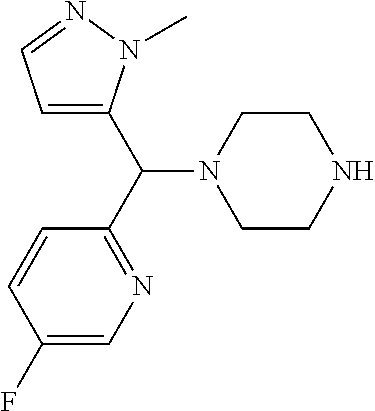 |
1-((5-fluoropyridin- 2-yl)(1-methyl-1H- pyrazol-5- yl)methyl)piperazine | B | 0.95 | 276 |

| Ret | MS | ||||
| EX | Structure | Chemical name | Method | (min) | (M + H) |
| 2 |
 |
1-benzyl-4-((1- methyl-1H-pyrazol- 5- yl)(phenyl)methyl) piperazine | B | 2.10 | 347.2 |
| 3 |
 |
1-((1-methyl-1H- pyrazol-5- yl)(phenyl)methyl)-4- phenethylpiperazine | B | 2.11 | 361.3 |
| 4 |
 |
1-((1-methyl-1H- pyrazol-5-yl)(pyridin- 2-yl)methyl)-4- phenethylpiperazine | B | 1.77 | 362.2 |
| 5 |
 |
1-((1-methyl-1H- pyrazol-5-yl)(pyridin- 3-yl)methyl)-4- phenethylpiperazine | B | 1.77 | 362.2 |
| 6 |
 |
1-(2- methoxyphenethyl)- 4-((1-methyl-1H- pyrazol-5- yl)(phenyl)methyl) piperazine | B | 2.16 | 391.3 |
| 7 |
 |
1-((3- methoxyphenyl)(1- methyl-1H-pyrazol- 5-yl)methyl)-4- phenethylpiperazine | B | 2.09 | 391.3 |
| 8 |
 |
1-((2- methoxyphenyl)(1- methyl-1H-pyrazol- 5-yl)methyl)-4- phenethylpiperazine | B | 2.17 | 391.3 |
| 9 |
 |
1-((4- methoxyphenyl)(1- methyl-1H-pyrazol- 5-yl)methyl)-4- phenethylpiperazine | B | 2.07 | 391.3 |
| 10 |
 |
1-((1-methyl-1H- pyrazol-5-yl)(6- (trifluoromethyl)pyridin- 2-yl)methyl)-4- phenethylpiperazine | B | 2.15 | 430.3 |
| 11 |
 |
1-((1-methyl-1H- pyrazol-5-yl)(6- (trifluoromethyl)pyridin- 3-yl)methyl)-4- phenethylpiperazine | B | 2.11 | 430.4 |
| 12 |
 |
1-((5-fluoropyridin-2- yl)(1-methyl-1H- pyrazol-5-yl)methyl)- 4- phenethylpiperazine | B | 1.86 | 380.4 |
| 13 |
 |
1-((5-fluoropyridin-3- yl)(1-methyl-1H- pyrazol-5-yl)methyl)- 4- phenethylpiperazine | B | 1.83 | 380.3 |
| 14 |
 |
1-((1-methyl-1H- pyrazol-5-yl)(5- (trifluoromethyl)pyridin- 2-yl)methyl)-4- phenethylpiperazine | B | 2.11 | 430.2 |
| 15 |
 |
1-((5-fluoropyridin-2- yl)(1-methyl-1H- pyrazol-5-yl)methyl)- 4-(2-(pyridin-2- yl)ethyl)piperazine | B | 1.38 | 381.3 |
| 16 |
 |
1-((3-fluoropyridin-2- yl)(1-methyl-1H- pyrazol-5-yl)methyl)- 4- phenethylpiperazine | B | 1.79 | 380.2 |
| 17 |
 |
1-((1-methyl-1H- pyrazol-5-yl)(2- (trifluoromethyl)pyridin- 3-yl)methyl)-4- phenethylpiperazine | B | 2.08 | 430.2 |
| 18 |
 |
1-((5-chloropyridin- 2-yl)(1-methyl-1H- pyrazol-5-yl)methyl)- 4- phenethylpiperazine | B | 2.03 | 396.1 |
| 19 |
 |
1-((1-methyl-1H- pyrazol-5-yl)(4- (trifluoromethyl)pyridin- 3-yl)methyl)-4- phenethylpiperazine | B | 2.02 | 430.1 |
| 20 |
 |
1-((1-methyl-1H- pyrazol-5-yl)(pyridin- 4-yl)methyl)-4- phenethylpiperazine | B | 1.66 | 362.1 |

| Ret | MS | ||||
| EX | Structure | Chemical name | Method | (min) | (M + H) |
| 22 |
 |
1-(2- fluorophenethyl)- 4-((1-methyl-1H- pyrazol-5- yl)(phenyl)methyl) piperazine | B | 2.17 | 379.3 |
| 23 |
 |
1-(4- fluorophenethyl)- 4-((1-methyl-1H- pyrazol-5- yl)(phenyl)methyl) piperazine | B | 2.13 | 379.3 |
| 24 |
 |
1-((1-methyl-1H- pyrazol-5- yl)(phenyl)methyl)- 4-(2-(6- (trifluoromethyl) pyridin-3- yl)ethyl)piperazine | B | 2.01 | 430.4 |
| 25 |
 |
tert-butyl 4-(2-(4- ((1-methyl-1H- pyrazol-5- yl)(phenyl)methyl) piperazin-1- yl)ethyl)thiazol-2- ylcarbamate | B | 2.01 | 483.4 |
| 26 |
 |
1-(2- fluorophenethyl)- 4-((5-fluoropyridin- 2-yl)(1-methyl-1H- pyrazol-5- yl)methyl)piperazine | B | 1.92 | 398.3 |
| 27 |
 |
1-((5-fluoropyridin- 2-yl)(1-methyl-1H- pyrazol-5- yl)methyl)-4-(3- methoxyphenethyl) piperazine | B | 1.82 | 410.2 |

| Ret | MS | ||||
| EX | Structure | Chemical name | Method | (min) | (M + H) |
| 29 |
 |
3-((1-methyl-1H- pyrazol-5-yl)(4- phenethylpiperazin- 1- yl)methyl)phenol | B | 1.76 | 377.3 |
| 30 |
 |
3-(2-(4-((1-methyl- 1H-pyrazol-5- yl)(phenyl)methyl) piperazin-1- yl)ethyl)phenol | B | 1.71 | 377.3 |
| 31 |
 |
3-(2-(4-((5- fluoropyridin-2- yl)(1-methyl-1H- pyrazol-5- yl)methyl)piperazin- 1-yl)ethyl)phenol | B | 1.51 | 396.2 |


| Ret | MS | ||||
| EX | Structure | Chemical name | Method | (min) | (M + H) |
| 34 |
 |
1-(2-(5- fluoropyridin-2- yl)ethyl)-4-((1- methyl-1H- pyrazol-5- yl)(phenyl)methyl) piperazine | B | 1.71 | 380.3 |

| Ret | MS | ||||
| EX | Structure | Chemical name | Method | (min) | (M + H) |
| 36 |
 |
1-((1-methyl-1H- pyrazol-5- yl)(phenyl)methyl)- 4-(2-(pyridin-3- yl)ethyl)piperazine | B | 1.58 | 362.4 |
| 37 |
 |
1-((1-methyl-1H- pyrazol-5- yl)(phenyl)methyl)- 4-(2-(pyridin-4- yl)ethyl)piperazine | B | 1.57 | 362.4 |
| 38 |
 |
1-(3- fluorophenethyl)- 4-((5-fluoropyridin- 2-yl)(1-methyl-1H- pyrazol-5- yl)methyl)piperazine | B | 1.89 | 398.2 |


| Ret | MS | ||||
| EX | Structure | Chemical name | Method | (min) | (M + H) |
| 41 |
 |
1-(2-(3- chloropyridin-2- yl)ethyl)-4-((1- methyl-1H- pyrazol-5- yl)(phenyl)methyl) piperazine | B | 2.52 | 396.2 |
| 42 |
 |
1-((1-methyl-1H- pyrazol-5- yl)(phenyl)methyl)- 4-(2-(6- (trifluoromethyl) pyridin-2- yl)ethyl)piperazine | B | 2.04 | 430.3 |
| 43 |
 |
1-(2-(3- chloropyridin-2- yl)ethyl)-4-((5- fluoropyridin-2- yl)(1-methyl-1H- pyrazol-5- yl)methyl)piperazine | B | 1.60 | 415.2 |


| Ret | MS | ||||
| EX | Structure | Chemical name | Method | (min) | (M + H) |
| 47 |  | 1-benzyl-N-(1- methyl-1H- pyrazol-5-yl)-N- phenylpiperidin-4- amine | B | 2.04 | 347.3 |
Table of Examples with Binding to the μ-opioid Receptor and the □σ1-Receptor:
Biological Activity
Pharmacological Study
Human σ1 Receptor Radioligand Assay
-
- + Both Ki-μ and Ki-σ1>=500 nM
- ++ One Ki<500 nM while the other Ki is >=500 nM
- +++ Both Ki-μ and Ki-σ1<500 nM
- ++++ Both Ki-μ and Ki-σ1<100 nM
| EX | μ and σ1 dual binding | |
| 1 | ++ | |
| 2 | ++ | |
| 3 | ++++ | |
| 4 | ++ | |
| 5 | ++ | |
| 6 | + | |
| 7 | ++++ | |
| 8 | +++ | |
| 9 | +++ | |
| 10 | ++ | |
| 11 | ++ | |
| 12 | +++ | |
| 13 | ++ | |
| 14 | ++ | |
| 15 | + | |
| 16 | ++ | |
| 17 | +++ | |
| 18 | ++ | |
| 19 | ++ | |
| 20 | ++ | |
| 21 | +++ | |
| 22 | ++++ | |
| 23 | ++ | |
| 24 | + | |
| 25 | + | |
| 26 | ++ | |
| 27 | ++ | |
| 28 | ++ | |
| 29 | +++ | |
| 30 | ++++ | |
| 31 | ++ | |
| 32 | + | |
| 33 | + | |
| 34 | + | |
| 35 | +++ | |
| 36 | + | |
| 37 | ++ | |
| 38 | +++ | |
| 39 | ++ | |
| 40 | + | |
| 41 | ++ | |
| 42 | + | |
| 43 | ++ | |
| 44 | + | |
| 45 | + | |
| 46 | ++ | |
| 47 | ++ | |
Claims (21)


Applications Claiming Priority (4)
| Application Number | Priority Date | Filing Date | Title |
|---|---|---|---|
| EP14382515 | 2014-12-15 | ||
| EP14382515 | 2014-12-15 | ||
| EP14382515.6 | 2014-12-15 | ||
| PCT/EP2015/002525 WO2016096126A1 (en) | 2014-12-15 | 2015-12-15 | 1-methylpyrazole-piperazine compounds having multimodal activity against pain |
Publications (2)
| Publication Number | Publication Date |
|---|---|
| US20170362215A1 US20170362215A1 (en) | 2017-12-21 |
| US10189828B2 true US10189828B2 (en) | 2019-01-29 |
Family
ID=52134081
Family Applications (1)
| Application Number | Title | Priority Date | Filing Date |
|---|---|---|---|
| US15/531,571 Expired - Fee Related US10189828B2 (en) | 2014-12-15 | 2015-12-15 | 1-methylpyrazole-piperazine compounds having multimodal activity against pain |
Country Status (3)
| Country | Link |
|---|---|
| US (1) | US10189828B2 (en) |
| EP (1) | EP3233830A1 (en) |
| WO (1) | WO2016096126A1 (en) |
Families Citing this family (2)
| Publication number | Priority date | Publication date | Assignee | Title |
|---|---|---|---|---|
| EP3753932A1 (en) * | 2019-06-17 | 2020-12-23 | Esteve Pharmaceuticals, S.A. | Substituted bicyclic derivatives having multimodal activity against pain |
| WO2024105225A1 (en) | 2022-11-18 | 2024-05-23 | Universitat De Barcelona | Synergistic combinations of a sigma receptor 1 (s1r) antagonist and a soluble epoxide hydrolase inhibitor (sehi) and their use in the treatment of pain |
Citations (2)
| Publication number | Priority date | Publication date | Assignee | Title |
|---|---|---|---|---|
| CN1371903A (en) | 2001-02-28 | 2002-10-02 | 中国科学院上海药物研究所 | Optical isomer of 3-methyl fentanyl, derivant, synthesizing and its analgesic activity |
| EP2353598A1 (en) | 2010-02-04 | 2011-08-10 | Laboratorios Del. Dr. Esteve, S.A. | Sigma ligands for use in the prevention and/or treatment of postoperative pain |
-
2015
- 2015-12-15 EP EP15813268.8A patent/EP3233830A1/en not_active Withdrawn
- 2015-12-15 WO PCT/EP2015/002525 patent/WO2016096126A1/en not_active Ceased
- 2015-12-15 US US15/531,571 patent/US10189828B2/en not_active Expired - Fee Related
Patent Citations (2)
| Publication number | Priority date | Publication date | Assignee | Title |
|---|---|---|---|---|
| CN1371903A (en) | 2001-02-28 | 2002-10-02 | 中国科学院上海药物研究所 | Optical isomer of 3-methyl fentanyl, derivant, synthesizing and its analgesic activity |
| EP2353598A1 (en) | 2010-02-04 | 2011-08-10 | Laboratorios Del. Dr. Esteve, S.A. | Sigma ligands for use in the prevention and/or treatment of postoperative pain |
Non-Patent Citations (11)
| Title |
|---|
| Bornot, et al., J. Med. Chem, 56, 1197-1210 (2013). |
| Bourrain. S., et al., Bioorganic and Medicinal Chemistry, vol. 6, No. 6, pg. 1731-1743, Oct. 1, 1998. |
| Chien, et al., Neurosci. Lett. 190, 137-9 (1995). |
| DIckenson, et al., Eur J Pain 9, 113-6 (2005). |
| Giron, R., et al., Life Sciences, vol. 71, No. 9, p. 1023-1034, Jul. 19, 2002. |
| Goldberg, et al., BMC Public Health, 11, 770 (2011). |
| International Search Report for PCT/EP2015/002525 dated Mar. 2, 2016. |
| Jagerovis, Nadine, et al., Bioorganic and Medicinal Chemistry, vol. 10, p. 817-827, 2002. |
| Mao, et al., J. Pain 12, 157-166 (2011). |
| Turk, et al., Lancet, 377, 2226-2235 (2011). |
| Zamanillo, et al., Eur. J. Pharmacol, 716, 78-93 (2013). |
Also Published As
| Publication number | Publication date |
|---|---|
| WO2016096126A1 (en) | 2016-06-23 |
| EP3233830A1 (en) | 2017-10-25 |
| US20170362215A1 (en) | 2017-12-21 |
Similar Documents
| Publication | Publication Date | Title |
|---|---|---|
| US10745361B2 (en) | Piperazine derivatives having multimodal activity against pain | |
| US10428051B2 (en) | Substituted amide derivatives having multimodal activity against pain | |
| EP3149006B1 (en) | Alkyl derivatives of 1-oxa-4,9-diazaspiro undecane compounds having multimodal activity against pain | |
| EP3149005B1 (en) | Amide derivatives of 1-oxa-4,9-diazaspiro undecane compounds having multimodal activity against pain | |
| US20190055217A1 (en) | Piperidinylalkylamide derivatives having multimodal activity against pain | |
| US9902711B2 (en) | Piperidine compounds having multimodal activity against pain | |
| US10022359B2 (en) | 1,9-diazaspiro undecane compounds having multimodal activity against pain | |
| US10807970B2 (en) | Tetrahydropyran and thiopyran derivatives having multimodal activity against pain | |
| US10189828B2 (en) | 1-methylpyrazole-piperazine compounds having multimodal activity against pain | |
| US20190031615A1 (en) | 3-ethyl-3-phenylazepane derivatives having multimodal activity against pain | |
| US10071968B2 (en) | Methyl-1H-pyrazole alkylamine compounds having multimodal activity against pain | |
| US10351549B2 (en) | Amide derivatives having multimodal activity against pain | |
| US10508114B2 (en) | Spiro-isoquinoline-4,4′-piperidine compounds having multimodal activity against pain | |
| US20200010457A1 (en) | Tetrahydropyran and tetrahydrothiopyran amide derivatives having multimodal activity against pain | |
| HK1235773B (en) | Amide derivatives of 1-oxa-4,9-diazaspiro undecane compounds having multimodal activity against pain | |
| HK1235773A1 (en) | Amide derivatives of 1-oxa-4,9-diazaspiro undecane compounds having multimodal activity against pain |
Legal Events
| Date | Code | Title | Description |
|---|---|---|---|
| AS | Assignment |
Owner name: LABORATORIOS DEL DR. ESTEVE S.A., SPAIN Free format text: ASSIGNMENT OF ASSIGNORS INTEREST;ASSIGNORS:ALMANSA-ROSALES, CARMEN;GARCIA-LOPEZ, MONICA;GARRIGA-SANAHUJA, LOURDES;REEL/FRAME:043899/0311 Effective date: 20170510 |
|
| STCF | Information on status: patent grant |
Free format text: PATENTED CASE |
|
| CC | Certificate of correction | ||
| AS | Assignment |
Owner name: ESTEVE PHARMACEUTICALS, S.A., SPAIN Free format text: CHANGE OF NAME;ASSIGNOR:LABORATORIOS DEL DR. ESTEVE S.A.;REEL/FRAME:049837/0469 Effective date: 20180625 |
|
| FEPP | Fee payment procedure |
Free format text: MAINTENANCE FEE REMINDER MAILED (ORIGINAL EVENT CODE: REM.); ENTITY STATUS OF PATENT OWNER: LARGE ENTITY |
|
| LAPS | Lapse for failure to pay maintenance fees |
Free format text: PATENT EXPIRED FOR FAILURE TO PAY MAINTENANCE FEES (ORIGINAL EVENT CODE: EXP.); ENTITY STATUS OF PATENT OWNER: LARGE ENTITY |
|
| STCH | Information on status: patent discontinuation |
Free format text: PATENT EXPIRED DUE TO NONPAYMENT OF MAINTENANCE FEES UNDER 37 CFR 1.362 |
|
| FP | Lapsed due to failure to pay maintenance fee |
Effective date: 20230129 |