US10188642B2 - Pharmacologically active compounds - Google Patents
Pharmacologically active compounds Download PDFInfo
- Publication number
- US10188642B2 US10188642B2 US15/852,639 US201715852639A US10188642B2 US 10188642 B2 US10188642 B2 US 10188642B2 US 201715852639 A US201715852639 A US 201715852639A US 10188642 B2 US10188642 B2 US 10188642B2
- Authority
- US
- United States
- Prior art keywords
- alkyl
- cycloalkyl
- pyrazol
- heteroaryl
- amino
- Prior art date
- Legal status (The legal status is an assumption and is not a legal conclusion. Google has not performed a legal analysis and makes no representation as to the accuracy of the status listed.)
- Active
Links
- 0 [2*]C1=[Y]C2=C(C=NC(N([H])[Ar])=C2)C([4*])=C1[3*] Chemical compound [2*]C1=[Y]C2=C(C=NC(N([H])[Ar])=C2)C([4*])=C1[3*] 0.000 description 25
- DFGZXQPOMINNIK-NSCUHMNNSA-N CC(=O)/C=C/C1=CN=C(Br)C=C1N Chemical compound CC(=O)/C=C/C1=CN=C(Br)C=C1N DFGZXQPOMINNIK-NSCUHMNNSA-N 0.000 description 2
- DCWWISSDVFDQNQ-UHFFFAOYSA-N CC(C)(O)CN1C=C(C2=NC3=C(C=C2)C=NC(Br)=C3)C=N1 Chemical compound CC(C)(O)CN1C=C(C2=NC3=C(C=C2)C=NC(Br)=C3)C=N1 DCWWISSDVFDQNQ-UHFFFAOYSA-N 0.000 description 2
- NMQGFBNAKPAMKE-UHFFFAOYSA-N CC(O)CN1C=C(B2OC(C)(C)C(C)(C)O2)C=N1 Chemical compound CC(O)CN1C=C(B2OC(C)(C)C(C)(C)O2)C=N1 NMQGFBNAKPAMKE-UHFFFAOYSA-N 0.000 description 2
- VWPXSWMYEMPJGB-UHFFFAOYSA-N CC1(C)OB(C2=CN(CC(F)(F)F)N=C2)OC1(C)C Chemical compound CC1(C)OB(C2=CN(CC(F)(F)F)N=C2)OC1(C)C VWPXSWMYEMPJGB-UHFFFAOYSA-N 0.000 description 2
- AQUZNOKYCJMWPD-UHFFFAOYSA-N CC1(CN2C=C(C3=CC=C4C=NC(Cl)=CC4=C3)C=N2)COC1 Chemical compound CC1(CN2C=C(C3=CC=C4C=NC(Cl)=CC4=C3)C=N2)COC1 AQUZNOKYCJMWPD-UHFFFAOYSA-N 0.000 description 2
- AAXPEASHSKPKJP-UHFFFAOYSA-N CC1=C(N)C=CC(C2=NN=CN2C)=C1 Chemical compound CC1=C(N)C=CC(C2=NN=CN2C)=C1 AAXPEASHSKPKJP-UHFFFAOYSA-N 0.000 description 2
- DLBPAXFMYFLDMI-UHFFFAOYSA-N CC1=C(NC2=CC3=C(C=CC(C4=CN(CC(C)(C)O)N=C4)=N3)C=N2)C=CC(C2=NN=CN2C)=C1 Chemical compound CC1=C(NC2=CC3=C(C=CC(C4=CN(CC(C)(C)O)N=C4)=N3)C=N2)C=CC(C2=NN=CN2C)=C1 DLBPAXFMYFLDMI-UHFFFAOYSA-N 0.000 description 2
- HMSKNTDXQPFETR-UHFFFAOYSA-N CCN1C=C(C2=CC3=CC(Cl)=NC=C3C=C2)C=N1 Chemical compound CCN1C=C(C2=CC3=CC(Cl)=NC=C3C=C2)C=N1 HMSKNTDXQPFETR-UHFFFAOYSA-N 0.000 description 2
- OPZXBOZQFGGJIL-UHFFFAOYSA-N CCOC1=CC(C2=NN=CN2C)=CC=C1NC1=CC2=CC(C3=CN(CC(C)(C)O)N=C3)=CC=C2C=N1 Chemical compound CCOC1=CC(C2=NN=CN2C)=CC=C1NC1=CC2=CC(C3=CN(CC(C)(C)O)N=C3)=CC=C2C=N1 OPZXBOZQFGGJIL-UHFFFAOYSA-N 0.000 description 2
- DPMKPSNWGMTOQJ-UHFFFAOYSA-N CN1N=CC(C2=CC=C3C=NC(Cl)=CC3=C2)=C1CO Chemical compound CN1N=CC(C2=CC=C3C=NC(Cl)=CC3=C2)=C1CO DPMKPSNWGMTOQJ-UHFFFAOYSA-N 0.000 description 2
- DSMZWJJCFWVNHQ-UHFFFAOYSA-N COC(C)(C)CN1C=C(C2=CC=C3C=NC(Cl)=CC3=C2)C=N1 Chemical compound COC(C)(C)CN1C=C(C2=CC=C3C=NC(Cl)=CC3=C2)C=N1 DSMZWJJCFWVNHQ-UHFFFAOYSA-N 0.000 description 2
- WMUAOQMVCLAFLU-UHFFFAOYSA-N COC1=C(F)C(C2=CN=C(C)N2C)=CC=C1NC1=CC2=CC(C3=CN(CC(C)(C)O)N=C3)=CC=C2C=N1 Chemical compound COC1=C(F)C(C2=CN=C(C)N2C)=CC=C1NC1=CC2=CC(C3=CN(CC(C)(C)O)N=C3)=CC=C2C=N1 WMUAOQMVCLAFLU-UHFFFAOYSA-N 0.000 description 2
- RKZKWNHFADJRND-UHFFFAOYSA-N COC1=C(NC2=CC3=CC(C4=CN(C)N=C4C)=CC=C3C=N2)C=CC(C2=CN=C(C)N2C)=C1 Chemical compound COC1=C(NC2=CC3=CC(C4=CN(C)N=C4C)=CC=C3C=N2)C=CC(C2=CN=C(C)N2C)=C1 RKZKWNHFADJRND-UHFFFAOYSA-N 0.000 description 2
- DEYNBCMLWJJQFO-UHFFFAOYSA-N COC1=CC(C(=O)N2CC(OC)C2)=CC=C1NC1=CC2=CC(C3=CN(CC(C)(C)O)N=C3)=CC=C2C=N1 Chemical compound COC1=CC(C(=O)N2CC(OC)C2)=CC=C1NC1=CC2=CC(C3=CN(CC(C)(C)O)N=C3)=CC=C2C=N1 DEYNBCMLWJJQFO-UHFFFAOYSA-N 0.000 description 2
- CPDGKSIPMBWCGK-UHFFFAOYSA-N COC1=CC(C(=O)N2CC(OC)C2)=CC=C1NC1=NC=C2C=CC(C3=CN(CC(C)(C)O)N=N3)=CC2=C1 Chemical compound COC1=CC(C(=O)N2CC(OC)C2)=CC=C1NC1=NC=C2C=CC(C3=CN(CC(C)(C)O)N=N3)=CC2=C1 CPDGKSIPMBWCGK-UHFFFAOYSA-N 0.000 description 2
- KTQIYSRSPCMRNB-UHFFFAOYSA-N COC1=CC(C2=CN=C(C)N2C)=CC=C1NC1=CC2=CC(C3=CN(C4CCOCC4)N=C3)=CC=C2C=N1 Chemical compound COC1=CC(C2=CN=C(C)N2C)=CC=C1NC1=CC2=CC(C3=CN(C4CCOCC4)N=C3)=CC=C2C=N1 KTQIYSRSPCMRNB-UHFFFAOYSA-N 0.000 description 2
- KNTNNABZSHTFKS-UHFFFAOYSA-N COC1=CC(C2=CN=C(C)N2C)=CC=C1NC1=CC2=CC(C3=CN(CC(C)O)N=C3)=CC=C2C=N1 Chemical compound COC1=CC(C2=CN=C(C)N2C)=CC=C1NC1=CC2=CC(C3=CN(CC(C)O)N=C3)=CC=C2C=N1 KNTNNABZSHTFKS-UHFFFAOYSA-N 0.000 description 2
- JWXHHTCEBRCAQE-UHFFFAOYSA-N COC1=CC(C2=CN=C(C)N2C)=CN=C1N Chemical compound COC1=CC(C2=CN=C(C)N2C)=CN=C1N JWXHHTCEBRCAQE-UHFFFAOYSA-N 0.000 description 2
- AFHQIKJONOAXNW-UHFFFAOYSA-N COC1=CC(C2=CN=C(C)N2CC2CCNCC2)=CC=C1NC1=CC2=CC(C3=CN(CC(C)(C)O)N=C3)=CC=C2C=N1 Chemical compound COC1=CC(C2=CN=C(C)N2CC2CCNCC2)=CC=C1NC1=CC2=CC(C3=CN(CC(C)(C)O)N=C3)=CC=C2C=N1 AFHQIKJONOAXNW-UHFFFAOYSA-N 0.000 description 2
- BHXALEJPYBRMAD-UHFFFAOYSA-N COC1=CC(F)=CC=C1NC1=CC2=CC(C3=CN(CC(C)(C)O)N=C3)=CC=C2C=N1 Chemical compound COC1=CC(F)=CC=C1NC1=CC2=CC(C3=CN(CC(C)(C)O)N=C3)=CC=C2C=N1 BHXALEJPYBRMAD-UHFFFAOYSA-N 0.000 description 2
- QTMYTAIZPRSAEZ-UHFFFAOYSA-N COC1=NC(C2=CN=C(C)N2C)=CC=C1NC1=CC2=CC(C3=CN(CC(C)(C)O)N=C3)=CC=C2C=N1 Chemical compound COC1=NC(C2=CN=C(C)N2C)=CC=C1NC1=CC2=CC(C3=CN(CC(C)(C)O)N=C3)=CC=C2C=N1 QTMYTAIZPRSAEZ-UHFFFAOYSA-N 0.000 description 2
- NWWGUGMSONVLCE-UHFFFAOYSA-N COCCN1C=C(C2=CC3=CC(Cl)=NC=C3C=C2)C=N1 Chemical compound COCCN1C=C(C2=CC3=CC(Cl)=NC=C3C=C2)C=N1 NWWGUGMSONVLCE-UHFFFAOYSA-N 0.000 description 2
- UNAVSLNMFZKAMD-UHFFFAOYSA-N CSC1=NC=C2C=CC(Cl)=NC2=N1 Chemical compound CSC1=NC=C2C=CC(Cl)=NC2=N1 UNAVSLNMFZKAMD-UHFFFAOYSA-N 0.000 description 2
- CBTZLJFHRPGWLC-UHFFFAOYSA-N ClC1=CC2=CC(C3=CN(CC4COC4)N=C3)=CC=C2C=N1 Chemical compound ClC1=CC2=CC(C3=CN(CC4COC4)N=C3)=CC=C2C=N1 CBTZLJFHRPGWLC-UHFFFAOYSA-N 0.000 description 2
- BZGHCNFAWIFPNF-UHFFFAOYSA-N ClC1=CC2=CC(C3=CNN=C3)=CC=C2C=N1 Chemical compound ClC1=CC2=CC(C3=CNN=C3)=CC=C2C=N1 BZGHCNFAWIFPNF-UHFFFAOYSA-N 0.000 description 2
- CUESSRVIWWBRBP-UHFFFAOYSA-N FC(F)CN1C=C(C2=CC3=CC(Cl)=NC=C3C=C2)C=N1 Chemical compound FC(F)CN1C=C(C2=CC3=CC(Cl)=NC=C3C=C2)C=N1 CUESSRVIWWBRBP-UHFFFAOYSA-N 0.000 description 2
- QGXPRUPCPOSUJA-UHFFFAOYSA-N O=C1C=CC2=C(C=C(Br)N=C2)N1 Chemical compound O=C1C=CC2=C(C=C(Br)N=C2)N1 QGXPRUPCPOSUJA-UHFFFAOYSA-N 0.000 description 2
- CDQFNNODMQLMFW-UHFFFAOYSA-N BrC1=NN=C2CNCCN12 Chemical compound BrC1=NN=C2CNCCN12 CDQFNNODMQLMFW-UHFFFAOYSA-N 0.000 description 1
- BBEXOAMKLMWPHJ-UHFFFAOYSA-N C#CC1=CC2=CC(Cl)=NC=C2C=C1 Chemical compound C#CC1=CC2=CC(Cl)=NC=C2C=C1 BBEXOAMKLMWPHJ-UHFFFAOYSA-N 0.000 description 1
- APUDJEBZDAGSQY-UHFFFAOYSA-N C1CC2(C1)CO2 Chemical compound C1CC2(C1)CO2 APUDJEBZDAGSQY-UHFFFAOYSA-N 0.000 description 1
- CGOPQNLNXHVKHO-UHFFFAOYSA-N CC(=O)C(C)N1C=C(B2OC(C)(C)C(C)(C)O2)C=N1 Chemical compound CC(=O)C(C)N1C=C(B2OC(C)(C)C(C)(C)O2)C=N1 CGOPQNLNXHVKHO-UHFFFAOYSA-N 0.000 description 1
- ZKAMTLCHUWPMKF-UHFFFAOYSA-N CC(C)(C)OC(=O)N1CCC(N2C=C(C3=CC=C4C=NC(Cl)=CC4=C3)C=N2)CC1 Chemical compound CC(C)(C)OC(=O)N1CCC(N2C=C(C3=CC=C4C=NC(Cl)=CC4=C3)C=N2)CC1 ZKAMTLCHUWPMKF-UHFFFAOYSA-N 0.000 description 1
- VOVRMAJVRJAGAJ-UHFFFAOYSA-N CC(C)(C)OC(N(CC1)CCC1[n]1ncc(-c(cc2)cc3c2cnc(Nc(ccc(-c2cnc(C)[n]2C)c2)c2OC)c3)c1)=O Chemical compound CC(C)(C)OC(N(CC1)CCC1[n]1ncc(-c(cc2)cc3c2cnc(Nc(ccc(-c2cnc(C)[n]2C)c2)c2OC)c3)c1)=O VOVRMAJVRJAGAJ-UHFFFAOYSA-N 0.000 description 1
- GCHUQHKHUFMWDH-UHFFFAOYSA-N CC(C)(O)CN1C=C(B2OC(C)(C)C(C)(C)O2)C=N1 Chemical compound CC(C)(O)CN1C=C(B2OC(C)(C)C(C)(C)O2)C=N1 GCHUQHKHUFMWDH-UHFFFAOYSA-N 0.000 description 1
- JRCAOXDYXAVGPL-UHFFFAOYSA-N CC(C)(O)CN1C=C(C2=CC=C3C=NC(Cl)=CC3=C2)C=N1 Chemical compound CC(C)(O)CN1C=C(C2=CC=C3C=NC(Cl)=CC3=C2)C=N1 JRCAOXDYXAVGPL-UHFFFAOYSA-N 0.000 description 1
- ORGFIBPGMWWBMW-UHFFFAOYSA-N CC(C)(O)CN1C=C(C2=CC=C3C=NC(Cl)=CC3=C2)N=N1.CC(C)(O)CN1N=CC(C2=CC=C3C=NC(Cl)=CC3=C2)=N1 Chemical compound CC(C)(O)CN1C=C(C2=CC=C3C=NC(Cl)=CC3=C2)N=N1.CC(C)(O)CN1N=CC(C2=CC=C3C=NC(Cl)=CC3=C2)=N1 ORGFIBPGMWWBMW-UHFFFAOYSA-N 0.000 description 1
- MIKYJPUXFHNDGN-UHFFFAOYSA-N CC(C)(O)CN1C=C(C2=CC=C3C=NC(NC4=CC=C(C5=CN=CN=C5)C=C4Cl)=CC3=C2)C=N1 Chemical compound CC(C)(O)CN1C=C(C2=CC=C3C=NC(NC4=CC=C(C5=CN=CN=C5)C=C4Cl)=CC3=C2)C=N1 MIKYJPUXFHNDGN-UHFFFAOYSA-N 0.000 description 1
- PDGJQWVOTWRNHN-UHFFFAOYSA-N CC(C)(O)CN1C=C(C2=CC=C3C=NC(NC4=CC=C(N5CCOCC5)C=C4Cl)=CC3=C2)C=N1 Chemical compound CC(C)(O)CN1C=C(C2=CC=C3C=NC(NC4=CC=C(N5CCOCC5)C=C4Cl)=CC3=C2)C=N1 PDGJQWVOTWRNHN-UHFFFAOYSA-N 0.000 description 1
- ZGDYHAJVIRBAJU-UHFFFAOYSA-N CC(C)(O)CN1C=C(C2=CC=C3C=NC(NC4=CC=C(S(C)(=O)=O)C=C4Cl)=CC3=C2)C=N1 Chemical compound CC(C)(O)CN1C=C(C2=CC=C3C=NC(NC4=CC=C(S(C)(=O)=O)C=C4Cl)=CC3=C2)C=N1 ZGDYHAJVIRBAJU-UHFFFAOYSA-N 0.000 description 1
- SIZVACIDYSNVCS-UHFFFAOYSA-N CC(C)(O)CN1C=C(C2=CC=C3C=NC(S(C)(=O)=O)=NC3=N2)C=N1 Chemical compound CC(C)(O)CN1C=C(C2=CC=C3C=NC(S(C)(=O)=O)=NC3=N2)C=N1 SIZVACIDYSNVCS-UHFFFAOYSA-N 0.000 description 1
- PRCUDJXDCWUEDT-UHFFFAOYSA-O CC(C)=C(C)O.CC(C)=C(C)[O-].[H+].[H+].[H]C(C)(C)C(C)=O Chemical compound CC(C)=C(C)O.CC(C)=C(C)[O-].[H+].[H+].[H]C(C)(C)C(C)=O PRCUDJXDCWUEDT-UHFFFAOYSA-O 0.000 description 1
- AZZOBIBIODEIAJ-UHFFFAOYSA-N CC(C)C(O)CN1C=C(B2OC(C)(C)C(C)(C)O2)C=N1 Chemical compound CC(C)C(O)CN1C=C(B2OC(C)(C)C(C)(C)O2)C=N1 AZZOBIBIODEIAJ-UHFFFAOYSA-N 0.000 description 1
- RWSHHVRLLQQVPH-UHFFFAOYSA-N CC(C)C(O)CN1C=C(C2=CC=C3C=NC(Cl)=CC3=C2)C=N1 Chemical compound CC(C)C(O)CN1C=C(C2=CC=C3C=NC(Cl)=CC3=C2)C=N1 RWSHHVRLLQQVPH-UHFFFAOYSA-N 0.000 description 1
- KJIFGBVUOVNZCA-UHFFFAOYSA-N CC(C)N1C=C(C2=CC3=CC(Cl)=NC=C3C=C2)C=N1 Chemical compound CC(C)N1C=C(C2=CC3=CC(Cl)=NC=C3C=C2)C=N1 KJIFGBVUOVNZCA-UHFFFAOYSA-N 0.000 description 1
- GIRZHYDEQMDKSU-UHFFFAOYSA-N CC(N1C=C(B2OC(C)(C)C(C)(C)O2)C=N1)C(C)(C)O Chemical compound CC(N1C=C(B2OC(C)(C)C(C)(C)O2)C=N1)C(C)(C)O GIRZHYDEQMDKSU-UHFFFAOYSA-N 0.000 description 1
- DYKVCMMDXRVAGT-UHFFFAOYSA-N CC(N1C=C(C2=CC=C3C=NC(Cl)=CC3=C2)C=N1)C(C)(C)O Chemical compound CC(N1C=C(C2=CC=C3C=NC(Cl)=CC3=C2)C=N1)C(C)(C)O DYKVCMMDXRVAGT-UHFFFAOYSA-N 0.000 description 1
- HSURAPUZXMZCSW-UHFFFAOYSA-N CC(O)CN1C=C(C2=CC=C3C=NC(Cl)=CC3=C2)C=N1 Chemical compound CC(O)CN1C=C(C2=CC=C3C=NC(Cl)=CC3=C2)C=N1 HSURAPUZXMZCSW-UHFFFAOYSA-N 0.000 description 1
- BOOVIFJKQGYEON-UHFFFAOYSA-N CC1(C)OB(C2=CN(C3CCOCC3)N=C2)OC1(C)C Chemical compound CC1(C)OB(C2=CN(C3CCOCC3)N=C2)OC1(C)C BOOVIFJKQGYEON-UHFFFAOYSA-N 0.000 description 1
- KIYMAKQVFHPNGB-UHFFFAOYSA-N CC1(C)OB(C2=CN(C3COC3)N=C2)OC1(C)C Chemical compound CC1(C)OB(C2=CN(C3COC3)N=C2)OC1(C)C KIYMAKQVFHPNGB-UHFFFAOYSA-N 0.000 description 1
- VIJHBGGAAIINTO-UHFFFAOYSA-N CC1(C)OB(C2=CN(CC(F)F)N=C2)OC1(C)C Chemical compound CC1(C)OB(C2=CN(CC(F)F)N=C2)OC1(C)C VIJHBGGAAIINTO-UHFFFAOYSA-N 0.000 description 1
- GFTSMKXURNIHAR-UHFFFAOYSA-N CC1(C)OB(C2=CN(CC(O)C(F)(F)F)N=C2)OC1(C)C Chemical compound CC1(C)OB(C2=CN(CC(O)C(F)(F)F)N=C2)OC1(C)C GFTSMKXURNIHAR-UHFFFAOYSA-N 0.000 description 1
- LOERFZDYTQXEEU-UHFFFAOYSA-N CC1(C)OB(C2=CN(CC3(O)CCC3)N=C2)OC1(C)C Chemical compound CC1(C)OB(C2=CN(CC3(O)CCC3)N=C2)OC1(C)C LOERFZDYTQXEEU-UHFFFAOYSA-N 0.000 description 1
- LJUAHBJQFILHLS-UHFFFAOYSA-N CC1(C)OB(C2=CN(CC3CC3)N=C2)OC1(C)C Chemical compound CC1(C)OB(C2=CN(CC3CC3)N=C2)OC1(C)C LJUAHBJQFILHLS-UHFFFAOYSA-N 0.000 description 1
- KNRSHJUPUUIKJW-UHFFFAOYSA-N CC1(C)OB(C2=CN(CC3CCC3)N=C2)OC1(C)C Chemical compound CC1(C)OB(C2=CN(CC3CCC3)N=C2)OC1(C)C KNRSHJUPUUIKJW-UHFFFAOYSA-N 0.000 description 1
- ZMVOVSFKXFUUFU-UHFFFAOYSA-N CC1(C)OB(C2=CN(CC3COC3)N=C2)OC1(C)C Chemical compound CC1(C)OB(C2=CN(CC3COC3)N=C2)OC1(C)C ZMVOVSFKXFUUFU-UHFFFAOYSA-N 0.000 description 1
- KPXUWAMGPCLHKH-UHFFFAOYSA-N CC1(C)OCC(CN2C=C(B3OC(C)(C)C(C)(C)O3)C=N2)O1 Chemical compound CC1(C)OCC(CN2C=C(B3OC(C)(C)C(C)(C)O3)C=N2)O1 KPXUWAMGPCLHKH-UHFFFAOYSA-N 0.000 description 1
- VYQGPJQFPAJFIQ-UHFFFAOYSA-N CC1(C)OCC(CN2C=C(C3=CC=C4C=NC(Cl)=CC4=C3)C=N2)O1 Chemical compound CC1(C)OCC(CN2C=C(C3=CC=C4C=NC(Cl)=CC4=C3)C=N2)O1 VYQGPJQFPAJFIQ-UHFFFAOYSA-N 0.000 description 1
- CPHKVNPPDXMAJP-UHFFFAOYSA-N CC1(CN2C=C(B3OC(C)(C)C(C)(C)O3)C=N2)COC1 Chemical compound CC1(CN2C=C(B3OC(C)(C)C(C)(C)O3)C=N2)COC1 CPHKVNPPDXMAJP-UHFFFAOYSA-N 0.000 description 1
- VMPRIZZQIMQKOP-UHFFFAOYSA-N CC1=C(C2=CC3=CC(Cl)=NC=C3C=C2)C=NN1C Chemical compound CC1=C(C2=CC3=CC(Cl)=NC=C3C=C2)C=NN1C VMPRIZZQIMQKOP-UHFFFAOYSA-N 0.000 description 1
- XSIAXMSZWUYLNL-UHFFFAOYSA-N CC1=C(NC2=CC3=C(C=CC(C(=O)N(C)C)=N3)C=N2)C=CC(C2=CN(C)N=C2)=C1 Chemical compound CC1=C(NC2=CC3=C(C=CC(C(=O)N(C)C)=N3)C=N2)C=CC(C2=CN(C)N=C2)=C1 XSIAXMSZWUYLNL-UHFFFAOYSA-N 0.000 description 1
- OIOVRSWJPKYXGP-UHFFFAOYSA-N CC1=C(NC2=CC3=C(C=CC(C4=CN(C)N=C4)=N3)C=N2)C=CC(C2=CN(C)N=C2)=C1 Chemical compound CC1=C(NC2=CC3=C(C=CC(C4=CN(C)N=C4)=N3)C=N2)C=CC(C2=CN(C)N=C2)=C1 OIOVRSWJPKYXGP-UHFFFAOYSA-N 0.000 description 1
- ABBIYOUPOWBWAN-UHFFFAOYSA-N CC1=C(NC2=CC3=C(C=CC(C4=CN(CC(C)(C)O)N=C4)=N3)C=N2)C=CC(C(=O)N2CC(C)C2)=C1 Chemical compound CC1=C(NC2=CC3=C(C=CC(C4=CN(CC(C)(C)O)N=C4)=N3)C=N2)C=CC(C(=O)N2CC(C)C2)=C1 ABBIYOUPOWBWAN-UHFFFAOYSA-N 0.000 description 1
- XTNDOHLTXZMYTH-UHFFFAOYSA-N CC1=C(NC2=CC3=CC(C4=CN(CC(C)(C)O)N=C4)=CC=C3C=N2)C=CC(C2=CN(C)N=C2)=C1 Chemical compound CC1=C(NC2=CC3=CC(C4=CN(CC(C)(C)O)N=C4)=CC=C3C=N2)C=CC(C2=CN(C)N=C2)=C1 XTNDOHLTXZMYTH-UHFFFAOYSA-N 0.000 description 1
- YDUUCKZXANKHDM-UHFFFAOYSA-N CC1=C([N+](=O)[O-])C=CC(C2=NN=C(S)N2C)=C1 Chemical compound CC1=C([N+](=O)[O-])C=CC(C2=NN=C(S)N2C)=C1 YDUUCKZXANKHDM-UHFFFAOYSA-N 0.000 description 1
- BRTAADITHNMDMA-UHFFFAOYSA-N CC1=C([N+](=O)[O-])C=CC(C2=NN=CN2C)=C1 Chemical compound CC1=C([N+](=O)[O-])C=CC(C2=NN=CN2C)=C1 BRTAADITHNMDMA-UHFFFAOYSA-N 0.000 description 1
- SMRIMKXHORAHJR-UHFFFAOYSA-N CC1=CC(C(=O)NN)=CC=C1[N+](=O)[O-] Chemical compound CC1=CC(C(=O)NN)=CC=C1[N+](=O)[O-] SMRIMKXHORAHJR-UHFFFAOYSA-N 0.000 description 1
- WVKVGCBQSWQDTM-UHFFFAOYSA-N CC1=CC(C2=CN=C(C)N2C)=CC=C1NC1=CC2=CC(C3=C(C)N=C(C)S3)=CC=C2C=N1 Chemical compound CC1=CC(C2=CN=C(C)N2C)=CC=C1NC1=CC2=CC(C3=C(C)N=C(C)S3)=CC=C2C=N1 WVKVGCBQSWQDTM-UHFFFAOYSA-N 0.000 description 1
- FKKOGMPKQYDEIA-UHFFFAOYSA-N CC1=CC(C2=CN=C(C)N2C)=CC=C1NC1=CC2=CC(C3=CC=C(N(C)C(=O)OC(C)(C)C)N=C3)=CC=C2C=N1 Chemical compound CC1=CC(C2=CN=C(C)N2C)=CC=C1NC1=CC2=CC(C3=CC=C(N(C)C(=O)OC(C)(C)C)N=C3)=CC=C2C=N1 FKKOGMPKQYDEIA-UHFFFAOYSA-N 0.000 description 1
- DCYTUUHHERPXEW-UHFFFAOYSA-N CC1=CC(C2=CN=C(C)N2C)=CC=C1NC1=CC2=CC(C3=CC=C(N(C)C)N=C3)=CC=C2C=N1 Chemical compound CC1=CC(C2=CN=C(C)N2C)=CC=C1NC1=CC2=CC(C3=CC=C(N(C)C)N=C3)=CC=C2C=N1 DCYTUUHHERPXEW-UHFFFAOYSA-N 0.000 description 1
- PJPBBZQSEYOMIC-UHFFFAOYSA-N CC1=CC(C2=CN=C(C)N2C)=CC=C1NC1=CC2=CC(C3=CC=NC=C3)=CC=C2C=N1 Chemical compound CC1=CC(C2=CN=C(C)N2C)=CC=C1NC1=CC2=CC(C3=CC=NC=C3)=CC=C2C=N1 PJPBBZQSEYOMIC-UHFFFAOYSA-N 0.000 description 1
- IYUUIUHZQVCHPN-UHFFFAOYSA-N CC1=CC(C2=CN=C(C)N2C)=CC=C1NC1=CC2=CC(C3=CN(C(C)C)N=C3)=CC=C2C=N1 Chemical compound CC1=CC(C2=CN=C(C)N2C)=CC=C1NC1=CC2=CC(C3=CN(C(C)C)N=C3)=CC=C2C=N1 IYUUIUHZQVCHPN-UHFFFAOYSA-N 0.000 description 1
- ZKWMRULPJNNROW-UHFFFAOYSA-N CC1=CC(C2=CN=C(C)N2C)=CC=C1NC1=CC2=CC(C3=CN(C4CCN(C(=O)OC(C)(C)C)CC4)N=C3)=CC=C2C=N1 Chemical compound CC1=CC(C2=CN=C(C)N2C)=CC=C1NC1=CC2=CC(C3=CN(C4CCN(C(=O)OC(C)(C)C)CC4)N=C3)=CC=C2C=N1 ZKWMRULPJNNROW-UHFFFAOYSA-N 0.000 description 1
- FVCYDYURUBZKIP-UHFFFAOYSA-N CC1=CC(C2=CN=C(C)N2C)=CC=C1NC1=CC2=CC(C3=CN(C4CCNCC4)N=C3)=CC=C2C=N1 Chemical compound CC1=CC(C2=CN=C(C)N2C)=CC=C1NC1=CC2=CC(C3=CN(C4CCNCC4)N=C3)=CC=C2C=N1 FVCYDYURUBZKIP-UHFFFAOYSA-N 0.000 description 1
- WDLGUYRGJVVQRB-UHFFFAOYSA-N CC1=CC(C2=CN=C(C)N2C)=CC=C1NC1=CC2=CC(C3=CN(CC(F)F)N=C3)=CC=C2C=N1 Chemical compound CC1=CC(C2=CN=C(C)N2C)=CC=C1NC1=CC2=CC(C3=CN(CC(F)F)N=C3)=CC=C2C=N1 WDLGUYRGJVVQRB-UHFFFAOYSA-N 0.000 description 1
- RPDNZWOVNHOXLM-UHFFFAOYSA-N CC1=CC(C2=CN=C(C)N2C)=CC=C1NC1=CC2=CC(C3=CN(CC4CC4)N=C3)=CC=C2C=N1 Chemical compound CC1=CC(C2=CN=C(C)N2C)=CC=C1NC1=CC2=CC(C3=CN(CC4CC4)N=C3)=CC=C2C=N1 RPDNZWOVNHOXLM-UHFFFAOYSA-N 0.000 description 1
- BEGJPIOIXVPIMD-UHFFFAOYSA-N CC1=CC(C2=CN=C(C)N2C)=CC=C1NC1=CC2=CC(C3=CN(CC4CCOCC4)N=C3)=CC=C2C=N1 Chemical compound CC1=CC(C2=CN=C(C)N2C)=CC=C1NC1=CC2=CC(C3=CN(CC4CCOCC4)N=C3)=CC=C2C=N1 BEGJPIOIXVPIMD-UHFFFAOYSA-N 0.000 description 1
- WVYWAHSEHFZRFZ-UHFFFAOYSA-N CC1=CC(C2=CN=C(C)N2C)=CC=C1NC1=CC2=CC(C3=CN=C(C)N3C)=CC=C2C=N1 Chemical compound CC1=CC(C2=CN=C(C)N2C)=CC=C1NC1=CC2=CC(C3=CN=C(C)N3C)=CC=C2C=N1 WVYWAHSEHFZRFZ-UHFFFAOYSA-N 0.000 description 1
- BYJFTBLAHNPBDJ-UHFFFAOYSA-N CC1=CC(C2=CN=C(C)N2C)=CC=C1NC1=CC2=CC(C3=CN=CO3)=CC=C2C=N1 Chemical compound CC1=CC(C2=CN=C(C)N2C)=CC=C1NC1=CC2=CC(C3=CN=CO3)=CC=C2C=N1 BYJFTBLAHNPBDJ-UHFFFAOYSA-N 0.000 description 1
- PUAUZGCHVOKNPW-UHFFFAOYSA-N CC1=CC(C2=CN=C(C)N2C)=CC=C1NC1=CC2=CC(C3=CN=CS3)=CC=C2C=N1 Chemical compound CC1=CC(C2=CN=C(C)N2C)=CC=C1NC1=CC2=CC(C3=CN=CS3)=CC=C2C=N1 PUAUZGCHVOKNPW-UHFFFAOYSA-N 0.000 description 1
- DQIITUUUHOPPTP-UHFFFAOYSA-N CC1=CC(C2=CN=C(C)N2C)=CC=C1NC1=CC2=CC(C3=CN=NN3C)=CC=C2C=N1 Chemical compound CC1=CC(C2=CN=C(C)N2C)=CC=C1NC1=CC2=CC(C3=CN=NN3C)=CC=C2C=N1 DQIITUUUHOPPTP-UHFFFAOYSA-N 0.000 description 1
- YIGRAYLJOZGLJA-UHFFFAOYSA-N CC1=CC(C2=CN=C(C)N2C)=CC=C1NC1=NC2=NC(C3=CN(C)N=C3)=CC=C2C=N1 Chemical compound CC1=CC(C2=CN=C(C)N2C)=CC=C1NC1=NC2=NC(C3=CN(C)N=C3)=CC=C2C=N1 YIGRAYLJOZGLJA-UHFFFAOYSA-N 0.000 description 1
- VDPOQBAIDYWUBR-UHFFFAOYSA-N CC1=CC=C(C2=CC3=CC(Cl)=NC=C3C=C2)C=N1 Chemical compound CC1=CC=C(C2=CC3=CC(Cl)=NC=C3C=C2)C=N1 VDPOQBAIDYWUBR-UHFFFAOYSA-N 0.000 description 1
- FREIKJJZIRLNFC-UHFFFAOYSA-N CC1=CC=C(C2=CC=C3C=NC(NC4=CC=C(C5=CN=C(C)N5C)C=C4C)=CC3=C2)C=N1 Chemical compound CC1=CC=C(C2=CC=C3C=NC(NC4=CC=C(C5=CN=C(C)N5C)C=C4C)=CC3=C2)C=N1 FREIKJJZIRLNFC-UHFFFAOYSA-N 0.000 description 1
- DOYCBAJTMWPNLI-UHFFFAOYSA-N CC1=CN=CC(C2=CC=C3C=NC(Cl)=CC3=C2)=C1 Chemical compound CC1=CN=CC(C2=CC=C3C=NC(Cl)=CC3=C2)=C1 DOYCBAJTMWPNLI-UHFFFAOYSA-N 0.000 description 1
- NBFFZNNQNZEXJC-UHFFFAOYSA-N CC1=CN=CC(C2=CC=C3C=NC(NC4=CC=C(C5=CN=C(C)N5C)C=C4C)=CC3=C2)=C1 Chemical compound CC1=CN=CC(C2=CC=C3C=NC(NC4=CC=C(C5=CN=C(C)N5C)C=C4C)=CC3=C2)=C1 NBFFZNNQNZEXJC-UHFFFAOYSA-N 0.000 description 1
- FTJVDSSNDZIGSA-UHFFFAOYSA-N CC1=NC(C)=C(C2=CC3=CC(Cl)=NC=C3C=C2)S1 Chemical compound CC1=NC(C)=C(C2=CC3=CC(Cl)=NC=C3C=C2)S1 FTJVDSSNDZIGSA-UHFFFAOYSA-N 0.000 description 1
- DXABTEPIGFPAEE-UHFFFAOYSA-N CC1=NC2=C(C=C1)C=NC(Br)=C2 Chemical compound CC1=NC2=C(C=C1)C=NC(Br)=C2 DXABTEPIGFPAEE-UHFFFAOYSA-N 0.000 description 1
- CAOHGVUQACZWKK-UHFFFAOYSA-N CC1=NC=C(Br)N1CC(C)(C)O Chemical compound CC1=NC=C(Br)N1CC(C)(C)O CAOHGVUQACZWKK-UHFFFAOYSA-N 0.000 description 1
- MTVPFESVJUOCRN-UHFFFAOYSA-N CC1=NC=C(Br)N1CC1CCN(C(=O)OC(C)(C)C)CC1 Chemical compound CC1=NC=C(Br)N1CC1CCN(C(=O)OC(C)(C)C)CC1 MTVPFESVJUOCRN-UHFFFAOYSA-N 0.000 description 1
- XGLZOHPYXVHLDJ-UHFFFAOYSA-N CC1=NC=C(C2=CC(C)=C(NC3=CC4=C(C=CC(C5=CN(CC6(O)CCC6)N=C5)=N4)C=N3)C=C2)N1C Chemical compound CC1=NC=C(C2=CC(C)=C(NC3=CC4=C(C=CC(C5=CN(CC6(O)CCC6)N=C5)=N4)C=N3)C=C2)N1C XGLZOHPYXVHLDJ-UHFFFAOYSA-N 0.000 description 1
- YMRJXPQQHDZRJP-UHFFFAOYSA-N CC1=NC=C(C2=CC(C)=C(NC3=NC=C4C=CC(C5=CN(CC(C)(C)O)N=C5)=NC4=C3)C=C2)N1C Chemical compound CC1=NC=C(C2=CC(C)=C(NC3=NC=C4C=CC(C5=CN(CC(C)(C)O)N=C5)=NC4=C3)C=C2)N1C YMRJXPQQHDZRJP-UHFFFAOYSA-N 0.000 description 1
- XCFOIODZZGYHFL-UHFFFAOYSA-N CC1=NC=C(C2=CC(Cl)=C(NC3=CC4=CC(C5=CN(C)N=C5)=CC=C4C=N3)C=C2)N1C Chemical compound CC1=NC=C(C2=CC(Cl)=C(NC3=CC4=CC(C5=CN(C)N=C5)=CC=C4C=N3)C=C2)N1C XCFOIODZZGYHFL-UHFFFAOYSA-N 0.000 description 1
- NLKLOPXUFNTHJA-UHFFFAOYSA-N CC1=NC=C(C2=CC3=CC(Cl)=NC=C3C=C2)N1C Chemical compound CC1=NC=C(C2=CC3=CC(Cl)=NC=C3C=C2)N1C NLKLOPXUFNTHJA-UHFFFAOYSA-N 0.000 description 1
- VDMAJZMHUYTYTC-UHFFFAOYSA-N CC1=NC=C(C2=CC=C(N)C(Cl)=C2)N1C Chemical compound CC1=NC=C(C2=CC=C(N)C(Cl)=C2)N1C VDMAJZMHUYTYTC-UHFFFAOYSA-N 0.000 description 1
- PHNINTDHMJAFHF-UHFFFAOYSA-N CC1=NC=C(C2=CC=C(N)C=C2)N1C Chemical compound CC1=NC=C(C2=CC=C(N)C=C2)N1C PHNINTDHMJAFHF-UHFFFAOYSA-N 0.000 description 1
- BWFSADSTBAHUAC-UHFFFAOYSA-N CC1=NC=C(C2=CC=C(NC3=CC4=CC(C5=CN(CC(C)(C)O)N=C5)=CC=C4C=N3)C(Cl)=C2)N1C Chemical compound CC1=NC=C(C2=CC=C(NC3=CC4=CC(C5=CN(CC(C)(C)O)N=C5)=CC=C4C=N3)C(Cl)=C2)N1C BWFSADSTBAHUAC-UHFFFAOYSA-N 0.000 description 1
- JSYCIYBAQIBKAY-UHFFFAOYSA-N CC1=NC=C(C2=CC=C(NC3=CC4=CC(C5=CN(CC(C)(C)O)N=C5)=CC=C4C=N3)C=C2)N1C Chemical compound CC1=NC=C(C2=CC=C(NC3=CC4=CC(C5=CN(CC(C)(C)O)N=C5)=CC=C4C=N3)C=C2)N1C JSYCIYBAQIBKAY-UHFFFAOYSA-N 0.000 description 1
- IUMPMQCCNVXQDS-UHFFFAOYSA-N CC1=NC=CN1CC(C)(C)O Chemical compound CC1=NC=CN1CC(C)(C)O IUMPMQCCNVXQDS-UHFFFAOYSA-N 0.000 description 1
- GRENIPLSGVUWBU-UHFFFAOYSA-N CC1=NC=CN1CC1CCN(C(=O)OC(C)(C)C)CC1 Chemical compound CC1=NC=CN1CC1CCN(C(=O)OC(C)(C)C)CC1 GRENIPLSGVUWBU-UHFFFAOYSA-N 0.000 description 1
- OJSDYNZRSCBQKO-UHFFFAOYSA-N CC1=NN(C)C=C1C1=CC2=CC(Cl)=NC=C2C=C1 Chemical compound CC1=NN(C)C=C1C1=CC2=CC(Cl)=NC=C2C=C1 OJSDYNZRSCBQKO-UHFFFAOYSA-N 0.000 description 1
- HHYKEWUIVBWIQU-UHFFFAOYSA-N CC1=NN=C(C2=CC(Cl)=C(N)C=C2)O1 Chemical compound CC1=NN=C(C2=CC(Cl)=C(N)C=C2)O1 HHYKEWUIVBWIQU-UHFFFAOYSA-N 0.000 description 1
- UEBRNBMDPHVRKE-UHFFFAOYSA-N CC1=NN=C(C2=CC=C(NC3=CC4=CC(C5=CN(CC(C)(C)O)N=C5)=CC=C4C=N3)C(Cl)=C2)O1 Chemical compound CC1=NN=C(C2=CC=C(NC3=CC4=CC(C5=CN(CC(C)(C)O)N=C5)=CC=C4C=N3)C(Cl)=C2)O1 UEBRNBMDPHVRKE-UHFFFAOYSA-N 0.000 description 1
- SBFLHQSEONDYJL-UHFFFAOYSA-N CCC(O)CN1C=C(B2OC(C)(C)C(C)(C)O2)C=N1 Chemical compound CCC(O)CN1C=C(B2OC(C)(C)C(C)(C)O2)C=N1 SBFLHQSEONDYJL-UHFFFAOYSA-N 0.000 description 1
- MHDJZDAIOSHTSK-UHFFFAOYSA-N CCC(O)CN1C=C(C2=CC=C3C=NC(Cl)=CC3=C2)C=N1 Chemical compound CCC(O)CN1C=C(C2=CC=C3C=NC(Cl)=CC3=C2)C=N1 MHDJZDAIOSHTSK-UHFFFAOYSA-N 0.000 description 1
- LLGGCJLUMFLBSI-UHFFFAOYSA-N CCC(O)CN1C=C(C2=CC=C3C=NC(NC4=CC=C(C(=O)N5CC(OC)C5)C=C4OC)=CC3=C2)C=N1 Chemical compound CCC(O)CN1C=C(C2=CC=C3C=NC(NC4=CC=C(C(=O)N5CC(OC)C5)C=C4OC)=CC3=C2)C=N1 LLGGCJLUMFLBSI-UHFFFAOYSA-N 0.000 description 1
- WKAPHOCXNMOYAD-UHFFFAOYSA-N CCN1C=C(C2=CC=C3C=NC(NC4=CC=C(C5=CN=C(C)N5C)C=C4C)=CC3=C2)C=N1 Chemical compound CCN1C=C(C2=CC=C3C=NC(NC4=CC=C(C5=CN=C(C)N5C)C=C4C)=CC3=C2)C=N1 WKAPHOCXNMOYAD-UHFFFAOYSA-N 0.000 description 1
- ZSYFALDKYDRNBO-UHFFFAOYSA-N CCN1C=C(C2=CC=C3C=NC(NC4=CC=C(C5=CN=C(C)N5C)C=C4OC)=CC3=C2)C=N1 Chemical compound CCN1C=C(C2=CC=C3C=NC(NC4=CC=C(C5=CN=C(C)N5C)C=C4OC)=CC3=C2)C=N1 ZSYFALDKYDRNBO-UHFFFAOYSA-N 0.000 description 1
- QXTOURHVIWUYNY-ONEGZZNKSA-N CCOC(=O)/C=C/C1=CN=C(Br)C=C1N Chemical compound CCOC(=O)/C=C/C1=CN=C(Br)C=C1N QXTOURHVIWUYNY-ONEGZZNKSA-N 0.000 description 1
- NGQOSRGLRQKJPO-UHFFFAOYSA-N CCOC1=C(N)C=CC(C(=O)N2CC(OC)C2)=C1 Chemical compound CCOC1=C(N)C=CC(C(=O)N2CC(OC)C2)=C1 NGQOSRGLRQKJPO-UHFFFAOYSA-N 0.000 description 1
- PEBNILKIHZJARI-UHFFFAOYSA-N CCOC1=C([N+](=O)[O-])C=CC(C(=O)N2CC(OC)C2)=C1 Chemical compound CCOC1=C([N+](=O)[O-])C=CC(C(=O)N2CC(OC)C2)=C1 PEBNILKIHZJARI-UHFFFAOYSA-N 0.000 description 1
- KDQSBJSLGKAMSI-UHFFFAOYSA-N CCOC1=CC(C(=O)N2CC(OC)C2)=CC=C1NC1=NC=C2C=CC(C3=CN(CC(C)(C)O)N=C3)=CC2=C1 Chemical compound CCOC1=CC(C(=O)N2CC(OC)C2)=CC=C1NC1=NC=C2C=CC(C3=CN(CC(C)(C)O)N=C3)=CC2=C1 KDQSBJSLGKAMSI-UHFFFAOYSA-N 0.000 description 1
- CISPDRPYMFFYET-UHFFFAOYSA-N CCOC1=CC(C2=NN=CN2C)=CC=C1NC1=CC2=CC(C3=CN(CC4(O)CCC4)N=C3)=CC=C2C=N1 Chemical compound CCOC1=CC(C2=NN=CN2C)=CC=C1NC1=CC2=CC(C3=CN(CC4(O)CCC4)N=C3)=CC=C2C=N1 CISPDRPYMFFYET-UHFFFAOYSA-N 0.000 description 1
- NOMJSMQJRLAWEA-UHFFFAOYSA-N CN(C(=O)OC(C)(C)C)C1=CC=C(C2=CC3=CC(Cl)=NC=C3C=C2)C=N1 Chemical compound CN(C(=O)OC(C)(C)C)C1=CC=C(C2=CC3=CC(Cl)=NC=C3C=C2)C=N1 NOMJSMQJRLAWEA-UHFFFAOYSA-N 0.000 description 1
- OEHODVVAHXEVKG-UHFFFAOYSA-N CN(C)C(=O)C1=CC2=C(C=C1)C=NC(Cl)=C2 Chemical compound CN(C)C(=O)C1=CC2=C(C=C1)C=NC(Cl)=C2 OEHODVVAHXEVKG-UHFFFAOYSA-N 0.000 description 1
- DXFICGCWLPSKCE-UHFFFAOYSA-N CN(C)C(=O)C1=NC2=C(C=C1)C=NC(Br)=C2 Chemical compound CN(C)C(=O)C1=NC2=C(C=C1)C=NC(Br)=C2 DXFICGCWLPSKCE-UHFFFAOYSA-N 0.000 description 1
- BVZWAPSVWATKJL-UHFFFAOYSA-N CN(C)C1=CC=C(C2=CC3=CC(Cl)=NC=C3C=C2)C=N1 Chemical compound CN(C)C1=CC=C(C2=CC3=CC(Cl)=NC=C3C=C2)C=N1 BVZWAPSVWATKJL-UHFFFAOYSA-N 0.000 description 1
- HWLDPZFKKFAACB-UHFFFAOYSA-N CN(C)S(=O)(=O)C1=CC=C(N2C(=O)C3=C(C=CC=C3)C2=O)C(O)=C1 Chemical compound CN(C)S(=O)(=O)C1=CC=C(N2C(=O)C3=C(C=CC=C3)C2=O)C(O)=C1 HWLDPZFKKFAACB-UHFFFAOYSA-N 0.000 description 1
- JTDVEVOPANULTB-FPYGCLRLSA-N CN1C(Br)=CN=C1/C=N/O Chemical compound CN1C(Br)=CN=C1/C=N/O JTDVEVOPANULTB-FPYGCLRLSA-N 0.000 description 1
- WZYBAXDJDSVJQP-UHFFFAOYSA-N CN1C=C(C2=CC=C3=C(C=C(Cl)N=C3)C2)C=N1 Chemical compound CN1C=C(C2=CC=C3=C(C=C(Cl)N=C3)C2)C=N1 WZYBAXDJDSVJQP-UHFFFAOYSA-N 0.000 description 1
- ZPFBIOLVVRPIHJ-UHFFFAOYSA-N CN1C=C(C2=NC3=C(C=C2)C=NC(Br)=C3)C=N1 Chemical compound CN1C=C(C2=NC3=C(C=C2)C=NC(Br)=C3)C=N1 ZPFBIOLVVRPIHJ-UHFFFAOYSA-N 0.000 description 1
- WBMKLJAEAAMFQP-UHFFFAOYSA-N CN1C=C(C2=NC3=NC(Cl)=NC=C3C=C2)C=N1 Chemical compound CN1C=C(C2=NC3=NC(Cl)=NC=C3C=C2)C=N1 WBMKLJAEAAMFQP-UHFFFAOYSA-N 0.000 description 1
- XQLPVHCIKYBCEX-UHFFFAOYSA-N CN1CCN2C(Br)=NN=C2C1 Chemical compound CN1CCN2C(Br)=NN=C2C1 XQLPVHCIKYBCEX-UHFFFAOYSA-N 0.000 description 1
- AMEIYOFJSKNQTQ-UHFFFAOYSA-N CN1N=CC(B2OC(C)(C)C(C)(C)O2)=C1C=O Chemical compound CN1N=CC(B2OC(C)(C)C(C)(C)O2)=C1C=O AMEIYOFJSKNQTQ-UHFFFAOYSA-N 0.000 description 1
- LSSQFCPQOWISLH-UHFFFAOYSA-N CN1N=CC(B2OC(C)(C)C(C)(C)O2)=C1CO Chemical compound CN1N=CC(B2OC(C)(C)C(C)(C)O2)=C1CO LSSQFCPQOWISLH-UHFFFAOYSA-N 0.000 description 1
- YLTQBUUGYXTAHV-UHFFFAOYSA-N CN1N=CC(Br)=C1CO Chemical compound CN1N=CC(Br)=C1CO YLTQBUUGYXTAHV-UHFFFAOYSA-N 0.000 description 1
- XFGICTRISYRJHK-UHFFFAOYSA-N CN1N=NC=C1C1=CC2=CC(Cl)=NC=C2C=C1 Chemical compound CN1N=NC=C1C1=CC2=CC(Cl)=NC=C2C=C1 XFGICTRISYRJHK-UHFFFAOYSA-N 0.000 description 1
- VYRDMEQOCBKUES-UHFFFAOYSA-N CNC(=O)C1=CC2=C(C=C1)C=NC(Cl)=C2 Chemical compound CNC(=O)C1=CC2=C(C=C1)C=NC(Cl)=C2 VYRDMEQOCBKUES-UHFFFAOYSA-N 0.000 description 1
- AMMNQRXKRBASPP-UHFFFAOYSA-N CNC(=O)C1=CC2=C(C=C1)C=NC(NC1=CC=C(C3=CN=C(C)N3C)C=C1OC)=C2 Chemical compound CNC(=O)C1=CC2=C(C=C1)C=NC(NC1=CC=C(C3=CN=C(C)N3C)C=C1OC)=C2 AMMNQRXKRBASPP-UHFFFAOYSA-N 0.000 description 1
- XACXSYVOFXVAMT-UHFFFAOYSA-N CNC(=O)C1=NC2=C(C=C1)C=NC(Br)=C2 Chemical compound CNC(=O)C1=NC2=C(C=C1)C=NC(Br)=C2 XACXSYVOFXVAMT-UHFFFAOYSA-N 0.000 description 1
- AGIVQQWCFNHWHI-UHFFFAOYSA-N CNC(=O)C1=NC2=C(C=C1)C=NC(NC1=C(C)C=C(C3=CN(C)N=C3)C=C1)=C2 Chemical compound CNC(=O)C1=NC2=C(C=C1)C=NC(NC1=C(C)C=C(C3=CN(C)N=C3)C=C1)=C2 AGIVQQWCFNHWHI-UHFFFAOYSA-N 0.000 description 1
- CFVCLNMSBRBVAB-UHFFFAOYSA-N CNC1=CC=C(C2=CC=C3C=NC(NC4=CC=C(C5=CN=C(C)N5C)C=C4C)=CC3=C2)C=N1 Chemical compound CNC1=CC=C(C2=CC=C3C=NC(NC4=CC=C(C5=CN=C(C)N5C)C=C4C)=CC3=C2)C=N1 CFVCLNMSBRBVAB-UHFFFAOYSA-N 0.000 description 1
- VUMPVYGDRQCBHR-UHFFFAOYSA-N COC(C1)CN1C(c(cc1OC(F)F)ccc1N)=O Chemical compound COC(C1)CN1C(c(cc1OC(F)F)ccc1N)=O VUMPVYGDRQCBHR-UHFFFAOYSA-N 0.000 description 1
- ABAGIBGTJPTZKW-UHFFFAOYSA-N COC1=C(F)C(B2OC(C)(C)C(C)(C)O2)=CC=C1N Chemical compound COC1=C(F)C(B2OC(C)(C)C(C)(C)O2)=CC=C1N ABAGIBGTJPTZKW-UHFFFAOYSA-N 0.000 description 1
- QMPCIJTZHLTURH-UHFFFAOYSA-N COC1=C(F)C(Br)=CC=C1N Chemical compound COC1=C(F)C(Br)=CC=C1N QMPCIJTZHLTURH-UHFFFAOYSA-N 0.000 description 1
- IWNBMHNQAIDOOF-UHFFFAOYSA-N COC1=C(F)C(C2=CN=C(C)N2C)=CC=C1N Chemical compound COC1=C(F)C(C2=CN=C(C)N2C)=CC=C1N IWNBMHNQAIDOOF-UHFFFAOYSA-N 0.000 description 1
- FJWCCCNOWQWAST-UHFFFAOYSA-N COC1=C(NC2=CC3=CC(C4=C(C)N(C)N=C4)=CC=C3C=N2)C=CC(C2=CN=C(C)N2C)=C1 Chemical compound COC1=C(NC2=CC3=CC(C4=C(C)N(C)N=C4)=CC=C3C=N2)C=CC(C2=CN=C(C)N2C)=C1 FJWCCCNOWQWAST-UHFFFAOYSA-N 0.000 description 1
- NJQJASPATMIFDV-UHFFFAOYSA-N COC1=C(NC2=CC3=CC(C4=CC=CN=C4)=CC=C3C=N2)C=CC(C2=CN=C(C)N2C)=C1 Chemical compound COC1=C(NC2=CC3=CC(C4=CC=CN=C4)=CC=C3C=N2)C=CC(C2=CN=C(C)N2C)=C1 NJQJASPATMIFDV-UHFFFAOYSA-N 0.000 description 1
- RCJYMSGCQHWXHQ-UHFFFAOYSA-N COC1=C(NC2=CC3=CC(C4=CN(C)N=C4)=CC=C3C=N2)C=CC(C(=O)N2CC(OC)C2)=C1 Chemical compound COC1=C(NC2=CC3=CC(C4=CN(C)N=C4)=CC=C3C=N2)C=CC(C(=O)N2CC(OC)C2)=C1 RCJYMSGCQHWXHQ-UHFFFAOYSA-N 0.000 description 1
- WRODWFBJNYLOMF-UHFFFAOYSA-N COC1=C(NC2=CC3=CC(C4=CN(C)N=C4)=CC=C3C=N2)C=CC(C2=CN=C(C)N2C)=C1 Chemical compound COC1=C(NC2=CC3=CC(C4=CN(C)N=C4)=CC=C3C=N2)C=CC(C2=CN=C(C)N2C)=C1 WRODWFBJNYLOMF-UHFFFAOYSA-N 0.000 description 1
- ZUEVFYBYSKNJKB-UHFFFAOYSA-N COC1=C(NC2=CC3=CC(C4=CN(C)N=C4)=CC=C3C=N2)C=CC(C2=CN=CN2C)=C1 Chemical compound COC1=C(NC2=CC3=CC(C4=CN(C)N=C4)=CC=C3C=N2)C=CC(C2=CN=CN2C)=C1 ZUEVFYBYSKNJKB-UHFFFAOYSA-N 0.000 description 1
- XSGKTIKYQUHOGE-UHFFFAOYSA-N COC1=C(NC2=CC3=CC(C4=CN=CN=C4)=CC=C3C=N2)C=CC(C2=CN=C(C)N2C)=C1 Chemical compound COC1=C(NC2=CC3=CC(C4=CN=CN=C4)=CC=C3C=N2)C=CC(C2=CN=C(C)N2C)=C1 XSGKTIKYQUHOGE-UHFFFAOYSA-N 0.000 description 1
- HATMQWPJJRHDRD-UHFFFAOYSA-N COC1=C(NC2=CC3=CC(C4CC4)=CC=C3C=N2)C=CC(C2=CN=C(C)N2C)=C1 Chemical compound COC1=C(NC2=CC3=CC(C4CC4)=CC=C3C=N2)C=CC(C2=CN=C(C)N2C)=C1 HATMQWPJJRHDRD-UHFFFAOYSA-N 0.000 description 1
- TWCIJZRAJDALSF-UHFFFAOYSA-N COC1=CC(C#N)=CC=C1NC1=CC2=CC(C3=CN(CC(C)(C)O)N=C3)=CC=C2C=N1 Chemical compound COC1=CC(C#N)=CC=C1NC1=CC2=CC(C3=CN(CC(C)(C)O)N=C3)=CC=C2C=N1 TWCIJZRAJDALSF-UHFFFAOYSA-N 0.000 description 1
- WFXYXLAUKHZGKK-UHFFFAOYSA-N COC1=CC(C(=O)N(C)C)=CC=C1NC1=CC2=CC(C3=CN(CC(C)(C)O)N=C3)=CC=C2C=N1 Chemical compound COC1=CC(C(=O)N(C)C)=CC=C1NC1=CC2=CC(C3=CN(CC(C)(C)O)N=C3)=CC=C2C=N1 WFXYXLAUKHZGKK-UHFFFAOYSA-N 0.000 description 1
- KOOQOIIMRVSJLW-UHFFFAOYSA-N COC1=CC(C(=O)N2CC(F)(F)C2)=CC=C1N Chemical compound COC1=CC(C(=O)N2CC(F)(F)C2)=CC=C1N KOOQOIIMRVSJLW-UHFFFAOYSA-N 0.000 description 1
- FNAQGHJSHRZHNV-UHFFFAOYSA-N COC1=CC(C(=O)N2CC(F)(F)C2)=CC=C1NC1=NC=C2C=CC(C3=CN(CC(C)(C)O)N=C3)=CC2=C1 Chemical compound COC1=CC(C(=O)N2CC(F)(F)C2)=CC=C1NC1=NC=C2C=CC(C3=CN(CC(C)(C)O)N=C3)=CC2=C1 FNAQGHJSHRZHNV-UHFFFAOYSA-N 0.000 description 1
- XEEIAKZYRGDRLW-UHFFFAOYSA-N COC1=CC(C(=O)N2CC(OC)C2)=CC=C1N Chemical compound COC1=CC(C(=O)N2CC(OC)C2)=CC=C1N XEEIAKZYRGDRLW-UHFFFAOYSA-N 0.000 description 1
- CKPSLZSKRQIBFL-UHFFFAOYSA-N COC1=CC(C(=O)N2CC(OC)C2)=CC=C1NC1=CC2=CC(C3=CN(C(C)C(C)(C)O)N=C3)=CC=C2C=N1 Chemical compound COC1=CC(C(=O)N2CC(OC)C2)=CC=C1NC1=CC2=CC(C3=CN(C(C)C(C)(C)O)N=C3)=CC=C2C=N1 CKPSLZSKRQIBFL-UHFFFAOYSA-N 0.000 description 1
- OEJJTGBPFAXDHG-UHFFFAOYSA-N COC1=CC(C(=O)N2CC(OC)C2)=CC=C1NC1=CC2=CC(C3=CN(C4CCCC4O)N=C3)=CC=C2C=N1 Chemical compound COC1=CC(C(=O)N2CC(OC)C2)=CC=C1NC1=CC2=CC(C3=CN(C4CCCC4O)N=C3)=CC=C2C=N1 OEJJTGBPFAXDHG-UHFFFAOYSA-N 0.000 description 1
- JMEREKCTSPIZOW-UHFFFAOYSA-N COC1=CC(C(=O)N2CC(OC)C2)=CC=C1NC1=CC2=CC(C3=CN(C4CCCCC4O)N=C3)=CC=C2C=N1 Chemical compound COC1=CC(C(=O)N2CC(OC)C2)=CC=C1NC1=CC2=CC(C3=CN(C4CCCCC4O)N=C3)=CC=C2C=N1 JMEREKCTSPIZOW-UHFFFAOYSA-N 0.000 description 1
- BWOPVGWVVWRKBB-UHFFFAOYSA-N COC1=CC(C(=O)N2CC(OC)C2)=CC=C1NC1=CC2=CC(C3=CN(C4COCC4O)N=C3)=CC=C2C=N1 Chemical compound COC1=CC(C(=O)N2CC(OC)C2)=CC=C1NC1=CC2=CC(C3=CN(C4COCC4O)N=C3)=CC=C2C=N1 BWOPVGWVVWRKBB-UHFFFAOYSA-N 0.000 description 1
- UNBXHRLXVWHKKU-UHFFFAOYSA-N COC1=CC(C(=O)N2CC(OC)C2)=CC=C1NC1=CC2=CC(C3=CN(CC(C)(C)OC)N=C3)=CC=C2C=N1 Chemical compound COC1=CC(C(=O)N2CC(OC)C2)=CC=C1NC1=CC2=CC(C3=CN(CC(C)(C)OC)N=C3)=CC=C2C=N1 UNBXHRLXVWHKKU-UHFFFAOYSA-N 0.000 description 1
- PVMJFMSGFVLAKQ-UHFFFAOYSA-N COC1=CC(C(=O)N2CC(OC)C2)=CC=C1NC1=CC2=CC(C3=CN(CC(O)C(C)C)N=C3)=CC=C2C=N1 Chemical compound COC1=CC(C(=O)N2CC(OC)C2)=CC=C1NC1=CC2=CC(C3=CN(CC(O)C(C)C)N=C3)=CC=C2C=N1 PVMJFMSGFVLAKQ-UHFFFAOYSA-N 0.000 description 1
- NPIVJNZKILKPHL-UHFFFAOYSA-N COC1=CC(C(=O)N2CC(OC)C2)=CC=C1NC1=CC2=CC(C3=CN(CC(O)C(F)(F)F)N=C3)=CC=C2C=N1 Chemical compound COC1=CC(C(=O)N2CC(OC)C2)=CC=C1NC1=CC2=CC(C3=CN(CC(O)C(F)(F)F)N=C3)=CC=C2C=N1 NPIVJNZKILKPHL-UHFFFAOYSA-N 0.000 description 1
- FKXKTIVWIYXDID-UHFFFAOYSA-N COC1=CC(C(=O)N2CC(OC)C2)=CC=C1NC1=CC2=CC(C3=CN(CC(O)CO)N=C3)=CC=C2C=N1 Chemical compound COC1=CC(C(=O)N2CC(OC)C2)=CC=C1NC1=CC2=CC(C3=CN(CC(O)CO)N=C3)=CC=C2C=N1 FKXKTIVWIYXDID-UHFFFAOYSA-N 0.000 description 1
- OSBOAGJQMJPXNT-UHFFFAOYSA-N COC1=CC(C(=O)N2CC(OC)C2)=CC=C1NC1=CC2=CC(C3=CN(CC4(O)CCC4)N=C3)=CC=C2C=N1 Chemical compound COC1=CC(C(=O)N2CC(OC)C2)=CC=C1NC1=CC2=CC(C3=CN(CC4(O)CCC4)N=C3)=CC=C2C=N1 OSBOAGJQMJPXNT-UHFFFAOYSA-N 0.000 description 1
- INSRKQJEWKCHOX-UHFFFAOYSA-N COC1=CC(C(=O)N2CC(OC)C2)=CC=C1NC1=NC=C2C=CC(C3=NN(CC(C)(C)O)N=C3)=CC2=C1 Chemical compound COC1=CC(C(=O)N2CC(OC)C2)=CC=C1NC1=NC=C2C=CC(C3=NN(CC(C)(C)O)N=C3)=CC2=C1 INSRKQJEWKCHOX-UHFFFAOYSA-N 0.000 description 1
- SVBPSOGQRATULJ-UHFFFAOYSA-N COC1=CC(C(=O)N2CC3(CCOC3)C2)=CC=C1N Chemical compound COC1=CC(C(=O)N2CC3(CCOC3)C2)=CC=C1N SVBPSOGQRATULJ-UHFFFAOYSA-N 0.000 description 1
- ZODXCUDVMUSVPZ-UHFFFAOYSA-N COC1=CC(C(=O)N2CC3(CCOC3)C2)=CC=C1NC1=NC=C2C=CC(C3=CN(CC(C)(C)O)N=C3)=CC2=C1 Chemical compound COC1=CC(C(=O)N2CC3(CCOC3)C2)=CC=C1NC1=NC=C2C=CC(C3=CN(CC(C)(C)O)N=C3)=CC2=C1 ZODXCUDVMUSVPZ-UHFFFAOYSA-N 0.000 description 1
- DSUKOKLOCZIIRB-UHFFFAOYSA-N COC1=CC(C(=O)N2CCC(C#N)CC2)=CC=C1NC1=NC=C2C=CC(C3=CN(CC(C)(C)O)N=C3)=CC2=C1 Chemical compound COC1=CC(C(=O)N2CCC(C#N)CC2)=CC=C1NC1=NC=C2C=CC(C3=CN(CC(C)(C)O)N=C3)=CC2=C1 DSUKOKLOCZIIRB-UHFFFAOYSA-N 0.000 description 1
- BPNQKYIRLSMIKT-UHFFFAOYSA-N COC1=CC(C(=O)N2CCN(C)CC2)=CC=C1N Chemical compound COC1=CC(C(=O)N2CCN(C)CC2)=CC=C1N BPNQKYIRLSMIKT-UHFFFAOYSA-N 0.000 description 1
- PITGGRNMEIJWAH-UHFFFAOYSA-N COC1=CC(C(=O)N2CCN(C)CC2)=CC=C1NC1=CC2=CC(C3=CN(CC(C)(C)O)N=C3)=CC=C2C=N1 Chemical compound COC1=CC(C(=O)N2CCN(C)CC2)=CC=C1NC1=CC2=CC(C3=CN(CC(C)(C)O)N=C3)=CC=C2C=N1 PITGGRNMEIJWAH-UHFFFAOYSA-N 0.000 description 1
- RRJJFEWEOXCFNM-UHFFFAOYSA-N COC1=CC(C(=O)N2CCS(=O)(=O)CC2)=CC=C1N Chemical compound COC1=CC(C(=O)N2CCS(=O)(=O)CC2)=CC=C1N RRJJFEWEOXCFNM-UHFFFAOYSA-N 0.000 description 1
- MARFCPOLWXPQIY-UHFFFAOYSA-N COC1=CC(C(=O)N2CCS(=O)(=O)CC2)=CC=C1NC1=CC2=CC(C3=CN(CC(C)(C)O)N=C3)=CC=C2C=N1 Chemical compound COC1=CC(C(=O)N2CCS(=O)(=O)CC2)=CC=C1NC1=CC2=CC(C3=CN(CC(C)(C)O)N=C3)=CC=C2C=N1 MARFCPOLWXPQIY-UHFFFAOYSA-N 0.000 description 1
- XBYFLVPPIOYEJF-UHFFFAOYSA-N COC1=CC(C(=O)NC2CCN(C)CC2)=CC=C1N Chemical compound COC1=CC(C(=O)NC2CCN(C)CC2)=CC=C1N XBYFLVPPIOYEJF-UHFFFAOYSA-N 0.000 description 1
- DHGWEOOLISANTD-UHFFFAOYSA-N COC1=CC(C(=O)NC2CCN(C)CC2)=CC=C1NC1=CC2=CC(C3=CN(CC(C)(C)O)N=C3)=CC=C2C=N1 Chemical compound COC1=CC(C(=O)NC2CCN(C)CC2)=CC=C1NC1=CC2=CC(C3=CN(CC(C)(C)O)N=C3)=CC=C2C=N1 DHGWEOOLISANTD-UHFFFAOYSA-N 0.000 description 1
- CUOVGWYLSQYFKA-UHFFFAOYSA-N COC1=CC(C(=O)NCCO)=CC=C1N Chemical compound COC1=CC(C(=O)NCCO)=CC=C1N CUOVGWYLSQYFKA-UHFFFAOYSA-N 0.000 description 1
- OVOALYOJIFYAQK-UHFFFAOYSA-N COC1=CC(C(=O)NCCO)=CC=C1NC1=CC2=CC(C3=CN(CC(C)(C)O)N=C3)=CC=C2C=N1 Chemical compound COC1=CC(C(=O)NCCO)=CC=C1NC1=CC2=CC(C3=CN(CC(C)(C)O)N=C3)=CC=C2C=N1 OVOALYOJIFYAQK-UHFFFAOYSA-N 0.000 description 1
- XMZYKNCWWKMRMW-UHFFFAOYSA-N COC1=CC(C2=C(C)N(C)N=C2)=CC=C1N Chemical compound COC1=CC(C2=C(C)N(C)N=C2)=CC=C1N XMZYKNCWWKMRMW-UHFFFAOYSA-N 0.000 description 1
- UDUUSMAESAAGPC-UHFFFAOYSA-N COC1=CC(C2=C(C)N(C)N=C2)=CC=C1NC1=CC2=CC(C3=CN(CC(C)(C)O)N=C3)=CC=C2C=N1 Chemical compound COC1=CC(C2=C(C)N(C)N=C2)=CC=C1NC1=CC2=CC(C3=CN(CC(C)(C)O)N=C3)=CC=C2C=N1 UDUUSMAESAAGPC-UHFFFAOYSA-N 0.000 description 1
- IVZGXUYZMGEBBH-UHFFFAOYSA-N COC1=CC(C2=C(CO)N(C)N=C2)=CC=C1N Chemical compound COC1=CC(C2=C(CO)N(C)N=C2)=CC=C1N IVZGXUYZMGEBBH-UHFFFAOYSA-N 0.000 description 1
- LWFYUTQUMRUJGZ-UHFFFAOYSA-N COC1=CC(C2=C(CO)N(C)N=C2)=CC=C1NC1=CC2=CC(C3=CN(CC(C)(C)O)N=C3)=CC=C2C=N1 Chemical compound COC1=CC(C2=C(CO)N(C)N=C2)=CC=C1NC1=CC2=CC(C3=CN(CC(C)(C)O)N=C3)=CC=C2C=N1 LWFYUTQUMRUJGZ-UHFFFAOYSA-N 0.000 description 1
- OEADKUBRUQQSJI-UHFFFAOYSA-N COC1=CC(C2=CN(C)N=C2)=CC=C1N Chemical compound COC1=CC(C2=CN(C)N=C2)=CC=C1N OEADKUBRUQQSJI-UHFFFAOYSA-N 0.000 description 1
- JNOPFMYDCIMMLP-UHFFFAOYSA-N COC1=CC(C2=CN(C)N=C2)=CC=C1NC1=CC2=CC(C3=CN(CC(C)(C)O)N=C3)=CC=C2C=N1 Chemical compound COC1=CC(C2=CN(C)N=C2)=CC=C1NC1=CC2=CC(C3=CN(CC(C)(C)O)N=C3)=CC=C2C=N1 JNOPFMYDCIMMLP-UHFFFAOYSA-N 0.000 description 1
- HPFQWBVSYZIWJQ-UHFFFAOYSA-N COC1=CC(C2=CN=C(C)N2C)=CC=C1N Chemical compound COC1=CC(C2=CN=C(C)N2C)=CC=C1N HPFQWBVSYZIWJQ-UHFFFAOYSA-N 0.000 description 1
- KDWFCINDKGCDFP-UHFFFAOYSA-N COC1=CC(C2=CN=C(C)N2C)=CC=C1NC1=CC2=C(C=CC(C(=O)N(C)C)=C2)C=N1 Chemical compound COC1=CC(C2=CN=C(C)N2C)=CC=C1NC1=CC2=C(C=CC(C(=O)N(C)C)=C2)C=N1 KDWFCINDKGCDFP-UHFFFAOYSA-N 0.000 description 1
- YHAQCVQQVHHQMO-UHFFFAOYSA-N COC1=CC(C2=CN=C(C)N2C)=CC=C1NC1=CC2=CC(C3=C(CO)N(C)N=C3)=CC=C2C=N1 Chemical compound COC1=CC(C2=CN=C(C)N2C)=CC=C1NC1=CC2=CC(C3=C(CO)N(C)N=C3)=CC=C2C=N1 YHAQCVQQVHHQMO-UHFFFAOYSA-N 0.000 description 1
- UTOBCGXYFJPEOK-UHFFFAOYSA-N COC1=CC(C2=CN=C(C)N2C)=CC=C1NC1=CC2=CC(C3=CN(C(C)C(C)(C)O)N=C3)=CC=C2C=N1 Chemical compound COC1=CC(C2=CN=C(C)N2C)=CC=C1NC1=CC2=CC(C3=CN(C(C)C(C)(C)O)N=C3)=CC=C2C=N1 UTOBCGXYFJPEOK-UHFFFAOYSA-N 0.000 description 1
- QWLNKOQNIMMUSB-UHFFFAOYSA-N COC1=CC(C2=CN=C(C)N2C)=CC=C1NC1=CC2=CC(C3=CN(C4COC4)N=C3)=CC=C2C=N1 Chemical compound COC1=CC(C2=CN=C(C)N2C)=CC=C1NC1=CC2=CC(C3=CN(C4COC4)N=C3)=CC=C2C=N1 QWLNKOQNIMMUSB-UHFFFAOYSA-N 0.000 description 1
- YBLVOTCKZWTHIP-UHFFFAOYSA-N COC1=CC(C2=CN=C(C)N2C)=CC=C1NC1=CC2=CC(C3=CN(CC(C)(C)O)N=C3)=CC=C2C=N1 Chemical compound COC1=CC(C2=CN=C(C)N2C)=CC=C1NC1=CC2=CC(C3=CN(CC(C)(C)O)N=C3)=CC=C2C=N1 YBLVOTCKZWTHIP-UHFFFAOYSA-N 0.000 description 1
- LWTIXMZJRWOTQW-UHFFFAOYSA-N COC1=CC(C2=CN=C(C)N2C)=CC=C1NC1=CC2=CC(C3=CN(CC(O)CO)N=C3)=CC=C2C=N1 Chemical compound COC1=CC(C2=CN=C(C)N2C)=CC=C1NC1=CC2=CC(C3=CN(CC(O)CO)N=C3)=CC=C2C=N1 LWTIXMZJRWOTQW-UHFFFAOYSA-N 0.000 description 1
- PJFRJNQKQZKKKJ-UHFFFAOYSA-N COC1=CC(C2=CN=C(C)N2C)=CC=C1NC1=CC2=CC(C3=CN(CC4(C)COC4)N=C3)=CC=C2C=N1 Chemical compound COC1=CC(C2=CN=C(C)N2C)=CC=C1NC1=CC2=CC(C3=CN(CC4(C)COC4)N=C3)=CC=C2C=N1 PJFRJNQKQZKKKJ-UHFFFAOYSA-N 0.000 description 1
- RDRZGOACBHSVCE-UHFFFAOYSA-N COC1=CC(C2=CN=C(C)N2C)=CC=C1NC1=CC2=CC(C3=CN(CC4(O)CCC4)N=C3)=CC=C2C=N1 Chemical compound COC1=CC(C2=CN=C(C)N2C)=CC=C1NC1=CC2=CC(C3=CN(CC4(O)CCC4)N=C3)=CC=C2C=N1 RDRZGOACBHSVCE-UHFFFAOYSA-N 0.000 description 1
- NUIHUBZIHWHBQE-UHFFFAOYSA-N COC1=CC(C2=CN=C(C)N2C)=CC=C1NC1=CC2=CC(C3=CN(CC4CCC4)N=C3)=CC=C2C=N1 Chemical compound COC1=CC(C2=CN=C(C)N2C)=CC=C1NC1=CC2=CC(C3=CN(CC4CCC4)N=C3)=CC=C2C=N1 NUIHUBZIHWHBQE-UHFFFAOYSA-N 0.000 description 1
- VJVBZSNRKSTMNQ-UHFFFAOYSA-N COC1=CC(C2=CN=C(C)N2C)=CC=C1NC1=CC2=CC(C3=CN(CC4COC(C)(C)O4)N=C3)=CC=C2C=N1 Chemical compound COC1=CC(C2=CN=C(C)N2C)=CC=C1NC1=CC2=CC(C3=CN(CC4COC(C)(C)O4)N=C3)=CC=C2C=N1 VJVBZSNRKSTMNQ-UHFFFAOYSA-N 0.000 description 1
- RNZBCECCQJIJPL-UHFFFAOYSA-N COC1=CC(C2=CN=C(C)N2C)=CC=C1NC1=CC2=CC(C3=CN(CC4COC4)N=C3)=CC=C2C=N1 Chemical compound COC1=CC(C2=CN=C(C)N2C)=CC=C1NC1=CC2=CC(C3=CN(CC4COC4)N=C3)=CC=C2C=N1 RNZBCECCQJIJPL-UHFFFAOYSA-N 0.000 description 1
- IWWQHGVTDGXJSO-UHFFFAOYSA-N COC1=CC(C2=CN=C(C)N2C)=CC=C1NC1=NC2=NC(C3=CN(CC(C)(C)O)N=C3)=CC=C2C=N1 Chemical compound COC1=CC(C2=CN=C(C)N2C)=CC=C1NC1=NC2=NC(C3=CN(CC(C)(C)O)N=C3)=CC=C2C=N1 IWWQHGVTDGXJSO-UHFFFAOYSA-N 0.000 description 1
- QKMIUTINIGDJBD-UHFFFAOYSA-N COC1=CC(C2=CN=C(C)N2C)=CN=C1NC1=CC2=CC(C3=CN(CC(C)(C)O)N=C3)=CC=C2C=N1 Chemical compound COC1=CC(C2=CN=C(C)N2C)=CN=C1NC1=CC2=CC(C3=CN(CC(C)(C)O)N=C3)=CC=C2C=N1 QKMIUTINIGDJBD-UHFFFAOYSA-N 0.000 description 1
- VZLIJIXWSMMMKT-UHFFFAOYSA-N COC1=CC(C2=CN=C(C)N2CC(C)(C)O)=CC=C1N Chemical compound COC1=CC(C2=CN=C(C)N2CC(C)(C)O)=CC=C1N VZLIJIXWSMMMKT-UHFFFAOYSA-N 0.000 description 1
- BXCFBCPESHQPKY-UHFFFAOYSA-N COC1=CC(C2=CN=C(C)N2CC(C)(C)O)=CC=C1NC1=CC2=CC(C3=CN(CC(C)(C)O)N=C3)=CC=C2C=N1 Chemical compound COC1=CC(C2=CN=C(C)N2CC(C)(C)O)=CC=C1NC1=CC2=CC(C3=CN(CC(C)(C)O)N=C3)=CC=C2C=N1 BXCFBCPESHQPKY-UHFFFAOYSA-N 0.000 description 1
- YXPDZEFSQGEVMW-UHFFFAOYSA-N COC1=CC(C2=CN=C(C)N2CC2CCN(C(=O)OC(C)(C)C)CC2)=CC=C1N Chemical compound COC1=CC(C2=CN=C(C)N2CC2CCN(C(=O)OC(C)(C)C)CC2)=CC=C1N YXPDZEFSQGEVMW-UHFFFAOYSA-N 0.000 description 1
- JEDNRCYWNUFUCR-UHFFFAOYSA-N COC1=CC(C2=CN=C(CO)N2C)=CC=C1N Chemical compound COC1=CC(C2=CN=C(CO)N2C)=CC=C1N JEDNRCYWNUFUCR-UHFFFAOYSA-N 0.000 description 1
- GKSJNEHIVANTGS-UHFFFAOYSA-N COC1=CC(C2=CN=C3CCCCN23)=CC=C1N Chemical compound COC1=CC(C2=CN=C3CCCCN23)=CC=C1N GKSJNEHIVANTGS-UHFFFAOYSA-N 0.000 description 1
- XUQXKKZSSJWZLG-UHFFFAOYSA-N COC1=CC(C2=CN=C3CN(C)CCN23)=CC=C1NC1=CC2=CC(C3=CN(CC(C)(C)O)N=C3)=CC=C2C=N1 Chemical compound COC1=CC(C2=CN=C3CN(C)CCN23)=CC=C1NC1=CC2=CC(C3=CN(CC(C)(C)O)N=C3)=CC=C2C=N1 XUQXKKZSSJWZLG-UHFFFAOYSA-N 0.000 description 1
- GGRSKQZEAZQRFM-UHFFFAOYSA-N COC1=CC(C2=CN=C3CNCCN23)=CC=C1NC1=CC2=CC(C3=CN(CC(C)(C)O)N=C3)=CC=C2C=N1 Chemical compound COC1=CC(C2=CN=C3CNCCN23)=CC=C1NC1=CC2=CC(C3=CN(CC(C)(C)O)N=C3)=CC=C2C=N1 GGRSKQZEAZQRFM-UHFFFAOYSA-N 0.000 description 1
- WVNOQAWBKCVQKD-UHFFFAOYSA-N COC1=CC(C2=CN=CN2C)=CC=C1N Chemical compound COC1=CC(C2=CN=CN2C)=CC=C1N WVNOQAWBKCVQKD-UHFFFAOYSA-N 0.000 description 1
- SBJDXWGTGMNLHK-UHFFFAOYSA-N COC1=CC(C2=CN=CN2C)=CC=C1NC1=CC2=CC(C3=CN(CC(C)(C)O)N=C3)=CC=C2C=N1 Chemical compound COC1=CC(C2=CN=CN2C)=CC=C1NC1=CC2=CC(C3=CN(CC(C)(C)O)N=C3)=CC=C2C=N1 SBJDXWGTGMNLHK-UHFFFAOYSA-N 0.000 description 1
- JOFCOFNCNPYWJD-UHFFFAOYSA-N COC1=CC(C2=NC=NN2C)=CC=C1N Chemical compound COC1=CC(C2=NC=NN2C)=CC=C1N JOFCOFNCNPYWJD-UHFFFAOYSA-N 0.000 description 1
- JLCKSWDGILPYFJ-UHFFFAOYSA-N COC1=CC(C2=NC=NN2C)=CC=C1NC1=CC2=CC(C3=CN(CC(C)(C)O)N=C3)=CC=C2C=N1 Chemical compound COC1=CC(C2=NC=NN2C)=CC=C1NC1=CC2=CC(C3=CN(CC(C)(C)O)N=C3)=CC=C2C=N1 JLCKSWDGILPYFJ-UHFFFAOYSA-N 0.000 description 1
- HGMNVVSDSYQLPA-UHFFFAOYSA-N COC1=CC(C2=NN=C3CCCCN32)=CC=C1N Chemical compound COC1=CC(C2=NN=C3CCCCN32)=CC=C1N HGMNVVSDSYQLPA-UHFFFAOYSA-N 0.000 description 1
- LHETZDCVVKXVOC-UHFFFAOYSA-N COC1=CC(C2=NN=C3CCCCN32)=CC=C1NC1=CC2=CC(C3=CN(CC(C)(C)O)N=C3)=CC=C2C=N1 Chemical compound COC1=CC(C2=NN=C3CCCCN32)=CC=C1NC1=CC2=CC(C3=CN(CC(C)(C)O)N=C3)=CC=C2C=N1 LHETZDCVVKXVOC-UHFFFAOYSA-N 0.000 description 1
- RASWIEGKMMSJDE-UHFFFAOYSA-N COC1=CC(C2=NN=C3CN(C)CCN32)=CC=C1N Chemical compound COC1=CC(C2=NN=C3CN(C)CCN32)=CC=C1N RASWIEGKMMSJDE-UHFFFAOYSA-N 0.000 description 1
- NVBHGENLPOLBHJ-UHFFFAOYSA-N COC1=CC(C2=NN=C3CNCCN32)=CC=C1NC1=CC2=CC(C3=CN(CC(C)(C)O)N=C3)=CC=C2C=N1 Chemical compound COC1=CC(C2=NN=C3CNCCN32)=CC=C1NC1=CC2=CC(C3=CN(CC(C)(C)O)N=C3)=CC=C2C=N1 NVBHGENLPOLBHJ-UHFFFAOYSA-N 0.000 description 1
- AFLAJUZTWQUJRZ-UHFFFAOYSA-N COC1=CC(S(=O)(=O)N(C)C)=CC=C1N Chemical compound COC1=CC(S(=O)(=O)N(C)C)=CC=C1N AFLAJUZTWQUJRZ-UHFFFAOYSA-N 0.000 description 1
- ZXLLMPIDFRFVKQ-UHFFFAOYSA-N COC1=CC(S(=O)(=O)N(C)C)=CC=C1N1C(=O)C2=C(C=CC=C2)C1=O Chemical compound COC1=CC(S(=O)(=O)N(C)C)=CC=C1N1C(=O)C2=C(C=CC=C2)C1=O ZXLLMPIDFRFVKQ-UHFFFAOYSA-N 0.000 description 1
- MTLDWTZAJRMCHM-UHFFFAOYSA-N COC1=CC(S(=O)(=O)N(C)C)=CC=C1NC1=CC2=CC(C3=CN(CC(C)(C)O)N=C3)=CC=C2C=N1 Chemical compound COC1=CC(S(=O)(=O)N(C)C)=CC=C1NC1=CC2=CC(C3=CN(CC(C)(C)O)N=C3)=CC=C2C=N1 MTLDWTZAJRMCHM-UHFFFAOYSA-N 0.000 description 1
- GYBVVYDMZWQPTE-UHFFFAOYSA-N COC1=NC(C2=CN=C(C)N2C)=CC=C1N Chemical compound COC1=NC(C2=CN=C(C)N2C)=CC=C1N GYBVVYDMZWQPTE-UHFFFAOYSA-N 0.000 description 1
- GXAHGQOZCSRDTC-UHFFFAOYSA-N COC1CN(C(=O)C2=CC(OC(F)F)=C([N+](=O)[O-])C=C2)C1 Chemical compound COC1CN(C(=O)C2=CC(OC(F)F)=C([N+](=O)[O-])C=C2)C1 GXAHGQOZCSRDTC-UHFFFAOYSA-N 0.000 description 1
- QCNPMADUTHXGGT-UHFFFAOYSA-N COC1CN(C(=O)C2=CC=C(NC3=NC=C4C=CC(C5=CN(CC(C)(C)O)N=C5)=CC4=C3)C(OC(F)F)=C2)C1 Chemical compound COC1CN(C(=O)C2=CC=C(NC3=NC=C4C=CC(C5=CN(CC(C)(C)O)N=C5)=CC4=C3)C(OC(F)F)=C2)C1 QCNPMADUTHXGGT-UHFFFAOYSA-N 0.000 description 1
- OSUYXDAMPAJBAU-UHFFFAOYSA-N COC1CN(C(=O)C2=CC=C([N+](=O)[O-])C(O)=C2)C1 Chemical compound COC1CN(C(=O)C2=CC=C([N+](=O)[O-])C(O)=C2)C1 OSUYXDAMPAJBAU-UHFFFAOYSA-N 0.000 description 1
- UAMIVYHMAJYPOQ-UHFFFAOYSA-N COCC(CN1C=C(C2=CC=C3C=NC(Cl)=CC3=C2)C=N1)OC Chemical compound COCC(CN1C=C(C2=CC=C3C=NC(Cl)=CC3=C2)C=N1)OC UAMIVYHMAJYPOQ-UHFFFAOYSA-N 0.000 description 1
- QRKVHMWLEYSOMS-UHFFFAOYSA-N COCC(CN1C=C(C2=CC=C3C=NC(NC4=CC=C(C(=O)N5CC(OC)C5)C=C4OC)=CC3=C2)C=N1)OC Chemical compound COCC(CN1C=C(C2=CC=C3C=NC(NC4=CC=C(C(=O)N5CC(OC)C5)C=C4OC)=CC3=C2)C=N1)OC QRKVHMWLEYSOMS-UHFFFAOYSA-N 0.000 description 1
- QNLCLVHEGDGCHO-UHFFFAOYSA-N COCC(O)CN1C=C(B2OC(C)(C)C(C)(C)O2)C=N1 Chemical compound COCC(O)CN1C=C(B2OC(C)(C)C(C)(C)O2)C=N1 QNLCLVHEGDGCHO-UHFFFAOYSA-N 0.000 description 1
- RYEZVWYTFDHOKA-UHFFFAOYSA-N COCC(O)CN1C=C(C2=CC=C3C=NC(Cl)=CC3=C2)C=N1 Chemical compound COCC(O)CN1C=C(C2=CC=C3C=NC(Cl)=CC3=C2)C=N1 RYEZVWYTFDHOKA-UHFFFAOYSA-N 0.000 description 1
- ZBLMXBHMBBWVKB-UHFFFAOYSA-N COCC(O)CN1C=C(C2=CC=C3C=NC(NC4=CC=C(C(=O)N5CC(OC)C5)C=C4OC)=CC3=C2)C=N1 Chemical compound COCC(O)CN1C=C(C2=CC=C3C=NC(NC4=CC=C(C(=O)N5CC(OC)C5)C=C4OC)=CC3=C2)C=N1 ZBLMXBHMBBWVKB-UHFFFAOYSA-N 0.000 description 1
- DKVGWJPGRFFHAX-UHFFFAOYSA-N COCC1=C(Br)C=NN1C Chemical compound COCC1=C(Br)C=NN1C DKVGWJPGRFFHAX-UHFFFAOYSA-N 0.000 description 1
- GJZINSLRLWATNQ-UHFFFAOYSA-N COCC1=C(C2=CC=C(NC3=CC4=CC(C5=CN(CC(C)(C)O)N=C5)=CC=C4C=N3)C(OC)=C2)C=NN1C Chemical compound COCC1=C(C2=CC=C(NC3=CC4=CC(C5=CN(CC(C)(C)O)N=C5)=CC=C4C=N3)C(OC)=C2)C=NN1C GJZINSLRLWATNQ-UHFFFAOYSA-N 0.000 description 1
- VONDZVHTFIQUHI-UHFFFAOYSA-N COCC1=NC=C(Br)N1C Chemical compound COCC1=NC=C(Br)N1C VONDZVHTFIQUHI-UHFFFAOYSA-N 0.000 description 1
- MDIIDSQEBPWQOL-UHFFFAOYSA-N COCC1=NC=C(C2=CC=C(N)C(OC)=C2)N1C Chemical compound COCC1=NC=C(C2=CC=C(N)C(OC)=C2)N1C MDIIDSQEBPWQOL-UHFFFAOYSA-N 0.000 description 1
- MTBHBIIHUHBTMI-UHFFFAOYSA-N COCC1=NC=C(C2=CC=C(NC3=CC4=CC(C5=CN(CC(C)(C)O)N=C5)=CC=C4C=N3)C(OC)=C2)N1C Chemical compound COCC1=NC=C(C2=CC=C(NC3=CC4=CC(C5=CN(CC(C)(C)O)N=C5)=CC=C4C=N3)C(OC)=C2)N1C MTBHBIIHUHBTMI-UHFFFAOYSA-N 0.000 description 1
- RFNIHHHDBKSKAD-UHFFFAOYSA-N COCC1CN(C(=O)C2=CC=C(N)C(OC)=C2)C1 Chemical compound COCC1CN(C(=O)C2=CC=C(N)C(OC)=C2)C1 RFNIHHHDBKSKAD-UHFFFAOYSA-N 0.000 description 1
- QHTHUFFAKQAHTH-UHFFFAOYSA-N COCC1CN(C(=O)C2=CC=C(NC3=CC4=CC(C5=CN(CC(C)(C)O)N=C5)=CC=C4C=N3)C(OC)=C2)C1 Chemical compound COCC1CN(C(=O)C2=CC=C(NC3=CC4=CC(C5=CN(CC(C)(C)O)N=C5)=CC=C4C=N3)C(OC)=C2)C1 QHTHUFFAKQAHTH-UHFFFAOYSA-N 0.000 description 1
- LBOQBJFCRBKHNE-UHFFFAOYSA-N COCCN1C(Br)=CN=C1C Chemical compound COCCN1C(Br)=CN=C1C LBOQBJFCRBKHNE-UHFFFAOYSA-N 0.000 description 1
- SHFFOXOICWPPDO-UHFFFAOYSA-N COCCN1C(C2=CC=C(N)C(OC)=C2)=CN=C1C Chemical compound COCCN1C(C2=CC=C(N)C(OC)=C2)=CN=C1C SHFFOXOICWPPDO-UHFFFAOYSA-N 0.000 description 1
- XRNZMGMECKTGRZ-UHFFFAOYSA-N COCCN1C(C2=CC=C(NC3=CC4=CC(C5=CN(CC(C)(C)O)N=C5)=CC=C4C=N3)C(OC)=C2)=CN=C1C Chemical compound COCCN1C(C2=CC=C(NC3=CC4=CC(C5=CN(CC(C)(C)O)N=C5)=CC=C4C=N3)C(OC)=C2)=CN=C1C XRNZMGMECKTGRZ-UHFFFAOYSA-N 0.000 description 1
- NZMICYAXDXTDJV-UHFFFAOYSA-N COCCN1C=C(B2OC(C)(C)C(C)(C)O2)C=N1 Chemical compound COCCN1C=C(B2OC(C)(C)C(C)(C)O2)C=N1 NZMICYAXDXTDJV-UHFFFAOYSA-N 0.000 description 1
- LWWBINHUPURNQH-UHFFFAOYSA-N COCCN1C=C(C2=CC=C3C=NC(NC4=CC=C(C(=O)N5CC(OC)C5)C=C4OC)=CC3=C2)C=N1 Chemical compound COCCN1C=C(C2=CC=C3C=NC(NC4=CC=C(C(=O)N5CC(OC)C5)C=C4OC)=CC3=C2)C=N1 LWWBINHUPURNQH-UHFFFAOYSA-N 0.000 description 1
- XRIQSUUZNIURFR-UHFFFAOYSA-N COCCN1C=C(C2=CC=C3C=NC(NC4=CC=C(C5=C(CO)N(C)N=C5)C=C4OC)=CC3=C2)C=N1 Chemical compound COCCN1C=C(C2=CC=C3C=NC(NC4=CC=C(C5=C(CO)N(C)N=C5)C=C4OC)=CC3=C2)C=N1 XRIQSUUZNIURFR-UHFFFAOYSA-N 0.000 description 1
- CMNXIEDDDAXQCW-UHFFFAOYSA-N COCCN1C=C(C2=CC=C3C=NC(NC4=CC=C(C5=CN=C(C)N5C)C=C4C)=CC3=C2)C=N1 Chemical compound COCCN1C=C(C2=CC=C3C=NC(NC4=CC=C(C5=CN=C(C)N5C)C=C4C)=CC3=C2)C=N1 CMNXIEDDDAXQCW-UHFFFAOYSA-N 0.000 description 1
- GJUVEFLVWIUCMN-UHFFFAOYSA-N COCCN1C=C(C2=CC=C3C=NC(NC4=CC=C(C5=CN=C(C)N5CCOC)C=C4OC)=CC3=C2)C=N1 Chemical compound COCCN1C=C(C2=CC=C3C=NC(NC4=CC=C(C5=CN=C(C)N5CCOC)C=C4OC)=CC3=C2)C=N1 GJUVEFLVWIUCMN-UHFFFAOYSA-N 0.000 description 1
- CFAMTQMHHQYUNP-UHFFFAOYSA-N COCCN1C=C(C2=CC=C3C=NC(NC4=CC=C(C5=CN=C(CO)N5C)C=C4C)=CC3=C2)C=N1 Chemical compound COCCN1C=C(C2=CC=C3C=NC(NC4=CC=C(C5=CN=C(CO)N5C)C=C4C)=CC3=C2)C=N1 CFAMTQMHHQYUNP-UHFFFAOYSA-N 0.000 description 1
- ZBDBUPWKTXLEJD-UHFFFAOYSA-N COCCN1C=CN=C1C Chemical compound COCCN1C=CN=C1C ZBDBUPWKTXLEJD-UHFFFAOYSA-N 0.000 description 1
- AWSAGBDZAGVTPS-UHFFFAOYSA-N COCCNC(=O)C1=CC=C(N)C(OC)=C1 Chemical compound COCCNC(=O)C1=CC=C(N)C(OC)=C1 AWSAGBDZAGVTPS-UHFFFAOYSA-N 0.000 description 1
- XRJAIBLGIJGYBP-UHFFFAOYSA-N COCCNC(=O)C1=CC=C(NC2=CC3=CC(C4=CN(CC(C)(C)O)N=C4)=CC=C3C=N2)C(OC)=C1 Chemical compound COCCNC(=O)C1=CC=C(NC2=CC3=CC(C4=CN(CC(C)(C)O)N=C4)=CC=C3C=N2)C(OC)=C1 XRJAIBLGIJGYBP-UHFFFAOYSA-N 0.000 description 1
- VFRRMWFFCBRFCP-UHFFFAOYSA-N COCN1C(C2=CC=C(N)C(OC)=C2)=CN=C1C Chemical compound COCN1C(C2=CC=C(N)C(OC)=C2)=CN=C1C VFRRMWFFCBRFCP-UHFFFAOYSA-N 0.000 description 1
- ILZBVZFKFYXCCF-UHFFFAOYSA-N CSC1=NC2=NC(C3=CN(CC(C)(C)O)N=C3)=CC=C2C=N1 Chemical compound CSC1=NC2=NC(C3=CN(CC(C)(C)O)N=C3)=CC=C2C=N1 ILZBVZFKFYXCCF-UHFFFAOYSA-N 0.000 description 1
- QNTKWMYHWBVENG-UHFFFAOYSA-N CSC1=NC=C2C=CC(C3=CN(C)N=C3)=NC2=N1 Chemical compound CSC1=NC=C2C=CC(C3=CN(C)N=C3)=NC2=N1 QNTKWMYHWBVENG-UHFFFAOYSA-N 0.000 description 1
- SSVKYJFXPKKLSY-UHFFFAOYSA-N C[Si](C)(C)C#CC1=CC2=CC(Cl)=NC=C2C=C1 Chemical compound C[Si](C)(C)C#CC1=CC2=CC(Cl)=NC=C2C=C1 SSVKYJFXPKKLSY-UHFFFAOYSA-N 0.000 description 1
- VFGGRBQSXPYFLU-UHFFFAOYSA-N C[n]1c(C#N)ncc1-c(cc1)cc(OC)c1N Chemical compound C[n]1c(C#N)ncc1-c(cc1)cc(OC)c1N VFGGRBQSXPYFLU-UHFFFAOYSA-N 0.000 description 1
- AVHMUDRGCOLVGH-UHFFFAOYSA-N Cc1ncc(-c(cc2)cc(OC)c2Nc2cc(cc(cc3)-c4c[n](CC5CCOCC5)nc4)c3cn2)[n]1C Chemical compound Cc1ncc(-c(cc2)cc(OC)c2Nc2cc(cc(cc3)-c4c[n](CC5CCOCC5)nc4)c3cn2)[n]1C AVHMUDRGCOLVGH-UHFFFAOYSA-N 0.000 description 1
- XWMYUXMHDJDQMK-UHFFFAOYSA-N Cc1ncc(-c(cc2)cc(OC)c2Nc2cc(cc(cc3)-c4cnc[s]4)c3cn2)[n]1C Chemical compound Cc1ncc(-c(cc2)cc(OC)c2Nc2cc(cc(cc3)-c4cnc[s]4)c3cn2)[n]1C XWMYUXMHDJDQMK-UHFFFAOYSA-N 0.000 description 1
- JUNHHUALAJRVGQ-UHFFFAOYSA-N Cc1ncc(-c(cc2)cc(OC)c2Nc2cc(nc(cc3)-c4c[n](CC5(CCC5)O)nc4)c3cn2)[n]1C Chemical compound Cc1ncc(-c(cc2)cc(OC)c2Nc2cc(nc(cc3)-c4c[n](CC5(CCC5)O)nc4)c3cn2)[n]1C JUNHHUALAJRVGQ-UHFFFAOYSA-N 0.000 description 1
- FJBMPHSBVJCRAS-UHFFFAOYSA-N Cc1ncc(-c(cc2)cc3c2cnc(Nc(ccc(-c2cnc(C)[n]2C)c2)c2OC)c3)[n]1C Chemical compound Cc1ncc(-c(cc2)cc3c2cnc(Nc(ccc(-c2cnc(C)[n]2C)c2)c2OC)c3)[n]1C FJBMPHSBVJCRAS-UHFFFAOYSA-N 0.000 description 1
- OYMYZVQPYUXVGA-UHFFFAOYSA-N ClC1=CC2=CC(C3=CN(C4CCOCC4)N=C3)=CC=C2C=N1 Chemical compound ClC1=CC2=CC(C3=CN(C4CCOCC4)N=C3)=CC=C2C=N1 OYMYZVQPYUXVGA-UHFFFAOYSA-N 0.000 description 1
- GFRLCUBRCYMMQE-UHFFFAOYSA-N ClC1=CC2=CC(C3=CN(C4COC4)N=C3)=CC=C2C=N1 Chemical compound ClC1=CC2=CC(C3=CN(C4COC4)N=C3)=CC=C2C=N1 GFRLCUBRCYMMQE-UHFFFAOYSA-N 0.000 description 1
- VDPMXECKFQAHET-UHFFFAOYSA-N ClC1=CC2=CC(C3=CN(CC4CC4)N=C3)=CC=C2C=N1 Chemical compound ClC1=CC2=CC(C3=CN(CC4CC4)N=C3)=CC=C2C=N1 VDPMXECKFQAHET-UHFFFAOYSA-N 0.000 description 1
- WXOLWVFRDXCOGV-UHFFFAOYSA-N ClC1=CC2=CC(C3=CN(CC4CCC4)N=C3)=CC=C2C=N1 Chemical compound ClC1=CC2=CC(C3=CN(CC4CCC4)N=C3)=CC=C2C=N1 WXOLWVFRDXCOGV-UHFFFAOYSA-N 0.000 description 1
- CXVRHQDVHVOQQV-UHFFFAOYSA-N ClC1=CC2=CC(C3=CN(CC4CCOCC4)N=C3)=CC=C2C=N1 Chemical compound ClC1=CC2=CC(C3=CN(CC4CCOCC4)N=C3)=CC=C2C=N1 CXVRHQDVHVOQQV-UHFFFAOYSA-N 0.000 description 1
- VJBBSXXUQOWEOI-UHFFFAOYSA-N ClC1=NC2=C(C=C1)C=NC(Br)=C2 Chemical compound ClC1=NC2=C(C=C1)C=NC(Br)=C2 VJBBSXXUQOWEOI-UHFFFAOYSA-N 0.000 description 1
- NEWPUEJCJKMRID-UHFFFAOYSA-N ClC1=NC=C2C=CC(C3=CC=CN=C3)=CC2=C1 Chemical compound ClC1=NC=C2C=CC(C3=CC=CN=C3)=CC2=C1 NEWPUEJCJKMRID-UHFFFAOYSA-N 0.000 description 1
- ZQQIRRDVOKBTTL-UHFFFAOYSA-N ClC1=NC=C2C=CC(C3=CC=NC=C3)=CC2=C1 Chemical compound ClC1=NC=C2C=CC(C3=CC=NC=C3)=CC2=C1 ZQQIRRDVOKBTTL-UHFFFAOYSA-N 0.000 description 1
- IXVDGRKNEIFUHQ-UHFFFAOYSA-N ClC1=NC=C2C=CC(C3=CN=CN=C3)=CC2=C1 Chemical compound ClC1=NC=C2C=CC(C3=CN=CN=C3)=CC2=C1 IXVDGRKNEIFUHQ-UHFFFAOYSA-N 0.000 description 1
- TVPJOUIZMUPJNO-UHFFFAOYSA-N ClC1=NC=C2C=CC(C3=CN=CO3)=CC2=C1 Chemical compound ClC1=NC=C2C=CC(C3=CN=CO3)=CC2=C1 TVPJOUIZMUPJNO-UHFFFAOYSA-N 0.000 description 1
- ZVIBAYFUIOPATQ-UHFFFAOYSA-N ClC1=NC=C2C=CC(C3=CN=CS3)=CC2=C1 Chemical compound ClC1=NC=C2C=CC(C3=CN=CS3)=CC2=C1 ZVIBAYFUIOPATQ-UHFFFAOYSA-N 0.000 description 1
- MJYUYBAAUFPXRO-UHFFFAOYSA-N ClC1=NC=C2C=CC(C3=NNN=C3)=CC2=C1 Chemical compound ClC1=NC=C2C=CC(C3=NNN=C3)=CC2=C1 MJYUYBAAUFPXRO-UHFFFAOYSA-N 0.000 description 1
- ALSRYVZOVKRDCT-UHFFFAOYSA-N ClC1=NC=C2C=CC(C3CC3)=CC2=C1 Chemical compound ClC1=NC=C2C=CC(C3CC3)=CC2=C1 ALSRYVZOVKRDCT-UHFFFAOYSA-N 0.000 description 1
- RAXRUZXCEXBXFF-UHFFFAOYSA-N FC(F)(F)CN1C=C(C2=CC=C3C=NC(Cl)=CC3=C2)C=N1 Chemical compound FC(F)(F)CN1C=C(C2=CC=C3C=NC(Cl)=CC3=C2)C=N1 RAXRUZXCEXBXFF-UHFFFAOYSA-N 0.000 description 1
- GEJFFFJUVXSVCT-UHFFFAOYSA-N NC1=C(Cl)C=C(N2CCOCC2)C=C1 Chemical compound NC1=C(Cl)C=C(N2CCOCC2)C=C1 GEJFFFJUVXSVCT-UHFFFAOYSA-N 0.000 description 1
- XYHYBNUDOGWNRA-UHFFFAOYSA-N O=C(O)C1=CC=C2C=NC(Cl)=CC2=C1 Chemical compound O=C(O)C1=CC=C2C=NC(Cl)=CC2=C1 XYHYBNUDOGWNRA-UHFFFAOYSA-N 0.000 description 1
- OOOSVKLBRLSAAQ-UHFFFAOYSA-N O=C(O)C1=NC2=C(C=C1)C=NC(Br)=C2 Chemical compound O=C(O)C1=NC2=C(C=C1)C=NC(Br)=C2 OOOSVKLBRLSAAQ-UHFFFAOYSA-N 0.000 description 1
- HFTBJOHDKIVTSQ-UHFFFAOYSA-N O=[N+]([O-])C1=C(Cl)C=C(N2CCOCC2)C=C1 Chemical compound O=[N+]([O-])C1=C(Cl)C=C(N2CCOCC2)C=C1 HFTBJOHDKIVTSQ-UHFFFAOYSA-N 0.000 description 1
- AGDIPMPGVOIYFV-UHFFFAOYSA-N OC(CN1C=C(C2=CC=C3C=NC(Cl)=CC3=C2)C=N1)C(F)(F)F Chemical compound OC(CN1C=C(C2=CC=C3C=NC(Cl)=CC3=C2)C=N1)C(F)(F)F AGDIPMPGVOIYFV-UHFFFAOYSA-N 0.000 description 1
- MIWUSFYSIZBVGZ-UHFFFAOYSA-N OC1(CN2C=C(C3=CC=C4C=NC(Cl)=CC4=C3)C=N2)CCC1 Chemical compound OC1(CN2C=C(C3=CC=C4C=NC(Cl)=CC4=C3)C=N2)CCC1 MIWUSFYSIZBVGZ-UHFFFAOYSA-N 0.000 description 1
- JAQAFHXDKDXQTJ-UHFFFAOYSA-N OC1(CN2C=C(C3=NC4=C(C=C3)C=NC(Br)=C4)C=N2)CCC1 Chemical compound OC1(CN2C=C(C3=NC4=C(C=C3)C=NC(Br)=C4)C=N2)CCC1 JAQAFHXDKDXQTJ-UHFFFAOYSA-N 0.000 description 1
- MAVDCFSNLBWWJH-UHFFFAOYSA-N OC1CCCC1N1C=C(C2=CC=C3C=NC(Cl)=CC3=C2)C=N1 Chemical compound OC1CCCC1N1C=C(C2=CC=C3C=NC(Cl)=CC3=C2)C=N1 MAVDCFSNLBWWJH-UHFFFAOYSA-N 0.000 description 1
- JLRZLNSLEGWUFS-UHFFFAOYSA-N OC1CCCCC1N1C=C(C2=CC=C3C=NC(Cl)=CC3=C2)C=N1 Chemical compound OC1CCCCC1N1C=C(C2=CC=C3C=NC(Cl)=CC3=C2)C=N1 JLRZLNSLEGWUFS-UHFFFAOYSA-N 0.000 description 1
- AJVWCNYPAJRYDL-UHFFFAOYSA-N OC1COCC1N1C=C(C2=CC=C3C=NC(Cl)=CC3=C2)C=N1 Chemical compound OC1COCC1N1C=C(C2=CC=C3C=NC(Cl)=CC3=C2)C=N1 AJVWCNYPAJRYDL-UHFFFAOYSA-N 0.000 description 1
- GTEBKBRHJGLYTM-UHFFFAOYSA-N OCC(O)CN1C=C(C2=CC=C3C=NC(Cl)=CC3=C2)C=N1 Chemical compound OCC(O)CN1C=C(C2=CC=C3C=NC(Cl)=CC3=C2)C=N1 GTEBKBRHJGLYTM-UHFFFAOYSA-N 0.000 description 1
- VVVPZPMHTIAVHC-UHFFFAOYSA-N [C-]#[N+]C1=NC=C(Br)N1C Chemical compound [C-]#[N+]C1=NC=C(Br)N1C VVVPZPMHTIAVHC-UHFFFAOYSA-N 0.000 description 1
- IUNLZHYFFZWUTP-UHFFFAOYSA-N [C-]#[N+]C1=NC=C(C2=CC=C(N)C(OC)=C2)N1C Chemical compound [C-]#[N+]C1=NC=C(C2=CC=C(N)C(OC)=C2)N1C IUNLZHYFFZWUTP-UHFFFAOYSA-N 0.000 description 1
- ZVXMBCIIHHRRNB-UHFFFAOYSA-N [C-]#[N+]C1=NC=C(C2=CC=C(NC3=CC4=CC(C5=CN(CC(C)(C)O)N=C5)=CC=C4C=N3)C(OC)=C2)N1C Chemical compound [C-]#[N+]C1=NC=C(C2=CC=C(NC3=CC4=CC(C5=CN(CC(C)(C)O)N=C5)=CC=C4C=N3)C(OC)=C2)N1C ZVXMBCIIHHRRNB-UHFFFAOYSA-N 0.000 description 1
- QDFYHKBDMXIWPT-UHFFFAOYSA-N [C-]#[N+]C1CCN(C(=O)C2=CC=C(N)C(OC)=C2)CC1 Chemical compound [C-]#[N+]C1CCN(C(=O)C2=CC=C(N)C(OC)=C2)CC1 QDFYHKBDMXIWPT-UHFFFAOYSA-N 0.000 description 1
- CMVASRORVOBIKV-UHFFFAOYSA-N [H]C(=O)NC1=CC=C(C#N)C=C1OC Chemical compound [H]C(=O)NC1=CC=C(C#N)C=C1OC CMVASRORVOBIKV-UHFFFAOYSA-N 0.000 description 1
Classifications
-
- A—HUMAN NECESSITIES
- A61—MEDICAL OR VETERINARY SCIENCE; HYGIENE
- A61K—PREPARATIONS FOR MEDICAL, DENTAL OR TOILETRY PURPOSES
- A61K31/00—Medicinal preparations containing organic active ingredients
- A61K31/33—Heterocyclic compounds
- A61K31/395—Heterocyclic compounds having nitrogen as a ring hetero atom, e.g. guanethidine or rifamycins
- A61K31/435—Heterocyclic compounds having nitrogen as a ring hetero atom, e.g. guanethidine or rifamycins having six-membered rings with one nitrogen as the only ring hetero atom
- A61K31/47—Quinolines; Isoquinolines
- A61K31/472—Non-condensed isoquinolines, e.g. papaverine
- A61K31/4725—Non-condensed isoquinolines, e.g. papaverine containing further heterocyclic rings
-
- A—HUMAN NECESSITIES
- A61—MEDICAL OR VETERINARY SCIENCE; HYGIENE
- A61K—PREPARATIONS FOR MEDICAL, DENTAL OR TOILETRY PURPOSES
- A61K31/00—Medicinal preparations containing organic active ingredients
- A61K31/33—Heterocyclic compounds
- A61K31/395—Heterocyclic compounds having nitrogen as a ring hetero atom, e.g. guanethidine or rifamycins
- A61K31/435—Heterocyclic compounds having nitrogen as a ring hetero atom, e.g. guanethidine or rifamycins having six-membered rings with one nitrogen as the only ring hetero atom
- A61K31/4353—Heterocyclic compounds having nitrogen as a ring hetero atom, e.g. guanethidine or rifamycins having six-membered rings with one nitrogen as the only ring hetero atom ortho- or peri-condensed with heterocyclic ring systems
- A61K31/4375—Heterocyclic compounds having nitrogen as a ring hetero atom, e.g. guanethidine or rifamycins having six-membered rings with one nitrogen as the only ring hetero atom ortho- or peri-condensed with heterocyclic ring systems the heterocyclic ring system containing a six-membered ring having nitrogen as a ring heteroatom, e.g. quinolizines, naphthyridines, berberine, vincamine
-
- A—HUMAN NECESSITIES
- A61—MEDICAL OR VETERINARY SCIENCE; HYGIENE
- A61K—PREPARATIONS FOR MEDICAL, DENTAL OR TOILETRY PURPOSES
- A61K31/00—Medicinal preparations containing organic active ingredients
- A61K31/33—Heterocyclic compounds
- A61K31/395—Heterocyclic compounds having nitrogen as a ring hetero atom, e.g. guanethidine or rifamycins
- A61K31/435—Heterocyclic compounds having nitrogen as a ring hetero atom, e.g. guanethidine or rifamycins having six-membered rings with one nitrogen as the only ring hetero atom
- A61K31/47—Quinolines; Isoquinolines
- A61K31/4747—Quinolines; Isoquinolines spiro-condensed
-
- A—HUMAN NECESSITIES
- A61—MEDICAL OR VETERINARY SCIENCE; HYGIENE
- A61K—PREPARATIONS FOR MEDICAL, DENTAL OR TOILETRY PURPOSES
- A61K31/00—Medicinal preparations containing organic active ingredients
- A61K31/33—Heterocyclic compounds
- A61K31/395—Heterocyclic compounds having nitrogen as a ring hetero atom, e.g. guanethidine or rifamycins
- A61K31/495—Heterocyclic compounds having nitrogen as a ring hetero atom, e.g. guanethidine or rifamycins having six-membered rings with two or more nitrogen atoms as the only ring heteroatoms, e.g. piperazine or tetrazines
- A61K31/496—Non-condensed piperazines containing further heterocyclic rings, e.g. rifampin, thiothixene or sparfloxacin
-
- A—HUMAN NECESSITIES
- A61—MEDICAL OR VETERINARY SCIENCE; HYGIENE
- A61K—PREPARATIONS FOR MEDICAL, DENTAL OR TOILETRY PURPOSES
- A61K31/00—Medicinal preparations containing organic active ingredients
- A61K31/33—Heterocyclic compounds
- A61K31/395—Heterocyclic compounds having nitrogen as a ring hetero atom, e.g. guanethidine or rifamycins
- A61K31/495—Heterocyclic compounds having nitrogen as a ring hetero atom, e.g. guanethidine or rifamycins having six-membered rings with two or more nitrogen atoms as the only ring heteroatoms, e.g. piperazine or tetrazines
- A61K31/4985—Pyrazines or piperazines ortho- or peri-condensed with heterocyclic ring systems
-
- A—HUMAN NECESSITIES
- A61—MEDICAL OR VETERINARY SCIENCE; HYGIENE
- A61K—PREPARATIONS FOR MEDICAL, DENTAL OR TOILETRY PURPOSES
- A61K31/00—Medicinal preparations containing organic active ingredients
- A61K31/33—Heterocyclic compounds
- A61K31/395—Heterocyclic compounds having nitrogen as a ring hetero atom, e.g. guanethidine or rifamycins
- A61K31/495—Heterocyclic compounds having nitrogen as a ring hetero atom, e.g. guanethidine or rifamycins having six-membered rings with two or more nitrogen atoms as the only ring heteroatoms, e.g. piperazine or tetrazines
- A61K31/505—Pyrimidines; Hydrogenated pyrimidines, e.g. trimethoprim
- A61K31/506—Pyrimidines; Hydrogenated pyrimidines, e.g. trimethoprim not condensed and containing further heterocyclic rings
-
- A—HUMAN NECESSITIES
- A61—MEDICAL OR VETERINARY SCIENCE; HYGIENE
- A61K—PREPARATIONS FOR MEDICAL, DENTAL OR TOILETRY PURPOSES
- A61K31/00—Medicinal preparations containing organic active ingredients
- A61K31/33—Heterocyclic compounds
- A61K31/395—Heterocyclic compounds having nitrogen as a ring hetero atom, e.g. guanethidine or rifamycins
- A61K31/495—Heterocyclic compounds having nitrogen as a ring hetero atom, e.g. guanethidine or rifamycins having six-membered rings with two or more nitrogen atoms as the only ring heteroatoms, e.g. piperazine or tetrazines
- A61K31/505—Pyrimidines; Hydrogenated pyrimidines, e.g. trimethoprim
- A61K31/519—Pyrimidines; Hydrogenated pyrimidines, e.g. trimethoprim ortho- or peri-condensed with heterocyclic rings
-
- A—HUMAN NECESSITIES
- A61—MEDICAL OR VETERINARY SCIENCE; HYGIENE
- A61K—PREPARATIONS FOR MEDICAL, DENTAL OR TOILETRY PURPOSES
- A61K31/00—Medicinal preparations containing organic active ingredients
- A61K31/33—Heterocyclic compounds
- A61K31/395—Heterocyclic compounds having nitrogen as a ring hetero atom, e.g. guanethidine or rifamycins
- A61K31/535—Heterocyclic compounds having nitrogen as a ring hetero atom, e.g. guanethidine or rifamycins having six-membered rings with at least one nitrogen and one oxygen as the ring hetero atoms, e.g. 1,2-oxazines
- A61K31/5355—Non-condensed oxazines and containing further heterocyclic rings
-
- A—HUMAN NECESSITIES
- A61—MEDICAL OR VETERINARY SCIENCE; HYGIENE
- A61K—PREPARATIONS FOR MEDICAL, DENTAL OR TOILETRY PURPOSES
- A61K31/00—Medicinal preparations containing organic active ingredients
- A61K31/33—Heterocyclic compounds
- A61K31/395—Heterocyclic compounds having nitrogen as a ring hetero atom, e.g. guanethidine or rifamycins
- A61K31/54—Heterocyclic compounds having nitrogen as a ring hetero atom, e.g. guanethidine or rifamycins having six-membered rings with at least one nitrogen and one sulfur as the ring hetero atoms, e.g. sulthiame
- A61K31/541—Non-condensed thiazines containing further heterocyclic rings
-
- A—HUMAN NECESSITIES
- A61—MEDICAL OR VETERINARY SCIENCE; HYGIENE
- A61P—SPECIFIC THERAPEUTIC ACTIVITY OF CHEMICAL COMPOUNDS OR MEDICINAL PREPARATIONS
- A61P17/00—Drugs for dermatological disorders
- A61P17/06—Antipsoriatics
-
- A—HUMAN NECESSITIES
- A61—MEDICAL OR VETERINARY SCIENCE; HYGIENE
- A61P—SPECIFIC THERAPEUTIC ACTIVITY OF CHEMICAL COMPOUNDS OR MEDICINAL PREPARATIONS
- A61P19/00—Drugs for skeletal disorders
- A61P19/08—Drugs for skeletal disorders for bone diseases, e.g. rachitism, Paget's disease
-
- A—HUMAN NECESSITIES
- A61—MEDICAL OR VETERINARY SCIENCE; HYGIENE
- A61P—SPECIFIC THERAPEUTIC ACTIVITY OF CHEMICAL COMPOUNDS OR MEDICINAL PREPARATIONS
- A61P35/00—Antineoplastic agents
-
- A—HUMAN NECESSITIES
- A61—MEDICAL OR VETERINARY SCIENCE; HYGIENE
- A61P—SPECIFIC THERAPEUTIC ACTIVITY OF CHEMICAL COMPOUNDS OR MEDICINAL PREPARATIONS
- A61P35/00—Antineoplastic agents
- A61P35/02—Antineoplastic agents specific for leukemia
-
- A—HUMAN NECESSITIES
- A61—MEDICAL OR VETERINARY SCIENCE; HYGIENE
- A61P—SPECIFIC THERAPEUTIC ACTIVITY OF CHEMICAL COMPOUNDS OR MEDICINAL PREPARATIONS
- A61P43/00—Drugs for specific purposes, not provided for in groups A61P1/00-A61P41/00
-
- A—HUMAN NECESSITIES
- A61—MEDICAL OR VETERINARY SCIENCE; HYGIENE
- A61P—SPECIFIC THERAPEUTIC ACTIVITY OF CHEMICAL COMPOUNDS OR MEDICINAL PREPARATIONS
- A61P9/00—Drugs for disorders of the cardiovascular system
- A61P9/10—Drugs for disorders of the cardiovascular system for treating ischaemic or atherosclerotic diseases, e.g. antianginal drugs, coronary vasodilators, drugs for myocardial infarction, retinopathy, cerebrovascula insufficiency, renal arteriosclerosis
-
- C—CHEMISTRY; METALLURGY
- C07—ORGANIC CHEMISTRY
- C07D—HETEROCYCLIC COMPOUNDS
- C07D401/00—Heterocyclic compounds containing two or more hetero rings, having nitrogen atoms as the only ring hetero atoms, at least one ring being a six-membered ring with only one nitrogen atom
- C07D401/02—Heterocyclic compounds containing two or more hetero rings, having nitrogen atoms as the only ring hetero atoms, at least one ring being a six-membered ring with only one nitrogen atom containing two hetero rings
- C07D401/04—Heterocyclic compounds containing two or more hetero rings, having nitrogen atoms as the only ring hetero atoms, at least one ring being a six-membered ring with only one nitrogen atom containing two hetero rings directly linked by a ring-member-to-ring-member bond
-
- C—CHEMISTRY; METALLURGY
- C07—ORGANIC CHEMISTRY
- C07D—HETEROCYCLIC COMPOUNDS
- C07D401/00—Heterocyclic compounds containing two or more hetero rings, having nitrogen atoms as the only ring hetero atoms, at least one ring being a six-membered ring with only one nitrogen atom
- C07D401/02—Heterocyclic compounds containing two or more hetero rings, having nitrogen atoms as the only ring hetero atoms, at least one ring being a six-membered ring with only one nitrogen atom containing two hetero rings
- C07D401/12—Heterocyclic compounds containing two or more hetero rings, having nitrogen atoms as the only ring hetero atoms, at least one ring being a six-membered ring with only one nitrogen atom containing two hetero rings linked by a chain containing hetero atoms as chain links
-
- C—CHEMISTRY; METALLURGY
- C07—ORGANIC CHEMISTRY
- C07D—HETEROCYCLIC COMPOUNDS
- C07D401/00—Heterocyclic compounds containing two or more hetero rings, having nitrogen atoms as the only ring hetero atoms, at least one ring being a six-membered ring with only one nitrogen atom
- C07D401/14—Heterocyclic compounds containing two or more hetero rings, having nitrogen atoms as the only ring hetero atoms, at least one ring being a six-membered ring with only one nitrogen atom containing three or more hetero rings
-
- C—CHEMISTRY; METALLURGY
- C07—ORGANIC CHEMISTRY
- C07D—HETEROCYCLIC COMPOUNDS
- C07D405/00—Heterocyclic compounds containing both one or more hetero rings having oxygen atoms as the only ring hetero atoms, and one or more rings having nitrogen as the only ring hetero atom
- C07D405/14—Heterocyclic compounds containing both one or more hetero rings having oxygen atoms as the only ring hetero atoms, and one or more rings having nitrogen as the only ring hetero atom containing three or more hetero rings
-
- C—CHEMISTRY; METALLURGY
- C07—ORGANIC CHEMISTRY
- C07D—HETEROCYCLIC COMPOUNDS
- C07D413/00—Heterocyclic compounds containing two or more hetero rings, at least one ring having nitrogen and oxygen atoms as the only ring hetero atoms
- C07D413/14—Heterocyclic compounds containing two or more hetero rings, at least one ring having nitrogen and oxygen atoms as the only ring hetero atoms containing three or more hetero rings
-
- C—CHEMISTRY; METALLURGY
- C07—ORGANIC CHEMISTRY
- C07D—HETEROCYCLIC COMPOUNDS
- C07D417/00—Heterocyclic compounds containing two or more hetero rings, at least one ring having nitrogen and sulfur atoms as the only ring hetero atoms, not provided for by group C07D415/00
- C07D417/14—Heterocyclic compounds containing two or more hetero rings, at least one ring having nitrogen and sulfur atoms as the only ring hetero atoms, not provided for by group C07D415/00 containing three or more hetero rings
-
- C—CHEMISTRY; METALLURGY
- C07—ORGANIC CHEMISTRY
- C07D—HETEROCYCLIC COMPOUNDS
- C07D471/00—Heterocyclic compounds containing nitrogen atoms as the only ring hetero atoms in the condensed system, at least one ring being a six-membered ring with one nitrogen atom, not provided for by groups C07D451/00 - C07D463/00
- C07D471/02—Heterocyclic compounds containing nitrogen atoms as the only ring hetero atoms in the condensed system, at least one ring being a six-membered ring with one nitrogen atom, not provided for by groups C07D451/00 - C07D463/00 in which the condensed system contains two hetero rings
- C07D471/04—Ortho-condensed systems
-
- C—CHEMISTRY; METALLURGY
- C07—ORGANIC CHEMISTRY
- C07D—HETEROCYCLIC COMPOUNDS
- C07D487/00—Heterocyclic compounds containing nitrogen atoms as the only ring hetero atoms in the condensed system, not provided for by groups C07D451/00 - C07D477/00
- C07D487/02—Heterocyclic compounds containing nitrogen atoms as the only ring hetero atoms in the condensed system, not provided for by groups C07D451/00 - C07D477/00 in which the condensed system contains two hetero rings
- C07D487/04—Ortho-condensed systems
-
- C—CHEMISTRY; METALLURGY
- C07—ORGANIC CHEMISTRY
- C07D—HETEROCYCLIC COMPOUNDS
- C07D491/00—Heterocyclic compounds containing in the condensed ring system both one or more rings having oxygen atoms as the only ring hetero atoms and one or more rings having nitrogen atoms as the only ring hetero atoms, not provided for by groups C07D451/00 - C07D459/00, C07D463/00, C07D477/00 or C07D489/00
- C07D491/02—Heterocyclic compounds containing in the condensed ring system both one or more rings having oxygen atoms as the only ring hetero atoms and one or more rings having nitrogen atoms as the only ring hetero atoms, not provided for by groups C07D451/00 - C07D459/00, C07D463/00, C07D477/00 or C07D489/00 in which the condensed system contains two hetero rings
- C07D491/10—Spiro-condensed systems
- C07D491/107—Spiro-condensed systems with only one oxygen atom as ring hetero atom in the oxygen-containing ring
Definitions
- the present invention relates to compounds that inhibit the spindle checkpoint function of monopolar spindle 1 (Mps1—also known as TTK) kinases, either directly or indirectly via interaction with the Mps1 kinase itself.
- Mps1 monopolar spindle 1
- the present invention relates to compounds for use as therapeutic agents for the treatment and/or prevention of proliferative diseases, such as cancer.
- the present invention also relates to processes for the preparation of these compounds, and to pharmaceutical compositions comprising them.
- Cancer is caused by uncontrolled and unregulated cellular proliferation. Precisely what causes a cell to become malignant and proliferate in an uncontrolled and unregulated manner has been the focus of intense research over recent decades. This research has led to the targeting of surveillance mechanisms, such as those responsible for regulating the cell cycle, with anticancer agents.
- published patent application WO 2009/103966 (CANCER RESEARCH TECHNOLOGY LIMITED) relates to the inhibition of checkpoint kinase 1 (CHK1) kinase function, with bicyclylaryl-aryl-amine compounds, in the treatment of cancer.
- the main role of the cell cycle is to enable error-free DNA replication, chromosome segregation and cytokinesis.
- Surveillance mechanisms, the so-called checkpoint pathways monitor passage through mitosis at several stages.
- One of the best characterised is the spindle assembly checkpoint that prevents anaphase onset until the appropriate tension and attachment across kinetochores is achieved (HARDWICK KG, 1998, “The spindle checkpoint”, Trends Genet 14, 1-4).
- the majority of proteins involved in the checkpoint exert their functions through protein binding interactions with the involvement of only a small number of kinases (MUSACCHIO A et al, 2007, “The spindle-assembly checkpoint in space and time”, Nature Reviews, Molecular and Cell Biology, 8, 379-393).
- a mitotic checkpoint complex that contains three checkpoint proteins (Mad2, BubR1/Mad3, Bub3) and the APC/C co-factor, CDC20, concentrates at the kinetochores and acts as a spindle checkpoint effector.
- Other core proteins required to amplify the checkpoint signal include Mad1 and the kinases Bub1, Mps1 (also known as TTK) and Aurora-B (MUSACCHIO, referenced above).
- Mps1 monopolar spindle 1
- Mps1 mutant cells WEISS E, 1996, “The Saccharomyces cerevisiae spindle pole body duplication gene MPS1 is part of a mitotic checkpoint”, J Cell Biol 132, 111-123), however, it still remains one of the least studied checkpoint components in higher eukaryotes.
- Mps1 gene was shown to encode an essential dual-specificity kinase (LAUZE et al, 1995, “Yeast spindle pole body duplication gene MPS1 encodes an essential dual specificity protein kinase”, EMBO J 14, 1655-1663 and also POCH et al, 1994, “RPK1, an essential yeast protein kinase involved in the regulation of the onset of mitosis, shows homology to mammalian dual-specificity kinases”, Mol Gen Genet 243, 641-653) conserved from yeast to humans (MILLS et al, 1992, “Expression of TTK, a novel human protein kinase, is associated with cell proliferation”, J Biol Chem 267, 16000-16006).
- Mps1 activity peaks at the G 2 /M transition and is enhanced upon activation of the spindle checkpoint with nocodazole (STUCKE et al, 2002, “Human Mps1 kinase is required for the spindle assembly checkpoint but not for centrosome duplication”, EMBO J 21, 1723-1732 and also LIU et al, 2003, “Human MPS1 kinase is required for mitotic arrest induced by the loss of CENP-E from kinetochores”, Mol Biol Cell 14, 1638-1651).
- Mps1 inhibitors Given the importance of Mps1 in spindle checkpoint activation, the development of Mps1 inhibitors would be an asset, not only as a tool to further investigate its cell cycle-related functions, but also as a form of anticancer treatment.
- the first generation inhibitors of Mps1 have been described.
- Cincreasin caused chromosome mis-segregation and death in yeast cells (DORER et al, 2005, “A small-molecule inhibitor of Mps1 blocks the spindle-checkpoint response to a lack of tension on mitotic chromosomes”, Curr Biol 15, 1070-1076) and SP600125, a JNK (c-Jun amino-terminal kinase) inhibitor, also disrupts spindle checkpoint function in a JNK-independent manner via the inhibition of Mps1 (SCHMIDT et al, 2005, “Ablation of the spindle assembly checkpoint by a compound targeting Mps1”, EMBO Rep 6, 866-872).
- Dysregulation of the mitotic checkpoint is recognised as a feature of the malignant transformation process.
- Mitotic checkpoint dysfunction in tumors provides an opportunity for developing a therapeutic strategy using small molecules. This is based on the proposition that pharmacologic disruption of an already compromised mitotic checkpoint may selectively sensitize tumors. This observation has led to the hypothesis that inhibition of Mps1 may be of therapeutic benefit.
- the present invention provides a compound as defined herein, or a pharmaceutically acceptable salt or solvate thereof.
- the present invention provides a pharmaceutical composition as defined herein which comprises a compound as defined herein, or a pharmaceutically acceptable salt or solvate thereof, and one or more pharmaceutically acceptable excipients.
- the present invention provides a compound as defined herein, or a pharmaceutically acceptable salt or solvate thereof, or a pharmaceutical composition as defined herein, for use in therapy.
- the present invention provides a compound as defined herein, or a pharmaceutically acceptable salt or solvate thereof, or a pharmaceutical composition as defined herein, for use in the treatment of a proliferative condition.
- the present invention provides a compound as defined herein, or a pharmaceutically acceptable salt or solvate thereof, or a pharmaceutical composition as defined herein, for use in the treatment of cancer.
- the cancer is a human cancer.
- the present invention provides a compound as defined herein, or a pharmaceutically acceptable salt or solvate thereof, or a pharmaceutical composition as defined herein, for use in the production of a Mps1 kinase inhibitory effect.
- the present invention provides the use of a compound as defined herein, or a pharmaceutically acceptable salt or solvate thereof, in the manufacture of a medicament for use in the treatment of a proliferative condition.
- the present invention provides the use of a compound as defined herein, or a pharmaceutically acceptable salt or solvate thereof, in the manufacture of a medicament for use in the treatment of cancer.
- the medicament is for use in the treatment of human cancers.
- the present invention provides the use of a compound as defined herein, or a pharmaceutically acceptable salt or solvate thereof, in the manufacture of a medicament for use in the production of an Mps1 kinase inhibitory effect.
- the present invention provides a method of inhibiting Mps1 kinase in vitro or in vivo, said method comprising contacting a cell with an effective amount of a compound as defined herein, or a pharmaceutically acceptable salt or solvate thereof.
- the present invention provides a method of inhibiting cell proliferation in vitro or in vivo, said method comprising contacting a cell with an effective amount of a compound as defined herein, or a pharmaceutically acceptable salt or solvate thereof.
- the present invention provides a method of treating a proliferative disorder in a patient in need of such treatment, said method comprising administering to said patient a therapeutically effective amount of a compound as defined herein, or a pharmaceutically acceptable salt or solvate thereof, or a pharmaceutical composition as defined herein.
- the present invention provides a method of treating cancer in a patient in need of such treatment, said method comprising administering to said patient a therapeutically effective amount of a compound as defined herein, or a pharmaceutically acceptable salt or solvate thereof, or a pharmaceutical composition as defined herein.
- the present invention further provides a method of synthesising a compound, or a pharmaceutically acceptable salt or solvate thereof, as defined herein.
- the present invention provides a compound as defined herein, or a pharmaceutically acceptable salt or solvate thereof, obtainable by, or obtained by, or directly obtained by a method of synthesis as defined herein.
- the present invention provides novel intermediates as defined herein which are suitable for use in any one of the synthetic methods as set out herein.
- references to “treating” or “treatment” include prophylaxis as well as the alleviation of established symptoms of a condition.
- “Treating” or “treatment” of a state, disorder or condition therefore includes: (1) preventing or delaying the appearance of clinical symptoms of the state, disorder or condition developing in a human that may be afflicted with or predisposed to the state, disorder or condition but does not yet experience or display clinical or subclinical symptoms of the state, disorder or condition, (2) inhibiting the state, disorder or condition, i.e., arresting, reducing or delaying the development of the disease or a relapse thereof (in case of maintenance treatment) or at least one clinical or subclinical symptom thereof, or (3) relieving or attenuating the disease, i.e., causing regression of the state, disorder or condition or at least one of its clinical or subclinical symptoms.
- a “therapeutically effective amount” means the amount of a compound that, when administered to a mammal for treating a disease, is sufficient to effect such treatment for the disease.
- the “therapeutically effective amount” will vary depending on the compound, the disease and its severity and the age, weight, etc., of the mammal to be treated.
- alkyl includes both straight and branched chain alkyl groups. References to individual alkyl groups such as “propyl” are specific for the straight chain version only and references to individual branched chain alkyl groups such as “isopropyl” are specific for the branched chain version only.
- (1-6C)alkyl includes (1-4C)alkyl, (1-3C)alkyl, propyl, isopropyl and t-butyl.
- phenyl(1-6C)alkyl includes phenyl(1-4C)alkyl, benzyl, 1-phenylethyl and 2-phenylethyl.
- (m-nC) or “(m-nC) group” used alone or as a prefix, refers to any group having m to n carbon atoms.
- (3-8C)cycloalkyl means a hydrocarbon ring containing from 3 to 8 carbon atoms, for example, cyclopropyl, cyclobutyl, cyclopentyl, cyclohexyl, cycloheptyl or bicycle[2.2.2]octane, bicycle[2.1.1]hexane, bicycle[1.1.1]pentane and bicyclo[2.2.1]heptyl.
- (1-8C)heteroalkyl refers to an alkyl chain comprising 1-8 carbon atoms which additionally comprises one, two or three heteroatoms present within the alkyl chain which are selected from the group consisting of N, O, or S.
- halo refers to fluoro, chloro, bromo and iodo.
- fluoroalkyl is used herein to refer to an alkyl group in which one or more hydrogen atoms have been replaced by fluorine atoms.
- fluoroalkyl groups include —CHF 2 , —CH 2 CF 3 , or perfluoroalkyl groups such as —CF 3 or —CF 2 CF 3 .
- fluoroalkoxy is used herein to refer to an alkoxy group in which one or more hydrogen atoms have been replaced by fluorine atoms.
- fluoroalkoxy groups include —CHF 2 , —CH 2 CF 3 , or perfluoroalkoxy groups such as —CF 3 or —CF 2 CF 3 .
- heterocyclyl means a non-aromatic saturated or partially saturated monocyclic, fused, bridged, or spiro bicyclic heterocyclic ring system(s).
- Monocyclic heterocyclic rings contain from about 3 to 12 (suitably from 3 to 7) ring atoms, with from 1 to 5 (suitably 1, 2 or 3) heteroatoms selected from nitrogen, oxygen or sulfur in the ring.
- Bicyclic heterocycles contain from 7 to 17 member atoms, suitably 7 to 12 member atoms, in the ring.
- Bicyclic heterocyclic(s) rings may be fused, spiro, or bridged ring systems.
- heterocyclic groups include cyclic ethers such as oxiranyl, oxetanyl, tetrahydrofuranyl, dioxanyl, and substituted cyclic ethers.
- Heterocycles containing nitrogen include, for example, azetidinyl, pyrrolidinyl, piperidinyl, piperazinyl, tetrahydrotriazinyl, tetrahydropyrazolyl, and the like.
- Typical sulfur containing heterocycles include tetrahydrothienyl, dihydro-1,3-dithiol, tetrahydro-2H-thiopyran, and hexahydrothiepine.
- heterocycles include dihydro-oxathiolyl, tetrahydro-oxazolyl, tetrahydro-oxadiazolyl, tetrahydrodioxazolyl, tetrahydro-oxathiazolyl, hexahydrotriazinyl, tetrahydro-oxazinyl, morpholinyl, thiomorpholinyl, tetrahydropyrimidinyl, dioxolinyl, octahydrobenzofuranyl, octahydrobenzimidazolyl, and octahydrobenzothiazolyl.
- the oxidized sulfur heterocycles containing SO or SO 2 groups are also included.
- examples include the sulfoxide and sulfone forms of tetrahydrothienyl and thiomorpholinyl such as tetrahydrothiene 1,1-dioxide and thiomorpholinyl 1,1-dioxide.
- a suitable value for a heterocyclyl group which bears 1 or 2 oxo ( ⁇ O) or thioxo ( ⁇ S) substituents is, for example, 2-oxopyrrolidinyl, 2-thioxopyrrolidinyl, 2-oxoimidazolidinyl, 2-thioxoimidazolidinyl, 2-oxopiperidinyl, 2,5-dioxopyrrolidinyl, 2,5-dioxoimidazolidinyl or 2,6-dioxopiperidinyl.
- heterocyclyl groups are saturated monocyclic 3 to 7 membered heterocyclyls containing 1, 2 or 3 heteroatoms selected from nitrogen, oxygen or sulfur, for example azetidinyl, tetrahydrofuranyl, tetrahydropyranyl, pyrrolidinyl, morpholinyl, tetrahydrothienyl, tetrahydrothienyl 1,1-dioxide, thiomorpholinyl, thiomorpholinyl 1,1-dioxide, piperidinyl, homopiperidinyl, piperazinyl or homopiperazinyl.
- any heterocycle may be linked to another group via any suitable atom, such as via a carbon or nitrogen atom.
- reference herein to piperidino or morpholino refers to a piperidin-1-yl or morpholin-4-yl ring that is linked via the ring nitrogen.
- bridged ring systems is meant ring systems in which two rings share more than two atoms, see for example Advanced Organic Chemistry , by Jerry March, 4 th Edition, Wiley Interscience, pages 131-133, 1992.
- bridged heterocyclyl ring systems include, aza-bicyclo[2.2.1]heptane, 2-oxa-5-azabicyclo[2.2.1]heptane, aza-bicyclo[2.2.2]octane, aza-bicyclo[3.2.1]octane and quinuclidine.
- spiro bi-cyclic ring systems we mean that the two ring systems share one common spiro carbon atom, i.e. the heterocyclic ring is linked to a further carbocyclic or heterocyclic ring through a single common spiro carbon atom.
- spiro ring systems examples include 6-azaspiro[3.4]octane, 2-oxa-6-azaspiro[3.4]octane, 2-azaspiro[3.3]heptanes, 2-oxa-6-azaspiro[3.3]heptanes, 7-oxa-2-azaspiro[3.5]nonane, 6-oxa-2-azaspiro[3.4]octane, 2-oxa-7-azaspiro[3.5]nonane and 2-oxa-6-azaspiro[3.5]nonane.
- Heterocyclyl(m-nC)alkyl means a heterocyclyl group covalently attached to a (m-nC)alkylene group, both of which are defined herein.
- heteroaryl or “heteroaromatic” means an aromatic mono-, bi-, or polycyclic ring incorporating one or more (for example 1-4, particularly 1, 2 or 3) heteroatoms selected from nitrogen, oxygen or sulfur.
- heteroaryl groups are monocyclic and bicyclic groups containing from five to twelve ring members, and more usually from five to ten ring members.
- the heteroaryl group can be, for example, a 5- or 6-membered monocyclic ring or a 9- or 10-membered bicyclic ring, for example a bicyclic structure formed from fused five and six membered rings or two fused six membered rings. Each ring may contain up to about four heteroatoms typically selected from nitrogen, sulfur and oxygen.
- the heteroaryl ring will contain up to 3 heteroatoms, more usually up to 2, for example a single heteroatom.
- the heteroaryl ring contains at least one ring nitrogen atom.
- the nitrogen atoms in the heteroaryl rings can be basic, as in the case of an imidazole or pyridine, or essentially non-basic as in the case of an indole or pyrrole nitrogen. In general the number of basic nitrogen atoms present in the heteroaryl group, including any amino group substituents of the ring, will be less than five.
- heteroaryl examples include furyl, pyrrolyl, thienyl, oxazolyl, isoxazolyl, imidazolyl, pyrazolyl, thiazolyl, isothiazolyl, oxadiazolyl, thiadiazolyl, triazolyl, tetrazolyl, pyridyl, pyridazinyl, pyrimidinyl, pyrazinyl, 1,3,5-triazenyl, benzofuranyl, indolyl, isoindolyl, benzothienyl, benzoxazolyl, benzimidazolyl, benzothiazolyl, benzothiazolyl, indazolyl, purinyl, benzofurazanyl, quinolyl, isoquinolyl, quinazolinyl, quinoxalinyl, cinnolinyl, pteridinyl, naphthyridinyl, carb
- Heteroaryl also covers partially aromatic bi- or polycyclic ring systems wherein at least one ring is an aromatic ring and one or more of the other ring(s) is a non-aromatic, saturated or partially saturated ring, provided at least one ring contains one or more heteroatoms selected from nitrogen, oxygen or sulfur.
- partially aromatic heteroaryl groups include for example, tetrahydroisoquinolinyl, tetrahydroquinolinyl, 2-oxo-1,2,3,4-tetrahydroquinolinyl, dihydrobenzthienyl, dihydrobenzfuranyl, 2,3-dihydro-benzo[1,4]dioxinyl, benzo[1,3]dioxolyl, 2,2-dioxo-1,3-dihydro-2-benzothienyl, 4,5,6,7-tetrahydrobenzofuranyl, indolinyl, 1,2,3,4-tetrahydro-1,8-naphthyridinyl, 1,2,3,4-tetrahydropyrido[2,3-b]pyrazinyl and 3,4-dihydro-2H-pyrido[3,2-b][1,4]oxazinyl.
- heteroaryl groups examples include but are not limited to pyrrolyl, furanyl, thienyl, imidazolyl, furazanyl, oxazolyl, oxadiazolyl, oxatriazolyl, isoxazolyl, thiazolyl, isothiazolyl, pyrazolyl, triazolyl and tetrazolyl groups.
- heteroaryl groups examples include but are not limited to pyridyl, pyrazinyl, pyridazinyl, pyrimidinyl and triazinyl.
- a bicyclic heteroaryl group may be, for example, a group selected from:
- bicyclic heteroaryl groups containing a six membered ring fused to a five membered ring include but are not limited to benzofuranyl, benzothiophenyl, benzimidazolyl, benzoxazolyl, benzisoxazolyl, benzothiazolyl, benzisothiazolyl, isobenzofuranyl, indolyl, isoindolyl, indolizinyl, indolinyl, isoindolinyl, purinyl (e.g., adeninyl, guaninyl), indazolyl, benzodioxolyl, pyrrolopyridine, and pyrazolopyridinyl groups.
- bicyclic heteroaryl groups containing two fused six membered rings include but are not limited to quinolinyl, isoquinolinyl, chromanyl, thiochromanyl, chromenyl, isochromenyl, chromanyl, isochromanyl, benzodioxanyl, quinolizinyl, benzoxazinyl, benzodiazinyl, pyridopyridinyl, quinoxalinyl, quinazolinyl, cinnolinyl, phthalazinyl, naphthyridinyl and pteridinyl groups.
- Heteroaryl(m-nC)alkyl means a heteroaryl group covalently attached to a (m-nC)alkylene group, both of which are defined herein.
- heteroaralkyl groups include pyridin-3-ylmethyl, 3-(benzofuran-2-yl)propyl, and the like.
- aryl means a cyclic or polycyclic aromatic ring having from 5 to 12 carbon atoms.
- aryl includes both monovalent species and divalent species.
- aryl groups include, but are not limited to, phenyl, biphenyl, naphthyl and the like.
- an aryl is phenyl.
- aryl(m-nC)alkyl means an aryl group covalently attached to a (m-nC)alkylene group, both of which are defined herein.
- aryl-(m-nC)alkyl groups include benzyl, phenylethyl, and the like.
- heterocyclyl(m-nC)alkyl comprises (m-nC)alkyl substituted by heterocyclyl.
- the present invention relates to compounds of formula II shown below:
- X is CH or N; Y is N or C—H; R 2 is selected from (1-6C)alkyl, (1-8C)heteroalkyl, aryl, aryl(1-2C)alkyl, a 5 or 6 membered heteroaryl, a 5 or 6 membered heteroaryl(1-2C)alkyl, a 3 to 6 membered heterocyclyl, a 3 to 6 membered heterocyclyl(1-2C)alkyl, (3-8C)cycloalkyl, (3-8C)cycloalkyl(1-2C)alkyl, NR 11 R 12 , OR 13 , C(O)R 13 , C(O)OR 13 , OC(O)R 13 , N(R 14 )OR 13 , N(R 14 )C(O)OR 13 , C(O)N(R 14 )R 13 , N(R 14 )C(O)R 13 , S(O) x R 13 (where x is 0, 1 or 2),
- R 3 is H or fluoro when X and Y are both N, or when X is CH and Y is N.
- R 3 is H when X and Y are both N.
- R 3 is H when X and Y are both N, or when X is CH and Y is N.
- R 2 is not NR 11 R 12 when X and Y are both N.
- Particular compounds of the invention include, for example, compounds of the formula I or II, or pharmaceutically acceptable salts or solvates thereof, wherein, unless otherwise stated, each of X, Y, R 2 , R 3 , R 4 , Ar, A 1 , A 2 , A 3 , R 5 , R 6 , R 11 , R 12 , R 13 , R 14 , R 15 , R 16 , R 17 , R 18 , R 19 , R 20 , R 21 , R 22 , R 23 , R 24 , R 25 , R 26 , R 27 , R a , R b , R c , R d , R e , R f , L 1 , L 2 , L 3 , and L 4 has any of the meanings defined hereinbefore or in any one of paragraphs (1) to (54) hereinafter:—
- X and Y are both CH or X and Y are both N.
- X and Y are both CH.
- X and Y are both N.
- X is CH and Y is N.
- the compounds of formula II may have one of the structures IIa, IIb or IIc shown below:
- the compound of the invention is a compound of formula IIa above, wherein R 2 , R 3 , R 4 and Ar each have any one of the definitions set out herein.
- the compound of the invention is a compound of formula lib, wherein R 2 , R 3 , R 4 and Ar each have any one of the definitions set out herein.
- the compound of the invention is a compound of formula IIc, wherein R 2 , R 3 , R 4 and Ar each have any one of the definitions set out herein.
- the compounds of formula II have the structural formula IIa or IIc, especially structural formula IIa.
- R 2 is as defined in any one of paragraphs (7) to (16) above.
- R 3 is as defined in any one of paragraphs (17) to (20) above.
- R 4 is as defined in any one of paragraphs (21) to (24) above.
- Ar is as defined in any one of paragraphs (25) to (27) above.
- R 5 is as defined in any one of paragraphs (28) to (33) above.
- R 6 is as defined in any one of paragraphs (34) to (43) above.
- R 12 is as defined in any one of paragraphs (44) to (46) above.
- R 13 is as defined in any one of paragraphs (47) to (49) above.
- R 11 and R 14 are as defined in any one of paragraphs (50) to (54) above.
- the compound is a compound of formula II, IIa, IIb or IIc as defined herein wherein R 3 is H and R 2 , R 4 , and Ar each have any one of the definitions set out herein.
- the compound is a compound of formula II, IIa, IIb or IIc as defined herein wherein R 4 is H and R 2 , R 3 , and Ar each have any one of the definitions set out herein.
- the compound is a compound of formula II, IIa, IIb or IIc as defined herein wherein R 3 and R 4 are H, and R 2 and Ar each have any one of the definitions set out herein.
- the compound is a compound of formula II, IIa, IIb or IIc as defined herein wherein A 3 is CH and R 2 , R 3 , R 4 , R 5 , R 6 , A 1 and A 2 each have any one of the definitions set out herein.
- the compound is a compound of formula II, IIa, IIb or IIc as defined herein wherein A 3 is CH; R 3 and R 4 are both H; and R 2 , R 5 , R 6 , A 1 and A 2 each have any one of the definitions set out herein.
- the compound is a compound of formula II, IIa, IIb or IIc as defined herein wherein
- a 3 is CH
- R 3 and R 4 are both H
- R 2 is as defined in any one of paragraphs (7) to (16) above;
- R 5 is as defined in any one of paragraphs (28) to (33) above;
- R 6 is as defined in any one of paragraphs (34) to (43) above;
- both of A 1 and A 2 are CH or one of A 1 and A 2 is CH and the other is N.
- the compound is a compound of formula II, IIa, IIb or IIc as defined herein wherein
- a 3 is CH
- R 3 and R 4 are both H
- R 2 is as defined in any one of paragraphs (10) to (16) above;
- R 5 is as defined in any one of paragraphs (30) to (33) above;
- R 6 is as defined in any one of paragraphs (36) to (43) above;
- both of A 1 and A 2 are CH or one of A 1 and A 2 is CH and the other is N.
- the compound is a compound of formula II, IIa, IIb or IIc as defined herein wherein Ar is as defined in either paragraph (26) or (27) above, and R 2 , R 3 , and R 4 each have any one of the definitions set out herein.
- the compound is a compound of formula II, IIa, IIb or IIc as defined herein in which Ar has the formula:
- the compound is a compound of formula II, IIa, IIb or IIc as defined herein before in which Ar has the formula:
- the compound is a compound of formula IIa, IIb or IIc as defined herein before in which Ar has the formula:
- the compound is a compound of formula IIa, IIb or IIc as defined herein before in which Ar has the formula:
- the compound is a compound of formula IIa, IIb or IIc as defined herein before in which Ar has the formula:
- Particular compounds of the present invention include any one of the compounds exemplified in the present application, or a pharmaceutically acceptable salt or solvate thereof, and, in particular, any one of the following:
- the various functional groups and substituents making up the compounds of the present invention are typically chosen such that the molecular weight of the compound does not exceed 1000. More usually, the molecular weight of the compound will be less than 750, for example less than 700, or less than 650, or less than 600, or less than 550. More preferably, the molecular weight is less than 525 and, for example, is 500 or less.
- Suitable or preferred features of any compounds of the present invention may also be suitable features of any other aspect.
- a suitable pharmaceutically acceptable salt of a compound of the invention is, for example, an acid-addition salt of a compound of the invention which is sufficiently basic, for example, an acid-addition salt with, for example, an inorganic or organic acid, for example hydrochloric, hydrobromic, sulfuric, phosphoric, trifluoroacetic, formic, citric or maleic acid.
- a suitable pharmaceutically acceptable salt of a compound of the invention which is sufficiently acidic is an alkali metal salt, for example a sodium or potassium salt, an alkaline earth metal salt, for example a calcium or magnesium salt, an ammonium salt or a salt with an organic base which affords a physiologically-acceptable cation, for example a salt with methylamine, dimethylamine, trimethylamine, piperidine, morpholine or tris-(2-hydroxyethyl)amine.
- an alkali metal salt for example a sodium or potassium salt
- an alkaline earth metal salt for example a calcium or magnesium salt
- an ammonium salt or a salt with an organic base which affords a physiologically-acceptable cation
- a salt with methylamine, dimethylamine, trimethylamine, piperidine, morpholine or tris-(2-hydroxyethyl)amine for example a salt with methylamine, dimethylamine, trimethylamine, piperidine, morpholine or tris-(2-hydroxye
- isomers Compounds that have the same molecular formula but differ in the nature or sequence of bonding of their atoms or the arrangement of their atoms in space are termed “isomers”. Isomers that differ in the arrangement of their atoms in space are termed “stereoisomers”. Stereoisomers that are not mirror images of one another are termed “diastereomers” and those that are non-superimposable mirror images of each other are termed “enantiomers”. When a compound has an asymmetric center, for example, it is bonded to four different groups, a pair of enantiomers is possible.
- An enantiomer can be characterized by the absolute configuration of its asymmetric center and is described by the R- and S-sequencing rules of Cahn and Prelog, or by the manner in which the molecule rotates the plane of polarized light and designated as dextrorotatory or levorotatory (i.e., as (+) or ( ⁇ )-isomers respectively).
- a chiral compound can exist as either individual enantiomer or as a mixture thereof. A mixture containing equal proportions of the enantiomers is called a “racemic mixture”.
- the compounds of this invention may possess one or more asymmetric centers; such compounds can therefore be produced as individual (R)- or (S)-stereoisomers or as mixtures thereof. Unless indicated otherwise, the description or naming of a particular compound in the specification and claims is intended to include both individual enantiomers and mixtures, racemic or otherwise, thereof.
- the methods for the determination of stereochemistry and the separation of stereoisomers are well-known in the art (see discussion in Chapter 4 of “Advanced Organic Chemistry”, 4th edition J. March, John Wiley and Sons, New York, 2001), for example by synthesis from optically active starting materials or by resolution of a racemic form.
- Some of the compounds of the invention may have geometric isomeric centres (E- and Z-isomers). It is to be understood that the present invention encompasses all optical, diastereoisomers and geometric isomers and mixtures thereof that possess Mps1 kinase inhibitory activity.
- the present invention also encompasses compounds of the invention as defined herein which comprise one or more isotopic substitutions.
- H may be in any isotopic form, including 1 H, 2 H(D), and 3 H (T);
- C may be in any isotopic form, including 12 C, 13 C, and 14 C;
- O may be in any isotopic form, including 16 O and 18 O; and the like.
- tautomeric forms include keto-, enol-, and enolate-forms, as in, for example, the following tautomeric pairs: keto/enol (illustrated below), imine/enamine, amide/imino alcohol, amidine/amidine, nitroso/oxime, thioketone/enethiol, and nitro/aci-nitro.
- N-oxides may also form N-oxides.
- a reference herein to a compound of the formula II that contains an amine function also includes the N-oxide.
- one or more than one nitrogen atom may be oxidised to form an N-oxide.
- Particular examples of N-oxides are the N-oxides of a tertiary amine or a nitrogen atom of a nitrogen-containing heterocycle.
- N-Oxides can be formed by treatment of the corresponding amine with an oxidizing agent such as hydrogen peroxide or a per-acid (e.g. a peroxycarboxylic acid), see for example Advanced Organic Chemistry , by Jerry March, 4 th Edition, Wiley Interscience, pages.
- N-oxides can be made by the procedure of L. W. Deady ( Syn. Comm. 1977, 7, 509-514) in which the amine compound is reacted with m-chloroperoxybenzoic acid (MCPBA), for example, in an inert solvent such as dichloromethane.
- MCPBA m-chloroperoxybenzoic acid
- the compounds of the invention may be administered in the form of a pro-drug which is broken down in the human or animal body to release a compound of the invention.
- a pro-drug may be used to alter the physical properties and/or the pharmacokinetic properties of a compound of the invention.
- a pro-drug can be formed when the compound of the invention contains a suitable group or substituent to which a property-modifying group can be attached.
- Examples of pro-drugs include in vivo cleavable ester derivatives that may be formed at a carboxy group or a hydroxy group in a compound of the invention and in-vivo cleavable amide derivatives that may be formed at a carboxy group or an amino group in a compound of the invention.
- the present invention includes those compounds of the formula II as defined hereinbefore when made available by organic synthesis and when made available within the human or animal body by way of cleavage of a pro-drug thereof.
- the present invention includes those compounds of the formula II that are produced by organic synthetic means and also such compounds that are produced in the human or animal body by way of metabolism of a precursor compound, that is a compound of the formula II may be a synthetically-produced compound or a metabolically-produced compound.
- a suitable pharmaceutically acceptable pro-drug of a compound of the formula II is one that is based on reasonable medical judgement as being suitable for administration to the human or animal body without undesirable pharmacological activities and without undue toxicity.
- a suitable pharmaceutically acceptable pro-drug of a compound of the formula II that possesses a carboxy group is, for example, an in vivo cleavable ester thereof.
- An in vivo cleavable ester of a compound of the formula II containing a carboxy group is, for example, a pharmaceutically acceptable ester which is cleaved in the human or animal body to produce the parent acid.
- Suitable pharmaceutically acceptable esters for carboxy include C 1-6 alkyl esters such as methyl, ethyl and tert-butyl, C 1-6 alkoxymethyl esters such as methoxymethyl esters, C 1-6 alkanoyloxymethyl esters such as pivaloyloxymethyl esters, 3-phthalidyl esters, C 3-8 cycloalkylcarbonyloxy-C 1-6 alkyl esters such as cyclopentylcarbonyloxymethyl and 1-cyclohexylcarbonyloxyethyl esters, 2-oxo-1,3-dioxolenylmethyl esters such as 5-methyl-2-oxo-1,3-dioxolen-4-ylmethyl esters and C 1-6 alkoxycarbonyloxy-C 1-6 alkyl esters such as methoxycarbonyloxymethyl and 1-methoxycarbonyloxyethyl esters.
- C 1-6 alkyl esters such as methyl, eth
- a suitable pharmaceutically acceptable pro-drug of a compound of the formula II that possesses a hydroxy group is, for example, an in vivo cleavable ester or ether thereof.
- An in vivo cleavable ester or ether of a compound of the formula II containing a hydroxy group is, for example, a pharmaceutically acceptable ester or ether which is cleaved in the human or animal body to produce the parent hydroxy compound.
- Suitable pharmaceutically acceptable ester forming groups for a hydroxy group include inorganic esters such as phosphate esters (including phosphoramidic cyclic esters).
- ester forming groups for a hydroxy group include C 1-10 alkanoyl groups such as acetyl, benzoyl, phenylacetyl and substituted benzoyl and phenylacetyl groups, C 1-10 alkoxycarbonyl groups such as ethoxycarbonyl, N,N—(C 1-6 ) 2 carbamoyl, 2-dialkylaminoacetyl and 2-carboxyacetyl groups.
- Suitable pharmaceutically acceptable ether forming groups for a hydroxy group include ⁇ -acyloxyalkyl groups such as acetoxymethyl and pivaloyloxymethyl groups.
- a suitable pharmaceutically acceptable pro-drug of a compound of the formula II that possesses a carboxy group is, for example, an in vivo cleavable amide thereof, for example an amide formed with an amine such as ammonia, a C 1-4 alkylamine such as methylamine, a (C 1-4 alkyl) 2 amine such as dimethylamine, N-ethyl-N-methylamine or diethylamine, a C 1-4 alkoxy-C 2-4 alkylamine such as 2-methoxyethylamine, a phenyl-C 1-4 alkylamine such as benzylamine and amino acids such as glycine or an ester thereof.
- an amine such as ammonia
- a C 1-4 alkylamine such as methylamine
- a (C 1-4 alkyl) 2 amine such as dimethylamine, N-ethyl-N-methylamine or diethylamine
- a suitable pharmaceutically acceptable pro-drug of a compound of the formula II that possesses an amino group is, for example, an in vivo cleavable amide derivative thereof.
- Suitable pharmaceutically acceptable amides from an amino group include, for example an amide formed with C 1-10 alkanoyl groups such as an acetyl, benzoyl, phenylacetyl and substituted benzoyl and phenylacetyl groups.
- Examples of ring substituents on the phenylacetyl and benzoyl groups include aminomethyl, N-alkylaminomethyl, N,N-dialkylaminomethyl, morpholinomethyl, piperazin-1-ylmethyl and 4-(C 1-4 alkyl)piperazin-1-ylmethyl.
- the in vivo effects of a compound of the formula II may be exerted in part by one or more metabolites that are formed within the human or animal body after administration of a compound of the formula II. As stated hereinbefore, the in vivo effects of a compound of the formula II may also be exerted by way of metabolism of a precursor compound (a pro-drug).
- compounds of formula II may also be covalently linked (at any suitable position) to other groups such as, for example, solubilising moieties (for example, PEG polymers), moieties that enable them to be bound to a solid support (such as, for example, biotin-containing moieties), and targeting ligands (such as antibodies or antibody fragments).
- solubilising moieties for example, PEG polymers
- moieties that enable them to be bound to a solid support such as, for example, biotin-containing moieties
- targeting ligands such as antibodies or antibody fragments
- Necessary starting materials may be obtained by standard procedures of organic chemistry. The preparation of such starting materials is described in conjunction with the following representative process variants and within the accompanying Examples. Alternatively necessary starting materials are obtainable by analogous procedures to those illustrated which are within the ordinary skill of an organic chemist.
- protecting groups see one of the many general texts on the subject, for example, ‘Protective Groups in Organic Synthesis’ by Theodora Green (publisher: John Wiley & Sons).
- Protecting groups may be removed by any convenient method described in the literature or known to the skilled chemist as appropriate for the removal of the protecting group in question, such methods being chosen so as to effect removal of the protecting group with the minimum disturbance of groups elsewhere in the molecule.
- reactants include, for example, groups such as amino, carboxy or hydroxy it may be desirable to protect the group in some of the reactions mentioned herein.
- a suitable protecting group for an amino or alkylamino group is, for example, an acyl group, for example an alkanoyl group such as acetyl, an alkoxycarbonyl group, for example a methoxycarbonyl, ethoxycarbonyl or t-butoxycarbonyl group, an arylmethoxycarbonyl group, for example benzyloxycarbonyl, or an aroyl group, for example benzoyl.
- the deprotection conditions for the above protecting groups necessarily vary with the choice of protecting group.
- an acyl group such as an alkanoyl or alkoxycarbonyl group or an aroyl group may be removed by, for example, hydrolysis with a suitable base such as an alkali metal hydroxide, for example lithium or sodium hydroxide.
- a suitable base such as an alkali metal hydroxide, for example lithium or sodium hydroxide.
- an acyl group such as a tert-butoxycarbonyl group may be removed, for example, by treatment with a suitable acid as hydrochloric, sulfuric or phosphoric acid or trifluoroacetic acid and an arylmethoxycarbonyl group such as a benzyloxycarbonyl group may be removed, for example, by hydrogenation over a catalyst such as palladium-on-carbon, or by treatment with a Lewis acid for example BF 3 .OEt 2 .
- a suitable alternative protecting group for a primary amino group is, for example, a phthaloyl group which may be removed by treatment with an alkylamine, for example dimethylaminopropylamine, or with hydrazine.
- a suitable protecting group for a hydroxy group is, for example, an acyl group, for example an alkanoyl group such as acetyl, an aroyl group, for example benzoyl, or an arylmethyl group, for example benzyl.
- the deprotection conditions for the above protecting groups will necessarily vary with the choice of protecting group.
- an acyl group such as an alkanoyl or an aroyl group may be removed, for example, by hydrolysis with a suitable base such as an alkali metal hydroxide, for example lithium, sodium hydroxide or ammonia.
- a suitable base such as an alkali metal hydroxide, for example lithium, sodium hydroxide or ammonia.
- an arylmethyl group such as a benzyl group may be removed, for example, by hydrogenation over a catalyst such as palladium-on-carbon.
- a suitable protecting group for a carboxy group is, for example, an esterifying group, for example a methyl or an ethyl group which may be removed, for example, by hydrolysis with a base such as sodium hydroxide, or for example a t-butyl group which may be removed, for example, by treatment with an acid, for example an organic acid such as trifluoroacetic acid, or for example a benzyl group which may be removed, for example, by hydrogenation over a catalyst such as palladium-on-carbon.
- a base such as sodium hydroxide
- a t-butyl group which may be removed, for example, by treatment with an acid, for example an organic acid such as trifluoroacetic acid, or for example a benzyl group which may be removed, for example, by hydrogenation over a catalyst such as palladium-on-carbon.
- Resins may also be used as a protecting group.
- the present invention provides a method of synthesising a compound of the formula II, or a pharmaceutically acceptable salt or solvate thereof, the method comprising:
- LG A may be any suitable leaving group.
- LG A is a halogen or any other suitable leaving group (e.g. trifluoromethylsulphonate etc.).
- LG A may be chlorine, bromine or trifluoromethylsulphonate.
- the coupling reaction between compound A and compound B takes place in the presence of a suitable solvent.
- a suitable solvent Any suitable solvent or solvent mixture may be used for this reaction.
- suitable solvents include DMA, 1,4-dioxane, DMF and toluene.
- reaction is carried out in anhydrous conditions and in the presence of an inert atmosphere, such as argon or nitrogen.
- the reaction may also be carried out an elevated temperature, such as, for example, within the range of 40 to 160° C. or, more suitably 120 to 160° C. (depending on the solvent utilised), for a suitable time period of, for example, 2 hours to 7 days, or more suitably 2 to 10 hours either thermally or under microwave irradiation.
- the coupling reaction between compound A and compound B takes place in the presence of a catalyst, suitably a palladium-derived catalyst, such as Pd or Pd 2 (dba) 3 or by using an acid catalysis, such as trifluoroacetic acid.
- a catalyst suitably a palladium-derived catalyst, such as Pd or Pd 2 (dba) 3 or by using an acid catalysis, such as trifluoroacetic acid.
- the coupling reaction between compound A and compound B takes place in the presence of an organophosphorus compound, suitably an organophosphorus compound which serves as a suitable ligand to the catalyst.
- organophosphorus compound may suitably be a phosphine-derivative, such as Xantphos.
- the coupling reaction between compound A and compound B takes place in the presence of a base, for example a metal carbonate, such as cesium carbonate, or metal hydrides, such as sodium hydride.
- a base for example a metal carbonate, such as cesium carbonate, or metal hydrides, such as sodium hydride.
- the compound of formula A can be prepared by processes known in the art, and suitably by the processes described herein with reference to the examples.
- the compound of formula B can be prepared by processes known in the art, and suitably by the processes described herein with reference to the examples.
- Suitable protecting groups include tert-butoxycarbonate and dimethylacetal.
- Typical conditions comprise a suitable acid in a suitable solvent such as trifluoroacetic acid in either DCM or THF.
- the racemic compound of formula 1 may be separated using suitable chiral separation chromatography to furnish the desired enantiomers.
- the present invention provides a method of synthesising a compound of the formula II, or a pharmaceutically acceptable salt or solvate thereof, the method comprising:
- X, Y, R 2 , R 3 and R 4 each have any one of the meanings as defined hereinbefore; with a compound of formula B as defined hereinbefore, or a compound of formula D: HC(O)HN—Ar Formula D wherein Ar is as defined herein; and
- the coupling reaction between compound C and compound B or D takes place in the presence of a suitable solvent.
- a suitable solvent or solvent mixture may be used for this reaction.
- suitable solvents include THF and TFE (1,2,3-trifluoroethanol).
- reaction is carried out in anhydrous conditions and in the presence of an inert atmosphere, such as argon or nitrogen.
- the reaction may also be carried out an elevated temperature, such as, for example, within the range of 30 to 170° C. or, more suitably 30 to 50° C. for compounds of formula D and 120 to 170 50° C. for compounds of formula B (depending on the solvent utilised), for a suitable time period of, for example, 2 hours to 7 days, or more suitably 2 to 10 hours either thermally or under microwave irradiation.
- the coupling reaction between compound C and compounds B or D takes place in the presence of a catalyst, suitably a palladium-derived catalyst, such as Pd or Pd 2 (dba) 3 or by using an acid catalysis, such as trifluoroacetic acid.
- a catalyst suitably a palladium-derived catalyst, such as Pd or Pd 2 (dba) 3 or by using an acid catalysis, such as trifluoroacetic acid.
- an organophosphorus compound suitably an organophosphorus compound which serves as a suitable ligand to the catalyst.
- the organophosphorus compound may suitably be a phosphine-derivative, such as Xantphos.
- the coupling reaction between compound C and compounds B or D takes place in the presence of a base, for example a metal carbonate, such as cesium carbonate, or metal hydrides, such as sodium hydride.
- a base for example a metal carbonate, such as cesium carbonate, or metal hydrides, such as sodium hydride.
- the compound of formula C can be prepared by processes known in the art, and suitably by processes described herein with reference to the examples.
- the compound of formula D can be prepared by processes known in the art, and suitably by processes described herein with reference to the examples.
- the present invention provides a method of synthesising a compound of the formula II, or a pharmaceutically acceptable salt or solvate thereof, the method comprising:
- X, Y, Ar, R 3 and R 4 each have any one of the meanings as defined hereinbefore, and LG A is a suitable leaving group as hereinbefore defined; with a compound of formula F: H 2 N—R 2 Formula F or R 2 BX 2 wherein R 2 is as defined herein and BX 2 represents boronic acids (e.g. B(OH) 2 ), tetrafluoroborates (e.g BF 3 ⁇ ), or pinacol esters; and
- LG A may be any suitable leaving group.
- LG A is a halogen or any other suitable leaving group (e.g. trifluoromethylsulphonate etc.).
- LG A is chlorine, bromine or trifluoromethylsulphonate.
- the coupling reaction between compound E and compound F takes place in the presence of a suitable solvent.
- a suitable solvent Any suitable solvent or solvent mixture may be used for this reaction.
- suitable solvents include DMA, 1,4-dioxane, toluene, DMF, tBuOH, or H 2 O.
- reaction is carried out in anhydrous conditions and in the presence of an inert atmosphere, such as argon or nitrogen.
- the reaction may also be carried out an elevated temperature, such as, for example, within the range of room temperature to 160° C. or, more suitably 60 to 140° C. (depending on the solvent utilised), for a suitable time period of, for example, 2 hours to 7 days, or more suitably 2 to 10 hours either thermally or under microwave irradiation.
- the coupling reaction between compound E and compound F takes place in the presence of a catalyst, suitably a palladium-derived catalyst, such as Pd or Pd 2 (dba) 3 or by using an acid catalysis, such as trifluoroacetic acid.
- a catalyst suitably a palladium-derived catalyst, such as Pd or Pd 2 (dba) 3 or by using an acid catalysis, such as trifluoroacetic acid.
- an organophosphorus compound suitably an organophosphorus compound which serves as a suitable ligand to the catalyst.
- the organophosphorus compound may suitably be a phosphine-derivative, such as Xantphos.
- the coupling reaction between compound E and compound F takes place in the presence of a base, for example a metal carbonate, such as cesium carbonate, or metal hydrides, such as sodium hydride.
- a base for example a metal carbonate, such as cesium carbonate, or metal hydrides, such as sodium hydride.
- the compound of formula E can be prepared by processes known in the art, suitably by processes described herein with reference to the examples.
- the compound of formula F can be prepared by processes known in the art, and suitably by processes described herein with reference to the examples.
- the processes defined herein may further comprise the step of subjecting the compound of formula II to a salt exchange, particularly in situations where the compound of formula II is formed as a mixture of different salt forms.
- the salt exchange suitably comprises immobilising the compound of formula II on a suitable solid support or resin, and eluting the compounds with an appropriate acid to yield a single salt of the compound of formula II.
- R 1 and/or R 2 when present, are suitably aryl or heteroaryl, but may also be alkyl or alkenyl.
- BX2 represents boronic acids (B(OH) 2 ), tetrafluoroborates (e.g. BF 3 ), or pinacol esters, i.e.
- the following biological assays may be used to measure the pharmacological effects of the compounds of the present invention.
- the enzyme reaction (total volume 10 ⁇ l) was carried out in black 384-well low volume plates containing full length MPS1 (12.5 nM or 3 nM), fluorescent labelled peptide [known as H236, which has the sequence: 5FAM-DHTGFLTEYVATR-CONH 2 ] (5 ⁇ M), ATP(10 ⁇ M), either DMSO (1% v/v) or the test compound (in the range 0.25 nM-100 ⁇ M in 1% DMSO) and assay buffer (50 mM HEPES (pH 7.0), 0.02% NaN 3 , 0.01% BSA, 0.1 mM Orthovandate, 10 ⁇ M MgCl 2 , 1 ⁇ M DTT, Roche protease inhibitor).
- H236 fluorescent labelled peptide
- ATP 10 ⁇ M
- DMSO 1% v/v
- test compound in the range 0.25 nM-100 ⁇ M in 1% DMSO
- assay buffer 50 mM H
- the reaction was carried out for 60 min at room temperature and stopped by the addition of buffer (10 ⁇ l) containing 20 mM EDTA, 0.05% (v/v) Brij-35, in 0.1M HEPES-buffered saline (Free acid, Sigma, UK).
- buffer 10 ⁇ l
- 20 mM EDTA, 0.05% (v/v) Brij-35 20 mM EDTA, 0.05% (v/v) Brij-35
- HEPES-buffered saline Free acid, Sigma, UK.
- the plate was read on a Caliper EZ reader II (Caliper Life Sciences).
- the reader provides a Software package (‘Reviewer’) which converts the peak heights into % conversion by measuring both product and substrate peak and also allows selection of control well which represent 0% and 100% inhibition respectively.
- the % inhibition of the compounds is calculated relative to the means of selected control wells.
- activity possessed by compounds of the formula II may be demonstrated in the inhibition assay by an IC 50 value of less than 15 ⁇ M.
- compounds have an IC 50 value of less than 10 ⁇ M, suitably less than 1 ⁇ M, suitably less than 0.1 ⁇ M, and suitably less than 0.01 ⁇ M (i.e. less than 10 nM).
- a pharmaceutical composition which comprises a compound of the invention as defined hereinbefore, or a pharmaceutically acceptable salt or solvate thereof, in association with a pharmaceutically acceptable diluent or carrier.
- compositions of the invention may be in a form suitable for oral use (for example as tablets, lozenges, hard or soft capsules, aqueous or oily suspensions, emulsions, dispersible powders or granules, syrups or elixirs), for topical use (for example as creams, ointments, gels, or aqueous or oily solutions or suspensions), for administration by inhalation (for example as a finely divided powder or a liquid aerosol), for administration by insufflation (for example as a finely divided powder) or for parenteral administration (for example as a sterile aqueous or oily solution for intravenous, subcutaneous, intramuscular, intraperitoneal or intramuscular dosing or as a suppository for rectal dosing).
- oral use for example as tablets, lozenges, hard or soft capsules, aqueous or oily suspensions, emulsions, dispersible powders or granules, syrups or
- compositions of the invention may be obtained by conventional procedures using conventional pharmaceutical excipients, well known in the art.
- compositions intended for oral use may contain, for example, one or more colouring, sweetening, flavouring and/or preservative agents.
- An effective amount of a compound of the present invention for use in therapy of proliferative disease is an amount sufficient to symptomatically relieve in a warm-blooded animal, particularly a human the symptoms of infection, to slow the progression of infection, or to reduce in patients with symptoms of infection the risk of getting worse.
- a formulation intended for oral administration to humans will generally contain, for example, from 0.5 mg to 0.5 g of active agent (more suitably from 0.5 to 100 mg, for example from 1 to 30 mg) compounded with an appropriate and convenient amount of excipients which may vary from about 5 to about 98 percent by weight of the total composition.
- the size of the dose for therapeutic or prophylactic purposes of a compound of the formula II will naturally vary according to the nature and severity of the conditions, the age and sex of the animal or patient and the route of administration, according to well known principles of medicine.
- a daily dose in the range for example, 0.1 mg/kg to 75 mg/kg body weight is received, given if required in divided doses.
- lower doses will be administered when a parenteral route is employed.
- a dose in the range for example, 0.1 mg/kg to 30 mg/kg body weight will generally be used.
- a dose in the range for example, 0.05 mg/kg to 25 mg/kg body weight will be used.
- Oral administration may also be suitable, particularly in tablet form.
- unit dosage forms will contain about 0.5 mg to 0.5 g of a compound of this invention.
- the present invention provides a compound of Formula I, or a pharmaceutically acceptable salt or solvate thereof, or a pharmaceutical composition as defined herein for use in therapy.
- the present invention provides a method of inhibiting Mps1 kinase activity in a cell, the method comprising administering to said cell compound of formula II as defined herein, or a pharmaceutically acceptable salt or solvate thereof.
- the present invention provides a method of inhibiting Mps1 kinase in vitro or in vivo, said method comprising contacting a cell with an effective amount of a compound, or a pharmaceutically acceptable salt or solvate thereof, as defined herein.
- the present invention provides a method of inhibiting Mps1 kinase activity in a human or animal subject in need of such inhibition, the method comprising administering to said subject an effective amount of a compound of formula II as defined herein, or a pharmaceutically acceptable salt or solvate thereof.
- the present invention provides a compound of formula II as defined herein, or a pharmaceutically acceptable salt or solvate thereof for use in the treatment of disease or condition associated with Mps1 kinase activity.
- the present invention provides the use of a compound of formula II as defined herein, or a pharmaceutically acceptable salt or solvate thereof, in the manufacture of a medicament for use in the treatment of disease or condition associated with Mps1 kinase activity.
- the present invention provides a method of treating a proliferative disorder in a human or animal subject, the method comprising administering to said subject a therapeutically acceptable amount of a compound of formula II as defined herein, or a pharmaceutically acceptable salt or solvate thereof.
- the present invention provides a compound of formula II as defined herein, or a pharmaceutically acceptable salt or solvate thereof, for use in the treatment of a proliferative disorder.
- the present invention provides the use of a compound of formula II as defined herein, or a pharmaceutically acceptable salt or solvate thereof, in the manufacture of a medicament for use in the treatment of a proliferative disorder.
- proliferative disorder are used interchangeably herein and pertain to an unwanted or uncontrolled cellular proliferation of excessive or abnormal cells which is undesired, such as, neoplastic or hyperplasticgrowth, whether in vitro or in vivo.
- proliferative conditions include, but are not limited to, pre-malignant and malignant cellular proliferation, including but not limited to, malignant neoplasms and tumours, cancers, leukemias, psoriasis, bone diseases, fibroproliferative disorders (e.g., of connective tissues), and atherosclerosis. Any type of cell may be treated, including but not limited to, lung, colon, breast, ovarian, prostate, liver, pancreas, brain, and skin.
- the anti-proliferative effects of the compounds of the present invention have particular application in the treatment of human cancers by virtue of their Mps1 kinase inhibitory properties.
- the anti-cancer effect may arise through one or more mechanisms, including but not limited to, the regulation of cell proliferation, the inhibition of angiogenesis (the formation of new blood vessels), the inhibition of metastasis (the spread of a tumour from its origin), the inhibition of invasion (the spread of tumour cells into neighbouring normal structures), or the promotion of apoptosis (programmed cell death).
- the present invention provides a compound, or a pharmaceutically acceptable salt or solvate thereof, or a pharmaceutical composition as defined herein for use in the treatment of cancer.
- the present invention provides the use of a compound, or a pharmaceutically acceptable salt or solvate thereof, as defined herein in the manufacture of a medicament for use in the treatment of cancer.
- the present invention provides a method of treating cancer in a patient in need of such treatment, said method comprising administering to said patient a therapeutically effective amount of a compound, or a pharmaceutically acceptable salt or solvate thereof, or a pharmaceutical composition as defined herein.
- the invention further provides a method of treatment of the human or animal body, the method comprising administering to a subject in need of treatment a therapeutically-effective amount of an active compound, preferably in the form of a pharmaceutical composition.
- the compounds of the invention or pharmaceutical composition comprising the active compound may be administered to a subject by any convenient route of administration, whether systemically/peripherally or topically (ie. at the site of desired action).
- Routes of administration include, but are not limited to, oral (e.g, by ingestion); buccal; sublingual; transdermal (including, e.g., by a patch, plaster, etc.); transmucosal (including, e.g., by a patch, plaster, etc.); intranasal (e.g., by nasal spray); ocular (e.g., by eyedrops); pulmonary (e.g., by inhalation or insufflation therapy using, e.g., via an aerosol, e.g., through the mouth or nose); rectal (e.g., by suppository or enema); vaginal (e.g., by pessary); parenteral, for example, by injection, including subcutaneous, intradermal, intramuscular, intravenous, intraarterial, intracardiac, intrathecal, intraspinal, intracapsular, subcapsular, intraorbital, intraperitoneal, intratracheal, subcuticular,
- antiproliferative treatment may be applied as a sole therapy or may involve, in addition to the compound of the invention, conventional surgery or radiotherapy or chemotherapy.
- chemotherapy may include one or more of the following categories of anti-tumour agents:—
- antiproliferative/antineoplastic drugs and combinations thereof as used in medical oncology, such as alkylating agents (for example cis-platin, oxaliplatin, carboplatin, cyclophosphamide, nitrogen mustard, melphalan, chlorambucil, busulphan, temozolamide and nitrosoureas); antimetabolites (for example gemcitabine and antifolates such as fluoropyrimidines like 5-fluorouracil and tegafur, raltitrexed, methotrexate, cytosine arabinoside, and hydroxyurea); antitumour antibiotics (for example anthracyclines like adriamycin, bleomycin, doxorubicin, daunomycin, epirubicin, idarubicin, mitomycin-C, dactinomycin and mithramycin); antimitotic agents (for example vinca alkaloids like vincristine, vinblast
- inhibitors of growth factor function include growth factor antibodies and growth factor receptor antibodies (for example the anti-erbB2 antibody trastuzumab [HerceptinTM], the anti-EGFR antibody panitumumab, the anti-erbB1 antibody cetuximab [Erbitux, C225] and any growth factor or growth factor receptor antibodies disclosed by Stern et al. Critical reviews in oncology/haematology, 2005, Vol.
- inhibitors also include tyrosine kinase inhibitors, for example inhibitors of the epidermal growth factor family (for example EGFR family tyrosine kinase inhibitors such as N-(3-chloro-4-fluorophenyl)-7-methoxy-6-(3-morpholinopropoxy)quinazolin-4-amine (gefitinib, ZD1839), N-(3-ethynylphenyl)-6,7-bis(2-methoxyethoxy)quinazolin-4-amine (erlotinib, OSI-774) and 6-acrylamido-N-(3-chloro-4-fluorophenyl)-7-(3-morpholinopropoxy)-quinazolin-4-amine (CI 1033), erbB2 tyrosine kinase inhibitors such as lapatinib); inhibitors of the hepatocyte growth factor family; inhibitors of the insulin growth factor family
- Such conjoint treatment may be achieved by way of the simultaneous, sequential or separate dosing of the individual components of the treatment.
- Such combination products employ the compounds of this invention within the dosage range described hereinbefore and the other pharmaceutically-active agent within its approved dosage range.
- a combination suitable for use in the treatment of a cancer comprising a compound of the invention as defined hereinbefore, or a pharmaceutically acceptable salt or solvate thereof, and another anti-tumour agent.
- a combination suitable for use in the treatment of a cancer comprising a compound of the invention as defined hereinbefore, or a pharmaceutically acceptable salt or solvate thereof, and any one of the anti-tumour agents listed under (i)-(ix) above.
- a pharmaceutical composition which comprises a compound of the invention, or a pharmaceutically acceptable salt or solvate thereof in combination with an anti-tumour agent selected from one listed under (i)-(ix) herein above, in association with a pharmaceutically acceptable diluent or carrier.
- Flash column chromatography was performed using Merck silica gel 60 (0.025-0.04 mm). Column chromatography was also performed on a FlashMaster personal unit using isolute Flash silica columns or a Biotage SP1 purification system using Merck or Biotage Flash silica cartridges. Preparative TLC was performed on Analtech or Merck plates. Ion exchange chromatography was performed using acidic Isolute Flash SCX-II columns, Isolute Si-carbonate columns or basic isolute Flash NH 2 columns.
- HPLC grade solvents formic acid, or alternative eluent modifiers were purchased from Sigma Aldrich (Poole, UK) unless otherwise stated.
- UV-Vis spectra were acquired at 254 nm on a Gilson 156 UV-Vis detector (Gilson, Middleton, USA).
- the mobile phase was a mixture of methanol (solvent A) and water (solvent B) both containing formic acid at 0.1%.
- Gradient elution was as follows: 1:9 (A/B) to 9:1 (A/B) over 2.25 min, 9:1 (A/B) for 0.75 min, and then reversion back to 1:9 (A/B) over 0.3 min, finally 1:9 (A/B) for 0.2 min
- Agilent ToF method LC/MS and HRMS analysis was performed on an Agilent 1200 series HPLC and diode array detector coupled to a 6210 time of flight mass spectrometer with dual multimode APCI/ESI source.
- Analytical separation was carried out at 30° C. on a Merck Purospher STAR column (RP-18e, 30 ⁇ 4 mm) using a flow rate of 1.5 mL/min in a 4 minute gradient elution with detection at 254 nm.
- the mobile phase was a mixture of methanol (solvent A) and water containing formic acid at 0.1% (solvent B).
- Gradient elution was as follows: 1:9 (A/B) to 9:1 (A/B) over 2.5 min, 9:1 (A/B) for 1 min, and then reversion back to 1:9 (A/B) over 0.3 min, finally 1:9 (A/B) for 0.2 min.
- Routine LCMS was performed using the LCT method whereas HRMS data were recored using the Agilent ToF method.
- the reaction mixture was filtered, diluted with NaCl solution and extracted with EtOAc.
- the organic layer was purified by SCX-2 column eluting with 2M NH 3 /MeOH and concentrated in vacuo.
- the residue was purified using Biotage silica gel column chromatography eluting with 0-12% MeOH in EtOAc to afford the title compound (4.5 mg, 28%).
- Method B Biotage silica gel column chromatography eluting with 0-6% MeOH/EtOAc followed by preparative HPLC.
- Method C Biotage silica gel column chromatography eluting with 0-15% MeOH/EtOAc.
- Method D Preparative HPLC followed by, where necessary elution though an SCX-2 cartridge using 2M NH 3 /MeOH.
- Method E Biotage silica gel column chromatography eluting with 0-8% MeOH/EtOAc.
- Method F Biotage silica gel column chromatography eluting with 0-10% MeOH/EtOAc followed by preparative HPLC.
- Method G Biotage silica gel column chromatography eluting with between 50-100% EtOAc in cyclohexanes.
- Method I Elution through an SCX-2 cartridge using 50% MeOH in chloroform followed by 50% chloroform in 7N NH 3 /MeOH, followed by silica gel column chromatography eluting with 0-10% 7N NH 3 /MeOH in EtOAc.
- Method J Elution through an SCX-2 cartridge using 50% MeOH in chloroform followed by 50% chloroform in 7N NH 3 /MeOH, followed by silica gel column chromatography eluting with 20% hexanes in EtOAc.
- Method B Grade III basic alumina column chromatography eluting with a gradient of 0-10% EtOH in DCM.
- Method C Elution though an SCX-2 cartridge using 2M NH 3 /MeOH followed by preparative TLC eluting with 10% EtOH in EtOAc followed by trituration with diethylether.
- Method D Preparative TLC eluting with EtOAc followed by trituration with diethyl ether.
- Preparations 47 and 48 1-(4-(3-Chloroisoquinolin-6-yl)-2H-1,2,3-triazol-2-yl)-2-methylpropan-2-ol and 1-(4-(3-Chloroisoquinolin-6-yl)-1H-1,2,3-triazol-1-yl)-2-methylpropan-2-ol
- HATU (15.6 mg, 0.231 mmol) was added to a solution of 3-chloroisoquinoline-6-carboxylic acid (Preparation 54, 8 mg, 0.039 mmol), DIPEA (54 uL, 0.31 mmol) and methanamine hydrochloride (15.6 mg, 0.231 mmol) in DMF (4 mL) and the reaction was stirred for 18 hours. The reaction was partitioned between EtOAc and brine, the separated organic phase was washed with saturated NaHCO 3 solution, citric acid and brine, dried over Na 2 SO 4 and concentrated in vacuo to afford the title compound as yellow oil (5.2 mg, 61%).
- reaction mixture was filtered, concentrated in vacuo onto silica gel and purified by Biotage silica gel column chromatography eluting with 80% EtOAc in cyclohexane to afford title compound as an yellow oil (13 mg, 35%).
- reaction mixture was diluted with EtOAc and dried with Na 2 SO 4 , filtered and concentrated in vacuo.
- the residue was purified using Biotage silica gel column chromatography eluting with 25-80% EtOAc/cyclohexane to give the title compound as orange semi-solid (21 mg, 28%).
- Acetic anhydride (0.65 mL, 6.7 mmol) was cooled in an ice bath and formic acid (0.38 mL, 10 mmol) was added with stirring. The ice-bath was removed and the mixture was stirred for a further 60 minutes. The reaction was re-cooled in the ice-bath and 4-amino-3-methoxybenzonitrile (0.25 g, 1.58 mmol) was added. The reaction was stirred at ice-bath temperature for 5 minutes, then at room temperature for 60 minutes. The reaction was concentrated in vacuo, azeotroped with toluene and the title compound was precipitated from ether/hexanes as a white powder (255 mg, 71.3%).
- Method A Biotage silica gel column chromatography eluting with 1-5% MeOH in DCM.
- Method B Biotage silica gel column chromatography eluting with EtOAc followed by elution through an SCX-2 cartridge.
- Method C Biotage silica gel column chromatography eluting with from 30-100% EtOAc in cyclohexanes.
- Method E Elution through an SCX-2 cartridge using 2M NH 3 /MeOH.
- HATU (2.70 g, 7.10 mmol) was added to a solution of 4-amino-3-methoxybenzoic acid (880 mg, 5.26 mmol), 3-methoxyazetidine hydrochloride (0.971 g, 7.86 mmol) and DIPEA (2.85 mL, 16.32 mmol) in THF (15 mL) at room temperature. THF was removed under reduced pressure, and the residue partitioned between EtOAc and saturated aqueous NaHCO 3 . The aqueous layer was extracted with EtOAc and the combined organic layers were washed with brine, dried and concentrated.
- Method A Biotage silica gel column chromatography eluting with between 0-4% MeOH in EtOAc.
- Method B Elution through an SCX-2 cartridge using 2M NH 3 /MeOH.
- the title compound was prepared according to the methods described for Preparations, 107, 116, 117 and 118 using 3-methoxy-4-nitrobenzoic acid.
- HATU 2.1 g, 5.5 mmol was added to a solution of 3-hydroxy-4-nitrobenzoic acid (915 mg, 5 mmol), triethylamine (1.1 g, 11 mmol)) and 3-methoxyazetidine hydrochloride (740 mg, 5.5 mmol) in dichloromethane (10 mL). The reaction mixture was stirred at room temperature for 30 minutes. The reaction was partitioned between EtOAc (30 mL) and water (30 mL). The organic phase was collected, washed with water, brine, dried over Na 2 SO 4 and concentrated in vacuo.
- the organic layer was purified by eluting through an SCX-2 column using 2M NH 3 /MeOH followed by Biotage silica gel column chromatography eluting with 0-4% MeOH/EtOAc to give the title compound as pink solid (17 mg, 16%).
- the organic layer was purified by eluting through an SCX-2 column using 2M NH 3 /MeOH followed by Biotage silica gel column chromatography eluting with 0-12% MeOH/EtOAc to give the title compound as yellow waxy solid (9 mg, 15%).
Landscapes
- Chemical & Material Sciences (AREA)
- Health & Medical Sciences (AREA)
- Organic Chemistry (AREA)
- General Health & Medical Sciences (AREA)
- Veterinary Medicine (AREA)
- Medicinal Chemistry (AREA)
- Public Health (AREA)
- Pharmacology & Pharmacy (AREA)
- Life Sciences & Earth Sciences (AREA)
- Animal Behavior & Ethology (AREA)
- Epidemiology (AREA)
- Chemical Kinetics & Catalysis (AREA)
- General Chemical & Material Sciences (AREA)
- Nuclear Medicine, Radiotherapy & Molecular Imaging (AREA)
- Engineering & Computer Science (AREA)
- Bioinformatics & Cheminformatics (AREA)
- Physical Education & Sports Medicine (AREA)
- Urology & Nephrology (AREA)
- Heart & Thoracic Surgery (AREA)
- Hematology (AREA)
- Oncology (AREA)
- Cardiology (AREA)
- Orthopedic Medicine & Surgery (AREA)
- Vascular Medicine (AREA)
- Rheumatology (AREA)
- Dermatology (AREA)
- Pharmaceuticals Containing Other Organic And Inorganic Compounds (AREA)
- Plural Heterocyclic Compounds (AREA)
- Nitrogen Condensed Heterocyclic Rings (AREA)
Abstract

wherein X, Y, R2, R3, R4 and Ar are all as defined herein. The compounds of the present invention are known to inhibit the spindle checkpoint function of Monospindle 1 (Mps1—also known as TTK) kinases either directly or indirectly via interaction with the Mps1 kinase itself. In particular, the present invention relates to the use of these compounds as therapeutic agents for the treatment and/or prevention of proliferative diseases, such as cancer. The present invention also relates to processes for the preparation of these compounds, and to pharmaceutical compositions comprising them.
Description
-
- a) a benzene ring fused to a 5- or 6-membered ring containing 1, 2 or 3 ring heteroatoms;
- b) a pyridine ring fused to a 5- or 6-membered ring containing 1, 2 or 3 ring heteroatoms;
- c) a pyrimidine ring fused to a 5- or 6-membered ring containing 1 or 2 ring heteroatoms;
- d) a pyrrole ring fused to a 5- or 6-membered ring containing 1, 2 or 3 ring heteroatoms;
- e) a pyrazole ring fused to a 5- or 6-membered ring containing 1 or 2 ring heteroatoms;
- f) a pyrazine ring fused to a 5- or 6-membered ring containing 1 or 2 ring heteroatoms;
- g) an imidazole ring fused to a 5- or 6-membered ring containing 1 or 2 ring heteroatoms;
- h) an oxazole ring fused to a 5- or 6-membered ring containing 1 or 2 ring heteroatoms;
- i) an isoxazole ring fused to a 5- or 6-membered ring containing 1 or 2 ring heteroatoms;
- j) a thiazole ring fused to a 5- or 6-membered ring containing 1 or 2 ring heteroatoms;
- k) an isothiazole ring fused to a 5- or 6-membered ring containing 1 or 2 ring heteroatoms;
- l) a thiophene ring fused to a 5- or 6-membered ring containing 1, 2 or 3 ring heteroatoms;
- m) a furan ring fused to a 5- or 6-membered ring containing 1, 2 or 3 ring heteroatoms;
- n) a cyclohexyl ring fused to a 5- or 6-membered heteroaromatic ring containing 1, 2 or 3 ring heteroatoms; and
- o) a cyclopentyl ring fused to a 5- or 6-membered heteroaromatic ring containing 1, 2 or 3 ring heteroatoms.

wherein:
X is CH or N;
Y is N or C—H;
R2 is selected from (1-6C)alkyl, (1-8C)heteroalkyl, aryl, aryl(1-2C)alkyl, a 5 or 6 membered heteroaryl, a 5 or 6 membered heteroaryl(1-2C)alkyl, a 3 to 6 membered heterocyclyl, a 3 to 6 membered heterocyclyl(1-2C)alkyl, (3-8C)cycloalkyl, (3-8C)cycloalkyl(1-2C)alkyl, NR11R12, OR13, C(O)R13, C(O)OR13, OC(O)R13, N(R14)OR13, N(R14)C(O)OR13, C(O)N(R14)R13, N(R14)C(O)R13, S(O)xR13 (where x is 0, 1 or 2), SO2N(R14)R13, or N(R14)SO2R13;
-
- and wherein R2 is optionally substituted by one or more substituent groups selected from fluoro, chloro, trifluoromethyl, trifluoromethoxy, cyano, nitro, hydroxy, amino, carboxy, carbamoyl, sulphamoyl, (1-4C)alkyl, (1-4C)alkoxy, S(O)xCH3 (where x is 0, 1 or 2), methylamino or dimethylamino, aryl, aryl(1-2C)alkyl, heteroaryl, heteroaryl(1-2C)alkyl, heterocyclyl, heterocyclyl(1-2C)alkyl, (3-8C)cycloalkyl, or (3-8C)cycloalkyl(1-2C)alkyl,
- and wherein any (1-4C)alkyl, (1-4C)alkoxy, aryl, heteroaryl, heterocyclyl, or (3-8C)cycloalkyl moiety present within a substituent group on R2 is optionally further substituted by fluoro, chloro, trifluoromethyl, trifluoromethoxy, cyano, nitro, hydroxy, amino, carboxy, carbamoyl, sulphamoyl, (1-4C)alkyl, NRcRd, ORc, C(O)Rc, C(O)ORc, OC(O)Rc, N(Rd)ORc, C(O)N(Rd)Rc, N(Rd)C(O)Rc, S(O)yRc (where y is 0, 1 or 2), SO2N(Rd)Rc, or N(Rd)SO2Rc, wherein Rc and Rd are each independently selected from H or (1-4C)alkyl;
R3 is hydrogen, (1-4C)alkyl, (3-6C)cycloalkyl, halo, CF3, CN and (1-4C)alkoxy;
R4 is hydrogen, (1-3C)alkyl, fluoro, chloro or CF3;
Ar has the formula:

wherein:
-
- (i) all of A1, A2 and A3 are CH;
- (ii) one of A1, A2 and A3 is N and the others are CH; or
- (iii) two of A1, A2 and A3 are N and the other is CH;
- R5 is hydrogen, cyano, (1-3C)alkyl, (1-3C)fluoroalkyl, (1-3C)alkoxy, (1-3C)fluoroalkoxy, halo, (1-3C)alkanoyl, C(O)NR15R16 or S(O)2NR15R16, and wherein R15 and R16 are each independently selected from H or (1-3C)alkyl, and wherein any alkyl or alkoxy moities present within a R5 substituent group are optionally further substituted by hydroxy or methoxy;
- R6 is halogeno, trifluoromethyl, trifluoromethoxy, cyano, nitro, hydroxy, amino, carboxy, carbamoyl, sulphamoyl, ureido, (1-6C)alkyl, (2-6C)alkenyl, (2-6C)alkynyl,
- or R6 is a group of the formula:
-L1-L2-R17- wherein
- L1 is absent or a linker group of the formula —[CR18R19]n— in which n is an integer selected from 1, 2, 3 or 4, and R18 and R19 are each independently selected from hydrogen or (1-2C)alkyl;
- L2 is absent or is selected from O, S, SO, SO2, N(R20), C(O), C(O)O, OC(O), CH(OR20), C(O)N(R20), N(R20)C(O), N(R20)C(O)N(R21), S(O)2N(R20), or N(R21)SO2, wherein R20 and R21 are each independently selected from hydrogen or (1-2C)alkyl; and
- R17 is (1-6C)alkyl, aryl, aryl-(1-6C)alkyl, (3-6C)cycloalkyl, (3-6C)cycloalkyl-(1-4C)alkyl, heteroaryl, heteroaryl-(1-4C)alkyl, heterocyclyl, heterocyclyl-(1-4C)alkyl,
- and wherein R17 is optionally further substituted by one or more substituent groups independently selected from oxo, halo, cyano, nitro, hydroxy, NR22R23, (1-4C)alkoxy, (1-4C)alkyl, (3-8C)cycloalkyl, (3-8C)cycloalkyl-(1-3C)alkyl, (1-5C)alkanoyl, (1-5C)alkylsulphonyl, heterocyclyl, heterocyclyl-(1-2C)alkyl, heteroaryl, heteroaryl-(1-2C)alkyl, CONR22R23, and SO2NR22R23; wherein R22 and R23 are each independently selected from hydrogen, (1-4C)alkyl or (3-6C)cycloalkyl or (3-6C)cycloalkyl(1-2C)alkyl; or R22 and R23 can be linked such that, together with the nitrogen atom to which they are attached, they form a 4-6 membered heterocyclic ring ring;
- and wherein when said substituent group comprises an alkyl, cycloalkyl, heterocyclyl or heteroaryl moiety then said moiety is optionally further substituted by hydroxy, fluoro, chloro, cyano, CF3, OCF3, (1-2C)alkyl, (1-2C)alkoxy, SO2(1-2C)alkyl or NReRf (where Re and Rf are each independently selected from hydrogen, (1-3C)alkyl, (3-6C)cycloalkyl, or (3-6C)cycloalkyl(1-2C)alkyl);
- or R17 is a group having the formula:
-L3-L4-R24 - wherein
- L3 is absent or a linker group of the formula —[CR25R26]n— in which n is an integer selected from 1, 2, 3 or 4, and R25 and R26 are each independently selected from hydrogen or (1-2C)alkyl;
- L4 is absent or is selected from O, S, SO, SO2, N(R27), C(O), C(O)O, OC(O), CH(OR27), C(O)N(R27), N(R27)C(O), N(R27)C(O)N(R28), S(O)2N(R27), or N(R28)SO2, wherein R27 and R28 are each independently selected from hydrogen or (1-2C)alkyl; and
- R24 is (1-6C)alkyl, aryl, aryl-(1-6C)alkyl, (3-6C)cycloalkyl, (3-6C)cycloalkyl-(1-4C)alkyl, heteroaryl, heteroaryl-(1-4C)alkyl, heterocyclyl, heterocyclyl-(1-4C)alkyl;
R12 is selected from hydrogen, (1-6C)alkyl, (1-6C)alkoxy, (3-6C)cycloalkyl, (3-6C)cycloalkyl-(1-2C)alkyl, aryl, aryl-(1-2C)alkyl, heterocyclyl, heterocyclyl-(1-2C)alkyl, heteroaryl, heteroaryl-(1-2C)alkyl, and wherein R12 is optionally further substituted by one or more substituents selected from hydroxy, fluoro, chloro, cyano, CF3, OCF3 (1-2C)alkyl or (1-2C)alkoxy;
R13 is selected from hydrogen, (1-6C)alkyl, (1-6C)alkoxy, (3-6C)cycloalkyl, (3-6C)cycloalkyl-(1-2C)alkyl, aryl, aryl-(1-2C)alkyl, heteroaryl, heteroaryl-(1-2C)alkyl, and wherein R13 is optionally further substituted by one or more substituents selected from hydroxy, fluoro, chloro, cyano, CF3, OCF3 (1-2C)alkyl or (1-2C)alkoxy;
R11 and R14 are independently selected from hydrogen, (1-6C)alkyl, (3-6C)cycloalkyl, (3-6C)cycloalkyl-(1-2C)alkyl, and wherein R11 and R14 are optionally further substituted by one or more substituents selected from hydroxy, fluoro, chloro, cyano, CF3, OCF3, (1-2C)alkyl or (1-2C)alkoxy;
subject to the proviso that:
- wherein
- X can only be N when Y is N; and
- when X and Y are both N, R3 is H or fluoro and R2 is not a NR11R12 group;
or a pharmaceutically acceptable salt or solvate thereof.
- (1) X is CH;
- (2) X and Y are both N;
- (3) Y is N;
- (4) Y is CH;
- (5) X and Y are both CH;
- (6) X is CH and Y is N;
- (7) R2 is selected from (1-6C)alkyl, phenyl, phenyl(1-2C)alkyl, a 5 or 6 membered heteroaryl, a 5 or 6 membered heteroaryl(1-2C)alkyl, a 3 to 6 membered heterocyclyl, a 3 to 6 membered heterocyclyl(1-2C)alkyl, (3-8C)cycloalkyl, (3-8C)cycloalkyl(1-2C)alkyl, NR11R12, OR13, C(O)R13, C(O)OR13, OC(O)R13, N(R14)OR13, N(R14)C(O)OR13, C(O)N(R14)R13, N(R14)C(O)R13, S(O)xR13 (where x is 0, 1 or 2), SO2N(R14)R13, or N(R14)SO2R13;
- and wherein R2 is optionally substituted by one or more substituent groups selected from fluoro, chloro, trifluoromethyl, trifluoromethoxy, cyano, nitro, hydroxy, amino, carboxy, carbamoyl, sulphamoyl, (1-4C)alkyl, (1-4C)alkoxy, S(O)xCH3 (where x is 0, 1 or 2), methylamino or dimethylamino, phenyl, phenyl(1-2C)alkyl, a 5 or 6 membered heteroaryl, a 5 or 6 membered heteroaryl(1-2C)alkyl, a 3 to 6 membered heterocyclyl, a 3 to 6 membered heterocyclyl(1-2C)alkyl, (3-8C)cycloalkyl, or (3-8C)cycloalkyl(1-2C)alkyl,
- and wherein any (1-4C)alkyl, (1-4C)alkoxy, phenyl, heteroaryl, heterocyclyl, or (3-8C)cycloalkyl moiety present within a substituent group on R2 is optionally further substituted by fluoro, chloro, trifluoromethyl, trifluoromethoxy, cyano, nitro, hydroxy, amino, carboxy, carbamoyl, sulphamoyl, (1-4C)alkyl, NRcRd, ORc, C(O)Rc, C(O)ORc, OC(O)Rc, N(Rd)ORc, C(O)N(Rd)Rc, N(Rd)C(O)Rc, S(O)yRc (where y is 0, 1 or 2), SO2N(Rd)Rc, or N(Rd)SO2Rc, wherein Rc and Rd are each independently selected from H or (1-4C)alkyl;
- (8) R2 is selected from (1-6C)alkyl, a 5 or 6 membered heteroaryl, a 3 to 6 membered heterocyclyl, a 3 to 6 membered heterocyclyl(1-2C)alkyl, (3-8C)cycloalkyl, NR11R12, OR13, C(O)R13, C(O)OR13, OC(O)R13, N(R14)OR13, N(R14)C(O)OR13, C(O)N(R14)R13, N(R14)C(O)R13, S(O)xR13 (where x is 0, 1 or 2), SO2N(R14)R13, or N(R14)SO2R13;
- and wherein R2 is optionally substituted by one or more substituent groups selected from fluoro, chloro, trifluoromethyl, trifluoromethoxy, cyano, hydroxy, amino, carboxy, carbamoyl, sulphamoyl, (1-4C)alkyl, (1-4C)alkoxy, S(O)xCH3 (where x is 0, 1 or 2), methylamino or dimethylamino, 5 or 6 membered heteroaryl, 5 or 6 membered heteroaryl(1-2C)alkyl, a 3 to 6 membered heterocyclyl, a 3 to 6 membered heterocyclyl(1-2C)alkyl, (3-6C)cycloalkyl, or (3-8C)cycloalkyl(1-2C)alkyl,
- and wherein any (1-4C)alkyl, (1-4C)alkoxy heteroaryl, heterocyclyl, or (3-8C)cycloalkyl moiety present within a substituent group on R2 is optionally further substituted by fluoro, chloro, trifluoromethyl, trifluoromethoxy, cyano, nitro, hydroxy, amino, carboxy, carbamoyl, sulphamoyl, (1-4C)alkyl, NRcRd, ORc, C(O)R, C(O)OR, OC(O)R, N(Rd)ORc, C(O)N(Rd)Rc, N(Rd)C(O)Rc, S(O)yRc (where y is 0, 1 or 2), SO2N(Rd)Rc, or N(Rd)SO2Rc, wherein Rc and Rd are each independently selected from H or (1-4C)alkyl;
- (9) R2 is selected from (1-6C)alkyl, a 5 or 6 membered heteroaryl, a 3 to 6 membered heterocyclyl, a 3 to 6 membered heterocyclyl(1-2C)alkyl, (3-8C)cycloalkyl, NR11R12, N(R14)C(O)OR13, C(O)N(R14)R13, N(R14)C(O)R13, S(O)xR13 (where x is 0, 1 or 2), SO2N(R14)R13, or N(R14)SO2R13;
- and wherein R2 is optionally substituted by one or more substituent groups selected from fluoro, chloro, trifluoromethyl, trifluoromethoxy, cyano, hydroxy, amino, carboxy, carbamoyl, sulphamoyl, (1-4C)alkyl, (1-4C)alkoxy, S(O)xCH3 (where x is 0, 1 or 2), methylamino or dimethylamino, 5 or 6 membered heteroaryl, a 3 to 6 membered heterocyclyl, a 3 to 6 membered heterocyclyl(1-2C)alkyl, (3-6C)cycloalkyl, or (3-8C)cycloalkyl(1-2C)alkyl,
- and wherein any (1-4C)alkyl, (1-4C)alkoxy, heteroaryl, heterocyclyl, or (3-8C)cycloalkyl moiety present within a substituent group on R2 is optionally further substituted by fluoro, chloro, trifluoromethyl, trifluoromethoxy, cyano, nitro, hydroxy, amino, carboxy, carbamoyl, sulphamoyl, (1-4C)alkyl, NRcRd, ORc, C(O)Rc, C(O)ORc, OC(O)Rc, N(Rd)ORc, C(O)N(Rd)Rc, N(Rd)C(O)Rc, S(O)yRc (where y is 0, 1 or 2), SO2N(Rd)Rc, or N(Rd)SO2Rc, wherein Rc and Rd are each independently selected from H or (1-4C)alkyl;
- (10) R2 is selected from (1-6C)alkyl, a 5 or 6 membered heteroaryl, a 3 to 6 membered heterocyclyl, a 3 to 6 membered heterocyclyl(1-2C)alkyl, (3-8C)cycloalkyl, NR11R12, N(R14)C(O)OR13, C(O)N(R14)R13, N(R14)C(O)R13, S(O)xR13 (where x is 0, 1 or 2), SO2N(R14)R13, or N(R14)SO2R13;
- and wherein R2 is optionally substituted by one or more substituent groups selected from fluoro, chloro, trifluoromethyl, trifluoromethoxy, cyano, hydroxy, amino, carboxy, carbamoyl, sulphamoyl, (1-2C)alkyl, (1-2C)alkoxy, S(O)xCH3 (where x is 0, 1 or 2), methylamino or dimethylamino, 5 or 6 membered heteroaryl, a 3 to 6 membered heterocyclyl, a 3 to 6 membered heterocyclyl(1-2C)alkyl, (3-6C)cycloalkyl, or (3-8C)cycloalkyl(1-2C)alkyl,
- and wherein any (1-4C)alkyl, (1-4C)alkoxy, heteroaryl, heterocyclyl, or (3-8C)cycloalkyl moiety present within a substituent group on R2 is optionally further substituted by fluoro, chloro, trifluoromethyl, trifluoromethoxy, cyano, hydroxy, amino, carboxy, carbamoyl, sulphamoyl, (1-4C)alkyl, NRcRd, ORc, C(O)Rc, C(O)ORc, OC(O)Rc, N(Rd)ORc, C(O)N(Rd)Rc, N(Rd)C(O)Rc, S(O)yRc (where y is 0, 1 or 2), SO2N(Rd)Rc, or N(Rd)SO2Rc, wherein Rc and Rd are each independently selected from H or (1-4C)alkyl;
- (11) R2 is selected from a 5 or 6 membered heteroaryl, a 5 or 6 membered heteroaryl(1-2C)alkyl, a 3 to 6 membered heterocyclyl, a 3 to 6 membered heterocyclyl(1-2C)alkyl, (3-8C)cycloalkyl, (3-8C)cycloalkyl(1-2C)alkyl, NR11R12, OR13, C(O)R13, C(O)OR13, OC(O)R13, N(R14)OR13, N(R14)C(O)OR13, C(O)N(R14)R13, N(R14)C(O)R13, S(O)xR13 (where x is 0, 1 or 2), SO2N(R14)R13, or N(R14)SO2R13;
- and wherein R2 is optionally substituted by one or more substituent groups selected from fluoro, chloro, trifluoromethyl, trifluoromethoxy, cyano, nitro, hydroxy, amino, carboxy, carbamoyl, sulphamoyl, (1-4C)alkyl, (1-4C)alkoxy, S(O)xCH3 (where x is 0, 1 or 2), methylamino or dimethylamino, phenyl, phenyl(1-2C)alkyl, a 5 or 6 membered heteroaryl, a 5 or 6 membered heteroaryl(1-2C)alkyl, a 3 to 6 membered heterocyclyl, a 3 to 6 membered heterocyclyl(1-2C)alkyl, (3-8C)cycloalkyl, or (3-8C)cycloalkyl(1-2C)alkyl,
- and wherein any (1-4C)alkyl, (1-4C)alkoxy, phenyl, heteroaryl, heterocyclyl, or (3-8C)cycloalkyl moiety present within a substituent group on R2 is optionally further substituted by fluoro, chloro, trifluoromethyl, trifluoromethoxy, cyano, nitro, hydroxy, amino, carboxy, carbamoyl, sulphamoyl, (1-4C)alkyl, NRcRd, ORc, C(O)Rc, C(O)ORc, OC(O)Rc, N(Rd)ORc, C(O)N(Rd)Rc, N(Rd)C(O)Rc, S(O)yRc (where y is 0, 1 or 2), SO2N(Rd)Rc, or N(Rd)SO2Rc, wherein Rc and Rd are each independently selected from H or (1-4C)alkyl;
- (12) R2 is a 5 or 6 membered heteroaryl which is optionally substituted by one or more substituent groups selected from fluoro, chloro, trifluoromethyl, trifluoromethoxy, cyano, hydroxy, amino, carboxy, carbamoyl, sulphamoyl, (1-4C)alkyl, (1-4C)alkoxy, S(O)xCH3 (where x is 0, 1 or 2), methylamino or dimethylamino, 5 or 6 membered heteroaryl, 5 or 6 membered heteroaryl(1-2C)alkyl, a 3 to 6 membered heterocyclyl, a 3 to 6 membered heterocyclyl(1-2C)alkyl, (3-6C)cycloalkyl, or (3-8C)cycloalkyl(1-2C)alkyl,
- and wherein any (1-4C)alkyl, (1-4C)alkoxy heteroaryl, heterocyclyl, or (3-8C)cycloalkyl moiety present within a substituent group on R2 is optionally further substituted by fluoro, chloro, trifluoromethyl, trifluoromethoxy, cyano, nitro, hydroxy, amino, carboxy, carbamoyl, sulphamoyl, (1-4C)alkyl, NRcRd, ORc, C(O)Rc, C(O)ORc, OC(O)Rc, N(Rd)ORc, C(O)N(Rd)Rc, N(Rd)C(O)Rc, S(O)yRc (where y is 0, 1 or 2), SO2N(Rd)Rc, or N(Rd)SO2Rc, wherein Rc and Rd are each independently selected from H or (1-4C)alkyl;
- or R2 is C(O)N(R14)R13, N(R14)C(O)R13, wherein R13 is (1-6C)alkyl and R14 is hydrogen;
- (13) R2 is a 5 or 6 membered heteroaryl, which is optionally substituted by one or more substituent groups selected from fluoro, chloro, trifluoromethyl, trifluoromethoxy, cyano, hydroxy, amino, (1-4C)alkyl, (1-4C)alkoxy,
- and wherein any (1-4C)alkyl or (1-4C)alkoxy moiety present within a substituent group on R2 is optionally further substituted by fluoro, chloro, cyano, hydroxy, amino, ORc, wherein Rc is (1-4C)alkyl;
- or R2 is C(O)N(R14)R13, wherein R13 is (1-4C)alkyl and R14 is hydrogen;
- (14) R2 is a 5 or 6 membered heteroaryl, which is optionally substituted by one or more substituent groups selected from (1-4C)alkyl or (1-4C)alkoxy,
- and wherein an (1-4C)alkyl or (1-4C)alkoxy is optionally further substituted by fluoro, chloro, cyano, hydroxy, amino, ORc, wherein Rc is (1-4C)alkyl;
- or R2 is C(O)N(R14)R13, wherein R13 is methyl and R14 is hydrogen;
- (15) R2 is a 5 membered heteroaryl, which is optionally substituted by one or more substituent groups selected from (1-4C)alkyl or (1-4C)alkoxy, and wherein an (1-4C)alkyl or (1-4C)alkoxy is optionally further substituted by fluoro, chloro, cyano, hydroxy, amino, ORc, wherein Rc is (1-4C)alkyl;
- (16) R2 is a pyrazolyl, which is optionally substituted by one or more substituent groups selected from (1-4C)alkyl or (1-4C)alkoxy, and wherein an (1-4C)alkyl or (1-4C)alkoxy is optionally further substituted by fluoro, chloro, cyano, hydroxy, amino, ORc, wherein Rc is (1-4C)alkyl;
- (17) R3 is hydrogen, fluoro, (1-2C)alkyl, or (3-6C)cycloalkyl;
- (18) R3 is hydrogen;
- (19) R3 is (1-2C)alkyl
- (20) R3 is fluoro;
- (21) R4 is hydrogen, (1-2C)alkyl, fluoro, chloro or CF3;
- (22) R4 is hydrogen or methyl;
- (23) R4 is hydrogen;
- (24) R4 is methyl;
- (25) Ar has the formula:

-
- wherein:
- (i) all of A1, A2 and A3 are CH; or
- (ii) A3 is CH and one of A1 or A2 is N and the other is CH;
- and R5 and R6 each have any one of the definitions set out herein;
- wherein:
- (26) Ar has the formula:

-
- wherein:
- (i) all of A1, A2 and A3 are CH; or
- (ii) A2 and A3 are both CH and A1 is N;
- and R5 and R6 each have any one of the definitions set out herein;
- wherein:
- (27) Ar has the formula:

-
- wherein:
- all of A1, A2 and A3 are CH;
- and R5 and R6 each have any one of the definitions set out herein;
- wherein:
- (28) R5 is hydrogen, cyano, (1-3C)alkyl, (1-3C)fluoroalkyl, (1-3C)alkoxy, (1-3C)fluoroalkoxy, and halo, and wherein any alkyl or alkoxy moities present within a R5 substituent group are optionally further substituted by hydroxy or methoxy;
- (29) R5 is hydrogen, (1-3C)alkyl, (1-3C)alkoxy, (1-3C)fluoroalkoxy and halo, and wherein any alkyl or alkoxy moities present within a R5 substituent group are optionally further substituted by methoxy;
- (30) R5 is (1-2C)alkyl, CF3, (1-2C)alkoxy, —OCF3, —OCF2 or Cl;
- (31) R5 is OCH3, OCH2CH3 or Cl;
- (32) R5 is OCH3;
- (33) R5 is Cl;
- (34) R6 is halogeno, trifluoromethyl, trifluoromethoxy, cyano, hydroxy, amino, carboxy, carbamoyl, sulphamoyl,
- or R6 is a group of the formula:
-L1-L2-R17 - wherein
- L1 is absent or a linker group of the formula —[CR18R19]n— in which n is an integer selected from 1 or 2, and R18 and R19 are each independently selected from hydrogen or methyl;
- L2 is absent or is selected from O, S, SO, SO2, N(R20), C(O), C(O)O, OC(O), CH(OR20), C(O)N(R20), N(R20)C(O), N(R20)C(O)N(R21), S(O)2N(R20), or N(R20)SO2, wherein R20 and R21 are each independently selected from hydrogen or (1-2C)alkyl; and
- R17 is (1-6C)alkyl, aryl, (3-6C)cycloalkyl, heteroaryl, or heterocyclyl, and wherein R17 is optionally further substituted by one or more substituent groups independently selected from oxo, halo, cyano, nitro, hydroxy, NR22R23, (1-4C)alkoxy, (1-4C)alkyl, (3-8C)cycloalkyl, (3-8C)cycloalkyl-(1-3C)alkyl, (1-5C)alkanoyl, (1-5C)alkylsulphonyl, 3 to 6 membered heterocyclyl, 3 to 6 membered heterocyclyl-(1-2C)alkyl, 5 or 6 membered heteroaryl, 5 or 6 membered heteroaryl-(1-2C)alkyl, CONR22R23, and SO2NR22R23; wherein R22 and R23 are each independently selected from hydrogen, (1-4C)alkyl or (3-6C)cycloalkyl or (3-6C)cycloalkyl(1-2C)alkyl; or R22 and R23 can be linked such that, together with the nitrogen atom to which they are attached, they form a 4-6 membered heterocyclic ring;
- and wherein when said substituent group comprises an alkyl, cycloalkyl, heterocyclyl or heteroaryl moiety then said moiety is optionally further substituted by hydroxy, fluoro, chloro, cyano, CF3, OCF3, (1-2C)alkyl, (1-2C)alkoxy, SO2(1-2C)alkyl or NReRf (where Re and Rf are each independently selected from hydrogen, (1-3C)alkyl, (3-6C)cycloalkyl, or (3-6C)cycloalkyl(1-2C)alkyl);
- or R17 is a group having the formula:
-L3-L4-R24 - L3 is absent or a linker group of the formula —[CR25R26]n— in which n is an integer selected from 1 or 2, and R25 and R26 are each hydrogen;
- L4 is absent or is selected from O, S, SO, SO2, N(R27), C(O), C(O)O, OC(O), C(O)N(R27), N(R27)C(O), S(O)2N(R27) or N(R28)SO2, wherein R27 and R28 are each independently selected from hydrogen or (1-2C)alkyl; and
- R24 is (1-6C)alkyl, phenyl, phenyl-(1-2C)alkyl, (3-6C)cycloalkyl, (3-6C)cycloalkyl-(1-4C)alkyl, 5 or 6-membered heteroaryl, 5 or 6-membered heteroaryl-(1-2C)alkyl, 4 to 6-membered heterocyclyl, 4 to 6-membered heterocyclyl-(1-2C)alkyl;
- or R6 is a group of the formula:
- (35) R6 is halogeno, trifluoromethyl, trifluoromethoxy, cyano, hydroxy, amino, carboxy, carbamoyl, sulphamoyl,
- or R6 is a group of the formula:
-L1-L2-R17 - wherein
- L1 is absent or a linker group of the formula —[CR18R19]n— in which n is an integer selected from 1 or 2, and R18 and R19 are both hydrogen;
- L2 is absent or is selected from O, S, SO, SO2, N(R20), C(O), C(O)O, OC(O), CH(OR20), C(O)N(R20), N(R20)C(O), N(R20)C(O)N(R21), S(O)2N(R20), or N(R20)SO2, wherein R20 and R21 are each independently selected from hydrogen or (1-2C)alkyl; and
- R17 is (1-6C)alkyl, aryl, (3-6C)cycloalkyl, 5 or 6 membered monocyclic heteroaryl, 8 to 12 membered bicyclic heteroaryl, or 3 to 6 membered heterocyclyl,
- and wherein R17 is optionally further substituted by one or more substituent groups independently selected from oxo, halo, cyano, hydroxy, NR22R23, (1-4C)alkoxy, (1-4C)alkyl, (1-5C)alkylsulphonyl, 3 to 6 membered heterocyclyl, 3 to 6 membered heterocyclyl-(1-2C)alkyl, 5 or 6 membered heteroaryl, 5 or 6 membered heteroaryl-(1-2C)alkyl, CONR22R23, and SO2NR22R23; wherein R22 and R23 are each independently selected from hydrogen, (1-4C)alkyl or (3-6C)cycloalkyl or (3-6C)cycloalkyl(1-2C)alkyl; or R22 and R23 can be linked such that, together with the nitrogen atom to which they are attached, they form a 4-6 membered heterocyclic ring;
- and wherein when said substituent group comprises an alkyl, cycloalkyl, heterocyclyl or heteroaryl moiety then said moiety is optionally further substituted by hydroxy, fluoro, chloro, cyano, CF3, OCF3, (1-2C)alkyl, (1-2C)alkoxy, SO2(1-2C)alkyl or NReRf (where Re and Rf are each independently selected from hydrogen or (1-2C)alkyl);
- or R17 is a group having the formula:
-L3-L4-R24 - L3 is absent or —CH2—;
- L4 is absent or selected from O, S, SO, SO2, N(R27), C(O), C(O)O, OC(O), C(O)N(R27), N(R27)C(O), S(O)2N(R27) or N(R28)SO2, wherein R27 and R28 are each independently selected from hydrogen or (1-2C)alkyl; and
- R24 is (1-6C)alkyl;
- or R6 is a group of the formula:
- (36) R6 is a group of the formula:
-L1-L2-R17- wherein
- L1 is absent or a linker group of the formula —[CR18R19]n— in which n is an integer selected from 1 or 2, and R18 and R19 are both hydrogen;
- L2 is absent or is selected from O, S, SO, SO2, N(R20), C(O), C(O)O, OC(O), CH(OR20), C(O)N(R20), N(R20)C(O), N(R20)C(O)N(R21), S(O)2N(R20), or N(R20)SO2, wherein R20 and R21 are each independently selected from hydrogen or (1-2C)alkyl; and
- R17 is (1-6C)alkyl, aryl, (3-6C)cycloalkyl, 5 or 6 membered monocyclic heteroaryl, 8 to 12 membered bicyclic heteroaryl, or 3 to 6 membered heterocyclyl,
- and wherein R17 is optionally further substituted by one or more substituent groups independently selected from oxo, halo, cyano, hydroxy, NR22R23, (1-4C)alkoxy, (1-4C)alkyl, (1-5C)alkylsulphonyl, 3 to 6 membered heterocyclyl, 3 to 6 membered heterocyclyl-(1-2C)alkyl, 5 or 6 membered heteroaryl, 5 or 6 membered heteroaryl-(1-2C)alkyl, CONR22R23, and SO2NR22R23; wherein R22 and R23 are each independently selected from hydrogen, (1-4C)alkyl or (3-6C)cycloalkyl or (3-6C)cycloalkyl(1-2C)alkyl; or R22 and R23 can be linked such that, together with the nitrogen atom to which they are attached, they form a 4-6 membered heterocyclic ring;
- and wherein when said substituent group comprises an alkyl, cycloalkyl, heterocyclyl or heteroaryl moiety then said moiety is optionally further substituted by hydroxy, fluoro, chloro, cyano, CF3, OCF3, (1-2C)alkyl, (1-2C)alkoxy, SO2(1-2C)alkyl or NReRf(where Re and Rf are each independently selected from hydrogen or (1-2C)alkyl);
- or R17 is a group having the formula:
-L3-L4-R24- L3 is absent;
- L4 is absent or selected from O, S, SO, SO2, N(R27), C(O), C(O)O, OC(O), C(O)N(R27), N(R27)C(O), S(O)2N(R27) or N(R28)SO2, wherein R27 and R28 are each independently selected from hydrogen or (1-2C)alkyl; and
- R24 is (1-4C)alkyl;
- or R17 is a group having the formula:
- wherein
- (37) R6 is halogeno, trifluoromethyl, trifluoromethoxy, cyano, hydroxy, amino, carboxy, carbamoyl, sulphamoyl,
- or R6 is a group of the formula:
-L1-L2-R17 - wherein
- L1 is absent or a linker group of the formula —[CR18R19]n— in which n is an integer selected from 1 or 2, and R18 and R19 are each independently selected from hydrogen or methyl;
- L2 is absent or is selected from O, S, SO, SO2, N(R20), C(O), C(O)O, OC(O), CH(OR20), C(O)N(R20), N(R20)C(O), N(R20)C(O)N(R21), S(O)2N(R20), or N(R20)SO2, wherein R20 and R21 are each independently selected from hydrogen or (1-2C)alkyl; and
- R17 is (1-6C)alkyl, aryl, (3-6C)cycloalkyl, heteroaryl, or heterocyclyl,
- and wherein R17 is optionally further substituted by one or more substituent groups independently selected from oxo, halo, cyano, nitro, hydroxy, NR22R23, (1-4C)alkoxy, (1-4C)alkyl, (3-8C)cycloalkyl, (3-8C)cycloalkyl-(1-3C)alkyl, (1-5C)alkanoyl, (1-5C)alkylsulphonyl, 3 to 6 membered heterocyclyl, 3 to 6 membered heterocyclyl-(1-2C)alkyl, 5 or 6 membered heteroaryl, 5 or 6 membered heteroaryl-(1-2C)alkyl, CONR22R23, and SO2NR22R23; wherein R22 and R23 are each independently selected from hydrogen, (1-4C)alkyl or (3-6C)cycloalkyl or (3-6C)cycloalkyl(1-2C)alkyl; or R22 and R23 can be linked such that, together with the nitrogen atom to which they are attached, they form a 4-6 membered heterocyclic ring;
- and wherein when said substituent group comprises an alkyl, cycloalkyl, heterocyclyl or heteroaryl moiety then said moiety is optionally further substituted by hydroxy, fluoro, chloro, cyano, CF3, OCF3, (1-2C)alkyl, (1-2C)alkoxy, SO2(1-2C)alkyl or NReRf (where Re and Rf are each independently selected from hydrogen, (1-3C)alkyl, (3-6C)cycloalkyl, or (3-6C)cycloalkyl(1-2C)alkyl);
- or R6 is a group of the formula:
- (38) R6 is halogeno, trifluoromethyl, trifluoromethoxy, cyano, hydroxy, amino, carboxy, carbamoyl, sulphamoyl,
- or R6 is a group of the formula:
-L1-L2-R17 - wherein
- L1 is absent or a linker group of the formula —[CR18R19]n— in which n is an integer selected from 1 or 2, and R18 and R19 are both hydrogen;
- L2 is absent or is selected from O, S, SO, SO2, N(R20), C(O), C(O)O, OC(O), CH(OR20), C(O)N(R20), N(R20)C(O), N(R20)C(O)N(R21), S(O)2N(R20), or N(R20)SO2, wherein R20 and R21 are each independently selected from hydrogen or (1-2C)alkyl; and
- R17 is (1-6C)alkyl, aryl, (3-6C)cycloalkyl, 5 or 6 membered monocyclic heteroaryl, 8 to 12 membered bicyclic heteroaryl, or 3 to 6 membered heterocyclyl,
- and wherein R17 is optionally further substituted by one or more substituent groups independently selected from oxo, halo, cyano, hydroxy, NR22R23, (1-4C)alkoxy, (1-4C)alkyl, (1-5C)alkylsulphonyl, 3 to 6 membered heterocyclyl, 3 to 6 membered heterocyclyl-(1-2C)alkyl, 5 or 6 membered heteroaryl, 5 or 6 membered heteroaryl-(1-2C)alkyl, CONR22R23, and SO2NR22R23; wherein R22 and R23 are each independently selected from hydrogen, (1-4C)alkyl or (3-6C)cycloalkyl or (3-6C)cycloalkyl(1-2C)alkyl; or R22 and R23 can be linked such that, together with the nitrogen atom to which they are attached, they form a 4-6 membered heterocyclic ring;
- and wherein when said substituent group comprises an alkyl, cycloalkyl, heterocyclyl or heteroaryl moiety then said moiety is optionally further substituted by hydroxy, fluoro, chloro, cyano, CF3, OCF3, (1-2C)alkyl, (1-2C)alkoxy, SO2(1-2C)alkyl or NReRf (where Re and Rf are each independently selected from hydrogen or (1-2C)alkyl);
- or R6 is a group of the formula:
- (39) R6 is a group of the formula:
-L1-L2-R17- wherein
- L1 is absent or a linker group of the formula —[CR18R19]n— in which n is an integer selected from 1 or 2, and R18 and R19 are both hydrogen;
- L2 is absent or is selected from O, S, SO, SO2, N(R20), C(O), C(O)O, OC(O), CH(OR20), C(O)N(R20), N(R20)C(O), N(R20)C(O)N(R21), S(O)2N(R20), or N(R20)SO2, wherein R20 and R21 are each independently selected from hydrogen or (1-2C)alkyl; and
- R17 is (1-6C)alkyl, aryl, (3-6C)cycloalkyl, 5 or 6 membered monocyclic heteroaryl, 8 to 12 membered bicyclic heteroaryl, or 3 to 6 membered heterocyclyl,
- and wherein R17 is optionally further substituted by one or more substituent groups independently selected from oxo, halo, cyano, hydroxy, NR22R23, (1-4C)alkoxy, (1-4C)alkyl, (1-5C)alkylsulphonyl, 3 to 6 membered heterocyclyl, 3 to 6 membered heterocyclyl-(1-2C)alkyl, 5 or 6 membered heteroaryl, 5 or 6 membered heteroaryl-(1-2C)alkyl, CONR22R23, and SO2NR22R23; wherein R22 and R23 are each independently selected from hydrogen, (1-4C)alkyl or (3-6C)cycloalkyl or (3-6C)cycloalkyl(1-2C)alkyl; or R22 and R23 can be linked such that, together with the nitrogen atom to which they are attached, they form a 4-6 membered heterocyclic ring;
- and wherein when said substituent group comprises an alkyl, cycloalkyl, heterocyclyl or heteroaryl moiety then said moiety is optionally further substituted by hydroxy, fluoro, chloro, cyano, CF3, OCF3, (1-2C)alkyl, (1-2C)alkoxy, SO2(1-2C)alkyl or NReRf (where Re and Rf are each independently selected from hydrogen or (1-2C)alkyl);
- wherein
- (40) R6 is a group of the formula:
-L1-L2-R17- wherein
- L1 is absent or a linker group of the formula —[CR18R19]n— in which n is an integer selected from 1 or 2, and R18 and R19 are both hydrogen;
- L2 is absent or is selected from O, S, SO, SO2, N(R20), C(O), C(O)O, OC(O), CH(OR20), C(O)N(R20), N(R20)C(O), N(R20)C(O)N(R21), S(O)2N(R20), or N(R20)SO2, wherein R20 and R21 are each independently selected from hydrogen or (1-2C)alkyl; and
- R17 is (1-6C)alkyl, aryl, (3-6C)cycloalkyl, 5 or 6 membered monocyclic heteroaryl, 8 to 12 membered bicyclic heteroaryl, or 3 to 6 membered heterocyclyl,
- and wherein R17 is optionally further substituted by one or more substituent groups independently selected from oxo, halo, cyano, hydroxy, NR22R23, (1-4C)alkoxy, (1-4C)alkyl, (1-5C)alkylsulphonyl, 3 to 6 membered heterocyclyl, 3 to 6 membered heterocyclyl-(1-2C)alkyl, 5 or 6 membered heteroaryl, 5 or 6 membered heteroaryl-(1-2C)alkyl, CONR22R23, and SO2NR22R23; wherein R22 and R23 are each independently selected from hydrogen, (1-4C)alkyl or (3-6C)cycloalkyl or (3-6C)cycloalkyl(1-2C)alkyl; or R22 and R23 can be linked such that, together with the nitrogen atom to which they are attached, they form a 4-6 membered heterocyclic ring;
- and wherein when said substituent group comprises an alkyl, cycloalkyl, heterocyclyl or heteroaryl moiety then said moiety is optionally further substituted by hydroxy, fluoro, chloro, cyano, CF3, OCF3, (1-2C)alkyl, (1-2C)alkoxy, SO2(1-2C)alkyl or NReRf (where Re and Rf are each independently selected from hydrogen or (1-2C)alkyl);
- wherein
- (41) R6 is a group of the formula:
-L1-L2-R17- wherein
- L1 is absent;
- L2 is absent or is selected from O, S, SO, SO2, N(R20), C(O), C(O)O, OC(O), CH(OR20), C(O)N(R20), N(R20)C(O), S(O)2N(R20), or N(R20)SO2, wherein R20 is selected from hydrogen or (1-2C)alkyl; and
- R17 is (1-6C)alkyl, aryl, (3-6C)cycloalkyl, 5 or 6 membered heteroaryl, 8 to 12 membered bicyclic heteroaryl, or 3 to 6 membered heterocyclyl,
- and wherein R17 is optionally further substituted by one or more substituent groups independently selected from oxo, halo, cyano, hydroxy, NR22R23, (1-4C)alkoxy, (1-4C)alkyl, (1-5C)alkylsulphonyl, 3 to 6 membered heterocyclyl, 3 to 6 membered heterocyclyl-(1-2C)alkyl, 5 or 6 membered heteroaryl, 5 or 6 membered heteroaryl-(1-2C)alkyl, CONR22R23, and SO2NR22R23; wherein R22 and R23 are each independently selected from hydrogen or (1-4C)alkyl;
- and wherein when said substituent group comprises an alkyl, cycloalkyl, heterocyclyl or heteroaryl moiety then said moiety is optionally further substituted by hydroxy, fluoro, chloro, cyano, CF3, OCF3, (1-2C)alkyl, (1-2C)alkoxy, SO2(1-2C)alkyl or NReRf (where Re and Rf are each independently selected from hydrogen or (1-2C)alkyl);
- wherein
- (42) R6 is a group of the formula:
-L1-L2-R17- wherein
- L1 is absent;
- L2 is absent or is selected from O, S, SO, SO2, N(R20), C(O), C(O)O, OC(O), CH(OR20), C(O)N(R20), N(R20)C(O), S(O)2N(R20), or N(R20)SO2, wherein R20 is selected from hydrogen or (1-2C)alkyl; and
- R17 is (1-6C)alkyl, phenyl, (3-6C)cycloalkyl, 5 or 6 membered heteroaryl, 8 to 12 membered bicyclic heteroaryl, or 3 to 6 membered heterocyclyl,
- and wherein R17 is optionally further substituted by one or more substituent groups independently selected from oxo, halo, cyano, hydroxy, NR22R23, (1-4C)alkoxy, (1-4C)alkyl, (1-4C)alkylsulphonyl, 3 to 6 membered heterocyclyl, 3 to 6 membered heterocyclyl-(1-2C)alkyl, 5 or 6 membered heteroaryl, 5 or 6 membered heteroaryl-(1-2C)alkyl, CONR22R23, and SO2NR22R23; wherein R22 and R23 are each independently selected from hydrogen or (1-2C)alkyl;
- and wherein when said substituent group comprises an alkyl, cycloalkyl, heterocyclyl or heteroaryl moiety then said moiety is optionally further substituted by hydroxy, fluoro, chloro, cyano, CF3, OCF3, (1-2C)alkyl, (1-2C)alkoxy, SO2(1-2C)alkyl or NReRf (where Re and Rf are each independently selected from hydrogen or methyl);
- wherein
- (43) R6 is a group of the formula:
-L1-L2-R17- wherein
- L1 is absent;
- L2 is absent, C(O) or S(O)2N(R20), wherein R20 is selected from hydrogen or (1-2C)alkyl; and
- R17 is:
- (i) (1-6C)alkyl when L2 is S(O)2N(R20),
- (ii) 5 or 6 membered heteroaryl when L2 is absent, or
- (iii) 3 to 6 membered nitrogen-linked heterocyclyl when L2 is C(O);
- and wherein R17 is optionally further substituted by one or more substituent groups independently selected from oxo, halo, cyano, hydroxy, NR22R23, (1-4C)alkoxy, (1-4C)alkyl, (1-4C)alkylsulphonyl, 3 to 6 membered heterocyclyl, 3 to 6 membered heterocyclyl-(1-2C)alkyl, 5 or 6 membered heteroaryl, 5 or 6 membered heteroaryl-(1-2C)alkyl, CONR22R23, and SO2NR22R23; wherein R22 and R23 are each independently selected from hydrogen or (1-2C)alkyl;
- and wherein when said substituent group comprises an alkyl, cycloalkyl, heterocyclyl or heteroaryl moiety then said moiety is optionally further substituted by hydroxy, fluoro, chloro, cyano, CF3, OCF3, (1-2C)alkyl, (1-2C)alkoxy, SO2(1-2C)alkyl or NReRf (where Re and Rf are each independently selected from hydrogen or methyl);
- wherein
- (44) R12 is selected from hydrogen, (1-6C)alkyl, (3-6C)cycloalkyl, (3-6C)cycloalkyl-(1-2C)alkyl, phenyl, 3 to 6 membered heterocyclyl, 3 to 6 membered heterocyclyl-(1-2C)alkyl, 5 or 6 membered heteroaryl, 5 or 6 membered heteroaryl-(1-2C)alkyl, and wherein R8, R9, R12 and R13 are optionally further substituted by one or more substituents selected from hydroxy, fluoro, chloro, cyano, CF3, OCF3, (1-2C)alkyl or (1-2C)alkoxy;
- (45) R12 is selected from hydrogen, (1-6C)alkyl, (3-6C)cycloalkyl, (3-6C)cycloalkyl-(1-2C)alkyl, 3 to 6 membered heterocyclyl, 3 to 6 membered heterocyclyl-(1-2C)alkyl, and wherein R8, R9, R12 and R13 are optionally further substituted by one or more substituents selected from hydroxy, fluoro, chloro, cyano, CF3, OCF3, methyl or methoxy;
- (46) R12 is selected from hydrogen or (1-6C)alkyl;
- (47) R13 is selected from hydrogen, (1-6C)alkyl, (3-6C)cycloalkyl, (3-6C)cycloalkyl-(1-2C)alkyl, phenyl, 5 or 6 membered heteroaryl, 5 or 6 membered heteroaryl-(1-2C)alkyl, and wherein R8, R9, R12 and R13 are optionally further substituted by one or more substituents selected from hydroxy, fluoro, chloro, cyano, CF3, OCF3, (1-2C)alkyl or (1-2C)alkoxy;
- (48) R13 is selected from hydrogen, (1-6C)alkyl, (3-6C)cycloalkyl, (3-6C)cycloalkyl-(1-2C)alkyl, and wherein R8, R9, R12 and R13 are optionally further substituted by one or more substituents selected from hydroxy, fluoro, chloro, cyano, CF3, OCF3, methyl or methoxy;
- (49) R13 is selected from hydrogen or (1-6C)alkyl;
- (50) R11 and R14 are independently selected from hydrogen, (1-4C)alkyl, (3-6C)cycloalkyl, (3-6C)cycloalkyl-(1-2C)alkyl;
- (51) R11 and R14 are independently selected from hydrogen or (1-4C)alkyl;
- (52) R11 and R14 are independently selected from hydrogen or (1-2C)alkyl;
- (53) R11 and R14 are independently selected from hydrogen or methyl;
- (54) R11 and R14 are hydrogen.


-
- wherein:
- (i) all of A1, A2 and A3 are CH; or
- (ii) A2 and A3 are both CH and A1 is N;
- R5 is methoxy or chloro; and
- R2, R3, R4 and R6 each have any one of the definitions set out herein.
- wherein:

-
- wherein:
- (i) all of A1, A2 and A3 are CH; or
- (ii) A2 and A3 are both CH and A1 is N;
- R5 is methoxy or chloro;
- R3 and R4 are both hydrogen; and
- R2 is as defined in any one of paragraphs (7) to (16) above; and
- R6 is as defined in any one of paragraphs (34) to (43) above.
- wherein:

-
- wherein:
- all of A1, A2 and A3 are CH; or
- R5 is methoxy or ethoxy;
- R3 and R4 are both hydrogen; and
- R2 is as defined in any one of paragraphs (12) to (16) above; and
- R6 is as defined in any one of paragraphs (34) to (43) above.

-
- wherein:
- all of A1, A2 and A3 are CH; or
- R5 is methoxy or ethoxy;
- R3 and R4 are both hydrogen; and
- R2 is as defined in any one of paragraphs (12) to (16) above; and
- R6 is as defined in any one of paragraphs (40) to (43) above.

-
- wherein:
- all of A1, A2 and A3 are CH; or
- R5 is methoxy or ethoxy;
- R3 and R4 are both hydrogen; and
- R2 is as defined in paragraph (16) above; and
- R6 is as defined in paragraph (43) above.
- (3-methoxy-4-((6-(1-methyl-1H-pyrazol-4-yl)isoquinolin-3-yl)amino)phenyl)(3-methoxyazetidin-1-yl)methanone;
- N-(4-(1,2-dimethyl-1H-imidazol-5-yl)-2-methoxyphenyl)-6-(1-methyl-1H-pyrazol-4-yl)isoquinolin-3-amine;
- N-(2-chloro-4-(1,2-dimethyl-1H-imidazol-5-yl)phenyl)-6-(1-methyl-1H-pyrazol-4-yl)isoquinolin-3-amine;
- N-(2-methoxy-4-(1-methyl-1H-imidazol-5-yl)phenyl)-6-(1-methyl-1H-pyrazol-4-yl)isoquinolin-3-amine;
- N-(4-(1,2-dimethyl-1H-imidazol-5-yl)-2-methoxyphenyl)-6-(1,5-dimethyl-1H-pyrazol-4-yl)isoquinolin-3-amine;
- N-(4-(1,2-dimethyl-1H-imidazol-5-yl)-2-methoxyphenyl)-6-(1,3-dimethyl-1H-pyrazol-4-yl)isoquinolin-3-amine;
- 6-cyclopropyl-N-(4-(1,2-dimethyl-1H-imidazol-5-yl)-2-methoxyphenyl)isoquinolin-3-amine;
- N-(4-(1,2-dimethyl-1H-imidazol-5-yl)-2-methoxyphenyl)-6-(pyrimidin-5-yl)isoquinolin-3-amine;
- N-(4-(1,2-dimethyl-1H-imidazol-5-yl)-2-methoxyphenyl)-6-(pyridin-3-yl)isoquinolin-3-amine;
- N-(4-(1,2-dimethyl-1H-imidazol-5-yl)-2-methoxyphenyl)-7-(1-methyl-1H-pyrazol-4-yl)pyrido[2,3-d]pyrimidin-2-amine;
- N-(4-(1,2-dimethyl-1H-imidazol-5-yl)-2-methoxyphenyl)-6-(1-isopropyl-1H-pyrazol-4-yl)isoquinolin-3-amine;
- N-(4-(1,2-dimethyl-1H-imidazol-5-yl)-2-methoxyphenyl)-6-(1-(2-methoxyethyl)-1H-pyrazol-4-yl)isoquinolin-3-amine;
- N-(4-(1,2-dimethyl-1H-imidazol-5-yl)-2-methoxyphenyl)-6-(2,4-dimethylthiazol-5-yl)isoquinolin-3-amine;
- tert-butyl (5-(3-((4-(1,2-dimethyl-1H-imidazol-5-yl)-2-methoxyphenyl)amino)isoquinolin-6-yl)pyridin-2-yl) (methyl)carbamate;
- N-(4-(1,2-dimethyl-1H-imidazol-5-yl)-2-methoxyphenyl)-6-(6-(methylamino)pyridin-3-yl)isoquinolin-3-amine;
- N-(4-(1,2-dimethyl-1H-imidazol-5-yl)-2-methoxyphenyl)-6-(6-methylpyridin-3-yl)isoquinolin-3-amine;
- N-(4-(1,2-dimethyl-1H-imidazol-5-yl)-2-methoxyphenyl)-6-(1-ethyl-1H-pyrazol-4-yl)isoquinolin-3-amine;
- N-(4-(1,2-dimethyl-1H-imidazol-5-yl)-2-methoxyphenyl)-6-(thiazol-5-yl)isoquinolin-3-amine;
- N-(4-(1,2-dimethyl-1H-imidazol-5-yl)-2-methoxyphenyl)-6-(6-(dimethylamino)pyridin-3-yl)isoquinolin-3-amine;
- N-(4-(1,2-dimethyl-1H-imidazol-5-yl)-2-methoxyphenyl)-6-(pyridin-4-yl)isoquinolin-3-amine;
- N-(4-(1,2-dimethyl-1H-imidazol-5-yl)-2-methoxyphenyl)-6-(oxazol-5-yl)isoquinolin-3-amine;
- 6-(1,2-dimethyl-1H-imidazol-5-yl)-N-(4-(1,2-dimethyl-1H-imidazol-5-yl)-2-methoxyphenyl)isoquinolin-3-amine;
- tert-butyl 4-(4-(3-((4-(1,2-dimethyl-1H-imidazol-5-yl)-2-methoxyphenyl)amino)isoquinolin-6-yl)-1H-pyrazol-1-yl)piperidine-1-carboxylate;
- N-(4-(1,2-dimethyl-1H-imidazol-5-yl)-2-methoxyphenyl)-6-(1-(piperidin-4-yl)-1H-pyrazol-4-yl)isoquinolin-3-amine;
- 6-(1-(2,2-difluoroethyl)-1H-pyrazol-4-yl)-N-(4-(1,2-dimethyl-1H-imidazol-5-yl)-2-methoxyphenyl)isoquinolin-3-amine;
- 6-(1-(cyclopropylmethyl)-1H-pyrazol-4-yl)-N-(4-(1,2-dimethyl-1H-imidazol-5-yl)-2-methoxyphenyl)isoquinolin-3-amine;
- N-(4-(1,2-dimethyl-1H-imidazol-5-yl)-2-methoxyphenyl)-6-(1-((tetrahydro-2H-pyran-4-yl)methyl)-1H-pyrazol-4-yl)isoquinolin-3-amine;
- N-(4-(1,2-dimethyl-1H-imidazol-5-yl)-2-methoxyphenyl)-6-(1-methyl-1H-1,2,3-triazol-5-yl)isoquinolin-3-amine;
- N-(4-(1,2-dimethyl-1H-imidazol-5-yl)-2-methoxyphenyl)-6-(5-methylpyridin-3-yl)isoquinolin-3-amine;
- (5-(3-methoxy-4-((6-(1-(2-methoxyethyl)-1H-pyrazol-4-yl)isoquinolin-3-yl)amino)phenyl)-1-methyl-1H-imidazol-2-yl)methanol;
- 6-(1-(cyclobutylmethyl)-1H-pyrazol-4-yl)-N-(4-(1,2-dimethyl-1H-imidazol-5-yl)-2-methoxyphenyl)isoquinolin-3-amine;
- 1-(4-(3-((4-(1,2-dimethyl-1H-imidazol-5-yl)-2-methoxyphenyl)amino)isoquinolin-6-yl)-1H-pyrazol-1-yl)-2-methylpropan-2-ol;
- N-(4-(1,2-dimethyl-1H-imidazol-5-yl)-2-methoxyphenyl)-6-(1-((3-methyloxetan-3-yl)methyl)-1H-pyrazol-4-yl)isoquinolin-3-amine;
- N-(2-methoxy-4-(1-(2-methoxyethyl)-2-methyl-1H-imidazol-5-yl)phenyl)-6-(1-(2-methoxyethyl)-1H-pyrazol-4-yl)isoquinolin-3-amine;
- (4-(3-methoxy-4-((6-(1-(2-methoxyethyl)-1H-pyrazol-4-yl)isoquinolin-3-yl)amino)phenyl)-1-methyl-1H-pyrazol-5-yl)methanol;
- N-(4-(1,2-dimethyl-1H-imidazol-5-yl)-2-methoxyphenyl)-6-(1-(oxetan-3-yl)-1H-pyrazol-4-yl)isoquinolin-3-amine;
- (4-(3-((4-(1,2-dimethyl-1H-imidazol-5-yl)-2-methoxyphenyl)amino)isoquinolin-6-yl)-1-methyl-1H-pyrazol-5-yl)methanol;
- 1-(4-(3-((2-methoxy-4-(1-(2-methoxyethyl)-2-methyl-1H-imidazol-5-yl)phenyl)amino)isoquinolin-6-yl)-1H-pyrazol-1-yl)-2-methylpropan-2-ol;
- 1-(4-(3-((4-(5-(hydroxymethyl)-1-methyl-1H-pyrazol-4-yl)-2-methoxyphenyl)amino)isoquinolin-6-yl)-1H-pyrazol-1-yl)-2-methylpropan-2-ol;
- N-(4-(1,2-dimethyl-1H-imidazol-5-yl)-2-methoxyphenyl)-6-(1-(oxetan-3-ylmethyl)-1H-pyrazol-4-yl)isoquinolin-3-amine;
- 1-(4-(3-((4-(1,2-dimethyl-1H-imidazol-5-yl)-2-methoxyphenyl)amino)isoquinolin-6-yl)-1H-pyrazol-1-yl)propan-2-ol;
- N-(4-(1,2-dimethyl-1H-imidazol-5-yl)-2-methoxyphenyl)-6-(1-(tetrahydro-2H-pyran-4-yl)-1H-pyrazol-4-yl)isoquinolin-3-amine;
- 6-(1-((2,2-dimethyl-1,3-dioxolan-4-yl)methyl)-1H-pyrazol-4-yl)-N-(4-(1,2-dimethyl-1H-imidazol-5-yl)-2-methoxyphenyl)isoquinolin-3-amine;
- 3-(4-(3-((4-(1,2-dimethyl-1H-imidazol-5-yl)-2-methoxyphenyl)amino)isoquinolin-6-yl)-1H-pyrazol-1-yl)propane-1,2-diol;
- 1-(4-(3-((2-methoxy-4-(2-methyl-1-(piperidin-4-ylmethyl)-1H-imidazol-5-yl)phenyl)amino)isoquinolin-6-yl)-1H-pyrazol-1-yl)-2-methylpropan-2-ol;
- 1-(4-(3-((2-methoxy-4-(4-methyl-4H-1,2,4-triazol-3-yl)phenyl)amino)isoquinolin-6-yl)-1H-pyrazol-1-yl)-2-methylpropan-2-ol;
- 1-(4-(3-((2-chloro-4-(1,2-dimethyl-1H-imidazol-5-yl)phenyl)amino)isoquinolin-6-yl)-1H-pyrazol-1-yl)-2-methylpropan-2-ol;
- 1-((4-(3-((4-(1,2-dimethyl-1H-imidazol-5-yl)-2-methoxyphenyl)amino)isoquinolin-6-yl)-1H-pyrazol-1-yl)methyl)cyclobutanol;
- N-(4-(1,2-dimethyl-1H-imidazol-5-yl)-2-methoxyphenyl)-6-(1-(2,2,2-trifluoroethyl)-1H-pyrazol-4-yl)isoquinolin-3-amine;
- 1-(4-(2-((4-(1,2-dimethyl-1H-imidazol-5-yl)-2-methoxyphenyl)amino)pyrido[2,3-d]pyrimidin-7-yl)-1H-pyrazol-1-yl)-2-methylpropan-2-ol;
- 1-(4-(3-((2-chloro-4-morpholinophenyl)amino)isoquinolin-6-yl)-1H-pyrazol-1-yl)-2-methylpropan-2-ol;
- 1-(4-(3-((2-methoxy-4-morpholinophenyl)amino)isoquinolin-6-yl)-1H-pyrazol-1-yl)-2-methylpropan-2-ol;
- 1-(4-(3-((2-methoxy-6-morpholinopyridin-3-yl)amino)isoquinolin-6-yl)-1H-pyrazol-1-yl)-2-methylpropan-2-ol;
- (4-((6-(1-(2-hydroxy-2-methylpropyl)-1H-pyrazol-4-yl) isoquinolin-3-yl)amino)-3-methoxyphenyl)(3-methoxyazetidin-1-yl)methanone;
- 1-(4-(3-((4-(1,2-dimethyl-1H-imidazol-5-yl)phenyl)amino)isoquinolin-6-yl)-1H-pyrazol-1-yl)-2-methylpropan-2-ol;
- 1-(4-(3-((2-ethoxy-4-(4-methyl-4H-1,2,4-triazol-3-yl)phenyl)amino)isoquinolin-6-yl)-1H-pyrazol-1-yl)-2-methylpropan-2-ol;
- 4-((6-(1-(2-hydroxy-2-methylpropyl)-1H-pyrazol-4-yl) isoquinolin-3-yl)amino)-3-methoxybenzonitrile;
- 1-(4-(3-((4-(1,2-dimethyl-1H-imidazol-5-yl)-3-fluoro-2-methoxyphenyl)amino)isoquinolin-6-yl)-1H-pyrazol-1-yl)-2-methylpropan-2-ol;
- (S)-1-(4-(3-((4-(1,2-dimethyl-1H-imidazol-5-yl)-2-methoxyphenyl)amino)isoquinolin-6-yl)-1H-pyrazol-1-yl)propan-2-ol;
- (R)-1-(4-(3-((4-(1,2-dimethyl-1H-imidazol-5-yl)-2-methoxyphenyl)amino)isoquinolin-6-yl)-1H-pyrazol-1-yl)propan-2-ol;
- 1-(4-(3-((2-methoxy-4-(5-(methoxymethyl)-1-methyl-1H-pyrazol-4-yl)phenyl)amino)isoquinolin-6-yl)-1H-pyrazol-1-yl)-2-methylpropan-2-ol;
- 1-(4-(3-((2-methoxy-4-(1-methyl-1H-pyrazol-4-yl)phenyl)amino)isoquinolin-6-yl)-1H-pyrazol-1-yl)-2-methylpropan-2-ol;
- 1-(4-(3-((4-(1,5-dimethyl-1H-pyrazol-4-yl)-2-methoxyphenyl)amino)isoquinolin-6-yl)-1H-pyrazol-1-yl)-2-methylpropan-2-ol;
- 1-(4-(3-((4-fluoro-2-methoxyphenyl)amino)isoquinolin-6-yl)-1H-pyrazol-1-yl)-2-methylpropan-2-ol;
- tert-butyl 3-(4-((6-(1-(2-hydroxy-2-methylpropyl)-1H-pyrazol-4-yl)isoquinolin-3-yl)amino)-3-methoxyphenyl)-5,6-dihydro-[1,2,4]triazolo[4,3-a]pyrazine-7(8H)-carboxylate;
- 1-(4-(3-((2-methoxy-4-(5,6,7,8-tetrahydro-[1,2,4]triazolo[4,3-a]pyrazin-3-yl)phenyl)amino)isoquinolin-6-yl)-1H-pyrazol-1-yl)-2-methylpropan-2-ol;
- 1-(4-(3-((6-(1,2-dimethyl-1H-imidazol-5-yl)-2-methoxypyridin-3-yl)amino)isoquinolin-6-yl)-1H-pyrazol-1-yl)-2-methylpropan-2-ol;
- 1-(4-(3-((5-(1,2-dimethyl-1H-imidazol-5-yl)-3-methoxypyridin-2-yl)amino)isoquinolin-6-yl)-1H-pyrazol-1-yl)-2-methylpropan-2-ol;
- 1-(4-(3-((2-chloro-4-(pyrimidin-5-yl)phenyl)amino) isoquinolin-6-yl)-1H-pyrazol-1-yl)-2-methylpropan-2-ol;
- 1-(4-(3-((2-chloro-4-(methylsulfonyl)phenyl)amino)isoquinolin-6-yl)-1H-pyrazol-1-yl)-2-methylpropan-2-ol;
- 4-((6-(1-(2-hydroxy-2-methylpropyl)-1H-pyrazol-4-yl) isoquinolin-3-yl)amino)-3-methoxy-N,N-dimethylbenzamide;
- 4-((6-(1-(2-hydroxy-2-methylpropyl)-1H-pyrazol-4-yl) isoquinolin-3-yl)amino)-N-(2-hydroxyethyl)-3-methoxybenzamide;
- 4-((6-(1-(2-hydroxy-2-methylpropyl)-1H-pyrazol-4-yl) isoquinolin-3-yl)amino)-3-methoxy-N-(2-methoxyethyl)benzamide;
- 1-(4-(3-((2-methoxy-4-(2-(methoxymethyl)-1-methyl-1H-imidazol-5-yl)phenyl)amino)isoquinolin-6-yl)-1H-pyrazol-1-yl)-2-methylpropan-2-ol;
- 1-(4-(3-((2-methoxy-4-(1-methyl-1H-1,2,4-triazol-5-yl)phenyl)amino)isoquinolin-6-yl)-1H-pyrazol-1-yl)-2-methylpropan-2-ol;
- (1,1-dioxidothiomorpholino)(4-((6-(1-(2-hydroxy-2-methylpropyl)-1H-pyrazol-4-yl)isoquinolin-3-yl)amino)-3-methoxyphenyl)methanone;
- N-(2-methoxy-4-(1-methyl-1H-pyrazol-4-yl)phenyl)-2-(1-methyl-1H-pyrazol-4-yl)-1,6-naphthyridin-7-amine;
- 1-(4-(7-((2-methoxy-4-(1-methyl-1H-pyrazol-4-yl)phenyl)amino)-1,6-naphthyridin-2-yl)-1H-pyrazol-1-yl)-2-methylpropan-2-ol;
- 1-(4-(7-((4-(1,2-dimethyl-1H-imidazol-5-yl)-2-methoxyphenyl)amino)-1,6-naphthyridin-2-yl)-1H-pyrazol-1-yl)-2-methylpropan-2-ol;
- (4-((6-(1-(2-hydroxy-2-methylpropyl)-1H-pyrazol-4-yl) isoquinolin-3-yl)amino)-3-methoxyphenyl)(4-methylpiperazin-1-yl)methanone;
- 4-((6-(1-(2-hydroxy-2-methylpropyl)-1H-pyrazol-4-yl) isoquinolin-3-yl)amino)-3-methoxy-N-(1-methylpiperidin-4-yl)benzamide;
- 3-(4-(3-((4-(1,2-dimethyl-1H-imidazol-5-yl)-2-methoxyphenyl)amino)isoquinolin-6-yl)-1H-pyrazol-1-yl)-2-methylbutan-2-ol;
- 1-(5-(4-((6-(1-(2-hydroxy-2-methylpropyl)-1H-pyrazol-4-yl) isoquinolin-3-yl)amino)-3-methoxyphenyl)-2-methyl-1H-imidazol-1-yl)-2-methylpropan-2-ol;
- 1-(4-(3-((2-methoxy-4-(7-methyl-5,6,7,8-tetrahydro-[1,2,4]triazolo[4,3-a]pyrazin-3-yl)phenyl)amino)isoquinolin-6-yl)-1H-pyrazol-1-yl)-2-methylpropan-2-ol;
- (4-((6-(1-(2-hydroxybutyl)-1H-pyrazol-4-yl)isoquinolin-3-yl)amino)-3-methoxyphenyl)(3-methoxyazetidin-1-yl)methanone;
- (3-methoxy-4-((6-(1-(2-methoxyethyl)-1H-pyrazol-4-yl) isoquinolin-3-yl)amino)phenyl) (3-methoxyazetidin-1-yl)methanone;
- (4-((6-(1-(2-hydroxy-3-methylbutyl)-1H-pyrazol-4-yl)isoquinolin-3-yl)amino)-3-methoxyphenyl)(3-methoxyazetidin-1-yl)methanone;
- 1-(4-(3-((2-methoxy-4-(5,6,7,8-tetrahydroimidazo[1,2-a]pyrazin-3-yl)phenyl)amino)isoquinolin-6-yl)-1H-pyrazol-1-yl)-2-methylpropan-2-ol;
- (3-methoxy-4-((6-(1-(2-methoxy-2-methylpropyl)-1H-pyrazol-4-yl)isoquinolin-3-yl)amino)phenyl)(3-methoxyazetidin-1-yl)methanone;
- (3-methoxy-4-((6-(1-(3,3,3-trifluoro-2-hydroxypropyl)-1H-pyrazol-4-yl)isoquinolin-3-yl)amino)phenyl)(3-methoxyazetidin-1-yl)methanone;
- (4-((6-(1-(3-hydroxy-3-methylbutan-2-yl)-1H-pyrazol-4-yl)isoquinolin-3-yl)amino)-3-methoxyphenyl)(3-methoxyazetidin-1-yl)methanone;
- 1-(4-(7-((2-ethoxy-4-(4-methyl-4H-1,2,4-triazol-3-yl)phenyl)amino)-1,6-naphthyridin-2-yl)-1H-pyrazol-1-yl)-2-methylpropan-2-ol;
- (4-((2-(1-(2-hydroxy-2-methylpropyl)-1H-pyrazol-4-yl)-1,6-naphthyridin-7-yl)amino)-3-methoxyphenyl)(3-methoxyazetidin-1-yl)methanone;
- 1-(4-(7-((2-methoxy-4-(4-methyl-4H-1,2,4-triazol-3-yl)phenyl)amino)-1,6-naphthyridin-2-yl)-1H-pyrazol-1-yl)-2-methylpropan-2-ol;
- 1-((4-(7-((4-(1,2-dimethyl-1H-imidazol-5-yl)-2-methoxyphenyl)amino)-1,6-naphthyridin-2-yl)-1H-pyrazol-1-yl)methyl)cyclobutanol;
- (3-(difluoromethoxy)-4-((6-(1-(2-hydroxy-2-methylpropyl)-1H-pyrazol-4-yl)isoquinolin-3-yl)amino)phenyl)(3-methoxyazetidin-1-yl)methanone;
- (3-ethoxy-4-((6-(1-(2-hydroxy-2-methylpropyl)-1H-pyrazol-4-yl)isoquinolin-3-yl)amino)phenyl)(3-methoxyazetidin-1-yl)methanone;
- (3,3-difluoroazetidin-1-yl)(4-((6-(1-(2-hydroxy-2-methylpropyl)-1H-pyrazol-4-yl)isoquinolin-3-yl)amino)-3-methoxyphenyl)methanone;
- 1-(4-((6-(1-(2-hydroxy-2-methylpropyl)-1H-pyrazol-4-yl)isoquinolin-3-yl)amino)-3-methoxybenzoyl)piperidine-4-carbonitrile;
- (4-((6-(1-(2-hydroxy-2-methylpropyl)-1H-pyrazol-4-yl) isoquinolin-3-yl)amino)-3-methoxyphenyl) (6-oxa-2-azaspiro[3.4]octan-2-yl)methanone;
- 1-(4-(3-((2-chloro-4-(5-methyl-1,3,4-oxadiazol-2-yl)phenyl)amino)isoquinolin-6-yl)-1H-pyrazol-1-yl)-2-methylpropan-2-ol;
- (4-((6-(1-(2-hydroxy-3-methoxypropyl)-1H-pyrazol-4-yl)isoquinolin-3-yl)amino)-3-methoxyphenyl)(3-methoxyazetidin-1-yl)methanone;
- (4-((6-(1-(2,3-dimethoxypropyl)-1H-pyrazol-4-yl)isoquinolin-3-yl)amino)-3-methoxyphenyl)(3-methoxyazetidin-1-yl)methanone;
- 4-((6-(1-(2-hydroxy-2-methylpropyl)-1H-pyrazol-4-yl) isoquinolin-3-yl)amino)-3-methoxy-N,N-dimethylbenzenesulfonamide;
- (4-((6-(1-(2,3-dihydroxypropyl)-1H-pyrazol-4-yl)isoquinolin-3-yl)amino)-3-methoxyphenyl)(3-methoxyazetidin-1-yl)methanone;
- (4-((6-(1-(4-hydroxytetrahydrofuran-3-yl)-1H-pyrazol-4-yl)isoquinolin-3-yl)amino)-3-methoxyphenyl)(3-methoxyazetidin-1-yl)methanone;
- (4-((6-(1-(2-hydroxycyclopentyl)-1H-pyrazol-4-yl)isoquinolin-3-yl)amino)-3-methoxyphenyl)(3-methoxyazetidin-1-yl)methanone;
- 5-(4-((6-(1-(2-hydroxy-2-methylpropyl)-1H-pyrazol-4-yl)isoquinolin-3-yl)amino)-3-methoxyphenyl)-1-methyl-1H-imidazole-2-carbonitrile;
- (4-((6-(1-(2-hydroxycyclohexyl)-1H-pyrazol-4-yl)isoquinolin-3-yl)amino)-3-methoxyphenyl)(3-methoxyazetidin-1-yl)methanone;
- (4-((6-(1-(2-hydroxy-2-methylpropyl)-1H-pyrazol-4-yl) isoquinolin-3-yl)amino)-3-methoxyphenyl)(3-(methoxymethyl)azetidin-1-yl)methanone;
- (4-((6-(1-((1-hydroxycyclobutyl)methyl)-1H-pyrazol-4-yl)isoquinolin-3-yl)amino)-3-methoxyphenyl)(3-methoxyazetidin-1-yl)methanone;
- 1-((4-(3-((2-ethoxy-4-(4-methyl-4H-1,2,4-triazol-3-yl)phenyl)amino)isoquinolin-6-yl)-1H-pyrazol-1-yl)methyl)cyclobutanol;
- 7-((2-methoxy-4-(1-methyl-1H-pyrazol-4-yl)phenyl)amino)-N,N-dimethyl-1,6-naphthyridine-2-carboxamide;
- 7-((2-methoxy-4-(1-methyl-1H-pyrazol-4-yl)phenyl)amino)-N-methyl-1,6-naphthyridine-2-carboxamide;
- 3-((4-(1,2-dimethyl-1H-imidazol-5-yl)-2-methoxyphenyl)amino)-N,N-dimethylisoquinoline-6-carboxamide;
- 3-((4-(1,2-dimethyl-1H-imidazol-5-yl)-2-methoxyphenyl)amino)-N-methylisoquinoline-6-carboxamide;
or a pharmaceutically acceptable salt or solvate thereof.

-
- a) reacting a compound of formula A:

wherein X, Y, R2, R3 and R4 each have any one of the meanings as defined hereinbefore, and LGA is a suitable leaving group;
with a compound of formula B:
H2N—Ar Formula B
wherein Ar is as defined herein; and
-
- b) optionally thereafter, and if necessary:
- i) removing any protecting groups present;
- ii) converting the compound formula II into another compound of formula Ii; and/or
- iii) forming a pharmaceutically acceptable salt or solvate thereof.
- b) optionally thereafter, and if necessary:
-
- a) reacting a compound of formula C:

wherein X, Y, R2, R3 and R4 each have any one of the meanings as defined hereinbefore; with a compound of formula B as defined hereinbefore, or a compound of formula D:
HC(O)HN—Ar Formula D
wherein Ar is as defined herein; and
-
- b) optionally thereafter, and if necessary:
- i) removing any protecting groups present;
- ii) converting the compound formula II into another compound of formula II; and/or
- iii) forming a pharmaceutically acceptable salt or solvate thereof.
- b) optionally thereafter, and if necessary:
-
- a) reacting a compound of formula E:

wherein X, Y, Ar, R3 and R4 each have any one of the meanings as defined hereinbefore, and LGA is a suitable leaving group as hereinbefore defined;
with a compound of formula F:
H2N—R2 Formula F
or R2BX2 wherein R2 is as defined herein and BX2 represents boronic acids (e.g. B(OH)2), tetrafluoroborates (e.g BF3 −), or pinacol esters; and
-
- b) optionally thereafter, and if necessary:
- i) removing any protecting groups present;
- ii) converting the compound formula II into another compound of formula II; and/or
- iii) forming a pharmaceutically acceptable salt or solvate thereof.
- b) optionally thereafter, and if necessary:


Biological Activity
y=(a+((b−a)/(1+((c/x^d))))
where a=asym min, b=asym max, c=IC50 and d=hill coefficient
(ii) cytostatic agents such as antioestrogens (for example tamoxifen, fulvestrant, toremifene, raloxifene, droloxifene and iodoxyfene), antiandrogens (for example bicalutamide, flutamide, nilutamide and cyproterone acetate), LHRH antagonists or LHRH agonists (for example goserelin, leuprorelin and buserelin), progestogens (for example megestrol acetate), aromatase inhibitors (for example as anastrozole, letrozole, vorazole and exemestane) and inhibitors of 5α-reductase such as finasteride;
(iii) anti-invasion agents [for example c-Src kinase family inhibitors like 4-(6-chloro-2,3-methylenedioxyanilino)-7-[2-(4-methylpiperazin-1-yl)ethoxy]-5-tetrahydropyran-4-yloxyquinazoline (AZD0530; International Patent Application WO 01/94341), N-(2-chloro-6-methylphenyl)-2-{6-[4-(2-hydroxyethyl)piperazin-1-yl]-2-methylpyrimidin-4-ylamino}thiazole-5-carboxamide (dasatinib, BMS-354825; J. Med. Chem., 2004, 47, 6658-6661) and bosutinib (SKI-606), and metalloproteinase inhibitors like marimastat, inhibitors of urokinase plasminogen activator receptor function or antibodies to Heparanase];
(iv) inhibitors of growth factor function: for example such inhibitors include growth factor antibodies and growth factor receptor antibodies (for example the anti-erbB2 antibody trastuzumab [Herceptin™], the anti-EGFR antibody panitumumab, the anti-erbB1 antibody cetuximab [Erbitux, C225] and any growth factor or growth factor receptor antibodies disclosed by Stern et al. Critical reviews in oncology/haematology, 2005, Vol. 54, pp11-29); such inhibitors also include tyrosine kinase inhibitors, for example inhibitors of the epidermal growth factor family (for example EGFR family tyrosine kinase inhibitors such as N-(3-chloro-4-fluorophenyl)-7-methoxy-6-(3-morpholinopropoxy)quinazolin-4-amine (gefitinib, ZD1839), N-(3-ethynylphenyl)-6,7-bis(2-methoxyethoxy)quinazolin-4-amine (erlotinib, OSI-774) and 6-acrylamido-N-(3-chloro-4-fluorophenyl)-7-(3-morpholinopropoxy)-quinazolin-4-amine (CI 1033), erbB2 tyrosine kinase inhibitors such as lapatinib); inhibitors of the hepatocyte growth factor family; inhibitors of the insulin growth factor family; inhibitors of the platelet-derived growth factor family such as imatinib and/or nilotinib (AMN107); inhibitors of serine/threonine kinases (for example Ras/Raf signalling inhibitors such as farnesyl transferase inhibitors, for example sorafenib (BAY 43-9006), tipifarnib (R115777) and lonafarnib (SCH66336)), inhibitors of cell signalling through MEK and/or AKT kinases, c-kit inhibitors, abl kinase inhibitors, PI3 kinase inhibitors, Plt3 kinase inhibitors, CSF-1R kinase inhibitors, IGF receptor (insulin-like growth factor) kinase inhibitors; aurora kinase inhibitors (for example AZD1152, PH739358, VX-680, MLN8054, R763, MP235, MP529, VX-528 AND AX39459) and cyclin dependent kinase inhibitors such as CDK2 and/or CDK4 inhibitors;
(v) antiangiogenic agents such as those which inhibit the effects of vascular endothelial growth factor, [for example the anti-vascular endothelial cell growth factor antibody bevacizumab (Avastin™) and for example, a VEGF receptor tyrosine kinase inhibitor such as vandetanib (ZD6474), vatalanib (PTK787), sunitinib (SU11248), axitinib (AG-013736), pazopanib (GW 786034) and 4-(4-fluoro-2-methylindol-5-yloxy)-6-methoxy-7-(3-pyrrolidin-1-ylpropoxy)quinazoline (AZD2171; Example 240 within WO 00/47212), compounds such as those disclosed in International Patent Applications WO97/22596, WO 97/30035, WO 97/32856 and WO 98/13354 and compounds that work by other mechanisms (for example linomide, inhibitors of integrin αvβ3 function and angiostatin)];
(vi) vascular damaging agents such as Combretastatin A4 and compounds disclosed in International Patent Applications WO 99/02166, WO 00/40529, WO 00/41669, WO 01/92224, WO 02/04434 and WO 02/08213;
(vii) an endothelin receptor antagonist, for example zibotentan (ZD4054) or atrasentan; (viii) antisense therapies, for example those which are directed to the targets listed above, such as ISIS 2503, an anti-ras antisense;
(ix) gene therapy approaches, including for example approaches to replace aberrant genes such as aberrant p53 or aberrant BRCA1 or BRCA2, GDEPT (gene-directed enzyme pro-drug therapy) approaches such as those using cytosine deaminase, thymidine kinase or a bacterial nitroreductase enzyme and approaches to increase patient tolerance to chemotherapy or radiotherapy such as multi-drug resistance gene therapy; and
(x) immunotherapy approaches, including for example ex-vivo and in-vivo approaches to increase the immunogenicity of patient tumour cells, such as transfection with cytokines such as interleukin 2, interleukin 4 or granulocyte-macrophage colony stimulating factor, approaches to decrease T-cell anergy, approaches using transfected immune cells such as cytokine-transfected dendritic cells, approaches using cytokine-transfected tumour cell lines and approaches using anti-idiotypic antibodies.

Method A
| MPS1 | |||
| Example | IC50 | ||
| No | Name/Structure | Data | (μM) |
| 2 | 6-(1-(Cyclopropylmethyl)- 1H-pyrazol-4-yl)-N-(4-(1,2- dimethyl-1H-imidazol-5- yl)-2- methoxyphenyl)isoquinolin- 3-amine  |
1H NMR (500 MHz, CDCl3): δ 8.95 (d, J = 1.0 Hz, 1H), 7.97-7.92 (m, 2H), 7.90 (d, J = 0.8 Hz, 1H), 7.84 (d, J = 8.4 Hz, 1H), 7.72 (d, J = 1.6 Hz, 1H), 7.49 (dd, J = 8.5, 1.6 Hz, 1H), 7.26 (s, 1H), 7.17 (s, 1H), 7.00-6.95 (m, 2H), 6.92 (d, J = 1.9 Hz, 1H), 4.07 (d, J = 7.2 Hz, 2H), 3.96 (s, 3H), 3.58 (s, 3H), 2.49 (s, 3H), 1.42-1.32 (m, 1H), 0.77-0.69 (m, 2H), 0.49-0.41 (m, 2H). LCMS (ESI) Rt = 2.00 minutes, MS m/z 465 [M + H]+ Using 3-chloro-6-(1-(cyclopropylmethyl)- 1H-pyrazol-4-yl)isoquinoline (Preparation 4) and purification Method A. | 0.001 |
| 3 | 6-(1-(2,2-Difluoroethyl)- 1H-pyrazol-4-yl)-N-(4-(1,2- dimethyl-1H-imidazol-5- yl)-2- methoxyphenyl)isoquinolin- 3-amine  |
1H NMR (500 MHz, CDCl3): δ 8.99 (s, 1H), 8.04 (dd, J = 8.4, 1.3 Hz, 1H), 8.02-7.98 (m, 1H), 7.89 (m, 2H), 7.74 (d, J = 1.5 Hz, 1H), 7.51 (dt, J = 8.5, 1.5 Hz, 1H), 7.38 (s, 1H), 7.29 (d, J = 1.3 Hz, 1H), 7.17 (s, 1H), 6.99 (dd, J = 8.2, 1.9 Hz, 1H), 6.89 (d, J = 2.0 Hz, 1H), 6.33-6.01 (m, 1H), 4.57 (ddd, J = 14.7, 13.0, 4.3 Hz, 2H), 3.99 (s, 3H), 3.65 (s, 3H), 2.70 (s, 3H). LCMS (ESI) Rt = 1.87 minutes, MS m/z 475 [M + H]+ Using 3-chloro-6-(1-(2,2-difluoroethyl)- 1H-pyrazol-4-yl)isoquinoline (Preparation 5) and purification method B. | 0.002 |
| 4 | tert-Butyl 4-(4-(3-((4-(1,2- dimethyl-1H-imidazol-5- yl)-2- methoxyphenyl)amino)iso quinolin-6-yl)-1H-pyrazol- 1-yl)piperidine-1- carboxylate  |
1H NMR (500 MHz, CDCl3): δ 8.94 (d, J = 1.0 Hz, 1H), 7.97-7.90 (m, 2H), 7.86- 7.80 (m, 2H), 7.70 (d, J = 1.6 Hz, 1H), 7.46 (dd, J = 8.5, 1.6 Hz, 1H), 7.25 (s, 1H), 7.17 (s, 1H), 6.98 (dd, J = 8.5, 1.8 Hz, 1H), 6.97 (s, 1H), 6.91 (d, J = 1.8 Hz, 1H), 4.35- 4.25 (m, 3H), 3.95 (s, 3H), 3.57 (s, 3H), 3.00-2.83 (m, 2H), 2.47 (s, 3H), 2.24- 2.16 (m, 2H), 2.02-1.85 (m, 2H), 1.48 (s, 9H). LCMS (ESI) Rt = 2.23 minutes MS m/z 594 [M + H]+ Using tert-butyl 4-(4-(3-chloroisoquinolin- 6-yl)-1H-pyrazol-1-yl)piperidine-1- carboxylate (Preparation 6) at 140° C. and purification method A. | 0.110 |
| 5 | 6-(1,2-Dimethyl-1H- imidazol-5-yl)-N-(4-(1,2- dimethyl-1H-imidazol-5- yl)-2-methoxyphenyl)- isoquinolin-3-amine  |
1H NMR (500 MHz, CDCl3): δ 9.02 (s, 1H), 7.99-7.94 (m, 1H), 7.90 (d, J = 8.5 Hz, 1H), 7.62-7.57 (m, 1H), 7.34 (dd, J = 8.5, 1.6 Hz, 1H), 7.27 (s, 1H), 7.21 (s, 1H), 7.13 (s, 1H), 7.02-6.95 (m, 2H), 6.93 (d, J = 1.9 Hz, 1H), 3.96 (s, 3H), 3.65 (s, 3H), 3.58 (s, 3H), 2.51 (s, 3H), 2.49 (s, 3H). LCMS (ESI) Rt = 1.25 minutes MS m/z 439 [M + H]+ Using 3-chloro-6-(1,2-dimethyl-1H- imidazol-5-yl)isoquinoline (Preparation 7) and purification method C. | 0.005 |
| 6 | N-(4-(1,2-dimethyl-1H- imidazol-5-yl)-2- methoxyphenyl)-6-(oxazol- 5-yl)isoquinolin-3-amine  |
1H NMR (500 MHz, CDCl3): δ 9.00 (q, J = 1.1 Hz, 1H), 8.02 (s, 1H), 7.97-7.94 (m, 1H), 7.93 (d, J = 1.5 Hz, 1H), 7.91-7.87 (m, 1H), 7.58 (dt, J = 8.3, 1.5 Hz, 1H), 7.54 (s, 1H), 7.31 (s, 1H), 7.21 (s, 1H), 7.01 (dd, J = 8.2, 1.8 Hz, 1H), 6.99 (s, 1H), 6.94 (d, J = 1.8 Hz, 1H), 3.97 (s, 3H), 3.59 (s, 3H), 2.49 (s, 3H). LCMS (ESI) Rt = 1.73 minutes MS m/z 412 [M + H]+ Using 5-(3-chloroisoquinolin-6-yl)oxazole (Preparation 8). | 0.004 |
| 7 | N-(4-(1,2-dimethyl-1H- imidazol-5-yl)-2- methoxyphenyl)-6-(pyridin- 4-yl)isoquinolin-3-amine  |
1H NMR (500 MHz, CDCl3): δ 9.08 (d, J = 1.2 Hz, 1H), 8.78-8.70 (m, 2H), 7.99 (dd, J = 8.5, 2.4 Hz, 2H), 7.90 (d, J = 1.6 Hz, 1H), 7.66-7.62 (m, 2H), 7.60 (dt, J = 8.3, 1.7 Hz, 1H), 7.36 (d, J = 1.2 Hz, 1H), 7.27- 7.21 (m, 1H), 7.05-6.97 (m, 2H), 6.94 (d, J = 1.8 Hz, 1H), 3.98 (s, 3H), 3.60 (s, 3H), 2.52 (s, 3H). LCMS (ESI) Rt = 1.58 minutes MS m/z 422 [M + H]+ Using 3-chloro-6-(pyridin-4- yl)isoquinoline (Preparation 9). | 0.145 |
| 8 | N-(4-(1,2-dimethyl-1H- imidazol-5-yl)-2- methoxyphenyl)-6-(6- (dimethylamino)pyridin-3- yl)isoquinolin-3-amine  |
1H NMR (500 MHz, CDCl3): δ 8.99 (d, J = 1.0 Hz, 1H), 8.58 (dd, J = 2.6, 0.8 Hz, 1H), 7.97 (d, J = 8.2 Hz, 1H), 7.89 (d, J = 8.5 Hz, 1H), 7.84 (dd, J = 8.9, 2.6 Hz, 1H), 7.73 (d, J = 1.7 Hz, 1H), 7.55 (dd, J = 8.5, 1.7 Hz, 1H), 7.31 (s, 1H), 7.18 (s, 1H), 7.00 (dd, J = 8.2, 1.9 Hz, 1H), 6.98 (s, 1H), 6.93 (d, J = 1.8 Hz, 1H), 6.65 (dd, J = 8.9, 0.8 Hz, 1H), 3.97 (s, 3H), 3.58 (s, 3H), 3.19 (s, 6H), 2.49 (s, 3H). LCMS (ESI) Rt = 1.55 minutes MS m/z 465 [M + H]+ Using 5-(3-chloroisoquinolin-6-yl)-N,N- dimethylpyridin-2-amine (Preparation 10) and purification method C. | 0.108 |
| 9 | N-(4-(1,2-dimethyl-1H- imidazol-5-yl)-2- methoxyphenyl)-6-(thiazol- 5-yl)isoquinolin-3-amine  |
1H NMR (500 MHz, CDCl3): δ 9.00 (d, J = 0.9 Hz, 1H), 8.84 (d, J = 0.7 Hz, 1H), 8.25 (d, J = 0.6 Hz, 1H), 7.94 (d, J = 8.2 Hz, 1H), 7.88 (dt, J = 8.6, 0.8 Hz, 1H), 7.83- 7.76 (m, 1H), 7.55 (dd, J = 8.5, 1.7 Hz, 1H), 7.20 (s, 1H), 7.00 (dd, J = 8.2, 1.9 Hz, 1H), 6.98 (s, 1H),6.93 (d, J = 1.9 Hz, 1H), 6.79-6.73 (m, 1H), 3.96 (s, 3H), 3.58 (s, 3H), 2.48 (s, 3H). LCMS (ESI) Rt = 1.95 minutes 428 [M + H]+ Using 5-(3-chloroisoquinolin-6-yl)thiazole (Preparation 41). | 0.004 |
| 10 | N-(4-(1,2-dimethyl-1H- imidazol-5-yl)-2- methoxyphenyl)-6-(1- ethyl-1H-pyrazol-4- yl)isoquinolin-3-amine  |
1H NMR (500 MHz, CDCl3): δ 8.94 (d, J = 0.9 Hz, 1H), 7.96-7.90 (m, 2H), 7.83 (d, J = 8.5 Hz, 1H), 7.80 (d, J = 0.8 Hz, 1H), 7.72-7.67 (m, 1H), 7.47 (dd, J = 8.4, 1.6 Hz, 1H), 7.25 (d, J = 0.9 Hz, 1H), 7.16 (s, 1H), 7.02-6.95 (m, 2H), 6.92 (d, J = 1.8 Hz, 1H), 4.25 (q, J = 7.3 Hz, 2H), 3.95 (s, 3H), 3.57 (s, 3H), 2.48 (s, 3H), 1.58 (t, J = 7.2 Hz, 3H). LCMS (ESI) Rt = 1.88 minutes MS m/z 439 [M + H]+ Using 3-chloro-6-(1-ethyl-1H-pyrazol-4- yl)isoquinoline (Preparation 11). | 0.007 |
| 11 | N-(4-(1,2-dimethyl-1H- imidazol-5-yl)-2- methoxyphenyl)-6-(6- methylpyrid in-3- yl)isoquinolin-3-amine  |
1H NMR (500 MHz, CDCl3): δ 9.04 (s, 1H), 8.86 (d, J = 2.3 Hz, 1H), 7.96 (t, J = 8.2 Hz, 2H), 7.91 (dd, J = 8.0, 2.3 Hz, 1H), 7.80 (s, 1H), 7.55 (dd, J = 8.2, 2.0 Hz, 1H), 7.34 (s, 1H), 7.30 (d, J = 8.0 Hz, 1H), 7.20 (s, 1H),7.01 (dd, J = 8.1, 1.8 Hz, 1H),6.98 (s, 1H), 6.93 (d, J = 2.0 Hz, 1H), 3.97 (s, 3H), 3.59 (s, 3H), 2.66 (s, 3H), 2.49 (s, 3H). LCMS (ESI) Rt = 1.50 minutes MS m/z 436 [M + H]+ Using 3-chloro-6-(6-methylpyridin-3- yl)isoquinoline (Preparation 12). | 0.002 |
| 12 | tert-Butyl (5-(3-((4-(1,2- dimethyl-1H-imidazol-5- yl)-2- methoxyphenyl)amino)iso quinolin-6-yl)pyridin-2- yl)(methyl)carbamate  |
1H NMR (500 MHz, CDCl3): δ 9.03 (d, J = 0.9 Hz, 1H), 8.72 (dd, J = 2.5, 0.9 Hz, 1H), 7.95 (td, J = 8.4, 5.9 Hz, 3H), 7.89-7.83 (m, 1H), 7.81-7.75 (m, 1H), 7.54 (dd, J = 8.5, 1.7 Hz, 1H), 7.32 (d, J = 1.1 Hz, 1H), 7.20 (s, 1H), 7.00 (dd, J = 8.2, 1.9 Hz, 1H), 6.97 (s, 1H), 6.92 (d, J = 1.8 Hz, 1H), 3.96 (s, 3H), 3.57 (s, 3H), 3.48 (s, 3H), 2.48 (s, 3H), 1.58 (s, 9H). LCMS (ESI) Rt = 2.38 minutes, MS m/z 551 [M + H]+ Using ter-butyl (5-(3-chloroisoquinolin-6- yl)pyridin-2-yl)(methyl)carbamate (Preparation 13) and purification method D. | 0.713 |
| 13 | N-(4-(l,2-dimethyl-1H- imidazol-5-yl)-2- methoxyphenyl)-6-(2,4- dimethylthiazol-5- yl)isoquinolin-3-amine  |
1H NMR (500 MHz, CDCl3): δ 9.03 (s, 1H), 8.38 (s, broad, 1H), 8.06 (d, J = 8.3 Hz, 1H), 7.90 (d, J = 8.5 Hz, 1H), 7.66 (s, 1H), 7.50-7.36 (m, 2H), 7.19 (s, 1H), 7.00 (d, J = 8.5 Hz, 1H), 6.90 (s, 1H), 3.98 (s, 3H), 3.64 (s, 3H), 2.75 (s, 3H), 2.69 (s, 3H), 2.56 (s, 3H). LCMS (ESI) Rt = 2.20 minutes MS m/z 456 [M + H]+ Using 5-(3-chloroisoquinolin-6-yl)-2,4- dimethylthiazole (Preparation 14) and purification method D. | 0.097 |
| 14 | N-(4-(1,2-dimethyl-1H- imidazol-5-yl)-2- methoxyphenyl)-6-(1-(2- methoxyethyl)-1H-pyrazol- 4-yl)isoquinolin-3-amine  |
1H NMR (500 MHz, CDCl3): δ 8.96 (t, J = 0.9 Hz, 1H), 8.00 (d, J = 8.2 Hz, 1H), 7.94 (d, J = 0.8 Hz, 1H), 7.89 (d, J = 0.8 Hz, 1H), 7.85 (d, J = 8.5 Hz, 1H), 7.73 (d, J = 1.5 Hz, 1H), 7.51 (dd, J = 8.5, 1.6 Hz, 1H), 7.29 (s, 1H), 7.26 (d, J = 2.0 Hz, 1H), 7.10 (s, 1H), 6.98 (dd, J = 8.2, 1.9 Hz, 1H), 6.89 (d, J = 1.9 Hz, 1H), 4.38 (t, J = 5.1 Hz, 2H), 3.97 (s, 3H), 3.82 (d, J = 5.1 Hz, 2H), 3.61 (s, 3H), 3.39 (s, 3H), 2.62 (s, 3H). LCMS (ESI) Rt = 1.87 minutes MS m/z 469 [M + H]+ Using 3-chloro-6-(1-(2-methoxyethyl)-1H- pyrazol-4-yl)isoquinoline (Preparation 15) and purification method D. | 0.020 |
| 15 | N-(4-(1,2-dimethyl-1H- imidazol-5-yl)-2- methoxyphenyl)-6-(1- isopropyl-1H-pyrazol-4- yl)isoquinolin-3-amine  |
1H NMR (500 MHz, CDCl3): δ 8.96 (t, J = 0.9 Hz, 1H), 8.00 (d, J = 8.2 Hz, 1H), 7.94 (d, J = 0.8 Hz, 1H), 7.85 (d, J = 8.6 Hz, 1H), 7.84 (d, J = 0.8 Hz, 1H), 7.76-7.67 (m, 1H), 7.51 (dd, J = 8.5, 1.6 Hz, 1H), 7.35 (s, 1H), 7.27 (s, 1H), 7.13 (s, 1H), 6.97 (dd, J = 8.2, 1.9 Hz, 1H), 6.89 (d, J = 1.9 Hz, 1H), 4.59 (hept, J = 6.7 Hz, 1H), 3.97 (s, 3H), 3.62 (s, 3H), 2.64 (s, 3H), 1.60 (d, J = 6.7 Hz, 6H). LCMS Rt = 2.02 minutes MS m/z 453 [M + H]+ Using 3-chloro-6-(1-isopropyl-1H-pyrazol- 4-yl)isoquinoline (Preparation 16) and purification method D. | 0.003 |
| 16 | N-(4-(1,2-dimethyl-1H- imidazol-5-yl)-2- methoxyphenyl)-6-(pyridin- 3-yl)isoquinolin-3-amine  |
1H NMR (500 MHz, CDCl3): δ 9.04 (t, J = 0.9 Hz, 1H), 8.97 (dd, J = 2.3, 0.9 Hz, 1H), 8.66 (dd, J = 4.8, 1.6 Hz, 1H), 7.99 (ddd, J = 7.9, 2.3, 1.6 Hz, 1H), 7.97-7.91 (m, 2H), 7.85-7.77 (m, 1H), 7.54 (dd, J = 8.5, 1.7 Hz, 1H), 7.43 (ddd, J = 7.9, 4.8, 0.9 Hz, 1H), 7.32 (d, J = 1.0 Hz, 1H), 7.23 (s, 1H), 7.03-6.94 (m, 2H), 6.92 (d, J = 1.8 Hz, 1H), 3.95 (s, 3H), 3.57 (s, 3H), 2.48 (s, 3H). LCMS (ESI) Rt = 1.78 minutes MS m/z 422 [M + H]+ Using of 3-chloro-6-(pyridin-3- yl)isoquinoline (Preparation 17). | 0.003 |
| 17 | N-(4-(1,2-dimethyl-1H- imidazol-5-yl)-2- methoxyphenyl)-6- (pyrimidin-5-yl)isoquinolin- 3-amine  |
1H NMR (500 MHz, CDCl3): δ 9.28 (s, 1H), 9.10-9.05 (m, 3H), 8.00 (dt, J = 8.6, 0.8 Hz, 1H), 7.96 (d, J = 8.1 Hz, 1H), 7.86- 7.77 (m, 1H), 7.52 (dd, J = 8.5, 1.7 Hz, 1H), 7.27-7.23 (m, 1H), 7.33 (d, J = 1.1 Hz, 1H), 7.03-6.96 (m, 2H), 6.93 (d, J = 1.9 Hz, 1H), 3.96 (s, 3H), 3.58 (s, 3H), 2.49 (s, 3H). LCMS (ESI) Rt = 1.82 minutes MS m/z 423 [M + H]+ Using 3-chloro-6-(pyrimidin-5- yl)isoquinoline (Preparation 3). | 0.014 |
| 18 | 6-Cyclopropyl-N-(4-(1,2- dimethyl-1H-imidazol-5- yl)-2- methoxyphenyl)isoquinolin- 3-amine  |
1H NMR (500 MHz, CDCl3): δ 8.92 (t, J = 0.8 Hz, 1H), 7.91 (d, J = 8.2 Hz, 1H), 7.73 (d, J = 8.5 Hz, 1H), 7.33-7.29 (m, 1H), 7.21-7.18 (m, 1H), 7.12 (s, 1H), 7.02 (dd, J = 8.5, 1.7 Hz, 1H), 7.00-6.94 (m, 2H), 6.91 (d, J = 1.9 Hz, 1H), 3.94 (s, 3H), 3.56 (s, 3H), 2.47 (s, 3H), 2.00-2.05 (m, 1H), 1.04-1.13 (m, 2H), 0.80-0.88 (m, 2H). LCMS (ESI) Rt = 2.05 minutes MS m/z 385 [M + H]+ Using 3-chloro-6-cyclopropylisoquinoline (Preparation 2). | 0.144 |
| 19 | N-(4-(1,2-dimethyl-1H- imidazol-5-yl)-2- methoxyphenyl)-6-(1,3- dimethyl-1H-pyrazol-4- yl)isoquinolin-3-amine  |
1H NMR (500 MHz, CDCl3): δ 8.97 (d, J = 0.9 Hz, 1H), 7.96 (d, J = 8.2 Hz, 1H), 7.85 (dt, J = 8.5, 0.8 Hz, 1H), 7.62-7.59 (m, 1H), 7.58 (s, 1H), 7.39 (dd, J = 8.5, 1.6 Hz, 1H), 7.26 (d, J = 0.9 Hz, 1H), 7.20 (s, 1H), 7.01-6.95 (m, 2H), 6.91 (d, J = 1.8 Hz, 1H), 3.95 (s, 3H), 3.93 (s, 3H), 3.57 (s, 3H), 2.50 (s, 3H), 2.49 (s, 3H). LCMS (ESI) Rt = 1.93 minutes MS m/z 439 [M + H]+ Using 3-chloro-6-(1,3-dimethyl-1H- pyrazol-4-yl)isoquinoline (Preparation 18). | 0.030 |
| 20 | N-(4-(1,2-dimethyl-1H- imidazol-5-yl)-2- methoxyphenyl)-6-(1,5- dimethyl-1H-pyrazol-4- yl)isoquinolin-3-amine  |
1H NMR (500 MHz, CDCl3): δ 8.98 (d, J = 0.9 Hz, 1H), 7.95 (d, J = 8.2 Hz, 1H), 7.86 (dt, J = 8.6, 0.8 Hz, 1H), 7.69 (s, 1H), 7.59- 7.54 (m, 1H), 7.39 (dd, J = 8.5, 1.6 Hz, 1H), 7.27 (d, J = 0.9 Hz, 1H), 7.20 (s, 1H), 7.03-6.96 (m, 2H), 6.92 (d, J = 1.8 Hz, 1H), 3.95 (s, 3H), 3.90 (s, 3H), 3.57 (s, 3H), 2.49 (s, 6H). LCMS (ESI) Rt = 1.93 minutes MS m/z 439 [M + H]+ Using 3-chloro-6-(1,5-dimethyl-1H- pyrazol-4-yl)isoquinoline (Preparation 19). | 0.002 |
| 21 | N-(2-methoxy-4-(1-methyl- 1H-imidazol-5-yl)phenyl)- 6-(1-methyl-1H-pyrazol-4- yl)isoquinolin-3-amine  |
1H NMR (500 MHz, CDCl3): δ 8.93 (d, J = 0.9 Hz, 1H), 7.94 (d, J = 8.2 Hz, 1H), 7.90 (d, J = 0.8 Hz, 1H), 7.82 (dt, J = 8.6, 0.8 Hz, 1H), 7.75 (d, J = 0.8 Hz, 1H), 7.71- 7.65 (m, 1H), 7.55 (s, 1H), 7.45 (dd, J = 8.5, 1.6 Hz, 1H), 7.24 (d, J = 1.0 Hz, 1H), 7.19 (s, 1H),7.11 (d, J = 1.1 Hz, 1H),7.01 (dd, J = 8.2, 1.9 Hz, 1H), 6.93 (d, J = 1.8 Hz, 1H), 3.98 (s, 3H), 3.95 (s, 3H), 3.70 (s, 3H). LCMS (ESI) Rt = 1.83 minutes MS m/z 411 [M + H]+ Using 3-chloro-6-(1-methyl-1H-pyrazol-4- yl)isoquinoline (Preparation 20) and 2- methoxy-4-(1-methyl-1H-imidazol-5- yl)aniline (Preparation 73) purification method A. | 0.003 |
| 22 | N-(2-chloro-4-(1,2- dimethyl-1H-imidazol-5- yl)phenyl)-6-(1-methyl-1H- pyrazol-4-yl)isoquinolin-3- amine  |
1H NMR (500 MHz, CDCl3): δ 8.97 (d, J = 0.9 Hz, 1H), 7.98 (d, J = 8.5 Hz, 1H), 7.91 (d, J = 0.8 Hz, 1H), 7.86 (d, J = 8.5 Hz, 1H), 7.77 (d, J = 0.8 Hz, 2H), 7.74-7.69 (m, 1H), 7.51 (dd, J = 8.5, 1.6 Hz, 1H), 7.44 (d, J = 2.0 Hz, 1H), 7.27-7.21 (m, 1H), 7.24 (s, 1H), 7.03 (s, 1H), 6.97 (s, 1H), 4.00 (s, 3H), 3.56 (s, 3H), 2.47 (s, 3H). LCMS (ESI) Rt = 1.93 minutes MS m/z 429 [M + H]+ Using 3-chloro-6-(1-methyl-1H-pyrazol-4- yl)isoquinoline (Preparation 20), 2- chloro-4-(1,2-dimethyl-1H-imidazol-5- yl)aniline (Preparation 75) and purification method A. | 0.004 |
| 23 | N-(4-(1,2-dimethyl-1H- imidazol-5-yl)-2- methoxyphenyl)-6-(1- methyl-1H-pyrazol-4- yl)isoquinolin-3-amine  |
1H NMR (500 MHz, CDCl3): δ 8.95 (d, J = 0.9 Hz, 1H), 7.93 (d, J = 8.2 Hz, 1H), 7.91 (d, J = 0.8 Hz, 1H), 7.84 (dt, J = 8.5, 0.8 Hz, 1H), 7.76 (d, J = 0.8 Hz, 1H), 7.70 (d, J = 1.6 Hz, 1H), 7.46 (dd, J = 8.5, 1.6 Hz, 1H), 7.26 (d, J = 1.1 Hz, 1H), 7.18 (s, 1H), 6.99 (dd, J = 8.1, 1.8 Hz, 2H), 6.92 (d, J = 1.9 Hz, 1H), 4.00 (s, 3H), 3.95 (s, 3H), 3.57 (s, 3H), 2.48 (s, 3H). LCMS (ESI) Rt = 1.87 minutes MS m/z 425 [M + H]+ Using 3-chloro-6-(1-methyl-1H-pyrazol-4- yl)isoquinoline (Preparation 20) and purification method A. | 0.002 |
| 24 | (3-Methoxy-4-((6-(1- methyl-1H-pyrazol-4- yl)isoquinolin-3- yl)amino)phenyl)(3- methoxyazetidin-1- yl)methanone  |
1H NMR (500 MHz, CDCl3): δ 8.96 (d, J = 0.9 Hz, 1H), 7.96 (d, J = 8.3 Hz,1H), 7.91 (d, J = 0.8 Hz, 1H), 7.88-7.82 (m, 1H), 7.77 (d, J = 0.9 Hz, 1H), 7.75-7.67 (m, 1H), 7.49 (dd, J = 8.5, 1.6 Hz, 1H), 7.36 (d, J = 1.6 Hz, 1H), 7.33 (s, 1H), 7.27 (d, J = 1.8 Hz, 1H), 7.23 (dd, J = 8.3, 1.8 Hz, 1H), 4.55-4.53 (m, broad, 2H), 4.30- 4.25 (m, 2H), 4.15-4.05 (m, 1H), 4.00 (s, 3H), 3.98 (s, 3H), 3.35 (s, 3H). LCMS (ESI) Rt = 2.47 minutes MS m/z 444 [M + H]+ Using 3-chloro-6-(1-methyl-1H-pyrazol-4- yl)isoquinoline (Preparation 20), (4- amino-3-methoxyphenyl)(3- methoxyazetidin-1-yl)methanone (Preparation 92) and purification method A. | 0.002 |
| 25 | (5-(3-Methoxy-4-((6-(1-(2- methoxyethyl)-1H-pyrazol- 4-yl)isoquinolin-3- yl)amino)phenyl)-1-methyl- 1H-imidazol-2-yl)methanol  |
1H NMR (500 MHz, CDCl3): δ 8.96 (d, J = 1.0 Hz, 1H), 8.01 (d, J = 8.2 Hz, 1H), 7.95 (d, J = 0.8 Hz, 1H), 7.90 (dd, J = 2.1, 0.8 Hz, 1H), 7.85 (d, J = 8.4 Hz, 1H), 7.74 (d, J = 0.8 Hz, 1H), 7.51 (dd, J = 8.5, 1.6 Hz, 1H), 7.25 (s, 1H), 7.22 (s, 1H), 7.07 (s, 1H), 7.01 (dd, J = 8.1, 1.9 Hz, 1H), 6.92 (d, J = 1.9 Hz, 1H), 4.88 (s, 2H), 4.38 (t, J = 5.1 Hz, 2H), 3.98 (s, 3H), 3.83 (t, J = 5.1 Hz, 2H), 3.76 (s, 3H), 3.40 (s, 3H). LCMS (ESI) Rt = 1.85 minutes MS m/z 485 [M + H]+ Using 3-chloro-6-(1-(2-methoxyethyl)-1H- pyrazol-4-yl)isoquinoline (Preparation 15) and 4-(1,2-dimethyl-1H-imidazol-5- yl)-2-methoxyaniline (Preparation 76). | 0.028 |
| 26 | N-(4-(l,2-dimethyl-1H- imidazol-5-yl)-2- methoxyphenyl)-6-(5- methylpyridin-3- yl)isoquinolin-3-amine  |
1H NMR (500 MHz, CDCl3): δ 9.03 (s, 1H), 8.76 (d, J = 2.2 Hz, 1H), 8.49 (d, J = 2.0 Hz, 1H), 7.94 (dd, J = 8.4, 7.2 Hz, 2H), 7.82-7.75 (m, 2H), 7.54 (dd, J = 8.5, 1.7 Hz, 1H), 7.32 (s, 1H), 7.21 (s, 1H), 7.03- 6.94 (m, 2H), 6.92 (d, J = 1.9 Hz, 1H), 3.95 (s, 3H), 3.57 (s, 3H), 2.48 (s, 3H), 2.44 (s, 3H). LCMS (ESI) Rt = 1.75 minutes MS m/z 436 [M + H]+ Using 3-chloro-6-(5-methylpyridin-3- yl)isoquinoline (Preparation 38) and purification method E. | 0.010 |
| 27 | N-(4-(1,2-dimethyl-1H- imidazol-5-yl)-2- methoxyphenyl)-6-(1- methyl-1H-1,2,3-triazol-5- yl)isoquinolin-3-amine  |
1H NMR (500 MHz, CDCl3): δ 9.08 (d, J = 1.0 Hz, 1H), 7.99-7.94 (m, 2H), 7.85 (d, J = 1.0 Hz, 1H), 7.70-7.66 (m, 1H), 7.34 (dd, J = 8.4, 1.6 Hz, 1H), 7.30 (d, J = 1.0 Hz, 1H), 7.26 (s, 1H), 7.05-6.97 (m, 2H), 6.94 (d, J = 1.9 Hz, 1H), 4.17 (s, 3H), 3.97 (s, 3H), 3.59 (s, 3H), 2.49 (s, 3H). LCMS (ESI) Rt = 1.70 minutes MS m/z 426 [M + H]+ Using 3-chloro-6-(1-methylpyridin-3- yl)isoquinoline (Preparation 40) and purification method E. | 0.004 |
| 28 | 6-(1-(Cyclobutylmethyl)- 1H-pyrazol-4-yl)-N-(4-(1,2- dimethyl-1H-imidazol-5- yl)-2- methoxyphenyl)isoquinolin- 3-amine  |
1H NMR (500 MHz, CDCl3): δ 8.95 (s, 1H), 7.95 (d, J = 8.21 Hz, 1H), 7.91 (s, 1H), 7.83 (d, J = 8.50 Hz, 1H), 7.75 (s, 1H), 7.70 (s, 1H), 7.47 (dd, J = 1.60, 8.50 Hz, 1H), 7.26 (s, 1H), 7.17 (s, 1H), 7.00-6.96 (m, 2H), 6.92 (d, J = 1.81 Hz, 1H) ,4.21 (d, J = 7.34 Hz, 2H), 3.96 (s, 3H), 3.59 (s, 3H), 2.95-2.85 (m, 1H), 2.51 (s, 3H), 2.20- 2.10 (m, 2H), 2.02-1.80 (m, 4H). LCMS (ESI) Rt = 2.17 minutes MS m/z 479 [M + H]+ HRMS (ESI) MS m/z calcd for C29H31N6O [M + H]+ 479.2554, found 479.2559 Rt = 2.80 minutes Using 3-chloro-6-(1-(cyclobutylmethyl)- 1H-pyrazol-4-yl)isoquinoline (Preparation 21) and purification method A. | 0.003 |
| 29 | 1-(4-(3-((4-(1,2-Dimethyl- 1H-im idazol-5-yl)-2- methoxyphenyl)amino)iso quinolin-6-yl)-1H-pyrazol- 1-yl)-2-methylpropan-2-ol  |
1H NMR (500 MHz, CDCl3): δ 8.95 (s, 1H), 7.96 (s, 1H), 7.94 (d, J = 8.20 Hz, 1H), 7.86 (s, 1H), 7.83 (d, J = 8.50 Hz, 1H), 7.70 (s, 1H), 7.47 (dd, J = 1.60, 8.50 Hz, 1H), 7.24 (s, 1H), 7.17 (s, 1H), 7.00-6.94 (m, 2H), 6.90 (d, J = 1.86 Hz, 1H), 4.16 (s, 2H), 3.95 (s, 3H), 3.57 (s, 3H), 2.49 (s, 3H), 1.26 (s, 6H). LCMS (ESI) Rt = 1.82 minutes MS m/z 483 [M + H]+ HRMS (ESI) MS m/z calcd for C28H31N6O2 [M + H]+ 483.2503, found 483.2501. Rt = 2.49 minutes Using 1-(4-(3-chloroisoquinolin-6-yl)-1H- pyrazol-1-yl)-2-methylpropan-2-ol (Preparation 22) and purification method E. | 0.002 |
| 30 | N-(4-(1,2-Dimethyl-1H- imidazol-5-yl)-2- methoxyphenyl)-6-(1-((3- methyloxetan-3-yl)methyl)- 1H-pyrazol-4- yl)isoquinolin-3-amine  |
1H NMR (500 MHz, CDCl3): δ 8.97 (s, 1H), 7.99 (d, J = 8.25 Hz, 1H), 7.94 (s, 1H), 7.86 (d, J = 8.50 Hz, 1H), 7.78 (s, 1H), 7.74 (s, 1H), 7.48 (dd, J = 1.60, 8.50 Hz, 1H), 7.27 (d, J = 1.00 Hz, 1H), 7.21 (s, 1H), 7.04 (s, 1H), 6.99 (dd, J = 1.88, 8.20 Hz, 1H),6.91 (d, J = 1.88 Hz, 1H), 4.78 (d, J = 6.16 Hz, 2H), 4.47 (d, J = 6.04 Hz, 2H), 4.42 (s, 2H), 3.97 (s, 3H), 3.61 (s, 3H), 2.57 (s, 3H), 1.33 (s, 3H). LCMS (ESI) Rt = 1.85 minutes MS m/z 495 [M + H]+ HRMS (ESI) MS m/z calcd for C29H31N6O2 [M + H]+ 495.2503, found 495.2496. Rt = 2.53 minutes Using 3-chloro-6-(1-((3-methyloxetan-3- yl)methyl)-1H-pyrazol-4-yl)isoquinoline (Preparation 23). | 0.002 |
| 31 | N-(2-Methoxy-4-(1-(2- methoxyethyl)-2-methyl- 1H-imidazol-5-yl)phenyl)- 6-(1-(2-methoxyethyl)-1H- pyrazol-4-yl)isoquinolin-3- amine  |
1H NMR (500 MHz, CDCl3): δ 8.94 (s, 1H), 7.96-7.91 (m, 2H), 7.89 (s, 1H), 7.84- 7.80 (m, 1H), 7.74 (s, 1H), 7.48 (dd, J = 1.64, 8.50 Hz, 1H), 7.27 (s, 1H), 7.18 (s, 1H), 7.03-6.97 (m, 2H), 6.96 (s, 1H), 4.36 (t, J = 5.12 Hz, 2H), 4.12 (t, J = 5.80 Hz, 2H), 3.95 (s, 3H), 3.81 (t, J = 5.12 Hz, 2H), 3.51 (t, J = 5.80 Hz, 2H), 3.38 (s, 3H), 3.28 (s, 3H), 2.52 (s, 3H). LCMS (ESI) Rt = 1.90 minutes MS m/z 513 [M + H]+ HRMS (ESI) MS m/z calcd for C29H33N6O3 [M + H]+ 513.2609, found 513.2603. Rt = 2.52 minutes Using 3-chloro-6-(1-(2-methoxyethyl)-1H- pyrazol-4-yl)isoquinoline (Preparation 15) and 2-methoxy-4-(1-(2- methoxyethyl)-2-methyl-1H-imidazol-5- yl)aniline (Preparation 77). | 0.002 |
| 32 | (4-(3-Methoxy-4-((6-(1-(2- methoxyethyl)-1H-pyrazol- 4-yl)isoquinolin-3- yl)amino)phenyl)-1-methyl- 1H-pyrazol-5-yl)methanol  |
1H NMR (500 MHz, MeOD): δ 8.87 (s, 1H), 8.17 (s, 1H), 8.02 (s, 1H), 7.89 (d, J = 8.47 Hz, 1H), 7.83 (s, 1H), 7.77 (d, J = 8.14 Hz, 1H), 7.64 (s, 1H), 7.57 (dd, J = 1.60, 8.54 Hz, 1H), 7.25 (s, 1H), 7.19 (d, J = 1.80 Hz, 1H), 7.10 (dd, J = 1.80, 8.06 Hz, 1H), 4.76 (s, 2H), 4.37 (t, J = 5.20 Hz, 2H), 4.00 (s, 3H), 3.98 (s, 3H), 3.80 (t, J = 5.20 Hz, 2H), 3.37 (s, 3H). LCMS (ESI) Rt = 2.50 minutes MS m/z 485 [M + H]+ HRMS (ESI) MS m/z calcd for C27H29N6O3 [M + H]+ 485.2296, found 485.2361. Rt = 2.71 minutes Using 3-chloro-6-(1-(2-methoxyethyl)-1H- pyrazol-4-yl)isoquinoline (Preparation 15) and (4-(4-amino-3-methoxyphenyl)-1- methyl-1H-pyrazol-5-yl)methanol (Preparation 78) and purification method A. | 0.003 |
| 33 | N-(4-(1,2-Dimethyl-1H- imidazol-5-yl)-2- methoxyphenyl)-6-(1- (oxetan-3-yl)-1H-pyrazol- 4-yl)isoquinolin-3-amine  |
1H NMR (500 MHz, CDCl3): δ 8.97 (s, 1H), 8.02 (s, 1H), 8.01 (s, 1H), 7.96 (d, J = 8.20 Hz, 1H), 7.86 (d, J = 8.50 Hz, 1H), 7.77 (s, 1H), 7.49 (dd, J = 1.60, 8.50 Hz, 1H), 7.27 (s, 1H), 7.19 (s, 1H), 7.02- 6.95 (m, 2H), 6.92 (d, J = 1.84 Hz, 1H), 5.58-5.50 (m, 1H), 5.14 (d, J = 6.88 Hz, 4H), 3.96 (s, 3H), 3.59 (s, 3H), 2.52 (s, 3H). LCMS (ESI) Rt = 1.77 minutes MS m/z 467 [M + H]+ HRMS (ESI) MS m/z calcd for C27H26N6NaO2 [M + Na]+ 489.2009, found 489.1996. Rt = 2.16 minutes Using 3-chloro-6-(1-(oxetan-3-yl)-1H- pyrazol-4-yl)isoquinoline (Preparation 24) and purification method E. | 0.003 |
| 34 | (4-(3-((4-(1,2-Dimethyl-1H- imidazol-5-yl)-2- methoxyphenyl)amino)iso quinolin-6-yl)-1-methyl-1H- pyrazol-5-yl)methanol  |
1H NMR (500 MHz, CDCl3): δ 8.97 (s, 1H), 8.37 (s, 1H), 7.98 (d, J = 8.20 Hz, 1H), 7.87 (d, J = 8.44 Hz, 1H), 7.69 (s, 1H), 7.67 (s, 1H), 7.45 (dd, J = 1.58, 8.44 Hz, 1H), 7.36 (s, 1H), 7.26 (s, 1H), 7.12 (s, 1H), 6.91 (dd, J = 1.90, 8.20 Hz, 1H), 6.83 (d, J = 1.90 Hz, 1H), 4.86 (s, 2H), 4.06 (s, 3H), 3.94 (s, 3H), 3.61 (s, 3H), 2.65 (s, 3H). LCMS (ESI) Rt = 1.67 minutes MS m/z 455 [M + H]+ HRMS (ESI) MS m/z calcd for C26H27N6O2 [M + H]+ 455.2190, found 455.2198. Rt = 2.11 minutes Using 4-(3-chloroisoquinolin-6-yl)-1- methyl-1H-pyrazol-5-yl)methanol (Preparation 25) and purification method D. | 0.003 |
| 35 | 1-(4-(3-((2-Methoxy-4-(1- (2-methoxyethyl)-2- methyl-1H-imidazol-5- yl)phenyl)amino)- isoquinolin-6-yl)-1H- pyrazol-1-yl)-2- methylpropan-2-ol  |
1H NMR (500 MHz, CDCl3): δ 8.98 (s, 1H), 8.33 (s, 1H), 8.05 (d, J = 8.16 Hz, 1H), 7.99 (s, 1H), 7.91-7.84 (m, 2H), 7.75 (d, J = 1.80 Hz, 1H), 7.54 (dd, J = 1.60, 8.48 Hz, 1H), 7.47 (s, 1H), 7.22 (s, 1H), 6.99 (dd, J = 1.80, 8.16 Hz, 1H), 6.94 (d, J = 1.88 Hz, 1H), 4.22 (t, J = 5.00 Hz, 2H), 4.18 (s, 2H), 3.99 (s, 3H), 3.52 (t, J = 5.00 Hz, 2H), 3.30 (s, 3H), 2.80 (s, 3H), 1.27 (s, 6H). LCMS (ESI) Rt = 1.87 minutes MS m/z 527 [M + H]+ HRMS (ESI) MS m/z calcd for C30H35N6O3 [M + H]+ 527.2765, found 527.2766. Rt = 2.31 minutes Using 1-(4-(3-chloroisoquinolin-6-yl)-1H- pyrazol-1-yl)-2-methylpropan-2-ol (Preparation 22) and 2-methoxy-4-(1-(2- methoxyethyl)-2-methyl-1H-imidazol-5- yl)aniline (Preparation 77). | 0.003 |
| 36 | 1-(4-(3-((4-(5- (Hydroxymethyl)-1-methyl- 1H-pyrazol-4-yl)-2- methoxyphenyl)amino)- isoquinolin-6-yl)-1H- pyrazol-1-yl)-2- methylpropan-2-ol  |
1H NMR (500 MHz, CDCl3): δ 8.82 (s, 1H), 8.19 (s, 1H), 7.93 (s, 1H), 7.86 (s, 1H), 7.80 (d, J = 8.52 Hz, 1H), 7.68- 7.58 (m, 3H), 7.44 (dd, J = 1.56, 8.50 Hz, 1H), 7.16 (s, 1H), 7.04-6.98 (m, 2H), 4.83 (s, 2H), 4.16 (s, 2H), 4.04 (s, 3H), 3.92 (s, 3H), 1.25 (s, 6H). LCMS (ESI) Rt = 2.38 minutes MS m/z 499 [M + H]+ HRMS (ESI) MS m/z calcd for C28H31N6O3 [M + H]+ 499.2452, found 499.2527. Rt = 2.67 minutes Using 1-(4-(3-chloroisoquinolin-6-yl)-1H- pyrazol-1-yl)-2-methylpropan-2-ol (Preparation 22) and (4-(4-Amino-3- methoxyphenyl)-1-methyl-1H-pyrazol-5- yl)methanol (Preparation 78). | 0.003 |
| 37 | N-(4-(1,2-Dimethyl-1H- imidazol-5-yl)-2- methoxyphenyl)-6-(1- (oxetan-3-ylmethyl)-1H- pyrazol-4-yl)isoquinolin-3- amine  |
1H NMR (500 MHz, CDCl3): δ 8.98 (s, 1H), 8.07 (d, J = 8.22 Hz, 1H), 7.94 (s, 1H), 7.88 (d, J = 8.52 Hz, 1H), 7.80 (s, 1H), 7.73 (d, J = 1.96 Hz, 1H), 7.50 (dd, J = 1.62, 8.52 Hz, 1H), 7.41 (s, 1H), 7.28 (s, 1H), 7.22 (s, 1H), 6.99 (dd, J = 1.88, 8.30 Hz, 1H), 6.89 (d, J = 1.88 Hz, 1H), 4.91 (dd, J = 6.46 , 7.60 Hz, 2H), 4.60 (dd, J = 5.80, 6.46 Hz, 2H), 4.54 (d, J = 7.60 Hz, 2H), 3.99 (s, 3H), 3.67 (s, 3H), 3.64-3.56 (m, 1H), 2.76 (s, 3H). LCMS (ESI) Rt = 1.73 minutes MS m/z 481 [M + H]+ HRMS (ESI) MS m/z calcd for C28H29N6O2 [M + H]+ 481.2347, found 481.2338. Rt = 2.36 minutes Using 3-chloro-6-(1-(oxetan-3-ylmethyl)- 1H-pyrazol-4-yl)isoquinoline (Preparation 26) and purification method D. | 0.005 |
| 38 | Racemic 1-(4-(3-((4-(1,2- Dimethyl-1H-imidazol-5- yl)-2- methoxyphenyl)amino)iso quinolin-6-yl)-1H-pyrazol- 1-yl)propan-2-ol  |
1H NMR (500 MHz, CDCl3): δ 8.94 (s, 1H), 8.00 (d, J = 8.18 Hz, 1H), 7.95 (s, 1H), 7.88 (s, 1H), 7.85 (d, J = 8.50 Hz, 1H), 7.71 (d, J = 1.75 Hz, 1H), 7.49 (dd, J = 1.64, 8.48 Hz, 1H), 7.42 (s, 1H), 7.25 (s, 1H), 7.17 (s, 1H), 6.96 (dd, J = 1.94, 8.18 Hz, 1H), 6.88 (d, J = 2.00 Hz, 1H), 4.36-4.24 (m, 2H), 4.14-4.06 (m, 1H), 3.97 (s, 3H), 3.63 (s, 3H), 2.68 (s, 3H), 1.30 (d, J = 6.30 Hz, 3H). LCMS (ESI) Rt = 1.70 minutes MS m/z 469 [M + H]+ HRMS (ESI) MS m/z calcd for C27H29N6O2 [M + H]+ 469.2347, found 469.2376. Rt = 2.26 minutes Using Racemic 1-(4-(3-chloroisoquinolin- 6-yl)-1H-pyrazol-1-yl)propan-2-ol (Preparation 27) and purification method D. | 0.002 |
| 39 | N-(4-(1,2-Dimethyl-1H- imidazol-5-yl)-2- methoxyphenyl)-6-(1- (tetrahydro-2H-pyran-4-yl)- 1H-pyrazol-4- yl)isoquinolin-3-amine  |
1H NMR (500 MHz, CDCl3): δ 8.96 (s, 1H), 8.02 (d, J = 8.16 Hz, 1H), 7.96 (s, 1H), 7.86 (m, 2H), 7.74 (s, 1H), 7.51 (dd, J = 1.78, 8.20 Hz, 1H), 7.40 (s, 1H), 7.28 (s, 1H), 7.17 (s, 1H), 6.98 (dd, J = 2.08, 8.16 Hz, 1H), 6.89 (d, J = 2.08 Hz, 1H), 4.50-4.40 (m, 1H), 4.22-4.15 (m, 2H), 3.98 (s, 3H), 3.64 (s, 3H), 3.62-3.55 (m, 2H), 2.68 (s, 3H), 2.25-2.10 (m, 4H). LCMS (ESI) Rt = 1.87 minutes MS m/z 495 [M + H]+ HRMS (ESI) MS m/z calcd for C29H31N6O2 [M + H]+ 495.2503, found 495.2563. Rt = 2.41 minutes Using 3-chloro-6-(1-(tetrahydro-2H- pyran-4-yl)-1H-pyrazol-4-yl)isoquinoline (Preparation 28) and purification method D. | 0.006 |
| 40 | Racemic 6-(1-((2,2- Dimethyl-1,3-dioxolan-4- yl)methyl)-1H-pyrazol-4- yl)-N-(4-(1,2-dimethyl-1H- imidazol-5-yl)-2- methoxyphenyl)isoquinolin- 3-amine  |
1H NMR (500 MHz, CDCl3): δ 8.96 (s, 1H), 8.45 (s, 1H), 8.02 (d, J = 8.18 Hz, 1H), 7.92 (d, J = 18.25 Hz, 1H), 7.86 (d, J = 8.45 Hz, 1H), 7.73 (s, 1H), 7.52- 7.47 (m, 1H), 7.37 (s, 1H), 7.28 (d, J = 9.08 Hz, 1H), 7.15 (s, 1H), 6.97 (dd, J = 2.00, 7.90 Hz, 1H), 6.89 (d, J = 2.00 Hz, 1H), 4.60-4.50 (m, 1H), 4.40-4.28 (m, 2H), 4.14 (dd, J = 6.20, 8.64 Hz, 1H), 3.97 (s, 3H), 3.84 (dd, J = 6.00, 8.68 Hz, 1H), 3.63 (s, 3H), 2.66 (s, 3H), 1.43 (s, 3H), 1.39 (s, 3H). LCMS (ESI) Rt = 2.22 minutes MS m/z 525 [M + H]+ HRMS (ESI) MS m/z calcd for C30H33N6O3 [M + H]+ 525.2609, found 525.2709. Rt = 2.48 minutes Using racemic 3-chloro-6-(1-((2,2- dimethyl-1,3-dioxolan-4-yl)methyl)-1H- pyrazol-4-yl)isoquinoline (Preparation 29) and purification method D. | 0.006 |
| 41 | 1-(4-(3-((2-Methoxy-4-(4- methyl-4H-1,2,4-triazol-3- yl)phenyl)amino)isoquinolin- 6-yl)-1H-pyrazol-1-yl)-2- methylpropan-2-ol  |
1H NMR (500 MHz, CDCl3): δ 8.96 (s, 1H), 8.21 (s, 1H), 8.07 (d, J = 8.22 Hz, 1H), 7.97 (d, J = 0.82 Hz, 1H), 7.88 (s, 1H), 7.85 (d, J = 8.48 Hz, 1H), 7.74- 7.68 (m, 1H), 7.49 (dd, J = 1.68, 8.48 Hz, 1H), 7.39 (d, J = 1.90 Hz, 1H), 7.36 (s, 1H), 7.25 (s, 1H), 7.20 (dd, J = 1.88, 8.32 Hz, 1H), 4.17 (s, 2H), 4.00 (s, 3H), 3.82 (s, 3H), 1.26 (s, 6H). LCMS (ESI) Rt = 2.28 minutes MS m/z 470 [M + H]+ HRMS (ESI) MS m/z calcd for C26H28N7O2 [M + H]+ 470.2299, found 470.2319. Rt = 2.60 minutes Using 1-(4-(3-chloroisoquinolin-6-yl)-1H- pyrazol-1-yl)-2-methylpropan-2-ol (Preparation 22) and 2-methoxy-4-(4- methyl-4H-1,2,4-triazol-3-yl)aniline (Preparation 110) and purification method D. | 0.001 |
| 42 | 1-(4-(3-((2-Chloro-4-(1,2- dimethyl-1H-imidazol-5- yl)phenyl)amino)isoquinolin- 6-yl)-1H-pyrazol-1-yl)-2- methylpropan-2-ol  |
1H NMR (500 MHz, CDCl3): δ 8.99 (s, 1H), 8.06 (d, J = 8.50 Hz, 1H), 7.99 (d, J = 0.80 Hz, 1H), 7.91 (d, J = 8.43 Hz, 1H), 7.89 (s, 1H), 7.77 (d, J = 1.75 Hz, 1H), 7.57 (dd, J = 1.60, 8.52 Hz, 1H), 7.44 (d, J = 2.06 Hz, 1H), 7.32 (s, 1H), 7.28 (s, 1H), 7.26 (dd, J = 2.06, 8.50 Hz, 1H), 7.15 (s, 1H), 4.18 (s, 2H), 3.63 (s, 3H), 2.67 (s, 3H), 1.27 (s, 6H). LCMS (ESI) Rt = 2.15 minutes MS m/z 487 [M + H]+ HRMS (ESI) MS m/z calcd for C27H28ClN6O [M + H]+ 487.2008, found 487.2018. Rt = 2.43 minutes Using 1-(4-(3-chloroisoquinolin-6-yl)-1H- pyrazol-1-yl)-2-methylpropan-2-ol (Preparation 22) and 2-chloro-4-(1,2- dimethyl-1H-imidazol-5-yl)aniline (Preparation 75) and purification method D. | 0.003 |
| 43 | 1-((4-(3-((4-(1,2-Dimethyl- 1H-imidazol-5-yl)-2- methoxyphenyl)amino)iso quinolin-6-yl)-1H-pyrazol- 1-yl)methyl)cyclobutanol  |
1H NMR (500 MHz, CDCl3): δ 8.96 (s, 1H), 8.02 (d, J = 8.16 Hz, 1H), 7.95 (d, J = 0.82 Hz, 1H), 7.92 (d, J = 0.82 Hz, 1H), 7.87 (d, J = 8.50 Hz, 1H), 7.73 (d, J = 1.76 Hz, 1H), 7.51 (dd, J = 1.64, 8.48 Hz, 1H), 7.38 (s, 1H), 7.26 (s, 1H), 7.16 (s, 1H), 6.97 (dd, J = 1.90, 8.20 Hz, 1H), 6.88 (d, J = 1.90 Hz, 1H), 4.32 (s, 2H), 3.97 (s, 3H), 3.63 (s, 3H), 2.68 (s, 3H), 2.23-2.04 (m, 4H), 1.95-1.81 (m, 1H), 1.66 (dt, J = 9.08, 11.60 Hz, 1H). LCMS (ESI) Rt = 2.17 minutes MS m/z 495 [M + H]+ HRMS (ESI) MS m/z calcd for C29H31N6O2 [M + H]+ 495.2503, found 495.2533. Rt = 2.38 minutes Using 1-((4-(3-chloroisoquinolin-6-yl)-1H- pyrazol-1-yl)methyl)cyclobutanol (Preparation 30) and purification method D. | 0.003 |
| 44 | N-(4-(1,2-Dimethyl-1H- imidazol-5-yl)-2- methoxyphenyl)-6-(1- (2,2,2-trifluoroethyl)-1H- pyrazol-4-yl)isoquinolin-3- amine  |
1H NMR (500 MHz, CDCl3): δ 8.99 (s, 1H), 8.08-7.99 (m, 2H), 7.92 (s, 1H), 7.89 (d, J = 8.52 Hz, 1H), 7.75 (s, 1H), 7.50 (dd, J = 1.64, 8.52 Hz, 1H), 7.40 (s, 1H), 7.29 (s, 1H), 7.17 (s, 1H), 6.98 (dd, J = 1.88, 8.20 Hz, 1H), 6.90 (d, J = 2.00 Hz, 1H), 4.81 (q, J = 8.37 Hz, 2H), 3.98 (s, 3H), 3.64 (s, 3H), 2.68 (s, 3H). LCMS (ESI) Rt = 2.23 minutes MS m/z 493 [M + H]+ HRMS (ESI) MS m/z calcd for C26H23F3N6NaO [M + Na]+ 515.1778, found 515.1761. Rt = 2.46 minutes Using 3-chloro-6-(1-(2,2,2-trifluoroethyl)- 1H-pyrazol-4-yl)isoquinoline (Preparation 31) and purification method D. | 0.004 |
| 45 | 1-(4-(3-(2-Chloro-4- morpholinophenylamino)iso- quinolin-6-yl)-1H-pyrazol- 1-yl)-2-methylpropan-2-ol  |
1H NMR (500 MHz, CDCl3): δ 8.86 (s, 1H), 7.94 (s, 1H), 7.84-7.78 (m, 2H), 7.61 (s, 1H), 7.55 (d, J = 8.88 Hz, 1H), 7.44 (dd, J = 1.60, 8.54 Hz, 1H), 7.34 (s, 1H), 7.05 (d, J = 2.80 Hz, 1H), 6.90 (dd, J = 2.82, 8.88 Hz, 1H), 6.86 (s, 1H), 4.15 (s, 2H), 4.02-3.79 (m, 4H), 3.31-3.09 (m, 4H), 1.25 (s, 6H). LCMS (ESI) Rt = 2.62 minutes MS m/z 478 [M + H]+ HRMS (ESI) MS m/z calcd for C26H29ClN5O2 [M + H]+ 478.2004, found 478.2049. Rt = 2.91 minutes Using 1-(4-(3-chloroisoquinolin-6-yl)-1H- pyrazol-1-yl)-2-methylpropan-2-ol (Preparation 22) and 2-chloro-4- morpholinoaniline (Preparation 111) and purification method D. | 0.045 |
| 46 | (4-(6-(1-(2-Hydroxy-2- methylpropyl)-1H-pyrazol- 4-yl)isoquinolin-3- ylamino)-3-methoxy- phenyl)(3- methoxyazetidin-1- yl)methanone  |
1H NMR (500 MHz, CDCl3): δ 8.93 (s, 1H), 7.95 (s, 1H), 7.93 (d, J = 8.34 Hz, 1H), 7.85 (s, 1H), 7.82 (d, J = 8.34 Hz, 1H), 7.69 (d, J = 1.75 Hz, 1H), 7.47 (dd, J = 1.60, 8.46 Hz, 1H), 7.38-7.32 (m, 2H), 7.25-7.17 (m, 2H), 4.55-4.35 (m, broad, 2H), 4.30-4.24 (m, 2H), 4.15 (s, 2H), 4.14-4.05 (s, broad, 1H), 3.96 (s, 3H), 3.33 (s, 3H), 1.25 (s, 6H). LCMS (ESI) Rt = 2.60 minutes MS m/z 502 [M + H]+ HRMS (ESI) MS m/z calcd for C28H32N5O4 [M + H]+ 502.2449, found 502.2457. Rt = 2.82 minutes Using 1-(4-(3-chloroisoquinolin-6-yl)-1H- pyrazol-1-yl)-2-methylpropan-2-ol (Preparation 22) and (4-amino-3- methoxyphenyl)(3-methoxyazetidin-1- yl)methanone (Preparation 92) and purification method A. | 0.002 |
| 47 | 1-(4-(3-(4-(1,2-Dimethyl- 1H-imidazol-5- yl)phenylamino)isoquinolin- 6-yl)-1H-pyrazol-1-yl)-2- methylpropan-2-ol  |
1H NMR (500 MHz, MeOD): δ 8.87 (s, 1H), 8.15 (s, 1H), 8.00 (s, 1H), 7.96- 7.71 (m, 2H), 7.65-7.48 (m, 3H), 7.40- 7.25 (m, 2H), 7.20 (s, 1H), 6.86 (s, 1H), 4.16 (s, 2H), 3.57 (s, 3H), 2.43 (s, 3H), 1.23 (s, 6H). LCMS (ESI) Rt = 2.03 minutes MS m/z 453 [M + H]+ HRMS (ESI) MS m/z calcd for C27H29N6O [M + H]+ 453.2397, found 453.2406. Rt = 2.32 minutes Using 1-(4-(3-chloroisoquinolin-6-yl)-1H- pyrazol-1-yl)-2-methylpropan-2-ol (Preparation 22) and 4-(1,2-dimethyl- 1H-imidazol-5-yl)aniline (Preparation 80) and purification method E. | 0.006 |
| 48 | 1-(4-(3-(2-Ethoxy-4-(4- methyl-4H-1,2,4-triazol-3- yl)phenylamino)isoquinolin- 6-yl)-1H-pyrazol-1-yl)-2- methylpropan-2-ol  |
1H NMR (500 MHz, CDCl3): δ 8.95 (s, 1H), 8.20 (s, 1H), 8.02 (d, J = 8.28 Hz, 1H), 7.96 (d, J = 0.72 Hz, 1H), 7.89 (s, 1H), 7.85 (d, J = 8.50 Hz, 1H), 7.72 (d, J = 1.28 Hz, 1H), 7.49 (dd, J = 1.62, 8.50 Hz, 1H), 7.43 (s, 1H), 7.37 (d, J = 1.85 Hz, 1H), 7.27 (s, 1H), 7.20 (dd, J = 1.85, 8.22 Hz, 1H), 4.22 (q, J = 6.92 Hz, 2H), 4.17 (s, 2H), 3.82 (s, 3H), 1.52 (t, J = 6.98 Hz, 3H), 1.26 (s, 6H). LCMS (ESI) Rt = 2.48 minutes MS m/z 484 [M + H]+ HRMS (ESI) MS m/z calcd for C27H30N7O2 [M + H]+ 484.2383, found 484.2454. Rt = 2.71 minutes Using 1-(4-(3-chloroisoquinolin-6-yl)-1H- pyrazol-1-yl)-2-methylpropan-2-ol (Preparation 22) and 2-ethoxy-4-(4- methyl-4H-1,2,4-triazol-3-yl)aniline (Preparation 109). | 0.002 |
| 49 | 4-(6-(1-(2-Hydroxy-2- methylpropyl)-1H-pyrazol- 4-yl)isoquinolin-3- ylamino)-3-methoxy- benzonitrile  |
1H NMR (500 MHz, CDCl3): δ 8.98 (s, 1H), 8.07 (d, J = 8.46 Hz, 1H), 8.00 (s, 1H), 7.91 (d, J = 8.64 Hz, 1H), 7.88 (s, 1H), 7.77 (s, 1H), 7.58 (dd, J = 1.62, 8.52 Hz, 1H), 7.34 (dd, J = 1.82, 8.40 Hz, 1H), 7.30 (s, 1H), 7.13 (d, J = 1.68 Hz, 1H), 4.18 (s, 2H), 4.00 (s, 3H), 1.27 (s, 6H). LCMS (ESI) Rt = 2.83 minutes MS m/z 414 [M + H]+ HRMS (ESI) MS m/z calcd for C24H24N5O2 [M + H]+ 414.1925, found 414.1933. Rt = 3.01 minutes Using 1-(4-(3-chloroisoquinolin-6-yl)-1H- pyrazol-1-yl)-2-methylpropan-2-ol (Preparation 22) and N-(4-cyano-2- methoxyphenyl)formamide (Preparation 71) and purification method G. | 0.011 |
| 50 | 1-(4-(3-(4-(1,2-Dimethyl- 1H-imidazol-5-yl)-3-fluoro- 2- methoxyphenylamino)iso- quinolin-6-yl)-1H-pyrazol-1- yl)-2-methylpropan-2-ol  |
1H NMR (500 MHz, CDCl3): δ 8.99 (s, 1H), 7.99 (s, 1H), 7.92-7.85 (m, 2H), 7.81 (dd, J = 1.36, 8.50 Hz, 1H), 7.76 (d, J = 1.68 Hz, 1H), 7.54 (dd, J = 1.68, 8.50 Hz, 1H), 7.28 (d, J = 1.00 Hz, 1H), 7.25 (s, 1H), 7.06-6.94 (m, 2H), 4.17 (s, 2H), 4.05 (s, 3H), 3.51 (s, 3H), 2.55 (s, 3H), 1.26 (s, 6H). LCMS (ESI) Rt = 2.14 minutes MS m/z 501 [M + H]+ HRMS (ESI) MS m/z calcd for C28H30FN6O2 [M + H]+ 501.2409, found 501.2405. Rt = 2.33 minutes Using 1-(4-(3-chloroisoquinolin-6-yl)-1 H- pyrazol-1-yl)-2-methylpropan-2-ol (Preparation 22) and 4-(1,2-dimethyl- 1H-imidazol-5-yl)-3-fluoro-2- methoxyaniline (Preparation 81) and purification method E. | 0.002 |
| 51 | 1-(4-(3-(2-Methoxy-4-(5- (methoxymethyl)-1-methyl- 1H-pyrazol-4- yl)phenylamino)isoquinolin- 6-yl)-1H-pyrazol-1-yl)-2- methylpropan-2-ol  |
1H NMR (500 MHz, CDCl3): δ 8.93 (s, 1H), 7.97 (s, 1H), 7.87-7.80 (m, 3H), 7.70 (d, J = 1.68 Hz, 1H), 7.62 (s, 1H), 7.46 (dd, J = 1.60, 8.50 Hz, 1H), 7.24 (s, 1H), 7.21 (s, 1H), 7.08-6.97 (m, 2H), 4.55 (s, 2H), 4.16 (s, 2H), 4.00 (s, 3H), 3.96 (s, 3H), 3.46 (s, 3H), 1.25 (s, 6H). LCMS (ESI) Rt = 2.70 minutes MS m/z 513 [M + H]+ HRMS (ESI) MS m/z calcd for C29H33N6O3 [M + H]+ 513.2609, found 513.2605. Rt = 2.93 minutes Using 1-(4-(3-chloroisoquinolin-6-yl)-1H- pyrazol-1-yl)-2-methylpropan-2-ol (Preparation 22) and 2-methoxy-4-(5- (methoxymethyl)-1-methyl-1H-pyrazol-4- yl)aniline (Preparation 82) and purification method A. | 0.004 |
| 52 | 1-(4-(3-(2-Methoxy-4-(1- methyl-1H-pyrazol-4- yl)phenylamino)isoquinolin- 6-yl)-1H-pyrazol-1-yl)-2- methylpropan-2-ol  |
1H NMR (500 MHz, CDCl3): δ 8.91 (s, 1H), 7.96 (s, 1H), 7.84 (s, 1H), 7.81 (d, J = 8.52 Hz, 1H), 7.79-7.72 (m, 2H), 7.69- 7.65 (m, 1H), 7.62 (d, J = 0.82 Hz, 1H), 7.44 (dd, J = 1.60, 8.48 Hz, 1H), 7.19 (s, 1H), 7.17-7.10 (m, 2H), 7.04 (d, J = 1.80 Hz, 1H), 4.15 (s, 2H), 3.98 (s, 3H), 3.96 (s, 3H), 1.25 (s, 6H). LCMS (ESI) Rt = 2.58 minutes MS m/z 469 [M + H]+ HRMS (ESI) MS m/z calcd C27H29N6O2 [M + H]+ 469.2347, found 469.2359. Rt = 2.75 minutes Using 1-(4-(3-chloroisoquinolin-6-yl)-1H- pyrazol-1-yl)-2-methylpropan-2-ol (Preparation 22) and 2-methoxy-4-(1- methyl-1H-pyrazol-4-yl)aniline (Preparation 91) and purification method A. | 0.004 |
| 53 | 1-(4-(3-(4-(1,5-Dimethyl- 1H-pyrazol-4-yl)-2- methoxyphenylamino)iso- quinolin-6-yl)-1H-pyrazol-1- yl)-2-methylpropan-2-ol  |
1H NMR (500 MHz, CDCl3): δ 8.91 (s, 1H), 7.95 (s, 1H), 7.84 (s, 1H), 7.83- 7.78 (m, 2H), 7.68 (d, J = 1.70 Hz, 1H), 7.58 (s, 1H), 7.43 (dd, J = 1.60, 8.46 Hz, 1H), 7.22 (s, 1H), 7.13 (s, 1H), 7.00 (dd, J = 1.82, 8.08 Hz, 1H), 6.94 (d, J = 1.84 Hz, 1H), 4.15 (s, 2H), 3.95 (s, 3H), 3.88 (s, 3H), 2.43 (s, 3H), 1.25 (s, 6H). LCMS (ESI) Rt = 2.73 minutes MS m/z 483 [M + H]+ HRMS (ESI) MS m/z calcd C28H31N6O2 [M + H]+ 483.2503, found 483.2510. Rt = 2.85 minutes Using 1-(4-(3-chloroisoquinolin-6-yl)-1H- pyrazol-1-yl)-2-methylpropan-2-ol (Preparation 22) and 4-(1,5-dimethyl- 1H-pyrazol-4-yl)-2-methoxyaniline (Preparation 83) and purification method H. | 0.004 |
| 54 | 1-(4-(3-(4-Fluoro-2- methoxyphenylamino)iso- quinolin-6-yl)-1H-pyrazol-1- yl)-2-methylpropan-2-ol  |
1H NMR (500 MHz, CDCl3): δ 8.89 (s, 1H), 7.95 (d, J = 0.78 Hz, 1H), 7.83 (s, 1H), 7.79 (d, J = 8.50 Hz, 1H), 7.72- 7.66 (m, 1H), 7.64 (d, J = 1.78 Hz, 1H), 7.42 (dd, J = 1.64, 8.50 Hz, 1H), 7.04 (s, 1H), 6.84 (s, 1H), 6.78-6.67 (m, 2H), 4.15 (s, 2H), 3.89 (s, 3H), 1.25 (s, 6H). HRMS (ESI) MS m/z calcd C23H23FN4NaO2 [M + Na]+ 429.1697, found 429.1692. Rt = 2.69 minutes Using 1-(4-(3-chloroisoquinolin-6-yl)-1H- pyrazol-1-yl)-2-methylpropan-2-ol (Preparation 22) and 4-fluoro-2- methoxyaniline and purification method G. | 0.065 |
| 55 | tert-Butyl 3-(4-(6-(1-(2- hydroxy-2-methylpropyl)- 1H-pyrazol-4- yl)isoquinolin-3-ylamino)- 3-methoxyphenyl)-5,6- dihydro-[1,2,4]triazolo[4,3- a]pyrazine-7(8H- carboxylate  |
1H NMR (500 MHz, CDCl3): δ 8.95 (s, 1H), 8.06 (d, J = 8.30 Hz, 1H), 7.96 (d, J = 0.78 Hz, 1H), 7.88 (s, 1H), 7.85 (d, J = 8.58 Hz, 1H), 7.71 (d, J = 1.64 Hz, 1H), 7.49 (dd, J = 1.64, 8.58 Hz, 1H), 7.44- 7.38 (m, 2H), 7.23 (s, 1H), 7.18 (dd, J = 1.86, 8.22 Hz, 1H), 4.94 (s, 2H), 4.17- 4.12 (m, 2H + 2H), 4.00 (s, 3H), 3.90- 3.84 (m, 2H), 1.54 (s, 9H), 1.26 (s, 6H). HRMS (ESI) MS m/z calcd for C33H39N8O4 [M + H]+ 611.3089, found 611.3093. Rt = 2.94 minutes Using 1-(4-(3-chloroisoquinolin-6-yl)-1H- pyrazol-1-yl)-2-methylpropan-2-ol (Preparation 22) and tert-butyl 3-(4- amino-3-methoxyphenyl)-5,6-dihydro- [1,2,4]triazolo[4,3-a]pyrazine-7(8H)- carboxylate (Preparation 84) and purification method A. | 0.003 |
| 56 | 1-(4-(3-(6-(1,2-Dimethyl- 1H-imidazol-5-yl)-2- methoxypyridin-3- ylamino)isoquinolin-6-yl)- 1H-pyrazol-1-yl)-2- methylpropan-2-ol  |
1H NMR (500 MHz, CDCl3): δ 8.95 (s, 1H), 8.22 (d, J = 8.06 Hz, 1H), 7.96 (d, J = 0.78 Hz, 1H), 7.87 (s, 1H), 7.84 (d, J = 8.52 Hz, 1H), 7.69 (d, J = 1.70 Hz, 1H), 7.48 (dd, J = 1.60, 8.48 Hz, 1H), 7.22 (s, 1H), 7.15 (d, J = 8.04 Hz, 1H), 7.12 (s, 1H), 7.06 (s, 1H), 4.17 (s, 2H), 4.06 (s, 3H), 3.90 (s, 3H), 2.48 (s, 3H), 1.27 (s, 6H). HRMS (ESI) MS m/z calcd for C27H30N7O2 [M + H]+ 484.2455, found 484.2460. Rt = 2.45 minutes Using 1-(4-(3-chloroisoquinolin-6-yl)-1H- pyrazol-1-yl)-2-methylpropan-2-ol (Preparation 22) and 6-(1,2-dimethyl- 1H-imidazol-5-yl)-2-methoxypyridin-3- amine (Preparation 119) and purification method A. | 0.003 |
| 57 | 1-(4-(3-((5-(1,2-Dimethyl- 1H-imidazol-5-yl)-3- methoxypyridin-2- yl)amino)isoquinolin-6-yl)- 1H-pyrazol-1-yl)-2- methylpropan-2-ol  |
1H NMR (500 MHz, CDCl3): δ 8.95 (s, 1H), 8.88 (s, 1H), 8.14 (s, 1H), 8.00 (s, 1H), 7.98 (d, J = 1.84 Hz, 1H), 7.94 (d, J = 1.34 Hz, 1H), 7.91-7.82 (m, 2H), 7.55 (dd, J = 1.64, 8.44 Hz, 1H), 7.08 (s, 1H), 7.01 (d, J = 1.84 Hz, 1H), 4.17 (s, 2H), 3.99 (s, 3H), 3.61 (s, 3H), 2.59 (s, 3H), 1.26 (s, 6H). HRMS (ESI) MS m/z calcd for C27H30N7O2 [M + H]+ 484.2455, found 484.2440. Rt = 1.98 minutes Using 1-(4-(3-chloroisoquinolin-6-yl)-1H- pyrazol-1-yl)-2-methylpropan-2-ol (Preparation 22) and 5-(1,2-dimethyl- 1H-imidazol-5-yl)-3-methoxypyridin-2- amine (Preparation 120). | 0.003 |
| 58 | 1-(4-(3-((2-Chloro-4- (pyrimidin-5- yl)phenyl)amino)isoquinolin- 6-yl)-1H-pyrazol-1-yl)-2- methylpropan-2-ol  |
1H NMR (500 MHz, CDCl3): δ 9.22 (s, 1H), 8.99 (s, 1H), 8.97 (s, 2H), 8.09 (d, J = 8.50 Hz, 1H), 7.99 (d, J = 0.78 Hz, 1H), 7.91 (d, J = 8.64 Hz, 1H), 7.88 (s, 1H), 7.76 (d, J = 1.74 Hz, 1H), 7.70 (d, J = 2.15 Hz, 1H), 7.57 (dd, J = 1.59, 8.53 Hz, 1H), 7.52 (dd, J = 2.20, 8.50 Hz, 1H), 7.41 (s, 1H), 7.27 (s, 1H), 4.17 (s, 2H), 1.27 (s, 6H). HRMS (ESI) MS m/z calcd for C26H24N6O [M + H]+ 471.1695, found 471.1695. Rt = 3.01 minutes Using 1-(4-(3-chloroisoquinolin-6-yl)-1H- pyrazol-1-yl)-2-methylpropan-2-ol (Preparation 22) and 2-chloro-4- (pyrimidine-5-yl)aniline and purification method A. | 0.005 |
| 59 | 1-(4-(3-((2-Chloro-4- (methylsulfonyl)phenyl)ami no)isoquinolin-6-yl)-1H- pyrazol-1-yl)-2- methylpropan-2-ol  |
1H NMR (500 MHz, Acetone-d6): δ 9.10 (s, 1H), 8.51 (d, J = 8.80 Hz, 1H), 8.50 (d, J = 8.74 Hz, 1H), 8.28 (s, 1H), 8.08- 8.04 (m, 2H), 8.02 (s, 1H), 7.96 (d, J = 2.20 Hz, 1H), 7.83 (dd, J = 2.14, 8.80 Hz, 1H), 7.79 (dd, J = 1.66, 8.58 Hz, 1H), 7.57 (s, 1H), 4.21 (s, 2H), 3.17 (s, 3H), 1.21 (s, 6H). HRMS (ESI) MS m/z calcd for C23H24ClN4O3S [M + H]+ 471.1252, found 471.1296. Rt = 2.78 minutes Using 1-(4-(3-chloroisoquinolin-6-yl)-1H- pyrazol-1-yl)-2-methylpropan-2-ol (Preparation 22) and 2-chloro-4- (methylsulfonyl)aniline and purification method G. | 0.004 |
| 60 | 4-((6-(1-(2-Hydroxy-2- methylpropyl)-1H-pyrazol- 4-yl)isoquinolin-3- yl)amino)-3-methoxy-N,N- dimethylbenzamide  |
1H NMR (500 MHz, CDCl3): δ 8.93 (s, 1H), 7.97 (d, J = 0.78 Hz, 1H), 7.88 (d, J = 8.02 Hz, 1H), 7.85 (s, 1H), 7.84 (d, J = 8.60 Hz, 1H), 7.72-7.68 (m, 1H), 7.48 (dd, J = 1.60, 8.50 Hz, 1H), 7.33 (s, 1H), 7.23 (t, J = 0.90 Hz, 1H), 7.12-7.05 (m, 2H), 4.16 (s, 2H), 3.96 (s, 3H), 3.13 (s, 6H), 1.25 (s, 6H). HRMS (ESI) MS m/z calcd for C26H30N5O3 [M + H]+ 460.2343, found 460.2351. Rt = 2.67 minutes Using-(4-(3-chloroisoquinolin-6-yl)-1H- pyrazol-1-yl)-2-methylpropan-2-ol (Preparation 22) and 4-amino-3- methoxy-N,N-dimethylbenzamide and purification method A. | 0.002 |
| 61 | 4-((6-(1-(2-Hydroxy-2- methylpropyl)-1H-pyrazol- 4-yl)isoquinolin-3- yl)amino)-N-(2- hydroxyethyl)-3- methoxybenzamide  |
1H NMR (500 MHz, CDCl3): δ 8.90 (s, 1H), 7.95 (d, J = 0.78 Hz, 1H), 7.88 (d, J = 8.32 Hz, 1H), 7.86 (d, J = 0.76 Hz, 1H), 7.81 (d, J = 8.54 Hz, 1H), 7.67 (d, J = 1.38 Hz, 1H), 7.52-7.45 (m, 2H), 7.42 (s, 1H), 7.36 (dd, J = 1.92, 8.42 Hz, 1H), 7.20 (d, J = 0.99 Hz, 1H), 6.84 (t, J = 5.68 Hz, 1H), 4.16 (s, 2H), 3.97 (s, 3H), 3.90-3.86 (m, 2H), 3.69-3.65 (m, 2H), 1.26 (s, 6H). HRMS (ESI) MS m/z calcd for C26H30N5O4 [M + H]+ 476.2292, found 476.2302. Rt = 2.57 minutes Using 1-(4-(3-chloroisoquinolin-6-yl)-1H- pyrazol-1-yl)-2-methylpropan-2-ol (Preparation 22) and 4-amino-N-(2- hydroxyethyl)-3-methoxybenzamide (Preparation 93) and purification method A. | 0.002 |
| 62 | 4-((6-(1-(2-Hydroxy-2- methylpropyl)-1H-pyrazol- 4-yl)isoquinolin-3- yl)amino)-3-methoxy-N-(2- methoxyethyl)benzamide  |
1H NMR (500 MHz, CDCl3): δ 8.91 (s, 1H), 7.99 (d, J = 0.74 Hz, 1H), 7.89 (s, 1H), 7.87 (d, J = 8.70 Hz, 1H), 7.82 (d, J = 8.14 Hz, 1H), 7.72 (s, 1H), 7.57-7.49 (m, 2H), 7.37 (dd, J = 2.00, 8.34 Hz, 1H), 7.27 (s, 1H), 6.58 (t, J = 5.68 Hz, 1H), 4.18 (s, 2H), 4.00 (s, 3H), 3.75-3.67 (m, 2H), 3.64-3.58 (m, 2H), 3.44 (s, 3H), 1.26 (s, 6H). HRMS (ESI) MS m/z calcd for C27H32N5O4 [M + H]+ 490.2449, found 490.2446. Rt = 2.74 minutes Using 1-(4-(3-chloroisoquinolin-6-yl)-1H- pyrazol-1-yl)-2-methylpropan-2-ol (Preparation 22) and 4-amino-N-(2- hydroxyethyl)-3-methoxybenzamide (Preparation 94) and purification method A. | 0.003 |
| 63 | 1-(4-(3-((2-Methoxy-4-(2- (methoxymethyl)-1-methyl- 1H-imidazol-5- yl)phenyl)amino)- isoquinolin-6-yl)-1H- pyrazol-1-yl)-2- methylpropan-2-ol  |
1H NMR (500 MHz, CDCl3): δ 8.96 (s, 1H), 7.99-7.94 (m, 2H), 7.88-7.81 (m, 2H), 7.75-7.69 (m, 1H), 7.48 (dd, J = 1.62, 8.46 Hz, 1H), 7.26 (s, 1H), 7.20 (s, 1H), 7.06 (s, 1H), 7.01 (dd, J = 1.86, 8.20 Hz, 1H), 6.93 (d, J = 1.86 Hz, 1H), 4.66 (s, 2H), 4.16 (s, 2H), 3.97 (s, 3H), 3.71 (s, 3H), 3.45 (s, 3H), 1.26 (s, 6H). HRMS (ESI) MS m/z calcd for C29H33N6O3 [M + H]+ 513.2722, found 513.2724 Rt = 2.38 minutes Using 1-(4-(3-chloroisoquinolin-6-yl)-1H- pyrazol-1-yl)-2-methylpropan-2-ol (Preparation 22) and 2-methoxy-4-(2- (methoxymethyl)-1-methyl-1H-imidazol- 5-yl)aniline (Preparation 85) and purification method A. | 0.001 |
| 64 | 1-(4-(34 (2-Methoxy-4-(1- methyl-1H-1,2,4-triazol-5- yl)phenyl)amino)isoquinolin- 6-yl)-1H-pyrazol-1-yl)-2- methylpropan-2-ol  |
1H NMR (500 MHz, CDCl3): δ 8.96 (s, 1H), 8.08 (d, J = 8.34 Hz, 1H), 7.97 (d, J = 0.74 Hz, 1H), 7.95 (s, 1H), 7.87-7.81 (m, 2H), 7.75-7.67 (m, 1H), 7.49 (dd, J = 1.58, 8.50 Hz, 1H), 7.39 (s, 1H), 7.35 (d, J = 1.88 Hz, 1H), 7.26-7.24 (m, 2H), 4.16 (s, 2H), 4.06 (s, 3H), 4.01 (s, 3H), 1.25 (s, 6H). HRMS (ESI) MS m/z calcd for C26H27N7NaO2 [M + Na]+ 492.2118, found 492.2117. Rt = 2.80 minutes Using 1-(4-(3-chloroisoquinolin-6-yl)-1H- pyrazol-1-yl)-2-methylpropan-2-ol (Preparation 22) and 2-methoxy-4-(1- methyl-1H-1,2,4-triazol-5-yl)aniline (Preparation 86) and purification method A. | 0.001 |
| 65 | (1,1- Dioxidothiomorpholino)(4- ((6-(1-(2-hydroxy-2- methylpropyl)-1H-pyrazol- 4-yl)isoquinolin-3- yl)amino)-3- methoxyphenyl)methanone  |
1H NMR (500 MHz, CDCl3): δ 8.95 (s, 1H), 8.00-7.95 (m, 2H), 7.91-7.86 (m, 2H), 7.73 (d, J = 1.60 Hz, 1H), 7.54 (dd, J = 1.58, 8.56 Hz, 1H), 7.25 (s, 1H), 7.12- 7.05 (m, 2H), 4.25-4.15 (m, 4H), 4.18 (s, 2H), 3.99 (s, 3H), 3.20-3.05 (m, 4H), 1.26 (s, 6H). HRMS (ESI) MS m/z calcd for C28H32N5O5S [M + H]+ 550.2119, found 550.2118. Rt = 2.50 minutes Using 1-(4-(3-chloroisoquinolin-6-yl)-1H- pyrazol-1-yl)-2-methylpropan-2-ol (Preparation 22) and (4-amino-3- methoxyphenyl)(1,1- dioxidothiomorpholino)methanone (Preparation 95) and purification method A. | 0.002 |
| 66 | 4-((6-(1-(2-Hydroxy-2- methylpropyl)-1H-pyrazol- 4-yl)isoquinolin-3- yl)amino)-3-methoxy- phenyl)(4-methylpiperazin- 1-yl)methanone  |
1H NMR (500 MHz, CDCl3): δ 8.96 (s, 1H), 7.97 (d, J = 0.78 Hz, 1H), 7.95 (d, J = 8.12 Hz, 1H), 7.90-7.82 (m, 2H), 7.75- 7.70 (m, 1H), 7.50 (dd, J = 1.64, 8.48 Hz, 1H), 7.27-7.21 (m, 2H), 7.12-7.05 (m, 2H), 4.16 (s, 2H), 3.98 (s, 3H), 3.85- 3.70 (m, 4H), 2.60-2.45 (m, 4H), 2.41 (s, 3H), 1.27 (s, 6H). HRMS (ESI) MS m/z calcd for C29H35N6O3 [M + H]+ 515.2765, found 515.2758. Rt = 2.16 minutes Using-(4-(3-chloroisoquinolin-6-yl)-1H- pyrazol-1-yl)-2-methylpropan-2-ol (Preparation 22) and (4-amino-3- methoxyphenyl)(4-methylpiperazin-1- yl)methanone (Preparation 96). | 0.002 |
| 67 | 4-((6-(1-(2-Hydroxy-2- methylpropyl)-1H-pyrazol- 4-yl)isoquinolin-3- yl)amino)-3-methoxy-N-(1- methylpiperidin-4- yl)benzamide  |
1H NMR (500 MHz, CDCl3): δ 8.98 (s, 1H), 8.02-7.95 (m, 2H), 7.90-7.84 (m, 2H), 7.74 (s, 1H), 7.55-7.47 (m, 2H), 7.39-7.31 (m, 2H), 7.28 (d, J = 2.64 Hz, 1H), 4.17 (s, 2H), 4.02 (s, 3H), 3.08- 2.95 (m, 1H), 2.43 (s, 3H), 2.36-2.25 (m, 2H), 2.17-1.98 (m, 4H), 1.83-1.54 (m, 2H), 1.26 (s, 6H). HRMS (ESI) MS m/z calcd for C30H37N6O3 [M + H]+ 529.2922, found 529.2921. Rt = 2.35 minutes Using 1-(4-(3-chloroisoquinolin-6-yl)-1H- pyrazol-1-yl)-2-methylpropan-2-ol (Preparation 22) and 4-amino-3- methoxy-N-(1-methylpiperidin-4- yl)benzamide (Preparation 97) and purification method D. | 0.005 |
| 68 | Racemic 3-(4-(3-((4-(1,2- Dimethyl-1H-imidazol-5- yl)-2- methoxyphenyl)amino)iso quinolin-6-yl)-1H-pyrazol- 1-yl)-2-methylbutan-2-ol  |
1H NMR (500 MHz, CDCl3): δ 8.97 (s, 1H), 8.01-7.95 (m, 2H), 7.90-7.86 (m, 2H), 7.74 (s, 1H), 7.50 (dd, J = 1.64, 8.42 Hz, 1H), 7.27 (s, 1H), 7.23 (s, 1H), 7.05 (s, 1H), 7.00 (dd, J = 1.88, 8.18 Hz, 1H), 6.92 (d, J = 1.90 Hz, 1H), 4.25 (q, J = 6.98 Hz, 1H), 3.98 (s, 3H), 3.61 (s, 3H), 2.57 (s, 3H), 1.65 (d, J = 6.98 Hz, 3H), 1.26 (s, 6H). HRMS (ESI) MS m/z calcd for C29H33N6O2 [M + H]+ 497.2660, found 497.2651. Rt = 2.45 minutes Using racemic 3-(4-(3-chloroisoquinolin- 6-yl)-1H-pyrazol-1-yl)-2-methylbutan-2-ol (Preparation 32) and purification method D. | 0.006 |
| 69 | 1-(5-(4-((6-(1-(2-Hydroxy- 2-methylpropyl)-1H- pyrazol-4-yl)isoquinolin-3- yl)amino)-3-methoxy- phenyl)-2-methyl-1H- imidazol-1-yl)-2- methylpropan-2-ol  |
1H NMR (500 MHz, CDCl3): δ 8.96 (s, 1H), 8.00-7.94 (m, 2H), 7.86 (d, J = 0.80 Hz, 1H), 7.85 (d, J = 8.58 Hz, 1H), 7.74-7.71 (m, 1H), 7.48 (dd, J = 1.62, 8.46 Hz, 1H), 7.25 (t, J = 0.88 Hz, 1H), 7.20 (s, 1H), 6.97 (dd, J = 1.84, 8.20 Hz, 1H), 6.95 (s, 1H), 6.90 (d, J = 1.80 Hz, 1H), 4.16 (s, 2H), 4.10 (s, 2H), 3.95 (s, 3H), 2.61 (s, 3H), 1.25 (s, 6H), 1.06 (s, 6H). HRMS (ESI) MS m/z calcd for C31H37N6O3 [M + H]+ 541.2922, found 541.3029. Rt = 2.41 minutes Using 1-(4-(3-chloroisoquinolin-6-yl)-1H- pyrazol-1-yl)-2-methylpropan-2-ol (Preparation 22) and 1-(5-(4-amino-3- methoxyphenyl)-2-methyl-1H-imidazol-1- yl)-2-methyl-propan-2-ol (Preparation 87) and purification method E. | 0.002 |
| 70 | 1-(4-(3-((2-Methoxy-4-(7- methyl-5,6,7,8-tetrahydro- [1,2,4]triazolo[4,3- a]pyrazin-3-yl)- phenyl)amino)isoquinolin- 6-yl)-1H-pyrazol-1-yl)-2- methylpropan-2-ol  |
1H NMR (500 MHz, CDCl3): δ 8.97 (s, 1H), 8.06 (d, J = 8.28 Hz, 1H), 7.97 (d, J = 0.76 Hz, 1H), 7.89-7.83 (m, 2H), 7.74- 7.70 (m, 1H), 7.50 (dd, J = 1.62, 8.50 Hz, 1H), 7.45 (d, J = 1.84 Hz, 1H), 7.30 (s, 1H), 7.26 (s, 1H), 7.22 (dd, J = 1.84, 8.34 Hz, 1H), 4.20-4.17 (m, 2H), 4.16 (s, 2H), 4.01 (s, 3H), 3.90 (s, 2H), 2.91- 2.84 (m, 2H), 2.58 (s, 3H), 1.25 (s, 6H). HRMS (ESI) MS m/z calcd for C29H33N8O2 [M + H]+ 525.2721, found 525.2723. Rt = 2.48 minutes Using 1-(4-(3-chloroisoquinolin-6-yl)-1H- pyrazol-1-yl)-2-methylpropan-2-ol (Preparation 22) and 2-methoxy-4-(7- methyl-5,6,7,8-tetrahydro- [1,2,4]triazolo[4,3-a]pyrazin-3-yl)aniline (Preparation 88) and purification method D. | 0.002 |
| 71 | (4-((6-(1-(2-Hydroxybutyl)- 1H-pyrazol-4- yl)isoquinolin-3-yl)amino)- 3-methoxyphenyl)(3- methoxyazetidin-1- yl)methanone  |
1H NMR (500 MHz, CDCl3): δ 8.96 (s, 1H), 7.98-7.93 (m, 2H), 7.87-7.82 (m, 2H), 7.73-7.69 (m, 1H), 7.49 (dd, J = 1.60, 8.50 Hz, 1H), 7.36 (d, J = 1.80 Hz, 1H), 7.34 (s, 1H), 7.26 (s, 1H), 7.23 (dd, J = 1.80, 8.28 Hz, 1H), 4.54-4.35 (m, 2H), 4.35-4.24 (m, 3H), 4.17-4.07 (m, 2H), 4.08-3.99 (m, 1H), 3.98 (s, 3H), 3.35 (s, 3H), 1.58 (qd, J = 6.20, 7.40 Hz, 2H), 1.06 (t, J = 7.40 Hz, 3H). HRMS (ESI) MS m/z calcd for C28H32N5O4 [M + H]+ 502.2449, found 502.2499. Rt = 2.87 minutes Using racemic 1-(4-(3-chloroisoquinolin- 6-yl)-1H-pyrazol-1-yl)butan-2-ol (Preparation 33) and 4-amino-3- methoxyphenyl)(3-methoxyazetidin-1- yl)methanone (Preparation 92) and purification method B. | 0.004 |
| 72 | (3-Methoxy-4-((6-(1-(2- methoxyethyl)-1H-pyrazol- 4-yl)isoquinolin-3- yl)amino)phenyl)(3- methoxyazetidin-1- yl)methanone  |
1H NMR (500 MHz, CDCl3): δ 8.96 (s, 1H), 7.96 (d, J = 8.40 Hz, 1H), 7.94 (s, 1H), 7.89 (d, J = 0.80 Hz, 1H), 7.86- 7.82 (m, 1H), 7.74-7.71 (m, 1H), 7.51 (dd, J = 1.60, 8.52 Hz, 1H), 7.36 (d, J = 1.82 Hz, 1H), 7.34 (s, 1H), 7.27 (s, 1H), 7.23 (dd, J = 1.82, 8.28 Hz, 1H), 4.58- 4.38 (m, 2H), 4.37 (t, J = 5.12 Hz, 2H), 4.31-4.23 (m, 2H), 4.17-4.07 (m, 1H), 3.98 (s, 3H), 3.82 (t, J = 5.12 Hz, 2H), 3.39 (s, 3H), 3.35 (s, 3H). HRMS (ESI) MS m/z calcd for C27H30N5O4 [M + H]+ 488.2292, found 488.2322. Rt = 2.89 minutes Using 3-chloro-6-(1-(2-methoxyethyl)-1H- pyrazol-4-yl)isoquinoline (Preparation 15) and (4-amino-3-methoxyphenyl)(3- methoxyazetidin-1-yl)methanone (Preparation 92) and purification method A. | 0.003 |
| 73 | Racemic (4-((6-(1-(2- Hydroxy-3-methylbutyl)- 1H-pyrazol-4- yl)isoquinolin-3-yl)amino)- 3-methoxy-phenyl)(3- methoxyazetidin-1- yl)methanone  |
1H NMR (500 MHz, CDCl3): δ 8.94 (s, 1H), 7.97-7.91 (m, 2H), 7.86 (d, J = 0.82 Hz, 1H), 7.83 (d, J = 8.54 Hz, 1H), 7.71-7.67 (m, 1H), 7.47 (dd, J = 1.62, 8.44 Hz, 1H), 7.36 (d, J = 1.84 Hz, 1H), 7.33 (s, 1H), 7.27-7.17 (m, 2H), 4.54- 4.34 (m, 2H), 4.32 (dd, J = 2.46, 13.84 Hz, 1H), 4.30-4.25 (m, 2H), 4.14 (dd, J = 8.54, 13.84 Hz, 1H), 4.15-4.05 (m, 1H), 3.98 (s, 3H), 3.83 (ddd, J = 2.36, 5.98, 8.54 Hz, 1H), 3.35 (s, 3H), 1.87- 1.73 (m, 1H), 1.07 (d, J = 5.02 Hz, 3H), 1.06 (d, J = 4.88 Hz, 3H). HRMS (ESI) MS m/z calcd for C29H34N5O4 [M + H]+ 516.2605, found 516.2604. Rt = 2.96 minutes Using racemic 1-(4-(3-chloroisoquinolin- 6-yl)-1H-pyrazol-1-yl)-3-methylbutan-2-ol (Preparation 34) and (4-amino-3- methoxyphenyl)(3-methoxyazetidin-1- yl)methanone (Preparation 92) and purification method A. | 0.004 |
| 74 | (3-Methoxy-4-((6-(1-(2- methoxy-2-methylpropyl)- 1H-pyrazol-4- yl)isoquinolin-3-yl)amino)- phenyl)(3- methoxyazetidin-1- yl)methanone  |
1H NMR (500 MHz, CDCl3): δ 8.94 (s, 1H), 7.94 (d, J = 8.32 Hz, 1H), 7.89 (s, 1H), 7.88 (s, 1H), 7.84-7.81 (m, 1H), 7.73-7.70 (m, 1H), 7.50 (dd, J = 1.60, 8.52 Hz, 1H), 7.35 (d, J = 1.82 Hz, 1H), 7.33 (s, 1H), 7.25 (s, 1H), 7.22 (dd, J = 1.86, 8.34 Hz, 1H), 4.54-4.30 (m, 2H), 4.32-4.21 (m, 2H), 4.17 (s, 2H), 4.12- 4.04 (m, 1H), 3.96 (s, 3H), 3.33 (s, 3H), 3.29 (s, 3H), 1.19 (s, 6H). HRMS (ESI) MS m/z calcd for C29H34N5O4 [M + H]+ 516.2605, found 516.2686. Rt = 3.07 minutes Using 3-chloro-6-(1-(2-methoxy-2- methylpropyl)-1H-pyrazol-4- yl)isoquinoline (Preparation 42) and and (4-amino-3-methoxyphenyl)(3- methoxyazetidin-1-yl)methanone (Preparation 92) and purification method A. | 0.003 |
| 75 | (3-Methoxy-4-((6-(1-(3,3,3- trifluoro-2-hydroxypropyl)- 1H-pyrazol-4- yl)isoquinolin-3-yl)amino)- phenyl)(3- methoxyazetidin-1- yl)methanone  |
1H NMR (500 MHz, CDCl3): δ 8.95 (s, 1H), 7.97 (d, J = 0.80 Hz, 1H), 7.93 (d, J = 8.34 Hz, 1H), 7.87 (d, J = 0.80 Hz, 1H), 7.85 (d, J = 8.50 Hz, 1H), 7.67 (s, 1H), 7.46 (dd, J = 1.60, 8.50 Hz, 1H), 7.34 (d, J = 1.80 Hz, 1H), 7.33 (s, 1H), 7.24- 7.19 (m, 2H), 4.57 (dd, J = 2.50, 13.88 Hz, 1H), 4.55-4.46 (m, 2H), 4.46-4.44 (m, 1H), 4.39 (dd, J = 7.72, 13.98 Hz, 1H), 4.32-4.25 (m, 2H), 4.16-4.05 (m, 1H), 3.97 (s, 3H), 3.36 (s, 3H). HRMS (ESI) MS m/z calcd for C27H26F3N5NaO4 [M + Na]+ 564.1829, found 564.1822. Rt = 2.86 minutes Using racemic 3-(4-(3-chloroisoquinolin- 6-yl)-1H-pyrazol-1-yl)-1,1,1- trifluoropropan-2-ol (Preparation 35) and 4-amino-3-methoxyphenyl)(3- methoxyazetidin-1-yl)methanone (Preparation 92) and purification method D. | 0.003 |
| 76 | (4-((6-(1-(3-Hydroxy-3- methylbutan-2-yl)-1H- pyrazol-4-yl)isoquinolin-3- yl)amino)-3- methoxyphenyl)(3- methoxyazetidin-1- yl)methanone  |
1H NMR (500 MHz, CDCl3): δ 8.97 (s, 1H), 7.97 (d, J = 0.78 Hz, 1H), 7.95 (d, J = 8.34 Hz, 1H), 7.89-7.84 (m, 2H), 7.75- 7.72 (m, 1H), 7.51 (dd, J = 1.60, 8.46 Hz, 1H), 7.37 (d, J = 1.82 Hz, 1H), 7.34 (s, 1H), 7.24 (dd, J = 1.82, 8.30 Hz, 1H), 4.54-4.32 (m, 2H), 4.34-4.27 (m, 2H), 4.16-4.08 (m, 1H), 3.99 (s, 3H), 3.94- 3.82 (m, 1H), 3.35 (s, 3H), 1.64 (d, J = 7.00 Hz, 3H), 1.25 (s, 6H). HRMS (ESI) MS m/z calcd for C29H34N5O4 [M + H]+ 516.2605, found 516.2620. Rt = 2.96 minutes Using racemic 3-(4-(3-chloroisoquinolin- 6-yl)-1H-pyrazol-1-yl)-2-methylbutan-2-ol (Preparation 32) and 4-amino-3- methoxyphenyl)(3-methoxyazetidin-1- yl)methanone (Preparation 92) and purification method D. | 0.005 |
| 77 | 1-(4-(3-((2-Chloro-4-(5- methyl-1,3,4-oxadiazol-2- yl)phenyl)amino)isoquinolin- 6-yl)-1H-pyrazol-1-yl)-2- methylpropan-2-ol  |
1H NMR (500 MHz, MeOD): δ 9.01 (s, 1H), 8.22 (d, J = 0.78 Hz, 1H), 8.10 (d, J = 8.78 Hz, 1H), 8.08 (d, J = 2.04 Hz, 1H), 8.06 (d, J = 0.80 Hz, 1H), 8.00 (d, J = 8.64 Hz, 1H), 7.98 (s, 1H), 7.90 (dd, J = 2.04, 8.72 Hz, 1H), 7.74 (dd, J = 1.63, 8.56 Hz, 1H), 7.48 (s, 1H), 4.19 (s, 2H), 2.64 (s, 3H), 1.25 (s, 6H). HRMS (ESI) MS m/z calcd for C25H24ClN6O2 [M + H]+ 475.1644, found 475.1639. Rt = 3.06 minutes Using 1-(4-(3-chloroisoquinolin-6-yl)-1H- pyrazol-1-yl)-2-methylpropan-2-ol (Preparation 22) and 2-chloro-4-(5- methyl-1,3,4-oxadiazol-2-yl)aniline (Preparation 72) and purification method G. | 0.023 |
| 78 | Racemic (4-((6-(1-(2- Hydroxy-3- methoxypropyl)-1H- pyrazol-4-yl)isoquinolin-3- yl)amino)-3- methoxyphenyl)(3- methoxyazetidin-1- yl)methanone  |
1H NMR (500 MHz, CDCl3): δ 8.94 (s, 1H), 7.97-7.91 (m, 2H), 7.87 (d, J = 0.86 Hz, 1H), 7.82 (d, J = 8.46 Hz, 1H), 7.70-7.67 (m, 1H), 7.47 (dd, J = 1.60, 8.46 Hz, 1H), 7.35 (d, J = 1.80 Hz, 1H), 7.34 (s, 1H), 7.25-7.19 (m, 2H), 4.54- 4.36 (m, 2H), 4.39-4.33 (m, 1H), 4.31- 4.20 (m, 4H), 4.15-4.05 (m, 1H), 3.97 (s, 3H), 3.45-3.38 (m, 2H), 3.42 (s, 3H), 3.34 (s, 3H). HRMS (ESI) MS m/z calcd for C28H32N5O5 [M + H]+ 518.2398, found 518.2392. Rt = 2.76 minutes Using racemic 1-(4-(3-chloroisoquinolin- 6-yl)-1H-pyrazol-1-yl)-3-methoxypropan- 2-ol (Preparation 36) and 4-amino-3- methoxyphenyl)(3-methoxyazetidin-1- yl)methanone (Preparation 92) and purification method A. | 0.017 |
| 79 | Racemic (4-((6-(1-(2,3- Dimethoxypropyl)-1H- pyrazol-4-yl)isoquinolin-3- yl)amino)-3- methoxyphenyl)(3- methoxyazetidin-1- yl)methanone  |
1H NMR (500 MHz, CDCl3): δ 8.97 (s, 1H), 7.97 (d, J = 8.40 Hz, 1H), 7.95 (d, J = 0.80 Hz, 1H), 7.87 (d, J = 0.80 Hz, 1H), 7.86 (dd, J = 0.80, 8.58 Hz, 1H), 7.74 (d, J = 1.38 Hz, 1H), 7.52 (dd, J = 1.62, 8.48 Hz, 1H), 7.37 (d, J = 1.86 Hz, 1H), 7.35 (s, 1H), 7.28 (d, J = 0.94 Hz, 1H), 7.24 (dd, J = 1.84, 8.30 Hz, 1H), 4.56-4.40 (m, 2H), 4.40 (dd, J = 4.54, 14.16 Hz, 1H), 4.32 (d, J = 7.16 Hz, 1H), 4.30- 4.25 (m, 2H), 4.16-4.08 (m, 1H), 3.99 (s, 3H), 3.80 (dq, J = 4.36, 7.16 Hz, 1H), 3.55 (dd, J = 4.34, 10.32 Hz, 1H), 3.43 (s, 3H), 3.44-3.38 (m, 1H) 3.40 (s, 3H), 3.35 (s, 3H). HRMS (ESI) MS m/z calcd for C29H34N5O5 [M + H]+ 532.2554, found 532.2559. Rt = 2.94 minutes Using racemic 3-chloro-6-(1-(2,3- dimethoxypropyl)-1H-pyrazol-4- yl)isoquinoline (Preparation 43) and 4- amino-3-methoxyphenyl)(3- methoxyazetidin-1-yl)methanone (Preparation 92) and purification method A. | 0.009 |
| 80 | 4-((6-(1-(2-Hydroxy-2- methylpropyl)-1H-pyrazol- 4-yl)isoquinolin-3- yl)amino)-3-methoxy-N,N- dimethylbenzenesulfonamide  |
1H NMR (500 MHz, CDCl3): δ 9.00 (s, 1H), 8.18 (d, J = 8.46 Hz, 1H), 7.99 (d, J = 0.80 Hz, 1H), 7.89 (d, J = 8.46 Hz, 1H), 7.87 (s, 1H), 7.76 (d, J = 1.75 Hz, 1H), 7.55 (dd, J = 1.60, 8.52 Hz, 1H), 7.45 (dd, J = 1.94, 8.46 Hz, 1H), 7.43 (s, 1H), 7.29-7.28 (m, 2H), 4.17 (s, 2H), 4.02 (s, 3H), 2.75 (s, 6H), 1.26 (s, 6H). HRMS (ESI) MS m/z calcd for C25H30N5O4S [M + H]+ 496.2013, found 496.2015. Rt = 2.90 minutes Using-(4-(3-chloroisoquinolin-6-yl)-1H- pyrazol-1-yl)-2-methylpropan-2-ol (Preparation 22) and 4-amino-3- methoxy-N,N- dimethylbenzenesulfonamide (Preparation 104) and purification method G. | 0.003 |
| 81 | Racemic (4-((6-(1-(2,3- Dihydroxypropyl)-1H- pyrazol-4-yl)isoquinolin-3- yl)amino)-3- methoxyphenyl)(3- methoxyazetidin-1- yl)methanone  |
1H NMR (500 MHz, CDCl3): δ 8.97 (s, 1H), 7.98-7.92 (m, 2H), 7.87 (s, 1H), 7.86 (d, J = 8.54 Hz, 1H), 7.73-7.69 (m, 1H), 7.49 (dd, J = 1.64, 8.48 Hz, 1H), 7.36 (d, J = 1.86 Hz, 1H), 7.35 (s, 1H), 7.26 (s, 1H), 7.24 (dd, J = 1.86, 8.34 Hz, 1H), 4.56-4.44 (m, 2H), 4.36 (d, J = 5.16 Hz, 2H), 4.32-4.26 (m, 2H), 4.22- 4.17 (m, 1H), 4.16-4.06 (m, 1H), 3.99 (s, 3H), 3.75-3.65 (m, 2H), 3.36 (s, 3H). HRMS (ESI) MS m/z calcd for C27H30N5O5 [M + H]+ 504.2241, found 504.2241. Rt = 2.49 minutes Using racemic 3-(4-(3-chloroisoquinolin- 6-yl)-1H-pyrazol-1-yl)propane-1,2-diol (Preparation 39) and 4-amino-3- methoxyphenyl)(3-methoxyazetidin-1- yl)methanone (Preparation 92) and purification method D. | 0.003 |
| 82 | Racemic (4-((6-(1-(4- Hydroxytetrahydrofuran-3- yl)-1H-pyrazol-4- yl)isoquinolin-3-yl)amino)- 3-methoxyphenyl)(3- methoxyazetidin-1- yl)methanone  |
1H NMR (500 MHz, CDCl3): δ 8.92 (s, 1H), 7.95-7.90 (m, 2H), 7.86 (d, J = 0.76 Hz, 1H), 7.84-7.79 (m, 1H), 7.66- 7.63 (m, 1H), 7.45 (dd, J = 1.60, 8.48 Hz, 1H), 7.33 (d, J = 1.84 Hz, 1H), 7.32 (s, 1H), 7.22 (dd, J = 1.84, 8.36 Hz, 1H), 7.19 (s, 1H), 4.84 (ddd, J = 2.16, 3.42, 5.86 Hz, 1H), 4.69 (ddd, J = 2.16, 3.15, 5.36 Hz, 1H), 4.56-4.40 (m, 2H), 4.40 (dd, J = 6.18, 10.02 Hz, 1H), 4.33-4.24 (m, 4H), 4.18-4.06 (m, 1H), 3.97 (s, 3H), 3.89 (dd, J = 3.15, 10.02 Hz, 1H), 3.35 (s, 3H). HRMS (ESI) MS m/z calcd for C28H30N5O5 [M + H]+ 516.2241, found 516.2316. Rt = 2.71 minutes Using racemic 4-(4-(3-chloroisoquinolin- 6-yl)-1H-pyrazol-1-yl)tetrahydrofuran-3-ol (Preparation 44) and 4-amino-3- methoxyphenyl)(3-methoxyazetidin-1- yl)methanone (Preparation 92) and purification method D. | 0.005 |
| 83 | Racemic (4-((6-(1-(2- Hydroxycyclopentyl)-1H- pyrazol-4-yl)isoquinolin-3- yl)amino)-3-methoxy- phenyl)(3- methoxyazetidin-1- yl)methanone  |
1H NMR (500 MHz, CDCl3): δ 8.95 (s, 1H), 7.97-7.91 (m, 2H), 7.87-7.80 (m, 2H), 7.73-7.68 (m, 1H), 7.49 (dd, J = 1.64, 8.48 Hz, 1H), 7.36 (d, J = 1.84 Hz, 1H), 7.34 (s, 1H), 7.26 (s, 1H), 7.23 (dd, J = 1.80, 8.30 Hz, 1H), 4.56-4.35 (m, 4H), 4.32-4.24 (m, 2H), 4.16-4.06 (m, 1H), 3.99 (s, 3H), 3.36 (s, 3H), 2.47- 2.34 (m, 1H), 2.29-2.10 (m, 2H), 2.03- 1.91 (m, 2H), 1.85-1.75 (m, 1H). HRMS (ESI) MS m/z calcd for C29H32N5O4 M + H]+ 514.2449, found 514.2545. Rt = 2.87 minutes Using racemic 2-(4-(3-chloroisoquinolin- 6-yl)-1H-pyrazol-1-yl)cyclopentanol (Preparation 45) and 4-amino-3- methoxyphenyl)(3-methoxyazetidin-1- yl)methanone (Preparation 92) and purification method D. | 0.003 |
| 84 | 5-(4-((6-(1-(2-Hydroxy-2- methylpropyl)-1H-pyrazol- 4-yl)isoquinolin-3- yl)amino)-3- methoxyphenyl)-1-methyl- 1H-imidazole-2- carbonitrile  |
1H NMR (500 MHz, CDCl3): δ 8.99 (s, 1H), 8.09 (d, J = 8.24 Hz, 1H), 7.99 (d, J = 0.78 Hz, 1H), 7.88 (d, J = 8.50 Hz, 1H), 7.86 (d, J = 0.78 Hz, 1H), 7.75 (d, J = 1.66 Hz, 1H), 7.52 (dd, J = 1.66, 8.48 Hz, 1H), 7.28 (d, J = 2.24 Hz, 2H), 7.03 (dd, J = 1.92, 8.20 Hz, 1H), 6.92 (d, J = 1.92 Hz, 1H), 4.17 (s, 2H), 4.00 (s, 3H), 3.88 (s, 3H), 1.26 (s, 6H). HRMS (ESI) MS m/z calcd for C28H28N7O2 [M + H]+ 494.2299, found 494.2304. Rt = 2.83 minutes Using 1-(4-(3-chloroisoquinolin-6-yl)-1H- pyrazol-1-yl)-2-methylpropan-2-ol (Preparation 22) and 5-(4-amino-3- methoxyphenyl)-1-methyl-1H-imidazole- 2-carbonitrile (Preparation 90) and purification method D. | 0.005 |
| 85 | Racemic (4-((6-(1-(2- Hydroxycyclohexyl)-1H- pyrazol-4-yl)isoquinolin-3- yl)amino)-3- methoxyphenyl)(3- methoxyazetidin-1- yl)methanone  |
1H NMR (500 MHz, CDCl3): δ 8.96 (s, 1H), 7.97 (s, 1H), 7.95 (d, J = 8.34 Hz, 1H), 7.89 (s, 1H), 7.85 (d, J = 8.52 Hz, 1H), 7.71 (d, J = 1.60 Hz, 1H), 7.49 (dd, J = 1.60, 8.50 Hz, 1H), 7.36 (d, J = 1.84 Hz, 1H), 7.35 (s, 1H), 7.26 (s, 1H), 7.24 (dd, J = 1.84, 8.34 Hz, 1H), 4.52-4.36 (m, 2H), 4.32-4.26 (m, 2H), 4.15-4.06 (m, 1H), 4.02-3.94 (m, 2H), 3.99 (s, 3H), 3.35 (s, 3H), 2.31-2.17 (m, 2H), 1.98-1.82 (m, 3H), 1.56-1.40 (m, 3H). HRMS (ESI) MS m/z calcd for C30H34N5O4 [M + H]+ 528.2605, found 528.2667. Rt = 2.88 minutes Using racemic 2-(4-(3-chloroisoquinolin- 6-yl)-1H-pyrazol-1-yl)cyclohexanol (Preparation 46) and 4-amino-3- methoxyphenyl)(3-methoxyazetidin-1- yl)methanone (Preparation 92) and purification method D. | 0.015 |
| 86 | (4-((6-(1-(2-Hydroxy-2- methylpropyl)-1H-pyrazol- 4-yl)isoquinolin-3- yl)amino)-3-methoxy- phenyl)(3- (methoxymethyl)azetidin- 1-yl)methanone  |
1H NMR (500 MHz, CDCl3): δ 8.94 (s, 1H), 7.96 (d, J = 0.78 Hz, 1H), 7.92 (d, J = 8.34 Hz, 1H), 7.85 (s, 1H), 7.83 (d, J = 8.52 Hz, 1H), 7.72-7.67 (m, 1H), 7.48 (dd, J = 1.62, 8.50 Hz, 1H), 7.37 (d, J = 1.82 Hz, 1H), 7.33 (s, 1H), 7.28-7.22 (m, 2H), 4.45-4.44 (m, 1H), 4.35-4.25 (m, 1H), 4.20-4.10 (m, 1H), 4.15 (s, 2H), 3.96-3.90 (m, 1H), 3.97 (s, 3H), 3.58 (dd, J = 2.08, 6.64 Hz, 2H), 3.40 (s, 3H), 2.99-2.87 (m, 1H), 1.25 (s, 6H). HRMS (ESI) MS m/z calcd for C29H33N5NaO4 [M + Na]+ 538.2425, found 538.2393. Rt = 2.78 minutes Using 1-(4-(3-chloroisoquinolin-6-yl)-1H- pyrazol-1-yl)-2-methylpropan-2-ol (Preparation 22) and (4-amino-3- methoxyphenyl)(3- (methoxymethyl)azetidin-1-yl)methanone (Preparation 98) and purification method E. | 0.007 |
| 87 | (4-((6-(1-((1- Hydroxycyclobutyl)methyl)- 1H-pyrazol-4- yl)isoquinolin-3-yl)amino)- 3-methoxy-phenyl)(3- methoxyazetidin-1- yl)methanone  |
1H NMR (500 MHz, CDCl3): δ 8.98 (s, 1H), 7.98-7.94 (m, 2H), 7.90 (d, J = 0.76 Hz, 1H), 7.87 (d, J = 8.42 Hz, 1H), 7.75-7.72 (m, 1H), 7.51 (dd, J = 1.62, 8.48 Hz, 1H), 7.37 (d, J = 1.84 Hz, 1H), 7.35 (s, 1H), 7.28 (d, J = 0.96 Hz, 1H), 7.24 (dd, J = 1.84, 8.34 Hz, 1H), 4.56- 4.36 (m, 2H), 4.32 (s, 2H), 4.31-4.26 (m, 2H), 4.16-4.06 (m, 1H), 3.99 (s, 3H), 3.36 (s, 3H), 2.21-2.06 (m, 4H), 1.94- 1.84 (m, 1H), 1.71-1.60 (m, 1H). HRMS (ESI) MS m/z calcd for C29H32N5O4 [M + H]+ 514.2449, found 514.2463. Rt = 2.87 minutes Using-((4-(3-chloroisoquinolin-6-yl)-1H- pyrazol-1-yl)methyl)cyclobutanol (Preparation 30) and 4-amino-3- methoxyphenyl)(3-methoxyazetidin-1- yl)methanone (Preparation 92) and purification method D. | 0.008 |
| 88 | 1-((4-(3-((2-Ethoxy-4-(4- methyl-4H-1,2,4-triazol-3- yl)phenyl)amino)isoquinolin- 6-yl)-1H-pyrazol-1- yl)methyl)cyclobutanol  |
1H NMR (500 MHz, CDCl3): δ 8.99 (s, 1H), 8.21 (s, 1H), 8.06 (d, J = 8.28 Hz, 1H), 7.96 (d, J = 0.78 Hz, 1H), 7.91 (s, 1H), 7.88 (d, J = 8.48 Hz, 1H), 7.75 (d, J = 1.22 Hz, 1H), 7.51 (dd, J = 1.62, 8.50 Hz, 1H), 7.39 (d, J = 1.84 Hz, 1H), 7.34 (s, 1H), 7.31 (s, 1H), 7.21 (dd, J = 1.86, 8.24 Hz, 1H), 4.32 (s, 2H), 4.24 (q, J = 6.98 Hz, 2H), 3.84 (s, 3H), 2.21-2.06 (m, 4H), 1.92-1.82 (m, 1H), 1.71-1.63 (m, 1H), 1.54 (t, J = 6.98 Hz, 3H). HRMS (ESI) MS m/z calcd for C28H30N7O2 [M + H]+ 496.2455, found 496.2444. Rt = 2.74 minutes Using 1-((4-(3-chloroisoquinolin-6-yl)-1H- pyrazol-1-yl)methyl)cyclobutanol (Preparation 30) and 2-ethoxy-4-(4- methyl-4H-1,2,4-triazol-3-yl)aniline (Preparation 109) and purification method D. | 0.007 |
| 89 | 3-((4-(1,2-Dimethyl-1H- imidazol-5-yl)-2- methoxyphenyl)amino)- N,N-dimethylisoquinoline- 6-carboxamideone  |
1H NMR (500 MHz, CDCl3): δ 9.04 (s, 1H), 7.96 (d, J = 8.16 Hz, 1H), 7.90 (d, J = 8.34 Hz, 1H), 7.68 (d, J = 1.38 Hz, 1H), 7.34 (dd, J = 1.50, 8.36 Hz, 1H), 7.28 (s, 1H), 7.21 (s, 1H), 7.02-6.97 (m, 2H), 6.93 (d, J = 1.86 Hz, 1H), 3.97 (s, 3H), 3.59 (s, 3H), 3.18 (s, 3H), 3.04 (s, 3H), 2.51 (s, 3H). HRMS (ESI) MS m/z calcd for C24H26N5O2 [M + H]+ 416.2081, found 416.2067. Rt = 2.01 minutes Using 3-chloro-N,N-dimethylisoquinoline- 6-carboxamide (Preparation 53) and purification method D. | 0.472 |
| 90 | 3-((4-(1,2-Dimethyl-1H- imidazol-5-yl)-2- methoxyphenyl)amino)-N- methylisoquinoline-6- carboxamide  |
1H NMR (500 MHz, CDCl3): δ 9.05 (s, 1H), 8.07 (d, J = 1.78 Hz, 1H), 7.94 (d, J = 8.18 Hz, 1H), 7.91 (d, J = 8.50 Hz, 1H), 7.64 (dd, J = 1.60, 8.50 Hz, 1H), 7.32 (s, 1H), 7.22 (s, 1H), 7.02-6.95 (m, 2H), 6.92 (d, J = 1.84 Hz, 1H), 6.44 (s, broad, 1H), 3.96 (s, 3H), 3.58 (s, 3H), 3.09 (d, J = 4.80 Hz, 3H), 2.50 (s, 3H). HRMS (ESI) MS m/z calcd for C23H24N5O2 [M + H]+ 402.1925, found 402.1908. Rt = 1.97 minutes Using 3-chloro-N-methylisoquinoline-6- carboxamide (Preparation 52) and purification method D. | 0.005 |
| 91 | (3-(Difluoromethoxy)-4-(6- (1-(2-hydroxy-2- methylpropyl)-1H-pyrazol- 4-yl)isoquinolin-3- ylamino)phenyl)(3- methoxyazetidin-1- yl)methanone  |
1H NMR (500 MHz, DMSO-d6): δ 8.99 (s, 1H), 8.68 (s, 1H), 8.29 (s, 1H), 8.15 (d, J = 9.1 Hz, 1H), 8.08 (s, 1H), 7.95 (d, J = 8.8 Hz, 1H), 7.92 (s, 1H), 7.65 (dd, J = 8.6, 1.6 Hz, 1H), 7.5-7.48 (m, 2 H), 7.37 (s, 1H), 7.25 (t, J = 70 Hz, 1H), 4.77 (s, 1H), 4.52-4.5 (m, 1H), 4.26-4.25 (m, 3H), 4.07 (s, 2H), 3.83-3.8 (m, 1H), 3.23 (s, 3H), 1.11 (s, 6H). HRMS (ESI) MS m/z calcd for C28H30F2N5O4 [M + H]+ 538.226, found 538.2264 Using 1-(4-(3-chloroisoquinolin-6-yl)-1H- pyrazol-1-yl)-2-methylpropan-2-ol (Preparation 22) and (4-amino-3- (difluoromethoxy)phenyl)(3- methoxyazetidin-1-yl)methanone (Preparation 108) and purification method I. | 0.002 |
| 92 | (3-Ethoxy-4-(6-(1-(2- hydroxy-2-methylpropyl)- 1H-pyrazol-4- yl)isoquinolin-3- ylamino)phenyl)(3- methoxyazetidin-1- yl)methanone  |
1H NMR (500 MHz, DMSO-d6): δ 8.98 (s, 1H), 8.28 (s, 1H), 8.11 (s, 1H), 8.06 (s, 1H), 8.05 (d, J = 8.9 Hz, 1H), 7.93 (d, J = 8.8 Hz, 1H), 7.91 (s, 1H), 7.62 (dd, J = 8.6, 1.7 Hz, 1H), 7.36 (s, 1H), 7.24-7.23 (m, 2 H), 4.77 (s, 1H), 4.5 (br s, 1H), 4.25- 4.22 (m, 2H), 4.16 ( q, J = 7 Hz, 2H), 4.07 (s, 2H), 3.85 (br s, 1H), 3.23 (s, 3H), 1.42 (t, J = 7 Hz, 3H), 1.11 (s, 6H). HRMS (ESI) MS m/z calcd for C29H34N5O4 [M + H]+ 516.2605, found 516.261 Using 1-(4-(3-chloroisoquinolin-6-yl)-1H- pyrazol-1-yl)-2-methylpropan-2-ol (Preparation 22) and (4-amino-3- ethoxyphenyl)(3-methoxyazetidin-1- yl)methanone (Preparation 107) and purification method I. | 0.002 |
| 93 | (3,3-Difluoroazetidin-1- yl)(4-(6-(1-(2-hydroxy-2- methylpropyl)-1H-pyrazol- 4-yl)isoquinolin-3- ylamino)-3- methoxyphenyl)methanone  |
1H NMR (500 MHz, DMSO-d6): δ 8.99 (s, 1H), 8.38 (s, 1H), 8.29 (s, 1H), 8.18 (d, J = 8.9 Hz, 1H), 8.07 (s, 1H), 7.94 (d, J = 8.7 Hz, 1H), 7.89 (s, 1H), 7.63 (dd, J = 8.6, 1.7 Hz, 1H), 7.39 (s, 1H), 7.31-7.29 (m, 2 H), 4.77 (s, 1H), 4.68-4.65 (m, 4H), 4.07 ( s, 2H), 3.95 (s, 3H), 1.11 (s, 6H). HRMS (ESI) MS m/z calcd for C27H28F2N5O3 [M + H]+ 508.2155, found 508.2168 Using 1-(4-(3-chloroisoquinolin-6-yl)-1H- pyrazol-1-yl)-2-methylpropan-2-ol (Preparation 22) and (4-amino-3- methoxyphenyl)(3,3-difluoroazetidin-1- yl)methanone (Preparation 99) and purification method J. | 0.005 |
| 94 | 1-(4-(6-(1-(2-Hydroxy-2- methylpropyl)-1H-pyrazol- 4-yl)isoquinolin-3- ylamino)-3- methoxybenzoyl)piperidine- 4-carbonitrile  |
1H NMR (500 MHz, DMSO-d6): δ 8.95 (s, 1H), 8.28 (s, 1H), 8.18 (s, 1H), 8.06 (s, 1H), 8.03 (d, J = 8.2 Hz, 1H), 7.91 (d, J = 8.7 Hz, 1H), 7.87 (s, 1H), 7.6 (dd, J = 8.6, 1.6 Hz, 1H), 7.28 (s, 1H), 7.07 (d, J = 1.8 Hz, 1H), 6.99 (dd, J = 8.2, 1.8 Hz, 1H), 4.77 (s, 1H), 4.06 ( s, 2H), 3.9 (s, 3H), 3.75 (br s, 1H), 3.38-3.36 (m, 2H), 3.16-3.15 (m, 1H), 1.92-1.9 (m, 2H), 1.76-1.75 (m, 2H), 1.11 (s, 6H). HRMS (ESI) MS m/z calcd for C30H33N6O3 [M + H]+ 525.2609, found 525.2618 Using 1-(4-(3-chloroisoquinolin-6-yl)-1H- pyrazol-1-yl)-2-methylpropan-2-ol (Preparation 22) and 1-(4-amino-3- methoxybenzoyl)piperidine-4-carbonitrile (Preparation 101) and purification method I. | 0.002 |
| 95 | (4-(6-(1-(2-Hydroxy-2- methylpropyl)-1H-pyrazol- 4-yl)isoquinolin-3- ylamino)-3- methoxyphenyl)(6-oxa-2- azaspiro[3.4]octan-2- yl)methanone  |
1H NMR (500 MHz, DMSO-d6): δ 8.98 (s, 1H), 8.28 (d, J = 5 Hz, 1H), 8.11 (d, J = 8.4 Hz, 1H), 8.07 (s, 1H), 7.93 (d, J = 8.7 Hz, 1H), 7.88 (s, 1H), 7.62 (dd, J = 8.6, 1.6 Hz, 1H), 7.34 (s, 1H), 7.27 (d, J = 1.8 Hz, 1H), 7.24 (dd, J = 8.4, 1.8 Hz, 1H), 4.77 (s, 1H), 4.37 (br s, 2H), 4.07 (s, 2H), 4.02 (br s, 2H), 3.93 (s, 3H), 3.8 (br s, 2H), 3.71 (br s, 2H), 2.15 (t, J = 6.8 Hz, 2H), 1.11 (s, 6H). HRMS (ESI) MS m/z calcd for C30H34N5O4 [M + H]+ 528.2605, found 528.2614 Using 1-(4-(3-chloroisoquinolin-6-yl)-1H- pyrazol-1-yl)-2-methylpropan-2-ol (Preparation 22) and (4-amino-3- methoxyphenyl)(6-oxa-2- azaspiro[3.4]octan-2-yl)methanone (Preparation 100) and purification method I. | 0.001 |
| 96 | (4-(6-(1-(2-Hydroxy-2- methylpropyl)-1H-1,2,3- triazol-4-yl)isoquinolin-3- ylamino)-3- methoxyphenyl)(3- methoxyazetidin-1- yl)methanone  |
1H NMR (500 MHz, CD3OD): δ 8.96 (s, 1H), 8.44 (s, 1H), 8.15 (s, 1H), 8 (d, J = 8.4 Hz, 1H), 7.96 (d, J = 8.6 Hz, 1H), 7.82 (dd, J = 8.6, 1.5 Hz, 1H), 7.38 (s, 1H), 7.31 (d, J = 1.9 Hz, 1H), 7.25 (dd, J = 8.3, 1.9 Hz, 1H), 4.6 (br s, 1H), 4.44 (s, 2H), 4.31 (br s, 1H), 4.31-4.29 (m, 2H), 4.1-4 (m, 1H), 3.99 ( s, 3H), 3.33 (s, 3H), 1.26 (s, 6H). HRMS (ESI) MS m/z calcd for C27H31N6O4 [M + H]+, 503.2401 found 503.2402 Using 1-(4-(3-chloroisoquinolin-6-yl)-1H- 1,2,3-triazol-1-yl)-2-methylpropan-2-ol (Preparation 47) and (4-amino-3- methoxyphenyl)(3-methoxyazetidin-1- yl)methanone (Preparation 92) and purification method A. | 0.002 |
| 97 | (4-(6-(2-(2-Hydroxy-2- methylpropyl)-2H-1,2,3- triazol-4-yl)isoquinolin-3- ylamino)-3- methoxyphenyl)(3- methoxyazetidin-1- yl)methanone  |
1H NMR (500 MHz, CD3OD): δ 8.99 (s, 1H), 8.21 (s, 1H), 8.18 (s, 1H), 8.02 (d, J = 8.4 Hz, 1H), 7.98 (d, J = 8.6 Hz, 1H), 7.88 (dd, J = 8.6, 1.6 Hz, 1H), 7.42 (s, 1H), 7.33 (d, J = 1.9 Hz, 1H), 7.27 (dd, J = 8.4, 1.9 Hz, 1H), 4.6 (br s, 1H), 4.49 (s, 2H), 4.32-4.3 (m, 3H), 4.31-4.29 (m, 2H), 4.1-3.99 (m, 1H), 4 ( s, 3H), 3.34 (s, 3H), 1.29 (s, 6H). HRMS (ESI) MS m/z calcd for C27H31N6O4 [M + H] 503.2446 Using 1-(4-(3-chloroisoquinolin-6-yl)-2H- 1,2,3-triazol-2-yl)-2-methylpropan-2-ol (Preparation 48) and (4-amino-3- methoxyphenyl)(3-methoxyazetidin-1- yl)methanone (Preparation 92) and purification method A. | 0.009 |


Method B
| MPS1 | |||
| Example | IC50 | ||
| No | Name/Structure | Data | (μM) |
| 101 | 1-(4-(7-(2-Methoxy-4-(1- methyl-1H-pyrazol-4- yl)phenylamino)-1,6- naphthyridin-2-yl)-1H- pyrazol-1-yl)-2- methylpropan-2-ol  |
1H NMR (500 MHz, CDCl3): δ 8.87 (s, 1H), 8.23 (br s, 1H), 8.17 (s, 1H), 8.08 (d, J = 8.51 Hz, 1H), 7.83 (d, J = 8.20 Hz, 1H), 7.77 (s, 1H), 7.62 (s, 1H), 7.41 (d, J = 8.51 Hz, 1H), 7.40 (s, 1H), 7.19 (s, 1H), 7.13 (dd, J = 1.58, 7.88 Hz, 1H), 7.04 (d, J = 1.89 Hz, 1H), 4.16 (s, 2H), 3.98 (s, 3H), 3.97 (s, 3H), 1.24 (s, 6H). HRMS (ESI) MS m/z calcd for C26H28N7O2 [M + H]+ 470.2299, found 472.2287. Rt = 2.55 minutes Using 1-(4-(7-Bromo-1,6-naphthyridin-2- yl)-1H-pyrazol-1-yl)-2-methylpropan-2-ol (Preparation 59) and 2-methoxy-4-(1- methyl-1H-pyrazol-4-yl)aniline (Preparation 91) | 0.003 |
| 102 | 1-(4-(7-(4-(1,2-Dimethyl- 1H-imidazol-5-yl)-2- methoxyphenylamino)- 1,6-naphthyridin-2-yl)- 1H-pyrazol-1-yl)-2- methylpropan-2-ol  |
1H NMR (500 MHz, CDCl3): δ 8.89 (d, J = 0.63 Hz, 1H), 8.42 (d, J = 0.63 Hz, 1H), 8.51 Hz, 1H), 8.25 (dd, J = 0.63, 8.51 Hz, 1H), 8.22 (d, J = 0.95 Hz, 1H), 7.89 (d, J = 8.20 Hz, 1H), 7.62 (d, J = 8.51 Hz, 1H), 7.30 (s, 1H), 7.08 (d, J = 1.89 Hz, 1H), 7.03 (dd, J = 1.89, 7.88 Hz, 1H), 6.89 (s, 1H), 4.19 (s, 2H), 3.97 (s, 3H), 3.62 (s, 3H), 2.44 (s, 3H),1.23 (s, 6H). (ESI) MS m/z calcd for C27H30N7O2 [M + H]+ 484.2455, found 484.2453. Rt = 2.07 minutes Using 1-(4-(7-Bromo-1,6-naphthyridin-2- yl)-1H-pyrazol-1-yl)-2-methylpropan-2-ol (Preparation 59) and 4-(1,2-dimethyl-1H- imidazol-5-yl)-2-methoxyaniline (Preparation 74) and purification method A. | 0.002 |
| 103 | 1-(4-(7-(2-Ethoxy-4-(4- methyl-4H-1,2,4-triazol- 3-yl)phenylamino)-1,6- naphthyridin-2-yl)-1H- pyrazol-1-yl)-2- methylpropan-2-ol  |
1H NMR (500 MHz, CDCl3): δ 8.93 (d, J = 0.63 Hz, 1H), 8.24 (br s, 1H), 8.20 (s, 1H), 8.18 (s, 1H), 8.12 (dd, J = 0.63, 8.51 Hz, 1H), 8.11 (d, J = 8.20 Hz, 1H), 7.51 (s, 1H), 7.47 (d, J = 8.51 Hz, 1H), 7.40 (d, J = 1.89 Hz, 1H), 7.21 (dd, J = 1.89, 8.51 Hz, 1H), 4.24 (q, J = 7.25 Hz, 2H), 4.18 (s, 2H), 3.83 (s, 3H), 1.53 (t, J = 7.25 Hz, 3H), 1.25 (s, 6H). HRMS (ESI) MS m/z calcd for C26H26N8O2 [M + H]+ 485.2408, found 485.2409. Rt = 2.42 minutes Using 1-(4-(7-Bromo-1,6-naphthyridin-2- yl)-1H-pyrazol-1-yl)-2-methylpropan-2-ol (Preparation 59) and 2-ethoxy-4-(4- methyl-4H-1,2,4-triazol-3-yl)aniline (Preparation 109) and purification method B. | 0.001 |
| 104 | (4-(2-(1-(2-Hydroxy-2- methylpropyI)-1H- pyrazol-4-yl)-1,6- naphthyridin-7-ylamino)- 3-methoxyphenyl)(3- methoxyazetidin-1- yl)methanone  |
1H NMR (500 MHz, DMSO-d6): δ 8.98 (d, J = 0.63 Hz, 1H), 8.54 (s, 1H), 8.44 (d, J = 0.63 Hz, 1H), 8.30 (dd, J = 0.63, 8.51 Hz, 1H), 8.19 (s, 1H), 8.16 (d, J = 8.51 Hz, 1H), 7.68 (d, J = 8.51 Hz, 1H), 7.36 (s, 1H), 7.28 (d, J = 1.58 Hz, 1H), 7.25 (dd, J = 1.89, 8.20 Hz, 1H), 4.52 (br, 1H), 4.21- 4.25 (br, 3H), 4.10 (s, 2H), 3.93 (s, 3H), 3.85 (br s, 1H), 3.24 (s 3H), 1.11 (s, 6H). HRMS (ESI) MS m/z calcd for C27H31N6O4 [M + H]+ 503.2401, found 503.2411. Rt = 2.54 minutes Using 1-(4-(7-Bromo-1,6-naphthyridin-2- yl)-1H-pyrazol-1-yl)-2-methylpropan-2-ol (Preparation 59) and (4-amino-3- methoxyphenyl)(3-methoxyazetidin-1- yl)methanone (Preparation 92) and purification method C. | 0.002 |
| 105 | 1-(4-(7-(2-Methoxy-4-(4- methyl-4H-1,2,4-triazol- 3-yl)phenylamino)-1,6- naphthyridin-2-yl)-1H- pyrazol-1-yl)-2- methylpropan-2-ol  |
1H NMR (500 MHz, CDCl3): δ 8.92 (s, 1H), 8.22 (br s, 1H), 8.21 (s, 1H), 8.18 (s, 1H), 8.12 (d, J = 8.51 Hz, 1H), 8.11 (d, J = 8.83 Hz, 1H), 7.47 (d, J = 8.51 Hz, 1H), 7.47 (s, 1H), 7.45 (s, 1H), 7.43 (d, J = 1.58 Hz, 1H), 7.22 (dd, J = 1.89, 8.20 Hz, 1H), 4.18 (s, 2H), 4.01 (s, 3H), 3.84 (s, 3H), 1.25 (s, 6H). HRMS (ESI) MS m/z calcd for C25H25N8O2 [M + H]+ 471.2251, found 471.2260. Rt = 2.31 minutes Using 1-(4-(7-Bromo-1,6-naphthyridin-2- yl)-1H-pyrazol-1-yl)-2-methylpropan-2-ol (Preparation 59) and 2-methoxy-4-(4- methyl-4H-1,2,4-triazol-3-yl)aniline (Preparation 110) and purification method B. | 0.001 |
| 106 | 1-((4-(7-(4-(1,2-Dimethyl- 1H-imidazol-5-yl)-2- methoxyphenylamino)- 1,6-naphthyridin-2-yl)- 1H-pyrazol-1- yl)methyl)cyclobutanol  |
1H NMR (500 MHz, CDCl3): δ 8.90 (d, J = 0.63 Hz, 1H), 8.23 (d, J = 0.63 Hz, 1H), 8.14 (d, J = 0.63 Hz, 1H), 8.09 (dd, J = 0.63, 8.51 Hz, 1H), 7.96 (d, J = 8.20 Hz, 1H), 7.44 (d, J = 8.51 Hz, 1H), 7.43 (s, 1H), 7.27 (s, 1H), 7.00 (dd, J = 1.89, 8.20 Hz, 1H), 6.98 (s, 1H), 6.93 (d, J = 1.89 Hz, 1H), 4.32 (s, 2H), 3.95 (s, 3H), 3.58 (s, 3H), 2.48 (s, 3H), 2.06-2.17 (m, 4H), 1.82-1.91 (m, 1H), 1.59-1.70 (m, 1H). HRMS (ESI) MS m/z calcd for C28H30N7O2 [M + H]+ 496.2455, found 496.2458. Rt = 2.17 minutes Using 1-((4-(7-Bromo-1,6-naphthyridin-2- yl)-1H-pyrazol-1-yl)methyl)cyclobutanol (Preparation 60) and 4-(1,2-dimethyl- 1H-imidazol-5-yl)-2-methoxyaniline (Preparation 74) and purification method B. | 0.001 |
| 107 | 7-(2-Methoxy-4-(1- methyl-1H-pyrazol-4- yl)phenylamino)-N,N- dimethyl-1,6- naphthyridine-2- carboxamide  |
1H NMR (500 MHz, DMSO-d6): δ 9.06 (d, J = 0.63 Hz, 1H), 8.46 (s, 1H), 8.40 (dd, J = 0.95, 8.51 Hz, 1H), 8.14 (s, 1H), 7.88 (d, J = 0.63 Hz, 1H), 7.72 (d, J = 8.20 Hz, 1H), 7.30 (d, J = 8.20 Hz, 1H), 7.26 (d, J = 1.89 Hz, 1H), 7.15 (dd, J = 1.89, 7.88 Hz, 1H), 7.04 (s, 1H), 3.89 (s, 3H), 3.87 (s, 3H), 3.03 (s, 3H), 2.93 (s, 3H). HRMS (ESI) MS m/z calcd for C22H23N6O2 [M + H]+ 403.1877, found 403.1884. Rt = 2.52 minutes Using 7-Bromo-N,N-dimethyl-1,6- naphthyridine-2-carboxamide (Preparation 62) and 2-methoxy-4-(1- methyl-1H-pyrazol-4-yl)aniline (Preparation 91). | 0.411 |
| 108 | 7-(2-Methoxy-4-(1- methyl-1H-pyrazol-4- yl)phenylamino)-N- methyl-1,6- naphthyridine-2- carboxamide  |
1H NMR (500 MHz, DMSO-d6): δ 9.12 (s, 1H), 8.89 (br m, 1H), 8.51 (s, 1H), 8.47 (d, J = 8.51 Hz, 1H), 8.18 (s,1H), 7.91 (s, 1H), 7.84 (d, J = 8.20 Hz, 1H), 7.59 (d, J = 8.20 Hz, 1H), 7.30 (d, J = 1.57 Hz, 1H), 7.19 (dd, J = 1.89, 8.20 Hz, 1H), 6.99 (s, 1H), 3.89 (s, 6H), 2.84 (s, 3H). HRMS (ESI) MS m/z calcd for C21H21N6O2 [M + H]+ 289.1721, found 389.1716 Using 7-Bromo-N-methyl-1,6- naphthyridine-2-carboxamide (Preparation 63) and 2-methoxy-4-(1- methyl-1H-pyrazol-4-yl)aniline (Preparation 91) and purification method D. | 0.007 |


Method C

Method D

Method E
| Preparation | ||
| No | Name/Structure | Data |
| 4 | 3-Chloro-6-(1- | 1H NMR (500 MHz, CDCl3): δ 8.99 (d, J = |
| (cyclopropylmethyl)-1H- | 0.9 Hz, 1H), 7.99-7.91 (m, 3H), 7.83- | |
| pyrazol-4-yl)isoquinoline | 7.78 (m, 1H), 7.74 (dd, J = 8.5, 1.7 Hz, 1H), | |
 |
7.67 (t, J = 0.9 Hz, 1H), 4.08 (d, J = 7.1 Hz, 2H), 1.37 (m, 1H), 0.79-0.68 (m, 2H), 0.51- 0.43 (m, 2H). LCMS (ESI) Rt = 2.63 minutes MS m/z 284 [M + H]+ Using 1-(cyclopropylmethyl)-4-(4,4,5,5- tetramethyl-1,3,2-dioxaborolan-2-yl)-1H- pyrazole (Preparation 139) and Method 12. | |
| 5 | 3-Chloro-6-(1-(2,2- | 1H NMR (500 MHz, CDCl3): δ 9.01 (t, J = |
| difluoroethyl)-1H-pyrazol-4- | 0.9 Hz, 1H), 7.99 (d, J = 0.8 Hz, 1H), 7.96 | |
| yl)isoquinoline | (dt, J = 8.6, 0.8 Hz, 1H), 7.90 (d, J = 0.7 Hz, | |
 |
1H), 7.81 (dq, J = 1.4, 0.7 Hz, 1H), 7.72 (dd, J = 8.5, 1.7 Hz, 1H), 7.68 (d, J = 1.0 Hz, 1H), 6.17 (tt, J = 55.3, 4.2 Hz, 1H), 4.56 (td, J = 13.6, 4.2 Hz, 2H). LCMS (ESI) Rt = 2.40 minutes MS m/z 294 [M + H]+ Using 1-(2,2-difluoroethyl)-4-(4,4,5,5- tetramethyl-1,3,2-dioxaborolan-2-yl)-1H- pyrazole (Preparation 138) and Method 12. | |
| 6 | tert-Butyl 4-(4-(3- | 1H NMR (500 MHz, CDCl3): δ 8.99 (d, J = |
| chloroisoquinolin-6-yl)-1H- | 0.9 Hz, 1H), 7.99-7.91 (m, 3H), 7.83- | |
| pyrazol-1-yl)piperidine-1- | 7.78 (m, 1H), 7.74 (dd, J = 8.5, 1.7 Hz, 1H), | |
| carboxylate | 7.67 (t, J = 0.9 Hz, 1H), 4.35-4.25 (m, 3H), | |
 |
3.00-2.83 (m, 2H), 2.24-2.16 (m, 2H), 2.02-1.85 (m, 2H), 1.48 (s, 9H). LCMS (ESI) Rt = 2.83 minutes MS m/z 413 [M + H]+ Using tert-butyl 4-(4-(4,4,5,5-tetramethyl- 1,3,2-dioxaborolan-2-yl)-1H-pyrazol-1- yl)piperidine-1-carboxylate and Method 12 at 110° C. for 90 minutes. | |
| 7 | 3-Chloro-6-(1,2-dimethyl-1H- | 1H NMR (500 MHz, CDCl3): δ 9.04 (t, J = |
| imidazol-5-yl)isoquinoline | 0.9 Hz, 1H), 7.99 (dt, J = 8.5, 0.8 Hz, 1H), | |
 |
7.74-7.67 (m, 2H), 7.61 (dd, J = 8.5, 1.6 Hz, 1H), 7.13 (s, 1H), 3.64 (s, 3H), 2.49 (s, 3H). LCMS (ESI) Rt = 1.18 minutes MS m/z 258 [M + H]+ Using 1,2-dimethyl-1H-imidazole and Method 13 at 150° C. for 1 hour. | |
| 8 | 5-(3-Chloroisoquinolin-6- | 1H NMR (500 MHz, CDCl3): δ 9.05 (t, J = |
| yl)oxazole | 0.9 Hz, 1H), 8.04 (s, 1H), 8.01 (dt, J = 9.4, | |
 |
1.0 Hz, 2H), 7.84 (dd, J = 8.6, 1.7 Hz, 1H), 7.74 (d, J = 1.0 Hz, 1H), 7.59 (s, 1H). LCMS Rt = 2.35 minutes MS m/z 231 [M + H]+ Using oxazole and Method 13 at 150° C. for 1 hour. | |
| 9 | 3-Chloro-6-(pyridin-4- | 1H NMR (500 MHz, CDCl3): δ 9.15 (s, 1H), |
| yl)isoquinoline | 8.78 (d, J = 5.2 Hz, 2H), 8.14-8.13 (m, 1H), | |
 |
7.99-8.05 (m, 1H), 7.88 (dd, J = 8.6, 1.7 Hz, 1H), 7.83 (s, 1H), 7.60-7.69 (m, 2H). LCMS (ESI) RT = 1.73 minutes MS m/z 241 [M + H]+ Using pyridin-4-yl-boronic acid and Method 12 at 120° C. | |
| 10 | 5-(3-Chloroisoquinolin-6-yl)- | 1H NMR (500 MHz, CDCl3): δ 9.02 (t, J = |
| N,N-dimethylpyridin-2-amine | 0.9 Hz, 1H), 8.56 (dd, J = 2.6, 0.8 Hz, 1H), | |
 |
7.99 (dt, J = 8.5, 0.9 Hz, 1H), 7.75-7.85 (m, 3H), 7.71 (d, J = 0.9 Hz, 1H), 6.64 (dd, J = 8.9, 0.8 Hz, 1H), 3.18 (s, 6H). LCMS (ESI) Rt = 1.73 minutes MS m/z 284 [M + H]+ Using (6-(dimethylamino)-pyridin-3-yl)- boronic acid hydrate and Method 12. | |
| 11 | 3-Chloro-6-(1-ethyl-1H- | 1H NMR (500 MHz, CDCl3): δ 8.96 (s, 1H), |
| pyrazol-4-yl)isoquinoline | 7.96-7.88 (m, 2H), 7.82 (d, J = 0.8 Hz, | |
 |
1H), 7.79-7.74 (m, 1H), 7.70 (dd, J = 8.5, 1.6 Hz, 1H), 7.64 (s. 1H), 4.25 (q, J = 7.3 Hz, 2H), 1.56 (t, J = 7.2 Hz, 3H). LCMS (ESI) Rt = 2.48 minutes MS m/z 258 [M + H]+ Using 1-ethyl-4-(4,4,5,5-tetramethyl-1,3,2- dioxaborolan-2-yl)-1H-pyrazole and Method 12. | |
| 12 | 3-Chloro-6-(6-methylpyridin- | 1H NMR (500 MHz, CDCl3): δ 9.10 (s, 1H), |
| 3-yl)isoquinoline | 8.84 (d, J = 3.6 Hz, 1H), 8.08 (d, J = 8.4 Hz, | |
 |
1H), 7.94-7.88 (m, 2H), 7.82 (dd, J = 8.6, 2.5 Hz, 1H), 7.78 (s. 1H), 7.32 (d, J = 8.6 Hz, 1H), 2.66 (s, 3H). LCMS (ESI) Rt = 1.83 minutes MS m/z 255 [M + H]+ Using 2-methyl-5-(4,4,5,5-tetramethyl-1,3,2- dioxaborolan-2-yl)pyridine and Method 12. | |
| 13 | tert-Butyl (5-(3- | 1H NMR (500 MHz, CDCl3): δ 9.10 (d, J = |
| chloroisoquinolin-6-yl)pyridin- | 0.9 Hz, 1H), 8.72 (dd, J = 2.4, 1.0 Hz, 1H), | |
| 2-yl)(methyl)carbamate | 8.07 (dt, J = 8.6, 0.8 Hz, 1H), 7.95-7.90 | |
 |
(m, 3H), 7.82 (dd, J = 8.5, 1.7 Hz, 1H), 7.78 (d, J = 1.0 Hz, 1H), 3.49 (s, 3H), 1.56 (s, 9H). LCMS (ESI) Rt = 2.97 minutes MS m/z 370 [M + H]+ Using tert-butyl methyl(5-(4,4,5,5- tetramethyl-1,3,2-dioxaborolan-2-yl)pyridin- 2-yl)carbamate and Method 12. | |
| 14 | 5-(3-Chloroisoquinolin-6-yl)- | 1H NMR (500 MHz, CDCl3): δ 9.08 (t, J = |
| 2,4-dimethylthiazole | 0.9 Hz, 1H), 8.01 (dt, J = 8.5, 0.9 Hz, 1H), | |
 |
7.76 (dt, J = 15.7, 1.0 Hz, 2H), 7.67 (dd, J = 8.5, 1.7 Hz, 1H), 2.75 (s, 3H), 2.56 (s, 3H). LCMS (ESI) Rt = 2.73 minutes MS m/z 275 [M + H]+ Using 2,4-dimethyl-5-(4,4,5,5-tetramethyl- 1.3.2-dioxaborolan-2-yl)thiazole and Method 12. | |
| 15 | 3-Chloro-6-(1-(2- | 1H NMR (500 MHz, CDCl3): δ 9.01 (s, 1H), |
| methoxyethyl)-1H-pyrazol-4- | 7.98-7.94 (m, 2H), 7.93 (s, 1H), 7.83 (d, J = | |
| yl)isoquinoline | 1.6 Hz, 1H), 7.76 (dd, J = 8.6, 1.6 Hz, 1H), | |
 |
7.70 (s, 1H), 4.38 (t, J = 5.1 Hz, 2H), 3.82 (t, J = 5.1 Hz, 2H), 3.40 (s, 3H). LCMS (ESI) Rt = 2.40 minutes MS m/z 288 [M + H]+ Using 1-(2-methoxyethyl)-4-(4,4,5,5- tetramethyl-1,3,2-dioxaborolan-2-yl)-1H- pyrazole (Preparation 122) and Method 12. | |
| 16 | 3-Chloro-6-(1-isopropyl-1H- | 1H NMR (500 MHz, CDCl3): δ 9.00 (t, J = |
| pyrazol-4-yl)isoquinoline | 0.9 Hz, 1H), 7.95 (dd, J = 8.3, 0.9 Hz, 2H), | |
 |
7.86 (d, J = 0.9 Hz, 1H), 7.82-7.79 (m, 1H), 7.74 (dd, J = 8.5, 1.7 Hz, 1H), 7.68 (d, J = 1.1 Hz, 1H), 4.59 (hept, J = 6.7 Hz, 1H), 1.59 (d, J = 6.7 Hz, 6H). LCMS (ESI) Rt = 2.58 minutes MS m/z 272 [M + H]+ Using 1-isopropyl-4-(4,4,5,5-tetramethyl- 1.3.2-dioxaborolan-2-yl)-1H-pyrazole and Method 12. | |
| 17 | 3-Chloro-6-(pyridin-3- | 1H NMR (500 MHz, CDCl3): δ 9.12 (d, J = |
| yl)isoquinoline | 0.9 Hz, 1H), 8.97 (dd, J = 2.5, 0.9 Hz, 1H), | |
 |
8.70 (dd, J = 4.8, 1.6 Hz, 1H), 8.10 (dd, J = 8.4, 1.0 Hz, 1H), 8.01 (ddd, J = 7.9, 2.4, 1.6 Hz, 1H), 7.94 (d, J = 1.7 Hz, 1H), 7.84 (dd, J = 8.5, 1.7 Hz, 1H), 7.80 (d, J = 1.0 Hz, 1H), 7.64-7.71 (m, 1H). LCMS (ESI) Rt = 2.14 minutes MS m/z 241 [M + H]+ Using pyridin-3-ylboronic acid and Method 14. | |
| 18 | 3-Chloro-6-(1,3-dimethyl-1H- | 1H NMR (500 MHz, CDCl3): δ 9.03 (d, J = |
| pyrazol-4-yl)isoquinoline | 0.9 Hz, 1H), 7.96 (dt, J = 8.5, 0.9 Hz, 1H), | |
 |
7.71 (dt, J = 7.8, 1.0 Hz, 2H), 7.65 (dd, J = 8.5, 1.7 Hz, 1H), 7.61 (s, 1H), 3.93 (s, 3H), 2.50 (s, 3H). LCMS (ESI) Rt = 2.50 minutes MS m/z 258 [M + H]+ Using 1,3-dimethyl-4-(4,4,5,5-tetramethyl- 1,3,2-dioxaborolan-2-yl)-1H-pyrazole and Method 14. | |
| 19 | 3-Chloro-6-(1,5-dimethyl-1H- | 1H NMR (500 MHz, CDCl3): δ 9.04 (d, J = |
| pyrazol-4-yl)isoquinoline | 0.9 Hz, 1H), 7.99 (dt, J = 8.6, 0.9 Hz, 1H), | |
 |
7.72-7.69 (m, 2H), 7.68-7.67 (m, 1H), 7.65 (dd, J = 8.4, 1.6 Hz, 1H), 3.91 (s, 3H), 2.49 (s, 3H). LCMS (ESI) Rt = 2.47 minutes MS m/z 258 [M + H]+ Using 1,5-dimethyl-4-(4,4,5,5-tetramethyl- 1,3,2-dioxaborolan-2-yl)-1H-pyrazole and Method 14. | |
| 20 | 3-Chloro-6-(1-methyl-1H- | 1H NMR (500 MHz, CDCl3): δ 8.98 (t, J = |
| pyrazol-4-yl)isoquinoline | 0.9 Hz, 1H), 7.93 (dt, J = 8.6, 0.8 Hz, 1H), | |
 |
7.91 (d, J = 0.9 Hz, 1H), 7.80-7.75 (m, 2H), 7.71 (dd, J = 8.5, 1.6 Hz, 1H), 7.66 (d, J = 1.0 Hz, 1H), 4.00 (s, 3H). LCMS (ESI) Rt = 2.36 minutes MS m/z 244 [M + H]+ Using 1-methyl-4-(4,4,5,5-tetramethyl-1,3,2- dioxaborolan-2-yl)-1H-pyrazole and Method 14. | |
| 21 | 3-Chloro-6-(1- | 1H NMR (500 MHz, CDCl3): δ 8.98 (s, 1H), |
| (cyclobutylmethyl)-1H- | 7.95-7.90 (m, 2H), 7.77 (d, J = 1.08 Hz, 1H), | |
| pyrazol-4-yl)isoquinoline | 7.71 (dd, J = 1.60, 8.48 Hz, 2H), 7.65 (s, 1H), | |
 |
4.21 (d, J = 7.34 Hz, 2H), 2.95-2.85 (m, 1H), 2.20-2.08 (m, 2H), 2.01-1.77 (m, 4H). LCMS (ESI) Rt = 2.81 minutes MS m/z 298 [M + H]+ Using 1-(cyclobutylmethyl)-4-(4,4,5,5- tetramethyl-1,3,2-dioxaborolan-2-yl)-1H- pyrazole (Preparation 123) and Method 12. | |
| 22 | 1-(4-(3-Chloroisoquinolin-6- | 1H NMR (500 MHz, CDCl3): δ 8.98 (s, 1H), |
| yl)-1H-pyrazol-1-yl)-2- | 7.96 (s, 1H), 7.93 (d, J = 8.46 Hz, 1H), 7.88 | |
| methylpropan-2-ol | (s, 1H), 7.77 (d, J = 1.60 Hz, 1H), 7.71 (dd, | |
 |
J = 1.60, 8.54 Hz, 1H), 7.65 (s, 1H), 4.17 (s, 2H), 1.26 (s, 6H). LCMS (ESI) Rt = 2.38 minutes MS m/z 302 [M + H]+ Using 2-methyl-1-(4-(4,4,5,5-tetramethyl- 1,3,2-dioxaborolan-2-yl)-1H-pyrazol-1- yl)propan-2-ol (Preparation 124) and Method 12. | |
| 23 | 3-Chloro-6-(1-((3- | 1H NMR (500 MHz, CDCl3): δ 9.00 (s, 1H), |
| methyloxetan-3-yl)methyl)- | 8.00-7.58 (m, 2H), 7.80 (d, J = 4.16 Hz, 2H), | |
| 1H-pyrazol-4-yl)isoquinoline | 7.72 (d, J = 8.54 Hz, 1H), 7.68 (s, 1H), 4.77 | |
 |
(d, J = 6.04 Hz, 2H), 4.47 (d, J = 6.04 Hz, 2H), 4.43 (s, 2H), 1.33 (s, 3H). LCMS (ESI) Rt = 2.44 minutes MS m/z 314 [M + H]+ Using 1-((3-methyloxetan-3-yl)methyl)-4- (4,4,5,5-tetramethyl-1,3,2-dioxaborolan-2- yl)-1H-pyrazole (Preparation 125) and Method 12. | |
| 24 | 3-Chloro-6-(1-(oxetan-3-yl)- | 1H NMR (500 MHz, CDCl3): δ 9.04 (s, 1H), |
| 1H-pyrazol-4-yl)isoquinoline | 8.16-7.90 (m, 3H), 7.85 (s, 1H), 7.80-7.62 | |
 |
(m, 2H), 5.62-5.48 (m, 1H), 5.14 (d, J = 5.70 Hz, 4H). LCMS (ESI) Rt = 2.17 minutes MS m/z 479 [M + H]+ Using 1-(oxetan-3-yl)-4-(4,4,5,5-tetramethyl- 1,3,2-dioxaborolan-2-yl)-1H-pyrazole (Preparation 126) and Method 12. | |
| 25 | (4-(3-Chloroisoquinolin-6-yl)- | 1H NMR (500 MHz, CDCl3): δ 9.04 (s, 1H), |
| 1-methyl-1H-pyrazol-5- | 8.00 (d, J = 8.44 Hz, 1H), 7.78 (d, J = | |
| yl)methanol | 1.74 Hz, 1H), 7.75-7.71 (m, 2H), 7.69 (dd, | |
 |
J = 1.58, 8.464 Hz, 1H), 6.23 (s, 1H), 4.86 (s, 2H), 4.06 (s, 3H). LCMS (ESI) Rt = 2.15 minutes MS m/z 274 [M + H]+ Using (1-methyl-4-(4,4,5,5-tetramethyl- 1,3,2-dioxaborolan-2-yl)-1H-pyrazol-5- yl)methanol (Preparation 141) and Method 12. | |
| 26 | 3-Chloro-6-(1-(oxetan-3- | 1H NMR (500 MHz, CDCl3): δ 9.00 (s, 1H), |
| ylmethyl)-1H-pyrazol-4- | 7.96 (d, J = 8.68 Hz, 1H), 7.93 (s, 1H), 7.84- | |
| yl)isoquinoline | 7.76 (m, 2H), 7.71 (d, J = 8.94 Hz, 1H), 7.68 | |
 |
(s, 1H), 4.89 (t, J = 7.08 Hz, 2H), 4.57 (t, J = 6.14 Hz, 2H), 4.53 (d, J = 7.34 Hz, 2H), 3.65-3.54 (m, 1H). LCMS (ESI) Rt = 2.30 minutes MS m/z 300 [M + H]+ Using 1-(oxetan-3-ylmethyl)-4-(4,4,5,5- tetramethyl-1,3,2-dioxaborolan-2-yl)-1H- pyrazole (Preparation 127) and Method 12. | |
| 27 | Racemic 1-(4-(3- | 1H NMR (500 MHz, CDCl3): δ 8.92 (s. 1H), |
| chloroisoquinolin-6-yl)-1H- | 7.90 (s, 1H), 7.89-7.84 (m, 2H), 7.68 (d, | |
| pyrazol-1-yl)propan-2-ol | J = 1.60 Hz, 1H), 7.65 (dd, J = 1.54, 8.56 Hz, | |
 |
1H), 7.58 (s, 1H), 4.36-4.28 (m, 1H), 4.25 (dd, J = 2.68, 13.80 Hz, 1H), 4.08 (dd, J = 7.98, 13.80 Hz, 1H), 1.29 (d, J = 6.26 Hz, 3H). LCMS (ESI) Rt = 2.23 minutes MS m/z 288 [M + H]+ Using racemic 1-(4-(4,4,5,5-tetramethyl- 1,3,2-dioxaborolan-2-yl)-1H-pyrazol-1- yl)propan-2-ol (Preparation 128) and Method 12. | |
| 28 | 3-Chloro-6-(1-(tetrahydro-2H- | 1H NMR (500 MHz, CDCl3): δ 8.99 (s, 1H), |
| pyran-4-yl)-1H-pyrazol-4- | 7.98-7.92 (m, 2H), 7.87 (d, J = 0.80 Hz, 1H), | |
| yl)isoquinoline | 7.81-7.79 (m, 1H), 7.73 (dd, J = 1.64, | |
 |
8.56 Hz, 1H), 7.67 (s, 1H), 4.48-4.40 (m, 1H), 4.22-4.12 (m, 2H), 3.63-3.55 (m, 2H), 2.25- 2.10 (m, 4H). LCMS (ESI) Rt = 2.45 minutes MS m/z 314 [M + H]+ Using 1-(tetrahydro-2H-pyran-4-yl)-4- (4,4,5,5-tetramethyl-1,3,2-dioxaborolan-2- yl)-1H-pyrazole (Preparation 129) and Method 12. | |
| 29 | Racemic 3-chloro-6-(1-((2,2- | 1H NMR (500 MHz, CDCl3): δ 8.99 (s, 1H), |
| dimethyl-1,3-dioxolan-4- | 7.96-7.91 (m, 3H), 7.79 (d, J = 1.86 Hz, 1H), | |
| yl)methyl)-1H-pyrazol-4- | 7.72 (dd, J = 1.64, 8.58 Hz, 1H), 7.67 (d, J = | |
| yl)isoquinoline | 0.94 Hz, 1H), 4.53 (qd, J = 4.49, 6.02 Hz, | |
 |
1H), 4.39-4.26 (m, 2H), 4.14 (dd, J = 6.34, 8.68 Hz, 1H), 3.84 (dd, J = 6.02, 8.68 Hz, 1H), 1.25 (s, 6H). LCMS (ESI) Rt = 2.69 minutes MS m/z 344 [M + H]+ Using racemic 1-((2,2-dimethyl-1,3-dioxolan- 4-yl)methyl)-4-(4,4,5,5-tetramethyl-1,3,2- dioxaborolan-2-yl)-1H-pyrazole (Preparation 130) and Method 12. | |
| 30 | 1-((4-(3-Chloroisoquinolin-6- | 1H NMR (500 MHz, CDCl3): δ 9.00 (s, 1H), |
| yl)-1H-pyrazol-1- | 7.99-7.91 (m, 3H), 7.80 (d, J = 1.68 Hz, 1H), | |
| yl)methyl)cyclobutanol | 7.74 (dd, J = 1.60, 8.46 Hz, 1H), 7.68 (s, 1H), | |
 |
4.33 (s, 2H), 2.22-2.08 (m, 4H), 1.93-1.83 (m, 1H), 1.74-1.61 (m, 1H). LCMS (ESI) Rt = 2.55 minutes MS m/z 314 [M + H]+ Using 1-((2,2-dimethyl-1,3-dioxolan-4- yl)methyl)-4-(4,4,5,5-tetramethyl-1,3,2- dioxaborolan-2-yl)-1H-pyrazole (Preparation 131) and Method 12. | |
| 31 | 3-Chloro-6-(1-(2,2,2- | 1H NMR (500 MHz, CDCl3): δ 9.03 (s, 1H), |
| trifluoroethyl)-1H-pyrazol-4- | 8.03 (d, J = 0.60 Hz, 1H), 7.98 (d, J = 8.52 Hz, | |
| yl)isoquinoline | 1H), 7.95 (s, 1H), 7.83 (d, J = 1.88 Hz, | |
 |
1H), 7.73 (dd, J = 1.64, 8.52 Hz, 1H), 7.70 (s. 1H), 4.82 (q, J = 8.34 Hz, 2H). LCMS (ESI) Rt = 2.65 minutes MS m/z 312 [M + H]+ Using 4-(4,4,5,5-tetramethyl-1,3,2- dioxaborolan-2-yl)-1-(2,2,2-trifluoroethyl)- 1H-pyrazole (Preparation 132) and Method 12. | |
| 32 | Racemic 3-(4-(3- | 1H NMR (500 MHz, CDCl3): δ 9.00 (s, 1H), |
| chloroisoquinolin-6-yl)-1H- | 7.97 (s, 1H), 7.89 (s, 1H), 7.81 (s, 1H), 7.74 | |
| pyrazol-1-yl)-2-methylbutan- | (dd, J = 1.66, 8.52 Hz, 1H), 7.68 (s, 1H), 7.46- | |
| 2-ol | 7.42 (m, 1H), 4.17 (q, J = 6.96 Hz, 1H), 1.64 | |
 |
(d, J = 6.96 Hz, 3H), 1.25 (s, 6H). LCMS (ESI) Rt = 2.65 minutes MS m/z 316 [M + H]+ Using 2-methyl-3-(4-(4,4,5,5-tetramethyl- 1,3,2-dioxaborolan-2-yl)-1H-pyrazol-1- yl)butan-2-ol (Preparation 140) and Method 12. | |
| 33 | Racemic 1-(4-(3- | 1H NMR (500 MHz, CDCl3): δ 8.86 (d, J = |
| chloroisoquinolin-6-yl)-1H- | 0.78 Hz, 1H), 7.86 (d, J = 0.78 Hz, 1H), 7.84 | |
| pyrazol-1-yl)butan-2-ol | (s, 1H), 7.81 (dd, J = 0.90, 9.12 Hz, 1H), 7.63- | |
 |
7.55 (m, 2H), 7.52 (d, J = 0.90 Hz, 1H), 4.29 (dd, J = 2.34, 13.54 Hz, 1H), 4.06-4.00 (m, 1H), 3.92-3.84 (m, 1H), 1.63-1.53 (m, 2H), 1.06 (t, J = 7.46 Hz, 3H). LCMS (ESI) Rt = 2.51 minutes MS m/z 302 [M + H]+ Using racemic 1-(4-(4,4,5,5-tetramethyl- 1.3.2-dioxaborolan-2-yl)-1H-pyrazol-1- yl)butan-2-ol (Preparation 134) and Method 12. | |
| 34 | Racemic 1-(4-(3- | 1H NMR (500 MHz, CDCl3): δ 8.83 (s, 1H), |
| chloroisoquinolin-6-yl)-1H- | 7.84 (d, J = 0.90 Hz, 1H), 7.82 (d, J = | |
| pyrazol-1-yl)-3-methylbutan- | 0.96 Hz, 1H), 7.77 (dd, J = 0.90, 9.00 Hz, 1H), | |
| 2-ol | 7.57-7.53 (m, 2H), 7.48 (d, J = 0.96 Hz, 1H), | |
 |
4.30 (dd, J = 2.42, 13.84 Hz, 1H), 4.09 (dd, J = 8.74, 13.84 Hz, 1H), 3.92 (d, J = 4.58 Hz, 1H), 3.86-3.80 (m, 1H), 1.85-1.72 (m, 1H), 1.05 (d, J = 3.30 Hz, 3H), 1.03 (d, J = 3.30 Hz, 3H). LCMS (ESI) Rt = 2.66 minutes MS m/z 316 [M + H]+ Using racemic 3-methyl-1-(4-(4,4,5,5- tetramethyl-1,3,2-dioxaborolan-2-yl)-1H- pyrazol-1-yl)butan-2-ol (Preparation 135) and Method 12. | |
| 35 | Racemic 3-(4-(3- | 1H NMR (500 MHz, CDCl3): δ 9.00 (s. 1H), |
| chloroisoquinolin-6-yl)-1H- | 8.01-7.95 (m, 2H), 7.90 (d, J = 1.02 Hz, 1H), | |
| pyrazol-1-yl)-1,1,1- | 7.80 (s, 1H), 7.75-7.69 (m, 2H), 4.58 (dd, | |
| trifluoropropan-2-ol | J = 2.53, 14.06 Hz, 1H), 4.44-4.36 (m, 2H). | |
 |
LCMS (ESI) Rt = 2.60 minutes MS m/z 342 [M + H]+ Using racemic 1,1,1-trifluoro-3-(4-(4,4,5,5- tetramethyl-1,3,2-dioxaborolan-2-yl)-1H- pyrazol-1-yl)propan-2-ol (Preparation 136) and Method 12. | |
| 36 | Racemic 1-(4-(3- | 1H NMR (500 MHz, CDCl3): δ 9.00 (s, 1H), |
| chloroisoquinolin-6-yl)-1H- | 7.98-7.93 (m, 2H), 7.91 (d, J = 0.80 Hz, 1H), | |
| pyrazol-1-yl)-3- | 7.79 (dd, J = 0.74, 1.44 Hz, 1H), 7.72 (dd, | |
| methoxypropan-2-ol | J = 1.64, 8.56 Hz, 1H), 7.67 (s, 1H), 4.42-4.36 | |
 |
(m, 1H), 4.32-4.24 (m, 2H), 3.49 (d, J = 4.45 Hz, 1H), 3.44-3.40 (m, 2H), 3.43 (s, 3H). LCMS (ESI) Rt = 2.43 minutes MS m/z 318 [M + H]+ Using racemic 1-methoxy-3-(4-(4,4,5,5- tetramethyl-1,3,2-dioxaborolan-2-yl)-1H- pyrazol-1-yl)propan-2-ol (Preparation 137) and Method 12. | |
| 37 | 3-Chloro-6-(1H-pyrazol-4- | 1H NMR (500 MHz, MeOD): δ 9.03 (s, 1H), |
| yl)isoquinoline | 8.35-8.15 (m, broad, 2H), 8.14-8.09 (m, | |
 |
2H), 7.98 (dd, J = 1.80, 8.42 Hz, 1H), 7.88 (d, J = 0.82 Hz, 1H). LCMS (ESI) Rt = 2.32 minutes MS m/z 230 [M + H]+ Using tert-butyl 4-(4,4,5,5-tetramethyl-1,3,2- dioxaborolan-2-yl)-1H-pyrazole-1- carboxylate and Method 12. | |
| 38 | 3-chloro-6-(5-methylpyridin-3- | 1H NMR (500 MHz, CDCl3): δ 9.10 (s, 1H), |
| yl)isoquinoline | 8.86 (s, broad, 1H), 8.63 (s, broad, 1H), 8.09 | |
 |
(d, J = 8.1 Hz, 1H), 7.94 (s, 1H), 7.89-7.75 (m, 2H), 7.69 (s, 1H), 2.49 (s, 3H). LCMS (ESI) Rt = 2.21 minutes MS m/z 255 [M + H]+ Using (5-methylpyridin-3-yl)boronic acid and Method 12. | |


Method F
| Preparation | ||
| No | Name/Structure | Data |
| 74 | 4-(1,2-dimethyl-1H-imidazol- | 1H NMR (500 MHz, DMSO-d6): δ 6.77 (s, |
| 5-yl)-2-methoxyaniline | 1H), 6.65-6.72 (s, 3H), 4.87 (s, 2H), 3.78 (s, | |
 |
3H), 3.46 (s, 3H), 2.31 (s, 3H). LCMS (ESI) Rt = 0.49 minutes MS m/z 218 [M + H]+ Using 5-bromo-1,2-dimethyl-1H-imidazole and 2-methoxy-4-(4,4,5,5-tetramethyl-1,3,2- dioxaborolan-2-yl)aniline. | |
| 75 | 2-Chloro-4-(1,2-dimethyl-1H- | 1H NMR (500 MHz, CDCl3): δ 2.43 (s, 3H), |
| imidazol-5-yl)aniline | 3.48 (s, 3H), 4.21 (br s, 2H), 6.81 (d, J = | |
 |
8.2 Hz, 1H), 6.87 (s, 1H), 7.05 (dd, J = 8.2, 2.0 Hz, 1H), 7.24 (d, J = 2.0 Hz, 1H). LCMS (ESI) Rt = 0.96 minutes MS m/z 222 [M + H]+ Using 5-bromo-1,2-dimethyl-1H-imidazole and 2-chloro-4-(4,4,5,5-tetramethyl-1,3,2- dioxaborolan-2-yl)aniline for 10 minutes at 150° C. and purification method A. | |
| 76 | (5-(4-Amino-3- | LCMS (ESI) Rt = 0.40 minutes MS m/z 234 |
| methoxyphenyl)-1-methyl-1H- | [M + H]+ | |
| imidazol-2-yl)methanol | Using (5-bromo-1-methyl-1H-imidazol-2- | |
 |
yl)methanol and 2-methoxy-4-(4,4,5,5- tetramethyl-1,3,2-dioxaborolan-2-yl)aniline. | |
| 77 | 2-Methoxy-4-(1-(2- | 1H NMR (500 MHz, CDCl3): δ 6.86 (s, 1H), |
| methoxyethyl)-2-methyl-1H- | 6.81 (d, J = 1.72 Hz, 1H), 6.78 (dd, J = 1.72, | |
| imidazol-5-yl)aniline | 7.86 Hz, 1H), 6.73 (d, J = 7.88 Hz, 1H), 4.03 | |
 |
(t, J = 5.92 Hz, 2H), 3.86 (s, 3H), 3.43 (t, J = 5.92 Hz, 2H), 3.23 (s, 3H), 2.48 (s, 3H). LCMS (ESI) Rt = 0.73 minutes MS m/z 262 [M + H]+ Using 5-bromo-1-(2-methoxyethyl)-2- methyl-1H-imidazole (Preparation 143) and 2-methoxy-4-(4,4,5,5-tetramethyl-1,3,2- dioxaborolan-2-yl)aniline. | |
| 78 | (4-(4-Amino-3- | 1H NMR (500 MHz, CDCl3): δ 7.53 (s, 1H), |
| methoxyphenyl)-1-methyl-1H- | 6.85 (d, J = 1.80 Hz, 1H), 6.82 (dd, J = 1.80, | |
| pyrazol-5-yl)methanol | 7.90 Hz, 1H), 6.77 (d, J = 7.90 Hz, 1H), 4.77 | |
 |
(s, 2H), 4.00 (s, 3H), 3.90 (s, 3H). LCMS (ESI) Rt = 0.82 minutes MS m/z 234 [M + H]+ Using (4-bromo-1-methyl-1H-pyrazol-5- yl)methanol (Preparation 149) and 2- methoxy-4-(4,4,5,5-tetramethyl-1,3,2- dioxaborolan-2-yl)aniline and purification method B. | |
| 79 | tert-Butyl 4-((5-(4-amino-3- | 1H NMR (500 MHz, CDCl3): δ 6.93 (d, J = |
| methoxyphenyl)-2-methyl-1H- | 1.33 Hz, 1H), 6.87 (s, 1H), 6.79 (d, J = | |
| imidazol-1- | 1.36 Hz, 1H), 6.75-6.73 (m, 1H), 4.08-3.88 (m, | |
| yl)methyl)piperidine-1- | broad, 2H), 3.87 (s, 3H), 3.72 (d, J = 7.40 Hz, | |
| carboxylate | 2H), 2.72-2.58 (m, 2H), 2.43 (s, 3H), 1.98- | |
 |
1.86 (m, 1H), 1.63-1.51 (m, 2H), 1.47 (s, 9H), 1.30-1.13 (m, 2H). LCMS (ESI) Rt = 1.72 minutes MS m/z 401 [M + H]+ Using tert-butyl 4-((5-bromo-2-methyl-1H- imidazol-1-yl)methyl)piperidine-1- carboxylate (Preparation 144) and 2- methoxy-4-(4,4,5,5-tetramethyl-1,3,2- dioxaborolan-2-yl)aniline. | |
| 80 | 4-(1,2-Dimethyl-1H-imidazol- | 1H NMR (500 MHz, CDCl3): δ 7.14 (d, J = |
| 5-yl)aniline | 8.60 Hz, 2H), 6.89 (s, 1H), 6.75 (d, J = | |
 |
8.60 Hz, 2H), 3.50 (s, 3H), 2.48 (s, 3H). LCMS (ESI) Rt = 0.53 minutes MS m/z 188 [M + H]+ Using 5-bromo-1,2-dimethyl-1H-imidazole and 4-(4,4,5,5-tetramethyl-1,3,2- dioxaborolan-2-yl)aniline. | |
| 81 | 4-(1,2-Dimethyl-1H-imidazol- | 1H NMR (500 MHz, CDCl3): δ 6.88 (s, 1H), |
| 5-yl)-3-fluoro-2- | 6.79 (dd, J = 7.46, 8.28 Hz, 1H), 6.53 (dd, | |
| methoxyaniline | J = 1.48, 8.36 Hz, 1H), 3.93 (d, J = 1.38 Hz, | |
 |
3H), 3.41 (d, J = 1.70 Hz, 3H), 2.44 (s, 3H). LCMS (ESI) Rt = 1.07 minutes MS m/z 236 [M + H]+ Using 5-bromo-1,2-dimethyl-1H-imidazole and 3-fluoro-2-methoxy-4-(4,4,5,5- tetramethyl-1,3,2-dioxaborolan-2-yl)aniline (Preparation 102). | |
| 82 | 2-Methoxy-4-(5- | 1H NMR (500 MHz, CDCl3): δ 7.53 (s, 1H), |
| (methoxymethyl)-1-methyl- | 6.85 (d, J = 1.74 Hz, 1H), 6.81 (dd, J = 1.78, | |
| 1H-pyrazol-4-yl)aniline | 7.86 Hz, 1H), 6.76 (d, J = 7.86 Hz, 1H), 4.48 | |
 |
(s, 2H), 3.95 (s, 3H), 3.89 (s, 3H), 3.40 (s, 3H). LCMS (ESI) Rt = 1.37 minutes MS m/z 248 [M + H]+ Using 4-bromo-5-(methoxymethyl)-1-methyl- 1H-pyrazole (Preparation 150) and 2- methoxy-4-(4,4,5,5-tetramethyl-1,3,2- dioxaborolan-2-yl)aniline and purification method C. | |
| 83 | 4-(1,5-Dimethyl-1H-pyrazol- | 1H NMR (500 MHz, CDCl3): δ 7.51 (s, 1H), |
| 4-yl)-2-methoxyaniline | 6.86 (d, J = 8.46 Hz, 1H), 6.82-6.77 (m, 2H), | |
 |
3.90 (s, 3H), 3.85 (s, 3H), 2.37 (s, 3H). LCMS (ESI) Rt = 1.37 minutes MS m/z 218 [M + H]+ Using 4-bromo-2-methoxyaniline and 1,5- dimethyl-4-(4,4,5,5-tetramethyl-1,3,2- dioxaborolan-2-yl)-1H-pyrazole and purification method C. | |
| 84 | tert-Butyl 3-(4-amino-3- | 1H NMR (500 MHz, CDCl3): δ 7.29 (s, 1H), |
| methoxyphenyl)-5,6-dihydro- | 7.00 (dd, J = 1.84, 8.02 Hz, 1H), 6.77 (d, J = | |
| [1,2,4]triazolo[4,3-a]pyrazine- | 8.02 Hz, 1H), 4.91 (s, 2H), 4.14-4.07 (m, | |
| 7(8H)-carboxylate | 2H), 3.93 (s, 3H), 3.87-3.76 (m, 2H), 1.52 | |
 |
(s, 9H). LCMS (ESI) Rt = 2.07 minutes MS m/z 346 [M + H]+ Using tert-butyl 3-bromo-5,6-dihydro- [1,2,4]triazolo[4,3-a]pyrazine-7(8H)- carboxylate and 2-methoxy-4-(4,4,5,5- tetramethyl-1,3,2-dioxaborolan-2-yl)aniline at 140° C. | |
| 85 | 2-Methoxy-4-(2- | 1H NMR (500 MHz, CDCl3): δ 6.97 (s, 1H), |
| (methoxymethyl)-1-methyl- | 6.81-6.75 (m, 3H), 4.61 (s, 2H), 3.88 (s, | |
| 1H-imidazol-5-yl)aniline | 3H), 3.63 (s, 3H), 3.41 (s, 3H). | |
 |
LCMS (ESI) Rt = 0.90 minutes MS m/z 248 [M + H]+ Using 5-bromo-2-(methoxymethyl)-1-methyl- 1H-imidazole (Preparation 151) and 2- methoxy-4-(4,4,5,5-tetramethyl-1,3,2- dioxaborolan-2-yl)aniline. | |
| 86 | 2-Methoxy-4-(2- | 1H NMR (500 MHz, CDCl3): δ 7.88 (s, 1H), |
| (methoxymethyl)-1-methyl- | 7.18 (d, J = 1.86 Hz, 1H), 7.04 (dd, J = 1.86, | |
| 1H-imidazol-5-yl)aniline | 8.02 Hz, 1H), 6.76 (d, J = 8.02 Hz, 1H), 3.98 | |
 |
(s, 3H), 3.90 (s, 3H). LCMS (ESI) Rt = 1.25 minutes MS m/z 205 [M + H]+ Using 5-bromo-1-methyl-1H-1,2,4-triazole and 2-methoxy-4-(4,4,5,5-tetramethyl-1,3,2- dioxaborolan-2-yl)aniline and purification method D. | |
| 87 | 1-(5-(4-Amino-3- | 1H NMR (500 MHz, CDCl3): δ 6.78 (s, 1H), |
| methoxyphenyl)-2-methyl-1H- | 6.76-6.70 (m, 3H), 4.00 (s, 2H), 3.86 (s, | |
| imidazol-1-yl)-2- | 3H), 2.52 (s, 3H), 1.00 (s, 6H). | |
| methylpropan-2-ol | LCMS (ESI) Rt = 0.78 minutes MS m/z 276 | |
 |
[M + H]+ Using 1-(5-bromo-2-methyl-1H-imidazol-1- yl)-2-methylpropan-2-ol (Preparation 145) and 2-methoxy-4-(4,4,5,5-tetramethyl-1,3,2- dioxaborolan-2-yl)aniline. | |
| 88 | 2-Methoxy-4-(7-methyl- | 1H NMR (500 MHz, CDCl3): δ 7.02 (dd, J = |
| 5,6,7,8-tetrahydro- | 1.80, 8.00 Hz, 1H), 6.82-6.78 (m, 1H), 6.78- | |
| [1,2,4]triazolo[4,3-a]pyrazin- | 6.75 (m, 1H), 4.13-4.08 (m, 2H), 3.86 (s, | |
| 3-yl)aniline | 3H), 3.81 (s, 2H), 2.85-2.82 (m, 2H), 2.55 | |
 |
(s, 3H). Using 3-bromo-7-methyl-5,6,7,8-tetrahydro- [1,2,4]triazolo[4,3-a]pyrazine (Preparation 153) and 2-methoxy-4-(4,4,5,5-tetramethyl- 1,3,2-dioxaborolan-2-yl)aniline and purification method E. | |
| 89 | tert-Butyl 3-(4-amino-3- | 1H NMR (500 MHz, CDCl3): δ 7.03 (s, 1H), |
| methoxyphenyl)-5,6- | 6.80-6.72 (m, 3H), 4.79 (s, 2H), 3.98-3.94 | |
| dihydroimidazo[1,2- | (m, 2H), 3.88 (s, 3H), 3.84-3.80 (m, 2H), | |
| a]pyrazine-7(8H)-carboxylate | 1.51 (s, 9H). | |
 |
LCMS (ESI) Rt = 1.63 minutes MS m/z 345 [M + H]+ Using tert-butyl 3-bromo-5,6- dihydroimidazo[1,2-a]pyrazine-7(8H)- carboxylate and 2-methoxy-4-(4,4,5,5- tetramethyl-1,3,2-dioxaborolan-2-yl)aniline and purification method D. | |
| 90 | 5-(4-Amino-3- | 1H NMR (500 MHz, CDCl3): δ 7.16 (s, 1H), |
| methoxyphenyl)-1-methyl-1H- | 6.81 (d, J = 1.68 Hz, 1H), 6.79 (s, 1H), 6.77 | |
| imidazole-2-carbonitrile | (d, J = 1.68 Hz, 1H), 3.90 (s, 3H), 3.80 (s, | |
 |
3H). LCMS (ESI) Rt = 1.67 minutes MS m/z 229 [M + H]+ Using 5-bromo-1-methyl-1H-imidazole-2- carbonrtrile (Preparation 121) and 2- methoxy-4-(4,4,5,5-tetramethyl-1,3,2- dioxaborolan-2-yl)aniline and method C. | |
| 91 | 2-methoxy-4-(1-methyl-1H- | 1H NMR (500 MHz, CDCl3): δ 7.70 (s, 1H), |
| pyrazol-4-yl)aniline | 7.52 (s, 1H), 6.92 (dd, J = 7.9, 1.8 Hz, 1H), | |
 |
6.90 (d, J = 1.8 Hz, 1H), 6.73 (d, J = 7.9 Hz, 1H), 3.94 (s, 3H), 3.91 (s, 3H), 3.80 (s, broad, 2H). LCMS (ESI) Rt = 0.95 minutes MS m/z 204 [M + H]+ Using 4-bromo-2-methoxyaniline and 1- methyl-4-(4,4,5,5-tetramethyl-1,3,2- dioxaborolan-2-yl)-1H-pyrazole and purification method A. | |
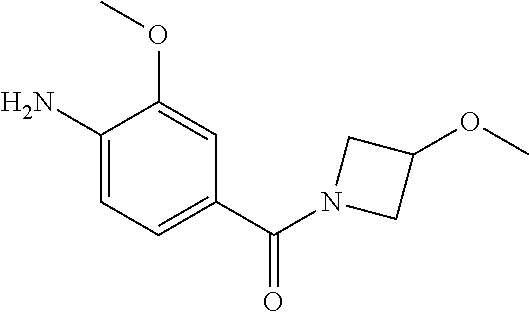
Method G
| Preparation | ||
| No | Name/Structure | Data |
| 93 | 4-Amino-N-(2-hydroxyethyl)- | 1H NMR (500 MHz, CDCl3): δ 7.37 (d, J = |
| 3-methoxybenzamide | 1.92 Hz, 1H), 7.18 (dd, J = 1.92, 8.10 Hz, | |
 |
1H), 6.67 (d, J = 8.10 Hz, 1H), 3.91 (s, 3H), 3.86-3.80 (m, 2H), 3.64-3.60 (m, 2H). LCMS (ESI) Rt = 0.71 minutes MS m/z 211 [M + H]+ Using 2-aminoethanol in DMF and purification method A. | |
| 94 | 4-Amino-3-methoxy-N-(2- | 1H NMR (500 MHz, CDCl3): δ 7.36 (d, J = |
| methoxyethyl)benzamide | 1.88 Hz, 1H), 7.16 (dd, J = 1.88, 8.06 Hz, | |
 |
1H), 6.68 (d, J = 8.06 Hz, 1H), 3.89 (s, 3H), 3.65-3.60 (m, 2H), 3.56 -3.51 (m, 2H), 3.38 (s, 3H). LCMS (ESI) Rt = 1.20 minutes MS m/z 225 [M + H]+ Using 2-methoxyethanamine in DMF and purification method A. | |
| 95 | (4-Amino-3- | 1H NMR (500 MHz, MeOD): δ 6.95 (s, 1H), |
| methoxyphenyl)(1,1- | 6.89 (d, J = 7.88 Hz, 1H), 6.74 (d, J = | |
| dioxidothiomorpholino) | 7.88 Hz, 1H), 4.14-4.05 (m, 1H), 3.94-3.85 (m, | |
| methanone | 2H), 3.89 (s, 3H), 3.79-3.68 (m, 1H), 3.28- | |
 |
3.16 (m, 2H), 3.15-3.08 (m, 2H). LCMS (ESI) Rt = 0.90 minutes MS m/z 285 [M + H]+ Using thiomorpholine 1,1-dioxide in DMF and purification method B. | |
| 96 | (4-Amino-3- | 1H NMR (500 MHz, MeOD): δ 6.94 (dd, J = |
| methoxyphenyl)(4- | 1.78, 8.62 Hz, 1H), 6.88 (ddd, J = 1.78, 8.00, | |
| methylpiperazin-1- | 8.62 Hz, 1H), 6.73 (dd, J = 0.87, 8.00 Hz, | |
| yl)methanone | 1H), 3.87 (s, 3H), 3.72-3.60 (m, 4H), 3.08 | |
 |
(s, 3H), 2.50-2.42 (m, 4H). LCMS (ESI) Rt = 0.43 minutes MS m/z 250 [M + H]+ Using 1-methylpiperazine in DMF and purification method B. | |
| 97 | 4-Amino-3-methoxy-N-(1- | 1H NMR (500 MHz, MeOD): δ 7.36 (d, J = |
| methylpiperidin-4- | 1.90 Hz, 1H), 7.33 (dd, J = 1.90, 8.16 Hz, | |
| yl)benzamide | 1H), 6.72 (d, J = 8.16 Hz, 1H), 3.91 (s, 3H), | |
 |
3.08-2.95 (m, 1H), 2.98-2.90 (m, 2H), 2.32 (s, 3H), 2.25-2.14 (m, 2H), 1.98-1.91 (m, 2H), 1.75-1.63 (m, 2H). LCMS (ESI) Rt = 0.63 minutes MS m/z 264 [M + H]+ Using 1-methylpiperidin-4-amine in DMF and purification method B. | |
| 98 | (4-Amino-3- | 1H NMR (500 MHz, CDCl3): δ 7.25 (d, J = |
| methoxyphenyl)(3- | 1.76 Hz, 1H), 7.07 (dd, J = 1.76, 8.06 Hz, | |
| (methoxymethyl)azetidin-1- | 1H), 6.64 (d, J = 8.06 Hz, 1H), 4.45-4.20 | |
| yl)methanone | (m, 2H), 4.15-4.05 (m, 2H), 3.95-3.87 (m, | |
 |
1H), 3.89 (s, 3H), 3.56 (d, J = 6.62 Hz, 2H), 3.38 (s, 3H). LCMS (ESI) Rt = 1.58 minutes MS m/z 251 [M + H]+ Using 3-(methoxymethyl)azetidine 4- methylbenzenesulfonate salt and purification method A. | |
| 99 | (4-Amino-3- | 1H NMR (500 MHz, DMSO-d6): δ 7.09 (s, |
| methoxyphenyl)(3,3- | 1H), 7.08 (d, J = 9.3 Hz, 1H), 6.61 (d, J = | |
| difluoroazetidin-1- | 8.3 Hz, 1H), 5.44 (s, 2H), 4.57 (br s, 4H), | |
| yl)methanone | 3.8 (s, 3H). | |
 |
LCMS (ESI) Rt = 1.65 minutes MS m/z 243 [M + H]+ Using 3,3-difluoroazetidine hydrochloride and triethylamine in DCM with purification method A. | |
| 100 | (4-Amino-3- | 1H NMR (500 MHz, CDCl3): δ 7.23 (d, J = |
| methoxyphenyl)(6-oxa-2- | 1.8 Hz, 1H), 7.04 (dd, J = 8.1, 1.9 Hz, 1H), 6.62 | |
| azaspiro[3.4]octan-2- | (d, J = 8.1 Hz, 1H), 4.23 (br s, 4H), 3.89 (s, | |
| yl)methanone | 2H), 3.87 (s, 3H), 3.83 (t, J = 6.9 Hz, 2H), | |
 |
2.16 (t, J = 6.9 Hz, 2H). LCMS (ESI) Rt = 1.33 minutes MS m/z 263 [M + H]+ Using 6-oxa-2-azaspiro[3.4]octane oxalate and triethylamine in DCM with purification method A. | |
| 101 | 1-(4-Amino-3- | 1H NMR (500 MHz, DMSO-d6): δ 6.84 (d, J = |
| methoxybenzoyl)piperidine-4- | 1.8 Hz, 1H), 6.79 (dd, J = 8, 1.8 Hz, 1H), 6.6 | |
| carbonitrile | (d, J = 8 Hz, 1H), 5.15 (s, 2H), 3.77 (s, 3H), | |
 |
3.74-3.76 (m, 2H), 3.34-3.32 (m, 2H), 3.12-3.11 (m, 1H), 1.88-1.85 (m, 2H), 1.72- 1.7 (m, 2H). LCMS (ESI) Rt = 1.27 minutes MS m/z 260 [M + H]+ Using piperidine-4-carbonitrile and triethylamine in DCM with purification method A. | |


Method H
| Preparation | ||
| No | Name/Structure | Data |
| 123 | 1-(Cyclobutylmethyl)-4- | 1H NMR (500 MHz, CDCl3): δ 7.78 (d, J = |
| (4,4,5,5-tetramethyl-1,3,2- | 0.70 Hz, 1H), 7 66 (d, J = 0.70 Hz, 1H), 4 15 | |
| dioxaborolan-2-yl)-1H- | (d, J = 7.34 Hz, 2H), 2.85-2.75 (m, 1H), 2.12- | |
| pyrazole | 2.04 (m, 2H), 1.96-1.74 (m, 4H), 1.32 (s, | |
 |
12H). LCMS (ESI) Rt = 2.67 minutes MS m/z 263 [M + H]+ Using (bromomethyl)-cyclobutane. | |
| 124 | 2-Methyl-1-(4-(4,4,5,5- | 1H NMR (500 MHz, CDCl3): δ 7.81 (d, J = |
| tetramethyl-1,3,2- | 0.70 Hz, 1H), 7.70 (d, J = 0.70 Hz, 1H), 4.07 | |
| dioxaborolan-2-yl)-1H- | (s, 2H), 1.31 (s, 12H), 1.15 (s, 6H). | |
| pyrazol-1-yl)propan-2-ol | LCMS (ESI) Rt = 2.67 minutes MS m/z 263 | |
 |
[M + H]+ Using 2,2-dimethyloxirane at 120° C. | |
| 125 | 1-((3-Methyloxetan-3- | 1H NMR (500 MHz, CDCl3): δ 7.79 (d, J = |
| yl)methyl)-4-(4,4,5,5- | 0.70 Hz, 1H), 7.67 (d, J = 0.70 Hz, 1H), 4.72 | |
| tetramethyl-1,3,2- | (d, J = 6.10 Hz, 2H), 4.40 (d, J = 6.10 Hz, | |
| dioxaborolan-2-yl)-1H- | 2H), 4.35 (s, 2H), 1.33 (s, 12H), 1.24 (s, 3H). | |
| pyrazole | LCMS (ESI) Rt = 2.23 minutes MS m/z 279 | |
 |
[M + H]+ Using 3-(iodomethyl)-3-methyloxetane. | |
| 126 | 1-(Oxetan-3-yl)-4-(4,4,5,5- | 1H NMR (500 MHz, CDCl3): δ 7.92 (d, J = |
| tetramethyl-1,3,2- | 0.68 Hz, 1H), 7.88 (d, J = 0.68 Hz, 1H), 5.06 | |
| dioxaborolan-2-yl)-1H- | (d, J = 6.92 Hz, 4H), 4.78-4.62 (m, 1H), 1.34 | |
| pyrazole | (s, 12H). | |
 |
LCMS (ESI) Rt = 2.05 minutes MS m/z 251 [M + H]+ Using oxetan-3-yl 4- methylbenzenesulfonate at 160° C. in NMP. | |
| 127 | 1-(Oxetan-3-ylmethyl)-4- | 1H NMR (500 MHz, CDCl3): δ 7.79 (d, J = |
| (4,4,5,5-tetramethyl-1,3,2- | 0.70 Hz, 1H), 7.67 (d, J = 0.70 Hz, 1H), 4.83 | |
| dioxaborolan-2-yl)-1H- | (dd, J = 6.46, 7.67 Hz, 2H), 4.51 (t, J = | |
| pyrazole | 6.14 Hz, 2H), 4.46 (d, J = 7.48 Hz, 2H), 3.58- | |
 |
3.48 (m, 1H), 1.33 (s, 12H). LCMS (ESI) Rt = 2.12 minutes MS m/z 265 [M + H]+ Using oxetan-3-ylmethyl 4-methylbenzene sulfonate at 90° C. | |
| 128 | Racemic 1-(4-(4,4,5,5- | 1H NMR (500 MHz, CDCl3): δ 7.81 (d, J = |
| tetramethyl-1,3,2- | 0.70 Hz, 1H), 7.72 (d, J = 0.70 Hz, 1H), 4.21- | |
| dioxaborolan-2-yl)-1H- | 4.17 (m, 2H), 4.03 (dd, J = 8.16, 14.14 Hz, | |
| pyrazol-1-yl)propan-2-ol | 1H), 1.32 (s, 12H), 1.21 (d, J = 6.24 Hz, 3H). | |
 |
LCMS (ESI) Rt = 2.03 minutes MS m/z 253 [M + H]+ Using racemic 2-methyloxirane and cesium carbonate at 120° C. | |
| 129 | 1-(Tetrahydro-2H-pyran-4-yl)- | 1H NMR (500 MHz, CDCl3): δ 7.81 (d, J = |
| 4-(4,4,5,5-tetramethyl-1,3,2- | 0.70 Hz, 1H), 7.77 (d, J = 0.70 Hz, 1H), 4.41- | |
| dioxaborolan-2-yl)-1H- | 4.33 (m, 1H), 4.15-4.06 (m, 2H), 3.52- | |
| pyrazole | 3.50 (m, 2H), 2.16-1.98 (m, 4H), 1.33 (s, | |
 |
12H). LCMS (ESI) Rt = 2.25 minutes MS m/z 379 [M + H]+ Using tetrahydro-2H-pyran-4-yl methanesulfonate at 160° C. | |
| 130 | Racemic 1-((2,2-dimethyl- | 1H NMR (500 MHz, CDCl3): δ 7.80 (s, 1H), |
| 1,3-dioxolan-4-yl)methyl)-4- | 7.78 (s, 1H), 4.50-4.45 (m, 1H), 4.26 (d, J = | |
| (4,4,5,5-tetramethyl-1,3,2- | 5.90 Hz, 2H), 4.07 (dd, J = 6.28, 8.68 Hz, | |
| dioxaborolan-2-yl)-1H- | 1H), 3.79 (dd, J = 5.90, 8.68 Hz, 1H), 1.35 (s, | |
| pyrazole | 6H), 1.32 (d, J = 1.76 Hz, 12H). | |
 |
LCMS (ESI) Rt = 2.32 minutes MS m/z 309 [M + H]+ Using racemic (2,2-dimethyl-1,3-dioxolan-4- yl)methyl 4-methylbenzenesulfonate at 140° C. | |
| 131 | 1-((4-(4,4,5,5-Tetramethyl- | 1H NMR (500 MHz, CDCl3): δ 7.80 (d, J = |
| 1,3,2-dioxaborolan-2-yl)-1H- | 0.68 Hz, 1H), 7.77 (d, J = 0.68 Hz, 1H), 4.24 | |
| pyrazol-1- | (s, 2H), 2.14-2.06 (m, 2H), 2.02-1.96 (m, | |
| yl)methyl)cyclobutanol | 2H), 1.85-1.77 (m, 1H), 1.62-1.52 (m, 1H), | |
 |
1.33 (s, 12H). LCMS (ESI) Rt = 2.38 minutes MS m/z 279 [M + H]+ Using 1-oxaspiro[2.3]hexane and cesium carbonate at 120° C. | |
| 132 | 4-(4,4,5,5-Tetramethyl-1,3,2- | 1H NMR (500 MHz, CDCl3): δ 7.86 (d, J = |
| dioxaborolan-2-yl)-1-(2,2,2- | 0.64 Hz, 1H), 7.82 (d, J = 0.64 Hz, 1H), 4.73 | |
| trifluoroethyl)-1H-pyrazole | (q, J = 8.38 Hz, 2H), 1.34 (s, 12H). | |
 |
LCMS (ESI) Rt = 2.53 minutes MS m/z 277 [M + H]+ Using 2,2,2-trifluoroethyl trifluoromethanesulfonate at 120° C. | |
| 133 | 3-(4-(4,4,5,5-Tetramethyl- | 1H NMR (500 MHz, CDCl3): δ 7.86 (d, J = |
| 1,3,2-dioxaborolan-2-yl)-1H- | 0.62 Hz, 1H), 7.80 (d, J = 0.62 Hz, 1H), 4.97 | |
| pyrazol-1-yl)butan-2-one | (q, J = 7.28 Hz, 1H), 1.99 (s, 3H), 1.70 (d, | |
 |
J = 7.30 Hz, 3H), 1.34 (s, 12H). LCMS (ESI) Rt = 2.32 minutes MS m/z 265 [M + H]+ Using 3-bromobutan-2-one at 120° C. | |
| 134 | Racemic 1-(4-(4,4,5,5- | 1H NMR (500 MHz, CDCl3): δ 7.81 (d, J = |
| tetramethyl-1,3,2- | 0.68 Hz, 1H), 7.72 (d, J = 0.68 Hz, 1H), 4.22 | |
| dioxaborolan-2-yl)-1H- | (dd, J = 2.64, 13.72 Hz, 1H), 4.04 (dd, J = | |
| pyrazol-1-yl)butan-2-ol | 7.46, 13.72 Hz, 1H), 3.97-3.85 (m, 1H), | |
 |
3.46 (d, J = 4.24 Hz, 1H), 1.53-1.44 (m, 2H), 1.32 (s, 12H), 1.00 (t, J = 7.46 Hz, 3H). LCMS (ESI) Rt = 2.28 minutes MS m/z 267 [M + H]+ Using racemic 2-ethyloxirane and cesium carbonate at 120° C. | |
| 135 | Racemic 3-methyl-1-(4- | 1H NMR (500 MHz, CDCl3): δ 7.81 (d, J = |
| (4,4,5,5-tetramethyl-1,3,2- | 0.78 Hz, 1H), 7.73 (d, J = 0.78 Hz, 1H), 4.24 | |
| dioxaborolan-2-yl)-1H- | (dd, J = 2.46, 13.78 Hz, 1H), 4.08 (dd, J = | |
| pyrazol-1-yl)butan-2-ol | 8.20, 13.78 Hz, 1H), 3.75-3.68 (m, 1H), 3.41 | |
 |
(d, J = 4.06 Hz, 1H), 1.75-1.65 (m, 1H), 1.33 (s, 12H), 1.01 (d, J = 6.80 Hz, 3H), 0.99 (d, J = 6.80 Hz, 3H). LCMS (ESI) Rt = 2.45 minutes MS m/z 281 [M + H]+ Using racemic 2-isopropyloxirane and cesium carbonate at 120° C. | |
| 136 | Racemic 1,1,1-Trifluoro-3-(4- | 1H NMR (500 MHz, CDCl3): δ 7.86 (d, J = |
| (4,4,5,5-tetramethyl-1,3,2- | 0.60 Hz, 1H), 7.75 (d, J = 0.60 Hz, 1H), 4.56- | |
| dioxaborolan-2-yl)-1H- | 4.53 (m, 1H), 4.48-4.45 (m, 2H), 1.33 (d, | |
| pyrazol-1-yl)propan-2-ol | J = 1.16 Hz, 12H). | |
 |
LCMS (ESI) Rt = 2.40 minutes MS m/z 307 [M + H]+ Using racemic 2-(trifluoromethyl)oxirane at 120° C. | |
| 137 | Racemic 1-Methoxy-3-(4- | 1H NMR (500 MHz, CDCl3): δ 7.80 (d, J = |
| (4,4,5,5-tetramethyl-1,3,2- | 0.68 Hz, 1H), 7.74 (d, J = 0.68 Hz, 1H), 4.30 | |
| dioxaborolan-2-yl)-1H- | (dd, J = 3.52, 13.62 Hz, 1H), 4.20 (dd, J = | |
| pyrazol-1-yl)propan-2-ol | 6.62, 13.62 Hz, 1H), 4.17-4.13 (m, 1H), | |
 |
3.58 (d, J = 4.68 Hz, 1H), 3.37 (s, 3H), 3.36 (dd, J = 5.44, 9.66 Hz, 1H), 3.30 (dd, J = 5.44, 9.66 Hz, 1H), 1.32 (s, 12H). LCMS (ESI) Rt = 2.12 minutes MS m/z 283 [M + H]+ Using racemic 2-(methoxymethyl)oxirane at 120° C. | |
| 138 | 1-(2,2-difluoroethyl)-4- | 1H NMR (500 MHz, CDCl3): δ 7.84 (d, J = |
| (4,4,5,5-tetramethyl-1,3,2- | 0.7 Hz, 1H), 7.77 (d, J = 0.7 Hz, 1H), 6.25-5.93 | |
| dioxaborolan-2-yl)-1H- | (m, 1H), 4.57-4.39 (m, 2H), 1.33 (s, 12H). | |
| pyrazole | LCMS (ESI) Rt = 2.64 minutes MS m/z 259 | |
 |
[M + H]+ Using 1,1-difluoro-2-iodoethane | |
| 139 | 1-(cyclopropylmethyl)-4- | 1H NMR (500 MHz, CDCl3): δ 7.82 (d, J = |
| (4,4,5,5-tetramethyl-1,3,2- | 0.7 Hz, 1H), 7.80 (d, J = 0.7 Hz, 1H), 4.00 (d, | |
| dioxaborolan-2-yl)-1H- | J = 7.1 Hz, 2H), 1.33 (s, 12H), 1.27 (m, 1H), | |
| pyrazole | 0.68-0.63 (m, 2H), 0.40-0.35 (m, 2H). | |
 |
LCMS (ESI) Rt = 2.58 minutes MS m/z 249 [M + H]+ Using (bromomethyl)-cyclopropane. | |


Claims (15)


-L1-L2-R17
-L3-L4-R24

-L1-L2-R17
-L3-L4-R24
-L1-L2-R17
Priority Applications (1)
| Application Number | Priority Date | Filing Date | Title |
|---|---|---|---|
| US15/852,639 US10188642B2 (en) | 2012-09-07 | 2017-12-22 | Pharmacologically active compounds |
Applications Claiming Priority (6)
| Application Number | Priority Date | Filing Date | Title |
|---|---|---|---|
| GBGB1216018.0A GB201216018D0 (en) | 2012-09-07 | 2012-09-07 | Pharmacologically active compounds |
| GB1216018.0 | 2012-09-07 | ||
| PCT/GB2013/052361 WO2014037751A1 (en) | 2012-09-07 | 2013-09-09 | Pharmacologically active compounds |
| US201514426574A | 2015-03-06 | 2015-03-06 | |
| US15/069,012 US9895364B2 (en) | 2012-09-07 | 2016-03-14 | Pharmacologically active compounds |
| US15/852,639 US10188642B2 (en) | 2012-09-07 | 2017-12-22 | Pharmacologically active compounds |
Related Parent Applications (1)
| Application Number | Title | Priority Date | Filing Date |
|---|---|---|---|
| US15/069,012 Continuation US9895364B2 (en) | 2012-09-07 | 2016-03-14 | Pharmacologically active compounds |
Publications (2)
| Publication Number | Publication Date |
|---|---|
| US20180117032A1 US20180117032A1 (en) | 2018-05-03 |
| US10188642B2 true US10188642B2 (en) | 2019-01-29 |
Family
ID=47137118
Family Applications (3)
| Application Number | Title | Priority Date | Filing Date |
|---|---|---|---|
| US14/426,574 Expired - Fee Related US9334286B2 (en) | 2012-09-07 | 2013-09-09 | Pharmacologically active compounds |
| US15/069,012 Expired - Fee Related US9895364B2 (en) | 2012-09-07 | 2016-03-14 | Pharmacologically active compounds |
| US15/852,639 Active US10188642B2 (en) | 2012-09-07 | 2017-12-22 | Pharmacologically active compounds |
Family Applications Before (2)
| Application Number | Title | Priority Date | Filing Date |
|---|---|---|---|
| US14/426,574 Expired - Fee Related US9334286B2 (en) | 2012-09-07 | 2013-09-09 | Pharmacologically active compounds |
| US15/069,012 Expired - Fee Related US9895364B2 (en) | 2012-09-07 | 2016-03-14 | Pharmacologically active compounds |
Country Status (6)
| Country | Link |
|---|---|
| US (3) | US9334286B2 (en) |
| EP (1) | EP2892890B1 (en) |
| JP (1) | JP6297570B2 (en) |
| ES (1) | ES2655026T3 (en) |
| GB (1) | GB201216018D0 (en) |
| WO (1) | WO2014037751A1 (en) |
Families Citing this family (17)
| Publication number | Priority date | Publication date | Assignee | Title |
|---|---|---|---|---|
| GB201216018D0 (en) | 2012-09-07 | 2012-10-24 | Cancer Rec Tech Ltd | Pharmacologically active compounds |
| GB201216017D0 (en) | 2012-09-07 | 2012-10-24 | Cancer Rec Tech Ltd | Inhibitor compounds |
| GB201403536D0 (en) | 2014-02-28 | 2014-04-16 | Cancer Rec Tech Ltd | Inhibitor compounds |
| EP3283642B1 (en) | 2015-04-17 | 2023-10-11 | Netherlands Translational Research Center Holding B.V. | Prognostic biomarkers for ttk inhibitor chemotherapy |
| MX2019010302A (en) | 2017-03-30 | 2019-11-21 | Hoffmann La Roche | ISOQUINOLINES AS INHIBITORS OF HPK1. |
| WO2018234778A1 (en) * | 2017-06-20 | 2018-12-27 | The Institute Of Cancer Research: Royal Cancer Hospital | Methods and medical uses |
| GB201709840D0 (en) * | 2017-06-20 | 2017-08-02 | Inst Of Cancer Research: Royal Cancer Hospital | Methods and medical uses |
| JP7235748B2 (en) * | 2017-11-30 | 2023-03-08 | ハンミ ファーム.カンパニー リミテッド | Salt of 4-amino-N-(1-((3-chloro-2-fluorophenyl)amino)-6-methylisoquinolin-5-yl)thieno[3,2-D]pyrimidine-7-carboxamide and crystals thereof form |
| JP7386841B2 (en) * | 2018-07-24 | 2023-11-27 | エフ・ホフマン-ラ・ロシュ・アクチェンゲゼルシャフト | Isoquinoline compounds and their uses |
| TW202024053A (en) | 2018-10-02 | 2020-07-01 | 美商建南德克公司 | Isoquinoline compounds and uses thereof |
| TW202023558A (en) | 2018-10-03 | 2020-07-01 | 美商建南德克公司 | 8-aminoisoquinoline compounds and uses thereof |
| CN112174903B (en) * | 2019-07-01 | 2022-07-12 | 清华大学 | Small molecule modulators of TLR8 |
| CN114761000A (en) * | 2019-10-01 | 2022-07-15 | 金翅雀生物公司 | Substituted 1, 6-naphthyridine inhibitors of CDK5 |
| AR122928A1 (en) * | 2020-07-10 | 2022-10-19 | Goldfinch Bio Inc | 1,6-SUBSTITUTED NAPHTHYRIDINES INHIBITOR OF CDK5 |
| AU2022407173A1 (en) * | 2021-12-10 | 2024-06-27 | Prothena Biosciences Limited | Heterocyclic compounds as dyrk1a inhibitors |
| CN116410189B (en) * | 2021-12-30 | 2024-08-06 | 中国科学院上海药物研究所 | Pyrimido pyridine compound and medicinal composition and application thereof |
| WO2025179188A1 (en) * | 2024-02-22 | 2025-08-28 | Juno Therapeutics, Inc. | Pyrazole-based inhibitors of dna-dependent protein kinase and compositions and applications in gene editing |
Citations (59)
| Publication number | Priority date | Publication date | Assignee | Title |
|---|---|---|---|---|
| US2697710A (en) | 1953-01-02 | 1954-12-21 | Burroughs Wellcome Co | Pyrido (2,3-d) pyrimidines and method of preparing same |
| US3021332A (en) | 1954-01-04 | 1962-02-13 | Burroughs Wellcome Co | Pyrido (2, 3-d) pyrimidine compounds and method of making |
| WO1996015128A2 (en) | 1994-11-14 | 1996-05-23 | Warner-Lambert Company | 6-ARYL PYRIDO[2,3-d]PYRIMIDINES AND NAPHTHYRIDINES FOR INHIBITING PROTEIN TYROSINE KINASE MEDIATED CELLULAR PROLIFERATION |
| WO2000025780A1 (en) | 1998-10-29 | 2000-05-11 | Bristol-Myers Squibb Company | Compounds derived from an amine nucleus that are inhibitors of impdh enzyme |
| WO2000068203A1 (en) | 1999-05-07 | 2000-11-16 | Takeda Chemical Industries, Ltd. | Cyclic compounds and uses thereof |
| WO2001019788A2 (en) | 1999-09-17 | 2001-03-22 | Cor Therapeutics, Inc. | BENZAMIDES AND RELATED INHIBITORS OF FACTOR Xa |
| WO2001055147A1 (en) | 2000-01-25 | 2001-08-02 | Warner-Lambert Company | PYRIDO[2,3-d]PYRIMIDINE-2,7-DIAMINE KINASE INHIBITORS |
| WO2001064643A2 (en) | 2000-02-29 | 2001-09-07 | Cor Therapeutics, Inc. | BENZAMIDES AND RELATED INHIBITORS OF FACTOR Xa |
| WO2002000647A1 (en) | 2000-06-23 | 2002-01-03 | Bristol-Myers Squibb Pharma Company | Heteroaryl-phenyl substituted factor xa inhibitors |
| WO2002090360A1 (en) | 2001-05-10 | 2002-11-14 | Smithkline Beecham Corporation | Compounds useful as kinase inhibitors for the treatment of hyperproliferative diseases |
| WO2003007955A2 (en) | 2001-07-20 | 2003-01-30 | Cancer Research Technology Limited | Biphenyl apurinic/apyrimidinic site endonuclease inhibitors to treat cancer |
| US20030073668A1 (en) | 2000-01-25 | 2003-04-17 | Booth Richard John | Pyrido[2,3-d]pyrimidine-2,7-diamine kinase inhibitors |
| US20030105115A1 (en) | 2001-06-21 | 2003-06-05 | Metcalf Chester A. | Novel pyridopyrimidines and uses thereof |
| WO2003051366A2 (en) | 2001-12-13 | 2003-06-26 | Abbott Laboratories | 3-(phenyl-alkoxy)-5-(phenyl)-pyridine derivatives and related compounds as kinase inhibitors for the treatment of cancer |
| WO2003074530A1 (en) | 2002-03-07 | 2003-09-12 | F. Hoffman-La Roche Ag | Bicyclic pyridine and pyrimidine p38 kinase inhibitors |
| WO2004007472A1 (en) | 2002-07-10 | 2004-01-22 | Ono Pharmaceutical Co., Ltd. | Ccr4 antagonist and medicinal use thereof |
| US20040092521A1 (en) | 2002-11-12 | 2004-05-13 | Altenbach Robert J. | Bicyclic-substituted amines as histamine-3 receptor ligands |
| WO2004043458A1 (en) | 2002-11-12 | 2004-05-27 | Abbott Laboratories | Bicyclic-substituted amines as histamine-3 receptor ligands |
| WO2004065378A1 (en) | 2003-01-17 | 2004-08-05 | Warner-Lambert Company Llc | 2-aminopyridine substituted heterocycles as inhibitors of cellular proliferation |
| WO2004085385A2 (en) | 2003-03-20 | 2004-10-07 | Schering Corporation | Cannabinoid receptor ligands |
| US20050256118A1 (en) | 2004-05-12 | 2005-11-17 | Altenbach Robert J | Bicyclic-substituted amines having cyclic-substituted monocyclic substituents |
| US20050272728A1 (en) | 2004-05-12 | 2005-12-08 | Altenbach Robert J | Bicyclic-substituted amines having cyclic-substituted monocyclic substituents |
| WO2006001463A1 (en) | 2004-06-23 | 2006-01-05 | Ono Pharmaceutical Co., Ltd. | Compound having s1p receptor binding potency and use thereof |
| WO2007000240A1 (en) | 2005-06-28 | 2007-01-04 | Sanofi-Aventis | Isoquinoline derivatives as inhibitors of rho-kinase |
| WO2007011759A2 (en) | 2005-07-15 | 2007-01-25 | Kalypsys, Inc. | Inhibitors of mitotic kinesin |
| WO2007088999A1 (en) | 2006-01-31 | 2007-08-09 | Mitsubishi Tanabe Pharma Corporation | Trisubstituted amine compound |
| WO2007088996A1 (en) | 2006-01-31 | 2007-08-09 | Mitsubishi Tanabe Pharma Corporation | Trisubstituted amine compounds as inhibitors of -cholesteryl ester transfer protein cetp |
| WO2007125405A2 (en) | 2006-05-01 | 2007-11-08 | Pfizer Products Inc. | Substituted 2-amino-fused heterocyclic compounds |
| WO2007140222A2 (en) | 2006-05-26 | 2007-12-06 | Novartis Ag | Pyrrolopyrimidine compounds and their uses |
| WO2008073670A2 (en) | 2006-12-08 | 2008-06-19 | Millennium Pharmaceuticals, Inc. | Unit dose formulations and methods of treating thrombosis with an oral factor xa inhibitor |
| WO2008079988A2 (en) | 2006-12-22 | 2008-07-03 | Novartis Ag | Quinazolines for pdk1 inhibition |
| WO2008135232A1 (en) | 2007-05-02 | 2008-11-13 | Riccardo Cortese | Use and compositions of purine derivatives for the treatment of proliferative disorders |
| WO2009010871A2 (en) | 2007-07-13 | 2009-01-22 | Addex Pharma S.A. | Pyrazole derivatives as antagonists of adenosine a3 receptor |
| WO2009010455A2 (en) | 2007-07-13 | 2009-01-22 | Addex Pharma S.A. | Pyrazole derivatives as modulators of metabotropic glutamate receptors |
| WO2009026717A1 (en) | 2007-08-29 | 2009-03-05 | Methylgene Inc. | Inhibitors of protein tyrosine kinase activity |
| WO2009032694A1 (en) | 2007-08-28 | 2009-03-12 | Dana Farber Cancer Institute | Amino substituted pyrimidine, pyrollopyridine and pyrazolopyrimidine derivatives useful as kinase inhibitors and in treating proliferative disorders and diseases associated with angiogenesis |
| JP2009051827A (en) | 2007-07-30 | 2009-03-12 | Mitsubishi Tanabe Pharma Corp | Pharmaceutical composition |
| WO2009076618A2 (en) | 2007-12-12 | 2009-06-18 | Cernofina, Llc | Generation of combinatorial synthetic libraries and screening for novel proadhesins and nonadhesins |
| WO2009103966A1 (en) | 2008-02-19 | 2009-08-27 | Cancer Research Technology Limited | Bicyclylaryl-aryl-amine compounds and their use |
| WO2010007374A1 (en) | 2008-07-15 | 2010-01-21 | Sentinel Oncology Limited | Pharmaceutical compounds |
| WO2010048149A2 (en) | 2008-10-20 | 2010-04-29 | Kalypsys, Inc. | Heterocyclic modulators of gpr119 for treatment of disease |
| WO2010080537A1 (en) | 2008-12-18 | 2010-07-15 | Metabolex, Inc. | Gpr120 receptor agonists and uses thereof |
| WO2010129816A2 (en) | 2009-05-07 | 2010-11-11 | Intellikine, Inc. | Heterocyclic compounds and uses thereof |
| WO2011015037A1 (en) | 2009-08-05 | 2011-02-10 | The University Of Hongkong | Antiviral compounds and methods of making and using there of cross reference to related applications |
| US20110212975A1 (en) | 2009-08-05 | 2011-09-01 | The University Of Hong Kong | Antiviral compounds and methods of making and using thereof |
| US20110257196A1 (en) | 2008-06-16 | 2011-10-20 | Yan Lu | Compounds for treatment of cancer |
| WO2011159297A1 (en) | 2010-06-16 | 2011-12-22 | Metabolex, Inc. | Gpr120 receptor agonists and uses thereof |
| WO2012013557A1 (en) | 2010-07-30 | 2012-02-02 | Nerviano Medical Sciences S.R.L. | Isoxazolo-quinazolines as modulators of protein kinase activity |
| WO2012028756A1 (en) | 2010-09-01 | 2012-03-08 | Institut Químic De Sarrià Cets, Fundació Privada | Preparation of substituted pyrido[2,3-d]pyrimidin-7(8h)-one compounds |
| WO2012064973A2 (en) | 2010-11-10 | 2012-05-18 | Infinity Pharmaceuticals, Inc. | Heterocyclic compounds and uses thereof |
| WO2012079032A2 (en) | 2010-12-09 | 2012-06-14 | Trana Discovery, Inc. | Compositions and methods of treating drug-resistant retroviral infections |
| WO2012080729A2 (en) | 2010-12-14 | 2012-06-21 | Electrophoretics Limited | CASEIN KINASE 1δ (CK1δ) INHIBITORS |
| WO2012080284A2 (en) | 2010-12-17 | 2012-06-21 | F. Hoffmann-La Roche Ag | Substituted 6,6-fused nitrogenous heterocyclic compounds and uses thereof |
| WO2012088438A1 (en) | 2010-12-22 | 2012-06-28 | Eutropics Pharmaceuticals, Inc. | Compositions and methods useful for treating diseases |
| WO2012092471A2 (en) | 2010-12-29 | 2012-07-05 | Development Center For Biotechnology | Novel tubulin inhibitors and methods of using the same |
| WO2012101032A1 (en) | 2011-01-26 | 2012-08-02 | Nerviano Medical Sciences S.R.L. | Tricyclic pyrrolo derivatives, process for their preparation and their use as kinase inhibitors |
| WO2012123745A1 (en) | 2011-03-14 | 2012-09-20 | Cancer Research Technology Limited | Pyrrolopyridineamino derivatives as mps1 inhibitors |
| WO2014037750A1 (en) | 2012-09-07 | 2014-03-13 | Cancer Research Technology Limited | Inhibitor compounds |
| US9334286B2 (en) | 2012-09-07 | 2016-05-10 | Cancer Research Technology Limited | Pharmacologically active compounds |
Family Cites Families (1)
| Publication number | Priority date | Publication date | Assignee | Title |
|---|---|---|---|---|
| AU2001277110A1 (en) | 2000-07-21 | 2002-02-05 | The Trustees Of Columbia University In The City Of New York | Method and apparatus for reducing distortion in images |
-
2012
- 2012-09-07 GB GBGB1216018.0A patent/GB201216018D0/en not_active Ceased
-
2013
- 2013-09-09 ES ES13760107T patent/ES2655026T3/en active Active
- 2013-09-09 WO PCT/GB2013/052361 patent/WO2014037751A1/en not_active Ceased
- 2013-09-09 JP JP2015530496A patent/JP6297570B2/en not_active Expired - Fee Related
- 2013-09-09 US US14/426,574 patent/US9334286B2/en not_active Expired - Fee Related
- 2013-09-09 EP EP13760107.6A patent/EP2892890B1/en active Active
-
2016
- 2016-03-14 US US15/069,012 patent/US9895364B2/en not_active Expired - Fee Related
-
2017
- 2017-12-22 US US15/852,639 patent/US10188642B2/en active Active
Patent Citations (62)
| Publication number | Priority date | Publication date | Assignee | Title |
|---|---|---|---|---|
| US2697710A (en) | 1953-01-02 | 1954-12-21 | Burroughs Wellcome Co | Pyrido (2,3-d) pyrimidines and method of preparing same |
| US3021332A (en) | 1954-01-04 | 1962-02-13 | Burroughs Wellcome Co | Pyrido (2, 3-d) pyrimidine compounds and method of making |
| WO1996015128A2 (en) | 1994-11-14 | 1996-05-23 | Warner-Lambert Company | 6-ARYL PYRIDO[2,3-d]PYRIMIDINES AND NAPHTHYRIDINES FOR INHIBITING PROTEIN TYROSINE KINASE MEDIATED CELLULAR PROLIFERATION |
| WO2000025780A1 (en) | 1998-10-29 | 2000-05-11 | Bristol-Myers Squibb Company | Compounds derived from an amine nucleus that are inhibitors of impdh enzyme |
| WO2000068203A1 (en) | 1999-05-07 | 2000-11-16 | Takeda Chemical Industries, Ltd. | Cyclic compounds and uses thereof |
| WO2001019788A2 (en) | 1999-09-17 | 2001-03-22 | Cor Therapeutics, Inc. | BENZAMIDES AND RELATED INHIBITORS OF FACTOR Xa |
| WO2001055147A1 (en) | 2000-01-25 | 2001-08-02 | Warner-Lambert Company | PYRIDO[2,3-d]PYRIMIDINE-2,7-DIAMINE KINASE INHIBITORS |
| US20030073668A1 (en) | 2000-01-25 | 2003-04-17 | Booth Richard John | Pyrido[2,3-d]pyrimidine-2,7-diamine kinase inhibitors |
| WO2001064643A2 (en) | 2000-02-29 | 2001-09-07 | Cor Therapeutics, Inc. | BENZAMIDES AND RELATED INHIBITORS OF FACTOR Xa |
| WO2001064642A2 (en) | 2000-02-29 | 2001-09-07 | Cor Therapeutics, Inc. | Benzamides and related inhibitors of factor xa |
| WO2002000647A1 (en) | 2000-06-23 | 2002-01-03 | Bristol-Myers Squibb Pharma Company | Heteroaryl-phenyl substituted factor xa inhibitors |
| WO2002090360A1 (en) | 2001-05-10 | 2002-11-14 | Smithkline Beecham Corporation | Compounds useful as kinase inhibitors for the treatment of hyperproliferative diseases |
| US20030105115A1 (en) | 2001-06-21 | 2003-06-05 | Metcalf Chester A. | Novel pyridopyrimidines and uses thereof |
| WO2003007955A2 (en) | 2001-07-20 | 2003-01-30 | Cancer Research Technology Limited | Biphenyl apurinic/apyrimidinic site endonuclease inhibitors to treat cancer |
| WO2003051366A2 (en) | 2001-12-13 | 2003-06-26 | Abbott Laboratories | 3-(phenyl-alkoxy)-5-(phenyl)-pyridine derivatives and related compounds as kinase inhibitors for the treatment of cancer |
| WO2003074530A1 (en) | 2002-03-07 | 2003-09-12 | F. Hoffman-La Roche Ag | Bicyclic pyridine and pyrimidine p38 kinase inhibitors |
| WO2004007472A1 (en) | 2002-07-10 | 2004-01-22 | Ono Pharmaceutical Co., Ltd. | Ccr4 antagonist and medicinal use thereof |
| US20040092521A1 (en) | 2002-11-12 | 2004-05-13 | Altenbach Robert J. | Bicyclic-substituted amines as histamine-3 receptor ligands |
| WO2004043458A1 (en) | 2002-11-12 | 2004-05-27 | Abbott Laboratories | Bicyclic-substituted amines as histamine-3 receptor ligands |
| WO2004065378A1 (en) | 2003-01-17 | 2004-08-05 | Warner-Lambert Company Llc | 2-aminopyridine substituted heterocycles as inhibitors of cellular proliferation |
| WO2004085385A2 (en) | 2003-03-20 | 2004-10-07 | Schering Corporation | Cannabinoid receptor ligands |
| US20050256118A1 (en) | 2004-05-12 | 2005-11-17 | Altenbach Robert J | Bicyclic-substituted amines having cyclic-substituted monocyclic substituents |
| US20050272728A1 (en) | 2004-05-12 | 2005-12-08 | Altenbach Robert J | Bicyclic-substituted amines having cyclic-substituted monocyclic substituents |
| WO2006001463A1 (en) | 2004-06-23 | 2006-01-05 | Ono Pharmaceutical Co., Ltd. | Compound having s1p receptor binding potency and use thereof |
| WO2007000240A1 (en) | 2005-06-28 | 2007-01-04 | Sanofi-Aventis | Isoquinoline derivatives as inhibitors of rho-kinase |
| WO2007011759A2 (en) | 2005-07-15 | 2007-01-25 | Kalypsys, Inc. | Inhibitors of mitotic kinesin |
| WO2007088999A1 (en) | 2006-01-31 | 2007-08-09 | Mitsubishi Tanabe Pharma Corporation | Trisubstituted amine compound |
| WO2007088996A1 (en) | 2006-01-31 | 2007-08-09 | Mitsubishi Tanabe Pharma Corporation | Trisubstituted amine compounds as inhibitors of -cholesteryl ester transfer protein cetp |
| WO2007125405A2 (en) | 2006-05-01 | 2007-11-08 | Pfizer Products Inc. | Substituted 2-amino-fused heterocyclic compounds |
| WO2007140222A2 (en) | 2006-05-26 | 2007-12-06 | Novartis Ag | Pyrrolopyrimidine compounds and their uses |
| WO2008073670A2 (en) | 2006-12-08 | 2008-06-19 | Millennium Pharmaceuticals, Inc. | Unit dose formulations and methods of treating thrombosis with an oral factor xa inhibitor |
| WO2008079988A2 (en) | 2006-12-22 | 2008-07-03 | Novartis Ag | Quinazolines for pdk1 inhibition |
| WO2008135232A1 (en) | 2007-05-02 | 2008-11-13 | Riccardo Cortese | Use and compositions of purine derivatives for the treatment of proliferative disorders |
| WO2009010871A2 (en) | 2007-07-13 | 2009-01-22 | Addex Pharma S.A. | Pyrazole derivatives as antagonists of adenosine a3 receptor |
| WO2009010455A2 (en) | 2007-07-13 | 2009-01-22 | Addex Pharma S.A. | Pyrazole derivatives as modulators of metabotropic glutamate receptors |
| JP2009051827A (en) | 2007-07-30 | 2009-03-12 | Mitsubishi Tanabe Pharma Corp | Pharmaceutical composition |
| WO2009032694A1 (en) | 2007-08-28 | 2009-03-12 | Dana Farber Cancer Institute | Amino substituted pyrimidine, pyrollopyridine and pyrazolopyrimidine derivatives useful as kinase inhibitors and in treating proliferative disorders and diseases associated with angiogenesis |
| WO2009026717A1 (en) | 2007-08-29 | 2009-03-05 | Methylgene Inc. | Inhibitors of protein tyrosine kinase activity |
| WO2009076618A2 (en) | 2007-12-12 | 2009-06-18 | Cernofina, Llc | Generation of combinatorial synthetic libraries and screening for novel proadhesins and nonadhesins |
| WO2009103966A1 (en) | 2008-02-19 | 2009-08-27 | Cancer Research Technology Limited | Bicyclylaryl-aryl-amine compounds and their use |
| US20110257196A1 (en) | 2008-06-16 | 2011-10-20 | Yan Lu | Compounds for treatment of cancer |
| WO2010007374A1 (en) | 2008-07-15 | 2010-01-21 | Sentinel Oncology Limited | Pharmaceutical compounds |
| WO2010048149A2 (en) | 2008-10-20 | 2010-04-29 | Kalypsys, Inc. | Heterocyclic modulators of gpr119 for treatment of disease |
| WO2010080537A1 (en) | 2008-12-18 | 2010-07-15 | Metabolex, Inc. | Gpr120 receptor agonists and uses thereof |
| WO2010129816A2 (en) | 2009-05-07 | 2010-11-11 | Intellikine, Inc. | Heterocyclic compounds and uses thereof |
| US20110212975A1 (en) | 2009-08-05 | 2011-09-01 | The University Of Hong Kong | Antiviral compounds and methods of making and using thereof |
| WO2011015037A1 (en) | 2009-08-05 | 2011-02-10 | The University Of Hongkong | Antiviral compounds and methods of making and using there of cross reference to related applications |
| WO2011159297A1 (en) | 2010-06-16 | 2011-12-22 | Metabolex, Inc. | Gpr120 receptor agonists and uses thereof |
| WO2012013557A1 (en) | 2010-07-30 | 2012-02-02 | Nerviano Medical Sciences S.R.L. | Isoxazolo-quinazolines as modulators of protein kinase activity |
| WO2012028756A1 (en) | 2010-09-01 | 2012-03-08 | Institut Químic De Sarrià Cets, Fundació Privada | Preparation of substituted pyrido[2,3-d]pyrimidin-7(8h)-one compounds |
| US20150031672A1 (en) | 2010-11-10 | 2015-01-29 | Infinity Pharmaceuticals, Inc. | Heterocyclic compounds and uses thereof |
| WO2012064973A2 (en) | 2010-11-10 | 2012-05-18 | Infinity Pharmaceuticals, Inc. | Heterocyclic compounds and uses thereof |
| WO2012079032A2 (en) | 2010-12-09 | 2012-06-14 | Trana Discovery, Inc. | Compositions and methods of treating drug-resistant retroviral infections |
| WO2012080729A2 (en) | 2010-12-14 | 2012-06-21 | Electrophoretics Limited | CASEIN KINASE 1δ (CK1δ) INHIBITORS |
| WO2012080284A2 (en) | 2010-12-17 | 2012-06-21 | F. Hoffmann-La Roche Ag | Substituted 6,6-fused nitrogenous heterocyclic compounds and uses thereof |
| WO2012088438A1 (en) | 2010-12-22 | 2012-06-28 | Eutropics Pharmaceuticals, Inc. | Compositions and methods useful for treating diseases |
| WO2012092471A2 (en) | 2010-12-29 | 2012-07-05 | Development Center For Biotechnology | Novel tubulin inhibitors and methods of using the same |
| WO2012101032A1 (en) | 2011-01-26 | 2012-08-02 | Nerviano Medical Sciences S.R.L. | Tricyclic pyrrolo derivatives, process for their preparation and their use as kinase inhibitors |
| WO2012123745A1 (en) | 2011-03-14 | 2012-09-20 | Cancer Research Technology Limited | Pyrrolopyridineamino derivatives as mps1 inhibitors |
| WO2014037750A1 (en) | 2012-09-07 | 2014-03-13 | Cancer Research Technology Limited | Inhibitor compounds |
| US9334286B2 (en) | 2012-09-07 | 2016-05-10 | Cancer Research Technology Limited | Pharmacologically active compounds |
| US9895364B2 (en) | 2012-09-07 | 2018-02-20 | Cancer Research Technology Limited | Pharmacologically active compounds |
Non-Patent Citations (35)
| Title |
|---|
| Aguilera et al., "c-Jun N-terminal phosphorylation antagonizes recruitment of the Mbd3/NuRD repressor complex", Nature, 469:231-235 (2011). |
| Balog et al., "Novel fluorescent isoquinoline derivatives obtained via Buchwald-Hartwig coupling of isoquinolin-3-amines", Arkivoc., 5:109-19 (2012). |
| Bathini et al., "2-Aminoquinazoline inhibitors of cyclin-dependent kinases", Bioorg. Med. Chem. Lett., 15(17):3881-5 (2005). |
| Cabarello et al., "2D Autocorrelation, CoMFA, and CoMSIA modeling of protein tyrosine kinases' inhibition by substituted pyrido[2,3-d]pyrimidine derivatives", Bioorg. Med. Chem., 16(2):810-21 (2008). |
| DATABASE PubChem [online] "AC1LZP15 - Compound Summary (CID 2004801)", XP002714055 |
| DATABASE PubChem [online] "ethyl 4-[(6,7-diethoxyisoquinolin-3-yl)amino]benzoate - Compound Summary (CID 2000835)", XP002714054 |
| DATABASE PubChem [online] NCBI; "6,7-diethoxy-N-(4-methoxyphenyl)isoquinolin-3-amine - Compound Summary (CID 945107)", XP002714052 |
| DATABASE PubChem [online] NCBI; "methyl 4-[(6,7-diethoxyisoquinolin-3-yl)amino]benzoate - Compound Summary (CID 2019230)", XP002714056 |
| DATABASE PubChem [online] NCBI; "STK122063 - Compound Summary (CID 940974)", XP002714051 |
| DATABASE PubChem [online] NCBI; "STK126367 - Compound Summary (CID 4000352)", XP002714057 |
| DATABASE PubChem [online] NCBI; "SureCN7064739 - Compound Summary (CID 69975764)", XP002714059 |
| DATABASE PubChem [online] NCBI; "SureCN7507901 - Compound Summary (CID 70113665)", XP002714058 |
| DATABASE PubChem Compound [online] "6,7-diethoxy-N-(4-methylphenyl)isoquinolin-3-amine - Compound Summary (CID 945815)", XP002714053 |
| Database PubChem Compounds [Online] Dec. 1, 2012 (Dec. 1, 2012), XP002714058, Database accession No. CID 70113665 abstract. |
| Database PubChem Compounds [Online] Jul. 13, 2005 (Jul. 13, 2005), XP002714054, Database accession No. CID 2000835 abstract. |
| Database PubChem Compounds [Online] Jul. 13, 2005 (Jul. 13, 2005), XP002714055, Database accession No. CID 2004801 abstract. |
| Database PubChem Compounds [Online] Jul. 13, 2005 (Jul. 13, 2005), XP002714056, Database accession No. CID 2019230 abstract. |
| Database PubChem Compounds [Online] Jul. 9, 2005 (Jul. 9, 2005), XP002714051, Database accession No. CID 940974 Abstract. |
| Database PubChem Compounds [Online] Jul. 9, 2005 (Jul. 9, 2005), XP002714052, Database accession No. CID 945107 abstract. |
| Database PubChem Compounds [Online] Jul. 9, 2005 (Jul. 9, 2005), XP002714053, Database accession No. CID 945815 abstract. |
| Database PubChem Compounds [Online] NCBI; Dec. 1, 2012 (Dec. 1, 2012), XP002714059, Database accession No. CID 69975764 abstract. |
| Database PubChem Compounds [Online] NCBI; Sep. 13, 2005 (Sep. 13, 2005), XP002714057. Database accession No. CID 4000352 abstract. |
| DATABASE REGISTRY [online] CHEMICAL ABSTRACTS SERVICE, COLUMBUS, OHIO, US; XP002714050 |
| Database Registry [Online] Chemical Abstracts Service. Columbus, Ohio. US; Jan. 19, 2004 (Jan. 19, 2004), XP002714050, Database accession No. 639005-15-5 abstract. |
| Dubey et al., "2-Methoxyestradiol: a potential treatment for multiple proliferative disorders," Endocrinology, 148(9): 4125-4127 (2007). |
| He et al., "Synthesis and SAR of novel quinazolines as potent and brain-penetrant c-jun N-terminal kinase Inhibitors," Bioorg. Med. Chem. Let., 21:1719-1723 (2011). |
| International Search Report and Written Opinion for International Application No. PCT/GB2013/052361 dated Oct. 22, 2013. |
| Lainchbury et al., "Discovery of 3-Alkoxyamino-5-(pyridin-2-ylamino)pyrazine-2-carbonitriles as Selective, Orally Bioavailable CHK1 Inhibitors", J. Med. Chem., 55(22):10229-40 (2012). |
| Proisy et al., "Rapid synthesis of 3-aminoisoquinoline-5-sulfonamides using the Buchwald-Hartwig reaction", Synthesis, 4:561-6 (2009). |
| Ranjitkar et al., "Affinity-Based Probes Based on Type II Kinase Inhibitors", J. Am. Chem. Soc., 134(16):19017-25 (2012). |
| Reader et al., "Structure-Guided Evolution of Potent and Selective CHK1 Inhibitors through Scaffold Morphing," J Med Chem, 54(24): 8328-8342 (2011). |
| Scifinder Search Report, 1-104, dated Aug. 20, 2012. |
| Thompson et al., "Synthesis and Structure—Activity Relationships of 7-Substituted 3-(2,6-Dichlorophenyl)-1,6-naphthyridin-2(1H)-ones as Selective Inhibitors of pp60", J. Med. Chem. Lett., 43(16):3134-47 (2000). |
| Trumpp-Kallmeyer et al., "Development of a Binding Model to Protein Tyrosine Kinases for Substituted Pyrido[2,3-d]pyrimidine Inhibitors", J. Med. Chem., 41(11):1752-63 (1998). |
| Walton et al., "The Preclinical Pharmacology and Therapeutic Activity of the Novel CHK1 Inhibitor SAR-020106", Mol. Cancer Ther., 9:89 (2010). |
Also Published As
| Publication number | Publication date |
|---|---|
| US9334286B2 (en) | 2016-05-10 |
| JP2015529217A (en) | 2015-10-05 |
| WO2014037751A1 (en) | 2014-03-13 |
| GB201216018D0 (en) | 2012-10-24 |
| US20180117032A1 (en) | 2018-05-03 |
| US20150218181A1 (en) | 2015-08-06 |
| US20160296514A1 (en) | 2016-10-13 |
| JP6297570B2 (en) | 2018-03-20 |
| EP2892890B1 (en) | 2017-11-22 |
| ES2655026T3 (en) | 2018-02-16 |
| US9895364B2 (en) | 2018-02-20 |
| EP2892890A1 (en) | 2015-07-15 |
Similar Documents
| Publication | Publication Date | Title |
|---|---|---|
| US11897877B2 (en) | Inhibitor compounds | |
| US9895364B2 (en) | Pharmacologically active compounds | |
| US9371319B2 (en) | Pyrrolopyridineamino derivatives as MPS1 inhibitors | |
| US10399974B2 (en) | N2-phenyl-pyrido[3,4-D]pyrimidine-2, 8-diamine derivatives and their use as Mps1 inhibitors | |
| KR20240016442A (en) | Benzimidazolone derived inhibitors of bcl6 | |
| HK1230201B (en) | N2-phenyl-pyrido[3,4-d]pyrimidine-2,8-diamine derivatives and their use as mps1 inhibitors | |
| HK1230201A1 (en) | N2-phenyl-pyrido[3,4-d]pyrimidine-2,8-diamine derivatives and their use as mps1 inhibitors | |
| HK1211921B (en) | Inhibitor compounds |
Legal Events
| Date | Code | Title | Description |
|---|---|---|---|
| FEPP | Fee payment procedure |
Free format text: ENTITY STATUS SET TO UNDISCOUNTED (ORIGINAL EVENT CODE: BIG.); ENTITY STATUS OF PATENT OWNER: LARGE ENTITY |
|
| AS | Assignment |
Owner name: CANCER RESEARCH TECHNOLOGY LIMITED, UNITED KINGDOM Free format text: ASSIGNMENT OF ASSIGNORS INTEREST;ASSIGNOR:INSTITUTE OF CANCER RESEARCH: ROYAL CANCER HOSPITAL (THE);REEL/FRAME:044483/0873 Effective date: 20151231 Owner name: INSTITUTE OF CANCER RESEARCH: ROYAL CANCER HOSPITA Free format text: ASSIGNMENT OF ASSIGNORS INTEREST;ASSIGNORS:HOELDER, SWEN;BLAGG, JULIAN;CHEUNG, KWAI-MING J.;AND OTHERS;SIGNING DATES FROM 20151029 TO 20151202;REEL/FRAME:044483/0877 |
|
| STCF | Information on status: patent grant |
Free format text: PATENTED CASE |
|
| MAFP | Maintenance fee payment |
Free format text: PAYMENT OF MAINTENANCE FEE, 4TH YEAR, LARGE ENTITY (ORIGINAL EVENT CODE: M1551); ENTITY STATUS OF PATENT OWNER: LARGE ENTITY Year of fee payment: 4 |