US10179330B2 - Chiral N-substituted allylic amine compounds - Google Patents
Chiral N-substituted allylic amine compounds Download PDFInfo
- Publication number
- US10179330B2 US10179330B2 US15/469,654 US201715469654A US10179330B2 US 10179330 B2 US10179330 B2 US 10179330B2 US 201715469654 A US201715469654 A US 201715469654A US 10179330 B2 US10179330 B2 US 10179330B2
- Authority
- US
- United States
- Prior art keywords
- chiral
- allylic
- substituted
- mmol
- ligand
- Prior art date
- Legal status (The legal status is an assumption and is not a legal conclusion. Google has not performed a legal analysis and makes no representation as to the accuracy of the status listed.)
- Active
Links
- -1 allylic amine compounds Chemical class 0.000 title abstract description 30
- 239000003446 ligand Substances 0.000 claims abstract description 30
- 239000010949 copper Substances 0.000 claims description 23
- 150000001875 compounds Chemical class 0.000 claims description 16
- DDAPSNKEOHDLKB-UHFFFAOYSA-N 1-(2-aminonaphthalen-1-yl)naphthalen-2-amine Chemical compound C1=CC=C2C(C3=C4C=CC=CC4=CC=C3N)=C(N)C=CC2=C1 DDAPSNKEOHDLKB-UHFFFAOYSA-N 0.000 claims description 10
- RYGMFSIKBFXOCR-UHFFFAOYSA-N Copper Chemical group [Cu] RYGMFSIKBFXOCR-UHFFFAOYSA-N 0.000 claims description 8
- 229910052757 nitrogen Inorganic materials 0.000 claims description 3
- HIXQCPGXQVQHJP-UHFFFAOYSA-N nobin Chemical compound C1=CC=C2C(C3=C4C=CC=CC4=CC=C3N)=C(O)C=CC2=C1 HIXQCPGXQVQHJP-UHFFFAOYSA-N 0.000 claims description 2
- IJGRMHOSHXDMSA-UHFFFAOYSA-N Atomic nitrogen Chemical compound N#N IJGRMHOSHXDMSA-UHFFFAOYSA-N 0.000 claims 2
- 150000001242 acetic acid derivatives Chemical class 0.000 claims 1
- 150000004820 halides Chemical class 0.000 claims 1
- 150000002500 ions Chemical class 0.000 claims 1
- NLRKCXQQSUWLCH-IDEBNGHGSA-N nitrosobenzene Chemical group O=N[13C]1=[13CH][13CH]=[13CH][13CH]=[13CH]1 NLRKCXQQSUWLCH-IDEBNGHGSA-N 0.000 claims 1
- 150000003467 sulfuric acid derivatives Chemical class 0.000 claims 1
- 150000008648 triflates Chemical class 0.000 claims 1
- 238000000034 method Methods 0.000 abstract description 41
- 238000007105 allylic amination reaction Methods 0.000 abstract description 13
- 239000003054 catalyst Substances 0.000 abstract description 11
- 230000000975 bioactive effect Effects 0.000 abstract description 7
- 150000002443 hydroxylamines Chemical class 0.000 abstract description 7
- DOMXUEMWDBAQBQ-WEVVVXLNSA-N terbinafine Chemical compound C1=CC=C2C(CN(C\C=C\C#CC(C)(C)C)C)=CC=CC2=C1 DOMXUEMWDBAQBQ-WEVVVXLNSA-N 0.000 abstract description 6
- XSVMFMHYUFZWBK-NSHDSACASA-N Rivastigmine Chemical compound CCN(C)C(=O)OC1=CC=CC([C@H](C)N(C)C)=C1 XSVMFMHYUFZWBK-NSHDSACASA-N 0.000 abstract description 5
- VDHAWDNDOKGFTD-MRXNPFEDSA-N cinacalcet Chemical compound N([C@H](C)C=1C2=CC=CC=C2C=CC=1)CCCC1=CC=CC(C(F)(F)F)=C1 VDHAWDNDOKGFTD-MRXNPFEDSA-N 0.000 abstract description 5
- OLNTVTPDXPETLC-XPWALMASSA-N ezetimibe Chemical compound N1([C@@H]([C@H](C1=O)CC[C@H](O)C=1C=CC(F)=CC=1)C=1C=CC(O)=CC=1)C1=CC=C(F)C=C1 OLNTVTPDXPETLC-XPWALMASSA-N 0.000 abstract description 5
- OZGNYLLQHRPOBR-DHZHZOJOSA-N naftifine Chemical compound C=1C=CC2=CC=CC=C2C=1CN(C)C\C=C\C1=CC=CC=C1 OZGNYLLQHRPOBR-DHZHZOJOSA-N 0.000 abstract description 5
- VGKDLMBJGBXTGI-SJCJKPOMSA-N sertraline Chemical compound C1([C@@H]2CC[C@@H](C3=CC=CC=C32)NC)=CC=C(Cl)C(Cl)=C1 VGKDLMBJGBXTGI-SJCJKPOMSA-N 0.000 abstract description 5
- 125000000746 allylic group Chemical group 0.000 abstract description 4
- 125000000623 heterocyclic group Chemical group 0.000 abstract description 4
- 239000000463 material Substances 0.000 abstract description 4
- JMMHCFHCCXZGPN-UHFFFAOYSA-N n-(2-methylpent-1-en-3-yl)aniline Chemical compound CCC(C(C)=C)NC1=CC=CC=C1 JMMHCFHCCXZGPN-UHFFFAOYSA-N 0.000 abstract description 4
- 239000000758 substrate Substances 0.000 abstract description 4
- 229960002722 terbinafine Drugs 0.000 abstract description 4
- WAZQYCSKBMTMLT-HEGSHODTSA-N (4r,4ar,7s,7ar,12bs)-3,9-dimethyl-1,2,4,4a,7,7a,10,13-octahydro-4,12-methanobenzofuro[3,2-e]isoquinoline-7,9-diol Chemical compound O[C@H]([C@@H]1O2)C=C[C@H]3[C@]4([H])N(C)CC[C@@]31C1=C2C(C)(O)CC=C1C4 WAZQYCSKBMTMLT-HEGSHODTSA-N 0.000 abstract description 3
- WESWYMRNZNDGBX-YLCXCWDSSA-N Mefloquine hydrochloride Chemical compound Cl.C([C@@H]1[C@@H](O)C=2C3=CC=CC(=C3N=C(C=2)C(F)(F)F)C(F)(F)F)CCCN1 WESWYMRNZNDGBX-YLCXCWDSSA-N 0.000 abstract description 3
- 229960003315 cinacalcet Drugs 0.000 abstract description 3
- TVAHMMHZLCBVFB-UHFFFAOYSA-N ethyl 3-anilino-2-methylidenebutanoate Chemical compound CCOC(=O)C(=C)C(C)NC1=CC=CC=C1 TVAHMMHZLCBVFB-UHFFFAOYSA-N 0.000 abstract description 3
- 229960000815 ezetimibe Drugs 0.000 abstract description 3
- 229960005329 mefloquine hydrochloride Drugs 0.000 abstract description 3
- 229960004313 naftifine Drugs 0.000 abstract description 3
- 229960004136 rivastigmine Drugs 0.000 abstract description 3
- 229960002073 sertraline Drugs 0.000 abstract description 3
- PJDFLNIOAUIZSL-UHFFFAOYSA-N vigabatrin Chemical compound C=CC(N)CCC(O)=O PJDFLNIOAUIZSL-UHFFFAOYSA-N 0.000 abstract description 3
- 229960005318 vigabatrin Drugs 0.000 abstract description 3
- 239000005749 Copper compound Substances 0.000 abstract description 2
- 150000001880 copper compounds Chemical class 0.000 abstract description 2
- YMWUJEATGCHHMB-UHFFFAOYSA-N Dichloromethane Chemical compound ClCCl YMWUJEATGCHHMB-UHFFFAOYSA-N 0.000 description 56
- VVJKKWFAADXIJK-UHFFFAOYSA-N Allylamine Chemical compound NCC=C VVJKKWFAADXIJK-UHFFFAOYSA-N 0.000 description 22
- 238000006243 chemical reaction Methods 0.000 description 15
- 239000000047 product Substances 0.000 description 12
- 238000005481 NMR spectroscopy Methods 0.000 description 10
- 239000000203 mixture Substances 0.000 description 10
- VLKZOEOYAKHREP-UHFFFAOYSA-N n-Hexane Chemical compound CCCCCC VLKZOEOYAKHREP-UHFFFAOYSA-N 0.000 description 10
- WEVYAHXRMPXWCK-UHFFFAOYSA-N Acetonitrile Chemical compound CC#N WEVYAHXRMPXWCK-UHFFFAOYSA-N 0.000 description 9
- CKRZKMFTZCFYGB-UHFFFAOYSA-N N-phenylhydroxylamine Chemical compound ONC1=CC=CC=C1 CKRZKMFTZCFYGB-UHFFFAOYSA-N 0.000 description 9
- 150000001336 alkenes Chemical class 0.000 description 9
- 238000002290 gas chromatography-mass spectrometry Methods 0.000 description 9
- 239000003153 chemical reaction reagent Substances 0.000 description 8
- 230000003287 optical effect Effects 0.000 description 7
- JMMZCWZIJXAGKW-UHFFFAOYSA-N 2-methylpent-2-ene Chemical compound CCC=C(C)C JMMZCWZIJXAGKW-UHFFFAOYSA-N 0.000 description 6
- XEKOWRVHYACXOJ-UHFFFAOYSA-N Ethyl acetate Chemical compound CCOC(C)=O XEKOWRVHYACXOJ-UHFFFAOYSA-N 0.000 description 6
- OKKJLVBELUTLKV-UHFFFAOYSA-N Methanol Chemical compound OC OKKJLVBELUTLKV-UHFFFAOYSA-N 0.000 description 6
- YXFVVABEGXRONW-UHFFFAOYSA-N Toluene Chemical compound CC1=CC=CC=C1 YXFVVABEGXRONW-UHFFFAOYSA-N 0.000 description 6
- 150000001412 amines Chemical group 0.000 description 6
- 238000005356 chiral GC Methods 0.000 description 6
- OMYXQGTUTCZGCI-UHFFFAOYSA-N n-(2-methylphenyl)hydroxylamine Chemical compound CC1=CC=CC=C1NO OMYXQGTUTCZGCI-UHFFFAOYSA-N 0.000 description 6
- 230000008901 benefit Effects 0.000 description 5
- 230000003197 catalytic effect Effects 0.000 description 5
- 229910052802 copper Inorganic materials 0.000 description 5
- 238000004519 manufacturing process Methods 0.000 description 5
- 229910052751 metal Inorganic materials 0.000 description 5
- WJKHJLXJJJATHN-UHFFFAOYSA-N triflic anhydride Chemical compound FC(F)(F)S(=O)(=O)OS(=O)(=O)C(F)(F)F WJKHJLXJJJATHN-UHFFFAOYSA-N 0.000 description 5
- VMQMZMRVKUZKQL-UHFFFAOYSA-N Cu+ Chemical compound [Cu+] VMQMZMRVKUZKQL-UHFFFAOYSA-N 0.000 description 4
- LFQSCWFLJHTTHZ-UHFFFAOYSA-N Ethanol Chemical compound CCO LFQSCWFLJHTTHZ-UHFFFAOYSA-N 0.000 description 4
- HEDRZPFGACZZDS-MICDWDOJSA-N Trichloro(2H)methane Chemical compound [2H]C(Cl)(Cl)Cl HEDRZPFGACZZDS-MICDWDOJSA-N 0.000 description 4
- 238000002441 X-ray diffraction Methods 0.000 description 4
- 239000002184 metal Substances 0.000 description 4
- 238000002360 preparation method Methods 0.000 description 4
- 239000000126 substance Substances 0.000 description 4
- WEPNJTDVIIKRIK-UHFFFAOYSA-N 2-methylhept-2-ene Chemical compound CCCCC=C(C)C WEPNJTDVIIKRIK-UHFFFAOYSA-N 0.000 description 3
- RTZKZFJDLAIYFH-UHFFFAOYSA-N Diethyl ether Chemical compound CCOCC RTZKZFJDLAIYFH-UHFFFAOYSA-N 0.000 description 3
- OAPHLAAOJMTMLY-GQCTYLIASA-N Ethyl 2-methylbut-2-enoate Chemical compound CCOC(=O)C(\C)=C\C OAPHLAAOJMTMLY-GQCTYLIASA-N 0.000 description 3
- 239000003905 agrochemical Substances 0.000 description 3
- 150000001576 beta-amino acids Chemical class 0.000 description 3
- 238000004296 chiral HPLC Methods 0.000 description 3
- 239000001696 ethyl (E)-2-methylbut-2-enoate Substances 0.000 description 3
- 239000000543 intermediate Substances 0.000 description 3
- JRZJOMJEPLMPRA-UHFFFAOYSA-N olefin Natural products CCCCCCCC=C JRZJOMJEPLMPRA-UHFFFAOYSA-N 0.000 description 3
- 239000002904 solvent Substances 0.000 description 3
- DRDVJQOGFWAVLH-UHFFFAOYSA-N tert-butyl n-hydroxycarbamate Chemical compound CC(C)(C)OC(=O)NO DRDVJQOGFWAVLH-UHFFFAOYSA-N 0.000 description 3
- 102000004190 Enzymes Human genes 0.000 description 2
- 108090000790 Enzymes Proteins 0.000 description 2
- 201000002980 Hyperparathyroidism Diseases 0.000 description 2
- 239000003529 anticholesteremic agent Substances 0.000 description 2
- 239000001961 anticonvulsive agent Substances 0.000 description 2
- 229960003965 antiepileptics Drugs 0.000 description 2
- 230000015572 biosynthetic process Effects 0.000 description 2
- 150000001728 carbonyl compounds Chemical class 0.000 description 2
- 230000008859 change Effects 0.000 description 2
- OROGSEYTTFOCAN-DNJOTXNNSA-N codeine Chemical compound C([C@H]1[C@H](N(CC[C@@]112)C)C3)=C[C@H](O)[C@@H]1OC1=C2C3=CC=C1OC OROGSEYTTFOCAN-DNJOTXNNSA-N 0.000 description 2
- 239000012043 crude product Substances 0.000 description 2
- 239000013078 crystal Substances 0.000 description 2
- 238000013461 design Methods 0.000 description 2
- 238000011161 development Methods 0.000 description 2
- 229940093499 ethyl acetate Drugs 0.000 description 2
- 235000019439 ethyl acetate Nutrition 0.000 description 2
- 238000002474 experimental method Methods 0.000 description 2
- 150000002466 imines Chemical class 0.000 description 2
- 238000011065 in-situ storage Methods 0.000 description 2
- 229910052741 iridium Inorganic materials 0.000 description 2
- 201000004792 malaria Diseases 0.000 description 2
- SRORRGMOEUTSDV-AATRIKPKSA-N methyl (e)-2-methylpent-2-enoate Chemical compound CC\C=C(/C)C(=O)OC SRORRGMOEUTSDV-AATRIKPKSA-N 0.000 description 2
- 229930014626 natural product Natural products 0.000 description 2
- 239000012299 nitrogen atmosphere Substances 0.000 description 2
- 125000004433 nitrogen atom Chemical group N* 0.000 description 2
- NLRKCXQQSUWLCH-UHFFFAOYSA-N nitrosobenzene Chemical compound O=NC1=CC=CC=C1 NLRKCXQQSUWLCH-UHFFFAOYSA-N 0.000 description 2
- 125000004430 oxygen atom Chemical group O* 0.000 description 2
- 229910052763 palladium Inorganic materials 0.000 description 2
- 230000008569 process Effects 0.000 description 2
- 125000004549 quinolin-4-yl group Chemical group N1=CC=C(C2=CC=CC=C12)* 0.000 description 2
- 230000009467 reduction Effects 0.000 description 2
- 238000011160 research Methods 0.000 description 2
- 229910052703 rhodium Inorganic materials 0.000 description 2
- 238000003786 synthesis reaction Methods 0.000 description 2
- 125000002827 triflate group Chemical group FC(S(=O)(=O)O*)(F)F 0.000 description 2
- 0 */C(=C\[2*])C([1*])[H] Chemical compound */C(=C\[2*])C([1*])[H] 0.000 description 1
- HNSDLXPSAYFUHK-UHFFFAOYSA-N 1,4-bis(2-ethylhexyl) sulfosuccinate Chemical compound CCCCC(CC)COC(=O)CC(S(O)(=O)=O)C(=O)OCC(CC)CCCC HNSDLXPSAYFUHK-UHFFFAOYSA-N 0.000 description 1
- 238000001644 13C nuclear magnetic resonance spectroscopy Methods 0.000 description 1
- 238000005160 1H NMR spectroscopy Methods 0.000 description 1
- XAQABCDIZFEJJK-UHFFFAOYSA-N 4-methyl-n-(2-methylhept-1-en-3-yl)aniline Chemical compound CCCCC(C(C)=C)NC1=CC=C(C)C=C1 XAQABCDIZFEJJK-UHFFFAOYSA-N 0.000 description 1
- VGUYVPITWCMQTB-UHFFFAOYSA-N 4-methyl-n-(2-methylpent-1-en-3-yl)aniline Chemical compound CCC(C(C)=C)NC1=CC=C(C)C=C1 VGUYVPITWCMQTB-UHFFFAOYSA-N 0.000 description 1
- JRLTTZUODKEYDH-UHFFFAOYSA-N 8-methylquinoline Chemical group C1=CN=C2C(C)=CC=CC2=C1 JRLTTZUODKEYDH-UHFFFAOYSA-N 0.000 description 1
- 238000006596 Alder-ene reaction Methods 0.000 description 1
- DVIYYQUAQBIHMU-IAWIVZODSA-N C/C=C(\C)C(=O)OC(C)CC.C/C=C(\C)C(=O)OCC.C/C=C(\C)C(=O)OCC1=CC=CC=C1.C/C=C(\C)C(C)=O.CC(C)=CCC(C)C.CC/C=C(\C)C(=O)OC.CC=C(C)C.CCC=C(C)C.CCCCC=C(C)C.[H]C(=O)/C(C)=C/C.[H]C(=O)/C(C)=C/CC Chemical compound C/C=C(\C)C(=O)OC(C)CC.C/C=C(\C)C(=O)OCC.C/C=C(\C)C(=O)OCC1=CC=CC=C1.C/C=C(\C)C(C)=O.CC(C)=CCC(C)C.CC/C=C(\C)C(=O)OC.CC=C(C)C.CCC=C(C)C.CCCCC=C(C)C.[H]C(=O)/C(C)=C/C.[H]C(=O)/C(C)=C/CC DVIYYQUAQBIHMU-IAWIVZODSA-N 0.000 description 1
- KJOAJXBMXTZIPW-LBPRGKRZSA-N C=C(C(=O)OC)[C@H](CC)NC1=CC=CC=C1 Chemical compound C=C(C(=O)OC)[C@H](CC)NC1=CC=CC=C1 KJOAJXBMXTZIPW-LBPRGKRZSA-N 0.000 description 1
- VSSZGPHTIIRDNF-LBPRGKRZSA-N C=C(C(=O)OCC)[C@H](C)NC1=CC=C(C)C=C1 Chemical compound C=C(C(=O)OCC)[C@H](C)NC1=CC=C(C)C=C1 VSSZGPHTIIRDNF-LBPRGKRZSA-N 0.000 description 1
- TVAHMMHZLCBVFB-NSHDSACASA-N C=C(C(=O)OCC)[C@H](C)NC1=CC=CC=C1 Chemical compound C=C(C(=O)OCC)[C@H](C)NC1=CC=CC=C1 TVAHMMHZLCBVFB-NSHDSACASA-N 0.000 description 1
- LJQSZYMTBKTAKP-ZDUSSCGKSA-N C=C(C)[C@@H](CC)CC1=CC=CC=C1 Chemical compound C=C(C)[C@@H](CC)CC1=CC=CC=C1 LJQSZYMTBKTAKP-ZDUSSCGKSA-N 0.000 description 1
- QJAZHOGGGRIFTF-CQSZACIVSA-N C=C(C)[C@H](CC)CC1=CC=C(C)C=C1 Chemical compound C=C(C)[C@H](CC)CC1=CC=C(C)C=C1 QJAZHOGGGRIFTF-CQSZACIVSA-N 0.000 description 1
- LJQSZYMTBKTAKP-CYBMUJFWSA-N C=C(C)[C@H](CC)CC1=CC=CC=C1 Chemical compound C=C(C)[C@H](CC)CC1=CC=CC=C1 LJQSZYMTBKTAKP-CYBMUJFWSA-N 0.000 description 1
- IWXGVSWGVNLXES-MRXNPFEDSA-N C=C(C)[C@H](CCCC)CC1=CC=C(C)C=C1 Chemical compound C=C(C)[C@H](CCCC)CC1=CC=C(C)C=C1 IWXGVSWGVNLXES-MRXNPFEDSA-N 0.000 description 1
- MNOLAQIANSDJLN-OAHLLOKOSA-N C=C(C)[C@H](CCCC)CC1=CC=CC=C1 Chemical compound C=C(C)[C@H](CCCC)CC1=CC=CC=C1 MNOLAQIANSDJLN-OAHLLOKOSA-N 0.000 description 1
- XDLCMAGRGFZDIY-UHFFFAOYSA-N CC(C)(C)OC(=O)NO.CC1=CC=C(NO)C=C1.ONC1=CC=CC=C1.ONC1=CC=CC=C1I Chemical compound CC(C)(C)OC(=O)NO.CC1=CC=C(NO)C=C1.ONC1=CC=CC=C1.ONC1=CC=CC=C1I XDLCMAGRGFZDIY-UHFFFAOYSA-N 0.000 description 1
- QHBADPPPCRSYRD-UHFFFAOYSA-L CCN(CC)C1=CC=C(/N=O/[Cu]23(/O=N/C4=CC=C(N(CC)CC)C=C4)(CC4=CC=C5C=CC=CC5=C4C4=C(C=CC5=C4C=CC=C5)C2)CC2=C(C4=C(C=CC=C4)C=C2)C2=C4C=CC=CC4=CC=C2N3)C=C1.NC1=C(C2=C(N)C=CC3=C2C=CC=C3)C2=CC=CC=C2C=C1.O=S(=O)(O[Cu]OS(=O)(=O)C(F)(F)F)C(F)(F)F Chemical compound CCN(CC)C1=CC=C(/N=O/[Cu]23(/O=N/C4=CC=C(N(CC)CC)C=C4)(CC4=CC=C5C=CC=CC5=C4C4=C(C=CC5=C4C=CC=C5)C2)CC2=C(C4=C(C=CC=C4)C=C2)C2=C4C=CC=CC4=CC=C2N3)C=C1.NC1=C(C2=C(N)C=CC3=C2C=CC=C3)C2=CC=CC=C2C=C1.O=S(=O)(O[Cu]OS(=O)(=O)C(F)(F)F)C(F)(F)F QHBADPPPCRSYRD-UHFFFAOYSA-L 0.000 description 1
- JPVYNHNXODAKFH-UHFFFAOYSA-N Cu2+ Chemical class [Cu+2] JPVYNHNXODAKFH-UHFFFAOYSA-N 0.000 description 1
- JTCMGCPDXBAXPG-JLWDGZLTSA-N NC1=C(C2=C3C=CC=CC3=CC=C2O)C2=CC=CC=C2C=C1.NC1=CC=C2C=CC=CC2=C1C1=C(N)C=CC2=CC=CC=C21.NC1=CC=C2CCCCC2=C1C1=C(N)C=CC2CCCCC12.N[C@@H](CO)C1=CC=CC=C1.[H]N(C)C1=CC=C2C=CC=CC2=C1C1=C(N([H])C)C=CC2=CC=CC=C21.[H]N(C1=CC=C2C=CC=CC2=C1C1=C(N([H])P(C2=CC=CC=C2)C2=CC=CC=C2)C=CC2=CC=CC=C21)P(C1=CC=CC=C1)C1=CC=CC=C1 Chemical compound NC1=C(C2=C3C=CC=CC3=CC=C2O)C2=CC=CC=C2C=C1.NC1=CC=C2C=CC=CC2=C1C1=C(N)C=CC2=CC=CC=C21.NC1=CC=C2CCCCC2=C1C1=C(N)C=CC2CCCCC12.N[C@@H](CO)C1=CC=CC=C1.[H]N(C)C1=CC=C2C=CC=CC2=C1C1=C(N([H])C)C=CC2=CC=CC=C21.[H]N(C1=CC=C2C=CC=CC2=C1C1=C(N([H])P(C2=CC=CC=C2)C2=CC=CC=C2)C=CC2=CC=CC=C21)P(C1=CC=CC=C1)C1=CC=CC=C1 JTCMGCPDXBAXPG-JLWDGZLTSA-N 0.000 description 1
- VYPSYNLAJGMNEJ-UHFFFAOYSA-N Silicium dioxide Chemical compound O=[Si]=O VYPSYNLAJGMNEJ-UHFFFAOYSA-N 0.000 description 1
- 238000005576 amination reaction Methods 0.000 description 1
- 125000003118 aryl group Chemical group 0.000 description 1
- 238000009876 asymmetric hydrogenation reaction Methods 0.000 description 1
- QVGXLLKOCUKJST-UHFFFAOYSA-N atomic oxygen Chemical compound [O] QVGXLLKOCUKJST-UHFFFAOYSA-N 0.000 description 1
- 244000309464 bull Species 0.000 description 1
- 238000006555 catalytic reaction Methods 0.000 description 1
- 239000003795 chemical substances by application Substances 0.000 description 1
- 238000004440 column chromatography Methods 0.000 description 1
- 238000004590 computer program Methods 0.000 description 1
- 150000004696 coordination complex Chemical class 0.000 description 1
- SBTSVTLGWRLWOD-UHFFFAOYSA-L copper(ii) triflate Chemical compound [Cu+2].[O-]S(=O)(=O)C(F)(F)F.[O-]S(=O)(=O)C(F)(F)F SBTSVTLGWRLWOD-UHFFFAOYSA-L 0.000 description 1
- 238000010586 diagram Methods 0.000 description 1
- 239000003480 eluent Substances 0.000 description 1
- 238000005516 engineering process Methods 0.000 description 1
- 238000006266 etherification reaction Methods 0.000 description 1
- VSSZGPHTIIRDNF-UHFFFAOYSA-N ethyl 3-(4-methylanilino)-2-methylidenebutanoate Chemical compound CCOC(=O)C(=C)C(C)NC1=CC=C(C)C=C1 VSSZGPHTIIRDNF-UHFFFAOYSA-N 0.000 description 1
- 239000000706 filtrate Substances 0.000 description 1
- 230000006870 function Effects 0.000 description 1
- 125000000524 functional group Chemical group 0.000 description 1
- 238000007306 functionalization reaction Methods 0.000 description 1
- 238000004128 high performance liquid chromatography Methods 0.000 description 1
- 238000002329 infrared spectrum Methods 0.000 description 1
- 230000007246 mechanism Effects 0.000 description 1
- 238000002156 mixing Methods 0.000 description 1
- OLNMJIHADFYHAK-UHFFFAOYSA-N n,n-diethyl-4-nitrosoaniline Chemical compound CCN(CC)C1=CC=C(N=O)C=C1 OLNMJIHADFYHAK-UHFFFAOYSA-N 0.000 description 1
- WILXMBQRDXJYHW-UHFFFAOYSA-N n-(2-iodophenyl)hydroxylamine Chemical compound ONC1=CC=CC=C1I WILXMBQRDXJYHW-UHFFFAOYSA-N 0.000 description 1
- GTXRZPTWVYPLJP-UHFFFAOYSA-N n-(2-methylhept-1-en-3-yl)aniline Chemical compound CCCCC(C(C)=C)NC1=CC=CC=C1 GTXRZPTWVYPLJP-UHFFFAOYSA-N 0.000 description 1
- ODXGUKYYNHKQBC-UHFFFAOYSA-N n-(pyrrolidin-3-ylmethyl)cyclopropanamine Chemical compound C1CNCC1CNC1CC1 ODXGUKYYNHKQBC-UHFFFAOYSA-N 0.000 description 1
- 150000002832 nitroso derivatives Chemical class 0.000 description 1
- 230000003647 oxidation Effects 0.000 description 1
- 238000007254 oxidation reaction Methods 0.000 description 1
- 239000001301 oxygen Substances 0.000 description 1
- 229910052760 oxygen Inorganic materials 0.000 description 1
- 230000037361 pathway Effects 0.000 description 1
- 150000008300 phosphoramidites Chemical class 0.000 description 1
- 229920000642 polymer Polymers 0.000 description 1
- 239000012041 precatalyst Substances 0.000 description 1
- 230000009257 reactivity Effects 0.000 description 1
- 238000001953 recrystallisation Methods 0.000 description 1
- 238000000926 separation method Methods 0.000 description 1
- 239000003579 shift reagent Substances 0.000 description 1
- 239000007787 solid Substances 0.000 description 1
- 238000003756 stirring Methods 0.000 description 1
- 230000002194 synthesizing effect Effects 0.000 description 1
- UIERETOOQGIECD-ONEGZZNKSA-N tiglic acid Chemical class C\C=C(/C)C(O)=O UIERETOOQGIECD-ONEGZZNKSA-N 0.000 description 1
- 229910052723 transition metal Inorganic materials 0.000 description 1
- 150000003624 transition metals Chemical class 0.000 description 1
Images


Classifications
-
- B—PERFORMING OPERATIONS; TRANSPORTING
- B01—PHYSICAL OR CHEMICAL PROCESSES OR APPARATUS IN GENERAL
- B01J—CHEMICAL OR PHYSICAL PROCESSES, e.g. CATALYSIS OR COLLOID CHEMISTRY; THEIR RELEVANT APPARATUS
- B01J31/00—Catalysts comprising hydrides, coordination complexes or organic compounds
- B01J31/16—Catalysts comprising hydrides, coordination complexes or organic compounds containing coordination complexes
- B01J31/22—Organic complexes
- B01J31/2204—Organic complexes the ligands containing oxygen or sulfur as complexing atoms
- B01J31/2208—Oxygen, e.g. acetylacetonates
- B01J31/2217—At least one oxygen and one nitrogen atom present as complexing atoms in an at least bidentate or bridging ligand
-
- B—PERFORMING OPERATIONS; TRANSPORTING
- B01—PHYSICAL OR CHEMICAL PROCESSES OR APPARATUS IN GENERAL
- B01J—CHEMICAL OR PHYSICAL PROCESSES, e.g. CATALYSIS OR COLLOID CHEMISTRY; THEIR RELEVANT APPARATUS
- B01J31/00—Catalysts comprising hydrides, coordination complexes or organic compounds
- B01J31/16—Catalysts comprising hydrides, coordination complexes or organic compounds containing coordination complexes
- B01J31/18—Catalysts comprising hydrides, coordination complexes or organic compounds containing coordination complexes containing nitrogen, phosphorus, arsenic or antimony as complexing atoms, e.g. in pyridine ligands, or in resonance therewith, e.g. in isocyanide ligands C=N-R or as complexed central atoms
- B01J31/1805—Catalysts comprising hydrides, coordination complexes or organic compounds containing coordination complexes containing nitrogen, phosphorus, arsenic or antimony as complexing atoms, e.g. in pyridine ligands, or in resonance therewith, e.g. in isocyanide ligands C=N-R or as complexed central atoms the ligands containing nitrogen
- B01J31/181—Cyclic ligands, including e.g. non-condensed polycyclic ligands, comprising at least one complexing nitrogen atom as ring member, e.g. pyridine
- B01J31/1825—Ligands comprising condensed ring systems, e.g. acridine, carbazole
- B01J31/183—Ligands comprising condensed ring systems, e.g. acridine, carbazole with more than one complexing nitrogen atom, e.g. phenanthroline
-
- C—CHEMISTRY; METALLURGY
- C07—ORGANIC CHEMISTRY
- C07C—ACYCLIC OR CARBOCYCLIC COMPOUNDS
- C07C209/00—Preparation of compounds containing amino groups bound to a carbon skeleton
- C07C209/02—Preparation of compounds containing amino groups bound to a carbon skeleton by substitution of hydrogen atoms by amino groups
-
- C—CHEMISTRY; METALLURGY
- C07—ORGANIC CHEMISTRY
- C07C—ACYCLIC OR CARBOCYCLIC COMPOUNDS
- C07C211/00—Compounds containing amino groups bound to a carbon skeleton
- C07C211/43—Compounds containing amino groups bound to a carbon skeleton having amino groups bound to carbon atoms of six-membered aromatic rings of the carbon skeleton
- C07C211/44—Compounds containing amino groups bound to a carbon skeleton having amino groups bound to carbon atoms of six-membered aromatic rings of the carbon skeleton having amino groups bound to only one six-membered aromatic ring
- C07C211/45—Monoamines
- C07C211/48—N-alkylated amines
-
- C—CHEMISTRY; METALLURGY
- C07—ORGANIC CHEMISTRY
- C07C—ACYCLIC OR CARBOCYCLIC COMPOUNDS
- C07C211/00—Compounds containing amino groups bound to a carbon skeleton
- C07C211/43—Compounds containing amino groups bound to a carbon skeleton having amino groups bound to carbon atoms of six-membered aromatic rings of the carbon skeleton
- C07C211/54—Compounds containing amino groups bound to a carbon skeleton having amino groups bound to carbon atoms of six-membered aromatic rings of the carbon skeleton having amino groups bound to two or three six-membered aromatic rings
- C07C211/56—Compounds containing amino groups bound to a carbon skeleton having amino groups bound to carbon atoms of six-membered aromatic rings of the carbon skeleton having amino groups bound to two or three six-membered aromatic rings the carbon skeleton being further substituted by halogen atoms or by nitro or nitroso groups
-
- C—CHEMISTRY; METALLURGY
- C07—ORGANIC CHEMISTRY
- C07C—ACYCLIC OR CARBOCYCLIC COMPOUNDS
- C07C211/00—Compounds containing amino groups bound to a carbon skeleton
- C07C211/43—Compounds containing amino groups bound to a carbon skeleton having amino groups bound to carbon atoms of six-membered aromatic rings of the carbon skeleton
- C07C211/57—Compounds containing amino groups bound to a carbon skeleton having amino groups bound to carbon atoms of six-membered aromatic rings of the carbon skeleton having amino groups bound to carbon atoms of six-membered aromatic rings being part of condensed ring systems of the carbon skeleton
- C07C211/58—Naphthylamines; N-substituted derivatives thereof
-
- C—CHEMISTRY; METALLURGY
- C07—ORGANIC CHEMISTRY
- C07C—ACYCLIC OR CARBOCYCLIC COMPOUNDS
- C07C227/00—Preparation of compounds containing amino and carboxyl groups bound to the same carbon skeleton
- C07C227/30—Preparation of optical isomers
- C07C227/32—Preparation of optical isomers by stereospecific synthesis
-
- C—CHEMISTRY; METALLURGY
- C07—ORGANIC CHEMISTRY
- C07C—ACYCLIC OR CARBOCYCLIC COMPOUNDS
- C07C229/00—Compounds containing amino and carboxyl groups bound to the same carbon skeleton
- C07C229/02—Compounds containing amino and carboxyl groups bound to the same carbon skeleton having amino and carboxyl groups bound to acyclic carbon atoms of the same carbon skeleton
- C07C229/04—Compounds containing amino and carboxyl groups bound to the same carbon skeleton having amino and carboxyl groups bound to acyclic carbon atoms of the same carbon skeleton the carbon skeleton being acyclic and saturated
- C07C229/06—Compounds containing amino and carboxyl groups bound to the same carbon skeleton having amino and carboxyl groups bound to acyclic carbon atoms of the same carbon skeleton the carbon skeleton being acyclic and saturated having only one amino and one carboxyl group bound to the carbon skeleton
- C07C229/18—Compounds containing amino and carboxyl groups bound to the same carbon skeleton having amino and carboxyl groups bound to acyclic carbon atoms of the same carbon skeleton the carbon skeleton being acyclic and saturated having only one amino and one carboxyl group bound to the carbon skeleton the nitrogen atom of the amino group being further bound to carbon atoms of six-membered aromatic rings
-
- C—CHEMISTRY; METALLURGY
- C07—ORGANIC CHEMISTRY
- C07F—ACYCLIC, CARBOCYCLIC OR HETEROCYCLIC COMPOUNDS CONTAINING ELEMENTS OTHER THAN CARBON, HYDROGEN, HALOGEN, OXYGEN, NITROGEN, SULFUR, SELENIUM OR TELLURIUM
- C07F1/00—Compounds containing elements of Groups 1 or 11 of the Periodic Table
- C07F1/005—Compounds containing elements of Groups 1 or 11 of the Periodic Table without C-Metal linkages
-
- B—PERFORMING OPERATIONS; TRANSPORTING
- B01—PHYSICAL OR CHEMICAL PROCESSES OR APPARATUS IN GENERAL
- B01J—CHEMICAL OR PHYSICAL PROCESSES, e.g. CATALYSIS OR COLLOID CHEMISTRY; THEIR RELEVANT APPARATUS
- B01J2231/00—Catalytic reactions performed with catalysts classified in B01J31/00
- B01J2231/40—Substitution reactions at carbon centres, e.g. C-C or C-X, i.e. carbon-hetero atom, cross-coupling, C-H activation or ring-opening reactions
- B01J2231/44—Allylic alkylation, amination, alkoxylation or analogues
-
- B—PERFORMING OPERATIONS; TRANSPORTING
- B01—PHYSICAL OR CHEMICAL PROCESSES OR APPARATUS IN GENERAL
- B01J—CHEMICAL OR PHYSICAL PROCESSES, e.g. CATALYSIS OR COLLOID CHEMISTRY; THEIR RELEVANT APPARATUS
- B01J2531/00—Additional information regarding catalytic systems classified in B01J31/00
- B01J2531/10—Complexes comprising metals of Group I (IA or IB) as the central metal
- B01J2531/16—Copper
-
- C—CHEMISTRY; METALLURGY
- C07—ORGANIC CHEMISTRY
- C07B—GENERAL METHODS OF ORGANIC CHEMISTRY; APPARATUS THEREFOR
- C07B2200/00—Indexing scheme relating to specific properties of organic compounds
- C07B2200/07—Optical isomers
Definitions
- a novel catalytic intermediate has been synthesized and isolated that is relevant to the asymmetric allylic amination procedure.
- This novel catalytic intermediate which comprises a chiral Cu-complex. It is a chiral copper-BINAM nitrocreasene complex [Cu(BINAM) 2 (ArNO) 2 ]OTf 2 .
- OTf is a triflate functional group as would be recognized by one having skill in the art. Other functional groups may likewise be added.
- a chemical compound is synthesized from the process of combining a copper (II) salt [Cu(X)2] and a chiral donor ligand in the presence of toluene.
- the present complex is similar to copper-superoxo complexes that generally exist as copper-monooxygenase enzymes. Yet, they are molecularly distinct. Most metal-nitroso complexes involve in coordination through the nitrogen-atom, instead of oxygen. However, the fact X-Ray crystallographic analysis has confirmed that the nitrocreasene moiety of [Cu(BINAM)2(ArNO)2]OTf2 is coordinated through its oxygen atom is substantial. The catalytic implications of this metal complex will assist in the understanding of reaction mechanisms and selectivity, particularly in the asymmetric allylic amination procedure.
- the complex has a direct use in both chemical and pharmaceutical industries such as for the design and development of novel catalytic reactions.
- the current structure can also be useful in predicting mechanistic pathways of copper-monooxygenase enzymes in biological systems.
Landscapes
- Chemical & Material Sciences (AREA)
- Organic Chemistry (AREA)
- Inorganic Chemistry (AREA)
- Engineering & Computer Science (AREA)
- Materials Engineering (AREA)
- Chemical Kinetics & Catalysis (AREA)
- Organic Low-Molecular-Weight Compounds And Preparation Thereof (AREA)
Abstract
The method relates to the field of asymmetric allylic amination and comprises preparing a chiral N-substituted allylic amine compound from the corresponding allylic substrates and substituted hydroxylamines, in the presence of a catalyst, said catalyst comprising copper compounds and a chiral ligand. Examples of chiral amine compounds which can be made using the method include Vigabatrin, Ezetimibe Terbinafine, Naftifine 3-methylmorphine, Sertraline, Cinacalcet, Mefloquine hydrochloride, and Rivastigmine. There are over 20,000 known bioactive molecules with chiral N-substituted allylic amine substructure. The method may also be used to produce non-natural chiral β-aminoacid esters, a sub-class of chiral N-substituted allylic amine compounds. Examples of β-aminoacid ester which can be produced by the disclosed method, include, but are not limited to, N-(2-methylpent-1-en-3-yl)benzenamine and Ethyl 2-methylene-3-(phenylamino)butanoate. Further, the products of the method described herein can be used to produce chiral heterocycles and bioactive molecules or materials. A novel chiral copper-ligand nitrosoarene complex is also set forth.
Description
This application is a continuation-in-part (“CIP”) of U.S. patent application Ser. No. 15/186,823, entitled “Composition of Matter”, filed on Jun. 20, 2016, which itself is a CIP of U.S. patent application Ser. No. 14/418,540, entitled “METHOD OF PRODUCING CHIRAL N-SUBSTITUTED ALLYLIC AMINE COMPOUNDS”, filed on Jan. 30, 2015, now issued as U.S. Pat. No. 9,394,229 B2, which was filed under 35 U.S.C. § 371 and claims priority to the PCT Application No. PCT/US2013/054011, filed on Aug. 7, 2013, which claims priority to a provisional application, U.S. Application No. 61/680,551, which was filed on Aug. 7, 2012.
Not Applicable.
Not Applicable.
The drawings constitute a part of this specification and include exemplary embodiments of CHIRAL N-SUBSTITUTED ALLYLIC AMINE COMPOUNDS. It is to be understood that in some instances, various aspects of the invention may be shown exaggerated or enlarged to facilitate an understanding of the invention. Therefore the drawings may not be to scale. In addition, in the embodiments depicted herein, like reference numerals in the various drawings refer to identical or near identical structural elements.
The subject matter herein is described with specificity to meet statutory requirements. However, the description itself is not intended to necessarily limit the scope of claims. Rather, the claimed subject matter might be embodied in other ways to include different steps or combinations of steps similar to the ones described in this document, in conjunction with other present or future technologies.
Many natural products, pharmaceutical compounds, and agrochemicals contain chiral amine functionality. The antiepileptic drug Vigabatrin ((R or S)-4-aminohex-5-enoic acid) and the cholesterol lowering drug Ezetimibe ((3R,4S)-1-(4-fluorophenyl)-3-[(3 S)-3-(4-fluorophenyl)-3-hydroxypropyl]-4-(4-hydroxyphenyl)azetidin-2-one) are examples of two commercially useful chiral amine compounds that can be produced by the described method. Terbinafine ([(2E)-6,6-dimethylhept-2-en-4-yn-1-yl](methyl)(naphthalene-1-ylmethyl)amine) and Naftifine ((2E)-N-methyl-N-(1-naphthylmethyl)-3-phenylprop-2-en-1-amine) are examples of two commercially useful N-substituted allylic amine compounds. Examples of commercially useful chiral amine based compounds include 3-methylmorphine ((5α, 6α)-7,8-didehydro-4,5-epoxy-3-methoxy-17-methylmorphinan-6-ol) (pain relief), Sertraline ((1S, 4S)-4-(3,4-dichlorophenyl)-N-methyl-1,2,3,4-tetrahydronaphthalen-1-amine) (depression), Cinacalcet (R)—N-[1-(1-naphthyl)ethyl]-3-[3-(trifluoromethyl)phenyl]propan-1-amine (hyperparathyroidism), Mefloquine hydrochloride ([(R,S)-2,8-bis(trifluoromethyl)quinolin-4-yl]-(2-piperidyl)methanol) (malaria), and Rivastigmine ((S)-3-[1-(dimethylamino)ethyl]phenyl N-ethyl-N-methylcarbamate) (Alzheimers). There are over 20,000 known bioactive molecules with chiral N-substituted allylic amine substructure. Current efforts in asymmetric allylic amination use pre-functionalized allylic substrates and Pd, Rh or Ir-based chiral complexes as catalysts. Additionally, chiral β-aminoacids have been produced using Aza Byalis-Hillman reactions utilizing N-protected imines and α,β-unsaturated carbonyl compounds.
A method for producing chiral N-substituted allylic amine compounds is described herein. The method comprises preparation of a chiral N-substituted allylic amine from the corresponding olefins and hydroxylamines, in the presence of a catalyst. The catalyst comprises a copper compound and a chiral ligand. The aminating agents are substituted hydroxylamines. The method may be used to produce non-natural chiral β-aminoacid esters, a sub-class of chiral N-substituted allylic amines. Further, the products of the method disclosed can be used to produce chiral heterocycles, and bioactive molecules or materials.
The method comprises mixing an olefin compound containing allylic C—H group, with an aminating reagent. The aminating reagent comprises a substituted hydroxylamine. The method further comprises adding a chiral ligand and a copper (Cu(I)) compound to the mixture. The active catalyst is formed in situ by the reaction of the copper [Cu(I)] compound with the chiral ligand. The reaction results in the production of a chiral allyl amine through asymmetric allylic amination. This is a nitroso-ene reaction in which nitroso compounds are generated in situ via oxidation of hydroxylamines by the metal catalyst. The reaction results in very good yields and high enantioselectivity rate.
Through the above described method, a variety of chiral allyl amines may be produced. The antiepileptic drug Vigabatrin ((R or S)-4-aminohex-5-enoic acid) and the cholesterol lowering drug Ezetimibe ((3R,4S)-1-(4-fluorophenyl)-3-[(3S)-3-(4-fluorophenyl)-3-hydroxypropyl]-4-(4-hydroxyphenyl)azetidin-2-one) are two non-limiting examples of two commercially useful chiral amine compounds that can be produced by the described method. Terbinafine ([(2E)-6,6-dimethylhept-2-en-4-yn-1-yl](methyl)(naphthalene-1-ylmethyl)amine) and Naftifine ((2E)-N-methyl-N-(1-naphthylmethyl)-3-phenylprop-2-en-1-amine) are examples of two commercially useful N-substituted allylic amine compounds. Examples of commercially useful chiral amine based compounds include 3-methylmorphine ((5α, 6α)-7,8-didehydro-4,5-epoxy-3-methoxy-17-methylmorphinan-6-ol) (pain relief), Sertraline ((1S,4S)-4-(3,4-dichlorophenyl)-N-methyl-1,2,3,4-tetrahydronaphthalen-1-amine) (depression), Cinacalcet (R)—N-[1-(1-naphthyl)ethyl]-3-[3-(trifluoromethyl)phenyl]propan-1-amine (hyperparathyroidism), Mefloquine hydrochloride ([(R,S)-2,8-bis(trifluoromethyl)quinolin-4-yl]-(2-piperidyl) methanol) (malaria), and Rivastigmine ((S)-3-[1-(dimethylamino)ethyl]phenyl N-ethyl-N-methylcarbamate) (Alzheimers). There are over 20,000 known bioactive molecules with chiral N-substituted allylic amine substructure. Additionally, the method may be used in the production of non-natural chiral β-aminoacid esters, a sub-class of chiral N-substituted allylic amines Examples of chiral β-aminoacid esters that can be produced through the described method include, but are not limited to, N-(2-methylpent-1-en-3-yl)benzenamine and Ethyl 2-methylene-3-(phenylamino)butanoate). Further, chiral heterocycles, and bioactive molecules or materials can be produced from the products of the method disclosed herein. This method could be used in the pharmaceutical industry, the biotech industry, the agrochemical industry, the chemical industry, and the polymer industry, as well as any other industry where chiral amines are used.
Since many natural products, pharmaceutical compounds, and agrochemicals contain chiral amine functionality, the transition metal catalyzed asymmetric amination of olefins has received significant importance in organic synthesis. [You, S. et al., J. Am. Chem. Soc. 2001, 123, 7471; Hayashi, T. et al., Tetrahedron Lett. 1990, 31, 1743; Jorgensen, K. A. et al., Chem. Rev. 1998, 98, 1689; Evans, P. A. et al., J. Am. Chem. Soc. 1999, 121, 6761.] The direct and most efficient way to synthesize these chiral amines involves the direct functionalization of allylic C—H bonds via asymmetric allylic amination. Most efforts in asymmetric allylic amination use pre-functionalized allylic substrates, which require more synthetic steps than the method described herein. Additionally, prior methods utilize expensive Pd, Rh or Ir-based chiral complexes as the common catalysts [US 20060199728 A1] for asymmetric allylic amination of pre-functionalized allylic substrates. [Trost, B. M. et al. Chem. Pharm. Bull. 2002, 50, 1-14; Chem. Rev. 2003, 103, 2921-2943].
U.S. patent publication number US 2008/0194841 A1 and U.S. Pat. No. 6,399,787 B1 disclose the preparation of optically active β-aminoacids via asymmetric hydrogenation reaction. Alternate methods of producing chiral β-aminoacids and related chiral heterocycles mainly involve Aza Byalis-Hillman (ABH) reactions, which use N-protected imines and α,β-unsaturated carbonyl compounds. The major limitations of this ABH method include: i) the method is not useful for the preparation of chiral N-aryl allyl amines; and ii) the method's reaction rates are very poor. [Lamaty, F. et al., Chem. Rev. 2009, 109, 1-48].
US patent publication no. US 2008/0167312 A1 discloses the preparation of bioactive allyl amine Terbinafine and medical applications. US patent publication no. US 2006/0199728 A1 discloses Ir-based catalysts with phosphoramidite ligands for asymmetric allylic amination and etherification of allylic acetates.
The method described herein provides a simple and direct method for the production of chiral allyl amines by using simple olefins and inexpensive metal catalyst for asymmetric allylic amination, using a copper catalytic system.
In the method described herein, one reagent comprises an olefin containing allylic C—H group with the general structure R—C(C—HR1)═CHR2. The structure can be further represented as:

Useful olefins include, but are not limited to, the following examples:
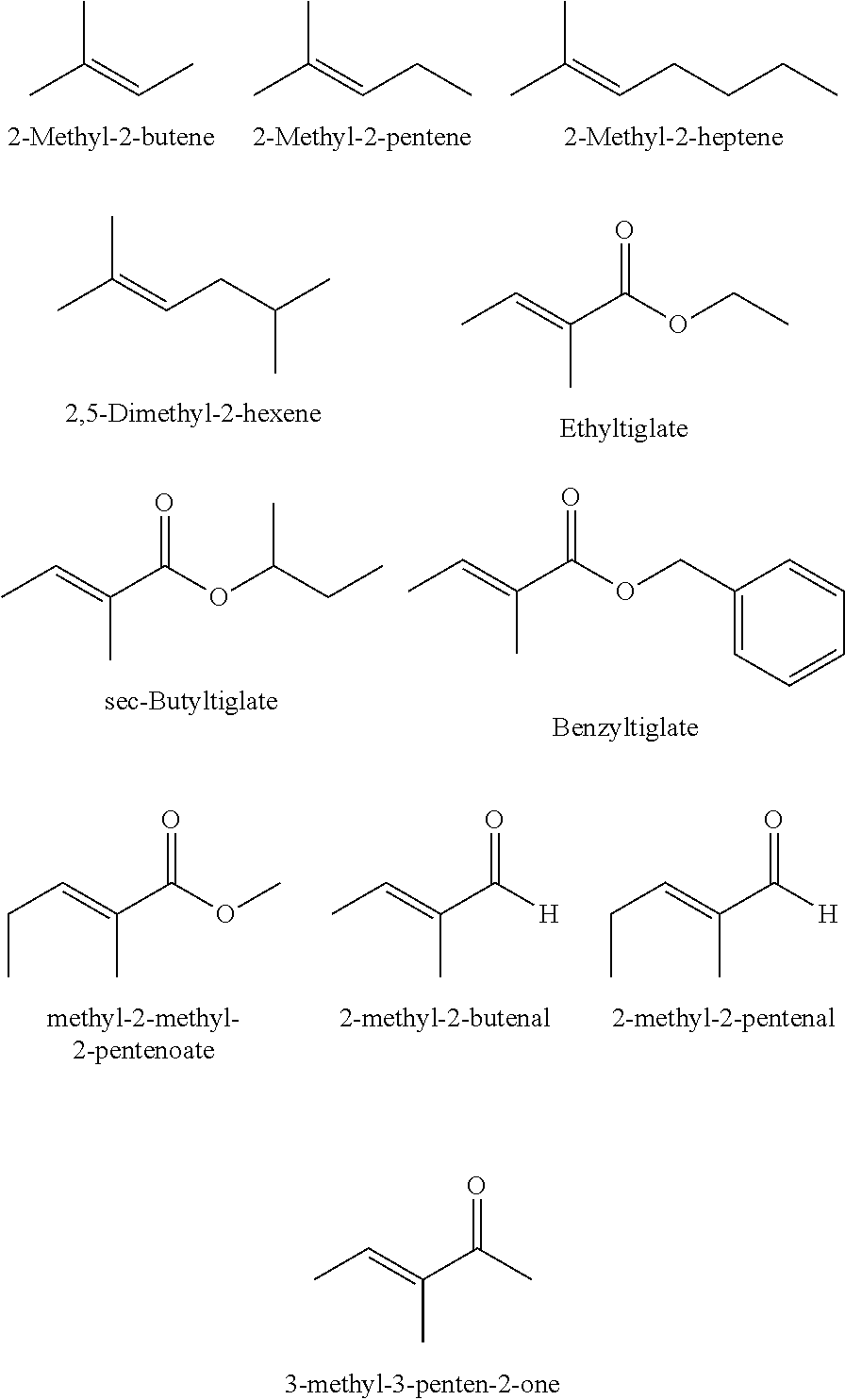
Combinations of above olefins may also be implemented in the method of invention.
In the method described herein, one reagent comprises an aminating reagent. The aminating reagents are substituted hydroxylamines. Examples of aminating reagents which can be used include, but are not limited to, aryl hydroxylamines, N-Boc hydroxyl amines, Phenyl hydroxylamine, Tolyl hydroxylamine, 2-Iodophenyl hydroxylamine, and N-Boc hydroxylamine. The following aryl and N-Boc hydroxylamines are non-limiting examples of aminating reagents which may be used:

R(+)-BINAM may be used as the chiral ligand. The following chiral ligands are non-limiting examples of chiral ligands which may be utilized in the described method:

Tetrakis(acetonitrile)copper(I) hexafluorophosphate, whose chemical formula is [Cu(CH3CN)4]PF6, may be used as the copper (Cu(I)) compound.
Examples And Results.All experiments were performed under nitrogen atmosphere. Dichloromethane (dry, 99.99+) from Alfa Aesar was used as purchased. The following olefins were used in experiments: 2-methyl-2-pentene, 2-methyl-2-heptene, Ethyl tiglate, Methyl trans-2-methyl-2-pentenoate. All olefins, including tiglate esters, and N-Boc hydroxylamine were purchased from Sigma Aldrich and used as purchased. Most of the ligands and catalysts were purchased from Sigma-Aldrich and Strem chemicals, except octahydro R(+)-BINAM which was synthesized by the reduction of R(+)-BINAM ligand as described in Kano, T.; Tanaka, Y.; Osawa, K.; Yurino, T.; Maruoka, K. J. Org. Chem. 2008, 73, 7387. Arylhydroxylamines were synthesized by Zn-metal reduction of commercially available nitroarenes, as described in Kamm, O. Org. Synth. Col. Vol. I, 1958, p. 445.
IR spectra were recorded on JASCO 480-plus instrument. 1H and 13C NMR were recorded on Varian 400 MHz NMR using CDCl3 solvent, unless otherwise noted. Products were confirmed by Agilent GC-MS (7890A-5975C). To measure enantiomeric excess, GC (HP Series II 5890) with chiral capillary column (Restek betadex-30 m×0.25×0.25μ) and HPLC (Dionex, Ultimate 3000) with Chiralpak AS-H column (4.6×250 mm×5 μ)were used.
General Procedure for Asymmetric Allylic Amination: Under nitrogen atmosphere, the solution of precatalyst copper (Cu(I)) compound Cu(CH3CN)4PF6 (10 mg, 0.025 mmol) and ligand R(+)-BINAM (14 mg, 0.05 mmol) in dichloromethane (3 mL) was stirred at room temperature for ten (10) minutes. Then the olefin (1 mmol) was added followed by the slow addition of arylhydroxylamine (0.25 mmol) solution in dichloromethane (5 mL) via syringe pump over five (5) hours at room temperature. Reactions were allowed to continue for two (2) more hours to get complete consumption of arylhydroxylamine Once the product formation was confirmed by GC-MS, the mixture was filtered through celite and the filtrate was concentrated to dryness. The crude product was purified by column chromatography (Hexane/Ethylacetate eluents) to give the corresponding allyl amine product, which was then directly analyzed by NMR and chiral HPLC or chiral GC to determine the purity and enantiomeric excess.

The solution of Cu(CH3CN)4PF6 (10 mg, 0.025 mmol) and ligand R(+)-BINAM (14 mg, 0.05 mmol) in dichloromethane (3 mL) was stirred at room temperature for 10 minutes. To the same flask, addition of 2-methyl-2-pentene (1 mmol, 122 μL) was followed by the slow addition of phenylhydroxylamine (0.25 mmol, 27.5 mg) solution in dichloromethane (5 mL) via syringe pump over 5 hours at room temperature. Reaction was allowed to continue for two more hours to get complete consumption of phenylhydroxylamine Product was confirmed by GC-MS (M+=175.10) and NMR analysis. Pure allylamine obtained in 68% yield with an optical purity of 69% ee. Chiral GC: tr=35.00 min (major), tr=35.42 min (minor).

All the procedure is same as in Example 1, except that S(−)-BINAM was used in place of R(+)-BINAM. Pure allylamine obtained in 65% yield with an opposite enantioselectivity of 73% ee. Chiral GC: tr=35.18 min (minor), tr=35.58 min (major).

The solution of Cu(CH3CN)4PF6 (10 mg, 0.025 mmol) and ligand R(+)-BINAM (14 mg, 0.05 mmol) in dichloromethane (3 mL) was stirred at room temperature for 10 minutes. To the same flask, addition of 2-methyl-2-heptene (1 mmol, 155 μL) was followed by the slow addition of N-phenylhydroxylamine (0.25 mmol, 27.5 mg) solution in dichloromethane (5 mL) via syringe pump over 5 hours at room temperature. Reaction was allowed to continue for two more hours to get complete consumption of N-phenylhydroxylamine Product was confirmed by GC-MS (M+=203.10) and NMR analysis. Pure allylamine obtained in 64% yield with an optical purity of 67% ee. Chiral GC: tr=41.65 min (major), tr=41.88 min (minor).

The solution of Cu(CH3CN)4PF6 (10 mg, 0.025 mmol) and ligand R(+)-BINAM (14 mg, 0.05 mmol) in dichloromethane (3 mL) was stirred at room temperature for 10 minutes. To the same flask, addition of 2-methyl-2-pentene (1 mmol, 122 μL) was followed by the slow addition of N-tolylhydroxylamine (0.25 mmol, 31 mg) solution in dichloromethane (5 mL) via syringe pump over 5 hours at room temperature. Reaction was allowed to continue for two more hours to get complete consumption of N-tolylhydroxylamine Product was confirmed by GC-MS (M+=189.10) and NMR analysis. Pure allylamine obtained in 62% yield with an optical purity of 74% ee. Chiral GC: tr=38.56 min (major), tr=39.07 min (minor).

The solution of Cu(CH3CN)4PF6 (10 mg, 0.025 mmol) and ligand R(+)-BINAM (14 mg, 0.05 mmol) in dichloromethane (3 mL) was stirred at room temperature for 10 minutes. To the same flask, addition of 2-methyl-2-heptene (1 mmol, 155 μL) was followed by the slow addition of N-tolylhydroxylamine (0.25 mmol, 31 mg) solution in dichloromethane (5 mL) via syringe pump over 5 hours at room temperature. Reaction was allowed to continue for two more hours to get complete consumption of N-tolylhydroxylamine Product was confirmed by GC-MS (M+=217.20) and NMR analysis. Pure allylamine obtained in 59% yield with an optical purity of 66% ee. Chiral GC: tr=44.98 min (major), tr=45.28 min (minor).

The solution of Cu(CH3CN)4PF6 (10 mg, 0.025 mmol) and ligand R(+)-BINAM (14 mg, 0.05 mmol) in dichloromethane (3 mL) was stirred at room temperature for 10 minutes. To the same flask, addition of Ethyltiglate (0.75 mmol, 104 μL) was followed by the slow addition of N-phenylhydroxylamine (0.25 mmol, 27.5 mg) solution in dichloromethane (5 mL) via syringe pump over 5 hours at room temperature. Reaction was allowed to continue for two more hours to get complete consumption of N-phenylhydroxylamine Product was confirmed by GC-MS (M+=219.00) and NMR analysis. Pure allylamine obtained in 78% yield with an optical purity of 42% ee. Chiral HPLC: Chiralpak AS-H column using Hexanes/Ethanol/DEA (99:1:0.02) as mobile phase with a flow rate of 0.30 mL/min; tr=17.367 min (major), tr=18.417 min (minor).

The solution of Cu(CH3CN)4PF6 (10 mg, 0.025 mmol) and ligand R(+)-BINAM (14 mg, 0.05 mmol) in dichloromethane (3 mL) was stirred at room temperature for 10 minutes. To the same flask, addition of Ethyltiglate (0.75 mmol, 104 μL) was followed by the slow addition of N-tolylhydroxylamine (0.25 mmol, 27.5 mg) solution in dichloromethane (5 mL) via syringe pump over 5 hours at room temperature. Reaction was allowed to continue for two more hours to get complete consumption of N-tolylhydroxylamine Product was confirmed by GC-MS (M+=232.90) and NMR analysis. Pure allylamine obtained in 69% yield with an optical purity of 34% ee. Chiral HPLC: Chiralpak AS-H column using Hexanes/Ethanol/DEA (99:1:0.02) as mobile phase with a flow rate of 0.35 mL/min; tr=14.108 min (minor), tr=15.467 min (major).

The solution of Cu(CH3CN)4PF6 (10 mg, 0.025 mmol) and ligand R(+)-BINAM (14 mg, 0.05 mmol) in dichloromethane (3 mL) was stirred at room temperature for 10 minutes. To the same flask, addition of Methyl trans-2-methyl-2-pentenoate (0.75 mmol, 105 μL) was followed by the slow addition of N-phenylhydroxylamine (0.25 mmol, 27.5 mg) solution in dichloromethane (5 mL) via syringe pump over 5 hours at room temperature. Reaction was allowed to continue for two more hours to get complete consumption of N-phenylhydroxylamine Product was confirmed by GC-MS (M+=219.10) and NMR analysis. Pure allylamine obtained in 73% yield with an optical purity of 33% ee. Chiral separation with NMR using shift reagent (CDCl3): δ 4.80 (major), δ 4.83 (minor).
A novel catalytic intermediate has been synthesized and isolated that is relevant to the asymmetric allylic amination procedure. This novel catalytic intermediate, which comprises a chiral Cu-complex. It is a chiral copper-BINAM nitrosoarene complex [Cu(BINAM)2(ArNO)2]OTf2. OTf is a triflate functional group as would be recognized by one having skill in the art. Other functional groups may likewise be added. In fact, in at least one embodiment, a chemical compound is synthesized from the process of combining a copper (II) salt [Cu(X)2] and a chiral donor ligand in the presence of toluene.
X-Ray crystallographic analysis of [Cu(BINAM)2(ArNO)2]OTf2 confirms the coordination of two BINAM ligands and two notrosoarenes (ArNO) to the Cu-metal. An ORTEP view of the X-Ray structure with atomic numbering scheme of the Cu-BINAM-nitroso complex is set forth as FIG. 2 . The previously reported and understood Cu-complexes exhibits coordination through the nitrogen atom. However, the present composition of matter does not share this common coordination; instead this novel Cu-complex indicates the coordination of nitrosoarene through the Oxygen atom (O→Cu). This exhibits a staunch difference in the reactivity likely due to the change in electron density at the metal center resulting from the BINAM ligands attached to it.
Structurally, the present complex is similar to copper-superoxo complexes that generally exist as copper-monooxygenase enzymes. Yet, they are molecularly distinct. Most metal-nitroso complexes involve in coordination through the nitrogen-atom, instead of oxygen. However, the fact X-Ray crystallographic analysis has confirmed that the nitrosoarene moiety of [Cu(BINAM)2(ArNO)2]OTf2 is coordinated through its oxygen atom is substantial. The catalytic implications of this metal complex will assist in the understanding of reaction mechanisms and selectivity, particularly in the asymmetric allylic amination procedure. Therefore, in addition to its clear uses in academic research, the complex has a direct use in both chemical and pharmaceutical industries such as for the design and development of novel catalytic reactions. Likewise, because of the existing structural similarities, the current structure can also be useful in predicting mechanistic pathways of copper-monooxygenase enzymes in biological systems.
An embodiment of a scheme for the synthesis [Cu(BINAM)2(ArNO)2]OTf2 is provided below. A mixture of [Cu(OTf)2] (0.635 g, 1.76 mmol) and R(+)-BINAM ligand (1.0 g, 3.52 mmol) was created. To this mixture, 10 mL toluene was added. The mixture was stirred at room temperature for 6 hours, after which the solvent was removed under vacuum and the crude product which was directly re-crystallized from ethylacetate:hexane mixture(5:1) to obtain pure [Cu(BINAM)2]OTf2 complex (1.28 g, 78% yield).
In order to obtain crystals suitable for X-ray diffraction, the Cu-complex (1.28 g, 1.37 mmol) obtained above was dissolved in dichloromethane (10 mL) and N,N-diethyl-4-nitrosoaniline (0.40 g, 2.2 mmol) was added. It is immediately noted that the dark brown solution becomes dark green. After stirring overnight (15 h), the dark green solution was filtered, and the solvent was removed on rotavap. The solid residue was triturated with diethyl ether (10 mL×2). Recrystallization from CH2Cl2/haxane at −20° C. provided dark greenish crystals suitable for X-ray diffraction.

It is also possible for other novel catalytic intermediates to be synthesized and isolated that is relevant to the asymmetric allylic amination procedure. For example, it is conceivable that a chemical compound having the general structure [Cu(Ligand)2(ArNO)2]X2 can be synthesized under a similar asymmetric allylic amination procedure. Thus, while the previous examples have focused on the use of a BINAM ligand, this process can generate additional compounds with other chiral nitrogen-donor ligands including BINAM, NOBIN, and other related substituted ligands. In such an embodiment, the copper atom would be bonded to two nitrosoarenes such as nitrosobenzene, and other related substituted nitrosobenzenes.
For the purpose of understanding the original method of producing the composition of matter described herein, references are made in the text to exemplary embodiments of a method of producing or synthesizing the matter of composition, only some of which are described herein. It should be understood that no limitations on the scope of the invention are intended by describing these exemplary methods. One of ordinary skill in the art will readily appreciate that alternate but functionally equivalent components, materials, designs, and equipment may be used. The inclusion of additional elements may be deemed readily apparent and obvious to one of ordinary skill in the art. Specific elements disclosed herein are not to be interpreted as limiting, but rather as a basis for the claims and as a representative basis for teaching one of ordinary skill in the art to employ the present invention.
Reference throughout this specification to features, advantages, or similar language does not imply that all of the features and advantages that may be realized should be or are in any single embodiment. Rather, language referring to the features and advantages is understood to mean that a specific feature, advantage, or characteristic described in connection with an embodiment is included in at least one embodiment. Thus, discussion of the features and advantages, and similar language, throughout this specification may, but do not necessarily, refer to the same embodiment.
Reference throughout this specification to “one embodiment,” “an embodiment,” or similar language means that a particular feature, structure, or characteristic described in connection with the embodiment is included in at least one embodiment. Thus, appearances of the phrases “in one embodiment,” “in an embodiment,” and similar language throughout this specification may, but do not necessarily, all refer to the same embodiment.
Moreover, the terms “substantially” or “approximately” as used herein may be applied to modify any quantitative representation that could permissibly vary without resulting in a change to the basic function to which it is related.
All references to patents, documents, and other writings are incorporated by reference and their inclusion herein shall not be construed as an admission as to their status with respect to being or not being prior art.
Claims (4)
1. An isolated chemical compound having the formula [Cu(Ligand)2(ArNO)2]X2, wherein X is selected from a group consisting of halides, triflates, sulfates, acetates, and PF6.
2. The chemical compound of claim 1 wherein the compound is a chiral copper-nitrosoarene complex having two nitrogen donor ligands and two counter ions.
3. The chemical compound of claim 1 wherein the copper atom is bonded to two chiral nitrogen-donor ligands selected from the group comprising BINAM and NOBIN.
4. The chemical compound of claim 1 wherein the copper atom is bonded to a nitrosobenzene.
Priority Applications (3)
| Application Number | Priority Date | Filing Date | Title |
|---|---|---|---|
| US15/469,654 US10179330B2 (en) | 2016-06-20 | 2017-03-27 | Chiral N-substituted allylic amine compounds |
| US16/211,806 US11021494B2 (en) | 2017-03-27 | 2018-12-06 | Chiral N-substituted allylic amine compounds |
| US17/239,991 US12129268B2 (en) | 2015-01-30 | 2021-04-26 | Chiral N-substituted allylic amine compounds |
Applications Claiming Priority (2)
| Application Number | Priority Date | Filing Date | Title |
|---|---|---|---|
| US15/186,823 US9637503B2 (en) | 2012-08-07 | 2016-06-20 | Composition of matter |
| US15/469,654 US10179330B2 (en) | 2016-06-20 | 2017-03-27 | Chiral N-substituted allylic amine compounds |
Related Parent Applications (1)
| Application Number | Title | Priority Date | Filing Date |
|---|---|---|---|
| US15/186,823 Continuation-In-Part US9637503B2 (en) | 2012-08-07 | 2016-06-20 | Composition of matter |
Related Child Applications (2)
| Application Number | Title | Priority Date | Filing Date |
|---|---|---|---|
| US16/211,806 Division US11021494B2 (en) | 2015-01-30 | 2018-12-06 | Chiral N-substituted allylic amine compounds |
| US16/211,806 Continuation-In-Part US11021494B2 (en) | 2015-01-30 | 2018-12-06 | Chiral N-substituted allylic amine compounds |
Publications (2)
| Publication Number | Publication Date |
|---|---|
| US20170361310A1 US20170361310A1 (en) | 2017-12-21 |
| US10179330B2 true US10179330B2 (en) | 2019-01-15 |
Family
ID=60661584
Family Applications (1)
| Application Number | Title | Priority Date | Filing Date |
|---|---|---|---|
| US15/469,654 Active US10179330B2 (en) | 2015-01-30 | 2017-03-27 | Chiral N-substituted allylic amine compounds |
Country Status (1)
| Country | Link |
|---|---|
| US (1) | US10179330B2 (en) |
Cited By (2)
| Publication number | Priority date | Publication date | Assignee | Title |
|---|---|---|---|---|
| US20190106440A1 (en) * | 2017-03-27 | 2019-04-11 | University Of Louisiana At Lafayette | Composition of matter |
| US11912647B2 (en) | 2020-05-22 | 2024-02-27 | University Of Georgia Research Foundation, Inc. | Diversity-oriented synthesis of N,N,O-trisubstituted hydroxylamines from alcohols and amines by N—O bond formation |
-
2017
- 2017-03-27 US US15/469,654 patent/US10179330B2/en active Active
Non-Patent Citations (1)
| Title |
|---|
| Srivastava et al., J. Amer. Chem. Soc. 2007, 129, 15250-15258. (Year: 2007). * |
Cited By (5)
| Publication number | Priority date | Publication date | Assignee | Title |
|---|---|---|---|---|
| US20210238200A1 (en) * | 2015-01-30 | 2021-08-05 | University Of Louisiana At Lafayette | Chiral n-substituted allylic amine compounds |
| US12129268B2 (en) * | 2015-01-30 | 2024-10-29 | University Of Louisiana At Lafayette | Chiral N-substituted allylic amine compounds |
| US20190106440A1 (en) * | 2017-03-27 | 2019-04-11 | University Of Louisiana At Lafayette | Composition of matter |
| US11021494B2 (en) * | 2017-03-27 | 2021-06-01 | University Of Louisiana At Lafayette | Chiral N-substituted allylic amine compounds |
| US11912647B2 (en) | 2020-05-22 | 2024-02-27 | University Of Georgia Research Foundation, Inc. | Diversity-oriented synthesis of N,N,O-trisubstituted hydroxylamines from alcohols and amines by N—O bond formation |
Also Published As
| Publication number | Publication date |
|---|---|
| US20170361310A1 (en) | 2017-12-21 |
Similar Documents
| Publication | Publication Date | Title |
|---|---|---|
| Zhang et al. | Challenges and recent advancements in the synthesis of α, α-disubstituted α-amino acids | |
| NL1015655C2 (en) | Catalyst for asymmetric hydrogenation. | |
| US8039675B2 (en) | Catalysts | |
| US9744528B2 (en) | Metallorganocatalysis for asymmetric transformations | |
| Wang et al. | Asymmetric synthesis of syn-propargylamines and unsaturated β-amino acids under Brønsted base catalysis | |
| JP2011518150A (en) | Hydrogenation of imine | |
| Strand et al. | Asymmetric induction afforded by chiral azolylidene N-heterocyclic carbenes (NHC) catalysts | |
| US20100160636A1 (en) | Method for producing optically active amines | |
| US9637503B2 (en) | Composition of matter | |
| JP4913077B2 (en) | Process for producing optically active homoallyl hydrazino esters | |
| US12129268B2 (en) | Chiral N-substituted allylic amine compounds | |
| US20170361310A1 (en) | Composition of matter | |
| US20100036127A1 (en) | Process | |
| You et al. | Asymmetric formation of tert-alkylamines from serinols by a dual function catalyst | |
| KR101130818B1 (en) | Method for preparing chiral amino acid from azlactones using bifunctional bis-cinchona alkaloid thiourea organo catalysts | |
| CN102766092A (en) | Method for synthesizing optically active tetrahydroquinoline derivative in presence of chiral spiro phosphoric acid serving as catalyst | |
| US20070259774A1 (en) | Enantioselective Phosphoramidite Compounds and Catalysts | |
| US20210238122A1 (en) | Igm compositions and methods of mucosal delivery of these compositions | |
| Doyle et al. | Stereoselectivity in Metal Carbene Addition to a Carbon‐Carbon Triple Bond Tied to the Reactant Diazoacetate Through a Chiral Linker | |
| EP2065371A1 (en) | Chiral organic catalysts for the stereoselective reduction of carbon-nitrogen double bonds for the preparation of enantiomerically enriched amines | |
| US20050215832A1 (en) | Process for producing optically active nitroalcohols | |
| KR101881215B1 (en) | Compound, manufacturing method of compound through asymmetric michael addition using the compound and manufacturing method of phenibut using the compound | |
| CN101175715B (en) | Asymmetric Hydrogenation of Diphenylalanine Derivatives | |
| WO2002076932A1 (en) | Process for preparing amino compounds by using salen-manganese complexes as the catalyst | |
| US7612239B2 (en) | Method for asymmetric alkynylation of alpha-imino esters |
Legal Events
| Date | Code | Title | Description |
|---|---|---|---|
| AS | Assignment |
Owner name: UNIVERSITY OF LOUISIANA AT LAFAYETTE, LOUISIANA Free format text: ASSIGNMENT OF ASSIGNORS INTEREST;ASSIGNORS:SRIVASTAVA, RADHEY S.;MURRU, SIVA;SIGNING DATES FROM 20130806 TO 20130807;REEL/FRAME:046830/0046 |
|
| STCF | Information on status: patent grant |
Free format text: PATENTED CASE |
|
| MAFP | Maintenance fee payment |
Free format text: PAYMENT OF MAINTENANCE FEE, 4TH YEAR, MICRO ENTITY (ORIGINAL EVENT CODE: M3551); ENTITY STATUS OF PATENT OWNER: MICROENTITY Year of fee payment: 4 |