US10177550B2 - Side-loading quadrant deadend clamp assembly - Google Patents
Side-loading quadrant deadend clamp assembly Download PDFInfo
- Publication number
- US10177550B2 US10177550B2 US15/351,896 US201615351896A US10177550B2 US 10177550 B2 US10177550 B2 US 10177550B2 US 201615351896 A US201615351896 A US 201615351896A US 10177550 B2 US10177550 B2 US 10177550B2
- Authority
- US
- United States
- Prior art keywords
- clamp assembly
- keeper
- cable
- body member
- fastener
- Prior art date
- Legal status (The legal status is an assumption and is not a legal conclusion. Google has not performed a legal analysis and makes no representation as to the accuracy of the status listed.)
- Active
Links
Images




Classifications
-
- H—ELECTRICITY
- H02—GENERATION; CONVERSION OR DISTRIBUTION OF ELECTRIC POWER
- H02G—INSTALLATION OF ELECTRIC CABLES OR LINES, OR OF COMBINED OPTICAL AND ELECTRIC CABLES OR LINES
- H02G7/00—Overhead installations of electric lines or cables
- H02G7/05—Suspension arrangements or devices for electric cables or lines
- H02G7/053—Suspension clamps and clips for electric overhead lines not suspended to a supporting wire
- H02G7/056—Dead-end clamps
-
- F—MECHANICAL ENGINEERING; LIGHTING; HEATING; WEAPONS; BLASTING
- F16—ENGINEERING ELEMENTS AND UNITS; GENERAL MEASURES FOR PRODUCING AND MAINTAINING EFFECTIVE FUNCTIONING OF MACHINES OR INSTALLATIONS; THERMAL INSULATION IN GENERAL
- F16L—PIPES; JOINTS OR FITTINGS FOR PIPES; SUPPORTS FOR PIPES, CABLES OR PROTECTIVE TUBING; MEANS FOR THERMAL INSULATION IN GENERAL
- F16L3/00—Supports for pipes, cables or protective tubing, e.g. hangers, holders, clamps, cleats, clips, brackets
- F16L3/08—Supports for pipes, cables or protective tubing, e.g. hangers, holders, clamps, cleats, clips, brackets substantially surrounding the pipe, cable or protective tubing
- F16L3/10—Supports for pipes, cables or protective tubing, e.g. hangers, holders, clamps, cleats, clips, brackets substantially surrounding the pipe, cable or protective tubing divided, i.e. with two members engaging the pipe, cable or protective tubing
- F16L3/1033—Supports for pipes, cables or protective tubing, e.g. hangers, holders, clamps, cleats, clips, brackets substantially surrounding the pipe, cable or protective tubing divided, i.e. with two members engaging the pipe, cable or protective tubing with two members engaging the pipe, cable or tubing, the two members being joined only on one side of the pipe
-
- F—MECHANICAL ENGINEERING; LIGHTING; HEATING; WEAPONS; BLASTING
- F16—ENGINEERING ELEMENTS AND UNITS; GENERAL MEASURES FOR PRODUCING AND MAINTAINING EFFECTIVE FUNCTIONING OF MACHINES OR INSTALLATIONS; THERMAL INSULATION IN GENERAL
- F16L—PIPES; JOINTS OR FITTINGS FOR PIPES; SUPPORTS FOR PIPES, CABLES OR PROTECTIVE TUBING; MEANS FOR THERMAL INSULATION IN GENERAL
- F16L3/00—Supports for pipes, cables or protective tubing, e.g. hangers, holders, clamps, cleats, clips, brackets
- F16L3/08—Supports for pipes, cables or protective tubing, e.g. hangers, holders, clamps, cleats, clips, brackets substantially surrounding the pipe, cable or protective tubing
- F16L3/10—Supports for pipes, cables or protective tubing, e.g. hangers, holders, clamps, cleats, clips, brackets substantially surrounding the pipe, cable or protective tubing divided, i.e. with two members engaging the pipe, cable or protective tubing
- F16L3/105—Supports for pipes, cables or protective tubing, e.g. hangers, holders, clamps, cleats, clips, brackets substantially surrounding the pipe, cable or protective tubing divided, i.e. with two members engaging the pipe, cable or protective tubing one member carrying a substantially radial tightening element
-
- F—MECHANICAL ENGINEERING; LIGHTING; HEATING; WEAPONS; BLASTING
- F16—ENGINEERING ELEMENTS AND UNITS; GENERAL MEASURES FOR PRODUCING AND MAINTAINING EFFECTIVE FUNCTIONING OF MACHINES OR INSTALLATIONS; THERMAL INSULATION IN GENERAL
- F16L—PIPES; JOINTS OR FITTINGS FOR PIPES; SUPPORTS FOR PIPES, CABLES OR PROTECTIVE TUBING; MEANS FOR THERMAL INSULATION IN GENERAL
- F16L3/00—Supports for pipes, cables or protective tubing, e.g. hangers, holders, clamps, cleats, clips, brackets
- F16L3/08—Supports for pipes, cables or protective tubing, e.g. hangers, holders, clamps, cleats, clips, brackets substantially surrounding the pipe, cable or protective tubing
- F16L3/12—Supports for pipes, cables or protective tubing, e.g. hangers, holders, clamps, cleats, clips, brackets substantially surrounding the pipe, cable or protective tubing comprising a member substantially surrounding the pipe, cable or protective tubing
- F16L3/1211—Supports for pipes, cables or protective tubing, e.g. hangers, holders, clamps, cleats, clips, brackets substantially surrounding the pipe, cable or protective tubing comprising a member substantially surrounding the pipe, cable or protective tubing with a substantially radial tightening or securing member
-
- F—MECHANICAL ENGINEERING; LIGHTING; HEATING; WEAPONS; BLASTING
- F16—ENGINEERING ELEMENTS AND UNITS; GENERAL MEASURES FOR PRODUCING AND MAINTAINING EFFECTIVE FUNCTIONING OF MACHINES OR INSTALLATIONS; THERMAL INSULATION IN GENERAL
- F16L—PIPES; JOINTS OR FITTINGS FOR PIPES; SUPPORTS FOR PIPES, CABLES OR PROTECTIVE TUBING; MEANS FOR THERMAL INSULATION IN GENERAL
- F16L3/00—Supports for pipes, cables or protective tubing, e.g. hangers, holders, clamps, cleats, clips, brackets
- F16L3/08—Supports for pipes, cables or protective tubing, e.g. hangers, holders, clamps, cleats, clips, brackets substantially surrounding the pipe, cable or protective tubing
- F16L3/12—Supports for pipes, cables or protective tubing, e.g. hangers, holders, clamps, cleats, clips, brackets substantially surrounding the pipe, cable or protective tubing comprising a member substantially surrounding the pipe, cable or protective tubing
- F16L3/1215—Supports for pipes, cables or protective tubing, e.g. hangers, holders, clamps, cleats, clips, brackets substantially surrounding the pipe, cable or protective tubing comprising a member substantially surrounding the pipe, cable or protective tubing the pipe being fixed by rotation of an element
-
- F—MECHANICAL ENGINEERING; LIGHTING; HEATING; WEAPONS; BLASTING
- F16—ENGINEERING ELEMENTS AND UNITS; GENERAL MEASURES FOR PRODUCING AND MAINTAINING EFFECTIVE FUNCTIONING OF MACHINES OR INSTALLATIONS; THERMAL INSULATION IN GENERAL
- F16L—PIPES; JOINTS OR FITTINGS FOR PIPES; SUPPORTS FOR PIPES, CABLES OR PROTECTIVE TUBING; MEANS FOR THERMAL INSULATION IN GENERAL
- F16L3/00—Supports for pipes, cables or protective tubing, e.g. hangers, holders, clamps, cleats, clips, brackets
- F16L3/02—Supports for pipes, cables or protective tubing, e.g. hangers, holders, clamps, cleats, clips, brackets partly surrounding the pipes, cables or protective tubing
-
- F—MECHANICAL ENGINEERING; LIGHTING; HEATING; WEAPONS; BLASTING
- F16—ENGINEERING ELEMENTS AND UNITS; GENERAL MEASURES FOR PRODUCING AND MAINTAINING EFFECTIVE FUNCTIONING OF MACHINES OR INSTALLATIONS; THERMAL INSULATION IN GENERAL
- F16L—PIPES; JOINTS OR FITTINGS FOR PIPES; SUPPORTS FOR PIPES, CABLES OR PROTECTIVE TUBING; MEANS FOR THERMAL INSULATION IN GENERAL
- F16L3/00—Supports for pipes, cables or protective tubing, e.g. hangers, holders, clamps, cleats, clips, brackets
- F16L3/08—Supports for pipes, cables or protective tubing, e.g. hangers, holders, clamps, cleats, clips, brackets substantially surrounding the pipe, cable or protective tubing
- F16L3/10—Supports for pipes, cables or protective tubing, e.g. hangers, holders, clamps, cleats, clips, brackets substantially surrounding the pipe, cable or protective tubing divided, i.e. with two members engaging the pipe, cable or protective tubing
- F16L3/1075—Supports for pipes, cables or protective tubing, e.g. hangers, holders, clamps, cleats, clips, brackets substantially surrounding the pipe, cable or protective tubing divided, i.e. with two members engaging the pipe, cable or protective tubing with two members, the two members being joined with a hinge on one side and fastened together on the other side
Definitions
- the present invention relates to a clamp assembly for deadending a conductor. More particularly, the present invention relates to a clamp assembly having a biasing member disposed between a keeper and body member of the clamp assembly. Still more particularly, the present invention relates to a clamp assembly in which a conductor is secured between a keeper and body member, and a biasing member is disposed on a fastener securing the keeper to the body member.
- Deadend clamps are commonly used to secure a cable under tension, for example, an overhead electrical conductor.
- the deadend clamp anchors the received cable to a supporting structure, such as a tower or utility pole.
- the deadend clamp transmits the tension on the cable to the supporting structure.
- deadend clamps typically include one or more U-bolts to clamp a keeper, which in turn applies a clamping pressure to the conductor, such as the deadend clamp disclosed in U.S. Pat. No. 5,752,680.
- One disadvantage associated with such deadend clamps is that the lineman must remove several nuts and washers to insert the conductor, and then the nuts and washers must be reconnected to the U-bolts. That procedure becomes even more difficult when the lineman is working with an energized conductor in the field. Accordingly, a need exists for a clamp assembly that is easily assembled.
- Non-captive fasteners are prone to loosening, thereby providing a less secure connection between the keeper and the main body. Accordingly, a need exists for a clamp assembly in which the keeper is securely connected to the main body to maintain clamping pressure on the conductor.
- a further objective of the present invention is to provide a clamp assembly in which a keeper is securely connected to a main body.
- Another objective of the present invention is to provide a clamp assembly in which a biasing member is securely maintained between a keeper and a main body.
- a clamp assembly that includes a body member having a cable groove formed therein to receive a cable.
- a keeper is connected to the body member and has a lower surface adapted to engage the cable received in the cable groove.
- a biasing member is disposed between the keeper and the body member.
- a clamp assembly including a body member and a keeper.
- a cable groove is formed in the body member to receive a cable.
- the keeper has a lower surface adapted to engage the cable received in the cable groove.
- a threaded fastener connects the keeper to the body member.
- An internally threaded nut disposed in a chamber in the keeper receives the fastener.
- a biasing member is disposed on the fastener.
- a clamp assembly including a body member and a keeper.
- a cable groove is formed in the body member to receive a cable.
- the keeper has a lower surface to engage the cable received in the cable groove.
- a threaded fastener connects the keeper to the body member.
- a recess is formed in the body member to receive a washer on the fastener.
- the recess is defined by first and second walls in which the first wall has a larger height than the second wall.
- a biasing member is disposed on the threaded fastener between the keeper and the body member.
- front As used in this application, the terms “front,” “rear,” “upper,” “lower,” “upwardly,” “downwardly,” and other orientational descriptors are intended to facilitate the description of the clamp assembly, and are not intended to limit the structure of the clamp assembly to any particular position or orientation.
- FIG. 1 is a front perspective view of a side loading quadrant deadend clamp assembly according to a first exemplary embodiment of the present invention
- FIG. 2 is a rear perspective view of the clamp assembly of FIG. 1 ;
- FIG. 3 is a side elevational view of the clamp assembly of FIG. 1 ;
- FIG. 4 is a top plan view of the clamp assembly of FIG. 1 ;
- FIG. 5 is a top plan view in cross section of the clamp assembly taken along line 5 - 5 of FIG. 3 ;
- FIG. 6 is a side elevational in cross section of the clamp assembly taken along line 6 - 6 of FIG. 4 ;
- FIG. 7 is a front perspective view of a body member of the clamp assembly of FIG. 1 ;
- FIG. 8 is a bottom perspective of the body member of FIG. 7 ;
- FIG. 9 is a side elevational view of the body member of FIG. 7 ;
- FIG. 10 is a rear elevational view of the body member of FIG. 7 ;
- FIG. 11 is a front elevational view of the body member of FIG. 7 ;
- FIG. 12 is a top plan view of the body member of FIG. 7 ;
- FIG. 13 is a bottom plan view of the body member of FIG. 7 ;
- FIG. 14 is a perspective view of a keeper of the clamp assembly of FIG. 1 ;
- FIG. 15 is a side elevational view of the keeper of FIG. 14 ;
- FIG. 16 is a rear elevational view of the keeper of FIG. 14 ;
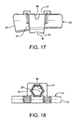
- FIG. 17 is a side elevational view of the keeper of FIG. 14 ;
- FIG. 18 is a top plan view of the keeper of FIG. 14 ;
- FIG. 19 is a rear elevational view of the clamp assembly of FIG. 1 ;
- FIG. 20 is front perspective view of a side loading quadrant deadend clamp assembly according to a second exemplary embodiment of the present invention.
- FIG. 21 is a rear perspective view of the clamp assembly of FIG. 20 ;
- FIG. 22 is a side elevational view of the clamp assembly of FIG. 20 ;
- FIG. 23 is an enlarged perspective view of a recessed area in an outer surface of a bottom wall of a pocket of a body of the clamp assembly of FIG. 22 ;
- FIG. 24 is a front perspective view of the clamp assembly of FIG. 20 ;
- FIG. 25 is a front elevational view of a body of the clamp assembly of FIG. 20 ;
- FIG. 26 is a side elevational view of the body of FIG. 25 ;
- FIG. 27 is a front perspective view of the body of FIG. 25 ;
- FIG. 28 is a front elevational view of a biasing member of the clamp assembly of FIG. 20 ;
- FIG. 29 is a perspective view of the biasing member of FIG. 28 .
- a clamp assembly 11 in accordance with a first exemplary embodiment of the present invention includes a body member 21 and a keeper 31 .
- the body member 21 has a cable groove 71 formed therein to receive a cable 9 .
- the keeper 31 is connected to the body member 21 and has a lower surface 34 adapted to engage the cable 9 received in the cable groove 71 .
- a biasing member 41 is disposed between the keeper 31 and the body member 21 .
- the body member 21 includes a clevis bracket 51 having first and second mounting ears 52 and 53 , as shown in FIGS. 1 and 2 . Openings 54 and 55 in the mounting ears 52 and 53 receive a clevis pin 56 . As shown in FIG. 4 , the clevis pin 56 has a first end 57 and a second end 58 . A head 59 is disposed at the first end 57 of the clevis pin. An opening 60 is formed proximal the second end 58 of the clevis pin 56 . The second end 58 of the clevis pin 56 is inserted through the first and second mounting ears 52 and 53 .
- a cotter pin 61 is inserted through the opening 60 in the clevis pin 56 , thereby preventing the clevis pin 56 from being removed from the mounting ears 52 and 53 .
- the head 59 of the clevis pin 56 is larger than the openings 54 and 55 in the mounting ears 52 and 53 to limit insertion of the clevis pin through the openings 54 and 55 in the mounting ears.
- the cotter pin 61 has a head 62 at one end and a raised portion 63 proximal the other end to substantially prevent accidental withdrawal of the cotter pin from the clevis pin opening 60 .
- the head 62 of the cotter pin 61 is larger than the clevis pin opening 60 to limit insertion of the cotter pin.
- the raised portion 62 of the cotter pin 61 flexes to allow insertion of cotter pin through the clevis pin opening 60 , but prevents accidental withdrawal of the cotter pin from the clevis pin opening 60 .
- the clevis bracket 51 allows the clamp assembly 11 to be pivotally connected to a supporting structure.
- a cable groove 71 extends from a first end 22 to proximal a second end 23 of the body member 21 , as shown in FIG. 2 .
- the cable groove 71 has a 90 degree bend 72 therein, as shown in FIG. 8 , to bring the conductor 9 in line with the clevis bracket 51 .
- the cable groove 71 is preferably formed in a side of the body member 21 such that the conductor 9 can be inserted in the cable groove in a radial direction of the conductor, i.e., from the side of the clamp assembly 11 .
- a lip 70 is formed at an outer edge of the cable groove 71 , as shown in FIGS. 2 and 8 , to substantially prevent the cable 9 from exiting the cable groove 71 before being clamped between the body member 21 and the keeper 31 .
- a pocket 73 is formed in the body member 21 proximal the first end 22 thereof.
- the pocket 73 is preferably a substantially U-shaped cavity configured to receive the keeper 31 , as shown in FIG. 3 .
- the pocket 73 has opposite side walls 74 and 75 and a bottom wall 76 therebetween.
- a fastener opening 77 in the bottom wall 76 of the pocket 73 receives a fastener 13 to secure the keeper 31 to the body member 21 , as shown in FIG. 6 .
- a recessed area 78 is formed on an outer surface 79 of the bottom wall 76 of the pocket 73 , as shown in FIG. 6 .
- the recessed area 78 is preferably substantially V-shaped, as shown in FIG. 7 .
- the recessed area 78 receives the washer 16 disposed on the shaft 15 of the fastener, as shown in FIG. 6 .
- the keeper 31 is secured to a side of the body member 21 below the clevis bracket 51 , as shown in FIG. 2 .
- the keeper 31 has a fastening portion 32 and a cable engaging portion 33 , as shown in FIGS. 14-18 .
- a cable groove 34 is disposed in the cable engaging portion 33 of the keeper 31 , as shown in FIGS. 5 and 16 .
- the keeper cable groove 34 is disposed opposite the body member cable groove 71 to securely retain the cable 9 therebetween when the keeper 31 is secured to the body member 21 .
- the fastening portion 32 of the keeper 31 has a fastener bore 35 passing from an inner surface 36 to an outer surface 37 thereof, as shown in FIGS. 5 and 6 .
- a chamber 38 is formed at the end of the bore proximal the outer surface 37 to receive a nut 17 disposed on the fastener 13 .
- the chamber 38 is preferably hexagonally shaped to correspond to the outer shape of the nut 17 , thereby providing a captive nut that is substantially prevented from rotational movement on the fastener 13 .
- An eye 65 in the body member 21 facilitates manipulation of the clamp assembly 11 by a lineman.
- the eye 65 has a substantially oval shape.
- the cable groove preferably runs between the eye 65 and the mounting ears 52 and 53 . Accordingly, the clevis pin 56 does not need to be removed to insert the conductor 9 in the cable groove 71 .
- the fastener 13 is inserted through a fastener opening 77 in the bottom wall 76 of the pocket 73 of the body member 21 and is received by a fastener bore 35 in the keeper 31 .
- the fastener 13 has a head 14 and a threaded shaft 15 extending therefrom, as shown in FIGS. 5 and 6 .
- the washer 16 and the nut 17 are disposed on the fastener shaft 13 . When assembled, the washer 16 is received in the recess 78 in the body member 21 and the nut 17 is received in the chamber 38 in the fastener portion 32 of the keeper 31 .
- the biasing member 41 is disposed on the shaft 15 of the fastener 13 , as shown in FIGS. 1-3, 5 and 6 .
- the biasing member 41 has a first end 42 that abuts an inner surface 80 of the bottom wall 76 , as shown in FIG. 3 .
- a second end 43 of the biasing member 41 abuts the nut 17 received in the chamber 38 of the keeper 31 , as shown in FIG. 6 .
- the biasing member 41 is preferably a helical tapered spring in which a diameter at the first end 42 is larger than a diameter at the second end 43 .
- the body member 21 is preferably unitarily formed as a single-piece.
- the body member 21 is preferably made of an aluminum alloy.
- the keeper 31 is preferably unitarily formed as a single-piece.
- the keeper 31 is preferably made of an aluminum alloy.
- the deadend clamp assembly 11 is shown assembled in FIGS. 1-7 .
- the body member 21 is connected to a support, such as a bracket, and the clevis pin 56 is passed through the mounting ear openings 54 and 55 .
- the cotter pin 61 is then passed through the opening 60 in the clevis pin 56 to prevent the cotter pin from being removed from the mounting ears 52 and 53 .
- the clevis pin 56 allows the clamp assembly 11 to pivot with respect to the support, thereby facilitating receiving the cable 9 .
- the cable 9 is inserted in the cable groove 71 from a side of the body member (i.e., in a radial direction of the cable).
- the lip 70 prevents the cable 9 from slipping out of the cable groove 71 as the fastener 13 is tightened to draw the keeper 31 closer to the body member 21 to clamp the cable therebetween.
- the washer 16 is disposed on the shaft 15 of fastener 13 such that the washer is received by the recessed area 78 in the body member 21 , as shown in FIGS. 5 and 6 .
- a fastener 13 is inserted through the fastener opening 77 in the body member 21 and through the bore 35 in the keeper 31 .
- the nut 17 is disposed in the chamber 38 of the fastener portion 32 of the keeper 31 and peened in the chamber 38 to substantially prevent upward (axial) movement.
- the biasing member 41 is disposed on the shaft 15 of the fastener 13 such that the biasing member is prevented from being dislodged during tightening.
- the fastener 13 is tightened, thereby drawing the fastener portion 32 of the keeper 31 into the pocket 73 of the body member 21 .
- the biasing member 41 is compressed as the fastener portion 32 of the keeper 31 is drawn into the pocket 73 .
- the cable portion 33 of the keeper 31 is drawn toward the retained cable 9 in the cable groove 71 . Tightening of the fastener 13 is stopped when the keeper cable groove 34 engages the cable 9 , thereby clamping the cable 9 between the keeper 31 and the body member 21 .
- the chamber 38 and the peened nut 17 substantially prevent rotation and movement of the captive nut 17 on the fastener shaft 15 , thereby securely retaining the keeper 31 to the body member 21 .
- the side walls 74 and 75 substantially prevent rotation of the keeper 31 relative to the body member 21 as the keeper 31 is drawn into the pocket 73 of the body member 21 .
- FIGS. 20-29 A clamp assembly 111 in accordance with a second exemplary embodiment of the present invention is shown in FIGS. 20-29 .
- the clamp assembly 111 of the second exemplary embodiment is substantially similar to the clamp assembly 11 of the first exemplary embodiment shown in FIGS. 1-19 , such that only features of the second exemplary embodiment different than those of the first exemplary embodiment are described below. Similar reference numbers are used to describe the features of the second exemplary embodiment, except in the 100 series, e.g., “1xx.”
- a recessed area 178 is formed on an outer surface 179 of the bottom wall 176 of the pocket 173 , as shown in FIGS. 20 and 23-27 .
- the recessed area 178 is preferably substantially V-shaped.
- the recessed area 178 receives a washer 116 disposed on a shaft 115 of a fastener 113 , as shown in FIGS. 22 and 23 .
- the fastener opening 177 has an open portion bounded by two end walls 191 and 192 . As shown in FIG. 26 , a first height H 1 of the first end wall 191 is larger than a second height H 2 of the second end wall 192 .
- the washer 116 is captured in the body member 121 by the V-shaped recessed area 178 .
- the first height H 1 of the first end wall 191 is larger than the second height H 2 of the second end wall 192 to substantially prevent disassembly of the clamp assembly 111 when the distance between a cable groove 171 and a keeper cable groove 134 is at a maximum, such as when inserting or removing a cable 109 .
- the first height H 1 of the first end wall 191 prevents the washer 115 and the fastener 113 from slipping out the open end of the fastener opening 177 when moving the keeper 131 away from the cable groove 171 .
- the biasing member 141 is preferably a tapered spring, as shown in FIGS. 28 and 29 , and is disposed on a shaft 115 of a fastener 113 , as shown in FIGS. 20-22 .
- the biasing member 141 has a first end 142 that abuts an inner surface 180 of a bottom wall 176 of a pocket 173 in a body member 121 of the clamp assembly 111 , as shown in FIG. 22 .
- a second end 143 of the biasing member 141 abuts a nut 117 received in a chamber 138 of a keeper 131 ( FIG. 6 ).
- the biasing member 141 has a diameter D 1 at the first end 142 that is larger than a diameter D 2 at the second end 143 , as shown in FIG. 28 .
- the smaller diameter second end 143 of the biasing member 141 facilitates passing the biasing member through the fastener bore 135 in the keeper 131 to engage the nut 117 , as shown in FIGS. 20-22 .
- the larger diameter first end 142 facilitates engaging the biasing member 141 with the inner surface 180 of the bottom wall 176 without slipping into a fastener opening 177 therein.
- the tapered biasing member 141 also allows the coils 145 to telescope into one another during compression by the keeper 131 , thereby reducing the length of the biasing member 141 .
- the first end 142 of the biasing member 141 preferably has two coils 143 and 144 that are substantially planar, i.e, having zero pitch.
- the two coils 143 and 144 increases the stiffness of the biasing member.
- the two coils 143 and 144 also substantially eliminate the likelihood of the biasing member 141 becoming stuck in the pitch of the threads of the fastener 113 and caught between the fastener 113 and a fastener bore 135 in the keeper 131 when torque is applied to the fastener 113 .
- the coils 145 of the biasing member 141 are substantially prevented from unraveling when torque is applied to the fastener 113 by the two coils 143 and 144 at the first end 142 of the biasing member 141 .
- clamp assembly 111 of the second exemplary embodiment are substantially similar to those of the first exemplary embodiment such that for brevity a description thereof is omitted.
Landscapes
- Engineering & Computer Science (AREA)
- General Engineering & Computer Science (AREA)
- Mechanical Engineering (AREA)
- Clamps And Clips (AREA)
Abstract
A clamp assembly includes a body member and a keeper. A cable groove is formed in the body member to receive a cable. The keeper has a lower surface to engage the cable received in the cable groove. A threaded fastener connects the keeper to the body member. A recess is formed in the body member to receive a washer on the fastener. The recess is defined by first and second walls in which the first wall has a larger height than the second wall. A biasing member is disposed on the threaded fastener between the keeper and the body member.
Description
This application is continuation of U.S. patent application Ser. No. 13/833,585, filed Mar. 15, 2013, which is a continuation-in-part under 35 U.S.C. § 120 of U.S. patent application Ser. No. 13/248,259, filed Sep. 29, 2011, the entire contents thereof being hereby incorporated by reference in its entirety.
The present invention relates to a clamp assembly for deadending a conductor. More particularly, the present invention relates to a clamp assembly having a biasing member disposed between a keeper and body member of the clamp assembly. Still more particularly, the present invention relates to a clamp assembly in which a conductor is secured between a keeper and body member, and a biasing member is disposed on a fastener securing the keeper to the body member.
Deadend clamps are commonly used to secure a cable under tension, for example, an overhead electrical conductor. The deadend clamp anchors the received cable to a supporting structure, such as a tower or utility pole. The deadend clamp transmits the tension on the cable to the supporting structure.
Conventional deadend clamps typically include one or more U-bolts to clamp a keeper, which in turn applies a clamping pressure to the conductor, such as the deadend clamp disclosed in U.S. Pat. No. 5,752,680. One disadvantage associated with such deadend clamps is that the lineman must remove several nuts and washers to insert the conductor, and then the nuts and washers must be reconnected to the U-bolts. That procedure becomes even more difficult when the lineman is working with an energized conductor in the field. Accordingly, a need exists for a clamp assembly that is easily assembled.
Another disadvantage associated with conventional deadend clamps is the use of non-captive fasteners to secure the keeper to the main body. Non-captive fasteners are prone to loosening, thereby providing a less secure connection between the keeper and the main body. Accordingly, a need exists for a clamp assembly in which the keeper is securely connected to the main body to maintain clamping pressure on the conductor.
Still another disadvantage associated with conventional deadend clamps the use of external springs between the keeper and the main body. These springs can become dislodged when tightening the keeper to the main body. Additionally, these springs require the fasteners to be tightened in a specific sequence to prevent damaging the springs, thereby providing an inefficient and time consuming task for the lineman. Accordingly, a need exists for a clamp assembly having an improved biasing member between the keeper and main body.
Accordingly, it is a primary objective of the present invention to provide a clamp assembly that is easy to assemble.
A further objective of the present invention is to provide a clamp assembly in which a keeper is securely connected to a main body.
Another objective of the present invention is to provide a clamp assembly in which a biasing member is securely maintained between a keeper and a main body.
The foregoing objectives are basically attained by a clamp assembly that includes a body member having a cable groove formed therein to receive a cable. A keeper is connected to the body member and has a lower surface adapted to engage the cable received in the cable groove. A biasing member is disposed between the keeper and the body member.
The foregoing objectives are also basically attained by a clamp assembly including a body member and a keeper. A cable groove is formed in the body member to receive a cable. The keeper has a lower surface adapted to engage the cable received in the cable groove. A threaded fastener connects the keeper to the body member. An internally threaded nut disposed in a chamber in the keeper receives the fastener. A biasing member is disposed on the fastener.
The foregoing objectives are also basically attained by a clamp assembly including a body member and a keeper. A cable groove is formed in the body member to receive a cable. The keeper has a lower surface to engage the cable received in the cable groove. A threaded fastener connects the keeper to the body member. A recess is formed in the body member to receive a washer on the fastener. The recess is defined by first and second walls in which the first wall has a larger height than the second wall. A biasing member is disposed on the threaded fastener between the keeper and the body member.
Other objects, advantages and salient features of the invention will become apparent from the following detailed description, which, taken in conjunction with the annexed drawings, discloses a preferred embodiment of the invention.
As used in this application, the terms “front,” “rear,” “upper,” “lower,” “upwardly,” “downwardly,” and other orientational descriptors are intended to facilitate the description of the clamp assembly, and are not intended to limit the structure of the clamp assembly to any particular position or orientation.
The above aspects and features of the present invention will be more apparent from the description for exemplary embodiments of the present invention taken with reference to the accompanying drawings, in which:
Throughout the drawings, like reference numerals will be understood to refer to like parts, components and structures.
As shown in FIGS. 1-19 , a clamp assembly 11 in accordance with a first exemplary embodiment of the present invention includes a body member 21 and a keeper 31. The body member 21 has a cable groove 71 formed therein to receive a cable 9. The keeper 31 is connected to the body member 21 and has a lower surface 34 adapted to engage the cable 9 received in the cable groove 71. A biasing member 41 is disposed between the keeper 31 and the body member 21.
The body member 21 includes a clevis bracket 51 having first and second mounting ears 52 and 53, as shown in FIGS. 1 and 2 . Openings 54 and 55 in the mounting ears 52 and 53 receive a clevis pin 56. As shown in FIG. 4 , the clevis pin 56 has a first end 57 and a second end 58. A head 59 is disposed at the first end 57 of the clevis pin. An opening 60 is formed proximal the second end 58 of the clevis pin 56. The second end 58 of the clevis pin 56 is inserted through the first and second mounting ears 52 and 53. A cotter pin 61 is inserted through the opening 60 in the clevis pin 56, thereby preventing the clevis pin 56 from being removed from the mounting ears 52 and 53. The head 59 of the clevis pin 56 is larger than the openings 54 and 55 in the mounting ears 52 and 53 to limit insertion of the clevis pin through the openings 54 and 55 in the mounting ears. The cotter pin 61 has a head 62 at one end and a raised portion 63 proximal the other end to substantially prevent accidental withdrawal of the cotter pin from the clevis pin opening 60. The head 62 of the cotter pin 61 is larger than the clevis pin opening 60 to limit insertion of the cotter pin. The raised portion 62 of the cotter pin 61 flexes to allow insertion of cotter pin through the clevis pin opening 60, but prevents accidental withdrawal of the cotter pin from the clevis pin opening 60. The clevis bracket 51 allows the clamp assembly 11 to be pivotally connected to a supporting structure.
A cable groove 71 extends from a first end 22 to proximal a second end 23 of the body member 21, as shown in FIG. 2 . The cable groove 71 has a 90 degree bend 72 therein, as shown in FIG. 8 , to bring the conductor 9 in line with the clevis bracket 51. The cable groove 71 is preferably formed in a side of the body member 21 such that the conductor 9 can be inserted in the cable groove in a radial direction of the conductor, i.e., from the side of the clamp assembly 11. A lip 70 is formed at an outer edge of the cable groove 71, as shown in FIGS. 2 and 8 , to substantially prevent the cable 9 from exiting the cable groove 71 before being clamped between the body member 21 and the keeper 31.
As shown in FIG. 6 , a pocket 73 is formed in the body member 21 proximal the first end 22 thereof. The pocket 73 is preferably a substantially U-shaped cavity configured to receive the keeper 31, as shown in FIG. 3 . The pocket 73 has opposite side walls 74 and 75 and a bottom wall 76 therebetween. A fastener opening 77 in the bottom wall 76 of the pocket 73 receives a fastener 13 to secure the keeper 31 to the body member 21, as shown in FIG. 6 .
A recessed area 78 is formed on an outer surface 79 of the bottom wall 76 of the pocket 73, as shown in FIG. 6 . The recessed area 78 is preferably substantially V-shaped, as shown in FIG. 7 . The recessed area 78 receives the washer 16 disposed on the shaft 15 of the fastener, as shown in FIG. 6 .
The keeper 31 is secured to a side of the body member 21 below the clevis bracket 51, as shown in FIG. 2 . The keeper 31 has a fastening portion 32 and a cable engaging portion 33, as shown in FIGS. 14-18 . A cable groove 34 is disposed in the cable engaging portion 33 of the keeper 31, as shown in FIGS. 5 and 16 . The keeper cable groove 34 is disposed opposite the body member cable groove 71 to securely retain the cable 9 therebetween when the keeper 31 is secured to the body member 21.
The fastening portion 32 of the keeper 31 has a fastener bore 35 passing from an inner surface 36 to an outer surface 37 thereof, as shown in FIGS. 5 and 6 . A chamber 38 is formed at the end of the bore proximal the outer surface 37 to receive a nut 17 disposed on the fastener 13. The chamber 38 is preferably hexagonally shaped to correspond to the outer shape of the nut 17, thereby providing a captive nut that is substantially prevented from rotational movement on the fastener 13.
An eye 65 in the body member 21 facilitates manipulation of the clamp assembly 11 by a lineman. Preferably, the eye 65 has a substantially oval shape. The cable groove preferably runs between the eye 65 and the mounting ears 52 and 53. Accordingly, the clevis pin 56 does not need to be removed to insert the conductor 9 in the cable groove 71.
The fastener 13 is inserted through a fastener opening 77 in the bottom wall 76 of the pocket 73 of the body member 21 and is received by a fastener bore 35 in the keeper 31. The fastener 13 has a head 14 and a threaded shaft 15 extending therefrom, as shown in FIGS. 5 and 6 . The washer 16 and the nut 17 are disposed on the fastener shaft 13. When assembled, the washer 16 is received in the recess 78 in the body member 21 and the nut 17 is received in the chamber 38 in the fastener portion 32 of the keeper 31.
The biasing member 41 is disposed on the shaft 15 of the fastener 13, as shown in FIGS. 1-3, 5 and 6 . The biasing member 41 has a first end 42 that abuts an inner surface 80 of the bottom wall 76, as shown in FIG. 3 . A second end 43 of the biasing member 41 abuts the nut 17 received in the chamber 38 of the keeper 31, as shown in FIG. 6 . The biasing member 41 is preferably a helical tapered spring in which a diameter at the first end 42 is larger than a diameter at the second end 43.
The body member 21 is preferably unitarily formed as a single-piece. The body member 21 is preferably made of an aluminum alloy. The keeper 31 is preferably unitarily formed as a single-piece. The keeper 31 is preferably made of an aluminum alloy.
Assembly and Operation
The deadend clamp assembly 11 is shown assembled in FIGS. 1-7 . The body member 21 is connected to a support, such as a bracket, and the clevis pin 56 is passed through the mounting ear openings 54 and 55. The cotter pin 61 is then passed through the opening 60 in the clevis pin 56 to prevent the cotter pin from being removed from the mounting ears 52 and 53. The clevis pin 56 allows the clamp assembly 11 to pivot with respect to the support, thereby facilitating receiving the cable 9.
The cable 9 is inserted in the cable groove 71 from a side of the body member (i.e., in a radial direction of the cable). The lip 70, as shown in FIG. 2 , prevents the cable 9 from slipping out of the cable groove 71 as the fastener 13 is tightened to draw the keeper 31 closer to the body member 21 to clamp the cable therebetween.
The washer 16 is disposed on the shaft 15 of fastener 13 such that the washer is received by the recessed area 78 in the body member 21, as shown in FIGS. 5 and 6 . To clamp the cable 9 between the body member 21 and the keeper 31, a fastener 13 is inserted through the fastener opening 77 in the body member 21 and through the bore 35 in the keeper 31. The nut 17 is disposed in the chamber 38 of the fastener portion 32 of the keeper 31 and peened in the chamber 38 to substantially prevent upward (axial) movement.
The biasing member 41 is disposed on the shaft 15 of the fastener 13 such that the biasing member is prevented from being dislodged during tightening. The fastener 13 is tightened, thereby drawing the fastener portion 32 of the keeper 31 into the pocket 73 of the body member 21. The biasing member 41 is compressed as the fastener portion 32 of the keeper 31 is drawn into the pocket 73. Simultaneously, the cable portion 33 of the keeper 31 is drawn toward the retained cable 9 in the cable groove 71. Tightening of the fastener 13 is stopped when the keeper cable groove 34 engages the cable 9, thereby clamping the cable 9 between the keeper 31 and the body member 21. The chamber 38 and the peened nut 17 substantially prevent rotation and movement of the captive nut 17 on the fastener shaft 15, thereby securely retaining the keeper 31 to the body member 21. As shown in FIGS. 3 and 19 , the side walls 74 and 75 substantially prevent rotation of the keeper 31 relative to the body member 21as the keeper 31 is drawn into the pocket 73 of the body member 21.
Second Exemplary Embodiment
A clamp assembly 111 in accordance with a second exemplary embodiment of the present invention is shown in FIGS. 20-29 . The clamp assembly 111 of the second exemplary embodiment is substantially similar to the clamp assembly 11 of the first exemplary embodiment shown in FIGS. 1-19 , such that only features of the second exemplary embodiment different than those of the first exemplary embodiment are described below. Similar reference numbers are used to describe the features of the second exemplary embodiment, except in the 100 series, e.g., “1xx.”
A recessed area 178 is formed on an outer surface 179 of the bottom wall 176 of the pocket 173, as shown in FIGS. 20 and 23-27 . The recessed area 178 is preferably substantially V-shaped. The recessed area 178 receives a washer 116 disposed on a shaft 115 of a fastener 113, as shown in FIGS. 22 and 23 . The fastener opening 177 has an open portion bounded by two end walls 191 and 192. As shown in FIG. 26 , a first height H1 of the first end wall 191 is larger than a second height H2 of the second end wall 192. The washer 116 is captured in the body member 121 by the V-shaped recessed area 178. The first height H1 of the first end wall 191 is larger than the second height H2 of the second end wall 192 to substantially prevent disassembly of the clamp assembly 111 when the distance between a cable groove 171 and a keeper cable groove 134 is at a maximum, such as when inserting or removing a cable 109. The first height H1 of the first end wall 191 prevents the washer 115 and the fastener 113 from slipping out the open end of the fastener opening 177 when moving the keeper 131 away from the cable groove 171.
The biasing member 141 is preferably a tapered spring, as shown in FIGS. 28 and 29 , and is disposed on a shaft 115 of a fastener 113, as shown in FIGS. 20-22 . The biasing member 141 has a first end 142 that abuts an inner surface 180 of a bottom wall 176 of a pocket 173 in a body member 121 of the clamp assembly 111, as shown in FIG. 22 . A second end 143 of the biasing member 141 abuts a nut 117 received in a chamber 138 of a keeper 131 (FIG. 6 ). The biasing member 141 has a diameter D1 at the first end 142 that is larger than a diameter D2 at the second end 143, as shown in FIG. 28 .
The smaller diameter second end 143 of the biasing member 141 facilitates passing the biasing member through the fastener bore 135 in the keeper 131 to engage the nut 117, as shown in FIGS. 20-22 . The larger diameter first end 142 facilitates engaging the biasing member 141 with the inner surface 180 of the bottom wall 176 without slipping into a fastener opening 177 therein. The tapered biasing member 141 also allows the coils 145 to telescope into one another during compression by the keeper 131, thereby reducing the length of the biasing member 141.
The first end 142 of the biasing member 141 preferably has two coils 143 and 144 that are substantially planar, i.e, having zero pitch. The two coils 143 and 144 increases the stiffness of the biasing member. The two coils 143 and 144 also substantially eliminate the likelihood of the biasing member 141 becoming stuck in the pitch of the threads of the fastener 113 and caught between the fastener 113 and a fastener bore 135 in the keeper 131 when torque is applied to the fastener 113. The coils 145 of the biasing member 141 are substantially prevented from unraveling when torque is applied to the fastener 113 by the two coils 143 and 144 at the first end 142 of the biasing member 141.
The remaining structure, features and operation of the clamp assembly 111 of the second exemplary embodiment are substantially similar to those of the first exemplary embodiment such that for brevity a description thereof is omitted.
While an advantageous embodiment has been chosen to illustrate the invention, it will be understood by those skilled in the art that various changes and modifications may be made therein without departing from the scope of the invention as defined in the appended claims.
Claims (19)
1. A clamp assembly for deadending a conductor, comprising:
a body member;
a cable groove formed in the body member to receive a cable, the cable groove having a first portion extending in a first axial direction of the cable, a second portion extending in a second axial direction of the cable, and a curved portion connecting the first portion and the second portion, wherein the cable groove is formed in the side of the body member to receive the cable in a radial direction of the cable and wherein the first direction is non-parallel to the second direction;
a keeper having a lower surface adapted to engage the cable received in the cable groove, wherein the keeper is aligned with the first portion of the cable groove and is spaced from the second portion of the cable groove;
a threaded fastener connecting the keeper to the body member;
a recess formed in the body member to receive a portion of the fastener, the recess being defined by first and second walls, the first wall having a larger height than the second wall; and
a biasing member disposed on the threaded fastener between the keeper and the body member.
2. The clamp assembly of claim 1 , wherein the cable groove has a bend of approximately 90 degrees between the first portion and the second portion.
3. The clamp assembly of claim 1 , wherein the recess is substantially V-shaped.
4. The clamp assembly of claim 1 , wherein at least a portion of the keeper is received in a pocket.
5. The clamp assembly of claim 1 , wherein the biasing member is a helical tapered spring.
6. The clamp assembly of claim 5 , wherein a second end of the biasing member contacts a nut disposed in the keeper.
7. The clamp assembly of claim 1 , wherein an internally threaded nut disposed in a chamber in the keeper receives the fastener.
8. The clamp assembly of claim 7 , wherein the nut is peened in the chamber and the chamber has a shape corresponding to the nut to substantially prevent rotational and axial movement of the nut therein.
9. The clamp assembly of claim 1 , wherein the first wall extends beyond the fastener.
10. A clamp assembly for deadening a conductor, comprising:
a body member;
a cable groove formed in the body member to receive a cable, wherein the cable groove is formed in the side of the body member to receive the cable in a radial direction of the cable;
a keeper having a lower surface adapted to engage the cable received in the cable groove;
a pocket formed in the body member and configured to receive at least a portion of the keeper;
a threaded fastener connecting the keeper to the body member, the threaded fastener extending through the pocket;
a recess formed in the body member on an opposite side of the pocket, the recess being at least partially defined by first and second walls extending away from the pocket, the first wall having an first upper surface and the second wall having a second upper surface non-planar to the first upper surface; and
a biasing member disposed on the threaded fastener between the keeper and the body member.
11. The clamp assembly of claim 10 , wherein the cable groove has a bend of approximately 90 degrees between the first portion and the second portion.
12. The clamp assembly of claim 10 , wherein the recess is substantially V-shaped.
13. The clamp assembly of claim 10 , wherein the first wall extends beyond a head of the fastener when the keeper is in a position to engage the cable.
14. The clamp assembly of claim 13 , wherein the second wall does not extend beyond the head of the fastener when the keeper is in a position to engage the cable.
15. The clamp assembly of claim 10 , wherein the body member includes a clevis bracket having a first mounting ear, a second mounting ear, and a clevis pin configured to extend through the first and second mounting ears.
16. The clamp assembly of claim 15 , wherein the body member includes an eye.
17. The clamp assembly of claim 16 , wherein the cable groove runs between the eye and the first and second mounting ears.
18. The clamp assembly of claim 10 , wherein the keeper includes a fastening portion having a fastener bore and a chamber.
19. The clamp assembly of claim 18 , wherein a nut is peened in the chamber and the chamber has a shape corresponding to the nut to substantially prevent rotational and axial movement of the nut therein.
Priority Applications (1)
| Application Number | Priority Date | Filing Date | Title |
|---|---|---|---|
| US15/351,896 US10177550B2 (en) | 2011-09-29 | 2016-11-15 | Side-loading quadrant deadend clamp assembly |
Applications Claiming Priority (3)
| Application Number | Priority Date | Filing Date | Title |
|---|---|---|---|
| US13/248,259 US9038966B2 (en) | 2011-09-29 | 2011-09-29 | Side-loading quadrant deadend clamp assembly |
| US13/833,585 US9496700B2 (en) | 2011-09-29 | 2013-03-15 | Side-loading quadrant deadend clamp assembly |
| US15/351,896 US10177550B2 (en) | 2011-09-29 | 2016-11-15 | Side-loading quadrant deadend clamp assembly |
Related Parent Applications (1)
| Application Number | Title | Priority Date | Filing Date |
|---|---|---|---|
| US13/833,585 Continuation US9496700B2 (en) | 2011-09-29 | 2013-03-15 | Side-loading quadrant deadend clamp assembly |
Publications (2)
| Publication Number | Publication Date |
|---|---|
| US20170063067A1 US20170063067A1 (en) | 2017-03-02 |
| US10177550B2 true US10177550B2 (en) | 2019-01-08 |
Family
ID=49156755
Family Applications (2)
| Application Number | Title | Priority Date | Filing Date |
|---|---|---|---|
| US13/833,585 Active 2032-06-24 US9496700B2 (en) | 2011-09-29 | 2013-03-15 | Side-loading quadrant deadend clamp assembly |
| US15/351,896 Active US10177550B2 (en) | 2011-09-29 | 2016-11-15 | Side-loading quadrant deadend clamp assembly |
Family Applications Before (1)
| Application Number | Title | Priority Date | Filing Date |
|---|---|---|---|
| US13/833,585 Active 2032-06-24 US9496700B2 (en) | 2011-09-29 | 2013-03-15 | Side-loading quadrant deadend clamp assembly |
Country Status (1)
| Country | Link |
|---|---|
| US (2) | US9496700B2 (en) |
Families Citing this family (8)
| Publication number | Priority date | Publication date | Assignee | Title |
|---|---|---|---|---|
| US9038966B2 (en) * | 2011-09-29 | 2015-05-26 | Hubbell Incorporated | Side-loading quadrant deadend clamp assembly |
| US9496700B2 (en) * | 2011-09-29 | 2016-11-15 | Hubbell Incorporated | Side-loading quadrant deadend clamp assembly |
| US9520704B2 (en) * | 2014-04-11 | 2016-12-13 | Hubbell Incorporated | Side-loading quadrant deadend clamp assembly |
| US10670112B2 (en) * | 2017-04-10 | 2020-06-02 | National Oilwell Varco, L.P. | Deadline anchor pigtail clamp |
| CN107681595B (en) * | 2017-08-08 | 2019-08-20 | 国网浙江省电力公司丽水供电公司 | A kind of taper lock compact form strain clamp convenient for safeguarding |
| US10673220B2 (en) * | 2017-12-12 | 2020-06-02 | Pole Line Innovations Llc | Electric current conducting assembly |
| US11084234B2 (en) * | 2018-03-28 | 2021-08-10 | Honda Motor Co., Ltd. | Rapid repair of pneumatic tire with damage by cut or tear |
| WO2021247839A1 (en) * | 2020-06-04 | 2021-12-09 | Hubbell Incorporated | Single person wedge clamp |
Citations (61)
| Publication number | Priority date | Publication date | Assignee | Title |
|---|---|---|---|---|
| US1215201A (en) | 1913-02-14 | 1917-02-06 | Thomas And Sons Company R | Electric-cable attachment. |
| US1730197A (en) | 1928-06-01 | 1929-10-01 | Delco Remy Corp | Anchoring device |
| US1809774A (en) | 1930-01-30 | 1931-06-09 | Manley R Coates | Wire clamp |
| US1858549A (en) | 1930-07-29 | 1932-05-17 | Lapp Insulator Co | Dead end clamp |
| US2026260A (en) | 1933-05-02 | 1935-12-31 | George R Tarbox | Cable support |
| US2059413A (en) | 1935-12-10 | 1936-11-03 | Ohio Brass Co | Cable clamp |
| US2099465A (en) | 1935-07-03 | 1937-11-16 | Ohio Brass Co | Conductor clamp |
| US2196938A (en) | 1939-10-24 | 1940-04-09 | Louis A Parnell | Dead end clamp |
| US2471305A (en) | 1946-04-05 | 1949-05-24 | Brewer Titchener Corp | Clamp |
| US2631805A (en) | 1950-10-23 | 1953-03-17 | Robert F Jackson | Wire holder |
| US2635133A (en) | 1948-07-20 | 1953-04-14 | Thomas & Betts Corp | Bent tube dead-end connector |
| US2640667A (en) | 1950-05-01 | 1953-06-02 | R L House | Electrical service connector |
| US2651766A (en) | 1949-12-05 | 1953-09-08 | Kearney James R Corp | Electrical line clamp |
| US2669600A (en) | 1948-07-20 | 1954-02-16 | Thomas & Betts Corp | Dead-end connector |
| US2679032A (en) | 1951-06-07 | 1954-05-18 | Thomas & Betts Corp | Ground clamp |
| US2712167A (en) | 1951-03-07 | 1955-07-05 | Burndy Engineering Co Inc | Parallel cable clamp |
| US2810116A (en) | 1954-09-02 | 1957-10-15 | Hubbell Inc Harvey | Top wired electrical cap and connector |
| US2810538A (en) | 1954-01-08 | 1957-10-22 | Anderson Carl Eric | Double-thread hanger clamp |
| US2942316A (en) | 1954-05-19 | 1960-06-28 | H B Mchorse | Cable clamps |
| US2950936A (en) | 1958-04-09 | 1960-08-30 | Dossert Mfg Corp | Multiple cable connector |
| US2980378A (en) | 1959-11-23 | 1961-04-18 | Bethea Barron | Dead end cable clamp |
| US2997764A (en) | 1957-04-25 | 1961-08-29 | Ohio Brass Co | Strain clamp |
| US3141643A (en) | 1961-12-21 | 1964-07-21 | Reliable Electric Co | Tangent support for messenger cable |
| US3146982A (en) | 1961-12-21 | 1964-09-01 | Electrical Fittings Corp | Universal swivel beam clamp |
| US3177459A (en) | 1962-11-19 | 1965-04-06 | Jasper Blackburn Corp | Electrical connector |
| US3562875A (en) | 1969-06-16 | 1971-02-16 | L E Lindsey | Dead end clamp |
| US3843083A (en) | 1972-11-09 | 1974-10-22 | Wonder Piles | Mounting apparatus for portable device |
| US3892455A (en) | 1974-03-26 | 1975-07-01 | Thomas & Betts Corp | Ground clamp connector |
| US3985411A (en) | 1975-06-30 | 1976-10-12 | I-T-E Imperial Corporation | Hinged ground clamp |
| USD243404S (en) | 1975-09-17 | 1977-02-15 | Ite Imperial Corporation | Ground clamp |
| US4090762A (en) | 1977-01-18 | 1978-05-23 | Harvey Hubbell, Incorporated | Electrical terminal connection and method of making same |
| US4131257A (en) | 1977-11-14 | 1978-12-26 | Eby Company | Stacking cable clamp |
| US4330906A (en) | 1980-03-10 | 1982-05-25 | Amp Incorporated | Feed-thru connection |
| US4383668A (en) | 1981-06-04 | 1983-05-17 | Hall Gaddis G | Cable clamp |
| US4707051A (en) * | 1986-08-28 | 1987-11-17 | Hall Gaddis G | Tap connector |
| US4740174A (en) | 1986-09-23 | 1988-04-26 | Fargo Mfg. Company, Inc. | Dead end tension clamp for optical ground wire |
| US4969616A (en) | 1988-11-02 | 1990-11-13 | Square D Company | Low profile side opening straight line dead end cable clamp |
| US4985003A (en) | 1988-05-13 | 1991-01-15 | S.I.C.A.M.E. Societe Industrielle De Construction D'appareils Et De Material Electrique | Branching electrical connector and spacer therefor |
| US5207543A (en) | 1991-06-28 | 1993-05-04 | Deutsche Aerospace Airbus Gmbh | Connecting device with a nut and bolt to prevent loosening and losing the nut |
| US5435507A (en) | 1992-10-23 | 1995-07-25 | The Morgan Crucible Company Plc | Cable support |
| US5435506A (en) | 1994-03-02 | 1995-07-25 | United Technologies Corporation | Clamp with mechanically attached grommet |
| US5634605A (en) | 1995-09-01 | 1997-06-03 | Carrier Corporation | Mounting clamp for transport generator set |
| US5752680A (en) | 1996-05-20 | 1998-05-19 | Hubbell Incorporated | Spring loaded straight line dead end clamp |
| US6128800A (en) | 1998-07-10 | 2000-10-10 | Quickie Manufacturing Corporation | Rotatable brush head |
| US6220586B1 (en) | 1999-09-21 | 2001-04-24 | Precision Products Group | Multiple torsion spring and methods of use |
| US6327753B1 (en) | 1999-12-16 | 2001-12-11 | Kennedy W. Rushing | Cable clamp |
| US6547481B2 (en) | 2001-02-08 | 2003-04-15 | Hubbell Incorporated | Spring-loaded wedge dead end connector having elements for coupling together and preventing removal of conductor-gripping jaws |
| US6595472B1 (en) | 2001-12-28 | 2003-07-22 | Preformed Line Products Company | Cable clamp |
| US6726166B2 (en) | 2000-03-11 | 2004-04-27 | All-Points Equipment Co., L.P. | Cable clamp |
| US20050015940A1 (en) | 2002-07-03 | 2005-01-27 | Stafford Jeffrey B. | Anchoring clamp |
| US6877996B1 (en) | 2002-11-27 | 2005-04-12 | Senior Industries, Inc. | Grounding connector |
| US7039988B2 (en) | 2003-09-26 | 2006-05-09 | Delri, Llc | Single jaw wedge dead end |
| US7316533B2 (en) | 2002-12-02 | 2008-01-08 | Kashiraishi Inc. | Fastener for exerting tightening torque to fastening member screwed into mounting base |
| US7516582B2 (en) | 2000-12-03 | 2009-04-14 | Simpson Strong-Tie Company Inc. | Automatic take-up device with internal spring |
| US7562848B2 (en) | 2005-09-27 | 2009-07-21 | Hubbell Incorporated | Single bolt deadend anchor clamp |
| US7666024B2 (en) | 2007-02-13 | 2010-02-23 | Burndy Technology Llc | Spring loaded parallel pad clamp |
| US7794291B2 (en) | 2007-09-24 | 2010-09-14 | Classic Connectors, Inc. | Electrical transmission line repair service |
| US8132767B2 (en) | 2008-10-30 | 2012-03-13 | Erico International Corporation | Quick threaded rod locking devices and method |
| US20120210544A1 (en) | 2011-02-23 | 2012-08-23 | Hubbell Incorporated | Wedge Dead End Clamp Assembly |
| US9038966B2 (en) * | 2011-09-29 | 2015-05-26 | Hubbell Incorporated | Side-loading quadrant deadend clamp assembly |
| US9496700B2 (en) * | 2011-09-29 | 2016-11-15 | Hubbell Incorporated | Side-loading quadrant deadend clamp assembly |
-
2013
- 2013-03-15 US US13/833,585 patent/US9496700B2/en active Active
-
2016
- 2016-11-15 US US15/351,896 patent/US10177550B2/en active Active
Patent Citations (62)
| Publication number | Priority date | Publication date | Assignee | Title |
|---|---|---|---|---|
| US1215201A (en) | 1913-02-14 | 1917-02-06 | Thomas And Sons Company R | Electric-cable attachment. |
| US1730197A (en) | 1928-06-01 | 1929-10-01 | Delco Remy Corp | Anchoring device |
| US1809774A (en) | 1930-01-30 | 1931-06-09 | Manley R Coates | Wire clamp |
| US1858549A (en) | 1930-07-29 | 1932-05-17 | Lapp Insulator Co | Dead end clamp |
| US2026260A (en) | 1933-05-02 | 1935-12-31 | George R Tarbox | Cable support |
| US2099465A (en) | 1935-07-03 | 1937-11-16 | Ohio Brass Co | Conductor clamp |
| US2059413A (en) | 1935-12-10 | 1936-11-03 | Ohio Brass Co | Cable clamp |
| US2196938A (en) | 1939-10-24 | 1940-04-09 | Louis A Parnell | Dead end clamp |
| US2471305A (en) | 1946-04-05 | 1949-05-24 | Brewer Titchener Corp | Clamp |
| US2635133A (en) | 1948-07-20 | 1953-04-14 | Thomas & Betts Corp | Bent tube dead-end connector |
| US2669600A (en) | 1948-07-20 | 1954-02-16 | Thomas & Betts Corp | Dead-end connector |
| US2651766A (en) | 1949-12-05 | 1953-09-08 | Kearney James R Corp | Electrical line clamp |
| US2640667A (en) | 1950-05-01 | 1953-06-02 | R L House | Electrical service connector |
| US2631805A (en) | 1950-10-23 | 1953-03-17 | Robert F Jackson | Wire holder |
| US2712167A (en) | 1951-03-07 | 1955-07-05 | Burndy Engineering Co Inc | Parallel cable clamp |
| US2679032A (en) | 1951-06-07 | 1954-05-18 | Thomas & Betts Corp | Ground clamp |
| US2810538A (en) | 1954-01-08 | 1957-10-22 | Anderson Carl Eric | Double-thread hanger clamp |
| US2942316A (en) | 1954-05-19 | 1960-06-28 | H B Mchorse | Cable clamps |
| US2810116A (en) | 1954-09-02 | 1957-10-15 | Hubbell Inc Harvey | Top wired electrical cap and connector |
| US2997764A (en) | 1957-04-25 | 1961-08-29 | Ohio Brass Co | Strain clamp |
| US2950936A (en) | 1958-04-09 | 1960-08-30 | Dossert Mfg Corp | Multiple cable connector |
| US2980378A (en) | 1959-11-23 | 1961-04-18 | Bethea Barron | Dead end cable clamp |
| US3141643A (en) | 1961-12-21 | 1964-07-21 | Reliable Electric Co | Tangent support for messenger cable |
| US3146982A (en) | 1961-12-21 | 1964-09-01 | Electrical Fittings Corp | Universal swivel beam clamp |
| US3177459A (en) | 1962-11-19 | 1965-04-06 | Jasper Blackburn Corp | Electrical connector |
| US3562875A (en) | 1969-06-16 | 1971-02-16 | L E Lindsey | Dead end clamp |
| US3843083A (en) | 1972-11-09 | 1974-10-22 | Wonder Piles | Mounting apparatus for portable device |
| US3892455A (en) | 1974-03-26 | 1975-07-01 | Thomas & Betts Corp | Ground clamp connector |
| US3985411A (en) | 1975-06-30 | 1976-10-12 | I-T-E Imperial Corporation | Hinged ground clamp |
| USD243404S (en) | 1975-09-17 | 1977-02-15 | Ite Imperial Corporation | Ground clamp |
| US4090762A (en) | 1977-01-18 | 1978-05-23 | Harvey Hubbell, Incorporated | Electrical terminal connection and method of making same |
| US4131257A (en) | 1977-11-14 | 1978-12-26 | Eby Company | Stacking cable clamp |
| US4330906A (en) | 1980-03-10 | 1982-05-25 | Amp Incorporated | Feed-thru connection |
| US4383668A (en) | 1981-06-04 | 1983-05-17 | Hall Gaddis G | Cable clamp |
| US4383668B1 (en) | 1981-06-04 | 1991-06-04 | G Hall Gaddis | |
| US4707051A (en) * | 1986-08-28 | 1987-11-17 | Hall Gaddis G | Tap connector |
| US4740174A (en) | 1986-09-23 | 1988-04-26 | Fargo Mfg. Company, Inc. | Dead end tension clamp for optical ground wire |
| US4985003A (en) | 1988-05-13 | 1991-01-15 | S.I.C.A.M.E. Societe Industrielle De Construction D'appareils Et De Material Electrique | Branching electrical connector and spacer therefor |
| US4969616A (en) | 1988-11-02 | 1990-11-13 | Square D Company | Low profile side opening straight line dead end cable clamp |
| US5207543A (en) | 1991-06-28 | 1993-05-04 | Deutsche Aerospace Airbus Gmbh | Connecting device with a nut and bolt to prevent loosening and losing the nut |
| US5435507A (en) | 1992-10-23 | 1995-07-25 | The Morgan Crucible Company Plc | Cable support |
| US5435506A (en) | 1994-03-02 | 1995-07-25 | United Technologies Corporation | Clamp with mechanically attached grommet |
| US5634605A (en) | 1995-09-01 | 1997-06-03 | Carrier Corporation | Mounting clamp for transport generator set |
| US5752680A (en) | 1996-05-20 | 1998-05-19 | Hubbell Incorporated | Spring loaded straight line dead end clamp |
| US6128800A (en) | 1998-07-10 | 2000-10-10 | Quickie Manufacturing Corporation | Rotatable brush head |
| US6220586B1 (en) | 1999-09-21 | 2001-04-24 | Precision Products Group | Multiple torsion spring and methods of use |
| US6327753B1 (en) | 1999-12-16 | 2001-12-11 | Kennedy W. Rushing | Cable clamp |
| US6726166B2 (en) | 2000-03-11 | 2004-04-27 | All-Points Equipment Co., L.P. | Cable clamp |
| US7516582B2 (en) | 2000-12-03 | 2009-04-14 | Simpson Strong-Tie Company Inc. | Automatic take-up device with internal spring |
| US6547481B2 (en) | 2001-02-08 | 2003-04-15 | Hubbell Incorporated | Spring-loaded wedge dead end connector having elements for coupling together and preventing removal of conductor-gripping jaws |
| US6595472B1 (en) | 2001-12-28 | 2003-07-22 | Preformed Line Products Company | Cable clamp |
| US20050015940A1 (en) | 2002-07-03 | 2005-01-27 | Stafford Jeffrey B. | Anchoring clamp |
| US6877996B1 (en) | 2002-11-27 | 2005-04-12 | Senior Industries, Inc. | Grounding connector |
| US7316533B2 (en) | 2002-12-02 | 2008-01-08 | Kashiraishi Inc. | Fastener for exerting tightening torque to fastening member screwed into mounting base |
| US7039988B2 (en) | 2003-09-26 | 2006-05-09 | Delri, Llc | Single jaw wedge dead end |
| US7562848B2 (en) | 2005-09-27 | 2009-07-21 | Hubbell Incorporated | Single bolt deadend anchor clamp |
| US7666024B2 (en) | 2007-02-13 | 2010-02-23 | Burndy Technology Llc | Spring loaded parallel pad clamp |
| US7794291B2 (en) | 2007-09-24 | 2010-09-14 | Classic Connectors, Inc. | Electrical transmission line repair service |
| US8132767B2 (en) | 2008-10-30 | 2012-03-13 | Erico International Corporation | Quick threaded rod locking devices and method |
| US20120210544A1 (en) | 2011-02-23 | 2012-08-23 | Hubbell Incorporated | Wedge Dead End Clamp Assembly |
| US9038966B2 (en) * | 2011-09-29 | 2015-05-26 | Hubbell Incorporated | Side-loading quadrant deadend clamp assembly |
| US9496700B2 (en) * | 2011-09-29 | 2016-11-15 | Hubbell Incorporated | Side-loading quadrant deadend clamp assembly |
Also Published As
| Publication number | Publication date |
|---|---|
| US9496700B2 (en) | 2016-11-15 |
| US20170063067A1 (en) | 2017-03-02 |
| US20130240685A1 (en) | 2013-09-19 |
Similar Documents
| Publication | Publication Date | Title |
|---|---|---|
| US10177550B2 (en) | Side-loading quadrant deadend clamp assembly | |
| US10411454B2 (en) | Side-loading quadrant deadend clamp assembly | |
| US9825449B2 (en) | Side-loading straight-line deadend clamp assembly | |
| US10910805B2 (en) | Adapter for mounting cable hangers | |
| US9755413B2 (en) | Side-loading quadrant deadend clamp assembly | |
| JP2010118264A (en) | Connector for pulldown wire | |
| US20020119027A1 (en) | Anti-rotation clip for screw retention | |
| CA2608955A1 (en) | Bolt | |
| US20030143054A1 (en) | Screw grommet | |
| CA2905761C (en) | Side-loading quadrant deadend clamp assembly | |
| US6709182B1 (en) | Retaining element for cap screws | |
| CN209981996U (en) | Wire anti-falling fastening device | |
| US9917379B2 (en) | Coupler for attaching a conduit to a wall | |
| JP3207374U (en) | Wing nut locking device | |
| CN210669489U (en) | Elastic locking type cable head | |
| CN213839247U (en) | Anti-skid screw bolt structure | |
| CN1625655A (en) | Screw grommet | |
| KR20230013859A (en) | Fastening device of suspension for vehicle | |
| US20050232721A1 (en) | Expansion anchor | |
| JP2012152086A (en) | Drop wire connector | |
| KR20090063491A (en) | Parking cable fastening structure of vehicle |
Legal Events
| Date | Code | Title | Description |
|---|---|---|---|
| STCF | Information on status: patent grant |
Free format text: PATENTED CASE |
|
| MAFP | Maintenance fee payment |
Free format text: PAYMENT OF MAINTENANCE FEE, 4TH YEAR, LARGE ENTITY (ORIGINAL EVENT CODE: M1551); ENTITY STATUS OF PATENT OWNER: LARGE ENTITY Year of fee payment: 4 |