US10174033B2 - N6-substituted adenosine derivatives and N6-substituted adenine derivatives and uses thereof - Google Patents
N6-substituted adenosine derivatives and N6-substituted adenine derivatives and uses thereof Download PDFInfo
- Publication number
- US10174033B2 US10174033B2 US13/515,152 US200913515152A US10174033B2 US 10174033 B2 US10174033 B2 US 10174033B2 US 200913515152 A US200913515152 A US 200913515152A US 10174033 B2 US10174033 B2 US 10174033B2
- Authority
- US
- United States
- Prior art keywords
- adenosine
- moiety
- substituted
- group
- unsubstituted
- Prior art date
- Legal status (The legal status is an assumption and is not a legal conclusion. Google has not performed a legal analysis and makes no representation as to the accuracy of the status listed.)
- Expired - Fee Related, expires
Links
- 0 *C(C)N([Y])C1=NC=NC2=C1N=CN2C Chemical compound *C(C)N([Y])C1=NC=NC2=C1N=CN2C 0.000 description 85
- ZWLZHFQBXQMCTK-RCPDXOTQSA-N C[C@H](NC1=NC=NC2=C1N=CN2[C@@H]1O[C@H](CO)C(O)[C@@H]1O)C1=CC=CC=C1 Chemical compound C[C@H](NC1=NC=NC2=C1N=CN2[C@@H]1O[C@H](CO)C(O)[C@@H]1O)C1=CC=CC=C1 ZWLZHFQBXQMCTK-RCPDXOTQSA-N 0.000 description 2
- LCZAPAHBCRCHLA-CQTKXVLISA-N O=C(O)[C@@H](CO)NC1=NC=NC2=C1N=CN2[C@@H]1O[C@H](CO)C(O)[C@@H]1O Chemical compound O=C(O)[C@@H](CO)NC1=NC=NC2=C1N=CN2[C@@H]1O[C@H](CO)C(O)[C@@H]1O LCZAPAHBCRCHLA-CQTKXVLISA-N 0.000 description 2
- UGVIXKXYLBAZND-NUKIEUHSSA-N OC[C@H]1O[C@@H](N2C=NC3=C2N=CN=C3NCC2=CC=C(O)C=C2)C(O)[C@H]1O Chemical compound OC[C@H]1O[C@@H](N2C=NC3=C2N=CN=C3NCC2=CC=C(O)C=C2)C(O)[C@H]1O UGVIXKXYLBAZND-NUKIEUHSSA-N 0.000 description 2
- WXJOQFONLADABH-IOTAFMPCSA-N CC(C(O)C1=CC=CC=C1)N(C)C1=NC=NC2=C1N=CN2[C@@H]1O[C@H](CO)C(O)[C@@H]1O Chemical compound CC(C(O)C1=CC=CC=C1)N(C)C1=NC=NC2=C1N=CN2[C@@H]1O[C@H](CO)C(O)[C@@H]1O WXJOQFONLADABH-IOTAFMPCSA-N 0.000 description 1
- SWWWBGLXFILCEJ-ZCUUNYEISA-N CC(C)C(NC1=NC=NC2=C1N=CN2[C@@H]1O[C@H](CO)C(O)[C@@H]1O)C1=CC=CC=C1 Chemical compound CC(C)C(NC1=NC=NC2=C1N=CN2[C@@H]1O[C@H](CO)C(O)[C@@H]1O)C1=CC=CC=C1 SWWWBGLXFILCEJ-ZCUUNYEISA-N 0.000 description 1
- UILMPOMLIIYULB-KOSSRVGJSA-N CC(C)CC1=CC=C(C(C)NC2=NC=NC3=C2N=CN3[C@@H]2O[C@H](CO)C(O)[C@@H]2O)C=C1 Chemical compound CC(C)CC1=CC=C(C(C)NC2=NC=NC3=C2N=CN3[C@@H]2O[C@H](CO)C(O)[C@@H]2O)C=C1 UILMPOMLIIYULB-KOSSRVGJSA-N 0.000 description 1
- HWGBXKPHIGGCNS-XNZUMOJTSA-N CC(C)CNC1=NC=NC2=C1N=CN2[C@@H]1O[C@H](CO)[C@H](O)C1O Chemical compound CC(C)CNC1=NC=NC2=C1N=CN2[C@@H]1O[C@H](CO)[C@H](O)C1O HWGBXKPHIGGCNS-XNZUMOJTSA-N 0.000 description 1
- IFXXETIETNTLBL-DTVIKXRNSA-N CC(C)C[C@@H](CO)NC1=NC=NC2=C1N=CN2[C@@H]1O[C@H](CO)C(O)[C@@H]1O Chemical compound CC(C)C[C@@H](CO)NC1=NC=NC2=C1N=CN2[C@@H]1O[C@H](CO)C(O)[C@@H]1O IFXXETIETNTLBL-DTVIKXRNSA-N 0.000 description 1
- MUMBNVYUXKNXFU-RPNVLIBRSA-N CC(C)[C@@H](NC1=NC=NC2=C1N=CN2[C@@H]1O[C@H](CO)[C@H](O)C1O)C(=O)O Chemical compound CC(C)[C@@H](NC1=NC=NC2=C1N=CN2[C@@H]1O[C@H](CO)[C@H](O)C1O)C(=O)O MUMBNVYUXKNXFU-RPNVLIBRSA-N 0.000 description 1
- MUMBNVYUXKNXFU-XUYCPLKUSA-N CC(C)[C@H](C(O)=O)Nc1ncnc2c1nc[n]2[C@@H](C1O)O[C@H](CO)C1O Chemical compound CC(C)[C@H](C(O)=O)Nc1ncnc2c1nc[n]2[C@@H](C1O)O[C@H](CO)C1O MUMBNVYUXKNXFU-XUYCPLKUSA-N 0.000 description 1
- MUMBNVYUXKNXFU-BQVCQGOHSA-N CC(C)[C@H](NC1=NC=NC2=C1N=CN2[C@@H]1O[C@H](CO)[C@H](O)C1O)C(=O)O Chemical compound CC(C)[C@H](NC1=NC=NC2=C1N=CN2[C@@H]1O[C@H](CO)[C@H](O)C1O)C(=O)O MUMBNVYUXKNXFU-BQVCQGOHSA-N 0.000 description 1
- OBXFMRBCKJRJAD-FURGGIPKSA-N CC(NC1=NC=NC2=C1N=CN2[C@@H]1O[C@H](CO)C(O)[C@@H]1O)C1=CC=C(N)C=C1 Chemical compound CC(NC1=NC=NC2=C1N=CN2[C@@H]1O[C@H](CO)C(O)[C@@H]1O)C1=CC=C(N)C=C1 OBXFMRBCKJRJAD-FURGGIPKSA-N 0.000 description 1
- JNQOFFHRIGZTFB-FURGGIPKSA-N CC(NC1=NC=NC2=C1N=CN2[C@@H]1O[C@H](CO)C(O)[C@@H]1O)C1=CC=C(O)C=C1 Chemical compound CC(NC1=NC=NC2=C1N=CN2[C@@H]1O[C@H](CO)C(O)[C@@H]1O)C1=CC=C(O)C=C1 JNQOFFHRIGZTFB-FURGGIPKSA-N 0.000 description 1
- USUVTUVTTDHZNB-YFPXEMCZSA-N CC(NC1=NC=NC2=C1N=CN2[C@@H]1O[C@H](CO)C(O)[C@@H]1O)C1=CC=C2C=CC=CC2=C1 Chemical compound CC(NC1=NC=NC2=C1N=CN2[C@@H]1O[C@H](CO)C(O)[C@@H]1O)C1=CC=C2C=CC=CC2=C1 USUVTUVTTDHZNB-YFPXEMCZSA-N 0.000 description 1
- ZWLZHFQBXQMCTK-NTRNKHGKSA-N CC(NC1=NC=NC2=C1N=CN2[C@@H]1O[C@H](CO)C(O)[C@@H]1O)C1=CC=CC=C1 Chemical compound CC(NC1=NC=NC2=C1N=CN2[C@@H]1O[C@H](CO)C(O)[C@@H]1O)C1=CC=CC=C1 ZWLZHFQBXQMCTK-NTRNKHGKSA-N 0.000 description 1
- JPDSVXMTESDQEK-NNCWWPNCSA-N CC(O)CN(CC(C)O)C1=NC=NC2=C1N=CN2[C@@H]1O[C@H](CO)[C@H](O)C1O Chemical compound CC(O)CN(CC(C)O)C1=NC=NC2=C1N=CN2[C@@H]1O[C@H](CO)[C@H](O)C1O JPDSVXMTESDQEK-NNCWWPNCSA-N 0.000 description 1
- HMSAGUZXDIMTKA-HWXUZCTOSA-N CC(O)[C@@H](NC1=NC=NC2=C1N=CN2[C@@H]1O[C@H](CO)[C@H](O)C1O)C(=O)O Chemical compound CC(O)[C@@H](NC1=NC=NC2=C1N=CN2[C@@H]1O[C@H](CO)[C@H](O)C1O)C(=O)O HMSAGUZXDIMTKA-HWXUZCTOSA-N 0.000 description 1
- HMSAGUZXDIMTKA-MASNVMJRSA-N CC(O)[C@H](NC1=NC=NC2=C1N=CN2[C@@H]1O[C@H](CO)C(O)[C@@H]1O)C(=O)O Chemical compound CC(O)[C@H](NC1=NC=NC2=C1N=CN2[C@@H]1O[C@H](CO)C(O)[C@@H]1O)C(=O)O HMSAGUZXDIMTKA-MASNVMJRSA-N 0.000 description 1
- BXKXVMXUSDNCNM-XBSGFPIISA-N CC(c(cc1OC)cc(OC)c1OC)Nc1ncnc2c1nc[n]2[C@@H](C1)O[C@H](COC(C)=O)C1OC(C)=O Chemical compound CC(c(cc1OC)cc(OC)c1OC)Nc1ncnc2c1nc[n]2[C@@H](C1)O[C@H](COC(C)=O)C1OC(C)=O BXKXVMXUSDNCNM-XBSGFPIISA-N 0.000 description 1
- WBJVJFOITZTVRG-MEQMSXBBSA-N CC1=CC(CNC2=NC=NC3=C2N=CN3[C@@H]2O[C@H](CO)[C@H](O)C2O)=CC=C1 Chemical compound CC1=CC(CNC2=NC=NC3=C2N=CN3[C@@H]2O[C@H](CO)[C@H](O)C2O)=CC=C1 WBJVJFOITZTVRG-MEQMSXBBSA-N 0.000 description 1
- UNUJWQVUMJADNQ-POIKNQFGSA-N CC1=CC=C(/C=C/C(=O)OC[C@H]2O[C@@H](N3C=NC4=C3N=CN=C4NCC3=CC=C4OCOC4=C3)[C@@H](O)C2O)C=C1.CC1=CC=C(/C=C/C(=O)OC[C@H]2O[C@@H](N3C=NC4=C3N=CN=C4NCC3=CC=C4OCOC4=C3)[C@H]3OC(C)(C)OC32)C=C1 Chemical compound CC1=CC=C(/C=C/C(=O)OC[C@H]2O[C@@H](N3C=NC4=C3N=CN=C4NCC3=CC=C4OCOC4=C3)[C@@H](O)C2O)C=C1.CC1=CC=C(/C=C/C(=O)OC[C@H]2O[C@@H](N3C=NC4=C3N=CN=C4NCC3=CC=C4OCOC4=C3)[C@H]3OC(C)(C)OC32)C=C1 UNUJWQVUMJADNQ-POIKNQFGSA-N 0.000 description 1
- NIILKQXUUNHDMM-ZIWBQIBKSA-N CC1=CC=C(CNC2=NC=NC3=C2N=CN3[C@@H]2O[C@H](CO)C(O)[C@@H]2O)O1 Chemical compound CC1=CC=C(CNC2=NC=NC3=C2N=CN3[C@@H]2O[C@H](CO)C(O)[C@@H]2O)O1 NIILKQXUUNHDMM-ZIWBQIBKSA-N 0.000 description 1
- GEYPSUBAIFHQJP-ZIWBQIBKSA-N CC1=CC=C(CNC2=NC=NC3=C2N=CN3[C@@H]2O[C@H](CO)C(O)[C@@H]2O)S1 Chemical compound CC1=CC=C(CNC2=NC=NC3=C2N=CN3[C@@H]2O[C@H](CO)C(O)[C@@H]2O)S1 GEYPSUBAIFHQJP-ZIWBQIBKSA-N 0.000 description 1
- GSNRZPKLEWMHHM-MEQMSXBBSA-N CC1=CC=C(CNC2=NC=NC3=C2N=CN3[C@@H]2O[C@H](CO)[C@H](O)C2O)C=C1 Chemical compound CC1=CC=C(CNC2=NC=NC3=C2N=CN3[C@@H]2O[C@H](CO)[C@H](O)C2O)C=C1 GSNRZPKLEWMHHM-MEQMSXBBSA-N 0.000 description 1
- HDYYTVPJWDXXNC-RBSFLKMASA-N CC1=CC=C(CNC2=NC=NC3=C2N=CN3[C@H]2C[C@@H](O)[C@@H](CO)O2)C=C1 Chemical compound CC1=CC=C(CNC2=NC=NC3=C2N=CN3[C@H]2C[C@@H](O)[C@@H](CO)O2)C=C1 HDYYTVPJWDXXNC-RBSFLKMASA-N 0.000 description 1
- XFLWADPQOMQHRL-SLJLXLFXSA-N CC1=CC=C([C@@H](C)NC2=NC=NC3=C2N=CN3[C@@H]2O[C@H](CO)C(O)[C@@H]2O)C=C1 Chemical compound CC1=CC=C([C@@H](C)NC2=NC=NC3=C2N=CN3[C@@H]2O[C@H](CO)C(O)[C@@H]2O)C=C1 XFLWADPQOMQHRL-SLJLXLFXSA-N 0.000 description 1
- XFLWADPQOMQHRL-UASQIPTJSA-N CC1=CC=C([C@H](C)NC2=NC=NC3=C2N=CN3[C@@H]2O[C@H](CO)C(O)[C@@H]2O)C=C1 Chemical compound CC1=CC=C([C@H](C)NC2=NC=NC3=C2N=CN3[C@@H]2O[C@H](CO)C(O)[C@@H]2O)C=C1 XFLWADPQOMQHRL-UASQIPTJSA-N 0.000 description 1
- NCXWNNXFMOAYNB-RUNQFFJVSA-N CCC(NC1=NC=NC2=C1N=CN2[C@@H]1O[C@H](CO)C(O)[C@@H]1O)C1=CC=C(O)C=C1 Chemical compound CCC(NC1=NC=NC2=C1N=CN2[C@@H]1O[C@H](CO)C(O)[C@@H]1O)C1=CC=C(O)C=C1 NCXWNNXFMOAYNB-RUNQFFJVSA-N 0.000 description 1
- DVYHPLRPSFNTOS-AMDMMAPVSA-N CCC(NC1=NC=NC2=C1N=CN2[C@@H]1O[C@H](CO)C(O)[C@@H]1O)C1=CC=C(OC)C=C1 Chemical compound CCC(NC1=NC=NC2=C1N=CN2[C@@H]1O[C@H](CO)C(O)[C@@H]1O)C1=CC=C(OC)C=C1 DVYHPLRPSFNTOS-AMDMMAPVSA-N 0.000 description 1
- RRRLUFHDFDNPMZ-RUNQFFJVSA-N CCC(NC1=NC=NC2=C1N=CN2[C@@H]1O[C@H](CO)C(O)[C@@H]1O)C1=CC=CC=C1 Chemical compound CCC(NC1=NC=NC2=C1N=CN2[C@@H]1O[C@H](CO)C(O)[C@@H]1O)C1=CC=CC=C1 RRRLUFHDFDNPMZ-RUNQFFJVSA-N 0.000 description 1
- LSGAAFYNBJHECU-DFOLSVEKSA-N CCCC(=O)OC1=C(OC)C=C(CNC2=NC=NC3=C2N=CN3[C@@H]2O[C@H](CO)C(O)[C@@H]2O)C=C1.CCCC(=O)OC[C@H]1O[C@@H](N2C=NC3=C2N=CN=C3NCC2=CC(OC)=C(OC(=O)CCC)C=C2)[C@@H](O)C1O.CCCC(=O)OC[C@H]1O[C@@H](N2C=NC3=C2N=CN=C3NCC2=CC(OC)=C(OC(=O)CCC)C=C2)[C@H]2OC(C)(C)OC21 Chemical compound CCCC(=O)OC1=C(OC)C=C(CNC2=NC=NC3=C2N=CN3[C@@H]2O[C@H](CO)C(O)[C@@H]2O)C=C1.CCCC(=O)OC[C@H]1O[C@@H](N2C=NC3=C2N=CN=C3NCC2=CC(OC)=C(OC(=O)CCC)C=C2)[C@@H](O)C1O.CCCC(=O)OC[C@H]1O[C@@H](N2C=NC3=C2N=CN=C3NCC2=CC(OC)=C(OC(=O)CCC)C=C2)[C@H]2OC(C)(C)OC21 LSGAAFYNBJHECU-DFOLSVEKSA-N 0.000 description 1
- IXEGJRLUDHEXCU-VGKKNIQASA-N CCCC(NC1=NC=NC2=C1N=CN2[C@@H]1O[C@H](CO)C(O)[C@@H]1O)C1=CC=C(OC)C=C1 Chemical compound CCCC(NC1=NC=NC2=C1N=CN2[C@@H]1O[C@H](CO)C(O)[C@@H]1O)C1=CC=C(OC)C=C1 IXEGJRLUDHEXCU-VGKKNIQASA-N 0.000 description 1
- BDBYTVQXDMOPHD-AMDMMAPVSA-N CCCC(NC1=NC=NC2=C1N=CN2[C@@H]1O[C@H](CO)C(O)[C@@H]1O)C1=CC=CC=C1 Chemical compound CCCC(NC1=NC=NC2=C1N=CN2[C@@H]1O[C@H](CO)C(O)[C@@H]1O)C1=CC=CC=C1 BDBYTVQXDMOPHD-AMDMMAPVSA-N 0.000 description 1
- BDBYTVQXDMOPHD-HOCBQMGISA-N CCCC(c1ccccc1)Nc1c2nc[n]([C@@H]([C@H]3O)O[C@H](CO)[C@@H]3O)c2ncn1 Chemical compound CCCC(c1ccccc1)Nc1c2nc[n]([C@@H]([C@H]3O)O[C@H](CO)[C@@H]3O)c2ncn1 BDBYTVQXDMOPHD-HOCBQMGISA-N 0.000 description 1
- RMVZHSSVEAXJGB-DHEKLMLGSA-N CCCOC[C@H]1O[C@@H](N2C=NC3=C2N=CN=C3N(CCC)CC2=CC=C3OCOC3=C2)[C@@H](OCCC)C1OCCC Chemical compound CCCOC[C@H]1O[C@@H](N2C=NC3=C2N=CN=C3N(CCC)CC2=CC=C3OCOC3=C2)[C@@H](OCCC)C1OCCC RMVZHSSVEAXJGB-DHEKLMLGSA-N 0.000 description 1
- HIHXGFKCUTYPBF-RKKTUIAWSA-N CCCOC[C@H]1O[C@@H](N2C=NC3=C2N=CN=C3NC(C)C2=CC(OC)=C(OC)C(OC)=C2)[C@@H](O)C1O Chemical compound CCCOC[C@H]1O[C@@H](N2C=NC3=C2N=CN=C3NC(C)C2=CC(OC)=C(OC)C(OC)=C2)[C@@H](O)C1O HIHXGFKCUTYPBF-RKKTUIAWSA-N 0.000 description 1
- UMVBKLLHNZMFTD-IPZUKPMBSA-N CCCOC[C@H]1O[C@@H](N2C=NC3=C2N=CN=C3NCC2=CC=C3OCOC3=C2)[C@@H](O)C1O Chemical compound CCCOC[C@H]1O[C@@H](N2C=NC3=C2N=CN=C3NCC2=CC=C3OCOC3=C2)[C@@H](O)C1O UMVBKLLHNZMFTD-IPZUKPMBSA-N 0.000 description 1
- LINGICLDZLVDIG-BQPMQJBSSA-N CCCOC[C@H]1O[C@@H](N2C=NC3=C2N=CN=C3N[C@@H](CC)C2=CC=CC=C2)[C@@H](O)C1O Chemical compound CCCOC[C@H]1O[C@@H](N2C=NC3=C2N=CN=C3N[C@@H](CC)C2=CC=CC=C2)[C@@H](O)C1O LINGICLDZLVDIG-BQPMQJBSSA-N 0.000 description 1
- LINGICLDZLVDIG-UNFNTTOVSA-N CCCOC[C@H]1O[C@@H](N2C=NC3=C2N=CN=C3N[C@H](CC)C2=CC=CC=C2)[C@@H](O)C1O Chemical compound CCCOC[C@H]1O[C@@H](N2C=NC3=C2N=CN=C3N[C@H](CC)C2=CC=CC=C2)[C@@H](O)C1O LINGICLDZLVDIG-UNFNTTOVSA-N 0.000 description 1
- BDBYTVQXDMOPHD-NFUWGNPBSA-N CCC[C@@H](NC1=NC=NC2=C1N=CN2[C@@H]1O[C@H](CO)C(O)[C@@H]1O)C1=CC=CC=C1 Chemical compound CCC[C@@H](NC1=NC=NC2=C1N=CN2[C@@H]1O[C@H](CO)C(O)[C@@H]1O)C1=CC=CC=C1 BDBYTVQXDMOPHD-NFUWGNPBSA-N 0.000 description 1
- BDBYTVQXDMOPHD-ARNMJKHPSA-N CCC[C@H](NC1=NC=NC2=C1N=CN2[C@@H]1O[C@H](CO)C(O)[C@@H]1O)C1=CC=CC=C1 Chemical compound CCC[C@H](NC1=NC=NC2=C1N=CN2[C@@H]1O[C@H](CO)C(O)[C@@H]1O)C1=CC=CC=C1 BDBYTVQXDMOPHD-ARNMJKHPSA-N 0.000 description 1
- QQVDYAJHWNCBLK-OMOUFDEYSA-N CCN(CC1=CC=CC=C1)C1=NC=NC2=C1N=CN2[C@@H]1O[C@H](CO)C(O)[C@@H]1O Chemical compound CCN(CC1=CC=CC=C1)C1=NC=NC2=C1N=CN2[C@@H]1O[C@H](CO)C(O)[C@@H]1O QQVDYAJHWNCBLK-OMOUFDEYSA-N 0.000 description 1
- SHBIQOVGLUASKT-XNZUMOJTSA-N CCN(CCO)C1=NC=NC2=C1N=CN2[C@@H]1O[C@H](CO)[C@H](O)C1O Chemical compound CCN(CCO)C1=NC=NC2=C1N=CN2[C@@H]1O[C@H](CO)[C@H](O)C1O SHBIQOVGLUASKT-XNZUMOJTSA-N 0.000 description 1
- UZAUQTPDDJLKLP-LZCZXHTESA-N CCOC(=O)[C@@H](CC1=CC=C(O)C=C1)NC1=NC=NC2=C1N=CN2[C@@H]1O[C@H](CO)[C@H](O)C1O Chemical compound CCOC(=O)[C@@H](CC1=CC=C(O)C=C1)NC1=NC=NC2=C1N=CN2[C@@H]1O[C@H](CO)[C@H](O)C1O UZAUQTPDDJLKLP-LZCZXHTESA-N 0.000 description 1
- AQLJWHCJVFYGGV-TURCKAOWSA-N CCOC(=O)[C@@H](CC1=CNC2=C1C=CC=C2)NC1=NC=NC2=C1N=CN2[C@@H]1O[C@H](CO)[C@H](O)C1O Chemical compound CCOC(=O)[C@@H](CC1=CNC2=C1C=CC=C2)NC1=NC=NC2=C1N=CN2[C@@H]1O[C@H](CO)[C@H](O)C1O AQLJWHCJVFYGGV-TURCKAOWSA-N 0.000 description 1
- UZAUQTPDDJLKLP-DJGRIFHNSA-N CCOC(=O)[C@H](CC1=CC=C(O)C=C1)NC1=NC=NC2=C1N=CN2[C@@H]1O[C@H](CO)[C@H](O)C1O Chemical compound CCOC(=O)[C@H](CC1=CC=C(O)C=C1)NC1=NC=NC2=C1N=CN2[C@@H]1O[C@H](CO)[C@H](O)C1O UZAUQTPDDJLKLP-DJGRIFHNSA-N 0.000 description 1
- ZOVQFJHLFIEHRB-ARNMJKHPSA-N CCOC(=O)[C@H](CC1=CC=CC=C1)NC1=NC=NC2=C1N=CN2[C@@H]1O[C@H](CO)C(O)[C@@H]1O Chemical compound CCOC(=O)[C@H](CC1=CC=CC=C1)NC1=NC=NC2=C1N=CN2[C@@H]1O[C@H](CO)C(O)[C@@H]1O ZOVQFJHLFIEHRB-ARNMJKHPSA-N 0.000 description 1
- AQLJWHCJVFYGGV-JVFJLRAKSA-N CCOC(=O)[C@H](CC1=CNC2=C1C=CC=C2)NC1=NC=NC2=C1N=CN2[C@@H]1O[C@H](CO)[C@H](O)C1O Chemical compound CCOC(=O)[C@H](CC1=CNC2=C1C=CC=C2)NC1=NC=NC2=C1N=CN2[C@@H]1O[C@H](CO)[C@H](O)C1O AQLJWHCJVFYGGV-JVFJLRAKSA-N 0.000 description 1
- RVHSEXOWWRYORG-LLVKDONJSA-N CC[C@@H](NC1=NC=NC2=C1N=CN2)C1=CC=CC=C1 Chemical compound CC[C@@H](NC1=NC=NC2=C1N=CN2)C1=CC=CC=C1 RVHSEXOWWRYORG-LLVKDONJSA-N 0.000 description 1
- JJSBILSSLHHKQS-GICMACPYSA-N CC[C@@H](NC1=NC=NC2=C1N=CN2C1CCCO1)C1=CC=CC=C1 Chemical compound CC[C@@H](NC1=NC=NC2=C1N=CN2C1CCCO1)C1=CC=CC=C1 JJSBILSSLHHKQS-GICMACPYSA-N 0.000 description 1
- FSGITWJJXSDNBC-NFUWGNPBSA-N CC[C@@H](NC1=NC=NC2=C1N=CN2[C@@H]1O[C@H](CC)C(O)[C@@H]1O)C1=CC=CC=C1 Chemical compound CC[C@@H](NC1=NC=NC2=C1N=CN2[C@@H]1O[C@H](CC)C(O)[C@@H]1O)C1=CC=CC=C1 FSGITWJJXSDNBC-NFUWGNPBSA-N 0.000 description 1
- XVXYSTRUADMZIE-LPYUFBPCSA-N CC[C@@H](NC1=NC=NC2=C1N=CN2[C@@H]1O[C@H](CC)C(OC(C)=O)[C@@H]1OC(C)=O)C1=CC=CC=C1 Chemical compound CC[C@@H](NC1=NC=NC2=C1N=CN2[C@@H]1O[C@H](CC)C(OC(C)=O)[C@@H]1OC(C)=O)C1=CC=CC=C1 XVXYSTRUADMZIE-LPYUFBPCSA-N 0.000 description 1
- RRRLUFHDFDNPMZ-UULYZVBISA-N CC[C@@H](NC1=NC=NC2=C1N=CN2[C@@H]1O[C@H](CO)C(O)[C@@H]1O)C1=CC=CC=C1 Chemical compound CC[C@@H](NC1=NC=NC2=C1N=CN2[C@@H]1O[C@H](CO)C(O)[C@@H]1O)C1=CC=CC=C1 RRRLUFHDFDNPMZ-UULYZVBISA-N 0.000 description 1
- ARZJNJBMEDAJKJ-WCPMNHKBSA-N CC[C@@H](NC1=NC=NC2=C1N=CN2[C@@H]1O[C@H](COC2=C([N+](=O)[O-])C=CC=C2)C(O)[C@@H]1O)C1=CC=CC=C1 Chemical compound CC[C@@H](NC1=NC=NC2=C1N=CN2[C@@H]1O[C@H](COC2=C([N+](=O)[O-])C=CC=C2)C(O)[C@@H]1O)C1=CC=CC=C1 ARZJNJBMEDAJKJ-WCPMNHKBSA-N 0.000 description 1
- PPIVZFHUVGPZFC-WDIZGYCRSA-N CC[C@@H](c1ccccc1)Nc1ncnc2c1nc[n]2[C@@H](C1OC(C)=O)O[C@H](COC(C)=O)C1OC(C)=O Chemical compound CC[C@@H](c1ccccc1)Nc1ncnc2c1nc[n]2[C@@H](C1OC(C)=O)O[C@H](COC(C)=O)C1OC(C)=O PPIVZFHUVGPZFC-WDIZGYCRSA-N 0.000 description 1
- YVVZSJOSZADVEO-GZHMAPNISA-N CC[C@H](C)[C@@H](CO)NC1=NC=NC2=C1N=CN2[C@@H]1O[C@H](CO)C(O)[C@@H]1O Chemical compound CC[C@H](C)[C@@H](CO)NC1=NC=NC2=C1N=CN2[C@@H]1O[C@H](CO)C(O)[C@@H]1O YVVZSJOSZADVEO-GZHMAPNISA-N 0.000 description 1
- RVHSEXOWWRYORG-NSHDSACASA-N CC[C@H](NC1=NC=NC2=C1N=CN2)C1=CC=CC=C1 Chemical compound CC[C@H](NC1=NC=NC2=C1N=CN2)C1=CC=CC=C1 RVHSEXOWWRYORG-NSHDSACASA-N 0.000 description 1
- JJSBILSSLHHKQS-MLCCFXAWSA-N CC[C@H](NC1=NC=NC2=C1N=CN2C1CCCO1)C1=CC=CC=C1 Chemical compound CC[C@H](NC1=NC=NC2=C1N=CN2C1CCCO1)C1=CC=CC=C1 JJSBILSSLHHKQS-MLCCFXAWSA-N 0.000 description 1
- FSGITWJJXSDNBC-ARNMJKHPSA-N CC[C@H](NC1=NC=NC2=C1N=CN2[C@@H]1O[C@H](CC)C(O)[C@@H]1O)C1=CC=CC=C1 Chemical compound CC[C@H](NC1=NC=NC2=C1N=CN2[C@@H]1O[C@H](CC)C(O)[C@@H]1O)C1=CC=CC=C1 FSGITWJJXSDNBC-ARNMJKHPSA-N 0.000 description 1
- XVXYSTRUADMZIE-ONZBEFSSSA-N CC[C@H](NC1=NC=NC2=C1N=CN2[C@@H]1O[C@H](CC)C(OC(C)=O)[C@@H]1OC(C)=O)C1=CC=CC=C1 Chemical compound CC[C@H](NC1=NC=NC2=C1N=CN2[C@@H]1O[C@H](CC)C(OC(C)=O)[C@@H]1OC(C)=O)C1=CC=CC=C1 XVXYSTRUADMZIE-ONZBEFSSSA-N 0.000 description 1
- RRRLUFHDFDNPMZ-OOIRONNSSA-N CC[C@H](NC1=NC=NC2=C1N=CN2[C@@H]1O[C@H](CO)C(O)[C@@H]1O)C1=CC=CC=C1 Chemical compound CC[C@H](NC1=NC=NC2=C1N=CN2[C@@H]1O[C@H](CO)C(O)[C@@H]1O)C1=CC=CC=C1 RRRLUFHDFDNPMZ-OOIRONNSSA-N 0.000 description 1
- MRNJGBFBNSFAQG-YXVDDVMNSA-N CC[C@H](NC1=NC=NC2=C1N=CN2[C@@H]1O[C@H](COC(=O)/C=C/C2=CC=C(C)C=C2)C(O)[C@@H]1O)C1=CC=CC=C1 Chemical compound CC[C@H](NC1=NC=NC2=C1N=CN2[C@@H]1O[C@H](COC(=O)/C=C/C2=CC=C(C)C=C2)C(O)[C@@H]1O)C1=CC=CC=C1 MRNJGBFBNSFAQG-YXVDDVMNSA-N 0.000 description 1
- GLJAXPZLPOFBNH-YFJXFELTSA-N CC[C@H](NC1=NC=NC2=C1N=CN2[C@@H]1O[C@H](COC(=O)CCC2=CC=C(C)C=C2)C(O)[C@@H]1O)C1=CC=CC=C1 Chemical compound CC[C@H](NC1=NC=NC2=C1N=CN2[C@@H]1O[C@H](COC(=O)CCC2=CC=C(C)C=C2)C(O)[C@@H]1O)C1=CC=CC=C1 GLJAXPZLPOFBNH-YFJXFELTSA-N 0.000 description 1
- PMHZWSDNFCEILD-HCHKRTQISA-N CC[C@H]1O[C@@H](N2C=NC3=C2N=CN=C3NC(C)C2=CC(OC)=C(OC)C(OC)=C2)C[C@H]1OC(C)=O Chemical compound CC[C@H]1O[C@@H](N2C=NC3=C2N=CN=C3NC(C)C2=CC(OC)=C(OC)C(OC)=C2)C[C@H]1OC(C)=O PMHZWSDNFCEILD-HCHKRTQISA-N 0.000 description 1
- HSXQRBXOQBFRIJ-KZNAEPCWSA-N CC[C@H]1O[C@@H](N2C=NC3=C2N=CN=C3NCC2=CC=C(C)C=C2)C[C@H]1OC(C)=O Chemical compound CC[C@H]1O[C@@H](N2C=NC3=C2N=CN=C3NCC2=CC=C(C)C=C2)C[C@H]1OC(C)=O HSXQRBXOQBFRIJ-KZNAEPCWSA-N 0.000 description 1
- UTZPQNWTUKLVOF-KBAYOESNSA-N CC[C@H]1O[C@@H](N2C=NC3=C2N=CN=C3NCC2=CC=C(O)C(OC)=C2)C[C@H]1OC(C)=O Chemical compound CC[C@H]1O[C@@H](N2C=NC3=C2N=CN=C3NCC2=CC=C(O)C(OC)=C2)C[C@H]1OC(C)=O UTZPQNWTUKLVOF-KBAYOESNSA-N 0.000 description 1
- QXUBJWWWOJCTQD-DVMJSHNHSA-N CC[C@H]1O[C@@H](N2C=NC3=C2N=CN=C3NCC2=CC=C(OC(C)=O)C(OC)=C2)[C@@H](O)C1O Chemical compound CC[C@H]1O[C@@H](N2C=NC3=C2N=CN=C3NCC2=CC=C(OC(C)=O)C(OC)=C2)[C@@H](O)C1O QXUBJWWWOJCTQD-DVMJSHNHSA-N 0.000 description 1
- DXPXOZBYBJPSES-ZTFGCOKTSA-N CC[C@H]1O[C@@H](N2C=NC3=C2N=CN=C3NCC2=CC=C3OCOC3=C2)C[C@H]1OC(C)=O Chemical compound CC[C@H]1O[C@@H](N2C=NC3=C2N=CN=C3NCC2=CC=C3OCOC3=C2)C[C@H]1OC(C)=O DXPXOZBYBJPSES-ZTFGCOKTSA-N 0.000 description 1
- NYVORRAEZSOCSJ-BRWVUGGUSA-N CC[C@H]1O[C@@H](N2C=NC3=C2N=CN=C3NCC2=CC=CC=C2O)C[C@H]1OC(C)=O Chemical compound CC[C@H]1O[C@@H](N2C=NC3=C2N=CN=C3NCC2=CC=CC=C2O)C[C@H]1OC(C)=O NYVORRAEZSOCSJ-BRWVUGGUSA-N 0.000 description 1
- GLPIVDGRYPPAMJ-NUKIEUHSSA-N CN(C1=NC=NC2=C1N=CN2[C@@H]1O[C@H](CO)[C@H](O)C1O)C1CCCCC1 Chemical compound CN(C1=NC=NC2=C1N=CN2[C@@H]1O[C@H](CO)[C@H](O)C1O)C1CCCCC1 GLPIVDGRYPPAMJ-NUKIEUHSSA-N 0.000 description 1
- VGSGPQLKDKJSOZ-OWYXCUOISA-N CN(CC1=CC=CC=C1)C1=NC=NC2=C1N=CN2[C@@H]1O[C@H](CO)C(O)[C@@H]1O Chemical compound CN(CC1=CC=CC=C1)C1=NC=NC2=C1N=CN2[C@@H]1O[C@H](CO)C(O)[C@@H]1O VGSGPQLKDKJSOZ-OWYXCUOISA-N 0.000 description 1
- YGIJTVNEKPVDTG-UULYZVBISA-N COC(=O)[C@@H](CC1=CC=CC=C1)NC1=NC=NC2=C1N=CN2[C@@H]1O[C@H](CO)C(O)[C@@H]1O Chemical compound COC(=O)[C@@H](CC1=CC=CC=C1)NC1=NC=NC2=C1N=CN2[C@@H]1O[C@H](CO)C(O)[C@@H]1O YGIJTVNEKPVDTG-UULYZVBISA-N 0.000 description 1
- CKFQUSCIRFVDNO-OMOUFDEYSA-N COC1=C(O)C=C(CCNC2=NC=NC3=C2N=CN3[C@@H]2O[C@H](CO)C(O)[C@@H]2O)C=C1 Chemical compound COC1=C(O)C=C(CCNC2=NC=NC3=C2N=CN3[C@@H]2O[C@H](CO)C(O)[C@@H]2O)C=C1 CKFQUSCIRFVDNO-OMOUFDEYSA-N 0.000 description 1
- XIYHDKXKWDQFSV-OMOUFDEYSA-N COC1=C(O)C=CC(CCNC2=NC=NC3=C2N=CN3[C@@H]2O[C@H](CO)C(O)[C@@H]2O)=C1 Chemical compound COC1=C(O)C=CC(CCNC2=NC=NC3=C2N=CN3[C@@H]2O[C@H](CO)C(O)[C@@H]2O)=C1 XIYHDKXKWDQFSV-OMOUFDEYSA-N 0.000 description 1
- BYVPAZHQSBQHQZ-RLNNTCJHSA-N COC1=CC(C(C)NC2=NC=NC3=C2N=CN3[C@@H]2O[C@H](CO)C(O)[C@@H]2O)=CC(OC)=C1OC Chemical compound COC1=CC(C(C)NC2=NC=NC3=C2N=CN3[C@@H]2O[C@H](CO)C(O)[C@@H]2O)=CC(OC)=C1OC BYVPAZHQSBQHQZ-RLNNTCJHSA-N 0.000 description 1
- JBJQZWAFMUSOIM-RLYVEUPTSA-N COC1=CC(C(C)NC2=NC=NC3=C2N=CN3[C@@H]2O[C@H](CO)C(O)[C@@H]2O)=CC=C1O Chemical compound COC1=CC(C(C)NC2=NC=NC3=C2N=CN3[C@@H]2O[C@H](CO)C(O)[C@@H]2O)=CC=C1O JBJQZWAFMUSOIM-RLYVEUPTSA-N 0.000 description 1
- XOWYEJKDFWEGOC-MXXBMYGZSA-N COC1=CC(C(C)NC2=NC=NC3=C2N=CN3[C@@H]2O[C@H](COC(=O)CCC3=CC=C(C)C=C3)C(O)[C@@H]2O)=CC(OC)=C1OC Chemical compound COC1=CC(C(C)NC2=NC=NC3=C2N=CN3[C@@H]2O[C@H](COC(=O)CCC3=CC=C(C)C=C3)C(O)[C@@H]2O)=CC(OC)=C1OC XOWYEJKDFWEGOC-MXXBMYGZSA-N 0.000 description 1
- BWKLZCISLCWWLX-XHMVIRGMSA-N COC1=CC(C(C)NC2=NC=NC3=C2N=CN3[C@H]2C[C@@H](O)[C@@H](CO)O2)=CC(OC)=C1OC Chemical compound COC1=CC(C(C)NC2=NC=NC3=C2N=CN3[C@H]2C[C@@H](O)[C@@H](CO)O2)=CC(OC)=C1OC BWKLZCISLCWWLX-XHMVIRGMSA-N 0.000 description 1
- WDPQHNDJXZITPS-OVMZWLKVSA-N COC1=CC(CNC2=NC=NC3=C2N=CN3[C@@H]2O[C@H](CO)C(O)[C@@H]2O)=CC(OC)=C1O Chemical compound COC1=CC(CNC2=NC=NC3=C2N=CN3[C@@H]2O[C@H](CO)C(O)[C@@H]2O)=CC(OC)=C1O WDPQHNDJXZITPS-OVMZWLKVSA-N 0.000 description 1
- HPIOHZNDWHIMOJ-YPDTUTPGSA-N COC1=CC(CNC2=NC=NC3=C2N=CN3[C@@H]2O[C@H](CO)C(O)[C@@H]2O)=CC(OC)=C1OC Chemical compound COC1=CC(CNC2=NC=NC3=C2N=CN3[C@@H]2O[C@H](CO)C(O)[C@@H]2O)=CC(OC)=C1OC HPIOHZNDWHIMOJ-YPDTUTPGSA-N 0.000 description 1
- VOSIFZUHQCWGLR-OWYXCUOISA-N COC1=CC(CNC2=NC=NC3=C2N=CN3[C@@H]2O[C@H](CO)C(O)[C@@H]2O)=CC=C1O Chemical compound COC1=CC(CNC2=NC=NC3=C2N=CN3[C@@H]2O[C@H](CO)C(O)[C@@H]2O)=CC=C1O VOSIFZUHQCWGLR-OWYXCUOISA-N 0.000 description 1
- FJJIZCAHWSYEKX-BPLDGKMQSA-N COC1=CC(CNC2=NC=NC3=C2N=CN3[C@H]2C[C@@H](O)[C@@H](CO)O2)=CC=C1O Chemical compound COC1=CC(CNC2=NC=NC3=C2N=CN3[C@H]2C[C@@H](O)[C@@H](CO)O2)=CC=C1O FJJIZCAHWSYEKX-BPLDGKMQSA-N 0.000 description 1
- WOGMPRPPPAAONC-DZOOSHFRSA-N COC1=CC([C@@H](C)NC2=NC=NC3=C2N=CN3[C@@H]2O[C@H](CO)C(O)[C@@H]2O)=CC=C1 Chemical compound COC1=CC([C@@H](C)NC2=NC=NC3=C2N=CN3[C@@H]2O[C@H](CO)C(O)[C@@H]2O)=CC=C1 WOGMPRPPPAAONC-DZOOSHFRSA-N 0.000 description 1
- WOGMPRPPPAAONC-IAXWYRMXSA-N COC1=CC([C@H](C)NC2=NC=NC3=C2N=CN3[C@@H]2O[C@H](CO)C(O)[C@@H]2O)=CC=C1 Chemical compound COC1=CC([C@H](C)NC2=NC=NC3=C2N=CN3[C@@H]2O[C@H](CO)C(O)[C@@H]2O)=CC=C1 WOGMPRPPPAAONC-IAXWYRMXSA-N 0.000 description 1
- IFMBILYAQMAGKX-ZOWVGNMFSA-N COC1=CC=C(C(C)NC2=NC=NC3=C2N=CN3[C@@H]2O[C@H](CO)C(O)[C@@H]2O)C=C1 Chemical compound COC1=CC=C(C(C)NC2=NC=NC3=C2N=CN3[C@@H]2O[C@H](CO)C(O)[C@@H]2O)C=C1 IFMBILYAQMAGKX-ZOWVGNMFSA-N 0.000 description 1
- GOAKLLIBRAYJOI-KQOCVMIJSA-N COC1=CC=C(C(C)NC2=NC=NC3=C2N=CN3[C@@H]2O[C@H](CO)C(O)[C@@H]2O)C=C1OC Chemical compound COC1=CC=C(C(C)NC2=NC=NC3=C2N=CN3[C@@H]2O[C@H](CO)C(O)[C@@H]2O)C=C1OC GOAKLLIBRAYJOI-KQOCVMIJSA-N 0.000 description 1
- TYVREJOFWWAYFY-OWYXCUOISA-N COC1=CC=C(CNC2=NC=NC3=C2N=CN3[C@@H]2O[C@H](CO)C(O)[C@@H]2O)C=C1O Chemical compound COC1=CC=C(CNC2=NC=NC3=C2N=CN3[C@@H]2O[C@H](CO)C(O)[C@@H]2O)C=C1O TYVREJOFWWAYFY-OWYXCUOISA-N 0.000 description 1
- UUIOJKJCNRYLSX-OMOUFDEYSA-N COC1=CC=C(CNC2=NC=NC3=C2N=CN3[C@@H]2O[C@H](CO)C(O)[C@@H]2O)C=C1OC Chemical compound COC1=CC=C(CNC2=NC=NC3=C2N=CN3[C@@H]2O[C@H](CO)C(O)[C@@H]2O)C=C1OC UUIOJKJCNRYLSX-OMOUFDEYSA-N 0.000 description 1
- IFMBILYAQMAGKX-DZOOSHFRSA-N COC1=CC=C([C@@H](C)NC2=NC=NC3=C2N=CN3[C@@H]2O[C@H](CO)C(O)[C@@H]2O)C=C1 Chemical compound COC1=CC=C([C@@H](C)NC2=NC=NC3=C2N=CN3[C@@H]2O[C@H](CO)C(O)[C@@H]2O)C=C1 IFMBILYAQMAGKX-DZOOSHFRSA-N 0.000 description 1
- SGGDXFRNBBOCNX-UULYZVBISA-N COC1=CC=C([C@@H](CO)NC2=NC=NC3=C2N=CN3[C@@H]2O[C@H](CO)C(O)[C@@H]2O)C=C1 Chemical compound COC1=CC=C([C@@H](CO)NC2=NC=NC3=C2N=CN3[C@@H]2O[C@H](CO)C(O)[C@@H]2O)C=C1 SGGDXFRNBBOCNX-UULYZVBISA-N 0.000 description 1
- IFMBILYAQMAGKX-IAXWYRMXSA-N COC1=CC=C([C@H](C)NC2=NC=NC3=C2N=CN3[C@@H]2O[C@H](CO)C(O)[C@@H]2O)C=C1 Chemical compound COC1=CC=C([C@H](C)NC2=NC=NC3=C2N=CN3[C@@H]2O[C@H](CO)C(O)[C@@H]2O)C=C1 IFMBILYAQMAGKX-IAXWYRMXSA-N 0.000 description 1
- SGGDXFRNBBOCNX-OOIRONNSSA-N COC1=CC=C([C@H](CO)NC2=NC=NC3=C2N=CN3[C@@H]2O[C@H](CO)C(O)[C@@H]2O)C=C1 Chemical compound COC1=CC=C([C@H](CO)NC2=NC=NC3=C2N=CN3[C@@H]2O[C@H](CO)C(O)[C@@H]2O)C=C1 SGGDXFRNBBOCNX-OOIRONNSSA-N 0.000 description 1
- BXOVOPVQYZMELM-VGKKNIQASA-N COC1=CC=C2C(=C1)CCCC2NC1=NC=NC2=C1N=CN2[C@@H]1O[C@H](CO)C(O)[C@@H]1O Chemical compound COC1=CC=C2C(=C1)CCCC2NC1=NC=NC2=C1N=CN2[C@@H]1O[C@H](CO)C(O)[C@@H]1O BXOVOPVQYZMELM-VGKKNIQASA-N 0.000 description 1
- CKFQUSCIRFVDNO-BECUHMJXSA-N COc(ccc(CCNc1c2nc[n]([C@@H](C3O)O[C@H](CO)C3O)c2ncn1)c1)c1O Chemical compound COc(ccc(CCNc1c2nc[n]([C@@H](C3O)O[C@H](CO)C3O)c2ncn1)c1)c1O CKFQUSCIRFVDNO-BECUHMJXSA-N 0.000 description 1
- MTVGZGZEUSZDSY-AMXHVBFLSA-N CSCC[C@@H](CO)NC1=NC=NC2=C1N=CN2[C@@H]1O[C@H](CO)C(O)[C@@H]1O Chemical compound CSCC[C@@H](CO)NC1=NC=NC2=C1N=CN2[C@@H]1O[C@H](CO)C(O)[C@@H]1O MTVGZGZEUSZDSY-AMXHVBFLSA-N 0.000 description 1
- MTVGZGZEUSZDSY-IUOVJRMGSA-N CSCC[C@@H](CO)Nc1ncnc2c1nc[n]2[C@@H](C1O)O[C@H](CO)C1O Chemical compound CSCC[C@@H](CO)Nc1ncnc2c1nc[n]2[C@@H](C1O)O[C@H](CO)C1O MTVGZGZEUSZDSY-IUOVJRMGSA-N 0.000 description 1
- OPBOKLRORBKBAN-SECBINFHSA-N C[C@@H](NC1=NC=NC2=C1N=CN2)C1=CC=CC=C1 Chemical compound C[C@@H](NC1=NC=NC2=C1N=CN2)C1=CC=CC=C1 OPBOKLRORBKBAN-SECBINFHSA-N 0.000 description 1
- DHMFJBXEQGOXHR-HJSDXCFKSA-N C[C@@H](NC1=NC=NC2=C1N=CN2[C@@H]1O[C@H](CO)C(O)[C@@H]1O)C1=CC=C(Cl)C=C1 Chemical compound C[C@@H](NC1=NC=NC2=C1N=CN2[C@@H]1O[C@H](CO)C(O)[C@@H]1O)C1=CC=C(Cl)C=C1 DHMFJBXEQGOXHR-HJSDXCFKSA-N 0.000 description 1
- RLDZWMWSRPIZLQ-HJSDXCFKSA-N C[C@@H](NC1=NC=NC2=C1N=CN2[C@@H]1O[C@H](CO)C(O)[C@@H]1O)C1=CC=C(F)C=C1 Chemical compound C[C@@H](NC1=NC=NC2=C1N=CN2[C@@H]1O[C@H](CO)C(O)[C@@H]1O)C1=CC=C(F)C=C1 RLDZWMWSRPIZLQ-HJSDXCFKSA-N 0.000 description 1
- DHMFJBXEQGOXHR-VIUCGXGZSA-N C[C@@H](c(cc1)ccc1Cl)Nc1c2nc[n]([C@@H](C3O)O[C@H](CO)C3O)c2ncn1 Chemical compound C[C@@H](c(cc1)ccc1Cl)Nc1c2nc[n]([C@@H](C3O)O[C@H](CO)C3O)c2ncn1 DHMFJBXEQGOXHR-VIUCGXGZSA-N 0.000 description 1
- KIJIEMNWSXTTSP-VIUCGXGZSA-N C[C@@H](c(cc1)ccc1[N+]([O-])=O)Nc1ncnc2c1nc[n]2[C@@H](C1O)O[C@H](CO)C1O Chemical compound C[C@@H](c(cc1)ccc1[N+]([O-])=O)Nc1ncnc2c1nc[n]2[C@@H](C1O)O[C@H](CO)C1O KIJIEMNWSXTTSP-VIUCGXGZSA-N 0.000 description 1
- OPBOKLRORBKBAN-VIFPVBQESA-N C[C@H](NC1=NC=NC2=C1N=CN2)C1=CC=CC=C1 Chemical compound C[C@H](NC1=NC=NC2=C1N=CN2)C1=CC=CC=C1 OPBOKLRORBKBAN-VIFPVBQESA-N 0.000 description 1
- DHMFJBXEQGOXHR-KVKMSIROSA-N C[C@H](NC1=NC=NC2=C1N=CN2[C@@H]1O[C@H](CO)C(O)[C@@H]1O)C1=CC=C(Cl)C=C1 Chemical compound C[C@H](NC1=NC=NC2=C1N=CN2[C@@H]1O[C@H](CO)C(O)[C@@H]1O)C1=CC=C(Cl)C=C1 DHMFJBXEQGOXHR-KVKMSIROSA-N 0.000 description 1
- RLDZWMWSRPIZLQ-KVKMSIROSA-N C[C@H](NC1=NC=NC2=C1N=CN2[C@@H]1O[C@H](CO)C(O)[C@@H]1O)C1=CC=C(F)C=C1 Chemical compound C[C@H](NC1=NC=NC2=C1N=CN2[C@@H]1O[C@H](CO)C(O)[C@@H]1O)C1=CC=C(F)C=C1 RLDZWMWSRPIZLQ-KVKMSIROSA-N 0.000 description 1
- KIJIEMNWSXTTSP-KVKMSIROSA-N C[C@H](NC1=NC=NC2=C1N=CN2[C@@H]1O[C@H](CO)C(O)[C@@H]1O)C1=CC=C([N+](=O)[O-])C=C1 Chemical compound C[C@H](NC1=NC=NC2=C1N=CN2[C@@H]1O[C@H](CO)C(O)[C@@H]1O)C1=CC=C([N+](=O)[O-])C=C1 KIJIEMNWSXTTSP-KVKMSIROSA-N 0.000 description 1
- XSVDIHWFPVAPHL-AMZXIHSASA-N C[C@H](NC1=NC=NC2=C1N=CN2[C@@H]1O[C@H](CO)C(O)[C@@H]1O)[C@H](O)C1=CC=CC(O)=C1 Chemical compound C[C@H](NC1=NC=NC2=C1N=CN2[C@@H]1O[C@H](CO)C(O)[C@@H]1O)[C@H](O)C1=CC=CC(O)=C1 XSVDIHWFPVAPHL-AMZXIHSASA-N 0.000 description 1
- WXJOQFONLADABH-NZUSRGFHSA-N C[C@H]([C@@H](O)C1=CC=CC=C1)N(C)C1=NC=NC2=C1N=CN2[C@@H]1O[C@H](CO)C(O)[C@@H]1O Chemical compound C[C@H]([C@@H](O)C1=CC=CC=C1)N(C)C1=NC=NC2=C1N=CN2[C@@H]1O[C@H](CO)C(O)[C@@H]1O WXJOQFONLADABH-NZUSRGFHSA-N 0.000 description 1
- WXJOQFONLADABH-HRLVFMTLSA-N C[C@H]([C@H](O)C1=CC=CC=C1)N(C)C1=NC=NC2=C1N=CN2[C@@H]1O[C@H](CO)C(O)[C@@H]1O Chemical compound C[C@H]([C@H](O)C1=CC=CC=C1)N(C)C1=NC=NC2=C1N=CN2[C@@H]1O[C@H](CO)C(O)[C@@H]1O WXJOQFONLADABH-HRLVFMTLSA-N 0.000 description 1
- WBJVJFOITZTVRG-UZFJHYNOSA-N Cc1cc(CNc2ncnc3c2nc[n]3[C@@H](C2O)O[C@H](CO)C2O)ccc1 Chemical compound Cc1cc(CNc2ncnc3c2nc[n]3[C@@H](C2O)O[C@H](CO)C2O)ccc1 WBJVJFOITZTVRG-UZFJHYNOSA-N 0.000 description 1
- HDYYTVPJWDXXNC-JVIGXAJISA-N Cc1ccc(CNc2c3nc[n]([C@@H](C4)O[C@H](CO)C4O)c3ncn2)cc1 Chemical compound Cc1ccc(CNc2c3nc[n]([C@@H](C4)O[C@H](CO)C4O)c3ncn2)cc1 HDYYTVPJWDXXNC-JVIGXAJISA-N 0.000 description 1
- NIILKQXUUNHDMM-VHBSBENZSA-N Cc1ccc(CNc2ncnc3c2nc[n]3[C@@H](C2O)O[C@H](CO)C2O)[o]1 Chemical compound Cc1ccc(CNc2ncnc3c2nc[n]3[C@@H](C2O)O[C@H](CO)C2O)[o]1 NIILKQXUUNHDMM-VHBSBENZSA-N 0.000 description 1
- NTBGVBQLCFELBY-NUKIEUHSSA-N NC1=CC(CNC2=NC=NC3=C2N=CN3[C@@H]2O[C@H](CO)[C@H](O)C2O)=CC=C1 Chemical compound NC1=CC(CNC2=NC=NC3=C2N=CN3[C@@H]2O[C@H](CO)[C@H](O)C2O)=CC=C1 NTBGVBQLCFELBY-NUKIEUHSSA-N 0.000 description 1
- PMUVNAUPWLXPSA-NUKIEUHSSA-N NC1=CC=C(CNC2=NC=NC3=C2N=CN3[C@@H]2O[C@H](CO)[C@H](O)C2O)C=C1 Chemical compound NC1=CC=C(CNC2=NC=NC3=C2N=CN3[C@@H]2O[C@H](CO)[C@H](O)C2O)C=C1 PMUVNAUPWLXPSA-NUKIEUHSSA-N 0.000 description 1
- RMONBKSPPWRGGN-UBWCABFXSA-N O=C(O)C(CC1=CNC2=C1C=C(O)C=C2)NC1=NC=NC2=C1N=CN2[C@@H]1O[C@H](CO)[C@H](O)C1O Chemical compound O=C(O)C(CC1=CNC2=C1C=C(O)C=C2)NC1=NC=NC2=C1N=CN2[C@@H]1O[C@H](CO)[C@H](O)C1O RMONBKSPPWRGGN-UBWCABFXSA-N 0.000 description 1
- GYKZVSIPLPLCSM-SYZZGYRHSA-N O=C(O)CNC1=NC=NC2=C1N=CN2[C@@H]1O[C@H](CO)C(O)[C@@H]1O Chemical compound O=C(O)CNC1=NC=NC2=C1N=CN2[C@@H]1O[C@H](CO)C(O)[C@@H]1O GYKZVSIPLPLCSM-SYZZGYRHSA-N 0.000 description 1
- CBKPJRODMJMYIR-PCWFFJQDSA-N O=C(O)[C@@H](CC1=CC=C(O)C=C1)NC1=NC=NC2=C1N=CN2[C@@H]1O[C@H](CO)C(O)[C@@H]1O Chemical compound O=C(O)[C@@H](CC1=CC=C(O)C=C1)NC1=NC=NC2=C1N=CN2[C@@H]1O[C@H](CO)C(O)[C@@H]1O CBKPJRODMJMYIR-PCWFFJQDSA-N 0.000 description 1
- PBHOCJATKAAKRP-PCWFFJQDSA-N O=C(O)[C@@H](CC1=CC=CC=C1)NC1=NC=NC2=C1N=CN2[C@@H]1O[C@H](CO)C(O)[C@@H]1O Chemical compound O=C(O)[C@@H](CC1=CC=CC=C1)NC1=NC=NC2=C1N=CN2[C@@H]1O[C@H](CO)C(O)[C@@H]1O PBHOCJATKAAKRP-PCWFFJQDSA-N 0.000 description 1
- VZBFIJSKMMDJAH-LZCZXHTESA-N O=C(O)[C@@H](CC1=CNC2=C1C=CC=C2)NC1=NC=NC2=C1N=CN2[C@@H]1O[C@H](CO)[C@H](O)C1O Chemical compound O=C(O)[C@@H](CC1=CNC2=C1C=CC=C2)NC1=NC=NC2=C1N=CN2[C@@H]1O[C@H](CO)[C@H](O)C1O VZBFIJSKMMDJAH-LZCZXHTESA-N 0.000 description 1
- NWXUFMYTKHYRKU-ABMFPIFHSA-N O=C(O)[C@@H](CC1=CNC=N1)NC1=NC=NC2=C1N=CN2[C@@H]1O[C@H](CO)[C@H](O)C1O Chemical compound O=C(O)[C@@H](CC1=CNC=N1)NC1=NC=NC2=C1N=CN2[C@@H]1O[C@H](CO)[C@H](O)C1O NWXUFMYTKHYRKU-ABMFPIFHSA-N 0.000 description 1
- SXRJZKYTXQIVBJ-TVODDLSVSA-N O=C(O)[C@@H]1CCCN1C1=NC=NC2=C1N=CN2[C@@H]1O[C@H](CO)[C@H](O)C1O Chemical compound O=C(O)[C@@H]1CCCN1C1=NC=NC2=C1N=CN2[C@@H]1O[C@H](CO)[C@H](O)C1O SXRJZKYTXQIVBJ-TVODDLSVSA-N 0.000 description 1
- OKHQCBIHNYYYTL-GTWNWHRRSA-N O=C(O)[C@H](CC1=CC=C(O)C(O)=C1)NC1=NC=NC2=C1N=CN2[C@@H]1O[C@H](CO)[C@H](O)C1O Chemical compound O=C(O)[C@H](CC1=CC=C(O)C(O)=C1)NC1=NC=NC2=C1N=CN2[C@@H]1O[C@H](CO)[C@H](O)C1O OKHQCBIHNYYYTL-GTWNWHRRSA-N 0.000 description 1
- CBKPJRODMJMYIR-QCCDPIDZSA-N O=C(O)[C@H](CC1=CC=C(O)C=C1)NC1=NC=NC2=C1N=CN2[C@@H]1O[C@H](CO)C(O)[C@@H]1O Chemical compound O=C(O)[C@H](CC1=CC=C(O)C=C1)NC1=NC=NC2=C1N=CN2[C@@H]1O[C@H](CO)C(O)[C@@H]1O CBKPJRODMJMYIR-QCCDPIDZSA-N 0.000 description 1
- PBHOCJATKAAKRP-QCCDPIDZSA-N O=C(O)[C@H](CC1=CC=CC=C1)NC1=NC=NC2=C1N=CN2[C@@H]1O[C@H](CO)C(O)[C@@H]1O Chemical compound O=C(O)[C@H](CC1=CC=CC=C1)NC1=NC=NC2=C1N=CN2[C@@H]1O[C@H](CO)C(O)[C@@H]1O PBHOCJATKAAKRP-QCCDPIDZSA-N 0.000 description 1
- VZBFIJSKMMDJAH-DJGRIFHNSA-N O=C(O)[C@H](CC1=CNC2=C1C=CC=C2)NC1=NC=NC2=C1N=CN2[C@@H]1O[C@H](CO)[C@H](O)C1O Chemical compound O=C(O)[C@H](CC1=CNC2=C1C=CC=C2)NC1=NC=NC2=C1N=CN2[C@@H]1O[C@H](CO)[C@H](O)C1O VZBFIJSKMMDJAH-DJGRIFHNSA-N 0.000 description 1
- NWXUFMYTKHYRKU-UPCYCNJXSA-N O=C(O)[C@H](CC1=CNC=N1)NC1=NC=NC2=C1N=CN2[C@@H]1O[C@H](CO)[C@H](O)C1O Chemical compound O=C(O)[C@H](CC1=CNC=N1)NC1=NC=NC2=C1N=CN2[C@@H]1O[C@H](CO)[C@H](O)C1O NWXUFMYTKHYRKU-UPCYCNJXSA-N 0.000 description 1
- SXRJZKYTXQIVBJ-RPNVLIBRSA-N O=C(O)[C@H]1CCCN1C1=NC=NC2=C1N=CN2[C@@H]1O[C@H](CO)[C@H](O)C1O Chemical compound O=C(O)[C@H]1CCCN1C1=NC=NC2=C1N=CN2[C@@H]1O[C@H](CO)[C@H](O)C1O SXRJZKYTXQIVBJ-RPNVLIBRSA-N 0.000 description 1
- VAQMNFPQRLLRMG-NUKIEUHSSA-N O=[N+]([O-])C1=CC=C(CNC2=NC=NC3=C2N=CN3[C@@H]2O[C@H](CO)[C@H](O)C2O)C=C1 Chemical compound O=[N+]([O-])C1=CC=C(CNC2=NC=NC3=C2N=CN3[C@@H]2O[C@H](CO)[C@H](O)C2O)C=C1 VAQMNFPQRLLRMG-NUKIEUHSSA-N 0.000 description 1
- VQGSMNYIKPJMGJ-NUKIEUHSSA-N O=[N+]([O-])C1=CC=CC=C1CNC1=NC=NC2=C1N=CN2[C@@H]1O[C@H](CO)[C@H](O)C1O Chemical compound O=[N+]([O-])C1=CC=CC=C1CNC1=NC=NC2=C1N=CN2[C@@H]1O[C@H](CO)[C@H](O)C1O VQGSMNYIKPJMGJ-NUKIEUHSSA-N 0.000 description 1
- ARWCZOIXSIHAPQ-CXOKJZQJSA-N OCC(CO)NC1=NC=NC2=C1N=CN2[C@@H]1O[C@H](CO)C(O)[C@@H]1O Chemical compound OCC(CO)NC1=NC=NC2=C1N=CN2[C@@H]1O[C@H](CO)C(O)[C@@H]1O ARWCZOIXSIHAPQ-CXOKJZQJSA-N 0.000 description 1
- ARWCZOIXSIHAPQ-QQNFCMCUSA-N OCC(CO)Nc1ncnc2c1nc[n]2[C@@H](C1O)O[C@H](CO)C1O Chemical compound OCC(CO)Nc1ncnc2c1nc[n]2[C@@H](C1O)O[C@H](CO)C1O ARWCZOIXSIHAPQ-QQNFCMCUSA-N 0.000 description 1
- NDKWIXMUYBMNPV-VXSJHCPZSA-N OCCN(CC1=CC=CC=C1)C1=NC=NC2=C1N=CN2[C@@H]1O[C@H](CO)[C@H](O)C1O Chemical compound OCCN(CC1=CC=CC=C1)C1=NC=NC2=C1N=CN2[C@@H]1O[C@H](CO)[C@H](O)C1O NDKWIXMUYBMNPV-VXSJHCPZSA-N 0.000 description 1
- NDKWIXMUYBMNPV-BECUHMJXSA-N OCCN(Cc1ccccc1)c1c2nc[n]([C@@H](C3O)O[C@H](CO)C3O)c2ncn1 Chemical compound OCCN(Cc1ccccc1)c1c2nc[n]([C@@H](C3O)O[C@H](CO)C3O)c2ncn1 NDKWIXMUYBMNPV-BECUHMJXSA-N 0.000 description 1
- PFEYJMZLFBLZQX-AMXHVBFLSA-N OC[C@@H]1CCCN1C1=NC=NC2=C1N=CN2[C@@H]1O[C@H](CO)C(O)[C@@H]1O Chemical compound OC[C@@H]1CCCN1C1=NC=NC2=C1N=CN2[C@@H]1O[C@H](CO)C(O)[C@@H]1O PFEYJMZLFBLZQX-AMXHVBFLSA-N 0.000 description 1
- SXRJZKYTXQIVBJ-HNYAIYDISA-N OC[C@H](C(C1O)O)O[C@H]1[n]1c(ncnc2N(CCC3)[C@@H]3C(O)=O)c2nc1 Chemical compound OC[C@H](C(C1O)O)O[C@H]1[n]1c(ncnc2N(CCC3)[C@@H]3C(O)=O)c2nc1 SXRJZKYTXQIVBJ-HNYAIYDISA-N 0.000 description 1
- FSHTYAMZKGATIU-HGOJYGERSA-N OC[C@H](C(C1O)O)O[C@H]1[n]1c(ncnc2NCCc3c[nH]cn3)c2nc1 Chemical compound OC[C@H](C(C1O)O)O[C@H]1[n]1c(ncnc2NCCc3c[nH]cn3)c2nc1 FSHTYAMZKGATIU-HGOJYGERSA-N 0.000 description 1
- CVJYKJPGSPXZJM-HGOJYGERSA-N OC[C@H](C(C1O)O)O[C@H]1[n]1c(ncnc2NCc3c[nH]cc3)c2nc1 Chemical compound OC[C@H](C(C1O)O)O[C@H]1[n]1c(ncnc2NCc3c[nH]cc3)c2nc1 CVJYKJPGSPXZJM-HGOJYGERSA-N 0.000 description 1
- RZVWFSHUCDKBDW-UZFJHYNOSA-N OC[C@H](C(C1O)O)O[C@H]1[n]1c2ncnc(NCc(cc3)cc4c3OCO4)c2nc1 Chemical compound OC[C@H](C(C1O)O)O[C@H]1[n]1c2ncnc(NCc(cc3)cc4c3OCO4)c2nc1 RZVWFSHUCDKBDW-UZFJHYNOSA-N 0.000 description 1
- YLCSKAJQIBHWDP-ZKLAREPXSA-N OC[C@H](NC1=NC=NC2=C1N=CN2[C@@H]1O[C@H](CO)C(O)[C@@H]1O)[C@@H](O)C1=CC=CC=C1 Chemical compound OC[C@H](NC1=NC=NC2=C1N=CN2[C@@H]1O[C@H](CO)C(O)[C@@H]1O)[C@@H](O)C1=CC=CC=C1 YLCSKAJQIBHWDP-ZKLAREPXSA-N 0.000 description 1
- UGVIXKXYLBAZND-LRCAOYNASA-N OC[C@H]([C@@H]([C@@H]1O)O)O[C@H]1[n]1c(ncnc2NCc(cc3)ccc3O)c2nc1 Chemical compound OC[C@H]([C@@H]([C@@H]1O)O)O[C@H]1[n]1c(ncnc2NCc(cc3)ccc3O)c2nc1 UGVIXKXYLBAZND-LRCAOYNASA-N 0.000 description 1
- PFEYJMZLFBLZQX-HSOWGNGZSA-N OC[C@H]1O[C@@H](N2C=NC3=C2N=CN=C3N2CCC[C@@H]2CO)[C@@H](O)C1O Chemical compound OC[C@H]1O[C@@H](N2C=NC3=C2N=CN=C3N2CCC[C@@H]2CO)[C@@H](O)C1O PFEYJMZLFBLZQX-HSOWGNGZSA-N 0.000 description 1
- FVRJZHPJEJJPPT-SVMMFVHSSA-N OC[C@H]1O[C@@H](N2C=NC3=C2N=CN=C3N2CCN(C3=CC=CC=C3)CC2)C(O)[C@H]1O Chemical compound OC[C@H]1O[C@@H](N2C=NC3=C2N=CN=C3N2CCN(C3=CC=CC=C3)CC2)C(O)[C@H]1O FVRJZHPJEJJPPT-SVMMFVHSSA-N 0.000 description 1
- STBHGUDBFRVICM-RWRBJHTGSA-N OC[C@H]1O[C@@H](N2C=NC3=C2N=CN=C3NC(C2=CC=CC=C2)C2=CC=CC=C2)[C@@H](O)C1O Chemical compound OC[C@H]1O[C@@H](N2C=NC3=C2N=CN=C3NC(C2=CC=CC=C2)C2=CC=CC=C2)[C@@H](O)C1O STBHGUDBFRVICM-RWRBJHTGSA-N 0.000 description 1
- JWCDDATWLSHWSK-KYLKUYHVSA-N OC[C@H]1O[C@@H](N2C=NC3=C2N=CN=C3NC(C2=CC=CC=C2)C2CCCCC2)[C@@H](O)C1O Chemical compound OC[C@H]1O[C@@H](N2C=NC3=C2N=CN=C3NC(C2=CC=CC=C2)C2CCCCC2)[C@@H](O)C1O JWCDDATWLSHWSK-KYLKUYHVSA-N 0.000 description 1
- AEAJKIGHDVMXEW-QUDMNKEWSA-N OC[C@H]1O[C@@H](N2C=NC3=C2N=CN=C3NC(CC2=CC=CC=C2)C2=CC=CC=C2)[C@@H](O)C1O Chemical compound OC[C@H]1O[C@@H](N2C=NC3=C2N=CN=C3NC(CC2=CC=CC=C2)C2=CC=CC=C2)[C@@H](O)C1O AEAJKIGHDVMXEW-QUDMNKEWSA-N 0.000 description 1
- CCBDZINEVBVRPC-RWRBJHTGSA-N OC[C@H]1O[C@@H](N2C=NC3=C2N=CN=C3NC2C3=CC=CC=C3C3=C2C=CC=C3)[C@@H](O)C1O Chemical compound OC[C@H]1O[C@@H](N2C=NC3=C2N=CN=C3NC2C3=CC=CC=C3C3=C2C=CC=C3)[C@@H](O)C1O CCBDZINEVBVRPC-RWRBJHTGSA-N 0.000 description 1
- MNJPNTPHBLHSGS-CHUFDBNISA-N OC[C@H]1O[C@@H](N2C=NC3=C2N=CN=C3NC2CCCC3=C(O)C=CC=C32)[C@@H](O)C1O Chemical compound OC[C@H]1O[C@@H](N2C=NC3=C2N=CN=C3NC2CCCC3=C(O)C=CC=C32)[C@@H](O)C1O MNJPNTPHBLHSGS-CHUFDBNISA-N 0.000 description 1
- BWURXSTZXPDZIH-ASQPVTKTSA-N OC[C@H]1O[C@@H](N2C=NC3=C2N=CN=C3NCC/C2=C/C3=C(C=CC=C3)N2)[C@@H](O)C1O Chemical compound OC[C@H]1O[C@@H](N2C=NC3=C2N=CN=C3NCC/C2=C/C3=C(C=CC=C3)N2)[C@@H](O)C1O BWURXSTZXPDZIH-ASQPVTKTSA-N 0.000 description 1
- SGEXQCXUFHPEJQ-NUKIEUHSSA-N OC[C@H]1O[C@@H](N2C=NC3=C2N=CN=C3NCC2=CC=C(C(F)(F)F)C=C2)C(O)[C@H]1O Chemical compound OC[C@H]1O[C@@H](N2C=NC3=C2N=CN=C3NCC2=CC=C(C(F)(F)F)C=C2)C(O)[C@H]1O SGEXQCXUFHPEJQ-NUKIEUHSSA-N 0.000 description 1
- AVHZIEZVLFUQFK-NUKIEUHSSA-N OC[C@H]1O[C@@H](N2C=NC3=C2N=CN=C3NCC2=CC=C(Cl)C=C2)C(O)[C@H]1O Chemical compound OC[C@H]1O[C@@H](N2C=NC3=C2N=CN=C3NCC2=CC=C(Cl)C=C2)C(O)[C@H]1O AVHZIEZVLFUQFK-NUKIEUHSSA-N 0.000 description 1
- VTIXNKKIYJGASE-NUKIEUHSSA-N OC[C@H]1O[C@@H](N2C=NC3=C2N=CN=C3NCC2=CC=C(F)C=C2)C(O)[C@H]1O Chemical compound OC[C@H]1O[C@@H](N2C=NC3=C2N=CN=C3NCC2=CC=C(F)C=C2)C(O)[C@H]1O VTIXNKKIYJGASE-NUKIEUHSSA-N 0.000 description 1
- HKUVZSKOMPUWSJ-OVHGWZCWSA-N OC[C@H]1O[C@@H](N2C=NC3=C2N=CN=C3NCC2=CC=C(O)C(O)=C2)[C@@H](O)C1O Chemical compound OC[C@H]1O[C@@H](N2C=NC3=C2N=CN=C3NCC2=CC=C(O)C(O)=C2)[C@@H](O)C1O HKUVZSKOMPUWSJ-OVHGWZCWSA-N 0.000 description 1
- SSQVUUSLAFSAAE-NUKIEUHSSA-N OC[C@H]1O[C@@H](N2C=NC3=C2N=CN=C3NCC2=CC=C(OC(F)(F)F)C=C2)C(O)[C@H]1O Chemical compound OC[C@H]1O[C@@H](N2C=NC3=C2N=CN=C3NCC2=CC=C(OC(F)(F)F)C=C2)C(O)[C@H]1O SSQVUUSLAFSAAE-NUKIEUHSSA-N 0.000 description 1
- OAXVHVJRITUJPE-KCPJHIHWSA-N OC[C@H]1O[C@@H](N2C=NC3=C2N=CN=C3NCC2=CC=C3OCOC3=C2)C[C@H]1O Chemical compound OC[C@H]1O[C@@H](N2C=NC3=C2N=CN=C3NCC2=CC=C3OCOC3=C2)C[C@H]1O OAXVHVJRITUJPE-KCPJHIHWSA-N 0.000 description 1
- RZVWFSHUCDKBDW-OWYXCUOISA-N OC[C@H]1O[C@@H](N2C=NC3=C2N=CN=C3NCC2=CC=C3OCOC3=C2)[C@@H](O)C1O Chemical compound OC[C@H]1O[C@@H](N2C=NC3=C2N=CN=C3NCC2=CC=C3OCOC3=C2)[C@@H](O)C1O RZVWFSHUCDKBDW-OWYXCUOISA-N 0.000 description 1
- MRPKNNSABYPGBF-NUKIEUHSSA-N OC[C@H]1O[C@@H](N2C=NC3=C2N=CN=C3NCC2=CC=CC=C2)C(O)[C@H]1O Chemical compound OC[C@H]1O[C@@H](N2C=NC3=C2N=CN=C3NCC2=CC=CC=C2)C(O)[C@H]1O MRPKNNSABYPGBF-NUKIEUHSSA-N 0.000 description 1
- URVCVGNFSZHAOA-NUKIEUHSSA-N OC[C@H]1O[C@@H](N2C=NC3=C2N=CN=C3NCC2=CC=CC=C2O)C(O)[C@H]1O Chemical compound OC[C@H]1O[C@@H](N2C=NC3=C2N=CN=C3NCC2=CC=CC=C2O)C(O)[C@H]1O URVCVGNFSZHAOA-NUKIEUHSSA-N 0.000 description 1
- CCYLRAYLVGARQT-MGPQQGTHSA-N OC[C@H]1O[C@@H](N2C=NC3=C2N=CN=C3NCC2=CC=CC=C2O)C[C@H]1O Chemical compound OC[C@H]1O[C@@H](N2C=NC3=C2N=CN=C3NCC2=CC=CC=C2O)C[C@H]1O CCYLRAYLVGARQT-MGPQQGTHSA-N 0.000 description 1
- CAGLGYNQQSIUGX-WABSSEDKSA-N OC[C@H]1O[C@@H](N2C=NC3=C2N=CN=C3NCC2=CC=CO2)C(O)[C@H]1O Chemical compound OC[C@H]1O[C@@H](N2C=NC3=C2N=CN=C3NCC2=CC=CO2)C(O)[C@H]1O CAGLGYNQQSIUGX-WABSSEDKSA-N 0.000 description 1
- NXSATUYYWOSHKH-BWIWHEPQSA-N OC[C@H]1O[C@@H](N2C=NC3=C2N=CN=C3NCC2=CC=CS2)[C@@H](O)C1O Chemical compound OC[C@H]1O[C@@H](N2C=NC3=C2N=CN=C3NCC2=CC=CS2)[C@@H](O)C1O NXSATUYYWOSHKH-BWIWHEPQSA-N 0.000 description 1
- AMUNEPVACAQVCN-BWIWHEPQSA-N OC[C@H]1O[C@@H](N2C=NC3=C2N=CN=C3NCC2=CSC=C2)[C@@H](O)C1O Chemical compound OC[C@H]1O[C@@H](N2C=NC3=C2N=CN=C3NCC2=CSC=C2)[C@@H](O)C1O AMUNEPVACAQVCN-BWIWHEPQSA-N 0.000 description 1
- SYMPTMIUDBRBAX-NUKIEUHSSA-N OC[C@H]1O[C@@H](N2C=NC3=C2N=CN=C3NCC2CCCCC2)C(O)[C@H]1O Chemical compound OC[C@H]1O[C@@H](N2C=NC3=C2N=CN=C3NCC2CCCCC2)C(O)[C@H]1O SYMPTMIUDBRBAX-NUKIEUHSSA-N 0.000 description 1
- LJSCNWRFGRIEQT-OWYXCUOISA-N OC[C@H]1O[C@@H](N2C=NC3=C2N=CN=C3NCCC2=CC(O)=C(O)C=C2)[C@@H](O)C1O Chemical compound OC[C@H]1O[C@@H](N2C=NC3=C2N=CN=C3NCCC2=CC(O)=C(O)C=C2)[C@@H](O)C1O LJSCNWRFGRIEQT-OWYXCUOISA-N 0.000 description 1
- FSHTYAMZKGATIU-BWIWHEPQSA-N OC[C@H]1O[C@@H](N2C=NC3=C2N=CN=C3NCCC2=CNC=N2)[C@@H](O)C1O Chemical compound OC[C@H]1O[C@@H](N2C=NC3=C2N=CN=C3NCCC2=CNC=N2)[C@@H](O)C1O FSHTYAMZKGATIU-BWIWHEPQSA-N 0.000 description 1
- MWDOHUHZOBWKBF-ITFUMLEMSA-N OC[C@H]1O[C@@H](N2C=NC3=C2N=CN=C3N[C@@H](C2=CC=CC=C2)[C@H](O)C2=CC=CC=C2)[C@@H](O)C1O Chemical compound OC[C@H]1O[C@@H](N2C=NC3=C2N=CN=C3N[C@@H](C2=CC=CC=C2)[C@H](O)C2=CC=CC=C2)[C@@H](O)C1O MWDOHUHZOBWKBF-ITFUMLEMSA-N 0.000 description 1
- MWDOHUHZOBWKBF-NTKMWWCVSA-N OC[C@H]1O[C@@H](N2C=NC3=C2N=CN=C3N[C@H](C2=CC=CC=C2)[C@@H](O)C2=CC=CC=C2)[C@@H](O)C1O Chemical compound OC[C@H]1O[C@@H](N2C=NC3=C2N=CN=C3N[C@H](C2=CC=CC=C2)[C@@H](O)C2=CC=CC=C2)[C@@H](O)C1O MWDOHUHZOBWKBF-NTKMWWCVSA-N 0.000 description 1
- YLCSKAJQIBHWDP-WBCWBJIISA-N OC[C@H]1O[C@@H](N2C=NC3=C2N=CN=C3N[C@H](CO)[C@H](O)C2=CC=CC=C2)[C@@H](O)C1O Chemical compound OC[C@H]1O[C@@H](N2C=NC3=C2N=CN=C3N[C@H](CO)[C@H](O)C2=CC=CC=C2)[C@@H](O)C1O YLCSKAJQIBHWDP-WBCWBJIISA-N 0.000 description 1
Classifications
-
- C—CHEMISTRY; METALLURGY
- C07—ORGANIC CHEMISTRY
- C07D—HETEROCYCLIC COMPOUNDS
- C07D473/00—Heterocyclic compounds containing purine ring systems
- C07D473/26—Heterocyclic compounds containing purine ring systems with an oxygen, sulphur, or nitrogen atom directly attached in position 2 or 6, but not in both
- C07D473/32—Nitrogen atom
- C07D473/34—Nitrogen atom attached in position 6, e.g. adenine
-
- A—HUMAN NECESSITIES
- A61—MEDICAL OR VETERINARY SCIENCE; HYGIENE
- A61P—SPECIFIC THERAPEUTIC ACTIVITY OF CHEMICAL COMPOUNDS OR MEDICINAL PREPARATIONS
- A61P25/00—Drugs for disorders of the nervous system
- A61P25/08—Antiepileptics; Anticonvulsants
-
- A—HUMAN NECESSITIES
- A61—MEDICAL OR VETERINARY SCIENCE; HYGIENE
- A61P—SPECIFIC THERAPEUTIC ACTIVITY OF CHEMICAL COMPOUNDS OR MEDICINAL PREPARATIONS
- A61P25/00—Drugs for disorders of the nervous system
- A61P25/14—Drugs for disorders of the nervous system for treating abnormal movements, e.g. chorea, dyskinesia
- A61P25/16—Anti-Parkinson drugs
-
- A—HUMAN NECESSITIES
- A61—MEDICAL OR VETERINARY SCIENCE; HYGIENE
- A61P—SPECIFIC THERAPEUTIC ACTIVITY OF CHEMICAL COMPOUNDS OR MEDICINAL PREPARATIONS
- A61P25/00—Drugs for disorders of the nervous system
- A61P25/20—Hypnotics; Sedatives
-
- A—HUMAN NECESSITIES
- A61—MEDICAL OR VETERINARY SCIENCE; HYGIENE
- A61P—SPECIFIC THERAPEUTIC ACTIVITY OF CHEMICAL COMPOUNDS OR MEDICINAL PREPARATIONS
- A61P25/00—Drugs for disorders of the nervous system
- A61P25/28—Drugs for disorders of the nervous system for treating neurodegenerative disorders of the central nervous system, e.g. nootropic agents, cognition enhancers, drugs for treating Alzheimer's disease or other forms of dementia
-
- C—CHEMISTRY; METALLURGY
- C07—ORGANIC CHEMISTRY
- C07H—SUGARS; DERIVATIVES THEREOF; NUCLEOSIDES; NUCLEOTIDES; NUCLEIC ACIDS
- C07H19/00—Compounds containing a hetero ring sharing one ring hetero atom with a saccharide radical; Nucleosides; Mononucleotides; Anhydro-derivatives thereof
- C07H19/02—Compounds containing a hetero ring sharing one ring hetero atom with a saccharide radical; Nucleosides; Mononucleotides; Anhydro-derivatives thereof sharing nitrogen
- C07H19/04—Heterocyclic radicals containing only nitrogen atoms as ring hetero atom
- C07H19/16—Purine radicals
- C07H19/167—Purine radicals with ribosyl as the saccharide radical
Definitions
- the invention belongs to the field of pharmaceuticals and therapeutics.
- the invention relates to N 6 -substituted adenosine derivatives and N 6 -substituted adenine derivatives, manufacturing methods, pharmaceutical compositions comprising such compounds, and uses of these compounds in manufacturing medicaments and health care products for treating insomnia, convulsion, epilepsy, and Parkinson's diseases, and for preventing and treating dementia.
- N 6 -substituted adenosine derivatives and N 6 -substituted adenine derivatives are important bioactive compounds. Some of them are present as trace ingredients in plants as cytokinin to promote plant cell division and differentiation, and have important biological functions on promotion of seed germination, bud differentiation, and branch formation, as well as on production of chlorophyll and starch. In addition, they have been widely used in plant biotechnological research. Recent research shows that histidine kinases AHK2, AHK3 and AHK4 act as cytokinin receptor and play an important role in cytokinin signal transduction.
- N 6 -isopentenyl-adenine derivaties but less on N 6 -isopentenyl-adenosine.
- investigations were focused on antitumor and antivirus activities of these compounds, and some researchers conducted studies of N 6 -phenyl-adenosine derivatives, N 6 -phenylisopropyl-adenosine derivatives, and N 6 -cyclohexyl-adenosine derivatives, and activation of adenylate cyclase by these compounds through inhibiting adenosine receptor A 1 and A 2 .
- N 6 -substituted-adenosine derivatives have any sedative, hypnotic, anticonvulsant, or antiepileptic effects, or effects in treating Parkinson's disease or in prevention of dementia.
- N 6 -(4-hydroxybenzyl)-adenosine was reported from Rhizoma Gastrodiae , and was found to be effective in preventing PC12 cell apoptosis and binding to adenosine A 2A receptor.
- this compound and its analogues have any sedative and hypnotic effects in the central nervous and mental systems.
- Nai-Kuei Huang, Yijuang Chem, Jim-Min Fang, Chia-I Lin, Wang-Ping Chen, and Yun-Lian Lin Neuroprotective Principles from Gastrodia elata , J. Nat. Prod., 2007, 70, 571-574 (references cited therein).
- this invention provides a group of N 6 -substituted-adenosine and N 6 -substituted-adenine compounds.
- this invention provides preparation methods of the N 6 -substituted-adenosine and N 6 -substituted-adenine compounds.
- this invention provides pharmaceutical compositions containing N 6 -substituted-adenosine and N 6 -substituted-adenine compounds.
- this invention provides uses of the N 6 -substituted-adenosine and N 6 -substituted-adenine compounds.
- N 6 -(4-hydroxy-benzyl)-adenosine with significant sedative and hypnotic effects from Rhizomes of Gastrodia elata and Gymnadenia conopsea in the studies of bioactive constituents of the two materials.
- the synthesis and structural modification of N 6 -(4-hydroxybenzyl)-adenosine and further evaluations of the sedative, hypnotic, anticonvulsant, and antiepileptic activities of the compounds were carried out, which confirmed the activities of these compounds, in particularly the sedative and hypnotic activities.
- the compounds of the invention can also be used as drugs and health care products to treat depression, convulsion, epilepsy, Parkinson's disease and to prevent and treat dementia.
- N 6 -substituted adenosine derivatives and N 6 -substituted adenine derivatives is shown by formula VI, including the derived esters, stereoisomers, and ethers, as well as pharmaceutically acceptable salts.
- n is an integer selected from 0-4, preferably from 1-3, more preferably from 1-2.
- X is selected from the group consisting of substituted and unsubstituted phenyls, substituted and unsubstituted furyls, substituted and unsubstituted thiopheneyls, substituted and unsubstituted pyrrolyls, substituted and unsubstituted naphthyls, substituted and unsubstituted tetrahydro-naphthyls, substituted and unsubstituted fluoreneyls, substituted and unsubstituted imidazolyls, substituted and unsubstituted indyls, substituted and unsubstituted 1H-imidazolyls, substituted and unsubstituted 1H-indyls, substituted and unsubstituted C3-8cycloalkyls, and substituted and unsubstituted C1-16 al
- Y is selected from the group consisting of H, substituted and unsubstituted C1-16 alkyls with a straight chain, substituted and unsubstituted C1-16 alkyls with a branched chain; preferably from H, C1-4 alkyls a straight chain, and C1-4 alkyls with a branched chain; more preferably from H, C1-2 alkyls with a straight chain, and C1-2 alkyls with a branched chain; and most preferably from H.
- R is selected from the group consisting of H, hydroxyl, substituted and unsubstituted C1-6 alkyls with a straight chain, substituted and unsubstituted C1-6 alkyls with a branched chain, substituted and unsubstituted C3-8cycloalkyls, substituted and unsubstituted phenyls (Ph), and COOR′ (wherein, R′ is selected from the group consisting of H and C1-6 alkyls).
- R′ is selected as H
- COOR′ is a carboxyl group (COOH).
- COOR′ are alkoxylformyl groups with C1-6 alkyl chains.
- R is preferably selected from H, hydroxyl, C1-6 alkyls, hydroxy substituted C1-6 alkyls, cyclohexyl, and COOR′ (wherein R′ is selected from the group consisting of H and C1-4 alkyls); more preferably from H, hydroxyl, methyl (Me), ethyl (Et), propyl (Pr), cyclohexyl, hydroxymethyl (CH 2 OH), 2-hydroxypropyl [CH 2 CH(CH 3 )OH], carboxyl (COOH), and C1-2 alkoxylformyls [COOR′ (wherein, R′ is selected from the group consisting of methyl and ethyl)]; and most preferably from H, hydroxyl, methyl, ethyl, propyl, and hydroxymethyl.
- Z is selected from the group consisting of ribosyl, esterified ribosyls, etherified ribosyls, 2′-deoxyribosyl, esterified 2′-deoxy ribosyls, etherified 2′-deoxyribosyls, tetrahydrofuranyl, and substituted and unsubstituted aliphatic groups.
- Z is preferably selected from ribosyl, esterified ribosyls, etherified ribosyls, 2′-deoxyribosyl, esterified 2′-deoxyribosyls, and etherified 2′-deoxyribosyl; more preferably from ribosyl, esterified ribosyls, and etherified ribosyls.
- n is not 0, e.g.
- the configuration at the carbon atom connected with R and X includes both R and S (a mixture of epimers at the carbon atom), R (an optical pure compound with the R configuration at the carbon atom), and S (an optical pure compound with the S configuration at the carbon atom).
- R and S a mixture of epimers at the carbon atom
- R an optical pure compound with the R configuration at the carbon atom
- S an optical pure compound with the S configuration at the carbon atom
- amino acid units is selected from the group consisting of amino acid units, it can be any known amino acid unit with the D or L configuration.
- the amino acid unit is preferably selected from phenylalanine, tyrosine, tryptophane, histidine, proline, valine, threonine, serine, glycine, and prolinol.
- the COOH of amino acid unit can be esterified with any alcohol, preferably esterified with C1-16 alkyl alcohols; more preferably esterified with methanol and ethanol.
- substituted and unsubstituted furanyls substituted and unsubstituted thienyls, substituted and unsubstituted pyrrolyls, substituted and unsubstituted imidazolyls, substituted and unsubstituted naphthyls, substituted and unsubstituted tetrahydro-naphthyls, substituted and unsubstituted indyls, substituted and unsubstituted fluoreneyls, and substituted and unsubstituted C3-8 cycloalkyls.
- substitution group(s) in the above structural moiety is selected from the group consisting of H, hydroxyl (OH), amino (NH 2 ), nitro (NO 2 ), phenyl (Ph), methylenedioxy (OCH 2 O), halogens, C1-16 alkyls, C1-16 alkoxyls, C1-16 alkthioyl, and C1-16 alkacyloxoyls.
- the alkyl in C1-16 alkyls, C1-16 alkoxyls, C1-16 alkthioyl, and C1-16 alkacyloxoyls can have straight and branched chains which are unsubstituted or substituted by halogen, hydroxyl, and amino group(s).
- the substitution groups is preferably selected from H, hydroxyl, amino, phenyl, methylenedioxy, halogen(s) (F, Cl, Br, and I), C1-10 alkyls, C1-10 alkoxyls, C1-10 alkthioyl, and C1-10 alkacyloxoyls.
- the alkyl in C1-10 alkyls, C1-10 alkoxyls, C1-10 alkthioyl, and C1-10 alkacyloxoyls can have straight and branched chains which are unsubstituted or substituted by halogen, hydroxyl, and amino group(s).
- the substitution groups is more preferably selected from H, hydroxyl, amino, phenyl, methylenedioxy, halogen(s) (F, Cl, Br, and I), C1-6 alkyls, C1-6 alkoxyls, C1-6 alkthioyl, and C1-6 alkacyloxoyls.
- the alkyl in C1-6 alkyls, C1-6 alkoxyls, C1-6 alkthioyl, and C1-6 alkacyloxoyls can have straight and branched chains which are unsubstituted or substituted by halogen, hydroxyl, and amino group(s).
- substitution groups is most preferably selected from H, methyl, ethyl, propyl, isopropyl, methoxy, ethoxy, propoxy, isopropoxy, methylthio, acetoxy, propionyloxy, trifluoromethyl, trifluoromethoxyl, fluoro, chloro, bromo, and methylenedioxy.
- R is selected from the group consisting of H, hydroxy, substituted and unsubstituted C1-16 alkyls with a straight or branched chain, substituted and unsubstituted C3-8 cycloalkyls, substituted and unsubstituted phenyl (Ph), and COOR′ (R′ is selected from the group consisting of H and C1-6 alkyls).
- the further substitution group(s) of R is selected from the group consisting of hydroxyl, amino, nitro, methylenedioxy, and halogens; more preferably from hydroxyl, methylenedioxy and halogen; and most preferably from hydroxyl.
- the N 6 atom of the parent structure can connect with any suitable position of the furyls, e.g. position 2 [2-furyl(s)] and position 3 [3-furyl(s)].
- the N 6 atom of the parent structure can connect with any suitable position of the thienyl(s), e.g. position 2 [2-thienyl(s)] and position 3 [3-thienyl(s)].
- the N 6 atom of the parent structure can connect with any suitable position of the pyrrolyl(s), e.g.
- the N 6 atom of the parent structure can connect with any suitable position of the imidazolyl(s), and preferably with position 4.
- the N 6 atom of the parent structure can connect with any suitable position of the napthyl(s), and preferably with position 1.
- the N 6 atom of the parent structure can connect with any suitable position of the tetranapthyl(s), and preferably with position 1.
- the N 6 atom of the parent structure can connect with any suitable position of the indyl(s), and preferably with positions 1 and 3.
- the N 6 atom of the parent structure can connect with any suitable position of the fluoren(s), and preferably with position 9.
- the N 6 atom of the parent structure can connect with any suitable position of the C3-8 cycloalkyl(s).
- the substituted position(s) can be position(s) 2 ⁇ 6, the number of the substitution group(s) can be 1 ⁇ 5; and the substituted position for methylenedioxy (OCH 2 O) is preferably at ortho position.
- the straight-chain alkyl(s) includes saturated and unsaturated aliphatic chains containing one to sixteen carbons.
- the unsaturated group(s) in the unsaturated straight alophatic chain(s) includes the 1 ⁇ 4 unconjugated and/or conjugated double bond(s), and/or a terminal triple bond.
- the branched-chain alkyl(s) includes the saturated and unsaturated aliphatic branched chains containing one to sixteen carbons, the number of branched chain is selected form 1 ⁇ 2.
- the unsaturated group(s) in the unsaturated straight alophatic chain(s) includes the 1 ⁇ 4 unconjugated and/or conjugated double bond(s), and/or a terminal triple bond.
- the esterified ribosyl and 2′-deoxyribosyl refer to esterification of the hydroxyl group(s) in the ribosyl and 2′-deoxyribosyl.
- the acids used for esterification are saturated C1-16 aliphatic acids, unsaturated C1-16 aliphatic acids [containing 1-4 unconjugated and/or conjugated double bond(s), and a terminal triple bond], phenylpropionic acid, p-methyl-phenylacrylic acid, p-hydroxyphenylpropionic acid, phenylacrylic acid, p-phenylacrylic acid, and ferulic acid.
- the esterified position(s) is at 2′-, 3′- and/or 5′-hydroxyl group(s) for the ribosyl and at 3′- and/or 5′-hydroxyl group(s) for the for 2′-deoxyribosyl.
- the etherified ribosyl(s) and 2′-deoxyribosyl(s) imply that the hydroxyl group(s) of the ribosyl and 2′-deoxyribosyl is etherified.
- the group(s) used for the etherification includes saturated C1-16 aliphatic groups, unsaturated C1-16 aliphatic groups [containing 1 ⁇ 4 unconjugated and/or conjugated double bond(s), and/or terminal triple bond], phenylpropyl, p-methyl-phenylpropyl, phenylpropenyl, p-hydroxyphenylpropenyl, and nitrophenyl.
- the etherified position(s) is at 2′-, 3′- and/or 5′-hydroxyl group(s) for the ribosyl and at 3′- and/or 5′-hydroxyl group(s) for the for 2′-deoxyribosyl.
- the preferable compounds, represented by the formula VI include but are not limited to the compounds represented by the general structure I.
- n is an integer selected from 0-4.
- X is selected from the group consisting of substituted and unsubstituted phenyls, substituted and unsubstituted furyls, substituted and unsubstituted thiopheneyls, substituted and unsubstituted pyrrolyls, substituted and unsubstituted naphthyls, substituted and unsubstituted tetrahydro-naphthyls, substituted and unsubstituted fluoreneyls, substituted and unsubstituted imidazolyls, substituted and unsubstituted indyls, substituted and unsubstituted 1H-imidazolyls, substituted and unsubstituted 1H-indyls, substituted and unsubstituted C3-8 cycloalkyls, and substituted and unsubstituted C1-16 alkyls with straight and branched chains.
- Y is selected from the group consisting of H and substituted and unsubstituted C1-6 alkyls with a straight or branched chain.
- R is selected from the group consisting of H, hydroxy, substituted and unsubstituted C1-16 alkyls with a straight chain or a branched-chain, substituted or unsubstituted C3-8cycloalkyls, substituted or unsubstituted phenyls, and COOR′ (R′ is selected from the group consisting of H and C1-6 alkyls).
- substituted and unsubstituted furanyls substituted and unsubstituted thienyls, substituted and unsubstituted pyrrolyls, substituted and unsubstituted imidazolyls, substituted and unsubstituted naphthyls, substituted and unsubstituted tetrahydro-naphthyls, substituted and unsubstituted indyls, substituted and unsubstituted fluoreneyls, and C3-8 cycloalkyls.
- substitution group(s) in the above structural moiety is selected from the group consisting of H, hydroxy (OH), amino (NH 2 ), nitro (NO 2 ), phenyl (Ph), methylenedioxy (OCH 2 O), halogens, C1-16 alkyls, C1-16 alkoxyls, C1-16 alkthioyls, and C1-16 alkacyloxoyls.
- the alkyl in the said C1-16 alkyls, C1-16 alkoxyls, C1-16 alkthioyls, and C1-16 alkacyloxoyls can be straight, breached, unsubstituted, and substituted, thereof the further substitution group(s) can be selected from the group consisting of halogens, hydroxyl, and amino groups.
- R 2 , R 3 , and R 5 are independently selected from the group consisting of H, saturated and unsaturated C1-16 alkyls, phenylpropyl, p-hydroxy-phenylpropyl, p-methyl-phenylpropyl, phenylpropenyl, p-hydroxyphenylpropenyl, nitrophenyl, saturated and unsaturated C1-16 alkylacyls, phenylpropionyl, p-hydroxy-phenylpropionyl, p-methyl-phenylpropionyl, phenylpropenionyl, p-hydroxyphenylpropenionyl, nitrophenylacyl, thereof, R 2 and R 3 can be interconnected to form a ring.
- R 2 , R 3 , and R 5 are independently and preferably selected from saturated C7-12 alkyls, phenylpropyl, p-hydroxyphenylpropyl, p-methylphenylpropyl, phenylpropenyl, p-hydroxyphenylpropenyl, nitrophenyl, saturated C7-12 alkylacyls, phenylpropionyl, p-hydroxy-phenylpropionyl, p-methyl-phenylpropionyl, phenylpropenionyl, p-hydroxyphenylpropenionyl, and nitrophenylacyl.
- R 2 , R 3 , and R 5 are independently and most preferably selected from propyl, o-nitrophenyl, decyl (C 10 H 21 ), acetyl, propionyl, p-methylphenylpropenionyl, p-methoxyl-phenylpropionyl, octanoyl, dodecanoyl (C 11 H 23 CO), thereof, R 2 and R 3 can be an isopropylidene.
- the preferable compounds, represented by the formula I include but are not limited to the compounds represented by the structure A.
- R 1 is selected from the group consisting of H, hydroxy, amino, nitro, phenyl, methylenedioxy, halogens, C1-16 alkyls, C1-16 alkoxyls, C1-16 alkthioyls, and C1-16 alkacyloxoyls.
- the alkyl in the said C1-16 alkyls, C1-16 alkoxyls, C1-16 alkthioyls, and C1-16 alkacyloxoyls can be straight, breached, unsubstituted, and substituted; thereof the further substitution group(s) can be selected from the group consisting of halogens, hydroxyl, and amino groups.
- R 2 , R 3 , and R 5 are independently selected from the group consisting of H, saturated and unsaturated C1-16 alkyls, phenylpropyl, p-hydroxy-phenylpropyl, p-methyl-phenylpropyl, phenylpropenyl, p-hydroxyphenylpropenyl, nitrophenyl, saturated and unsaturated C1-16 alkylacyls, phenylpropionyl, p-hydroxy-phenylpropionyl, p-methyl-phenylpropionyl, phenylpropenionyl, p-hydroxyphenylpropenionyl, nitrophenylacyl, thereof, R 2 and R 3 can be interconnected to form a ring.
- the preferable compounds, represented by the formula A include but are not limited to the compounds represented by formula Aa.
- R 1 is selected from the group consisting of H, hydroxy, amino, nitro, phenyl, methylenedioxy, halogens, C1-10 alkyls, C1-10 alkoxyls, C1-10 alkthioyls, and C1-10 alkacyloxoyls.
- the alkyl in the said C1-10 alkyls, C1-10 alkoxyls, C1-10 alkthioyls, and C1-10 alkacyloxoyls can be straight, breached, unsubstituted, and substituted, thereof the further substitution group(s) can be selected from the group consisting of halogens, hydroxyl, and amino groups.
- R 5 is selected from the group consisting of H, saturated C1-7 alkyls, phenylpropyl, p-hydroxy-phenylpropyl, p-methyl-phenylpropyl, phenylpropenyl, p-hydroxyphenylpropenyl, nitrophenyl, saturated C1-7 alkylacyls, phenylpropionyl, p-hydroxy-phenylpropionyl, p-methyl-phenylpropionyl, phenylpropenionyl, p-hydroxyphenylpropenionyl, and nitrophenylacyl.
- the preferable compounds, represented by the formula Aa include but are not limited to the compounds represented by the formula Aa1.
- R 1 is selected from the group consisting of H, hydroxy, amino, nitro, phenyl, methylenedioxy, halogens, C1-6 alkyls, C1-6 alkoxyls, C1-6 alkthioyls, and C1-6 alkacyloxoyls.
- the alkyl in the said C1-6 alkyls, C1-6 alkoxyls, C1-6 alkthioyls, and C1-6 alkacyloxoyls can be straight, breached, unsubstituted, and substituted, thereof the further substitution group(s) can be selected from the group consisting of halogens, hydroxyl, and amino groups.
- the preferable compounds, represented by the formula Aa include but are not limited to the compounds represented by the formula Aa2.
- R 1 and R 2 are independently selected from the group consisting of H, C1-6 alkyls, and C1-6 alkoxyls.
- R 5 is selected from the group consisting of H, saturated C1-7 alkyls, phenylpropyl, p-hydroxy-phenylpropyl, p-methyl-phenylpropyl, phenylpropenyl, p-hydroxyphenylpropenyl, nitrophenyl, saturated C1-7 alkylacyls, phenylpropionyl, p-hydroxy-phenylpropionyl, p-methyl-phenylpropionyl, phenylpropenionyl, p-hydroxyphenylpropenionyl, and nitrophenylacyl.
- the preferable compounds, represented by the formula A include but are not limited to the compounds represented by the formula Ab.
- Y is selected from the group consisting of H, and C1-7 alkyls.
- R 2 , R 3 , and R 5 are independently selected from the group consisting of H, saturated C 1 -C 12 alkyls, phenylpropyl, p-hydroxy-phenylpropyl, p-methyl-phenylpropyl, phenylpropenyl, p-hydroxyphenylpropenyl, nitrophenyl, saturated and unsaturated C 1 -C 12 alkylacyls, phenylpropionyl, p-hydroxy-phenylpropionyl, p-methyl-phenylpropionyl, phenylpropenionyl, p-hydroxyphenylpropenionyl, nitrophenylacyl, thereof, R 2 and R 3 can be interconnected to form a ring.
- the preferable compounds represented by the formula Ab include but are not limited to the compounds represented by the formula Ab1.
- R 5 is selected from the group consisting of H, saturated C7-12 alkyls, phenylpropyl, p-hydroxy-phenylpropyl, p-methyl-phenylpropyl, phenylpropenyl, p-hydroxyphenylpropenyl, nitrophenyl, saturated C7-12 alkylacyls, phenylpropionyl, p-hydroxy-phenylpropionyl, p-methyl-phenylpropionyl, phenylpropenionyl, p-hydroxyphenylpropenionyl, and nitrophenylacyl.
- the preferable compounds represented by the formula 1 include but are not limited to the compounds represented by the formula B.
- W is selected from the group consisting of oxygen (O), sulfur (S), and nitrogen (N) atoms.
- R 1 is selected from the group consisting of H, hydroxy, amino, nitro, phenyl, methylenedioxy, halogens, C1-16 alkyls, C1-16 alkoxyls, C1-16 alkthioyls, and C1-16 alkacyloxoyls.
- the alkyl in the said C1-16 alkyls, C1-16 alkoxyls, C1-16 alkthioyls, and C1-16 alkacyloxoyls can be straight, breached, unsubstituted, and substituted, thereof the further substitution group(s) can be selected from the group consisting of halogens, hydroxyl, and amino groups.
- R 2 , R 3 , and R 5 are independently selected from the group consisting of H, saturated C1-16 alkyls, phenylpropyl, p-hydroxy-phenylpropyl, p-methyl-phenylpropyl, phenylpropenyl, p-hydroxyphenylpropenyl, nitrophenyl, saturated and unsaturated C1-16 alkylacyls, phenylpropionyl, p-hydroxy-phenylpropionyl, p-methyl-phenylpropionyl, phenylpropenionyl, p-hydroxyphenylpropenionyl, nitrophenylacyl, thereof, R 2 and R 3 can be interconnected to form a ring.
- the preferable compounds represented by the formula B include but are not limited to the compounds represented by the formula Ba.
- W is selected from the group consisting of oxygen (O), sulfur (S), and nitrogen (N) atoms.
- R 1 is selected from the group consisting of H, hydroxy, amino, nitro, phenyl, methylenedioxy, halogens, C1-10 alkyls, C1-10 alkoxyls, C1-10 alkthioyls, and C1-10 alkacyloxoyls.
- the alkyl in the said C1-10 alkyls, C1-10 alkoxyls, C1-10 alkthioyls, and C1-10 alkacyloxoyls can be straight, breached, unsubstituted, and substituted, thereof the further substitution group(s) can be selected from the group consisting of halogens, hydroxyl, and amino groups.
- R 5 is selected from the group consisting of H, saturated C7-12 alkyls, phenylpropyl, p-hydroxy-phenylpropyl, p-methyl-phenylpropyl, phenylpropenyl, p-hydroxyphenylpropenyl, nitrophenyl, saturated C7-12 alkylacyls, phenylpropionyl, p-hydroxy-phenylpropionyl, p-methyl-phenylpropionyl, phenylpropenionyl, p-hydroxyphenylpropenionyl, and nitrophenylacyl.
- the preferable compounds represented by the formula Ba include but are not limited to the compounds represented by formula Ba1.
- R 1 is selected from the group consisting of H, hydroxy, amino, nitro, phenyl, methylenedioxy, halogens, C1-6 alkyls, C1-6 alkoxyls, C1-6 alkthioyls, and C1-6 alkacyloxoyls.
- the alkyl in the said C1-6 alkyls, C1-6 alkoxyls, C1-6 alkthioyls, and C1-6 alkacyloxoyls can be straight, breached, unsubstituted, and substituted, thereof, the further substitution group(s) can be selected from the group consisting of halogens, hydroxyl, and amino groups.
- the preferable compounds represented by the formula Ba1 include but are not limited to the compounds represented by the formula Ba11
- R 1 is selected from the group consisting of H, methyl, ethyl, propyl, isopropyl, methoxyl, ethoxyl, propoxy, isopropoxy, methylthio, acetoxy, propionyloxy, trifluoromethyl, trifluoromethoxyl, fluoro, chloro, bromo, and methylenedioxy.
- the preferable compounds represented by the formula Ba1 include but are not limited to the compounds represented by the formula Ba12.
- R 1 is selected from the group consisting of H, methyl, ethyl, propyl, isopropyl, methoxyl, ethoxyl, propoxy, isopropoxy, methylthio, acetoxy, propionyloxy, trifluoromethyl, trifluoromethoxyl, fluoro, chloro, bromo, methylenedioxy.
- the preferable compounds Ba represented by the formula include but are not limited to the compounds represented the formula Ba2.
- R 1 is selected from the group consisting of H, hydroxy, amino, nitro, phenyl, methylenedioxy, halogens, C1-6 alkyls, C1-6 alkoxyls, C1-6 alkthioyls, and C1-6 alkacyloxoyls.
- the alkyl in the said C1-6 alkyls, C1-6 alkoxyls, C1-6 alkthioyls, and C1-6 alkacyloxoyls can be straight, breached, unsubstituted, and substituted, thereof, the further substitution group(s) can be selected from the group consisting of halogens, hydroxyl, and amino groups.
- the preferable compounds represented by the formula Ba2 include but are not limited to the compounds represented by the formula Ba21.
- R 1 is selected from the group consisting of H, methyl, ethyl, propyl, isopropyl, methoxyl, ethoxyl, propoxy, isopropoxy, methylthio, acetoxy, propionyloxy, trifluoromethyl, trifluoromethoxyl, fluoro, chloro, bromo, methylenedioxy.
- the preferable compounds, represented by the formula Ba2 include but are not limited to the compounds represented the formula Ba22.
- R 1 is selected from the group consisting of H, methyl, ethyl, propyl, isopropyl, methoxyl, ethoxyl, propoxy, isopropoxy, methylthio, acetoxy, propionyloxy, trifluoromethyl, trifluoromethoxyl, fluoro, chloro, bromo, methylenedioxy.
- the preferable compounds represented by the formula Ba include but are not limited to the compounds represented by the formula Ba3.
- R 1 is selected from the group consisting of H, hydroxy, amino, nitro, phenyl, methylenedioxy, halogens, C1-6 alkyls, C1-6 alkoxyls, C1-6 alkthioyls, and C1-6 alkacyloxoyls.
- the alkyl in the said C1-6 alkyls, C1-6 alkoxyls, C1-6 alkthioyls, and C1-6 alkacyloxoyls can be straight, breached, unsubstituted, and substituted, thereof, the further substitution group(s) can be selected from the group consisting of halogens, hydroxyl, and amino groups.
- the preferable compounds represented by the formula Ba3, include but are not limited to the compounds represented by the formula Ba31.
- R 1 is selected from the group consisting of H, methyl, ethyl, propyl, isopropyl, methoxyl, ethoxyl, propoxy, isopropoxy, methylthio, acetoxy, propionyloxy, trifluoromethyl, trifluoromethoxyl, fluoro, chloro, bromo, and methylenedioxy.
- the preferable compounds, represented by the formula Ba3, include but are not limited to the compounds represented by the formula Ba32.
- R 1 is selected from the group consisting of H, methyl, ethyl, propyl, isopropyl, methoxyl, ethoxyl, propoxy, isopropoxy, methylthio, acetoxy, propionyloxy, trifluoromethyl, trifluoromethoxyl, fluoro, chloro, bromo, and methylenedioxy.
- the preferable compounds represented by the formula I include but are not limited to the compounds represented by the formula C.
- R 1 is selected from the group consisting of H, hydroxy, amino, nitro, phenyl, methylenedioxy, halogens, C1-16 alkyls, C1-16 alkoxyls, C1-16 alkthioyls, and C1-16 alkacyloxoyls.
- the alkyl in the said C1-16 alkyls, C1-16 alkoxyls, C1-16 alkthioyls, and C1-16 alkacyloxoyls can be straight, breached, unsubstituted, and substituted, thereof, the further substitution group(s) can be selected from the group consisting of halogens, hydroxyl, and amino groups.
- R 2 , R 3 , and R 5 are independently selected from the group consisting of H, saturated C1-16 alkyls, phenylpropyl, p-hydroxy-phenylpropyl, p-methyl-phenylpropyl, phenylpropenyl, p-hydroxyphenylpropenyl, nitrophenyl, saturated and unsaturated C1-16 alkylacyls, phenylpropionyl, p-hydroxy-phenylpropionyl, p-methyl-phenylpropionyl, phenylpropenionyl, p-hydroxyphenylpropenionyl, nitrophenylacyl, thereof, R 2 and R 3 can be interconnected to form a ring.
- the preferable compounds, represented by the formula I include but are not limited to the compounds represented by formula D.
- R 1 is selected from the group consisting of H, hydroxy, amino, nitro, phenyl, methylenedioxy, halogens, C1-16 alkyls, C1-16 alkoxyls, C1-16 alkthioyls, and C1-16 alkacyloxoyls.
- the alkyl in the said C1-16 alkyls, C1-16 alkoxyls, C1-16 alkthioyls, and C1-16 alkacyloxoyls can be straight, breached, unsubstituted, and substituted, thereof, the further substitution group(s) can be selected from the group consisting of halogens, hydroxyl, and amino groups.
- R 2 , R 3 , and R 5 are independently selected from the group consisting of H, saturated C1-16 alkyls, phenylpropyl, p-hydroxy-phenylpropyl, p-methyl-phenylpropyl, phenylpropenyl, p-hydroxyphenylpropenyl, nitrophenyl, saturated and unsaturated C1-16 alkylacyls, phenylpropionyl, p-hydroxy-phenylpropionyl, p-methyl-phenylpropionyl, phenylpropenionyl, p-hydroxyphenylpropenionyl, nitrophenylacyl, thereof, R 2 and R 3 can be interconnected to form a ring.
- the preferable compounds, represented by the formula I include but are not limited to the compounds represented by the formula E.
- R 1 is selected from the group consisting of H, hydroxy, amino, nitro, phenyl, methylenedioxy, halogens, C1-16 alkyls, C1-16 alkoxyls, C1-16 alkthioyls, and C1-16 alkacyloxoyls.
- the alkyl in the said C1-16 alkyls, C1-16 alkoxyls, C1-16 alkthioyls, and C1-16 alkacyloxoyls can be straight, breached, unsubstituted, and substituted, thereof, the further substitution group(s) can be selected from the group consisting of halogens, hydroxyl, and amino groups.
- R 2 , R 3 , and R 5 are independently selected from the group consisting of H, saturated C1-16 alkyls, phenylpropyl, p-hydroxy-phenylpropyl, p-methyl-phenylpropyl, phenylpropenyl, p-hydroxyphenylpropenyl, nitrophenyl, saturated and unsaturated C1-16 alkylacyls, phenylpropionyl, p-hydroxy-phenylpropionyl, p-methyl-phenylpropionyl, phenylpropenionyl, p-hydroxyphenylpropenionyl, nitrophenylacyl, thereof, R 2 and R 3 can be interconnected to form a ring.
- the preferable compounds, represented by the formula I include but are not limited to the compounds represented by the formula F.
- R 1 is selected from the group consisting of H, hydroxy, amino, nitro, phenyl, methylenedioxy, halogens, C1-16 alkyls, C1-16 alkoxyls, C1-16 alkthioyls, and C1-16 alkacyloxoyls.
- the alkyl in the said C1-16 alkyls, C1-16 alkoxyls, C1-16 alkthioyls, and C1-16 alkacyloxoyls can be straight, breached, unsubstituted, and substituted, thereof, the further substitution group(s) can be selected from the group consisting of halogens, hydroxyl, and amino groups.
- R 2 , R 3 , and R 5 are independently selected from the group consisting of H, saturated C1-16 alkyls, phenylpropyl, p-hydroxy-phenylpropyl, p-methyl-phenylpropyl, phenylpropenyl, p-hydroxyphenylpropenyl, nitrophenyl, saturated and unsaturated C1-16 alkylacyls, phenylpropionyl, p-hydroxy-phenylpropionyl, p-methyl-phenylpropionyl, phenylpropenionyl, p-hydroxyphenylpropenionyl, nitrophenylacyl, thereof, R 2 and R 3 can be interconnected to form a ring.
- the preferable compounds, represented by the formula I include but are not limited to the compounds represented by the formula G
- R 1 is selected from the group consisting of H, hydroxy, amino, nitro, phenyl, methylenedioxy, halogens, C1-16 alkyls, C1-16 alkoxyls, C1-16 alkthioyls, and C1-16 alkacyloxoyls.
- the alkyl in the said C1-16 alkyls, C1-16 alkoxyls, C1-16 alkthioyls, and C1-16 alkacyloxoyls can be straight, breached, unsubstituted, and substituted, thereof, the further substitution group(s) can be selected from the group consisting of halogens, hydroxyl, and amino groups.
- R 2 , R 3 , and R 5 are independently selected from the group consisting of H, saturated C1-16 alkyls, phenylpropyl, p-hydroxy-phenylpropyl, p-methyl-phenylpropyl, phenylpropenyl, p-hydroxyphenylpropenyl, nitrophenyl, saturated and unsaturated C1-16 alkylacyls, phenylpropionyl, p-hydroxy-phenylpropionyl, p-methyl-phenylpropionyl, phenylpropenionyl, p-hydroxyphenylpropenionyl, nitrophenylacyl, thereof, R 2 and R 3 can be interconnected to form a ring.
- the preferable compounds, represented by the formula I include but are not limited to the compounds represented by the formula H.
- R 1 is selected from the group consisting of H, hydroxy, amino, nitro, phenyl, methylenedioxy, halogens, C1-16 alkyls, C1-16 alkoxyls, C1-16 alkthioyls, and C1-16 alkacyloxoyls.
- the alkyl in the said C1-16 alkyls, C1-16 alkoxyls, C1-16 alkthioyls, and C1-16 alkacyloxoyls can be straight, breached, unsubstituted, and substituted, thereof, the further substitution group(s) can be selected from the group consisting of halogens, hydroxyl, and amino groups.
- R 2 , R 3 , and R 5 are independently selected from the group consisting of H, saturated C1-16 alkyls, phenylpropyl, p-hydroxy-phenylpropyl, p-methyl-phenylpropyl, phenylpropenyl, p-hydroxyphenylpropenyl, nitrophenyl, saturated and unsaturated C1-16 alkylacyls, phenylpropionyl, p-hydroxy-phenylpropionyl, p-methyl-phenylpropionyl, phenylpropenionyl, p-hydroxyphenylpropenionyl, nitrophenylacyl, thereof, R 2 and R 3 can be interconnected to form a ring.
- the preferable compounds, represented by the formula H include but are not limited to the compounds represented by the formula Ha.
- R 1 is selected from the group consisting of H, hydroxy, amino, nitro, phenyl, methylenedioxy, halogens, C1-10 alkyls, C1-10 alkoxyls, C1-10 alkthioyls, and C1-10 alkacyloxoyls.
- the alkyl in the said C1-10 alkyls, C1-10 alkoxyls, C1-10 alkthioyls, and C1-10 alkacyloxoyls can be straight, breached, unsubstituted, and substituted, thereof, the further substitution group(s) can be selected from the group consisting of halogens, hydroxyl, and amino groups.
- R 5 is selected from the group consisting of H, saturated C7-12 alkyls, phenylpropyl, p-hydroxy-phenylpropyl, p-methyl-phenylpropyl, phenylpropenyl, p-hydroxyphenylpropenyl, nitrophenyl, saturated and unsaturated C7-12 alkyl acyls, phenylpropionyl, p-hydroxy-phenylpropionyl, p-methyl-phenylpropionyl, phenylpropenionyl, p-hydroxyphenylpropenionyl, and nitrophenylacyl.
- the preferable compounds, represented by the formula Ha include but are not limited to the compounds represented by the formula Ha1.
- R 1 is selected from the group consisting of H, hydroxy, amino, nitro, phenyl, methylenedioxy, halogens, C1-6 alkyls, C1-6 alkoxyls, C1-6 alkthioyls, and C1-6 alkacyloxoyls.
- the alkyl in the said C1-6 alkyls, C1-6 alkoxyls, C1-6 alkthioyls, and C1-6 alkacyloxoyls can be straight, breached, unsubstituted, and substituted, thereof, the further substitution group(s) can be selected from the group consisting of halogens, hydroxyl, and amino groups.
- the preferable compounds, represented by the formula I include but are not limited to the compounds represented by the formula J.
- W is selected from the group consisting of oxygen (O), sulfur (S), and nitrogen (N) atoms.
- R 1 is selected from the group consisting of H, hydroxy, amino, nitro, phenyl, methylenedioxy, halogens, C1-16 alkyls, C1-16 alkoxyls, C1-16 alkthioyls, and C1-16 alkacyloxoyls.
- the alkyl in the said C1-16 alkyls, C1-16 alkoxyls, C1-16 alkthioyls, and C1-16 alkacyloxoyls can be straight, breached, unsubstituted, and substituted, thereof, the further substitution group(s) can be selected from the group consisting of halogens, hydroxyl, and amino groups.
- R 2 , R 3 , and R 5 are independently selected from the group consisting of H, saturated C1-16 alkyls, phenylpropyl, p-hydroxy-phenylpropyl, p-methyl-phenylpropyl, phenylpropenyl, p-hydroxyphenylpropenyl, nitrophenyl, saturated and unsaturated C1-16 alkylacyls, phenylpropionyl, p-hydroxy-phenylpropionyl, p-methyl-phenylpropionyl, phenylpropenionyl, p-hydroxyphenylpropenionyl, nitrophenylacyl, thereof, R 2 and R 3 can be interconnected to form a ring.
- the preferable compounds represented by the formula J include but are not limited to the compounds represented by the formula Ja.
- W is selected from the group consisting of oxygen (O), sulfur (S), and nitrogen (N) atoms.
- R 1 is selected from the group consisting of H, hydroxy, amino, nitro, phenyl, methylenedioxy, halogens, C1-10 alkyls, C1-10 alkoxyls, C1-10 alkthioyls, and C1-10 alkacyloxoyls.
- the alkyl in the said C1-10 alkyls, C1-10 alkoxyls, C1-10 alkthioyls, and C1-10 alkacyloxoyls can be straight, breached, unsubstituted, and substituted, thereof, the further substitution group(s) can be selected from the group consisting of halogens, hydroxyl, and amino groups.
- R 5 are independently selected from the group consisting of H, saturated C7-12 alkyls, phenylpropyl, p-hydroxy-phenylpropyl, p-methyl-phenylpropyl, phenylpropenyl, p-hydroxyphenylpropenyl, nitrophenyl, saturated and unsaturated C7-12 alkylacyls, phenylpropionyl, p-hydroxy-phenylpropionyl, p-methyl-phenylpropionyl, phenylpropenionyl, p-hydroxyphenylpropenionyl, nitrophenylacyl, thereof, R 2 and R 3 can be interconnected to form a ring.
- the preferable compounds, represented by the formula Ja include but are not limited to the compounds represented by formula Ja1.
- W is selected from the group consisting of oxygen (O), sulfur (S), and nitrogen (N) atoms.
- R 1 is selected from the group consisting of H, hydroxy, amino, nitro, phenyl, methylenedioxy, halogens, C1-6 alkyls, C1-6 alkoxyls, C1-6 alkthioyls, and C1-6 alkacyloxoyls.
- the alkyl in the said C1-6 alkyls, C1-6 alkoxyls, C1-6 alkthioyls, and C1-6 alkacyloxoyls can be straight, breached, unsubstituted, and substituted, thereof, the further substitution group(s) can be selected from the group consisting of halogens, hydroxyl, and amino groups.
- the preferable compounds, represented by the formula I include but are not limited to the compounds represented by the formula K.
- R 1 is selected from the group consisting of H, hydroxy, amino, nitro, phenyl, methylenedioxy, halogens, C1-16 alkyls, C1-16 alkoxyls, C1-16 alkthioyls, and C1-16 alkacyloxoyls.
- the alkyl in the said C1-16 alkyls, C1-16 alkoxyls, C1-16 alkthioyls, and C1-16 alkacyloxoyls can be straight, breached, unsubstituted, and substituted, thereof, the further substitution group(s) can be selected from the group consisting of halogens, hydroxyl, and amino groups.
- R 2 , R 3 , and R 5 are independently selected from the group consisting of H, saturated C1-16 alkyls, phenylpropyl, p-hydroxy-phenylpropyl, p-methyl-phenylpropyl, phenylpropenyl, p-hydroxyphenylpropenyl, nitrophenyl, saturated and unsaturated C1-16 alkylacyls, phenylpropionyl, p-hydroxy-phenylpropionyl, p-methyl-phenylpropionyl, phenylpropenionyl, p-hydroxyphenylpropenionyl, nitrophenylacyl, thereof, R 2 and R 3 can be interconnected to form a ring.
- the preferable compounds represented by the formula I include but are not limited to the compounds represented by the formula M.
- R 1 is selected from the group consisting of H, hydroxy, amino, nitro, phenyl, methylenedioxy, halogens, C1-16 alkyls, C1-16 alkoxyls, C1-16 alkthioyls, and C1-16 alkacyloxoyls.
- the alkyl in the said C1-16 alkyls, C1-16 alkoxyls, C1-16 alkthioyls, and C1-16 alkacyloxoyls can be straight, breached, unsubstituted, and substituted, thereof, the further substitution group(s) can be selected from the group consisting of halogens, hydroxyl, and amino groups.
- R 2 , R 3 , and R 5 are independently selected from the group consisting of H, saturated C1-16 alkyls, phenylpropyl, p-hydroxy-phenylpropyl, p-methyl-phenylpropyl, phenylpropenyl, p-hydroxyphenylpropenyl, nitrophenyl, saturated and unsaturated C1-16 alkylacyls, phenylpropionyl, p-hydroxy-phenylpropionyl, p-methyl-phenylpropionyl, phenylpropenionyl, p-hydroxyphenylpropenionyl, nitrophenylacyl, thereof, R 2 and R 3 can be interconnected to form a ring.
- the preferable compounds, represented by the formula I include but are not limited to the compounds represented by the formula N.
- R 1 is selected from the group consisting of H, hydroxy, amino, nitro, phenyl, methylenedioxy, halogens, C1-16 alkyls, C1-16 alkoxyls, C1-16 alkthioyls, and C1-16 alkacyloxoyls.
- the alkyl in the said C1-16 alkyls, C1-16 alkoxyls, C1-16 alkthioyls, and C1-16 alkacyloxoyls can be straight, breached, unsubstituted, and substituted, thereof, the further substitution group(s) can be selected from the group consisting of halogens, hydroxyl, and amino groups.
- R 2 , R 3 , and R 5 are independently selected from the group consisting of H, saturated C1-16 alkyls, phenylpropyl, p-hydroxy-phenylpropyl, p-methyl-phenylpropyl, phenylpropenyl, p-hydroxyphenylpropenyl, nitrophenyl, saturated and unsaturated C1-16 alkylacyls, phenylpropionyl, p-hydroxy-phenylpropionyl, p-methyl-phenylpropionyl, phenylpropenionyl, p-hydroxyphenylpropenionyl, nitrophenylacyl, thereof, R 2 and R 3 can be interconnected to form a ring.
- the preferable compounds, represented by the formula I include but are not limited to the compounds represented by the formula O.
- R 1 is selected from the group consisting of H, hydroxy, amino, nitro, phenyl, methylenedioxy, halogens, C1-16 alkyls, C1-16 alkoxyls, C1-16 alkthioyls, and C1-16 alkacyloxoyls.
- the alkyl in the said C1-16 alkyls, C1-16 alkoxyls, C1-16 alkthioyls, and C1-16 alkacyloxoyls can be straight, breached, unsubstituted, and substituted, thereof, the further substitution group(s) can be selected from the group consisting of halogens, hydroxyl, and amino groups.
- R 2 , R 3 , and R 5 are independently selected from the group consisting of H, saturated C1-16 alkyls, phenylpropyl, p-hydroxy-phenylpropyl, p-methyl-phenylpropyl, phenylpropenyl, p-hydroxyphenylpropenyl, nitrophenyl, saturated and unsaturated C1-16 alkylacyls, phenylpropionyl, p-hydroxy-phenylpropionyl, p-methyl-phenylpropionyl, phenylpropenionyl, p-hydroxyphenylpropenionyl, nitrophenylacyl, thereof, R 2 and R 3 can be interconnected to form a ring.
- the preferable compounds, represented by the formula I include but are not limited to the compounds represented by the formula P.
- R 1 is selected from the group consisting of H, hydroxy, amino, nitro, phenyl, methylenedioxy, halogens, C1-16 alkyls, C1-16 alkoxyls, C1-16 alkthioyls, and C1-16 alkacyloxoyls.
- the alkyl in the said C1-16 alkyls, C1-16 alkoxyls, C1-16 alkthioyls, and C1-16 alkacyloxoyls can be straight, breached, unsubstituted, and substituted, thereof, the further substitution group(s) can be selected from the group consisting of halogens, hydroxyl, and amino groups.
- R 2 , R 3 , and R 5 are independently selected from the group consisting of H, saturated C1-16 alkyls, phenylpropyl, p-hydroxy-phenylpropyl, p-methyl-phenylpropyl, phenylpropenyl, p-hydroxyphenylpropenyl, nitrophenyl, saturated and unsaturated C1-16 alkylacyls, phenylpropionyl, p-hydroxy-phenylpropionyl, p-methyl-phenylpropionyl, phenylpropenionyl, p-hydroxyphenylpropenionyl, nitrophenylacyl, thereof, R 2 and R 3 can be interconnected to form a ring.
- the preferable compounds, represented by the formula I include but are not limited to the compounds represented by the formula Q.
- R is selected from the group consisting of C1-4 alkyls and hydroxy substituted C1-4 alkyls.
- R 1 is selected from the group consisting of H, hydroxy, amino, nitro, phenyl, methylenedioxy, halogens, C1-16 alkyls, C1-16 alkoxyls, C1-16 alkthioyls, and C1-16 alkacyloxoyls.
- the alkyl in the said C1-16 alkyls, C1-16 alkoxyls, C1-16 alkthioyls, and C1-16 alkacyloxoyls can be straight, breached, unsubstituted, and substituted, thereof, the further substitution group(s) can be selected from the group consisting of halogens, hydroxyl, and amino groups.
- R 2 , R 3 , and R 5 are independently selected from the group consisting of H, saturated C1-16 alkyls, phenylpropyl, p-hydroxy-phenylpropyl, p-methyl-phenylpropyl, phenylpropenyl, p-hydroxyphenylpropenyl, nitrophenyl, saturated and unsaturated C1-16 alkylacyls, phenylpropionyl, p-hydroxy-phenylpropionyl, p-methyl-phenylpropionyl, phenylpropenionyl, p-hydroxyphenylpropenionyl, nitrophenylacyl, thereof, R 2 and R 3 can be interconnected to form a ring.
- the preferable compounds, represented by the formula Q include but are not limited to the compounds represented by the formula Qa.
- R 1 is selected from the group consisting of H, hydroxy, amino, nitro, phenyl, methylenedioxy, halogens, C1-10 alkyls, C1-10 alkoxyls, C1-10 alkthioyls, and C1-10 alkacyloxoyls.
- the alkyl in the said C1-10 alkyls, C1-10 alkoxyls, C1-10 alkthioyls, and C1-10 alkacyloxoyls can be straight, breached, unsubstituted, and substituted, thereof, the further substitution group(s) can be selected from the group consisting of halogens, hydroxyl, and amino groups.
- R 5 is selected from the group consisting of H, saturated C7-12 alkyls, phenylpropyl, p-hydroxy-phenylpropyl, p-methyl-phenylpropyl, phenylpropenyl, p-hydroxyphenylpropenyl, nitrophenyl, saturated and unsaturated C7-12 alkylacyls, phenylpropionyl, p-hydroxy-phenylpropionyl, p-methyl-phenylpropionyl, phenylpropenionyl, p-hydroxyphenylpropenionyl, nitrophenylacyl.
- the preferable compounds, represented by the formula Qa include but are not limited to the compounds represented by the formula Qa1.
- R 1 is selected from the group consisting of H, hydroxy, amino, nitro, phenyl, methylenedioxy, halogens, C1-6 alkyls, C1-6 alkoxyls, C1-6 alkthioyls, and C1-6 alkacyloxoyls.
- the alkyl in the said C1-6 alkyls, C1-6 alkoxyls, C1-6 alkthioyls, and C1-6 alkacyloxoyls can be straight, breached, unsubstituted, and substituted, thereof, the further substitution group(s) can be selected from the group consisting of halogens, hydroxyl, and amino groups.
- the preferable compounds, represented by the formula Qa1 include but are not limited to the compounds represented by the formula Qa11.
- R 1 is selected from the group consisting of H, methyl, ethyl, propyl, isopropyl, methoxyl, ethoxyl, propoxy, isopropoxy, methylthio, acetoxy, propionyloxy, trifluoromethyl, trifluoromethoxyl, fluoro, chloro, bromo, methylenedioxy.
- the preferable compounds, represented by the formula Qa1, include but are not limited to the compounds represented by the formula Qa12.
- R 1 is selected from the group consisting of H, methyl, ethyl, propyl, isopropyl, methoxyl, ethoxyl, propoxy, isopropoxy, methylthio, acetoxy, propionyloxy, trifluoromethyl, trifluoromethoxyl, fluoro, chloro, bromo, methylenedioxy.
- the preferable compounds, represented by the formula Q include but are not limited to the compounds represented by the formula Qb.
- R 1 is selected from the group consisting of H, hydroxy, amino, nitro, phenyl, methylenedioxy, halogens, C1-10 alkyls, C1-10 alkoxyls, C1-10 alkthioyls, and C1-10 alkacyloxoyls.
- the alkyl in the said C1-10 alkyls, C1-10 alkoxyls, C1-10 alkthioyls, and C1-10 alkacyloxoyls can be straight, breached, unsubstituted, and substituted, thereof, the further substitution group(s) can be selected from the group consisting of halogens, hydroxyl, and amino groups.
- R 5 is selected from the group consisting of H, saturated C7-12 alkyls, phenylpropyl, p-hydroxy-phenylpropyl, p-methyl-phenylpropyl, phenylpropenyl, p-hydroxyphenylpropenyl, nitrophenyl, saturated and unsaturated C7-12 alkylacyls, phenylpropionyl, p-hydroxy-phenylpropionyl, p-methyl-phenylpropionyl, phenylpropenionyl, p-hydroxyphenylpropenionyl, nitrophenylacyl.
- the preferable compounds, represented by the formula Qb include but are not limited to the compounds represented by the formula Qb1.
- R 1 is selected from the group consisting of H, hydroxy, amino, nitro, phenyl, methylenedioxy, halogens, C1-6 alkyls, C1-6 alkoxyls, C1-6 alkthioyls, and C1-6 alkacyloxoyls.
- the alkyl in the said C1-6 alkyls, C1-6 alkoxyls, C1-6 alkthioyls, and C1-6 alkacyloxoyls can be straight, breached, unsubstituted, and substituted, thereof, the further substitution group(s) can be selected from the group consisting of halogens, hydroxyl, and amino groups.
- the preferable compounds, represented by the formula Qb include but are not limited to the compounds represented by the formula Qb2.
- R 1 is selected from the group consisting of H, hydroxy, amino, nitro, phenyl, methylenedioxy, halogens, C1-6 alkyls, C1-6 alkoxyls, C1-6 alkthioyls, and C1-6 alkacyloxoyls.
- the alkyl in the said C1-6 alkyls, C1-6 alkoxyls, C1-6 alkthioyls, and C1-6 alkacyloxoyls can be straight, breached, unsubstituted, and substituted, thereof, the further substitution group(s) can be selected from the group consisting of halogens, hydroxyl, and amino groups.
- the preferable compounds, represented by the formula Q include but are not limited to the compounds represented by the formula Qc.
- R 1 is selected from the group consisting of H, hydroxy, amino, nitro, phenyl, methylenedioxy, halogens, C1-10 alkyls, C1-10 alkoxyls, C1-10 alkthioyls, and C1-10 alkacyloxoyls.
- the alkyl in the said C1-10 alkyls, C1-10 alkoxyls, C1-10 alkthioyls, and C1-10 alkacyloxoyls can be straight, breached, unsubstituted, and substituted, thereof, the further substitution group(s) can be selected from the group consisting of halogens, hydroxyl, and amino groups.
- R 5 is selected from the group consisting of H, saturated C7-12 alkyls, phenylpropyl, p-hydroxy-phenylpropyl, p-methyl-phenylpropyl, phenylpropenyl, p-hydroxyphenylpropenyl, nitrophenyl, saturated and unsaturated C7-12 alkylacyls, phenylpropionyl, p-hydroxy-phenylpropionyl, p-methyl-phenylpropionyl, phenylpropenionyl, p-hydroxyphenylpropenionyl, nitrophenylacyl.
- the preferable compounds, represented by the formula Qc include but are not limited to the compounds represented by the formula Qc1.
- R 1 is selected from the group consisting of H, hydroxy, amino, nitro, phenyl, methylenedioxy, halogens, C1-6 alkyls, C1-6 alkoxyls, C1-6 alkthioyls, and C1-6 alkacyloxoyls.
- the alkyl in the said C1-6 alkyls, C1-6 alkoxyls, C1-6 alkthioyls, and C1-6 alkacyloxoyls can be straight, breached, unsubstituted, and substituted, thereof, the further substitution group(s) can be selected from the group consisting of halogens, hydroxyl, and amino groups.
- the preferable compounds, represented by the formula Qc include but are not limited to the compounds represented by the formula Qc2.
- R 1 is selected from the group consisting of H, hydroxy, amino, nitro, phenyl, methylenedioxy, halogens, C1-6 alkyls, C1-6 alkoxyls, C1-6 alkthioyls, and C1-6 alkacyloxoyls.
- the alkyl in the said C1-6 alkyls, C1-6 alkoxyls, C1-6 alkthioyls, and C1-6 alkacyloxoyls can be straight, breached, unsubstituted, and substituted, thereof, the further substitution group(s) can be selected from the group consisting of halogens, hydroxyl, and amino groups.
- the preferable compounds represented by the formula I include but are not limited to the compounds represented by the formula R.
- R 6 and R 7 are independently selected from the group consisting of hydroxy and hydroxymethyl.
- R 1 is selected from the group consisting of H, hydroxy, amino, nitro, phenyl, methylenedioxy, halogens, C1-16 alkyls, C1-16 alkoxyls, C1-16 alkthioyls, and C1-16 alkacyloxoyls.
- the alkyl in the said C1-16 alkyls, C1-16 alkoxyls, C1-16 alkthioyls, and C1-16 alkacyloxoyls can be straight, breached, unsubstituted, and substituted, thereof, the further substitution group(s) can be selected from the group consisting of halogens, hydroxyl, and amino groups.
- R 2 , R 3 , and R 5 are independently selected from the group consisting of H, saturated C1-16 alkyls, phenylpropyl, p-hydroxy-phenylpropyl, p-methyl-phenylpropyl, phenylpropenyl, p-hydroxyphenylpropenyl, nitrophenyl, saturated and unsaturated C1-16 alkylacyls, phenylpropionyl, p-hydroxy-phenylpropionyl, p-methyl-phenylpropionyl, phenylpropenionyl, p-hydroxyphenylpropenionyl, nitrophenylacyl, thereof, R 2 and R 3 can be interconnected to form a ring.
- the preferable compounds, represented by the formula R include but are not limited to the compounds represented by the formula Ra.
- R 6 and R 7 are independently selected from the group consisting of hydroxy and hydroxymethyl.
- R 1 is selected from the group consisting of H, hydroxy, amino, nitro, phenyl, methylenedioxy, halogens, C1-6 alkyls, C1-6 alkoxyls, C1-6 alkthioyls, and C1-6 alkacyloxoyls.
- the alkyl in the said C1-6 alkyls, C1-6 alkoxyls, C1-6 alkthioyls, and C1-6 alkacyloxoyls can be straight, breached, unsubstituted, and substituted, thereof, the further substitution group(s) can be selected from the group consisting of halogens, hydroxyl, and amino groups.
- R 5 is selected from the group consisting of H, saturated C7-12 alkyls, phenylpropyl, p-hydroxy-phenylpropyl, p-methyl-phenylpropyl, phenylpropenyl, p-hydroxyphenylpropenyl, nitrophenyl, saturated and unsaturated C7-12 alkylacyls, phenylpropionyl, p-hydroxy-phenylpropionyl, p-methyl-phenylpropionyl, phenylpropenionyl, p-hydroxyphenylpropenionyl, nitrophenylacyl.
- the preferable compounds, represented by the formula R include but are not limited to the compounds represented by the formula Rb.
- R 6 and R 7 are independently selected from the group consisting of hydroxy and hydroxymethyl.
- R 1 is selected from the group consisting of H, hydroxy, amino, nitro, phenyl, methylenedioxy, halogens, C1-6 alkyls, C1-6 alkoxyls, C1-6 alkthioyls, and C1-6 alkacyloxoyls.
- the alkyl in the said C1-6 alkyls, C1-6 alkoxyls, C1-6 alkthioyls, and C1-6 alkacyloxoyls can be straight, breached, unsubstituted, and substituted, thereof, the further substitution group(s) can be selected from the group consisting of halogens, hydroxyl, and amino groups.
- R 5 is selected from the group consisting of H, saturated C7-12 alkyls, phenylpropyl, p-hydroxy-phenylpropyl, p-methyl-phenylpropyl, phenylpropenyl, p-hydroxyphenylpropenyl, nitrophenyl, saturated and unsaturated C7-12 alkylacyls, phenylpropionyl, p-hydroxy-phenylpropionyl, p-methyl-phenylpropionyl, phenylpropenionyl, p-hydroxyphenylpropenionyl, nitrophenylacyl.
- the preferable compounds, represented by the formula I include but are not limited to the compounds represented by the formula S.
- X is selected from the group consisting of substituted and unsubstituted cyclohexyls and substituted and unsubstituted phenyls.
- R 1 is selected from the group consisting of H, hydroxy, amino, nitro, phenyl, methylenedioxy, halogens, C1-16 alkyls, C1-16 alkoxyls, C1-16 alkthioyls, and C1-16 alkacyloxoyls.
- the alkyl in the said C1-16 alkyls, C1-16 alkoxyls, C1-16 alkthioyls, and C1-16 alkacyloxoyls can be straight, breached, unsubstituted, and substituted, thereof, the further substitution group(s) can be selected from the group consisting of halogens, hydroxyl, and amino groups.
- R 2 , R 3 , and R 5 are independently selected from the group consisting of H, saturated C1-16 alkyls, phenylpropyl, p-hydroxy-phenylpropyl, p-methyl-phenylpropyl, phenylpropenyl, p-hydroxyphenylpropenyl, nitrophenyl, saturated and unsaturated C1-16 alkylacyls, phenylpropionyl, p-hydroxy-phenylpropionyl, p-methyl-phenylpropionyl, phenylpropenionyl, p-hydroxyphenylpropenionyl, nitrophenylacyl, thereof, R 2 and R 3 can be interconnected to form a ring.
- the preferable compounds, represented by the formula S include but are not limited to the compounds represented by the formula Sa.
- R 1 and R 1 ′ are independently selected from the group consisting of H, hydroxy, amino, nitro, phenyl, methylenedioxy, halogens, C1-6 alkyls, C1-6 alkoxyls, C1-6 alkthioyls, and C1-6 alkacyloxoyls.
- the alkyl in the said C1-6 alkyls, C1-6 alkoxyls, C1-6 alkthioyls, and C1-6 alkacyloxoyls can be straight, breached, unsubstituted, and substituted, thereof, the further substitution group(s) can be selected from the group consisting of halogens, hydroxyl, and amino groups.
- R 5 is selected from the group consisting of H, saturated C7-12 alkyls, phenylpropyl, p-hydroxy-phenylpropyl, p-methyl-phenylpropyl, phenylpropenyl, p-hydroxyphenylpropenyl, nitrophenyl, saturated and unsaturated C7-12 alkyl acyls, phenylpropionyl, p-hydroxy-phenylpropionyl, p-methyl-phenylpropionyl, phenylpropenionyl, p-hydroxyphenylpropenionyl, nitrophenylacyl.
- the preferable compounds represented by the formula Sa include but are not limited to the compounds represented by the formula Sa1.
- R 1 and R 1 ′ are independently selected from the group consisting of H, hydroxy, amino, nitro, phenyl, methylenedioxy, halogens, C1-6 alkyls, C1-6 alkoxyls, C1-6 alkthioyls, and C1-6 alkacyloxoyls.
- the alkyl in the said C1-6 alkyls, C1-6 alkoxyls, C1-6 alkthioyls, and C1-6 alkacyloxoyls can be straight, breached, unsubstituted, and substituted, thereof, the further substitution group(s) can be selected from the group consisting of halogens, hydroxyl, and amino groups.
- the preferable compounds, represented by the formula Sa include but are not limited to the compounds represented by the formula Sa2.
- R 1 and R 1 ′ are independently selected from the group consisting of H, hydroxy, amino, nitro, phenyl, methylenedioxy, halogens, C1-6 alkyls, C1-6 alkoxyls, C1-6 alkthioyls, and C1-6 alkacyloxoyls.
- the alkyl in the said C1-6 alkyls, C1-6 alkoxyls, C1-6 alkthioyls, and C1-6 alkacyloxoyls can be straight, breached, unsubstituted, and substituted, thereof, the further substitution group(s) can be selected from the group consisting of halogens, hydroxyl, and amino groups.
- the preferable compounds, represented by the formula I include but are not limited to the compounds represented by the formula T.
- R 1 is selected from the group consisting of H, hydroxy, amino, nitro, phenyl, methylenedioxy, halogens, C1-16 alkyls, C1-16 alkoxyls, C1-16 alkthioyls, and C1-16 alkacyloxoyls.
- the alkyl in the said C1-16 alkyls, C1-16 alkoxyls, C1-16 alkthioyls, and C1-16 alkacyloxoyls can be straight, breached, unsubstituted, and substituted, thereof, the further substitution group(s) can be selected from the group consisting of halogens, hydroxyl, and amino groups.
- R 2 , R 3 , and R 5 are independently selected from the group consisting of H, saturated C1-16 alkyls, phenylpropyl, p-hydroxy-phenylpropyl, p-methyl-phenylpropyl, phenylpropenyl, p-hydroxyphenylpropenyl, nitrophenyl, saturated and unsaturated C1-16 alkylacyls, phenylpropionyl, p-hydroxy-phenylpropionyl, p-methyl-phenylpropionyl, phenylpropenionyl, p-hydroxyphenylpropenionyl, nitrophenylacyl, thereof, R 2 and R 3 can be interconnected to form a ring.
- the preferable compounds, represented by the formula T include but are not limited to the compounds represented by the formula Ta.
- R 1 is selected from the group consisting of H, hydroxy, amino, nitro, phenyl, methylenedioxy, halogens, C1-6 alkyls, C1-6 alkoxyls, C1-6 alkthioyls, and C1-6 alkacyloxoyls.
- the alkyl in the said C1-6 alkyls, C1-6 alkoxyls, C1-6 alkthioyls, and C1-6 alkacyloxoyls can be straight, breached, unsubstituted, and substituted, thereof, the further substitution group(s) can be selected from the group consisting of halogens, hydroxyl, and amino groups.
- R 5 is selected from the group consisting of H, saturated C7-12 alkyls, phenylpropyl, p-hydroxy-phenylpropyl, p-methyl-phenylpropyl, phenylpropenyl, p-hydroxyphenylpropenyl, nitrophenyl, saturated and unsaturated C7-12 alkyl acyls, phenylpropionyl, p-hydroxy-phenylpropionyl, p-methyl-phenylpropionyl, phenylpropenionyl, p-hydroxyphenylpropenionyl, nitrophenylacyl.
- the preferable compounds, represented by the formula T include but are not limited to the compounds by represented the formula Tb.
- R 1 is selected from the group consisting of H, hydroxy, amino, nitro, phenyl, methylenedioxy, halogens, C1-6 alkyls, C1-6 alkoxyls, C1-6 alkthioyls, and C1-6 alkacyloxoyls.
- the alkyl in the said C1-6 alkyls, C1-6 alkoxyls, C1-6 alkthioyls, and C1-6 alkacyloxoyls can be straight, breached, unsubstituted, and substituted, thereof, the further substitution group(s) can be selected from the group consisting of halogens, hydroxyl, and amino groups.
- R 5 is selected from the group consisting of H, saturated C7-12 alkyls, phenylpropyl, p-hydroxy-phenylpropyl, p-methyl-phenylpropyl, phenylpropenyl, p-hydroxyphenylpropenyl, nitrophenyl, saturated and unsaturated C7-12 alkylacyls, phenylpropionyl, p-hydroxy-phenylpropionyl, p-methyl-phenylpropionyl, phenylpropenionyl, p-hydroxyphenylpropenionyl, nitrophenylacyl.
- the preferable compounds, represented by the formula I include but are not limited to the compounds represented by the formula U.
- AA is selected from the group consisting of amino acids, thereof attached to the formula by nitrogen atom of the amino acids.
- R 2 , R 3 , and R 5 are independently selected from the group consisting of H, saturated C1-16 alkyls, phenylpropyl, p-hydroxy-phenylpropyl, p-methyl-phenylpropyl, phenylpropenyl, p-hydroxyphenylpropenyl, nitrophenyl, saturated and unsaturated C1-16 alkylacyls, phenylpropionyl, p-hydroxy-phenylpropionyl, p-methyl-phenylpropionyl, phenylpropenionyl, p-hydroxyphenylpropenionyl, nitrophenylacyl, thereof, R 2 and R 3 can be interconnected to form a ring.
- the preferable AA is selected from the group consisting of phenylalanine, tyrosine, tryptophane, histidine, praline, valine, threonine, serine, and glycine.
- the preferable compounds represented by the formula VI include but are not limited to the compounds represented by the formula II.
- R 1 is selected from the group consisting of H, hydroxy, amino, nitro, phenyl, methylenedioxy, halogens, C1-16 alkyls, C1-16 alkoxyls, C1-16 alkthioyls, and C1-16 alkacyloxoyls.
- the alkyl in the said C1-16 alkyls, C1-16 alkoxyls, C1-16 alkthioyls, and C1-16 alkacyloxoyls can be straight, breached, unsubstituted, and substituted, thereof, the further substitution group(s) can be selected from the group consisting of halogens, hydroxyl, and amino groups.
- R 2 , R 3 , and R 5 are independently selected from the group consisting of H, saturated C1-16 alkyls, phenylpropyl, p-hydroxy-phenylpropyl, p-methyl-phenylpropyl, phenylpropenyl, p-hydroxyphenylpropenyl, nitrophenyl, saturated and unsaturated C1-16 alkylacyls, phenylpropionyl, p-hydroxy-phenylpropionyl, p-methyl-phenylpropionyl, phenylpropenionyl, p-hydroxyphenylpropenionyl, nitrophenylacyl, thereof, R 2 and R 3 can be interconnected to form a ring.
- the preferable compounds represented by the formula VI include but are not limited to the compounds represented by the formula III.
- n is an integer selected from 0-4.
- X is selected from the group consisting of substituted and unsubstituted phenyls, substituted and unsubstituted furyls, substituted or unsubstituted thiopheneyls, substituted and unsubstituted pyrrolyls, substituted or unsubstituted naphthyls, substituted and unsubstituted tetrahydro-naphthyls, substituted and unsubstituted fluoreneyls, substituted and unsubstituted imidazolyls, substituted and unsubstituted indyls, substituted and unsubstituted 1H-imidazolyls, substituted and unsubstituted 1H-indyls, substituted and unsubstituted C3-8 cycloalkyls, and C1-16 alkyls with straight and/or branched chains.
- Y is selected from the group consisting of H and unsubstituted C1-6 alkyls with straight and/or branched chains.
- R is selected from the group consisting of H, hydroxy, substituted and unsubstituted C1-16 alkyls with straight and/or branched chains., substituted and unsubstituted C3-8cycloalkyls, substituted and unsubstituted phenyls, COOR′ (R′ is selected H or C1-6 alkyls).
- substituted and unsubstituted furanyls substituted and unsubstituted thienyls, substituted and unsubstituted pyrrolyls, substituted and unsubstituted imidazolyls, substituted and unsubstituted naphthyls, substituted and unsubstituted tetrahydro-naphthyls, substituted and unsubstituted indyls, substituted and unsubstituted fluoreneyls, and substituted and unsubstituted C3-8 cycloalkyls.
- substituent is selected from the group consisting of H, hydroxy, amino, nitro, phenyl, methylenedioxy, halogens, C1-16 alkyls, C1-16 alkoxyls, C1-16 alkthioyls, and C1-16 alkacyloxoyls.
- the alkyl in the said C1-16 alkyls, C1-16 alkoxyls, C1-16 alkthioyls, and C1-16 alkacyloxoyls can be straight, breached, unsubstituted, and substituted, thereof, the further substitution group(s) can be selected from the group consisting of halogens, hydroxyl, and amino groups.
- R 3 and R 5 are independently selected from the group consisting of H, saturated and unsaturated C1-16 alkyls, phenylpropyl, p-hydroxy-phenylpropyl, p-methyl-phenylpropyl, phenylpropenyl, p-hydroxyphenylpropenyl, nitrophenyl, saturated and unsaturated C1-16 alkylacyls, phenylpropionyl, p-hydroxy-phenylpropionyl, p-methyl-phenylpropionyl, phenylpropenionyl, p-hydroxyphenylpropenionyl, nitrophenylacyl.
- the preferable compounds, represented by the formula III include but are not limited to the compounds represented by the formula IIIA.
- R 3 and R 5 are independently selected from the group consisting of H, saturated and unsaturated C1-16 alkyls, phenylpropyl, p-hydroxy-phenylpropyl, p-methyl-phenylpropyl, phenylpropenyl, p-hydroxyphenylpropenyl, nitrophenyl, saturated and unsaturated C1-16 alkylacyls, phenylpropionyl, p-hydroxy-phenylpropionyl, p-methyl-phenylpropionyl, phenylpropenionyl, p-hydroxyphenylpropenionyl, nitrophenylacyl.
- the preferable compounds, represented by the formula VI include but are not limited to the compounds represented by the formula IV.
- n is an integer selected from 0-4.
- X is selected from the group consisting of substituted and unsubstituted phenyls, substituted and unsubstituted furyls, substituted or unsubstituted thiopheneyls, substituted and unsubstituted pyrrolyls, substituted or unsubstituted naphthyls, substituted and unsubstituted tetrahydro-naphthyls, substituted and unsubstituted fluoreneyls, substituted and unsubstituted imidazolyls, substituted and unsubstituted indyls, substituted and unsubstituted 1H-imidazolyls, substituted and unsubstituted 1H-indyls, substituted and unsubstituted C3-8 cycloalkyls, and C1-16 alkyls with straight and/or branched chains.
- Y is selected from the group consisting of H and unsubstituted C1-6 alkyls with straight and/or branched chains.
- R is selected from the group consisting of H, hydroxy, substituted and unsubstituted C1-16 alkyls with straight and/or branched chains, substituted and unsubstituted C3-8cycloalkyls, substituted and unsubstituted phenyls, COOR′ (R′ is selected H or C1-6 alkyls).
- the preferable compounds represented by the formula VI include but are not limited to the compounds represented by the formula V.
- n is an integer selected from 0-4.
- X is selected from the group consisting of substituted and unsubstituted phenyls, substituted and unsubstituted furyls, substituted or unsubstituted thiopheneyls, substituted and unsubstituted pyrrolyls, substituted or unsubstituted naphthyls, substituted and unsubstituted tetrahydro-naphthyls, substituted and unsubstituted fluoreneyls, substituted and unsubstituted imidazolyls, substituted and unsubstituted indyls, substituted and unsubstituted 1H-imidazolyls, substituted and unsubstituted 1H-indyls, substituted and unsubstituted C3-8 cycloalkyls, and C1-16 alkyls with straight and/or branched chains.
- Y is selected from the group consisting of H and unsubstituted C1-6 alkyls with straight and/or branched chains.
- R is selected from the group consisting of H, hydroxy, substituted and unsubstituted C1-16 alkyls with straight and/or branched chains, substituted and unsubstituted C3-8cycloalkyls, substituted and unsubstituted phenyls, COOR′ (R′ is selected H or C1-6 alkyls).
- substituted and unsubstituted furanyls substituted and unsubstituted thienyls, substituted and unsubstituted pyrrolyls, substituted and unsubstituted imidazolyls, substituted and unsubstituted naphthyls, substituted and unsubstituted tetrahydro-naphthyls, substituted and unsubstituted indyls, substituted and unsubstituted fluoreneyls, and substituted and unsubstituted C3-8 cycloalkyls.
- substituent is selected from the group consisting of H, hydroxy, amino, nitro, phenyl, methylenedioxy, halogens, C1-16 alkyls, C1-16 alkoxyls, C1-16 alkthioyls, and C1-16 alkacyloxoyls.
- the alkyl in the said C1-16 alkyls, C1-16 alkoxyls, C1-16 alkthioyls, and C1-16 alkacyloxoyls can be straight, breached, unsubstituted, and substituted, thereof, the further substitution group(s) can be selected from the group consisting of halogens, hydroxyl, and amino groups.
- 6-cholopurine can be synthesized by hypoxanthine (6-hydroxypurine) and phosphorus oxychloride (POCl 3 ) according to the method in the literature (LaMontagne and Maurice P., Journal of Heterocyclic Chemistry 1983, 20, 295).
- 6-Chloropurine riboside can be synthesized by inosine and SO 2 Cl 2 according to the method in the literature (Lakshmi P. Kotra, Konstantine K. Manouilov, Journal of Medicinal Chemistry 1996, 39, 5202), or purchased directly from commercial companies (such as Sigma, Aldrich and Fluka).
- 6-Bromo-adenine-2′-dexoriboside can be synthesized by 3′,5′-diacetyl-adenine-2′-dexoriboside, tert-butyl nitrite, and bromoform.
- the other raw materials used in the synthesis are commercially available aldehydes, ketones, and amines.
- the two synthesis methods are described below.
- Basic steps of the first method include:
- the first step various aldehyde derivatives, hydroxyamine hydrochloride, and NaOAc are independently stirred in an alcohol solvent at room temperature. After the solvent is removed, H 2 O is added to the residue, and extracted with EtOAc. The EtOAc of the combined organic layer is removed to yield various aldehyde oxime as the first step product.
- the second step a solution of the first step product and concentrated HCl is subjected to hydrogenation in an alcohol solvent and the presence of Pd/C at atmospheric pressure.
- the reaction mixture is filtered, and the filtrate is concentrated to yield the corresponding amine hydrochloride.
- the first step product and zinc dust are stirred in HOAc at room temperature.
- the reaction solution is filtered to remove the excess zinc dust and ZnOAc residue, and the filtrate is concentrated to yield the corresponding amine.
- the third step a mixture of the amine derivative (or the amine hydrochloride), 6-chloropurine riboside (or 6-chloropurine, N 9 -substituted-6-chloropurine or 3′,5′-diacetyl-2′-deoxy-6-bromo-adenosine) and N,N-diisopropylethylamine (or triethylamine) is heated in an alcohol solvent to react. After evaporation of the solvent, the residue is purified by recrystallization or separated by column chromatography over chromatography to yield the target product.
- 6-chloropurine riboside or 6-chloropurine, N 9 -substituted-6-chloropurine or 3′,5′-diacetyl-2′-deoxy-6-bromo-adenosine
- N,N-diisopropylethylamine or triethylamine
- Basic steps of the second method include:
- the first step benzotriazole, benzaldehyde derivative, and adenosine are heated with a catalycal amount of acid in anhydrous alcohol solvent. After the solvent is removed, the residue is purified by recrystallization or separated by column chromatography over chromatography to yield the product as a white solid.
- the second step, the first step product and NaBH 4 are heated in anhydrous tetrahydrofuran. After the reaction solution was cooled to the room temperature, it is poured into a mixture of ice and water, then neutralized with acid, and extracted with chloroform. The chloroform layer is concentrated, and the residue is purified by recrystallization or separated by column chromatography over chromatography to yield the target product.
- a triester derivative is prepared by a reaction of the N 6 -substituted adenosine derivative obtained from the above steps with acid anhydride or acyl chloride in pyridine, respectively.
- Monoester and diester derivatives are prepared as follows: An N 6 -substituted adenosine derivative is reacted with 2,2-dimethoxypropane to protect 2′,3′-hydroxy of the ribosyl unit, then esterified with the corresponding acid under EDCI and DMAP catalysis, and finally deprotected in formic acid.
- a further object of this invention is to provide the preparation methods of N 6 -substituted adenosine derivatives and N 6 -substituted adenine derivatives; the pharmaceutical compositions containing therapeutically effective doses of the N 6 -substituted adenosine derivatives and the N 6 -substituted adenine derivatives; as well as any selectable pharmaceutical carrier, thereof, the pharmaceutical carriers referring to common carriers used in pharmaceutical field, and the preparation methods of the pharmaceutical compositions referring to the common pharmaceutical methods used in the field.
- This invention involves in another aspect the pharmaceutical compositions containing these compounds covered by the invention as the active components.
- the pharmaceutical compositions can be prepared by commonly acknowledged pharmaceutical preparation methods in the area.
- the compounds of this invention can be combined with one or more pharmaceutical acceptable solid or liquid excipient(s) and (or) adjuvant(s) to produce any dosage form suitable for human or animals applications.
- the compounds normally constitute weight percentages of 0.1 ⁇ 95%.
- the compounds in this invention and the pharmaceutical compositions containing these compounds can be administrated in a unit dose form, and the suitable route for administration can be intestinal and parenteral, such as oral, intravenous, intramuscular, intradermal, nasal, buccal and sublingual, ocular, rectal, pneumonic and respiratory, dermal, vaginal, rectal, etc.
- Drug delivery formulations can be liquid, solid and semisolid dose forms.
- the liquid dose form can be liquors (including molecular solution and colloidal solution), emulsion (including o/w type, w/o type, and multiple emulsion), suspensions, injections (including injection, injectable powder, and transfusion), eye drops, nasal drops, lotions, liniments, etc.
- the solid dose form can be tablets (including general tablets, enteric-coated tablets, buccal tablets, dispersible tablets, mastication tablets, effervescent tablets, and orally disintegrating tablets), capsules (including saussaurea capsules, soft capsules, and enteric capsule), granules, pulvis, pellets, dropping pills, suppositorys, films, patches, aerosols, powders, and sprays, etc.
- the semisolid dose form can be ointments, gels, and pastes, etc.
- Compounds of this invention can be manufactured to common preparations, sustained-release preparations, controlled-release preparations, target-oriented preparations, and all kinds of particulate delivery system.
- various kinds of commonly acknowledged excipient(s) in the area can be used, including diluent agents, adhesive agents, moistening agents, disintegrating agents, lubricant agents, and glidant agents.
- the diluent agent(s) can be, for example, starch, dextrin, sucrose, glucose, lactose, mannitol, sorbitol, xylitol, microcrystalline cellulose, calcium sulfate, calcium phosphate dibasic, and calcium carbonate;
- the moistening agent(s) can be, for example, water, ethanol, and isopropyl alcohol;
- the adhesive agent(s) can be, for example, starch paste, dextrin, syrup, honey, the glucose solution, microcrystalline cellulose, acacia mucilage, gelatin mucilage, sodium carboxymethylcellulose, methyl cellulose, hydroxypropylmethyl cellulose, ethyl cellulose, acrylic resin, carbomer, polyvidone, and macrogol;
- the disintegrating agent(s) can be anhydrous starch, microcrystalline cellulose, low-substituted hydroxypropyl cellulose, crospolyvinylpyrrolidone, cro
- the tablet forms can be further manufactured to coated tablets such as sugar coated tablets, film coated tablet and enteric-coated tablet, double-deck tablet and multideck tablet.
- the effective component(s), the compound(s) of this invention can be mixed with lubricant agent(s) and glidant agent(s), and place the mixture(s) in soft elastic capsules or hard gelatin capsules.
- the effective component(s), the compound(s) of this invention can also be manufactured to granules or pellets with lubricant agent(s), adhesive agent(s), disintegrating agent(s), and are made in soft elastic capsules or hard gelatin capsules.
- a variety of the diluent agent(s), adhesive agent(s), moistening agent(s), disintegrating agent(s) and glidant agent(s) used for the preparation of the tablets in this invention can also be used in the preparation of the capsules.
- water, ethanol, isopropanol, propylene glycol, and a mixture of them can be solvents, adding an appropriate amount of the solubilizing agent(s), auxiliary solvent(s), pH conditioner(s), and osmotic pressure conditioner(s) which are commonly acknowledged in this field.
- the solubilizing agent(s) and auxiliary solvent(s) can be, for example, poloxamer, lecithin, and hydroxypropyl- ⁇ -cyclodextrin, etc.;
- the pH conditioner can be, for example, phosphates, acetates, hydrochloric acid, and sodium hydroxide, etc.;
- the osmotic pressure conditioners can be sodium chloride, mannitol, glucose, phosphates, and acetates, etc.
- mannitol and/or glucose etc can be added to serve as support agent(s).
- coloring agent(s), preservative agent(s), aromatic agent(s), taste correctant(s), and other additives can be added in the pharmaceutical preparations.
- coloring agent(s), preservative agent(s), aromatic agent(s), taste correctant(s), and other additives can be added in the pharmaceutical preparations.
- the pharmaceuticals or pharmaceutical compositions of this invention can be used for administration in any commonly acknowledged medication method.
- the other object of this invention is to provide the uses of N 6 -substituted adenosine derivatives and N 6 -substituted adenine derivatives in manufacturing medicaments and health-care products, especially, the uses of N 6 -substituted adenosine derivatives and N 6 -substituted adenine derivatives in manufacturing medicaments used for sedative-hypnotic, anticonvulsant, antiepileptic, and anti-Parkinson's diseases, and for prevention and treatment of dementia.
- the N 6 -substituted adenosine derivatives and the N 6 -substituted adenine derivatives of this invention can be used to manufacture medicaments and health care products used for sedative, hypnotic, anti-convulsant, anti-epileptic, anti-Parkinson's diseases, and for prevention and treatment of dementia.
- the dosage uses can refer to the doses of N 6 -substituted adenosine derivatives and N 6 -substituted adenine derivatives in the treatments.
- the dose can be less than those used in the common treatments.
- the inventors have carried out many pharmaceutical experiments and proved that the N 6 -substituted adenosine derivatives and the N 6 -substituted adenine derivatives had sedative, hypnotic, anticonvulsant, and antiepileptic functions, as well as and anti-Parkinson's disease function, and had fine curative effects in treating insomnia, convulsion, epilepsy, and Parkinson's disease, as well as in treating and preventing dementia; and they can be added in the health-care products to improve health status and enhance immunity.
- the administration doses of the compounds and the pharmaceutical compositions of this invention depend on the property and severity of the diseases to be prevented and treated.
- the administration kohl and dosage types etc can be in a large range of variation.
- appropriate daily doses of the compounds in this invention are 0.001-150 mg/kg (body weight), preferable doses are 0.1-100 mg/kg (body weight), more preferable doses are 1-60 mg/kg (body weight), and the most preferable doses are 2-30 mg/kg (body weight).
- the above said dosages can be administrated in one dosage unit and in several divided dosage units, depending on the clinical experience of the doctors and administration strategies including an application of other treatment methods.
- the compounds and the pharmaceutical compositions of this invention can be taken independently and be used in a combination with other therapeutical medicines as well as symptomatic drugs. In the cases that the compounds of this invention have synergistic effects with other therapeutical medicines, the doses can be adjusted according to the practical situations.
- benzaldehyde (1.08 g), hydroxyamine hydrochloride (1.29 g), and NaOAc (1.67 g) were dissolved in EtOH (40 ml). The reaction mixture was stirred at room temperature for 6 h. EtOH was removed under reduced pressure. H 2 O (20 ml) was added to the residue, and extracted with EtOAc (3 ⁇ 20 ml). The EtOAc of the combined organic layer was removed by a rotary evaporation under reduced pressure to yield benzaldehyde oxime (1.13 g) as a pale yellowish solid.
- Second step a solution of benzaldehyde oxime (1.13 g) and concentrated HCl (1 ml) in EtOH (40 ml) was subjected to hydrogenation at atmospheric pressure in the presence of 10% Pd/C (85 mg). The reaction mixture was filtered and the filtrate was concentrated to yield benzylamine hydrochloride (1.29 g) as a white solid.
- Second step a mixture of o-hydroxybenzylamine (223 mg, the hydrochloride), 6-chloropurine riboside (200 mg) and triethylamine (3 ml) in PrOH (60 ml) was heated to 70° C. and reacted for 8 h.
- hydroxyamine hydrochloride (2.04 g) and NaOAc (2.73 g) were added to a solution of p-metheylbenzylaldehyde (2 g) in EtOH (80 ml).
- EtOH was removed under reduced pressure.
- H 2 O (40 ml) was added to the residue, and extracted with EtOAc (3 ⁇ 40 ml).
- EtOAc of the combined organic layer was removed by rotary evaporation under reduced pressure to yield p-methylbenzaldehyde oxime (2.02 g) as a pale yellowish solid.
- hydroxyamine hydrochloride (1.22 g) and NaOAc (1.64 g) were added to a solution of m-metheylbenzaldehyde (1.2 g) in EtOH (80 ml).
- EtOH was removed under reduced pressure.
- H 2 O (40 ml) was added to the residue, and extracted with EtOAc (3 ⁇ 40 ml).
- EtOAc of the combined organic layer was removed by rotary evaporation under reduced pressure to yield m-methylbenzaldehyde oxime (1.2 g) as a pale yellowish solid.
- the first step product (105 mg) was dissolved in dry tetrahydrofuran (60 ml) and refluxed with sodium borohydride (46 mg) for 8 h.
- the reaction solution was cooled to room temperature, poured onto ice water, then neutralized with acetic acid, and extract with chloroform.
- the first step product (368 mg) was dissolved in dry tetrahydrofuran (60 ml) and refluxed with sodium borohydride (191 mg) for 8 h.
- the reaction solution was cooled to room temperature, poured onto ice water, then neutralized with acetic acid, and extracted with chloroform.
- the first step product (152 mg) was dissolved in dry tetrahydrofuran (60 ml) and refluxed with sodium borohydride (73 mg) for 8 h.
- the reaction solution was cooled to room temperature, poured onto ice water, then neutralized with acetic acid, and extracted with chloroform.
- hydroxyamine hydrochloride (1.01 g) and NaOAc (1.33 g) were added to a solution of 5-methyl-2-furancarbaldehyde (890 mg) in EtOH (80 ml).
- EtOH was removed under reduced pressure.
- H 2 O (40 ml) was added to the residue, and extracted with EtOAc (3 ⁇ 40 ml).
- the EtOAc of the combined organic layer was removed by rotary evaporation under reduced pressure to yield 5-methyl-2-furancarbaldehyde oxime (950 mg) as a pale yellowish solid.
- hydroxyamine hydrochloride (3.27 g) and NaOAc (4.39 g) were added to a solution of 2-thiophenecarbaldehyde (3.0 g) in EtOH (80 ml).
- EtOH was removed under reduced pressure.
- H 2 O (40 ml) was added to the residue, and extracted with EtOAc (3 ⁇ 40 ml).
- the EtOAc of the combined organic layer was removed by rotary evaporation under reduced pressure to yield 2-thiophenecarbaldehyde oxime (2.75 g) as a pale yellowish solid.
- hydroxyamine hydrochloride (874 mg) and NaOAc (1.18 g) were added to a solution of 3-thiophenecarbaldehyde (800 mg) in EtOH (50 ml).
- EtOH was removed under reduced pressure.
- H 2 O 40 ml was added to the residue, and extracted with EtOAc (3 ⁇ 40 ml).
- EtOAc of the combined organic layer was removed by rotary evaporation under reduced pressure to yield 3-thiophenecarbaldehyde oxime (722 mg) as a pale yellowish solid.
- hydroxyamine hydrochloride (2.52 g) and NaOAc (3.26 g) were added to a solution of 3,4-dihydroxybenzaldehyde (2.76 g) in EtOH (80 ml).
- EtOH was removed under reduced pressure.
- H 2 O (40 ml) was added to the residue, and extracted with EtOAc (3 ⁇ 40 ml).
- EtOAc of the combined organic layer was removed by rotary evaporation under reduced pressure to yield 3,4-dihydroxybenzaldehyde oxime (2.72 g) as a pale yellowish solid.
- hydroxyamine hydrochloride (2.52 g) and NaOAc (3.26 g) were added to a solution of 3-methoxy-4-hydroxybenzaldehyde (3.04 g) in EtOH (80 ml).
- EtOH was removed under reduced pressure.
- H 2 O (40 ml) was added to the residue, and extracted with EtOAc (3 ⁇ 40 ml).
- EtOAc of the combined organic layer was removed by rotary evaporation under reduced pressure to yield 3-methoxy-4-dihydroxybenzaldehyde oxime (2.99 g) as a pale yellowish solid.
- the reaction mixture was stirred at room temperature for 5 h. After evaporating the solvent, the oily substance was dissolved in EtOAc, and a NaHCO 3 solution was also added. After separation by two-phase extraction, the EtOAc layer was dried by anhydrous sodium sulfate and filtered, and the solvent was evaporated.
- N 6 -(3-methoxy-4-hydroxybenzyl)-2′,3′-O-isopropylidene-adenosine-5′-acetate 60 mg was added in a formic acid solution (20 ml, 50% V/V), and the mixture was stirred at room temperature for 12 h.
- N 6 -(3-methoxy-4-hydroxybenzyl)-2′,3′-O-isopropylidene-adenosine 200 mg
- EDCI 129.8 mg
- DMAP 110.2 mg
- lauric acid 99.36 mg
- N 6 -(3-methoxy-4-hydroxybenzyl)-2′,3′-O-isopropylidene-adenosine-5′-caprylate was added to a formic acid solution (20 ml, 50% V/V), and the mixture was stirred at room temperature for 12 h.
- N 6 -(3-methoxy-4-hydroxybenzyl)-2′,3′-O-isopropylidene-adenosine-5′-caprylate 150 mg was added to a formic acid solution (20 ml, 50% V/V) and the mixture was stirred at room temperature for 12 h.
- Example 28 Preparation of N 6 -(3-methoxy-4-butanoyloxy-benzyl)-adenosine-5′-butyrate and N 6 -(3-methoxy-4-butanoyloxy-benzyl)-adenosine
- N 6 -(3-methoxy-4-butanoyloxy-benzyl)-2′,3′-O-isopropylidene-adenosine-5′-butyrate positive ESIMS m/z 584.4 [M+H] + , 606.4 [M+Na] + and 622.4 [M+K] + ;
- N 6 -(3-methoxy-4-hydroxybenzyl)-2′,3′-O-isopropylidene-adenosine-5′-butyrate (80 mg) was added to a formic acid solution (20 ml, 50% V/V), and the mixture was stirred at room temperature for 12 h. After evaporation of the reaction mixture, the residue was separated by column chromatography over silica gel and eluted with CHCl 3 —CH 3 OH (50:1) to yield N 6 -(3-methoxy-4-hydroxybenzyl)-adenosine-5′-butyrate (80 mg) and N 6 -(3-methoxy-4-hydroxybenzyl)-adenosine (60 mg).
- hydroxyamine hydrochloride (1.29 g) and NaOAc (1.67 g) were added to a solution of 4-methoxy-3-hydroxybenzaldehyde (1.55 g) in EtOH (80 ml).
- EtOH was removed under reduced pressure.
- H 2 O (40 ml) was added to the residue, and extracted with EtOAc (3 ⁇ 40 ml).
- the EtOAc of the combined organic layer was removed by rotary evaporation under reduced pressure to yield 4-methoxy-3-hydroxybenzaldehyde oxime (1.45 g) as a pale yellowish solid.
- hydroxyamine hydrochloride (1.67 g) and NaOAc (1.67 g) were added to a solution of 3,4-dimethoxybenzaldehyde (1.55 g) in EtOH (40 ml).
- EtOH was removed under reduced pressure.
- H 2 O (40 ml) was added to the residue, and extracted with EtOAc (3 ⁇ 40 ml).
- EtOAc of the combined organic layer was removed by rotary evaporation under reduced pressure to yield 3,4-dimethoxybenzaldehyde oxime (1.61 g) as a pale yellowish solid.
- hydroxyamine hydrochloride (921 mg) and NaOAc (1.21 g) were added to a solution of 3,4-methylenedioxybenzaldehyde (1.13 g) in EtOH (80 ml).
- EtOH was removed under reduced pressure.
- H 2 O 40 ml was added to the residue, and extracted with EtOAc (3 ⁇ 40 ml).
- EtOAc of the combined organic layer was removed by rotary evaporation under reduced pressure to yield 3,4-methylenedioxybenzaldehyde oxime (1.06 g) as a pale yellowish solid.
- N 6 -(3,4-methylenedioxybenzyl)-adenosine (200 mg) prepared in the above example, and 2,2-dimethoxypropane (300 mg) were added to dry acetone (50 ml), and (1S)-(+)-camphor-10-sulfonic acid (120 mg) was added as a catalyst.
- the reaction mixture was stirred at room temperature for 5 h. After evaporation of the reaction mixture, the residue was dissolved in EtOAc, and neutralized with a NaHCO 3 solution.
- N 6 -(3-methoxy-4-hydroxybenzyl)-2′,3′-O-isopropylidene-adenosine-5′-caprylate (220 mg) was added to a formic acid solution (20 ml, 50% V/V), and the mixture was stirred at room temperature for 12 h.
- N 6 -(3-methoxy-4-hydroxybenzyl)-2′,3′-O-isopropylidene-adenosine-5′-p-methyl-cinnamate (452.0 mg) was added to a formic acid solution (20 ml, 50% V/V), and the mixture was stirred at room temperature for 12 h, After evaporation of the reaction mixture, the residue was separated by column chromatography over silica gel and eluted with CHCl 3 —CH 3 OH (50:1) to yield N 6 -(3-methoxy-4-hydroxybenzyl)-adenosine-5′-p-methyl-cinnamate (380.0 mg) as a light yellowish solid: positive ESIMS m/z 546.3 [M+H] + , 568.3 [M+Na] + and 586.4 [M+K] + ; 1 H NMR (300 MHz, DMSO-d 6 ): the adenosine moiety ⁇ 8.
- N 6 -(3,4-methylenedioxybenzyl)-2′,3′-O-isopropylidene-adenosine 500 mg was dissolved in dry THF (25 ml). NaH (500 mg) was added slowly at room temperature and stirred for 2 h. The dry THF (5 ml) solution of 1-iodo-propan (288 mg) was added to the reaction solution and stirred at room temperature for 4 h. The reaction solution was ended by adding proper quantity of distilled water to destroy the excess NaH. After evaporation of the reaction mixture, the residue was dissolved in distilled water (20 ml), and extracted with EtOAc (3 ⁇ 25 ml).
- N 6 -(3,4-methylenedioxybenzyl)-2′,3′-O-isopropylidene-adenosine-5′-propyl ether (260 mg) was added to a formic acid solution (20 ml, 50% V/V), and the mixture was stirred at room temperature for 12 h.
- hydroxyamine hydrochloride (1.26 g) and NaOAc (1.65 g) were added to a solution of 4-hydroxy-3,5-dimethxoybenzaldehyde (1.82 g) in EtOH (80 ml).
- EtOH was removed under reduced pressure.
- H 2 O (40 ml) was added to the residue, which was then extracted with EtOAc (3 ⁇ 40 ml).
- EtOAc of the combined organic layer was removed by rotary evaporation under reduced pressure to yield 4-hydroxy-3,5-dimethxoybenzaldehyde oxime (1.7 g) as a pale yellowish solid.
- hydroxyamine hydrochloride (748 mg) and NaOAc (1.0 g) were added to a solution of 3,4,5-trimethxoybenzaldehyde (1.16 g) in EtOH (80 ml).
- EtOH was removed under reduced pressure.
- H 2 O 40 ml was added to the residue, which was then extracted with EtOAc (3 ⁇ 40 ml).
- EtOAc of the combined organic layer was removed by rotary evaporation under reduced pressure to yield 3,4,5-trimethxoybenzaldehyde oxime (1.16 g) as a pale yellowish solid.
- hydroxyamine hydrochloride (2.60 g) and NaOAc (3.40 g) were added to a solution of acetophenone (2.40 g) in EtOH (80 ml). The reaction mixture was stirred at room temperature for 6 h. EtOH was removed under reduced pressure. H 2 O (40 ml) was added to the residue, and extracted with EtOAc (3 ⁇ 40 ml). The EtOAc of the combined organic layer was removed by rotary evaporation under reduced pressure to yield acetophenone oxime (2.68 g) as a pale yellowish solid.
- hydroxyamine hydrochloride (4.60 g) and NaOAc (10.92 g) were added to a solution of 4-methoxyacetophenone (5 g) in EtOH (80 ml).
- the reaction mixture was stirred at 60° C. for 6 h.
- EtOH was removed under reduced pressure.
- H 2 O (40 ml) was added to the residue, and extracted with EtOAc (3 ⁇ 40 ml).
- the EtOAc of the combined organic layer was removed by rotary evaporation under reduced pressure to yield 4-methoxyacetophenone oxime (5.03 g) as a pale yellowish solid.
- hydroxyamine hydrochloride (5.07 g) and NaOAc (12.05 g) were added to a solution of 4-hydroxyacetophenone (5 g) in EtOH (80 ml).
- EtOH was removed under reduced pressure.
- H 2 O 40 ml was added to the residue, and extracted with EtOAc (3 ⁇ 40 ml).
- the EtOAc of the combined organic layer was removed by rotary evaporation under reduced pressure to yield 4-hydroxyacetophenone oxime (4.53 g) as a pale yellowish solid.
- hydroxyamine hydrochloride (4.18 g) and NaOAc (9.93 g) were added to a solution of p-aminoacetophenone (5 g) in EtOH (80 ml). The reaction mixture was stirred at 60° C. for 6 h. EtOH was removed under reduced pressure. H 2 O (40 ml) was added to the residue, and extracted with EtOAc (3 ⁇ 40 ml). The EtOAc of the combined organic layer was removed by rotary evaporation under reduced pressure to yield p-aminoacetophenone oxime (5.56 g) as a pale yellowish solid.
- hydroxyamine hydrochloride (3.34 g) and NaOAc (7.95 g) were added to a solution of 4-(2-methyl-propyl)-acetophenone (5 g) in EtOH (80 ml).
- EtOH was removed under reduced pressure.
- H 2 O (40 ml) was added to the residue, and extracted with EtOAc (3 ⁇ 40 ml).
- the EtOAc of the combined organic layer was removed by rotary evaporation under reduced pressure to yield 4-(2-methyl-propyl)-acetophenone oxime (5.43 g) as a pale yellowish solid.
- hydroxyamine hydrochloride (4.15 g) and NaOAc (9.84 g) were added to a solution of 3-methoxy-4-hydroxy-acetophenone (5 g) in EtOH (80 ml).
- EtOH was removed under reduced pressure.
- H 2 O (40 ml) was added to the residue, and extracted with EtOAc (3 ⁇ 40 ml).
- EtOAc of the combined organic layer was removed by rotary evaporation under reduced pressure to yield 3-methoxy-4-hydroxy-acetophenone oxime (5.43 g) as a pale yellowish solid.
- hydroxyamine hydrochloride (3.83 g) and NaOAc (9.11 g) were added to a solution of 3,4-dimethoxy-acetophenone (5 g) in EtOH (80 ml).
- EtOH was removed under reduced pressure.
- H 2 O (40 ml) was added to the residue, and extracted with EtOAc (3 ⁇ 40 ml).
- EtOAc of the combined organic layer was removed by rotary evaporation under reduced pressure to yield 3,4-dimethoxy-acetophenone oxime (5.16 g) as a pale yellowish solid.
- hydroxyamine hydrochloride (2.87 g) and NaOAc (6.82 g) were added to a solution of 3,4,5-trimethoxy-acetophenone (5 g) in EtOH (80 ml).
- EtOH was removed under reduced pressure.
- H 2 O (40 ml) was added to the residue, and extracted with EtOAc (3 ⁇ 40 ml).
- EtOAc of the combined organic layer was removed by rotary evaporation under reduced pressure to yield 3,4,5-trimethoxy-acetophenone oxime (5.36 g) as a pale yellowish solid.
- Second step a mixture of hydrochloric salt of 1-(3,4,5-trimethoxyphenyl)-ethylamine (2.0 g) prepared in the above example, 2′,3′-O-isopropylidene-6-chloropurine riboside (1.60 g) and triethylamine (1.20 g) in EtOH (70 ml) was refluxed for 10 h.
- N 6 -[( ⁇ )-1-(3,4,5-trimethoxyphenyl)-ethyl]-2′,3′-O-isopropylidene-adenosine-5′-caprylate 450 mg was added to a formic acid solution (20 ml, 50% V/V), and the mixture was stirred at room temperature for 12 h, After evaporation of the reaction mixture, the residue was separated by column chromatography over silica gel and eluted with CHCl 3 —CH 3 OH (50:1) to yield N 6 -[( ⁇ )-1-(3,4,5-trimethoxyphenyl)-ethyl]-adenosine-5′-caprylate (360 mg) as a white solid: positive ESIMS m/z 588 [M+H] + , 610 [M+Na] + and 626 [M+K] + ; 1 H NMR (300 MHz, DMSO-d 6 ): positive ⁇ 8.35 (1H
- Example 54 Preparation of N 6 -[( ⁇ )-1-(3,4,5-trimethoxyphenyl)-ethyl]-adenosine-5′-p-methoxy-phenyl propionate
- N 6 -[( ⁇ )-1-(3,4,5-trimethoxyphenyl)-ethyl]-2′,3′-O-isopropylidene-adenosine-5′-p-methoxy-phenyl propionate 120 mg was added to a formic acid solution (20 ml, 50% V/V), and the mixture was stirred at room temperature for 12 h.
- 6-chloropurine riboside (10.0 g) and 2,2-dimethoxypropane (29.0 g) were added to dry acetone (200 ml), and (1S)-(+)-camphor-10-sulfonic acid (4.05 g) was added as a catalyst.
- the reaction mixture was stirred at room temperature for 3 h. After evaporating the solvent, the mixture was dissolved in distilled water (60 ml), and extracted with EtOAc (3 ⁇ 60 ml), then the EtOAc layer was dried by anhydrous sodium sulfate, and filtered.
- Second step a mixture of 1-(3,4,5-trimethoxyphenyl)-ethylamine (0.730 g), 2′,3′-O-isopropylidene-6-chloropurine riboside (0.80 g) and triethylamine (1.20 g) in 95% EtOH (50 ml) was refluxed for 8 h. After evaporation of the reaction mixture, the residue was suspended in EtOAc (150 ml), and filtered. The filtrate was evaporated.
- N 6 -[( ⁇ )-1-(3,4,5-trimethoxyphenyl)-ethyl]-2′,3′-O-isopropylidene-adenosine (240 mg) was dissolved in dry THF (10 ml). NaH (240 mg) was added slowly at room temperature and stirred for 2 h. The dry THF (5 ml) solution of 1-iodo-propan (137.5 mg) was added to the reaction solution and stirred at room temperature for 4 h. The reaction solution was ended by adding proper quantity of distilled water to destroy the excess NaH. After evaporation of the reaction mixture, the residue was dissolved in distilled water (20 ml), and extracted with EtOAc (3 ⁇ 25 ml).
- N 6 -[( ⁇ )-1-(3,4,5-trimethoxyphenyl)-ethyl]-2′,3′-O-isopropylidene-adenosine-5′-propyl ether 200 mg was added to a formic acid solution (20 ml, 50% V/V), and the mixture was stirred at room temperature for 12 h.
- N 6 -[( ⁇ )-1-(3,4,5-trimethoxyphenyl)-ethyl]-2′,3′-O-isopropylidene-adenosine (240 mg) was dissolved in dry THF (10 ml). NaH (240 mg) was added slowly at room temperature and stirred for 2 h. The dry THF (5 ml) solution of 1-iodo-decane (167.0 mg) was added to the reaction solution and stirred at room temperature for 4 h. The reaction solution was ended by adding proper quantity of distilled water to destroy the excess NaH. After evaporation of the reaction mixture, the residue was dissolved in distilled water (20 ml), and extracted with EtOAc (3 ⁇ 25 ml).
- N 6 -[( ⁇ )-1-(3,4,5-trimethoxyphenyl)-ethyl]-2′,3′-O-isopropylidene-adenosine-5′-decanoic ether (150 mg) was added to a formic acid solution (20 ml, 50% V/V), and the mixture was stirred at room temperature for 12 h, After evaporation of the reaction mixture, the residue was separated by column chromatography over silica gel and eluted with CHCl 3 —CH 3 OH (50:1) to yield N 6 -[( ⁇ )-1-(3,4,5-trimethoxyphenyl)-ethyl]-adenosine-5′-decanoic ether (98 mg) as a white solid: positive ESIMS m/z 602 [M+H] + , 624 [M+Na] + and 640 [M+K] + ; 1 H NMR (300 MHz, acetone-d 6 ): the
- hydroxyamine hydrochloride (5.15 g) and NaOAc (12.23 g) were added to a solution of 1-propiophenone (5 g) in EtOH (80 ml). The reaction mixture was stirred at 60° C. for 6 h. EtOH was removed under reduced pressure. H 2 O (40 ml) was added to the residue, and the resulting solution was extracted with EtOAc (3 ⁇ 40 ml). The EtOAc of the combined organic layer was removed by rotary evaporation under reduced pressure to yield 1-propiophenone oxime (4.75 g) as a pale yellowish solid.
- hydroxyamine hydrochloride (4.60 g) and NaOAc (10.9 g) were added to a solution of 1-(4-hydroxy)-propiophenone (5 g) in EtOH (80 ml).
- EtOH was removed under reduced pressure.
- H 2 O 40 ml was added to the residue, and the resulting solution was extracted with EtOAc (3 ⁇ 40 ml).
- the EtOAc of the combined organic layer was removed by rotary evaporation under reduced pressure to yield 1-(4-hydroxy)-propiophenone oxime (2.72 g) as a pale yellowish solid.
- hydroxyamine hydrochloride (3.55 g) and NaOAc (8.44 g) were added to a solution of 1-(4-methoxy)-propiophenone (5 g) in EtOH (80 ml).
- EtOH was removed under reduced pressure.
- H 2 O (40 ml) was added to the residue, and the solution was extracted with EtOAc (3 ⁇ 40 ml).
- the EtOAc of the combined organic layer was removed by rotary evaporation under reduced pressure to yield 1-(4-methoxy)-propiophenone oxime (4.60 g) as a pale yellowish solid.
- N 6 -[(R)-1-(phenyl)-propyl]-adenosine (220 mg) was dissolved in dry pyridine (6.0 ml). A proper quantity of molecular sieve and acetic anhydride (1.0 ml) were added. The reaction solution was stirred at room temperature for 12 h. After evaporation, EtOAc and copper sulfate solution were added to extract. The EtOAc layer was dried by anhydrous sodium sulfate, and filtered.
- N 6 -[(R)-1-(phenyl)-propyl]-2′,3′-O-isopropylidene-adenosine-5′-acetate 300 mg was added to a formic acid solution (20 ml, 50% V/V), and the mixture was stirred at room temperature for 12 h.
- N 6 -[(S)-1-(phenyl)-propyl]-2′,3′-O-isopropylidene-adenosine-5′-acetate (240 mg) was added to a formic acid solution (20 ml, 50% V/V), and the mixture was stirred at room temperature for 12 h, After evaporation of the reaction mixture, the residue was separated by column chromatography over silica gel and eluted with CHCl 3 —CH 3 OH (50:1) to yield N 6 -[(S)-1-(phenyl)-propyl]-adenosine-5′-acetate (180 mg) as a white solid, the productive rate is 82.2%: positive ESIMS m/z 428 [M+H] + , 450 [M+Na] + ; 1 H NMR (300 MHz, DMSO-d 6 ): the adenosine moiety ⁇ 8.34 (1H, s, H-2), 8.28 (1
- N 6 -[(S)-1-(phenyl)-propyl]-adenosine (2.50 g) prepared in the above example, and 2,2-dimethoxypropane (5.40 g) were added to dry acetone (100 ml), and (1S)-(+)-camphor-10-sulfonic acid (1 g) was added as a catalyst.
- the reaction solution was stirred at room temperature for 3 h. After evaporation of the reaction mixture, the residue was dissolved in water (40 ml), extracted with chloroform (3 ⁇ 30 ml), and the chloroform layer was dried by anhydrous sodium sulfate, filtered and evaporated to remove the solvent.
- N 6 -[(S)-1-(phenyl)-propyl]-2′,3′-O-isopropylidene-adenosine-5′-p-methyl-phenylpropionate (369.0 mg) was added to a formic acid solution (20 ml, 50% V/V), and the mixture was stirred at room temperature for 12 h.
- N 6 -[(S)-1-(phenyl)-propyl]-2′,3′-O-isopropylidene-adenosine-5′-p-methyl-cinnamate 230 mg was added to a formic acid solution (20 ml, 50% V/V), and the mixture was stirred at room temperature for 12 h.
- N 6 -[(S)-1-(phenyl)-propyl]-adenosine (4.0 g) prepared in the above example, and 2,2-dimethoxypropane (8.67 g) were added to dry acetone (60 ml), and (1S)-(+)-camphor-10-sulfonic acid (2.42 g) was added as a catalyst.
- the reaction solution was stirred at room temperature for 12 h. After evaporation of the reaction mixture, the residue was dissolved in saturated NaHCO 3 solution (60 ml), and extracted with EtOAC (3 ⁇ 40 ml). The EtOAc layer was dried by anhydrous sodium sulfate, and filtered.
- N 6 -[(S)-1-(phenyl)-propyl]-2′,3′-O-isopropylidene-adenosine (425.5 mg) was dissolved in dry THF (15 ml). NaH (425.0 mg) was added slowly at room temperature and stirred for 2 h. The dry THF (5 ml) solution of 1-iodo-propan (220.0 mg) was added to the reaction solution and stirred at room temperature for 4 h. The reaction solution was ended by adding proper quantity of distilled water to destroy the excess NaH. After evaporation of the reaction mixture, the residue was dissolved in distilled water (20 ml), and extracted with EtOAc (3 ⁇ 25 ml).
- N 6 -[(S)-1-(phenyl)-propyl]-2′,3′-O-isopropylidene-adenosine (400.0 mg) prepared in the above example was dissolved in dry THF (15 ml). NaH (356.0 mg) was added slowly at room temperature and stirred for 2 h. The dry THF (5 ml) solution of 1-iodo-decane (340.0 mg) was added to the reaction solution and stirred at room temperature for 4 h. The reaction solution was ended by adding proper quantity of distilled water to destroy the excess NaH. After evaporation of the reaction mixture, the residue was dissolved in distilled water (20 ml), and extracted with EtOAc (3 ⁇ 25 ml).
- N 6 -[(S)-1-(phenyl)-propyl]-2′,3′-O-isopropylidene-adenosine-5′-decanoic ether (240 mg) was added to a formic acid solution (20 ml, 50% V/V), and the mixture was stirred at room temperature for 12 h.
- N 6 -[(R)-1-(phenyl)-propyl]-2′,3′-O-isopropylidene-adenosine (500.0 mg) prepared in the above example was dissolved in dry THF (40 ml). NaH (550.0 mg) was added slowly at room temperature and stirred for 2 h. The dry THF (5 ml) solution of o-fluoronitrobenzene (414.5 mg) was added to the reaction solution and stirred at room temperature for 4 h. The reaction solution was ended by adding proper quantity of distilled water to destroy the excess NaH. After evaporation of the reaction mixture, the residue was dissolved in distilled water (20 ml), and extracted with EtOAc (3 ⁇ 25 ml).
- N 6 -[(R)-1-(phenyl)-propyl]-2′,3′-O-isopropylidene-adenosine-5′-o-nitrophenyl ether (246 mg) was added to a formic acid solution (20 ml, 50% V/V), and the mixture was stirred at room temperature for 12 h.
- N 6 -[(R)-1-(phenyl)-propyl]-2′,3′-O-isopropylidene-adenosine (500.0 mg) prepared in the above example was dissolved in dry THF (40 ml). NaH (550.0 mg) was added slowly at room temperature and stirred for 2 h. The dry THF (10 ml) solution of 1-iodo-propan (699.1 mg) was added to the reaction solution and stirred at room temperature for 4 h. The reaction solution was ended by adding proper quantity of distilled water to destroy the excess NaH. After evaporation of the reaction mixture, the residue was dissolved in distilled water (20 ml), and extracted with EtOAc (3 ⁇ 25 ml).
- N 6 -[(R)-1-(phenyl)-propyl]-2′,3′-O-isopropylidene-adenosine-5′-propyl ether (240 mg) was added to a formic acid solution (20 ml, 50% V/V), and the mixture was stirred at room temperature for 12 h.
- hydroxyamine hydrochloride (4.66 g) and NaOAc (11.07 g) were added to a solution of 1-(phenyl)-butanone (5 g) in EtOH (80 ml). The reaction mixture was stirred at 60° C. for 6 h. EtOH was removed under reduced pressure. H 2 O (40 ml) was added to the residue, and the resulting solution was extracted with EtOAc (3 ⁇ 40 ml). The EtOAc of the combined organic layer was removed by rotary evaporation under reduced pressure to yield 1-(phenyl)-butanone oxime (5.5 g) as a pale yellowish solid.
- hydroxyamine hydrochloride (619 mg) and NaOAc (1.47 g) were added to a solution of 1-(4-methoxyphenyl)-butanone (800 mg) in EtOH (80 ml).
- EtOH was removed under reduced pressure.
- H 2 O 40 ml was added to the residue, and the resulting solution was extracted with EtOAc (3 ⁇ 40 ml).
- the EtOAc of the combined organic layer was removed by rotary evaporation under reduced pressure to yield 1-(4-methoxyphenyl)-butanone oxime (870 mg) as a pale yellowish solid.
- hydroxyamine hydrochloride (4.1 g) and NaOAc (9.6 g) were added to a solution of 2-acetonaphthone (5 g) in EtOH (80 ml). The reaction mixture was stirred at 60° C. for 6 h. EtOH was removed under reduced pressure. H 2 O (40 ml) was added to the residue, and the resulting solution was extracted with EtOAc (3 ⁇ 40 ml). The EtOAc of the combined organic layer was removed by rotary evaporation under reduced pressure to yield 2-acetonaphthone oxime (5.45 g) as a pale yellowish solid.
- hydroxyamine hydrochloride (3.87 g) and NaOAc (9.20 g) were added to a solution of 1-[1-(phenyl)-2-(methyl)]-acetone (5 g) in EtOH (80 ml).
- EtOH was removed under reduced pressure.
- H 2 O (40 ml) was added to the residue, and the resulting solution was extracted with EtOAc (3 ⁇ 40 ml).
- the EtOAc of the combined organic layer was removed by rotary evaporation under reduced pressure to yield 1-[1-(phenyl)-2-(methyl)]-acetone oxime (5.5 g) as a pale yellowish solid.
- hydroxyamine hydrochloride (2.20 g) and NaOAc (5.23 g) were added to a solution of benzoylcyclohexane (3 g) in EtOH (80 ml). The reaction mixture was stirred at 60° C. for 6 h. EtOH was removed under reduced pressure. H 2 O (40 ml) was added to the residue, and the resulting solution was extracted with EtOAc (3 ⁇ 40 ml). The EtOAc of the combined organic layer was removed by rotary evaporation under reduced pressure to yield benzoylcyclohexane oxime (3.25 g) as a pale yellowish solid.
- hydroxyamine hydrochloride (3.52 g) and NaOAc (8.36 g) were added to a solution of 2-phenylacetophenone (5 g) in EtOH (80 ml).
- the reaction mixture was stirred at 60° C. for 6 h.
- EtOH was removed under reduced pressure.
- H 2 O (40 ml) was added to the residue, and the resulting solution was extracted with EtOAc (3 ⁇ 40 ml).
- the EtOAc of the combined organic layer was removed by rotary evaporation under reduced pressure to yield 2-phenylacetophenone oxime (5.39 g) as a pale yellowish solid.
- hydroxyamine hydrochloride (670 mg) and NaOAc (900 mg) were added to a solution of benzophenone (1.0 g) in EtOH (80 ml). The reaction mixture was stirred at 60° C. for 6 h. EtOH was removed under reduced pressure. H 2 O (40 ml) was added to the residue, and the resulting solution was extracted with EtOAc (3 ⁇ 40 ml). The EtOAc of the combined organic layer was removed by rotary evaporation under reduced pressure to yield benzophenone oxime (900 mg) as a pale yellowish solid.
- hydroxyamine hydrochloride (2.60 g) and NaOAc (3.40 g) were added to a solution of 6-methoxy-1,2,3,4-tetrahydro-1-tetralone (3.52 g) in EtOH (80 ml).
- EtOH was removed under reduced pressure.
- H 2 O (40 ml) was added to the residue, and the resulting solution was extracted with EtOAc (3 ⁇ 40 ml).
- the EtOAc of the combined organic layer was removed by rotary evaporation under reduced pressure to yield 6-methoxy-1,2,3,4-tetrahydro-1-tetralone oxime (3.74 g) as a pale yellowish solid.
- hydroxyamine hydrochloride (337 mg) and NaOAc (507 mg) were added to a solution of 5-hydroxy-1,2,3,4-tetrahydro-1-tetralone (500 mg) in EtOH (80 ml).
- EtOH was removed under reduced pressure.
- H 2 O (40 ml) was added to the residue, and the resulting solution was extracted with EtOAc (3 ⁇ 40 ml).
- the EtOAc of the combined organic layer was removed by rotary evaporation under reduced pressure to yield 5-hydroxy-1,2,3,4-tetrahydro-1-tetralone oxime (531 mg) as a pale yellowish solid.
- Metaraminol bitartrate [( ⁇ )- ⁇ -(1-aminoethyl)-3-hydroxy-phenylmethanol](400 mg, as the bitartrate), 6-chloropurine riboside (241 mg) and triethylamine (3.6 ml) in EtOH (50 ml) was refluxed for 18 h.
- N-(6-adenosine)-(L)-histidine 230 mg
- Example 135 Preparation of N 6 -methyl-N 6 -[2-(1S,2R)-(1-hydroxy-1-phenyl)-propyl]-adenosine
- 6-chloropurine 150 mg was stirred with 3,4-dihydro-2H-pyrane (168 mg) for 10 min in ethyl acetate (10 ml) and subsequently, trifluoroacetic acid (160 mg) was added dropwise.
- the reaction mixture was stirred at room temperature for 1 h, and neutralized by the appropriate amount of aqueous ammonia.
- the ethyl acetate layer was washed with water (3 ⁇ 10 ml) and dried with sodium acetate (500 mg) for 2 h.
- 6-chloropurine 150 mg was stirred with 3,4-dihydro-2H-pyrane (170 mg) for 10 min in ethyl acetate (10 ml) and subsequently, trifluoroacetic acid (163 mg) was added dropwise.
- the reaction mixture was stirred at room temperature for 1 h, and neutralized by the appropriate amount of aqueous ammonia.
- the ethyl acetate layer was washed with water (3 ⁇ 10 ml) and dried with sodium acetate (500 mg) for 2 h.
- Second step a mixture of 3′,5′-diacetyl-2′-deoxy-adenosine (1.2 g), tert-butyl nitrite (7.42 g), and tribromomethane (20 ml) was refluxed for 2 h. The excess tert-butyl nitrite was removed under reduced pressure. The residue was separated by column chromatography over silica gel and eluted with CHCl 3 —CH 3 OH (80:1) to yield 3′,5′-diacetyl-2′-deoxy-6-bromo-adenosine (595 mg).
- N 6 -(o-hydroxybenzyl)-2′-deoxyadenosine (220 mg): 1 H NMR (300 MHz, DMSO-d 6 ): the 2′-deoxy-adenosine moiety ⁇ 8.37 (1H, s, H-2), 8.21 (1H, s, H-8), 8.20 (1H, brs, NH), 6.35 (1H, brs, H-1′), 5.30 (1H, brs, OH), 5.18 (1H, brs, OH), 4.41 (1H, brs, H-3′), 3.87 (1H, brs, H-4′), 3.60 (1H, m, H-5′a), 3.53 (1H, m, H-5′b), 2.72 (1H, m, H-2′a), 2.28 (1H, m, H-2′b); the o-hydroxybenzyl)-2′-deoxyadenosine (220 mg): 1 H NMR (300 MHz, DMSO-d 6 ): the 2′-deoxy-a
- N 6 -(3,4-methylenedioxy-benzyl)-3′,5′-diacetyl-2′-deoxyadenosine (190 mg) was added to methanol-ammonia (2.0 mol/L, 5 ml). The reaction solution was stirred at room temperature for 6 h.
- Example 156 Preparation of N 6 -[( ⁇ )-1-(3,4,5-trimethoxyphenyl)-ethyl]-2′-deoxy-3′,5′-diacetyl adenosine
- N 6 -substituted adenosine derivatives and/or N 6 -substituted adenine derivatives potentiated sodium pentobarbital-induced sleep in mice
- the criterion for sleep is that the mouse was placed on its back and exhibited a loss-of-righting reflex for more than 1 min. Following sodium pentobarbital injection, each mouse was observed 15 min for onset of sleep. The percentage of sleep onset was calculated as: (number of animals falling asleep/total number of animals) ⁇ 100%. The detailed data are shown in Table 1.
- N 6 -substituted adenosine derivatives Effects of N 6 -substituted adenosine derivatives and/or N 6 -substituted adenine derivatives on sodium pentobarbital-induced sleeping time in mice.
Landscapes
- Health & Medical Sciences (AREA)
- Chemical & Material Sciences (AREA)
- Organic Chemistry (AREA)
- Engineering & Computer Science (AREA)
- Life Sciences & Earth Sciences (AREA)
- General Health & Medical Sciences (AREA)
- Bioinformatics & Cheminformatics (AREA)
- Neurosurgery (AREA)
- Biomedical Technology (AREA)
- Neurology (AREA)
- Public Health (AREA)
- Veterinary Medicine (AREA)
- Medicinal Chemistry (AREA)
- Pharmacology & Pharmacy (AREA)
- Nuclear Medicine, Radiotherapy & Molecular Imaging (AREA)
- Animal Behavior & Ethology (AREA)
- General Chemical & Material Sciences (AREA)
- Chemical Kinetics & Catalysis (AREA)
- Molecular Biology (AREA)
- Biochemistry (AREA)
- Biotechnology (AREA)
- Genetics & Genomics (AREA)
- Psychology (AREA)
- Pain & Pain Management (AREA)
- Hospice & Palliative Care (AREA)
- Psychiatry (AREA)
- Anesthesiology (AREA)
- Pharmaceuticals Containing Other Organic And Inorganic Compounds (AREA)
- Saccharide Compounds (AREA)
Abstract

Description


Wherein
n is an integer selected from 0-4, preferably from 1-3, more preferably from 1-2.
X is selected from the group consisting of substituted and unsubstituted phenyls, substituted and unsubstituted furyls, substituted and unsubstituted thiopheneyls, substituted and unsubstituted pyrrolyls, substituted and unsubstituted naphthyls, substituted and unsubstituted tetrahydro-naphthyls, substituted and unsubstituted fluoreneyls, substituted and unsubstituted imidazolyls, substituted and unsubstituted indyls, substituted and unsubstituted 1H-imidazolyls, substituted and unsubstituted 1H-indyls, substituted and unsubstituted C3-8cycloalkyls, and substituted and unsubstituted C1-16 alkyls with straight and branched chains.
Y is selected from the group consisting of H, substituted and unsubstituted C1-16 alkyls with a straight chain, substituted and unsubstituted C1-16 alkyls with a branched chain; preferably from H, C1-4 alkyls a straight chain, and C1-4 alkyls with a branched chain; more preferably from H, C1-2 alkyls with a straight chain, and C1-2 alkyls with a branched chain; and most preferably from H.
R is selected from the group consisting of H, hydroxyl, substituted and unsubstituted C1-6 alkyls with a straight chain, substituted and unsubstituted C1-6 alkyls with a branched chain, substituted and unsubstituted C3-8cycloalkyls, substituted and unsubstituted phenyls (Ph), and COOR′ (wherein, R′ is selected from the group consisting of H and C1-6 alkyls).
When R′ is selected as H, COOR′ is a carboxyl group (COOH). When R′ is selected from the group consisting of C1-6 alkyls, COOR′ are alkoxylformyl groups with C1-6 alkyl chains.
R is preferably selected from H, hydroxyl, C1-6 alkyls, hydroxy substituted C1-6 alkyls, cyclohexyl, and COOR′ (wherein R′ is selected from the group consisting of H and C1-4 alkyls); more preferably from H, hydroxyl, methyl (Me), ethyl (Et), propyl (Pr), cyclohexyl, hydroxymethyl (CH2OH), 2-hydroxypropyl [CH2CH(CH3)OH], carboxyl (COOH), and C1-2 alkoxylformyls [COOR′ (wherein, R′ is selected from the group consisting of methyl and ethyl)]; and most preferably from H, hydroxyl, methyl, ethyl, propyl, and hydroxymethyl.
Z is selected from the group consisting of ribosyl, esterified ribosyls, etherified ribosyls, 2′-deoxyribosyl, esterified 2′-deoxy ribosyls, etherified 2′-deoxyribosyls, tetrahydrofuranyl, and substituted and unsubstituted aliphatic groups.
Z is preferably selected from ribosyl, esterified ribosyls, etherified ribosyls, 2′-deoxyribosyl, esterified 2′-deoxyribosyls, and etherified 2′-deoxyribosyl; more preferably from ribosyl, esterified ribosyls, and etherified ribosyls.
When n is not 0, e.g. an integer selected from 0-4, and when both R and X are not selected as H, the configuration at the carbon atom connected with R and X includes both R and S (a mixture of epimers at the carbon atom), R (an optical pure compound with the R configuration at the carbon atom), and S (an optical pure compound with the S configuration at the carbon atom).
The structural moiety, represented by

can also be selected from the group consisting of (5R)-5-carboxy-2-pyrrolyl, (5S)-5-carboxy-2-pyrrolyl, (5R)-5-hydroxymethyl-2-pyrrolyl, (5S)-5-hydroxymethyl-2-pyrroleyl, and substituted and unsubstituted phenylpiperazinyls, amino acid units, and amino acid ester units.
When the structural moiety

is selected from the group consisting of amino acid units, it can be any known amino acid unit with the D or L configuration. The amino acid unit is preferably selected from phenylalanine, tyrosine, tryptophane, histidine, proline, valine, threonine, serine, glycine, and prolinol. The COOH of amino acid unit can be esterified with any alcohol, preferably esterified with C1-16 alkyl alcohols; more preferably esterified with methanol and ethanol.
The structural moiety

can also be selected from the group consisting of substituted and unsubstituted furanyls, substituted and unsubstituted thienyls, substituted and unsubstituted pyrrolyls, substituted and unsubstituted imidazolyls, substituted and unsubstituted naphthyls, substituted and unsubstituted tetrahydro-naphthyls, substituted and unsubstituted indyls, substituted and unsubstituted fluoreneyls, and substituted and unsubstituted C3-8 cycloalkyls.
Wherein, the substitution group(s) in the above structural moiety is selected from the group consisting of H, hydroxyl (OH), amino (NH2), nitro (NO2), phenyl (Ph), methylenedioxy (OCH2O), halogens, C1-16 alkyls, C1-16 alkoxyls, C1-16 alkthioyl, and C1-16 alkacyloxoyls. The alkyl in C1-16 alkyls, C1-16 alkoxyls, C1-16 alkthioyl, and C1-16 alkacyloxoyls can have straight and branched chains which are unsubstituted or substituted by halogen, hydroxyl, and amino group(s).
The substitution groups is preferably selected from H, hydroxyl, amino, phenyl, methylenedioxy, halogen(s) (F, Cl, Br, and I), C1-10 alkyls, C1-10 alkoxyls, C1-10 alkthioyl, and C1-10 alkacyloxoyls. The alkyl in C1-10 alkyls, C1-10 alkoxyls, C1-10 alkthioyl, and C1-10 alkacyloxoyls can have straight and branched chains which are unsubstituted or substituted by halogen, hydroxyl, and amino group(s).
The substitution groups is more preferably selected from H, hydroxyl, amino, phenyl, methylenedioxy, halogen(s) (F, Cl, Br, and I), C1-6 alkyls, C1-6 alkoxyls, C1-6 alkthioyl, and C1-6 alkacyloxoyls. The alkyl in C1-6 alkyls, C1-6 alkoxyls, C1-6 alkthioyl, and C1-6 alkacyloxoyls can have straight and branched chains which are unsubstituted or substituted by halogen, hydroxyl, and amino group(s).
The substitution groups is most preferably selected from H, methyl, ethyl, propyl, isopropyl, methoxy, ethoxy, propoxy, isopropoxy, methylthio, acetoxy, propionyloxy, trifluoromethyl, trifluoromethoxyl, fluoro, chloro, bromo, and methylenedioxy.
R is selected from the group consisting of H, hydroxy, substituted and unsubstituted C1-16 alkyls with a straight or branched chain, substituted and unsubstituted C3-8 cycloalkyls, substituted and unsubstituted phenyl (Ph), and COOR′ (R′ is selected from the group consisting of H and C1-6 alkyls). The further substitution group(s) of R is selected from the group consisting of hydroxyl, amino, nitro, methylenedioxy, and halogens; more preferably from hydroxyl, methylenedioxy and halogen; and most preferably from hydroxyl.
For the substituted or unsubstituted furyl(s), the N6 atom of the parent structure can connect with any suitable position of the furyls, e.g. position 2 [2-furyl(s)] and position 3 [3-furyl(s)].
For the substituted or unsubstituted thienyls, the N6 atom of the parent structure can connect with any suitable position of the thienyl(s), e.g. position 2 [2-thienyl(s)] and position 3 [3-thienyl(s)].
For the substituted or unsubstituted pyrrolyl(s), the N6 atom of the parent structure can connect with any suitable position of the pyrrolyl(s), e.g. position 2 [2-pyrrolyl(s)] and position 3 [3-pyrrolyl(s)].
For the substituted or unsubstituted imidazolyl(s), the N6 atom of the parent structure can connect with any suitable position of the imidazolyl(s), and preferably with position 4.
For the substituted or unsubstituted naphthyl(s), the N6 atom of the parent structure can connect with any suitable position of the napthyl(s), and preferably with position 1.
For the substituted or unsubstituted tetranaphthyl(s), the N6 atom of the parent structure can connect with any suitable position of the tetranapthyl(s), and preferably with position 1.
For the substituted or unsubstituted indyl(s), the N6 atom of the parent structure can connect with any suitable position of the indyl(s), and preferably with positions 1 and 3.
For the substituted or unsubstituted fluoren(s), the N6 atom of the parent structure can connect with any suitable position of the fluoren(s), and preferably with position 9.
For the substituted or unsubstituted C3-8 cycloalkyl(s), the N6 atom of the parent structure can connect with any suitable position of the C3-8 cycloalkyl(s).
For the substituted phenyl group(s), the substituted position(s) can be position(s) 2˜6, the number of the substitution group(s) can be 1˜5; and the substituted position for methylenedioxy (OCH2O) is preferably at ortho position.
Thereof, the straight-chain alkyl(s) includes saturated and unsaturated aliphatic chains containing one to sixteen carbons. The unsaturated group(s) in the unsaturated straight alophatic chain(s) includes the 1˜4 unconjugated and/or conjugated double bond(s), and/or a terminal triple bond.
Thereof, the branched-chain alkyl(s) includes the saturated and unsaturated aliphatic branched chains containing one to sixteen carbons, the number of branched chain is selected form 1˜2. The unsaturated group(s) in the unsaturated straight alophatic chain(s) includes the 1˜4 unconjugated and/or conjugated double bond(s), and/or a terminal triple bond.
Thereof, the esterified ribosyl and 2′-deoxyribosyl refer to esterification of the hydroxyl group(s) in the ribosyl and 2′-deoxyribosyl. Wherein, the acids used for esterification are saturated C1-16 aliphatic acids, unsaturated C1-16 aliphatic acids [containing 1-4 unconjugated and/or conjugated double bond(s), and a terminal triple bond], phenylpropionic acid, p-methyl-phenylacrylic acid, p-hydroxyphenylpropionic acid, phenylacrylic acid, p-phenylacrylic acid, and ferulic acid. The esterified position(s) is at 2′-, 3′- and/or 5′-hydroxyl group(s) for the ribosyl and at 3′- and/or 5′-hydroxyl group(s) for the for 2′-deoxyribosyl.
Thereof, the etherified ribosyl(s) and 2′-deoxyribosyl(s) imply that the hydroxyl group(s) of the ribosyl and 2′-deoxyribosyl is etherified. Wherein, the group(s) used for the etherification includes saturated C1-16 aliphatic groups, unsaturated C1-16 aliphatic groups [containing 1˜4 unconjugated and/or conjugated double bond(s), and/or terminal triple bond], phenylpropyl, p-methyl-phenylpropyl, phenylpropenyl, p-hydroxyphenylpropenyl, and nitrophenyl. The etherified position(s) is at 2′-, 3′- and/or 5′-hydroxyl group(s) for the ribosyl and at 3′- and/or 5′-hydroxyl group(s) for the for 2′-deoxyribosyl.
The preferable compounds, represented by the formula VI, include but are not limited to the compounds represented by the general structure I.

Wherein
n is an integer selected from 0-4.
X is selected from the group consisting of substituted and unsubstituted phenyls, substituted and unsubstituted furyls, substituted and unsubstituted thiopheneyls, substituted and unsubstituted pyrrolyls, substituted and unsubstituted naphthyls, substituted and unsubstituted tetrahydro-naphthyls, substituted and unsubstituted fluoreneyls, substituted and unsubstituted imidazolyls, substituted and unsubstituted indyls, substituted and unsubstituted 1H-imidazolyls, substituted and unsubstituted 1H-indyls, substituted and unsubstituted C3-8 cycloalkyls, and substituted and unsubstituted C1-16 alkyls with straight and branched chains.
Y is selected from the group consisting of H and substituted and unsubstituted C1-6 alkyls with a straight or branched chain.
R is selected from the group consisting of H, hydroxy, substituted and unsubstituted C1-16 alkyls with a straight chain or a branched-chain, substituted or unsubstituted C3-8cycloalkyls, substituted or unsubstituted phenyls, and COOR′ (R′ is selected from the group consisting of H and C1-6 alkyls).
The structural moiety, represented by

can also be selected from the group consisting of (5R)-5-carboxy-2-pyrrolyl, (5S)-5-carboxy-2-pyrrolyl, (5R)-5-hydroxymethyl-2-pyrrolyl, (5S)-5-hydroxymethyl-2-pyrroleyl, substituted and unsubstituted phenylpiperazinyls, amino acid units, and amino acid ester units.
The structural moiety, represented by

can also be selected from the group consisting of substituted and unsubstituted furanyls, substituted and unsubstituted thienyls, substituted and unsubstituted pyrrolyls, substituted and unsubstituted imidazolyls, substituted and unsubstituted naphthyls, substituted and unsubstituted tetrahydro-naphthyls, substituted and unsubstituted indyls, substituted and unsubstituted fluoreneyls, and C3-8 cycloalkyls.
Thereof, the substitution group(s) in the above structural moiety is selected from the group consisting of H, hydroxy (OH), amino (NH2), nitro (NO2), phenyl (Ph), methylenedioxy (OCH2O), halogens, C1-16 alkyls, C1-16 alkoxyls, C1-16 alkthioyls, and C1-16 alkacyloxoyls. Wherein, the alkyl in the said C1-16 alkyls, C1-16 alkoxyls, C1-16 alkthioyls, and C1-16 alkacyloxoyls can be straight, breached, unsubstituted, and substituted, thereof the further substitution group(s) can be selected from the group consisting of halogens, hydroxyl, and amino groups.
R2, R3, and R5 are independently selected from the group consisting of H, saturated and unsaturated C1-16 alkyls, phenylpropyl, p-hydroxy-phenylpropyl, p-methyl-phenylpropyl, phenylpropenyl, p-hydroxyphenylpropenyl, nitrophenyl, saturated and unsaturated C1-16 alkylacyls, phenylpropionyl, p-hydroxy-phenylpropionyl, p-methyl-phenylpropionyl, phenylpropenionyl, p-hydroxyphenylpropenionyl, nitrophenylacyl, thereof, R2 and R3 can be interconnected to form a ring.
R2, R3, and R5 are independently and preferably selected from saturated C7-12 alkyls, phenylpropyl, p-hydroxyphenylpropyl, p-methylphenylpropyl, phenylpropenyl, p-hydroxyphenylpropenyl, nitrophenyl, saturated C7-12 alkylacyls, phenylpropionyl, p-hydroxy-phenylpropionyl, p-methyl-phenylpropionyl, phenylpropenionyl, p-hydroxyphenylpropenionyl, and nitrophenylacyl.
R2, R3, and R5 are independently and most preferably selected from propyl, o-nitrophenyl, decyl (C10H21), acetyl, propionyl, p-methylphenylpropenionyl, p-methoxyl-phenylpropionyl, octanoyl, dodecanoyl (C11H23CO), thereof, R2 and R3 can be an isopropylidene.
The preferable compounds, represented by the formula I, include but are not limited to the compounds represented by the structure A.

Wherein,
R1 is selected from the group consisting of H, hydroxy, amino, nitro, phenyl, methylenedioxy, halogens, C1-16 alkyls, C1-16 alkoxyls, C1-16 alkthioyls, and C1-16 alkacyloxoyls. Wherein, the alkyl in the said C1-16 alkyls, C1-16 alkoxyls, C1-16 alkthioyls, and C1-16 alkacyloxoyls can be straight, breached, unsubstituted, and substituted; thereof the further substitution group(s) can be selected from the group consisting of halogens, hydroxyl, and amino groups.
R2, R3, and R5 are independently selected from the group consisting of H, saturated and unsaturated C1-16 alkyls, phenylpropyl, p-hydroxy-phenylpropyl, p-methyl-phenylpropyl, phenylpropenyl, p-hydroxyphenylpropenyl, nitrophenyl, saturated and unsaturated C1-16 alkylacyls, phenylpropionyl, p-hydroxy-phenylpropionyl, p-methyl-phenylpropionyl, phenylpropenionyl, p-hydroxyphenylpropenionyl, nitrophenylacyl, thereof, R2 and R3 can be interconnected to form a ring.
The preferable compounds, represented by the formula A, include but are not limited to the compounds represented by formula Aa.

Wherein,
R1 is selected from the group consisting of H, hydroxy, amino, nitro, phenyl, methylenedioxy, halogens, C1-10 alkyls, C1-10 alkoxyls, C1-10 alkthioyls, and C1-10 alkacyloxoyls. Wherein, the alkyl in the said C1-10 alkyls, C1-10 alkoxyls, C1-10 alkthioyls, and C1-10 alkacyloxoyls can be straight, breached, unsubstituted, and substituted, thereof the further substitution group(s) can be selected from the group consisting of halogens, hydroxyl, and amino groups.
R5 is selected from the group consisting of H, saturated C1-7 alkyls, phenylpropyl, p-hydroxy-phenylpropyl, p-methyl-phenylpropyl, phenylpropenyl, p-hydroxyphenylpropenyl, nitrophenyl, saturated C1-7 alkylacyls, phenylpropionyl, p-hydroxy-phenylpropionyl, p-methyl-phenylpropionyl, phenylpropenionyl, p-hydroxyphenylpropenionyl, and nitrophenylacyl.
The preferable compounds, represented by the formula Aa, include but are not limited to the compounds represented by the formula Aa1.

Wherein,
R1 is selected from the group consisting of H, hydroxy, amino, nitro, phenyl, methylenedioxy, halogens, C1-6 alkyls, C1-6 alkoxyls, C1-6 alkthioyls, and C1-6 alkacyloxoyls. Wherein, the alkyl in the said C1-6 alkyls, C1-6 alkoxyls, C1-6 alkthioyls, and C1-6 alkacyloxoyls can be straight, breached, unsubstituted, and substituted, thereof the further substitution group(s) can be selected from the group consisting of halogens, hydroxyl, and amino groups.
The preferable compounds, represented by the formula Aa, include but are not limited to the compounds represented by the formula Aa2.

Wherein,
R1 and R2 are independently selected from the group consisting of H, C1-6 alkyls, and C1-6 alkoxyls.
R5 is selected from the group consisting of H, saturated C1-7 alkyls, phenylpropyl, p-hydroxy-phenylpropyl, p-methyl-phenylpropyl, phenylpropenyl, p-hydroxyphenylpropenyl, nitrophenyl, saturated C1-7 alkylacyls, phenylpropionyl, p-hydroxy-phenylpropionyl, p-methyl-phenylpropionyl, phenylpropenionyl, p-hydroxyphenylpropenionyl, and nitrophenylacyl.
The preferable compounds, represented by the formula A, include but are not limited to the compounds represented by the formula Ab.
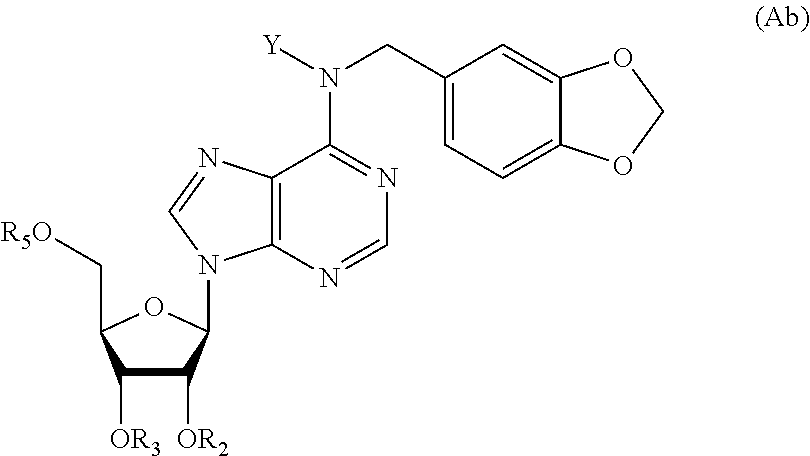
Wherein,
Y is selected from the group consisting of H, and C1-7 alkyls.
R2, R3, and R5 are independently selected from the group consisting of H, saturated C1-C12 alkyls, phenylpropyl, p-hydroxy-phenylpropyl, p-methyl-phenylpropyl, phenylpropenyl, p-hydroxyphenylpropenyl, nitrophenyl, saturated and unsaturated C1-C12 alkylacyls, phenylpropionyl, p-hydroxy-phenylpropionyl, p-methyl-phenylpropionyl, phenylpropenionyl, p-hydroxyphenylpropenionyl, nitrophenylacyl, thereof, R2 and R3 can be interconnected to form a ring.
The preferable compounds represented by the formula Ab, include but are not limited to the compounds represented by the formula Ab1.

Wherein,
R5 is selected from the group consisting of H, saturated C7-12 alkyls, phenylpropyl, p-hydroxy-phenylpropyl, p-methyl-phenylpropyl, phenylpropenyl, p-hydroxyphenylpropenyl, nitrophenyl, saturated C7-12 alkylacyls, phenylpropionyl, p-hydroxy-phenylpropionyl, p-methyl-phenylpropionyl, phenylpropenionyl, p-hydroxyphenylpropenionyl, and nitrophenylacyl.
The preferable compounds represented by the formula 1, include but are not limited to the compounds represented by the formula B.

Wherein,
W is selected from the group consisting of oxygen (O), sulfur (S), and nitrogen (N) atoms.
R1 is selected from the group consisting of H, hydroxy, amino, nitro, phenyl, methylenedioxy, halogens, C1-16 alkyls, C1-16 alkoxyls, C1-16 alkthioyls, and C1-16 alkacyloxoyls. Wherein, the alkyl in the said C1-16 alkyls, C1-16 alkoxyls, C1-16 alkthioyls, and C1-16 alkacyloxoyls can be straight, breached, unsubstituted, and substituted, thereof the further substitution group(s) can be selected from the group consisting of halogens, hydroxyl, and amino groups.
R2, R3, and R5 are independently selected from the group consisting of H, saturated C1-16 alkyls, phenylpropyl, p-hydroxy-phenylpropyl, p-methyl-phenylpropyl, phenylpropenyl, p-hydroxyphenylpropenyl, nitrophenyl, saturated and unsaturated C1-16 alkylacyls, phenylpropionyl, p-hydroxy-phenylpropionyl, p-methyl-phenylpropionyl, phenylpropenionyl, p-hydroxyphenylpropenionyl, nitrophenylacyl, thereof, R2 and R3 can be interconnected to form a ring.
The preferable compounds represented by the formula B, include but are not limited to the compounds represented by the formula Ba.

Wherein,
W is selected from the group consisting of oxygen (O), sulfur (S), and nitrogen (N) atoms.
R1 is selected from the group consisting of H, hydroxy, amino, nitro, phenyl, methylenedioxy, halogens, C1-10 alkyls, C1-10 alkoxyls, C1-10 alkthioyls, and C1-10 alkacyloxoyls. Wherein, the alkyl in the said C1-10 alkyls, C1-10 alkoxyls, C1-10 alkthioyls, and C1-10 alkacyloxoyls can be straight, breached, unsubstituted, and substituted, thereof the further substitution group(s) can be selected from the group consisting of halogens, hydroxyl, and amino groups.
R5 is selected from the group consisting of H, saturated C7-12 alkyls, phenylpropyl, p-hydroxy-phenylpropyl, p-methyl-phenylpropyl, phenylpropenyl, p-hydroxyphenylpropenyl, nitrophenyl, saturated C7-12 alkylacyls, phenylpropionyl, p-hydroxy-phenylpropionyl, p-methyl-phenylpropionyl, phenylpropenionyl, p-hydroxyphenylpropenionyl, and nitrophenylacyl.
The preferable compounds represented by the formula Ba, include but are not limited to the compounds represented by formula Ba1.

Wherein,
R1 is selected from the group consisting of H, hydroxy, amino, nitro, phenyl, methylenedioxy, halogens, C1-6 alkyls, C1-6 alkoxyls, C1-6 alkthioyls, and C1-6 alkacyloxoyls. The alkyl in the said C1-6 alkyls, C1-6 alkoxyls, C1-6 alkthioyls, and C1-6 alkacyloxoyls can be straight, breached, unsubstituted, and substituted, thereof, the further substitution group(s) can be selected from the group consisting of halogens, hydroxyl, and amino groups.
The preferable compounds represented by the formula Ba1, include but are not limited to the compounds represented by the formula Ba11

Wherein,
R1 is selected from the group consisting of H, methyl, ethyl, propyl, isopropyl, methoxyl, ethoxyl, propoxy, isopropoxy, methylthio, acetoxy, propionyloxy, trifluoromethyl, trifluoromethoxyl, fluoro, chloro, bromo, and methylenedioxy.
The preferable compounds represented by the formula Ba1, include but are not limited to the compounds represented by the formula Ba12.

Wherein,
R1 is selected from the group consisting of H, methyl, ethyl, propyl, isopropyl, methoxyl, ethoxyl, propoxy, isopropoxy, methylthio, acetoxy, propionyloxy, trifluoromethyl, trifluoromethoxyl, fluoro, chloro, bromo, methylenedioxy.
The preferable compounds Ba represented by the formula, include but are not limited to the compounds represented the formula Ba2.

Wherein,
R1 is selected from the group consisting of H, hydroxy, amino, nitro, phenyl, methylenedioxy, halogens, C1-6 alkyls, C1-6 alkoxyls, C1-6 alkthioyls, and C1-6 alkacyloxoyls. The alkyl in the said C1-6 alkyls, C1-6 alkoxyls, C1-6 alkthioyls, and C1-6 alkacyloxoyls can be straight, breached, unsubstituted, and substituted, thereof, the further substitution group(s) can be selected from the group consisting of halogens, hydroxyl, and amino groups.
The preferable compounds represented by the formula Ba2, include but are not limited to the compounds represented by the formula Ba21.

Wherein,
R1 is selected from the group consisting of H, methyl, ethyl, propyl, isopropyl, methoxyl, ethoxyl, propoxy, isopropoxy, methylthio, acetoxy, propionyloxy, trifluoromethyl, trifluoromethoxyl, fluoro, chloro, bromo, methylenedioxy.
The preferable compounds, represented by the formula Ba2, include but are not limited to the compounds represented the formula Ba22.

Wherein,
R1 is selected from the group consisting of H, methyl, ethyl, propyl, isopropyl, methoxyl, ethoxyl, propoxy, isopropoxy, methylthio, acetoxy, propionyloxy, trifluoromethyl, trifluoromethoxyl, fluoro, chloro, bromo, methylenedioxy.
The preferable compounds represented by the formula Ba, include but are not limited to the compounds represented by the formula Ba3.

Wherein,
R1 is selected from the group consisting of H, hydroxy, amino, nitro, phenyl, methylenedioxy, halogens, C1-6 alkyls, C1-6 alkoxyls, C1-6 alkthioyls, and C1-6 alkacyloxoyls. The alkyl in the said C1-6 alkyls, C1-6 alkoxyls, C1-6 alkthioyls, and C1-6 alkacyloxoyls can be straight, breached, unsubstituted, and substituted, thereof, the further substitution group(s) can be selected from the group consisting of halogens, hydroxyl, and amino groups.
The preferable compounds represented by the formula Ba3, include but are not limited to the compounds represented by the formula Ba31.

Wherein,
R1 is selected from the group consisting of H, methyl, ethyl, propyl, isopropyl, methoxyl, ethoxyl, propoxy, isopropoxy, methylthio, acetoxy, propionyloxy, trifluoromethyl, trifluoromethoxyl, fluoro, chloro, bromo, and methylenedioxy.
The preferable compounds, represented by the formula Ba3, include but are not limited to the compounds represented by the formula Ba32.

Wherein,
R1 is selected from the group consisting of H, methyl, ethyl, propyl, isopropyl, methoxyl, ethoxyl, propoxy, isopropoxy, methylthio, acetoxy, propionyloxy, trifluoromethyl, trifluoromethoxyl, fluoro, chloro, bromo, and methylenedioxy.
The preferable compounds represented by the formula I, include but are not limited to the compounds represented by the formula C.

Wherein,
R1 is selected from the group consisting of H, hydroxy, amino, nitro, phenyl, methylenedioxy, halogens, C1-16 alkyls, C1-16 alkoxyls, C1-16 alkthioyls, and C1-16 alkacyloxoyls. The alkyl in the said C1-16 alkyls, C1-16 alkoxyls, C1-16 alkthioyls, and C1-16 alkacyloxoyls can be straight, breached, unsubstituted, and substituted, thereof, the further substitution group(s) can be selected from the group consisting of halogens, hydroxyl, and amino groups.
R2, R3, and R5 are independently selected from the group consisting of H, saturated C1-16 alkyls, phenylpropyl, p-hydroxy-phenylpropyl, p-methyl-phenylpropyl, phenylpropenyl, p-hydroxyphenylpropenyl, nitrophenyl, saturated and unsaturated C1-16 alkylacyls, phenylpropionyl, p-hydroxy-phenylpropionyl, p-methyl-phenylpropionyl, phenylpropenionyl, p-hydroxyphenylpropenionyl, nitrophenylacyl, thereof, R2 and R3 can be interconnected to form a ring.
The preferable compounds, represented by the formula I, include but are not limited to the compounds represented by formula D.

Wherein,
R1 is selected from the group consisting of H, hydroxy, amino, nitro, phenyl, methylenedioxy, halogens, C1-16 alkyls, C1-16 alkoxyls, C1-16 alkthioyls, and C1-16 alkacyloxoyls. The alkyl in the said C1-16 alkyls, C1-16 alkoxyls, C1-16 alkthioyls, and C1-16 alkacyloxoyls can be straight, breached, unsubstituted, and substituted, thereof, the further substitution group(s) can be selected from the group consisting of halogens, hydroxyl, and amino groups.
R2, R3, and R5 are independently selected from the group consisting of H, saturated C1-16 alkyls, phenylpropyl, p-hydroxy-phenylpropyl, p-methyl-phenylpropyl, phenylpropenyl, p-hydroxyphenylpropenyl, nitrophenyl, saturated and unsaturated C1-16 alkylacyls, phenylpropionyl, p-hydroxy-phenylpropionyl, p-methyl-phenylpropionyl, phenylpropenionyl, p-hydroxyphenylpropenionyl, nitrophenylacyl, thereof, R2 and R3 can be interconnected to form a ring.
The preferable compounds, represented by the formula I, include but are not limited to the compounds represented by the formula E.

Wherein,
R1 is selected from the group consisting of H, hydroxy, amino, nitro, phenyl, methylenedioxy, halogens, C1-16 alkyls, C1-16 alkoxyls, C1-16 alkthioyls, and C1-16 alkacyloxoyls. The alkyl in the said C1-16 alkyls, C1-16 alkoxyls, C1-16 alkthioyls, and C1-16 alkacyloxoyls can be straight, breached, unsubstituted, and substituted, thereof, the further substitution group(s) can be selected from the group consisting of halogens, hydroxyl, and amino groups.
R2, R3, and R5 are independently selected from the group consisting of H, saturated C1-16 alkyls, phenylpropyl, p-hydroxy-phenylpropyl, p-methyl-phenylpropyl, phenylpropenyl, p-hydroxyphenylpropenyl, nitrophenyl, saturated and unsaturated C1-16 alkylacyls, phenylpropionyl, p-hydroxy-phenylpropionyl, p-methyl-phenylpropionyl, phenylpropenionyl, p-hydroxyphenylpropenionyl, nitrophenylacyl, thereof, R2 and R3 can be interconnected to form a ring.
The preferable compounds, represented by the formula I, include but are not limited to the compounds represented by the formula F.

Wherein,
R1 is selected from the group consisting of H, hydroxy, amino, nitro, phenyl, methylenedioxy, halogens, C1-16 alkyls, C1-16 alkoxyls, C1-16 alkthioyls, and C1-16 alkacyloxoyls. The alkyl in the said C1-16 alkyls, C1-16 alkoxyls, C1-16 alkthioyls, and C1-16 alkacyloxoyls can be straight, breached, unsubstituted, and substituted, thereof, the further substitution group(s) can be selected from the group consisting of halogens, hydroxyl, and amino groups.
R2, R3, and R5 are independently selected from the group consisting of H, saturated C1-16 alkyls, phenylpropyl, p-hydroxy-phenylpropyl, p-methyl-phenylpropyl, phenylpropenyl, p-hydroxyphenylpropenyl, nitrophenyl, saturated and unsaturated C1-16 alkylacyls, phenylpropionyl, p-hydroxy-phenylpropionyl, p-methyl-phenylpropionyl, phenylpropenionyl, p-hydroxyphenylpropenionyl, nitrophenylacyl, thereof, R2 and R3 can be interconnected to form a ring.
The preferable compounds, represented by the formula I, include but are not limited to the compounds represented by the formula G

Wherein,
R1 is selected from the group consisting of H, hydroxy, amino, nitro, phenyl, methylenedioxy, halogens, C1-16 alkyls, C1-16 alkoxyls, C1-16 alkthioyls, and C1-16 alkacyloxoyls. The alkyl in the said C1-16 alkyls, C1-16 alkoxyls, C1-16 alkthioyls, and C1-16 alkacyloxoyls can be straight, breached, unsubstituted, and substituted, thereof, the further substitution group(s) can be selected from the group consisting of halogens, hydroxyl, and amino groups.
R2, R3, and R5 are independently selected from the group consisting of H, saturated C1-16 alkyls, phenylpropyl, p-hydroxy-phenylpropyl, p-methyl-phenylpropyl, phenylpropenyl, p-hydroxyphenylpropenyl, nitrophenyl, saturated and unsaturated C1-16 alkylacyls, phenylpropionyl, p-hydroxy-phenylpropionyl, p-methyl-phenylpropionyl, phenylpropenionyl, p-hydroxyphenylpropenionyl, nitrophenylacyl, thereof, R2 and R3 can be interconnected to form a ring.
The preferable compounds, represented by the formula I, include but are not limited to the compounds represented by the formula H.

Wherein,
R1 is selected from the group consisting of H, hydroxy, amino, nitro, phenyl, methylenedioxy, halogens, C1-16 alkyls, C1-16 alkoxyls, C1-16 alkthioyls, and C1-16 alkacyloxoyls. The alkyl in the said C1-16 alkyls, C1-16 alkoxyls, C1-16 alkthioyls, and C1-16 alkacyloxoyls can be straight, breached, unsubstituted, and substituted, thereof, the further substitution group(s) can be selected from the group consisting of halogens, hydroxyl, and amino groups.
R2, R3, and R5 are independently selected from the group consisting of H, saturated C1-16 alkyls, phenylpropyl, p-hydroxy-phenylpropyl, p-methyl-phenylpropyl, phenylpropenyl, p-hydroxyphenylpropenyl, nitrophenyl, saturated and unsaturated C1-16 alkylacyls, phenylpropionyl, p-hydroxy-phenylpropionyl, p-methyl-phenylpropionyl, phenylpropenionyl, p-hydroxyphenylpropenionyl, nitrophenylacyl, thereof, R2 and R3 can be interconnected to form a ring.
The preferable compounds, represented by the formula H, include but are not limited to the compounds represented by the formula Ha.

Wherein,
R1 is selected from the group consisting of H, hydroxy, amino, nitro, phenyl, methylenedioxy, halogens, C1-10 alkyls, C1-10 alkoxyls, C1-10 alkthioyls, and C1-10 alkacyloxoyls. The alkyl in the said C1-10 alkyls, C1-10 alkoxyls, C1-10 alkthioyls, and C1-10 alkacyloxoyls can be straight, breached, unsubstituted, and substituted, thereof, the further substitution group(s) can be selected from the group consisting of halogens, hydroxyl, and amino groups.
R5 is selected from the group consisting of H, saturated C7-12 alkyls, phenylpropyl, p-hydroxy-phenylpropyl, p-methyl-phenylpropyl, phenylpropenyl, p-hydroxyphenylpropenyl, nitrophenyl, saturated and unsaturated C7-12 alkyl acyls, phenylpropionyl, p-hydroxy-phenylpropionyl, p-methyl-phenylpropionyl, phenylpropenionyl, p-hydroxyphenylpropenionyl, and nitrophenylacyl.
The preferable compounds, represented by the formula Ha, include but are not limited to the compounds represented by the formula Ha1.

Wherein,
R1 is selected from the group consisting of H, hydroxy, amino, nitro, phenyl, methylenedioxy, halogens, C1-6 alkyls, C1-6 alkoxyls, C1-6 alkthioyls, and C1-6 alkacyloxoyls. The alkyl in the said C1-6 alkyls, C1-6 alkoxyls, C1-6 alkthioyls, and C1-6 alkacyloxoyls can be straight, breached, unsubstituted, and substituted, thereof, the further substitution group(s) can be selected from the group consisting of halogens, hydroxyl, and amino groups.
The preferable compounds, represented by the formula I, include but are not limited to the compounds represented by the formula J.

Wherein,
W is selected from the group consisting of oxygen (O), sulfur (S), and nitrogen (N) atoms.
R1 is selected from the group consisting of H, hydroxy, amino, nitro, phenyl, methylenedioxy, halogens, C1-16 alkyls, C1-16 alkoxyls, C1-16 alkthioyls, and C1-16 alkacyloxoyls. The alkyl in the said C1-16 alkyls, C1-16 alkoxyls, C1-16 alkthioyls, and C1-16 alkacyloxoyls can be straight, breached, unsubstituted, and substituted, thereof, the further substitution group(s) can be selected from the group consisting of halogens, hydroxyl, and amino groups.
R2, R3, and R5 are independently selected from the group consisting of H, saturated C1-16 alkyls, phenylpropyl, p-hydroxy-phenylpropyl, p-methyl-phenylpropyl, phenylpropenyl, p-hydroxyphenylpropenyl, nitrophenyl, saturated and unsaturated C1-16 alkylacyls, phenylpropionyl, p-hydroxy-phenylpropionyl, p-methyl-phenylpropionyl, phenylpropenionyl, p-hydroxyphenylpropenionyl, nitrophenylacyl, thereof, R2 and R3 can be interconnected to form a ring.
The preferable compounds represented by the formula J, include but are not limited to the compounds represented by the formula Ja.

Wherein,
W is selected from the group consisting of oxygen (O), sulfur (S), and nitrogen (N) atoms.
R1 is selected from the group consisting of H, hydroxy, amino, nitro, phenyl, methylenedioxy, halogens, C1-10 alkyls, C1-10 alkoxyls, C1-10 alkthioyls, and C1-10 alkacyloxoyls. The alkyl in the said C1-10 alkyls, C1-10 alkoxyls, C1-10 alkthioyls, and C1-10 alkacyloxoyls can be straight, breached, unsubstituted, and substituted, thereof, the further substitution group(s) can be selected from the group consisting of halogens, hydroxyl, and amino groups.
R5 are independently selected from the group consisting of H, saturated C7-12 alkyls, phenylpropyl, p-hydroxy-phenylpropyl, p-methyl-phenylpropyl, phenylpropenyl, p-hydroxyphenylpropenyl, nitrophenyl, saturated and unsaturated C7-12 alkylacyls, phenylpropionyl, p-hydroxy-phenylpropionyl, p-methyl-phenylpropionyl, phenylpropenionyl, p-hydroxyphenylpropenionyl, nitrophenylacyl, thereof, R2 and R3 can be interconnected to form a ring.
The preferable compounds, represented by the formula Ja, include but are not limited to the compounds represented by formula Ja1.

Wherein,
W is selected from the group consisting of oxygen (O), sulfur (S), and nitrogen (N) atoms.
R1 is selected from the group consisting of H, hydroxy, amino, nitro, phenyl, methylenedioxy, halogens, C1-6 alkyls, C1-6 alkoxyls, C1-6 alkthioyls, and C1-6 alkacyloxoyls. The alkyl in the said C1-6 alkyls, C1-6 alkoxyls, C1-6 alkthioyls, and C1-6 alkacyloxoyls can be straight, breached, unsubstituted, and substituted, thereof, the further substitution group(s) can be selected from the group consisting of halogens, hydroxyl, and amino groups.
The preferable compounds, represented by the formula I, include but are not limited to the compounds represented by the formula K.

Wherein,
R1 is selected from the group consisting of H, hydroxy, amino, nitro, phenyl, methylenedioxy, halogens, C1-16 alkyls, C1-16 alkoxyls, C1-16 alkthioyls, and C1-16 alkacyloxoyls. The alkyl in the said C1-16 alkyls, C1-16 alkoxyls, C1-16 alkthioyls, and C1-16 alkacyloxoyls can be straight, breached, unsubstituted, and substituted, thereof, the further substitution group(s) can be selected from the group consisting of halogens, hydroxyl, and amino groups.
R2, R3, and R5 are independently selected from the group consisting of H, saturated C1-16 alkyls, phenylpropyl, p-hydroxy-phenylpropyl, p-methyl-phenylpropyl, phenylpropenyl, p-hydroxyphenylpropenyl, nitrophenyl, saturated and unsaturated C1-16 alkylacyls, phenylpropionyl, p-hydroxy-phenylpropionyl, p-methyl-phenylpropionyl, phenylpropenionyl, p-hydroxyphenylpropenionyl, nitrophenylacyl, thereof, R2 and R3 can be interconnected to form a ring.
The preferable compounds represented by the formula I, include but are not limited to the compounds represented by the formula M.

Wherein,
R1 is selected from the group consisting of H, hydroxy, amino, nitro, phenyl, methylenedioxy, halogens, C1-16 alkyls, C1-16 alkoxyls, C1-16 alkthioyls, and C1-16 alkacyloxoyls. The alkyl in the said C1-16 alkyls, C1-16 alkoxyls, C1-16 alkthioyls, and C1-16 alkacyloxoyls can be straight, breached, unsubstituted, and substituted, thereof, the further substitution group(s) can be selected from the group consisting of halogens, hydroxyl, and amino groups.
R2, R3, and R5 are independently selected from the group consisting of H, saturated C1-16 alkyls, phenylpropyl, p-hydroxy-phenylpropyl, p-methyl-phenylpropyl, phenylpropenyl, p-hydroxyphenylpropenyl, nitrophenyl, saturated and unsaturated C1-16 alkylacyls, phenylpropionyl, p-hydroxy-phenylpropionyl, p-methyl-phenylpropionyl, phenylpropenionyl, p-hydroxyphenylpropenionyl, nitrophenylacyl, thereof, R2 and R3 can be interconnected to form a ring.
The preferable compounds, represented by the formula I, include but are not limited to the compounds represented by the formula N.

Wherein,
R1 is selected from the group consisting of H, hydroxy, amino, nitro, phenyl, methylenedioxy, halogens, C1-16 alkyls, C1-16 alkoxyls, C1-16 alkthioyls, and C1-16 alkacyloxoyls. The alkyl in the said C1-16 alkyls, C1-16 alkoxyls, C1-16 alkthioyls, and C1-16 alkacyloxoyls can be straight, breached, unsubstituted, and substituted, thereof, the further substitution group(s) can be selected from the group consisting of halogens, hydroxyl, and amino groups.
R2, R3, and R5 are independently selected from the group consisting of H, saturated C1-16 alkyls, phenylpropyl, p-hydroxy-phenylpropyl, p-methyl-phenylpropyl, phenylpropenyl, p-hydroxyphenylpropenyl, nitrophenyl, saturated and unsaturated C1-16 alkylacyls, phenylpropionyl, p-hydroxy-phenylpropionyl, p-methyl-phenylpropionyl, phenylpropenionyl, p-hydroxyphenylpropenionyl, nitrophenylacyl, thereof, R2 and R3 can be interconnected to form a ring.
The preferable compounds, represented by the formula I, include but are not limited to the compounds represented by the formula O.

Wherein,
R1 is selected from the group consisting of H, hydroxy, amino, nitro, phenyl, methylenedioxy, halogens, C1-16 alkyls, C1-16 alkoxyls, C1-16 alkthioyls, and C1-16 alkacyloxoyls. The alkyl in the said C1-16 alkyls, C1-16 alkoxyls, C1-16 alkthioyls, and C1-16 alkacyloxoyls can be straight, breached, unsubstituted, and substituted, thereof, the further substitution group(s) can be selected from the group consisting of halogens, hydroxyl, and amino groups.
R2, R3, and R5 are independently selected from the group consisting of H, saturated C1-16 alkyls, phenylpropyl, p-hydroxy-phenylpropyl, p-methyl-phenylpropyl, phenylpropenyl, p-hydroxyphenylpropenyl, nitrophenyl, saturated and unsaturated C1-16 alkylacyls, phenylpropionyl, p-hydroxy-phenylpropionyl, p-methyl-phenylpropionyl, phenylpropenionyl, p-hydroxyphenylpropenionyl, nitrophenylacyl, thereof, R2 and R3 can be interconnected to form a ring.
The preferable compounds, represented by the formula I, include but are not limited to the compounds represented by the formula P.

Wherein,
R1 is selected from the group consisting of H, hydroxy, amino, nitro, phenyl, methylenedioxy, halogens, C1-16 alkyls, C1-16 alkoxyls, C1-16 alkthioyls, and C1-16 alkacyloxoyls. The alkyl in the said C1-16 alkyls, C1-16 alkoxyls, C1-16 alkthioyls, and C1-16 alkacyloxoyls can be straight, breached, unsubstituted, and substituted, thereof, the further substitution group(s) can be selected from the group consisting of halogens, hydroxyl, and amino groups.
R2, R3, and R5 are independently selected from the group consisting of H, saturated C1-16 alkyls, phenylpropyl, p-hydroxy-phenylpropyl, p-methyl-phenylpropyl, phenylpropenyl, p-hydroxyphenylpropenyl, nitrophenyl, saturated and unsaturated C1-16 alkylacyls, phenylpropionyl, p-hydroxy-phenylpropionyl, p-methyl-phenylpropionyl, phenylpropenionyl, p-hydroxyphenylpropenionyl, nitrophenylacyl, thereof, R2 and R3 can be interconnected to form a ring.
The preferable compounds, represented by the formula I, include but are not limited to the compounds represented by the formula Q.

Wherein,
R is selected from the group consisting of C1-4 alkyls and hydroxy substituted C1-4 alkyls.
R1 is selected from the group consisting of H, hydroxy, amino, nitro, phenyl, methylenedioxy, halogens, C1-16 alkyls, C1-16 alkoxyls, C1-16 alkthioyls, and C1-16 alkacyloxoyls. The alkyl in the said C1-16 alkyls, C1-16 alkoxyls, C1-16 alkthioyls, and C1-16 alkacyloxoyls can be straight, breached, unsubstituted, and substituted, thereof, the further substitution group(s) can be selected from the group consisting of halogens, hydroxyl, and amino groups.
R2, R3, and R5 are independently selected from the group consisting of H, saturated C1-16 alkyls, phenylpropyl, p-hydroxy-phenylpropyl, p-methyl-phenylpropyl, phenylpropenyl, p-hydroxyphenylpropenyl, nitrophenyl, saturated and unsaturated C1-16 alkylacyls, phenylpropionyl, p-hydroxy-phenylpropionyl, p-methyl-phenylpropionyl, phenylpropenionyl, p-hydroxyphenylpropenionyl, nitrophenylacyl, thereof, R2 and R3 can be interconnected to form a ring.
The preferable compounds, represented by the formula Q, include but are not limited to the compounds represented by the formula Qa.

Wherein,
R1 is selected from the group consisting of H, hydroxy, amino, nitro, phenyl, methylenedioxy, halogens, C1-10 alkyls, C1-10 alkoxyls, C1-10 alkthioyls, and C1-10 alkacyloxoyls. The alkyl in the said C1-10 alkyls, C1-10 alkoxyls, C1-10 alkthioyls, and C1-10 alkacyloxoyls can be straight, breached, unsubstituted, and substituted, thereof, the further substitution group(s) can be selected from the group consisting of halogens, hydroxyl, and amino groups.
R5 is selected from the group consisting of H, saturated C7-12 alkyls, phenylpropyl, p-hydroxy-phenylpropyl, p-methyl-phenylpropyl, phenylpropenyl, p-hydroxyphenylpropenyl, nitrophenyl, saturated and unsaturated C7-12 alkylacyls, phenylpropionyl, p-hydroxy-phenylpropionyl, p-methyl-phenylpropionyl, phenylpropenionyl, p-hydroxyphenylpropenionyl, nitrophenylacyl.
The preferable compounds, represented by the formula Qa, include but are not limited to the compounds represented by the formula Qa1.

Wherein,
R1 is selected from the group consisting of H, hydroxy, amino, nitro, phenyl, methylenedioxy, halogens, C1-6 alkyls, C1-6 alkoxyls, C1-6 alkthioyls, and C1-6 alkacyloxoyls. The alkyl in the said C1-6 alkyls, C1-6 alkoxyls, C1-6 alkthioyls, and C1-6 alkacyloxoyls can be straight, breached, unsubstituted, and substituted, thereof, the further substitution group(s) can be selected from the group consisting of halogens, hydroxyl, and amino groups.
The preferable compounds, represented by the formula Qa1, include but are not limited to the compounds represented by the formula Qa11.

Wherein,
R1 is selected from the group consisting of H, methyl, ethyl, propyl, isopropyl, methoxyl, ethoxyl, propoxy, isopropoxy, methylthio, acetoxy, propionyloxy, trifluoromethyl, trifluoromethoxyl, fluoro, chloro, bromo, methylenedioxy.
The preferable compounds, represented by the formula Qa1, include but are not limited to the compounds represented by the formula Qa12.

Wherein,
R1 is selected from the group consisting of H, methyl, ethyl, propyl, isopropyl, methoxyl, ethoxyl, propoxy, isopropoxy, methylthio, acetoxy, propionyloxy, trifluoromethyl, trifluoromethoxyl, fluoro, chloro, bromo, methylenedioxy.
The preferable compounds, represented by the formula Q, include but are not limited to the compounds represented by the formula Qb.

Wherein,
R1 is selected from the group consisting of H, hydroxy, amino, nitro, phenyl, methylenedioxy, halogens, C1-10 alkyls, C1-10 alkoxyls, C1-10 alkthioyls, and C1-10 alkacyloxoyls. The alkyl in the said C1-10 alkyls, C1-10 alkoxyls, C1-10 alkthioyls, and C1-10 alkacyloxoyls can be straight, breached, unsubstituted, and substituted, thereof, the further substitution group(s) can be selected from the group consisting of halogens, hydroxyl, and amino groups.
R5 is selected from the group consisting of H, saturated C7-12 alkyls, phenylpropyl, p-hydroxy-phenylpropyl, p-methyl-phenylpropyl, phenylpropenyl, p-hydroxyphenylpropenyl, nitrophenyl, saturated and unsaturated C7-12 alkylacyls, phenylpropionyl, p-hydroxy-phenylpropionyl, p-methyl-phenylpropionyl, phenylpropenionyl, p-hydroxyphenylpropenionyl, nitrophenylacyl.
The preferable compounds, represented by the formula Qb, include but are not limited to the compounds represented by the formula Qb1.

Wherein,
R1 is selected from the group consisting of H, hydroxy, amino, nitro, phenyl, methylenedioxy, halogens, C1-6 alkyls, C1-6 alkoxyls, C1-6 alkthioyls, and C1-6 alkacyloxoyls. The alkyl in the said C1-6 alkyls, C1-6 alkoxyls, C1-6 alkthioyls, and C1-6 alkacyloxoyls can be straight, breached, unsubstituted, and substituted, thereof, the further substitution group(s) can be selected from the group consisting of halogens, hydroxyl, and amino groups.
The preferable compounds, represented by the formula Qb, include but are not limited to the compounds represented by the formula Qb2.

Wherein,
R1 is selected from the group consisting of H, hydroxy, amino, nitro, phenyl, methylenedioxy, halogens, C1-6 alkyls, C1-6 alkoxyls, C1-6 alkthioyls, and C1-6 alkacyloxoyls. The alkyl in the said C1-6 alkyls, C1-6 alkoxyls, C1-6 alkthioyls, and C1-6 alkacyloxoyls can be straight, breached, unsubstituted, and substituted, thereof, the further substitution group(s) can be selected from the group consisting of halogens, hydroxyl, and amino groups.
The preferable compounds, represented by the formula Q, include but are not limited to the compounds represented by the formula Qc.

Wherein,
R1 is selected from the group consisting of H, hydroxy, amino, nitro, phenyl, methylenedioxy, halogens, C1-10 alkyls, C1-10 alkoxyls, C1-10 alkthioyls, and C1-10 alkacyloxoyls. The alkyl in the said C1-10 alkyls, C1-10 alkoxyls, C1-10 alkthioyls, and C1-10 alkacyloxoyls can be straight, breached, unsubstituted, and substituted, thereof, the further substitution group(s) can be selected from the group consisting of halogens, hydroxyl, and amino groups.
R5 is selected from the group consisting of H, saturated C7-12 alkyls, phenylpropyl, p-hydroxy-phenylpropyl, p-methyl-phenylpropyl, phenylpropenyl, p-hydroxyphenylpropenyl, nitrophenyl, saturated and unsaturated C7-12 alkylacyls, phenylpropionyl, p-hydroxy-phenylpropionyl, p-methyl-phenylpropionyl, phenylpropenionyl, p-hydroxyphenylpropenionyl, nitrophenylacyl.
The preferable compounds, represented by the formula Qc, include but are not limited to the compounds represented by the formula Qc1.

Wherein,
R1 is selected from the group consisting of H, hydroxy, amino, nitro, phenyl, methylenedioxy, halogens, C1-6 alkyls, C1-6 alkoxyls, C1-6 alkthioyls, and C1-6 alkacyloxoyls. The alkyl in the said C1-6 alkyls, C1-6 alkoxyls, C1-6 alkthioyls, and C1-6 alkacyloxoyls can be straight, breached, unsubstituted, and substituted, thereof, the further substitution group(s) can be selected from the group consisting of halogens, hydroxyl, and amino groups.
The preferable compounds, represented by the formula Qc, include but are not limited to the compounds represented by the formula Qc2.

Wherein,
R1 is selected from the group consisting of H, hydroxy, amino, nitro, phenyl, methylenedioxy, halogens, C1-6 alkyls, C1-6 alkoxyls, C1-6 alkthioyls, and C1-6 alkacyloxoyls. The alkyl in the said C1-6 alkyls, C1-6 alkoxyls, C1-6 alkthioyls, and C1-6 alkacyloxoyls can be straight, breached, unsubstituted, and substituted, thereof, the further substitution group(s) can be selected from the group consisting of halogens, hydroxyl, and amino groups.
The preferable compounds represented by the formula I, include but are not limited to the compounds represented by the formula R.

Wherein,
R6 and R7 are independently selected from the group consisting of hydroxy and hydroxymethyl.
R1 is selected from the group consisting of H, hydroxy, amino, nitro, phenyl, methylenedioxy, halogens, C1-16 alkyls, C1-16 alkoxyls, C1-16 alkthioyls, and C1-16 alkacyloxoyls. The alkyl in the said C1-16 alkyls, C1-16 alkoxyls, C1-16 alkthioyls, and C1-16 alkacyloxoyls can be straight, breached, unsubstituted, and substituted, thereof, the further substitution group(s) can be selected from the group consisting of halogens, hydroxyl, and amino groups.
R2, R3, and R5 are independently selected from the group consisting of H, saturated C1-16 alkyls, phenylpropyl, p-hydroxy-phenylpropyl, p-methyl-phenylpropyl, phenylpropenyl, p-hydroxyphenylpropenyl, nitrophenyl, saturated and unsaturated C1-16 alkylacyls, phenylpropionyl, p-hydroxy-phenylpropionyl, p-methyl-phenylpropionyl, phenylpropenionyl, p-hydroxyphenylpropenionyl, nitrophenylacyl, thereof, R2 and R3 can be interconnected to form a ring.
The preferable compounds, represented by the formula R, include but are not limited to the compounds represented by the formula Ra.

Wherein,
R6 and R7 are independently selected from the group consisting of hydroxy and hydroxymethyl.
R1 is selected from the group consisting of H, hydroxy, amino, nitro, phenyl, methylenedioxy, halogens, C1-6 alkyls, C1-6 alkoxyls, C1-6 alkthioyls, and C1-6 alkacyloxoyls. The alkyl in the said C1-6 alkyls, C1-6 alkoxyls, C1-6 alkthioyls, and C1-6 alkacyloxoyls can be straight, breached, unsubstituted, and substituted, thereof, the further substitution group(s) can be selected from the group consisting of halogens, hydroxyl, and amino groups.
R5 is selected from the group consisting of H, saturated C7-12 alkyls, phenylpropyl, p-hydroxy-phenylpropyl, p-methyl-phenylpropyl, phenylpropenyl, p-hydroxyphenylpropenyl, nitrophenyl, saturated and unsaturated C7-12 alkylacyls, phenylpropionyl, p-hydroxy-phenylpropionyl, p-methyl-phenylpropionyl, phenylpropenionyl, p-hydroxyphenylpropenionyl, nitrophenylacyl.
The preferable compounds, represented by the formula R, include but are not limited to the compounds represented by the formula Rb.

Wherein,
R6 and R7 are independently selected from the group consisting of hydroxy and hydroxymethyl.
R1 is selected from the group consisting of H, hydroxy, amino, nitro, phenyl, methylenedioxy, halogens, C1-6 alkyls, C1-6 alkoxyls, C1-6 alkthioyls, and C1-6 alkacyloxoyls. The alkyl in the said C1-6 alkyls, C1-6 alkoxyls, C1-6 alkthioyls, and C1-6 alkacyloxoyls can be straight, breached, unsubstituted, and substituted, thereof, the further substitution group(s) can be selected from the group consisting of halogens, hydroxyl, and amino groups.
R5 is selected from the group consisting of H, saturated C7-12 alkyls, phenylpropyl, p-hydroxy-phenylpropyl, p-methyl-phenylpropyl, phenylpropenyl, p-hydroxyphenylpropenyl, nitrophenyl, saturated and unsaturated C7-12 alkylacyls, phenylpropionyl, p-hydroxy-phenylpropionyl, p-methyl-phenylpropionyl, phenylpropenionyl, p-hydroxyphenylpropenionyl, nitrophenylacyl.
The preferable compounds, represented by the formula I, include but are not limited to the compounds represented by the formula S.

Wherein,
X is selected from the group consisting of substituted and unsubstituted cyclohexyls and substituted and unsubstituted phenyls.
R1 is selected from the group consisting of H, hydroxy, amino, nitro, phenyl, methylenedioxy, halogens, C1-16 alkyls, C1-16 alkoxyls, C1-16 alkthioyls, and C1-16 alkacyloxoyls. The alkyl in the said C1-16 alkyls, C1-16 alkoxyls, C1-16 alkthioyls, and C1-16 alkacyloxoyls can be straight, breached, unsubstituted, and substituted, thereof, the further substitution group(s) can be selected from the group consisting of halogens, hydroxyl, and amino groups.
R2, R3, and R5 are independently selected from the group consisting of H, saturated C1-16 alkyls, phenylpropyl, p-hydroxy-phenylpropyl, p-methyl-phenylpropyl, phenylpropenyl, p-hydroxyphenylpropenyl, nitrophenyl, saturated and unsaturated C1-16 alkylacyls, phenylpropionyl, p-hydroxy-phenylpropionyl, p-methyl-phenylpropionyl, phenylpropenionyl, p-hydroxyphenylpropenionyl, nitrophenylacyl, thereof, R2 and R3 can be interconnected to form a ring.
The preferable compounds, represented by the formula S, include but are not limited to the compounds represented by the formula Sa.

Wherein,
R1 and R1′ are independently selected from the group consisting of H, hydroxy, amino, nitro, phenyl, methylenedioxy, halogens, C1-6 alkyls, C1-6 alkoxyls, C1-6 alkthioyls, and C1-6 alkacyloxoyls. The alkyl in the said C1-6 alkyls, C1-6 alkoxyls, C1-6 alkthioyls, and C1-6 alkacyloxoyls can be straight, breached, unsubstituted, and substituted, thereof, the further substitution group(s) can be selected from the group consisting of halogens, hydroxyl, and amino groups.
R5 is selected from the group consisting of H, saturated C7-12 alkyls, phenylpropyl, p-hydroxy-phenylpropyl, p-methyl-phenylpropyl, phenylpropenyl, p-hydroxyphenylpropenyl, nitrophenyl, saturated and unsaturated C7-12 alkyl acyls, phenylpropionyl, p-hydroxy-phenylpropionyl, p-methyl-phenylpropionyl, phenylpropenionyl, p-hydroxyphenylpropenionyl, nitrophenylacyl.
The preferable compounds represented by the formula Sa, include but are not limited to the compounds represented by the formula Sa1.

R1 and R1′ are independently selected from the group consisting of H, hydroxy, amino, nitro, phenyl, methylenedioxy, halogens, C1-6 alkyls, C1-6 alkoxyls, C1-6 alkthioyls, and C1-6 alkacyloxoyls. The alkyl in the said C1-6 alkyls, C1-6 alkoxyls, C1-6 alkthioyls, and C1-6 alkacyloxoyls can be straight, breached, unsubstituted, and substituted, thereof, the further substitution group(s) can be selected from the group consisting of halogens, hydroxyl, and amino groups.
The preferable compounds, represented by the formula Sa, include but are not limited to the compounds represented by the formula Sa2.

Wherein,
R1 and R1′ are independently selected from the group consisting of H, hydroxy, amino, nitro, phenyl, methylenedioxy, halogens, C1-6 alkyls, C1-6 alkoxyls, C1-6 alkthioyls, and C1-6 alkacyloxoyls. The alkyl in the said C1-6 alkyls, C1-6 alkoxyls, C1-6 alkthioyls, and C1-6 alkacyloxoyls can be straight, breached, unsubstituted, and substituted, thereof, the further substitution group(s) can be selected from the group consisting of halogens, hydroxyl, and amino groups.
The preferable compounds, represented by the formula I, include but are not limited to the compounds represented by the formula T.

Wherein,
R1 is selected from the group consisting of H, hydroxy, amino, nitro, phenyl, methylenedioxy, halogens, C1-16 alkyls, C1-16 alkoxyls, C1-16 alkthioyls, and C1-16 alkacyloxoyls. The alkyl in the said C1-16 alkyls, C1-16 alkoxyls, C1-16 alkthioyls, and C1-16 alkacyloxoyls can be straight, breached, unsubstituted, and substituted, thereof, the further substitution group(s) can be selected from the group consisting of halogens, hydroxyl, and amino groups.
R2, R3, and R5 are independently selected from the group consisting of H, saturated C1-16 alkyls, phenylpropyl, p-hydroxy-phenylpropyl, p-methyl-phenylpropyl, phenylpropenyl, p-hydroxyphenylpropenyl, nitrophenyl, saturated and unsaturated C1-16 alkylacyls, phenylpropionyl, p-hydroxy-phenylpropionyl, p-methyl-phenylpropionyl, phenylpropenionyl, p-hydroxyphenylpropenionyl, nitrophenylacyl, thereof, R2 and R3 can be interconnected to form a ring.
The preferable compounds, represented by the formula T, include but are not limited to the compounds represented by the formula Ta.

Wherein,
R1 is selected from the group consisting of H, hydroxy, amino, nitro, phenyl, methylenedioxy, halogens, C1-6 alkyls, C1-6 alkoxyls, C1-6 alkthioyls, and C1-6 alkacyloxoyls. The alkyl in the said C1-6 alkyls, C1-6 alkoxyls, C1-6 alkthioyls, and C1-6 alkacyloxoyls can be straight, breached, unsubstituted, and substituted, thereof, the further substitution group(s) can be selected from the group consisting of halogens, hydroxyl, and amino groups.
R5 is selected from the group consisting of H, saturated C7-12 alkyls, phenylpropyl, p-hydroxy-phenylpropyl, p-methyl-phenylpropyl, phenylpropenyl, p-hydroxyphenylpropenyl, nitrophenyl, saturated and unsaturated C7-12 alkyl acyls, phenylpropionyl, p-hydroxy-phenylpropionyl, p-methyl-phenylpropionyl, phenylpropenionyl, p-hydroxyphenylpropenionyl, nitrophenylacyl.
The preferable compounds, represented by the formula T, include but are not limited to the compounds by represented the formula Tb.

Wherein,
R1 is selected from the group consisting of H, hydroxy, amino, nitro, phenyl, methylenedioxy, halogens, C1-6 alkyls, C1-6 alkoxyls, C1-6 alkthioyls, and C1-6 alkacyloxoyls. The alkyl in the said C1-6 alkyls, C1-6 alkoxyls, C1-6 alkthioyls, and C1-6 alkacyloxoyls can be straight, breached, unsubstituted, and substituted, thereof, the further substitution group(s) can be selected from the group consisting of halogens, hydroxyl, and amino groups.
R5 is selected from the group consisting of H, saturated C7-12 alkyls, phenylpropyl, p-hydroxy-phenylpropyl, p-methyl-phenylpropyl, phenylpropenyl, p-hydroxyphenylpropenyl, nitrophenyl, saturated and unsaturated C7-12 alkylacyls, phenylpropionyl, p-hydroxy-phenylpropionyl, p-methyl-phenylpropionyl, phenylpropenionyl, p-hydroxyphenylpropenionyl, nitrophenylacyl.
The preferable compounds, represented by the formula I, include but are not limited to the compounds represented by the formula U.

Wherein,
AA is selected from the group consisting of amino acids, thereof attached to the formula by nitrogen atom of the amino acids.
R2, R3, and R5 are independently selected from the group consisting of H, saturated C1-16 alkyls, phenylpropyl, p-hydroxy-phenylpropyl, p-methyl-phenylpropyl, phenylpropenyl, p-hydroxyphenylpropenyl, nitrophenyl, saturated and unsaturated C1-16 alkylacyls, phenylpropionyl, p-hydroxy-phenylpropionyl, p-methyl-phenylpropionyl, phenylpropenionyl, p-hydroxyphenylpropenionyl, nitrophenylacyl, thereof, R2 and R3 can be interconnected to form a ring.
The preferable AA is selected from the group consisting of phenylalanine, tyrosine, tryptophane, histidine, praline, valine, threonine, serine, and glycine.
The preferable compounds represented by the formula VI, include but are not limited to the compounds represented by the formula II.

Wherein,
R1 is selected from the group consisting of H, hydroxy, amino, nitro, phenyl, methylenedioxy, halogens, C1-16 alkyls, C1-16 alkoxyls, C1-16 alkthioyls, and C1-16 alkacyloxoyls. The alkyl in the said C1-16 alkyls, C1-16 alkoxyls, C1-16 alkthioyls, and C1-16 alkacyloxoyls can be straight, breached, unsubstituted, and substituted, thereof, the further substitution group(s) can be selected from the group consisting of halogens, hydroxyl, and amino groups.
R2, R3, and R5 are independently selected from the group consisting of H, saturated C1-16 alkyls, phenylpropyl, p-hydroxy-phenylpropyl, p-methyl-phenylpropyl, phenylpropenyl, p-hydroxyphenylpropenyl, nitrophenyl, saturated and unsaturated C1-16 alkylacyls, phenylpropionyl, p-hydroxy-phenylpropionyl, p-methyl-phenylpropionyl, phenylpropenionyl, p-hydroxyphenylpropenionyl, nitrophenylacyl, thereof, R2 and R3 can be interconnected to form a ring.
The preferable compounds represented by the formula VI, include but are not limited to the compounds represented by the formula III.

Wherein,
n is an integer selected from 0-4.
X is selected from the group consisting of substituted and unsubstituted phenyls, substituted and unsubstituted furyls, substituted or unsubstituted thiopheneyls, substituted and unsubstituted pyrrolyls, substituted or unsubstituted naphthyls, substituted and unsubstituted tetrahydro-naphthyls, substituted and unsubstituted fluoreneyls, substituted and unsubstituted imidazolyls, substituted and unsubstituted indyls, substituted and unsubstituted 1H-imidazolyls, substituted and unsubstituted 1H-indyls, substituted and unsubstituted C3-8 cycloalkyls, and C1-16 alkyls with straight and/or branched chains.
Y is selected from the group consisting of H and unsubstituted C1-6 alkyls with straight and/or branched chains.
R is selected from the group consisting of H, hydroxy, substituted and unsubstituted C1-16 alkyls with straight and/or branched chains., substituted and unsubstituted C3-8cycloalkyls, substituted and unsubstituted phenyls, COOR′ (R′ is selected H or C1-6 alkyls).
The structural moiety, represented by

can also be selected from the group consisting of (5R)-5-carboxy-2-pyrrolyl, (5S)-5-carboxy-2-pyrrolyl, (5R)-5-hydroxymethyl-2-pyrrolyl, (5S)-5-hydroxymethyl-2-pyrroleyl, substituted and unsubstituted phenylpiperazinyls, amino acid units, and amino acid ester units.
The structural moiety, represented by

can also be selected from the group consisting of substituted and unsubstituted furanyls, substituted and unsubstituted thienyls, substituted and unsubstituted pyrrolyls, substituted and unsubstituted imidazolyls, substituted and unsubstituted naphthyls, substituted and unsubstituted tetrahydro-naphthyls, substituted and unsubstituted indyls, substituted and unsubstituted fluoreneyls, and substituted and unsubstituted C3-8 cycloalkyls.
In addition, the above mentioned substituent is selected from the group consisting of H, hydroxy, amino, nitro, phenyl, methylenedioxy, halogens, C1-16 alkyls, C1-16 alkoxyls, C1-16 alkthioyls, and C1-16 alkacyloxoyls. The alkyl in the said C1-16 alkyls, C1-16 alkoxyls, C1-16 alkthioyls, and C1-16 alkacyloxoyls can be straight, breached, unsubstituted, and substituted, thereof, the further substitution group(s) can be selected from the group consisting of halogens, hydroxyl, and amino groups.
R3 and R5 are independently selected from the group consisting of H, saturated and unsaturated C1-16 alkyls, phenylpropyl, p-hydroxy-phenylpropyl, p-methyl-phenylpropyl, phenylpropenyl, p-hydroxyphenylpropenyl, nitrophenyl, saturated and unsaturated C1-16 alkylacyls, phenylpropionyl, p-hydroxy-phenylpropionyl, p-methyl-phenylpropionyl, phenylpropenionyl, p-hydroxyphenylpropenionyl, nitrophenylacyl.
The preferable compounds, represented by the formula III, include but are not limited to the compounds represented by the formula IIIA.

Wherein,
R3 and R5 are independently selected from the group consisting of H, saturated and unsaturated C1-16 alkyls, phenylpropyl, p-hydroxy-phenylpropyl, p-methyl-phenylpropyl, phenylpropenyl, p-hydroxyphenylpropenyl, nitrophenyl, saturated and unsaturated C1-16 alkylacyls, phenylpropionyl, p-hydroxy-phenylpropionyl, p-methyl-phenylpropionyl, phenylpropenionyl, p-hydroxyphenylpropenionyl, nitrophenylacyl.
The preferable compounds, represented by the formula VI, include but are not limited to the compounds represented by the formula IV.

Wherein,
n is an integer selected from 0-4.
X is selected from the group consisting of substituted and unsubstituted phenyls, substituted and unsubstituted furyls, substituted or unsubstituted thiopheneyls, substituted and unsubstituted pyrrolyls, substituted or unsubstituted naphthyls, substituted and unsubstituted tetrahydro-naphthyls, substituted and unsubstituted fluoreneyls, substituted and unsubstituted imidazolyls, substituted and unsubstituted indyls, substituted and unsubstituted 1H-imidazolyls, substituted and unsubstituted 1H-indyls, substituted and unsubstituted C3-8 cycloalkyls, and C1-16 alkyls with straight and/or branched chains.
Y is selected from the group consisting of H and unsubstituted C1-6 alkyls with straight and/or branched chains.
R is selected from the group consisting of H, hydroxy, substituted and unsubstituted C1-16 alkyls with straight and/or branched chains, substituted and unsubstituted C3-8cycloalkyls, substituted and unsubstituted phenyls, COOR′ (R′ is selected H or C1-6 alkyls).
The structural moiety, represented by

can also be selected from the group consisting of (5R)-5-carboxy-2-pyrrolyl, (5S)-5-carboxy-2-pyrrolyl, (5R)-5-hydroxymethyl-2-pyrrolyl, (5S)-5-hydroxymethyl-2-pyrroleyl, substituted and unsubstituted phenylpiperazinyls, amino acid units, and amino acid ester units.
The structural moiety, represented by

can also be selected from the group consisting of substituted and unsubstituted furanyls, substituted and unsubstituted thienyls, substituted and unsubstituted pyrrolyls, substituted and unsubstituted imidazolyls, substituted and unsubstituted naphthyls, substituted and unsubstituted tetrahydro-naphthyls, substituted and unsubstituted indyls, substituted and unsubstituted fluoreneyls, and substituted and unsubstituted C3-8 cycloalkyls.
The preferable compounds represented by the formula VI, include but are not limited to the compounds represented by the formula V.

Wherein,
n is an integer selected from 0-4.
X is selected from the group consisting of substituted and unsubstituted phenyls, substituted and unsubstituted furyls, substituted or unsubstituted thiopheneyls, substituted and unsubstituted pyrrolyls, substituted or unsubstituted naphthyls, substituted and unsubstituted tetrahydro-naphthyls, substituted and unsubstituted fluoreneyls, substituted and unsubstituted imidazolyls, substituted and unsubstituted indyls, substituted and unsubstituted 1H-imidazolyls, substituted and unsubstituted 1H-indyls, substituted and unsubstituted C3-8 cycloalkyls, and C1-16 alkyls with straight and/or branched chains.
Y is selected from the group consisting of H and unsubstituted C1-6 alkyls with straight and/or branched chains.
R is selected from the group consisting of H, hydroxy, substituted and unsubstituted C1-16 alkyls with straight and/or branched chains, substituted and unsubstituted C3-8cycloalkyls, substituted and unsubstituted phenyls, COOR′ (R′ is selected H or C1-6 alkyls).
The structural moiety, represented by

can also be selected from the group consisting of (5R)-5-carboxy-2-pyrrolyl, (5S)-5-carboxy-2-pyrrolyl, (5R)-5-hydroxymethyl-2-pyrrolyl, (5S)-5-hydroxymethyl-2-pyrroleyl, substituted and unsubstituted phenylpiperazinyls, amino acid units, and amino acid ester units.
The structural moiety, represented by

can also be selected from the group consisting of substituted and unsubstituted furanyls, substituted and unsubstituted thienyls, substituted and unsubstituted pyrrolyls, substituted and unsubstituted imidazolyls, substituted and unsubstituted naphthyls, substituted and unsubstituted tetrahydro-naphthyls, substituted and unsubstituted indyls, substituted and unsubstituted fluoreneyls, and substituted and unsubstituted C3-8 cycloalkyls.
In addition, the above mentioned substituent is selected from the group consisting of H, hydroxy, amino, nitro, phenyl, methylenedioxy, halogens, C1-16 alkyls, C1-16 alkoxyls, C1-16 alkthioyls, and C1-16 alkacyloxoyls. The alkyl in the said C1-16 alkyls, C1-16 alkoxyls, C1-16 alkthioyls, and C1-16 alkacyloxoyls can be straight, breached, unsubstituted, and substituted, thereof, the further substitution group(s) can be selected from the group consisting of halogens, hydroxyl, and amino groups.
The above compounds can be synthesized through the following steps and methods:
(1) The raw materials used in the synthesis, 6-cholopurine, can be synthesized by hypoxanthine (6-hydroxypurine) and phosphorus oxychloride (POCl3) according to the method in the literature (LaMontagne and Maurice P., Journal of Heterocyclic Chemistry 1983, 20, 295). 6-Chloropurine riboside can be synthesized by inosine and SO2Cl2 according to the method in the literature (Lakshmi P. Kotra, Konstantine K. Manouilov, Journal of Medicinal Chemistry 1996, 39, 5202), or purchased directly from commercial companies (such as Sigma, Aldrich and Fluka). 6-Bromo-adenine-2′-dexoriboside can be synthesized by 3′,5′-diacetyl-adenine-2′-dexoriboside, tert-butyl nitrite, and bromoform.
(2) The other raw materials used in the synthesis are commercially available aldehydes, ketones, and amines.
(3) The two synthesis methods are described below.
This invention involves in another aspect the pharmaceutical compositions containing these compounds covered by the invention as the active components. The pharmaceutical compositions can be prepared by commonly acknowledged pharmaceutical preparation methods in the area. The compounds of this invention can be combined with one or more pharmaceutical acceptable solid or liquid excipient(s) and (or) adjuvant(s) to produce any dosage form suitable for human or animals applications. In the pharmaceutical compositions, the compounds normally constitute weight percentages of 0.1˜95%.
The compounds in this invention and the pharmaceutical compositions containing these compounds can be administrated in a unit dose form, and the suitable route for administration can be intestinal and parenteral, such as oral, intravenous, intramuscular, intradermal, nasal, buccal and sublingual, ocular, rectal, pneumonic and respiratory, dermal, vaginal, rectal, etc. Drug delivery formulations can be liquid, solid and semisolid dose forms. The liquid dose form can be liquors (including molecular solution and colloidal solution), emulsion (including o/w type, w/o type, and multiple emulsion), suspensions, injections (including injection, injectable powder, and transfusion), eye drops, nasal drops, lotions, liniments, etc. The solid dose form can be tablets (including general tablets, enteric-coated tablets, buccal tablets, dispersible tablets, mastication tablets, effervescent tablets, and orally disintegrating tablets), capsules (including saussaurea capsules, soft capsules, and enteric capsule), granules, pulvis, pellets, dropping pills, suppositorys, films, patches, aerosols, powders, and sprays, etc. The semisolid dose form can be ointments, gels, and pastes, etc.
Compounds of this invention can be manufactured to common preparations, sustained-release preparations, controlled-release preparations, target-oriented preparations, and all kinds of particulate delivery system.
In order to manufacture compounds of this invention to the tablets, various kinds of commonly acknowledged excipient(s) in the area can be used, including diluent agents, adhesive agents, moistening agents, disintegrating agents, lubricant agents, and glidant agents. The diluent agent(s) can be, for example, starch, dextrin, sucrose, glucose, lactose, mannitol, sorbitol, xylitol, microcrystalline cellulose, calcium sulfate, calcium phosphate dibasic, and calcium carbonate; the moistening agent(s) can be, for example, water, ethanol, and isopropyl alcohol; the adhesive agent(s) can be, for example, starch paste, dextrin, syrup, honey, the glucose solution, microcrystalline cellulose, acacia mucilage, gelatin mucilage, sodium carboxymethylcellulose, methyl cellulose, hydroxypropylmethyl cellulose, ethyl cellulose, acrylic resin, carbomer, polyvidone, and macrogol; the disintegrating agent(s) can be anhydrous starch, microcrystalline cellulose, low-substituted hydroxypropyl cellulose, crospolyvinylpyrrolidone, croscarmellose sodium, sodium carboxymethyl starch, sodium bicarbonate and citric acid, polyoxyethylene sorbitol fatty acid ester, sodium dodecylsulphate; the lubricant agent(s) and glidant agent(s) can be, for example, talcum powder, silicon dioxide, stearate, tartaric acid, liquid paraffin, and macrogol.
The tablet forms can be further manufactured to coated tablets such as sugar coated tablets, film coated tablet and enteric-coated tablet, double-deck tablet and multideck tablet.
In order to manufacture units of administration to capsules, the effective component(s), the compound(s) of this invention, can be mixed with lubricant agent(s) and glidant agent(s), and place the mixture(s) in soft elastic capsules or hard gelatin capsules. The effective component(s), the compound(s) of this invention, can also be manufactured to granules or pellets with lubricant agent(s), adhesive agent(s), disintegrating agent(s), and are made in soft elastic capsules or hard gelatin capsules. A variety of the diluent agent(s), adhesive agent(s), moistening agent(s), disintegrating agent(s) and glidant agent(s) used for the preparation of the tablets in this invention can also be used in the preparation of the capsules.
In order to manufacture compounds of this invention to injections, water, ethanol, isopropanol, propylene glycol, and a mixture of them can be solvents, adding an appropriate amount of the solubilizing agent(s), auxiliary solvent(s), pH conditioner(s), and osmotic pressure conditioner(s) which are commonly acknowledged in this field. The solubilizing agent(s) and auxiliary solvent(s) can be, for example, poloxamer, lecithin, and hydroxypropyl-β-cyclodextrin, etc.; the pH conditioner can be, for example, phosphates, acetates, hydrochloric acid, and sodium hydroxide, etc.; the osmotic pressure conditioners can be sodium chloride, mannitol, glucose, phosphates, and acetates, etc. In the preparation of a freeze-dried powder injection mannitol and/or glucose etc can be added to serve as support agent(s).
In addition, if it is necessary, coloring agent(s), preservative agent(s), aromatic agent(s), taste correctant(s), and other additives can be added in the pharmaceutical preparations.
In order to achieve the pharmaceutical administration goal and enhancing the therapeutic efficacy, the pharmaceuticals or pharmaceutical compositions of this invention can be used for administration in any commonly acknowledged medication method.
Therefore, the other object of this invention is to provide the uses of N6-substituted adenosine derivatives and N6-substituted adenine derivatives in manufacturing medicaments and health-care products, especially, the uses of N6-substituted adenosine derivatives and N6-substituted adenine derivatives in manufacturing medicaments used for sedative-hypnotic, anticonvulsant, antiepileptic, and anti-Parkinson's diseases, and for prevention and treatment of dementia. The N6-substituted adenosine derivatives and the N6-substituted adenine derivatives of this invention can be used to manufacture medicaments and health care products used for sedative, hypnotic, anti-convulsant, anti-epileptic, anti-Parkinson's diseases, and for prevention and treatment of dementia.
In uses of N6-substituted adenosine derivatives and N6-substituted adenine derivatives and the compositions of this invention to treat the above mentioned diseases, the dosage uses can refer to the doses of N6-substituted adenosine derivatives and N6-substituted adenine derivatives in the treatments. In uses of N6-substituted adenosine derivatives and N6-substituted adenine derivatives and the compositions of this invention as the health-care products, and in uses of N6-substituted adenosine derivatives and N6-substituted adenine derivatives and the compositions of this invention to add in the health-care products, the dose can be less than those used in the common treatments.
The inventors have carried out many pharmaceutical experiments and proved that the N6-substituted adenosine derivatives and the N6-substituted adenine derivatives had sedative, hypnotic, anticonvulsant, and antiepileptic functions, as well as and anti-Parkinson's disease function, and had fine curative effects in treating insomnia, convulsion, epilepsy, and Parkinson's disease, as well as in treating and preventing dementia; and they can be added in the health-care products to improve health status and enhance immunity.
The administration doses of the compounds and the pharmaceutical compositions of this invention depend on the property and severity of the diseases to be prevented and treated. The administration toutes and dosage types etc can be in a large range of variation. Generally, appropriate daily doses of the compounds in this invention are 0.001-150 mg/kg (body weight), preferable doses are 0.1-100 mg/kg (body weight), more preferable doses are 1-60 mg/kg (body weight), and the most preferable doses are 2-30 mg/kg (body weight). The above said dosages can be administrated in one dosage unit and in several divided dosage units, depending on the clinical experience of the doctors and administration strategies including an application of other treatment methods.
The compounds and the pharmaceutical compositions of this invention can be taken independently and be used in a combination with other therapeutical medicines as well as symptomatic drugs. In the cases that the compounds of this invention have synergistic effects with other therapeutical medicines, the doses can be adjusted according to the practical situations.


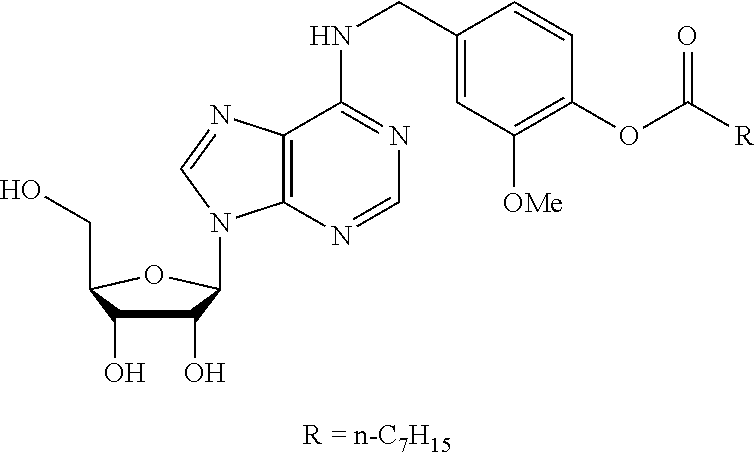


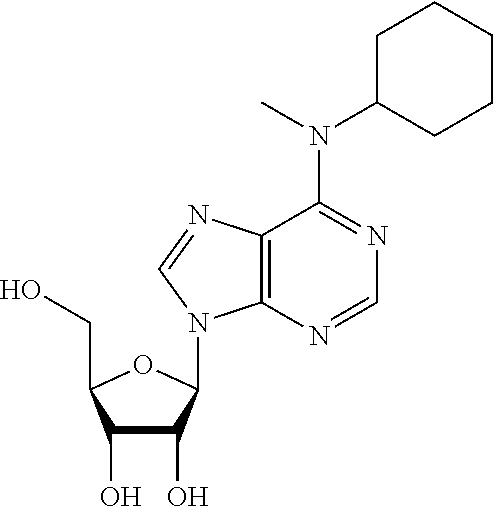


| TABLE 1 |
| Intraperitoneal administration of test compounds potentiated sodium |
| pentobarbital-induced sleep. |
| Dosage | Sleep | |
| Groups | (mg/kg) | rate (%) |
| control group | — | 0 |
| zolpidem | 2 | 75 |
| N6-(p-hydroxybenzyl)-adenosine | 1 | 63 |
| N6-(3-methxoy-4-hydroxybenzyl)-adenosine | 1 | 100 |
| N6-(3,4-dihydroxybenzyl)-adenosine | 1 | 87 |
| N6-(2-furanylmethyl)-adenosine | 5 | 71 |
| N6-(2-thiopheneylmethyl)-adenosine | 5 | 71 |
| N6-(p-trifluoromethyl)-adenosine | 5 | 57 |
| N6-(3,4-methylenedioxybenzyl)-adenosine | 5 | 100 |
| N6-(p-trifluoromethoxybenzyl)-adenosine | 5 | 43 |
| N6-(p-fluorobenzyl)-adenosine | 5 | 71 |
| N6-(4-phenyl-piperazinyl)-adenosine | 5 | 50 |
| N6-(4-hydroxy-3,5-dimethoxybenzyl)-adenosine | 5 | 86 |
| N6-(p-chlorobenzyl)-adenosine | 1 | 50 |
| N6-(p-nitrobenzyl)-adenosine | 1 | 63 |
| N6-(3-methoxy-4-hydroxybenzyl)-adenine | 1 | 38 |
| N6-(o-hydroxybenzyl)-adenosine | 1 | 88 |
| N6-(o-methoxybenzyl)-adenosine | 1 | 100 |
| N6-(m-aminobenzyl)-adenosine | 1 | 100 |
| N6-[(±)-1-(phenyl)-ethyl]-adenosine | 5 | 100 |
| N6-(3,4-dihydroxybenzyl)-adenosine | 5 | 100 |
| N6-(p-trifluoromethyl)-adenosine | 5 | 57 |
| N6-(3,4-methylenedioxybenzyl)-adenosine | 5 | 100 |
| N6-(p-trifluoromethoxybenzyl)-adenosine | 5 | 43 |
| N6-(p-fluorobenzyl)-adenosine | 5 | 71 |
| N-(6-adenosine)-(L)-tryptophan | 5 | 14 |
| N6-(4-hydroxy-3,5-dimethoxybenzyl)-adenosine | 5 | 86 |
| N-(6-adenosine)-5-hydroxy tryptophan | 5 | 17 |
| N-(6-adenosine)-(D)-phenylalanine | 5 | 17 |
| N-(6-adenosine)-(D)-tyrosine | 5 | 17 |
| N6-[(1H-indole-3-yl)-ethyl]-adenosine | 5 | 86 |
| N6-(2-thiopheneylmethyl)-adenosine | 5 | 29 |
| N-(6-adenosine)-(L)-serine | 5 | 29 |
| N-(6-adenosine)-(D)-serine | 5 | 14 |
| N6-[(1H-imidazole-4-yl)-ethyl]-adenosine | 1 | 88 |
| N6-[(3-hydroxy-4-methoxyphenyl)-ethyl]- | 1 | 50 |
| adenosine | ||
| N6-[(3-methoxy-4-hydroxyphenyl)-ethyl]- | 1 | 88 |
| adenosine | ||
| N6-(p-chlorobenzyl)-adenosine | 1 | 50 |
| N6-(p-nitrobenzyl)-adenosine | 1 | 63 |
| N6-(o-hydroxylbenzyl)-adenosine | 1 | 88 |
| N6-(3,4-dimethoxybenzyl)-adenosine | 1 | 100 |
| N6-(4-methoxy-3-hydroxybenzyl)-adenosine | 1 | 86 |
| N6-(o-nitrobenzyl)-adenosine | 1 | 100 |
| TABLE 2 |
| The effects of intraperitoneal administration of test |
| compounds on sodium pentobarbital-induced sleep time. |
| Sleep | ||
| Dosage | prolonging | |
| Groups | (mg/kg) | rate (%) |
| solvent control | ||
| N6-(m-methylbenzyl)-adenoisne | 1 | 84 |
| N6-(p-methylbenzyl)-adenosine | 1 | 51 |
| N6-(p-trifluoromethylbenzyl)-adenosine | 5 | 23 |
| N6-(p-fluorobenzyl)-adenosine | 5 | 73 |
| N6-(p-nitrobenzyl)-adenosine | 1 | 16 |
| N6-(m-aminobenzyl)-adenosine | 1 | 101 |
| N6-(p-aminobenzyl)-adenosine | 1 | 165 |
| N6-(p-trifluoromethoxybenzyl)-adenosine | 5 | 44 |
| N6-(3,4-dihydroxybenzyl)-adenosine | 5 | 32 |
| N6-(3,4-methylenedioxybenzyl)-adenosine | 5 | 175 |
| N6-(4-hydroxy-3,5-dimethoxybenzyl)-adenosine | 5 | 336 |
| N6-(3,4,5-trimethoxybenzyl)-adenosine | 1 | 112 |
| N6-(5-methyl-2-furanylmethyl)-adenosine | 5 | 7 |
| N6-(2-thiopheneylmethyl)-adenosine | 5 | 12 |
| N6-(4-phenylpiperazinyl)-adenosine | 5 | 34 |
| N6-[(±)-1-(phenyl)-ethyl]-adenosine | 5 | 254 |
| N6-[(3-hydroxy-4-methoxyphenyl)-ethyl]- | 1 | 1 |
| adenosine | ||
| N6-[(3-methoxy-4-hydroxyphenyl)-ethyl]- | 1 | 13 |
| adenosine | ||
| N6-[(3,4-dihydroxyphenyl)-ethyl]-adenosine | 1 | 98 |
| N6-[(1H-imidazole-4-yl)-ethyl]-adenosine | 1 | 43 |
| N6-[(1H-indole-3-yl)-ethyl]-adenosine | 5 | 147 |
| N-(6-adenosine)-(L)-proline | 5 | 29 |
| N-(6-adenosine)-(L)-serine | 5 | 15 |
| N-(6-adenosine)-(D)-serine | 5 | 0 |
| N-(6-adenosine)-(D)-phenylalanine | 5 | 19 |
| N-(6-adenosine)-(L)-phenylalanine | 5 | 44 |
| N-(6-adenosine)-(D)-tyrosine | 5 | 82 |
| N-(6-adenosine)-(L)-tyrosine | 5 | 66 |
| N-(6-adenosine)-(L)-tryptophan | 5 | 69 |
| N-(6-adenosine)-(D)-tryptophan | 5 | 89 |
| N-(6-adenosine)-5-hydroxy tryptophan | 5 | 60 |
| TABLE 3 |
| The effects of oral administration of test compounds on sodium |
| pentobarbital-induced sleep time. |
| Sleep | ||
| Dosage | prolongin | |
| Groups | (mg/kg) | g rate (%) |
| solvent control | ||
| N6-(3,4-dihydroxybenzyl)-adenosine | 4 | 74 |
| N6-(3-methoxy-4-hydroxybenzyl)-adenosine | 4 | 87 |
| N6-(p-hydroxybenzyl)-adenosine | 1 | 90 |
| N6-(m-aminobenzyl)-adenosine | 5 | 50 |
| N6-(p-aminobenzyl)-adenosine | 5 | 171 |
| N6-(m-methylbenzyl)-adenosine | 5 | 174 |
| N6-[(3,4-dihydroxyphenyl)-ethyl]-adenosine | 5 | 69 |
| N6-(diphenylmethyl)-adenosine | 5 | 16 |
| N6-[(±)-(6-methoxy-1,2,3,4-tetrahydro-naphthalene-1-yl)]-adenosine | 5 | 170 |
| N6-[(±)-hydroxy-1,2,3,4-tetrahydro-naphthalene-1-yl)]-adenosine | 5 | 39 |
| N6-[(±)-1-(cyclohexylphenyl)-methyl]-adenosine | 5 | 17 |
| N6-(fluorene-9-yl)-adenosine | 5 | 53 |
| N6-(3-methoxy-4-lauroyloxybenzyl)-2′,3′-O-isopropylidene- | 5 | 27 |
| adenosine-5′-laurate | ||
| N6-(3-methoxy-4-octanoyloxy-benzyl)-adenosine-5′-caprylate | 5 | 184 |
| N6-(3-methoxy-4-butanoyloxy-benzyl)-adenosine-5′-butyrate | 5 | 11 |
| N6-(3-methoxy-4-butanoyloxy-benzyl)-2′,3′-O-isopropylidene- | 5 | 21 |
| adenosine-5′-butyrate | ||
| N6-(3,4-methylenedioxy-benzyl)-2′,3′-O-isopropylidene- | 5 | 4 |
| adenosine-5′-caprylate | ||
| N6-(3,4-methylenedioxy-benzyl)-adenosine-5′-caprylate | 5 | 26 |
| N6-[(R)-1-(phenyl)-propyl]-adenosine-2′,3′-O-isopropylidene- | 5 | 18 |
| 5′-acetate | ||
| N6-(3-methoxy-4-butanoyloxy-benzyl)-adenosine | 5 | 11 |
| N6-[(R)-1-(4-methylphenyl)-ethyl]-adenosine | 5 | 99 |
| N6-[(S)-1-(4-methylphenyl)-ethyl]-adenosine | 5 | 19 |
| N6-[(S)-1-(3-methoxyphenyl)-ethyl]-adenosine | 5 | 39 |
| N6-[(R)-1-(3-methoxyphenyl)-ethyl]-adenosine | 5 | 160 |
| N6-[(±)-1-(4-hydroxyphenyl)-ethyl]-adenosine | 5 | 50 |
| N6-[(L)-2-(hydroxy)-1-(phenyl)-ethyl]-adenosine | 5 | 67 |
| N6-[(±)-1-(1,2-diphenyl)-ethyl]-adenosine | 5 | 36 |
| N6-[(±)-1-(phenyl)-propyl]-adenosine | 2.5 | 135 |
| N6-[(R)-1-(phenyl)-propyl]-adenosine | 2.5 | 183 |
| N6-[(S)-1-(phenyl)-propyl]-adenosine | 2.5 | 49 |
| N6-[(R)-1-(4-methoxyphenyl)-ethyl]-adenosine | 5 | 66 |
| N6-[(±)-1-(4-methoxyphenyl)-propyl]-adenosine | 2.5 | 86 |
| N6-[(±)-1-(4-aminophenyl)-ethyl]-adenosine | 2.5 | 132 |
| N6-[(±)-1-(phenyl)-butyl]-adenosine | 5 | 57 |
| N6-[(±)-1-(4-methoxyphenyl)-butyl]-adenosine | 5 | 80 |
| N6-(3-methoxy-4-hydroxy-benzyl)-3′,5′-diacetyl-2′-deoxyadenosine | 5 | 71 |
| N6-(p-methylbenzyl)-2′-deoxy-3′,5′-diacetyl adenosine | 5 | 9 |
| N6-(p-methylbenzyl)-2′-deoxyadenosine | 5 | 34 |
| N6-(3,4-methylenedioxy-benzyl)-3′,5′-diacetyl-2′-deoxyadenosine | 5 | 29 |
| N6-[(±)-1-(3,4,5-trimethoxyphenyl)-ethyl]-adenosine-5′-caprylate | 5 | 130 |
| N6-[(±)-1-(3,4,5-trimethoxyphenyl)-ethyl]-adenosine-5′-methoxy- | 5 | 76 |
| phenyl propionate | ||
| N-(6-adenosine)-(D)-phenylalanine methyl ester | 5 | 2 |
| N-(6-adenosine)-(D)-tyrosine ethyl ester | 5 | 32 |
| N-(6-adenosine)-(L)-tyrosine ethyl ester | 5 | 36 |
| N-(6-adenosine)-(L)-tryptophan ethyl ester | 5 | 7 |
| N-(6-adenosine)-(D)-tryptophan ethyl ester | 5 | 16 |
| N6-[(R)-1-(phenylpropyl)]-adenosine-2′,3′,5′-triacetate | 5 | 339 |
| N6-[(1S,2S)-2-(1,3-dihydroxy-1-phenyl)-propyl]-adenosine | 5 | 33 |
| N6-[(1R,2R)-2-(1,3-dihydroxy-1-phenyl)-propyl]-adenosine | 5 | 4 |
| N6-[2-(1,3-dihydroxy)-propyl]-adenosine | 5 | 184 |
| N6-[(L)-2-(1-hydroxy-3-methyl)-pentyl]-adenosine | 5 | 36 |
| N6-[(L)-2-(1-hydroxy-4-methylthioyl)-butyl]-adenosine | 5 | 53 |
| N6-{(1S,2R)-[2-hydroxy-(1,2-diphenyl)]-ethyl}-adenosine | 5 | 46 |
| N6-{(1R,2S)-[2-hydroxy-(1,2-diphenyl)]-ethyl}-adenosine | 5 | 38 |
| N6-methyl-N6-[2-(1S,2R)-(1-hydroxy-1-phenyl)-propyl]-adenosine | 5 | 39 |
| N6-methyl-N6-[(±)-2-(1-hydroxy-1-phenyl)-propyl]-adenosine | 5 | 92 |
| N6-[(R)-1-(phenyl)-propyl]-adenine | 5 | 42 |
| N6-[(R)-1-(phenyl)-ethyl]-adenine | 5 | 21 |
| N6-[(R)-1-(phenyl)-propyl]-N9-(tetrahydrofuran-2-yl)-adenine | 5 | 2 |
| N6-[(S)-1-(phenylpropyl)]-adenosine-2′,3′,5′-triacetate | 5 | 41 |
| N6-[(±)-1-(3,4,5-trimethoxyphenyl)-ethyl]-adenosine-5′- | 5 | 2 |
| decanoic ether | ||
| N6-[(S)-1-(phenyl)-propyl]-adenosine-5′-decanoic ether | 5 | 4 |
| N6-[(S)-1-(phenyl)-propyl]-adenosine-5′-propyl ether | 5 | 4 |
| N6-(3,4-methylenedioxy-benzyl)-adenosine-5′-propyl ether | 5 | 36 |
| N6-[(R)-1-(phenyl)-propyl]-adenosine-5′-o-nitrophenyl ether | 5 | 87 |
| N6-[(R)-1-(phenyl)-propyl]-adenosine-5′-propyl ether | 5 | 318 |
| N6-[(±)-1-(3,4,5-trimethoxyphenyl)-ethyl]-2′-deoxyadenosine | 5 | 9 |
| N6-[(S)-1-(phenyl)-propyl)]-adenosine-5′-acetate | 5 | 24 |
| N6-[(S)-1-(phenyl)-propyl]-adenosine-5′-methyl-cinnamate | 5 | 50 |
| N6-[(R)-1-(phenylpropyl)]-adenosine-5′-acetate | 5 | 590 |
| N6-[(±)-1-(3,4,5-trimethoxyphenyl) ethyl]-adenosine-5′-propyl ether | 5 | 14 |
| N6-(4-hydroxy-3,5-dimethoxybenzyl)-adenosine | 5 | 121 |
| N6-[(1H-indole-3-yl)-ethyl]-adenosine | 5 | 78 |
| N6-(m-methylbenzyl)-adenosine | 5 | 136 |
| N6-[(±)-1-(phenyl)-ethyl]-adenosine | 5 | 201 |
| N6-methyl-N6-benzyl-adenosine | 5 | 27 |
| N6-ethyl-N6-benzyl-adenosine | 5 | 7 |
| N6-ethyl-N6-(2-hydroxyethyl)-adenosine | 5 | 5 |
| N6, N6-Bis(2-hydroxypropyl)-adenosine | 5 | 5 |
| N6-methyl-N6-cyclohexyl-adenosine | 5 | 55 |
| N6-[(R)-1-(4-chlorophenyl)-ethyl]-adenosine | 5 | 103 |
| N6-[(S)-1-(4-chlorophenyl)-ethyl]-adenosine | 5 | 33 |
| N6-[(R)-1-(4-fluorophenyl)-ethyl]-adenosine | 5 | 136 |
| N6-[(S)-1-(4-fluorophenyl)-ethyl]-adenosine | 5 | 24 |
| N6-(2-hydroxyethyl)-N6-benzyl-adenosine | 5 | 18 |
| N6-methyl-N6-[2-(1R,2R)-(1-hydroxy-1-phenyl)-propyl]-adenosine | 5 | 44 |
| N6-[(R)-1-(phenyl)-butyl]-adenosine | 5 | 163 |
| N6-[(±)-1-(3-methoxy-4-hydroxy-phenyl)-ethyl]-adenosine | 5 | 119 |
| N6-(p-nitrobenzyl)-adenosine | 5 | 29 |
| N6-(o-hydroxylbenzyl)-adenosine | 5 | 92 |
Claims (6)
Applications Claiming Priority (1)
| Application Number | Priority Date | Filing Date | Title |
|---|---|---|---|
| PCT/CN2009/075478 WO2011069294A1 (en) | 2009-12-10 | 2009-12-10 | N6-substituted adenosine derivatives, n6-substituted adenine derivatives and uses thereof |
Publications (2)
| Publication Number | Publication Date |
|---|---|
| US20130045942A1 US20130045942A1 (en) | 2013-02-21 |
| US10174033B2 true US10174033B2 (en) | 2019-01-08 |
Family
ID=44145091
Family Applications (1)
| Application Number | Title | Priority Date | Filing Date |
|---|---|---|---|
| US13/515,152 Expired - Fee Related US10174033B2 (en) | 2009-12-10 | 2009-12-10 | N6-substituted adenosine derivatives and N6-substituted adenine derivatives and uses thereof |
Country Status (6)
| Country | Link |
|---|---|
| US (1) | US10174033B2 (en) |
| EP (1) | EP2511283A4 (en) |
| JP (1) | JP2013513551A (en) |
| CN (1) | CN102812033B (en) |
| CA (1) | CA2783859A1 (en) |
| WO (1) | WO2011069294A1 (en) |
Cited By (1)
| Publication number | Priority date | Publication date | Assignee | Title |
|---|---|---|---|---|
| WO2024196760A1 (en) * | 2023-03-17 | 2024-09-26 | Academia Sinica | Method of treating tuberous sclerosis complex or epilepsy and composition for use therein |
Families Citing this family (29)
| Publication number | Priority date | Publication date | Assignee | Title |
|---|---|---|---|---|
| KR101763656B1 (en) | 2009-06-29 | 2017-08-01 | 인사이트 홀딩스 코포레이션 | Pyrimidinones as pi3k inhibitors |
| US8759359B2 (en) | 2009-12-18 | 2014-06-24 | Incyte Corporation | Substituted heteroaryl fused derivatives as PI3K inhibitors |
| EP2558463A1 (en) | 2010-04-14 | 2013-02-20 | Incyte Corporation | Fused derivatives as i3 inhibitors |
| WO2011163195A1 (en) | 2010-06-21 | 2011-12-29 | Incyte Corporation | Fused pyrrole derivatives as pi3k inhibitors |
| EP3660016A1 (en) | 2010-12-20 | 2020-06-03 | Incyte Holdings Corporation | N-(1-(substituted-phenyl)ethyl)-9h-purin-6-amines as pi3k inhibitors |
| US9108984B2 (en) | 2011-03-14 | 2015-08-18 | Incyte Corporation | Substituted diamino-pyrimidine and diamino-pyridine derivatives as PI3K inhibitors |
| WO2012135009A1 (en) | 2011-03-25 | 2012-10-04 | Incyte Corporation | Pyrimidine-4,6-diamine derivatives as pi3k inhibitors |
| PT3513793T (en) | 2011-09-02 | 2021-05-10 | Incyte Holdings Corp | Heterocyclylamines as pi3k inhibitors |
| CN104363757B (en) * | 2012-02-11 | 2017-05-24 | 中央研究院 | Methods and compositions for treating pain |
| AR090548A1 (en) | 2012-04-02 | 2014-11-19 | Incyte Corp | BICYCLIC AZAHETEROCICLOBENCILAMINS AS PI3K INHIBITORS |
| WO2014124458A1 (en) * | 2013-02-11 | 2014-08-14 | The Regents Of The University Of California | Compositions and methods for treating neurodegenerative diseases |
| CN104173363B (en) * | 2013-05-28 | 2019-12-13 | 中国医学科学院药物研究所 | Use of an adenosine compound in the preparation of drugs for preventing and treating stress disorders |
| US10301348B2 (en) * | 2013-10-23 | 2019-05-28 | Academia Sinica | Compounds for use in prevention and treatment of neurodegenerative diseases and pain |
| ES2919024T3 (en) | 2014-02-11 | 2022-07-21 | Mitokinin Inc | Compositions and procedures using the same for the treatment of neurodegenerative and mitochondrial diseases |
| WO2015191677A1 (en) | 2014-06-11 | 2015-12-17 | Incyte Corporation | Bicyclic heteroarylaminoalkyl phenyl derivatives as pi3k inhibitors |
| US20160024135A1 (en) * | 2014-07-27 | 2016-01-28 | Zhejiang Subtropical Crops Research Institute | Adenosine receptor activation reagent and the uses of thereof |
| TWI668007B (en) * | 2014-11-11 | 2019-08-11 | 中央研究院 | Compounds for use in prevention and treatment of neurodegenerative diseases and pain |
| TWI650328B (en) * | 2014-11-11 | 2019-02-11 | 中央研究院 | Compounds for use in prevention and treatment of neurodegenerative diseases and pain |
| CZ308881B6 (en) * | 2014-12-09 | 2021-08-04 | Univerzita Palackého v Olomouci | 6-aryl-9-glycosylpurines and their use |
| SG10201907576SA (en) | 2015-02-27 | 2019-09-27 | Incyte Corp | Salts of pi3k inhibitor and processes for their preparation |
| US9732097B2 (en) | 2015-05-11 | 2017-08-15 | Incyte Corporation | Process for the synthesis of a phosphoinositide 3-kinase inhibitor |
| US9988401B2 (en) | 2015-05-11 | 2018-06-05 | Incyte Corporation | Crystalline forms of a PI3K inhibitor |
| US11753432B2 (en) | 2017-01-27 | 2023-09-12 | Academia Sinica | Compound with analgesic effect for use in prevention and treatment of pain |
| AU2018290225A1 (en) | 2017-06-21 | 2020-01-23 | Mitokinin, Inc. | Compositions and methods using the same for treatment of neurodegenerative and mitochondrial disease |
| SG11202011680YA (en) | 2018-06-01 | 2020-12-30 | Incyte Corp | Dosing regimen for the treatment of pi3k related disorders |
| WO2022204770A1 (en) * | 2021-04-01 | 2022-10-06 | Nallar Jaime Alberto Rabi | Antiviral compounds, methods for the manufacturing of compounds, antiviral pharmaceutical composition, use of the compounds and method for the oral treatment of coronavirus infection and related diseases thereof |
| GB202218917D0 (en) * | 2022-12-15 | 2023-02-01 | Univ College Cardiff Consultants Ltd | Nucleoside analogue compounds |
| CN117338801B (en) * | 2023-11-13 | 2024-06-21 | 河北医科大学 | Application of N6-substituted adenosine derivative or N6-substituted purine derivative in preparation of medicine for relieving peri-operative neuroinflammation |
| CN119798352B (en) * | 2024-01-15 | 2025-11-11 | 中国医学科学院药物研究所 | Crystal form of compound YZG-331 and preparation method thereof |
Citations (7)
| Publication number | Priority date | Publication date | Assignee | Title |
|---|---|---|---|---|
| US3502649A (en) * | 1966-05-07 | 1970-03-24 | Boehringer Mannheim Gmbh | N(6) substituted adenosine derivatives |
| EP0179630A2 (en) * | 1984-10-26 | 1986-04-30 | Warner-Lambert Company | N6-acenaphthyl adenosines and analogs thereof |
| WO2002018404A2 (en) | 2000-08-30 | 2002-03-07 | F. Hoffmann-La Roche Ag | Nucleoside derivatives for the treatment of hepatitis c |
| WO2004058791A2 (en) | 2002-12-30 | 2004-07-15 | Ustav Experimentalni Botaniky Akademie Ved Ceske Republiky | Substitution derivatives of n6-benzyladenosine, methods of their preparation, their use for preparation of drugs, cosmetic preparations and growth regulators, pharmaceutical preparations, cosmetic preparations and growth regulators containing these compounds |
| US20050153989A1 (en) * | 2004-01-13 | 2005-07-14 | Ambit Biosciences Corporation | Pyrrolopyrimidine derivatives and analogs and their use in the treatment and prevention of diseases |
| CN1217952C (en) | 1997-11-08 | 2005-09-07 | 葛兰素集团有限公司 | compound |
| US20120295863A1 (en) | 2009-11-13 | 2012-11-22 | Yun-Lian Lin | Dual-Action Compounds Targeting Adenosine A2A Receptor and Adenosine Transporter for Prevention and Treatment of Neurodegenerative Diseases |
Family Cites Families (3)
| Publication number | Priority date | Publication date | Assignee | Title |
|---|---|---|---|---|
| NL130136C (en) * | 1966-10-20 | |||
| DE1962387C2 (en) * | 1969-12-12 | 1983-08-25 | Schering AG, 1000 Berlin und 4709 Bergkamen | N → 6 → - (3-chlorobutene (2) -yl) adenosine |
| US20080221060A1 (en) * | 2004-03-05 | 2008-09-11 | Martyn Pritchard | Therapeutic Compounds |
-
2009
- 2009-12-10 CN CN200980162826.5A patent/CN102812033B/en active Active
- 2009-12-10 WO PCT/CN2009/075478 patent/WO2011069294A1/en not_active Ceased
- 2009-12-10 US US13/515,152 patent/US10174033B2/en not_active Expired - Fee Related
- 2009-12-10 EP EP09851974.7A patent/EP2511283A4/en not_active Withdrawn
- 2009-12-10 CA CA2783859A patent/CA2783859A1/en not_active Abandoned
- 2009-12-10 JP JP2012542331A patent/JP2013513551A/en active Pending
Patent Citations (7)
| Publication number | Priority date | Publication date | Assignee | Title |
|---|---|---|---|---|
| US3502649A (en) * | 1966-05-07 | 1970-03-24 | Boehringer Mannheim Gmbh | N(6) substituted adenosine derivatives |
| EP0179630A2 (en) * | 1984-10-26 | 1986-04-30 | Warner-Lambert Company | N6-acenaphthyl adenosines and analogs thereof |
| CN1217952C (en) | 1997-11-08 | 2005-09-07 | 葛兰素集团有限公司 | compound |
| WO2002018404A2 (en) | 2000-08-30 | 2002-03-07 | F. Hoffmann-La Roche Ag | Nucleoside derivatives for the treatment of hepatitis c |
| WO2004058791A2 (en) | 2002-12-30 | 2004-07-15 | Ustav Experimentalni Botaniky Akademie Ved Ceske Republiky | Substitution derivatives of n6-benzyladenosine, methods of their preparation, their use for preparation of drugs, cosmetic preparations and growth regulators, pharmaceutical preparations, cosmetic preparations and growth regulators containing these compounds |
| US20050153989A1 (en) * | 2004-01-13 | 2005-07-14 | Ambit Biosciences Corporation | Pyrrolopyrimidine derivatives and analogs and their use in the treatment and prevention of diseases |
| US20120295863A1 (en) | 2009-11-13 | 2012-11-22 | Yun-Lian Lin | Dual-Action Compounds Targeting Adenosine A2A Receptor and Adenosine Transporter for Prevention and Treatment of Neurodegenerative Diseases |
Non-Patent Citations (9)
| Title |
|---|
| Dolezal, K. et al., "Preparation, biological activity and endogenous occurrence of N6-benzyladenosines" Bioorganic & Medicinal Chemistry (2007) pp. 3737-3747, vol. 15. |
| Gao, Z. G., Blaustein, J. B., Gross, A. S., Melman, N., & Jacobson, K. A. (2003). N 6-Substituted adenosine derivatives: selectivity, efficacy, and species differences at A 3 adenosine receptors. Biochemical pharmacology, 65(10), 1675-1684. * |
| Huang, N.K., et al., "Neuroprotective Principles from Gastrodia elata" J. Nat. Prod. (2007) pp. 571-574, vol. 70. |
| International Search Report dated Oct. 8, 2012, issued in International Application No. PCT/CN2009/075478. |
| Koszalka, G. W., Averett, D. R., Fyfe, J. A., Roberts, G. B., Spector, T. H. O. M. A. S., Biron, K. A. R. E. N., & Krenitsky, T. A. (1991). 6-N-substituted derivatives of adenine arabinoside as selective inhibitors of varicella-zoster virus. Antimicrobial agents and chemotherapy, 35(7), 1437-1443. * |
| Kusachi S et al. "Dog coronary artery adenosine receptor: structure of the N6-aryl subregion" J Med Chem. Jun. 1986;29(6):989-96. |
| Kwatra, M.M. et al., "N6-phenyladenosines: Pronounced Effect of Phenyl Substituents on Affinity for A2 Adenosine Receptors" Journal of Med. Chem. (May 1987) pp. 954-956, vol. 30, No. 5. |
| PubChem record for 1-phenyl-1-aminopropane and 1-phenyl-1-aminobutane, retrieved from https://pubchem.ncbi.nlm.nih.gov/compound on Apr. 12, 2107. * |
| Ukena, D., Olsson, R. A., & Daly, J. W. (1987). Definition of subclasses of adenosine receptors associated with adenylate cyclase: interaction of adenosine analogs with inhibitory A1 receptors and stimulatory A2 receptors. Canadian journal of physiology and pharmacology. * |
Cited By (1)
| Publication number | Priority date | Publication date | Assignee | Title |
|---|---|---|---|---|
| WO2024196760A1 (en) * | 2023-03-17 | 2024-09-26 | Academia Sinica | Method of treating tuberous sclerosis complex or epilepsy and composition for use therein |
Also Published As
| Publication number | Publication date |
|---|---|
| CN102812033B (en) | 2015-11-25 |
| US20130045942A1 (en) | 2013-02-21 |
| EP2511283A1 (en) | 2012-10-17 |
| CA2783859A1 (en) | 2011-06-16 |
| JP2013513551A (en) | 2013-04-22 |
| CN102812033A (en) | 2012-12-05 |
| WO2011069294A1 (en) | 2011-06-16 |
| EP2511283A4 (en) | 2013-07-03 |
Similar Documents
| Publication | Publication Date | Title |
|---|---|---|
| US10174033B2 (en) | N6-substituted adenosine derivatives and N6-substituted adenine derivatives and uses thereof | |
| KR0160768B1 (en) | Pharmaceutical compositions containing 8-substituted xantrines | |
| US9498481B2 (en) | Cyclopropyl modulators of P2Y12 receptor | |
| FI66867C (en) | PHARMACEUTICAL FORM OF PHARMACOLOGICAL ACTIVE 3-ALKYLXANTINER | |
| KR20090101278A (en) | Azetidine analogs of nucleosidase and phosphorylase inhibitors | |
| CN104395319A (en) | Thienopyridone derivatives useful as activators of AMPK | |
| EP0117779B1 (en) | Pyridazine derivatives active on the central nervous system, their process of preparation and medicines containing them | |
| JPS63239294A (en) | Novel adenosine derivative and medicinal composition containing said compound as active ingredient | |
| CZ286621B6 (en) | Tromethamine salt of (+)-(S)-2-(3-benzoylphenyl)propionic acid, process of its preparation and pharmaceutical preparation containing thereof | |
| JPH0680061B2 (en) | Novel purine derivative | |
| EP0402752B1 (en) | N-heteroaryl-purin-6-amines, a process for their preparation and their use as medicaments | |
| US20060293343A1 (en) | Pyrimidine derivatives | |
| JP2760364B2 (en) | 9-substituted-8-unsubstituted-9-deazaguanines | |
| US20200172529A1 (en) | Chemical Compound, Pharmaceutical Composition Thereof, and Use and Application Thereof | |
| CN115052588B (en) | Prodrugs of itaconate esters and methyl itaconate | |
| EP1525205A2 (en) | Novel substituted pyrazolo( 1,5-a /i ]-1,3,5-triazine derivatives and their analogues, pharmaceutical compositions containing same, use thereof as medicine and methods for preparing same | |
| JPS59501112A (en) | New derivative of guanine 1 | |
| CN101602786A (en) | N 6-substituted adenosines derivative, its method for making and pharmaceutical composition and purposes | |
| CN104382924B (en) | N6 substituted adenosines derivative and N6 substituted adenines derivatives and application thereof | |
| FR2476071A1 (en) | NOVEL 2-AMINO-3- (A-HYDROXYBENZYL) -PHENYLACETIC ACIDS AND THEIR ESTERS AND AMIDES, PARTICULARLY USEFUL AS ANTI-INFLAMMATORY AGENTS, AND PHARMACEUTICAL COMPOSITIONS CONTAINING SAME | |
| MC1845A1 (en) | PYRIMIDINE DERIVATIVES | |
| US20230144283A1 (en) | 8-substituted diaryl xanthines as dual a2a-a2b antagonists | |
| US20160022675A1 (en) | Processes for preparing tetrahydroisoquinolines | |
| JPS59501113A (en) | New derivative of guanine 2 | |
| US6458792B1 (en) | Compounds |
Legal Events
| Date | Code | Title | Description |
|---|---|---|---|
| AS | Assignment |
Owner name: INSTITUTE OF MATARIA MEDICA, CHINESE ACADEMY OF ME Free format text: ASSIGNMENT OF ASSIGNORS INTEREST;ASSIGNORS:SHI, JIANGONG;ZHANG, JIANJUN;YUE, ZHENGGANG;AND OTHERS;SIGNING DATES FROM 20120918 TO 20120919;REEL/FRAME:029004/0765 |
|
| STCF | Information on status: patent grant |
Free format text: PATENTED CASE |
|
| FEPP | Fee payment procedure |
Free format text: MAINTENANCE FEE REMINDER MAILED (ORIGINAL EVENT CODE: REM.); ENTITY STATUS OF PATENT OWNER: SMALL ENTITY |
|
| LAPS | Lapse for failure to pay maintenance fees |
Free format text: PATENT EXPIRED FOR FAILURE TO PAY MAINTENANCE FEES (ORIGINAL EVENT CODE: EXP.); ENTITY STATUS OF PATENT OWNER: SMALL ENTITY |
|
| STCH | Information on status: patent discontinuation |
Free format text: PATENT EXPIRED DUE TO NONPAYMENT OF MAINTENANCE FEES UNDER 37 CFR 1.362 |
|
| FP | Lapsed due to failure to pay maintenance fee |
Effective date: 20230108 |