US10167439B2 - Ultraviolet curable resin composition and sliding member - Google Patents

Ultraviolet curable resin composition and sliding member Download PDF

Info

Publication number
US10167439B2
US10167439B2 US15/609,794 US201715609794A US10167439B2 US 10167439 B2 US10167439 B2 US 10167439B2 US 201715609794 A US201715609794 A US 201715609794A US 10167439 B2 US10167439 B2 US 10167439B2
Authority
US
United States
Prior art keywords
resin composition
meth
acrylate
ultraviolet curable
curable resin
Prior art date
Legal status (The legal status is an assumption and is not a legal conclusion. Google has not performed a legal analysis and makes no representation as to the accuracy of the status listed.)
Active
Application number
US15/609,794
Other versions
US20170349851A1 (en
Inventor
Hirotaka TOHYAMA
Tadahiko KARAKI
Yuko Taguchi
Kentaro Ishikawa
Current Assignee (The listed assignees may be inaccurate. Google has not performed a legal analysis and makes no representation or warranty as to the accuracy of the list.)
MinebeaMitsumi Inc
Original Assignee
MinebeaMitsumi Inc
Priority date (The priority date is an assumption and is not a legal conclusion. Google has not performed a legal analysis and makes no representation as to the accuracy of the date listed.)
Filing date
Publication date
Priority claimed from JP2017015115A external-priority patent/JP6886302B2/en
Application filed by MinebeaMitsumi Inc filed Critical MinebeaMitsumi Inc
Assigned to MINEBEA MITSUMI INC. reassignment MINEBEA MITSUMI INC. ASSIGNMENT OF ASSIGNORS INTEREST (SEE DOCUMENT FOR DETAILS). Assignors: TAGUCHI, YUKO, ISHIKAWA, KENTARO, KARAKI, TADAHIKO, Tohyama, Hirotaka
Publication of US20170349851A1 publication Critical patent/US20170349851A1/en
Application granted granted Critical
Publication of US10167439B2 publication Critical patent/US10167439B2/en
Active legal-status Critical Current
Anticipated expiration legal-status Critical

Links

Images

Classifications

    • CCHEMISTRY; METALLURGY
    • C10PETROLEUM, GAS OR COKE INDUSTRIES; TECHNICAL GASES CONTAINING CARBON MONOXIDE; FUELS; LUBRICANTS; PEAT
    • C10MLUBRICATING COMPOSITIONS; USE OF CHEMICAL SUBSTANCES EITHER ALONE OR AS LUBRICATING INGREDIENTS IN A LUBRICATING COMPOSITION
    • C10M107/00Lubricating compositions characterised by the base-material being a macromolecular compound
    • C10M107/38Lubricating compositions characterised by the base-material being a macromolecular compound containing halogen
    • CCHEMISTRY; METALLURGY
    • C08ORGANIC MACROMOLECULAR COMPOUNDS; THEIR PREPARATION OR CHEMICAL WORKING-UP; COMPOSITIONS BASED THEREON
    • C08FMACROMOLECULAR COMPOUNDS OBTAINED BY REACTIONS ONLY INVOLVING CARBON-TO-CARBON UNSATURATED BONDS
    • C08F220/00Copolymers of compounds having one or more unsaturated aliphatic radicals, each having only one carbon-to-carbon double bond, and only one being terminated by only one carboxyl radical or a salt, anhydride ester, amide, imide or nitrile thereof
    • C08F220/02Monocarboxylic acids having less than ten carbon atoms; Derivatives thereof
    • C08F220/10Esters
    • C08F220/20Esters of polyhydric alcohols or phenols, e.g. 2-hydroxyethyl (meth)acrylate or glycerol mono-(meth)acrylate
    • CCHEMISTRY; METALLURGY
    • C08ORGANIC MACROMOLECULAR COMPOUNDS; THEIR PREPARATION OR CHEMICAL WORKING-UP; COMPOSITIONS BASED THEREON
    • C08FMACROMOLECULAR COMPOUNDS OBTAINED BY REACTIONS ONLY INVOLVING CARBON-TO-CARBON UNSATURATED BONDS
    • C08F220/00Copolymers of compounds having one or more unsaturated aliphatic radicals, each having only one carbon-to-carbon double bond, and only one being terminated by only one carboxyl radical or a salt, anhydride ester, amide, imide or nitrile thereof
    • C08F220/02Monocarboxylic acids having less than ten carbon atoms; Derivatives thereof
    • C08F220/10Esters
    • C08F220/26Esters containing oxygen in addition to the carboxy oxygen
    • C08F220/32Esters containing oxygen in addition to the carboxy oxygen containing epoxy radicals
    • CCHEMISTRY; METALLURGY
    • C08ORGANIC MACROMOLECULAR COMPOUNDS; THEIR PREPARATION OR CHEMICAL WORKING-UP; COMPOSITIONS BASED THEREON
    • C08FMACROMOLECULAR COMPOUNDS OBTAINED BY REACTIONS ONLY INVOLVING CARBON-TO-CARBON UNSATURATED BONDS
    • C08F220/00Copolymers of compounds having one or more unsaturated aliphatic radicals, each having only one carbon-to-carbon double bond, and only one being terminated by only one carboxyl radical or a salt, anhydride ester, amide, imide or nitrile thereof
    • C08F220/02Monocarboxylic acids having less than ten carbon atoms; Derivatives thereof
    • C08F220/10Esters
    • C08F220/26Esters containing oxygen in addition to the carboxy oxygen
    • C08F220/32Esters containing oxygen in addition to the carboxy oxygen containing epoxy radicals
    • C08F220/325Esters containing oxygen in addition to the carboxy oxygen containing epoxy radicals containing glycidyl radical, e.g. glycidyl (meth)acrylate
    • CCHEMISTRY; METALLURGY
    • C08ORGANIC MACROMOLECULAR COMPOUNDS; THEIR PREPARATION OR CHEMICAL WORKING-UP; COMPOSITIONS BASED THEREON
    • C08FMACROMOLECULAR COMPOUNDS OBTAINED BY REACTIONS ONLY INVOLVING CARBON-TO-CARBON UNSATURATED BONDS
    • C08F222/00Copolymers of compounds having one or more unsaturated aliphatic radicals, each having only one carbon-to-carbon double bond, and at least one being terminated by a carboxyl radical and containing at least one other carboxyl radical in the molecule; Salts, anhydrides, esters, amides, imides, or nitriles thereof
    • C08F222/10Esters
    • C08F222/1006Esters of polyhydric alcohols or polyhydric phenols
    • CCHEMISTRY; METALLURGY
    • C08ORGANIC MACROMOLECULAR COMPOUNDS; THEIR PREPARATION OR CHEMICAL WORKING-UP; COMPOSITIONS BASED THEREON
    • C08FMACROMOLECULAR COMPOUNDS OBTAINED BY REACTIONS ONLY INVOLVING CARBON-TO-CARBON UNSATURATED BONDS
    • C08F222/00Copolymers of compounds having one or more unsaturated aliphatic radicals, each having only one carbon-to-carbon double bond, and at least one being terminated by a carboxyl radical and containing at least one other carboxyl radical in the molecule; Salts, anhydrides, esters, amides, imides, or nitriles thereof
    • C08F222/10Esters
    • C08F222/1006Esters of polyhydric alcohols or polyhydric phenols
    • C08F222/103Esters of polyhydric alcohols or polyhydric phenols of trialcohols, e.g. trimethylolpropane tri(meth)acrylate
    • CCHEMISTRY; METALLURGY
    • C08ORGANIC MACROMOLECULAR COMPOUNDS; THEIR PREPARATION OR CHEMICAL WORKING-UP; COMPOSITIONS BASED THEREON
    • C08FMACROMOLECULAR COMPOUNDS OBTAINED BY REACTIONS ONLY INVOLVING CARBON-TO-CARBON UNSATURATED BONDS
    • C08F230/00Copolymers of compounds having one or more unsaturated aliphatic radicals, each having only one carbon-to-carbon double bond, and containing phosphorus, selenium, tellurium or a metal
    • C08F230/02Copolymers of compounds having one or more unsaturated aliphatic radicals, each having only one carbon-to-carbon double bond, and containing phosphorus, selenium, tellurium or a metal containing phosphorus
    • CCHEMISTRY; METALLURGY
    • C08ORGANIC MACROMOLECULAR COMPOUNDS; THEIR PREPARATION OR CHEMICAL WORKING-UP; COMPOSITIONS BASED THEREON
    • C08FMACROMOLECULAR COMPOUNDS OBTAINED BY REACTIONS ONLY INVOLVING CARBON-TO-CARBON UNSATURATED BONDS
    • C08F259/00Macromolecular compounds obtained by polymerising monomers on to polymers of halogen containing monomers as defined in group C08F14/00
    • C08F259/08Macromolecular compounds obtained by polymerising monomers on to polymers of halogen containing monomers as defined in group C08F14/00 on to polymers containing fluorine
    • CCHEMISTRY; METALLURGY
    • C08ORGANIC MACROMOLECULAR COMPOUNDS; THEIR PREPARATION OR CHEMICAL WORKING-UP; COMPOSITIONS BASED THEREON
    • C08KUse of inorganic or non-macromolecular organic substances as compounding ingredients
    • C08K7/00Use of ingredients characterised by shape
    • C08K7/02Fibres or whiskers
    • C08K7/04Fibres or whiskers inorganic
    • C08K7/14Glass
    • CCHEMISTRY; METALLURGY
    • C08ORGANIC MACROMOLECULAR COMPOUNDS; THEIR PREPARATION OR CHEMICAL WORKING-UP; COMPOSITIONS BASED THEREON
    • C08LCOMPOSITIONS OF MACROMOLECULAR COMPOUNDS
    • C08L27/00Compositions of homopolymers or copolymers of compounds having one or more unsaturated aliphatic radicals, each having only one carbon-to-carbon double bond, and at least one being terminated by a halogen; Compositions of derivatives of such polymers
    • C08L27/02Compositions of homopolymers or copolymers of compounds having one or more unsaturated aliphatic radicals, each having only one carbon-to-carbon double bond, and at least one being terminated by a halogen; Compositions of derivatives of such polymers not modified by chemical after-treatment
    • C08L27/12Compositions of homopolymers or copolymers of compounds having one or more unsaturated aliphatic radicals, each having only one carbon-to-carbon double bond, and at least one being terminated by a halogen; Compositions of derivatives of such polymers not modified by chemical after-treatment containing fluorine atoms
    • C08L27/18Homopolymers or copolymers or tetrafluoroethene
    • CCHEMISTRY; METALLURGY
    • C08ORGANIC MACROMOLECULAR COMPOUNDS; THEIR PREPARATION OR CHEMICAL WORKING-UP; COMPOSITIONS BASED THEREON
    • C08LCOMPOSITIONS OF MACROMOLECULAR COMPOUNDS
    • C08L33/00Compositions of homopolymers or copolymers of compounds having one or more unsaturated aliphatic radicals, each having only one carbon-to-carbon double bond, and only one being terminated by only one carboxyl radical, or of salts, anhydrides, esters, amides, imides or nitriles thereof; Compositions of derivatives of such polymers
    • C08L33/04Homopolymers or copolymers of esters
    • C08L33/14Homopolymers or copolymers of esters of esters containing halogen, nitrogen, sulfur, or oxygen atoms in addition to the carboxy oxygen
    • CCHEMISTRY; METALLURGY
    • C08ORGANIC MACROMOLECULAR COMPOUNDS; THEIR PREPARATION OR CHEMICAL WORKING-UP; COMPOSITIONS BASED THEREON
    • C08LCOMPOSITIONS OF MACROMOLECULAR COMPOUNDS
    • C08L35/00Compositions of homopolymers or copolymers of compounds having one or more unsaturated aliphatic radicals, each having only one carbon-to-carbon double bond, and at least one being terminated by a carboxyl radical, and containing at least one other carboxyl radical in the molecule, or of salts, anhydrides, esters, amides, imides or nitriles thereof; Compositions of derivatives of such polymers
    • C08L35/02Homopolymers or copolymers of esters
    • CCHEMISTRY; METALLURGY
    • C09DYES; PAINTS; POLISHES; NATURAL RESINS; ADHESIVES; COMPOSITIONS NOT OTHERWISE PROVIDED FOR; APPLICATIONS OF MATERIALS NOT OTHERWISE PROVIDED FOR
    • C09DCOATING COMPOSITIONS, e.g. PAINTS, VARNISHES OR LACQUERS; FILLING PASTES; CHEMICAL PAINT OR INK REMOVERS; INKS; CORRECTING FLUIDS; WOODSTAINS; PASTES OR SOLIDS FOR COLOURING OR PRINTING; USE OF MATERIALS THEREFOR
    • C09D127/00Coating compositions based on homopolymers or copolymers of compounds having one or more unsaturated aliphatic radicals, each having only one carbon-to-carbon double bond, and at least one being terminated by a halogen; Coating compositions based on derivatives of such polymers
    • C09D127/02Coating compositions based on homopolymers or copolymers of compounds having one or more unsaturated aliphatic radicals, each having only one carbon-to-carbon double bond, and at least one being terminated by a halogen; Coating compositions based on derivatives of such polymers not modified by chemical after-treatment
    • C09D127/12Coating compositions based on homopolymers or copolymers of compounds having one or more unsaturated aliphatic radicals, each having only one carbon-to-carbon double bond, and at least one being terminated by a halogen; Coating compositions based on derivatives of such polymers not modified by chemical after-treatment containing fluorine atoms
    • C09D127/18Homopolymers or copolymers of tetrafluoroethene
    • CCHEMISTRY; METALLURGY
    • C09DYES; PAINTS; POLISHES; NATURAL RESINS; ADHESIVES; COMPOSITIONS NOT OTHERWISE PROVIDED FOR; APPLICATIONS OF MATERIALS NOT OTHERWISE PROVIDED FOR
    • C09DCOATING COMPOSITIONS, e.g. PAINTS, VARNISHES OR LACQUERS; FILLING PASTES; CHEMICAL PAINT OR INK REMOVERS; INKS; CORRECTING FLUIDS; WOODSTAINS; PASTES OR SOLIDS FOR COLOURING OR PRINTING; USE OF MATERIALS THEREFOR
    • C09D4/00Coating compositions, e.g. paints, varnishes or lacquers, based on organic non-macromolecular compounds having at least one polymerisable carbon-to-carbon unsaturated bond ; Coating compositions, based on monomers of macromolecular compounds of groups C09D183/00 - C09D183/16
    • C09D4/06Organic non-macromolecular compounds having at least one polymerisable carbon-to-carbon unsaturated bond in combination with a macromolecular compound other than an unsaturated polymer of groups C09D159/00 - C09D187/00
    • CCHEMISTRY; METALLURGY
    • C10PETROLEUM, GAS OR COKE INDUSTRIES; TECHNICAL GASES CONTAINING CARBON MONOXIDE; FUELS; LUBRICANTS; PEAT
    • C10MLUBRICATING COMPOSITIONS; USE OF CHEMICAL SUBSTANCES EITHER ALONE OR AS LUBRICATING INGREDIENTS IN A LUBRICATING COMPOSITION
    • C10M145/00Lubricating compositions characterised by the additive being a macromolecular compound containing oxygen
    • C10M145/02Macromolecular compounds obtained by reactions only involving carbon-to-carbon unsaturated bonds
    • C10M145/10Macromolecular compounds obtained by reactions only involving carbon-to-carbon unsaturated bonds containing monomers having an unsaturated radical bound to a carboxyl radical, e.g. acrylate
    • C10M145/16Macromolecular compounds obtained by reactions only involving carbon-to-carbon unsaturated bonds containing monomers having an unsaturated radical bound to a carboxyl radical, e.g. acrylate polycarboxylic
    • FMECHANICAL ENGINEERING; LIGHTING; HEATING; WEAPONS; BLASTING
    • F16ENGINEERING ELEMENTS AND UNITS; GENERAL MEASURES FOR PRODUCING AND MAINTAINING EFFECTIVE FUNCTIONING OF MACHINES OR INSTALLATIONS; THERMAL INSULATION IN GENERAL
    • F16CSHAFTS; FLEXIBLE SHAFTS; ELEMENTS OR CRANKSHAFT MECHANISMS; ROTARY BODIES OTHER THAN GEARING ELEMENTS; BEARINGS
    • F16C11/00Pivots; Pivotal connections
    • F16C11/04Pivotal connections
    • F16C11/06Ball-joints; Other joints having more than one degree of angular freedom, i.e. universal joints
    • F16C11/0614Ball-joints; Other joints having more than one degree of angular freedom, i.e. universal joints the female part of the joint being open on two sides
    • FMECHANICAL ENGINEERING; LIGHTING; HEATING; WEAPONS; BLASTING
    • F16ENGINEERING ELEMENTS AND UNITS; GENERAL MEASURES FOR PRODUCING AND MAINTAINING EFFECTIVE FUNCTIONING OF MACHINES OR INSTALLATIONS; THERMAL INSULATION IN GENERAL
    • F16CSHAFTS; FLEXIBLE SHAFTS; ELEMENTS OR CRANKSHAFT MECHANISMS; ROTARY BODIES OTHER THAN GEARING ELEMENTS; BEARINGS
    • F16C23/00Bearings for exclusively rotary movement adjustable for aligning or positioning
    • F16C23/02Sliding-contact bearings
    • F16C23/04Sliding-contact bearings self-adjusting
    • F16C23/043Sliding-contact bearings self-adjusting with spherical surfaces, e.g. spherical plain bearings
    • F16C23/045Sliding-contact bearings self-adjusting with spherical surfaces, e.g. spherical plain bearings for radial load mainly, e.g. radial spherical plain bearings
    • FMECHANICAL ENGINEERING; LIGHTING; HEATING; WEAPONS; BLASTING
    • F16ENGINEERING ELEMENTS AND UNITS; GENERAL MEASURES FOR PRODUCING AND MAINTAINING EFFECTIVE FUNCTIONING OF MACHINES OR INSTALLATIONS; THERMAL INSULATION IN GENERAL
    • F16CSHAFTS; FLEXIBLE SHAFTS; ELEMENTS OR CRANKSHAFT MECHANISMS; ROTARY BODIES OTHER THAN GEARING ELEMENTS; BEARINGS
    • F16C33/00Parts of bearings; Special methods for making bearings or parts thereof
    • F16C33/02Parts of sliding-contact bearings
    • F16C33/04Brasses; Bushes; Linings
    • F16C33/06Sliding surface mainly made of metal
    • F16C33/10Construction relative to lubrication
    • F16C33/1095Construction relative to lubrication with solids as lubricant, e.g. dry coatings, powder
    • FMECHANICAL ENGINEERING; LIGHTING; HEATING; WEAPONS; BLASTING
    • F16ENGINEERING ELEMENTS AND UNITS; GENERAL MEASURES FOR PRODUCING AND MAINTAINING EFFECTIVE FUNCTIONING OF MACHINES OR INSTALLATIONS; THERMAL INSULATION IN GENERAL
    • F16CSHAFTS; FLEXIBLE SHAFTS; ELEMENTS OR CRANKSHAFT MECHANISMS; ROTARY BODIES OTHER THAN GEARING ELEMENTS; BEARINGS
    • F16C33/00Parts of bearings; Special methods for making bearings or parts thereof
    • F16C33/02Parts of sliding-contact bearings
    • F16C33/04Brasses; Bushes; Linings
    • F16C33/20Sliding surface consisting mainly of plastics
    • F16C33/201Composition of the plastic
    • FMECHANICAL ENGINEERING; LIGHTING; HEATING; WEAPONS; BLASTING
    • F16ENGINEERING ELEMENTS AND UNITS; GENERAL MEASURES FOR PRODUCING AND MAINTAINING EFFECTIVE FUNCTIONING OF MACHINES OR INSTALLATIONS; THERMAL INSULATION IN GENERAL
    • F16CSHAFTS; FLEXIBLE SHAFTS; ELEMENTS OR CRANKSHAFT MECHANISMS; ROTARY BODIES OTHER THAN GEARING ELEMENTS; BEARINGS
    • F16C33/00Parts of bearings; Special methods for making bearings or parts thereof
    • F16C33/02Parts of sliding-contact bearings
    • F16C33/04Brasses; Bushes; Linings
    • F16C33/20Sliding surface consisting mainly of plastics
    • F16C33/208Methods of manufacture, e.g. shaping, applying coatings
    • C08F2220/325
    • C08F2222/1026
    • C08F2230/085
    • CCHEMISTRY; METALLURGY
    • C10PETROLEUM, GAS OR COKE INDUSTRIES; TECHNICAL GASES CONTAINING CARBON MONOXIDE; FUELS; LUBRICANTS; PEAT
    • C10MLUBRICATING COMPOSITIONS; USE OF CHEMICAL SUBSTANCES EITHER ALONE OR AS LUBRICATING INGREDIENTS IN A LUBRICATING COMPOSITION
    • C10M2213/00Organic macromolecular compounds containing halogen as ingredients in lubricant compositions
    • C10M2213/06Perfluoro polymers
    • C10M2213/062Polytetrafluoroethylene [PTFE]
    • C10M2213/0623Polytetrafluoroethylene [PTFE] used as base material
    • CCHEMISTRY; METALLURGY
    • C10PETROLEUM, GAS OR COKE INDUSTRIES; TECHNICAL GASES CONTAINING CARBON MONOXIDE; FUELS; LUBRICANTS; PEAT
    • C10NINDEXING SCHEME ASSOCIATED WITH SUBCLASS C10M RELATING TO LUBRICATING COMPOSITIONS
    • C10N2030/00Specified physical or chemical properties which is improved by the additive characterising the lubricating composition, e.g. multifunctional additives
    • C10N2030/06Oiliness; Film-strength; Anti-wear; Resistance to extreme pressure
    • CCHEMISTRY; METALLURGY
    • C10PETROLEUM, GAS OR COKE INDUSTRIES; TECHNICAL GASES CONTAINING CARBON MONOXIDE; FUELS; LUBRICANTS; PEAT
    • C10NINDEXING SCHEME ASSOCIATED WITH SUBCLASS C10M RELATING TO LUBRICATING COMPOSITIONS
    • C10N2030/00Specified physical or chemical properties which is improved by the additive characterising the lubricating composition, e.g. multifunctional additives
    • C10N2030/56Boundary lubrication or thin film lubrication
    • CCHEMISTRY; METALLURGY
    • C10PETROLEUM, GAS OR COKE INDUSTRIES; TECHNICAL GASES CONTAINING CARBON MONOXIDE; FUELS; LUBRICANTS; PEAT
    • C10NINDEXING SCHEME ASSOCIATED WITH SUBCLASS C10M RELATING TO LUBRICATING COMPOSITIONS
    • C10N2040/00Specified use or application for which the lubricating composition is intended
    • C10N2040/02Bearings
    • CCHEMISTRY; METALLURGY
    • C10PETROLEUM, GAS OR COKE INDUSTRIES; TECHNICAL GASES CONTAINING CARBON MONOXIDE; FUELS; LUBRICANTS; PEAT
    • C10NINDEXING SCHEME ASSOCIATED WITH SUBCLASS C10M RELATING TO LUBRICATING COMPOSITIONS
    • C10N2050/00Form in which the lubricant is applied to the material being lubricated
    • C10N2050/14Composite materials or sliding materials in which lubricants are integrally molded
    • C10N2240/02
    • C10N2250/18
    • FMECHANICAL ENGINEERING; LIGHTING; HEATING; WEAPONS; BLASTING
    • F16ENGINEERING ELEMENTS AND UNITS; GENERAL MEASURES FOR PRODUCING AND MAINTAINING EFFECTIVE FUNCTIONING OF MACHINES OR INSTALLATIONS; THERMAL INSULATION IN GENERAL
    • F16CSHAFTS; FLEXIBLE SHAFTS; ELEMENTS OR CRANKSHAFT MECHANISMS; ROTARY BODIES OTHER THAN GEARING ELEMENTS; BEARINGS
    • F16C2208/00Plastics; Synthetic resins, e.g. rubbers
    • F16C2208/20Thermoplastic resins
    • F16C2208/30Fluoropolymers
    • F16C2208/32Polytetrafluorethylene [PTFE]
    • FMECHANICAL ENGINEERING; LIGHTING; HEATING; WEAPONS; BLASTING
    • F16ENGINEERING ELEMENTS AND UNITS; GENERAL MEASURES FOR PRODUCING AND MAINTAINING EFFECTIVE FUNCTIONING OF MACHINES OR INSTALLATIONS; THERMAL INSULATION IN GENERAL
    • F16CSHAFTS; FLEXIBLE SHAFTS; ELEMENTS OR CRANKSHAFT MECHANISMS; ROTARY BODIES OTHER THAN GEARING ELEMENTS; BEARINGS
    • F16C2223/00Surface treatments; Hardening; Coating
    • F16C2223/30Coating surfaces
    • F16C2223/60Coating surfaces by vapour deposition, e.g. PVD, CVD
    • FMECHANICAL ENGINEERING; LIGHTING; HEATING; WEAPONS; BLASTING
    • F16ENGINEERING ELEMENTS AND UNITS; GENERAL MEASURES FOR PRODUCING AND MAINTAINING EFFECTIVE FUNCTIONING OF MACHINES OR INSTALLATIONS; THERMAL INSULATION IN GENERAL
    • F16CSHAFTS; FLEXIBLE SHAFTS; ELEMENTS OR CRANKSHAFT MECHANISMS; ROTARY BODIES OTHER THAN GEARING ELEMENTS; BEARINGS
    • F16C2226/00Joining parts; Fastening; Assembling or mounting parts
    • F16C2226/50Positive connections
    • F16C2226/62Positive connections with pins, bolts or dowels
    • FMECHANICAL ENGINEERING; LIGHTING; HEATING; WEAPONS; BLASTING
    • F16ENGINEERING ELEMENTS AND UNITS; GENERAL MEASURES FOR PRODUCING AND MAINTAINING EFFECTIVE FUNCTIONING OF MACHINES OR INSTALLATIONS; THERMAL INSULATION IN GENERAL
    • F16CSHAFTS; FLEXIBLE SHAFTS; ELEMENTS OR CRANKSHAFT MECHANISMS; ROTARY BODIES OTHER THAN GEARING ELEMENTS; BEARINGS
    • F16C2326/00Articles relating to transporting
    • F16C2326/43Aeroplanes; Helicopters

Definitions

  • the present disclosure relates to an ultraviolet curable resin composition for forming a self-lubricating liner of a sliding member and a sliding member provided with the self-lubricating liner.
  • a sliding bearing in which a shaft of rotary motion or translational motion is held by a sliding surface has been widely used.
  • an unlubricated sliding bearing using no lubricating oil for a sliding surface has been used for applications requiring low friction coefficient, high durability, high load capacity, high heat resistance, high oil resistance, and the like, such as vessel or ship application and aircraft application.
  • Japanese Patent Application Laid-open No. 2007-255712 discloses a spherical bearing for high-load application that includes an outer race member having a concave first bearing surface and an inner race member having a convex second bearing surface slidably movable relative to the first bearing surface.
  • one of the outer race member and the inner race member is made of titanium alloy which has a bearing surface made of titanium nitride formed on the titanium alloy surface by a physical vapor deposition method (PVD).
  • the hearing surface of the other member includes a self-lubricating liner made from resin.
  • the self-lubricating liner is composed of a fabric including fibers of polytetrafluoroethylene (PTFE) and polyaramid. The fabric is saturated with a phenol resin composition.
  • WO2013/161402 filed by the applicant of the present application discloses a curable resin composition containing 20 to 90% by weight of a (meth)acrylate compound having an isocyanuric acid ring and 10 to 50% by weight of polytetrafluoroethylene resin. It is described that a self-lubricating liner may be formed from this resin composition on a sliding surface of a sliding bearing, and that the sliding bearing with such a self-lubricating liner is suitable for aircraft application and the like.
  • the unlubricated sliding bearing disclosed in International Publication No. WO2013/161402 is used by being assembled in an aircraft and the like, it has low friction coefficient, high load capacity, heat resistance and oil resistance. In spite of that such an unlubricated sliding bearing is still required to increase the thickness of the self-lubricating liner. Further, the unlubricated sliding bearing is required to increase the amount of PTFE added to the self-lubricating liner in order to reduce friction and improve wear resistance of the self-lubricating liner. Furthermore, the self-lubricating liner is required to have a good adhesiveness in relation to an inner circumferential surface of a metal outer race member.
  • Japanese Patent Application Laid-open No. 2014-74082 discloses a photocurable resin composition made from a polythiol compound, a photoradical initiator, and a compound containing an isocyanuric acid ring and (meth)acrylic group.
  • Art object related to the present disclosure is to provide a resin composition for forming a self-lubricating liner having increased thickness, improved lubricity, and a good adhesion property to metal.
  • Another object related to the present disclosure is to provide a sliding member with the self-lubricating liner made from the resin composition.
  • an ultraviolet curable resin composition for a self-lubricating liner comprising:
  • X is a group that contains an acryloyl group and is composed only of C, H, and O
  • Y and Z are groups each composed only of C, H, and O;
  • a sliding member comprising a self-lubricating liner which is formed on a sliding surface of the sliding member and is made of the ultraviolet curable resin composition related to the first aspect.
  • FIG. 1A is a longitudinal sectional view of a sleeve bearing related to the present disclosure cut along an axial direction of the sleeve beating;
  • FIG. 1B is a lateral sectional view of the sleeve hewing cut along a direction perpendicular to the axis.
  • FIG. 2 is a cross-sectional view of a structure of a spherical beating with a self-lubricating liner made from a resin composition related to the present disclosure.
  • FIG. 3A is a longitudinal sectional view of a rod end spherical beating into which the spherical bearing related to the present disclosure is incorporated and FIG. 3B is a lateral sectional view of the same.
  • FIG. 4 shows an outer appearance of a reamer bolt with a self-lubricating liner, which is formed on a shaft surface of the reamer bolt and is made from the resin composition related to the present disclosure.
  • a sleeve bearing 10 shown in FIGS. 1A and 1B includes a cylindrical outer race member 12 which is made of metal such as bearing steel, stainless steel, duralumin material, and titanium alloy and a self-lubricating liner layer 14 which is formed on an inner circumferential surface of the outer race member 12 .
  • the self-lubricating liner layer 14 is a self-lubricating resin layer and is formed by applying the ultraviolet curable resin composition related to the present disclosure which will be described below on the inner circumferential surface of the outer race member 12 and then curing the applied ultraviolet curable resin composition.
  • the size adjustment of self-lubricating liner can be easily performed by grinding or cutting, and thus the self-lubricating liner may be referred to as a “machinable liner” (processable liner) as appropriate.
  • the sliding member may be any member having at least a sliding surface.
  • the sliding member includes not only a sleeve bearing used for rotary motion or translational (linear) motion but also various sliding members such as a spherical bearing and a reamer bolt which will be described later. Those sliding members are also included in an object related to the present disclosure.
  • the ultraviolet curable resin composition contains (meth)acrylate having an isocyanuric acid ring represented by the following formula (1) as a component mainly composing the resin.
  • X is a group which contains an acryloyl group and is composed only of C, H, and O.
  • Y and Z are groups each composed only of C, H, and O. Y and Z may or may not contain the acryloyl group.
  • X is preferably an acryloxyethyl group or an acryloxyethyl group modified by ⁇ -caprolactone.
  • Y and Z are preferably the same group as X.
  • (meth)acrylate means acrylate or methacrylate.
  • the (meth)acrylate having the isocyanuric acid ring represented by formula (1) (hereinafter simply referred to as (meth)acrylate having the isocyanuric acid ring) has satisfactory heat resistance in addition to the ultraviolet curing property, and thus it is preferably used for a self-lubricating liner of sliding members and the like.
  • the sliding member incorporated into the aircraft is required to have a heat resistance of 163 degrees C. or more, and even in such a case, the (meth)acrylate having the isocyanuric acid ring is preferably used.
  • the (meth)acrylate having the isocyanuric acid ring is preferably capable of being applied on a sliding surface as a composition and is preferably capable of forming a self-lubricating liner with reduced wear after curing.
  • the (meth)acrylate having the isocyanuric acid ring bis(acryloyloxyethyl) hydroxyethyl isocyanurate, di-(2-(meth) acryloxyethyl) isocyanurate, tris-(2-(meth)acryloxyethyl) isocyanurate, ⁇ -caprolactone modified tris-(2-acryloxyethyl) isocyanurate, and the like art preferably used.
  • the above examples of the (meth)acrylate having the isocyanuric acid ring may be used individually or combining two or more kinds.
  • any of di-(2-(meth) acryloxyethyl) isocyanurate, tris-(2-(meth)acryloxyethyl) isocyanurate, and ⁇ -caprolactone modified tris-(2-acryloxyethyl) isocyanurate is preferably used, or a mixture of di-(2-(meth) acryloxyethyl) isocyanurate and tris-(2-(meth)acryloxyethyl) isocyanurate is preferably used.
  • the resin composition related to the present disclosure may contain the (meth)acrylate having the isocyanuric acid ring in an amount of 15 to 50% by weight, 15 to 40% by weight, or especially 16 to 35% by weight.
  • the content of the (meth)acrylate, having the isocyanuric acid ring is less than 15% by weight, resin fluidity is liable to be insufficient, which could make the application of the resin composition difficult, and further strength of the liner is liable to be inadequate.
  • the content of the (meth)acrylate having the isocyanuric acid ring exceeds 50% by weight, the lubricating property tends to decrease due to a low content of a solid lubricant described later.
  • the ultraviolet curable resin composition contains, as an adhesion improver to metal, (meth)acrylate having a phosphoric acid ester group and (methacrylate having a silane group individually or in combination.
  • (meth)acrylate having the phosphoric acid ester group ethylene glycol methacrylate phosphate represented by the following formula (2), phosphoric acid 2-(acryloyloxy)ethyl, and the like may be used individually or combining two more kinds.
  • the resin composition may contain the (meth)acrylate having the phosphoric acid ester group and/or the (meth)acrylate having the silane group in an amount of 1 to 10% by weight, especially in an amount of 1 to 5% by weight.
  • the adhesion improving effect is liable to be insufficient.
  • the content of the (meth)acrylate having the phosphoric acid ester group and/or the (meth)acrylate having the silane group exceeds 10% by weight, the lubricating property is liable to decrease due to a low content of the solid lubricant.
  • the ultraviolet curable resin composition may contain, as a viscosity modifier, (meth)acrylate having a hydroxy group.
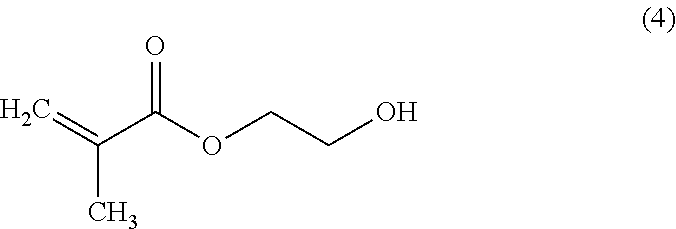
  • (meth)acrylate having, the hydroxy group hydroxyethyl methacrylate represented by the following formula (4), hydroxyethyl acrylate, hydroxypropyl (meth)acrylate, and the like may be used individually or combining two or more kinds.
  • the resin composition may contain 1 to 20% by weight of the (meth)acrylate having the hydroxy group.
  • the ultraviolet curable resin composition contains, as a curing reaction accelerator (polymerization reaction accelerator), a polythiol compound.
  • the polythiol compound reacts with (meth)acrylate due to both ultraviolet rays and heat.
  • the resin composition is irradiated with ultraviolet rays, the polythiol compound reacts with the (meth)acrylate and generates reaction heat.
  • the reaction between the polythiol and the (meth)acrylate is accelerated by this reaction heat.
  • the reaction heat generated by the reaction on the surface of the resin composition allows the reaction to continue until the inner portion of the resin composition. Accordingly, even when the thickness of the ultraviolet curable resin composition is large, the inner portion of the resin composition can be cured by the ultraviolet irradiation, and also the content of PTFE in the resin composition can be increased. Moreover the ultraviolet curable resin composition containing the polythiol compound prevents cracks caused by the contraction of the resin composition upon curing.
  • the polythiol compound is exemplified, for example, by trimethylolpropane tris(3-mercapto propionate), pentaerythritol tetrakis(3-mercapto propionate), trimethylolpropane tris(3-mercapto butyrate), trimethylolethane tris(3-mercapto butyrate), ethylene glycol bis(3-mercapto glycolate), butanediol bis(3-mercapto glycolate), trimethylolpropane tris(3-mercapto glycolate), pentaerythritol tetrakis(3-mercapto glycolate), tris-[(3-mercapto propionyloxy)-ethyl]-isocyanurate, tetraethylene glycol bis(3-mercapto propionate), dipentaerythritol hexakis(3-mercapto propionate), pentaerythritol te
  • the above-listed compounds may be used individually or combining two or more kinds.
  • the polythiol compound may be a commercially available product, and examples of the commercially available product include: “TMTP” and “PETP” produced by YODO KAGAKU CO., LTD.; “TEMPIC”, “TMMP”, “PEMP”, “PEMP-II20P”, and “DPMP” produced by SC Organic Chemical Co., Ltd.; “MTNR1”, “MTBD1”, and “MTPE1” produced by SHOWA DENKO K.K.
  • the commercial available products usable as the polythiol compound are not limited to those.
  • the resin composition related to the present disclosure may contain 0.5 to 5% by weight of the polythiol compound.
  • the content of the polythiol compound is less than 0.5% by weight, the curing reaction accelerating effect is liable to be insufficient.
  • the content of the polythiol compound exceeds 5% by weight, the lubricating property is liable to decrease due to a low content of the solid lubricant.
  • the ultraviolet curable resin composition may contain, as the curing reaction accelerator, a compound having a glycidyl group or oxetane group and an acrylic group.
  • a compound having the glycidyl group or oxetane group reacts with a thiol group by heat.
  • a compound having the acrylic group is cured by ultraviolet irradiation.
  • the ultraviolet curable resin composition contains the compound having the glycidyl group or oxetane group and the acrylic group
  • the ultraviolet irradiation causes the curing reaction due to the acrylic group and the reaction heat generated by the curing reaction causes the reaction between the glycidyl group or oxetane group and the thiol group.
  • the inner portion of the resin composition can be completely cured by the ultraviolet rays irradiation, and also the content of PTFE in the resin composition can be increased.
  • glycidyl methacrylate represented by the following formula (5), (3-ethyloxetane-3-yl) methyl methacrylate, and the like.
  • the resin composition may contain the compound having the glycidyl group or oxetane group and the acrylic group in an amount of 1 to 20% by weight, especially in an amount of 4 to 10% by weight.
  • the content of the compound is less than 1% by weight, the curing reaction accelerating effect is insufficient.
  • the content of the compound exceeds 20% by weight, the lubricating property tends to decrease due to a low content of the solid lubricant.
  • the ultraviolet curable resin composition may contain, as a curing accelerator, a bifunctional or higher (meth)acrylate monomer (i.e., (meth)acrylate monomer having three or more of (meth)acrylic groups).
  • the ultraviolet curable resin composition may contain pentaerythritol triacrylate, pentaerythritol tetraacrylate, dipentaerythritol penta(meth)acrylate, dipentaerythritol hexa(meth)acrylate, dipentaerythritol polyacrylate, and trimethylolpropane tri(meth)acrylate individually or combining two or more kinds.
  • the ultraviolet curable resin composition containing the trifunctional or higher (meth)acrylate monomer has many starting points of polymerization reaction, thus making the polymerization reaction (curing reaction) faster. Further, the ultraviolet curable resin composition containing the trifunctional or higher (meth)acrylate monomer has many cross-linking points, thus improving heat resistance of the cured resin.
  • the content of the trifunctional or higher (meth)acrylate monomer may be 15% by weight or less. When the content of the trifunctional or higher (meth)acrylate monomer exceeds 15% by weight, the resin composition cures so rapidly that it becomes difficult to handle the resin composition at the time of manufacture.
  • the ultraviolet curable resin composition may contain, as a chemical-resisting agent, modified bisphenol A-type epoxy acrylate or bisphenol A-type epoxy modified acrylate in an amount of 20% by weight or less.
  • modified bisphenol A-type epoxy acrylate or bisphenol A-type epoxy modified acrylate exceeds 20% by weight, there is a possibility that the cured resin might crack due to the rigidity of the modified bisphenol A-type epoxy acrylate and bisphenol A-type epoxy modified acrylate.
  • the ultraviolet curable resin composition may contain, as, an adjuvant or supplement for cross-linking reaction by UV irradiation to the (meth)acrylate having the isocyanuric acid ring, crosslinkable monomers individually or combining two or more kinds in an amount of 5% by weight or less.
  • crosslinkable monomer a monomer having two or more of unsaturated bonds of an equivalent reactive property may be used.
  • the crosslinkable monomer is exemplified, for example, by a bifunctional(meth)acrylate monomer (meth)acrylate monomer having two (meth)acrylic groups), such as ethylene glycol di(meth)acrylate, propylene glycol di(meth)acrylate butylene glycol di(meth)acrylate, hexanediol di(meth)acrylate, tetraethylene glycol di(meth)acrylate, triethylene glycol di(meth)acrylate, and tripropylene glycol di(meth)acrylate.
  • the ultraviolet curable resin composition contains the crosslinkable monomer(s), molecular chains, each of which polymerization reaction is proceeding separately, can be cross-linked each other. This increases cross-linking points, thus improving hardness of the cured resin.
  • the resin composition related to the present disclosure contains the solid lubricant (solid sliding agent).
  • the solid lubricant is preferably such that the transmissivity of ultraviolet rays is not affected when ultraviolet rays are radiated for caring or polymerizing the resin composition. From this viewpoint, it is used a polytetrafluoroethylene resin (hereinafter referred to as “PTFE” in an abbreviated a tanner, as appropriate) which is an organic white solid lubricant.
  • PTFE polytetrafluoroethylene resin
  • one kind of PTFE may be used individually, or two kinds of PTFE having mutually different average particle diameters may be used in combination.
  • PTFE having a large average particle diameter e.g., an average particle diameter of 75 to 180 ⁇ m, preferably an average particle diameter of 100 ⁇ m or greater
  • PTFE having a small average particle diameter e.g., an average particle diameter of 20 ⁇ m or less, preferably an average particle diameter of 1 to 15 ⁇ m.
  • PTFE can be contained in an amount of 30 to 80% by weight, especially in an amount of 40 to 70% by weight, with respect to the total amount of the resin composition.
  • the resin a composition containing a large amount of PTFE is difficult to cure completely, because the light is shielded by PTFE.
  • the resin composition related to the present disclosure contains the polythiol compound that accelerates curing reaction as described above, and thus the resin composition related to the present disclosure may cure completely even when it contains a large amount of PTFE.
  • the resin composition related to the present disclosure may contain PTFE in a larger amount than conventional ones.
  • PTFE may be in any form such as a powder form or a fibrous form, and PTFE in any form may be used individually or in combination.
  • the particles or fibers of PTFE powder may be surface-treated such that etching is performed on a surface of particles or fibers of the PTFE powder by using sodium naphthalene and then the surface is coated with epoxy modified acrylate.
  • etching is performed on a surface of particles or fibers of the PTFE powder by using sodium naphthalene and then the surface is coated with epoxy modified acrylate.
  • Such a surface treatment enhances the affinity for an acrylic resin produced from the (meth)acrylate having the isocyanuric acid ring and further strengthens the bond with the acrylic resin. Therefore, when the resin composition related to the present disclosure is used as the self-lubricating liner, the particles or fibers of PTFE can be prevented from separating from the self-lubricating liner at the time of sliding and thus t is possible to reduce the wear amount of the self-lubricating liner.
  • any other solid lubricant may be used together with PTFE.
  • the resin composition related to the present disclosure may contain melamine cyanurate or hexagonal boron nitride. Using the melamine cyanurate together with PTFE may reduce a friction coefficient after the resin composition is cured further than a case in which PTFE is used individually as the solid lubricant. In that case, the melamine cyanurate is desirably contained amount of 30% by weight or less with respect to the total amount of the resin composition. When the content of melamine cyanurate exceeds 30% by weight, although the friction coefficient of the self-lubricating liner becomes lower, the wear amount tends to increase.
  • the melamine cyanurate has a cleavage tincture in which melamine molecules having six-membered ring structures and cyanuric acid molecules are held together by hydrogen-handing to be arranged planarly and each of the planes is stacked in layers by weak bonding. It is presumed that such a structure contributes to the solid lubricating property.
  • the resin composition related to the present disclosure may contain a dye, such as a polymerizable dye, water-based dye, or oil-based dye.
  • a dye such as a polymerizable dye, water-based dye, or oil-based dye.
  • coloring the resin composition depending on the usage and/or kind thereof makes it possible to visually identify the usage and/or kind of the resin composition and a member manufactured using the resin composition.
  • the polymerizable dye is superior in that it is less likely to dissolve in water or solvent than the oil-based dye and water-based dye.
  • the polymerizable dye is preferably used.
  • conventional resin compositions contain the polymerizable dye, light is shielded by the polymerizable dye and thus the conventional resin compositions are difficult to cure completely.
  • the resin composition related to the present disclosure contains the polythiol compound accelerating curing reaction as described above.
  • the resin composition related to the present disclosure can cure completely even when it contains the polymerizable dye.
  • Those usable as the polymerizable dye include, for example, “RDW-R13”, “RDW-R60”, “RDW-G01”, and “RDW-B01” produced by Wako Pure Chemical Industries, Ltd.
  • Those usable as the water-based dye include, for example, “Aqueous and Glossy EXE” (color: red) and “Aqueous and Enamel Mini” (color: blue) produced by Nippe Home Products Co. Ltd.
  • oil-based dye examples include, for example, “Oily and Glossy EXE” (color: red) and “Enamel” (color: green) produced by Nippe Home Products Co. Ltd.
  • the resin composition related to the present disclosure may contain 1% by weight or less of the dye.
  • the dye in an amount of 1% by weight or less provides its sufficient color, and the dye in an amount of 1% by weight or more could cause the resin composition to cure inadequately.
  • the resin composition related to the present disclosure may contain 0.01 to 5% by weight of a photopolymerization initiators
  • the photopolymerization initiator include benzophenone, 4,4-bis(diethylamino) benzophenone, 2,4,6-trimethylbenzophenone, methylortho benzoyl benzoate 4-phenyl benzophenone, 2-t-butyl anthraquinone, 2-ethyl anthraquinone, 2-2-diethoxy acetophenone, 2-hydroxy-2-methyl-1-phenylpropane-1-one, benzyl dimethyl ketal, 1-hydroxy cyclohexyl-phenylketone, benzoin methyl ether, benzoin ethyl ether, benzoin isopropyl ether, benzoin isobutyl ether, 2-methyl-[4-(methylthio) phenyl]
  • the resin composition related to the present disclosure may contain 0.01 to 5% by weight of an azo polymerization initiator that generates radicals by heat.
  • the resin composition related to the present disclosure contains the azo polymerization initiator, the azo polymerization initiator generates radicals by the reaction heat of polymerization reaction caused by ultraviolet irradiation, thus causing polymerization reaction of (meth)acrylate.
  • the polymerization reaction proceeds in the parts where ultraviolet rays do not reach, such as the inner portion of the resin composition, allowing the resin composition to cure completely.
  • Examples of the azo polymerization initiator include dimethyl-2,2′-azobis(2-methyl propionate), dimethyl-1,1′-azobis(1-cyclohexanecarboxylate), 2,2′-azobis(2-methyl-N-2-propenylpropionamide), 2,2′-azobis(N-butyl-2-methylpropionamide), 1,1′-azobis(1-acetoxy-1-phenylethane), and dimethyl-2,2′-azobisisobutyrate.
  • the above examples of the azo polymerization initiator may be used individually or in combination. The azo polymerization initiator, however, is not limited to those.
  • Glass fiber may be added to the resin composition related to the present disclosure to improve strength of the self-lubricating liner.
  • Those usable as the glass fiber include circular cross-section glass fiber of which cross-sectional shape is circular and modified cross-section glass fiber of which cross-sectional shape is not circular.
  • the resin composition of the present disclosure may contain, as reinforcement fiber, inorganic fiber such as carbon fiber, aramid fiber, and potassium titanate whisker.
  • the glass fiber is preferably added in an amount of 15% by weight or less with respect to the total amount of the resin composition.
  • the amount of addition of the glass fiber in the resin composition exceeds 15% by weight, the wear on a surface of a mating material is likely to be accelerated by the glass fiber which was cut at the time of cutting and/or grinding of the self-lubricating liner. This could compromise the advantages as the machinable liner.
  • the glass fiber is suitably used, because transmissivity of ultraviolet rays is not reduced thereby.
  • the resin composition related to the present disclosure is desirably in a liquid form at room temperature. Accordingly, the resin composition can be applied on the sliding surface of the sliding member easily, and after the application, the resin composition can be cured by being irradiated with ultraviolet rays.
  • the ultraviolet curable resin in the liquid form is used as a base resin.
  • the resin composition is easily mixed with the solid lubricant containing PTFE, and PTFE can be added to the resin composition related to the present disclosure in a high content (30 to 80% by weight).
  • PTFE cannot be added to conventional ultraviolet curable resin compositions in such a high content. Therefore, it is possible to produce the self-lubricating liner having lower friction and less-wearing.
  • the sliding member with the self-lubricating liner by applying the ultraviolet curable resin composition containing: the (meth)acrylate compound having the isocyanuric acid ring represented by the above-described formula (1); the (meth)acrylate having the phosphoric acid ester group and/or the (meth)acrylate having the slime group; the polythiol compound; and PTFE as the solid lubricant on the sliding surface of the sliding member and then curing the ultraviolet curable resin composition by ultraviolet irradiation.
  • the ultraviolet curable resin composition containing: the (meth)acrylate compound having the isocyanuric acid ring represented by the above-described formula (1); the (meth)acrylate having the phosphoric acid ester group and/or the (meth)acrylate having the slime group; the polythiol compound; and PTFE as the solid lubricant on the sliding surface of the sliding member and then curing the ultraviolet curable resin composition by ultraviolet irradiation.
  • the self-lubricating liner using such an ultraviolet curable resin composition can have a thickness of 3 mm or more, as indicated in examples described later.
  • the ultraviolet curable resin composition further contains the compound having the glycidyl group or oxetane group and the acrylic group
  • the self-lubricating liner can have a thickness of 5 mm or more, as indicated in examples described later.
  • the ultraviolet curable resin composition related to the present disclosure can have a high content of PTFE (30 to 80% by weight), and thus it is possible to produce the self-lubricating liner having low friction and high wear resistance.
  • the ultraviolet curable resin composition related to the present disclosure contains (meth)acrylate having a functional group of phosphoester or silane, and thus the self-lubricating liner adheres to the sliding member firmly.
  • the self-lubricating liner is a machinable liner which can be subjected to after-processing through grinding or cutting to obtain a desired size.
  • the ultraviolet curable resin composition related to the present disclosure contains the polythiol compound. This accelerates curing reaction of the curable resin composition. Thus, even when the resin composition has a large thickness, the inner portion of the resin composition can be cured by the ultraviolet irradiation. Accordingly, it is possible to form a lubricating liner with a large thickness by using the ultraviolet curable resin composition related to the present disclosure. Further, since the polythiol accelerates curing reaction, the ultraviolet curable resin composition related to the present disclosure may have a high content of PTFE. Furthermore, since the ultraviolet curable resin composition related to the present disclosure contains (meth)acrylate having a functional group of phosphoric acid ester or silane, the self-lubricating liner using the resin composition related to the present disclosure adheres to metal firmly.
  • a resin composition and a sliding member provided with a self-lubricating liner composed of the resin composition related to the present disclosure will be explained based on the following examples and comparative examples. However, the present disclosure is not limited to the following examples.
  • Component A (meth)acrylate compound having isocyatutric acid ring
  • Component B (meth)acrylate having phosphoric acid ester group or silane group
  • Component B′ Comparative component of component B
  • Component C Polythiol compound
  • Component D Compound having glycidyl group or oxetane group and acrylic group
  • Component F Polymerization initiator
  • Component G (meth)acrylate having hydroxy group (reactive diluent)
  • Component H trifunctional or higher (meth)acrylate monomer.
  • the average particle diameter of PTFE can be measured by a dry sieving testing method (JIS Z8815). When the average particle diameter is less than 45 ⁇ m, the average particle diameter can be measured by a laser diffraction/scattering method. In both the measuring methods, the average particle diameter indicates a particle diameter at integrated value of 50% in particle diameter distribution (median diameter in cumulative distribution).
  • Component J Reinforcement fiber
  • Example 1 0.1 Example 2 0.1 5 Example 3 0.1 3 Example 4 4 0.1 4 Example 5 10 0.1 4 Example 6 4 0.1 4 Example 7 10 0.1 4 Example 8 0.1 4 Example 9 1 0.1 4 Example 10 4 1 0.1 4 Example 11 4 1 0.1 4 Example 12 0.1 4 Example 13 0.1 4 Example 14 0.1 4 Example 15 0.1 4 Example 16 1 1 Example 17 0.5 3 Example 18 0.05 0.05 Example 19 0.5 1.5 Example 20 0.5 1.5 Example 21 0.5 0.1 5 Example 22 0.5 0.1 2 Example 23 0.5 3 Example 24 0.3 Example 25 0.35 0.05 Example 26 0.3 3 Example 27 0.005 0.05 Example 28 0.1 0.05 Example 29 0.1 0.05 Example 30 0.1 0.05 Example 31 0.1 0.05 Comparative 0.1 Example 1 Comparative 0.1 Example 2 Comparative 0.1 Example 3 Comparative 0.1 4 Example 4 Comparative 0.1 4 Example 5 1
  • Example 1 Components H I J h1 h2 i1 i2 i3 i4 j Example 1 30 20 7 Example 2 30 20 7 Example 3 30 20 7 Example 4 40 15 Example 5 40 15 Example 6 40 15 Example 7 40 15 Example 8 40 15 Example 9 40 15 Example 10 40 15 Example 11 40 15 Example 12 40 15 Example 13 40 15 Example 14 40 15 Example 15 40 15 Example 16 20 40 5 Example 17 50 20 3 Example 18 39.9 5 Example 19 40 5 Example 20 10 30 7 Example 21 6 25 25 10 Example 22 13 25 25 10 Example 23 20 20 10 Example 24 20 20 5 Example 25 25 25 7 Example 26 20 20 10 Example 27 20 20 5 Example 28 40 10 Example 29 30 20 5 Example 30 40 10 Example 31 20 20 10 Comparative 30 20 7 Example 1 Comparative 30 20 7 Example 2 Comparative 30 20 7 Example 3 Comparative 40 15 Example 4 Comparative 40 15 Example 5
  • FIGS. 1A and 1B It was manufactured a cylindrical sleeve bearing (width (length in the axial direction) 12.7 mm, outer diameter 30.2 mm, inner diameter 24.9 mm) as shown in FIGS. 1A and 1B by using a material obtained by subjecting SUS630 stainless steel to heat treatment under H1150 condition.
  • the resin composition prepared in each of Examples 1 to 31 and Comparative Examples 1 to 5 was uniformly applied on an inner circumferential surface of this sleeve bearing by using a dispenser. Subsequently, the applied resin composition was irradiated with ultraviolet rays for one minute to cure the resin composition, so that a machinable liner was formed in the inner circumferential surface of the sleeve bearing. Next, this machinable liner was subjected to cutting and grinding to have a liner thickness of 0.25 mm, and the sleeve was finished to an inner diameter of 25.4 mm.
  • the resin composition of each of Examples 4 to 1.5 and Comparative Examples 4 and 5 was poured into a cylindrical container made of polypropylene and having an inner diameter of 10 mm and a depth of 30 mm.
  • the liquid surface of the resin composition was irradiated with ultraviolet rays at an integrated light intensity of 3000 mJ/cm 2 , thus curing the resin composition.
  • the resin composition was removed from the cylindrical container and the length (thickness) of the cured resin composition was measured. TABLE 5 indicates results thereof.
  • the length of the resin composition of each of Examples 8 and 12 to 15 containing the component C was longer than the length of the resin composition of Comparative Example 4 containing no component C. This revealed that containing the component C made the film thickness of the cured resin composition large and all the components c1 to c5 provided the effect of increasing the film thickness of the cured resin composition. Further, the length of the resin composition of each of Examples 4 to 7 containing the component D as the compound having the glycidyl group or oxetane group and the acrylic group was longer than the length of the resin composition of Example 8 containing no component D. This revealed that containing the component D made the film thickness of the cured resin composition large.
  • the length of the resin composition of Example 9 containing the component E as the dye was shorter than the length of the resin composition of Example 8 containing no component E, and the length of the resin composition of Comparative Example 5 containing the component E as the dye was shorter than the length of the resin composition Comparative Example 4 containing no component E. This revealed that light was shielded by the dye, thus causing the film thickness of the cured resin composition to apt to be small. Meanwhile, the length of the resin composition of Example 9 containing the components C and E was longer than the length of the resin composition of Comparative Example 4 containing no components C and E. This revealed that the component C compensated for the reduction of film thickness of the cured resin composition caused by the component E.
  • the resin composition of each of Examples 9, 16 to 20, and 27 was irradiated with ultraviolet rays, thus curing the resin composition.
  • the cured resin composition was immersed in IPA, a rust preventive oil (“ANTITRUST TERAMI SC” produced by JX Nippon Oil & Energy Corporation), pure water, and nitric acid (50 wt %) and kept for one week.
  • IPA a rust preventive oil
  • pure water pure water
  • nitric acid 50 wt %
  • the resin composition related to the present disclosure was applied to the sleeve bearing with the shape as shown in FIGS. 1A and 1B .
  • the application of the present disclosure is not limited to that shape, and it is possible to apply the resin composition related to the present disclosure to sliding members having a variety of shapes and structures.
  • a spherical bearing 20 includes an outer race (outer ring) 22 having a concave spherical inner-circumferential surface 22 a , an inner race (inner ring) 26 having a convex spherical outer-circumferential surface 26 a , and a machinable liner 24 formed between the inner circumferential surface 22 a and the outer circumferential surface 26 a .
  • the thickness of the liner may be, for example, about 0.25 mm.
  • FIGS. 3A and 3B each show an exemplary rod end spherical bearing 60 in which the spherical bearing 20 is assembled into a rod end body 50 .
  • the rod end body 50 includes a head portion 52 having a through hole 52 a into which the spherical bearing 20 is inserted, and a shaft portion 54 provided with a female or male thread 56 .
  • the shaft portion 54 is a substantially cylindrical portion extending from the head portion 52 in a radial direction of the through hole 52 a .
  • the spherical bearing 20 is fixed to the rod end body 50 by swaging a V-shaped groove (not shown) formed at the edge of the through bole 52 a.
  • a reamer bolt 70 as shown in FIG. 4 includes a main body portion composed of a head portion 72 , a shaft portion 74 having a large diameter and a male thread portion 76 having a small diameter, and a machinable liner 74 a provided on the outer circumference of the shaft portion 74 .
  • the machinable liner 74 a is formed by uniformly applying and curing a resin composition prepared in any of the examples in a similar manner as that described in the examples.
  • the main body portion of the reamer bolt 70 can be made of SUS630 stainless steel, for example.
  • the thickness of the machinable liner 74 a may be in a range of about 0.25 to 0.5 mm.
  • the reamer bolt 70 is used in critical connection portions transmitting high torque, such as a propeller shaft of vessels or ships, a flight control surface of aircraft, and a connecting rod of automobile engines.
  • the reamer bolt 70 used in such important connection portions is required to be fitted to a bolt hole with high precision without any internal clearance. Therefore, the shaft portion 74 of the reamer bolt 70 is finished with high precision, but even so, it is advantageous to be able to perform the size adjustment of the bolt at the time of assembly. Since the reamer bolt according to the present disclosure includes the machinable liner 74 a , a user is capable of easily adjusting the size of outer diameter of the shaft portion even after curing of the resin.
  • the reamer bolt related to the present disclosure includes the self-lubricating machinable liner 74 a on the shaft portion 74 , galling and the like do not occur when the bolt is inserted or removed at the time of assembly or disassembly. This advantage results in a reamer bolt 70 with a long, service life.
  • the self-lubricating liner is formed on the inner circumferential surface of the outer race of the spherical bearing and the rod end spherical bearing.
  • the self-lubricating liner nay be formed on the outer circumferential surface of the inner race.
  • the explanation has been made by citing the spherical bearing, the rod end spherical bearing, and the reamer bolt as examples of the sliding member, the present invention is not limited to those and can be applied to any sliding member including the self-lubricating liner.
  • the sliding member related to the present invention includes not only that for the rotary motion but also a sliding member used for sliding motion such as translational motion (linear motion), oscillating motion, and any combination thereof in any direction.
  • the lubricating liner with a large thickness can be formed by using the ultraviolet curable resin composition related to the present disclosure. Since the ultraviolet curable resin composition related to the present disclosure can have a high content of PTFE, it is possible to form the lubricating liner having lower friction and higher wear resistance. Further, the lubricating liner formed by using the ultraviolet curable resin composition related to the present disclosure adheres to metal firmly.
  • the self-lubricating liner manufactured as described above can be formed in various sliding members including sliding bearings such as a sleeve bearing and a spherical bearing.
  • the self-lubricating liner formed by the ultraviolet curable resin composition related to the present disclosure can be subjected to cutting, grinding, and the like, which allows an end-user to perform posterior processing, such as the line-adjustment of inner diameter size of the bearing when installing the shaft in the bearing. Therefore, the resin composition related to the present disclosure and the sliding member provided with the self-lubricating liner made from the resin composition related to the present disclosure are useful in wide fields such s vessels, aircraft, automobiles, electronic products, and home electric appliances.

Landscapes

  • Chemical & Material Sciences (AREA)
  • Engineering & Computer Science (AREA)
  • General Engineering & Computer Science (AREA)
  • Organic Chemistry (AREA)
  • Chemical Kinetics & Catalysis (AREA)
  • Mechanical Engineering (AREA)
  • Health & Medical Sciences (AREA)
  • Medicinal Chemistry (AREA)
  • Polymers & Plastics (AREA)
  • Oil, Petroleum & Natural Gas (AREA)
  • General Chemical & Material Sciences (AREA)
  • Life Sciences & Earth Sciences (AREA)
  • Materials Engineering (AREA)
  • Wood Science & Technology (AREA)
  • Manufacturing & Machinery (AREA)
  • Polymerisation Methods In General (AREA)

Abstract

There is provided an ultraviolet curable resin composition for a self-lubricating liner, including: a (meth)acrylate compound having an isocyanuric acid ring; at least one of (meth)acrylate having a phosphoric acid ester group and (meth)acrylate having a silane group: a polythiol compound; and a polytetrafluoroethylene resin as a solid lubricant.

Description

CROSS REFERENCE TO RELATED APPLICATION
This application claims the benefit of priority of Japanese Patent Applications No. 2016-110185 filed on Jun. 1, 2016 and No. 2017-015115 filed on Jan. 31, 2017. The contents of Japanese Patent Applications No. 2016-110185 and No. 2017-015115 are incorporated herein by reference in their entities.
BACKGROUND Field of the Invention
The present disclosure relates to an ultraviolet curable resin composition for forming a self-lubricating liner of a sliding member and a sliding member provided with the self-lubricating liner.
Description of the Related Art
A sliding bearing in which a shaft of rotary motion or translational motion is held by a sliding surface has been widely used. In particular, an unlubricated sliding bearing using no lubricating oil for a sliding surface has been used for applications requiring low friction coefficient, high durability, high load capacity, high heat resistance, high oil resistance, and the like, such as vessel or ship application and aircraft application.
As the unlubricated sliding bearing, Japanese Patent Application Laid-open No. 2007-255712 discloses a spherical bearing for high-load application that includes an outer race member having a concave first bearing surface and an inner race member having a convex second bearing surface slidably movable relative to the first bearing surface. In the spherical bearing, one of the outer race member and the inner race member is made of titanium alloy which has a bearing surface made of titanium nitride formed on the titanium alloy surface by a physical vapor deposition method (PVD). The hearing surface of the other member includes a self-lubricating liner made from resin. The self-lubricating liner is composed of a fabric including fibers of polytetrafluoroethylene (PTFE) and polyaramid. The fabric is saturated with a phenol resin composition.
International Publication No. WO2013/161402 filed by the applicant of the present application discloses a curable resin composition containing 20 to 90% by weight of a (meth)acrylate compound having an isocyanuric acid ring and 10 to 50% by weight of polytetrafluoroethylene resin. It is described that a self-lubricating liner may be formed from this resin composition on a sliding surface of a sliding bearing, and that the sliding bearing with such a self-lubricating liner is suitable for aircraft application and the like.
Since the unlubricated sliding bearing disclosed in International Publication No. WO2013/161402 is used by being assembled in an aircraft and the like, it has low friction coefficient, high load capacity, heat resistance and oil resistance. In spite of that such an unlubricated sliding bearing is still required to increase the thickness of the self-lubricating liner. Further, the unlubricated sliding bearing is required to increase the amount of PTFE added to the self-lubricating liner in order to reduce friction and improve wear resistance of the self-lubricating liner. Furthermore, the self-lubricating liner is required to have a good adhesiveness in relation to an inner circumferential surface of a metal outer race member.
Japanese Patent Application Laid-open No. 2014-74082 discloses a photocurable resin composition made from a polythiol compound, a photoradical initiator, and a compound containing an isocyanuric acid ring and (meth)acrylic group.
The present disclosure has been conceived to solve the foregoing problems. Art object related to the present disclosure is to provide a resin composition for forming a self-lubricating liner having increased thickness, improved lubricity, and a good adhesion property to metal. Another object related to the present disclosure is to provide a sliding member with the self-lubricating liner made from the resin composition.
SUMMARY
According to a first aspect related to the present disclosure, there is provided an ultraviolet curable resin composition for a self-lubricating liner, comprising:
a (meth)acrylate compound having an isocyanuric acid ring represented by formula (1):
Figure US10167439-20190101-C00001
where X is a group that contains an acryloyl group and is composed only of C, H, and O, and Y and Z are groups each composed only of C, H, and O;
at least one of (meth)acrylate having a phosphoric acid ester group and (meth)acrylate having a silane group;
polythiol compound; and
a polytetrafluoroethylene resin as a solid lubricant.
According to a second aspect of the present disclosure, there is provided a sliding member comprising a self-lubricating liner which is formed on a sliding surface of the sliding member and is made of the ultraviolet curable resin composition related to the first aspect.
BRIEF DESCRIPTION OF THE DRAWINGS
FIG. 1A is a longitudinal sectional view of a sleeve bearing related to the present disclosure cut along an axial direction of the sleeve beating; FIG. 1B is a lateral sectional view of the sleeve hewing cut along a direction perpendicular to the axis.
FIG. 2 is a cross-sectional view of a structure of a spherical beating with a self-lubricating liner made from a resin composition related to the present disclosure.
FIG. 3A is a longitudinal sectional view of a rod end spherical beating into which the spherical bearing related to the present disclosure is incorporated and FIG. 3B is a lateral sectional view of the same.
FIG. 4 shows an outer appearance of a reamer bolt with a self-lubricating liner, which is formed on a shaft surface of the reamer bolt and is made from the resin composition related to the present disclosure.
DESCRIPTION OF THE EMBODIMENTS
In the following, an explanation will be made about an ultraviolet curable resin composition related to the present disclosure and a sliding member with a self-lubricating liner made from the ultraviolet curable resin composition.
<Sliding Member>
At first, an exemplary sliding member including the self-lubricating liner made from the ultraviolet curable resin composition related to the present disclosure will be explained while referring to FIGS. 1A and 1B. A sleeve bearing 10 shown in FIGS. 1A and 1B includes a cylindrical outer race member 12 which is made of metal such as bearing steel, stainless steel, duralumin material, and titanium alloy and a self-lubricating liner layer 14 which is formed on an inner circumferential surface of the outer race member 12. The self-lubricating liner layer 14 is a self-lubricating resin layer and is formed by applying the ultraviolet curable resin composition related to the present disclosure which will be described below on the inner circumferential surface of the outer race member 12 and then curing the applied ultraviolet curable resin composition. The size adjustment of self-lubricating liner can be easily performed by grinding or cutting, and thus the self-lubricating liner may be referred to as a “machinable liner” (processable liner) as appropriate. The sliding member may be any member having at least a sliding surface. Thus, the sliding member includes not only a sleeve bearing used for rotary motion or translational (linear) motion but also various sliding members such as a spherical bearing and a reamer bolt which will be described later. Those sliding members are also included in an object related to the present disclosure.
<Ultraviolet Curable Resin Composition>
The ultraviolet curable resin composition contains (meth)acrylate having an isocyanuric acid ring represented by the following formula (1) as a component mainly composing the resin.
Figure US10167439-20190101-C00002

In the formula (1), X is a group which contains an acryloyl group and is composed only of C, H, and O. Y and Z are groups each composed only of C, H, and O. Y and Z may or may not contain the acryloyl group. X is preferably an acryloxyethyl group or an acryloxyethyl group modified by ε-caprolactone. Y and Z are preferably the same group as X. In the present application, the term “(meth)acrylate” means acrylate or methacrylate.
The (meth)acrylate having the isocyanuric acid ring represented by formula (1) (hereinafter simply referred to as (meth)acrylate having the isocyanuric acid ring) has satisfactory heat resistance in addition to the ultraviolet curing property, and thus it is preferably used for a self-lubricating liner of sliding members and the like. In particular, the sliding member incorporated into the aircraft is required to have a heat resistance of 163 degrees C. or more, and even in such a case, the (meth)acrylate having the isocyanuric acid ring is preferably used.
The (meth)acrylate having the isocyanuric acid ring is preferably capable of being applied on a sliding surface as a composition and is preferably capable of forming a self-lubricating liner with reduced wear after curing. From this viewpoint, as the (meth)acrylate having the isocyanuric acid ring, bis(acryloyloxyethyl) hydroxyethyl isocyanurate, di-(2-(meth) acryloxyethyl) isocyanurate, tris-(2-(meth)acryloxyethyl) isocyanurate, ε-caprolactone modified tris-(2-acryloxyethyl) isocyanurate, and the like art preferably used. The above examples of the (meth)acrylate having the isocyanuric acid ring may be used individually or combining two or more kinds. Especially, any of di-(2-(meth) acryloxyethyl) isocyanurate, tris-(2-(meth)acryloxyethyl) isocyanurate, and ε-caprolactone modified tris-(2-acryloxyethyl) isocyanurate is preferably used, or a mixture of di-(2-(meth) acryloxyethyl) isocyanurate and tris-(2-(meth)acryloxyethyl) isocyanurate is preferably used.
The resin composition related to the present disclosure may contain the (meth)acrylate having the isocyanuric acid ring in an amount of 15 to 50% by weight, 15 to 40% by weight, or especially 16 to 35% by weight. When the content of the (meth)acrylate, having the isocyanuric acid ring is less than 15% by weight, resin fluidity is liable to be insufficient, which could make the application of the resin composition difficult, and further strength of the liner is liable to be inadequate. When the content of the (meth)acrylate having the isocyanuric acid ring exceeds 50% by weight, the lubricating property tends to decrease due to a low content of a solid lubricant described later.
The ultraviolet curable resin composition contains, as an adhesion improver to metal, (meth)acrylate having a phosphoric acid ester group and (methacrylate having a silane group individually or in combination. As the (meth)acrylate having the phosphoric acid ester group, ethylene glycol methacrylate phosphate represented by the following formula (2), phosphoric acid 2-(acryloyloxy)ethyl, and the like may be used individually or combining two more kinds. As the (meth)acrylate having the silane group, 3-acryloxypropyltrimethoxysilane represented by the following formula (3), 3-methacryloxypropylmethyldimethoxysilane, 3-methacryloxypropyltrimethoxysilane, 3-methacryloxypropylmethyldimethoxysilane, 3-methacryloxypropyltrimethoxysilane, and the like may be used individually or combining two more kinds. The resin composition may contain the (meth)acrylate having the phosphoric acid ester group and/or the (meth)acrylate having the silane group in an amount of 1 to 10% by weight, especially in an amount of 1 to 5% by weight. When the content of the (meth)acrylate having the phosphoric acid ester group and/or the (meth)acrylate having the silane group is less than 1% by weight, the adhesion improving effect is liable to be insufficient. When the content of the (meth)acrylate having the phosphoric acid ester group and/or the (meth)acrylate having the silane group exceeds 10% by weight, the lubricating property is liable to decrease due to a low content of the solid lubricant.
Figure US10167439-20190101-C00003
The ultraviolet curable resin composition may contain, as a viscosity modifier, (meth)acrylate having a hydroxy group. As the (meth)acrylate having, the hydroxy group, hydroxyethyl methacrylate represented by the following formula (4), hydroxyethyl acrylate, hydroxypropyl (meth)acrylate, and the like may be used individually or combining two or more kinds. The resin composition may contain 1 to 20% by weight of the (meth)acrylate having the hydroxy group.
Figure US10167439-20190101-C00004
The ultraviolet curable resin composition contains, as a curing reaction accelerator (polymerization reaction accelerator), a polythiol compound. The polythiol compound reacts with (meth)acrylate due to both ultraviolet rays and heat. When the resin composition is irradiated with ultraviolet rays, the polythiol compound reacts with the (meth)acrylate and generates reaction heat. The reaction between the polythiol and the (meth)acrylate is accelerated by this reaction heat. Thus, even when the thickness of the ultraviolet curable resin composition is large and ultraviolet rays do not reach the inner portion of the resin composition due to absorption of ultraviolet rays at the surface of the resin composition, the reaction heat generated by the reaction on the surface of the resin composition allows the reaction to continue until the inner portion of the resin composition. Accordingly, even when the thickness of the ultraviolet curable resin composition is large, the inner portion of the resin composition can be cured by the ultraviolet irradiation, and also the content of PTFE in the resin composition can be increased. Moreover the ultraviolet curable resin composition containing the polythiol compound prevents cracks caused by the contraction of the resin composition upon curing. The polythiol compound is exemplified, for example, by trimethylolpropane tris(3-mercapto propionate), pentaerythritol tetrakis(3-mercapto propionate), trimethylolpropane tris(3-mercapto butyrate), trimethylolethane tris(3-mercapto butyrate), ethylene glycol bis(3-mercapto glycolate), butanediol bis(3-mercapto glycolate), trimethylolpropane tris(3-mercapto glycolate), pentaerythritol tetrakis(3-mercapto glycolate), tris-[(3-mercapto propionyloxy)-ethyl]-isocyanurate, tetraethylene glycol bis(3-mercapto propionate), dipentaerythritol hexakis(3-mercapto propionate), pentaerythritol tetrakis(3-mercapto butyrate), 1,4-bis(3-mercaptobutyryloxy)butane, and 1,3,5-tris(3-mercaptobutyryloxyethyl)-1,3,5-triazine-2,4,6(1H, 3H, 5H)-trione. The above-listed compounds may be used individually or combining two or more kinds. The polythiol compound may be a commercially available product, and examples of the commercially available product include: “TMTP” and “PETP” produced by YODO KAGAKU CO., LTD.; “TEMPIC”, “TMMP”, “PEMP”, “PEMP-II20P”, and “DPMP” produced by SC Organic Chemical Co., Ltd.; “MTNR1”, “MTBD1”, and “MTPE1” produced by SHOWA DENKO K.K. The commercial available products usable as the polythiol compound are not limited to those. The resin composition related to the present disclosure may contain 0.5 to 5% by weight of the polythiol compound. When the content of the polythiol compound is less than 0.5% by weight, the curing reaction accelerating effect is liable to be insufficient. When the content of the polythiol compound exceeds 5% by weight, the lubricating property is liable to decrease due to a low content of the solid lubricant.
The ultraviolet curable resin composition may contain, as the curing reaction accelerator, a compound having a glycidyl group or oxetane group and an acrylic group. A compound having the glycidyl group or oxetane group reacts with a thiol group by heat. A compound having the acrylic group is cured by ultraviolet irradiation. Thus, when the ultraviolet curable resin composition contains the compound having the glycidyl group or oxetane group and the acrylic group, the ultraviolet irradiation causes the curing reaction due to the acrylic group and the reaction heat generated by the curing reaction causes the reaction between the glycidyl group or oxetane group and the thiol group. Thus, even when the thickness of die ultraviolet curable resin composition is large, the inner portion of the resin composition can be completely cured by the ultraviolet rays irradiation, and also the content of PTFE in the resin composition can be increased. As such a compound, it is possible to use glycidyl methacrylate represented by the following formula (5), (3-ethyloxetane-3-yl) methyl methacrylate, and the like. The resin composition may contain the compound having the glycidyl group or oxetane group and the acrylic group in an amount of 1 to 20% by weight, especially in an amount of 4 to 10% by weight. When the content of the compound is less than 1% by weight, the curing reaction accelerating effect is insufficient. When the content of the compound exceeds 20% by weight, the lubricating property tends to decrease due to a low content of the solid lubricant.
Figure US10167439-20190101-C00005
In order to accelerate curing speed without losing strength and heat resistance after curing, the ultraviolet curable resin composition may contain, as a curing accelerator, a bifunctional or higher (meth)acrylate monomer (i.e., (meth)acrylate monomer having three or more of (meth)acrylic groups). In particular, the ultraviolet curable resin composition may contain pentaerythritol triacrylate, pentaerythritol tetraacrylate, dipentaerythritol penta(meth)acrylate, dipentaerythritol hexa(meth)acrylate, dipentaerythritol polyacrylate, and trimethylolpropane tri(meth)acrylate individually or combining two or more kinds. The ultraviolet curable resin composition containing the trifunctional or higher (meth)acrylate monomer has many starting points of polymerization reaction, thus making the polymerization reaction (curing reaction) faster. Further, the ultraviolet curable resin composition containing the trifunctional or higher (meth)acrylate monomer has many cross-linking points, thus improving heat resistance of the cured resin. The content of the trifunctional or higher (meth)acrylate monomer may be 15% by weight or less. When the content of the trifunctional or higher (meth)acrylate monomer exceeds 15% by weight, the resin composition cures so rapidly that it becomes difficult to handle the resin composition at the time of manufacture.
In order to provide chemical resistance without losing, strength after curing, the ultraviolet curable resin composition may contain, as a chemical-resisting agent, modified bisphenol A-type epoxy acrylate or bisphenol A-type epoxy modified acrylate in an amount of 20% by weight or less. When die content of the modified bisphenol A-type epoxy acrylate or bisphenol A-type epoxy modified acrylate exceeds 20% by weight, there is a possibility that the cured resin might crack due to the rigidity of the modified bisphenol A-type epoxy acrylate and bisphenol A-type epoxy modified acrylate.
The ultraviolet curable resin composition may contain, as, an adjuvant or supplement for cross-linking reaction by UV irradiation to the (meth)acrylate having the isocyanuric acid ring, crosslinkable monomers individually or combining two or more kinds in an amount of 5% by weight or less. As the crosslinkable monomer, a monomer having two or more of unsaturated bonds of an equivalent reactive property may be used. The crosslinkable monomer is exemplified, for example, by a bifunctional(meth)acrylate monomer (meth)acrylate monomer having two (meth)acrylic groups), such as ethylene glycol di(meth)acrylate, propylene glycol di(meth)acrylate butylene glycol di(meth)acrylate, hexanediol di(meth)acrylate, tetraethylene glycol di(meth)acrylate, triethylene glycol di(meth)acrylate, and tripropylene glycol di(meth)acrylate. When the ultraviolet curable resin composition contains the crosslinkable monomer(s), molecular chains, each of which polymerization reaction is proceeding separately, can be cross-linked each other. This increases cross-linking points, thus improving hardness of the cured resin.
The resin composition related to the present disclosure contains the solid lubricant (solid sliding agent). The solid lubricant is preferably such that the transmissivity of ultraviolet rays is not affected when ultraviolet rays are radiated for caring or polymerizing the resin composition. From this viewpoint, it is used a polytetrafluoroethylene resin (hereinafter referred to as “PTFE” in an abbreviated a tanner, as appropriate) which is an organic white solid lubricant.
As the solid lubricant, one kind of PTFE may be used individually, or two kinds of PTFE having mutually different average particle diameters may be used in combination. When two kinds of PTFE with different average particle diameters are used, PTFE having a large average particle diameter (e.g., an average particle diameter of 75 to 180 μm, preferably an average particle diameter of 100 μm or greater) may be used in combination with PTFE having a small average particle diameter (e.g., an average particle diameter of 20 μm or less, preferably an average particle diameter of 1 to 15 μm).
PTFE can be contained in an amount of 30 to 80% by weight, especially in an amount of 40 to 70% by weight, with respect to the total amount of the resin composition. Usually, the resin a composition containing a large amount of PTFE is difficult to cure completely, because the light is shielded by PTFE. The resin composition related to the present disclosure, however, contains the polythiol compound that accelerates curing reaction as described above, and thus the resin composition related to the present disclosure may cure completely even when it contains a large amount of PTFE. Accordingly, the resin composition related to the present disclosure may contain PTFE in a larger amount than conventional ones. PTFE may be in any form such as a powder form or a fibrous form, and PTFE in any form may be used individually or in combination. The particles or fibers of PTFE powder may be surface-treated such that etching is performed on a surface of particles or fibers of the PTFE powder by using sodium naphthalene and then the surface is coated with epoxy modified acrylate. Such a surface treatment enhances the affinity for an acrylic resin produced from the (meth)acrylate having the isocyanuric acid ring and further strengthens the bond with the acrylic resin. Therefore, when the resin composition related to the present disclosure is used as the self-lubricating liner, the particles or fibers of PTFE can be prevented from separating from the self-lubricating liner at the time of sliding and thus t is possible to reduce the wear amount of the self-lubricating liner.
In the present disclosure, any other solid lubricant may be used together with PTFE. For example, the resin composition related to the present disclosure may contain melamine cyanurate or hexagonal boron nitride. Using the melamine cyanurate together with PTFE may reduce a friction coefficient after the resin composition is cured further than a case in which PTFE is used individually as the solid lubricant. In that case, the melamine cyanurate is desirably contained amount of 30% by weight or less with respect to the total amount of the resin composition. When the content of melamine cyanurate exceeds 30% by weight, although the friction coefficient of the self-lubricating liner becomes lower, the wear amount tends to increase. The melamine cyanurate has a cleavage tincture in which melamine molecules having six-membered ring structures and cyanuric acid molecules are held together by hydrogen-handing to be arranged planarly and each of the planes is stacked in layers by weak bonding. It is presumed that such a structure contributes to the solid lubricating property.
The resin composition related to the present disclosure may contain a dye, such as a polymerizable dye, water-based dye, or oil-based dye. For example, coloring the resin composition depending on the usage and/or kind thereof makes it possible to visually identify the usage and/or kind of the resin composition and a member manufactured using the resin composition. The polymerizable dye is superior in that it is less likely to dissolve in water or solvent than the oil-based dye and water-based dye. Thus, when the resin composition related to the present disclosure is used under a severe environment in which the resin composition is polluted with water or solvent, the polymerizable dye is preferably used. When conventional resin compositions contain the polymerizable dye, light is shielded by the polymerizable dye and thus the conventional resin compositions are difficult to cure completely. The resin composition related to the present disclosure, however, contains the polythiol compound accelerating curing reaction as described above. Thus, the resin composition related to the present disclosure can cure completely even when it contains the polymerizable dye. Those usable as the polymerizable dye include, for example, “RDW-R13”, “RDW-R60”, “RDW-G01”, and “RDW-B01” produced by Wako Pure Chemical Industries, Ltd. Those usable as the water-based dye include, for example, “Aqueous and Glossy EXE” (color: red) and “Aqueous and Enamel Mini” (color: blue) produced by Nippe Home Products Co. Ltd. Those usable as the oil-based dye include, for example, “Oily and Glossy EXE” (color: red) and “Enamel” (color: green) produced by Nippe Home Products Co. Ltd. The resin composition related to the present disclosure may contain 1% by weight or less of the dye. The dye in an amount of 1% by weight or less provides its sufficient color, and the dye in an amount of 1% by weight or more could cause the resin composition to cure inadequately.
In order to start the polymerization reaction of the resin composition related to the present disclosure by ultraviolet rays, the resin composition related to the present disclosure may contain 0.01 to 5% by weight of a photopolymerization initiators Examples of the photopolymerization initiator include benzophenone, 4,4-bis(diethylamino) benzophenone, 2,4,6-trimethylbenzophenone, methylortho benzoyl benzoate 4-phenyl benzophenone, 2-t-butyl anthraquinone, 2-ethyl anthraquinone, 2-2-diethoxy acetophenone, 2-hydroxy-2-methyl-1-phenylpropane-1-one, benzyl dimethyl ketal, 1-hydroxy cyclohexyl-phenylketone, benzoin methyl ether, benzoin ethyl ether, benzoin isopropyl ether, benzoin isobutyl ether, 2-methyl-[4-(methylthio) phenyl]-2-morpholino-1-propanone, 2-benzyl-2-dimethylamino-1-(4-morpholino phenyl-1-butanone, 2,4-diethyl thioxanthone, isopropyl thioxanthone, diphenyl(2,4,6-trimethylbenzoyl)phosphine oxide, bis(2,6-dimethoxy benzoyl)-2,4,4-trimethylpentyl phosphine oxide, bis(2,4,6-trimethylbenzoyl) phenylphosphine oxide, 2-hydroxy-1-{4-[4-(2-hydroxy-2-methylpropionyl) benzyl] phenyl}-2-methylpropane-1-one, methyl benzoylformate, 1,2-octanedion, 1-[4-(phenylthio)phenyl]-, 2-(O-betzoyloxime), ethanone, 1-[9-ethyl-6-(2-methylbenzoyl)-9H-carbazole-3-yl]-, and 1-(O-acetyloxime). The above examples of the photopolymerization initiator ma be used individually or in combination. The photopolymerizatton initiator, however, is not limited to those.
In order to accelerate the polymerization reaction of the resin composition related to the present disclosure by heat, the resin composition related to the present disclosure may contain 0.01 to 5% by weight of an azo polymerization initiator that generates radicals by heat. When the resin composition related to the present disclosure contains the azo polymerization initiator, the azo polymerization initiator generates radicals by the reaction heat of polymerization reaction caused by ultraviolet irradiation, thus causing polymerization reaction of (meth)acrylate. Then, the polymerization reaction proceeds in the parts where ultraviolet rays do not reach, such as the inner portion of the resin composition, allowing the resin composition to cure completely. Examples of the azo polymerization initiator include dimethyl-2,2′-azobis(2-methyl propionate), dimethyl-1,1′-azobis(1-cyclohexanecarboxylate), 2,2′-azobis(2-methyl-N-2-propenylpropionamide), 2,2′-azobis(N-butyl-2-methylpropionamide), 1,1′-azobis(1-acetoxy-1-phenylethane), and dimethyl-2,2′-azobisisobutyrate. The above examples of the azo polymerization initiator may be used individually or in combination. The azo polymerization initiator, however, is not limited to those.
Glass fiber may be added to the resin composition related to the present disclosure to improve strength of the self-lubricating liner. Those usable as the glass fiber include circular cross-section glass fiber of which cross-sectional shape is circular and modified cross-section glass fiber of which cross-sectional shape is not circular. In addition to the glass fiber, the resin composition of the present disclosure may contain, as reinforcement fiber, inorganic fiber such as carbon fiber, aramid fiber, and potassium titanate whisker. The glass fiber is preferably added in an amount of 15% by weight or less with respect to the total amount of the resin composition. When the amount of addition of the glass fiber in the resin composition exceeds 15% by weight, the wear on a surface of a mating material is likely to be accelerated by the glass fiber which was cut at the time of cutting and/or grinding of the self-lubricating liner. This could compromise the advantages as the machinable liner. The glass fiber is suitably used, because transmissivity of ultraviolet rays is not reduced thereby.
The resin composition related to the present disclosure is desirably in a liquid form at room temperature. Accordingly, the resin composition can be applied on the sliding surface of the sliding member easily, and after the application, the resin composition can be cured by being irradiated with ultraviolet rays.
In addition to the above, it is possible to add various additives such as an antioxidant, a photostabilizer, a polymerization inhibitor, and a preservation stabilizer to the resin composition related to the present disclosure as needed.
In the resin composition related to the present disclosure, the ultraviolet curable resin in the liquid form is used as a base resin. Thus, the resin composition is easily mixed with the solid lubricant containing PTFE, and PTFE can be added to the resin composition related to the present disclosure in a high content (30 to 80% by weight). PTFE cannot be added to conventional ultraviolet curable resin compositions in such a high content. Therefore, it is possible to produce the self-lubricating liner having lower friction and less-wearing.
In the present disclosure, there is provided the sliding member with the self-lubricating liner by applying the ultraviolet curable resin composition containing: the (meth)acrylate compound having the isocyanuric acid ring represented by the above-described formula (1); the (meth)acrylate having the phosphoric acid ester group and/or the (meth)acrylate having the slime group; the polythiol compound; and PTFE as the solid lubricant on the sliding surface of the sliding member and then curing the ultraviolet curable resin composition by ultraviolet irradiation. Since the ultraviolet curable resin composition contains the polythiol compound and the like as the curing reaction accelerator, the self-lubricating liner using such an ultraviolet curable resin composition can have a thickness of 3 mm or more, as indicated in examples described later. When the ultraviolet curable resin composition further contains the compound having the glycidyl group or oxetane group and the acrylic group, the self-lubricating liner can have a thickness of 5 mm or more, as indicated in examples described later. The ultraviolet curable resin composition related to the present disclosure can have a high content of PTFE (30 to 80% by weight), and thus it is possible to produce the self-lubricating liner having low friction and high wear resistance. The ultraviolet curable resin composition related to the present disclosure contains (meth)acrylate having a functional group of phosphoester or silane, and thus the self-lubricating liner adheres to the sliding member firmly. The self-lubricating liner is a machinable liner which can be subjected to after-processing through grinding or cutting to obtain a desired size.
As described above, the ultraviolet curable resin composition related to the present disclosure contains the polythiol compound. This accelerates curing reaction of the curable resin composition. Thus, even when the resin composition has a large thickness, the inner portion of the resin composition can be cured by the ultraviolet irradiation. Accordingly, it is possible to form a lubricating liner with a large thickness by using the ultraviolet curable resin composition related to the present disclosure. Further, since the polythiol accelerates curing reaction, the ultraviolet curable resin composition related to the present disclosure may have a high content of PTFE. Furthermore, since the ultraviolet curable resin composition related to the present disclosure contains (meth)acrylate having a functional group of phosphoric acid ester or silane, the self-lubricating liner using the resin composition related to the present disclosure adheres to metal firmly.
EXAMPLES
A resin composition and a sliding member provided with a self-lubricating liner composed of the resin composition related to the present disclosure will be explained based on the following examples and comparative examples. However, the present disclosure is not limited to the following examples.
<Manufacture of Ultraviolet Curable Resin Composition>
In Examples 1 to 31 and Comparative Examples 1 to 5, components a1 to a3; b1, b2, b′1, b′2, c1 to c5; d1, d2; e1 to e6; f1, f2; g; h1, h2; i1 to i4; and j, as the following components A to J, respectively (wherein each of components b′1 and b′2 was comparative component of component B), were mixed in the composition ratios indicated in TABLE 1 to TABLE 3 to prepare to liquid resin compositions.
Component A: (meth)acrylate compound having isocyatutric acid ring
    • Component a1; di-(2-acryloxyethyl) isocyanurate (“M-215” produced by TOAGOSEI CO., LTD.)
    • Component a2: tris-(2-acryloxyethyl) isocyanurate (“FA-731AT” produced by Hitachi Chemical Co., Ltd.)
    • Component a3: ε-caprolactone modified tris-(2-acryloxyethyl) isocyanurate (“A-9300-1CL” produced by Shin-Nakamura Chemical Co., Ltd)
Component B: (meth)acrylate having phosphoric acid ester group or silane group
    • Component b1: ethylene glycol methacrylate phosphate
    • Component b2: 3-acryloxypropyltrimethoxysilane
Component B′: Comparative component of component B
    • Component b′: pentaerythritol triacrylate hexamethylene diisocyanate urethane prepolymer (“UA-306H” produced by KYOEISHA CHEMICAL CO., LTD)
    • Component b″2: bisphenol A-type epoxy acrylate (“EBECRYL 3700” produced by DAICEL-ALLNEX LTD.)
Component C: Polythiol compound
    • Component c1: pentaerythritol tetrakis(3-mercapto butyrate)
    • Component c2: 1,4-bis(3-mercaptobutyryloxy)butane
    • Component c3: 1,3,5-tris(3-mercaptobutyryloxyethyl)-1,3,5-triazine-2,4,6(1H, 3H, 5H)-trione
    • Component c4: trimethylolpropane tris(3-mercapto butyrate)
    • Component c5: trimethylolethane tris(3-mercapto butyrate)
Component D: Compound having glycidyl group or oxetane group and acrylic group
    • Component d1: glycidyl methacrylate
    • Component d2: (3-ethyloxetane-3-yl) methylmethacrylate
Component E: Dye
    • Component e1: Polymerizable dye (“RDW-R13” produced by Wako Pure Chemical Industries, Ltd.)
    • Component e2: Polymerizable dye (“RDW-R60” produced by Wako Pure Chemical Industries, Ltd.)
    • Component e3: Polymerizable dye (“RDW-G01” produced by Wako Pure Chemical Industries, Ltd.)
    • Component e4: Polymerizable dye (“RDW-B01” produced by Wako Pure Chemical Industries, Ltd.)
    • Component e5: Oil-based dye (“Oily and Glossy EXE” color: red, produced by Nippe Home Products Co, Ltd.)
    • Component e6: Water-based dye (“Aqueous and Glossy EXE” color: red, produced by Nippe Home Products Co. Ltd.)
Component F: Polymerization initiator
    • Component f1: Photopolymerization initiator (2-hydroxy-2-methyl-1-phenylpropane-1-one, “DAROCURE 1173” produced by BASE Corporation)
    • Component f2; Thermal polymerization initiator (2,2′-azobis(N-butyl-2-methylpropionamide), “VAm-110” produced by Wako Pure Chemical Industries, Ltd.)
Component G: (meth)acrylate having hydroxy group (reactive diluent)
    • Component 2-hydroxyethyl methacrylate
Component H: trifunctional or higher (meth)acrylate monomer.
    • Component h1: trimethylolpropane triacrylate (“TMPTA” produced by DAICEL-ALLNEX LTD.)
    • Component h2: dipentaerythritol polyacrylate “A-9550” produced by Shin-Nakamura Chemical Co. Ltd)
Constituent I: Solid lubricant
    • Component i1: PTFE having an average particle diameter of 160 μm (“KT-40H” produced by KITAMURA LIMITED)
    • Component i2: PTFE having an average particle diameter of 130 μm (“KT-60” produced by KITAMURA LIMITED)
    • Component i3: PTFE having an average particle diameter of 12 μm (“KTL-610A” produced by KITAMURA LIMITED)
    • Component i4. PTFE having an average particle diameter of 3.5 μm (“KTL-8FH” produced by KITAMURA LIMITED)
The average particle diameter of PTFE can be measured by a dry sieving testing method (JIS Z8815). When the average particle diameter is less than 45 μm, the average particle diameter can be measured by a laser diffraction/scattering method. In both the measuring methods, the average particle diameter indicates a particle diameter at integrated value of 50% in particle diameter distribution (median diameter in cumulative distribution).
Component J: Reinforcement fiber
    • Component j: Glass fiber (average fiber length 65 μm×average diameter ø 11 μm, “SS05DE-413” produced by Nitto Boseki Co., Ltd.)
TABLE 1
Components
A B B′ C
a1 a2 a3 b1 b2 b′1 b′2 c1 c2 c3 c4 c5
Example 1 6 14 15.9 5 2
Example 2 6 14 14 1.9 2
Example 3 6 14 15.9 1 1 2
Example 4 34.1 1.3 0.5 1
Example 5 28.1 1.3 0.5 1
Example 6 34.1 1.3 0.5 1
Example 7 28.1 1.3 0.5 1
Example 8 38.1 1.3 0.5 1
Example 9 37.1 1.3 0.5 1
Example 10 33.1 1.3 0.5 1
Example 11 33.1 1.3 0.5 1
Example 12 38.1 1.3 0.5 1
Example 13 38.6 1.3 0.5 0.5
Example 14 37.1 1.3 0.5 2
Example 15 36.1 1.3 0.5 3
Example 16 3 7 10 5 5 1 1 1
Example 17 4.8 11.2 5 1 1.5
Example 18 6 14 26 3 1 1 1 1 1 1
Example 19 13.5 31.5 3 2 3
Example 20 13.5 31.5 3 3
Example 21 6.4 15 2 2 3
Example 22 5.8 13.6 3 1 1
Example 23 9.5 22 4 4 5 2
Example 24 11.6 27.1 1 3 10 2
Example 25 11.3 26.3 2 3
Example 26 12.5 29.2 2 3
Example 27 6 14 25.945 2 3 2 2
Example 28 12 27.85 3 3 4
Example 29 10 24.85 3 3 4
Example 30 12 27.85 3 3 4
Example 31 12 27.85 3 3 4
Comparative 6 14 20.9 2
Example 1
Comparative 6 14 15.9 5 2
Example 2
Comparative 6 14 15.9 5 2
Example 3
Comparative 39.1 1.3 0.5
Example 4
Comparative 38.1 1.3 0.5
Example 5
TABLE 2
Components
D E F G
d1 d2 e1 e2 e3 e4 e5 e6 f1 f2 g
Example 1 0.1
Example 2 0.1 5
Example 3 0.1 3
Example 4 4 0.1 4
Example 5 10 0.1 4
Example 6 4 0.1 4
Example 7 10 0.1 4
Example 8 0.1 4
Example 9 1 0.1 4
Example 10 4 1 0.1 4
Example 11 4 1 0.1 4
Example 12 0.1 4
Example 13 0.1 4
Example 14 0.1 4
Example 15 0.1 4
Example 16 1 1
Example 17 0.5 3
Example 18 0.05 0.05
Example 19 0.5 1.5
Example 20 0.5 1.5
Example 21 0.5 0.1 5
Example 22 0.5 0.1 2
Example 23 0.5 3
Example 24 0.3
Example 25 0.35 0.05
Example 26 0.3 3
Example 27 0.005 0.05
Example 28 0.1 0.05
Example 29 0.1 0.05
Example 30 0.1 0.05
Example 31 0.1 0.05
Comparative 0.1
Example 1
Comparative 0.1
Example 2
Comparative 0.1
Example 3
Comparative 0.1 4
Example 4
Comparative 0.1 4
Example 5 1
TABLE 3
Components
H I J
h1 h2 i1 i2 i3 i4 j
Example 1 30 20 7
Example 2 30 20 7
Example 3 30 20 7
Example 4 40 15
Example 5 40 15
Example 6 40 15
Example 7 40 15
Example 8 40 15
Example 9 40 15
Example 10 40 15
Example 11 40 15
Example 12 40 15
Example 13 40 15
Example 14 40 15
Example 15 40 15
Example 16 20 40 5
Example 17 50 20 3
Example 18 39.9 5
Example 19 40 5
Example 20 10 30 7
Example 21 6 25 25 10
Example 22 13 25 25 10
Example 23 20 20 10
Example 24 20 20 5
Example 25 25 25 7
Example 26 20 20 10
Example 27 20 20 5
Example 28 40 10
Example 29 30 20 5
Example 30 40 10
Example 31 20 20 10
Comparative 30 20 7
Example 1
Comparative 30 20 7
Example 2
Comparative 30 20 7
Example 3
Comparative 40 15
Example 4
Comparative 40 15
Example 5
<Manufacture of Self-Lubricating Liner>
It was manufactured a cylindrical sleeve bearing (width (length in the axial direction) 12.7 mm, outer diameter 30.2 mm, inner diameter 24.9 mm) as shown in FIGS. 1A and 1B by using a material obtained by subjecting SUS630 stainless steel to heat treatment under H1150 condition. The resin composition prepared in each of Examples 1 to 31 and Comparative Examples 1 to 5 was uniformly applied on an inner circumferential surface of this sleeve bearing by using a dispenser. Subsequently, the applied resin composition was irradiated with ultraviolet rays for one minute to cure the resin composition, so that a machinable liner was formed in the inner circumferential surface of the sleeve bearing. Next, this machinable liner was subjected to cutting and grinding to have a liner thickness of 0.25 mm, and the sleeve was finished to an inner diameter of 25.4 mm.
1. Adhesion Strength
The adhesion strength of the resin composition of each of Examples 1 to 3 and Comparative Examples 1 to 3 was measured in accordance with JIS K 6850. TABLE 4 indicates adhesion strength values thereof.
TABLE 4
Adhesion strength/MPa
Example 1 17.7
Example 2 15
Example 3 16.3
Comparative Example 1 2.4
Comparative Example 2 5.2
Comparative Example 3 3.9
As indicated in TABLE 4, the resin composition of each of Examples 1 to 3 containing, as the component B, any or both of the components b1 and b2 had the adhesion strength higher than that of the resin composition of each of Comparative Examples 1 to 3 containing no component B.
2. Thick Film Photo-Curing Test
The resin composition of each of Examples 4 to 1.5 and Comparative Examples 4 and 5 was poured into a cylindrical container made of polypropylene and having an inner diameter of 10 mm and a depth of 30 mm. The liquid surface of the resin composition was irradiated with ultraviolet rays at an integrated light intensity of 3000 mJ/cm2, thus curing the resin composition. The resin composition was removed from the cylindrical container and the length (thickness) of the cured resin composition was measured. TABLE 5 indicates results thereof.
TABLE 5
Length of cured resin composition/mm
Example 4 6.8
Example 5 7.8
Example 6 6.4
Example 7 7.5
Example 8 4.2
Example 9 3.5
Example 10 5.4
Example 11 5.1
Example 12 4.1
Example 13 3.6
Example 14 4.3
Example 15 4.6
Comparative Example 4 2.6
Comparative Example 4 1.0
As indicated in TABLE 5, the length of the resin composition of each of Examples 8 and 12 to 15 containing the component C (polythiol compound) was longer than the length of the resin composition of Comparative Example 4 containing no component C. This revealed that containing the component C made the film thickness of the cured resin composition large and all the components c1 to c5 provided the effect of increasing the film thickness of the cured resin composition. Further, the length of the resin composition of each of Examples 4 to 7 containing the component D as the compound having the glycidyl group or oxetane group and the acrylic group was longer than the length of the resin composition of Example 8 containing no component D. This revealed that containing the component D made the film thickness of the cured resin composition large.
The length of the resin composition of Example 9 containing the component E as the dye was shorter than the length of the resin composition of Example 8 containing no component E, and the length of the resin composition of Comparative Example 5 containing the component E as the dye was shorter than the length of the resin composition Comparative Example 4 containing no component E. This revealed that light was shielded by the dye, thus causing the film thickness of the cured resin composition to apt to be small. Meanwhile, the length of the resin composition of Example 9 containing the components C and E was longer than the length of the resin composition of Comparative Example 4 containing no components C and E. This revealed that the component C compensated for the reduction of film thickness of the cured resin composition caused by the component E. Further, the length of the resin composition of each of Examples 10 and 11 containing the components C, D, and E was longer than the length of the resin composition of Example 9 containing components C and E and no component D. This revealed that, as with the case containing no component E, the case containing the component E was also able to obtain the effect of increasing the film thickness of the cured resin composition by virtue of the component D.
3. Colorant Elution Test
The resin composition of each of Examples 9, 16 to 20, and 27 was irradiated with ultraviolet rays, thus curing the resin composition. The cured resin composition was immersed in IPA, a rust preventive oil (“ANTITRUST TERAMI SC” produced by JX Nippon Oil & Energy Corporation), pure water, and nitric acid (50 wt %) and kept for one week. In order to examine whether the colorant (dye) was eluted, the absorbance of IPA, rust preventive oil, pure water, and nitric acid in which the resin composition was immersed, at a wavelength of 350 to 700 nm was measured by a spectrophotometer (“V-530” produced by JASCO). When the absorbance exceeded 0.05 in a measurement area, it was determined that the colorant was eluted from the cured resin composition. TABLE 6 indicates results thereof, TABLE 6, “o” indicates that no dye was eluted and “x” indicates that the dye was elute.
TABLE 6
Solvents
IPA Rust preventive oil Pure water Nitric acid
Example 9
Example 16
Example 17
Example 18
Example 19 x x
Example 20 x x
Example 27
As indicated in TABLE 6, regarding the resin composition of each of Examples 9, 16 to 18, and 27 containing the components e1 to e4 as the polymerizable dye, no colorant was eluted in all the solvents. Meanwhile, retarding the resin composition of Example 19 containing the component e5 as the oil-based dye, the colorant was elated in the IPA and rust preventive oil. Regarding the resin composition of Example 20 containing the component e6 as the water-based dye, the colorant was eluted in the pure water and nitric acid. As understood from those results, the polymerizable dye was superior to the oil-based dye and water-based dye in that no colorant was eluted in the solvents.
In the examples, the resin composition related to the present disclosure was applied to the sleeve bearing with the shape as shown in FIGS. 1A and 1B. However, the application of the present disclosure is not limited to that shape, and it is possible to apply the resin composition related to the present disclosure to sliding members having a variety of shapes and structures.
<Spherical Bearing>
As shown in FIG. 2, a spherical bearing 20 includes an outer race (outer ring) 22 having a concave spherical inner-circumferential surface 22 a, an inner race (inner ring) 26 having a convex spherical outer-circumferential surface 26 a, and a machinable liner 24 formed between the inner circumferential surface 22 a and the outer circumferential surface 26 a. The thickness of the liner may be, for example, about 0.25 mm.
<Rod End Spherical Bearing>
FIGS. 3A and 3B each show an exemplary rod end spherical bearing 60 in which the spherical bearing 20 is assembled into a rod end body 50. The rod end body 50 includes a head portion 52 having a through hole 52 a into which the spherical bearing 20 is inserted, and a shaft portion 54 provided with a female or male thread 56. The shaft portion 54 is a substantially cylindrical portion extending from the head portion 52 in a radial direction of the through hole 52 a. After inserting the spherical bearing 20 in the through hole 52 a, the spherical bearing 20 is fixed to the rod end body 50 by swaging a V-shaped groove (not shown) formed at the edge of the through bole 52 a.
<Reamer Bolt>
A reamer bolt 70 as shown in FIG. 4 includes a main body portion composed of a head portion 72, a shaft portion 74 having a large diameter and a male thread portion 76 having a small diameter, and a machinable liner 74 a provided on the outer circumference of the shaft portion 74. The machinable liner 74 a is formed by uniformly applying and curing a resin composition prepared in any of the examples in a similar manner as that described in the examples. The main body portion of the reamer bolt 70 can be made of SUS630 stainless steel, for example. The thickness of the machinable liner 74 a may be in a range of about 0.25 to 0.5 mm.
The reamer bolt 70 is used in critical connection portions transmitting high torque, such as a propeller shaft of vessels or ships, a flight control surface of aircraft, and a connecting rod of automobile engines. The reamer bolt 70 used in such important connection portions is required to be fitted to a bolt hole with high precision without any internal clearance. Therefore, the shaft portion 74 of the reamer bolt 70 is finished with high precision, but even so, it is advantageous to be able to perform the size adjustment of the bolt at the time of assembly. Since the reamer bolt according to the present disclosure includes the machinable liner 74 a, a user is capable of easily adjusting the size of outer diameter of the shaft portion even after curing of the resin. Further, since the reamer bolt related to the present disclosure includes the self-lubricating machinable liner 74 a on the shaft portion 74, galling and the like do not occur when the bolt is inserted or removed at the time of assembly or disassembly. This advantage results in a reamer bolt 70 with a long, service life.
Although the present disclosure has been explained by the embodiments and examples, the present invention is not limited to those and can be substantiated in various embodiments and aspects within the scope of the claims. For example, in the above embodiments, the self-lubricating liner is formed on the inner circumferential surface of the outer race of the spherical bearing and the rod end spherical bearing. The self-lubricating liner, however, nay be formed on the outer circumferential surface of the inner race. Further, although the explanation has been made by citing the spherical bearing, the rod end spherical bearing, and the reamer bolt as examples of the sliding member, the present invention is not limited to those and can be applied to any sliding member including the self-lubricating liner. Especially, although the explanation has been made in the above embodiments and examples by citing the sliding member used for rotary motion of the member or part, the sliding member related to the present invention includes not only that for the rotary motion but also a sliding member used for sliding motion such as translational motion (linear motion), oscillating motion, and any combination thereof in any direction.
As described above, the lubricating liner with a large thickness can be formed by using the ultraviolet curable resin composition related to the present disclosure. Since the ultraviolet curable resin composition related to the present disclosure can have a high content of PTFE, it is possible to form the lubricating liner having lower friction and higher wear resistance. Further, the lubricating liner formed by using the ultraviolet curable resin composition related to the present disclosure adheres to metal firmly. The self-lubricating liner manufactured as described above can be formed in various sliding members including sliding bearings such as a sleeve bearing and a spherical bearing. The self-lubricating liner formed by the ultraviolet curable resin composition related to the present disclosure can be subjected to cutting, grinding, and the like, which allows an end-user to perform posterior processing, such as the line-adjustment of inner diameter size of the bearing when installing the shaft in the bearing. Therefore, the resin composition related to the present disclosure and the sliding member provided with the self-lubricating liner made from the resin composition related to the present disclosure are useful in wide fields such s vessels, aircraft, automobiles, electronic products, and home electric appliances.

Claims (20)

What is claimed is:
1. An ultraviolet curable resin composition for a self-lubricating liner, comprising:
a (meth)acrylate compound having an isocyanuric acid ring represented by formula (1):
Figure US10167439-20190101-C00006
where X is a group that contains an acryloyl group and is composed only of C, H, and O, and
Y and Z are groups each composed only of C, H, and O;
at least one of (meth)acrylate having a phosphoric acid ester group and (meth)acrylate having a silane group;
a polythiol compound; and
a polytetrafluoroethylene resin as a solid lubricant.
2. The ultraviolet curable resin composition according to claim 1, further comprising a compound having a glycidyl group or oxetane group and an acrylic group.
3. The ultraviolet curable resin composition according to claim 2, wherein the compound having the glycidyl group or oxetane group and the acrylic group is glycidyl methacrylate or (3-ethyloxetane-3-yl) methyl methacrylate.
4. The ultraviolet curable resin composition according to claim 1, further comprising a dye.
5. The ultraviolet curable resin composition according to claim 1, further comprising (meth)acrylate having a hydroxy group.
6. The ultraviolet curable resin composition according to claim 1, wherein the (meth)acrylate compound having the isocyanuric acid ring is any of di-(2-(meth) acryloxyethyl) isocyanurate, tris-(2-(meth)acryloxyethyl) isocyanurate, and ε-caprolactone modified tris-(2-acryloxyethyl) isocyanurate or a mixture obtained by combining two or more kinds of them.
7. The ultraviolet curable resin composition according to claim 1, wherein the polythiol compound is any of pentaerythritol tetrakis(3-mercapto butyrate), 1,4-bis(3-mercaptobutyryloxy)butane, 1,3,5-tris(3-mercaptobutyryloxyethyl)-1,3,5-triazine-2,4,6(1H, 3H, 5H)-trione, trimethylolpropane tris(3-mercapto butyrate), and trimethylolethane tris(3-mercapto butyrate) or a mixture obtained by combining two or more kinds of them.
8. The ultraviolet curable resin composition according to claim 1, wherein the (meth)acrylate having the phosphoric acid ester group is ethylene glycol methacrylate phosphate, and the (meth)acrylate having the silane group is 3-acryloxypropyltrimethoxysilane.
9. The ultraviolet curable resin composition according to claim 1, wherein the ultraviolet curable resin composition contains 30 to 80% by weight of the polytetrafluoroethylene resin.
10. The ultraviolet curable resin composition according to claim 1, further comprising any of pentaerythritol triacrylate, pentaerythritol tetraacrylate, dipentaerythritol penta(meth)acrylate, dipentaerythritol hexa(meth)acrylate, dipentaerythritol polyacrylate, and trimethylolpropane tri(meth)acrylate or a mixture obtained by combining two or more kinds of them.
11. The ultraviolet curable resin composition according to claim 1, further comprising modified bisphenol A-type epoxy acrylate or bisphenol A-type epoxy modified acrylate.
12. The ultraviolet curable resin composition according to claim 1, further comprising any of benzophenone, 4,4-bis(diethylamino) benzophenone, 2,4,6-trimethylbenzophenone, methylortho benzoyl benzoate, 4-phenyl benzophenone, 2-t-butyl anthraquinone, 2-ethyl anthraquinone, 2-2-diethoxy acetophenone, 2-hydroxy-2-methyl-1-phenylpropane-1-one, benzyl dimethyl ketal, 1-hydroxy cyclohexyl-phenylketone, benzoin methyl ether, benzoin ethyl ether, benzoin isopropyl ether, benzoin isobutyl ether, 2-methyl-[4-(methylthio) phenyl]-2-morpholino-1-propanone, 2-benzyl-2-dimethylamino-1-(4-morpholino phenyl)-1-butanone, 2,4-diethyl thioxanthone, isopropyl thioxanthone, diphenyl(2,4,6-trimethylbenzoyl)phosphine oxide, bis(2,6-dimethoxy benzoyl)-2,4,4-trimethylpentyl phosphine oxide, bis(2,4,6-trimethylbenzoyl) phenylphosphine oxide, 2-hydroxy-1-{4-[4-(2-hydroxy-2-methylpropionyl) benzyl] phenyl}-2-methylpropane-1-one, methyl benzoylformate, 1,2-octanedion, 1-[4-(phenylthio)phenyl]-, 2-(O-benzoyloxime), ethanone, 1-[9-ethyl-6-(2-methylbenzoyl)-9H-carbazole-3-yl]-, and 1-(O-acetyloxime) or a mixture obtained by combining two or more kinds of them.
13. The ultraviolet curable resin composition according to claim 1, further comprising any of dimethyl-2,2′-azobis(2-methyl propionate), dimethyl-1,1′-azobis(1-cyclohexanecarboxylate), 2,2′-azobis(2-methyl-N-2-propenylpropionamide), 2,2′-azobis(N-butyl-2-methylpropionamide), 1,1′-azobis(1-acetoxy-1-phenylethane), and dimethyl-2,2′-azobisisobutyrate or a mixture obtained by combining two or more kinds of them.
14. A sliding member comprising a self-lubricating liner that is formed on a sliding surface of the sliding member and is made of the ultraviolet curable resin composition as defined in claim 1.
15. The sliding member according to claim 14, wherein the sliding member is a sliding bearing.
16. The sliding member according to claim 15, wherein the sliding bearing is a spherical bearing.
17. The sliding member according to claim 14, wherein the sliding member is a bolt comprising a head portion, a shaft portion, a thread portion, and the self-lubricating liner formed on an outer circumferential surface of the shaft portion that is the sliding surface.
18. The ultraviolet curable resin composition according to claim 1, wherein the ultraviolet curable resin composition comprises:
15 to 50% by weight of the (meth)acrylate compound having the isocyanuric acid ring,
1 to 10% by weight of the at least one (meth)acrylate having the phosphoric acid ester group and (meth)acrylate having the silane group,
0.5 to 5% by weight of the polythiol compound, and
30 to 80% by weight of the polytetrafluoroethylene resin.
19. The ultraviolet curable resin composition according to claim 18, wherein:
the (meth)acrylate compound having the isocyanuric acid ring is any of di-(2-(meth) acryloxyethyl) isocyanurate, tris-(2-(meth)acryloxyethyl) isocyanurate, and ε-caprolactone modified tris-(2-acryloxyethyl) isocyanurate or a mixture obtained by combining two or more kinds of them,
the (meth)acrylate having the phosphoric acid ester group is ethylene glycol methacrylate phosphate, and the (meth)acrylate having the silane group is 3-acryloxypropyltrimethoxysilane, and
the polythiol compound is any of pentaerythritol tetrakis(3-mercapto butyrate), 1,4-bis(3-mercaptobutyryloxy)butane, 1,3,5-tris(3-mercaptobutyryloxyethyl)-1,3,5-triazine-2,4,6(1H, 3H, 5H)-trione, trimethylolpropane tris(3-mercapto butyrate), and trimethylolethane tris(3-mercapto butyrate) or a mixture obtained by combining two or more kinds of them.
20. The ultraviolet curable resin composition according to claim 19, further comprising:
0.01 to 5% by weight of a photopolymerization initiator; and
15% by weight or less of reinforcement fibers.
US15/609,794 2016-06-01 2017-05-31 Ultraviolet curable resin composition and sliding member Active US10167439B2 (en)

Applications Claiming Priority (4)

Application Number Priority Date Filing Date Title
JP2016110185 2016-06-01
JP2016-110185 2016-06-01
JP2017015115A JP6886302B2 (en) 2016-06-01 2017-01-31 UV curable resin composition and sliding member
JP2017-015115 2017-01-31

Publications (2)

Publication Number Publication Date
US20170349851A1 US20170349851A1 (en) 2017-12-07
US10167439B2 true US10167439B2 (en) 2019-01-01

Family

ID=59093359

Family Applications (1)

Application Number Title Priority Date Filing Date
US15/609,794 Active US10167439B2 (en) 2016-06-01 2017-05-31 Ultraviolet curable resin composition and sliding member

Country Status (2)

Country Link
US (1) US10167439B2 (en)
EP (1) EP3252110B1 (en)

Cited By (1)

* Cited by examiner, † Cited by third party
Publication number Priority date Publication date Assignee Title
US11268566B2 (en) * 2017-06-06 2022-03-08 SKF Aerospace France S.A.S Connector with integrated swivel

Families Citing this family (7)

* Cited by examiner, † Cited by third party
Publication number Priority date Publication date Assignee Title
US10480569B2 (en) * 2017-06-15 2019-11-19 Schaublin Sa Hybrid lined trunnion bearing for aircraft landing gear
US10724575B2 (en) 2017-06-15 2020-07-28 Schaublin Sa Metallic lined trunnion bearing for aircraft landing gear
US10746225B2 (en) 2018-03-30 2020-08-18 Minebea Mitsumi Inc. Photocurable resin composition and sliding member
CN109593306B (en) * 2018-11-20 2021-01-05 浙江巨化新材料研究院有限公司 A kind of PTFE material for glass fiber coating bundle device and preparation method
DE102018131022A1 (en) * 2018-12-05 2020-06-10 Schaeffler Technologies AG & Co. KG Plain bearing and method for producing a bearing element for a plain bearing
CN111892979B (en) * 2020-08-05 2021-07-20 中国科学院兰州化学物理研究所 A kind of self-lubricating gasket material for aviation spherical plain bearing and its application
CN113685436A (en) * 2021-08-23 2021-11-23 航天精工股份有限公司 High unitized joint bearing for aerospace and aviation

Citations (10)

* Cited by examiner, † Cited by third party
Publication number Priority date Publication date Assignee Title
US5863875A (en) * 1998-06-24 1999-01-26 The Lubrizol Corporation Coating additive, coating composition containing said additive and method for coating a substrate using said coating composition
US20030104955A1 (en) * 2001-04-06 2003-06-05 Sanyo Chemical Industries, Ltd. Viscosity index improver and lube oil containing the same
US20070223850A1 (en) 2006-03-21 2007-09-27 Roller Bearing Company Of America, Inc. Titanium spherical plain bearing with liner and treated surface
US20100035053A1 (en) * 2008-01-15 2010-02-11 Yukio Kishi Curable composition, cured product and laminate
US20110104389A1 (en) 2008-05-19 2011-05-05 Guy Peter Bryan-Brown Method for patterning a surface using selective adhesion
WO2013161402A1 (en) 2012-04-26 2013-10-31 ミネベア株式会社 Ultraviolet curable resin composition, sliding member, and method for producing sliding member
US20140000640A1 (en) * 2011-03-16 2014-01-02 Wilde Cosmetics Gmhh Light-hardening nail polish
JP2014074082A (en) 2012-10-02 2014-04-24 Three Bond Co Ltd Photocurable resin composition
US20140171347A1 (en) * 2011-08-31 2014-06-19 Terumo Kabushiki Kaisha Medical device
US20150275125A1 (en) 2014-03-31 2015-10-01 Minebea Co., Ltd. Ultraviolet curable resin composition, sliding member, and method for producing sliding member

Patent Citations (13)

* Cited by examiner, † Cited by third party
Publication number Priority date Publication date Assignee Title
US5863875A (en) * 1998-06-24 1999-01-26 The Lubrizol Corporation Coating additive, coating composition containing said additive and method for coating a substrate using said coating composition
US20030104955A1 (en) * 2001-04-06 2003-06-05 Sanyo Chemical Industries, Ltd. Viscosity index improver and lube oil containing the same
US20070223850A1 (en) 2006-03-21 2007-09-27 Roller Bearing Company Of America, Inc. Titanium spherical plain bearing with liner and treated surface
JP2007255712A (en) 2006-03-21 2007-10-04 Roller Bearing Co Of America Inc Liner and titanium spherical sliding bearing with surface-treated surface
US20100035053A1 (en) * 2008-01-15 2010-02-11 Yukio Kishi Curable composition, cured product and laminate
US20110104389A1 (en) 2008-05-19 2011-05-05 Guy Peter Bryan-Brown Method for patterning a surface using selective adhesion
US20140000640A1 (en) * 2011-03-16 2014-01-02 Wilde Cosmetics Gmhh Light-hardening nail polish
US20140171347A1 (en) * 2011-08-31 2014-06-19 Terumo Kabushiki Kaisha Medical device
WO2013161402A1 (en) 2012-04-26 2013-10-31 ミネベア株式会社 Ultraviolet curable resin composition, sliding member, and method for producing sliding member
US20150051123A1 (en) * 2012-04-26 2015-02-19 Minebea Co., Ltd. Ultraviolet curable resin composition, sliding member, and method for producing sliding member
US20170015923A1 (en) 2012-04-26 2017-01-19 Minebea Co., Ltd. Ultraviolet curable resin composition, sliding member, and method for producing sliding member
JP2014074082A (en) 2012-10-02 2014-04-24 Three Bond Co Ltd Photocurable resin composition
US20150275125A1 (en) 2014-03-31 2015-10-01 Minebea Co., Ltd. Ultraviolet curable resin composition, sliding member, and method for producing sliding member

Non-Patent Citations (1)

* Cited by examiner, † Cited by third party
Title
Aug. 28, 2017 Search Report issued in European Patent Application No. 17174008.7.

Cited By (1)

* Cited by examiner, † Cited by third party
Publication number Priority date Publication date Assignee Title
US11268566B2 (en) * 2017-06-06 2022-03-08 SKF Aerospace France S.A.S Connector with integrated swivel

Also Published As

Publication number Publication date
EP3252110B1 (en) 2019-04-24
EP3252110A1 (en) 2017-12-06
US20170349851A1 (en) 2017-12-07

Similar Documents

Publication Publication Date Title
US10167439B2 (en) Ultraviolet curable resin composition and sliding member
JP6886302B2 (en) UV curable resin composition and sliding member
US10053645B2 (en) Ultraviolet curable resin composition, sliding member, and method for producing sliding member
US9540584B2 (en) Ultraviolet curable resin composition, sliding member, and method for producing sliding member
JP6120817B2 (en) Ultraviolet curable resin composition, cured product thereof and sliding member
JP5606802B2 (en) Photo-curable composition suitable for rust prevention of steel pipe threaded joints
JP4799126B2 (en) Eyeglass lenses and polycarbonate resin molding materials for eyeglass lenses
US10746225B2 (en) Photocurable resin composition and sliding member
US10213943B2 (en) Composition
US20030017954A1 (en) UV curable lubricant compositions
US10471466B2 (en) Active anti-ice coating, coating material and method
JP2019183106A (en) Photocurable resin composition, and slide member
JP2019189685A (en) Resin composition, and slide member
US20050203205A1 (en) Composition of matter comprising UV curable materials incorporating nanotechnology for the coating of fiberglass
KR102014206B1 (en) UV curable composition having excellent flexibility and hardness and method of manufacturing
JP2024058332A (en) Sliding member combining photocurable resin composition and surface treatment of mating material
JP2023130932A (en) Photocurable resin composition
JP2019099604A (en) Resin composition, slide member and production method of slide member
US20090054547A1 (en) Method for the preparation of a transparent moulding based on a blend of thermoplastic polymer and thermosetting polymer
JP2017082157A (en) Photocationic curable resin composition and slide member
JP2015074733A (en) Ultraviolet-curable resin composition

Legal Events

Date Code Title Description
AS Assignment

Owner name: MINEBEA MITSUMI INC., JAPAN

Free format text: ASSIGNMENT OF ASSIGNORS INTEREST;ASSIGNORS:TOHYAMA, HIROTAKA;KARAKI, TADAHIKO;TAGUCHI, YUKO;AND OTHERS;SIGNING DATES FROM 20170523 TO 20170529;REEL/FRAME:042676/0793

Owner name: MINEBEA MITSUMI INC., JAPAN

Free format text: ASSIGNMENT OF ASSIGNORS INTEREST;ASSIGNORS:TOHYAMA, HIROTAKA;KARAKI, TADAHIKO;TAGUCHI, YUKO;AND OTHERS;SIGNING DATES FROM 20170523 TO 20170529;REEL/FRAME:042676/0807

STCF Information on status: patent grant

Free format text: PATENTED CASE

MAFP Maintenance fee payment

Free format text: PAYMENT OF MAINTENANCE FEE, 4TH YEAR, LARGE ENTITY (ORIGINAL EVENT CODE: M1551); ENTITY STATUS OF PATENT OWNER: LARGE ENTITY

Year of fee payment: 4