US10163389B2 - Electronic device including an organic light emitting diode display device, and a method of compensating for a degradation of an organic light emitting diode display device in an electronic device - Google Patents
Electronic device including an organic light emitting diode display device, and a method of compensating for a degradation of an organic light emitting diode display device in an electronic device Download PDFInfo
- Publication number
- US10163389B2 US10163389B2 US15/370,044 US201615370044A US10163389B2 US 10163389 B2 US10163389 B2 US 10163389B2 US 201615370044 A US201615370044 A US 201615370044A US 10163389 B2 US10163389 B2 US 10163389B2
- Authority
- US
- United States
- Prior art keywords
- compensation factor
- compensation
- red
- green
- blue
- Prior art date
- Legal status (The legal status is an assumption and is not a legal conclusion. Google has not performed a legal analysis and makes no representation as to the accuracy of the status listed.)
- Active, expires
Links
- 230000015556 catabolic process Effects 0.000 title claims description 64
- 238000006731 degradation reaction Methods 0.000 title claims description 64
- 238000000034 method Methods 0.000 title claims description 21
- 238000009825 accumulation Methods 0.000 claims description 19
- 230000004044 response Effects 0.000 claims description 12
- 238000010586 diagram Methods 0.000 description 14
- 230000006870 function Effects 0.000 description 7
- 230000001413 cellular effect Effects 0.000 description 2
- 230000003247 decreasing effect Effects 0.000 description 2
- 239000000463 material Substances 0.000 description 1
- 239000011159 matrix material Substances 0.000 description 1
- 230000002093 peripheral effect Effects 0.000 description 1
- 229920000642 polymer Polymers 0.000 description 1
- 239000007787 solid Substances 0.000 description 1
- 230000003068 static effect Effects 0.000 description 1
Images



Classifications
-
- G—PHYSICS
- G09—EDUCATION; CRYPTOGRAPHY; DISPLAY; ADVERTISING; SEALS
- G09G—ARRANGEMENTS OR CIRCUITS FOR CONTROL OF INDICATING DEVICES USING STATIC MEANS TO PRESENT VARIABLE INFORMATION
- G09G3/00—Control arrangements or circuits, of interest only in connection with visual indicators other than cathode-ray tubes
- G09G3/20—Control arrangements or circuits, of interest only in connection with visual indicators other than cathode-ray tubes for presentation of an assembly of a number of characters, e.g. a page, by composing the assembly by combination of individual elements arranged in a matrix no fixed position being assigned to or needed to be assigned to the individual characters or partial characters
- G09G3/22—Control arrangements or circuits, of interest only in connection with visual indicators other than cathode-ray tubes for presentation of an assembly of a number of characters, e.g. a page, by composing the assembly by combination of individual elements arranged in a matrix no fixed position being assigned to or needed to be assigned to the individual characters or partial characters using controlled light sources
- G09G3/30—Control arrangements or circuits, of interest only in connection with visual indicators other than cathode-ray tubes for presentation of an assembly of a number of characters, e.g. a page, by composing the assembly by combination of individual elements arranged in a matrix no fixed position being assigned to or needed to be assigned to the individual characters or partial characters using controlled light sources using electroluminescent panels
- G09G3/32—Control arrangements or circuits, of interest only in connection with visual indicators other than cathode-ray tubes for presentation of an assembly of a number of characters, e.g. a page, by composing the assembly by combination of individual elements arranged in a matrix no fixed position being assigned to or needed to be assigned to the individual characters or partial characters using controlled light sources using electroluminescent panels semiconductive, e.g. using light-emitting diodes [LED]
- G09G3/3208—Control arrangements or circuits, of interest only in connection with visual indicators other than cathode-ray tubes for presentation of an assembly of a number of characters, e.g. a page, by composing the assembly by combination of individual elements arranged in a matrix no fixed position being assigned to or needed to be assigned to the individual characters or partial characters using controlled light sources using electroluminescent panels semiconductive, e.g. using light-emitting diodes [LED] organic, e.g. using organic light-emitting diodes [OLED]
-
- G—PHYSICS
- G09—EDUCATION; CRYPTOGRAPHY; DISPLAY; ADVERTISING; SEALS
- G09G—ARRANGEMENTS OR CIRCUITS FOR CONTROL OF INDICATING DEVICES USING STATIC MEANS TO PRESENT VARIABLE INFORMATION
- G09G2320/00—Control of display operating conditions
- G09G2320/02—Improving the quality of display appearance
- G09G2320/0285—Improving the quality of display appearance using tables for spatial correction of display data
-
- G—PHYSICS
- G09—EDUCATION; CRYPTOGRAPHY; DISPLAY; ADVERTISING; SEALS
- G09G—ARRANGEMENTS OR CIRCUITS FOR CONTROL OF INDICATING DEVICES USING STATIC MEANS TO PRESENT VARIABLE INFORMATION
- G09G2320/00—Control of display operating conditions
- G09G2320/04—Maintaining the quality of display appearance
- G09G2320/043—Preventing or counteracting the effects of ageing
- G09G2320/045—Compensation of drifts in the characteristics of light emitting or modulating elements
-
- G—PHYSICS
- G09—EDUCATION; CRYPTOGRAPHY; DISPLAY; ADVERTISING; SEALS
- G09G—ARRANGEMENTS OR CIRCUITS FOR CONTROL OF INDICATING DEVICES USING STATIC MEANS TO PRESENT VARIABLE INFORMATION
- G09G2320/00—Control of display operating conditions
- G09G2320/04—Maintaining the quality of display appearance
- G09G2320/043—Preventing or counteracting the effects of ageing
- G09G2320/048—Preventing or counteracting the effects of ageing using evaluation of the usage time
-
- G—PHYSICS
- G09—EDUCATION; CRYPTOGRAPHY; DISPLAY; ADVERTISING; SEALS
- G09G—ARRANGEMENTS OR CIRCUITS FOR CONTROL OF INDICATING DEVICES USING STATIC MEANS TO PRESENT VARIABLE INFORMATION
- G09G2320/00—Control of display operating conditions
- G09G2320/06—Adjustment of display parameters
- G09G2320/0626—Adjustment of display parameters for control of overall brightness
-
- G—PHYSICS
- G09—EDUCATION; CRYPTOGRAPHY; DISPLAY; ADVERTISING; SEALS
- G09G—ARRANGEMENTS OR CIRCUITS FOR CONTROL OF INDICATING DEVICES USING STATIC MEANS TO PRESENT VARIABLE INFORMATION
- G09G2320/00—Control of display operating conditions
- G09G2320/06—Adjustment of display parameters
- G09G2320/0666—Adjustment of display parameters for control of colour parameters, e.g. colour temperature
Definitions
- Exemplary embodiments of the present invention relate to display devices and electronic devices including the display devices. More particularly, exemplary embodiments of the present invention relate to electronic devices including organic light emitting diode (OLED) display devices, and methods of compensating for a degradation of the OLED display devices in the electronic devices.
- OLED organic light emitting diode
- OLED organic light emitting diode
- the OLED included in each pixel tends to degrade.
- the degradation of a pixel may cause the luminance of a pixel to decrease.
- the degradation of the pixels may be compensated such that the pixel luminance level is maintained at a predetermined level.
- a powerful processor and a large amount of memory may be needed to perform the compensation process.
- An exemplary embodiment of the present invention relates to an electronic device that may perform a pixel degradation compensation process efficiently.
- An exemplary embodiment of the present invention relates to a method of compensating for a degradation of an organic light emitting diode (OLED) display device included in an electronic device.
- OLED organic light emitting diode
- an electronic device includes an OLED display device, and a display controller configured to provide image data to the OLED display device.
- the display controller calculates stress data for the OLED display device by accumulating the image data, and determines a compensation factor for the OLED display device based on the stress data.
- the OLED display device receives the image data and the compensation factor from the display controller, converts the image data into compensated image data based on the compensation factor, and displays an image based on the compensated image data.
- an electronic device includes an OLED display device, and a display controller configured to provide image data to the OLED display device.
- the display controller calculates stress data for the OLED display device by accumulating the image data, and stores the stress data.
- the OLED display device receives the image data and the stress data from the display controller, determines a compensation factor in response to the stress data, converts the image data into compensated image data in response to the compensation factor, and displays an image in response to the compensated image data.
- the electronic device including an OLED display device, and a display controller configured to provide image data to the OLED display device, the OLED display device including a red sub-pixel, a green sub-pixel and a blue sub-pixel
- the display controller calculates stress data for the OLED display device by accumulating the image data, the stress data are stored in the display controller, the display controller calculates a common compensation factor for red, the green and the blue sub-pixels, and calculates an additional compensation factor for the red sub-pixel, an additional compensation factor for the green sub-pixel and an additional compensation factor for the blue sub-pixel
- the display controller performs a first compensation operation on the image data in response to the common compensation factor
- the display controller transfers the image data on which the first compensation operation is performed and the red, green and blue additional compensation factors to the OLED display device
- the OLED display device performs a second compensation operation on the image data on which the first compensation operation is performed in response to the red, green and
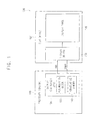
- FIG. 1 is a block diagram illustrating an electronic device according to an exemplary embodiment of the present invention
- FIG. 2 is a graph illustrating a luminance of red, green and blue sub-pixels as a function of stress, according to an exemplary embodiment of the present invention
- FIG. 3 is a graph illustrating compensation factors for red, green and blue sub-pixels as a function of stress, according to an exemplary embodiment of the present invention
- FIG. 4 is a graph illustrating a compensation operation that compensates for a degradation of red, green and blue sub-pixels, according to an exemplary embodiment of the present invention
- FIG. 5 is a block diagram illustrating a display controller and a display driver included in an electronic device according to an exemplary embodiment of the present invention
- FIG. 6 is a flowchart illustrating a method of compensating for a degradation in an electronic device according to an exemplary embodiment of the present invention
- FIG. 7 is a block diagram illustrating a first compensation block included in a display controller of an electronic device according to an exemplary embodiment of the present invention.
- FIG. 8 is a block diagram illustrating a second compensation block included in a display driver of an electronic device according to an exemplary embodiment of the present invention.
- FIG. 9 is a block diagram illustrating a display controller and a display driver included in an electronic device according to an exemplary embodiment of the present invention.
- FIG. 10 is a flowchart illustrating a method of compensating for a degradation in an electronic device according to an exemplary embodiment of the present invention
- FIG. 11 is a block diagram illustrating a display controller and a display driver included in an electronic device according to an exemplary embodiment of the present invention.
- FIG. 12 is a flowchart illustrating a method of compensating for a degradation in an electronic device according to an exemplary embodiment of the present invention.
- FIG. 13 is a block diagram illustrating an electronic device according to an exemplary embodiment of the present invention.
- the “blocks” referred to throughout the specification may include hardware components such as circuits.
- FIG. 1 is a block diagram illustrating an electronic device according to an exemplary embodiment of the present invention.
- FIG. 2 is a graph illustrating a luminance of red, green and blue sub-pixels as a function of stress, according to an exemplary embodiment of the present invention.
- FIG. 3 is a graph illustrating compensation factors for red, green and blue sub-pixels as a function of stress, according to an exemplary embodiment of the present invention.
- FIG. 4 is a graph illustrating a compensation operation that compensates for a degradation of red, green and blue sub-pixels, according to an exemplary embodiment of the present invention.
- an electronic device 100 includes a processor 110 that controls an overall operation of the electronic device 100 , and an organic light emitting diode (OLED) display device 150 that displays an image.
- the electronic device 100 may be any electronic device that includes the OLED display device 150 .
- the electronic device 100 may be, for example, a cellular phone, a smart phone, a tablet computer, a wearable device, a personal digital assistant (PDA), a portable multimedia player (PMP), a digital camera, a music player, a portable game console, a navigation system, a digital television, a three-dimensional (3D) television, a personal computer (PC), a home appliance, a laptop computer, etc.
- the processor 110 may perform various computing functions, and may control the electronic device 100 .
- the electronic device 100 may be a mobile device, for example, a smart phone, a tablet computer, or the like, and the processor 110 may be an application processor (AP).
- the processor 110 may be a central processing unit (CPU), a micro processor, etc.
- the processor 110 may include a display controller 120 that controls the OLED display device 150 .
- the display controller 120 may provide red, green and blue (RGB) image data (e.g., image data RGB) to the OLED display device 150 by performing predetermined graphics and image processing.
- the display controller 120 may be a graphics processing unit (GPU) included in the processor 110 that controls an operation of the electronic device 100 .
- the display controller 120 may be a graphics card.
- the display controller 120 may include an accumulation block 130 that calculates the stress data for the OLED display device 150 by accumulating the image data RGB provided to the OLED display device 150 .
- the display controller 120 may include and a nonvolatile memory 140 that stores the stress data.
- the accumulation block 130 may add current stress data corresponding to current image data RGB to the stress data stored in the nonvolatile memory 140 .
- the accumulation block 130 may rewrite the stress data already stored in the nonvolatile memory 140 with the current stress data in the nonvolatile memory 140 .
- the accumulation block 130 may calculate the stress data not only based on the image data RGB, but also based on a luminance information, a loading information, a temperature information, information about a stress level for each gray level, etc.
- the nonvolatile memory 140 may store the stress data calculated by the accumulation block 130 .
- the nonvolatile memory 140 may retain the stored stress data when the electronic device 100 is powered off.
- the nonvolatile memory 140 may be a flash memory included in the processor 110 .
- the nonvolatile memory 140 may be located inside or outside the display controller 120 .
- the calculation and the storage of the stress data for the degradation compensation of the OLED display device 150 may be performed by the display controller 120 instead of the OLED display device 150 .
- the display controller 120 may determine a compensation factor COMPF for the degradation compensation of the OLED display device 150 based on the stress data stored in the nonvolatile memory 140 .
- a compensation factor COMPF for the degradation compensation of the OLED display device 150 based on the stress data stored in the nonvolatile memory 140 .
- an OLED included in each pixel may be degraded.
- a luminance of the pixel may be decreased.
- each pixel of the OLED display device may include a red sub-pixel R, a green sub-pixel G and a blue sub-pixel B.
- the red, green and blue sub-pixels R, G and B may have different degradation degrees at the same accumulated stress.
- the luminance of the red, green and blue sub-pixels R, G and B may decrease as an accumulated stress applied to the red, green and blue sub-pixels R, G and B increases.
- decrements of the luminance of the red, green and blue sub-pixels R, G and B may be different from each other at the same accumulated stress.
- the blue sub-pixel B may have the largest luminance decrement, or the highest degradation degree
- the red sub-pixel R may have the smallest luminance decrement, or the lowest degradation degree.
- the luminance versus stress relationship of FIG. 2 is merely exemplary, and the degradation degrees of the red, green and blue sub-pixels R, G and B, as a function of the accumulated stress, may be changed depending on the luminescent materials, etc, included in the red, green and blue sub-pixels R, G and B.
- the display controller 120 may determine the compensation factor COMPF to compensate for the luminance decrease based on the accumulated stress. For example, as illustrated in FIG. 3 , the display controller 120 may determine compensation factors 191 , 193 and 195 for the red, green and blue sub-pixels R, G and B, respectively, to be increased as the accumulated stress, indicated by the stress data stored in the nonvolatile memory 140 , increases. In the example illustrated in FIG.
- the blue sub-pixel B may have the highest compensation factor 195
- the red sub-pixel R may have the lowest compensation factor 191 .
- the present invention is not limited thereto.
- the OLED display device 150 may receive the image data RGB from the display controller 120 , and may display an image based on the image data RGB.
- the OLED display device 150 may include a display panel 170 , and a display driver 160 for driving the display panel 170 .
- the display panel 170 may include a plurality of pixels that are arranged in a matrix having a plurality of rows and a plurality of columns.
- each pixel may include a red sub-pixel R that emits red light, a green sub-pixel G that emits green light, and a blue sub-pixel B that emits blue light.
- the display panel 170 may be an OLED display panel where each sub-pixel includes an OLED.
- the display driver 160 may drive the display panel 170 to display an image corresponding to the image data RGB provided by the display controller 120 .
- the display driver 160 may include a scan driver that selects each row of the display panel 170 , a source driver that applies a data signal to sub-pixels in the selected row, and a timing controller that controls the scan driver and the source driver.
- the display driver 160 of the OLED display device 150 may further receive the compensation factor COMPF from the display controller 120 , may convert the image data RGB into compensated image data based on the compensation factor COMPF, and may drive the display panel 170 to display an image based on the compensated image data.
- a color characteristic such as a color coordinate
- the color characteristics of the pixels may not be distorted.
- the compensation factor COMPF may be determined such that the red, green and blue sub-pixels R, G and B have substantially the same luminance based on the luminance of one of the red, green and blue sub-pixels R, G and B having the largest luminance decrement, or the highest degradation degree, and the image data RGB may be converted into the compensated image data based on the determined compensation factor COMPF. For example, as illustrated in FIG.
- the image data for the red and green sub-pixels R and G may be decreased such that the red and green sub-pixels R and G have substantially the same luminance as the blue sub-pixel B. Accordingly, the red, green and blue sub-pixels R, G and B may have uniform luminance, and thus color characteristics of the pixels may not be distorted or the distortion may be small.
- the compensation factor COMPF may be determined such that a target luminance of the red, green and blue sub-pixels R, G and B is substantially the same based on the luminance of one of the red, green and blue sub-pixels R, G and B having the smallest luminance decrement, or the lowest degradation degree.
- the image data RGB may be converted into the compensated image data based on the determined compensation factor COMPF.
- the image data for the others of the red, green and blue sub-pixels R, G and B may be increased.
- the compensation factor COMPF may be determined such that the red, green and blue sub-pixels R, G and B have a predetermined target luminance, and the image data RGB may be converted into the compensated image data based on the determined compensation factor COMPF.
- the display controller 120 may determine a compensation factor COMPF per each individual sub-pixel, and the display driver 160 may apply a different compensation factor COMPF to each of the sub-pixels of the display panel 170 .
- the display controller 120 may determine a compensation factor COMPF per a sub-pixel block, the sub-pixel block including a plurality of adjacent sub-pixels (e.g., 10 sub-pixels*10 sub-pixels), and the display driver 160 may apply the same compensation factor COMPF to all of the sub-pixels included in the sub-pixel block. This operation may be performed for each sub-pixel block of the display panel 170 .
- the display controller 120 may transfer the compensation factor COMPF to the OLED display device 150 only when the OLED display device 150 is powered on. In an exemplary embodiment of the present invention, the display controller 120 may transfer the compensation factor COMPF to the OLED display device 150 when a mode of the OLED display device 150 is changed from a standby mode to a normal operation mode. In an exemplary embodiment of the present invention, the display controller 120 may periodically transfer the compensation factor COMPF to the OLED display device 150 . For example, the display controller 120 may transfer the compensation factor COMPF to the OLED display device 150 with a period of about one second, at a frequency substantially the same as an image frame frequency, etc.
- the display controller 120 may perform the calculation and the storage of the stress data for the degradation compensation of the OLED display device 150 . Accordingly, the display driver 160 of the OLED display device 150 may have a small size, and the degradation compensation of the OLED display device 150 may be efficiently performed.
- FIG. 5 is a block diagram illustrating a display controller and a display driver included in an electronic device according to an exemplary embodiment of the present invention.
- FIG. 6 is a flowchart illustrating a method of compensating for a degradation in an electronic device according to an exemplary embodiment of the present invention.
- FIG. 7 is a block diagram illustrating a first compensation block included in a display controller of an electronic device according to an exemplary embodiment of the present invention.
- FIG. 8 is a block diagram illustrating a second compensation block included in a display driver of an electronic device according to an exemplary embodiment of the present invention.
- a display controller 200 that controls an OLED display device may include an accumulation block 210 , a nonvolatile memory 220 , a compensation factor calculation block 230 , a common factor calculation block 240 and a first compensation block 250 .
- a display driver 260 included in the OLED display device may include a data input block 270 , an additional factor input block 280 and a second compensation block 290 .
- the display controller 200 may receive image data RGB from an image source 205 .
- the accumulation block 210 may calculate stress data SD for the OLED display device by accumulating the received image data RGB or the image data R′G′B′, on which a first compensation operation is performed.
- the stress data SD calculated by the accumulation block 210 may be stored in the nonvolatile memory 220 .
- the display controller 200 may determine a compensation factor based on the stress data SD stored in the nonvolatile memory 220 .
- each pixel of the OLED display device may include a red sub-pixel R, a green sub-pixel G and a blue sub-pixel B.
- the display controller 200 may determine, as the compensation factor, a common compensation factor CCF for the red, green and blue sub-pixels R, G and B, a red additional compensation factor RACF for the red sub-pixel R, a green additional compensation factor GACF for the green sub-pixel G, and a blue additional compensation factor BACF for the blue sub-pixel B based on the stress data.
- the compensation factor calculation block 230 may calculate a red compensation factor RCF for the red sub-pixel R, a green compensation factor GCF for the green sub-pixel G and a blue compensation factor BCF for the blue sub-pixel B based on the stress data SD.
- the common factor calculation block 240 may calculate the common compensation factor CCF, the red additional compensation factor RACF, the green additional compensation factor GACF and the blue additional compensation factor BACF based on the red compensation factor RCF, the green compensation factor GCF and the blue compensation factor BCF.
- the common factor calculation block 240 may determine the common compensation factor CCF to be the lowest one of the red compensation factor RCF, the green compensation factor GCF and the blue compensation factor BCF.
- the common factor calculation block 240 may determine the red additional compensation factor RACF to be a ratio of the red compensation factor RCF to the common compensation factor CCF.
- the common factor calculation block 240 may determine the green additional compensation factor GACF to be ratio of the green compensation factor GCF to the common compensation factor CCF.
- the common factor calculation block 240 may determine the blue additional compensation factor BACF to be a ratio of the blue compensation factor BCF to the common compensation factor CCF.
- the first compensation block 250 may perform a first compensation operation on the image data RGB based on the common compensation factor CCF. Since the first compensation operation is performed based on the common compensation factor CCF, the image data RGB for the red, green and blue sub-pixels R, G and B may be compensated with the same ratio.
- the common compensation factor CCF may be determined (e.g., selected) to be the lowest compensation factor among the red, green and blue compensation factors RCF, GCF and BCF.
- the first compensation operation may be performed for the red, green and blue sub-pixels R, G and B based on a degradation degree of one of the red, green and blue sub-pixels R, G and B that is the lowest among the degradation degrees of the red, green and blue sub-pixels R, G and B.
- the display driver 260 may receive the image data R′G′B′, on which the first compensation operation is performed, and the red, green and blue additional compensation factors RACF, GACF and BACF from the display controller 200 .
- the data input block 270 of the display driver 260 may receive the image data R′G′B′ on which the first compensation operation is performed from the display controller 200 , and the additional factor input block 280 of the display driver 260 may receive the red, green and blue additional compensation factors RACF, GACF and BACF from the display controller 200 .
- the data input block 270 may receive data of 8 bits per each sub-pixel, and may convert the data of 8 bits into data of 10 bits.
- the data input block 270 may apply a predetermined gamma value (e.g., about 2.2) to the image data R′G′B′, representing a gray level for each sub-pixel, to generate data representing luminance of the sub-pixel.
- a predetermined gamma value e.g., about 2.2
- the second compensation block 290 of the display driver 260 may perform a second compensation operation on the image data R′G′B′, on which the first compensation operation is performed, based on the red, green and blue additional compensation factors RACF, GACF and BACF to generate compensated image data CRGB.
- the first compensation operation may be performed by the display controller 200 commonly for the red, green and blue sub-pixels R, G and B based on the common compensation factor CCF
- the second compensation operation may be performed by the display driver 260 for the red, green and blue sub-pixels R, G and B based on the red, green and blue additional compensation factors RACF, GACF and BACF, respectively.
- the second compensation operation may be performed to compensate for the degradation of the other sub-pixels R, G and/or B, for example, the sub-pixels R, G and/or B that have a degradation degree other than the lowest degradation degree.
- the display driver 260 may drive a display panel to display an image based on the compensated image data CRGB.
- the accumulation block 210 of the display controller 200 may calculate the stress data SD for the OLED display device by accumulating the image data RGB (or the image data R′G′B′ on which the first compensation operation is performed) (S 310 ).
- the nonvolatile memory 220 of the display controller 200 may store the stress data SD calculated by the accumulation block 210 (S 320 ).
- the compensation factor calculation block 230 of the display controller 200 may calculate the red, green and blue compensation factors RCF, GCF and BCF for the red, green and blue sub-pixels R, G and B based on the stress data SD.
- the common factor calculation block 240 of the display controller 200 may calculate, based on the red, green and blue compensation factors RCF, GCF and BCF, the common compensation factor CCF that is common for the red, green and blue sub-pixels R, G and B, and the red, green and blue additional compensation factors RACF, GACF and BACF, respectively, for the red, green and blue sub-pixels R, G and B (S 330 ).
- the first compensation block 250 of the display controller 200 may perform the first compensation operation on the image data RGB based on the common compensation factor CCF (S 340 ).
- the first compensation block 250 a may include a first multiplier 251 that applies the common compensation factor CCF to red data RD of the image data RGB to generate the red data R′ on which the first compensation operation is performed, a second multiplier 252 that applies the common compensation factor CCF to green data GD of the image data RGB to generate the green data G′ on which the first compensation operation is performed, and a third multiplier 253 that applies the common compensation factor CCF to blue data BD of the image data RGB to generate the blue data B′ on which the first compensation operation is performed.
- the first compensation operation may be performed by applying the common compensation factor CCF commonly to the red, green and blue data RD, GD and BD.
- the display controller 200 may transfer the image data R′G′B′, on which the first compensation operation is performed, and the red, green and blue additional compensation factors RACF, GACF and BACF to the display driver 260 of the OLED display device (S 350 ).
- the data input block 270 of the display driver 260 may receive the image data R′G′B′, on which the first compensation operation is performed, from the display controller 200 .
- the additional factor input block 280 of the display driver 260 may receive the red, green and blue additional compensation factors RACF, GACF and BACF from the display controller 200 .
- the second compensation block 290 of the display driver 260 may perform the second compensation operation on the image data R′G′B′, on which the first compensation operation is performed, based on the red, green and blue additional compensation factors RACF, GACF and BACF to generate the compensated image data CRGB (S 360 ).
- S 360 compensated image data CRGB
- the second compensation block 290 a may include a fourth multiplier 291 that applies the red additional compensation factor RACF to the red data R′ on, which the first compensation operation is performed, to generate compensated red data CR, a fifth multiplier 292 that applies the green additional compensation factor GACF to the green data G′, on which the first compensation operation is performed, to generate compensated green data CG, and a sixth multiplier 293 that applies the blue additional compensation factor BACF to the blue data B′, on which the first compensation operation is performed, to generate compensated blue data CB.
- the second compensation operation may performed by applying the red, green and blue additional compensation factors RACF, GACF and BACF to the red, green and blue data R′, G′ and B′, respectively.
- the display driver 260 may drive the display panel to display an image based on the compensated image data CRGB (S 370 ).
- the display controller 200 may perform the calculation and the storage of the stress data SD for the degradation compensation of the OLED display device.
- the display controller 200 may perform the first compensation operation on the image data RGB based on the common compensation factor CCF. Accordingly, the display driver 260 of the OLED display device may have a small size, and the degradation compensation of the OLED display device may be efficiently performed.
- FIG. 9 is a block diagram illustrating a display controller and a display driver included in an electronic device according to an exemplary embodiment of the present invention.
- FIG. 10 is a flowchart illustrating a method of compensating for a degradation in an electronic device according to an exemplary embodiment of the present invention.
- a display controller 400 that controls an OLED display device may include an accumulation block 410 , a nonvolatile memory 420 and a compensation factor calculation block 430 .
- a display driver 460 included in the OLED display device may include a data input block 470 , a compensation factor input block 480 and a compensation block 490 .
- the display controller 400 of FIG. 9 may not perform a first compensation operation, and may provide, as a compensation factor, red, green and blue compensation factors RCF, GCF and BCF to the display driver 460 .
- the display controller 400 may receive image data RGB from an image source 405 .
- the accumulation block 410 of the display controller 400 may calculate stress data SD for the OLED display device by accumulating the image data RGB (S 510 ).
- the nonvolatile memory 420 of the display controller 400 may store the stress data SD calculated by the accumulation block 410 (S 520 ).
- the compensation factor calculation block 430 of the display controller 400 may calculate the red, green and blue compensation factors RCF, GCF and BCF for red, green and blue sub-pixels R, G and B based on the stress data SD (S 530 ).
- the display controller 400 may transfer the image data RGB and the red, green and blue compensation factors RCF, GCF and BCF to the display driver 460 of the OLED display device (S 540 ).
- the data input block 470 of the display driver 460 may receive the image data RGB from the display controller 400 .
- the compensation factor input block 480 of the display driver 460 may receive the red, green and blue compensation factors RCF, GCF and BCF from the display controller 400 , and the compensation block 490 of the display driver 460 may perform a compensation operation on the image data RGB based on the red, green and blue compensation factors RCF, GCF and BCF to generate compensated image data CRGB (S 550 ).
- the display driver 460 may drive a display panel to display an image based on the compensated image data CRGB (S 560 ).
- the display controller 400 may perform the calculation and the storage of the stress data SD for degradation compensation of the OLED display device.
- the display controller 400 may determine the red, green and blue compensation factors RCF, GCF and BCF for the red, green and blue sub-pixels R, G and B. Accordingly, the display driver 460 of the OLED display device may have a small size, and the degradation compensation of the OLED display device may be efficiently performed.
- FIG. 11 is a block diagram illustrating a display controller and a display driver included in an electronic device according to an exemplary embodiment of the present invention
- FIG. 12 is a flowchart illustrating a method of compensating for a degradation in an electronic device according to an exemplary embodiment of the present invention.
- a display controller 600 that controls an OLED display device may include an accumulation block 610 and a nonvolatile memory 620 .
- a display driver 660 included in the OLED display device may include a data input block 670 , a stress input block 675 , a compensation factor calculation block 680 and a compensation block 490 .
- the display controller 600 of FIG. 11 may not transfer a compensation factor but it may transfer stress data SD to the display driver 660 .
- the display controller 600 may receive image data RGB from an image source 605 .
- the accumulation block 610 of the display controller 600 may calculate the stress data SD for the OLED display device by accumulating the image data RGB (S 710 ).
- the nonvolatile memory 620 of the display controller 600 may store the stress data SD calculated by the accumulation block 610 (S 720 ).
- the display controller 600 may transfer the image data RGB and the stress data SD stored in the nonvolatile memory 620 to the display driver 660 of the OLED display device (S 370 ). According to an exemplary embodiment of the present invention, the display controller 600 may transfer the stress data SD when the OLED display device is powered on, when a mode of the OLED display device is changed from a standby mode to a normal operation mode, continuously, or at predetermined time periods.
- the stress input block 675 of the display driver 660 may receive the stress data SD from the display controller 600 , and the compensation factor calculation block 680 of the display driver 660 may calculate red, green and blue compensation factors RCF, GCF and BCF for red, green and blue sub-pixels R, G and B based on the stress data SD (S 740 ).
- the data input block 670 of the display driver 660 may receive the image data RGB from the display controller 600 , and the compensation block 690 of the display driver 660 may perform a compensation operation on the image data RGB based on the red, green and blue compensation factors RCF, GCF and BCF to generate compensated image data CRGB (S 750 ).
- the display driver 660 may drive a display panel to display an image based on the compensated image data CRGB (S 760 ).
- the display controller 600 may perform the calculation and the storage of the stress data SD for the degradation compensation of the OLED display device.
- the display driver 660 of the OLED display device may have a small size, and the degradation compensation of the OLED display device may be efficiently performed.
- FIG. 13 is a block diagram illustrating an electronic device according to an exemplary embodiment of the present invention.
- an electronic device 800 may include a processor 810 , a memory device 820 , a storage device 830 , an input/output (I/O) device 840 , a power supply 850 , and an OLED display device 860 .
- the electronic device 800 may further include a plurality of ports for communicating a video card, a sound card, a memory card, a universal serial bus (USB) device, other electronic devices, etc.
- USB universal serial bus
- the processor 810 may perform various computing functions.
- the processor 810 may be an AP, a micro processor, a CPU, etc.
- the processor 810 may be coupled to other components of the electronic device 800 via an address bus, a control bus, a data bus, etc. Further, in an exemplary embodiment of the present invention, the processor 810 may be further coupled to an extended bus such as a peripheral component interconnection (PCI) bus.
- the processor 810 may include a display controller (e.g., a GPU) that controls the OLED display device 860 .
- the display controller of the processor 810 may perform the calculation and storage of stress data for the degradation compensation of the OLED display device 860 .
- the memory device 820 may store data for operations of the electronic device 800 .
- the memory device 820 may include a non-volatile memory device such as an erasable programmable read-only memory (EPROM) device, an electrically erasable programmable read-only memory (EEPROM) device, a flash memory device, a phase change random access memory (PRAM) device, a resistance random access memory (RRAM) device, a nano floating gate memory (NFGM) device, a polymer random access memory (PoRAM) device, a magnetic random access memory (MRAM) device, a ferroelectric random access memory (FRAM) device, or the like.
- the memory device 820 may include a volatile memory device such as a dynamic random access memory (DRAM) device, a static random access memory (SRAM) device, a mobile dynamic random access memory (mobile DRAM) device, or the like.
- DRAM dynamic random access memory
- SRAM static random access memory
- mobile DRAM mobile dynamic random access memory
- the storage device 830 may be a solid state drive device, a hard disk drive device, a compact disc, read-only memory (CD-ROM) device, etc.
- the I/O device 840 may include an input device such as a keyboard, a keypad, a mouse, a touch screen, etc, and an output device such as a printer, a speaker, etc.
- the power supply 850 may supply power for operations of the electronic device 800 .
- the OLED display device 860 may receive a compensation factor as well as image data from the processor 810 (or the display controller of the processor 810 ).
- the OLED display device 860 may convert the image data based on the compensation factor into compensated image data, and may display an image based on the compensated image data. Accordingly, since the processor 810 (or the display controller of the processor 810 ), having a high operational throughput and a large storage space, performs the calculation and the storage of the stress data for the degradation compensation of the OLED display device 860 , a display driver of the OLED display device 860 may have a small size. Accordingly, the degradation compensation of the OLED display device 860 may be efficiently performed.
- the electronic device 800 may be any electronic device that includes the OLED display device 860 , for example, a cellular phone, a smart phone, a tablet computer, a wearable device, a PDA, a PMP, a digital camera, a music player, a portable game console, a navigation system, a digital television, a 3D television, a PC, a home appliance, a laptop computer, etc.
- a cellular phone for example, a cellular phone, a smart phone, a tablet computer, a wearable device, a PDA, a PMP, a digital camera, a music player, a portable game console, a navigation system, a digital television, a 3D television, a PC, a home appliance, a laptop computer, etc.
Landscapes
- Engineering & Computer Science (AREA)
- Physics & Mathematics (AREA)
- Computer Hardware Design (AREA)
- General Physics & Mathematics (AREA)
- Theoretical Computer Science (AREA)
- Control Of Indicators Other Than Cathode Ray Tubes (AREA)
- Control Of El Displays (AREA)
- Electroluminescent Light Sources (AREA)
Abstract
An electronic device includes an organic light emitting diode (OLED) display device, and a display controller configured to provide image data to the OLED display device. The display controller calculates stress data for the OLED display device by accumulating the image data, and determines a compensation factor for the OLED display device based on the stress data. The OLED display device receives the image data and the compensation factor from the display controller, converts the image data into compensated image data based on the compensation factor, and displays an image based on the compensated image data.
Description
This application claims priority under 35 U.S.C. § 119 to Korean Patent Application No. 10-2015-0173174, filed on Dec. 7, 2015, in the Korean Intellectual Property Office (KIPO), the disclosure of which is incorporated by reference herein in its entirety.
Exemplary embodiments of the present invention relate to display devices and electronic devices including the display devices. More particularly, exemplary embodiments of the present invention relate to electronic devices including organic light emitting diode (OLED) display devices, and methods of compensating for a degradation of the OLED display devices in the electronic devices.
In an organic light emitting diode (OLED) display device, as a driving time of each pixel increases, the OLED included in each pixel tends to degrade. The degradation of a pixel may cause the luminance of a pixel to decrease. The degradation of the pixels may be compensated such that the pixel luminance level is maintained at a predetermined level. However, a powerful processor and a large amount of memory may be needed to perform the compensation process.
An exemplary embodiment of the present invention relates to an electronic device that may perform a pixel degradation compensation process efficiently.
An exemplary embodiment of the present invention relates to a method of compensating for a degradation of an organic light emitting diode (OLED) display device included in an electronic device.
According to an exemplary embodiment of the present invention, an electronic device includes an OLED display device, and a display controller configured to provide image data to the OLED display device. The display controller calculates stress data for the OLED display device by accumulating the image data, and determines a compensation factor for the OLED display device based on the stress data. The OLED display device receives the image data and the compensation factor from the display controller, converts the image data into compensated image data based on the compensation factor, and displays an image based on the compensated image data.
According to an exemplary embodiment of the present invention, an electronic device includes an OLED display device, and a display controller configured to provide image data to the OLED display device. The display controller calculates stress data for the OLED display device by accumulating the image data, and stores the stress data. The OLED display device receives the image data and the stress data from the display controller, determines a compensation factor in response to the stress data, converts the image data into compensated image data in response to the compensation factor, and displays an image in response to the compensated image data.
According to an exemplary embodiment of the present invention, in a method of compensating for degradation in an electronic device, the electronic device including an OLED display device, and a display controller configured to provide image data to the OLED display device, the OLED display device including a red sub-pixel, a green sub-pixel and a blue sub-pixel, the display controller calculates stress data for the OLED display device by accumulating the image data, the stress data are stored in the display controller, the display controller calculates a common compensation factor for red, the green and the blue sub-pixels, and calculates an additional compensation factor for the red sub-pixel, an additional compensation factor for the green sub-pixel and an additional compensation factor for the blue sub-pixel, the display controller performs a first compensation operation on the image data in response to the common compensation factor, the display controller transfers the image data on which the first compensation operation is performed and the red, green and blue additional compensation factors to the OLED display device, the OLED display device performs a second compensation operation on the image data on which the first compensation operation is performed in response to the red, green and blue additional compensation factors to generate compensated image data, and the OLED display device displays an image in response to the compensated image data.
The above and other aspects of the present invention will become more apparent by describing in detail exemplary embodiments thereof in conjunction with the accompanying drawings, in which:
Exemplary embodiments of the present invention will now be described more fully hereinafter with reference to the accompanying drawings. Like reference numerals may refer to like elements throughout the specification. It is to be understood that the “blocks” referred to throughout the specification, for example, the accumulation block 130, the first compensation block 250, the common factor calculating block 240, the compensation factor calculating block 230, the accumulation block 210, the data input block 270, the second compensation block 290, the additional factor input block 280, etc., may include hardware components such as circuits.
Referring to FIG. 1 , an electronic device 100 includes a processor 110 that controls an overall operation of the electronic device 100, and an organic light emitting diode (OLED) display device 150 that displays an image. According to an exemplary embodiment of the present invention, the electronic device 100 may be any electronic device that includes the OLED display device 150. The electronic device 100 may be, for example, a cellular phone, a smart phone, a tablet computer, a wearable device, a personal digital assistant (PDA), a portable multimedia player (PMP), a digital camera, a music player, a portable game console, a navigation system, a digital television, a three-dimensional (3D) television, a personal computer (PC), a home appliance, a laptop computer, etc.
The processor 110 may perform various computing functions, and may control the electronic device 100. In an exemplary embodiment of the present invention, the electronic device 100 may be a mobile device, for example, a smart phone, a tablet computer, or the like, and the processor 110 may be an application processor (AP). In an exemplary embodiment of the present invention, the processor 110 may be a central processing unit (CPU), a micro processor, etc. The processor 110 may include a display controller 120 that controls the OLED display device 150.
The display controller 120 may provide red, green and blue (RGB) image data (e.g., image data RGB) to the OLED display device 150 by performing predetermined graphics and image processing. In an exemplary embodiment of the present invention, the display controller 120 may be a graphics processing unit (GPU) included in the processor 110 that controls an operation of the electronic device 100. In an exemplary embodiment of the present invention, the display controller 120 may be a graphics card.
The display controller 120 may include an accumulation block 130 that calculates the stress data for the OLED display device 150 by accumulating the image data RGB provided to the OLED display device 150. In addition, the display controller 120 may include and a nonvolatile memory 140 that stores the stress data. For example, the accumulation block 130 may add current stress data corresponding to current image data RGB to the stress data stored in the nonvolatile memory 140. In other words, the accumulation block 130 may rewrite the stress data already stored in the nonvolatile memory 140 with the current stress data in the nonvolatile memory 140. In an exemplary embodiment of the present invention, the accumulation block 130 may calculate the stress data not only based on the image data RGB, but also based on a luminance information, a loading information, a temperature information, information about a stress level for each gray level, etc. The nonvolatile memory 140 may store the stress data calculated by the accumulation block 130. The nonvolatile memory 140 may retain the stored stress data when the electronic device 100 is powered off. In an exemplary embodiment of the present invention, the nonvolatile memory 140 may be a flash memory included in the processor 110. According to an exemplary embodiment of the present invention, the nonvolatile memory 140 may be located inside or outside the display controller 120. Thus, in the electronic device 100, according to an exemplary embodiment of the present invention, the calculation and the storage of the stress data for the degradation compensation of the OLED display device 150 may be performed by the display controller 120 instead of the OLED display device 150.
In an exemplary embodiment of the present invention, the display controller 120 may determine a compensation factor COMPF for the degradation compensation of the OLED display device 150 based on the stress data stored in the nonvolatile memory 140. In the OLED display device 150, as an accumulated driving time or an accumulated driving amount of each pixel increases, or as an accumulated stress applied to each pixel increases, an OLED included in each pixel may be degraded. When the OLED included in a pixel is degraded, a luminance of the pixel may be decreased. In an exemplary embodiment of the present invention, each pixel of the OLED display device may include a red sub-pixel R, a green sub-pixel G and a blue sub-pixel B. The red, green and blue sub-pixels R, G and B may have different degradation degrees at the same accumulated stress. For example, as illustrated in FIG. 2 , the luminance of the red, green and blue sub-pixels R, G and B may decrease as an accumulated stress applied to the red, green and blue sub-pixels R, G and B increases. In addition, decrements of the luminance of the red, green and blue sub-pixels R, G and B may be different from each other at the same accumulated stress. In the example illustrated in FIG. 2 , at the same accumulated stress, the blue sub-pixel B may have the largest luminance decrement, or the highest degradation degree, and the red sub-pixel R may have the smallest luminance decrement, or the lowest degradation degree. However, the luminance versus stress relationship of FIG. 2 is merely exemplary, and the degradation degrees of the red, green and blue sub-pixels R, G and B, as a function of the accumulated stress, may be changed depending on the luminescent materials, etc, included in the red, green and blue sub-pixels R, G and B. The display controller 120 may determine the compensation factor COMPF to compensate for the luminance decrease based on the accumulated stress. For example, as illustrated in FIG. 3 , the display controller 120 may determine compensation factors 191, 193 and 195 for the red, green and blue sub-pixels R, G and B, respectively, to be increased as the accumulated stress, indicated by the stress data stored in the nonvolatile memory 140, increases. In the example illustrated in FIG. 3 , when the red, green and blue sub-pixels R, G and B have the same accumulated stress, the blue sub-pixel B may have the highest compensation factor 195, and the red sub-pixel R may have the lowest compensation factor 191. However, the present invention is not limited thereto.
The OLED display device 150 may receive the image data RGB from the display controller 120, and may display an image based on the image data RGB. The OLED display device 150 may include a display panel 170, and a display driver 160 for driving the display panel 170.
The display panel 170 may include a plurality of pixels that are arranged in a matrix having a plurality of rows and a plurality of columns. In an exemplary embodiment of the present invention, each pixel may include a red sub-pixel R that emits red light, a green sub-pixel G that emits green light, and a blue sub-pixel B that emits blue light. The display panel 170 may be an OLED display panel where each sub-pixel includes an OLED.
The display driver 160 may drive the display panel 170 to display an image corresponding to the image data RGB provided by the display controller 120. In an exemplary embodiment of the present invention, the display driver 160 may include a scan driver that selects each row of the display panel 170, a source driver that applies a data signal to sub-pixels in the selected row, and a timing controller that controls the scan driver and the source driver.
The display driver 160 of the OLED display device 150 may further receive the compensation factor COMPF from the display controller 120, may convert the image data RGB into compensated image data based on the compensation factor COMPF, and may drive the display panel 170 to display an image based on the compensated image data. In a case where the red, green and blue R, G and B sub-pixels have different luminance decrements or different degradation degrees, a color characteristic, such as a color coordinate, of each pixel may be distorted. However, in the electronic device 100, according to an exemplary embodiment of the present invention, since the pixels are driven based on the compensated image data, the color characteristics of the pixels may not be distorted.
In an exemplary embodiment of the present invention, the compensation factor COMPF may be determined such that the red, green and blue sub-pixels R, G and B have substantially the same luminance based on the luminance of one of the red, green and blue sub-pixels R, G and B having the largest luminance decrement, or the highest degradation degree, and the image data RGB may be converted into the compensated image data based on the determined compensation factor COMPF. For example, as illustrated in FIG. 4 , when the luminance decrement of the blue sub-pixel B from an initial luminance is greater than those of the red and green sub-pixels R and G, the image data for the red and green sub-pixels R and G may be decreased such that the red and green sub-pixels R and G have substantially the same luminance as the blue sub-pixel B. Accordingly, the red, green and blue sub-pixels R, G and B may have uniform luminance, and thus color characteristics of the pixels may not be distorted or the distortion may be small.
In an exemplary embodiment of the present invention, the compensation factor COMPF may be determined such that a target luminance of the red, green and blue sub-pixels R, G and B is substantially the same based on the luminance of one of the red, green and blue sub-pixels R, G and B having the smallest luminance decrement, or the lowest degradation degree. In this case, the image data RGB may be converted into the compensated image data based on the determined compensation factor COMPF. In other words, based on the luminance of one of the red, green and blue sub-pixels R, G and B having the lowest degradation degree, the image data for the others of the red, green and blue sub-pixels R, G and B may be increased. In an exemplary embodiment of the present invention, the compensation factor COMPF may be determined such that the red, green and blue sub-pixels R, G and B have a predetermined target luminance, and the image data RGB may be converted into the compensated image data based on the determined compensation factor COMPF.
In an exemplary embodiment of the present invention, the display controller 120 may determine a compensation factor COMPF per each individual sub-pixel, and the display driver 160 may apply a different compensation factor COMPF to each of the sub-pixels of the display panel 170. In an exemplary embodiment of the present invention, the display controller 120 may determine a compensation factor COMPF per a sub-pixel block, the sub-pixel block including a plurality of adjacent sub-pixels (e.g., 10 sub-pixels*10 sub-pixels), and the display driver 160 may apply the same compensation factor COMPF to all of the sub-pixels included in the sub-pixel block. This operation may be performed for each sub-pixel block of the display panel 170. Further, in an exemplary embodiment of the present invention, the display controller 120 may transfer the compensation factor COMPF to the OLED display device 150 only when the OLED display device 150 is powered on. In an exemplary embodiment of the present invention, the display controller 120 may transfer the compensation factor COMPF to the OLED display device 150 when a mode of the OLED display device 150 is changed from a standby mode to a normal operation mode. In an exemplary embodiment of the present invention, the display controller 120 may periodically transfer the compensation factor COMPF to the OLED display device 150. For example, the display controller 120 may transfer the compensation factor COMPF to the OLED display device 150 with a period of about one second, at a frequency substantially the same as an image frame frequency, etc.
In the electronic device 100, according to an exemplary embodiment of the present invention, the display controller 120, having a high operational throughput and a large storage space, may perform the calculation and the storage of the stress data for the degradation compensation of the OLED display device 150. Accordingly, the display driver 160 of the OLED display device 150 may have a small size, and the degradation compensation of the OLED display device 150 may be efficiently performed.
Referring to FIG. 5 , a display controller 200 that controls an OLED display device may include an accumulation block 210, a nonvolatile memory 220, a compensation factor calculation block 230, a common factor calculation block 240 and a first compensation block 250. A display driver 260 included in the OLED display device may include a data input block 270, an additional factor input block 280 and a second compensation block 290.
The display controller 200 may receive image data RGB from an image source 205. The accumulation block 210 may calculate stress data SD for the OLED display device by accumulating the received image data RGB or the image data R′G′B′, on which a first compensation operation is performed. The stress data SD calculated by the accumulation block 210 may be stored in the nonvolatile memory 220.
The display controller 200 may determine a compensation factor based on the stress data SD stored in the nonvolatile memory 220. In an exemplary embodiment of the present invention, each pixel of the OLED display device may include a red sub-pixel R, a green sub-pixel G and a blue sub-pixel B. The display controller 200 may determine, as the compensation factor, a common compensation factor CCF for the red, green and blue sub-pixels R, G and B, a red additional compensation factor RACF for the red sub-pixel R, a green additional compensation factor GACF for the green sub-pixel G, and a blue additional compensation factor BACF for the blue sub-pixel B based on the stress data. To perform this operation, the compensation factor calculation block 230 may calculate a red compensation factor RCF for the red sub-pixel R, a green compensation factor GCF for the green sub-pixel G and a blue compensation factor BCF for the blue sub-pixel B based on the stress data SD. The common factor calculation block 240 may calculate the common compensation factor CCF, the red additional compensation factor RACF, the green additional compensation factor GACF and the blue additional compensation factor BACF based on the red compensation factor RCF, the green compensation factor GCF and the blue compensation factor BCF. In an exemplary embodiment of the present invention, the common factor calculation block 240 may determine the common compensation factor CCF to be the lowest one of the red compensation factor RCF, the green compensation factor GCF and the blue compensation factor BCF. The common factor calculation block 240 may determine the red additional compensation factor RACF to be a ratio of the red compensation factor RCF to the common compensation factor CCF. The common factor calculation block 240 may determine the green additional compensation factor GACF to be ratio of the green compensation factor GCF to the common compensation factor CCF. In addition, the common factor calculation block 240 may determine the blue additional compensation factor BACF to be a ratio of the blue compensation factor BCF to the common compensation factor CCF.
The first compensation block 250 may perform a first compensation operation on the image data RGB based on the common compensation factor CCF. Since the first compensation operation is performed based on the common compensation factor CCF, the image data RGB for the red, green and blue sub-pixels R, G and B may be compensated with the same ratio. In an exemplary embodiment of the present invention, the common compensation factor CCF may be determined (e.g., selected) to be the lowest compensation factor among the red, green and blue compensation factors RCF, GCF and BCF. Thus, the first compensation operation may be performed for the red, green and blue sub-pixels R, G and B based on a degradation degree of one of the red, green and blue sub-pixels R, G and B that is the lowest among the degradation degrees of the red, green and blue sub-pixels R, G and B.
The display driver 260 may receive the image data R′G′B′, on which the first compensation operation is performed, and the red, green and blue additional compensation factors RACF, GACF and BACF from the display controller 200. The data input block 270 of the display driver 260 may receive the image data R′G′B′ on which the first compensation operation is performed from the display controller 200, and the additional factor input block 280 of the display driver 260 may receive the red, green and blue additional compensation factors RACF, GACF and BACF from the display controller 200. In an exemplary embodiment of the present invention, the data input block 270 may receive data of 8 bits per each sub-pixel, and may convert the data of 8 bits into data of 10 bits. Further, in an exemplary embodiment of the present invention, the data input block 270 may apply a predetermined gamma value (e.g., about 2.2) to the image data R′G′B′, representing a gray level for each sub-pixel, to generate data representing luminance of the sub-pixel.
The second compensation block 290 of the display driver 260 may perform a second compensation operation on the image data R′G′B′, on which the first compensation operation is performed, based on the red, green and blue additional compensation factors RACF, GACF and BACF to generate compensated image data CRGB. In other words, the first compensation operation may be performed by the display controller 200 commonly for the red, green and blue sub-pixels R, G and B based on the common compensation factor CCF, and the second compensation operation may be performed by the display driver 260 for the red, green and blue sub-pixels R, G and B based on the red, green and blue additional compensation factors RACF, GACF and BACF, respectively. In an exemplary embodiment of the present invention, in a case where the first compensation operation is performed based on a degradation degree of one of the red, green and blue sub-pixels R, G and B that is the lowest among the degradation degrees of the red, green and blue sub-pixels R, G and B, the second compensation operation may be performed to compensate for the degradation of the other sub-pixels R, G and/or B, for example, the sub-pixels R, G and/or B that have a degradation degree other than the lowest degradation degree. The display driver 260 may drive a display panel to display an image based on the compensated image data CRGB.
Hereinafter, a method of compensating for degradation in an electronic device will be described below with reference to FIGS. 5 through 8 .
Referring to FIGS. 5 and 6 , the accumulation block 210 of the display controller 200 may calculate the stress data SD for the OLED display device by accumulating the image data RGB (or the image data R′G′B′ on which the first compensation operation is performed) (S310). The nonvolatile memory 220 of the display controller 200 may store the stress data SD calculated by the accumulation block 210 (S320).
The compensation factor calculation block 230 of the display controller 200 may calculate the red, green and blue compensation factors RCF, GCF and BCF for the red, green and blue sub-pixels R, G and B based on the stress data SD. The common factor calculation block 240 of the display controller 200 may calculate, based on the red, green and blue compensation factors RCF, GCF and BCF, the common compensation factor CCF that is common for the red, green and blue sub-pixels R, G and B, and the red, green and blue additional compensation factors RACF, GACF and BACF, respectively, for the red, green and blue sub-pixels R, G and B (S330).
The first compensation block 250 of the display controller 200 may perform the first compensation operation on the image data RGB based on the common compensation factor CCF (S340). In an exemplary embodiment of the present invention, as illustrated in FIG. 7 , the first compensation block 250 a may include a first multiplier 251 that applies the common compensation factor CCF to red data RD of the image data RGB to generate the red data R′ on which the first compensation operation is performed, a second multiplier 252 that applies the common compensation factor CCF to green data GD of the image data RGB to generate the green data G′ on which the first compensation operation is performed, and a third multiplier 253 that applies the common compensation factor CCF to blue data BD of the image data RGB to generate the blue data B′ on which the first compensation operation is performed. As described above, the first compensation operation may be performed by applying the common compensation factor CCF commonly to the red, green and blue data RD, GD and BD.
The display controller 200 may transfer the image data R′G′B′, on which the first compensation operation is performed, and the red, green and blue additional compensation factors RACF, GACF and BACF to the display driver 260 of the OLED display device (S350).
The data input block 270 of the display driver 260 may receive the image data R′G′B′, on which the first compensation operation is performed, from the display controller 200. The additional factor input block 280 of the display driver 260 may receive the red, green and blue additional compensation factors RACF, GACF and BACF from the display controller 200. The second compensation block 290 of the display driver 260 may perform the second compensation operation on the image data R′G′B′, on which the first compensation operation is performed, based on the red, green and blue additional compensation factors RACF, GACF and BACF to generate the compensated image data CRGB (S360). In an exemplary embodiment of the present invention, as illustrated in FIG. 8 , the second compensation block 290 a may include a fourth multiplier 291 that applies the red additional compensation factor RACF to the red data R′ on, which the first compensation operation is performed, to generate compensated red data CR, a fifth multiplier 292 that applies the green additional compensation factor GACF to the green data G′, on which the first compensation operation is performed, to generate compensated green data CG, and a sixth multiplier 293 that applies the blue additional compensation factor BACF to the blue data B′, on which the first compensation operation is performed, to generate compensated blue data CB. As described above, the second compensation operation may performed by applying the red, green and blue additional compensation factors RACF, GACF and BACF to the red, green and blue data R′, G′ and B′, respectively.
The display driver 260 may drive the display panel to display an image based on the compensated image data CRGB (S370).
Thus, in a method of compensating for a degradation in an electronic device, according to an exemplary embodiment of the present invention, the display controller 200, having a high operational throughput and a large storage space, may perform the calculation and the storage of the stress data SD for the degradation compensation of the OLED display device. In addition, the display controller 200 may perform the first compensation operation on the image data RGB based on the common compensation factor CCF. Accordingly, the display driver 260 of the OLED display device may have a small size, and the degradation compensation of the OLED display device may be efficiently performed.
Referring to FIG. 9 , a display controller 400 that controls an OLED display device may include an accumulation block 410, a nonvolatile memory 420 and a compensation factor calculation block 430. A display driver 460 included in the OLED display device may include a data input block 470, a compensation factor input block 480 and a compensation block 490. The display controller 400 of FIG. 9 may not perform a first compensation operation, and may provide, as a compensation factor, red, green and blue compensation factors RCF, GCF and BCF to the display driver 460.
Referring to FIGS. 9 and 10 , the display controller 400 may receive image data RGB from an image source 405. The accumulation block 410 of the display controller 400 may calculate stress data SD for the OLED display device by accumulating the image data RGB (S510). The nonvolatile memory 420 of the display controller 400 may store the stress data SD calculated by the accumulation block 410 (S520).
The compensation factor calculation block 430 of the display controller 400 may calculate the red, green and blue compensation factors RCF, GCF and BCF for red, green and blue sub-pixels R, G and B based on the stress data SD (S530). The display controller 400 may transfer the image data RGB and the red, green and blue compensation factors RCF, GCF and BCF to the display driver 460 of the OLED display device (S540).
The data input block 470 of the display driver 460 may receive the image data RGB from the display controller 400. The compensation factor input block 480 of the display driver 460 may receive the red, green and blue compensation factors RCF, GCF and BCF from the display controller 400, and the compensation block 490 of the display driver 460 may perform a compensation operation on the image data RGB based on the red, green and blue compensation factors RCF, GCF and BCF to generate compensated image data CRGB (S550). The display driver 460 may drive a display panel to display an image based on the compensated image data CRGB (S560).
Thus, in a method of compensating for a degradation in an electronic device, according to an exemplary embodiment of the present invention, the display controller 400, having a high operational throughput and a large storage space, may perform the calculation and the storage of the stress data SD for degradation compensation of the OLED display device. In addition, the display controller 400 may determine the red, green and blue compensation factors RCF, GCF and BCF for the red, green and blue sub-pixels R, G and B. Accordingly, the display driver 460 of the OLED display device may have a small size, and the degradation compensation of the OLED display device may be efficiently performed.
Referring to FIG. 11 , a display controller 600 that controls an OLED display device may include an accumulation block 610 and a nonvolatile memory 620. A display driver 660 included in the OLED display device may include a data input block 670, a stress input block 675, a compensation factor calculation block 680 and a compensation block 490. The display controller 600 of FIG. 11 may not transfer a compensation factor but it may transfer stress data SD to the display driver 660.
Referring to FIGS. 11 and 12 , the display controller 600 may receive image data RGB from an image source 605. The accumulation block 610 of the display controller 600 may calculate the stress data SD for the OLED display device by accumulating the image data RGB (S710). The nonvolatile memory 620 of the display controller 600 may store the stress data SD calculated by the accumulation block 610 (S720).
The display controller 600 may transfer the image data RGB and the stress data SD stored in the nonvolatile memory 620 to the display driver 660 of the OLED display device (S370). According to an exemplary embodiment of the present invention, the display controller 600 may transfer the stress data SD when the OLED display device is powered on, when a mode of the OLED display device is changed from a standby mode to a normal operation mode, continuously, or at predetermined time periods.
The stress input block 675 of the display driver 660 may receive the stress data SD from the display controller 600, and the compensation factor calculation block 680 of the display driver 660 may calculate red, green and blue compensation factors RCF, GCF and BCF for red, green and blue sub-pixels R, G and B based on the stress data SD (S740). The data input block 670 of the display driver 660 may receive the image data RGB from the display controller 600, and the compensation block 690 of the display driver 660 may perform a compensation operation on the image data RGB based on the red, green and blue compensation factors RCF, GCF and BCF to generate compensated image data CRGB (S750). The display driver 660 may drive a display panel to display an image based on the compensated image data CRGB (S760).
Accordingly, in a method of compensating for a degradation in an electronic device, according to an exemplary embodiment of the present invention, the display controller 600, having a high operational throughput and a large storage space, may perform the calculation and the storage of the stress data SD for the degradation compensation of the OLED display device. Thus, the display driver 660 of the OLED display device may have a small size, and the degradation compensation of the OLED display device may be efficiently performed.
Referring to FIG. 13 , an electronic device 800 may include a processor 810, a memory device 820, a storage device 830, an input/output (I/O) device 840, a power supply 850, and an OLED display device 860. The electronic device 800 may further include a plurality of ports for communicating a video card, a sound card, a memory card, a universal serial bus (USB) device, other electronic devices, etc.
The processor 810 may perform various computing functions. The processor 810 may be an AP, a micro processor, a CPU, etc. The processor 810 may be coupled to other components of the electronic device 800 via an address bus, a control bus, a data bus, etc. Further, in an exemplary embodiment of the present invention, the processor 810 may be further coupled to an extended bus such as a peripheral component interconnection (PCI) bus. The processor 810 may include a display controller (e.g., a GPU) that controls the OLED display device 860. The display controller of the processor 810 may perform the calculation and storage of stress data for the degradation compensation of the OLED display device 860.
The memory device 820 may store data for operations of the electronic device 800. For example, the memory device 820 may include a non-volatile memory device such as an erasable programmable read-only memory (EPROM) device, an electrically erasable programmable read-only memory (EEPROM) device, a flash memory device, a phase change random access memory (PRAM) device, a resistance random access memory (RRAM) device, a nano floating gate memory (NFGM) device, a polymer random access memory (PoRAM) device, a magnetic random access memory (MRAM) device, a ferroelectric random access memory (FRAM) device, or the like. In addition, the memory device 820 may include a volatile memory device such as a dynamic random access memory (DRAM) device, a static random access memory (SRAM) device, a mobile dynamic random access memory (mobile DRAM) device, or the like.
The storage device 830 may be a solid state drive device, a hard disk drive device, a compact disc, read-only memory (CD-ROM) device, etc. The I/O device 840 may include an input device such as a keyboard, a keypad, a mouse, a touch screen, etc, and an output device such as a printer, a speaker, etc. The power supply 850 may supply power for operations of the electronic device 800.
The OLED display device 860 may receive a compensation factor as well as image data from the processor 810 (or the display controller of the processor 810). The OLED display device 860 may convert the image data based on the compensation factor into compensated image data, and may display an image based on the compensated image data. Accordingly, since the processor 810 (or the display controller of the processor 810), having a high operational throughput and a large storage space, performs the calculation and the storage of the stress data for the degradation compensation of the OLED display device 860, a display driver of the OLED display device 860 may have a small size. Accordingly, the degradation compensation of the OLED display device 860 may be efficiently performed.
The electronic device 800 may be any electronic device that includes the OLED display device 860, for example, a cellular phone, a smart phone, a tablet computer, a wearable device, a PDA, a PMP, a digital camera, a music player, a portable game console, a navigation system, a digital television, a 3D television, a PC, a home appliance, a laptop computer, etc.
While the present invention has been particularly shown and described with reference to exemplary embodiments thereof, it will be apparent to those of ordinary skill in the art that various changes in form and detail may be made therein without departing from the spirit and scope of the present invention as defined by the following claims.
Claims (10)
1. An electronic device, comprising: an organic light emitting diode (OLED) display device; and a display controller configured to provide image data to the OLED display device, wherein the display controller calculates stress data for the OLED display device by accumulating the image data, and determines a compensation factor for the OLED display device based on the stress data, and wherein the OLED display device receives the image data and the compensation factor from the display controller, converts the image data into compensated image data based on the compensation factor, and displays an image based on the compensated image data; wherein the OLED display device includes a first pixel, the first pixel including a red sub-pixel, a preen sub-pixel and a blue sub-pixel, and wherein the display controller determines, as the compensation factor, a common compensation factor for the red, green and blue sub-pixels, a red additional compensation factor for the red sub-pixel, a preen additional compensation factor for the green sub-pixel, and a blue additional compensation factor for the blue sub-pixel; wherein the display controller includes: an accumulation block configured to calculate the stress data for the OLED display device by accumulating the image data; a nonvolatile memory configured to store the stress data; a compensation factor calculation block configured to calculate a red compensation factor for the red sub-pixel, a green compensation factor for the green sub-pixel and a blue compensation factor for the blue sub-pixel based on the stress data; a common factor calculation block configured to calculate the common compensation factor, the red additional compensation factor, the green additional compensation factor and the blue additional compensation factor based on the red compensation factor, the green compensation factor and the blue compensation factor; and a first compensation block configured to perform a first compensation operation on the image data based on the common compensation factor.
2. The electronic device of claim 1 , wherein the display controller performs a first compensation operation on the image data based on the common compensation factor, and wherein the OLED display device receives the image data, on which the first compensation operation is performed, and the red, green and blue additional compensation factors from the display controller, and the OLED display device generates the compensated image data by performing a second compensation operation on the image data, on which the first compensation operation is performed, based on the red, green and blue additional compensation factors.
3. The electronic device of claim 2 , wherein the first compensation operation includes selecting a smallest degradation degree, among a degradation degree of the red sub-pixel, a degradation degree of the green sub-pixel and a degradation degree of the blue sub-pixel, and compensating for the degradation of the red, green and blue sub-pixels based on the selected degradation degree, and
wherein the second compensation operation includes compensating for the degradation of the sub-pixels other than the sub-pixel selected to have the smallest degradation degree, from among the red, green and blue sub-pixels.
4. The electronic device of claim 1 , wherein the common factor calculation block is configured to: determine the common compensation factor as a lowest one of the red compensation factor, the green compensation factor and the blue compensation factor, determine the red additional compensation factor as a ratio of the red compensation factor to the common compensation factor, determine the green additional compensation factor as a ratio of the green compensation factor to the common compensation factor, and determine the blue additional compensation factor as a ratio of the blue compensation factor to the common compensation factor.
5. The electronic device of claim 1 , wherein the OLED display device includes: a data input block configured to receive the image data on which the first compensation operation is performed from the display controller; an additional factor input block configured to receive the red, green and blue additional compensation factors from the display controller; and a second compensation block configured to perform a second compensation operation on the image data, on which the first compensation operation is performed, based on the red, green and blue additional compensation factors.
6. The electronic device of claim 1 , wherein the display controller is a graphic processing unit (GPU) included in a processor, wherein the processor controls an operation of the electronic device.
7. A method of compensating for degradation in an electronic device, the electronic device including an organic light emitting diode (OLED) display device, and a display controller configured to provide image data to the OLED display device, wherein the OLED display device includes a red sub-pixel, a green sub-pixel and a blue sub-pixel, the method comprising: calculating, by the display controller, stress data for the OLED display device by accumulating the image data; storing the stress data in the display controller; calculating, by the display controller, a common compensation factor for the red, the green and the blue sub-pixels, and calculating an additional compensation factor for the red sub-pixel, an additional compensation factor for the green sub-pixel and an additional compensation factor for the blue sub-pixel; performing, by the display controller, a first compensation operation on the image data in response to the common compensation factor; transferring, by the display controller, the image data on which the first compensation operation is performed and the red, green and blue additional compensation factors to the OLED display device; performing, by the OLED display device, a second compensation operation on the image data on which the first compensation operation is performed in response to the red, green and blue additional compensation factors to generate compensated image data; and displaying, by the OLED display device, an image in response to the compensated image data; wherein calculating the common compensation factor and the red, preen and blue additional compensation factors includes: calculating a red compensation factor for the red sub-pixel, a preen compensation factor for the green sub-pixel and a blue compensation factor for the blue sub-pixel in response to the stress data; and calculating the common compensation factor, the red additional compensation factor, the preen additional compensation factor and the blue additional compensation factor in response to the red compensation factor, the green compensation factor and the blue compensation factor.
8. The method of claim 7 , wherein the first compensation operation includes selecting a smallest degradation degree, among a degradation degree of the red sub-pixel, a degradation degree of the green sub-pixel and a degradation degree of the blue sub-pixel, and compensating for the degradation of the red, green and blue sub-pixels in response to the selected degradation degree, and
wherein the second compensation operation includes compensating for the degradation of the sub-pixels other than the sub-pixel selected to have the smallest degradation degree, from among the red, green and blue sub-pixels.
9. The method of claim 7 , wherein the common compensation factor is the smallest of the red compensation factor, the green compensation factor and the blue compensation factor, the red additional compensation factor is a ratio of the red compensation factor to the common compensation factor, the green additional compensation factor is a ratio of the green compensation factor to the common compensation factor, and the blue additional compensation factor is a ratio of the blue compensation factor to the common compensation factor.
10. The method of claim 7 , wherein the stress data is stored in a nonvolatile memory included in a processor, wherein the processor controls an operation of the electronic device.
Applications Claiming Priority (2)
| Application Number | Priority Date | Filing Date | Title |
|---|---|---|---|
| KR1020150173174A KR102438619B1 (en) | 2015-12-07 | 2015-12-07 | Electronic device including an organic light emitting diode display device, and the method of compensating degradation of an organic light emitting diode display device in an electronic system |
| KR10-2015-0173174 | 2015-12-07 |
Publications (2)
| Publication Number | Publication Date |
|---|---|
| US20170162103A1 US20170162103A1 (en) | 2017-06-08 |
| US10163389B2 true US10163389B2 (en) | 2018-12-25 |
Family
ID=58798543
Family Applications (1)
| Application Number | Title | Priority Date | Filing Date |
|---|---|---|---|
| US15/370,044 Active 2037-02-17 US10163389B2 (en) | 2015-12-07 | 2016-12-06 | Electronic device including an organic light emitting diode display device, and a method of compensating for a degradation of an organic light emitting diode display device in an electronic device |
Country Status (2)
| Country | Link |
|---|---|
| US (1) | US10163389B2 (en) |
| KR (1) | KR102438619B1 (en) |
Cited By (7)
| Publication number | Priority date | Publication date | Assignee | Title |
|---|---|---|---|---|
| US20190205605A1 (en) * | 2018-01-02 | 2019-07-04 | Samsung Display Co., Ltd. | Display device and electronic device having the same |
| US11295677B2 (en) | 2020-07-07 | 2022-04-05 | Samsung Electronics Co., Ltd. | Display driver integrated circuit and driving method |
| US20220246108A1 (en) * | 2021-02-01 | 2022-08-04 | Samsung Electronics Co., Ltd. | Display system performing display panel compensation and method of compensating display panel |
| US11443690B2 (en) | 2018-08-08 | 2022-09-13 | Samsung Electronics Co., Ltd. | Method for calculating degree of degradation on basis of properties of image displayed on display and electronic device for implementing same |
| US11580933B1 (en) | 2022-04-22 | 2023-02-14 | Faurecia Irystec Inc. | System and method for luminance compensation for local and global dimming displays |
| US11663966B2 (en) | 2019-02-20 | 2023-05-30 | Samsung Display Co., Ltd. | Degradation compensation device and display device including the same |
| US12112711B1 (en) * | 2023-08-23 | 2024-10-08 | Novatek Microelectronics Corp. | Processor and pixel degradation compensation method thereof |
Families Citing this family (13)
| Publication number | Priority date | Publication date | Assignee | Title |
|---|---|---|---|---|
| US10068548B1 (en) * | 2016-06-06 | 2018-09-04 | Apple Inc. | Sub-pixel layout resampler systems and methods |
| US10714049B2 (en) | 2016-06-06 | 2020-07-14 | Apple Inc. | Electronic display border gain systems and methods |
| US20190156737A1 (en) * | 2017-11-22 | 2019-05-23 | Microsoft Technology Licensing, Llc | Display Degradation Compensation |
| KR102455323B1 (en) | 2017-11-27 | 2022-10-18 | 삼성디스플레이 주식회사 | Display device and operation method of the same |
| KR102470405B1 (en) * | 2018-03-09 | 2022-11-25 | 삼성전자 주식회사 | Electronic device and method for compensating image and displaying compensated image based on time which image being displayed through display |
| KR102593264B1 (en) | 2018-08-14 | 2023-10-26 | 삼성전자주식회사 | Device for compensating for degradation and organic light emitting display comprising the device |
| CN111243493B (en) * | 2018-11-29 | 2022-07-08 | 成都辰显光电有限公司 | Pixel circuit, display device and driving method of pixel circuit |
| KR102704557B1 (en) * | 2019-08-20 | 2024-09-10 | 삼성디스플레이 주식회사 | Data compensating circuit and display device including the same |
| US11908361B2 (en) * | 2020-10-08 | 2024-02-20 | Sharp Kabushiki Kaisha | Display device and driving method therefor |
| WO2022234982A1 (en) | 2021-05-03 | 2022-11-10 | 삼성전자 주식회사 | Electronic device and operation method thereof |
| US20230136688A1 (en) * | 2021-10-29 | 2023-05-04 | Ignis Innovation Inc. | High efficiency stress history modelling and compensation |
| CN116543695A (en) * | 2022-01-26 | 2023-08-04 | 格科微电子(上海)有限公司 | Integrated circuit of display panel and graphic data processing method |
| KR20240055979A (en) * | 2022-10-20 | 2024-04-30 | 삼성디스플레이 주식회사 | Display device and method of driving the same |
Citations (7)
| Publication number | Priority date | Publication date | Assignee | Title |
|---|---|---|---|---|
| US20030214521A1 (en) * | 2002-05-15 | 2003-11-20 | Semiconductor Energy Laboratory Co., Ltd. | Passive matrix light emitting device |
| KR100759634B1 (en) | 2003-03-28 | 2007-09-17 | 샤프 가부시키가이샤 | Control circuit of liquid crystal display device for performing driving compensation |
| KR101243353B1 (en) | 2007-06-22 | 2013-03-13 | 글로벌 오엘이디 테크놀러지 엘엘씨 | Oled display with aging and efficiency compensation |
| US20140111567A1 (en) * | 2005-04-12 | 2014-04-24 | Ignis Innovation Inc. | System and method for compensation of non-uniformities in light emitting device displays |
| US20140168191A1 (en) * | 2012-12-17 | 2014-06-19 | LG Display Co.. Ltd. | Organic light emitting display device and method for driving the same |
| US20160335965A1 (en) * | 2015-05-13 | 2016-11-17 | Microsoft Technology Licensing, Llc | Display diode relative age tracking |
| US20170076659A1 (en) * | 2015-09-14 | 2017-03-16 | Apple Inc. | Light-Emitting Diode Displays With Predictive Luminance Compensation |
-
2015
- 2015-12-07 KR KR1020150173174A patent/KR102438619B1/en active Active
-
2016
- 2016-12-06 US US15/370,044 patent/US10163389B2/en active Active
Patent Citations (7)
| Publication number | Priority date | Publication date | Assignee | Title |
|---|---|---|---|---|
| US20030214521A1 (en) * | 2002-05-15 | 2003-11-20 | Semiconductor Energy Laboratory Co., Ltd. | Passive matrix light emitting device |
| KR100759634B1 (en) | 2003-03-28 | 2007-09-17 | 샤프 가부시키가이샤 | Control circuit of liquid crystal display device for performing driving compensation |
| US20140111567A1 (en) * | 2005-04-12 | 2014-04-24 | Ignis Innovation Inc. | System and method for compensation of non-uniformities in light emitting device displays |
| KR101243353B1 (en) | 2007-06-22 | 2013-03-13 | 글로벌 오엘이디 테크놀러지 엘엘씨 | Oled display with aging and efficiency compensation |
| US20140168191A1 (en) * | 2012-12-17 | 2014-06-19 | LG Display Co.. Ltd. | Organic light emitting display device and method for driving the same |
| US20160335965A1 (en) * | 2015-05-13 | 2016-11-17 | Microsoft Technology Licensing, Llc | Display diode relative age tracking |
| US20170076659A1 (en) * | 2015-09-14 | 2017-03-16 | Apple Inc. | Light-Emitting Diode Displays With Predictive Luminance Compensation |
Cited By (9)
| Publication number | Priority date | Publication date | Assignee | Title |
|---|---|---|---|---|
| US20190205605A1 (en) * | 2018-01-02 | 2019-07-04 | Samsung Display Co., Ltd. | Display device and electronic device having the same |
| US10990780B2 (en) * | 2018-01-02 | 2021-04-27 | Samsung Display Co., Ltd. | Display device and electronic device having the same |
| US11443690B2 (en) | 2018-08-08 | 2022-09-13 | Samsung Electronics Co., Ltd. | Method for calculating degree of degradation on basis of properties of image displayed on display and electronic device for implementing same |
| US11663966B2 (en) | 2019-02-20 | 2023-05-30 | Samsung Display Co., Ltd. | Degradation compensation device and display device including the same |
| US11295677B2 (en) | 2020-07-07 | 2022-04-05 | Samsung Electronics Co., Ltd. | Display driver integrated circuit and driving method |
| US20220246108A1 (en) * | 2021-02-01 | 2022-08-04 | Samsung Electronics Co., Ltd. | Display system performing display panel compensation and method of compensating display panel |
| US11942055B2 (en) * | 2021-02-01 | 2024-03-26 | Samsung Electronics Co., Ltd. | Display system performing display panel compensation and method of compensating display panel |
| US11580933B1 (en) | 2022-04-22 | 2023-02-14 | Faurecia Irystec Inc. | System and method for luminance compensation for local and global dimming displays |
| US12112711B1 (en) * | 2023-08-23 | 2024-10-08 | Novatek Microelectronics Corp. | Processor and pixel degradation compensation method thereof |
Also Published As
| Publication number | Publication date |
|---|---|
| KR102438619B1 (en) | 2022-09-01 |
| US20170162103A1 (en) | 2017-06-08 |
| KR20170067200A (en) | 2017-06-16 |
Similar Documents
| Publication | Publication Date | Title |
|---|---|---|
| US10163389B2 (en) | Electronic device including an organic light emitting diode display device, and a method of compensating for a degradation of an organic light emitting diode display device in an electronic device | |
| US11004400B2 (en) | Display device compensating for horizontal crosstalk | |
| US9934718B2 (en) | Electroluminescent display device, system including the same and method of driving the same | |
| US10535293B2 (en) | Display device performing low gray single color image compensation, and method of operating the display device | |
| US20150138251A1 (en) | METHOD OF CONTROLLING LUMINANCE, LUMINANCE CONTROLLER, AND ORGANIC LlGHT-EMITTING DIODE (OLED) DISPLAY INCLUDING THE SAME | |
| US9542887B2 (en) | Organic light emitting display device and method of driving an organic light emitting display device | |
| US9159261B2 (en) | Method of generating image compensation data for display device, image compensation device using the same, and method of operating display device | |
| US11250773B2 (en) | Gamma correction device for a display device, gamma correction method for a display device, and display device | |
| US20160055799A1 (en) | Organic light-emitting diode display device and method of operating the same | |
| US20160104408A1 (en) | Method of driving display panel and display apparatus performing the same | |
| KR102280922B1 (en) | Data process device and display device having the same | |
| US11741893B2 (en) | Display device and method of driving display device | |
| US8953001B2 (en) | Method of digital-driving an organic light emitting display device | |
| US20140176616A1 (en) | Organic light emitting display device and method of driving an organic light emitting display device | |
| US11854450B2 (en) | Display device performing image sticking compensation based on accumulated degradation amount, and method of compensating image sticking in a display device | |
| CN114694584A (en) | Display device and control method thereof | |
| US20230317018A1 (en) | Display device, and method of operating a display device | |
| US11942021B2 (en) | Display device and method of operating a display device | |
| US11615730B2 (en) | Display device performing peak luminance driving, and method of operating a display device | |
| US20230154436A1 (en) | Display device, and method of operating a display device | |
| US20140184480A1 (en) | Method of performing a multi-time progammable operation and display device employing the same | |
| US20230326426A1 (en) | Gamma correction method for a display device | |
| US9318039B2 (en) | Method of operating an organic light emitting display device, and organic light emitting display device | |
| US20250372018A1 (en) | Display driving employing dithering | |
| US11170688B2 (en) | Method of driving a display panel and display device employing the same |
Legal Events
| Date | Code | Title | Description |
|---|---|---|---|
| AS | Assignment |
Owner name: SAMSUNG DISPLAY CO., LTD., KOREA, REPUBLIC OF Free format text: ASSIGNMENT OF ASSIGNORS INTEREST;ASSIGNORS:AN, BO-YOUNG;MAENG, HO-SUK;PARK, JONG-WOONG;REEL/FRAME:040533/0339 Effective date: 20161128 |
|
| STCF | Information on status: patent grant |
Free format text: PATENTED CASE |
|
| MAFP | Maintenance fee payment |
Free format text: PAYMENT OF MAINTENANCE FEE, 4TH YEAR, LARGE ENTITY (ORIGINAL EVENT CODE: M1551); ENTITY STATUS OF PATENT OWNER: LARGE ENTITY Year of fee payment: 4 |