US10158492B2 - Blockchain-supported device location verification with digital signatures - Google Patents
Blockchain-supported device location verification with digital signatures Download PDFInfo
- Publication number
- US10158492B2 US10158492B2 US15/297,111 US201615297111A US10158492B2 US 10158492 B2 US10158492 B2 US 10158492B2 US 201615297111 A US201615297111 A US 201615297111A US 10158492 B2 US10158492 B2 US 10158492B2
- Authority
- US
- United States
- Prior art keywords
- signature
- digital
- data
- record
- location
- Prior art date
- Legal status (The legal status is an assumption and is not a legal conclusion. Google has not performed a legal analysis and makes no representation as to the accuracy of the status listed.)
- Active, expires
Links
Images




Classifications
-
- H—ELECTRICITY
- H04—ELECTRIC COMMUNICATION TECHNIQUE
- H04L—TRANSMISSION OF DIGITAL INFORMATION, e.g. TELEGRAPHIC COMMUNICATION
- H04L9/00—Cryptographic mechanisms or cryptographic arrangements for secret or secure communications; Network security protocols
- H04L9/32—Cryptographic mechanisms or cryptographic arrangements for secret or secure communications; Network security protocols including means for verifying the identity or authority of a user of the system or for message authentication, e.g. authorization, entity authentication, data integrity or data verification, non-repudiation, key authentication or verification of credentials
- H04L9/3247—Cryptographic mechanisms or cryptographic arrangements for secret or secure communications; Network security protocols including means for verifying the identity or authority of a user of the system or for message authentication, e.g. authorization, entity authentication, data integrity or data verification, non-repudiation, key authentication or verification of credentials involving digital signatures
-
- G—PHYSICS
- G01—MEASURING; TESTING
- G01S—RADIO DIRECTION-FINDING; RADIO NAVIGATION; DETERMINING DISTANCE OR VELOCITY BY USE OF RADIO WAVES; LOCATING OR PRESENCE-DETECTING BY USE OF THE REFLECTION OR RERADIATION OF RADIO WAVES; ANALOGOUS ARRANGEMENTS USING OTHER WAVES
- G01S19/00—Satellite radio beacon positioning systems; Determining position, velocity or attitude using signals transmitted by such systems
- G01S19/01—Satellite radio beacon positioning systems transmitting time-stamped messages, e.g. GPS [Global Positioning System], GLONASS [Global Orbiting Navigation Satellite System] or GALILEO
- G01S19/13—Receivers
- G01S19/21—Interference related issues ; Issues related to cross-correlation, spoofing or other methods of denial of service
- G01S19/215—Interference related issues ; Issues related to cross-correlation, spoofing or other methods of denial of service issues related to spoofing
-
- G—PHYSICS
- G01—MEASURING; TESTING
- G01S—RADIO DIRECTION-FINDING; RADIO NAVIGATION; DETERMINING DISTANCE OR VELOCITY BY USE OF RADIO WAVES; LOCATING OR PRESENCE-DETECTING BY USE OF THE REFLECTION OR RERADIATION OF RADIO WAVES; ANALOGOUS ARRANGEMENTS USING OTHER WAVES
- G01S5/00—Position-fixing by co-ordinating two or more direction or position line determinations; Position-fixing by co-ordinating two or more distance determinations
- G01S5/02—Position-fixing by co-ordinating two or more direction or position line determinations; Position-fixing by co-ordinating two or more distance determinations using radio waves
-
- G—PHYSICS
- G01—MEASURING; TESTING
- G01S—RADIO DIRECTION-FINDING; RADIO NAVIGATION; DETERMINING DISTANCE OR VELOCITY BY USE OF RADIO WAVES; LOCATING OR PRESENCE-DETECTING BY USE OF THE REFLECTION OR RERADIATION OF RADIO WAVES; ANALOGOUS ARRANGEMENTS USING OTHER WAVES
- G01S5/00—Position-fixing by co-ordinating two or more direction or position line determinations; Position-fixing by co-ordinating two or more distance determinations
- G01S5/02—Position-fixing by co-ordinating two or more direction or position line determinations; Position-fixing by co-ordinating two or more distance determinations using radio waves
- G01S5/0252—Radio frequency fingerprinting
-
- G—PHYSICS
- G01—MEASURING; TESTING
- G01S—RADIO DIRECTION-FINDING; RADIO NAVIGATION; DETERMINING DISTANCE OR VELOCITY BY USE OF RADIO WAVES; LOCATING OR PRESENCE-DETECTING BY USE OF THE REFLECTION OR RERADIATION OF RADIO WAVES; ANALOGOUS ARRANGEMENTS USING OTHER WAVES
- G01S5/00—Position-fixing by co-ordinating two or more direction or position line determinations; Position-fixing by co-ordinating two or more distance determinations
- G01S5/02—Position-fixing by co-ordinating two or more direction or position line determinations; Position-fixing by co-ordinating two or more distance determinations using radio waves
- G01S5/0252—Radio frequency fingerprinting
- G01S5/02521—Radio frequency fingerprinting using a radio-map
-
- H—ELECTRICITY
- H04—ELECTRIC COMMUNICATION TECHNIQUE
- H04L—TRANSMISSION OF DIGITAL INFORMATION, e.g. TELEGRAPHIC COMMUNICATION
- H04L63/00—Network architectures or network communication protocols for network security
- H04L63/12—Applying verification of the received information
- H04L63/123—Applying verification of the received information received data contents, e.g. message integrity
-
- H—ELECTRICITY
- H04—ELECTRIC COMMUNICATION TECHNIQUE
- H04L—TRANSMISSION OF DIGITAL INFORMATION, e.g. TELEGRAPHIC COMMUNICATION
- H04L63/00—Network architectures or network communication protocols for network security
- H04L63/12—Applying verification of the received information
- H04L63/126—Applying verification of the received information the source of the received data
-
- H—ELECTRICITY
- H04—ELECTRIC COMMUNICATION TECHNIQUE
- H04L—TRANSMISSION OF DIGITAL INFORMATION, e.g. TELEGRAPHIC COMMUNICATION
- H04L9/00—Cryptographic mechanisms or cryptographic arrangements for secret or secure communications; Network security protocols
- H04L9/32—Cryptographic mechanisms or cryptographic arrangements for secret or secure communications; Network security protocols including means for verifying the identity or authority of a user of the system or for message authentication, e.g. authorization, entity authentication, data integrity or data verification, non-repudiation, key authentication or verification of credentials
- H04L9/3236—Cryptographic mechanisms or cryptographic arrangements for secret or secure communications; Network security protocols including means for verifying the identity or authority of a user of the system or for message authentication, e.g. authorization, entity authentication, data integrity or data verification, non-repudiation, key authentication or verification of credentials using cryptographic hash functions
-
- H—ELECTRICITY
- H04—ELECTRIC COMMUNICATION TECHNIQUE
- H04L—TRANSMISSION OF DIGITAL INFORMATION, e.g. TELEGRAPHIC COMMUNICATION
- H04L9/00—Cryptographic mechanisms or cryptographic arrangements for secret or secure communications; Network security protocols
- H04L9/32—Cryptographic mechanisms or cryptographic arrangements for secret or secure communications; Network security protocols including means for verifying the identity or authority of a user of the system or for message authentication, e.g. authorization, entity authentication, data integrity or data verification, non-repudiation, key authentication or verification of credentials
- H04L9/3236—Cryptographic mechanisms or cryptographic arrangements for secret or secure communications; Network security protocols including means for verifying the identity or authority of a user of the system or for message authentication, e.g. authorization, entity authentication, data integrity or data verification, non-repudiation, key authentication or verification of credentials using cryptographic hash functions
- H04L9/3239—Cryptographic mechanisms or cryptographic arrangements for secret or secure communications; Network security protocols including means for verifying the identity or authority of a user of the system or for message authentication, e.g. authorization, entity authentication, data integrity or data verification, non-repudiation, key authentication or verification of credentials using cryptographic hash functions involving non-keyed hash functions, e.g. modification detection codes [MDCs], MD5, SHA or RIPEMD
-
- H—ELECTRICITY
- H04—ELECTRIC COMMUNICATION TECHNIQUE
- H04L—TRANSMISSION OF DIGITAL INFORMATION, e.g. TELEGRAPHIC COMMUNICATION
- H04L9/00—Cryptographic mechanisms or cryptographic arrangements for secret or secure communications; Network security protocols
- H04L9/50—Cryptographic mechanisms or cryptographic arrangements for secret or secure communications; Network security protocols using hash chains, e.g. blockchains or hash trees
-
- H—ELECTRICITY
- H04—ELECTRIC COMMUNICATION TECHNIQUE
- H04W—WIRELESS COMMUNICATION NETWORKS
- H04W12/00—Security arrangements; Authentication; Protecting privacy or anonymity
- H04W12/10—Integrity
-
- H—ELECTRICITY
- H04—ELECTRIC COMMUNICATION TECHNIQUE
- H04W—WIRELESS COMMUNICATION NETWORKS
- H04W4/00—Services specially adapted for wireless communication networks; Facilities therefor
- H04W4/02—Services making use of location information
- H04W4/023—Services making use of location information using mutual or relative location information between multiple location based services [LBS] targets or of distance thresholds
-
- H—ELECTRICITY
- H04—ELECTRIC COMMUNICATION TECHNIQUE
- H04W—WIRELESS COMMUNICATION NETWORKS
- H04W4/00—Services specially adapted for wireless communication networks; Facilities therefor
- H04W4/02—Services making use of location information
- H04W4/029—Location-based management or tracking services
-
- H—ELECTRICITY
- H04—ELECTRIC COMMUNICATION TECHNIQUE
- H04L—TRANSMISSION OF DIGITAL INFORMATION, e.g. TELEGRAPHIC COMMUNICATION
- H04L2209/00—Additional information or applications relating to cryptographic mechanisms or cryptographic arrangements for secret or secure communication H04L9/00
- H04L2209/30—Compression, e.g. Merkle-Damgard construction
-
- H04L2209/38—
-
- H—ELECTRICITY
- H04—ELECTRIC COMMUNICATION TECHNIQUE
- H04L—TRANSMISSION OF DIGITAL INFORMATION, e.g. TELEGRAPHIC COMMUNICATION
- H04L2209/00—Additional information or applications relating to cryptographic mechanisms or cryptographic arrangements for secret or secure communication H04L9/00
- H04L2209/80—Wireless
-
- H—ELECTRICITY
- H04—ELECTRIC COMMUNICATION TECHNIQUE
- H04W—WIRELESS COMMUNICATION NETWORKS
- H04W12/00—Security arrangements; Authentication; Protecting privacy or anonymity
- H04W12/60—Context-dependent security
- H04W12/63—Location-dependent; Proximity-dependent
Definitions
- This disclosure relates to systems and methods for verifying the location of a client system.
- the entity may possess the device, or an employee or customer of the entity may have it, etc. Indeed, in some cases, the owner/user of the device may himself wish to prove where he (or at least the device in his control) was at a given time.
- the entity may even today receive a plaintext or graphical indication of the geolocation from the device.
- a plaintext or graphical indication of the geolocation For example, many smart phones have a built-in geolocation engine, such as a Global Positioning System (GPS) sub-system, which interfaces with an internal or network-accessible mapping routine.
- GPS Global Positioning System
- the transmitted indication may be spoofed, for example, by substituting an indication of another geolocation.
- system administrators can locate a device using existing technology. For example, even now, administrators of mobile telephones can locate a telephone (n particular, its SIM card) approximately by sensing the strength of its transmission at different cell towers.
- a telephone no particular, its SIM card
- One disadvantage of such known multilateration/hyperbolic capabilities is that they do not provide a method to verify such geolocation information to an acceptable degree of reliability.
- FIG. 1 illustrates a system configured to determine geolocation.
- FIG. 2 illustrates an embodiment of a phone able to obtain a digital signature of geolocation data, for example, using a distributed, hash tree-based verification infrastructure.
- FIG. 3 illustrates an alternate embodiment of a system able to digitally sign a current geolocation.
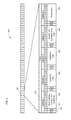
- FIG. 4 shows exemplary data sent by a transmitter with a known location.
- FIG. 5 is a flow diagram of a method for signing geolocation information.
- FIG. 6 illustrates various layers of a generalized digital record verification and signing infrastructure.
- FIG. 7 illustrates the verification infrastructure along with various data and computational structures maintained and computed within different layers.
- FIG. 8 shows a subset of FIG. 7 to illustrate a digital signature and recomputation of authentication values using the signature.
- FIG. 9 illustrates optional publication to enable permanent, trust-free authentication.
- FIG. 10 illustrates use of a digital signature to enable system-independent authentication by recomputation.
- FIG. 11 shows how the location of a server in a data authentication infrastructure can be included as a parameter in a recomputation path for signed digital data.
- FIGS. 12 and 13 illustrate respective embodiments in which either calendar values individually, or in digital combination over a period, are committed to a distributed, widely witnessed data structure such as a blockchain.
- FIG. 1 illustrates one of many possible examples of a system 100 configured to verifiably establish the geolocation of one or more devices operating within the system.
- a user of a mobile phone 611 and a communication system in a car 612 are shown as transmitting to reception systems such as cell phone towers 620 and/or satellites 630 .
- reception systems such as cell phone towers 620 and/or satellites 630 .
- the number and type of wireless devices continues to increase and spread, so too will the possible uses of the invention. Note that it is not necessary for the device tracked by the geolocation system according to embodiments of the invention to itself be mobile, or at least not intentionally.
- the system may be used to detect and prove that a device that is not supposed to move, for example, beyond or to within some boundary, has in fact done so. It would also be possible to incorporate the invention into a device that is independent of human interaction, or is remotely controlled.
- the term “device” is used to mean anything that includes or can receive data from a geolocation engine and whose location is to be verified with a data signature.
- FIG. 2 illustrates an embodiment of a mobile device 700 configured to determine its current location and to request a corresponding data signature.
- the device 700 will typically include one or more antennas or transceivers 705 , which may allow the phone to exchange data with a cell tower, satellite (such to acquire GPS signals, signals transmitted from the Iridium constellation of satellites, etc.), Wi-Fi base station, and/or the like in order to perform its nominal function, such as telephony, as well as to determine a geolocation and/or to communicate with a remotely located entity.
- antennas or transceivers 705 may allow the phone to exchange data with a cell tower, satellite (such to acquire GPS signals, signals transmitted from the Iridium constellation of satellites, etc.), Wi-Fi base station, and/or the like in order to perform its nominal function, such as telephony, as well as to determine a geolocation and/or to communicate with a remotely located entity.
- the device 700 includes at least one geolocation engine 710 configured to compute a current location.
- the geolocation engine 710 determines a current location of the device 700 based on any or a plurality of the various forms of information available to the device 700 .
- a suitable geolocation engine would be a GPS receiver and processor.
- Another example would be any known transmission and/or receiver and processing systems that process multiple signals using tri- or multilateration.
- cell towers and Wi-Fi base stations may have known, fixed locations, so if the device 700 is within communication range of or connected to a particular transmitter, it may know that it is within a certain distance of the particular cell tower and/or Wi-Fi base station to which it is connected.
- the geolocation engine 710 may compute a current location based on such pseudoranges to one or more transmitters with known locations, such as satellites or transmitters with fixed locations on earth.
- Various methods are well-known for computing a location estimate based on a plurality of signals, or signal pairs.
- the geolocation engine is shown as a single component in the figures, this is only to represent the collection of whichever hardware and software components are included in the device to acquire, receive, and interpret geolocation information from the various sources and as such, represents in some cases more than one “engine”.
- the GPS circuitry and processing software in a mobile phone will in general be different from the circuitry and processing software that determines position based on multilateration from cell phone towers.
- geolocation systems there are many examples of geolocation systems that the invention can accommodate, based on methods such as tri- or multilateration, tri- and multiangulation, direct measurement, differential signal arrival times, etc.
- measured signal strengths and/or round-trip signal transit times to a plurality of communication towers can allow for tri- or multilateration.
- LCS radio resource location services
- RRLP uses Enhanced Observed Time Difference (E-OTD) measurements within the phone, which involve differences in time of arrival of bursts of base station pairs.
- E-OTD Enhanced Observed Time Difference
- GPS and its algorithms based on precise times and other well-known orbital parameters, as well as correction signals transmitted from fixed stations in a Differential GPS configuration.
- geolocation engine(s) 710 which may comprise more than one geolocation mode, such as both GPS and relative signal strength of transmissions between mobile phones and cell tower
- location data that either directly, or after proper processing, provide position information, such as such as latitude/longitude/altitude, other grid coordinates, in any coordinate system, etc.
- the location data will typically include other information as well, such as tower or satellite ID, time, signal propagation information, information about the transmission system itself, such as GPS orbital parameters, etc.
- the geolocation engine(s) may be built into the device and/or may be added by a user after manufacture.
- geo-“location” may also include orientation or movement information; that is, “location” may mean any point in an n-dimensional parameter space that need not be limited to instantaneous position in some fixed, linear coordinate system.
- geolocation data might also include such information as angular positions about x-, y- and/or z-axes (such as roll, pitch, yaw), “upside down” vs. “rightside up”, velocity v and acceleration a (in one or more directions), position expressed in terms of bearing/range, Cartesian or non-Cartesian coordinates (such as lat/long/altitude, hyperbolic coordinates, time-difference coordinates, etc.).
- the signals for such values may in such cases then be taken and converted or computed from suitable sensors such as airspeed or flow sensors, accelerometers, location difference values (such as a change in GPS-fixed position over time), etc. Coupled with a reliable (and, in one embodiment described above, later verifiable) indication of time, at least one embodiment of the invention can establish for later verification not only the position of the device 700 , but do so at a verifiable time, possibly together with a verifiable indication of other information such as motion and acceleration (etc.) data as well. Extraction and signature of such information might be useful, for example, for flight data recorders (“black boxes”), in which case signature of the location (and other) data could be done and recorded as part of the data recording itself, or when the recorder casing is opened for inspection
- x j , ⁇ j , ⁇ j , ⁇ dot over ( ⁇ ) ⁇ j are the j'th position (of any dimension), velocity, acceleration, and rotational velocity and rotational acceleration coordinates, for example, from a j'th geolocation sub-system in the device.
- x j , ⁇ j , ⁇ j , ⁇ dot over ( ⁇ ) ⁇ j are the j'th position (of any dimension), velocity, acceleration, and rotational velocity and rotational acceleration coordinates, for example, from a j'th geolocation sub-system in the device.
- a mobile phone uses both GPS and location based on multilateration between it and several cell phone towers, there could be at least two sets of coordinates, although possibly not rotational data, and possibly not with velocity or acceleration data. As is made clearer below, such data will typically be only a subset of the data that is submitted as a request for signature.
- the data to which the geolocation engine 710 has access may not be generally accessible to users of the device 700 .
- the geolocation engine 710 might have access to identification information for a cell phone tower or Wi-Fi base station, MAC addresses, and/or the like.
- the geolocation engine 710 may have access to frames (such as GPS frame data) or packets transmitted by transmitters with known locations for the purpose of determining geolocation.
- the geolocation engine 710 may also have access to pseudoranges and intermediate calculations used by the geolocation engine 710 to determine the current location.
- the intermediate calculations may include calculations to determine the location of the transmitters and/or calculations to determine the location of the device 700 .
- a signature generation module 720 is configured to format a digital data record and to generate or, using an infrastructure as shown in FIGS. 6-10 , obtain a digital signature that can be used to verify a current geolocation of the device 700 at the time the signature is obtained. Because geographic coordinates may be spoofed or possibly manipulated by the user himself, the digital record may include various types of additional information that would be more difficult for an attacker trying to spoof or fake a location to determine. For example, any of the lower level data generated by or known to the geolocation engine 710 could be included in digital records. It may, for example, be somewhat more difficult for an attacker to determine pseudoranges, cell tower and/or Wi-Fi base station identifiers, a calculated position of a moving transmitter, and/or the like.
- the general concern will be the following: Assume that a user U wishes to fake the whereabouts of the device, for example, to create an alibi for himself at location L1. He then gets a friend F in location L2, to compile and send to him the location parameters (such as GPS coordinates, time t, etc.), to which U adds in his own local data, such as phone SIM, and submits this for signing. U then later claims to have been at L2 at time t, and also presents the faked input data, along with the signature, as proof. There would be other ways to fake location data, for example, by spoofing the GPS signal and thereby fooling the GPS engine within the device into outputting incorrect location data.
- location parameters such as GPS coordinates, time t, etc.
- FIG. 3 illustrates an alternate embodiment in which the signature generation module 755 is included in a system external to the device itself, but in communication with it, such as in a cell tower base station 750 for a phone.
- the phone may transmit any information needed by the signature generation module 755 to the base station 750 , possibly even without the user of the device knowing this.
- the phone may include any hardware or software necessary to acquire and/or aggregate the necessary information and send it to the signature generation module 755 .
- a digital record may include, as just a few examples, additional arguments in a digital input record relating to the system that generates the raw geolocation data such as:
- GPS frame parity (checksum) data is included in the signature request, along with the data that the parity bits are derived from, then this would add an additional level of difficulty in faking the location of the device, since it would constitute a form of “built-in” security algorithm, namely, the GPS checksum for the received frames or sub-frames.
- FIG. 4 shows one of substantially unlimited examples of data 800 sent by a transmitter, in this case, a GPS satellite, with a known location.
- a GPS transmission typically includes a plurality of data frames (e.g., the data frame 805 ), each of which may include a plurality of sub-frames (e.g., the sub-frame 810 ).
- the sub-frames may include various forms of information that can be included in digital records.
- the frame and/or sub-frame from which information is extracted may then be selected according to a predetermined algorithm. For example, a frame or sub-frame closest in time to when a position fix is acquired may be selected, and/or a frame including information related to satellites visible to the geolocation engine. For information that changes very slowly or not at all, it may not matter which frame it is taken from.
- the digital record may include information from all transmitters visible.
- Triggers may be used as triggers to start the process of compiling location data and having it, along with any other desired data, signed.
- One simple trigger event could be a direct request by the user, for example, by tapping on a screen icon, push a button, or entering a command that the device's operating system can interpret.
- the signal triggering location determination and signature might also be received from an external source, such as a system administrator, a law enforcement agency, an authorized third party (such as a parent), etc.
- geolocation/signature procedure is triggered automatically, or periodically, according to a schedule, or, for example, when the device is powered on or off, or when the user accesses or attempts to access or run some feature or application within the device, such as talking a photo, making or receiving a call (possibly from any number or a white or black list), etc., a change in path outside some preset limit, for example, a change in flight path of a plane, change in car route, path, moving outside of or inside of some predetermined boundary, etc.), and/or the like.
- triggers could be: sensing that a user has been away from (or using) the device for more than some threshold time; sensing that a person has entered some monitored area; sensing an attempt at physical intrusion into or removal of the device, etc.
- trigger events could occur without the knowledge of the user, in which case the geolocation/signature routines may also be run substantially anonymously, as background processes.
- any pre-defined or even randomly occurring event may form a trigger as long as its occurrence can be sensed.
- the signature generation module Upon sensing a trigger event, the signature generation module will then input data indicative of a current location from the geolocation engine, which in turn may either create this data itself, or it may retrieve this data from an external source, or both. For example, the signature generation module might submit a request or query to the geolocation engine for the data in response to the trigger event. The signature generation module might then submit commands to an operating system (e.g., Android, iOS, etc.) requesting data from the geolocation engine.
- an operating system e.g., Android, iOS, etc.
- FIG. 5 is a flow diagram of a method 900 for signing geolocation information.
- the method 900 may begin when it is determined 902 that a trigger event requiring a geolocation to be signed has occurred. Several examples of trigger events are mentioned above.
- the data comprising the digital input record that gets signed and is later to be verified must be preserved exactly 908 ; otherwise, even a change in one digital bit, or a change of, for example, longitude, by even a fraction of a second, or even the smallest change in a measured signal strength, might cause a failure of verification.
- the information that is used as the basis for a digital input record should therefore preferably be such that a later third-party verifier can extract useful comparative information from it so as to increase the reliability of the verification.
- the verifier is unable to correlate ionospheric model data with a stated position, then it might not be relevant and might not be included in an input record, although it could still be stored and presented.
- the idea is that, given a set of data that is purported to prove the position of the device at the time the data was obtained, a verifier should be able, given that data and its signature, to verify that the data is identical to what led to the signature, and the data itself should correspond to a geolocation with some at least minimum level of certainty or at least credibiltiy.
- the signature generation module 720 To reduce the ability for even a sophisticated user to manipulate the data that is digitally signed, it is preferable for the signature generation module 720 to extract geolocation information as directly from the geolocation engine 710 as possible, preferably without any intermediate software or hardware component that is accessible to the user. It would therefore also be possible to combine the geolocation engine 710 and signature generation module 720 into a single and separately programmable component within the device in addition to its existing processor, etc.
- the lower level data generated by the geolocation engine 710 may accordingly in some embodiments not be made available to the operating system 725 of the device 700 at all and instead may be sent “raw”—transferred as an otherwise unprocessed data block, directly to the signature generation module 720 .
- a software attacker may then be unable to obtain at least some information included in the digital record. Physical access to the hardware may then be required to determine the values of the data being included in the digital record.
- the signature generation module 720 may also include information from the device 700 in the digital record.
- the signature generation module 720 may include a system time from a clock 715 (which may be a separate, dedicated hardware clock used to create an additional time indication used for time corroboration by the module 720 ) or network time obtained from the telephone or other network, information from an operating system 725 , and/or information from and/or about a storage device 730 .
- the signature generation module 720 may include sufficient information for the device 700 and/or its SIM card to be uniquely identified. Such numbers might include the SIM identifier itself, and/or the phone number associated with it, and/or the serial number of the device, and/or a “secret” number supplied by the manufacturer or preprogrammed into the module 720 .
- the signature generation module 720 may also include a system time and a time used by the geolocation engine 710 for calculating the geolocation argument in the digital input record. As will become clearer below, depending on how signatures are generated, a signature itself may encode a verifiable indication of the time the signature request was received or the signature was generated.
- a parameter M is also shown in this example for ⁇ .
- being able to verify the location of the device at a particular time may not be an end in itself, but rather location at the time and also associated with some other message, that is, other data set M.
- the message M may be any set of digital data that the user also wishes to digitally sign, along with geolocation.
- a user might want to use the system to “location stamp” a photograph taken with the device, or to prove that, for example, a particular document, or downloadable application, etc., was digitally signed at a particular location.
- Location-verified photographs might then be used as evidence that is more credible than what is available now.
- the digital record may be digitally signed by submitting the digital record to another party for signing.
- a common signature scheme uses keys that are issued by some certificate authority.
- the well-known Public Key Infrastructure (PKI) is an example of such a system.
- PKI Public Key Infrastructure
- One problem with key-based signature schemes is not only the need to store and maintain the key sets, but also that the keys may expire, along with the underlying digital certificates.
- Another disadvantage of key-based signature schemes is that they require trust of the issuing authority.
- Still another disadvantage that is likely to rise in severity is that known key-based signature schemes are not quantum-immune, that is, they are not secure against an attack using proposed quantum-computing systems.
- the digital record ⁇ is signed by a distributed, hash tree-based signing infrastructure such as is provided by Guardtime AS of Tallinn, Estonia, which returns a digital signature that enables data verification through recomputation of a logically uppermost value in a hash tree.
- a distributed, hash tree-based signing infrastructure such as is provided by Guardtime AS of Tallinn, Estonia, which returns a digital signature that enables data verification through recomputation of a logically uppermost value in a hash tree.
- This infrastructure is described in more detail below.
- the digital record, digital signature, and/or uppermost hash tree value may be stored, in a storage component 730 ( FIG. 10 ) in the device 700 , or in any other entity or entities that might want or need to later confirm the device's location, by the signing infrastructure, etc.
- an entity Given a purportedly authentic copy of the data record, or the original, together with the data signature, an entity can then verify that the digital record is authentic by recomputing the uppermost hash tree value from the digital signature and the digital record.
- the digital record, digital signature, and/or uppermost hash tree value may also allow the time the digital record was signed to be verified.
- FIG. 6 illustrates the hash tree infrastructure (the “Guardtime signing infrastructure”) that has been developed by Guardtime As of Tallinn, Estonia, and which is disclosed in U.S. Pat. Nos. 8,347,372; 8,312,528; and 7,698,557 (all Buldas, et al., “System and method for generating a digital certificate”) as well as U.S. Pat. No. 8,719,576 (also Buldas, et al., “Document verification with distributed calendar infrastructure”), all of which are incorporated herein by reference.
- the Guardtime signing infrastructure the hash tree infrastructure
- the hash tree infrastructure of Rickas '576 may be used to function not only as a signature-generation system 500 , but also as a timestamping system too, for any of a plurality of clients 2000 .
- the main features of the Guardtime signing infrastructure are summarized here, with reference to FIG. 7 .
- either the device 700 itself may comprise a client, or be connected to a system that is or acts as a client and with which the device communicates, such as a server that receives data from an LTE eNodeB, base transceiver station (BTS), etc., or any other type of server that receives and processes signals from the device 700 .
- a server that receives data from an LTE eNodeB, base transceiver station (BTS), etc., or any other type of server that receives and processes signals from the device 700 .
- Guardtime hash tree infrastructure is that, except for possible and optional temporary establishment of user or client ID during a session, and optionally temporarily until a time of publication (described below), it does not rely on public/private keys such as RSA in a PKI infrastructure.
- Keys have several disadvantages: they can expire; they depend on a trust authority (in particular a Certificate Authority that issues the keys); they are mathematically less secure than hash functions; they must be stored and maintained, which leaves them potentially vulnerable to being hacked, in addition to the problem of requiring increasing storage space in devices in which this may be a scarce resource; they must be made available to a third party who wishes to verify the key-signed data; moreover, recent research indicates that some keys may have “back doors” embedded in them, or may be generated using comprised pseudo-random number seeding routines, such that these back doors are unknown to users.
- the general Guardtime infrastructure has several different layers: a client layer 2000 comprising a number of client systems; a layer of gateways 3000 ; a layer including one or more aggregation systems 4000 ; and an uppermost layer 5000 that includes a “core”.
- the gateways, aggregators and the core will be servers, with known network connections and network communication hardware and software.
- the client systems may also be servers, but, depending on the implementation, some or all may also be more individualized workstations, laptop, personal or other mobile computing devices, etc.; in particular here, the mobile device 700 may comprise or be associated with one of the client systems.
- a client 2000 may be any system where a representation of any type of information is input, created or otherwise presented (with or without human involvement) in digital form such that it can be processed and registered using the infrastructure according to the invention.
- a client is the system where digital records are prepared and entered into the verification/signature system.
- a digital record may be any set of binary data that one later wishes to verify has not changed since initial registration and signing using the infrastructure.
- FIG. 6 shows the various layers as being separate and distinct, some implementations of the main principles of the infrastructure might consolidate or do without some of the layers or might need to add additional layers for administrative or other purposes.
- a gateway in the layer 3000 will typically be a computer system such as a server with which one or more of the clients communicates so as to receive requests for registration of digital records that its clients submit.
- An aggregator in the aggregation layer 4000 will similarly be a computer system such as a server intended to receive registration requests that have been consolidated by respective gateways. The distinction between aggregators and gateways will often depend on which entities control each, but this is not necessary and in some implementations there is no control or functional differences between the two types of systems.
- various clients are represented as 2010 - 1 , . . . , 2010 - n ; gateways are represented as 3010 - 1 , 3010 - 2 , . . . , 3010 - m ; and two aggregators are shown as 4010 - 1 , 4010 - k .
- An aggregator will typically communicate into a respective one of the lowest level hash tree nodes within the core, as described in more detail below. Only two aggregators are shown in FIG. 7 for the sake of simplicity.
- Each client system 2000 that wishes to use the verification infrastructure may be loaded with a software package or internal system routines for convenient or even automatic communication and submission “upwards” of digital information.
- the client system 2000 may be the client 200 .
- the software package may include some application program interface (API) 2014 that transforms submitted digital records into a proper form for processing.
- API application program interface
- a digital record 2012 is then submitted by way of the API 2014 to a software module 2016 that uses the digital data from the record 2012 as at least one argument in a transformation function 2018 such as a hash function.
- the data structure of a binary hash tree is illustrated within the gateway 3010 - 2 .
- the lowest level nodes of the gateway hash tree will correspond to the transformed dataset 2018 submitted as a request REQ from a client, along with any other parameters or data used in any given implementation to form a request.
- the values represented by each pair of nodes in the data structure form inputs to a parent node, which then computes a combined output value, for example, as a hash of the two input values from its “children” nodes.
- Each thus combined output/hash value is then submitted “upward” as one of two inputs to a “grandparent” node, which in turn computes a combined output/hash value for these two inputs, and so on, until a single combined output/hash value is computed for the top node in the gateway.
- Aggregators such as the system 4010 - 1 similarly include computation modules that compute combined output values for each node of a hash tree data structure. As in the gateways, the value computed for each node in the aggregator's data structure uses its two “children” nodes as inputs. Each aggregator will therefore ultimately compute an uppermost combined output value—a “root hash value”—as the result of application of a hash function that includes information derived from the digital input record(s) of every client that submitted a request to a gateway in the data structure under that aggregator.
- the core 5000 is maintained and controlled by the overall system administrator.
- a hash tree data structure is computed using the root hash values of the aggregators as lowest level inputs.
- the hash computations and structure within the core form an aggregation of aggregation values.
- the core will therefore ultimately compute a single current uppermost core hash value at the respective tree node 5001 at each of a sequence of calendar time intervals t0, t1, . . . , t n .
- This uppermost value is referred to here alternatively as the “calendar value” c i or “current calendar value” for the time interval ti.
- calendar values are computed according to precisely determined time values, such as one calendar value each 1.0 s, then each calendar value will also be a precise representation of time.
- each digital signature issued in a given calendar interval will intrinsically and provably be tied to a particular calendar value. Due to the essentially non-invertible nature of cryptographic hash functions, this time association will be as essentially impossible to fake as the data that led to the corresponding signature itself.
- the signature request includes a time parameter, such as the time of the device clock 715 , then this may later be compared with the calendar time of the request. If the device time differs from the calendar time more than some acceptable amount, taking into account any signal and network propagation delays, then this may serve as an indication that the device time may have been manipulated, for example, by back- or forward-dating, or that some other parameter in the request ⁇ was received so much later after the others that the data comprising the request ⁇ itself is suspicious.
- the relationship between calendar values and the time used by one or more transmitters with known locations may be known, and/or the processing delay of the signature generation module 720 and the signing infrastructure may be at least approximately known.
- the uppermost tree node 5001 represents the root node of the entire tree structure of nodes junior to it. This will change upon recomputation of a new uppermost core hash value at the end of the next period of accumulating requests and generating signature vectors (also referred to as “data signatures”) containing recomputation parameters.
- the core system 5000 combines the sequence of calendar values c i during each of a series of time intervals (“calendar periods”) T p using a Merkle hash tree 7002 ( FIG.
- the combined uppermost hash value 7001 will encode information from every calendar value, and thus every digital input record, ever submitted to the infrastructure for signature up to the end of the current calendar period.
- the combined uppermost hash value may then be published in some substantially unalterable medium 7000 , such as a newspaper, publicly accessible database or web site, some internal database or publication (such as within an enterprise or government agency), etc., such that, once the value is published, it would be practically impossible to fraudulently alter what was published; for example, it would in practice be impossible to retrieve and change every copy of a newspaper that has been distributed to the public.
- FIG. 7 certain ones of the hash tree nodes in the gateway 3010 - 2 , the aggregator 4010 - 1 , and the core 5000 are marked with an “X”. Notice if one traverses the various tree paths upward from the value 2018 in the client 2010 - 1 , it is possible to compute every value upward in the tree structures all the way to the most current uppermost core value 5001 given the values in the X-marked tree nodes (the “siblings” of the nodes in the direct recomputation path) and a knowledge of the hash functions applied at each successive parent node.
- the set of sibling hash values may then be returned to the client system as the signature 8000 ( FIG. 8 ) for the digital input.
- This signature may later be extended with the sibling values within the core's Merkle hash tree that allow recomputation all the way up through the infrastructure to the uppermost hash value 7001 of the core 5000 for the corresponding calendar period.
- FIG. 10 illustrates this option, in which the “X-marked” sibling values in a digital signature may be extended with the “E-marked” sibling values to enable recomputation all the way up to the published value 7001 .
- a “candidate digital record” is an identical copy of digital record 2012 .
- the entity should compute to the exact same calendar value, or publication value 7001 that resulted from the original digital record's request.
- a data record ⁇ * is the same as the data record ⁇ .
- the corresponding digital signature for ⁇ may similarly be stored locally, in storage 730 , and/or externally.
- the Guardtime signing infrastructure as shown in FIGS. 6-10 , this can be done without dependence on keys, and may in some implementations even be done offline, without having to rely on the signing infrastructure again, and assuming all hash functions are specified or known. Even so, the signatures themselves are created not within clients themselves, which is more open to malicious manipulation or attack, but rather within external entities, in particular, the gateway(s), aggregator(s) and core; in short, the data signatures created by the Guardtime infrastructure are created server-side, albeit of course with client-input data record as the basis of the signature.
- FIG. 11 illustrates how the hash tree signing infrastructure of FIGS. 6-10 can be augmented with geolocation data ⁇ (or maybe just ⁇ ) for the current calendar period by inputting and hashing this data into the tree as a node GEO within the hash sub-tree within one or more of the gateway(s) and/or aggregator(s).
- An identifier ID for each respective gateway/aggregator may also be included as a node, or may be included within the data set ⁇ .
- the geolocation data for the current calendar period will then be encoded in the data signatures for every data record for which the “location node” 9010 (with or without other data) is a sibling in the recomputation path, that is, for all signatures for clients submitting signature requests via nodes below the node 9012 marked “*” in FIG. 11 .
- the server itself becomes the device 700 whose location is established. It would also additionally be possible for the gateway/aggregator to request and get a digital signature for its own geolocation data ⁇ . The locations signatures may then be stored in the sever itself or sent to some other entity for later verification.
- the various operations of the geolocation component 710 described above for example, extracting and compiling the data that comprises each ⁇ , submitting it for signature, receiving and storing the signature, etc., will be carried out by executing, for example, in one or more processors 750 ( FIG. 10 ), corresponding executable code, under the direction of some system software such as an operating system 725 , that may be stored in a non-transitory, volatile and/or non-volatile computer-readable medium such as the memory/storage component 730 , which may be implemented using any known storage technology or combination of technologies.
- the code that embodies the different embodiments of the invention may be incorporated into the device 700 at the time of manufacture and initial software configuration, and/or it may be installed as a computer program product either then, or later.
- the calendar values during a calendar period are combined in the Merkle to produce a composite value that may be published in some unalterable medium.
- FIGS. 12 and 13 illustrate an embodiment in which the “medium” is a data structure that can be widely witnessed, and, as such, practically impossible to tamper with without detection.
- One such data structure is known as a “blockchain” 9000 .
- a “blockchain” is understood as being a data structure comprising a series of usually (but not necessarily) time-stamped blocks bi, . . . , bj, bj+1, bj+2, bj+3, . . . , where each block includes data corresponding to one or more transactions, hashed together with linking data, such as the hash output, of an immediately preceding block.
- the chain can then be used to create a public ledger, which is typically an append-only database achieved by distributed consensus of multiple participants.
- a public ledger typically an append-only database achieved by distributed consensus of multiple participants.
- blockchain One current point of dispute when it comes to the concept of a “blockchain” is whether, by definition, any entity may be allowed to submit blocks to and verify blocks in the blockchain, possibly only upon meeting some proof-of-work requirement (such as Bitcoin's “mining”), or whether the entities that may submit to and verify blocks in the data structure must be permissioned by some central authority. In other words, there is dispute as to whether “blockchain” by definition implies “open” or not. Embodiments of this invention do not presuppose or require either definition.
- the composite calendar value for each calendar period is entered, using any appropriate mechanism, for example, using proof-of-work, other multi-entity consensus, by permission, etc., for the chosen type of blockchain, as a block in the blockchain.
- any appropriate mechanism for example, using proof-of-work, other multi-entity consensus, by permission, etc., for the chosen type of blockchain, as a block in the blockchain.
- Some blockchains have a non-trivial settlement time. For example, there may be a delay on the order of ten minutes for an updated state of a Bitcoin blockchain to be accepted. In such cases, it may be preferable to consolidate several calendar values and submit this as a single transaction.
- the composite calendar value formed as the root of the Merkle tree in the core 5000 is itself a consolidation of several calendar values.
- the composite value may be the transaction submitted at the end of each period Tp. The period Tp may then be adjusted according to the blockchain settlement time.
- the signatures distributed to users may be extended to include parameters identifying, for example, the respective transaction, that is, block, in the blockchain in which the user's input's calendar value was a part. Given a purportedly true copy of the original input record, its corresponding signature, and this blockchain-identifying information, one would then be able to verify the signature up to the level of the calendar value, and onward to the blockchain, thereby totally verifying (or confirming alteration of) the input record.
- Embodiments may also be used to implement geofencing: Upon triggering by an administrator, or as a result of a schedule, the device may be directed to request a signature for its current location. The calendar value corresponding to signature may then be committed to the blockchain (either as is, or as part of the core-level Merkle tree computation), thereby forming an irrefutable record of the location data encoded in the signature. If the determined location is beyond, or within, some boundary (for example, defined by a threshold distance from an “allowed” or “operational” central point), all or some of the functions of the device may be rendered inoperational, for example, by the device's operating system itself or an application that communicates with it.
- some boundary for example, defined by a threshold distance from an “allowed” or “operational” central point
Landscapes
- Engineering & Computer Science (AREA)
- Computer Security & Cryptography (AREA)
- Computer Networks & Wireless Communication (AREA)
- Signal Processing (AREA)
- Radar, Positioning & Navigation (AREA)
- Remote Sensing (AREA)
- Physics & Mathematics (AREA)
- General Physics & Mathematics (AREA)
- Computer Hardware Design (AREA)
- Computing Systems (AREA)
- General Engineering & Computer Science (AREA)
- Telephonic Communication Services (AREA)
- Position Fixing By Use Of Radio Waves (AREA)
Abstract
Description
-
- the pseudo-random codes the respective satellites transmit as IDs;
- the ephemeris data, which has the advantage that it generally includes the date and time used in the calculations used to determine the position of the GPS receiver, which should then match, to within some time margin, the system time of the
device 700, and/or of the signature time encoded within the corresponding digital signature; and - the almanac data, which would require an attacker trying to fake geolocation data to know even orbit information of the satellite transmitting location information.
-
-
telemetry words 811 and/orhandover words 812 from one or more sub-frames. For example, ahandover word 812 received closest in time to when a position fix is acquired and/or used to compute the geolocation may be included; - clock correction, accuracy, and
system health data 815 received from one or more transmitters; -
ephemeris data - almanac data 845, 855 for all possible transmitters and/or a smaller set of transmitters selected according to a predetermined method; and
- ionospheric model data.
-
Δ={Λ,M,ID,τ,C}
where Λ is a set of location data; ID is whatever set of data is optionally included to identify the user and/or device and/or geolocation data source(s) (such as GPS satellite or mobile phone tower identifiers), etc.; τ is an optional set of data indicating one or more time measurements; and C is any other optional data included for purposes, for example, of corroboration or simply administration.
Claims (17)
Priority Applications (1)
| Application Number | Priority Date | Filing Date | Title |
|---|---|---|---|
| US15/297,111 US10158492B2 (en) | 2015-02-25 | 2016-10-18 | Blockchain-supported device location verification with digital signatures |
Applications Claiming Priority (2)
| Application Number | Priority Date | Filing Date | Title |
|---|---|---|---|
| US14/630,656 US9473510B2 (en) | 2015-02-25 | 2015-02-25 | System and method for location verification |
| US15/297,111 US10158492B2 (en) | 2015-02-25 | 2016-10-18 | Blockchain-supported device location verification with digital signatures |
Related Parent Applications (1)
| Application Number | Title | Priority Date | Filing Date |
|---|---|---|---|
| US14/630,656 Continuation-In-Part US9473510B2 (en) | 2015-02-25 | 2015-02-25 | System and method for location verification |
Publications (2)
| Publication Number | Publication Date |
|---|---|
| US20170041148A1 US20170041148A1 (en) | 2017-02-09 |
| US10158492B2 true US10158492B2 (en) | 2018-12-18 |
Family
ID=58053161
Family Applications (1)
| Application Number | Title | Priority Date | Filing Date |
|---|---|---|---|
| US15/297,111 Active 2035-12-13 US10158492B2 (en) | 2015-02-25 | 2016-10-18 | Blockchain-supported device location verification with digital signatures |
Country Status (1)
| Country | Link |
|---|---|
| US (1) | US10158492B2 (en) |
Cited By (6)
| Publication number | Priority date | Publication date | Assignee | Title |
|---|---|---|---|---|
| US20190074960A1 (en) * | 2017-09-01 | 2019-03-07 | Honda Motor Co., Ltd. | Methods and systems for creating a unique identification number to maintain customer privacy |
| US10627250B2 (en) * | 2018-01-25 | 2020-04-21 | Walmart Apollo, Llc | System and method for tracking vehicle mileage using blockchain |
| US11443326B2 (en) | 2019-06-05 | 2022-09-13 | International Business Machines Corporation | Geo-location compliance |
| US12099997B1 (en) | 2020-01-31 | 2024-09-24 | Steven Mark Hoffberg | Tokenized fungible liabilities |
| US20250063368A1 (en) * | 2021-12-21 | 2025-02-20 | Mercedes-Benz Group AG | Apparatus for securing communication |
| US12632859B2 (en) | 2023-07-26 | 2026-05-19 | Bank Of America Corporation | Hybrid consensus mechanisms in distributed trust computing networks implicating proof of geographic location |
Families Citing this family (81)
| Publication number | Priority date | Publication date | Assignee | Title |
|---|---|---|---|---|
| US9474042B1 (en) * | 2015-09-16 | 2016-10-18 | Ivani, LLC | Detecting location within a network |
| US11533584B2 (en) | 2015-09-16 | 2022-12-20 | Ivani, LLC | Blockchain systems and methods for confirming presence |
| KR101977109B1 (en) * | 2015-11-17 | 2019-08-28 | (주)마크애니 | Large simultaneous digital signature service system based on hash function and method thereof |
| AU2017363534B2 (en) * | 2016-11-22 | 2022-01-20 | Cox Automotive, Inc. | Multiple agent distributed ledger architecture |
| US10115068B2 (en) * | 2017-01-24 | 2018-10-30 | Accenture Global Solutions Limited | Secure product identification and verification |
| US11005653B2 (en) * | 2017-02-28 | 2021-05-11 | Airbus Helicopters | Integrated method and device for storing and sharing data |
| US10826681B1 (en) * | 2017-03-24 | 2020-11-03 | Open Invention Network Llc | Blockchain node initialization |
| WO2018187300A1 (en) | 2017-04-03 | 2018-10-11 | Systems And Software Enterprises, Llc | Systems and methods for cryptocurrency transactions in aircraft |
| US10832214B1 (en) | 2017-04-05 | 2020-11-10 | State Farm Mutual Automobile Insurance Company | Systems and methods for maintaining transferability of title via blockchain |
| GB2562054A (en) * | 2017-05-02 | 2018-11-07 | Bitbond Ltd | Automotive electronic blockchain information system - AEBIS |
| US10917423B2 (en) | 2017-05-15 | 2021-02-09 | Forcepoint, LLC | Intelligently differentiating between different types of states and attributes when using an adaptive trust profile |
| US10447718B2 (en) | 2017-05-15 | 2019-10-15 | Forcepoint Llc | User profile definition and management |
| US10623431B2 (en) | 2017-05-15 | 2020-04-14 | Forcepoint Llc | Discerning psychological state from correlated user behavior and contextual information |
| US10129269B1 (en) | 2017-05-15 | 2018-11-13 | Forcepoint, LLC | Managing blockchain access to user profile information |
| US10999297B2 (en) | 2017-05-15 | 2021-05-04 | Forcepoint, LLC | Using expected behavior of an entity when prepopulating an adaptive trust profile |
| US10862927B2 (en) | 2017-05-15 | 2020-12-08 | Forcepoint, LLC | Dividing events into sessions during adaptive trust profile operations |
| US9882918B1 (en) | 2017-05-15 | 2018-01-30 | Forcepoint, LLC | User behavior profile in a blockchain |
| US10999296B2 (en) | 2017-05-15 | 2021-05-04 | Forcepoint, LLC | Generating adaptive trust profiles using information derived from similarly situated organizations |
| US10915644B2 (en) | 2017-05-15 | 2021-02-09 | Forcepoint, LLC | Collecting data for centralized use in an adaptive trust profile event via an endpoint |
| EP4550293A3 (en) * | 2017-05-18 | 2025-07-09 | Nokia Technologies Oy | Vehicle operation |
| EP3410156A1 (en) * | 2017-06-02 | 2018-12-05 | Nokia Technologies Oy | Positioning information verification |
| US10433117B2 (en) | 2017-07-23 | 2019-10-01 | Brilliant Points, Inc. | Time and location-based object tracking and presence confirmation |
| US10187754B1 (en) * | 2017-07-23 | 2019-01-22 | Brilliant Points, Inc. | Time and location-based user tracking and presence confirmation |
| GB201711879D0 (en) * | 2017-07-24 | 2017-09-06 | Nchain Holdings Ltd | Computer-implemented system and method |
| US10318729B2 (en) | 2017-07-26 | 2019-06-11 | Forcepoint, LLC | Privacy protection during insider threat monitoring |
| CN107566342B (en) * | 2017-08-01 | 2019-07-23 | 东华大学 | A M2M security method in cotton spinning production CPS based on blockchain technology |
| WO2019033090A1 (en) | 2017-08-11 | 2019-02-14 | Teluss Title Company | Distributed ledger based system and method for the settlement and transfer of title to real estate |
| GB2566741A (en) * | 2017-09-26 | 2019-03-27 | Phm Associates Ltd | Integrity of data records |
| US10832241B2 (en) | 2017-10-11 | 2020-11-10 | International Business Machines Corporation | Transaction reservation for block space on a blockchain |
| KR101936080B1 (en) * | 2017-10-26 | 2019-04-03 | 순천향대학교 산학협력단 | Ksi-based authentication and communication method for secure smart home environment and system therefor |
| EP3707858A4 (en) * | 2017-11-06 | 2021-07-21 | Velo Holdings Limited | Blockchain system |
| EP3503595B1 (en) | 2017-12-19 | 2020-11-11 | Nokia Technologies Oy | Provision of location-specific user information |
| US10833869B2 (en) | 2018-01-05 | 2020-11-10 | International Business Machines Corporation | Securing geo-physical presence |
| TWI659373B (en) | 2018-02-14 | 2019-05-11 | 財團法人工業技術研究院 | Blockchain system and method thereof |
| US10645094B2 (en) * | 2018-02-16 | 2020-05-05 | Integrity Security Services Llc | Systems, methods, and devices for provisioning and processing geolocation information for computerized devices |
| DE102018204509B4 (en) * | 2018-03-23 | 2021-04-15 | Deutsche Bahn Ag | Method for scheduling or controlling the movements of a plurality of vehicles over a network of traffic routes |
| CN108510251A (en) * | 2018-03-30 | 2018-09-07 | 上海分赋信息科技有限公司 | A variety of trigger mechanisms are built based on external data to execute the method and system of intelligent contract in block chain network |
| EP3562090B1 (en) * | 2018-04-25 | 2020-07-01 | Siemens Aktiengesellschaft | Data processing device for processing a radio signal |
| US11250485B2 (en) | 2018-06-12 | 2022-02-15 | International Business Machines Corporation | Filtering digital images stored on a blockchain database |
| CN108876616A (en) * | 2018-06-13 | 2018-11-23 | 众安信息技术服务有限公司 | Exchange information processing method, device and assets based on block chain register settlement system |
| WO2019245924A1 (en) * | 2018-06-19 | 2019-12-26 | Docusign, Inc. | File validation using a blockchain |
| US11138608B2 (en) | 2018-06-28 | 2021-10-05 | International Business Machines Corporation | Authorizing multiparty blockchain transactions via one-time passwords |
| US11088827B2 (en) | 2018-07-09 | 2021-08-10 | At&T Intellectual Property I, L.P. | Location-based blockchain |
| GB201811263D0 (en) * | 2018-07-10 | 2018-08-29 | Netmaster Solutions Ltd | A method and system for managing digital using a blockchain |
| KR101994455B1 (en) * | 2018-07-27 | 2019-06-28 | 박기업 | distributed network system operating a group for the nodes included in the system |
| KR102877312B1 (en) | 2018-09-12 | 2025-10-29 | 삼성전자주식회사 | Electronic apparatus and control method thereof |
| US11741239B2 (en) | 2018-10-17 | 2023-08-29 | Omnitracs, Llc | Blockchain-based hours-of-service system |
| KR102178583B1 (en) * | 2018-11-13 | 2020-11-13 | 주식회사 싸이투코드 | Contract apparatus and method of blockchain using digital contents orginal key |
| CN109495478B (en) * | 2018-11-20 | 2021-05-04 | 桂林电子科技大学 | A distributed secure communication method and system based on blockchain |
| US11196567B2 (en) * | 2018-11-26 | 2021-12-07 | Amazon Technologies, Inc. | Cryptographic verification of database transactions |
| KR102170284B1 (en) * | 2018-11-30 | 2020-10-26 | 주식회사 파이랩테크놀로지 | Location Authentication Method Using Block Chain |
| TWI686074B (en) * | 2018-11-30 | 2020-02-21 | 國立中興大學 | Carbon rights management method using blockchain |
| CN111327354B (en) * | 2018-12-14 | 2022-01-11 | 华为技术有限公司 | Satellite network communication method, related device and system |
| ES2950336T3 (en) * | 2018-12-20 | 2023-10-09 | Merck Patent Gmbh | Methods and systems to prepare and perform an object authentication |
| US12619595B1 (en) | 2019-03-18 | 2026-05-05 | Amazon Technologies, Inc. | Optimistically concurrent view loading |
| US11297500B2 (en) * | 2019-04-16 | 2022-04-05 | Research Foundation Of The City University Of New York | Authenticating digital evidence |
| US10853496B2 (en) | 2019-04-26 | 2020-12-01 | Forcepoint, LLC | Adaptive trust profile behavioral fingerprint |
| GB2584317A (en) * | 2019-05-30 | 2020-12-02 | Hoptroff London Ltd | System for watermarking time, place and identity |
| CN110493182B (en) * | 2019-07-05 | 2020-05-19 | 北京邮电大学 | Crowd-sensing worker selection mechanism and system based on blockchain location privacy protection |
| TWI767414B (en) * | 2019-11-21 | 2022-06-11 | 劉鎮崇 | Progressive global positioning system and method thereof |
| WO2021104651A1 (en) * | 2019-11-29 | 2021-06-03 | Huawei Technologies Co., Ltd. | Devices and methods providing contextualized identity for privacy-preserving communications |
| CN111047835B (en) * | 2019-12-12 | 2021-02-02 | 武汉理工大学 | Road passenger traffic overspeed early warning system based on block chain |
| IT201900024817A1 (en) * | 2019-12-19 | 2021-06-19 | Luchetta Emilio | Data certification process, data certification system, and certification transaction |
| CN111242547A (en) * | 2020-01-13 | 2020-06-05 | 支付宝(杭州)信息技术有限公司 | Method, device and equipment for acquiring goods inventory information |
| US12216791B2 (en) | 2020-02-24 | 2025-02-04 | Forcepoint Llc | Re-identifying pseudonymized or de-identified data utilizing distributed ledger technology |
| CN111314494A (en) * | 2020-05-09 | 2020-06-19 | 湖南天河国云科技有限公司 | Block chain-based distributed storage contribution determination method and device |
| US11368310B2 (en) | 2020-07-11 | 2022-06-21 | Bank Of America Corporation | Data transfer between computing nodes of a distributed computing system |
| CN112492513B (en) * | 2020-10-31 | 2023-03-24 | 上海墨珩网络科技有限公司 | Credible information positioning method and device |
| US20220164804A1 (en) * | 2020-11-25 | 2022-05-26 | Lilach Frida Friedman Ashkenazi | System and method for proof of authenticity and ledger of ownership |
| CN112487102B (en) * | 2020-12-15 | 2024-03-19 | 深圳前海微众银行股份有限公司 | Blockchain data processing methods, devices and electronic equipment |
| US20220255928A1 (en) * | 2021-02-05 | 2022-08-11 | Dish Wireless L.L.C. | Systems and methods for device location verification |
| CN112600671B (en) | 2021-03-02 | 2021-06-01 | 腾讯科技(深圳)有限公司 | A data processing method, device, equipment and storage medium |
| US12135824B2 (en) * | 2022-04-01 | 2024-11-05 | Hong Kong Applied Science And Technology Research Institute Co., Ltd. | System and methods for auditable data management |
| WO2023242969A1 (en) * | 2022-06-14 | 2023-12-21 | 日本電信電話株式会社 | Signature system, terminal, existence confirmation method, and program |
| US12445415B2 (en) | 2022-08-11 | 2025-10-14 | Microsoft Technology Licensing, Llc | Verifiable identity map maintaining identities and associated public keys |
| US12395331B2 (en) | 2022-09-13 | 2025-08-19 | Microsoft Technology Licensing, Llc | Decryption key generation and recovery |
| US12602497B2 (en) * | 2022-09-23 | 2026-04-14 | Microsoft Technology Licensing, Llc | Verifiable attribute maps |
| US12401630B2 (en) | 2022-09-30 | 2025-08-26 | Microsoft Technology Licensing, Llc | Zero-trust distributed data sharing |
| US12393720B2 (en) | 2022-10-07 | 2025-08-19 | Microsoft Technology Licensing, Llc | Blind subpoena protection |
| US12580740B2 (en) | 2022-10-10 | 2026-03-17 | Microsoft Technology Licensing, Llc | Access control using mediated location, attribute, policy, and purpose verification |
| US12580762B2 (en) | 2023-07-24 | 2026-03-17 | Kabushiki Kaisha Toshiba | Self-supervised multi-agent cooperation framework |
Citations (2)
| Publication number | Priority date | Publication date | Assignee | Title |
|---|---|---|---|---|
| US20170353435A1 (en) * | 2016-06-06 | 2017-12-07 | Cisco Technology, Inc. | Root of trust of geolocation |
| US20170357009A1 (en) * | 2016-06-08 | 2017-12-14 | The Boeing Company | On-board backup and anti-spoofing gps system |
-
2016
- 2016-10-18 US US15/297,111 patent/US10158492B2/en active Active
Patent Citations (2)
| Publication number | Priority date | Publication date | Assignee | Title |
|---|---|---|---|---|
| US20170353435A1 (en) * | 2016-06-06 | 2017-12-07 | Cisco Technology, Inc. | Root of trust of geolocation |
| US20170357009A1 (en) * | 2016-06-08 | 2017-12-14 | The Boeing Company | On-board backup and anti-spoofing gps system |
Cited By (7)
| Publication number | Priority date | Publication date | Assignee | Title |
|---|---|---|---|---|
| US20190074960A1 (en) * | 2017-09-01 | 2019-03-07 | Honda Motor Co., Ltd. | Methods and systems for creating a unique identification number to maintain customer privacy |
| US10396979B2 (en) * | 2017-09-01 | 2019-08-27 | Honda Motor Co., Ltd. | Methods and systems for creating a unique identification number to maintain customer privacy |
| US10627250B2 (en) * | 2018-01-25 | 2020-04-21 | Walmart Apollo, Llc | System and method for tracking vehicle mileage using blockchain |
| US11443326B2 (en) | 2019-06-05 | 2022-09-13 | International Business Machines Corporation | Geo-location compliance |
| US12099997B1 (en) | 2020-01-31 | 2024-09-24 | Steven Mark Hoffberg | Tokenized fungible liabilities |
| US20250063368A1 (en) * | 2021-12-21 | 2025-02-20 | Mercedes-Benz Group AG | Apparatus for securing communication |
| US12632859B2 (en) | 2023-07-26 | 2026-05-19 | Bank Of America Corporation | Hybrid consensus mechanisms in distributed trust computing networks implicating proof of geographic location |
Also Published As
| Publication number | Publication date |
|---|---|
| US20170041148A1 (en) | 2017-02-09 |
Similar Documents
| Publication | Publication Date | Title |
|---|---|---|
| US20170041148A1 (en) | Blockchain-supported device location verification with digital signatures | |
| US9473510B2 (en) | System and method for location verification | |
| CN106062750B (en) | Provable Geolocation | |
| USRE38899E1 (en) | Method for providing location certificates | |
| US10439820B2 (en) | Method and apparatus for secure access to a mobile edge computing gateway device based on a subscriber location fingerprint | |
| EP1329049B1 (en) | Method and apparatus for real-time digital certification of electronic files and transactions using entropy factors | |
| CN102933980B (en) | Method of providing an authenticable time-and-location indication | |
| CN113515782B (en) | A personal trajectory proof method based on blockchain and zero-knowledge proof | |
| US8800027B1 (en) | Authentication using privacy protected personally identifiable information | |
| US12231576B2 (en) | Secure digital signing of a document | |
| CN107636663A (en) | The position relational physical properties of use environment are measured to protect the method and apparatus of application | |
| CN104160673A (en) | Secure routing based on degree of trust | |
| US20130117572A1 (en) | Portable electronic device, system and method for authenticating a document associated with a geographical location | |
| EP1391697B1 (en) | Measurement authentication | |
| CN113272670A (en) | Position information providing system and position information providing method | |
| CN110808953A (en) | Cloud data verifiable backup method with position perception | |
| US20230336362A1 (en) | Module, method, and system for producing a data block | |
| AU2023398843B2 (en) | Systems and methods for third-party time and position authentication | |
| US11683152B2 (en) | System and method using a locally referenced blockchain | |
| Mannetta | Improvement in the management of cryptographic keys in a HSM and proposal of an Outdoor Position Certification Authority | |
| HK40052008A (en) | Location information providing system and location information providing method |
Legal Events
| Date | Code | Title | Description |
|---|---|---|---|
| AS | Assignment |
Owner name: GUARDTIME IP HOLDINGS LIMITED, VIRGIN ISLANDS, BRI Free format text: ASSIGNMENT OF ASSIGNORS INTEREST;ASSIGNOR:PEARCE, JEFFREY;REEL/FRAME:047399/0608 Effective date: 20181102 |
|
| STCF | Information on status: patent grant |
Free format text: PATENTED CASE |
|
| AS | Assignment |
Owner name: GUARDTIME SA, SWITZERLAND Free format text: ASSIGNMENT OF ASSIGNORS INTEREST;ASSIGNOR:GUARDTIME IP HOLDINGS LIMITED;REEL/FRAME:049073/0592 Effective date: 20190502 |
|
| MAFP | Maintenance fee payment |
Free format text: PAYMENT OF MAINTENANCE FEE, 4TH YR, SMALL ENTITY (ORIGINAL EVENT CODE: M2551); ENTITY STATUS OF PATENT OWNER: SMALL ENTITY Year of fee payment: 4 |
|
| FEPP | Fee payment procedure |
Free format text: ENTITY STATUS SET TO UNDISCOUNTED (ORIGINAL EVENT CODE: BIG.); ENTITY STATUS OF PATENT OWNER: LARGE ENTITY |
|
| MAFP | Maintenance fee payment |
Free format text: PAYMENT OF MAINTENANCE FEE, 8TH YEAR, LARGE ENTITY (ORIGINAL EVENT CODE: M1552); ENTITY STATUS OF PATENT OWNER: LARGE ENTITY Year of fee payment: 8 |