US10155136B2 - Golf ball dimple profile - Google Patents
Golf ball dimple profile Download PDFInfo
- Publication number
- US10155136B2 US10155136B2 US15/833,100 US201715833100A US10155136B2 US 10155136 B2 US10155136 B2 US 10155136B2 US 201715833100 A US201715833100 A US 201715833100A US 10155136 B2 US10155136 B2 US 10155136B2
- Authority
- US
- United States
- Prior art keywords
- dimple
- profile
- weighted
- function
- dimples
- Prior art date
- Legal status (The legal status is an assumption and is not a legal conclusion. Google has not performed a legal analysis and makes no representation as to the accuracy of the status listed.)
- Active
Links
Images





Classifications
-
- A—HUMAN NECESSITIES
- A63—SPORTS; GAMES; AMUSEMENTS
- A63B—APPARATUS FOR PHYSICAL TRAINING, GYMNASTICS, SWIMMING, CLIMBING, OR FENCING; BALL GAMES; TRAINING EQUIPMENT
- A63B37/00—Solid balls; Rigid hollow balls; Marbles
- A63B37/0003—Golf balls
- A63B37/0004—Surface depressions or protrusions
- A63B37/0012—Dimple profile, i.e. cross-sectional view
-
- A—HUMAN NECESSITIES
- A63—SPORTS; GAMES; AMUSEMENTS
- A63B—APPARATUS FOR PHYSICAL TRAINING, GYMNASTICS, SWIMMING, CLIMBING, OR FENCING; BALL GAMES; TRAINING EQUIPMENT
- A63B37/00—Solid balls; Rigid hollow balls; Marbles
- A63B37/0003—Golf balls
-
- A—HUMAN NECESSITIES
- A63—SPORTS; GAMES; AMUSEMENTS
- A63B—APPARATUS FOR PHYSICAL TRAINING, GYMNASTICS, SWIMMING, CLIMBING, OR FENCING; BALL GAMES; TRAINING EQUIPMENT
- A63B37/00—Solid balls; Rigid hollow balls; Marbles
- A63B37/0003—Golf balls
- A63B37/0004—Surface depressions or protrusions
- A63B37/0021—Occupation ratio, i.e. percentage surface occupied by dimples
-
- A—HUMAN NECESSITIES
- A63—SPORTS; GAMES; AMUSEMENTS
- A63B—APPARATUS FOR PHYSICAL TRAINING, GYMNASTICS, SWIMMING, CLIMBING, OR FENCING; BALL GAMES; TRAINING EQUIPMENT
- A63B37/00—Solid balls; Rigid hollow balls; Marbles
- A63B37/0003—Golf balls
- A63B37/0004—Surface depressions or protrusions
- A63B37/0018—Specified number of dimples
-
- A—HUMAN NECESSITIES
- A63—SPORTS; GAMES; AMUSEMENTS
- A63B—APPARATUS FOR PHYSICAL TRAINING, GYMNASTICS, SWIMMING, CLIMBING, OR FENCING; BALL GAMES; TRAINING EQUIPMENT
- A63B37/00—Solid balls; Rigid hollow balls; Marbles
- A63B37/0003—Golf balls
- A63B37/0004—Surface depressions or protrusions
- A63B37/0019—Specified dimple depth
-
- A—HUMAN NECESSITIES
- A63—SPORTS; GAMES; AMUSEMENTS
- A63B—APPARATUS FOR PHYSICAL TRAINING, GYMNASTICS, SWIMMING, CLIMBING, OR FENCING; BALL GAMES; TRAINING EQUIPMENT
- A63B37/00—Solid balls; Rigid hollow balls; Marbles
- A63B37/0003—Golf balls
- A63B37/0004—Surface depressions or protrusions
- A63B37/002—Specified dimple diameter
Definitions
- the present invention is directed to a golf ball dimple cross-sectional profile defined by the product of a base profile and one or more weighting functions.
- U.S. Pat. No. 4,681,323 to Alaki et al. discloses a golf ball with a plurality of recessed dimples having a shape in accordance with a certain mathematical ratio on the surface thereof.
- U.S. Pat. No. 4,840,381 to Ihara et al. discloses a golf ball characterized by the shape of its dimples.
- the dimples have a more gentle transition over their edge portion than prior art golf balls wherein dimple edges sharply intrude into the ball surface.
- U.S. Pat. No. 6,331,150 to Ogg discloses a golf ball having a surface thereon with a plurality of dimples on the surface.
- the contour of each of the dimples is continuous from a first edge of each of the dimples to a second opposing edge of each of the dimples.
- a golf ball comprising a plurality of recessed dimples on the surface thereof, where at least one dimple has a cross-sectional profile defined by a weighted function, and where the weighted function is the multiplication of a spherical base profile function g(x) and at least one weighting function w(x) and at least a second dimple has a cross-sectional profile defined by a weighted function, where the weighted function is the multiplication of a conical base profile function g(x) and at least one weighting function w(x).
- At least one additional dimple may have a cross-sectional profile defined by a weighted function, where the weighted function is the multiplication of a catenary base profile function g(x) and at least one weighting function w(x).
- a golf ball may be provided where each dimple cross-section is defined by weighting functions. The number of dimples using the first weighted base profile may be equal to the number of dimples using the second weighted base profile.
- the number of dimples using the first weighted base profile and the number of dimples using the second weighted base profile are not equal to each other.
- the golf ball may have one or more dimples having cross-sections not defined by a weighting function.
- a golf ball may be provided where each dimple cross-section of the golf ball may be defined by a weighting function. The number of dimples using the first weighted base profile may be equal to the number of dimples using the second weighted base profile.
- the number of dimples using the first weighted base profile may not be equal to the number of dimples using the second weighted base profile.
- the golf ball may have one or more dimples with cross-sections not defined by a weighting function.
- a golf ball having a plurality of recessed dimples on the surface thereof, where at least one dimple has a cross-sectional profile defined by a weighted function, where the weighted function is the multiplication of a catenary base profile function g(x) and at least one weighting function w(x) and at least a second dimple has a cross-sectional profile defined by a weighted function, where the weighted function is the multiplication of a conical base profile function g(x) and at least one weighting function w(x).
- a golf ball may be provided where each dimple cross-section may be defined by a weighting function.
- the number of dimples using the first weighted base profile may be equal to the number of dimples using the second weighted base profile.
- the number of dimples using the first weighted base profile may not be equal to the number of dimples using the second weighted base profile.
- one or more dimples may have cross-sections not defined by a weighting function.
- the present invention is generally directed to a golf ball having a plurality of recessed dimples on the surface thereof, at least a portion of which have a cross-sectional profile defined by a weighted profile.
- the weighted profile is the product of a base profile and at least one weighting function.
- the base profile is defined by a single function.
- the base profile is defined by a single continuous, differentiable function.
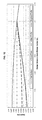
- FIG. 1 shows a dimple cross-sectional profile defined by the product of a spherical base profile and a weighting function according to one embodiment of the present invention.
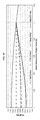
- FIG. 2 shows a dimple cross-sectional profile defined by the product of a spherical base profile and a weighting function according to another embodiment of the present invention.
- FIG. 3 shows a dimple cross-sectional profile defined by the product of a spherical base profile and a weighting function according to another embodiment of the present invention.
- FIG. 4 shows a dimple cross-sectional profile defined by the product of a spherical base profile and a weighting function according to another embodiment of the present invention.
- FIG. 6 shows a dimple cross-sectional profile defined by the product of a spherical base profile and a weighting function according to another embodiment of the present invention.
- FIG. 8 shows a dimple cross-sectional profile defined by the product of a spherical base profile and a weighting function according to another embodiment of the present invention.
- FIG. 9 shows a dimple cross-sectional profile defined by the product of a spherical base profile and a weighting function according to another embodiment of the present invention.
- FIG. 10 shows a dimple cross-sectional profile defined by the product of a spherical base profile and a weighting function according to another embodiment of the present invention.
- FIG. 11 shows a dimple cross-sectional profile defined by the product of a spherical base profile and a weighting function according to another embodiment of the present invention.
- FIG. 12 shows a dimple cross-sectional profile defined by the product of a spherical base profile and a weighting function according to another embodiment of the present invention.
- FIG. 13 shows a dimple cross-sectional profile defined by the product of a spherical base profile and a weighting function according to another embodiment of the present invention.
- FIG. 14 shows a dimple cross-sectional profile defined by the product of a spherical base profile and a weighting function according to another embodiment of the present invention.
- FIG. 15 shows a dimple cross-sectional profile defined by the product of a spherical base profile and a weighting function according to another embodiment of the present invention.
- FIG. 16 shows a dimple cross-sectional profile defined by the product of a spherical base profile and a weighting function according to another embodiment of the present invention.
- FIG. 17 shows a dimple cross-sectional profile defined by the product of a spherical base profile and a weighting function according to another embodiment of the present invention.
- FIG. 18 shows a dimple cross-sectional profile defined by the product of a spherical base profile and a weighting function according to another embodiment of the present invention.
- FIG. 19 shows a dimple cross-sectional profile defined by the product of a spherical base profile and a weighting function according to another embodiment of the present invention.
- FIG. 20 shows a dimple cross-sectional profile defined by the product of a spherical base profile and a weighting function according to another embodiment of the present invention.
- FIG. 21 shows a dimple cross-sectional profile defined by the product of a spherical base profile and a weighting function according to another embodiment of the present invention.
- FIG. 22 shows a dimple cross-sectional profile defined by the product of a spherical base profile and a weighting function according to another embodiment of the present invention.
- FIG. 23 shows a dimple cross-sectional profile defined by the product of a spherical base profile and a weighting function according to another embodiment of the present invention.
- FIG. 24 is a partial sectional view of a dimple of a finished ball including layers of paint and a clear coat.
- FIGS. 25 a -25 d are isometric views of a dimple depicting the enclosed chord volume between the dimple surface and chord plane.
- FIG. 26 shows the preferred and most preferred plan shape area and surface volume ranges according to the present invention.
- FIG. 27 shows a dimple cross-sectional profile of the spherical base dimple profile.
- FIG. 30 shows a dimple cross-sectional profile of the catenary base dimple profile.
- FIG. 33 shows a dimple cross-sectional profile of the conical base dimple profile.
- FIG. 36 illustrates 1/12 of a golf ball according to an embodiment of the present invention.
- FIG. 38 illustrates 1/12 of a golf ball according to an embodiment of the present invention.
- Golf balls of the present invention include dimples having a cross-sectional shape defined by a weighted profile, the weighted profile being the product of a base dimple profile and at least one weighting function.
- Suitable base dimple profiles include those that can be defined by a single function, including, but not limited to, spherical, conical, catenary, elliptical, polynomial, Witch of Agnesi, frequency, Neiles parabola, and cosine profiles, and those that are defined by two or more functions, including, but not limited to, profiles comprising a top conical edge and a bottom spherical cap. Profiles comprising a top conical edge and a bottom spherical cap are further disclosed, for example, in U.S. Patent Application Publication No. 2010/0240474, the entire disclosure of which is hereby incorporated herein by reference.
- the base dimple profile is defined by a single continuous, differentiable function.
- One or more continuous weighting functions are applied as multiplicative constructs to the base dimple profile to produce the weighted dimple profile. For base profiles defined by a single function the weighting function(s) are applied to the entire dimple profile. For base profiles defined by two or more functions, the weighting function(s) are applied independently to one or more of the base profile functions.
- Typical weighting function forms include, but are not limited to, polynomial, exponential, and trigonometric, Gaussian or linear combinations thereof.
- one or more continuous weighting functions are applied as multiplicative constructs to a base dimple profile defined by a single continuous, differentiable function, resulting in a continuous, differentiable weighted dimple profile.
- the weighting function allows dimple profile refinement through biasing derivatives of the function profile, thus allowing specific regions of the dimple cross-section to be altered. This allows unique dimple profiles to be created and provides greater control and flexibility of the final golf ball surface.
- the method is well suited to common hob manufacturing methods.
- Non-limiting examples of particularly suitable weighting functions are shown in Table 1 below.
- a spherical base profile is defined by the following function:
- a golf ball according to the present invention has a plurality of recessed dimples on the surface thereof, where the dimples have a cross-sectional profile defined by a weighted function, where the weighted function is the multiplication of a single continuous, differentiable function and at least one weighting function.
- the weighting function is selected from the group consisting of polynomial, exponential and trigonometric functions. Examples of these functions are listed in Table 1, and the resulting weighted dimple profiles, from the use of these functions, is shown in FIGS. 1-23 and Table 2. The cross-sections of half of a dimple profile are depicted in each figure, showing the dimple profile from the dimple center to the outer edge or golf ball surface.
- the base dimple profile and the weighted dimple profile have the same dimple diameters; however, they have one or more distinctly different dimple features; namely a different edge angle, volume, chord depth or dimple profile shape.
- the resulting claimed weighted dimple profile is uniquely different from the initial base dimple profile.
- the final weighted dimple profile has a chord depth, an equivalent spherical edge angle, an edge angle, and weighted volume ratio.
- the equivalent spherical edge angle is the edge angle of a spherical dimple with an equivalent chord volume and diameter.
- a spherical dimple with an equivalent chord volume and the same diameter would have an equivalent spherical edge angle of 21.08° while the edge angle as defined in FIG. 24 is about 20.95°.
- the equivalent spherical edge angle of the weighted dimple profile is preferably within a range having a lower limit of about 10° or 11° or 12° and an upper limit of 20° or 21° or 22°.
- the weighted volume ratio is the ratio of the volume of the weighted dimple profile to the base dimple profile.
- the volumes of both the weighted dimple profile and the base dimple profile are calculated using the chord plane, and thus, are considered to be chord volumes. Referring to FIGS. 25 a -25 d , the chord volume 103 is shown.
- FIGS. 25 a -25 c depict the ball surface 100 , the dimple surface 101 and the chord plane 102 .
- 25 d shows the enclosed volume of the dimple as the chord volume 103 bounded by the dimple surface 101 and the dimple chord plane 102 .
- the weighted volume ratio for the weighted dimple profile in FIG. 1 is 2.00 using volumes calculated from the chord plane.
- the weighted dimple profile shown in FIG. 1 has a volume that is two times the volume of the base dimple profile shown in FIG. 1 from the chord plane.
- the weighted dimple volume ratio of the weighted dimple profile to the base dimple profile is preferably within a range having a lower limit of 0.2 or 0.4 or 0.6 and an upper limit of 2 or 3 or 4.
- the base dimple profile and the weighted dimple profile have the same dimple diameter; however, the chord depth, edge angle and volume of the base dimple profile and the weighted dimple profile are different. It will also be appreciated from Table 2, that the weighted volume ratio is about 2.00.
- the base dimple profile and the weighted dimple profile have the same dimple diameter and the same chord depth; however, the volume and the edge angle of the base dimple profile and the weighted dimple profile are different. It will also be appreciated from Table 2, that the weighted volume ratio is about 1.17 to about 1.70.
- FIGS. 10-12, 14 and 17 show that the base dimple profile and the weighted dimple profile have the same dimple diameter and the same edge angle; however, the volume and the chord depth of the base dimple profile and the weighted dimple profile are different. It will also be appreciated from Table 2, that the weighted volume ratio is about 1.47 to about 1.77.
- the base dimple profile and the weighted dimple profile have the same dimple diameter, chord depth and edge angle; however, the volume of the base dimple profile and the weighted dimple profile are different. It will also be appreciated from Table 2, that the weighted volume ratio is about 1.15 to about 1.21.
- the base dimple profile and the weighted dimple profile have the same edge angle and volume; however, the chord depth of the base dimple profile and the weighted dimple profile are different. It will also be appreciated from Table 2, that the weighted volume ratio is about 1.00, meaning the volume of the base dimple profile and the weighted dimple profile are substantially the same.
- FIG. 21 shows that the base dimple profile and the weighted dimple profile have the same dimple diameter and volume; however, the edge angle and chord depth of the base dimple profile and the weighted dimple profile are different. It will also be appreciated from Table 2, that the weighted volume ratio is about 1.00, meaning the volume of the base dimple profile and the weighted dimple profile are substantially the same.
- the base dimple profile and the weighted dimple profile have the same dimple diameter, volume and chord depth; however, the edge angle of the base dimple profile and the weighted dimple profile are different. It will also be appreciated from Table 2, that the weighted volume ratio is about 1.00, meaning the volume of the base dimple profile and the weighted dimple profile are substantially the same.
- the base dimple profile and the weighted dimple profile have the same dimple diameter, edge angle, volume and chord depth. It will be appreciated from the figure that the dimple profile shape of the base dimple profile and the weighted dimple profile are different, such that the cross-sectional shape of the dimple profiles are different. It will also be appreciated from Table 2, that the weighted volume ratio is about 1.00, meaning the volume of the base dimple profile and the weighted dimple profile are substantially the same.
- the dimple plan shapes are preferably circular.
- the plan shape area is based on a planar view of the dimple plan shape, such that the viewing plane is normal to an axis connecting the center of the ball to the point of the calculated surface depth.
- the dimple volume is the total volume encompassed by the dimple shape and the surface of the golf ball.
- the plan shape area and total dimple volume preferably fall within range 1 in FIG. 26 . More preferably, the dimple shape area and total dimple volume fall within range 2 shown in FIG. 26 . More specifically, preferably the dimple plan shape area is from about 0.0025 in 2 to about 0.045 in 2 .
- the dimple plan shape area is from about 0.0065 in 2 to about 0.036 in 2 .
- the dimple surface volume is from about 0.1 ⁇ 10 ⁇ 5 in 3 to about 5.0 ⁇ 10 ⁇ 4 in 3 . More preferably, the dimple surface volume is from about 0.3 ⁇ 10 ⁇ 4 in 3 to about 3.3 ⁇ 10 ⁇ 4 in 3 .
- the base profile is modified using a pure weighted method.
- g(x) is the Base Profile Function
- w(x) is the Weighting function
- the pure weighting method means the resulting weighted function is purely a percentage of the original base profile function as defined by the weighting function.
- the base profile is modified using a profile relative weighted method.
- g(x) is the Base Profile Function
- w(x) is the Weighting function
- the profile relative method applies the given weighting function relative to the existing base profile function such that the weighted value is added to the existing base curve to obtain the resulting weighted function.
- both the profile relative method and the pure weighting method hold to the construct that the weighted function results from the multiplication of a base profile function and a weighting function.
- the domain of the function w(x) is such that 0 ⁇ w(x) ⁇ 1 while the calculated weighted function range differs between the profile relative and pure weighting methods.
- FIGS. 28 a - c An example is shown in FIGS. 28 a - c .
- the weighting function is continuous from the dimple center to the dimple perimeter and the weighting is applied as such thereby creating the weighted function representing a half dimple profile that is revolved about an axis through the dimple center to create the dimple surface.
- Cross-sectional views of the resulting dimple profile are shown in FIGS. 28 b and 28 c using the two different weighting methods.
- FIG. 28 b is the resulting cross-section when using the profile relative method
- FIG. 28 c is the resulting cross-section when using the pure weighted method.
- FIGS. 29 a -29 c Another example is shown in FIGS. 29 a -29 c .
- the weighting function is continuous from the dimple center to the dimple perimeter and the weighting is applied as such thereby creating the weighted function representing a half dimple profile that is revolved about an axis through the dimple center to create the dimple surface.
- Cross-sectional views of the resulting dimple profile are shown in FIGS. 29 b and 29 c using the two different weighting methods.
- FIG. 29 b is the resulting cross-section when using the profile relative method
- FIG. 29 c is the resulting cross-section when using the pure weighted method.
- Dimple profiles of the present invention are defined by a catenary base profile to which a weighting function is applied as a multiplier as discussed above.
- An example of a catenary base profile is shown in FIG. 30 , and described in U.S. Pat. No. 7,641,572, incorporated herein by reference in its entirety.
- a catenary base profile is defined by the following function:
- y d c ⁇ ( cosh ⁇ ( sf * x ) - 1 ) cosh ⁇ ( sf * D 2 ) - 1
- y is the vertical direction coordinate away from the center of the ball with 0 at the center of the dimple
- x the horizontal (radial) direction coordinate from the dimple apex to the dimple surface with 0 at the center of the dimple
- sf the shape factor
- d c the chordal depth of the dimple, in inches
- D the diameter of the dimple, in inches.
- one base catenary profile is used. All examples started with a catenary base profile having a dimple diameter of 0.2 inches, a chord depth of 0.0035 inches and a shape factor of 100. It will be appreciated that a base profile may be used having a chord depth, or maximum dimple depth at the center of the dimple measured from the chord plane of 0.0015 to 0.0070 inches, and a shape factor of 30 to 300.
- the selected base profile is then weighted with a weighting function, for example by multiplying with a function chosen from Table 1, to achieve a weighted dimple profile.
- the catenary base profile may be modified using either a pure weighted method or a profile relative method. It will be appreciated that both the profile relative method and the pure weighting method hold to the construct that the weighted function results from the multiplication of a base profile function and a weighting function. Further, the domain of the function w(x) is such that 0 ⁇ w(x) ⁇ 1 while the calculated weighted function range differs between the profile relative and pure weighting methods.
- the catenary base dimple profile and the resulting weighted dimple profile may have the same or different properties of diameter, shape factor, volume and chord depth.
- FIGS. 31 a - c An example is shown in FIGS. 31 a - c .
- the weighting function is continuous from the dimple center to the dimple perimeter and the weighting is applied as such thereby creating the weighted function representing a half dimple profile that is revolved about an axis through the dimple center to create the dimple surface.
- a cross-sectional view of the resulting dimple is shown in FIGS. 31 b and 31 c using the two different weighting methods.
- FIG. 31 b is the resulting cross-section when using the profile relative method
- FIG. 31 c is the resulting cross-section when using the pure weighted method.
- FIGS. 32 a -32 c Another example is shown in FIGS. 32 a -32 c .
- This weighting function is continuous from the dimple center to the dimple perimeter and the weighting is applied as such thereby creating the weighted function representing a half dimple profile that is revolved about an axis through the dimple center to create the dimple surface.
- Cross-sectional views of the resulting dimple are shown in FIGS. 32 b and 32 c using the two different weighting methods.
- FIG. 32 b is the resulting cross-section when using the profile relative method
- FIG. 32 c is the resulting cross-section when using the pure weighted method.
- Dimple profiles of the present invention are defined by a conical base profile to which a weighting function is applied as a multiplier as discussed above.
- An example of a conical base profile is shown in FIG. 33 .
- the conical base profile may have a preferred edge angle of about 10° to about 13.5°, and a preferred chord depth of about 0.0063 to about 0.0105 inches.
- the base profile may be conical with a bottom spherical cap as described in U.S. Pat. Nos. 8,137,217 and 8,632,426 and U.S. application Ser. No. 14/981,383 filed Dec. 28, 2015, incorporated herein by reference in their entirety.
- the base dimple profile comprises a top conical sidewall, a bottom spherical cap, and a defined point of tangency at an intersection between the top conical sidewall and bottom spherical cap, wherein a difference between a slope of the conical sidewall and a slope of the spherical cap is less than about 2°.
- the dimple has a shape defined by at least a saucer ratio and edge angle.
- the saucer ratio is defined as a ratio of dimple diameter to saucer diameter or spherical cap diameter, and the value of said ratio is between about 0.05 and about 0.75.
- one base conical profile is used. All examples started with a conical base profile having a dimple diameter of 0.2 inches, edge angle of 10.4°, and a chord depth, or maximum dimple depth at the center of the dimple measured from the chord plane of 0.0049 inches. This selected base profile is then weighted with a weighting function, for example by multiplying with a function chosen from Table 1, to achieve a weighted dimple profile.
- the conical base profile may be modified using either a pure weighted method or a profile relative method. It will be appreciated that both the profile relative method and the pure weighting method hold to the construct that the weighted function results from the multiplication of a base profile function and a weighting function. Further, the domain of the function w(x) is such that 0 ⁇ w(x) ⁇ 1 while the calculated weighted function range differs between the profile relative and pure weighting methods.
- the catenary base dimple profile and the resulting weighted dimple profile may have the same or different properties of diameter, edge angle, volume and chord depth.
- FIGS. 34 a - c An example is shown in FIGS. 34 a - c .
- the weighting function is continuous from the dimple center to the dimple perimeter and the weighting is applied as such thereby creating the weighted function representing a half dimple profile that is revolved about an axis through the dimple center to create the dimple surface.
- a cross-sectional view of the resulting dimple is shown in FIGS. 34 b and 34 c using the two different weighting methods.
- FIG. 34 b is the resulting cross-section when using the profile relative method
- FIG. 34 c is the resulting cross-section when using the pure weighted method.
- every dimple will have modified cross-sections defined by weighting functions.
- the number of dimples using the first weighted base profile is equal to the number of dimples using the second weighted base profile.
- the number of dimples using a first weighted base profile is not equal to the number of dimples using the second weighted base profile.
- the golf ball also may include dimples that have cross-sections that have not been modified by a weighting function.
- FIGS. 36-38 illustrate a section 200 , 204 , 210 of a golf ball made with a hexagonal dipyramid pattern such that the section represents 1/12 of the golf ball.
- the pattern in the examples has 338 dimples, resulting in each section having of 28 and 1/16 dimples.
- the sections 200 , 204 , 210 are tiled on the golf ball to form a dimple pattern.
- sections 200 , 204 , 210 made with a hexagonal dipyramid pattern are illustrated, it will be appreciated that any suitable pattern may be used.
- the section 200 is made entirely of dimples 202 that have cross-sectional profiles that have been modified by weighting functions.
- the labels A and B represent the type of cross-sectional profile of the dimple 202 .
- dimples 202 labeled A have a cross-sectional profile defined by a weighted function, where the weighted function is the multiplication of a spherical base profile function g(x) and at least one weighting function w(x).
- the dimples 202 labeled B have a cross-sectional profile defined by a weighted function, where the weighted function is the multiplication of a catenary base profile function g(x) and at least one weighting function w(x). Both dimples types A, B are created using the pure weighting method described above.
- the section 204 is made of dimples 206 that have cross-sectional profiles that have been modified by weighting functions.
- the labels A and B represent the type of cross-sectional profile of the dimple 206 .
- dimples 206 labeled A have a cross-sectional profile defined by a weighted function, where the weighted function is the multiplication of a conical base profile function g(x) and at least one weighting function w(x).
- the dimples 206 labeled B have a cross-sectional profile defined by a weighted function, where the weighted function is the multiplication of a catenary base profile function g(x) and at least one weighting function w(x). Both dimple types A, B are created using the profile relative weighting method.
- Dimples 208 that are not labeled in the figure are spherical dimples that are not modified by any kind of weighting function.
- the section 210 is made entirely of dimples 212 that have cross-sectional profiles that have been modified by weighting functions.
- the labels A, B and C represent the type of cross-sectional profile of the dimple 212 .
- dimples 212 labeled A have a cross-sectional profile defined by a weighted function, where the weighted function is the multiplication of a conical base profile function g(x) and at least one weighting function w(x).
- the dimples 212 labeled B have a cross-sectional profile defined by a weighted function, where the weighted function is the multiplication of a catenary base profile function g(x) and at least one weighting function w(x).
- the dimples 212 labeled C have a cross-sectional profile defined by a weighted function, where the weighted function is the multiplication of a spherical base profile function g(x) and at least one weighting function w(x).
- the dimples types A and C are created using a profile relative method and the dimple type B is created using the pure weighting method.
- the present invention is not limited by any particular dimple pattern.
- suitable dimple patterns include, but are not limited to, phyllotaxis-based patterns; polyhedron-based patterns; and patterns based on multiple copies of one or more irregular domain(s) as disclosed in U.S. Pat. No. 8,029,388, the entire disclosure of which is hereby incorporated herein by reference; and particularly dimple patterns suitable for packing dimples on seamless golf balls.
- suitable dimple patterns are further disclosed in U.S. Pat. Nos.
- the dimple pattern provides for overall dimple coverage of 60% or greater, or 65% or greater, or 75% or greater, or 80% or greater, or 85% or greater, or 90% or greater.
- Golf balls of the present invention typically have a dimple count within a limit having a lower limit of 250 and an upper limit of 350 or 400 or 450 or 500.
- the dimple count is 252 or 272 or 302 or 312 or 320 or 328 or 332 or 336 or 340 or 352 or 360 or 362 or 364 or 372 or 376 or 384 or 390 or 392 or 432.
- At least 30%, or at least 50%, or at least 60%, or at least 80%, or at least 90%, or at least 95% of the total number of dimples have a cross-sectional profile defined by the product of a base function and at least one weighting function, with the remaining dimples, if any, having a cross-sectional profile based on any known dimple profile shape including, but not limited to, parabolic curves, ellipses, spherical curves, saucer-shapes, sine curves, truncated cones, flattened trapezoids, and catenary curves.
- the profile of one dimple may be the same as or different from the profile of another dimple.
- the profile of one dimple may be the same as or different from the profile of another dimple.
- the diameter of the dimples is preferably within a range having a lower limit of 0.090 inches or 0.100 inches or 0.115 inches or 0.125 inches and an upper limit of 0.185 inches or 0.200 inches or 0.225 inches.
- the present invention is not limited by any particular golf ball construction or any particular composition for forming the golf ball layers.
- functionally weighted curves of the present invention can be used to form dimple profiles on one-piece, two-piece (i.e., a core and a cover), multi-layer (i.e., a core of one or more layers and a cover of one or more layers), and wound golf balls, having a variety of core structures, intermediate layers, covers, and coatings.
Landscapes
- Health & Medical Sciences (AREA)
- General Health & Medical Sciences (AREA)
- Physical Education & Sports Medicine (AREA)
Abstract
Description
| TABLE 1 | |
| Example | Weighting |
| No. | Function |
| 1 | w = 1 |
| 2 | w = x |
| 3 | w = x2 |
| 4 | w = x3 |
| 5 | w = x4 |
| 6 | w = x4 + x3 |
| 7 | w = x2/5 + 3x3 + x4 |
| 8 | w = 10x2 + 3x4 |
| 9 | w = 3x4 + x3/2 + 10x |
| 10 | w = −x |
| 11 | w = −x3 |
| 12 | w = x3 − X4 − 2x |
| 13 | w = sin(x) |
| 14 | w = cos(x) |
| 15 | w = −x5 |
| 16 | w = ex |
| 17 | w = −ex |
| 18 | w = (−e2x)sin(x) |
| 19 | w = e2xx3 |
| 20 | w = cos(4.9x)/−5 |
| 21 | w = cos(1.89x)/−2 |
| 22 | w = sin(3.64x)/1.5 |
| 23 | w = sin(6x)/3 |
| TABLE 2 | ||
| Final Weighted Profile | ||
| equivalent | ||||||
| chord | spherical | edge | weighted | |||
| depth | edge angle | angle | volume | |||
| FIG. # | Base Profile | Weighting Function | (inches) | (degrees) | (degrees) | ratio |
| 1 | spherical | w = 1 | 0.0126 | 21.08° | 20.95° | 2.00 |
| 2 | spherical | w = x | 0.0063 | 17.75° | 20.94° | 1.53 |
| 3 | spherical | w = x2 | 0.0063 | 16.32° | 20.93° | 1.33 |
| 4 | spherical | w = x3 | 0.0063 | 15.57° | 20.92° | 1.23 |
| 5 | spherical | w = x4 | 0.0063 | 15.13° | 20.90° | 1.17 |
| 6 | spherical | w = x4 + x3 | 0.0063 | 15.35° | 20.91° | 1.20 |
| 7 | spherical | w = x2/5 + 3x3 + x4 | 0.0063 | 15.50° | 20.92° | 1.22 |
| 8 | spherical | w = 10x2 + 3x4 | 0.0063 | 16.05° | 20.93° | 1.29 |
| 9 | spherical | w = 3x4 + x3/2 + 10x | 0.0063 | 15.73° | 20.91° | 1.25 |
| 10 | spherical | w = −x | 0.0126 | 17.27° | 14.00° | 1.47 |
| 11 | spherical | w = −x3 | 0.0126 | 19.45° | 14.02° | 1.77 |
| 12 | spherical | w = x3 − x4 − 2x | 0.0126 | 17.49° | 14.01° | 1.50 |
| 13 | spherical | w = sin(x) | 0.0063 | 18.93° | 20.95° | 1.70 |
| 14 | spherical | w = cos(x) | 0.0126 | 18.43° | 14.00° | 1.63 |
| 15 | spherical | w = −x5 | 0.0063 | 15.42° | 14.05° | 1.21 |
| 16 | spherical | w = ex | 0.0063 | 17.04° | 20.94° | 1.43 |
| 17 | spherical | w = −ex | 0.0126 | 17.98° | 14.01° | 1.57 |
| 18 | spherical | w = (−e2x)sin(x) | 0.0063 | 14.98° | 14.02° | 1.15 |
| 19 | spherical | w = e2xx3 | 0.0063 | 15.02° | 13.98° | 1.15 |
| 20 | Spherical | w = cos(4.9x)/−5 | 0.0050 | 14.00° | 13.76° | 1.00 |
| 21 | Spherical | w = cos(1.89x)/−2 | 0.0031 | 14.00° | 17.47° | 1.00 |
| 22 | Spherical | w = sin(3.64x)/1.5 | 0.0063 | 14.00° | 11.41° | 1.00 |
| 23 | Spherical | w = sin(6x)/3 | 0.0063 | 14.00° | 14.02° | 1.00 |
Where, for the above formula, the origin is located along the dimple axis intersecting the chord plane at y=0, and wherein
θ=the dimple edge angle, in degrees;
d=the dimple diameter, in inches; and
D=the diameter of the golf ball, in inches.
| TABLE 3 | |||||
| Edge | Chord | ||||
| Figures | Angle | Volume | Depth | ||
| FIG. 1 | D | D | D | ||
| FIGS. 2-9, 13, 16 | D | D | S | ||
| FIGS. 10-12, 14, 17 | S | D | D | ||
| FIGS. 15, 18, 19 | S | D | S | ||
| FIG. 20 | S | S | D | ||
| FIG. 21 | D | S | D | ||
| FIG. 22 | D | S | S | ||
| FIG. 23 | S | S | S | ||
ƒ(x)=g(x)*w(x) (1)
ƒ(x)=g(x)*(1+w(x)) (2)
w(x)=x
The weighting function is continuous from the dimple center to the dimple perimeter and the weighting is applied as such thereby creating the weighted function representing a half dimple profile that is revolved about an axis through the dimple center to create the dimple surface. Cross-sectional views of the resulting dimple profile are shown in
w(x)=−x 4 +x 3+2x
where, for the above formula,
y is the vertical direction coordinate away from the center of the ball with 0 at the center of the dimple
x=the horizontal (radial) direction coordinate from the dimple apex to the dimple surface with 0 at the center of the dimple;
sf=the shape factor;
dc=the chordal depth of the dimple, in inches; and
D=the diameter of the dimple, in inches.
w(x)=x
The weighting function is continuous from the dimple center to the dimple perimeter and the weighting is applied as such thereby creating the weighted function representing a half dimple profile that is revolved about an axis through the dimple center to create the dimple surface. A cross-sectional view of the resulting dimple is shown in
w(x)=−x 4 +x 3+2x
w(x)=x
The weighting function is continuous from the dimple center to the dimple perimeter and the weighting is applied as such thereby creating the weighted function representing a half dimple profile that is revolved about an axis through the dimple center to create the dimple surface. A cross-sectional view of the resulting dimple is shown in
w(x)=−x 4 +x 3+2x
The weighting function is continuous from the dimple center to the dimple perimeter and the weighting is applied as such thereby creating the weighted function representing a half dimple profile that is revolved about an axis through the dimple center to create the dimple surface. Cross-sectional views of the resulting dimple are shown in
| TABLE 4 | ||||||
| Number | Number | |||||
| of | of | |||||
| Dimple | Dimples | dimples | ||||
| Dimple | Cross- | Weighting | in the | on the | ||
| Label | Section | Method | Segment | Ball | ||
| A | Weighted | Pure | 15 1/6 | 182 | ||
| Spherical Base | Weighting | |||||
| B | Weighted | Pure | 13 | 156 | ||
| Catenary Base | Weighting | |||||
| TABLE 5 | ||||||
| Number | Number | |||||
| of | of | |||||
| Dimple | Dimples | dimples | ||||
| Dimple | Cross- | Weighting | in the | on the | ||
| Label | Section | Method | Segment | Ball | ||
| A | | Profile | 10 | 120 | ||
| Conical Base | Relative | |||||
| B | | Profile | 10 | 120 | ||
| Catenary Base | Relative | |||||
| NONE | Spherical | NA | 8 1/6 | 98 | ||
| TABLE 6 | ||||||
| Number | Number | |||||
| of | of | |||||
| Dimple | Dimples | dimples | ||||
| Dimple | Cross- | Weighting | in the | on the | ||
| Label | Section | Method | Segment | Ball | ||
| A | | Profile | 12 1/6 | 146 | ||
| Conical Base | Relative | |||||
| B | Weighted | Pure | 10 | 120 | ||
| Catenary Base | Weighting | |||||
| C | Weighted | Profile | 6 | 72 | ||
| Spherical Base | Relative | |||||
Claims (16)
f(x)=g(x)*w(x)
f(x)=g(x)*w(x)
f(x)=g(x)*w(x)
Priority Applications (2)
| Application Number | Priority Date | Filing Date | Title |
|---|---|---|---|
| US15/833,100 US10155136B2 (en) | 2011-12-30 | 2017-12-06 | Golf ball dimple profile |
| US16/188,731 US10376741B2 (en) | 2011-12-30 | 2018-11-13 | Golf ball dimple profile |
Applications Claiming Priority (7)
| Application Number | Priority Date | Filing Date | Title |
|---|---|---|---|
| US13/341,652 US20130172123A1 (en) | 2011-12-30 | 2011-12-30 | Golf ball dimple profile |
| US14/835,819 US20150360086A1 (en) | 2011-12-30 | 2015-08-26 | Golf ball dimple profile |
| US14/953,641 US20160074709A1 (en) | 2011-12-30 | 2015-11-30 | Golf ball dimple profile |
| US14/985,482 US9868032B2 (en) | 2011-12-30 | 2015-12-31 | Golf ball dimple profile |
| US14/985,617 US9861859B2 (en) | 2011-12-30 | 2015-12-31 | Golf ball dimple profile |
| US14/985,476 US9868031B2 (en) | 2011-12-30 | 2015-12-31 | Golf ball dimple profile |
| US15/833,100 US10155136B2 (en) | 2011-12-30 | 2017-12-06 | Golf ball dimple profile |
Related Parent Applications (1)
| Application Number | Title | Priority Date | Filing Date |
|---|---|---|---|
| US14/985,476 Continuation-In-Part US9868031B2 (en) | 2011-12-30 | 2015-12-31 | Golf ball dimple profile |
Related Child Applications (1)
| Application Number | Title | Priority Date | Filing Date |
|---|---|---|---|
| US16/188,731 Continuation US10376741B2 (en) | 2011-12-30 | 2018-11-13 | Golf ball dimple profile |
Publications (2)
| Publication Number | Publication Date |
|---|---|
| US20180093136A1 US20180093136A1 (en) | 2018-04-05 |
| US10155136B2 true US10155136B2 (en) | 2018-12-18 |
Family
ID=61757513
Family Applications (2)
| Application Number | Title | Priority Date | Filing Date |
|---|---|---|---|
| US15/833,100 Active US10155136B2 (en) | 2011-12-30 | 2017-12-06 | Golf ball dimple profile |
| US16/188,731 Active US10376741B2 (en) | 2011-12-30 | 2018-11-13 | Golf ball dimple profile |
Family Applications After (1)
| Application Number | Title | Priority Date | Filing Date |
|---|---|---|---|
| US16/188,731 Active US10376741B2 (en) | 2011-12-30 | 2018-11-13 | Golf ball dimple profile |
Country Status (1)
| Country | Link |
|---|---|
| US (2) | US10155136B2 (en) |
Citations (2)
| Publication number | Priority date | Publication date | Assignee | Title |
|---|---|---|---|---|
| US6464601B2 (en) * | 1999-09-16 | 2002-10-15 | Callaway Golf Company | Aerodynamic pattern for a golf ball |
| US8137217B2 (en) | 2009-03-20 | 2012-03-20 | Acushnet Company | Golf ball dimple profile |
Family Cites Families (1)
| Publication number | Priority date | Publication date | Assignee | Title |
|---|---|---|---|---|
| US9861859B2 (en) * | 2011-12-30 | 2018-01-09 | Acushnet Company | Golf ball dimple profile |
-
2017
- 2017-12-06 US US15/833,100 patent/US10155136B2/en active Active
-
2018
- 2018-11-13 US US16/188,731 patent/US10376741B2/en active Active
Patent Citations (2)
| Publication number | Priority date | Publication date | Assignee | Title |
|---|---|---|---|---|
| US6464601B2 (en) * | 1999-09-16 | 2002-10-15 | Callaway Golf Company | Aerodynamic pattern for a golf ball |
| US8137217B2 (en) | 2009-03-20 | 2012-03-20 | Acushnet Company | Golf ball dimple profile |
Also Published As
| Publication number | Publication date |
|---|---|
| US20180093136A1 (en) | 2018-04-05 |
| US10376741B2 (en) | 2019-08-13 |
| US20190076703A1 (en) | 2019-03-14 |
Similar Documents
| Publication | Publication Date | Title |
|---|---|---|
| US20150360086A1 (en) | Golf ball dimple profile | |
| US10183195B2 (en) | Dimple patterns for golf balls | |
| US11045692B2 (en) | Dimple patterns for golf balls | |
| US10758783B1 (en) | Dimple patterns for golf balls | |
| US11691052B2 (en) | Dimple patterns for golf balls | |
| US20210093928A1 (en) | Dimple patterns for golf balls | |
| US12201877B2 (en) | Dimple patterns for golf balls | |
| US11794077B2 (en) | Golf balls having volumetric equivalence on opposing hemispheres and symmetric flight performance and methods of making same | |
| US9861859B2 (en) | Golf ball dimple profile | |
| US20190209896A1 (en) | Golf ball dimple plan shape | |
| US20250121254A1 (en) | Dimple patterns for golf balls | |
| US10369418B2 (en) | Golf ball dimple plan shape | |
| US11724159B2 (en) | Golf ball dimple plan shape | |
| US10814176B2 (en) | Golf ball dimple plan shape | |
| US9868032B2 (en) | Golf ball dimple profile | |
| US20210106877A1 (en) | Golf ball dimple plan shape | |
| US9868031B2 (en) | Golf ball dimple profile | |
| US10376741B2 (en) | Golf ball dimple profile | |
| US20200139196A1 (en) | Curvilinear golf ball dimples and methods of making same | |
| US10420986B2 (en) | Golf balls having volumetric equivalence on opposing hemispheres and symmetric flight performance and methods of making same | |
| US20240115905A1 (en) | Dimple patterns for golf balls | |
| US20160074709A1 (en) | Golf ball dimple profile | |
| US9033827B2 (en) | Golf ball dimple profile | |
| US20240017127A1 (en) | Golf ball dimple plan shape defined by clausen function | |
| US9956453B2 (en) | Golf balls having volumetric equivalence on opposing hemispheres and symmetric flight performance and methods of making same |
Legal Events
| Date | Code | Title | Description |
|---|---|---|---|
| FEPP | Fee payment procedure |
Free format text: ENTITY STATUS SET TO UNDISCOUNTED (ORIGINAL EVENT CODE: BIG.); ENTITY STATUS OF PATENT OWNER: LARGE ENTITY |
|
| AS | Assignment |
Owner name: ACUSHNET COMPANY, MASSACHUSETTS Free format text: ASSIGNMENT OF ASSIGNORS INTEREST;ASSIGNORS:NARDACCI, NICHOLAS M.;MADSON, MICHAEL R.;REEL/FRAME:044325/0054 Effective date: 20171205 |
|
| STCF | Information on status: patent grant |
Free format text: PATENTED CASE |
|
| AS | Assignment |
Owner name: WELLS FARGO BANK, N.A., AS ADMINISTRATIVE AGENT, CALIFORNIA Free format text: SECURITY INTEREST;ASSIGNOR:ACUSHNET COMPANY;REEL/FRAME:051618/0777 Effective date: 20200114 |
|
| MAFP | Maintenance fee payment |
Free format text: PAYMENT OF MAINTENANCE FEE, 4TH YEAR, LARGE ENTITY (ORIGINAL EVENT CODE: M1551); ENTITY STATUS OF PATENT OWNER: LARGE ENTITY Year of fee payment: 4 |
|
| AS | Assignment |
Owner name: JPMORGAN CHASE BANK, N.A., AS SUCCESSOR ADMINISTRATIVE AGENT, ILLINOIS Free format text: ASSIGNMENT OF SECURITY INTEREST IN PATENTS (ASSIGNS 051618-0777);ASSIGNOR:WELLS FARGO BANK, NATIONAL ASSOCIATION, AS RESIGNING ADMINISTRATIVE AGENT;REEL/FRAME:061069/0731 Effective date: 20220802 Owner name: JPMORGAN CHASE BANK, N.A., AS ADMINISTRATIVE AGENT, ILLINOIS Free format text: SECURITY INTEREST;ASSIGNOR:ACUSHNET COMPANY;REEL/FRAME:061099/0236 Effective date: 20220802 |