US10150755B2 - ASK1 inhibitor compounds and uses thereof - Google Patents
ASK1 inhibitor compounds and uses thereof Download PDFInfo
- Publication number
- US10150755B2 US10150755B2 US15/970,587 US201815970587A US10150755B2 US 10150755 B2 US10150755 B2 US 10150755B2 US 201815970587 A US201815970587 A US 201815970587A US 10150755 B2 US10150755 B2 US 10150755B2
- Authority
- US
- United States
- Prior art keywords
- alkyl
- mmol
- compound
- group
- cycloalkyl
- Prior art date
- Legal status (The legal status is an assumption and is not a legal conclusion. Google has not performed a legal analysis and makes no representation as to the accuracy of the status listed.)
- Active
Links
- 0 *.CC.[2*]C1=CC2=C(C=C1)CN(C)C2=O.[3*]C Chemical compound *.CC.[2*]C1=CC2=C(C=C1)CN(C)C2=O.[3*]C 0.000 description 73
- DJXTYMUIJPEFHS-UHFFFAOYSA-N CC.CC(C)C1=CN=CC=C1 Chemical compound CC.CC(C)C1=CN=CC=C1 DJXTYMUIJPEFHS-UHFFFAOYSA-N 0.000 description 7
- WIOCNNUHSCWOKL-UHFFFAOYSA-N CC(C)C1=NN=CN1C1CC1 Chemical compound CC(C)C1=NN=CN1C1CC1 WIOCNNUHSCWOKL-UHFFFAOYSA-N 0.000 description 6
- NUYPAIVIEOFEKK-UHFFFAOYSA-N *.CC.CN1CC2=C(C=CC=C2)C1=O Chemical compound *.CC.CN1CC2=C(C=CC=C2)C1=O NUYPAIVIEOFEKK-UHFFFAOYSA-N 0.000 description 4
- VHCRQICVRIVRLC-UHFFFAOYSA-N CC(C)(C)C(=O)N1CCCC1.CC(C)(C)C(=O)N1CCCCC1.CC(C)(C)C(=O)N1CCOCC1.CC(C)(C)C(=O)N1CCSCC1 Chemical compound CC(C)(C)C(=O)N1CCCC1.CC(C)(C)C(=O)N1CCCCC1.CC(C)(C)C(=O)N1CCOCC1.CC(C)(C)C(=O)N1CCSCC1 VHCRQICVRIVRLC-UHFFFAOYSA-N 0.000 description 4
- PFEFYMLZZNVDEJ-UHFFFAOYSA-N CC(C)C(=O)CC1CC1.CC(C)C(=O)CC1CCC1.CC(C)C(=O)CC1CCCC1.CC(C)C(=O)CC1CCCCC1.CC(C)C(=O)CC1CCCCCC1 Chemical compound CC(C)C(=O)CC1CC1.CC(C)C(=O)CC1CCC1.CC(C)C(=O)CC1CCCC1.CC(C)C(=O)CC1CCCCC1.CC(C)C(=O)CC1CCCCCC1 PFEFYMLZZNVDEJ-UHFFFAOYSA-N 0.000 description 4
- IYGWOJOUMFMSLN-UHFFFAOYSA-N CC(C)C1=CC=NN1C.CC(C)C1=CC=NN1C1CC1.CC(C)C1=CC=NN1C1CCC1.CC(C)C1=CC=NN1C1CCCC1.CC(C)C1=CC=NN1C1CCCCC1.CC(C)C1=CN(C)C=N1.CC(C)C1=CN=CN1C.CC(C)C1=CN=CN1C1CC1.CC(C)C1=CN=CN1C1CCC1.CC(C)C1=CN=CN1C1CCCC1.CC(C)C1=CN=CN1C1CCCCC1.CCCN1C=NC(C(C)C)=C1.CCCN1C=NC(C(C)C)=C1.CCCN1C=NC(C(C)C)=C1.CCCN1C=NC(C(C)C)=C1.CCCN1C=NC=C1C(C)C.CCCN1C=NC=C1C(C)C.CCCN1C=NC=C1C(C)C.CCCN1C=NC=C1C(C)C.CCCN1N=CC=C1C(C)C.CCCN1N=CC=C1C(C)C.CCCN1N=CC=C1C(C)C.CCCN1N=CC=C1C(C)C.CCN1C=NC(C(C)C)=C1.CCN1C=NC=C1C(C)C.CCN1N=CC=C1C(C)C Chemical compound CC(C)C1=CC=NN1C.CC(C)C1=CC=NN1C1CC1.CC(C)C1=CC=NN1C1CCC1.CC(C)C1=CC=NN1C1CCCC1.CC(C)C1=CC=NN1C1CCCCC1.CC(C)C1=CN(C)C=N1.CC(C)C1=CN=CN1C.CC(C)C1=CN=CN1C1CC1.CC(C)C1=CN=CN1C1CCC1.CC(C)C1=CN=CN1C1CCCC1.CC(C)C1=CN=CN1C1CCCCC1.CCCN1C=NC(C(C)C)=C1.CCCN1C=NC(C(C)C)=C1.CCCN1C=NC(C(C)C)=C1.CCCN1C=NC(C(C)C)=C1.CCCN1C=NC=C1C(C)C.CCCN1C=NC=C1C(C)C.CCCN1C=NC=C1C(C)C.CCCN1C=NC=C1C(C)C.CCCN1N=CC=C1C(C)C.CCCN1N=CC=C1C(C)C.CCCN1N=CC=C1C(C)C.CCCN1N=CC=C1C(C)C.CCN1C=NC(C(C)C)=C1.CCN1C=NC=C1C(C)C.CCN1N=CC=C1C(C)C IYGWOJOUMFMSLN-UHFFFAOYSA-N 0.000 description 4
- GWLHJBNWCCNRPY-UHFFFAOYSA-N CC(C)C1=CN(C)N=C1.CC(C)C1=CN(C2CC2)N=C1.CC(C)C1=CN(C2CCC2)N=C1.CC(C)C1=CN(C2CCCC2)N=C1.CC(C)C1=CN(C2CCCCC2)N=C1.CC(C)C1=NN(C)C=C1.CC(C)C1=NN(C2CC2)C=C1.CC(C)C1=NN(C2CCC2)C=C1.CC(C)C1=NN(C2CCCC2)C=C1.CC(C)C1=NN(C2CCCCC2)C=C1.CCCN1C=C(C(C)C)C=N1.CCCN1C=C(C(C)C)C=N1.CCCN1C=C(C(C)C)C=N1.CCCN1C=C(C(C)C)C=N1.CCCN1C=CC(C(C)C)=N1.CCCN1C=CC(C(C)C)=N1.CCCN1C=CC(C(C)C)=N1.CCCN1C=CC(C(C)C)=N1.CCN1C=C(C(C)C)C=N1.CCN1C=CC(C(C)C)=N1 Chemical compound CC(C)C1=CN(C)N=C1.CC(C)C1=CN(C2CC2)N=C1.CC(C)C1=CN(C2CCC2)N=C1.CC(C)C1=CN(C2CCCC2)N=C1.CC(C)C1=CN(C2CCCCC2)N=C1.CC(C)C1=NN(C)C=C1.CC(C)C1=NN(C2CC2)C=C1.CC(C)C1=NN(C2CCC2)C=C1.CC(C)C1=NN(C2CCCC2)C=C1.CC(C)C1=NN(C2CCCCC2)C=C1.CCCN1C=C(C(C)C)C=N1.CCCN1C=C(C(C)C)C=N1.CCCN1C=C(C(C)C)C=N1.CCCN1C=C(C(C)C)C=N1.CCCN1C=CC(C(C)C)=N1.CCCN1C=CC(C(C)C)=N1.CCCN1C=CC(C(C)C)=N1.CCCN1C=CC(C(C)C)=N1.CCN1C=C(C(C)C)C=N1.CCN1C=CC(C(C)C)=N1 GWLHJBNWCCNRPY-UHFFFAOYSA-N 0.000 description 4
- KUDGHOVOFWAFLE-UHFFFAOYSA-N CC(C)C1=CN(C2CC2)C=N1.CC(C)C1=CN(C2CCC2)C=N1.CC(C)C1=CN(C2CCCC2)C=N1.CC(C)C1=CN(C2CCCCC2)C=N1.CC(C)N1C=NC(C2CC2)=C1.CC(C)N1C=NC(C2CCC2)=C1.CC(C)N1C=NC(C2CCCC2)=C1.CC(C)N1C=NC(C2CCCCC2)=C1.CC1=CN(C(C)C)C=N1.CC1=NC=C(C(C)C)S1.CCC1=CN(C(C)C)C=N1.CCC1=NC=C(C(C)C)S1.CCCC1=CN(C(C)C)C=N1.CCCC1=CN(C(C)C)C=N1.CCCC1=CN(C(C)C)C=N1.CCCC1=CN(C(C)C)C=N1.CCCC1=NC=C(C(C)C)S1.CCCC1=NC=C(C(C)C)S1 Chemical compound CC(C)C1=CN(C2CC2)C=N1.CC(C)C1=CN(C2CCC2)C=N1.CC(C)C1=CN(C2CCCC2)C=N1.CC(C)C1=CN(C2CCCCC2)C=N1.CC(C)N1C=NC(C2CC2)=C1.CC(C)N1C=NC(C2CCC2)=C1.CC(C)N1C=NC(C2CCCC2)=C1.CC(C)N1C=NC(C2CCCCC2)=C1.CC1=CN(C(C)C)C=N1.CC1=NC=C(C(C)C)S1.CCC1=CN(C(C)C)C=N1.CCC1=NC=C(C(C)C)S1.CCCC1=CN(C(C)C)C=N1.CCCC1=CN(C(C)C)C=N1.CCCC1=CN(C(C)C)C=N1.CCCC1=CN(C(C)C)C=N1.CCCC1=NC=C(C(C)C)S1.CCCC1=NC=C(C(C)C)S1 KUDGHOVOFWAFLE-UHFFFAOYSA-N 0.000 description 4
- OUXSIAYBLHCTDW-UHFFFAOYSA-N CC(C)C1=CN=C(C2CC2)S1.CC(C)C1=CN=C(C2CCC2)S1.CC(C)C1=CN=C(C2CCCC2)S1.CC(C)C1=CN=C(C2CCCCC2)S1.CCCC1=NC=C(C(C)C)S1.CCCC1=NC=C(C(C)C)S1 Chemical compound CC(C)C1=CN=C(C2CC2)S1.CC(C)C1=CN=C(C2CCC2)S1.CC(C)C1=CN=C(C2CCCC2)S1.CC(C)C1=CN=C(C2CCCCC2)S1.CCCC1=NC=C(C(C)C)S1.CCCC1=NC=C(C(C)C)S1 OUXSIAYBLHCTDW-UHFFFAOYSA-N 0.000 description 4
- USCLNPSYXUKDPE-UHFFFAOYSA-N CC(C)(C)C1=C2C=CC=CN2N=C1.CC(C)(C)C1=C2C=CC=CN2N=N1.CC(C)(C)C1=CN=N2CCCC12.CC(C)(C)C1=NN=C2C=CC=CN21.CC(C)(C)C1=NN=C2CCC(CO)N21.CC(C)(C)C1=NN=C2CCCN21.CC(C)(C)C1=NN=N2CCCC12.CC1CCC2=NN=C(C(C)(C)C)N21.CN1CCN2C(=NN=C2C(C)(C)C)C1 Chemical compound CC(C)(C)C1=C2C=CC=CN2N=C1.CC(C)(C)C1=C2C=CC=CN2N=N1.CC(C)(C)C1=CN=N2CCCC12.CC(C)(C)C1=NN=C2C=CC=CN21.CC(C)(C)C1=NN=C2CCC(CO)N21.CC(C)(C)C1=NN=C2CCCN21.CC(C)(C)C1=NN=N2CCCC12.CC1CCC2=NN=C(C(C)(C)C)N21.CN1CCN2C(=NN=C2C(C)(C)C)C1 USCLNPSYXUKDPE-UHFFFAOYSA-N 0.000 description 3
- LKSXXBXQLHVCKZ-UHFFFAOYSA-N CC(C)C(=O)CC1CC1.CC(C)C(=O)CC1CCC1.CC(C)C(=O)CC1CCCC1.CC(C)C(=O)CC1CCCCC1.CC(C)C(=O)CC1CCCCCC1.CCCCCN(C)C(=O)C(C)C.CCCCCN(CC)C(=O)C(C)C.CCCCN(C)C(=O)C(C)C.CCCCN(CC)C(=O)C(C)C.CCCN(CC)C(=O)C(C)C Chemical compound CC(C)C(=O)CC1CC1.CC(C)C(=O)CC1CCC1.CC(C)C(=O)CC1CCCC1.CC(C)C(=O)CC1CCCCC1.CC(C)C(=O)CC1CCCCCC1.CCCCCN(C)C(=O)C(C)C.CCCCCN(CC)C(=O)C(C)C.CCCCN(C)C(=O)C(C)C.CCCCN(CC)C(=O)C(C)C.CCCN(CC)C(=O)C(C)C LKSXXBXQLHVCKZ-UHFFFAOYSA-N 0.000 description 3
- WNNYSOLVFGPZQC-UHFFFAOYSA-N CC(C)C(=O)N(C)C.CC(C)C(N)=O.CCC(=O)C(C)C.CCCC(=O)C(C)C.CCCCC(=O)C(C)C.CCCCC(=O)C(C)C.CCCCC(=O)C(C)C.CCCCC(=O)C(C)C.CCCN(C)C(=O)C(C)C.CCCN(C)C(=O)C(C)C.CCCN(C)C(=O)C(C)C.CCCN(CC)C(=O)C(C)C.CCCN(CC)C(=O)C(C)C.CCCN(CC)C(=O)C(C)C.CCN(C)C(=O)C(C)C.COCCC(=O)C(C)C.COCCCC(=O)C(C)C.COCCCCC(=O)C(C)C.COCCCCCC(=O)C(C)C.COCCCCCCC(=O)C(C)C Chemical compound CC(C)C(=O)N(C)C.CC(C)C(N)=O.CCC(=O)C(C)C.CCCC(=O)C(C)C.CCCCC(=O)C(C)C.CCCCC(=O)C(C)C.CCCCC(=O)C(C)C.CCCCC(=O)C(C)C.CCCN(C)C(=O)C(C)C.CCCN(C)C(=O)C(C)C.CCCN(C)C(=O)C(C)C.CCCN(CC)C(=O)C(C)C.CCCN(CC)C(=O)C(C)C.CCCN(CC)C(=O)C(C)C.CCN(C)C(=O)C(C)C.COCCC(=O)C(C)C.COCCCC(=O)C(C)C.COCCCCC(=O)C(C)C.COCCCCCC(=O)C(C)C.COCCCCCCC(=O)C(C)C WNNYSOLVFGPZQC-UHFFFAOYSA-N 0.000 description 3
- VRIXKSYQVILASZ-UHFFFAOYSA-N CC(C)C(=O)N(C)C.CC(C)C(N)=O.CCC(=O)C(C)C.CCCC(=O)C(C)C.CCCCC(=O)C(C)C.CCCCCC(=O)C(C)C.CCCCCCC(=O)C(C)C.CCCCCCCC(=O)C(C)C.CCCN(C)C(=O)C(C)C.CCN(C)C(=O)C(C)C.COCCC(=O)C(C)C.COCCCC(=O)C(C)C.COCCCCC(=O)C(C)C.COCCCCCC(=O)C(C)C.COCCCCCCC(=O)C(C)C Chemical compound CC(C)C(=O)N(C)C.CC(C)C(N)=O.CCC(=O)C(C)C.CCCC(=O)C(C)C.CCCCC(=O)C(C)C.CCCCCC(=O)C(C)C.CCCCCCC(=O)C(C)C.CCCCCCCC(=O)C(C)C.CCCN(C)C(=O)C(C)C.CCN(C)C(=O)C(C)C.COCCC(=O)C(C)C.COCCCC(=O)C(C)C.COCCCCC(=O)C(C)C.COCCCCCC(=O)C(C)C.COCCCCCCC(=O)C(C)C VRIXKSYQVILASZ-UHFFFAOYSA-N 0.000 description 3
- WBOIYTNYTOFRSA-UHFFFAOYSA-N CC1=CC2=C(C=C1N1C=CN=C1)C(=O)N(C1=NC(C3=NN=CN3C3CC3)=CC=C1)C2 Chemical compound CC1=CC2=C(C=C1N1C=CN=C1)C(=O)N(C1=NC(C3=NN=CN3C3CC3)=CC=C1)C2 WBOIYTNYTOFRSA-UHFFFAOYSA-N 0.000 description 3
- ATVWMGIUIKAOFB-UHFFFAOYSA-N CN1C=NC(C2=CC3=C(C=C2)C(=O)N(C2=NC(C4=NN=CN4C4CC4)=CC=C2)C3)=C1 Chemical compound CN1C=NC(C2=CC3=C(C=C2)C(=O)N(C2=NC(C4=NN=CN4C4CC4)=CC=C2)C3)=C1 ATVWMGIUIKAOFB-UHFFFAOYSA-N 0.000 description 3
- KOULFMRALARHIM-UHFFFAOYSA-N O=C(C1=CC2=C(C=C1)C(=O)N(C1=NC(C3=NN=CN3C3CC3)=CC=C1)C2)N1CCOCC1 Chemical compound O=C(C1=CC2=C(C=C1)C(=O)N(C1=NC(C3=NN=CN3C3CC3)=CC=C1)C2)N1CCOCC1 KOULFMRALARHIM-UHFFFAOYSA-N 0.000 description 3
- RHRKCQIDEZCNDX-UHFFFAOYSA-N O=C1C2=C(C=CC(C3=CN(C4CC4)N=C3)=C2)CN1C1=NC(C2=NN=CN2C2CC2)=CC=C1 Chemical compound O=C1C2=C(C=CC(C3=CN(C4CC4)N=C3)=C2)CN1C1=NC(C2=NN=CN2C2CC2)=CC=C1 RHRKCQIDEZCNDX-UHFFFAOYSA-N 0.000 description 3
- CZEMXEBFUZEAGE-UHFFFAOYSA-N CC(=O)CC1CCN(C(=O)C(C)(C)C)CC1.CC(=O)N1CCN(C(=O)C(C)(C)C)CC1.CC(C)(C)C(=O)N1CCC(O)CC1.CC(C)(C)C(=O)N1CCCC1.CC(C)(C)C(=O)N1CCCCC1.CC(C)(C)C(=O)N1CCOCC1.CC(C)(C)C(=O)N1CCSCC1.CC1(O)CCN(C(=O)C(C)(C)C)CC1.CN(C)C1CCN(C(=O)C(C)(C)C)CC1.CN1CCN(C(=O)C(C)(C)C)CC1.COC(=O)C1CCN(C(=O)C(C)(C)C)CC1.COC1CCN(C(=O)C(C)(C)C)C1.COC1CCN(C(=O)C(C)(C)C)CC1.CSC1CCN(C(=O)C(C)(C)C)CC1 Chemical compound CC(=O)CC1CCN(C(=O)C(C)(C)C)CC1.CC(=O)N1CCN(C(=O)C(C)(C)C)CC1.CC(C)(C)C(=O)N1CCC(O)CC1.CC(C)(C)C(=O)N1CCCC1.CC(C)(C)C(=O)N1CCCCC1.CC(C)(C)C(=O)N1CCOCC1.CC(C)(C)C(=O)N1CCSCC1.CC1(O)CCN(C(=O)C(C)(C)C)CC1.CN(C)C1CCN(C(=O)C(C)(C)C)CC1.CN1CCN(C(=O)C(C)(C)C)CC1.COC(=O)C1CCN(C(=O)C(C)(C)C)CC1.COC1CCN(C(=O)C(C)(C)C)C1.COC1CCN(C(=O)C(C)(C)C)CC1.CSC1CCN(C(=O)C(C)(C)C)CC1 CZEMXEBFUZEAGE-UHFFFAOYSA-N 0.000 description 2
- WWHACOJKCYOMQP-UHFFFAOYSA-N CC(C)C1=C(C2CC2)C=NO1.CC(C)C1=CN=CN1C1CC1.CC(C)C1=NN=CN1C(C)C.CC(C)C1=NN=CN1C1CC1.CC(C)C1=NN=CN1C1CC1.CC(C)C1=NOC=C1C1CC1.CC(C)C1=NOC=C1C1CC1.CC(C)N1C=CN=C1.CC(C)N1C=NC=C1C1CC1.CC(C)N1N=NC=C1C1CC1 Chemical compound CC(C)C1=C(C2CC2)C=NO1.CC(C)C1=CN=CN1C1CC1.CC(C)C1=NN=CN1C(C)C.CC(C)C1=NN=CN1C1CC1.CC(C)C1=NN=CN1C1CC1.CC(C)C1=NOC=C1C1CC1.CC(C)C1=NOC=C1C1CC1.CC(C)N1C=CN=C1.CC(C)N1C=NC=C1C1CC1.CC(C)N1N=NC=C1C1CC1 WWHACOJKCYOMQP-UHFFFAOYSA-N 0.000 description 2
- TZRXJLNOOIKERR-UHFFFAOYSA-N CC(C)C1=C(C2CC2)C=NO1.CC(C)C1=CN=CN1C1CC1.CC(C)C1=NN=CN1C1CC1.CC(C)C1=NN=CN1C1CC1.CC(C)C1=NOC=C1C1CC1.CC(C)C1=NOC=C1C1CC1.CC(C)N1C=CN=C1.CC(C)N1C=NC=C1C1CC1.CC(C)N1N=NC=C1C1CC1 Chemical compound CC(C)C1=C(C2CC2)C=NO1.CC(C)C1=CN=CN1C1CC1.CC(C)C1=NN=CN1C1CC1.CC(C)C1=NN=CN1C1CC1.CC(C)C1=NOC=C1C1CC1.CC(C)C1=NOC=C1C1CC1.CC(C)N1C=CN=C1.CC(C)N1C=NC=C1C1CC1.CC(C)N1N=NC=C1C1CC1 TZRXJLNOOIKERR-UHFFFAOYSA-N 0.000 description 2
- YPRFYJXSKFTDJZ-UHFFFAOYSA-N CC(C)C1=C2C=CC=CN2N=C1.CC(C)C1=C2C=CC=CN2N=N1.CC(C)C1=C2CCCN2N=C1.CC(C)C1=C2CCCN2N=N1.CC(C)C1=NN=C2C=CC=CN21.CC(C)C1=NN=C2CCCN21.CC(C)C1=NN=C2CN(C)CCN21 Chemical compound CC(C)C1=C2C=CC=CN2N=C1.CC(C)C1=C2C=CC=CN2N=N1.CC(C)C1=C2CCCN2N=C1.CC(C)C1=C2CCCN2N=N1.CC(C)C1=NN=C2C=CC=CN21.CC(C)C1=NN=C2CCCN21.CC(C)C1=NN=C2CN(C)CCN21 YPRFYJXSKFTDJZ-UHFFFAOYSA-N 0.000 description 2
- UJWQLYYRSCMGCR-UHFFFAOYSA-N CC(C)C1=NN=C2C=CC=CN21.CC(C)C1=NN=C2C=CC=CN21.CC(C)C1=NN=C2C=CC=CN21.CC(C)C1=NN=C2C=CC=CN21.CC(C)C1=NN=C2C=CCCN21.CC(C)C1=NN=C2C=CCCN21.CC(C)C1=NN=C2C=CCCN21.CC(C)C1=NN=C2C=CCCN21.CC(C)C1=NN=C2C=CCN21.CC(C)C1=NN=C2C=CCN21.CC(C)C1=NN=C2C=CCN21.CC(C)C1=NN=C2C=CCN21.CC(C)C1=NN=C2C=CCN21.CC(C)C1=NN=C2CC=CCN21.CC(C)C1=NN=C2CC=CCN21.CC(C)C1=NN=C2CC=CCN21.CC(C)C1=NN=C2CC=CCN21.CC(C)C1=NN=C2CC=CN21.CC(C)C1=NN=C2CC=CN21.CC(C)C1=NN=C2CC=CN21.CC(C)C1=NN=C2CC=CN21.CC(C)C1=NN=C2CC=CN21.CC(C)C1=NN=C2CCC=CN21.CC(C)C1=NN=C2CCC=CN21.CC(C)C1=NN=C2CCC=CN21.CC(C)C1=NN=C2CCC=CN21 Chemical compound CC(C)C1=NN=C2C=CC=CN21.CC(C)C1=NN=C2C=CC=CN21.CC(C)C1=NN=C2C=CC=CN21.CC(C)C1=NN=C2C=CC=CN21.CC(C)C1=NN=C2C=CCCN21.CC(C)C1=NN=C2C=CCCN21.CC(C)C1=NN=C2C=CCCN21.CC(C)C1=NN=C2C=CCCN21.CC(C)C1=NN=C2C=CCN21.CC(C)C1=NN=C2C=CCN21.CC(C)C1=NN=C2C=CCN21.CC(C)C1=NN=C2C=CCN21.CC(C)C1=NN=C2C=CCN21.CC(C)C1=NN=C2CC=CCN21.CC(C)C1=NN=C2CC=CCN21.CC(C)C1=NN=C2CC=CCN21.CC(C)C1=NN=C2CC=CCN21.CC(C)C1=NN=C2CC=CN21.CC(C)C1=NN=C2CC=CN21.CC(C)C1=NN=C2CC=CN21.CC(C)C1=NN=C2CC=CN21.CC(C)C1=NN=C2CC=CN21.CC(C)C1=NN=C2CCC=CN21.CC(C)C1=NN=C2CCC=CN21.CC(C)C1=NN=C2CCC=CN21.CC(C)C1=NN=C2CCC=CN21 UJWQLYYRSCMGCR-UHFFFAOYSA-N 0.000 description 2
- JVFUEISRRWHMSV-UHFFFAOYSA-N CC(C)C1=NN=C2CCCCN21.CC(C)C1=NN=C2CCCCN21.CC(C)C1=NN=C2CCCCN21.CC(C)C1=NN=C2CCCCN21.CC(C)C1=NN=C2CCCCN21.CC(C)C1=NN=C2CCCCN21.CC(C)C1=NN=C2CCCCN21.CC(C)C1=NN=C2CCCCN21.CC(C)C1=NN=C2CCCN21.CC(C)C1=NN=C2CCCN21.CC(C)C1=NN=C2CCCN21.CC(C)C1=NN=C2CCCN21.CC(C)C1=NN=C2CCCN21.CC(C)C1=NN=C2CCCN21 Chemical compound CC(C)C1=NN=C2CCCCN21.CC(C)C1=NN=C2CCCCN21.CC(C)C1=NN=C2CCCCN21.CC(C)C1=NN=C2CCCCN21.CC(C)C1=NN=C2CCCCN21.CC(C)C1=NN=C2CCCCN21.CC(C)C1=NN=C2CCCCN21.CC(C)C1=NN=C2CCCCN21.CC(C)C1=NN=C2CCCN21.CC(C)C1=NN=C2CCCN21.CC(C)C1=NN=C2CCCN21.CC(C)C1=NN=C2CCCN21.CC(C)C1=NN=C2CCCN21.CC(C)C1=NN=C2CCCN21 JVFUEISRRWHMSV-UHFFFAOYSA-N 0.000 description 2
- OKPRPEXPVWATMQ-UHFFFAOYSA-N CC(C)C1=NN=CN1C1CC1.CC(C)N1C=CN=N1.CC(C)N1N=NC=C1C1CC1 Chemical compound CC(C)C1=NN=CN1C1CC1.CC(C)N1C=CN=N1.CC(C)N1N=NC=C1C1CC1 OKPRPEXPVWATMQ-UHFFFAOYSA-N 0.000 description 2
- ZOIQXPSBDBMIKR-UHFFFAOYSA-N CC(C)N1C=CN=N1.CC(C)N1N=NC=C1C1CC1 Chemical compound CC(C)N1C=CN=N1.CC(C)N1N=NC=C1C1CC1 ZOIQXPSBDBMIKR-UHFFFAOYSA-N 0.000 description 2
- AUARRSYQSGBOCW-UHFFFAOYSA-N CC.CC.CC.CC.CC.CC.CC.CC.CC.CC.CC.CC.CC.CC(C)C1=NN=C2CCCCN21.CC(C)C1=NN=C2CCCCN21.CC(C)C1=NN=C2CCCCN21.CC(C)C1=NN=C2CCCCN21.CC(C)C1=NN=C2CCCCN21.CC(C)C1=NN=C2CCCCN21.CC(C)C1=NN=C2CCCCN21.CC(C)C1=NN=C2CCCCN21.CC(C)C1=NN=C2CCCN21.CC(C)C1=NN=C2CCCN21.CC(C)C1=NN=C2CCCN21.CC(C)C1=NN=C2CCCN21.CC(C)C1=NN=C2CCCN21 Chemical compound CC.CC.CC.CC.CC.CC.CC.CC.CC.CC.CC.CC.CC.CC(C)C1=NN=C2CCCCN21.CC(C)C1=NN=C2CCCCN21.CC(C)C1=NN=C2CCCCN21.CC(C)C1=NN=C2CCCCN21.CC(C)C1=NN=C2CCCCN21.CC(C)C1=NN=C2CCCCN21.CC(C)C1=NN=C2CCCCN21.CC(C)C1=NN=C2CCCCN21.CC(C)C1=NN=C2CCCN21.CC(C)C1=NN=C2CCCN21.CC(C)C1=NN=C2CCCN21.CC(C)C1=NN=C2CCCN21.CC(C)C1=NN=C2CCCN21 AUARRSYQSGBOCW-UHFFFAOYSA-N 0.000 description 2
- XJNLNVSCHHZJBA-UHFFFAOYSA-N CC1=CC2=C(C=C1C1=CN=CC=C1)C(=O)N(C1=NC(C3=NN=CN3C3CC3)=CC=C1)C2 Chemical compound CC1=CC2=C(C=C1C1=CN=CC=C1)C(=O)N(C1=NC(C3=NN=CN3C3CC3)=CC=C1)C2 XJNLNVSCHHZJBA-UHFFFAOYSA-N 0.000 description 2
- KTPSGKDFMGWKRV-UHFFFAOYSA-N CC1=CC=NC=C1C1=CC2=C(C=C1)CN(C1=NC(C3=NN=CN3C3CC3)=CC=C1)C2=O Chemical compound CC1=CC=NC=C1C1=CC2=C(C=C1)CN(C1=NC(C3=NN=CN3C3CC3)=CC=C1)C2=O KTPSGKDFMGWKRV-UHFFFAOYSA-N 0.000 description 2
- VOTURYVZHDEFPS-UHFFFAOYSA-N CC1=NC=C(C2=CC3=C(C=C2)CN(C2=NC(C4=NN=CN4C4CC4)=CC=C2)C3=O)S1 Chemical compound CC1=NC=C(C2=CC3=C(C=C2)CN(C2=NC(C4=NN=CN4C4CC4)=CC=C2)C3=O)S1 VOTURYVZHDEFPS-UHFFFAOYSA-N 0.000 description 2
- UAGHSQBOKUDAIM-UHFFFAOYSA-N CC1=NC=C(C2=CC=C3CN(C4=NC(C5=NN=CN5C5CC5)=CC=C4)C(=O)C3=C2)C=C1 Chemical compound CC1=NC=C(C2=CC=C3CN(C4=NC(C5=NN=CN5C5CC5)=CC=C4)C(=O)C3=C2)C=C1 UAGHSQBOKUDAIM-UHFFFAOYSA-N 0.000 description 2
- WFSMLFYAIYBAIR-UHFFFAOYSA-N CN(C)C(=O)C1=CC2=C(C=C1)C(=O)N(C1=NC(C3=NN=CN3C3CC3)=CC=C1)C2 Chemical compound CN(C)C(=O)C1=CC2=C(C=C1)C(=O)N(C1=NC(C3=NN=CN3C3CC3)=CC=C1)C2 WFSMLFYAIYBAIR-UHFFFAOYSA-N 0.000 description 2
- MQHGYOJIWYZITR-UHFFFAOYSA-N CN1C=NC(C2=CC3=C(C=C2)CN(C2=NC(C4=NN=CN4C4CC4)=CC=C2)C3=O)=C1 Chemical compound CN1C=NC(C2=CC3=C(C=C2)CN(C2=NC(C4=NN=CN4C4CC4)=CC=C2)C3=O)=C1 MQHGYOJIWYZITR-UHFFFAOYSA-N 0.000 description 2
- ZXOKMAZFMHWGSW-UHFFFAOYSA-N CN1CCN(C(=O)C2=CC=C3C(=O)N(C4=NC(C5=NN=CN5C5CC5)=CC=C4)CC3=C2)CC1 Chemical compound CN1CCN(C(=O)C2=CC=C3C(=O)N(C4=NC(C5=NN=CN5C5CC5)=CC=C4)CC3=C2)CC1 ZXOKMAZFMHWGSW-UHFFFAOYSA-N 0.000 description 2
- ZWDISRIYUGJNID-UHFFFAOYSA-N CN1N=CC=C1C1=CC2=C(C=C1)C(=O)N(C1=NC(C3=NN=CN3C3CC3)=CC=C1)C2 Chemical compound CN1N=CC=C1C1=CC2=C(C=C1)C(=O)N(C1=NC(C3=NN=CN3C3CC3)=CC=C1)C2 ZWDISRIYUGJNID-UHFFFAOYSA-N 0.000 description 2
- VOBUCXPBTNCKEE-UHFFFAOYSA-N COC1CCN(C(=O)C2=CC=C3C(=O)N(C4=NC(C5=NN=CN5C5CC5)=CC=C4)CC3=C2)CC1 Chemical compound COC1CCN(C(=O)C2=CC=C3C(=O)N(C4=NC(C5=NN=CN5C5CC5)=CC=C4)CC3=C2)CC1 VOBUCXPBTNCKEE-UHFFFAOYSA-N 0.000 description 2
- HZZUKKNEAPXVRU-UHFFFAOYSA-N CSC1CCN(C(=O)C2=CC=C3C(=O)N(C4=NC(C5=NN=CN5C5CC5)=CC=C4)CC3=C2)CC1 Chemical compound CSC1CCN(C(=O)C2=CC=C3C(=O)N(C4=NC(C5=NN=CN5C5CC5)=CC=C4)CC3=C2)CC1 HZZUKKNEAPXVRU-UHFFFAOYSA-N 0.000 description 2
- PWYIUWOZRFRSDB-UHFFFAOYSA-N O=C(C1=CC2=C(C=C1)C(=O)N(C1=NC(C3=NN=CN3C3CC3)=CC=C1)C2)N1C=CC=N1 Chemical compound O=C(C1=CC2=C(C=C1)C(=O)N(C1=NC(C3=NN=CN3C3CC3)=CC=C1)C2)N1C=CC=N1 PWYIUWOZRFRSDB-UHFFFAOYSA-N 0.000 description 2
- YNHBHSGSGWDTEG-UHFFFAOYSA-N O=C(C1=CC=C2C(=O)N(C3=NC(C4=NN=CN4C4CC4)=CC=C3)CC2=C1)N1CCC(O)CC1 Chemical compound O=C(C1=CC=C2C(=O)N(C3=NC(C4=NN=CN4C4CC4)=CC=C3)CC2=C1)N1CCC(O)CC1 YNHBHSGSGWDTEG-UHFFFAOYSA-N 0.000 description 2
- MQPGVOCUAMZIMI-UHFFFAOYSA-N O=C(C1=CC=C2C(=O)N(C3=NC(C4=NN=CN4C4CC4)=CC=C3)CC2=C1)N1CCCC1 Chemical compound O=C(C1=CC=C2C(=O)N(C3=NC(C4=NN=CN4C4CC4)=CC=C3)CC2=C1)N1CCCC1 MQPGVOCUAMZIMI-UHFFFAOYSA-N 0.000 description 2
- CSJDPTBYOSDJEU-UHFFFAOYSA-N O=C(C1=CC=C2C(=O)N(C3=NC(C4=NN=CN4C4CC4)=CC=C3)CC2=C1)N1CCCCC1 Chemical compound O=C(C1=CC=C2C(=O)N(C3=NC(C4=NN=CN4C4CC4)=CC=C3)CC2=C1)N1CCCCC1 CSJDPTBYOSDJEU-UHFFFAOYSA-N 0.000 description 2
- KMDASHFQXQCRTL-UHFFFAOYSA-N O=C(NC1CC1)C1=CC2=C(C=C1)C(=O)N(C1=NC(C3=NN=CN3C3CC3)=CC=C1)C2 Chemical compound O=C(NC1CC1)C1=CC2=C(C=C1)C(=O)N(C1=NC(C3=NN=CN3C3CC3)=CC=C1)C2 KMDASHFQXQCRTL-UHFFFAOYSA-N 0.000 description 2
- GEIOSQKEZHMNMF-UHFFFAOYSA-N O=C(NCCN1C=CN=C1)C1=CC2=C(C=C1)C(=O)N(C1=NC(C3=NN=CN3C3CC3)=CC=C1)C2 Chemical compound O=C(NCCN1C=CN=C1)C1=CC2=C(C=C1)C(=O)N(C1=NC(C3=NN=CN3C3CC3)=CC=C1)C2 GEIOSQKEZHMNMF-UHFFFAOYSA-N 0.000 description 2
- SDAPXQWSZMVMHF-UHFFFAOYSA-N O=C1C2=C(C=C(C3=NNC=C3)C=C2)CN1C1=NC(C2=NN=CN2C2CC2)=CC=C1 Chemical compound O=C1C2=C(C=C(C3=NNC=C3)C=C2)CN1C1=NC(C2=NN=CN2C2CC2)=CC=C1 SDAPXQWSZMVMHF-UHFFFAOYSA-N 0.000 description 2
- BSUVXSRGIZBFQS-UHFFFAOYSA-N O=C1C2=C(C=CC(C3=CN=CC=C3)=C2)CN1C1=NC(C2=NN=CN2C2CC2)=CC=C1 Chemical compound O=C1C2=C(C=CC(C3=CN=CC=C3)=C2)CN1C1=NC(C2=NN=CN2C2CC2)=CC=C1 BSUVXSRGIZBFQS-UHFFFAOYSA-N 0.000 description 2
- FWOZCZAMWBBXGX-UHFFFAOYSA-N O=C1C2=C(C=CC(C3=CN=CC=C3Cl)=C2)CN1C1=NC(C2=NN=CN2C2CC2)=CC=C1 Chemical compound O=C1C2=C(C=CC(C3=CN=CC=C3Cl)=C2)CN1C1=NC(C2=NN=CN2C2CC2)=CC=C1 FWOZCZAMWBBXGX-UHFFFAOYSA-N 0.000 description 2
- ZHTOMHCMNBVCCV-UHFFFAOYSA-N O=C1C2=CC(C3=CN=C(C4CC4)C=N3)=CC=C2CN1C1=NC(C2=NN=CN2C2CC2)=CC=C1 Chemical compound O=C1C2=CC(C3=CN=C(C4CC4)C=N3)=CC=C2CN1C1=NC(C2=NN=CN2C2CC2)=CC=C1 ZHTOMHCMNBVCCV-UHFFFAOYSA-N 0.000 description 2
- QXEUJUYSECCFGD-UHFFFAOYSA-N O=C1C2=CC(C3=CN=CC=C3)=C(OC3CCCC3)C=C2CN1C1=NC(C2=NN=CN2C2CC2)=CC=C1 Chemical compound O=C1C2=CC(C3=CN=CC=C3)=C(OC3CCCC3)C=C2CN1C1=NC(C2=NN=CN2C2CC2)=CC=C1 QXEUJUYSECCFGD-UHFFFAOYSA-N 0.000 description 2
- PZFODKUNXKEODR-KQCQQBGMSA-M *.*.*.C.CC1=CC=C(S(=O)(=O)Cl)C=C1.CC1=CC=C(S(=O)(=O)OC[C@H]2CCC3=NN=C(C4=CC=CC(N5CC6=CC=CC=C6C5=O)=N4)N32)C=C1.C[C@H]1CCC2=NN=C(C3=CC=CC(N4CC5=CC=CC=C5C4=O)=N3)N21.O=C1C2=CC=CC=C2CN1C1=NC(C2=NN=C3CC[C@H](CBr)N32)=CC=C1.O=C1C2=CC=CC=C2CN1C1=NC(C2=NN=C3CC[C@H](CO)N32)=CC=C1.S.[Li]Br Chemical compound *.*.*.C.CC1=CC=C(S(=O)(=O)Cl)C=C1.CC1=CC=C(S(=O)(=O)OC[C@H]2CCC3=NN=C(C4=CC=CC(N5CC6=CC=CC=C6C5=O)=N4)N32)C=C1.C[C@H]1CCC2=NN=C(C3=CC=CC(N4CC5=CC=CC=C5C4=O)=N3)N21.O=C1C2=CC=CC=C2CN1C1=NC(C2=NN=C3CC[C@H](CBr)N32)=CC=C1.O=C1C2=CC=CC=C2CN1C1=NC(C2=NN=C3CC[C@H](CO)N32)=CC=C1.S.[Li]Br PZFODKUNXKEODR-KQCQQBGMSA-M 0.000 description 1
- JCXKGPKXGABQER-UHFFFAOYSA-N *.C.CC.CN1CC2=C(C=CC=C2)C1=O Chemical compound *.C.CC.CN1CC2=C(C=CC=C2)C1=O JCXKGPKXGABQER-UHFFFAOYSA-N 0.000 description 1
- FTKSURWRROVWHT-JPSRFNTRSA-N *.CC[C@H]1CCC2=NN=C(C3=CC=CC(N4CC5=CC=CC=C5C4=O)=N3)N21.C[C@H]1CCC2=NN=C(C3=CC=CC(N4CC5=CC=CC=C5C4=O)=N3)N21.O=C1C2=CC=CC=C2CN1C1=NC(C2=NN=C3CC[C@@H](CO)N32)=CC=C1.S.S Chemical compound *.CC[C@H]1CCC2=NN=C(C3=CC=CC(N4CC5=CC=CC=C5C4=O)=N3)N21.C[C@H]1CCC2=NN=C(C3=CC=CC(N4CC5=CC=CC=C5C4=O)=N3)N21.O=C1C2=CC=CC=C2CN1C1=NC(C2=NN=C3CC[C@@H](CO)N32)=CC=C1.S.S FTKSURWRROVWHT-JPSRFNTRSA-N 0.000 description 1
- BUTKKAXCWNSQPA-UHFFFAOYSA-N *.COC1CCN(C(=O)C2=CC=C3C(=O)N(C4=NC(C5=NN=CN5C5CC5)=CC=C4)CC3=C2)C1.O=C(C1=CC=C2C(=O)N(C3=NC(C4=NN=CN4C4CC4)=CC=C3)CC2=C1)N1CC2CCC(C1)O2.O=C1CN(C(=O)C2=CC=C3C(=O)N(C4=NC(C5=NN=CN5C5CC5)=CC=C4)CC3=C2)CCN1 Chemical compound *.COC1CCN(C(=O)C2=CC=C3C(=O)N(C4=NC(C5=NN=CN5C5CC5)=CC=C4)CC3=C2)C1.O=C(C1=CC=C2C(=O)N(C3=NC(C4=NN=CN4C4CC4)=CC=C3)CC2=C1)N1CC2CCC(C1)O2.O=C1CN(C(=O)C2=CC=C3C(=O)N(C4=NC(C5=NN=CN5C5CC5)=CC=C4)CC3=C2)CCN1 BUTKKAXCWNSQPA-UHFFFAOYSA-N 0.000 description 1
- USVFCIIDRAKQCD-GOSISDBHSA-N *.CO[C@@H]1CCN(C(=O)C2=CC=C3C(=O)N(C4=NC(C5=NN=CN5C5CC5)=CC=C4)CC3=C2)C1 Chemical compound *.CO[C@@H]1CCN(C(=O)C2=CC=C3C(=O)N(C4=NC(C5=NN=CN5C5CC5)=CC=C4)CC3=C2)C1 USVFCIIDRAKQCD-GOSISDBHSA-N 0.000 description 1
- JHXGRCVWBSONFR-GFCCVEGCSA-N *.C[C@@H]1CCC2=NN=C(C3=CC=CC(N4CC5=CC=CC=C5C4=O)=N3)N21 Chemical compound *.C[C@@H]1CCC2=NN=C(C3=CC=CC(N4CC5=CC=CC=C5C4=O)=N3)N21 JHXGRCVWBSONFR-GFCCVEGCSA-N 0.000 description 1
- QCCRDESNJSETMD-UHFFFAOYSA-N B=NS.BrC1=CC=CC(C2=NN=CN2C2CC2)=N1.CN(C)C1=C(Br)C=C2C(=O)NCC2=C1.CN(C)C1=C(C2=CN=CC=C2)C=C2C(=O)N(C3=NC(C4=NN=CN4C4CC4)=CC=C3)CC2=C1.CN(C)C1=C(C2=CN=CC=C2)C=C2C(=O)NCC2=C1.CN(C)C1=CC=C2C(=O)NCC2=C1.OB(O)C1=CN=CC=C1 Chemical compound B=NS.BrC1=CC=CC(C2=NN=CN2C2CC2)=N1.CN(C)C1=C(Br)C=C2C(=O)NCC2=C1.CN(C)C1=C(C2=CN=CC=C2)C=C2C(=O)N(C3=NC(C4=NN=CN4C4CC4)=CC=C3)CC2=C1.CN(C)C1=C(C2=CN=CC=C2)C=C2C(=O)NCC2=C1.CN(C)C1=CC=C2C(=O)NCC2=C1.OB(O)C1=CN=CC=C1 QCCRDESNJSETMD-UHFFFAOYSA-N 0.000 description 1
- GKHQRHBPHCQCEV-UHFFFAOYSA-N B=[SH](=N)/N=B/[AlH2].BrC1=CC=CC(C2=NN=CN2C2CC2)=N1.C.COC(=O)C1=CC(I)=C(Cl)C=C1C.COC(=O)C1=CC(I)=C(Cl)C=C1CBr.COC(=O)C1=CC(I)=C(N)C=C1C.COC(=O)C1=CC=C(N)C=C1C.N.O=C1C2=CC(C3=CN=CC=C3)=C(Cl)C=C2CN1C1=NC(C2=NN=CN2C2CC2)=CC=C1.O=C1NCC2=CC(Cl)=C(C3=CN=CC=C3)C=C12.O=C1NCC2=CC(Cl)=C(I)C=C12.OB(O)C1=CN=CC=C1 Chemical compound B=[SH](=N)/N=B/[AlH2].BrC1=CC=CC(C2=NN=CN2C2CC2)=N1.C.COC(=O)C1=CC(I)=C(Cl)C=C1C.COC(=O)C1=CC(I)=C(Cl)C=C1CBr.COC(=O)C1=CC(I)=C(N)C=C1C.COC(=O)C1=CC=C(N)C=C1C.N.O=C1C2=CC(C3=CN=CC=C3)=C(Cl)C=C2CN1C1=NC(C2=NN=CN2C2CC2)=CC=C1.O=C1NCC2=CC(Cl)=C(C3=CN=CC=C3)C=C12.O=C1NCC2=CC(Cl)=C(I)C=C12.OB(O)C1=CN=CC=C1 GKHQRHBPHCQCEV-UHFFFAOYSA-N 0.000 description 1
- DUUCSPIKUSFFJB-UHFFFAOYSA-N B=[SH](=N)/N=B/[AlH2].BrC1=CC=CC(C2=NN=CN2C2CC2)=N1.COC(=O)C1=CC(Br)=C(OC)C=C1C.COC(=O)C1=CC(Br)=C(OC)C=C1CBr.COC1=C(Br)C=C(C(=O)O)C(C)=C1.COC1=C(Br)C=C2C(=O)NCC2=C1.COC1=C(C2=CN=CC=C2)C=C2C(=O)N(C3=NC(C4=NN=CN4C4CC4)=CC=C3)CC2=C1.COC1=C(C2=CN=CC=C2)C=C2C(=O)NCC2=C1.COC1=CC=C(C(=O)O)C(C)=C1.N.O=S(Cl)Cl.OB(O)C1=CN=CC=C1 Chemical compound B=[SH](=N)/N=B/[AlH2].BrC1=CC=CC(C2=NN=CN2C2CC2)=N1.COC(=O)C1=CC(Br)=C(OC)C=C1C.COC(=O)C1=CC(Br)=C(OC)C=C1CBr.COC1=C(Br)C=C(C(=O)O)C(C)=C1.COC1=C(Br)C=C2C(=O)NCC2=C1.COC1=C(C2=CN=CC=C2)C=C2C(=O)N(C3=NC(C4=NN=CN4C4CC4)=CC=C3)CC2=C1.COC1=C(C2=CN=CC=C2)C=C2C(=O)NCC2=C1.COC1=CC=C(C(=O)O)C(C)=C1.N.O=S(Cl)Cl.OB(O)C1=CN=CC=C1 DUUCSPIKUSFFJB-UHFFFAOYSA-N 0.000 description 1
- JLXBQCZZNPYGHQ-UHFFFAOYSA-N BrC1=CC=CC(C2=NN=C3CCCN32)=N1.COC1=NCCC1.NCC(=O)C1=NC(Br)=CC=C1.O=C1C2=CC=CC=C2CN1C1=NC(C2=NN=C3CCCN32)=CC=C1.O=C1NCC2=CC=CC=C12 Chemical compound BrC1=CC=CC(C2=NN=C3CCCN32)=N1.COC1=NCCC1.NCC(=O)C1=NC(Br)=CC=C1.O=C1C2=CC=CC=C2CN1C1=NC(C2=NN=C3CCCN32)=CC=C1.O=C1NCC2=CC=CC=C12 JLXBQCZZNPYGHQ-UHFFFAOYSA-N 0.000 description 1
- VXILREVYGXXDPH-UHFFFAOYSA-M BrC1=CC=CC(C2=NN=CN2C2CC2)=N1.BrC1=CN=C(C2CC2)N=C1.BrC1=CN=C(I)N=C1.Br[Mg]C1CC1.CC1(C)OB(B2OC(C)(C)C(C)(C)O2)OC1(C)C.CC1(C)OB(C2=CN=C(C3CC3)N=C2)OC1(C)C.O=C1C2=CC(C3=CN=C(C4CC4)N=C3)=CC=C2CN1C1=NC(C2=NN=CN2C2CC2)=CC=C1.O=C1NCC2=CC=C(Br)C=C12.O=C1NCC2=CC=C(C3=CN=C(C4CC4)N=C3)C=C12 Chemical compound BrC1=CC=CC(C2=NN=CN2C2CC2)=N1.BrC1=CN=C(C2CC2)N=C1.BrC1=CN=C(I)N=C1.Br[Mg]C1CC1.CC1(C)OB(B2OC(C)(C)C(C)(C)O2)OC1(C)C.CC1(C)OB(C2=CN=C(C3CC3)N=C2)OC1(C)C.O=C1C2=CC(C3=CN=C(C4CC4)N=C3)=CC=C2CN1C1=NC(C2=NN=CN2C2CC2)=CC=C1.O=C1NCC2=CC=C(Br)C=C12.O=C1NCC2=CC=C(C3=CN=C(C4CC4)N=C3)C=C12 VXILREVYGXXDPH-UHFFFAOYSA-M 0.000 description 1
- MODQKYGXBVZSGT-UHFFFAOYSA-N BrC1=CC=CC(C2=NN=CN2C2CC2)=N1.BrC1=NN=C(Br)C=C1.CC1(C)OB(C2=CC=C3CNC(=O)C3=C2)OC1(C)C.O=C1C2=CC(C3=CN=C(C4CC4)C=C3)=CC=C2CN1C1=NC(C2=NN=CN2C2CC2)=CC=C1.O=C1NCC2=CC=C(C3=NN=C(Br)C=C3)C=C12.O=C1NCC2=CC=C(C3=NN=C(C4CC4)C=C3)C=C12.OB(O)C1CC1 Chemical compound BrC1=CC=CC(C2=NN=CN2C2CC2)=N1.BrC1=NN=C(Br)C=C1.CC1(C)OB(C2=CC=C3CNC(=O)C3=C2)OC1(C)C.O=C1C2=CC(C3=CN=C(C4CC4)C=C3)=CC=C2CN1C1=NC(C2=NN=CN2C2CC2)=CC=C1.O=C1NCC2=CC=C(C3=NN=C(Br)C=C3)C=C12.O=C1NCC2=CC=C(C3=NN=C(C4CC4)C=C3)C=C12.OB(O)C1CC1 MODQKYGXBVZSGT-UHFFFAOYSA-N 0.000 description 1
- KFHJLWUNLDOURQ-UHFFFAOYSA-N BrC1=CC=CC(C2=NN=CN2C2CC2)=N1.C#CC1CC1.O=C1C2=CC(N3C=C(C4CC4)N=N3)=CC=C2CN1C1=NC(C2=NN=CN2C2CC2)=CC=C1.O=C1NCC2=CC=C(Br)C=C12.O=C1NCC2=CC=C(N3C=C(C4CC4)N=N3)C=C12.[N-]=[N+]=NC1=CC=C2CNC(=O)C2=C1 Chemical compound BrC1=CC=CC(C2=NN=CN2C2CC2)=N1.C#CC1CC1.O=C1C2=CC(N3C=C(C4CC4)N=N3)=CC=C2CN1C1=NC(C2=NN=CN2C2CC2)=CC=C1.O=C1NCC2=CC=C(Br)C=C12.O=C1NCC2=CC=C(N3C=C(C4CC4)N=N3)C=C12.[N-]=[N+]=NC1=CC=C2CNC(=O)C2=C1 KFHJLWUNLDOURQ-UHFFFAOYSA-N 0.000 description 1
- SZVVRFAEOJTANZ-UHFFFAOYSA-K BrC1=CC=CC(C2=NN=CN2C2CC2)=N1.C.C.CC1=C(C)C=C2C(=O)NCC2=C1.CC1=C(C2=CN=CC=C2)C=C2C(=O)NCC2=C1.CC1=C(O)C=C2C(=O)NCC2=C1.COC(=O)C1=CC(OC)=C(C)C=C1Br.COC(=O)C1=CC(OC)=C(C)C=C1C#N.COC1=C(C)C=C(Br)C(C(=O)O)=C1.COC1=C(C)C=C2CNC(=O)C2=C1.COC1=C(C)C=CC(C(=O)O)=C1.Cl[Al](Cl)Cl.N#C[Cu].O=S(=O)(O)O.OB(O)C1=CN=CC=C1 Chemical compound BrC1=CC=CC(C2=NN=CN2C2CC2)=N1.C.C.CC1=C(C)C=C2C(=O)NCC2=C1.CC1=C(C2=CN=CC=C2)C=C2C(=O)NCC2=C1.CC1=C(O)C=C2C(=O)NCC2=C1.COC(=O)C1=CC(OC)=C(C)C=C1Br.COC(=O)C1=CC(OC)=C(C)C=C1C#N.COC1=C(C)C=C(Br)C(C(=O)O)=C1.COC1=C(C)C=C2CNC(=O)C2=C1.COC1=C(C)C=CC(C(=O)O)=C1.Cl[Al](Cl)Cl.N#C[Cu].O=S(=O)(O)O.OB(O)C1=CN=CC=C1 SZVVRFAEOJTANZ-UHFFFAOYSA-K 0.000 description 1
- DNPUQUKNKOOHOE-UHFFFAOYSA-M BrC1=CC=CC(C2=NN=CN2C2CC2)=N1.C.C.COC(=O)C1=CC(N)=C(F)C=C1Br.COC(=O)C1=CC(N)=C(F)C=C1C#N.COC(=O)C1=CC([N+](=O)[O-])=C(F)C=C1Br.N#C[Cu].NC1=C(F)C=C2CNC(=O)C2=C1.O=C(O)C1=CC([N+](=O)[O-])=C(F)C=C1Br.O=C(O)C1=CC=C(F)C=C1Br.O=C1NCC2=CC(F)=C(Br)C=C12.O=C1NCC2=CC(F)=C(C3=CN=CC=C3)C=C12.O=NOS(=O)OOO[Na].O=S(=O)(O)O.OB(O)C1=CN=CC=C1 Chemical compound BrC1=CC=CC(C2=NN=CN2C2CC2)=N1.C.C.COC(=O)C1=CC(N)=C(F)C=C1Br.COC(=O)C1=CC(N)=C(F)C=C1C#N.COC(=O)C1=CC([N+](=O)[O-])=C(F)C=C1Br.N#C[Cu].NC1=C(F)C=C2CNC(=O)C2=C1.O=C(O)C1=CC([N+](=O)[O-])=C(F)C=C1Br.O=C(O)C1=CC=C(F)C=C1Br.O=C1NCC2=CC(F)=C(Br)C=C12.O=C1NCC2=CC(F)=C(C3=CN=CC=C3)C=C12.O=NOS(=O)OOO[Na].O=S(=O)(O)O.OB(O)C1=CN=CC=C1 DNPUQUKNKOOHOE-UHFFFAOYSA-M 0.000 description 1
- GVLIGIIMGYQIIQ-UHFFFAOYSA-N BrC1=CC=CC(C2=NN=CN2C2CC2)=N1.C.C1=COCCC1.Cl.O=C1C2=CC=CC=C2N(C2CCCCO2)N1C1=NC(C2=NN=CN2C2CC2)=CC=C1.O=C1C2=CC=CC=C2NN1C1=NC(C2=NN=CN2C2CC2)=CC=C1.O=C1NN(C2CCCCO2)C2=C1C=CC=C2.O=C1NNC2=C1C=CC=C2 Chemical compound BrC1=CC=CC(C2=NN=CN2C2CC2)=N1.C.C1=COCCC1.Cl.O=C1C2=CC=CC=C2N(C2CCCCO2)N1C1=NC(C2=NN=CN2C2CC2)=CC=C1.O=C1C2=CC=CC=C2NN1C1=NC(C2=NN=CN2C2CC2)=CC=C1.O=C1NN(C2CCCCO2)C2=C1C=CC=C2.O=C1NNC2=C1C=CC=C2 GVLIGIIMGYQIIQ-UHFFFAOYSA-N 0.000 description 1
- NMEAJQKTZYJJFS-UHFFFAOYSA-N BrC1=CC=CC(C2=NN=CN2C2CC2)=N1.C.COC(=O)C1=CC=C2CN(C3=NC(C4=NN=CN4C4CC4)=CC=C3)C(=O)C2=C1.COC(=O)C1=CC=C2CNC(=O)C2=C1.O=C1NCC2=CC=C(Br)C=C12 Chemical compound BrC1=CC=CC(C2=NN=CN2C2CC2)=N1.C.COC(=O)C1=CC=C2CN(C3=NC(C4=NN=CN4C4CC4)=CC=C3)C(=O)C2=C1.COC(=O)C1=CC=C2CNC(=O)C2=C1.O=C1NCC2=CC=C(Br)C=C12 NMEAJQKTZYJJFS-UHFFFAOYSA-N 0.000 description 1
- RKIKSEOSELDGBF-UHFFFAOYSA-N BrC1=CC=CC(C2=NN=CN2C2CC2)=N1.C1=CNC=N1.O=C1C2=CC(N3C=CN=C3)=CC=C2CN1C1=NC(C2=NN=CN2C2CC2)=CC=C1.O=C1NCC2=CC=C(Br)C=C12.O=C1NCC2=CC=C(N3C=CN=C3)C=C12.O=C1NCC2=CC=C(N3C=CN=C3)C=C12 Chemical compound BrC1=CC=CC(C2=NN=CN2C2CC2)=N1.C1=CNC=N1.O=C1C2=CC(N3C=CN=C3)=CC=C2CN1C1=NC(C2=NN=CN2C2CC2)=CC=C1.O=C1NCC2=CC=C(Br)C=C12.O=C1NCC2=CC=C(N3C=CN=C3)C=C12.O=C1NCC2=CC=C(N3C=CN=C3)C=C12 RKIKSEOSELDGBF-UHFFFAOYSA-N 0.000 description 1
- GOBFGYARSOXMSH-UHFFFAOYSA-N BrC1=CC=CC(C2=NN=CN2C2CC2)=N1.CC1(C)OB(B2OC(C)(C)C(C)(C)O2)OC1(C)C.CC1(C)OB(C2=CC=C3CNC(=O)C3=C2)OC1(C)C.CN1C=CN=C1Br.CN1C=CN=C1C1=CC=C2CN(C3=NC(C4=NN=CN4C4CC4)=CC=C3)C(=O)C2=C1.CN1C=CN=C1C1=CC=C2CNC(=O)C2=C1.O=C1NCC2=CC=C(Br)C=C12 Chemical compound BrC1=CC=CC(C2=NN=CN2C2CC2)=N1.CC1(C)OB(B2OC(C)(C)C(C)(C)O2)OC1(C)C.CC1(C)OB(C2=CC=C3CNC(=O)C3=C2)OC1(C)C.CN1C=CN=C1Br.CN1C=CN=C1C1=CC=C2CN(C3=NC(C4=NN=CN4C4CC4)=CC=C3)C(=O)C2=C1.CN1C=CN=C1C1=CC=C2CNC(=O)C2=C1.O=C1NCC2=CC=C(Br)C=C12 GOBFGYARSOXMSH-UHFFFAOYSA-N 0.000 description 1
- HAWZXXORODKSOQ-UHFFFAOYSA-N BrC1=CC=CC(C2=NN=CN2C2CC2)=N1.CC1=CN=CN1C.CN1C=NC=C1C1=CC=C2CN(C3=NC(C4=NN=CN4C4CC4)=CC=C3)C(=O)C2=C1.CN1C=NC=C1C1=CC=C2CNC(=O)C2=C1.CN1C=NC=C1C1=CC=C2CNC(=O)C2=C1.O=C1NCC2=CC=C(Br)C=C12 Chemical compound BrC1=CC=CC(C2=NN=CN2C2CC2)=N1.CC1=CN=CN1C.CN1C=NC=C1C1=CC=C2CN(C3=NC(C4=NN=CN4C4CC4)=CC=C3)C(=O)C2=C1.CN1C=NC=C1C1=CC=C2CNC(=O)C2=C1.CN1C=NC=C1C1=CC=C2CNC(=O)C2=C1.O=C1NCC2=CC=C(Br)C=C12 HAWZXXORODKSOQ-UHFFFAOYSA-N 0.000 description 1
- CDBZATBNKNFCCR-MIPMTANYSA-N BrC1=CC=CC(C2=NN=CN2C2CC2)=N1.CN(C)/C=N/CC(=O)C1=NC(Br)=CC=C1.NC1CC1 Chemical compound BrC1=CC=CC(C2=NN=CN2C2CC2)=N1.CN(C)/C=N/CC(=O)C1=NC(Br)=CC=C1.NC1CC1 CDBZATBNKNFCCR-MIPMTANYSA-N 0.000 description 1
- YEEMDEJDCIUPOW-UHFFFAOYSA-N BrC1=CC=CC(C2=NN=CN2C2CC2)=N1.CN(C)C1=CC=C2C(=O)N(C3=NC(C4=NN=CN4C4CC4)=CC=C3)CC2=C1.CN(C)C1=CC=C2C(=O)NCC2=C1.CN(C)C1=CC=C2C(=O)NCC2=C1.NC1=CC=C2C(=O)NCC2=C1 Chemical compound BrC1=CC=CC(C2=NN=CN2C2CC2)=N1.CN(C)C1=CC=C2C(=O)N(C3=NC(C4=NN=CN4C4CC4)=CC=C3)CC2=C1.CN(C)C1=CC=C2C(=O)NCC2=C1.CN(C)C1=CC=C2C(=O)NCC2=C1.NC1=CC=C2C(=O)NCC2=C1 YEEMDEJDCIUPOW-UHFFFAOYSA-N 0.000 description 1
- WQLWXSCLCWDQBW-UHFFFAOYSA-N BrC1=CC=CC(C2=NN=CN2C2CC2)=N1.CN1C=CC(B2OC(C)(C)C(C)(C)O2)=N1.CN1C=CC(C2=CC=C3CN(C4=NC(C5=NN=CN5C5CC5)=CC=C4)C(=O)C3=C2)=N1.CN1C=CC(C2=CC=C3CNC(=O)C3=C2)=N1.CN1C=CC(C2=CC=C3CNC(=O)C3=C2)=N1.O=C1NCC2=CC=C(Br)C=C12 Chemical compound BrC1=CC=CC(C2=NN=CN2C2CC2)=N1.CN1C=CC(B2OC(C)(C)C(C)(C)O2)=N1.CN1C=CC(C2=CC=C3CN(C4=NC(C5=NN=CN5C5CC5)=CC=C4)C(=O)C3=C2)=N1.CN1C=CC(C2=CC=C3CNC(=O)C3=C2)=N1.CN1C=CC(C2=CC=C3CNC(=O)C3=C2)=N1.O=C1NCC2=CC=C(Br)C=C12 WQLWXSCLCWDQBW-UHFFFAOYSA-N 0.000 description 1
- COVNJONXWHBSCU-UHFFFAOYSA-N BrC1=CC=CC(C2=NN=CN2C2CC2)=N1.CN1C=CC(C2=CC=C3C(=O)N(C4=NC(C5=NN=CN5C5CC5)=CC=C4)CC3=C2)=N1.CN1C=CC(C2=CC=C3C(=O)NCC3=C2)=N1 Chemical compound BrC1=CC=CC(C2=NN=CN2C2CC2)=N1.CN1C=CC(C2=CC=C3C(=O)N(C4=NC(C5=NN=CN5C5CC5)=CC=C4)CC3=C2)=N1.CN1C=CC(C2=CC=C3C(=O)NCC3=C2)=N1 COVNJONXWHBSCU-UHFFFAOYSA-N 0.000 description 1
- NINHBJMOAKUOGI-UHFFFAOYSA-N BrC1=CC=CC(C2=NN=CN2C2CC2)=N1.COC(=O)C1=C(Br)C=C2C(=O)NCC2=C1.COC(=O)C1=C(C2=CN=CC=C2)C=C2C(=O)N(C3=NC(C4=NN=CN4C4CC4)=CC=C3)CC2=C1.COC(=O)C1=C(C2=CN=CC=C2)C=C2C(=O)NCC2=C1.COC(=O)C1=C(N)C=C2C(=O)NCC2=C1.OB(O)C1=CN=CC=C1 Chemical compound BrC1=CC=CC(C2=NN=CN2C2CC2)=N1.COC(=O)C1=C(Br)C=C2C(=O)NCC2=C1.COC(=O)C1=C(C2=CN=CC=C2)C=C2C(=O)N(C3=NC(C4=NN=CN4C4CC4)=CC=C3)CC2=C1.COC(=O)C1=C(C2=CN=CC=C2)C=C2C(=O)NCC2=C1.COC(=O)C1=C(N)C=C2C(=O)NCC2=C1.OB(O)C1=CN=CC=C1 NINHBJMOAKUOGI-UHFFFAOYSA-N 0.000 description 1
- JPFWRPKGOCIFSX-UHFFFAOYSA-N BrC1=CC=CC(C2=NN=CN2C2CC2)=N1.N=C(C1=CC=CC=C1)C1=CC=CC=C1.NC1=CC=C2C(=O)N(C3=NC(C4=NN=CN4C4CC4)=CC=C3)CC2=C1.O=C1C2=CC=C(Br)C=C2CN1C1=NC(C2=NN=CN2C2CC2)=CC=C1.O=C1NCC2=CC(Br)=CC=C12 Chemical compound BrC1=CC=CC(C2=NN=CN2C2CC2)=N1.N=C(C1=CC=CC=C1)C1=CC=CC=C1.NC1=CC=C2C(=O)N(C3=NC(C4=NN=CN4C4CC4)=CC=C3)CC2=C1.O=C1C2=CC=C(Br)C=C2CN1C1=NC(C2=NN=CN2C2CC2)=CC=C1.O=C1NCC2=CC(Br)=CC=C12 JPFWRPKGOCIFSX-UHFFFAOYSA-N 0.000 description 1
- WLARXMLOJGDTLJ-UHFFFAOYSA-N BrC1=CC=CC(C2=NN=CN2C2CC2)=N1.NC1=C(F)C=C2CNC(=O)C2=C1.O=C(CC1=C(F)C=C2CN(C3=NC(C4=NN=CN4C4CC4)=CC=C3)C(=O)C2=C1)C1CC1.O=C(Cl)C1CC1.O=C1NCC2=CC(F)=C(CC(=O)C3CC3)C=C12 Chemical compound BrC1=CC=CC(C2=NN=CN2C2CC2)=N1.NC1=C(F)C=C2CNC(=O)C2=C1.O=C(CC1=C(F)C=C2CN(C3=NC(C4=NN=CN4C4CC4)=CC=C3)C(=O)C2=C1)C1CC1.O=C(Cl)C1CC1.O=C1NCC2=CC(F)=C(CC(=O)C3CC3)C=C12 WLARXMLOJGDTLJ-UHFFFAOYSA-N 0.000 description 1
- SJXCAZHNQJTVAK-UHFFFAOYSA-N BrC1=CC=CC(C2=NN=CN2C2CC2)=N1.O=C1C2=CC=CC=C2CN1C1=NC(C2=NN=CN2C2CC2)=CC=C1.O=C1NCC2=CC=CC=C12 Chemical compound BrC1=CC=CC(C2=NN=CN2C2CC2)=N1.O=C1C2=CC=CC=C2CN1C1=NC(C2=NN=CN2C2CC2)=CC=C1.O=C1NCC2=CC=CC=C12 SJXCAZHNQJTVAK-UHFFFAOYSA-N 0.000 description 1
- WSVQMQLESVFGLI-UHFFFAOYSA-N BrC1=CC=CC(C2=NN=CN2C2CC2)=N1.O=C1C2=CC=CC=C2SN1C1=NC(C2=NN=CN2C2CC2)=CC=C1.O=C1NSC2=CC=CC=C12 Chemical compound BrC1=CC=CC(C2=NN=CN2C2CC2)=N1.O=C1C2=CC=CC=C2SN1C1=NC(C2=NN=CN2C2CC2)=CC=C1.O=C1NSC2=CC=CC=C12 WSVQMQLESVFGLI-UHFFFAOYSA-N 0.000 description 1
- LWZCOFIZRAAUEP-UHFFFAOYSA-M BrC1=CC=CC(N2N=NC=C2C2CC2)=N1.C#CC1CC1.NNC1=NC(Br)=CC=C1.O=C1C2=CC=CC=C2CN1C1=NC(N2N=NC=C2C2CC2)=CC=C1.O=C1NCC2=CC=CC=C12.O=NO[Na].[N-]=[N+]=NC1=NC(Br)=CC=C1 Chemical compound BrC1=CC=CC(N2N=NC=C2C2CC2)=N1.C#CC1CC1.NNC1=NC(Br)=CC=C1.O=C1C2=CC=CC=C2CN1C1=NC(N2N=NC=C2C2CC2)=CC=C1.O=C1NCC2=CC=CC=C12.O=NO[Na].[N-]=[N+]=NC1=NC(Br)=CC=C1 LWZCOFIZRAAUEP-UHFFFAOYSA-M 0.000 description 1
- HHLOHECOCKEDTN-UHFFFAOYSA-N BrC1=NC(C2=NN=CN2C2CC2)=CC=C1.CC(=O)C1=C(Cl)C=C2C(=O)N(C3=NC(C4=NN=CN4C4CC4)=CC=C3)CC2=C1.CC(=O)C1=C(Cl)C=C2C(=O)NCC2=C1.CC(=O)C1=C(N)C=C2C(=O)NCC2=C1.COC(=O)C1=CC(N)=C(C(C)=O)C=C1.COC(=O)C1=CC(N)=C(C(C)=O)C=C1Br.COC(=O)C1=CC(N)=C(C(C)=O)C=C1C#N.O=C(O)C1=C(Cl)C=C2C(=O)N(C3=NC(C4=NN=CN4C4CC4)=CC=C3)CC2=C1 Chemical compound BrC1=NC(C2=NN=CN2C2CC2)=CC=C1.CC(=O)C1=C(Cl)C=C2C(=O)N(C3=NC(C4=NN=CN4C4CC4)=CC=C3)CC2=C1.CC(=O)C1=C(Cl)C=C2C(=O)NCC2=C1.CC(=O)C1=C(N)C=C2C(=O)NCC2=C1.COC(=O)C1=CC(N)=C(C(C)=O)C=C1.COC(=O)C1=CC(N)=C(C(C)=O)C=C1Br.COC(=O)C1=CC(N)=C(C(C)=O)C=C1C#N.O=C(O)C1=C(Cl)C=C2C(=O)N(C3=NC(C4=NN=CN4C4CC4)=CC=C3)CC2=C1 HHLOHECOCKEDTN-UHFFFAOYSA-N 0.000 description 1
- PWMKOAYCODYDGX-UHFFFAOYSA-N C.C.C.C.C.C.CC(C)C1=C(C2CC2)C=CO1.CC(C)C1=CN=CN1C1CC1.CC(C)C1=NN=CN1C1CC1.CC(C)C1=NOC=C1C1CC1.CC(C)C1=NON=C1C1CC1.CC(C)C1=NSC=C1C1CC1.CC(C)N1C=CN=C1.CC(C)N1C=NC=C1C1CC1.CC(C)N1N=NN=C1C1CC1 Chemical compound C.C.C.C.C.C.CC(C)C1=C(C2CC2)C=CO1.CC(C)C1=CN=CN1C1CC1.CC(C)C1=NN=CN1C1CC1.CC(C)C1=NOC=C1C1CC1.CC(C)C1=NON=C1C1CC1.CC(C)C1=NSC=C1C1CC1.CC(C)N1C=CN=C1.CC(C)N1C=NC=C1C1CC1.CC(C)N1N=NN=C1C1CC1 PWMKOAYCODYDGX-UHFFFAOYSA-N 0.000 description 1
- TVOVDQWSCVSYNJ-UHFFFAOYSA-N C.CC(C)Br.CC(C)OC1=C(C2=CN=CC=C2)C=C2C(=O)N(C3=NC(C4=NN=CN4C4CC4)=CC=C3)CC2=C1.COC1=C(C2=CN=CC=C2)C=C2C(=O)N(C3=NC(C4=NN=CN4C4CC4)=CC=C3)CC2=C1.O=C1C2=CC(C3=CN=CC=C3)=C(O)C=C2CN1C1=NC(C2=NN=CN2C2CC2)=CC=C1 Chemical compound C.CC(C)Br.CC(C)OC1=C(C2=CN=CC=C2)C=C2C(=O)N(C3=NC(C4=NN=CN4C4CC4)=CC=C3)CC2=C1.COC1=C(C2=CN=CC=C2)C=C2C(=O)N(C3=NC(C4=NN=CN4C4CC4)=CC=C3)CC2=C1.O=C1C2=CC(C3=CN=CC=C3)=C(O)C=C2CN1C1=NC(C2=NN=CN2C2CC2)=CC=C1 TVOVDQWSCVSYNJ-UHFFFAOYSA-N 0.000 description 1
- VPSLPYBAESLUQC-UHFFFAOYSA-N C.CC.CC.CC.CC.CC.CC.CC.CC(C)(C)C1=C2C=CC=CN2N=C1.CC(C)(C)C1=C2C=CC=CN2N=N1.CC(C)(C)C1=CN=N2CCCC12.CC(C)(C)C1=NN=C2C=CC=CN21.CC(C)(C)C1=NN=C2CCCN21.CC(C)(C)C1=NN=N2CCCC12.CN1CCN2C(=NN=C2C(C)(C)C)C1 Chemical compound C.CC.CC.CC.CC.CC.CC.CC.CC(C)(C)C1=C2C=CC=CN2N=C1.CC(C)(C)C1=C2C=CC=CN2N=N1.CC(C)(C)C1=CN=N2CCCC12.CC(C)(C)C1=NN=C2C=CC=CN21.CC(C)(C)C1=NN=C2CCCN21.CC(C)(C)C1=NN=N2CCCC12.CN1CCN2C(=NN=C2C(C)(C)C)C1 VPSLPYBAESLUQC-UHFFFAOYSA-N 0.000 description 1
- WLWXUTIOYXSCOW-UHFFFAOYSA-N C1=CC2=C(C=C1)N=CC=C2.C1=CC2=C(C=C1)N=CC=N2.C1=CC2=CN=NC=C2C=C1.C1=CC=C2NC=CC2=C1.C1=CC=C2NC=CC2=C1.C1=CC=C2NC=NC2=C1.C1=CC=C2OC=CC2=C1.C1=CC=C2OC=NC2=C1.C1=CC=C2SC=CC2=C1.C1=CC=C2SC=CC2=C1.C1=CC=NC=C1.C1=CC=NC=C1.C1=CN=C2C=CC=CC2=C1.C1=CN=C2C=CC=CC2=C1.C1=CN=CC=N1.C1=CN=CN=C1.C1=CN=CN=C1.C1=CN=CN=C1.C1=CNC=C1.C1=CNC=N1.C1=CNC=N1.C1=CNN=C1.C1=COC=C1.C1=COC=N1.C1=CON=C1.C1=CSC=C1.C1=CSC=N1.C1=CSN=C1.C1=NC=NN1 Chemical compound C1=CC2=C(C=C1)N=CC=C2.C1=CC2=C(C=C1)N=CC=N2.C1=CC2=CN=NC=C2C=C1.C1=CC=C2NC=CC2=C1.C1=CC=C2NC=CC2=C1.C1=CC=C2NC=NC2=C1.C1=CC=C2OC=CC2=C1.C1=CC=C2OC=NC2=C1.C1=CC=C2SC=CC2=C1.C1=CC=C2SC=CC2=C1.C1=CC=NC=C1.C1=CC=NC=C1.C1=CN=C2C=CC=CC2=C1.C1=CN=C2C=CC=CC2=C1.C1=CN=CC=N1.C1=CN=CN=C1.C1=CN=CN=C1.C1=CN=CN=C1.C1=CNC=C1.C1=CNC=N1.C1=CNC=N1.C1=CNN=C1.C1=COC=C1.C1=COC=N1.C1=CON=C1.C1=CSC=C1.C1=CSC=N1.C1=CSN=C1.C1=NC=NN1 WLWXUTIOYXSCOW-UHFFFAOYSA-N 0.000 description 1
- KXRVYLDXFSOCMM-UHFFFAOYSA-N C1CCNC1.COC(=O)C1=C(C2=CN=CC=C2)C=C2C(=O)N(C3=NC(C4=NN=CN4C4CC4)=CC=C3)CC2=C1.O=C(C1=C(C2=CN=CC=C2)C=C2C(=O)N(C3=NC(C4=NN=CN4C4CC4)=CC=C3)CC2=C1)N1CCCC1.O=C(O)C1=C(C2=CN=CC=C2)C=C2C(=O)N(C3=NC(C4=NN=CN4C4CC4)=CC=C3)CC2=C1 Chemical compound C1CCNC1.COC(=O)C1=C(C2=CN=CC=C2)C=C2C(=O)N(C3=NC(C4=NN=CN4C4CC4)=CC=C3)CC2=C1.O=C(C1=C(C2=CN=CC=C2)C=C2C(=O)N(C3=NC(C4=NN=CN4C4CC4)=CC=C3)CC2=C1)N1CCCC1.O=C(O)C1=C(C2=CN=CC=C2)C=C2C(=O)N(C3=NC(C4=NN=CN4C4CC4)=CC=C3)CC2=C1 KXRVYLDXFSOCMM-UHFFFAOYSA-N 0.000 description 1
- UHZYPRFLPAOHJR-UHFFFAOYSA-N CC(=O)CC1CCN(C(=O)C(C)(C)C)CC1.CC(C)(C)C(=O)N1CCC(O)CC1.CC(C)(C)C(=O)N1CCCC1.CC(C)(C)C(=O)N1CCCCC1.CC(C)(C)C(=O)N1CCOCC1.CC(C)(C)C(=O)N1CCSCC1.CC1(O)CCN(C(=O)C(C)(C)C)CC1.CN(C)C1CCN(C(=O)C(C)(C)C)CC1.COC(=O)C1CCN(C(=O)C(C)(C)C)CC1.COC1CCN(C(=O)C(C)(C)C)C1.COC1CCN(C(=O)C(C)(C)C)CC1.CSC1CCN(C(=O)C(C)(C)C)CC1 Chemical compound CC(=O)CC1CCN(C(=O)C(C)(C)C)CC1.CC(C)(C)C(=O)N1CCC(O)CC1.CC(C)(C)C(=O)N1CCCC1.CC(C)(C)C(=O)N1CCCCC1.CC(C)(C)C(=O)N1CCOCC1.CC(C)(C)C(=O)N1CCSCC1.CC1(O)CCN(C(=O)C(C)(C)C)CC1.CN(C)C1CCN(C(=O)C(C)(C)C)CC1.COC(=O)C1CCN(C(=O)C(C)(C)C)CC1.COC1CCN(C(=O)C(C)(C)C)C1.COC1CCN(C(=O)C(C)(C)C)CC1.CSC1CCN(C(=O)C(C)(C)C)CC1 UHZYPRFLPAOHJR-UHFFFAOYSA-N 0.000 description 1
- LMWVHTFOCCNMCO-UHFFFAOYSA-N CC(=O)CC1CCN(C(=O)C2=CC=C3C(=O)N(C4=NC(C5=NN=CN5C5CC5)=CC=C4)CC3=C2)CC1 Chemical compound CC(=O)CC1CCN(C(=O)C2=CC=C3C(=O)N(C4=NC(C5=NN=CN5C5CC5)=CC=C4)CC3=C2)CC1 LMWVHTFOCCNMCO-UHFFFAOYSA-N 0.000 description 1
- YKHDRLHXVDEEEB-UHFFFAOYSA-N CC(=O)CC1CCN(C(=O)C2=CC=C3C(=O)N(C4=NC(C5=NN=CN5C5CC5)=CC=C4)CC3=C2)CC1.CC(=O)N1CCN(C(=O)C2=CC=C3C(=O)N(C4=NC(C5=NN=CN5C5CC5)=CC=C4)CC3=C2)CC1.CN(C)C1CCN(C(=O)C2=CC=C3C(=O)N(C4=NC(C5=NN=CN5C5CC5)=CC=C4)CC3=C2)CC1.O=C(C1=CC=C2C(=O)N(C3=NC(C4=NN=CN4C4CC4)=CC=C3)CC2=C1)N1CCC1.O=C(C1=CC=C2C(=O)N(C3=NC(C4=NN=CN4C4CC4)=CC=C3)CC2=C1)N1CCCC1 Chemical compound CC(=O)CC1CCN(C(=O)C2=CC=C3C(=O)N(C4=NC(C5=NN=CN5C5CC5)=CC=C4)CC3=C2)CC1.CC(=O)N1CCN(C(=O)C2=CC=C3C(=O)N(C4=NC(C5=NN=CN5C5CC5)=CC=C4)CC3=C2)CC1.CN(C)C1CCN(C(=O)C2=CC=C3C(=O)N(C4=NC(C5=NN=CN5C5CC5)=CC=C4)CC3=C2)CC1.O=C(C1=CC=C2C(=O)N(C3=NC(C4=NN=CN4C4CC4)=CC=C3)CC2=C1)N1CCC1.O=C(C1=CC=C2C(=O)N(C3=NC(C4=NN=CN4C4CC4)=CC=C3)CC2=C1)N1CCCC1 YKHDRLHXVDEEEB-UHFFFAOYSA-N 0.000 description 1
- OETLLTTXDNTWBI-UHFFFAOYSA-N CC(=O)N1CCN(C(=O)C(C)(C)C)CC1.CN1CCN(C(=O)C(C)(C)C)CC1 Chemical compound CC(=O)N1CCN(C(=O)C(C)(C)C)CC1.CN1CCN(C(=O)C(C)(C)C)CC1 OETLLTTXDNTWBI-UHFFFAOYSA-N 0.000 description 1
- SCQHVRVWJHVDET-UHFFFAOYSA-N CC(=O)N1CCN(C(=O)C2=CC=C3C(=O)N(C4=NC(C5=NN=CN5C5CC5)=CC=C4)CC3=C2)CC1 Chemical compound CC(=O)N1CCN(C(=O)C2=CC=C3C(=O)N(C4=NC(C5=NN=CN5C5CC5)=CC=C4)CC3=C2)CC1 SCQHVRVWJHVDET-UHFFFAOYSA-N 0.000 description 1
- JMWUINDPNXOLQK-UHFFFAOYSA-N CC(=O)NC1=CC2=C(C=C1)C(=O)N(C1=NC(C3=NN=CN3C3CC3)=CC=C1)C2 Chemical compound CC(=O)NC1=CC2=C(C=C1)C(=O)N(C1=NC(C3=NN=CN3C3CC3)=CC=C1)C2 JMWUINDPNXOLQK-UHFFFAOYSA-N 0.000 description 1
- ZKMLRTFUBIORSE-UHFFFAOYSA-N CC(=O)NC1=CC=C2C(=O)N(C3=NC(C4=NN=CN4C4CC4)=CC=C3)CC2=C1.CC(N)=O.O=C1C2=CC=C(Br)C=C2CN1C1=NC(C2=NN=CN2C2CC2)=CC=C1 Chemical compound CC(=O)NC1=CC=C2C(=O)N(C3=NC(C4=NN=CN4C4CC4)=CC=C3)CC2=C1.CC(N)=O.O=C1C2=CC=C(Br)C=C2CN1C1=NC(C2=NN=CN2C2CC2)=CC=C1 ZKMLRTFUBIORSE-UHFFFAOYSA-N 0.000 description 1
- MYAFOPAUGAMPPX-UHFFFAOYSA-N CC(=O)NC1=CC=C2C(=O)N(C3=NC(C4=NN=CN4C4CC4)=CC=C3)CC2=C1.CCNC1=CC=C2C(=O)N(C3=NC(C4=NN=CN4C4CC4)=CC=C3)CC2=C1.CN(C)C1=CC=C2C(=O)N(C3=NC(C4=NN=CN4C4CC4)=CC=C3)CC2=C1.CN1C=NC(C2=CC=C3C(=O)N(C4=NC(C5=NN=CN5C5CC5)=CC=C4)CC3=C2)=C1.CN1C=NC=C1C1=CC=C2CN(C3=NC(C4=NN=CN4C4CC4)=CC=C3)C(=O)C2=C1.CN1N=CC=C1C1=CC=C2C(=O)N(C3=NC(C4=NN=CN4C4CC4)=CC=C3)CC2=C1.NC1=CC=C2C(=O)N(C3=NC(C4=NN=CN4C4CC4)=CC=C3)CC2=C1 Chemical compound CC(=O)NC1=CC=C2C(=O)N(C3=NC(C4=NN=CN4C4CC4)=CC=C3)CC2=C1.CCNC1=CC=C2C(=O)N(C3=NC(C4=NN=CN4C4CC4)=CC=C3)CC2=C1.CN(C)C1=CC=C2C(=O)N(C3=NC(C4=NN=CN4C4CC4)=CC=C3)CC2=C1.CN1C=NC(C2=CC=C3C(=O)N(C4=NC(C5=NN=CN5C5CC5)=CC=C4)CC3=C2)=C1.CN1C=NC=C1C1=CC=C2CN(C3=NC(C4=NN=CN4C4CC4)=CC=C3)C(=O)C2=C1.CN1N=CC=C1C1=CC=C2C(=O)N(C3=NC(C4=NN=CN4C4CC4)=CC=C3)CC2=C1.NC1=CC=C2C(=O)N(C3=NC(C4=NN=CN4C4CC4)=CC=C3)CC2=C1 MYAFOPAUGAMPPX-UHFFFAOYSA-N 0.000 description 1
- PZDUQCAZKZOAKN-UHFFFAOYSA-N CC(C)(C)C(N1CC(CC(C)(C)C(N2CCCC2)=O)OCC1)=O Chemical compound CC(C)(C)C(N1CC(CC(C)(C)C(N2CCCC2)=O)OCC1)=O PZDUQCAZKZOAKN-UHFFFAOYSA-N 0.000 description 1
- ANJQSXYVVJJIIN-UHFFFAOYSA-N CC(C)(C)C(N1CCSCC1)=O Chemical compound CC(C)(C)C(N1CCSCC1)=O ANJQSXYVVJJIIN-UHFFFAOYSA-N 0.000 description 1
- NUBYEXMMBFHJNM-UHFFFAOYSA-N CC(C)(C)C1=C2C=CC=CN2N=C1.CC(C)(C)C1=C2C=CC=CN2N=N1.CC(C)(C)C1=CN=N2CCCC12.CC(C)(C)C1=CN=N2CCCC12.CC(C)(C)C1=NN=C2C=CC=CN21.CC(C)(C)C1=NN=C2CCCN21.CN1CCN2C(=NN=C2C(C)(C)C)C1 Chemical compound CC(C)(C)C1=C2C=CC=CN2N=C1.CC(C)(C)C1=C2C=CC=CN2N=N1.CC(C)(C)C1=CN=N2CCCC12.CC(C)(C)C1=CN=N2CCCC12.CC(C)(C)C1=NN=C2C=CC=CN21.CC(C)(C)C1=NN=C2CCCN21.CN1CCN2C(=NN=C2C(C)(C)C)C1 NUBYEXMMBFHJNM-UHFFFAOYSA-N 0.000 description 1
- XQZFPNRILUYVPT-UHFFFAOYSA-N CC(C)(C)C1=C2C=CC=CN2N=C1.CC(C)(C)C1=C2C=CC=CN2N=N1.CC(C)(C)C1=CN=N2CCCC12.CC(C)(C)C1=NN=C2C=CC=CN21.CC(C)(C)C1=NN=C2CCCN21.CC(C)(C)C1=NN=N2CCCC12.CN1CCN2C(=NN=C2C(C)(C)C)C1 Chemical compound CC(C)(C)C1=C2C=CC=CN2N=C1.CC(C)(C)C1=C2C=CC=CN2N=N1.CC(C)(C)C1=CN=N2CCCC12.CC(C)(C)C1=NN=C2C=CC=CN21.CC(C)(C)C1=NN=C2CCCN21.CC(C)(C)C1=NN=N2CCCC12.CN1CCN2C(=NN=C2C(C)(C)C)C1 XQZFPNRILUYVPT-UHFFFAOYSA-N 0.000 description 1
- KTTYKLAEJTVKBW-UHFFFAOYSA-N CC(C)C(=O)N(C)C.CC(C)C(N)=O.CCC(=O)C(C)C.CCCC(=O)C(C)C.CCCCC(=O)C(C)C.CCCCCC(=O)C(C)C.CCCCCCC(=O)C(C)C.CCCCCCCC(=O)C(C)C.CCCCCN(C)C(=O)C(C)C.CCCCCN(CC)C(=O)C(C)C.CCCCN(C)C(=O)C(C)C.CCCCN(CC)C(=O)C(C)C.CCCN(C)C(=O)C(C)C.CCCN(CC)C(=O)C(C)C.CCN(C)C(=O)C(C)C.COCCC(=O)C(C)C.COCCCC(=O)C(C)C.COCCCCC(=O)C(C)C.COCCCCCC(=O)C(C)C.COCCCCCCC(=O)C(C)C Chemical compound CC(C)C(=O)N(C)C.CC(C)C(N)=O.CCC(=O)C(C)C.CCCC(=O)C(C)C.CCCCC(=O)C(C)C.CCCCCC(=O)C(C)C.CCCCCCC(=O)C(C)C.CCCCCCCC(=O)C(C)C.CCCCCN(C)C(=O)C(C)C.CCCCCN(CC)C(=O)C(C)C.CCCCN(C)C(=O)C(C)C.CCCCN(CC)C(=O)C(C)C.CCCN(C)C(=O)C(C)C.CCCN(CC)C(=O)C(C)C.CCN(C)C(=O)C(C)C.COCCC(=O)C(C)C.COCCCC(=O)C(C)C.COCCCCC(=O)C(C)C.COCCCCCC(=O)C(C)C.COCCCCCCC(=O)C(C)C KTTYKLAEJTVKBW-UHFFFAOYSA-N 0.000 description 1
- KHGRSURBPFQREH-UHFFFAOYSA-N CC(C)C(N1CCCCC1)=O Chemical compound CC(C)C(N1CCCCC1)=O KHGRSURBPFQREH-UHFFFAOYSA-N 0.000 description 1
- PKDLPHJDCQSAAX-UHFFFAOYSA-N CC(C)C1=C(C(C)C)ON=C1.CC(C)C1=C(C2CC2)C=NO1.CC(C)C1=C(C2CCC2)C=NO1.CC(C)C1=C(C2CCCC2)C=NO1.CC(C)C1=C(C2CCCCC2)C=NO1.CC(C)C1=NN=CN1C.CC(C)C1=NN=CN1C(C)C.CC(C)C1=NN=CN1C1CC1.CC(C)C1=NN=CN1C1CCC1.CC(C)C1=NN=CN1C1CCCC1.CC(C)C1=NN=CN1C1CCCCC1.CC(C)N1C=CN=C1.CC1=C(C(C)C)ON=C1.CCC1=C(C(C)C)ON=C1.CCCC1=C(C(C)C)ON=C1.CCCC1=C(C(C)C)ON=C1.CCCC1=C(C(C)C)ON=C1.CCCC1=C(C(C)C)ON=C1.CCCN1C=NN=C1C(C)C.CCCN1C=NN=C1C(C)C.CCCN1C=NN=C1C(C)C.CCCN1C=NN=C1C(C)C.CCN1C=NN=C1C(C)C Chemical compound CC(C)C1=C(C(C)C)ON=C1.CC(C)C1=C(C2CC2)C=NO1.CC(C)C1=C(C2CCC2)C=NO1.CC(C)C1=C(C2CCCC2)C=NO1.CC(C)C1=C(C2CCCCC2)C=NO1.CC(C)C1=NN=CN1C.CC(C)C1=NN=CN1C(C)C.CC(C)C1=NN=CN1C1CC1.CC(C)C1=NN=CN1C1CCC1.CC(C)C1=NN=CN1C1CCCC1.CC(C)C1=NN=CN1C1CCCCC1.CC(C)N1C=CN=C1.CC1=C(C(C)C)ON=C1.CCC1=C(C(C)C)ON=C1.CCCC1=C(C(C)C)ON=C1.CCCC1=C(C(C)C)ON=C1.CCCC1=C(C(C)C)ON=C1.CCCC1=C(C(C)C)ON=C1.CCCN1C=NN=C1C(C)C.CCCN1C=NN=C1C(C)C.CCCN1C=NN=C1C(C)C.CCCN1C=NN=C1C(C)C.CCN1C=NN=C1C(C)C PKDLPHJDCQSAAX-UHFFFAOYSA-N 0.000 description 1
- LTDGAMQSZYZPQV-UHFFFAOYSA-N CC(C)C1=C(C2CC2)C=NO1.CC(C)C1=CN=CN1C1CC1.CC(C)C1=NN=CN1C1CC1.CC(C)C1=NN=CN1C1CC1.CC(C)C1=NOC=C1C1CC1.CC(C)C1=NOC=C1C1CC1.CC(C)N1C=CN=C1.CC(C)N1C=CN=N1.CC(C)N1C=NC=C1C1CC1.CC(C)N1N=NC=C1C1CC1.CC(C)N1N=NC=C1C1CC1 Chemical compound CC(C)C1=C(C2CC2)C=NO1.CC(C)C1=CN=CN1C1CC1.CC(C)C1=NN=CN1C1CC1.CC(C)C1=NN=CN1C1CC1.CC(C)C1=NOC=C1C1CC1.CC(C)C1=NOC=C1C1CC1.CC(C)N1C=CN=C1.CC(C)N1C=CN=N1.CC(C)N1C=NC=C1C1CC1.CC(C)N1N=NC=C1C1CC1.CC(C)N1N=NC=C1C1CC1 LTDGAMQSZYZPQV-UHFFFAOYSA-N 0.000 description 1
- KRRHTWFVAXXZMT-UHFFFAOYSA-N CC(C)C1=C(C2CC2)C=NO1.CC(C)C1=CN=CN1C1CC1.CC(C)C1=NN=CN1C1CC1.CC(C)C1=NN=NN1C1CC1.CC(C)C1=NOC=C1C1CC1.CC(C)C1=NON=C1C1CC1.CC(C)N1C=CN=N1.CC(C)N1C=NC=C1C1CC1.CC(C)N1C=NN=C1.CC(C)N1N=NC=C1C1CC1.CC(C)N1N=NN=C1C1CC1 Chemical compound CC(C)C1=C(C2CC2)C=NO1.CC(C)C1=CN=CN1C1CC1.CC(C)C1=NN=CN1C1CC1.CC(C)C1=NN=NN1C1CC1.CC(C)C1=NOC=C1C1CC1.CC(C)C1=NON=C1C1CC1.CC(C)N1C=CN=N1.CC(C)N1C=NC=C1C1CC1.CC(C)N1C=NN=C1.CC(C)N1N=NC=C1C1CC1.CC(C)N1N=NN=C1C1CC1 KRRHTWFVAXXZMT-UHFFFAOYSA-N 0.000 description 1
- HARGDMFNNHZKDB-UHFFFAOYSA-N CC(C)C1=C(C2CC2)C=NO1.CC(C)C1=CN=CN1C1CC1.CC(C)C1=NN=CN1C1CC1.CC(C)C1=NOC=C1C1CC1.CC(C)C1=NOC=C1C1CC1.CC(C)C1=NSC=C1C1CC1.CC(C)N1C=CN=C1.CC(C)N1C=NC=C1C1CC1.CC(C)N1N=NC=C1C1CC1 Chemical compound CC(C)C1=C(C2CC2)C=NO1.CC(C)C1=CN=CN1C1CC1.CC(C)C1=NN=CN1C1CC1.CC(C)C1=NOC=C1C1CC1.CC(C)C1=NOC=C1C1CC1.CC(C)C1=NSC=C1C1CC1.CC(C)N1C=CN=C1.CC(C)N1C=NC=C1C1CC1.CC(C)N1N=NC=C1C1CC1 HARGDMFNNHZKDB-UHFFFAOYSA-N 0.000 description 1
- GIPZGFBWDJOXGQ-UHFFFAOYSA-N CC(C)C1=CN=CN1C(C)C.CC(C)C1=CON=C1C(C)C.CC(C)C1=NOC=C1C1CC1.CC(C)C1=NOC=C1C1CCC1.CC(C)C1=NOC=C1C1CCCC1.CC(C)C1=NOC=C1C1CCCCC1.CC(C)N1C=NC=C1C1CC1.CC(C)N1C=NC=C1C1CCC1.CC(C)N1C=NC=C1C1CCCC1.CC(C)N1C=NC=C1C1CCCCC1.CC1=CON=C1C(C)C.CCC1=CON=C1C(C)C.CCCC1=CN=CN1C(C)C.CCCC1=CN=CN1C(C)C.CCCC1=CN=CN1C(C)C.CCCC1=CN=CN1C(C)C.CCCC1=CON=C1C(C)C.CCCC1=CON=C1C(C)C.CCCC1=CON=C1C(C)C.CCCC1=CON=C1C(C)C Chemical compound CC(C)C1=CN=CN1C(C)C.CC(C)C1=CON=C1C(C)C.CC(C)C1=NOC=C1C1CC1.CC(C)C1=NOC=C1C1CCC1.CC(C)C1=NOC=C1C1CCCC1.CC(C)C1=NOC=C1C1CCCCC1.CC(C)N1C=NC=C1C1CC1.CC(C)N1C=NC=C1C1CCC1.CC(C)N1C=NC=C1C1CCCC1.CC(C)N1C=NC=C1C1CCCCC1.CC1=CON=C1C(C)C.CCC1=CON=C1C(C)C.CCCC1=CN=CN1C(C)C.CCCC1=CN=CN1C(C)C.CCCC1=CN=CN1C(C)C.CCCC1=CN=CN1C(C)C.CCCC1=CON=C1C(C)C.CCCC1=CON=C1C(C)C.CCCC1=CON=C1C(C)C.CCCC1=CON=C1C(C)C GIPZGFBWDJOXGQ-UHFFFAOYSA-N 0.000 description 1
- XOEZKFAESGBLCM-UHFFFAOYSA-N CC(C)C1=CN=CN1C.CC(C)C1=CN=CN1C(C)C.CC(C)C1=CN=CN1C1CC1.CC(C)C1=CN=CN1C1CCC1.CC(C)C1=CN=CN1C1CCCC1.CC(C)C1=CN=CN1C1CCCCC1.CC(C)C1=CN=NN1C(C)C.CC(C)N1N=NC=C1C1CC1.CC(C)N1N=NC=C1C1CCC1.CC(C)N1N=NC=C1C1CCCC1.CC1=CN=CN1C(C)C.CCC1=CN=CN1C(C)C.CCCC1=CN=NN1C(C)C.CCCC1=CN=NN1C(C)C.CCCC1=CN=NN1C(C)C.CCCC1=CN=NN1C(C)C.CCCN1C=NC=C1C(C)C.CCCN1C=NC=C1C(C)C.CCCN1C=NC=C1C(C)C.CCCN1C=NC=C1C(C)C.CCN1C=NC=C1C(C)C Chemical compound CC(C)C1=CN=CN1C.CC(C)C1=CN=CN1C(C)C.CC(C)C1=CN=CN1C1CC1.CC(C)C1=CN=CN1C1CCC1.CC(C)C1=CN=CN1C1CCCC1.CC(C)C1=CN=CN1C1CCCCC1.CC(C)C1=CN=NN1C(C)C.CC(C)N1N=NC=C1C1CC1.CC(C)N1N=NC=C1C1CCC1.CC(C)N1N=NC=C1C1CCCC1.CC1=CN=CN1C(C)C.CCC1=CN=CN1C(C)C.CCCC1=CN=NN1C(C)C.CCCC1=CN=NN1C(C)C.CCCC1=CN=NN1C(C)C.CCCC1=CN=NN1C(C)C.CCCN1C=NC=C1C(C)C.CCCN1C=NC=C1C(C)C.CCCN1C=NC=C1C(C)C.CCCN1C=NC=C1C(C)C.CCN1C=NC=C1C(C)C XOEZKFAESGBLCM-UHFFFAOYSA-N 0.000 description 1
- WVOIJZJZBRLQHJ-UHFFFAOYSA-N CC(C)C1=CON=C1C(C)C.CC(C)C1=NN=CN1C.CC(C)C1=NN=CN1C(C)C.CC(C)C1=NN=CN1C1CC1.CC(C)C1=NN=CN1C1CCC1.CC(C)C1=NN=CN1C1CCCC1.CC(C)C1=NN=CN1C1CCCCC1.CC(C)C1=NOC=C1C1CC1.CC(C)C1=NOC=C1C1CCC1.CC(C)C1=NOC=C1C1CCCC1.CC(C)C1=NOC=C1C1CCCCC1.CC1=CN=NN1C(C)C.CC1=CON=C1C(C)C.CCC1=CN=NN1C(C)C.CCC1=CON=C1C(C)C.CCCC1=CON=C1C(C)C.CCCC1=CON=C1C(C)C.CCCC1=CON=C1C(C)C.CCCC1=CON=C1C(C)C.CCCN1C=NN=C1C(C)C.CCCN1C=NN=C1C(C)C.CCCN1C=NN=C1C(C)C.CCCN1C=NN=C1C(C)C.CCN1C=NN=C1C(C)C Chemical compound CC(C)C1=CON=C1C(C)C.CC(C)C1=NN=CN1C.CC(C)C1=NN=CN1C(C)C.CC(C)C1=NN=CN1C1CC1.CC(C)C1=NN=CN1C1CCC1.CC(C)C1=NN=CN1C1CCCC1.CC(C)C1=NN=CN1C1CCCCC1.CC(C)C1=NOC=C1C1CC1.CC(C)C1=NOC=C1C1CCC1.CC(C)C1=NOC=C1C1CCCC1.CC(C)C1=NOC=C1C1CCCCC1.CC1=CN=NN1C(C)C.CC1=CON=C1C(C)C.CCC1=CN=NN1C(C)C.CCC1=CON=C1C(C)C.CCCC1=CON=C1C(C)C.CCCC1=CON=C1C(C)C.CCCC1=CON=C1C(C)C.CCCC1=CON=C1C(C)C.CCCN1C=NN=C1C(C)C.CCCN1C=NN=C1C(C)C.CCCN1C=NN=C1C(C)C.CCCN1C=NN=C1C(C)C.CCN1C=NN=C1C(C)C WVOIJZJZBRLQHJ-UHFFFAOYSA-N 0.000 description 1
- UCGIEWDEAHZGPN-JZOXEEFRSA-N CC(C)N.CC(C)N1C=NN=C1C1=CC=CC(N2CC3=CC=C(C4=CN=CC=C4)C=C3C2=O)=N1.CC(C)N1C=NN=C1C1=NC(Br)=CC=C1.CC(C)N1C=NN=C1C1=NC(Br)=CC=C1.CN(C)/C=N/CC(=O)C1=NC(Br)=CC=C1.O=C1NCC2=CC=C(Br)C=C12.O=C1NCC2=CC=C(C3=CN=CC=C3)C=C12.OB(O)C1=CC=CN=C1 Chemical compound CC(C)N.CC(C)N1C=NN=C1C1=CC=CC(N2CC3=CC=C(C4=CN=CC=C4)C=C3C2=O)=N1.CC(C)N1C=NN=C1C1=NC(Br)=CC=C1.CC(C)N1C=NN=C1C1=NC(Br)=CC=C1.CN(C)/C=N/CC(=O)C1=NC(Br)=CC=C1.O=C1NCC2=CC=C(Br)C=C12.O=C1NCC2=CC=C(C3=CN=CC=C3)C=C12.OB(O)C1=CC=CN=C1 UCGIEWDEAHZGPN-JZOXEEFRSA-N 0.000 description 1
- BSGWGQQMKGFUPS-UHFFFAOYSA-N CC(C)N1C=CN=N1 Chemical compound CC(C)N1C=CN=N1 BSGWGQQMKGFUPS-UHFFFAOYSA-N 0.000 description 1
- JZCKECSZGCDTQS-UHFFFAOYSA-N CC(C)N1C=NN=C1C1=CC=CC(N2CC3=C(C=C(C4=CN=CN4C)C=C3)C2=O)=N1 Chemical compound CC(C)N1C=NN=C1C1=CC=CC(N2CC3=C(C=C(C4=CN=CN4C)C=C3)C2=O)=N1 JZCKECSZGCDTQS-UHFFFAOYSA-N 0.000 description 1
- LGTVBVOQGIJKPX-UHFFFAOYSA-N CC(C)N1N=NC=C1C1CC1 Chemical compound CC(C)N1N=NC=C1C1CC1 LGTVBVOQGIJKPX-UHFFFAOYSA-N 0.000 description 1
- BZDSQZLOTTWBCR-UHFFFAOYSA-N CC(C)OC1=C(C2=CN=CC=C2)C=C2C(=O)N(C3=NC(C4=NN=CN4C4CC4)=CC=C3)CC2=C1.CN(C)C1=C(C2=CN=CC=C2)C=C2C(=O)N(C3=NC(C4=NN=CN4C4CC4)=CC=C3)CC2=C1.COC(=O)C1=C(C2=CN=CC=C2)C=C2C(=O)N(C3=NC(C4=NN=CN4C4CC4)=CC=C3)CC2=C1.O=C(C1=C(C2=CN=CC=C2)C=C2C(=O)N(C3=NC(C4=NN=CN4C4CC4)=CC=C3)CC2=C1)N1CCCC1.O=C1C2=CC(C3=CN=CC=C3)=C(OC3CCCC3)C=C2CN1C1=NC(C2=NN=CN2C2CC2)=CC=C1 Chemical compound CC(C)OC1=C(C2=CN=CC=C2)C=C2C(=O)N(C3=NC(C4=NN=CN4C4CC4)=CC=C3)CC2=C1.CN(C)C1=C(C2=CN=CC=C2)C=C2C(=O)N(C3=NC(C4=NN=CN4C4CC4)=CC=C3)CC2=C1.COC(=O)C1=C(C2=CN=CC=C2)C=C2C(=O)N(C3=NC(C4=NN=CN4C4CC4)=CC=C3)CC2=C1.O=C(C1=C(C2=CN=CC=C2)C=C2C(=O)N(C3=NC(C4=NN=CN4C4CC4)=CC=C3)CC2=C1)N1CCCC1.O=C1C2=CC(C3=CN=CC=C3)=C(OC3CCCC3)C=C2CN1C1=NC(C2=NN=CN2C2CC2)=CC=C1 BZDSQZLOTTWBCR-UHFFFAOYSA-N 0.000 description 1
- PUACTIIESPYWSI-UHFFFAOYSA-N CC(C)c1cccnc1 Chemical compound CC(C)c1cccnc1 PUACTIIESPYWSI-UHFFFAOYSA-N 0.000 description 1
- XVUGGUXEXVQXAD-UHFFFAOYSA-N CC1(O)CCN(C(=O)C2=CC=C3C(=O)N(C4=NC(C5=NN=CN5C5CC5)=CC=C4)CC3=C2)CC1 Chemical compound CC1(O)CCN(C(=O)C2=CC=C3C(=O)N(C4=NC(C5=NN=CN5C5CC5)=CC=C4)CC3=C2)CC1 XVUGGUXEXVQXAD-UHFFFAOYSA-N 0.000 description 1
- ARKDLADGIUMRCY-UHFFFAOYSA-N CC1(O)CCN(C(=O)C2=CC=C3C(=O)N(C4=NC(C5=NN=CN5C5CC5)=CC=C4)CC3=C2)CC1.CN1CCN(C(=O)C2=CC=C3C(=O)N(C4=NC(C5=NN=CN5C5CC5)=CC=C4)CC3=C2)CC1.COC1CCN(C(=O)C2=CC=C3C(=O)N(C4=NC(C5=NN=CN5C5CC5)=CC=C4)CC3=C2)CC1.O=C(C1=CC=C2C(=O)N(C3=NC(C4=NN=CN4C4CC4)=CC=C3)CC2=C1)N1CCC(O)CC1.O=C(C1=CC=C2C(=O)N(C3=NC(C4=NN=CN4C4CC4)=CC=C3)CC2=C1)N1CCCCC1.O=C(CC1CC1)C1=CC=C2C(=O)N(C3=NC(C4=NN=CN4C4CC4)=CC=C3)CC2=C1.O=C(CC1CCOCC1)C1=CC=C2C(=O)N(C3=NC(C4=NN=CN4C4CC4)=CC=C3)CC2=C1 Chemical compound CC1(O)CCN(C(=O)C2=CC=C3C(=O)N(C4=NC(C5=NN=CN5C5CC5)=CC=C4)CC3=C2)CC1.CN1CCN(C(=O)C2=CC=C3C(=O)N(C4=NC(C5=NN=CN5C5CC5)=CC=C4)CC3=C2)CC1.COC1CCN(C(=O)C2=CC=C3C(=O)N(C4=NC(C5=NN=CN5C5CC5)=CC=C4)CC3=C2)CC1.O=C(C1=CC=C2C(=O)N(C3=NC(C4=NN=CN4C4CC4)=CC=C3)CC2=C1)N1CCC(O)CC1.O=C(C1=CC=C2C(=O)N(C3=NC(C4=NN=CN4C4CC4)=CC=C3)CC2=C1)N1CCCCC1.O=C(CC1CC1)C1=CC=C2C(=O)N(C3=NC(C4=NN=CN4C4CC4)=CC=C3)CC2=C1.O=C(CC1CCOCC1)C1=CC=C2C(=O)N(C3=NC(C4=NN=CN4C4CC4)=CC=C3)CC2=C1 ARKDLADGIUMRCY-UHFFFAOYSA-N 0.000 description 1
- BFGQFFJZKLMWJR-UHFFFAOYSA-N CC1=C(C2=CC=C3CN(C4=NC(C5=NN=CN5C5CC5)=CC=C4)C(=O)C3=C2)C=CC=N1 Chemical compound CC1=C(C2=CC=C3CN(C4=NC(C5=NN=CN5C5CC5)=CC=C4)C(=O)C3=C2)C=CC=N1 BFGQFFJZKLMWJR-UHFFFAOYSA-N 0.000 description 1
- YZXJGRYYCLFLIO-UHFFFAOYSA-N CC1=C(C2=CC=C3CN(C4=NC(C5=NN=CN5C5CC5)=CC=C4)C(=O)C3=C2)C=CC=N1.CC1=CC(C2=CC=C3CN(C4=NC(C5=NN=CN5C5CC5)=CC=C4)C(=O)C3=C2)=CN=C1.CC1=NC=C(C2=CC=C3CN(C4=NC(C5=NN=CN5C5CC5)=CC=C4)C(=O)C3=C2)S1.O=C1C2=CC(C3=C(F)N=CC=C3)=CC=C2CN1C1=NC(C2=NN=CN2C2CC2)=CC=C1.O=C1C2=CC(C3=CC=NC=C3)=CC=C2CN1C1=NC(C2=NN=CN2C2CC2)=CC=C1 Chemical compound CC1=C(C2=CC=C3CN(C4=NC(C5=NN=CN5C5CC5)=CC=C4)C(=O)C3=C2)C=CC=N1.CC1=CC(C2=CC=C3CN(C4=NC(C5=NN=CN5C5CC5)=CC=C4)C(=O)C3=C2)=CN=C1.CC1=NC=C(C2=CC=C3CN(C4=NC(C5=NN=CN5C5CC5)=CC=C4)C(=O)C3=C2)S1.O=C1C2=CC(C3=C(F)N=CC=C3)=CC=C2CN1C1=NC(C2=NN=CN2C2CC2)=CC=C1.O=C1C2=CC(C3=CC=NC=C3)=CC=C2CN1C1=NC(C2=NN=CN2C2CC2)=CC=C1 YZXJGRYYCLFLIO-UHFFFAOYSA-N 0.000 description 1
- LCWUXCDGRMXRMB-UHFFFAOYSA-N CC1=C(C2=CN=CC=C2)C=C2C(=O)N(C3=NC(C4=NN=CN4C4CC4)=CC=C3)CC2=C1.COC1=C(C2=CN=CC=C2)C=C2C(=O)N(C3=NC(C4=NN=CN4C4CC4)=CC=C3)CC2=C1.O=C1C2=CC(C3=CN=CC=C3)=C(Cl)C=C2CN1C1=NC(C2=NN=CN2C2CC2)=CC=C1.O=C1C2=CC(C3=CN=CC=C3)=C(F)C=C2CN1C1=NC(C2=NN=CN2C2CC2)=CC=C1.O=C1C2=CC(C3=NN=C(C4CC4)C=C3)=CC=C2CN1C1=NC(C2=NN=CN2C2CC2)=CC=C1.O=C1C2=CC(N3C=C(C4CC4)N=N3)=CC=C2CN1C1=NC(C2=NN=CN2C2CC2)=CC=C1 Chemical compound CC1=C(C2=CN=CC=C2)C=C2C(=O)N(C3=NC(C4=NN=CN4C4CC4)=CC=C3)CC2=C1.COC1=C(C2=CN=CC=C2)C=C2C(=O)N(C3=NC(C4=NN=CN4C4CC4)=CC=C3)CC2=C1.O=C1C2=CC(C3=CN=CC=C3)=C(Cl)C=C2CN1C1=NC(C2=NN=CN2C2CC2)=CC=C1.O=C1C2=CC(C3=CN=CC=C3)=C(F)C=C2CN1C1=NC(C2=NN=CN2C2CC2)=CC=C1.O=C1C2=CC(C3=NN=C(C4CC4)C=C3)=CC=C2CN1C1=NC(C2=NN=CN2C2CC2)=CC=C1.O=C1C2=CC(N3C=C(C4CC4)N=N3)=CC=C2CN1C1=NC(C2=NN=CN2C2CC2)=CC=C1 LCWUXCDGRMXRMB-UHFFFAOYSA-N 0.000 description 1
- PYEFVGMIKAHHTH-UHFFFAOYSA-N CC1=CC(C2=CC=C3CN(C4=NC(C5=NN=CN5C5CC5)=CC=C4)C(=O)C3=C2)=CN=C1 Chemical compound CC1=CC(C2=CC=C3CN(C4=NC(C5=NN=CN5C5CC5)=CC=C4)C(=O)C3=C2)=CN=C1 PYEFVGMIKAHHTH-UHFFFAOYSA-N 0.000 description 1
- GVYDDSATERBTOS-UHFFFAOYSA-N CC1=CC=NC=C1C1=CC=C2CN(C3=NC(C4=NN=CN4C4CC4)=CC=C3)C(=O)C2=C1.CC1=NC=C(C2=CC=C3CN(C4=NC(C5=NN=CN5C5CC5)=CC=C4)C(=O)C3=C2)C=C1.CN1C=CC(C2=CC=C3CN(C4=NC(C5=NN=CN5C5CC5)=CC=C4)C(=O)C3=C2)=N1.O=C1C2=CC(C3=CN=CC=C3)=CC=C2CN1C1=NC(C2=NN=CN2C2CC2)=CC=C1.O=C1C2=CC(N3C=CN=C3)=CC=C2CN1C1=NC(C2=NN=CN2C2CC2)=CC=C1.O=C1C2=CC(N3C=NC4=C3C=CC=C4)=CC=C2CN1C1=NC(C2=NN=CN2C2CC2)=CC=C1 Chemical compound CC1=CC=NC=C1C1=CC=C2CN(C3=NC(C4=NN=CN4C4CC4)=CC=C3)C(=O)C2=C1.CC1=NC=C(C2=CC=C3CN(C4=NC(C5=NN=CN5C5CC5)=CC=C4)C(=O)C3=C2)C=C1.CN1C=CC(C2=CC=C3CN(C4=NC(C5=NN=CN5C5CC5)=CC=C4)C(=O)C3=C2)=N1.O=C1C2=CC(C3=CN=CC=C3)=CC=C2CN1C1=NC(C2=NN=CN2C2CC2)=CC=C1.O=C1C2=CC(N3C=CN=C3)=CC=C2CN1C1=NC(C2=NN=CN2C2CC2)=CC=C1.O=C1C2=CC(N3C=NC4=C3C=CC=C4)=CC=C2CN1C1=NC(C2=NN=CN2C2CC2)=CC=C1 GVYDDSATERBTOS-UHFFFAOYSA-N 0.000 description 1
- LBQSMLUCOONUOI-UHFFFAOYSA-N CC1=CN=CN1C1=CC2=C(C=C1)CN(C1=NC(C3=NN=CN3C3CC3)=CC=C1)C2=O Chemical compound CC1=CN=CN1C1=CC2=C(C=C1)CN(C1=NC(C3=NN=CN3C3CC3)=CC=C1)C2=O LBQSMLUCOONUOI-UHFFFAOYSA-N 0.000 description 1
- SJWFIDBHTRNTHU-UHFFFAOYSA-N CC1=CN=CN1C1=CC2=C(C=C1)CN(C1=NC(C3=NN=CN3C3CC3)=CC=C1)C2=O.CN1C2=CC=CC=C2C(=O)N1C1=NC(C2=NN=CN2C2CC2)=CC=C1.CN1C=NC(C2=CC3=C(C=C2)CN(C2=NC(C4=NN=CN4C4CC4)=CC=C2)C3=O)=C1.O=C1C2=C(C=CC(C3=CC=NN3)=C2)CN1C1=NC(C2=NN=CN2C2CC2)=CC=C1.O=C1C2=C(C=CC(N3C=NC(C4CC4)=C3)=C2)CN1C1=NC(C2=NN=CN2C2CC2)=CC=C1.O=C1C2=C(C=CC=C2)SN1C1=NC(C2=NN=CN2C2CC2)=CC=C1.O=C1C2=CC=CC=C2NN1C1=NC(C2=NN=CN2C2CC2)=CC=C1 Chemical compound CC1=CN=CN1C1=CC2=C(C=C1)CN(C1=NC(C3=NN=CN3C3CC3)=CC=C1)C2=O.CN1C2=CC=CC=C2C(=O)N1C1=NC(C2=NN=CN2C2CC2)=CC=C1.CN1C=NC(C2=CC3=C(C=C2)CN(C2=NC(C4=NN=CN4C4CC4)=CC=C2)C3=O)=C1.O=C1C2=C(C=CC(C3=CC=NN3)=C2)CN1C1=NC(C2=NN=CN2C2CC2)=CC=C1.O=C1C2=C(C=CC(N3C=NC(C4CC4)=C3)=C2)CN1C1=NC(C2=NN=CN2C2CC2)=CC=C1.O=C1C2=C(C=CC=C2)SN1C1=NC(C2=NN=CN2C2CC2)=CC=C1.O=C1C2=CC=CC=C2NN1C1=NC(C2=NN=CN2C2CC2)=CC=C1 SJWFIDBHTRNTHU-UHFFFAOYSA-N 0.000 description 1
- JRDPEWFIYFHVBI-UHFFFAOYSA-N CC1=NC=C(C2=CC=C3CN(C4=NC(C5=NN=CN5C5CC5)=CC=C4)C(=O)C3=C2)C=N1 Chemical compound CC1=NC=C(C2=CC=C3CN(C4=NC(C5=NN=CN5C5CC5)=CC=C4)C(=O)C3=C2)C=N1 JRDPEWFIYFHVBI-UHFFFAOYSA-N 0.000 description 1
- IBPVTRGMLJWXAZ-UHFFFAOYSA-N CC1=NC=C(C2=CC=C3CN(C4=NC(C5=NN=CN5C5CC5)=CC=C4)C(=O)C3=C2)C=N1.O=C1C2=CC(C3=CN(C4CC4)N=C3)=CC=C2CN1C1=NC(C2=NN=CN2C2CC2)=CC=C1.O=C1C2=CC(C3=CN=C(C4CC4)C=C3)=CC=C2CN1C1=NC(C2=NN=CN2C2CC2)=CC=C1.O=C1C2=CC(C3=CN=CC=C3Cl)=CC=C2CN1C1=NC(C2=NN=CN2C2CC2)=CC=C1.O=C1C2=CC(C3=CN=CC=C3F)=CC=C2CN1C1=NC(C2=NN=CN2C2CC2)=CC=C1.O=C1C2=CC(C3=CN=CN=C3)=CC=C2CN1C1=NC(C2=NN=CN2C2CC2)=CC=C1 Chemical compound CC1=NC=C(C2=CC=C3CN(C4=NC(C5=NN=CN5C5CC5)=CC=C4)C(=O)C3=C2)C=N1.O=C1C2=CC(C3=CN(C4CC4)N=C3)=CC=C2CN1C1=NC(C2=NN=CN2C2CC2)=CC=C1.O=C1C2=CC(C3=CN=C(C4CC4)C=C3)=CC=C2CN1C1=NC(C2=NN=CN2C2CC2)=CC=C1.O=C1C2=CC(C3=CN=CC=C3Cl)=CC=C2CN1C1=NC(C2=NN=CN2C2CC2)=CC=C1.O=C1C2=CC(C3=CN=CC=C3F)=CC=C2CN1C1=NC(C2=NN=CN2C2CC2)=CC=C1.O=C1C2=CC(C3=CN=CN=C3)=CC=C2CN1C1=NC(C2=NN=CN2C2CC2)=CC=C1 IBPVTRGMLJWXAZ-UHFFFAOYSA-N 0.000 description 1
- HSZAKAJPXSYPSA-UHFFFAOYSA-N CC1CCC(=O)N1.CC1CCC2=NN=C(C3=CC=CC(N4CC5=CC=CC=C5C4=O)=N3)N21.CC1CCC2=NN=C(C3=NC(Br)=CC=C3)N21.COC1=NC(C)CC1.NCC(=O)C1=NC(Br)=CC=C1.O=C1NCC2=CC=CC=C12 Chemical compound CC1CCC(=O)N1.CC1CCC2=NN=C(C3=CC=CC(N4CC5=CC=CC=C5C4=O)=N3)N21.CC1CCC2=NN=C(C3=NC(Br)=CC=C3)N21.COC1=NC(C)CC1.NCC(=O)C1=NC(Br)=CC=C1.O=C1NCC2=CC=CC=C12 HSZAKAJPXSYPSA-UHFFFAOYSA-N 0.000 description 1
- AHTKYRNQUKXLBA-UHFFFAOYSA-N CC1CCC2=NN=C(C3=CC=CC(N4CC5=CC=CC=C5C4=O)=N3)N21.CN(C)C(=O)C1=CC=C2CN(C3=NC(C4=NN=CN4C4CC4)=CC=C3)C(=O)C2=C1.COC(=O)C1=CC=C2CN(C3=NC(C4=NN=CN4C4CC4)=CC=C3)C(=O)C2=C1.O=C(CC1=C(F)C=C2CN(C3=NC(C4=NN=CN4C4CC4)=CC=C3)C(=O)C2=C1)C1CC1.O=C(O)C1=CC=C2CN(C3=NC(C4=NN=CN4C4CC4)=CC=C3)C(=O)C2=C1.O=C1C2=CC=CC=C2CN1C1=NC(C2=NN=C3CCCCN32)=CC=C1.O=C1C2=CC=CC=C2CN1C1=NC(C2=NN=C3CCCN32)=CC=C1 Chemical compound CC1CCC2=NN=C(C3=CC=CC(N4CC5=CC=CC=C5C4=O)=N3)N21.CN(C)C(=O)C1=CC=C2CN(C3=NC(C4=NN=CN4C4CC4)=CC=C3)C(=O)C2=C1.COC(=O)C1=CC=C2CN(C3=NC(C4=NN=CN4C4CC4)=CC=C3)C(=O)C2=C1.O=C(CC1=C(F)C=C2CN(C3=NC(C4=NN=CN4C4CC4)=CC=C3)C(=O)C2=C1)C1CC1.O=C(O)C1=CC=C2CN(C3=NC(C4=NN=CN4C4CC4)=CC=C3)C(=O)C2=C1.O=C1C2=CC=CC=C2CN1C1=NC(C2=NN=C3CCCCN32)=CC=C1.O=C1C2=CC=CC=C2CN1C1=NC(C2=NN=C3CCCN32)=CC=C1 AHTKYRNQUKXLBA-UHFFFAOYSA-N 0.000 description 1
- GQGOJSNXCWUSOT-UHFFFAOYSA-N CCC(=O)C1=CC=C2C(=O)N(C3=NC(C4=NN=CN4C4CC4)=CC=C3)CC2=C1 Chemical compound CCC(=O)C1=CC=C2C(=O)N(C3=NC(C4=NN=CN4C4CC4)=CC=C3)CC2=C1 GQGOJSNXCWUSOT-UHFFFAOYSA-N 0.000 description 1
- APFBRVNSHQHMTD-UHFFFAOYSA-N CCC(=O)C1=CC=C2C(=O)N(C3=NC(C4=NN=CN4C4CC4)=CC=C3)CC2=C1.CN(C)C(=O)C1=CC=C2C(=O)N(C3=NC(C4=NN=CN4C4CC4)=CC=C3)CC2=C1.CN1C=CC(C2=CC=C3C(=O)N(C4=CC=CC(C5=NN=CN5C5CC5)=N4)CC3=C2)=N1.COCCCC(=O)C1=CC=C2C(=O)N(C3=NC(C4=NN=CN4C4CC4)=CC=C3)CC2=C1.O=C(C1=CC=C2C(=O)N(C3=NC(C4=NN=CN4C4CC4)=CC=C3)CC2=C1)N1C=CC=N1.O=C(C1=CC=C2C(=O)N(C3=NC(C4=NN=CN4C4CC4)=CC=C3)CC2=C1)N1CCOCC1.O=C(CCCN1C=CN=C1)C1=CC=C2C(=O)N(C3=NC(C4=NN=CN4C4CC4)=CC=C3)CC2=C1 Chemical compound CCC(=O)C1=CC=C2C(=O)N(C3=NC(C4=NN=CN4C4CC4)=CC=C3)CC2=C1.CN(C)C(=O)C1=CC=C2C(=O)N(C3=NC(C4=NN=CN4C4CC4)=CC=C3)CC2=C1.CN1C=CC(C2=CC=C3C(=O)N(C4=CC=CC(C5=NN=CN5C5CC5)=N4)CC3=C2)=N1.COCCCC(=O)C1=CC=C2C(=O)N(C3=NC(C4=NN=CN4C4CC4)=CC=C3)CC2=C1.O=C(C1=CC=C2C(=O)N(C3=NC(C4=NN=CN4C4CC4)=CC=C3)CC2=C1)N1C=CC=N1.O=C(C1=CC=C2C(=O)N(C3=NC(C4=NN=CN4C4CC4)=CC=C3)CC2=C1)N1CCOCC1.O=C(CCCN1C=CN=C1)C1=CC=C2C(=O)N(C3=NC(C4=NN=CN4C4CC4)=CC=C3)CC2=C1 APFBRVNSHQHMTD-UHFFFAOYSA-N 0.000 description 1
- HXIXSFGZITVKKK-UHFFFAOYSA-N CCN.CCNC1=CC=C2C(=O)N(C3=NC(C4=NN=CN4C4CC4)=CC=C3)CC2=C1.O=C1C2=CC=C(Br)C=C2CN1C1=NC(C2=NN=CN2C2CC2)=CC=C1 Chemical compound CCN.CCNC1=CC=C2C(=O)N(C3=NC(C4=NN=CN4C4CC4)=CC=C3)CC2=C1.O=C1C2=CC=C(Br)C=C2CN1C1=NC(C2=NN=CN2C2CC2)=CC=C1 HXIXSFGZITVKKK-UHFFFAOYSA-N 0.000 description 1
- GDKMFUAQNSAQQU-UHFFFAOYSA-N CCNc(cc1CN2c3cccc(-c4nnc[n]4C4CC4)n3)ccc1C2=O Chemical compound CCNc(cc1CN2c3cccc(-c4nnc[n]4C4CC4)n3)ccc1C2=O GDKMFUAQNSAQQU-UHFFFAOYSA-N 0.000 description 1
- ZECIQTNFCLSJLP-IZZDOVSWSA-N CN(C)/C=N/NC(c1nc(Br)ccc1)=O Chemical compound CN(C)/C=N/NC(c1nc(Br)ccc1)=O ZECIQTNFCLSJLP-IZZDOVSWSA-N 0.000 description 1
- AWDQJLAKNXDCPY-UHFFFAOYSA-N CN(C)C(=O)C1=CC=C2C(=O)NCC2=C1.CNC.O=C(O)C1=CC=C2C(=O)NCC2=C1 Chemical compound CN(C)C(=O)C1=CC=C2C(=O)NCC2=C1.CNC.O=C(O)C1=CC=C2C(=O)NCC2=C1 AWDQJLAKNXDCPY-UHFFFAOYSA-N 0.000 description 1
- PCSSVXPMUNFSGO-UHFFFAOYSA-N CN(C)C(=O)C1=CC=C2CN(C3=NC(C4=NN=CN4C4CC4)=CC=C3)C(=O)C2=C1.CNC.O=C(O)C1=CC=C2CN(C3=NC(C4=NN=CN4C4CC4)=CC=C3)C(=O)C2=C1 Chemical compound CN(C)C(=O)C1=CC=C2CN(C3=NC(C4=NN=CN4C4CC4)=CC=C3)C(=O)C2=C1.CNC.O=C(O)C1=CC=C2CN(C3=NC(C4=NN=CN4C4CC4)=CC=C3)C(=O)C2=C1 PCSSVXPMUNFSGO-UHFFFAOYSA-N 0.000 description 1
- PIFFPSGBNLRYOX-UHFFFAOYSA-N CN(C)C1CCN(C(=O)C2=CC=C3C(=O)N(C4=NC(C5=NN=CN5C5CC5)=CC=C4)CC3=C2)CC1 Chemical compound CN(C)C1CCN(C(=O)C2=CC=C3C(=O)N(C4=NC(C5=NN=CN5C5CC5)=CC=C4)CC3=C2)CC1 PIFFPSGBNLRYOX-UHFFFAOYSA-N 0.000 description 1
- HUWOOJMHDMAOIO-UHFFFAOYSA-N CN1C2=CC=CC=C2C(=O)N1C1=NC(C2=NN=CN2C2CC2)=CC=C1.O=C1C2=CC=CC=C2NN1C1=NC(C2=NN=CN2C2CC2)=CC=C1 Chemical compound CN1C2=CC=CC=C2C(=O)N1C1=NC(C2=NN=CN2C2CC2)=CC=C1.O=C1C2=CC=CC=C2NN1C1=NC(C2=NN=CN2C2CC2)=CC=C1 HUWOOJMHDMAOIO-UHFFFAOYSA-N 0.000 description 1
- AUZPMCMQLKLFTO-UHFFFAOYSA-N CN1C=CC(B2OC(C)(C)C(C)(C)O2)=N1.CN1C=CC(C2=CC=C3C(=O)NCC3=C2)=N1.O=C1NCC2=CC(Br)=CC=C12 Chemical compound CN1C=CC(B2OC(C)(C)C(C)(C)O2)=N1.CN1C=CC(C2=CC=C3C(=O)NCC3=C2)=N1.O=C1NCC2=CC(Br)=CC=C12 AUZPMCMQLKLFTO-UHFFFAOYSA-N 0.000 description 1
- CZXXWDZQGDSJQU-UHFFFAOYSA-N CN1C=CC(C2=CC3=C(C=C2)C(=O)N(C2=NC(C4=NN=CN4C4CC4)=CC=C2)C3)=N1 Chemical compound CN1C=CC(C2=CC3=C(C=C2)C(=O)N(C2=NC(C4=NN=CN4C4CC4)=CC=C2)C3)=N1 CZXXWDZQGDSJQU-UHFFFAOYSA-N 0.000 description 1
- QDTIPRFKMBUHRR-UHFFFAOYSA-N CN1C=CC(C2=CC3=C(C=C2)CN(C2=NC(C4=NN=CN4C4CC4)=CC=C2)C3=O)=N1 Chemical compound CN1C=CC(C2=CC3=C(C=C2)CN(C2=NC(C4=NN=CN4C4CC4)=CC=C2)C3=O)=N1 QDTIPRFKMBUHRR-UHFFFAOYSA-N 0.000 description 1
- BSZYINSOSAPHNR-UHFFFAOYSA-N CN1C=CC(C2=CC=C3C(=O)N(C4=CC=CC(C5=NN=CN5C5CC5)=N4)CC3=C2)=N1.COC(=O)C1CCN(C(=O)C2=CC=C3C(=O)N(C4=NC(C5=NN=CN5C5CC5)=CC=C4)CC3=C2)CC1.CSC1CCN(C(=O)C2=CC=C3C(=O)N(C4=NC(C5=NN=CN5C5CC5)=CC=C4)CC3=C2)CC1.O=C(C1=C(Cl)C=C2C(=O)N(C3=NC(C4=NN=CN4C4CC4)=CC=C3)CC2=C1)N1CCOCC1.O=C(C1=CC=C2C(=O)N(C3=NC(C4=NN=CN4C4CC4)=CC=C3)CC2=C1)N1CCSCC1.O=C1C2=CC=C(C3=NNC=C3)C=C2CN1C1=NC(C2=NN=CN2C2CC2)=CC=C1 Chemical compound CN1C=CC(C2=CC=C3C(=O)N(C4=CC=CC(C5=NN=CN5C5CC5)=N4)CC3=C2)=N1.COC(=O)C1CCN(C(=O)C2=CC=C3C(=O)N(C4=NC(C5=NN=CN5C5CC5)=CC=C4)CC3=C2)CC1.CSC1CCN(C(=O)C2=CC=C3C(=O)N(C4=NC(C5=NN=CN5C5CC5)=CC=C4)CC3=C2)CC1.O=C(C1=C(Cl)C=C2C(=O)N(C3=NC(C4=NN=CN4C4CC4)=CC=C3)CC2=C1)N1CCOCC1.O=C(C1=CC=C2C(=O)N(C3=NC(C4=NN=CN4C4CC4)=CC=C3)CC2=C1)N1CCSCC1.O=C1C2=CC=C(C3=NNC=C3)C=C2CN1C1=NC(C2=NN=CN2C2CC2)=CC=C1 BSZYINSOSAPHNR-UHFFFAOYSA-N 0.000 description 1
- XCXUAKURJNLYOL-UHFFFAOYSA-N CN1C=CN=C1C1=CC=C2CN(C3=NC(C4=NN=CN4C4CC4)=CC=C3)C(=O)C2=C1.O=C1C2=CC(C3=CN=C(C4CC4)C=N3)=CC=C2CN1C1=NC(C2=NN=CN2C2CC2)=CC=C1.O=C1C2=CC(C3=CN=C(C4CC4)N=C3)=CC=C2CN1C1=NC(C2=NN=CN2C2CC2)=CC=C1.O=C1C2=CC(C3=CN=CC(F)=C3)=CC=C2CN1C1=NC(C2=NN=CN2C2CC2)=CC=C1.O=C1C2=CC(C3=NC=CC=C3)=CC=C2CN1C1=NC(C2=NN=CN2C2CC2)=CC=C1.O=C1C2=CC(C3=NN=CC=C3)=CC=C2CN1C1=NC(C2=NN=CN2C2CC2)=CC=C1 Chemical compound CN1C=CN=C1C1=CC=C2CN(C3=NC(C4=NN=CN4C4CC4)=CC=C3)C(=O)C2=C1.O=C1C2=CC(C3=CN=C(C4CC4)C=N3)=CC=C2CN1C1=NC(C2=NN=CN2C2CC2)=CC=C1.O=C1C2=CC(C3=CN=C(C4CC4)N=C3)=CC=C2CN1C1=NC(C2=NN=CN2C2CC2)=CC=C1.O=C1C2=CC(C3=CN=CC(F)=C3)=CC=C2CN1C1=NC(C2=NN=CN2C2CC2)=CC=C1.O=C1C2=CC(C3=NC=CC=C3)=CC=C2CN1C1=NC(C2=NN=CN2C2CC2)=CC=C1.O=C1C2=CC(C3=NN=CC=C3)=CC=C2CN1C1=NC(C2=NN=CN2C2CC2)=CC=C1 XCXUAKURJNLYOL-UHFFFAOYSA-N 0.000 description 1
- QTLKOKVJFRALBK-UHFFFAOYSA-N CN1C=NC=C1C1=CC2=C(C=C1)CN(C1=NC(C3=NN=CN3C3CC3)=CC=C1)C2=O Chemical compound CN1C=NC=C1C1=CC2=C(C=C1)CN(C1=NC(C3=NN=CN3C3CC3)=CC=C1)C2=O QTLKOKVJFRALBK-UHFFFAOYSA-N 0.000 description 1
- CZRCEACTUTYSLJ-UHFFFAOYSA-N CNC(=O)C1=CC2=C(C=C1)C(=O)N(C1=NC(C3=NN=CN3C3CC3)=CC=C1)C2 Chemical compound CNC(=O)C1=CC2=C(C=C1)C(=O)N(C1=NC(C3=NN=CN3C3CC3)=CC=C1)C2 CZRCEACTUTYSLJ-UHFFFAOYSA-N 0.000 description 1
- KRLJFKCCROBZTO-UHFFFAOYSA-N CO.COC(=O)C1=NC(Br)=CC=C1.NN.NNC(=O)C1=NC(Br)=CC=C1.O Chemical compound CO.COC(=O)C1=NC(Br)=CC=C1.NN.NNC(=O)C1=NC(Br)=CC=C1.O KRLJFKCCROBZTO-UHFFFAOYSA-N 0.000 description 1
- FOGNBKIXKRGLCO-UHFFFAOYSA-N COC(=O)C1=CC=C2CN(C3=NC(C4=NN=CN4C4CC4)=CC=C3)C(=O)C2=C1.O=C(O)C1=CC=C2CN(C3=NC(C4=NN=CN4C4CC4)=CC=C3)C(=O)C2=C1 Chemical compound COC(=O)C1=CC=C2CN(C3=NC(C4=NN=CN4C4CC4)=CC=C3)C(=O)C2=C1.O=C(O)C1=CC=C2CN(C3=NC(C4=NN=CN4C4CC4)=CC=C3)C(=O)C2=C1 FOGNBKIXKRGLCO-UHFFFAOYSA-N 0.000 description 1
- IFMOYSCSONUMIP-UHFFFAOYSA-N COC(=O)C1CCN(C(=O)C2=CC=C3C(=O)N(C4=NC(C5=NN=CN5C5CC5)=CC=C4)CC3=C2)CC1 Chemical compound COC(=O)C1CCN(C(=O)C2=CC=C3C(=O)N(C4=NC(C5=NN=CN5C5CC5)=CC=C4)CC3=C2)CC1 IFMOYSCSONUMIP-UHFFFAOYSA-N 0.000 description 1
- PRXUIRPLUXUWAB-UHFFFAOYSA-N COC1=NC=C(C2=CC=C3CN(C4=NC(C5=NN=CN5C5CC5)=CC=C4)C(=O)C3=C2)C=C1 Chemical compound COC1=NC=C(C2=CC=C3CN(C4=NC(C5=NN=CN5C5CC5)=CC=C4)C(=O)C3=C2)C=C1 PRXUIRPLUXUWAB-UHFFFAOYSA-N 0.000 description 1
- UODBZLQYQGWKHZ-UHFFFAOYSA-N COCCCC(=O)C1=CC=C2C(=O)N(C3=NC(C4=NN=CN4C4CC4)=CC=C3)CC2=C1 Chemical compound COCCCC(=O)C1=CC=C2C(=O)N(C3=NC(C4=NN=CN4C4CC4)=CC=C3)CC2=C1 UODBZLQYQGWKHZ-UHFFFAOYSA-N 0.000 description 1
- VQSPZBGSVVLSFD-UHFFFAOYSA-N COCCNC(=O)C1=CC2=C(C=C1)C(=O)N(C1=NC(C3=NN=CN3C3CC3)=CC=C1)C2 Chemical compound COCCNC(=O)C1=CC2=C(C=C1)C(=O)N(C1=NC(C3=NN=CN3C3CC3)=CC=C1)C2 VQSPZBGSVVLSFD-UHFFFAOYSA-N 0.000 description 1
- CUDQTPCGOPBJEO-UHFFFAOYSA-N NNC(c1nc(Br)ccc1)=O Chemical compound NNC(c1nc(Br)ccc1)=O CUDQTPCGOPBJEO-UHFFFAOYSA-N 0.000 description 1
- YMMMWQQQPWZEKJ-UHFFFAOYSA-N O=C(C1=C(Cl)C=C2C(=O)N(C3=NC(C4=NN=CN4C4CC4)=CC=C3)CC2=C1)N1CCOCC1 Chemical compound O=C(C1=C(Cl)C=C2C(=O)N(C3=NC(C4=NN=CN4C4CC4)=CC=C3)CC2=C1)N1CCOCC1 YMMMWQQQPWZEKJ-UHFFFAOYSA-N 0.000 description 1
- RNPBXAXAFOFOJK-UHFFFAOYSA-N O=C(C1=CC=C2C(=O)N(C3=NC(C4=NN=CN4C4CC4)=CC=C3)CC2=C1)N1CC2CCC(C1)O2 Chemical compound O=C(C1=CC=C2C(=O)N(C3=NC(C4=NN=CN4C4CC4)=CC=C3)CC2=C1)N1CC2CCC(C1)O2 RNPBXAXAFOFOJK-UHFFFAOYSA-N 0.000 description 1
- LGPRRHAWYZPBBC-UHFFFAOYSA-N O=C(C1=CC=C2C(=O)N(C3=NC(C4=NN=CN4C4CC4)=CC=C3)CC2=C1)N1CCC1 Chemical compound O=C(C1=CC=C2C(=O)N(C3=NC(C4=NN=CN4C4CC4)=CC=C3)CC2=C1)N1CCC1 LGPRRHAWYZPBBC-UHFFFAOYSA-N 0.000 description 1
- JSKGIOIFNNBQGD-UHFFFAOYSA-N O=C(C1=CC=C2C(=O)N(C3=NC(C4=NN=CN4C4CC4)=CC=C3)CC2=C1)N1CCSCC1 Chemical compound O=C(C1=CC=C2C(=O)N(C3=NC(C4=NN=CN4C4CC4)=CC=C3)CC2=C1)N1CCSCC1 JSKGIOIFNNBQGD-UHFFFAOYSA-N 0.000 description 1
- UONVGPSQTLBUJT-UHFFFAOYSA-N O=C(CC1CC1)C1=CC=C2C(=O)N(C3=NC(C4=NN=CN4C4CC4)=CC=C3)CC2=C1 Chemical compound O=C(CC1CC1)C1=CC=C2C(=O)N(C3=NC(C4=NN=CN4C4CC4)=CC=C3)CC2=C1 UONVGPSQTLBUJT-UHFFFAOYSA-N 0.000 description 1
- MEZMQMKMUXEROM-UHFFFAOYSA-N O=C(CC1CCOCC1)C1=CC=C2C(=O)N(C3=NC(C4=NN=CN4C4CC4)=CC=C3)CC2=C1 Chemical compound O=C(CC1CCOCC1)C1=CC=C2C(=O)N(C3=NC(C4=NN=CN4C4CC4)=CC=C3)CC2=C1 MEZMQMKMUXEROM-UHFFFAOYSA-N 0.000 description 1
- ZMVGMOFHVCCTBQ-UHFFFAOYSA-N O=C(CCCN1C=CN=C1)C1=CC=C2C(=O)N(C3=NC(C4=NN=CN4C4CC4)=CC=C3)CC2=C1 Chemical compound O=C(CCCN1C=CN=C1)C1=CC=C2C(=O)N(C3=NC(C4=NN=CN4C4CC4)=CC=C3)CC2=C1 ZMVGMOFHVCCTBQ-UHFFFAOYSA-N 0.000 description 1
- QARGSYPBKUGBHZ-UHFFFAOYSA-N O=C(NC1CCOCC1)C1=CC2=C(C=C1)C(=O)N(C1=NC(C3=NN=CN3C3CC3)=CC=C1)C2 Chemical compound O=C(NC1CCOCC1)C1=CC2=C(C=C1)C(=O)N(C1=NC(C3=NN=CN3C3CC3)=CC=C1)C2 QARGSYPBKUGBHZ-UHFFFAOYSA-N 0.000 description 1
- IEHSGQBPAGTUGD-UHFFFAOYSA-N O=C(c(c(C1)c2)ccc2Br)N1c1cccc(-c2nnc[n]2C2CC2)n1 Chemical compound O=C(c(c(C1)c2)ccc2Br)N1c1cccc(-c2nnc[n]2C2CC2)n1 IEHSGQBPAGTUGD-UHFFFAOYSA-N 0.000 description 1
- GGFHYGHXEBCXGQ-UHFFFAOYSA-N O=C1C2=C(C=CC(C3=CC=NN3)=C2)CN1C1=NC(C2=NN=CN2C2CC2)=CC=C1 Chemical compound O=C1C2=C(C=CC(C3=CC=NN3)=C2)CN1C1=NC(C2=NN=CN2C2CC2)=CC=C1 GGFHYGHXEBCXGQ-UHFFFAOYSA-N 0.000 description 1
- QHRICJJUGQAFQL-UHFFFAOYSA-N O=C1C2=C(C=CC(N3C=CN=C3)=C2)CN1C1=NC(C2=NN=CN2C2CC2)=CC=C1 Chemical compound O=C1C2=C(C=CC(N3C=CN=C3)=C2)CN1C1=NC(C2=NN=CN2C2CC2)=CC=C1 QHRICJJUGQAFQL-UHFFFAOYSA-N 0.000 description 1
- MUHUXHOKHJDECX-UHFFFAOYSA-N O=C1C2=C(C=CC(N3C=NC(C4CC4)=C3)=C2)CN1C1=NC(C2=NN=CN2C2CC2)=CC=C1 Chemical compound O=C1C2=C(C=CC(N3C=NC(C4CC4)=C3)=C2)CN1C1=NC(C2=NN=CN2C2CC2)=CC=C1 MUHUXHOKHJDECX-UHFFFAOYSA-N 0.000 description 1
- OBYPIQGEFWHGBZ-UHFFFAOYSA-N O=C1C2=C(C=CC=C2)CN1C1=NC(C2=NN=CN2C2CC2)=CC=C1 Chemical compound O=C1C2=C(C=CC=C2)CN1C1=NC(C2=NN=CN2C2CC2)=CC=C1 OBYPIQGEFWHGBZ-UHFFFAOYSA-N 0.000 description 1
- YZIIOLVCYBWWQT-UHFFFAOYSA-N O=C1C2=CC(C3=C(F)N=CC=C3)=CC=C2CN1C1=NC(C2=NN=CN2C2CC2)=CC=C1 Chemical compound O=C1C2=CC(C3=C(F)N=CC=C3)=CC=C2CN1C1=NC(C2=NN=CN2C2CC2)=CC=C1 YZIIOLVCYBWWQT-UHFFFAOYSA-N 0.000 description 1
- GJQZLSTUXBSYKO-UHFFFAOYSA-N O=C1C2=CC(C3=CC=NC=C3)=CC=C2CN1C1=NC(C2=NN=CN2C2CC2)=CC=C1 Chemical compound O=C1C2=CC(C3=CC=NC=C3)=CC=C2CN1C1=NC(C2=NN=CN2C2CC2)=CC=C1 GJQZLSTUXBSYKO-UHFFFAOYSA-N 0.000 description 1
- WJPFQLUTKAMYPT-UHFFFAOYSA-N O=C1C2=CC(C3=CN=C(C4CC4)C=C3)=CC=C2CN1C1=NC(C2=NN=CN2C2CC2)=CC=C1 Chemical compound O=C1C2=CC(C3=CN=C(C4CC4)C=C3)=CC=C2CN1C1=NC(C2=NN=CN2C2CC2)=CC=C1 WJPFQLUTKAMYPT-UHFFFAOYSA-N 0.000 description 1
- AWSXMACUCOBMHY-UHFFFAOYSA-N O=C1C2=CC(C3=CN=CC(F)=C3)=CC=C2CN1C1=NC(C2=NN=CN2C2CC2)=CC=C1 Chemical compound O=C1C2=CC(C3=CN=CC(F)=C3)=CC=C2CN1C1=NC(C2=NN=CN2C2CC2)=CC=C1 AWSXMACUCOBMHY-UHFFFAOYSA-N 0.000 description 1
- URLNNGLHJLHKAL-UHFFFAOYSA-N O=C1C2=CC(C3=CN=CC=C3)=C(F)C=C2CN1C1=NC(C2=NN=CN2C2CC2)=CC=C1 Chemical compound O=C1C2=CC(C3=CN=CC=C3)=C(F)C=C2CN1C1=NC(C2=NN=CN2C2CC2)=CC=C1 URLNNGLHJLHKAL-UHFFFAOYSA-N 0.000 description 1
- AWSZRJQXHUFOCZ-UHFFFAOYSA-N O=C1C2=CC(C3=CN=CC=C3F)=CC=C2CN1C1=NC(C2=NN=CN2C2CC2)=CC=C1 Chemical compound O=C1C2=CC(C3=CN=CC=C3F)=CC=C2CN1C1=NC(C2=NN=CN2C2CC2)=CC=C1 AWSZRJQXHUFOCZ-UHFFFAOYSA-N 0.000 description 1
- BDWRMIDGXDFVOE-UHFFFAOYSA-N O=C1C2=CC(C3=CN=CN=C3)=CC=C2CN1C1=NC(C2=NN=CN2C2CC2)=CC=C1 Chemical compound O=C1C2=CC(C3=CN=CN=C3)=CC=C2CN1C1=NC(C2=NN=CN2C2CC2)=CC=C1 BDWRMIDGXDFVOE-UHFFFAOYSA-N 0.000 description 1
- DIYRMJUBPDCHKT-UHFFFAOYSA-N O=C1C2=CC(C3=NC=CC=C3)=CC=C2CN1C1=NC(C2=NN=CN2C2CC2)=CC=C1 Chemical compound O=C1C2=CC(C3=NC=CC=C3)=CC=C2CN1C1=NC(C2=NN=CN2C2CC2)=CC=C1 DIYRMJUBPDCHKT-UHFFFAOYSA-N 0.000 description 1
- XNKJZZWAAFPQGA-UHFFFAOYSA-N O=C1C2=CC(C3=NN=CC=C3)=CC=C2CN1C1=NC(C2=NN=CN2C2CC2)=CC=C1 Chemical compound O=C1C2=CC(C3=NN=CC=C3)=CC=C2CN1C1=NC(C2=NN=CN2C2CC2)=CC=C1 XNKJZZWAAFPQGA-UHFFFAOYSA-N 0.000 description 1
- CTAJQZCJTMUUAO-UHFFFAOYSA-N O=C1C2=CC(N3C=NC4=C3C=CC=C4)=CC=C2CN1C1=NC(C2=NN=CN2C2CC2)=CC=C1 Chemical compound O=C1C2=CC(N3C=NC4=C3C=CC=C4)=CC=C2CN1C1=NC(C2=NN=CN2C2CC2)=CC=C1 CTAJQZCJTMUUAO-UHFFFAOYSA-N 0.000 description 1
- ITPXVPCADUSIIZ-UHFFFAOYSA-N O=C1C2=CC=C(NC(=O)C3(C4=CC=CC=C4)CC3)C=C2CN1C1=NC(C2=NN=CN2C2CC2)=CC=C1 Chemical compound O=C1C2=CC=C(NC(=O)C3(C4=CC=CC=C4)CC3)C=C2CN1C1=NC(C2=NN=CN2C2CC2)=CC=C1 ITPXVPCADUSIIZ-UHFFFAOYSA-N 0.000 description 1
- QCZHWGDVEMNQGK-ZOWNYOTGSA-N O=C1C2=CC=CC=C2CN1C1=NC(C2=NN=C3CC[C@@H](CO)N32)=CC=C1.S Chemical compound O=C1C2=CC=CC=C2CN1C1=NC(C2=NN=C3CC[C@@H](CO)N32)=CC=C1.S QCZHWGDVEMNQGK-ZOWNYOTGSA-N 0.000 description 1
- HANZRVZEHHQCHQ-UHFFFAOYSA-N O=C1C2=CC=CC=C2CN1C1=NC(C2=NN=CN2C2CC2)=CC=N1.O=C1C2=CC=CC=C2CN1C1=NC(N2C=CN=N2)=CC=C1.O=C1C2=CC=CC=C2CN1C1=NC(N2N=NC=C2C2CC2)=CC=C1 Chemical compound O=C1C2=CC=CC=C2CN1C1=NC(C2=NN=CN2C2CC2)=CC=N1.O=C1C2=CC=CC=C2CN1C1=NC(N2C=CN=N2)=CC=C1.O=C1C2=CC=CC=C2CN1C1=NC(N2N=NC=C2C2CC2)=CC=C1 HANZRVZEHHQCHQ-UHFFFAOYSA-N 0.000 description 1
- NNMMGIGDYVZVOO-UHFFFAOYSA-N O=C1CN(C(=O)C2=CC=C3C(=O)N(C4=NC(C5=NN=CN5C5CC5)=CC=C4)CC3=C2)CCN1 Chemical compound O=C1CN(C(=O)C2=CC=C3C(=O)N(C4=NC(C5=NN=CN5C5CC5)=CC=C4)CC3=C2)CCN1 NNMMGIGDYVZVOO-UHFFFAOYSA-N 0.000 description 1
Images

Classifications
-
- A—HUMAN NECESSITIES
- A61—MEDICAL OR VETERINARY SCIENCE; HYGIENE
- A61K—PREPARATIONS FOR MEDICAL, DENTAL OR TOILETRY PURPOSES
- A61K31/00—Medicinal preparations containing organic active ingredients
- A61K31/33—Heterocyclic compounds
- A61K31/395—Heterocyclic compounds having nitrogen as a ring hetero atom, e.g. guanethidine or rifamycins
- A61K31/435—Heterocyclic compounds having nitrogen as a ring hetero atom, e.g. guanethidine or rifamycins having six-membered rings with one nitrogen as the only ring hetero atom
- A61K31/44—Non condensed pyridines; Hydrogenated derivatives thereof
- A61K31/4427—Non condensed pyridines; Hydrogenated derivatives thereof containing further heterocyclic ring systems
- A61K31/4439—Non condensed pyridines; Hydrogenated derivatives thereof containing further heterocyclic ring systems containing a five-membered ring with nitrogen as a ring hetero atom, e.g. omeprazole
-
- C—CHEMISTRY; METALLURGY
- C07—ORGANIC CHEMISTRY
- C07D—HETEROCYCLIC COMPOUNDS
- C07D401/00—Heterocyclic compounds containing two or more hetero rings, having nitrogen atoms as the only ring hetero atoms, at least one ring being a six-membered ring with only one nitrogen atom
- C07D401/14—Heterocyclic compounds containing two or more hetero rings, having nitrogen atoms as the only ring hetero atoms, at least one ring being a six-membered ring with only one nitrogen atom containing three or more hetero rings
-
- A—HUMAN NECESSITIES
- A61—MEDICAL OR VETERINARY SCIENCE; HYGIENE
- A61P—SPECIFIC THERAPEUTIC ACTIVITY OF CHEMICAL COMPOUNDS OR MEDICINAL PREPARATIONS
- A61P1/00—Drugs for disorders of the alimentary tract or the digestive system
- A61P1/16—Drugs for disorders of the alimentary tract or the digestive system for liver or gallbladder disorders, e.g. hepatoprotective agents, cholagogues, litholytics
-
- C—CHEMISTRY; METALLURGY
- C07—ORGANIC CHEMISTRY
- C07D—HETEROCYCLIC COMPOUNDS
- C07D403/00—Heterocyclic compounds containing two or more hetero rings, having nitrogen atoms as the only ring hetero atoms, not provided for by group C07D401/00
- C07D403/14—Heterocyclic compounds containing two or more hetero rings, having nitrogen atoms as the only ring hetero atoms, not provided for by group C07D401/00 containing three or more hetero rings
-
- C—CHEMISTRY; METALLURGY
- C07—ORGANIC CHEMISTRY
- C07D—HETEROCYCLIC COMPOUNDS
- C07D405/00—Heterocyclic compounds containing both one or more hetero rings having oxygen atoms as the only ring hetero atoms, and one or more rings having nitrogen as the only ring hetero atom
- C07D405/14—Heterocyclic compounds containing both one or more hetero rings having oxygen atoms as the only ring hetero atoms, and one or more rings having nitrogen as the only ring hetero atom containing three or more hetero rings
-
- C—CHEMISTRY; METALLURGY
- C07—ORGANIC CHEMISTRY
- C07D—HETEROCYCLIC COMPOUNDS
- C07D417/00—Heterocyclic compounds containing two or more hetero rings, at least one ring having nitrogen and sulfur atoms as the only ring hetero atoms, not provided for by group C07D415/00
- C07D417/14—Heterocyclic compounds containing two or more hetero rings, at least one ring having nitrogen and sulfur atoms as the only ring hetero atoms, not provided for by group C07D415/00 containing three or more hetero rings
-
- C—CHEMISTRY; METALLURGY
- C07—ORGANIC CHEMISTRY
- C07D—HETEROCYCLIC COMPOUNDS
- C07D487/00—Heterocyclic compounds containing nitrogen atoms as the only ring hetero atoms in the condensed system, not provided for by groups C07D451/00 - C07D477/00
- C07D487/02—Heterocyclic compounds containing nitrogen atoms as the only ring hetero atoms in the condensed system, not provided for by groups C07D451/00 - C07D477/00 in which the condensed system contains two hetero rings
- C07D487/04—Ortho-condensed systems
-
- C—CHEMISTRY; METALLURGY
- C07—ORGANIC CHEMISTRY
- C07D—HETEROCYCLIC COMPOUNDS
- C07D491/00—Heterocyclic compounds containing in the condensed ring system both one or more rings having oxygen atoms as the only ring hetero atoms and one or more rings having nitrogen atoms as the only ring hetero atoms, not provided for by groups C07D451/00 - C07D459/00, C07D463/00, C07D477/00 or C07D489/00
- C07D491/02—Heterocyclic compounds containing in the condensed ring system both one or more rings having oxygen atoms as the only ring hetero atoms and one or more rings having nitrogen atoms as the only ring hetero atoms, not provided for by groups C07D451/00 - C07D459/00, C07D463/00, C07D477/00 or C07D489/00 in which the condensed system contains two hetero rings
- C07D491/08—Bridged systems
-
- C—CHEMISTRY; METALLURGY
- C07—ORGANIC CHEMISTRY
- C07D—HETEROCYCLIC COMPOUNDS
- C07D498/00—Heterocyclic compounds containing in the condensed system at least one hetero ring having nitrogen and oxygen atoms as the only ring hetero atoms
- C07D498/02—Heterocyclic compounds containing in the condensed system at least one hetero ring having nitrogen and oxygen atoms as the only ring hetero atoms in which the condensed system contains two hetero rings
- C07D498/08—Bridged systems
Definitions
- Non-alcoholic steatohepatitis is an extreme form of non-alcoholic fatty liver disease (NAFLD), a condition resembling alcohol-induced liver injury associated with obesity and metabolic syndrome rather than alcohol abuse.
- NAFLD non-alcoholic fatty liver disease
- triglycerides accumulate within hepatocytes due to alterations in lipid synthesis, storage, movement, or clearance processes causing steatosis.
- steatosis typically has no large risk implications on its own, in a subset of NAFLD patients the steatosis progresses to include inflammation (hepatitis), necrosis and fibrosis, a condition known as NASH.
- HCC hepatocellular carcinoma
- cirrhosis as high as 25% total risk
- described herein are compounds, or pharmaceutically acceptable salts or solvates thereof that inhibit ASK1.
- R 2 is selected from a group consisting of C 3-8 cycloalkyl, C 2-9 heterocycle, C 6-10 aryl, C 1-9 heteroaryl, and a fused C 5-9 heteroaryl-cycloalkyl; wherein C 3-8 cycloalkyl, C 2-9 heterocycle, C 6-10 aryl, C 1-9 heteroaryl, and fused C 2-9 heteroaryl-cycloalkyl are optionally substituted with one, two, or three substituents selected from the group consisting of halo, —CN, C 1-6 alkyl, —C 1-6 alkyl-OH, C 1-6 haloalkyl, C 3-8 cycloalkyl, C 2-9 heterocycle, C 6-10 aryl, C 1-9 heteroaryl, —C( ⁇ O)R 14 , —C( ⁇ )OR 13 , —C( ⁇ O)N(R 13 ) 2 , —S( ⁇ O)R 14 , —S( ⁇ O) 2
- R 2 is selected from a group consisting of C 2-9 heterocycle and C 1-9 heteroaryl; wherein C 2-9 heterocycle and C 1-9 heteroaryl are optionally substituted with one, two, or three substituents selected from the group consisting of halo, —CN, C 1-6 alkyl, —C 1-6 alkyl-OH, C 1-6 haloalkyl, C 3-8 cycloalkyl, C 2-9 heterocycle, C 6-10 aryl, C 1-9 heteroaryl, —C( ⁇ O)R 14 , —C( ⁇ O)OR 13 , —C( ⁇ O)N(R 13 ) 2 , —S( ⁇ O)R 14 , —S( ⁇ O) 2 R 13 , —S( ⁇ O) 2 —N(R 13 ) 2 , —N(R 13 ) 2 , —N(R 13 )C( ⁇ O)R 14 , and —N(R 13 )S( ⁇ O) 2 R
- R 2 is selected from a group consisting of C 2-9 heterocycle and C 1-9 heteroaryl; wherein C 2-9 heterocycle and C 1-9 heteroaryl are optionally substituted with one or two substituents selected from the group consisting of halo, —CN, C 1-6 alkyl, —C 1-6 alkyl-OH, C 1-6 haloalkyl, C 3-8 cycloalkyl, C 2-9 heterocycle, C 6-10 aryl, C 1-9 heteroaryl, —C( ⁇ O)R 14 , —C( ⁇ O)OR 13 , —C( ⁇ O)N(R 13 ) 2 , —S( ⁇ O)R 14 , —S( ⁇ O) 2 R 13 , —S( ⁇ O) 2 —N(R 13 ) 2 , —N(R 13 ) 2 , —N(R 13 )C( ⁇ O)R 14 , and —N(R 13 )S( ⁇ O) 2 R 13 .
- R 2 is selected from a group consisting of pyrazole, imidazole, thiazole, and pyridine; wherein pyrazole, imidazole, thiazole, and pyridine are optionally substituted with one or two substituents selected from the group consisting of halo, —CN, C 1-6 alkyl, —C 1-6 alkyl-OH, C 1-6 haloalkyl, C 3-8 cycloalkyl, C 2-9 heterocycle, C 6-10 aryl, C 1-9 heteroaryl, —C( ⁇ O)R 14 , —C( ⁇ O)OR 13 , —C( ⁇ O)N(R 13 ) 2 , —S( ⁇ O)R 14 , —S( ⁇ O) 2 R 13 , —S( ⁇ O) 2 —N(R 13 ) 2 , —N(R 13 ) 2 , —N(R 13 )C( ⁇ O)R 14 , and —N(halo,
- R 2 is selected from a group consisting of pyrazole, imidazole, thiazole, and pyridine; wherein pyrazole, imidazole, thiazole, and pyridine are optionally substituted with one or two substituents selected from the group consisting of halo, C 1-6 alkyl, and C 3-8 cycloalkyl.
- R 2 is
- R 11 is C 1 -C 6 alkyl or C 3 -C 6 cycloalkyl.
- R 2 is
- R 12 is halo, C 1 -C 6 alkyl, or C 3 -C 6 cycloalkyl; and m is 1 or 2.
- R 2 is selected from a group consisting of unsubstituted pyrazole, unsubstituted imidazole, unsubstituted thiazole, and unsubstituted pyridine.
- R 2 is —C( ⁇ O)N(R 6 ) 2 and each R 6 is independently selected from the group consisting of hydrogen, C 1 -C 6 alkyl, —C 1 -C 6 alkyl-O—C 1 -C 6 alkyl, —C 1 -C 6 alkyl-C 2-9 heterocycle, —C 1 -C 6 alkyl-C 2-9 heteroaryl, C 3 -C 8 cycloalkyl, and C 2-9 heterocycle.
- R 2 is
- R 2 is
- R 10 is a heteroaryl
- R 3 is hydrogen. In some embodiments, R 3 is C 1 -C 6 alkyl.
- R 3 is selected from a group consisting of C 3-8 cycloalkyl, C 2-9 heterocycle, C 6-10 aryl, C 1-9 heteroaryl, and a fused C 5-9 heteroaryl-cycloalkyl; wherein C 3-8 cycloalkyl, C 2-9 heterocycle, C 6-10 aryl, C 1-9 heteroaryl, and fused C 2-9 heteroaryl-cycloalkyl, wherein C 3-8 cycloalkyl, C 2-9 heterocycle, C 6-10 aryl, C 1-9 heteroaryl, and fused C 5-9 heteroaryl-cycloalkyl are optionally substituted with one, two, or three substituents selected from the group consisting of halo, —CN, C 1-6 alkyl, —C 1-6 alkyl-OH, C 1-6 haloalkyl, C 3-8 cycloalkyl, C 2-9 heterocycle, C 6-10 aryl, C 1-9 heteroaryl, —C( ⁇ O)R
- R 3 is selected from a group consisting of C 2-9 heterocycle and C 1-9 heteroaryl; wherein C 2-9 heterocycle and C 1-9 heteroaryl are optionally substituted with one, two, or three substituents selected from the group consisting of halo, —CN, C 1-6 alkyl, —C 1-6 alkyl-OH, C 1-6 haloalkyl, C 3-8 cycloalkyl, C 2-9 heterocycle, C 6-10 aryl, C 1-9 heteroaryl, —C( ⁇ O)R 14 , —C( ⁇ O)OR 13 , —C( ⁇ O)N(R 13 ) 2 , —S( ⁇ O)R 14 , —S( ⁇ O) 2 R 13 , —S( ⁇ O) 2 —N(R 13 ) 2 , —N(R 13 ) 2 , —N(R 13 )C( ⁇ O)R 14 , and —N(R 13 )S( ⁇ O) 2 R
- R 3 is selected from a group consisting of C 2-9 heterocycle and C 1-9 heteroaryl; wherein C 2-9 heterocycle and C 1-9 heteroaryl are optionally substituted with one or two substituents selected from the group consisting of halo, —CN, C 1-6 alkyl, —C 1-6 alkyl-OH, C 1-6 haloalkyl, C 3-8 cycloalkyl, C 2-9 heterocycle, C 6-10 aryl, C 1-9 heteroaryl, —C( ⁇ O)R 14 , —C( ⁇ O)OR 13 , —C( ⁇ O)N(R 13 ) 2 , —S( ⁇ O)R 14 , —S( ⁇ O) 2 R 13 , —S( ⁇ O) 2 —N(R 13 ) 2 , —N(R 13 ) 2 , —N(R 13 )C( ⁇ O)R 14 , and —N(R 13 )S( ⁇ O) 2 R 13 .
- R 3 is selected from a group consisting of pyrazole, imidazole, thiazole, and pyridine; wherein pyrazole, imidazole, thiazole, and pyridine are optionally substituted with one or two substituents selected from the group consisting of halo, —CN, C 1-6 alkyl, —C 1-6 alkyl-OH, C 1-6 haloalkyl, C 3-8 cycloalkyl, C 2-9 heterocycle, C 6-10 aryl, C 1-9 heteroaryl, —C( ⁇ O)R 14 , —C( ⁇ O)OR 13 , —C( ⁇ O)N(R 13 ) 2 , —S( ⁇ O)R 14 , —S( ⁇ O) 2 R 13 , —S( ⁇ O) 2 —N(R 13 ) 2 , —N(R 13 ) 2 , —N(R 13 )C( ⁇ O)R 14 , and —N(
- R 3 is selected from a group consisting of pyrazole, imidazole, thiazole, and pyridine; wherein pyrazole, imidazole, thiazole, and pyridine are optionally substituted with one or two substituents selected from the group consisting of halo, C 1-6 alkyl, and C 3-8 cycloalkyl.
- R 3 is
- R 11 is C 1 -C 6 alkyl or C 3 -C 6 cycloalkyl.
- R 3 is
- each R 12 is independently halo, C 1 -C 6 alkyl, or C 3 -C 6 cycloalkyl; and m is 1 or 2.
- R 3 is selected from a group consisting of unsubstituted pyrazole, unsubstituted imidazole, unsubstituted thiazole, and unsubstituted pyridine.
- R 3 is —C( ⁇ O)N(R 6 ) 2 and each R 6 is independently selected from the group consisting of hydrogen, C 1 -C 6 alkyl, —C 1 -C 6 alkyl-O—C 1 -C 6 alkyl, —C 1 -C 6 alkyl-C 2-9 heterocycle, —C 1 -C 6 alkyl-C 2-9 heteroaryl, C 3 -C 8 cycloalkyl, and C 2-9 heterocycle.
- R 3 is
- R 3 is
- R 10 is a heteroaryl
- R 3 is —OR 6 and R 6 is selected from the group consisting of C 1 -C 6 alkyl, —C 1 -C 6 alkyl-O—C 1 -C 6 alkyl, and —C 1 -C 6 alkyl-C 2-9 heterocycle.
- R 2 is hydrogen. In some embodiments, R 2 is C 1 -C 6 alkyl.
- R 1 is selected from a group consisting of C 3-8 cycloalkyl, C 2-9 heterocycle, C 6-10 aryl, C 1-9 heteroaryl, and a fused C 5-9 heteroaryl-cycloalkyl; wherein C 1-6 alkyl, C 2-6 alkenyl, C 2-6 alkynyl, C 3-8 cycloalkyl, C 2-9 heterocycle, C 6-10 aryl, C 1-9 heteroaryl, and fused C 5-9 heteroaryl-cycloalkyl are optionally substituted with one, two, or three substituents selected from the group consisting of halo, —CN, C 1-6 alkyl, —C 1-6 alkyl-OH, C 1-6 haloalkyl, C 3-8 cycloalkyl, C 2-9 heterocycle, C 6-10 aryl, C 1-9 heteroaryl, —C( ⁇ O)R 14 , —C( ⁇ O)OR 13 , —C( ⁇ O)N(R
- R 1 is selected from a group consisting of a C 1-9 heteroaryl and a fused C 5-9 heteroaryl-cycloalkyl; wherein the C 1-9 heteroaryl and fused C 2-9 heteroaryl-cycloalkyl are optionally substituted with one, two, or three substituents selected from the group consisting of halo, —CN, C 1-6 alkyl, —C 1-6 alkyl-OH, C 1-6 haloalkyl, C 3-8 cycloalkyl, C 2-9 heterocycle, C 6-10 aryl, C 1-9 heteroaryl, —C( ⁇ O)R 14 , —C( ⁇ )OR 13 , —C( ⁇ O)N(R 13 ) 2 , —S( ⁇ O)R 14 , —S( ⁇ O) 2 R 13 , S( ⁇ O) 2 —N(R 13 ) 2 , —N(R 13 ) 2 , —N(R 13 )C( ⁇ O)C( ⁇ O
- R 1 is selected from a group consisting of a C 1-9 heteroaryl and a fused C 5-9 heteroaryl-cycloalkyl; wherein the C 1-9 heteroaryl and fused C 5-9 heteroaryl-cycloalkyl are optionally substituted with one or two substituents selected from the group consisting of halo, —CN, C 1-6 alkyl, —C 1-6 alkyl-OH, C 1-6 haloalkyl, C 3-8 cycloalkyl, C 2-9 heterocycle, C 6-10 aryl, C 1-9 heteroaryl, —C( ⁇ O)R 14 , —C( ⁇ O)OR 13 , —C( ⁇ O)N(R 13 ) 2 , —S( ⁇ O)R 14 , —S( ⁇ O) 2 R 13 , —S( ⁇ O) 2 —N(R 13 ) 2 , —N(R 13 ) 2 , —N(R 13 )C —N(R 13 )
- R 1 is selected from a group consisting of triazole, imidazole, oxazole, isoxazole, oxadiazole, and tetrazole; wherein triazole, imidazole, oxazole, isoxazole, oxadiazole, and tetrazole are optionally substituted with one or two substituents selected from the group consisting of halo, —CN, C 1-6 alkyl, —C 1-6 alkyl-OH, C 1-6 haloalkyl, C 3-8 cycloalkyl, C 2-9 heterocycle, C 6-10 aryl, C 1-9 heteroaryl, —C( ⁇ O)R 14 , —C( ⁇ O)OR 13 , —C( ⁇ O)N(R 13 ) 2 , —S( ⁇ O)R 14 , —S( ⁇ O) 2 R 13 , —S( ⁇ O) 2 —N(R 13 ) 2 , —S( ⁇
- R 1 is selected from a group consisting of triazole, imidazole, oxazole, isoxazole, oxadiazole, and tetrazole; wherein triazole, imidazole, oxazole, isoxazole, oxadiazole, and tetrazole are optionally substituted with one or two substituents selected from the group consisting of halo, C 1-6 alkyl, and C 3-8 cycloalkyl.
- R 1 is N-(2-aminoethyl)-2-aminoethyl-N-(2-aminoethyl)-2-aminoethyl-N-(2-aminoethyl)-2-aminoethyl-N-(2-aminoethyl)-2-aminoethyl-N-(2-aminoethyl)-2-aminoethyl
- R 1 is N-(2-aminoethyl)-2-aminoethyl-N-(2-aminoethyl)-2-aminoethyl-N-(2-aminoethyl)-2-aminoethyl-N-(2-aminoethyl)-2-aminoethyl-N-(2-aminoethyl)-2-aminoethyl
- R 1 is N-(2-aminoethyl)-2-aminoethyl-N-(2-aminoethyl)-2-aminoethyl-N-(2-aminoethyl)-2-aminoethyl-N-(2-aminoethyl)-2-aminoethyl-N-(2-aminoethyl)-2-aminoethyl
- R 25 is selected from a group consisting of C 3-8 cycloalkyl, C 2-9 heterocycle, C 6-10 aryl, C 1-9 heteroaryl, and a fused C 5-9 heteroaryl-cycloalkyl; wherein C 3-8 cycloalkyl, C 2-9 heterocycle, C 6-10 aryl, C 1-9 heteroaryl, and fused C 5-9 heteroaryl-cycloalkyl, wherein C 3-8 cycloalkyl, C 2-9 heterocycle, C 6-10 aryl, C 1-9 heteroaryl, and fused C 5-9 heteroaryl-cycloalkyl are optionally substituted with one, two, or three substituents selected from the group consisting of halo, —CN, C 1-6 alkyl, —C 1-6 alkyl-OH, C 1-6 haloalkyl, C 3-8 cycloalkyl, C 2-9 heterocycle, C 6-10 aryl, C 1-9 heteroaryl, —C( ⁇ O)R
- R 25 is selected from a group consisting of C 2-9 heterocycle and C 1-9 heteroaryl; wherein C 2-9 heterocycle and C 1-9 heteroaryl are optionally substituted with one, two, or three substituents selected from the group consisting of halo, —CN, C 1-6 alkyl, —C 1-6 alkyl-OH, C 1-6 haloalkyl, C 3-8 cycloalkyl, C 2-9 heterocycle, C 6-10 aryl, C 1-9 heteroaryl, —C( ⁇ O)R 14 , —C( ⁇ O)OR 13 , —C( ⁇ O)N(R 13 ) 2 , —S( ⁇ O)R 14 , —S( ⁇ O) 2 R 13 , —S( ⁇ O) 2 —N(R 13 ) 2 , —N(R 13 ) 2 , —N(R 13 )C( ⁇ O)R 14 , and —N(R 13 )S( ⁇ O) 2 R
- R 25 is selected from a group consisting of C 2-9 heterocycle and C 1-9 heteroaryl; wherein C 2-9 heterocycle and C 1-9 heteroaryl are optionally substituted with one or two substituents selected from the group consisting of halo, —CN, C 1-6 alkyl, —C 1-6 alkyl-OH, C 1-6 haloalkyl, C 3-8 cycloalkyl, C 2-9 heterocycle, C 6-10 aryl, C 1-9 heteroaryl, —C( ⁇ O)R 14 , —C( ⁇ O)OR 13 , —C( ⁇ O)N(R 13 ) 2 , —S( ⁇ O)R 14 , —S( ⁇ O) 2 R 13 , —S( ⁇ O) 2 —N(R 13 ) 2 , —N(R 13 ) 2 , —N(R 13 )C( ⁇ O)R 14 , and —N(R 13 )S( ⁇ O) 2 R 13 .
- R 25 is selected from a group consisting of pyrazole, imidazole, thiazole, and pyridine; wherein pyrazole, imidazole, thiazole, and pyridine are optionally substituted with one or two substituents selected from the group consisting of halo, —CN, C 1-6 alkyl, —C 1-6 alkyl-OH, C 1-6 haloalkyl, C 3-8 cycloalkyl, C 2-9 heterocycle, C 6-10 aryl, C 1-9 heteroaryl, —C( ⁇ O)R 14 , —C( ⁇ O)OR 13 , —C( ⁇ O)N(R 13 ) 2 , —S( ⁇ O)R 14 , —S( ⁇ O) 2 R 13 , —S( ⁇ O) 2 —N(R 13 ) 2 , —N(R 13 ) 2 , —N(R 13 )C( ⁇ O)R 14 , and —N(halo,
- R 25 is selected from a group consisting of pyrazole, imidazole, thiazole, and pyridine; wherein pyrazole, imidazole, thiazole, and pyridine are optionally substituted with one or two substituents selected from the group consisting of halo, C 1-6 alkyl, and C 3-8 cycloalkyl.
- R 25 is
- each R 11 is independently C 1 -C 6 alkyl or C 3 -C 6 cycloalkyl.
- R 25 is
- each R 12 is independently hydrogen, halo, C 1 -C 6 alkyl, or C 3 -C 6 cycloalkyl; and m is 1 or 2.
- R 25 is selected from a group consisting of unsubstituted pyrazole, unsubstituted imidazole, unsubstituted thiazole, and unsubstituted pyridine.
- R 25 is selected from a group consisting of pyrimidine, pyrazine, and pyridazine; wherein pyrimidine, pyrazine, and pyridazine are optionally substituted with one or two substituents selected from the group consisting of halo, C 1-6 alkyl, and C 3-8 cycloalkyl.
- R 25 is selected from a group consisting of halogen, —OR 6 , —N(R 6 ) 2 , C 1-6 alkyl, pyrazole, imidazole, thiazole, and pyridine; wherein pyrazole, imidazole, thiazole, and pyridine are optionally substituted with one or two substituents selected from the group consisting of halo, C 1-6 alkyl, and C 3-8 cycloalkyl.
- R 25 is selected from a group consisting of halogen, —OR 6 , —N(R 6 ) 2 , C 1-6 alkyl, and unsubstituted pyridine.
- R 25 is —C( ⁇ O)N(R 6 ) 2 and each R 6 is independently selected from the group consisting of hydrogen, C 1 -C 6 alkyl, —C 1 -C 6 alkyl-O—C 1 -C 6 alkyl, —C 1 -C 6 alkyl-C 2-9 heterocycle, —C 1 -C 6 alkyl-C 2-9 heteroaryl, C 3 -C 8 cycloalkyl, and C 2-9 heterocycle.
- R 25 is
- R 25 is
- R 10 is a heteroaryl
- R 25 is —C( ⁇ O)N(R 6 ) 2 and two R 6 on the same heteroatom are taken together with that heteroatom to which they are attached to form a C 2-9 heterocycle or a C 2-9 heteroaryl, wherein C 2-9 heterocycle or C 2-9 heteroaryl are optionally substituted with one, two, or three substituents selected from the group consisting of halo, —OR 8 , —SR 8 , —N(R 8 ) 2 , —C 1-6 alkyl, —O—C 1-6 alkyl, —C( ⁇ O)R 14 , —C( ⁇ O)OR 13 , and —NR 13 )C( ⁇ O)R 14 .
- R 25 is
- R 25 is —C( ⁇ O)N(R 6 ) 2 and two R 6 on the same heteroatom are taken together with that heteroatom to which they are attached to form a C 2-9 heterocycle or a C 2-9 heteroaryl.
- R 25 is —C( ⁇ O)N(R 6 ) 2 and two R 6 are taken together with that heteroatom to which they are attached to form a C 2-9 heterocycle or a C 2-9 heteroaryl.
- R 25 is
- R 25 is —OR 6 and R 6 is selected from the group consisting of C 1 -C 6 alkyl, —C 1 -C 6 alkyl-O—C 1 -C 6 alkyl, and —C 1 -C 6 alkyl-C 2-9 heterocycle.
- R 1 is N-(2-aminoethyl)-2-aminoethyl-N-(2-aminoethyl)-2-aminoethyl-N-(2-aminoethyl)-2-aminoethyl-N-(2-aminoethyl)-2-aminoethyl-N-(2-aminoethyl)-2-aminoethyl
- R 1 is N-(2-aminoethyl)-2-aminoethyl-N-(2-aminoethyl)-2-aminoethyl-N-(2-aminoethyl)-2-aminoethyl-N-(2-aminoethyl)-2-aminoethyl-N-(2-aminoethyl)-2-aminoethyl
- R 1 is N-(2-aminoethyl)-2-aminoethyl-N-(2-aminoethyl)-2-aminoethyl-N-(2-aminoethyl)-2-aminoethyl-N-(2-aminoethyl)-2-aminoethyl-N-(2-aminoethyl)-2-aminoethyl
- R 1 is N-(2-aminoethyl)-2-aminoethyl-N-(2-aminoethyl)-2-aminoethyl-N-(2-aminoethyl)-2-aminoethyl-N-(2-aminoethyl)-2-aminoethyl-N-(2-aminoethyl)-2-aminoethyl
- p is 0.
- q is 0.
- n is 0. In some embodiments, n is 1. In some embodiments, n is 2. In some embodiments, Z is C(R 9 ) 2 . In some embodiments, R 9 is H.
- compositions comprising a compound of Formula I, Formula II, or Formula III, or a pharmaceutically acceptable salt or solvate thereof, and at least one pharmaceutically acceptable excipient.
- non-alcoholic steatohepatitis in a subject in need thereof, comprising administering to the subject a therapeutically effective amount of a compound of Formula I, Formula II, or Formula III, or a pharmaceutically acceptable salt or solvate thereof.
- methods of treating non-alcoholic steatohepatitis in a subject in need thereof comprising administering to the subject a therapeutically effective amount of a pharmaceutical composition comprising a compound of Formula I, Formula II, or Formula III, or a pharmaceutically acceptable salt or solvate thereof, and at least one pharmaceutically acceptable excipient.
- FIG. 1 shows a graph comparing the inhibition of the hERG potassium channel between compound 2 and compound 27 described herein (cmpd. 2 and cmpd. 27, respectively), ASK1 inhibitor GS-4997, and positive control Amitriptyline.
- ASK1 is a membrane-proximal MAP3K (MAP-kinase-kinase-kinase) upstream of pathways which play important roles in the cellular response to environmental stresses (e.g. the c-Jun and p38 pathways, which are known to be responsive to UV and oxidative damage), is a promising therapeutic target for NASH.
- a positive regulator of mitochondrial apoptosis, ASK1 is tightly regulated and activated by cellular damage signals as diverse as receptor-acting inflammatory cytokines (e.g. TNFa and LPS), calcium and intracellular r sensors (e.g. the redox sensor thioredoxin, and the ER-stress-responsive IRE1).
- ASK1 has been shown as an important mediator of pathological stress-induced hepatic tissue remodeling.
- ASK1 null mice show resistance to diet-induced steatohepatitis and subsequent fibrosis.
- Human data is consistent with this role in directing responses to diet-induced liver damage;
- ASK1 inhibitors e.g. the small molecule selonsertib/GS-4997 in clinical trial NCT02466516
- NASH non-alcoholic steatohepatitis
- ASK1 may be critical in diseases of stress-induced tissue remodeling generally. Cardiac-targeted deletion of ASK1 improves resistance to ischemia-, angiotensin II-, and pressure-induced pathologic tissue remodeling. Further, the ubiquitous expression of the molecule combined with its central place upstream in stress-induced signaling cascades suggests inhibitors of this molecule may be broadly useful for counteracting diseases of dysfunctional tissue healing and fibrosis.
- alkyl refers to an aliphatic hydrocarbon group.
- the alkyl moiety may be branched or straight chain.
- the “alkyl” group may have 1 to 15 carbon atoms (whenever it appears herein, a numerical range such as “1 to 15” refers to each integer in the given range; e.g., “1 to 15 carbon atoms” means that the alkyl group may consist of 1 carbon atom, 2 carbon atoms, 3 carbon atoms, etc., up to and including 15 carbon atoms, although the present definition also covers the occurrence of the term “alkyl” where no numerical range is designated).
- the alkyl is selected from the group consisting of methyl, ethyl, propyl, iso-propyl, n-butyl, iso-butyl, sec-butyl, and t-butyl.
- Typical alkyl groups include, but are in no way limited to, methyl, ethyl, propyl, isopropyl, butyl, isobutyl, sec-butyl, tertiary butyl, pentyl, neopentyl, hexyl, and the like.
- alkenyl refers to a type of alkyl group in which at least one carbon-carbon double bond is present.
- an alkenyl group has the formula —C(R) ⁇ CR 2 , wherein R refers to the remaining portions of the alkenyl group, which may be the same or different.
- R is H or an alkyl.
- Non-limiting examples of an alkenyl group include —CH ⁇ CH 2 , —C(CH 3 ) ⁇ CH 2 , —CH ⁇ CHCH 3 , —C(CH 3 ) ⁇ CHCH 3 , and —CH 2 CH ⁇ CH 2 .
- alkynyl refers to a type of alkyl group in which at least one carbon-carbon triple bond is present.
- an alkynyl group has the formula —C ⁇ C—R, wherein R refers to the remaining portions of the alkynyl group.
- R is H or an alkyl.
- Non-limiting examples of an alkynyl group include —C ⁇ CH, —C ⁇ CCH 3 —C ⁇ CCH 2 CH 3 , —CH 2 C ⁇ CH.
- cycloalkyl refers to a monocyclic or polycyclic aliphatic, non-aromatic radical, wherein each of the atoms forming the ring (i.e. skeletal atoms) is a carbon atom. Cycloalkyls may be saturated, or partially unsaturated. Cycloalkyls may be fused with an aromatic ring, and the point of attachment is at a carbon that is not an aromatic ring carbon atom. Cycloalkyl groups include groups having from 3 to 10 ring atoms.
- cycloalkyl groups are selected from among cyclopropyl, cyclobutyl, cyclopentyl, cyclopentenyl, cyclohexyl, cyclohexenyl, cycloheptyl, and cyclooctyl. Cycloalkyl groups may be substituted or unsubstituted.
- a cycloalkyl group can be a monoradical or a diradical (i.e., an cycloalkylene group, such as, but not limited to, cyclopropan-1,1-diyl, cyclobutan-1,1-diyl, cyclopentan-1,1-diyl, cyclohexan-1,1-diyl, cyclohexan-1,4-diyl, cycloheptan-1,1-diyl, and the like).
- a cycloalkyl is a C 3 -C 6 cycloalkyl.
- aromatic refers to a planar ring having a delocalized it-electron system containing 4 ⁇ +2 ⁇ electrons, where n is an integer. Aromatics are optionally substituted.
- aromatic includes both cycloalkyl aryl (“aryl”, e.g., phenyl) and heterocyclic aryl (or “heteroaryl” or “heteroaromatic”) groups (e.g., pyridine).
- aryl refers to an aromatic ring wherein each of the atoms forming the ring is a carbon atom.
- Aryl groups are optionally substituted. Depending on the structure, an aryl group can be a monoradical or a diradical (i.e., an arylene group).
- heteroaryl or, alternatively, “heteroaromatic” refers to an aryl group that includes one or more ring heteroatoms selected from nitrogen, oxygen and sulfur.
- heteroaryl groups include the following moieties:
- Monocyclic heteroaryls include pyridinyl, imidazolyl, pyrimidinyl, pyrazolyl, triazolyl, pyrazinyl, tetrazolyl, furyl, thienyl, isoxazolyl, thiazolyl, oxazolyl, isothiazolyl, pyrrolyl, pyridazinyl, triazinyl, oxadiazolyl, thiadiazolyl, and furazanyl.
- a heteroaryl contains 0-3 N atoms in the ring. In some embodiments, a heteroaryl contains 1-3 N atoms in the ring.
- a heteroaryl contains 0-3 N atoms, 0-1 O atoms, and 0-1 S atoms in the ring.
- a heteroaryl is a monocyclic or bicyclic heteroaryl.
- heteroaryl is a C 1 -C 9 heteroaryl.
- monocyclic heteroaryl is a C 1 -C 5 heteroaryl.
- monocyclic heteroaryl is a 5-membered or 6-membered heteroaryl.
- bicyclic heteroaryl is a C 6 -C 9 heteroaryl.
- a heteroaryl group can be a monoradical or a diradical (i.e., a heteroarylene group).
- a “heterocycle” or “heterocycloalkyl” group refers to a cycloalkyl group wherein at least one of the carbon atoms of the cycloalkyl is replaced with nitrogen (unsubstituted or substituted, e.g. —NH—, —N(alkyl)-), oxygen (—O—), or sulfur (e.g. —S—, —S( ⁇ O)— or —S( ⁇ O) 2 —).
- the radicals may be fused with an aryl or heteroaryl.
- the heterocycloalkyl is selected from oxazolidinonyl, pyrrolidinyl, tetrahydrofuranyl, tetrahydrothienyl, tetrahydropyranyl, tetrahydrothiopyranyl, piperidinyl, morpholinyl, thiomorpholinyl, piperazinyl, and indolinyl.
- the term heteroalicyclic also includes all ring forms of the carbohydrates, including but not limited to the monosaccharides, the disaccharides and the oligosaccharides.
- a heterocycloalkyl is a C 2 -C 10 heterocycloalkyl.
- a heterocycloalkyl is a C 4 -C 10 heterocycloalkyl. In some embodiments, a heterocycloalkyl contains 0-3 N atoms in the ring. In some embodiments, a heterocycloalkyl contains 0-3 N atoms, 0-3 O atoms and 0-1 S atoms in the ring.
- halo or, alternatively, “halogen” or “halide” means fluoro (F), chloro (Cl), bromo (Br) or iodo (I).
- bond or “single bond” refers to a chemical bond between two atoms, or two moieties when the atoms joined by the bond are considered to be part of larger substructure. In one aspect, when a group described herein is a bond, the referenced group is absent thereby allowing a bond to be formed between the remaining identified groups.
- moiety refers to a specific segment or functional group of a molecule. Chemical moieties are often recognized chemical entities embedded in or appended to a molecule.
- optionally substituted or “substituted” means that the referenced group may be substituted with one or more additional group(s) individually and independently selected from alkyl, cycloalkyl, aryl, heteroaryl, heteroalicyclic, hydroxy, alkoxy, aryloxy, alkylthio, arylthio, alkylsulfoxide, arylsulfoxide, alkylsulfone, arylsulfone, cyano, halo, nitro, haloalkyl, fluoroalkyl, fluoroalkoxy, and amino, including mono- and di-substituted amino groups, and the protected derivatives thereof.
- optional substituents are independently selected from halogen, —CN, —NH 2 , —NH(CH 3 ), —N(CH 3 ) 2 , —OH, —CO 2 H, —CO 2 alkyl, —C( ⁇ O)NH 2 , —C( ⁇ O)NH(alkyl), —C( ⁇ O)N(alkyl) 2 , —S( ⁇ O) 2 NH 2 , —S( ⁇ O) 2 NH(alkyl), —S( ⁇ O) 2 N(alkyl) 2 , alkyl, cycloalkyl, fluoroalkyl, heteroalkyl, alkoxy, fluoroalkoxy, heterocycloalkyl, aryl, heteroaryl, aryloxy, alkylthio, arylthio, alkylsulfoxide, arylsulfoxide, alkylsulfone, and arylsulfone.
- optional substituents are independently selected from halogen, —CN, —NH 2 , —OH, —NH(CH 3 ), —N(CH 3 ) 2 , —CH 3 , —CH 2 CH 3 , —CF 3 , —OCH 3 , and —OCF 3 .
- substituted groups are substituted with one or two of the preceding groups.
- an optional substituent on an aliphatic carbon atom (acyclic or cyclic, saturated or unsaturated carbon atoms, excluding aromatic carbon atoms) includes oxo ( ⁇ O).
- the compounds presented herein possess one or more stereocenters and each center independently exists in either the R or S configuration.
- the compounds presented herein include all diastereomeric, enantiomeric, and epimeric forms as well as the appropriate mixtures thereof.
- Stereoisomers are obtained, if desired, by methods such as, stereoselective synthesis and/or the separation of stereoisomers by chiral chromatographic columns.
- halogen is F or C 1 . In some embodiments, halogen is F.
- the methods and formulations described herein include the use of N-oxides (if appropriate), crystalline forms (also known as polymorphs), or pharmaceutically acceptable salts of compounds having the structure of Formula I, Formula II, or Formula III, as well as active metabolites of these compounds having the same type of activity.
- compounds may exist as tautomers. All tautomers are included within the scope of the compounds presented herein.
- the compounds described herein exist in solvated forms with pharmaceutically acceptable solvents such as water, ethanol, and the like. In other embodiments, the compounds described herein exist in unsolvated form.
- pharmaceutical combination means a product that results from the mixing or combining of more than one active ingredient and includes both fixed and non-fixed combinations of the active ingredients.
- fixed combination means that the active ingredients, e.g. a compound of Formula I, Formula II, or Formula III, or a pharmaceutically acceptable salt thereof, and a co-agent, are both administered to a patient simultaneously in the form of a single entity or dosage.
- non-fixed combination means that the active ingredients, e.g.
- a compound of Formula I, Formula II, or Formula III, or a pharmaceutically acceptable salt thereof, and a co-agent are administered to a patient as separate entities either simultaneously, concurrently or sequentially with no specific intervening time limits, wherein such administration provides effective levels of the two compounds in the body of the patient.
- cocktail therapy e.g. the administration of three or more active ingredients.
- subject or “patient” encompasses mammals.
- mammals include, but are not limited to, any member of the Mammalian class: humans, non-human primates such as chimpanzees, and other apes and monkey species; farm animals such as cattle, horses, sheep, goats, swine; domestic animals such as rabbits, dogs, and cats; laboratory animals including rodents, such as rats, mice and guinea pigs, and the like.
- the mammal is a human.
- treat include alleviating, abating or ameliorating at least one symptom of a disease or condition, preventing additional symptoms, inhibiting the disease or condition, e.g., arresting the development of the disease or condition, relieving the disease or condition, causing regression of the disease or condition, relieving a condition caused by the disease or condition, or stopping the symptoms of the disease or condition either prophylactically and/or therapeutically.
- R 2 is selected from a group consisting of C 3-8 cycloalkyl, C 2-9 heterocycle, C 6-10 aryl, C 1-9 heteroaryl, and a fused C 5-9 heteroaryl-cycloalkyl; wherein C 3-8 cycloalkyl, C 2-9 heterocycle, C 6-10 aryl, C 1-9 heteroaryl, and fused C 2-9 heteroaryl-cycloalkyl are optionally substituted with one, two, or three substituents selected from the group consisting of halo, —CN, C 1-6 alkyl, —C 1-6 alkyl-OH, C 1-6 haloalkyl, C 3-8 cycloalkyl, C 2-9 heterocycle, C 6-10 aryl, C 1-9 heteroaryl, —C( ⁇ O)R 14 , —C( ⁇ )OR 13 , —C( ⁇ O)N(R 13 ) 2 , —S( ⁇ O)R 14 , —S( ⁇ O) 2
- R 2 is selected from a group consisting of C 2-9 heterocycle and C 1-9 heteroaryl; wherein C 2-9 heterocycle and C 1-9 heteroaryl are optionally substituted with one, two, or three substituents selected from the group consisting of halo, —CN, C 1-6 alkyl, —C 1-6 alkyl-OH, C 1-6 haloalkyl, C 3-8 cycloalkyl, C 2-9 heterocycle, C 6-10 aryl, C 1-9 heteroaryl, —C( ⁇ O)R 14 , —C( ⁇ O)OR 13 , —C( ⁇ O)N(R 13 ) 2 , —S( ⁇ O)R 14 , —S( ⁇ O) 2 R 13 , —S( ⁇ O) 2 —N(R 13 ) 2 , —N(R 13 ) 2 , —N(R 13 )C( ⁇ O)R 14 , and —N(R 13 )S( ⁇ O) 2 R
- R 2 is selected from a group consisting of C 2-9 heterocycle and C 1-9 heteroaryl; wherein C 2-9 heterocycle and C 1-9 heteroaryl are optionally substituted with one or two substituents selected from the group consisting of halo, —CN, C 1-6 alkyl, —C 1-6 alkyl-OH, C 1-6 haloalkyl, C 3-8 cycloalkyl, C 2-9 heterocycle, C 6-10 aryl, C 1-9 heteroaryl, —C( ⁇ O)R 14 , —C( ⁇ O)OR 13 , —C( ⁇ O)N(R 13 ) 2 , —S( ⁇ O)R 14 , —S( ⁇ O) 2 R 13 , —S( ⁇ O) 2 —N(R 13 ) 2 , —N(R 13 ) 2 , —N(R 13 )C( ⁇ O)R 14 , and —N(R 13 )S( ⁇ O) 2 R 13 .
- R 2 is selected from a group consisting of pyrazole, imidazole, thiazole, and pyridine; wherein pyrazole, imidazole, thiazole, and pyridine are optionally substituted with one or two substituents selected from the group consisting of halo, —CN, C 1-6 alkyl, —C 1-6 alkyl-OH, C 1-6 haloalkyl, C 3-8 cycloalkyl, C 2-9 heterocycle, C 6-10 aryl, C 1-9 heteroaryl, —C( ⁇ O)R 14 , —C( ⁇ O)OR 13 , —C( ⁇ O)N(R 13 ) 2 , —S( ⁇ O)R 14 , —S( ⁇ O) 2 R 13 , —S( ⁇ O) 2 —N(R 13 ) 2 , —N(R 13 ) 2 , —N(R 13 )C( ⁇ O)R 14 , and —N(halo,
- R 2 is selected from a group consisting of pyrazole, imidazole, thiazole, and pyridine; wherein pyrazole, imidazole, thiazole, and pyridine are optionally substituted with one or two substituents selected from the group consisting of halo, C 1-6 alkyl, and C 3-8 cycloalkyl.
- R 2 is
- each R 11 is C 1 -C 6 alkyl or C 3 -C 6 cycloalkyl;
- R 11a is —CN, —OH, C 1 -C 6 alkyl, or C 3 -C 6 cycloalkyl; and
- u is 0, 1 or 2.
- R 2 is
- R 11 is C 1 -C 6 alkyl or C 3 -C 6 cycloalkyl.
- R 2 is
- R 2 is
- each R 12 is independently halo, C 1 -C 6 alkyl, or C 3 -C 6 cycloalkyl; and m is 1 or 2.
- R 2 is selected from a group consisting of unsubstituted pyrazole, unsubstituted imidazole, unsubstituted thiazole, and unsubstituted pyridine.
- R 2 is —C( ⁇ O)N(R 6 ) 2 and each R 6 is independently selected from the group consisting of hydrogen, C 1 -C 6 alkyl, —C 1 -C 6 alkyl-O—C 1 -C 6 alkyl, —C 1 -C 6 alkyl-C 2-9 heterocycle, —C 1 -C 6 alkyl-C 2-9 heteroaryl, C 3 -C 8 cycloalkyl, and C 2-9 heterocycle.
- R 2 is
- R 2 is
- R 10 is a heteroaryl
- R 3 is hydrogen. In some embodiments, R 3 is C 1 -C 6 alkyl.
- R 3 is selected from a group consisting of C 3-8 cycloalkyl, C 2-9 heterocycle, C 6-10 aryl, C 1-9 heteroaryl, and a fused C 5-9 heteroaryl-cycloalkyl; wherein C 3-8 cycloalkyl, C 2-9 heterocycle, C 6-10 aryl, C 1-9 heteroaryl, and fused C 2-9 heteroaryl-cycloalkyl are optionally substituted with one, two, or three substituents selected from the group consisting of halo, —CN, C 1-6 alkyl, —C 1-6 alkyl-OH, C 1-6 haloalkyl, C 3-8 cycloalkyl, C 2-9 heterocycle, C 6-10 aryl, C 1-9 heteroaryl, —C( ⁇ O)R 14 , —C( ⁇ O)OR 13 , —C( ⁇ O)N(R 13 ) 2 , —S( ⁇ O)R 14 , —S( ⁇ O)
- R 3 is selected from a group consisting of C 2-9 heterocycle and C 1-9 heteroaryl; wherein C 2-9 heterocycle and C 1-9 heteroaryl are optionally substituted with one, two, or three substituents selected from the group consisting of halo, —CN, C 1-6 alkyl, —C 1-6 alkyl-OH, C 1-6 haloalkyl, C 3-8 cycloalkyl, C 2-9 heterocycle, C 6-10 aryl, C 1-9 heteroaryl, —C( ⁇ O)R 14 , —C( ⁇ O)OR 13 , —C( ⁇ O)N(R 13 ) 2 , —S( ⁇ O)R 14 , —S( ⁇ O) 2 R 13 , —S( ⁇ O) 2 —N(R 13 ) 2 , —N(R 13 ) 2 , —N(R 13 )C( ⁇ O)R 14 , and —N(R 13 )S( ⁇ O) 2 R
- R 3 is selected from a group consisting of C 2-9 heterocycle and C 1-9 heteroaryl; wherein C 2-9 heterocycle and C 1-9 heteroaryl are optionally substituted with one or two substituents selected from the group consisting of halo, —CN, C 1-6 alkyl, —C 1-6 alkyl-OH, C 1-6 haloalkyl, C 3-8 cycloalkyl, C 2-9 heterocycle, C 6-10 aryl, C 1-9 heteroaryl, —C( ⁇ O)R 14 , —C( ⁇ O)OR 13 , —C( ⁇ O)N(R 13 ) 2 , —S( ⁇ O)R 14 , —S( ⁇ O) 2 R 13 , —S( ⁇ O) 2 —N(R 13 ) 2 , —N(R 13 ) 2 , —N(R 13 )C( ⁇ O)R 14 , and —N(R 13 )S( ⁇ O) 2 R 13 .
- R 3 is selected from a group consisting of pyrazole, imidazole, thiazole, and pyridine; wherein pyrazole, imidazole, thiazole, and pyridine are optionally substituted with one or two substituents selected from the group consisting of halo, —CN, C 1-6 alkyl, —C 1-6 alkyl-OH, C 1-6 haloalkyl, C 3-8 cycloalkyl, C 2-9 heterocycle, C 6-10 aryl, C 1-9 heteroaryl, —C( ⁇ O)R 14 , —C( ⁇ O)OR 13 , —C( ⁇ O)N(R 13 ) 2 , —S( ⁇ O)R 14 , —S( ⁇ O) 2 R 13 , —S( ⁇ O) 2 —N(R 13 ) 2 , —N(R 13 ) 2 , —N(R 13 )C( ⁇ O)R 14 , and —N(
- R 3 is selected from a group consisting of pyrazole, imidazole, thiazole, and pyridine; wherein pyrazole, imidazole, thiazole, and pyridine are optionally substituted with one or two substituents selected from the group consisting of halo, C 1-6 alkyl, and C 3-8 cycloalkyl.
- R 3 is
- each R 11 is C 1 -C 6 alkyl or C 3 -C 6 cycloalkyl;
- R 11a is —CN, —OH, C 1 -C 6 alkyl or C 3 -C 6 cycloalkyl; and
- u is 0, 1 or 2.
- R 3 is
- R 11 is C 1 -C 6 alkyl or C 3 -C 6 cycloalkyl.
- R 3 is
- R 3 is
- each R 12 is independently halo, C 1 -C 6 alkyl, or C 3 -C 6 cycloalkyl; and m is 1 or 2.
- R 3 is selected from a group consisting of unsubstituted pyrazole, unsubstituted imidazole, unsubstituted thiazole, and unsubstituted pyridine.
- R 3 is —C( ⁇ O)N(R 6 ) 2 and each R 6 is independently selected from the group consisting of hydrogen, C 1 -C 6 alkyl, —C 1 -C 6 alkyl-O—C 1 -C 6 alkyl, —C 1 -C 6 alkyl-C 2-9 heterocycle, —C 1 -C 6 alkyl-C 2-9 heteroaryl, C 3 -C 8 cycloalkyl, and C 2-9 heterocycle.
- R 3 is
- R 3 is
- R 10 is a heteroaryl
- R 3 is —OR 6 and R 6 is selected from the group consisting of C 1 -C 6 alkyl, —C 1 -C 6 alkyl-O—C 1 -C 6 alkyl, and —C 1 -C 6 alkyl-C 2-9 heterocycle.
- R 2 is hydrogen. In some embodiments, R 2 is C 1 -C 6 alkyl.
- R 1 is selected from a group consisting of C 3-8 cycloalkyl, C 2-9 heterocycle, C 6-10 aryl, C 1-9 heteroaryl, and a fused C 5-9 heteroaryl-cycloalkyl; wherein C 1-6 alkyl, C 2-6 alkenyl, C 2-6 alkynyl, C 3-8 cycloalkyl, C 2-9 heterocycle, C 6-10 aryl, C 1-9 heteroaryl, and fused C 5-9 heteroaryl-cycloalkyl are optionally substituted with one, two, or three substituents selected from the group consisting of halo, —CN, C 1-6 alkyl, —C 1-6 alkyl-OH, C 1-6 haloalkyl, C 3-8 cycloalkyl, C 2-9 heterocycle, C 6-10 aryl, C 1-9 heteroaryl, —C( ⁇ O)R 14 , —C( ⁇ O)OR 13 , —C( ⁇ O)N(R
- R 1 is selected from a group consisting of a C 1-9 heteroaryl and a fused C 5-9 heteroaryl-cycloalkyl; wherein the C 1-9 heteroaryl and fused C 5-9 heteroaryl-cycloalkyl are optionally substituted with one, two, or three substituents selected from the group consisting of halo, —CN, C 1-6 alkyl, —C 1-6 alkyl-OH, C 1-6 haloalkyl, C 3-8 cycloalkyl, C 2-9 heterocycle, C 6-10 aryl, C 1-9 heteroaryl, —C( ⁇ O)R 14 , —C( ⁇ O)OR 13 , —C( ⁇ O)N(R 13 ) 2 , —S( ⁇ O)R 14 , —S( ⁇ O) 2 R 13 , —S( ⁇ O) 2 —N(R 13 ) 2 , —N(R 13 ) 2 , —N(R 13 )C —N(R
- R 1 is selected from a group consisting of a C 1-9 heteroaryl and a fused C 5-9 heteroaryl-cycloalkyl; wherein the C 1-9 heteroaryl and fused C 5-9 heteroaryl-cycloalkyl are optionally substituted with one or two substituents selected from the group consisting of halo, —CN, C 1-6 alkyl, —C 1-6 alkyl-OH, C 1-6 haloalkyl, C 3-8 cycloalkyl, C 2-9 heterocycle, C 6-10 aryl, C 1-9 heteroaryl, —C( ⁇ O)R 14 , —C( ⁇ O)OR 13 , —C( ⁇ O)N(R 13 ) 2 , —S( ⁇ O)R 14 , —S( ⁇ O) 2 R 13 , —S( ⁇ O) 2 —N(R 13 ) 2 , —N(R 13 ) 2 , —N(R 13 )C —N(R 13 )
- R 1 is selected from a group consisting of triazole, imidazole, oxazole, isoxazole, oxadiazole, and tetrazole; wherein triazole, imidazole, oxazole, isoxazole, oxadiazole, and tetrazole are optionally substituted with one or two substituents selected from the group consisting of halo, —CN, C 1-6 alkyl, —C 1-6 alkyl-OH, C 1-6 haloalkyl, C 3-8 cycloalkyl, C 2-9 heterocycle, C 6-10 aryl, C 1-9 heteroaryl, —C( ⁇ O)R 14 , —C( ⁇ O)OR 13 , —C( ⁇ O)N(R 13 ) 2 , —S( ⁇ O)R 14 , —S( ⁇ O) 2 R 13 , —S( ⁇ O) 2 —N(R 13 ) 2 , —S( ⁇
- R 1 is selected from a group consisting of triazole, imidazole, oxazole, isoxazole, oxadiazole, and tetrazole; wherein triazole, imidazole, oxazole, isoxazole, oxadiazole, and tetrazole are optionally substituted with one or two substituents selected from the group consisting of halo, C 1-6 alkyl, and C 3-8 cycloalkyl.
- R 1 is N-(2-aminoethyl)-2-aminoethyl-N-(2-aminoethyl)-2-aminoethyl-N-(2-aminoethyl)-2-aminoethyl-N-(2-aminoethyl)-2-aminoethyl-N-(2-aminoethyl)-2-aminoethyl
- R 15 is C 1-6 alkyl or C 3-8 cycloalkyl; and R 16 is hydrogen, halo, —CN, C 1-6 alkyl or C 3-8 cycloalkyl.
- R 1 is N-(2-aminoethyl)-2-aminoethyl-N-(2-aminoethyl)-2-aminoethyl-N-(2-aminoethyl)-2-aminoethyl-N-(2-aminoethyl)-2-aminoethyl-N-(2-aminoethyl)-2-aminoethyl
- R 15 is C 1-6 alkyl or C 3-8 cycloalkyl; and R 16 is halo, —CN, C 1-6 alkyl or C 3-8 cycloalkyl.
- R 1 is N-(2-aminoethyl)-2-aminoethyl-N-(2-aminoethyl)-2-aminoethyl-N-(2-aminoethyl)-2-aminoethyl-N-(2-aminoethyl)-2-aminoethyl-N-(2-aminoethyl)-2-aminoethyl
- R 1 is N-(2-aminoethyl)-2-aminoethyl-N-(2-aminoethyl)-2-aminoethyl-N-(2-aminoethyl)-2-aminoethyl-N-(2-aminoethyl)-2-aminoethyl-N-(2-aminoethyl)-2-aminoethyl
- R 1 is N-(2-aminoethyl)-2-aminoethyl-N-(2-aminoethyl)-2-aminoethyl-N-(2-aminoethyl)-2-aminoethyl-N-(2-aminoethyl)-2-aminoethyl-N-(2-aminoethyl)-2-aminoethyl
- each R 17 is independently hydrogen, halo, —CN, C 1-6 alkyl, —C 1-6 alkyl-OH, C 1-6 haloalkyl, C 3-8 cycloalkyl, C 2-9 heterocycle, C 6-10 aryl, C 1-9 heteroaryl, —C( ⁇ O)R 14 , —C( ⁇ O)OR 13 , —C( ⁇ O)N(R 13 ) 2 , —S( ⁇ O)R 14 , —S( ⁇ O) 2 R 13 , —S( ⁇ O) 2 —N(R 13 ) 2 , —N(R 13 ) 2 , —N(R 13 )C( ⁇ O)R 14 , and —N(R 13 )S( ⁇ O) 2 R 13 ; each R 18 is independently hydrogen, halo, —CN, C 1-6 alkyl, —C 1-6 alkyl-OH, C 1-6 haloalkyl, C 3-8 cycloalkyl, C
- each R 17 is independently hydrogen, halo, —CN, C 1-6 alkyl, —C 1-6 alkyl-OH, C 1-6 haloalkyl, or C 3-8 cycloalkyl; each R 18 is independently hydrogen, halo, —CN, C 1-6 alkyl, —C 1-6 alkyl-OH, C 1-6 haloalkyl, or C 3-8 acycloalkyl.
- each R 17 is independently hydrogen, halo, —CN, C 1-6 alkyl, —C 1-6 alkyl-OH, or C 1-6 haloalkyl; each R 18 is independently hydrogen, halo, —CN, C 1-6 alkyl, —C 1-6 alkyl-OH, or C 1-6 haloalkyl. In some embodiments, each R 17 is independently hydrogen, halo, —CN, or C 1-6 alkyl; each R 18 is independently is hydrogen, halo, —CN, or C 1-6 alkyl.
- R 1 is N-(2-aminoethyl)-2-aminoethyl-N-(2-aminoethyl)-2-aminoethyl-N-(2-aminoethyl)-2-aminoethyl-N-(2-aminoethyl)-2-aminoethyl-N-(2-aminoethyl)-2-aminoethyl
- R 25 is selected from a group consisting of C 3-8 cycloalkyl, C 2-9 heterocycle, C 6-10 aryl, C 1-9 heteroaryl, and a fused C 5-9 heteroaryl-cycloalkyl; wherein C 3-8 cycloalkyl, C 2-9 heterocycle, C 6-10 aryl, C 1-9 heteroaryl, and fused C 5-9 heteroaryl-cycloalkyl, wherein C 3-8 cycloalkyl, C 2-9 heterocycle, C 6-10 aryl, C 1-9 heteroaryl, and fused C 5-9 heteroaryl-cycloalkyl are optionally substituted with one, two, or three substituents selected from the group consisting of halo, —CN, C 1-6 alkyl, —C 1-6 alkyl-OH, C 1-6 haloalkyl, C 3-8 cycloalkyl, C 2-9 heterocycle, C 6-10 aryl, C 1-9 heteroaryl, —C( ⁇ O)R
- R 25 is selected from a group consisting of C 2-9 heterocycle and C 1-9 heteroaryl; wherein C 2-9 heterocycle and C 1-9 heteroaryl are optionally substituted with one, two, or three substituents selected from the group consisting of halo, —CN, C 1-6 alkyl, —C 1-6 alkyl-OH, C 1-6 haloalkyl, C 3-8 cycloalkyl, C 2-9 heterocycle, C 6-10 aryl, C 1-9 heteroaryl, —C( ⁇ O)R 14 , —C( ⁇ O)OR 13 , —C( ⁇ O)N(R 13 ) 2 , —S( ⁇ O)R 14 , —S( ⁇ O) 2 R 13 , —S( ⁇ O) 2 —N(R 13 ) 2 , —N(R 13 ) 2 , —N(R 13 )C( ⁇ O)R 14 , and —N(R 13 )S( ⁇ O) 2 R
- R 25 is selected from a group consisting of C 2-9 heterocycle and C 1-9 heteroaryl; wherein C 2-9 heterocycle and C 1-9 heteroaryl are optionally substituted with one or two substituents selected from the group consisting of halo, —CN, C 1-6 alkyl, —C 1-6 alkyl-OH, C 1-6 haloalkyl, C 3-8 cycloalkyl, C 2-9 heterocycle, C 6-10 aryl, C 1-9 heteroaryl, —C( ⁇ O)R 14 , —C( ⁇ O)OR 13 , —C( ⁇ O)N(R 13 ) 2 , —S( ⁇ O)R 14 , —S( ⁇ O) 2 R 13 , —S( ⁇ O) 2 —N(R 13 ) 2 , —N(R 13 ) 2 , —N(R 13 )C( ⁇ O)R 14 , and —N(R 13 )S( ⁇ O) 2 R 13 .
- R 25 is selected from a group consisting of pyrazole, imidazole, thiazole, and pyridine; wherein pyrazole, imidazole, thiazole, and pyridine are optionally substituted with one or two substituents selected from the group consisting of halo, —CN, C 1-6 alkyl, —C 1-6 alkyl-OH, C 1-6 haloalkyl, C 3-8 cycloalkyl, C 2-9 heterocycle, C 6-10 aryl, C 1-9 heteroaryl, —C( ⁇ O)R 14 , —C( ⁇ O)OR 13 , —C( ⁇ O)N(R 13 ) 2 , —S( ⁇ O)R 14 , —S( ⁇ O) 2 R 13 , —S( ⁇ O) 2 —N(R 13 ) 2 , —N(R 13 ) 2 , —N(R 13 )C( ⁇ O)R 14 , and —N(halo,
- R 25 is selected from a group consisting of pyrazole, imidazole, thiazole, and pyridine; wherein pyrazole, imidazole, thiazole, and pyridine are optionally substituted with one or two substituents selected from the group consisting of halo, C 1-6 alkyl, and C 3-8 cycloalkyl.
- R 25 is
- each R 11 is C 1 -C 6 alkyl or C 3 -C 6 cycloalkyl;
- R 11a is —CN, —OH, C 1 -C 6 alkyl or C 3 -C 6 cycloalkyl; and
- u is 0, 1 or 2.
- R 25 is
- R 11 is C 1 -C 6 alkyl or C 3 -C 6 cycloalkyl.
- R 25 is
- R 25 is
- R 12 is halo, C 1 -C 6 alkyl, or C 3 -C 6 cycloalkyl; and m is 1 or 2.
- R 25 is selected from a group consisting of unsubstituted pyrazole, unsubstituted imidazole, unsubstituted thiazole, and unsubstituted pyridine.
- R 25 is —C( ⁇ O)N(R 6 ) 2 and each R 6 is independently selected from the group consisting of hydrogen, C 1 -C 6 alkyl, —C 1 -C 6 alkyl-O—C 1 -C 6 alkyl, —C 1 -C 6 alkyl-C 2-9 heterocycle, —C 1 -C 6 alkyl-C 2-9 heteroaryl, C 3 -C 8 cycloalkyl, and C 2-9 heterocycle.
- R 25 is
- R 25 is
- R 10 is a heteroaryl
- R 25 is —C( ⁇ O)N(R 6 ) 2 and two R 6 are taken together with that heteroatom to which they are attached to form a C 2-9 heterocycle or a C 2-9 heteroaryl.
- R 25 is
- R 25 is —OR 6 and R 6 is selected from the group consisting of C 1 -C 6 alkyl, —C 1 -C 6 alkyl-O—C 1 -C 6 alkyl, and —C 1 -C 6 alkyl-C 2-9 heterocycle.
- p is 0.
- q is 0.
- n is 0. In some embodiments, n is 1. In some embodiments, Z is C(R 9 ) 2 . In some embodiments, R 9 is H.
- R 1 is N-(2-aminoethyl)-2-aminoethyl-N-(2-aminoethyl)-2-aminoethyl-N-(2-aminoethyl)-2-aminoethyl-N-(2-aminoethyl)-2-aminoethyl-N-(2-aminoethyl)-2-aminoethyl
- R 2 is C 3-6 cycloalkyl
- R 3 is selected from a group consisting of hydrogen C 1-6 alkyl and C 3-6 cycloalkyl
- each R 4 is independently selected from a group consisting of hydrogen, halogen, C 1-6 alkyl, and C 3-6 cycloalkyl; or one R 4 and another R 2 , R 3 , or R 4 , together with the atoms to which they are attached, form a 5- or 6-membered ring that is optionally containing one or two heteroatoms selected from O, N, and S; wherein the 5- or 6-membered ring is saturated, unsaturated or aromatic; and wherein the 5- or 6-membered ring is optionally substituted with one, two, or three substituents selected from the group consisting of halo, —CN, C 1-6 alkyl, —C 1-6 alkyl-OH, C 1-6 haloalkyl, C 3-8 cycloalkyl, C 2-9 heterocycle, C 6-10
- R 1 is N-(2-aminoethyl)-2-aminoethyl-N-(2-aminoethyl)-2-aminoethyl-N-(2-aminoethyl)-2-aminoethyl-N-(2-aminoethyl)-2-aminoethyl-N-(2-aminoethyl)-2-aminoethyl
- R 3 is selected from a group consisting of C 1-6 alkyl and C 3-6 cycloalkyl; and each R 4 is independently selected from a group consisting of hydrogen, halogen, C 1-6 alkyl, and C 3-6 cycloalkyl.
- R 1 is N-(2-aminoethyl)-2-aminoethyl-N-(2-aminoethyl)-2-aminoethyl-N-(2-aminoethyl)-2-aminoethyl-N-(2-aminoethyl)-2-aminoethyl-N-(2-aminoethyl)-2-aminoethyl
- R 1 is N-(2-aminoethyl)-2-aminoethyl-N-(2-aminoethyl)-2-aminoethyl-N-(2-aminoethyl)-2-aminoethyl-N-(2-aminoethyl)-2-aminoethyl-N-(2-aminoethyl)-2-aminoethyl
- R 1 is N-(2-aminoethyl)-2-aminoethyl-N-(2-aminoethyl)-2-aminoethyl-N-(2-aminoethyl)-2-aminoethyl-N-(2-aminoethyl)-2-aminoethyl-N-(2-aminoethyl)-2-aminoethyl
- R 1 is N-(2-aminoethyl)-2-aminoethyl-N-(2-aminoethyl)-2-aminoethyl-N-(2-aminoethyl)-2-aminoethyl-N-(2-aminoethyl)-2-aminoethyl-N-(2-aminoethyl)-2-aminoethyl
- R 2 and R 4 together with the atoms to which they are attached, form a 5- or 6-membered ring that is optionally containing one or two heteroatoms selected from O, N, and S; wherein the 5- or 6-membered ring is saturated, unsaturated or aromatic; and wherein the 5- or 6-membered ring is optionally substituted with one, two, or three substituents selected from the group consisting of halo, —CN, C 1-6 alkyl, —C 1-6 alkyl-OH, C 1-6 haloalkyl, C 3-8 cycloalkyl, C 2-9 heterocycle, C 6-10 aryl, C 1-9 heteroaryl, —C( ⁇ O)R 14 , —C( ⁇ O)OR 13 , —C( ⁇ O)N(R 13 ) 2 , —S( ⁇ O)R 14 , —S( ⁇ O) 2 R 13 , —S( ⁇ O) 2 —N(R 13 ) 2 , —N(R
- R 1 is N-(2-aminoethyl)-2-aminoethyl-N-(2-aminoethyl)-2-aminoethyl-N-(2-aminoethyl)-2-aminoethyl-N-(2-aminoethyl)-2-aminoethyl-N-(2-aminoethyl)-2-aminoethyl
- each R 19 is independently halo, —CN, C 1-6 alkyl, —C 1-6 alkyl-OH, C 1-6 haloalkyl, C 3-8 cycloalkyl, C 2-9 heterocycle, C 6-10 aryl, C 1-9 heteroaryl, —C( ⁇ O)R 14 , —C( ⁇ O)OR 13 , —C( ⁇ O)N(R 13 ) 2 , —S( ⁇ O)R 4 , —S( ⁇ O) 2 R 13 , —S( ⁇ O) 2 —N(R 13 ) 2 , —N(R 13 ) 2 , —N(R 13 )C( ⁇ O)R 14 , and —N(R 13 )S( ⁇ O) 2 R 13 ; and y is 0, 1, 2, 3 or 4.
- R 1 is N-(2-aminoethyl)-2-aminoethyl-N-(2-aminoethyl)-2-aminoethyl-N-(2-aminoethyl)-2-aminoethyl-N-(2-aminoethyl)-2-aminoethyl-N-(2-aminoethyl)-2-aminoethyl
- X is O, N or S.
- R 1 is N-(2-aminoethyl)-2-aminoethyl-N-(2-aminoethyl)-2-aminoethyl-N-(2-aminoethyl)-2-aminoethyl-N-(2-aminoethyl)-2-aminoethyl-N-(2-aminoethyl)-2-aminoethyl
- R 1 is N-(2-aminoethyl)-2-aminoethyl-N-(2-aminoethyl)-2-aminoethyl-N-(2-aminoethyl)-2-aminoethyl-N-(2-aminoethyl)-2-aminoethyl-N-(2-aminoethyl)-2-aminoethyl
- X is O or S; and one R 4 and another R 2 , R 3 , or R 4 , together with the atoms to which they are attached, form a 5- or 6-membered ring that is optionally containing one or two heteroatoms selected from O, N, and S; wherein the 5- or 6-membered ring is saturated, unsaturated or aromatic; and wherein the 5- or 6-membered ring is optionally substituted with one, two, or three substituents selected from the group consisting of halo, —CN, C 1-6 alkyl, —C 1-6 alkyl-OH, C 1-6 haloalkyl, C 3-8 cycloalkyl, C 2-9 heterocycle, C 6-10 aryl, C 1-9 heteroaryl, —C( ⁇ O)R 14 , —C( ⁇ O)OR 13 , —C( ⁇ O)N(R 13 ) 2 , —S( ⁇ O)R 14 , —S( ⁇ O) 2 R 13 , —
- R 1 is N-(2-aminoethyl)-2-aminoethyl-N-(2-aminoethyl)-2-aminoethyl-N-(2-aminoethyl)-2-aminoethyl-N-(2-aminoethyl)-2-aminoethyl-N-(2-aminoethyl)-2-aminoethyl
- R 1 is N-(2-aminoethyl)-2-aminoethyl-N-(2-aminoethyl)-2-aminoethyl-N-(2-aminoethyl)-2-aminoethyl-N-(2-aminoethyl)-2-aminoethyl-N-(2-aminoethyl)-2-aminoethyl
- R 25 is selected from a group consisting of C 3-8 cycloalkyl, C 2-9 heterocycle, C 6-10 aryl, C 1-9 heteroaryl, and a fused C 5-9 heteroaryl-cycloalkyl; wherein C 3-8 cycloalkyl, C 2-9 heterocycle, C 6-10 aryl, C 1-9 heteroaryl, and fused C 5-9 heteroaryl-cycloalkyl, wherein C 3-8 cycloalkyl, C 2-9 heterocycle, C 6-10 aryl, C 1-9 heteroaryl, and fused C 5-9 heteroaryl-cycloalkyl are optionally substituted with one, two, or three substituents selected from the group consisting of halo, —CN, C 1-6 alkyl, —C 1-6 alkyl-OH, C 1-6 haloalkyl, C 3-8 cycloalkyl, C 2-9 heterocycle, C 6-10 aryl, C 1-9 heteroaryl, —C( ⁇ O)R
- R 25 is selected from a group consisting of C 2-9 heterocycle and C 1-9 heteroaryl; wherein C 2-9 heterocycle and C 1-9 heteroaryl are optionally substituted with one, two, or three substituents selected from the group consisting of halo, —CN, C 1-6 alkyl, —C 1-6 alkyl-OH, C 1-6 haloalkyl, C 3-8 cycloalkyl, C 2-9 heterocycle, C 6-10 aryl, C 1-9 heteroaryl, —C( ⁇ O)R 14 , —C( ⁇ O)OR 13 , —C( ⁇ O)N(R 13 ) 2 , —S( ⁇ O)R 14 , —S( ⁇ O) 2 R 13 , —S( ⁇ O) 2 —N(R 13 ) 2 , —N(R 13 ) 2 , —N(R 13 )C( ⁇ O)R 14 , and —N(R 13 )S( ⁇ O) 2 R
- R 25 is selected from a group consisting of C 2-9 heterocycle and C 1-9 heteroaryl; wherein C 2-9 heterocycle and C 1-9 heteroaryl are optionally substituted with one or two substituents selected from the group consisting of halo, —CN, C 1-6 alkyl, —C 1-6 alkyl-OH, C 1-6 haloalkyl, C 3-8 cycloalkyl, C 2-9 heterocycle, C 6-10 aryl, C 1-9 heteroaryl, —C( ⁇ O)R 14 , —C( ⁇ O)OR 13 , —C( ⁇ O)N(R 13 ) 2 , —S( ⁇ O)R 14 , —S( ⁇ O) 2 R 13 , —S( ⁇ O) 2 —N(R 13 ) 2 , —N(R 13 ) 2 , —N(R 13 )C( ⁇ O)R 14 , and —N(R 13 )S( ⁇ O) 2 R 13 .
- R 25 is selected from a group consisting of pyrazole, imidazole, thiazole, and pyridine; wherein pyrazole, imidazole, thiazole, and pyridine are optionally substituted with one or two substituents selected from the group consisting of halo, —CN, C 1-6 alkyl, —C 1-6 alkyl-OH, C 1-6 haloalkyl, C 3-8 cycloalkyl, C 2-9 heterocycle, C 6-10 aryl, C 1-9 heteroaryl, —C( ⁇ O)R 14 , —C( ⁇ O)OR 13 , —C( ⁇ O)N(R 13 ) 2 , —S( ⁇ O)R 14 , —S( ⁇ O) 2 R 13 , —S( ⁇ O) 2 —N(R 13 ) 2 , —N(R 13 ) 2 , —N(R 13 )C( ⁇ O)R 14 , and —N(halo,
- R 25 is selected from a group consisting of pyrazole, imidazole, thiazole, and pyridine; wherein pyrazole, imidazole, thiazole, and pyridine are optionally substituted with one or two substituents selected from the group consisting of halo, C 1-6 alkyl, and C 3-8 cycloalkyl.
- R 25 is
- each R 11 is C 1 -C 6 alkyl or C 3 -C 6 cycloalkyl;
- R 11a is —CN, —OH, C 1 -C 6 alkyl or C 3 -C 6 cycloalkyl; and
- u is 0, 1 or 2.
- R 25 is
- R 11 is C 1 -C 6 alkyl or C 3 -C 6 cycloalkyl.
- R 25 is
- R 25 is
- R 12 is halo, C 1 -C 6 alkyl, or C 3 -C 6 cycloalkyl; and m is 1 or 2.
- R 25 is selected from a group consisting of unsubstituted pyrazole, unsubstituted imidazole, unsubstituted thiazole, and unsubstituted pyridine.
- R 25 is selected from a group consisting of pyrimidine, pyrazine, and pyridazine; wherein pyrimidine, pyrazine, and pyridazine are optionally substituted with one or two substituents selected from the group consisting of halo, C 1-6 alkyl, and C 3-8 cycloalkyl.
- R 25 is selected from a group consisting of halogen, —OR 6 , —N(R 6 ) 2 , C 1-6 alkyl, pyrazole, imidazole, thiazole, and pyridine; wherein pyrazole, imidazole, thiazole, and pyridine are optionally substituted with one or two substituents selected from the group consisting of halo, C 1-6 alkyl, and C 3-8 cycloalkyl.
- R 25 is selected from a group consisting of halogen, —OR 6 , —N(R 6 ) 2 , C 1-6 alkyl, and unsubstituted pyridine.
- R 25 is —C( ⁇ O)N(R 6 ) 2 and each R 6 is independently selected from the group consisting of hydrogen, C 1 -C 6 alkyl, —C 1 -C 6 alkyl-O—C 1 -C 6 alkyl, —C 1 -C 6 alkyl-C 2-9 heterocycle, —C 1 -C 6 alkyl-C 2-9 heteroaryl, C 3 -C 8 cycloalkyl, and C 2-9 heterocycle.
- R 25 is
- R 25 is
- R 10 is a heteroaryl
- R 25 is —C( ⁇ O)N(R 6 ) 2 and two R 6 on the same heteroatom are taken together with that heteroatom to which they are attached to form a C 2-9 heterocycle or a C 2-9 heteroaryl, wherein C 2-9 heterocycle or C 2-9 heteroaryl are optionally substituted with one, two, or three substituents selected from the group consisting of halo, —OR 8 , —SR 8 , —N(R 8 ) 2 , —C 1-6 alkyl, —O—C 1-6 alkyl, —C( ⁇ O)R 14 , —C( ⁇ O)OR 13 , and —N(R 13 )C( ⁇ O)R 14 .
- R 25 is
- R 25 is —C( ⁇ O)N(R 6 ) 2 and two R 6 are taken together with that heteroatom to which they are attached to form a C 2-9 heterocycle or a C 2-9 heteroaryl.
- R 25 is
- R 25 is —OR 6 and R 6 is selected from the group consisting of C 1 -C 6 alkyl, —C 1 -C 6 alkyl-O—C 1 -C 6 alkyl, and —C 1 -C 6 alkyl-C 2-9 heterocycle.
- n is 0. In some embodiments, n is 1. In some embodiments, n is 2.
- Z is C(R 9 ) 2 . In some embodiments, Z is C(R 9 ) 2 and each R 9 is H.
- Z is N(R 8 ). In some embodiments, Z is N(R 8 ) and each R 8 is H. In some embodiments, Z is N(R 8 ) and each R 8 is C 1 -C 6 alkyl.
- p is 0.
- q is 0.
- R 1 is N-(2-aminoethyl)-2-aminoethyl-N-(2-aminoethyl)-2-aminoethyl-N-(2-aminoethyl)-2-aminoethyl-N-(2-aminoethyl)-2-aminoethyl-N-(2-aminoethyl)-2-aminoethyl
- R 2 is C 3-6 cycloalkyl
- R 3 is selected from a group consisting of hydrogen C 1-6 alkyl and C 3-6 cycloalkyl
- each R 4 is independently selected from a group consisting of hydrogen, halogen, C 1-6 alkyl, and C 3-6 cycloalkyl; or one R 4 and another R 2 , R 3 , or R 4 , together with the atoms to which they are attached, form a 5- or 6-membered ring that is optionally containing one or two heteroatoms selected from O, N, and S; wherein the 5- or 6-membered ring is saturated, unsaturated or aromatic; and wherein the 5- or 6-membered ring is optionally substituted with one, two, or three substituents selected from the group consisting of halo, —CN, C 1-6 alkyl, —C 1-6 alkyl-OH, C 1-6 haloalkyl, C 3-8 cycloalkyl, C 2-9 heterocycle, C 6-10
- R 1 is N-(2-aminoethyl)-2-aminoethyl-N-(2-aminoethyl)-2-aminoethyl-N-(2-aminoethyl)-2-aminoethyl-N-(2-aminoethyl)-2-aminoethyl-N-(2-aminoethyl)-2-aminoethyl
- R 3 is selected from a group consisting of C 1-6 alkyl and C 3-6 cycloalkyl; and each R 4 is independently selected from a group consisting of hydrogen, halogen, C 1-6 alkyl, and C 3-6 cycloalkyl.
- R 1 is N-(2-aminoethyl)-2-aminoethyl-N-(2-aminoethyl)-2-aminoethyl-N-(2-aminoethyl)-2-aminoethyl-N-(2-aminoethyl)-2-aminoethyl-N-(2-aminoethyl)-2-aminoethyl
- R 1 is N-(2-aminoethyl)-2-aminoethyl-N-(2-aminoethyl)-2-aminoethyl-N-(2-aminoethyl)-2-aminoethyl-N-(2-aminoethyl)-2-aminoethyl-N-(2-aminoethyl)-2-aminoethyl
- R 1 is N-(2-aminoethyl)-2-aminoethyl-N-(2-aminoethyl)-2-aminoethyl-N-(2-aminoethyl)-2-aminoethyl-N-(2-aminoethyl)-2-aminoethyl-N-(2-aminoethyl)-2-aminoethyl
- R 1 is N-(2-aminoethyl)-2-aminoethyl-N-(2-aminoethyl)-2-aminoethyl-N-(2-aminoethyl)-2-aminoethyl-N-(2-aminoethyl)-2-aminoethyl-N-(2-aminoethyl)-2-aminoethyl
- R 1 is N-(2-aminoethyl)-2-aminoethyl-N-(2-aminoethyl)-2-aminoethyl-N-(2-aminoethyl)-2-aminoethyl-N-(2-aminoethyl)-2-aminoethyl-N-(2-aminoethyl)-2-aminoethyl
- R 1 is N-(2-aminoethyl)-2-aminoethyl-N-(2-aminoethyl)-2-aminoethyl-N-(2-aminoethyl)-2-aminoethyl-N-(2-aminoethyl)-2-aminoethyl-N-(2-aminoethyl)-2-aminoethyl
- R 1 is N-(2-aminoethyl)-2-aminoethyl-N-(2-aminoethyl)-2-aminoethyl-N-(2-aminoethyl)-2-aminoethyl-N-(2-aminoethyl)-2-aminoethyl-N-(2-aminoethyl)-2-aminoethyl
- R 1 is N-(2-aminoethyl)-2-aminoethyl-N-(2-aminoethyl)-2-aminoethyl-N-(2-aminoethyl)-2-aminoethyl-N-(2-aminoethyl)-2-aminoethyl-N-(2-aminoethyl)-2-aminoethyl
- R 1 is N-(2-aminoethyl)-2-aminoethyl-N-(2-aminoethyl)-2-aminoethyl-N-(2-aminoethyl)-2-aminoethyl-N-(2-aminoethyl)-2-aminoethyl-N-(2-aminoethyl)-2-aminoethyl
- R 2 and R 4 together with the atoms to which they are attached, form a 5- or 6-membered ring that is optionally containing one or two heteroatoms selected from O, N, and S; wherein the 5- or 6-membered ring is saturated, unsaturated or aromatic; and wherein the 5- or 6-membered ring is optionally substituted with one, two, or three substituents selected from the group consisting of halo, —CN, C 1-6 alkyl, —C 1-6 alkyl-OH, C 1-6 haloalkyl, C 3-8 cycloalkyl, C 2-9 heterocycle, C 6-10 aryl, C 1-9 heteroaryl, —C( ⁇ O)R 14 , —C( ⁇ O)OR 13 , —C( ⁇ O)N(R 13 ) 2 , —S( ⁇ O)R 14 , —S( ⁇ O) 2 R 13 , —S( ⁇ O) 2 —N(R 13 ) 2 , —N(R
- R 1 is N-(2-aminoethyl)-2-aminoethyl-N-(2-aminoethyl)-2-aminoethyl-N-(2-aminoethyl)-2-aminoethyl-N-(2-aminoethyl)-2-aminoethyl-N-(2-aminoethyl)-2-aminoethyl
- each R 19 is independently halo, —CN, C 1-6 alkyl, —C 1-6 alkyl-OH, C 1-6 haloalkyl, C 3-8 cycloalkyl, C 2-9 heterocycle, C 6-10 aryl, C 1-9 heteroaryl, —C( ⁇ O)R 14 , —C( ⁇ O)OR 13 , —C( ⁇ O)N(R 13 ) 2 , —S( ⁇ O)R 14 , —S( ⁇ O) 2 R 13 , —S( ⁇ O) 2 —N(R 13 ) 2 , —N(R 13 ) 2 , —N(R 13 )C( ⁇ O)R 14 , and —N(R 13 )S( ⁇ O) 2 R 13 ; and y is 0, 1, 2, 3 or 4.
- R 1 is N-(2-aminoethyl)-2-aminoethyl-N-(2-aminoethyl)-2-aminoethyl-N-(2-aminoethyl)-2-aminoethyl-N-(2-aminoethyl)-2-aminoethyl-N-(2-aminoethyl)-2-aminoethyl
- X is O, N or S.
- R 1 is N-(2-aminoethyl)-2-aminoethyl-N-(2-aminoethyl)-2-aminoethyl-N-(2-aminoethyl)-2-aminoethyl-N-(2-aminoethyl)-2-aminoethyl-N-(2-aminoethyl)-2-aminoethyl
- R 1 is N-(2-aminoethyl)-2-aminoethyl-N-(2-aminoethyl)-2-aminoethyl-N-(2-aminoethyl)-2-aminoethyl-N-(2-aminoethyl)-2-aminoethyl-N-(2-aminoethyl)-2-aminoethyl
- X is O or S; and one R 4 and another R 2 , R 3 , or R 4 , together with the atoms to which they are attached, form a 5- or 6-membered ring that is optionally containing one or two heteroatoms selected from O, N, and S; wherein the 5- or 6-membered ring is saturated, unsaturated or aromatic; and wherein the 5- or 6-membered ring is optionally substituted with one, two, or three substituents selected from the group consisting of halo, —CN, C 1-6 alkyl, —C 1-6 alkyl-OH, C 1-6 haloalkyl, C 3-8 cycloalkyl, C 2-9 heterocycle, C 6-10 aryl, C 1-9 heteroaryl, —C( ⁇ O)R 14 , —C( ⁇ O)OR 13 , —C( ⁇ O)N(R 13 ) 2 , —S( ⁇ O)R 14 , —S( ⁇ O) 2 R 13 , —S
- R 1 is N-(2-aminoethyl)-2-aminoethyl-N-(2-aminoethyl)-2-aminoethyl-N-(2-aminoethyl)-2-aminoethyl-N-(2-aminoethyl)-2-aminoethyl-N-(2-aminoethyl)-2-aminoethyl
- R 1 is N-(2-aminoethyl)-2-aminoethyl-N-(2-aminoethyl)-2-aminoethyl-N-(2-aminoethyl)-2-aminoethyl-N-(2-aminoethyl)-2-aminoethyl-N-(2-aminoethyl)-2-aminoethyl
- compositions comprising a compound of Formula I, Formula II, or Formula III, or a pharmaceutically acceptable salt or solvate thereof, and at least one pharmaceutically acceptable excipient.
- presented herein are methods of treating non-alcoholic steatohepatitis in a subject in need thereof, comprising administering to the subject a therapeutically effective amount of a compound of Formula I, Formula II, or Formula III, or a pharmaceutically acceptable salt or solvate thereof.
- a method of treating non-alcoholic steatohepatitis in a subject in need thereof comprising administering to the subject a therapeutically effective amount of a compound of Formula I, or a pharmaceutically acceptable salt or solvate thereof.
- a method of treating non-alcoholic steatohepatitis in a subject in need thereof comprising administering to the subject a therapeutically effective amount of a compound of Formula II, or a pharmaceutically acceptable salt or solvate thereof.
- a method of treating non-alcoholic steatohepatitis in a subject in need thereof comprising administering to the subject a therapeutically effective amount of a compound of Formula III, or a pharmaceutically acceptable salt or solvate thereof.
- the compound disclosed herein is a compound of any one of Compounds 1-89, or a pharmaceutically acceptable salt or solvate thereof.
- the structures of the compounds described herein are selected from Table 1.
- the starting material used for the synthesis of the compounds described herein are either synthesized or obtained from commercial sources, such as, but not limited to, Sigma-Aldrich, Fluka, Acros Organics, Alfa Aesar, and the like.
- the compounds described herein, and other related compounds having different substituents are synthesized using techniques and materials described herein or otherwise known, including those found in March, A DVANCED O RGANIC C HEMISTRY 4 th Ed., (Wiley 1992); Carey and Sundberg, A DVANCED O RGANIC C HEMISTRY 4 th Ed., Vols.
- a compound such as compound 1 is prepared according to the route as shown in Scheme 1.
- a phenolic compound, such as 1A is hydrazinated with a suitable hydrazination reagent, to provide a hydrazide phenolic compound, such as 1B.
- the suitable hydrazination reagent is hydrazine hydrate.
- the hydrazide phenolic compound, such as 1B is coupled with an appropriate formamide compound to provide a coupled hydrazide phenolic compound, such as 1C.
- the appropriate formamide compound is dimethylformamide dimethylacetal.
- the coupled hydrazide phenolic compound, such as 1C is subjected under suitable reaction conditions to provide a polycyclic compound, such as 1D.
- the suitable reaction conditions include treatment with acetic acid.
- the polycyclic compound is subjected to suitable reaction conditions to provide a compound, such as compounds 1.
- compounds described herein possess one or more stereocenters and each stereocenter exists independently in either the R or S configuration.
- the compounds presented herein include all diastereomeric, enantiomeric, and epimeric forms as well as the appropriate mixtures thereof.
- the compounds and methods provided herein include all cis-, trans-, syn-, anti-,
- Z isomers as well as the appropriate mixtures thereof.
- compounds described herein are prepared as their individual stereoisomers by reacting a racemic mixture of the compound with an optically active resolving agent to form a pair of diastereoisomeric compounds/salts, separating the diastereomers and recovering the optically pure enantiomers.
- resolution of enantiomers is carried out using covalent diastereomeric derivatives of the compounds described herein.
- diastereomers are separated by separation/resolution techniques based upon differences in solubility.
- separation of stereoisomers is performed by chromatography or by the forming diastereomeric salts and separation by recrystallization, or chromatography, or any combination thereof. Jean Jacques, Andre Collet, Samuel H. Wilen, “Enantiomers, Racemates and Resolutions”, John Wiley And Sons, Inc., 1981.
- stereoisomers are obtained by stereoselective synthesis.
- “Pharmaceutically acceptable,” as used herein, refers to a material, such as a carrier or diluent, which does not abrogate the biological activity or properties of the compound, and is relatively nontoxic, i.e., the material may be administered to an individual without causing undesirable biological effects or interacting in a deleterious manner with any of the components of the composition in which it is contained.
- pharmaceutically acceptable salt refers to a formulation of a compound that does not cause significant irritation to an organism to which it is administered and does not abrogate the biological activity and properties of the compound.
- pharmaceutically acceptable salts are obtained by reacting a compound described herein with acids.
- compositions are also obtained by reacting a compound described herein with a base to form a salt.
- compositions described herein may be formed as, and/or used as, pharmaceutically acceptable salts.
- pharmaceutical acceptable salts include, but are not limited to: (1) acid addition salts, formed by reacting the free base form of the compound with a pharmaceutically acceptable: inorganic acid to form a salt such as, for example, a hydrochloric acid salt, a hydrobromic acid salt, a sulfuric acid salt, a phosphoric acid salt, a metaphosphoric acid salt, and the like; or with an organic acid to form a salt such as, for example, an acetic acid salt, a propionic acid salt, a hexanoic acid salt, a cyclopentanepropionic acid salt, a glycolic acid salt, a pyruvic acid salt, a lactic acid salt, a malonic acid salt, a succinic acid salt, a malic acid salt, a maleic acid salt, a fumaric acid salt, a trifluoroacetic acid salt, a tartaric acid
- compounds described herein may coordinate with an organic base to form a salt, such as, but not limited to, an ethanolamine salt, a diethanolamine salt, a triethanolamine salt, a tromethamine salt, a N-methylglucamine salt, a dicyclohexylamine salt, or a tris(hydroxymethyl)methylamine salt.
- compounds described herein may form salts with amino acids such as, but not limited to, an arginine salt, a lysine salt, and the like.
- Acceptable inorganic bases used to form salts with compounds that include an acidic proton include, but are not limited to, aluminum hydroxide, calcium hydroxide, potassium hydroxide, sodium carbonate, sodium hydroxide, and the like.
- a reference to a pharmaceutically acceptable salt includes the solvent addition forms.
- Solvates contain either stoichiometric or non-stoichiometric amounts of a solvent, and may be formed during the process of crystallization with pharmaceutically acceptable solvents such as water, ethanol, and the like. Hydrates are formed when the solvent is water, or alcoholates are formed when the solvent is alcohol. Solvates of compounds described herein can be conveniently prepared or formed during the processes described herein. In addition, the compounds provided herein can exist in unsolvated as well as solvated forms.
- Suitable routes of administration include, but are not limited to, oral, intravenous, rectal, aerosol, parenteral, ophthalmic, pulmonary, transmucosal, transdermal, vaginal, otic, nasal, and topical administration.
- parenteral delivery includes intramuscular, subcutaneous, intravenous, intramedullary injections, as well as intrathecal, direct intraventricular, intraperitoneal, intralymphatic, and intranasal injections.
- a compound as described herein is administered in a local rather than systemic manner, for example, via injection of the compound directly into an organ, often in a depot preparation or sustained release formulation.
- long acting formulations are administered by implantation (for example subcutaneously or intramuscularly) or by intramuscular injection.
- the drug is delivered in a targeted drug delivery system, for example, in a liposome coated with organ-specific antibody.
- the liposomes are targeted to and taken up selectively by the organ.
- the compound as described herein is provided in the form of a rapid release formulation, in the form of an extended release formulation, or in the form of an intermediate release formulation.
- the compound described herein is administered topically.
- the compounds described herein are formulated into pharmaceutical compositions.
- Pharmaceutical compositions are formulated in a conventional manner using one or more pharmaceutically acceptable inactive ingredients that facilitate processing of the active compounds into preparations that can be used pharmaceutically. Proper formulation is dependent upon the route of administration chosen.
- a summary of pharmaceutical compositions described herein can be found, for example, in Remington: The Science and Practice of Pharmacy, Nineteenth Ed (Easton, Pa.: Mack Publishing Company, 1995); Hoover, John E., Remington's Pharmaceutical Sciences, Mack Publishing Co., Easton, Pa. 1975; Liberman, H. A.
- compositions that include a compound of Formula I, Formula II, or Formula III, or a pharmaceutically acceptable salt thereof, and at least one pharmaceutically acceptable inactive ingredient.
- a pharmaceutical composition that includes a compound of Formula I, or a pharmaceutically acceptable salt thereof, and at least one pharmaceutically acceptable excipient.
- a pharmaceutical composition that includes a compound of Formula II, or a pharmaceutically acceptable salt thereof, and at least one pharmaceutically acceptable excipient.
- the compounds described herein are administered as pharmaceutical compositions in which a compound of Formula I, Formula II, or Formula III, or a pharmaceutically acceptable salt thereof, is mixed with other active ingredients, as in combination therapy.
- the pharmaceutical compositions include other medicinal or pharmaceutical agents, carriers, adjuvants, preserving, stabilizing, wetting or emulsifying agents, solution promoters, salts for regulating the osmotic pressure, and/or buffers.
- the pharmaceutical compositions include other therapeutically valuable substances.
- a pharmaceutical composition refers to a mixture of a compound of Formula I, Formula II, or Formula III, or a pharmaceutically acceptable salt thereof, with other chemical components (i.e. pharmaceutically acceptable inactive ingredients), such as carriers, excipients, binders, filling agents, suspending agents, flavoring agents, sweetening agents, disintegrating agents, dispersing agents, surfactants, lubricants, colorants, diluents, solubilizers, moistening agents, plasticizers, stabilizers, penetration enhancers, wetting agents, anti-foaming agents, antioxidants, preservatives, or one or more combination thereof.
- the pharmaceutical composition facilitates administration of the compound to a mammal.
- a therapeutically effective amount can vary widely depending on the severity of the disease, the age and relative health of the subject, the potency of the compound used and other factors.
- the compounds can be used singly or in combination with one or more therapeutic agents as components of mixtures.
- the pharmaceutical formulations described herein are administered to a subject by appropriate administration routes, including but not limited to, oral, parenteral (e.g., intravenous, subcutaneous, intramuscular), intranasal, buccal, topical, rectal, or transdermal administration routes.
- the pharmaceutical formulations described herein include, but are not limited to, aqueous liquid dispersions, self-emulsifying dispersions, solid solutions, liposomal dispersions, aerosols, solid dosage forms, powders, immediate release formulations, controlled release formulations, fast melt formulations, tablets, capsules, pills, delayed release formulations, extended release formulations, pulsatile release formulations, multiparticulate formulations, and mixed immediate and controlled release formulations.
- compositions including a compound of Formula I, Formula II, or Formula III, or a pharmaceutically acceptable salt thereof are manufactured in a conventional manner, such as, by way of example only, by means of conventional mixing, dissolving, granulating, dragee-making, levigating, emulsifying, encapsulating, entrapping or compression processes.
- the pharmaceutical compositions will include at least one compound of Formula I, Formula II, or Formula III, as an active ingredient in free-acid or free-base form, or in a pharmaceutically acceptable salt form.
- the methods and pharmaceutical compositions described herein include the use of N-oxides (if appropriate), crystalline forms, amorphous phases, as well as active metabolites of these compounds having the same type of activity.
- compounds described herein exist in unsolvated form or in solvated forms with pharmaceutically acceptable solvents such as water, ethanol, and the like. The solvated forms of the compounds presented herein are also considered to be disclosed herein.
- compositions described herein which include a compound of Formula I, Formula II, or Formula III, or a pharmaceutically acceptable salt thereof, are formulated into any suitable dosage form, including but not limited to, aqueous oral dispersions, liquids, gels, syrups, elixirs, slurries, suspensions, solid oral dosage forms, controlled release formulations, fast melt formulations, effervescent formulations, lyophilized formulations, tablets, powders, pills, dragees, capsules, delayed release formulations, extended release formulations, pulsatile release formulations, multiparticulate formulations, and mixed immediate release and controlled release formulations.
- aqueous oral dispersions liquids, gels, syrups, elixirs, slurries, suspensions, solid oral dosage forms, controlled release formulations, fast melt formulations, effervescent formulations, lyophilized formulations, tablets, powders, pills, dragees, capsules, delayed release formulations, extended release formulations, pulsatile release
- compositions that are administered orally include push-fit capsules made of gelatin, as well as soft, sealed capsules made of gelatin and a plasticizer, such as glycerol or sorbitol.
- the push-fit capsules contain the active ingredients in admixture with filler such as lactose, binders such as starches, and/or lubricants such as talc or magnesium stearate and, optionally, stabilizers.
- the push-fit capsules do not include any other ingredient besides the capsule shell and the active ingredient.
- the active compounds are dissolved or suspended in suitable liquids, such as fatty oils, liquid paraffin, or liquid polyethylene glycols. In some embodiments, stabilizers are added.
- solid oral dosage forms are prepared by mixing a compound of Formula I, Formula II, or Formula III, or a pharmaceutically acceptable salt thereof, with one or more of the following: antioxidants, flavoring agents, and carrier materials such as binders, suspending agents, disintegration agents, filling agents, surfactants, solubilizers, stabilizers, lubricants, wetting agents, and diluents.
- antioxidants such as binders, suspending agents, disintegration agents, filling agents, surfactants, solubilizers, stabilizers, lubricants, wetting agents, and diluents.
- the solid dosage forms disclosed herein are in the form of a tablet, (including a suspension tablet, a fast-melt tablet, a bite-disintegration tablet, a rapid-disintegration tablet, an effervescent tablet, or a caplet), a pill, a powder, a capsule, solid dispersion, solid solution, bioerodible dosage form, controlled release formulations, pulsatile release dosage forms, multiparticulate dosage forms, beads, pellets, granules.
- the pharmaceutical formulation is in the form of a powder.
- the pharmaceutical formulation is in the form of a tablet.
- pharmaceutical formulation is in the form of a capsule.
- solid dosage forms e.g., tablets, effervescent tablets, and capsules
- solid dosage forms are prepared by mixing particles of a compound of Formula I, Formula II, or Formula III, or a pharmaceutically acceptable salt thereof, with one or more pharmaceutical excipients to form a bulk blend composition.
- the bulk blend is readily subdivided into equally effective unit dosage forms, such as tablets, pills, and capsules.
- the individual unit dosages include film coatings. These formulations are manufactured by conventional formulation techniques.
- Conventional formulation techniques include, e.g., one or a combination of methods: (1) dry mixing, (2) direct compression, (3) milling, (4) dry or non-aqueous granulation, (5) wet granulation, or (6) fusion.
- Other methods include, e.g., spray drying, pan coating, melt granulation, granulation, fluidized bed spray drying or coating (e.g., wurster coating), tangential coating, top spraying, tableting, extruding and the like.
- tablets will include a film surrounding the final compressed tablet.
- the film coating can provide a delayed release of the compound of Formula I, Formula II, or Formula III, or a pharmaceutically acceptable salt thereof, from the formulation.
- the film coating aids in patient compliance (e.g., Opadry® coatings or sugar coating). Film coatings including Opadry® typically range from about 1% to about 3% of the tablet weight.
- a capsule may be prepared, for example, by placing the bulk blend of the formulation of the compound described above, inside of a capsule.
- the formulations non-aqueous suspensions and solutions
- the formulations are placed in a soft gelatin capsule.
- the formulations are placed in standard gelatin capsules or non-gelatin capsules such as capsules comprising HPMC.
- the formulation is placed in a sprinkle capsule, wherein the capsule is swallowed whole or the capsule is opened and the contents sprinkled on food prior to eating.
- the particles of the compound of Formula I, Formula II, or Formula III, or a pharmaceutically acceptable salt thereof, and one or more excipients are dry blended and compressed into a mass, such as a tablet, having a hardness sufficient to provide a pharmaceutical composition that substantially disintegrates within less than about 30 minutes, less than about 35 minutes, less than about 40 minutes, less than about 45 minutes, less than about 50 minutes, less than about 55 minutes, or less than about 60 minutes, after oral administration, thereby releasing the formulation into the gastrointestinal fluid.
- effervescent powders are also prepared.
- Effervescent salts have been used to disperse medicines in water for oral administration.
- the pharmaceutical solid oral dosage forms are formulated to provide a controlled release of the active compound.
- Controlled release refers to the release of the active compound from a dosage form in which it is incorporated according to a desired profile over an extended period of time.
- Controlled release profiles include, for example, sustained release, prolonged release, pulsatile release, and delayed release profiles.
- immediate release compositions controlled release compositions allow delivery of an agent to a subject over an extended period of time according to a predetermined profile.
- Such release rates can provide therapeutically effective levels of agent for an extended period of time and thereby provide a longer period of pharmacologic response while minimizing side effects as compared to conventional rapid release dosage forms.
- Such longer periods of response provide for many inherent benefits that are not achieved with the corresponding short acting, immediate release preparations.
- the solid dosage forms described herein are formulated as enteric coated delayed release oral dosage forms, i.e., as an oral dosage form of a pharmaceutical composition as described herein which utilizes an enteric coating to affect release in the small intestine or large intestine.
- the enteric coated dosage form is a compressed or molded or extruded tablet/mold (coated or uncoated) containing granules, powder, pellets, beads or particles of the active ingredient and/or other composition components, which are themselves coated or uncoated.
- the enteric coated oral dosage form is in the form of a capsule containing pellets, beads or granules.
- coating techniques such as spray or pan coating are employed to apply coatings.
- the coating thickness must be sufficient to ensure that the oral dosage form remains intact until the desired site of topical delivery in the intestinal tract is reached.
- the formulations described herein are delivered using a pulsatile dosage form.
- a pulsatile dosage form is capable of providing one or more immediate release pulses at predetermined time points after a controlled lag time or at specific sites.
- the pulsatile dosage form includes at least two groups of particles, (i.e. multiparticulate) each containing the formulation described herein.
- the first group of particles provides a substantially immediate dose of the active compound upon ingestion by a mammal.
- the first group of particles can be either uncoated or include a coating and/or sealant.
- the second group of particles comprises coated particles.
- the coating on the second group of particles provides a delay of from about 2 hours to about 7 hours following ingestion before release of the second dose. Suitable coatings for pharmaceutical compositions are described herein or in the art.
- pharmaceutical formulations include particles of a compound of Formula I, Formula II, or Formula III, or a pharmaceutically acceptable salt thereof, and at least one dispersing agent or suspending agent for oral administration to a subject.
- the formulations may be a powder and/or granules for suspension, and upon admixture with water, a substantially uniform suspension is obtained.
- liquid formulation dosage forms for oral administration are in the form of aqueous suspensions selected from the group including, but not limited to, pharmaceutically acceptable aqueous oral dispersions, emulsions, solutions, elixirs, gels, and syrups. See, e.g., Singh et al., Encyclopedia of Pharmaceutical Technology, 2nd Ed., pp. 754-757 (2002).
- the liquid dosage forms include additives, such as: (a) disintegrating agents; (b) dispersing agents; (c) wetting agents; (d) at least one preservative, (e) viscosity enhancing agents, (f) at least one sweetening agent, and (g) at least one flavoring agent.
- the aqueous dispersions can further include a crystalline inhibitor.
- buccal formulations that include a compound of Formula I, Formula II, or Formula III, or a pharmaceutically acceptable salt thereof, are administered using a variety of formulations known in the art.
- formulations include, but are not limited to, U.S. Pat. Nos. 4,229,447, 4,596,795, 4,755,386, and 5,739,136.
- the buccal dosage forms described herein can further include a bioerodible (hydrolysable) polymeric carrier that also serves to adhere the dosage form to the buccal mucosa.
- the compositions may take the form of tablets, lozenges, or gels formulated in a conventional manner.
- transdermal formulations described herein include at least three components: (1) a formulation of a compound of Formula I, Formula II, or Formula III, or a pharmaceutically acceptable salt thereof; (2) a penetration enhancer; and (3) an aqueous adjuvant.
- the transdermal formulations include additional components such as, but not limited to, gelling agents, creams and ointment bases, and the like.
- the transdermal formulation further includes a woven or non-woven backing material to enhance absorption and prevent the removal of the transdermal formulation from the skin.
- the transdermal formulations described herein can maintain a saturated or supersaturated state to promote diffusion into the skin.
- formulations suitable for transdermal administration of compounds described herein employ transdermal delivery devices and transdermal delivery patches and can be lipophilic emulsions or buffered, aqueous solutions, dissolved and/or dispersed in a polymer or an adhesive.
- transdermal patches are constructed for continuous, pulsatile, or on demand delivery of pharmaceutical agents. Still further, transdermal delivery of the compounds described herein can be accomplished by means of iontophoretic patches and the like. In one aspect, transdermal patches provide controlled delivery of the active compound. In one aspect, transdermal devices are in the form of a bandage comprising a backing member, a reservoir containing the compound optionally with carriers, optionally a rate controlling barrier to deliver the compound to the skin of the host at a controlled and predetermined rate over a prolonged period of time, and means to secure the device to the skin.
- a compound of Formula I, Formula II, or Formula III, or a pharmaceutically acceptable salt thereof is formulated into a pharmaceutical composition suitable for intramuscular, subcutaneous, or intravenous injection.
- formulations suitable for intramuscular, subcutaneous, or intravenous injection include physiologically acceptable sterile aqueous or non-aqueous solutions, dispersions, suspensions or emulsions, and sterile powders for reconstitution into sterile injectable solutions or dispersions.
- aqueous and non-aqueous carriers examples include water, ethanol, polyols (propyleneglycol, polyethylene-glycol, glycerol, cremophor and the like), vegetable oils and organic esters, such as ethyl oleate.
- formulations suitable for subcutaneous injection contain additives such as preserving, wetting, emulsifying, and dispensing agents. Prolonged absorption of the injectable pharmaceutical form can be brought about by the use of agents delaying absorption, such as aluminum monostearate and gelatin.
- compounds described herein are formulated in aqueous solutions, preferably in physiologically compatible buffers such as Hank's solution, Ringer's solution, or physiological saline buffer.
- penetrants appropriate to the barrier to be permeated are used in the formulation. Such penetrants are generally known in the art.
- appropriate formulations include aqueous or nonaqueous solutions, preferably with physiologically compatible buffers or excipients. Such excipients are known.
- Parenteral injections may involve bolus injection or continuous infusion.
- Formulations for injection may be presented in unit dosage form, e.g., in ampoules or in multi-dose containers, with an added preservative.
- the pharmaceutical composition described herein may be in a form suitable for parenteral injection as a sterile suspensions, solutions or emulsions in oily or aqueous vehicles, and may contain formulatory agents such as suspending, stabilizing and/or dispersing agents.
- the active ingredient is in powder form for constitution with a suitable vehicle, e.g., sterile pyrogen-free water, before use.
- compositions provided herein can also include an mucoadhesive polymer, selected from among, for example, carboxymethylcellulose, carbomer (acrylic acid polymer), poly(methylmethacrylate), polyacrylamide, polycarbophil, acrylic acid/butyl acrylate copolymer, sodium alginate and dextran.
- an mucoadhesive polymer selected from among, for example, carboxymethylcellulose, carbomer (acrylic acid polymer), poly(methylmethacrylate), polyacrylamide, polycarbophil, acrylic acid/butyl acrylate copolymer, sodium alginate and dextran.
- the compounds described herein may be administered topically and can be formulated into a variety of topically administrable compositions, such as solutions, suspensions, lotions, gels, pastes, medicated sticks, balms, creams or ointments.
- Such pharmaceutical compounds can contain solubilizers, stabilizers, tonicity enhancing agents, buffers and preservatives.
- the therapeutic effectiveness of one of the compounds described herein is enhanced by administration of an adjuvant (i.e., by itself the adjuvant may have minimal therapeutic benefit, but in combination with another therapeutic agent, the overall therapeutic benefit to the patient is enhanced).
- an adjuvant i.e., by itself the adjuvant may have minimal therapeutic benefit, but in combination with another therapeutic agent, the overall therapeutic benefit to the patient is enhanced.
- the benefit experienced by a patient is increased by administering one of the compounds described herein with another therapeutic agent (which also includes a therapeutic regimen) that also has therapeutic benefit.
- a compound of Formula I, Formula II, or Formula III, or a pharmaceutically acceptable salt thereof is co-administered with a second therapeutic agent, wherein the compound of Formula I, Formula II, or Formula III, or a pharmaceutically acceptable salt thereof, and the second therapeutic agent modulate different aspects of the disease, disorder or condition being treated, thereby providing a greater overall benefit than administration of either therapeutic agent alone.
- the overall benefit experienced by the patient may simply be additive of the two therapeutic agents or the patient may experience a synergistic benefit.
- different therapeutically-effective dosages of the compounds disclosed herein will be utilized in formulating pharmaceutical composition and/or in treatment regimens when the compounds disclosed herein are administered in combination with one or more additional agent, such as an additional therapeutically effective drug, an adjuvant or the like.
- a combination treatment regimen encompasses treatment regimens in which administration of a compound of Formula I, Formula II, or Formula III, or a pharmaceutically acceptable salt thereof, is initiated prior to, during, or after treatment with a second agent, and continues until any time during treatment with the second agent or after termination of treatment with the second agent.
- Combination treatment further includes periodic treatments that start and stop at various times to assist with the clinical management of the patient.
- the dosage regimen to treat, prevent, or ameliorate the condition(s) for which relief is sought is modified in accordance with a variety of factors (e.g. the disease, disorder or condition from which the subject suffers; the age, weight, sex, diet, and medical condition of the subject).
- factors e.g. the disease, disorder or condition from which the subject suffers; the age, weight, sex, diet, and medical condition of the subject.
- the dosage regimen actually employed varies and, in some embodiments, deviates from the dosage regimens set forth herein.
- dosages of the co-administered compounds vary depending on the type of co-drug employed, on the specific drug employed, on the disease or condition being treated and so forth.
- the compound provided herein when co-administered with one or more other therapeutic agents, is administered either simultaneously with the one or more other therapeutic agents, or sequentially.
- the multiple therapeutic agents are administered in any order or even simultaneously. If administration is simultaneous, the multiple therapeutic agents are, by way of example only, provided in a single, unified form, or in multiple forms (e.g., as a single pill or as two separate pills).
- the compounds of Formula I, Formula II, or Formula III, or a pharmaceutically acceptable salt thereof, as well as combination therapies, are administered before, during or after the occurrence of a disease or condition, and the timing of administering the composition containing a compound varies.
- the compounds described herein are used as a prophylactic and are administered continuously to subjects with a propensity to develop conditions or diseases in order to prevent the occurrence of the disease or condition.
- the compounds and compositions are administered to a subject during or as soon as possible after the onset of the symptoms.
- a compound described herein is administered as soon as is practicable after the onset of a disease or condition is detected or suspected, and for a length of time necessary for the treatment of the disease.
- the length required for treatment varies, and the treatment length is adjusted to suit the specific needs of each subject.
- a compound described herein or a formulation containing the compound is administered for at least 2 weeks, about 1 month to about 5 years.
- the starting materials and reagents used in preparing these compounds are either available from commercial suppliers such as Aldrich Chemical Co., (Milwaukee, Wis.), Bachem (Torrance, Calif.), or Sigma (St. Louis, Mo.) or are prepared by methods known to those skilled in the art following procedures set forth in references such as Fieser and Fieser's Reagents for Organic Synthesis, Volumes 1-17 (John Wiley and Sons, 1991); Rodd's Chemistry of Carbon Compounds, Volumes 1-5 and Supplementals (Elsevier Science Publishers, 1989); Organic Reactions, Volumes 1-40 (John Wiley and Sons, 1991), March's Advanced Organic Chemistry, (John Wiley and Sons, 4th Edition) and Larock's Comprehensive Organic Transformations (VCH Publishers Inc., 1989).
- PE petroleum ether
- Raney Ni (1 g) was added to a mixture of 3B (4 g, 17.1 mmol) in MeOH (150 mL), TEA (20 mL) and dioxane (100 mL). The reaction mixture was stirred under 0.5 MPa of H 2 at 80° C. for 20 hours. The reaction mixture was filtered and the filtrate was concentrated under vacuum.
- Trifluoromethanesulfonyl chloride (1.2 g, 7.4 mmol) was added dropwise to a mixture of 17E (600 mg, 3.7 mmol), triethylamine (2.2 g, 22.1 mmol) and DMAP (449 mg, 3.7 mmol) in DMF (20 mL) at 0° C. over a period of 10 min.
- the reaction mixture was warmed to room temperature and stirred for 3 hours under a nitrogen atmosphere.
- the resulting mixture was poured into water and extracted with EtOAc (100 mL ⁇ 3). The organic fractions were washed with water and brine and dried over sodium sulfate.
- the ASK1 enzymatic assay was run following Promega ASK1 Kinase Enzyme System (Cat #V3881).
- the kit provides the protocol, enzymes and all reagents necessary to run an assay. Firstly, the compounds, enzyme, substrate and ATP were diluted in provided assay buffer. The final concentration of the enzyme was 50 nM, substrate (Myelin basic protein) 1 ⁇ g/ml and ATP 10 ⁇ M. The compound and the enzyme were pre-incubated in a 384 well white solid bottom plate (Greiner, Cat#784075) for 10 minutes. After incubation, the substrate and ATP were added and incubated for further 60 minutes.
- Example 40 Inhibition of LPS-induced TNFalpha in Human PBMCs
- Cryopreserved human PBMCs were obtained from AllCells (cat# PB003F). After thawing/dilution protocols using RPMI medium supplemented with 5% FBS (heat inactivated), 100 ul/well of 1 ⁇ 10 6 cells/ml were plated into 96 well tissue culture plates (Corning). Cells were then pre-incubated for 1 hr at 37° C. in humidified 5% CO2 and 95% air with test compounds diluted in DMSO (final DMSO concentration 0.3%). Each compound was tested at 10 concentrations in duplicate wells. After the pre-incubation, 100 ng/ml LPS ( E.
- MYLK dissociation constants (Kd) for compounds were determined using the DiscoverX KdELECT platform.
- the MYLK kinase (accession number NP_444254.3) was labeled with a DNA tag for subsequent qPCR readout while a known active site binding ligand (staurosporine) was immobilized on a solid support (beads).
- Test compounds were prepared as 111X stocks in 100% DMSO and Kds were determined using an 11-point 3-fold compound dilution series with three DMSO control points. The compounds were then diluted directly into the assays such that the final concentration of DMSO was 0.9%. The assay plates were incubated at room temperature with shaking for 1 hour to equilibrate.
- the affinity beads were washed (lx PBS, 0.05% Tween 20) to remove unbound kinase and quantify MYLK captured on solid support by qPCR.
- the Kd was determined by measuring the amount of MYLK captured on the solid support as a function of the test compound concentration.
- the Kd values were calculated by fitting dose-response curves to the Hill binding equation using the Levenberg-Marquardt algorithm.
- the Kd data for compounds are shown in Table 6.
- MLCK myosin light chain kinase
- CAT#: MLCK Reaction Biology Corporation radioactive kinase platform
- the MLCK peptide substrate (KKLNRTLSFAEPG, 20 uM) was freshly prepared in base reaction buffer (20 mM Hepes (pH 7.5), 10 mM MgCl2, 1 mM EGTA, 0.02% Brij35, 0.02 mg/ml BSA, 0.1 mM Na3VO4, 2 mM DTT, 1% DMSO) with 1 uM calmodulin and 30 uM ATP (Km).
- Test compounds were tested in 10-dose IC50 mode with a 3-fold serial dilution starting at 60 uM.
- the control compound, staurosporine was tested in 10-dose IC50 mode with 4-fold serial dilution starting at 20 uM.
- the hERG QPatchHTX assay was conducted at room temperature. The whole-cell protocols, voltage protocols and application protocols were established with QPatch Assay Software 5.2 (Sophion Bioscience). Chinese hamster ovary (CHO) cells stably expressing hERG potassium channels (Aviva Bioscience) were cultured at more than 75% confluent. Cells were harvested using TrypLE and resuspended in the extracellular solution at the room temperature.
- Test compounds described herein, commercial compound GS-4997 and positive control Amitriptyline were dissolved in 100% DMSO to obtain stock solutions and were further diluted into extracellular solution to achieve final concentrations for testing. Visual check for precipitation was conducted before testing. Final DMSO concentration in extracellular solution was not more than 0.30% for the test compounds and Amitriptyline (positive) control. Three additions of 5 l of the vehicle were applied, followed by 30 runs of voltage protocol for a baseline period. Then the ascending doses of each compound were added with three repetitions (5 l*3). The exposure of test compound at each concentration was no less than 5 minutes. The recording for the whole process had to pass the quality control or the well was abandoned and the compound was retested, all automatically set by QPatch Assay Software. Two concentrations (10 M and 30 ⁇ M) were tested for each compound. Minimum 2 replicates per concentration were obtained.
- Voltage command protocol From this holding potential of ⁇ 80 mV, the voltage was first stepped to ⁇ 50 mV for 80 ms for leak subtraction, and then stepped to +20 mV for 4800 ms to open hERG channels. After that, the voltage was stepped back down to ⁇ 50 mV for 5000 ms, causing a “rebound” or tail current, which was measured and collected for data analysis. Finally, the voltage was stepped back to the holding potential ( ⁇ 80 mV, 3100 ms). This voltage command protocol was repeated every 15000 msec. This command protocol was performed continuously during the test (vehicle control and test compounds described herein).
- Patient inclusion criteria are: age 18-75, greater than 60 U/L serum alanine transaminase (ALT), ultrasound-documented fatty liver, biopsy-consistent NASH without cirrhosis, platelet count >75,000/mm 3 , absolute neutrophil count >1500/mm 3 , hemoglobin >11.0 g/dL, and creatinine clearance >70 mL/min as calculated with the Cockcroft-Gault equation.
- ALT serum alanine transaminase
- Histological criteria used for NASH in biopsy analysis are: steatosis (>5% of hepatocytes containing liver fat), hepatocyte ballooning, and lobular inflammation, regardless of the amount of fibrosis.
- Patient exclusion criteria are: any other cause of liver disease (e.g., viral hepatitis, autoimmune hepatitis, hemochromatosis, and others), hepatocellular carcinoma (HCC), daily alcohol consumption higher than 30 g in males and 20 g in females, or drug-induced/secondary NASH.
- liver disease e.g., viral hepatitis, autoimmune hepatitis, hemochromatosis, and others
- HCC hepatocellular carcinoma
- daily alcohol consumption higher than 30 g in males and 20 g in females e.g., hepatocellular carcinoma, daily alcohol consumption higher than 30 g in males and 20 g in females, or drug-induced/secondary NASH.
- the study is randomized, double-blind, parallel-group, and placebo-controlled. Patients successfully meeting selection criteria are stratified by comorbid conditions that may exacerbate liver injury (e.g. type-2 diabetes). After stratification, subjects are randomly assigned to one of five parallel treatment groups: placebo or 4 escalating doses of any of the ASK-1 inhibitors of Formula I, Formula II, or Formula III described herein. The inhibitor is administered orally once daily for 4 weeks. On completion of treatment, subjects are followed for 4 weeks.
- Serum ALT and AST live function markers are measured from weekly blood samples collected during the treatment and follow-up periods. Normal levels are defined as 43 U/L ALT and 36 U/L AST for males, and 34 U/L ALT and 34 U/L AST for females.
- Cytokeratin-18 fragments (resulting from caspase-3 cleavage and apoptotic activity, liver damage markers) are measured using ELISA from blood samples collected at week 2 and week 4 of the treatment period.
- Concentrations of ASK-1 inhibitors are determined in plasma by using a validated bioanalytical assay to assess drug concentration.
- Steady state analysis of pharmacokinetic parameters e.g. (C max ), time of C max (T max ), half-life (T 1/2 ), and area under the plasma concentration versus time curve over the dosing interval (AUC tau ) occurs between weeks 2 and 4.
- Safety monitoring includes clinical laboratory tests, physical examinations, vital signs measurements, 12-lead electrocardiograms, and documentation of adverse events (AEs).
- AEs adverse events
- Absolute and percent change from baseline in ALT levels, AST levels, and CK-18 fragment levels at week 4 are assessed by an analysis of covariance (ANCOVA) model with adjustment for baseline values.
- Plasma concentration-time data for each subject are analyzed using standard noncompartmental methods to compute pharmacokinetic parameters. Exposure/response relationships for ASK-1 inhibitors are determined by fitting C max or AUC au to time-weighted absolute changes in CK-18 fragment, AST, or ALT levels.
Landscapes
- Chemical & Material Sciences (AREA)
- Organic Chemistry (AREA)
- Health & Medical Sciences (AREA)
- Veterinary Medicine (AREA)
- Pharmacology & Pharmacy (AREA)
- Public Health (AREA)
- General Health & Medical Sciences (AREA)
- Medicinal Chemistry (AREA)
- Animal Behavior & Ethology (AREA)
- Life Sciences & Earth Sciences (AREA)
- Nuclear Medicine, Radiotherapy & Molecular Imaging (AREA)
- Engineering & Computer Science (AREA)
- Bioinformatics & Cheminformatics (AREA)
- General Chemical & Material Sciences (AREA)
- Chemical Kinetics & Catalysis (AREA)
- Gastroenterology & Hepatology (AREA)
- Epidemiology (AREA)
- Pharmaceuticals Containing Other Organic And Inorganic Compounds (AREA)
- Acyclic And Carbocyclic Compounds In Medicinal Compositions (AREA)
- Plural Heterocyclic Compounds (AREA)
- Nitrogen Condensed Heterocyclic Rings (AREA)
- Nitrogen And Oxygen Or Sulfur-Condensed Heterocyclic Ring Systems (AREA)
- Cosmetics (AREA)
Abstract
Description

wherein

is

- Z is O, S, C(═O), N(R8), or C(R9)2;
- R1 and R3 are each independently selected from a group consisting of hydrogen, halogen, —CN, —OH, —OR6, —SR6, —S(═O)R7, —NO2, —N(R6)2, —S(═O)2R7, —NHS(═O)2R7, —S(═O)2N(R6)2, —C(═O)R7, —C(═O)OR6, —OC(═O)R7, —C(═O)N(R6)2, —OC(═O)N(R6)2, —NR6C(═O)N(R6)2, —NR6C(═O)R7, —NR6C(═O)OR6, C1-6alkyl, C2-6alkenyl, C2-6alkynyl, C3-8cycloalkyl, C2-9heterocycle, C6-10aryl, C1-9heteroaryl, and a fused C5-9heteroaryl-cycloalkyl; wherein C1-6 alkyl, C2-6alkenyl, C2-6alkynyl, C3-8cycloalkyl, C2-9heterocycle, C6-10aryl, C1-9heteroaryl, and fused C5-9heteroaryl-cycloalkyl are optionally substituted with one, two, or three substituents selected from the group consisting of halo, —CN, C1-6alkyl, —C1-6alkyl-OH, C1-6 haloalkyl, C3-8cycloalkyl, C2-9heterocycle, C6-10aryl, C1-9heteroaryl, —C(═O)R14, —C(═O)OR13, —C(═O)N(R13)2, —S(═O)R14, —S(═O)2R13, —S(═O)2—N(R13)2, —N(R13)2, —N(R13)C(═O)R14, and —N(R13)S(═O)2R13;
- R2 is selected from a group consisting of hydrogen, halogen, —CN, —OH, —SR6, —S(═O)R7, —NO2, —N(R6)2, —S(═O)2R7, —NHS(═O)2R7, —S(═O)2N(R6)2, —C(═O)R7, —C(═O)OR6, —OC(═O)R7, —C(═O)N(R6)2, —OC(═O)N(R6)2, —NR6C(═O)N(R6)2, —NR6C(═O)R7, —NR6C(═O)OR6, C1-6alkyl, C2-6alkenyl, C2-6alkynyl, C3-8cycloalkyl, C2-9heterocycle, C6-10aryl, C1-9heteroaryl, and a fused C5-9heteroaryl-cycloalkyl; wherein C1-6alkyl, C2-6alkenyl, C2-6alkynyl, C3-8 cycloalkyl, C2-9heterocycle, C6-10aryl, C1-9heteroaryl, and fused C5-9heteroaryl-cycloalkyl are optionally substituted with one, two, or three substituents selected from the group consisting of halo, —CN, C1-6alkyl, —C1-6alkyl-OH, C1-6haloalkyl, C3-8cycloalkyl, C2-9heterocycle, C6-10aryl, C1-9heteroaryl, —C(═O)R14, —C(═O)OR13, —C(═O)N(R13)2, —S(═O)R14, —S(═O)2R13, —S(═O)2—N(R13)2, —N(R13)2, —N(R13)C(═O)R14, and —N(R13)S(═O)2R13; wherein R2 and R3 are not both hydrogen;
- each R4 and each R5 are each independently selected from a group consisting of halogen, —CN, and C1-6alkyl;
- R5a is selected from the group consisting of hydrogen and C1-C6alkyl;
- each R6 is independently selected from the group consisting of hydrogen, C1-C6alkyl, —C1-C6alkyl-O—C1-C6alkyl, —C1-C6alkyl-C2-9heterocycle, —C1-C6alkyl-C2-9heteroaryl, C3-C8cycloalkyl, and C2-9heterocycle; or two R6 on the same heteroatom are taken together with that heteroatom to which they are attached to form a C2-9heterocycle or a C2-9heteroaryl;
- each R7 is independently selected from the group consisting of C1-C6alkyl and C3-C8cycloalkyl;
- R8 is selected from the group consisting of hydrogen and C1-C6alkyl;
- each R9 is independently selected from the group consisting of hydrogen, halogen, and C1-C6alkyl;
- each R13 is independently selected from the group consisting of hydrogen, C1-C6alkyl, and C3-C8cycloalkyl; or two R13 on the same heteroatom are taken together with that heteroatom to which they are attached to form a C2-9heterocycle;
- each R14 is independently selected from the group consisting of C1-C6alkyl and C3-C8cycloalkyl;
- n is 0, 1, or 2;
- p is 0, 1, 2, or 3; and
- q is 0, 1, or 2.

wherein R11 is C1-C6alkyl or C3-C6cycloalkyl.

wherein R12 is halo, C1-C6alkyl, or C3-C6cycloalkyl; and m is 1 or 2.


wherein R10 is a heteroaryl.

wherein R11 is C1-C6alkyl or C3-C6cycloalkyl.

wherein each R12 is independently halo, C1-C6alkyl, or C3-C6cycloalkyl; and m is 1 or 2.


wherein R10 is a heteroaryl.


wherein

is

R1 is

- Z is O, S, C(═O), N(R8), or C(R9)2;
- X is O or S;
- R2 is C3-6cycloalkyl;
- R3 is selected from a group consisting of hydrogen, C1-6alkyl, and C3-6cycloalkyl; each R4 is independently selected from a group consisting of hydrogen, halo, C1-6alkyl, and C3-6 cycloalkyl;
- or one R4 and another R2, R3, or R4, together with the atoms to which they are attached, form a 5- or 6-membered ring that is optionally containing one or two heteroatoms selected from O, N, and S; wherein the 5- or 6-membered ring is saturated, unsaturated, or aromatic; and wherein the 5- or 6-membered ring is optionally substituted with one, two, or three substituents selected from the group consisting of halo, —CN, C1-6alkyl, —C1-6alkyl-OH, C1-6haloalkyl, C3-8cycloalkyl, C2-9heterocycle, C6-10aryl, C1-9heteroaryl, —C(═O)R14, —C(═O)OR13, —C(═O)N(R13)2, —S(═O)R14, —S(═O)2R13, —S(═O)2—N(R13)2, —N(R13)2, —N(R13)C(═O)R14, and —N(R13)S(═O)2R13;
- each R5 is independently selected from a group consisting of halogen and C1-6alkyl;
- R5a is selected from the group consisting of hydrogen and C1-C6alkyl;
- R25 is selected from a group consisting of halogen, —CN, —OH, —OR6, —SR6, —S(═O)R7, —NO2, —N(R6)2, —S(═O)2R7, —NHS(═O)2R7, —S(═O)2N(R6)2, —C(═O)R7, —C(═O)OR6, —OC(═O)R7, —C(═O)N(R6)2, —OC(═O)N(R6)2, —NR6C(═O)N(R6)2, —NR6C(═O)R7, —NR6C(═O)OR6, C1-6alkyl, C2-6alkenyl, C2-6alkynyl, C3-8cycloalkyl, C2-9heterocycle, C6-10aryl, C1-9heteroaryl, and a fused C5-9heteroaryl-cycloalkyl; wherein C1-6alkyl, C2-6alkenyl, C2-6alkynyl, C3-8cycloalkyl, C2-9heterocycle, C6-10aryl, C1-9heteroaryl, and fused C5-9heteroaryl-cycloalkyl are optionally substituted with one, two, or three substituents selected from the group consisting of halo, —CN, C1-6alkyl, —C1-6alkyl-OH, C1-6haloalkyl, C3-8cycloalkyl, C2-9heterocycle, C6-10aryl, C1-9heteroaryl, —C(═O)R14, —C(═O)OR13, —C(═O)N(R13)2, —S(═O)R14, —S(═O)2R13, —S(═O)2—N(R13)2, —N(R13)2, —N(R13)C(═O)R14, and —N(R13)S(═O)2R13;
- each R6 is independently selected from the group consisting of hydrogen, C1-C6alkyl, —C1-C6alkyl-O—C1-C6alkyl, —C1-C6alkyl-C2-9heterocycle, —C1-C6alkyl-C2-9heteroaryl, C3-C8cycloalkyl, and C2-9heterocycle; or two R6 on the same heteroatom are taken together with that heteroatom to which they are attached to form a C2-9heterocycle or a C2-9heteroaryl;
- each R7 is independently selected from the group consisting of C1-C6alkyl and C3-C8cycloalkyl;
- R8 is selected from the group consisting of hydrogen and C1-C6alkyl;
- each R9 is independently selected from the group consisting of hydrogen, halogen, and C1-C6alkyl;
- each R13 is independently selected from the group consisting of hydrogen, C1-C6alkyl, and C3-C8cycloalkyl; or two R13 on the same heteroatom are taken together with that heteroatom to which they are attached to form a C2-9heterocycle;
- each R14 is independently selected from the group consisting of C1-C6alkyl and C3-C8cycloalkyl;
- n is 0, 1, 2, 3, or 4;
- p is 0, 1, 2, or 3; and
- q is 0, 1, or 2.

wherein

is

- R1 is

- Z is O, S, C(═O), N(R8), or C(R9)2;
- X is O or S;
- R2 is C3-6cycloalkyl;
- R3 is selected from a group consisting of hydrogen, C1-6alkyl, and C3-6cycloalkyl;
- each R4 is independently selected from a group consisting of hydrogen, halo, C1-6alkyl, and C3-6cycloalkyl;
- or one R4 and another R2, R3, Or R4, together with the atoms to which they are attached, form a 5- or 6-membered ring that is optionally containing one or two heteroatoms selected from O, N, and S; wherein the 5- or 6-membered ring is saturated, unsaturated, or aromatic; and wherein the 5- or 6-membered ring is optionally substituted with one, two, or three substituents selected from the group consisting of halo, —CN, C1-6alkyl, —C1-6alkyl-OH, C1-6haloalkyl, C3-8cycloalkyl, C2-9heterocycle, C6-10aryl, C1-9heteroaryl, —C(═O)R14, —C(═O)OR13, —C(═O)N(R13)2, —S(═O)R14, —S(═O)2R13, —S(═O)2—N(R13)2, —N(R13)2, —N(R13)C(═O)R14, and —N(R13)S(═O)2R13;
- each R5 is independently selected from a group consisting of halogen and C1-6alkyl;
- R5a is selected from the group consisting of hydrogen and C1-C6alkyl;
- each R25 is independently selected from a group consisting of halogen, —CN, —OH, —OR6, —SR6, —S(═O)R7, —NO2, —N(R6)2, —S(═O)2R7, —NHS(═O)2R7, —S(═O)2N(R6)2, —C(═O)R7, —C(═O)OR6, —OC(═O)R7, —C(═O)N(R6)2, —OC(═O)N(R6)2, —NR6C(═O)N(R6)2, —NR6C(═O)R7, —NR6C(═O)OR6, C1-6alkyl, C2-6alkenyl, C2-6alkynyl, C3-8cycloalkyl, C2-9heterocycle, C6-10aryl, C1-9heteroaryl, and a fused C5-9heteroaryl-cycloalkyl; wherein C1-6alkyl, C2-6alkenyl, C2-6alkynyl, C3-8cycloalkyl, C2-9heterocycle, C6-10aryl, C1-9heteroaryl, and fused C5-9 heteroaryl-cycloalkyl are optionally substituted with one, two, or three substituents selected from the group consisting of halo, —CN, C1-6alkyl, —C1-6alkyl-OH, C1-6haloalkyl, C3-8cycloalkyl, C2-9heterocycle, C6-10aryl, C1-9heteroaryl, —C(═O)R14, —C(═O)OR13, —C(═O)N(R13)2, —S(═O)R14, —S(═O)2R13, —S(═O)2—N(R13)2, —N(R13)2, —N(R13)C(═O)R14, and —N(R13)S(═O)2R13;
- each R6 is independently selected from the group consisting of hydrogen, C1-C6alkyl, —C1-C6alkyl-O—C1-C6alkyl, —C1-C6alkyl-C2-9heterocycle, —C1-C6alkyl-C2-9heteroaryl, C3-C8cycloalkyl, —C3-C8cycloalkyl-phenyl, and C2-9heterocycle, wherein C1-C6alkyl, —C1-C6alkyl-O—C1-C6alkyl, —C1-C6alkyl-C2-9heterocycle, —C1-C6alkyl-C2-9heteroaryl, C3-C8cycloalkyl, —C3-C8cycloalkyl-phenyl, and C2-9heterocycle are optionally substituted with one, two, or three substituents selected from the group consisting of halo, —OR8, —SR8, —N(R13)2, —C1-6alkyl, —O—C1-6alkyl, —C(═O)R14, —C(═O)OR13, and —N(R13)C(═O)R14; or two R6 on the same heteroatom are taken together with that heteroatom to which they are attached to form a C2-9heterocycle or a C2-9heteroaryl, wherein C2-9heterocycle or C2-9heteroaryl are optionally substituted with one, two, or three substituents selected from the group consisting of halo, —OR8, —SR8, —N(R8)2, —C1-6alkyl, —O—C1-6alkyl, —C(═O)R14, —C(═O)OR13, and —N(R13)C(═O)R14;
- each R7 is independently selected from the group consisting of C1-C6alkyl, C3-C8cycloalkyl, and C2-9heterocycle, wherein C3-C8cycloalkyl and C2-9heterocycle are optionally substituted with one, two, or three substituents selected from the group consisting of halo, oxo, —OR8, —SR8, —N(R8)2, —C1-6alkyl, —O—C1-6alkyl, —C(═O)R14, —C(═O)OR13, and —N(R13)C(═O)R14;
- each R8 is independently selected from the group consisting of hydrogen and C1-C6alkyl;
- each R9 is independently selected from the group consisting of hydrogen, halogen, and C1-C6alkyl;
- each R13 is independently selected from the group consisting of hydrogen, C1-C6alkyl, and C3-C8cycloalkyl; or two R13 on the same heteroatom are taken together with that heteroatom to which they are attached to form a C2-9heterocycle;
- each R14 is independently selected from the group consisting of C1-C6alkyl and C3-C8cycloalkyl;
- n is 0, 1, 2, 3, or 4;
- p is 0, 1, 2, or 3; and
- q is 0, 1, or 2.

wherein each R11 is independently C1-C6alkyl or C3-C6cycloalkyl.

wherein each R12 is independently hydrogen, halo, C1-C6alkyl, or C3-C6cycloalkyl; and m is 1 or 2.


wherein R10 is a heteroaryl.


is

In some embodiments, p is 0.

is

In some embodiments,

is

In some embodiments, q is 0.

and the like. Monocyclic heteroaryls include pyridinyl, imidazolyl, pyrimidinyl, pyrazolyl, triazolyl, pyrazinyl, tetrazolyl, furyl, thienyl, isoxazolyl, thiazolyl, oxazolyl, isothiazolyl, pyrrolyl, pyridazinyl, triazinyl, oxadiazolyl, thiadiazolyl, and furazanyl. In some embodiments, a heteroaryl contains 0-3 N atoms in the ring. In some embodiments, a heteroaryl contains 1-3 N atoms in the ring. In some embodiments, a heteroaryl contains 0-3 N atoms, 0-1 O atoms, and 0-1 S atoms in the ring. In some embodiments, a heteroaryl is a monocyclic or bicyclic heteroaryl. In some embodiments, heteroaryl is a C1-C9heteroaryl. In some embodiments, monocyclic heteroaryl is a C1-C5heteroaryl. In some embodiments, monocyclic heteroaryl is a 5-membered or 6-membered heteroaryl. In some embodiments, bicyclic heteroaryl is a C6-C9heteroaryl. Depending on the structure, a heteroaryl group can be a monoradical or a diradical (i.e., a heteroarylene group).

wherein

is

- Z is O, S, C(═O), N(R8), or C(R9)2;
- R1 and R3 are each independently selected from a group consisting of hydrogen, halogen, —CN, —OH, —OR6, —SR6, —S(═O)R7, —NO2, —N(R6)2, —S(═O)2R7, —NHS(═O)2R7, —S(═O)2N(R6)2, —C(═O)R7, —C(═O)OR6, —OC(═O)R7, —C(═O)N(R6)2, —OC(═O)N(R6)2, —NR6C(═O)N(R6)2, —NR6C(═O)R7, —NR6C(═O)OR6, C1-6alkyl, C2-6alkenyl, C2-6alkynyl, C3-8cycloalkyl, C2-9heterocycle, C6-10aryl, C1-9heteroaryl, and a fused C5-9heteroaryl-cycloalkyl; wherein C1-6 alkyl, C2-6alkenyl, C2-6alkynyl, C3-8cycloalkyl, C2-9heterocycle, C6-10aryl, C1-9heteroaryl, and fused C5-9heteroaryl-cycloalkyl are optionally substituted with one, two, or three substituents selected from the group consisting of halo, —CN, C1-6alkyl, —C1-6alkyl-OH, C1-6 haloalkyl, C3-8cycloalkyl, C2-9heterocycle, C6-10aryl, C1-9heteroaryl, —C(═O)R14, —C(═O)OR13, —C(═O)N(R13)2, —S(═O)R14, —S(═O)2R13, —S(═O)2—N(R13)2, —N(R13)2, —N(R13)C(═O)R14, and —N(R13)S(═O)2R13;
- R2 is selected from a group consisting of hydrogen, halogen, —CN, —OH, —SR6, —S(═O)R7, —NO2, —N(R6)2, —S(═O)2R7, —NHS(═O)2R7, —S(═O)2N(R6)2, —C(═O)R7, —C(═O)OR6, —OC(═O)R7, —C(═O)N(R6)2, —OC(═O)N(R6)2, —NR6C(═O)N(R6)2, —NR6C(═O)R7, —NR6C(═O)OR6, C1-6alkyl, C2-6alkenyl, C2-6alkynyl, C3-8cycloalkyl, C2-9heterocycle, C6-10aryl, C1-9heteroaryl, and a fused C5-9heteroaryl-cycloalkyl; wherein C1-6alkyl, C2-6alkenyl, C2-6alkynyl, C3-8 cycloalkyl, C2-9heterocycle, C6-10aryl, C1-9heteroaryl, and fused C2-9heteroaryl-cycloalkyl are optionally substituted with one, two, or three substituents selected from the group consisting of halo, —CN, C1-6alkyl, —C1-6alkyl-OH, C1-6haloalkyl, C3-8cycloalkyl, C2-9heterocycle, C6-10aryl, C1-9heteroaryl, —C(═O)R14, —C(═O)OR13, —C(═O)N(R13)2, —S(═O)R14, —S(═O)2R13, —S(═O)2—N(R13)2, —N(R13)2, —N(R13)C(═O)R14, and —N(R13)S(═O)2R13; wherein R2 and R3 are not both hydrogen;
- each R4 and each R5 are each independently selected from a group consisting of halogen, —CN, and C1-6alkyl;
- R5a is selected from the group consisting of hydrogen and C1-C6alkyl;
- each R6 is independently selected from the group consisting of hydrogen, C1-C6alkyl, —C1-C6alkyl-O—C1-C6alkyl, —C1-C6alkyl-C2-9heterocycle, —C1-C6alkyl-C2-9heteroaryl, C3-C8cycloalkyl, and C2-9heterocycle; or two R6 on the same heteroatom are taken together with that heteroatom to which they are attached to form a C2-9heterocycle or a C2-9heteroaryl;
- each R7 is independently selected from the group consisting of C1-C6alkyl and C3-C8cycloalkyl;
- R8 is selected from the group consisting of hydrogen and C1-C6alkyl;
- each R9 is independently selected from the group consisting of hydrogen, halogen, and C1-C6alkyl;
- each R13 is independently selected from the group consisting of hydrogen, C1-C6alkyl, and C3-C8cycloalkyl; or two R13 on the same heteroatom are taken together with that heteroatom to which they are attached to form a C2-9heterocycle;
- each R14 is independently selected from the group consisting of C1-C6alkyl and C3-C8cycloalkyl;
- n is 0, 1, or 2;
- p is 0, 1, 2, or 3; and
- q is 0, 1, or 2.

each R11 is C1-C6alkyl or C3-C6cycloalkyl; R11a is —CN, —OH, C1-C6alkyl, or C3-C6cycloalkyl; and u is 0, 1 or 2.

wherein R11 is C1-C6alkyl or C3-C6cycloalkyl.


wherein each R12 is independently halo, C1-C6alkyl, or C3-C6cycloalkyl; and m is 1 or 2.


wherein R10 is a heteroaryl.

each R11 is C1-C6alkyl or C3-C6cycloalkyl; R11a is —CN, —OH, C1-C6alkyl or C3-C6cycloalkyl; and u is 0, 1 or 2.

wherein R11 is C1-C6alkyl or C3-C6cycloalkyl.


wherein each R12 is independently halo, C1-C6alkyl, or C3-C6cycloalkyl; and m is 1 or 2.


wherein R10 is a heteroaryl.

wherein R15 is C1-6alkyl or C3-8cycloalkyl; and R16 is hydrogen, halo, —CN, C1-6alkyl or C3-8cycloalkyl.

wherein R15 is C1-6alkyl or C3-8cycloalkyl; and R16 is halo, —CN, C1-6alkyl or C3-8cycloalkyl.


wherein each R17 is independently hydrogen, halo, —CN, C1-6alkyl, —C1-6alkyl-OH, C1-6haloalkyl, C3-8cycloalkyl, C2-9heterocycle, C6-10aryl, C1-9heteroaryl, —C(═O)R14, —C(═O)OR13, —C(═O)N(R13)2, —S(═O)R14, —S(═O)2R13, —S(═O)2—N(R13)2, —N(R13)2, —N(R13)C(═O)R14, and —N(R13)S(═O)2R13; each R18 is independently hydrogen, halo, —CN, C1-6alkyl, —C1-6alkyl-OH, C1-6haloalkyl, C3-8cycloalkyl, C2-9heterocycle, C6-10aryl, C1-9heteroaryl, —C(═O)R14, —C(═)OR13, —C(═O)N(R13)2, —S(═O)R14, —S(═O)2R13, —S(═O)2—N(R13)2, —N(R13)2, —N(R13)C(═O)R14, and —N(R13)S(═O)2R13; v is 0, 1, 2, 3, 4, 5, or 6; and w is 0, 1, 2, 3, or 4. In some embodiments, each R17 is independently hydrogen, halo, —CN, C1-6alkyl, —C1-6alkyl-OH, C1-6haloalkyl, or C3-8cycloalkyl; each R18 is independently hydrogen, halo, —CN, C1-6alkyl, —C1-6alkyl-OH, C1-6haloalkyl, or C3-8acycloalkyl.
In some embodiments, each R17 is independently hydrogen, halo, —CN, C1-6alkyl, —C1-6alkyl-OH, or C1-6haloalkyl; each R18 is independently hydrogen, halo, —CN, C1-6alkyl, —C1-6alkyl-OH, or C1-6 haloalkyl.
In some embodiments, each R17 is independently hydrogen, halo, —CN, or C1-6alkyl; each R18 is independently is hydrogen, halo, —CN, or C1-6alkyl.


wherein

is

R1 is

- Z is O, S, C(═O), N(R8), or C(R9)2;
- X is O or S;
- R2 is C3-6cycloalkyl;
- R3 is selected from a group consisting of hydrogen, C1-6alkyl, and C3-6cycloalkyl;
- each R4 is independently selected from a group consisting of hydrogen, halo, C1-6alkyl, and C3-6 cycloalkyl;
- or one R4 and another R2, R3, or R4, together with the atoms to which they are attached, form a 5- or 6-membered ring that is optionally containing one or two heteroatoms selected from O, N, and S; wherein the 5- or 6-membered ring is saturated, unsaturated, or aromatic; and wherein the 5- or 6-membered ring is optionally substituted with one, two, or three substituents selected from the group consisting of halo, —CN, C1-6alkyl, —C1-6alkyl-OH, C1-6haloalkyl, C3-8cycloalkyl, C2-9heterocycle, C6-10aryl, C1-9heteroaryl, —C(═O)R14, —C(═O)OR13, —C(═O)N(R13)2, —S(═O)R14, —S(═O)2R13, —S(═O)2—N(R13)2, —N(R13)2, —N(R13)C(═O)R14, and —N(R13)S(═O)2R13;
- each R5 is independently selected from a group consisting of halogen and C1-6alkyl;
- R5a is selected from the group consisting of hydrogen and C1-C6alkyl;
- R25 is selected from a group consisting of halogen, —CN, —OH, —OR6, —SR6, —S(═O)R7, —NO2, —N(R6)2, —S(═O)2R7, —NIHS(═O)2R7, —S(═O)2N(R6)2, —C(═O)R7, —C(═O)OR6, —OC(═O)R7, —C(═O)N(R6)2, —OC(═O)N(R6)2, —NR6C(═O)N(R6)2, —NR6C(═O)R7, —NR6C(═O)OR6, C1-6alkyl, C2-6alkenyl, C2-6alkynyl, C3-8cycloalkyl, C2-9heterocycle, C6-10aryl, C1-9heteroaryl, and a fused C5-9heteroaryl-cycloalkyl; wherein C1-6alkyl, C2-6alkenyl, C2-6alkynyl, C3-8cycloalkyl, C2-9heterocycle, C6-10aryl, C1-9heteroaryl, and fused C5-9heteroaryl-cycloalkyl are optionally substituted with one, two, or three substituents selected from the group consisting of halo, —CN, C1-6alkyl, —C1-6alkyl-OH, C1-6haloalkyl, C3-8cycloalkyl, C2-9heterocycle, C6-10aryl, C1-9heteroaryl, —C(═O)R14, —C(═O)OR13, —C(═O)N(R13)2, —S(═O)R14, —S(═O)2R13, —S(═O)2—N(R13)2, —N(R13)2, —N(R13)C(═O)R14, and —N(R13)S(═O)2R13;
- each R6 is independently selected from the group consisting of hydrogen, C1-C6alkyl, —C1-C6alkyl-O—C1-C6alkyl, —C1-C6alkyl-C2-9heterocycle, —C1-C6alkyl-C2-9heteroaryl, C3-C8cycloalkyl, and C2-9heterocycle; or two R6 on the same heteroatom are taken together with that heteroatom to which they are attached to form a C2-9heterocycle or a C2-9heteroaryl;
- each R7 is independently selected from the group consisting of C1-C6alkyl and C3-C8cycloalkyl;
- R8 is selected from the group consisting of hydrogen and C1-C6alkyl;
- each R9 is independently selected from the group consisting of hydrogen, halogen, and C1-C6alkyl;
- each R13 is independently selected from the group consisting of hydrogen, C1-C6alkyl, and C3-C8cycloalkyl; or two R13 on the same heteroatom are taken together with that heteroatom to which they are attached to form a C2-9heterocycle;
- each R14 is independently selected from the group consisting of C1-C6alkyl and C3-C8cycloalkyl;
- n is 0, 1, 2, 3 or 4;
- p is 0, 1, 2, or 3; and
- q is 0, 1, or 2.

each R11 is C1-C6alkyl or C3-C6cycloalkyl; R11a is —CN, —OH, C1-C6alkyl or C3-C6cycloalkyl; and u is 0, 1 or 2.

wherein R11 is C1-C6alkyl or C3-C6cycloalkyl.


wherein R12 is halo, C1-C6alkyl, or C3-C6cycloalkyl; and
m is 1 or 2.


wherein R10 is a heteroaryl.


is

In some embodiments, p is 0.

is

In some embodiments,

is

In some embodiments, q is 0.

wherein R2 is C3-6cycloalkyl; R3 is selected from a group consisting of hydrogen C1-6alkyl and C3-6cycloalkyl; each R4 is independently selected from a group consisting of hydrogen, halogen, C1-6 alkyl, and C3-6cycloalkyl; or one R4 and another R2, R3, or R4, together with the atoms to which they are attached, form a 5- or 6-membered ring that is optionally containing one or two heteroatoms selected from O, N, and S; wherein the 5- or 6-membered ring is saturated, unsaturated or aromatic; and wherein the 5- or 6-membered ring is optionally substituted with one, two, or three substituents selected from the group consisting of halo, —CN, C1-6alkyl, —C1-6alkyl-OH, C1-6 haloalkyl, C3-8cycloalkyl, C2-9heterocycle, C6-10aryl, C1-9heteroaryl, —C(═O)R14, —C(═O)OR13, —C(═O)N(R13)2, —S(═O)R14, —S(═O)2R13, —S(═O)2—N(R13)2, —N(R13)2, —N(R13)C(═O)R14, and —N(R13)S(═O)2R13.

wherein R3 is selected from a group consisting of C1-6alkyl and C3-6cycloalkyl; and each R4 is independently selected from a group consisting of hydrogen, halogen, C1-6alkyl, and C3-6cycloalkyl.


wherein R2 and R4, together with the atoms to which they are attached, form a 5- or 6-membered ring that is optionally containing one or two heteroatoms selected from O, N, and S; wherein the 5- or 6-membered ring is saturated, unsaturated or aromatic; and wherein the 5- or 6-membered ring is optionally substituted with one, two, or three substituents selected from the group consisting of halo, —CN, C1-6alkyl, —C1-6alkyl-OH, C1-6haloalkyl, C3-8cycloalkyl, C2-9heterocycle, C6-10aryl, C1-9heteroaryl, —C(═O)R14, —C(═O)OR13, —C(═O)N(R13)2, —S(═O)R14, —S(═O)2R13, —S(═O)2—N(R13)2, —N(R13)2, —N(R13)C(═O)R14, and —N(R13)S(═O)2R13.

wherein X is O, N or S; each R19 is independently halo, —CN, C1-6alkyl, —C1-6alkyl-OH, C1-6haloalkyl, C3-8cycloalkyl, C2-9heterocycle, C6-10aryl, C1-9heteroaryl, —C(═O)R14, —C(═O)OR13, —C(═O)N(R13)2, —S(═O)R4, —S(═O)2R13, —S(═O)2—N(R13)2, —N(R13)2, —N(R13)C(═O)R14, and —N(R13)S(═O)2R13; and y is 0, 1, 2, 3 or 4.

wherein X is O, N or S.

wherein X is N.

wherein X is O or S; and
one R4 and another R2, R3, or R4, together with the atoms to which they are attached, form a 5- or 6-membered ring that is optionally containing one or two heteroatoms selected from O, N, and S; wherein the 5- or 6-membered ring is saturated, unsaturated or aromatic; and wherein the 5- or 6-membered ring is optionally substituted with one, two, or three substituents selected from the group consisting of halo, —CN, C1-6alkyl, —C1-6alkyl-OH, C1-6haloalkyl, C3-8cycloalkyl, C2-9heterocycle, C6-10aryl, C1-9heteroaryl, —C(═O)R14, —C(═O)OR13, —C(═O)N(R13)2, —S(═O)R14, —S(═O)2R13, —S(═O)2—N(R13)2, —N(R13)2, —N(R13)C(═O)R14, and —N(R13)S(═O)2R13.


wherein

is

- R1 is

- Z is O, S, C(═O), N(R8), or C(R9)2;
- X is O or S;
- R2 is C3-6cycloalkyl;
- R3 is selected from a group consisting of hydrogen, C1-6alkyl, and C3-6cycloalkyl;
- each R4 is independently selected from a group consisting of hydrogen, halo, C1-6alkyl, and C3-6 cycloalkyl;
- or one R4 and another R2, R3, or R4, together with the atoms to which they are attached, form a 5- or 6-membered ring that is optionally containing one or two heteroatoms selected from O, N, and S; wherein the 5- or 6-membered ring is saturated, unsaturated, or aromatic; and wherein the 5- or 6-membered ring is optionally substituted with one, two, or three substituents selected from the group consisting of halo, —CN, C1-6alkyl, —C1-6alkyl-OH, C1-6haloalkyl, C3-8cycloalkyl, C2-9heterocycle, C6-10aryl, C1-9heteroaryl, —C(═O)R14, —C(═O)OR13, —C(═O)N(R13)2, —S(═O)R14, —S(═O)2R13, —S(═O)2—N(R13)2, —N(R13)2, —N(R13)C(═O)R14, and —N(R13)S(═O)2R13;
- each R5 is independently selected from a group consisting of halogen and C1-6alkyl;
- R5a is selected from the group consisting of hydrogen and C1-C6alkyl;
- each R25 is independently selected from a group consisting of halogen, —CN, —OH, —OR6, —SR6, —S(═O)R7, —NO2, —N(R6)2, —S(═O)2R7, —NHS(═O)2R7, —S(═O)2N(R6)2, —C(═O)R7, —C(═O)OR6, —OC(═O)R7, —C(═O)N(R6)2, —OC(═O)N(R6)2, —NR6C(═O)N(R6)2, —NR6C(═O)R7, —NR6C(═O)OR6, C1-6alkyl, C2-6alkenyl, C2-6alkynyl, C3-8cycloalkyl, C2-9heterocycle, C6-10aryl, C1-9heteroaryl, and a fused C5-9heteroaryl-cycloalkyl; wherein C1-6alkyl, C2-6alkenyl, C2-6alkynyl, C3-8cycloalkyl, C2-9heterocycle, C6-10aryl, C1-9heteroaryl, and fused C5-9 heteroaryl-cycloalkyl are optionally substituted with one, two, or three substituents selected from the group consisting of halo, —CN, C1-6alkyl, —C1-6alkyl-OH, C1-6haloalkyl, C3-8cycloalkyl, C2-9heterocycle, C6-10aryl, C1-9heteroaryl, —C(═O)R14, —C(═O)OR13, —C(═O)N(R13)2, —S(═O)R14, —S(═O)2R13, —S(═O)2—N(R13)2, —N(R13)2, —N(R13)C(═O)R14, and —N(R13)S(═O)2R13;
- each R6 is independently selected from the group consisting of hydrogen, C1-C6alkyl, —C1-C6alkyl-O—C1-C6alkyl, —C1-C6alkyl-C2-9heterocycle, —C1-C6alkyl-C2-9heteroaryl, C3-C8cycloalkyl, —C3-C8cycloalkyl-phenyl, and C2-9heterocycle, wherein C1-C6alkyl, —C1-C6alkyl-O—C1-C6alkyl, —C1-C6alkyl-C2-9heterocycle, —C1-C6alkyl-C2-9heteroaryl, C3-C8cycloalkyl, —C3-C8cycloalkyl-phenyl, and C2-9heterocycle are optionally substituted with one, two, or three substituents selected from the group consisting of halo, —OR8, —SR8, —N(R)2, —C1-6alkyl, —O—C1-6alkyl, —C(═O)R14, —C(═O)OR13, and —N(R13)C(═O)R14; or two R6 on the same heteroatom are taken together with that heteroatom to which they are attached to form a C2-9heterocycle or a C2-9heteroaryl, wherein C2-9heterocycle or C2-9heteroaryl are optionally substituted with one, two, or three substituents selected from the group consisting of halo, —OR8, —SR8, —N(R8)2, —C1-6alkyl, —O—C1-6alkyl, —C(═O)R14, —C(═O)OR13, and —N(R13)C(═O)R14;
- each R7 is independently selected from the group consisting of C1-C6alkyl, C3-C8cycloalkyl, and C2-9 heterocycle, wherein C3-C8cycloalkyl and C2-9heterocycle are optionally substituted with one, two, or three substituents selected from the group consisting of halo, oxo, —OR8, —SR8, —N(R8)2, —C1-6alkyl, —O—C1-6alkyl, —C(═O)R14, —C(═O)OR13, and —N(R13)C(═O)R14;
- each R8 is independently selected from the group consisting of hydrogen and C1-C6alkyl;
- each R9 is independently selected from the group consisting of hydrogen, halogen, and C1-C6alkyl;
- each R13 is independently selected from the group consisting of hydrogen, C1-C6alkyl, and C3-C8cycloalkyl; or two R13 on the same heteroatom are taken together with that heteroatom to which they are attached to form a C2-9heterocycle;
- each R14 is independently selected from the group consisting of C1-C6alkyl and C3-C8cycloalkyl;
- n is 0, 1, 2, 3, or 4;
- p is 0, 1, 2, or 3; and
- q is 0, 1, or 2.

each R11 is C1-C6alkyl or C3-C6cycloalkyl; R11a is —CN, —OH, C1-C6alkyl or C3-C6cycloalkyl; and u is 0, 1 or 2.

wherein R11 is C1-C6alkyl or C3-C6cycloalkyl.


wherein R12 is halo, C1-C6alkyl, or C3-C6cycloalkyl; and m is 1 or 2.


wherein R10 is a heteroaryl.


is

In some embodiments, p is 0.

is

In some embodiments,

is

In some embodiments, q is 0.

wherein R2 is C3-6cycloalkyl; R3 is selected from a group consisting of hydrogen C1-6alkyl and C3-6cycloalkyl; each R4 is independently selected from a group consisting of hydrogen, halogen, C1-6 alkyl, and C3-6cycloalkyl; or one R4 and another R2, R3, or R4, together with the atoms to which they are attached, form a 5- or 6-membered ring that is optionally containing one or two heteroatoms selected from O, N, and S; wherein the 5- or 6-membered ring is saturated, unsaturated or aromatic; and wherein the 5- or 6-membered ring is optionally substituted with one, two, or three substituents selected from the group consisting of halo, —CN, C1-6alkyl, —C1-6alkyl-OH, C1-6 haloalkyl, C3-8cycloalkyl, C2-9heterocycle, C6-10aryl, C1-9heteroaryl, —C(═O)R14, —C(═O)OR13, —C(═O)N(R13)2, —S(═O)R14, —S(═O)2R13, —S(═O)2—N(R13)2, —N(R13)2, —N(R13)C(═O)R14, and —N(R13)S(═O)2R13.

wherein R3 is selected from a group consisting of C1-6alkyl and C3-6cycloalkyl; and each R4 is independently selected from a group consisting of hydrogen, halogen, C1-6alkyl, and C3-6cycloalkyl.


wherein R2 and R4, together with the atoms to which they are attached, form a 5- or 6-membered ring that is optionally containing one or two heteroatoms selected from O, N, and S; wherein the 5- or 6-membered ring is saturated, unsaturated or aromatic; and wherein the 5- or 6-membered ring is optionally substituted with one, two, or three substituents selected from the group consisting of halo, —CN, C1-6alkyl, —C1-6alkyl-OH, C1-6haloalkyl, C3-8cycloalkyl, C2-9heterocycle, C6-10aryl, C1-9heteroaryl, —C(═O)R14, —C(═O)OR13, —C(═O)N(R13)2, —S(═O)R14, —S(═O)2R13, —S(═O)2—N(R13)2, —N(R13)2, —N(R13)C(═O)R14, and —N(R13)S(═O)2R13.

wherein X is O, N or S; each R19 is independently halo, —CN, C1-6alkyl, —C1-6alkyl-OH, C1-6haloalkyl, C3-8cycloalkyl, C2-9heterocycle, C6-10aryl, C1-9heteroaryl, —C(═O)R14, —C(═O)OR13, —C(═O)N(R13)2, —S(═O)R14, —S(═O)2R13, —S(═O)2—N(R13)2, —N(R13)2, —N(R13)C(═O)R14, and —N(R13)S(═O)2R13; and y is 0, 1, 2, 3 or 4.

wherein X is O, N or S.
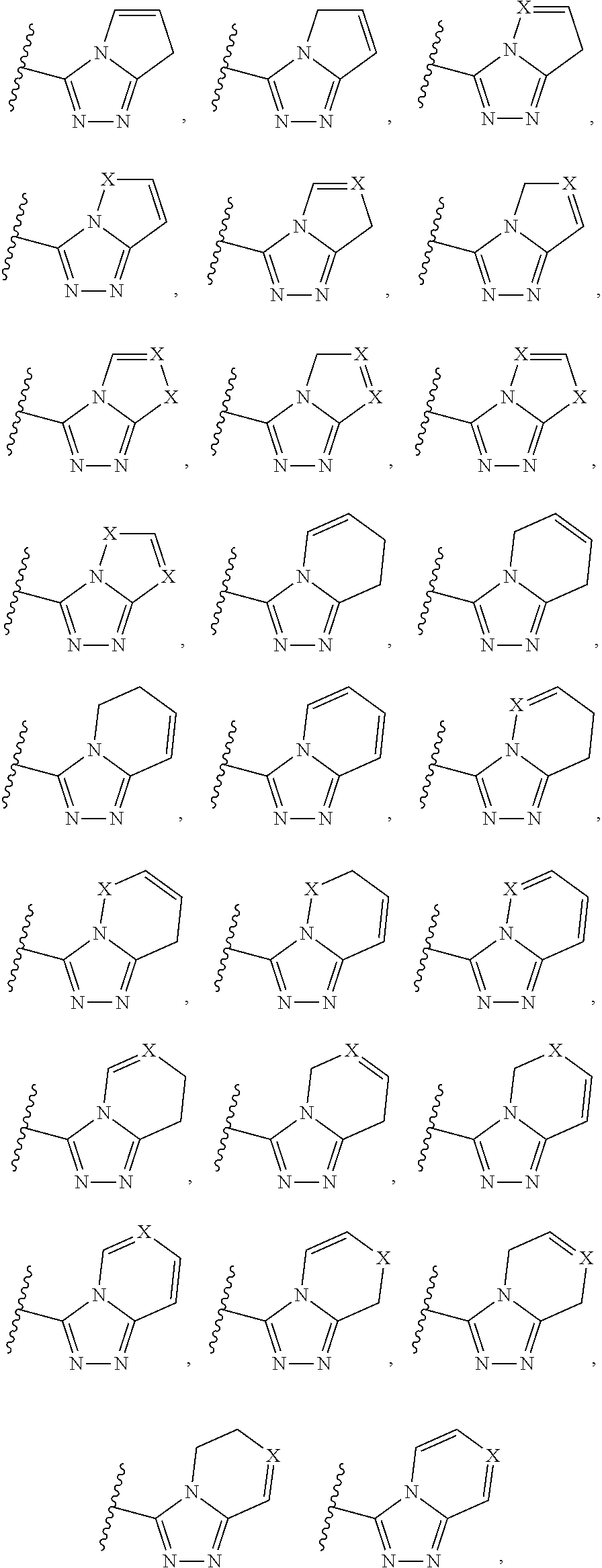
wherein X is N.

X is O or S; and
one R4 and another R2, R3, or R4, together with the atoms to which they are attached, form a 5- or 6-membered ring that is optionally containing one or two heteroatoms selected from O, N, and S; wherein the 5- or 6-membered ring is saturated, unsaturated or aromatic; and wherein the 5- or 6-membered ring is optionally substituted with one, two, or three substituents selected from the group consisting of halo, —CN, C1-6alkyl, —C1-6alkyl-OH, C1-6haloalkyl, C3-8cycloalkyl, C2-9heterocycle, C6-10aryl, C1-9heteroaryl, —C(═O)R14, —C(═O)OR13, —C(═O)N(R13)2, —S(═O)R14, —S(═O)2R13, —S(═O)2—N(R13)2, —N(R13)2, —N(R13)C(═O)R14, and —N(R13)S(═O)2R13.


| TABLE 1 |
 |
 |
 |
 |
 |
 |
 |
 |
 |
 |
 |
 |
 |
 |
 |
 |
 |
 |
 |
 |
 |
 |
 |
 |
 |
 |
 |
 |
 |


| TABLE 2 | |||
| Com- | |||
| pound | Name | Structure | Characterization |
| 3 | 2-(6-(4-cyclopropyl- 4H-1,2,4-triazol-3- yl)pyridin-2-yl)-N- methyl-1- oxoisoindoline-5- carboxamide |
 |
1H NMR (400 MHz. DMSO-d6) δ 8.72 (s, 1H), 8.68 (d, J = 4.8 Hz, 1H), 8.64 (d, J = 8 Hz, 1H), 8.17 (s, 1H), 8.08 (t, J = 8 Hz, 1H), 7.99 (d, J = 8 Hz, 1H, 7.91 (d, J = 7.6 Hz, 1H), 5.23 (s, 2H), 4.14-4.09 (m, 1H), 2.83 (d, J = 4.4 Hz, 2H), 1.16-1.11 (m, 2H), 1.02-0.96 (m, 2H); ESI m/z 375.1[M + 1]+ |
| 4 | 2-(6-(4-cyclopropyl- 4H-1,2,4-triazol-3- yl)pyridin-2-yl)-N- (2-methoxyethyl)-1- oxoisoindoline-5- carboxamide |
 |
1H NMR (400 MHz, DMSO-d6) δ 8.77 (s, 2H), 8.65 (d, J = 8 Hz, 1H), 8.19 (s, 1H), 8.11-8.07 (m, 1H), 8.01 (d, J = 7.6 Hz, 1H), 7.91 (d, J = 7.6 Hz, 2H), 5.23 (s, 2H), 4.12 (br, 1H), 3.48 (s, 4H), 3.28 (s, 3H), 1.14 (d, J = 6 Hz, 2H), 1.0 (s, 2H); ESI m/z 418.9[M + 1]+ |
| 5 | N-(2-(1H-imidazol- 1-yl)ethyl)-2-(6-(4- cyclopropyl-4H- 1,2,4-triazol-3- yl)pyridin-2-yl)-1- oxoisoindoline-5- carboxamide |
 |
1H NMR (400 MHz, DMSO-d6) δ 9.16 (s, 1H), 8.95-8.92 (m, 1H), 8.78 (s, 1H), 8.65 (d, J = 8.4 Hz. 1H), 8.13-8.08 (m, 2H), 7.96-7.91 (m, 3H), 7.79 (s, 1H), 7.67 (s, 1H), 5.22 (s, 2H), 4.41 (s, 2H), 4.12-4.10 (m, 2H), 3.77-3.76 (m, 2H), 1.13-1.12 (m, 2H), 1.10 (s, 2H); ESI m/z 454.9 [M + 1]+ |
| 6 | 2-(6-(4-cyclopropyl- 4H-1,2,4-triazol-3- yl)pyridin-2-yl)-5- (1H-pyrazole-1- carbonyl)isoindolin- 1-one |
 |
1H NMR (400 MHz, DMSO-d6) δ 8.72 (s, 1H), 8.67-8.65 (m, 2H), 8.34 (s, 1H), 8.5 (d, J = 8 Hz, 1H), 8.10 (t, J = 8 Hz, 1H), 8.01 (t, J = 8 Hz, 2H), 7.92 (d, J = 7.6 Hz, 1H), 6.77-6.76 (m, 1H), 5.23 (s, 2H), 4.15-4.10 (m, 1H), 1.16-1.11 (m, 2H), 1.0- 0.96 (m, 2H); ESI m/z 412.1 [M + 1]+ |
| 7 | 2-(6-(4-cyclopropyl- 4H-1,2,4-triazol-3- yl)pyridin-2-yl)-5- (morpholine-4- carbonyl)isoindolin- 1-one |
 |
1H NMR (400 MHz, DMSO-d6) δ 8.71 (s, 1H), 8.64 (d, J = 8 Hz, 1H), 8.08 (t, J = 7.6 Hz, 1H), 7.89 (dd, J = 8 Hz, 2.4 Hz, 2H), 7.76 (s, 1H), 7.57 (d, J = 7.6 Hz, 1H), 5.21 (s. 2H), 4.12-4.06 (m, 1H), 3.66-3.58 (m, 8H), 1.14-1.09 (m, 2H), 1.0-0.96 (m, 2H); ESI m/z 431.1 [M+ 1]+ |
| 8 | N-cyclopropyl-2-(6- (4-cyclopropyl-4H- 1,2,4-triazol-3- yl)pyridin-2-yl)-1- oxoisoindoline-5- carboxamide |
 |
1H NMR (400 MHz, DMSO-d6) δ 8.71 (s, 1H), 8.68 (d, J = 4.4 Hz, 1H), 8.63 (d, J = 8.4 Hz, 1H), 8.14 (s, 1H), 8.08 (t, J = 8 Hz, 1H), 7.97 (d, J = 8 Hz, 1H), 7.91-7.88 (m, 2H), 5.21 (s, 2H), 4.13-4.08 (m, 1H), 2.93-2.87 (m, 1H), 1.15-1.10 (m, 2H), 1.01-0.97 (m, 2H), 0.75-0.70 (m, 2H), 0.62-0.58 (m, 2H); ESI m/z 400.2 [M + 1]+ |
| 9 | 2-(6-(4-cyclopropyl- 4H-1,2,4-triazol-3- yl)pyridin-2-yl)-1- oxo-N-(tetrahydro- 2H-pyran-4- yl)isoindoline-5- carboxamide |
 |
1H NMR (400 MHz, DMSO-d6) δ 8.71 (s, 1H), 8.65 (d, J = 8.4 Hz, 1H), 8.57 (d, J = 7.6 Hz, 1H), 8.18 (s, 1H), 8.09 (t, J = 8 Hz, 1H), 8.01 (d, J = 8 Hz, 1H), 7.91 (d, J = 8 Hz, 2H), 5.23 (s, 2H), 4.13-4.03 (m, 2H), 3.90 (d, J = 9.6 Hz, 2H), 3.43-3.38 (m, 2H), 1.80-1.77 (m, 2H), 1.66-1.59 (m, 2H), 1.16-1.12 (m, 2H), 1.02-0.98 (m, 2H); ESI m/z 445.2 [M + 1]+ |
| 10 | 2-(6-(4-cyclopropyl- 4H-1,2,4-triazol-3- yl)pyridin-2-yl)-5- (4- methylpiperazine-1- carbonyl)isoindolin- 1-one |
 |
1H NMR (400 MHz, CDCl3) δ 8.75 (d, J = 8.4 Hz, 1H), 8.24 (s, 1H), 8.00-7.92 (m, 3H), 7.62 (s, 1H), 7.53 (d, J = 8 Hz, 1H), 5.11 (s, 2H), 3.95-3.91 (m, 1H), 3.83 (br, 2H), 3.48-3.44 (m, 2H), 2.52 (br, 2H), 2.37 (d, J = 0.8 Hz, 2H), 2.34 (s, 1H), 1.15- 1.10 (m, 2H), 0.98-0.94 (m, 2H); ESI m/z 444.1[M + 1]+ |
| 11 | 2-(6-(4-cyclopropyl- 4H-1,2,4-triazol-3- yl)pyridin-2-yl)-5- (piperidine-1- carbonyl)isoindolin- 1-one |
 |
1H NMR (400 MHz, CDCl3) δ 8.76 (dd, J = 0.8 Hz, 1H), 8.25 (s, 1H), 8.01-7.92 (m, 3H), 7.60 (s, 1H), 7.52-7.50 (m, 1H), 5.11 (s, 2H), 3.96-3.91 (m, 1H), 3.75 (br, 2H), 3.36 (br, 2H), 1.71 (s, 4H), 1.31 (s, 2H), 1.16-1.10 (m, 2H), 0.98-0.94 (m, 2H); ESI m/z 429.1[M + 1]+ |
| 12 | 2-(6-(4-cyclopropyl- 4H-1,2,4-triazol-3- yl)pyridin-2-yl)-5- (4- hydroxypiperidine- 1- carbonyl)isoindolin- 1-one |
 |
1H NMR (400 MHz, DMSO-d6) δ 8.71 (s, 1H), 8.64 (d, J = 8.4 Hz, 1H), 8.09 (t, J = 8 Hz, 1H), 7.89 (d, J = 8 Hz, 2H), 7.73 (s, 1H), 7.53 (s, 1H), 5.21 (s, 2H), 4.82 (d, J = 4 Hz, 1H), 4.15- 3.98 (m, 2H), 3.81-3.73 (m, 1H), 3.51-3.41 (m, 1H), 3.29- 3.20 (m, 1H), 3.19-3.06 (m, 1H), 1.88-1.68 (m, 2H), 1.47- 1.29 (m, 2H), 1.16-1.07 (m, 2H), 1.01-0.94 (m, 2H); ESI m/z 445.1 [M + 1]+ |
| 13 | 2-(6-(4-cyclopropyl- 4H-1,2,4-triazol-3- yl)pyridin-2-yl)-5- (4-hydroxy-4- methylpiperidine-1- carbonyl)isoindolin- 1-one |
 |
1H NMR (400 MHz, DMSO-d6) δ 8.71 (s, 1H), 8.64 (d, J = 8.4 Hz, 1H), 8.09 (t, J = 8 Hz, 1H), 7.90 (dd, J = 7.6 Hz, 1.2 Hz, 1H), 7.88 (d, J = 2 Hz, 1H), 7.72 (s, 1H), 7.54 (d. J = 8 Hz, 1H), 5.21 (s, 2H), 4.46 (s, 1H), 4.13-4.06 (m, 2H), 1.60-1.39 (m, 5H), 1.17 (s, 3H), 1.13-1.09 (m, 2H), 1.0-0.96 (m, 2H); ESI m/z 459.1 [M + 1]+ |
| 14 | 2-(6-(4-cyclopropyl- 4H-1,2,4-triazol-3- yl)pyridin-2-yl)-5- (4- methoxypiperidine- 1- carbonyl)isoindolin- 1-one |
 |
1H NMR (400 MHz, DMSO-d6) δ 8.71 (s, 1H), 8.64 (d, J = 8.4 Hz, 1H), 8.87 (m, 1H), 7.89 (d, J = 7.6 Hz, 2H), 7.74 (s, 1H), 7.55 (d, J = 8 Hz, 1H), 5.21 (s, 2H), 4.12-4.07 (m, 1H), 3.96 (br, 1H), 3.48-3.44 (m, 2H), 3.39-3.36 (m, 1H), 3.27 (s, 3H), 3.17 (br, 1H), 1.91 (s, 1H), 1.80 (s, 1H), 1.49 (s, 1H), 1.43 (s, 1H), 1.15-1.10 (m, 2H), 1.0- 0.96 (m. 2H); ESI m/z 459.1 [M + 1]+ |
| 15 | 2-(6-(4-cyclopropyl- 4H-1,2,4-triazol-3- yl)pyridin-2-yl)-5- (4- (dimethylamino) piperidine-1- carbonyl)isoindolin- 1-one |
 |
1H NMR (400 MHz, DMSO-d6) δ 8.71 (s, 1H), 8.64 (d, J = 8.4 Hz, 1H), 8.09 (t, J = 8 Hz, 1H), 7.89 (d, J = 8 Hz, 2H), 7.73 (s, 1H), 7.54 (d, J = 8.4 Hz, 1H), 5.21 (s, 2H), 4.46 (br, 1H), 4.12-4.06 (m, 1H), 3.60-3.51 (m, 1H), 3.09-3.03 (m, 1H), 2.88-2.83 (m, 1H), 2.39-2.33 (m, 1H), 2.18 (s, 6H), 1.86-1.83 (m, 1H), 1.71-1.68 (m, 1H), 1.39-1.32 (m, 2H), 1.14-1.09 (m, 2H), 1.0-0.95 (m, 2H); ESI m/z 472.2 [M + 1]1 |
| 16 | 5-(4- acetylpiperazine-1- carbonyl)-2-(6-(4- cyclopropyl-4H- 1,2,4-triazol-3- yl)pyridin-2- yl)isoindolin-1-one |
 |
1H NMR (400 MHz, DMSO-d6) δ 8.71 (s, 1H), 8.64 (d, J = 8.4 Hz, 1H), 8.09 (t, J = 8 Hz, 1H), 7.90 (t. J = 6.8 Hz, 2H), 7.77 (s, 1H), 7.59 (d, J = 7.6 Hz, 1H), 5.22 (s, 2H), 4.12-4.06 (m, 1H), 3.69-3.37 (m, 8H), 2.04 (br, 3H), 1.14-1.09 (m, 2H), 1.00- 0.96 (m, 2H); ESI m/z 472.1 [M + 1]+ |
| 17 | N-(1-(2-(6-(4- cyclopropyl-4H- 1,2,4-triazol-3- yl)pyridin-2-yl)-1- oxoisoindoline-5- carbonyl)piperidin- 4-yl)acetamide |
 |
1H NMR (400 MHz, DMSO-d6) δ 8.71 (s, 1H), 8.64 (d, J = 8.4 Hz, 1H), 8.08 (t, J = 7.6 Hz, 1H), 7.91-7.86 (m, 3H), 7.72 (s, 1H), 7.52 (d, J = 8.4 Hz, 1H), 5.22 (s, 2H), 4.33 (br, 1H), 4.12-4.07 (m, 1H), 3.87-3.78 (m, 1H), 3.645-3.52 (m, 1H), 3.16-3.00 (m, 2H), 1.80 (s, 3H), 1.29-1.24 (m, 4H), 1.14-1.09 (m, 2H), 1.00-0.96 (m, 2H); ESI m/z 486.1 [M + 1]+ |
| 18 | 2-(6-(4-cyclopropyl- 4H-1,2,4-triazol-3- yl)pyridin-2-yl)-5- (pyrrolidine-1- carbonyl)isoindolin- 1-one |
 |
1H NMR (400 MHz, CDCl3) δ 8.72 (s, 1H), 8.64 (d, J = 8.4 Hz, 1H), 8.09 (t, J = 8 Hz, 1H), 7.90-7.87 (m, 2H), 7.85 (s, 1H), 7.67 (d, J = 7.6 Hz, 1H), 5.21 (s, 2H), 4.11-4.07 (m, 1H), 3.50 (t, 6.4 Hz, 2H). 3.40-3.37 (m, 2H), 1.91-1.81 (m 4H), 1.12- 1.07 (m 4H), 1.0-0.96 (m, 2H); ESI m/z 415.1[M + 1]+ |
| 19 | 5-(azetidine-1- carbonyl)-2-(6-(4- cyclopropyl-4H- 1,2,4-triazol-3- yl)pyridin-2- yl)isoindolin-1-one |
 |
1H NMR (400 MHz, CDCl3) δ 8.74 (d, J = 8.4 Hz, 1H), 8.25 (s, 1H), 8.0-7.91 (m, 3H), 7.87 (s, 1H), 7.70 (d, J = 7.6 Hz, 1H), 5.11 (s, 2H), 4.30 (tt, J = 7.6 Hz. 4H), 3.97-3.91 (m, 1H), 2.41 (m, 2H), 1.16-1.11 (m, 2H), 0.98-0.94 (m, 2H); ESI m/z 401.1[M + 1]+ |
| 20 | 2-(6-(4-cyclopropyl- 4H-1,2,4-triazol-3- yl)pyridin-2-yl)-5- (3-oxopiperazine-1- carbonyl)isoindolin- 1-one |
 |
1H NMR (400 MHz, DMSO-d6) δ 8.70 (s, 1H), 8.64 (d, J = 8.4 Hz, 1H), 8.14-8.07 (m, 2H), 7.90 (t, J = 8 Hz, 2H), 7.80 (s, 1H), 7.61 (d, J = 8 Hz, 1H), 5.22 (s, 2H), 4.14-4.06 (m, 2H), 3.86 (m, 2H), 3.50 (s, 1H), 3.25 (s, 2H), 1.13-1.09 (m, 2H), 1.00-0.96 (m, 2H); ESI m/z 444.0 [M + 1]+ |
| 21 | 5-((1R,5S)-8-oxa-3- azabicyclo[3.2.1] octane-3-carbonyl)- 2- (6-(4-cyclopropyl- 4H-1,2,4-triazol-3- yl)pyridin-2- yl)isoindolin-1-one |
 |
1H NMR (400 MHz, CDCl3) δ 8.75 (d, J = 8 Hz, 1H), 8.26 (s, 1H), 8.0-7.92 (m, 3H), 7.61 (s, 1H), 7.50 (d, J = 7.6 Hz, 1H), 5.11 (s, 1H), 4.48-4.41 (m, 2H), 4.26 (s, 1H), 3.96-3.91 (m, 1H), 3.52-3.48 (m, 1H), 3.30 (d, J = 12.4 Hz, 1H), 3.18 (d, J = 12.8 Hz, 1H), 1.98 (s, 3H), 1.68 (s, 1H), 1.13 (d, J = 7.2 Hz, 1H), 0.97 (s, 2H); ESI m/z 457.1[M + 1]+ |
| 22 | (R)-2-(6-(4- cyclopropyl-4H- 1,2,4-triazol-3- yl)pyridin-2-yl)-5- (3- methoxypyrrolidine- 1- carbonyl)isoindolin- 1-one |
 |
1H NMR (400 MHz, DMSO-d6) δ 8.72 (s, 1H), 8.64 (d, J = 8.4 Hz, 1H), 8.11-8.07 (m, 1H), 7.90-7.87 (m, 3H), 7.67 (d, J = 8 Hz, 1H), 5.22 (s, 2H), 4.12- 3.95 (m, 2H), 3.59 (s, 2H), 3.36 (s, 3H), 3.28 (s, 2H), 3.17 (s, 1H), 2.02-1.92 (m, 2H), 1.13 (d, J = 6.4 Hz, 2H), 0.99 (s, 2H); ESI m/z 445.1 [M + 1]+ |
| 23 | methyl 1-(2-(6-(4- cyclopropyl-4H- 1,2,4-triazol-3- yl)pyridin-2-yl)-1- oxoisoindoline-5- carbonyl)piperidine- 4-carboxylate |
 |
1H NMR (400 MHz, CDCl3) δ 8.78 (d, J = 8 Hz, 1H), 8.43 (s, 1H), 8.02-7.93 (m, 3H), 7.61 (s, 1H), 7.52 (d, J = 8 Hz, 1H), 5.12 (s, 2H), 4.55 (s, 1H), 4.01- 3.92 (m, 1H), 3.72 (s, 2H), 3.11-2.82 (s, 3H), 2.67-2.60 (m, 1H), 2.11-1.73 (m, 4H), 1.22- 1.16 (m, 2H), 1.01 (s, 2H); ESI m/z 487.1[M + 1]+ |
| 24 | 2-(6-(4-cyclopropyl- 4H-1,2,4-triazole-3- yl)pyridin-2-yl)-5- (thiomorpholine-4- carbonyl)isoindolin- 1-one |
 |
1H NMR (400 MHz, DMSO-d6) δ 8.70 (s, 1H), 8.64 (d, J = 8.4 Hz, 1H), 8.09 (t, J = 8 Hz, 1H), 7.91-7.89 (m, 2H), 7.75 (s, 1H), 7.57 (d, J = 7.6 Hz, 1H), 5.22 (s, 2H), 4.13-4.06 (m, 1H), 3.97-3.85 (m, 2H), 3.61-3.50 (m, 2H), 2.70-2.62 (m, 4H), 1.14-1.09 (m, 2H), 1.00-0.96 (m, 2H); ESI m/z 447.0 [M + 1]+ |
| 25 | 2-(6-(4-cyclopropyl- 4H-1,2,4-triazol-3- yl)pyridin-2-yl)-5- (4- (methylthio) piperidine-1- carbonyl)isoindolin- 1-one |
 |
1H NMR (400 MHz, CDCl3) δ 7.50 (d, J = 8 Hz, 1H), 8.25 (s, 1H), 8.01-7.94 (m, 3H), 7.60 (s, 1H), 7.51 (d, J = 7.6 Hz, 1H), 5.11 (s, 2H), 4.48 (br, 1H). 3.94 (t, 6.8 Hz, 1H), 3.67 (br, 1H), 3.17 (t, J = 10.8 Hz, 2H), 2.88- 2.83 (m, 1H), 2.13-1.95 (m, 5H), 1.68-1.54 (m, 2H), 1.16- 1.12 (m, 2H), 0.99-0.95 (m, 2H); ESI m/z 475.0[M + 1]+ |


| TABLE 3 | |||
| Compound | Name | Structure | Characterization |
| 28 | 2-(6-(4-cyclopropyl- 4H-1,2,4-triazol-3- yl)pyridin-2-yl)-5- (1H-pyrazol-3- yl)isoindolin-1-one |
 |
1H NMR (400 MHz, DMSO-d6) δ 13.12 (s, 1H), 8.71 (s, 1H), 8.66 (d, J = 5.2 Hz, 1H), 8.18- 7.87 (m, 6H), 6.88 (s, 1H), 5.22 (s, 2H), 4.13 (s, 1H), 1.14 (d, J = 6 Hz, 4H); ESI m/z 384.1 [M + 1]+ |
| 29 | 2-(6-(4-cyclopropyl- 4H-1,2,4-triazol-3- yl)pyridin-2-yl)-5- (1-methyl-1H- pyrazol-5- yl)isoindolin-1-one |
 |
1H NMR (400 MHz, CDCl3) δ 8.77 (dd, J = 8.4 Hz, 0.4 Hz, 1H), 8.24 (s, 1H), 8.04 (d, J = 8 Hz, 1H), 7.98 (m, 1H), 7.95 (d, J = 8 Hz, 1H), 7.60-7.58 (m, 2H), 7.56 (d, J = 2 Hz, 1H), 6.40 (d, J = 2 Hz, 1H), 5.14 (s, 2H), 3.95 (s, 4H), 1.16-1.11 (m, 2H), 0.99-0.95 (m, 2H); ESI m/z 398.2[M + 1]+ |
| 30 | 2-(6-(4-cyclopropyl- 4H-1,2,4-triazol-3- yl)pyridin-2-yl)-5- (1-methyl-1H- imidazol-4- yl)isoindolin-1-one |
 |
1H NMR (400 MHz, DMSO-d6) δ 9.08 (s, 1H), 8.81 (s, 1H), 8.62 (d, J = 8.4 Hz, 1H), 8.24 (s, 1H), 8.08-8.05 (m, 2H), 7.94-7.88 (m, 3H), 5.19 (s, 2H), 5.23 (s, 2H), 4.10-4.09 (m, 4H), 1.14-1.12 (m, 2H), 1.03 (br, 2H); ESI m/z 397.9 [M + 1]+ |


| TABLE 4 | ||||
| Compound | | Structure | Characterization | |
| 40 | 2-(6-(4-cyclopropyl- 4H-1,2,4-triazol-3- yl)pyridin-2-yl)-6- (pyridin-3- yl)isoindolin-1-one |
 |
1H NMR (400 MHz, DMSO-d6) δ 9.0 (s, 1H), 8.72 (s, 1H), 8.68 (d, J = 8.4 Hz, 1H), 8.63 (d, J = 4 Hz, 1H), 8.22 (d, J = 8 Hz, 1H), 8.15 (s, 1H), 8.12-8.08 (m, 2H), 7.91-7.85 (m, 2H), 7.55- 7.53 (m, 1H), 5.25 (s, 2H), 4.15-4.09 (m, 1H), 1.16-1.11 (m, 2H), 1.01-0.96 (m, 2H); ESI m/z 395.2 [M + 1]+ | |
| 41 | 2-(6-(4-cyclopropyl- 4H-1,2,4-triazol-3- yl)pyridin-2-yl)-6- (4-methylpyridin-3- yl)isoindolin-1-one |
 |
1H NMR (400 MHz, DMSO-d6) δ 8.71 (s, 1H), 8.65 (d, J = 8.4 Hz, 1H), 8.48 (d, J = 5.2 Hz, 1H), 8.4.1 (s, 1H), 8.10-8.06 (m, 1H), 7.89 (d, J =7.6 Hz, 1H), 7.84-7.81 (m, 2H), 7.75 (dd, J = 7.6 Hz, 0.8 Hz, 1H), 7.37 (d, J = 5.2 Hz. 1H), 5.25 (s, 2H), 4.14-4.09 (m, 1H), 2.29 (s, 3H), 1.16-1.11 (m, 2H), 1.00-0.96 (m, 2H); ESI m/z 409.2 [M + 1]+ | |
| 42 | 2-(6-(4-cyclopropyl- 4H-1,2,4-triazol-3- yl)pyridin-2-yl)-6- (6-methylpyridin-3- yl)isoindolin-1-one |
 |
1H NMR (400 MHz, CDCl3) δ 9.18 (s. 1H), 8.81 (dd, J = 6.4 Hz, 2.8 Hz, 1H), 8.42-8.39 (m, 2H), 8.18 (s, 1H), 8.00-7.92 (m, 3H), 7.75-7.68 (m, 2H), 5.18 (s, 2H), 4.01-3.96 (m, 1H), 2.89 (s, 3H), 1.23-1.18 (m, 2H), 1.04- 1.0 (m, 2H); ESI m/z 409.1 [M + 1]+ | |
| 43 | 2-(6-(4-cyclopropyl- 4H-1,2,4-triazol-3- yl)pyridin-2-yl)-6- (pyrimidin-5- yl)isooindolin-1-one |
 |
1H NMR (400 MHz, CDCl3) δ 8.27 (s, 1H), 9.03 (s, 1H), 8.78 (dd, J = 8 Hz, 1.2 Hz, 1H), 7.72 (d, J = 8 Hz, 1H), 5.17 (s, 2H), 3.98-3.93 (m, 1H), 1.18-1.13 (m, 2H), 1.0-0.96 (m, 2H); ESI m/z 396.1 [M + 1]+ | |
| 44 | 2-(6-(4-cyclopropyl- 4H-1,2,4-triazol-3- yl)pyridin-2-yl)-6- (2-methylpyrimidin- 5-yl)isoindolin-1- one |
 |
1H NMR (400 MHz, CDCl3) δ 8.93 (s, 2H), 8.78 (d, J = 8 Hz, 1H), 8.25 (s, 1H), 8.16 (s, 1H), 8.01-7.93 (m, 2H), 7.84 (dd, J = 7.6 Hz, 1.2 Hz, 1H), 7.70 (d, J = 7.6 Hz, 1H), 5.16 (s, 2H), 3.98-3.93 (m, 1H), 2.82 (s, 3H), 1.18-1.13 (m, 2H), 1.0-0.96 (m, 2H); ESI m/z 410.1 [M + 1]+ | |
| 45 | 2-(6-(4-cyclopropyl- 4H-1,2,4-triazol-3- yl)pyridin-2-yl)-6- (6-methoxypyridin- 3-yl)isoindolin-1- one |
 |
1H NMR (400 MHz, CDCl3) δ 8.78 (d, J = 8 Hz, 1H), 8.45 (s, 1H), 8.25 (s, 1H), 8.10 (s, 1H), 8.0-7.87(m, 2H), 7.86 (d, J = 8 Hz, 1H), 7.80 (d, J = 7.2 Hz, 1H), 7.62 (d, J = 7.6 Hz, 1H), 6.87 (d, J = 8.4 Hz, 1H), 5.12 (s, 2H), 4.0 (s, 3H), 4.0-3.92 (m, 1H), 1.16-1.14 (m, 2H), 1.0-0.96 (m, 2H); ESI m/z 425.0 [M + 1]+ | |
| 46 | 2-(6-(4-cyclopropyl- 4H-1,2,4-triazol-3- yl)pyridin-2-yl)-6- (6- cyclopropylpyridin- 3-yl)isoindolin-1- one |
 |
1H NMR (400 MHz, DMSO-d6) δ 8.78 (d, J = 1.2 Hz, 1H), 8.71 (s, 1H), 8.65 (d, J = 7.6, 1H), 8.08 (t, J = 8 Hz, 2H), 8.04- 8.01 (m, 2H), 7.89 (d, J = 7.6 Hz, 1H), 7.81 (d. J = 8 Hz, 1H), 7.40 (d, J = 8.4 Hz, 1H), 5.20 (s, 2H), 4.11 (m, 1H), 2.19-2.13 (m, 1H), 1.16-1.11 (m, 2H), 1.0-0.96 (m, 6H); ESI m/z 435.1 [M + 1]+ | |
| 47 | 6-(1-cyclopropyl- 1H-pyrazol-4-yl)-2- (6-(4-cyclopropyl- 4H-1,2,4-triazol-3- yl)pyridin-2- yl)isoindolin-1-one |
 |
1H NMR (400 MHz, CDCl3) δ 8.76 (d, J = 8.4 Hz, 1H), 8.23 (s, 1H), 8.0-7.98 (m, 2H), 7.91 (t, 8.4 Hz, 1H), 7.81 (d, J = 6 Hz, 2H), 7.73 (dd, J = 8 Hz, 1.6 Hz, 1H), 7.51 (d, J = 8 Hz, 1H), 5.06 (s, 2H), 3.97-3.94 (m, 1H), 3.68-3.63 (m, 1H), 1.21-1.05 (m, 6H), 0.98-0.94 (m, 2H); ESI m/z 424.1 [M + 1]+ | |
| 48 | 2-(6-(4-cyclopropyl- 4H-1,2,4-triazol-3- yl)pyridin-2-yl)-6- (4-fluoropyridin-3- yl)isoindolin-1-one |
 |
1H NMR (400 MHz, CDCl3) δ 8.76 (t, J = 8 Hz, 2H), 8.63- 8.60 (m, 1H), 8.25 (s, 1H), 8.14 (s, 1H), 8.00-7.92 (m, 2H), 7.82 (d, J = 8 Hz, 1H), 7.68 (d, J = 8 Hz, 1H), 7.20-7.16 (m, 1H), 5.51 (s, 2H), 3.99-3.93 (m, 1H), 1.17-1.12 (m,. 2H), 1.00-0.95 (m, 2H); ESI m/z 413.0 [M + H]+ | |
| 49 | 6-(4-chloropyridin- 3-yl)-2-(6-(4- cyclopropyl-4H- 1,2,4-triazol-3- yl)pyridin-2- yl)isoindolin-1-one |
 |
1H NMR (400 MHz, CDCl3) δ 8.77 (d, J = 8.4 Hz, 1H), 8.60 (s, 1 H), 8.54 (d, J = 5.2 Hz, 1H), 8.25 (s, 1H), 8.05 (s, 1H), 8.0-7.94 (m, 2H), 7.74-7.66 (m, 2H), 7.48 (d, J = 5.2 Hz, 1H), 5.16 (s, 2H), 3.98-3.95 (m, 1H), 1.18-1.11 (m, 2H), 1.01-0.93 (m, 2H); ESI m/z 429.0 [M + 1]+ | |
| 50 | 2-(6-(4-cyclopropyl- 4H-1,2,4-triazol-3- yl)pyridin-2-yl)-6- (pyridin-4- yl)isoindolin-1-one |
 |
1H NMR (400 MHz, CDCl3) δ 8.79 (dd, J = 8 Hz, 0.8 Hz, 1H), 8.73-8.72 (m, 2H), 8.25 (s, 1H), 8.24 (d, J = 0.6 Hz, 1H), 8.01- 7.91 (m, 3H), 7.68 (d, J = 8 Hz, 2H), 7.59-7.58 (m. 2H), 5.16 (s, 2H), 3.99-3.93 (m, 1H), 1.18- 1.23 (m, 2H), 1.0-0.98 (m, 2H); ESI m/z 395.0 [M + 1]+ | |
| 51 | 2-(6-(4-cyclopropyl- 4H-1,2,4-triazol-3- yl)pyridin-2-yl)-6- (2-methylthiazol-5- yl)isoindolin-1-one |
 |
1H NMR (400 MHz, CDCl3) δ 8.76 (d, J = 8.4 Hz, 1H), 8.25 (s, 1H), 8.07 (s, 1H), 8.00-7.90 (m, 3H), 7.79 (dd, J = 8 Hz, 1.2 Hz, 1H), 7.57 (d, J = 8 Hz, 1H), 5.10 (s, 2H), 3.98-3.92 (m, 1H), 2.76 (s, 3H), 1.14 (q, J = 6.8 Hz, 2H), 0.99-0.95 (m, 2H); ESI m/z 415.0 [M + 1]+ | |
| 52 | 2-(6-(4-cyclopropyl- 4H-1,2,4-triazol-3- yl)pyridin-2-yl)-6- (2-methylpyridin-3- yl)isoindolin-1-one |
 |
1H NMR (400 MHz, DMSO-d6) δ 8.71 (s, 1H), 8.65 (d, J = 8.4 Hz, 1H), 8.50 (dd, J = 4.8 Hz, 1.2 Hz, 1H), 8.09 (t, J = 8 Hz, 1H), 7.89 (d, J = 7.2 Hz, 1H), 7.83-7.80 (m, 2H), 7.75 (dd, J = 8 Hz, 1.6 Hz, 1H), 7.69 (dd, J = 7.6 Hz, 1.2 Hz, 1H), 7.34 (dd, J = 7.6 Hz, 4.8 Hz, 1H), 5.25 (s, 2H), 4.14-4.08 (m, 1H), 2.45 (s, 3H), 1.13 (q, J = 5.6 Hz, 2H), 0.98-0.96 (m. 2H); ESI m/z 409.1 [M + 1]+ | |
| 53 | 2-(6-(4-cyclopropyl- 4H-1,2,4-triazol-3- yl)pyridin-2-yl)-6- (2-fluoropyridin-3- yl)isoindolin-1-one |
 |
1H NMR (400 MHz, DMSO-d6) δ 8.71 (s, 1H), 8.65 (d, J = 8.4 Hz, 1H), 8.50 (dd, J = 4.8 Hz, 1.2 Hz, 1H), 8.09 (t, J = 8 Hz, 1H), 7.89 (d, J = 7.2 Hz, 1H), 7.83-7.80 (m, 2H), 7.75 (dd, J = 8 Hz, 1.6 Hz 1H), 7.69 (dd, J = 7.6 Hz, 1.2 Hz, 1H), 7.34 (dd, J = 7.6 Hz, 4.8 Hz, 1H), 5.25 (s, 2H), 4.14-4.08 (m, 1H), 2.45 (s, 3H), 1.13 (dd, J = 12.8 Hz, 7.2 Hz, 2H), 0.98-0.96 (m, 2H); ESI m/z 413.0 [M + 1]+ | |
| 54 | 2-(6-(4-cyclopropyl- 4H-1,2,4-triazol-3- yl)pyridin-2-yl)-6- (5-methylpyridin-3- yl)isoindolin-1-one |
 |
1H NMR (400 MHz, CDCl3) δ 8.78 (d, J = 8 Hz, 1H), 8.71 (d, J = 1.6 Hz, 1H), 8.48 (s, 1H), 8.25 (s, 1H), 8.15 (s, 1H), 8.00- 7.91 (m, 2H), 7.86 (dd, J = 8 Hz, 1.6 Hz, 1H), 7.76 (s, 1H), 7.65 (d, J = 8 Hz, 1H), 5.14 (s, 2H), 4.00-3.94 (m, 1H), 2.44 (s, 3H), 1.15 (q, J = 6.4 Hz, 1H), 1.00-0.95 (m, 2H); ESI m/z 409.1 [M + 1]+ | |
| 55 | 2-(6-(4-cyclopropyl- 4H-1,2,4-triazol-3- yl)pyridin-2-yl)-6- (5-fluoropyridin-3- yl)isoindolin-1-one |
 |
1H NMR (400 MHz, CDCl3) δ 8.79 (m, 1H), 8.53 (d, J = 2.4 Hz, 1H), 8.25 (s, 1H), 8.17 (d, J = 0.8 Hz, 1H), 8.01-7.93 (m, 2H), 7.86 (dd, J = 8 Hz, 1.6 Hz 1H), 7.70-7.66 (m, 2H), 5.16 (s, 2H), 3.99-3.93 (m, 1H), 7.15 (q, J = 6.8 Hz, 2H), 1.00-0.96 (m, 2H); ESI m/z 413.0 [M + 1]+ | |


| TABLE 5 | |||
| Compound | Name | Structure | Characterization |
| 58 | 2-(6-(4-cyclopropyl- 4H-1,2,4-triazol-3- yl)pyridin-2-yl)-6- (pyridin-2- yl)isoindolin-1-one |
 |
1H NMR (400 MHz, CDCl3) δ 8.78 (d, J = 8 Hz, 1H), 8.72 (d, J = 5.2 Hz, 1H), 8.49 (s, 1H), 8.41 (dd, J = 8 Hz, 2.4 Hz, 1H), 8.24 (s, 1H), 7.99 (d, J = 6.4 Hz, 1H), 7.95-7.91 (m, 1H), 7.85-7.81 (m, 2H), 7.65 (d, J = 8 Hz, 1H), 7.31-7.28 (m, 1H), 5.13 (s, 2H), 4.0-3.94 (m, 1H), 1.18-1.13 (m, 2H), 1.0-1.95 (m, 2H); ESI m/z 395.0 [M + 1]+ |
| 59 | 2-(6-(4-cyclopropyl- 4H-1,2,4-triazol-3- yl)pyridin-2-yl)-6- (pyridazin-3- yl)isoindolin-1-one |
 |
1H NMR (400 MHz, CDCl3) δ 9.23 (dd, J = 4.8 Hz, 1.2 Hz, 1H), 8.80 (d, J = 8.8 Hz, 1H), 8.63 (dd, J = 8 Hz, 1.6 Hz, 1H), 8.50 (s, 1H), 8.26 (s, 1H), 8.02- 7.93 (m, 3H), 7.74 (d, J = 8 Hz, 1H), 7.63 (m, 1H), 5.18 (s, 2H), 4.01-3.94 (m, 1H), 1.17-1.12 (m, 2H), 1.01-0.95 (m, 2H); ESI m/z 396.0 [M + 1]+ |
| 60 | 2-(6-(4-cyclopropyl- 4H-1,2,4-triazol-3- yl)pyridin-2-yl)-6- (5- cyclopropylpyrazin- 2-yll)isoindolin-1- one |
 |
1H NMR (400 MHz, CDCl3) δ 8.90 (s, 1H), 8.76 (d, J = 8 Hz, 1H), 8.54 (s, 1H), 8.49 (s, 1H), 8.30 (d, J = 8 Hz, 1H), 8.24 (s, 1H), 7.99-7.90 (m, 2H), 7.65 (d, J = 8 Hz, 1H), 5.12 (s, 2H), 3.99-3.93 (m, 1H), 2.14-2.11 (m 1H), 1.17-1.08 (m, 6H), 0.99-0.95 (m, 2H); ESI m/z 436.1 [M + 1]+ |


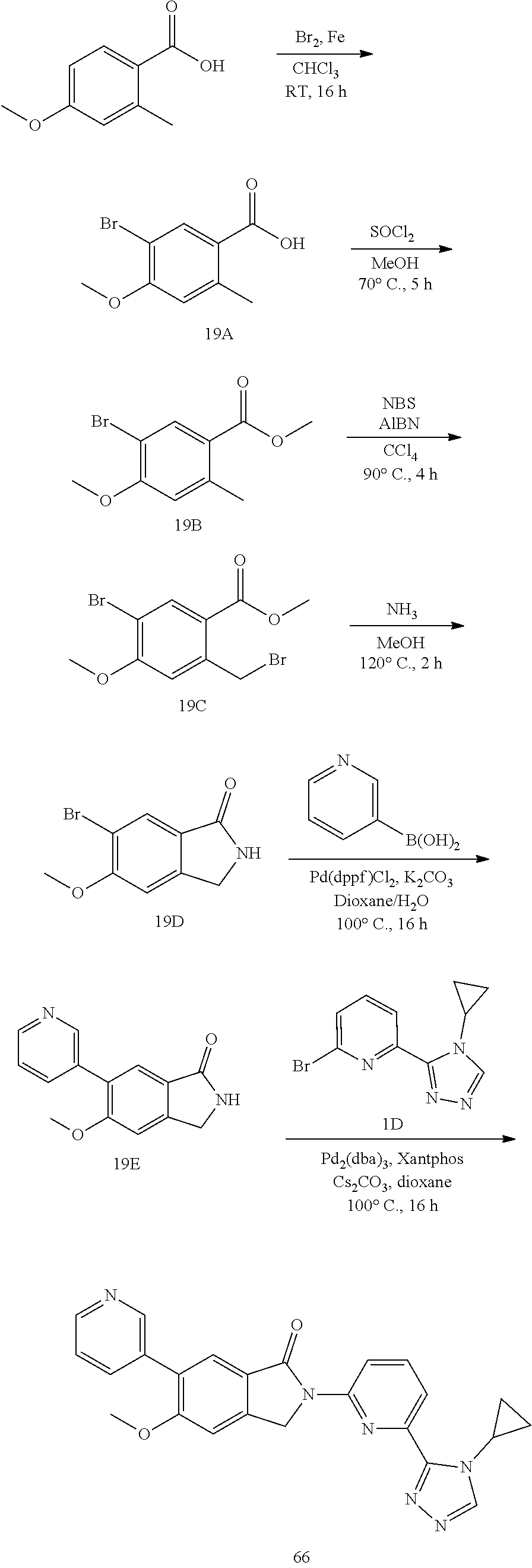


| TABLE 6 | ||||
| ASK1 Kinase | TNFa | MYLK/MLCK | hERG | |
| Avg | Inhibition | Kinase | Inhibition | |
| Compound | IC50 | IC50 | IC50 or Kd | at 10 μM |
| 1 | +++ | +++ | ||
| 2 | +++ | ++ | + | + |
| 3 | +++ | |||
| 4 | +++ | |||
| 5 | +++ | |||
| 6 | +++ | |||
| 7 | +++ | + | + | ++ |
| 8 | +++ | ++ | ||
| 9 | +++ | ++ | ||
| 10 | +++ | ++ | + | |
| 11 | +++ | ++ | + | |
| 12 | +++ | + | ||
| 13 | +++ | + | ||
| 14 | +++ | ++ | + | |
| 15 | +++ | ++ | + | |
| 16 | +++ | + | + | |
| 17 | +++ | + | ||
| 18 | +++ | |||
| 19 | +++ | |||
| 20 | +++ | |||
| 21 | +++ | |||
| 22 | +++ | |||
| 23 | +++ | |||
| 24 | +++ | |||
| 25 | +++ | |||
| 26 | +++ | |||
| 27 | +++ | ++ | ||
| 28 | +++ | ++ | ||
| 29 | +++ | |||
| 30 | +++ | ++ | ++ | |
| 31 | +++ | |||
| 32 | ++ | ++ | ||
| 33 | ++ | |||
| 34 | +++ | |||
| 35 | +++ | |||
| 36 | +++ | |||
| 37 | +++ | |||
| 38 | +++ | |||
| 39 | +++ | |||
| 40 | +++ | +++ | +++ | +++ |
| 41 | +++ | +++ | +++ | +++ |
| 42 | +++ | |||
| 43 | +++ | ++ | ++ | |
| 44 | +++ | ++ | + | |
| 45 | +++ | |||
| 46 | +++ | +++ | +++ | +++ |
| 47 | +++ | |||
| 48 | +++ | |||
| 49 | +++ | |||
| 50 | +++ | |||
| 51 | +++ | + | ||
| 52 | +++ | |||
| 53 | +++ | |||
| 54 | +++ | |||
| 55 | ++ | |||
| 56 | +++ | |||
| 57 | +++ | |||
| 58 | +++ | |||
| 59 | +++ | |||
| 60 | +++ | + | +++ | |
| 61 | +++ | |||
| 62 | +++ | |||
| 63 | +++ | + | ||
| 64 | +++ | +++ | ++ | |
| 65 | +++ | + | ||
| 66 | +++ | +++ | +++ | |
| 67 | +++ | |||
| 68 | +++ | +++ | ++ | |
| 69 | +++ | +++ | ++ | |
| 70 | +++ | |||
| 71 | +++ | ++ | ++ | |
| 72 | +++ | |||
| 73 | +++ | |||
| 74 | ++ | |||
| 75 | ++ | |||
| 76 | ++ | |||
| 77 | + | |||
| 78 | +++ | +++ | ||
| 79 | +++ | |||
| 80 | ++ | |||
| 81 | + | |||
| 82 | +++ | |||
| 83 | +++ | |||
| 84 | ++ | |||
| 85 | +++ | |||
| 86 | + | |||
| 87 | + | |||
| 88 | + | |||
| 89 | + | |||
| For ASK1 Kinase Assay: +++ = IC50 < 200 nM; ++ = IC50 200 nM-<1 μM; + = IC50 1-10 μM. | ||||
| For TNFa Inhibition Assay: +++ = IC50 < 2 μM; ++ = IC50 2-10 μM; + = IC50 > 10 nM. | ||||
| For MYLK/MLCK Kinase Assay: +++ = Kd or IC50 < 1 μM; ++ = Kd or IC50 1-10 μM; + = Kd or IC50 > 10 μM. | ||||
| For hERG Inhibition Assay: +++ >20% inhibition: ++ = 10-20% inhibition: + = <%10 inhibition. | ||||
Claims (16)


Priority Applications (1)
| Application Number | Priority Date | Filing Date | Title |
|---|---|---|---|
| US15/970,587 US10150755B2 (en) | 2017-04-05 | 2018-05-03 | ASK1 inhibitor compounds and uses thereof |
Applications Claiming Priority (3)
| Application Number | Priority Date | Filing Date | Title |
|---|---|---|---|
| US201762482085P | 2017-04-05 | 2017-04-05 | |
| PCT/US2018/026134 WO2018187506A1 (en) | 2017-04-05 | 2018-04-04 | Ask1 inhibitor compounds and uses thereof |
| US15/970,587 US10150755B2 (en) | 2017-04-05 | 2018-05-03 | ASK1 inhibitor compounds and uses thereof |
Related Parent Applications (1)
| Application Number | Title | Priority Date | Filing Date |
|---|---|---|---|
| PCT/US2018/026134 Continuation WO2018187506A1 (en) | 2017-04-05 | 2018-04-04 | Ask1 inhibitor compounds and uses thereof |
Publications (2)
| Publication Number | Publication Date |
|---|---|
| US20180291002A1 US20180291002A1 (en) | 2018-10-11 |
| US10150755B2 true US10150755B2 (en) | 2018-12-11 |
Family
ID=63712299
Family Applications (3)
| Application Number | Title | Priority Date | Filing Date |
|---|---|---|---|
| US16/499,075 Abandoned US20210087167A1 (en) | 2017-04-05 | 2018-04-04 | Ask1 inhibitor compounds and uses thereof |
| US15/970,587 Active US10150755B2 (en) | 2017-04-05 | 2018-05-03 | ASK1 inhibitor compounds and uses thereof |
| US18/897,798 Pending US20250304552A1 (en) | 2017-04-05 | 2024-09-26 | Ask1 inhibitor compounds and uses thereof |
Family Applications Before (1)
| Application Number | Title | Priority Date | Filing Date |
|---|---|---|---|
| US16/499,075 Abandoned US20210087167A1 (en) | 2017-04-05 | 2018-04-04 | Ask1 inhibitor compounds and uses thereof |
Family Applications After (1)
| Application Number | Title | Priority Date | Filing Date |
|---|---|---|---|
| US18/897,798 Pending US20250304552A1 (en) | 2017-04-05 | 2024-09-26 | Ask1 inhibitor compounds and uses thereof |
Country Status (34)
| Country | Link |
|---|---|
| US (3) | US20210087167A1 (en) |
| EP (1) | EP3606519B1 (en) |
| JP (1) | JP7196093B2 (en) |
| KR (1) | KR102665145B1 (en) |
| CN (1) | CN110730661B (en) |
| AR (1) | AR111407A1 (en) |
| AU (1) | AU2018250217B2 (en) |
| CA (1) | CA3059107A1 (en) |
| CL (1) | CL2019002810A1 (en) |
| CO (1) | CO2019011708A2 (en) |
| CR (1) | CR20190503A (en) |
| CU (1) | CU20190080A7 (en) |
| DK (1) | DK3606519T3 (en) |
| DO (1) | DOP2019000255A (en) |
| EA (1) | EA201992299A1 (en) |
| EC (1) | ECSP19078393A (en) |
| ES (1) | ES2992084T3 (en) |
| FI (1) | FI3606519T3 (en) |
| HU (1) | HUE068103T2 (en) |
| IL (1) | IL269711B (en) |
| JO (1) | JOP20190221A1 (en) |
| MA (1) | MA49047A (en) |
| MX (1) | MX394098B (en) |
| NI (1) | NI201900102A (en) |
| NZ (1) | NZ758345A (en) |
| PE (1) | PE20200009A1 (en) |
| PH (1) | PH12019502288A1 (en) |
| PL (1) | PL3606519T3 (en) |
| PT (1) | PT3606519T (en) |
| RU (1) | RU2019134679A (en) |
| SG (1) | SG11201909155VA (en) |
| SI (1) | SI3606519T1 (en) |
| TW (1) | TWI779022B (en) |
| WO (1) | WO2018187506A1 (en) |
Cited By (1)
| Publication number | Priority date | Publication date | Assignee | Title |
|---|---|---|---|---|
| US11434249B1 (en) | 2018-01-02 | 2022-09-06 | Seal Rock Therapeutics, Inc. | ASK1 inhibitor compounds and uses thereof |
Families Citing this family (16)
| Publication number | Priority date | Publication date | Assignee | Title |
|---|---|---|---|---|
| WO2018133865A1 (en) * | 2017-01-22 | 2018-07-26 | 福建广生堂药业股份有限公司 | Ask1 inhibitor and preparation method and use thereof |
| PL3621615T3 (en) | 2017-05-12 | 2024-03-25 | Enanta Pharmaceuticals, Inc. | Apoptosis signal-regulating kinase 1 inhibitors and methods of use thereof |
| CN110407806B (en) * | 2018-04-28 | 2021-08-17 | 深圳微芯生物科技股份有限公司 | Formamide compound, its preparation method and application |
| IL278368B2 (en) | 2018-05-02 | 2024-06-01 | Enanta Pharm Inc | Tetrazole containing apoptosis signal-regulating kinase 1 inhibitors and methods for its use |
| WO2020006429A1 (en) * | 2018-06-28 | 2020-01-02 | Hepatikos Therapeutics, Llc | Ask1 isoindolin-1-one inhibitors and methods of use thereof |
| US10968199B2 (en) | 2018-08-22 | 2021-04-06 | Enanta Pharmaceuticals, Inc. | Cycloalkyl-containing apoptosis signal-regulating kinase 1 inhibitors and methods of use thereof |
| WO2020106707A1 (en) | 2018-11-19 | 2020-05-28 | Enanta Pharmaceuticals, Inc. | Apoptosis signal-regulating kinase 1 inhibitors and methods of use thereof |
| WO2020198214A1 (en) * | 2019-03-25 | 2020-10-01 | Enanta Pharmaceuticals, Inc. | Apoptosis signal-regulating kinase 1 inhibitors and methods of use thereof |
| CN112409332B (en) * | 2019-08-23 | 2023-12-08 | 广东东阳光药业股份有限公司 | Triazole derivatives and their applications in medicine |
| GEAP202416015A (en) | 2019-12-27 | 2024-04-10 | Lupin Ltd | Substituted tricyclic compounds |
| EP4143186A1 (en) | 2020-05-01 | 2023-03-08 | Pfizer Inc. | Azalactam compounds as hpk1 inhibitors |
| WO2021224818A1 (en) * | 2020-05-08 | 2021-11-11 | Pfizer Inc. | Isoindolone compounds as hpk1 inhibitors |
| EP4188549A1 (en) * | 2020-08-03 | 2023-06-07 | Novartis AG | Heteroaryl substituted 3-(1-oxoisoindolin-2-yl)piperidine-2,6-dione derivatives and uses thereof |
| US20260021084A1 (en) * | 2022-07-20 | 2026-01-22 | Seal Rock Therapeutics, Inc. | Method of treating organ diseases or disorders with ask1 inhibitors |
| WO2025233319A1 (en) | 2024-05-06 | 2025-11-13 | Genfit | (1,2,4-triazol-3-yl)-2-pyridyl-1-isoindolinone for use in the treatment of sepsis |
| WO2026057806A1 (en) | 2024-09-13 | 2026-03-19 | Genfit | Injectable dosage form of 2-[6-(4-cyclopropyl-4h-1,2,4-triazol-3-yl)-2-pyridyl]-5-morpholinocarbonyl-1-isoindolinone |
Citations (13)
| Publication number | Priority date | Publication date | Assignee | Title |
|---|---|---|---|---|
| US20110009410A1 (en) | 2009-07-13 | 2011-01-13 | Gilead Sciences, Inc. | Apoptosis signal-regulating kinase inhibitors |
| US20130150408A1 (en) | 2010-12-10 | 2013-06-13 | Concert Pharmaceuticals, Inc. | Substituted dioxopiperidinyl phthalimide derivatives |
| US20140038957A1 (en) | 2010-12-16 | 2014-02-06 | Convergence Pharmaceuticals Limited | Ask 1 inhibiting pyrrolopyrimidine derivatives |
| US20140329850A1 (en) | 2010-02-03 | 2014-11-06 | Takeda Pharmaceutical Company Limited | Apoptosis signal-regulating kinase 1 inhibitors |
| WO2016049069A1 (en) | 2014-09-24 | 2016-03-31 | Gilead Sciences, Inc. | Methods of treating liver disease |
| WO2018133866A1 (en) | 2017-01-22 | 2018-07-26 | 福建广生堂药业股份有限公司 | Pyridine derivative as ask1 inhibitor and preparation method and use thereof |
| WO2018133865A1 (en) | 2017-01-22 | 2018-07-26 | 福建广生堂药业股份有限公司 | Ask1 inhibitor and preparation method and use thereof |
| WO2018148204A1 (en) | 2017-02-07 | 2018-08-16 | Biogen Ma Inc. | Ask1 inhibiting agents |
| WO2018149284A1 (en) | 2017-02-16 | 2018-08-23 | 四川科伦博泰生物医药股份有限公司 | Kinase inhibitor and preparation method therefor and use thereof |
| WO2018151830A1 (en) | 2017-02-17 | 2018-08-23 | Fronthera U.S. Pharmaceuticals Llc | Pyridinyl based apoptosis signal-regulation kinase inhibitors |
| WO2018157856A1 (en) | 2017-03-03 | 2018-09-07 | 江苏豪森药业集团有限公司 | Amide derivative inhibitor and preparation method and application thereof |
| WO2018160406A1 (en) | 2017-02-28 | 2018-09-07 | Eli Lilly And Company | Isoquinolin and naphthydrin compounds |
| WO2018183122A1 (en) | 2017-03-27 | 2018-10-04 | Sidecar Therapeutics, Inc. | Apoptosis signal-regulating kinase 1 (ask 1) inhibitor compounds |
Family Cites Families (7)
| Publication number | Priority date | Publication date | Assignee | Title |
|---|---|---|---|---|
| US4229447A (en) | 1979-06-04 | 1980-10-21 | American Home Products Corporation | Intraoral methods of using benzodiazepines |
| US4596795A (en) | 1984-04-25 | 1986-06-24 | The United States Of America As Represented By The Secretary, Dept. Of Health & Human Services | Administration of sex hormones in the form of hydrophilic cyclodextrin derivatives |
| US4755386A (en) | 1986-01-22 | 1988-07-05 | Schering Corporation | Buccal formulation |
| US5739136A (en) | 1989-10-17 | 1998-04-14 | Ellinwood, Jr.; Everett H. | Intraoral dosing method of administering medicaments |
| US10669242B2 (en) * | 2016-06-10 | 2020-06-02 | Venenum Biodesign, LLC | Clostridium difficile toxin inhibitors |
| EP3681499A4 (en) | 2017-09-13 | 2021-04-21 | D.E. Shaw Research, LLC | COMPOUNDS USED AS RAS INHIBITORS AND THEIR USE |
| WO2020006429A1 (en) * | 2018-06-28 | 2020-01-02 | Hepatikos Therapeutics, Llc | Ask1 isoindolin-1-one inhibitors and methods of use thereof |
-
2017
- 2017-06-16 JO JOP/2019/0221A patent/JOP20190221A1/en unknown
-
2018
- 2018-04-03 TW TW107111742A patent/TWI779022B/en active
- 2018-04-04 PL PL18780760.7T patent/PL3606519T3/en unknown
- 2018-04-04 CN CN201880037304.1A patent/CN110730661B/en active Active
- 2018-04-04 RU RU2019134679A patent/RU2019134679A/en not_active Application Discontinuation
- 2018-04-04 WO PCT/US2018/026134 patent/WO2018187506A1/en not_active Ceased
- 2018-04-04 PT PT187807607T patent/PT3606519T/en unknown
- 2018-04-04 AU AU2018250217A patent/AU2018250217B2/en active Active
- 2018-04-04 EA EA201992299A patent/EA201992299A1/en unknown
- 2018-04-04 FI FIEP18780760.7T patent/FI3606519T3/en active
- 2018-04-04 MA MA049047A patent/MA49047A/en unknown
- 2018-04-04 CR CR20190503A patent/CR20190503A/en unknown
- 2018-04-04 PE PE2019001990A patent/PE20200009A1/en unknown
- 2018-04-04 NZ NZ758345A patent/NZ758345A/en unknown
- 2018-04-04 SI SI201831140T patent/SI3606519T1/en unknown
- 2018-04-04 ES ES18780760T patent/ES2992084T3/en active Active
- 2018-04-04 US US16/499,075 patent/US20210087167A1/en not_active Abandoned
- 2018-04-04 MX MX2019012013A patent/MX394098B/en unknown
- 2018-04-04 DK DK18780760.7T patent/DK3606519T3/en active
- 2018-04-04 SG SG11201909155V patent/SG11201909155VA/en unknown
- 2018-04-04 HU HUE18780760A patent/HUE068103T2/en unknown
- 2018-04-04 CU CU2019000080A patent/CU20190080A7/en unknown
- 2018-04-04 CA CA3059107A patent/CA3059107A1/en active Pending
- 2018-04-04 KR KR1020197032180A patent/KR102665145B1/en active Active
- 2018-04-04 JP JP2019553366A patent/JP7196093B2/en active Active
- 2018-04-04 EP EP18780760.7A patent/EP3606519B1/en active Active
- 2018-04-05 AR ARP180100846A patent/AR111407A1/en active IP Right Grant
- 2018-05-03 US US15/970,587 patent/US10150755B2/en active Active
-
2019
- 2019-09-26 IL IL269711A patent/IL269711B/en unknown
- 2019-10-02 CL CL2019002810A patent/CL2019002810A1/en unknown
- 2019-10-03 PH PH12019502288A patent/PH12019502288A1/en unknown
- 2019-10-03 NI NI201900102A patent/NI201900102A/en unknown
- 2019-10-04 DO DO2019000255A patent/DOP2019000255A/en unknown
- 2019-10-23 CO CONC2019/0011708A patent/CO2019011708A2/en unknown
- 2019-10-31 EC ECSENADI201978393A patent/ECSP19078393A/en unknown
-
2024
- 2024-09-26 US US18/897,798 patent/US20250304552A1/en active Pending
Patent Citations (16)
| Publication number | Priority date | Publication date | Assignee | Title |
|---|---|---|---|---|
| US20110009410A1 (en) | 2009-07-13 | 2011-01-13 | Gilead Sciences, Inc. | Apoptosis signal-regulating kinase inhibitors |
| US20140329850A1 (en) | 2010-02-03 | 2014-11-06 | Takeda Pharmaceutical Company Limited | Apoptosis signal-regulating kinase 1 inhibitors |
| US20130150408A1 (en) | 2010-12-10 | 2013-06-13 | Concert Pharmaceuticals, Inc. | Substituted dioxopiperidinyl phthalimide derivatives |
| US20140038957A1 (en) | 2010-12-16 | 2014-02-06 | Convergence Pharmaceuticals Limited | Ask 1 inhibiting pyrrolopyrimidine derivatives |
| US20160067251A1 (en) | 2010-12-16 | 2016-03-10 | Convergence Pharmaceuticals Limited | Ask 1 inhibiting pyrrolopyrimidine derivatives |
| WO2016049069A1 (en) | 2014-09-24 | 2016-03-31 | Gilead Sciences, Inc. | Methods of treating liver disease |
| WO2018133866A1 (en) | 2017-01-22 | 2018-07-26 | 福建广生堂药业股份有限公司 | Pyridine derivative as ask1 inhibitor and preparation method and use thereof |
| WO2018133865A1 (en) | 2017-01-22 | 2018-07-26 | 福建广生堂药业股份有限公司 | Ask1 inhibitor and preparation method and use thereof |
| WO2018148204A1 (en) | 2017-02-07 | 2018-08-16 | Biogen Ma Inc. | Ask1 inhibiting agents |
| WO2018149284A1 (en) | 2017-02-16 | 2018-08-23 | 四川科伦博泰生物医药股份有限公司 | Kinase inhibitor and preparation method therefor and use thereof |
| WO2018151830A1 (en) | 2017-02-17 | 2018-08-23 | Fronthera U.S. Pharmaceuticals Llc | Pyridinyl based apoptosis signal-regulation kinase inhibitors |
| WO2018160406A1 (en) | 2017-02-28 | 2018-09-07 | Eli Lilly And Company | Isoquinolin and naphthydrin compounds |
| WO2018157277A1 (en) | 2017-02-28 | 2018-09-07 | Eli Lilly And Company | Isoquinolin and naphthydrin compounds |
| WO2018157856A1 (en) | 2017-03-03 | 2018-09-07 | 江苏豪森药业集团有限公司 | Amide derivative inhibitor and preparation method and application thereof |
| WO2018157857A1 (en) | 2017-03-03 | 2018-09-07 | 江苏豪森药业集团有限公司 | Apoptotic signal regulation kinase inhibitor, preparation method and application thereof |
| WO2018183122A1 (en) | 2017-03-27 | 2018-10-04 | Sidecar Therapeutics, Inc. | Apoptosis signal-regulating kinase 1 (ask 1) inhibitor compounds |
Non-Patent Citations (8)
| Title |
|---|
| Banini et al. Current and future pharmacologic treatment of nonalcoholic steatohepatitis. Curr Opin Gastroenterol 33(3):134-141 (2017). |
| Gibson et al. Structure-based drug design of novel ASK1 inhibitors using an integrated lead optimization strategy. Bioorg Med Chem Lett 27(8):1709-1713 (2017). |
| Gilead Presents Data on Multiple Investigational Regimens for the Treatment of Patients With Nonalcoholic Steatohepatitis (NASH)and Advanced Fibrosis at the International Liver Congress™ 2018 Press Release (4 pgs). |
| Lanier et al. Structure-Based Design of ASK1 Inhibitors as Potential Agents for Heart Failure. ACS Med Chem Lett 8(3):316-320 (2017). |
| Loomba et al. Hepatology, vol. 67, No. 2, 2018 pp. 549-559. (Year: 2018). * |
| PCT/US2018/26134 International Search Report and Written Opinion dated Jun. 1, 2018. |
| Ratziu et al. Journal of Hepatology 2015 vol. 62 pp. S65-S75. (Year: 2015). * |
| Rotman et al. Current and upcoming pharmacotherapy for non-alcoholic fatty liver disease. Gut 66(1):180-190 (2017). |
Cited By (1)
| Publication number | Priority date | Publication date | Assignee | Title |
|---|---|---|---|---|
| US11434249B1 (en) | 2018-01-02 | 2022-09-06 | Seal Rock Therapeutics, Inc. | ASK1 inhibitor compounds and uses thereof |
Also Published As
Similar Documents
| Publication | Publication Date | Title |
|---|---|---|
| US20250304552A1 (en) | Ask1 inhibitor compounds and uses thereof | |
| US20240366598A1 (en) | Glucose-dependent insulinotropic polypeptide receptor antagonists and uses thereof | |
| US12116362B2 (en) | Monocyclic compounds useful as GPR120 modulators | |
| US8349839B2 (en) | Inhibitors of HIV replication | |
| US10987360B2 (en) | Hepatitis B core protein modulators | |
| US20140221374A1 (en) | Raf kinase inhibitors | |
| US20220117974A1 (en) | 6-aryl-4-morpholin-1-ylpyridone compounds useful for the treatment of cancer and diabetes | |
| US20230212138A1 (en) | Phd inhibitor compounds, compositions, and their use | |
| US20230159489A1 (en) | Phd inhibitor compounds, compositions, and use | |
| US12378250B2 (en) | Tricyclic compound as IRAK4 inhibitor | |
| WO2019136093A1 (en) | Inhibitors of low molecular weight protein tyrosine phosphatase (lmptp) and uses thereof | |
| US20230295110A1 (en) | Phd inhibitor compounds, compositions, and methods of use | |
| US11434249B1 (en) | ASK1 inhibitor compounds and uses thereof | |
| EA040632B1 (en) | COMPOUNDS INHIBITING ASK1 AND THEIR USE | |
| HK40013582A (en) | Ask1 inhibitor compounds and uses thereof | |
| HK40013582B (en) | Ask1 inhibitor compounds and uses thereof | |
| BR112019021021B1 (en) | ASK1 INHIBITOR COMPOUNDS, THEIR USES AND PHARMACEUTICAL COMPOSITIONS | |
| US20240043405A1 (en) | Potent and selective irreversible inhibitors of irak1 | |
| US20230102520A1 (en) | Inhibitors of low molecular weight protein tyrosine phosphatase (lmptp) and uses thereof |
Legal Events
| Date | Code | Title | Description |
|---|---|---|---|
| FEPP | Fee payment procedure |
Free format text: ENTITY STATUS SET TO UNDISCOUNTED (ORIGINAL EVENT CODE: BIG.); ENTITY STATUS OF PATENT OWNER: SMALL ENTITY |
|
| FEPP | Fee payment procedure |
Free format text: ENTITY STATUS SET TO SMALL (ORIGINAL EVENT CODE: SMAL); ENTITY STATUS OF PATENT OWNER: SMALL ENTITY |
|
| AS | Assignment |
Owner name: SEAL ROCK THERAPEUTICS, INC., WASHINGTON Free format text: ASSIGNMENT OF ASSIGNORS INTEREST;ASSIGNOR:BROWN, SAMUEL DAVID;REEL/FRAME:046196/0938 Effective date: 20180515 |
|
| STCF | Information on status: patent grant |
Free format text: PATENTED CASE |
|
| CC | Certificate of correction | ||
| CC | Certificate of correction | ||
| CC | Certificate of correction | ||
| MAFP | Maintenance fee payment |
Free format text: PAYMENT OF MAINTENANCE FEE, 4TH YR, SMALL ENTITY (ORIGINAL EVENT CODE: M2551); ENTITY STATUS OF PATENT OWNER: SMALL ENTITY Year of fee payment: 4 |
|
| FEPP | Fee payment procedure |
Free format text: ENTITY STATUS SET TO UNDISCOUNTED (ORIGINAL EVENT CODE: BIG.); ENTITY STATUS OF PATENT OWNER: LARGE ENTITY |
|
| MAFP | Maintenance fee payment |
Free format text: PAYMENT OF MAINTENANCE FEE, 8TH YEAR, LARGE ENTITY (ORIGINAL EVENT CODE: M1552); ENTITY STATUS OF PATENT OWNER: LARGE ENTITY Year of fee payment: 8 |