US10138512B2 - Nucleic acid processing of a nucleic acid fragment with a triazole linkage - Google Patents
Nucleic acid processing of a nucleic acid fragment with a triazole linkage Download PDFInfo
- Publication number
- US10138512B2 US10138512B2 US15/312,313 US201515312313A US10138512B2 US 10138512 B2 US10138512 B2 US 10138512B2 US 201515312313 A US201515312313 A US 201515312313A US 10138512 B2 US10138512 B2 US 10138512B2
- Authority
- US
- United States
- Prior art keywords
- nucleic acid
- acid fragment
- adapter molecule
- rna
- triazole
- Prior art date
- Legal status (The legal status is an assumption and is not a legal conclusion. Google has not performed a legal analysis and makes no representation as to the accuracy of the status listed.)
- Active
Links
- 0 *C.*C.CCC.CCC.CN1N=NC2=C1CCC[Y]CC2.CN1N=NC2=C1CC[Y]CCC2 Chemical compound *C.*C.CCC.CCC.CN1N=NC2=C1CCC[Y]CC2.CN1N=NC2=C1CC[Y]CCC2 0.000 description 4
- XJGRGYBGSULMSR-KVJHNSCSSA-N [H][C@@]12CCC3=C(CC[C@]1([H])[C@H]2CCOP(=O)(O)OC[C@H]1O[C@@H](C)[C@@H](O)C1OC)N([C@H]1C(O)[C@@H](CC)O[C@H]1C)N=N3 Chemical compound [H][C@@]12CCC3=C(CC[C@]1([H])[C@H]2CCOP(=O)(O)OC[C@H]1O[C@@H](C)[C@@H](O)C1OC)N([C@H]1C(O)[C@@H](CC)O[C@H]1C)N=N3 XJGRGYBGSULMSR-KVJHNSCSSA-N 0.000 description 3
- JMLAQINRNYXUBB-UHFFFAOYSA-N O=C(OC1=CC=C([N+](=O)[O-])C=C1)OC1CC2=C(C#CC3=CC=CC=C31)C=CC=C2.O=C(ON1C(=O)CCC1=O)C1=CC=C(CC2C#CCCCCC2)C=C1.[C-]#[N+]CCOP(OCCCNC(=O)OC1CC2=C(C#CC3=CC=CC=C31)C=CC=C2)N(C(C)C)C(C)C Chemical compound O=C(OC1=CC=C([N+](=O)[O-])C=C1)OC1CC2=C(C#CC3=CC=CC=C31)C=CC=C2.O=C(ON1C(=O)CCC1=O)C1=CC=C(CC2C#CCCCCC2)C=C1.[C-]#[N+]CCOP(OCCCNC(=O)OC1CC2=C(C#CC3=CC=CC=C31)C=CC=C2)N(C(C)C)C(C)C JMLAQINRNYXUBB-UHFFFAOYSA-N 0.000 description 1
Images


Classifications
-
- C—CHEMISTRY; METALLURGY
- C12—BIOCHEMISTRY; BEER; SPIRITS; WINE; VINEGAR; MICROBIOLOGY; ENZYMOLOGY; MUTATION OR GENETIC ENGINEERING
- C12Q—MEASURING OR TESTING PROCESSES INVOLVING ENZYMES, NUCLEIC ACIDS OR MICROORGANISMS; COMPOSITIONS OR TEST PAPERS THEREFOR; PROCESSES OF PREPARING SUCH COMPOSITIONS; CONDITION-RESPONSIVE CONTROL IN MICROBIOLOGICAL OR ENZYMOLOGICAL PROCESSES
- C12Q1/00—Measuring or testing processes involving enzymes, nucleic acids or microorganisms; Compositions therefor; Processes of preparing such compositions
- C12Q1/68—Measuring or testing processes involving enzymes, nucleic acids or microorganisms; Compositions therefor; Processes of preparing such compositions involving nucleic acids
- C12Q1/6844—Nucleic acid amplification reactions
- C12Q1/6853—Nucleic acid amplification reactions using modified primers or templates
- C12Q1/6855—Ligating adaptors
-
- C—CHEMISTRY; METALLURGY
- C12—BIOCHEMISTRY; BEER; SPIRITS; WINE; VINEGAR; MICROBIOLOGY; ENZYMOLOGY; MUTATION OR GENETIC ENGINEERING
- C12Q—MEASURING OR TESTING PROCESSES INVOLVING ENZYMES, NUCLEIC ACIDS OR MICROORGANISMS; COMPOSITIONS OR TEST PAPERS THEREFOR; PROCESSES OF PREPARING SUCH COMPOSITIONS; CONDITION-RESPONSIVE CONTROL IN MICROBIOLOGICAL OR ENZYMOLOGICAL PROCESSES
- C12Q1/00—Measuring or testing processes involving enzymes, nucleic acids or microorganisms; Compositions therefor; Processes of preparing such compositions
- C12Q1/68—Measuring or testing processes involving enzymes, nucleic acids or microorganisms; Compositions therefor; Processes of preparing such compositions involving nucleic acids
- C12Q1/6806—Preparing nucleic acids for analysis, e.g. for polymerase chain reaction [PCR] assay
-
- C—CHEMISTRY; METALLURGY
- C12—BIOCHEMISTRY; BEER; SPIRITS; WINE; VINEGAR; MICROBIOLOGY; ENZYMOLOGY; MUTATION OR GENETIC ENGINEERING
- C12Q—MEASURING OR TESTING PROCESSES INVOLVING ENZYMES, NUCLEIC ACIDS OR MICROORGANISMS; COMPOSITIONS OR TEST PAPERS THEREFOR; PROCESSES OF PREPARING SUCH COMPOSITIONS; CONDITION-RESPONSIVE CONTROL IN MICROBIOLOGICAL OR ENZYMOLOGICAL PROCESSES
- C12Q1/00—Measuring or testing processes involving enzymes, nucleic acids or microorganisms; Compositions therefor; Processes of preparing such compositions
- C12Q1/68—Measuring or testing processes involving enzymes, nucleic acids or microorganisms; Compositions therefor; Processes of preparing such compositions involving nucleic acids
- C12Q1/6844—Nucleic acid amplification reactions
- C12Q1/6853—Nucleic acid amplification reactions using modified primers or templates
-
- C—CHEMISTRY; METALLURGY
- C12—BIOCHEMISTRY; BEER; SPIRITS; WINE; VINEGAR; MICROBIOLOGY; ENZYMOLOGY; MUTATION OR GENETIC ENGINEERING
- C12Q—MEASURING OR TESTING PROCESSES INVOLVING ENZYMES, NUCLEIC ACIDS OR MICROORGANISMS; COMPOSITIONS OR TEST PAPERS THEREFOR; PROCESSES OF PREPARING SUCH COMPOSITIONS; CONDITION-RESPONSIVE CONTROL IN MICROBIOLOGICAL OR ENZYMOLOGICAL PROCESSES
- C12Q1/00—Measuring or testing processes involving enzymes, nucleic acids or microorganisms; Compositions therefor; Processes of preparing such compositions
- C12Q1/68—Measuring or testing processes involving enzymes, nucleic acids or microorganisms; Compositions therefor; Processes of preparing such compositions involving nucleic acids
- C12Q1/6869—Methods for sequencing
-
- C—CHEMISTRY; METALLURGY
- C12—BIOCHEMISTRY; BEER; SPIRITS; WINE; VINEGAR; MICROBIOLOGY; ENZYMOLOGY; MUTATION OR GENETIC ENGINEERING
- C12Q—MEASURING OR TESTING PROCESSES INVOLVING ENZYMES, NUCLEIC ACIDS OR MICROORGANISMS; COMPOSITIONS OR TEST PAPERS THEREFOR; PROCESSES OF PREPARING SUCH COMPOSITIONS; CONDITION-RESPONSIVE CONTROL IN MICROBIOLOGICAL OR ENZYMOLOGICAL PROCESSES
- C12Q2521/00—Reaction characterised by the enzymatic activity
- C12Q2521/10—Nucleotidyl transfering
- C12Q2521/107—RNA dependent DNA polymerase,(i.e. reverse transcriptase)
-
- C—CHEMISTRY; METALLURGY
- C12—BIOCHEMISTRY; BEER; SPIRITS; WINE; VINEGAR; MICROBIOLOGY; ENZYMOLOGY; MUTATION OR GENETIC ENGINEERING
- C12Q—MEASURING OR TESTING PROCESSES INVOLVING ENZYMES, NUCLEIC ACIDS OR MICROORGANISMS; COMPOSITIONS OR TEST PAPERS THEREFOR; PROCESSES OF PREPARING SUCH COMPOSITIONS; CONDITION-RESPONSIVE CONTROL IN MICROBIOLOGICAL OR ENZYMOLOGICAL PROCESSES
- C12Q2523/00—Reactions characterised by treatment of reaction samples
- C12Q2523/10—Characterised by chemical treatment
- C12Q2523/109—Characterised by chemical treatment chemical ligation between nucleic acids
-
- C—CHEMISTRY; METALLURGY
- C12—BIOCHEMISTRY; BEER; SPIRITS; WINE; VINEGAR; MICROBIOLOGY; ENZYMOLOGY; MUTATION OR GENETIC ENGINEERING
- C12Q—MEASURING OR TESTING PROCESSES INVOLVING ENZYMES, NUCLEIC ACIDS OR MICROORGANISMS; COMPOSITIONS OR TEST PAPERS THEREFOR; PROCESSES OF PREPARING SUCH COMPOSITIONS; CONDITION-RESPONSIVE CONTROL IN MICROBIOLOGICAL OR ENZYMOLOGICAL PROCESSES
- C12Q2525/00—Reactions involving modified oligonucleotides, nucleic acids, or nucleotides
- C12Q2525/10—Modifications characterised by
- C12Q2525/121—Modifications characterised by incorporating both deoxyribonucleotides and ribonucleotides
-
- C—CHEMISTRY; METALLURGY
- C12—BIOCHEMISTRY; BEER; SPIRITS; WINE; VINEGAR; MICROBIOLOGY; ENZYMOLOGY; MUTATION OR GENETIC ENGINEERING
- C12Q—MEASURING OR TESTING PROCESSES INVOLVING ENZYMES, NUCLEIC ACIDS OR MICROORGANISMS; COMPOSITIONS OR TEST PAPERS THEREFOR; PROCESSES OF PREPARING SUCH COMPOSITIONS; CONDITION-RESPONSIVE CONTROL IN MICROBIOLOGICAL OR ENZYMOLOGICAL PROCESSES
- C12Q2525/00—Reactions involving modified oligonucleotides, nucleic acids, or nucleotides
- C12Q2525/10—Modifications characterised by
- C12Q2525/191—Modifications characterised by incorporating an adaptor
Definitions
- the present invention relates to methods of nucleic acid processing, such as RNA sequencing.
- the present invention particularly relates to methods of nucleic acid processing of a nucleic acid fragment with a triazole linkage.
- RNAs extracted from eukaryotic cells are classified into five different categories: ribosomal RNAs (rRNA), transfer RNAs (tRNA), messenger RNAs (mRNAs), long noncoding RNAs, and small RNAs. Over 90% of the total RNA molecules in the extract are rRNA and tRNA. Small RNAs account only for about 1% of the total RNA population, this include microRNAs (miRNAs), small interfering RNAs (siRNAs) and piwi-interacting RNAs (piRNAs).
- miRNAs microRNAs
- siRNAs small interfering RNAs
- piRNAs piwi-interacting RNAs
- High-throughput sequencing (HTS, or next generation sequencing) techniques such as Illumia®, SOLiD® (Sequencing by Oligonucleotide Ligation and Detection) and Roche 454 pyrosequencing, are playing very important role in novel small RNA detection and miRNA editing detection.
- the isolated native RNA is usually reverse transcribed into DNA followed by PCR-amplification.
- the unknown RNAs therefore need to be ligated to a known sequence of two adaptors or handles, one at the 3′-end and the other at the 5′-end of the native RNA.
- the 3′-handle installation is often done either by poly-A tailing or by 3′-adaptor ligation catalyzed by a T4 RNA ligase.
- poly-A tailing will generate a great percentage of poly-A signal. It also has the disadvantage of the uncertainty about the origin of the poly-A region and is often followed by an additional parallel poly C tailing reaction, which further complicates the procedure. This technique is considered to be not suitable for small RNA sequencing. So the 3′-handle is normally provided by a 3′-adaptor.
- the 3′-adaptor ligation and the 5′-adaptor ligation reactions need to be separated by a gel purification step, otherwise the excessive 3′-adaptor will ligate to the 5′-adaptor.
- An aim of the present invention is to provide an improved method of nucleic acid processing, such as an improved method of small RNA sequencing which seeks to reduce the issue of ligation-mediated sequence bias.
- the present invention is directed at a method of nucleic acid processing that comprises providing an adapted nucleic acid fragment having a triazole linkage therein, and transcribing the adapted nucleic acid fragment with reverse transcriptase.
- the triazole linkage is a result of Cu I -catalysed [3+2] Azide-Alkyne Cycloaddition (CuAAC) reaction or a Strain-Promoted Alkyne Azide Cycloaddition (SPAAC) reaction.
- CuAAC Azide-Alkyne Cycloaddition
- SPAAC Strain-Promoted Alkyne Azide Cycloaddition
- the adapted nucleic acid fragment comprises a nucleic acid fragment linked to a 3′-adapter molecule by a triazole linkage.
- the adapted nucleic acid fragment comprises a 5′-adapter molecule linked to the 5′-end of the nucleic acid fragment.
- the adapted nucleic acid fragment comprises RNA or a combination of RNA and other nucleic acid, or analogues thereof
- the method of the present invention comprises a method of nucleic acid sequencing, wherein the adapted nucleic acid fragment is provided by linking a 3′-adapter molecule to the 3′ end of a nucleic acid fragment, thereby forming an adapted nucleic acid fragment, wherein the 3′-adapter molecule is linked to the nucleic acid fragment via a triazole linkage, and wherein the adapted nucleic acid fragment is transcribed by annealing a primer to the adapted nucleic acid fragment, which is complementary thereto, transcribing the adapted nucleic acid fragment using reverse transcriptase to form a cDNA strand, and further comprising determining the sequence of the cDNA strand.
- the method further comprises linking a 5′-adapter molecule to the 5′-end of the nucleic acid fragment, optionally wherein the 5′-adapter molecule is linked to the 5′-end of the nucleic acid fragment by a ligase
- the 5′-adapter molecule is linked to the 5′-end of the nucleic acid fragment by a ligase.
- the 3′-adapter molecule and/or 5′-adapter molecule have a known/pre-determined sequence.
- the sequence of the nucleic acid fragment is unknown prior to sequencing.
- the nucleic acid fragment is RNA, optionally wherein the RNA comprises non-coding RNA (ncRNA). In certain other aspects, the RNA comprises non-coding RNA (ncRNA).
- determining the sequence of the cDNA strand comprises amplifying the sequence of the cDNA strand in a PCR reaction, and analyzing the PCR product.
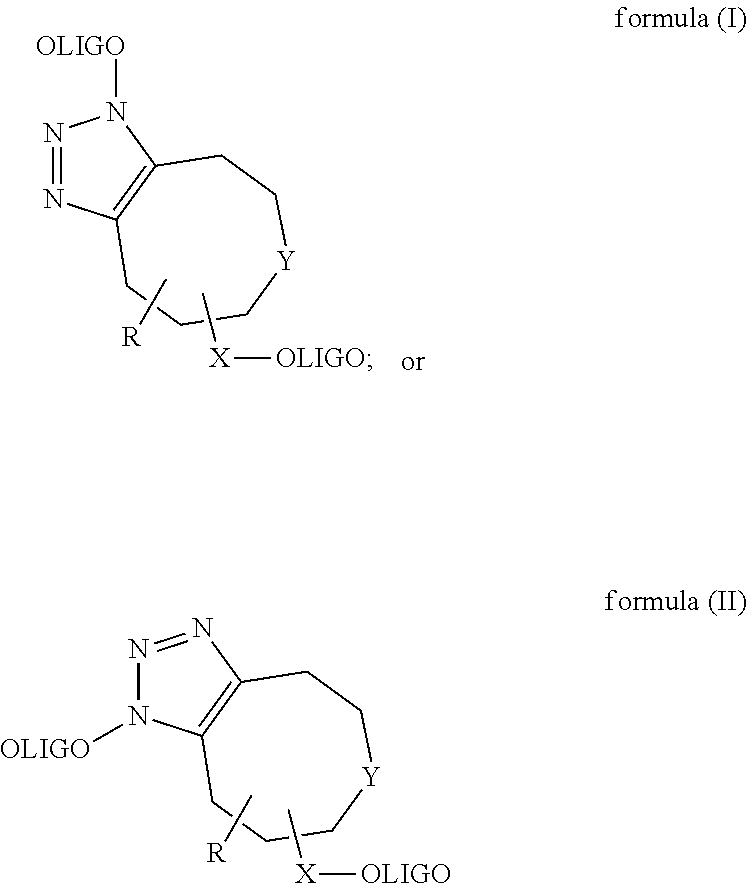
- the triazole linkage comprises a 7 to 9 membered ring, and a triazole group. In certain aspects, the triazole linkage comprises Formula (I) or Formula (II):
- X is a linker
- Y is one or more carbon or heteroatoms
- R is a substituent
- OLIGO is the 3′-adapter molecule or the nucleic acid fragment.
- the adapted nucleic acid fragment comprising the triazole linkage comprises the Formula (III):
- Base X is guanine, adenine, uracil, thymine or cytosine
- Base Y is guanine, adenine, uracil, thymine or cytosine
- OLIGO is a nucleic acid fragment, or analogue thereof, or an adapter molecule.
- the triazole linkage is formed by reacting an alkyne group on the nucleic acid fragment with an azide group on the 3′-adapter molecule; or by reacting an alkyne group on the 3′-adapter molecule with an azide group on the nucleic acid fragment.
- the alkyne group comprises a cyclooctyne or dibenzocyclooctyne.
- the linking of the 3′-adapter molecule to the nucleic acid fragment is carried out in metal-ion free conditions.
- the reverse transcriptase is RNase H deficient.
- the reverse transcription reaction uses a buffer comprising Mn 2+ .
- the present invention is directed to the use of reverse transcriptase to transcribe nucleic acid comprising one or more triazole linkages.
- the present invention is directed to a kit for sequencing a nucleic acid fragment comprising a reverse transcriptase; and a 3′-adapter molecule having a reactive group arranged to form a triazole linkage with an opposing reactive group on the nucleic acid fragment.
- the kit may comprise at least one of a 5′-adapter molecule; one or more primers for reverse transcriptase polymerisation; a nucleotidyl transferase; and a resin for a solid-phase phosphoramidite reaction for adding an alkyne group to the nucleic acid fragment or 3′-adapter molecule.
- the kit may comprise one or more primers for reverse transcriptase polymerisation.
- the kit may comprise a nucleotidyl transferase.
- the kit may comprise a resin for a solid-phase phosphoramidite reaction for adding an alkyne group to the nucleic acid fragment or 3′-adapter molecule.
- the present invention is directed to nucleic acid processing, the use, or a kit, substantially as described herein, and optionally with reference to the following accompanying drawings.
- FIG. 1 shows a typical synthesis and PCR amplification of DNA containing an artificial triazole linkage.
- FIG. 2 C z U and C z C triazole linkages formed by CuAAC click reaction.
- FIG. 3 20% Polyacrylamide gel for templated CuAAC click ligation to synthesize ODN1.
- FIG. 4 Reverse Transcription of the triazole template ODN5 (Backbone B′) (C z U) by M-MuLV reverse-transcriptase (RNase H ⁇ ) (NEB®) in Mg 2+ -buffer. Lane 1; primer (ODN10) (+1, P4), lane 2 and 3; reverse transcription product of click template (ODN5) and control template (ODN12) using primer (ODN10), lane 4; primer (ODN11) (+4, P5), lane 5 and 6 reverse transcription product of click template (ODN5) and control template (ODN12) using primer (ODN11).
- FIG. 5 Reverse transcription of the control template ODN12 and click template ODN5 (backbone B′) (C z U) by M-MuLV reverse-transcriptase (RNase H ⁇ ) in 3 mM Mn 2+ buffer.
- Lane 1; ODN8(P2), lane 4; ODN9(P3), lane 7; ODN10(P4), lane 10 ODN11(P5), lanes 2, 5; 8 and 11 are reverse transcription of click template ODN5, lanes 3, 6, 9 and 12 are reverse transcription of native RNA template ODN12.
- FIG. 6 (A) HPLC and (B) mass spectroscopy, of the M-MuLV reverse transcriptase (RNase H ⁇ ) products of the triazole template ODN5 (backbone B′) (minus “G”, cal. 13867), (minus “G” plus “A”, cal. 14180).
- the “plus A” fragment was likely resulted from the terminal transferase activity of the reverse-transcriptase. (6 mM Mn 2+ and primer ODN7 ( ⁇ 7, P1) were used).
- FIG. 7 20% polyacrylamide gel for the effect of Mg 2+ /Mn 2+ concentrations on the reverse transcription of ODN5 (C z U) (B′) and control ODN12 respectively.
- Lane 1 primer ODN7( ⁇ 7, P1), lane 2 and 3; 3 mM Mg 2+ (1 eq of primer) lane 4 and 5; 3 mM Mg 2+ (2 eq of primer), lane 6 and 7; 3 mM Mg 2+ +3 mM Mn 2+ (1 eq of primer), lane 8, 9; 3 mM Mg 2+ +3 mM Mn 2+ (2 eq of primer), lane 10 and 11; 3 mM Mn 2+ (1 eq of primer), lane 12 and 13; 3 mM Mn 2+ (2 eq of primer).
- M-MuLV reverse transcriptase wild type was used for 1 h. at 37° C.
- FIG. 8 Mass spectroscopy of reverse transcriptase product using C z C templates (A) ODN13 and (B) ODN14.
- M-MuLV reverse transcriptase (wild type) with 3 mM Mg 2+ and primer ODN7 were used, incubated at 37° C. for 2 h then desalting by gel-filtration (NAP-10).
- FIG. 9 20% polyacrylamide gel for reverse transcription of C z U ODN5 (B′) and ODN1 (B) and C z C ODN13 (B′).
- M-MuLV reverse transcriptase wild type
- 3 mM Mg 2+ lane 1
- primer ODN7 primer ODN7
- lane 2 reverse transcription of ODN5
- B′, C z U reverse transcription of ODN5
- lane 3 reverse transcription of ODN1 (B, C z U), lane 4
- reverse transcription of control ODN15, lane 5 reverse transcription of ODN13 (C z C, B′).
- FIG. 10 20% polyacrylamide gel for reverse transcription of ODN14 (C z C, B). M-MuLV Reverse Transcriptase (Wild type) in Mg 2+ buffer at 37° C. for 2 h. Lane 1, 2 and 3; primer ODN8, ( ⁇ 3, P2) and the reverse transcription of triazole ODN14 and control ODN15 using it, lane 4, 5 and 6; primer ODN16 (+0, P6) and the reverse transcription of triazole ODN14 and control ODN15 using it; lane 7, 8 and 9; primer ODN17 (+1, P7) and the reverse transcription of triazole ODN14 and control ODN15 using it; lane 10, 11 and 12; primer ODN18 (+4, P8) and the reverse transcription of triazole ODN14 and control ODN15 using it.
- M-MuLV Reverse Transcriptase Wild type
- FIG. 11 Triazole backbones formed via copper free click chemistry.
- FIGS. 12 are 5′-O-(4,4′-dimethoxytrityl)-2′-azido-2′-deoxycytidine (N-Ac) and 5′-dimethoxytrityl)-2′-azido-2′-deoxyuridine functionalized resins for the synthesis of 2′-azido model RNAs respectively.
- FIG. 13 20% Polyacrylamide gel for non templated copper free click ligation to synthesize ODN20. Lane 1; 2′-azide oligo ODN23, lane 2, alkyne oligo ODN21, lane 3; crude reaction mixture.
- FIG. 14 20% polyacrylamide gel for reverse transcription of ODN20 (BCN R1) and ODN24 (BCN 1). Lane 1 and 2; reverse transcription of template ODN24 (BCN1) at 2 h and 18 h, lane 3; primer ODN7 ( ⁇ 7, P1); lane 4, 5 and 6 reverse transcription of template BCNR1 at 10 min, 2 h and 18 h. M-MuLV Reverse Transcriptase (RNase H ⁇ ) was used.
- RNase H ⁇ M-MuLV Reverse Transcriptase
- FIG. 15 (A) 20% polyacrylamide gel for the effect of Mg 2+ /Mn 2+ concentrations on the reverse transcription of ODN20 (BCN R1). Lane 1 and 2; incubation in 3 mM Mg 2+ for 2 h and 7 h respectively, lane 3 and 4; incubation in 10 mM Mg 2+ for 2 h and 7 h respectively, lane 5 and 6; incubation in 3 mM Mn 2+ for 2 h and 7 h respectively, lane 7 and 8; incubation in 10 mM Mn 2+ incubation for 2 h and 7 h respectively, lane 9; primer ODN7.
- B Mass spectrometry of the reverse transcription reaction of ODN20 (BCN R1), Cal mass 14196 for full length minus G.
- FIG. 16 20% polyacrylamide gel for reverse transcription of ODN20 BCN R1. Lane 1; ODN26 (+T, P9), lane 2 and 3; reverse transcription after 2 h and 7 h using primer ODN26, lane 4 and 5; reverse transcription after 2 h and 7 h using primer ODN27 (+T+1, P10), lane 6 and 7; reverse transcription after 2 h and 7 h using primer ODN7.
- FIG. 17 20% polyacrylamide gel for reverse transcription of ODN24 BCN 1. Lane 1 and 2; reverse transcription of control ODN15 after 2 h and 16 h using 3 mM Mn 2+ , lane 3 and 4; reverse transcription of triazole template ODN24 after 2 h and 16 h using 3 mM Mn 2+ , lane 5 and 6; reverse transcription of triazole template ODN24 after 2 h and 16 h using 3 mM Mg 2+ , lane 7; primer ODN7.
- FIG. 18 Shows the results of sequence analysis of sequences as determined by the method according to certain aspects of the present invention.
- FIG. 19 shows (NSCO, 1 and DIBO 2) activated cyclooctyne carboxylic acids for labelling amino-modified oligonucleotides and (3) DIBO phosphoramide for insertion during solid-phase oligonucleotide synthesis.
- FIG. 20 shows a schematic diagram of a ncRNA sequencing reaction according to a method according to certain aspects of the present invention.
- a method of nucleic acid processing comprising providing an adapted nucleic acid fragment having a triazole linkage therein; and transcribing the adapted nucleic acid fragment with reverse transcriptase.
- the reverse transcriptase enzyme is capable of reading through a bulky triazole linkage in nucleic acid such as RNA in order to transcribe a copy of the nucleic acid.
- Such triazole linkages are formed through the process of chemical ligation methods, such as a Cu I -catalysed [3+2] Azide-Alkyne Cycloaddition (CuAAC) reaction.
- CuAAC Azide-Alkyne Cycloaddition
- SPAAC Strain-Promoted Alkyne Azide Cycloaddition
- SPAAC Strain-Promoted Alkyne Azide Cycloaddition
- RNA ligation can have other advantages over enzymatic ligation; it can be carried out on a large scale and it is compatible with a wide range of pH and salts and salt concentrations. Also, the ability to use a different method for ligation of adapter molecules at 3′ and 5′ends means that a typical gel purification between two ligation steps can be avoided prior to RNA sequencing.
- the triazole linkage may be a result of a copper-free SPAAC click reaction, which advantageously does not require copper catalysis. Therefore, unlike other copper-requiring chemical ligation methods that may result in the provision of a less bulky linking group, the copper free click ligation is compatible with large biomolecules such as RNA and can be carried out in any biologically compatible buffer. The presence of copper causes degradation of long DNA and RNA molecules, so the avoidance of copper is a major advantage. Copper-free click ligation of RNA can also be carried out in conditions under which RNA secondary structure is unstable (e.g. in water without salt).
- the adapted nucleic acid fragment may comprise a nucleic acid fragment linked to a pair of adapter molecules, wherein one of the adapters is linked by a triazole linkage.
- the adapted nucleic acid fragment may comprise RNA.
- the adapted nucleic acid fragment may comprise a combination of RNA and other nucleic acid, or analogues thereof.
- the adapted nucleic acid fragment may comprise any of the group comprising RNA; DNA; and a nucleic acid analogue; or combinations thereof.
- the present invention may comprise a method of nucleic acid sequencing, wherein the adapted nucleic acid fragment is provided by: linking a 3′-adapter molecule to the 3′ end of a nucleic acid fragment, thereby forming an adapted nucleic acid fragment, wherein the 3′-adapter molecule is linked to the nucleic acid fragment via a triazole linkage; and wherein the adapted nucleic acid fragment is transcribed by annealing a primer to the adapted nucleic acid fragment, which is complementary thereto; transcribing the adapted nucleic acid fragment using reverse transcriptase to form a cDNA strand; and further comprising determining the sequence of the cDNA strand.
- the method may further comprise linking a 5′-adapter molecule to the 5′ end of the nucleic acid fragment.
- the 5′-adapter molecule may be linked to the nucleic acid fragment via phosphate, for example via the natural sugar-phosphate backbone of nucleic acid.
- the 5′-adapter molecule may be linked to the nucleic acid fragment by ligation.
- the ligation of the 5′adapter molecule may be enzymatic, for example by ligase, or chemical.
- the 3′-adapter molecule may comprise or consist of any of the group comprising RNA; DNA; and a nucleic acid analogue; or combinations thereof.
- the 3′-adapter molecule may comprise or consist of RNA.
- the 3′-adapter molecule may have a known/pre-determined sequence.
- the 5′-adapter molecule may comprise or consist of any of the group comprising RNA; DNA; and a nucleic acid analogue; or combinations thereof.
- the 5′-adapter molecule may comprise or consist of RNA.
- the 5′-adapter molecule may have a known/pre-determined sequence.
- the sequence of the nucleic acid fragment may be unknown prior to sequencing.
- the nucleic acid fragment may be RNA.
- the RNA may be non-coding RNA (ncRNA).
- the nucleic acid fragment may be less than 200 nucleotides in length.
- the nucleic acid fragment may be less than 100 nucleotides in length.
- the nucleic acid fragment may be less than 50 nucleotides in length.
- the nucleic acid fragment may be less than 30 nucleotides in length.
- the nucleic acid fragment may be less than 20 nucleotides in length.
- the nucleic acid fragment may be between about 10 and about 400 nucleotides in length.
- the nucleic acid fragment may be between about 10 and about 200 nucleotides in length.
- the nucleic acid fragment may be between about 20 and about 200 nucleotides in length.
- the nucleic acid fragment may be between about 20 and about 100 nucleotides in length.
- the nucleic acid fragment may be between about 20 and about 50 nucleotides in length.
- the nucleic acid fragment may be about 20 or 22 nucleotides in length. In an alternative embodiment, the nucleic acid fragment may be at least 200 nucleotides in length.
- Determining the sequence of the cDNA strand may comprise amplifying the sequence of the cDNA strand in a PCR reaction, and analyzing the PCR product.
- the PCR reaction may comprise the use of forward and reverse primers.
- the forward primer may comprise a sequence substantially or completely complementary to the 5′ adapter molecule.
- the reverse primer may comprise a sequence substantially or completely equivalent to the sequence of the 3′-adapter molecule.
- the reverse primer may comprise a sequence substantially or completely equivalent to the sequence of the primer used for transcribing the adapted nucleic acid fragment using reverse transcriptase.
- the forward primer may comprise a sequence substantially or completely complementary to the 5′-adapter molecule.
- the forward primer may comprise a sequence substantially or completely complementary to the nucleic acid fragment.
- Analyzing the PCR product may comprise detecting specific base pair addition during polymerase-mediated synthesis of the PCR product.
- the reverse transcriptase may omit a one or two residues during polymerisation at a site corresponding to the site of the triazole linkage, which would be taken into account when determining the sequence.
- the omission of residues would be expected and their identity may be determined from a known sequence surrounding the triazole linkage.
- the triazole linkage may comprise a 7 to 9 membered ring.
- the triazole linkage may comprise a substituted 7 to 9 membered ring.
- the triazole linkage may comprise a 7 to 9 membered ring and a triazole group.
- the triazole linkage may comprise a cyclic compound having at least one heteroatom in the ring.
- the triazole linkage may comprise Formula (I) or Formula (II):
- X is a linker
- Y is one or more carbon or heteroatoms
- R is a substituent
- OLIGO is the 3′-adapter molecule or the nucleic acid.
- the substituent may comprise one or more groups.
- the substituent groups may be electron-withdrawing groups.
- the ring may be fused with one or more conjugated rings, for example one or more benzene rings.
- the strained alkyne group may comprise a ring with a fluorine substituent.
- the adapted nucleic acid fragment comprising the triazole linkage may comprise the Formula (III):
- Base X is guanine, adenine, uracil, thymine or cytosine
- Base Y is guanine, adenine, uracil, thymine or cytosine
- OLIGO is a nucleic acid fragment, or analogue thereof, or an adapter molecule.
- the nucleic acid fragment, analogue thereof, or adapter molecule may comprise DNA and/or RNA.
- the nucleic acid fragment, analogue thereof, or adapter molecule may comprise DNA, RNA PNA, LNA, GNA or TNA; or combinations thereof.
- base X and base Y may comprise cytosine.
- base X may comprise cytosine.
- base Y may comprise cytosine.
- base X may comprise uracil and base Y may comprise cytosine.
- the nucleotide bases flanking the triazole linkage may be C z C.
- the C z C linkage is more stable, providing an easier read-through for reverse transcriptase.
- the triazole linkage may be formed by reacting an alkyne group on the nucleic acid fragment with an azide group on the 3′-adapter molecule.
- the triazole linkage may be formed by reacting an alkyne group on the 3′-adapter molecule with an azide group on the nucleic acid fragment.
- the alkyne group may be a strained alkyne group.
- the linking of the 3′-adapter molecule to the nucleic acid fragment may be by use of a ring-strain promoted alkyne-azide [3+2] cycloaddition reaction, (a SPAAC reaction) between a strained alkyne and an azide group on the respective molecules to be linked.
- the strained alkyne group and the azide group may react according to the following scheme:
- X is a linker that attaches the strained alkyne group to the 3′-adapter molecule or nucleic acid
- Y is one or more carbon or heteroatoms
- R is an optional substituent to the ring or an electron withdrawing group
- OLIGO is the 3′-adapter molecule or the nucleic acid fragment.
- the alkyne group may be strained by being part of a ring, for example a cycloalkyne such as a cyclooctyne.
- a dibenzocyclooctyne is highly suitable for use attached to oligonucleotides that are used in fast SPAAC reactions with azides attached to oligonucleotides.
- the conjugated aromatic rings impose ring strain and electron withdrawing properties on the alkyne, making it react very quickly with azides. Substituents to the ring may be used to increase or decrease the reactivity of the alkyne.
- the strained alkyne group may comprise a substituted cyclooctyne.
- Suitable cycloalkynes for use may be those that are stable at room temperature and/or stable in water, and/or stable in air. In one embodiment cycloalkynes used may be those that do not require to be stored or reacted under argon.
- the strained alkyne used in the present invention may be any strained alkyne group.
- the strained alkyne may be within a ring structure, for example a cycloalkyne or a cyclic compound where the ring comprises carbon atoms and one or more heteroatoms, for example, one or more nitrogen, sulphur or oxygen atoms in the ring.
- the strained alkyne group may comprise a 7 to 9 membered ring.
- the strained alkyne group may comprise a substituted 7 to 9 membered ring.
- the strained alkyne may comprise an 8 membered ring, or a substituted 8 membered ring.
- the substituted or unsubstituted 8 membered ring may comprise 8 carbon atoms in the ring or may comprise one or more nitrogen, sulphur or oxygen atoms in the ring in addition to carbon atoms.
- the strained alkyne group may comprise a cyclooctyne.
- the strained alkyne group may comprise a substituted cyclooctyne.
- the strained alkyne group may comprise a cyclic compound having at least one heteroatom in the ring.
- the strained alkyne group may comprise a dibenzocyclooctyne (DIBO) group.
- DIBO dibenzocyclooctyne
- the heteroatom may be at any position in the ring. In one embodiment there is one heteroatom in the ring.
- a strained alkyne that is reactive enough to perform the SPAAC reaction under laboratory conditions, for example because it can react in water or buffer at normal room temperature, for example 20° C., but that is also stable under laboratory conditions, for example it is stable in water, oxygen stable and stable at normal room temperature.
- the strained alkyne group may comprises an unsubstituted ring, for example the strained alkyne group may be a NSCO group as shown at “1” in FIG. 19 .
- strained alkyne groups provide examples of strained alkyne groups that can be added to the end of nucleic acids or 3′-adapter molecules as active esters or phosphoramidite monomers: a nucleic acid or 3′-adapter molecule linked to a strained alkyne group wherein the strained alkyne group comprises a substituted or un-substituted cyclooctyne; a nucleic acid or 3′-adapter molecule linked to a strained alkyne group, wherein the strained alkyne group comprises a cyclooctyne having at least one heteroatom in the ring; a nucleic acid or 3′-adapter molecule linked to a strained alkyne group, wherein said strained alkyne group is a DIBO group; a nucleic acid or 3′-adapter molecule linked to a strained alkyne group, or an azide group wherein the strained alkyne group or the azi
- the alkyne group may be selected from the following cyclooctyne or dibenzocyclooctyne groups and may be linked to the 3′-adapter molecule or nucleic acid fragment through the groups shown below, in particular active carbonates or phosphoramidite monomers:
- the ring comprising the strained alkyne is substituted with one or more groups.
- the strained alkyne group may comprise a ring with one or more substituents to the ring, for example, the strained alkyne group may comprise a dibenzocyclooctyne (DIBO) group as shown at “2” and “3” in FIG. 19 .
- DIBO dibenzocyclooctyne
- Substituent groups may be electron-withdrawing groups, groups that increase or decrease the reactivity of the alkyne.
- the ring may be fused with one or more conjugated rings, for example one or more benzene rings.
- a substituent group may comprise one or more electronegative atoms, for example fluorine.
- the alkyne group may be sufficiently reactive because of the ring strain to react with the azide group without metal ion catalysis, for example, without Cu I catalysis.
- the reaction may proceed in a range of buffers.
- the reaction may go to completion within a short time scale, for example less than 1 hour, without Cu I catalysis.
- the reaction may go to completion within less than 30 minutes, without Cu I catalysis.
- the reaction may go to completion within less than 10 minutes, or less than 1 minute, or less than 30 seconds, without Cu I catalysis.
- the reaction may go to completion within less than 10 seconds, without Cu I catalysis.
- the reaction may occur at room temperature, for example 20° C.
- the reaction may occur at a temperature between 5 and 40° C.
- the reaction may occur at a temperature between 10 and 30° C., or between 15 and 25° C., or at about 20° C. The higher the reaction temperature the faster the reaction may proceed.
- a strained alkyne group or an azide group may be linked to an oligonucleotide by a linker.
- the linker shown at “X” in formulas (I), (II) and (III) links the alkyne group to the 3′ end of a nucleic acid fragment or 5′ end of a 3′-adapter molecule.
- the linker shown at “X” in the above general scheme links the alkyne group to the 3′ end of a nucleic acid fragment or 3′-adapter molecule.
- the alkyne group comprises the linker, the ring comprising the strained alkyne (strained alkyne ring) and all of the substituents to the alkyne ring.
- the linker may comprise all of the structure between the alkyne ring and the oligonucleotide that the strained alkyne group is linked to.
- a linker may be a spacer that allows the strained alkyne and azide to approach each other to react.
- the linker may have a reactive group on it such as an active ester.
- the active ester of a strained alkyne for example a cyclo-octyne group, may be reacted with an amino group that has been added to a 3′-adapter molecule or nucleic acid fragment.
- the linker attached to the cyclo-octyne may also have a phosphoramidite group attached, or another suitable group for adding monomers to 3′-adapter molecules by the phosphoramidite or H-phosphonate or phosphotriester method of oligonucleotide synthesis.
- a phosphoramidite group attached, or another suitable group for adding monomers to 3′-adapter molecules by the phosphoramidite or H-phosphonate or phosphotriester method of oligonucleotide synthesis In all the methods described above either single or multiple alkyne groups, for example cyclo-octyne groups can be added to a 3′-adapter molecule or nucleic acid fragment.
- Linkers may be of different lengths that are appropriate to form the required link. If a spacer is too long it may slow down the reaction between a strained alkyne group and an azide group, if a linker is too short it may inhibit reaction between a strained alkyne group and an azide group as they may not be able to reach each other.
- a linker may be chosen for each of the strained alkyne and the azide that are to be linked to each other so that the linkers are the appropriate length to allow the strained alkyne group and the azide group to react with each other to join the nucleic acid fragment and 3′-adapter molecule.
- a hydrophilic spacer such as (CH2CH2O)n might be used instead of a hydrophobic spacer such as (CH2)n.
- the linking of the 3′-adapter molecule to the nucleic acid fragment may be carried out in metal-ion free conditions.
- the linking of the 3′-adapter molecule to the nucleic acid fragment may be carried out in copper-free conditions.
- the linking of the 3′-adapter molecule to the nucleic acid fragment may be carried out in a salt free medium.
- the linking of the 3′-adapter molecule to the nucleic acid fragment may be carried out at a salt concentration of between about 0 M and about 4 M.
- the linking of the 3′-adapter molecule to the nucleic acid fragment may be carried out at pH of between about 5 and about 10.
- the linking of the 3′-adapter molecule to the nucleic acid fragment may be a template-mediated nucleic acid ligation, for example in an embodiment where the nucleic acid fragment sequence is known.
- the linking of the 3′-adapter molecule(s) to the nucleic acid fragment may not be carried out by a DNA ligase enzyme.
- the adapter molecule(s) may be labelled.
- the adapter molecule(s) may be labelled with a fluorophore.
- the adapter molecule(s) may be affinity tagged for isolating the molecule on a solid phase.
- the linking of the adapter molecule(s), the reverse transcription, and/or the PCR may be carried out on a solid phase.
- the azide group may be added to the nucleic acid fragment by use of a nucleotidyl transferase, such as a Poly(A) Polymerase (PAP) to provide an azide-modified nucleotide residue.
- a terminal transferase may be used to add the azide group.
- Yeast PAP may be used to add the azide group.
- the alkyne group may be added to the 3′-adapter molecule by a phosphoramidite reaction.
- the alkyne group may be added to the 3′-adapter molecule by solid-phase synthesis.
- the alkyne group may be added to the 3′-adapter molecule by reaction with an activated nucleic acid, for example and amino-modified nucleic acid, with an active ester or carbonate of an alkyne.
- the alkyne group may be added to the 3′-end of the nucleic acid fragment.
- the alkyne group may be added to the 3′-end of the nucleic acid fragment using a terminal transferase, such as PAP, to add an alkyne-modified nucleotide.
- An azide group may be added to the 5′-end of the 3′-adapter molecule.
- An azide group may be added the 5′-end of the 3′-adapter molecule as an active ester to an amino-modified adapter, or added as an iodo, or bromo or mesyl-group that can be converted to azide by reaction, for example with sodium azide.
- the reverse transcriptase may be RNase H deficient.
- the reverse transcriptase may be thermostable, for example, operating at temperatures greater than 50° C.
- the reverse transcriptase may comprise M-MuLV reverse-transcriptase (wild type, NEB® #M0253).
- the reverse transcriptase comprises M-MuLV reverse-transcriptase (RNase H ⁇ ) (mutant type, NEB® #M0368). The mutation reduces RNase H activity compared to wild type enzyme and minimizes its ability to degrade RNA.
- the reverse transcription reaction may use a buffer.
- the reverse transcription reaction may comprise the use of a divalent cation in the buffer.
- the buffer may comprise Mn 2+ .
- the buffer may comprise Mn 2+ and no Mg 2+ .
- the buffer may comprise Mn 2+ and Mg 2+ .
- a buffer comprising Mn 2+ instead of Mg 2+ surprisingly and advantageously allows a faster reverse transcriptase reaction, for example a complete reaction in about 2 hours instead of 12 hours or more.
- the reverse transcription reaction may be completed in less than 2 hours.
- the reverse transcription reaction may be completed in less than 3 hours.
- the reverse transcription reaction may be completed in less than 5 hours.
- the reverse transcription reaction may be completed in less than 8 hours.
- the primer may be suitable for facilitating the reverse transcriptase polymerisation reaction during transcription.
- the primer may comprise or consist of any of the group comprising RNA; DNA; and a nucleic acid analogue; or combinations thereof.
- the primer may be arranged to hybridise to the adapted nucleic acid molecule at a site at least +1 upstream to the 3′ side of the triazole linkage.
- the primer may be arranged to hybridise to the adapted nucleic acid molecule at a site at least +2, +3, +4 or +5 upstream to the 3′ side of the triazole linkage.
- the primer may be arranged to hybridise to the adapted nucleic acid molecule at a site at least +6 upstream to the 3′ side of the triazole linkage.
- the primer may be arranged to hybridise to the adapted nucleic acid molecule at a site at least +7 upstream to the 3′ side of the triazole linkage.
- the primer may be arranged to hybridise to the adapted nucleic acid molecule at a site at least ⁇ 1 residue downstream to the 5′ side of the triazole linkage.
- the site of hybridisation may be defined as the residue at which a polymerase or reverse transcriptase would add nucleotides to extend the 3′ end of the primer.
- the primer may be arranged to hybridise to the adapted nucleic acid molecule at a site at least 1 residue away from the triazole linkage.
- the primer may be arranged to hybridise to the adapted nucleic acid molecule at a site such that the 3′ end residue of the primer is at least 2, 3, 4 or 5 residues in distance towards the 3′ side of the triazole linkage.
- the primer may be arranged to hybridise to the adapted nucleic acid molecule at a site such that the 3′ end residue of the primer is at least 6 residues in distance towards the 3′ side of the triazole linkage.
- the primer may be arranged to hybridise to the adapted nucleic acid molecule at a site such that the 3′ end residue of the primer is at least 7 residues in distance towards the 3′ side of the triazole linkage.
- the primer may be arranged to hybridise to the adapted nucleic acid molecule at a site such that the 3′ end residue of the primer is at least 1 residue in distance towards the 5′ side of the triazole linkage.
- reverse transcriptase to transcribe nucleic acid comprising one or more triazole linkages.
- kits for sequencing a nucleic acid fragment comprising a reverse transcriptase; and an 3′-adapter molecule having a reactive group arranged to form a triazole linkage with an opposing reactive group on the nucleic acid fragment.
- triazole linkage and reactive group arranged to form the triazole linkage may be as described herein in respect to other embodiments and aspects of the invention.
- the nucleic acid fragment may be RNA.
- the nucleic acid fragment may be ncRNA (small RNA).
- the nucleic acid fragment, such as ncRNA, may be less than 200 nucleotides in length.
- the reactive group may comprise one of an alkyne group or azide group.
- the alkyne group may be arranged to form a triazole linkage with an azide group on an opposing nucleic acid fragment or 3′-adapter molecule.
- the kit may further comprise a 5′-adapter molecule.
- the kit may further comprise a 5′-adapter molecule and ligase.
- the kit may further comprise dNTPs.
- the kit may further comprise a polymerase suitable for PCR.
- the kit may further comprise a pair of PCR primers. At least one primer may be complementary to a region of the 3′-adapter molecule or 5′-adapter molecule or the complementary sequence thereof.
- the kit may further comprise one or more primers for the reverse transcriptase polymerisation.
- the one or more primers may be complementary to a region of the 3′-adapter molecule.
- the one or more primers may be capable of hybridising to the 3′-adapter molecule under stringent conditions.
- the kit may further comprise a nucleotidyl transferase, such as a Poly(A) Polymerase (PAP), for adding the azide group to the nucleic acid fragment or 3′-adapter molecule.
- PAP Poly(A) Polymerase
- the PAP may comprise a yeast PAP.
- the kit may further comprise nucleoside triphosphates.
- the kit may further comprise modified nucleoside triphosphates having an azide or alkyne group anchored thereon.
- the kit may further comprise instructions for sequencing the nucleic acid fragment.
- a ncRNA molecule may be sequenced using click ligation and reverse transcription.
- the 3′ end of a ncRNA fragment is modified with 2′azide using yeast PAP enzyme.
- the formed triazole linkage has to be compatible with the reverse transcriptase enzyme.
- a DNA backbone mimic can be read through by DNA and RNA polymerases and is functional in vivo ( FIG. 13 ). This is despite the fact that the triazole linkage bears no obvious resemblance to a phosphodiester group.
- NMR studies show that the DNA duplex around the artificial backbone is similar in overall shape to normal DNA, but slightly unstable with a greater rate of opening of the base pairs. The decreased stability of DNA duplexes that contain triazole linkages (i.e.
- Reverse transcription templates were synthesized via click chemistry using the Cu I -catalysed [3+2] Azide-Alkyne Cycloaddition (CuAAC) reaction or the Strain-Promoted Alkyne Azide Cycloaddition (SPAAC) reaction between azide and cyclooctyne-modified oligonucleotides (copper-free click ligation).
- CuAAC Azide-Alkyne Cycloaddition
- SPAAC Strain-Promoted Alkyne Azide Cycloaddition
- RNA template ODN1 (for all oligonucleotide sequences, see table 1) with the C-triazole-U linkage (C z U, B) ( FIG. 2 ) in the middle was synthesized using the CuAAC reaction.
- the 3′-alkyne oligonucleotides were made entirely by the phosphoramidite method.
- the functionalised resin required for the solid-phase synthesis of oligonucleotides terminating with 3′-propargyl Me dC was prepared from thymidine as previously described or 3′-propargyl C which was purchased from Glen Research.
- the 5′-azide oligonucleotide was synthesised using normal solid phase synthesis then the 5′-azide group was introduced in a 2-stage process; the 5′-OH group of the support-bound oligonucleotide was first converted to 5′-iodo using methyltriphenoxyphosphonium iodide then the resultant 5′-iodo oligonucleotide was reacted with sodium azide to complete the transformation.
- M-MuLV reverse-transcriptase wild type, NEB® #M0253
- RNase H ⁇ mutant type, NEB® #M0368
- the mutant M-MuLV reverse-transcriptase (RNase H ⁇ ) an enzyme frequently used for RNA sequencing applications, is an engineered enzyme with reduced RNase H activity comparing to wild type enzyme. The mutation minimizes its ability to degrade the RNA.
- the copper-free AAC reaction on DNA has potential advantages when compared to the CuAAC reaction, especially in RNA click ligation. As it does not require catalysis with toxic metals, it has potential uses in vivo and in RNA click ligation. However, the reaction between azides and unactivated terminal alkynes is very slow in the absence of Cu I catalysis, even when templated by DNA. However, the copper-free reaction can be accelerated by using an alkyne which is distorted by incorporation into an 8-membered ring structure.
- the ring-strain promoted alkyne-azide [3+2] cycloaddition reaction (SPAAC reaction) has been pioneered by Bertozzi, principally for in vivo labelling of carbohydrates. It has recently been applied to DNA strand ligation, using dibenzocyclooctyne (DIBO) or bicyclo[6.1.0]nonyne (BCN) as the strained alkynes.
- DIBO dibenzocycloo
- RNA templates ODN19 and ODN20 with U z C and C z C in the middle were synthesised by the copper free SPAAC reaction by ligation of 5′-BCN oligonucleotide ODN21 with 2′-azide oligonucleotides ODN22 or ODN23.
- the key building blocks for the synthesis of the 2′-azide labelled model RNA strands are 5′-O-(4,4′-Dimethoxytrityl)-2′-azido-2′-deoxyuridine or 5′-O-(4,4′-dimethoxytrityl)-2′-azido-2′-deoxycytidine. These were made and coupled to succinylated aminoalkyl solid support to give the derivatised supports which were used in the solid-phase synthesis of 2′-azide oligonucleotides ( FIG. 12 ). To synthesis the alkyne oligonucleotide ODN21, BCN phosphoramidite ( FIG.
- RNA templates ODN19 and ODN20 in very good yield ( FIG. 13 ).
- no template was used and instead very concentrated reaction mixtures were employed to ensure good yields.
- the Backbone BCN3 with the sequence “U z C” instead of “C z C” was also investigated. It was expected not to give very good results as it might give a less stable duplex than the corresponding C z C template. As expected, the reverse transcription of this backbone in standard Mg 2+ -buffer had difficulty in passing the triazole-BCN link. The problem was not solved by using “+1” primer as it was not extended as well.
- the reaction buffer containing 3 mM Mg 2+ and 3 mM Mn 2+ helped the M-MuLV Reverse Transcriptase to read-through this “U-BCN-C” linkage. However, both PAGE and MS showed that the reverse transcription produced a mixture of products including two-nucleotide-deletion and one-nucleotide-deletion.
Landscapes
- Chemical & Material Sciences (AREA)
- Life Sciences & Earth Sciences (AREA)
- Organic Chemistry (AREA)
- Proteomics, Peptides & Aminoacids (AREA)
- Zoology (AREA)
- Wood Science & Technology (AREA)
- Health & Medical Sciences (AREA)
- Engineering & Computer Science (AREA)
- Analytical Chemistry (AREA)
- Biophysics (AREA)
- Biochemistry (AREA)
- Microbiology (AREA)
- Molecular Biology (AREA)
- Biotechnology (AREA)
- Physics & Mathematics (AREA)
- Genetics & Genomics (AREA)
- Immunology (AREA)
- Bioinformatics & Cheminformatics (AREA)
- General Engineering & Computer Science (AREA)
- General Health & Medical Sciences (AREA)
- Chemical Kinetics & Catalysis (AREA)
- Measuring Or Testing Involving Enzymes Or Micro-Organisms (AREA)
- Enzymes And Modification Thereof (AREA)
Abstract
Description

wherein X is a linker; Y is one or more carbon or heteroatoms; R is a substituent; and OLIGO is the 3′-adapter molecule or the nucleic acid fragment.

wherein Base X is guanine, adenine, uracil, thymine or cytosine; Base Y is guanine, adenine, uracil, thymine or cytosine; and OLIGO is a nucleic acid fragment, or analogue thereof, or an adapter molecule.

wherein: X is a linker; Y is one or more carbon or heteroatoms; R is a substituent; and OLIGO is the 3′-adapter molecule or the nucleic acid.

wherein: Base X is guanine, adenine, uracil, thymine or cytosine Base Y is guanine, adenine, uracil, thymine or cytosine; and OLIGO is a nucleic acid fragment, or analogue thereof, or an adapter molecule.

wherein X is a linker that attaches the strained alkyne group to the 3′-adapter molecule or nucleic acid; Y is one or more carbon or heteroatoms; R is an optional substituent to the ring or an electron withdrawing group; and OLIGO is the 3′-adapter molecule or the nucleic acid fragment.

| TABLE 1 |
| oligonucleotides used in this study |
| Code | Sequence (5′ - 3′) |
| ODN1 | ODN2 + ODN3 CZU Backbone B |
| ODN2 | PUUAAUGCUAAUCGUGAUAGGGGUMeCK, |
| MeCK = 3′-propargyl C | |
| ODN3 | ZUAGAUCGGAAGAGCGGUUCAG, |
| ZU = 5′-azido U | |
| ODN4 | CCGATCTAGACCCCTCU splint |
| ODN5 | ODN3 + ODN6 CzU Backbone B′ |
| ODN6 | UUAAUGCUAAUCGUGAUAGGGGUCK, |
| CK = 3′-propargyl C | |
| ODN7 | FCTGAACCGCTCTTC primer P1 |
| ODN8 | FCTGAACCGCTCTTCCGAT primer P2 |
| ODN9 | FCTGAACCGCTCTTCCGATCTA primer P3 |
| ODN10 | FCTGAACCGCTCTTCCGATCTAG primer P4 |
| ODN11 | FCTGAACCGCTCTTCCGATCTAGACC primer P5 |
| ODN12 | UUAAUGCUAAUCGUGAUAGGGGUCUAGAUCG |
| GAAGAGCGGUUCAG | |
| ODN13 | PODN6 + ODN28 CzC Backbone B′ |
| ODN14 | ODN2 + ODN28 CzC Backbone B |
| ODN15 | UUAAUGCUAAUCGUGAUAGGGGUCCAGAUCG |
| GAAGAGCGGUUCAG | |
| ODN16 | FCTGAACCGCTCTTCCGATCTG primer P6 |
| ODN17 | FTGAACCGCTCTTCCGATCTGG primer P7 |
| ODN18 | FCTGAACCGCTCTTCCGATCTGGACC primer P8 |
| ODN19 | ODN21 + ODN22 BCN3 |
| ODN20 | ODN21 + ODN23 BCN R1 |
| ODN21 | X7CAGAUCGGAAGAGCGGUUCAG |
| X7 = BCN monomer | |
| ODN22 | PUUAAUGCUAAUCGUGAUAGGGGUUz, |
| Uz = 2′-azido-2′-dU | |
| ODN23 | UUAAUGCUAAUCGUGAUAGGGGUCz |
| Cz = 2′-azido-2′-dC | |
| ODN24 | ODN23 + ODN25 BCN1 |
| ODN25 | X7CAGATCGGAAGAGCGGTTCAG, |
| X7 = BCN monomer | |
| ODN26 | FCTGAACCGCTCTTCCGATCTGT primer P9 |
| ODN27 | FCTGAACCGCTCTTCCGATCTGTG primer P10 |
| ODN28 | ZCAGAUCGGAAGAGCGGUUCAG, |
| ZC = 5′-azido C | |
| F = 5′-FAM, P = 5′-phosphate | |
DNA Sequencing Analysis
Claims (19)

Applications Claiming Priority (3)
| Application Number | Priority Date | Filing Date | Title |
|---|---|---|---|
| GBGB1408841.3A GB201408841D0 (en) | 2014-05-19 | 2014-05-19 | Nucleic acid processing |
| GB1408841.3 | 2014-05-19 | ||
| PCT/GB2015/051451 WO2015177520A1 (en) | 2014-05-19 | 2015-05-18 | Nucleic acid processing of a nucleic acid fragment with a triazole linkage |
Publications (2)
| Publication Number | Publication Date |
|---|---|
| US20170088888A1 US20170088888A1 (en) | 2017-03-30 |
| US10138512B2 true US10138512B2 (en) | 2018-11-27 |
Family
ID=51135062
Family Applications (1)
| Application Number | Title | Priority Date | Filing Date |
|---|---|---|---|
| US15/312,313 Active US10138512B2 (en) | 2014-05-19 | 2015-05-18 | Nucleic acid processing of a nucleic acid fragment with a triazole linkage |
Country Status (4)
| Country | Link |
|---|---|
| US (1) | US10138512B2 (en) |
| EP (1) | EP3146068B1 (en) |
| GB (2) | GB201408841D0 (en) |
| WO (1) | WO2015177520A1 (en) |
Families Citing this family (13)
| Publication number | Priority date | Publication date | Assignee | Title |
|---|---|---|---|---|
| CA2831613A1 (en) | 2011-03-31 | 2012-10-04 | Moderna Therapeutics, Inc. | Delivery and formulation of engineered nucleic acids |
| EP4279610A3 (en) | 2013-03-15 | 2024-01-03 | ModernaTX, Inc. | Ribonucleic acid purification |
| WO2014144767A1 (en) | 2013-03-15 | 2014-09-18 | Moderna Therapeutics, Inc. | Ion exchange purification of mrna |
| WO2016011226A1 (en) * | 2014-07-16 | 2016-01-21 | Moderna Therapeutics, Inc. | Chimeric polynucleotides |
| EP4101930A1 (en) | 2015-09-17 | 2022-12-14 | ModernaTX, Inc. | Polynucleotides containing a stabilizing tail region |
| EP3400255B1 (en) | 2016-01-05 | 2022-04-20 | SABIC Global Technologies B.V. | Process for preparing graft copolymer comprising polyethylene |
| US10975186B2 (en) * | 2016-01-05 | 2021-04-13 | Sabic Global Technologies B.V. | Process for preparing graft copolymer comprising polyethylene |
| PL3529380T3 (en) * | 2016-10-19 | 2022-10-24 | Illumina, Inc. | Methods for chemical ligation of nucleic acids |
| WO2018138218A1 (en) * | 2017-01-25 | 2018-08-02 | Metabion International Ag | Gene synthesis using templated chemical ligation |
| GB201714403D0 (en) * | 2017-09-07 | 2017-10-25 | Univ Oxford Innovation Ltd | Process for oligonucleotide synthesis |
| US11027260B2 (en) | 2019-02-13 | 2021-06-08 | Uchicago Argonne, Llc | Low pressure nanowire membrane for catalytic reactions and methods of making and using the same |
| JP2022537069A (en) | 2019-06-21 | 2022-08-23 | サーモ フィッシャー サイエンティフィック バルティックス ユーエービー | Nucleotide Triphosphates Linked to Oligonucleotides Useful for Labeling Nucleic Acids to Prepare Next Generation Sequencing Libraries |
| CN115997016A (en) | 2020-04-27 | 2023-04-21 | 西克斯福德生物科学有限公司 | Compositions comprising nucleic acid nanoparticles with modular functional groups |
Citations (1)
| Publication number | Priority date | Publication date | Assignee | Title |
|---|---|---|---|---|
| US20130046083A1 (en) | 2011-08-16 | 2013-02-21 | Tom Brown | Oligonucleotide ligation |
-
2014
- 2014-05-19 GB GBGB1408841.3A patent/GB201408841D0/en not_active Ceased
-
2015
- 2015-05-18 US US15/312,313 patent/US10138512B2/en active Active
- 2015-05-18 WO PCT/GB2015/051451 patent/WO2015177520A1/en not_active Ceased
- 2015-05-18 GB GB1619468.0A patent/GB2540702A/en not_active Withdrawn
- 2015-05-18 EP EP15724010.2A patent/EP3146068B1/en active Active
Patent Citations (1)
| Publication number | Priority date | Publication date | Assignee | Title |
|---|---|---|---|---|
| US20130046083A1 (en) | 2011-08-16 | 2013-02-21 | Tom Brown | Oligonucleotide ligation |
Non-Patent Citations (46)
| Title |
|---|
| A. H. EL-SAGHEER, A. P. SANZONE, R. GAO, A. TAVASSOLI, T. BROWN: "Biocompatible artificial DNA linker that is read through by DNA polymerases and is functional in Escherichia coli", PROCEEDINGS OF THE NATIONAL ACADEMY OF SCIENCES, NATIONAL ACADEMY OF SCIENCES, vol. 108, no. 28, 12 July 2011 (2011-07-12), pages 11338 - 11343, XP055196445, ISSN: 00278424, DOI: 10.1073/pnas.1101519108 |
| A. H. EL-SAGHEER, T. BROWN: "New strategy for the synthesis of chemically modified RNA constructs exemplified by hairpin and hammerhead ribozymes", PROCEEDINGS OF THE NATIONAL ACADEMY OF SCIENCES, NATIONAL ACADEMY OF SCIENCES, vol. 107, no. 35, 31 August 2010 (2010-08-31), pages 15329 - 15334, XP055084941, ISSN: 00278424, DOI: 10.1073/pnas.1006447107 |
| AFAF H. EL-SAGHEER, TOM BROWN: "Efficient RNA synthesis by in vitro transcription of a triazole-modified DNA template", CHEMICAL COMMUNICATIONS, ROYAL SOCIETY OF CHEMISTRY, vol. 47, no. 44, 1 January 2011 (2011-01-01), pages 12057, XP055205663, ISSN: 13597345, DOI: 10.1039/c1cc14316f |
| Agard et al., "Chemical approaches to perturb, profile, and perceive glycans," Accounts of Chemical Research (Jun. 2009) vol. 42, No. 6; 788-797. |
| Birts et al., "Transcription of click-linked DNA in human cells," Angew. Chem. Int. Ed. (Jan. 22, 2014) 53(9); 2362-2365. |
| Carthew et al., "Origins and mechanisms of miRNAs and siRNAs," Cell (Feb. 20, 2009) 136; 642-655. |
| Chapuis et al., "2′-lipid-modified oligonucleotides via a ‘Staudinger-Vilarrasa’ reaction," Tetrahedron Letters (2008) 49; 6838-6840. |
| Dallmann et al, "Structure and dynamics of triazole-linked DNA: Biocompatibility explained," Chem. Eur. J. (2011) 17; 14714-14717. |
| Dommerholt et al., "Readily accessible biocyclononyes for bioorthogonal labeling and three-dimensional imaging of living cells," Angew. Chem. Int. Ed. (2010) 49; 9422-9425. |
| Elbashir et al., "RNA interference is mediated by 21- and 22-nucleotide RNAs," Genes and Development (2001) 15; 188-200. |
| El-Sagheer et al., "Biocmpatible artificial DnA linker that is read through by DNA polymerases and is functional in Escherichia coli," PNAS (Jul. 12, 2011) vol. 108, No. 28; 11338-11343. XP55196445. |
| El-Sagheer et al., "Efficient RNA synthesis by in vitro transcription of a tirazole-modified DNA template," Chem. Commun. (2011) 47; 12057-12058. XP55205663. |
| El-Sagheer et al., "New strategy for the synthesis of chemically modified RNA constructs exemplified by hairpin and hammerhead ribozymes," PNAS (Aug. 31, 2010) vol. 107, No. 35; 15329-15334. XP55084941. |
| El-Sagheer et al., "Combined nucleobase and backbone modifications enhance DNA duplex stability and preserve biocompatibility," Chem. Sci. (2014) 5; 253-259. |
| El-Sagheer et al., "Factors influencing hairpin oligonucleotide cyclization by the uncatalyzed alkyne-azide cycloaddition (AAC) reaction," Pure Appl. Chem. (2010) vol. 82, No. 8; 1599-1607. |
| EP Search Report for corresponding EP Application No. 15724010.2, dated Dec. 7, 2017, Inventor(s): El-Sagheer et al.; 4 pages. |
| Fauster et al., "2′-azido RNA, a versatile tool for chemical biology: Synthesis, X-ray structure, siRNA applications, click labeling," ACS Chem. Biol. (2012) 7; 581-589. |
| Fujino et al., "Triazole-linked DNA as a primer surrogate in the synthesis of first-strand cDNA," Chem. Asian J. (2011) 6; 2956-2960. |
| GB Office Action for corresponding GB Application No. GB1619468.0, dated Feb. 3, 2018, Inventor(s): El-Sagheer et al.; 4 pages. |
| Gerard et al., "Reverse transcriptase (EC 2.7.7.49)," Methods in Molecular Biology, vol. 16: Enzymes of Molecular Biology; 73-93. |
| Hafner et al., "Identification of microRNAs and other small regulatory RNAs using cDNA library sequencing," Methods (Jan. 2008) 44(1); 15 pages. |
| Hafner et al., "RNA-ligase-dependent biases in miRNA representation in deep-sequenced small RNA cDNA libraries," RNA (2011) 17; 1697-1712. |
| Hiroyuki Isobe et al: "Triazole-Linked Analogues of DNA and RNA (TL DNA and TL RNA): Synthesis and Functions : Triazole-Linked DNA and RNA Analogues", Chemical Record, vol. 14, No. 1, Dec. 19, 2013 (Dec. 19, 2013), pp. 41-51. |
| Huisgen, R., "Kinetics and mechanism of 1,3-dipolar cycloadditions," Angew. Chem. Internat. Edit. (1963) vol. 2, No. 11; 633-696. |
| International Search Report for corresponding International Application No. PCT/GB2015/051451 dated Aug. 28, 2015; 4 pages. |
| Jayaprakash et al., "Identification and remediation of biases in the activity of RNA ligases in small-RNA deep sequencing," Nucleic Acids Research (2011); 1-12. |
| Kotewicz et al., "Isolation of cloned Moloney murine leukemia virus reverse transciptase lacking ribonuclease H activity," Nucleic Acids Research (1988) vol. 16, No. 1; 265-277. |
| Kumar et al., "Template-directed oligonucleotide strang ligation, covalent intramolecular DNA circularization and catenation using click chemistry," J. Am. Chem. Soc. (2007) 129; 6859-6864. XP002640516. |
| KUMAR R, EL-SAGHEER A, TUMPANE J, LINCOLN P, WILHELMSSON L M, BROWN T: "Template-directed oligonucleotide strand ligation, covalent intramolecular DNA circularization and catenation using Click chemistry", JOURNAL OF THE AMERICAN CHEMICAL SOCIETY, ¬AMERICAN CHEMICAL SOCIETY|, vol. 129, no. 21, 30 May 2007 (2007-05-30), pages 6859 - 6864, XP002640516, ISSN: 0002-7863, DOI: 10.1021/JA070273V |
| Linsen et al., "Limitations and possibilities of small RNA digital gene expression profiling," Nature Methods (Jul. 2009) vol. 6, No. 7; 474-476. |
| Mamanova et al., "Low-bias, strand-specific transcriptome Illumina sequencing by on-flowcell reverse transcription (FRT-seq)," Nature Protocols (Oct. 20, 2011) vol. 6, No. 11; 1736-1747. |
| Merczak et al., "Circular RNAs are a large class of animal RNAs with regulatory potentcy," Nature (Mar. 21, 2013) vol. 495; p. 333-342. |
| Miller et al., "Versatile 5′-functionaliztion of oligonucleotides on solid support: Amines, azides, thiols, and thioethers via phosphorus chemistry," J. Org. Chem. (2004) 69; 2404-2410. |
| Morin et al., "Application of massively parallel sequencing to microRNA profiling and discovery in human embryonic stem cells," Genome Research (2008) 18; 610-621. |
| Sanzone et al., "Assessing the biocompatibility of click-linked DNA in Escherichia coil," Nucleic Acids Research (2012) vol. 40, No. 20; 10568-10575. |
| Scolnick et al., "RNA-dependent DNA polymerase activity in five RNA viruses: Divalent cation requirements," PNAS (Dec. 1970) vol. 67, No. 4; 1789-1796. |
| Search Report for corresponding GB Application No. 1408841.3 dated May 12, 2015; 4 pages. |
| Shelbourne et al., "Fast and efficient DNA crosslinking and multiple orthogonal labeling by copper-free click chemistry," Chem. Commun. (2012) 48; 11184-11186. |
| Shelbourne et al., "Fast copper-free click DNA ligation by the ring-strain promoted alkyne-azide cycloaddition reaction," Chem. Commun. (2011) 47; 6257-6259. |
| Sorefan et al., "Reducing ligation bias of small RNAs in libraries for next generation sequencing," Silence (2012) 3: 4; 11 pages. |
| Vamvakopoulos Nucleic Acids Research vol. 4, No. 10 1977, pp. 3589-3597. * |
| Winz et al., "Site-specific terminal and internal labeling of RNA by poly(A) polymerase tailing and copper-catalyzed or copper-free strain-promoted click chemistry," Nucleic Acids Research (2012) vol. 40, No. 10, 13 pages. |
| Written Opinion of the International Searching Authority for corresponding International Application No. PCT/GB2015/051451 dated Aug. 28, 2015; 5 pages. |
| Zhang et al., "Genome-wide analysis of small RNA and novel microRNA discovery in human acute lymphoblastic leukemia based on extensive sequencing approach," PLoS ONE (Sep. 2009) vol. 4, Issue 9, e6849-e; 10 pages. |
| Zhuang et al., "Small RNA expression profiling by high-throughput sequencing: Implications of enzymatic manipulation," Journal of Nucleic Acids (2012) vol. 2012; 15 pages. |
| Zhuang et al., "Structural bias in T4 RNA ligase-mediated 3′-adapter ligation," Nucleic Acids Research (2012) Vo. 40, No. 7; 14 pages. |
Also Published As
| Publication number | Publication date |
|---|---|
| EP3146068A1 (en) | 2017-03-29 |
| GB201408841D0 (en) | 2014-07-02 |
| GB2540702A (en) | 2017-01-25 |
| GB201619468D0 (en) | 2017-01-04 |
| US20170088888A1 (en) | 2017-03-30 |
| EP3146068B1 (en) | 2019-03-27 |
| WO2015177520A1 (en) | 2015-11-26 |
Similar Documents
| Publication | Publication Date | Title |
|---|---|---|
| US20170088888A1 (en) | Nucleic acid processing of a nucleic acid fragment with a triazole linkage | |
| EP1987159B2 (en) | Method for sequencing a polynucleotide template | |
| US10619199B2 (en) | Nucleic acid amplification and library preparation | |
| EP3674419A1 (en) | Probe and method applying the same for enriching target region in high-throughput sequencing | |
| US20130046083A1 (en) | Oligonucleotide ligation | |
| JP7699390B2 (en) | Methods and products for generating single-stranded DNA polynucleotides | |
| CA3137993C (en) | Method of amplifying mrnas and for preparing full length mrna libraries | |
| EP4457364A1 (en) | Methods of nucleic acid sequencing using surface-bound primers | |
| JP7550761B2 (en) | Method for synthesizing single-stranded DNA | |
| JP2026506504A (en) | In vitro transcription method and compounds therefor | |
| EP3921440B1 (en) | Method and products for producing functionalised single stranded oligonucleotides | |
| US11254982B2 (en) | Osmiumtetroxide-based conversion of RNA and DNA containing thiolated nucleotides | |
| JP5129498B2 (en) | Nucleic acid cloning method | |
| EP4570971A1 (en) | Fragmentation and tagmentation method for next-generation sequence analysis and like | |
| US11898186B1 (en) | Compositions and methods for preparing capped mRNA | |
| Medžiūnė | The synthesis and applications of oligonucleotide-modified nucleotides | |
| EP4720339A1 (en) | Methods for double-stranded sequencing by synthesis | |
| JP2025505253A (en) | Use of 3'-oxymethylene alkyl disulfide protected nucleotides for enzymatic DNA and RNA synthesis | |
| WO2023137292A1 (en) | Methods and compositions for transcriptome analysis | |
| WO2026035644A1 (en) | Excess rna depletion probes for high-value cdna preparation with reverse transcription | |
| HK40073899A (en) | A method for constructing library based on promoter and library thereof |
Legal Events
| Date | Code | Title | Description |
|---|---|---|---|
| AS | Assignment |
Owner name: ATDBIO LIMITED, UNITED KINGDOM Free format text: ASSIGNMENT OF ASSIGNORS INTEREST;ASSIGNORS:EL-SAGHEER, AFAF H.;BROWN, TOM;REEL/FRAME:041051/0403 Effective date: 20170113 |
|
| STCF | Information on status: patent grant |
Free format text: PATENTED CASE |
|
| FEPP | Fee payment procedure |
Free format text: ENTITY STATUS SET TO UNDISCOUNTED (ORIGINAL EVENT CODE: BIG.); ENTITY STATUS OF PATENT OWNER: LARGE ENTITY |
|
| MAFP | Maintenance fee payment |
Free format text: PAYMENT OF MAINTENANCE FEE, 4TH YEAR, LARGE ENTITY (ORIGINAL EVENT CODE: M1551); ENTITY STATUS OF PATENT OWNER: LARGE ENTITY Year of fee payment: 4 |
|
| MAFP | Maintenance fee payment |
Free format text: PAYMENT OF MAINTENANCE FEE, 8TH YEAR, LARGE ENTITY (ORIGINAL EVENT CODE: M1552); ENTITY STATUS OF PATENT OWNER: LARGE ENTITY Year of fee payment: 8 |