US10128443B2 - Organic light-emitting device - Google Patents
Organic light-emitting device Download PDFInfo
- Publication number
- US10128443B2 US10128443B2 US14/752,508 US201514752508A US10128443B2 US 10128443 B2 US10128443 B2 US 10128443B2 US 201514752508 A US201514752508 A US 201514752508A US 10128443 B2 US10128443 B2 US 10128443B2
- Authority
- US
- United States
- Prior art keywords
- group
- substituted
- salt
- unsubstituted
- aromatic condensed
- Prior art date
- Legal status (The legal status is an assumption and is not a legal conclusion. Google has not performed a legal analysis and makes no representation as to the accuracy of the status listed.)
- Active, expires
Links
- 239000010410 layer Substances 0.000 claims abstract description 84
- 239000000463 material Substances 0.000 claims abstract description 63
- 239000012044 organic layer Substances 0.000 claims abstract description 9
- 150000003839 salts Chemical class 0.000 claims description 189
- 125000003118 aryl group Chemical group 0.000 claims description 168
- 125000006749 (C6-C60) aryl group Chemical group 0.000 claims description 96
- -1 isooxazolyl group Chemical group 0.000 claims description 93
- 125000006753 (C1-C60) heteroaryl group Chemical group 0.000 claims description 85
- 125000003367 polycyclic group Chemical group 0.000 claims description 85
- 125000004585 polycyclic heterocycle group Chemical group 0.000 claims description 80
- 125000004093 cyano group Chemical group *C#N 0.000 claims description 75
- YZCKVEUIGOORGS-OUBTZVSYSA-N Deuterium Chemical compound [2H] YZCKVEUIGOORGS-OUBTZVSYSA-N 0.000 claims description 74
- 229910052805 deuterium Inorganic materials 0.000 claims description 74
- 125000006743 (C1-C60) alkyl group Chemical group 0.000 claims description 70
- 125000000449 nitro group Chemical group [O-][N+](*)=O 0.000 claims description 69
- 125000001997 phenyl group Chemical group [H]C1=C([H])C([H])=C(*)C([H])=C1[H] 0.000 claims description 68
- 125000006376 (C3-C10) cycloalkyl group Chemical group 0.000 claims description 63
- NBIIXXVUZAFLBC-UHFFFAOYSA-N Phosphoric acid Chemical group OP(O)(O)=O NBIIXXVUZAFLBC-UHFFFAOYSA-N 0.000 claims description 63
- 125000003277 amino group Chemical group 0.000 claims description 63
- 125000003739 carbamimidoyl group Chemical group C(N)(=N)* 0.000 claims description 63
- OAKJQQAXSVQMHS-UHFFFAOYSA-N hydrazine group Chemical group NN OAKJQQAXSVQMHS-UHFFFAOYSA-N 0.000 claims description 63
- 125000005597 hydrazone group Chemical group 0.000 claims description 63
- 125000002887 hydroxy group Chemical group [H]O* 0.000 claims description 63
- 125000000542 sulfonic acid group Chemical group 0.000 claims description 63
- 125000006751 (C6-C60) aryloxy group Chemical group 0.000 claims description 62
- 125000006752 (C6-C60) arylthio group Chemical group 0.000 claims description 62
- 125000004366 heterocycloalkenyl group Chemical group 0.000 claims description 61
- 125000006717 (C3-C10) cycloalkenyl group Chemical group 0.000 claims description 60
- 125000000592 heterocycloalkyl group Chemical group 0.000 claims description 60
- 125000001624 naphthyl group Chemical group 0.000 claims description 57
- 125000002843 carboxylic acid group Chemical group 0.000 claims description 53
- 125000006746 (C1-C60) alkoxy group Chemical group 0.000 claims description 50
- 125000006744 (C2-C60) alkenyl group Chemical group 0.000 claims description 50
- 125000006745 (C2-C60) alkynyl group Chemical group 0.000 claims description 48
- 125000001792 phenanthrenyl group Chemical group C1(=CC=CC=2C3=CC=CC=C3C=CC12)* 0.000 claims description 44
- 125000002178 anthracenyl group Chemical group C1(=CC=CC2=CC3=CC=CC=C3C=C12)* 0.000 claims description 43
- 125000002676 chrysenyl group Chemical group C1(=CC=CC=2C3=CC=C4C=CC=CC4=C3C=CC12)* 0.000 claims description 39
- 125000001725 pyrenyl group Chemical group 0.000 claims description 39
- 125000004076 pyridyl group Chemical group 0.000 claims description 38
- 125000003983 fluorenyl group Chemical group C1(=CC=CC=2C3=CC=CC=C3CC12)* 0.000 claims description 37
- 125000002183 isoquinolinyl group Chemical group C1(=NC=CC2=CC=CC=C12)* 0.000 claims description 37
- 125000003373 pyrazinyl group Chemical group 0.000 claims description 37
- 125000000714 pyrimidinyl group Chemical group 0.000 claims description 37
- 125000002943 quinolinyl group Chemical group N1=C(C=CC2=CC=CC=C12)* 0.000 claims description 37
- 125000004306 triazinyl group Chemical group 0.000 claims description 37
- UHOVQNZJYSORNB-UHFFFAOYSA-N Benzene Chemical compound C1=CC=CC=C1 UHOVQNZJYSORNB-UHFFFAOYSA-N 0.000 claims description 36
- 125000002294 quinazolinyl group Chemical group N1=C(N=CC2=CC=CC=C12)* 0.000 claims description 36
- 125000001567 quinoxalinyl group Chemical group N1=C(C=NC2=CC=CC=C12)* 0.000 claims description 36
- 125000002098 pyridazinyl group Chemical group 0.000 claims description 35
- UFWIBTONFRDIAS-UHFFFAOYSA-N Naphthalene Chemical compound C1=CC=CC2=CC=CC=C21 UFWIBTONFRDIAS-UHFFFAOYSA-N 0.000 claims description 32
- 125000003837 (C1-C20) alkyl group Chemical group 0.000 claims description 23
- 230000005525 hole transport Effects 0.000 claims description 22
- 150000002431 hydrogen Chemical class 0.000 claims description 21
- 229910052739 hydrogen Inorganic materials 0.000 claims description 21
- 239000001257 hydrogen Substances 0.000 claims description 21
- 125000003860 C1-C20 alkoxy group Chemical group 0.000 claims description 20
- MWPLVEDNUUSJAV-UHFFFAOYSA-N anthracene Chemical compound C1=CC=CC2=CC3=CC=CC=C3C=C21 MWPLVEDNUUSJAV-UHFFFAOYSA-N 0.000 claims description 20
- 125000002080 perylenyl group Chemical group C1(=CC=C2C=CC=C3C4=CC=CC5=CC=CC(C1=C23)=C45)* 0.000 claims description 20
- YNPNZTXNASCQKK-UHFFFAOYSA-N phenanthrene Chemical compound C1=CC=C2C3=CC=CC=C3C=CC2=C1 YNPNZTXNASCQKK-UHFFFAOYSA-N 0.000 claims description 20
- 125000004429 atom Chemical group 0.000 claims description 19
- 125000005509 dibenzothiophenyl group Chemical group 0.000 claims description 19
- 125000000499 benzofuranyl group Chemical group O1C(=CC2=C1C=CC=C2)* 0.000 claims description 18
- 125000004196 benzothienyl group Chemical group S1C(=CC2=C1C=CC=C2)* 0.000 claims description 18
- 239000002019 doping agent Substances 0.000 claims description 18
- 125000002541 furyl group Chemical group 0.000 claims description 18
- 125000001544 thienyl group Chemical group 0.000 claims description 18
- NIHNNTQXNPWCJQ-UHFFFAOYSA-N fluorene Chemical compound C1=CC=C2CC3=CC=CC=C3C2=C1 NIHNNTQXNPWCJQ-UHFFFAOYSA-N 0.000 claims description 16
- 125000001633 hexacenyl group Chemical group C1(=CC=CC2=CC3=CC4=CC5=CC6=CC=CC=C6C=C5C=C4C=C3C=C12)* 0.000 claims description 16
- 125000003933 pentacenyl group Chemical group C1(=CC=CC2=CC3=CC4=CC5=CC=CC=C5C=C4C=C3C=C12)* 0.000 claims description 16
- 125000001828 phenalenyl group Chemical group C1(C=CC2=CC=CC3=CC=CC1=C23)* 0.000 claims description 16
- 125000003960 triphenylenyl group Chemical group C1(=CC=CC=2C3=CC=CC=C3C3=CC=CC=C3C12)* 0.000 claims description 16
- 125000006762 (C1-C60) heteroarylene group Chemical group 0.000 claims description 14
- 125000006761 (C6-C60) arylene group Chemical group 0.000 claims description 14
- 125000000641 acridinyl group Chemical group C1(=CC=CC2=NC3=CC=CC=C3C=C12)* 0.000 claims description 14
- 125000002883 imidazolyl group Chemical group 0.000 claims description 14
- 125000001041 indolyl group Chemical group 0.000 claims description 14
- 125000002496 methyl group Chemical group [H]C([H])([H])* 0.000 claims description 14
- 125000004593 naphthyridinyl group Chemical group N1=C(C=CC2=CC=CN=C12)* 0.000 claims description 14
- JQQSUOJIMKJQHS-UHFFFAOYSA-N pentaphenyl group Chemical group C1=CC=CC2=CC3=CC=C4C=C5C=CC=CC5=CC4=C3C=C12 JQQSUOJIMKJQHS-UHFFFAOYSA-N 0.000 claims description 14
- 125000004934 phenanthridinyl group Chemical group C1(=CC=CC2=NC=C3C=CC=CC3=C12)* 0.000 claims description 14
- 125000004625 phenanthrolinyl group Chemical group N1=C(C=CC2=CC=C3C=CC=NC3=C12)* 0.000 claims description 14
- 125000001791 phenazinyl group Chemical group C1(=CC=CC2=NC3=CC=CC=C3N=C12)* 0.000 claims description 14
- 125000000843 phenylene group Chemical group C1(=C(C=CC=C1)*)* 0.000 claims description 14
- 125000004592 phthalazinyl group Chemical group C1(=NN=CC2=CC=CC=C12)* 0.000 claims description 14
- 125000000168 pyrrolyl group Chemical group 0.000 claims description 14
- 125000001425 triazolyl group Chemical group 0.000 claims description 14
- 125000005872 benzooxazolyl group Chemical group 0.000 claims description 12
- 125000001495 ethyl group Chemical group [H]C([H])([H])C([H])([H])* 0.000 claims description 12
- 125000003453 indazolyl group Chemical group N1N=C(C2=C1C=CC=C2)* 0.000 claims description 12
- 125000001786 isothiazolyl group Chemical group 0.000 claims description 12
- 125000004957 naphthylene group Chemical group 0.000 claims description 12
- 125000001715 oxadiazolyl group Chemical group 0.000 claims description 12
- 125000002971 oxazolyl group Chemical group 0.000 claims description 12
- 125000003226 pyrazolyl group Chemical group 0.000 claims description 12
- 125000003831 tetrazolyl group Chemical group 0.000 claims description 12
- 125000000335 thiazolyl group Chemical group 0.000 claims description 12
- 125000003785 benzimidazolyl group Chemical group N1=C(NC2=C1C=CC=C2)* 0.000 claims description 11
- SLGBZMMZGDRARJ-UHFFFAOYSA-N Triphenylene Natural products C1=CC=C2C3=CC=CC=C3C3=CC=CC=C3C2=C1 SLGBZMMZGDRARJ-UHFFFAOYSA-N 0.000 claims description 10
- 125000003914 fluoranthenyl group Chemical group C1(=CC=C2C=CC=C3C4=CC=CC=C4C1=C23)* 0.000 claims description 10
- 125000001424 substituent group Chemical group 0.000 claims description 10
- 125000000999 tert-butyl group Chemical group [H]C([H])([H])C(*)(C([H])([H])[H])C([H])([H])[H] 0.000 claims description 10
- 125000005580 triphenylene group Chemical group 0.000 claims description 10
- 125000000959 isobutyl group Chemical group [H]C([H])([H])C([H])(C([H])([H])[H])C([H])([H])* 0.000 claims description 9
- 125000001449 isopropyl group Chemical group [H]C([H])([H])C([H])(*)C([H])([H])[H] 0.000 claims description 9
- 125000004123 n-propyl group Chemical group [H]C([H])([H])C([H])([H])C([H])([H])* 0.000 claims description 9
- 125000002914 sec-butyl group Chemical group [H]C([H])([H])C([H])([H])C([H])(*)C([H])([H])[H] 0.000 claims description 9
- 229910052717 sulfur Inorganic materials 0.000 claims description 9
- 125000004108 n-butyl group Chemical group [H]C([H])([H])C([H])([H])C([H])([H])C([H])([H])* 0.000 claims description 8
- 229910007161 Si(CH3)3 Inorganic materials 0.000 claims description 2
- 125000004430 oxygen atom Chemical group O* 0.000 claims description 2
- 125000004434 sulfur atom Chemical group 0.000 claims description 2
- 0 [13*]C1=C2C(CC)=C3C([20*])=C([19*])C([18*])=C([17*])C3=C(CC)C2=C([16*])C([15*])=C1[14*].[21*]CN(C[22*])CC Chemical compound [13*]C1=C2C(CC)=C3C([20*])=C([19*])C([18*])=C([17*])C3=C(CC)C2=C([16*])C([15*])=C1[14*].[21*]CN(C[22*])CC 0.000 description 39
- 150000001875 compounds Chemical class 0.000 description 31
- 125000000609 carbazolyl group Chemical group C1(=CC=CC=2C3=CC=CC=C3NC12)* 0.000 description 30
- 125000005299 dibenzofluorenyl group Chemical group C1(=CC=CC2=C3C(=C4C=5C=CC=CC5CC4=C21)C=CC=C3)* 0.000 description 23
- 239000000872 buffer Substances 0.000 description 22
- 238000000034 method Methods 0.000 description 18
- 230000000052 comparative effect Effects 0.000 description 15
- 238000001771 vacuum deposition Methods 0.000 description 14
- 238000000151 deposition Methods 0.000 description 13
- 125000004432 carbon atom Chemical group C* 0.000 description 12
- 239000011248 coating agent Substances 0.000 description 12
- 238000000576 coating method Methods 0.000 description 12
- 230000008021 deposition Effects 0.000 description 12
- GVEPBJHOBDJJJI-UHFFFAOYSA-N fluoranthene Chemical compound C1=CC(C2=CC=CC=C22)=C3C2=CC=CC3=C1 GVEPBJHOBDJJJI-UHFFFAOYSA-N 0.000 description 12
- 238000004528 spin coating Methods 0.000 description 12
- 125000003178 carboxy group Chemical group [H]OC(*)=O 0.000 description 10
- 239000000758 substrate Substances 0.000 description 9
- 125000004653 anthracenylene group Chemical group 0.000 description 8
- WDECIBYCCFPHNR-UHFFFAOYSA-N chrysene Chemical compound C1=CC=CC2=CC=C3C4=CC=CC=C4C=CC3=C21 WDECIBYCCFPHNR-UHFFFAOYSA-N 0.000 description 8
- 125000005584 chrysenylene group Chemical group 0.000 description 8
- 125000005560 phenanthrenylene group Chemical group 0.000 description 8
- GBROPGWFBFCKAG-UHFFFAOYSA-N picene Chemical compound C1=CC2=C3C=CC=CC3=CC=C2C2=C1C1=CC=CC=C1C=C2 GBROPGWFBFCKAG-UHFFFAOYSA-N 0.000 description 8
- 125000005550 pyrazinylene group Chemical group 0.000 description 8
- BBEAQIROQSPTKN-UHFFFAOYSA-N pyrene Chemical compound C1=CC=C2C=CC3=CC=CC4=CC=C1C2=C43 BBEAQIROQSPTKN-UHFFFAOYSA-N 0.000 description 8
- 125000005548 pyrenylene group Chemical group 0.000 description 8
- 125000005551 pyridylene group Chemical group 0.000 description 8
- 125000005576 pyrimidinylene group Chemical group 0.000 description 8
- 125000005558 triazinylene group Chemical group 0.000 description 8
- 238000002347 injection Methods 0.000 description 7
- 239000007924 injection Substances 0.000 description 7
- 229910000272 alkali metal oxide Inorganic materials 0.000 description 6
- 238000005266 casting Methods 0.000 description 6
- 238000007641 inkjet printing Methods 0.000 description 6
- 238000007648 laser printing Methods 0.000 description 6
- 229910052760 oxygen Inorganic materials 0.000 description 6
- 125000005842 heteroatom Chemical group 0.000 description 5
- 229910052757 nitrogen Inorganic materials 0.000 description 5
- 229910052698 phosphorus Inorganic materials 0.000 description 5
- VZSRBBMJRBPUNF-UHFFFAOYSA-N 2-(2,3-dihydro-1H-inden-2-ylamino)-N-[3-oxo-3-(2,4,6,7-tetrahydrotriazolo[4,5-c]pyridin-5-yl)propyl]pyrimidine-5-carboxamide Chemical compound C1C(CC2=CC=CC=C12)NC1=NC=C(C=N1)C(=O)NCCC(N1CC2=C(CC1)NN=N2)=O VZSRBBMJRBPUNF-UHFFFAOYSA-N 0.000 description 4
- KXZQISAMEOLCJR-UHFFFAOYSA-N 7H-indeno[2,1-a]anthracene Chemical compound C1=CC=C2C=C3C4=CC5=CC=CC=C5CC4=CC=C3C2=C1 KXZQISAMEOLCJR-UHFFFAOYSA-N 0.000 description 4
- HKMTVMBEALTRRR-UHFFFAOYSA-N Benzo[a]fluorene Chemical compound C1=CC=CC2=C3CC4=CC=CC=C4C3=CC=C21 HKMTVMBEALTRRR-UHFFFAOYSA-N 0.000 description 4
- KAKZBPTYRLMSJV-UHFFFAOYSA-N Butadiene Chemical group C=CC=C KAKZBPTYRLMSJV-UHFFFAOYSA-N 0.000 description 4
- MKYBYDHXWVHEJW-UHFFFAOYSA-N N-[1-oxo-1-(2,4,6,7-tetrahydrotriazolo[4,5-c]pyridin-5-yl)propan-2-yl]-2-[[3-(trifluoromethoxy)phenyl]methylamino]pyrimidine-5-carboxamide Chemical compound O=C(C(C)NC(=O)C=1C=NC(=NC=1)NCC1=CC(=CC=C1)OC(F)(F)F)N1CC2=C(CC1)NN=N2 MKYBYDHXWVHEJW-UHFFFAOYSA-N 0.000 description 4
- AFCARXCZXQIEQB-UHFFFAOYSA-N N-[3-oxo-3-(2,4,6,7-tetrahydrotriazolo[4,5-c]pyridin-5-yl)propyl]-2-[[3-(trifluoromethoxy)phenyl]methylamino]pyrimidine-5-carboxamide Chemical compound O=C(CCNC(=O)C=1C=NC(=NC=1)NCC1=CC(=CC=C1)OC(F)(F)F)N1CC2=C(CC1)NN=N2 AFCARXCZXQIEQB-UHFFFAOYSA-N 0.000 description 4
- 239000011575 calcium Substances 0.000 description 4
- 125000005566 carbazolylene group Chemical group 0.000 description 4
- 229940125904 compound 1 Drugs 0.000 description 4
- XNKVIGSNRYAOQZ-UHFFFAOYSA-N dibenzofluorene Chemical compound C12=CC=CC=C2C2=CC=CC=C2C2=C1CC1=CC=CC=C12 XNKVIGSNRYAOQZ-UHFFFAOYSA-N 0.000 description 4
- 125000005567 fluorenylene group Chemical group 0.000 description 4
- 239000011521 glass Substances 0.000 description 4
- DDTGNKBZWQHIEH-UHFFFAOYSA-N heptalene Chemical compound C1=CC=CC=C2C=CC=CC=C21 DDTGNKBZWQHIEH-UHFFFAOYSA-N 0.000 description 4
- 125000000904 isoindolyl group Chemical group C=1(NC=C2C=CC=CC12)* 0.000 description 4
- 239000011777 magnesium Substances 0.000 description 4
- 125000002950 monocyclic group Chemical group 0.000 description 4
- CSHWQDPOILHKBI-UHFFFAOYSA-N peryrene Natural products C1=CC(C2=CC=CC=3C2=C2C=CC=3)=C3C2=CC=CC3=C1 CSHWQDPOILHKBI-UHFFFAOYSA-N 0.000 description 4
- XDJOIMJURHQYDW-UHFFFAOYSA-N phenalene Chemical compound C1=CC(CC=C2)=C3C2=CC=CC3=C1 XDJOIMJURHQYDW-UHFFFAOYSA-N 0.000 description 4
- 229920000767 polyaniline Polymers 0.000 description 4
- IFLREYGFSNHWGE-UHFFFAOYSA-N tetracene Chemical compound C1=CC=CC2=CC3=CC4=CC=CC=C4C=C3C=C21 IFLREYGFSNHWGE-UHFFFAOYSA-N 0.000 description 4
- 125000005730 thiophenylene group Chemical group 0.000 description 4
- 125000005559 triazolylene group Chemical group 0.000 description 4
- KFZMGEQAYNKOFK-UHFFFAOYSA-N Isopropanol Chemical compound CC(C)O KFZMGEQAYNKOFK-UHFFFAOYSA-N 0.000 description 3
- NIPNSKYNPDTRPC-UHFFFAOYSA-N N-[2-oxo-2-(2,4,6,7-tetrahydrotriazolo[4,5-c]pyridin-5-yl)ethyl]-2-[[3-(trifluoromethoxy)phenyl]methylamino]pyrimidine-5-carboxamide Chemical compound O=C(CNC(=O)C=1C=NC(=NC=1)NCC1=CC(=CC=C1)OC(F)(F)F)N1CC2=C(CC1)NN=N2 NIPNSKYNPDTRPC-UHFFFAOYSA-N 0.000 description 3
- 125000003828 azulenyl group Chemical group 0.000 description 3
- 229910052799 carbon Inorganic materials 0.000 description 3
- 125000000259 cinnolinyl group Chemical group N1=NC(=CC2=CC=CC=C12)* 0.000 description 3
- 125000005724 cycloalkenylene group Chemical group 0.000 description 3
- 125000002993 cycloalkylene group Chemical group 0.000 description 3
- 125000006588 heterocycloalkylene group Chemical group 0.000 description 3
- 229910052751 metal Inorganic materials 0.000 description 3
- 239000002184 metal Substances 0.000 description 3
- 125000000561 purinyl group Chemical group N1=C(N=C2N=CNC2=C1)* 0.000 description 3
- XOLBLPGZBRYERU-UHFFFAOYSA-N tin dioxide Chemical compound O=[Sn]=O XOLBLPGZBRYERU-UHFFFAOYSA-N 0.000 description 3
- 125000006758 (C2-C60) alkyl group Chemical group 0.000 description 2
- YIWGJFPJRAEKMK-UHFFFAOYSA-N 1-(2H-benzotriazol-5-yl)-3-methyl-8-[2-[[3-(trifluoromethoxy)phenyl]methylamino]pyrimidine-5-carbonyl]-1,3,8-triazaspiro[4.5]decane-2,4-dione Chemical compound CN1C(=O)N(c2ccc3n[nH]nc3c2)C2(CCN(CC2)C(=O)c2cnc(NCc3cccc(OC(F)(F)F)c3)nc2)C1=O YIWGJFPJRAEKMK-UHFFFAOYSA-N 0.000 description 2
- 229910001148 Al-Li alloy Inorganic materials 0.000 description 2
- PVGCRPJQPNTWHV-UHFFFAOYSA-N C1=CC=C(C2=CC=C(N(C3=CC=C(C4=CC=CC5=C4SC4=C5C=CC=C4)C=C3)C3=CC=C(C4=C5SC6=C(C=CC=C6)C5=CC=C4)C=C3)C=C2)C=C1 Chemical compound C1=CC=C(C2=CC=C(N(C3=CC=C(C4=CC=CC5=C4SC4=C5C=CC=C4)C=C3)C3=CC=C(C4=C5SC6=C(C=CC=C6)C5=CC=C4)C=C3)C=C2)C=C1 PVGCRPJQPNTWHV-UHFFFAOYSA-N 0.000 description 2
- GWNJZSGBZMLRBW-UHFFFAOYSA-N C1=CC=C2C(=C1)C(C1=CC=CC3=C1C=CC=C3)=C1C=CC=CC1=C2C1=C2C=CC=CC2=CC=C1 Chemical compound C1=CC=C2C(=C1)C(C1=CC=CC3=C1C=CC=C3)=C1C=CC=CC1=C2C1=C2C=CC=CC2=CC=C1 GWNJZSGBZMLRBW-UHFFFAOYSA-N 0.000 description 2
- UPCJPOOLTYUZLY-UHFFFAOYSA-N CC1(C)C2=CC=C(C3=CC=C(C4=CC=C(N(C5=CC=C(C6=CC=CC=C6)C=C5)C5=CC=C(C6=CC=CC=C6)C=C5)C=C4)C=C3)C=C2C2=C1C=CC=C2 Chemical compound CC1(C)C2=CC=C(C3=CC=C(C4=CC=C(N(C5=CC=C(C6=CC=CC=C6)C=C5)C5=CC=C(C6=CC=CC=C6)C=C5)C=C4)C=C3)C=C2C2=C1C=CC=C2 UPCJPOOLTYUZLY-UHFFFAOYSA-N 0.000 description 2
- GJWBRYKOJMOBHH-UHFFFAOYSA-N CC1(C)c(cc(cc2)N(c(cc3)ccc3-c3ccccc3)c(cc3)ccc3-c(cc3)cc(c4ccccc44)c3[n]4-c3ccccc3)c2-c2ccccc12 Chemical compound CC1(C)c(cc(cc2)N(c(cc3)ccc3-c3ccccc3)c(cc3)ccc3-c(cc3)cc(c4ccccc44)c3[n]4-c3ccccc3)c2-c2ccccc12 GJWBRYKOJMOBHH-UHFFFAOYSA-N 0.000 description 2
- OYPRJOBELJOOCE-UHFFFAOYSA-N Calcium Chemical compound [Ca] OYPRJOBELJOOCE-UHFFFAOYSA-N 0.000 description 2
- 229940126062 Compound A Drugs 0.000 description 2
- PXGOKWXKJXAPGV-UHFFFAOYSA-N Fluorine Chemical compound FF PXGOKWXKJXAPGV-UHFFFAOYSA-N 0.000 description 2
- NLDMNSXOCDLTTB-UHFFFAOYSA-N Heterophylliin A Natural products O1C2COC(=O)C3=CC(O)=C(O)C(O)=C3C3=C(O)C(O)=C(O)C=C3C(=O)OC2C(OC(=O)C=2C=C(O)C(O)=C(O)C=2)C(O)C1OC(=O)C1=CC(O)=C(O)C(O)=C1 NLDMNSXOCDLTTB-UHFFFAOYSA-N 0.000 description 2
- FYYHWMGAXLPEAU-UHFFFAOYSA-N Magnesium Chemical compound [Mg] FYYHWMGAXLPEAU-UHFFFAOYSA-N 0.000 description 2
- VCUFZILGIRCDQQ-KRWDZBQOSA-N N-[[(5S)-2-oxo-3-(2-oxo-3H-1,3-benzoxazol-6-yl)-1,3-oxazolidin-5-yl]methyl]-2-[[3-(trifluoromethoxy)phenyl]methylamino]pyrimidine-5-carboxamide Chemical compound O=C1O[C@H](CN1C1=CC2=C(NC(O2)=O)C=C1)CNC(=O)C=1C=NC(=NC=1)NCC1=CC(=CC=C1)OC(F)(F)F VCUFZILGIRCDQQ-KRWDZBQOSA-N 0.000 description 2
- 229920001609 Poly(3,4-ethylenedioxythiophene) Polymers 0.000 description 2
- FAPWRFPIFSIZLT-UHFFFAOYSA-M Sodium chloride Chemical compound [Na+].[Cl-] FAPWRFPIFSIZLT-UHFFFAOYSA-M 0.000 description 2
- JAWMENYCRQKKJY-UHFFFAOYSA-N [3-(2,4,6,7-tetrahydrotriazolo[4,5-c]pyridin-5-ylmethyl)-1-oxa-2,8-diazaspiro[4.5]dec-2-en-8-yl]-[2-[[3-(trifluoromethoxy)phenyl]methylamino]pyrimidin-5-yl]methanone Chemical compound N1N=NC=2CN(CCC=21)CC1=NOC2(C1)CCN(CC2)C(=O)C=1C=NC(=NC=1)NCC1=CC(=CC=C1)OC(F)(F)F JAWMENYCRQKKJY-UHFFFAOYSA-N 0.000 description 2
- JHYLKGDXMUDNEO-UHFFFAOYSA-N [Mg].[In] Chemical compound [Mg].[In] JHYLKGDXMUDNEO-UHFFFAOYSA-N 0.000 description 2
- 229910052782 aluminium Inorganic materials 0.000 description 2
- XAGFODPZIPBFFR-UHFFFAOYSA-N aluminium Chemical compound [Al] XAGFODPZIPBFFR-UHFFFAOYSA-N 0.000 description 2
- 150000004945 aromatic hydrocarbons Chemical group 0.000 description 2
- 230000000903 blocking effect Effects 0.000 description 2
- VIJRUCREIFUUBP-UHFFFAOYSA-N c(cc1)ccc1-c(cc1)ccc1N(c(cc1)ccc1-c1ccccc1)c(cc1)ccc1-c(cc1)ccc1-c(cc1)cc2c1[s]c1ccccc21 Chemical compound c(cc1)ccc1-c(cc1)ccc1N(c(cc1)ccc1-c1ccccc1)c(cc1)ccc1-c(cc1)ccc1-c(cc1)cc2c1[s]c1ccccc21 VIJRUCREIFUUBP-UHFFFAOYSA-N 0.000 description 2
- 229910052791 calcium Inorganic materials 0.000 description 2
- 239000000969 carrier Substances 0.000 description 2
- 229940125782 compound 2 Drugs 0.000 description 2
- 229910052731 fluorine Inorganic materials 0.000 description 2
- 239000011737 fluorine Substances 0.000 description 2
- 230000014509 gene expression Effects 0.000 description 2
- 150000002430 hydrocarbons Chemical group 0.000 description 2
- 229910052749 magnesium Inorganic materials 0.000 description 2
- SJCKRGFTWFGHGZ-UHFFFAOYSA-N magnesium silver Chemical compound [Mg].[Ag] SJCKRGFTWFGHGZ-UHFFFAOYSA-N 0.000 description 2
- 229910044991 metal oxide Inorganic materials 0.000 description 2
- 150000004706 metal oxides Chemical class 0.000 description 2
- SFMJNHNUOVADRW-UHFFFAOYSA-N n-[5-[9-[4-(methanesulfonamido)phenyl]-2-oxobenzo[h][1,6]naphthyridin-1-yl]-2-methylphenyl]prop-2-enamide Chemical compound C1=C(NC(=O)C=C)C(C)=CC=C1N1C(=O)C=CC2=C1C1=CC(C=3C=CC(NS(C)(=O)=O)=CC=3)=CC=C1N=C2 SFMJNHNUOVADRW-UHFFFAOYSA-N 0.000 description 2
- 150000004059 quinone derivatives Chemical class 0.000 description 2
- 239000004065 semiconductor Substances 0.000 description 2
- 125000006759 (C2-C60) alkenylene group Chemical group 0.000 description 1
- 125000006760 (C2-C60) alkynylene group Chemical group 0.000 description 1
- MIOPJNTWMNEORI-GMSGAONNSA-N (S)-camphorsulfonic acid Chemical compound C1C[C@@]2(CS(O)(=O)=O)C(=O)C[C@@H]1C2(C)C MIOPJNTWMNEORI-GMSGAONNSA-N 0.000 description 1
- KTSGGWMVDAECFK-UHFFFAOYSA-N *.C1=CC=C(C2=CC(C3=CC=CC=C3)=C3C=CC4=C(N=C(C5=CC=CC=C5)C=C4C4=CC=CC=C4)C3=N2)C=C1 Chemical compound *.C1=CC=C(C2=CC(C3=CC=CC=C3)=C3C=CC4=C(N=C(C5=CC=CC=C5)C=C4C4=CC=CC=C4)C3=N2)C=C1 KTSGGWMVDAECFK-UHFFFAOYSA-N 0.000 description 1
- IYZMXHQDXZKNCY-UHFFFAOYSA-N 1-n,1-n-diphenyl-4-n,4-n-bis[4-(n-phenylanilino)phenyl]benzene-1,4-diamine Chemical compound C1=CC=CC=C1N(C=1C=CC(=CC=1)N(C=1C=CC(=CC=1)N(C=1C=CC=CC=1)C=1C=CC=CC=1)C=1C=CC(=CC=1)N(C=1C=CC=CC=1)C=1C=CC=CC=1)C1=CC=CC=C1 IYZMXHQDXZKNCY-UHFFFAOYSA-N 0.000 description 1
- IXHWGNYCZPISET-UHFFFAOYSA-N 2-[4-(dicyanomethylidene)-2,3,5,6-tetrafluorocyclohexa-2,5-dien-1-ylidene]propanedinitrile Chemical compound FC1=C(F)C(=C(C#N)C#N)C(F)=C(F)C1=C(C#N)C#N IXHWGNYCZPISET-UHFFFAOYSA-N 0.000 description 1
- QZTQQBIGSZWRGI-UHFFFAOYSA-N 2-n',7-n'-bis(3-methylphenyl)-2-n',7-n'-diphenyl-9,9'-spirobi[fluorene]-2',7'-diamine Chemical compound CC1=CC=CC(N(C=2C=CC=CC=2)C=2C=C3C4(C5=CC=CC=C5C5=CC=CC=C54)C4=CC(=CC=C4C3=CC=2)N(C=2C=CC=CC=2)C=2C=C(C)C=CC=2)=C1 QZTQQBIGSZWRGI-UHFFFAOYSA-N 0.000 description 1
- ZDAWFMCVTXSZTC-UHFFFAOYSA-N 2-n',7-n'-dinaphthalen-1-yl-2-n',7-n'-diphenyl-9,9'-spirobi[fluorene]-2',7'-diamine Chemical compound C1=CC=CC=C1N(C=1C2=CC=CC=C2C=CC=1)C1=CC=C(C=2C(=CC(=CC=2)N(C=2C=CC=CC=2)C=2C3=CC=CC=C3C=CC=2)C23C4=CC=CC=C4C4=CC=CC=C43)C2=C1 ZDAWFMCVTXSZTC-UHFFFAOYSA-N 0.000 description 1
- ZVFQEOPUXVPSLB-UHFFFAOYSA-N 3-(4-tert-butylphenyl)-4-phenyl-5-(4-phenylphenyl)-1,2,4-triazole Chemical compound C1=CC(C(C)(C)C)=CC=C1C(N1C=2C=CC=CC=2)=NN=C1C1=CC=C(C=2C=CC=CC=2)C=C1 ZVFQEOPUXVPSLB-UHFFFAOYSA-N 0.000 description 1
- HXWWMGJBPGRWRS-CMDGGOBGSA-N 4- -2-tert-butyl-6- -4h-pyran Chemical compound O1C(C(C)(C)C)=CC(=C(C#N)C#N)C=C1\C=C\C1=CC(C(CCN2CCC3(C)C)(C)C)=C2C3=C1 HXWWMGJBPGRWRS-CMDGGOBGSA-N 0.000 description 1
- AWXGSYPUMWKTBR-UHFFFAOYSA-N 4-carbazol-9-yl-n,n-bis(4-carbazol-9-ylphenyl)aniline Chemical compound C12=CC=CC=C2C2=CC=CC=C2N1C1=CC=C(N(C=2C=CC(=CC=2)N2C3=CC=CC=C3C3=CC=CC=C32)C=2C=CC(=CC=2)N2C3=CC=CC=C3C3=CC=CC=C32)C=C1 AWXGSYPUMWKTBR-UHFFFAOYSA-N 0.000 description 1
- OSQXTXTYKAEHQV-WXUKJITCSA-N 4-methyl-n-[4-[(e)-2-[4-[4-[(e)-2-[4-(4-methyl-n-(4-methylphenyl)anilino)phenyl]ethenyl]phenyl]phenyl]ethenyl]phenyl]-n-(4-methylphenyl)aniline Chemical compound C1=CC(C)=CC=C1N(C=1C=CC(\C=C\C=2C=CC(=CC=2)C=2C=CC(\C=C\C=3C=CC(=CC=3)N(C=3C=CC(C)=CC=3)C=3C=CC(C)=CC=3)=CC=2)=CC=1)C1=CC=C(C)C=C1 OSQXTXTYKAEHQV-WXUKJITCSA-N 0.000 description 1
- ZOKIJILZFXPFTO-UHFFFAOYSA-N 4-methyl-n-[4-[1-[4-(4-methyl-n-(4-methylphenyl)anilino)phenyl]cyclohexyl]phenyl]-n-(4-methylphenyl)aniline Chemical compound C1=CC(C)=CC=C1N(C=1C=CC(=CC=1)C1(CCCCC1)C=1C=CC(=CC=1)N(C=1C=CC(C)=CC=1)C=1C=CC(C)=CC=1)C1=CC=C(C)C=C1 ZOKIJILZFXPFTO-UHFFFAOYSA-N 0.000 description 1
- DIVZFUBWFAOMCW-UHFFFAOYSA-N 4-n-(3-methylphenyl)-1-n,1-n-bis[4-(n-(3-methylphenyl)anilino)phenyl]-4-n-phenylbenzene-1,4-diamine Chemical compound CC1=CC=CC(N(C=2C=CC=CC=2)C=2C=CC(=CC=2)N(C=2C=CC(=CC=2)N(C=2C=CC=CC=2)C=2C=C(C)C=CC=2)C=2C=CC(=CC=2)N(C=2C=CC=CC=2)C=2C=C(C)C=CC=2)=C1 DIVZFUBWFAOMCW-UHFFFAOYSA-N 0.000 description 1
- AOQKGYRILLEVJV-UHFFFAOYSA-N 4-naphthalen-1-yl-3,5-diphenyl-1,2,4-triazole Chemical compound C1=CC=CC=C1C(N1C=2C3=CC=CC=C3C=CC=2)=NN=C1C1=CC=CC=C1 AOQKGYRILLEVJV-UHFFFAOYSA-N 0.000 description 1
- BVWGDSDHUYJHQW-UHFFFAOYSA-H C.C1=CC2=C3C(=C1)O[Al]14(OC5=CC=CC6=C5N1=CC=C6)(O/C1=C/C=C\C5=C1N4=CC=C5)N3=CC=C2.C1=CC=C(C2=CC=NC3=C2C=CC2=C3N=CC=C2C2=CC=CC=C2)C=C1.C1=CC=C(C2=NN=C(C3=CC=CC=C3)N2C2=C3C=CC=CC3=CC=C2)C=C1.CBP.CC(C)(C)C1=CC=C(C2=NN=C(C3=CC=C(C4=CC=CC=C4)C=C3)N2C2=CC=CC=C2)C=C1.CC1=N2C3=C(C=CC=C3C=C1)O[AlH]21(OC2=CC=C(C3=CC=CC=C3)C=C2)OC2=C3C(=CC=C2)/C=C\C(C)=N/31.CC1=NC2=C(C=CC3=C2N=C(C)C=C3C2=CC=CC=C2)C(C2=CC=CC=C2)=C1 Chemical compound C.C1=CC2=C3C(=C1)O[Al]14(OC5=CC=CC6=C5N1=CC=C6)(O/C1=C/C=C\C5=C1N4=CC=C5)N3=CC=C2.C1=CC=C(C2=CC=NC3=C2C=CC2=C3N=CC=C2C2=CC=CC=C2)C=C1.C1=CC=C(C2=NN=C(C3=CC=CC=C3)N2C2=C3C=CC=CC3=CC=C2)C=C1.CBP.CC(C)(C)C1=CC=C(C2=NN=C(C3=CC=C(C4=CC=CC=C4)C=C3)N2C2=CC=CC=C2)C=C1.CC1=N2C3=C(C=CC=C3C=C1)O[AlH]21(OC2=CC=C(C3=CC=CC=C3)C=C2)OC2=C3C(=CC=C2)/C=C\C(C)=N/31.CC1=NC2=C(C=CC3=C2N=C(C)C=C3C2=CC=CC=C2)C(C2=CC=CC=C2)=C1 BVWGDSDHUYJHQW-UHFFFAOYSA-H 0.000 description 1
- RXGXZFOXDNFNLR-WHRPVCKNSA-N C.C1=CC=C(N(C2=CC=CC=C2)C2=CC=C(/C=C/C3=CC=C(C4=CC=C(/C=C/C5=CC=C(N(C6=CC=CC=C6)C6=CC=CC=C6)C=C5)C=C4)C=C3)C=C2)C=C1.CC(C)(C)C1=CC2=CC(C(C)(C)C)=CC3=C2C(=C1)C1=C2\C3=CC(C(C)(C)C)=C\C2=C\C(C(C)(C)C)=C\1.CC1(C)CCN2CCC(C)(C)C3=C2C1=CC1=C3OC(=O)C(C2=NC3=C(C=CC=C3)S2)=C1.CC1=CC=C(N(C2=CC=C(C)C=C2)C2=CC=C(/C=C/C3=CC=C(C4=CC=C(/C=C/C5=CC=C(N(C6=CC=C(C)C=C6)C6=CC=C(C)C=C6)C=C5)C=C4)C=C3)C=C2)C=C1.CCN(CC)C1=CC2=C(C=C1)C=C(C1=NC3=C(C=CC=C3)S1)C(=O)O2.[C-]#[N+]/C(C#N)=C1/C=C(/C=C/C2=CC3=C4C(=C2)C(C)(C)CCN4CCC3(C)C)OC(C(C)(C)C)=C1.[C-]#[N+]/C(C#N)=C1/C=C(C)OC(/C=C/C2=CC3=C4C(=C2)CCCN4CCC3)=C1 Chemical compound C.C1=CC=C(N(C2=CC=CC=C2)C2=CC=C(/C=C/C3=CC=C(C4=CC=C(/C=C/C5=CC=C(N(C6=CC=CC=C6)C6=CC=CC=C6)C=C5)C=C4)C=C3)C=C2)C=C1.CC(C)(C)C1=CC2=CC(C(C)(C)C)=CC3=C2C(=C1)C1=C2\C3=CC(C(C)(C)C)=C\C2=C\C(C(C)(C)C)=C\1.CC1(C)CCN2CCC(C)(C)C3=C2C1=CC1=C3OC(=O)C(C2=NC3=C(C=CC=C3)S2)=C1.CC1=CC=C(N(C2=CC=C(C)C=C2)C2=CC=C(/C=C/C3=CC=C(C4=CC=C(/C=C/C5=CC=C(N(C6=CC=C(C)C=C6)C6=CC=C(C)C=C6)C=C5)C=C4)C=C3)C=C2)C=C1.CCN(CC)C1=CC2=C(C=C1)C=C(C1=NC3=C(C=CC=C3)S1)C(=O)O2.[C-]#[N+]/C(C#N)=C1/C=C(/C=C/C2=CC3=C4C(=C2)C(C)(C)CCN4CCC3(C)C)OC(C(C)(C)C)=C1.[C-]#[N+]/C(C#N)=C1/C=C(C)OC(/C=C/C2=CC3=C4C(=C2)CCCN4CCC3)=C1 RXGXZFOXDNFNLR-WHRPVCKNSA-N 0.000 description 1
- ZQEQYBVVIOZVCC-UHFFFAOYSA-N C1=CC2=C(C=C1)C(C1=CC=C(C3=NC(C4=CC5=C(C=CC=C5)C5=C4C=CC=C5)=CC(C4=CC5=C(C=CC=C5)C5=C4C=CC=C5)=N3)C=C1)=CN=C2.C1=CC2=CC(C3=CC=C(C4=NC(C5=CC6=C(C=CC=C6)C6=C5C=CC=C6)=NC(C5=CC6=C(C=CC=C6)C6=C5C=CC=C6)=N4)C=C3)=CN=C2C=C1.C1=CC2=CC(C3=CC=C(C4=NC(C5=CC=C(C6=CC7=C(C=CC=C7)C7=C6C=CC=C7)C=C5)=CC(C5=CC6=C(C=CC=C6)C6=C5C=CC=C6)=N4)C=C3)=CN=C2C=C1 Chemical compound C1=CC2=C(C=C1)C(C1=CC=C(C3=NC(C4=CC5=C(C=CC=C5)C5=C4C=CC=C5)=CC(C4=CC5=C(C=CC=C5)C5=C4C=CC=C5)=N3)C=C1)=CN=C2.C1=CC2=CC(C3=CC=C(C4=NC(C5=CC6=C(C=CC=C6)C6=C5C=CC=C6)=NC(C5=CC6=C(C=CC=C6)C6=C5C=CC=C6)=N4)C=C3)=CN=C2C=C1.C1=CC2=CC(C3=CC=C(C4=NC(C5=CC=C(C6=CC7=C(C=CC=C7)C7=C6C=CC=C7)C=C5)=CC(C5=CC6=C(C=CC=C6)C6=C5C=CC=C6)=N4)C=C3)=CN=C2C=C1 ZQEQYBVVIOZVCC-UHFFFAOYSA-N 0.000 description 1
- SZHKTMKJOMSNDJ-UHFFFAOYSA-N C1=CC=C(C2=C3C=CC(C4=CC=C(/C5=N/C6=C(C=CC=C6)N5C5=CC=CC=C5)C=C4)=CC3=C(C3=CC=CC=C3)C3=CC=CC=C32)C=C1.C1=CC=C(C2=CC=CC=C2C2=C3C=CC(C4=CC=C(/C5=N/C6=C(C=CC=C6)N5C5=CC=CC=C5)C=C4)=CC3=C(C3=CC=CC=C3C3=CC=CC=C3)C3=CC=CC=C32)C=C1.C1=CC=C(N2C3=C(C=CC=C3)/N=C\2C2=CC=C(C3=CC4=C(C5=CC=CC6=C5C=CC=C6)C5=CC=CC=C5C(C5=CC=CC6=C5C=CC=C6)=C4C=C3)C=C2)C=C1 Chemical compound C1=CC=C(C2=C3C=CC(C4=CC=C(/C5=N/C6=C(C=CC=C6)N5C5=CC=CC=C5)C=C4)=CC3=C(C3=CC=CC=C3)C3=CC=CC=C32)C=C1.C1=CC=C(C2=CC=CC=C2C2=C3C=CC(C4=CC=C(/C5=N/C6=C(C=CC=C6)N5C5=CC=CC=C5)C=C4)=CC3=C(C3=CC=CC=C3C3=CC=CC=C3)C3=CC=CC=C32)C=C1.C1=CC=C(N2C3=C(C=CC=C3)/N=C\2C2=CC=C(C3=CC4=C(C5=CC=CC6=C5C=CC=C6)C5=CC=CC=C5C(C5=CC=CC6=C5C=CC=C6)=C4C=C3)C=C2)C=C1 SZHKTMKJOMSNDJ-UHFFFAOYSA-N 0.000 description 1
- BTHFHXUGGOOLAY-UHFFFAOYSA-N C1=CC=C(C2=C3C=CC=CC3=C(C3=C4C=CC=CC4=C(C4=C5C=CC=CC5=C5C=CC=CC5=C4)C4=CC=CC=C43)C=C2)C=C1.C1=CC=C(C2=C3C=CC=CC3=C(C3=C4C=CC=CC4=C(C4=CC=C5C=C6C=CC=CC6=CC5=C4)C4=CC=CC=C43)C=C2)C=C1.C1=CC=C(C2=C3C=CC=CC3=C(C3=C4C=CC=CC4=C(C4=CC=C5C=CC6=C(C=CC=C6)C5=C4)C4=CC=CC=C43)C=C2)C=C1.C1=CC=C(C2=C3C=CC=CC3=C(C3=C4C=CC=CC4=C(C4=CC=C5SC6=C(C=CC=C6)C5=C4)C4=CC=CC=C43)C=C2)C=C1.CC1(C)C2=CC=C(C3=C4C=CC=CC4=C(C4=C5C=CC=CC5=C(C5=CC=CC=C5)C=C4)C4=CC=CC=C43)C=C2C2=C1C=CC=C2 Chemical compound C1=CC=C(C2=C3C=CC=CC3=C(C3=C4C=CC=CC4=C(C4=C5C=CC=CC5=C5C=CC=CC5=C4)C4=CC=CC=C43)C=C2)C=C1.C1=CC=C(C2=C3C=CC=CC3=C(C3=C4C=CC=CC4=C(C4=CC=C5C=C6C=CC=CC6=CC5=C4)C4=CC=CC=C43)C=C2)C=C1.C1=CC=C(C2=C3C=CC=CC3=C(C3=C4C=CC=CC4=C(C4=CC=C5C=CC6=C(C=CC=C6)C5=C4)C4=CC=CC=C43)C=C2)C=C1.C1=CC=C(C2=C3C=CC=CC3=C(C3=C4C=CC=CC4=C(C4=CC=C5SC6=C(C=CC=C6)C5=C4)C4=CC=CC=C43)C=C2)C=C1.CC1(C)C2=CC=C(C3=C4C=CC=CC4=C(C4=C5C=CC=CC5=C(C5=CC=CC=C5)C=C4)C4=CC=CC=C43)C=C2C2=C1C=CC=C2 BTHFHXUGGOOLAY-UHFFFAOYSA-N 0.000 description 1
- WMUMKZTWGRJQEH-UHFFFAOYSA-N C1=CC=C(C2=C3C=CC=CC3=C(C3=C4C=CC=CC4=C(C4=C5C=CC=CC5=CC=C4)C=C3)C3=CC=CC=C32)C=C1.C1=CC=C(C2=C3C=CC=CC3=C(C3=C4C=CC=CC4=C(C4=CC5=C(C=CC=C5)C=C4)C=C3)C3=CC=CC=C32)C=C1.C1=CC=C(C2=C3C=CC=CC3=C(C3=C4C=CC=CC4=C(C4=CC=C5OC6=C(C=CC=C6)C5=C4)C4=CC=CC=C43)C=C2)C=C1.C1=CC=C2C(=C1)C(C1=CC=CC3=C1C=CC=C3)=C1C=CC=CC1=C2C1=C2C=CC=CC2=C(C2=CC3=C(C=CC=C3)C=C2)C=C1.CC1(C)C2=C(C=CC=C2)C2=C1C=CC(C1=C3C=CC=CC3=C(C3=C4C=CC=CC4=C(C4=CC=CC=C4)C4=CC=CC=C43)C=C1)=C2 Chemical compound C1=CC=C(C2=C3C=CC=CC3=C(C3=C4C=CC=CC4=C(C4=C5C=CC=CC5=CC=C4)C=C3)C3=CC=CC=C32)C=C1.C1=CC=C(C2=C3C=CC=CC3=C(C3=C4C=CC=CC4=C(C4=CC5=C(C=CC=C5)C=C4)C=C3)C3=CC=CC=C32)C=C1.C1=CC=C(C2=C3C=CC=CC3=C(C3=C4C=CC=CC4=C(C4=CC=C5OC6=C(C=CC=C6)C5=C4)C4=CC=CC=C43)C=C2)C=C1.C1=CC=C2C(=C1)C(C1=CC=CC3=C1C=CC=C3)=C1C=CC=CC1=C2C1=C2C=CC=CC2=C(C2=CC3=C(C=CC=C3)C=C2)C=C1.CC1(C)C2=C(C=CC=C2)C2=C1C=CC(C1=C3C=CC=CC3=C(C3=C4C=CC=CC4=C(C4=CC=CC=C4)C4=CC=CC=C43)C=C1)=C2 WMUMKZTWGRJQEH-UHFFFAOYSA-N 0.000 description 1
- JMENPMUULWURJX-UHFFFAOYSA-N C1=CC=C(C2=C3C=CC=CC3=C(C3=C4C=CC=CC4=C(C4=CC5=C(C=C4)OC4=C5C=CC=C4)C=C3)C3=CC=CC=C32)C=C1.C1=CC=C(C2=C3C=CC=CC3=C(C3=C4C=CC=CC4=C(C4=CC5=C(C=C4)SC4=C5C=CC=C4)C=C3)C3=CC=CC=C32)C=C1.C1=CC=C2C(=C1)C(C1=CC=C3C=CC=CC3=C1)=C1C=CC=CC1=C2C1=C2C=CC=CC2=C(C2=CC3=C(C=C2)SC2=C3C=CC=C2)C=C1.C1=CC=C2C(=C1)C(C1=CC=CC3=C1C=CC=C3)=C1C=CC=CC1=C2C1=C2C=CC=CC2=C(C2=CC3=C(C=C2)OC2=C3C=CC=C2)C=C1.CC1(C)C2=C(C=CC=C2)C2=C1C=CC(C1=C3C=CC=CC3=C(C3=C4C=CC=CC4=C(C4=CC=CC5=C4C=CC=C5)C4=CC=CC=C43)C=C1)=C2 Chemical compound C1=CC=C(C2=C3C=CC=CC3=C(C3=C4C=CC=CC4=C(C4=CC5=C(C=C4)OC4=C5C=CC=C4)C=C3)C3=CC=CC=C32)C=C1.C1=CC=C(C2=C3C=CC=CC3=C(C3=C4C=CC=CC4=C(C4=CC5=C(C=C4)SC4=C5C=CC=C4)C=C3)C3=CC=CC=C32)C=C1.C1=CC=C2C(=C1)C(C1=CC=C3C=CC=CC3=C1)=C1C=CC=CC1=C2C1=C2C=CC=CC2=C(C2=CC3=C(C=C2)SC2=C3C=CC=C2)C=C1.C1=CC=C2C(=C1)C(C1=CC=CC3=C1C=CC=C3)=C1C=CC=CC1=C2C1=C2C=CC=CC2=C(C2=CC3=C(C=C2)OC2=C3C=CC=C2)C=C1.CC1(C)C2=C(C=CC=C2)C2=C1C=CC(C1=C3C=CC=CC3=C(C3=C4C=CC=CC4=C(C4=CC=CC5=C4C=CC=C5)C4=CC=CC=C43)C=C1)=C2 JMENPMUULWURJX-UHFFFAOYSA-N 0.000 description 1
- FCRGWQISNOLNMH-UHFFFAOYSA-N C1=CC=C(C2=C3C=CC=CC3=C(C3=C4C=CC=CC4=C(C4=CC=C5/C=C\C=C/C5=C4)C4=CC=CC=C43)C=C2)C=C1 Chemical compound C1=CC=C(C2=C3C=CC=CC3=C(C3=C4C=CC=CC4=C(C4=CC=C5/C=C\C=C/C5=C4)C4=CC=CC=C43)C=C2)C=C1 FCRGWQISNOLNMH-UHFFFAOYSA-N 0.000 description 1
- DDKVLOLCIWRKQP-UHFFFAOYSA-N C1=CC=C(C2=C3C=CC=CC3=C(C3=C4C=CC=CC4=C(C4=CC=C5C=CC=CC5=C4)C4=CC=CC=C43)C=C2)C=C1.C1=CC=C(C2=CC(C3=C4C=CC=CC4=C(C4=CC=C5C=CC=CC5=C4)C4=CC=CC=C43)=C3C=CC=CC3=C2)C=C1.C1=CC=C(C2=CC3=CC=CC(C4=C5C=CC=CC5=C(C5=CC=C6C=CC=CC6=C5)C5=CC=CC=C54)=C3C=C2)C=C1.C1=CC=C(C2=CC=C3C=CC=CC3=C2C2=C3C=CC=CC3=C(C3=CC=C4C=CC=CC4=C3)C3=CC=CC=C32)C=C1.C1=CC=C(C2=CC=CC3=C(C4=C5C=CC=CC5=C(C5=CC=C6C=CC=CC6=C5)C5=CC=CC=C54)C=CC=C23)C=C1 Chemical compound C1=CC=C(C2=C3C=CC=CC3=C(C3=C4C=CC=CC4=C(C4=CC=C5C=CC=CC5=C4)C4=CC=CC=C43)C=C2)C=C1.C1=CC=C(C2=CC(C3=C4C=CC=CC4=C(C4=CC=C5C=CC=CC5=C4)C4=CC=CC=C43)=C3C=CC=CC3=C2)C=C1.C1=CC=C(C2=CC3=CC=CC(C4=C5C=CC=CC5=C(C5=CC=C6C=CC=CC6=C5)C5=CC=CC=C54)=C3C=C2)C=C1.C1=CC=C(C2=CC=C3C=CC=CC3=C2C2=C3C=CC=CC3=C(C3=CC=C4C=CC=CC4=C3)C3=CC=CC=C32)C=C1.C1=CC=C(C2=CC=CC3=C(C4=C5C=CC=CC5=C(C5=CC=C6C=CC=CC6=C5)C5=CC=CC=C54)C=CC=C23)C=C1 DDKVLOLCIWRKQP-UHFFFAOYSA-N 0.000 description 1
- UEXXFYBCPLQGKO-UHFFFAOYSA-N C1=CC=C(C2=C3C=CC=CC3=C(C3=C4C=CC=CC4=C(C4=CC=CC5=C4C=CC=C5)C4=CC=CC=C43)C=C2)C=C1.C1=CC=C(C2=CC(C3=C4C=CC=CC4=C(C4=CC=CC5=C4C=CC=C5)C4=CC=CC=C43)=C3C=CC=CC3=C2)C=C1.C1=CC=C(C2=CC3=CC=CC(C4=C5C=CC=CC5=C(C5=CC=CC6=C5C=CC=C6)C5=CC=CC=C54)=C3C=C2)C=C1.C1=CC=C(C2=CC=C3C=CC=CC3=C2C2=C3C=CC=CC3=C(C3=CC=CC4=C3C=CC=C4)C3=CC=CC=C32)C=C1.C1=CC=C(C2=CC=CC3=C(C4=C5C=CC=CC5=C(C5=CC=CC6=C5C=CC=C6)C5=CC=CC=C54)C=CC=C23)C=C1 Chemical compound C1=CC=C(C2=C3C=CC=CC3=C(C3=C4C=CC=CC4=C(C4=CC=CC5=C4C=CC=C5)C4=CC=CC=C43)C=C2)C=C1.C1=CC=C(C2=CC(C3=C4C=CC=CC4=C(C4=CC=CC5=C4C=CC=C5)C4=CC=CC=C43)=C3C=CC=CC3=C2)C=C1.C1=CC=C(C2=CC3=CC=CC(C4=C5C=CC=CC5=C(C5=CC=CC6=C5C=CC=C6)C5=CC=CC=C54)=C3C=C2)C=C1.C1=CC=C(C2=CC=C3C=CC=CC3=C2C2=C3C=CC=CC3=C(C3=CC=CC4=C3C=CC=C4)C3=CC=CC=C32)C=C1.C1=CC=C(C2=CC=CC3=C(C4=C5C=CC=CC5=C(C5=CC=CC6=C5C=CC=C6)C5=CC=CC=C54)C=CC=C23)C=C1 UEXXFYBCPLQGKO-UHFFFAOYSA-N 0.000 description 1
- RRFSDXVQFGASBQ-UHFFFAOYSA-N C1=CC=C(C2=C3C=CC=CC3=C(C3=C4C=CC=CC4=C(C4=CC=CC=C4)C4=CC=CC=C43)C=C2)C=C1 Chemical compound C1=CC=C(C2=C3C=CC=CC3=C(C3=C4C=CC=CC4=C(C4=CC=CC=C4)C4=CC=CC=C43)C=C2)C=C1 RRFSDXVQFGASBQ-UHFFFAOYSA-N 0.000 description 1
- VXFNDPRPMFJZKF-UHFFFAOYSA-N C1=CC=C(C2=C3C=CC=CC3=C(C3=C4C=CC=CC4=C(C4=CC=CC=C4)C4=CC=CC=C43)C=C2)C=C1.C1=CC=C(C2=CC(C3=C4C=CC=CC4=C(C4=CC=CC=C4)C4=CC=CC=C43)=C3C=CC=CC3=C2)C=C1.C1=CC=C(C2=CC3=CC=CC(C4=C5C=CC=CC5=C(C5=CC=CC=C5)C5=CC=CC=C54)=C3C=C2)C=C1.C1=CC=C(C2=CC=C3C=CC=CC3=C2C2=C3C=CC=CC3=C(C3=CC=CC=C3)C3=CC=CC=C32)C=C1.C1=CC=C(C2=CC=CC3=C(C4=C5C=CC=CC5=C(C5=CC=CC=C5)C5=CC=CC=C54)C=CC=C23)C=C1 Chemical compound C1=CC=C(C2=C3C=CC=CC3=C(C3=C4C=CC=CC4=C(C4=CC=CC=C4)C4=CC=CC=C43)C=C2)C=C1.C1=CC=C(C2=CC(C3=C4C=CC=CC4=C(C4=CC=CC=C4)C4=CC=CC=C43)=C3C=CC=CC3=C2)C=C1.C1=CC=C(C2=CC3=CC=CC(C4=C5C=CC=CC5=C(C5=CC=CC=C5)C5=CC=CC=C54)=C3C=C2)C=C1.C1=CC=C(C2=CC=C3C=CC=CC3=C2C2=C3C=CC=CC3=C(C3=CC=CC=C3)C3=CC=CC=C32)C=C1.C1=CC=C(C2=CC=CC3=C(C4=C5C=CC=CC5=C(C5=CC=CC=C5)C5=CC=CC=C54)C=CC=C23)C=C1 VXFNDPRPMFJZKF-UHFFFAOYSA-N 0.000 description 1
- LUAQQYZAICQGOR-UHFFFAOYSA-N C1=CC=C(C2=C3C=CC=CC3=C(C3=CC4=C(C=CC=C4)C4=C3C=CC=C4)C3=CC=CC=C32)C(C2=C3C=CC=CC3=CC=C2)=C1.C1=CC=C(C2=CC(C3=C4C=CC=CC4=C(C4=CC5=C(C=CC=C5)C5=C4C=CC=C5)C4=CC=CC=C43)=CC=C2)C=C1.C1=CC=C(C2=CC=C(C3=C4C=CC=CC4=C(C4=CC5=C(C=CC=C5)C5=C4C=CC=C5)C4=CC=CC=C43)C=C2)C=C1.C1=CC=C(C2=CC=CC=C2C2=C3C=CC=CC3=C(C3=CC4=C(C=CC=C4)C4=C3C=CC=C4)C3=CC=CC=C32)C=C1.C1=CC=C2C(=C1)C(C1=CC=C(C3=C4C=CC=CC4=CC=C3)C=C1)=C1C=CC=CC1=C2C1=CC2=C(C=CC=C2)C2=C1C=CC=C2.C1=CC=C2C(=C1)C(C1=CC=CC(C3=C4C=CC=CC4=CC=C3)=C1)=C1C=CC=CC1=C2C1=CC2=C(C=CC=C2)C2=C1C=CC=C2 Chemical compound C1=CC=C(C2=C3C=CC=CC3=C(C3=CC4=C(C=CC=C4)C4=C3C=CC=C4)C3=CC=CC=C32)C(C2=C3C=CC=CC3=CC=C2)=C1.C1=CC=C(C2=CC(C3=C4C=CC=CC4=C(C4=CC5=C(C=CC=C5)C5=C4C=CC=C5)C4=CC=CC=C43)=CC=C2)C=C1.C1=CC=C(C2=CC=C(C3=C4C=CC=CC4=C(C4=CC5=C(C=CC=C5)C5=C4C=CC=C5)C4=CC=CC=C43)C=C2)C=C1.C1=CC=C(C2=CC=CC=C2C2=C3C=CC=CC3=C(C3=CC4=C(C=CC=C4)C4=C3C=CC=C4)C3=CC=CC=C32)C=C1.C1=CC=C2C(=C1)C(C1=CC=C(C3=C4C=CC=CC4=CC=C3)C=C1)=C1C=CC=CC1=C2C1=CC2=C(C=CC=C2)C2=C1C=CC=C2.C1=CC=C2C(=C1)C(C1=CC=CC(C3=C4C=CC=CC4=CC=C3)=C1)=C1C=CC=CC1=C2C1=CC2=C(C=CC=C2)C2=C1C=CC=C2 LUAQQYZAICQGOR-UHFFFAOYSA-N 0.000 description 1
- RFQUKAMFQZVMRC-UHFFFAOYSA-N C1=CC=C(C2=C3C=CC=CC3=C(C3=CC4=C(C=CC=C4)C4=C3C=CC=C4)C3=CC=CC=C32)C(C2=CC3=C(C=CC=C3)C=C2)=C1.C1=CC=C2C(=C1)C(C1=CC=C(C3=C4C=CC5=C(C=CC=C5)C4=CC=C3)C=C1)=C1C=CC=CC1=C2C1=CC2=C(C=CC=C2)C2=C1C=CC=C2.C1=CC=C2C(=C1)C(C1=CC=C(C3=CC4=C(C=C3)C=CC3=C4C=CC=C3)C=C1)=C1C=CC=CC1=C2C1=CC2=C(C=CC=C2)C2=C1C=CC=C2.C1=CC=C2C(=C1)C(C1=CC=C(C3=CC4=C(C=CC=C4)C=C3)C=C1)=C1C=CC=CC1=C2C1=CC2=C(C=CC=C2)C2=C1C=CC=C2.C1=CC=C2C(=C1)C(C1=CC=CC(C3=CC4=C(C=CC=C4)C=C3)=C1)=C1C=CC=CC1=C2C1=CC2=C(C=CC=C2)C2=C1C=CC=C2 Chemical compound C1=CC=C(C2=C3C=CC=CC3=C(C3=CC4=C(C=CC=C4)C4=C3C=CC=C4)C3=CC=CC=C32)C(C2=CC3=C(C=CC=C3)C=C2)=C1.C1=CC=C2C(=C1)C(C1=CC=C(C3=C4C=CC5=C(C=CC=C5)C4=CC=C3)C=C1)=C1C=CC=CC1=C2C1=CC2=C(C=CC=C2)C2=C1C=CC=C2.C1=CC=C2C(=C1)C(C1=CC=C(C3=CC4=C(C=C3)C=CC3=C4C=CC=C3)C=C1)=C1C=CC=CC1=C2C1=CC2=C(C=CC=C2)C2=C1C=CC=C2.C1=CC=C2C(=C1)C(C1=CC=C(C3=CC4=C(C=CC=C4)C=C3)C=C1)=C1C=CC=CC1=C2C1=CC2=C(C=CC=C2)C2=C1C=CC=C2.C1=CC=C2C(=C1)C(C1=CC=CC(C3=CC4=C(C=CC=C4)C=C3)=C1)=C1C=CC=CC1=C2C1=CC2=C(C=CC=C2)C2=C1C=CC=C2 RFQUKAMFQZVMRC-UHFFFAOYSA-N 0.000 description 1
- GHUXNFQGSDKJLG-UHFFFAOYSA-N C1=CC=C(C2=C3C=CC=CC3=C(C3=CC=C(/C4=C/C5=C(C=CC=C5)C5=C4C=CC=C5)C=C3)C3=CC=CC=C32)C=C1.C1=CC=C(C2=C3C=CC=CC3=C(C3=CC=C(C4=CC5=C(C=C4)C=CC4=C5C=CC=C4)C=C3)C3=CC=CC=C32)C=C1.C1=CC=C(C2=C3C=CC=CC3=C(C3=CC=C(C4=CC5=C(C=C4)OC4=C5C=CC=C4)C=C3)C3=CC=CC=C32)C=C1.C1=CC=C(C2=C3C=CC=CC3=C(C3=CC=C(C4=CC5=C(C=C4)SC4=C5C=CC=C4)C=C3)C3=CC=CC=C32)C=C1.CC1(C)C2=C(C=CC=C2)C2=C1C=CC(C1=CC=C(C3=C4C=CC=CC4=C(C4=CC=CC=C4)C4=CC=CC=C43)C=C1)=C2 Chemical compound C1=CC=C(C2=C3C=CC=CC3=C(C3=CC=C(/C4=C/C5=C(C=CC=C5)C5=C4C=CC=C5)C=C3)C3=CC=CC=C32)C=C1.C1=CC=C(C2=C3C=CC=CC3=C(C3=CC=C(C4=CC5=C(C=C4)C=CC4=C5C=CC=C4)C=C3)C3=CC=CC=C32)C=C1.C1=CC=C(C2=C3C=CC=CC3=C(C3=CC=C(C4=CC5=C(C=C4)OC4=C5C=CC=C4)C=C3)C3=CC=CC=C32)C=C1.C1=CC=C(C2=C3C=CC=CC3=C(C3=CC=C(C4=CC5=C(C=C4)SC4=C5C=CC=C4)C=C3)C3=CC=CC=C32)C=C1.CC1(C)C2=C(C=CC=C2)C2=C1C=CC(C1=CC=C(C3=C4C=CC=CC4=C(C4=CC=CC=C4)C4=CC=CC=C43)C=C1)=C2 GHUXNFQGSDKJLG-UHFFFAOYSA-N 0.000 description 1
- FOUOSVDYQCGHSG-UHFFFAOYSA-N C1=CC=C(C2=C3C=CC=CC3=C(C3=CC=C(C4=C5C=CC6=C(C=CC=C6)C5=CC=C4)C=C3)C3=CC=CC=C32)C=C1.C1=CC=C(C2=C3C=CC=CC3=C(C3=CC=C(C4=CC5=C(C=CC=C5)C=C4)C=C3)C3=CC=CC=C32)C=C1.C1=CC=C(C2=C3C=CC=CC3=C(C3=CC=CC(C4=CC5=C(C=CC=C5)C=C4)=C3)C3=CC=CC=C32)C=C1.C1=CC=C(C2=C3C=CC=CC3=C(C3=CC=CC=C3C3=C4C=CC=CC4=CC=C3)C3=CC=CC=C32)C=C1.C1=CC=C(C2=C3C=CC=CC3=C(C3=CC=CC=C3C3=CC4=C(C=CC=C4)C=C3)C3=CC=CC=C32)C=C1 Chemical compound C1=CC=C(C2=C3C=CC=CC3=C(C3=CC=C(C4=C5C=CC6=C(C=CC=C6)C5=CC=C4)C=C3)C3=CC=CC=C32)C=C1.C1=CC=C(C2=C3C=CC=CC3=C(C3=CC=C(C4=CC5=C(C=CC=C5)C=C4)C=C3)C3=CC=CC=C32)C=C1.C1=CC=C(C2=C3C=CC=CC3=C(C3=CC=CC(C4=CC5=C(C=CC=C5)C=C4)=C3)C3=CC=CC=C32)C=C1.C1=CC=C(C2=C3C=CC=CC3=C(C3=CC=CC=C3C3=C4C=CC=CC4=CC=C3)C3=CC=CC=C32)C=C1.C1=CC=C(C2=C3C=CC=CC3=C(C3=CC=CC=C3C3=CC4=C(C=CC=C4)C=C3)C3=CC=CC=C32)C=C1 FOUOSVDYQCGHSG-UHFFFAOYSA-N 0.000 description 1
- BQFHCTCOPCCUMX-UHFFFAOYSA-N C1=CC=C(C2=C3C=CC=CC3=C(C3=CC=C(C4=C5C=CC=CC5=CC=C4)C=C3)C3=CC=CC=C32)C=C1 Chemical compound C1=CC=C(C2=C3C=CC=CC3=C(C3=CC=C(C4=C5C=CC=CC5=CC=C4)C=C3)C3=CC=CC=C32)C=C1 BQFHCTCOPCCUMX-UHFFFAOYSA-N 0.000 description 1
- IFNVSSHCFUOQKB-UHFFFAOYSA-N C1=CC=C(C2=C3C=CC=CC3=C(C3=CC=C(C4=C5C=CC=CC5=CC=C4)C=C3)C3=CC=CC=C32)C=C1.C1=CC=C(C2=C3C=CC=CC3=C(C3=CC=CC(C4=C5C=CC=CC5=CC=C4)=C3)C3=CC=CC=C32)C=C1.C1=CC=C(C2=CC(C3=C4C=CC=CC4=C(C4=CC=CC=C4)C4=CC=CC=C43)=CC=C2)C=C1.C1=CC=C(C2=CC=C(C3=C4C=CC=CC4=C(C4=CC=CC=C4)C4=CC=CC=C43)C=C2)C=C1.C1=CC=C(C2=CC=CC=C2C2=C3C=CC=CC3=C(C3=CC=CC=C3)C3=CC=CC=C32)C=C1 Chemical compound C1=CC=C(C2=C3C=CC=CC3=C(C3=CC=C(C4=C5C=CC=CC5=CC=C4)C=C3)C3=CC=CC=C32)C=C1.C1=CC=C(C2=C3C=CC=CC3=C(C3=CC=CC(C4=C5C=CC=CC5=CC=C4)=C3)C3=CC=CC=C32)C=C1.C1=CC=C(C2=CC(C3=C4C=CC=CC4=C(C4=CC=CC=C4)C4=CC=CC=C43)=CC=C2)C=C1.C1=CC=C(C2=CC=C(C3=C4C=CC=CC4=C(C4=CC=CC=C4)C4=CC=CC=C43)C=C2)C=C1.C1=CC=C(C2=CC=CC=C2C2=C3C=CC=CC3=C(C3=CC=CC=C3)C3=CC=CC=C32)C=C1 IFNVSSHCFUOQKB-UHFFFAOYSA-N 0.000 description 1
- VPPMOIBMHVVSNE-UHFFFAOYSA-N C1=CC=C(C2=C3C=CC=CC3=C(C3=CC=C(C4=CC5=C(C=CC=C5)C=C4)C=C3)C3=CC=CC=C32)C=C1 Chemical compound C1=CC=C(C2=C3C=CC=CC3=C(C3=CC=C(C4=CC5=C(C=CC=C5)C=C4)C=C3)C3=CC=CC=C32)C=C1 VPPMOIBMHVVSNE-UHFFFAOYSA-N 0.000 description 1
- VYAQNPNAPSBCMU-UHFFFAOYSA-N C1=CC=C(C2=C3C=CC=CC3=C(C3=CC=C(C4=CC=CC5=C4C=CC=C5)C=C3)C3=CC=CC=C32)C(C2=C3C=CC=CC3=CC=C2)=C1.C1=CC=C(C2=C3C=CC=CC3=C(C3=CC=C(C4=CC=CC5=C4C=CC=C5)C=C3)C3=CC=CC=C32)C(C2=CC3=C(C=CC=C3)C=C2)=C1.C1=CC=C2C(=C1)C(C1=CC=C(C3=CC4=C(C=CC=C4)C=C3)C=C1)=C1C=CC=CC1=C2C1=CC=C(C2=CC=CC3=C2C=CC=C3)C=C1.C1=CC=C2C(=C1)C(C1=CC=C(C3=CC=CC4=C3C=CC=C4)C=C1)=C1C=CC=CC1=C2C1=CC=CC(C2=C3C=CC=CC3=CC=C2)=C1.C1=CC=C2C(=C1)C(C1=CC=C(C3=CC=CC4=C3C=CC=C4)C=C1)=C1C=CC=CC1=C2C1=CC=CC(C2=CC3=C(C=CC=C3)C=C2)=C1 Chemical compound C1=CC=C(C2=C3C=CC=CC3=C(C3=CC=C(C4=CC=CC5=C4C=CC=C5)C=C3)C3=CC=CC=C32)C(C2=C3C=CC=CC3=CC=C2)=C1.C1=CC=C(C2=C3C=CC=CC3=C(C3=CC=C(C4=CC=CC5=C4C=CC=C5)C=C3)C3=CC=CC=C32)C(C2=CC3=C(C=CC=C3)C=C2)=C1.C1=CC=C2C(=C1)C(C1=CC=C(C3=CC4=C(C=CC=C4)C=C3)C=C1)=C1C=CC=CC1=C2C1=CC=C(C2=CC=CC3=C2C=CC=C3)C=C1.C1=CC=C2C(=C1)C(C1=CC=C(C3=CC=CC4=C3C=CC=C4)C=C1)=C1C=CC=CC1=C2C1=CC=CC(C2=C3C=CC=CC3=CC=C2)=C1.C1=CC=C2C(=C1)C(C1=CC=C(C3=CC=CC4=C3C=CC=C4)C=C1)=C1C=CC=CC1=C2C1=CC=CC(C2=CC3=C(C=CC=C3)C=C2)=C1 VYAQNPNAPSBCMU-UHFFFAOYSA-N 0.000 description 1
- YPOPEUDJAAWHTQ-UHFFFAOYSA-N C1=CC=C(C2=C3C=CC=CC3=C(C3=CC=C4C=CC=CC4=C3)C3=CC=CC=C32)C(C2=C3C=CC=CC3=CC=C2)=C1.C1=CC=C(C2=CC(C3=C4C=CC=CC4=C(C4=CC=C5C=CC=CC5=C4)C4=CC=CC=C43)=CC=C2)C=C1.C1=CC=C(C2=CC=C(C3=C4C=CC=CC4=C(C4=CC=C5C=CC=CC5=C4)C4=CC=CC=C43)C=C2)C=C1.C1=CC=C(C2=CC=CC=C2C2=C3C=CC=CC3=C(C3=CC=C4C=CC=CC4=C3)C3=CC=CC=C32)C=C1.C1=CC=C2C(=C1)C(C1=CC=C(C3=C4C=CC=CC4=CC=C3)C=C1)=C1C=CC=CC1=C2C1=CC=C2C=CC=CC2=C1.C1=CC=C2C(=C1)C(C1=CC=C3C=CC=CC3=C1)=C1C=CC=CC1=C2C1=CC=CC(C2=C3C=CC=CC3=CC=C2)=C1 Chemical compound C1=CC=C(C2=C3C=CC=CC3=C(C3=CC=C4C=CC=CC4=C3)C3=CC=CC=C32)C(C2=C3C=CC=CC3=CC=C2)=C1.C1=CC=C(C2=CC(C3=C4C=CC=CC4=C(C4=CC=C5C=CC=CC5=C4)C4=CC=CC=C43)=CC=C2)C=C1.C1=CC=C(C2=CC=C(C3=C4C=CC=CC4=C(C4=CC=C5C=CC=CC5=C4)C4=CC=CC=C43)C=C2)C=C1.C1=CC=C(C2=CC=CC=C2C2=C3C=CC=CC3=C(C3=CC=C4C=CC=CC4=C3)C3=CC=CC=C32)C=C1.C1=CC=C2C(=C1)C(C1=CC=C(C3=C4C=CC=CC4=CC=C3)C=C1)=C1C=CC=CC1=C2C1=CC=C2C=CC=CC2=C1.C1=CC=C2C(=C1)C(C1=CC=C3C=CC=CC3=C1)=C1C=CC=CC1=C2C1=CC=CC(C2=C3C=CC=CC3=CC=C2)=C1 YPOPEUDJAAWHTQ-UHFFFAOYSA-N 0.000 description 1
- BXVMIXJAEWLURM-UHFFFAOYSA-N C1=CC=C(C2=C3C=CC=CC3=C(C3=CC=C4C=CC=CC4=C3)C3=CC=CC=C32)C(C2=CC3=C(C=CC=C3)C=C2)=C1.C1=CC=C2C(=C1)C(C1=CC=C(/C3=C/C4=C(C=CC=C4)C4=C3C=CC=C4)C=C1)=C1C=CC=CC1=C2C1=CC=C2C=CC=CC2=C1.C1=CC=C2C(=C1)C(C1=CC=C(C3=C4C=CC5=C(C=CC=C5)C4=CC=C3)C=C1)=C1C=CC=CC1=C2C1=CC=C2C=CC=CC2=C1.C1=CC=C2C(=C1)C(C1=CC=C(C3=CC4=C(C=C3)C=CC3=C4C=CC=C3)C=C1)=C1C=CC=CC1=C2C1=CC=C2C=CC=CC2=C1.C1=CC=C2C(=C1)C(C1=CC=C(C3=CC4=C(C=CC=C4)C=C3)C=C1)=C1C=CC=CC1=C2C1=CC=C2C=CC=CC2=C1.C1=CC=C2C(=C1)C(C1=CC=C3C=CC=CC3=C1)=C1C=CC=CC1=C2C1=CC=CC(C2=CC3=C(C=CC=C3)C=C2)=C1 Chemical compound C1=CC=C(C2=C3C=CC=CC3=C(C3=CC=C4C=CC=CC4=C3)C3=CC=CC=C32)C(C2=CC3=C(C=CC=C3)C=C2)=C1.C1=CC=C2C(=C1)C(C1=CC=C(/C3=C/C4=C(C=CC=C4)C4=C3C=CC=C4)C=C1)=C1C=CC=CC1=C2C1=CC=C2C=CC=CC2=C1.C1=CC=C2C(=C1)C(C1=CC=C(C3=C4C=CC5=C(C=CC=C5)C4=CC=C3)C=C1)=C1C=CC=CC1=C2C1=CC=C2C=CC=CC2=C1.C1=CC=C2C(=C1)C(C1=CC=C(C3=CC4=C(C=C3)C=CC3=C4C=CC=C3)C=C1)=C1C=CC=CC1=C2C1=CC=C2C=CC=CC2=C1.C1=CC=C2C(=C1)C(C1=CC=C(C3=CC4=C(C=CC=C4)C=C3)C=C1)=C1C=CC=CC1=C2C1=CC=C2C=CC=CC2=C1.C1=CC=C2C(=C1)C(C1=CC=C3C=CC=CC3=C1)=C1C=CC=CC1=C2C1=CC=CC(C2=CC3=C(C=CC=C3)C=C2)=C1 BXVMIXJAEWLURM-UHFFFAOYSA-N 0.000 description 1
- FPDTZPJFNUANMF-UHFFFAOYSA-N C1=CC=C(C2=C3C=CC=CC3=C(C3=CC=CC4=C3C=CC=C4)C3=CC=CC=C32)C(C2=C3C=CC=CC3=CC=C2)=C1.C1=CC=C2C(=C1)C(C1=CC=C(C3=C4C=CC=CC4=CC=C3)C=C1)=C1C=CC=CC1=C2C1=CC=CC2=C1C=CC=C2.C1=CC=C2C(=C1)C(C1=CC=C(C3=CC4=C(C=CC=C4)C=C3)C=C1)=C1C=CC=CC1=C2C1=CC=CC2=C1C=CC=C2.C1=CC=C2C(=C1)C(C1=CC=CC(C3=C4C=CC=CC4=CC=C3)=C1)=C1C=CC=CC1=C2C1=CC=CC2=C1C=CC=C2.C1=CC=C2C(=C1)C(C1=CC=CC(C3=CC4=C(C=CC=C4)C=C3)=C1)=C1C=CC=CC1=C2C1=CC=CC2=C1C=CC=C2 Chemical compound C1=CC=C(C2=C3C=CC=CC3=C(C3=CC=CC4=C3C=CC=C4)C3=CC=CC=C32)C(C2=C3C=CC=CC3=CC=C2)=C1.C1=CC=C2C(=C1)C(C1=CC=C(C3=C4C=CC=CC4=CC=C3)C=C1)=C1C=CC=CC1=C2C1=CC=CC2=C1C=CC=C2.C1=CC=C2C(=C1)C(C1=CC=C(C3=CC4=C(C=CC=C4)C=C3)C=C1)=C1C=CC=CC1=C2C1=CC=CC2=C1C=CC=C2.C1=CC=C2C(=C1)C(C1=CC=CC(C3=C4C=CC=CC4=CC=C3)=C1)=C1C=CC=CC1=C2C1=CC=CC2=C1C=CC=C2.C1=CC=C2C(=C1)C(C1=CC=CC(C3=CC4=C(C=CC=C4)C=C3)=C1)=C1C=CC=CC1=C2C1=CC=CC2=C1C=CC=C2 FPDTZPJFNUANMF-UHFFFAOYSA-N 0.000 description 1
- YXNIUBUXBFCKDR-UHFFFAOYSA-N C1=CC=C(C2=C3C=CC=CC3=C(C3=CC=CC4=C3C=CC=C4)C3=CC=CC=C32)C(C2=CC3=C(C=CC=C3)C=C2)=C1.C1=CC=C2C(=C1)C(C1=CC=C(C3=C4C=CC5=C(C=CC=C5)C4=CC=C3)C=C1)=C1C=CC=CC1=C2C1=CC=CC2=C1C=CC=C2.C1=CC=C2C(=C1)C(C1=CC=C(C3=CC4=C(C=C3)C=CC3=C4C=CC=C3)C=C1)=C1C=CC=CC1=C2C1=CC=CC2=C1C=CC=C2.C1=CC=C2C(=C1)C(C1=CC=C(C3=CC4=C(C=CC=C4)C4=C3C=CC=C4)C=C1)=C1C=CC=CC1=C2C1=CC=CC2=C1C=CC=C2 Chemical compound C1=CC=C(C2=C3C=CC=CC3=C(C3=CC=CC4=C3C=CC=C4)C3=CC=CC=C32)C(C2=CC3=C(C=CC=C3)C=C2)=C1.C1=CC=C2C(=C1)C(C1=CC=C(C3=C4C=CC5=C(C=CC=C5)C4=CC=C3)C=C1)=C1C=CC=CC1=C2C1=CC=CC2=C1C=CC=C2.C1=CC=C2C(=C1)C(C1=CC=C(C3=CC4=C(C=C3)C=CC3=C4C=CC=C3)C=C1)=C1C=CC=CC1=C2C1=CC=CC2=C1C=CC=C2.C1=CC=C2C(=C1)C(C1=CC=C(C3=CC4=C(C=CC=C4)C4=C3C=CC=C4)C=C1)=C1C=CC=CC1=C2C1=CC=CC2=C1C=CC=C2 YXNIUBUXBFCKDR-UHFFFAOYSA-N 0.000 description 1
- SMZAPJKLRPXGIV-UHFFFAOYSA-N C1=CC=C(C2=CC(C3=C4C=CC=CC4=C(C4=CC=C(C5=CC=C6C=CC=CC6=C5)C=C4)C4=CC=CC=C43)=CC=C2)C=C1.C1=CC=C(C2=CC=C(C3=C4C=CC=CC4=C(C4=CC=C(C5=CC=C6C=CC=CC6=C5)C=C4)C4=CC=CC=C43)C=C2)C=C1.C1=CC=C(C2=CC=CC=C2C2=C3C=CC=CC3=C(C3=CC=C(C4=CC=C5C=CC=CC5=C4)C=C3)C3=CC=CC=C32)C=C1.C1=CC=C2C(=C1)C(C1=CC=C(C3=CC=C4C=CC=CC4=C3)C=C1)=C1C=CC=CC1=C2C1=CC(C2=CC=C3C=CC=CC3=C2)=CC=C1.C1=CC=C2C(=C1)C(C1=CC=C(C3=CC=C4C=CC=CC4=C3)C=C1)=C1C=CC=CC1=C2C1=CC(C2=CC=CC3=C2C=CC=C3)=CC=C1.C1=CC=C2C(=C1)C(C1=CC=C(C3=CC=C4C=CC=CC4=C3)C=C1)=C1C=CC=CC1=C2C1=CC=C(C2=C3C=CC=CC3=CC=C2)C=C1 Chemical compound C1=CC=C(C2=CC(C3=C4C=CC=CC4=C(C4=CC=C(C5=CC=C6C=CC=CC6=C5)C=C4)C4=CC=CC=C43)=CC=C2)C=C1.C1=CC=C(C2=CC=C(C3=C4C=CC=CC4=C(C4=CC=C(C5=CC=C6C=CC=CC6=C5)C=C4)C4=CC=CC=C43)C=C2)C=C1.C1=CC=C(C2=CC=CC=C2C2=C3C=CC=CC3=C(C3=CC=C(C4=CC=C5C=CC=CC5=C4)C=C3)C3=CC=CC=C32)C=C1.C1=CC=C2C(=C1)C(C1=CC=C(C3=CC=C4C=CC=CC4=C3)C=C1)=C1C=CC=CC1=C2C1=CC(C2=CC=C3C=CC=CC3=C2)=CC=C1.C1=CC=C2C(=C1)C(C1=CC=C(C3=CC=C4C=CC=CC4=C3)C=C1)=C1C=CC=CC1=C2C1=CC(C2=CC=CC3=C2C=CC=C3)=CC=C1.C1=CC=C2C(=C1)C(C1=CC=C(C3=CC=C4C=CC=CC4=C3)C=C1)=C1C=CC=CC1=C2C1=CC=C(C2=C3C=CC=CC3=CC=C2)C=C1 SMZAPJKLRPXGIV-UHFFFAOYSA-N 0.000 description 1
- JHSWQTSEISCTBJ-UHFFFAOYSA-N C1=CC=C(C2=CC(C3=C4C=CC=CC4=C(C4=CC=C(C5=CC=C6OC7=C(C=CC=C7)C6=C5)C=C4)C4=CC=CC=C43)=CC=C2)C=C1.C1=CC=C(C2=CC=C(C3=C4C=CC=CC4=C(C4=CC=C(C5=CC=C6OC7=C(C=CC=C7)C6=C5)C=C4)C4=CC=CC=C43)C=C2)C=C1.C1=CC=C(C2=CC=CC=C2C2=C3C=CC=CC3=C(C3=CC=C(C4=CC=C5OC6=C(C=CC=C6)C5=C4)C=C3)C3=CC=CC=C32)C=C1.C1=CC=C2C(=C1)C(C1=CC=C(C3=CC=C4SC5=C(C=CC=C5)C4=C3)C=C1)=C1C=CC=CC1=C2C1=CC(C2=CC=CC3=C2C=CC=C3)=CC=C1.C1=CC=C2C(=C1)C(C1=CC=C(C3=CC=CC4=C3C3=C(C=CC=C3)S4)C=C1)=C1C=CC=CC1=C2C1=CC(C2=CC=C3C=CC=CC3=C2)=CC=C1 Chemical compound C1=CC=C(C2=CC(C3=C4C=CC=CC4=C(C4=CC=C(C5=CC=C6OC7=C(C=CC=C7)C6=C5)C=C4)C4=CC=CC=C43)=CC=C2)C=C1.C1=CC=C(C2=CC=C(C3=C4C=CC=CC4=C(C4=CC=C(C5=CC=C6OC7=C(C=CC=C7)C6=C5)C=C4)C4=CC=CC=C43)C=C2)C=C1.C1=CC=C(C2=CC=CC=C2C2=C3C=CC=CC3=C(C3=CC=C(C4=CC=C5OC6=C(C=CC=C6)C5=C4)C=C3)C3=CC=CC=C32)C=C1.C1=CC=C2C(=C1)C(C1=CC=C(C3=CC=C4SC5=C(C=CC=C5)C4=C3)C=C1)=C1C=CC=CC1=C2C1=CC(C2=CC=CC3=C2C=CC=C3)=CC=C1.C1=CC=C2C(=C1)C(C1=CC=C(C3=CC=CC4=C3C3=C(C=CC=C3)S4)C=C1)=C1C=CC=CC1=C2C1=CC(C2=CC=C3C=CC=CC3=C2)=CC=C1 JHSWQTSEISCTBJ-UHFFFAOYSA-N 0.000 description 1
- RNDLSIWHZCJNSJ-UHFFFAOYSA-N C1=CC=C(C2=CC(C3=C4C=CC=CC4=C(C4=CC=C(C5=CC=C6SC7=C(C=CC=C7)C6=C5)C=C4)C4=CC=CC=C43)=CC=C2)C=C1.C1=CC=C(C2=CC=C(C3=C4C=CC=CC4=C(C4=CC=C(C5=CC=C6SC7=C(C=CC=C7)C6=C5)C=C4)C4=CC=CC=C43)C=C2)C=C1.C1=CC=C(C2=CC=CC=C2C2=C3C=CC=CC3=C(C3=CC=C(C4=CC=C5SC6=C(C=CC=C6)C5=C4)C=C3)C3=CC=CC=C32)C=C1.C1=CC=C2C(=C1)C(C1=CC=C(C3=CC=C4SC5=C(C=CC=C5)C4=C3)C=C1)=C1C=CC=CC1=C2C1=CC=C(C2=C3C=CC=CC3=CC=C2)C=C1.CC1(C)C2=CC=C(C3=CC=C(C4=C5C=CC=CC5=C(C5=CC(C6=CC=CC7=C6C=CC=C7)=CC=C5)C5=CC=CC=C54)C=C3)C=C2C2=C1C=CC=C2 Chemical compound C1=CC=C(C2=CC(C3=C4C=CC=CC4=C(C4=CC=C(C5=CC=C6SC7=C(C=CC=C7)C6=C5)C=C4)C4=CC=CC=C43)=CC=C2)C=C1.C1=CC=C(C2=CC=C(C3=C4C=CC=CC4=C(C4=CC=C(C5=CC=C6SC7=C(C=CC=C7)C6=C5)C=C4)C4=CC=CC=C43)C=C2)C=C1.C1=CC=C(C2=CC=CC=C2C2=C3C=CC=CC3=C(C3=CC=C(C4=CC=C5SC6=C(C=CC=C6)C5=C4)C=C3)C3=CC=CC=C32)C=C1.C1=CC=C2C(=C1)C(C1=CC=C(C3=CC=C4SC5=C(C=CC=C5)C4=C3)C=C1)=C1C=CC=CC1=C2C1=CC=C(C2=C3C=CC=CC3=CC=C2)C=C1.CC1(C)C2=CC=C(C3=CC=C(C4=C5C=CC=CC5=C(C5=CC(C6=CC=CC7=C6C=CC=C7)=CC=C5)C5=CC=CC=C54)C=C3)C=C2C2=C1C=CC=C2 RNDLSIWHZCJNSJ-UHFFFAOYSA-N 0.000 description 1
- XZHZFLJDRNJJGO-UHFFFAOYSA-N C1=CC=C(C2=CC(C3=C4C=CC=CC4=C(C4=CC=C(C5=CC=CC6=C5C=CC=C6)C=C4)C4=CC=CC=C43)=CC=C2)C=C1.C1=CC=C(C2=CC=C(C3=C4C=CC=CC4=C(C4=CC=C(C5=CC=CC6=C5C=CC=C6)C=C4)C4=CC=CC=C43)C=C2)C=C1.C1=CC=C(C2=CC=C(C3=C4C=CC=CC4=C(C4=CC=CC=C4C4=CC5=C(C=CC=C5)C=C4)C4=CC=CC=C43)C=C2)C=C1.C1=CC=C(C2=CC=CC=C2C2=C3C=CC=CC3=C(C3=CC=C(C4=CC=CC5=C4C=CC=C5)C=C3)C3=CC=CC=C32)C=C1.C1=CC=C2C(=C1)C(C1=CC=C(C3=CC=CC4=C3C=CC=C4)C=C1)=C1C=CC=CC1=C2C1=CC=C(C2=C3C=CC=CC3=CC=C2)C=C1 Chemical compound C1=CC=C(C2=CC(C3=C4C=CC=CC4=C(C4=CC=C(C5=CC=CC6=C5C=CC=C6)C=C4)C4=CC=CC=C43)=CC=C2)C=C1.C1=CC=C(C2=CC=C(C3=C4C=CC=CC4=C(C4=CC=C(C5=CC=CC6=C5C=CC=C6)C=C4)C4=CC=CC=C43)C=C2)C=C1.C1=CC=C(C2=CC=C(C3=C4C=CC=CC4=C(C4=CC=CC=C4C4=CC5=C(C=CC=C5)C=C4)C4=CC=CC=C43)C=C2)C=C1.C1=CC=C(C2=CC=CC=C2C2=C3C=CC=CC3=C(C3=CC=C(C4=CC=CC5=C4C=CC=C5)C=C3)C3=CC=CC=C32)C=C1.C1=CC=C2C(=C1)C(C1=CC=C(C3=CC=CC4=C3C=CC=C4)C=C1)=C1C=CC=CC1=C2C1=CC=C(C2=C3C=CC=CC3=CC=C2)C=C1 XZHZFLJDRNJJGO-UHFFFAOYSA-N 0.000 description 1
- MXTVHAMCBRFSAE-UHFFFAOYSA-N C1=CC=C(C2=CC(C3=C4C=CC=CC4=C(C4=CC=C5C=CC=CC5=C4)C4=CC=CC=C43)=C3C=CC=CC3=C2C2=CC=CC=C2)C=C1.C1=CC=C(C2=CC3=C(C4=C5C=CC=CC5=C(C5=CC=C6C=CC=CC6=C5)C5=CC=CC=C54)C=CC=C3C=C2)C=C1.C1=CC=C(C2=CC3=C(C4=CC=CC=C4)C=CC(C4=C5C=CC=CC5=C(C5=CC=C6C=CC=CC6=C5)C5=CC=CC=C54)=C3C=C2)C=C1.C1=CC=C(C2=CC=CC3=CC=CC(C4=C5C=CC=CC5=C(C5=CC=C6C=CC=CC6=C5)C5=CC=CC=C54)=C32)C=C1 Chemical compound C1=CC=C(C2=CC(C3=C4C=CC=CC4=C(C4=CC=C5C=CC=CC5=C4)C4=CC=CC=C43)=C3C=CC=CC3=C2C2=CC=CC=C2)C=C1.C1=CC=C(C2=CC3=C(C4=C5C=CC=CC5=C(C5=CC=C6C=CC=CC6=C5)C5=CC=CC=C54)C=CC=C3C=C2)C=C1.C1=CC=C(C2=CC3=C(C4=CC=CC=C4)C=CC(C4=C5C=CC=CC5=C(C5=CC=C6C=CC=CC6=C5)C5=CC=CC=C54)=C3C=C2)C=C1.C1=CC=C(C2=CC=CC3=CC=CC(C4=C5C=CC=CC5=C(C5=CC=C6C=CC=CC6=C5)C5=CC=CC=C54)=C32)C=C1 MXTVHAMCBRFSAE-UHFFFAOYSA-N 0.000 description 1
- DUHKZQYYJMDJGZ-UHFFFAOYSA-N C1=CC=C(C2=CC(C3=C4C=CC=CC4=C(C4=CC=CC5=C4C=CC=C5)C4=CC=CC=C43)=C3C=CC=CC3=C2C2=CC=CC=C2)C=C1.C1=CC=C(C2=CC3=C(C4=C5C=CC=CC5=C(C5=CC=CC6=C5C=CC=C6)C5=CC=CC=C54)C=CC=C3C=C2)C=C1.C1=CC=C(C2=CC3=C(C4=CC=CC=C4)C=CC(C4=C5C=CC=CC5=C(C5=CC=CC6=C5C=CC=C6)C5=CC=CC=C54)=C3C=C2)C=C1.C1=CC=C(C2=CC=CC3=CC=CC(C4=C5C=CC=CC5=C(C5=CC=CC6=C5C=CC=C6)C5=CC=CC=C54)=C32)C=C1 Chemical compound C1=CC=C(C2=CC(C3=C4C=CC=CC4=C(C4=CC=CC5=C4C=CC=C5)C4=CC=CC=C43)=C3C=CC=CC3=C2C2=CC=CC=C2)C=C1.C1=CC=C(C2=CC3=C(C4=C5C=CC=CC5=C(C5=CC=CC6=C5C=CC=C6)C5=CC=CC=C54)C=CC=C3C=C2)C=C1.C1=CC=C(C2=CC3=C(C4=CC=CC=C4)C=CC(C4=C5C=CC=CC5=C(C5=CC=CC6=C5C=CC=C6)C5=CC=CC=C54)=C3C=C2)C=C1.C1=CC=C(C2=CC=CC3=CC=CC(C4=C5C=CC=CC5=C(C5=CC=CC6=C5C=CC=C6)C5=CC=CC=C54)=C32)C=C1 DUHKZQYYJMDJGZ-UHFFFAOYSA-N 0.000 description 1
- RMRGMVVFHLFLMM-UHFFFAOYSA-N C1=CC=C(C2=CC(C3=C4C=CC=CC4=C(C4=CC=CC5=C4C=CC=C5)C4=CC=CC=C43)=CC=C2)C=C1.C1=CC=C(C2=CC=C(C3=C4C=CC=CC4=C(C4=CC=C5OC6=C(C=CC=C6)C5=C4)C4=CC=CC=C43)C=C2)C=C1.C1=CC=C(C2=CC=C(C3=C4C=CC=CC4=C(C4=CC=CC5=C4C=CC=C5)C4=CC=CC=C43)C=C2)C=C1.C1=CC=C(C2=CC=CC=C2C2=C3C=CC=CC3=C(C3=CC=CC4=C3C=CC=C4)C3=CC=CC=C32)C=C1.C1=CC=C2C(=C1)C(C1=CC=C(C3=C4C=CC=CC4=CC=C3)C=C1)=C1C=CC=CC1=C2C1=CC=C2OC3=C(C=CC=C3)C2=C1.C1=CC=C2C(=C1)C(C1=CC=C(C3=CC4=C(C=CC=C4)C=C3)C=C1)=C1C=CC=CC1=C2C1=CC=C2OC3=C(C=CC=C3)C2=C1 Chemical compound C1=CC=C(C2=CC(C3=C4C=CC=CC4=C(C4=CC=CC5=C4C=CC=C5)C4=CC=CC=C43)=CC=C2)C=C1.C1=CC=C(C2=CC=C(C3=C4C=CC=CC4=C(C4=CC=C5OC6=C(C=CC=C6)C5=C4)C4=CC=CC=C43)C=C2)C=C1.C1=CC=C(C2=CC=C(C3=C4C=CC=CC4=C(C4=CC=CC5=C4C=CC=C5)C4=CC=CC=C43)C=C2)C=C1.C1=CC=C(C2=CC=CC=C2C2=C3C=CC=CC3=C(C3=CC=CC4=C3C=CC=C4)C3=CC=CC=C32)C=C1.C1=CC=C2C(=C1)C(C1=CC=C(C3=C4C=CC=CC4=CC=C3)C=C1)=C1C=CC=CC1=C2C1=CC=C2OC3=C(C=CC=C3)C2=C1.C1=CC=C2C(=C1)C(C1=CC=C(C3=CC4=C(C=CC=C4)C=C3)C=C1)=C1C=CC=CC1=C2C1=CC=C2OC3=C(C=CC=C3)C2=C1 RMRGMVVFHLFLMM-UHFFFAOYSA-N 0.000 description 1
- TWURKMGNJUUCKP-UHFFFAOYSA-N C1=CC=C(C2=CC(C3=C4C=CC=CC4=C(C4=CC=CC=C4)C4=CC=CC=C43)=C3C=CC=CC3=C2C2=CC=CC=C2)C=C1.C1=CC=C(C2=CC3=C(C4=C5C=CC=CC5=C(C5=CC=CC=C5)C5=CC=CC=C54)C=CC=C3C=C2)C=C1.C1=CC=C(C2=CC3=C(C4=CC=CC=C4)C=CC(C4=C5C=CC=CC5=C(C5=CC=CC=C5)C5=CC=CC=C54)=C3C=C2)C=C1.C1=CC=C(C2=CC=CC3=CC=CC(C4=C5C=CC=CC5=C(C5=CC=CC=C5)C5=CC=CC=C54)=C32)C=C1 Chemical compound C1=CC=C(C2=CC(C3=C4C=CC=CC4=C(C4=CC=CC=C4)C4=CC=CC=C43)=C3C=CC=CC3=C2C2=CC=CC=C2)C=C1.C1=CC=C(C2=CC3=C(C4=C5C=CC=CC5=C(C5=CC=CC=C5)C5=CC=CC=C54)C=CC=C3C=C2)C=C1.C1=CC=C(C2=CC3=C(C4=CC=CC=C4)C=CC(C4=C5C=CC=CC5=C(C5=CC=CC=C5)C5=CC=CC=C54)=C3C=C2)C=C1.C1=CC=C(C2=CC=CC3=CC=CC(C4=C5C=CC=CC5=C(C5=CC=CC=C5)C5=CC=CC=C54)=C32)C=C1 TWURKMGNJUUCKP-UHFFFAOYSA-N 0.000 description 1
- YEONADNNPJBRTB-UHFFFAOYSA-N C1=CC=C(C2=CC(C3=CC=CC=C3)=CC(C3=C4C=CC(C5=CC=C(/C6=N/C7=C(C=CC=C7)N6C6=CC=CC=C6)C=C5)=CC4=C(C4=CC(C5=CC=CC=C5)=CC(C5=CC=CC=C5)=C4)C4=CC=CC=C43)=C2)C=C1.C1=CC=C(C2=CC(C3=CC=CC=C3)=CC(C3=CC4=C(C5=CC=C(C6=NC=CC=C6)C=C5)C5=CC=CC=C5C(C5=CC=C(C6=CC=CC=N6)C=C5)=C4C=C3)=C2)C=C1.C1=CC=C(C2=CC(C3=CC=CC=C3)=CC(C3=CC4=C(C5=CC=CC(C6=CC=CC=N6)=C5)C5=CC=CC=C5C(C5=CC(C6=NC=CC=C6)=CC=C5)=C4C=C3)=C2)C=C1 Chemical compound C1=CC=C(C2=CC(C3=CC=CC=C3)=CC(C3=C4C=CC(C5=CC=C(/C6=N/C7=C(C=CC=C7)N6C6=CC=CC=C6)C=C5)=CC4=C(C4=CC(C5=CC=CC=C5)=CC(C5=CC=CC=C5)=C4)C4=CC=CC=C43)=C2)C=C1.C1=CC=C(C2=CC(C3=CC=CC=C3)=CC(C3=CC4=C(C5=CC=C(C6=NC=CC=C6)C=C5)C5=CC=CC=C5C(C5=CC=C(C6=CC=CC=N6)C=C5)=C4C=C3)=C2)C=C1.C1=CC=C(C2=CC(C3=CC=CC=C3)=CC(C3=CC4=C(C5=CC=CC(C6=CC=CC=N6)=C5)C5=CC=CC=C5C(C5=CC(C6=NC=CC=C6)=CC=C5)=C4C=C3)=C2)C=C1 YEONADNNPJBRTB-UHFFFAOYSA-N 0.000 description 1
- DYULESPHVQNCTR-UHFFFAOYSA-N C1=CC=C(C2=CC(C3=CC=CC=C3)=NC(N3C4=C(C=CC=C4)C4=C3C=CC(C3=CC=C5C(=C3)C3=C(C=CC=C3)N5C3=CC=CC=C3)=C4)=N2)C=C1.C1=CC=C(C2=NC(C3=CC=CC=C3)=NC(C3=CC=C(N4C5=C(C=CC=C5)C5=C4C=CC(C4=CC=C6C(=C4)C4=C(C=CC=C4)N6C4=CC=CC=C4)=C5)C=C3)=N2)C=C1.C1=CC=C(C2=NC(C3=CC=CC=C3)=NC(N3C4=C(C=CC=C4)C4=C3C=CC(C3=CC=C5C(=C3)C3=C(C=CC=C3)N5C3=CC=CC=C3)=C4)=N2)C=C1 Chemical compound C1=CC=C(C2=CC(C3=CC=CC=C3)=NC(N3C4=C(C=CC=C4)C4=C3C=CC(C3=CC=C5C(=C3)C3=C(C=CC=C3)N5C3=CC=CC=C3)=C4)=N2)C=C1.C1=CC=C(C2=NC(C3=CC=CC=C3)=NC(C3=CC=C(N4C5=C(C=CC=C5)C5=C4C=CC(C4=CC=C6C(=C4)C4=C(C=CC=C4)N6C4=CC=CC=C4)=C5)C=C3)=N2)C=C1.C1=CC=C(C2=NC(C3=CC=CC=C3)=NC(N3C4=C(C=CC=C4)C4=C3C=CC(C3=CC=C5C(=C3)C3=C(C=CC=C3)N5C3=CC=CC=C3)=C4)=N2)C=C1 DYULESPHVQNCTR-UHFFFAOYSA-N 0.000 description 1
- KZOGYKRCCAHGKX-UHFFFAOYSA-N C1=CC=C(C2=CC3=C(C4=CC=CC(C5=CC=NC=C5)=C4)C4=CC=CC=C4C(C4=CC(C5=CC=NC=C5)=CC=C4)=C3C=C2)C=C1.C1=CC=C(C2=CC3=C(C4=CN=C(C5=NC=CC=C5)C=C4)C4=CC=CC=C4C(C4=CC=C(C5=CC=CC=N5)N=C4)=C3C=C2)C=C1.C1=CC=C(N2C3=C(C=CC=C3)/N=C\2C2=CC=C(C3=CC4=C(C5=CC6=C(C=CC=C6)C=C5)C5=CC=CC=C5C(C5=CC6=C(C=CC=C6)C=C5)=C4C=C3)C=C2)C=C1 Chemical compound C1=CC=C(C2=CC3=C(C4=CC=CC(C5=CC=NC=C5)=C4)C4=CC=CC=C4C(C4=CC(C5=CC=NC=C5)=CC=C4)=C3C=C2)C=C1.C1=CC=C(C2=CC3=C(C4=CN=C(C5=NC=CC=C5)C=C4)C4=CC=CC=C4C(C4=CC=C(C5=CC=CC=N5)N=C4)=C3C=C2)C=C1.C1=CC=C(N2C3=C(C=CC=C3)/N=C\2C2=CC=C(C3=CC4=C(C5=CC6=C(C=CC=C6)C=C5)C5=CC=CC=C5C(C5=CC6=C(C=CC=C6)C=C5)=C4C=C3)C=C2)C=C1 KZOGYKRCCAHGKX-UHFFFAOYSA-N 0.000 description 1
- BJBARIZBWGQFBQ-UHFFFAOYSA-N C1=CC=C(C2=CC=C(C3=C4C=CC(C5=C6C=CC=CC6=CC=C5)=CC4=C(C4=CC=C(C5=NC=CC=C5)C=C4)C4=CC=CC=C43)C=C2)N=C1.C1=CC=C2C(=C1)C(C1=CC=C3C=CC=CC3=C1)=C1C=CC(C3=CC=C(C4=CC5=C(C=CC=C5)N=C4)N=C3)=CC1=C2C1=CC=C2C=CC=CC2=C1.C1=CN=C(C2=CC=C(C3=NC(C4=CC5=C(C=CC=C5)C5=C4C=CC=C5)=CC(C4=CC5=C(C=CC=C5)C5=C4C=CC=C5)=N3)C=C2)C=C1 Chemical compound C1=CC=C(C2=CC=C(C3=C4C=CC(C5=C6C=CC=CC6=CC=C5)=CC4=C(C4=CC=C(C5=NC=CC=C5)C=C4)C4=CC=CC=C43)C=C2)N=C1.C1=CC=C2C(=C1)C(C1=CC=C3C=CC=CC3=C1)=C1C=CC(C3=CC=C(C4=CC5=C(C=CC=C5)N=C4)N=C3)=CC1=C2C1=CC=C2C=CC=CC2=C1.C1=CN=C(C2=CC=C(C3=NC(C4=CC5=C(C=CC=C5)C5=C4C=CC=C5)=CC(C4=CC5=C(C=CC=C5)C5=C4C=CC=C5)=N3)C=C2)C=C1 BJBARIZBWGQFBQ-UHFFFAOYSA-N 0.000 description 1
- XHWBNSPWVNXIKT-UHFFFAOYSA-N C1=CC=C(C2=CC=C(C3=C4C=CC=CC4=C(C4=C5C(=CC=C4)C=CC=C5C4=CC=CC=C4)C4=CC=CC=C43)C=C2)C=C1.C1=CC=C(C2=CC=C(C3=C4C=CC=CC4=C(C4=C5C=C(C6=CC=CC=C6)C=CC5=CC=C4)C4=CC=CC=C43)C=C2)C=C1.C1=CC=C(C2=CC=C(C3=C4C=CC=CC4=C(C4=C5C=CC(C6=CC=CC=C6)=CC5=C(C5=CC=CC=C5)C=C4)C4=CC=CC=C43)C=C2)C=C1.C1=CC=C(C2=CC=C(C3=C4C=CC=CC4=C(C4=C5C=CC=CC5=C(C5=CC=CC=C5)C(C5=CC=CC=C5)=C4)C4=CC=CC=C43)C=C2)C=C1 Chemical compound C1=CC=C(C2=CC=C(C3=C4C=CC=CC4=C(C4=C5C(=CC=C4)C=CC=C5C4=CC=CC=C4)C4=CC=CC=C43)C=C2)C=C1.C1=CC=C(C2=CC=C(C3=C4C=CC=CC4=C(C4=C5C=C(C6=CC=CC=C6)C=CC5=CC=C4)C4=CC=CC=C43)C=C2)C=C1.C1=CC=C(C2=CC=C(C3=C4C=CC=CC4=C(C4=C5C=CC(C6=CC=CC=C6)=CC5=C(C5=CC=CC=C5)C=C4)C4=CC=CC=C43)C=C2)C=C1.C1=CC=C(C2=CC=C(C3=C4C=CC=CC4=C(C4=C5C=CC=CC5=C(C5=CC=CC=C5)C(C5=CC=CC=C5)=C4)C4=CC=CC=C43)C=C2)C=C1 XHWBNSPWVNXIKT-UHFFFAOYSA-N 0.000 description 1
- KNCALVLJTYTBST-UHFFFAOYSA-N C1=CC=C(C2=CC=C(C3=C4C=CC=CC4=C(C4=C5C=CC(C6=CC=CC=C6)=CC5=CC=C4)C4=CC=CC=C43)C=C2)C=C1.C1=CC=C(C2=CC=C(C3=C4C=CC=CC4=C(C4=C5C=CC=C(C6=CC=CC=C6)C5=CC=C4)C4=CC=CC=C43)C=C2)C=C1.C1=CC=C(C2=CC=C(C3=C4C=CC=CC4=C(C4=C5C=CC=CC5=C(C5=CC=CC=C5)C=C4)C4=CC=CC=C43)C=C2)C=C1.C1=CC=C(C2=CC=C(C3=C4C=CC=CC4=C(C4=C5C=CC=CC5=CC(C5=CC=CC=C5)=C4)C4=CC=CC=C43)C=C2)C=C1.C1=CC=C(C2=CC=C(C3=C4C=CC=CC4=C(C4=C5C=CC=CC5=CC=C4C4=CC=CC=C4)C4=CC=CC=C43)C=C2)C=C1 Chemical compound C1=CC=C(C2=CC=C(C3=C4C=CC=CC4=C(C4=C5C=CC(C6=CC=CC=C6)=CC5=CC=C4)C4=CC=CC=C43)C=C2)C=C1.C1=CC=C(C2=CC=C(C3=C4C=CC=CC4=C(C4=C5C=CC=C(C6=CC=CC=C6)C5=CC=C4)C4=CC=CC=C43)C=C2)C=C1.C1=CC=C(C2=CC=C(C3=C4C=CC=CC4=C(C4=C5C=CC=CC5=C(C5=CC=CC=C5)C=C4)C4=CC=CC=C43)C=C2)C=C1.C1=CC=C(C2=CC=C(C3=C4C=CC=CC4=C(C4=C5C=CC=CC5=CC(C5=CC=CC=C5)=C4)C4=CC=CC=C43)C=C2)C=C1.C1=CC=C(C2=CC=C(C3=C4C=CC=CC4=C(C4=C5C=CC=CC5=CC=C4C4=CC=CC=C4)C4=CC=CC=C43)C=C2)C=C1 KNCALVLJTYTBST-UHFFFAOYSA-N 0.000 description 1
- UTNIDFADRLMEBK-UHFFFAOYSA-N C1=CC=C(C2=CC=C(C3=C4C=CC=CC4=C(C4=CC=C(C5=C6C=CC=CC6=CC=C5)C=C4)C4=CC=CC=C43)C=C2)C=C1.C1=CC=C(C2=CC=C(C3=C4C=CC=CC4=C(C4=CC=C(C5=CC6=C(C=CC=C6)C=C5)C=C4)C4=CC=CC=C43)C=C2)C=C1.C1=CC=C(C2=CC=C(C3=C4C=CC=CC4=C(C4=CC=CC(C5=C6C=CC=CC6=CC=C5)=C4)C4=CC=CC=C43)C=C2)C=C1.C1=CC=C(C2=CC=C(C3=C4C=CC=CC4=C(C4=CC=CC(C5=CC6=C(C=CC=C6)C=C5)=C4)C4=CC=CC=C43)C=C2)C=C1.C1=CC=C(C2=CC=C(C3=C4C=CC=CC4=C(C4=CC=CC=C4C4=C5C=CC=CC5=CC=C4)C4=CC=CC=C43)C=C2)C=C1 Chemical compound C1=CC=C(C2=CC=C(C3=C4C=CC=CC4=C(C4=CC=C(C5=C6C=CC=CC6=CC=C5)C=C4)C4=CC=CC=C43)C=C2)C=C1.C1=CC=C(C2=CC=C(C3=C4C=CC=CC4=C(C4=CC=C(C5=CC6=C(C=CC=C6)C=C5)C=C4)C4=CC=CC=C43)C=C2)C=C1.C1=CC=C(C2=CC=C(C3=C4C=CC=CC4=C(C4=CC=CC(C5=C6C=CC=CC6=CC=C5)=C4)C4=CC=CC=C43)C=C2)C=C1.C1=CC=C(C2=CC=C(C3=C4C=CC=CC4=C(C4=CC=CC(C5=CC6=C(C=CC=C6)C=C5)=C4)C4=CC=CC=C43)C=C2)C=C1.C1=CC=C(C2=CC=C(C3=C4C=CC=CC4=C(C4=CC=CC=C4C4=C5C=CC=CC5=CC=C4)C4=CC=CC=C43)C=C2)C=C1 UTNIDFADRLMEBK-UHFFFAOYSA-N 0.000 description 1
- VEFLMRRARMMDFW-UHFFFAOYSA-N C1=CC=C(C2=CC=C(C3=C4C=CC=CC4=C(C4=CC=C(C5=CC=CC=C5)C=C4)C4=CC=CC=C43)C=C2)C=C1.C1=CC=C(C2=CC=C(C3=C4C=CC=CC4=C(C4=CC=CC(C5=CC=CC=C5)=C4)C4=CC=CC=C43)C=C2)C=C1.C1=CC=C(C2=CC=C(C3=C4C=CC=CC4=C(C4=CC=CC=C4C4=CC=CC=C4)C4=CC=CC=C43)C=C2)C=C1.C1=CC=C2C(=C1)C(C1=CC=C(C3=C4C(=CC=C3)OC3=C4C=CC=C3)C=C1)=C1C=CC=CC1=C2C1=CC2=C(C=CC=C2)C2=C1C=CC=C2.C1=CC=C2C(=C1)C(C1=CC=C(C3=C4C(=CC=C3)SC3=C4C=CC=C3)C=C1)=C1C=CC=CC1=C2C1=CC2=C(C=CC=C2)C2=C1C=CC=C2 Chemical compound C1=CC=C(C2=CC=C(C3=C4C=CC=CC4=C(C4=CC=C(C5=CC=CC=C5)C=C4)C4=CC=CC=C43)C=C2)C=C1.C1=CC=C(C2=CC=C(C3=C4C=CC=CC4=C(C4=CC=CC(C5=CC=CC=C5)=C4)C4=CC=CC=C43)C=C2)C=C1.C1=CC=C(C2=CC=C(C3=C4C=CC=CC4=C(C4=CC=CC=C4C4=CC=CC=C4)C4=CC=CC=C43)C=C2)C=C1.C1=CC=C2C(=C1)C(C1=CC=C(C3=C4C(=CC=C3)OC3=C4C=CC=C3)C=C1)=C1C=CC=CC1=C2C1=CC2=C(C=CC=C2)C2=C1C=CC=C2.C1=CC=C2C(=C1)C(C1=CC=C(C3=C4C(=CC=C3)SC3=C4C=CC=C3)C=C1)=C1C=CC=CC1=C2C1=CC2=C(C=CC=C2)C2=C1C=CC=C2 VEFLMRRARMMDFW-UHFFFAOYSA-N 0.000 description 1
- CFPHSAMANSJZER-UHFFFAOYSA-N C1=CC=C(C2=CC=C(C3=C4C=CC=CC4=C(C4=CC=C5SC6=C(C=CC=C6)C5=C4)C4=CC=CC=C43)C=C2)C=C1.C1=CC=C2C(=C1)C(C1=CC=C(C3=C4C=CC=CC4=CC=C3)C=C1)=C1C=CC=CC1=C2C1=CC=C2SC3=C(C=CC=C3)C2=C1.C1=CC=C2C(=C1)C(C1=CC=C(C3=CC4=C(C=CC=C4)C=C3)C=C1)=C1C=CC=CC1=C2C1=CC=C2SC3=C(C=CC=C3)C2=C1.CC1(C)C2=CC=C(C3=C4C=CC=CC4=C(C4=CC=C(C5=C6C=CC=CC6=CC=C5)C=C4)C4=CC=CC=C43)C=C2C2=C1C=CC=C2.CC1(C)C2=CC=C(C3=C4C=CC=CC4=C(C4=CC=C(C5=CC6=C(C=CC=C6)C=C5)C=C4)C4=CC=CC=C43)C=C2C2=C1C=CC=C2.CC1(C)C2=CC=C(C3=C4C=CC=CC4=C(C4=CC=C(C5=CC=CC=C5)C=C4)C4=CC=CC=C43)C=C2C2=C1C=CC=C2 Chemical compound C1=CC=C(C2=CC=C(C3=C4C=CC=CC4=C(C4=CC=C5SC6=C(C=CC=C6)C5=C4)C4=CC=CC=C43)C=C2)C=C1.C1=CC=C2C(=C1)C(C1=CC=C(C3=C4C=CC=CC4=CC=C3)C=C1)=C1C=CC=CC1=C2C1=CC=C2SC3=C(C=CC=C3)C2=C1.C1=CC=C2C(=C1)C(C1=CC=C(C3=CC4=C(C=CC=C4)C=C3)C=C1)=C1C=CC=CC1=C2C1=CC=C2SC3=C(C=CC=C3)C2=C1.CC1(C)C2=CC=C(C3=C4C=CC=CC4=C(C4=CC=C(C5=C6C=CC=CC6=CC=C5)C=C4)C4=CC=CC=C43)C=C2C2=C1C=CC=C2.CC1(C)C2=CC=C(C3=C4C=CC=CC4=C(C4=CC=C(C5=CC6=C(C=CC=C6)C=C5)C=C4)C4=CC=CC=C43)C=C2C2=C1C=CC=C2.CC1(C)C2=CC=C(C3=C4C=CC=CC4=C(C4=CC=C(C5=CC=CC=C5)C=C4)C4=CC=CC=C43)C=C2C2=C1C=CC=C2 CFPHSAMANSJZER-UHFFFAOYSA-N 0.000 description 1
- OTVMJYMBPUBFJM-UHFFFAOYSA-N C1=CC=C(C2=CC=C(C3=C4C=CC=CC4=C(C4=CC=CC5=C4C=CC=C5)C4=CC(C5=CC=CC=C5)=CC=C43)C=C2)C=C1.C1=CC=C(C2=CC=C3C(=C2)C(C2=CC=CC4=C2C=CC=C4)=C2C=CC(C4=CC=CC=C4)=CC2=C3C2=CC=C(C3=C4C=CC=CC4=CC=C3)C=C2)C=C1.CC(C)(C)C1=CC=C2C(=C1)C(C1=CC=CC3=C1C=CC=C3)=C1C=CC(C(C)(C)C)=CC1=C2C1=CC=C(C2=CC3=C(C=CC=C3)C=C2)C=C1.CC1=CC2=C(C3=CC=C(C4=C5C=CC=CC5=CC=C4)C=C3)C3=CC=C(C(C)(C)C)C=C3C(C3=CC=CC4=C3C=CC=C4)=C2C=C1 Chemical compound C1=CC=C(C2=CC=C(C3=C4C=CC=CC4=C(C4=CC=CC5=C4C=CC=C5)C4=CC(C5=CC=CC=C5)=CC=C43)C=C2)C=C1.C1=CC=C(C2=CC=C3C(=C2)C(C2=CC=CC4=C2C=CC=C4)=C2C=CC(C4=CC=CC=C4)=CC2=C3C2=CC=C(C3=C4C=CC=CC4=CC=C3)C=C2)C=C1.CC(C)(C)C1=CC=C2C(=C1)C(C1=CC=CC3=C1C=CC=C3)=C1C=CC(C(C)(C)C)=CC1=C2C1=CC=C(C2=CC3=C(C=CC=C3)C=C2)C=C1.CC1=CC2=C(C3=CC=C(C4=C5C=CC=CC5=CC=C4)C=C3)C3=CC=C(C(C)(C)C)C=C3C(C3=CC=CC4=C3C=CC=C4)=C2C=C1 OTVMJYMBPUBFJM-UHFFFAOYSA-N 0.000 description 1
- NYOKYTZJUCXSFA-UHFFFAOYSA-N C1=CC=C(C2=CC=C(C3=C4C=CC=CC4=C(C4=CC=CC=C4)C4=CC(C5=CC=CC=C5)=CC=C43)C=C2)C=C1.C1=CC=C(C2=CC=C3C(=C2)C(C2=CC=CC=C2)=C2C=CC(C4=CC=CC=C4)=CC2=C3C2=CC=C(C3=C4C=CC=CC4=CC=C3)C=C2)C=C1.CC(C)(C)C1=CC=C2C(=C1)C(C1=CC=CC=C1)=C1C=CC(C(C)(C)C)=CC1=C2C1=CC=C(C2=CC3=C(C=CC=C3)C=C2)C=C1.CC1=CC2=C(C3=CC=C(C4=C5C=CC=CC5=CC=C4)C=C3)C3=CC=C(C(C)(C)C)C=C3C(C3=CC=CC=C3)=C2C=C1 Chemical compound C1=CC=C(C2=CC=C(C3=C4C=CC=CC4=C(C4=CC=CC=C4)C4=CC(C5=CC=CC=C5)=CC=C43)C=C2)C=C1.C1=CC=C(C2=CC=C3C(=C2)C(C2=CC=CC=C2)=C2C=CC(C4=CC=CC=C4)=CC2=C3C2=CC=C(C3=C4C=CC=CC4=CC=C3)C=C2)C=C1.CC(C)(C)C1=CC=C2C(=C1)C(C1=CC=CC=C1)=C1C=CC(C(C)(C)C)=CC1=C2C1=CC=C(C2=CC3=C(C=CC=C3)C=C2)C=C1.CC1=CC2=C(C3=CC=C(C4=C5C=CC=CC5=CC=C4)C=C3)C3=CC=C(C(C)(C)C)C=C3C(C3=CC=CC=C3)=C2C=C1 NYOKYTZJUCXSFA-UHFFFAOYSA-N 0.000 description 1
- NAOALKUAJIXVPX-UHFFFAOYSA-N C1=CC=C(C2=CC=C(C3=CC=C(N(C4=CC=C(C5=CC=CC6=C5OC5=C6C=CC=C5)C=C4)C4=CC=C(C5=CC=CC6=C5OC5=C6C=CC=C5)C=C4)C=C3)C=C2)C=C1.C1=CC=C(C2=CC=C(N(C3=CC=C(C4=CC=C(C5=CC=C6OC7=C(C=CC=C7)C6=C5)C=C4)C=C3)C3=CC=C(C4=CC=C(C5=CC=C6OC7=C(C=CC=C7)C6=C5)C=C4)C=C3)C=C2)C=C1 Chemical compound C1=CC=C(C2=CC=C(C3=CC=C(N(C4=CC=C(C5=CC=CC6=C5OC5=C6C=CC=C5)C=C4)C4=CC=C(C5=CC=CC6=C5OC5=C6C=CC=C5)C=C4)C=C3)C=C2)C=C1.C1=CC=C(C2=CC=C(N(C3=CC=C(C4=CC=C(C5=CC=C6OC7=C(C=CC=C7)C6=C5)C=C4)C=C3)C3=CC=C(C4=CC=C(C5=CC=C6OC7=C(C=CC=C7)C6=C5)C=C4)C=C3)C=C2)C=C1 NAOALKUAJIXVPX-UHFFFAOYSA-N 0.000 description 1
- ITLRTCQKZXYKRG-UHFFFAOYSA-N C1=CC=C(C2=CC=C(C3=CC=C(N(C4=CC=C(C5=CC=CC6=C5SC5=C6C=CC=C5)C=C4)C4=CC=C(C5=CC=CC6=C5SC5=C6C=CC=C5)C=C4)C=C3)C=C2)C=C1 Chemical compound C1=CC=C(C2=CC=C(C3=CC=C(N(C4=CC=C(C5=CC=CC6=C5SC5=C6C=CC=C5)C=C4)C4=CC=C(C5=CC=CC6=C5SC5=C6C=CC=C5)C=C4)C=C3)C=C2)C=C1 ITLRTCQKZXYKRG-UHFFFAOYSA-N 0.000 description 1
- MXXHWAIEFXLUJG-UHFFFAOYSA-N C1=CC=C(C2=CC=C(N(C3=CC=C(C4=CC5=C(C=C4)N(C4=CC=CC=C4)C4=C5/C=C\C=C/4)C=C3)C3=CC=C4C(=C3)C(C3=CC=CC=C3)(C3=CC=CC=C3)C3=C4C=CC=C3)C=C2)C=C1.CC1(C)C2=CC(N(C3=CC=CC=C3)C3=CC=C(C4=CC5=C(C=C4)N(C4=CC=C(C6=CC=CC=C6)C=C4)C4=C5/C=C\C=C/4)C=C3)=CC=C2C2=C1C=CC=C2 Chemical compound C1=CC=C(C2=CC=C(N(C3=CC=C(C4=CC5=C(C=C4)N(C4=CC=CC=C4)C4=C5/C=C\C=C/4)C=C3)C3=CC=C4C(=C3)C(C3=CC=CC=C3)(C3=CC=CC=C3)C3=C4C=CC=C3)C=C2)C=C1.CC1(C)C2=CC(N(C3=CC=CC=C3)C3=CC=C(C4=CC5=C(C=C4)N(C4=CC=C(C6=CC=CC=C6)C=C4)C4=C5/C=C\C=C/4)C=C3)=CC=C2C2=C1C=CC=C2 MXXHWAIEFXLUJG-UHFFFAOYSA-N 0.000 description 1
- CPQWBFISWZJMES-UHFFFAOYSA-N C1=CC=C(C2=CC=C(N(C3=CC=C(C4=CC5=C(C=C4)N(C4=CC=CC=C4)C4=C5/C=C\C=C/4)C=C3)C3=CC=C4C(=C3)C3(C5=C4C=CC=C5)C4=C(C=CC=C4)C4=C3C=CC=C4)C=C2)C=C1.CC1(C)C2=CC(N(C3=CC=C(C4=CC5=C(C=C4)N(C4=CC=CC=C4)C4=C5/C=C\C=C/4)C=C3)C3=CC=C4C(=C3)C(C)(C)C3=C4C=CC=C3)=CC=C2C2=C1C=CC=C2 Chemical compound C1=CC=C(C2=CC=C(N(C3=CC=C(C4=CC5=C(C=C4)N(C4=CC=CC=C4)C4=C5/C=C\C=C/4)C=C3)C3=CC=C4C(=C3)C3(C5=C4C=CC=C5)C4=C(C=CC=C4)C4=C3C=CC=C4)C=C2)C=C1.CC1(C)C2=CC(N(C3=CC=C(C4=CC5=C(C=C4)N(C4=CC=CC=C4)C4=C5/C=C\C=C/4)C=C3)C3=CC=C4C(=C3)C(C)(C)C3=C4C=CC=C3)=CC=C2C2=C1C=CC=C2 CPQWBFISWZJMES-UHFFFAOYSA-N 0.000 description 1
- LCCGIJJAGSXPKI-UHFFFAOYSA-N C1=CC=C(C2=CC=C(N(C3=CC=C(C4=CC=C(C5=CC=C6C(=C5)C5=C(C=CC=C5)N6C5=CC=C(C6=CC=CC=C6)C=C5)C=C4)C=C3)C3=CC4=C(C=C3)C3=C(C=CC=C3)C4(C3=CC=CC=C3)C3=CC=CC=C3)C=C2)C=C1.C1=CC=C(C2=CC=C(N(C3=CC=C(C4=CC=CC=C4)C=C3)C3=CC=C(C4=CC=CC5=C4N(C4=CC=CC=C4)C4=C5C=CC=C4)C=C3)C=C2)C=C1.CC1(C)C2=C(C=CC=C2)C2=C1C=C(N(C1=CC=C(C3=CC=CC=C3)C=C1)C1=CC=C(C3=CC=C(C4=CC=C5C(=C4)C4=C(C=CC=C4)N5C4=CC=CC=C4)C=C3)C=C1)C=C2 Chemical compound C1=CC=C(C2=CC=C(N(C3=CC=C(C4=CC=C(C5=CC=C6C(=C5)C5=C(C=CC=C5)N6C5=CC=C(C6=CC=CC=C6)C=C5)C=C4)C=C3)C3=CC4=C(C=C3)C3=C(C=CC=C3)C4(C3=CC=CC=C3)C3=CC=CC=C3)C=C2)C=C1.C1=CC=C(C2=CC=C(N(C3=CC=C(C4=CC=CC=C4)C=C3)C3=CC=C(C4=CC=CC5=C4N(C4=CC=CC=C4)C4=C5C=CC=C4)C=C3)C=C2)C=C1.CC1(C)C2=C(C=CC=C2)C2=C1C=C(N(C1=CC=C(C3=CC=CC=C3)C=C1)C1=CC=C(C3=CC=C(C4=CC=C5C(=C4)C4=C(C=CC=C4)N5C4=CC=CC=C4)C=C3)C=C1)C=C2 LCCGIJJAGSXPKI-UHFFFAOYSA-N 0.000 description 1
- PHMYCEOHLCPLFW-UHFFFAOYSA-N C1=CC=C(C2=CC=C(N(C3=CC=C(C4=CC=C(C5=CC=C6SC7=C(C=CC=C7)C6=C5)C=C4)C=C3)C3=CC=C(C4=CC=C(C5=CC=C6SC7=C(C=CC=C7)C6=C5)C=C4)C=C3)C=C2)C=C1.C1=CC=C(C2=CC=C(N(C3=CC=C(C4=CC=C5SC6=C(C=CC=C6)C5=C4)C=C3)C3=CC=C(C4=CC=C5SC6=C(C=CC=C6)C5=C4)C=C3)C=C2)C=C1 Chemical compound C1=CC=C(C2=CC=C(N(C3=CC=C(C4=CC=C(C5=CC=C6SC7=C(C=CC=C7)C6=C5)C=C4)C=C3)C3=CC=C(C4=CC=C(C5=CC=C6SC7=C(C=CC=C7)C6=C5)C=C4)C=C3)C=C2)C=C1.C1=CC=C(C2=CC=C(N(C3=CC=C(C4=CC=C5SC6=C(C=CC=C6)C5=C4)C=C3)C3=CC=C(C4=CC=C5SC6=C(C=CC=C6)C5=C4)C=C3)C=C2)C=C1 PHMYCEOHLCPLFW-UHFFFAOYSA-N 0.000 description 1
- TTZIJIBBILRMAJ-UHFFFAOYSA-N C1=CC=C(C2=CC=C(N(C3=CC=C(C4=CC=C(N(C5=CC=C(C6=CC=CC=C6)C=C5)C5=CC6=C(C=C5)N(C5=CC=CC=C5)C5=C6C=CC=C5)C=C4)C=C3)C3=CC=C4C(=C3)C3=C(C=CC=C3)N4C3=CC=CC=C3)C=C2)C=C1.C1=CC=C(C2=CC=CC(N(C3=CC=C(C4=CC=C(N(C5=CC=CC(C6=CC=CC=C6)=C5)C5=CC6=C(C=C5)N(C5=CC=CC=C5)C5=C6C=CC=C5)C=C4)C=C3)C3=CC=C4C(=C3)C3=C(C=CC=C3)N4C3=CC=CC=C3)=C2)C=C1.FC1=CC=C(N2C3=CC=C(N(C4=CC=CC=C4)C4=CC=C(C5=CC=C(N(C6=CC=CC=C6)C6=CC7=C(C=C6)N(C6=CC=C(F)C=C6)C6=C7C=CC=C6)C=C5)C=C4)C=C3C3=C2C=CC=C3)C=C1 Chemical compound C1=CC=C(C2=CC=C(N(C3=CC=C(C4=CC=C(N(C5=CC=C(C6=CC=CC=C6)C=C5)C5=CC6=C(C=C5)N(C5=CC=CC=C5)C5=C6C=CC=C5)C=C4)C=C3)C3=CC=C4C(=C3)C3=C(C=CC=C3)N4C3=CC=CC=C3)C=C2)C=C1.C1=CC=C(C2=CC=CC(N(C3=CC=C(C4=CC=C(N(C5=CC=CC(C6=CC=CC=C6)=C5)C5=CC6=C(C=C5)N(C5=CC=CC=C5)C5=C6C=CC=C5)C=C4)C=C3)C3=CC=C4C(=C3)C3=C(C=CC=C3)N4C3=CC=CC=C3)=C2)C=C1.FC1=CC=C(N2C3=CC=C(N(C4=CC=CC=C4)C4=CC=C(C5=CC=C(N(C6=CC=CC=C6)C6=CC7=C(C=C6)N(C6=CC=C(F)C=C6)C6=C7C=CC=C6)C=C5)C=C4)C=C3C3=C2C=CC=C3)C=C1 TTZIJIBBILRMAJ-UHFFFAOYSA-N 0.000 description 1
- QHKLINSCALBEOQ-UHFFFAOYSA-N C1=CC=C(C2=CC=C(N(C3=CC=C(C4=CC=C5C(=C4)C4=C(C=CC=C4)N5C4=C5C=CC=CC5=CC=C4)C=C3)C3=CC4=C(C=C3)C3=C(C=CC=C3)C4(C3=CC=CC=C3)C3=CC=CC=C3)C=C2)C=C1.C1=CC=C(C2=CC=C(N(C3=CC=C(C4=CC=CC=C4)C=C3)C3=CC=C(C4=CC=C5C(=C4)N(C4=CC=CC=C4)C4=C5C=CC=C4)C=C3)C=C2)C=C1.CC1(C)C2=C(C=CC=C2)C2=C1C=C(N(C1=CC=C(C3=CC=CC=C3)C=C1)C1=CC=C(C3=CC=C4C(=C3)C3=C(C=CC=C3)N4C3=CC=CC=C3)C=C1)C=C2 Chemical compound C1=CC=C(C2=CC=C(N(C3=CC=C(C4=CC=C5C(=C4)C4=C(C=CC=C4)N5C4=C5C=CC=CC5=CC=C4)C=C3)C3=CC4=C(C=C3)C3=C(C=CC=C3)C4(C3=CC=CC=C3)C3=CC=CC=C3)C=C2)C=C1.C1=CC=C(C2=CC=C(N(C3=CC=C(C4=CC=CC=C4)C=C3)C3=CC=C(C4=CC=C5C(=C4)N(C4=CC=CC=C4)C4=C5C=CC=C4)C=C3)C=C2)C=C1.CC1(C)C2=C(C=CC=C2)C2=C1C=C(N(C1=CC=C(C3=CC=CC=C3)C=C1)C1=CC=C(C3=CC=C4C(=C3)C3=C(C=CC=C3)N4C3=CC=CC=C3)C=C1)C=C2 QHKLINSCALBEOQ-UHFFFAOYSA-N 0.000 description 1
- IVYFESDSDWSAAU-UHFFFAOYSA-N C1=CC=C(C2=CC=C(N(C3=CC=C(C4=CC=C5C(=C4)N(C4=CC=CC=C4)C4=C5C=CC=C4)C=C3)C3=CC4=C(C=C3)C3=C(C=CC=C3)C4(C3=CC=CC=C3)C3=CC=CC=C3)C=C2)C=C1.C1=CC=C(C2=CC=C(N(C3=CC=C(C4=CC=CC=C4)C=C3)C3=CC=C(C4=CC=C(C5=CC=C6C(=C5)C5=C(C=CC=C5)N6C5=CC=CC=C5)C=C4)C=C3)C=C2)C=C1.CC1(C)C2=C(C=CC=C2)C2=C1C=C(N(C1=CC=C(C3=CC=CC=C3)C=C1)C1=CC=C(C3=CC=C4C(=C3)N(C3=CC=CC=C3)C3=C4C=CC=C3)C=C1)C=C2 Chemical compound C1=CC=C(C2=CC=C(N(C3=CC=C(C4=CC=C5C(=C4)N(C4=CC=CC=C4)C4=C5C=CC=C4)C=C3)C3=CC4=C(C=C3)C3=C(C=CC=C3)C4(C3=CC=CC=C3)C3=CC=CC=C3)C=C2)C=C1.C1=CC=C(C2=CC=C(N(C3=CC=C(C4=CC=CC=C4)C=C3)C3=CC=C(C4=CC=C(C5=CC=C6C(=C5)C5=C(C=CC=C5)N6C5=CC=CC=C5)C=C4)C=C3)C=C2)C=C1.CC1(C)C2=C(C=CC=C2)C2=C1C=C(N(C1=CC=C(C3=CC=CC=C3)C=C1)C1=CC=C(C3=CC=C4C(=C3)N(C3=CC=CC=C3)C3=C4C=CC=C3)C=C1)C=C2 IVYFESDSDWSAAU-UHFFFAOYSA-N 0.000 description 1
- YXLKUDBGXPKHOO-UHFFFAOYSA-N C1=CC=C(C2=CC=C(N(C3=CC=C(C4=CC=C5OC6=C(C=CC=C6)C5=C4)C=C3)C3=CC=C(C4=CC=C5OC6=C(C=CC=C6)C5=C4)C=C3)C=C2)C=C1.CC1(C)C2=C(C=CC=C2)C2=C1C(C1=CC=C(N(C3=CC=C(C4=CC=C(C5=CC=CC=C5)C=C4)C=C3)C3=CC=C(C4=CC=CC5=C4C(C)(C)C4=C5C=CC=C4)C=C3)C=C1)=CC=C2 Chemical compound C1=CC=C(C2=CC=C(N(C3=CC=C(C4=CC=C5OC6=C(C=CC=C6)C5=C4)C=C3)C3=CC=C(C4=CC=C5OC6=C(C=CC=C6)C5=C4)C=C3)C=C2)C=C1.CC1(C)C2=C(C=CC=C2)C2=C1C(C1=CC=C(N(C3=CC=C(C4=CC=C(C5=CC=CC=C5)C=C4)C=C3)C3=CC=C(C4=CC=CC5=C4C(C)(C)C4=C5C=CC=C4)C=C3)C=C1)=CC=C2 YXLKUDBGXPKHOO-UHFFFAOYSA-N 0.000 description 1
- PLJGUAHAUDSALM-UHFFFAOYSA-N C1=CC=C(C2=CC=C(N(C3=CC=C(C4=CC=CC5=C4N(C4=CC=CC=C4)C4=C5C=CC=C4)C=C3)C3=CC=C(C4=C5C(=CC=C4)C4=C(C=CC=C4)N5C4=CC=CC=C4)C=C3)C=C2)C=C1.C1=CC=C(C2=CC=C(N(C3=CC=C(C4=CC=CC=C4)C=C3)C3=CC=C(C4=CC=C(C5=CC=CC6=C5N(C5=CC=CC=C5)C5=C6C=CC=C5)C=C4)C=C3)C=C2)C=C1.CC1(C)C2=CC=C(N(C3=CC=C(C4=CC=CC=C4)C=C3)C3=CC=C(C4=CC=CC=C4)C=C3)C=C2C2=C1C=CC=C2 Chemical compound C1=CC=C(C2=CC=C(N(C3=CC=C(C4=CC=CC5=C4N(C4=CC=CC=C4)C4=C5C=CC=C4)C=C3)C3=CC=C(C4=C5C(=CC=C4)C4=C(C=CC=C4)N5C4=CC=CC=C4)C=C3)C=C2)C=C1.C1=CC=C(C2=CC=C(N(C3=CC=C(C4=CC=CC=C4)C=C3)C3=CC=C(C4=CC=C(C5=CC=CC6=C5N(C5=CC=CC=C5)C5=C6C=CC=C5)C=C4)C=C3)C=C2)C=C1.CC1(C)C2=CC=C(N(C3=CC=C(C4=CC=CC=C4)C=C3)C3=CC=C(C4=CC=CC=C4)C=C3)C=C2C2=C1C=CC=C2 PLJGUAHAUDSALM-UHFFFAOYSA-N 0.000 description 1
- NMDOKNXSVJFPLI-UHFFFAOYSA-N C1=CC=C(C2=CC=C(N(C3=CC=C(C4=CC=CC=C4)C=C3)C3=CC=C(C4=CC=C(C5=C6C(=CC=C5)OC5=C6C=CC=C5)C=C4)C=C3)C=C2)C=C1.C1=CC=C(C2=CC=C(N(C3=CC=C(C4=CC=CC=C4)C=C3)C3=CC=C(C4=CC=C(C5=CC=C6SC7=C(C=CC=C7)C6=C5)C=C4)C=C3)C=C2)C=C1.C1=CC=C(C2=CC=C(N(C3=CC=C(C4=CC=CC=C4)C=C3)C3=CC=C(C4=CC=C5SC6=C(C=CC=C6)C5=C4)C=C3)C=C2)C=C1 Chemical compound C1=CC=C(C2=CC=C(N(C3=CC=C(C4=CC=CC=C4)C=C3)C3=CC=C(C4=CC=C(C5=C6C(=CC=C5)OC5=C6C=CC=C5)C=C4)C=C3)C=C2)C=C1.C1=CC=C(C2=CC=C(N(C3=CC=C(C4=CC=CC=C4)C=C3)C3=CC=C(C4=CC=C(C5=CC=C6SC7=C(C=CC=C7)C6=C5)C=C4)C=C3)C=C2)C=C1.C1=CC=C(C2=CC=C(N(C3=CC=C(C4=CC=CC=C4)C=C3)C3=CC=C(C4=CC=C5SC6=C(C=CC=C6)C5=C4)C=C3)C=C2)C=C1 NMDOKNXSVJFPLI-UHFFFAOYSA-N 0.000 description 1
- LONLQDYTXQURQV-UHFFFAOYSA-N C1=CC=C(C2=CC=C(N(C3=CC=C(C4=CC=CC=C4)C=C3)C3=CC=C(C4=CC=C(C5=C6C(=CC=C5)SC5=C6C=CC=C5)C=C4)C=C3)C=C2)C=C1.CC1(C)C2=CC=C(C3=CC=C(C4=CC=C(N(C5=CC=C(C6=CC=CC=C6)C=C5)C5=CC=C(C6=CC=C(C7=CC=C8C(=C7)C7=C(C=CC=C7)C8(C)C)C=C6)C=C5)C=C4)C=C3)C=C2C2=C1C=CC=C2.CC1(C)C2=CC=C(C3=CC=C(N(C4=CC=C(C5=CC=CC=C5)C=C4)C4=CC=C(C5=CC=C6C(=C5)C5=C(C=CC=C5)C6(C)C)C=C4)C=C3)C=C2C2=C1C=CC=C2 Chemical compound C1=CC=C(C2=CC=C(N(C3=CC=C(C4=CC=CC=C4)C=C3)C3=CC=C(C4=CC=C(C5=C6C(=CC=C5)SC5=C6C=CC=C5)C=C4)C=C3)C=C2)C=C1.CC1(C)C2=CC=C(C3=CC=C(C4=CC=C(N(C5=CC=C(C6=CC=CC=C6)C=C5)C5=CC=C(C6=CC=C(C7=CC=C8C(=C7)C7=C(C=CC=C7)C8(C)C)C=C6)C=C5)C=C4)C=C3)C=C2C2=C1C=CC=C2.CC1(C)C2=CC=C(C3=CC=C(N(C4=CC=C(C5=CC=CC=C5)C=C4)C4=CC=C(C5=CC=C6C(=C5)C5=C(C=CC=C5)C6(C)C)C=C4)C=C3)C=C2C2=C1C=CC=C2 LONLQDYTXQURQV-UHFFFAOYSA-N 0.000 description 1
- PHNYQCJONLGUED-UHFFFAOYSA-N C1=CC=C(C2=CC=C(N(C3=CC=C(C4=CC=CC=C4)C=C3)C3=CC=C(C4=CC=C(C5=CC=C6OC7=C(C=CC=C7)C6=C5)C=C4)C=C3)C=C2)C=C1 Chemical compound C1=CC=C(C2=CC=C(N(C3=CC=C(C4=CC=CC=C4)C=C3)C3=CC=C(C4=CC=C(C5=CC=C6OC7=C(C=CC=C7)C6=C5)C=C4)C=C3)C=C2)C=C1 PHNYQCJONLGUED-UHFFFAOYSA-N 0.000 description 1
- KXPANLBFKOKMBM-UHFFFAOYSA-N C1=CC=C(C2=CC=C(N(C3=CC=C(C4=CC=CC=C4)C=C3)C3=CC=C(C4=CC=C(C5=CC=C6OC7=C(C=CC=C7)C6=C5)C=C4)C=C3)C=C2)C=C1.C1=CC=C(C2=CC=C(N(C3=CC=C(C4=CC=CC=C4)C=C3)C3=CC=C(C4=CC=C5OC6=C(C=CC=C6)C5=C4)C=C3)C=C2)C=C1.CC1(C)C2=CC=C(C3=CC=C(C4=CC=C(N(C5=CC=C(C6=CC=CC=C6)C=C5)C5=CC=C(C6=CC=CC=C6)C=C5)C=C4)C=C3)C=C2C2=C1C=CC=C2.CC1(C)C2=CC=C(C3=CC=C(N(C4=CC=C(C5=CC=CC=C5)C=C4)C4=CC=C(C5=CC=CC=C5)C=C4)C=C3)C=C2C2=C1C=CC=C2 Chemical compound C1=CC=C(C2=CC=C(N(C3=CC=C(C4=CC=CC=C4)C=C3)C3=CC=C(C4=CC=C(C5=CC=C6OC7=C(C=CC=C7)C6=C5)C=C4)C=C3)C=C2)C=C1.C1=CC=C(C2=CC=C(N(C3=CC=C(C4=CC=CC=C4)C=C3)C3=CC=C(C4=CC=C5OC6=C(C=CC=C6)C5=C4)C=C3)C=C2)C=C1.CC1(C)C2=CC=C(C3=CC=C(C4=CC=C(N(C5=CC=C(C6=CC=CC=C6)C=C5)C5=CC=C(C6=CC=CC=C6)C=C5)C=C4)C=C3)C=C2C2=C1C=CC=C2.CC1(C)C2=CC=C(C3=CC=C(N(C4=CC=C(C5=CC=CC=C5)C=C4)C4=CC=C(C5=CC=CC=C5)C=C4)C=C3)C=C2C2=C1C=CC=C2 KXPANLBFKOKMBM-UHFFFAOYSA-N 0.000 description 1
- AZLONVAUUPEURC-UHFFFAOYSA-N C1=CC=C(C2=CC=C(N(C3=CC=C(C4=CC=CC=C4)C=C3)C3=CC=C(C4=CC=C5C(=C4)C4=C(C=CC=C4)N5C4=CC=CC=C4)C=C3)C=C2)C=C1 Chemical compound C1=CC=C(C2=CC=C(N(C3=CC=C(C4=CC=CC=C4)C=C3)C3=CC=C(C4=CC=C5C(=C4)C4=C(C=CC=C4)N5C4=CC=CC=C4)C=C3)C=C2)C=C1 AZLONVAUUPEURC-UHFFFAOYSA-N 0.000 description 1
- AXSLMFMNJUQSEN-UHFFFAOYSA-N C1=CC=C(C2=CC=C(N(C3=CC=C(C4=CC=CC=C4)C=C3)C3=CC=C(C4=CC=C5C(=C4)C4=C(C=CC=C4)N5C4=CC=CC=C4)C=C3)C=C2)C=C1.C1=CC=C(C2=CC=C(N(C3=CC=CC=C3)C3=CC=C(C4=CC=C(N5C6=C(C=CC=C6)C6=C5C=CC=C6)C=C4)C=C3)C=C2)C=C1.C1=CC=C(C2=CC=C(N(C3=CC=CC=C3)C3=CC=C(C4=CC=C5C(=C4)C4=C(C=CC=C4)N5C4=CC=CC=C4)C=C3)C=C2)C=C1 Chemical compound C1=CC=C(C2=CC=C(N(C3=CC=C(C4=CC=CC=C4)C=C3)C3=CC=C(C4=CC=C5C(=C4)C4=C(C=CC=C4)N5C4=CC=CC=C4)C=C3)C=C2)C=C1.C1=CC=C(C2=CC=C(N(C3=CC=CC=C3)C3=CC=C(C4=CC=C(N5C6=C(C=CC=C6)C6=C5C=CC=C6)C=C4)C=C3)C=C2)C=C1.C1=CC=C(C2=CC=C(N(C3=CC=CC=C3)C3=CC=C(C4=CC=C5C(=C4)C4=C(C=CC=C4)N5C4=CC=CC=C4)C=C3)C=C2)C=C1 AXSLMFMNJUQSEN-UHFFFAOYSA-N 0.000 description 1
- VARVIXJOAAAWBH-UHFFFAOYSA-N C1=CC=C(C2=CC=C(N(C3=CC=C(C4=CC=CC=C4)C=C3)C3=CC=C4C(=C3)C3=C(C=CC=C3)N4C3=CC=C4C=CC=CC4=C3)C=C2)C=C1.C1=CC=C(C2=CC=C(N(C3=CC=C(C4=CC=CC=C4)C=C3)C3=CC=C4C(=C3)C3=C(C=CC=C3)N4C3=CC=CC=C3)C=C2)C=C1.C1=CC=C(C2=CC=C(N(C3=CC=CC=C3)C3=CC=C(N4C5=C(C=CC=C5)C5=C4C=CC=C5)C=C3)C=C2)C=C1.C1=CC=C(C2=CC=C(N(C3=CC=CC=C3)C3=CC=C4C(=C3)C3=C(C=CC=C3)N4C3=CC=CC=C3)C=C2)C=C1 Chemical compound C1=CC=C(C2=CC=C(N(C3=CC=C(C4=CC=CC=C4)C=C3)C3=CC=C4C(=C3)C3=C(C=CC=C3)N4C3=CC=C4C=CC=CC4=C3)C=C2)C=C1.C1=CC=C(C2=CC=C(N(C3=CC=C(C4=CC=CC=C4)C=C3)C3=CC=C4C(=C3)C3=C(C=CC=C3)N4C3=CC=CC=C3)C=C2)C=C1.C1=CC=C(C2=CC=C(N(C3=CC=CC=C3)C3=CC=C(N4C5=C(C=CC=C5)C5=C4C=CC=C5)C=C3)C=C2)C=C1.C1=CC=C(C2=CC=C(N(C3=CC=CC=C3)C3=CC=C4C(=C3)C3=C(C=CC=C3)N4C3=CC=CC=C3)C=C2)C=C1 VARVIXJOAAAWBH-UHFFFAOYSA-N 0.000 description 1
- WQXFUARBQAVHSC-UHFFFAOYSA-N C1=CC=C(C2=CC=C3C(=C2)C(C2=C4C=CC=C(C5=CC=CC=C5)C4=CC=C2)=C2C=C(C4=CC=CC=C4)C=CC2=C3C2=CC=C3C=CC=CC3=C2)C=C1.C1=CC=C(C2=CC=C3C(=C2)C(C2=C4C=CC=CC4=C(C4=CC=CC=C4)C=C2)=C2C=CC(C4=CC=CC=C4)=CC2=C3C2=CC=C3C=CC=CC3=C2)C=C1.C1=CC=C(C2=CC=C3C(=C2)C(C2=C4C=CC=CC4=C(C4=CC=CC=C4)C=C2)=C2C=CC=CC2=C3C2=CC=C3C=CC=CC3=C2)C=C1 Chemical compound C1=CC=C(C2=CC=C3C(=C2)C(C2=C4C=CC=C(C5=CC=CC=C5)C4=CC=C2)=C2C=C(C4=CC=CC=C4)C=CC2=C3C2=CC=C3C=CC=CC3=C2)C=C1.C1=CC=C(C2=CC=C3C(=C2)C(C2=C4C=CC=CC4=C(C4=CC=CC=C4)C=C2)=C2C=CC(C4=CC=CC=C4)=CC2=C3C2=CC=C3C=CC=CC3=C2)C=C1.C1=CC=C(C2=CC=C3C(=C2)C(C2=C4C=CC=CC4=C(C4=CC=CC=C4)C=C2)=C2C=CC=CC2=C3C2=CC=C3C=CC=CC3=C2)C=C1 WQXFUARBQAVHSC-UHFFFAOYSA-N 0.000 description 1
- AMMPKISWXVEKNQ-UHFFFAOYSA-N C1=CC=C(C2=CC=C3C(=C2)C(C2=C4C=CC=C(C5=CC=CC=C5)C4=CC=C2)=C2C=C(C4=CC=CC=C4)C=CC2=C3C2=CC=CC=C2)C=C1.C1=CC=C(C2=CC=C3C(=C2)C(C2=C4C=CC=CC4=C(C4=CC=CC=C4)C=C2)=C2C=CC(C4=CC=CC=C4)=CC2=C3C2=CC=CC=C2)C=C1.C1=CC=C(C2=CC=C3C(=C2)C(C2=C4C=CC=CC4=C(C4=CC=CC=C4)C=C2)=C2C=CC=CC2=C3C2=CC=CC=C2)C=C1 Chemical compound C1=CC=C(C2=CC=C3C(=C2)C(C2=C4C=CC=C(C5=CC=CC=C5)C4=CC=C2)=C2C=C(C4=CC=CC=C4)C=CC2=C3C2=CC=CC=C2)C=C1.C1=CC=C(C2=CC=C3C(=C2)C(C2=C4C=CC=CC4=C(C4=CC=CC=C4)C=C2)=C2C=CC(C4=CC=CC=C4)=CC2=C3C2=CC=CC=C2)C=C1.C1=CC=C(C2=CC=C3C(=C2)C(C2=C4C=CC=CC4=C(C4=CC=CC=C4)C=C2)=C2C=CC=CC2=C3C2=CC=CC=C2)C=C1 AMMPKISWXVEKNQ-UHFFFAOYSA-N 0.000 description 1
- RKLLVQCPERZPOM-UHFFFAOYSA-N C1=CC=C(C2=CC=C3C(=C2)C(C2=C4C=CC=C(C5=CC=CC=C5)C4=CC=C2)=C2C=CC(C4=CC=CC=C4)=CC2=C3C2=CC=CC3=C2C=CC=C3)C=C1.C1=CC=C(C2=CC=C3C(=C2)C(C2=C4C=CC=C(C5=CC=CC=C5)C4=CC=C2)=C2C=CC=CC2=C3C2=CC=CC3=C2C=CC=C3)C=C1.C1=CC=C(C2=CC=C3C(=C2)C(C2=CC=CC4=C2C=CC=C4)=C2C=C(C4=CC=CC=C4)C=CC2=C3C2=C3C=CC=C(C4=CC5=C(C=CC=C5)C=C4)C3=CC=C2)C=C1 Chemical compound C1=CC=C(C2=CC=C3C(=C2)C(C2=C4C=CC=C(C5=CC=CC=C5)C4=CC=C2)=C2C=CC(C4=CC=CC=C4)=CC2=C3C2=CC=CC3=C2C=CC=C3)C=C1.C1=CC=C(C2=CC=C3C(=C2)C(C2=C4C=CC=C(C5=CC=CC=C5)C4=CC=C2)=C2C=CC=CC2=C3C2=CC=CC3=C2C=CC=C3)C=C1.C1=CC=C(C2=CC=C3C(=C2)C(C2=CC=CC4=C2C=CC=C4)=C2C=C(C4=CC=CC=C4)C=CC2=C3C2=C3C=CC=C(C4=CC5=C(C=CC=C5)C=C4)C3=CC=C2)C=C1 RKLLVQCPERZPOM-UHFFFAOYSA-N 0.000 description 1
- DZTNLABSEYNMND-UHFFFAOYSA-N C1=CC=C(C2=CC=C3C(=C2)C(C2=CC=CC4=C2C=CC=C4)=C2C=CC(C4=CC=CC=C4)=CC2=C3C2=CC=C(C3=CC4=C(C=CC=C4)C=C3)C=C2)C=C1.FC1=C(F)C(F)=C(C2=CC=C(C3=C4C=CC=CC4=C(C4=C(F)C(F)=C(F)C5=C4C(F)=C(F)C(F)=C5F)C4=CC=CC=C43)C=C2)C(F)=C1F.FC1=C(F)C(F)=C2C(=C1F)C(C1=CC=C(C3=CC=CC=C3)C=C1)=C1C(F)=C(F)C(F)=C(F)C1=C2C1=CC=CC2=C1C=CC=C2.FC1=C(F)C2=C(C(F)=C1F)C(C1=C3C=CC=CC3=C(C3=CC=C(C4=CC=CC=C4)C=C3)C3=CC=CC=C31)=C(F)C(F)=C2F Chemical compound C1=CC=C(C2=CC=C3C(=C2)C(C2=CC=CC4=C2C=CC=C4)=C2C=CC(C4=CC=CC=C4)=CC2=C3C2=CC=C(C3=CC4=C(C=CC=C4)C=C3)C=C2)C=C1.FC1=C(F)C(F)=C(C2=CC=C(C3=C4C=CC=CC4=C(C4=C(F)C(F)=C(F)C5=C4C(F)=C(F)C(F)=C5F)C4=CC=CC=C43)C=C2)C(F)=C1F.FC1=C(F)C(F)=C2C(=C1F)C(C1=CC=C(C3=CC=CC=C3)C=C1)=C1C(F)=C(F)C(F)=C(F)C1=C2C1=CC=CC2=C1C=CC=C2.FC1=C(F)C2=C(C(F)=C1F)C(C1=C3C=CC=CC3=C(C3=CC=C(C4=CC=CC=C4)C=C3)C3=CC=CC=C31)=C(F)C(F)=C2F DZTNLABSEYNMND-UHFFFAOYSA-N 0.000 description 1
- RAMICRRSHJUHLY-UHFFFAOYSA-N C1=CC=C(C2=CC=C3C(=C2)C(C2=CC=CC=C2)=C2C=CC(C4=CC=CC=C4)=CC2=C3C2=CC=C(C3=CC4=C(C=CC=C4)C=C3)C=C2)C=C1.FC1=C(F)C(F)=C(C2=C3C=CC=CC3=C(C3=CC=C(C4=CC=CC=C4)C=C3)C3=CC=CC=C32)C(F)=C1F.FC1=C(F)C(F)=C(C2=CC=C(C3=C4C=CC=CC4=C(C4=C(F)C(F)=C(F)C(F)=C4F)C4=CC=CC=C43)C=C2)C(F)=C1F.FC1=C(F)C(F)=C2C(=C1F)C(C1=CC=CC=C1)=C1C(F)=C(F)C(F)=C(F)C1=C2C1=CC=C(C2=CC=CC=C2)C=C1 Chemical compound C1=CC=C(C2=CC=C3C(=C2)C(C2=CC=CC=C2)=C2C=CC(C4=CC=CC=C4)=CC2=C3C2=CC=C(C3=CC4=C(C=CC=C4)C=C3)C=C2)C=C1.FC1=C(F)C(F)=C(C2=C3C=CC=CC3=C(C3=CC=C(C4=CC=CC=C4)C=C3)C3=CC=CC=C32)C(F)=C1F.FC1=C(F)C(F)=C(C2=CC=C(C3=C4C=CC=CC4=C(C4=C(F)C(F)=C(F)C(F)=C4F)C4=CC=CC=C43)C=C2)C(F)=C1F.FC1=C(F)C(F)=C2C(=C1F)C(C1=CC=CC=C1)=C1C(F)=C(F)C(F)=C(F)C1=C2C1=CC=C(C2=CC=CC=C2)C=C1 RAMICRRSHJUHLY-UHFFFAOYSA-N 0.000 description 1
- WVORULWFPDYIDF-UHFFFAOYSA-N C1=CC=C(C2=CC=CC3=C(C4=C5C=CC=CC5=C(C5=CC=CC=C5)C5=CC=CC=C54)C=CC=C23)C=C1 Chemical compound C1=CC=C(C2=CC=CC3=C(C4=C5C=CC=CC5=C(C5=CC=CC=C5)C5=CC=CC=C54)C=CC=C23)C=C1 WVORULWFPDYIDF-UHFFFAOYSA-N 0.000 description 1
- AOZBPMSOCIBCBI-UHFFFAOYSA-N C1=CC=C(C2=NC(C3=CC=CC=C3)=NC(N3C4=C(C=CC=C4)C4=C3C=CC(C3=CC=C(C5=CC=C6C(=C5)C5=C(C=CC=C5)N6C5=CC=CC=C5)C=C3)=C4)=N2)C=C1.C1=CC=C(N2C3=CC=C(C4=CC5=C(C=C4)N(C4=CC=C(/C6=N/C7=C(C=CC=C7)N6C6=CC=CC=C6)C=C4)C4=C5C=CC=C4)C=C3C3=C2C=CC=C3)C=C1.CC1(C)C2=CC=C(C3=CC4=C(C=C3)N(C3=NC(C5=CC=CC=C5)=NC(C5=CC=CC=C5)=N3)C3=C4C=CC=C3)C=C2C2=C1C=CC=C2 Chemical compound C1=CC=C(C2=NC(C3=CC=CC=C3)=NC(N3C4=C(C=CC=C4)C4=C3C=CC(C3=CC=C(C5=CC=C6C(=C5)C5=C(C=CC=C5)N6C5=CC=CC=C5)C=C3)=C4)=N2)C=C1.C1=CC=C(N2C3=CC=C(C4=CC5=C(C=C4)N(C4=CC=C(/C6=N/C7=C(C=CC=C7)N6C6=CC=CC=C6)C=C4)C4=C5C=CC=C4)C=C3C3=C2C=CC=C3)C=C1.CC1(C)C2=CC=C(C3=CC4=C(C=C3)N(C3=NC(C5=CC=CC=C5)=NC(C5=CC=CC=C5)=N3)C3=C4C=CC=C3)C=C2C2=C1C=CC=C2 AOZBPMSOCIBCBI-UHFFFAOYSA-N 0.000 description 1
- LUJPGXZDBJAZAT-UHFFFAOYSA-N C1=CC=C(C2=NC(C3=CC=CC=C3)=NC(N3C4=C(C=CC=C4)C4=C3C=CC(C3=CC=C(C5=CC=C6OC7=C(C=CC=C7)C6=C5)C=C3)=C4)=N2)C=C1.C1=CC=C(C2=NC(C3=CC=CC=C3)=NC(N3C4=C(C=CC=C4)C4=C3C=CC(C3=CC=C5OC6=C(C=CC=C6)C5=C3)=C4)=N2)C=C1 Chemical compound C1=CC=C(C2=NC(C3=CC=CC=C3)=NC(N3C4=C(C=CC=C4)C4=C3C=CC(C3=CC=C(C5=CC=C6OC7=C(C=CC=C7)C6=C5)C=C3)=C4)=N2)C=C1.C1=CC=C(C2=NC(C3=CC=CC=C3)=NC(N3C4=C(C=CC=C4)C4=C3C=CC(C3=CC=C5OC6=C(C=CC=C6)C5=C3)=C4)=N2)C=C1 LUJPGXZDBJAZAT-UHFFFAOYSA-N 0.000 description 1
- DSRNEPWIEFQCIC-UHFFFAOYSA-N C1=CC=C(N(C2=CC3=C(C=C2)C2=C(C=C(N(C4=CC=CC=C4)C4=C5C=CC=CC5=CC=C4)C=C2)C32C3=CC=CC=C3C3=CC=CC=C32)C2=C3C=CC=CC3=CC=C2)C=C1.C1=CC=C(N(C2=CC=C(C3=CC=C(N(C4=CC=CC=C4)C4=C5C=CC=CC5=CC=C4)C=C3)C=C2)C2=C3C=CC=CC3=CC=C2)C=C1.C1=CC=C(N(C2=CC=C(C3=CC=C(N(C4=CC=CC=C4)C4=CC5=C(C=CC=C5)C=C4)C=C3)C=C2)C2=CC3=C(C=CC=C3)C=C2)C=C1.CC1=CC(N(C2=CC=CC=C2)C2=CC3=C(C=C2)C2=C(C=C(N(C4=CC=CC=C4)C4=CC=CC(C)=C4)C=C2)C32C3=CC=CC=C3C3=CC=CC=C32)=CC=C1.CC1=CC=CC(N(C2=CC=CC=C2)C2=CC=C(C3=CC=C(N(C4=CC=CC=C4)C4=CC=CC(C)=C4)C=C3)C=C2)=C1 Chemical compound C1=CC=C(N(C2=CC3=C(C=C2)C2=C(C=C(N(C4=CC=CC=C4)C4=C5C=CC=CC5=CC=C4)C=C2)C32C3=CC=CC=C3C3=CC=CC=C32)C2=C3C=CC=CC3=CC=C2)C=C1.C1=CC=C(N(C2=CC=C(C3=CC=C(N(C4=CC=CC=C4)C4=C5C=CC=CC5=CC=C4)C=C3)C=C2)C2=C3C=CC=CC3=CC=C2)C=C1.C1=CC=C(N(C2=CC=C(C3=CC=C(N(C4=CC=CC=C4)C4=CC5=C(C=CC=C5)C=C4)C=C3)C=C2)C2=CC3=C(C=CC=C3)C=C2)C=C1.CC1=CC(N(C2=CC=CC=C2)C2=CC3=C(C=C2)C2=C(C=C(N(C4=CC=CC=C4)C4=CC=CC(C)=C4)C=C2)C32C3=CC=CC=C3C3=CC=CC=C32)=CC=C1.CC1=CC=CC(N(C2=CC=CC=C2)C2=CC=C(C3=CC=C(N(C4=CC=CC=C4)C4=CC=CC(C)=C4)C=C3)C=C2)=C1 DSRNEPWIEFQCIC-UHFFFAOYSA-N 0.000 description 1
- JNMCGVFNRFAPDB-UHFFFAOYSA-N C1=CC=C(N(C2=CC3=C(C=C2)SC2=C3C=CC=C2)C2=CC3=C(C=C(N(C4=CC=CC=C4)C4=CC5=C(C=C4)SC4=C5C=CC=C4)C4=C3C=CC=C4)C3=C2C=CC=C3)C=C1.CC1=CC2=C(C=C1)OC1=C2C=C(N(C2=CC=CC=C2)C2=CC3=C(C=C(N(C4=CC=CC=C4)C4=CC5=C(C=C4)OC4=C5C=C(C)C=C4)C4=C3C=CC=C4)C3=C2C=CC=C3)C=C1 Chemical compound C1=CC=C(N(C2=CC3=C(C=C2)SC2=C3C=CC=C2)C2=CC3=C(C=C(N(C4=CC=CC=C4)C4=CC5=C(C=C4)SC4=C5C=CC=C4)C4=C3C=CC=C4)C3=C2C=CC=C3)C=C1.CC1=CC2=C(C=C1)OC1=C2C=C(N(C2=CC=CC=C2)C2=CC3=C(C=C(N(C4=CC=CC=C4)C4=CC5=C(C=C4)OC4=C5C=C(C)C=C4)C4=C3C=CC=C4)C3=C2C=CC=C3)C=C1 JNMCGVFNRFAPDB-UHFFFAOYSA-N 0.000 description 1
- YDXLFEPTEMNBKP-UHFFFAOYSA-N C1=CC=C(N(C2=CC=C(C3=CC=C(N(C4=CC=CC=C4)C4=CC5=C(C=C4)N(C4=CC=CC=C4)C4=C5C=CC=C4)C=C3)C=C2)C2=CC=C3C(=C2)C2=C(C=CC=C2)N3C2=CC=CC=C2)C=C1.CC1(C)C2=CC(N(C3=CC=C(C4=CC5=C(C=C4)N(C4=CC=CC=C4)C4=C5/C=C\C=C/4)C=C3)C3=CC=CC(C4=CC=CN=C4)=C3)=CC=C2C2=C1C=CC=C2.CC1(C)C2=CC(N(C3=CC=C(C4=CC5=C(C=C4)N(C4=CC=CC=C4)C4=C5/C=C\C=C/4)C=C3)C3=CC=CC=N3)=CC=C2C2=C1C=CC=C2 Chemical compound C1=CC=C(N(C2=CC=C(C3=CC=C(N(C4=CC=CC=C4)C4=CC5=C(C=C4)N(C4=CC=CC=C4)C4=C5C=CC=C4)C=C3)C=C2)C2=CC=C3C(=C2)C2=C(C=CC=C2)N3C2=CC=CC=C2)C=C1.CC1(C)C2=CC(N(C3=CC=C(C4=CC5=C(C=C4)N(C4=CC=CC=C4)C4=C5/C=C\C=C/4)C=C3)C3=CC=CC(C4=CC=CN=C4)=C3)=CC=C2C2=C1C=CC=C2.CC1(C)C2=CC(N(C3=CC=C(C4=CC5=C(C=C4)N(C4=CC=CC=C4)C4=C5/C=C\C=C/4)C=C3)C3=CC=CC=N3)=CC=C2C2=C1C=CC=C2 YDXLFEPTEMNBKP-UHFFFAOYSA-N 0.000 description 1
- PUALMHAAKFNCHE-UHFFFAOYSA-N C1=CC=C(N(C2=CC=C(N(C3=CC=C(N(C4=CC=CC=C4)C4=CC=C5C=CC=CC5=C4)C=C3)C3=CC=C(N(C4=CC=CC=C4)C4=CC=C5C=CC=CC5=C4)C=C3)C=C2)C2=CC=C3C=CC=CC3=C2)C=C1.C1=CC=C(N(C2=CC=CC=C2)C2=CC=C(N(C3=CC=C(N(C4=CC=CC=C4)C4=CC=CC=C4)C=C3)C3=CC=C(N(C4=CC=CC=C4)C4=CC=CC=C4)C=C3)C=C2)C=C1.CC1=CC=CC(N(C2=CC=CC=C2)C2=CC=C(N(C3=CC=C(N(C4=CC=CC=C4)C4=CC=CC(C)=C4)C=C3)C3=CC=C(N(C4=CC=CC=C4)C4=CC(C)=CC=C4)C=C3)C=C2)=C1 Chemical compound C1=CC=C(N(C2=CC=C(N(C3=CC=C(N(C4=CC=CC=C4)C4=CC=C5C=CC=CC5=C4)C=C3)C3=CC=C(N(C4=CC=CC=C4)C4=CC=C5C=CC=CC5=C4)C=C3)C=C2)C2=CC=C3C=CC=CC3=C2)C=C1.C1=CC=C(N(C2=CC=CC=C2)C2=CC=C(N(C3=CC=C(N(C4=CC=CC=C4)C4=CC=CC=C4)C=C3)C3=CC=C(N(C4=CC=CC=C4)C4=CC=CC=C4)C=C3)C=C2)C=C1.CC1=CC=CC(N(C2=CC=CC=C2)C2=CC=C(N(C3=CC=C(N(C4=CC=CC=C4)C4=CC=CC(C)=C4)C=C3)C3=CC=C(N(C4=CC=CC=C4)C4=CC(C)=CC=C4)C=C3)C=C2)=C1 PUALMHAAKFNCHE-UHFFFAOYSA-N 0.000 description 1
- IINSJTHPQNCGOQ-UHFFFAOYSA-N C1=CC=C(N(C2=CC=C3/C=C\C4=C(N(C5=CC=CC=C5)C5=CC=CC6=C5OC5=C6C=CC=C5)C=CC5=C4C3=C2C=C5)C2=CC=CC3=C2OC2=C3C=CC=C2)C=C1.C1=CC=C(N(C2=CC=C3/C=C\C4=C(N(C5=CC=CC=C5)C5=CC=CC6=C5SC5=C6C=CC=C5)C=CC5=C4C3=C2C=C5)C2=CC=CC3=C2SC2=C3C=CC=C2)C=C1.N#CC1=CC(C2=CC=CC=C2)=CC=C1N(C1=CC=CC=N1)C1=CC=C2/C=C\C3=C(N(C4=CC=CC=N4)C4=CC=C(C5=CC=CC=C5)C=C4C#N)C=CC4=C3C2=C1C=C4 Chemical compound C1=CC=C(N(C2=CC=C3/C=C\C4=C(N(C5=CC=CC=C5)C5=CC=CC6=C5OC5=C6C=CC=C5)C=CC5=C4C3=C2C=C5)C2=CC=CC3=C2OC2=C3C=CC=C2)C=C1.C1=CC=C(N(C2=CC=C3/C=C\C4=C(N(C5=CC=CC=C5)C5=CC=CC6=C5SC5=C6C=CC=C5)C=CC5=C4C3=C2C=C5)C2=CC=CC3=C2SC2=C3C=CC=C2)C=C1.N#CC1=CC(C2=CC=CC=C2)=CC=C1N(C1=CC=CC=N1)C1=CC=C2/C=C\C3=C(N(C4=CC=CC=N4)C4=CC=C(C5=CC=CC=C5)C=C4C#N)C=CC4=C3C2=C1C=C4 IINSJTHPQNCGOQ-UHFFFAOYSA-N 0.000 description 1
- SNRBDMZUHVRONW-UHFFFAOYSA-N C1=CC=C(N(C2=CC=CC=C2)C2=CC=C3/C=C\C4=C(N(C5=CC=CC=C5)C5=CC=CC=C5)C=CC5=C4C3=C2C=C5)C=C1.CC1=CC(N(C2=CC=CC3=C2C=CC=C3)C2=NC=CC=C2)=C2/C=C\C3=C(C)C=C(N(C4=CC=CC5=C4C=CC=C5)C4=NC=CC=C4)C4=C3C2=C1C=C4.CC1=CN=C(N(C2=CC=CC=C2)C2=CC=C3/C=C\C4=C(N(C5=CC=CC=C5)C5=NC=C(C)C=C5)C=CC5=C4C3=C2C=C5)C=C1 Chemical compound C1=CC=C(N(C2=CC=CC=C2)C2=CC=C3/C=C\C4=C(N(C5=CC=CC=C5)C5=CC=CC=C5)C=CC5=C4C3=C2C=C5)C=C1.CC1=CC(N(C2=CC=CC3=C2C=CC=C3)C2=NC=CC=C2)=C2/C=C\C3=C(C)C=C(N(C4=CC=CC5=C4C=CC=C5)C4=NC=CC=C4)C4=C3C2=C1C=C4.CC1=CN=C(N(C2=CC=CC=C2)C2=CC=C3/C=C\C4=C(N(C5=CC=CC=C5)C5=NC=C(C)C=C5)C=CC5=C4C3=C2C=C5)C=C1 SNRBDMZUHVRONW-UHFFFAOYSA-N 0.000 description 1
- SEYICBFIASSQGN-UHFFFAOYSA-N C1=CC=C(N2C3=CC=C(N(C4=CC=C(C5=CC=C(N(C6=CC7=C(C=C6)N(C6=CC=CC=C6)C6=C7C=CC=C6)C6=CC=CC7=C6C=CC=C7)C=C5)C=C4)C4=C5C=CC=CC5=CC=C4)C=C3C3=C2C=CC=C3)C=C1.CC1=CC=C(N(C2=CC=C(C3=CC=C(N(C4=CC=C(C)C=C4)C4=CC5=C(C=C4)N(C4=CC=CC=C4)C4=C5C=CC=C4)C=C3)C=C2)C2=CC=C3C(=C2)C2=C(C=CC=C2)N3C2=CC=CC=C2)C=C1.FC1=CC=C(N(C2=CC=C(C3=CC=C(N(C4=CC=C(F)C=C4)C4=CC5=C(C=C4)N(C4=CC=CC=C4)C4=C5C=CC=C4)C=C3)C=C2)C2=CC=C3C(=C2)C2=C(C=CC=C2)N3C2=CC=CC=C2)C=C1.N#CC1=CC=C(N(C2=CC=C(C3=CC=C(N(C4=CC=C(C#N)C=C4)C4=CC5=C(C=C4)N(C4=CC=CC=C4)C4=C5C=CC=C4)C=C3)C=C2)C2=CC=C3C(=C2)C2=C(C=CC=C2)N3C2=CC=CC=C2)C=C1 Chemical compound C1=CC=C(N2C3=CC=C(N(C4=CC=C(C5=CC=C(N(C6=CC7=C(C=C6)N(C6=CC=CC=C6)C6=C7C=CC=C6)C6=CC=CC7=C6C=CC=C7)C=C5)C=C4)C4=C5C=CC=CC5=CC=C4)C=C3C3=C2C=CC=C3)C=C1.CC1=CC=C(N(C2=CC=C(C3=CC=C(N(C4=CC=C(C)C=C4)C4=CC5=C(C=C4)N(C4=CC=CC=C4)C4=C5C=CC=C4)C=C3)C=C2)C2=CC=C3C(=C2)C2=C(C=CC=C2)N3C2=CC=CC=C2)C=C1.FC1=CC=C(N(C2=CC=C(C3=CC=C(N(C4=CC=C(F)C=C4)C4=CC5=C(C=C4)N(C4=CC=CC=C4)C4=C5C=CC=C4)C=C3)C=C2)C2=CC=C3C(=C2)C2=C(C=CC=C2)N3C2=CC=CC=C2)C=C1.N#CC1=CC=C(N(C2=CC=C(C3=CC=C(N(C4=CC=C(C#N)C=C4)C4=CC5=C(C=C4)N(C4=CC=CC=C4)C4=C5C=CC=C4)C=C3)C=C2)C2=CC=C3C(=C2)C2=C(C=CC=C2)N3C2=CC=CC=C2)C=C1 SEYICBFIASSQGN-UHFFFAOYSA-N 0.000 description 1
- MAIALRIWXGBQRP-UHFFFAOYSA-N C1=CC=C2C(=C1)C(C1=CC3=C(C=CC=C3)C=C1)=C1C=CC=CC1=C2C1=CC=CC2=C1C=CC=C2 Chemical compound C1=CC=C2C(=C1)C(C1=CC3=C(C=CC=C3)C=C1)=C1C=CC=CC1=C2C1=CC=CC2=C1C=CC=C2 MAIALRIWXGBQRP-UHFFFAOYSA-N 0.000 description 1
- TZJJNLQSTLNVTO-UHFFFAOYSA-N C1=CC=C2C(=C1)C(C1=CC=C(C3=C4C(=CC=C3)OC3=C4C=CC=C3)C=C1)=C1C=CC=CC1=C2C1=C/C=C2\C=CC=C\C2=C\1.C1=CC=C2C(=C1)C(C1=CC=C(C3=C4C(=CC=C3)SC3=C4C=CC=C3)C=C1)=C1C=CC=CC1=C2C1=C/C=C2\C=CC=C\C2=C\1.C1=CC=C2C(=C1)C(C1=CC=C(C3=CC4=C(C=C3)OC3=C4C=CC=C3)C=C1)=C1C=CC=CC1=C2C1=C/C=C2\C=CC=C\C2=C\1.C1=CC=C2C(=C1)C(C1=CC=C(C3=CC4=C(C=C3)SC3=C4C=CC=C3)C=C1)=C1C=CC=CC1=C2C1=C/C=C2\C=CC=C\C2=C\1.CC1(C)C2=C(C=CC=C2)C2=C1C=CC(C1=CC=C(C3=C4C=CC=CC4=C(C4=C/C=C5\C=CC=C\C5=C\4)C4=CC=CC=C43)C=C1)=C2.CC1(C)C2=CC=CC(C3=CC=C(C4=C5C=CC=CC5=C(C5=C/C=C6\C=CC=C\C6=C\5)C5=CC=CC=C54)C=C3)=C2C2=C1C=CC=C2 Chemical compound C1=CC=C2C(=C1)C(C1=CC=C(C3=C4C(=CC=C3)OC3=C4C=CC=C3)C=C1)=C1C=CC=CC1=C2C1=C/C=C2\C=CC=C\C2=C\1.C1=CC=C2C(=C1)C(C1=CC=C(C3=C4C(=CC=C3)SC3=C4C=CC=C3)C=C1)=C1C=CC=CC1=C2C1=C/C=C2\C=CC=C\C2=C\1.C1=CC=C2C(=C1)C(C1=CC=C(C3=CC4=C(C=C3)OC3=C4C=CC=C3)C=C1)=C1C=CC=CC1=C2C1=C/C=C2\C=CC=C\C2=C\1.C1=CC=C2C(=C1)C(C1=CC=C(C3=CC4=C(C=C3)SC3=C4C=CC=C3)C=C1)=C1C=CC=CC1=C2C1=C/C=C2\C=CC=C\C2=C\1.CC1(C)C2=C(C=CC=C2)C2=C1C=CC(C1=CC=C(C3=C4C=CC=CC4=C(C4=C/C=C5\C=CC=C\C5=C\4)C4=CC=CC=C43)C=C1)=C2.CC1(C)C2=CC=CC(C3=CC=C(C4=C5C=CC=CC5=C(C5=C/C=C6\C=CC=C\C6=C\5)C5=CC=CC=C54)C=C3)=C2C2=C1C=CC=C2 TZJJNLQSTLNVTO-UHFFFAOYSA-N 0.000 description 1
- DATGLWFMZRKOIX-UHFFFAOYSA-N C1=CC=C2C(=C1)C(C1=CC=C(C3=C4C(=CC=C3)OC3=C4C=CC=C3)C=C1)=C1C=CC=CC1=C2C1=CC=CC2=C1C=CC=C2.C1=CC=C2C(=C1)C(C1=CC=C(C3=C4C(=CC=C3)SC3=C4C=CC=C3)C=C1)=C1C=CC=CC1=C2C1=CC=CC2=C1C=CC=C2.C1=CC=C2C(=C1)C(C1=CC=C(C3=CC4=C(C=C3)OC3=C4C=CC=C3)C=C1)=C1C=CC=CC1=C2C1=CC=CC2=C1C=CC=C2.C1=CC=C2C(=C1)C(C1=CC=C(C3=CC4=C(C=C3)SC3=C4C=CC=C3)C=C1)=C1C=CC=CC1=C2C1=CC=CC2=C1C=CC=C2.CC1(C)C2=C(C=CC=C2)C2=C1C=CC(C1=CC=C(C3=C4C=CC=CC4=C(C4=CC=CC5=C4C=CC=C5)C4=CC=CC=C43)C=C1)=C2.CC1(C)C2=CC=CC(C3=CC=C(C4=C5C=CC=CC5=C(C5=CC=CC6=C5C=CC=C6)C5=CC=CC=C54)C=C3)=C2C2=C1C=CC=C2 Chemical compound C1=CC=C2C(=C1)C(C1=CC=C(C3=C4C(=CC=C3)OC3=C4C=CC=C3)C=C1)=C1C=CC=CC1=C2C1=CC=CC2=C1C=CC=C2.C1=CC=C2C(=C1)C(C1=CC=C(C3=C4C(=CC=C3)SC3=C4C=CC=C3)C=C1)=C1C=CC=CC1=C2C1=CC=CC2=C1C=CC=C2.C1=CC=C2C(=C1)C(C1=CC=C(C3=CC4=C(C=C3)OC3=C4C=CC=C3)C=C1)=C1C=CC=CC1=C2C1=CC=CC2=C1C=CC=C2.C1=CC=C2C(=C1)C(C1=CC=C(C3=CC4=C(C=C3)SC3=C4C=CC=C3)C=C1)=C1C=CC=CC1=C2C1=CC=CC2=C1C=CC=C2.CC1(C)C2=C(C=CC=C2)C2=C1C=CC(C1=CC=C(C3=C4C=CC=CC4=C(C4=CC=CC5=C4C=CC=C5)C4=CC=CC=C43)C=C1)=C2.CC1(C)C2=CC=CC(C3=CC=C(C4=C5C=CC=CC5=C(C5=CC=CC6=C5C=CC=C6)C5=CC=CC=C54)C=C3)=C2C2=C1C=CC=C2 DATGLWFMZRKOIX-UHFFFAOYSA-N 0.000 description 1
- RUQICFLRSLDXDP-UHFFFAOYSA-N C1=CC=C2C(=C1)C(C1=CC=C(C3=C4C=CC=CC4=CC=C3)C=C1)=C1C=CC=CC1=C2C1=CC=C2/C=C\C=C/C2=C1 Chemical compound C1=CC=C2C(=C1)C(C1=CC=C(C3=C4C=CC=CC4=CC=C3)C=C1)=C1C=CC=CC1=C2C1=CC=C2/C=C\C=C/C2=C1 RUQICFLRSLDXDP-UHFFFAOYSA-N 0.000 description 1
- OTZMTCVBRRUXDQ-UHFFFAOYSA-N C1=CC=C2C(=C1)C(C1=CC=C(C3=C4C=CC=CC4=CC=C3)C=C1)=C1C=CC=CC1=C2C1=CC=CC2=C1C=CC=C2 Chemical compound C1=CC=C2C(=C1)C(C1=CC=C(C3=C4C=CC=CC4=CC=C3)C=C1)=C1C=CC=CC1=C2C1=CC=CC2=C1C=CC=C2 OTZMTCVBRRUXDQ-UHFFFAOYSA-N 0.000 description 1
- DQRMCTNNHZNFDG-UHFFFAOYSA-N C1=CC=C2C(=C1)C(C1=CC=C(C3=CC4=C(C=C3)OC3=C4C=CC=C3)C=C1)=C1C=CC=CC1=C2C1=CC2=C(C=CC=C2)C2=C1C=CC=C2.C1=CC=C2C(=C1)C(C1=CC=C(C3=CC4=C(C=C3)SC3=C4C=CC=C3)C=C1)=C1C=CC=CC1=C2C1=CC2=C(C=CC=C2)C2=C1C=CC=C2.C1=CC=C2C(=C1)C(C1=CC=C(C3=CC4=C(C=CC=C4)C4=C3C=CC=C4)C=C1)=C1C=CC=CC1=C2C1=CC2=C(C=CC=C2)C2=C1C=CC=C2.CC1(C)C2=C(C=CC=C2)C2=C1C=CC(C1=CC=C(C3=C4C=CC=CC4=C(C4=CC5=C(C=CC=C5)C5=C4C=CC=C5)C4=CC=CC=C43)C=C1)=C2.CC1(C)C2=CC=CC(C3=CC=C(C4=C5C=CC=CC5=C(C5=CC6=C(C=CC=C6)C6=C5C=CC=C6)C5=CC=CC=C54)C=C3)=C2C2=C1C=CC=C2 Chemical compound C1=CC=C2C(=C1)C(C1=CC=C(C3=CC4=C(C=C3)OC3=C4C=CC=C3)C=C1)=C1C=CC=CC1=C2C1=CC2=C(C=CC=C2)C2=C1C=CC=C2.C1=CC=C2C(=C1)C(C1=CC=C(C3=CC4=C(C=C3)SC3=C4C=CC=C3)C=C1)=C1C=CC=CC1=C2C1=CC2=C(C=CC=C2)C2=C1C=CC=C2.C1=CC=C2C(=C1)C(C1=CC=C(C3=CC4=C(C=CC=C4)C4=C3C=CC=C4)C=C1)=C1C=CC=CC1=C2C1=CC2=C(C=CC=C2)C2=C1C=CC=C2.CC1(C)C2=C(C=CC=C2)C2=C1C=CC(C1=CC=C(C3=C4C=CC=CC4=C(C4=CC5=C(C=CC=C5)C5=C4C=CC=C5)C4=CC=CC=C43)C=C1)=C2.CC1(C)C2=CC=CC(C3=CC=C(C4=C5C=CC=CC5=C(C5=CC6=C(C=CC=C6)C6=C5C=CC=C6)C5=CC=CC=C54)C=C3)=C2C2=C1C=CC=C2 DQRMCTNNHZNFDG-UHFFFAOYSA-N 0.000 description 1
- ASXYVOYQKONRAN-UHFFFAOYSA-N C1=CC=C2C(=C1)C(C1=CC=C(C3=CC4=C(C=CC=C4)C=C3)C=C1)=C1C=CC=CC1=C2C1=CC=C(C2=CC=CC3=C2C=CC=C3)C=C1 Chemical compound C1=CC=C2C(=C1)C(C1=CC=C(C3=CC4=C(C=CC=C4)C=C3)C=C1)=C1C=CC=CC1=C2C1=CC=C(C2=CC=CC3=C2C=CC=C3)C=C1 ASXYVOYQKONRAN-UHFFFAOYSA-N 0.000 description 1
- UVKXKMPWVQQLGE-UHFFFAOYSA-N C1=CC=C2C(=C1)C(C1=CC=C(C3=CC4=C(C=CC=C4)C=C3)C=C1)=C1C=CC=CC1=C2C1=CC=C2/C=C\C=C/C2=C1 Chemical compound C1=CC=C2C(=C1)C(C1=CC=C(C3=CC4=C(C=CC=C4)C=C3)C=C1)=C1C=CC=CC1=C2C1=CC=C2/C=C\C=C/C2=C1 UVKXKMPWVQQLGE-UHFFFAOYSA-N 0.000 description 1
- ONDNHAVGVHWUQM-UHFFFAOYSA-N C1=CC=C2C(=C1)C(C1=CC=C(C3=CC4=C(C=CC=C4)C=C3)C=C1)=C1C=CC=CC1=C2C1=CC=C2OC3=C(C=CC=C3)C2=C1 Chemical compound C1=CC=C2C(=C1)C(C1=CC=C(C3=CC4=C(C=CC=C4)C=C3)C=C1)=C1C=CC=CC1=C2C1=CC=C2OC3=C(C=CC=C3)C2=C1 ONDNHAVGVHWUQM-UHFFFAOYSA-N 0.000 description 1
- VKZXFIGTXGLVMW-UHFFFAOYSA-N C1=CC=C2C(=C1)C(C1=CC=C(C3=CC=C4OC5=C(C=CC=C5)C4=C3)C=C1)=C1C=CC=CC1=C2C1=CC(C2=CC=CC3=C2C=CC=C3)=CC=C1.C1=CC=C2C(=C1)C(C1=CC=C(C3=CC=C4OC5=C(C=CC=C5)C4=C3)C=C1)=C1C=CC=CC1=C2C1=CC=C(C2=C3C=CC=CC3=CC=C2)C=C1.C1=CC=C2C(=C1)C(C1=CC=C(C3=CC=CC4=C3C3=C(C=CC=C3)O4)C=C1)=C1C=CC=CC1=C2C1=CC(C2=CC=C3C=CC=CC3=C2)=CC=C1.CC1=CC=C2C(=C1)C(C1=CC=CC3=C1C=CC=C3)=C1C=CC(C)=CC1=C2C1=CC=C(C2=C3C=CC=CC3=CC=C2)C=C1.CC1=CC=C2C(=C1)C(C1=CC=CC3=C1C=CC=C3)=C1C=CC(C)=CC1=C2C1=CC=C(C2=CC3=C(C=CC=C3)C=C2)C=C1.CC1=CC=C2C(=C1)C(C1=CC=CC3=C1C=CC=C3)=C1C=CC=CC1=C2C1=CC=C(C2=CC=CC=C2)C=C1 Chemical compound C1=CC=C2C(=C1)C(C1=CC=C(C3=CC=C4OC5=C(C=CC=C5)C4=C3)C=C1)=C1C=CC=CC1=C2C1=CC(C2=CC=CC3=C2C=CC=C3)=CC=C1.C1=CC=C2C(=C1)C(C1=CC=C(C3=CC=C4OC5=C(C=CC=C5)C4=C3)C=C1)=C1C=CC=CC1=C2C1=CC=C(C2=C3C=CC=CC3=CC=C2)C=C1.C1=CC=C2C(=C1)C(C1=CC=C(C3=CC=CC4=C3C3=C(C=CC=C3)O4)C=C1)=C1C=CC=CC1=C2C1=CC(C2=CC=C3C=CC=CC3=C2)=CC=C1.CC1=CC=C2C(=C1)C(C1=CC=CC3=C1C=CC=C3)=C1C=CC(C)=CC1=C2C1=CC=C(C2=C3C=CC=CC3=CC=C2)C=C1.CC1=CC=C2C(=C1)C(C1=CC=CC3=C1C=CC=C3)=C1C=CC(C)=CC1=C2C1=CC=C(C2=CC3=C(C=CC=C3)C=C2)C=C1.CC1=CC=C2C(=C1)C(C1=CC=CC3=C1C=CC=C3)=C1C=CC=CC1=C2C1=CC=C(C2=CC=CC=C2)C=C1 VKZXFIGTXGLVMW-UHFFFAOYSA-N 0.000 description 1
- MSDMPJCOOXURQD-UHFFFAOYSA-N C545T Chemical compound C1=CC=C2SC(C3=CC=4C=C5C6=C(C=4OC3=O)C(C)(C)CCN6CCC5(C)C)=NC2=C1 MSDMPJCOOXURQD-UHFFFAOYSA-N 0.000 description 1
- DNFBWQZHUKSHLA-UHFFFAOYSA-N CC(C)(C)C1=CC=C2C(=C1)C(C1=CC=CC3=C1C=CC=C3)=C1C=CC=CC1=C2C1=CC=C(C2=CC=CC=C2)C=C1.CC1=CC=C2C(=C1)C(C1=CC=CC3=C1C=CC=C3)=C1C=CC([Si](C)(C)C)=CC1=C2C1=CC=C(C2=C3C=CC=CC3=CC=C2)C=C1.CC1=CC=C2C(=C1)C(C1=CC=CC3=C1C=CC=C3)=C1C=CC([Si](C)(C)C)=CC1=C2C1=CC=C(C2=CC3=C(C=CC=C3)C=C2)C=C1.C[SiH](C)CC1=CC=C2C(=C1)C(C1=CC=CC3=C1C=CC=C3)=C1C=CC=CC1=C2C1=CC=C(C2=CC=CC=C2)C=C1 Chemical compound CC(C)(C)C1=CC=C2C(=C1)C(C1=CC=CC3=C1C=CC=C3)=C1C=CC=CC1=C2C1=CC=C(C2=CC=CC=C2)C=C1.CC1=CC=C2C(=C1)C(C1=CC=CC3=C1C=CC=C3)=C1C=CC([Si](C)(C)C)=CC1=C2C1=CC=C(C2=C3C=CC=CC3=CC=C2)C=C1.CC1=CC=C2C(=C1)C(C1=CC=CC3=C1C=CC=C3)=C1C=CC([Si](C)(C)C)=CC1=C2C1=CC=C(C2=CC3=C(C=CC=C3)C=C2)C=C1.C[SiH](C)CC1=CC=C2C(=C1)C(C1=CC=CC3=C1C=CC=C3)=C1C=CC=CC1=C2C1=CC=C(C2=CC=CC=C2)C=C1 DNFBWQZHUKSHLA-UHFFFAOYSA-N 0.000 description 1
- KDPBINAXNHYTEV-UHFFFAOYSA-N CC(C)(C)C1=CC=C2C(=C1)C(C1=CC=CC=C1)=C1C=CC=CC1=C2C1=CC=C(C2=CC=CC=C2)C=C1.CC1=CC=C2C(=C1)C(C1=CC=CC=C1)=C1C=CC(C)=CC1=C2C1=CC=C(C2=CC3=C(C=CC=C3)C=C2)C=C1.CC1=CC=C2C(=C1)C(C1=CC=CC=C1)=C1C=CC([Si](C)(C)C)=CC1=C2C1=CC=C(C2=C3C=CC=CC3=CC=C2)C=C1.CC1=CC=C2C(=C1)C(C1=CC=CC=C1)=C1C=CC([Si](C)(C)C)=CC1=C2C1=CC=C(C2=CC3=C(C=CC=C3)C=C2)C=C1.CC1=CC=C2C(=C1)C(C1=CC=CC=C1)=C1C=CC=CC1=C2C1=CC=C(C2=CC=CC=C2)C=C1 Chemical compound CC(C)(C)C1=CC=C2C(=C1)C(C1=CC=CC=C1)=C1C=CC=CC1=C2C1=CC=C(C2=CC=CC=C2)C=C1.CC1=CC=C2C(=C1)C(C1=CC=CC=C1)=C1C=CC(C)=CC1=C2C1=CC=C(C2=CC3=C(C=CC=C3)C=C2)C=C1.CC1=CC=C2C(=C1)C(C1=CC=CC=C1)=C1C=CC([Si](C)(C)C)=CC1=C2C1=CC=C(C2=C3C=CC=CC3=CC=C2)C=C1.CC1=CC=C2C(=C1)C(C1=CC=CC=C1)=C1C=CC([Si](C)(C)C)=CC1=C2C1=CC=C(C2=CC3=C(C=CC=C3)C=C2)C=C1.CC1=CC=C2C(=C1)C(C1=CC=CC=C1)=C1C=CC=CC1=C2C1=CC=C(C2=CC=CC=C2)C=C1 KDPBINAXNHYTEV-UHFFFAOYSA-N 0.000 description 1
- RRBUWTLLNYMXEC-UHFFFAOYSA-N CC1(C)C2=C(C=CC=C2)C2=C1C=CC(C1=C3C=CC=CC3=C(C3=C4C=CC=CC4=C(C4=CC=CC=C4)C4=CC=CC=C43)C=C1)=C2 Chemical compound CC1(C)C2=C(C=CC=C2)C2=C1C=CC(C1=C3C=CC=CC3=C(C3=C4C=CC=CC4=C(C4=CC=CC=C4)C4=CC=CC=C43)C=C1)=C2 RRBUWTLLNYMXEC-UHFFFAOYSA-N 0.000 description 1
- JQCDQXUIKMFZBV-UHFFFAOYSA-N CC1(C)C2=C(C=CC=C2)C2=C1C=CC(C1=CC=C(C3=C4C=CC=CC4=C(C4=CC=CC=C4)C4=CC=CC=C43)C=C1)=C2 Chemical compound CC1(C)C2=C(C=CC=C2)C2=C1C=CC(C1=CC=C(C3=C4C=CC=CC4=C(C4=CC=CC=C4)C4=CC=CC=C43)C=C1)=C2 JQCDQXUIKMFZBV-UHFFFAOYSA-N 0.000 description 1
- LQJAHHBQSJZGHU-UHFFFAOYSA-N CC1(C)C2=C(C=CC=C2)C2=C1C=CC=C2C1=CC=C(C2=C3C=CC=CC3=C(C3=CC(C4=CC=C5C=CC=CC5=C4)=CC=C3)C3=CC=CC=C32)C=C1.CC1(C)C2=CC=C(C3=CC=C(C4=C5C=CC=CC5=C(C5=CC=C(C6=C7C=CC=CC7=CC=C6)C=C5)C5=CC=CC=C54)C=C3)C=C2C2=C1C=CC=C2.CC1(C)C2=CC=C(C3=CC=C(C4=C5C=CC=CC5=C(C5=CC=C(C6=CC=CC=C6)C=C5)C5=CC=CC=C54)C=C3)C=C2C2=C1C=CC=C2.CC1(C)C2=CC=C(C3=CC=C(C4=C5C=CC=CC5=C(C5=CC=CC(C6=CC=CC=C6)=C5)C5=CC=CC=C54)C=C3)C=C2C2=C1C=CC=C2.CC1(C)C2=CC=C(C3=CC=C(C4=C5C=CC=CC5=C(C5=CC=CC=C5C5=CC=CC=C5)C5=CC=CC=C54)C=C3)C=C2C2=C1C=CC=C2 Chemical compound CC1(C)C2=C(C=CC=C2)C2=C1C=CC=C2C1=CC=C(C2=C3C=CC=CC3=C(C3=CC(C4=CC=C5C=CC=CC5=C4)=CC=C3)C3=CC=CC=C32)C=C1.CC1(C)C2=CC=C(C3=CC=C(C4=C5C=CC=CC5=C(C5=CC=C(C6=C7C=CC=CC7=CC=C6)C=C5)C5=CC=CC=C54)C=C3)C=C2C2=C1C=CC=C2.CC1(C)C2=CC=C(C3=CC=C(C4=C5C=CC=CC5=C(C5=CC=C(C6=CC=CC=C6)C=C5)C5=CC=CC=C54)C=C3)C=C2C2=C1C=CC=C2.CC1(C)C2=CC=C(C3=CC=C(C4=C5C=CC=CC5=C(C5=CC=CC(C6=CC=CC=C6)=C5)C5=CC=CC=C54)C=C3)C=C2C2=C1C=CC=C2.CC1(C)C2=CC=C(C3=CC=C(C4=C5C=CC=CC5=C(C5=CC=CC=C5C5=CC=CC=C5)C5=CC=CC=C54)C=C3)C=C2C2=C1C=CC=C2 LQJAHHBQSJZGHU-UHFFFAOYSA-N 0.000 description 1
- AWTZLCWHVLPJCP-UHFFFAOYSA-N CC1(C)C2=CC(N(C3=CC=C(C4=CC5=C(C=C4)N(C4=CC=CC=C4)C4=C5/C=C\C=C/4)C=C3)C3=CC=CC(C4=CC=CC=C4)=C3)=CC=C2C2=C1C=CC=C2.CC1(C)C2=CC(N(C3=CC=C(C4=CC=CC=C4)C=C3)C3=CC=C(C4=CC5=C(C=C4)N(C4=CC=CC=C4)C4=C5/C=C\C=C/4)C=C3)=CC=C2C2=C1C=CC=C2.CC1(C)C2=CC(N(C3=CC=CC=C3)C3=CC=C(C4=CC5=C(C=C4)N(C4=CC=CC=C4)C4=C5/C=C\C=C/4)C=C3)=CC=C2C2=C1C=CC=C2 Chemical compound CC1(C)C2=CC(N(C3=CC=C(C4=CC5=C(C=C4)N(C4=CC=CC=C4)C4=C5/C=C\C=C/4)C=C3)C3=CC=CC(C4=CC=CC=C4)=C3)=CC=C2C2=C1C=CC=C2.CC1(C)C2=CC(N(C3=CC=C(C4=CC=CC=C4)C=C3)C3=CC=C(C4=CC5=C(C=C4)N(C4=CC=CC=C4)C4=C5/C=C\C=C/4)C=C3)=CC=C2C2=C1C=CC=C2.CC1(C)C2=CC(N(C3=CC=CC=C3)C3=CC=C(C4=CC5=C(C=C4)N(C4=CC=CC=C4)C4=C5/C=C\C=C/4)C=C3)=CC=C2C2=C1C=CC=C2 AWTZLCWHVLPJCP-UHFFFAOYSA-N 0.000 description 1
- WBXOGXBMABLVPT-UHFFFAOYSA-N CC1(C)C2=CC(N(C3=CC=C(C4=CN=CC=C4)C=C3)C3=CC=C(C4=CC5=C(C=C4)N(C4=CC=CC=C4)C4=C5/C=C\C=C/4)C=C3)=CC=C2C2=C1C=CC=C2.CC1(C)C2=CC(N(C3=CC=C4C(=C3)C(C)(C)C3=C4C=CC=C3)C3=CC4=C(C=C3)N(C3=CC=CC=C3)C3=C4/C=C\C=C/3)=CC=C2C2=C1C=CC=C2.CC1(C)C2=CC(N(C3=CC=CC(C4=CC=CC=C4)=C3)C3=CC=C(C4=CC5=C(C=C4)N(C4=CC=CC=C4)C4=C5/C=C\C=C/4)C4=C3C=CC=C4)=CC=C2C2=C1C=CC=C2 Chemical compound CC1(C)C2=CC(N(C3=CC=C(C4=CN=CC=C4)C=C3)C3=CC=C(C4=CC5=C(C=C4)N(C4=CC=CC=C4)C4=C5/C=C\C=C/4)C=C3)=CC=C2C2=C1C=CC=C2.CC1(C)C2=CC(N(C3=CC=C4C(=C3)C(C)(C)C3=C4C=CC=C3)C3=CC4=C(C=C3)N(C3=CC=CC=C3)C3=C4/C=C\C=C/3)=CC=C2C2=C1C=CC=C2.CC1(C)C2=CC(N(C3=CC=CC(C4=CC=CC=C4)=C3)C3=CC=C(C4=CC5=C(C=C4)N(C4=CC=CC=C4)C4=C5/C=C\C=C/4)C4=C3C=CC=C4)=CC=C2C2=C1C=CC=C2 WBXOGXBMABLVPT-UHFFFAOYSA-N 0.000 description 1
- UVTXZFLWZHMALD-UHFFFAOYSA-N CC1(C)c(cc(cc2)N(c(cc3)ccc3-c(cc3)cc(c4ccccc44)c3[n]4-c3ccccc3)c3cc(-c4ccccc4)ccc3)c2-c2ccccc12 Chemical compound CC1(C)c(cc(cc2)N(c(cc3)ccc3-c(cc3)cc(c4ccccc44)c3[n]4-c3ccccc3)c3cc(-c4ccccc4)ccc3)c2-c2ccccc12 UVTXZFLWZHMALD-UHFFFAOYSA-N 0.000 description 1
- GQNWWPTZWAFGIO-UHFFFAOYSA-N CC1(C)c(cc(cc2)N(c3ccccc3)c(cc3)ccc3-c(cc3c4ccccc44)ccc3[n]4-c(cc3)ccc3-c3ccccc3)c2-c2ccccc12 Chemical compound CC1(C)c(cc(cc2)N(c3ccccc3)c(cc3)ccc3-c(cc3c4ccccc44)ccc3[n]4-c(cc3)ccc3-c3ccccc3)c2-c2ccccc12 GQNWWPTZWAFGIO-UHFFFAOYSA-N 0.000 description 1
- YNJLDXKPXZGGCH-UHFFFAOYSA-N CC1=C2C(=CC=C1)C=CC1=C2C=CC=C1.CC1=C2C=C3C=CC=CC3=CC2=CC=C1.CC1=CC2=C(C=C1)C1=C(C=CC=C1)O2.CC1=CC2=C(C=C1)OC1=C2C=CC=C1.CC1=CC2=C(C=CC=C2)C2=CC=CC=C12.CC1=CC=C2C=C3C=CC=CC3=CC2=C1.CC1=CC=CC2=C1C1=C(C=CC=C1)O2.CC1=CC=CC2=C1OC1=C2C=CC=C1 Chemical compound CC1=C2C(=CC=C1)C=CC1=C2C=CC=C1.CC1=C2C=C3C=CC=CC3=CC2=CC=C1.CC1=CC2=C(C=C1)C1=C(C=CC=C1)O2.CC1=CC2=C(C=C1)OC1=C2C=CC=C1.CC1=CC2=C(C=CC=C2)C2=CC=CC=C12.CC1=CC=C2C=C3C=CC=CC3=CC2=C1.CC1=CC=CC2=C1C1=C(C=CC=C1)O2.CC1=CC=CC2=C1OC1=C2C=CC=C1 YNJLDXKPXZGGCH-UHFFFAOYSA-N 0.000 description 1
- DVXXRXYBLFCLSB-UHFFFAOYSA-N CC1=C2C=CC3=C(C=CC=C3)C2=CC=C1.CC1=CC2=C(C=C1)C(C1=CC=CC=C1)(C1=CC=CC=C1)C1=C2C=CC=C1.CC1=CC2=C(C=C1)C1=C(C=CC=C1)C2(C1=CC=CC=C1)C1=CC=CC=C1.CC1=CC=C2C(=C1)C=CC1=C2C=CC=C1.CC1=CC=C2C=CC3=C(C=CC=C3)C2=C1.CC1=CC=CC2=C1C(C1=CC=CC=C1)(C1=CC=CC=C1)C1=C2C=CC=C1.CC1=CC=CC2=C1C1=C(C=CC=C1)C2(C1=CC=CC=C1)C1=CC=CC=C1 Chemical compound CC1=C2C=CC3=C(C=CC=C3)C2=CC=C1.CC1=CC2=C(C=C1)C(C1=CC=CC=C1)(C1=CC=CC=C1)C1=C2C=CC=C1.CC1=CC2=C(C=C1)C1=C(C=CC=C1)C2(C1=CC=CC=C1)C1=CC=CC=C1.CC1=CC=C2C(=C1)C=CC1=C2C=CC=C1.CC1=CC=C2C=CC3=C(C=CC=C3)C2=C1.CC1=CC=CC2=C1C(C1=CC=CC=C1)(C1=CC=CC=C1)C1=C2C=CC=C1.CC1=CC=CC2=C1C1=C(C=CC=C1)C2(C1=CC=CC=C1)C1=CC=CC=C1 DVXXRXYBLFCLSB-UHFFFAOYSA-N 0.000 description 1
- WJHVYHJPXSXKFX-UHFFFAOYSA-N CC1=C2C=CC=CC2=CC=C1.CC1=CC2=C(C=C1)C(C)(C)C1=C2C=CC=C1.CC1=CC2=C(C=C1)C1=C(C=CC=C1)C2(C)C.CC1=CC2=C(C=CC=C2)C=C1.CC1=CC=CC2=C1C(C)(C)C1=C2C=CC=C1.CC1=CC=CC2=C1C1=C(C=CC=C1)C2(C)C.CC1=CC=CC=C1 Chemical compound CC1=C2C=CC=CC2=CC=C1.CC1=CC2=C(C=C1)C(C)(C)C1=C2C=CC=C1.CC1=CC2=C(C=C1)C1=C(C=CC=C1)C2(C)C.CC1=CC2=C(C=CC=C2)C=C1.CC1=CC=CC2=C1C(C)(C)C1=C2C=CC=C1.CC1=CC=CC2=C1C1=C(C=CC=C1)C2(C)C.CC1=CC=CC=C1 WJHVYHJPXSXKFX-UHFFFAOYSA-N 0.000 description 1
- ICEGHEGQPUKNKC-JTEJXJQZSA-N CC1=CC2=C(C3=CC=C(C4=C5C=CC=CC5=CC=C4)C=C3)C3=CC=CC=C3C(C3=CC=CC=C3)=C2C=C1.CC1=CC=C2C(=C1)C(C1=CC=CC=C1)=C1C=CC=CC1=C2C1=CC=C(C2=CC=CC=C2)C=C1.[2H]C1=C([2H])C([2H])=C(C2=CC=C(C3=C4C=CC=CC4=C(C4=C([2H])C([2H])=C([2H])C5=C4C([2H])=C([2H])C([2H])=C5[2H])C4=CC=CC=C43)C=C2)C([2H])=C1[2H].[2H]C1=C([2H])C([2H])=C2C(=C1[2H])C(C1=CC=C(C3=CC=CC=C3)C=C1)=C1C([2H])=C([2H])C([2H])=C([2H])C1=C2C1=CC=CC2=C1C=CC=C2.[2H]C1=C([2H])C2=C(C([2H])=C1[2H])C(C1=C3C=CC=CC3=C(C3=CC=C(C4=CC=CC=C4)C=C3)C3=CC=CC=C31)=C([2H])C([2H])=C2[2H] Chemical compound CC1=CC2=C(C3=CC=C(C4=C5C=CC=CC5=CC=C4)C=C3)C3=CC=CC=C3C(C3=CC=CC=C3)=C2C=C1.CC1=CC=C2C(=C1)C(C1=CC=CC=C1)=C1C=CC=CC1=C2C1=CC=C(C2=CC=CC=C2)C=C1.[2H]C1=C([2H])C([2H])=C(C2=CC=C(C3=C4C=CC=CC4=C(C4=C([2H])C([2H])=C([2H])C5=C4C([2H])=C([2H])C([2H])=C5[2H])C4=CC=CC=C43)C=C2)C([2H])=C1[2H].[2H]C1=C([2H])C([2H])=C2C(=C1[2H])C(C1=CC=C(C3=CC=CC=C3)C=C1)=C1C([2H])=C([2H])C([2H])=C([2H])C1=C2C1=CC=CC2=C1C=CC=C2.[2H]C1=C([2H])C2=C(C([2H])=C1[2H])C(C1=C3C=CC=CC3=C(C3=CC=C(C4=CC=CC=C4)C=C3)C3=CC=CC=C31)=C([2H])C([2H])=C2[2H] ICEGHEGQPUKNKC-JTEJXJQZSA-N 0.000 description 1
- YEMKNXQPSGZOGS-UHFFFAOYSA-N CC1=CC2=C(C=C1)C(C)(C)C1=C2C=CC=C1.CC1=CC2=C(C=C1)C(C1=CC=CC=C1)(C1=CC=CC=C1)C1=C2C=CC=C1.CC1=CC2=C(C=C1)C1=C(C=CC=C1)C2(C)C.CC1=CC2=C(C=C1)C1=C(C=CC=C1)C2(C1=CC=CC=C1)C1=CC=CC=C1.CC1=CC=CC2=C1C(C)(C)C1=C2C=CC=C1.CC1=CC=CC2=C1C(C1=CC=CC=C1)(C1=CC=CC=C1)C1=C2C=CC=C1.CC1=CC=CC2=C1C1=C(C=CC=C1)C2(C)C.CC1=CC=CC2=C1C1=C(C=CC=C1)C2(C1=CC=CC=C1)C1=CC=CC=C1 Chemical compound CC1=CC2=C(C=C1)C(C)(C)C1=C2C=CC=C1.CC1=CC2=C(C=C1)C(C1=CC=CC=C1)(C1=CC=CC=C1)C1=C2C=CC=C1.CC1=CC2=C(C=C1)C1=C(C=CC=C1)C2(C)C.CC1=CC2=C(C=C1)C1=C(C=CC=C1)C2(C1=CC=CC=C1)C1=CC=CC=C1.CC1=CC=CC2=C1C(C)(C)C1=C2C=CC=C1.CC1=CC=CC2=C1C(C1=CC=CC=C1)(C1=CC=CC=C1)C1=C2C=CC=C1.CC1=CC=CC2=C1C1=C(C=CC=C1)C2(C)C.CC1=CC=CC2=C1C1=C(C=CC=C1)C2(C1=CC=CC=C1)C1=CC=CC=C1 YEMKNXQPSGZOGS-UHFFFAOYSA-N 0.000 description 1
- WWCBATNMISZOPM-UHFFFAOYSA-N CC1=CC2=C(C=C1)C1=C(C=CC=C1)N2C1=CC=C(C2=CC=CC=C2)C=C1.CC1=CC2=C(C=C1)C1=C(C=CC=C1)N2C1=CC=CC=C1.CC1=CC2=C(C=C1)N(C1=CC=CC=C1)C1=C2C=CC=C1.CC1=CC=CC2=C1C1=C(C=CC=C1)N2C1=CC=CC=C1.CC1=CC=CC2=C1N(C1=CC=C(C3=CC=CC=C3)C=C1)C1=C2C=CC=C1.CC1=CC=CC2=C1N(C1=CC=CC=C1)C1=C2C=CC=C1 Chemical compound CC1=CC2=C(C=C1)C1=C(C=CC=C1)N2C1=CC=C(C2=CC=CC=C2)C=C1.CC1=CC2=C(C=C1)C1=C(C=CC=C1)N2C1=CC=CC=C1.CC1=CC2=C(C=C1)N(C1=CC=CC=C1)C1=C2C=CC=C1.CC1=CC=CC2=C1C1=C(C=CC=C1)N2C1=CC=CC=C1.CC1=CC=CC2=C1N(C1=CC=C(C3=CC=CC=C3)C=C1)C1=C2C=CC=C1.CC1=CC=CC2=C1N(C1=CC=CC=C1)C1=C2C=CC=C1 WWCBATNMISZOPM-UHFFFAOYSA-N 0.000 description 1
- XUPUJJNSEQQADR-UHFFFAOYSA-N CC1=CC2=C(C=C1)C1=C(C=CC=C1)O2.CC1=CC2=C(C=C1)C1=C(C=CC=C1)S2.CC1=CC2=C(C=C1)OC1=C2C=CC=C1.CC1=CC2=C(C=C1)SC1=C2C=CC=C1.CC1=CC=CC2=C1C1=C(C=CC=C1)O2.CC1=CC=CC2=C1C1=C(C=CC=C1)S2.CC1=CC=CC2=C1OC1=C2C=CC=C1.CC1=CC=CC2=C1SC1=C2C=CC=C1 Chemical compound CC1=CC2=C(C=C1)C1=C(C=CC=C1)O2.CC1=CC2=C(C=C1)C1=C(C=CC=C1)S2.CC1=CC2=C(C=C1)OC1=C2C=CC=C1.CC1=CC2=C(C=C1)SC1=C2C=CC=C1.CC1=CC=CC2=C1C1=C(C=CC=C1)O2.CC1=CC=CC2=C1C1=C(C=CC=C1)S2.CC1=CC=CC2=C1OC1=C2C=CC=C1.CC1=CC=CC2=C1SC1=C2C=CC=C1 XUPUJJNSEQQADR-UHFFFAOYSA-N 0.000 description 1
- UNSWMRYFNNRLSB-UHFFFAOYSA-N CC1=CC2=C(C=C1)C1=C(C=CC=C1)S2.CC1=CC2=C(C=C1)SC1=C2C=CC=C1.CC1=CC=CC2=C1C1=C(C=CC=C1)S2.CC1=CC=CC2=C1SC1=C2C=CC=C1 Chemical compound CC1=CC2=C(C=C1)C1=C(C=CC=C1)S2.CC1=CC2=C(C=C1)SC1=C2C=CC=C1.CC1=CC=CC2=C1C1=C(C=CC=C1)S2.CC1=CC=CC2=C1SC1=C2C=CC=C1 UNSWMRYFNNRLSB-UHFFFAOYSA-N 0.000 description 1
- OSVWLYCXWUEOJR-UHFFFAOYSA-N CC1=CC2=C(C=C1)N(C1=CC=C(C3=CC=CC=C3)C=C1)C1=C2C=CC=C1.CC1=CC=CC2=C1C1=C(C=CC=C1)N2C1=CC=C(C2=CC=CC=C2)C=C1 Chemical compound CC1=CC2=C(C=C1)N(C1=CC=C(C3=CC=CC=C3)C=C1)C1=C2C=CC=C1.CC1=CC=CC2=C1C1=C(C=CC=C1)N2C1=CC=C(C2=CC=CC=C2)C=C1 OSVWLYCXWUEOJR-UHFFFAOYSA-N 0.000 description 1
- YMWUJEATGCHHMB-UHFFFAOYSA-N Dichloromethane Chemical compound ClCCl YMWUJEATGCHHMB-UHFFFAOYSA-N 0.000 description 1
- 101000837344 Homo sapiens T-cell leukemia translocation-altered gene protein Proteins 0.000 description 1
- FUJCRWPEOMXPAD-UHFFFAOYSA-N Li2O Inorganic materials [Li+].[Li+].[O-2] FUJCRWPEOMXPAD-UHFFFAOYSA-N 0.000 description 1
- WHXSMMKQMYFTQS-UHFFFAOYSA-N Lithium Chemical compound [Li] WHXSMMKQMYFTQS-UHFFFAOYSA-N 0.000 description 1
- YHBMLJBQKGYTSL-UHFFFAOYSA-N N#CC(C#N)=C1C(F)=C(F)C(=C(C#N)C#N)C(F)=C1F.[C-]#[N+]C1=NC2=C(N=C1C#N)C1=C(N=C(C#N)C(C#N)=N1)C1=C2N=C([N+]#[C-])C(C#N)=N1 Chemical compound N#CC(C#N)=C1C(F)=C(F)C(=C(C#N)C#N)C(F)=C1F.[C-]#[N+]C1=NC2=C(N=C1C#N)C1=C(N=C(C#N)C(C#N)=N1)C1=C2N=C([N+]#[C-])C(C#N)=N1 YHBMLJBQKGYTSL-UHFFFAOYSA-N 0.000 description 1
- CBENFWSGALASAD-UHFFFAOYSA-N Ozone Chemical compound [O-][O+]=O CBENFWSGALASAD-UHFFFAOYSA-N 0.000 description 1
- 102100028692 T-cell leukemia translocation-altered gene protein Human genes 0.000 description 1
- XLOMVQKBTHCTTD-UHFFFAOYSA-N Zinc monoxide Chemical compound [Zn]=O XLOMVQKBTHCTTD-UHFFFAOYSA-N 0.000 description 1
- WWYPUBDMULIVJR-LQNDBUBASA-N [2H]C1=C([2H])C([2H])=C(C2=C3C=CC=CC3=C(C3=CC=C(C4=CC=CC=C4)C=C3)C3=CC=CC=C32)C([2H])=C1[2H].[2H]C1=C([2H])C([2H])=C(C2=CC=C(C3=C4C=CC=CC4=C(C4=C([2H])C([2H])=C([2H])C([2H])=C4[2H])C4=CC=CC=C43)C=C2)C([2H])=C1[2H].[2H]C1=C([2H])C([2H])=C2C(=C1[2H])C(C1=CC=CC=C1)=C1C([2H])=C([2H])C([2H])=C([2H])C1=C2C1=CC=C(C2=CC=CC=C2)C=C1 Chemical compound [2H]C1=C([2H])C([2H])=C(C2=C3C=CC=CC3=C(C3=CC=C(C4=CC=CC=C4)C=C3)C3=CC=CC=C32)C([2H])=C1[2H].[2H]C1=C([2H])C([2H])=C(C2=CC=C(C3=C4C=CC=CC4=C(C4=C([2H])C([2H])=C([2H])C([2H])=C4[2H])C4=CC=CC=C43)C=C2)C([2H])=C1[2H].[2H]C1=C([2H])C([2H])=C2C(=C1[2H])C(C1=CC=CC=C1)=C1C([2H])=C([2H])C([2H])=C([2H])C1=C2C1=CC=C(C2=CC=CC=C2)C=C1 WWYPUBDMULIVJR-LQNDBUBASA-N 0.000 description 1
- UAEVUFVDJUQWEM-UHFFFAOYSA-L [Li]1OC2=C(C=CC=C2)C2=N1C1=C(C=CC=C1)S2.[Li]1OC2=CC=CC3=C2/N1=C\C=C/3 Chemical compound [Li]1OC2=C(C=CC=C2)C2=N1C1=C(C=CC=C1)S2.[Li]1OC2=CC=CC3=C2/N1=C\C=C/3 UAEVUFVDJUQWEM-UHFFFAOYSA-L 0.000 description 1
- 150000001338 aliphatic hydrocarbons Chemical class 0.000 description 1
- 125000002947 alkylene group Chemical group 0.000 description 1
- 229910045601 alloy Inorganic materials 0.000 description 1
- 239000000956 alloy Substances 0.000 description 1
- 229910021417 amorphous silicon Inorganic materials 0.000 description 1
- QVQLCTNNEUAWMS-UHFFFAOYSA-N barium oxide Inorganic materials [Ba]=O QVQLCTNNEUAWMS-UHFFFAOYSA-N 0.000 description 1
- LPTWEDZIPSKWDG-UHFFFAOYSA-N benzenesulfonic acid;dodecane Chemical compound OS(=O)(=O)C1=CC=CC=C1.CCCCCCCCCCCC LPTWEDZIPSKWDG-UHFFFAOYSA-N 0.000 description 1
- UFVXQDWNSAGPHN-UHFFFAOYSA-K bis[(2-methylquinolin-8-yl)oxy]-(4-phenylphenoxy)alumane Chemical compound [Al+3].C1=CC=C([O-])C2=NC(C)=CC=C21.C1=CC=C([O-])C2=NC(C)=CC=C21.C1=CC([O-])=CC=C1C1=CC=CC=C1 UFVXQDWNSAGPHN-UHFFFAOYSA-K 0.000 description 1
- 125000004369 butenyl group Chemical group C(=CCC)* 0.000 description 1
- XJHCXCQVJFPJIK-UHFFFAOYSA-M caesium fluoride Inorganic materials [F-].[Cs+] XJHCXCQVJFPJIK-UHFFFAOYSA-M 0.000 description 1
- 150000001721 carbon Chemical group 0.000 description 1
- 238000004140 cleaning Methods 0.000 description 1
- 239000004020 conductor Substances 0.000 description 1
- 125000003336 coronenyl group Chemical group C1(=CC2=CC=C3C=CC4=CC=C5C=CC6=CC=C1C1=C6C5=C4C3=C21)* 0.000 description 1
- VBVAVBCYMYWNOU-UHFFFAOYSA-N coumarin 6 Chemical compound C1=CC=C2SC(C3=CC4=CC=C(C=C4OC3=O)N(CC)CC)=NC2=C1 VBVAVBCYMYWNOU-UHFFFAOYSA-N 0.000 description 1
- 229910021419 crystalline silicon Inorganic materials 0.000 description 1
- 238000005520 cutting process Methods 0.000 description 1
- 125000001995 cyclobutyl group Chemical group [H]C1([H])C([H])([H])C([H])(*)C1([H])[H] 0.000 description 1
- 125000001162 cycloheptenyl group Chemical group C1(=CCCCCC1)* 0.000 description 1
- 125000000582 cycloheptyl group Chemical group [H]C1([H])C([H])([H])C([H])([H])C([H])([H])C([H])(*)C([H])([H])C1([H])[H] 0.000 description 1
- 125000000596 cyclohexenyl group Chemical group C1(=CCCCC1)* 0.000 description 1
- 125000000113 cyclohexyl group Chemical group [H]C1([H])C([H])([H])C([H])([H])C([H])(*)C([H])([H])C1([H])[H] 0.000 description 1
- 125000002433 cyclopentenyl group Chemical group C1(=CCCC1)* 0.000 description 1
- 125000001511 cyclopentyl group Chemical group [H]C1([H])C([H])([H])C([H])([H])C([H])(*)C1([H])[H] 0.000 description 1
- 125000001559 cyclopropyl group Chemical group [H]C1([H])C([H])([H])C1([H])* 0.000 description 1
- XUCJHNOBJLKZNU-UHFFFAOYSA-M dilithium;hydroxide Chemical compound [Li+].[Li+].[OH-] XUCJHNOBJLKZNU-UHFFFAOYSA-M 0.000 description 1
- 229940060296 dodecylbenzenesulfonic acid Drugs 0.000 description 1
- 125000001301 ethoxy group Chemical group [H]C([H])([H])C([H])([H])O* 0.000 description 1
- 125000002534 ethynyl group Chemical group [H]C#C* 0.000 description 1
- 238000011156 evaluation Methods 0.000 description 1
- 230000005281 excited state Effects 0.000 description 1
- 230000005283 ground state Effects 0.000 description 1
- 125000005843 halogen group Chemical group 0.000 description 1
- 125000002192 heptalenyl group Chemical group 0.000 description 1
- 125000004051 hexyl group Chemical group [H]C([H])([H])C([H])([H])C([H])([H])C([H])([H])C([H])([H])C([H])([H])* 0.000 description 1
- 125000003427 indacenyl group Chemical group 0.000 description 1
- 125000003454 indenyl group Chemical group C1(C=CC2=CC=CC=C12)* 0.000 description 1
- AMGQUBHHOARCQH-UHFFFAOYSA-N indium;oxotin Chemical compound [In].[Sn]=O AMGQUBHHOARCQH-UHFFFAOYSA-N 0.000 description 1
- 230000001678 irradiating effect Effects 0.000 description 1
- 125000001972 isopentyl group Chemical group [H]C([H])([H])C([H])(C([H])([H])[H])C([H])([H])C([H])([H])* 0.000 description 1
- 229910052744 lithium Inorganic materials 0.000 description 1
- PQXKHYXIUOZZFA-UHFFFAOYSA-M lithium fluoride Inorganic materials [Li+].[F-] PQXKHYXIUOZZFA-UHFFFAOYSA-M 0.000 description 1
- IMKMFBIYHXBKRX-UHFFFAOYSA-M lithium;quinoline-2-carboxylate Chemical compound [Li+].C1=CC=CC2=NC(C(=O)[O-])=CC=C21 IMKMFBIYHXBKRX-UHFFFAOYSA-M 0.000 description 1
- 238000004519 manufacturing process Methods 0.000 description 1
- 125000000956 methoxy group Chemical group [H]C([H])([H])O* 0.000 description 1
- 239000000203 mixture Substances 0.000 description 1
- 229910000476 molybdenum oxide Inorganic materials 0.000 description 1
- IBHBKWKFFTZAHE-UHFFFAOYSA-N n-[4-[4-(n-naphthalen-1-ylanilino)phenyl]phenyl]-n-phenylnaphthalen-1-amine Chemical compound C1=CC=CC=C1N(C=1C2=CC=CC=C2C=CC=1)C1=CC=C(C=2C=CC(=CC=2)N(C=2C=CC=CC=2)C=2C3=CC=CC=C3C=CC=2)C=C1 IBHBKWKFFTZAHE-UHFFFAOYSA-N 0.000 description 1
- BLFVVZKSHYCRDR-UHFFFAOYSA-N n-[4-[4-(n-naphthalen-2-ylanilino)phenyl]phenyl]-n-phenylnaphthalen-2-amine Chemical compound C1=CC=CC=C1N(C=1C=C2C=CC=CC2=CC=1)C1=CC=C(C=2C=CC(=CC=2)N(C=2C=CC=CC=2)C=2C=C3C=CC=CC3=CC=2)C=C1 BLFVVZKSHYCRDR-UHFFFAOYSA-N 0.000 description 1
- QGLKJKCYBOYXKC-UHFFFAOYSA-N nonaoxidotritungsten Chemical compound O=[W]1(=O)O[W](=O)(=O)O[W](=O)(=O)O1 QGLKJKCYBOYXKC-UHFFFAOYSA-N 0.000 description 1
- 230000003287 optical effect Effects 0.000 description 1
- 239000011368 organic material Substances 0.000 description 1
- PQQKPALAQIIWST-UHFFFAOYSA-N oxomolybdenum Chemical compound [Mo]=O PQQKPALAQIIWST-UHFFFAOYSA-N 0.000 description 1
- 125000001147 pentyl group Chemical group C(CCCC)* 0.000 description 1
- 125000001388 picenyl group Chemical group C1(=CC=CC2=CC=C3C4=CC=C5C=CC=CC5=C4C=CC3=C21)* 0.000 description 1
- 229920003023 plastic Polymers 0.000 description 1
- 125000001436 propyl group Chemical group [H]C([*])([H])C([H])([H])C([H])([H])[H] 0.000 description 1
- 125000002568 propynyl group Chemical group [*]C#CC([H])([H])[H] 0.000 description 1
- 229920006395 saturated elastomer Polymers 0.000 description 1
- 229930195734 saturated hydrocarbon Natural products 0.000 description 1
- 239000002356 single layer Substances 0.000 description 1
- 239000011780 sodium chloride Substances 0.000 description 1
- 238000004544 sputter deposition Methods 0.000 description 1
- 125000001935 tetracenyl group Chemical group C1(=CC=CC2=CC3=CC4=CC=CC=C4C=C3C=C12)* 0.000 description 1
- 125000003718 tetrahydrofuranyl group Chemical group 0.000 description 1
- 125000003507 tetrahydrothiofenyl group Chemical group 0.000 description 1
- 238000001931 thermography Methods 0.000 description 1
- 239000010409 thin film Substances 0.000 description 1
- 229910001887 tin oxide Inorganic materials 0.000 description 1
- TVIVIEFSHFOWTE-UHFFFAOYSA-K tri(quinolin-8-yloxy)alumane Chemical compound [Al+3].C1=CN=C2C([O-])=CC=CC2=C1.C1=CN=C2C([O-])=CC=CC2=C1.C1=CN=C2C([O-])=CC=CC2=C1 TVIVIEFSHFOWTE-UHFFFAOYSA-K 0.000 description 1
- 229910001930 tungsten oxide Inorganic materials 0.000 description 1
- 125000000391 vinyl group Chemical group [H]C([*])=C([H])[H] 0.000 description 1
- XLYOFNOQVPJJNP-UHFFFAOYSA-N water Substances O XLYOFNOQVPJJNP-UHFFFAOYSA-N 0.000 description 1
- YVTHLONGBIQYBO-UHFFFAOYSA-N zinc indium(3+) oxygen(2-) Chemical compound [O--].[Zn++].[In+3] YVTHLONGBIQYBO-UHFFFAOYSA-N 0.000 description 1
Images


Classifications
-
- H01L51/0058—
-
- C—CHEMISTRY; METALLURGY
- C09—DYES; PAINTS; POLISHES; NATURAL RESINS; ADHESIVES; COMPOSITIONS NOT OTHERWISE PROVIDED FOR; APPLICATIONS OF MATERIALS NOT OTHERWISE PROVIDED FOR
- C09B—ORGANIC DYES OR CLOSELY-RELATED COMPOUNDS FOR PRODUCING DYES, e.g. PIGMENTS; MORDANTS; LAKES
- C09B57/00—Other synthetic dyes of known constitution
-
- C—CHEMISTRY; METALLURGY
- C09—DYES; PAINTS; POLISHES; NATURAL RESINS; ADHESIVES; COMPOSITIONS NOT OTHERWISE PROVIDED FOR; APPLICATIONS OF MATERIALS NOT OTHERWISE PROVIDED FOR
- C09B—ORGANIC DYES OR CLOSELY-RELATED COMPOUNDS FOR PRODUCING DYES, e.g. PIGMENTS; MORDANTS; LAKES
- C09B1/00—Dyes with anthracene nucleus not condensed with any other ring
-
- C—CHEMISTRY; METALLURGY
- C09—DYES; PAINTS; POLISHES; NATURAL RESINS; ADHESIVES; COMPOSITIONS NOT OTHERWISE PROVIDED FOR; APPLICATIONS OF MATERIALS NOT OTHERWISE PROVIDED FOR
- C09B—ORGANIC DYES OR CLOSELY-RELATED COMPOUNDS FOR PRODUCING DYES, e.g. PIGMENTS; MORDANTS; LAKES
- C09B57/00—Other synthetic dyes of known constitution
- C09B57/001—Pyrene dyes
-
- C—CHEMISTRY; METALLURGY
- C09—DYES; PAINTS; POLISHES; NATURAL RESINS; ADHESIVES; COMPOSITIONS NOT OTHERWISE PROVIDED FOR; APPLICATIONS OF MATERIALS NOT OTHERWISE PROVIDED FOR
- C09B—ORGANIC DYES OR CLOSELY-RELATED COMPOUNDS FOR PRODUCING DYES, e.g. PIGMENTS; MORDANTS; LAKES
- C09B57/00—Other synthetic dyes of known constitution
- C09B57/008—Triarylamine dyes containing no other chromophores
-
- C—CHEMISTRY; METALLURGY
- C09—DYES; PAINTS; POLISHES; NATURAL RESINS; ADHESIVES; COMPOSITIONS NOT OTHERWISE PROVIDED FOR; APPLICATIONS OF MATERIALS NOT OTHERWISE PROVIDED FOR
- C09B—ORGANIC DYES OR CLOSELY-RELATED COMPOUNDS FOR PRODUCING DYES, e.g. PIGMENTS; MORDANTS; LAKES
- C09B57/00—Other synthetic dyes of known constitution
- C09B57/10—Metal complexes of organic compounds not being dyes in uncomplexed form
-
- C—CHEMISTRY; METALLURGY
- C09—DYES; PAINTS; POLISHES; NATURAL RESINS; ADHESIVES; COMPOSITIONS NOT OTHERWISE PROVIDED FOR; APPLICATIONS OF MATERIALS NOT OTHERWISE PROVIDED FOR
- C09K—MATERIALS FOR MISCELLANEOUS APPLICATIONS, NOT PROVIDED FOR ELSEWHERE
- C09K11/00—Luminescent, e.g. electroluminescent, chemiluminescent materials
- C09K11/02—Use of particular materials as binders, particle coatings or suspension media therefor
- C09K11/025—Use of particular materials as binders, particle coatings or suspension media therefor non-luminescent particle coatings or suspension media
-
- C—CHEMISTRY; METALLURGY
- C09—DYES; PAINTS; POLISHES; NATURAL RESINS; ADHESIVES; COMPOSITIONS NOT OTHERWISE PROVIDED FOR; APPLICATIONS OF MATERIALS NOT OTHERWISE PROVIDED FOR
- C09K—MATERIALS FOR MISCELLANEOUS APPLICATIONS, NOT PROVIDED FOR ELSEWHERE
- C09K11/00—Luminescent, e.g. electroluminescent, chemiluminescent materials
- C09K11/06—Luminescent, e.g. electroluminescent, chemiluminescent materials containing organic luminescent materials
-
- H01L27/3244—
-
- H01L51/006—
-
- H01L51/0061—
-
- H01L51/0073—
-
- H—ELECTRICITY
- H10—SEMICONDUCTOR DEVICES; ELECTRIC SOLID-STATE DEVICES NOT OTHERWISE PROVIDED FOR
- H10K—ORGANIC ELECTRIC SOLID-STATE DEVICES
- H10K50/00—Organic light-emitting devices
- H10K50/10—OLEDs or polymer light-emitting diodes [PLED]
-
- H—ELECTRICITY
- H10—SEMICONDUCTOR DEVICES; ELECTRIC SOLID-STATE DEVICES NOT OTHERWISE PROVIDED FOR
- H10K—ORGANIC ELECTRIC SOLID-STATE DEVICES
- H10K59/00—Integrated devices, or assemblies of multiple devices, comprising at least one organic light-emitting element covered by group H10K50/00
- H10K59/10—OLED displays
- H10K59/12—Active-matrix OLED [AMOLED] displays
-
- H—ELECTRICITY
- H10—SEMICONDUCTOR DEVICES; ELECTRIC SOLID-STATE DEVICES NOT OTHERWISE PROVIDED FOR
- H10K—ORGANIC ELECTRIC SOLID-STATE DEVICES
- H10K85/00—Organic materials used in the body or electrodes of devices covered by this subclass
- H10K85/60—Organic compounds having low molecular weight
- H10K85/615—Polycyclic condensed aromatic hydrocarbons, e.g. anthracene
-
- H—ELECTRICITY
- H10—SEMICONDUCTOR DEVICES; ELECTRIC SOLID-STATE DEVICES NOT OTHERWISE PROVIDED FOR
- H10K—ORGANIC ELECTRIC SOLID-STATE DEVICES
- H10K85/00—Organic materials used in the body or electrodes of devices covered by this subclass
- H10K85/60—Organic compounds having low molecular weight
- H10K85/615—Polycyclic condensed aromatic hydrocarbons, e.g. anthracene
- H10K85/622—Polycyclic condensed aromatic hydrocarbons, e.g. anthracene containing four rings, e.g. pyrene
-
- H—ELECTRICITY
- H10—SEMICONDUCTOR DEVICES; ELECTRIC SOLID-STATE DEVICES NOT OTHERWISE PROVIDED FOR
- H10K—ORGANIC ELECTRIC SOLID-STATE DEVICES
- H10K85/00—Organic materials used in the body or electrodes of devices covered by this subclass
- H10K85/60—Organic compounds having low molecular weight
- H10K85/615—Polycyclic condensed aromatic hydrocarbons, e.g. anthracene
- H10K85/626—Polycyclic condensed aromatic hydrocarbons, e.g. anthracene containing more than one polycyclic condensed aromatic rings, e.g. bis-anthracene
-
- H—ELECTRICITY
- H10—SEMICONDUCTOR DEVICES; ELECTRIC SOLID-STATE DEVICES NOT OTHERWISE PROVIDED FOR
- H10K—ORGANIC ELECTRIC SOLID-STATE DEVICES
- H10K85/00—Organic materials used in the body or electrodes of devices covered by this subclass
- H10K85/60—Organic compounds having low molecular weight
- H10K85/631—Amine compounds having at least two aryl rest on at least one amine-nitrogen atom, e.g. triphenylamine
- H10K85/633—Amine compounds having at least two aryl rest on at least one amine-nitrogen atom, e.g. triphenylamine comprising polycyclic condensed aromatic hydrocarbons as substituents on the nitrogen atom
-
- H—ELECTRICITY
- H10—SEMICONDUCTOR DEVICES; ELECTRIC SOLID-STATE DEVICES NOT OTHERWISE PROVIDED FOR
- H10K—ORGANIC ELECTRIC SOLID-STATE DEVICES
- H10K85/00—Organic materials used in the body or electrodes of devices covered by this subclass
- H10K85/60—Organic compounds having low molecular weight
- H10K85/631—Amine compounds having at least two aryl rest on at least one amine-nitrogen atom, e.g. triphenylamine
- H10K85/636—Amine compounds having at least two aryl rest on at least one amine-nitrogen atom, e.g. triphenylamine comprising heteroaromatic hydrocarbons as substituents on the nitrogen atom
-
- H—ELECTRICITY
- H10—SEMICONDUCTOR DEVICES; ELECTRIC SOLID-STATE DEVICES NOT OTHERWISE PROVIDED FOR
- H10K—ORGANIC ELECTRIC SOLID-STATE DEVICES
- H10K85/00—Organic materials used in the body or electrodes of devices covered by this subclass
- H10K85/60—Organic compounds having low molecular weight
- H10K85/649—Aromatic compounds comprising a hetero atom
- H10K85/654—Aromatic compounds comprising a hetero atom comprising only nitrogen as heteroatom
-
- H—ELECTRICITY
- H10—SEMICONDUCTOR DEVICES; ELECTRIC SOLID-STATE DEVICES NOT OTHERWISE PROVIDED FOR
- H10K—ORGANIC ELECTRIC SOLID-STATE DEVICES
- H10K85/00—Organic materials used in the body or electrodes of devices covered by this subclass
- H10K85/60—Organic compounds having low molecular weight
- H10K85/649—Aromatic compounds comprising a hetero atom
- H10K85/657—Polycyclic condensed heteroaromatic hydrocarbons
- H10K85/6572—Polycyclic condensed heteroaromatic hydrocarbons comprising only nitrogen in the heteroaromatic polycondensed ring system, e.g. phenanthroline or carbazole
-
- H—ELECTRICITY
- H10—SEMICONDUCTOR DEVICES; ELECTRIC SOLID-STATE DEVICES NOT OTHERWISE PROVIDED FOR
- H10K—ORGANIC ELECTRIC SOLID-STATE DEVICES
- H10K85/00—Organic materials used in the body or electrodes of devices covered by this subclass
- H10K85/60—Organic compounds having low molecular weight
- H10K85/649—Aromatic compounds comprising a hetero atom
- H10K85/657—Polycyclic condensed heteroaromatic hydrocarbons
- H10K85/6574—Polycyclic condensed heteroaromatic hydrocarbons comprising only oxygen in the heteroaromatic polycondensed ring system, e.g. cumarine dyes
-
- H—ELECTRICITY
- H10—SEMICONDUCTOR DEVICES; ELECTRIC SOLID-STATE DEVICES NOT OTHERWISE PROVIDED FOR
- H10K—ORGANIC ELECTRIC SOLID-STATE DEVICES
- H10K85/00—Organic materials used in the body or electrodes of devices covered by this subclass
- H10K85/60—Organic compounds having low molecular weight
- H10K85/649—Aromatic compounds comprising a hetero atom
- H10K85/657—Polycyclic condensed heteroaromatic hydrocarbons
- H10K85/6576—Polycyclic condensed heteroaromatic hydrocarbons comprising only sulfur in the heteroaromatic polycondensed ring system, e.g. benzothiophene
-
- C—CHEMISTRY; METALLURGY
- C09—DYES; PAINTS; POLISHES; NATURAL RESINS; ADHESIVES; COMPOSITIONS NOT OTHERWISE PROVIDED FOR; APPLICATIONS OF MATERIALS NOT OTHERWISE PROVIDED FOR
- C09K—MATERIALS FOR MISCELLANEOUS APPLICATIONS, NOT PROVIDED FOR ELSEWHERE
- C09K2211/00—Chemical nature of organic luminescent or tenebrescent compounds
- C09K2211/10—Non-macromolecular compounds
- C09K2211/1003—Carbocyclic compounds
- C09K2211/1007—Non-condensed systems
-
- C—CHEMISTRY; METALLURGY
- C09—DYES; PAINTS; POLISHES; NATURAL RESINS; ADHESIVES; COMPOSITIONS NOT OTHERWISE PROVIDED FOR; APPLICATIONS OF MATERIALS NOT OTHERWISE PROVIDED FOR
- C09K—MATERIALS FOR MISCELLANEOUS APPLICATIONS, NOT PROVIDED FOR ELSEWHERE
- C09K2211/00—Chemical nature of organic luminescent or tenebrescent compounds
- C09K2211/10—Non-macromolecular compounds
- C09K2211/1003—Carbocyclic compounds
- C09K2211/1011—Condensed systems
-
- C—CHEMISTRY; METALLURGY
- C09—DYES; PAINTS; POLISHES; NATURAL RESINS; ADHESIVES; COMPOSITIONS NOT OTHERWISE PROVIDED FOR; APPLICATIONS OF MATERIALS NOT OTHERWISE PROVIDED FOR
- C09K—MATERIALS FOR MISCELLANEOUS APPLICATIONS, NOT PROVIDED FOR ELSEWHERE
- C09K2211/00—Chemical nature of organic luminescent or tenebrescent compounds
- C09K2211/10—Non-macromolecular compounds
- C09K2211/1003—Carbocyclic compounds
- C09K2211/1014—Carbocyclic compounds bridged by heteroatoms, e.g. N, P, Si or B
-
- C—CHEMISTRY; METALLURGY
- C09—DYES; PAINTS; POLISHES; NATURAL RESINS; ADHESIVES; COMPOSITIONS NOT OTHERWISE PROVIDED FOR; APPLICATIONS OF MATERIALS NOT OTHERWISE PROVIDED FOR
- C09K—MATERIALS FOR MISCELLANEOUS APPLICATIONS, NOT PROVIDED FOR ELSEWHERE
- C09K2211/00—Chemical nature of organic luminescent or tenebrescent compounds
- C09K2211/10—Non-macromolecular compounds
- C09K2211/1018—Heterocyclic compounds
- C09K2211/1025—Heterocyclic compounds characterised by ligands
- C09K2211/1029—Heterocyclic compounds characterised by ligands containing one nitrogen atom as the heteroatom
-
- C—CHEMISTRY; METALLURGY
- C09—DYES; PAINTS; POLISHES; NATURAL RESINS; ADHESIVES; COMPOSITIONS NOT OTHERWISE PROVIDED FOR; APPLICATIONS OF MATERIALS NOT OTHERWISE PROVIDED FOR
- C09K—MATERIALS FOR MISCELLANEOUS APPLICATIONS, NOT PROVIDED FOR ELSEWHERE
- C09K2211/00—Chemical nature of organic luminescent or tenebrescent compounds
- C09K2211/10—Non-macromolecular compounds
- C09K2211/1018—Heterocyclic compounds
- C09K2211/1025—Heterocyclic compounds characterised by ligands
- C09K2211/1088—Heterocyclic compounds characterised by ligands containing oxygen as the only heteroatom
-
- C—CHEMISTRY; METALLURGY
- C09—DYES; PAINTS; POLISHES; NATURAL RESINS; ADHESIVES; COMPOSITIONS NOT OTHERWISE PROVIDED FOR; APPLICATIONS OF MATERIALS NOT OTHERWISE PROVIDED FOR
- C09K—MATERIALS FOR MISCELLANEOUS APPLICATIONS, NOT PROVIDED FOR ELSEWHERE
- C09K2211/00—Chemical nature of organic luminescent or tenebrescent compounds
- C09K2211/10—Non-macromolecular compounds
- C09K2211/1018—Heterocyclic compounds
- C09K2211/1025—Heterocyclic compounds characterised by ligands
- C09K2211/1092—Heterocyclic compounds characterised by ligands containing sulfur as the only heteroatom
-
- H01L2251/5384—
-
- H01L51/0054—
-
- H01L51/0072—
-
- H01L51/0074—
-
- H—ELECTRICITY
- H10—SEMICONDUCTOR DEVICES; ELECTRIC SOLID-STATE DEVICES NOT OTHERWISE PROVIDED FOR
- H10K—ORGANIC ELECTRIC SOLID-STATE DEVICES
- H10K2101/00—Properties of the organic materials covered by group H10K85/00
- H10K2101/10—Triplet emission
-
- H—ELECTRICITY
- H10—SEMICONDUCTOR DEVICES; ELECTRIC SOLID-STATE DEVICES NOT OTHERWISE PROVIDED FOR
- H10K—ORGANIC ELECTRIC SOLID-STATE DEVICES
- H10K2101/00—Properties of the organic materials covered by group H10K85/00
- H10K2101/90—Multiple hosts in the emissive layer
-
- H—ELECTRICITY
- H10—SEMICONDUCTOR DEVICES; ELECTRIC SOLID-STATE DEVICES NOT OTHERWISE PROVIDED FOR
- H10K—ORGANIC ELECTRIC SOLID-STATE DEVICES
- H10K50/00—Organic light-emitting devices
- H10K50/10—OLEDs or polymer light-emitting diodes [PLED]
- H10K50/11—OLEDs or polymer light-emitting diodes [PLED] characterised by the electroluminescent [EL] layers
-
- Y—GENERAL TAGGING OF NEW TECHNOLOGICAL DEVELOPMENTS; GENERAL TAGGING OF CROSS-SECTIONAL TECHNOLOGIES SPANNING OVER SEVERAL SECTIONS OF THE IPC; TECHNICAL SUBJECTS COVERED BY FORMER USPC CROSS-REFERENCE ART COLLECTIONS [XRACs] AND DIGESTS
- Y10—TECHNICAL SUBJECTS COVERED BY FORMER USPC
- Y10S—TECHNICAL SUBJECTS COVERED BY FORMER USPC CROSS-REFERENCE ART COLLECTIONS [XRACs] AND DIGESTS
- Y10S428/00—Stock material or miscellaneous articles
- Y10S428/917—Electroluminescent
Definitions
- One or more example embodiments relate to an organic light-emitting device.
- Organic light emitting devices are self-emitting devices that have wide viewing angles, high contrast ratios, short response times, and excellent brightness, driving voltage, and response speed characteristics, and produce multi-color images.
- the organic light-emitting device may include a first electrode disposed on a substrate, and a hole transport region, an emission layer, an electron transport region, and a second electrode, which are sequentially disposed on the first electrode. Holes provided from the first electrode may move toward the emission layer through the hole transport region, and electrons provided from the second electrode may move toward the emission layer through the electron transport region. Carriers, such as holes and electrons, are recombined in the emission layer to produce excitons. These excitons change from an excited state to a ground state, thereby generating light.
- aspects according to one or more example embodiments are directed toward an organic light-emitting device.
- an organic light-emitting device includes a first electrode; a second electrode facing the first electrode; and an organic layer between the first electrode and the second electrode and including an emission layer, wherein the emission layer includes a first material represented by Formula 1 and a second material represented by Formula 2:
- L 11 and L 12 are each independently selected from a substituted or unsubstituted C 6 -C 60 arylene group and a substituted or unsubstituted C 1 -C 60 heteroarylene group;
- a11 and a12 are each independently selected from 0, 1, 2, and 3;
- R 11 and R 12 are each independently selected from a substituted or unsubstituted C 6 -C 60 aryl group, a substituted or unsubstituted C 1 -C 60 heteroaryl group, a substituted or unsubstituted monovalent non-aromatic condensed polycyclic group, and a substituted or unsubstituted monovalent non-aromatic condensed heteropolycyclic group;
- b11 and b12 are each independently 1, 2, or 3;
- R 13 to R 20 are each independently selected from a hydrogen, a deuterium, —F, —Cl, —Br, —I, a hydroxyl group, a cyano group, a nitro group, an amino group, an amidino group, a hydrazine group, a hydrazone group, a carboxylic acid group or a salt thereof, a sulfonic acid group or a salt thereof, a phosphoric acid group or a salt thereof, a substituted or unsubstituted C 1 -C 60 alkyl group, a substituted or unsubstituted C 2 -C 60 alkenyl group, a substituted or unsubstituted C 2 -C 60 alkynyl group, a substituted or unsubstituted C 1 -C 60 alkoxy group, a substituted or unsubstituted C 3 -C 10 cycloalkyl group, a substituted or unsubstituted C
- Ar 21 is selected from a mono, di, or tri-valent substituted or unsubstituted C 6 -C 60 arene group and a mono, di, or tri-valent substituted or unsubstituted non-aromatic condensed polycyclic group, the valency corresponding to the value of n21;
- R 21 and R 22 are each independently selected from R x , a substituted or unsubstituted C 6 -C 60 aryl group, and a substituted or unsubstituted C 1 -C 60 heteroaryl group, wherein at least one of R 21 and R 22 is R x , and R x is a group represented by at least one of Formulae 2A to 2C above;
- L 21 to L 24 are each independently selected from a substituted or unsubstituted C 6 -C 60 arylene group and a substituted or unsubstituted C 1 -C 60 heteroarylene group;
- a21 to a24 are each independently selected from 0, 1, 2, and 3;
- X 21 is selected from an oxygen atom (O), a sulfur atom (S), N(R 25 ), and C(R 25 )(R 26 );
- R 23 to R 26 are each independently selected from a hydrogen, a deuterium, —F, —Cl, —Br, —I, a hydroxyl group, a cyano group, a nitro group, an amino group, an amidino group, a hydrazine group, a hydrazone group, a carboxylic acid group or a salt thereof, a sulfonic acid group or a salt thereof, a phosphoric acid group or a salt thereof, a substituted or unsubstituted C 1 -C 60 alkyl group, a substituted or unsubstituted C 1 -C 60 alkoxy group, a substituted or unsubstituted C 3 -C 10 cycloalkyl group, a substituted or unsubstituted C 6 -C 60 aryl group, a substituted or unsubstituted C 6 -C 60 aryloxy group, a substituted or unsubstituted C 6
- b23 and b24 are each independently selected from 1, 2, 3, and 4;
- n21 is selected from 1, 2, and 3;
- the substituted C 6 -C 60 arene group, the substituted non-aromatic condensed polycyclic group, the substituted C 6 -C 60 arylene group, the substituted C 1 -C 60 heteroarylene group, the substituted C 1 -C 60 alkyl group, the substituted C 2 -C 60 alkenyl group, the substituted C 2 -C 60 alkynyl group, the substituted C 1 -C 60 alkoxy group, the substituted C 3 -C 10 cycloalkyl group, the substituted C 1 -C 10 heterocycloalkyl group, the substituted C 3 -C 10 cycloalkenyl group, the substituted C 1 -C 10 heterocycloalkenyl group, the substituted C 6 -C 60 aryl group, the substituted C 6 -C 60 aryloxy group, the substituted C 6 -C 60 arylthio group, the substituted C 1 -C 60 heteroaryl group, the substituted
- a deuterium —F; —Cl; —Br; —I; a hydroxyl group; a cyano group; a nitro group; an amino group; an amidino group; a hydrazine group; a hydrazone group; a carboxylic acid group or a salt thereof; a sulfonic acid group or a salt thereof; a phosphoric acid group or a salt thereof; a C 1 -C 60 alkyl group; a C 2 -C 60 alkenyl group; a C 2 -C 60 alkynyl group; and a C 1 -C 60 alkoxy group;
- Q 1 to Q 3 , Q 11 to Q 17 , Q 21 to Q 27 , and Q 31 to Q 37 are each independently selected from a C 1 -C 60 alkyl group, a C 6 -C 60 aryl group, a C 1 -C 60 heteroaryl group, a monovalent non-aromatic condensed polycyclic group, and a monovalent non-aromatic condensed heteropolycyclic group.
- the drawing illustrates a schematic view of an organic light-emitting device according to an embodiment.
- a range of “1.0 to 10.0” is intended to include all subranges between (and including) the recited minimum value of 1.0 and the recited maximum value of 10.0, that is, having a minimum value equal to or greater than 1.0 and a maximum value equal to or less than 10.0, such as, for example, 2.4 to 7.6.
- Any maximum numerical limitation recited herein is intended to include all lower numerical limitations subsumed therein and any minimum numerical limitation recited in this specification is intended to include all higher numerical limitations subsumed therein. Accordingly, Applicant reserves the right to amend this specification, including the claims, to expressly recite any sub-range subsumed within the ranges expressly recited herein.
- (organic layer) may include a first material” used herein refers to “(organic layer) may include a first material represented by Formula 1 or two or more different first materials represented by Formula 1”.
- organic layer refers to a single layer and/or a plurality of layers disposed between the first electrode and the second electrode of an organic light-emitting device.
- a material included in the “organic layer” is not limited to an organic material.
- the drawing is a schematic view of an organic light-emitting device according to an embodiment.
- a substrate may be additionally disposed under a first electrode 110 or above a second electrode 190 .
- the substrate may be a glass substrate or a transparent plastic substrate, each with excellent mechanical strength, thermal stability, transparency, surface smoothness, ease of handling, and/or water-resistance.
- the first electrode 110 may be formed by, e.g., depositing or sputtering a material for forming the first electrode 110 on the substrate.
- the material for forming the first electrode 110 may be selected from materials with a high work function to facilitate hole injection.
- the first electrode 110 may be a transmissive electrode, a semi-transparent electrode, or a transparent electrode.
- the material for forming the first electrode 110 may be a transparent and highly conductive material, and examples of such a material include indium tin oxide (ITO), indium zinc oxide (IZO), tin oxide (SnO 2 ), and zinc oxide (ZnO).
- the first electrode 110 is a semi-transparent electrode or a reflective electrode
- at least one of magnesium (Mg), aluminum (Al), aluminum-lithium (Al—Li), calcium (Ca), magnesium-indium (Mg—In), magnesium-silver (Mg—Ag) may be utilized as a material for forming the first electrode 110 .
- the first electrode 110 may have a single-layered structure, or a multi-layered structure including a plurality of layers.
- the first electrode 110 may have a three-layered structure of ITO/Ag/ITO, but the structure of the first electrode 110 is not limited thereto.
- An organic layer 150 including an emission layer is disposed on the first electrode 110 .
- the organic layer 150 may further include a hole transport region disposed between the first electrode and the emission layer and an electron transport region disposed between the emission layer and the second electrode.
- the hole transport region may include at least one selected from a hole injection layer (HIL), a hole transport layer (HTL), a buffer layer, and an electron blocking layer (EBL); and the electron transport region may include at least one selected from a hole blocking layer (HBL), an electron transport layer (ETL), and an electron injection layer (EIL), but the hole transport region and the electron transport region are not limited thereto.
- HIL hole injection layer
- HTL hole transport layer
- EBL electron transport layer
- EIL electron injection layer
- the hole transport region may have a single-layered structure formed of a single material, a single-layered structure formed of a plurality of different materials, or a multi-layered structure having a plurality of layers formed of a plurality of different materials.
- the hole transport region may have a single-layered structure formed of a plurality of different materials, or a multi-layered structure such as a structure of HIL/HTL, a structure of HIL/HTL/buffer layer, a structure of HIL/buffer layer, a structure of HTL/buffer layer, a structure of HIL/HTL/EBL, or a structure of HTL/EBL. Layers of each structure are sequentially stacked from the first electrode 110 in this stated order, but the hole transport region is not limited thereto.
- the HIL may be formed on the first electrode 110 by utilizing various suitable methods, such as vacuum deposition, spin coating, casting, a Langmuir-Blodgett (LB) method, ink-jet printing, laser-printing, or a laser-induced thermal imaging (LITI) method.
- suitable methods such as vacuum deposition, spin coating, casting, a Langmuir-Blodgett (LB) method, ink-jet printing, laser-printing, or a laser-induced thermal imaging (LITI) method.
- the vacuum deposition may be performed, e.g., at a deposition temperature of about 100° C. to about 500° C., at a vacuum degree of about 10 ⁇ 8 torr to about 10 ⁇ 3 torr, and a deposition rate of about 0.01 ⁇ /sec to about 100 ⁇ /sec, in consideration of a compound for forming the HIL to be deposited and a structure of the HIL to be formed.
- the coating may be performed, e.g., at a coating speed of about 2,000 rpm to about 5,000 rpm and at a temperature of about 80° C. to about 200° C., in consideration of a compound for forming the HIL to be deposited and a structure of the HIL to be formed.
- the HTL may be formed on the first electrode 110 or the HIL by utilizing various suitable methods, such as vacuum deposition, spin coating, casting, an LB method, an ink-jet printing, a laser-printing, or an LITI method.
- suitable methods such as vacuum deposition, spin coating, casting, an LB method, an ink-jet printing, a laser-printing, or an LITI method.
- the deposition and coating conditions for the HTL may be determined by referring to the deposition and coating conditions for the HIL.
- the hole transport region may include at least one selected from m-MTDATA, TDATA, 2-TNATA, NPB, ⁇ -NPB, TPD, Spiro-TPD, Spiro-NPB, ⁇ -NPB, TAPC, HMTPD, 4,4′,4′′-tris(N-carbazolyl)triphenylamine) (TCTA), polyaniline/dodecylbenzenesulfonic acid (Pani/DBSA), poly(3,4-ethylenedioxythiophene)/poly(4-styrenesulfonate) (PEDOT/PSS), polyaniline/camphor sulfonic acid (Pani/CSA), polyaniline/poly(4-styrenesulfonate) (PANI/PSS), a compound represented by Formula 201 below, and a compound represented by Formula 202 below:
- L 201 to L 205 may be each independently selected from a substituted or unsubstituted C 3 -C 10 cycloalkylene group, a substituted or unsubstituted C 1 -C 10 heterocycloalkylene group, a substituted or unsubstituted C 3 -C 10 cycloalkenylene group, a substituted or unsubstituted C 1 -C 10 heterocycloalkenylene group, a substituted or unsubstituted C 6 -C 60 arylene group, a substituted or unsubstituted C 1 -C 60 heteroarylene group, a substituted or unsubstituted divalent non-aromatic condensed polycyclic group, and a substituted or unsubstituted divalent non-aromatic condensed heteropolycyclic group,
- At least one substituent of the substituted C 3 -C 10 cycloalkylene group, the substituted C 1 -C 10 heterocycloalkylene group, the substituted C 3 -C 10 cycloalkenylene group, the substituted C 1 -C 10 heterocycloalkenylene group, the substituted C 6 -C 60 arylene group, the substituted C 1 -C 60 heteroarylene group, the substituted divalent non-aromatic condensed polycyclic group, and the substituted divalent non-aromatic condensed heteropolycyclic group may be selected from:
- a deuterium —F, —Cl, —Br, —I, a hydroxyl group, a cyano group, a nitro group, an amino group, an amidino group, a hydrazine group, a hydrazone group, a carboxyl group or a salt thereof, a sulfonic acid group or a salt thereof, a phosphoric acid group or a salt thereof, a C 1 -C 60 alkyl group, a C 2 -C 60 alkenyl group, a C 2 -C 60 alkynyl group, and a C 1 -C 60 alkoxy group;
- xa1 to xa4 may be each independently selected from 0, 1, 2, and 3;
- xa5 may be selected from 1, 2, 3, 4, and 5;
- R 201 to R 204 may be each independently selected from a C 1 -C 60 alkyl group, a C 2 -C 60 alkenyl group, a C 2 -C 60 alkynyl group, and a C 1 -C 60 alkoxy group;
- Q 201 to Q 207 , to Q 217 , Q 221 to Q 227 , Q 231 to Q 237 , and Q 241 to Q 247 may each independently selected from a hydrogen, a deuterium, —F, —Cl, —Br, —I, a hydroxyl group, a cyano group, a nitro group, an amino group, an amidino group, a hydrazine group, a hydrazone group, a carboxyl group or a salt thereof, a sulfonic acid group or a salt thereof, a phosphoric acid group or a salt thereof, a C 1 -C 60 alkyl group, a C 2 -C 60 alkenyl group, a C 2 -C 60 alkynyl group, and a C 1 -C 60 alkoxy group;
- L 201 to L 205 may be each independently selected from a phenylene group, a naphthylenylene group, a fluorenylene group, a spiro-fluorenylene group, a benzofluorenylene group, a dibenzofluorenylene group, a phenanthrenylene group, an anthracenylene group, a pyrenylene group, a chrysenylene group, a pyridinylene group, a pyrazinylene group, a pyrimidinylene group, a pyridazinylene group, a quinolinylene group, an isoquinolinylene group, a quinoxalinylene group, a quinazolinylene group, a carbazolylene group, and a triazinylene group; and
- xa1 to xa4 may be each independently 0, 1, or 2;
- xa5 may be 1, 2, or 3;
- R 201 to R 204 may be each independently selected from:
- the compound represented by Formula 201 may be represented by Formula 201A below.
- the compound represented by Formula 201 may be represented by Formula 201A-1 below, but the compound represented by Formula 201 is not limited thereto:
- the compound represented by Formula 202 may be represented by Formula 202A, but the compound represented by Formula 202 is not limited thereto:
- R 201A, 201A-1, and 202A descriptions of L 201 to L 203 , xa1 to xa3, xa5, and R 202 to R 204 are the same as described above with respect to Formulae 201 and 202, descriptions of R 211 are the same as described in connection with R 203 with respect to Formulae 201 and 202, and R 213 to R 216 may be each independently selected from a hydrogen, a deuterium, —F, —Cl, —Br, —I, a hydroxyl group, a cyano group, a nitro group, an amino group, an amidino group, a hydrazine group, a hydrazone group, a carboxylic acid group or a salt thereof, a sulfonic acid group or a salt thereof, a phosphoric acid group or a salt thereof, a C 1 -C 60 alkyl group, a C 2 -C 60 alkenyl group, a C 2
- L 201 to L 203 may be each independently selected from:
- xa1 to xa3 may be each independently 0 or 1;
- R 202 to R 204 , R 211 , and R 212 may be each independently selected from:
- R 213 and R 214 may be each independently selected from:
- a C 1 -C 20 alkyl group and a C 1 -C 20 alkoxy group each substituted with at least one of a deuterium, —F, —Cl, —Br, —I, a hydroxyl group, a cyano group, a nitro group, an amino group, an amidino group, a hydrazine group, a hydrazone group, a carboxylic acid group or a salt thereof, a sulfonic acid group or a salt thereof, a phosphoric acid group or a salt thereof, a phenyl group, a naphthyl group, a fluorenyl group, a spiro-fluorenyl group, a benzofluorenyl group, a dibenzofluorenyl group, a phenanthrenyl group, an anthracenyl group, a pyrenyl group, a chrysenyl group, a pyridiny
- R 215 and R 216 may be each independently selected from:
- a C 1 -C 20 alkyl group and a C 1 -C 20 alkoxy group each substituted with at least one of a deuterium, —F, —Cl, —Br, —I, a hydroxyl group, a cyano group, a nitro group, an amino group, an amidino group, a hydrazine group, a hydrazone group, a carboxylic acid group or a salt thereof, a sulfonic acid group or a salt thereof, a phosphoric acid group or a salt thereof, a phenyl group, a naphthyl group, a fluorenyl group, a spiro-fluorenyl group, a benzofluorenyl group, a dibenzofluorenyl group, a phenanthrenyl group, an anthracenyl group, a pyrenyl group, a chrysenyl group, a pyridiny
- xa5 may be 1 or 2.
- R 213 and R 214 may bind to each other to form a saturated or unsaturated ring.
- the compound represented by Formula 201 and the compound represented by Formula 202 may each include at least one selected from Compound HT1 to HT20 below, but the compound represented by Formula 201 and the compound represented by Formula 202 are not limited thereto.
- a thickness of the hole transport region may be in a range of about 100 ⁇ to about 10,000 ⁇ , for example, about 100 ⁇ to about 1,000 ⁇ .
- a thickness of the HIL may be in a range of about 100 ⁇ to about 10,000 ⁇ , for example, about 100 ⁇ to about 1,000 ⁇ ; and a thickness of the HTL may be in a range of about 50 ⁇ to about 2,000 ⁇ , for example about 100 ⁇ to about 1500 ⁇ .
- the thicknesses of the hole transport region, the HIL, and the HTL are within these ranges, satisfactory or suitable hole transporting characteristics are obtained without a substantial increase in driving voltage.
- the hole transport region may further include, in addition to these materials, a charge-generation material for the improvement of conductive properties.
- the charge-generation material may be homogeneously or inhomogeneously dispersed in the hole transport region.
- the charge-generation material may be, for example, a p-dopant.
- the p-dopant may be one selected from a quinone derivative, a metal oxide, and a cyano group-containing compound, but the p-dopant is not limited thereto.
- non-limiting examples of the p-dopant are a quinone derivative (such as tetracyanoquinonedimethane (TCNQ) or 2,3,5,6-tetrafluoro-tetracyano-1,4-benzoquinonedimethane (F4-TCNQ)); a metal oxide (such as a tungsten oxide or a molybdenum oxide); and Compound HT-D1 below, but the p-dopant is not limited thereto.
- a quinone derivative such as tetracyanoquinonedimethane (TCNQ) or 2,3,5,6-tetrafluoro-tetracyano-1,4-benzoquinonedimethane (F4-TCNQ)
- a metal oxide such as a tungsten oxide or a molybdenum oxide
- Compound HT-D1 Compound HT-D1 below, but the p-dopant is not limited thereto.
- the hole transport region may further include, in addition to the HIL and the HTL, at least one of a buffer layer and an EBL. Since the buffer layer may compensate for an optical resonance distance according to a wavelength of light emitted from the emission layer, light-emission efficiency of a formed organic light-emitting device may be improved. For usage as a material included in the buffer layer, materials that are included in the hole transport region may be utilized.
- the EBL may reduce or prevent injection of electrons from the electron transport region.
- the emission layer may be formed on the first electrode 110 or on the hole transport region by utilizing various suitable methods, such as vacuum deposition, spin coating, casting, an LB method, an ink-jet printing, a laser-printing, or an LITI method.
- vacuum deposition spin coating
- the deposition and coating conditions for forming the emission layer may be determined by referring to the deposition and coating conditions for forming the HIL.
- the emission layer may be patterned into a red emission layer, a green emission layer, or a blue emission layer, according to individual sub pixels, respectively. That is, each subpixel may include a red emission layer, a green emission layer, or a blue emission layer.
- the number of the emission layer to be included according to a sub pixel is 1.
- the emission layer may include a host and a dopant.
- the host may include a first material represented by Formula 1 below and a second material represented by Formula 2 below:
- L 11 and L 12 may be each independently selected from a substituted or unsubstituted C 6 -C 60 arylene group and a substituted or unsubstituted C 1 -C 60 heteroarylene group;
- At least one substituent of the substituted C 6 -C 60 arylene group and the substituted C 1 -C 60 heteroarylene group may be selected from:
- a deuterium —F, —Cl, —Br, —I, a hydroxyl group, a cyano group, a nitro group, an amino group, an amidino group, a hydrazine group, a hydrazone group, a carboxylic acid group or a salt thereof, a sulfonic acid group or a salt thereof, a phosphoric acid group or a salt thereof, a C 1 -C 60 alkyl group, a C 2 -C 60 alkenyl group, a C 2 -C 60 alkynyl group, and a C 1 -C 60 alkoxy group;
- Q 11 to Q 17 , Q 21 to Q 27 , and Q 31 to Q 37 may be each independently selected from a C 1 -C 60 alkyl group, a C 6 -C 60 aryl group, a C 1 -C 60 heteroaryl group, a monovalent non-aromatic condensed polycyclic group, and a monovalent non-aromatic condensed heteropolycyclic group.
- L 11 and L 12 may be each independently selected from a phenylene group, a naphthylene group, a phenanthrenylene group, an anthracenylene group, a triphenylenylene group, a pyrenylene group, a chrysenylene group, a pyrrolylene group, a thiophenylene group, a furanylene group, an imidazolylene group, a pyridinylene group, a pyrazinylene group, a pyrimidinylene group, a pyridazinylene group, an indolylene group, a quinolinylene group, an isoquinolinylene group, a benzoquinolinylene group, a phenanthridinylene group, an acridinylene group, a phenanthrolinylene group, a benzofuranylene group, a benzothiophenylene group, a triazo
- L 11 and L 12 in Formula 1 may be each independently selected from: a phenylene group and a naphthylene group;
- a phenylene group and a naphthylene group each substituted with at least one of a deuterium, —F, —Cl, —Br, —I, a cyano group, a nitro group, a C 1 -C 20 alkyl group, a phenyl group, and a naphthyl group, but L 11 and L 12 are not limited thereto.
- L 11 and L 12 in Formula 1 may be each independently selected from groups represented by Formulae 3-1 to 3-15 below, but L 11 and L 12 are not limited thereto:
- R 31 may be selected from a hydrogen, a deuterium, —F, —Cl, —Br, —I, a cyano group, a nitro group, a methyl group, an ethyl group, an n-propyl group, an iso-propyl group, an n-butyl group, an iso-butyl group, a sec-butyl group, a tert-butyl group, a phenyl group, and a naphthyl group;
- b31 may be selected from 1, 2, 3, and 4;
- b32 may be selected from 1, 2, 3, 4, 5, and 6;
- * and *′ may each indicate a binding site to a neighboring atom.
- L 11 and L 12 in Formula 1 may be each independently selected from groups represented by Formulae 4-1 to 4-11 below, but L 11 and L 12 are not limited thereto:
- * and *′ may each indicate a binding site to a neighboring atom.
- a11 indicates the number of L 11 , and may be selected from 0, 1, 2, and 3. When a11 is 0, (L 11 ) a11 indicates a single bond. When a11 is 2 or more, a plurality of L 11 s may be identical to or different from each other. For example, a11 in Formula 1 may be selected from 0 and 1, but it is not limited thereto.
- a12 indicates the number of L 12 , and may be selected from 0, 1, 2, and 3. When a12 is 0, (L 12 ) a12 indicates a single bond. When a12 is 2 or more, a plurality of L 12 s may be identical to or different from each other. For example, a12 in Formula 1 may be selected from 0 and 1, but it is not limited thereto.
- R 11 and R 12 may be each independently selected from a substituted or unsubstituted C 6 -C 60 aryl group, a substituted or unsubstituted C 1 -C 60 heteroaryl group, a substituted or unsubstituted monovalent non-aromatic condensed polycyclic group, and a substituted or unsubstituted monovalent non-aromatic condensed heteropolycyclic group; and
- At least one substituent of the substituted C 6 -C 60 aryl group, the substituted C 1 -C 60 heteroaryl group, the substituted monovalent non-aromatic condensed polycyclic group, and the substituted monovalent non-aromatic condensed heteropolycyclic group may be selected from:
- a deuterium —F, —Cl, —Br, —I, a hydroxyl group, a cyano group, a nitro group, an amino group, an amidino group, a hydrazine group, a hydrazone group, a carboxylic acid group or a salt thereof, a sulfonic acid group or a salt thereof, a phosphoric acid group or a salt thereof, a C 1 -C 60 alkyl group, a C 2 -C 60 alkenyl group, a C 2 -C 60 alkynyl group, and a C 1 -C 60 alkoxy group;
- Q 11 to Q 17 , Q 21 to Q 27 , and Q 31 to Q 37 may be each independently selected from a C 1 -C 60 alkyl group, a C 6 -C 60 aryl group, a C 1 -C 60 heteroaryl group, a monovalent non-aromatic condensed polycyclic group, and a monovalent non-aromatic condensed heteropolycyclic group.
- R 11 and R 12 in Formula 1 may be each independently selected from a phenyl group, a naphthyl group, a fluorenyl group, a spiro-fluorenyl group, a phenalenyl group, a phenanthrenyl group, an anthracenyl group, a fluoranthenyl group, a triphenylenyl group, a pyrenyl group, a chrysenyl group, a perylenyl group, a pentaphenyl group, a hexacenyl group, a pentacenyl group, a pyrrolyl group, a thiophenyl group, a furanyl group, an imidazolyl group, a pyrazolyl group, a thiazolyl group, an isothiazolyl group, an oxazolyl group, an isooxazolyl group, a pyridinyl
- R 11 and R 12 in Formula 1 may be each independently selected from a phenyl group, a naphthyl group, a fluorenyl group, a phenanthrenyl group, an anthracenyl group, a dibenzofuranyl group, and a dibenzothiophenyl group; and
- R 11 and R 12 in Formula 1 may be each independently selected from groups represented by Formulae 5-1 to 5-26 below, but R 11 and R 12 are not limited thereto:
- Ph is a phenyl group
- * may indicate a binding site to a neighboring atom.
- b11 may indicate the number of R 11 , and may be selected from 1, 2, and 3. When b11 is 2 or more, a plurality of R 11 s may be identical to or different from each other. For example, b11 may be selected from 1 and 2, but it is not limited thereto. For another example, b11 may be 1, but it is not limited thereto.
- b12 may indicate the number of R 12 , and may be selected from 1, 2, and 3. When b12 is 2 or more, a plurality of R 12 s may be identical to or different from each other. For example, b12 may be selected from 1 and 2, but it is not limited thereto. For another example, b12 may be 1, but it is not limited thereto.
- R 13 to R 20 may be each independently selected from: a hydrogen, a deuterium, —F, —Cl, —Br, —I, a hydroxyl group, a cyano group, a nitro group, an amino group, an amidino group, a hydrazine group, a hydrazone group, a carboxylic acid group or a salt thereof, a sulfonic acid group or a salt thereof, a phosphoric acid group or a salt thereof, a substituted or unsubstituted C 1 -C 60 alkyl group, a substituted or unsubstituted C 2 -C 60 alkenyl group, a substituted or unsubstituted C 2 -C 60 alkynyl group, a substituted or unsubstituted C 1 -C 60 alkoxy group, a substituted or unsubstituted C 3 -C 10 cycloalkyl group, a substituted or unsubstistit
- At least one substituent of the substituted C 1 -C 60 alkyl group, the substituted C 2 -C 60 alkenyl group, the substituted C 2 -C 60 alkynyl group, the substituted C 1 -C 60 alkoxy group, the substituted C 3 -C 10 cycloalkyl group, the substituted C 1 -C 10 heterocycloalkyl group, the substituted C 3 -C 10 cycloalkenyl group, the substituted C 1 -C 10 heterocycloalkenyl group, the substituted C 6 -C 60 aryl group, the substituted C 6 -C 60 aryloxy group, the substituted C 6 -C 60 arylthio group, the substituted C 1 -C 60 heteroaryl group, the substituted monovalent non-aromatic condensed polycyclic group, and the substituted monovalent non-aromatic condensed heteropolycyclic group may be selected from:
- a deuterium —F, —Cl, —Br, —I, a hydroxyl group, a cyano group, a nitro group, an amino group, an amidino group, a hydrazine group, a hydrazone group, a carboxylic acid group or a salt thereof, a sulfonic acid group or a salt thereof, a phosphoric acid group or a salt thereof, a C 1 -C 60 alkyl group, a C 2 -C 60 alkenyl group, a C 2 -C 60 alkynyl group, and a C 1 -C 60 alkoxy group;
- Q 1 to Q 3 , Q 11 to Q 17 , Q 21 to Q 27 , and Q 31 to Q 37 may be each independently selected from a C 1 -C 60 alkyl group, a C 6 -C 60 aryl group, a C 1 -C 60 heteroaryl group, a monovalent non-aromatic condensed polycyclic group, and a monovalent non-aromatic condensed heteropolycyclic group.
- R 13 to R 20 in Formula 1 may be each independently selected from a hydrogen, a deuterium, —F, —Cl, —Br, —I, a cyano group, a C 1 -C 60 alkyl group, a C 6 -C 60 aryl group, a C 1 -C 60 heteroaryl group, and —Si(Q 1 )(Q 2 )(Q 3 );
- Q 1 to Q 3 may be each independently selected from a C 1 -C 60 alkyl group and a C 6 -C 60 aryl group, but Q 1 to Q 3 are not limited thereto.
- R 13 to R 20 in Formula 1 may be each independently selected from a hydrogen, a deuterium, —F, —Cl, —Br, —I, a cyano group, a methyl group, an ethyl group, an n-propyl group, an iso-propyl group, an n-butyl group, a sec-butyl group, an iso-butyl group, a tert-butyl group, a phenyl group, a naphthyl group, a pyridinyl group, and —Si(Q 1 )(Q 2 )(Q 3 );
- Q 1 to Q 3 may be each independently selected from a methyl group, an ethyl group, an n-propyl group, an iso-propyl group, and a phenyl group, but Q 1 to Q 3 are not limited thereto.
- R 13 to R 20 in Formula 1 may be each independently selected from a hydrogen, a deuterium, —F, —Cl, —Br, —I, a cyano group, a methyl group, an ethyl group, an n-propyl group, an iso-propyl group, an n-butyl group, a sec-butyl group, an iso-butyl group, a tert-butyl group, a phenyl group, and —Si(CH 3 ) 3 , but R 13 to R 20 are not limited thereto.
- Ar 21 may be selected from a mono, di or tri-valent substituted or unsubstituted C 6 -C 60 arene and a mono, di or tri-valent substituted or unsubstituted non-aromatic condensed polycyclic group, where the valency of Ar 21 has the same value as n21 (e.g., Ar 21 may be selected from an n21-valent substituted or unsubstituted C 6 -C 60 arene and an n21-valent substituted or unsubstituted non-aromatic condensed polycyclic group); and
- At least one substituent of the substituted C 6 -C 60 arene and the substituted non-aromatic condensed polycyclic group may be selected from:
- a deuterium —F, —Cl, —Br, —I, a hydroxyl group, a cyano group, a nitro group, an amino group, an amidino group, a hydrazine group, a hydrazone group, a carboxylic acid group or a salt thereof, a sulfonic acid group or a salt thereof, a phosphoric acid group or a salt thereof, a C 1 -C 60 alkyl group, a C 2 -C 60 alkenyl group, a C 2 -C 60 alkynyl group, and a C 1 -C 60 alkoxy group;
- Q 11 to Q 17 , Q 21 to Q 27 , and Q 31 to Q 37 may be each independently selected from a C 1 -C 60 alkyl group, a C 6 -C 60 aryl group, a C 1 -C 60 heteroaryl group, a monovalent non-aromatic condensed polycyclic group, and a monovalent non-aromatic condensed heteropolycyclic group.
- Ar 21 in Formula 2 may be selected from:
- a mono, di or tri-valent benzene a mono, di or tri-valent naphthalene, a mono, di or tri-valent anthracene, a mono, di or tri-valent phenanthrene, a mono, di or tri-valent triphenylene, and a mono, di or tri-valent fluorene (e.g., an n21-valent benzene, an n21-valent naphthalene, an n21-valent anthracene, an n21-valent phenanthrene, an n21-valent triphenylene, and an n21-valent fluorene); and
- Ar 21 in Formula 2 may be selected from:
- a mono, di or tri-valent benzene and a mono, di or tri-valent naphthalene e.g., an n21-valent benzene and an n21-valent naphthalene, each substituted with at least one of a phenyl group and a naphthyl group, but Ar 21 is not limited thereto.
- Ar 21 in Formula 2 may be selected from:
- Ar 21 is not limited thereto.
- R 21 and R 22 may be each independently selected from R x , a substituted or unsubstituted C 6 -C 60 aryl group, and a substituted or unsubstituted C 1 -C 60 heteroaryl group, wherein at least one of R 21 and R 22 may be R x ;
- At least one substituent of the substituted C 6 -C 60 aryl group and the substituted C 1 -C 60 heteroaryl group may be selected from:
- a deuterium —F, —Cl, —Br, —I, a hydroxyl group, a cyano group, a nitro group, an amino group, an amidino group, a hydrazine group, a hydrazone group, a carboxylic acid group or a salt thereof, a sulfonic acid group or a salt thereof, a phosphoric acid group or a salt thereof, a C 1 -C 60 alkyl group, a C 2 -C 60 alkenyl group, a C 2 -C 60 alkynyl group, and a C 1 -C 60 alkoxy group;
- Q 11 to Q 17 , Q 21 to Q 27 , and Q 31 to Q 37 may be each independently selected from a C 1 -C 60 alkyl group, a C 6 -C 60 aryl group, a C 1 -C 60 heteroaryl group, a monovalent non-aromatic condensed polycyclic group, and a monovalent non-aromatic condensed heteropolycyclic group, and
- R 21 and R 22 in Formula 2 may be each independently selected from R x , a phenyl group, a naphthyl group, a phenalenyl group, a phenanthrenyl group, an anthracenyl group, a triphenylenyl group, a pyrenyl group, a chrysenyl group, a perylenyl group, a hexacenyl group, a pentacenyl group, a pyrrolyl group, a thiophenyl group, a furanyl group, an imidazolyl group, a pyridinyl group, a pyrazinyl group, a pyrimidinyl group, an indolyl group, a quinolinyl group, an isoquinolinyl group, a benzoquinolinyl group, a phthalazinyl group, a naphthyridinyl group, a
- Q 34 and Q 35 may be each independently selected from a C 6 -C 60 aryl group and a C 1 -C 60 heteroaryl group, and at least one of R 21 and R 22 may be R x , but R 21 and R 22 are not limited thereto.
- R 21 and R 22 in Formula 2 may be each independently selected from R x , a phenyl group, a naphthyl group, a phenalenyl group, a phenanthrenyl group, an anthracenyl group, a triphenylenyl group, a pyrenyl group, a chrysenyl group, a perylenyl group, a hexacenyl group, a pentacenyl group, a thiophenyl group, a furanyl group, a benzofuranyl group, and a benzothiophenyl group; and
- a phenyl group a naphthyl group, a phenalenyl group, a phenanthrenyl group, an anthracenyl group, a triphenylenyl group, a pyrenyl group, a chrysenyl group, a perylenyl group, a hexacenyl group, a pentacenyl group, a thiophenyl group, a furanyl group, a benzofuranyl group, and a benzothiophenyl group, each substituted with at least one of a deuterium, —F, —Cl, —Br, —I, a hydroxyl group, a cyano group, a nitro group, an amino group, an amidino group, a hydrazine group, a hydrazone group, a carboxylic acid group or a salt thereof, a sulfonic acid group or a salt thereof, a
- Q 34 and Q 35 may be each independently a C 6 -C 60 aryl group, and at least one of R 21 and R 22 may be R x , but R 21 and R 22 are not limited thereto.
- R 21 and R 22 may be each independently selected from R x and a group represented by one of Formulae 6-1 to 6-10 below:
- R 21 and R 22 may be R x , but R 21 and R 22 are not limited thereto.
- Ph is a phenyl group
- * may indicate a binding site to a neighboring atom.
- R x may be a group represented by one of Formulae 2A to 2C below:
- * may indicate a binding site to a neighboring atom.
- R x in Formula 2 may be represented by Formula 2A-1 below, but it is not limited thereto:
- * may indicate a binding site to a neighboring atom.
- R x in Formula 2 may be represented by Formula 2A-11 below, but it is not limited thereto.
- X 21 may be selected from O, S, N(R 25 ), and C(R 25 )(R 26 );
- R 25 and R 26 may be each independently selected from a C 1 -C 60 alkyl group, a C 6 -C 60 aryl group, and a C 6 -C 60 aryl group substituted with a C 6 -C 60 aryl group, but R 25 and R 26 are not limited thereto.
- R x for Formula 2 may be selected from Formulae 7-1 to 7-24 below, but it is not limited thereto.
- Ph is a phenyl group
- * may indicate a binding site to a neighboring atom.
- L 21 to L 24 may be each independently selected from a substituted or unsubstituted C 6 -C 60 arylene group and a substituted or unsubstituted C 1 -C 60 heteroarylene group;
- At least one substituent of the substituted C 6 -C 60 arylene group and the substituted C 1 -C 60 heteroarylene group may be selected from:
- a deuterium —F, —Cl, —Br, —I, a hydroxyl group, a cyano group, a nitro group, an amino group, an amidino group, a hydrazine group, a hydrazone group, a carboxylic acid group or a salt thereof, a sulfonic acid group or a salt thereof, a phosphoric acid group or a salt thereof, a C 1 -C 60 alkyl group, a C 2 -C 60 alkenyl group, a C 2 -C 60 alkynyl group, and a C 1 -C 60 alkoxy group;
- Q 11 to Q 17 , Q 21 to Q 27 , and Q 31 to Q 37 may be each independently selected from a C 1 -C 60 alkyl group, a C 6 -C 60 aryl group, a C 1 -C 60 heteroaryl group, a monovalent non-aromatic condensed polycyclic group, and a monovalent non-aromatic condensed heteropolycyclic group.
- L 21 to L 24 in Formula 2 may be each independently selected from a phenylene group, a naphthylene group, a phenanthrenylene group, an anthracenylene group, a triphenylenylene group, a pyrenylene group, a chrysenylene group, a pyrrolylene group, a thiophenylene group, a furanylene group, an imidazolylene group, a pyridinylene group, a pyrazinylene group, a pyrimidinylene group, a pyridazinylene group, an indolylene group, a quinolinylene group, an isoquinolinylene group, a benzoquinolinylene group, a phenanthridinylene group, an acridinylene group, a phenanthrolinylene group, a benzofuranylene group, a benzothiophenylene group, a triazo
- L 21 to L 24 in Formula 2 may be each independently selected from:
- a phenylene group and a naphthylene group each substituted with at least one of a deuterium, —F, —Cl, —Br, —I, a cyano group, a nitro group, a C 1 -C 20 alkyl group, a phenyl group, and a naphthyl group, but L 21 to L 24 are not limited thereto.
- L 21 to L 24 in Formula 2 may be each independently selected from groups represented by Formulae 3-1 to 3-15 below, but L 21 to L 24 are not limited thereto.
- R 31 may be selected from a hydrogen, a deuterium, —F, —Cl, —Br, —I, a cyano group, a nitro group, a methyl group, an ethyl group, an n-propyl group, an iso-propyl group, an n-butyl group, an iso-butyl group, a sec-butyl group, a tert-butyl group, a phenyl group, and a naphthyl group;
- b31 may be may be selected from 1, 2, 3, and 4;
- b32 may be selected from 1, 2, 3, 4, 5, and 6;
- * and *′ may each indicate a binding site to a neighboring atom.
- L 21 to L 24 in Formula 2 may be each independently selected from groups represented by Formulae 4-1 to 4-11 below, but L 21 to L 24 are not limited thereto.
- * and *′ may each indicate a binding site to a neighboring atom.
- a21 indicates the number of L 21 and may be selected from 0, 1, 2, and 3.
- a21 indicates a single bond.
- a21 is 2 or more, a plurality of L 21 s may be identical to or different from each other.
- a22 indicates the number of L 22 , and may be selected from 0, 1, 2, and 3. When a22 is 0, (L 22 ) a22 indicates a single bond. When a22 is 2 or more, a plurality of L 22 s may be identical to or different from each other.
- a23 indicates the number of L 23 , and may be selected from 0, 1, 2, and 3.
- a23 is 0, (L 23 )
- a23 indicates a single bond.
- a plurality of L 23 s may be identical to or different from each other.
- a24 indicates the number of L 24 , and may be selected from 0, 1, 2, and 3.
- a24 is 0, (L 24 )
- a24 indicates a single bond.
- a24 is 2 or more, a plurality of L 24 s may be identical to or different from each other.
- a21 to a24 in Formulae 2 and 2A to 20 may be each independently selected from 0 and 1, but a21 to a24 are not limited thereto.
- X 21 may be selected from O, S, N(R 25 ), and C(R 25 )(R 26 ); and descriptions of R 25 and R 26 may be as referred to in the descriptions provided below.
- R 23 to R 26 may be each independently selected from a hydrogen, a deuterium, —F, —Cl, —Br, —I, a hydroxyl group, a cyano group, a nitro group, an amino group, an amidino group, a hydrazine group, a hydrazone group, a carboxylic acid group or a salt thereof, a sulfonic acid group or a salt thereof, a phosphoric acid group or a salt thereof, a substituted or unsubstituted C 1 -C 60 alkyl group, a substituted or unsubstituted C 1 -C 60 alkoxy group, a substituted or unsubstituted C 3 -C 10 cycloalkyl group, a substituted or unsubstituted C 6 -C 60 aryl group, a substituted or unsubstituted C 6 -C 60 aryloxy group, a substituted or unsubstituted C 6
- At least one substituent of the substituted C 1 -C 60 alkyl group, the substituted C 2 -C 60 alkenyl group, the substituted C 2 -C 60 alkynyl group, the substituted C 1 -C 60 alkoxy group, the substituted C 3 -C 10 cycloalkyl group, the substituted C 1 -C 10 heterocycloalkyl group, the substituted C 3 -C 10 cycloalkenyl group, the substituted C 1 -C 10 heterocycloalkenyl group, the substituted C 6 -C 60 aryl group, the substituted C 6 -C 60 aryloxy group, the substituted C 6 -C 60 arylthio group, the substituted C 1 -C 60 heteroaryl group, the substituted monovalent non-aromatic condensed polycyclic group, and the substituted monovalent non-aromatic condensed heteropolycyclic group may be selected from:
- a deuterium —F, —Cl, —Br, —I, a hydroxyl group, a cyano group, a nitro group, an amino group, an amidino group, a hydrazine group, a hydrazone group, a carboxylic acid group or a salt thereof, a sulfonic acid group or a salt thereof, a phosphoric acid group or a salt thereof, a C 1 -C 60 alkyl group, a C 2 -C 60 alkenyl group, a C 2 -C 60 alkynyl group, and a C 1 -C 60 alkoxy group;
- Q 11 to Q 17 , Q 21 to Q 27 , and Q 31 to Q 37 may be each independently selected from a C 1 -C 60 alkyl group, a C 6 -C 60 aryl group, a C 1 -C 60 heteroaryl group, a monovalent non-aromatic condensed polycyclic group, and a monovalent non-aromatic condensed heteropolycyclic group.
- R 23 and R 24 in Formulae 2A to 2C may be each independently selected from a hydrogen, a C 1 -C 60 alkyl group, and a C 6 -C 60 aryl group, but R 23 and R 24 are not limited thereto.
- R 23 and R 24 in Formulae 2A to 2C may be a hydrogen, but R 23 and R 24 are not limited thereto.
- R 25 and R 26 in Formulae 2A to 2C may be each independently selected from a C 1 -C 60 alkyl group and a C 6 -C 60 aryl group, but R 25 and R 26 are not limited thereto.
- R 25 and R 26 in Formulae 2A to 2C may be each independently selected from a methyl group, an ethyl group, and a phenyl group, but R 25 and R 26 are not limited thereto.
- n21 indicates the number of a moiety represented by
- (* is a binding site to Ar 21 ), and may be selected from 1, 2, and 3.
- n21 is 2 or more, a plurality of moieties represented by
- n21 in Formula 2 may be identical to or different from each other.
- n21 in Formula 2 may be selected from 1 and 2, but it is not limited thereto.
- the first material may be represented by Formula 1-1 below, but it is not limited thereto:
- L 11 , L 12 , a 11 , a12, R 11 , R 12 , R 14 , R 18 , b11, and b12 may be as referred to in the descriptions above.
- the first material may be represented by Formula 1-11 below, but it is not limited thereto:
- L 11 , L 12 , R 11 , R 12 , R 14 , and R 18 may be as referred to in the descriptions above;
- a11 and a12 may be each independently selected from 0 and 1.
- the second material may be represented by Formula 2-1 below, but it is not limited thereto:
- the second material may be represented by one of Formulae 2-11 and 2-12 below, but it is not limited thereto:
- R x1 and R x2 may be each independently as referred to in the descriptions provided in connection with R x in Formula 2 above.
- the first material may be selected from compounds illustrated below, but it is not limited thereto.
- the second material may be selected from compounds illustrated below, but it is not limited thereto.
- the first material may improve the efficiency of the organic light-emitting device.
- the second material has excellent property in transporting holes, and thus may facilitate the movement of holes in the emission layer of the organic light-emitting device and the capture of electrons. Accordingly, the organic light-emitting device including the first material and the second material may improve the carrier balance in the emission layer, and thus the efficiency and lifespan characteristics of the organic light-emitting device may be improved.
- a volume ratio of the first material to the second material may be in a range of about 96:1 to about 77:20.
- a volume ratio of the first material to the second material may be in a range of about 94:3 to about 87:10, but the volume ratio is not limited thereto.
- carriers may be effectively or suitable captured so as to provide an organic light-emitting device having a high efficiency and long lifespan characteristics.
- the dopant included in the emission layer may be a fluorescent dopant.
- the fluorescent dopant may include at least one selected from DPAVBi, BDAVBi, TBPe, DCM, DCJTB, Coumarin 6, and C545T below.
- the fluorescent dopant may include a compound represented by Formula 501 below:
- Ar 501 may be selected from a naphthalene, a heptalene, a fluorene, a spiro-fluorene, a benzofluorene, a dibenzofluorene, a phenalene, a phenanthrene, an anthracene, a fluoranthene, a triphenylene, a pyrene, a chrysene, a naphthacene, a picene, a perylene, a pentaphene, and an indenoanthracene;
- L 501 to L 503 may be each independently as referred to in the description provided in connection with L 201 above;
- R 501 and R 502 may be each independently selected from:
- xd1 to xd3 may be each independently selected from 0, 1, 2, and 3;
- xd4 may be selected from 1, 2, 3, and 4.
- the fluorescent dopant may include at least one selected from Compounds FD1 to FD8 below.
- the maximum light-emitting wavelength of the fluorescent dopant may be in a range of about 400 nm to about 550 nm.
- the fluorescent dopant may emit green light or blue light.
- An amount of the dopant included in the emission layer may be, in general, in a range of about 0.01 to about 15 parts by volume based on 100 parts by volume of the host (i.e., total amounts of the first material and the second material), but it is not limited thereto.
- a thickness of the emission layer may be in a range of about 100 ⁇ to about 1,000 ⁇ , for example, about 200 ⁇ to about 600 ⁇ . In one embodiment, when the thickness of the emission layer is within the ranges described above, excellent light-emission characteristics are obtained without a substantial increase in driving voltage.
- the electron transport region may include at least one selected from a buffer layer, an ETL, and an EIL, but it is not limited thereto.
- the electron transport region may have a structure of ETL/EIL or a structure of buffer layer/ETL/EIL, wherein layers of each structure are sequentially stacked from the emission layer in this stated order, but the electron transport region is not limited thereto.
- the electron transport region may include a buffer layer.
- the buffer layer may capture excitons in the emission layer in an efficient manner, so as to improve the efficiency of the organic light-emitting device.
- the buffer layer may be formed on the emission layer by utilizing various suitable methods, such as vacuum deposition, spin coating, casting, an LB method, an ink-jet printing, a laser-printing, or an LITI method.
- vacuum deposition spin coating
- the deposition and coating conditions for the buffer layer may be determined by referring to the deposition and coating conditions for the HIL.
- the buffer layer may include, e.g., one selected from Compounds E1 to E8 below.
- the buffer layer may have a triplet energy that exceeds 2.2 eV, and may include a compound having electron transporting capability.
- a thickness of the buffer layer may be in a range of about 20 ⁇ to about 1,000 ⁇ , for example, about 30 ⁇ to about 300 ⁇ . In one embodiment, when the thickness of the buffer layer is within the ranges described above, the buffer layer captures excitons in the emission layer in an efficient manner, so as to obtain the organic light-emitting device having improved efficiency.
- the electron transport region may include an ETL, and the ETL may be formed on the emission layer by utilizing various suitable methods, such as vacuum deposition, spin coating, casting, an LB method, an ink-jet printing, a laser-printing, or an LITI method.
- vacuum deposition spin coating
- the deposition and coating conditions for the ETL may be determined by referring to the deposition and coating conditions for the HIL.
- the ETL may further include at least one selected from BCP, Bphen, Alq 3 , BAlq, TAZ, and NTAZ illustrated below.
- the ETL may include at least one compound represented by Formula 601 below: Ar 601 -[(L 601 ) xe1 -E 601 ] xe2 Formula 601
- Ar 601 may be selected from a naphthalene, a heptalene, a fluorene, a spiro-fluorene, a benzofluorene, a dibenzofluorene, a phenalene, a phenanthrene, an anthracene, a fluoranthene, a triphenylene, a pyrene, a chrysene, a naphthacene, a picene, a perylene, a pentaphene, and an indenoanthracene;
- L 601 may be as referred to in the description provided in connection with L 201 above;
- E 601 may be selected from: a pyrrolyl group, a thiophenyl group, a furanyl group, an imidazolyl group, a pyrazolyl group, a thiazolyl group, an isothiazolyl group, an oxazolyl group, an isooxazolyl group, a pyridinyl group, a pyrazinyl group, a pyrimidinyl group, a pyridazinyl group, an isoindolyl group, an indolyl group, an indazolyl group, a purinyl group, a quinolinyl group, an isoquinolinyl group, a benzoquinolinyl group, a phthalazinyl group, a naphthyridinyl group, a quinoxalinyl group, a quinazolinyl group, a cinnolinyl group, a carbazolyl
- xe1 may be selected from 0, 1, 2, and 3;
- xe2 may be selected from 1, 2, 3, and 4.
- the ETL may include at least one compound represented by Formula 602 below:
- X 611 may be N or C-(L 611 ) xe611 -R 611
- X 612 may be N or C-(L 612 ) xe612 -R 612
- X 613 may be N or C-(L 613 ) xe613 -R 613 , wherein at least one of X 611 to X 613 is N;
- L 611 to L 616 may be each independently as referred to in the description provided in connection with L 201 above;
- R 611 to R 616 may be each independently selected from:
- xe611 to xe616 may be each independently selected from 0, 1, 2, and 3.
- the compound represented by Formula 601 and the compound represented by Formula 602 may include, each independently, at least one selected from Compounds ET1 to ET15 below.
- a thickness of the ETL may be in a range of about 100 ⁇ to about 1,000 ⁇ , for example, about 150 ⁇ to about 500 ⁇ . In one embodiment, when the thickness of the ETL is within the ranges described above, the ETL has satisfactory or suitable electron transport characteristics without a substantial increase in driving voltage.
- the ETL may further include, in addition to the materials described above, a metal-containing material.
- the metal-containing material may include a Li complex.
- the Li complex may include, for example, Compound ET-D1 (lithium quinolate, LiQ) or ET-D2 below.
- the electron transport region may include an EIL that facilitates electron injection from the second electrode 190 .
- the EIL may be formed on the ETL by utilizing various suitable methods, such as vacuum deposition, spin coating, casting, an LB method, an ink-jet printing, a laser-printing, or an LITI method.
- vacuum deposition spin coating
- the deposition and coating conditions for the EIL may be determined by referring to the deposition and coating conditions for the HIL.
- the EIL may include at least one selected from LiF, NaCl, CsF, Li 2 O, BaO, and LiQ.
- a thickness of the EIL may be in a range of about 1 ⁇ to about 100 ⁇ , for example, about 3 ⁇ to about 90 ⁇ . In one embodiment, when the thickness of the EIL is within the ranges described above, the EIL has satisfactory or suitable electron injection characteristics without a substantial increase in driving voltage.
- the second electrode 190 is disposed on the electron transport region.
- the second electrode may be a cathode that is an electron injection electrode.
- a material for forming the second electrode 190 may be selected from a metal, an alloy, an electrically conductive compound, and a mixture thereof, which has a relatively low work function.
- Non-limiting examples of the material for forming the second electrode 190 are lithium (Li), magnesium (Mg), aluminum (Al), aluminum-lithium (Al—Li), calcium (Ca), magnesium-indium (Mg—In), and magnesium-silver (Mg—Ag).
- the material for forming the second electrode 190 may be ITO or IZO.
- the second electrode 190 may be a transmissive electrode, a semi-transparent electrode, or a transparent electrode.
- the organic light-emitting device may be included in a flat display apparatus including a thin film transistor (TFT).
- TFT may include a gate electrode, source and drain electrodes, a gate insulating layer, and an active layer. At least one of the source and drain electrodes may electrically contact (or may be electrically coupled to) the first electrode 110 of the organic light-emitting device.
- the active layer may include crystalline silicon, amorphous silicon, an organic semiconductor, or an oxide semiconductor, but it is not limited thereto.
- a C 1 -C 60 alkyl group refers to a linear or branched aliphatic hydrocarbon monovalent group having 1 to 60 carbon atoms, and non-limiting examples thereof are a methyl group, an ethyl group, a propyl group, an isobutyl group, a sec-butyl group, a tert-butyl group, a pentyl group, an iso-amyl group, and a hexyl group.
- a C 1 -C 60 alkylene group used herein refers to a divalent group having substantially the same structure as that of the C 1 -C 60 alkyl group.
- a C 1 -C 60 alkoxy group refers to a monovalent group represented by —OA 101 (A 101 is the C 1 -C 60 alkyl group), and non-limiting examples thereof are a methoxy group, an ethoxy group, and an isopropyloxy group.
- a C 2 -C 60 alkenyl group refers to a hydrocarbon group having at least one carbon double bond in the main chain (e.g., the middle) or at the terminal position of the C 2 -C 60 alkyl group, and non-limiting examples thereof are an ethenyl group, a prophenyl group, and a butenyl group.
- a C 2 -C 60 alkenylene group used herein refers to a divalent group having substantially the same structure as that of the C 2 -C 60 alkenyl group.
- a C 2 -C 60 alkynyl group used herein refers to a hydrocarbon group having at least one carbon triple bond in the main chain (e.g., the middle) or at the terminal position of the C 2 -C 60 alkyl group, and non-limiting examples thereof are an ethynyl group and a propynyl group.
- a C 2 -C 60 alkynylene group used herein refers to a divalent group having substantially the same structure as that of the C 2 -C 60 alkynyl group.
- a C 3 -C 10 cycloalkyl group refers to a saturated hydrocarbon monocyclic group having 3 to 10 carbon atoms, and non-limiting examples thereof are a cyclopropyl group, a cyclobutyl group, a cyclopentyl group, a cyclohexyl group, and a cycloheptyl group.
- a C 3 -C 10 cycloalkylene group used herein refers to a divalent group having substantially the same structure as that of the C 3 -C 10 cycloalkyl group.
- a C 1 -C 10 heterocycloalkyl group used herein refers to a monovalent monocyclic group having at least one heteroatom selected from N, O, P, and S as a ring-forming atom and 1 to 10 carbon atoms, and non-limiting examples thereof are a tetrahydrofuranyl group and a tetrahydrothiophenyl group.
- a C 1 -C 10 heterocycloalkylene group used herein refers to a divalent group having substantially the same structure as that of the C 1 -C 10 heterocycloalkyl group.
- a C 3 -C 10 cycloalkenyl group refers to a monovalent monocyclic group that has 3 to 10 carbon atoms and at least one double bond in the ring thereof and does not have aromacity, and non-limiting examples thereof are a cyclopentenyl group, a cyclohexenyl group, and a cycloheptenyl group.
- a C 3 -C 10 cycloalkenylene group used herein refers to a divalent group having substantially the same structure as that of the C 3 -C 10 cycloalkenyl group.
- a C 1 -C 10 heterocycloalkenyl group used herein refers to a monovalent monocyclic group that has at least one hetero atom selected from N, O, P, and S as a ring-forming atom, 1 to 10 carbon atoms, and at least one double bond in the ring thereof.
- Non-limiting examples of the C 1 -C 10 heterocycloalkenyl group are a 2,3-hydrofuranyl group and a 2,3-hydrothiophenyl group.
- a C 1 -C 10 heterocycloalkenylene group used herein refers to a divalent group having substantially the same structure as that of the C 1 -C 10 heterocycloalkenyl group.
- a C 6 -C 60 aryl group refers to a monovalent group having a carbocyclic aromatic system having 6 to 60 carbon atoms
- a C 6 -C 60 arylene group used herein refers to a divalent group having a carbocyclic aromatic system having 6 to 60 carbon atoms.
- Non-limiting examples of the C 6 -C 60 aryl group are a phenyl group, a naphthyl group, an anthracenyl group, a phenanthrenyl group, a pyrenyl group, and a chrysenyl group.
- the C 6 -C 60 aryl group and the C 6 -C 60 arylene group each include 2 or more rings, the rings may be fused to each other.
- a C 1 -C 60 heteroaryl group used herein refers to a monovalent group having a carbocyclic aromatic system that has at least one hetero atom selected from N, O, P, and S as a ring-forming atom, and 1 to 60 carbon atoms.
- a C 1 -C 60 heteroarylene group used herein refers to a divalent group having a carbocyclic aromatic system that has at least one hetero atom selected from N, O, P, and S as a ring-forming atom, and 1 to 60 carbon atoms.
- Non-limiting examples of the C 1 -C 60 heteroaryl group are a pyridinyl group, a pyrimidinyl group, a pyrazinyl group, a pyridazinyl group, a triazinyl group, a quinolinyl group, and an isoquinolinyl group.
- the C 1 -C 60 heteroaryl group and the C 1 -C 60 heteroarylene group each include 2 or more rings, the rings may be fused to each other.
- a C 6 -C 60 aryloxy group used herein refers to a monovalent group represented by —OA 102 (A 102 is the C 6 -C 60 aryl group), and the term “a C 6 -C 60 arylthio group” refers to a monovalent group represented by —SA 103 (A 103 is the C 6 -C 60 aryl group).
- a monovalent non-aromatic condensed polycyclic group used herein refers to a monovalent group (having 8 to 60 carbon atoms) that has 2 or more rings condensed to each other, carbon atoms as the only ring forming atoms, and non-aromacity in the entire molecular structure.
- a non-limiting examples of the monovalent non-aromatic condensed polycyclic group is a fluorenyl group.
- a divalent non-aromatic condensed polycyclic group used herein refers to a divalent group having substantially the same structure as that of the monovalent non-aromatic condensed polycyclic group.
- a monovalent non-aromatic condensed heteropolycyclic group refers to a monovalent group (having 1 to 60 carbon atoms) that has 2 or more rings condensed to each other, has a heteroatom other than carbon atom selected from N, O P, and S as a ring forming atom, and has non-aromacity in the entire molecular structure.
- a non-limiting example of the monovalent non-aromatic condensed heteropolycyclic group is a carbazolyl group.
- a divalent non-aromatic condensed heteropolycyclic group used herein refers to a divalent group having substantially the same structure as that of the monovalent non-aromatic condensed heteropolycyclic group.
- Ph refers to a phenyl group
- Me refers to a methyl group
- Et refers to an ethyl group
- ter-Bu or “Bu t ” used herein refers to a tert-butyl group.
- An anode was prepared by cutting a Corning 15 ⁇ /cm 2 (1,200 ⁇ ) ITO glass substrate to a size of 50 mm ⁇ 50 mm ⁇ 0.7 mm, ultrasonically cleaning the glass substrate by utilizing isopropyl alcohol for 5 minutes and pure water for 5 minutes, irradiating UV light for 30 minutes thereto, and exposing to ozone. Then, the anode was mounted onto a vacuum deposition apparatus.
- HT13 was deposited on the ITO glass substrate to form an HIL having a thickness of 500 ⁇
- HT3 was deposited on the HIL to form an HTL having a thickness of 450 ⁇
- Compound H-la (as a first material)
- Compound H-1b (as a second material)
- FD1 (as a dopant) were co-deposited on the HTL at a volume ratio of 92:5:3 to form an emission layer having a thickness of 300 ⁇ .
- E1 was deposed on the emission layer to form a buffer layer having a thickness of 100 ⁇
- Bphen and Liq were co-deposited on the buffer layer at a volume ratio of 50:50 to form an ETL having a thickness of 150 ⁇ .
- LiF was deposited on the ETL to form an EIL having a thickness of 5 ⁇
- Al was vacuum deposited on the EIL to form a cathode having a thickness 1,500 ⁇ , thereby completing the manufacturing of an organic light-emitting device.
- Organic light-emitting devices were manufactured in substantially the same manner as in Example 1, except that in forming an emission layer, the first material and the second material was adjusted according to Table 1 below.
- Example 1-1 H-1a H-1b Example 1-18 H-3a H-2b
- Example 1-2 H-1a H-2b Example 1-19 H-5a H-2b
- Example 1-20 H-7a H-2b Example 1-20 H-7a H-2b
- Example 1-4 H-1a H-4b Example 1-21 H-12a H-2b
- Example 1-5 H-1a H-5b Example 1-22 H-3a H-3b
- Example 1-6 H-1a H-6b
- Example 1-7 H-2a H-1b Example 1-24 H-7a H-3b
- Example 1-8 H-3a H-1b Example 1-25 H-12a H-3b
- Example 1-9 H-4a H-1b Example 1-26 H-3a H-6b
- Example 1-10 H-5a H-1b Example 1-27 H-5a H-6b
- Example 1-11 H-6a H-1b Example 1-28 H-7a H-6b
- Example 1-12 H-7a H-1b Example 1-29 H-12a H-6b
- Example 1-13 H-8a H-1b Comparative Compound
- T 90 The efficiency and lifespan (T 90 ) data of the organic light-emitting devices manufactured according to Examples 1-1 to 1-29 and Comparative Examples 1-1 to 1-6 was measured by utilizing an IVL measuring apparatus (PhotoResearch PR650, Keithley 238) and the results thereof are shown in Table 2 below.
- T 90 data (@ 50 mA/cm 2 ) denots a period of time that lapses until the brightness of the organic light-emitting device was 90% of the initial brightness (100%).
- Example 1-1 H-1a H-1b 5.2 120 Example 1-2 H-1a H-2b 5.4 110 Example 1-3 H-1a H-3b 5.4 120 Example 1-4 H-1a H-4b 5.2 120 Example 1-5 H-1a H-5b 5.2 130 Example 1-6 H-1a H-6b 5.3 120 Example 1-7 H-2a H-1b 5.2 120 Example 1-8 H-3a H-1b 5.1 130 Example 1-9 H-4a H-1b 5.2 120 Example 1-10 H-5a H-1b 5.3 110 Example 1-11 H-6a H-1b 5.1 120 Example 1-12 H-7a H-1b 5.1 110 Example 1-13 H-8a H-1b 5.2 110 Example 1-14 H-9a H-1b 5.1 120 Example 1-15 H-10a H-1b 5.0 120 Example 1-16 H-11a H-1b 5.2 110 Example 1-17 H-12a H-1b 5.3 110 Example 1-18 H-3a H-2b 5.2 130 Example 1-19 H-5a H-2b 5.4 110 Example 1-20 H-7a
- an organic light-emitting device has high efficiency and long lifespan.
Landscapes
- Chemical & Material Sciences (AREA)
- Engineering & Computer Science (AREA)
- Materials Engineering (AREA)
- Physics & Mathematics (AREA)
- Spectroscopy & Molecular Physics (AREA)
- Organic Chemistry (AREA)
- Optics & Photonics (AREA)
- Microelectronics & Electronic Packaging (AREA)
- Electroluminescent Light Sources (AREA)
Abstract
An organic light-emitting device includes a first electrode; a second electrode facing the first electrode; and an organic layer between the first electrode and the second electrode and including an emission layer. The emission layer includes a first material represented by Formula 1 and a second material represented by Formula 2:

Description
This application claims priority to and the benefit of Korean Patent Application No. 10-2015-0010029, filed on Jan. 21, 2015, in the Korean Intellectual Property Office, the entire content of which is incorporated herein by reference.
1. Field
One or more example embodiments relate to an organic light-emitting device.
2. Description of the Related Art
Organic light emitting devices are self-emitting devices that have wide viewing angles, high contrast ratios, short response times, and excellent brightness, driving voltage, and response speed characteristics, and produce multi-color images.
The organic light-emitting device may include a first electrode disposed on a substrate, and a hole transport region, an emission layer, an electron transport region, and a second electrode, which are sequentially disposed on the first electrode. Holes provided from the first electrode may move toward the emission layer through the hole transport region, and electrons provided from the second electrode may move toward the emission layer through the electron transport region. Carriers, such as holes and electrons, are recombined in the emission layer to produce excitons. These excitons change from an excited state to a ground state, thereby generating light.
Aspects according to one or more example embodiments are directed toward an organic light-emitting device.
According to an embodiment of the inventive concept, an organic light-emitting device includes a first electrode; a second electrode facing the first electrode; and an organic layer between the first electrode and the second electrode and including an emission layer, wherein the emission layer includes a first material represented by Formula 1 and a second material represented by Formula 2:

wherein in Formulae 1, 2, and 2A to 2C,
L11 and L12 are each independently selected from a substituted or unsubstituted C6-C60 arylene group and a substituted or unsubstituted C1-C60 heteroarylene group;
a11 and a12 are each independently selected from 0, 1, 2, and 3;
R11 and R12 are each independently selected from a substituted or unsubstituted C6-C60 aryl group, a substituted or unsubstituted C1-C60 heteroaryl group, a substituted or unsubstituted monovalent non-aromatic condensed polycyclic group, and a substituted or unsubstituted monovalent non-aromatic condensed heteropolycyclic group;
b11 and b12 are each independently 1, 2, or 3;
R13 to R20 are each independently selected from a hydrogen, a deuterium, —F, —Cl, —Br, —I, a hydroxyl group, a cyano group, a nitro group, an amino group, an amidino group, a hydrazine group, a hydrazone group, a carboxylic acid group or a salt thereof, a sulfonic acid group or a salt thereof, a phosphoric acid group or a salt thereof, a substituted or unsubstituted C1-C60 alkyl group, a substituted or unsubstituted C2-C60 alkenyl group, a substituted or unsubstituted C2-C60 alkynyl group, a substituted or unsubstituted C1-C60 alkoxy group, a substituted or unsubstituted C3-C10 cycloalkyl group, a substituted or unsubstituted C1-C10 heterocycloalkyl group, a substituted or unsubstituted C3-C10 cycloalkenyl group, a substituted or unsubstituted C1-C10 heterocycloalkenyl group, a substituted or unsubstituted C6-C60 aryl group, a substituted or unsubstituted C6-C60 aryloxy group, a substituted or unsubstituted C6-C60 arylthio group, a substituted or unsubstituted C1-C60 heteroaryl group, a substituted or unsubstituted monovalent non-aromatic condensed polycyclic group, a substituted or unsubstituted monovalent non-aromatic condensed heteropolycyclic group, and —Si(Q1)(Q2)(Q3);
Ar21 is selected from a mono, di, or tri-valent substituted or unsubstituted C6-C60 arene group and a mono, di, or tri-valent substituted or unsubstituted non-aromatic condensed polycyclic group, the valency corresponding to the value of n21;
R21 and R22 are each independently selected from Rx, a substituted or unsubstituted C6-C60 aryl group, and a substituted or unsubstituted C1-C60 heteroaryl group, wherein at least one of R21 and R22 is Rx, and Rx is a group represented by at least one of Formulae 2A to 2C above;
L21 to L24 are each independently selected from a substituted or unsubstituted C6-C60 arylene group and a substituted or unsubstituted C1-C60 heteroarylene group;
a21 to a24 are each independently selected from 0, 1, 2, and 3;
X21 is selected from an oxygen atom (O), a sulfur atom (S), N(R25), and C(R25)(R26);
R23 to R26 are each independently selected from a hydrogen, a deuterium, —F, —Cl, —Br, —I, a hydroxyl group, a cyano group, a nitro group, an amino group, an amidino group, a hydrazine group, a hydrazone group, a carboxylic acid group or a salt thereof, a sulfonic acid group or a salt thereof, a phosphoric acid group or a salt thereof, a substituted or unsubstituted C1-C60 alkyl group, a substituted or unsubstituted C1-C60 alkoxy group, a substituted or unsubstituted C3-C10 cycloalkyl group, a substituted or unsubstituted C6-C60 aryl group, a substituted or unsubstituted C6-C60 aryloxy group, a substituted or unsubstituted C6-C60 arylthio group, a substituted or unsubstituted C1-C60 heteroaryl group, a substituted or unsubstituted monovalent non-aromatic condensed polycyclic group, and a substituted or unsubstituted monovalent non-aromatic condensed heteropolycyclic group;
b23 and b24 are each independently selected from 1, 2, 3, and 4;
n21 is selected from 1, 2, and 3; and
at least one substituent of the substituted C6-C60 arene group, the substituted non-aromatic condensed polycyclic group, the substituted C6-C60 arylene group, the substituted C1-C60 heteroarylene group, the substituted C1-C60 alkyl group, the substituted C2-C60 alkenyl group, the substituted C2-C60 alkynyl group, the substituted C1-C60 alkoxy group, the substituted C3-C10 cycloalkyl group, the substituted C1-C10 heterocycloalkyl group, the substituted C3-C10 cycloalkenyl group, the substituted C1-C10 heterocycloalkenyl group, the substituted C6-C60 aryl group, the substituted C6-C60 aryloxy group, the substituted C6-C60 arylthio group, the substituted C1-C60 heteroaryl group, the substituted monovalent non-aromatic condensed polycyclic group, and the substituted monovalent non-aromatic condensed heteropolycyclic group is selected from:
a deuterium; —F; —Cl; —Br; —I; a hydroxyl group; a cyano group; a nitro group; an amino group; an amidino group; a hydrazine group; a hydrazone group; a carboxylic acid group or a salt thereof; a sulfonic acid group or a salt thereof; a phosphoric acid group or a salt thereof; a C1-C60 alkyl group; a C2-C60 alkenyl group; a C2-C60 alkynyl group; and a C1-C60 alkoxy group;
a C1-C60 alkyl group, a C2-C60 alkenyl group, a C2-C60 alkynyl group, and a C1-C60 alkoxy group, each substituted with at least one of a deuterium, —F, —Cl, —Br, —I, a hydroxyl group, a cyano group, a nitro group, an amino group, an amidino group, a hydrazine group, a hydrazone group, a carboxylic acid group or a salt thereof, a sulfonic acid group or a salt thereof, a phosphoric acid group or a salt thereof, a C3-C10 cycloalkyl group, a C1-C10 heterocycloalkyl group, a C3-C10 cycloalkenyl group, a C1-C10 heterocycloalkenyl group, a C6-C60 aryl group, a C6-C60 aryloxy group, a C6-C60 arylthio group, a C1-C60 heteroaryl group, a monovalent non-aromatic condensed polycyclic group, a monovalent non-aromatic condensed heteropolycyclic group, —Si(Q11)(Q12)(Q13), —N(Q14)(Q15), and —B(Q16)(Q17);
a C3-C10 cycloalkyl group; a C1-C10 heterocycloalkyl group; a C3-C10 cycloalkenyl group; a C1-C10 heterocycloalkenyl group; a C6-C60 aryl group; a C6-C60 aryloxy group; a C6-C60 arylthio group; a C1-C60 heteroaryl group; a monovalent non-aromatic condensed polycyclic group; and a monovalent non-aromatic condensed heteropolycyclic group;
a C3-C10 cycloalkyl group, a C1-C10 heterocycloalkyl group, a C3-C10 cycloalkenyl group, a C1-C10 heterocycloalkenyl group, a C6-C60 aryl group, a C6-C60 aryloxy group, a C6-C60 arylthio group, a C1-C60 heteroaryl group, a monovalent non-aromatic condensed polycyclic group, and a monovalent non-aromatic condensed heteropolycyclic group, each substituted with at least one of a deuterium, —F, —Cl, —Br, —I, a hydroxyl group, a cyano group, a nitro group, an amino group, an amidino group, a hydrazine group, a hydrazone group, a carboxylic acid group or a salt thereof, a sulfonic acid group or a salt thereof, a phosphoric acid group or a salt thereof, a C1-C60 alkyl group, a C2-C60 alkenyl group, a C2-C60 alkynyl group, a C1-C60 alkoxy group, a C3-C10 cycloalkyl group, a C1-C10 heterocycloalkyl group, a C3-C10 cycloalkenyl group, a C1-C10 heterocycloalkenyl group, a C6-C60 aryl group, a C6-C60 aryloxy group, a C6-C60 arylthio group, a C1-C60 heteroaryl group, a monovalent non-aromatic condensed polycyclic group, a monovalent non-aromatic condensed heteropolycyclic group, —Si(Q21)(Q22)(Q23), —N(Q24)(Q25), and —B(Q26)(Q27); and
—Si(Q31)(Q32)(Q33); —N(Q34)(Q35); and —B(Q36)(Q37),
wherein Q1 to Q3, Q11 to Q17, Q21 to Q27, and Q31 to Q37 are each independently selected from a C1-C60 alkyl group, a C6-C60 aryl group, a C1-C60 heteroaryl group, a monovalent non-aromatic condensed polycyclic group, and a monovalent non-aromatic condensed heteropolycyclic group.
Features will become apparent to those of ordinary skill in the art by describing in more detail example embodiments with reference to the attached drawing in which:
The drawing illustrates a schematic view of an organic light-emitting device according to an embodiment.
Reference will now be made in more detail to certain embodiments, examples of which are illustrated in the accompanying drawing, wherein like reference numerals refer to like elements throughout. In this regard, the present example embodiments may have different forms and should not be construed as being limited to the descriptions set forth herein. Accordingly, the example embodiments are merely described below, by referring to the drawing, to explain aspects of the present description. As used herein, the term “and/or” includes any and all combinations of one or more of the associated listed items. Expressions such as “at least one of” when preceding a list of elements, modify the entire list of elements and do not modify the individual elements of the list.
As used herein, the singular forms “a,” “an” and “the” are intended to include the plural forms as well, unless the context clearly indicates otherwise.
It will be further understood that the terms “comprises” and/or “comprising” used herein specify the presence of stated features or components, but do not preclude the presence or addition of one or more other features or components.
It will be understood that when a layer, region, or component is referred to as being “formed on” another layer, region, or component, it can be directly or indirectly formed on the other layer, region, or component. That is, for example, intervening layers, regions, or components may be present. As used herein, the term “substantially,” “about,” and similar terms are used as terms of approximation and not as terms of degree, and are intended to account for the inherent deviations in measured or calculated values that would be recognized by those of ordinary skill in the art. Also, any numerical range recited herein is intended to include all sub-ranges of the same numerical precision subsumed within the recited range. For example, a range of “1.0 to 10.0” is intended to include all subranges between (and including) the recited minimum value of 1.0 and the recited maximum value of 10.0, that is, having a minimum value equal to or greater than 1.0 and a maximum value equal to or less than 10.0, such as, for example, 2.4 to 7.6. Any maximum numerical limitation recited herein is intended to include all lower numerical limitations subsumed therein and any minimum numerical limitation recited in this specification is intended to include all higher numerical limitations subsumed therein. Accordingly, Applicant reserves the right to amend this specification, including the claims, to expressly recite any sub-range subsumed within the ranges expressly recited herein. All such ranges are intended to be inherently described in this specification such that amending to expressly recite any such subranges would comply with the requirements of 35 U.S.C. § 112(a), and 35 U.S.C. § 132(a).
Sizes of elements in the drawing may be exaggerated for convenience of explanation. In other words, since sizes and thicknesses of components in the drawing are arbitrarily illustrated for convenience of explanation, the sizes and thicknesses of components are not limited thereto.
The expression “(organic layer) may include a first material” used herein refers to “(organic layer) may include a first material represented by Formula 1 or two or more different first materials represented by Formula 1”.
The term “organic layer” used herein refers to a single layer and/or a plurality of layers disposed between the first electrode and the second electrode of an organic light-emitting device. A material included in the “organic layer” is not limited to an organic material.
The drawing is a schematic view of an organic light-emitting device according to an embodiment.
In the drawing, a substrate may be additionally disposed under a first electrode 110 or above a second electrode 190. The substrate may be a glass substrate or a transparent plastic substrate, each with excellent mechanical strength, thermal stability, transparency, surface smoothness, ease of handling, and/or water-resistance.
The first electrode 110 may be formed by, e.g., depositing or sputtering a material for forming the first electrode 110 on the substrate. When the first electrode 110 is an anode, the material for forming the first electrode 110 may be selected from materials with a high work function to facilitate hole injection. The first electrode 110 may be a transmissive electrode, a semi-transparent electrode, or a transparent electrode. The material for forming the first electrode 110 may be a transparent and highly conductive material, and examples of such a material include indium tin oxide (ITO), indium zinc oxide (IZO), tin oxide (SnO2), and zinc oxide (ZnO). When the first electrode 110 is a semi-transparent electrode or a reflective electrode, at least one of magnesium (Mg), aluminum (Al), aluminum-lithium (Al—Li), calcium (Ca), magnesium-indium (Mg—In), magnesium-silver (Mg—Ag) may be utilized as a material for forming the first electrode 110.
The first electrode 110 may have a single-layered structure, or a multi-layered structure including a plurality of layers. For example, the first electrode 110 may have a three-layered structure of ITO/Ag/ITO, but the structure of the first electrode 110 is not limited thereto.
An organic layer 150 including an emission layer is disposed on the first electrode 110. The organic layer 150 may further include a hole transport region disposed between the first electrode and the emission layer and an electron transport region disposed between the emission layer and the second electrode.
The hole transport region may include at least one selected from a hole injection layer (HIL), a hole transport layer (HTL), a buffer layer, and an electron blocking layer (EBL); and the electron transport region may include at least one selected from a hole blocking layer (HBL), an electron transport layer (ETL), and an electron injection layer (EIL), but the hole transport region and the electron transport region are not limited thereto.
The hole transport region may have a single-layered structure formed of a single material, a single-layered structure formed of a plurality of different materials, or a multi-layered structure having a plurality of layers formed of a plurality of different materials.
For example, the hole transport region may have a single-layered structure formed of a plurality of different materials, or a multi-layered structure such as a structure of HIL/HTL, a structure of HIL/HTL/buffer layer, a structure of HIL/buffer layer, a structure of HTL/buffer layer, a structure of HIL/HTL/EBL, or a structure of HTL/EBL. Layers of each structure are sequentially stacked from the first electrode 110 in this stated order, but the hole transport region is not limited thereto.
When the hole transport region includes an HIL, the HIL may be formed on the first electrode 110 by utilizing various suitable methods, such as vacuum deposition, spin coating, casting, a Langmuir-Blodgett (LB) method, ink-jet printing, laser-printing, or a laser-induced thermal imaging (LITI) method.
When an HIL is formed by vacuum deposition, the vacuum deposition may be performed, e.g., at a deposition temperature of about 100° C. to about 500° C., at a vacuum degree of about 10−8 torr to about 10−3 torr, and a deposition rate of about 0.01 Å/sec to about 100 Å/sec, in consideration of a compound for forming the HIL to be deposited and a structure of the HIL to be formed.
When an HIL is formed by spin coating, the coating may be performed, e.g., at a coating speed of about 2,000 rpm to about 5,000 rpm and at a temperature of about 80° C. to about 200° C., in consideration of a compound for forming the HIL to be deposited and a structure of the HIL to be formed.
When the hole transport region includes an HTL, the HTL may be formed on the first electrode 110 or the HIL by utilizing various suitable methods, such as vacuum deposition, spin coating, casting, an LB method, an ink-jet printing, a laser-printing, or an LITI method. When the HTL is formed by vacuum deposition or spin coating, the deposition and coating conditions for the HTL may be determined by referring to the deposition and coating conditions for the HIL.
The hole transport region may include at least one selected from m-MTDATA, TDATA, 2-TNATA, NPB, β-NPB, TPD, Spiro-TPD, Spiro-NPB, α-NPB, TAPC, HMTPD, 4,4′,4″-tris(N-carbazolyl)triphenylamine) (TCTA), polyaniline/dodecylbenzenesulfonic acid (Pani/DBSA), poly(3,4-ethylenedioxythiophene)/poly(4-styrenesulfonate) (PEDOT/PSS), polyaniline/camphor sulfonic acid (Pani/CSA), polyaniline/poly(4-styrenesulfonate) (PANI/PSS), a compound represented by Formula 201 below, and a compound represented by Formula 202 below:


In Formulae 201 and 202,
L201 to L205 may be each independently selected from a substituted or unsubstituted C3-C10 cycloalkylene group, a substituted or unsubstituted C1-C10 heterocycloalkylene group, a substituted or unsubstituted C3-C10 cycloalkenylene group, a substituted or unsubstituted C1-C10 heterocycloalkenylene group, a substituted or unsubstituted C6-C60 arylene group, a substituted or unsubstituted C1-C60 heteroarylene group, a substituted or unsubstituted divalent non-aromatic condensed polycyclic group, and a substituted or unsubstituted divalent non-aromatic condensed heteropolycyclic group,
at least one substituent of the substituted C3-C10 cycloalkylene group, the substituted C1-C10 heterocycloalkylene group, the substituted C3-C10 cycloalkenylene group, the substituted C1-C10 heterocycloalkenylene group, the substituted C6-C60 arylene group, the substituted C1-C60 heteroarylene group, the substituted divalent non-aromatic condensed polycyclic group, and the substituted divalent non-aromatic condensed heteropolycyclic group may be selected from:
a deuterium, —F, —Cl, —Br, —I, a hydroxyl group, a cyano group, a nitro group, an amino group, an amidino group, a hydrazine group, a hydrazone group, a carboxyl group or a salt thereof, a sulfonic acid group or a salt thereof, a phosphoric acid group or a salt thereof, a C1-C60 alkyl group, a C2-C60 alkenyl group, a C2-C60 alkynyl group, and a C1-C60 alkoxy group;
a C1-C60 alkyl group, a C2-C60 alkenyl group, a C2-C60 alkynyl group, and a C1-C60 alkoxy group, each substituted with at least one of a deuterium, —F, —Cl, —Br, —I, a hydroxyl group, a cyano group, a nitro group, an amino group, an amidino group, a hydrazine group, a hydrazone group, a carboxyl group or a salt thereof, a sulfonic acid group or a salt thereof, a phosphoric acid group or a salt thereof, a C3-C10 cycloalkyl group, a C1-C10 heterocycloalkyl group, a C3-C10 cycloalkenyl group, a C1-C10 heterocycloalkenyl group, a C6-C60 aryl group, a C6-C60 aryloxy group, a C6-C60 arylthio group, a C1-C60 heteroaryl group, a monovalent non-aromatic condensed polycyclic group, a monovalent non-aromatic condensed heteropolycyclic group, —N(Q201)(Q202), —Si(Q203)(Q204)(Q205), and —B(Q206)(Q207);
a C3-C10 cycloalkyl group, a C1-C10 heterocycloalkyl group, a C3-C10 cycloalkenyl group, a C1-C10 heterocycloalkenyl group, a C6-C60 aryl group, a C6-C60 aryloxy group, a C6-C60 arylthio group, a C1-C60 heteroaryl group, a monovalent non-aromatic condensed polycyclic group, and a monovalent non-aromatic condensed heteropolycyclic group;
a C3-C10 cycloalkyl group, a C1-C10 heterocycloalkyl group, a C3-C10 cycloalkenyl group, a C1-C10 heterocycloalkenyl group, a C6-C60 aryl group, a C6-C60 aryloxy group, a C6-C60 arylthio group, a C1-C60 heteroaryl group, a monovalent non-aromatic condensed polycyclic group, and a monovalent non-aromatic condensed heteropolycyclic group, each substituted with at least one of a deuterium, —F, —Cl, —Br, —I, a hydroxyl group, a cyano group, a nitro group, an amino group, an amidino group, a hydrazine group, a hydrazone group, a carboxyl group or a salt thereof, a sulfonic acid group or a salt thereof, a phosphoric acid group or a salt thereof, a C1-C60 alkyl group, a C2-C60 alkenyl group, a C2-C60 alkynyl group, a C1-C60 alkoxy group, a C3-C10 cycloalkyl group, a C1-C10 heterocycloalkyl group, a C3-C10 cycloalkenyl group, a C1-C10 heterocycloalkenyl group, a C6-C60 aryl group, a C6-C60 aryloxy group, a C6-C60 arylthio group, a C1-C60 heteroaryl group, a monovalent non-aromatic condensed polycyclic group, a monovalent non-aromatic condensed heteropolycyclic group, —N(Q211)(Q212), —Si(Q213)(Q214)(Q215), and —B(Q216)(Q217); and
—N(Q211)(Q212), —Si(Q213)(Q214)(Q215), and —B(Q216)(Q217);
xa1 to xa4 may be each independently selected from 0, 1, 2, and 3;
xa5 may be selected from 1, 2, 3, 4, and 5;
R201 to R204 may be each independently selected from a C1-C60 alkyl group, a C2-C60 alkenyl group, a C2-C60 alkynyl group, and a C1-C60 alkoxy group;
a C1-C60 alkyl group, a C2-C60 alkenyl group, a C2-C60 alkynyl group, and a C1-C60 alkoxy group, each substituted with at least one of a deuterium, —F, —Cl, —Br, —I, a hydroxyl group, a cyano group, a nitro group, an amino group, an amidino group, a hydrazine group, a hydrazone group, a carboxyl group or a salt thereof, a sulfonic acid group or a salt thereof, a phosphoric acid group or a salt thereof, a C3-C10 cycloalkyl group, a C1-C10 heterocycloalkyl group, a C3-C10 cycloalkenyl group, a C1-C10 heterocycloalkenyl group, a C6-C60 aryl group, a C6-C60 aryloxy group, a C6-C60 arylthio group, a C1-C60 heteroaryl group, a monovalent non-aromatic condensed polycyclic group, a monovalent non-aromatic condensed heteropolycyclic group, —N(Q231)(Q232), —Si(Q233)(Q234)(Q235), and —B(Q236)(Q237);
a C3-C10 cycloalkyl group, a C1-C10 heterocycloalkyl group, a C3-C10 cycloalkenyl group, a C1-C10 heterocycloalkenyl group, a C6-C60 aryl group, a C6-C60 aryloxy group, a C6-C60 arylthio group, a C1-C60 heteroaryl group, a monovalent non-aromatic condensed polycyclic group, and a monovalent non-aromatic condensed heteropolycyclic group; and
a C3-C10 cycloalkyl group, a C1-C10 heterocycloalkyl group, a C3-C10 cycloalkenyl group, a C1-C10 heterocycloalkenyl group, a C6-C60 aryl group, a C6-C60 aryloxy group, a C6-C60 arylthio group, a C1-C60 heteroaryl group, a monovalent non-aromatic condensed polycyclic group, and a monovalent non-aromatic condensed heteropolycyclic group, each substituted with at least one of a deuterium, —F, —Cl, —Br, —I, a hydroxyl group, a cyano group, a nitro group, an amino group, an amidino group, a hydrazine group, a hydrazone group, a carboxyl group or a salt thereof, a sulfonic acid group or a salt thereof, a phosphoric acid group or a salt thereof, a C1-C60 alkyl group, a C2-C60 alkenyl group, a C2-C60 alkynyl group, a C1-C60 alkoxy group, a C3-C10 cycloalkyl group, a C1-C10 heterocycloalkyl group, a C3-C10 cycloalkenyl group, a C1-C10 heterocycloalkenyl group, a C6-C60 aryl group, a C6-C60 aryloxy group, a C6-C60 arylthio group, a C1-C60 heteroaryl group, a monovalent non-aromatic condensed polycyclic group, a monovalent non-aromatic condensed heteropolycyclic group, —N(Q241)(Q242), (Q243)(Q244)(Q245), and —B(Q246)(Q247).
Q201 to Q207, to Q217, Q221 to Q227, Q231 to Q237, and Q241 to Q247 may each independently selected from a hydrogen, a deuterium, —F, —Cl, —Br, —I, a hydroxyl group, a cyano group, a nitro group, an amino group, an amidino group, a hydrazine group, a hydrazone group, a carboxyl group or a salt thereof, a sulfonic acid group or a salt thereof, a phosphoric acid group or a salt thereof, a C1-C60 alkyl group, a C2-C60 alkenyl group, a C2-C60 alkynyl group, and a C1-C60 alkoxy group;
a C1-C60 alkyl group, a C2-C60 alkenyl group, a C2-C60 alkynyl group, and a C1-C60 alkoxy group, each substituted with at least one of a deuterium, —F, —Cl, —Br, —I, a hydroxyl group, a cyano group, a nitro group, an amino group, an amidino group, a hydrazine group, a hydrazone group, a carboxyl group or a salt thereof, a sulfonic acid group or a salt thereof, a phosphoric acid group or a salt thereof, a C3-C10 cycloalkyl group, a C1-C10 heterocycloalkyl group, a C3-C10 cycloalkenyl group, a C1-C10 heterocycloalkenyl group, a C6-C60 aryl group, a C6-C60 aryloxy group, a C6-C60 arylthio group, a C1-C60 heteroaryl group, a monovalent non-aromatic condensed polycyclic group, and a monovalent non-aromatic condensed heteropolycyclic group;
a C3-C10 cycloalkyl group, a C1-C10 heterocycloalkyl group, a C3-C10 cycloalkenyl group, a C1-C10 heterocycloalkenyl group, a C6-C60 aryl group, a C6-C60 aryloxy group, a C6-C60 arylthio group, a C1-C60 heteroaryl group, a monovalent non-aromatic condensed polycyclic group, and a monovalent non-aromatic condensed heteropolycyclic group; and
a C3-C10 cycloalkyl group, a C1-C10 heterocycloalkyl group, a C3-C10 cycloalkenyl group, a C1-C10 heterocycloalkenyl group, a C6-C60 aryl group, a C6-C60 aryloxy group, a C6-C60 arylthio group, a C1-C60 heteroaryl group, a monovalent non-aromatic condensed polycyclic group, and a monovalent non-aromatic condensed heteropolycyclic group, each substituted with at least one of a deuterium, —F, —Cl, —Br, —I, a hydroxyl group, a cyano group, a nitro group, an amino group, an amidino group, a hydrazine group, a hydrazone group, a carboxyl group or a salt thereof, a sulfonic acid group or a salt thereof, a phosphoric acid group or a salt thereof, a C1-C60 alkyl group, a C2-C60 alkenyl group, a C2-C60 alkynyl group, a C1-C60 alkoxy group, a C3-C10 cycloalkyl group, a C1-C10 heterocycloalkyl group, a C3-C10 cycloalkenyl group, a C1-C10 heterocycloalkenyl group, a C6-C60 aryl group, a C6-C60 aryloxy group, a C6-C60 arylthio group, a C1-C60 heteroaryl group, a monovalent non-aromatic condensed polycyclic group, and a monovalent non-aromatic condensed heteropolycyclic group.
For example, in Formulae 201 and 202,
L201 to L205 may be each independently selected from a phenylene group, a naphthylenylene group, a fluorenylene group, a spiro-fluorenylene group, a benzofluorenylene group, a dibenzofluorenylene group, a phenanthrenylene group, an anthracenylene group, a pyrenylene group, a chrysenylene group, a pyridinylene group, a pyrazinylene group, a pyrimidinylene group, a pyridazinylene group, a quinolinylene group, an isoquinolinylene group, a quinoxalinylene group, a quinazolinylene group, a carbazolylene group, and a triazinylene group; and
a phenylene group, a naphthylenylene group, a fluorenylene group, a spiro-fluorenylene group, a benzofluorenylene group, a dibenzofluorenylene group, a phenanthrenylene group, an anthracenylene group, a pyrenylene group, a chrysenylene group, a pyridinylene group, a pyrazinylene group, a pyrimidinylene group, a pyridazinylene group, a quinolinylene group, an isoquinolinylene group, a quinoxalinylene group, a quinazolinylene group, a carbazolylene group, and a triazinylene group, each substituted with at least one of a deuterium, —F, —Cl, —Br, —I, a hydroxyl group, a cyano group, a nitro group, an amino group, an amidino group, a hydrazine group, a hydrazone group, a carboxylic acid group or a salt thereof, a sulfonic acid group or a salt thereof, a phosphoric acid group or a salt thereof, a C1-C20 alkyl group, a C1-C20 alkoxy group, a phenyl group, a naphthyl group, a fluorenyl group, a spiro-fluorenyl group, a benzofluorenyl group, a dibenzofluorenyl group, a phenanthrenyl group, an anthracenyl group, a pyrenyl group, a chrysenyl group, a pyridinyl group, a pyrazinyl group, a pyrimidinyl group, a pyridazinyl group, an isoindolyl group, a quinolinyl group, an isoquinolinyl group, a quinoxalinyl group, a quinazolinyl group, a carbazolyl group, and a triazinyl group;
xa1 to xa4 may be each independently 0, 1, or 2;
xa5 may be 1, 2, or 3;
R201 to R204 may be each independently selected from:
a phenyl group, a naphthyl group, a fluorenyl group, a spiro-fluorenyl group, a benzofluorenyl group, a dibenzofluorenyl group, a phenanthrenyl group, an anthracenyl group, a pyrenyl group, a chrysenyl group, a pyridinyl group, a pyrazinyl group, a pyrimidinyl group, a pyridazinyl group, a quinolinyl group, an isoquinolinyl group, a quinoxalinyl group, a quinazolinyl group, a carbazolyl group, and a triazinyl group; and
a phenyl group, a naphthyl group, a fluorenyl group, a spiro-fluorenyl group, a benzofluorenyl group, a dibenzofluorenyl group, a phenanthrenyl group, an anthracenyl group, a pyrenyl group, a chrysenyl group, a pyridinyl group, a pyrazinyl group, a pyrimidinyl group, a pyridazinyl group, a quinolinyl group, an isoquinolinyl group, a quinoxalinyl group, a quinazolinyl group, a carbazolyl group, and a triazinyl group, each substituted with at least one of a deuterium, —F, —Cl, —Br, —I, a hydroxyl group, a cyano group, a nitro group, an amino group, an amidino group, a hydrazine group, a hydrazone group, a carboxylic acid group or a salt thereof, a sulfonic acid group or a salt thereof, a phosphoric acid group or a salt thereof, a C1-C20 alkyl group, a C1-C20 alkoxy group, a phenyl group, a naphthyl group, an azulenyl group, a fluorenyl group, a spiro-fluorenyl group, a benzofluorenyl group, a dibenzofluorenyl group, a phenanthrenyl group, an anthracenyl group, a pyrenyl group, a chrysenyl group, a pyridinyl group, a pyrazinyl group, a pyrimidinyl group, a pyridazinyl group, a quinolinyl group, an isoquinolinyl group, a quinoxalinyl group, a quinazolinyl group, a carbazolyl group, and a triazinyl group, but R201 to R204 are not limited thereto.
The compound represented by Formula 201 may be represented by Formula 201A below.

For example, the compound represented by Formula 201 may be represented by Formula 201A-1 below, but the compound represented by Formula 201 is not limited thereto:

The compound represented by Formula 202 may be represented by Formula 202A, but the compound represented by Formula 202 is not limited thereto:

In Formulae 201A, 201A-1, and 202A, descriptions of L201 to L203, xa1 to xa3, xa5, and R202 to R204 are the same as described above with respect to Formulae 201 and 202, descriptions of R211 are the same as described in connection with R203 with respect to Formulae 201 and 202, and R213 to R216 may be each independently selected from a hydrogen, a deuterium, —F, —Cl, —Br, —I, a hydroxyl group, a cyano group, a nitro group, an amino group, an amidino group, a hydrazine group, a hydrazone group, a carboxylic acid group or a salt thereof, a sulfonic acid group or a salt thereof, a phosphoric acid group or a salt thereof, a C1-C60 alkyl group, a C2-C60 alkenyl group, a C2-C60 alkynyl group, a C1-C60 alkoxy group, a C3-C10 cycloalkyl group, a C1-C10 heterocycloalkyl group, a C3-C10 cycloalkenyl group, a C1-C10 heterocycloalkenyl group, a C6-C60 aryl group, a C6-C60 aryloxy group, a C6-C60 arylthio group, a C1-C60 heteroaryl group, a monovalent non-aromatic condensed polycyclic group, and a monovalent non-aromatic condensed heteropolycyclic group.
For example, in Formulae 201A, 201A-1, and 202A,
L201 to L203 may be each independently selected from:
a phenylene group, a naphthylene group, a fluorenylene group, a spiro-fluorenylene group, a benzofluorenylene group, a dibenzofluorenylene group, a phenanthrenylene group, an anthracenylene group, a pyrenylene group, a chrysenylene group, a pyridinylene group, a pyrazinylene group, a pyrimidinylene group, a pyridazinylene group, a quinolinylene group, an isoquinolinylene group, a quinoxalinylene group, a quinazolinylene group, a carbazolylene group, and a triazinylene group; and
a phenylene group, a naphthylene group, a fluorenylene group, a spiro-fluorenylene group, a benzofluorenylene group, a dibenzofluorenylene group, a phenanthrenylene group, an anthracenylene group, a pyrenylene group, a chrysenylene group, a pyridinylene group, a pyrazinylene group, a pyrimidinylene group, a pyridazinylene group, a quinolinylene group, an isoquinolinylene group, a quinoxalinylene group, a quinazolinylene group, a carbazolylene group, and a triazinylene group, each substituted with at least one of a deuterium, —F, —Cl, —Br, —I, a hydroxyl group, a cyano group, a nitro group, an amino group, an amidino group, a hydrazine group, a hydrazone group, a carboxylic acid group or a salt thereof, a sulfonic acid group or a salt thereof, a phosphoric acid group or a salt thereof, a C1-C20 alkyl group, a C1-C20 alkoxy group, a phenyl group, a naphthyl group, a fluorenyl group, a spiro-fluorenyl group, a benzofluorenyl group, a dibenzofluorenyl group, a phenanthrenyl group, an anthracenyl group, a pyrenyl group, a chrysenyl group, a pyridinyl group, a pyrazinyl group, a pyrimidinyl group, a pyridazinyl group, a quinolinyl group, an isoquinolinyl group, a quinoxalinyl group, a quinazolinyl group, a carbazolyl group, and a triazinyl group;
xa1 to xa3 may be each independently 0 or 1;
R202 to R204, R211, and R212 may be each independently selected from:
a phenyl group, a naphthyl group, a fluorenyl group, a spiro-fluorenyl group, a benzofluorenyl group, a dibenzofluorenyl group, a phenanthrenyl group, an anthracenyl group, a pyrenyl group, a chrysenyl group, a pyridinyl group, a pyrazinyl group, a pyrimidinyl group, a pyridazinyl group, a quinolinyl group, an isoquinolinyl group, a quinoxalinyl group, a quinazolinyl group, a carbazolyl group, and a triazinyl group; and
a phenyl group, a naphthyl group, a fluorenyl group, a spiro-fluorenyl group, a benzofluorenyl group, a dibenzofluorenyl group, a phenanthrenyl group, an anthracenyl group, a pyrenyl group, a chrysenyl group, a phenanthrenyl group, a pyridinyl group, a pyrazinyl group, a pyrimidinyl group, a pyridazinyl group, a quinolinyl group, an isoquinolinyl group, a quinoxalinyl group, a quinazolinyl group, and a triazinyl group, each substituted with at least one of a deuterium, —F, —Cl, —Br, —I, a hydroxyl group, a cyano group, a nitro group, an amino group, an amidino group, a hydrazine group, a hydrazone group, a carboxylic acid group or a salt thereof, a sulfonic acid group or a salt thereof, a phosphoric acid group or a salt thereof, a C1-C20 alkyl group, a C1-C20 alkoxy group, a phenyl group, a naphthyl group, a fluorenyl group, a spiro-fluorenyl group, a benzofluorenyl group, a dibenzofluorenyl group, a phenanthrenyl group, an anthracenyl group, a pyrenyl group, a chrysenyl group, a pyridinyl group, a pyrazinyl group, a pyrimidinyl group, a pyridazinyl group, a quinolinyl group, an isoquinolinyl group, a quinoxalinyl group, a quinazolinyl group, a carbazolyl group, and a triazinyl group;
R213 and R214 may be each independently selected from:
a C1-C20 alkyl group and a C1-C20 alkoxy group;
a C1-C20 alkyl group and a C1-C20 alkoxy group, each substituted with at least one of a deuterium, —F, —Cl, —Br, —I, a hydroxyl group, a cyano group, a nitro group, an amino group, an amidino group, a hydrazine group, a hydrazone group, a carboxylic acid group or a salt thereof, a sulfonic acid group or a salt thereof, a phosphoric acid group or a salt thereof, a phenyl group, a naphthyl group, a fluorenyl group, a spiro-fluorenyl group, a benzofluorenyl group, a dibenzofluorenyl group, a phenanthrenyl group, an anthracenyl group, a pyrenyl group, a chrysenyl group, a pyridinyl group, a pyrazinyl group, a pyrimidinyl group, a pyridazinyl group, a quinolinyl group, an isoquinolinyl group, a quinoxalinyl group, a quinazolinyl group, a carbazolyl group, and a triazinyl group;
a phenyl group, a naphthyl group, a fluorenyl group, a spiro-fluorenyl group, a benzofluorenyl group, a dibenzofluorenyl group, a phenanthrenyl group, an anthracenyl group, a pyrenyl group, a chrysenyl group, a pyridinyl group, a pyrazinyl group, a pyrimidinyl group, a pyridazinyl group, a quinolinyl group, an isoquinolinyl group, a quinoxalinyl group, a quinazolinyl group, a carbazolyl group, and a triazinyl group; and
a phenyl group, a naphthyl group, a fluorenyl group, a spiro-fluorenyl group, a benzofluorenyl group, a dibenzofluorenyl group, a phenanthrenyl group, an anthracenyl group, a pyrenyl group, a chrysenyl group, a pyridinyl group, a pyrazinyl group, a pyrimidinyl group, a pyridazinyl group, a quinolinyl group, an isoquinolinyl group, a quinoxalinyl group, a quinazolinyl group, a carbazolyl group, and a triazinyl group, each substituted with at least one of a deuterium, —F, —Cl, —Br, —I, a hydroxyl group, a cyano group, a nitro group, an amino group, an amidino group, a hydrazine group, a hydrazone group, a carboxylic acid group or a salt thereof, a sulfonic acid group or a salt thereof, a phosphoric acid group or a salt thereof, a C1-C20 alkyl group, a C1-C20 alkoxy group, a phenyl group, a naphthyl group, a fluorenyl group, a spiro-fluorenyl group, a benzofluorenyl group, a dibenzofluorenyl group, a phenanthrenyl group, an anthracenyl group, a pyrenyl group, a chrysenyl group, a pyridinyl group, a pyrazinyl group, a pyrimidinyl group, a pyridazinyl group, a quinolinyl group, an isoquinolinyl group, a quinoxalinyl group, a quinazolinyl group, a carbazolyl group, and a triazinyl group;
R215 and R216 may be each independently selected from:
a hydrogen, a deuterium, —F, —Cl, —Br, —I, a hydroxyl group, a cyano group, a nitro group, an amino group, an amidino group, a hydrazine group, a hydrazone group, a carboxylic acid group or a salt thereof, a sulfonic acid group or a salt thereof, a phosphoric acid group or a salt thereof, a C1-C20 alkyl group, and a C1-C20 alkoxy group;
a C1-C20 alkyl group and a C1-C20 alkoxy group, each substituted with at least one of a deuterium, —F, —Cl, —Br, —I, a hydroxyl group, a cyano group, a nitro group, an amino group, an amidino group, a hydrazine group, a hydrazone group, a carboxylic acid group or a salt thereof, a sulfonic acid group or a salt thereof, a phosphoric acid group or a salt thereof, a phenyl group, a naphthyl group, a fluorenyl group, a spiro-fluorenyl group, a benzofluorenyl group, a dibenzofluorenyl group, a phenanthrenyl group, an anthracenyl group, a pyrenyl group, a chrysenyl group, a pyridinyl group, a pyrazinyl group, a pyrimidinyl group, a pyridazinyl group, a quinolinyl group, an isoquinolinyl group, a quinoxalinyl group, a quinazolinyl group, a carbazolyl group, and a triazinyl group;
a phenyl group, a naphthyl group, a fluorenyl group, a spiro-fluorenyl group, a benzofluorenyl group, a dibenzofluorenyl group, a phenanthrenyl group, an anthracenyl group, a pyrenyl group, a chrysenyl group, a pyridinyl group, a pyrazinyl group, a pyrimidinyl group, a pyridazinyl group, a quinolinyl group, an isoquinolinyl group, a quinoxalinyl group, a quinazolinyl group and a triazinyl group; and
a phenyl group, a naphthyl group, a fluorenyl group, a spiro-fluorenyl group, a benzofluorenyl group, a dibenzofluorenyl group, a phenanthrenyl group, an anthracenyl group, a pyrenyl group, a chrysenyl group, a pyridinyl group, a pyrazinyl group, a pyrimidinyl group, a pyridazinyl group, a quinolinyl group, an isoquinolinyl group, a quinoxalinyl group, a quinazolinyl group, a carbazolyl group, and a triazinyl group, each substituted with at least one of a deuterium, —F, —Cl, —Br, —I, a hydroxyl group, a cyano group, a nitro group, an amino group, an amidino group, a hydrazine group, a hydrazone group, a carboxylic acid group or a salt thereof, a sulfonic acid group or a salt thereof, a phosphoric acid group or a salt thereof, a C1-C20 alkyl group, a C1-C20 alkoxy group, a phenyl group, a naphthyl group, a fluorenyl group, a spiro-fluorenyl group, a benzofluorenyl group, a dibenzofluorenyl group, a phenanthrenyl group, an anthracenyl group, a pyrenyl group, a chrysenyl group, a pyridinyl group, a pyrazinyl group, a pyrimidinyl group, a pyridazinyl group, a quinolinyl group, an isoquinolinyl group, a quinoxalinyl group, a quinazolinyl group, a carbazolyl group, and a triazinyl group; and
xa5 may be 1 or 2.
In Formulae 201A and 201A-1, R213 and R214 may bind to each other to form a saturated or unsaturated ring.
The compound represented by Formula 201 and the compound represented by Formula 202 may each include at least one selected from Compound HT1 to HT20 below, but the compound represented by Formula 201 and the compound represented by Formula 202 are not limited thereto.


A thickness of the hole transport region may be in a range of about 100 Å to about 10,000 Å, for example, about 100 Å to about 1,000 Å. When the hole transport region includes both an HIL and an HTL, a thickness of the HIL may be in a range of about 100 Å to about 10,000 Å, for example, about 100 Å to about 1,000 Å; and a thickness of the HTL may be in a range of about 50 Å to about 2,000 Å, for example about 100 Å to about 1500 Å. In one embodiment, when the thicknesses of the hole transport region, the HIL, and the HTL are within these ranges, satisfactory or suitable hole transporting characteristics are obtained without a substantial increase in driving voltage.
The hole transport region may further include, in addition to these materials, a charge-generation material for the improvement of conductive properties. The charge-generation material may be homogeneously or inhomogeneously dispersed in the hole transport region.
The charge-generation material may be, for example, a p-dopant. The p-dopant may be one selected from a quinone derivative, a metal oxide, and a cyano group-containing compound, but the p-dopant is not limited thereto. For example, non-limiting examples of the p-dopant are a quinone derivative (such as tetracyanoquinonedimethane (TCNQ) or 2,3,5,6-tetrafluoro-tetracyano-1,4-benzoquinonedimethane (F4-TCNQ)); a metal oxide (such as a tungsten oxide or a molybdenum oxide); and Compound HT-D1 below, but the p-dopant is not limited thereto.

The hole transport region may further include, in addition to the HIL and the HTL, at least one of a buffer layer and an EBL. Since the buffer layer may compensate for an optical resonance distance according to a wavelength of light emitted from the emission layer, light-emission efficiency of a formed organic light-emitting device may be improved. For usage as a material included in the buffer layer, materials that are included in the hole transport region may be utilized. The EBL may reduce or prevent injection of electrons from the electron transport region.
The emission layer may be formed on the first electrode 110 or on the hole transport region by utilizing various suitable methods, such as vacuum deposition, spin coating, casting, an LB method, an ink-jet printing, a laser-printing, or an LITI method. When the emission layer is formed by vacuum deposition or spin coating, the deposition and coating conditions for forming the emission layer may be determined by referring to the deposition and coating conditions for forming the HIL.
When the organic light-emitting device 10 is a full color organic light-emitting device, the emission layer may be patterned into a red emission layer, a green emission layer, or a blue emission layer, according to individual sub pixels, respectively. That is, each subpixel may include a red emission layer, a green emission layer, or a blue emission layer. Here, the number of the emission layer to be included according to a sub pixel is 1.
The emission layer may include a host and a dopant.
The host may include a first material represented by Formula 1 below and a second material represented by Formula 2 below:

In Formula 1, L11 and L12 may be each independently selected from a substituted or unsubstituted C6-C60 arylene group and a substituted or unsubstituted C1-C60 heteroarylene group;
at least one substituent of the substituted C6-C60 arylene group and the substituted C1-C60 heteroarylene group may be selected from:
a deuterium, —F, —Cl, —Br, —I, a hydroxyl group, a cyano group, a nitro group, an amino group, an amidino group, a hydrazine group, a hydrazone group, a carboxylic acid group or a salt thereof, a sulfonic acid group or a salt thereof, a phosphoric acid group or a salt thereof, a C1-C60 alkyl group, a C2-C60 alkenyl group, a C2-C60 alkynyl group, and a C1-C60 alkoxy group;
a C1-C60 alkyl group, a C2-C60 alkenyl group, a C2-C60 alkynyl group, and a C1-C60 alkoxy group, each substituted with at least one of a deuterium, —F, —Cl, —Br, —I, a hydroxyl group, a cyano group, a nitro group, an amino group, an amidino group, a hydrazine group, a hydrazone group, a carboxylic acid group or a salt thereof, a sulfonic acid group or a salt thereof, a phosphoric acid group or a salt thereof, a C3-C10 cycloalkyl group, a C1-C10 heterocycloalkyl group, a C3-C10 cycloalkenyl group, a C1-C10 heterocycloalkenyl group, a C6-C60 aryl group, a C6-C60 aryloxy group, a C6-C60 arylthio group, a C1-C60 heteroaryl group, a monovalent non-aromatic condensed polycyclic group, a monovalent non-aromatic condensed heteropolycyclic group, —Si(Q11)(Q12)(Q13), —N(Q14)(Q15), and —B(Q16)(Q17);
a C3-C10 cycloalkyl group, a C1-C10 heterocycloalkyl group, a C3-C10 cycloalkenyl group, a C1-C10 heterocycloalkenyl group, a C6-C60 aryl group, a C6-C60 aryloxy group, a C6-C60 arylthio group, a C1-C60 heteroaryl group, a monovalent non-aromatic condensed polycyclic group, and a monovalent non-aromatic condensed heteropolycyclic group;
a C3-C10 cycloalkyl group, a C1-C10 heterocycloalkyl group, a C3-C10 cycloalkenyl group, a C1-C10 heterocycloalkenyl group, a C6-C60 aryl group, a C6-C60 aryloxy group, a C6-C60 arylthio group, a C1-C60 heteroaryl group, a monovalent non-aromatic condensed polycyclic group, and a monovalent non-aromatic condensed heteropolycyclic group, each substituted with at least one of a deuterium, —F, —Cl, —Br, —I, a hydroxyl group, a cyano group, a nitro group, an amino group, an amidino group, a hydrazine group, a hydrazone group, a carboxylic acid group or a salt thereof, a sulfonic acid group or a salt thereof, a phosphoric acid group or a salt thereof, a C1-C60 alkyl group, a C2-C60 alkenyl group, a C2-C60 alkynyl group, a C1-C60 alkoxy group, a C3-C10 cycloalkyl group, a C1-C10 heterocycloalkyl group, a C3-C10 cycloalkenyl group, a C1-C10 heterocycloalkenyl group, a C6-C60 aryl group, a C6-C60 aryloxy group, a C6-C60 arylthio group, a C1-C60 heteroaryl group, a monovalent non-aromatic condensed polycyclic group, a monovalent non-aromatic condensed heteropolycyclic group, —Si(Q21)(Q22)(Q23), —N(Q24)(Q25), and —B(Q26)(Q27); and
—Si(Q31)(Q32)(Q33), —N(Q34)(Q35), and —B(Q36)(Q37)
Q11 to Q17, Q21 to Q27, and Q31 to Q37 may be each independently selected from a C1-C60 alkyl group, a C6-C60 aryl group, a C1-C60 heteroaryl group, a monovalent non-aromatic condensed polycyclic group, and a monovalent non-aromatic condensed heteropolycyclic group.
For example, in Formula 1, L11 and L12 may be each independently selected from a phenylene group, a naphthylene group, a phenanthrenylene group, an anthracenylene group, a triphenylenylene group, a pyrenylene group, a chrysenylene group, a pyrrolylene group, a thiophenylene group, a furanylene group, an imidazolylene group, a pyridinylene group, a pyrazinylene group, a pyrimidinylene group, a pyridazinylene group, an indolylene group, a quinolinylene group, an isoquinolinylene group, a benzoquinolinylene group, a phenanthridinylene group, an acridinylene group, a phenanthrolinylene group, a benzofuranylene group, a benzothiophenylene group, a triazolylene group, a tetrazolylene group, a triazinylene group, a dibenzofuranylene group, and a dibenzothiophenylene group; and
a phenylene group, a naphthylene group, a phenanthrenylene group, an anthracenylene group, a triphenylenylene group, a pyrenylene group, a chrysenylene group, a pyrrolylene group, a thiophenylene group, a furanylene group, an imidazolylene group, a pyridinylene group, a pyrazinylene group, a pyrimidinylene group, a pyridazinylene group, an indolylene group, a quinolinylene group, an isoquinolinylene group, a benzoquinolinylene group, a phenanthridinylene group, an acridinylene group, a phenanthrolinylene group, a benzofuranylene group, a benzothiophenylene group, a triazolylene group, a tetrazolylene group, a triazinylene group, a dibenzofuranylene group, and a dibenzothiophenylene group, each substituted with at least one of a deuterium, —F, —Cl, —Br, —I, a hydroxyl group, a cyano group, a nitro group, an amino group, an amidino group, a hydrazine group, a hydrazone group, a carboxylic acid group or a salt thereof, a sulfonic acid group or a salt thereof, a phosphoric acid group or a salt thereof, a C1-C20 alkyl group, a C1-C20 alkoxy group, a phenyl group, a naphthyl group, a fluorenyl group, a spiro-fluorenyl group, a phenalenyl group, a phenanthrenyl group, an anthracenyl group, a fluoranthenyl group, a triphenylenyl group, a pyrenyl group, a chrysenyl group, a perylenyl group, a pentaphenyl group, a hexacenyl group, a pentacenyl group, a pyrrolyl group, a thiophenyl group, a furanyl group, an imidazolyl group, a pyrazolyl group, a thiazolyl group, an isothiazolyl group, an oxazolyl group, an isooxazolyl group, a pyridinyl group, a pyrazinyl group, a pyrimidinyl group, a pyridazinyl group, an indolyl group, an indazolyl group, a quinolinyl group, an isoquinolinyl group, a carbazolyl group, a benzoquinolinyl group, a phthalazinyl group, a naphthyridinyl group, a quinoxalinyl group, a quinazolinyl group, a phenanthridinyl group, an acridinyl group, a phenanthrolinyl group, a phenazinyl group, a benzimidazolyl group, a benzofuranyl group, a benzothiophenyl group, a benzooxazolyl group, a triazolyl group, a tetrazolyl group, an oxadiazolyl group, a triazinyl group, a dibenzofuranyl group, a dibenzothiophenyl group, a benzocarbazolyl group, and a dibenzocarbazolyl group, but L11 and L12 are not limited thereto.
In some embodiments, L11 and L12 in Formula 1 may be each independently selected from: a phenylene group and a naphthylene group; and
a phenylene group and a naphthylene group, each substituted with at least one of a deuterium, —F, —Cl, —Br, —I, a cyano group, a nitro group, a C1-C20 alkyl group, a phenyl group, and a naphthyl group, but L11 and L12 are not limited thereto.
In some other embodiments, L11 and L12 in Formula 1 may be each independently selected from groups represented by Formulae 3-1 to 3-15 below, but L11 and L12 are not limited thereto:


In Formulae 3-1 to 3-15,
R31 may be selected from a hydrogen, a deuterium, —F, —Cl, —Br, —I, a cyano group, a nitro group, a methyl group, an ethyl group, an n-propyl group, an iso-propyl group, an n-butyl group, an iso-butyl group, a sec-butyl group, a tert-butyl group, a phenyl group, and a naphthyl group;
b31 may be selected from 1, 2, 3, and 4;
b32 may be selected from 1, 2, 3, 4, 5, and 6; and
* and *′ may each indicate a binding site to a neighboring atom.
In some embodiments, L11 and L12 in Formula 1 may be each independently selected from groups represented by Formulae 4-1 to 4-11 below, but L11 and L12 are not limited thereto:

In Formulae 4-1 to 4-11, * and *′ may each indicate a binding site to a neighboring atom.
In Formula 1, a11 indicates the number of L11, and may be selected from 0, 1, 2, and 3. When a11 is 0, (L11)a11 indicates a single bond. When a11 is 2 or more, a plurality of L11s may be identical to or different from each other. For example, a11 in Formula 1 may be selected from 0 and 1, but it is not limited thereto.
In Formula 1, a12 indicates the number of L12, and may be selected from 0, 1, 2, and 3. When a12 is 0, (L12)a12 indicates a single bond. When a12 is 2 or more, a plurality of L12s may be identical to or different from each other. For example, a12 in Formula 1 may be selected from 0 and 1, but it is not limited thereto.
In Formula 1, R11 and R12 may be each independently selected from a substituted or unsubstituted C6-C60 aryl group, a substituted or unsubstituted C1-C60 heteroaryl group, a substituted or unsubstituted monovalent non-aromatic condensed polycyclic group, and a substituted or unsubstituted monovalent non-aromatic condensed heteropolycyclic group; and
at least one substituent of the substituted C6-C60 aryl group, the substituted C1-C60 heteroaryl group, the substituted monovalent non-aromatic condensed polycyclic group, and the substituted monovalent non-aromatic condensed heteropolycyclic group may be selected from:
a deuterium, —F, —Cl, —Br, —I, a hydroxyl group, a cyano group, a nitro group, an amino group, an amidino group, a hydrazine group, a hydrazone group, a carboxylic acid group or a salt thereof, a sulfonic acid group or a salt thereof, a phosphoric acid group or a salt thereof, a C1-C60 alkyl group, a C2-C60 alkenyl group, a C2-C60 alkynyl group, and a C1-C60 alkoxy group;
a C1-C60 alkyl group, a C2-C60 alkenyl group, a C2-C60 alkynyl group, and a C1-C60 alkoxy group, each substituted with at least one of a deuterium, —F, —Cl, —Br, —I, a hydroxyl group, a cyano group, a nitro group, an amino group, an amidino group, a hydrazine group, a hydrazone group, a carboxylic acid group or a salt thereof, a sulfonic acid group or a salt thereof, a phosphoric acid group or a salt thereof, a C3-C10 cycloalkyl group, a C1-C10 heterocycloalkyl group, a C3-C10 cycloalkenyl group, a C1-C10 heterocycloalkenyl group, a C6-C60 aryl group, a C6-C60 aryloxy group, a C6-C60 arylthio group, a C1-C60 heteroaryl group, a monovalent non-aromatic condensed polycyclic group, a monovalent non-aromatic condensed heteropolycyclic group, —Si(Q11)(Q12)(Q13), —N(Q14)(Q15), and —B(Q16)(Q17);
a C3-C10 cycloalkyl group, a C1-C10 heterocycloalkyl group, a C3-C10 cycloalkenyl group, a C1-C10 heterocycloalkenyl group, a C6-C60 aryl group, a C6-C60 aryloxy group, a C6-C60 arylthio group, a C1-C60 heteroaryl group, a monovalent non-aromatic condensed polycyclic group, and a monovalent non-aromatic condensed heteropolycyclic group;
a C3-C10 cycloalkyl group, a C1-C10 heterocycloalkyl group, a C3-C10 cycloalkenyl group, a C1-C10 heterocycloalkenyl group, a C6-C60 aryl group, a C6-C60 aryloxy group, a C6-C60 arylthio group, a C1-C60 heteroaryl group, a monovalent non-aromatic condensed polycyclic group, and a monovalent non-aromatic condensed heteropolycyclic group, each substituted with at least one of a deuterium, —F, —Cl, —Br, —I, a hydroxyl group, a cyano group, a nitro group, an amino group, an amidino group, a hydrazine group, a hydrazone group, a carboxylic acid group or a salt thereof, a sulfonic acid group or a salt thereof, a phosphoric acid group or a salt thereof, a C1-C60 alkyl group, a C2-C60 alkenyl group, a C2-C60 alkynyl group, a C1-C60 alkoxy group, a C3-C10 cycloalkyl group, a C1-C10 heterocycloalkyl group, a C3-C10 cycloalkenyl group, a C1-C10 heterocycloalkenyl group, a C6-C60 aryl group, a C6-C60 aryloxy group, a C6-C60 arylthio group, a C1-C60 heteroaryl group, a monovalent non-aromatic condensed polycyclic group, a monovalent non-aromatic condensed heteropolycyclic group, —Si(Q21)(Q22)(Q23), —N(Q24)(Q25), and —B(Q26)(Q27); and
—Si(Q31)(Q32)(Q33), —N(Q34)(Q35), and —B(Q36)(Q37)
Q11 to Q17, Q21 to Q27, and Q31 to Q37 may be each independently selected from a C1-C60 alkyl group, a C6-C60 aryl group, a C1-C60 heteroaryl group, a monovalent non-aromatic condensed polycyclic group, and a monovalent non-aromatic condensed heteropolycyclic group.
For example, R11 and R12 in Formula 1 may be each independently selected from a phenyl group, a naphthyl group, a fluorenyl group, a spiro-fluorenyl group, a phenalenyl group, a phenanthrenyl group, an anthracenyl group, a fluoranthenyl group, a triphenylenyl group, a pyrenyl group, a chrysenyl group, a perylenyl group, a pentaphenyl group, a hexacenyl group, a pentacenyl group, a pyrrolyl group, a thiophenyl group, a furanyl group, an imidazolyl group, a pyrazolyl group, a thiazolyl group, an isothiazolyl group, an oxazolyl group, an isooxazolyl group, a pyridinyl group, a pyrazinyl group, a pyrimidinyl group, a pyridazinyl group, an indolyl group, an indazolyl group, a quinolinyl group, an isoquinolinyl group, a carbazolyl group, a benzoquinolinyl group, a phthalazinyl group, a naphthyridinyl group, a quinoxalinyl group, a quinazolinyl group, a phenanthridinyl group, an acridinyl group, a phenanthrolinyl group, a phenazinyl group, a benzimidazolyl group, a benzofuranyl group, a benzothiophenyl group, a benzooxazolyl group, a triazolyl group, a tetrazolyl group, an oxadiazolyl group, a triazinyl group, a dibenzofuranyl group, a dibenzothiophenyl group, a benzocarbazolyl group, and a dibenzocarbazolyl group; and
a phenyl group, a naphthyl group, a fluorenyl group, a spiro-fluorenyl group, a phenalenyl group, a phenanthrenyl group, an anthracenyl group, a fluoranthenyl group, a triphenylenyl group, a pyrenyl group, a chrysenyl group, a perylenyl group, a pentaphenyl group, a hexacenyl group, a pentacenyl group, a pyrrolyl group, a thiophenyl group, a furanyl group, an imidazolyl group, a pyrazolyl group, a thiazolyl group, an isothiazolyl group, an oxazolyl group, an isooxazolyl group, a pyridinyl group, a pyrazinyl group, a pyrimidinyl group, a pyridazinyl group, an indolyl group, an indazolyl group, a quinolinyl group, an isoquinolinyl group, a carbazolyl group, a benzoquinolinyl group, a phthalazinyl group, a naphthyridinyl group, a quinoxalinyl group, a quinazolinyl group, a phenanthridinyl group, an acridinyl group, a phenanthrolinyl group, a phenazinyl group, a benzimidazolyl group, a benzofuranyl group, a benzothiophenyl group, a benzooxazolyl group, a triazolyl group, a tetrazolyl group, an oxadiazolyl group, a triazinyl group, a dibenzofuranyl group, a dibenzothiophenyl group, a benzocarbazolyl group, and a dibenzocarbazolyl group, each substituted with at least one of a deuterium, —F, —Cl, —Br, —I, a hydroxyl group, a cyano group, a nitro group, an amino group, an amidino group, a hydrazine group, a hydrazone group, a carboxylic acid group or a salt thereof, a sulfonic acid group or a salt thereof, a phosphoric acid group or a salt thereof, a C1-C20 alkyl group, a C1-C20 alkoxy group, a phenyl group, a naphthyl group, a fluorenyl group, a spiro-fluorenyl group, a phenalenyl group, a phenanthrenyl group, an anthracenyl group, a fluoranthenyl group, a triphenylenyl group, a pyrenyl group, a chrysenyl group, a perylenyl group, a pentaphenyl group, a hexacenyl group, a pentacenyl group, a pyrrolyl group, a thiophenyl group, a furanyl group, an imidazolyl group, a pyrazolyl group, a thiazolyl group, an isothiazolyl group, an oxazolyl group, an isooxazolyl group, a pyridinyl group, a pyrazinyl group, a pyrimidinyl group, a pyridazinyl group, an indolyl group, an indazolyl group, a quinolinyl group, an isoquinolinyl group, a carbazolyl group, a benzoquinolinyl group, a phthalazinyl group, a naphthyridinyl group, a quinoxalinyl group, a quinazolinyl group, a phenanthridinyl group, an acridinyl group, a phenanthrolinyl group, a phenazinyl group, a benzimidazolyl group, a benzofuranyl group, a benzothiophenyl group, a benzooxazolyl group, a triazolyl group, a tetrazolyl group, an oxadiazolyl group, a triazinyl group, a dibenzofuranyl group, a dibenzothiophenyl group, a benzocarbazolyl group, and a dibenzocarbazolyl group, but R11 and R12 are not limited thereto.
In some embodiments, R11 and R12 in Formula 1 may be each independently selected from a phenyl group, a naphthyl group, a fluorenyl group, a phenanthrenyl group, an anthracenyl group, a dibenzofuranyl group, and a dibenzothiophenyl group; and
a phenyl group, a naphthyl group, a fluorenyl group, a phenanthrenyl group, an anthracenyl group, a dibenzofuranyl group, and a dibenzothiophenyl group, each substituted with at least one of a methyl group, an ethyl group, an n-propyl group, an iso-propyl group, an n-butyl group, a sec-butyl group, an iso-butyl group, a tert-butyl group, a phenyl group, and a naphthyl group, but R11 and R12 are not limited thereto.
In some other embodiments, R11 and R12 in Formula 1 may be each independently selected from groups represented by Formulae 5-1 to 5-26 below, but R11 and R12 are not limited thereto:


In Formulae 5-1 to 5-26,
Ph is a phenyl group; and
* may indicate a binding site to a neighboring atom.
In Formula 1, b11 may indicate the number of R11, and may be selected from 1, 2, and 3. When b11 is 2 or more, a plurality of R11s may be identical to or different from each other. For example, b11 may be selected from 1 and 2, but it is not limited thereto. For another example, b11 may be 1, but it is not limited thereto.
In Formula 1, b12 may indicate the number of R12, and may be selected from 1, 2, and 3. When b12 is 2 or more, a plurality of R12s may be identical to or different from each other. For example, b12 may be selected from 1 and 2, but it is not limited thereto. For another example, b12 may be 1, but it is not limited thereto.
In Formula 1, R13 to R20 may be each independently selected from: a hydrogen, a deuterium, —F, —Cl, —Br, —I, a hydroxyl group, a cyano group, a nitro group, an amino group, an amidino group, a hydrazine group, a hydrazone group, a carboxylic acid group or a salt thereof, a sulfonic acid group or a salt thereof, a phosphoric acid group or a salt thereof, a substituted or unsubstituted C1-C60 alkyl group, a substituted or unsubstituted C2-C60 alkenyl group, a substituted or unsubstituted C2-C60 alkynyl group, a substituted or unsubstituted C1-C60 alkoxy group, a substituted or unsubstituted C3-C10 cycloalkyl group, a substituted or unsubstituted C1-C10 heterocycloalkyl group, a substituted or unsubstituted C3-C10 cycloalkenyl group, a substituted or unsubstituted C1-C10 heterocycloalkenyl group, a substituted or unsubstituted C6-C60 aryl group, a substituted or unsubstituted C6-C60 aryloxy group, a substituted or unsubstituted C6-C60 arylthio group, a substituted or unsubstituted C1-C60 heteroaryl group, a substituted or unsubstituted monovalent non-aromatic condensed polycyclic group, a substituted or unsubstituted monovalent non-aromatic condensed heteropolycyclic group, and —Si(Q1)(Q2)(Q3); and
at least one substituent of the substituted C1-C60 alkyl group, the substituted C2-C60 alkenyl group, the substituted C2-C60 alkynyl group, the substituted C1-C60 alkoxy group, the substituted C3-C10 cycloalkyl group, the substituted C1-C10 heterocycloalkyl group, the substituted C3-C10 cycloalkenyl group, the substituted C1-C10 heterocycloalkenyl group, the substituted C6-C60 aryl group, the substituted C6-C60 aryloxy group, the substituted C6-C60 arylthio group, the substituted C1-C60 heteroaryl group, the substituted monovalent non-aromatic condensed polycyclic group, and the substituted monovalent non-aromatic condensed heteropolycyclic group may be selected from:
a deuterium, —F, —Cl, —Br, —I, a hydroxyl group, a cyano group, a nitro group, an amino group, an amidino group, a hydrazine group, a hydrazone group, a carboxylic acid group or a salt thereof, a sulfonic acid group or a salt thereof, a phosphoric acid group or a salt thereof, a C1-C60 alkyl group, a C2-C60 alkenyl group, a C2-C60 alkynyl group, and a C1-C60 alkoxy group;
a C1-C60 alkyl group, a C2-C60 alkenyl group, a C2-C60 alkynyl group, and a C1-C60 alkoxy group, each substituted with at least one of a deuterium, —F, —Cl, —Br, —I, a hydroxyl group, a cyano group, a nitro group, an amino group, an amidino group, a hydrazine group, a hydrazone group, a carboxylic acid group or a salt thereof, a sulfonic acid group or a salt thereof, a phosphoric acid group or a salt thereof, a C3-C10 cycloalkyl group, a C1-C10 heterocycloalkyl group, a C3-C10 cycloalkenyl group, a C1-C10 heterocycloalkenyl group, a C6-C60 aryl group, a C6-C60 aryloxy group, a C6-C60 arylthio group, a C1-C60 heteroaryl group, a monovalent non-aromatic condensed polycyclic group, a monovalent non-aromatic condensed heteropolycyclic group, —Si(Q11)(Q12)(Q13), —N(Q14)(Q15), and —B(Q16)(Q17);
a C3-C10 cycloalkyl group, a C1-C10 heterocycloalkyl group, a C3-C10 cycloalkenyl group, a C1-C10 heterocycloalkenyl group, a C6-C60 aryl group, a C6-C60 aryloxy group, a C6-C60 arylthio group, a C1-C60 heteroaryl group, a monovalent non-aromatic condensed polycyclic group, and a monovalent non-aromatic condensed heteropolycyclic group;
a C3-C10 cycloalkyl group, a C1-C10 heterocycloalkyl group, a C3-C10 cycloalkenyl group, a C1-C10 heterocycloalkenyl group, a C6-C60 aryl group, a C6-C60 aryloxy group, a C6-C60 arylthio group, a C1-C60 heteroaryl group, a monovalent non-aromatic condensed polycyclic group, and a monovalent non-aromatic condensed heteropolycyclic group, each substituted with at least one of a deuterium, —F, —Cl, —Br, —I, a hydroxyl group, a cyano group, a nitro group, an amino group, an amidino group, a hydrazine group, a hydrazone group, a carboxylic acid group or a salt thereof, a sulfonic acid group or a salt thereof, a phosphoric acid group or a salt thereof, a C1-C60 alkyl group, a C2-C60 alkenyl group, a C2-C60 alkynyl group, a C1-C60 alkoxy group, a C3-C10 cycloalkyl group, a C1-C10 heterocycloalkyl group, a C3-C10 cycloalkenyl group, a C1-C10 heterocycloalkenyl group, a C6-C60 aryl group, a C6-C60 aryloxy group, a C6-C60 arylthio group, a C1-C60 heteroaryl group, a monovalent non-aromatic condensed polycyclic group, a monovalent non-aromatic condensed heteropolycyclic group, —Si(Q21)(Q22)(Q23), —N(Q24)(Q25), and —B(Q26)(Q27); and
—Si(Q31)(Q32)(Q33), —N(Q34)(Q35), and —B(Q36)(Q37).
Q1 to Q3, Q11 to Q17, Q21 to Q27, and Q31 to Q37 may be each independently selected from a C1-C60 alkyl group, a C6-C60 aryl group, a C1-C60 heteroaryl group, a monovalent non-aromatic condensed polycyclic group, and a monovalent non-aromatic condensed heteropolycyclic group.
For example, R13 to R20 in Formula 1 may be each independently selected from a hydrogen, a deuterium, —F, —Cl, —Br, —I, a cyano group, a C1-C60 alkyl group, a C6-C60 aryl group, a C1-C60 heteroaryl group, and —Si(Q1)(Q2)(Q3);
Q1 to Q3 may be each independently selected from a C1-C60 alkyl group and a C6-C60 aryl group, but Q1 to Q3 are not limited thereto.
In some embodiments, R13 to R20 in Formula 1 may be each independently selected from a hydrogen, a deuterium, —F, —Cl, —Br, —I, a cyano group, a methyl group, an ethyl group, an n-propyl group, an iso-propyl group, an n-butyl group, a sec-butyl group, an iso-butyl group, a tert-butyl group, a phenyl group, a naphthyl group, a pyridinyl group, and —Si(Q1)(Q2)(Q3);
Q1 to Q3 may be each independently selected from a methyl group, an ethyl group, an n-propyl group, an iso-propyl group, and a phenyl group, but Q1 to Q3 are not limited thereto.
In some other embodiments, R13 to R20 in Formula 1 may be each independently selected from a hydrogen, a deuterium, —F, —Cl, —Br, —I, a cyano group, a methyl group, an ethyl group, an n-propyl group, an iso-propyl group, an n-butyl group, a sec-butyl group, an iso-butyl group, a tert-butyl group, a phenyl group, and —Si(CH3)3, but R13 to R20 are not limited thereto.
In Formula 2, Ar21 may be selected from a mono, di or tri-valent substituted or unsubstituted C6-C60 arene and a mono, di or tri-valent substituted or unsubstituted non-aromatic condensed polycyclic group, where the valency of Ar21 has the same value as n21 (e.g., Ar21 may be selected from an n21-valent substituted or unsubstituted C6-C60 arene and an n21-valent substituted or unsubstituted non-aromatic condensed polycyclic group); and
at least one substituent of the substituted C6-C60 arene and the substituted non-aromatic condensed polycyclic group may be selected from:
a deuterium, —F, —Cl, —Br, —I, a hydroxyl group, a cyano group, a nitro group, an amino group, an amidino group, a hydrazine group, a hydrazone group, a carboxylic acid group or a salt thereof, a sulfonic acid group or a salt thereof, a phosphoric acid group or a salt thereof, a C1-C60 alkyl group, a C2-C60 alkenyl group, a C2-C60 alkynyl group, and a C1-C60 alkoxy group;
a C1-C60 alkyl group, a C2-C60 alkenyl group, a C2-C60 alkynyl group, and a C1-C60 alkoxy group, each substituted with at least one of a deuterium, —F, —Cl, —Br, —I, a hydroxyl group, a cyano group, a nitro group, an amino group, an amidino group, a hydrazine group, a hydrazone group, a carboxylic acid group or a salt thereof, a sulfonic acid group or a salt thereof, a phosphoric acid group or a salt thereof, a C3-C10 cycloalkyl group, a C1-C10 heterocycloalkyl group, a C3-C10 cycloalkenyl group, a C1-C10 heterocycloalkenyl group, a C6-C60 aryl group, a C6-C60 aryloxy group, a C6-C60 arylthio group, a C1-C60 heteroaryl group, a monovalent non-aromatic condensed polycyclic group, a monovalent non-aromatic condensed heteropolycyclic group, —Si(Q11)(Q12)(Q13), —N(Q14)(Q15), and —B(Q16)(Q17);
a C3-C10 cycloalkyl group, a C1-C10 heterocycloalkyl group, a C3-C10 cycloalkenyl group, a C1-C10 heterocycloalkenyl group, a C6-C60 aryl group, a C6-C60 aryloxy group, a C6-C60 arylthio group, a C1-C60 heteroaryl group, a monovalent non-aromatic condensed polycyclic group, and a monovalent non-aromatic condensed heteropolycyclic group;
a C3-C10 cycloalkyl group, a C1-C10 heterocycloalkyl group, a C3-C10 cycloalkenyl group, a C1-C10 heterocycloalkenyl group, a C6-C60 aryl group, a C6-C60 aryloxy group, a C6-C60 arylthio group, a C1-C60 heteroaryl group, a monovalent non-aromatic condensed polycyclic group, and a monovalent non-aromatic condensed heteropolycyclic group, each substituted with at least one of a deuterium, —F, —Cl, —Br, —I, a hydroxyl group, a cyano group, a nitro group, an amino group, an amidino group, a hydrazine group, a hydrazone group, a carboxylic acid group or a salt thereof, a sulfonic acid group or a salt thereof, a phosphoric acid group or a salt thereof, a C1-C60 alkyl group, a C2-C60 alkenyl group, a C2-C60 alkynyl group, a C1-C60 alkoxy group, a C3-C10 cycloalkyl group, a C1-C10 heterocycloalkyl group, a C3-C10 cycloalkenyl group, a C1-C10 heterocycloalkenyl group, a C6-C60 aryl group, a C6-C60 aryloxy group, a C6-C60 arylthio group, a C1-C60 heteroaryl group, a monovalent non-aromatic condensed polycyclic group, a monovalent non-aromatic condensed heteropolycyclic group, —Si(Q21)(Q22)(Q23), —N(Q24)(Q25), and —B(Q26)(Q27); and
—Si(Q31)(Q32)(Q33), —N(Q34)(Q35), and —B(Q36)(Q37);
Q11 to Q17, Q21 to Q27, and Q31 to Q37 may be each independently selected from a C1-C60 alkyl group, a C6-C60 aryl group, a C1-C60 heteroaryl group, a monovalent non-aromatic condensed polycyclic group, and a monovalent non-aromatic condensed heteropolycyclic group.
For example, Ar21 in Formula 2 may be selected from:
a mono, di or tri-valent benzene, a mono, di or tri-valent naphthalene, a mono, di or tri-valent anthracene, a mono, di or tri-valent phenanthrene, a mono, di or tri-valent triphenylene, and a mono, di or tri-valent fluorene (e.g., an n21-valent benzene, an n21-valent naphthalene, an n21-valent anthracene, an n21-valent phenanthrene, an n21-valent triphenylene, and an n21-valent fluorene); and
a mono, di or tri-valent benzene, a mono, di or tri-valent naphthalene, a mono, di or tri-valent anthracene, a mono, di or tri-valent phenanthrene, a mono, di or tri-valent triphenylene, and a mono, di or tri-valent fluorine (e.g., an n21-valent benzene, an n21-valent naphthalene, an n21-valent anthracene, an n21-valent phenanthrene, an n21-valent triphenylene, and an n21-valent fluorine), each substituted with at least one of a methyl group, a phenyl group, and a naphthyl group, but Ar21 is not limited thereto.
In some embodiments, Ar21 in Formula 2 may be selected from:
a mono, di or tri-valent benzene and a mono, di or tri-valent naphthalene (an n21-valent benzene and an n21-valent naphthalene); and
a mono, di or tri-valent benzene and a mono, di or tri-valent naphthalene (e.g., an n21-valent benzene and an n21-valent naphthalene), each substituted with at least one of a phenyl group and a naphthyl group, but Ar21 is not limited thereto.
In some other embodiments, Ar21 in Formula 2 may be selected from:
a mono, di or tri-valent benzene and a mono, di or tri-valent naphthalene (e.g., an n21-valent benzene and an n21-valent naphthalene), but Ar21 is not limited thereto.
In Formula 2, R21 and R22 may be each independently selected from Rx, a substituted or unsubstituted C6-C60 aryl group, and a substituted or unsubstituted C1-C60 heteroaryl group, wherein at least one of R21 and R22 may be Rx;
at least one substituent of the substituted C6-C60 aryl group and the substituted C1-C60 heteroaryl group may be selected from:
a deuterium, —F, —Cl, —Br, —I, a hydroxyl group, a cyano group, a nitro group, an amino group, an amidino group, a hydrazine group, a hydrazone group, a carboxylic acid group or a salt thereof, a sulfonic acid group or a salt thereof, a phosphoric acid group or a salt thereof, a C1-C60 alkyl group, a C2-C60 alkenyl group, a C2-C60 alkynyl group, and a C1-C60 alkoxy group;
a C1-C60 alkyl group, a C2-C60 alkenyl group, a C2-C60 alkynyl group, and a C1-C60 alkoxy group, each substituted with at least one of a deuterium, —F, —Cl, —Br, —I, a hydroxyl group, a cyano group, a nitro group, an amino group, an amidino group, a hydrazine group, a hydrazone group, a carboxylic acid group or a salt thereof, a sulfonic acid group or a salt thereof, a phosphoric acid group or a salt thereof, a C3-C10 cycloalkyl group, a C1-C10 heterocycloalkyl group, a C3-C10 cycloalkenyl group, a C1-C10 heterocycloalkenyl group, a C6-C60 aryl group, a C6-C60 aryloxy group, a C6-C60 arylthio group, a C1-C60 heteroaryl group, a monovalent non-aromatic condensed polycyclic group, a monovalent non-aromatic condensed heteropolycyclic group, —Si(Q11)(Q12)(Q13), —N(Q14)(Q15), and —B(Q16)(Q17);
a C3-C10 cycloalkyl group, a C1-C10 heterocycloalkyl group, a C3-C10 cycloalkenyl group, a C1-C10 heterocycloalkenyl group, a C6-C60 aryl group, a C6-C60 aryloxy group, a C6-C60 arylthio group, a C1-C60 heteroaryl group, a monovalent non-aromatic condensed polycyclic group, and a monovalent non-aromatic condensed heteropolycyclic group;
a C3-C10 cycloalkyl group, a C1-C10 heterocycloalkyl group, a C3-C10 cycloalkenyl group, a C1-C10 heterocycloalkenyl group, a C6-C60 aryl group, a C6-C60 aryloxy group, a C6-C60 arylthio group, a C1-C60 heteroaryl group, a monovalent non-aromatic condensed polycyclic group, and a monovalent non-aromatic condensed heteropolycyclic group, each substituted with at least one of a deuterium, —F, —Cl, —Br, —I, a hydroxyl group, a cyano group, a nitro group, an amino group, an amidino group, a hydrazine group, a hydrazone group, a carboxylic acid group or a salt thereof, a sulfonic acid group or a salt thereof, a phosphoric acid group or a salt thereof, a C1-C60 alkyl group, a C2-C60 alkenyl group, a C2-C60 alkynyl group, a C1-C60 alkoxy group, a C3-C10 cycloalkyl group, a C1-C10 heterocycloalkyl group, a C3-C10 cycloalkenyl group, a C1-C10 heterocycloalkenyl group, a C6-C60 aryl group, a C6-C60 aryloxy group, a C6-C60 arylthio group, a C1-C60 heteroaryl group, a monovalent non-aromatic condensed polycyclic group, a monovalent non-aromatic condensed heteropolycyclic group, —Si(Q21)(Q22)(Q23), —N(Q24)(Q25), and —B(Q26)(Q27); and
—Si(Q31)(Q32)(Q33), —N(Q34)(Q35), and —B(Q36)(Q37);
Q11 to Q17, Q21 to Q27, and Q31 to Q37 may be each independently selected from a C1-C60 alkyl group, a C6-C60 aryl group, a C1-C60 heteroaryl group, a monovalent non-aromatic condensed polycyclic group, and a monovalent non-aromatic condensed heteropolycyclic group, and
a description of Rx will be provided below.
For example, R21 and R22 in Formula 2 may be each independently selected from Rx, a phenyl group, a naphthyl group, a phenalenyl group, a phenanthrenyl group, an anthracenyl group, a triphenylenyl group, a pyrenyl group, a chrysenyl group, a perylenyl group, a hexacenyl group, a pentacenyl group, a pyrrolyl group, a thiophenyl group, a furanyl group, an imidazolyl group, a pyridinyl group, a pyrazinyl group, a pyrimidinyl group, an indolyl group, a quinolinyl group, an isoquinolinyl group, a benzoquinolinyl group, a phthalazinyl group, a naphthyridinyl group, a quinoxalinyl group, a quinazolinyl group, a phenanthridinyl group, an acridinyl group, a phenanthrolinyl group, a phenazinyl group, a benzimidazolyl group, a benzofuranyl group, a benzothiophenyl group, a triazolyl group, and a triazinyl group; and
a phenyl group, a naphthyl group, a phenalenyl group, a phenanthrenyl group, an anthracenyl group, a triphenylenyl group, a pyrenyl group, a chrysenyl group, a perylenyl group, a hexacenyl group, a pentacenyl group, a pyrrolyl group, a thiophenyl group, a furanyl group, an imidazolyl group, a pyridinyl group, a pyrazinyl group, a pyrimidinyl group, an indolyl group, a quinolinyl group, an isoquinolinyl group, a benzoquinolinyl group, a phthalazinyl group, a naphthyridinyl group, a quinoxalinyl group, a quinazolinyl group, a phenanthridinyl group, an acridinyl group, a phenanthrolinyl group, a phenazinyl group, a benzimidazolyl group, a benzofuranyl group, a benzothiophenyl group, a triazolyl group, and a triazinyl group, each substituted with at least one of a deuterium, —F, —Cl, —Br, —I, a hydroxyl group, a cyano group, a nitro group, an amino group, an amidino group, a hydrazine group, a hydrazone group, a carboxylic acid group or a salt thereof, a sulfonic acid group or a salt thereof, a phosphoric acid group or a salt thereof, a C1-C20 alkyl group, a C1-C20 alkoxy group, a phenyl group, a naphthyl group, a fluorenyl group, a spiro-fluorenyl group, a phenalenyl group, a phenanthrenyl group, an anthracenyl group, a fluoranthenyl group, a triphenylenyl group, a pyrenyl group, a chrysenyl group, a perylenyl group, a pentaphenyl group, a hexacenyl group, a pentacenyl group, a pyrrolyl group, a thiophenyl group, a furanyl group, an imidazolyl group, a pyrazolyl group, a thiazolyl group, an isothiazolyl group, an oxazolyl group, an isooxazolyl group, a pyridinyl group, a pyrazinyl group, a pyrimidinyl group, a pyridazinyl group, an indolyl group, an indazolyl group, a quinolinyl group, an isoquinolinyl group, a carbazolyl group, a benzoquinolinyl group, a phthalazinyl group, a naphthyridinyl group, a quinoxalinyl group, a quinazolinyl group, a phenanthridinyl group, an acridinyl group, a phenanthrolinyl group, a phenazinyl group, a benzimidazolyl group, a benzofuranyl group, a benzothiophenyl group, a benzooxazolyl group, a triazolyl group, a tetrazolyl group, an oxadiazolyl group, a triazinyl group, a dibenzofuranyl group, a dibenzothiophenyl group, a benzocarbazolyl group, a dibenzocarbazolyl group, and —N(Q34)(Q35);
Q34 and Q35 may be each independently selected from a C6-C60 aryl group and a C1-C60 heteroaryl group, and at least one of R21 and R22 may be Rx, but R21 and R22 are not limited thereto.
In some embodiments, R21 and R22 in Formula 2 may be each independently selected from Rx, a phenyl group, a naphthyl group, a phenalenyl group, a phenanthrenyl group, an anthracenyl group, a triphenylenyl group, a pyrenyl group, a chrysenyl group, a perylenyl group, a hexacenyl group, a pentacenyl group, a thiophenyl group, a furanyl group, a benzofuranyl group, and a benzothiophenyl group; and
a phenyl group, a naphthyl group, a phenalenyl group, a phenanthrenyl group, an anthracenyl group, a triphenylenyl group, a pyrenyl group, a chrysenyl group, a perylenyl group, a hexacenyl group, a pentacenyl group, a thiophenyl group, a furanyl group, a benzofuranyl group, and a benzothiophenyl group, each substituted with at least one of a deuterium, —F, —Cl, —Br, —I, a hydroxyl group, a cyano group, a nitro group, an amino group, an amidino group, a hydrazine group, a hydrazone group, a carboxylic acid group or a salt thereof, a sulfonic acid group or a salt thereof, a phosphoric acid group or a salt thereof, a C1-C20 alkyl group, a C1-C20 alkoxy group, a phenyl group, a naphthyl group, and —N(Q34)(Q35);
Q34 and Q35 may be each independently a C6-C60 aryl group, and at least one of R21 and R22 may be Rx, but R21 and R22 are not limited thereto.
In some other embodiments, in Formula 2, R21 and R22 may be each independently selected from Rx and a group represented by one of Formulae 6-1 to 6-10 below:

and at least one of R21 and R22 may be Rx, but R21 and R22 are not limited thereto.
In Formulae 6-1 to 6-10,
Ph is a phenyl group; and
* may indicate a binding site to a neighboring atom.
In Formula 2, Rx may be a group represented by one of Formulae 2A to 2C below:

In Formulae 2A to 2C,
descriptions of X21, L24, a24, R23 to R25, b23, and b24 may be as referred to in the descriptions provided below;
* may indicate a binding site to a neighboring atom.
For example, Rx in Formula 2 may be represented by Formula 2A-1 below, but it is not limited thereto:

In Formula 2A-1,
descriptions of X21, L24, and a24 may be as referred to in the descriptions provided below;
* may indicate a binding site to a neighboring atom.
In some embodiments, Rx in Formula 2 may be represented by Formula 2A-11 below, but it is not limited thereto.

In Formula 2A-11,
X21 may be selected from O, S, N(R25), and C(R25)(R26);
R25 and R26 may be each independently selected from a C1-C60 alkyl group, a C6-C60 aryl group, and a C6-C60 aryl group substituted with a C6-C60 aryl group, but R25 and R26 are not limited thereto.
In some embodiments, Rx for Formula 2 may be selected from Formulae 7-1 to 7-24 below, but it is not limited thereto.


In Formulae 7-1 to 7-24,
Ph is a phenyl group; and
* may indicate a binding site to a neighboring atom.
In Formula 2, L21 to L24 may be each independently selected from a substituted or unsubstituted C6-C60 arylene group and a substituted or unsubstituted C1-C60 heteroarylene group; and
at least one substituent of the substituted C6-C60 arylene group and the substituted C1-C60 heteroarylene group may be selected from:
a deuterium, —F, —Cl, —Br, —I, a hydroxyl group, a cyano group, a nitro group, an amino group, an amidino group, a hydrazine group, a hydrazone group, a carboxylic acid group or a salt thereof, a sulfonic acid group or a salt thereof, a phosphoric acid group or a salt thereof, a C1-C60 alkyl group, a C2-C60 alkenyl group, a C2-C60 alkynyl group, and a C1-C60 alkoxy group;
a C1-C60 alkyl group, a C2-C60 alkenyl group, a C2-C60 alkynyl group, and a C1-C60 alkoxy group, each substituted with at least one of a deuterium, —F, —Cl, —Br, —I, a hydroxyl group, a cyano group, a nitro group, an amino group, an amidino group, a hydrazine group, a hydrazone group, a carboxylic acid group or a salt thereof, a sulfonic acid group or a salt thereof, a phosphoric acid group or a salt thereof, a C3-C10 cycloalkyl group, a C1-C10 heterocycloalkyl group, a C3-C10 cycloalkenyl group, a C1-C10 heterocycloalkenyl group, a C6-C60 aryl group, a C6-C60 aryloxy group, a C6-C60 arylthio group, a C1-C60 heteroaryl group, a monovalent non-aromatic condensed polycyclic group, a monovalent non-aromatic condensed heteropolycyclic group, —Si(Q11)(Q12)(Q13), —N(Q14)(Q15), and —B(Q16)(Q17);
a C3-C10 cycloalkyl group, a C1-C10 heterocycloalkyl group, a C3-C10 cycloalkenyl group, a C1-C10 heterocycloalkenyl group, a C6-C60 aryl group, a C6-C60 aryloxy group, a C6-C60 arylthio group, a C1-C60 heteroaryl group, a monovalent non-aromatic condensed polycyclic group, and a monovalent non-aromatic condensed heteropolycyclic group;
a C3-C10 cycloalkyl group, a C1-C10 heterocycloalkyl group, a C3-C10 cycloalkenyl group, a C1-C10 heterocycloalkenyl group, a C6-C60 aryl group, a C6-C60 aryloxy group, a C6-C60 arylthio group, a C1-C60 heteroaryl group, a monovalent non-aromatic condensed polycyclic group, and a monovalent non-aromatic condensed heteropolycyclic group, each substituted with at least one of a deuterium, —F, —Cl, —Br, —I, a hydroxyl group, a cyano group, a nitro group, an amino group, an amidino group, a hydrazine group, a hydrazone group, a carboxylic acid group or a salt thereof, a sulfonic acid group or a salt thereof, a phosphoric acid group or a salt thereof, a C1-C60 alkyl group, a C2-C60 alkenyl group, a C2-C60 alkynyl group, a C1-C60 alkoxy group, a C3-C10 cycloalkyl group, a C1-C10 heterocycloalkyl group, a C3-C10 cycloalkenyl group, a C1-C10 heterocycloalkenyl group, a C6-C60 aryl group, a C6-C60 aryloxy group, a C6-C60 arylthio group, a C1-C60 heteroaryl group, a monovalent non-aromatic condensed polycyclic group, a monovalent non-aromatic condensed heteropolycyclic group, —Si(Q21)(Q22)(Q23), —N(Q24)(Q25), and —B(Q26)(Q27); and
—Si(Q31)(Q32)(Q33), —N(Q34)(Q35), and —B(Q36)(Q37);
Q11 to Q17, Q21 to Q27, and Q31 to Q37 may be each independently selected from a C1-C60 alkyl group, a C6-C60 aryl group, a C1-C60 heteroaryl group, a monovalent non-aromatic condensed polycyclic group, and a monovalent non-aromatic condensed heteropolycyclic group.
For example, L21 to L24 in Formula 2 may be each independently selected from a phenylene group, a naphthylene group, a phenanthrenylene group, an anthracenylene group, a triphenylenylene group, a pyrenylene group, a chrysenylene group, a pyrrolylene group, a thiophenylene group, a furanylene group, an imidazolylene group, a pyridinylene group, a pyrazinylene group, a pyrimidinylene group, a pyridazinylene group, an indolylene group, a quinolinylene group, an isoquinolinylene group, a benzoquinolinylene group, a phenanthridinylene group, an acridinylene group, a phenanthrolinylene group, a benzofuranylene group, a benzothiophenylene group, a triazolylene group, a tetrazolylene group, a triazinylene group, a dibenzofuranylene group, and a dibenzothiophenylene group; and
a phenylene group, a naphthylene group, a phenanthrenylene group, an anthracenylene group, a triphenylenylene group, a pyrenylene group, a chrysenylene group, a pyrrolylene group, a thiophenylene group, a furanylene group, an imidazolylene group, a pyridinylene group, a pyrazinylene group, a pyrimidinylene group, a pyridazinylene group, an indolylene group, a quinolinylene group, an isoquinolinylene group, a benzoquinolinylene group, a phenanthridinylene group, an acridinylene group, a phenanthrolinylene group, a benzofuranylene group, a benzothiophenylene group, a triazolylene group, a tetrazolylene group, a triazinylene group, a dibenzofuranylene group, and a dibenzothiophenylene group, each substituted with at least one of a deuterium, —F, —Cl, —Br, —I, a hydroxyl group, a cyano group, a nitro group, an amino group, an amidino group, a hydrazine group, a hydrazone group, a carboxylic acid group or a salt thereof, a sulfonic acid group or a salt thereof, a phosphoric acid group or a salt thereof, a C1-C20 alkyl group, a C1-C20 alkoxy group, a phenyl group, a naphthyl group, a fluorenyl group, a spiro-fluorenyl group, a phenalenyl group, a phenanthrenyl group, an anthracenyl group, a fluoranthenyl group, a triphenylenyl group, a pyrenyl group, a chrysenyl group, a perylenyl group, a pentaphenyl group, a hexacenyl group, a pentacenyl group, a pyrrolyl group, a thiophenyl group, a furanyl group, an imidazolyl group, a pyrazolyl group, a thiazolyl group, an isothiazolyl group, an oxazolyl group, an isooxazolyl group, a pyridinyl group, a pyrazinyl group, a pyrimidinyl group, a pyridazinyl group, an indolyl group, an indazolyl group, a quinolinyl group, an isoquinolinyl group, a carbazolyl group, a benzoquinolinyl group, a phthalazinyl group, a naphthyridinyl group, a quinoxalinyl group, a quinazolinyl group, a phenanthridinyl group, an acridinyl group, a phenanthrolinyl group, a phenazinyl group, a benzimidazolyl group, a benzofuranyl group, a benzothiophenyl group, a benzooxazolyl group, a triazolyl group, a tetrazolyl group, an oxadiazolyl group, a triazinyl group, a dibenzofuranyl group, a dibenzothiophenyl group, a benzocarbazolyl group, and a dibenzocarbazolyl group, but L21 to L24 are not limited thereto.
In some embodiments, L21 to L24 in Formula 2 may be each independently selected from:
a phenylene group and a naphthylene group; and
a phenylene group and a naphthylene group, each substituted with at least one of a deuterium, —F, —Cl, —Br, —I, a cyano group, a nitro group, a C1-C20 alkyl group, a phenyl group, and a naphthyl group, but L21 to L24 are not limited thereto.
In some other embodiments, L21 to L24 in Formula 2 may be each independently selected from groups represented by Formulae 3-1 to 3-15 below, but L21 to L24 are not limited thereto.


In Formulae 3-1 to 3-15,
R31 may be selected from a hydrogen, a deuterium, —F, —Cl, —Br, —I, a cyano group, a nitro group, a methyl group, an ethyl group, an n-propyl group, an iso-propyl group, an n-butyl group, an iso-butyl group, a sec-butyl group, a tert-butyl group, a phenyl group, and a naphthyl group;
b31 may be may be selected from 1, 2, 3, and 4;
b32 may be selected from 1, 2, 3, 4, 5, and 6; and
* and *′ may each indicate a binding site to a neighboring atom.
In some embodiments, L21 to L24 in Formula 2 may be each independently selected from groups represented by Formulae 4-1 to 4-11 below, but L21 to L24 are not limited thereto.

In Formulae 4-1 to 4-11,
* and *′ may each indicate a binding site to a neighboring atom.
In Formula 2, a21 indicates the number of L21 and may be selected from 0, 1, 2, and 3. When a21 is 0, (L21)a21 indicates a single bond. When a21 is 2 or more, a plurality of L21s may be identical to or different from each other.
In Formula 2, a22 indicates the number of L22, and may be selected from 0, 1, 2, and 3. When a22 is 0, (L22)a22 indicates a single bond. When a22 is 2 or more, a plurality of L22s may be identical to or different from each other.
In Formula 2, a23 indicates the number of L23, and may be selected from 0, 1, 2, and 3. When a23 is 0, (L23)a23 indicates a single bond. When a23 is 2 or more, a plurality of L23s may be identical to or different from each other.
In Formulae 2A to 20, a24 indicates the number of L24, and may be selected from 0, 1, 2, and 3. When a24 is 0, (L24)a24 indicates a single bond. When a24 is 2 or more, a plurality of L24s may be identical to or different from each other.
For example, a21 to a24 in Formulae 2 and 2A to 20 may be each independently selected from 0 and 1, but a21 to a24 are not limited thereto.
In Formulae 2A to 20, X21 may be selected from O, S, N(R25), and C(R25)(R26); and descriptions of R25 and R26 may be as referred to in the descriptions provided below.
In Formulae 2 and 2A to 2C, R23 to R26 may be each independently selected from a hydrogen, a deuterium, —F, —Cl, —Br, —I, a hydroxyl group, a cyano group, a nitro group, an amino group, an amidino group, a hydrazine group, a hydrazone group, a carboxylic acid group or a salt thereof, a sulfonic acid group or a salt thereof, a phosphoric acid group or a salt thereof, a substituted or unsubstituted C1-C60 alkyl group, a substituted or unsubstituted C1-C60 alkoxy group, a substituted or unsubstituted C3-C10 cycloalkyl group, a substituted or unsubstituted C6-C60 aryl group, a substituted or unsubstituted C6-C60 aryloxy group, a substituted or unsubstituted C6-C60 arylthio group, a substituted or unsubstituted C1-C60 heteroaryl group, a substituted or unsubstituted monovalent non-aromatic condensed polycyclic group, and a substituted or unsubstituted monovalent non-aromatic condensed heteropolycyclic group; and
at least one substituent of the substituted C1-C60 alkyl group, the substituted C2-C60 alkenyl group, the substituted C2-C60 alkynyl group, the substituted C1-C60 alkoxy group, the substituted C3-C10 cycloalkyl group, the substituted C1-C10 heterocycloalkyl group, the substituted C3-C10 cycloalkenyl group, the substituted C1-C10 heterocycloalkenyl group, the substituted C6-C60 aryl group, the substituted C6-C60 aryloxy group, the substituted C6-C60 arylthio group, the substituted C1-C60 heteroaryl group, the substituted monovalent non-aromatic condensed polycyclic group, and the substituted monovalent non-aromatic condensed heteropolycyclic group may be selected from:
a deuterium, —F, —Cl, —Br, —I, a hydroxyl group, a cyano group, a nitro group, an amino group, an amidino group, a hydrazine group, a hydrazone group, a carboxylic acid group or a salt thereof, a sulfonic acid group or a salt thereof, a phosphoric acid group or a salt thereof, a C1-C60 alkyl group, a C2-C60 alkenyl group, a C2-C60 alkynyl group, and a C1-C60 alkoxy group;
a C1-C60 alkyl group, a C2-C60 alkenyl group, a C2-C60 alkynyl group, and a C1-C60 alkoxy group, each substituted with at least one of a deuterium, —F, —Cl, —Br, —I, a hydroxyl group, a cyano group, a nitro group, an amino group, an amidino group, a hydrazine group, a hydrazone group, a carboxylic acid group or a salt thereof, a sulfonic acid group or a salt thereof, a phosphoric acid group or a salt thereof, a C3-C10 cycloalkyl group, a C1-C10 heterocycloalkyl group, a C3-C10 cycloalkenyl group, a C1-C10 heterocycloalkenyl group, a C6-C60 aryl group, a C6-C60 aryloxy group, a C6-C60 arylthio group, a C1-C60 heteroaryl group, a monovalent non-aromatic condensed polycyclic group, a monovalent non-aromatic condensed heteropolycyclic group, —Si(Q11)(Q12)(Q13), —N(Q14)(Q15), and —B(Q16)(Q17);
a C3-C10 cycloalkyl group, a C1-C10 heterocycloalkyl group, a C3-C10 cycloalkenyl group, a C1-C10 heterocycloalkenyl group, a C6-C60 aryl group, a C6-C60 aryloxy group, a C6-C60 arylthio group, a C1-C60 heteroaryl group, a monovalent non-aromatic condensed polycyclic group, and a monovalent non-aromatic condensed heteropolycyclic group;
a C3-C10 cycloalkyl group, a C1-C10 heterocycloalkyl group, a C3-C10 cycloalkenyl group, a C1-C10 heterocycloalkenyl group, a C6-C60 aryl group, a C6-C60 aryloxy group, a C6-C60 arylthio group, a C1-C60 heteroaryl group, a monovalent non-aromatic condensed polycyclic group, and a monovalent non-aromatic condensed heteropolycyclic group, each substituted with at least one of a deuterium, —F, —Cl, —Br, —I, a hydroxyl group, a cyano group, a nitro group, an amino group, an amidino group, a hydrazine group, a hydrazone group, a carboxylic acid group or a salt thereof, a sulfonic acid group or a salt thereof, a phosphoric acid group or a salt thereof, a C1-C60 alkyl group, a C2-C60 alkenyl group, a C2-C60 alkynyl group, a C1-C60 alkoxy group, a C3-C10 cycloalkyl group, a C1-C10 heterocycloalkyl group, a C3-C10 cycloalkenyl group, a C1-C10 heterocycloalkenyl group, a C6-C60 aryl group, a C6-C60 aryloxy group, a C6-C60 arylthio group, a C1-C60 heteroaryl group, a monovalent non-aromatic condensed polycyclic group, a monovalent non-aromatic condensed heteropolycyclic group, —Si(Q21)(Q22)(Q23), —N(Q24)(Q25), and —B(Q26)(Q27); and
—Si(Q31)(Q32)(Q33), —N(Q34)(Q35), and —B(Q36)(Q37);
Q11 to Q17, Q21 to Q27, and Q31 to Q37 may be each independently selected from a C1-C60 alkyl group, a C6-C60 aryl group, a C1-C60 heteroaryl group, a monovalent non-aromatic condensed polycyclic group, and a monovalent non-aromatic condensed heteropolycyclic group.
For example, R23 and R24 in Formulae 2A to 2C may be each independently selected from a hydrogen, a C1-C60 alkyl group, and a C6-C60 aryl group, but R23 and R24 are not limited thereto.
In some embodiments, R23 and R24 in Formulae 2A to 2C may be a hydrogen, but R23 and R24 are not limited thereto.
For example, R25 and R26 in Formulae 2A to 2C may be each independently selected from a C1-C60 alkyl group and a C6-C60 aryl group, but R25 and R26 are not limited thereto.
In some embodiments, R25 and R26 in Formulae 2A to 2C may be each independently selected from a methyl group, an ethyl group, and a phenyl group, but R25 and R26 are not limited thereto.
In Formula 2, n21 indicates the number of a moiety represented by

(* is a binding site to Ar21), and may be selected from 1, 2, and 3. When n21 is 2 or more, a plurality of moieties represented by

may be identical to or different from each other. For example, n21 in Formula 2 may be selected from 1 and 2, but it is not limited thereto.
For example, the first material may be represented by Formula 1-1 below, but it is not limited thereto:

In Formula 1-1,
descriptions of L11, L12, a11, a12, R11, R12, R14, R18, b11, and b12 may be as referred to in the descriptions above.
In some other embodiments, the first material may be represented by Formula 1-11 below, but it is not limited thereto:

In Formula 1-11,
descriptions of L11, L12, R11, R12, R14, and R18 may be as referred to in the descriptions above; and
a11 and a12 may be each independently selected from 0 and 1.
For example, the second material may be represented by Formula 2-1 below, but it is not limited thereto:

In Formula 2-1,
descriptions of Ar21, L21 to L23, a21 to a23, R21, and R22 may be as referred to in the descriptions above.
In some embodiments, the second material may be represented by one of Formulae 2-11 and 2-12 below, but it is not limited thereto:

In Formulae 2-11 and 2-12,
descriptions of Ar21, L21 to L23, a21 to a23, and R22 may be as referred to in the descriptions above; and
descriptions of Rx1 and Rx2 may be each independently as referred to in the descriptions provided in connection with Rx in Formula 2 above.
In some other embodiments, the first material may be selected from compounds illustrated below, but it is not limited thereto.


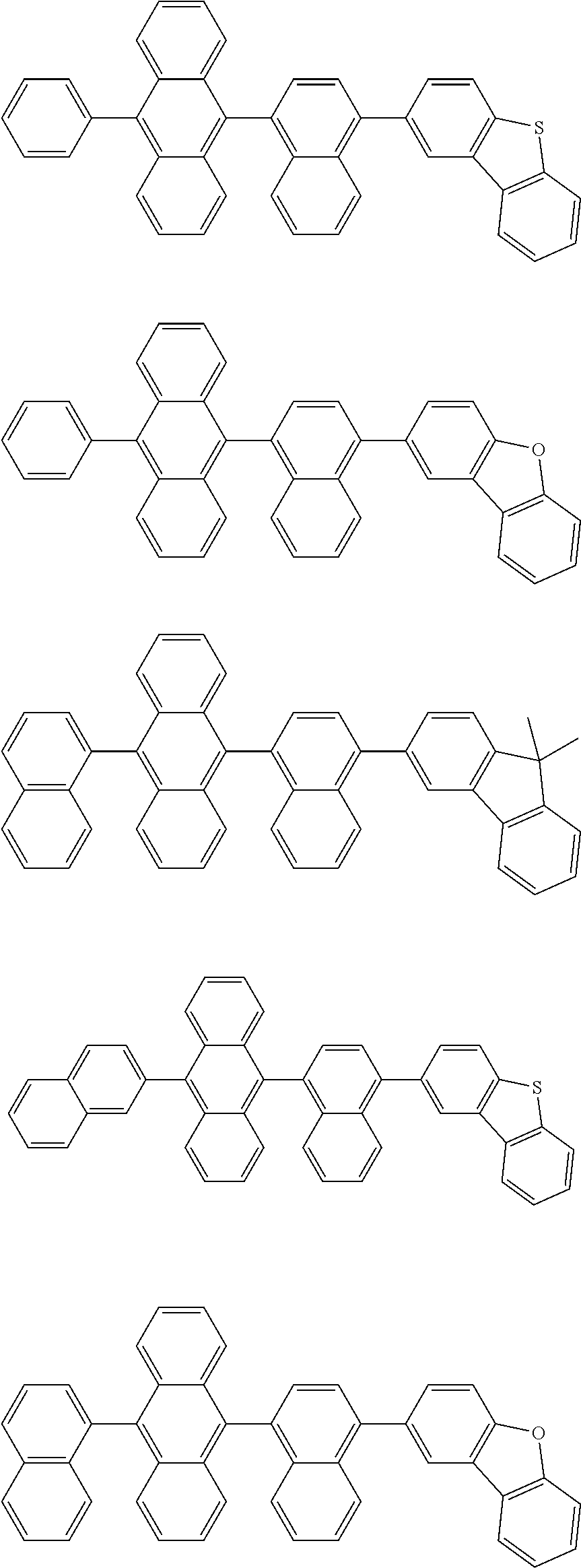


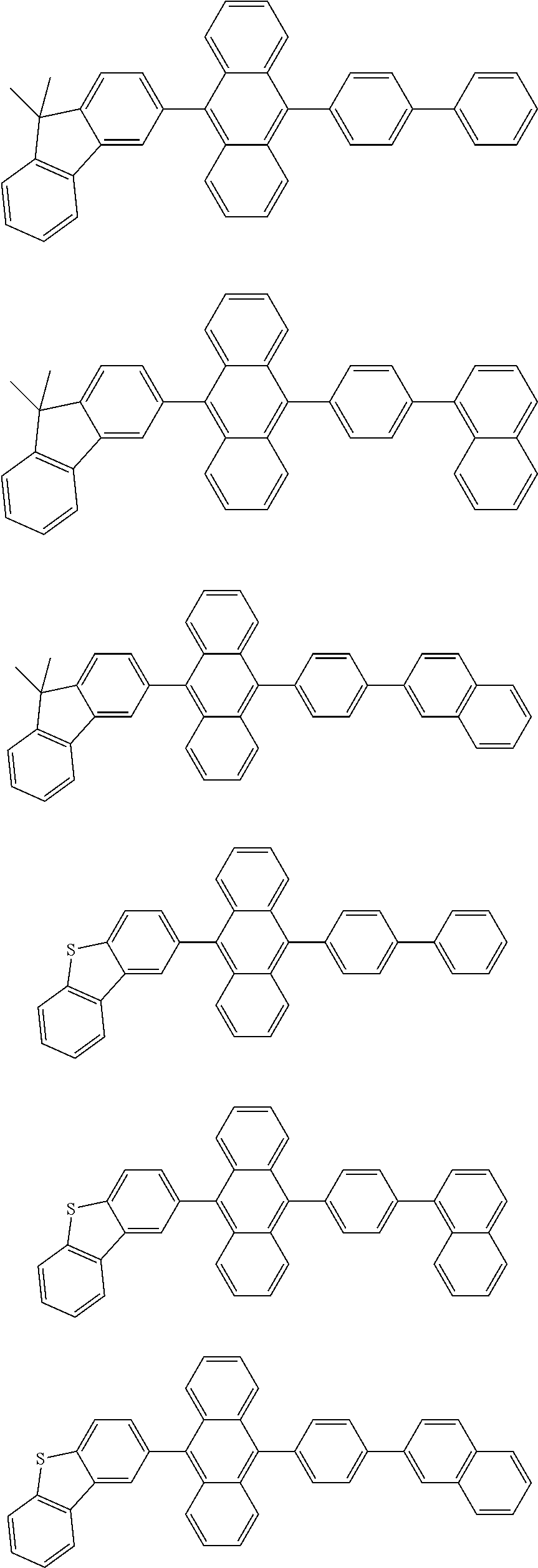


In some other embodiments, the second material may be selected from compounds illustrated below, but it is not limited thereto.


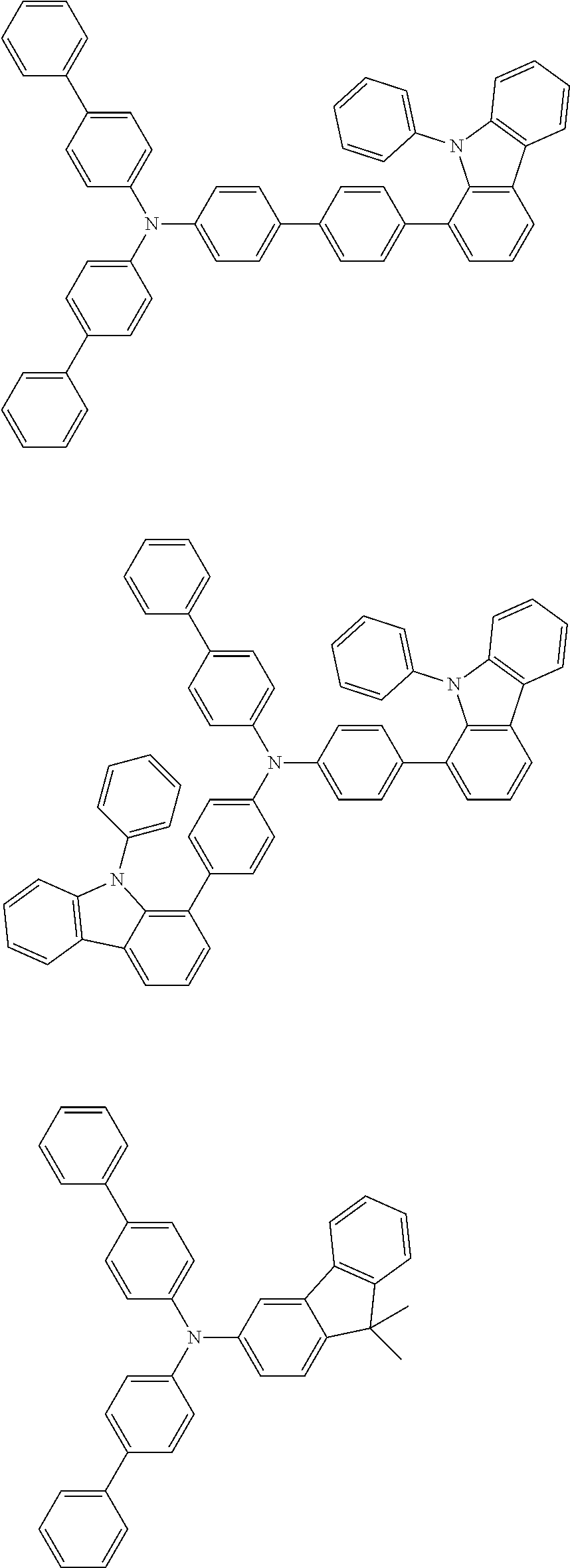


The first material may improve the efficiency of the organic light-emitting device. The second material has excellent property in transporting holes, and thus may facilitate the movement of holes in the emission layer of the organic light-emitting device and the capture of electrons. Accordingly, the organic light-emitting device including the first material and the second material may improve the carrier balance in the emission layer, and thus the efficiency and lifespan characteristics of the organic light-emitting device may be improved.
A volume ratio of the first material to the second material may be in a range of about 96:1 to about 77:20. For example, a volume ratio of the first material to the second material may be in a range of about 94:3 to about 87:10, but the volume ratio is not limited thereto. When the volume ratio is within the ranges above, carriers may be effectively or suitable captured so as to provide an organic light-emitting device having a high efficiency and long lifespan characteristics.
The dopant included in the emission layer may be a fluorescent dopant.
For example, the fluorescent dopant may include at least one selected from DPAVBi, BDAVBi, TBPe, DCM, DCJTB, Coumarin 6, and C545T below.

The fluorescent dopant may include a compound represented by Formula 501 below:

In Formula 501,
Ar501 may be selected from a naphthalene, a heptalene, a fluorene, a spiro-fluorene, a benzofluorene, a dibenzofluorene, a phenalene, a phenanthrene, an anthracene, a fluoranthene, a triphenylene, a pyrene, a chrysene, a naphthacene, a picene, a perylene, a pentaphene, and an indenoanthracene;
a naphthalene, a heptalene, a fluorene, a spiro-fluorene, a benzofluorene, a dibenzofluorene, a phenalene, a phenanthrene, an anthracene, a fluoranthene, a triphenylene, a pyrene, a chrysene, naphthacene, a picene, a perylene, a pentaphene, and an indenoanthracene, each substituted with at least one of a deuterium, —F, —Cl, —Br, —I, a hydroxyl group, a cyano group, a nitro group, an amino group, an amidino group, a hydrazine group, a hydrazone group, a carboxyl group or a salt thereof, a sulfonic acid group or a salt thereof, a phosphoric acid group or a salt thereof, a C1-C60 alkyl group, a C2-C60 alkenyl group, a C2-C60 alkynyl group, a C1-C60 alkoxy group, a C3-C10 cycloalkyl group, a C1-C10 heterocycloalkyl group, a C3-C10 cycloalkenyl group, a C1-C10 heterocycloalkenyl group, a C6-C60 aryl group, a C6-C60 aryloxy group, a C6-C60 arylthio group, a C1-C60 heteroaryl group, a monovalent non-aromatic condensed polycyclic group, a monovalent non-aromatic condensed heteropolycyclic group, and —Si(Q501)(Q502)(Q503) (Q501 to Q503 may be each independently selected from a hydrogen, a C1-C60 alkyl group, a C2-C60 alkenyl group, a C6-C60 aryl group, and a C1-C60 heteroaryl group);
descriptions of L501 to L503 may be each independently as referred to in the description provided in connection with L201 above;
R501 and R502 may be each independently selected from:
a phenyl group, a naphthyl group, a fluorenyl group, a spiro-fluorenyl group, a benzofluorenyl group, a dibenzofluorenyl group, a phenanthrenyl group, an anthracenyl group, a pyrenyl group, a chrysenyl group, a pyridinyl group, a pyrazinyl group, a pyrimidinyl group, a pyridazinyl group, a quinolinyl group, an isoquinolinyl group, a quinoxalinyl group, a quinazolinyl group, a carbazole group, a triazinyl group, a dibenzofuranyl group, and a dibenzothiophenyl group; and
a phenyl group, a naphthyl group, a fluorenyl group, a spiro-fluorenyl group, a benzofluorenyl group, a dibenzofluorenyl group, a phenanthrenyl group, an anthracenyl group, a pyrenyl group, a chrysenyl group, a pyridinyl group, a pyrazinyl group, a pyrimidinyl group, a pyridazinyl group, a quinolinyl group, an isoquinolinyl group, a quinoxalinyl group, a quinazolinyl group, a carbazolyl group, a triazinyl group, a dibenzofuranyl group, and a dibenzothiophenyl group, each substituted with at least one of a deuterium, a halogen atom, a hydroxyl group, a cyano group, a nitro group, an amino group, an amidino group, a hydrazine group, a hydrazone group, a carboxyl group or a salt thereof, a sulfonic acid group or a salt thereof, a phosphoric acid group or a salt thereof, a C1-C20 alkyl group, a C1-C20 alkoxy group, a phenyl group, a naphthyl group, a fluorenyl group, a spiro-fluorenyl group, a benzofluorenyl group, a dibenzofluorenyl group, a phenanthrenyl group, an anthracenyl group, a pyrenyl group, a chrysenyl group, a pyridinyl group, a pyrazinyl group, a pyrimidinyl group, a pyridazinyl group, a quinolinyl group, an isoquinolinyl group, a quinoxalinyl group, a quinazolinyl group, a carbazolyl group, a triazinyl group, a dibenzofuranyl group, and a dibenzothiophenyl group;
xd1 to xd3 may be each independently selected from 0, 1, 2, and 3; and
xd4 may be selected from 1, 2, 3, and 4.
The fluorescent dopant may include at least one selected from Compounds FD1 to FD8 below.


The maximum light-emitting wavelength of the fluorescent dopant may be in a range of about 400 nm to about 550 nm. The fluorescent dopant may emit green light or blue light.
An amount of the dopant included in the emission layer may be, in general, in a range of about 0.01 to about 15 parts by volume based on 100 parts by volume of the host (i.e., total amounts of the first material and the second material), but it is not limited thereto.
A thickness of the emission layer may be in a range of about 100 Å to about 1,000 Å, for example, about 200 Å to about 600 Å. In one embodiment, when the thickness of the emission layer is within the ranges described above, excellent light-emission characteristics are obtained without a substantial increase in driving voltage.
The electron transport region may include at least one selected from a buffer layer, an ETL, and an EIL, but it is not limited thereto.
For example, the electron transport region may have a structure of ETL/EIL or a structure of buffer layer/ETL/EIL, wherein layers of each structure are sequentially stacked from the emission layer in this stated order, but the electron transport region is not limited thereto.
The electron transport region may include a buffer layer. When the emission layer includes a fluorescent dopant, the buffer layer may capture excitons in the emission layer in an efficient manner, so as to improve the efficiency of the organic light-emitting device.
When the electron transport region includes a buffer layer, the buffer layer may be formed on the emission layer by utilizing various suitable methods, such as vacuum deposition, spin coating, casting, an LB method, an ink-jet printing, a laser-printing, or an LITI method. When the buffer layer is formed by vacuum deposition or spin coating, the deposition and coating conditions for the buffer layer may be determined by referring to the deposition and coating conditions for the HIL.
The buffer layer may include, e.g., one selected from Compounds E1 to E8 below.


The buffer layer may have a triplet energy that exceeds 2.2 eV, and may include a compound having electron transporting capability.
A thickness of the buffer layer may be in a range of about 20 Å to about 1,000 Å, for example, about 30 Å to about 300 Å. In one embodiment, when the thickness of the buffer layer is within the ranges described above, the buffer layer captures excitons in the emission layer in an efficient manner, so as to obtain the organic light-emitting device having improved efficiency.
The electron transport region may include an ETL, and the ETL may be formed on the emission layer by utilizing various suitable methods, such as vacuum deposition, spin coating, casting, an LB method, an ink-jet printing, a laser-printing, or an LITI method. When the ETL is formed by vacuum deposition or spin coating, the deposition and coating conditions for the ETL may be determined by referring to the deposition and coating conditions for the HIL.
The ETL may further include at least one selected from BCP, Bphen, Alq3, BAlq, TAZ, and NTAZ illustrated below.

Alternatively, the ETL may include at least one compound represented by Formula 601 below:
Ar601-[(L601)xe1-E601]xe2 Formula 601
Ar601-[(L601)xe1-E601]xe2 Formula 601
In Formula 601,
Ar601 may be selected from a naphthalene, a heptalene, a fluorene, a spiro-fluorene, a benzofluorene, a dibenzofluorene, a phenalene, a phenanthrene, an anthracene, a fluoranthene, a triphenylene, a pyrene, a chrysene, a naphthacene, a picene, a perylene, a pentaphene, and an indenoanthracene;
a naphthalene, a heptalene, a fluorene, a spiro-fluorene, a benzofluorene, a dibenzofluorene, a phenalene, a phenanthrene, an anthracene, a fluoranthene, a triphenylene, a pyrene, a chrysene, a naphthacene, a picene, a perylene, a pentaphene, and an indenoanthracene, each substituted with at least one of a deuterium, —F, —Cl, —Br, —I, a hydroxyl group, a cyano group, a nitro group, an amino group, an amidino group, a hydrazine group, a hydrazone group, a carboxylic acid group or a salt thereof, a sulfonic acid group or a salt thereof, a phosphoric acid group or a salt thereof, a C1-C60 alkyl group, a C2-C60 alkenyl group, a C2-C60 alkynyl group, a C1-C60 alkoxy group, a C3-C10 cycloalkyl group, a C1-C10 heterocycloalkyl group, a C3-C10 cycloalkenyl group, a C1-C10 heterocycloalkenyl group, a C6-C60 aryl group, a C6-C60 aryloxy group, a C6-C60 arylthio group, a C1-C60 heteroaryl group, a monovalent non-aromatic condensed polycyclic group, a monovalent non-aromatic condensed heteropolycyclic group, and —Si(Q301)(Q302)(Q303) (Q301 to Q303 may be each independently selected from a hydrogen, a C1-C60 alkyl group, a C2-C60 alkenyl group, a C6-C60 aryl group, a C1-C60 heteroaryl group, a monovalent non-aromatic condensed polycyclic group, and a monovalent non-aromatic condensed heteropolycyclic group);
a descriptions of L601 may be as referred to in the description provided in connection with L201 above;
E601 may be selected from: a pyrrolyl group, a thiophenyl group, a furanyl group, an imidazolyl group, a pyrazolyl group, a thiazolyl group, an isothiazolyl group, an oxazolyl group, an isooxazolyl group, a pyridinyl group, a pyrazinyl group, a pyrimidinyl group, a pyridazinyl group, an isoindolyl group, an indolyl group, an indazolyl group, a purinyl group, a quinolinyl group, an isoquinolinyl group, a benzoquinolinyl group, a phthalazinyl group, a naphthyridinyl group, a quinoxalinyl group, a quinazolinyl group, a cinnolinyl group, a carbazolyl group, a phenanthridinyl group, an acridinyl group, a phenanthrolinyl group, a phenazinyl group, a benzoimidazolyl group, a benzofuranyl group, a benzothiophenyl group, an isobenzothiazolyl group, a benzooxazolyl group, an isobenzooxazolyl group, a triazolyl group, a tetrazolyl group, an oxadiazolyl group, a triazinyl group, a dibenzofuranyl group, a dibenzothiophenyl group, a benzocarbazolyl group, and a dibenzocarbazolyl group; and
a pyrrolyl group, a thiophenyl group, a furanyl group, an imidazolyl group, a pyrazolyl group, a thiazolyl group, an isothiazolyl group, an oxazolyl group, an isooxazolyl group, a pyridinyl group, a pyrazinyl group, a pyrimidinyl group, a pyridazinyl group, an isoindolyl group, an indolyl group, an indazolyl group, a purinyl group, a quinolinyl group, an isoquinolinyl group, a benzoquinolinyl group, a phthalazinyl group, a naphthyridinyl group, a quinoxalinyl group, a quinazolinyl group, a cinnolinyl group, a carbazolyl group, a phenanthridinyl group, an acridinyl group, a phenanthrolinyl group, a phenazinyl group, a benzoimidazolyl group, a benzofuranyl group, a benzothiophenyl group, an isobenzothiazolyl group, a benzooxazolyl group, an isobenzooxazolyl group, a triazolyl group, a tetrazolyl group, an oxadiazolyl group, a triazinyl group, a dibenzofuranyl group, a dibenzothiophenyl group, a benzocarbazolyl group, and a dibenzocarbazolyl group, each substituted with at least one of a deuterium, —F, —Cl, —Br, —I, a hydroxyl group, a cyano group, a nitro group, an amino group, an amidino group, a hydrazine group, a hydrazone group, a carboxylic acid group or a salt thereof, a sulfonic acid group or a salt thereof, a phosphoric acid group or a salt thereof, a C1-C20 alkyl group, a C1-C20 alkoxy group, a phenyl group, a pentalenyl group, an indenyl group, a naphthyl group, an azulenyl group, a heptalenyl group, an indacenyl group, an acenaphthyl group, a fluorenyl group, a spiro-fluorenyl group, a benzofluorenyl group, a dibenzofluorenyl group, a phenalenyl group, a phenanthrenyl group, an anthracenyl group, a fluoranthenyl group, a triphenylenyl group, a pyrenyl group, a chrysenyl group, a naphthacenyl group, a picenyl group, a perylenyl group, a pentaphenyl group, a hexacenyl group, a pentacenyl group, a rubicenyl group, a coronenyl group, an ovalenyl group, a pyrrolyl group, a thiophenyl group, a furanyl group, an imidazolyl group, a pyrazolyl group, a thiazolyl group, an isothiazolyl group, an oxazolyl group, an isooxazolyl group, a pyridinyl group, a pyrazinyl group, a pyrimidinyl group, a pyridazinyl group, an isoindolyl group, an indolyl group, an indazolyl group, a purinyl group, a quinolinyl group, an isoquinolinyl group, a benzoquinolinyl group, a phthalazinyl group, a naphthyridinyl group, a quinoxalinyl group, a quinazolinyl group, a cinnolinyl group, a carbazolyl group, a phenanthridinyl group, an acridinyl group, a phenanthrolinyl group, a phenazinyl group, a benzoimidazolyl group, a benzofuranyl group, a benzothiophenyl group, an isobenzothiazolyl group, a benzooxazolyl group, an isobenzooxazolyl group, a triazolyl group, a tetrazolyl group, an oxadiazolyl group, a triazinyl group, a dibenzofuranyl group, a dibenzothiophenyl group, a benzocarbazolyl group, and a dibenzocarbazolyl group;
xe1 may be selected from 0, 1, 2, and 3; and
xe2 may be selected from 1, 2, 3, and 4.
Alternatively, the ETL may include at least one compound represented by Formula 602 below:
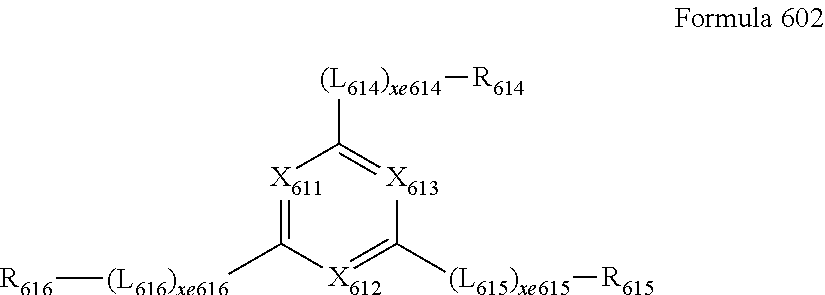
In Formula 602,
X611 may be N or C-(L611)xe611-R611, X612 may be N or C-(L612)xe612-R612, and X613 may be N or C-(L613)xe613-R613, wherein at least one of X611 to X613 is N;
descriptions of L611 to L616 may be each independently as referred to in the description provided in connection with L201 above;
R611 to R616 may be each independently selected from:
a phenyl group, a naphthyl group, a fluorenyl group, a spiro-fluorenyl group, a benzofluorenyl group, a dibenzofluorenyl group, a phenanthrenyl group, an anthracenyl group, a pyrenyl group, a chrysenyl group, a pyridinyl group, a pyrazinyl group, a pyrimidinyl group, a pyridazinyl group, a quinolinyl group, an isoquinolinyl group, a quinoxalinyl group, a quinazolinyl group, a carbazolyl group, and a triazinyl group; and
a phenyl group, a naphthyl group, a fluorenyl group, a spiro-fluorenyl group, a benzofluorenyl group, a dibenzofluorenyl group, a phenanthrenyl group, an anthracenyl group, a pyrenyl group, a chrysenyl group, a pyridinyl group, a pyrazinyl group, a pyrimidinyl group, a pyridazinyl group, a quinolinyl group, an isoquinolinyl group, a quinoxalinyl group, a quinazolinyl group, a carbazolyl group, and a triazinyl group, each substituted with at least one of a deuterium, —F, —Cl, —Br, —I, a hydroxyl group, a cyano group, a nitro group, an amino group, an amidino group, a hydrazine group, a hydrazone group, a carboxylic acid group or a salt thereof, a sulfonic acid group or a salt thereof, a phosphoric acid group or a salt thereof, a C1-C20 alkyl group, a C1-C20 alkoxy group, a phenyl group, a naphthyl group, an azulenyl group, a fluorenyl group, a spiro-fluorenyl group, a benzofluorenyl group, a dibenzofluorenyl group, a phenanthrenyl group, an anthracenyl group, a pyrenyl group, a chrysenyl group, a pyridinyl group, a pyrazinyl group, a pyrimidinyl group, a pyridazinyl group, a quinolinyl group, an isoquinolinyl group, a quinoxalinyl group, a quinazolinyl group, a carbazolyl group, and a triazinyl group; and
xe611 to xe616 may be each independently selected from 0, 1, 2, and 3.
The compound represented by Formula 601 and the compound represented by Formula 602 may include, each independently, at least one selected from Compounds ET1 to ET15 below.


A thickness of the ETL may be in a range of about 100 Å to about 1,000 Å, for example, about 150 Å to about 500 Å. In one embodiment, when the thickness of the ETL is within the ranges described above, the ETL has satisfactory or suitable electron transport characteristics without a substantial increase in driving voltage.
The ETL may further include, in addition to the materials described above, a metal-containing material.
The metal-containing material may include a Li complex. The Li complex may include, for example, Compound ET-D1 (lithium quinolate, LiQ) or ET-D2 below.

The electron transport region may include an EIL that facilitates electron injection from the second electrode 190.
The EIL may be formed on the ETL by utilizing various suitable methods, such as vacuum deposition, spin coating, casting, an LB method, an ink-jet printing, a laser-printing, or an LITI method. When the EIL s formed by vacuum deposition or spin coating, the deposition and coating conditions for the EIL may be determined by referring to the deposition and coating conditions for the HIL.
The EIL may include at least one selected from LiF, NaCl, CsF, Li2O, BaO, and LiQ.
A thickness of the EIL may be in a range of about 1 Å to about 100 Å, for example, about 3 Å to about 90 Å. In one embodiment, when the thickness of the EIL is within the ranges described above, the EIL has satisfactory or suitable electron injection characteristics without a substantial increase in driving voltage.
The second electrode 190 is disposed on the electron transport region. The second electrode may be a cathode that is an electron injection electrode. Here, a material for forming the second electrode 190 may be selected from a metal, an alloy, an electrically conductive compound, and a mixture thereof, which has a relatively low work function. Non-limiting examples of the material for forming the second electrode 190 are lithium (Li), magnesium (Mg), aluminum (Al), aluminum-lithium (Al—Li), calcium (Ca), magnesium-indium (Mg—In), and magnesium-silver (Mg—Ag). Alternatively, the material for forming the second electrode 190 may be ITO or IZO. The second electrode 190 may be a transmissive electrode, a semi-transparent electrode, or a transparent electrode.
The organic light-emitting device may be included in a flat display apparatus including a thin film transistor (TFT). The TFT may include a gate electrode, source and drain electrodes, a gate insulating layer, and an active layer. At least one of the source and drain electrodes may electrically contact (or may be electrically coupled to) the first electrode 110 of the organic light-emitting device. The active layer may include crystalline silicon, amorphous silicon, an organic semiconductor, or an oxide semiconductor, but it is not limited thereto.
The term “a C1-C60 alkyl group” used herein refers to a linear or branched aliphatic hydrocarbon monovalent group having 1 to 60 carbon atoms, and non-limiting examples thereof are a methyl group, an ethyl group, a propyl group, an isobutyl group, a sec-butyl group, a tert-butyl group, a pentyl group, an iso-amyl group, and a hexyl group. The term “a C1-C60 alkylene group” used herein refers to a divalent group having substantially the same structure as that of the C1-C60 alkyl group.
The term “a C1-C60 alkoxy group” used herein refers to a monovalent group represented by —OA101 (A101 is the C1-C60 alkyl group), and non-limiting examples thereof are a methoxy group, an ethoxy group, and an isopropyloxy group.
The term “a C2-C60 alkenyl group” used herein refers to a hydrocarbon group having at least one carbon double bond in the main chain (e.g., the middle) or at the terminal position of the C2-C60 alkyl group, and non-limiting examples thereof are an ethenyl group, a prophenyl group, and a butenyl group. The term “a C2-C60 alkenylene group” used herein refers to a divalent group having substantially the same structure as that of the C2-C60 alkenyl group.
The term “a C2-C60 alkynyl group” used herein refers to a hydrocarbon group having at least one carbon triple bond in the main chain (e.g., the middle) or at the terminal position of the C2-C60 alkyl group, and non-limiting examples thereof are an ethynyl group and a propynyl group. The term “a C2-C60 alkynylene group” used herein refers to a divalent group having substantially the same structure as that of the C2-C60 alkynyl group.
The term “a C3-C10 cycloalkyl group” used herein refers to a saturated hydrocarbon monocyclic group having 3 to 10 carbon atoms, and non-limiting examples thereof are a cyclopropyl group, a cyclobutyl group, a cyclopentyl group, a cyclohexyl group, and a cycloheptyl group. The term “a C3-C10 cycloalkylene group” used herein refers to a divalent group having substantially the same structure as that of the C3-C10 cycloalkyl group.
The term “a C1-C10 heterocycloalkyl group” used herein refers to a monovalent monocyclic group having at least one heteroatom selected from N, O, P, and S as a ring-forming atom and 1 to 10 carbon atoms, and non-limiting examples thereof are a tetrahydrofuranyl group and a tetrahydrothiophenyl group. The term “a C1-C10 heterocycloalkylene group” used herein refers to a divalent group having substantially the same structure as that of the C1-C10 heterocycloalkyl group.
The term “a C3-C10 cycloalkenyl group” used herein refers to a monovalent monocyclic group that has 3 to 10 carbon atoms and at least one double bond in the ring thereof and does not have aromacity, and non-limiting examples thereof are a cyclopentenyl group, a cyclohexenyl group, and a cycloheptenyl group. The term “a C3-C10 cycloalkenylene group” used herein refers to a divalent group having substantially the same structure as that of the C3-C10 cycloalkenyl group.
The term “a C1-C10 heterocycloalkenyl group” used herein refers to a monovalent monocyclic group that has at least one hetero atom selected from N, O, P, and S as a ring-forming atom, 1 to 10 carbon atoms, and at least one double bond in the ring thereof. Non-limiting examples of the C1-C10 heterocycloalkenyl group are a 2,3-hydrofuranyl group and a 2,3-hydrothiophenyl group. The term “a C1-C10 heterocycloalkenylene group” used herein refers to a divalent group having substantially the same structure as that of the C1-C10 heterocycloalkenyl group.
The term “a C6-C60 aryl group” used herein refers to a monovalent group having a carbocyclic aromatic system having 6 to 60 carbon atoms, and the term “a C6-C60 arylene group” used herein refers to a divalent group having a carbocyclic aromatic system having 6 to 60 carbon atoms. Non-limiting examples of the C6-C60 aryl group are a phenyl group, a naphthyl group, an anthracenyl group, a phenanthrenyl group, a pyrenyl group, and a chrysenyl group. When the C6-C60 aryl group and the C6-C60 arylene group each include 2 or more rings, the rings may be fused to each other.
The term “a C1-C60 heteroaryl group” used herein refers to a monovalent group having a carbocyclic aromatic system that has at least one hetero atom selected from N, O, P, and S as a ring-forming atom, and 1 to 60 carbon atoms. The term “a C1-C60 heteroarylene group” used herein refers to a divalent group having a carbocyclic aromatic system that has at least one hetero atom selected from N, O, P, and S as a ring-forming atom, and 1 to 60 carbon atoms. Non-limiting examples of the C1-C60 heteroaryl group are a pyridinyl group, a pyrimidinyl group, a pyrazinyl group, a pyridazinyl group, a triazinyl group, a quinolinyl group, and an isoquinolinyl group. When the C1-C60 heteroaryl group and the C1-C60 heteroarylene group each include 2 or more rings, the rings may be fused to each other.
The term “a C6-C60 aryloxy group” used herein refers to a monovalent group represented by —OA102 (A102 is the C6-C60 aryl group), and the term “a C6-C60 arylthio group” refers to a monovalent group represented by —SA103 (A103 is the C6-C60 aryl group).
The term “a monovalent non-aromatic condensed polycyclic group” used herein refers to a monovalent group (having 8 to 60 carbon atoms) that has 2 or more rings condensed to each other, carbon atoms as the only ring forming atoms, and non-aromacity in the entire molecular structure. A non-limiting examples of the monovalent non-aromatic condensed polycyclic group is a fluorenyl group. The term “a divalent non-aromatic condensed polycyclic group” used herein refers to a divalent group having substantially the same structure as that of the monovalent non-aromatic condensed polycyclic group.
The term “a monovalent non-aromatic condensed heteropolycyclic group” used herein refers to a monovalent group (having 1 to 60 carbon atoms) that has 2 or more rings condensed to each other, has a heteroatom other than carbon atom selected from N, O P, and S as a ring forming atom, and has non-aromacity in the entire molecular structure. A non-limiting example of the monovalent non-aromatic condensed heteropolycyclic group is a carbazolyl group. The term “a divalent non-aromatic condensed heteropolycyclic group” used herein refers to a divalent group having substantially the same structure as that of the monovalent non-aromatic condensed heteropolycyclic group.
The term “Ph” used herein refers to a phenyl group, the term “Me” used herein refers to a methyl group, the term “Et” used herein refers to an ethyl group, and the term “ter-Bu” or “But” used herein refers to a tert-butyl group.
Hereinafter, the organic light-emitting devices according to example embodiments of the present inventive concept will now be described in more detail with reference to the following examples. It will be understood that the Examples are not to be construed as limiting the scope of the embodiments.
An anode was prepared by cutting a Corning 15 Ω/cm2 (1,200 Å) ITO glass substrate to a size of 50 mm×50 mm×0.7 mm, ultrasonically cleaning the glass substrate by utilizing isopropyl alcohol for 5 minutes and pure water for 5 minutes, irradiating UV light for 30 minutes thereto, and exposing to ozone. Then, the anode was mounted onto a vacuum deposition apparatus.
HT13 was deposited on the ITO glass substrate to form an HIL having a thickness of 500 Å, HT3 was deposited on the HIL to form an HTL having a thickness of 450 Å, and then, Compound H-la (as a first material), Compound H-1b (as a second material), and FD1 (as a dopant) were co-deposited on the HTL at a volume ratio of 92:5:3 to form an emission layer having a thickness of 300 Å.
Afterwards, E1 was deposed on the emission layer to form a buffer layer having a thickness of 100 Å, and Bphen and Liq were co-deposited on the buffer layer at a volume ratio of 50:50 to form an ETL having a thickness of 150 Å. Then, LiF was deposited on the ETL to form an EIL having a thickness of 5 Å, and Al was vacuum deposited on the EIL to form a cathode having a thickness 1,500 Å, thereby completing the manufacturing of an organic light-emitting device.
Organic light-emitting devices were manufactured in substantially the same manner as in Example 1, except that in forming an emission layer, the first material and the second material was adjusted according to Table 1 below.
| TABLE 1 | |||||
| Example | First | Second | Example | Second | |
| number | material | material | number | First material | material |
| Example 1-1 | H-1a | H-1b | Example 1-18 | H-3a | H-2b |
| Example 1-2 | H-1a | H-2b | Example 1-19 | H-5a | H-2b |
| Example 1-3 | H-1a | H-3b | Example 1-20 | H-7a | H-2b |
| Example 1-4 | H-1a | H-4b | Example 1-21 | H-12a | H-2b |
| Example 1-5 | H-1a | H-5b | Example 1-22 | H-3a | H-3b |
| Example 1-6 | H-1a | H-6b | Example 1-23 | H-5a | H-3b |
| Example 1-7 | H-2a | H-1b | Example 1-24 | H-7a | H-3b |
| Example 1-8 | H-3a | H-1b | Example 1-25 | H-12a | H-3b |
| Example 1-9 | H-4a | H-1b | Example 1-26 | H-3a | H-6b |
| Example 1-10 | H-5a | H-1b | Example 1-27 | H-5a | H-6b |
| Example 1-11 | H-6a | H-1b | Example 1-28 | H-7a | H-6b |
| Example 1-12 | H-7a | H-1b | Example 1-29 | H-12a | H-6b |
| Example 1-13 | H-8a | H-1b | Comparative | Compound 1 | — |
| Example 1-1 | |||||
| Example 1-14 | H-9a | H-1b | Comparative | Compound 2 | — |
| Example 1-2 | |||||
| Example 1-15 | H-10a | H-1b | Comparative | H-1a | — |
| Example 1-3 | |||||
| Exampel 1-16 | H-11a | H-1b | Comparative | — | H-1b |
| Example 1-4 | |||||
| Example 1-17 | H-12a | H-1b | Comparative | Compound 1 | H-1b |
| Example 1-5 | |||||
| Comparative | Compound A | NPB | |||
| Example 1-6 | |||||
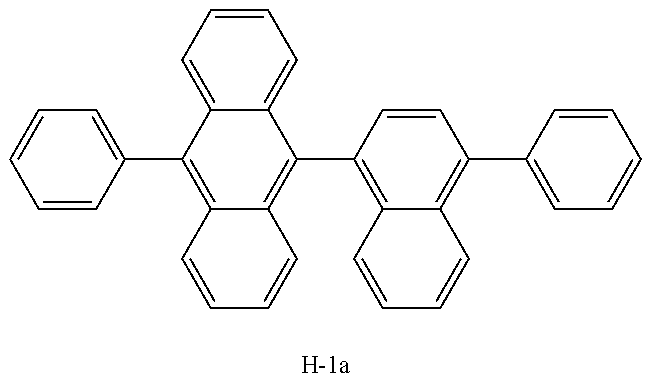                   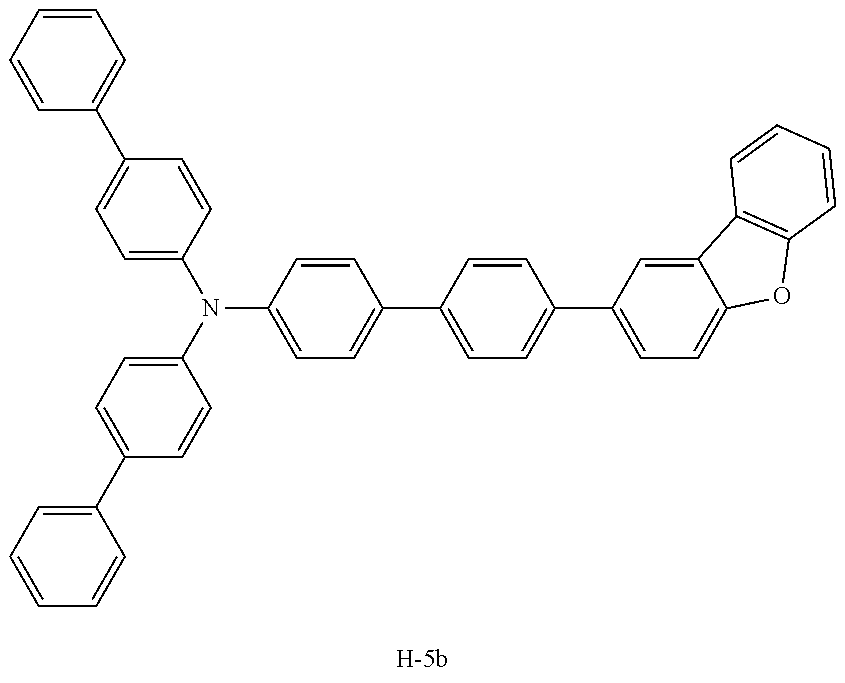  |
|||||
The efficiency and lifespan (T90) data of the organic light-emitting devices manufactured according to Examples 1-1 to 1-29 and Comparative Examples 1-1 to 1-6 was measured by utilizing an IVL measuring apparatus (PhotoResearch PR650, Keithley 238) and the results thereof are shown in Table 2 below. Here, T90 data (@ 50 mA/cm2) denots a period of time that lapses until the brightness of the organic light-emitting device was 90% of the initial brightness (100%).
| TABLE 2 | ||||
| Example | Second | Efficiency | T90 | |
| number | First material | material | (cd/A) | (hour) |
| Example 1-1 | H-1a | H-1b | 5.2 | 120 |
| Example 1-2 | H-1a | H-2b | 5.4 | 110 |
| Example 1-3 | H-1a | H-3b | 5.4 | 120 |
| Example 1-4 | H-1a | H-4b | 5.2 | 120 |
| Example 1-5 | H-1a | H-5b | 5.2 | 130 |
| Example 1-6 | H-1a | H-6b | 5.3 | 120 |
| Example 1-7 | H-2a | H-1b | 5.2 | 120 |
| Example 1-8 | H-3a | H-1b | 5.1 | 130 |
| Example 1-9 | H-4a | H-1b | 5.2 | 120 |
| Example 1-10 | H-5a | H-1b | 5.3 | 110 |
| Example 1-11 | H-6a | H-1b | 5.1 | 120 |
| Example 1-12 | H-7a | H-1b | 5.1 | 110 |
| Example 1-13 | H-8a | H-1b | 5.2 | 110 |
| Example 1-14 | H-9a | H-1b | 5.1 | 120 |
| Example 1-15 | H-10a | H-1b | 5.0 | 120 |
| Example 1-16 | H-11a | H-1b | 5.2 | 110 |
| Example 1-17 | H-12a | H-1b | 5.3 | 110 |
| Example 1-18 | H-3a | H-2b | 5.2 | 130 |
| Example 1-19 | H-5a | H-2b | 5.4 | 110 |
| Example 1-20 | H-7a | H-2b | 5.2 | 120 |
| Example 1-21 | H-12a | H-2b | 5.3 | 110 |
| Example 1-22 | H-3a | H-3b | 5.3 | 130 |
| Example 1-23 | H-5a | H-3b | 5.3 | 110 |
| Example 1-24 | H-7a | H-3b | 5.1 | 120 |
| Example 1-25 | H-12a | H-3b | 5.2 | 120 |
| Example 1-26 | H-3a | H-6b | 5.3 | 130 |
| Example 1-27 | H-5a | H-6b | 5.4 | 110 |
| Example 1-28 | H-7a | H-6b | 5.2 | 120 |
| Example 1-29 | H-12a | H-6b | 5.3 | 130 |
| Comparative | Compound1 | — | 4.5 | 40 |
| Example 1-1 | ||||
| Comparative | Compound2 | — | 4.6 | 50 |
| Example 1-2 | ||||
| Comparative | H-1a | — | 5.0 | 90 |
| Example 1-3 | ||||
| Comparative | — | H-1b | 3.5 | 40 |
| Example 1-4 | ||||
| Comparative | Compound1 | H-1b | 4.4 | 90 |
| Example 1-5 | ||||
| Comparative | Compound A | NPB | 3.2 | 50 |
| Example 1-6 | ||||
Referring to Table 2, it was confirmed that the organic light-emitting devices of Examples 1-1 to 1-29 had better efficiency and lifespan characteristics than those of Comparative Examples 1-1 to 1-6.
As described above, according to the one or more of the above example embodiments, an organic light-emitting device has high efficiency and long lifespan.
It should be understood that example embodiments described herein should be considered in a descriptive sense only and not for purposes of limitation. Descriptions of features or aspects within each example embodiment should typically be considered as available for other similar features or aspects in other example embodiments.
While one or more example embodiments have been described with reference to the drawing, it will be understood by those of ordinary skill in the art that various suitable changes in form and details may be made therein without departing from the spirit and scope as defined by the following claims, and equivalents thereof.
Claims (20)
1. An organic light-emitting device comprising:
a first electrode;
a second electrode facing the first electrode; and
an organic layer between the first electrode and the second electrode and comprising an emission layer,
wherein the emission layer comprises a first material represented by Formula 1 and a second material represented by Formula 2:

wherein in Formulae 1, 2, and 2A to 2C,
L11 and L12 are each independently selected from a substituted or unsubstituted C6-C60 arylene group and a substituted or unsubstituted C1-C60 heteroarylene group;
a11 and a12are each independently selected from 0, 1, 2, and 3;
R11 and R12 are each independently selected from: a phenyl group, a naphthyl group, a fluorenyl group, a spiro-fluorenyl group, a phenalenyl group, a phenanthrenyl group, an anthracenyl group, a fluoranthenyl group, a triphenylenyl group, a pyrenyl group, a chrysenyl group, a perylenyl group, a pentaphenyl group, a hexacenyl group, a pentacenyl group, a pyrrolyl group, a thiophenyl group, a furanyl group, an imidazolyl group, a pyrazolyl group, a thiazolyl group, an isothiazolyl group, an oxazolyl group, an isooxazolyl group, a pyridinyl group, a pyrazinyl group, a pyrimidinyl group, a pyridazinyl group, an indolyl group, an indazolyl group, a quinolinyl group, an isoquinolinyl group, a benzoquinolinyl group, a phthalazinyl group, a naphthyridinyl group, a quinoxalinyl group, a quinazolinyl group, a phenanthridinyl group, an acridinyl group, a phenanthrolinyl group, a phenazinyl group, a benzimidazolyl group, a benzofuranyl group, a benzothiophenyl group, a benzooxazolyl group, a triazolyl group, a tetrazolyl group, an oxadiazolyl group, a triazinyl group, a dibenzofuranyl group and a dibenzothiophenyl group; and
a phenyl group, a naphthyl group, a fluorenyl group, a spiro-fluorenyl group, a phenalenyl group, a phenanthrenyl group, an anthracenyl group, a fluoranthenyl group, a triphenylenyl group, a pyrenyl group, a chrysenyl group, a perylenyl group, a pentaphenyl group, a hexacenyl group, a pentacenyl group, a pyrrolyl group, a thiophenyl group, a furanyl group, an imidazolyl group, a pyrazolyl group, a thiazolyl group, an isothiazolyl group, an oxazolyl group, an isooxazolyl group, a pyridinyl group, a pyrazinyl group, a pyrimidinyl group, a pyridazinyl group, an indolyl group, an indazolyl group, a quinolinyl group, an isoquinolinyl group, a benzoquinolinyl group, a phthalazinyl group, a naphthyridinyl group, a quinoxalinyl group, a quinazolinyl group, a phenanthridinyl group, an acridinyl group, a phenanthrolinyl group, a phenazinyl group, a benzimidazolyl group, a benzofuranyl group, a benzothiophenyl group, a benzooxazolyl group, a triazolyl group, a tetrazolyl group, an oxadiazolyl group, a triazinyl group, a dibenzofuranyl group and a dibenzothiophenyl group, each substituted with at least one of a deuterium, —F, —Cl, —Br, —I, a hydroxyl group, a cyano group, a nitro group, an amino group, an amidino group, a hydrazine group, a hydrazone group, a carboxylic acid group or a salt thereof, a sulfonic acid group or a salt thereof, a phosphoric acid group or a salt thereof, a C1 -C20 alkyl group, a C1-C20 alkoxy group, a phenyl group, a naphthyl group, a fluorenyl group, a spiro-fluorenyl group, a phenalenyl group, a phenanthrenyl group, an anthracenyl group, a fluoranthenyl group, a triphenylenyl group, a pyrenyl group, a chrysenyl group, a perylenyl group, a pentaphenyl group, a hexacenyl group, a pentacenyl group, a pyrrolyl group, a thiophenyl group, a furanyl group, an imidazolyl group, a pyrazolyl group, a thiazolyl group, an isothiazolyl group, an oxazolyl group, an isooxazolyl group, a pyridinyl group, a pyrazinyl group, a pyrimidinyl group, a pyridazinyl group, an indolyl group, an indazolyl group, a quinolinyl group, an isoquinolinyl group, a benzoquinolinyl group, a phthalazinyl group, a naphthyridinyl group, a quinoxalinyl group, a quinazolinyl group, a phenanthridinyl group, an acridinyl group, a phenanthrolinyl group, a phenazinyl group, a benzimidazolyl group, a benzofuranyl group, a benzothiophenyl group, a benzooxazolyl group, a triazolyl group, a tetrazolyl group, an oxadiazolyl group, a triazinyl group, a dibenzofuranyl group and a dibenzothiophenyl group;
b11 and b12 are each independently selected from 1, 2, and 3;
R13 to R20 are each independently selected from a hydrogen, a deuterium, —F, —Cl, —Br, —I, a hydroxyl group, a cyano group, a nitro group, an amino group, an amidino group, a hydrazine group, a hydrazone group, a carboxylic acid group or a salt thereof, a sulfonic acid group or a salt thereof, a phosphoric acid group or a salt thereof, a substituted or unsubstituted C1-C60 alkyl group, a substituted or unsubstituted C2-C60 alkenyl group, a substituted or unsubstituted C2-C60 alkynyl group, a substituted or unsubstituted C1-C60 alkoxy group, a substituted or unsubstituted C3-C10 cycloalkyl group, a substituted or unsubstituted C1-C10 heterocycloalkyl group, a substituted or unsubstituted C3-C10 cycloalkenyl group, a substituted or unsubstituted C1-C10 heterocycloalkenyl group, a substituted or unsubstituted C6-C60 aryl group, a substituted or unsubstituted C6-C60 aryloxy group, a substituted or unsubstituted C6-C60 arylthio group, a substituted or unsubstituted C1-C60 heteroaryl group, a substituted or unsubstituted monovalent non-aromatic condensed polycyclic group, a substituted or unsubstituted monovalent non-aromatic condensed heteropolycyclic group, and —Si(Q1)(Q2)(Q3);
Ar21 is selected from a mono, di or tri-valent substituted or unsubstituted C6-C60 arene and a mono, di or tri-valent substituted or unsubstituted non-aromatic condensed polycycle, a valency of the C6-C60 arene and the non-aromatic condensed polycycle corresponding to a value of n21;
R21 and R22 are each independently selected from Rx, a substituted or unsubstituted C6-C60 aryl group, and a substituted or unsubstituted C1-C60 heteroaryl group, wherein at least one of R21 and R22 is Rx and Rx is a group represented by one of Formulae 2A to 2C above;
L21 to L24 are each independently selected from a substituted or unsubstituted C6-C60 arylene group and a substituted or unsubstituted C1-C60 heteroarylene group;
a21 to a24 are each independently selected from 0, 1, 2, and 3;
X21 is selected from an oxygen atom (O), a sulfur atom (S), N(R25), and C(R25)(R26);
R23 to R26 are each independently selected from a hydrogen, a deuterium, —F, —Cl, —Br, —I, a hydroxyl group, a cyano group, a nitro group, an amino group, an amidino group, a hydrazine group, a hydrazone group, a carboxylic acid group or a salt thereof, a sulfonic acid group or a salt thereof, a phosphoric acid group or a salt thereof, a substituted or unsubstituted C1-C60 alkyl group, a substituted or unsubstituted C1-C60 alkoxy group, a substituted or unsubstituted C3-C10 cycloalkyl group, a substituted or unsubstituted C6-C60 aryl group, a substituted or unsubstituted C6-C60 aryloxy group, a substituted or unsubstituted C6-C60 arylthio group, a substituted or unsubstituted C1-C60 heteroaryl group, a substituted or unsubstituted monovalent non-aromatic condensed polycyclic group, and a substituted or unsubstituted monovalent non-aromatic condensed heteropolycyclic group;
b23 and b24 are each independently selected from 1, 2, 3, and 4;
n21 is selected from 1, 2, and 3; and
at least one substituent of the substituted C6-C60 arene, the substituted non-aromatic condensed polycycle, the substituted C6-C60 arylene group, the substituted C1 -C60 heteroarylene group, the substituted C1-C60 alkyl group, the substituted C2-C60 alkenyl group, the substituted C2-C60 alkynyl group, the substituted C1-C60 alkoxy group, the substituted C3-C10 cycloalkyl group, the substituted C1-C10 heterocycloalkyl group, the substituted C3-C10 cycloalkenyl group, the substituted C1-C10 heterocycloalkenyl group, the substituted C6-C60 aryl group, the substituted C6-C60 aryloxy group, the substituted C6-C60 arylthio group, the substituted C1-C60 heteroaryl group, the substituted monovalent non-aromatic condensed polycyclic group, and the substituted monovalent non-aromatic condensed heteropolycyclic group is selected from:
a deuterium; —F; —Cl; —Br; —I; a hydroxyl group; a cyano group; a nitro group; an amino group; an amidino group; a hydrazine group; a hydrazone group; a carboxylic acid group or a salt thereof; a sulfonic acid group or a salt thereof; a phosphoric acid group or a salt thereof; a C1-C60 alkyl group; a C2-C60 alkenyl group; a C2-C60 alkynyl group and a C1-C60 alkoxy group;
a C1-C60 alkyl group, a C2-C60 alkenyl group, a C2-C60 alkynyl group, and a C1-C60 alkoxy group, each substituted with at least one of a deuterium, —F, —Cl, —Br, —I, a hydroxyl group, a cyano group, a nitro group, an amino group, an amidino group, a hydrazine group, a hydrazone group, a carboxylic acid group or a salt thereof, a sulfonic acid group or a salt thereof, a phosphoric acid group or a salt thereof, a C3-C10 cycloalkyl group, a C1-C10 heterocycloalkyl group, a C3-C10 cycloalkenyl group, a C1-C10 heterocycloalkenyl group, a C6-C60 aryl group, a C6-C60 aryloxy group, a C6-C60 arylthio group, a C1-C60 heteroaryl group, a monovalent non-aromatic condensed polycyclic group, a monovalent non-aromatic condensed heteropolycyclic group, —Si(Q11)(Q12)(Q13), —N(Q14)(Q15), and —B(Q16)(Q17);
a C3-C10 cycloalkyl group; a C1-C10 heterocycloalkyl group; a C3-C10 cycloalkenyl group; a C1-C10 heterocycloalkenyl group; a C6-C60 aryl group; a C6-C60 aryloxy group; a C6-C60 arylthio group; a C1-C60 heteroaryl group; a monovalent non-aromatic condensed polycyclic group; and a monovalent non-aromatic condensed heteropolycyclic group;
a C3-C10 cycloalkyl group, a C1-C10 heterocycloalkyl group, a C3-C10 cycloalkenyl group, a C1-C10 heterocycloalkenyl group, a C6-C60 aryl group, a C6-C60 aryloxy group, a C6-C60 arylthio group, a C1-C60 heteroaryl group, a monovalent non-aromatic condensed polycyclic group, and a monovalent non-aromatic condensed heteropolycyclic group, each substituted with at least one of a deuterium, —F, —Cl, —Br, —I, a hydroxyl group, a cyano group, a nitro group, an amino group, an amidino group, a hydrazine group, a hydrazone group, a carboxylic acid group or a salt thereof, a sulfonic acid group or a salt thereof, a phosphoric acid group or a salt thereof, a C1-C60 alkyl group, a C2-C60 alkenyl group, a C2-C60 alkynyl group, a C1-C60 alkoxy group, a C3-C10 cycloalkyl group, a C1-C10 heterocycloalkyl group, a C3-C10 cycloalkenyl group, a C1-C10 heterocycloalkenyl group, a C6-C60 aryl group, a C6-C60 aryloxy group, a C6-C60 arylthio group, a C1-C60 heteroaryl group, a monovalent non-aromatic condensed polycyclic group, a monovalent non-aromatic condensed heteropolycyclic group, —Si(Q21)(Q22)(Q23), —N(Q24)(Q25), and —B(Q26)(Q27); and
—Si(Q31)(Q32)(Q33); —N(Q34)(Q35); and —B(Q36)(Q37),
wherein Q1 to Q3, Q11 to Q17, Q21 to Q27, and Q31 to Q37 are each independently selected from a C1-C60 alkyl group, a C6-C60 aryl group, a C1-C60 heteroaryl group, a monovalent non-aromatic condensed polycyclic group, and a monovalent non-aromatic condensed heteropolycyclic group.
2. The organic light-emitting device of claim 1 , wherein L11, L12 and L21 to L24 are each independently selected from:
a phenylene group and a naphthylene group; and
a phenylene group and a naphthylene group, each substituted with at least one of a deuterium, —F, —Cl, —Br, —I, a cyano group, a nitro group, a C1-C20 alkyl group, a phenyl group, and a naphthyl group.
3. The organic light-emitting device of claim 1 , wherein L11, L12 and L21 to L24 are each independently selected from groups represented by Formulae 3-1 to 3-15 below:


wherein in Formulae 3-1 to 3-15,
R31 is selected from a hydrogen, a deuterium, —F, —Cl, —Br, —I, a cyano group, a nitro group, a methyl group, an ethyl group, an n-propyl group, an iso-propyl group, an n-butyl group, an iso-butyl group, a sec-butyl group, a tert-butyl group, a phenyl group, and a naphthyl group;
b31 is selected from 1, 2, 3, and 4;
b32 is selected from 1, 2, 3, 4, 5, and 6; and
* and *′ each indicate a binding site to a neighboring atom.
4. The organic light-emitting device of claim 1 , wherein R11 and R12 are each independently selected from a phenyl group; a naphthyl group; a fluorenyl group; a phenanthrenyl group; an anthracenyl group; a dibenzofuranyl group; and a dibenzothiophenyl group; and
a phenyl group, a naphthyl group, a fluorenyl group, phenanthrenyl group, an anthracenyl group, a dibenzofuranyl group, and a dibenzothiophenyl group, each substituted with at least one of a methyl group, an ethyl group, an n-propyl group, an iso-propyl group, an n-butyl group, a sec-butyl group, an iso-butyl group, a tert-butyl group, a phenyl group, and a naphthyl group.
5. The organic light-emitting device of claim 1 , wherein R11 and R12 are each independently selected from groups represented by Formulae 5-1 to 5-26 below:


wherein in Formulae 5-1 to 5-26,
Ph is a phenyl group; and
* indicates a binding site to a neighboring atom.
6. The organic light-emitting device of claim 1 , wherein R13 to R20 are each independently selected from a hydrogen, a deuterium, —F, —Cl, —Br, —I, a cyano group, a C1-C60 alkyl group, a C6-C60 aryl group, a C1-C60 heteroaryl group, and —Si(Q1)(Q2)(Q3),
wherein Q1 to Q3 are each independently selected from a C1-C60 alkyl group and a C6-C60 aryl group.
7. The organic light-emitting device of claim 1 , wherein R13 to R20 are each independently selected from a hydrogen, a deuterium, —F, —Cl, —Br, —I, a cyano group, a methyl group, an ethyl group, an n-propyl group, an iso-propyl group, an n-butyl group, a sec-butyl group, an iso-butyl group, a tert-butyl group, a phenyl group and —Si(CH3)3.
8. The organic light-emitting device of claim 1 , wherein Ar21 is selected from a mono, di or tri-valent benzene; a mono, di or tri-valent naphthalene; a mono, di or tri-valent anthracene; a mono, di or tri-valent phenanthrene; a mono, di or tri-valent a triphenylene; and a mono, di or tri-valent fluorene; and
a mono, di or tri-valent benzene, a mono, di or tri-valent naphthalene, a mono, di or tri-valent anthracene, a mono, di or tri-valent phenanthrene, a mono, di or tri-valent triphenylene, and a mono, di or tri-valent fluorene, each substituted with at least one of a methyl group, a phenyl group, and a naphthyl group.
9. The organic light-emitting device of claim 1 , wherein R21 and R22 are each independently selected from Rx; a phenyl group; a naphthyl group; a phenalenyl group; a phenanthrenyl group; an anthracenyl group; a triphenylenyl group; a pyrenyl group; a chrysenyl group; a perylenyl group; a hexacenyl group; a pentacenyl group; a thiophenyl group; a furanyl group; a benzofuranyl group; and a benzothiophenyl group; and
a phenyl group, a naphthyl group, a phenalenyl group, a phenanthrenyl group, an anthracenyl group, a triphenylenyl group, a pyrenyl group, a chrysenyl group, a perylenyl group, a hexacenyl group, a pentacenyl group, a thiophenyl group, a furanyl group, a benzofuranyl group, and a benzothiophenyl group, each substituted with at least one of a deuterium, —F, —Cl, —Br, —I, a hydroxyl group, a cyano group, a nitro group, an amino group, an amidino group, a hydrazine group, a hydrazone group, a carboxylic acid group or a salt thereof, a sulfonic acid group or a salt thereof, a phosphoric acid group or a salt thereof, a C1-C20 alkyl group, a C1-C20 alkoxy group, a phenyl group, a naphthyl group, and —N(Q34)(Q35),
wherein Q34 and Q35 are each independently a C6-C60 aryl group, and at least one of R21 and R22 is Rx.
10. The organic light-emitting device of claim 1 , wherein R21 and R22 are each independently selected from Rx and a group represented by one of Formulae 6-1 to
6-10 below, and
at least one of R21 and R22 is Rx:

wherein in Formulae 6-1 to 6-10,
Ph is a phenyl group; and
* indicates a binding site to a neighboring atom.
11. The organic light-emitting device of claim 1 , wherein Rx, is represented by Formula 2A-1 below:

12. The organic light-emitting device of claim 1 , wherein Rx, is selected from Formulae 7-1 to 7-24 below:


wherein in Formulae 7-1 to 7-24,
Ph is a phenyl group; and
* indicates a binding site to a neighboring atom.
13. The organic light-emitting device of claim 1 , wherein n21 is 1.
14. The organic light-emitting device of claim 1 , wherein the first material is represented by Formula 1-1 below:

15. The organic light-emitting device of claim 1 , wherein the second material is represented by Formula 2-1 below:

16. The organic light-emitting device of claim 1 , wherein the second material is represented by one of Formulae 2-11 and 2-12 below:

17. The organic light-emitting device of claim 1 , wherein the emission layer further comprises a fluorescent dopant.
18. The organic light-emitting device of claim 17 , wherein a maximum emission wavelength of the fluorescent dopant is in a range of about 400 nm to about 550 nm.
19. The organic light-emitting device of claim 1 , wherein the organic light-emitting device comprises one or more subpixels; and
each subpixel comprises a single emission layer.
20. The organic light-emitting device of claim 19 , further comprising:
a hole transport region and an electron transport region,
wherein the first electrode, the hole transport region, the emission layer, the electron transport region, and the second electrode are sequentially stacked.
Applications Claiming Priority (2)
| Application Number | Priority Date | Filing Date | Title |
|---|---|---|---|
| KR1020150010029A KR102316684B1 (en) | 2015-01-21 | 2015-01-21 | Organic light-emitting device |
| KR10-2015-0010029 | 2015-01-21 |
Publications (2)
| Publication Number | Publication Date |
|---|---|
| US20160211458A1 US20160211458A1 (en) | 2016-07-21 |
| US10128443B2 true US10128443B2 (en) | 2018-11-13 |
Family
ID=56408474
Family Applications (1)
| Application Number | Title | Priority Date | Filing Date |
|---|---|---|---|
| US14/752,508 Active 2036-03-24 US10128443B2 (en) | 2015-01-21 | 2015-06-26 | Organic light-emitting device |
Country Status (2)
| Country | Link |
|---|---|
| US (1) | US10128443B2 (en) |
| KR (1) | KR102316684B1 (en) |
Families Citing this family (10)
| Publication number | Priority date | Publication date | Assignee | Title |
|---|---|---|---|---|
| US9902687B2 (en) | 2014-09-19 | 2018-02-27 | Idemitsu Kosan Co., Ltd. | Compound |
| CA3002752A1 (en) | 2015-10-26 | 2017-05-04 | Oti Lumionics Inc. | Method for patterning a coating on a surface and device including a patterned coating |
| KR102079239B1 (en) * | 2017-03-08 | 2020-02-19 | 주식회사 엘지화학 | Organic light emitting device |
| KR102780240B1 (en) | 2017-04-26 | 2025-03-14 | 오티아이 루미오닉스 인크. | Method for patterning a coating on a surface and device including a patterned coating |
| US11751415B2 (en) | 2018-02-02 | 2023-09-05 | Oti Lumionics Inc. | Materials for forming a nucleation-inhibiting coating and devices incorporating same |
| WO2020178804A1 (en) | 2019-03-07 | 2020-09-10 | Oti Lumionics Inc. | Materials for forming a nucleation-inhibiting coating and devices incorporating same |
| US12101987B2 (en) | 2019-04-18 | 2024-09-24 | Oti Lumionics Inc. | Materials for forming a nucleation-inhibiting coating and devices incorporating same |
| CN114072705A (en) | 2019-05-08 | 2022-02-18 | Oti照明公司 | Material for forming nucleation inhibiting coatings and apparatus incorporating the same |
| KR20200129988A (en) * | 2019-05-10 | 2020-11-18 | 주식회사 엘지화학 | Organic light emitting device |
| US11985841B2 (en) | 2020-12-07 | 2024-05-14 | Oti Lumionics Inc. | Patterning a conductive deposited layer using a nucleation inhibiting coating and an underlying metallic coating |
Citations (18)
| Publication number | Priority date | Publication date | Assignee | Title |
|---|---|---|---|---|
| US20060043858A1 (en) | 2002-08-23 | 2006-03-02 | Idemitsu Kosan Co., Ltd. | Organic electroluminescence device and anthracene derivative |
| US20060158102A1 (en) | 2004-12-01 | 2006-07-20 | Idemitsu Kosan Co., Ltd. | Organic electroluminescent device |
| US20090053557A1 (en) | 2007-08-23 | 2009-02-26 | Spindler Jeffrey P | Stabilized white-emitting oled device |
| KR100924145B1 (en) | 2008-06-10 | 2009-10-28 | 삼성모바일디스플레이주식회사 | Organic electroluminescent device and manufacturing method thereof |
| JP2010238937A (en) * | 2009-03-31 | 2010-10-21 | Semiconductor Energy Lab Co Ltd | Light emitting element, light emitting device, electronic apparatus, and lighting system |
| JP2010283384A (en) | 2010-09-06 | 2010-12-16 | Idemitsu Kosan Co Ltd | Organic electroluminescence device |
| US20110037056A1 (en) | 2008-12-12 | 2011-02-17 | E. I. Du Pont De Nemours And Company | Photoactive composition and electronic device made with the composition |
| US20110198580A1 (en) | 2008-12-22 | 2011-08-18 | E.I. Du Pont De Nemours And Company | Photoactive composition and electronic device made with the composition |
| US20110248246A1 (en) | 2010-04-09 | 2011-10-13 | Semiconductor Energy Laboratory Co., Ltd. | Aromatic amine derivative, light-emitting element, light-emitting device, electronic device, and lighting device |
| KR20120039470A (en) | 2010-10-15 | 2012-04-25 | 제이엔씨 주식회사 | Emission layer material and organic electroluminescence element using the same |
| US20120112169A1 (en) | 2009-04-24 | 2012-05-10 | Yumiko Mizuki | Aromatic amine derivative, and organic electroluminescent element comprising same |
| JP2013157552A (en) | 2012-01-31 | 2013-08-15 | Canon Inc | Organic light emitting element |
| US20140034943A1 (en) | 2011-04-18 | 2014-02-06 | Idemitsu Kosan Co., Ltd. | Pyrene derivative, organic light-emitting medium, and organic electroluminescent element containing pyrene derivative or organic light-emitting medium |
| US20140061599A1 (en) | 2012-09-04 | 2014-03-06 | Lg Display Co., Ltd. | Organic Light Emitting Display Device |
| US20140159006A1 (en) | 2006-04-26 | 2014-06-12 | Idemitsu Kosan Co., Ltd. | Aromatic amine derivative and electroluminescence device using the same |
| KR20140091074A (en) | 2006-04-26 | 2014-07-18 | 이데미쓰 고산 가부시키가이샤 | Aromatic amine derivative, and organic electroluminescence element using the same |
| US20150325800A1 (en) | 2013-03-15 | 2015-11-12 | Idemitsu Kosan Co., Ltd. | Anthracene derivative and organic electroluminescence element using same |
| US20160181542A1 (en) | 2013-09-06 | 2016-06-23 | Idemitsu Kosan Co., Ltd. | Anthracene derivative and organic electroluminescent element using same |
Family Cites Families (2)
| Publication number | Priority date | Publication date | Assignee | Title |
|---|---|---|---|---|
| JP5117199B2 (en) * | 2007-02-13 | 2013-01-09 | 富士フイルム株式会社 | Organic electroluminescence device |
| JP6123895B2 (en) * | 2013-07-10 | 2017-05-10 | Jnc株式会社 | Material for light emitting auxiliary layer containing ring condensed fluorene compound or fluorene compound |
-
2015
- 2015-01-21 KR KR1020150010029A patent/KR102316684B1/en active Active
- 2015-06-26 US US14/752,508 patent/US10128443B2/en active Active
Patent Citations (24)
| Publication number | Priority date | Publication date | Assignee | Title |
|---|---|---|---|---|
| JP2008235917A (en) | 2002-08-23 | 2008-10-02 | Idemitsu Kosan Co Ltd | Organic electroluminescence device |
| US20060043858A1 (en) | 2002-08-23 | 2006-03-02 | Idemitsu Kosan Co., Ltd. | Organic electroluminescence device and anthracene derivative |
| US20060158102A1 (en) | 2004-12-01 | 2006-07-20 | Idemitsu Kosan Co., Ltd. | Organic electroluminescent device |
| KR20140091074A (en) | 2006-04-26 | 2014-07-18 | 이데미쓰 고산 가부시키가이샤 | Aromatic amine derivative, and organic electroluminescence element using the same |
| US20140159006A1 (en) | 2006-04-26 | 2014-06-12 | Idemitsu Kosan Co., Ltd. | Aromatic amine derivative and electroluminescence device using the same |
| KR20100057870A (en) | 2007-08-23 | 2010-06-01 | 글로벌 오엘이디 테크놀러지 엘엘씨 | Stabilized white-emitting oled device |
| US20090053557A1 (en) | 2007-08-23 | 2009-02-26 | Spindler Jeffrey P | Stabilized white-emitting oled device |
| US20090302313A1 (en) | 2008-06-10 | 2009-12-10 | Samsung Mobile Display Co., Ltd. | Organic light emitting diode and method of fabricating the same |
| KR100924145B1 (en) | 2008-06-10 | 2009-10-28 | 삼성모바일디스플레이주식회사 | Organic electroluminescent device and manufacturing method thereof |
| US20110037056A1 (en) | 2008-12-12 | 2011-02-17 | E. I. Du Pont De Nemours And Company | Photoactive composition and electronic device made with the composition |
| KR20110104022A (en) | 2008-12-12 | 2011-09-21 | 이 아이 듀폰 디 네모아 앤드 캄파니 | Photoactive Compositions, and Electronic Devices Made from the Compositions |
| US20110198580A1 (en) | 2008-12-22 | 2011-08-18 | E.I. Du Pont De Nemours And Company | Photoactive composition and electronic device made with the composition |
| KR20110114594A (en) | 2008-12-22 | 2011-10-19 | 이 아이 듀폰 디 네모아 앤드 캄파니 | Photoactive composition and electronic device made from the composition |
| JP2010238937A (en) * | 2009-03-31 | 2010-10-21 | Semiconductor Energy Lab Co Ltd | Light emitting element, light emitting device, electronic apparatus, and lighting system |
| US20120112169A1 (en) | 2009-04-24 | 2012-05-10 | Yumiko Mizuki | Aromatic amine derivative, and organic electroluminescent element comprising same |
| US20110248246A1 (en) | 2010-04-09 | 2011-10-13 | Semiconductor Energy Laboratory Co., Ltd. | Aromatic amine derivative, light-emitting element, light-emitting device, electronic device, and lighting device |
| JP2010283384A (en) | 2010-09-06 | 2010-12-16 | Idemitsu Kosan Co Ltd | Organic electroluminescence device |
| KR20120039470A (en) | 2010-10-15 | 2012-04-25 | 제이엔씨 주식회사 | Emission layer material and organic electroluminescence element using the same |
| US20140034943A1 (en) | 2011-04-18 | 2014-02-06 | Idemitsu Kosan Co., Ltd. | Pyrene derivative, organic light-emitting medium, and organic electroluminescent element containing pyrene derivative or organic light-emitting medium |
| JP2013157552A (en) | 2012-01-31 | 2013-08-15 | Canon Inc | Organic light emitting element |
| US20140061599A1 (en) | 2012-09-04 | 2014-03-06 | Lg Display Co., Ltd. | Organic Light Emitting Display Device |
| KR20140031031A (en) | 2012-09-04 | 2014-03-12 | 엘지디스플레이 주식회사 | Organic light emitting display device |
| US20150325800A1 (en) | 2013-03-15 | 2015-11-12 | Idemitsu Kosan Co., Ltd. | Anthracene derivative and organic electroluminescence element using same |
| US20160181542A1 (en) | 2013-09-06 | 2016-06-23 | Idemitsu Kosan Co., Ltd. | Anthracene derivative and organic electroluminescent element using same |
Non-Patent Citations (1)
| Title |
|---|
| Concise Description of Relevance of the Third Party Submission, submitted in cross-reference U.S. Appl. No. 14/752,483, 9 pages. |
Also Published As
| Publication number | Publication date |
|---|---|
| KR20160090445A (en) | 2016-08-01 |
| US20160211458A1 (en) | 2016-07-21 |
| KR102316684B1 (en) | 2021-10-26 |
Similar Documents
| Publication | Publication Date | Title |
|---|---|---|
| US10134999B2 (en) | Organic light-emitting device | |
| US10103333B2 (en) | Organic light-emitting device | |
| US10128443B2 (en) | Organic light-emitting device | |
| US9978955B2 (en) | Organic light-emitting device | |
| US10347842B2 (en) | Organic light-emitting device | |
| US12336426B2 (en) | Organic light-emitting device | |
| US20160225992A1 (en) | Organic light-emitting device | |
| US9680108B2 (en) | Organic light-emitting device | |
| US10290811B2 (en) | Organic light-emitting device | |
| US10333074B2 (en) | Organic light-emitting device | |
| US9917262B2 (en) | Organic light-emitting device | |
| US9818950B2 (en) | Organic light-emitting devices | |
| US20160111644A1 (en) | Organic light-emitting device | |
| US20160013427A1 (en) | Organic light-emitting device | |
| US20160028014A1 (en) | Organic light-emitting device | |
| US10797246B2 (en) | Organic light-emitting device | |
| US9666807B2 (en) | Organic light emitting device | |
| US20160218297A1 (en) | Organic light-emitting device | |
| US9490434B2 (en) | Organic light-emitting device | |
| US10629825B2 (en) | Organic light-emitting device | |
| US11793063B2 (en) | Condensed-cyclic compound and organic light emitting device including the same | |
| US20170012211A1 (en) | Organic light-emitting device | |
| US10186666B2 (en) | Condensed-cyclic compound and organic light emitting device including the same | |
| US9887364B2 (en) | Organic light-emitting devices | |
| US10020459B2 (en) | Organic light-emitting device |
Legal Events
| Date | Code | Title | Description |
|---|---|---|---|
| AS | Assignment |
Owner name: SAMSUNG DISPLAY CO., LTD., KOREA, REPUBLIC OF Free format text: ASSIGNMENT OF ASSIGNORS INTEREST;ASSIGNORS:ITO, NAOYUKI;KIM, SEULONG;KIM, YOUNSUN;AND OTHERS;REEL/FRAME:036101/0914 Effective date: 20150608 |
|
| STCF | Information on status: patent grant |
Free format text: PATENTED CASE |
|
| MAFP | Maintenance fee payment |
Free format text: PAYMENT OF MAINTENANCE FEE, 4TH YEAR, LARGE ENTITY (ORIGINAL EVENT CODE: M1551); ENTITY STATUS OF PATENT OWNER: LARGE ENTITY Year of fee payment: 4 |