US10126559B2 - System for spatial recombination of ultrashort laser pulses by means of a diffractive element - Google Patents
System for spatial recombination of ultrashort laser pulses by means of a diffractive element Download PDFInfo
- Publication number
- US10126559B2 US10126559B2 US15/313,028 US201515313028A US10126559B2 US 10126559 B2 US10126559 B2 US 10126559B2 US 201515313028 A US201515313028 A US 201515313028A US 10126559 B2 US10126559 B2 US 10126559B2
- Authority
- US
- United States
- Prior art keywords
- diffractive optical
- spatial
- recombining
- compensating
- optical element
- Prior art date
- Legal status (The legal status is an assumption and is not a legal conclusion. Google has not performed a legal analysis and makes no representation as to the accuracy of the status listed.)
- Active
Links
- 230000006798 recombination Effects 0.000 title abstract description 6
- 238000005215 recombination Methods 0.000 title abstract description 6
- 230000003287 optical effect Effects 0.000 claims abstract description 47
- 230000000737 periodic effect Effects 0.000 claims description 9
- 229920000535 Tan II Polymers 0.000 claims description 4
- 230000001747 exhibiting effect Effects 0.000 claims description 3
- 230000001360 synchronised effect Effects 0.000 claims description 3
- 238000003384 imaging method Methods 0.000 abstract description 8
- 238000011144 upstream manufacturing Methods 0.000 abstract description 3
- 239000006185 dispersion Substances 0.000 description 12
- 238000009826 distribution Methods 0.000 description 10
- 230000001427 coherent effect Effects 0.000 description 8
- 239000013598 vector Substances 0.000 description 8
- 230000007547 defect Effects 0.000 description 7
- 238000000034 method Methods 0.000 description 6
- 230000000694 effects Effects 0.000 description 4
- 238000005457 optimization Methods 0.000 description 4
- 210000001747 pupil Anatomy 0.000 description 4
- 230000003595 spectral effect Effects 0.000 description 4
- 230000005540 biological transmission Effects 0.000 description 2
- 238000010276 construction Methods 0.000 description 2
- 230000001066 destructive effect Effects 0.000 description 2
- 238000001228 spectrum Methods 0.000 description 2
- 230000007423 decrease Effects 0.000 description 1
- 230000000593 degrading effect Effects 0.000 description 1
- 230000001627 detrimental effect Effects 0.000 description 1
- 230000005672 electromagnetic field Effects 0.000 description 1
- 238000004519 manufacturing process Methods 0.000 description 1
- 230000010287 polarization Effects 0.000 description 1
- 238000000926 separation method Methods 0.000 description 1
Images




Classifications
-
- H—ELECTRICITY
- H01—ELECTRIC ELEMENTS
- H01S—DEVICES USING THE PROCESS OF LIGHT AMPLIFICATION BY STIMULATED EMISSION OF RADIATION [LASER] TO AMPLIFY OR GENERATE LIGHT; DEVICES USING STIMULATED EMISSION OF ELECTROMAGNETIC RADIATION IN WAVE RANGES OTHER THAN OPTICAL
- H01S3/00—Lasers, i.e. devices using stimulated emission of electromagnetic radiation in the infrared, visible or ultraviolet wave range
- H01S3/23—Arrangements of two or more lasers not provided for in groups H01S3/02 - H01S3/22, e.g. tandem arrangements of separate active media
-
- G—PHYSICS
- G02—OPTICS
- G02B—OPTICAL ELEMENTS, SYSTEMS OR APPARATUS
- G02B27/00—Optical systems or apparatus not provided for by any of the groups G02B1/00 - G02B26/00, G02B30/00
- G02B27/10—Beam splitting or combining systems
- G02B27/1086—Beam splitting or combining systems operating by diffraction only
-
- H—ELECTRICITY
- H01—ELECTRIC ELEMENTS
- H01S—DEVICES USING THE PROCESS OF LIGHT AMPLIFICATION BY STIMULATED EMISSION OF RADIATION [LASER] TO AMPLIFY OR GENERATE LIGHT; DEVICES USING STIMULATED EMISSION OF ELECTROMAGNETIC RADIATION IN WAVE RANGES OTHER THAN OPTICAL
- H01S3/00—Lasers, i.e. devices using stimulated emission of electromagnetic radiation in the infrared, visible or ultraviolet wave range
- H01S3/005—Optical devices external to the laser cavity, specially adapted for lasers, e.g. for homogenisation of the beam or for manipulating laser pulses, e.g. pulse shaping
-
- H—ELECTRICITY
- H01—ELECTRIC ELEMENTS
- H01S—DEVICES USING THE PROCESS OF LIGHT AMPLIFICATION BY STIMULATED EMISSION OF RADIATION [LASER] TO AMPLIFY OR GENERATE LIGHT; DEVICES USING STIMULATED EMISSION OF ELECTROMAGNETIC RADIATION IN WAVE RANGES OTHER THAN OPTICAL
- H01S3/00—Lasers, i.e. devices using stimulated emission of electromagnetic radiation in the infrared, visible or ultraviolet wave range
- H01S3/05—Construction or shape of optical resonators; Accommodation of active medium therein; Shape of active medium
- H01S3/08—Construction or shape of optical resonators or components thereof
- H01S3/08004—Construction or shape of optical resonators or components thereof incorporating a dispersive element, e.g. a prism for wavelength selection
- H01S3/08009—Construction or shape of optical resonators or components thereof incorporating a dispersive element, e.g. a prism for wavelength selection using a diffraction grating
-
- H—ELECTRICITY
- H01—ELECTRIC ELEMENTS
- H01S—DEVICES USING THE PROCESS OF LIGHT AMPLIFICATION BY STIMULATED EMISSION OF RADIATION [LASER] TO AMPLIFY OR GENERATE LIGHT; DEVICES USING STIMULATED EMISSION OF ELECTROMAGNETIC RADIATION IN WAVE RANGES OTHER THAN OPTICAL
- H01S3/00—Lasers, i.e. devices using stimulated emission of electromagnetic radiation in the infrared, visible or ultraviolet wave range
- H01S3/10—Controlling the intensity, frequency, phase, polarisation or direction of the emitted radiation, e.g. switching, gating, modulating or demodulating
-
- H—ELECTRICITY
- H01—ELECTRIC ELEMENTS
- H01S—DEVICES USING THE PROCESS OF LIGHT AMPLIFICATION BY STIMULATED EMISSION OF RADIATION [LASER] TO AMPLIFY OR GENERATE LIGHT; DEVICES USING STIMULATED EMISSION OF ELECTROMAGNETIC RADIATION IN WAVE RANGES OTHER THAN OPTICAL
- H01S3/00—Lasers, i.e. devices using stimulated emission of electromagnetic radiation in the infrared, visible or ultraviolet wave range
- H01S3/23—Arrangements of two or more lasers not provided for in groups H01S3/02 - H01S3/22, e.g. tandem arrangements of separate active media
- H01S3/2383—Parallel arrangements
-
- H—ELECTRICITY
- H01—ELECTRIC ELEMENTS
- H01S—DEVICES USING THE PROCESS OF LIGHT AMPLIFICATION BY STIMULATED EMISSION OF RADIATION [LASER] TO AMPLIFY OR GENERATE LIGHT; DEVICES USING STIMULATED EMISSION OF ELECTROMAGNETIC RADIATION IN WAVE RANGES OTHER THAN OPTICAL
- H01S3/00—Lasers, i.e. devices using stimulated emission of electromagnetic radiation in the infrared, visible or ultraviolet wave range
- H01S3/05—Construction or shape of optical resonators; Accommodation of active medium therein; Shape of active medium
- H01S3/08—Construction or shape of optical resonators or components thereof
- H01S3/081—Construction or shape of optical resonators or components thereof comprising three or more reflectors
- H01S3/082—Construction or shape of optical resonators or components thereof comprising three or more reflectors defining a plurality of resonators, e.g. for mode selection or suppression
- H01S3/0823—Construction or shape of optical resonators or components thereof comprising three or more reflectors defining a plurality of resonators, e.g. for mode selection or suppression incorporating a dispersive element, e.g. a prism for wavelength selection
- H01S3/0826—Construction or shape of optical resonators or components thereof comprising three or more reflectors defining a plurality of resonators, e.g. for mode selection or suppression incorporating a dispersive element, e.g. a prism for wavelength selection using a diffraction grating
Definitions
- the field of the invention is that of the coherent recombining of a large number of ultra-short pulse laser sources, that is to say with pulse width of less than a picosecond.
- the framework of the invention relates to the technique of the spatial recombining of these laser pulses, assumed to be perfectly synchronized otherwise.
- Coherent recombination of ultra-short pulse laser sources applies notably to the realization of high-energy laser sources.
- Methods for spatially recombining coherent beams fall into 2 categories, depending on whether one chooses to juxtapose the optical beams in the far field or to superpose them in the near field, that is to say at the level of the exit pupil of the system.
- FIG. 1 a A system for recombining by juxtaposition is shown in FIG. 1 a .
- the beams to be recombined arising from laser sources F k , k varying from 0 to N, are parallel and collimated in the near field by an array of collimating lenses MLC, and are disposed alongside one another, in the most compact manner possible.
- the superposition of the beams is then performed by free propagation up to the far field.
- Such a system does not involve any dispersive hardware components and therefore applies equally for pulse widths of less than a picosecond.
- the major drawback of this system is its relatively low efficiency, with notably an appreciable share of the energy lost in the grating lobes.
- the optical beams arising from the laser sources F k and collimated by collimating lenses CL k are superposed in the near field by means of polarization-splitter cubes PBS k respectively associated with half-wave plates HWP k , as illustrated by the example of FIG. 1 b .
- the recombining efficiency for N beams is given by:
- none of these systems is suitable for recombining a large number of pulses (typically >100 or indeed 1000), i.e. due to problems of efficiency (grating lobes for the far-field device), or of implementation for near-field systems.
- a diffractive optical element to combine the beams.
- a lens 23 in a Fourier-transform setup makes it possible to collimate the beams to be recombined (arising from the laser sources F k ) and to direct them toward a diffractive optical element or DOE 1 situated in the focal plane of the lens 23 .
- the spatial distribution of the source points in the object plane A of the lens 23 (periodic distribution of period P A ) is transformed into a distribution of angles of incidence on the optical element DOE 1 .
- the optical element 1 is typically a periodic phase grating, for example of Damann grating type, which ensures the constructive interference of all the incident beams on the order 0 , and destructive on all the other orders; the period ⁇ of this grating and the angles of incidence ⁇ 2k are related by the known formula for diffraction gratings:
- this architecture notably a high efficiency (beyond 90% demonstrated in the continuous regime), and an architecture that is well suited to a very large number of beams (typically >100) on account of this collective positioning, of a possible two-dimensional arrangement, and of the use of a single lens.
- this technique may not apply as is in the ultra-short pulse regime.
- the technical problem to be solved consists in transferring as efficiently as possible the energy of each of the laser pulses to a single pulse by a coherent process, while degrading the beam quality of the final pulse as little as possible with respect to the elementary pulses, while being compatible with a large number of summed pulses, and also sub-picosecond pulse duration.
- the proposed solution is based on recombination by superposition using a diffractive optical element DOE to combine the beams.
- an optical diffractive assembly is placed upstream of this diffractive optical element so as to make it possible, via an appropriate imaging system, to optimize the combining efficiency in the ultra-short pulse regime.
- the subject of the invention is a system for the spatial recombining of pulse laser beams of the same wavelength centered around ⁇ 0 , arising from N synchronized sources k, k varying from 1 to N, N being an integer >1, which has an optical axis and comprises:
- a recombining diffractive optical element with periodic phase profile on which the N beams are intended to be directed by the Fourier lens according to an angle of incidence ⁇ 2k that differs from one beam to the next, these angles of incidence being determined as a function of the period of the recombining diffractive optical element.
- the sources are able to emit pulses of duration of less than 10 ⁇ 12 s, and in that it comprises:
- N compensating diffractive optical elements with periodic grating with one compensating diffractive optical element per source, an angle of incidence ⁇ 1k that differs from one beam to the next, and a grating spacing ⁇ 1k that differs between neighboring compensating diffractive optical elements
- the angle of incidence ⁇ 1k of the beam on the compensating DOE, the angle of inclination ⁇ k of the compensating DOE on the optical axis, and the spacing ⁇ 1k of its grating are determined on the basis of the spacing P A , of k, of ⁇ 0 , of the magnification ⁇ , of the focal length f 2 and of the period of the recombining diffractive optical element.
- the angles of inclination ⁇ k of the compensating DOEs are zero, the DOEs being situated in one and the same plane.
- the sources can be disposed according to a one-dimensional or two-dimensional spatial configuration.
- the compensating DOE gratings are blazed gratings.
- the beams arising from the laser sources have one and the same exit plane
- the system comprises another Fourier lens having an object plane in which the exit plane of the laser sources and an image plane of the laser sources is situated.
- the position of the image plane of this lens with respect to the plane in which the assembly of the compensating diffractive optical elements is situated, as well as the separation of the sources in the object plane of the lens, are determined as a function of the focal length of the Fourier lens, of the period P A , and of the angles ⁇ 1k .
- FIG. 1 a -l c already described schematically represent systems for the spatial recombining of coherent beams in the near field ( FIG. 1 a ), in the far field ( FIG. 1 b ) and by a diffractive element ( FIG. 1 c ),
- FIGS. 2 a -2 c schematically illustrate the problems posed by a system for the spatial recombining of coherent beams by a diffractive element: the chromatic dispersion ( FIG. 2 a ), the defect of spatial overlap ( FIG. 2 b ), as well as an exemplary curve of the overlap coefficient as a function of the size of the pupil ( FIG. 2 c ),
- FIG. 3 schematically illustrates the conditions fulfilled by a system for the spatial recombining of coherent beams by a diffractive element according to the invention
- FIG. 4 schematically represents an exemplary system for the spatial recombining of coherent beams by a diffractive element according to the invention
- FIGS. 5 a -5 c schematically represent for a single source, the principle ( FIG. 5 a ) of chromatic dispersion compensation and of optimization of the spatial overlap by a system for the spatial recombining of beams according to the invention, a more detailed view at the level of a compensating DOE illustrating the inclination of the spatial distribution of the pulse on passing through a compensating DOE ( FIG. 5 b ), and the corresponding geometric construction illustrating the geometric construction of the grating vector ⁇ right arrow over (K) ⁇ k,1 of the compensating DOE as a function of the angles of incidence and of inclination of the grating, and of the incident wave vector ⁇ right arrow over (K) ⁇ i,1 ( FIG. 5 c ),
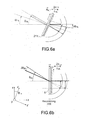
- FIGS. 6 a and 6 b schematically illustrate the graphical determination of the angles of diffraction on a compensating DOE ( FIG. 6 a ) and on the combining DOE ( FIG. 6 b ) for two different wavelengths
- FIG. 7 illustrates an exemplary calculation of the angles of incidence and of inclination of the compensation gratings for optimization of the overlap of the pulses on the combining DOE and compensation of the chromatic dispersion
- FIGS. 8 a and 8 b show two exemplary embodiments of a system for the spatial recombining of beams according to the invention, with compensating DOEs disposed in one and the same plane when the chromatic compensation ( FIG. 8 b ) or the compensation of the overlap defect ( FIG. 8 a ) is favored.
- FIG. 9 shows a third exemplary embodiment of a system for the spatial recombining of beams according to the invention, with another Fourier lens.
- a recombining system using an optical diffractive element DOE which ensures the constructive interference of all the pulses along a single direction of propagation, and destructive along all others, could be an excellent candidate for recombining a large number of pulses, but it suffers from two major problems in the ultra-short pulse regime:
- the defect of spatial overlap of the pulses at the level of the DOE on account of the distribution of the angles of incidence of the beams.
- the system according to the invention comprises a compensating configuration, the technical effect of which is to realize the conditions illustrated in FIG. 3 , that is to say:
- the red and blue components of the spectrum of the pulse must arrive with different angles of incidence on the combining DOE 1 , calculated in such a way that the wave vectors on exiting this combining DOE are all along the z axis of the figure, whatever the wavelength;
- the spatial distribution of energy at a set instant must be parallel to the combining DOE 1 , i.e. parallel to the yOx plane of the figure, this being so as to optimize the spatial overlap of the pulses on the combining DOE.
- This compensating configuration 2 is described in conjunction with FIGS. 4 and 5 a , 5 b and 5 c.
- a first diffractive compensating assembly 21 is imaged on the combining DOE 1 by an imaging device.
- This imaging device comprises:
- This array 22 of lenses forms with the Fourier lens 23 a double-FT setup of predetermined magnification ⁇ , able to image the diffractive optical compensating assembly 21 on the recombining diffractive optical element 1 : the diffractive optical compensating assembly 21 is situated in the object plane of the array of lenses 22 , the recombining DOE 1 being situated in the image plane of the Fourier lens 23 , the image plane of the array of lenses 22 coinciding with the object plane of the Fourier lens 23 .
- This diffractive compensating assembly 21 is subdivided into N compensating DOEs also spaced apart by P A , each compensating DOE 211 comprising a periodic phase and/or amplitude grating of spacing ⁇ 1k .
- the optical beams arising from the pulse laser sources S k are collimated upstream of the system (they are for example situated in a plane and collimated by a lens, or positioned directly according to their angle of incidence ⁇ 1k with a collimating lens associated with each source), and each beam arrives with a specific angle ⁇ 1k on the corresponding compensating DOE 211 .
- the middles of these DOEs 211 are situated on one and the same plane situated at f 1 of the array 22 of lenses.
- angles ⁇ 2k are also related to the period of the grating of the combining DOE 1 so as to obtain the desired optimal combining.
- the angle of inclination (in the plane xOz) of the energy distribution of the pulses before the lens 23 must equal ⁇ 2k .
- each compensating DOE 211 comprises a grating of uniform spacing ⁇ k , and that its normal is inclined by an angle ⁇ k with respect to the desired direction of propagation on exiting the DOE 211 (z axis in FIGS. 5 a , 5 b , 5 c ).
- the angle between the direction of incidence of the source S k and the desired direction of propagation on exit from the DOE is designated by ⁇ 1k .
- ⁇ 1k designates the angle on exit from the compensating DOE 211 , between the spatial distribution of energy of the pulse and the axis of propagation of the pulse.
- tan ⁇ ( ⁇ 1 ⁇ k ) sin ⁇ ⁇ ( ⁇ 1 ⁇ k - ⁇ 1 ⁇ k ) cos ⁇ ( ⁇ 1 ⁇ k ) + tan ⁇ ⁇ ( ⁇ 1 ⁇ k )
- the spacing ⁇ 1k of its grating is established as a function of the direction of incidence ⁇ 1k , of the direction of inclination of the grating, and of the wavelength ⁇ 0 by:
- ⁇ 1 ⁇ k ⁇ 0 sin ⁇ ( ⁇ 1 ⁇ k - ⁇ k ) + sin ⁇ ( ⁇ k )
- the combining DOE is considered to be the superposition of N sinusoidal gratings (N being the number of beams to be combined), of spacing ⁇ 2k given by:
- the period of the grating of the combining DOE is therefore equal to: ⁇ 0 /sin ⁇ 21 .
- the chromatic dispersion of the combining DOE 1 is therefore equal to:
- the spacing of the compensation grating ⁇ 1k is established as a function of the direction of incidence ⁇ 1k , of the direction of inclination of the grating, and of the wavelength ⁇ 0 by:
- ⁇ 1 ⁇ k ⁇ 0 sin ⁇ ( ⁇ 1 ⁇ k - ⁇ k ) + sin ⁇ ( ⁇ k )
- ⁇ 1 ⁇ k ⁇ ⁇ 0 ⁇ ( tan ⁇ ( ⁇ k ) + sin ⁇ ( ⁇ 1 ⁇ k ) cos ⁇ ⁇ ⁇ k )
- the angular dispersion of the compensating DOE 211 is therefore equal to:
- the chromatic compensation condition is deduced from the calculation of the angular magnification of the off-centered imaging device of transverse magnification ⁇ such as that of the system described in FIG. 5 a .
- the following condition is therefore obtained:
- FIG. 7 represents the values of angle of incidence ⁇ 1k ⁇ k on the compensating DOEs and the angles of inclination ⁇ k of the compensating DOEs 211 , which satisfy the above system, and therefore ensure simultaneous compensation of the effects of chromatic dispersion of the combining DOE 1 and the defect of spatial overlap of the pulses on the combining DOE.
- the compensating DOEs 211 are situated on one and the same plane, thereby simplifying the system and avoiding notably devices for orienting each DOE 211 which are bulky and increase the cost of the overall system.
- the angle of incidence ⁇ 1k of the beam is such that:
- the gratings of the compensating DOEs are advantageously blazed phase gratings.
- they may be phase gratings with sinusoidal continuous profile, with binary profile, or intensity gratings with binary profile (black and white) or ne gray levels. All these examples, except blazed gratings, exhibit multiple diffraction orders and therefore penalize the overall efficiency of the system.
- the combining DOE 1 and compensating DOE 211 operate in transmission; the principle of the system according to the invention remains valid when using DOEs in reflection.
Landscapes
- Physics & Mathematics (AREA)
- Electromagnetism (AREA)
- Optics & Photonics (AREA)
- Engineering & Computer Science (AREA)
- Plasma & Fusion (AREA)
- General Physics & Mathematics (AREA)
- Diffracting Gratings Or Hologram Optical Elements (AREA)
- Lasers (AREA)
Abstract
A system based on recombination by superposition using a diffractive optical element DOE to combine the beams is provided. An optical diffractive assembly is placed upstream of a diffractive optical element to make it possible, via an appropriate imaging system, to optimize the combining efficiency in the ultra-short pulse regime.
Description
This application is a National Stage of International patent application PCT/EP2015/061536, filed on May 26, 2015, which claims priority to foreign French patent application No. FR 1401219, filed on May 28, 2014, the disclosures of which are incorporated by reference in their entirety.
The field of the invention is that of the coherent recombining of a large number of ultra-short pulse laser sources, that is to say with pulse width of less than a picosecond. The framework of the invention relates to the technique of the spatial recombining of these laser pulses, assumed to be perfectly synchronized otherwise.
Coherent recombination of ultra-short pulse laser sources applies notably to the realization of high-energy laser sources.
Methods for spatially recombining coherent beams fall into 2 categories, depending on whether one chooses to juxtapose the optical beams in the far field or to superpose them in the near field, that is to say at the level of the exit pupil of the system.
A system for recombining by juxtaposition is shown in FIG. 1a . In this case, the beams to be recombined, arising from laser sources Fk, k varying from 0 to N, are parallel and collimated in the near field by an array of collimating lenses MLC, and are disposed alongside one another, in the most compact manner possible. The superposition of the beams is then performed by free propagation up to the far field. Such a system does not involve any dispersive hardware components and therefore applies equally for pulse widths of less than a picosecond. However, the major drawback of this system is its relatively low efficiency, with notably an appreciable share of the energy lost in the grating lobes.
In the case of a near-field superposition system, it is for example possible to recombine the optical beams by using the polarization of the electromagnetic field: the optical beams arising from the laser sources Fk and collimated by collimating lenses CLk are superposed in the near field by means of polarization-splitter cubes PBSk respectively associated with half-wave plates HWPk, as illustrated by the example of FIG. 1b . According to this system the recombining efficiency for N beams is given by:
where η is the coefficient of transmission of each pair (polarization-splitter cube/half-wave plate). The advantage of this architecture is its relative simplicity of implementation for a reduced number of beams to be recombined: typically about ten at the maximum. For a large number of beams, on the one hand the implementation of the system becomes very complex, and on the other hand, the recombining efficiency drops rapidly with the number of sources (for η=99%, the efficiency drops to 10% for 1000 recombined beams).
Whether involving recombination in the far field by free propagation of collimated and parallel beams, or superposition of the near-field beams by using a splitter plate or a polarization-splitter cube, none of these systems is suitable for recombining a large number of pulses (typically >100 or indeed 1000), i.e. due to problems of efficiency (grating lobes for the far-field device), or of implementation for near-field systems.
Another technique for recombining by superposition uses a diffractive optical element to combine the beams. According to this technique illustrated in FIG. 1c , a lens 23 in a Fourier-transform setup makes it possible to collimate the beams to be recombined (arising from the laser sources Fk) and to direct them toward a diffractive optical element or DOE 1 situated in the focal plane of the lens 23. The spatial distribution of the source points in the object plane A of the lens 23 (periodic distribution of period PA) is transformed into a distribution of angles of incidence on the optical element DOE 1. The optical element 1 is typically a periodic phase grating, for example of Damann grating type, which ensures the constructive interference of all the incident beams on the order 0, and destructive on all the other orders; the period Λ of this grating and the angles of incidence θ2k are related by the known formula for diffraction gratings:
The advantages of this architecture are notably a high efficiency (beyond 90% demonstrated in the continuous regime), and an architecture that is well suited to a very large number of beams (typically >100) on account of this collective positioning, of a possible two-dimensional arrangement, and of the use of a single lens. On the other hand, this technique may not apply as is in the ultra-short pulse regime.
The technical problem to be solved consists in transferring as efficiently as possible the energy of each of the laser pulses to a single pulse by a coherent process, while degrading the beam quality of the final pulse as little as possible with respect to the elementary pulses, while being compatible with a large number of summed pulses, and also sub-picosecond pulse duration.
The proposed solution is based on recombination by superposition using a diffractive optical element DOE to combine the beams. According to the invention, an optical diffractive assembly is placed upstream of this diffractive optical element so as to make it possible, via an appropriate imaging system, to optimize the combining efficiency in the ultra-short pulse regime.
More precisely the subject of the invention is a system for the spatial recombining of pulse laser beams of the same wavelength centered around λ0, arising from N synchronized sources k, k varying from 1 to N, N being an integer >1, which has an optical axis and comprises:
a Fourier lens of focal length f2, of predefined object plane and predefined image plane, the laser beams exhibiting at λ0 a periodic spatial configuration of spacing PA, in the object plane (plane A),
a recombining diffractive optical element with periodic phase profile, on which the N beams are intended to be directed by the Fourier lens according to an angle of incidence θ2k that differs from one beam to the next, these angles of incidence being determined as a function of the period of the recombining diffractive optical element.
It is mainly characterized in that the sources are able to emit pulses of duration of less than 10−12 s, and in that it comprises:
N compensating diffractive optical elements (DOEs) with periodic grating with one compensating diffractive optical element per source, an angle of incidence θ1k that differs from one beam to the next, and a grating spacing Λ1k that differs between neighboring compensating diffractive optical elements,
an array of lenses with one lens per source, of predefined object plane and predefined image plane, forming with the Fourier lens a double-FT setup of predetermined magnification γ, able to image each compensating diffractive optical element on the recombining diffractive optical element, the compensating DOE being situated in the object plane of the array of lenses, the recombining DOE being situated in the image plane of the Fourier lens, the image plane of the array of lenses coinciding with the object plane of the Fourier lens,
and in that for each compensating DOE, the angle of incidence θ1k of the beam on the compensating DOE, the angle of inclination Θk of the compensating DOE on the optical axis, and the spacing Λ1k of its grating, are determined on the basis of the spacing PA, of k, of λ0, of the magnification γ, of the focal length f2 and of the period of the recombining diffractive optical element.
According to one embodiment of the invention, the angles of inclination Θk of the compensating DOEs are zero, the DOEs being situated in one and the same plane.
The sources can be disposed according to a one-dimensional or two-dimensional spatial configuration.
Preferably, the compensating DOE gratings are blazed gratings.
According to a characteristic of the invention, the beams arising from the laser sources have one and the same exit plane, and the system comprises another Fourier lens having an object plane in which the exit plane of the laser sources and an image plane of the laser sources is situated. The position of the image plane of this lens with respect to the plane in which the assembly of the compensating diffractive optical elements is situated, as well as the separation of the sources in the object plane of the lens, are determined as a function of the focal length of the Fourier lens, of the period PA, and of the angles θ1k.
Other characteristics and advantages of the invention will become apparent on reading the detailed description which follows, given by way of nonlimiting example and with reference to the appended drawings in which:
From one figure to the next, the same elements are tagged by the same references.
The description is given with reference to the orientation of the figures described. Insofar as the system can be positioned according to other orientations, the directional terminology is indicated by way of illustration and is not limiting.
When the system is aimed at recombining pulse laser sources, with a pulse width of typically less than 1 picosecond, two difficulties occur in setting up the recombining system with a DOE such as described in FIG. 2a-2c :
-
- The first difficulty is related to the spectral width of the pulses (typically of the order of Δλ=10 nm for Δt˜100·10-15 s). The
diffractive element 1 is specified and produced for a given operating wavelength. However, a spectral width of the order of 10 nm does not substantially affect the efficiency of recombination of the DOE (typically an efficiency loss of a few % for a spectral width of 10 nm). The angular dispersion δθ0 of the DOE is on the other hand more problematic (the blue component of the spectrum of the pulse will exit the DOE with a different angle from the red component, as illustrated inFIG. 2a ). - This effect is on the one hand detrimental to the spatial quality of the recombined beam by increasing its divergence and on the other hand degrades the spatial dispersion of the beam and temporally widens the pulse.
- The second difficulty is related to the spatial overlap of short pulses having different angles of incidence on the DOE. This effect is illustrated in
FIG. 2b and is related to the limited spatial extent of the pulses: limited to 2ω (at 1/e2) transversely to the direction of propagation of the light, and limited to c.Δt in the direction of propagation of the light (c the speed of light, and Δt the duration of the pulse). There is perfect overlap of the pulses for a zero angle between the directions of propagation, and an overlap which decreases as this angle increases. In the application illustrated inFIG. 1c for a numerical aperture equal to 1, the angle between the directions of propagation depends on the focal length of theFourier lens 23 used, which is equal at the minimum to the size of the total pupil in the plane A i.e. the product of the number of channels (one-dimensional, or according to a diameter of the pattern of disposition of the laser sources) multiplied by the spacing between 2 consecutive sources in the plane A.FIG. 2c gives the coefficient of overlap between the pulses (of duration 300 10-15 s) calculated as a function of the size of the pupil in the plane A for the best value of focal length of the Fourier lens. This calculation clearly illustrate the impossibility of efficiently using the architecture such as shown inFIG. 1c in the short-pulse regime (<10-12 s) for a number of channels of typically greater than 10 (on one dimension).
- The first difficulty is related to the spectral width of the pulses (typically of the order of Δλ=10 nm for Δt˜100·10-15 s). The
Finally, a recombining system using an optical diffractive element DOE, which ensures the constructive interference of all the pulses along a single direction of propagation, and destructive along all others, could be an excellent candidate for recombining a large number of pulses, but it suffers from two major problems in the ultra-short pulse regime:
the problem related to the spectral width of the pulses, and
the defect of spatial overlap of the pulses at the level of the DOE, on account of the distribution of the angles of incidence of the beams.
The system according to the invention comprises a compensating configuration, the technical effect of which is to realize the conditions illustrated in FIG. 3 , that is to say:
on the one hand, the red and blue components of the spectrum of the pulse must arrive with different angles of incidence on the combining DOE 1, calculated in such a way that the wave vectors on exiting this combining DOE are all along the z axis of the figure, whatever the wavelength;
on the other hand, whatever the angle of incidence of the pulse on the combining DOE, the spatial distribution of energy at a set instant must be parallel to the combining DOE 1, i.e. parallel to the yOx plane of the figure, this being so as to optimize the spatial overlap of the pulses on the combining DOE.
This compensating configuration 2 is described in conjunction with FIGS. 4 and 5 a, 5 b and 5 c.
A first diffractive compensating assembly 21 is imaged on the combining DOE 1 by an imaging device. This imaging device comprises:
an array 22 of M lenses (one lens per beam) of focal lengths f1 spaced apart by the spacing PA, PA being the spatial period of the beams at λ0 in the plane A, and
the Fourier lens 23 of focal length f2, and of aperture at least equal to N×f1, N being the number of laser sources (along the dimension represented in FIG. 5a ).
This array 22 of lenses forms with the Fourier lens 23 a double-FT setup of predetermined magnification γ, able to image the diffractive optical compensating assembly 21 on the recombining diffractive optical element 1: the diffractive optical compensating assembly 21 is situated in the object plane of the array of lenses 22, the recombining DOE 1 being situated in the image plane of the Fourier lens 23, the image plane of the array of lenses 22 coinciding with the object plane of the Fourier lens 23.
This diffractive compensating assembly 21 is subdivided into N compensating DOEs also spaced apart by PA, each compensating DOE 211 comprising a periodic phase and/or amplitude grating of spacing Λ1k. The optical beams arising from the pulse laser sources Sk are collimated upstream of the system (they are for example situated in a plane and collimated by a lens, or positioned directly according to their angle of incidence θ1k with a collimating lens associated with each source), and each beam arrives with a specific angle θ1k on the corresponding compensating DOE 211. Each spacing Λ1k is calculated as a function of the angle of incidence θ1k of the beam on the corresponding compensating DOE and of the angle of inclination Θk of the compensating DOE on the z axis (we have Λ1(k−1)≠Λ1k≠Λ1(k+1), but Λ1(−k)=Λ1(+k)), so that at the central wavelength λ0, all the laser beams are parallel on exiting the compensating DOEs, that is to say that at the central wavelength λ0, the wave vectors {right arrow over (K)}i,1 of the pulses exiting the compensating DOEs are all identical. The middles of these DOEs 211 are situated on one and the same plane situated at f1 of the array 22 of lenses.
The Fourier lens 23 operates the Fourier transform from the plane A to the plane of the combining DOE 1; therefore the angles of incidences θ2k of the pulses on the combining DOE are given by:
θ2k =k·P A /f 2.
θ2k =k·P A /f 2.
As indicated in the preamble, these angles θ2k are also related to the period of the grating of the combining DOE 1 so as to obtain the desired optimal combining.
As shown in FIG. 5a , so that the spatial distributions of energy of the incident pulses on the combining DOE 1 are parallel to the plane of the combining DOE (the plane xOy in the figure), the angle of inclination (in the plane xOz) of the energy distribution of the pulses before the lens 23 must equal θ2k. For optimal overlap of the pulses at the level of the combining DOE 1, the imaging device consisting of the array of lenses 22 and of the Fourier lens 23, of magnification γ=−f2/f1, then imposes the following condition on the angle of inclination of the spatial distributions of energy φ1k on exiting each compensating DOE 211:
tan(φ1k)=γ tan(θ2k)
tan(φ1k)=γ tan(θ2k)
Moreover, it is considered that each compensating DOE 211 comprises a grating of uniform spacing Λk, and that its normal is inclined by an angle Θk with respect to the desired direction of propagation on exiting the DOE 211 (z axis in FIGS. 5a, 5b, 5c ). The angle between the direction of incidence of the source Sk and the desired direction of propagation on exit from the DOE is designated by θ1k. Finally φ1k designates the angle on exit from the compensating DOE 211, between the spatial distribution of energy of the pulse and the axis of propagation of the pulse. The wave vectors on entry to and on exit from the compensating DOE 211 are not parallel (except for the compensating DOE which is not inclined, that is to say such that: Θ0=0); the angles Θk, θ1k and φ1k are linked by:
Optimization of the spatial overlap of the pulses at the level of the combining DOE implies:
This giving a first relation between the parameters dimensioning the system:
-
- the spatial period PA of the source points in the plane A,
- the index k of the source,
- the central wavelength of the pulses λ0,
- the magnification γ of the imaging device,
- the focal length f2 of the
Fourier lens 23.
Moreover, as illustrated in FIG. 5c , for each compensating DOE 211, the spacing Λ1k of its grating is established as a function of the direction of incidence θ1k, of the direction of inclination of the grating, and of the wavelength λ0 by:
Finally, the optimization of the spatial overlap of the pulses at the level of the recombining DOE 1 is ensured by means of the system described in FIGS. 4 and 5 a if the following relations between the parameters of the system are satisfied:
Compensation of the chromatic dispersion is now considered.
To a first approximation, the combining DOE is considered to be the superposition of N sinusoidal gratings (N being the number of beams to be combined), of spacing Λ2k given by:
The period of the grating of the combining DOE is therefore equal to:
λ0/sin θ21.
λ0/sin θ21.
With θ2k the angle of incidence of the beam of index k on the combining DOE 1, at the central wavelength λ0. To deal with the compensation of the chromatic dispersion for the beam indexed k, only the grating indexed k is considered. A beam is considered at a wavelength λ0+δλ0 incident on the combining DOE 1 with an angle θ2k+δθ2k. As illustrated in FIG. 6b , in order for the beams diffracted by the DOE 1 at λ0 and at λ0+δλ0 to have parallel directions of propagation (or wave vectors), conservation of the component tangential to the plane of the DOE of the wave vector implies:
The chromatic dispersion of the combining DOE 1 is therefore equal to:
Likewise, for the compensating DOE 211, it was seen that the spacing of the compensation grating Λ1k is established as a function of the direction of incidence θ1k, of the direction of inclination of the grating, and of the wavelength λ0 by:
Calculation of the angular disparity δθ1k between the wave vectors diffracted by the compensating DOE 211 at the wavelengths λ0 and at λ0+δλ0 and illustrated in FIG. 6a gives:
The angular dispersion of the compensating DOE 211 is therefore equal to:
The chromatic compensation condition is deduced from the calculation of the angular magnification of the off-centered imaging device of transverse magnification γ such as that of the system described in FIG. 5a . The following condition is therefore obtained:
Finally, compensation of the chromatic dispersion of the combining DOE 1 is ensured by means of the device described in FIGS. 4 and 5 a if the following relations are satisfied:
According to the conditions established in the previous sections, simultaneous compensation of the chromatic dispersion of the combining DOE 1 and of the defect of spatial overlap of the pulses at the level of the combining DOE 1 is ensured by means of the device described in FIGS. 4 and 5 a if the following relations are satisfied:
Let us consider the example of the following case:
One wishes to combine 101 ultra-short (300 ps) pulse sources disposed in line according to a period PA of 2 mm (NB: the following calculation is equivalent for a in 2-dimensional disposition with 101 sources on the largest diameter, i.e. 7651 sources in a hexagonal tiling).
The magnification of the imaging system is fixed at γ=−5.
The central wavelength equals λ0=1030 nm.
According to a particular embodiment of the invention an example of which is shown in FIGS. 8a and 8b , the compensating DOEs 211 are situated on one and the same plane, thereby simplifying the system and avoiding notably devices for orienting each DOE 211 which are bulky and increase the cost of the overall system. Such is the case when the gratings are for example fabricated on one and the same support, thus exhibiting advantages in terms of time and cost of fabrication. This is then manifested in the previous relations by zero angles of inclination Θk of the compensating DOEs: Θk=0.
Then for each compensating DOE 211, the angle of incidence θ1k of the beam is such that:
-
- γ·tan(k PA/f2)=sin(θ1k), when one wishes to favor compensation of the defect of overlap of the recombined pulses to the detriment of chromatic compensation (
FIG. 8a ), or - γ·tan(k PA/f2)(1+tan(k PA/f2)2)=sin(θ1k), when one wishes to favor chromatic compensation of the recombined pulses to the detriment of compensation of the overlap defect (
FIG. 8b ). According to another embodiment of the invention (FIG. 9 ), the beams arising from the laser sources have one and the same exit plane, and the system comprises anotherFourier lens 24 having an object plane in which the exit plane of the laser sources is situated.
- γ·tan(k PA/f2)=sin(θ1k), when one wishes to favor compensation of the defect of overlap of the recombined pulses to the detriment of chromatic compensation (
The gratings of the compensating DOEs are advantageously blazed phase gratings. Alternatively, they may be phase gratings with sinusoidal continuous profile, with binary profile, or intensity gratings with binary profile (black and white) or ne gray levels. All these examples, except blazed gratings, exhibit multiple diffraction orders and therefore penalize the overall efficiency of the system.
In the examples of the figures, the combining DOE 1 and compensating DOE 211 operate in transmission; the principle of the system according to the invention remains valid when using DOEs in reflection.
Claims (8)
1. A system for the spatial recombining of pulse laser beams of the same wavelength centered around λ0, arising from N synchronized sources k, k varying from 1 to N, N being an integer >1, which has an optical axis and comprises:
a Fourier lens of focal length f2, of predefined object plane and predefined image plane, the laser beams exhibiting at λ0 a periodic spatial configuration of spacing PA in the object plane (plane A),
a recombining diffractive optical element with periodic phase profile, on which the N beams are intended to be directed by the Fourier lens according to an angle of incidence θ2k that differs from one beam to the next, these angles of incidence being determined as a function of the period of the recombining diffractive optical element,
wherein the sources are able to emit pulses of duration less than 10−12 s, and comprising:
N compensating diffractive optical elements with periodic grating with one compensating diffractive optical element per source, an angle of incidence θ1k that differs from one beam to the next, and a grating spacing Λ1k that differs between neighboring compensating diffractive optical elements,
an array of lenses with one lens per source, of predefined object plane and predefined image plane, forming with the Fourier lens a double-FT setup of predetermined magnification γ, able to image each compensating diffractive optical element on the recombining diffractive optical element, the compensating diffractive optical elements being situated in the object plane of the array of lenses, the recombining diffractive optical element being situated in the image plane of the Fourier lens, the image plane of the array of lenses coinciding with the object plane of the Fourier lens,
and wherein for each compensating diffractive optical element, the angle of incidence θ1kof the beam on the compensating diffractive optical element, an angle of inclination Θk of the compensating diffractive optical element on the optical axis, and the spacing Λ1k of its grating, are determined on the basis of
2. The spatial recombining system as claimed in claim 1 , wherein the angles of inclination Θk of the compensating diffractive optical elements are zero, and in that they are situated in one and the same plane.
3. The spatial recombining system as claimed in claim 2 , wherein for each compensating diffractive optical element, the angle of incidence θ1k of the beam is such that:
γ·tan(k P A /f 2)=sin(θ1k).
γ·tan(k P A /f 2)=sin(θ1k).
4. The spatial recombining system as claimed in claim 2 , wherein for each compensating diffractive optical element, the angle of incidence θ1k of the beam is such that:
γ·tan(k P A /f 2)(1 +tan(k P A /f 2)2)=sin(θ1k).
γ·tan(k P A /f 2)(1 +tan(k P A /f 2)2)=sin(θ1k).
5. The spatial recombining system as claimed in claim 1 , wherein the sources are disposed according to a one-dimensional or two-dimensional spatial configuration.
6. The spatial recombining system as claimed in claim 5 , wherein the beams arising from the laser sources having one and the same exit plane, the spatial recombining system further comprising another Fourier lens that differs from the Fourier lens, the other Fourier lens having an object plane in which the exit plane of the laser sources is situated.
7. The spatial recombining system as claimed in claim 1 , wherein N>100.
8. The spatial recombining system as claimed in claim 1 , wherein the gratings of the compensating diffractive optical elements are blazed gratings.
Applications Claiming Priority (3)
| Application Number | Priority Date | Filing Date | Title |
|---|---|---|---|
| FR1401219A FR3021760B1 (en) | 2014-05-28 | 2014-05-28 | SPACE RECOMBINATION SYSTEM OF LASER PULSES ULTRA-BRATED BY A DIFFRACTIVE ELEMENT |
| FR1401219 | 2014-05-28 | ||
| PCT/EP2015/061536 WO2015181137A1 (en) | 2014-05-28 | 2015-05-26 | System for spatial recombination of ultrashort laser pulses by means of a diffractive element |
Publications (2)
| Publication Number | Publication Date |
|---|---|
| US20170199390A1 US20170199390A1 (en) | 2017-07-13 |
| US10126559B2 true US10126559B2 (en) | 2018-11-13 |
Family
ID=51610151
Family Applications (1)
| Application Number | Title | Priority Date | Filing Date |
|---|---|---|---|
| US15/313,028 Active US10126559B2 (en) | 2014-05-28 | 2015-05-26 | System for spatial recombination of ultrashort laser pulses by means of a diffractive element |
Country Status (11)
| Country | Link |
|---|---|
| US (1) | US10126559B2 (en) |
| EP (1) | EP3149524B1 (en) |
| JP (1) | JP6577492B2 (en) |
| KR (1) | KR102342129B1 (en) |
| CN (1) | CN106662752B (en) |
| DK (1) | DK3149524T3 (en) |
| FR (1) | FR3021760B1 (en) |
| HU (1) | HUE054668T2 (en) |
| IL (1) | IL249157B (en) |
| LT (1) | LT3149524T (en) |
| WO (1) | WO2015181137A1 (en) |
Families Citing this family (3)
| Publication number | Priority date | Publication date | Assignee | Title |
|---|---|---|---|---|
| US10444526B2 (en) * | 2016-08-01 | 2019-10-15 | The Regents Of The University Of California | Optical pulse combiner comprising diffractive optical elements |
| CN109346849B (en) * | 2018-09-06 | 2021-01-08 | 中国科学院国家空间科学中心 | Device for generating millimeter wave Bessel wave beam |
| CN112558314B (en) * | 2020-12-01 | 2022-10-25 | 中国空间技术研究院 | Laser Array Beamsplitter and Grating Design Method |
Citations (5)
| Publication number | Priority date | Publication date | Assignee | Title |
|---|---|---|---|---|
| US6570896B2 (en) * | 1999-10-07 | 2003-05-27 | Deutsches Zentrum Fuer Luft-Und Raumfahrt E.V. | Laser radiation source and process for generating a coherent total laser radiation field |
| DE102010033630A1 (en) | 2009-08-07 | 2011-02-10 | Northrop Grumman Systems Corporation, Los Angeles | Fiber amplifying system i.e. high-power fiber laser amplifier, for use in e.g. industrial application, has end plate expanding output beam of fiber bundle, and beam sampler sampling part of output beam of plate and generating sampled beam |
| US7924894B2 (en) * | 2008-01-18 | 2011-04-12 | Northrop Grumman Systems Corporation | Digital piston error control for high-power laser system employing diffractive optical element beam combiner |
| US20110305250A1 (en) * | 2010-03-05 | 2011-12-15 | TeraDiode, Inc. | Wavelength beam combining based pulsed lasers |
| US8179594B1 (en) | 2007-06-29 | 2012-05-15 | Lockheed Martin Corporation | Method and apparatus for spectral-beam combining of fanned-in laser beams with chromatic-dispersion compensation using a plurality of diffractive gratings |
-
2014
- 2014-05-28 FR FR1401219A patent/FR3021760B1/en active Active
-
2015
- 2015-05-26 WO PCT/EP2015/061536 patent/WO2015181137A1/en not_active Ceased
- 2015-05-26 CN CN201580040988.7A patent/CN106662752B/en active Active
- 2015-05-26 KR KR1020167036622A patent/KR102342129B1/en active Active
- 2015-05-26 LT LTEP15725589.4T patent/LT3149524T/en unknown
- 2015-05-26 US US15/313,028 patent/US10126559B2/en active Active
- 2015-05-26 DK DK15725589.4T patent/DK3149524T3/en active
- 2015-05-26 EP EP15725589.4A patent/EP3149524B1/en active Active
- 2015-05-26 JP JP2016569836A patent/JP6577492B2/en active Active
- 2015-05-26 HU HUE15725589A patent/HUE054668T2/en unknown
-
2016
- 2016-11-23 IL IL249157A patent/IL249157B/en active IP Right Grant
Patent Citations (5)
| Publication number | Priority date | Publication date | Assignee | Title |
|---|---|---|---|---|
| US6570896B2 (en) * | 1999-10-07 | 2003-05-27 | Deutsches Zentrum Fuer Luft-Und Raumfahrt E.V. | Laser radiation source and process for generating a coherent total laser radiation field |
| US8179594B1 (en) | 2007-06-29 | 2012-05-15 | Lockheed Martin Corporation | Method and apparatus for spectral-beam combining of fanned-in laser beams with chromatic-dispersion compensation using a plurality of diffractive gratings |
| US7924894B2 (en) * | 2008-01-18 | 2011-04-12 | Northrop Grumman Systems Corporation | Digital piston error control for high-power laser system employing diffractive optical element beam combiner |
| DE102010033630A1 (en) | 2009-08-07 | 2011-02-10 | Northrop Grumman Systems Corporation, Los Angeles | Fiber amplifying system i.e. high-power fiber laser amplifier, for use in e.g. industrial application, has end plate expanding output beam of fiber bundle, and beam sampler sampling part of output beam of plate and generating sampled beam |
| US20110305250A1 (en) * | 2010-03-05 | 2011-12-15 | TeraDiode, Inc. | Wavelength beam combining based pulsed lasers |
Also Published As
| Publication number | Publication date |
|---|---|
| LT3149524T (en) | 2021-06-25 |
| KR20170012446A (en) | 2017-02-02 |
| HUE054668T2 (en) | 2021-09-28 |
| EP3149524B1 (en) | 2021-02-17 |
| DK3149524T3 (en) | 2021-05-03 |
| KR102342129B1 (en) | 2021-12-21 |
| EP3149524A1 (en) | 2017-04-05 |
| FR3021760B1 (en) | 2016-07-01 |
| JP2017518642A (en) | 2017-07-06 |
| CN106662752B (en) | 2019-05-21 |
| IL249157A0 (en) | 2017-01-31 |
| JP6577492B2 (en) | 2019-09-18 |
| FR3021760A1 (en) | 2015-12-04 |
| WO2015181137A1 (en) | 2015-12-03 |
| CN106662752A (en) | 2017-05-10 |
| IL249157B (en) | 2020-10-29 |
| US20170199390A1 (en) | 2017-07-13 |
Similar Documents
| Publication | Publication Date | Title |
|---|---|---|
| US7948680B2 (en) | Spectral beam combination using broad bandwidth lasers | |
| DE102019118010B4 (en) | STRUCTURED LIGHT PROJECTOR AND METHOD FOR MAKING SAME | |
| CN111190246B (en) | System and method for aberration correction in optical systems | |
| JP2013521667A (en) | Selective rearrangement and rotation wavelength beam combining system and method | |
| US9759924B2 (en) | Flat profile laser beam shaper | |
| JP2004536350A (en) | Diffraction shaping of the intensity distribution of a spatially partially coherent light beam | |
| US10983262B2 (en) | Rotational geometric phase hologram with application for fabricating geometric phase optical element | |
| US10126559B2 (en) | System for spatial recombination of ultrashort laser pulses by means of a diffractive element | |
| CN102841451A (en) | Device for generating vector light beam through annular combination half wave plate | |
| US20070217740A1 (en) | Method and apparatus for optimizing the target intensity distribution transmitted from a fiber coupled array | |
| US7548375B2 (en) | Method and device for influencing light | |
| TWI485431B (en) | Apparatus for homogenizing coherent radiation | |
| Kamali et al. | Dielectric metasurfaces with independent angular control | |
| Pala et al. | Application of holographic diffractive doublets as collimators for highly elliptical light beams edge emitted from diode lasers | |
| CN114813050A (en) | Multimode blue light single tube laser mode measuring device | |
| Liu et al. | Optical Design and Beam Shaping in High Power Semiconductor Lasers | |
| Sales | Uniform and efficient illumination with saddle lenses | |
| Vyas et al. | Exotic vortex beam shapes for optical traps | |
| AU2002210034A1 (en) | Diffractive shaping of the intensity distribution of a spatially partially coherent light beam | |
| JP2016035548A (en) | Diffraction pattern projection optical system |
Legal Events
| Date | Code | Title | Description |
|---|---|---|---|
| AS | Assignment |
Owner name: THALES, FRANCE Free format text: ASSIGNMENT OF ASSIGNORS INTEREST;ASSIGNORS:BOURDERIONNET, JEROME;BRIGNON, ARNAUD;REEL/FRAME:040937/0919 Effective date: 20170109 |
|
| STCF | Information on status: patent grant |
Free format text: PATENTED CASE |
|
| MAFP | Maintenance fee payment |
Free format text: PAYMENT OF MAINTENANCE FEE, 4TH YEAR, LARGE ENTITY (ORIGINAL EVENT CODE: M1551); ENTITY STATUS OF PATENT OWNER: LARGE ENTITY Year of fee payment: 4 |