US10125202B2 - Polymer compound for a conductive polymer and method for producing same - Google Patents
Polymer compound for a conductive polymer and method for producing same Download PDFInfo
- Publication number
- US10125202B2 US10125202B2 US15/230,684 US201615230684A US10125202B2 US 10125202 B2 US10125202 B2 US 10125202B2 US 201615230684 A US201615230684 A US 201615230684A US 10125202 B2 US10125202 B2 US 10125202B2
- Authority
- US
- United States
- Prior art keywords
- group
- polymer
- polymer compound
- conductive polymer
- conductive
- Prior art date
- Legal status (The legal status is an assumption and is not a legal conclusion. Google has not performed a legal analysis and makes no representation as to the accuracy of the status listed.)
- Active
Links
- 229920000642 polymer Polymers 0.000 title claims abstract description 113
- 150000001875 compounds Chemical class 0.000 title claims abstract description 64
- 229920001940 conductive polymer Polymers 0.000 title claims abstract description 50
- 238000004519 manufacturing process Methods 0.000 title description 7
- 125000004435 hydrogen atom Chemical group [H]* 0.000 claims abstract description 15
- 125000002496 methyl group Chemical group [H]C([H])([H])* 0.000 claims abstract description 8
- 239000002019 doping agent Substances 0.000 abstract description 22
- 125000004185 ester group Chemical group 0.000 abstract description 21
- 125000004432 carbon atom Chemical group C* 0.000 abstract description 19
- 125000000020 sulfo group Chemical group O=S(=O)([*])O[H] 0.000 abstract description 19
- 239000000446 fuel Substances 0.000 abstract description 16
- 239000003960 organic solvent Substances 0.000 abstract description 15
- 125000001033 ether group Chemical group 0.000 abstract description 14
- 239000004020 conductor Substances 0.000 abstract description 11
- 125000004957 naphthylene group Chemical group 0.000 abstract description 8
- 125000000843 phenylene group Chemical group C1(=C(C=CC=C1)*)* 0.000 abstract description 8
- 125000000753 cycloalkyl group Chemical group 0.000 abstract description 7
- 125000001183 hydrocarbyl group Chemical group 0.000 abstract 1
- OKKJLVBELUTLKV-UHFFFAOYSA-N Methanol Chemical compound OC OKKJLVBELUTLKV-UHFFFAOYSA-N 0.000 description 54
- 239000000178 monomer Substances 0.000 description 48
- 0 [1*]C(C)(CC)C[2*]C(=O)OC(C)(C)CS(=O)(=O)O Chemical compound [1*]C(C)(CC)C[2*]C(=O)OC(C)(C)CS(=O)(=O)O 0.000 description 25
- XEKOWRVHYACXOJ-UHFFFAOYSA-N Ethyl acetate Chemical compound CCOC(C)=O XEKOWRVHYACXOJ-UHFFFAOYSA-N 0.000 description 21
- 239000000203 mixture Substances 0.000 description 20
- 229910017464 nitrogen compound Inorganic materials 0.000 description 13
- 150000002830 nitrogen compounds Chemical class 0.000 description 13
- XLYOFNOQVPJJNP-UHFFFAOYSA-N water Substances O XLYOFNOQVPJJNP-UHFFFAOYSA-N 0.000 description 13
- DGAQECJNVWCQMB-PUAWFVPOSA-M Ilexoside XXIX Chemical compound C[C@@H]1CC[C@@]2(CC[C@@]3(C(=CC[C@H]4[C@]3(CC[C@@H]5[C@@]4(CC[C@@H](C5(C)C)OS(=O)(=O)[O-])C)C)[C@@H]2[C@]1(C)O)C)C(=O)O[C@H]6[C@@H]([C@H]([C@@H]([C@H](O6)CO)O)O)O.[Na+] DGAQECJNVWCQMB-PUAWFVPOSA-M 0.000 description 12
- WHXSMMKQMYFTQS-UHFFFAOYSA-N Lithium Chemical compound [Li] WHXSMMKQMYFTQS-UHFFFAOYSA-N 0.000 description 12
- ZLMJMSJWJFRBEC-UHFFFAOYSA-N Potassium Chemical compound [K] ZLMJMSJWJFRBEC-UHFFFAOYSA-N 0.000 description 12
- 229910052744 lithium Inorganic materials 0.000 description 12
- 229910052700 potassium Inorganic materials 0.000 description 12
- 239000011591 potassium Substances 0.000 description 12
- 229910052708 sodium Inorganic materials 0.000 description 12
- 239000011734 sodium Substances 0.000 description 12
- 238000000034 method Methods 0.000 description 11
- 238000006116 polymerization reaction Methods 0.000 description 11
- 125000000542 sulfonic acid group Chemical group 0.000 description 10
- ZMXDDKWLCZADIW-UHFFFAOYSA-N N,N-Dimethylformamide Chemical compound CN(C)C=O ZMXDDKWLCZADIW-UHFFFAOYSA-N 0.000 description 9
- 238000005227 gel permeation chromatography Methods 0.000 description 9
- 229920000172 poly(styrenesulfonic acid) Polymers 0.000 description 9
- 229940005642 polystyrene sulfonic acid Drugs 0.000 description 9
- NWUYHJFMYQTDRP-UHFFFAOYSA-N 1,2-bis(ethenyl)benzene;1-ethenyl-2-ethylbenzene;styrene Chemical compound C=CC1=CC=CC=C1.CCC1=CC=CC=C1C=C.C=CC1=CC=CC=C1C=C NWUYHJFMYQTDRP-UHFFFAOYSA-N 0.000 description 8
- PPBRXRYQALVLMV-UHFFFAOYSA-N Styrene Chemical compound C=CC1=CC=CC=C1 PPBRXRYQALVLMV-UHFFFAOYSA-N 0.000 description 8
- WYURNTSHIVDZCO-UHFFFAOYSA-N Tetrahydrofuran Chemical compound C1CCOC1 WYURNTSHIVDZCO-UHFFFAOYSA-N 0.000 description 8
- 150000003863 ammonium salts Chemical class 0.000 description 8
- 239000003456 ion exchange resin Substances 0.000 description 8
- 229920003303 ion-exchange polymer Polymers 0.000 description 8
- ZQMHJBXHRFJKOT-UHFFFAOYSA-N methyl 2-[(1-methoxy-2-methyl-1-oxopropan-2-yl)diazenyl]-2-methylpropanoate Chemical compound COC(=O)C(C)(C)N=NC(C)(C)C(=O)OC ZQMHJBXHRFJKOT-UHFFFAOYSA-N 0.000 description 8
- 150000003839 salts Chemical class 0.000 description 8
- 238000004293 19F NMR spectroscopy Methods 0.000 description 7
- 238000005160 1H NMR spectroscopy Methods 0.000 description 7
- RTZKZFJDLAIYFH-UHFFFAOYSA-N Diethyl ether Chemical compound CCOCC RTZKZFJDLAIYFH-UHFFFAOYSA-N 0.000 description 7
- 238000001816 cooling Methods 0.000 description 7
- 229920001577 copolymer Polymers 0.000 description 7
- 238000001914 filtration Methods 0.000 description 7
- 150000002430 hydrocarbons Chemical group 0.000 description 7
- 239000012299 nitrogen atmosphere Substances 0.000 description 7
- 239000007787 solid Substances 0.000 description 7
- 238000003756 stirring Methods 0.000 description 7
- LFQSCWFLJHTTHZ-UHFFFAOYSA-N Ethanol Chemical compound CCO LFQSCWFLJHTTHZ-UHFFFAOYSA-N 0.000 description 6
- KFZMGEQAYNKOFK-UHFFFAOYSA-N Isopropanol Chemical compound CC(C)O KFZMGEQAYNKOFK-UHFFFAOYSA-N 0.000 description 6
- 238000005342 ion exchange Methods 0.000 description 6
- AGBXYHCHUYARJY-UHFFFAOYSA-N 2-phenylethenesulfonic acid Chemical compound OS(=O)(=O)C=CC1=CC=CC=C1 AGBXYHCHUYARJY-UHFFFAOYSA-N 0.000 description 5
- 229920001400 block copolymer Polymers 0.000 description 5
- 238000012712 reversible addition−fragmentation chain-transfer polymerization Methods 0.000 description 5
- 125000002947 alkylene group Chemical group 0.000 description 4
- 230000006866 deterioration Effects 0.000 description 4
- -1 for example Chemical group 0.000 description 4
- 150000002500 ions Chemical class 0.000 description 4
- 229910003002 lithium salt Inorganic materials 0.000 description 4
- 159000000002 lithium salts Chemical class 0.000 description 4
- ZKIAYSOOCAKOJR-UHFFFAOYSA-M lithium;2-phenylethenesulfonate Chemical compound [Li+].[O-]S(=O)(=O)C=CC1=CC=CC=C1 ZKIAYSOOCAKOJR-UHFFFAOYSA-M 0.000 description 4
- 239000000463 material Substances 0.000 description 4
- 239000007870 radical polymerization initiator Substances 0.000 description 4
- 238000010526 radical polymerization reaction Methods 0.000 description 4
- YLQBMQCUIZJEEH-UHFFFAOYSA-N tetrahydrofuran Natural products C=1C=COC=1 YLQBMQCUIZJEEH-UHFFFAOYSA-N 0.000 description 4
- OZAIFHULBGXAKX-UHFFFAOYSA-N 2-(2-cyanopropan-2-yldiazenyl)-2-methylpropanenitrile Chemical compound N#CC(C)(C)N=NC(C)(C)C#N OZAIFHULBGXAKX-UHFFFAOYSA-N 0.000 description 3
- ZWEHNKRNPOVVGH-UHFFFAOYSA-N 2-Butanone Chemical compound CCC(C)=O ZWEHNKRNPOVVGH-UHFFFAOYSA-N 0.000 description 3
- UHOVQNZJYSORNB-UHFFFAOYSA-N Benzene Chemical compound C1=CC=CC=C1 UHOVQNZJYSORNB-UHFFFAOYSA-N 0.000 description 3
- LSNNMFCWUKXFEE-UHFFFAOYSA-M Bisulfite Chemical compound OS([O-])=O LSNNMFCWUKXFEE-UHFFFAOYSA-M 0.000 description 3
- ZJMWRROPUADPEA-UHFFFAOYSA-N CCC(C)C1=CC=CC=C1.CS(=O)(=O)O Chemical compound CCC(C)C1=CC=CC=C1.CS(=O)(=O)O ZJMWRROPUADPEA-UHFFFAOYSA-N 0.000 description 3
- LYCAIKOWRPUZTN-UHFFFAOYSA-N Ethylene glycol Chemical compound OCCO LYCAIKOWRPUZTN-UHFFFAOYSA-N 0.000 description 3
- DNIAPMSPPWPWGF-UHFFFAOYSA-N Propylene glycol Chemical compound CC(O)CO DNIAPMSPPWPWGF-UHFFFAOYSA-N 0.000 description 3
- YXFVVABEGXRONW-UHFFFAOYSA-N Toluene Chemical compound CC1=CC=CC=C1 YXFVVABEGXRONW-UHFFFAOYSA-N 0.000 description 3
- 125000003342 alkenyl group Chemical group 0.000 description 3
- 125000003545 alkoxy group Chemical group 0.000 description 3
- 125000003710 aryl alkyl group Chemical group 0.000 description 3
- 125000003118 aryl group Chemical group 0.000 description 3
- 125000005355 arylox oalkyl group Chemical group 0.000 description 3
- 125000006165 cyclic alkyl group Chemical group 0.000 description 3
- MTHSVFCYNBDYFN-UHFFFAOYSA-N diethylene glycol Chemical compound OCCOCCO MTHSVFCYNBDYFN-UHFFFAOYSA-N 0.000 description 3
- 125000001072 heteroaryl group Chemical group 0.000 description 3
- 229910052757 nitrogen Inorganic materials 0.000 description 3
- 125000004433 nitrogen atom Chemical group N* 0.000 description 3
- 125000005188 oxoalkyl group Chemical group 0.000 description 3
- 229920000123 polythiophene Polymers 0.000 description 3
- 239000011347 resin Substances 0.000 description 3
- 229920005989 resin Polymers 0.000 description 3
- 239000002904 solvent Substances 0.000 description 3
- 125000002023 trifluoromethyl group Chemical group FC(F)(F)* 0.000 description 3
- FCEHBMOGCRZNNI-UHFFFAOYSA-N 1-benzothiophene Chemical compound C1=CC=C2SC=CC2=C1 FCEHBMOGCRZNNI-UHFFFAOYSA-N 0.000 description 2
- YBYIRNPNPLQARY-UHFFFAOYSA-N 1H-indene Chemical compound C1=CC=C2CC=CC2=C1 YBYIRNPNPLQARY-UHFFFAOYSA-N 0.000 description 2
- YEJRWHAVMIAJKC-UHFFFAOYSA-N 4-Butyrolactone Chemical compound O=C1CCCO1 YEJRWHAVMIAJKC-UHFFFAOYSA-N 0.000 description 2
- LDFQZXFTCLMJBX-UHFFFAOYSA-N 6-cyano-6-propylcyclohexa-2,4-diene-1-carbothioic S-acid Chemical compound CCCC1(C=CC=CC1C(S)=O)C#N LDFQZXFTCLMJBX-UHFFFAOYSA-N 0.000 description 2
- CSCPPACGZOOCGX-UHFFFAOYSA-N Acetone Chemical compound CC(C)=O CSCPPACGZOOCGX-UHFFFAOYSA-N 0.000 description 2
- RGSFGYAAUTVSQA-UHFFFAOYSA-N Cyclopentane Chemical compound C1CCCC1 RGSFGYAAUTVSQA-UHFFFAOYSA-N 0.000 description 2
- IAZDPXIOMUYVGZ-UHFFFAOYSA-N Dimethylsulphoxide Chemical compound CS(C)=O IAZDPXIOMUYVGZ-UHFFFAOYSA-N 0.000 description 2
- PXGOKWXKJXAPGV-UHFFFAOYSA-N Fluorine Chemical compound FF PXGOKWXKJXAPGV-UHFFFAOYSA-N 0.000 description 2
- PEDCQBHIVMGVHV-UHFFFAOYSA-N Glycerine Chemical compound OCC(O)CO PEDCQBHIVMGVHV-UHFFFAOYSA-N 0.000 description 2
- MHAJPDPJQMAIIY-UHFFFAOYSA-N Hydrogen peroxide Chemical compound OO MHAJPDPJQMAIIY-UHFFFAOYSA-N 0.000 description 2
- LRHPLDYGYMQRHN-UHFFFAOYSA-N N-Butanol Chemical compound CCCCO LRHPLDYGYMQRHN-UHFFFAOYSA-N 0.000 description 2
- ICURIFUTRQEJPA-UHFFFAOYSA-N [3,5-bis(1,1,1,3,3,3-hexafluoro-2-hydroxypropan-2-yl)cyclohexyl] 2-methylprop-2-enoate Chemical compound CC(=C)C(=O)OC1CC(C(O)(C(F)(F)F)C(F)(F)F)CC(C(O)(C(F)(F)F)C(F)(F)F)C1 ICURIFUTRQEJPA-UHFFFAOYSA-N 0.000 description 2
- ROOXNKNUYICQNP-UHFFFAOYSA-N ammonium persulfate Chemical compound [NH4+].[NH4+].[O-]S(=O)(=O)OOS([O-])(=O)=O ROOXNKNUYICQNP-UHFFFAOYSA-N 0.000 description 2
- 238000007334 copolymerization reaction Methods 0.000 description 2
- 230000002708 enhancing effect Effects 0.000 description 2
- 229910052731 fluorine Inorganic materials 0.000 description 2
- 239000011737 fluorine Substances 0.000 description 2
- 230000009477 glass transition Effects 0.000 description 2
- 230000001965 increasing effect Effects 0.000 description 2
- BDERNNFJNOPAEC-UHFFFAOYSA-N propan-1-ol Chemical compound CCCO BDERNNFJNOPAEC-UHFFFAOYSA-N 0.000 description 2
- CIHOLLKRGTVIJN-UHFFFAOYSA-N tert‐butyl hydroperoxide Chemical compound CC(C)(C)OO CIHOLLKRGTVIJN-UHFFFAOYSA-N 0.000 description 2
- RYHBNJHYFVUHQT-UHFFFAOYSA-N 1,4-Dioxane Chemical compound C1COCCO1 RYHBNJHYFVUHQT-UHFFFAOYSA-N 0.000 description 1
- LGJCFVYMIJLQJO-UHFFFAOYSA-N 1-dodecylperoxydodecane Chemical compound CCCCCCCCCCCCOOCCCCCCCCCCCC LGJCFVYMIJLQJO-UHFFFAOYSA-N 0.000 description 1
- ARXJGSRGQADJSQ-UHFFFAOYSA-N 1-methoxypropan-2-ol Chemical compound COCC(C)O ARXJGSRGQADJSQ-UHFFFAOYSA-N 0.000 description 1
- IGGDKDTUCAWDAN-UHFFFAOYSA-N 1-vinylnaphthalene Chemical compound C1=CC=C2C(C=C)=CC=CC2=C1 IGGDKDTUCAWDAN-UHFFFAOYSA-N 0.000 description 1
- XMNIXWIUMCBBBL-UHFFFAOYSA-N 2-(2-phenylpropan-2-ylperoxy)propan-2-ylbenzene Chemical compound C=1C=CC=CC=1C(C)(C)OOC(C)(C)C1=CC=CC=C1 XMNIXWIUMCBBBL-UHFFFAOYSA-N 0.000 description 1
- XNWFRZJHXBZDAG-UHFFFAOYSA-N 2-METHOXYETHANOL Chemical compound COCCO XNWFRZJHXBZDAG-UHFFFAOYSA-N 0.000 description 1
- WYGWHHGCAGTUCH-UHFFFAOYSA-N 2-[(2-cyano-4-methylpentan-2-yl)diazenyl]-2,4-dimethylpentanenitrile Chemical compound CC(C)CC(C)(C#N)N=NC(C)(C#N)CC(C)C WYGWHHGCAGTUCH-UHFFFAOYSA-N 0.000 description 1
- HWFBTMIGWILNPM-UHFFFAOYSA-N 2-[dihydroxymethylidene(dodecyl)-lambda4-sulfanyl]acetonitrile Chemical compound CCCCCCCCCCCCS(=C(O)O)CC#N HWFBTMIGWILNPM-UHFFFAOYSA-N 0.000 description 1
- KRDXTHSSNCTAGY-UHFFFAOYSA-N 2-cyclohexylpyrrolidine Chemical compound C1CCNC1C1CCCCC1 KRDXTHSSNCTAGY-UHFFFAOYSA-N 0.000 description 1
- QSVOWVXHKOQYIP-UHFFFAOYSA-N 2-dodecylsulfanylcarbothioylsulfanyl-2-methylpropanenitrile Chemical compound CCCCCCCCCCCCSC(=S)SC(C)(C)C#N QSVOWVXHKOQYIP-UHFFFAOYSA-N 0.000 description 1
- DZFGVGDQHQHOKZ-UHFFFAOYSA-N 2-dodecylsulfanylcarbothioylsulfanyl-2-methylpropanoic acid Chemical compound CCCCCCCCCCCCSC(=S)SC(C)(C)C(O)=O DZFGVGDQHQHOKZ-UHFFFAOYSA-N 0.000 description 1
- ZNQVEEAIQZEUHB-UHFFFAOYSA-N 2-ethoxyethanol Chemical compound CCOCCO ZNQVEEAIQZEUHB-UHFFFAOYSA-N 0.000 description 1
- FRIBMENBGGCKPD-UHFFFAOYSA-N 3-(2,3-dimethoxyphenyl)prop-2-enal Chemical compound COC1=CC=CC(C=CC=O)=C1OC FRIBMENBGGCKPD-UHFFFAOYSA-N 0.000 description 1
- VFXXTYGQYWRHJP-UHFFFAOYSA-N 4,4'-azobis(4-cyanopentanoic acid) Chemical compound OC(=O)CCC(C)(C#N)N=NC(C)(CCC(O)=O)C#N VFXXTYGQYWRHJP-UHFFFAOYSA-N 0.000 description 1
- RNTXYZIABJIFKQ-UHFFFAOYSA-N 4-cyano-4-dodecylsulfanylcarbothioylsulfanylpentanoic acid Chemical compound CCCCCCCCCCCCSC(=S)SC(C)(C#N)CCC(O)=O RNTXYZIABJIFKQ-UHFFFAOYSA-N 0.000 description 1
- OZAIFHULBGXAKX-VAWYXSNFSA-N AIBN Substances N#CC(C)(C)\N=N\C(C)(C)C#N OZAIFHULBGXAKX-VAWYXSNFSA-N 0.000 description 1
- 239000004342 Benzoyl peroxide Substances 0.000 description 1
- OMPJBNCRMGITSC-UHFFFAOYSA-N Benzoylperoxide Chemical compound C=1C=CC=CC=1C(=O)OOC(=O)C1=CC=CC=C1 OMPJBNCRMGITSC-UHFFFAOYSA-N 0.000 description 1
- RKLVLGNEGDLKDO-UHFFFAOYSA-N C1=CC2=C(C=C1)CC=C2.CC1=CC2=C(C=C1)CC=C2.CC1=CC2=C(C=CC2)C=C1.CC1=CC=CC2=C1C=CC2.CC1=CC=CC2=C1CC=C2.CCC1=CC2=C(C=C1)CC=C2.CCC1=CC2=C(C=CC2)C=C1.CCC1=CC=CC2=C1C=CC2.CCC1=CC=CC2=C1CC=C2.COC(=O)C1=C2/C=C\C3=C\C=C/C(=C23)C=C1.COC(=O)C1=CC2=C3C(=C1)/C=C\C3=C\C=C/2.COC(=O)C1=CC=C2/C=C\C3=C\C=C/C1=C23.FC1=CC2=C(C=C1)CC=C2.FC1=CC2=C(C=CC2)C=C1.FC1=CC=CC2=C1C=CC2.FC1=CC=CC2=C1CC=C2.OC1=CC2=C(C=C1)CC=C2.OC1=CC2=C(C=CC2)C=C1.OC1=CC=CC2=C1C=CC2.OC1=CC=CC2=C1CC=C2 Chemical compound C1=CC2=C(C=C1)CC=C2.CC1=CC2=C(C=C1)CC=C2.CC1=CC2=C(C=CC2)C=C1.CC1=CC=CC2=C1C=CC2.CC1=CC=CC2=C1CC=C2.CCC1=CC2=C(C=C1)CC=C2.CCC1=CC2=C(C=CC2)C=C1.CCC1=CC=CC2=C1C=CC2.CCC1=CC=CC2=C1CC=C2.COC(=O)C1=C2/C=C\C3=C\C=C/C(=C23)C=C1.COC(=O)C1=CC2=C3C(=C1)/C=C\C3=C\C=C/2.COC(=O)C1=CC=C2/C=C\C3=C\C=C/C1=C23.FC1=CC2=C(C=C1)CC=C2.FC1=CC2=C(C=CC2)C=C1.FC1=CC=CC2=C1C=CC2.FC1=CC=CC2=C1CC=C2.OC1=CC2=C(C=C1)CC=C2.OC1=CC2=C(C=CC2)C=C1.OC1=CC=CC2=C1C=CC2.OC1=CC=CC2=C1CC=C2 RKLVLGNEGDLKDO-UHFFFAOYSA-N 0.000 description 1
- UBKYUSYUKCGRHH-UHFFFAOYSA-N C1=CC2=C(C=C1)OC=C2.CC(=O)OC1=CC2=C(C=C1)CC=C2.CC(=O)OC1=CC2=C(C=CC2)C=C1.CC(=O)OC1=CC=CC2=C1C=CC2.CC(=O)OC1=CC=CC2=C1CC=C2.CC1=CC2=C(C=C1)OC=C2.CC1=CC2=C(C=CO2)C=C1.CC1=CC=CC2=C1C=CO2.CC1=CC=CC2=C1OC=C2.CCC1=CC2=C(C=C1)OC=C2.CCC1=CC2=C(C=CO2)C=C1.CCC1=CC=CC2=C1C=CO2.CCC1=CC=CC2=C1OC=C2.COC1=CC2=C(C=C1)CC=C2.COC1=CC2=C(C=CC2)C=C1.COC1=CC=CC2=C1C=CC2.COC1=CC=CC2=C1CC=C2.OC1=CC2=C(C=C1)OC=C2.OC1=CC2=C(C=CO2)C=C1.OC1=CC=CC2=C1C=CO2.OC1=CC=CC2=C1OC=C2 Chemical compound C1=CC2=C(C=C1)OC=C2.CC(=O)OC1=CC2=C(C=C1)CC=C2.CC(=O)OC1=CC2=C(C=CC2)C=C1.CC(=O)OC1=CC=CC2=C1C=CC2.CC(=O)OC1=CC=CC2=C1CC=C2.CC1=CC2=C(C=C1)OC=C2.CC1=CC2=C(C=CO2)C=C1.CC1=CC=CC2=C1C=CO2.CC1=CC=CC2=C1OC=C2.CCC1=CC2=C(C=C1)OC=C2.CCC1=CC2=C(C=CO2)C=C1.CCC1=CC=CC2=C1C=CO2.CCC1=CC=CC2=C1OC=C2.COC1=CC2=C(C=C1)CC=C2.COC1=CC2=C(C=CC2)C=C1.COC1=CC=CC2=C1C=CC2.COC1=CC=CC2=C1CC=C2.OC1=CC2=C(C=C1)OC=C2.OC1=CC2=C(C=CO2)C=C1.OC1=CC=CC2=C1C=CO2.OC1=CC=CC2=C1OC=C2 UBKYUSYUKCGRHH-UHFFFAOYSA-N 0.000 description 1
- BLVLDYKJHVAPAC-UHFFFAOYSA-N C1=CC2=C(C=C1)SC=C2.CC(=O)OC1=CC2=C(C=C1)OC=C2.CC(=O)OC1=CC2=C(C=CO2)C=C1.CC(=O)OC1=CC=CC2=C1C=CO2.CC(=O)OC1=CC=CC2=C1OC=C2.CC1=CC2=C(C=C1)SC=C2.CC1=CC2=C(C=CS2)C=C1.CC1=CC=CC2=C1C=CS2.CC1=CC=CC2=C1SC=C2.CCC1=CC2=C(C=C1)SC=C2.CCC1=CC2=C(C=CS2)C=C1.CCC1=CC=CC2=C1C=CS2.CCC1=CC=CC2=C1SC=C2.COC1=CC2=C(C=C1)OC=C2.COC1=CC2=C(C=CO2)C=C1.COC1=CC=CC2=C1C=CO2.COC1=CC=CC2=C1OC=C2.FC1=CC2=C(C=C1)OC=C2.FC1=CC2=C(C=CO2)C=C1.FC1=CC=CC2=C1C=CO2.FC1=CC=CC2=C1OC=C2 Chemical compound C1=CC2=C(C=C1)SC=C2.CC(=O)OC1=CC2=C(C=C1)OC=C2.CC(=O)OC1=CC2=C(C=CO2)C=C1.CC(=O)OC1=CC=CC2=C1C=CO2.CC(=O)OC1=CC=CC2=C1OC=C2.CC1=CC2=C(C=C1)SC=C2.CC1=CC2=C(C=CS2)C=C1.CC1=CC=CC2=C1C=CS2.CC1=CC=CC2=C1SC=C2.CCC1=CC2=C(C=C1)SC=C2.CCC1=CC2=C(C=CS2)C=C1.CCC1=CC=CC2=C1C=CS2.CCC1=CC=CC2=C1SC=C2.COC1=CC2=C(C=C1)OC=C2.COC1=CC2=C(C=CO2)C=C1.COC1=CC=CC2=C1C=CO2.COC1=CC=CC2=C1OC=C2.FC1=CC2=C(C=C1)OC=C2.FC1=CC2=C(C=CO2)C=C1.FC1=CC=CC2=C1C=CO2.FC1=CC=CC2=C1OC=C2 BLVLDYKJHVAPAC-UHFFFAOYSA-N 0.000 description 1
- SNZIPCZTRABGFT-UHFFFAOYSA-N C1=CC2=C3C(=C1)/C=C\C3=C\C=C/2.C=CC1=C(F)C(F)=C(F)C(F)=C1F.C=CC1=CC(C)=CC(C(F)(F)F)=C1.C=CC1=CC=C(C(F)(F)F)C(C(F)(F)F)=C1.C=CC1=CC=CC(C(F)(F)F)=C1C(F)(F)F.CC(C)C1=C2/C=C\C3=C\C=C/C(=C23)C=C1.CC(C)C1=CC2=C3C(=C1)/C=C\C3=C\C=C/2.CC(C)C1=CC=C2/C=C\C3=C\C=C/C1=C23.CC1=C2/C=C\C3=C\C=C/C(=C23)C=C1.CC1=CC2=C3C(=C1)/C=C\C3=C\C=C/2.CC1=CC=C2/C=C\C3=C\C=C/C1=C23.CCC1=C2/C=C\C3=C\C=C/C(=C23)C=C1.CCC1=CC2=C3C(=C1)/C=C\C3=C\C=C/2.CCC1=CC=C2/C=C\C3=C\C=C/C1=C23.OC1=C2/C=C\C3=C\C=C/C(=C23)C=C1.OC1=CC2=C3C(=C1)/C=C\C3=C\C=C/2.OC1=CC=C2/C=C\C3=C\C=C/C1=C23 Chemical compound C1=CC2=C3C(=C1)/C=C\C3=C\C=C/2.C=CC1=C(F)C(F)=C(F)C(F)=C1F.C=CC1=CC(C)=CC(C(F)(F)F)=C1.C=CC1=CC=C(C(F)(F)F)C(C(F)(F)F)=C1.C=CC1=CC=CC(C(F)(F)F)=C1C(F)(F)F.CC(C)C1=C2/C=C\C3=C\C=C/C(=C23)C=C1.CC(C)C1=CC2=C3C(=C1)/C=C\C3=C\C=C/2.CC(C)C1=CC=C2/C=C\C3=C\C=C/C1=C23.CC1=C2/C=C\C3=C\C=C/C(=C23)C=C1.CC1=CC2=C3C(=C1)/C=C\C3=C\C=C/2.CC1=CC=C2/C=C\C3=C\C=C/C1=C23.CCC1=C2/C=C\C3=C\C=C/C(=C23)C=C1.CCC1=CC2=C3C(=C1)/C=C\C3=C\C=C/2.CCC1=CC=C2/C=C\C3=C\C=C/C1=C23.OC1=C2/C=C\C3=C\C=C/C(=C23)C=C1.OC1=CC2=C3C(=C1)/C=C\C3=C\C=C/2.OC1=CC=C2/C=C\C3=C\C=C/C1=C23 SNZIPCZTRABGFT-UHFFFAOYSA-N 0.000 description 1
- AWLTWAUMEYNWDE-UHFFFAOYSA-N C=C(C)C(=O)OC(C(C)C)(C(C)C)C(C)(O)C(F)(F)F.C=C(C)C(=O)OC(C12CC3CC(CC(C3)C1)C2)C(C)(O)C(F)(F)F.C=C(C)C(=O)OC(CC(C)C)C(C)(O)C(F)(F)F.C=C(C)C(=O)OC(CC12CC3CC(CC(C3)C1)C2)C(C)(O)C(F)(F)F.C=C(C)C(=O)OC(CC1C2CC3CC(C2)CC1C3)C(C)(O)C(F)(F)F.C=C(C)C(=O)OC(CC1CC2CCC1C2)C(C)(O)C(F)(F)F.C=C(C)C(=O)OC(CC1CCCC1)C(C)(O)C(F)(F)F.C=C(C)C(=O)OC(CC1CCCCC1)C(C)(O)C(F)(F)F.C=CC1=C(F)C=C(O)C(F)=C1.C=CC1=C(F)C=C(O)C=C1F.C=CC1=CC=C(O)C(F)=C1.C=CC1=CC=C(O)C(F)=C1F Chemical compound C=C(C)C(=O)OC(C(C)C)(C(C)C)C(C)(O)C(F)(F)F.C=C(C)C(=O)OC(C12CC3CC(CC(C3)C1)C2)C(C)(O)C(F)(F)F.C=C(C)C(=O)OC(CC(C)C)C(C)(O)C(F)(F)F.C=C(C)C(=O)OC(CC12CC3CC(CC(C3)C1)C2)C(C)(O)C(F)(F)F.C=C(C)C(=O)OC(CC1C2CC3CC(C2)CC1C3)C(C)(O)C(F)(F)F.C=C(C)C(=O)OC(CC1CC2CCC1C2)C(C)(O)C(F)(F)F.C=C(C)C(=O)OC(CC1CCCC1)C(C)(O)C(F)(F)F.C=C(C)C(=O)OC(CC1CCCCC1)C(C)(O)C(F)(F)F.C=CC1=C(F)C=C(O)C(F)=C1.C=CC1=C(F)C=C(O)C=C1F.C=CC1=CC=C(O)C(F)=C1.C=CC1=CC=C(O)C(F)=C1F AWLTWAUMEYNWDE-UHFFFAOYSA-N 0.000 description 1
- XFKNIQGDBYOFQF-UHFFFAOYSA-N C=C(C)C(=O)OC(C(C)C)C(C)(O)C(F)(F)F.C=C(C)C(=O)OC(C)(C)C(C)(O)C(F)(F)F.C=C(C)C(=O)OC(C)(C1CCCC1)C(C)(O)C(F)(F)F.C=C(C)C(=O)OC(C)C(C)(O)C(F)(F)F.C=C(C)C(=O)OC(C1CC2CCC1C2)C(C)(O)C(F)(F)F.C=C(C)C(=O)OC(C1CCCC1)C(C)(O)C(F)(F)F.C=C(C)C(=O)OC(C1CCCCC1)C(C)(O)C(F)(F)F.C=C(C)C(=O)OC(CC)(CC)C(C)(O)C(F)(F)F.C=C(C)C(=O)OC(CC)C(C)(O)C(F)(F)F.C=C(C)C(=O)OC1(C(C)(O)C(F)(F)F)CC2CCC1C2.C=C(C)C(=O)OC1(C(C)(O)C(F)(F)F)CCCC1.C=C(C)C(=O)OC1(C(C)(O)C(F)(F)F)CCCCC1.C=CC(=O)OC(C)(C)C(C)(O)C(F)(F)F.C=COC(C)(C)C(C)(O)C(F)(F)F Chemical compound C=C(C)C(=O)OC(C(C)C)C(C)(O)C(F)(F)F.C=C(C)C(=O)OC(C)(C)C(C)(O)C(F)(F)F.C=C(C)C(=O)OC(C)(C1CCCC1)C(C)(O)C(F)(F)F.C=C(C)C(=O)OC(C)C(C)(O)C(F)(F)F.C=C(C)C(=O)OC(C1CC2CCC1C2)C(C)(O)C(F)(F)F.C=C(C)C(=O)OC(C1CCCC1)C(C)(O)C(F)(F)F.C=C(C)C(=O)OC(C1CCCCC1)C(C)(O)C(F)(F)F.C=C(C)C(=O)OC(CC)(CC)C(C)(O)C(F)(F)F.C=C(C)C(=O)OC(CC)C(C)(O)C(F)(F)F.C=C(C)C(=O)OC1(C(C)(O)C(F)(F)F)CC2CCC1C2.C=C(C)C(=O)OC1(C(C)(O)C(F)(F)F)CCCC1.C=C(C)C(=O)OC1(C(C)(O)C(F)(F)F)CCCCC1.C=CC(=O)OC(C)(C)C(C)(O)C(F)(F)F.C=COC(C)(C)C(C)(O)C(F)(F)F XFKNIQGDBYOFQF-UHFFFAOYSA-N 0.000 description 1
- KQXTWXZWMWTNHR-UHFFFAOYSA-N C=C(C)C(=O)OC(C)(C1CCC(C(C)(O)C(F)(F)F)CC1)C(F)(F)F.C=C(C)C(=O)OC(C)CC(C)(O)C(F)(F)F.C=C(C)C(=O)OC(CC)CC(C)(O)C(F)(F)F.C=C(C)C(=O)OC1(C)C(F)(F)OC(O)(C(F)(F)F)C1(F)F.C=C(C)C(=O)OC1(C)COC(O)(C(F)(F)F)C1(F)F.C=C(C)C(=O)OC1C(F)(F)OC(O)(C(F)(F)F)C1(F)F.C=C(C)C(=O)OC1COC(O)(C(F)(F)F)C1(F)F.C=C(C)C(=O)OCC1(C)COC(O)(C(F)(F)F)C1(F)F.C=C(C)C(=O)OCC1(C)COC(O)(C(F)(F)F)C1(F)F.C=C(C)C(=O)OCC1COC(O)(C(F)(F)F)C1(F)F.C=C(C)C(=O)OCCC(C)(O)C(F)(F)F.C=C(C)C(=O)OCCCC(C)(C)O Chemical compound C=C(C)C(=O)OC(C)(C1CCC(C(C)(O)C(F)(F)F)CC1)C(F)(F)F.C=C(C)C(=O)OC(C)CC(C)(O)C(F)(F)F.C=C(C)C(=O)OC(CC)CC(C)(O)C(F)(F)F.C=C(C)C(=O)OC1(C)C(F)(F)OC(O)(C(F)(F)F)C1(F)F.C=C(C)C(=O)OC1(C)COC(O)(C(F)(F)F)C1(F)F.C=C(C)C(=O)OC1C(F)(F)OC(O)(C(F)(F)F)C1(F)F.C=C(C)C(=O)OC1COC(O)(C(F)(F)F)C1(F)F.C=C(C)C(=O)OCC1(C)COC(O)(C(F)(F)F)C1(F)F.C=C(C)C(=O)OCC1(C)COC(O)(C(F)(F)F)C1(F)F.C=C(C)C(=O)OCC1COC(O)(C(F)(F)F)C1(F)F.C=C(C)C(=O)OCCC(C)(O)C(F)(F)F.C=C(C)C(=O)OCCCC(C)(C)O KQXTWXZWMWTNHR-UHFFFAOYSA-N 0.000 description 1
- KOOBKSZYQQWHRI-UHFFFAOYSA-J C=C(C)C(=O)OC(CS(=O)(=O)[O-])(C(F)(F)F)C(F)(F)F.C=C(C)C(=O)OC12CC3CC(C1)CC(C(=O)OC(C)(CS(=O)(=O)[O-])C(F)(F)F)(C3)C2.C=C(C)C(=O)OC1=CC=C(C(=O)OC(C)(CS(=O)(=O)[O-])C(F)(F)F)C=C1.C=CC1=CC=C(C(=O)OC(CS(=O)(=O)[O-])(C(F)(F)F)C(F)(F)F)C=C1.CCCC[N+](CCCC)(CCCC)CCCC.C[N+](C)(C)CC1=CC=CC=C1.C[N+](C)(C)CC1=CC=CC=C1.C[N+](C)(C)CC1=CC=CC=C1 Chemical compound C=C(C)C(=O)OC(CS(=O)(=O)[O-])(C(F)(F)F)C(F)(F)F.C=C(C)C(=O)OC12CC3CC(C1)CC(C(=O)OC(C)(CS(=O)(=O)[O-])C(F)(F)F)(C3)C2.C=C(C)C(=O)OC1=CC=C(C(=O)OC(C)(CS(=O)(=O)[O-])C(F)(F)F)C=C1.C=CC1=CC=C(C(=O)OC(CS(=O)(=O)[O-])(C(F)(F)F)C(F)(F)F)C=C1.CCCC[N+](CCCC)(CCCC)CCCC.C[N+](C)(C)CC1=CC=CC=C1.C[N+](C)(C)CC1=CC=CC=C1.C[N+](C)(C)CC1=CC=CC=C1 KOOBKSZYQQWHRI-UHFFFAOYSA-J 0.000 description 1
- INIJBYCQKILRGP-UHFFFAOYSA-N C=C(C)C(=O)OC.C=C(C)C(=O)OC.C=C(C)C(=O)OC.C=C(C)C(=O)OC.C=C(C)C(=O)OC.C=C(C)C(=O)OC1CCC(C(C)(O)C(F)(F)F)C2CCCCC12.C=C(C)C(=O)OC1CCC(C(C)(O)C(F)(F)F)CC1.C=C(C)C(=O)OCC.C=CC(=O)OC.C=COC.C=COC.CC(C)(O)CC1CC2CCC1C2.CC(O)(C1CC2CCC1C2)C(F)(F)F.CC(O)(CC1CC2CCC1C2)C(F)(F)F.CC(O)(CC1CC2CCC1C2)C(F)(F)F.CC(O)(CC1CC2CCC1C2)C(F)(F)F.CC(O)(CC1CC2CCC1CC2)C(F)(F)F.CC(O)(CC1CC2CCC1S2)C(F)(F)F.CC(O)(CC1CCCCC1)C(F)(F)F.OC1(C(F)(F)F)CC2CCC1C2 Chemical compound C=C(C)C(=O)OC.C=C(C)C(=O)OC.C=C(C)C(=O)OC.C=C(C)C(=O)OC.C=C(C)C(=O)OC.C=C(C)C(=O)OC1CCC(C(C)(O)C(F)(F)F)C2CCCCC12.C=C(C)C(=O)OC1CCC(C(C)(O)C(F)(F)F)CC1.C=C(C)C(=O)OCC.C=CC(=O)OC.C=COC.C=COC.CC(C)(O)CC1CC2CCC1C2.CC(O)(C1CC2CCC1C2)C(F)(F)F.CC(O)(CC1CC2CCC1C2)C(F)(F)F.CC(O)(CC1CC2CCC1C2)C(F)(F)F.CC(O)(CC1CC2CCC1C2)C(F)(F)F.CC(O)(CC1CC2CCC1CC2)C(F)(F)F.CC(O)(CC1CC2CCC1S2)C(F)(F)F.CC(O)(CC1CCCCC1)C(F)(F)F.OC1(C(F)(F)F)CC2CCC1C2 INIJBYCQKILRGP-UHFFFAOYSA-N 0.000 description 1
- MAOYMNSZHWKQQD-UHFFFAOYSA-N C=C(C)C(=O)OC.C=C(C)C(=O)OC.C=C(C)C(=O)OC1=C(C(O)(C(F)(F)F)C(F)(F)F)C=CC=C1.C=C(C)C(=O)OC1=C(C(O)(C(F)(F)F)C(F)(F)F)C=CC=C1.C=C(C)C(=O)OC1=CC(C(C)(O)C(F)(F)F)=CC(C(O)(C(F)(F)F)C(F)(F)F)=C1.C=C(C)C(=O)OCC.C=C(C)C(=O)OCC(C)(O)C(F)(F)F.C=CC(=O)OC.C=CC(=O)OC1=C(C(O)(C(F)(F)F)C(F)(F)F)C=CC=C1.C=CC(=O)OC1CC(C(C)(O)C(F)(F)F)CC(C(O)(C(F)(F)F)C(F)(F)F)C1.C=CC(=O)OC1CCCCC1C(O)(C(F)(F)F)C(F)(F)F.OC1(C(F)(F)F)C2CCC(C2)C1(F)F.OC1(C(F)(F)F)C2CCC(C2)C1(F)F.OC1(C(F)(F)F)C2CCC(C2)C1(F)F.OC1(F)C2CCC(C2)C1(F)F Chemical compound C=C(C)C(=O)OC.C=C(C)C(=O)OC.C=C(C)C(=O)OC1=C(C(O)(C(F)(F)F)C(F)(F)F)C=CC=C1.C=C(C)C(=O)OC1=C(C(O)(C(F)(F)F)C(F)(F)F)C=CC=C1.C=C(C)C(=O)OC1=CC(C(C)(O)C(F)(F)F)=CC(C(O)(C(F)(F)F)C(F)(F)F)=C1.C=C(C)C(=O)OCC.C=C(C)C(=O)OCC(C)(O)C(F)(F)F.C=CC(=O)OC.C=CC(=O)OC1=C(C(O)(C(F)(F)F)C(F)(F)F)C=CC=C1.C=CC(=O)OC1CC(C(C)(O)C(F)(F)F)CC(C(O)(C(F)(F)F)C(F)(F)F)C1.C=CC(=O)OC1CCCCC1C(O)(C(F)(F)F)C(F)(F)F.OC1(C(F)(F)F)C2CCC(C2)C1(F)F.OC1(C(F)(F)F)C2CCC(C2)C1(F)F.OC1(C(F)(F)F)C2CCC(C2)C1(F)F.OC1(F)C2CCC(C2)C1(F)F MAOYMNSZHWKQQD-UHFFFAOYSA-N 0.000 description 1
- RPDLOUYXPCJMSX-UHFFFAOYSA-N C=C(C)C(=O)OC.C=C(C)C(=O)OC.C=C(C)C(=O)OC1=CC=C(C(C)(O)C(F)(F)F)C=C1.C=C(C)C(=O)OC1C2CCCCC2C(C(C)(O)C(F)(F)F)C2CCCCC21.C=C(C)C(=O)OCC.C=C(CC(=O)OC)C(=O)OC.C=CC(=O)OC.C=COC1C2CCCCC2C(C(C)(O)C(F)(F)F)C2CCCCC21.C=COC1CCC(C(C)(O)C(F)(F)F)C2CCCCC12.CC(O)(CC1CC2CCC1C2)C(F)(F)F.OC1(C(F)(F)F)CC2CCC1C2.OC1(C(F)(F)F)CC2CCC1C2.OC1(C(F)(F)F)CC2CCC1C2.OC1(F)CC2CCC1C2 Chemical compound C=C(C)C(=O)OC.C=C(C)C(=O)OC.C=C(C)C(=O)OC1=CC=C(C(C)(O)C(F)(F)F)C=C1.C=C(C)C(=O)OC1C2CCCCC2C(C(C)(O)C(F)(F)F)C2CCCCC21.C=C(C)C(=O)OCC.C=C(CC(=O)OC)C(=O)OC.C=CC(=O)OC.C=COC1C2CCCCC2C(C(C)(O)C(F)(F)F)C2CCCCC21.C=COC1CCC(C(C)(O)C(F)(F)F)C2CCCCC12.CC(O)(CC1CC2CCC1C2)C(F)(F)F.OC1(C(F)(F)F)CC2CCC1C2.OC1(C(F)(F)F)CC2CCC1C2.OC1(C(F)(F)F)CC2CCC1C2.OC1(F)CC2CCC1C2 RPDLOUYXPCJMSX-UHFFFAOYSA-N 0.000 description 1
- RYZTVGAOIIJVSH-UHFFFAOYSA-N C=C(C)C(=O)OC.C=C(C)C(=O)OC.C=C(C)C(=O)OC1CC(C(C)(O)C(F)(F)F)CC(C(O)(C(F)(F)F)C(F)(F)F)C1.C=C(C)C(=O)OC1CCC2CC(C(C)(O)C(F)(F)F)CCC21.C=C(C)C(=O)OC1CCCC2C1CCCC2C(C)(O)C(F)(F)F.C=C(C)C(=O)OC1CCCCC1C(O)(C(F)(F)F)C(F)(F)F.C=COC.C=COC.CC(=O)OC(C)(CC1CC2CCC1C2)C(F)(F)F.CC(=O)OC(C)(CC1CC2CCC1C2)C(F)(F)F.CC(=O)OC1(C(F)(F)F)CC2CCC1C2.CC(=O)OC1(C(F)(F)F)CC2CCC1C2 Chemical compound C=C(C)C(=O)OC.C=C(C)C(=O)OC.C=C(C)C(=O)OC1CC(C(C)(O)C(F)(F)F)CC(C(O)(C(F)(F)F)C(F)(F)F)C1.C=C(C)C(=O)OC1CCC2CC(C(C)(O)C(F)(F)F)CCC21.C=C(C)C(=O)OC1CCCC2C1CCCC2C(C)(O)C(F)(F)F.C=C(C)C(=O)OC1CCCCC1C(O)(C(F)(F)F)C(F)(F)F.C=COC.C=COC.CC(=O)OC(C)(CC1CC2CCC1C2)C(F)(F)F.CC(=O)OC(C)(CC1CC2CCC1C2)C(F)(F)F.CC(=O)OC1(C(F)(F)F)CC2CCC1C2.CC(=O)OC1(C(F)(F)F)CC2CCC1C2 RYZTVGAOIIJVSH-UHFFFAOYSA-N 0.000 description 1
- GNPIUJXCIVVYDJ-UHFFFAOYSA-N C=C(C)C(=O)OC.CC(=O)OC1=CC2=C(C=C1)SC=C2.CC(=O)OC1=CC2=C(C=CS2)C=C1.CC(=O)OC1=CC=CC2=C1C=CS2.CC(=O)OC1=CC=CC2=C1SC=C2.CC(O)(CC1CC2CCC1C2)C(F)(F)F.COC1=CC2=C(C=C1)SC=C2.COC1=CC2=C(C=CS2)C=C1.COC1=CC=CC2=C1C=CS2.COC1=CC=CC2=C1SC=C2.FC1=CC2=C(C=C1)SC=C2.FC1=CC2=C(C=CS2)C=C1.FC1=CC=CC2=C1C=CS2.FC1=CC=CC2=C1SC=C2.OC1=CC2=C(C=C1)SC=C2.OC1=CC2=C(C=CS2)C=C1.OC1=CC=CC2=C1C=CS2.OC1=CC=CC2=C1SC=C2 Chemical compound C=C(C)C(=O)OC.CC(=O)OC1=CC2=C(C=C1)SC=C2.CC(=O)OC1=CC2=C(C=CS2)C=C1.CC(=O)OC1=CC=CC2=C1C=CS2.CC(=O)OC1=CC=CC2=C1SC=C2.CC(O)(CC1CC2CCC1C2)C(F)(F)F.COC1=CC2=C(C=C1)SC=C2.COC1=CC2=C(C=CS2)C=C1.COC1=CC=CC2=C1C=CS2.COC1=CC=CC2=C1SC=C2.FC1=CC2=C(C=C1)SC=C2.FC1=CC2=C(C=CS2)C=C1.FC1=CC=CC2=C1C=CS2.FC1=CC=CC2=C1SC=C2.OC1=CC2=C(C=C1)SC=C2.OC1=CC2=C(C=CS2)C=C1.OC1=CC=CC2=C1C=CS2.OC1=CC=CC2=C1SC=C2 GNPIUJXCIVVYDJ-UHFFFAOYSA-N 0.000 description 1
- ULYQLORTNUWLLT-UHFFFAOYSA-N C=C(C)C(=O)OC1(C(F)(F)F)CC(C)(C)OC(O)(C(F)(F)F)C1.C=C(C)C(=O)OC1(C)CC(F)(F)OC(O)(C(F)(F)F)C1.C=C(C)C(=O)OC1(C)COC(O)(C(F)(F)F)C1.C=C(C)C(=O)OC1(C)OCOC(O)(C(F)(F)F)C1(F)F.C=C(C)C(=O)OC1C(F)(F)C(C)(C)OC(O)(C(F)(F)F)C1(F)F.C=C(C)C(=O)OC1C(F)(F)C(C)OC(O)(C(F)(F)F)C1(F)F.C=C(C)C(=O)OC1C(F)(F)COC(O)(C(F)(F)F)C1(F)F.C=C(C)C(=O)OC1CC(O)(C(F)(F)F)OCO1.C=C(C)C(=O)OC1CCOC(O)(C(F)(F)F)C1(F)F.C=C(C)C(=O)OC1COC(O)(C(F)(F)F)C1.C=C(C)C(=O)OC1OCOC(O)(C(F)(F)F)C1(F)F.C=C(C)C(=O)OCC1(C)OCOC(O)(C(F)(F)F)C1(F)F Chemical compound C=C(C)C(=O)OC1(C(F)(F)F)CC(C)(C)OC(O)(C(F)(F)F)C1.C=C(C)C(=O)OC1(C)CC(F)(F)OC(O)(C(F)(F)F)C1.C=C(C)C(=O)OC1(C)COC(O)(C(F)(F)F)C1.C=C(C)C(=O)OC1(C)OCOC(O)(C(F)(F)F)C1(F)F.C=C(C)C(=O)OC1C(F)(F)C(C)(C)OC(O)(C(F)(F)F)C1(F)F.C=C(C)C(=O)OC1C(F)(F)C(C)OC(O)(C(F)(F)F)C1(F)F.C=C(C)C(=O)OC1C(F)(F)COC(O)(C(F)(F)F)C1(F)F.C=C(C)C(=O)OC1CC(O)(C(F)(F)F)OCO1.C=C(C)C(=O)OC1CCOC(O)(C(F)(F)F)C1(F)F.C=C(C)C(=O)OC1COC(O)(C(F)(F)F)C1.C=C(C)C(=O)OC1OCOC(O)(C(F)(F)F)C1(F)F.C=C(C)C(=O)OCC1(C)OCOC(O)(C(F)(F)F)C1(F)F ULYQLORTNUWLLT-UHFFFAOYSA-N 0.000 description 1
- VNXALWHGHVNHIB-UHFFFAOYSA-N C=C(C)C(=O)OC1(C(F)(F)F)CCOC(O)(C(F)(F)F)C1.C=C(C)C(=O)OC1(C)CC(C)(C)OC(O)(C(F)(F)F)C1.C=C(C)C(=O)OC1(C)CCOC(O)(C(F)(F)F)C1.C=C(C)C(=O)OC1CCOC(O)(C(F)(F)F)C1.C=CC1=C(F)C(F)=C(O)C(F)=C1F.C=CC1=C(F)C=C(O)C=C1.C=CC1=CC=C(COC(=O)C(C)(O)C(F)(F)F)C=C1.C=CC1=CC=C(COCC(C)(O)C(F)(F)F)C=C1.C=CC1=CC=C(O)C(C(F)(F)F)=C1.C=CC1=CC=C(OCC(O)(C(F)(F)F)C(F)(F)F)C=C1.C=CC1=CC=C(OCCC(C)(O)C(F)(F)F)C=C1.C=CN1C2=CC=CC=C2C2=C1C=CC=C2 Chemical compound C=C(C)C(=O)OC1(C(F)(F)F)CCOC(O)(C(F)(F)F)C1.C=C(C)C(=O)OC1(C)CC(C)(C)OC(O)(C(F)(F)F)C1.C=C(C)C(=O)OC1(C)CCOC(O)(C(F)(F)F)C1.C=C(C)C(=O)OC1CCOC(O)(C(F)(F)F)C1.C=CC1=C(F)C(F)=C(O)C(F)=C1F.C=CC1=C(F)C=C(O)C=C1.C=CC1=CC=C(COC(=O)C(C)(O)C(F)(F)F)C=C1.C=CC1=CC=C(COCC(C)(O)C(F)(F)F)C=C1.C=CC1=CC=C(O)C(C(F)(F)F)=C1.C=CC1=CC=C(OCC(O)(C(F)(F)F)C(F)(F)F)C=C1.C=CC1=CC=C(OCCC(C)(O)C(F)(F)F)C=C1.C=CN1C2=CC=CC=C2C2=C1C=CC=C2 VNXALWHGHVNHIB-UHFFFAOYSA-N 0.000 description 1
- GYQYJPWZQISWOX-UHFFFAOYSA-N C=CC1=CC(C(C)(O)C(F)(F)F)=CC(C(O)(C(F)(F)F)C(F)(F)F)=C1.C=CC1=CC(F)=CC(F)=C1.C=CC1=CC=C(C(C)(O)C(F)(F)F)C=C1.C=CC1=CC=C(C(F)(F)F)C=C1.C=CC1=CC=C(F)C(F)=C1.C=CC1=CC=C(F)C=C1.C=CC1=CC=C([Si](O[Si](C)(C)C)(O[Si](C)(C)C)O[Si](C)(C)C)C=C1.C=CC1=CC=C2C=C(O)C=CC2=C1.C=CC1=CC=C2C=CC=CC2=C1.C=CC1=CC=CC(C(F)(F)F)=C1.C=CC1=CC=CC(C(O)(C(F)(F)F)C(F)(F)F)=C1.C=CC1=CC=CC(F)=C1.C=CC1=CC=CC(F)=C1F.C=CC1=CC=CC2=C1C=CC=C2.C=CC1=CC=CC2=C1C=CC=C2O.C=CC1=CC=CC=C1C(F)(F)F.C=CC1=CC=CC=C1F Chemical compound C=CC1=CC(C(C)(O)C(F)(F)F)=CC(C(O)(C(F)(F)F)C(F)(F)F)=C1.C=CC1=CC(F)=CC(F)=C1.C=CC1=CC=C(C(C)(O)C(F)(F)F)C=C1.C=CC1=CC=C(C(F)(F)F)C=C1.C=CC1=CC=C(F)C(F)=C1.C=CC1=CC=C(F)C=C1.C=CC1=CC=C([Si](O[Si](C)(C)C)(O[Si](C)(C)C)O[Si](C)(C)C)C=C1.C=CC1=CC=C2C=C(O)C=CC2=C1.C=CC1=CC=C2C=CC=CC2=C1.C=CC1=CC=CC(C(F)(F)F)=C1.C=CC1=CC=CC(C(O)(C(F)(F)F)C(F)(F)F)=C1.C=CC1=CC=CC(F)=C1.C=CC1=CC=CC(F)=C1F.C=CC1=CC=CC2=C1C=CC=C2.C=CC1=CC=CC2=C1C=CC=C2O.C=CC1=CC=CC=C1C(F)(F)F.C=CC1=CC=CC=C1F GYQYJPWZQISWOX-UHFFFAOYSA-N 0.000 description 1
- UBEJDUGAUFDUGG-UHFFFAOYSA-N C=CC1=CC=C(C(C)(C)C)C=C1.C=CC1=CC=C(C(C)(C)CC)C=C1.C=CC1=CC=C(C(C)C)C=C1.C=CC1=CC=C(C)C=C1.C=CC1=CC=C(C2=CC=CC=C2)C=C1.C=CC1=CC=C(C2CCCCC2)C=C1.C=CC1=CC=C(CC)C=C1.C=CC1=CC=C(O)C=C1.C=CC1=CC=C(OC(C)(C)C)C=C1.C=CC1=CC=C(OC(C)(C)CC)C=C1.C=CC1=CC=C(OC(C)C)C=C1.C=CC1=CC=C(OC)C=C1.C=CC1=CC=C(OC2CCCCC2)C=C1.C=CC1=CC=C(OCC)C=C1.C=CC1=CC=C([Si](C)(C)C)C=C1.C=CC1=CC=C([Si](C)(C)C[Si](C)(C)C)C=C1.C=CC1=CC=C([Si](C[Si](C)(C)C)(C[Si](C)(C)C)C[Si](C)(C)C)C=C1.C=CC1=CC=CC(C)=C1.C=CC1=CC=CC=C1.C=CC1=CC=CC=C1C Chemical compound C=CC1=CC=C(C(C)(C)C)C=C1.C=CC1=CC=C(C(C)(C)CC)C=C1.C=CC1=CC=C(C(C)C)C=C1.C=CC1=CC=C(C)C=C1.C=CC1=CC=C(C2=CC=CC=C2)C=C1.C=CC1=CC=C(C2CCCCC2)C=C1.C=CC1=CC=C(CC)C=C1.C=CC1=CC=C(O)C=C1.C=CC1=CC=C(OC(C)(C)C)C=C1.C=CC1=CC=C(OC(C)(C)CC)C=C1.C=CC1=CC=C(OC(C)C)C=C1.C=CC1=CC=C(OC)C=C1.C=CC1=CC=C(OC2CCCCC2)C=C1.C=CC1=CC=C(OCC)C=C1.C=CC1=CC=C([Si](C)(C)C)C=C1.C=CC1=CC=C([Si](C)(C)C[Si](C)(C)C)C=C1.C=CC1=CC=C([Si](C[Si](C)(C)C)(C[Si](C)(C)C)C[Si](C)(C)C)C=C1.C=CC1=CC=CC(C)=C1.C=CC1=CC=CC=C1.C=CC1=CC=CC=C1C UBEJDUGAUFDUGG-UHFFFAOYSA-N 0.000 description 1
- PJVXMVYNQCKXDA-UHFFFAOYSA-N C=CC1=CC=C(S(=O)(=O)OC)C=C1.C=CC1=CC=CC(S(=O)(=O)OC)=C1.C=CC1=CC=CC=C1S(=O)(=O)OC Chemical compound C=CC1=CC=C(S(=O)(=O)OC)C=C1.C=CC1=CC=CC(S(=O)(=O)OC)=C1.C=CC1=CC=CC=C1S(=O)(=O)OC PJVXMVYNQCKXDA-UHFFFAOYSA-N 0.000 description 1
- XQPBFRKGHZEFEX-UHFFFAOYSA-N CC(=O)OC1=C2/C=C\C3=C\C=C/C(=C23)C=C1.CC(=O)OC1=CC2=C3C(=C1)/C=C\C3=C\C=C/2.CC(=O)OC1=CC=C2/C=C\C3=C\C=C/C1=C23.COC1=C2/C=C\C3=C\C=C/C(=C23)C=C1.COC1=CC2=C3C(=C1)/C=C\C3=C\C=C/2.COC1=CC=C2/C=C\C3=C\C=C/C1=C23.O=C(O)C1=C2/C=C\C3=C\C=C/C(=C23)C=C1.O=C(O)C1=CC2=C3C(=C1)/C=C\C3=C\C=C/2.O=C(O)C1=CC=C2/C=C\C3=C\C=C/C1=C23.O=C(OC1=C2/C=C\C3=C\C=C/C(=C23)C=C1)C(F)(F)F.O=C(OC1=CC2=C3C(=C1)/C=C\C3=C\C=C/2)C(F)(F)F.O=C(OC1=CC=C2/C=C\C3=C\C=C/C1=C23)C(F)(F)F Chemical compound CC(=O)OC1=C2/C=C\C3=C\C=C/C(=C23)C=C1.CC(=O)OC1=CC2=C3C(=C1)/C=C\C3=C\C=C/2.CC(=O)OC1=CC=C2/C=C\C3=C\C=C/C1=C23.COC1=C2/C=C\C3=C\C=C/C(=C23)C=C1.COC1=CC2=C3C(=C1)/C=C\C3=C\C=C/2.COC1=CC=C2/C=C\C3=C\C=C/C1=C23.O=C(O)C1=C2/C=C\C3=C\C=C/C(=C23)C=C1.O=C(O)C1=CC2=C3C(=C1)/C=C\C3=C\C=C/2.O=C(O)C1=CC=C2/C=C\C3=C\C=C/C1=C23.O=C(OC1=C2/C=C\C3=C\C=C/C(=C23)C=C1)C(F)(F)F.O=C(OC1=CC2=C3C(=C1)/C=C\C3=C\C=C/2)C(F)(F)F.O=C(OC1=CC=C2/C=C\C3=C\C=C/C1=C23)C(F)(F)F XQPBFRKGHZEFEX-UHFFFAOYSA-N 0.000 description 1
- RQHZWCBLMHEHPK-UHFFFAOYSA-N CC(CCC(O)=S)(C#N)C(=S)c1ccccc1 Chemical compound CC(CCC(O)=S)(C#N)C(=S)c1ccccc1 RQHZWCBLMHEHPK-UHFFFAOYSA-N 0.000 description 1
- QOPRVYTYPGMENZ-UHFFFAOYSA-N CCC(C)(C)C(=O)OC(C)(C)CS(=O)(=O)O Chemical compound CCC(C)(C)C(=O)OC(C)(C)CS(=O)(=O)O QOPRVYTYPGMENZ-UHFFFAOYSA-N 0.000 description 1
- ZAOBIYJGQVWVLJ-UHFFFAOYSA-N CCC(C)(C)C(=O)OC(C)(C)CS(=O)(=O)O.CCC(C)C1=CC=C(S(=O)(=O)O)C=C1 Chemical compound CCC(C)(C)C(=O)OC(C)(C)CS(=O)(=O)O.CCC(C)C1=CC=C(S(=O)(=O)O)C=C1 ZAOBIYJGQVWVLJ-UHFFFAOYSA-N 0.000 description 1
- IXEKZUSDAYVOOL-UHFFFAOYSA-N CCC(C)(C)C(=O)OC12CC3CC(C1)CC(C(=O)OC(C)(CS(=O)(=O)O)C(F)(F)F)(C3)C2.CCC(C)(C)C(=O)OC1CC(C(C)(O)C(F)(F)F)CC(C(O)(C(F)(F)F)C(F)(F)F)C1 Chemical compound CCC(C)(C)C(=O)OC12CC3CC(C1)CC(C(=O)OC(C)(CS(=O)(=O)O)C(F)(F)F)(C3)C2.CCC(C)(C)C(=O)OC1CC(C(C)(O)C(F)(F)F)CC(C(O)(C(F)(F)F)C(F)(F)F)C1 IXEKZUSDAYVOOL-UHFFFAOYSA-N 0.000 description 1
- WYRXFOJXHLMYRP-UHFFFAOYSA-N CCC(C)(C)C(=O)OC12CC3CC(C1)CC(C(=O)OC(C)(CS(=O)(=O)O)C(F)(F)F)(C3)C2.CCC(C)C1=CC=C(C(C)(O)C(F)(F)F)C=C1 Chemical compound CCC(C)(C)C(=O)OC12CC3CC(C1)CC(C(=O)OC(C)(CS(=O)(=O)O)C(F)(F)F)(C3)C2.CCC(C)C1=CC=C(C(C)(O)C(F)(F)F)C=C1 WYRXFOJXHLMYRP-UHFFFAOYSA-N 0.000 description 1
- BZHILLCHMHIODC-UHFFFAOYSA-N CCC(C)(C)C(=O)OC12CC3CC(C1)CC(C(=O)OC(C)(CS(=O)(=O)O)C(F)(F)F)(C3)C2.CCC(C)C1=CC=C(S(=O)(=O)O)C=C1 Chemical compound CCC(C)(C)C(=O)OC12CC3CC(C1)CC(C(=O)OC(C)(CS(=O)(=O)O)C(F)(F)F)(C3)C2.CCC(C)C1=CC=C(S(=O)(=O)O)C=C1 BZHILLCHMHIODC-UHFFFAOYSA-N 0.000 description 1
- GIBLXAXJIKRMEH-UHFFFAOYSA-N CCC(C)(C)C(=O)OC1=CC=C(C(=O)OC(C)(CS(=O)(=O)O)C(F)(F)F)C=C1.CCC(C)C1=CC=C(S(=O)(=O)O)C=C1 Chemical compound CCC(C)(C)C(=O)OC1=CC=C(C(=O)OC(C)(CS(=O)(=O)O)C(F)(F)F)C=C1.CCC(C)C1=CC=C(S(=O)(=O)O)C=C1 GIBLXAXJIKRMEH-UHFFFAOYSA-N 0.000 description 1
- GPDPJJVFBMJJJV-UHFFFAOYSA-N CCC(C)C1=CC=C(C(=O)OC(C)(CS(=O)(=O)O)C(F)(F)F)C=C1.CCC(C)C1=CC=C(S(=O)(=O)O)C=C1 Chemical compound CCC(C)C1=CC=C(C(=O)OC(C)(CS(=O)(=O)O)C(F)(F)F)C=C1.CCC(C)C1=CC=C(S(=O)(=O)O)C=C1 GPDPJJVFBMJJJV-UHFFFAOYSA-N 0.000 description 1
- NHHMYKKLKKCJKG-UHFFFAOYSA-N CN(C(=S)OCC#N)c1ccccc1 Chemical compound CN(C(=S)OCC#N)c1ccccc1 NHHMYKKLKKCJKG-UHFFFAOYSA-N 0.000 description 1
- XDTMQSROBMDMFD-UHFFFAOYSA-N Cyclohexane Chemical compound C1CCCCC1 XDTMQSROBMDMFD-UHFFFAOYSA-N 0.000 description 1
- YIVJZNGAASQVEM-UHFFFAOYSA-N Lauroyl peroxide Chemical compound CCCCCCCCCCCC(=O)OOC(=O)CCCCCCCCCCC YIVJZNGAASQVEM-UHFFFAOYSA-N 0.000 description 1
- FXHOOIRPVKKKFG-UHFFFAOYSA-N N,N-Dimethylacetamide Chemical compound CN(C)C(C)=O FXHOOIRPVKKKFG-UHFFFAOYSA-N 0.000 description 1
- SECXISVLQFMRJM-UHFFFAOYSA-N N-Methylpyrrolidone Chemical compound CN1CCCC1=O SECXISVLQFMRJM-UHFFFAOYSA-N 0.000 description 1
- 229920000557 Nafion® Polymers 0.000 description 1
- 239000004793 Polystyrene Substances 0.000 description 1
- LXEKPEMOWBOYRF-UHFFFAOYSA-N [2-[(1-azaniumyl-1-imino-2-methylpropan-2-yl)diazenyl]-2-methylpropanimidoyl]azanium;dichloride Chemical compound Cl.Cl.NC(=N)C(C)(C)N=NC(C)(C)C(N)=N LXEKPEMOWBOYRF-UHFFFAOYSA-N 0.000 description 1
- QMHAHUAQAJVBIW-UHFFFAOYSA-N [methyl(sulfamoyl)amino]methane Chemical compound CN(C)S(N)(=O)=O QMHAHUAQAJVBIW-UHFFFAOYSA-N 0.000 description 1
- 125000004054 acenaphthylenyl group Chemical group C1(=CC2=CC=CC3=CC=CC1=C23)* 0.000 description 1
- HXGDTGSAIMULJN-UHFFFAOYSA-N acetnaphthylene Natural products C1=CC(C=C2)=C3C2=CC=CC3=C1 HXGDTGSAIMULJN-UHFFFAOYSA-N 0.000 description 1
- 239000002253 acid Substances 0.000 description 1
- 230000004931 aggregating effect Effects 0.000 description 1
- 229910052783 alkali metal Inorganic materials 0.000 description 1
- 125000004450 alkenylene group Chemical group 0.000 description 1
- 125000000217 alkyl group Chemical group 0.000 description 1
- 229910001870 ammonium persulfate Inorganic materials 0.000 description 1
- 125000000732 arylene group Chemical group 0.000 description 1
- RFRXIWQYSOIBDI-UHFFFAOYSA-N benzarone Chemical compound CCC=1OC2=CC=CC=C2C=1C(=O)C1=CC=C(O)C=C1 RFRXIWQYSOIBDI-UHFFFAOYSA-N 0.000 description 1
- LWGLGSPYKZTZBM-UHFFFAOYSA-N benzenecarbonothioylsulfanyl benzenecarbodithioate Chemical compound C=1C=CC=CC=1C(=S)SSC(=S)C1=CC=CC=C1 LWGLGSPYKZTZBM-UHFFFAOYSA-N 0.000 description 1
- 235000019400 benzoyl peroxide Nutrition 0.000 description 1
- INAXZZWPKIKVEJ-UHFFFAOYSA-M benzyl(trimethyl)azanium 2-(4-ethenylbenzoyl)oxy-3,3,3-trifluoro-2-(trifluoromethyl)propane-1-sulfonate Chemical compound C[N+](C)(C)Cc1ccccc1.[O-]S(=O)(=O)CC(OC(=O)c1ccc(C=C)cc1)(C(F)(F)F)C(F)(F)F INAXZZWPKIKVEJ-UHFFFAOYSA-M 0.000 description 1
- RJCFMGQTSXYUGC-UHFFFAOYSA-M benzyl(trimethyl)azanium 3,3,3-trifluoro-2-(2-methylprop-2-enoyloxy)-2-(trifluoromethyl)propane-1-sulfonate Chemical compound C[N+](C)(C)Cc1ccccc1.CC(=C)C(=O)OC(CS([O-])(=O)=O)(C(F)(F)F)C(F)(F)F RJCFMGQTSXYUGC-UHFFFAOYSA-M 0.000 description 1
- DFCBMLCDXWVGEJ-UHFFFAOYSA-M benzyl(trimethyl)azanium 3,3,3-trifluoro-2-[3-(2-methylprop-2-enoyloxy)adamantane-1-carbonyl]oxy-2-(trifluoromethyl)propane-1-sulfonate Chemical compound C[N+](C)(C)Cc1ccccc1.CC(=C)C(=O)OC12CC3CC(C1)CC(C3)(C2)C(=O)OC(CS([O-])(=O)=O)(C(F)(F)F)C(F)(F)F DFCBMLCDXWVGEJ-UHFFFAOYSA-M 0.000 description 1
- JHRWWRDRBPCWTF-OLQVQODUSA-N captafol Chemical group C1C=CC[C@H]2C(=O)N(SC(Cl)(Cl)C(Cl)Cl)C(=O)[C@H]21 JHRWWRDRBPCWTF-OLQVQODUSA-N 0.000 description 1
- 239000012986 chain transfer agent Substances 0.000 description 1
- 238000006243 chemical reaction Methods 0.000 description 1
- LSXWFXONGKSEMY-UHFFFAOYSA-N di-tert-butyl peroxide Chemical compound CC(C)(C)OOC(C)(C)C LSXWFXONGKSEMY-UHFFFAOYSA-N 0.000 description 1
- UUNRYKCXJSDLRD-UHFFFAOYSA-N dodecylsulfanyl-(dodecylsulfanylcarbothioyldisulfanyl)methanethione Chemical compound CCCCCCCCCCCCSC(=S)SSC(=S)SCCCCCCCCCCCC UUNRYKCXJSDLRD-UHFFFAOYSA-N 0.000 description 1
- 230000000694 effects Effects 0.000 description 1
- 235000011187 glycerol Nutrition 0.000 description 1
- 238000010438 heat treatment Methods 0.000 description 1
- DMEGYFMYUHOHGS-UHFFFAOYSA-N heptamethylene Natural products C1CCCCCC1 DMEGYFMYUHOHGS-UHFFFAOYSA-N 0.000 description 1
- AMGQUBHHOARCQH-UHFFFAOYSA-N indium;oxotin Chemical compound [In].[Sn]=O AMGQUBHHOARCQH-UHFFFAOYSA-N 0.000 description 1
- 125000005641 methacryl group Chemical group 0.000 description 1
- KKFHAJHLJHVUDM-UHFFFAOYSA-N n-vinylcarbazole Chemical compound C1=CC=C2N(C=C)C3=CC=CC=C3C2=C1 KKFHAJHLJHVUDM-UHFFFAOYSA-N 0.000 description 1
- 229920000767 polyaniline Polymers 0.000 description 1
- 230000000379 polymerizing effect Effects 0.000 description 1
- 229920000128 polypyrrole Polymers 0.000 description 1
- 229920002223 polystyrene Polymers 0.000 description 1
- USHAGKDGDHPEEY-UHFFFAOYSA-L potassium persulfate Chemical compound [K+].[K+].[O-]S(=O)(=O)OOS([O-])(=O)=O USHAGKDGDHPEEY-UHFFFAOYSA-L 0.000 description 1
- 230000035484 reaction time Effects 0.000 description 1
- 239000000126 substance Substances 0.000 description 1
- 238000003786 synthesis reaction Methods 0.000 description 1
- 230000002194 synthesizing effect Effects 0.000 description 1
- PFBLRDXPNUJYJM-UHFFFAOYSA-N tert-butyl 2-methylpropaneperoxoate Chemical compound CC(C)C(=O)OOC(C)(C)C PFBLRDXPNUJYJM-UHFFFAOYSA-N 0.000 description 1
- DZLFLBLQUQXARW-UHFFFAOYSA-N tetrabutylammonium Chemical compound CCCC[N+](CCCC)(CCCC)CCCC DZLFLBLQUQXARW-UHFFFAOYSA-N 0.000 description 1
- 229920000428 triblock copolymer Polymers 0.000 description 1
- UKRDPEFKFJNXQM-UHFFFAOYSA-N vinylsilane Chemical compound [SiH3]C=C UKRDPEFKFJNXQM-UHFFFAOYSA-N 0.000 description 1
- NLVXSWCKKBEXTG-UHFFFAOYSA-N vinylsulfonic acid Chemical compound OS(=O)(=O)C=C NLVXSWCKKBEXTG-UHFFFAOYSA-N 0.000 description 1
Classifications
-
- C—CHEMISTRY; METALLURGY
- C08—ORGANIC MACROMOLECULAR COMPOUNDS; THEIR PREPARATION OR CHEMICAL WORKING-UP; COMPOSITIONS BASED THEREON
- C08F—MACROMOLECULAR COMPOUNDS OBTAINED BY REACTIONS ONLY INVOLVING CARBON-TO-CARBON UNSATURATED BONDS
- C08F20/00—Homopolymers and copolymers of compounds having one or more unsaturated aliphatic radicals, each having only one carbon-to-carbon double bond, and only one being terminated by only one carboxyl radical or a salt, anhydride, ester, amide, imide or nitrile thereof
- C08F20/02—Monocarboxylic acids having less than ten carbon atoms, Derivatives thereof
- C08F20/10—Esters
- C08F20/38—Esters containing sulfur
-
- C—CHEMISTRY; METALLURGY
- C08—ORGANIC MACROMOLECULAR COMPOUNDS; THEIR PREPARATION OR CHEMICAL WORKING-UP; COMPOSITIONS BASED THEREON
- C08F—MACROMOLECULAR COMPOUNDS OBTAINED BY REACTIONS ONLY INVOLVING CARBON-TO-CARBON UNSATURATED BONDS
- C08F212/00—Copolymers of compounds having one or more unsaturated aliphatic radicals, each having only one carbon-to-carbon double bond, and at least one being terminated by an aromatic carbocyclic ring
- C08F212/02—Monomers containing only one unsaturated aliphatic radical
- C08F212/04—Monomers containing only one unsaturated aliphatic radical containing one ring
- C08F212/14—Monomers containing only one unsaturated aliphatic radical containing one ring substituted by heteroatoms or groups containing heteroatoms
- C08F212/30—Sulfur
-
- C—CHEMISTRY; METALLURGY
- C08—ORGANIC MACROMOLECULAR COMPOUNDS; THEIR PREPARATION OR CHEMICAL WORKING-UP; COMPOSITIONS BASED THEREON
- C08F—MACROMOLECULAR COMPOUNDS OBTAINED BY REACTIONS ONLY INVOLVING CARBON-TO-CARBON UNSATURATED BONDS
- C08F114/00—Homopolymers of compounds having one or more unsaturated aliphatic radicals, each having only one carbon-to-carbon double bond, and at least one being terminated by a halogen
- C08F114/18—Monomers containing fluorine
-
- C—CHEMISTRY; METALLURGY
- C08—ORGANIC MACROMOLECULAR COMPOUNDS; THEIR PREPARATION OR CHEMICAL WORKING-UP; COMPOSITIONS BASED THEREON
- C08F—MACROMOLECULAR COMPOUNDS OBTAINED BY REACTIONS ONLY INVOLVING CARBON-TO-CARBON UNSATURATED BONDS
- C08F120/00—Homopolymers of compounds having one or more unsaturated aliphatic radicals, each having only one carbon-to-carbon double bond, and only one being terminated by only one carboxyl radical or a salt, anhydride, ester, amide, imide or nitrile thereof
- C08F120/02—Monocarboxylic acids having less than ten carbon atoms; Derivatives thereof
- C08F120/10—Esters
- C08F120/22—Esters containing halogen
-
- C—CHEMISTRY; METALLURGY
- C08—ORGANIC MACROMOLECULAR COMPOUNDS; THEIR PREPARATION OR CHEMICAL WORKING-UP; COMPOSITIONS BASED THEREON
- C08F—MACROMOLECULAR COMPOUNDS OBTAINED BY REACTIONS ONLY INVOLVING CARBON-TO-CARBON UNSATURATED BONDS
- C08F120/00—Homopolymers of compounds having one or more unsaturated aliphatic radicals, each having only one carbon-to-carbon double bond, and only one being terminated by only one carboxyl radical or a salt, anhydride, ester, amide, imide or nitrile thereof
- C08F120/02—Monocarboxylic acids having less than ten carbon atoms; Derivatives thereof
- C08F120/10—Esters
- C08F120/38—Esters containing sulfur
-
- C—CHEMISTRY; METALLURGY
- C08—ORGANIC MACROMOLECULAR COMPOUNDS; THEIR PREPARATION OR CHEMICAL WORKING-UP; COMPOSITIONS BASED THEREON
- C08F—MACROMOLECULAR COMPOUNDS OBTAINED BY REACTIONS ONLY INVOLVING CARBON-TO-CARBON UNSATURATED BONDS
- C08F122/00—Homopolymers of compounds having one or more unsaturated aliphatic radicals each having only one carbon-to-carbon double bond, and at least one being terminated by a carboxyl radical and containing at least one other carboxyl radical in the molecule; Salts, anhydrides, esters, amides, imides or nitriles thereof
- C08F122/10—Esters
- C08F122/12—Esters of phenols or saturated alcohols
- C08F122/24—Esters containing sulfur
-
- C—CHEMISTRY; METALLURGY
- C08—ORGANIC MACROMOLECULAR COMPOUNDS; THEIR PREPARATION OR CHEMICAL WORKING-UP; COMPOSITIONS BASED THEREON
- C08F—MACROMOLECULAR COMPOUNDS OBTAINED BY REACTIONS ONLY INVOLVING CARBON-TO-CARBON UNSATURATED BONDS
- C08F128/00—Homopolymers of compounds having one or more unsaturated aliphatic radicals, each having only one carbon-to-carbon double bond, and at least one being terminated by a bond to sulfur or by a heterocyclic ring containing sulfur
- C08F128/02—Homopolymers of compounds having one or more unsaturated aliphatic radicals, each having only one carbon-to-carbon double bond, and at least one being terminated by a bond to sulfur or by a heterocyclic ring containing sulfur by a bond to sulfur
-
- C—CHEMISTRY; METALLURGY
- C08—ORGANIC MACROMOLECULAR COMPOUNDS; THEIR PREPARATION OR CHEMICAL WORKING-UP; COMPOSITIONS BASED THEREON
- C08F—MACROMOLECULAR COMPOUNDS OBTAINED BY REACTIONS ONLY INVOLVING CARBON-TO-CARBON UNSATURATED BONDS
- C08F212/00—Copolymers of compounds having one or more unsaturated aliphatic radicals, each having only one carbon-to-carbon double bond, and at least one being terminated by an aromatic carbocyclic ring
- C08F212/02—Monomers containing only one unsaturated aliphatic radical
- C08F212/04—Monomers containing only one unsaturated aliphatic radical containing one ring
- C08F212/14—Monomers containing only one unsaturated aliphatic radical containing one ring substituted by heteroatoms or groups containing heteroatoms
-
- C—CHEMISTRY; METALLURGY
- C08—ORGANIC MACROMOLECULAR COMPOUNDS; THEIR PREPARATION OR CHEMICAL WORKING-UP; COMPOSITIONS BASED THEREON
- C08F—MACROMOLECULAR COMPOUNDS OBTAINED BY REACTIONS ONLY INVOLVING CARBON-TO-CARBON UNSATURATED BONDS
- C08F214/00—Copolymers of compounds having one or more unsaturated aliphatic radicals, each having only one carbon-to-carbon double bond, and at least one being terminated by a halogen
- C08F214/18—Monomers containing fluorine
-
- C—CHEMISTRY; METALLURGY
- C08—ORGANIC MACROMOLECULAR COMPOUNDS; THEIR PREPARATION OR CHEMICAL WORKING-UP; COMPOSITIONS BASED THEREON
- C08F—MACROMOLECULAR COMPOUNDS OBTAINED BY REACTIONS ONLY INVOLVING CARBON-TO-CARBON UNSATURATED BONDS
- C08F220/00—Copolymers of compounds having one or more unsaturated aliphatic radicals, each having only one carbon-to-carbon double bond, and only one being terminated by only one carboxyl radical or a salt, anhydride ester, amide, imide or nitrile thereof
- C08F220/02—Monocarboxylic acids having less than ten carbon atoms; Derivatives thereof
- C08F220/10—Esters
- C08F220/22—Esters containing halogen
-
- C—CHEMISTRY; METALLURGY
- C08—ORGANIC MACROMOLECULAR COMPOUNDS; THEIR PREPARATION OR CHEMICAL WORKING-UP; COMPOSITIONS BASED THEREON
- C08F—MACROMOLECULAR COMPOUNDS OBTAINED BY REACTIONS ONLY INVOLVING CARBON-TO-CARBON UNSATURATED BONDS
- C08F220/00—Copolymers of compounds having one or more unsaturated aliphatic radicals, each having only one carbon-to-carbon double bond, and only one being terminated by only one carboxyl radical or a salt, anhydride ester, amide, imide or nitrile thereof
- C08F220/02—Monocarboxylic acids having less than ten carbon atoms; Derivatives thereof
- C08F220/10—Esters
- C08F220/38—Esters containing sulfur
-
- C—CHEMISTRY; METALLURGY
- C08—ORGANIC MACROMOLECULAR COMPOUNDS; THEIR PREPARATION OR CHEMICAL WORKING-UP; COMPOSITIONS BASED THEREON
- C08F—MACROMOLECULAR COMPOUNDS OBTAINED BY REACTIONS ONLY INVOLVING CARBON-TO-CARBON UNSATURATED BONDS
- C08F220/00—Copolymers of compounds having one or more unsaturated aliphatic radicals, each having only one carbon-to-carbon double bond, and only one being terminated by only one carboxyl radical or a salt, anhydride ester, amide, imide or nitrile thereof
- C08F220/02—Monocarboxylic acids having less than ten carbon atoms; Derivatives thereof
- C08F220/10—Esters
- C08F220/38—Esters containing sulfur
- C08F220/387—Esters containing sulfur and containing nitrogen and oxygen
-
- C—CHEMISTRY; METALLURGY
- C08—ORGANIC MACROMOLECULAR COMPOUNDS; THEIR PREPARATION OR CHEMICAL WORKING-UP; COMPOSITIONS BASED THEREON
- C08F—MACROMOLECULAR COMPOUNDS OBTAINED BY REACTIONS ONLY INVOLVING CARBON-TO-CARBON UNSATURATED BONDS
- C08F222/00—Copolymers of compounds having one or more unsaturated aliphatic radicals, each having only one carbon-to-carbon double bond, and at least one being terminated by a carboxyl radical and containing at least one other carboxyl radical in the molecule; Salts, anhydrides, esters, amides, imides, or nitriles thereof
- C08F222/10—Esters
- C08F222/12—Esters of phenols or saturated alcohols
- C08F222/24—Esters containing sulfur
-
- C—CHEMISTRY; METALLURGY
- C08—ORGANIC MACROMOLECULAR COMPOUNDS; THEIR PREPARATION OR CHEMICAL WORKING-UP; COMPOSITIONS BASED THEREON
- C08F—MACROMOLECULAR COMPOUNDS OBTAINED BY REACTIONS ONLY INVOLVING CARBON-TO-CARBON UNSATURATED BONDS
- C08F228/00—Copolymers of compounds having one or more unsaturated aliphatic radicals, each having only one carbon-to-carbon double bond, and at least one being terminated by a bond to sulfur or by a heterocyclic ring containing sulfur
- C08F228/02—Copolymers of compounds having one or more unsaturated aliphatic radicals, each having only one carbon-to-carbon double bond, and at least one being terminated by a bond to sulfur or by a heterocyclic ring containing sulfur by a bond to sulfur
-
- H—ELECTRICITY
- H01—ELECTRIC ELEMENTS
- H01B—CABLES; CONDUCTORS; INSULATORS; SELECTION OF MATERIALS FOR THEIR CONDUCTIVE, INSULATING OR DIELECTRIC PROPERTIES
- H01B1/00—Conductors or conductive bodies characterised by the conductive materials; Selection of materials as conductors
- H01B1/06—Conductors or conductive bodies characterised by the conductive materials; Selection of materials as conductors mainly consisting of other non-metallic substances
- H01B1/12—Conductors or conductive bodies characterised by the conductive materials; Selection of materials as conductors mainly consisting of other non-metallic substances organic substances
- H01B1/124—Intrinsically conductive polymers
- H01B1/125—Intrinsically conductive polymers comprising aliphatic main chains, e.g. polyactylenes
-
- C—CHEMISTRY; METALLURGY
- C08—ORGANIC MACROMOLECULAR COMPOUNDS; THEIR PREPARATION OR CHEMICAL WORKING-UP; COMPOSITIONS BASED THEREON
- C08F—MACROMOLECULAR COMPOUNDS OBTAINED BY REACTIONS ONLY INVOLVING CARBON-TO-CARBON UNSATURATED BONDS
- C08F12/00—Homopolymers and copolymers of compounds having one or more unsaturated aliphatic radicals, each having only one carbon-to-carbon double bond, and at least one being terminated by an aromatic carbocyclic ring
- C08F12/02—Monomers containing only one unsaturated aliphatic radical
- C08F12/04—Monomers containing only one unsaturated aliphatic radical containing one ring
- C08F12/14—Monomers containing only one unsaturated aliphatic radical containing one ring substituted by hetero atoms or groups containing heteroatoms
- C08F12/16—Halogens
- C08F12/20—Fluorine
-
- C—CHEMISTRY; METALLURGY
- C08—ORGANIC MACROMOLECULAR COMPOUNDS; THEIR PREPARATION OR CHEMICAL WORKING-UP; COMPOSITIONS BASED THEREON
- C08F—MACROMOLECULAR COMPOUNDS OBTAINED BY REACTIONS ONLY INVOLVING CARBON-TO-CARBON UNSATURATED BONDS
- C08F12/00—Homopolymers and copolymers of compounds having one or more unsaturated aliphatic radicals, each having only one carbon-to-carbon double bond, and at least one being terminated by an aromatic carbocyclic ring
- C08F12/02—Monomers containing only one unsaturated aliphatic radical
- C08F12/04—Monomers containing only one unsaturated aliphatic radical containing one ring
- C08F12/14—Monomers containing only one unsaturated aliphatic radical containing one ring substituted by hetero atoms or groups containing heteroatoms
- C08F12/22—Oxygen
-
- C—CHEMISTRY; METALLURGY
- C08—ORGANIC MACROMOLECULAR COMPOUNDS; THEIR PREPARATION OR CHEMICAL WORKING-UP; COMPOSITIONS BASED THEREON
- C08F—MACROMOLECULAR COMPOUNDS OBTAINED BY REACTIONS ONLY INVOLVING CARBON-TO-CARBON UNSATURATED BONDS
- C08F12/00—Homopolymers and copolymers of compounds having one or more unsaturated aliphatic radicals, each having only one carbon-to-carbon double bond, and at least one being terminated by an aromatic carbocyclic ring
- C08F12/02—Monomers containing only one unsaturated aliphatic radical
- C08F12/04—Monomers containing only one unsaturated aliphatic radical containing one ring
- C08F12/14—Monomers containing only one unsaturated aliphatic radical containing one ring substituted by hetero atoms or groups containing heteroatoms
- C08F12/30—Sulfur
-
- C—CHEMISTRY; METALLURGY
- C08—ORGANIC MACROMOLECULAR COMPOUNDS; THEIR PREPARATION OR CHEMICAL WORKING-UP; COMPOSITIONS BASED THEREON
- C08F—MACROMOLECULAR COMPOUNDS OBTAINED BY REACTIONS ONLY INVOLVING CARBON-TO-CARBON UNSATURATED BONDS
- C08F14/00—Homopolymers and copolymers of compounds having one or more unsaturated aliphatic radicals, each having only one carbon-to-carbon double bond, and at least one being terminated by a halogen
- C08F14/18—Monomers containing fluorine
-
- C—CHEMISTRY; METALLURGY
- C08—ORGANIC MACROMOLECULAR COMPOUNDS; THEIR PREPARATION OR CHEMICAL WORKING-UP; COMPOSITIONS BASED THEREON
- C08F—MACROMOLECULAR COMPOUNDS OBTAINED BY REACTIONS ONLY INVOLVING CARBON-TO-CARBON UNSATURATED BONDS
- C08F18/00—Homopolymers and copolymers of compounds having one or more unsaturated aliphatic radicals, each having only one carbon-to-carbon double bond, and at least one being terminated by an acyloxy radical of a saturated carboxylic acid, of carbonic acid or of a haloformic acid
- C08F18/20—Esters containing halogen
-
- C—CHEMISTRY; METALLURGY
- C08—ORGANIC MACROMOLECULAR COMPOUNDS; THEIR PREPARATION OR CHEMICAL WORKING-UP; COMPOSITIONS BASED THEREON
- C08F—MACROMOLECULAR COMPOUNDS OBTAINED BY REACTIONS ONLY INVOLVING CARBON-TO-CARBON UNSATURATED BONDS
- C08F20/00—Homopolymers and copolymers of compounds having one or more unsaturated aliphatic radicals, each having only one carbon-to-carbon double bond, and only one being terminated by only one carboxyl radical or a salt, anhydride, ester, amide, imide or nitrile thereof
- C08F20/02—Monocarboxylic acids having less than ten carbon atoms, Derivatives thereof
- C08F20/10—Esters
- C08F20/22—Esters containing halogen
-
- C—CHEMISTRY; METALLURGY
- C08—ORGANIC MACROMOLECULAR COMPOUNDS; THEIR PREPARATION OR CHEMICAL WORKING-UP; COMPOSITIONS BASED THEREON
- C08F—MACROMOLECULAR COMPOUNDS OBTAINED BY REACTIONS ONLY INVOLVING CARBON-TO-CARBON UNSATURATED BONDS
- C08F212/00—Copolymers of compounds having one or more unsaturated aliphatic radicals, each having only one carbon-to-carbon double bond, and at least one being terminated by an aromatic carbocyclic ring
- C08F212/02—Monomers containing only one unsaturated aliphatic radical
- C08F212/04—Monomers containing only one unsaturated aliphatic radical containing one ring
- C08F212/14—Monomers containing only one unsaturated aliphatic radical containing one ring substituted by heteroatoms or groups containing heteroatoms
- C08F212/16—Halogens
- C08F212/20—Fluorine
-
- C—CHEMISTRY; METALLURGY
- C08—ORGANIC MACROMOLECULAR COMPOUNDS; THEIR PREPARATION OR CHEMICAL WORKING-UP; COMPOSITIONS BASED THEREON
- C08F—MACROMOLECULAR COMPOUNDS OBTAINED BY REACTIONS ONLY INVOLVING CARBON-TO-CARBON UNSATURATED BONDS
- C08F212/00—Copolymers of compounds having one or more unsaturated aliphatic radicals, each having only one carbon-to-carbon double bond, and at least one being terminated by an aromatic carbocyclic ring
- C08F212/02—Monomers containing only one unsaturated aliphatic radical
- C08F212/04—Monomers containing only one unsaturated aliphatic radical containing one ring
- C08F212/14—Monomers containing only one unsaturated aliphatic radical containing one ring substituted by heteroatoms or groups containing heteroatoms
- C08F212/22—Oxygen
-
- C—CHEMISTRY; METALLURGY
- C08—ORGANIC MACROMOLECULAR COMPOUNDS; THEIR PREPARATION OR CHEMICAL WORKING-UP; COMPOSITIONS BASED THEREON
- C08F—MACROMOLECULAR COMPOUNDS OBTAINED BY REACTIONS ONLY INVOLVING CARBON-TO-CARBON UNSATURATED BONDS
- C08F212/00—Copolymers of compounds having one or more unsaturated aliphatic radicals, each having only one carbon-to-carbon double bond, and at least one being terminated by an aromatic carbocyclic ring
- C08F212/02—Monomers containing only one unsaturated aliphatic radical
- C08F212/32—Monomers containing only one unsaturated aliphatic radical containing two or more rings
-
- C—CHEMISTRY; METALLURGY
- C08—ORGANIC MACROMOLECULAR COMPOUNDS; THEIR PREPARATION OR CHEMICAL WORKING-UP; COMPOSITIONS BASED THEREON
- C08F—MACROMOLECULAR COMPOUNDS OBTAINED BY REACTIONS ONLY INVOLVING CARBON-TO-CARBON UNSATURATED BONDS
- C08F22/00—Homopolymers and copolymers of compounds having one or more unsaturated aliphatic radicals each having only one carbon-to-carbon double bond, and at least one being terminated by a carboxyl radical and containing at least one other carboxyl radical in the molecule; Salts, anhydrides, esters, amides, imides or nitriles thereof
- C08F22/10—Esters
- C08F22/12—Esters of phenols or saturated alcohols
- C08F22/24—Esters containing sulfur
-
- C08F2220/281—
-
- C08F2220/301—
-
- C08F2220/382—
-
- C—CHEMISTRY; METALLURGY
- C08—ORGANIC MACROMOLECULAR COMPOUNDS; THEIR PREPARATION OR CHEMICAL WORKING-UP; COMPOSITIONS BASED THEREON
- C08F—MACROMOLECULAR COMPOUNDS OBTAINED BY REACTIONS ONLY INVOLVING CARBON-TO-CARBON UNSATURATED BONDS
- C08F28/00—Homopolymers and copolymers of compounds having one or more unsaturated aliphatic radicals, each having only one carbon-to-carbon double bond, and at least one being terminated by a bond to sulfur or by a heterocyclic ring containing sulfur
- C08F28/02—Homopolymers and copolymers of compounds having one or more unsaturated aliphatic radicals, each having only one carbon-to-carbon double bond, and at least one being terminated by a bond to sulfur or by a heterocyclic ring containing sulfur by a bond to sulfur
Definitions
- the present invention relates to a polymer compound for a conductive polymer and a method for producing the same.
- a polymer containing a sulfo group has been used as a fuel cell or a dopant polymer for a conductive polymer.
- a material for a fuel cell vinylperfluoroalkyl ether sulfonic acid represented by Nafion (registered trademark) has been widely used, and as a dopant polymer for a conductive polymer, a polymer of vinylsulfonic acid or styrenesulfonic acid has been widely used (Patent Document 1).
- the vinylperfluoroalkyl ether sulfonic acid has chemically high stability and excellent durability, but the glass transition point thereof is low, so that there is a problem that when a fuel cell using it is exposed to high temperature, the polymer causes heat flow whereby ion conductivity thereof is lowered.
- a superacidic polymer having a sulfo group an ⁇ -position of which has been fluorinated is effective for enhancing the ion conductivity, but a material having high glass transition point and chemical stability with such a structure has not yet been found out.
- a conductive polymer having a conjugated double bond such as a polythiophene, a polyaniline, a polypyrrole, etc.
- a conductive polymer having a conjugated double bond such as a polythiophene, a polyaniline, a polypyrrole, etc.
- a strong acid such as sulfonic acid, etc.
- PSS polystyrene sulfonic acid
- PSS is a water-soluble resin, and hardly dissolves in an organic solvent. Accordingly, a polythiophene using PSS as a dopant is also water-soluble.
- the polythiophene using PSS as a dopant is highly conductive and highly transparent, so that it has been expected to be used as a conductive film for an organic EL lighting in place of ITO (indium-tin oxide).
- ITO indium-tin oxide
- a luminous body of the organic EL chemically changes by moisture, thereby stopping to emit a light. That is, when a conductive film composed of a water-soluble resin is used for an organic EL, there is a problem that an emission lifetime of the organic EL becomes short due to the resin containing water.
- Patent Document 1 Japanese Patent Laid-Open Publication No. 2008-146913
- the present invention has been accomplished in view of the above-described circumstances, and has an object to provide a polymer compound for a conductive polymer having a specific superacidic sulfo group which is soluble in an organic solvent, and suitably used for a fuel cell or a dopant for a conductive material.
- the present invention also has an object to provide a method for producing such a polymer compound for a conductive polymer.
- the present invention provides a polymer compound for a conductive polymer comprising one or more repeating units “a” shown by the following general formula (1), and having a weight-average molecular weight in the range of 1,000 to 500,000,
- R 1 represents a hydrogen atom or a methyl group
- R 2 represents any of a single bond, an ester group, and a linear, branched, or cyclic hydrocarbon group having 1 to 12 carbon atoms, the hydrocarbon group optionally containing either or both of an ether group and an ester group
- Z represents any of a single bond, a phenylene group, a naphthylene group, an ether group, and an ester group
- a is a number satisfying 0 ⁇ a ⁇ 1.0.
- Such a polymer compound for a conductive polymer can be a polymer compound for a conductive polymer having a specific superacidic sulfo group which is soluble in an organic solvent, and suitably used for a fuel cell or a dopant for a conductive material.
- polymer compound for a conductive polymer further comprise a repeating unit “b” shown by the following general formula (2),
- the polymer compound can be used as a dopant polymer with high conductivity.
- the repeating unit “a” shown by the general formula (1) preferably includes one or more kinds selected from repeating units a1 to a4 respectively shown by the following general formulae (3-1) to (3-4),
- R 1 has the same meaning as defined above; and a1, a2, a3, and a4 are each a number satisfying 0 ⁇ a1 ⁇ 1.0, 0 ⁇ a2 ⁇ 1.0, 0 ⁇ a3 ⁇ 1.0, 0 ⁇ a4 ⁇ 1.0, and 0 ⁇ a1+a2+a3+a4 ⁇ 1.0.
- the polymer compound is more suitable for a fuel cell or a dopant for a conductive material.
- the present invention provides a method for producing a polymer compound for a conductive polymer containing a repeating unit “a” shown by the following general formula (1), comprising the steps of:
- R 1 represents a hydrogen atom or a methyl group
- R 2 represents any of a single bond, an ester group, and a linear, branched, or cyclic hydrocarbon group having 1 to 12 carbon atoms, the hydrocarbon group optionally containing either or both of an ether group and an ester group
- Z represents any of a single bond, a phenylene group, a naphthylene group, an ether group, and an ester group
- “a” is a number satisfying 0 ⁇ a1 ⁇ 1.0.
- the polymer compound for a conductive polymer containing the repeating unit “a” shown by the general formula (1) can be easily produced.
- the polymerization reaction using a monomer having a structure of a salt composed of a sulfonic acid residue and lithium, sodium, potassium, or a nitrogen compound give a polymer which contains a repeating unit shown by the following general formula (4),
- R 1 , R 2 , “Z”, and “a” have the same meanings as defined above; and “X” represents lithium, sodium, potassium, or a nitrogen compound shown by the following general formula (5),
- R 101d , R 101e , R 101f , R 101g each represent a hydrogen atom, or a linear, branched, or cyclic alkyl group, alkenyl group, oxoalkyl group, or oxoalkenyl group each having 1 to 12 carbon atoms, an aryl group having 6 to 20 carbon atoms, or an aralkyl group or an aryloxoalkyl group each having 7 to 12 carbon atoms where a part or all of hydrogen atoms in these groups may be substituted by an alkoxy group(s);
- R 101d and R 101e , or R 101d , R 101e , and R 101f may form a ring together, and when the ring is formed, R 101d and R 101e , or R 101d , R 101e , and R 101f represent an alkylene group having 3 to 10 carbon atoms or a heteroaromatic ring having therein the nitrogen atom in the formula.
- Such a repeating unit can be easily converted to the repeating unit “a” shown by the general formula (1) by ion-exchange.
- the polymer compound for a conductive polymer of the present invention can be a polymer compound for a conductive polymer having a specific superacidic sulfo group which is soluble in an organic solvent, and suitably used for a fuel cell or a dopant for a conductive material.
- this polymer compound for a conductive polymer When this polymer compound for a conductive polymer is used for a fuel cell, a material for a fuel cell having high dielectric constant can be obtained. Also, when this polymer compound is used as a dopant for a conjugated double bond polymer, a conductive film having high transparency, high conductivity, and high durability can be formed. Since the polymer compound for a conductive polymer of the present invention has a superacidic sulfonic-acid structure, the ⁇ -position of which has been substituted with trifluoromethyl groups, it exhibits high performance as a dopant due to the strong ionic bond, and exhibits high stability as an ion. Therefore, when this polymer compound is used as a conductive material, it exhibits high conductivity and high stability. Moreover, it has excellent solubility in an organic solvent, so that deterioration of an organic EL device can be prevented by using it for a conductive film for an organic EL lighting.
- the producing method of the present invention facilitates producing such a polymer compound for a conductive polymer of the present invention.
- the present invention is a polymer compound for a conductive polymer comprising one or more repeating units “a” shown by the following general formula (1), and having a weight-average molecular weight in the range of 1,000 to 500,000,
- R 1 represents a hydrogen atom or a methyl group
- R 2 represents any of a single bond, an ester group, and a linear, branched, or cyclic hydrocarbon group having 1 to 12 carbon atoms, the hydrocarbon group optionally containing either or both of an ether group and an ester group
- Z represents any of a single bond, a phenylene group, a naphthylene group, an ether group, and an ester group
- a is a number satisfying 0 ⁇ a ⁇ 1.0.
- conductive means “electrically conductive.”
- the inventive polymer compound for a conductive polymer is a polymer which contains one or more repeating units “a” shown by the following general formula (1).
- the inventive polymer compound for a conductive polymer can have particularly high transparency by containing the repeating units “a” shown by the following general formula (1),
- R 1 represents a hydrogen atom or a methyl group
- R 2 represents any of a single bond, an ester group, and a linear, branched, or cyclic hydrocarbon group having 1 to 12 carbon atoms, the hydrocarbon group optionally containing either or both of an ether group and an ester group
- Z represents any of a single bond, a phenylene group, a naphthylene group, an ether group, and an ester group
- a is a number satisfying 0 ⁇ a ⁇ 1.0.
- R 1 is a hydrogen atom or a methyl group.
- R 2 is any of a single bond, an ester group, and a linear, branched, or cyclic hydrocarbon group having 1 to 12 carbon atoms, the hydrocarbon group optionally containing either or both of an ether group and an ester group.
- the hydrocarbon group for example, alkylene groups, arylene groups (such as a phenylene group and a naphthylene group), alkenylene groups are mentioned.
- Z is any of a single bond, a phenylene group, a naphthylene group, an ether group, and an ester group.
- a is a number satisfying 0 ⁇ a ⁇ 1.0.
- repeating unit “a” shown by the general formula (1) include one or more kinds selected from repeating units a1 to a4 respectively shown by the following general formulae (3-1) to (3-4),
- R 1 has the same meaning as defined above; and a1, a2, a3, and a4 are each a number satisfying 0 ⁇ a1 ⁇ 1.0, 0 ⁇ a2 ⁇ 1.0, 0 ⁇ a3 ⁇ 1.0, 0 ⁇ a4 ⁇ 1.0, and 0 ⁇ a1+a2+a3+a4 ⁇ 1.0.
- the polymer compound is more suitable for a fuel cell or a dopant for a conductive material.
- the polymer compound for a conductive polymer of the present invention further contain a repeating unit “b” shown by the following general formula (2).
- the repeating unit “a” is copolymerized with the repeating unit “b” which is a repeating unit of the polystyrene sulfonic acid, the polymer compound can be used as a dopant polymer with high conductivity,
- the polymer compound for a conductive polymer of the present invention may further contain a repeating unit “c” besides the repeating unit “a” and the repeating unit “b”.
- the polymer compound for a conductive polymer of the present invention has a weight-average molecular weight in the range of 1,000 to 500,000, preferably 2,000 to 200,000. If the weight-average molecular weight is less than 1,000, the polymer compound is inferior in heat resistance. On the other hand, if the weight-average molecular weight exceeds 500,000, its viscosity is increased, workability is worsened, and solubility in an organic solvent and water is lowered.
- the weight-average molecular weight (Mw) is a measured value in terms of polystyrene by gel permeation chromatography (GPC) using water, dimethylformamide (DMF), and/or tetrahydrofuran (THF) as a solvent.
- the polymer compound for a conductive polymer of the present invention as mentioned above can be a polymer compound for a conductive polymer having a specific superacidic sulfo group which is soluble in an organic solvent, and suitably used for a fuel cell or a dopant for a conductive material.
- the present invention provides a method for producing such a polymer compound for a conductive polymer of the present invention.
- the producing method of the present invention is a method for producing a polymer compound for a conductive polymer containing a repeating unit “a” shown by the following general formula (1), comprising the steps of:
- R 1 represents a hydrogen atom or a methyl group
- R 2 represents any of a single bond, an ester group, and a linear, branched, or cyclic hydrocarbon group having 1 to 12 carbon atoms, the hydrocarbon group optionally containing either or both of an ether group and an ester group
- Z represents any of a single bond, a phenylene group, a naphthylene group, an ether group, and an ester group
- a is a number satisfying 0 ⁇ a ⁇ 1.0.
- the polymerization reaction using a monomer having a structure of a salt composed of a sulfonic acid residue and lithium, sodium, potassium, or a nitrogen compound give a polymer which contains a repeating unit shown by the following general formula (4),
- R 1 , R 2 , “Z”, and “a” have the same meanings as defined above; and “X” represents lithium, sodium, potassium, or a nitrogen compound shown by the following general formula (5),
- R 101d , R 101e , R 101f , and R 101g each represent a hydrogen atom, or a linear, branched, or cyclic alkyl group, alkenyl group, oxoalkyl group, or oxoalkenyl group each having 1 to 12 carbon atoms, an aryl group having 6 to 20 carbon atoms, or an aralkyl group or an aryloxoalkyl group each having 7 to 12 carbon atoms where a part or all of hydrogen atoms in these groups may be substituted by an alkoxy group(s);
- R 101d and R 101e , or R 101d , R 101e , and R 101f may form a ring together, and when the ring is formed, R 101d and R 101e , or R 101d , R 101e , and R 101f represent an alkylene group having 3 to 10 carbon atoms or a heteroaromatic ring having therein the nitrogen atom in the formula.
- Such a repeating unit can be easily converted to the repeating unit “a” shown by the general formula (1) by ion-exchange, thereby being preferable.
- the monomer to be used in the producing method of the present invention that has a structure of a salt composed of a sulfonic acid residue and lithium, sodium, potassium, or a nitrogen compound, and can give the repeating unit “a”, may be specifically exemplified by the following.
- R 1 has the same meaning as defined above; and “X” represents lithium, sodium, potassium, or a nitrogen compound.
- the repeating unit “a” shown by the general formula (1) preferably includes one or more kinds selected from repeating units a1 to a4 respectively shown by the general formulae (3-1) to (3-4).
- the monomers from which the repeating units a1 to a4 can be obtained are particularly preferred.
- the polymer compound for a conductive polymer of the present invention preferably further contains the repeating unit “b” shown by the general formula (2), and a monomer from which the repeating unit “b” can be obtained may be specifically exemplified by the following,
- X 2 represents a hydrogen atom, lithium, sodium, potassium, a nitrogen compound, or a sulfonium compound.
- Illustrative examples of X 2 which is a nitrogen compound include a compound shown by the following general formula (5),
- R 101d , R 101e , R 101f , and R 101g each represent a hydrogen atom, or a linear, branched, or cyclic alkyl group, alkenyl group, oxoalkyl group, or oxoalkenyl group each having 1 to 12 carbon atoms, an aryl group having 6 to 20 carbon atoms, or an aralkyl group or an aryloxoalkyl group each having 7 to 12 carbon atoms where a part or all of hydrogen atoms in these groups may be substituted by an alkoxy group(s);
- R 101d and R 101e , or R 101d , R 101e , and R 101f may form a ring together, and when the ring is formed, R 101d and R 101e , or R 101d , R 101e , and R 101f represent an alkylene group having 3 to 10 carbon atoms or a heteroaromatic ring having therein the nitrogen atom in the formula.
- the polymer compound for a conductive polymer of the present invention may further contain a repeating unit “c” besides the repeating unit “a” and the repeating unit “b”.
- the repeating unit “c” include styrene types, vinylnaphthalene types, vinylsilane types, acenaphthylene, indene, benzofuran, benzothiophene, (meth)acryl types, vinylcarbazole.
- a method for synthesizing the polymer compound for a conductive polymer of the present invention for example, a method in which desired monomers among the above-described monomers are subjected to heat polymerization in a solvent by adding a radical polymerization initiator to obtain a polymer compound, which is a copolymer, may be mentioned.
- Illustrative examples of the solvent to be used for the polymerization include water, methanol, ethanol, n-propanol, isopropyl alcohol, methoxyethanol, ethoxyethanol, n-butanol, ethylene glycol, propylene glycol, glycerin, diethylene glycol, dimethylsulfamide, dimethylacetamide, acetone, dimethyl sulfoxide, N-methylpyrrolidone, toluene, benzene, tetrahydrofuran, diethyl ether, dioxane, cyclohexane, cyclopentane, methyl ethyl ketone, and ⁇ -butyrolactone.
- Illustrative examples of the radical polymerization initiator include di-tert-butyl peroxide, dicumyl peroxide, tert-butylcumyl peroxide, benzoyl peroxide, dilauryl peroxide, cumene hydroperoxide, tert-butyl hydroperoxide, tert-butyl peroxyisobutyrate, potassium persulfate, ammonium persulfate, hydrogen peroxide, 2,2′-azobisisobutyronitrile (AIBN), 2,2′-azobis(2,4-dimethylvaleronitrile), dimethyl 2,2-azobis(2-methylpropionate), lauroyl peroxide, 2,2′-azobis(2-amidinopropane) dihydrochloride, or an alkali metal salt or an ammonium salt of 4,4′-azobis(4-cyanovaleric acid).
- AIBN 2,2′-azobisisobutyronitrile
- the reaction temperature is preferably in the range of 50 to 80° C.
- the reaction time is preferably in the range of 2 to 100 hours, more preferably 5 to 20 hours.
- the monomer that gives the repeating unit “a” shown by the general formula (1) may be used alone or in combination with two or more kinds, and it is preferred to combine methacryl type and styrene type monomers for the sake of enhancing polymerizability.
- two or more kinds of monomers that give the repeating unit “a” may be random-copolymerized, or may be each block-copolymerized.
- a block-copolymerized polymer (block copolymer) is used as a conductive film, it can be expected to obtain a merit that the conductivity is improved by aggregating the repeating unit portions composed of the two or more kinds of the repeating units “a” with each other to form a sea-island structure.
- the monomers that give the repeating units “a” to “c” may be random-copolymerized, or may be each block-copolymerized. In this case, it can also be expected to obtain a merit that the conductivity is improved due to the block copolymer as explained for the repeating unit “a” above.
- the method is generally used in which monomers and a radical polymerization initiator to be used for the copolymerization are mixed and polymerized by heating.
- the polymerization is started with a first monomer in the presence of a radical polymerization initiator, and then adding a second monomer thereto, the resulting polymer has a structure that the first monomer is polymerized at one side of the polymer molecule, and the second monomer is polymerized at the other side.
- the repeating units of the first and second monomers are mixedly present at the middle portion, thus it has a different structure from the block copolymer.
- living radical polymerization is preferably used for forming the block copolymer by radical polymerization.
- radicals at the polymer terminal are always living, so that it is possible to form a block copolymer composed of first and second repeating units by starting the polymerization with a first monomer, and then adding a second monomer at the time when the first monomer has been consumed.
- RAFT polymerization Reversible Addition Fragmentation chain Transfer polymerization
- radicals at the polymer terminal are always living, so that it is possible to form a block copolymer composed of first and second repeating units by starting the polymerization with a first monomer, and then adding a second monomer at the time when the first monomer has been consumed.
- RAFT polymerization Reversible Addition Fragmentation chain Transfer polymerization
- RAFT polymerization When the RAFT polymerization is carried out, there is a characteristic that a narrowly distributed polymer having a narrow molecular weight distribution (degree of distribution) is obtained. In particular, when the RAFT polymerization is carried out by adding monomers at once, a polymer having a narrower molecular weight distribution can be obtained.
- the polymer compound for a conductive polymer of the present invention preferably has a narrow distribution, and the molecular weight distribution (Mw/Mn) thereof is preferably in the range of 1.0 to 2.0, particularly preferably 1.0 to 1.5.
- the narrow distribution allows to prevent unevenness of the conductivity of the conductive polymer synthesized by using the polymer compound.
- a chain transfer agent is necessary, and illustrative examples thereof include 2-cyano-2-propylbenzothioate, 4-cyano-4-phenylcarbonothioylthiopentanoic acid, 2-cyano-2-propyldodecyltrithiocarbonate, 4-cyano-4-[(dodecylsulfanylthiocarbonyl)sulfanyl]pentanoic acid, 2-(dodecylthiocarbonothioylthio)-2-methylpropanoic acid, cyanomethyldodecylthiocarbonate, cyanomethylmethyl-(phenyl)carbamothioate, bis(thiobenzoyl)disulfide, and bis(dodecylsulfanylthiocarbonyl)disulfide.
- 2-cyano-2-propylbenzothioate is particularly preferred.
- the proportion of the repeating units “a” to “c” is 0 ⁇ a ⁇ 1.0, 0 ⁇ b ⁇ 1.0, and 0 ⁇ c ⁇ 1.0, preferably 0.1 ⁇ a ⁇ 0.9, 0.1 ⁇ b ⁇ 0.9, and 0 ⁇ c ⁇ 0.8, more preferably 0.2 ⁇ b ⁇ 0.8, and 0 ⁇ c ⁇ 0.5.
- repeating unit “a” includes one or more kinds selected from repeating units a1 to a4 as mentioned above, it is preferred that 0 ⁇ a1 ⁇ 1.0, 0 ⁇ a2 ⁇ 1.0, 0 ⁇ a3 ⁇ 1.0, 0 ⁇ a4 ⁇ 1.0, and 0 ⁇ a1+a2+a3+a4 ⁇ 1.0, more preferably 0 ⁇ a1 ⁇ 0.9, 0 ⁇ a2 ⁇ 0.9, 0 ⁇ a3 ⁇ 0.9, 0 ⁇ a4 ⁇ 0.9, and 0.1 ⁇ a1+a2+a3+a4 ⁇ 0.9, much more preferably 0 ⁇ a1 ⁇ 0.8, 0 ⁇ a2 ⁇ 0.8, 0 ⁇ a3 ⁇ 0.8, 0 ⁇ a4 ⁇ 0.8, and 0.1 ⁇ a1+a2+a3+a4 ⁇ 0.8.
- the structure of the salt composed of a sulfonic acid residue and lithium, sodium, potassium, or a nitrogen compound is converted into a sulfo group by ion-exchange.
- ion-exchange may be carried out by using, for example, an ion-exchange resin.
- the polymer compound for a conductive polymer containing the repeating unit “a” shown by the general formula (1) can be easily produced by the method as mentioned above.
- the polymer compound for a conductive polymer of the present invention can be a polymer compound for a conductive polymer having a specific superacidic sulfo group which is soluble in an organic solvent, and suitably used for a fuel cell or a dopant for a conductive material.
- this polymer compound for a conductive polymer When this polymer compound for a conductive polymer is used for a fuel cell, a material for a fuel cell having high dielectric constant can be obtained. Also, when this polymer compound is used as a dopant for a conjugated double bond polymer, a conductive film having high transparency, high conductivity, and high durability can be formed.
- the inventive polymer compound for a conductive polymer has a superacidic sulfonic-acid structure, the ⁇ -position of which has been substituted with trifluoromethyl groups, and accordingly the strong ionic bond brings a high ability as a dopant and a high stability as an ion. Therefore, this shows high conductivity and stability when used as a conductive material. Moreover, it is excellent in solubility in an organic solvent, so that deterioration of an organic EL device can be prevented by using it as a conductive film for an organic EL lighting.
- the producing method of the present invention facilitates producing such a polymer compound for a conductive polymer of the present invention.
- Monomer 1 benzyltrimethylammonium 3,3,3-trifluoro-2-methacryloyloxy-2-trifluoromethylpropane-1-sulfonate
- Monomer 2 benzyltrimethylammonium 3,3,3-trifluoro-2-(3-methacryloyloxy-1-adamantanecarbonyloxy)-2-trifluoromethylpropane-1-sulfonate
- Monomer 3 benzyltrimethylammonium 3,3,3-trifluoro-2-trifluoromethyl-2-(4-vinylbenzoyloxy)propane-1-sulfonate
- Monomer 4 tetrabutylammonium 3,3,3-trifluoro-2-(4-methacryloyloxy-1-benzoyloxy)-2-trifluoromethylpropane-1-sulfonate
- the obtained white polymer was dissolved in 912 g of pure water, and the ammonium salt was converted into a sulfo group by using an ion-exchange resin.
- the obtained polymer was measured by 19 F-NMR, 1 H-NMR, and GPC, the following analytical results were obtained.
- Weight-average molecular weight (Mw) 42,000
- This polymer compound was named Polymer 1.
- the obtained white polymer was dissolved in 912 g of pure water, and the ammonium salt and the lithium salt were converted into sulfo groups by using an ion-exchange resin.
- the obtained polymer was measured by 19 F-NMR, 1 H-NMR, and GPC, the following analytical results were obtained.
- Weight-average molecular weight (Mw) 46,000
- This polymer compound was named Polymer 2.
- the obtained white polymer was dissolved in 912 g of pure water, and the ammonium salt and the lithium salt were converted into sulfo groups by using an ion-exchange resin.
- the obtained polymer was measured by 19 F-NMR, 1 H-NMR, and GPC, the following analytical results were obtained.
- Weight-average molecular weight (Mw) 46,000
- This polymer compound was named Polymer 3.
- the obtained white polymer was dissolved in 421 g of methanol, and the ammonium salt and the lithium salt were converted into sulfo groups by using an ion-exchange resin.
- the obtained polymer was measured by 19 F-NMR, 1 H-NMR, and GPC, the following analytical results were obtained.
- Weight-average molecular weight (Mw) 55,000
- This polymer compound was named Polymer 4.
- the obtained white polymer was dissolved in 421 g of methanol, and the ammonium salt and the lithium salt were converted into sulfo groups by using an ion-exchange resin.
- the obtained polymer was measured by 19 F-NMR, 1 H-NMR, and GPC, the following analytical results were obtained.
- Weight-average molecular weight (Mw) 56,000
- This polymer compound was named Polymer 5.
- the obtained white polymer was dissolved in 912 g of pure water, and the ammonium salt was converted into a sulfo group by using an ion-exchange resin.
- the obtained polymer was measured by 19 F-NMR, 1 H-NMR, and GPC, the following analytical results were obtained.
- Weight-average molecular weight (Mw) 41,000
- This polymer compound was named Polymer 6.
- the obtained white polymer was dissolved in 912 g of pure water, and the ammonium salt was converted into a sulfo group by using an ion-exchange resin.
- the obtained polymer was measured by 19 F-NMR, 1 H-NMR, and GPC, the following analytical results were obtained.
- Weight-average molecular weight (Mw) 23,000
- This polymer compound was named Polymer 7.
- Polymers 1 to 7 synthesized as mentioned above were each soluble in water, methanol, ethanol, isopropyl alcohol, propylene glycol monomethyl ether, tetrahydrofuran, and dimethylformamide.
- the producing method of the present invention facilitates producing the polymer compound for a conductive polymer of the present invention, which has a specific superacidic sulfonimide group, and is soluble in an organic solvent.
Landscapes
- Chemical & Material Sciences (AREA)
- Health & Medical Sciences (AREA)
- Chemical Kinetics & Catalysis (AREA)
- Medicinal Chemistry (AREA)
- Polymers & Plastics (AREA)
- Organic Chemistry (AREA)
- Physics & Mathematics (AREA)
- Spectroscopy & Molecular Physics (AREA)
- Addition Polymer Or Copolymer, Post-Treatments, Or Chemical Modifications (AREA)
- Emergency Medicine (AREA)
Abstract
The present invention provides a polymer compound for a conductive polymer comprising one or more repeating units “a” shown by the formula (1), and having a weight-average molecular weight in the range of 1,000 to 500,000. There can be provided a polymer compound for a conductive polymer having a specific superacidic sulfo group which is soluble in an organic solvent, and suitably used for a fuel cell or a dopant for a conductive material.

wherein R1 represents a hydrogen atom or a methyl group; R2 represents any of a single bond, an ester group, and a linear, branched, or cyclic hydrocarbon group having 1 to 12 carbon atoms, the hydrocarbon group optionally containing an ether group, an ester group, or both; “Z” represents any of a single bond, a phenylene group, a naphthylene group, an ether group, and an ester group; and “a” is a number satisfying 0<a≤1.0.
Description
Field of the Invention
The present invention relates to a polymer compound for a conductive polymer and a method for producing the same.
Description of the Related Art
A polymer containing a sulfo group has been used as a fuel cell or a dopant polymer for a conductive polymer. As a material for a fuel cell, vinylperfluoroalkyl ether sulfonic acid represented by Nafion (registered trademark) has been widely used, and as a dopant polymer for a conductive polymer, a polymer of vinylsulfonic acid or styrenesulfonic acid has been widely used (Patent Document 1).
The vinylperfluoroalkyl ether sulfonic acid has chemically high stability and excellent durability, but the glass transition point thereof is low, so that there is a problem that when a fuel cell using it is exposed to high temperature, the polymer causes heat flow whereby ion conductivity thereof is lowered. A superacidic polymer having a sulfo group an α-position of which has been fluorinated is effective for enhancing the ion conductivity, but a material having high glass transition point and chemical stability with such a structure has not yet been found out.
Also, a conductive polymer having a conjugated double bond such as a polythiophene, a polyaniline, a polypyrrole, etc., does not exhibit conductivity itself, but conductivity thereof is expressed by doping therein a strong acid such as sulfonic acid, etc. As the dopant, polystyrene sulfonic acid (PSS) has been most frequently used. This is because conductivity becomes the highest by doping PSS.
PSS is a water-soluble resin, and hardly dissolves in an organic solvent. Accordingly, a polythiophene using PSS as a dopant is also water-soluble.
The polythiophene using PSS as a dopant is highly conductive and highly transparent, so that it has been expected to be used as a conductive film for an organic EL lighting in place of ITO (indium-tin oxide). However, a luminous body of the organic EL chemically changes by moisture, thereby stopping to emit a light. That is, when a conductive film composed of a water-soluble resin is used for an organic EL, there is a problem that an emission lifetime of the organic EL becomes short due to the resin containing water.
Patent Document 1: Japanese Patent Laid-Open Publication No. 2008-146913
The present invention has been accomplished in view of the above-described circumstances, and has an object to provide a polymer compound for a conductive polymer having a specific superacidic sulfo group which is soluble in an organic solvent, and suitably used for a fuel cell or a dopant for a conductive material. In addition, the present invention also has an object to provide a method for producing such a polymer compound for a conductive polymer.
To solve the above-mentioned problems, the present invention provides a polymer compound for a conductive polymer comprising one or more repeating units “a” shown by the following general formula (1), and having a weight-average molecular weight in the range of 1,000 to 500,000,

wherein R1 represents a hydrogen atom or a methyl group; R2 represents any of a single bond, an ester group, and a linear, branched, or cyclic hydrocarbon group having 1 to 12 carbon atoms, the hydrocarbon group optionally containing either or both of an ether group and an ester group; “Z” represents any of a single bond, a phenylene group, a naphthylene group, an ether group, and an ester group; and “a” is a number satisfying 0<a≤1.0.
Such a polymer compound for a conductive polymer can be a polymer compound for a conductive polymer having a specific superacidic sulfo group which is soluble in an organic solvent, and suitably used for a fuel cell or a dopant for a conductive material.
It is preferred that the polymer compound for a conductive polymer further comprise a repeating unit “b” shown by the following general formula (2),

wherein “b” is a number satisfying 0<b<1.0.
When the repeating unit “a” is copolymerized with the repeating unit “b” which is a repeating unit of the polystyrene sulfonic acid, the polymer compound can be used as a dopant polymer with high conductivity.
The repeating unit “a” shown by the general formula (1) preferably includes one or more kinds selected from repeating units a1 to a4 respectively shown by the following general formulae (3-1) to (3-4),

wherein R1 has the same meaning as defined above; and a1, a2, a3, and a4 are each a number satisfying 0≤a1≤1.0, 0≤a2≤1.0, 0≤a3≤1.0, 0≤a4≤1.0, and 0<a1+a2+a3+a4≤1.0.
When such repeating units are included, the polymer compound is more suitable for a fuel cell or a dopant for a conductive material.
In addition, the present invention provides a method for producing a polymer compound for a conductive polymer containing a repeating unit “a” shown by the following general formula (1), comprising the steps of:
subjecting to polymerization reaction using a monomer having a structure of a salt composed of a sulfonic acid residue and lithium, sodium, potassium, or a nitrogen compound; and after the polymerization reaction,
converting the structure of the salt composed of a sulfonic acid residue and lithium, sodium, potassium, or a nitrogen compound to a sulfo group by ion-exchange,

wherein R1 represents a hydrogen atom or a methyl group; R2 represents any of a single bond, an ester group, and a linear, branched, or cyclic hydrocarbon group having 1 to 12 carbon atoms, the hydrocarbon group optionally containing either or both of an ether group and an ester group; “Z” represents any of a single bond, a phenylene group, a naphthylene group, an ether group, and an ester group; and “a” is a number satisfying 0<a1≤1.0.
When such a producing method is employed, the polymer compound for a conductive polymer containing the repeating unit “a” shown by the general formula (1) can be easily produced.
It is preferred that the polymerization reaction using a monomer having a structure of a salt composed of a sulfonic acid residue and lithium, sodium, potassium, or a nitrogen compound give a polymer which contains a repeating unit shown by the following general formula (4),

wherein R1, R2, “Z”, and “a” have the same meanings as defined above; and “X” represents lithium, sodium, potassium, or a nitrogen compound shown by the following general formula (5),

wherein R101d, R101e, R101f, R101g each represent a hydrogen atom, or a linear, branched, or cyclic alkyl group, alkenyl group, oxoalkyl group, or oxoalkenyl group each having 1 to 12 carbon atoms, an aryl group having 6 to 20 carbon atoms, or an aralkyl group or an aryloxoalkyl group each having 7 to 12 carbon atoms where a part or all of hydrogen atoms in these groups may be substituted by an alkoxy group(s); R101d and R101e, or R101d, R101e, and R101f may form a ring together, and when the ring is formed, R101d and R101e, or R101d, R101e, and R101f represent an alkylene group having 3 to 10 carbon atoms or a heteroaromatic ring having therein the nitrogen atom in the formula.
Such a repeating unit can be easily converted to the repeating unit “a” shown by the general formula (1) by ion-exchange.
As mentioned above, the polymer compound for a conductive polymer of the present invention can be a polymer compound for a conductive polymer having a specific superacidic sulfo group which is soluble in an organic solvent, and suitably used for a fuel cell or a dopant for a conductive material.
When this polymer compound for a conductive polymer is used for a fuel cell, a material for a fuel cell having high dielectric constant can be obtained. Also, when this polymer compound is used as a dopant for a conjugated double bond polymer, a conductive film having high transparency, high conductivity, and high durability can be formed. Since the polymer compound for a conductive polymer of the present invention has a superacidic sulfonic-acid structure, the β-position of which has been substituted with trifluoromethyl groups, it exhibits high performance as a dopant due to the strong ionic bond, and exhibits high stability as an ion. Therefore, when this polymer compound is used as a conductive material, it exhibits high conductivity and high stability. Moreover, it has excellent solubility in an organic solvent, so that deterioration of an organic EL device can be prevented by using it for a conductive film for an organic EL lighting.
Further, the producing method of the present invention facilitates producing such a polymer compound for a conductive polymer of the present invention.
As mentioned above, it has been desired to develop a polymer compound for a conductive polymer having a specific superacidic sulfa group which is soluble in an organic solvent, and suitably used for a fuel cell or a dopant for a conductive material.
For the purpose of changing a water-soluble conductive polymer containing water, which causes the deterioration of an organic EL device, into an organic solvent-soluble polymer containing an extremely little water to prevent the deterioration of the device, the present inventors have tried to develop a polymer for a dopant having high solubility in an organic solvent from polystyrene sulfonic acid, which is a dopant soluble in water but difficultly soluble in an organic solvent. Since it is effective for increasing solubility in an organic solvent to introduce a long-chain alkyl group or fluorine, they have investigated to introduce fluorine, and found out that the problems can be solved particularly by using a polymer compound composed of a repeating unit having a sulfo group, the β-position of which has been substituted with trifluoromethyl groups, thereby bringing the invention to completion.
That is, the present invention is a polymer compound for a conductive polymer comprising one or more repeating units “a” shown by the following general formula (1), and having a weight-average molecular weight in the range of 1,000 to 500,000,

wherein R1 represents a hydrogen atom or a methyl group; R2 represents any of a single bond, an ester group, and a linear, branched, or cyclic hydrocarbon group having 1 to 12 carbon atoms, the hydrocarbon group optionally containing either or both of an ether group and an ester group; “Z” represents any of a single bond, a phenylene group, a naphthylene group, an ether group, and an ester group; and “a” is a number satisfying 0<a≤1.0.
Hereinafter, the present invention will be described in detail, but the present invention is not limited thereto.
Herein, “conductive” means “electrically conductive.”
The inventive polymer compound for a conductive polymer is a polymer which contains one or more repeating units “a” shown by the following general formula (1). The inventive polymer compound for a conductive polymer can have particularly high transparency by containing the repeating units “a” shown by the following general formula (1),

wherein R1 represents a hydrogen atom or a methyl group; R2 represents any of a single bond, an ester group, and a linear, branched, or cyclic hydrocarbon group having 1 to 12 carbon atoms, the hydrocarbon group optionally containing either or both of an ether group and an ester group; “Z” represents any of a single bond, a phenylene group, a naphthylene group, an ether group, and an ester group; and “a” is a number satisfying 0<a≤1.0.
In the general formula (1), R1 is a hydrogen atom or a methyl group.
R2 is any of a single bond, an ester group, and a linear, branched, or cyclic hydrocarbon group having 1 to 12 carbon atoms, the hydrocarbon group optionally containing either or both of an ether group and an ester group. As the hydrocarbon group, for example, alkylene groups, arylene groups (such as a phenylene group and a naphthylene group), alkenylene groups are mentioned.
“Z” is any of a single bond, a phenylene group, a naphthylene group, an ether group, and an ester group.
“a” is a number satisfying 0<a≤1.0.
It is preferred that the repeating unit “a” shown by the general formula (1) include one or more kinds selected from repeating units a1 to a4 respectively shown by the following general formulae (3-1) to (3-4),

wherein R1 has the same meaning as defined above; and a1, a2, a3, and a4 are each a number satisfying 0≤a1≤1.0, 0≤a2≤1.0, 0≤a3≤1.0, 0≤a4≤1.0, and 0<a1+a2+a3+a4≤1.0.
When such repeating units are included, the polymer compound is more suitable for a fuel cell or a dopant for a conductive material.
Also, it is preferred that the polymer compound for a conductive polymer of the present invention further contain a repeating unit “b” shown by the following general formula (2). When the repeating unit “a” is copolymerized with the repeating unit “b” which is a repeating unit of the polystyrene sulfonic acid, the polymer compound can be used as a dopant polymer with high conductivity,

wherein “b” is a number satisfying 0<b<1.0.
Also, as explained later, the polymer compound for a conductive polymer of the present invention may further contain a repeating unit “c” besides the repeating unit “a” and the repeating unit “b”.
The polymer compound for a conductive polymer of the present invention has a weight-average molecular weight in the range of 1,000 to 500,000, preferably 2,000 to 200,000. If the weight-average molecular weight is less than 1,000, the polymer compound is inferior in heat resistance. On the other hand, if the weight-average molecular weight exceeds 500,000, its viscosity is increased, workability is worsened, and solubility in an organic solvent and water is lowered.
The weight-average molecular weight (Mw) is a measured value in terms of polystyrene by gel permeation chromatography (GPC) using water, dimethylformamide (DMF), and/or tetrahydrofuran (THF) as a solvent.
The polymer compound for a conductive polymer of the present invention as mentioned above can be a polymer compound for a conductive polymer having a specific superacidic sulfo group which is soluble in an organic solvent, and suitably used for a fuel cell or a dopant for a conductive material.
In addition, the present invention provides a method for producing such a polymer compound for a conductive polymer of the present invention.
That is, the producing method of the present invention is a method for producing a polymer compound for a conductive polymer containing a repeating unit “a” shown by the following general formula (1), comprising the steps of:
subjecting to polymerization reaction using a monomer having a structure of a salt composed of a sulfonic acid residue and lithium, sodium, potassium, or a nitrogen compound; and after the polymerization reaction,
converting the structure of the salt composed of a sulfonic acid residue and lithium, sodium, potassium, or a nitrogen compound to a sulfo group by ion-exchange,

wherein R1 represents a hydrogen atom or a methyl group; R2 represents any of a single bond, an ester group, and a linear, branched, or cyclic hydrocarbon group having 1 to 12 carbon atoms, the hydrocarbon group optionally containing either or both of an ether group and an ester group; “Z” represents any of a single bond, a phenylene group, a naphthylene group, an ether group, and an ester group; and “a” is a number satisfying 0<a≤1.0.
It is preferred that the polymerization reaction using a monomer having a structure of a salt composed of a sulfonic acid residue and lithium, sodium, potassium, or a nitrogen compound give a polymer which contains a repeating unit shown by the following general formula (4),

wherein R1, R2, “Z”, and “a” have the same meanings as defined above; and “X” represents lithium, sodium, potassium, or a nitrogen compound shown by the following general formula (5),

wherein R101d, R101e, R101f, and R101g each represent a hydrogen atom, or a linear, branched, or cyclic alkyl group, alkenyl group, oxoalkyl group, or oxoalkenyl group each having 1 to 12 carbon atoms, an aryl group having 6 to 20 carbon atoms, or an aralkyl group or an aryloxoalkyl group each having 7 to 12 carbon atoms where a part or all of hydrogen atoms in these groups may be substituted by an alkoxy group(s); R101d and R101e, or R101d, R101e, and R101f may form a ring together, and when the ring is formed, R101d and R101e, or R101d, R101e, and R101f represent an alkylene group having 3 to 10 carbon atoms or a heteroaromatic ring having therein the nitrogen atom in the formula.
Such a repeating unit can be easily converted to the repeating unit “a” shown by the general formula (1) by ion-exchange, thereby being preferable.
The monomer to be used in the producing method of the present invention that has a structure of a salt composed of a sulfonic acid residue and lithium, sodium, potassium, or a nitrogen compound, and can give the repeating unit “a”, may be specifically exemplified by the following.


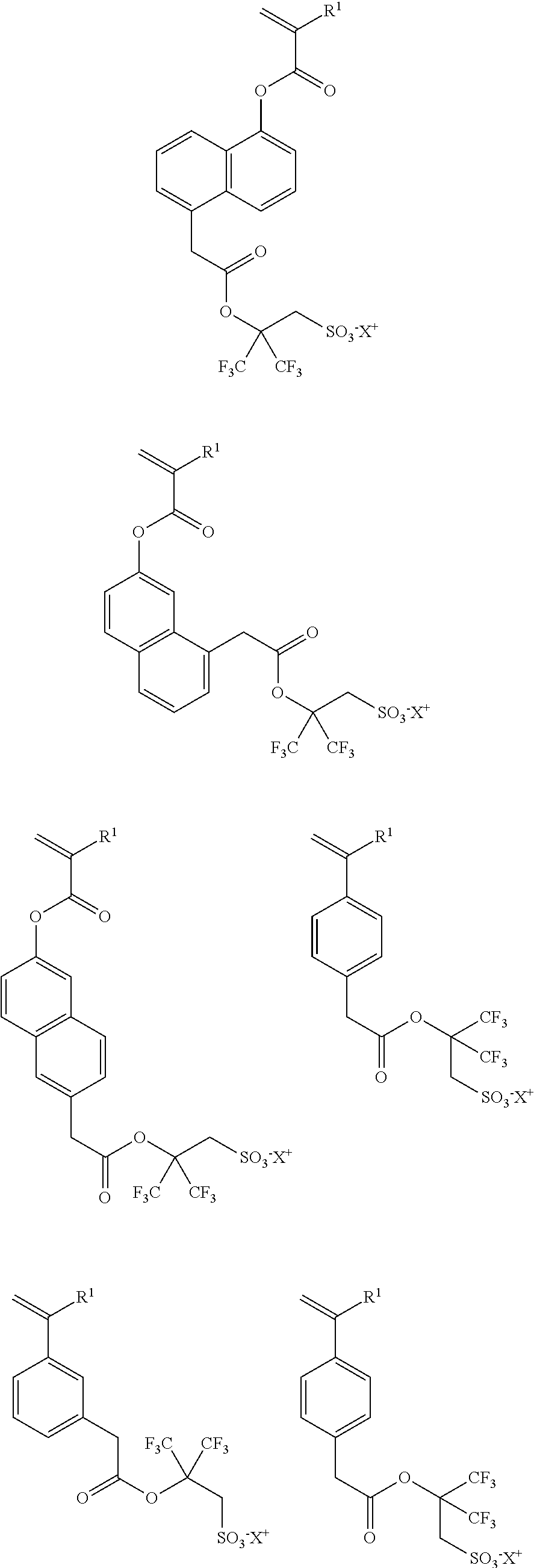


wherein R1 has the same meaning as defined above; and “X” represents lithium, sodium, potassium, or a nitrogen compound.
Also, as mentioned above, the repeating unit “a” shown by the general formula (1) preferably includes one or more kinds selected from repeating units a1 to a4 respectively shown by the general formulae (3-1) to (3-4). In other words, among the monomers exemplified above, the monomers from which the repeating units a1 to a4 can be obtained are particularly preferred.
Further, as mentioned above, the polymer compound for a conductive polymer of the present invention preferably further contains the repeating unit “b” shown by the general formula (2), and a monomer from which the repeating unit “b” can be obtained may be specifically exemplified by the following,

wherein, X2 represents a hydrogen atom, lithium, sodium, potassium, a nitrogen compound, or a sulfonium compound.
Illustrative examples of X2 which is a nitrogen compound include a compound shown by the following general formula (5),

wherein R101d, R101e, R101f, and R101g each represent a hydrogen atom, or a linear, branched, or cyclic alkyl group, alkenyl group, oxoalkyl group, or oxoalkenyl group each having 1 to 12 carbon atoms, an aryl group having 6 to 20 carbon atoms, or an aralkyl group or an aryloxoalkyl group each having 7 to 12 carbon atoms where a part or all of hydrogen atoms in these groups may be substituted by an alkoxy group(s); R101d and R101e, or R101d, R101e, and R101f may form a ring together, and when the ring is formed, R101d and R101e, or R101d, R101e, and R101f represent an alkylene group having 3 to 10 carbon atoms or a heteroaromatic ring having therein the nitrogen atom in the formula.
Also, as mentioned above, the polymer compound for a conductive polymer of the present invention may further contain a repeating unit “c” besides the repeating unit “a” and the repeating unit “b”. Examples of the repeating unit “c” include styrene types, vinylnaphthalene types, vinylsilane types, acenaphthylene, indene, benzofuran, benzothiophene, (meth)acryl types, vinylcarbazole.
Illustrative examples of a monomer from which the repeating unit “c” can be obtained may be specifically exemplified by the following.


As a method for synthesizing the polymer compound for a conductive polymer of the present invention, for example, a method in which desired monomers among the above-described monomers are subjected to heat polymerization in a solvent by adding a radical polymerization initiator to obtain a polymer compound, which is a copolymer, may be mentioned.
Illustrative examples of the solvent to be used for the polymerization include water, methanol, ethanol, n-propanol, isopropyl alcohol, methoxyethanol, ethoxyethanol, n-butanol, ethylene glycol, propylene glycol, glycerin, diethylene glycol, dimethylsulfamide, dimethylacetamide, acetone, dimethyl sulfoxide, N-methylpyrrolidone, toluene, benzene, tetrahydrofuran, diethyl ether, dioxane, cyclohexane, cyclopentane, methyl ethyl ketone, and γ-butyrolactone.
Illustrative examples of the radical polymerization initiator include di-tert-butyl peroxide, dicumyl peroxide, tert-butylcumyl peroxide, benzoyl peroxide, dilauryl peroxide, cumene hydroperoxide, tert-butyl hydroperoxide, tert-butyl peroxyisobutyrate, potassium persulfate, ammonium persulfate, hydrogen peroxide, 2,2′-azobisisobutyronitrile (AIBN), 2,2′-azobis(2,4-dimethylvaleronitrile), dimethyl 2,2-azobis(2-methylpropionate), lauroyl peroxide, 2,2′-azobis(2-amidinopropane) dihydrochloride, or an alkali metal salt or an ammonium salt of 4,4′-azobis(4-cyanovaleric acid).
The reaction temperature is preferably in the range of 50 to 80° C., and the reaction time is preferably in the range of 2 to 100 hours, more preferably 5 to 20 hours.
In the polymer compound for a conductive polymer of the present invention, the monomer that gives the repeating unit “a” shown by the general formula (1) may be used alone or in combination with two or more kinds, and it is preferred to combine methacryl type and styrene type monomers for the sake of enhancing polymerizability.
In addition, two or more kinds of monomers that give the repeating unit “a” may be random-copolymerized, or may be each block-copolymerized. When a block-copolymerized polymer (block copolymer) is used as a conductive film, it can be expected to obtain a merit that the conductivity is improved by aggregating the repeating unit portions composed of the two or more kinds of the repeating units “a” with each other to form a sea-island structure.
Moreover, the monomers that give the repeating units “a” to “c” may be random-copolymerized, or may be each block-copolymerized. In this case, it can also be expected to obtain a merit that the conductivity is improved due to the block copolymer as explained for the repeating unit “a” above.
When a random copolymerization is carried out by a radical polymerization, the method is generally used in which monomers and a radical polymerization initiator to be used for the copolymerization are mixed and polymerized by heating. In the case that the polymerization is started with a first monomer in the presence of a radical polymerization initiator, and then adding a second monomer thereto, the resulting polymer has a structure that the first monomer is polymerized at one side of the polymer molecule, and the second monomer is polymerized at the other side. In this case, however, the repeating units of the first and second monomers are mixedly present at the middle portion, thus it has a different structure from the block copolymer. For forming the block copolymer by radical polymerization, living radical polymerization is preferably used.
In a living radical polymerization method called RAFT polymerization (Reversible Addition Fragmentation chain Transfer polymerization), radicals at the polymer terminal are always living, so that it is possible to form a block copolymer composed of first and second repeating units by starting the polymerization with a first monomer, and then adding a second monomer at the time when the first monomer has been consumed. In addition, it is also possible to form a triblock copolymer by starting the polymerization with a first monomer, then adding a second monomer at the time when the first monomer has been consumed, and then adding a third monomer thereto.
When the RAFT polymerization is carried out, there is a characteristic that a narrowly distributed polymer having a narrow molecular weight distribution (degree of distribution) is obtained. In particular, when the RAFT polymerization is carried out by adding monomers at once, a polymer having a narrower molecular weight distribution can be obtained.
The polymer compound for a conductive polymer of the present invention preferably has a narrow distribution, and the molecular weight distribution (Mw/Mn) thereof is preferably in the range of 1.0 to 2.0, particularly preferably 1.0 to 1.5. The narrow distribution allows to prevent unevenness of the conductivity of the conductive polymer synthesized by using the polymer compound.
To carry out the RAFT polymerization, a chain transfer agent is necessary, and illustrative examples thereof include 2-cyano-2-propylbenzothioate, 4-cyano-4-phenylcarbonothioylthiopentanoic acid, 2-cyano-2-propyldodecyltrithiocarbonate, 4-cyano-4-[(dodecylsulfanylthiocarbonyl)sulfanyl]pentanoic acid, 2-(dodecylthiocarbonothioylthio)-2-methylpropanoic acid, cyanomethyldodecylthiocarbonate, cyanomethylmethyl-(phenyl)carbamothioate, bis(thiobenzoyl)disulfide, and bis(dodecylsulfanylthiocarbonyl)disulfide. Among these, 2-cyano-2-propylbenzothioate is particularly preferred.
The proportion of the repeating units “a” to “c” is 0<a≤1.0, 0≤b<1.0, and 0≤c<1.0, preferably 0.1≤a≤0.9, 0.1≤b≤0.9, and 0≤c≤0.8, more preferably 0.2≤b≤0.8, and 0≤c≤0.5.
Also, it is preferred that a+b+c=1.
Further, when the repeating unit “a” includes one or more kinds selected from repeating units a1 to a4 as mentioned above, it is preferred that 0≤a1≤1.0, 0≤a2≤1.0, 0≤a3≤1.0, 0≤a4≤1.0, and 0<a1+a2+a3+a4≤1.0, more preferably 0≤a1≤0.9, 0≤a2≤0.9, 0≤a3≤0.9, 0≤a4≤0.9, and 0.1≤a1+a2+a3+a4≤0.9, much more preferably 0≤a1≤0.8, 0≤a2≤0.8, 0≤a3≤0.8, 0≤a4≤0.8, and 0.1≤a1+a2+a3+a4≤0.8.
In the method for producing the polymer compound for a conductive polymer of the present invention, after polymerizing monomers as mentioned above, the structure of the salt composed of a sulfonic acid residue and lithium, sodium, potassium, or a nitrogen compound is converted into a sulfo group by ion-exchange.
At this time, ion-exchange may be carried out by using, for example, an ion-exchange resin.
The polymer compound for a conductive polymer containing the repeating unit “a” shown by the general formula (1) can be easily produced by the method as mentioned above.
As mentioned above, the polymer compound for a conductive polymer of the present invention can be a polymer compound for a conductive polymer having a specific superacidic sulfo group which is soluble in an organic solvent, and suitably used for a fuel cell or a dopant for a conductive material.
When this polymer compound for a conductive polymer is used for a fuel cell, a material for a fuel cell having high dielectric constant can be obtained. Also, when this polymer compound is used as a dopant for a conjugated double bond polymer, a conductive film having high transparency, high conductivity, and high durability can be formed. The inventive polymer compound for a conductive polymer has a superacidic sulfonic-acid structure, the β-position of which has been substituted with trifluoromethyl groups, and accordingly the strong ionic bond brings a high ability as a dopant and a high stability as an ion. Therefore, this shows high conductivity and stability when used as a conductive material. Moreover, it is excellent in solubility in an organic solvent, so that deterioration of an organic EL device can be prevented by using it as a conductive film for an organic EL lighting.
Further, the producing method of the present invention facilitates producing such a polymer compound for a conductive polymer of the present invention.
In the following, the present invention is specifically explained by referring to Examples, but the present invention is not limited thereto.
In the following, monomers used in syntheses of Examples are shown.

Monomer 1: benzyltrimethylammonium 3,3,3-trifluoro-2-methacryloyloxy-2-trifluoromethylpropane-1-sulfonate
Monomer 2: benzyltrimethylammonium 3,3,3-trifluoro-2-(3-methacryloyloxy-1-adamantanecarbonyloxy)-2-trifluoromethylpropane-1-sulfonate
Monomer 3: benzyltrimethylammonium 3,3,3-trifluoro-2-trifluoromethyl-2-(4-vinylbenzoyloxy)propane-1-sulfonate
Monomer 4: tetrabutylammonium 3,3,3-trifluoro-2-(4-methacryloyloxy-1-benzoyloxy)-2-trifluoromethylpropane-1-sulfonate
Under nitrogen atmosphere, to 37.5 g of methanol stirred at 64° C. was added dropwise a solution in which 48.1 g of Monomer 1 and 5.13 g of dimethyl 2,2′-azobis(isobutyrate) had been dissolved in 112.5 g of methanol, over 4 hours. The mixture was further stirred at 64° C. for 4 hours. After cooling to room temperature, the mixture was added dropwise to 1,000 g of ethyl acetate under vigorous stirring. The resulting solid was collected by filtration, and dried under vacuum at 50° C. for 15 hours to obtain 26.2 g of a white polymer.
The obtained white polymer was dissolved in 912 g of pure water, and the ammonium salt was converted into a sulfo group by using an ion-exchange resin. When the obtained polymer was measured by 19F-NMR, 1H-NMR, and GPC, the following analytical results were obtained.
Weight-average molecular weight (Mw)=42,000
Molecular weight distribution (Mw/Mn)=1.61
This polymer compound was named Polymer 1.

Under nitrogen atmosphere, to 37.5 g of methanol stirred at 64° C. was added dropwise a solution in which 24.0 g of Monomer 1, 9.5 g of lithium styrenesulfonate, and 5.13 g of dimethyl 2,2′-azobis(isobutyrate) had been dissolved in 112.5 g of methanol, over 4 hours. The mixture was further stirred at 64° C. for 4 hours. After cooling to room temperature, the mixture was added dropwise to 1,000 g of ethyl acetate under vigorous stirring. The resulting solid was collected by filtration, and dried under vacuum at 50° C. for 15 hours to obtain 41.5 g of a white polymer.
The obtained white polymer was dissolved in 912 g of pure water, and the ammonium salt and the lithium salt were converted into sulfo groups by using an ion-exchange resin. When the obtained polymer was measured by 19F-NMR, 1H-NMR, and GPC, the following analytical results were obtained.
Copolymer Composition Ratio (Molar Ratio)
-
- Monomer 1: styrenesulfonic acid=1:1
Weight-average molecular weight (Mw)=46,000
Molecular weight distribution (Mw/Mn)=1.76
This polymer compound was named Polymer 2.

Under nitrogen atmosphere, to 37.5 g of methanol stirred at 64° C. was added dropwise a solution in which 32.8 g of Monomer 2, 9.5 g of lithium styrenesulfonate, and 5.13 g of dimethyl 2,2′-azobis(isobutyrate) had been dissolved in 112.5 g of methanol, over 4 hours. The mixture was further stirred at 64° C. for 4 hours. After cooling to room temperature, the mixture was added dropwise to 1,000 g of ethyl acetate under vigorous stirring. The resulting solid was collected by filtration, and dried under vacuum at 50° C. for 15 hours to obtain 46.2 g of a white polymer.
The obtained white polymer was dissolved in 912 g of pure water, and the ammonium salt and the lithium salt were converted into sulfo groups by using an ion-exchange resin. When the obtained polymer was measured by 19F-NMR, 1H-NMR, and GPC, the following analytical results were obtained.
Copolymer Composition Ratio (Molar Ratio)
-
- Monomer 2: styrenesulfonic acid=1:1
Weight-average molecular weight (Mw)=46,000
Molecular weight distribution (Mw/Mn)=1.52
This polymer compound was named Polymer 3.

Under nitrogen atmosphere, to 37.5 g of methanol stirred at 64° C. was added dropwise a solution in which 27.0 g of Monomer 3, 9.5 g of lithium styrenesulfonate, and 2.82 g of dimethyl 2,2′-azobis(isobutyrate) had been dissolved in 112.5 g of methanol, over 4 hours. The mixture was further stirred at 64° C. for 4 hours. After cooling to room temperature, the mixture was added dropwise to 1,000 g of ethyl acetate under vigorous stirring. The resulting solid was collected by filtration, and dried under vacuum at 50° C. for 15 hours to obtain 47.3 g of a white polymer.
The obtained white polymer was dissolved in 421 g of methanol, and the ammonium salt and the lithium salt were converted into sulfo groups by using an ion-exchange resin. When the obtained polymer was measured by 19F-NMR, 1H-NMR, and GPC, the following analytical results were obtained.
Copolymer Composition Ratio (Molar Ratio)
-
- Monomer 3: styrenesulfonic acid=1:1
Weight-average molecular weight (Mw)=55,000
Molecular weight distribution (Mw/Mn)=1.81
This polymer compound was named Polymer 4.

Under nitrogen atmosphere, to 37.5 g of methanol stirred at 64° C. was added dropwise a solution in which 34.6 g of Monomer 4, 9.5 g of lithium styrenesulfonate, and 2.82 g of dimethyl 2,2′-azobis(isobutyrate) had been dissolved in 112.5 g of methanol, over 4 hours. The mixture was further stirred at 64° C. for 4 hours. After cooling to room temperature, the mixture was added dropwise to 1,000 g of ethyl acetate under vigorous stirring. The resulting solid was collected by filtration, and dried under vacuum at 50° C. for 15 hours to obtain 50.2 g of a white polymer.
The obtained white polymer was dissolved in 421 g of methanol, and the ammonium salt and the lithium salt were converted into sulfo groups by using an ion-exchange resin. When the obtained polymer was measured by 19F-NMR, 1H-NMR, and GPC, the following analytical results were obtained.
Copolymer Composition Ratio (Molar Ratio)
-
- Monomer 4: styrenesulfonic acid=1:1
Weight-average molecular weight (Mw)=56,000
Molecular weight distribution (Mw/Mn)=1.68
This polymer compound was named Polymer 5.

Under nitrogen atmosphere, to 37.5 g of methanol stirred at 64° C. was added dropwise a solution in which 52.5 g of Monomer 2, 7.0 g of 4-(1,1,1,3,3,3-hexafluoro-2-propanol)styrene, and 5.13 g of dimethyl 2,2′-azobis(isobutyrate) had been dissolved in 112.5 g of methanol, over 4 hours. The mixture was further stirred at 64° C. for 4 hours. After cooling to room temperature, the mixture was added dropwise to 1,000 g of ethyl acetate under vigorous stirring. The resulting solid was collected by filtration, and dried under vacuum at 50° C. for 15 hours to obtain 43.2 g of a white polymer.
The obtained white polymer was dissolved in 912 g of pure water, and the ammonium salt was converted into a sulfo group by using an ion-exchange resin. When the obtained polymer was measured by 19F-NMR, 1H-NMR, and GPC, the following analytical results were obtained.
Copolymer Composition Ratio (Molar Ratio)
-
- Monomer 2: 4-(1,1,1,3,3,3-hexafluoro-2-propanol)styrene=4:1
Weight-average molecular weight (Mw)=41,000
Molecular weight distribution (Mw/Mn)=1.64
This polymer compound was named Polymer 6.

Under nitrogen atmosphere, to 37.5 g of methanol stirred at 64° C. was added dropwise a solution in which 52.5 g of Monomer 2, 13.1 g of 3,5-bis(2-hydroxy-1,1,1,3,3,3-hexafluoro-2-propyl)cyclohexyl methacrylate, and 5.13 g of dimethyl 2,2′-azobis(isobutyrate) had been dissolved in 112.5 g of methanol, over 4 hours. The mixture was further stirred at 64° C. for 4 hours. After cooling to room temperature, the mixture was added dropwise to 1,000 g of ethyl acetate under vigorous stirring. The resulting solid was collected by filtration, and dried under vacuum at 50° C. for 15 hours to obtain 61.2 g of a white polymer.
The obtained white polymer was dissolved in 912 g of pure water, and the ammonium salt was converted into a sulfo group by using an ion-exchange resin. When the obtained polymer was measured by 19F-NMR, 1H-NMR, and GPC, the following analytical results were obtained.
Copolymer Composition Ratio (Molar Ratio)
-
- Monomer 2: 3,5-bis(2-hydroxy-1,1,1,3,3,3-hexafluoro-2-propyl)cyclohexyl methacrylate=4:1
Weight-average molecular weight (Mw)=23,000
Molecular weight distribution (Mw/Mn)=1.61
This polymer compound was named Polymer 7.

Polymers 1 to 7 synthesized as mentioned above were each soluble in water, methanol, ethanol, isopropyl alcohol, propylene glycol monomethyl ether, tetrahydrofuran, and dimethylformamide.
Thus, the producing method of the present invention facilitates producing the polymer compound for a conductive polymer of the present invention, which has a specific superacidic sulfonimide group, and is soluble in an organic solvent.
It should be noted that the present invention is not limited to the foregoing embodiment. The embodiment is just an exemplification, and any examples that have substantially the same feature and demonstrate the same functions and effects as those in the technical concept described in claims of the present invention are included in the technical scope of the present invention.
Claims (4)
1. A polymer compound for a conductive polymer comprising (A) one or more repeating units selected from the group consisting of the following general formulae (3-2) to (3-4), and having a weight-average molecular weight in the range of 1,000 to 500,000,

wherein R1 represents a hydrogen atom or a methyl group; and a2, a3, and a4 are each a number satisfying 0≤a2<1.0, 0≤a3<1.0, 0≤a4<1.0, and 0<a2+a3÷a4<1.0, and
(B) a repeating unit shown by the following general formula (2),

wherein “b” is a number satisfying 0<b<1.0.
2. The polymer compound for a conductive polymer according to claim 1 , further comprising a repeating unit shown by the following general formula (3-1):

wherein a1 is a number satisfying 0<a1<1.0, and 0<a1+a2+a3+a4<1.0.
3. The polymer compound for a conductive polymer according to claim 2 , wherein 0<a1<0.9, 0≤a2≤0.9, 0≤a3≤0.9, 0≤a4≤0.9, and 0.1≤a1+a2+a3+a4≤0.9.
4. The polymer compound for a conductive polymer according to claim 2 , wherein 0<a1<0.8, 0≤a2≤0.8, 0≤a3≤0.8, 0≤a4≤0.8, and 0.2≤a1+a2+a3+a4≤0.8.
Applications Claiming Priority (5)
| Application Number | Priority Date | Filing Date | Title |
|---|---|---|---|
| JP2015-165938 | 2015-08-25 | ||
| JP2015165938 | 2015-08-25 | ||
| JP2016-011215 | 2016-01-25 | ||
| JP2016-11215 | 2016-01-25 | ||
| JP2016011215A JP6450695B2 (en) | 2015-08-25 | 2016-01-25 | Polymer compound for conductive polymer and method for producing the same |
Publications (2)
| Publication Number | Publication Date |
|---|---|
| US20170058059A1 US20170058059A1 (en) | 2017-03-02 |
| US10125202B2 true US10125202B2 (en) | 2018-11-13 |
Family
ID=58098173
Family Applications (1)
| Application Number | Title | Priority Date | Filing Date |
|---|---|---|---|
| US15/230,684 Active US10125202B2 (en) | 2015-08-25 | 2016-08-08 | Polymer compound for a conductive polymer and method for producing same |
Country Status (1)
| Country | Link |
|---|---|
| US (1) | US10125202B2 (en) |
Families Citing this family (1)
| Publication number | Priority date | Publication date | Assignee | Title |
|---|---|---|---|---|
| JP6937232B2 (en) * | 2017-12-07 | 2021-09-22 | 信越化学工業株式会社 | Conductive polymer compositions, coatings, and pattern forming methods |
Citations (6)
| Publication number | Priority date | Publication date | Assignee | Title |
|---|---|---|---|---|
| JP2008146913A (en) | 2006-12-07 | 2008-06-26 | Shin Etsu Polymer Co Ltd | Conductive polymer solution and conductive coating |
| US20120237876A1 (en) * | 2009-12-08 | 2012-09-20 | Jsr Corporation | Radiation-sensitive resin composition, monomer, polymer, and production method of radiation-sensitive resin composition |
| US8283104B2 (en) * | 2009-02-19 | 2012-10-09 | Shin-Etsu Chemical Co., Ltd. | Sulfonate and its derivative, photosensitive acid generator, and resist composition and patterning process using the same |
| US20140017617A1 (en) * | 2012-07-10 | 2014-01-16 | c/o Tokyo Ohka Kogyo Co., Ltd. | Method of producing ammonium salt compound, method of producing compound, and compound, polymeric compound, acid generator, resist composition and method of forming resist pattern |
| US20170037167A1 (en) * | 2015-08-05 | 2017-02-09 | Shin-Etsu Chemical Co., Ltd. | Polymer compound, positive resist composition, laminate, and resist patterning process |
| US9752045B2 (en) * | 2015-08-25 | 2017-09-05 | Shin-Etsu Chemical Co., Ltd. | Conductive polymer composite and substrate |
-
2016
- 2016-08-08 US US15/230,684 patent/US10125202B2/en active Active
Patent Citations (6)
| Publication number | Priority date | Publication date | Assignee | Title |
|---|---|---|---|---|
| JP2008146913A (en) | 2006-12-07 | 2008-06-26 | Shin Etsu Polymer Co Ltd | Conductive polymer solution and conductive coating |
| US8283104B2 (en) * | 2009-02-19 | 2012-10-09 | Shin-Etsu Chemical Co., Ltd. | Sulfonate and its derivative, photosensitive acid generator, and resist composition and patterning process using the same |
| US20120237876A1 (en) * | 2009-12-08 | 2012-09-20 | Jsr Corporation | Radiation-sensitive resin composition, monomer, polymer, and production method of radiation-sensitive resin composition |
| US20140017617A1 (en) * | 2012-07-10 | 2014-01-16 | c/o Tokyo Ohka Kogyo Co., Ltd. | Method of producing ammonium salt compound, method of producing compound, and compound, polymeric compound, acid generator, resist composition and method of forming resist pattern |
| US20170037167A1 (en) * | 2015-08-05 | 2017-02-09 | Shin-Etsu Chemical Co., Ltd. | Polymer compound, positive resist composition, laminate, and resist patterning process |
| US9752045B2 (en) * | 2015-08-25 | 2017-09-05 | Shin-Etsu Chemical Co., Ltd. | Conductive polymer composite and substrate |
Also Published As
| Publication number | Publication date |
|---|---|
| US20170058059A1 (en) | 2017-03-02 |
Similar Documents
| Publication | Publication Date | Title |
|---|---|---|
| US9657115B2 (en) | Polymer compound for a conductive polymer and method for manufacturing same | |
| US9493597B2 (en) | Polymer compound having a specific super strongly acidic sulfo group | |
| US11208509B2 (en) | Polymer compound for conductive polymer and method for producing same | |
| US9777093B2 (en) | Polymer compound for a conductive polymer and method for producing same | |
| US10363555B2 (en) | Polymer compound for conductive polymer and method for producing the same | |
| US9527937B2 (en) | Polymer compound for a conductive polymer and method for producing same | |
| US10125202B2 (en) | Polymer compound for a conductive polymer and method for producing same | |
| KR102020099B1 (en) | Polymer compound for a conductive polymer and method for producing same | |
| US9663593B2 (en) | Polymer compound for a conductive polymer and method for producing same | |
| KR101856812B1 (en) | Polymer compound | |
| KR101864919B1 (en) | Polymer compound for a conductive polymer and method for manufacturing same |
Legal Events
| Date | Code | Title | Description |
|---|---|---|---|
| AS | Assignment |
Owner name: SHIN-ETSU CHEMICAL CO., LTD., JAPAN Free format text: ASSIGNMENT OF ASSIGNORS INTEREST;ASSIGNORS:HATAKEYAMA, JUN;OHASHI, MASAKI;NAGASAWA, TAKAYUKI;AND OTHERS;REEL/FRAME:039368/0001 Effective date: 20160627 |
|
| STCF | Information on status: patent grant |
Free format text: PATENTED CASE |
|
| MAFP | Maintenance fee payment |
Free format text: PAYMENT OF MAINTENANCE FEE, 4TH YEAR, LARGE ENTITY (ORIGINAL EVENT CODE: M1551); ENTITY STATUS OF PATENT OWNER: LARGE ENTITY Year of fee payment: 4 |