US10120879B2 - Scalable attribute-driven image retrieval and re-ranking - Google Patents
Scalable attribute-driven image retrieval and re-ranking Download PDFInfo
- Publication number
- US10120879B2 US10120879B2 US14/555,477 US201414555477A US10120879B2 US 10120879 B2 US10120879 B2 US 10120879B2 US 201414555477 A US201414555477 A US 201414555477A US 10120879 B2 US10120879 B2 US 10120879B2
- Authority
- US
- United States
- Prior art keywords
- images
- features
- attribute
- face
- attributes
- Prior art date
- Legal status (The legal status is an assumption and is not a legal conclusion. Google has not performed a legal analysis and makes no representation as to the accuracy of the status listed.)
- Active, expires
Links
Images




Classifications
-
- G—PHYSICS
- G06—COMPUTING OR CALCULATING; COUNTING
- G06F—ELECTRIC DIGITAL DATA PROCESSING
- G06F16/00—Information retrieval; Database structures therefor; File system structures therefor
- G06F16/50—Information retrieval; Database structures therefor; File system structures therefor of still image data
- G06F16/58—Retrieval characterised by using metadata, e.g. metadata not derived from the content or metadata generated manually
- G06F16/583—Retrieval characterised by using metadata, e.g. metadata not derived from the content or metadata generated manually using metadata automatically derived from the content
-
- G06F17/30247—
-
- G—PHYSICS
- G06—COMPUTING OR CALCULATING; COUNTING
- G06F—ELECTRIC DIGITAL DATA PROCESSING
- G06F18/00—Pattern recognition
- G06F18/20—Analysing
- G06F18/21—Design or setup of recognition systems or techniques; Extraction of features in feature space; Blind source separation
- G06F18/217—Validation; Performance evaluation; Active pattern learning techniques
- G06F18/2178—Validation; Performance evaluation; Active pattern learning techniques based on feedback of a supervisor
-
- G—PHYSICS
- G06—COMPUTING OR CALCULATING; COUNTING
- G06F—ELECTRIC DIGITAL DATA PROCESSING
- G06F18/00—Pattern recognition
- G06F18/20—Analysing
- G06F18/24—Classification techniques
- G06F18/241—Classification techniques relating to the classification model, e.g. parametric or non-parametric approaches
- G06F18/2413—Classification techniques relating to the classification model, e.g. parametric or non-parametric approaches based on distances to training or reference patterns
- G06F18/24133—Distances to prototypes
- G06F18/24137—Distances to cluster centroïds
-
- G06K9/00281—
-
- G06K9/6263—
-
- G06K9/6272—
-
- G—PHYSICS
- G06—COMPUTING OR CALCULATING; COUNTING
- G06V—IMAGE OR VIDEO RECOGNITION OR UNDERSTANDING
- G06V10/00—Arrangements for image or video recognition or understanding
- G06V10/70—Arrangements for image or video recognition or understanding using pattern recognition or machine learning
- G06V10/764—Arrangements for image or video recognition or understanding using pattern recognition or machine learning using classification, e.g. of video objects
-
- G—PHYSICS
- G06—COMPUTING OR CALCULATING; COUNTING
- G06V—IMAGE OR VIDEO RECOGNITION OR UNDERSTANDING
- G06V10/00—Arrangements for image or video recognition or understanding
- G06V10/70—Arrangements for image or video recognition or understanding using pattern recognition or machine learning
- G06V10/77—Processing image or video features in feature spaces; using data integration or data reduction, e.g. principal component analysis [PCA] or independent component analysis [ICA] or self-organising maps [SOM]; Blind source separation
- G06V10/778—Active pattern-learning, e.g. online learning of image or video features
- G06V10/7784—Active pattern-learning, e.g. online learning of image or video features based on feedback from supervisors
-
- G—PHYSICS
- G06—COMPUTING OR CALCULATING; COUNTING
- G06V—IMAGE OR VIDEO RECOGNITION OR UNDERSTANDING
- G06V40/00—Recognition of biometric, human-related or animal-related patterns in image or video data
- G06V40/10—Human or animal bodies, e.g. vehicle occupants or pedestrians; Body parts, e.g. hands
- G06V40/16—Human faces, e.g. facial parts, sketches or expressions
- G06V40/168—Feature extraction; Face representation
- G06V40/171—Local features and components; Facial parts ; Occluding parts, e.g. glasses; Geometrical relationships
-
- G—PHYSICS
- G06—COMPUTING OR CALCULATING; COUNTING
- G06F—ELECTRIC DIGITAL DATA PROCESSING
- G06F18/00—Pattern recognition
- G06F18/20—Analysing
- G06F18/21—Design or setup of recognition systems or techniques; Extraction of features in feature space; Blind source separation
- G06F18/213—Feature extraction, e.g. by transforming the feature space; Summarisation; Mappings, e.g. subspace methods
- G06F18/2132—Feature extraction, e.g. by transforming the feature space; Summarisation; Mappings, e.g. subspace methods based on discrimination criteria, e.g. discriminant analysis
-
- G06K9/6234—
Definitions
- the present disclosure relates to retrieval of an image or images of objects (such as images of human faces or images of people, vehicles or luggage) from a large-scale database of images based on a query image, and further relates to training and learning using the large-scale database of images in preparation for image retrieval.
- objects such as images of human faces or images of people, vehicles or luggage
- CBIR content-based face image retrieval
- Described herein is the application of human semantic attributes to object image retrieval and ranking, such as retrieval and ranking of face images or images of people, vehicles or luggage.
- the human semantic attributes are incorporated into an object image representation by linear discriminant analysis. Further described is a new metric learning algorithm to learn a similarity metric on this new image representation. Also described is an image re-ranking scheme based on the new similarity measure by combining low level feature similarity and attribute similarity.
- one embodiment described herein concerns a content-based face image retrieval and ranking system enhanced by human semantic attributes which contain semantic cues of the human faces.
- Low-level features are extracted to represent an image, e.g. histogram of oriented gradients (HOG).
- a low dimensional representation is learned (by machine learning) of face images using linear discriminant analysis (LDA) from part-based HOG features with human attributes as the LDA class labels.
- LDA linear discriminant analysis
- a metric is learned (by machine learning) on the above low dimensional features space based on identity information of a person.
- HOG low leveled features
- semantic attributes features together with an image re-ranking scheme which exploits this combination.
- aspects described herein include the building a database of searchable images.
- visual features are extracted from regions of multiple images in a first set of labeled images and the labels are applied to the extracted visual features, wherein the regions from which visual features are extracted have salient visual characteristics.
- a transformation is learned that uses the labels of the labeled visual features to transform the visual features into a discrimination vector, wherein the transformation is learned such that the discrimination vector discriminates between the labels.
- Visual features are extracted from multiple images in a second set of images different from the labeled images, wherein the regions from which the visual features are extracted have salient visual characteristics.
- the learned transformation is applied to the visual features extracted from the second set of images so as to transform the visual features into respective discrimination vectors for each image in the second set of images.
- the labeled images in the first set of images and the images from the second set of images are stored in a database in association with the respective discrimination vectors for each such image, wherein each such image is stored for retrieval by a search which at least in part uses the associated discrimination vectors.
- the learned transformation may be learned by application of a supervised learning analysis which reduces dimensionality of the extracted visual features while preserving local neighborhood structure in the regions from which the visual features are extracted.
- the supervised learning analysis may use at least local Fisher discriminant analysis (LFDA).
- LFDA local Fisher discriminant analysis
- the labeled images may be labeled manually, or some of the labeled images may be labeled manually and others of the labeled images may be labeled by trained classification engines which are trained to label the images automatically.
- the regions from which visual features are extracted may be determined automatically so as to accentuate salient visual characteristics of objects in the images. For example, in the case of face images, the regions may include more than one of at least an eye region (left and/or right eye), a nose region, a mouth region (left part and/or right part of the mouth), a hair region and an ear region.
- a salient visual characteristic typically refers to those regions of an image of an object to which attention of a human viewer might often be focused, in situations where a human viewer is discriminating between images of different objects of the same class, or in situations where a human viewer is determining whether different images of the same class contain images of the same object or images of different objects.
- the class of object images might be face images
- salient visual characteristics might include regions of the eyes, hair, nose, mouth and/or ears, and so forth. Most images of the class would ordinarily contain all or most of these salient visual characteristics, and most human viewers would be expected to focus attention on many of these regions when determining whether different images are images of different objects or are images of the same object.
- the class of object images might be images of vehicles, and the salient visual characteristics might include regions of the wheels, doors, windows, headlights, grille, side mirrors and/or bumpers, and so forth. Most images of the class would ordinarily contain all or most of these salient visual characteristics, and most human viewers would be expected to focus attention on many of these regions when determining whether different images are images of different objects or are images of the same object.
- the class of object images might be images of people, and the salient visual characteristics might include regions of the head, arms, legs, torso, face and/or hair, and so forth.
- the class of object images might be images of luggage, and the salient visual characteristics might include regions of the base/wheels, handle, corners and/or luggage tags, and so forth.
- Most images of the class would ordinarily contain all or most of these salient visual characteristics, and most human viewers would be expected to focus attention on many of these regions when determining whether different images are images of different objects or are images of the same object.
- Visual features are extracted from regions of the query image, wherein the regions from which the visual features are extracted have salient visual characteristics.
- a learned transformation is applied to the extracted visual features so as to transform the extracted visual features into a discrimination vector, wherein the learned transformation is learned by using labels of a labeled database of visual features to learn a transformation of the visual features into discrimination vectors that discriminate between the labels.
- An image similarity measure is generated between the discrimination vector for the query image and a discrimination vector for multiple images in the searchable database, wherein the similarity measure is generated using a calculation learned from a database of multiple images labeled with identities of labelable objects represented in the multiple images, and wherein the calculation measures whether the objects represented in the images are the same objects or are different objects.
- a candidate list is obtained of images in the searchable database that are similar to the query image based at least in part on the similarity measure.
- the database of multiple images may be comprised of a database of face images and the objects may be comprised of individuals whose face images are included in the database, such that the calculation by which the similarity measure is generated measures whether the individuals represented in the images are the same individual or are different individuals.
- the similarity measure may calculate a binary vector using the discrimination vector.
- the similarity measure may apply a covariance matrix to the discrimination vector for the query image and to the discrimination vector for images in the searchable database, so as to provide the measurement of whether the objects represented in the images are the same object or are different objects.
- a re-ranking of the candidates in the candidate list may be performed based at least in part of similarity of salient visual features in the images.
- the re-ranking may be based at least in part on a weighted combination of similarity of salient visual features in the images and the visual features extracted from the regions of the images having salient visual characteristics.
- a refined low-level feature transformation is generated based at least in part on the plurality of respective low-level features from more than one region of the object and the plurality of respective attribute scores.
- An object-similarity measure is generated of a first object image and a second object image based at least in part on low-level features of the first object image, on low-level features of the second object image, and on the refined low-level feature transformation.
- retrieval of objects in images includes obtaining a plurality of respective low-level features and a plurality of respective attribute scores for a plurality of reference object images; generating a refined low-level feature transformation based at least in part on the plurality of respective low-level features from more than one region of the object and the plurality of respective attribute scores; generating an object-similarity measure of a first object image and a second object image based at least in part on low-level features of the first object image, on low-level features of the second object image, and on the refined low-level feature transformation; retrieving a subset of images from a plurality of images wherein the subset of images are retrieved based on the respective object-similarity measures of a third object image and a plurality of fourth object images; and ranking the subset of images based at least in part on the respective object-similarity measure of the third object image and one or more of the subset images and based at least in part on low-level feature similarity of the third object image and the one or
- aspects also described herein include creation of an object attribute similarity metric, such as a face attribute similarity metric.
- creation of a face attribute similarity metric proceeds by receiving a plurality of identified face images wherein the face images identities are such that a least some of the faces of the same individuals are labeled with the same identifier; receiving a plurality of attributes describing face images associated with an identifier; extracting a plurality of respective low-level region features from a plurality of face region images; learning an attribute subspace mapping based at least in part on the plurality of the respective low-level region features from the plurality of face region images and on face attribute labels for a plurality of attributes; mapping the plurality of low-level region features to a respective plurality of subspace region features based at least in part on the attribute subspace mapping; and creating a face attribute similarity measure based at least in part on the plurality of subspace region features and on the identifier of the face image individual.
- the face attribute similarity is used to measure the similarity of two faces wherein the identifier of one or more of the faces is unknown.
- the learning of an attribute subspace mapping may comprise an LDA subspace construction using the plurality of attributes from the identifier associated with the face image.
- the face attribute similarity measure may be based at least in part on a distance metric using a metric learning technique.
- aspects also described herein include retrieval of images from a large-scale database of images based on a query image, by accessing a low level feature transformation, a low dimensional projection into a semantic attribute subspace, and a distance metric; applying the low level feature transformation to the query image so as to extract low level features representative of the query image; obtaining a candidate set of images from the large-scale database of images based at least in part on similarity of the low level features for the query image to low level features of the images in the large-scale database of images; applying the low dimensional projection to the query image so as to obtain a semantic attribute projection of the query image; and ranking the candidate images based at least in part on similarity of the semantic attribute projection for the query image to semantic attribute projections of the images in the large-scale database of images so as to result in a ranked retrieval of images. Similarity of the semantic attribute projection is measured by the distance metric.
- the low dimensional projection into a semantic attribute subspace, and the distance metric are both learned in a training phase from the large-scale database of images labeled with semantic attributes.
- the low dimensional projection into a semantic attribute subspace may use linear discriminant analysis (LDA) from part-based HOG features with human attributes as LDA class labels.
- LDA linear discriminant analysis
- Retrieval of images from a large-scale database of images may further comprise face detection and alignment of the query image using algorithms that are also applied to the images in the large-scale database of images during the training phase.
- ranking is also based at least in part on similarity of the low level features for the query image to low level features of the candidate images, using a weighting factor that applies respective weights to similarity of the semantic attribute projection and to similarity of the low level features.
- the weighting factor may be learned in a training phase from the large-scale database of images labeled with semantic attributes.
- FIG. 1 is a view for explaining the architecture of computing equipment for retrieval of images of objects such as retrieval of face images, in a training phase and in a use (or testing) phase.
- FIG. 2 is a view depicting seventy-three (73) attribute descriptions from Kumar [25].
- FIG. 3 is a view depicting a framework according to one embodiment described herein.
- FIG. 4 illustrates face parts that are generally used in face recognition for creating a feature pool.
- FIG. 5 shows an example of a face alignment process
- FIG. 6 is a conceptual view for illustrating extraction of HOG features (histogram of oriented gradients).
- FIG. 7 is a conceptual view for illustrating application of LDA (linear discriminant analysis) to patches of different face parts.
- FIG. 8 is a conceptual view for illustrating the generation of attribute features using LDA projection.
- FIG. 9 is a conceptual view for illustrating the learning of a block-wise metric on the attribute features from each small patch of different face parts.
- FIG. 10 is likewise a conceptual view for illustrating the learning of a block-wise metric on the attribute features from each small patch of different face parts.
- FIG. 11 shows a framework for one embodiment of a face image retrieval and re-ranking system.
- FIG. 12 is a table comparing the precision of face retrieval for different retrieval methods.
- FIG. 13 is a visualization of the comparison in FIG. 12 , which compares the precision of face retrieval for different retrieval methods.
- FIG. 14 shows multiple different images of one single person, illustrating significant variations in appearance such as pose, illumination, facial expression, occlusion.
- FIG. 15 is a system level diagram illustrating one embodiment for attribute-driven retrieval of face images based on a query image.
- FIG. 16 is an illustration showing an example of face detection and alignment, and feature extraction after face detection and alignment.
- FIG. 17 is a table showing an example of different attributes selected for use in an example embodiment.
- FIG. 18 shows some sample images for the attributes listed in FIG. 17 .
- FIG. 19 is a table summarizing characteristics of two datasets used in the experiments.
- FIG. 20 shows sample images from the two datasets summarized in FIG. 19 .
- FIGS. 21 and 22 are tables comparing the performance of embodiments described herein against baseline methods, for two different datasets.
- FIG. 23 shows images of some sample retrieval results for the two different datasets, without and with re-ranking.
- FIG. 24 is a graph illustrating the effect of weighting as between appearance distance and attribute distance, in the re-ranking process.
- FIG. 1 is a view for explaining the architecture of computing equipment 100 for training and learning using a large-scale database of object images in preparation for image retrieval (i.e., a training phase) and for retrieval of an image or images from the large-scale database of object images based on a query image (i.e., a use or testing phase).
- the FIG. 1 embodiment is mostly directed to a large-scale database of face images in preparation for face image retrieval (i.e., the training phase) and for retrieval of a face image or images from the large-scale database of face images based on a query image (i.e., the use or testing phase).
- the database of object images is a large-scale database, typically containing millions or multiple millions of images, on a scale so large that it would be wholly impracticable for either the training phase or the use phase to be accomplished by human effort alone.
- the embodiments described herein are computerized, as described below.
- computing equipment 100 includes central processing unit (CPU) 110 which interfaces with computer bus 114 . Also interfacing with computer bus 114 are non-volatile memory 156 (e.g., a hard disk or other nonvolatile storage medium), network interface 111 , keyboard interface 112 , access 113 to a large-scale database of face images (which may be accessed from a remote site), interface 114 for receiving a query image, random access memory (RAM) 116 for use as a main run-time transient memory, read only memory (ROM) 116 a , and display interface 117 for a display screen or other output.
- RAM random access memory
- ROM read only memory
- RAM 116 interfaces with computer bus 114 so as to provide information stored in RAM 116 to CPU 110 during execution of the instructions in software programs, such as an operating system, application programs, image processing modules, and device drivers. More specifically, CPU 110 first loads computer-executable process steps from non-volatile memory 156 , or another storage device into a region of RAM 116 . CPU 110 can then execute the stored process steps from RAM 116 in order to execute the loaded computer-executable process steps. Data, also, can be stored in RAM 116 so that the data can be accessed by CPU 110 during the execution of the computer-executable software programs, to the extent that such software programs have a need to access and/or modify the data.
- software programs such as an operating system, application programs, image processing modules, and device drivers. More specifically, CPU 110 first loads computer-executable process steps from non-volatile memory 156 , or another storage device into a region of RAM 116 . CPU 110 can then execute the stored process steps from RAM 116 in order to execute the loaded computer-executable
- non-volatile memory 156 contains computer-executable process steps for operating system 118 , and application programs 119 , such as graphic image management programs.
- Non-volatile memory 156 also contains computer-executable process steps for device drivers for software interface to devices, such as input device drivers 120 , output device drivers 121 , and other device drivers 122 .
- Non-volatile memory 156 also stores a training module and a retrieval module, which may comprise computer-executable process steps for training and learning using a large-scale database of face images in preparation for face image retrieval (i.e., the training phase) and for retrieval of a face image or images from the large-scale database of face images based on a query image (i.e., the use or testing phase).
- a training module and a retrieval module may comprise computer-executable process steps for training and learning using a large-scale database of face images in preparation for face image retrieval (i.e., the training phase) and for retrieval of a face image or images from the large-scale database of face images based on a query image (i.e., the use or testing phase).
- the computer-executable process steps for these modules may be configured as part of operating system 118 , as part of an output device driver in output device drivers 121 , or as a stand-alone application program. These modules may also be configured as a plug-in or dynamic link library (DLL) to the operating system, device driver or application program. It can be appreciated that the present disclosure is not limited to these embodiments and that the disclosed modules may be used in other environments.
- DLL dynamic link library
- the training module and a retrieval module correspondingly include a plurality of modules including a module for face detection which identifies those region(s) of an image that contain a face or faces, a module for face alignment which normalizes the appearance of the image of the face, a module for extraction of low-level features from the aligned face, such as HOG features (histogram of oriented gradients), a module for projecting the face image into a subspace that captures semantic attributes of the face image, a distance metric module for measuring distances between (for example) attributes for a query image and attributes for images in the large-scale database of face images, and a re-ranking module.
- a module for face detection which identifies those region(s) of an image that contain a face or faces
- a module for face alignment which normalizes the appearance of the image of the face
- a module for extraction of low-level features from the aligned face such as HOG features (histogram of oriented gradients)
- the module for projection into a semantic attribute subspace and the module for the distance metric are both learned modules (machine learning) based on training and learning using the large-scale database of face images in preparation for face image retrieval (training phase). These learned modules are thereafter used for query images in the testing/use phase.
- the re-ranking module may also be learned. This is described in greater detail below.
- An attribute is a semantic description for a given image. Unlike the low-level feature representations which are not directly comprehensible by a human being, describing an image using semantic attributes (e.g., young, black hair, female) complies with the human cognition pattern.
- Kumar [25] proposes use of attributes for face verification. See Kumar [25]. In total 73 attribute classifiers were trained using SVM with trained accuracies span from 70% to 90%. The detected attributes are used in the task of face verification on LFW database and state-of-the-art results are achieved.
- FIG. 2 shows the seventy-three (73) attribute descriptions the attributes used by Kumar in [25].
- the similarity between two given faces is usually measured by the similarity or distance between the feature descriptors extracted from the original images.
- the faces to be compared are often taken under different conditions such as varying pose, illumination, expression, image resolution, etc.
- directly extracting low-level features and then calculating the similarity between the low-level features might be prone to error.
- researchers aim at extracting invariant feature descriptors against different pose and illumination it is very challenging to find features that are robust and invariant in these changing aspects.
- face similarity is measured also based on facial semantic attributes, such as male or female or those given in FIG. 2 above, which is invariant to the change in image conditions.
- face similarity can be measured semantically based on the detected attributes instead of on low-level features which heavily rely on the appearance of the images.
- metric learning is used to enhance the similarity between faces with similar attributes while further separating faces with dissimilar attributes.
- the proposed face similarity measurement consists of two stages: a first phase of training and a second phase of testing/use.
- the faces in the input images are first detected and aligned.
- the low-level features such as LBP or HOG
- the attribute labels are known for the training images.
- an LDA projection matrix is learned which projects the training images into one dimensional subspace in which the class separation is maximized.
- the projected features for different attributes are then concatenated to form a new attribute feature representation for the face image, the dimension of which is determined by the number of attributes used.
- the attribute features are used to learn a distance metric.
- the low-level features are extracted from the detected and aligned faces. Then the learned LDA projection matrices are used to project the low-level features into individual one dimensional features. The concatenated attribute features are then used for similarity measure in the form of Mahalanobis distance, in which the learned metric are used.
- the large-scale database of images is comprised of object images of a class or classes different from the class of face images.
- the large-scale database of object images may be comprised of images of vehicles, images of people or images of luggage, or it might be comprised of multiple different classes of object images including all or some of face images, vehicle image, people images, luggage images and other classes of images.
- suitable attributes for the class of face images have been described above, and suitable salient visual characteristics are described below.
- suitable salient visual characteristics may include regions of the wheels, doors, windows, headlights, grille, side mirrors and/or bumpers, and so forth.
- suitable attributes may include the following:
- suitable salient visual characteristics may include regions of the head, arms, legs, torso, face and/or hair, and so forth.
- suitable attributes may include the following:
- suitable salient visual characteristics may include regions of the base/wheels, handle, corners and/or luggage tags, and so forth.
- suitable attributes may include the following:
- Closure such as Closes without zippers, Closes with zippers
- Material Elements such as Dual Soft/Hard, Leather, Metal, Tweed
- External Elements such as Combination Locks, Retractable Handles, Straps to Close/Secure, Wheels/Rollers
- Color such as White, Silver/Gray, Red, Patterned, Beige, Medium Green, Black, Blue, Yellow, Burgundy, Royal Purple).
- FIG. 3 is a view depicting a framework according to one embodiment described herein, pertinent to object images in general and to face images in particular.
- FIG. 3 shows the relationship between the training stage and the testing/use stage. Both the training stage and the testing/use stage include low-level feature extraction, including face detection, face alignment and feature extraction.
- machine learning is applied to obtain a transformation into an attribute subspace and to obtain a distance metric.
- the learned transformation is applied to transform the extracted low-level features into an attribute subspace, and the learned distance metric is applied to obtain a similarity measure.
- Low-level feature extraction includes processes for face detection and alignment so as to obtain a normalized face image, and feature extraction from the normalized face image. These processes will now be explained.
- the locations of faces can be found by applying a face detector.
- fiducial points on the face are extracted.
- the faces are aligned, and the aligned faces are used to generate face parts/regions that are significant for discriminant tasks.
- FIG. 4 illustrates face parts that are generally used in face recognition for creating a feature pool. These face parts comprise salient visual characteristics for the class of face images, and here may include regions of the eyes, hair, nose, mouth and/or ears, and so forth.
- the faces are first detected using a boundary box for a face detector.
- the bounding box is defined in the face region and the locations of the fiducial points are returned.
- FIG. 5 shows an example of the face alignment process.
- HOG Histogram of Oriented Gradients
- FIG. 6 is a conceptual view for illustrating extraction of HOG features (histogram of oriented gradients).
- LDA linear discriminant analysis
- FIG. 7 is a conceptual view for illustrating application of LDA (linear discriminant analysis) to patches of different face parts.
- LDA linear discriminant analysis
- LDA can reduce the dimensionality of a feature to at most C ⁇ 1 dimension where C is the number of attribute classes. For this reason each patch is reduced to a C ⁇ 1 dimensional vector. But because the patches are thought to capture differing characteristics with respect to the attributes, the combination of the patches provides a useful attribute-enhanced reduced dimensionality vector.
- the face images are provided with attribute labels, these attributes include diverse categorization of human, such as gender, age, ethnicity, etc.
- attributes include diverse categorization of human, such as gender, age, ethnicity, etc.
- positive face examples that contain this attribute and negative face examples in which this attribute are absent are used to learn an LDA (Linear Discriminant Analysis) projection matrix, with which the low-level features extracted from the face are linearly combined to achieve the class separation.
- K LDA projection matrices are learned for the K attributes.
- the low-level features are projected into 1D scalars for each attribute respectively.
- K scalars are concatenated to form a K dimensional attribute descriptor for this image patch.
- the final attribute descriptor is the concatenation of individual attribute descriptor from each patch, and the length of the final attribute descriptor for the entire face is N ⁇ K.
- FIG. 8 is a conceptual view for illustrating the generation of attribute features using LDA projection.
- FIG. 8 thus diagrammatically illustrates the process of attribute-based projection.
- the testing step given a face, it is first divided into patches. For each patch, the LDA projection for each attribute transforms the low-level features of this patch to the attribute features. Then the composite attribute features are constructed by gathering all the patch-based attribute features.
- the metric is designed to measure similarity of face images for the same person, even though such images are captured at different times, under different lighting conditions, and with different poses and so forth, such that different face images of the same person are designated as close matches whereas face images of different persons are designated as quite different.
- the distance metric is learned through machine learning, described below.
- LMNN large margin nearest neighbor
- ITML information-theoretic metric learning
- LDML logistic discriminant metric learning
- an effective metric is able to be learned just based on equivalence constraints. See Kostinger [50]. That is, in this embodiment it is possible to use only the information on whether two face images belong to the same person or not.
- a metric is learned on the attribute features from each small patch of a face which is shown in an example case in FIG. 9 .
- FIG. 9 is a conceptual view for illustrating the learning of a block-wise metric on the attribute features from each small patch of different face parts.
- d M ( x i ,x j ) ( x i ⁇ x j ) T M ( x i ⁇ x j ) (a)
- M ⁇ 0 is a positive semi-definite matrix and x i and x j are two sample points.
- a face similarity metric in this embodiment is learned based on the class of Mahalanobis distance and equivalence constraint. That is, the primary consideration is whether two face images belong to the same person or not.
- a metric is learned on the attribute features in each patch which is shown in FIG. 10 .
- FIG. 10 is also a conceptual view for illustrating the learning of a block-wise metric on the attribute features from each small patch of different face parts.
- the testing/use phase will now be described, in which the learned projection into attribute space, and the learned distance metric, are applied against a query image so as to retrieve candidate images from the large-scale database of face images, after which there is a re-ranking of the candidates using the semantic attributes so as to result in face images which are believed to be images from the same person as the query image.
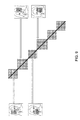
- FIG. 11 shows a framework for this embodiment of the face image retrieval and re-ranking system in which the retrieval algorithm (e.g. k nearest neighbor search based on low-level features or their quantization) gives some initial search results, and then the re-ranking scheme will re-rank the candidate images.
- the retrieval algorithm e.g. k nearest neighbor search based on low-level features or their quantization
- a query image is subjected to the same face detection, alignment and low-level feature extraction as performed on the face images in the large-scale database.
- candidate images are retrieved from the database, where the candidate images are candidates for face images of the same person as the query image.
- the query image is subjected to projection into the semantic attribute space using the projection learned in the training phase, and the learned distance metric is applied against the candidate images so as to re-rank the candidate images. Re-ranking of the images might cause some of the candidates to fall out of a top-X group of images, such as the top-10 images, as indicated by bolded X's in this figure.
- the re-ranked images are thereafter provided as the result images for the query.
- the top candidate face images are re-ranked using a weighted similarity function to improve the precision.
- the candidate images returned from the retrieval algorithms are initially ranked only based on the query image.
- each candidate is re-ranked based on its average distance to the already ranked images. See Wu [20].
- d is the low level feature similarity
- d M is the attribute-enhanced similarity which was learned using the distance metric learning
- ⁇ is a weighting parameter
- the candidate image may be selected in an iterative way. More specifically, at each iteration, an image I is selected that minimizes the following cost function:
- the parameters ⁇ and ⁇ can be selected by cross-validation.
- Experiment Setting All images are cropped and geometrically normalized using the locations of the eyes and mouths detected by the above-described face detector.
- the aligned faces are normalized to 200 by 200 pixels.
- the 43 individuals are randomly selected from Pubfig.
- each face is divided into 8 by 8 blocks.
- the number of oriented bins is set to 31.
- each face part is divided into 4 by 4 blocks and LDA is applied to each block.
- the mean average precision, P@10 and P@20 are calculated for the query set.
- P@n is defined as the percentage of correctly recalled images (the percentage of person matches to the query) in the top n ranked images.
- Mean average precision (MAP) is also used as an evaluation metric.
- FIG. 12 is a table comparing the precision of face retrieval for different retrieval methods.
- FIG. 12 thus shows the precision of face retrieval after re-ranking using low leveled features, attribute features and attribute enhanced re-ranking.
- results are also visualized in FIG. 13 , for example query results.
- attribute-enhanced features of face images are extracted using linear discriminant analysis in a part-based way. Then the face similarity is learned in the attributes feature space under the framework of metric learning under an equivalence constraint. Image re-ranking scheme is explained based on a similarity function combining the low level features similarity and attributes-enhanced feature similarity.
- attributes can be defined as describable object features. Humans are known to tend to use attributes to describe objects, such as gender or age in the case of people, or doors or windows in the case of vehicles. And while attributes such as gender and age can not uniquely identify individual objects, it is generally understood that attributes can be immutable qualities across pose, illumination, and also across short time frames.
- face image retrieval explores the use of face attributes as semantic cues for determining more discriminative visual feature representations.
- Other embodiments concern object images of different classes, or combinations of classes, such as object images of vehicles, people or luggage. Salient visual characteristics and attributes for these and other classes of object images have been described hereinabove, and are not repeated here in the interests of brevity.
- FIG. 14 shows multiple different samples of face images of one single person. Note that the appearance of the subject varies significantly in different images. There are significant variations in appearance such as pose, illumination, facial expression, occlusion. However, some attributes of the subject such as gender and age, remain unchanged. Recognizing this, the description herein incorporates attribute information for more accurate object image retrieval, here, face image retrieval. As stated above, attributes in general can be defined as describable object features.
- Attributes can also be used as query terms to retrieve images from a large database. See Siddiquie [26]. Beyond binary attributes, relative attributes which contain richer textual description of images have been explored. See Parikh [27].
- this embodiment uses an attribute-driven object image retrieval framework.
- the attribute-driven features are learned (machine learning) from low-level features and retrieval is based on the distance of the attribute-driven features. Specifically, using a few salient semantic face attributes, attribute-driven feature projections are learned such as by using Local Fisher Discriminant Analysis (LFDA).
- LFDA Local Fisher Discriminant Analysis
- the low-level features are projected into the attribute-enhanced space and the concatenation of the projected features using different attributes forms the attribute-driven features.
- binary K-means hash codes are learned from the attribute-driven features.
- the binary codes efficiently use Hamming distance calculations.
- a re-ranking process based on both low-level features and attribute-driven features is also performed.
- Attribute information is used to transform the low-level features to attribute-driven features, by which attribute information is encoded into low-level image features for better image retrieval performance.
- this description contributes region-based supervised dimensionality reduction techniques, wherein the regions comprise salient visual characteristics, using attributes in a supervisory role.
- attribute-driven object image retrieval is made applicable to large-scale image databases by using binary K-means hashing codes.
- a large-scale database typically contains millions or multiple millions of images, on a scale so large that it would be wholly impracticable for either training or retreival to be accomplished by human effort alone.
- the embodiments described herein are computerized, as described below.
- a re-ranking scheme is used to improve the retrieval accuracy by using both the visual appearance information from low-level features and the attribute information from attribute-driven features.
- Cai [18] introduced an image search re-ranking scheme based on semantic attributes. Each image was represented by attribute scores predicted from trained attribute classifiers.
- Kuo [19] jointly utilized both image contents and associated textual information to extract semantic information from both modalities. The Kuo framework is said to discover semantic features in textual and image graphs in an unsupervised manner.
- Zhang [4] proposed an attribute-augmented semantic hierarchy (A2SH) which is said to bridge both the semantic and intention gaps in CBIR.
- A2SH attribute-augmented semantic hierarchy
- the semantic concepts were divided into multiple semantic levels and each concept was augmented with relevant attributes. Improved accuracy on large scale dataset was reported compared to the state-of-the-art CBIR systems.
- Thang [22] proposed a face image retrieval system based on constrained independent component analysis (cICA).
- cICA uses a priori constraints to extract independent components from data and by using query images as constraints, the independent components that share similar probabilistic features with the queries are extracted.
- Wu [20] used identity-based quantization and component-based local features for scalable face image retrieval in large scale dataset. A multi-reference re-ranking process is performed to refine the initially returned results.
- Sparse coding with an identity constraint for face image retrieval was presented in Chen [28]. This framework included a coding scheme said to quantize faces with large intraclass variations into similar visual words if they share the same identity.
- Chen [21] proposed large scale face image retrieval using multi-level features which was said to take advantage of various scales of features to incorporate more person-specific information. By using simple features, the multi-level features of Chen [21] was said to achieve state-of-the-art retrieval performance.
- a face search technique based on shape manipulation was proposed in Smith [29]. In this method, users are able to drag some contour points to search for faces similar in shape to the query face but with updated geometric attributes.
- Attribute detection and its application is apparently an emerging trend in computer vision.
- Kumar [25] introduced describable visual attributes for image search and face verification.
- 73 attribute classifiers e.g., gender, square face, eye shape
- SVM Session Inversion
- Face verification and image search using attributes was said to achieve comparable or better results compared to state-of-the-art methods.
- Schierer [30] multi-attribute spaces were constructed from attribute classifier outputs based on the statistical extreme value theory. In this case, scores from different attribute classifiers were combined and results on large dataset were said to show improvement over prior work.
- Parikh [27] introduced relative attributes to relax the restrictions on current categorical labels such as “smiling” or “not smiling”. Relative attributes such as “bears are furrier than giraffes” were used on face and natural scene datasets, and relative attributes were said to show advantages over traditional binary attributes.
- Yu [31] used a large pool of weak attributes that can be easily obtained with little or no human effort for image retrieval.
- a mode of feedback for image search using relative attributes was proposed in Kovashka [32]. Given a query, the system of Kovashka [32] presents the user an initial set of reference images and the user provides relative attribute feedback in order to refine the top ranked images to better suit the user's requirement.
- the embodiments described herein differ at least in the aspect that there is machine-based learning of the attribute-driven features from low-level features, such as by supervised projection learning.
- the embodiments described herein differ at least in the aspect of a re-ranking process to refine the returned results by leveraging the attribute-driven feature distance as well as the low-level visual feature distance.
- FIG. 15 shows a system level diagram for attribute-driven retrieval of object images based on a query image, such as the attribute-driven retrieval of face images based on a query image.
- the system shown in FIG. 15 searches for similar images to a query image using attribute-driven features and a image re-ranking scheme that fuses low-level visual information with attribute relevant information. Cross-hatched boxes enclose the incorrect matches. After re-ranking, both the number of incorrect matches and the ranks of the mismatches are decreased.
- the system starts by performing face detection and alignment on the query image.
- Low-level features are extracted from various regions of the aligned face.
- the low-level features are transformed to attribute-driven features where the transformation is learned from a set of attribute labeled faces.
- Binary codes are then generated from the attribute-driven features to improve the scalability of the approach.
- Using the binary codes retrieval is performed and a list of candidate images are found.
- the candidate images are re-ranked based on a combination of both the low-level visual feature distance and the attribute-driven feature distance.
- Face Detection and Alignment For face detection a Viola-Jones face detector may be used. See Viola [34]. The face detector is trained using images from the Internet to robustly detect frontal and near-frontal faces in real-world images. In addition, trained eye and mouth detectors are used to detect the centers of the two eyes and the center of the mouth. Using these three key locations, all the faces are aligned to a canonical position and the faces are re-scaled to 200 ⁇ 200 using bi-cubic interpolation.
- FIG. 16 is an illustration showing an example of face detection and alignment, and feature extraction after face detection and alignment. After the face is aligned, features are extracted in grids from 5 different regions of salient visual characteristics: left eye, right eye, nose, left part of mouth, and right part of mouth.
- features are extracted in grids from 5 different regions including two eyes, two mouth corners and nose.
- One advantage of using component-based features over features from the entire face is that the extracted features are tolerant to local component deformations and are more robust to changes in pose and expression.
- a 8 ⁇ 8 cell grid is defined for each face component.
- HOG Histogram of Oriented Gradients
- Attribute-driven Feature Projection The attribute-driven features are generated by projecting the low-level features into an attribute-discriminative subspace via supervised learning.
- This embodiment uses Local Fisher Discriminant Analysis (LFDA) to learn the subspace mapping supervised by the attribute labels. See LFDA at Sugiyama [37].
- LFDA is a supervised feature learning method which inherits the concept of dimensionality reduction found in Fisher Discriminant Analysis (FDA) (see Fukunaga [38]) while preserving the local neighborhood structure as that in Locality Preserving Projection (LPP) (see He [39]).
- FDA Fisher Discriminant Analysis
- LPP Locality Preserving Projection
- the within-class scatter matrix S w and the between-class scatter matrix S b are defined by
- T FDA argmax T ⁇ R d ⁇ m ⁇ [ tr ⁇ ( ( T T ⁇ S w ⁇ T ) - 1 ⁇ T T ⁇ S b ⁇ T ) ] ( 4 )
- FDA can find at most C ⁇ 1 meaningful features for C classes. This is a limitation in the practical usage of FDA for dimensionality reduction. Essentially, an attribute discriminative subspace is sought for the semantic attribute features, however with a limited number of attributes it may not always be possible to retain enough information to discriminate individuals accurately.
- FDA treats all data without regard to the inherent structure in the data. Thus, for the case when data coming from the same class has local variations, the performance of FDA may sometimes degrade.
- LPP takes into account the local structure of data by using an affinity matrix A in its formulation. Given n data points, the affinity matrix A is of size n ⁇ n where A i,j measures the affinity between x i and x j .
- the transformation T LPP ⁇ R d ⁇ m is calculated by
- T T XDX T T I, where X contains n data points and D is a diagonal matrix with i-th diagonal element equals to
- LPP only cares about discovering a transformation that makes similar data elements similar to each other in the subspace.
- LPP generates a subspace of arbitrary dimensionality m, where the smaller m is, the smoother (or more regularized) the transformation is from one locality to another.
- m is more limited by the number of training samples than the number of attribute classes (which was the case for FDA).
- LPP accommodates the local structure of data, it is not explicitly attribute discriminative since it is generated in an unsupervised manner.
- T LFDA argmax T ⁇ R d ⁇ m [ tr ( ( T T ⁇ S ⁇ w ⁇ T ) - 1 ⁇ T T ⁇ S ⁇ b ⁇ T ) ] ( 11 )
- FIG. 17 is a table showing an example of different attributes selected for use in an example embodiment
- FIG. 18 shows some sample images for the attributes listed in FIG. 17
- FIG. 18 in particular shows sample images with 8 different attributes used in the proposed method. Both positive and negative samples are shown.
- certain attributes that might otherwise be considered as semantic attributes are deliberately not used as they are considered too transient, too subjective, too trivial, and the like.
- attributes such as “wearing lipstick” and “pale skin” are deliberately not used. Compare Kumar [25].
- Such attributes are trivial and difficult to extract when imaging conditions vary (e.g., low-resolution, illumination change) and are prone to detection error.
- this embodiment uses additional face images collected from the Internet that are independent from and have no identity overlap with the face images used as probe or gallery images in the experiments described herein. Specifically, for each attribute, 1,000 positive sample images are manually labeled together with 1,000 negative sample images to learn the LFDA projections for this attribute.
- K-Means Hashing for Binary Encoding Using attribute-driven features for image retrieval becomes impractical when the search space is large.
- approximate nearest neighbor (ANN) search is widely used. See for example Jegou [40] and Sivic [41].
- LSH locality sensitive hashing
- Torralba [42] and Andoni [43] vector quantization
- Poursistani [44] vector quantization
- product quantization see Jegou [45]
- This embodiment uses a recently proposed hashing method: affinity preserving K-means hashing to simultaneously quantize the features and approximate the distance in the original feature space. See He [46].
- hashing refers to the generation of compact binary codes which can be compared using the Hamming distance.
- 0 ⁇ i ⁇ k ⁇ 1 ⁇ and k is the number of codewords which is upper bounded by k 2 m .
- the objective function in K means hashing involves two parts: average quantization error E quan and the affinity error E aff . Given training set S with n samples, E quan is defined by
- i(z) is the index for sample z.
- the affinity error E aff is defined by
- d h is the Hamming distance
- s is a scaling factor that sets the Hamming distance measure to the same scale as the original metric scale
- the binary codes for gallery images are calculated and stored. For retrieval, given a probe image, its low-level features are extracted first. Using the previously learned LFDA transformations, the attribute-driven features are obtained for each attribute and concatenated. The concatenated attribute-driven features are subsequently encoded to binary codes. The binary codes of the query is then searched among the gallery and the most similar gallery faces are returned. Due to the binary encoding, the initial retrieval with the Hamming distance computation is very efficient, even for large scale datasets.
- a re-ranking process is applied to the top N returned results.
- d appr measures the appearance distance between a query image and a gallery image using low-level features
- d attr measures the distance between query image and gallery images using attribute-driven features
- a is a distance weight between 0 and 1.
- the first dataset is “Labeled Faces in the Wild” (LFW) (see Huang [47]), which contains 13,233 images of 5,749 different people, among which 1,680 people have more than one image. Those images were taken in uncontrolled environments in which the pose, illumination, expression vary significantly. Twelve (12) people were selected that have more than 50 images each as query subjects. For each person, ten (10) images are randomly sampled as query images. In total there are 120 query images and the remaining 13,113 images from the dataset are used as gallery images.
- the second dataset is the Pubfig dataset described by Kumar at [48].
- the Pubfig dataset contains 58,797 real-world images of 200 people collected from the Internet. One hundred (100) images were randomly selected for each subject and in total 43 subjects are chosen for the gallery and the query. Ten (10) images for each person are used as query images and the rest of the images are used as gallery. Thus there are 430 query images and 3,870 gallery images.
- FIG. 19 summarizes characteristics of the two datasets used in the experiments and FIG. 20 shows sample images from the two datasets.
- FIG. 19 is a table summarizing characteristics of the LFW and Pubfig datasets used in the experiments
- FIG. 20 shows sample images from the two datasets summarized in FIG. 19 , with sample faces from the LFW dataset being shown at the top and sample faces from the Pubfig dataset being shown at the bottom.
- a cell grid such as a 8 ⁇ 8 cell grid is defined for a total number of 64 cells per component.
- this embodiment uses the implementation of Felzenszwalb at [49] with the number of orientation bins set to 9.
- the projected feature dimension m is set to 5 for each attribute. To learn the LFDA projection for each attribute, in total 2,000 manually labeled faces with 1,000 positive samples and 1,000 negative samples are used.
- the training faces for the LFDA projection were obtained from web-crawled images and are independent of and disjoint from the probe and gallery data.
- K-means hashing the attribute-driven features are quantized to 128-bit binary codes.
- re-ranking the top 200 returned results are re-ranked.
- the distance weight ⁇ in Equation 15 is set to 0.4 which was empirically found to be optimal.
- MAP mean average precision
- P@K precision at K
- N is the number of queries
- p i (r) is the precision at recall r for query image i.
- the precision at K is the ratio between relevant retrieved images and total retrieved images at a cut-off rank K.
- the baseline method for comparison directly uses low-level features (HOG) for retrieval without attribute-driven feature projection and re-ranking.
- HOG low-level features
- AF and AFB binary encoding and re-ranking
- FIG. 21 shows the performance comparison in terms of MAP, P@10, and P@20 for both LFW and Pubfig datasets.
- FIGS. 21 and 22 are tables comparing the performance of embodiments described herein against baseline methods, for the two different datasets of LFW and Pubfig.
- AF attribute-driven features
- HOG low-level features
- FIG. 22 compares the embodiment described herein, which is labeled as AFB+RR, with baseline methods from Chen [33].
- the embodiment described herein using attribute-driven features with re-ranking outperforms the sparse-coding and attribute-embedded inverted indexing method of Chen [33].
- the MAP improvement of AFB+RR over ASC-W+AEI is 4%, and the P@10 and P@20 achieve improvement of 5% and 6.5% respectively.
- FIG. 23 shows images of some sample retrieval results for the LFW and Pubfig datasets, without and with re-ranking.
- the top two samples are from the Pubfig dataset and the bottom two samples are from the LFW dataset. Incorrect results are shown in cross-hatched boxes.
- FIG. 24 shows the MAP versus ⁇ for two datasets and demonstrates the impact of the distance weight ⁇ in Equation 15.
- FIG. 24 is a graph illustrating the effect of weighting as between appearance distance and attribute distance, in the re-ranking process, and shows the impact of the distance functions appearance/attribute trade-off weight ⁇ in Equation 15.
- the highest MAP is achieved when ⁇ is close to 0.4 and 0.5.
- ⁇ is zero the results are purely based on the attribute-enhanced feature matching distance.
- ⁇ is one the results are purely based on low-level visual feature distance.
- the time for retrieval mainly consists of five parts: low-level feature extraction, attribute-driven feature mapping, binary encoding, initial search, and re-ranking.
- the embodiment described herein was implemented in Matlab on a laptop with Intel i7 2.4 GHz CPU and 8 GB RAM.
- the low-level feature extraction takes 0.006 second.
- Attribute-driven feature mapping using the learned LFDA projections takes about 0.01 second.
- the time for binary encoding is about 0.005 second.
- the initial search for one query takes 0.07 second and on Pubfig dataset it completes in 0.006 second using binary codes with Hamming distance computation.
- direct search for one query with attribute-driven features takes 0.41 second on the LFW dataset and 0.12 second on the Pubfig dataset.
- the binary encoding significantly speeds up the search, making it applicable to large-scale datasets.
- re-ranking for the top 200 returned results re-ranking takes 0.01 second. Note that the implementation is not optimized and further speed up can be achieved using parallel computing and/or C++ implementation.
- This embodiment describes an attribute-driven face image retrieval method is proposed. Unlike previous work that relies on low-level visual features to retrieve similar images from a gallery given a query image, the embodiment herein utilizes attribute information to project low-level features to attribute-driven features in a supervised manner. The projection is learned using Local Fisher Discriminant Analysis (LFDA). Binary encoding of attribute features is applied to ensure scalability since the retrieval using binary codes by Hamming distance is very efficient. After initial retrieval results are obtained, the top returned results are refined by a re-ranking process in which an appearance-based distance (based on low-level features) and an attribute-enhanced feature distance (based on attribute-driven features) are fused to obtain a refined ranking.
- LFDA Local Fisher Discriminant Analysis
- example embodiments may include a computer processor such as a single core or multi-core central processing unit (CPU) or micro-processing unit (MPU), which is constructed to realize the functionality described above.
- the computer processor might be incorporated in a stand-alone apparatus or in a multi-component apparatus, or might comprise multiple computer processors which are constructed to work together to realize such functionality.
- the computer processor or processors execute a computer-executable program (sometimes referred to as computer-executable instructions or computer-executable code) to perform some or all of the above-described functions.
- the computer-executable program may be pre-stored in the computer processor(s), or the computer processor(s) may be functionally connected for access to a non-transitory computer-readable storage medium on which the computer-executable program or program steps are stored.
- access to the non-transitory computer-readable storage medium may be a local access such as by access via a local memory bus structure, or may be a remote access such as by access via a wired or wireless network or Internet.
- the computer processor(s) may thereafter be operated to execute the computer-executable program or program steps to perform functions of the above-described embodiments.
- example embodiments may include methods in which the functionality described above is performed by a computer processor such as a single core or multi-core central processing unit (CPU) or micro-processing unit (MPU).
- a computer processor such as a single core or multi-core central processing unit (CPU) or micro-processing unit (MPU).
- the computer processor might be incorporated in a stand-alone apparatus or in a multi-component apparatus, or might comprise multiple computer processors which work together to perform such functionality.
- the computer processor or processors execute a computer-executable program (sometimes referred to as computer-executable instructions or computer-executable code) to perform some or all of the above-described functions.
- the computer-executable program may be pre-stored in the computer processor(s), or the computer processor(s) may be functionally connected for access to a non-transitory computer-readable storage medium on which the computer-executable program or program steps are stored. Access to the non-transitory computer-readable storage medium may form part of the method of the embodiment. For these purposes, access to the non-transitory computer-readable storage medium may be a local access such as by access via a local memory bus structure, or may be a remote access such as by access via a wired or wireless network or Internet.
- the computer processor(s) is/are thereafter operated to execute the computer-executable program or program steps to perform functions of the above-described embodiments.
- the non-transitory computer-readable storage medium on which a computer-executable program or program steps are stored may be any of a wide variety of tangible storage devices which are constructed to retrievably store data, including, for example, any of a flexible disk (floppy disk), a hard disk, an optical disk, a magneto-optical disk, a compact disc (CD), a digital versatile disc (DVD), micro-drive, a read only memory (ROM), random access memory (RAM), erasable programmable read only memory (EPROM), electrically erasable programmable read only memory (EEPROM), dynamic random access memory (DRAM), video RAM (VRAM), a magnetic tape or card, optical card, nanosystem, molecular memory integrated circuit, redundant array of independent disks (RAID), a nonvolatile memory card, a flash memory device, a storage of distributed computing systems and the like.
- the storage medium may be a function expansion unit removably inserted in and/or remotely accessed by the apparatus or system for use with the computer processor(s).
Landscapes
- Engineering & Computer Science (AREA)
- Theoretical Computer Science (AREA)
- Health & Medical Sciences (AREA)
- General Physics & Mathematics (AREA)
- Physics & Mathematics (AREA)
- Databases & Information Systems (AREA)
- Computer Vision & Pattern Recognition (AREA)
- General Health & Medical Sciences (AREA)
- Evolutionary Computation (AREA)
- Artificial Intelligence (AREA)
- Multimedia (AREA)
- Data Mining & Analysis (AREA)
- Oral & Maxillofacial Surgery (AREA)
- General Engineering & Computer Science (AREA)
- Medical Informatics (AREA)
- Computing Systems (AREA)
- Library & Information Science (AREA)
- Software Systems (AREA)
- Bioinformatics & Computational Biology (AREA)
- Evolutionary Biology (AREA)
- Bioinformatics & Cheminformatics (AREA)
- Human Computer Interaction (AREA)
- Life Sciences & Earth Sciences (AREA)
- Image Analysis (AREA)
- Information Retrieval, Db Structures And Fs Structures Therefor (AREA)
Abstract
Description
- 1. E. Gabarron, L. Fernandez-Luque, M. Armayones, A. Y. Lau, Identifying measures used for assessing quality of youtube videos with patient health information: A review of current literature, Interactive Journal of Medical Research 2 (1).
- 2. J. Kotenko, Facebook reveals we upload a whopping 350 million photos to the network daily, digitaltrends.com, visited Nov. 27, 2013, URL: http://www.digitaltrends.com/social-media/according-to-facebook-there-are-350-million-photos-uploaded-on-the-social-network-daily-and-thats-just-crazy/3.
- 3. Y. Gong, S. Lazebnik, A. Gordo, F. Perronnin, Iterative quantization: A procrustean approach to learning binary codes for large-scale image retrieval, IEEE Transactions on Pattern Analysis and Machine Intelligence 35 (12) (2013) 2916-2929.
- 4. H. Zhang, Z.-J. Zha, Y. Yang, S. Yan, Y. Gao, T.-S. Chua, Attribute-augmented semantic hierarchy: Towards bridging semantic gap and intention gap in image retrieval, in: ACM International Conference on Multimedia, 2013, pp. 33-42.
- 5. J. Tang, R. Hong, S. Yan, T.-S. Chua, G.-J. Qi, R. Jain, Image annotation by knn-sparse graph-based label propagation over noisily tagged web images, ACM Transactions on Intelligent Systems and Technology 2 (2) (2011) 14:1-14:15.
- 6. J. Tang, Z.-J. Zha, D. Tao, T.-S. Chua, Semantic-gap-oriented active learning for multilabel image annotation, IEEE Transactions on Image Processing 21 (4) (2012) 2354-2360.
- 7. Z.-J. Ma, Q. Tian, J. Cai, Z. Wang, Interactive social group recommendation for flickr photos, Neurocomputing 105 (0) (2013) 30-37.
- 8. M. Eirinald, M. Louta, I. Varlamis, A trust-aware system for personalized user recommendations in social networks, IEEE Transactions on Systems, Man, and Cybernetics: Systems 44 (4) (2014) 409-421.
- 9. Z.-J. Zha, T. Mei, R. Hong, Z. Gu, Marginalized multi-layer multi-instance kernel for video concept detection, Signal Processing 93 (8) (2013) 2119-2125.
- 10. B. Geng, Y. Li, D. Tao, M. Wang, Z.-J. Zha, C. Xu, Parallel lasso for large-scale video concept detection, IEEE Transactions on Multimedia 14 (1) (2012) 55-65.
- 11. N. Kumar, P. N. Belhumeur, S. K. Nayar, FaceTracer: A Search Engine for Large Collections of Images with Faces, in: European Conference on Computer Vision (ECCV), 2008, pp. 340-353.
- 12. C. Zhu, F. Wen, J. Sun, A rank-order distance based clustering algorithm for face tagging, in: IEEE Conference on Computer Vision and Pattern Recognition, 2011, pp. 481-488.
- 13. D. Wang, S. Hoi, Y. He, J. Zhu, Mining weakly-labeled web facial images for search-based face annotation (2012).
- 14. A. Jain, B. Klare, U. Park, Face matching and retrieval in forensics applications, IEEE MultiMedia 19 (1) (2012) 20-20.
- 15. W. Wei, A. Zhang, Evaluation of low-level features by decisive feature patterns [content-based image retrieval], in: IEEE International Conference on Multimedia and Expo, Vol. 2, 2004, pp. 1007-1010 Vol. 2.
- 16. T. Deselaers, D. Keysers, H. Ney, Features for image retrieval: an experimental comparison, Information Retrieval 11 (2) (2008) 77-107.
- 17. B. Siddiquie, R. Feris, L. Davis, Image ranking and retrieval based on multi-attribute queries, in: IEEE Conference on Computer Vision and Pattern Recognition (CVPR), 2011, pp. 801-808.
- 18. J. Cai, Z.-J. Zha, W. Zhou, Q. Tian, Attribute-assisted reranking for web image retrieval, in: ACM International Conference on Multimedia, 2012, pp. 873-876.
- 19. Y.-H. Kuo, W.-H. Cheng, H.-T. Lin, W. Hsu, Unsupervised semantic feature discovery for image object retrieval and tag refinement, IEEE Transactions on Multimedia 14 (4) (2012) 1079-1090.
- 20. Z. Wu, Q. Ke, J. Sun, H.-Y. Shum, Scalable face image retrieval with identity-based quantization and multireference reranking, IEEE Transactions on Pattern Analysis and Machine Intelligence 33 (10) (2011) 1991-2001.
- 21. X. Chen, L. An, B. Bhanu, Improving large-scale face image retrieval using multi-level features, in: IEEE International Conference on Image Processing, 2013, pp. 4367-4371.
- 22. N. D. Thang, T. Rasheed, Y.-K. Lee, S. Lee, T.-S. Kim, Content-based facial image retrieval using constrained independent component analysis, Information Sciences 181 (15) (2011) 3162-3174.
- 23. T. Ahonen, A. Hadid, M. Pietikäinen, Face recognition with local binary patterns, in: European Conference on Computer Vision, 2004, pp. 469-481.
- 24. T. Ahonen, E. Rahtu, V. Ojansivu, J. Heikkila, Recognition of blurred faces using Local Phase Quantization, in: International Conference on Pattern Recognition, 2008, pp. 1-4.
- 25. N. Kumar, A. Berg, P. Belhumeur, S. Nayar, Describable visual attributes for face verification and image search, IEEE Transactions on Pattern Analysis and Machine Intelligence 33 (10) (2011) 1962-1977.
- 26. B. Siddiquie, R. Feris, L. Davis, Image ranking and retrieval based on multi-attribute queries, in: IEEE Conference on Computer Vision and Pattern Recognition, 2011, pp. 801-808.
- 27. D. Parikh, K. Grauman, Relative attributes, in: IEEE International Conference on Computer Vision, 2011, pp. 503-510.
- 28. B.-C. Chen, Y.-H. Kuo, Y.-Y. Chen, K.-Y. Chu, W. Hsu, Semi-supervised face image retrieval using sparse coding with identity constraint, in: ACM International Conference on Multimedia, 2011, pp. 1369-1372.
- 29. B. Smith, S. Zhu, L. Zhang, Face image retrieval by shape manipulation, in: IEEE Conference on Computer Vision and Pattern Recognition, 2011, pp. 769-776.
- 30. W. Scheirer, N. Kumar, P. Belhumeur, T. Boult, Multi-attribute spaces: Calibration for attribute fusion and similarity search, in: IEEE Conference on Computer Vision and Pattern Recognition, 2012, pp. 2933-2940.
- 31. F. Yu, R. Ji, M.-H. Tsai, G. Ye, S.-F. Chang, Weak attributes for largescale image retrieval, in: IEEE Conference on Computer Vision and Pattern Recognition, 2012, pp. 2949-2956.
- 32. A. Kovashka, D. Parikh, K. Grauman, Whittlesearch: Image search with relative attribute feedback, in: IEEE Conference on Computer Vision and Pattern Recognition, 2012, pp. 2973-2980.
- 33. B.-C. Chen, Y.-Y. Chen, Y.-H. Kuo, W. Hsu, Scalable face image retrieval using attribute-enhanced sparse codewords, IEEE Transactions on Multimedia 15 (5) (2013) 1163-1173.
- 34. P. Viola, M. J. Jones, Robust real-time face detection, International Journal on Computer Vision 57 (2) (2004) 137-154.
- 35. N. Dalal, B. Triggs, Histograms of oriented gradients for human detection, in: IEEE Conference on Computer Vision and Pattern Recognition, Vol. 1, 2005, pp. 886-893 vol. 1.
- 36. O. Deniz, G. Bueno, J. Salido, F. D. la Torre, Face recognition using histograms of oriented gradients, Pattern Recognition Letters 32 (12) (2011) 1598-1603.
- 37. M. Sugiyama, Dimensionality reduction of multimodal labeled data by local fisher discriminant analysis, J. Mach. Learn. Res. 8 (2007) 1027-1061.
- 38. K. Fukunaga, Introduction to statistical pattern recognition, Academic Press Professional, Inc., San Diego, Calif., USA, 1990.
- 39. X. He, S. Yan, Y. Hu, H.-J. Zhang, Learning a locality preserving subspace for visual recognition, in: IEEE International Conference on Computer Vision, 2003, pp. 385-392 vol. 1.
- 40. H. Jegou, M. Douze, C. Schmid, P. Perez, Aggregating local descriptors into a compact image representation, in: IEEE Conference on Computer Vision and Pattern Recognition, 2010, pp. 3304-3311.
- 41. J. Sivic, A. Zisserman, Video google: a text retrieval approach to object matching in videos, in: IEEE International Conference on Computer Vision, 2003, pp. 1470-1477 vol. 2.
- 42. A. Torralba, R. Fergus, W. Freeman, 80 million tiny images: A large data set for nonparametric object and scene recognition, IEEE Transactions on Pattern Analysis and Machine Intelligence 30 (11) (2008) 1958-1970.
- 43. A. Andoni, P. Indyk, Near-optimal hashing algorithms for approximate nearest neighbor in high dimensions, in: IEEE Symposium on Foundations of Computer Science, 2006, pp. 459-468.
- 44. P. Poursistani, H. Nezamabadi-pour, R. A. Moghadam, M. Saeed, Image indexing and retrieval in JPEG compressed domain based on vector quantization, Mathematical and Computer Modelling 57 (2013) 1005-1017.
- 45. H. Jegou, M. Douze, C. Schmid, Product quantization for nearest neighbor search, IEEE Transactions on Pattern Analysis and Machine Intelligence 33 (1) (2011) 117-128.
- 46. K. He, F. Wen, J. Sun, K-means hashing: An affinity-preserving quantization method for learning binary compact codes, in: IEEE Conference on Computer Vision and Pattern Recognition, 2013, pp. 2938-2945.
- 47. G. B. Huang, M. Ramesh, T. Berg, E. Learned-Miller, Labeled faces in the wild: A database for studying face recognition in unconstrained environments, Tech. Rep. 07-49, University of Massachusetts, Amherst (October 2007).
- 48. N. Kumar, A. Berg, P. Belhumeur, S. Nayar, Attribute and simile classifiers for face verification, in: IEEE International Conference on Computer Vision, 2009, pp. 365-372.
- 49. P. Felzenszwalb, R. Girshick, D. McAllester, D. Ramanan, Object detection with discriminatively trained part-based models, IEEE Transactions on Pattern Analysis and Machine Intelligence 32 (9) (2010) 1627-1645.
- 50. Martin Kostinger, Martin Hirzer, Paul Wohlhart, Peter M. Roth, Horst Boschof, “Large scale metric learning from equivalence constraints”, Proc. IEEE Intern. Conf. on Computer Vision and Pattern Recognition, 2012.
- 51. J. V. Davis, B. Kulis, P. Jain, S. Sra, and I. S. Dhillon. “Information-theoretic metric learning”. In Proc. IEEE Intern. Conf. on Machine Learning, 2007.
- 52. M. Guillaumin, J. Verbeek, and C. Schmid. “Is that you?” Metric learning approaches for face identification. In Proc. IEEE Intern. Conf. on Computer Vision, 2009.
- 53. K. Q. Weinberger, J. Blitzer, and L. K. Saul. “Distance metric learning for large margin nearest neighbor classification”. In Advances NIPS, 2006.
d M(x i ,x j)=(x i −x j)T M(x i −x j) (a)
d(x,y)=√{square root over ((x−y)T M(x−y))} (b)
{tilde over (d)}=(1−α)d+αd M (c)

z i =T T x i (1)
where k denotes a specific attribute type. The final attribute-driven features for one cell is
The attribute-driven features for the entire face is the concatenation of features from all cells.
in which ni and nj are the number of samples having index i and j. The intuition is that the distance d(ci,cj) is approximated by dh(i,j) and the fast Hamming distance computation can thus be taken advantage of. The overall objective function to optimize is given by
E=E quan +λE aff (14)
D=α·d appr+(1−α)·d attr (15)
Claims (8)
Priority Applications (1)
| Application Number | Priority Date | Filing Date | Title |
|---|---|---|---|
| US14/555,477 US10120879B2 (en) | 2013-11-29 | 2014-11-26 | Scalable attribute-driven image retrieval and re-ranking |
Applications Claiming Priority (2)
| Application Number | Priority Date | Filing Date | Title |
|---|---|---|---|
| US201361910197P | 2013-11-29 | 2013-11-29 | |
| US14/555,477 US10120879B2 (en) | 2013-11-29 | 2014-11-26 | Scalable attribute-driven image retrieval and re-ranking |
Publications (2)
| Publication Number | Publication Date |
|---|---|
| US20150154229A1 US20150154229A1 (en) | 2015-06-04 |
| US10120879B2 true US10120879B2 (en) | 2018-11-06 |
Family
ID=53265501
Family Applications (1)
| Application Number | Title | Priority Date | Filing Date |
|---|---|---|---|
| US14/555,477 Active 2036-05-20 US10120879B2 (en) | 2013-11-29 | 2014-11-26 | Scalable attribute-driven image retrieval and re-ranking |
Country Status (1)
| Country | Link |
|---|---|
| US (1) | US10120879B2 (en) |
Cited By (5)
| Publication number | Priority date | Publication date | Assignee | Title |
|---|---|---|---|---|
| US20200234037A1 (en) * | 2017-03-10 | 2020-07-23 | Hitachi Kokusai Electric Inc. | Similar image search system |
| US11675855B2 (en) | 2019-11-18 | 2023-06-13 | Deepmind Technologies Limited | Variable thresholds in constrained optimization |
| US20230196832A1 (en) * | 2021-12-21 | 2023-06-22 | Western Digital Technologies, Inc. | Ranking Images in an Image Group |
| US12136293B2 (en) | 2021-12-21 | 2024-11-05 | SanDisk Technologies, Inc. | Image group classifier in a user device |
| US12555353B2 (en) | 2022-10-24 | 2026-02-17 | International Business Machines Corporation | Detecting fine-grained similarity in images |
Families Citing this family (60)
| Publication number | Priority date | Publication date | Assignee | Title |
|---|---|---|---|---|
| US8463053B1 (en) | 2008-08-08 | 2013-06-11 | The Research Foundation Of State University Of New York | Enhanced max margin learning on multimodal data mining in a multimedia database |
| US9710447B2 (en) * | 2014-03-17 | 2017-07-18 | Yahoo! Inc. | Visual recognition using social links |
| US9384385B2 (en) * | 2014-11-06 | 2016-07-05 | Intel Corporation | Face recognition using gradient based feature analysis |
| WO2016094649A1 (en) * | 2014-12-10 | 2016-06-16 | Kyndi, Inc. | Weighted subsymbolic data encoding |
| US10810252B2 (en) * | 2015-10-02 | 2020-10-20 | Adobe Inc. | Searching using specific attributes found in images |
| CN105677898B (en) * | 2016-02-02 | 2021-07-06 | 中国科学技术大学 | An Improved Image Search Method Based on Feature Difference |
| US10437868B2 (en) * | 2016-03-04 | 2019-10-08 | Microsoft Technology Licensing, Llc | Providing images for search queries |
| US11356334B2 (en) * | 2016-04-15 | 2022-06-07 | Nec Corporation | Communication efficient sparse-reduce in distributed machine learning |
| US10074038B2 (en) * | 2016-11-23 | 2018-09-11 | General Electric Company | Deep learning medical systems and methods for image reconstruction and quality evaluation |
| US11205103B2 (en) | 2016-12-09 | 2021-12-21 | The Research Foundation for the State University | Semisupervised autoencoder for sentiment analysis |
| US10803013B2 (en) * | 2017-02-10 | 2020-10-13 | Smugmug, Inc. | Efficient similarity detection |
| JP6936866B2 (en) * | 2017-03-20 | 2021-09-22 | 華為技術有限公司Huawei Technologies Co.,Ltd. | Methods and devices for recognizing descriptive attributes of appearance features |
| CN107092918B (en) * | 2017-03-29 | 2020-10-30 | 太原理工大学 | An Image Retrieval Method Based on Semantic Features and Supervised Hashing |
| US10783393B2 (en) | 2017-06-20 | 2020-09-22 | Nvidia Corporation | Semi-supervised learning for landmark localization |
| US10303932B2 (en) * | 2017-07-05 | 2019-05-28 | Midea Group Co., Ltd. | Face recognition in a residential environment |
| CN107358266B (en) * | 2017-07-17 | 2020-11-10 | 浙江信电技术股份有限公司 | Mobile terminal with recognition function |
| CN107679474A (en) * | 2017-09-25 | 2018-02-09 | 北京小米移动软件有限公司 | Face matching process and device |
| CN107958055A (en) * | 2017-11-29 | 2018-04-24 | 上海电机学院 | A kind of method for expressing of the image attributes relation based on mutual information |
| US11068741B2 (en) * | 2017-12-28 | 2021-07-20 | Qualcomm Incorporated | Multi-resolution feature description for object recognition |
| KR102466998B1 (en) * | 2018-02-09 | 2022-11-14 | 삼성전자주식회사 | Method and apparatus for image fusion |
| US10750083B2 (en) | 2018-04-06 | 2020-08-18 | Motorola Solutions, Inc. | Systems and methods for processing digital image data representing multiple views of an object of interest |
| CN110674331A (en) * | 2018-06-15 | 2020-01-10 | 华为技术有限公司 | Information processing method, related device and computer storage medium |
| CN109213874A (en) * | 2018-08-30 | 2019-01-15 | 福建师范大学 | A kind of multimedia blended data approximation neighbour's binary query method of WMSN block chain |
| CN109241299B (en) * | 2018-09-25 | 2020-01-10 | 腾讯科技(深圳)有限公司 | Multimedia resource searching method, device, storage medium and equipment |
| CN109635686B (en) * | 2018-11-29 | 2021-04-23 | 上海交通大学 | A Two-Stage Pedestrian Search Method Combining Face and Appearance |
| CN110032655A (en) * | 2019-04-16 | 2019-07-19 | 杭州潜能科技有限公司 | A method of establishing face database automatically |
| CN110297931B (en) * | 2019-04-23 | 2021-12-03 | 西北大学 | Image retrieval method |
| CN110532306B (en) * | 2019-05-27 | 2021-12-17 | 浙江工业大学 | College library user portrait model construction method based on multi-view binary k-means |
| CN110298249A (en) * | 2019-05-29 | 2019-10-01 | 平安科技(深圳)有限公司 | Face identification method, device, terminal and storage medium |
| CN110458078B (en) * | 2019-08-05 | 2022-05-06 | 高新兴科技集团股份有限公司 | Face image data clustering method, system and equipment |
| CN110704659B (en) * | 2019-09-30 | 2023-09-26 | 腾讯科技(深圳)有限公司 | Image list sorting method and device, storage medium and electronic device |
| CN110704658A (en) * | 2019-10-15 | 2020-01-17 | 精硕科技(北京)股份有限公司 | Method and device for searching image, computer storage medium and terminal |
| CN111091064A (en) * | 2019-11-22 | 2020-05-01 | 天津理工大学 | Face recognition identity authentication method based on affinity nearest neighbor classification algorithm |
| US11651037B2 (en) * | 2019-12-20 | 2023-05-16 | Rakuten Group, Inc. | Efficient cross-modal retrieval via deep binary hashing and quantization |
| CN111222005B (en) * | 2020-01-08 | 2023-01-13 | 科大讯飞股份有限公司 | Voiceprint data reordering method and device, electronic equipment and storage medium |
| CN111274430A (en) * | 2020-01-19 | 2020-06-12 | 易拍全球(北京)科贸有限公司 | Porcelain field image retrieval algorithm based on feature reconstruction supervision |
| CN111339343A (en) * | 2020-02-12 | 2020-06-26 | 腾讯科技(深圳)有限公司 | Image retrieval method, device, storage medium and equipment |
| CN111461166A (en) * | 2020-02-28 | 2020-07-28 | 天津大学 | Multi-modal feature fusion method based on L STM network |
| CN111460200B (en) * | 2020-03-04 | 2023-07-04 | 西北大学 | Image retrieval method, model and construction method based on multi-task deep learning |
| CN112464973B (en) * | 2020-08-13 | 2024-02-02 | 浙江师范大学 | Multi-label classification method based on average distance weight and value calculation |
| US12141852B2 (en) | 2020-10-09 | 2024-11-12 | Rakuten Group, Inc. | Methods for simultaneous learning of inputs and parameters on machine learning-based recommender systems |
| GB2602452B (en) * | 2020-12-18 | 2025-01-15 | Supra Uk Ltd | Instigating communication |
| GB2605401B (en) * | 2021-03-30 | 2025-02-26 | Vastmindz Ai Ltd | System and method of estimating vital signs of user using artificial intelligence |
| CN113127661B (en) * | 2021-04-06 | 2023-09-12 | 中国科学院计算技术研究所 | Multi-supervised medical image retrieval method and system based on loop query expansion |
| CN113298143B (en) * | 2021-05-24 | 2023-11-10 | 浙江科技学院 | A robust classification method for ground-based clouds |
| JP7656732B2 (en) * | 2021-05-26 | 2025-04-03 | 42ドット・インコーポレイテッド | Method and apparatus for determining the location of an object on a lane map - Patents.com |
| CN113343018B (en) * | 2021-06-17 | 2022-12-02 | 浙江大华技术股份有限公司 | Method and device for determining characteristic value of image, storage medium and electronic device |
| US12211073B2 (en) | 2021-07-14 | 2025-01-28 | Rakuten Group, Inc. | Reducing sample selection bias in a machine learning-based recommender system |
| US12277591B2 (en) | 2021-07-14 | 2025-04-15 | Rakuten Group, Inc. | Reducing sample selection bias in a machine learning-based recommender method, system, and non-transitory computer-readable medium |
| US12062080B2 (en) | 2021-07-14 | 2024-08-13 | Rakuten Group, Inc. | Reducing sample selection bias in a machine learning-based recommender system |
| US12080042B2 (en) * | 2021-07-16 | 2024-09-03 | Taiwan Semiconductor Manufacturing Company, Ltd. | Method for retrieving images from database |
| US12626126B2 (en) | 2021-08-06 | 2026-05-12 | Rakuten Group, Inc. | Cold-start recommendation system using shared neural item representations with fixed weight initialization |
| CN114241343B (en) * | 2021-12-17 | 2025-03-04 | 中国电信股份有限公司 | Method and device for identifying object attributes, storage medium and electronic device |
| US12521068B2 (en) | 2022-03-18 | 2026-01-13 | Nikhil D Sehgal | System and method of estimating vital signs of user using artificial intelligence |
| CN115757845B (en) * | 2022-07-18 | 2025-07-04 | 华东师范大学 | A fuzzy hybrid instance search method combining image and instance features |
| US12530435B2 (en) | 2022-07-27 | 2026-01-20 | Rakuten Group, Inc. | One-class recommender system with hinge pairwise distance loss and orthogonal representations |
| CN115687676B (en) * | 2022-12-29 | 2023-03-31 | 浙江大华技术股份有限公司 | Information retrieval method, terminal and computer-readable storage medium |
| US20240331352A1 (en) * | 2023-03-27 | 2024-10-03 | Roblox Corporation | Classification of three-dimensional (3d) objects in a virtual environment |
| US20240331349A1 (en) * | 2023-03-27 | 2024-10-03 | Roblox Corporation | Similarity analysis of three-dimensional (3d) objects |
| CN118298065B (en) * | 2024-04-24 | 2024-11-12 | 中山大学·深圳 | A portrait generation system and method with multimodal fine-grained identity preservation |
Citations (11)
| Publication number | Priority date | Publication date | Assignee | Title |
|---|---|---|---|---|
| US7203346B2 (en) | 2002-04-27 | 2007-04-10 | Samsung Electronics Co., Ltd. | Face recognition method and apparatus using component-based face descriptor |
| US20070217676A1 (en) * | 2006-03-15 | 2007-09-20 | Kristen Grauman | Pyramid match kernel and related techniques |
| US20090087038A1 (en) | 2007-10-02 | 2009-04-02 | Sony Corporation | Image processing apparatus, image pickup apparatus, processing method for the apparatuses, and program for the apparatuses |
| US20100111375A1 (en) | 2008-10-31 | 2010-05-06 | Michael Jeffrey Jones | Method for Determining Atributes of Faces in Images |
| US20110078159A1 (en) * | 2009-09-30 | 2011-03-31 | Microsoft Corporation | Long-Query Retrieval |
| US20110135168A1 (en) | 2009-03-13 | 2011-06-09 | Omron Corporation | Face authentication apparatus, person image search system, face authentication apparatus control program, computer-readable recording medium, and method of controlling face authentication apparatus |
| US20120076418A1 (en) | 2010-09-24 | 2012-03-29 | Renesas Electronics Corporation | Face attribute estimating apparatus and method |
| US8553949B2 (en) * | 2004-01-22 | 2013-10-08 | DigitalOptics Corporation Europe Limited | Classification and organization of consumer digital images using workflow, and face detection and recognition |
| US20130273968A1 (en) * | 2008-08-19 | 2013-10-17 | Digimarc Corporation | Methods and systems for content processing |
| US20130290222A1 (en) * | 2012-04-27 | 2013-10-31 | Xerox Corporation | Retrieval system and method leveraging category-level labels |
| US20140348423A1 (en) * | 2011-07-08 | 2014-11-27 | Nikon Corporation | Image sorting method |
-
2014
- 2014-11-26 US US14/555,477 patent/US10120879B2/en active Active
Patent Citations (11)
| Publication number | Priority date | Publication date | Assignee | Title |
|---|---|---|---|---|
| US7203346B2 (en) | 2002-04-27 | 2007-04-10 | Samsung Electronics Co., Ltd. | Face recognition method and apparatus using component-based face descriptor |
| US8553949B2 (en) * | 2004-01-22 | 2013-10-08 | DigitalOptics Corporation Europe Limited | Classification and organization of consumer digital images using workflow, and face detection and recognition |
| US20070217676A1 (en) * | 2006-03-15 | 2007-09-20 | Kristen Grauman | Pyramid match kernel and related techniques |
| US20090087038A1 (en) | 2007-10-02 | 2009-04-02 | Sony Corporation | Image processing apparatus, image pickup apparatus, processing method for the apparatuses, and program for the apparatuses |
| US20130273968A1 (en) * | 2008-08-19 | 2013-10-17 | Digimarc Corporation | Methods and systems for content processing |
| US20100111375A1 (en) | 2008-10-31 | 2010-05-06 | Michael Jeffrey Jones | Method for Determining Atributes of Faces in Images |
| US20110135168A1 (en) | 2009-03-13 | 2011-06-09 | Omron Corporation | Face authentication apparatus, person image search system, face authentication apparatus control program, computer-readable recording medium, and method of controlling face authentication apparatus |
| US20110078159A1 (en) * | 2009-09-30 | 2011-03-31 | Microsoft Corporation | Long-Query Retrieval |
| US20120076418A1 (en) | 2010-09-24 | 2012-03-29 | Renesas Electronics Corporation | Face attribute estimating apparatus and method |
| US20140348423A1 (en) * | 2011-07-08 | 2014-11-27 | Nikon Corporation | Image sorting method |
| US20130290222A1 (en) * | 2012-04-27 | 2013-10-31 | Xerox Corporation | Retrieval system and method leveraging category-level labels |
Non-Patent Citations (51)
| Title |
|---|
| A. Andoni, P. Indyk, Near-optimal hashing algorithms for approximate nearest neighbor in high dimensions, in: IEEE Symposium on Foundations of Computer Science, 2006, pp. 459-468. |
| A. Jain, B. Klare, U. Park, Face matching and retrieval in forensics applications, IEEE MultiMedia 19 (1) (2012) 20-20. |
| A. Kovashka, D. Parikh, K. Grauman, Whittlesearch: Image search with relative attribute feedback, in: IEEE Conference on Computer Vision and Pattern Recognition, 2012, pp. 2973-2980. |
| A. Torralba, R. Fergus, W. Freeman, 80 million tiny images: A large data set for nonparametric object and scene recognition, IEEE Transactions on Pattern Analysis and Machine Intelligence 30 (11) (2008) 1958-1970. |
| B. Geng, Y. Li, D. Tao, M. Wang, Z.-J. Zha, C. Xu, Parallel lasso for large-scale video concept detection, IEEE Transactions on Multimedia 14 (1) (2012) 55-65. |
| B. Siddiquie, R. Feris, L. Davis, Image ranking and retrieval based on multi-attribute queries, in: IEEE Conference on Computer Vision and Pattern Recognition (CVPR), 2011, pp. 801-808. |
| B. Siddiquie, R. Feris, L. Davis, Image ranking and retrieval based on multi-attribute queries, in: IEEE Conference on Computer Vision and Pattern Recognition, 2011, pp. 801-808. |
| B. Smith, S. Zhu, L. Zhang, Face image retrieval by shape manipulation, in: IEEE Conference on Computer Vision and Pattern Recognition, 2011, pp. 769-776. |
| B.-C. Chen, Y.-H. Kuo, Y.-Y. Chen, K.-Y. Chu, W. Hsu, Semi-supervised face image retrieval using sparse coding with identity constraint, in: ACM International Conference on Multimedia, 2011, pp. 1369-1372. |
| B.-C. Chen, Y.-Y. Chen, Y.-H. Kuo,W. Hsu, Scalable face image retrieval using attribute-enhanced sparse codewords, IEEE Transactions on Multimedia 15 (5) (2013) 1163-1173. |
| C. Zhu, F. Wen, J. Sun, A rank-order distance based clustering algorithm for face tagging, in: IEEE Conference on Computer Vision and Pattern Recognition, 2011, pp. 481-488. |
| D. Parikh, K. Grauman, Relative attributes, in: IEEE International Conference on Computer Vision, 2011, pp. 503-510. |
| D. Wang, S. Hoi, Y. He, J. Zhu, Mining weakly-labeled web facial images for search-based face annotation (2012). |
| F. Yu, R. Ji, M.-H. Tsai, G. Ye, S.-F. Chang, Weak attributes for largescale image retrieval, in: IEEE Conference on Computer Vision and Pattern Recognition, 2012, pp. 2949-2956. |
| G. B. Huang, M. Ramesh, T. Berg, E. Learned-Miller, Labeled faces in the wild: A database for studying face recognition in unconstrained environments, Tech. Rep. 07-49, University of Massachusetts, Amherst (Oct. 2007). |
| H. Jegou, M. Douze, C. Schmid, P. Perez, Aggregating local descriptors into a compact image representation, in: IEEE Conference on Computer Vision and Pattern Recognition, 2010, pp. 3304-3311. |
| H. Jegou, M. Douze, C. Schmid, Product quantization for nearest neighbor search, IEEE Transactions on Pattern Analysis and Machine Intelligence 33 (1) (2011) 117-128. |
| H. Zhang, Z.-J. Zha, Y. Yang, S. Yan, Y. Gao, T.-S. Chua, Attribute-augmented semantic hierarchy: Towards bridging semantic gap and intention gap in image retrieval, in: ACM International Conference on Multimedia, 2013, pp. 33-42. |
| J. Cai, Z.-J. Zha, W. Zhou, Q. Tian, Attribute-assisted reranking for web image retrieval, in: ACM International Conference on Multimedia, 2012, pp. 873-876. |
| J. Kotenko, Facebook reveals we upload a whopping 350 million photos to the network daily, digitaltrends.com, visited Nov. 27, 2013, URL: http://www.digitaltrends.com/social-media/according-to-facebook-there-are-350-million-photos-uploaded-on-the-social-network-daily-and-thats-just-crazy/. |
| J. Sivic, A. Zisserman, Video google: a text retrieval approach to object matching in videos, in: IEEE International Conference on Computer Vision, 2003, pp. 1470-1477 vol. 2. |
| J. Tang, Z.-J. Zha, D. Tao, T.-S. Chua, Semantic-gap-oriented active learning for multilabel image annotation, IEEE Transactions on Image Processing 21 (4) (2012) 2354-2360. |
| J. V. Davis, B. Kulis, P. Jain, S. Sra, and I. S. Dhillon. "Information-theoretic metric learning". In Proc. IEEE Intern. Conf. on Machine Learning, 2007. |
| K. Fukunaga, Introduction to statistical pattern recognition, Academic Press Professional, Inc., San Diego, CA, USA, 1990. |
| K. He, F. Wen, J. Sun, K-means hashing: An affinity-preserving quantization method for learning binary compact codes, in: IEEE Conference on Computer Vision and Pattern Recognition, 2013, pp. 2938-2945. |
| K. Q.Weinberger, J. Blitzer, and L. K. Saul. "Distance metric learning for large margin nearest neighbor classification". In Advances NIPS, 2006. |
| M. Eirinald, M. Louta, I. Varlamis, A trust-aware system for personalized user recommendations in social networks, IEEE Transactions on Systems, Man, and Cybernetics: Systems 44 (4) (2014) 409-421. |
| M. Guillaumin, J. Verbeek, and C. Schmid. "Is that you?" Metric learning approaches for face identification. In Proc. IEEE Intern. Conf. on Computer Vision, 2009. |
| M. Sugiyama, Dimensionality reduction of multimodal labeled data by local fisher discriminant analysis, J. Mach. Learn. Res. 8 (2007) 1027-1061. |
| Martin Kostinger, Martin Hirzer, Paul Wohlhart, Peter M. Roth, Horst Boschof, "Large scale metric learning from equivalence constraints", Proc. IEEE Intern. Conf. on Computer Vision and Pattern Recognition, 2012. |
| N. D. Thang, T. Rasheed, Y.-K. Lee, S. Lee, T.-S. Kim, Content-based facial image retrieval using constrained independent component analysis, Information Sciences 181 (15) (2011) 3162-3174. |
| N. Dalai, B. Triggs, Histograms of oriented gradients for human detection, in: IEEE Conference on Computer Vision and Pattern Recognition, vol. 1, 2005, pp. 886-893 vol. 1. |
| N. Dalal, B. Triggs, Histograms of oriented gradients for human detection, in: IEEE Conference on Computer Vision and Pattern Recognition, vol. 1,2005, pp. 886-893 vol. 1. |
| N. Kumar, A. Berg, P. Belhumeur, S. Nayar, Attribute and simile classifiers for face verification, in: IEEE International Conference on Computer Vision, 2009, pp. 365-372. |
| N. Kumar, A. Berg, P. Belhumeur, S. Nayar, Describable visual attributes for face verification and image search, IEEE Transactions on Pattern Analysis and Machine Intelligence 33 (10) (2011) 1962-1977. |
| N. Kumar, P. N. Belhumeur, S. K. Nayar, FaceTracer: A Search Engine for Large Collections of Images with Faces, in: European Conference on Computer Vision (ECCV), 2008, pp. 340-353. |
| O. Dèniz, G. Bueno, J. Salido, F. D. la Torre, Face recognition using histograms of oriented gradients, Pattern Recognition Letters 32 (12) (2011) 1598-1603. |
| P. Felzenszwalb, R. Girshick, D. McAllester, D. Ramanan, Object detection with discriminatively trained part-based models, IEEE Transactions on Pattern Analysis and Machine Intelligence 32 (9) (2010) 1627-1645. |
| P. Poursistani, H. Nezamabadi-pour, R. A. Moghadam, M. Saeed, Image indexing and retrieval in JPEG compressed domain based on vector quantization, Mathematical and Computer Modelling 57 (2013) 1005-1017. |
| P. Viola, M. J. Jones, Robust real-time face detection, International Journal on Computer Vision 57 (2) (2004) 137-154. |
| T. Ahonen, A. Hadid, M. Pietikäinen , Face recognition with local binary patterns, in: European Conference on Computer Vision, 2004, pp. 469-481. |
| T. Ahonen, E. Rahtu, V. Ojansivu, J. Heikkila, Recognition of blurred faces using Local Phase Quantization, in: International Conference on Pattern Recognition, 2008, pp. 1-4. |
| T. Deselaers, D. Keysers, H. Ney, Features for image retrieval: an experimental comparison, Information Retrieval 11 (2) (2008) 77-107. |
| W. Scheirer, N. Kumar, P. Belhumeur, T. Boult, Multi-attribute spaces: Calibration for attribute fusion and similarity search, in: IEEE Conference on Computer Vision and Pattern Recognition, 2012, pp. 2933-2940. |
| W. Wei, A. Zhang, Evaluation of low-level features by decisive feature patterns [content-based image retrieval], in: IEEE International Conference on Multimedia and Expo, vol. 2,2004, pp. 1007-1010 vol. 2. |
| X. Chen, L. An, B. Bhanu, Improving large-scale face image retrieval using multi-level features, in: IEEE International Conference on Image Processing, 2013, pp. 4367-4371. |
| X. He, S. Yan, Y. Hu, H.-J. Zhang, Learning a locality preserving subspace for visual recognition, in: IEEE International Conference on Computer Vision, 2003, pp. 385-392 vol. 1. |
| Y.-H. Kuo, W.-H. Cheng, H.-T. Lin, W. Hsu, Unsupervised semantic feature discovery for image object retrieval and tag refinement, IEEE Transactions on Multimedia 14 (4) (2012) 1079-1090. |
| Z. Wu, Q. Ke, J. Sun, H.-Y. Shum, Scalable face image retrieval with identity-based quantization and multireference reranking, IEEE Transactions on Pattern Analysis and Machine Intelligence 33 (10) (2011) 1991-2001. |
| Z.-J. Ma, Q. Tian, J. Cai, Z. Wang, Interactive social group recommendation for flickr photos, Neurocomputing 105 (0) (2013) 30-37. |
| Z.-J. Zha, T. Mei, R. Hong, Z. Gu, Marginalized multi-layer multi-instance kernel for video concept detection, Signal Processing 93 (8) (2013) 2119-2125. |
Cited By (7)
| Publication number | Priority date | Publication date | Assignee | Title |
|---|---|---|---|---|
| US20200234037A1 (en) * | 2017-03-10 | 2020-07-23 | Hitachi Kokusai Electric Inc. | Similar image search system |
| US10817709B2 (en) * | 2017-03-10 | 2020-10-27 | Hitachi Kokusai Electric Inc. | Similar image search system |
| US11675855B2 (en) | 2019-11-18 | 2023-06-13 | Deepmind Technologies Limited | Variable thresholds in constrained optimization |
| US20230196832A1 (en) * | 2021-12-21 | 2023-06-22 | Western Digital Technologies, Inc. | Ranking Images in an Image Group |
| US12136293B2 (en) | 2021-12-21 | 2024-11-05 | SanDisk Technologies, Inc. | Image group classifier in a user device |
| US12148245B2 (en) * | 2021-12-21 | 2024-11-19 | SanDisk Technologies, Inc. | Ranking images in an image group |
| US12555353B2 (en) | 2022-10-24 | 2026-02-17 | International Business Machines Corporation | Detecting fine-grained similarity in images |
Also Published As
| Publication number | Publication date |
|---|---|
| US20150154229A1 (en) | 2015-06-04 |
Similar Documents
| Publication | Publication Date | Title |
|---|---|---|
| US20150154229A1 (en) | Scalable attribute-driven image retrieval and re-ranking | |
| Latif et al. | Content‐based image retrieval and feature extraction: A comprehensive review | |
| Wang et al. | Face search at scale: 80 million gallery | |
| Chen et al. | Scalable face image retrieval using attribute-enhanced sparse codewords | |
| Zhang et al. | Feature correlation hypergraph: exploiting high-order potentials for multimodal recognition | |
| Wang et al. | Face search at scale | |
| An et al. | Person reidentification with reference descriptor | |
| Erfani et al. | Robust domain generalisation by enforcing distribution invariance | |
| Klare et al. | Matching forensic sketches to mug shot photos | |
| An et al. | Improving person re-identification by soft biometrics based reranking | |
| K. Wickrama Arachchilage et al. | Deep-learned faces: a survey | |
| Li et al. | Relevance feedback in content-based image retrieval: a survey | |
| An et al. | Scalable attribute-driven face image retrieval | |
| Dharani et al. | Content based image retrieval system using feature classification with modified KNN algorithm | |
| Sami et al. | Benchmarking human face similarity using identical twins | |
| Kopeykina et al. | Photo privacy detection based on text classification and face clustering | |
| Chang et al. | Learning local semantic distances with limited supervision | |
| Li et al. | SPA: spatially pooled attributes for image retrieval | |
| Karakuş et al. | A deep learning based fast face detection and recognition algorithm for forensic analysis | |
| Sedmidubsky et al. | Face image retrieval revisited | |
| Venkata Kranthi et al. | Real-time facial recognition using deep learning and local binary patterns | |
| Suchitra et al. | Dynamic multi-attribute priority based face attribute detection for robust face image retrieval system | |
| Khan et al. | Caricature face photo facial attribute similarity generator | |
| Singh et al. | Novel and robust color texture descriptors for color face recognition | |
| Ranmale et al. | Systematic Review: Face Recognition Algorithms for Photos and Real-Time Applications |
Legal Events
| Date | Code | Title | Description |
|---|---|---|---|
| AS | Assignment |
Owner name: CANON KABUSHIKI KAISHA, JAPAN Free format text: ASSIGNMENT OF ASSIGNORS INTEREST;ASSIGNORS:DENNEY, BRADLEY SCOTT;DUSBERGER, DARIUSZ;AN, LE;AND OTHERS;SIGNING DATES FROM 20141210 TO 20150129;REEL/FRAME:034890/0650 |
|
| STCF | Information on status: patent grant |
Free format text: PATENTED CASE |
|
| MAFP | Maintenance fee payment |
Free format text: PAYMENT OF MAINTENANCE FEE, 4TH YEAR, LARGE ENTITY (ORIGINAL EVENT CODE: M1551); ENTITY STATUS OF PATENT OWNER: LARGE ENTITY Year of fee payment: 4 |
|
| MAFP | Maintenance fee payment |
Free format text: PAYMENT OF MAINTENANCE FEE, 8TH YEAR, LARGE ENTITY (ORIGINAL EVENT CODE: M1552); ENTITY STATUS OF PATENT OWNER: LARGE ENTITY Year of fee payment: 8 |