US10119091B2 - Anti-corrosion additives - Google Patents
Anti-corrosion additives Download PDFInfo
- Publication number
- US10119091B2 US10119091B2 US15/306,654 US201515306654A US10119091B2 US 10119091 B2 US10119091 B2 US 10119091B2 US 201515306654 A US201515306654 A US 201515306654A US 10119091 B2 US10119091 B2 US 10119091B2
- Authority
- US
- United States
- Prior art keywords
- lubricant composition
- hydrocarbyl
- group
- percent
- weight
- Prior art date
- Legal status (The legal status is an assumption and is not a legal conclusion. Google has not performed a legal analysis and makes no representation as to the accuracy of the status listed.)
- Active, expires
Links
- 0 *CCC(=O)O[4*] Chemical compound *CCC(=O)O[4*] 0.000 description 39
- UAEPNZWRGJTJPN-UHFFFAOYSA-N CC1CCCCC1 Chemical compound CC1CCCCC1 UAEPNZWRGJTJPN-UHFFFAOYSA-N 0.000 description 2
- VJRLDGLDYAPOET-UHFFFAOYSA-N [H]C(NC(CCCC(=O)OCCCC)C(=O)OCCCC)C1=CC=CC=C1 Chemical compound [H]C(NC(CCCC(=O)OCCCC)C(=O)OCCCC)C1=CC=CC=C1 VJRLDGLDYAPOET-UHFFFAOYSA-N 0.000 description 2
- UCWOWOLRUUMCAD-UHFFFAOYSA-N CCCCOC(=O)CC(CCC(C)C1=CC=CC=C1)C(=O)OCCCC Chemical compound CCCCOC(=O)CC(CCC(C)C1=CC=CC=C1)C(=O)OCCCC UCWOWOLRUUMCAD-UHFFFAOYSA-N 0.000 description 1
- MYQLQAUVRNJVPR-UHFFFAOYSA-N CCCCOC(=O)CCCC(C)CCC1=CC=CC=C1 Chemical compound CCCCOC(=O)CCCC(C)CCC1=CC=CC=C1 MYQLQAUVRNJVPR-UHFFFAOYSA-N 0.000 description 1
- GMHXEFAUFZUKQS-UHFFFAOYSA-O [Br-].[H][N+]([H])(CC1=CC=CC=C1)C(C)CCCC(=O)OCC(CC)CCCC Chemical compound [Br-].[H][N+]([H])(CC1=CC=CC=C1)C(C)CCCC(=O)OCC(CC)CCCC GMHXEFAUFZUKQS-UHFFFAOYSA-O 0.000 description 1
- VJRLDGLDYAPOET-UHFFFAOYSA-O [Cl-].[H][N+]([H])(CC1=CC=CC=C1)C(CCCC(=O)OCCCC)C(=O)OCCCC Chemical compound [Cl-].[H][N+]([H])(CC1=CC=CC=C1)C(CCCC(=O)OCCCC)C(=O)OCCCC VJRLDGLDYAPOET-UHFFFAOYSA-O 0.000 description 1
Classifications
-
- C—CHEMISTRY; METALLURGY
- C10—PETROLEUM, GAS OR COKE INDUSTRIES; TECHNICAL GASES CONTAINING CARBON MONOXIDE; FUELS; LUBRICANTS; PEAT
- C10M—LUBRICATING COMPOSITIONS; USE OF CHEMICAL SUBSTANCES EITHER ALONE OR AS LUBRICATING INGREDIENTS IN A LUBRICATING COMPOSITION
- C10M141/00—Lubricating compositions characterised by the additive being a mixture of two or more compounds covered by more than one of the main groups C10M125/00 - C10M139/00, each of these compounds being essential
- C10M141/08—Lubricating compositions characterised by the additive being a mixture of two or more compounds covered by more than one of the main groups C10M125/00 - C10M139/00, each of these compounds being essential at least one of them being an organic sulfur-, selenium- or tellurium-containing compound
-
- C—CHEMISTRY; METALLURGY
- C10—PETROLEUM, GAS OR COKE INDUSTRIES; TECHNICAL GASES CONTAINING CARBON MONOXIDE; FUELS; LUBRICANTS; PEAT
- C10M—LUBRICATING COMPOSITIONS; USE OF CHEMICAL SUBSTANCES EITHER ALONE OR AS LUBRICATING INGREDIENTS IN A LUBRICATING COMPOSITION
- C10M133/00—Lubricating compositions characterised by the additive being an organic non-macromolecular compound containing nitrogen
- C10M133/02—Lubricating compositions characterised by the additive being an organic non-macromolecular compound containing nitrogen having a carbon chain of less than 30 atoms
- C10M133/04—Amines, e.g. polyalkylene polyamines; Quaternary amines
- C10M133/06—Amines, e.g. polyalkylene polyamines; Quaternary amines having amino groups bound to acyclic or cycloaliphatic carbon atoms
-
- C—CHEMISTRY; METALLURGY
- C10—PETROLEUM, GAS OR COKE INDUSTRIES; TECHNICAL GASES CONTAINING CARBON MONOXIDE; FUELS; LUBRICANTS; PEAT
- C10M—LUBRICATING COMPOSITIONS; USE OF CHEMICAL SUBSTANCES EITHER ALONE OR AS LUBRICATING INGREDIENTS IN A LUBRICATING COMPOSITION
- C10M141/00—Lubricating compositions characterised by the additive being a mixture of two or more compounds covered by more than one of the main groups C10M125/00 - C10M139/00, each of these compounds being essential
- C10M141/10—Lubricating compositions characterised by the additive being a mixture of two or more compounds covered by more than one of the main groups C10M125/00 - C10M139/00, each of these compounds being essential at least one of them being an organic phosphorus-containing compound
-
- C—CHEMISTRY; METALLURGY
- C10—PETROLEUM, GAS OR COKE INDUSTRIES; TECHNICAL GASES CONTAINING CARBON MONOXIDE; FUELS; LUBRICANTS; PEAT
- C10M—LUBRICATING COMPOSITIONS; USE OF CHEMICAL SUBSTANCES EITHER ALONE OR AS LUBRICATING INGREDIENTS IN A LUBRICATING COMPOSITION
- C10M2215/00—Organic non-macromolecular compounds containing nitrogen as ingredients in lubricant Compositions
- C10M2215/02—Amines, e.g. polyalkylene polyamines; Quaternary amines
- C10M2215/04—Amines, e.g. polyalkylene polyamines; Quaternary amines having amino groups bound to acyclic or cycloaliphatic carbon atoms
-
- C—CHEMISTRY; METALLURGY
- C10—PETROLEUM, GAS OR COKE INDUSTRIES; TECHNICAL GASES CONTAINING CARBON MONOXIDE; FUELS; LUBRICANTS; PEAT
- C10M—LUBRICATING COMPOSITIONS; USE OF CHEMICAL SUBSTANCES EITHER ALONE OR AS LUBRICATING INGREDIENTS IN A LUBRICATING COMPOSITION
- C10M2219/00—Organic non-macromolecular compounds containing sulfur, selenium or tellurium as ingredients in lubricant compositions
- C10M2219/02—Sulfur-containing compounds obtained by sulfurisation with sulfur or sulfur-containing compounds
- C10M2219/022—Sulfur-containing compounds obtained by sulfurisation with sulfur or sulfur-containing compounds of hydrocarbons, e.g. olefines
-
- C—CHEMISTRY; METALLURGY
- C10—PETROLEUM, GAS OR COKE INDUSTRIES; TECHNICAL GASES CONTAINING CARBON MONOXIDE; FUELS; LUBRICANTS; PEAT
- C10M—LUBRICATING COMPOSITIONS; USE OF CHEMICAL SUBSTANCES EITHER ALONE OR AS LUBRICATING INGREDIENTS IN A LUBRICATING COMPOSITION
- C10M2219/00—Organic non-macromolecular compounds containing sulfur, selenium or tellurium as ingredients in lubricant compositions
- C10M2219/10—Heterocyclic compounds containing sulfur, selenium or tellurium compounds in the ring
- C10M2219/104—Heterocyclic compounds containing sulfur, selenium or tellurium compounds in the ring containing sulfur and carbon with nitrogen or oxygen in the ring
- C10M2219/106—Thiadiazoles
-
- C—CHEMISTRY; METALLURGY
- C10—PETROLEUM, GAS OR COKE INDUSTRIES; TECHNICAL GASES CONTAINING CARBON MONOXIDE; FUELS; LUBRICANTS; PEAT
- C10M—LUBRICATING COMPOSITIONS; USE OF CHEMICAL SUBSTANCES EITHER ALONE OR AS LUBRICATING INGREDIENTS IN A LUBRICATING COMPOSITION
- C10M2223/00—Organic non-macromolecular compounds containing phosphorus as ingredients in lubricant compositions
- C10M2223/02—Organic non-macromolecular compounds containing phosphorus as ingredients in lubricant compositions having no phosphorus-to-carbon bonds
- C10M2223/04—Phosphate esters
-
- C—CHEMISTRY; METALLURGY
- C10—PETROLEUM, GAS OR COKE INDUSTRIES; TECHNICAL GASES CONTAINING CARBON MONOXIDE; FUELS; LUBRICANTS; PEAT
- C10M—LUBRICATING COMPOSITIONS; USE OF CHEMICAL SUBSTANCES EITHER ALONE OR AS LUBRICATING INGREDIENTS IN A LUBRICATING COMPOSITION
- C10M2223/00—Organic non-macromolecular compounds containing phosphorus as ingredients in lubricant compositions
- C10M2223/02—Organic non-macromolecular compounds containing phosphorus as ingredients in lubricant compositions having no phosphorus-to-carbon bonds
- C10M2223/04—Phosphate esters
- C10M2223/043—Ammonium or amine salts thereof
-
- C—CHEMISTRY; METALLURGY
- C10—PETROLEUM, GAS OR COKE INDUSTRIES; TECHNICAL GASES CONTAINING CARBON MONOXIDE; FUELS; LUBRICANTS; PEAT
- C10M—LUBRICATING COMPOSITIONS; USE OF CHEMICAL SUBSTANCES EITHER ALONE OR AS LUBRICATING INGREDIENTS IN A LUBRICATING COMPOSITION
- C10M2223/00—Organic non-macromolecular compounds containing phosphorus as ingredients in lubricant compositions
- C10M2223/02—Organic non-macromolecular compounds containing phosphorus as ingredients in lubricant compositions having no phosphorus-to-carbon bonds
- C10M2223/04—Phosphate esters
- C10M2223/047—Thioderivatives not containing metallic elements
-
- C—CHEMISTRY; METALLURGY
- C10—PETROLEUM, GAS OR COKE INDUSTRIES; TECHNICAL GASES CONTAINING CARBON MONOXIDE; FUELS; LUBRICANTS; PEAT
- C10N—INDEXING SCHEME ASSOCIATED WITH SUBCLASS C10M RELATING TO LUBRICATING COMPOSITIONS
- C10N2030/00—Specified physical or chemical properties which is improved by the additive characterising the lubricating composition, e.g. multifunctional additives
- C10N2030/04—Detergent property or dispersant property
-
- C—CHEMISTRY; METALLURGY
- C10—PETROLEUM, GAS OR COKE INDUSTRIES; TECHNICAL GASES CONTAINING CARBON MONOXIDE; FUELS; LUBRICANTS; PEAT
- C10N—INDEXING SCHEME ASSOCIATED WITH SUBCLASS C10M RELATING TO LUBRICATING COMPOSITIONS
- C10N2030/00—Specified physical or chemical properties which is improved by the additive characterising the lubricating composition, e.g. multifunctional additives
- C10N2030/06—Oiliness; Film-strength; Anti-wear; Resistance to extreme pressure
-
- C—CHEMISTRY; METALLURGY
- C10—PETROLEUM, GAS OR COKE INDUSTRIES; TECHNICAL GASES CONTAINING CARBON MONOXIDE; FUELS; LUBRICANTS; PEAT
- C10N—INDEXING SCHEME ASSOCIATED WITH SUBCLASS C10M RELATING TO LUBRICATING COMPOSITIONS
- C10N2030/00—Specified physical or chemical properties which is improved by the additive characterising the lubricating composition, e.g. multifunctional additives
- C10N2030/10—Inhibition of oxidation, e.g. anti-oxidants
-
- C—CHEMISTRY; METALLURGY
- C10—PETROLEUM, GAS OR COKE INDUSTRIES; TECHNICAL GASES CONTAINING CARBON MONOXIDE; FUELS; LUBRICANTS; PEAT
- C10N—INDEXING SCHEME ASSOCIATED WITH SUBCLASS C10M RELATING TO LUBRICATING COMPOSITIONS
- C10N2030/00—Specified physical or chemical properties which is improved by the additive characterising the lubricating composition, e.g. multifunctional additives
- C10N2030/12—Inhibition of corrosion, e.g. anti-rust agents or anti-corrosives
-
- C—CHEMISTRY; METALLURGY
- C10—PETROLEUM, GAS OR COKE INDUSTRIES; TECHNICAL GASES CONTAINING CARBON MONOXIDE; FUELS; LUBRICANTS; PEAT
- C10N—INDEXING SCHEME ASSOCIATED WITH SUBCLASS C10M RELATING TO LUBRICATING COMPOSITIONS
- C10N2040/00—Specified use or application for which the lubricating composition is intended
- C10N2040/04—Oil-bath; Gear-boxes; Automatic transmissions; Traction drives
-
- C—CHEMISTRY; METALLURGY
- C10—PETROLEUM, GAS OR COKE INDUSTRIES; TECHNICAL GASES CONTAINING CARBON MONOXIDE; FUELS; LUBRICANTS; PEAT
- C10N—INDEXING SCHEME ASSOCIATED WITH SUBCLASS C10M RELATING TO LUBRICATING COMPOSITIONS
- C10N2040/00—Specified use or application for which the lubricating composition is intended
- C10N2040/04—Oil-bath; Gear-boxes; Automatic transmissions; Traction drives
- C10N2040/042—Oil-bath; Gear-boxes; Automatic transmissions; Traction drives for automatic transmissions
-
- C—CHEMISTRY; METALLURGY
- C10—PETROLEUM, GAS OR COKE INDUSTRIES; TECHNICAL GASES CONTAINING CARBON MONOXIDE; FUELS; LUBRICANTS; PEAT
- C10N—INDEXING SCHEME ASSOCIATED WITH SUBCLASS C10M RELATING TO LUBRICATING COMPOSITIONS
- C10N2040/00—Specified use or application for which the lubricating composition is intended
- C10N2040/04—Oil-bath; Gear-boxes; Automatic transmissions; Traction drives
- C10N2040/044—Oil-bath; Gear-boxes; Automatic transmissions; Traction drives for manual transmissions
-
- C10N2230/04—
-
- C10N2230/06—
-
- C10N2230/10—
-
- C10N2230/12—
-
- C10N2240/04—
-
- C10N2240/042—
-
- C10N2240/044—
Definitions
- the disclosed technology relates to additives that impart corrosion protection against both iron and copper corrosion to a lubricant formulation, particularly for gear lubrication or lubrication of driveline devices.
- suitable synthetic lubricating oils comprise esters of dicarboxylic acids and those made from C5 to C12 monocarboxylic acids and polyols or polyol ethers.
- Other synthetic lubricating oils include liquid esters of phosphorus-containing acids, polymeric tetrahydrofurans, silicon-based oils such as poly-alkyl-, polyaryl-, polyalkoxy-, or polyaryloxy-siloxane oils, and silicate oils.
- oils include those produced by Fischer-Tropsch reactions, typically hydroisomerized Fischer-Tropsch hydrocarbons or waxes.
- oils may be prepared by a Fischer-Tropsch gas-to-liquid synthetic procedure as well as other gas-to-liquid oils.
- the material when R 6 is —O—R 7 the material will be a substituted pentanedioic acid ester.
- the material may be a 2-methyl pentanedioic acid diester, with amine substitution on the methyl group.
- the R 4 and R 7 groups may be the same or different; in certain embodiments they may independently have 1 to 30 or 2 to 18, or 4 to 15, or 4 to 8 carbon atoms, with other parameters as described above for R 4 and R 7
- the material may be represented by the structure
- the branched hydrocarbyl substituent R on the amine nitrogen may thus include such groups as isopropyl, cyclopropyl, sec-butyl, iso-butyl, t-butyl, 1-ethylpropyl, 1,2-dimethylpropyl, neopentyl, cyclohexyl, 4-heptyl, 2-ethyl-1-hexyl (commonly referred to as 2-ethylhexyl), t-octyl (for instance, 1,1-dimethyl-1-hexyl), 4-heptyl, 2-propylheptyl, adamantyl, and ⁇ -methylbenzyl.
- the ethylenically unsaturated ester may be an ester of a 3-but-3-ene-1,2,3-tricarboxylic acid in which the reaction may be
- the N-hydrocarbyl-substituted aminoester, materials disclosed herein may be prepared by reductive amination of the esters of 4- or 5-oxy substituted carboxylic acids.
- reaction of ⁇ -methyl benzyl amine with butyl 5-oxopentanoate followed by selective hydrogenation of the resulting imine would yield butyl 5-(benzylamino)pentanoate.
- N-hydrocarbyl-substituted aminoester materials disclosed herein may be prepared by amination of the esters of 4- or 5-halogen substituted carboxylic acids.
- R, R 4 , and R 5 are as defined above and R 10 is H or an alkyl group having 1 to 4 carbon atoms.
- the halide when a hydrohalide is formed, the halide may be removed by known methods to obtain the amine.
- N-hydrocarbyl-substituted amino ester materials disclosed herein may be prepared by reductive amination of the esters of 2-amino substituted pentanedioic acids or 2-amino substituted hexanedioc acids.
- N-hydrocarbyl-substituted aminoester materials disclosed herein may be prepared by alkylation of the esters of 2-amino substituted pentanedioic acids or 2-amino substituted hexanedioc acids.
- the amine reactant is not a tertiary hydrocarbyl (e.g., t-alkyl) primary amine, that is, m is not zero while R 1 , R 2 , and R 3 are each hydrocarbyl groups.
- the Michael addition reaction may be conducted in a solvent such as methanol and may employ a catalyst such as a zirconium (Zr)-based catalyst or may be conducted in the absence of catalyst.
- a catalyst such as a zirconium (Zr)-based catalyst or may be conducted in the absence of catalyst.
- Zr-based catalyst may be prepared by combining an aqueous solution of ZrOCl 2 with a substrate such as montmorillonite clay, with heating followed by drying.
- Relative amounts of the reactants and the catalyst may be varied within bounds that will be apparent to the person skilled in the art.
- the ester and the amine may be used in approximately a 1:1 molar ratio, or alternatively with a slight molar excess of one reactant or the other, e.g., a ratio of ester:amine of 0.9:1 to 1.2:1, or 1:1 to 1.1:1, or 1.02:1 to 1.08:1.
- the amount of Zr catalyst, if used, (excluding support material) may be, for example, 0.5 to 5 g per 100 g of reactants (amine+ester), or 1 to 4 g, or 2 to 3 g, per 100 g of reactants.
- the Michael addition reaction may be conducted at a temperature of 10 to 33° C., or alternatively 15 to 30° C. or 18 to 27° C. or 20 to 25° C.
- Solvent may be used during the reaction if desired, and a suitable solvent may be an alcohol such as methanol or other protic solvent, which, in certain embodiments, is preferred. If such a solvent is present, it may be present in an amount of 5 to 80 percent by weight of the total reaction mixture (including the solvent), for instance, 10 to 70% or 12 to 60% or 15 to 50% or 18 to 40% or 20 to 30% or 18 to 25%, or about 20%. The presence of such a solvent may lead to an increased rate of reaction and may facilitate reaction at lower temperatures.
- a suitable solvent may be an alcohol such as methanol or other protic solvent, which, in certain embodiments, is preferred. If such a solvent is present, it may be present in an amount of 5 to 80 percent by weight of the total reaction mixture (including the solvent), for instance, 10 to 70% or 12 to 60% or 15 to 50% or 18 to 40% or 20 to 30% or 18 to 25%, or about 20%. The presence of such a solvent may lead to an increased rate of reaction and may facilitate reaction at lower temperatures.
- 20% methanol is present with dibutyl itaconate and ⁇ -methylbenzylamine, and the reaction is conducted at 50° C. Specific optimum conditions may vary depending on the materials employed and can be determined by the person of ordinary skill.
- the catalyst may be removed by filtration and the solvent, if any, may be removed by evaporation under vacuum.
- the solvent may be removed under vacuum at a temperature of up to 40° C. or up to 35° C. or up to 30° C. or up to 27° C. or up to 25° C.
- the amount of the N-hydrocarbyl-substituted aminoester material in a lubricant may be 0.1 to 5 percent by weight (or 0.2 to 4 or 0.1 to 2 or 0.5 to 5 or 0.8 to 4 or 1 to 3 percent by weight).
- the material may also be present in a concentrate, alone or with other additives and with a lesser amount of oil. In a concentrate, the amount of material may be two to ten times the above concentration amounts.
- the lubricant of the disclosed technology may contain one or more additional components or additives desirable to provide the performance properties of a fully formulated lubricant, e.g., a gear oil, a manual transmission fluid, an automatic transmission fluid, or a farm tractor fluid. Alternatively, any one or more of these components may be excluded from the formulation.
- Dispersants are well known in the field of lubricants and include those known as ashless dispersants and polymeric dispersants. Ashless dispersants are so called because, as supplied, they do not contain metal and thus do not normally contribute to sulfated ash when added to a lubricant. However they may, of course, interact with ambient metals once they are added to a lubricant which includes metal-containing species. Ashless dispersants are characterized by a polar group attached to a relatively high molecular weight hydrocarbon chain. Typical ashless dispersants include N-substituted long chain alkenyl succinimides, having a variety of chemical structures including typically
- the ratio of the carbonyl groups of the acylating agent to the nitrogen atoms of the amine may be 1:0.5 to 1:3, and in other instances 1:1 to 1:2.75 or 1:1.5 to 1:2.5.
- Succinimide dispersants are more fully described in U.S. Pat. Nos. 4,234,435 and 3,172,892 and in EP 0355895.
- ashless dispersant is high molecular weight esters. These materials are similar to the above-described succinimides except that they may be seen as having been prepared by reaction of a hydrocarbyl acylating agent and a polyhydric aliphatic alcohol such as glycerol, pentaerythritol, or sorbitol. Such materials are described in more detail in U.S. Pat. No. 3,381,022.
- Mannich bases Another class of ashless dispersant is Mannich bases. These are materials which are formed by the condensation of a higher molecular weight, alkyl substituted phenol, an alkylene polyamine, and an aldehyde such as formaldehyde. Such materials are described in more detail in U.S. Pat. No. 3,634,515.
- Dispersants can also be post-treated by reaction with any of a variety of agents. Among these are urea, thiourea, dimercaptothiadiazoles, carbon disulfide, aldehydes, ketones, carboxylic acids, hydrocarbon-substituted succinic anhydrides, nitriles, epoxides, boron compounds, and phosphorus compounds. References detailing such treatment are listed in U.S. Pat. No. 4,654,403. Borated dispersants may be prepared by reacting a dispersant with a boron compound such as boric acid.
- a boron compound such as boric acid.
- Another material that may be present is an amine phosphate or an amine thiophosphate, that is, an amine salt of a phosphorus acid ester.
- (thio)phosphate means phosphate or thiophosphate.
- This material can serve as one or more of an extreme pressure agent, a wear preventing agent.
- the amine salt of a phosphorus acid ester includes phosphoric acid esters and salts thereof; dialkyldithiophosphoric acid esters and salts thereof; phosphites; and phosphorus-containing carboxylic esters, ethers, and amides; and mixtures thereof.
- the phosphorus compound further comprises a sulfur atom in the molecule.
- the amine salt of the phosphorus compound is ashless, i.e., metal-free (prior to being mixed with other components).
- the amine salt of the phosphorus acid ester may comprise any of a variety of chemical structures.
- a variety of structures are possible when the phosphorus acid ester compound contains one or more sulfur atoms, that is, when the phosphorus-containing acid is a thiophosphorus acid ester.
- the thiophbsphorus acid esters may be mono- or dithiophosphorus acid esters.
- Thiophosphorus acid esters are also sometimes referred to as thiophosphoric acids.
- a phosphorus acid ester may be prepared by reacting a phosphorus compound with an alcohol.
- the amines which may be suitable for use as the amine salt include primary amines, secondary amines, tertiary amines, and mixtures thereof.
- the amines include those with at least one hydrocarbyl group, or, in certain embodiments, two or three hydrocarbyl groups.
- the hydrocarbyl groups may typically contain 2 to 30 carbon atoms, or in other embodiments 8 to 26 or 10 to 20 or 13 to 19 carbon atoms.
- a substituted thiadiazole such as a dimercaptothiadiazole, which may function as an extreme pressure (EP) agent or a corrosion inhibitor.
- suitable thiadiazoles include 2,5-dimercapto-1,3,4-thiadiazole or a hydrocarbyl-substituted 2,5-dimercapto-1,3,4-thiadiazole or a hydrocarbylthio substituted 2,5-dimercapto-1,3,4-thiadiazole.
- the number of carbon atoms on the hydrocarbyl-substituent group may be 1 to 30, 2 to 25, 4 to 20, or 6 to 16.
- the alcohol which reacts to provide the R 8 and R 9 groups may be a mixture of alcohols, for instance, a mixture of isopropanol and 4-methyl-2-pentanol, and in some embodiments a mixture of a secondary alcohol and a primary alcohol, such as isopropanol and 2-ethylhexanol.
- the resulting acid may be reacted with a basic metal compound to form the salt.
- the metal M having a valence n, generally is aluminum, lead, tin, manganese, cobalt, nickel, zinc, or copper, and in many cases, zinc, to form zinc dialkyldithiophosphates (ZDP).
- ZDP zinc dialkyldithiophosphates
- the amount of a metal salt of a phosphorus acid may be 0.3 to 1.0, or 0.5 to 0.8 weight percent.
- Such derivatives of (or compounds derived from) a hydroxy-carboxylic acid may typically be present in the lubricating composition in an amount of 0.1 weight % to 5 weight %, or 0.2 weight % to 3 weight %, or greater than 0.2 weight % to 3 weight %.
- Other anti-wear agents include borate esters (including borated epoxides), dithiocarbamate compounds, molybdenum-containing compounds, and sulfurized olefins, and they may be present in comparable amounts.
- the lubricant of the disclosed technology may be in the form of an automatic transmission fluid.
- the lubricant may contain, in addition to an oil of lubricating viscosity and other conventional components, (a) at least one dispersant such as a succinimide dispersant (optionally borated, optionally treated with phosphorus, optionally reacted with a dimercaptothiadiazole), in an amount of 1-5 percent, or 1-4 percent, or 1.5-4 percent, or 1.5-3 percent by weight; (b) at least one phosphorus containing antiwear agent (such as (i) a non-ionic phosphorus compound, e.g., a hydrocarbyl phosphite); (ii) an amine salt of a phosphorus compound; (iii) an ammonium um salt of a phosphorus compound) which delivers 350-950 ppm, 450-850 ppm, or 500-800 ppm phosphorus to the lubricant; (c) at least one metal containing dis
- the lubricant of the disclosed technology may be in the form of a farm tractor fluid.
- the lubricant may contain, in addition to an oil of lubricating viscosity and other conventional components, (a) at least one dispersant such as a succinimide dispersant (optionally borated, optionally treated with phosphorus, optionally reacted with a dimercaptothiadiazole), in an amount of 0.1-3 percent, or 0.1-2.5 percent, or 0.2-2 percent by weight; (b) at least one phosphorus containing antiwear agent (such as (i) a non-ionic phosphorus compound, e.g., a hydrocarbyl phosphite; (ii) an amine salt of a phosphorus compound; (iii) an ammonium salt of a phosphorus compound) which delivers 200-1500 ppm, 500-1300 ppm, or 700-1300 ppm phosphorus to the lubricant; (c) a sulfur-containing extreme pressure agent (such
- hydrocarbon substituents that is, aliphatic (e.g., alkyl or alkenyl), alicyclic (e.g., cycloalkyl, cycloalkenyl) substituents, and aromatic-, aliphatic, and alicyclic-substituted aromatic substituents, as well as cyclic substituents wherein the ring is completed through another portion of the molecule (e.g., two substituents together form a ring);
- aliphatic e.g., alkyl or alkenyl
- alicyclic e.g., cycloalkyl, cycloalkenyl
- aromatic-, aliphatic, and alicyclic-substituted aromatic substituents as well as cyclic substituents wherein the ring is completed through another portion of the molecule (e.g., two substituents together form a ring);
- the Zr catalyst is prepared by combining an aqueous solution of 33.5 g ZrOCl 2 with 66.5 g montmorillonite clay with heating followed by drying.) The mixture is stirred at room temperature and 16.3 g of 2-ethylhexylamine is added dropwise over 15 minutes (or alternatively, 3-4 minutes), during which time the temperature of the mixture is 18-27° C. (alternatively, up to 30° C. or 33° C.). The mixture is stirred for an additional 5 hours, then filtered to remove the catalyst. Methanol is removed from the filtrate by rotary vacuum drying under high vacuum, maintaining the temperature below 25° C. The product is believed to be bis(2-ethylhexyl)2-((2-ethylhexyl)amino)methyl succinate, 49.5 g. The product has a TBN of 74.2 as measured by D4739.
- Example 1 The procedure of Example 1 is substantially duplicated using the reactants shown in the following Table. Each used 0.66 g of the Zr catalyst (amount based on active ZrOCl.8H 2 O, excluding amount of substrate) and ⁇ 25 mL of methanol solvent:
- the mixture is stirred for an additional 5 hours, then filtered to remove the catalyst.
- Methanol is removed from the filtrate by rotary vacuum drying under high vacuum, maintaining the temperature below 25° C.
- the product will be bis(2-ethylhexyl) 2-((2-ethylhexyl)amino)methyl glutarate.
- Each of the products of Examples 1 through 12 (including Example 7a) is added to an oil of lubricating viscosity in an amount of about 2 percent by weight. Also included in the lubricant is 2,5-dimercapto-1,3,4-thiadiazole in an amount of about 0.5 percent by weight.
- the corrosion test ISO 6270-2 is an International Standard (ISO) and involves submerging a steel plate, of set dimensions, in the test fluid then allowing it to drain overnight; it is then placed in a humidity cabinet in triplicate. The test runs for 12 cycles; each cycle is 24 hours in duration and consists of 8 hours at 100% humidity and 16 hours at rest. The test plate is evaluated after 6 and 12 cycles, and the amount of rust present after 12 cycles is reported for each side of each test plate.
- ISO 6270-2 International Standard (ISO) and involves submerging a steel plate, of set dimensions, in the test fluid then allowing it to drain overnight; it is then placed in a humidity cabinet in triplicate. The test runs for 12 cycles; each cycle is 24 hours in duration and consists of 8 hours at 100% humidity and 16 hours at rest. The test plate is evaluated after 6 and 12 cycles, and the amount of rust present after 12 cycles is reported for each side of each test plate.
- a suitable copper corrosion test is performed generally according to ASTM D130 and involves suspending a copper strip, of known mass, in a test fluid (100 mL) and passing air (5 L/hour) through the fluid (160° C., 168 hours). The test reports the copper content of the test fluid at the end of the test along with the ASTM D130 rating.
Landscapes
- Chemical & Material Sciences (AREA)
- Chemical Kinetics & Catalysis (AREA)
- General Chemical & Material Sciences (AREA)
- Oil, Petroleum & Natural Gas (AREA)
- Organic Chemistry (AREA)
- Lubricants (AREA)
Abstract
Description
| Base Oil Category | Sulfur (%) | Saturates(%) | Viscosity Index |
| Group I | >0.03 and/or | <90 | 80 to 120 |
| Group II | ≤0.03 and | ≥90 | 80 to 120 |
| Group III | ≤0.03 and | ≥90 | >120 |
| Group IV | All polyalphaolefins (PAOs) |
| Group V | All others not included in Groups I, II, III or IV |
Groups I, II and III are mineral oil base stocks. The oil of lubricating viscosity can include natural or synthetic oils and mixtures thereof. Mixture of mineral oil and synthetic oils, e.g., polyalphaolefin oils and/or polyester oils, may be used.

where R and R4 are hydrocarbyl substituents (R4 may be viewed as the residue of the alcohol from which the ester may be envisioned as having been prepared by condensation of an amino acid with an alcohol). In the formula, n is 3 or 4, representing the 3 or 4 carbon atoms separating the amino group from the ester group. The R′ and R″ groups may each independently be hydrogen, a hydrocarbyl group (of 1 to 30, or 1 to 6, or 1, or 2 carbon atoms), or an ester group —C(O)OR4.

wherein R6 is a straight- or branched-chain hydrocarbylene group of 1 to 30 or 2 to 8, or 2 to 4, or 2 carbon atoms; R11 is H or a hydrocarbyl group of 1 to 10 carbon atoms, or 1 to 4 carbon atoms, or 1 to 2 carbon atoms; R12 is a straight- or branched-chain hydrocarbylene group of 1 to 6 carbon atoms; Y is hydrocarbyl group or a hydrocarbon group, which may have 1 to 30 or 2 to 18 or 4 to 15 or 4 to 8 carbon atoms. It may be aliphatic, cycloaliphatic, branched aliphatic, or aromatic. Y may alternatively be —OH or —NR9R10, where R9 and R10 are each independently H or a hydrocarbyl group of 1 to 30 or 2 to 18 or 4 to 15 or 4 to 8 carbon atoms, and m is an integer from 1 to 50, 1 to 14, or 15 to 40, or 2 to 8. An example of a mono-ether group would be —CH2—O—CH3. Polyether groups include groups based on poly(alkylene glycols) such as polyethylene glycols, polypropylene glycols, and poly(ethylene/propylene glycol) copolymers. Such polyalkylene glycols are commercially available under the trade names UCON® OSP base fluids, Synalox® fluids, and Brij® polyalkylene glycols. They may be terminated with an alkyl group (that is, Y is H) or with a hydroxy group or other such groups as mentioned above. If the terminal group is OH, then R4 would also be considered a hydroxy-containing group, much as described in the paragraph below (albeit not specifically a hydroxy-containing alkyl group) and may be esterified as described in the paragraph below.

group so as to from a bridged species.

Here R and R4 are as defined herein, and R5 may be hydrogen, a hydrocarbyl group, or a group represented by —C(═O)—R6 where R6 is hydrogen, an alkyl group, or —OR7, and R7 is a hydrocarbyl group of 1 to 30 carbon atoms. That is, a substituent at the β position of the chain may comprise an ester, carbonyl, or hydrocarbyl group.

It will be evident that when R6 is —OR7 the material will be a substituted succinic acid ester. In one embodiment the material may be methyl succinic acid diester, with amine substitution on the methyl group. The R4 and R6 groups may be the same or different; in certain embodiments they may be as described above for R4 (as when it is an ester). In certain embodiments, the material may be represented by the structure

where R4 and R7 are as defined above and may be the same or different.

It will be evident that when R6 is —O—R7 the material will be a substituted pentanedioic acid ester. In particular, in one embodiment the material may be a 2-methyl pentanedioic acid diester, with amine substitution on the methyl group. The R4 and R7 groups may be the same or different; in certain embodiments they may independently have 1 to 30 or 2 to 18, or 4 to 15, or 4 to 8 carbon atoms, with other parameters as described above for R4 and R7 In certain embodiments, the material may be represented by the structure

In certain embodiments the material will be or will comprise a 2-((hydrocarbyl)-aminomethyl) pentanedioic acid dihydrocarbyl ester (which may also be referred to as a dihydrocarbyl 2-(((hydrocarbyl)aminomethyl) glutaric acid dihydrocarbyl ester).

Here R, R4, R5 and are as defined above and R8 may be a hydrocarbyl group or a group represented by —C(═O)—R6 wherein R6 is as defined above. The material may be represented by the structure

It will be evident that when R6 is —O′—R7 the material will be a substituted 1,2,3-tricarboxylic acid ester. In particular, in one embodiment the material may be a trihydrocarbyl 4-(hydrocarbylamino)butane-1,2,3-tricarboxylate.

where the bond on the right represents the point of attachment to the nitrogen atom. In this partial structure, m may be 0 or 1, R1 is hydrogen or a hydrocarbyl group, R2 and R3 are independently hydrocarbyl groups or together form a carbocyclic structure. The hydrocarbyl groups may be aliphatic, cycloaliphatic, or aromatic, or mixtures thereof. When m is 0, the branching is at the 1 or α position. When m is 1, the branching is at the 2 or β position. If R4, above, is methyl, then m will be 0.

There may, of course, be branching both at the 1 position and the 2 position. Attachment to a cyclic structure is to be considered branching:


and substituted versions thereof as described above. The left-most (short) bond represents the attachment to the nitrogen atom.

wherein m is 0 or 1, n is 1 or 2, R1 is hydrogen or a hydrocarbyl group, R2 and R3 are independently hydrocarbyl groups or together form a carbocyclic structure, R4 is a hydrocarbyl group of 1 to 30 carbon atoms as more fully described above, and R5 is hydrogen, a hydrocarbyl group, or a group represented by —C(═O)—R6 where R6 is hydrogen, an alkyl group, or —O—R7, and R7 is a hydrocarbyl group of 1 to 30 carbon atoms. In certain embodiments, the materials may be represented by the structure

wherein n is 1 or 2, R2 and R3 are independently alkyl groups of 1 to 6 carbon atoms and R4 and R7 are independently alkyl groups of 1 to 12 carbon atoms. In other embodiments, the materials may be represented by the structure

wherein R2, R3, R4, R7 and n are as defined above.

wherein n is 1 or 2 or in one embodiment n is 1.

where the X and various R groups are as defined above, n=1 or 2 and m=0 or 1; in certain embodiments the R5 group will be a group which activates the adjacent double bond to the addition reaction; e.g., R5 may be an ester group. In one embodiment the ethylenically unsaturated ester may be an ester of itaconic acid, in which the reaction may be

In one embodiment the ethylenically unsaturated ester may be an ester of 2-methylene glutaric acid (the 2 indicating the position of the methylene group) in which the reaction may be

In one embodiment the ethylenically unsaturated ester may be an ester of a 3-but-3-ene-1,2,3-tricarboxylic acid in which the reaction may be


wherein x and y are 0 or 1 provided that x+y=1 or 2, and R, R4, and R5, are as defined above, and R10 is H or an alkyl group having 1 to 4 carbon atoms. For example, reaction of α-methyl benzyl amine with butyl 5-oxopentanoate followed by selective hydrogenation of the resulting imine would yield butyl 5-(benzylamino)pentanoate.


wherein x and y are 0 or 1 provided that x+y=1 or 2, and R, R4, and R5 are as defined above and R10 is H or an alkyl group having 1 to 4 carbon atoms. For example reaction of α-methyl benzyl amine with 2-ethylhexyl 5-bromohexanoate would yield the hydro bromide salt of 2-ethylhexy-5-(benzylamino)hexanoate.

In such instances, when a hydrohalide is formed, the halide may be removed by known methods to obtain the amine.

wherein x and y are 0 or 1 provided that x+y=1 or 2, and R, R4, R5 are as defined above. For example, the reaction of the dibutyl ester of 2-aminoadipic acid with benzaldehyde followed by selective hydrogenation of the imine would yield dibutyl 2-(benzylamino)hexanedioate.

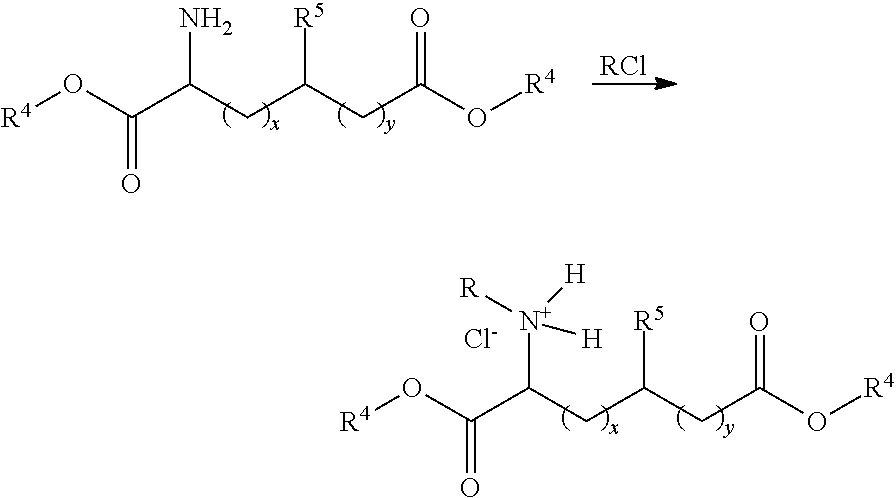
wherein x and y are 0 or 1 provided that x+y=1 or 2, and R, R4, R5 are as defined above. For example, the reaction of the dibutyl ester of 2-aminoadipic acid with benzyl amine would yield N-benzyl-1,6-dibutoxy-1,6-dioxohexane-2-ammonium chloride.


where each R1 is independently an alkyl group, frequently a polyisobutylene group with a molecular weight (Mn) of 500-5000 based on the polyisobutylene precursor, and R2 are alkylene groups, commonly ethylene (C2H4) groups. Such molecules are commonly derived from reaction of an alkenyl acylating agent with a polyamine, and a wide variety of linkages between the two moieties is possible beside the simple imide structure shown above, including a variety of amides and quaternary ammonium salts. In the above structure, the amine portion is shown as an alkylene polyamine, although other aliphatic and aromatic mono- and polyamines may also be used. Also, a variety of modes of linkage of the R1 groups onto the imide structure are possible, including various cyclic linkages. The ratio of the carbonyl groups of the acylating agent to the nitrogen atoms of the amine may be 1:0.5 to 1:3, and in other instances 1:1 to 1:2.75 or 1:1.5 to 1:2.5. Succinimide dispersants are more fully described in U.S. Pat. Nos. 4,234,435 and 3,172,892 and in EP 0355895.
[(R8O)(R9O)P(═S)—S]m-M
where R8 and R9 are independently hydrocarbyl groups containing 3 to 30 carbon atoms, are readily obtainable by heating phosphorus pentasulfide (P2S5) and an alcohol or phenol to form an O,O-dihydrocarbyl phosphorodithioic acid. The alcohol which reacts to provide the R8 and R9 groups may be a mixture of alcohols, for instance, a mixture of isopropanol and 4-methyl-2-pentanol, and in some embodiments a mixture of a secondary alcohol and a primary alcohol, such as isopropanol and 2-ethylhexanol. The resulting acid may be reacted with a basic metal compound to form the salt. The metal M, having a valence n, generally is aluminum, lead, tin, manganese, cobalt, nickel, zinc, or copper, and in many cases, zinc, to form zinc dialkyldithiophosphates (ZDP). Such materials are well known and readily available to those skilled in the art of lubricant formulation. Suitable variations to provide good phosphorus retention in an engine are disclosed, for instance, in US published application 2008-0015129, see, e.g., claims. The amount of a metal salt of a phosphorus acid, if present, may be 0.3 to 1.0, or 0.5 to 0.8 weight percent.
| fatty phosphites | borated alkoxylated fatty amines |
| fatty acid amides | metal salts of fatty acids |
| fatty epoxides | sulfurized olefins |
| borated fatty epoxides | fatty imidazolines |
| fatty amines | condensation products of carboxylic |
| glycerol esters | acids and polyalkylene-polyamines |
| borated glycerol esters | metal salts of alkyl salicylates |
| alkoxylated fatty amines | amine salts of alkylphosphoric acids |
| oxazolines | ethoxylated alcohols |
| hydroxyalkyl amides | imidazolines |
| dialkyl tartrates | polyhydroxy tertiary amines |
| molybdenum compounds | and mixtures of two or more thereof. |
| TABLE I | ||
| Ex. | Material | Amount |
| 2 | Dibutyl itaconate | 20.0 g |
| 2-Ethylhexylamine | 10.1 g | |
| Product, 49 TBNa | ||
| 3 | Dibutyl itaconate | 20.0 g |
| Isopropylamine | 4.6 g | |
| Product, 121 TBN | ||
| 4 | Dibutyl itaconate | 25.0 g |
| sec-Butylamine | 7.2 g | |
| Product, 69 TBN | ||
| 5 | Dibutyl itaconate | 25.0 g |
| iso-Butylamine | 7.2 g | |
| Product, 132 TBN | ||
| 6 | Dibutyl itaconate | 25.0 g |
| Cyclohexylamine | 9.7 g | |
| Product, 127 TBN | ||
| TABLE II | ||
| Ex 7 | Dibutyl itaconate | |
| α-Methylbenzylamineb | ||
| Product TBN 117 | ||
| Ex 7a | Dibutyl itaconate | |
| α-Methylbenzylamineb | ||
| Product TBN 144.2 | ||
| Ex. 8 | Dibutyl itaconate | |
| Cyclopentylamine | ||
| Product TBN 102 | ||
All TBNs by D4 739
b. The S-enantiomer is used. In all instances where a chiral center occurs, it is believed that either the R or S enantiomer may be used, or racemic mixtures thereof.
Claims (23)


Priority Applications (1)
| Application Number | Priority Date | Filing Date | Title |
|---|---|---|---|
| US15/306,654 US10119091B2 (en) | 2014-05-06 | 2015-04-28 | Anti-corrosion additives |
Applications Claiming Priority (4)
| Application Number | Priority Date | Filing Date | Title |
|---|---|---|---|
| US201461989299P | 2014-05-06 | 2014-05-06 | |
| US61989299 | 2014-05-06 | ||
| US15/306,654 US10119091B2 (en) | 2014-05-06 | 2015-04-28 | Anti-corrosion additives |
| PCT/US2015/027996 WO2015171364A1 (en) | 2014-05-06 | 2015-04-28 | Anti-corrosion additives |
Publications (2)
| Publication Number | Publication Date |
|---|---|
| US20170240836A1 US20170240836A1 (en) | 2017-08-24 |
| US10119091B2 true US10119091B2 (en) | 2018-11-06 |
Family
ID=53040691
Family Applications (1)
| Application Number | Title | Priority Date | Filing Date |
|---|---|---|---|
| US15/306,654 Active 2035-05-22 US10119091B2 (en) | 2014-05-06 | 2015-04-28 | Anti-corrosion additives |
Country Status (6)
| Country | Link |
|---|---|
| US (1) | US10119091B2 (en) |
| EP (1) | EP3140377B1 (en) |
| CN (1) | CN106471104A (en) |
| CA (1) | CA2948138C (en) |
| SG (1) | SG11201609152XA (en) |
| WO (1) | WO2015171364A1 (en) |
Families Citing this family (4)
| Publication number | Priority date | Publication date | Assignee | Title |
|---|---|---|---|---|
| CN106574202B (en) | 2014-05-06 | 2020-05-29 | 路博润公司 | Basic ashless additive |
| JP6753608B2 (en) * | 2016-10-19 | 2020-09-09 | 出光興産株式会社 | Lubricating oil composition, lubricating method, and transmission |
| US10767134B1 (en) * | 2019-05-17 | 2020-09-08 | Vanderbilt Chemicals, Llc | Less corrosive organomolybdenum compounds as lubricant additives |
| CN112760156B (en) * | 2019-10-21 | 2022-07-15 | 中国石油化工股份有限公司 | A kind of calcium-based grease and preparation method thereof |
Citations (8)
| Publication number | Priority date | Publication date | Assignee | Title |
|---|---|---|---|---|
| US3397145A (en) | 1958-12-29 | 1968-08-13 | Universal Oil Prod Co | Hydrocarbon oils containing alkylthiophosphoric acid salts of polymeric condensation products |
| US6596673B1 (en) * | 1999-09-13 | 2003-07-22 | Infineum International Ltd. | Marine diesel cylinder lubrication |
| US20120015855A1 (en) * | 2009-02-18 | 2012-01-19 | Saccomando Daniel J | Amine Derivatives as Friction Modifiers in Lubricants |
| US20120040876A1 (en) | 2009-03-20 | 2012-02-16 | The Lubrizol Corporation | Anthranilic Esters as Additives in Lubricants |
| WO2013013026A1 (en) | 2011-07-21 | 2013-01-24 | The Lubrizol Corporation | Carboxylic pyrrolidinones and methods of use thereof |
| US20150291907A1 (en) * | 2012-11-07 | 2015-10-15 | The Lubrizol Corporation | Basic Ashless Additives |
| WO2015171356A1 (en) | 2014-05-06 | 2015-11-12 | The Lubrizol Corporation | Basic ashless additives |
| WO2015171674A1 (en) | 2014-05-06 | 2015-11-12 | The Lubrizol Corporation | Lubricant composition containing an antiwear agent |
Family Cites Families (44)
| Publication number | Priority date | Publication date | Assignee | Title |
|---|---|---|---|---|
| US2501731A (en) | 1946-10-14 | 1950-03-28 | Union Oil Co | Modified lubricating oil |
| US2616911A (en) | 1951-03-16 | 1952-11-04 | Lubrizol Corp | Organic alkaline earth metal complexes formed by use of sulfonic promoters |
| US2616925A (en) | 1951-03-16 | 1952-11-04 | Lubrizol Corp | Organic alkaline earth metal complexes formed by use of thiophosphoric promoters |
| US2616905A (en) | 1952-03-13 | 1952-11-04 | Lubrizol Corp | Organic alkaline earth metal complexes and methods of making same |
| US2777874A (en) | 1952-11-03 | 1957-01-15 | Lubrizol Corp | Metal complexes and methods of making same |
| DE1248643B (en) | 1959-03-30 | 1967-08-31 | The Lubrizol Corporation, Cleveland, Ohio (V. St. A.) | Process for the preparation of oil-soluble aylated amines |
| US3488284A (en) | 1959-12-10 | 1970-01-06 | Lubrizol Corp | Organic metal compositions and methods of preparing same |
| US3197405A (en) | 1962-07-09 | 1965-07-27 | Lubrizol Corp | Phosphorus-and nitrogen-containing compositions and process for preparing the same |
| US3282835A (en) | 1963-02-12 | 1966-11-01 | Lubrizol Corp | Carbonated bright stock sulfonates and lubricants containing them |
| US3381022A (en) | 1963-04-23 | 1968-04-30 | Lubrizol Corp | Polymerized olefin substituted succinic acid esters |
| US3320162A (en) | 1964-05-22 | 1967-05-16 | Phillips Petroleum Co | Increasing the base number of calcium petroleum sulfonate |
| US3318809A (en) | 1965-07-13 | 1967-05-09 | Bray Oil Co | Counter current carbonation process |
| GB1105217A (en) | 1965-10-05 | 1968-03-06 | Lubrizol Corp | Process for preparing basic metal phenates |
| US3365396A (en) | 1965-12-28 | 1968-01-23 | Texaco Inc | Overbased calcium sulfonate |
| US3384585A (en) | 1966-08-29 | 1968-05-21 | Phillips Petroleum Co | Overbasing lube oil additives |
| US3471404A (en) | 1967-03-06 | 1969-10-07 | Mobil Oil Corp | Lubricating compositions containing polysulfurized olefin |
| US3544465A (en) | 1968-06-03 | 1970-12-01 | Mobil Oil Corp | Esters of phosphorodithioates |
| US3634515A (en) | 1968-11-08 | 1972-01-11 | Standard Oil Co | Alkylene polyamide formaldehyde |
| US3629109A (en) | 1968-12-19 | 1971-12-21 | Lubrizol Corp | Basic magnesium salts processes and lubricants and fuels containing the same |
| CA1064463A (en) | 1975-03-21 | 1979-10-16 | Kirk E. Davis | Sulfurized compositions |
| US4234435A (en) | 1979-02-23 | 1980-11-18 | The Lubrizol Corporation | Novel carboxylic acid acylating agents, derivatives thereof, concentrate and lubricant compositions containing the same, and processes for their preparation |
| US4285822A (en) | 1979-06-28 | 1981-08-25 | Chevron Research Company | Process for preparing a sulfurized molybdenum-containing composition and lubricating oil containing the composition |
| US4594378A (en) | 1985-03-25 | 1986-06-10 | The Lubrizol Corporation | Polymeric compositions, oil compositions containing said polymeric compositions, transmission fluids and hydraulic fluids |
| GB8531626D0 (en) | 1985-12-23 | 1986-02-05 | Shell Int Research | Grease composition |
| JPH01502988A (en) | 1986-06-13 | 1989-10-12 | ザ ルブリゾル コーポレーション | Phosphorous and sulfur containing lubricants and functional fluid compositions |
| US4755311A (en) | 1986-08-14 | 1988-07-05 | The Lubrizol Corporation | Phosphorus-, sulfur- and boron-containing compositions, and lubricant and functional fluid compositions containing same |
| US5110488A (en) | 1986-11-24 | 1992-05-05 | The Lubrizol Corporation | Lubricating compositions containing reduced levels of phosphorus |
| US4792410A (en) | 1986-12-22 | 1988-12-20 | The Lubrizol Corporation | Lubricant composition suitable for manual transmission fluids |
| IN172215B (en) | 1987-03-25 | 1993-05-08 | Lubrizol Corp | |
| US5157088A (en) | 1987-11-19 | 1992-10-20 | Dishong Dennis M | Nitrogen-containing esters of carboxy-containing interpolymers |
| US4957651A (en) | 1988-01-15 | 1990-09-18 | The Lubrizol Corporation | Mixtures of partial fatty acid esters of polyhydric alcohols and sulfurized compositions, and use as lubricant additives |
| US4959168A (en) | 1988-01-15 | 1990-09-25 | The Lubrizol Corporation | Sulfurized compositions, and additive concentrates and lubricating oils containing same |
| GB8818711D0 (en) | 1988-08-05 | 1988-09-07 | Shell Int Research | Lubricating oil dispersants |
| EP0394422B1 (en) | 1988-10-24 | 1994-01-12 | Exxon Chemical Patents Inc. | Amide containing friction modifier for use in power transmission fluids |
| DE69811208T2 (en) | 1997-11-13 | 2003-11-27 | Lubrizol Adibis Holdings (Uk) Ltd., Wirral | SALICYL CALIXARENE AND THEIR USE AS A LUBRICANT ADDITIVE |
| WO2001056968A1 (en) | 2000-02-07 | 2001-08-09 | Bp Oil International Limited | Calixarenes and their use as lubricant additives |
| US6559105B2 (en) | 2000-04-03 | 2003-05-06 | The Lubrizol Corporation | Lubricant compositions containing ester-substituted hindered phenol antioxidants |
| US6660695B2 (en) | 2002-03-15 | 2003-12-09 | Infineum International Ltd. | Power transmission fluids of improved anti-shudder properties |
| US7325967B2 (en) | 2003-07-31 | 2008-02-05 | Lextron, Inc. | Method and apparatus for administering micro-ingredient feed additives to animal feed rations |
| US7651987B2 (en) | 2004-10-12 | 2010-01-26 | The Lubrizol Corporation | Tartaric acid derivatives as fuel economy improvers and antiwear agents in crankcase oils and preparation thereof |
| US7727943B2 (en) | 2005-03-28 | 2010-06-01 | The Lubrizol Corporation | Titanium compounds and complexes as additives in lubricants |
| US7772171B2 (en) | 2006-07-17 | 2010-08-10 | The Lubrizol Corporation | Method of lubricating an internal combustion engine and improving the efficiency of the emissions control system of the engine |
| CN105602652A (en) | 2008-12-09 | 2016-05-25 | 路博润公司 | Lubricating composition containing compound derived from hydroxy-carboxylic acid |
| US9074157B2 (en) | 2009-04-30 | 2015-07-07 | The Lubrizol Corporation | Polymeric phosphorus esters for lubricant applications |
-
2015
- 2015-04-28 CN CN201580036741.8A patent/CN106471104A/en active Pending
- 2015-04-28 WO PCT/US2015/027996 patent/WO2015171364A1/en not_active Ceased
- 2015-04-28 EP EP15720247.4A patent/EP3140377B1/en active Active
- 2015-04-28 US US15/306,654 patent/US10119091B2/en active Active
- 2015-04-28 CA CA2948138A patent/CA2948138C/en active Active
- 2015-04-28 SG SG11201609152XA patent/SG11201609152XA/en unknown
Patent Citations (8)
| Publication number | Priority date | Publication date | Assignee | Title |
|---|---|---|---|---|
| US3397145A (en) | 1958-12-29 | 1968-08-13 | Universal Oil Prod Co | Hydrocarbon oils containing alkylthiophosphoric acid salts of polymeric condensation products |
| US6596673B1 (en) * | 1999-09-13 | 2003-07-22 | Infineum International Ltd. | Marine diesel cylinder lubrication |
| US20120015855A1 (en) * | 2009-02-18 | 2012-01-19 | Saccomando Daniel J | Amine Derivatives as Friction Modifiers in Lubricants |
| US20120040876A1 (en) | 2009-03-20 | 2012-02-16 | The Lubrizol Corporation | Anthranilic Esters as Additives in Lubricants |
| WO2013013026A1 (en) | 2011-07-21 | 2013-01-24 | The Lubrizol Corporation | Carboxylic pyrrolidinones and methods of use thereof |
| US20150291907A1 (en) * | 2012-11-07 | 2015-10-15 | The Lubrizol Corporation | Basic Ashless Additives |
| WO2015171356A1 (en) | 2014-05-06 | 2015-11-12 | The Lubrizol Corporation | Basic ashless additives |
| WO2015171674A1 (en) | 2014-05-06 | 2015-11-12 | The Lubrizol Corporation | Lubricant composition containing an antiwear agent |
Also Published As
| Publication number | Publication date |
|---|---|
| US20170240836A1 (en) | 2017-08-24 |
| CN106471104A (en) | 2017-03-01 |
| CA2948138C (en) | 2022-10-04 |
| EP3140377A1 (en) | 2017-03-15 |
| CA2948138A1 (en) | 2015-11-12 |
| WO2015171364A8 (en) | 2016-12-22 |
| SG11201609152XA (en) | 2016-12-29 |
| EP3140377B1 (en) | 2021-08-25 |
| WO2015171364A1 (en) | 2015-11-12 |
Similar Documents
| Publication | Publication Date | Title |
|---|---|---|
| US10519396B2 (en) | Method of lubricating a mechanical device | |
| US11072758B2 (en) | Lubricant composition containing an antiwear agent | |
| US9783756B2 (en) | Basic ashless additives | |
| US10358616B2 (en) | Lubricants containing quaternary ammonium compounds | |
| US10519395B2 (en) | Lubricant composition containing an antiwear agent | |
| JP2014208854A (en) | Lubricating method and lubricating compositions thereof | |
| EP3140377B1 (en) | Anti-corrosion additives | |
| US10144897B2 (en) | Basic ashless additives | |
| US20210024848A1 (en) | Lubricant with High Pyrophosphate Level | |
| EP3268454A1 (en) | Lubricating compositions comprising an anti-wear/friction modifying agent |
Legal Events
| Date | Code | Title | Description |
|---|---|---|---|
| AS | Assignment |
Owner name: THE LUBRIZOL CORPORATION, OHIO Free format text: ASSIGNMENT OF ASSIGNORS INTEREST;ASSIGNORS:SACCOMANDO, DANIEL J.;DELBRIDGE, EWAN E.;BARTON, WILLIAM R. S.;REEL/FRAME:040478/0142 Effective date: 20161025 |
|
| STCF | Information on status: patent grant |
Free format text: PATENTED CASE |
|
| MAFP | Maintenance fee payment |
Free format text: PAYMENT OF MAINTENANCE FEE, 4TH YEAR, LARGE ENTITY (ORIGINAL EVENT CODE: M1551); ENTITY STATUS OF PATENT OWNER: LARGE ENTITY Year of fee payment: 4 |
|
| MAFP | Maintenance fee payment |
Free format text: PAYMENT OF MAINTENANCE FEE, 8TH YEAR, LARGE ENTITY (ORIGINAL EVENT CODE: M1552); ENTITY STATUS OF PATENT OWNER: LARGE ENTITY Year of fee payment: 8 |