US10112947B2 - Substituted 6-aminopurines for targeting HSP90 - Google Patents
Substituted 6-aminopurines for targeting HSP90 Download PDFInfo
- Publication number
- US10112947B2 US10112947B2 US15/653,338 US201715653338A US10112947B2 US 10112947 B2 US10112947 B2 US 10112947B2 US 201715653338 A US201715653338 A US 201715653338A US 10112947 B2 US10112947 B2 US 10112947B2
- Authority
- US
- United States
- Prior art keywords
- compound
- inhibitor
- alkyl
- hsp90
- cancer
- Prior art date
- Legal status (The legal status is an assumption and is not a legal conclusion. Google has not performed a legal analysis and makes no representation as to the accuracy of the status listed.)
- Active
Links
- 0 [1*]N([2*])C(=O)C1=C(C(C)C)C([5*])=C(N2C=C([6*])C3=C2CC([7*])([8*])CC3=O)C([4*])=[Y]1 Chemical compound [1*]N([2*])C(=O)C1=C(C(C)C)C([5*])=C(N2C=C([6*])C3=C2CC([7*])([8*])CC3=O)C([4*])=[Y]1 0.000 description 9
- NNPPMTNAJDCUHE-UHFFFAOYSA-N CC(C)C Chemical compound CC(C)C NNPPMTNAJDCUHE-UHFFFAOYSA-N 0.000 description 7
- UJOFEPDYRZHELA-UHFFFAOYSA-N CC1=CC2=C(C=C1SC1=NC3=C(N)N=CN=C3N1CCCC(C)C)OCO2 Chemical compound CC1=CC2=C(C=C1SC1=NC3=C(N)N=CN=C3N1CCCC(C)C)OCO2 UJOFEPDYRZHELA-UHFFFAOYSA-N 0.000 description 2
- STIXEAYMURCISC-UHFFFAOYSA-N CC1=NN(C2=CC=C(C(N)=O)C(NCCCOCCOCCOCCOCCOCCCN)=C2)C2=C1C(=O)CC(C)(C)C2.CNCCCOCCOCCOCCOCCOCCCNC1=CC(N2N=C(C)C3=C2CC(C)(C)CC3=O)=CC=C1C(N)=O Chemical compound CC1=NN(C2=CC=C(C(N)=O)C(NCCCOCCOCCOCCOCCOCCCN)=C2)C2=C1C(=O)CC(C)(C)C2.CNCCCOCCOCCOCCOCCOCCCNC1=CC(N2N=C(C)C3=C2CC(C)(C)CC3=O)=CC=C1C(N)=O STIXEAYMURCISC-UHFFFAOYSA-N 0.000 description 2
- LTHOGIYEGGHBJY-UHFFFAOYSA-N BC.BCC1=CC(N2N=C(C)C3=C2CC(C)(C)CC3=O)=CC=C1C(N)=O.C.CC1=CC(N2N=C(C)C3=C2CC(C)(C)CC3=O)=CC=C1C#N.CC1=CC(N2N=C(C)C3=C2CC(C)(C)CC3=O)=CC=C1C(N)=O.CC1=CC(N2N=C(C)C3=C2CC(C)(C)CC3=O)=CC=C1C(N)=O.[HH] Chemical compound BC.BCC1=CC(N2N=C(C)C3=C2CC(C)(C)CC3=O)=CC=C1C(N)=O.C.CC1=CC(N2N=C(C)C3=C2CC(C)(C)CC3=O)=CC=C1C#N.CC1=CC(N2N=C(C)C3=C2CC(C)(C)CC3=O)=CC=C1C(N)=O.CC1=CC(N2N=C(C)C3=C2CC(C)(C)CC3=O)=CC=C1C(N)=O.[HH] LTHOGIYEGGHBJY-UHFFFAOYSA-N 0.000 description 1
- OHTZQOQFHIDIPG-UHFFFAOYSA-N CC(=O)C1C(=O)CC(C)(C)CC1=O.CC1(C)CC(=O)CC(=O)C1 Chemical compound CC(=O)C1C(=O)CC(C)(C)CC1=O.CC1(C)CC(=O)CC(=O)C1 OHTZQOQFHIDIPG-UHFFFAOYSA-N 0.000 description 1
- ISHUJNMAMJCUQA-UHFFFAOYSA-N CC(=O)C1C(=O)CC(C)(C)CC1=O.CC1(C)CC(=O)CC(=O)C1.CC1=NN(C2=CC=C(C#N)C(F)=C2)C2=C1C(=O)CC(C)(C)C2.N#CC1=C(F)C=C(F)C=C1.N#CC1=C(F)C=C(NN)C=C1 Chemical compound CC(=O)C1C(=O)CC(C)(C)CC1=O.CC1(C)CC(=O)CC(=O)C1.CC1=NN(C2=CC=C(C#N)C(F)=C2)C2=C1C(=O)CC(C)(C)C2.N#CC1=C(F)C=C(F)C=C1.N#CC1=C(F)C=C(NN)C=C1 ISHUJNMAMJCUQA-UHFFFAOYSA-N 0.000 description 1
- JWXFPOZFXUSZBH-UHFFFAOYSA-N CC(=O)C1C(=O)CC(C)(C)CC1=O.CC1=NN(C2=CC=C(C#N)C(F)=C2)C2=C1C(=O)CC(C)(C)C2.N#CC1=C(F)C=C(NN)C=C1 Chemical compound CC(=O)C1C(=O)CC(C)(C)CC1=O.CC1=NN(C2=CC=C(C#N)C(F)=C2)C2=C1C(=O)CC(C)(C)C2.N#CC1=C(F)C=C(NN)C=C1 JWXFPOZFXUSZBH-UHFFFAOYSA-N 0.000 description 1
- CWFGKNQILVMBIO-UHFFFAOYSA-N CC(=O)OB[Na].CC(=O)OOC(C)=O.CC1(C)CC(=O)CC(C)(C)N1[O].CC1=NN(C2=CC=C(C(N)=O)C(NCCCOCCOCCOCCOCCOCCCN)=C2)C2=C1C(=O)CC(C)(C)C2.CC1=NN(C2=CC=C(C(N)=O)C(NCCCOCCOCCOCCOCCOCCCNC3CC(C)(C)N([O])C(C)(C)C3)=C2)C2=C1C(=O)CC(C)(C)C2 Chemical compound CC(=O)OB[Na].CC(=O)OOC(C)=O.CC1(C)CC(=O)CC(C)(C)N1[O].CC1=NN(C2=CC=C(C(N)=O)C(NCCCOCCOCCOCCOCCOCCCN)=C2)C2=C1C(=O)CC(C)(C)C2.CC1=NN(C2=CC=C(C(N)=O)C(NCCCOCCOCCOCCOCCOCCCNC3CC(C)(C)N([O])C(C)(C)C3)=C2)C2=C1C(=O)CC(C)(C)C2 CWFGKNQILVMBIO-UHFFFAOYSA-N 0.000 description 1
- KIOROYKNESZAGJ-VPMNAVQSSA-N CC(C)(C)OC(=O)CCCC1=CC=C(O)C=C1.CC(C)(C)OC(=O)NCCC1=CC=C(O)C(/N=N/C2=CC=C(C(=O)O)C=C2)=C1.NC1=CC=C(C(=O)O)C=C1 Chemical compound CC(C)(C)OC(=O)CCCC1=CC=C(O)C=C1.CC(C)(C)OC(=O)NCCC1=CC=C(O)C(/N=N/C2=CC=C(C(=O)O)C=C2)=C1.NC1=CC=C(C(=O)O)C=C1 KIOROYKNESZAGJ-VPMNAVQSSA-N 0.000 description 1
- ZPQBHJAWSKBSJR-FXIPFYHKSA-N CC(C)(C)OC(=O)NCCC1=CC=C(O)C(/N=N/C2=CC=C(C(=O)O)C=C2)=C1.CC1=NN(C2=CC=C(C(N)=O)C(NCCCOCCOCCOCCOCCOCCCN)=C2)C2=C1C(=O)CC(C)(C)C2.CC1=NN(C2=CC=C(C(N)=O)C(NCCCOCCOCCOCCOCCOCCCNC(=O)C3=CC=C(/N=N/C4=CC(CCNC(=O)OC(C)(C)C)=CC=C4O)C=C3)=C2)C2=C1C(=O)CC(C)(C)C2 Chemical compound CC(C)(C)OC(=O)NCCC1=CC=C(O)C(/N=N/C2=CC=C(C(=O)O)C=C2)=C1.CC1=NN(C2=CC=C(C(N)=O)C(NCCCOCCOCCOCCOCCOCCCN)=C2)C2=C1C(=O)CC(C)(C)C2.CC1=NN(C2=CC=C(C(N)=O)C(NCCCOCCOCCOCCOCCOCCCNC(=O)C3=CC=C(/N=N/C4=CC(CCNC(=O)OC(C)(C)C)=CC=C4O)C=C3)=C2)C2=C1C(=O)CC(C)(C)C2 ZPQBHJAWSKBSJR-FXIPFYHKSA-N 0.000 description 1
- PJIYNBYKXCNMBY-UHFFFAOYSA-N CC(C)CCCOCCOCCOCCOCCOCCCC(C)C Chemical compound CC(C)CCCOCCOCCOCCOCCOCCCC(C)C PJIYNBYKXCNMBY-UHFFFAOYSA-N 0.000 description 1
- LZJXWLSXILZODG-UHFFFAOYSA-N CC1=CC(C)=C(CC2=NC3=C(N)N=C(C)N=C3N2PC(C)C)C=C1C Chemical compound CC1=CC(C)=C(CC2=NC3=C(N)N=C(C)N=C3N2PC(C)C)C=C1C LZJXWLSXILZODG-UHFFFAOYSA-N 0.000 description 1
- ICHSPYPSVAGCBE-UHFFFAOYSA-N CC1=CC2=C(C=C1)C1(OC(=O)C3=C1C=CC(NC(=S)C(C)C)=C3)C1=C(C=C(O)C=C1)O2 Chemical compound CC1=CC2=C(C=C1)C1(OC(=O)C3=C1C=CC(NC(=S)C(C)C)=C3)C1=C(C=C(O)C=C1)O2 ICHSPYPSVAGCBE-UHFFFAOYSA-N 0.000 description 1
- LMCFHZQNJBXZIR-UHFFFAOYSA-N CC1=NN(C2=CC(C(C)C)=C(C(N)=O)C=C2)C2=C1C(=O)CC(C)(C)C2 Chemical compound CC1=NN(C2=CC(C(C)C)=C(C(N)=O)C=C2)C2=C1C(=O)CC(C)(C)C2 LMCFHZQNJBXZIR-UHFFFAOYSA-N 0.000 description 1
- AZGXPXGCIKJOBR-UHFFFAOYSA-N CC1=NN(C2=CC=C(C#N)C(F)=C2)C2=C1C(=O)CC(C)(C)C2.CC1=NN(C2=CC=C(C(N)=O)C(NCCCOCCOCCOCCCN)=C2)C2=C1C(=O)CC(C)(C)C2 Chemical compound CC1=NN(C2=CC=C(C#N)C(F)=C2)C2=C1C(=O)CC(C)(C)C2.CC1=NN(C2=CC=C(C(N)=O)C(NCCCOCCOCCOCCCN)=C2)C2=C1C(=O)CC(C)(C)C2 AZGXPXGCIKJOBR-UHFFFAOYSA-N 0.000 description 1
- CFXBSYSNOVEUCZ-UHFFFAOYSA-N CC1=NN(C2=CC=C(C#N)C(F)=C2)C2=C1C(=O)CC(C)(C)C2.CC1=NN(C2=CC=C(C(N)=O)C(NCCCOCCOCCOCCOCCO)=C2)C2=C1C(=O)CC(C)(C)C2.CC1=NN(C2=CC=C(C(N)=O)C(NCCCOCCOCCOCCOCCOCCCNC3=CC(N4/N=C(/C)C5=C4CC(C)(C)CC5=O)=CC=C3C(N)=O)=C2)C2=C1C(=O)CC(C)(C)C2.NCCCOCCOCCOCCOCCOCCCN Chemical compound CC1=NN(C2=CC=C(C#N)C(F)=C2)C2=C1C(=O)CC(C)(C)C2.CC1=NN(C2=CC=C(C(N)=O)C(NCCCOCCOCCOCCOCCO)=C2)C2=C1C(=O)CC(C)(C)C2.CC1=NN(C2=CC=C(C(N)=O)C(NCCCOCCOCCOCCOCCOCCCNC3=CC(N4/N=C(/C)C5=C4CC(C)(C)CC5=O)=CC=C3C(N)=O)=C2)C2=C1C(=O)CC(C)(C)C2.NCCCOCCOCCOCCOCCOCCCN CFXBSYSNOVEUCZ-UHFFFAOYSA-N 0.000 description 1
- GGGMHRUDDVZRBC-UHFFFAOYSA-N CC1=NN(C2=CC=C(C#N)C(F)=C2)C2=C1C(=O)CC(C)(C)C2.CC1=NN(C2=CC=C(C(N)=O)C(NCCCOCCOCCOCCOCCOCCCN)=C2)C2=C1C(=O)CC(C)(C)C2.NCCCOCCOCCOCCOCCOCCCN Chemical compound CC1=NN(C2=CC=C(C#N)C(F)=C2)C2=C1C(=O)CC(C)(C)C2.CC1=NN(C2=CC=C(C(N)=O)C(NCCCOCCOCCOCCOCCOCCCN)=C2)C2=C1C(=O)CC(C)(C)C2.NCCCOCCOCCOCCOCCOCCCN GGGMHRUDDVZRBC-UHFFFAOYSA-N 0.000 description 1
- QYFFCPDTKCHHKU-UHFFFAOYSA-N CC1=NN(C2=CC=C(C#N)C(F)=C2)C2=C1C(=O)CC(C)(C)C2.CC1=NN(C2=CC=C(C(N)=O)C(NCCOCCOCCN)=C2)C2=C1C(=O)CC(C)(C)C2 Chemical compound CC1=NN(C2=CC=C(C#N)C(F)=C2)C2=C1C(=O)CC(C)(C)C2.CC1=NN(C2=CC=C(C(N)=O)C(NCCOCCOCCN)=C2)C2=C1C(=O)CC(C)(C)C2 QYFFCPDTKCHHKU-UHFFFAOYSA-N 0.000 description 1
- RJIBJADDTGFWES-PSVZQGSCSA-N CC1=NN(C2=CC=C(C#N)C(F)=C2)C2=C1C(=O)CC(C)(C)C2.CC1=NN(C2=CC=C(C(N)=O)C(N[C@H]3CC[C@H](N)CC3)=C2)C2=C1C(=O)CC(C)(C)C2.N[C@H]1CC[C@H](N)CC1 Chemical compound CC1=NN(C2=CC=C(C#N)C(F)=C2)C2=C1C(=O)CC(C)(C)C2.CC1=NN(C2=CC=C(C(N)=O)C(N[C@H]3CC[C@H](N)CC3)=C2)C2=C1C(=O)CC(C)(C)C2.N[C@H]1CC[C@H](N)CC1 RJIBJADDTGFWES-PSVZQGSCSA-N 0.000 description 1
- XSPLCFIXSIFFOU-SWQINVOKSA-N CC1=NN(C2=CC=C(C#N)C(F)=C2)C2=C1C(=O)CC(C)(C)C2.CC1=NN(C2=CC=C(C(N)=O)C(N[C@H]3CC[C@H](O)CC3)=C2)C2=C1C(=O)CC(C)(C)C2 Chemical compound CC1=NN(C2=CC=C(C#N)C(F)=C2)C2=C1C(=O)CC(C)(C)C2.CC1=NN(C2=CC=C(C(N)=O)C(N[C@H]3CC[C@H](O)CC3)=C2)C2=C1C(=O)CC(C)(C)C2 XSPLCFIXSIFFOU-SWQINVOKSA-N 0.000 description 1
- DPQOYRUZYMLZAJ-UHFFFAOYSA-N CC1=NN(C2=CC=C(C(N)=O)C(NCCCCCCCCCCN)=C2)C2=C1C(=O)CC(C)(C)C2 Chemical compound CC1=NN(C2=CC=C(C(N)=O)C(NCCCCCCCCCCN)=C2)C2=C1C(=O)CC(C)(C)C2 DPQOYRUZYMLZAJ-UHFFFAOYSA-N 0.000 description 1
- XEWWTUMTRNNOKZ-UHFFFAOYSA-N CC1=NN(C2=CC=C(C(N)=O)C(NCCCOCCOCCOCCOCCOCCCN(CC3=CC=CC(I)=C3)C(=S)NC3=CC=C4C(=C3)C(=O)OC43C4=C(C=C(O)C=C4)OC4=C3C=CC(O)=C4)=C2)C2=C1C(=O)CC(C)(C)C2.CC1=NN(C2=CC=C(C(N)=O)C(NCCCOCCOCCOCCOCCOCCCN(CC3=CC=CC([Sn](C)(C)C)=C3)C(=S)NC3=CC=C4C(=C3)C(=O)OC43C4=C(C=C(O)C=C4)OC4=C3C=CC(O)=C4)=C2)C2=C1C(=O)CC(C)(C)C2.NCCN Chemical compound CC1=NN(C2=CC=C(C(N)=O)C(NCCCOCCOCCOCCOCCOCCCN(CC3=CC=CC(I)=C3)C(=S)NC3=CC=C4C(=C3)C(=O)OC43C4=C(C=C(O)C=C4)OC4=C3C=CC(O)=C4)=C2)C2=C1C(=O)CC(C)(C)C2.CC1=NN(C2=CC=C(C(N)=O)C(NCCCOCCOCCOCCOCCOCCCN(CC3=CC=CC([Sn](C)(C)C)=C3)C(=S)NC3=CC=C4C(=C3)C(=O)OC43C4=C(C=C(O)C=C4)OC4=C3C=CC(O)=C4)=C2)C2=C1C(=O)CC(C)(C)C2.NCCN XEWWTUMTRNNOKZ-UHFFFAOYSA-N 0.000 description 1
- FGAGLXBOFHAGRW-UHFFFAOYSA-N CC1=NN(C2=CC=C(C(N)=O)C(NCCCOCCOCCOCCOCCOCCCN(CC3=CC=CC(I)=C3)C(=S)NC3=CC=C4C(=C3)C(=O)OC43C4=C(C=C(O)C=C4)OC4=C3C=CC(O)=C4)=C2)C2=C1C(=O)CC(C)(C)C2.CC1=NN(C2=CC=C(C(N)=O)C(NCCCOCCOCCOCCOCCOCCCNCC3=CC(I)=CC=C3)=C2)C2=C1C(=O)CC(C)(C)C2 Chemical compound CC1=NN(C2=CC=C(C(N)=O)C(NCCCOCCOCCOCCOCCOCCCN(CC3=CC=CC(I)=C3)C(=S)NC3=CC=C4C(=C3)C(=O)OC43C4=C(C=C(O)C=C4)OC4=C3C=CC(O)=C4)=C2)C2=C1C(=O)CC(C)(C)C2.CC1=NN(C2=CC=C(C(N)=O)C(NCCCOCCOCCOCCOCCOCCCNCC3=CC(I)=CC=C3)=C2)C2=C1C(=O)CC(C)(C)C2 FGAGLXBOFHAGRW-UHFFFAOYSA-N 0.000 description 1
- UDKALSNWYKUKSV-UHFFFAOYSA-N CC1=NN(C2=CC=C(C(N)=O)C(NCCCOCCOCCOCCOCCOCCCN(CC3=CC=CC([Sn](C)(C)C)=C3)C(=S)NC3=CC=C4C(=C3)C(=O)OC43C4=C(C=C(O)C=C4)OC4=C3C=CC(O)=C4)=C2)C2=C1C(=O)CC(C)(C)C2.CC1=NN(C2=CC=C(C(N)=O)C(NCCCOCCOCCOCCOCCOCCCNCC3=CC([Sn](C)(C)C)=CC=C3)=C2)C2=C1C(=O)CC(C)(C)C2 Chemical compound CC1=NN(C2=CC=C(C(N)=O)C(NCCCOCCOCCOCCOCCOCCCN(CC3=CC=CC([Sn](C)(C)C)=C3)C(=S)NC3=CC=C4C(=C3)C(=O)OC43C4=C(C=C(O)C=C4)OC4=C3C=CC(O)=C4)=C2)C2=C1C(=O)CC(C)(C)C2.CC1=NN(C2=CC=C(C(N)=O)C(NCCCOCCOCCOCCOCCOCCCNCC3=CC([Sn](C)(C)C)=CC=C3)=C2)C2=C1C(=O)CC(C)(C)C2 UDKALSNWYKUKSV-UHFFFAOYSA-N 0.000 description 1
- NILLYOAVRXAKPP-UHFFFAOYSA-N CC1=NN(C2=CC=C(C(N)=O)C(NCCCOCCOCCOCCOCCOCCCN)=C2)C2=C1C(=O)CC(C)(C)C2.CC1=NN(C2=CC=C(C(N)=O)C(NCCCOCCOCCOCCOCCOCCCNC(=O)C3=CC(I)=CC=C3)=C2)C2=C1C(=O)CC(C)(C)C2.O=C(O)C1=CC(I)=CC=C1 Chemical compound CC1=NN(C2=CC=C(C(N)=O)C(NCCCOCCOCCOCCOCCOCCCN)=C2)C2=C1C(=O)CC(C)(C)C2.CC1=NN(C2=CC=C(C(N)=O)C(NCCCOCCOCCOCCOCCOCCCNC(=O)C3=CC(I)=CC=C3)=C2)C2=C1C(=O)CC(C)(C)C2.O=C(O)C1=CC(I)=CC=C1 NILLYOAVRXAKPP-UHFFFAOYSA-N 0.000 description 1
- AYAHMCUMSXQIEG-UHFFFAOYSA-N CC1=NN(C2=CC=C(C(N)=O)C(NCCCOCCOCCOCCOCCOCCCN)=C2)C2=C1C(=O)CC(C)(C)C2.CC1=NN(C2=CC=C(C(N)=O)C(NCCCOCCOCCOCCOCCOCCCNC(=O)C3=CC=C(OC4=CC=C(O)C=C4)C=C3)=C2)C2=C1C(=O)CC(C)(C)C2.O=C(O)C1=CC=C(OC2=CC=C(O)C=C2)C=C1 Chemical compound CC1=NN(C2=CC=C(C(N)=O)C(NCCCOCCOCCOCCOCCOCCCN)=C2)C2=C1C(=O)CC(C)(C)C2.CC1=NN(C2=CC=C(C(N)=O)C(NCCCOCCOCCOCCOCCOCCCNC(=O)C3=CC=C(OC4=CC=C(O)C=C4)C=C3)=C2)C2=C1C(=O)CC(C)(C)C2.O=C(O)C1=CC=C(OC2=CC=C(O)C=C2)C=C1 AYAHMCUMSXQIEG-UHFFFAOYSA-N 0.000 description 1
- FEBQZLJCNXMZCV-UHFFFAOYSA-N CC1=NN(C2=CC=C(C(N)=O)C(NCCCOCCOCCOCCOCCOCCCN)=C2)C2=C1C(=O)CC(C)(C)C2.CC1=NN(C2=CC=C(C(N)=O)C(NCCCOCCOCCOCCOCCOCCCNC(=S)NC3=C/C4=C(\C=C/3)C3(OC4=O)C4=C(C=C(O)C=C4)OC4=C3C=CC(O)=C4)=C2)C2=C1C(=O)CC(C)(C)C2 Chemical compound CC1=NN(C2=CC=C(C(N)=O)C(NCCCOCCOCCOCCOCCOCCCN)=C2)C2=C1C(=O)CC(C)(C)C2.CC1=NN(C2=CC=C(C(N)=O)C(NCCCOCCOCCOCCOCCOCCCNC(=S)NC3=C/C4=C(\C=C/3)C3(OC4=O)C4=C(C=C(O)C=C4)OC4=C3C=CC(O)=C4)=C2)C2=C1C(=O)CC(C)(C)C2 FEBQZLJCNXMZCV-UHFFFAOYSA-N 0.000 description 1
- WLIGXJFEAGZITI-UHFFFAOYSA-N CC1=NN(C2=CC=C(C(N)=O)C(NCCCOCCOCCOCCOCCOCCCN)=C2)C2=C1C(=O)CC(C)(C)C2.CC1=NN(C2=CC=C(C(N)=O)C(NCCCOCCOCCOCCOCCOCCCNC3=CC=C([N+](=O)[O-])C4=NON=C34)=C2)C2=C1C(=O)CC(C)(C)C2.O=[N+]([O-])C1=CC=C(Cl)C2=NON=C12 Chemical compound CC1=NN(C2=CC=C(C(N)=O)C(NCCCOCCOCCOCCOCCOCCCN)=C2)C2=C1C(=O)CC(C)(C)C2.CC1=NN(C2=CC=C(C(N)=O)C(NCCCOCCOCCOCCOCCOCCCNC3=CC=C([N+](=O)[O-])C4=NON=C34)=C2)C2=C1C(=O)CC(C)(C)C2.O=[N+]([O-])C1=CC=C(Cl)C2=NON=C12 WLIGXJFEAGZITI-UHFFFAOYSA-N 0.000 description 1
- LUMREAWGEFWJET-UHFFFAOYSA-N CC1=NN(C2=CC=C(C(N)=O)C(NCCCOCCOCCOCCOCCOCCCN)=C2)C2=C1C(=O)CC(C)(C)C2.CC1=NN(C2=CC=C(C(N)=O)C(NCCCOCCOCCOCCOCCOCCCNCC3=CC(I)=CC=C3)=C2)C2=C1C(=O)CC(C)(C)C2.[H]C(=O)C1=CC(I)=CC=C1 Chemical compound CC1=NN(C2=CC=C(C(N)=O)C(NCCCOCCOCCOCCOCCOCCCN)=C2)C2=C1C(=O)CC(C)(C)C2.CC1=NN(C2=CC=C(C(N)=O)C(NCCCOCCOCCOCCOCCOCCCNCC3=CC(I)=CC=C3)=C2)C2=C1C(=O)CC(C)(C)C2.[H]C(=O)C1=CC(I)=CC=C1 LUMREAWGEFWJET-UHFFFAOYSA-N 0.000 description 1
- ZMBCQAMANOGKKB-RXAZSNRISA-N CC1=NN(C2=CC=C(C(N)=O)C(NCCCOCCOCCOCCOCCOCCCN)=C2)C2=C1C(=O)CC(C)(C)C2.CCCN1C2=C(C=CC=C2)C(C)(C)/C1=C\C=C1/CCCC(/C=C/C2=N(\CCC)C3=C(C=CC=C3)C2(C)C)=C1Cl.CCCN1C2=C(C=CC=C2)C(C)(C)/C1=C\C=C1/CCCC(/C=C/C2=[N+](CCC)C3=C(C=CC=C3)C2(C)C)=C1NCCCOCCOCCOCCOCCOCCCNC1=CC(N2N=C(C)C3=C2CC(C)(C)CC3=O)=CC=C1C(N)=O.[I-] Chemical compound CC1=NN(C2=CC=C(C(N)=O)C(NCCCOCCOCCOCCOCCOCCCN)=C2)C2=C1C(=O)CC(C)(C)C2.CCCN1C2=C(C=CC=C2)C(C)(C)/C1=C\C=C1/CCCC(/C=C/C2=N(\CCC)C3=C(C=CC=C3)C2(C)C)=C1Cl.CCCN1C2=C(C=CC=C2)C(C)(C)/C1=C\C=C1/CCCC(/C=C/C2=[N+](CCC)C3=C(C=CC=C3)C2(C)C)=C1NCCCOCCOCCOCCOCCOCCCNC1=CC(N2N=C(C)C3=C2CC(C)(C)CC3=O)=CC=C1C(N)=O.[I-] ZMBCQAMANOGKKB-RXAZSNRISA-N 0.000 description 1
- DGNJKCCRYXCZJC-HSYYAQRQSA-N CC1=NN(C2=CC=C(C(N)=O)C(NCCCOCCOCCOCCOCCOCCCN)=C2)C2=C1C(=O)CC(C)(C)C2.[H][C@@](CCC(=O)NCCCOCCOCCOCCOCCOCCCNC1=CC(N2N=C(C)C3=C2CC(C)(C)CC3=O)=CC=C1C(N)=O)(NC(=O)C1=CC=C(N(C)CC2=NC3=C(N=C2)N=C(N)N=C3N)C=C1)C(=O)O.[H][C@@](CCC(=O)O)(NC(=O)C1=CC=C(N(C)CC2=NC3=C(N=C2)N=C(N)N=C3N)C=C1)C(=O)O Chemical compound CC1=NN(C2=CC=C(C(N)=O)C(NCCCOCCOCCOCCOCCOCCCN)=C2)C2=C1C(=O)CC(C)(C)C2.[H][C@@](CCC(=O)NCCCOCCOCCOCCOCCOCCCNC1=CC(N2N=C(C)C3=C2CC(C)(C)CC3=O)=CC=C1C(N)=O)(NC(=O)C1=CC=C(N(C)CC2=NC3=C(N=C2)N=C(N)N=C3N)C=C1)C(=O)O.[H][C@@](CCC(=O)O)(NC(=O)C1=CC=C(N(C)CC2=NC3=C(N=C2)N=C(N)N=C3N)C=C1)C(=O)O DGNJKCCRYXCZJC-HSYYAQRQSA-N 0.000 description 1
- WUXYGVMVPXPPIT-UHFFFAOYSA-N CC1=NN(C2=CC=C(C(N)=O)C(NCCCOCCOCCOCCOCCOCCCNC(=O)C3=CC(I)=CC=C3)=C2)C2=C1C(=O)CC(C)(C)C2.CC1=NN(C2=CC=C(C(N)=O)C(NCCCOCCOCCOCCOCCOCCCNC(=O)C3=CC([Sn](C)(C)C)=CC=C3)=C2)C2=C1C(=O)CC(C)(C)C2.C[Sn](C)(C)[Sn](C)(C)C Chemical compound CC1=NN(C2=CC=C(C(N)=O)C(NCCCOCCOCCOCCOCCOCCCNC(=O)C3=CC(I)=CC=C3)=C2)C2=C1C(=O)CC(C)(C)C2.CC1=NN(C2=CC=C(C(N)=O)C(NCCCOCCOCCOCCOCCOCCCNC(=O)C3=CC([Sn](C)(C)C)=CC=C3)=C2)C2=C1C(=O)CC(C)(C)C2.C[Sn](C)(C)[Sn](C)(C)C WUXYGVMVPXPPIT-UHFFFAOYSA-N 0.000 description 1
- CFGCFUUKESIDSD-UHFFFAOYSA-N CC1=NN(C2=CC=C(C(N)=O)C(NCCCOCCOCCOCCOCCOCCCNC(=O)C3=CC(I)=CC=C3)=C2)C2=C1C(=O)CC(C)(C)C2.CC1=NN(C2=CC=C(C(N)=O)C(NCCCOCCOCCOCCOCCOCCCNC(=O)C3=CC([Sn](C)(C)C)=CC=C3)=C2)C2=C1C(=O)CC(C)(C)C2.II Chemical compound CC1=NN(C2=CC=C(C(N)=O)C(NCCCOCCOCCOCCOCCOCCCNC(=O)C3=CC(I)=CC=C3)=C2)C2=C1C(=O)CC(C)(C)C2.CC1=NN(C2=CC=C(C(N)=O)C(NCCCOCCOCCOCCOCCOCCCNC(=O)C3=CC([Sn](C)(C)C)=CC=C3)=C2)C2=C1C(=O)CC(C)(C)C2.II CFGCFUUKESIDSD-UHFFFAOYSA-N 0.000 description 1
- JOQHEDSEGIXYIQ-WYYOLBRMSA-N CC1=NN(C2=CC=C(C(N)=O)C(NCCCOCCOCCOCCOCCOCCCNC(=O)C3=CC=C(/N=N/C4=CC=C(CCN)C=C4O)C=C3)=C2)C2=C1C(=O)CC(C)(C)C2 Chemical compound CC1=NN(C2=CC=C(C(N)=O)C(NCCCOCCOCCOCCOCCOCCCNC(=O)C3=CC=C(/N=N/C4=CC=C(CCN)C=C4O)C=C3)=C2)C2=C1C(=O)CC(C)(C)C2 JOQHEDSEGIXYIQ-WYYOLBRMSA-N 0.000 description 1
- YCDXSBBLXATQLH-KECGAIAZSA-N CC1=NN(C2=CC=C(C(N)=O)C(NCCCOCCOCCOCCOCCOCCCNC(=O)C3=CC=C(/N=N/C4=CC=C(CCNC(=O)OC(C)(C)C)C=C4O)C=C3)=C2)C2=C1C(=O)CC(C)(C)C2.COC(=N)NCCC1=CC=C(/N=N/C2=CC=C(C(=O)NCCCOCCOCCOCCOCCOCCCNC3=CC(N4N=C(C)C5=C4CC(C)(C)CC5=O)=CC=C3C(N)=O)C=C2)C(O)=C1 Chemical compound CC1=NN(C2=CC=C(C(N)=O)C(NCCCOCCOCCOCCOCCOCCCNC(=O)C3=CC=C(/N=N/C4=CC=C(CCNC(=O)OC(C)(C)C)C=C4O)C=C3)=C2)C2=C1C(=O)CC(C)(C)C2.COC(=N)NCCC1=CC=C(/N=N/C2=CC=C(C(=O)NCCCOCCOCCOCCOCCOCCCNC3=CC(N4N=C(C)C5=C4CC(C)(C)CC5=O)=CC=C3C(N)=O)C=C2)C(O)=C1 YCDXSBBLXATQLH-KECGAIAZSA-N 0.000 description 1
- FXTGEVYFUZBKPB-UHFFFAOYSA-N CC1=NN(C2=CC=C(C(N)=O)C(NCCCOCCOCCOCCOCCOCCCNC(=O)C3=CC=C(OC4=CC(C)=C(O)C(I)=C4)C=C3)=C2)C2=C1C(=O)CC(C)(C)C2 Chemical compound CC1=NN(C2=CC=C(C(N)=O)C(NCCCOCCOCCOCCOCCOCCCNC(=O)C3=CC=C(OC4=CC(C)=C(O)C(I)=C4)C=C3)=C2)C2=C1C(=O)CC(C)(C)C2 FXTGEVYFUZBKPB-UHFFFAOYSA-N 0.000 description 1
- JYBZQRTVOOINFJ-UHFFFAOYSA-N CC1=NN(C2=CC=C(C(N)=O)C(NCCCOCCOCCOCCOCCOCCCNCC3=CC(I)=CC=C3)=C2)C2=C1C(=O)CC(C)(C)C2.CC1=NN(C2=CC=C(C(N)=O)C(NCCCOCCOCCOCCOCCOCCCNCC3=CC([Sn](C)(C)C)=CC=C3)=C2)C2=C1C(=O)CC(C)(C)C2.C[SnH](C)C.C[SnH](C)C Chemical compound CC1=NN(C2=CC=C(C(N)=O)C(NCCCOCCOCCOCCOCCOCCCNCC3=CC(I)=CC=C3)=C2)C2=C1C(=O)CC(C)(C)C2.CC1=NN(C2=CC=C(C(N)=O)C(NCCCOCCOCCOCCOCCOCCCNCC3=CC([Sn](C)(C)C)=CC=C3)=C2)C2=C1C(=O)CC(C)(C)C2.C[SnH](C)C.C[SnH](C)C JYBZQRTVOOINFJ-UHFFFAOYSA-N 0.000 description 1
- XQYAEGPAUPSZNM-LVMCXLEDSA-M CC1=NN(C2=CC=C(C(N)=O)C(N[C@H]3CC[C@H](N(C)(C)C)CC3)=C2)C2=C1C(=O)CC(C)(C)C2.CC1=NN(C2=CC=C(C(N)=O)C(N[C@H]3CC[C@H](N)CC3)=C2)C2=C1C(=O)CC(C)(C)C2.[H]C(=O)[O-] Chemical compound CC1=NN(C2=CC=C(C(N)=O)C(N[C@H]3CC[C@H](N(C)(C)C)CC3)=C2)C2=C1C(=O)CC(C)(C)C2.CC1=NN(C2=CC=C(C(N)=O)C(N[C@H]3CC[C@H](N)CC3)=C2)C2=C1C(=O)CC(C)(C)C2.[H]C(=O)[O-] XQYAEGPAUPSZNM-LVMCXLEDSA-M 0.000 description 1
- WQUHZQYWIHDOOO-UHFFFAOYSA-N N#CC1=C(F)C=C(F)C=C1.N#CC1=C(F)C=C(NN)C=C1 Chemical compound N#CC1=C(F)C=C(F)C=C1.N#CC1=C(F)C=C(NN)C=C1 WQUHZQYWIHDOOO-UHFFFAOYSA-N 0.000 description 1
- QYRGURADYAXCNF-UHFFFAOYSA-N NC1=C2N=C(SC3=CC4=C(C=C3I)OCO4)N(CCCBr)C2=NC=N1.NCCCOCCOCCOCCOCCOCCCN.NCCCOCCOCCOCCOCCOCCCNCCCN1C(SC2=CC3=C(C=C2I)OCO3)=NC2=C(N)N=CN=C21 Chemical compound NC1=C2N=C(SC3=CC4=C(C=C3I)OCO4)N(CCCBr)C2=NC=N1.NCCCOCCOCCOCCOCCOCCCN.NCCCOCCOCCOCCOCCOCCCNCCCN1C(SC2=CC3=C(C=C2I)OCO3)=NC2=C(N)N=CN=C21 QYRGURADYAXCNF-UHFFFAOYSA-N 0.000 description 1
- LOHUMFRKZGOVSC-AITDGFRESA-N NC1=C2N=C(SC3=CC4=C(C=C3I)OCO4)N(CCCNCCCOCCOCCOCCOCCOCCCNC(=S)NC3=CC=C4C(=C3)C(=O)OC43C4=C(C=C(O)C=C4)OC4=C3C=CC(O)=C4)C2=NC=N1.NCCCOCCOCCOCCOCCOCCCNCCCN1C(SC2=CC3=C(C=C2I)OCO3)=NC2=C(N)N=CN=C21.[3H]I(C)F Chemical compound NC1=C2N=C(SC3=CC4=C(C=C3I)OCO4)N(CCCNCCCOCCOCCOCCOCCOCCCNC(=S)NC3=CC=C4C(=C3)C(=O)OC43C4=C(C=C(O)C=C4)OC4=C3C=CC(O)=C4)C2=NC=N1.NCCCOCCOCCOCCOCCOCCCNCCCN1C(SC2=CC3=C(C=C2I)OCO3)=NC2=C(N)N=CN=C21.[3H]I(C)F LOHUMFRKZGOVSC-AITDGFRESA-N 0.000 description 1
Images




Classifications
-
- C—CHEMISTRY; METALLURGY
- C07—ORGANIC CHEMISTRY
- C07D—HETEROCYCLIC COMPOUNDS
- C07D473/00—Heterocyclic compounds containing purine ring systems
- C07D473/26—Heterocyclic compounds containing purine ring systems with an oxygen, sulphur, or nitrogen atom directly attached in position 2 or 6, but not in both
- C07D473/32—Nitrogen atom
- C07D473/34—Nitrogen atom attached in position 6, e.g. adenine
-
- C—CHEMISTRY; METALLURGY
- C07—ORGANIC CHEMISTRY
- C07D—HETEROCYCLIC COMPOUNDS
- C07D231/00—Heterocyclic compounds containing 1,2-diazole or hydrogenated 1,2-diazole rings
- C07D231/54—Heterocyclic compounds containing 1,2-diazole or hydrogenated 1,2-diazole rings condensed with carbocyclic rings or ring systems
-
- C—CHEMISTRY; METALLURGY
- C07—ORGANIC CHEMISTRY
- C07D—HETEROCYCLIC COMPOUNDS
- C07D405/00—Heterocyclic compounds containing both one or more hetero rings having oxygen atoms as the only ring hetero atoms, and one or more rings having nitrogen as the only ring hetero atom
- C07D405/14—Heterocyclic compounds containing both one or more hetero rings having oxygen atoms as the only ring hetero atoms, and one or more rings having nitrogen as the only ring hetero atom containing three or more hetero rings
-
- C—CHEMISTRY; METALLURGY
- C07—ORGANIC CHEMISTRY
- C07D—HETEROCYCLIC COMPOUNDS
- C07D413/00—Heterocyclic compounds containing two or more hetero rings, at least one ring having nitrogen and oxygen atoms as the only ring hetero atoms
- C07D413/02—Heterocyclic compounds containing two or more hetero rings, at least one ring having nitrogen and oxygen atoms as the only ring hetero atoms containing two hetero rings
- C07D413/12—Heterocyclic compounds containing two or more hetero rings, at least one ring having nitrogen and oxygen atoms as the only ring hetero atoms containing two hetero rings linked by a chain containing hetero atoms as chain links
-
- C—CHEMISTRY; METALLURGY
- C07—ORGANIC CHEMISTRY
- C07D—HETEROCYCLIC COMPOUNDS
- C07D473/00—Heterocyclic compounds containing purine ring systems
- C07D473/02—Heterocyclic compounds containing purine ring systems with oxygen, sulphur, or nitrogen atoms directly attached in positions 2 and 6
- C07D473/24—Heterocyclic compounds containing purine ring systems with oxygen, sulphur, or nitrogen atoms directly attached in positions 2 and 6 one nitrogen and one sulfur atom
-
- C—CHEMISTRY; METALLURGY
- C07—ORGANIC CHEMISTRY
- C07D—HETEROCYCLIC COMPOUNDS
- C07D487/00—Heterocyclic compounds containing nitrogen atoms as the only ring hetero atoms in the condensed system, not provided for by groups C07D451/00 - C07D477/00
- C07D487/02—Heterocyclic compounds containing nitrogen atoms as the only ring hetero atoms in the condensed system, not provided for by groups C07D451/00 - C07D477/00 in which the condensed system contains two hetero rings
- C07D487/04—Ortho-condensed systems
-
- C—CHEMISTRY; METALLURGY
- C07—ORGANIC CHEMISTRY
- C07D—HETEROCYCLIC COMPOUNDS
- C07D493/00—Heterocyclic compounds containing oxygen atoms as the only ring hetero atoms in the condensed system
- C07D493/02—Heterocyclic compounds containing oxygen atoms as the only ring hetero atoms in the condensed system in which the condensed system contains two hetero rings
- C07D493/10—Spiro-condensed systems
-
- G—PHYSICS
- G01—MEASURING; TESTING
- G01N—INVESTIGATING OR ANALYSING MATERIALS BY DETERMINING THEIR CHEMICAL OR PHYSICAL PROPERTIES
- G01N33/00—Investigating or analysing materials by specific methods not covered by groups G01N1/00 - G01N31/00
- G01N33/48—Biological material, e.g. blood, urine; Haemocytometers
- G01N33/50—Chemical analysis of biological material, e.g. blood, urine; Testing involving biospecific ligand binding methods; Immunological testing
- G01N33/53—Immunoassay; Biospecific binding assay; Materials therefor
- G01N33/569—Immunoassay; Biospecific binding assay; Materials therefor for microorganisms, e.g. protozoa, bacteria, viruses
- G01N33/56983—Viruses
- G01N33/56988—HIV or HTLV
-
- G01N33/574—
-
- G01N33/57496—
-
- G—PHYSICS
- G01—MEASURING; TESTING
- G01N—INVESTIGATING OR ANALYSING MATERIALS BY DETERMINING THEIR CHEMICAL OR PHYSICAL PROPERTIES
- G01N33/00—Investigating or analysing materials by specific methods not covered by groups G01N1/00 - G01N31/00
- G01N33/48—Biological material, e.g. blood, urine; Haemocytometers
- G01N33/50—Chemical analysis of biological material, e.g. blood, urine; Testing involving biospecific ligand binding methods; Immunological testing
- G01N33/53—Immunoassay; Biospecific binding assay; Materials therefor
- G01N33/575—Immunoassay; Biospecific binding assay; Materials therefor for cancer
-
- G—PHYSICS
- G01—MEASURING; TESTING
- G01N—INVESTIGATING OR ANALYSING MATERIALS BY DETERMINING THEIR CHEMICAL OR PHYSICAL PROPERTIES
- G01N33/00—Investigating or analysing materials by specific methods not covered by groups G01N1/00 - G01N31/00
- G01N33/48—Biological material, e.g. blood, urine; Haemocytometers
- G01N33/50—Chemical analysis of biological material, e.g. blood, urine; Testing involving biospecific ligand binding methods; Immunological testing
- G01N33/53—Immunoassay; Biospecific binding assay; Materials therefor
- G01N33/575—Immunoassay; Biospecific binding assay; Materials therefor for cancer
- G01N33/5758—Immunoassay; Biospecific binding assay; Materials therefor for cancer involving compounds serving as markers for tumours, cancers or neoplasias, e.g. cellular determinants, receptors, heat shock/stress proteins, A-protein, oligosaccharides or metabolites
- G01N33/57595—Immunoassay; Biospecific binding assay; Materials therefor for cancer involving compounds serving as markers for tumours, cancers or neoplasias, e.g. cellular determinants, receptors, heat shock/stress proteins, A-protein, oligosaccharides or metabolites involving intracellular compounds
-
- G—PHYSICS
- G01—MEASURING; TESTING
- G01N—INVESTIGATING OR ANALYSING MATERIALS BY DETERMINING THEIR CHEMICAL OR PHYSICAL PROPERTIES
- G01N2333/00—Assays involving biological materials from specific organisms or of a specific nature
- G01N2333/435—Assays involving biological materials from specific organisms or of a specific nature from animals; from humans
- G01N2333/46—Assays involving biological materials from specific organisms or of a specific nature from animals; from humans from vertebrates
- G01N2333/47—Assays involving proteins of known structure or function as defined in the subgroups
Definitions
- Hsp90 has been implicated in diseases such as cancer and its expression is up-regulated during oncogenesis. High expression is associated with poor prognosis for cancers, such as breast cancer, prostate cancer, non-small cell lung cancer, colorectal cancer and melanoma.
- A is an Hsp90 binding component
- B is selected from the group consisting of a detection moiety, an anti-cancer agent, and an Hsp90 binding component
- R is selected from the group consisting of hydrogen and a detection moiety.
- the disclosure provides a method of detecting Hsp90 in a sample, comprising:
- the disclosure provides a method of treating cancer in a subject in need of treatment, comprising administering the subject a therapeutically effective amount of a compound having the following formula (Ib): A-X 1 -L-X 2 -B (Ib)
- A is an Hsp90 binding component
- X 1 and X 2 are each independently selected from the group consisting of —NH—, —O—, —S—, —C(O)— and —S(O) 2 —;
- L is a divalent linker comprising at least twelve member atoms independently selected from carbon, nitrogen and oxygen, wherein at least one member atom is nitrogen or oxygen;
- B is selected from the group consisting of an anticancer agent and an Hsp90 binding component.
- the disclosure provides a method of detecting Human Immunodeficiency Virus (HIV) in a subject, the method comprising:
- the disclosure provides a pharmaceutical composition
- a pharmaceutical composition comprising a compound of formula (Ib): A-X 1 -L-X 2 -B (Ib)
- A is an Hsp90 binding component
- X 1 and X 2 are each independently selected from the group consisting of —NH—, —O—, —S—, —C(O)— and —S(O) 2 —;
- L is a divalent linker comprising at least twelve member atoms independently selected from carbon, nitrogen and oxygen, wherein at least one member atom is nitrogen or oxygen;
- B is selected from the group consisting of an anticancer agent and an Hsp90 binding component
- the disclosure provides a kit comprising a compound of formula (I) as described herein.
- FIGS. 1A-1E is an SDS-PAGE silver stain showing the effect of different linker structures on Hsp90 recovery and recovery of non-specifically bound proteins. Selectivity towards Hsp90 was demonstrated by including 1 mM compound 5 in the tissue extract prior to mixing.
- FIG. 2 is an SDS-PAGE silver stain showing elution of pig mammary gland proteins from ATP-Sepharose media with a compound described herein (8) and two known Hsp90 inhibitors.
- FIG. 3 is an SDS-PAGE silver stain showing elution of pig mammary gland proteins from ATP-Sepharose media with various compounds.
- FIG. 4 represents fluorescence microscopy images of cancer cell lines treated with a compound described herein (10).
- FIGS. 5A and 5B show fluorescence microscopy images of metastatic cancer cells and benign cells treated with: FIG. 5A an anti-Hsp90 antibody; and FIG. 5B compound 10.
- FIGS. 6A-6C show fluorescence microscopy images of MCF7 cells treated with compound 10, in the presence or absence of an anti-Hsp90 antibody, and an Hsp90-binding compound.
- FIGS. 7A and 7B show labeling of MDA-MB-468 tumor cells in NOD/SCID mice.
- FIG. 8 shows fluorescence microscopy images of xenografts harvested one hour after injection (IP) with compound 10.
- FIG. 9 shows the results of competitive binding experiments between compound 10 and the free parent drug compound 5.
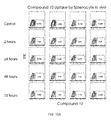
- FIGS. 10A-10C show the distribution of compound 10 in mice in FIG. 10A splenocytes; FIG. 10B liver cells; and FIG. 10C tumor cells.
- FIG. 11 shows quantitative analysis of the distribution of compound 10 in tumor cells, splenocytes and hepatocytes.
- FIG. 12 shows fluorescence microscopy images of compound 10 uptake in breast cancer cells.
- FIGS. 13A and 13B show chromatograms of Hsp90 purified from: FIG. 13A pig mammary gland and BT474 cells, and FIG. 13B MCF7 cells, treated with compound 10.
- FIGS. 14A-14C show: FIG. 14A Fluorescence images of HSP90 expression in mouse xenografts; FIG. 14B quantitative analysis of compound 10 accumulation in tumors isolated from mice; and FIG. 14C accumulation of compound 12 within tumors isolated from mice.
- FIG. 15 shows in vivo detection of compound 10 with optical spectroscopy.
- FIGS. 16A-16D show images of cells infected with human immunodeficiency virus, treated with compound 10 and an HIV-specific antibody.
- FIG. 17 shows recovery of compound 10-bound protein from mice.
- each intervening number there between with the same degree of precision is explicitly contemplated.
- the numbers 7 and 8 are contemplated in addition to 6 and 9, and for the range 6.0-7.0, the numbers 6.0, 6.1, 6.2, 6.3, 6.4, 6.5, 6.6, 6.7, 6.8, 6.9 and 7.0 are explicitly contemplated.
- the term “about” is used synonymously with the term “approximately.”
- the use of the term “about” indicates that values slightly outside the cited values, namely, plus or minus 10%. Such values are thus encompassed by the scope of the claims reciting the terms “about” and “approximately.”
- administer refers to any manner of providing a compound or a pharmaceutical composition (e.g., one described herein), to a subject or patient.
- Routes of administration can be accomplished through any means known by those skilled in the art. Such means include, but are not limited to, oral, buccal, intravenous, subcutaneous, intramuscular, transdermal, by inhalation and the like.
- Contacting refers to contacting a sample directly or indirectly in vitro, ex vivo, or in vivo (i.e. within a subject as defined herein).
- Contacting a sample may include addition of a compound to a sample (e.g., a sample comprising cells that contain Hsp90), or administration to a subject.
- Contacting encompasses administration to a solution, cell, tissue, mammal, subject, patient, or human.
- contacting a cell includes adding an agent to a cell culture.
- Effective amount refers to a dosage or an amount of a compound or a composition effective for eliciting a desired effect. This term as used herein may also refer to an amount effective at bringing about a desired in vivo effect in an animal, e.g., a mammal, e.g., a human. For example, in methods of treating cancer, an effective amount may be an amount sufficient to treat the disorder.
- Member atom refers to a polyvalent atom (e.g., a C, O, N, or S atom) in a chain or ring system that constitutes a part of the chain or ring.
- a polyvalent atom e.g., a C, O, N, or S atom
- five carbon atoms and one nitrogen atom arc member atoms of the ring.
- diethyl ether four carbon atoms and one oxygen atom are member atoms of the chain.
- Member atoms will be substituted up to their normal valence.
- the five carbon atoms will each be further substituted with a hydrogen or another substituent.
- the term “subject” is intended to include human and non-human animals.
- exemplary human subjects include a human patient having a disorder, e.g., cancer, or a normal subject.
- non-human animals includes all vertebrates, e.g., non-mammals (such as chickens, amphibians, reptiles) and mammals, such as non-human primates, domesticated and/or agriculturally useful animals (such as sheep, dogs, cats, cows, pigs, etc.), and rodents (such as mice, rats, hamsters, guinea pigs, etc.).
- treat or “treating” a subject having a disorder refers to administering a compound or a composition described herein to the subject, such that at least one symptom of the disorder is cured, healed, alleviated, relieved, altered, remedied, ameliorated, or improved. Treating includes administering an amount effective to alleviate, relieve, alter, remedy, ameliorate, cure, improve or affect the disorder or the symptoms of the disorder.
- the treatment may inhibit deterioration or worsening of a symptom of a disorder.
- acyl refers to an alkylcarbonyl, cycloalkylcarbonyl, heterocyclylcarbonyl, arylcarbonyl or heteroarylcarbonyl substituent, any of which may be further substituted (e.g., with one or more substituents).
- alkyl refers to a straight or branched saturated hydrocarbon chain.
- Alkyl groups may includes specified number of carbon atoms.
- C 1 -C 12 alkyl indicates that the alkyl group may have 1, 2, 3, 4, 5, 6, 7, 8, 9, 10, 11 or 12 carbon atoms.
- An alkyl group may be, e.g., a C 1 -C 12 alkyl group, a C 1 -C 10 alkyl group, a C 1 -C 8 alkyl group, a C 1 -C 6 alkyl group or a C 1 -C 4 alkyl group.
- exemplary C 1 -C 4 alkyl groups include methyl, ethyl, n-propyl, isopropyl, n-butyl, sec-butyl, isobutyl and tert-butyl groups.
- An alkyl group may be optionally substituted with one or more substituents.
- alkylenyl refers to a divalent alkyl group, examples of which include but are not limited to —CH 2 —, —CH 2 CH 2 —, —CH 2 CH 2 CH 2 — and —CH 2 CH(CH 3 )CH 2 —.
- An alkylenyl group may be optionally substituted with one or more substituents.
- alkenyl refers to a straight or branched hydrocarbon chain having one or more double bonds.
- Alkenyl groups may include a specified number of carbon atoms. For example, C 2 -C 12 alkenyl indicates that the alkenyl group may have 2, 3, 4, 5, 6, 7, 8, 9, 10, 11 or 12 carbon atoms.
- An alkenyl group may be, e.g., a C 2 -C 12 alkenyl group, a C 2 -C 10 alkenyl group, a C 2 -C 8 alkenyl group, a C 2 -C 6 alkenyl group or a C 2 -C 4 alkenyl group.
- alkenyl groups include but are not limited to allyl, propenyl, 2-butenyl, 3-hexenyl and 3-octenyl groups.
- One of the double bond carbons may optionally be the point of attachment of the alkenyl substituent.
- An alkenyl group may be optionally substituted with one or more substituents.
- alkenylenyl refers to a divalent alkenyl group, examples of which include but are not limited to —CH ⁇ CH—, —CH ⁇ CH—CH 2 —, —CH ⁇ CH—CH 2 —CH 2 — and —CH 2 —CH ⁇ CH—CH 2 —.
- An alkenylenyl group may be optionally substituted with one or more substituents.
- alkynyl refers to a straight or branched hydrocarbon chain having one or more triple bonds.
- Alkynyl groups may include a specified number of carbon atoms.
- C 2 -C 12 alkynyl indicates that the alkynyl group may have 2, 3, 4, 5, 6, 7, 8, 9, 10, 11 or 12 carbon atoms.
- An alkynyl group may be, e.g., a C 2 -C 12 alkynyl group, a C 2 -C 10 alkynyl group, a C 2 -C 8 alkynyl group, a C 2 -C 6 alkynyl group or a C 2 -C 4 alkynyl group.
- alkynyl groups include but are not limited to ethynyl, propargyl, and 3-hexynyl.
- One of the triple bond carbons may optionally be the point of attachment of the alkynyl substituent.
- An alkynyl group may be optionally substituted with one or more substituents.
- alkynylenyl refers to a divalent alkynyl group, examples of which include but are not limited to —C ⁇ C—, —C ⁇ C—CH 2 —, —C ⁇ C—CH 2 —CH 2 — and —CH 2 —C ⁇ C—CH 2 —.
- An alkynylenyl group may be optionally substituted with one or more substituents.
- aryl refers to an aromatic monocyclic, bicyclic, or tricyclic hydrocarbon ring system, wherein any ring atom capable of substitution can be substituted (e.g., with one or more substituents).
- aryl moieties include but arc not limited to phenyl, naphthyl, and anthracenyl.
- Aryl groups may be optionally substituted with one or more substituents.
- arylalkyl refers to an alkyl moiety in which at least one alkyl hydrogen atom is replaced with an aryl group.
- Arylalkyl includes groups in which more than one hydrogen atom has been replaced with an aryl group. Examples of arylalkyl groups include but are not limited to benzyl, 2-phenylethyl, 3-phenylpropyl, 9-fluorenyl, benzhydryl, and trityl groups.
- Arylalkyl groups may be optionally substituted with one or more substituents, on either the aryl moiety or the alkyl moiety.
- cycloalkyl refers to non-aromatic, saturated or partially unsaturated cyclic, bicyclic, tricyclic or polycyclic hydrocarbon groups having 3 to 12 carbons. Any ring atom can be substituted (e.g., with one or more substituents). Cycloalkyl groups can contain fused rings. Fused rings are rings that share one or more common carbon atoms.
- cycloalkyl groups include but arc not limited to cyclopropyl, cyclobutyl, cyclopentyl, cyclohexyl, cyclohexenyl, cyclohexadienyl, methylcyclohexyl, adamantyl, norbornyl, norbornenyl, tetrahydronaphthalenyl and dihydroindenyl. Cycloalkyl groups may be optionally substituted with one or more substituents.
- cycloalkylalkyl refers to an alkyl group in which at least one hydrogen atom is replaced with a cycloalkyl group.
- Cycloalkylalkyl groups include those in which more than one hydrogen atom of the alkyl group is replaced with a cycloalkyl group. Examples of cycloalkylalkyl groups include but are not limited to cyclohexylmethyl, cyclopentylmethyl, cyclobutylmethyl and cyclopropylmethyl. Cycloalkylalkyl groups can be optionally substituted with one or more substituents, on either the cycloalkyl moiety or the alkyl moiety.
- halo or “halogen” as used herein refers to any radical of fluorine, chlorine, bromine or iodine.
- haloalkyl refers to an alkyl group as defined herein, in which one or more hydrogen atoms are replaced with halogen atoms, and includes alkyl moieties in which all hydrogens have been replaced with halogens (e.g., perfluoroalkyl such as CF 3 ).
- Heteroalkyl refers to an alkyl, alkenyl or alkynyl group as defined herein, wherein at least one carbon atom of the alkyl group is replaced with a heteroatom.
- Heteroalkyl groups may contain from 1 to 18 non-hydrogen atoms (carbon and heteroatoms) in the chain, or 1 to 12 atoms, or 1 to 6 atoms, or 1 to 4 atoms.
- Heteroalkyl groups may be straight or branched, and saturated or unsaturated. Unsaturated heteroalkyl groups have one or more double bonds and/or one or more triple bonds. Heteroalkyl groups may be unsubstituted or substituted.
- heteroalkyl groups include but are not limited to alkoxyalkyl (e.g., methoxymethyl), and aminoalkyl (e.g., alkylaminoalkyl and dialkylaminoalkyl). Heteroalkyl groups may be optionally substituted with one or more substituents.
- heteroalkylenyl refers to a divalent heteroalkyl group, examples of which include but are not limited to —CH 2 OCH 2 —, —CH 2 NHCH 2 —, polyethyleneglycol groups (e.g., —(CH 2 CH 2 O) n —), polyethyleneimine groups (e.g., —(CH 2 CH 2 NH) n —). and the like.
- a heteroalkylenyl group may be optionally substituted with one or more substituents.
- heteroaryl refers to an aromatic 5-8 membered monocyclic, 8-12 membered bicyclic, or 11-14 membered tricyclic ring system having 1-3 heteroatoms if monocyclic, 1 -6 heteroatoms if bicyclic, or 1 -9 heteroatoms if tricyclic, said heteroatoms independently selected from O, N, S, P and Si (e.g., carbon atoms and 1-3, 1-6, or 1-9 heteroatoms independently selected from O, N, S, P and Si if monocyclic, bicyclic, or tricyclic, respectively). Any ring atom can be substituted (e.g., with one or more substituents).
- Heteroaryl groups can contain fused rings, which are rings that share one or more common atoms.
- heteroaryl groups include but are not limited to radicals of pyridine, pyrimidine, pyrazine, pyridazine, pyrrole, imidazole, pyrazole, oxazole, isoxazole, furan, thiazole, isothiazole, thiophene, quinoline, isoquinoline, quinoxaline, quinazoline, cinnoline, indole, isoindole, indolizine, indazole, benzimidazole, phthalazine, pteridine, carbazole, carboline, phenanthridine, acridine, phenanthroline, phenazine, naphthyridines and purines. Heteroaryl groups may be optionally substituted with one or more substituents.
- heteroarylalkyl refers to an alkyl moiety in which at least one alkyl hydrogen atom is replaced with a heteroaryl group. Heteroarylalkyl includes groups in which more than one hydrogen atom has been replaced with a heteroaryl group.
- heteroarylalkyl groups include but are not limited to imidazolylmethyl (e.g., 1H-imidazol-2-ylmethyl and 1H-imidazol-4-ylmethyl), pyridinylmethyl (e.g., pyridin-3-ylmethyl and pyridin-4-ylmethyl), pyrimidinylmethyl (e.g., pyrimidin-5-ylmethyl), furylmethyl (e.g., fur-2-ylmethyl and fur-3-ylmethyl), and thienylmethyl (e.g., thien-2-ylmethyl and thien-3-ylmethyl) groups.
- Heteroarylalkyl groups may be optionally substituted with one or more substituents, on either the heteroaryl moiety or the alkyl moiety.
- heteroatom refers to a non-carbon or hydrogen atom such as a nitrogen, sulfur, oxygen, silicon or phosphorus atom. Groups containing more than one heteroatom may contain different heteroatoms.
- heterocyclyl refers to a nonaromatic, saturated or partially unsaturated 3-10 membered monocyclic, 8-12 membered bicyclic, or 11-14 membered tricyclic ring system having 1-3 heteroatoms if monocyclic, 1-6 heteroatoms if bicyclic, or 1-9 heteroatoms if tricyclic, said heteroatoms selected from O, N, S, Si and P (e.g., carbon atoms and 1-3, 1-6, or 1-9 heteroatoms of O, N, S, Si and P if monocyclic, bicyclic, or tricyclic, respectively). Any ring atom can be substituted (e.g., with one or more substituents).
- Heterocyclyl groups can contain fused rings, which are rings that share one or more common atoms.
- heterocyclyl groups include but are not limited to radicals of tetrahydrofuran, tetrahydrothiophene, tetrahydropyran, oxetane, piperidine, piperazine, morpholine, pyrroline, pyrimidine, pyrrolidine, indoline, tetrahydropyridine, dihydropyran, thianthrene, pyran, benzopyran, xanthene, phenoxathiin, phenothiazine, furazan, lactones, lactams such as azetidinones and pyrrolidinones, sultams, sultones, and the like. Heterocyclyl groups may be optionally substituted with one or more substituents.
- heterocyclylalkyl refers to an alkyl moiety in which at least one alkyl hydrogen atom is replaced with a heterocyclyl group.
- Heterocyclylalkyl includes groups in which more than one hydrogen atom has been replaced with a heterocyclyl group. Examples of heterocyclylalkyl groups include but are not limited to oxetanylmethyl, morpholinomethyl, and pyrrolidinylmethyl groups, and the like.
- Heterocyclylalkyl groups may be optionally substituted with one or more substituents, on either the heterocyclyl moiety or the alkyl moiety.
- hydroxy refers to an —OH radical.
- alkoxy refers to an —O-alkyl radical.
- aryloxy refers to an —O-aryl radical.
- oxo refers to an oxygen atom, which forms a carbonyl when attached to carbon, an N-oxide when attached to nitrogen, and a sulfoxide or sulfone when attached to sulfur (i.e. ⁇ O).
- mercapto or “thiol” refers to an —SH radical.
- thioalkoxy or “thioether” refers to an —S-alkyl radical.
- thioaryloxy refers to an —S-aryl radical.
- Suitable substituents include, without limitation: acyl, acylamido, acyloxy, alkoxy, alkyl, alkenyl, alkynyl, amido, amino, carboxy, cyano, ester, halo, hydroxy, imino, nitro, oxo (e.g., C ⁇ O), phosphonate, sulfinyl, sulfonyl, sulfonate, sulfonamino, sulfonamido, thioamido, thiol, thioxo (e.g., C ⁇ S), and ureido.
- substituents on a group are independently any one single, or any combination of the aforementioned substituents.
- a substituent may itself be substituted with any one of the above substituents.
- groups and substituents thereof may be selected in accordance with permitted valence of the atoms and the substituents, and such that the selections and substitutions result in a stable compound, e.g., a compound that does not spontaneously undergo transformation such as by rearrangement, cyclization, elimination, etc.
- A is an Hsp90 binding component
- X 1 is selected from the group consisting of —NH—, —O—, —S—, —C(O)— and —S(O) 2 —;
- X 2 is selected from the group consisting of —NR—, —O—, —S—, —C(O)— and —S(O) 2 —;
- B is selected from the group consisting of a detection moiety, an anti-cancer agent, and an Hsp90 binding component
- R is selected from the group consisting of hydrogen, and a detection moiety.
- A is an Hsp90 binding component
- X 1 is selected from the group consisting of —NH—, —O—, —S—, —C(O)— and —S(O) 2 —;
- X 2 is selected from the group consisting of —NR—, —O—, —S—, —C(O)— and —S(O) 2 —;
- B is a detection moiety
- R is selected from the group consisting of hydrogen and a detection moiety.
- A is an Hsp90 binding component
- L is a divalent linker comprising at least twelve member atoms independently selected from carbon, nitrogen and oxygen, wherein at least one member atom is nitrogen or oxygen;
- B is selected from the group consisting of an anti-cancer agent and an Hsp90 binding component.
- A is an Hsp90 binding component.
- the compounds of formula (I) include at least one Hsp90 binding component, and may include two Hsp90 binding components in embodiments in which B is also an Hsp90 component. Any molecule that binds to Hsp90 can be used as the basis for the Hsp90 binding component.
- the Hsp90 binding component corresponds to an Hsp90 binding compound in winch an atom or a group of atoms is removed, to provide a point of attachment to the —X 1 -L-X 2 -B moiety of the remainder of the compound of formula (I) (or the —X 2 -L-X 1 -A moiety in embodiments in which B is an Hsp90 binding component).
- R 1 and R 2 are independently selected from the group consisting of —H and —C 1-8 -alkyl
- Y is CR 3 or N
- R 3 is —H, —F or —OCH 3 ;
- R 4 and R 5 are independently selected from the group consisting of —H, —F and —OCH 3 ;
- R 6 is —C 1-8 -alkyl, —C 2-8 -alkenyl, —C 2-8 -alkynyl, —C 3-8 -cycloalkenyl, —C 3-8 -cycloalkenyl-C 1-8 -alkyl, —C 3-8 -cycloalkyl, —C 3-8 -cycloalkyl-C 1-8 -alkyl, aryl, aryl-C 1-8 -alkyl, halo-C 1-8 -alkyl, heteroaryl, heteroaryl-C 1-8 -alkyl, heterocyclyl, heterocyclyl-C 1-8 -alkyl, or hydroxy-C 1-8 -alkyl;
- R 7 and R 8 are independently selected from the group consisting of —H and —C 1-8 -alkyl; or R 7 and R 8 taken together with the carbon atom to which they are attached form a C 3-8 -cycloalkyl group;
- X is N or CR 9 ;
- R 9 is —H or —C 1-8 -alkyl
- R 1 and R 2 are each —H
- Y is CR 3
- R 3 is —H
- R 4 and R 5 are each —H
- R 6 is —C 1-8 -alkyl (e.g., methyl) or halo-C 1-8 -alkyl (e.g., trifluoromethyl)
- R 7 and R 8 are independently —C 1-8 -alkyl (e.g., methyl)
- X is N.
- formula (II) is the following:
- an Hsp90 binding component has the following formula (III):
- each Y 1 is independently selected from the group consisting of CH and N;
- R is alkylenyl or heteroalkylenyl
- each Z 1 is taken together with the carbon atoms to which they are attached to form a heterocyclic ring;
- Z 2 is hydrogen or halo
- Z 3 is CH 2 , S, O, or NH
- Z 4 is hydrogen or halo
- a group of formula (III) is the following:
- the Hsp90 binding component may comprise any known Hsp90 binding compound or a portion thereof that retains affinity for Hsp90.
- Other compounds that bind to Hsp90 are known in the art, and include, for example, geldanamycin, herbimycin, radicicol, deguelin, derrubone and macebecin.
- Other compounds that bind to Hsp90 may include but arc not limited to those described in U.S. Pat. Nos. 7,358,370, 7,678,803, 7,906,529 and 7,928,135, U.S. Patent Publication No. 2011/0183977, and International Patent Publication Nos. WO2008/130879 and WO2006/084030.
- L is a divalent linker comprising at least twelve member atoms independently selected from carbon, nitrogen and oxygen, wherein at least one member atom is nitrogen or oxygen.
- L is a heteroalkylenyl group comprising at least twelve member atoms.
- L comprises 12, 13, 14, 15, 16, 17, 18, 19, 20, 21, 22, 23, 24, 25, 26, 27, 28, 29, 30, 31, 32, 33, 34, 35, 36, 37, 38, 39, 40, 41, 42, 43, 44, 45, 46, 47, 48, 49 or 50 atoms.
- the heteroalkylenyl group may be optionally substituted (e.g., a carbon may be substituted with an oxo group).
- L is a straight-chain heteroalkylenyl group.
- L includes at least one monomer of a polyethylene glycol group (i.e. —(CH 2 CH 2 O)—), or it may include at least two, three, four, five, six or more such monomers.
- L has the formula —(CH 2 ) m —(OCH 2 CH 2 ) m —O—(CH 2 ) p —, wherein m is 2 or 3, n is 3, 4, 5, 6, 7, 8, 9, 10, 11, 12, 13, 14, 15, 16, 17, 18, 19 or 20, and p is 2 or 3.
- m is 2.
- m is 3.
- n is 4, 5, 6, 7, 8, 9 or 10,
- n is 4.
- p is 2.
- p is 3.
- a suitable linker has the following formula:
- the groups X 1 and X 2 in the compounds formula (I) are each independently selected from the group consisting of —NH—, —O—, —S—, —C(O)— and —S(O) 2 —. These groups serve as bridges between the linker and the A and B groups of the compound of formula (I).
- the X 1 and X 2 groups may be derived from a linker precursor compound.
- X 1 and X 2 may be —NH—.
- a suitable linker precursor compound may have the formula H 2 N-Linker-NH 2 .
- the terminal amino groups of the linker precursor compound provide the source of the X 1 and X 2 groups.
- X 2 may be NR, wherein R is selected from the group consisting of hydrogen and a detection moiety.
- R is selected from the group consisting of hydrogen and a detection moiety.
- Such compounds may be synthesized, for example, by first synthesizing a group in which X 2 is NH and then further derivatizing the NH group with a compound comprising an additional detection moiety.
- B is a detection moiety.
- the detection moiety comprises one or more groups that are, either directly or indirectly, detectable via a method such as a spectroscopic method.
- Exemplary detection moieties may comprise, for example, a chromophore, a fluorophore, a luminescent moiety or a radioisotope.
- B comprises one or more detection moieties, such as, for example, a fluorophore and a radioisotope.
- Suitable reagents comprising fluorophores which may be used to prepare compounds of formula (I), are known in the art, and include but are not limited to fluoresceins, rhodamines, coumarins, cyanines and boron-dipyrromethenes.
- reagents comprising fluorophores that are commercially available include but are not limited to: 5- and 6-carboxyfluoresceins and esters thereof; fluorescein-5-isothiocyanate and fluorescein-6-isothiocyanate; BODIPY® dyes commercially available from Molecular Probes; Alexa Fluor® dyes commercially available from Molecular Probes; CyDye fluors commercially available from GE Healthcare Biosciences, including but not limited to Cy3, Cy 5, Cy5.5 and Cy 7 esters; and VivoTagTM fluorophores available from PerkinElmer, including but not limited to VivoTag 645, VivoTag 645-MAL, VivoTag 680, VivoTag 680-MAL, VivoTag 680 XL, VivoTag-S 680, VivoTag 750, VivoTag-S 750, VivoTag 750-MAL, and VivoTag 800.
- B is a detection moiety
- the detection moiety may include the detectable moiety as well as additional atoms or groups of atoms.
- a fluorophore may be attached to the remainder of a compound of formula (I), for example, by reacting a compound of the formula A-X 1 -L-NH 2 with a reagent comprising a fluorophore and a reactive group, such as an isothiocyanate or N-succinimidyl ester.
- a reaction with an isothiocyanate will produce a compound A-X 1 -L-NH—C(S)—NH-fluorophore.
- the group —B corresponding to the “detection moiety” includes not only the fluorophore but also the —C(S)—NH— linking atoms.
- the detection moiety may comprise a radioisotope.
- a radioisotope Such detection moieties may be useful for detection in samples by scintillation counting, or for radioimaging applications.
- Suitable radioisotopes include, but are not limited to, tritium (i.e. hydrogen-3), carbon-14, nitrogen-15, phosphorus-32, iodine-125 and iodine-131.
- compounds comprising iodine-131 may be useful as radiopharmaceuticals.
- B comprises an anti-cancer agent.
- anti-cancer/chemotherapeutic agents include, but arc not limited to, the following:
- alkylating agents including, without limitation, nitrogen mustards, ethylenimine derivatives, alkyl sulfonates, nitrosoureas and triazenes: uracil-mustard (Aminouracil Mustard®, Chlorethaminacil®, Demethyldopan®, Desmethyldopan®,Hacmanthamine®, Nordopan®, Uracil nitrogen Mustard®, Uracillost®, Uracilmostaza®, Uramustin®, Uramustine®), bendamustine (Treakisym®, Ribomustin®, Treanda®) chlormethine (Mustargen®), cyclophosphamide (Cytoxan®, Neosar®Clafen®Endoxan®Procytox®, RevimmuneTM), ifosfamide (Mitoxana®), melphalan (Alkeran®), Chlorambucil (Leukeran®), pipo
- anti-Her-2 antibodies e.g., trastuzumab (Herceptin®) and other antibodies from Genentech.
- antimetabolites including, without limitation, folic acid antagonists (also referred to herein as antifolates), pyrimidine analogs, purine analogs and adenosine deaminase inhibitors: methotrexate (Rheumatrex®, Trexall®), 5-fluorouracil (Adrucil®, Efudex®, Fluoroplex®), floxuridine (FUDF®), carmofur, cytarabine (Cytosar-U®, Tarabine PFS), 6-mercaptopurine (Puri-Nethol®)), 6-thioguanine (Thioguanine Tabloid®), fludarabine phosphate (Fludara®), pentostatin (Nipent®), pemetrexed (Alimta®), raltitrexed (Tomudex®), cladribine (Leustatin®), clofarabine (Clofarex®, Clolar®), mercaptopur
- vinca alkaloids vinblastine (Velban®, Velsar®), vincristine (Vincasar®, Oncovin®), vindesine (Eldisine®), vinorelbine (Navelbine®), vinflunine (Javlor®).
- platinum-based agents carboplatin (Paraplat®, Paraplatin®), cisplatin (Platinol®), oxaliplatin (Eloxatin®), nedaplatin, satraplatin, triplatin.
- anthracyclines daunorubicin (Cerubidine®, Rubidomycin®), doxorubicin (Adriamycin®), epirubicin (Ellence®), idarubicin (Idamycin®), mitoxantrone (Novantrone®), valrubicin (Valstar®), aclarubicin, amrubicin, liposomal doxorubicin, liposomal daunorubicin, pirarubicin, pixantrone, zorubicin.
- topoisomerase inhibitors topotecan (Hycamtin®), irinotecan (Camptosar®), etoposide (Toposar®, VePesid®), teniposide (Vumon®), lamellarin D, SN-38, camptothecin (e.g., IT-101), belotecan, rubitecan.
- Taxanes paclitaxel (Taxol®), docetaxel (Taxotere®), larotaxel, cabazitaxel, ortataxel, tesetaxel.
- antibiotics actiriomycin (Cosmegen®), bleomycin (Blenoxane®), hydroxyurea (Droxia®, Hydrea®), mitomycin (Mitozytrex®, Mutamycin®).
- immunomodulators lenalidomide (Revlimid®), thalidomide (Thalomid®).
- immune cell antibodies alemtuzamab (Campath®), gemtuzumab (Myelotarg®), rituximab (Rituxan®), tositumomab (Bexxar®).
- interferons e.g., IFN-alpha (Alferon®, Roferon-A®, Intron®-A) or IFN-gamma (Actimmune®)).
- interleukins IL-1, IL-2 (Proleukin®), IL-24, IL-6 (Sigosix®), IL-12.
- HSP90 inhibitors e.g., geldanamycin or any of its derivatives.
- the HSP90 inhibitor is selected from geldanamycin, 17-alkylamino-17-desmethoxygeldanamycin (“17-AAG”) or 17-(2-dimethylaminoetliyl)amino-17-desmethoxygeldanamycin (“17-DMAG”).
- anti-androgens which include, without limitation nilutamidc (Nilandron®) and bicalutamide (Caxodex®).
- antiestrogens which include, without limitation tamoxifen (Nolvadex®), toremifene (Fareston®), letrozole (Femara®), testolactone (Teslac®), anastrozole (Arimidex®), bicalutamide (Casodex®), exemestane (Aromasin®), flutamide (Eulexin®), fulvestrant (Faslodex®), raloxifene (Evista®, Keoxifene®) and raloxifene hydrochloride.
- anti-hypercalcaemia agents which include without limitation gallium (III) nitrate hydrate (Ganite®) and pamidronate disodium (Aredia®).
- apoptosis inducers which include without limitation ethanol, 2-[[3-(2,3-dichlorophenoxy)propyl]amino]-(9Cl), gambogic acid, elesclomol, embelin and arsenic trioxide (Trisenox®).
- Aurora kinase inhibitors which include without limitation binucleine 2.
- Bruton's tyrosine kinase inhibitors which include without limitation terreic acid.
- calcincurin inhibitors which include without limitation cypermethrin, deltamethrin, fenvalerate and tyrphostin 8.
- CaM kinase II inhibitors which include without limitation 5-Isoquinolinesulfonic acid, 4-[(2S)-2-[(5-isoquinolinylsulfonyl)methylamino]-3-oxo-3-[4-phenyl-1-piperazinyl)propyl]phenyl ester and benzenesulfonamide.
- CD45 tyrosine phosphatase inhibitors which include without limitation phosphonic acid.
- CDC25 phosphatase inhibitors which include without limitation 1,4-naphthalene dione, 2,3-bis[(2-hydroxyethyl)thio]-(9Cl).
- CHK kinase inhibitors which include without limitation debromohymenialdisine.
- cyclooxygenase inhibitors which include without limitation 1H-indole-3-acetamide, 1-(4-chlorobenzoyl)-5-methoxy-2-methyl-N-(2-phenylethyl)-(9Cl), 5-alkyl substituted 2-arylaminophenylacetic acid and its derivatives (e.g., celecoxib (Celebrex®), rofecoxib (Vioxx®), etoricoxib (Arcoxia®), lumiracoxib (Prexige®), valdecoxib (Bextra®) or 5-alkyl-2-arylaminophenylacetic acid).
- celecoxib Celebrex®
- rofecoxib Vioxx®
- etoricoxib etoricoxib
- lumiracoxib Prexige®
- valdecoxib Bextra®
- 5-alkyl-2-arylaminophenylacetic acid 5-alkyl-2-arylaminoph
- cRAF kinase inhibitors which include without limitation 3-(3,5-dibromo-4-hydroxybenzylidene)-5-iodo-1,3-dihydroindol-2-one and benzamide, 3-(dimethylamino)-N-[3-[(4-hydroxybenzoyl)amino]-4-methylphenyl]-(9Cl).
- cyclin dependent kinase inhibitors which include without limitation olomoucine and its derivatives, purvalanol B, roascovitine (Seliciclib®), indirubin, kenpaullone, purvalanol A and indirubin-3′-monooxime.
- cysteine protease inhibitors which include without limitation 4-morpholinecarboxamide, N-[(1S)-3-fluoro-2-oxo-1-(2-phenylethyl)propyl]amino]-2-oxo-1-(phenylmethyl)ethyl]-(9Cl).
- DNA intercalators which include without limitation plicamycin (Mithracin®) and daptomycin (Cubicin®).
- DNA strand breakers which include without limitation bleomycin (Blenoxane®).
- E3 ligase inhibitors which include without limitation N-((3,3,3-trifluoro-2-trifluoromethyl)propionyl)sulfanilamide.
- EGF Pathway Inhibitors which include, without limitation tyrphostin 46, EKB-569, erlotinib (Tarceva®), gefitinib (Iressa®), lapatinib (Tykerb®) and those compounds that are generically and specifically disclosed in WO 97/02266, EP 0 564 409, WO 99/03854, EP 0 520 722, EP 0 566 226, EP 0 787 722, EP 0 837 063, U.S. Pat. No. 5,747,498, WO 98/10767, WO 97/30034, WO 97/49688, WO 97/38983 and WO 96/33980.
- farnesyltransferase inhibitors which include without limitation a-hydroxyfarnesylphosphonic acid, butanoic acid, 2-[(2S)-2-[[(2S,3S)-2-[[(2R)-2-amino-3-mercaptopropyl]amino]-3-methylpent-yl]oxy]-1-oxo-3-phenylpropyl]amino]-4-(methylsulfonyl)-1-methylethylester (2S)-(9Cl), tipifarnib (Zarnestra®), and manumycin A.
- a-hydroxyfarnesylphosphonic acid butanoic acid
- Flk-1 kinase inhibitors which include without limitation 2-propenamide, 2-cyano-3-[4-hydroxy-3,5-bis(1-methylethyl)phenyl]-N-(3-phenylpropyl)-(2E-)-(9Cl).
- glycogen synthase kinase-3 (GSK3) inhibitors which include without limitation indirubin-3′-monooxime.
- HDAC histone deacetylase inhibitors which include without limitation suberoylanilide hydroxamic acid (SAHA), [4-(2-amino-phenylcarbamoyl)-benzyl]-carbamic acid pyridine-3-ylmethylester and its derivatives, butyric acid, pyroxamide, trichostatin A, oxamflatin, apicidin, depsipeptide, depudecin, trapoxin, vorinostat (Zolinza®), and compounds disclosed in WO 02/22577.
- SAHA suberoylanilide hydroxamic acid
- pyroxamide pyroxamide
- trichostatin A oxamflatin
- apicidin depsipeptide
- depudecin trapoxin
- vorinostat Vorinostat
- I-kappa B-alpha kinase inhibitors which include without limitation 2-propenenitrile, 3-[(4-methylphenyl)sulfonyl]-(2E)-(9Cl).
- imidazotetrazinones which include without limitation temozolomide (Methazolastone®, Temodar® and its derivatives (e.g., as disclosed generically and specifically in U.S. Pat. No. 5,260,291) and Mitozolomide.
- temozolomide Metalhazolastone®, Temodar® and its derivatives (e.g., as disclosed generically and specifically in U.S. Pat. No. 5,260,291) and Mitozolomide.
- insulin tyrosine kinase inhibitors which include without limitation hydroxyl-2-naphthalenylmethylphosphonic acid.
- JNK c-Jun-N-terminal kinase inhibitors which include without limitation pyrazoleanthrone and epigallocatechin gallate.
- mitogen-activated protein kinase (MAP) inhibitors which include without limitation benzenesulfonamide, N-[2-[[[3-(4-chlorophenyl)-2-propenyl]methyl]amino]methyl]phenyl]-N-(2-hydroxyethyl)-4-methoxy-(9Cl).
- MDM2 inhibitors which include without limitation trans-4-iodo, 4′-boranyl-chalcone.
- MEK inhibitors which include without limitation butanedinitrile, bis[amino[2-aminophenyl)thio]methylene]-(9Cl).
- MMP inhibitors which include without limitation Actinonin, epigallocatechin gallate, collagen peptidomimetic and non-peptidomimetic inhibitors, tetracycline derivatives marimastat (Marimastat®), prinomastat, incyclinide (Metastat®), shark cartilage extract AE-941 (Neovastat®), Tanomastat, TAA211, MMI270B or AAJ996.
- mTor inhibitors which include without limitation rapamycin (Rapamune®), and analogs and derivatives thereof, AP23573 (also known as ridaforolimus, deforolimus, or MK-8669), CCI-779 (also known as temsirolimus) (Torisel®) and SDZ-RAD.
- NGFR tyrosine kinase inhibitors which include without limitation tyrphostin AG 879.
- p38 MAP kinase inhibitors which include without limitation Phenol, 4-[4-(4-fluorophenyl)-5-(4-pyridinyl)-1H-imidazol-2-yl]-(9Cl), and benzamide, 3-(dimethylamino)-N-[3-[(4-hydroxylbenzoyl)amino]-4-methylphenyl]-(9Cl).
- PDGF pathway inhibitors which include without limitation tyrphostin AG 1296, tyrphostin 9, 1,3-butadiene-1,1,3-tricarbonitrile, 2-amino-4-(1H-indol-5-yl)-(9Cl), imatinib (Gleevec®) and gefitinib (Iressa®) and those compounds generically and specifically disclosed in European Patent No.: 0 564 409 and PCT Publication No.: WO 99/03854.
- phosphatidyl inositol 3-kinase inhibitors which include without limitation wortmannin, and quercetin dihydrate.
- phosphatase inhibitors which include without limitation cantharidic acid, cantharidin, and L-leucinamide.
- protein phosphatase inhibitors which include without limitation cantharidic acid, cantharidin, L-P-bromotetramisole oxalate, 2(5H)-furanone, 4-hydroxy-5-(hydroxymethyl)-3-(1-oxohexadecyl)-(5R)-(9Cl) and benzylphosphonic acid.
- PKC delta kinase inhibitors which include without limitation rottlerin.
- polyamine synthesis inhibitors which include without limitation DMFO.
- PTP1B inhibitors which include without limitation L-leucinamide.
- Janus (JAK-2 and/or JAK-3) tyrosine kinase inhibitors which include without limitation tyrphostin AG 490 and 2-naphthyl vinyl ketone.
- retinoids which include without limitation isotretinoin (Accutane®, Amnesteem®, Cistane®, Claravis®, Sotret®) and tretinoin (Aberel®, Aknoten®, Avita®, Renova®, Retin-A®, Retin-A MICRO®, Vesanoid®).
- serine/Threonine kinase inhibitors which include without limitation 2-aminopurine.
- sterol biosynthesis inhibitors which include without limitation squalene epoxidase and CYP2D6.
- VEGF pathway inhibitors which include without limitation anti-VEGF antibodies, e.g., bevacizumab, and small molecules, e.g., sunitinib (Sutent®), sorafinib (Nexavar®), ZD6474 (also known as vandetanib) (ZactimaTM), SU6668, CP-547632 and AZD2171 (also known as cediranib) (RecentinTM).
- anti-VEGF antibodies e.g., bevacizumab
- small molecules e.g., sunitinib (Sutent®), sorafinib (Nexavar®), ZD6474 (also known as vandetanib) (ZactimaTM), SU6668, CP-547632 and AZD2171 (also known as cediranib) (RecentinTM).
- anti-cancer agents include alitretinon, altretamine, aminopterin, aminolevulinic acid, amsacrine (Amsidine®), asparaginase (crisantaspase, Erwinase®), atrasentan, bexarotene (Targretin®), carboquone, demecolcine, efaproxiral, elsamitrucin, etoglucid, ferrocene, Gliadel implants, hydroxycarbamide, leucovorin, lonidamine, lucanthone, masoprocol, methyl aminolevulinate, mitoguazone, mitotane (Lysodren®), oblimersen, omacetaxine (Genasense®), pegaspargase (Oncaspar®), porfimer sodium (Photofrin®), prednimustine, sitimagene ceradenovec (Cerepro®), talaporf
- the anti-cancer agent may be attached to the linker group of the compound of formula (I) by any suitable linkage.
- the anti-cancer agent has a reactive moiety such as a hydroxyl group, an amine group, or the like, such groups may be used to attach the anti-cancer agent to the remainder of the compound of formula (I).
- an anti-cancer agent may be further derivatized with an atom or a group of atoms in order to provide a reactive group.
- the group ⁇ B corresponding to the anti-cancer agent includes not only the anti-cancer agent itself but also the linking atoms.
- the starting material includes an exemplary Hsp90-binding moiety precursor, and the group Y 1 is a leaving group or a reactive group.
- Y 1 may be leaving group such as a halogen, such that the compound H 2 N-Linker-NH 2 may react with the compound via a reaction such as nucleophilic aromatic substitution.
- the nitrile can then be subsequently hydrolyzed to produce the Hsp90-binding moiety.
- reaction 2 of Scheme 1 the product of the initial reaction is further reacted with a compound B—Y 2 , where B comprises a detection moiety, an anti-cancer agent or an Hsp90 binding component, and Y 2 is a leaving group or a reactive group.
- B comprises a detection moiety, an anti-cancer agent or an Hsp90 binding component
- Y 2 is a leaving group or a reactive group.
- Y 2 may be reactive group such as ah isothiocyanate or a maleimide.
- Compounds can be evaluated by determining their ability to bind to Hsp90.
- the selectivity for Hsp90 over other proteins, such as GRP94 and TRAP1 may also be determined.
- an A-Linker-NH 2 compound can be bound to Scpharose resin.
- a resin can be exposed to a pig mammary gland extract, which is a tissue known to be high in ATP binding proteins including native forms of Hsp90, GRP94 and TRAP1.
- Media can be incubated with extract, washed stringently, and bound proteins removed with SDS and subsequently characterized.
- Preincubation of the resin with a known Hsp90 inhibitor should selectively block binding of Hsp90 and associated proteins, while those recovered in the presence of such a quenching agent are likely to be non-specifically bound.
- Compounds of formula (I) may have increased selectivity for Hsp90 compared to proteins that share sequence homology with Hsp90.
- the compounds may bind to Hsp90 with an affinity that is at least about 100 to 1000 fold higher than the affinity for GRP94, a molecular chaperone that functions in the processing and transport of secreted proteins.
- the Hsp90 affinity probe may bind to Hsp90 with an affinity that is at least about 100 fold to 1000-fold higher than the affinity for TRAP1, (TNF receptor-associated protein 1), a heat shock protein of 75 kDa. This increased selectivity may lead to more accurate detection and targeting of Hsp90.
- Compounds of formula (I) may be used in a variety of methods, such as methods of detecting Hsp90 in a sample, methods of detecting cancer in a subject, and methods of treating cancer in a subject.
- compounds described herein can be used in methods of detecting Hsp90 in a sample, the methods comprising:
- the sample is an in vitro sample, such as a cell or tissue extract.
- the sample is a cell culture.
- the sample may be a culture of cells such as cancer cells.
- the sample is a biological sample from a subject, such as a human.
- the biological sample is selected from the group consisting of a tissue sample, bodily fluid, whole blood, plasma, serum, urine, bronchoalveolar lavage fluid, and a cell culture suspension or fraction thereof.
- the methods may further involve providing or obtaining a biological sample from the subject, which can be obtained by any known means including needle stick, needle biopsy, swab, and the like.
- the biological sample is a blood sample, such as a blood plasma or serum sample; which may be obtained by any standard technique such as, for example, by venipuncture.
- Biological samples used in the methods may be stored or banked under suitable tissue storage conditions, or can be accessed from samples that have been previously stored or banked under suitable conditions.
- the method further includes detecting a signal from the detection moiety.
- a signal may be detected by any suitable means appropriate for the particular detection moiety being used.
- the detection moiety comprises a fluorophore
- a signal may be detected using a fluorometer or a fluorescence plate reader, or by using fluorescence techniques such as fluorescence microscopy, fluorescence resonance energy transfer, flow cytometry and fluorescence-activated cell sorting.
- a signal may be detected using scintillation counting or radioimaging techniques.
- a signal from the detection moiety may be quantitated, for example, by comparing the quantity of the signal to that of a reference sample.
- compounds described herein can be used in a method of detecting cancer in a subject, the method comprising:
- the method further comprises obtaining the biological sample from the subject, such as a biological sample described herein, according to methods described herein.
- the subject is a human.
- a reference sample may be a sample from a healthy subject, i.e. a subject having no clinical signs or symptoms of cancer.
- the healthy subject may be clinically evaluated for otherwise undetected signs or symptoms of cancer, which evaluation may include routine physical examination and/or laboratory testing.
- the cancer may be any type of cancer, such as a cancer recognized by the National Cancer Institute.
- the cancer may be a type of cancer associated with elevated levels of Hsp90.
- Exemplary types of cancers include the following:
- Digestive/gastrointestinal cancers such as anal cancer; bile duct cancer; extrahepatic bile duct cancer; appendix cancer; carcinoid tumor, gastrointestinal cancer; colon cancer, colorectal cancer including childhood colorectal cancer; esophageal cancer including childhood esophageal cancer; gallbladder cancer; gastric (stomach) cancer including childhood gastric (stomach) cancer, hepatocellular (liver) cancer including adult (primary) hepatocellular (liver) cancer and childhood (primary) hepatocellular (liver) cancer; pancreatic cancer including childhood pancreatic cancer; sarcoma, rhabdomyosarcoma; islet cell pancreatic cancer; rectal cancer; and small intestine cancer;
- gastric (stomach) cancer including childhood gastric (stomach) cancer, hepatocellular (liver) cancer including adult (primary) hepatocellular (liver) cancer and childhood (primary) hepatocellular (live
- Breast cancer including childhood breast cancer, male breast cancer and breast cancer during pregnancy;
- Genitourinary cancers such as bladder cancer including childhood bladder cancer, renal cell (kidney) cancer; ovarian cancer including childhood ovarian cancer; ovarian epithelial cancer; ovarian low malignant potential tumor; penile cancer; prostate cancer; renal cell cancer including childhood renal cell cancer; renal pelvis and ureter, transitional cell cancer; testicular cancer; urethral cancer; vaginal cancer; vulvar cancer, cervical cancer; Wilms tumor and other childhood kidney tumors; endometrial cancer, and gestational trophoblastic tumor;
- Lung cancer such as non-small cell lung cancer; and small cell lung cancer;
- Respiratory cancers such as malignant mesothelioma, adult; malignant mesothelioma, childhood; malignant thymoma; childhood thymoma; thymic carcinoma; bronchial adenomas/carcinoids including childhood bronchial adenomas/carcinoids; pleuropulmonary blastoma; non-small cell lung cancer; and small cell lung cancer; and
- Skin cancers such as Kaposi's sarcoma; Merkel cell carcinoma; melanoma; and childhood skin cancer.
- the cancer may be a cancer that is associated with increased levels of Hsp90, including but not limited to breast cancer, prostate cancer, non-small cell lung cancer, colorectal cancer, pancreatic cancer, ovarian cancer and melanoma.
- the cancer is breast cancer or prostate cancer.
- compounds described herein can be used in a method of treating cancer in a subject in need of treatment. Such methods comprise administering the subject a therapeutically effective amount of a compound having the following formula (Ib): A-X 1 -L-X 2 -B (Ib)
- A is an Hsp90 binding component
- X 1 and X 2 are each independently selected from the group consisting of —NH—, —O—, —S—,—C(O)— and —S(O) 2 —;
- L is a divalent linker comprising at least twelve member atoms independently selected from carbon, nitrogen and oxygen, wherein at least one member atom is nitrogen or oxygen;
- B is selected from the group consisting of an anti-cancer agent and an Hsp90 binding component.
- the cancer is a cancer described herein.
- the cancer is selected from the group consisting of breast cancer, prostate cancer, non-small cell lung cancer, colorectal cancer, pancreatic cancer, ovarian cancer and melanoma.
- the cancer is breast cancer or prostate cancer.
- the anti-cancer agent is an anti-cancer agent described herein.
- B is an anti-cancer agent selected from the group consisting of a protein kinase inhibitor, a protein phosphatase inhibitor and a histone deacetylase inhibitor.
- a compound, or a pharmaceutical composition comprising the compound may be administered to the subject by any convenient route of administration, whether systemically/peripherally or at the site of desired action, including but not limited to, oral (e.g. by ingestion); topical (including e.g. transdermal, intranasal, ocular, buccal, and sublingual); pulmonary (e.g. by inhalation or insufflation therapy using, e.g. an aerosol, e.g.
- vaginal parenteral, for example, by injection, including subcutaneous, intradermal, intramuscular, intravenous, intraarterial, intracardiac, intrathecal, intraspinal, intracapsular, subcapsular, intraorbital, intraperitoneal, intratracheal, subcuticular, intraarticular, subarachnoid, and intrasternal; by implant of a depot, for example, subcutaneously or intramuscularly. Additional modes of administration may include adding the compound and/or a composition comprising the compound to a food or beverage, including a water supply for an animal, to supply the compound as part of the animal's diet.
- the compound may be presented as a pharmaceutical composition (e.g., formulation) comprising at least one compound, as defined above, together with one or more pharmaceutically-acceptable carriers, adjuvants, excipients, diluents, fillers, buffers, stabilizers, preservatives, lubricants, or other materials well known to those skilled in the art and optionally other therapeutic or prophylactic agents.
- a pharmaceutical composition e.g., formulation
- the compound may be presented as a pharmaceutical composition (e.g., formulation) comprising at least one compound, as defined above, together with one or more pharmaceutically-acceptable carriers, adjuvants, excipients, diluents, fillers, buffers, stabilizers, preservatives, lubricants, or other materials well known to those skilled in the art and optionally other therapeutic or prophylactic agents.
- compositions as defined above, and methods of making a pharmaceutical composition comprising admixing; at least one compound, as defined above, together with one or more pharmaceutically acceptable carriers, excipients, buffers, adjuvants, stabilizers, or other materials, as described herein.
- Suitable carriers, excipients, etc. can be found in standard pharmaceutical texts, for example Remington's Pharmaceutical Sciences, 18th edition, Mack Publishing Company, Easton, Pa., 1990.
- the formulations may conveniently be presented in unit dosage form and may be prepared by any method well known in the art of pharmacy. Such methods include the step of bringing into association the compound with the carrier which constitutes one or more accessory ingredients. In general, the formulations may be prepared by uniformly and intimately bringing into association the compound with liquid carriers or finely divided solid carriers or both, and then if necessary shaping the product.
- Formulations may be in the form of liquids, solutions, suspensions, emulsions, elixirs, syrups, tablets, lozenges, granules, powders, capsules, cachets, pills, ampoules, suppositories, pessaries, ointments, gels, pastes, creams, sprays, mists, foams, lotions, oils, boluses, electuaries, or aerosols.
- a tablet may be made by conventional means, e.g., compression or molding, optionally with one or more accessory ingredients.
- Compressed tablets may be prepared by compressing in a suitable machine the compound in a free-flowing form such as a powder or granules, optionally mixed with one or more binders (e.g., povidone, gelatin, acacia, sorbitol, tragacanth, hydroxypropylmethyl cellulose); fillers or diluents (e.g., lactose, microcrystalline cellulose, calcium hydrogen phosphate); lubricants (e.g., magnesium stearate, talc, silica); disintegrants (e.g., sodium starch glycolate, cross-linked povidone, cross-linked sodium carboxymethyl cellulose); surface-active or dispersing or wetting agents (e.g., sodium lauryl sulfate); and preservatives (e.g., methyl p-hydroxybenzoate, propyl
- Molded tablets may be made by molding in a suitable machine a mixture of the powdered compound moistened with an inert liquid diluent.
- the tablets may optionally be coated or scored and may be formulated so as to provide slow or controlled release of the compound therein using, for example, hydroxypropylmethyl cellulose in varying proportions to provide the desired release profile.
- Tablets may optionally be provided with an enteric coating, to provide release in parts of the gut other than the stomach.
- Formulations suitable for topical administration may be formulated as an ointment, cream, suspension, lotion, powder, solution, past, gel, spray, aerosol, or oil.
- a formulation may comprise a patch or a dressing such as a bandage or adhesive plaster impregnated with compounds and optionally one or more excipients or diluents.
- a formulation may be added to a conventional bandage, e.g. to a gauze portion that contacts a wound, as an antimicrobial agent.
- Formulations suitable for topical administration in the mouth include lozenges comprising the compound in a flavored basis, usually sucrose and acacia or tragacanth; pastilles comprising the compound in an inert basis such as gelatin and glycerin, or sucrose and acacia; and mouthwashes comprising the compound in a suitable liquid carrier.
- Formulations suitable for topical administration to the eye also include eye drops wherein the compound is dissolved or suspended in a suitable carrier, especially an aqueous solvent for the compound.
- Formulations suitable for nasal administration wherein the carrier is a solid, include a coarse powder having a particle size, for example, in the range of about 20 to about 500 microns which is administered in the manner in which snuff is taken, i.e., by rapid inhalation through the nasal passage from a container of the powder held close up to the nose.
- Suitable formulations wherein the carrier is a liquid for administration as, for example, nasal spray, nasal drops, or by aerosol administration by nebulizer include aqueous or oily solutions of the compound.
- Formulations suitable for administration by inhalation include those presented as an aerosol spray from a pressurized pack, with the use of a suitable propellant, such as dichlorodifluoromethane, trichlorofluoromethane, dichlorotetrafluoroethane, carbon dioxide, or other suitable gases.
- a suitable propellant such as dichlorodifluoromethane, trichlorofluoromethane, dichlorotetrafluoroethane, carbon dioxide, or other suitable gases.
- Formulations suitable for topical administration via the skin include ointments, creams, and emulsions.
- the compound When formulated in an ointment, the compound may optionally be employed with either a paraffinic or a water-miscible ointment base.
- the compounds may be formulated in a cream with an oil-in-water cream base.
- the aqueous phase of the cream base may include, for example, at least about 30% w/w of a polyhydric alcohol, i.e., an alcohol having two or more hydroxyl groups such as propylene glycol, butane-1,3-diol, mannitol, sorbitol, glycerol and polyethylene glycol and mixtures thereof.
- the topical formulations may desirably include a compound which enhances absorption or penetration of the compound through the skin or other affected areas. Examples of such dermal penetration enhancers include dimethylsulfoxide and related analogues.
- the oily phase may optionally comprise merely an emulsifier (otherwise known as an emulgent), or it may comprises a mixture of at least one emulsifier with a fat or an oil or with both a fat and an oil.
- an emulsifier otherwise known as an emulgent
- a hydrophilic emulsifier is included together with a lipophilic emulsifier which acts as a stabilizer. It is also preferred to include both an oil and a fat.
- the emulsifier(s) with or without stabilizer(s) make up the so-called emulsifying wax
- the wax together with the oil and/or fat make up the so-called emulsifying ointment base which forms the oily dispersed phase of the cream formulations.
- Suitable emulgents and emulsion stabilizers include Tween 60, Span 80, cetostearyl alcohol, myristyl alcohol, glyceryl monostearate and sodium lauryl sulfate.
- the choice of suitable oils or fats for the formulation is based on achieving the desired cosmetic properties, since the solubility of the compound in most oils likely to be used in pharmaceutical emulsion formulations may be very low.
- the cream should preferably be a non-greasy, non-staining and washable product with suitable consistency to avoid leakage from tubes or other containers.
- Straight or branched chain, mono- or dibasic alkyl esters such as diisoadipate, isocetyl stearate, propylene glycol diester of coconut fatty acids, isopropyl myristate, decyl oleate, isopropyl palmitate, butyl stearate, 2-ethylhexyl palmitate or a blend of branched chain esters known as Crodamol CAP may be used, the last three being preferred esters. These may be used alone or in combination depending on the properties required. Alternatively, high melting point lipids such as white soft paraffin and/or liquid paraffin or other mineral oils can be used.
- Formulations suitable for rectal administration may be presented as a suppository with a suitable base comprising, for example, cocoa butter or a salicylate.
- Formulations suitable for vaginal administration may be presented as pessaries, tampons, creams, gels, pastes, foams or spray formulations containing in addition to the compound, such carriers as are known in the art to be appropriate.
- Formulations suitable for parenteral administration include aqueous and non-aqueous isotonic, pyrogen-free, sterile injection solutions which may contain anti-oxidants, buffers, preservatives, stabilizers, bacteriostats in addition to the compound, and solutes which render the formulation isotonic with the blood of the intended recipient; and aqueous and non-aqueous sterile suspensions which may include suspending agents and thickening agents, and liposomes or other microparticulate systems which are designed to target the compound to blood components or one or more organs.
- parenteral administration include aqueous and non-aqueous isotonic, pyrogen-free, sterile injection solutions which may contain anti-oxidants, buffers, preservatives, stabilizers, bacteriostats in addition to the compound, and solutes which render the formulation isotonic with the blood of the intended recipient; and aqueous and non-aqueous sterile suspensions which may include suspending agents and thickening agents
- Suitable isotonic vehicles for use in such formulations include Sodium Chloride Injection, Ringer's Solution, or Lactated Ringer's Injection.
- concentration of the compound in the solution is from about 1 ng/ml to about 1 ⁇ g/ml, although other concentrations are possible and are encompassed within the invention.
- the formulations may be presented in unit-dose or multi-dose scaled containers, for example, ampoules and vials, and may be stored in a freeze-dried (lyophilized) condition requiring only the addition of the sterile liquid carrier, for example water for injections, immediately prior to use.
- appropriate dosages of the compounds, and compositions comprising the compounds can vary from patient to patient. Determining the optimal dosage will generally involve the balancing of the level of therapeutic benefit against any risk or deleterious side effects of the treatments of the present invention.
- the selected dosage level will depend on a variety of factors including, but not limited to, the activity of the particular compound, the route of administration, the time of administration, the rate of excretion of the compound, the duration of the treatment, other drugs, compounds, and/or materials used in combination, and the age, sex, weight, condition, general health, and prior medical history of the patient.
- the amount of compound and route of administration will ultimately be at the discretion of the physician, although generally the dosage will be to achieve local concentrations at the site of action which achieve the desired effect without causing substantial harmful or deleterious side-effects.
- Administration in vivo can be effected in one dose, continuously or intermittently (e.g., in divided doses at appropriate intervals) throughout the course of treatment. Methods of determining the most effective means and dosage of administration are well known to those of skill in the art and will vary with the formulation used for therapy, the purpose of the therapy, the target cell being treated, and the subject being treated. Single or multiple administrations can be carried out with the dose level and pattern being selected by the treating physician. In general, a suitable dose of the compound is in the range of about 100 ⁇ g to about 250 mg per kilogram body weight of the subject per day.
- the composition may be administered once, on a continuous basis (e.g. by an intravenous drip), or on a periodic/intermittent basis, including about once per hour, about once per two hours, about once per four hours, about once per eight hours, about once per twelve hours, about once per day, about once per two days, about once per three days, about twice per week, about once per week, and about once per month.
- the composition may be administered until a desired reduction of symptoms is achieved.
- present compounds, compositions, and methods may be administered as part of a therapeutic regimen along with other treatments appropriate for the particular injury or disease being treated.
- HIV Human Immunodeficiency Virus
- the disclosure provides a kit, which may be used for detecting Hsp90 in a sample, for detecting cancer in a sample, or for treating cancer in a subject.
- kits will include a compound of formula (I) as described herein.
- a kit may also include instructions for use of the compound of formula (I). Instructions included in kits can be affixed to packaging material or can be included as a package insert. While the instructions are typically written or printed materials they are not limited to such. Any medium capable of storing such instructions and communicating them to an end user is contemplated by this disclosure. Such media include, but are not limited to, electronic storage media (e.g., magnetic discs, tapes, cartridges, chips), optical media (e.g., CD, DVD), and the like. As used herein, the term “instructions” can include the address of an internet site that provides the instructions.
- the kit comprises all components, i.e., reagents, standards, buffers, diluents, etc., which are necessary to perform the assay.
- the instructions also can include instructions for generating a standard curve or a reference standard for purposes of quantifying Hsp90.
- the kit can also optionally include other reagents required to conduct a diagnostic assay or facilitate quality control evaluations, such as buffers, salts, enzymes, enzyme co-factors, substrates, detection reagents, and the like.
- Other components such as buffers and solutions for the isolation and/or treatment of a test sample (e.g., pretreatment reagents), also can be included in the kit.
- the kit can additionally include one or more other controls.
- One or more of the components of the kit can be lyophilized, in which case the kit can further comprise reagents suitable for the reconstitution of the lyophilized components.
- kits for holding or storing a sample (e.g., a container or cartridge for a blood sample).
- a sample e.g., a container or cartridge for a blood sample
- the kit optionally also can contain reaction vessels, mixing vessels, and other components that facilitate the preparation of reagents or the test sample.
- the kit can also include one or more instrument for assisting with obtaining a test sample, such as a syringe, pipette, forceps, measured spoon, or the like.
- Fluorescein 5(6)-isothiocyanate 35 mg, 90 ⁇ mol was dissolved methanol (10 mL) and treated with amine 8 (54.2 mg, 90 ⁇ mol) followed by Hunig's base (35 mg, 270 ⁇ mol) and stored in a drawer overnight.
- TLC CH 2 Cl 2 /MeOH/AcOH: 4/1/0.1
- the reaction mixture was concentrated to a glass and dissolved in DMSO/water (4/1, 2.5 mL). About half of the product was purified in two injections by chromatography (5 to 100% MeOH, Agilent C-18 21.2 ⁇ 250 mm) to give the product (45 mg) as a yellow solid.
- VivoTag 645 (Perkin Elmer, 2.5 mg, 1.8 ⁇ mol) was dissolved in DMSO (200 ⁇ L) and added to VivoTag 645 (Perkin Elmer, 2.5 mg, 1.8 ⁇ mol) in its original container and placed back into the freezer overnight. The sample was purified in 3 portions by reverse-phase chromatography and concentrated to give VivoTag 645 compound (12) ( ⁇ 3 mg) as a blue solid. MS (ESI): m/z 1577.5 [M + ].
- VivoTag 800 compound (13). Amine 8 (4.3 mg, 7.2 ⁇ mol) was dissolved in DMSO (100 ⁇ L) and treated with Hunig's base (10 ⁇ L) and added to VivoTag 800 (Perkin Elmer, 5 mg, 3.42 ⁇ mol) in its original container. The starting material vial was washed twice with DMSO (100 ⁇ L), which was added to the reaction mixture. The mixture was left in an aluminum bag at RT for 30 m, then placed back into the freezer for the 3 d. The sample was purified in 3 portions by reverse-phase chromatography and concentrated to give VivoTag 800 compound (13) ( ⁇ 9 mg) as a blue solid. MS (ESI): m/z 823.7 [M ⁇ 2] 2 ⁇ .
- Amine 8 (483 mg, 800 ⁇ mol), acid 17 (308 mg, 800 ⁇ mol), EDC (161 mg, 840 ⁇ mol) and HOBT (113 mg, 840 ⁇ mol) and 2 chips of DMAP and were dissolved in CH 2 Cl 2 (10 mL) and stirred at RT for 2 h.
- the reaction mixture was added to a column and chromatographed (2.5 ⁇ 20 cm, silica gel, CH 2 Cl 2 (300 mL), 9/1 CH 2 Cl 2 /MeOH (300 mL), 4/1 CH 2 Cl 2 /MeOH (300 mL).
- the active fractions were combined and concentrated to a frothy glass to give 18 (560 mg, 72%).
- CNBr-activated SepharoseTM 4B was obtained from GE Healthcare Life Sciences. The following procedure generally followed GE Healthcare Instructions 71-7086-00 AFA.
- Ligand 18 (25 mg 25.74 ⁇ mol) was dissolved in trifluoroacetic acid (1 mL). TLC (9/1/0.1: CH 2 Cl 2 /MeOH/NH 3 ) showed loss of starting material and formation of a lower product, corresponding to compound 24 (HRMS (ESI) [M+H] + calcd for C 46 H 63 N 8 O 9 , 871.4713; found 871.4696). The mixture was concentrated, then dissolved in ethanol (5 mL) and concentrated again. The residue was then dissolved in ethanol (5 mL) for addition to the resin.
- CNBr-activated SepharoseTM 4B (25 g) was swelled in 1 mM HCl (450 ml) and then washed with 1 mM HCl (5 L). The resin was washed with coupling buffer (125 mL) and then slurried with coupling buffer (125 mL). The mixture was then treated with the compound described above. The mixture was tumbled at RT for 4 h. The resin was then drained and washed with coupling buffer (5 ⁇ 125 mL), diluted with more coupling buffer ( ⁇ 125 mL) and treated with capping solution (2 mL) and rotated at RT for 2 h. The solution was drained and washed with 3 rounds of high buffer/low buffer (250 mL ca.) and finally washed with water (250 mL) and transferred in storage buffer (125 mL) to a bottle and stored at 4° C.
- the mixture was adsorbed onto silica (3 g), added to a dry column (1.5 ⁇ 12 cm silica gel) and eluted with 100%, 19/1/0.1, then 9/1/0.1: CH 2 Cl 2 /MeOH/NH 4 OH ( 300 mL ea.) to give the less polar product, 18 ( ⁇ 180 mg) and the more polar product ( ⁇ 650 mg), both as yellow glasses.
- the products were separately dissolved in DMSO and chromatographed by HPLC (Agilent Prep C-18, 2.5 ⁇ 25 cm, 5 to 100% MeOH w/2% formic acid) to give 26 (490 mg, 54%) and 27 (200 mg, 17%) as viscous yellow glasses. 26.
- each resin to selectively capture Hsp90 from pig mammary gland extract, a tissue shown to be high in ATP binding proteins including native forms of Hsp90, GRP94 and TRAP1, was evaluated.
- the resin was incubated in the protein solution then washed with a high salt buffer.
- the bound proteins were removed via an SDS boil procedure, separated by SDS-PAGE electrophoresis, located by silver staining and identified using mass spectrometry (MS) sequencing. Selectivity towards Hsp90 was demonstrated by inclusion of 1 mM compound 5 in the tissue extract prior to mixing with the affinity resin.
- resin E Example 7
- bound proteins were eluted with 25 mM sodium dithionite in phosphate-buffered saline.
- Results are illustrated in FIG. 1 . Numbers indicate bands that were sequenced by MS: (1) Fatty acid synthase. (2) Hsp90 (3) Hsp90 (4) Hsp90 proteolytic fragments.
- Resins A and B showed significant non-specific binding as illustrated in FIG. 1 .
- Resin C showed an intense band of Hsp90, and quenching with compound showed complete blocking of Hsp90 binding as well as several N-terminal fragments. MS analysis demonstrated that all of the recovered proteins were Hsp90 or proteolytic fragments of the protein, suggesting that this resin is selective for Hsp90 over GRP94 and TRAP-1.
- Resin D was more selective than A and B, although some non-specific binding was observed.
- the ATP resin was charged with the pig mammary gland extract and aliquots were distributed into individual wells. Proteins eluted from the wells with increasing amounts of indicated compound were analyzed as described above; results are illustrated in FIG. 2 .
- Compound PU-H71 demonstrates strong potency towards both Hsp90 and GRP94, whereas SNX-2112 shows weaker affinity for GRP94.
- Compound 8 shows essentially no elution of GRP94.
- the purinome was captured from pig mammary gland extract as described (Hughes et al., Bioorg Med Chem. 2012, 20(10):3298-3305) on gamma phosphate linked ATP Sepharose. Following extensive washing with physiological buffers to remove non-specifically associated proteins, the resin was divided equally and interrogated with the indicated compounds in parallel as described (Hughes et al 2012). All eluted proteins were characterized by SDS-PAGE and silver staining, and then identified by mass spectrometry. Results are illustrated in FIG. 3 . The experiment shows that compounds 5, 17-AAG (Schulte et al. Cancer Chemoth. Pharm.
- GRP94 glucose regulated protein 94
- Hsp90 heat shock protein 90
- LAPT lapatinimb
- Hsp90 STD purified Hsp90
- 17-AAG derivatized form of geldanamycin
- BLK vehicle control consisting of buffer containing 10% DMSO used to solubilize all compounds included in the test.
- the fluorescein compound 10 was applied at micromolar concentrations to four types of tumor cells.
- the cell lines MCF-7, BT474 and MDA-MB 468 which are metastatic forms of human breast cancer, take up the probe readily.
- the Huh7 cell line a human liver non-metastatic cell line, does not absorb the probe.
- the probe (10) fluoresces to give green staining in images obtained; in FIG. 4 , the green staining appears white.
- DAPI staining shows the nucleus in blue in images obtained; in FIG. 4 , the blue staining appears gray.
- the probe also detects more intracellular Hsp90 in MCF7s following permeabilization compared with MCF 10s consistent with increased expression of Hsp90. These results suggest up-regulation of Hsp90 in metastatic cells only. In FIG. 5 the green staining from compound 10 fluorescence appears white, while blue from the DAPI-stained nuclei appears gray.
- compound 10 was added to MCF7 cells alone.
- the compound was added in the presence of an antibody to Hsp90. The antibody prevents internalization of surface 90 causing the probe to accumulate at the membrane.
- compound 5 competes away the fluorescence signal.
- DAPI blue highlights the nucleus of the cell.
- the green staining from compound 10 fluorescence appears white, while blue from the DAPI-stained nuclei appears gray.
- MDA-MB-468 tumor-bearing NOD-SCID mice were ip injected with compound 10 (1 mg/mouse, in 100 ⁇ l of DMSO). After 1 and 2 hours, mice were sacrificed and tumors and spleens were harvested. Tumors were digested with coIlagenase/hyarulonidase/Dnase for 1 hour, and ficolled, and washed, then stained with anti-mouse CD45+anti-H2-kD (APC). Tumor cells were analyzed by flow cytometry, acquired by LSRII for FITC color compound 10 and mouse lineage expression. Lineage negative cells were analyzed for compound 10 labeling (% positivity is shown in each dot plot). Results are illustrated in FIG. 7A .
- Spleen were minced and passed through the strainer. Splenocytes were acquired as described above to analyze compound 10 labeling. Results are illustrated in FIG. 7B .
- BT474 cells were incubated with varying doses of compound 5 (0 ⁇ M, 0.01 ⁇ M, 0.1 ⁇ M, 1 ⁇ M and 10 ⁇ M) in the presence of a fixed concentration of compound 10 (10 ⁇ M) and a cell permeabilizing agent (escin) for 30 minutes. The cells were then washed to remove the free probe and cell extracts prepared from the homogenized cells. The amount of drug uptake was then measured by fluorescence (Ex488/Em522 nm) in a micro plate fluorescence reader.
- FIG. 9 shows that the signal from compound 10 can be effectively competed in vivo with the free parent drug, compound 5, in a dose-dependent manner. This data demonstrates that the fluorescence signal measured in cell and xenograft studies is derived from the probe bound to Hsp90.
- Tumor cells in tumor digest were labeled with anti-mouse CD45-biotin+anti-H2-kD-biotin for 15 min on ice, and then 15 min with streptavidin-APC. Tumor cells were analyzed by flow cytometry to detect fluorescence from compound 10. Mouse lineage negative cells were gated for the analysis. Spleen were minced and passedthrough the strainer. Splenocytes, liver cells and tumor cells were analyzed by flow cytometry to detect fluorescence from compound 10.
- FIG. 10A shows little accumulation of compound 10 in splenocytes.
- Liver tissues were minced with blades and digested with triple enzyme buffer (collagenase III, hyarulonidase, DNAse) for 1 h at 37° C., and cells were passed through a strainer to get rid of aggregations. Cells were stained with violet viability dye. Viable cells were analyzed for their compound 10 uptake. FIG. 10B shows little accumulation of compound 10 in liver cells.
- triple enzyme buffer collagenase III, hyarulonidase, DNAse
- Tumor tissues were minced with blades and digested with triple enzyme buffer (collagenase III, hyarulonidase, DNAse) for 1 h at 37° C., and cells were passed through a strainer to get rid of aggregations. Cells were stained with anti-mouse CD45-biotin/anti-H2-kd-biotin and then streptavidin-APC and violet viability dye. Viable and CD45/H2-kd negative cells were analyzed for their compound 10 uptake.
- FIG. 10C shows a high degree of accumulation of compound 10 in tumor cells.
- FIG. 11 shows quantitation of compound 10 accumulation in vivo following harvest of the indicated tissues from mice injected with the probe at the indicated time points (5 mice/time point).
- MDA-MB-468 tumor cells (5 M cells/mouse) were injected to the flank of NOD/SCID mice. After 3 weeks, tumor volumes reached 400-450 mm 3 . Mice were treated/untreated with intraperitoneal injection of compound 10 (1 mg/mouse). After 2, 24, 48 and 72 hours, mice were sacrificed, and tumor tissues were frozen in OCT compound. FITC(+) cells in tumor tissues (frozen sections) were analyzed under fluorescent microscope (Axio Observer). From 2 to 48 h, tumor cells showed intense FITC signal, as shown in FIG. 12 . In FIG. 12 , the green staining from compound 10 fluorescence appears white or light gray.
- FIG. 13B shows that the major peak of fluorescence correlates with elution of Hsp90 and that heat treatment induces activation of the protein as reflected by increased uptake of compound 10.
- mice with MDA MB 468 xenografts were injected with cither 0.1, 0.5 or 1 mg of compound 10 intravenously.
- the animals were then immediately imaged in real time in an TVIS Kinetic imager (Caliper Life Science) for the presence of fluorescence at 465ex/520em. After two hours the tumors were excised and examined for the presence of compound 10.
- FIG. 14B shows quantitative analysis of compound 10 accumulation in tumors isolated from mice treated with the indicated doses of the compound.
- FIG. 14B shows the probe accumulates selectively within the tumor mass in a dose dependent manner. Measurements were made in the IVIS imager or by preparing cells extracts from the tumors and measuring their fluorescence in a microtitre plate reader.
- FIG. 14C shows accumulation of compound 12 within tumors isolated from mice injected with the indicated concentrations of the compound.
- FIG. 14C shows the probe accumulates selectively within the tumor mass in a dose dependent manner. Measurements were made in the IVIS imager or by preparing cells extracts from the tumors and measuring their fluorescence in a microtitre plate reader.
- MDA-MB-468 tumor cells (1 M cells/mouse) were injected to the flank of SCID mice. Three weeks later, when tumor size reached 5-8 mm in diameter, the experiment was performed. Baseline autofluorescence levels were measured for tumor and normal tissues (skin adjacent to tumor), 1 mg or 0.5 mg of compound 10 was injected via tail vein. After drug injection, fluorescence signals were measured with the optical spectroscopy ( ⁇ 30 min). Two days after injection, measurement of fluorescence signal was repeated.
- FIG. 15 shows results from two separate mice injected with compound 10 (1 mg) and the presence of the compound detected tumor by optical spectroscopy at time 0 and then 3 days later.
- Normal Normal skin adjacent to tumor. All data are normalized to peak fluorescence intensity to compare fluorescence line shapes. In both mice at Day 0 Normal shows higher signal than tumor after compound 10 injection (due to poor vasculature in tumor). Measurements were made within a few minutes of injection; On Day 3, normal site has declined to pre-injection baseline level whereas the tumor still retains FITC signal in both cases. These data again demonstrate accumulation of compound 10 in tumors only and not other tissues.
- TZM-b1 Hela derived cells were added on glass coverslips in 24-well plates (1 ⁇ 105 cells/well) and were allowed to attach to cover slips overnight.
- NL4.3 virus HIV-1
- DEAE dextran DEAE dextran
- final concentration 15 ⁇ g/mL.
- compound 10 was added to the medium and incubated for 1 hour at 37° C. Later the infected cells were washed twice with phosphate-buffered saline (PBS) and fixed for 20 min in 4% paraformaldehyde. They were washed twice with PBS and permeabilized for 30 min in 50% ice cold methanol on ice.
- PBS phosphate-buffered saline
- Blocking was carried out using 1% FBS for 30 minutes at room temperature after two washes with PBS. Cells were then incubated for 2 hours at room temperature with antibody against HIV-1 capsid protein P24 at 1:100 dilutions in PBS.
- Theantibody was obtained from the AIDS Reference and Reagent Program (HIV-1 p24 Monoclonal Antibody-183-H12-5C, Catalogue number 3537). The cells were washed three times in PBS before and after 1 h of incubation with anti-mouse Texas Red secondary antibody (1:250). (Texas Red® Goat Anti-Mouse IgG (H+L), catalogue number: T682, Life technologies).
- Cover slips were mounted on the slides using Prolong gold with DAPI (ProLong® Gold Antifade Reagent with DAPI Catalog Number P36935, life technologies) and observed by confocal microscopy (Fluoview FV10i Olympus).
- Prolong gold with DAPI ProLong® Gold Antifade Reagent with DAPI Catalog Number P36935, life technologies
- confocal microscopy Fluoview FV10i Olympus
- panel A is an overlay of B and C;
- panel B shows the fluorescence from compound 10 (where green staining appears white or light gray);
- panel C shows fluorescence from the antibody to SP4 viral capsid protein (where red staining appears white or light gray);
- D shows an optical image of the entire field, showing that the probe and antibody do not recognize uninfected cells.
- mice were injected (IV) with 1 mg of compound 10 and the tumors were excised from the animal after 2 hours.
- Tissue extracts were prepared and characterized by micro anion-cxchange chromatography. Column fractions were analyzed for the presence of compound 10 by fluorescence and mass spectrometry. Results are shown in FIG. 17 .
- the major peak of fluorescence (fractions 49-53) con-elates with elution of full length Hsp90.
- the two minor peaks (fractions 27-35) were attributable to binding to degraded forms of the N terminal domain of Hsp90.
- Tin compound 31 (15.4 mg, 17.7 umol) was dissolved in methanol (1 mL) and treated with IN NaOH (53 uL of 1N solution) followed by Iodine (194 uL of 0.1 M solution). The iodine color went away almost immediately. After stirring for 20 m, an aliquot was removed for LC/MS analysis. LC/MS shows clean conversion to the iodide, about 60% there. Additional iodine (194 uL) was added to test for over iodination. After a day, LC/MS showed complete and clean conversion to the mono-iodo compound 30. MS (ESI): m/z 834.3 [M+H] + .
- Iodide 32 (230 mg, 280 umol), hexamethylditin (101 mg, 308 umol) and tetrakis triphenylphosphine palladium(0) (6.48 mg 5.61 umol) were slurried in dioxane (5 mL), purged with nitrogen and heated to 100° C. for 45 m.
- Tin compound 33 (116 mg, 135 umol) was dissolved in DMSO (200 uL) and treated with FITC (53 mg, 135 umol) dissolved in DMSO (200 uL) followed by Hunig's base (around 35 mg, 270 umol).
- the mixture was purified by prep HPLG (30 to 100% methanol, 20 mL/m, Agilent C-18, 21.1 ⁇ 25 cm) to give 34 (68 mg, 40%) as a yellow solid.
- Tin compound 34 (1 mg, 0.8 umol) was dissolved in methanol (1 mL) and treated with ethylenediamine diHCl (1 mg in 10 uL of water) followed by iodine (8 uL of 0.1 M solution). The color dissipated instantly. After stirring for 1 day, LC/MS showed clean formation of the iodide. MS (ESI): m/z 1207.4 [M] + .
- the iodination can be repeated using a radiolabeled iodine source to provide a dual function compound.
Landscapes
- Chemical & Material Sciences (AREA)
- Organic Chemistry (AREA)
- Health & Medical Sciences (AREA)
- Life Sciences & Earth Sciences (AREA)
- Immunology (AREA)
- Engineering & Computer Science (AREA)
- Biomedical Technology (AREA)
- Hematology (AREA)
- Molecular Biology (AREA)
- Urology & Nephrology (AREA)
- Cell Biology (AREA)
- Physics & Mathematics (AREA)
- Biotechnology (AREA)
- Medicinal Chemistry (AREA)
- Microbiology (AREA)
- Analytical Chemistry (AREA)
- Biochemistry (AREA)
- General Health & Medical Sciences (AREA)
- General Physics & Mathematics (AREA)
- Pathology (AREA)
- Food Science & Technology (AREA)
- Virology (AREA)
- AIDS & HIV (AREA)
- Tropical Medicine & Parasitology (AREA)
- Pharmaceuticals Containing Other Organic And Inorganic Compounds (AREA)
- Hospice & Palliative Care (AREA)
- Oncology (AREA)
- Plural Heterocyclic Compounds (AREA)
Abstract

Description
A-X1-L-X2-B (I)
-
- a) contacting the sample with a compound having the following formula (Ia):
A-X1-L-X2-B (Ia) - wherein:
- A is an Hsp90 binding component;
- X1 is selected from the group consisting of —NH—, —O—, —S—, —C(O)— and —S(O)2—;
- X2 is selected from the group consisting of —NR—, —O—, —S—, —C(O)— and —S(O)2—;
- L is a divalent linker comprising at least twelve member atoms independently selected from carbon, nitrogen and oxygen, wherein at least one member atom is nitrogen or oxygen;
- B is a detection moiety; and
- R is selected from the group consisting of hydrogen and a detection moiety; and
- b) detecting a signal from the detection moiety.
- a) contacting the sample with a compound having the following formula (Ia):
-
- a) contacting a biological sample from the subject with a compound having the following formula (Ia):
A-X1-L-X2-B (Ia) - wherein:
- A is an Hsp90 binding component;
- X1 is selected from the group consisting of —NH—, —O—, —S—, —C(O)— and —S(O)2—;
- X2 is selected from the group consisting of —NR—, —O—, —S—, —C(O)— and —S(O)2—;
- L is a divalent linker comprising at least twelve member atoms independently selected from carbon, nitrogen and oxygen, wherein at least one member atom is nitrogen or oxygen;
- B is a detection moiety; and
- R is selected from the group consisting of hydrogen and a detection moiety; and
- b) detecting a signal from the detection moiety;
- wherein cancer is detected in the sample when the signal from the detection moiety is higher relative to a signal from a reference sample.
- a) contacting a biological sample from the subject with a compound having the following formula (Ia):
A-X1-L-X2-B (Ib)
-
- a) contacting a biological sample from the subject with a compound having the following formula (Ia):
A-X1-L-X2-B (Ia) - wherein:
- A is an Hsp90 binding component;
- X1 is selected from the group consisting of —NH—, —O—, —S—, —C(O)— and —S(O)2—;
- X2 is selected from the group consisting of —NR—, —O—, —S—, —C(O)— and —S(O)2—;
- L is a divalent linker comprising at least twelve member atoms independently selected from carbon, nitrogen and oxygen, wherein at least one member atom is nitrogen or oxygen;
- B is a detection moiety; and
- R is selected from the group consisting of hydrogen and a detection moiety; and
- b) detecting a signal from the detection moiety;
- wherein HIV is detected in the sample when the signal from the detection moiety is higher relative to a signal from a reference sample.
- a) contacting a biological sample from the subject with a compound having the following formula (Ia):
A-X1-L-X2-B (Ib)

is used in structural formulae herein to depict the bond that is the point of attachment of the moiety or substituent to the core or backbone structure.
2. Compounds
A-X1-L-X2-B (I)
A-X1-L-X2-B (Ia)
A-X1-L-X2-B (Ib)


represents the point of attachment to the —X1-L-X2-B moiety of the compound of formula (I).
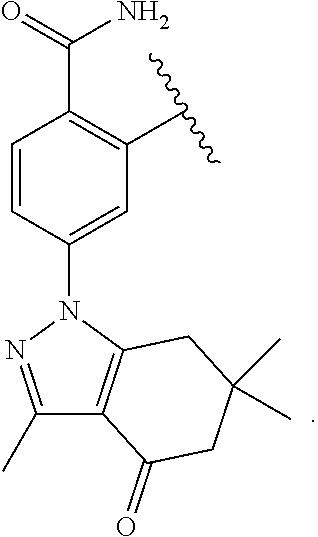


represents the point of attachment to the remainder of the compound of formula (I), e.g., to the —X1-L-X2-B moiety, or to the X2-L-X1-A moiety when B is an Hsp90 binding component having the formula (III).


-
- a) contacting the sample with a compound having the following formula (Ia):
A-X1-L-X2-B (Ia) - wherein:
- A is an Hsp90 binding component;
- X1 is selected from the group consisting of —NH—, —O—, —S—, —C(O)— and —S(O)2—;
- X2 is selected from the group consisting of —NR—, —O—, —S—, —C(O)— and —S(O)2—;
- L is a divalent linker comprising at least twelve member atoms independently selected from carbon, nitrogen and oxygen, wherein at least one member atom is nitrogen or oxygen;
- B is a detection moiety; and
- R is selected from the group consisting of hydrogen and a detection moiety; and
- b) detecting a signal from the detection moiety.
- a) contacting the sample with a compound having the following formula (Ia):
-
- a) contacting a biological sample from the subject with a compound having the following formula (Ia):
A-X1-L-X2-B (Ia) - wherein:
- A is an Hsp90 binding component;
- X1 is selected from the group consisting of —NH—, —O—, —S—, —C(O)— and —S(O)2—;
- X2 is selected from the group consisting of —NR—, —O—, —S—, —C(O)— and —S(O)2—;
- L is a divalent linker comprising at least twelve member atoms independently selected from carbon, nitrogen and oxygen, wherein at least one member atom is nitrogen or oxygen;
- B is a detection moiety; and
- R is selected from the group consisting of hydrogen and a detection moiety; and
- b) detecting a signal from the detection moiety;
- wherein cancer is detected in the sample when the signal from the detection moiety is higher relative to a signal from a reference sample.
- a) contacting a biological sample from the subject with a compound having the following formula (Ia):
A-X1-L-X2-B (Ib)
-
- a) contacting a biological, sample from the subject with a compound having the following formula (Ia):
A-X1-L-X2-B (Ia) - wherein:
- A is an Hsp90 binding component;
- X1 is selected from the group consisting of —NH—, —O—, —S—, —C(O)— and —S(O)2—;
- X2 is selected from the group consisting of —NR—, —O—, —S—, —C(O)— and —S(O)2—;
- L is a divalent linker comprising at least twelve member atoms independently selected from carbon, nitrogen and oxygen, wherein at least one member atom is nitrogen or oxygen;
- B is a detection moiety; and
- R is selected from the group consisting of hydrogen and a detection moiety; and
- b) detecting a signal from the detection moiety;
- wherein HIV is detected in the sample when the signal from the detection moiety is higher relative to a signal from a reference sample.
4. Kits
- a) contacting a biological, sample from the subject with a compound having the following formula (Ia):


| Swelling |
1 mM HCl | ||
| Coupling buffer | 0.1M NaHCO3, 0.5M NaCl, pH = 8.3 | ||
| Capping solution | 1M ethanolamine | ||
| Low buffer | 0.1M AcOH/NaAcOH, 0.5M NaCl pH = 4 | ||
| High buffer | 0.1M TRIS-HCl, 0.5M NaCl pH = 8 | ||
| Storage buffer | 0.1M KH2PO4, pH = 7.4 w/ 200 mg NaN3/L | ||


Amine 8 (673 mg, 1.11 mmol) and ferrocene carboxaldehyde (239 mg, 1.11 mmol) were dissolved in dichloroethane (5 mL) and treated with sodium triacetoxy-borohydride (283.5 mg, 1.34 mmol) followed by acetic acid (77 μL). The reaction mixture was stirred over the weekend. The mixture was adsorbed onto silica (3 g), added to a dry column (1.5×12 cm silica gel) and eluted with 100%, 19/1/0.1, then 9/1/0.1: CH2Cl2/MeOH/NH4OH (300 mL ea.) to give the less polar product, 18 (˜180 mg) and the more polar product (˜650 mg), both as yellow glasses. The products were separately dissolved in DMSO and chromatographed by HPLC (Agilent Prep C-18, 2.5×25 cm, 5 to 100% MeOH w/2% formic acid) to give 26 (490 mg, 54%) and 27 (200 mg, 17%) as viscous yellow glasses. 26. TLC (9/0.9/0.1 CH2Cl2/MeOH/NH3) Rf=0.23; 1H NMR (CDCl3) δ 8.52 (s, 1H), 7.98 (brs, 1H), 7.51 (d, J=8.1 Hz, 1H), 6.78 (d, J=1.6 Hz, 1H), 6.59 (dd, J=1.6, 8.1 Hz, 1H), 6.44 (brs, 1H), 4.3 (brs, 2H), 4.16 (br s, 2H), 4.11 (s, 5H), 3.91 (br s, 2H), 3.57 (br m, 20H), 3.28 (br s, 2H), 2.97 (br t, 2H), 2.79 (s, 2H), 5.52 (s, 3H), 2.37 (s, 2H), 1.91 (br m, 4H), 1.08 (s, 6H); MS (ESI): m/z 802.4 [M+H]+. 27 TLC (9/0.9/0.1 CH2Cl2/MeOH/NH3) Rf=0.40; MS (ESI): m/z 1000.5 [M+H]+.

A mixture of 2 (500 mg, 1.68 mmol) and trans-1,4-diaminocyclohexane (1.15 g, 10 mmol) and DMSO (1.5 ml) were stirred at RT for 3 days. The mixture was then diluted with ethanol (3 mL), heated to 90° C. and treated with 50% NaOH (12 drops) and then treated, very slowly, a drop at a time, with 30% hydrogen peroxide. After each drop, the reaction foamed up a bit. After 12 drops the reaction mixture was diluted with water (20 mL) and stirred rapidly overnight. A lot of powder fell out and was filtered off, washed with water and air dried to give 28 (689 mg. 100%) as an off-white powder. MS (ESI): m/z 410.3 [M+H]+.


Claims (14)


—(CH2)m—(OCH2CH2)n—O—(CH2)p—,


Priority Applications (3)
| Application Number | Priority Date | Filing Date | Title |
|---|---|---|---|
| US15/653,338 US10112947B2 (en) | 2012-08-06 | 2017-07-18 | Substituted 6-aminopurines for targeting HSP90 |
| US16/000,077 US10442806B2 (en) | 2012-08-06 | 2018-06-05 | Substituted heterocycles for targeting HSP90 |
| US16/550,715 US10927115B2 (en) | 2012-08-06 | 2019-08-26 | Substituted heterocycles for targeting Hsp90 |
Applications Claiming Priority (4)
| Application Number | Priority Date | Filing Date | Title |
|---|---|---|---|
| US201261680107P | 2012-08-06 | 2012-08-06 | |
| PCT/US2013/031614 WO2014025395A1 (en) | 2012-08-06 | 2013-03-14 | Compounds and methods for targeting hsp90 |
| US201514419965A | 2015-02-06 | 2015-02-06 | |
| US15/653,338 US10112947B2 (en) | 2012-08-06 | 2017-07-18 | Substituted 6-aminopurines for targeting HSP90 |
Related Parent Applications (2)
| Application Number | Title | Priority Date | Filing Date |
|---|---|---|---|
| PCT/US2013/031614 Division WO2014025395A1 (en) | 2012-08-06 | 2013-03-14 | Compounds and methods for targeting hsp90 |
| US14/419,965 Division US9738643B2 (en) | 2012-08-06 | 2013-03-14 | Substituted indazoles for targeting Hsp90 |
Related Child Applications (1)
| Application Number | Title | Priority Date | Filing Date |
|---|---|---|---|
| US16/000,077 Continuation US10442806B2 (en) | 2012-08-06 | 2018-06-05 | Substituted heterocycles for targeting HSP90 |
Publications (2)
| Publication Number | Publication Date |
|---|---|
| US20170369491A1 US20170369491A1 (en) | 2017-12-28 |
| US10112947B2 true US10112947B2 (en) | 2018-10-30 |
Family
ID=50068463
Family Applications (4)
| Application Number | Title | Priority Date | Filing Date |
|---|---|---|---|
| US14/419,965 Expired - Fee Related US9738643B2 (en) | 2012-08-06 | 2013-03-14 | Substituted indazoles for targeting Hsp90 |
| US15/653,338 Active US10112947B2 (en) | 2012-08-06 | 2017-07-18 | Substituted 6-aminopurines for targeting HSP90 |
| US16/000,077 Active US10442806B2 (en) | 2012-08-06 | 2018-06-05 | Substituted heterocycles for targeting HSP90 |
| US16/550,715 Expired - Fee Related US10927115B2 (en) | 2012-08-06 | 2019-08-26 | Substituted heterocycles for targeting Hsp90 |
Family Applications Before (1)
| Application Number | Title | Priority Date | Filing Date |
|---|---|---|---|
| US14/419,965 Expired - Fee Related US9738643B2 (en) | 2012-08-06 | 2013-03-14 | Substituted indazoles for targeting Hsp90 |
Family Applications After (2)
| Application Number | Title | Priority Date | Filing Date |
|---|---|---|---|
| US16/000,077 Active US10442806B2 (en) | 2012-08-06 | 2018-06-05 | Substituted heterocycles for targeting HSP90 |
| US16/550,715 Expired - Fee Related US10927115B2 (en) | 2012-08-06 | 2019-08-26 | Substituted heterocycles for targeting Hsp90 |
Country Status (3)
| Country | Link |
|---|---|
| US (4) | US9738643B2 (en) |
| EP (1) | EP2879675B1 (en) |
| WO (1) | WO2014025395A1 (en) |
Families Citing this family (7)
| Publication number | Priority date | Publication date | Assignee | Title |
|---|---|---|---|---|
| WO2014025395A1 (en) | 2012-08-06 | 2014-02-13 | Duke University | Compounds and methods for targeting hsp90 |
| BR112017005313A2 (en) | 2014-09-17 | 2017-12-05 | Memorial Sloan Kettering Cancer Center | imaging and therapy for hsp90-directed inflammation and infection |
| CA2983829C (en) | 2015-04-24 | 2024-04-02 | Duke University | Metal complexes with bisphosphonate or pyrophosphate useful as imaging agents |
| US9737509B1 (en) * | 2015-05-26 | 2017-08-22 | University Of South Florida | Antimicrobial compositions, methods of use, and methods of treatment of infections |
| CN105111773B (en) * | 2015-08-19 | 2017-06-27 | 大连理工大学 | A class of aminocyanine fluorescent dyes and its preparation method and application |
| US11261187B2 (en) | 2016-04-22 | 2022-03-01 | Duke University | Compounds and methods for targeting HSP90 |
| CN109796409A (en) * | 2019-01-31 | 2019-05-24 | 广州暨南生物医药研究开发基地有限公司 | A kind of method of tetrahydrobiopterin synthesis indazole compound |
Citations (34)
| Publication number | Priority date | Publication date | Assignee | Title |
|---|---|---|---|---|
| EP0520722A1 (en) | 1991-06-28 | 1992-12-30 | Zeneca Limited | Therapeutic preparations containing quinazoline derivatives |
| EP0564409A1 (en) | 1992-04-03 | 1993-10-06 | Ciba-Geigy Ag | Pyrimidin derivatives and process for their preparation |
| EP0566226A1 (en) | 1992-01-20 | 1993-10-20 | Zeneca Limited | Quinazoline derivatives |
| US5260291A (en) | 1981-08-24 | 1993-11-09 | Cancer Research Campaign Technology Limited | Tetrazine derivatives |
| WO1996033980A1 (en) | 1995-04-27 | 1996-10-31 | Zeneca Limited | Quinazoline derivatives |
| WO1997002266A1 (en) | 1995-07-06 | 1997-01-23 | Novartis Ag | Pyrrolopyrimidines and processes for the preparation thereof |
| EP0787722A1 (en) | 1996-02-05 | 1997-08-06 | American Cyanamid Company | Substituted quinazoline derivatives |
| WO1997030034A1 (en) | 1996-02-14 | 1997-08-21 | Zeneca Limited | Quinazoline derivatives as antitumor agents |
| WO1997038983A1 (en) | 1996-04-12 | 1997-10-23 | Warner-Lambert Company | Irreversible inhibitors of tyrosine kinases |
| WO1997049688A1 (en) | 1996-06-24 | 1997-12-31 | Pfizer Inc. | Phenylamino-substituted tricyclic derivatives for treatment of hyperproliferative diseases |
| WO1998010767A2 (en) | 1996-09-13 | 1998-03-19 | Sugen, Inc. | Use of quinazoline derivatives for the manufacture of a medicament in the treatment of hyperproliferative skin disorders |
| EP0837063A1 (en) | 1996-10-17 | 1998-04-22 | Pfizer Inc. | 4-Aminoquinazoline derivatives |
| US5747498A (en) | 1996-05-28 | 1998-05-05 | Pfizer Inc. | Alkynyl and azido-substituted 4-anilinoquinazolines |
| WO1999003854A1 (en) | 1997-07-18 | 1999-01-28 | Novartis Ag | Crystal modification of a n-phenyl-2-pyrimidineamine derivative, processes for its manufacture and its use |
| WO2002022577A2 (en) | 2000-09-01 | 2002-03-21 | Novartis Ag | Hydroxamate derivatives useful as deacetylase inhibitors |
| WO2003013541A1 (en) | 2001-08-07 | 2003-02-20 | Novartis Ag | 4-amino-6-phenyl-pyrrolo[2,3-d]pyrimidine derivatives |
| WO2006084030A2 (en) | 2005-02-01 | 2006-08-10 | Sloan-Kettering Institute For Cancer Research | Small-molecule hsp90 inhibitors |
| US20070207984A1 (en) | 2006-02-27 | 2007-09-06 | Huang Kenneth H | Cyclohexylamino Benzene, Pyridine, and Pyridazine Derivatives |
| US7344699B2 (en) | 2002-05-21 | 2008-03-18 | The Queen's University Of Belfast | Drug conjugate comprising an erythropoietin receptor ligand and an anticancer agent |
| US7358370B2 (en) | 2005-02-25 | 2008-04-15 | Serenex, Inc. | Benzene, pyridine, and pyridazine derivatives |
| US20080139587A1 (en) | 2004-11-30 | 2008-06-12 | Novartis Ag | Combinations Comprising Epothilones and Protein Tyrosine Kinase Inhibitors and Pharmaceutical Uses Thereof |
| US20080269193A1 (en) | 2007-04-16 | 2008-10-30 | Kenneth He Huang | Tetrahydroindole and Tetrahydroindazole Derivatives |
| US20090179638A1 (en) | 2006-02-01 | 2009-07-16 | Aegera Therapeutics Inc. | Assay for identifying inhibitors of neuronal apoptotic pathways |
| US20090226431A1 (en) | 2005-12-02 | 2009-09-10 | Nabil Habib | Treatment of Cancer and Other Diseases |
| US7612201B2 (en) | 2002-12-19 | 2009-11-03 | Vernalis (Cambridge) Limited | Pyrazole compounds |
| US20090298857A1 (en) | 2006-06-30 | 2009-12-03 | Sloan-Kettering Institute For Cancer Research | Treatment of Neurodegenerative Diseases Through Inhibition of HSP90 |
| US7678803B2 (en) | 2006-08-24 | 2010-03-16 | Serenex, Inc. | Quinazoline derivatives for the treatment of cancer |
| US20110065198A1 (en) | 2007-08-13 | 2011-03-17 | Nexigen Gmbh | Novel targets and compounds for therapeutic intervention of hiv infection |
| WO2011116181A1 (en) | 2010-03-17 | 2011-09-22 | Caris Life Sciences, Inc. | Theranostic and diagnostic methods using sparc and hsp90 |
| WO2012045237A1 (en) | 2010-10-08 | 2012-04-12 | 暨南大学 | Hsp90 inhibitor, preparation method and use thereof |
| WO2014025395A1 (en) | 2012-08-06 | 2014-02-13 | Duke University | Compounds and methods for targeting hsp90 |
| US20140079636A1 (en) | 2012-04-16 | 2014-03-20 | Dinesh U. Chimmanamada | Targeted therapeutics |
| US20140080895A1 (en) | 2011-03-15 | 2014-03-20 | The University Of British Columbia | Combination of anti-clusterin oligonucleotide with hsp90 inhibitor for the treatment of prostate cancer |
| WO2015114171A1 (en) | 2014-02-03 | 2015-08-06 | Eidgenoessische Technische Hochschule Zurich | Small molecule drug conjugates |
-
2013
- 2013-03-14 WO PCT/US2013/031614 patent/WO2014025395A1/en not_active Ceased
- 2013-03-14 EP EP13828368.4A patent/EP2879675B1/en active Active
- 2013-03-14 US US14/419,965 patent/US9738643B2/en not_active Expired - Fee Related
-
2017
- 2017-07-18 US US15/653,338 patent/US10112947B2/en active Active
-
2018
- 2018-06-05 US US16/000,077 patent/US10442806B2/en active Active
-
2019
- 2019-08-26 US US16/550,715 patent/US10927115B2/en not_active Expired - Fee Related
Patent Citations (42)
| Publication number | Priority date | Publication date | Assignee | Title |
|---|---|---|---|---|
| US5260291A (en) | 1981-08-24 | 1993-11-09 | Cancer Research Campaign Technology Limited | Tetrazine derivatives |
| EP0520722A1 (en) | 1991-06-28 | 1992-12-30 | Zeneca Limited | Therapeutic preparations containing quinazoline derivatives |
| EP0566226A1 (en) | 1992-01-20 | 1993-10-20 | Zeneca Limited | Quinazoline derivatives |
| CA2093203C (en) | 1992-04-03 | 2002-11-26 | Jurg Zimmermann | Pyrimidine derivatives and processes for the preparation thereof |
| EP0564409A1 (en) | 1992-04-03 | 1993-10-06 | Ciba-Geigy Ag | Pyrimidin derivatives and process for their preparation |
| WO1996033980A1 (en) | 1995-04-27 | 1996-10-31 | Zeneca Limited | Quinazoline derivatives |
| WO1997002266A1 (en) | 1995-07-06 | 1997-01-23 | Novartis Ag | Pyrrolopyrimidines and processes for the preparation thereof |
| EP0787722A1 (en) | 1996-02-05 | 1997-08-06 | American Cyanamid Company | Substituted quinazoline derivatives |
| WO1997030034A1 (en) | 1996-02-14 | 1997-08-21 | Zeneca Limited | Quinazoline derivatives as antitumor agents |
| WO1997038983A1 (en) | 1996-04-12 | 1997-10-23 | Warner-Lambert Company | Irreversible inhibitors of tyrosine kinases |
| US5747498A (en) | 1996-05-28 | 1998-05-05 | Pfizer Inc. | Alkynyl and azido-substituted 4-anilinoquinazolines |
| WO1997049688A1 (en) | 1996-06-24 | 1997-12-31 | Pfizer Inc. | Phenylamino-substituted tricyclic derivatives for treatment of hyperproliferative diseases |
| WO1998010767A2 (en) | 1996-09-13 | 1998-03-19 | Sugen, Inc. | Use of quinazoline derivatives for the manufacture of a medicament in the treatment of hyperproliferative skin disorders |
| EP0837063A1 (en) | 1996-10-17 | 1998-04-22 | Pfizer Inc. | 4-Aminoquinazoline derivatives |
| WO1999003854A1 (en) | 1997-07-18 | 1999-01-28 | Novartis Ag | Crystal modification of a n-phenyl-2-pyrimidineamine derivative, processes for its manufacture and its use |
| WO2002022577A2 (en) | 2000-09-01 | 2002-03-21 | Novartis Ag | Hydroxamate derivatives useful as deacetylase inhibitors |
| WO2003013541A1 (en) | 2001-08-07 | 2003-02-20 | Novartis Ag | 4-amino-6-phenyl-pyrrolo[2,3-d]pyrimidine derivatives |
| US7344699B2 (en) | 2002-05-21 | 2008-03-18 | The Queen's University Of Belfast | Drug conjugate comprising an erythropoietin receptor ligand and an anticancer agent |
| US7612201B2 (en) | 2002-12-19 | 2009-11-03 | Vernalis (Cambridge) Limited | Pyrazole compounds |
| US20080139587A1 (en) | 2004-11-30 | 2008-06-12 | Novartis Ag | Combinations Comprising Epothilones and Protein Tyrosine Kinase Inhibitors and Pharmaceutical Uses Thereof |
| WO2006084030A2 (en) | 2005-02-01 | 2006-08-10 | Sloan-Kettering Institute For Cancer Research | Small-molecule hsp90 inhibitors |
| US7358370B2 (en) | 2005-02-25 | 2008-04-15 | Serenex, Inc. | Benzene, pyridine, and pyridazine derivatives |
| US7906529B2 (en) | 2005-02-25 | 2011-03-15 | Serenex, Inc. | Benzene, pyridine, and pyridazine derivatives |
| US20110183977A1 (en) | 2005-02-25 | 2011-07-28 | Serenex, Inc. | Benzene, pyridine, and pyridazine derivatives |
| US7928135B2 (en) | 2005-02-25 | 2011-04-19 | Serenex, Inc. | Benzene, pyridine, and pyridazine derivatives |
| US20090226431A1 (en) | 2005-12-02 | 2009-09-10 | Nabil Habib | Treatment of Cancer and Other Diseases |
| US20090179638A1 (en) | 2006-02-01 | 2009-07-16 | Aegera Therapeutics Inc. | Assay for identifying inhibitors of neuronal apoptotic pathways |
| US20070207984A1 (en) | 2006-02-27 | 2007-09-06 | Huang Kenneth H | Cyclohexylamino Benzene, Pyridine, and Pyridazine Derivatives |
| US20090298857A1 (en) | 2006-06-30 | 2009-12-03 | Sloan-Kettering Institute For Cancer Research | Treatment of Neurodegenerative Diseases Through Inhibition of HSP90 |
| US7678803B2 (en) | 2006-08-24 | 2010-03-16 | Serenex, Inc. | Quinazoline derivatives for the treatment of cancer |
| US20080269193A1 (en) | 2007-04-16 | 2008-10-30 | Kenneth He Huang | Tetrahydroindole and Tetrahydroindazole Derivatives |
| WO2008130879A2 (en) | 2007-04-16 | 2008-10-30 | Serenex, Inc. | Tetrahydroindole and tetrahydroindazole derivatives |
| US20110065198A1 (en) | 2007-08-13 | 2011-03-17 | Nexigen Gmbh | Novel targets and compounds for therapeutic intervention of hiv infection |
| WO2011116181A1 (en) | 2010-03-17 | 2011-09-22 | Caris Life Sciences, Inc. | Theranostic and diagnostic methods using sparc and hsp90 |
| US20130190509A1 (en) | 2010-10-08 | 2013-07-25 | Yifei Wang | Hsp90 inhibitor and preparation method and use thereof |
| WO2012045237A1 (en) | 2010-10-08 | 2012-04-12 | 暨南大学 | Hsp90 inhibitor, preparation method and use thereof |
| US20140080895A1 (en) | 2011-03-15 | 2014-03-20 | The University Of British Columbia | Combination of anti-clusterin oligonucleotide with hsp90 inhibitor for the treatment of prostate cancer |
| US20140079636A1 (en) | 2012-04-16 | 2014-03-20 | Dinesh U. Chimmanamada | Targeted therapeutics |
| US20150139905A1 (en) | 2012-04-16 | 2015-05-21 | Synta Pharmaceuticals Corp. | Targeted therapeutics |
| WO2014025395A1 (en) | 2012-08-06 | 2014-02-13 | Duke University | Compounds and methods for targeting hsp90 |
| US9738643B2 (en) | 2012-08-06 | 2017-08-22 | Duke University | Substituted indazoles for targeting Hsp90 |
| WO2015114171A1 (en) | 2014-02-03 | 2015-08-06 | Eidgenoessische Technische Hochschule Zurich | Small molecule drug conjugates |
Non-Patent Citations (27)
Also Published As
| Publication number | Publication date |
|---|---|
| EP2879675A4 (en) | 2016-05-25 |
| US9738643B2 (en) | 2017-08-22 |
| US20150191471A1 (en) | 2015-07-09 |
| US20190031661A1 (en) | 2019-01-31 |
| US10442806B2 (en) | 2019-10-15 |
| EP2879675B1 (en) | 2019-11-13 |
| WO2014025395A1 (en) | 2014-02-13 |
| US20170369491A1 (en) | 2017-12-28 |
| US10927115B2 (en) | 2021-02-23 |
| US20200216452A1 (en) | 2020-07-09 |
| EP2879675A1 (en) | 2015-06-10 |
Similar Documents
| Publication | Publication Date | Title |
|---|---|---|
| US10927115B2 (en) | Substituted heterocycles for targeting Hsp90 | |
| US10207998B2 (en) | Substituted benzimidazole and substituted benzothiazole inhibitors of transforming growth factor-β kinase and methods of use thereof | |
| CN105073761B (en) | Substituted silaxanthene cationic red to near infrared fluorescent dyes for in vitro and in vivo imaging and detection | |
| KR102322794B1 (en) | Nuclear transport modulators and uses thereof | |
| US20230159762A1 (en) | Nir to swir fluorescent compounds for imaging and detection | |
| KR20210045998A (en) | Heterocyclic spiro compounds and methods of use thereof for cancer treatment | |
| ES2573494T3 (en) | Cucurbit [n] uril type molecular containers and their manufacturing and use procedures | |
| US11767298B2 (en) | Substituted benzimidazoles as inhibitors of transforming growth factor-β kinase | |
| JP7498108B2 (en) | Compounds and their uses for the prevention and treatment of medical disorders - Patents.com | |
| US8637490B2 (en) | Anti-cancer agents | |
| US10000469B2 (en) | Heat shock protein 70 (hsp-70) receptor ligands | |
| JP2017530961A (en) | Imaging and therapy of inflammation and infection targeting HSP90 | |
| CN103193691A (en) | Sulfonamide compound and medicinal compositions thereof, and preparation methods and applications thereof | |
| US20220135572A1 (en) | Compounds and methods for targeting hsp90 | |
| US20240408226A1 (en) | Antibody drug conjugate intermediate containing sn38 and its preparation method | |
| TW583000B (en) | X-type sPLA2 inhibitor as a cancer therapeutical agent | |
| Haystead | Development of Tethered Hsp90 Inhibitors Carrying Radioiodinated Probes to Specifically Discriminate and Kill Malignant Breast Tumor Cells | |
| Peters et al. | Synthesis and biological activity of a CXCR4-targeting bis (cyclam) lipid | |
| US12220423B2 (en) | Compounds, derivatives, and analogs for cancer | |
| Wang et al. | Novel Folate–Phenylfuran P‐gp Inhibitor Conjugates for Overcoming Multidrug Resistance in MCF‐7/ADR Cell | |
| CN121548417A (en) | Small molecule inhibitors of P27 | |
| WO2022241279A2 (en) | Folate receptor-targeted conjugates with brush border membrane enzyme-cleavable linkers and methods of use in imaging and treating cancer |
Legal Events
| Date | Code | Title | Description |
|---|---|---|---|
| AS | Assignment |
Owner name: DUKE UNIVERSITY, NORTH CAROLINA Free format text: ASSIGNMENT OF ASSIGNORS INTEREST;ASSIGNORS:HAYSTEAD, TIMOTHY;HUGHES, PHILIP FLOYD;REEL/FRAME:043054/0275 Effective date: 20150209 |
|
| STCF | Information on status: patent grant |
Free format text: PATENTED CASE |
|
| CC | Certificate of correction | ||
| MAFP | Maintenance fee payment |
Free format text: PAYMENT OF MAINTENANCE FEE, 4TH YR, SMALL ENTITY (ORIGINAL EVENT CODE: M2551); ENTITY STATUS OF PATENT OWNER: SMALL ENTITY Year of fee payment: 4 |
|
| AS | Assignment |
Owner name: NATIONAL INSTITUTES OF HEALTH (NIH), U.S. DEPT. OF HEALTH AND HUMAN SERVICES (DHHS), U.S. GOVERNMENT, MARYLAND Free format text: CONFIRMATORY LICENSE;ASSIGNOR:DUKE UNIVERSITY;REEL/FRAME:062136/0278 Effective date: 20210617 |