US10112456B2 - Systems and methods for damper actuator without microcontroller - Google Patents

Systems and methods for damper actuator without microcontroller Download PDF

Info

Publication number
US10112456B2
US10112456B2 US15/512,809 US201415512809A US10112456B2 US 10112456 B2 US10112456 B2 US 10112456B2 US 201415512809 A US201415512809 A US 201415512809A US 10112456 B2 US10112456 B2 US 10112456B2
Authority
US
United States
Prior art keywords
motor
semiconductor switch
actuator
drive
hold
Prior art date
Legal status (The legal status is an assumption and is not a legal conclusion. Google has not performed a legal analysis and makes no representation as to the accuracy of the status listed.)
Active
Application number
US15/512,809
Other versions
US20170282687A1 (en
Inventor
Pankaj V. Kalore
Guy P. Caliendo
Dean B. Anderson
Michael B. Strozewski
Current Assignee (The listed assignees may be inaccurate. Google has not performed a legal analysis and makes no representation or warranty as to the accuracy of the list.)
Siemens Industry Inc
Original Assignee
Siemens Industry Inc
Priority date (The priority date is an assumption and is not a legal conclusion. Google has not performed a legal analysis and makes no representation as to the accuracy of the date listed.)
Filing date
Publication date
Application filed by Siemens Industry Inc filed Critical Siemens Industry Inc
Assigned to SIEMENS INDUSTRY INC. reassignment SIEMENS INDUSTRY INC. ASSIGNMENT OF ASSIGNORS INTEREST (SEE DOCUMENT FOR DETAILS). Assignors: STROZEWSKI, MICHAEL B., CALIENDO, GUY P., KALORE, PANKAJ V., ANDERSON, DEAN B.
Publication of US20170282687A1 publication Critical patent/US20170282687A1/en
Application granted granted Critical
Publication of US10112456B2 publication Critical patent/US10112456B2/en
Active legal-status Critical Current
Anticipated expiration legal-status Critical

Links

Images

Classifications

    • BPERFORMING OPERATIONS; TRANSPORTING
    • B60VEHICLES IN GENERAL
    • B60HARRANGEMENTS OF HEATING, COOLING, VENTILATING OR OTHER AIR-TREATING DEVICES SPECIALLY ADAPTED FOR PASSENGER OR GOODS SPACES OF VEHICLES
    • B60H1/00Heating, cooling or ventilating [HVAC] devices
    • B60H1/00642Control systems or circuits; Control members or indication devices for heating, cooling or ventilating devices
    • B60H1/00814Control systems or circuits characterised by their output, for controlling particular components of the heating, cooling or ventilating installation
    • B60H1/00821Control systems or circuits characterised by their output, for controlling particular components of the heating, cooling or ventilating installation the components being ventilating, air admitting or air distributing devices
    • B60H1/00835Damper doors, e.g. position control
    • B60H1/00857Damper doors, e.g. position control characterised by the means connecting the initiating means, e.g. control lever, to the damper door
    • EFIXED CONSTRUCTIONS
    • E05LOCKS; KEYS; WINDOW OR DOOR FITTINGS; SAFES
    • E05FDEVICES FOR MOVING WINGS INTO OPEN OR CLOSED POSITION; CHECKS FOR WINGS; WING FITTINGS NOT OTHERWISE PROVIDED FOR, CONCERNED WITH THE FUNCTIONING OF THE WING
    • E05F15/00Power-operated mechanisms for wings
    • E05F15/40Safety devices, e.g. detection of obstructions or end positions
    • E05F15/41Detection by monitoring transmitted force or torque; Safety couplings with activation dependent upon torque or force, e.g. slip couplings
    • EFIXED CONSTRUCTIONS
    • E05LOCKS; KEYS; WINDOW OR DOOR FITTINGS; SAFES
    • E05FDEVICES FOR MOVING WINGS INTO OPEN OR CLOSED POSITION; CHECKS FOR WINGS; WING FITTINGS NOT OTHERWISE PROVIDED FOR, CONCERNED WITH THE FUNCTIONING OF THE WING
    • E05F15/00Power-operated mechanisms for wings
    • E05F15/60Power-operated mechanisms for wings using electrical actuators
    • EFIXED CONSTRUCTIONS
    • E05LOCKS; KEYS; WINDOW OR DOOR FITTINGS; SAFES
    • E05FDEVICES FOR MOVING WINGS INTO OPEN OR CLOSED POSITION; CHECKS FOR WINGS; WING FITTINGS NOT OTHERWISE PROVIDED FOR, CONCERNED WITH THE FUNCTIONING OF THE WING
    • E05F3/00Closers or openers with braking devices, e.g. checks; Construction of pneumatic or liquid braking devices
    • E05F3/22Additional arrangements for closers, e.g. for holding the wing in opened or other position
    • HELECTRICITY
    • H02GENERATION; CONVERSION OR DISTRIBUTION OF ELECTRIC POWER
    • H02PCONTROL OR REGULATION OF ELECTRIC MOTORS, ELECTRIC GENERATORS OR DYNAMO-ELECTRIC CONVERTERS; CONTROLLING TRANSFORMERS, REACTORS OR CHOKE COILS
    • H02P1/00Arrangements for starting electric motors or dynamo-electric converters
    • H02P1/16Arrangements for starting electric motors or dynamo-electric converters for starting dynamo-electric motors or dynamo-electric converters
    • H02P1/18Arrangements for starting electric motors or dynamo-electric converters for starting dynamo-electric motors or dynamo-electric converters for starting an individual DC motor
    • HELECTRICITY
    • H02GENERATION; CONVERSION OR DISTRIBUTION OF ELECTRIC POWER
    • H02PCONTROL OR REGULATION OF ELECTRIC MOTORS, ELECTRIC GENERATORS OR DYNAMO-ELECTRIC CONVERTERS; CONTROLLING TRANSFORMERS, REACTORS OR CHOKE COILS
    • H02P3/00Arrangements for stopping or slowing electric motors, generators, or dynamo-electric converters
    • H02P3/02Details of stopping control
    • H02P3/025Details of stopping control holding the rotor in a fixed position after deceleration
    • HELECTRICITY
    • H02GENERATION; CONVERSION OR DISTRIBUTION OF ELECTRIC POWER
    • H02PCONTROL OR REGULATION OF ELECTRIC MOTORS, ELECTRIC GENERATORS OR DYNAMO-ELECTRIC CONVERTERS; CONTROLLING TRANSFORMERS, REACTORS OR CHOKE COILS
    • H02P7/00Arrangements for regulating or controlling the speed or torque of electric DC motors
    • H02P7/03Arrangements for regulating or controlling the speed or torque of electric DC motors for controlling the direction of rotation of DC motors
    • H02P7/05Arrangements for regulating or controlling the speed or torque of electric DC motors for controlling the direction of rotation of DC motors by means of electronic switching
    • HELECTRICITY
    • H02GENERATION; CONVERSION OR DISTRIBUTION OF ELECTRIC POWER
    • H02PCONTROL OR REGULATION OF ELECTRIC MOTORS, ELECTRIC GENERATORS OR DYNAMO-ELECTRIC CONVERTERS; CONTROLLING TRANSFORMERS, REACTORS OR CHOKE COILS
    • H02P7/00Arrangements for regulating or controlling the speed or torque of electric DC motors
    • H02P7/06Arrangements for regulating or controlling the speed or torque of electric DC motors for regulating or controlling an individual DC dynamo-electric motor by varying field or armature current
    • EFIXED CONSTRUCTIONS
    • E05LOCKS; KEYS; WINDOW OR DOOR FITTINGS; SAFES
    • E05FDEVICES FOR MOVING WINGS INTO OPEN OR CLOSED POSITION; CHECKS FOR WINGS; WING FITTINGS NOT OTHERWISE PROVIDED FOR, CONCERNED WITH THE FUNCTIONING OF THE WING
    • E05F15/00Power-operated mechanisms for wings
    • E05F15/70Power-operated mechanisms for wings with automatic actuation
    • E05F15/79Power-operated mechanisms for wings with automatic actuation using time control
    • EFIXED CONSTRUCTIONS
    • E05LOCKS; KEYS; WINDOW OR DOOR FITTINGS; SAFES
    • E05YINDEXING SCHEME ASSOCIATED WITH SUBCLASSES E05D AND E05F, RELATING TO CONSTRUCTION ELEMENTS, ELECTRIC CONTROL, POWER SUPPLY, POWER SIGNAL OR TRANSMISSION, USER INTERFACES, MOUNTING OR COUPLING, DETAILS, ACCESSORIES, AUXILIARY OPERATIONS NOT OTHERWISE PROVIDED FOR, APPLICATION THEREOF
    • E05Y2201/00Constructional elements; Accessories therefor
    • E05Y2201/40Motors; Magnets; Springs; Weights; Accessories therefor
    • E05Y2201/43Motors
    • E05Y2201/434Electromotors; Details thereof
    • FMECHANICAL ENGINEERING; LIGHTING; HEATING; WEAPONS; BLASTING
    • F16ENGINEERING ELEMENTS AND UNITS; GENERAL MEASURES FOR PRODUCING AND MAINTAINING EFFECTIVE FUNCTIONING OF MACHINES OR INSTALLATIONS; THERMAL INSULATION IN GENERAL
    • F16HGEARING
    • F16H19/00Gearings comprising essentially only toothed gears or friction members and not capable of conveying indefinitely-continuing rotary motion
    • F16H19/001Gearings comprising essentially only toothed gears or friction members and not capable of conveying indefinitely-continuing rotary motion for conveying reciprocating or limited rotary motion

Definitions

  • the present embodiments relate generally to systems and methods for a damper actuator without a microcontroller.
  • Dampers e.g., in heating, ventilating and air conditioning (HVAC) installations, can include valves or plates that stop or regulate the flow of air inside a duct, chimney, variable air volume (VAV) box, air handler, or other air handling equipment.
  • Fire dampers are fitted where ductwork passes through fire compartment walls/fire curtains as part of a fire control strategy.
  • a damper actuator can control the opening and closing of the damper. The damper actuator allows a damper system to bring in outside air, smoke outside and/or moves the damping system in such a way that air cannot get in.
  • Conventional actuators typically require microcontrollers which can lead to extra parts and costs of the acutuators.
  • Systems and methods for an actuator include a housing and a motor provided in the housing for driving an external device to a determined position when energized.
  • a coupler is configured to connect the motor to the external device, and a gear train is operationally engaged between the motor and the coupler for transmitting torque between the motor and the coupler.
  • a switch is configured to generate a first switching signal for energizing the motor to drive the external device with a high voltage to the determined position, and a second switching signal for energizing the motor with a low voltage to hold the external device when a determined time has passed from a moment the motor is energized.
  • the low voltage is lower than the high voltage, and the low voltage is supplied to the motor to maintain the external device at the determined position.
  • Systems and methods for an actuator can also include a housing and a motor provided in the housing for driving the external device to a determined position when energized.
  • a coupler is configured to connect the motor to the external device, and a gear train is operationally engaged between the motor and the coupler for transmitting torque between the motor and the coupler.
  • a drive/hold switch connects with the motor, the drive/hold switch configured to select a high voltage or a low voltage, the high voltage for energizing the motor to drive the external device to the determined position and the low voltage to hold the external device when a determined time has passed from a moment the motor is energized, where the low voltage is lower than the high voltage.
  • An active/return switch connects with the motor, and the active/return switch is configured to connect the motor with a zener diode when the motor is acting as a generator.
  • FIG. 1 is an exploded view of an exemplary actuator, e.g., for use with a damper.
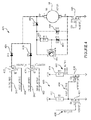
  • FIG. 2 is a schematic of an exemplary switching circuit for the actuator.
  • FIG. 3 is a schematic of exemplary regulator circuits for the actuator.
  • FIG. 4 is a schematic of an exemplary switching circuit for controlling switching from the high voltage state to low voltage state in the energized mode.
  • FIG. 5 is a schematic of another exemplary switching circuit for the actuator.
  • FIG. 6 is a flowchart of an exemplary logic for the different modes of the circuits described herein.
  • FIG. 7 is a schematic of another exemplary switching circuit for the actuator.
  • System and methods for a damper actuator without a microcontroller can be used with direct current (DC) motors and line voltage motors, etc., e.g., GND and GGD type of fire and smoke damper actuators by SIEMENS INDUSTRY INC. BUILDING TECHNOLOGIES DIVISION.
  • DC direct current
  • FIG. 1 is an exploded view of an exemplary actuator 10 , e.g., for use with a damper 12 .
  • the actuator 10 can include a lower housing 11 and a top housing 13 which are configured to receive a rotatable output coupler 14 through coupling holes 16 via a bearing rings 18 .
  • the coupler 14 is constructed to operatively couple to an external device such as the damper 12 or a valve, and is adapted to displace louvers 13 of the damper 12 between a default stasis position in the event of a power interruption and a desired operating position when power is being applied to the actuator 10 .
  • the actuator 10 can be reversible to accommodate a normally closed damper 12 or a normally open damper 12 depending on how the actuator 10 is installed.
  • the normally closed damper 12 can be used as a smoke exhaust in an elevator shaft to keep foreign object out of the shaft until the damper 12 is opened to allow smoke to vent out.
  • the normally open damper 12 can allow fresh air to enter building space until there is a fire when the damper 12 is closed to prevent smoke from travelling through the damper 12 to that part of the building.
  • the actuator 10 can include two modes, energized and de-energized, two energized states, high voltage and low voltage, and two de-energized states, rest and returning to stasis. Other modes and states can be used. For example, when the actuator 10 is energized, the actuator 10 can be driving under power or holding an end position. When the actuator 10 is de-energized, the actuator 10 can at rest or returning to the stasis state using a retracting spring 37 . The actuator 10 moves the louvers 13 between open and closed positions, or vice versa, depending on when the actuator 10 is operating in an energized or de-energized state.
  • the output coupler 14 of the actuator 10 includes an integral output segment 20 which has a plurality of teeth for engaging a gear train indicated generally at 22 .
  • the gear train 22 can include gear sets (e.g., four gear sets 24 , 26 , 28 , 30 ) which are operatively engaged with respect to each other.
  • the gear train 22 is arranged with the axes of the gear sets 24 , 26 , 28 , 30 generally forming a zig-zag line along the longitudinal direction of the actuator 10 .
  • the gear set 24 of the gear train 22 is engaged with the output segment 20 of the output coupler 14 and the gear set 30 is operatively engaged with a drive motor 34 .
  • gear train 22 is arranged using the interconnection of four gear sets 24 , 26 , 28 , 30 including their respective transfer pinions, gear train 22 may include more or less than four gear sets, and can be arranged in various other configurations which would allow torque to be transferred between the drive motor 34 and the output coupler 14 .
  • the actuator 10 further includes a switching circuit (e.g., any of the switching circuits described in FIG. 2-7 below) for controlling power that is applied to the drive motor 34 and the solenoid 46 .
  • the switching circuit can be implemented on a printed circuit board 42 and can be protected by an insulation plate.
  • FIG. 2 is a schematic of an exemplary switching circuit 200 for the actuator 10 .
  • the circuit 200 includes a transformer 202 .
  • Input terminals 204 on a primary side of the transformer 202 can include, for example, 24 V, 115 V and/or 230 V at 50 Hz or 60 Hz inputs.
  • the output terminals 206 on the secondary side of the transformer 202 can include a high voltage (HV) alternating current (AC) hot output 208 , a high voltage (HV) alternating current (AC) return output 210 , a low voltage (LV) alternating current (AC) hot output 212 , and a low voltage (LV) alternating current (AC) return output 214 .
  • the high voltages at terminals 208 and 210 can provide the driving voltage for the actuator 10 and the low voltages at terminals 212 and 214 can provide the hold voltage for the actuator 10 .
  • the actuator 10 moves the damper 12 from zero to ninety degrees (e.g., from a normally closed to an open position, or a normally open to a closed position) the drive voltage moves the damper 12 to the end stop position and changes to the hold voltage to provide enough power to help maintain the damper 12 at the end stop position.
  • the damper 12 can return to its starting, stasis state, e.g., open or closed.
  • the output voltages from the outputs 208 , 210 , 212 and 214 can be applied to a rectifier bridge, e.g., low voltage rectifier bridge 220 and high voltage rectifier bridge 230 .
  • the rectifier bridges 220 , 230 include diodes 222 , 224 , 226 , 228 , 232 , 234 , 236 , 238 , e.g., in one implementation 1N5408 type diodes.
  • the rectifiers 220 , 230 transform the AC voltage to DC voltage, e.g., about an 8 V unregulated DC voltage 240 for the hold voltage and about a 24 V unregulated high DC voltage 242 .
  • the unregulated high DC 24 V can be used as the high drive voltage for driving the motor 34 to move the damper 12 from a closed to open state, or open to closed depending on the configuration. (See also FIG. 4 ).
  • FIG. 3 is a schematic of exemplary regulator circuits 300 for the actuator 10 .
  • Regulator circuit 310 receives the 24 V unregulated high DC voltage at input terminal 312 which is sent through a blocking diode 314 and outputs about a regulated 12 V output at terminal 316 for powering the circuits (e.g., switching circuit 400 described in FIG. 4 ).
  • the regulator circuit 310 can include switches 318 , 320 , resistors 322 , 324 , 326 , capacitors 328 , 330 and diode 332 to regulate the unregulated 24 V input voltage.
  • switches 318 , 320 , resistors 322 , 324 , 326 , capacitors 328 , 330 and diode 332 to regulate the unregulated 24 V input voltage.
  • exemplary values of elements 314 , 318 , 320 , 322 , 324 , 326 , 328 , 330 and 332 are provided, but other values can be used.
  • Regulator circuit 340 receives unregulated low DC voltage input 240 (e.g., about 8 V) and sends the unregulated low DC voltage through a blocking diode 344 .
  • the regulator circuit uses switches 348 , 350 , resistors 352 , 354 , 356 , capacitors 358 , 360 , 362 , 364 and diode 366 to output a regulated low DC voltage 346 , e.g., 5 V.
  • the 5 V regulated low DC voltage can provide the actuator holding voltage in the energized low voltage state (see also FIG. 4 ).
  • exemplary values of elements 344 , 348 , 350 , 352 , 354 , 356 , 358 , 360 , 362 , 364 and 366 are provided, but other values can be used.
  • FIG. 4 is a schematic of an exemplary switching circuit 400 for controlling switching from the high voltage state to low voltage state in the energized mode.
  • the switching circuit 400 can advantageously replace a single throw, double pole switch.
  • the switching circuit 400 switches from providing a drive active signal 402 to a hold active signal 404 based on a timer signal 406 .
  • the drive active signal 402 and the hold active signal 404 can control whether unregulated high DC driving voltage 242 or regulated low DC holding voltage 346 is sent to the drive motor 34 .
  • the timer signal 406 can be received from an embedded memory, discrete timer circuit component or microcontroller, e.g., MC14541B by MOTOROLA when cost is not a factor, or other time producing circuit.
  • the timer signal 406 is sent for a determined amount of time, e.g., about 10 to 15 seconds, or other time after the actuator 10 is activated for the damper 12 to reach the end stop position or other determined position.
  • the spring 37 can act as a variable clutch to absorb shock and remove torque when the damper 12 reaches the end stop position and the actuator is driving.
  • the spring 37 can be located between the gear sets 24 , 26 , 28 , 30 of the gear train.
  • the switching circuit 400 can include first and second semiconductor switches 408 , 410 and resistors 412 , 414 with each of the resistors 412 , 414 connected to an output terminal of respective semiconductor switches 408 , 410 and reference voltage, e.g., 12 V.
  • first switch 408 When the timer signal 406 is received or present on the gate input (G) of first switch 408 the first switch 408 is activated (e.g., a voltage is applied at the gate (G) of semiconductor switch 408 ) the hold active signal 404 is pulled to ground.
  • the second semiconductor switch 410 is off since the voltage at gate (G) of semiconductor switch 410 is pulled low. Since the semiconductor switch 410 is off, the drive active signal 402 is high as received by the third switch 426 of motor circuit 420 .
  • the hold active signal 404 is low as received by the fourth switch 422 of the motor circuit 420 . Therefore, the third semiconductor switch 426 is on and the high voltage (HV) DC unregulated 24 V high driving voltage is received by the motor 34 to drive the damper 12 out of the stasis position.
  • the fourth semiconductor switch 422 is off.
  • the first semiconductor switch 408 When the timer signal 406 reaches the determined time and the timer signal 406 goes low, the first semiconductor switch 408 is turned off which means the hold active signal 404 is high as received by the fourth switch 422 of the motor circuit 420 .
  • the second semiconductor switch 410 is on, and the drive active signal 402 is pulled to ground. Therefore, the third semiconductor switch 426 is off and the fourth semiconductor switch 422 is on, and low holding voltage, e.g., (LV) DC regulated 5 V, is supplied to the motor 34 to hold the motor in the energized, non-stasis state.
  • the motor circuit 420 includes diode 424 corresponding to fourth semiconductor switch 422 , and diode 428 corresponding to semiconductor switch 426 .
  • the semiconductor switches 422 , 426 are metal-oxide semiconductor field-effect transistor (MOSFET) switches.
  • MOSFET metal-oxide semiconductor field-effect transistor
  • the semiconductor switches 408 , 410 , 422 and 426 can replace a single throw, double pole switch.
  • relays or other types of switches can be used in place of the semiconductor switches.
  • a fifth semiconductor switch 440 ensures that in the de-energized mode when no power is applied to the motor 34 as identified by the voltage at the gate (G) of fifth semiconductor switch 440 , the switch 440 is off and diodes 442 , 444 , 446 , resistor 448 and switch 450 connected in parallel with the drive motor 34 to provide an electrical load against the drive motor 34 as the retracting spring 37 returns the damper 12 to a stasis state. Voltage generated by the drive motor 34 being driven by the spring 37 is also blocked from conducting though the switch 440 to connecting circuits.
  • switch 440 When switch 440 is off, voltage generated by the drive motor 34 is forced to travel through diode 444 and diode 446 in the case of a low torque generator, and voltage travels through diode 442 , diode 446 , resistor 448 and switch 450 in the case of a high torque generator.
  • Switch 450 , diode 442 and resistor 448 are acting as a zener diode.
  • the load applied to the drive motor 34 allows the damper 12 to return to a stasis position in a controlled manner and prevents voltage from the drive motor 34 from harming parts of the circuit.
  • FIG. 5 is a schematic of another exemplary switching circuit 500 for the actuator 10 .
  • the circuit 500 includes a relay 510 that switches the circuit between a driving mode 512 and a holding mode 514 for the motor 34 .
  • a transformer 516 can provide more power for the driving mode 512 , e.g., 220 V, 230 V, or 240 V and less power for the holding mode 514 , e.g., 110 V, 120 V, 130 V.
  • the circuit 500 can include a MOSFET connected with the negative terminal of the drive motor 34 and a gate of the MOSFET connected to a resistor/capacitor (RC) bridge to provide load to the drive motor 34 .
  • the relay 510 can in some implementations make for more stable switching than the MOSFET.
  • the relay 510 connects with a diode bridge of diodes 522 , 524 , 526 , 528 , via a drive/hold switch 530 .
  • the diode bridge of diodes 522 , 524 , 526 , 528 rectifies the AC voltage from the transformer 516 to DC voltage for the drive motor 34 .
  • the drive/hold switch 530 selects between the driving mode 512 and holding mode 514 voltage of the transformer 516 to provide drive power to the drive motor 34 when the damper 12 moves from the stasis position and hold power to maintain the damper 12 at the end stop. For example, with the drive/hold switch 530 in the hold position the voltage is from a center tap of the transformer 516 to ground to provide half the drive voltage.
  • the drive/hold switch 530 can be implemented, for example, with a single pole, double throw switch. Other switch types can be used.
  • the relay 510 controls active/return selection of the circuit 500 . In the active (e.g., energized) mode the relay 510 is switched to supply drive and then hold power to the drive motor 34 . In the return (e.g., de-energized) mode, the relay 510 connects the drive motor 34 to diode 540 and zener diode 542 combination to provide a braking load for the drive motor 34 , e.g., when no power is supplied to the drive motor 34 and the damper 12 is returning to the stasis state, e.g., under spring power.
  • the drive motor 34 connects to the drive train 550 which connects with the damper 12 to provide opening or closing of the damper 12 .
  • the gear train 550 can connect to the drive/hold switch 530 to make the drive mode 512 and hold mode 514 selection, for example, based on the drive train 550 moving the damper 12 a determined distance, e.g., measured in degrees, from stasis.
  • Advantages of the circuit 500 include a small number of parts compared to past damper actuators, no pulse width modulator or microcontroller is needed, heat loss can be minimized, the return zener is not taxed while on hold, and low hold power can be utilized.
  • FIG. 6 is a flowchart of an exemplary logic 600 collectively performed by the switching circuits in FIGS. 2-7 having different modes as described herein.
  • the actuator 10 If power is being applied by the actuator 10 (block 610 ), it is determined whether the end position of the louvers 13 has been reached (block 620 ). The end position can be determined to have been reached after a determined amount of time since the power was application, after the gear sets 24 , 26 , 28 , 30 have moved a determined distance, a switch at the end point is activated, etc., depending on an implementation. If the end position has not yet been reached, the actuator continues to provide the higher driver voltage (block 630 ). If the end position has been determined to have been reached, the actuator supplies the lower hold voltage (block 640 ).
  • the damper 12 and actuator 10 are in stasis. If the louvers 13 not located in a home position (block 650 ), the retracting spring moves the louvers 13 to the home position and turns the drive motor 34 into a generator (block 660 ).
  • a zener e.g., described for the above circuitry, can load the drive motor 34 in that case.
  • FIG. 7 is a schematic of another exemplary switching circuit 700 for the actuator 10 .
  • a MOSFET 710 or other semiconductor device, and resistors 712 , 714 performs the switching for energized driving mode 512 voltage and holding mode 514 voltage, e.g., instead of the relay 510 of FIG. 5 .
  • the MOSFET turns off and the diode 540 /zener diode 542 combination becomes active.
  • the regulator circuits of FIG. 3 can be used to regulate the voltage received by the MOSFET 710 . No pulse width modulator, relay or microcontroller is needed to accommodate the damper drive power and hold power modes for this circuit.

Landscapes

  • Engineering & Computer Science (AREA)
  • Power Engineering (AREA)
  • Physics & Mathematics (AREA)
  • Thermal Sciences (AREA)
  • Mechanical Engineering (AREA)
  • Control Of Direct Current Motors (AREA)
  • Power-Operated Mechanisms For Wings (AREA)
  • Control Of Stepping Motors (AREA)
  • Control Of Electric Motors In General (AREA)

Abstract

Methods and systems include an actuator adapted to provide drive power and hold power to an external device. A motor provides for driving the external device to a determined position when the motor is energized. A switching circuit is configured to energize the motor with a high voltage to drive the external device to the determined position and energize the motor with a low voltage to hold the external device in the determined position.

Description

RELATED APPLICATION
This patent document claims priority under 35 U.S.C. § 119 AND ALL OTHER BENEFITS FROM the Application No. PCT/2014US/057328, filed Sep. 25, 2014, the content of which is hereby incorporated by reference to the extent permitted by law.
FIELD
The present embodiments relate generally to systems and methods for a damper actuator without a microcontroller.
BACKGROUND
Dampers, e.g., in heating, ventilating and air conditioning (HVAC) installations, can include valves or plates that stop or regulate the flow of air inside a duct, chimney, variable air volume (VAV) box, air handler, or other air handling equipment. Fire dampers are fitted where ductwork passes through fire compartment walls/fire curtains as part of a fire control strategy. A damper actuator can control the opening and closing of the damper. The damper actuator allows a damper system to bring in outside air, smoke outside and/or moves the damping system in such a way that air cannot get in. Conventional actuators typically require microcontrollers which can lead to extra parts and costs of the acutuators.
SUMMARY
Systems and methods for an actuator (e.g., for an external device such as a damper) include a housing and a motor provided in the housing for driving an external device to a determined position when energized. A coupler is configured to connect the motor to the external device, and a gear train is operationally engaged between the motor and the coupler for transmitting torque between the motor and the coupler. A switch is configured to generate a first switching signal for energizing the motor to drive the external device with a high voltage to the determined position, and a second switching signal for energizing the motor with a low voltage to hold the external device when a determined time has passed from a moment the motor is energized. The low voltage is lower than the high voltage, and the low voltage is supplied to the motor to maintain the external device at the determined position.
Systems and methods for an actuator can also include a housing and a motor provided in the housing for driving the external device to a determined position when energized. A coupler is configured to connect the motor to the external device, and a gear train is operationally engaged between the motor and the coupler for transmitting torque between the motor and the coupler. A drive/hold switch connects with the motor, the drive/hold switch configured to select a high voltage or a low voltage, the high voltage for energizing the motor to drive the external device to the determined position and the low voltage to hold the external device when a determined time has passed from a moment the motor is energized, where the low voltage is lower than the high voltage. An active/return switch connects with the motor, and the active/return switch is configured to connect the motor with a zener diode when the motor is acting as a generator.
Other systems, methods, features, and advantages will be or will become apparent upon examination of the following figures and detailed description. It is intended that all such additional systems, methods, features, and advantages be included within this description and be protected by the accompanying claims.
BRIEF DESCRIPTION OF THE DRAWINGS
The accompanying drawings, which are incorporated in and constitute a part of this specification, illustrate an implementation of the present embodiments and, together with the description, serve to explain the advantages and principles of the embodiments. In the drawings:
FIG. 1 is an exploded view of an exemplary actuator, e.g., for use with a damper.
FIG. 2 is a schematic of an exemplary switching circuit for the actuator.
FIG. 3 is a schematic of exemplary regulator circuits for the actuator.
FIG. 4 is a schematic of an exemplary switching circuit for controlling switching from the high voltage state to low voltage state in the energized mode.
FIG. 5 is a schematic of another exemplary switching circuit for the actuator.
FIG. 6 is a flowchart of an exemplary logic for the different modes of the circuits described herein.
FIG. 7 is a schematic of another exemplary switching circuit for the actuator.
Reference will now be made in detail to the description of the embodiments as illustrated in the drawings. While the embodiments will be described in connection with these drawings, there is no intent to limit it to the embodiment(s) disclosed. On the contrary, the intent is to cover all alternatives, modifications, and equivalents included within the spirit and scope of the embodiments as defined by the appended claims.
DETAILED DESCRIPTION
System and methods for a damper actuator without a microcontroller can be used with direct current (DC) motors and line voltage motors, etc., e.g., GND and GGD type of fire and smoke damper actuators by SIEMENS INDUSTRY INC. BUILDING TECHNOLOGIES DIVISION.
FIG. 1 is an exploded view of an exemplary actuator 10, e.g., for use with a damper 12. The actuator 10 can include a lower housing 11 and a top housing 13 which are configured to receive a rotatable output coupler 14 through coupling holes 16 via a bearing rings 18. The coupler 14 is constructed to operatively couple to an external device such as the damper 12 or a valve, and is adapted to displace louvers 13 of the damper 12 between a default stasis position in the event of a power interruption and a desired operating position when power is being applied to the actuator 10. The actuator 10 can be reversible to accommodate a normally closed damper 12 or a normally open damper 12 depending on how the actuator 10 is installed. For example, the normally closed damper 12 can be used as a smoke exhaust in an elevator shaft to keep foreign object out of the shaft until the damper 12 is opened to allow smoke to vent out. The normally open damper 12 can allow fresh air to enter building space until there is a fire when the damper 12 is closed to prevent smoke from travelling through the damper 12 to that part of the building.
The actuator 10 can include two modes, energized and de-energized, two energized states, high voltage and low voltage, and two de-energized states, rest and returning to stasis. Other modes and states can be used. For example, when the actuator 10 is energized, the actuator 10 can be driving under power or holding an end position. When the actuator 10 is de-energized, the actuator 10 can at rest or returning to the stasis state using a retracting spring 37. The actuator 10 moves the louvers 13 between open and closed positions, or vice versa, depending on when the actuator 10 is operating in an energized or de-energized state.
The output coupler 14 of the actuator 10 includes an integral output segment 20 which has a plurality of teeth for engaging a gear train indicated generally at 22. The gear train 22 can include gear sets (e.g., four gear sets 24, 26, 28, 30) which are operatively engaged with respect to each other. The gear train 22 is arranged with the axes of the gear sets 24, 26, 28, 30 generally forming a zig-zag line along the longitudinal direction of the actuator 10. The gear set 24 of the gear train 22 is engaged with the output segment 20 of the output coupler 14 and the gear set 30 is operatively engaged with a drive motor 34. In this manner, the torque produced by the motor 34 is transferred and amplified by the gear train 22 to the output coupler 14 when the drive motor 34 is energized. While the gear train 22 is arranged using the interconnection of four gear sets 24, 26, 28, 30 including their respective transfer pinions, gear train 22 may include more or less than four gear sets, and can be arranged in various other configurations which would allow torque to be transferred between the drive motor 34 and the output coupler 14.
An elongated shaft 36 which is concentric with the axis of the gear 28 depends from this gear. A slotted sleeve is attached to the end of the shaft 36 and is adapted to be connected to an end of the retracting spring 37, for example, a clock or torsion spring, e.g., double wrap spring clutch. When the damper 12 is displaced away from the default position by the output coupler 14, the retracting spring 37 is placed under a state of torsion, and applies a force on the output coupler 14 via the gear train 22 to return the damper 12 to its default position. The actuator 10 further includes a switching circuit (e.g., any of the switching circuits described in FIG. 2-7 below) for controlling power that is applied to the drive motor 34 and the solenoid 46. The switching circuit can be implemented on a printed circuit board 42 and can be protected by an insulation plate.
FIG. 2 is a schematic of an exemplary switching circuit 200 for the actuator 10. The circuit 200 includes a transformer 202. Input terminals 204 on a primary side of the transformer 202 can include, for example, 24 V, 115 V and/or 230 V at 50 Hz or 60 Hz inputs. The output terminals 206 on the secondary side of the transformer 202 can include a high voltage (HV) alternating current (AC) hot output 208, a high voltage (HV) alternating current (AC) return output 210, a low voltage (LV) alternating current (AC) hot output 212, and a low voltage (LV) alternating current (AC) return output 214. The high voltages at terminals 208 and 210 can provide the driving voltage for the actuator 10 and the low voltages at terminals 212 and 214 can provide the hold voltage for the actuator 10. For example, when the actuator 10 moves the damper 12 from zero to ninety degrees (e.g., from a normally closed to an open position, or a normally open to a closed position) the drive voltage moves the damper 12 to the end stop position and changes to the hold voltage to provide enough power to help maintain the damper 12 at the end stop position. When power is removed from the outputs 208, 210, 212 and 214 the damper 12 can return to its starting, stasis state, e.g., open or closed.
The output voltages from the outputs 208, 210, 212 and 214 can be applied to a rectifier bridge, e.g., low voltage rectifier bridge 220 and high voltage rectifier bridge 230. The rectifier bridges 220, 230 include diodes 222, 224, 226, 228, 232, 234, 236, 238, e.g., in one implementation 1N5408 type diodes. The rectifiers 220, 230 transform the AC voltage to DC voltage, e.g., about an 8 V unregulated DC voltage 240 for the hold voltage and about a 24 V unregulated high DC voltage 242. The unregulated high DC 24 V can be used as the high drive voltage for driving the motor 34 to move the damper 12 from a closed to open state, or open to closed depending on the configuration. (See also FIG. 4).
FIG. 3 is a schematic of exemplary regulator circuits 300 for the actuator 10. Regulator circuit 310 receives the 24 V unregulated high DC voltage at input terminal 312 which is sent through a blocking diode 314 and outputs about a regulated 12 V output at terminal 316 for powering the circuits (e.g., switching circuit 400 described in FIG. 4). The regulator circuit 310 can include switches 318, 320, resistors 322, 324, 326, capacitors 328, 330 and diode 332 to regulate the unregulated 24 V input voltage. For purposes of explanation exemplary values of elements 314, 318, 320, 322, 324, 326, 328, 330 and 332 are provided, but other values can be used.
Regulator circuit 340 receives unregulated low DC voltage input 240 (e.g., about 8 V) and sends the unregulated low DC voltage through a blocking diode 344. The regulator circuit uses switches 348, 350, resistors 352, 354, 356, capacitors 358, 360, 362, 364 and diode 366 to output a regulated low DC voltage 346, e.g., 5 V. The 5 V regulated low DC voltage can provide the actuator holding voltage in the energized low voltage state (see also FIG. 4). For purposes of explanation exemplary values of elements 344, 348, 350, 352, 354, 356, 358, 360, 362, 364 and 366 are provided, but other values can be used.
FIG. 4 is a schematic of an exemplary switching circuit 400 for controlling switching from the high voltage state to low voltage state in the energized mode. The switching circuit 400 can advantageously replace a single throw, double pole switch. The switching circuit 400 switches from providing a drive active signal 402 to a hold active signal 404 based on a timer signal 406. The drive active signal 402 and the hold active signal 404 can control whether unregulated high DC driving voltage 242 or regulated low DC holding voltage 346 is sent to the drive motor 34. Referring to the switching circuit 400, the timer signal 406 can be received from an embedded memory, discrete timer circuit component or microcontroller, e.g., MC14541B by MOTOROLA when cost is not a factor, or other time producing circuit. The timer signal 406 is sent for a determined amount of time, e.g., about 10 to 15 seconds, or other time after the actuator 10 is activated for the damper 12 to reach the end stop position or other determined position. The spring 37 can act as a variable clutch to absorb shock and remove torque when the damper 12 reaches the end stop position and the actuator is driving. The spring 37 can be located between the gear sets 24, 26, 28, 30 of the gear train.
The switching circuit 400 can include first and second semiconductor switches 408, 410 and resistors 412, 414 with each of the resistors 412, 414 connected to an output terminal of respective semiconductor switches 408, 410 and reference voltage, e.g., 12 V. When the timer signal 406 is received or present on the gate input (G) of first switch 408 the first switch 408 is activated (e.g., a voltage is applied at the gate (G) of semiconductor switch 408) the hold active signal 404 is pulled to ground. The second semiconductor switch 410 is off since the voltage at gate (G) of semiconductor switch 410 is pulled low. Since the semiconductor switch 410 is off, the drive active signal 402 is high as received by the third switch 426 of motor circuit 420. The hold active signal 404 is low as received by the fourth switch 422 of the motor circuit 420. Therefore, the third semiconductor switch 426 is on and the high voltage (HV) DC unregulated 24 V high driving voltage is received by the motor 34 to drive the damper 12 out of the stasis position. The fourth semiconductor switch 422 is off.
When the timer signal 406 reaches the determined time and the timer signal 406 goes low, the first semiconductor switch 408 is turned off which means the hold active signal 404 is high as received by the fourth switch 422 of the motor circuit 420. The second semiconductor switch 410 is on, and the drive active signal 402 is pulled to ground. Therefore, the third semiconductor switch 426 is off and the fourth semiconductor switch 422 is on, and low holding voltage, e.g., (LV) DC regulated 5 V, is supplied to the motor 34 to hold the motor in the energized, non-stasis state. The motor circuit 420 includes diode 424 corresponding to fourth semiconductor switch 422, and diode 428 corresponding to semiconductor switch 426. In one implementation the semiconductor switches 422, 426 are metal-oxide semiconductor field-effect transistor (MOSFET) switches. The semiconductor switches 408, 410, 422 and 426 can replace a single throw, double pole switch. In other implementations relays or other types of switches can be used in place of the semiconductor switches.
A fifth semiconductor switch 440 ensures that in the de-energized mode when no power is applied to the motor 34 as identified by the voltage at the gate (G) of fifth semiconductor switch 440, the switch 440 is off and diodes 442, 444, 446, resistor 448 and switch 450 connected in parallel with the drive motor 34 to provide an electrical load against the drive motor 34 as the retracting spring 37 returns the damper 12 to a stasis state. Voltage generated by the drive motor 34 being driven by the spring 37 is also blocked from conducting though the switch 440 to connecting circuits. When switch 440 is off, voltage generated by the drive motor 34 is forced to travel through diode 444 and diode 446 in the case of a low torque generator, and voltage travels through diode 442, diode 446, resistor 448 and switch 450 in the case of a high torque generator. Switch 450, diode 442 and resistor 448 are acting as a zener diode. The load applied to the drive motor 34 allows the damper 12 to return to a stasis position in a controlled manner and prevents voltage from the drive motor 34 from harming parts of the circuit.
FIG. 5 is a schematic of another exemplary switching circuit 500 for the actuator 10. The circuit 500 includes a relay 510 that switches the circuit between a driving mode 512 and a holding mode 514 for the motor 34. A transformer 516 can provide more power for the driving mode 512, e.g., 220 V, 230 V, or 240 V and less power for the holding mode 514, e.g., 110 V, 120 V, 130 V. Instead of a relay 510, in some implementations the circuit 500 can include a MOSFET connected with the negative terminal of the drive motor 34 and a gate of the MOSFET connected to a resistor/capacitor (RC) bridge to provide load to the drive motor 34. The relay 510, however, can in some implementations make for more stable switching than the MOSFET.
The relay 510 connects with a diode bridge of diodes 522, 524, 526, 528, via a drive/hold switch 530. The diode bridge of diodes 522, 524, 526, 528, rectifies the AC voltage from the transformer 516 to DC voltage for the drive motor 34. The drive/hold switch 530 selects between the driving mode 512 and holding mode 514 voltage of the transformer 516 to provide drive power to the drive motor 34 when the damper 12 moves from the stasis position and hold power to maintain the damper 12 at the end stop. For example, with the drive/hold switch 530 in the hold position the voltage is from a center tap of the transformer 516 to ground to provide half the drive voltage. The drive/hold switch 530 can be implemented, for example, with a single pole, double throw switch. Other switch types can be used. The relay 510 controls active/return selection of the circuit 500. In the active (e.g., energized) mode the relay 510 is switched to supply drive and then hold power to the drive motor 34. In the return (e.g., de-energized) mode, the relay 510 connects the drive motor 34 to diode 540 and zener diode 542 combination to provide a braking load for the drive motor 34, e.g., when no power is supplied to the drive motor 34 and the damper 12 is returning to the stasis state, e.g., under spring power.
The drive motor 34 connects to the drive train 550 which connects with the damper 12 to provide opening or closing of the damper 12. The gear train 550 can connect to the drive/hold switch 530 to make the drive mode 512 and hold mode 514 selection, for example, based on the drive train 550 moving the damper 12 a determined distance, e.g., measured in degrees, from stasis. Advantages of the circuit 500 include a small number of parts compared to past damper actuators, no pulse width modulator or microcontroller is needed, heat loss can be minimized, the return zener is not taxed while on hold, and low hold power can be utilized.
FIG. 6 is a flowchart of an exemplary logic 600 collectively performed by the switching circuits in FIGS. 2-7 having different modes as described herein. If power is being applied by the actuator 10 (block 610), it is determined whether the end position of the louvers 13 has been reached (block 620). The end position can be determined to have been reached after a determined amount of time since the power was application, after the gear sets 24, 26, 28, 30 have moved a determined distance, a switch at the end point is activated, etc., depending on an implementation. If the end position has not yet been reached, the actuator continues to provide the higher driver voltage (block 630). If the end position has been determined to have been reached, the actuator supplies the lower hold voltage (block 640). If the actuator is not applying power (block 610), and the louvers 13 are located in a home position (block 650), the damper 12 and actuator 10 are in stasis. If the louvers 13 not located in a home position (block 650), the retracting spring moves the louvers 13 to the home position and turns the drive motor 34 into a generator (block 660). A zener, e.g., described for the above circuitry, can load the drive motor 34 in that case.
FIG. 7 is a schematic of another exemplary switching circuit 700 for the actuator 10. A MOSFET 710, or other semiconductor device, and resistors 712, 714 performs the switching for energized driving mode 512 voltage and holding mode 514 voltage, e.g., instead of the relay 510 of FIG. 5. When the DC rectified gate voltage of the MOSFET drops below the threshold voltage, the MOSFET turns off and the diode 540/zener diode 542 combination becomes active. The regulator circuits of FIG. 3 can be used to regulate the voltage received by the MOSFET 710. No pulse width modulator, relay or microcontroller is needed to accommodate the damper drive power and hold power modes for this circuit.
While various embodiments of the present embodiments have been described, it will be apparent to those of skill in the art that many more embodiments and implementations are possible that are within the scope of these embodiments. Accordingly, the present embodiments are not to be restricted except in light of the attached claims and their equivalents.

Claims (18)

What is claimed is:
1. An actuator comprising:
a motor configured to drive an external device to a determined position when the motor is energized;
a switching circuit configured to drive control signals to control voltage applied to energize the motor, the drive control signals comprising a drive active signal and a hold active signal and the switching circuit comprising:
a first semiconductor switch having a gate that receives a timer signal and a first semiconductor switch terminal connected to a reference voltage such that the first semiconductor switch drives high the hold active signal when the timer signal is not present on the gate of the first semiconductor switch; and
a second semiconductor switch having a gate connected to the first semiconductor switch terminal to receive the hold active signal and a second semiconductor switch terminal connected to the reference voltage such that the second semiconductor switch drives high the drive active signal when the hold active signal is not present on the gate of the second semiconductor switch; and
a motor circuit configured to energize the motor with a high voltage to drive the external device to the determined position and energize the motor with a low voltage to hold the external device in the determined position, wherein the motor circuit comprises:
a third semiconductor switch having a gate connected to the second semiconductor switch terminal to receive the drive active signal, wherein the third semiconductor switch is configured to energize the motor with the high voltage when the drive active signal is driven to high; and
a fourth semiconductor switch having a gate connected to the first semiconductor switch terminal to receive the hold active signal, wherein the third semiconductor switch is configured to energize the motor with the low voltage when the hold active signal is driven to high.
2. The actuator of claim 1, wherein the timer signal changes value based on a determined time that has passed from a moment the motor is energized.
3. The actuator of claim 2, wherein the determined time is determined by a distance travelled by a gear train.
4. The actuator of claim 1, further comprising:
a zener diode connected in parallel with the motor; and
a fifth semicondutor switch having a gate connected to the reference voltage, a fifth semiconductor switch terminal connected to the motor and another fifth semiconductor switch terminal of the fifth semiconductor switch connected to a ground voltage.
5. The actuator of claim 4, wherein the fifth semiconductor switch is configured to, when the motor is de-energized, disconnect the motor from the ground voltage and allow the zener diode to provide an electrical load to the motor.
6. An actuator adapted to provide drive power and hold power to an external device, comprising:
a motor for driving the external device to a determined position when energized;
a drive/hold switch connected with the motor, the drive/hold switch configured to select a high voltage or a low voltage, the high voltage for energizing the motor to drive the external device to the determined position and the low voltage to hold the external device when a determined time has passed from a moment the motor is energized, where the low voltage is lower than the high voltage; and
an active/return switch connected with the motor, the active/return switch configured to:
in a de-energized mode, connect the motor with a zener diode and disconnect the motor from the high voltage or the low voltage selected by the drive-hold switch; and
in an energized mode, supply the high voltage or the low voltage selected by the drive/hold switch to the motor and disconnect the motor from the zener diode.
7. The actuator of claim 6, wherein the active/return switch comprises a relay.
8. The actuator of claim 6, wherein the active/return switch comprises a semiconductor device.
9. The actuator of claim 8, wherein the semiconductor device comprises a metal-oxide semiconductor field-effect transistor.
10. The actuator of claim 6, wherein the time is determined by a timer signal.
11. The actuator of claim 6, where the time is determined by a distance travelled by a gear train connected to the motor.
12. An actuator comprising:
a motor configured to drive an external device to a determined position when the motor is energized;
a switching circuit configured to drive control signals to control voltage applied to energize the motor, the drive control signals comprising a drive active signal and a hold active signal and the switching circuit comprising:
a first semiconductor switch having a gate that receives a timer signal and a first semiconductor switch terminal connected to a reference voltage such that the first semiconductor switch drives high the hold active signal when the timer signal is not present on the gate of the first semiconductor switch; and
a second semiconductor switch having a gate connected to the first semiconductor switch terminal to receive the hold active signal and a second semiconductor switch terminal connected to the reference voltage such that the second semiconductor switch drives high the drive active signal when the hold active signal is not present on the gate of the second semiconductor switch; and
a motor circuit configured to:
energize the motor with a high voltage to drive the external device to the determined position when the drive active signal is driven high by the switching circuit; and
energize the motor with a low voltage to hold the external device in the determined position when the hold active signal is driven high by the switching circuit.
13. The actuator of claim 12, wherein the motor circuit comprises:
a third semiconductor switch having a gate connected to the second semiconductor switch terminal to receive the drive active signal, wherein the third semiconductor switch is configured to energize the motor with the high voltage when the drive active signal is driven high; and
a fourth semiconductor switch having a gate connected to the first semiconductor switch terminal to receive the hold active signal, wherein the third semiconductor switch is configured to energize the motor with the low voltage when the hold active signal is driven high.
14. The actuator of claim 13, wherein the third semiconductor switch and the fourth semiconductor switch each have a terminal operatively connected to the motor.
15. The actuator of claim 12, wherein the timer signal changes value based on a determined time that has passed from a moment the motor is energized.
16. The actuator of claim 15, wherein the determined time is determined by a distance travelled by a gear train.
17. The actuator of claim 12, further comprising:
a zener diode connected in parallel with the motor; and
a fifth semicondutor switch having a gate connected to the reference voltage, a fifth semiconductor switch terminal connected to the motor and another fifth semiconductor switch terminal of the fifth semiconductor switch connected to a ground voltage.
18. The actuator of claim 17, wherein the fifth semiconductor switch is configured to, when the motor is de-energized, disconnect the motor from the ground voltage and allow the zener diode to provide an electrical load to the motor.
US15/512,809 2014-09-25 2014-09-25 Systems and methods for damper actuator without microcontroller Active US10112456B2 (en)

Applications Claiming Priority (1)

Application Number Priority Date Filing Date Title
PCT/US2014/057328 WO2016048315A1 (en) 2014-09-25 2014-09-25 Systems and methods for damper actuator without microcontroller

Publications (2)

Publication Number Publication Date
US20170282687A1 US20170282687A1 (en) 2017-10-05
US10112456B2 true US10112456B2 (en) 2018-10-30

Family

ID=55581637

Family Applications (1)

Application Number Title Priority Date Filing Date
US15/512,809 Active US10112456B2 (en) 2014-09-25 2014-09-25 Systems and methods for damper actuator without microcontroller

Country Status (6)

Country Link
US (1) US10112456B2 (en)
EP (1) EP3197694B1 (en)
CN (1) CN106715169B (en)
CA (1) CA2962423C (en)
MX (1) MX2017003700A (en)
WO (1) WO2016048315A1 (en)

Cited By (3)

* Cited by examiner, † Cited by third party
Publication number Priority date Publication date Assignee Title
US20170246931A1 (en) * 2016-02-25 2017-08-31 Johnson Electric S.A. Method for driving an actuator of an hvac system
WO2021228780A1 (en) 2020-05-11 2021-11-18 Rotiny Aps Actuator for fluid flow controllers
US11777367B2 (en) * 2018-04-13 2023-10-03 Mmt ag Linear compact electric actuator having a resilient kinematic chain

Families Citing this family (5)

* Cited by examiner, † Cited by third party
Publication number Priority date Publication date Assignee Title
JP7060983B2 (en) * 2018-02-26 2022-04-27 Joyson Safety Systems Japan株式会社 Seatbelt retractor and seatbelt take-up mechanism
BR112022017389A2 (en) 2020-03-02 2022-10-18 Falcon Power Llc VARIABLE TORQUE GENERATION ELECTRICAL MACHINE EMPLOYING TUNEABLE HALBACH MAGNET ARRANGEMENT
US12003146B2 (en) 2020-03-02 2024-06-04 Falcon Power, LLC Cascade MosFet design for variable torque generator/motor gear switching
NL2028970B1 (en) * 2021-08-13 2023-02-23 Mci Mirror Controls Int Netherlands B V Method for controlling a position of an actuable objection of a vehicle
CN114301366B (en) * 2021-12-24 2024-05-31 兰州飞行控制有限责任公司 Damper switching circuit controlled by electromagnetic relay

Citations (12)

* Cited by examiner, † Cited by third party
Publication number Priority date Publication date Assignee Title
US4185770A (en) * 1978-04-27 1980-01-29 Westinghouse Electric Corp. Automatic flue damper control system
US4911065A (en) 1989-04-11 1990-03-27 Philips Industrial Components Inc. Damper with override control
US5278454A (en) 1992-06-22 1994-01-11 National Environmental Products Ltd., Inc. Emergency capacitive energy source and circuit for damper motors and actuator motors
US5712548A (en) * 1997-01-16 1998-01-27 Eti Systems, Inc. Bi-directional motor actuator
US6249100B1 (en) * 1997-07-31 2001-06-19 Honeywell International Inc. Drive circuit and method for an electric actuator with spring return
US6369540B1 (en) 2000-11-21 2002-04-09 Honeywell International Inc. Bypass circuit for use in DC brush motor control
US20020175305A1 (en) 2001-05-25 2002-11-28 Mccabe Francis J. Multiblade damper with DC actuator and double knee lock blade operator
US20040209566A1 (en) 2003-04-17 2004-10-21 Guy Caliendo Multi-mode damper actuator
US20050091928A1 (en) 2003-09-03 2005-05-05 Dpnkd Holdings Inc. Automatic portable door operating system
US20070176570A1 (en) * 2006-01-30 2007-08-02 Honeywell International Inc. Inverter loop latch with integrated ac detection reset
US20070176758A1 (en) 2006-01-30 2007-08-02 Honeywell International Inc. Actuator control system
US20120037713A1 (en) 2009-03-02 2012-02-16 Belimo Holding Ag Drive for fire damper

Patent Citations (14)

* Cited by examiner, † Cited by third party
Publication number Priority date Publication date Assignee Title
US4185770A (en) * 1978-04-27 1980-01-29 Westinghouse Electric Corp. Automatic flue damper control system
US4911065A (en) 1989-04-11 1990-03-27 Philips Industrial Components Inc. Damper with override control
US5278454A (en) 1992-06-22 1994-01-11 National Environmental Products Ltd., Inc. Emergency capacitive energy source and circuit for damper motors and actuator motors
US5278454B1 (en) 1992-06-22 1995-05-23 Nat Environment Products Ltd Emergency capacitive energy source and circuit for damper motors and actuator motors
US5712548A (en) * 1997-01-16 1998-01-27 Eti Systems, Inc. Bi-directional motor actuator
US6249100B1 (en) * 1997-07-31 2001-06-19 Honeywell International Inc. Drive circuit and method for an electric actuator with spring return
US6369540B1 (en) 2000-11-21 2002-04-09 Honeywell International Inc. Bypass circuit for use in DC brush motor control
US20020175305A1 (en) 2001-05-25 2002-11-28 Mccabe Francis J. Multiblade damper with DC actuator and double knee lock blade operator
US20040209566A1 (en) 2003-04-17 2004-10-21 Guy Caliendo Multi-mode damper actuator
US20050091928A1 (en) 2003-09-03 2005-05-05 Dpnkd Holdings Inc. Automatic portable door operating system
US20070176570A1 (en) * 2006-01-30 2007-08-02 Honeywell International Inc. Inverter loop latch with integrated ac detection reset
US20070176758A1 (en) 2006-01-30 2007-08-02 Honeywell International Inc. Actuator control system
US7477028B2 (en) * 2006-01-30 2009-01-13 Honeywell International Inc. Actuator control system
US20120037713A1 (en) 2009-03-02 2012-02-16 Belimo Holding Ag Drive for fire damper

Non-Patent Citations (2)

* Cited by examiner, † Cited by third party
Title
Haines, R.W., "Control Systems for Heating, Ventilating and Air Conditioning", Control Systems for Heating, Ventilating and Air Conditioning, New York, US, Jan. 1987, pp. 41-54, 73-77 and 130-176.
PCT Search Report dated Jun. 23, 2015, for PCT Application No. PCT/US2014/057328, 16 pages.

Cited By (4)

* Cited by examiner, † Cited by third party
Publication number Priority date Publication date Assignee Title
US20170246931A1 (en) * 2016-02-25 2017-08-31 Johnson Electric S.A. Method for driving an actuator of an hvac system
US11679646B2 (en) 2016-02-25 2023-06-20 Johnson Electric International AG Method for driving an actuator of an HVAC system
US11777367B2 (en) * 2018-04-13 2023-10-03 Mmt ag Linear compact electric actuator having a resilient kinematic chain
WO2021228780A1 (en) 2020-05-11 2021-11-18 Rotiny Aps Actuator for fluid flow controllers

Also Published As

Publication number Publication date
CA2962423A1 (en) 2016-03-31
US20170282687A1 (en) 2017-10-05
CN106715169A (en) 2017-05-24
EP3197694A1 (en) 2017-08-02
EP3197694B1 (en) 2022-05-04
WO2016048315A1 (en) 2016-03-31
EP3197694A4 (en) 2018-06-27
CN106715169B (en) 2020-04-14
CA2962423C (en) 2019-08-27
MX2017003700A (en) 2017-06-30

Similar Documents

Publication Publication Date Title
US10112456B2 (en) Systems and methods for damper actuator without microcontroller
McDowall Fundamentals of HVAC Control Systems: SI Edition Hardbound Book
US4423364A (en) Electric motor damper drive with backup power pack
US7021072B2 (en) Current control loop for actuator and method
JPH07508636A (en) Capacitive energy source for damper and actuator motors
JP6007922B2 (en) Contact signal converter
US20050127854A1 (en) Fail-safe electric actuator using high voltage capacitors
KR200357345Y1 (en) system damper
US10859284B2 (en) Solid-state common-wire adapter for smart communicating thermostats
JP5993609B2 (en) Electric actuator
US20140346238A1 (en) Indoor unit and air conditioning system using the same
US4196848A (en) Automatic thermostat set-back control system
KR101346129B1 (en) System damper with delay time devices for ventilator
JP2006034000A (en) Inrush current prevention circuit for air conditioner
JP6751169B2 (en) Valve actuator
CA2980547C (en) Stored energy for failsafe valve
US1518619A (en) System of motor control
JP5997497B2 (en) Electric actuator
WO2009093350A1 (en) Heat-pump type water heater
KR102295972B1 (en) Air conditioner
SU1084548A2 (en) Plant for heating rooms having gates
JP5460667B2 (en) Ventilation device and bathroom dryer equipped with the ventilation device
HK1260865B (en) Valve train
JP2016152673A (en) Dc power supply
JPS6055728B2 (en) Pump control device for hot water system

Legal Events

Date Code Title Description
AS Assignment

Owner name: SIEMENS INDUSTRY INC., GEORGIA

Free format text: ASSIGNMENT OF ASSIGNORS INTEREST;ASSIGNORS:KALORE, PANKAJ V.;CALIENDO, GUY P.;ANDERSON, DEAN B.;AND OTHERS;SIGNING DATES FROM 20140724 TO 20140923;REEL/FRAME:041648/0631

STCF Information on status: patent grant

Free format text: PATENTED CASE

MAFP Maintenance fee payment

Free format text: PAYMENT OF MAINTENANCE FEE, 4TH YEAR, LARGE ENTITY (ORIGINAL EVENT CODE: M1551); ENTITY STATUS OF PATENT OWNER: LARGE ENTITY

Year of fee payment: 4