US10110869B2 - Real-time color preview generation for plenoptic imaging systems - Google Patents

Real-time color preview generation for plenoptic imaging systems Download PDF

Info

Publication number
US10110869B2
US10110869B2 US15/453,891 US201715453891A US10110869B2 US 10110869 B2 US10110869 B2 US 10110869B2 US 201715453891 A US201715453891 A US 201715453891A US 10110869 B2 US10110869 B2 US 10110869B2
Authority
US
United States
Prior art keywords
color
plenoptic
principal
channel
superpixels
Prior art date
Legal status (The legal status is an assumption and is not a legal conclusion. Google has not performed a legal analysis and makes no representation as to the accuracy of the status listed.)
Expired - Fee Related
Application number
US15/453,891
Other versions
US20180262734A1 (en
Inventor
Aashish Kumar
Current Assignee (The listed assignees may be inaccurate. Google has not performed a legal analysis and makes no representation or warranty as to the accuracy of the list.)
Ricoh Co Ltd
Original Assignee
Ricoh Co Ltd
Priority date (The priority date is an assumption and is not a legal conclusion. Google has not performed a legal analysis and makes no representation as to the accuracy of the date listed.)
Filing date
Publication date
Application filed by Ricoh Co Ltd filed Critical Ricoh Co Ltd
Priority to US15/453,891 priority Critical patent/US10110869B2/en
Assigned to RICOH COMPANY, LTD. reassignment RICOH COMPANY, LTD. ASSIGNMENT OF ASSIGNORS INTEREST (SEE DOCUMENT FOR DETAILS). Assignors: KUMAR, Aashish
Priority to JP2018034261A priority patent/JP6531848B2/en
Publication of US20180262734A1 publication Critical patent/US20180262734A1/en
Application granted granted Critical
Publication of US10110869B2 publication Critical patent/US10110869B2/en
Expired - Fee Related legal-status Critical Current
Anticipated expiration legal-status Critical

Links

Images

Classifications

    • HELECTRICITY
    • H04ELECTRIC COMMUNICATION TECHNIQUE
    • H04NPICTORIAL COMMUNICATION, e.g. TELEVISION
    • H04N9/00Details of colour television systems
    • H04N9/64Circuits for processing colour signals
    • H04N9/74Circuits for processing colour signals for obtaining special effects
    • H04N9/76Circuits for processing colour signals for obtaining special effects for mixing of colour signals
    • GPHYSICS
    • G02OPTICS
    • G02BOPTICAL ELEMENTS, SYSTEMS OR APPARATUS
    • G02B3/00Simple or compound lenses
    • G02B3/0006Arrays
    • G02B3/0037Arrays characterized by the distribution or form of lenses
    • G02B3/0056Arrays characterized by the distribution or form of lenses arranged along two different directions in a plane, e.g. honeycomb arrangement of lenses
    • HELECTRICITY
    • H04ELECTRIC COMMUNICATION TECHNIQUE
    • H04NPICTORIAL COMMUNICATION, e.g. TELEVISION
    • H04N23/00Cameras or camera modules comprising electronic image sensors; Control thereof
    • H04N23/10Cameras or camera modules comprising electronic image sensors; Control thereof for generating image signals from different wavelengths
    • H04N5/23293
    • H04N9/045
    • H04N9/097
    • GPHYSICS
    • G02OPTICS
    • G02BOPTICAL ELEMENTS, SYSTEMS OR APPARATUS
    • G02B5/00Optical elements other than lenses
    • G02B5/20Filters
    • G02B5/201Filters in the form of arrays

Definitions

  • This disclosure relates generally to the generation of plenoptic images, including plenoptic video.
  • the plenoptic imaging system has recently received increased attention. It can be used to recalculate a different focus point or point of view of an object, based on digital processing of the captured plenoptic image.
  • the plenoptic imaging system also finds application in estimating depth to three-dimensional objects that are imaged by the plenoptic imaging system, possibly followed by three-dimensional reconstruction of those objects or the entire three-dimensional scene.
  • a conventional viewfinder can be used, but that typically requires additional optics and/or electronics.
  • the present disclosure overcomes the limitations of the prior art by generating color preview images from the plenoptic images captured by a plenoptic imaging system.
  • the preview generation preferably is computationally simple enough that it can be done in real-time for plenoptic video systems.
  • a color preview image is generated from a plenoptic image captured by a plenoptic imaging system.
  • a typical plenoptic imaging system includes a microlens array and a sensor array, and the captured plenoptic image has a structure with superpixels corresponding to the microlenses.
  • the plenoptic imaging system uses a color sensor array, which includes subarrays of different color sensors (e.g., red, green and blue). Accordingly, the captured plenoptic image also has different color channels captured by the different color sensors.
  • a principal color center view is generated by determining pixel values at the centroids of the superpixels.
  • the principal color is the color which has the highest resolution (e.g. largest number of sensors) in the sensor array. In a Bayer sensor, the green channel is preferred as the principal color.
  • a ratio comparing the pixel values of the non-principal color channels to the pixel values of the principal color channel is determined for each superpixel. These ratios are applied to the principal color center view to generate center views for each non-principal color channel.
  • the center views for all of the color channels are combined to create a color preview image for the plenoptic imaging system.
  • the color preview images are generated in real-time at a same frame rate as the video capture.
  • FIG. 1 (prior art) is a diagram of a plenoptic imaging system.
  • FIG. 2 is a flow diagram of one method for generating a color preview image from captured plenoptic images, according to one example embodiment.
  • FIG. 3A is an illustration of a plenoptic image with multiple superpixels, according to one example embodiment.
  • FIG. 3B is an illustration of a centroid location for a superpixel from the plenoptic image of FIG. 3A .
  • FIG. 3C illustrates the centroids for all the superpixels from the plenoptic image of FIG. 3A .
  • FIGS. 4A and 4B illustrate synthetic apertures, according to various embodiments.
  • FIGS. 5A-5D illustrate more examples of synthetic apertures, according to various embodiments.
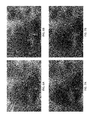
  • FIGS. 6A and 6B are images of the red channel approximated using bilinear interpolation and color ratios, respectively.
  • FIGS. 7A and 7B are images of the blue channel approximated using bilinear interpolation and color ratios, respectively.
  • FIG. 8 is a color preview image for a light field otoscope, according to one example embodiment.
  • FIG. 1 is a diagram illustrating a plenoptic imaging system.
  • the plenoptic imaging system 110 includes imaging optics 112 (represented by a single lens in FIG. 1 ), a microlens array 114 (an array of microlenses 115 ) and a sensor array 180 .
  • the microlens array 114 and sensor array 180 together may be referred to as a plenoptic sensor module. These components form two overlapping imaging subsystems, shown as subsystem 1 and subsystem 2 in FIG. 1 .
  • the imaging optics 112 is depicted in FIG. 1 as a single objective lens, but it should be understood that it could contain multiple elements.
  • the objective lens 112 forms an optical image 155 of the object 150 at an image plane IP.
  • the microlens array 114 is located at the image plane IP, and each microlens images the aperture of imaging subsystem 1 onto the sensor array 180 . That is, the aperture and sensor array are located at conjugate planes SP and SP′.
  • the microlens array 114 can be a rectangular array, hexagonal array or other types of arrays.
  • the sensor array 180 is also shown in FIG. 1 .
  • the sensor array 180 includes different color sensors, for example subarrays of red, green and blue color sensors. In some embodiments, this is achieved by use of a color filter array 185 .
  • the color filter array 185 is a Bayer filter, which is a pattern of red, green and blue color filters. The Bayer filter creates red, green and blue color channels.
  • the microlens array 114 is a 3 ⁇ 3 array of microlenses 115 .
  • the object 150 is divided into a corresponding 3 ⁇ 3 array of regions, which are labeled 1 - 9 .
  • Each of the regions 1 - 9 is imaged by the imaging optics 112 and imaging subsystem 1 onto one of the microlenses 114 .
  • the dashed rays in FIG. 1 show imaging of region 5 onto the corresponding center microlens.
  • microlens 115 images these rays onto a corresponding section of the sensor array 180 .
  • the sensor array 180 is shown as a 12 ⁇ 12 rectangular array.
  • the sensor array 180 can be subdivided into microlens footprints 175 , labelled A-I, with each microlens footprint corresponding to one of the microlenses and therefore also corresponding to a certain region of the object 150 .
  • microlens footprint E corresponds to the center microlens, which corresponds to region 5 of the object. That is, the sensors within microlens footprint E capture light from region 5 of the object.
  • the image data captured by the sensors within a microlens footprint will be referred to as a superpixel.
  • Each superpixel 175 contains light from many individual sensors.
  • each superpixel is generated from light from a 4 ⁇ 4 array of individual sensors.
  • Each sensor for a superpixel captures light from the same region of the object, but at different propagation angles.
  • the upper left sensor E 1 for superpixel E captures light from region 5 , as does the lower right sensor E 16 for superpixel E.
  • the two sensors capture light propagating in different directions from the object. This can be seen from the solid rays in FIG. 1 . All three solid rays originate from the same object point but are captured by different sensors for the same superpixel. That is because each solid ray propagates along a different direction from the object.
  • the object 150 generates a four-dimensional light field L(x,y,u,v), where L is the amplitude, intensity or other measure of a ray originating from spatial location (x,y) propagating in direction (u,v).
  • L is the amplitude, intensity or other measure of a ray originating from spatial location (x,y) propagating in direction (u,v).
  • Each sensor in the sensor array captures light from a certain volume of the four-dimensional light field.
  • the sensors are sampling the four-dimensional light field.
  • the shape or boundary of such volume is determined by the characteristics of the plenoptic imaging system.
  • the (x,y) region that maps to a sensor will be referred to as the light field viewing region for that sensor
  • the (u,v) region that maps to a sensor will be referred to as the light field viewing direction for that sensor.
  • the superpixel 175 is the aggregate result of all sensors that have the same light field viewing region.
  • the view is an analogous concept for propagation direction.
  • the view is the aggregate result of all sensors that have the same light field viewing region.
  • the individual sensors A 1 , B 1 , C 1 , . . . I 1 make up the upper left view of the object.
  • the individual sensors A 16 , B 16 , C 16 , . . . I 16 make up the lower right view of the object.
  • centroid is the center intersection that is labelled A, B, C, . . . I.
  • the processing module 190 can be used to perform different types of analysis, such as depth estimation, three-dimensional reconstruction, synthetic refocusing, extending the depth of focus, spectral analysis and other types of multi-view analysis. However, it can be computationally intensive to generate these processed images 195 and it may not be feasible to generate them in real-time.
  • FIG. 2 is a flow diagram of one method for generating a color preview image from captured plenoptic images, according to one example embodiment. This process is explained with reference to FIGS. 3-8 .
  • the sensor located at the centroid location will be referred to as the centroid or the centroid sensor.
  • the process of FIG. 2 is performed by the plenoptic imaging system 110 (e.g., via the processing module 190 ). In another embodiment, the process is performed by a computing system separate from the plenoptic imaging system. Other modules may perform some or all of the steps of the process in other embodiments. Likewise, embodiments may include different and/or additional steps, or perform the steps in different orders.
  • the processing module 190 accesses 200 a plenoptic image captured by the plenoptic imaging system 110 and determines 210 the centroids of the superpixels of the raw plenoptic image.
  • FIG. 3A is an illustration of a plenoptic image 310 with multiple superpixels 175 , according to one example embodiment. In FIG. 3A , these superpixels 175 are largely round (as opposed to the square superpixels shown in FIG. 1 ) because the pupil for the primary optics 112 is round.
  • Each square 182 represents a sensor in the sensor array 180 , or a corresponding pixel in the plenoptic image. In this example, a Bayer filter is used so the sensors are either red, green or blue color sensors. The red pixels in the plenoptic image form the red color channel for the plenoptic image, the green pixels form the green color channel, and the blue pixels form the blue color channel.
  • FIG. 3B is an illustration of a centroid location for a superpixel 175 from the plenoptic image of FIG. 3A .
  • FIG. 3B illustrates a superpixel 175 with a diameter of eight pixels 182 . In this example, the pixels alternate between red (R), green (G) and blue (B) according to the Bayer pattern.
  • the centroid 330 of the superpixel 175 is marked by the “+” in the middle of the superpixel 175 .
  • FIG. 3C is a version of FIG. 3A , in which all the centroids 330 have been marked. For clarity, the individual pixels are not shown in FIG. 3C .
  • the centroids 330 of the superpixels 175 can be determined 210 using a signal power analysis, a geometric analysis, or spectral analysis of each superpixel, for example. Further details for determining centroids are described in co-pending U.S. patent application Ser. No. 15/453,882 “Automatic Centroid Determination of Microlens Arrays in Plenoptic Imaging Systems,” which is incorporated by reference herein.
  • the processing module 190 generates 220 a principal color center view from the pixel values of a principal color channel at the centroids of the superpixels.
  • One of the color channels is selected as the principal color.
  • the green channel has twice as many pixels (sensors) as the red or blue channels, so in this example the green channel is selected as the principal color.
  • the channel with the largest number of pixels is selected as the principal color, but that is not required.
  • green is the principal color
  • the green pixel values for the centroids of all of the superpixels in the aggregate form a low resolution green image (or, more precisely, the green component of a low resolution color image).
  • This green component is a center view of the object since it is a collection of the green values taken at the centroids of the superpixels. It is referred to as the principal color center view because it is the center view for the principal color.
  • the center view can be up to 100 ⁇ 100 pixels without enhancement (i.e. one pixel per microlens).
  • the resolution of the center view can be enhanced, for example by super-sampling, interpolation, or other methods.
  • the green pixels in the superpixel 175 may not coincide with the location of the centroid 330 . Therefore, the green pixel value at the centroid location 330 may be interpolated from the actual green pixel locations. By interpolating green pixels that are all at the centroid, artifacts due to variations in view (i.e., disparity) may be reduced. Generally this reduced variation is due to the higher number of green pixels as compared to the red and blue color channels.
  • a bilinear interpolation can be used to determine the pixel value of the principal color at the centroid 330 of each superpixel 175 . For example, assume that the centroid is located at coordinates (i,j), which does not correspond to any green pixels.
  • i and j are not required to be integer in this example.
  • the four closest green pixels are located at (i 1 ,j 1 ), (i 2 ,j 1 ), (i 2 ,j 1 ), and (i 2 ,j 2 ); and their pixel values are given by G 11 , G 12 , G 21 , and G 22 , respectively.
  • the processing module can determine the pixel value at the centroid, G centroid , by interpolating in the i-direction and then the j-direction as follows:
  • G P ⁇ ⁇ 1 i 2 - i i 2 - i 1 ⁇ G 11 + i - i 1 i 2 - i 1 ⁇ G 21 ( 1 )
  • G P ⁇ ⁇ 2 i 2 - i i 2 - i 1 ⁇ G 12 + i - i 1 i 2 - i 1 ⁇ G 22 ( 2 )
  • G centroid j 2 - j j 2 - j 1 ⁇ G P ⁇ ⁇ 1 + j - j 1 j 2 - j 1 ⁇ G P ⁇ ⁇ 2 ( 3 )
  • G centroid can be described as the approximate green pixel value of the center view based on the green pixel values of nearby views within the superpixel.
  • the processing module interpolates about the j-direction before the i-direction.
  • the bilinear interpolation is performed using pixels on the similar row and column of the centroid.
  • the bilinear interpolation can use any pixels of the superpixel such that the value at the centroid may be approximated.
  • the proximal pixels may be selected based on the power of the signals such that bilinear interpolation will yield a high-quality result (e.g. non-selection of dead sensors or vignetted sensors).
  • interpolation may use more than two pixels in each direction and can interpolate in more or less than two directions (e.g., linear, bicubic and tri-linear interpolation).
  • the system may use other methods to approximate the pixel value of the principal color at the centroid, including for example sensor binning, vector analysis, nearest neighbor estimations, proximal sensor substitution (i.e. choosing the pixel value of the green pixel nearest the centroid), sensor averaging, or any other method capable of approximating the pixel value of the principal color at the centroid.
  • the processing module generates 230 center views for the other (non-principal) colors. In one approach, it does so by selecting 232 a “synthetic aperture” for each superpixel, calculating 234 the ratio of a non-principal color to the principal color within that synthetic aperture, and then multiplying 236 the pixel value of the principal color times this ratio to obtain the pixel value for the non-principal color.
  • the pixel values for the non-principal color in the aggregate across all superpixels define a low resolution center view for the non-principal color.
  • the center views for all colors are combined 260 to create the low resolution color preview image.
  • FIGS. 4A and 4B illustrate synthetic apertures, according to various embodiments.
  • the superpixel 175 is round with a diameter of 16 pixels 182 .
  • the pixels are arranged in a Bayer pattern.
  • the centroid 330 is denoted by the large “+”. Note that the centroid is not coincident with the grid defining the pixels 182 . That is, if the pixels are located at integer coordinates 1, 2, 3, etc., the centroid 330 is located at a fractional coordinate, e.g., 8.25.
  • the synthetic aperture is selected 232 as a 5 ⁇ 5 region centered on the centroid 330 , which is represented in FIG. 4A by the full set 430 of “+”s.
  • the color ratio for the red channel can be calculated 234 as follows. Green pixel values are interpolated at each of the “+” locations. Red pixel values are interpolated at each of the “+” locations. The red/green color ratio is calculated as the average red pixel value divided by the average green pixel value. The blue/green color ratio can be calculated 234 similarly.
  • the synthetic aperture 430 is selected to be aligned with the grid of pixels, even though this makes it slightly off-center relative to the centroid 330 .
  • the synthetic aperture 430 is selected to be the 5 ⁇ 5 collection of pixels enclosed by the square with thick outline.
  • the red/green and blue/green color ratios can be calculated based on the pixel values within the synthetic aperture 430 .
  • the color ratios are calculated based on “high-quality” pixel values, for example those with low noise and low vignetting.
  • the plenoptic image may have a rotation relative to the sensor array, and a pitch of the superpixels within the plenoptic image may not be an integer number of sensors.
  • the plenoptic image is normalized for these effects before further processing. For example, the normalization may remove rotational misalignment and may scale the superpixel so that it is an integer number of pixels wide. Then calculations such as shown in FIGS. 4A-4B can be simplified.
  • FIGS. 4A and 4B show the synthetic aperture for one superpixel.
  • the same size and shape synthetic aperture can be used for all superpixels or different synthetic apertures can be used for different superpixels.
  • the size and shape of superpixels and the location of the centroid within the superpixel can vary over the plenoptic image.
  • On-axis superpixels may be more circular and have larger area, while off-axis superpixels may be more elliptical and have smaller area due to vignetting or other aberrations.
  • the centroid may be located closer to the geometric center of on-axis superpixels compared to off-axis superpixels. For all these reasons, different synthetic apertures may be used for different superpixels.
  • FIGS. 5A-5D illustrate some examples of synthetic apertures.
  • the synthetic aperture 530 is a square shape.
  • the synthetic aperture 530 is a cross shape extending in the x and y directions. In one embodiment, the arms of the cross are two pixels wide to make better use of the Bayer color pattern.
  • the synthetic aperture 530 includes the nearest neighbor pixels.
  • the synthetic aperture 530 includes all pixels in the superpixel, or at least all of the high-quality pixels.
  • the color ratio for one superpixel may be based on pixels from an adjacent superpixel, for example when the pixel quality within the superpixel is too bad. Further, the color ratios for adjacent superpixels can be used to reduce noise artifacts, for example when the pixel within the superpixel is too bad.
  • the processing module can generate 230 center views for each of the non-principal colors.
  • FIGS. 6-7 show examples of this approximation of the red and blue channels.
  • FIG. 6A shows a red center view estimated using bilinear interpolation of red pixels from the plenoptic image, similar to how the green center view is estimated.
  • FIG. 6B shows a red center view estimated using Eqn. 5 above.
  • FIG. 7A shows a blue center view estimated using bilinear interpolation of blue pixels from the plenoptic image
  • FIG. 7B shows a blue center view estimated using Eqn. 6 above.
  • the center views estimated using bilinear interpolation exhibit streaky artifacts that are the result of the low sampling rate of the red and blue pixels.
  • the center views of FIGS. 6B and 7B are improved because the fine image detail is provided by the higher sampling rate of the green pixels.
  • the preview components defined by Eqns. 4-6 can be combined 260 as the red, green and blue components of the color preview image.
  • the preview image can use other image data determined from the pixel values of the plenoptic image to generate preview images.
  • the system may determine a brightness, chroma, luminance, hue, etc. and generate a color preview image further based on these values.
  • the plenoptic imaging system is capturing video. That is, plenoptic images are captured at video rate.
  • the plenoptic imaging system captures raw plenoptic images, processes the views, and creates 270 a color preview video such that the preview images are created at the same frame rate as the capture of the plenoptic video. If the imaging system is capturing 15 or more frames per second, then the processing module has 66 ms or less to create the color preview frame for real-time operation. Therefore, approaches that reduce computation requirements will help to meet the desired frame rate. For example, reducing the requirement for interpolation and reducing the number of pixels processed in a synthetic aperture will both reduce the computation burden.
  • the generated color preview video provides a real-time preview of what the plenoptic imaging system is capturing.
  • FIG. 8 is a color preview image for a light field otoscope, according to one example embodiment.
  • a light field otoscope captures plenoptic images of the interior of the ear.
  • the captured plenoptic images are processed as described above to generate a color preview image, as shown in FIG. 8 .
  • the color preview video allows the physician to guide the otoscope to capture images of the eardrum or other relevant anatomical features.
  • a plenoptic imaging system used as an otoscope in a medical procedure may have the following specifications: a microlens size of 55 a sensor array size of 3376 ⁇ 2704 pixels (i.e. 9 Mega pixels), an individual pixel size of 3.7 and a frame rate for the preview video of 15-18 frames per second. These are just an example. Other embodiments may have different specifications.
  • the color preview images i.e. frames of the preview video
  • various methods can be used to increase the resolution of the images above the number of microlenses in the array. Some examples include super-resolution, sub-sensor sampling, interpolation, resampling, box sampling, and vectorization.
  • Alternate embodiments are implemented in computer hardware, firmware, software, and/or combinations thereof. Implementations can be implemented in a computer program product tangibly embodied in a machine-readable storage device for execution by a programmable processor; and method steps can be performed by a programmable processor executing a program of instructions to perform functions by operating on input data and generating output. Embodiments can be implemented advantageously in one or more computer programs that are executable on a programmable system including at least one programmable processor coupled to receive data and instructions from, and to transmit data and instructions to, a data storage system, at least one input device, and at least one output device.
  • Each computer program can be implemented in a high-level procedural or object-oriented programming language, or in assembly or machine language if desired; and in any case, the language can be a compiled or interpreted language.
  • Suitable processors include, by way of example, both general and special purpose microprocessors.
  • a processor will receive instructions and data from a read-only memory and/or a random access memory.
  • a computer will include one or more mass storage devices for storing data files; such devices include magnetic disks, such as internal hard disks and removable disks; magneto-optical disks; and optical disks.
  • Storage devices suitable for tangibly embodying computer program instructions and data include all forms of non-volatile memory, including by way of example semiconductor memory devices, such as EPROM, EEPROM, and flash memory devices; magnetic disks such as internal hard disks and removable disks; magneto-optical disks; and CD-ROM disks. Any of the foregoing can be supplemented by, or incorporated in, ASICs (application-specific integrated circuits) and other forms of hardware.
  • ASICs application-specific integrated circuits

Landscapes

  • Physics & Mathematics (AREA)
  • Engineering & Computer Science (AREA)
  • Multimedia (AREA)
  • Signal Processing (AREA)
  • General Physics & Mathematics (AREA)
  • Optics & Photonics (AREA)
  • Image Analysis (AREA)
  • Color Television Image Signal Generators (AREA)
  • Studio Devices (AREA)

Abstract

A color preview image is generated, preferably in real-time, for a plenoptic imaging system. The raw plenoptic image has a structure containing superpixels and also contains different color channels. For a principal color channel, a center view is generated by determining the pixel value for a center view of the superpixel, i.e. at the centroid of the superpixel. For each of the other color channels, the ratio of that color channel to the principal color channel is calculated for each superpixel. A center view for each non-principal color channel is determined by multiplying the color ratios times the pixel values for the principal color center view. These center views for the principal and non-principal color channels are combined into a color preview image. The calculations preferably can be performed in real-time at video rates.

Description

BACKGROUND OF THE INVENTION 1. Field of the Invention
This disclosure relates generally to the generation of plenoptic images, including plenoptic video.
2. Description of the Related Art
The plenoptic imaging system has recently received increased attention. It can be used to recalculate a different focus point or point of view of an object, based on digital processing of the captured plenoptic image. The plenoptic imaging system also finds application in estimating depth to three-dimensional objects that are imaged by the plenoptic imaging system, possibly followed by three-dimensional reconstruction of those objects or the entire three-dimensional scene.
However, the amount of image processing required to generate the final processed images from the raw plenoptic images can be significant and often cannot be done at video rates in real-time. However, without the processed images, it can be difficult for the plenoptic camera user to know where the camera is pointed and what images are being captured. A conventional viewfinder can be used, but that typically requires additional optics and/or electronics.
Thus, there is a need for preview generation for plenoptic imaging systems, including for systems that capture plenoptic color video.
SUMMARY OF THE INVENTION
The present disclosure overcomes the limitations of the prior art by generating color preview images from the plenoptic images captured by a plenoptic imaging system. The preview generation preferably is computationally simple enough that it can be done in real-time for plenoptic video systems.
In one aspect, a color preview image is generated from a plenoptic image captured by a plenoptic imaging system. A typical plenoptic imaging system includes a microlens array and a sensor array, and the captured plenoptic image has a structure with superpixels corresponding to the microlenses. The plenoptic imaging system uses a color sensor array, which includes subarrays of different color sensors (e.g., red, green and blue). Accordingly, the captured plenoptic image also has different color channels captured by the different color sensors.
For one of the color channels, which will be referred to as the principal color channel, a principal color center view is generated by determining pixel values at the centroids of the superpixels. Typically, the principal color is the color which has the highest resolution (e.g. largest number of sensors) in the sensor array. In a Bayer sensor, the green channel is preferred as the principal color. For each of the other color channels, a ratio comparing the pixel values of the non-principal color channels to the pixel values of the principal color channel is determined for each superpixel. These ratios are applied to the principal color center view to generate center views for each non-principal color channel. The center views for all of the color channels are combined to create a color preview image for the plenoptic imaging system. Optionally, if the plenoptic imaging system is capturing video, the color preview images are generated in real-time at a same frame rate as the video capture.
Other aspects include components, devices, systems, improvements, methods, processes, applications, computer readable mediums, and other technologies related to any of the above.
BRIEF DESCRIPTION OF THE DRAWINGS
The patent or application file contains at least one drawing executed in color. Copies of this patent or patent application publication with color drawing(s) will be provided by the Office upon request and payment of the necessary fee.
The invention has other advantages and features which will be more readily apparent from the following detailed description of the invention and the appended claims, when taken in conjunction with the accompanying drawings, in which:
FIG. 1 (prior art) is a diagram of a plenoptic imaging system.
FIG. 2 is a flow diagram of one method for generating a color preview image from captured plenoptic images, according to one example embodiment.
FIG. 3A is an illustration of a plenoptic image with multiple superpixels, according to one example embodiment.
FIG. 3B is an illustration of a centroid location for a superpixel from the plenoptic image of FIG. 3A.
FIG. 3C illustrates the centroids for all the superpixels from the plenoptic image of FIG. 3A.
FIGS. 4A and 4B illustrate synthetic apertures, according to various embodiments.
FIGS. 5A-5D illustrate more examples of synthetic apertures, according to various embodiments.
FIGS. 6A and 6B are images of the red channel approximated using bilinear interpolation and color ratios, respectively.
FIGS. 7A and 7B are images of the blue channel approximated using bilinear interpolation and color ratios, respectively.
FIG. 8 is a color preview image for a light field otoscope, according to one example embodiment.
The figures depict various embodiments for purposes of illustration only. One skilled in the art will readily recognize from the following discussion that alternative embodiments of the structures and methods illustrated herein may be employed without departing from the principles described herein.
DETAILED DESCRIPTION
The figures and the following description relate to preferred embodiments by way of illustration only. It should be noted that from the following discussion, alternative embodiments of the structures and methods disclosed herein will be readily recognized as viable alternatives that may be employed without departing from the principles of what is claimed.
FIG. 1 (prior art) is a diagram illustrating a plenoptic imaging system. The plenoptic imaging system 110 includes imaging optics 112 (represented by a single lens in FIG. 1), a microlens array 114 (an array of microlenses 115) and a sensor array 180. The microlens array 114 and sensor array 180 together may be referred to as a plenoptic sensor module. These components form two overlapping imaging subsystems, shown as subsystem 1 and subsystem 2 in FIG. 1.
For convenience, the imaging optics 112 is depicted in FIG. 1 as a single objective lens, but it should be understood that it could contain multiple elements. The objective lens 112 forms an optical image 155 of the object 150 at an image plane IP. The microlens array 114 is located at the image plane IP, and each microlens images the aperture of imaging subsystem 1 onto the sensor array 180. That is, the aperture and sensor array are located at conjugate planes SP and SP′. The microlens array 114 can be a rectangular array, hexagonal array or other types of arrays. The sensor array 180 is also shown in FIG. 1.
The sensor array 180 includes different color sensors, for example subarrays of red, green and blue color sensors. In some embodiments, this is achieved by use of a color filter array 185. In one example embodiment, the color filter array 185 is a Bayer filter, which is a pattern of red, green and blue color filters. The Bayer filter creates red, green and blue color channels.
The bottom portion of FIG. 1 provides more detail. In this example, the microlens array 114 is a 3×3 array of microlenses 115. The object 150 is divided into a corresponding 3×3 array of regions, which are labeled 1-9. Each of the regions 1-9 is imaged by the imaging optics 112 and imaging subsystem 1 onto one of the microlenses 114. The dashed rays in FIG. 1 show imaging of region 5 onto the corresponding center microlens.
Each microlens 115 images these rays onto a corresponding section of the sensor array 180. The sensor array 180 is shown as a 12×12 rectangular array. The sensor array 180 can be subdivided into microlens footprints 175, labelled A-I, with each microlens footprint corresponding to one of the microlenses and therefore also corresponding to a certain region of the object 150. In FIG. 1, microlens footprint E corresponds to the center microlens, which corresponds to region 5 of the object. That is, the sensors within microlens footprint E capture light from region 5 of the object. The image data captured by the sensors within a microlens footprint will be referred to as a superpixel.
Each superpixel 175 contains light from many individual sensors. In this example, each superpixel is generated from light from a 4×4 array of individual sensors. Each sensor for a superpixel captures light from the same region of the object, but at different propagation angles. For example, the upper left sensor E1 for superpixel E captures light from region 5, as does the lower right sensor E16 for superpixel E. However, the two sensors capture light propagating in different directions from the object. This can be seen from the solid rays in FIG. 1. All three solid rays originate from the same object point but are captured by different sensors for the same superpixel. That is because each solid ray propagates along a different direction from the object.
In other words, the object 150 generates a four-dimensional light field L(x,y,u,v), where L is the amplitude, intensity or other measure of a ray originating from spatial location (x,y) propagating in direction (u,v). Each sensor in the sensor array captures light from a certain volume of the four-dimensional light field. The sensors are sampling the four-dimensional light field. The shape or boundary of such volume is determined by the characteristics of the plenoptic imaging system. For convenience, the (x,y) region that maps to a sensor will be referred to as the light field viewing region for that sensor, and the (u,v) region that maps to a sensor will be referred to as the light field viewing direction for that sensor.
The superpixel 175 is the aggregate result of all sensors that have the same light field viewing region. The view is an analogous concept for propagation direction. The view is the aggregate result of all sensors that have the same light field viewing region. In the example of FIG. 1, the individual sensors A1, B1, C1, . . . I1 make up the upper left view of the object. The individual sensors A16, B16, C16, . . . I16 make up the lower right view of the object. The center view is the view that corresponds to (u,v)=(0,0), assuming that the plenoptic imaging system is an on-axis symmetric system. The centroid of each superpixel/footprint is the point in the superpixel/footprint that corresponds to (u,v)=(0,0). In FIG. 1, the centroid is the center intersection that is labelled A, B, C, . . . I.
Because the plenoptic image 170 contains information about the four-dimensional light field produced by the object, the processing module 190 can be used to perform different types of analysis, such as depth estimation, three-dimensional reconstruction, synthetic refocusing, extending the depth of focus, spectral analysis and other types of multi-view analysis. However, it can be computationally intensive to generate these processed images 195 and it may not be feasible to generate them in real-time.
FIG. 2 is a flow diagram of one method for generating a color preview image from captured plenoptic images, according to one example embodiment. This process is explained with reference to FIGS. 3-8. For convenience, the sensor located at the centroid location will be referred to as the centroid or the centroid sensor. In the example described below, the process of FIG. 2 is performed by the plenoptic imaging system 110 (e.g., via the processing module 190). In another embodiment, the process is performed by a computing system separate from the plenoptic imaging system. Other modules may perform some or all of the steps of the process in other embodiments. Likewise, embodiments may include different and/or additional steps, or perform the steps in different orders.
The processing module 190 accesses 200 a plenoptic image captured by the plenoptic imaging system 110 and determines 210 the centroids of the superpixels of the raw plenoptic image. FIG. 3A is an illustration of a plenoptic image 310 with multiple superpixels 175, according to one example embodiment. In FIG. 3A, these superpixels 175 are largely round (as opposed to the square superpixels shown in FIG. 1) because the pupil for the primary optics 112 is round. Each square 182 represents a sensor in the sensor array 180, or a corresponding pixel in the plenoptic image. In this example, a Bayer filter is used so the sensors are either red, green or blue color sensors. The red pixels in the plenoptic image form the red color channel for the plenoptic image, the green pixels form the green color channel, and the blue pixels form the blue color channel.
FIG. 3B is an illustration of a centroid location for a superpixel 175 from the plenoptic image of FIG. 3A. The centroid 330 of each superpixel 175 is the location that corresponds to the center view of the plenoptic image. That is, it corresponds to a light field viewing direction of (u,v)=(0,0) for an on-axis plenoptic imaging system. FIG. 3B illustrates a superpixel 175 with a diameter of eight pixels 182. In this example, the pixels alternate between red (R), green (G) and blue (B) according to the Bayer pattern. The centroid 330 of the superpixel 175 is marked by the “+” in the middle of the superpixel 175. FIG. 3C is a version of FIG. 3A, in which all the centroids 330 have been marked. For clarity, the individual pixels are not shown in FIG. 3C.
The centroids 330 of the superpixels 175 can be determined 210 using a signal power analysis, a geometric analysis, or spectral analysis of each superpixel, for example. Further details for determining centroids are described in co-pending U.S. patent application Ser. No. 15/453,882 “Automatic Centroid Determination of Microlens Arrays in Plenoptic Imaging Systems,” which is incorporated by reference herein.
Returning to FIG. 2, the processing module 190 generates 220 a principal color center view from the pixel values of a principal color channel at the centroids of the superpixels. One of the color channels is selected as the principal color. In a Bayer pattern, the green channel has twice as many pixels (sensors) as the red or blue channels, so in this example the green channel is selected as the principal color. Preferably, the channel with the largest number of pixels is selected as the principal color, but that is not required.
Since green is the principal color, the green value at each centroid location is determined. The green pixel values for the centroids of all of the superpixels in the aggregate form a low resolution green image (or, more precisely, the green component of a low resolution color image). This green component is a center view of the object since it is a collection of the green values taken at the centroids of the superpixels. It is referred to as the principal color center view because it is the center view for the principal color. In an example with a 100×100 array of microlenses, the center view can be up to 100×100 pixels without enhancement (i.e. one pixel per microlens). In some embodiments, the resolution of the center view can be enhanced, for example by super-sampling, interpolation, or other methods.
Referring to FIG. 3B, the green pixels in the superpixel 175 may not coincide with the location of the centroid 330. Therefore, the green pixel value at the centroid location 330 may be interpolated from the actual green pixel locations. By interpolating green pixels that are all at the centroid, artifacts due to variations in view (i.e., disparity) may be reduced. Generally this reduced variation is due to the higher number of green pixels as compared to the red and blue color channels. In one approach, a bilinear interpolation can be used to determine the pixel value of the principal color at the centroid 330 of each superpixel 175. For example, assume that the centroid is located at coordinates (i,j), which does not correspond to any green pixels. Note that i and j are not required to be integer in this example. In the superpixel, the four closest green pixels are located at (i1,j1), (i2,j1), (i2,j1), and (i2,j2); and their pixel values are given by G11, G12, G21, and G22, respectively. The processing module can determine the pixel value at the centroid, Gcentroid, by interpolating in the i-direction and then the j-direction as follows:
G P 1 = i 2 - i i 2 - i 1 G 11 + i - i 1 i 2 - i 1 G 21 ( 1 ) G P 2 = i 2 - i i 2 - i 1 G 12 + i - i 1 i 2 - i 1 G 22 ( 2 ) G centroid = j 2 - j j 2 - j 1 G P 1 + j - j 1 j 2 - j 1 G P 2 ( 3 )
Gcentroid can be described as the approximate green pixel value of the center view based on the green pixel values of nearby views within the superpixel. In another embodiment, the processing module interpolates about the j-direction before the i-direction.
Generally, the bilinear interpolation is performed using pixels on the similar row and column of the centroid. However, the bilinear interpolation can use any pixels of the superpixel such that the value at the centroid may be approximated. In addition, the proximal pixels may be selected based on the power of the signals such that bilinear interpolation will yield a high-quality result (e.g. non-selection of dead sensors or vignetted sensors). Further, interpolation may use more than two pixels in each direction and can interpolate in more or less than two directions (e.g., linear, bicubic and tri-linear interpolation).
In other embodiments, the system may use other methods to approximate the pixel value of the principal color at the centroid, including for example sensor binning, vector analysis, nearest neighbor estimations, proximal sensor substitution (i.e. choosing the pixel value of the green pixel nearest the centroid), sensor averaging, or any other method capable of approximating the pixel value of the principal color at the centroid.
Returning to FIG. 2, the processing module generates 230 center views for the other (non-principal) colors. In one approach, it does so by selecting 232 a “synthetic aperture” for each superpixel, calculating 234 the ratio of a non-principal color to the principal color within that synthetic aperture, and then multiplying 236 the pixel value of the principal color times this ratio to obtain the pixel value for the non-principal color. The pixel values for the non-principal color in the aggregate across all superpixels define a low resolution center view for the non-principal color. The center views for all colors are combined 260 to create the low resolution color preview image.
FIGS. 4A and 4B illustrate synthetic apertures, according to various embodiments. In these examples, the superpixel 175 is round with a diameter of 16 pixels 182. The pixels are arranged in a Bayer pattern. The centroid 330 is denoted by the large “+”. Note that the centroid is not coincident with the grid defining the pixels 182. That is, if the pixels are located at integer coordinates 1, 2, 3, etc., the centroid 330 is located at a fractional coordinate, e.g., 8.25. In this example, the synthetic aperture is selected 232 as a 5×5 region centered on the centroid 330, which is represented in FIG. 4A by the full set 430 of “+”s.
Using the red color as an example, the color ratio for the red channel can be calculated 234 as follows. Green pixel values are interpolated at each of the “+” locations. Red pixel values are interpolated at each of the “+” locations. The red/green color ratio is calculated as the average red pixel value divided by the average green pixel value. The blue/green color ratio can be calculated 234 similarly.
In FIG. 4A, the “+” locations were off-grid, which introduced some additional calculation. In FIG. 4B, the synthetic aperture 430 is selected to be aligned with the grid of pixels, even though this makes it slightly off-center relative to the centroid 330. In this example, the synthetic aperture 430 is selected to be the 5×5 collection of pixels enclosed by the square with thick outline. The red/green and blue/green color ratios can be calculated based on the pixel values within the synthetic aperture 430. Preferably, the color ratios are calculated based on “high-quality” pixel values, for example those with low noise and low vignetting.
In many cases, superpixels are not perfectly aligned with the underlying sensor array. The plenoptic image may have a rotation relative to the sensor array, and a pitch of the superpixels within the plenoptic image may not be an integer number of sensors. In one approach, the plenoptic image is normalized for these effects before further processing. For example, the normalization may remove rotational misalignment and may scale the superpixel so that it is an integer number of pixels wide. Then calculations such as shown in FIGS. 4A-4B can be simplified.
FIGS. 4A and 4B show the synthetic aperture for one superpixel. The same size and shape synthetic aperture can be used for all superpixels or different synthetic apertures can be used for different superpixels. The size and shape of superpixels and the location of the centroid within the superpixel can vary over the plenoptic image. On-axis superpixels may be more circular and have larger area, while off-axis superpixels may be more elliptical and have smaller area due to vignetting or other aberrations. The centroid may be located closer to the geometric center of on-axis superpixels compared to off-axis superpixels. For all these reasons, different synthetic apertures may be used for different superpixels.
FIGS. 5A-5D illustrate some examples of synthetic apertures. In FIG. 5A, the synthetic aperture 530 is a square shape. In FIG. 5B, the synthetic aperture 530 is a cross shape extending in the x and y directions. In one embodiment, the arms of the cross are two pixels wide to make better use of the Bayer color pattern. In FIG. 5C, the synthetic aperture 530 includes the nearest neighbor pixels. In FIG. 5D, the synthetic aperture 530 includes all pixels in the superpixel, or at least all of the high-quality pixels. In some cases, the color ratio for one superpixel may be based on pixels from an adjacent superpixel, for example when the pixel quality within the superpixel is too bad. Further, the color ratios for adjacent superpixels can be used to reduce noise artifacts, for example when the pixel within the superpixel is too bad.
By multiplying 236 the color ratios for each non-principal color channel times the principal color center view, the processing module can generate 230 center views for each of the non-principal colors. In the RGB example, the color components for the color preview image can be defined as:
G Preview(n,n)=G Centroid(m,n)  (4)
R Preview(m,n)=G Centroid(m,n)*RatioR/G(m,n)  (5)
B Preview(m,n)=G Centroid(m,n)*RatioB G(m,n)  (6)
where (m,n) are the indices for the superpixels, GCentroid(m.n) is the center view for the principal color (green), and RatioR/G (m,n) and RatioB/G(m,n) are the color ratios for red-to-green and blue-to-green, respectively. The calculated quantities Gcentroid(m,n)*RatioR/G(m,n) and GCentroid(m,n)*RatioB/G (m,n) are approximations of the center views for the red and blue colors.
FIGS. 6-7 show examples of this approximation of the red and blue channels. FIG. 6A shows a red center view estimated using bilinear interpolation of red pixels from the plenoptic image, similar to how the green center view is estimated. FIG. 6B shows a red center view estimated using Eqn. 5 above. Similarly, FIG. 7A shows a blue center view estimated using bilinear interpolation of blue pixels from the plenoptic image, and FIG. 7B shows a blue center view estimated using Eqn. 6 above. In FIGS. 6A and 7A, the center views estimated using bilinear interpolation exhibit streaky artifacts that are the result of the low sampling rate of the red and blue pixels. The center views of FIGS. 6B and 7B are improved because the fine image detail is provided by the higher sampling rate of the green pixels.
The preview components defined by Eqns. 4-6 can be combined 260 as the red, green and blue components of the color preview image. In alternate embodiments, the preview image can use other image data determined from the pixel values of the plenoptic image to generate preview images. For example, the system may determine a brightness, chroma, luminance, hue, etc. and generate a color preview image further based on these values.
In some cases, the plenoptic imaging system is capturing video. That is, plenoptic images are captured at video rate. Preferably, the plenoptic imaging system captures raw plenoptic images, processes the views, and creates 270 a color preview video such that the preview images are created at the same frame rate as the capture of the plenoptic video. If the imaging system is capturing 15 or more frames per second, then the processing module has 66 ms or less to create the color preview frame for real-time operation. Therefore, approaches that reduce computation requirements will help to meet the desired frame rate. For example, reducing the requirement for interpolation and reducing the number of pixels processed in a synthetic aperture will both reduce the computation burden. The generated color preview video provides a real-time preview of what the plenoptic imaging system is capturing.
FIG. 8 is a color preview image for a light field otoscope, according to one example embodiment. In this example, a light field otoscope captures plenoptic images of the interior of the ear. The captured plenoptic images are processed as described above to generate a color preview image, as shown in FIG. 8. The color preview video allows the physician to guide the otoscope to capture images of the eardrum or other relevant anatomical features. For example, a plenoptic imaging system used as an otoscope in a medical procedure may have the following specifications: a microlens size of 55 a sensor array size of 3376×2704 pixels (i.e. 9 Mega pixels), an individual pixel size of 3.7 and a frame rate for the preview video of 15-18 frames per second. These are just an example. Other embodiments may have different specifications.
Generally, the color preview images (i.e. frames of the preview video) have a resolution that does not exceed the number of microlenses in the microlens array, which is significantly less than the total number of sensors in the sensor array. However, in some embodiments, various methods can be used to increase the resolution of the images above the number of microlenses in the array. Some examples include super-resolution, sub-sensor sampling, interpolation, resampling, box sampling, and vectorization.
Although the detailed description contains many specifics, these should not be construed as limiting the scope of the invention but merely as illustrating different examples and aspects of the invention. It should be appreciated that the scope of the invention includes other embodiments not discussed in detail above. For example, this method can be applied to any view of the plenoptic image rather than just to the center view, i.e. (u,v)≠(0,0). Various other modifications, changes and variations which will be apparent to those skilled in the art may be made in the arrangement, operation and details of the method and apparatus of the present invention disclosed herein without departing from the spirit and scope of the invention as defined in the appended claims. Therefore, the scope of the invention should be determined by the appended claims and their legal equivalents.
Alternate embodiments are implemented in computer hardware, firmware, software, and/or combinations thereof. Implementations can be implemented in a computer program product tangibly embodied in a machine-readable storage device for execution by a programmable processor; and method steps can be performed by a programmable processor executing a program of instructions to perform functions by operating on input data and generating output. Embodiments can be implemented advantageously in one or more computer programs that are executable on a programmable system including at least one programmable processor coupled to receive data and instructions from, and to transmit data and instructions to, a data storage system, at least one input device, and at least one output device. Each computer program can be implemented in a high-level procedural or object-oriented programming language, or in assembly or machine language if desired; and in any case, the language can be a compiled or interpreted language. Suitable processors include, by way of example, both general and special purpose microprocessors. Generally, a processor will receive instructions and data from a read-only memory and/or a random access memory. Generally, a computer will include one or more mass storage devices for storing data files; such devices include magnetic disks, such as internal hard disks and removable disks; magneto-optical disks; and optical disks. Storage devices suitable for tangibly embodying computer program instructions and data include all forms of non-volatile memory, including by way of example semiconductor memory devices, such as EPROM, EEPROM, and flash memory devices; magnetic disks such as internal hard disks and removable disks; magneto-optical disks; and CD-ROM disks. Any of the foregoing can be supplemented by, or incorporated in, ASICs (application-specific integrated circuits) and other forms of hardware.

Claims (20)

What is claimed is:
1. For a plenoptic imaging system comprising imaging optics, a microlens array and a sensor array, the sensor array including a plurality of subarrays of different color sensors, a method for generating real-time color preview images, the method comprising:
accessing a plenoptic image captured by the plenoptic imaging system, the plenoptic image including superpixels corresponding to the microlenses in the microlens array and also including different color channels captured by the subarrays of different color sensors;
for a principal color channel, determining pixel values for that principal color channel at centroids of the superpixels, said pixel values in the aggregate forming a principal color center view;
for each of the other color channels:
determining color ratios of that color channel to the principal color channel at centroids of the superpixels; and
determining pixel values for that color channel by multiplying said color ratios with the pixel values for the principal color channel, said determined pixel values in the aggregate forming a center view for that color channel; and
combining the center views of the different color channels to create a color preview image.
2. The method of claim 1, wherein the plenoptic imaging system captures plenoptic video comprising frames of plenoptic images, and the color preview images are created at a same frame rate as the capture of the plenoptic video.
3. The method of claim 1, wherein the plenoptic imaging system captures plenoptic video comprising frames of plenoptic images, and the color preview images provide a real-time preview of what the plenoptic imaging system is capturing.
4. The method of claim 1, wherein the color preview image has a resolution that does not exceed the number of microlenses in the microlens array.
5. The method of claim 1, wherein the color preview image has a resolution that is significantly lower than the total number of sensors in the sensor array.
6. The method of claim 1, wherein the principal color channel is the color channel with the largest number of sensors.
7. The method of claim 1, wherein determining the pixel values for the principal color channel at centroids of the superpixels comprises interpolating pixel values of the principal color channel from the plenoptic image.
8. The method of claim 7, wherein the interpolation is a bilinear interpolation.
9. The method of claim 1, wherein determining color ratios of another color channel to the principal color channel comprises, for synthetic apertures that include the centroids, calculating a ratio of the other color channel contained in the synthetic aperture to the principal color channel contained in the synthetic aperture.
10. The method of claim 9, wherein the synthetic aperture is contained within the corresponding superpixel.
11. The method of claim 9, wherein the synthetic aperture is equivalent to the corresponding superpixel.
12. The method of claim 9, wherein the color ratio for at least one of the superpixels is also used as the color ratio for an adjacent superpixel.
13. The method of claim 9, wherein the synthetic apertures are the same shape and size for all superpixels.
14. The method of claim 9, wherein the synthetic apertures are sized to avoid sensors that are vignetted.
15. The method of claim 9, wherein the synthetic apertures are centered on the centroids.
16. The method of claim 1, wherein the centroids of the superpixels are the centermost sensors of the superpixels.
17. The method of claim 1, wherein the accessing the plenoptic image comprises accessing a normalized version of the plenoptic image captured by the plenoptic imaging system, the normalized image normalized for pitch between adjacent microlenses and rotation of the microlens array relative to the sensor array.
18. The method of claim 1, wherein the sensor array includes a Bayer filter array, and the different color channels include a red channel, a green channel and a blue channel.
19. The method of claim 1 wherein generating the color preview image is further based on luminance values obtained from the sensors.
20. A non-transitory computer-readable storage medium storing executable computer program instructions for generating real-time color preview images from a plenoptic imaging system comprising imaging optics, a microlens array and a sensor array, the sensor array including a plurality of subarrays of different color sensors, the instructions executable by a processor and causing the processor to perform a method comprising:
accessing a plenoptic image captured by the plenoptic imaging system, the plenoptic image including superpixels corresponding to the microlenses in the microlens array and also including different color channels captured by the subarrays of different color sensors;
for a principal color channel, determining pixel values for that principal color channel at centroids of the superpixels, said pixel values in the aggregate forming a principal color center view;
for each of the other color channels:
determining color ratios of that color channel to the principal color channel at centroids of the superpixels; and
determining pixel values for that color channel by multiplying said color ratios with the pixel values for the principal color channel, said determined pixel values in the aggregate forming a center view for that color channel; and
combining the center views of the different color channels to create a color preview image.
US15/453,891 2017-03-08 2017-03-08 Real-time color preview generation for plenoptic imaging systems Expired - Fee Related US10110869B2 (en)

Priority Applications (2)

Application Number Priority Date Filing Date Title
US15/453,891 US10110869B2 (en) 2017-03-08 2017-03-08 Real-time color preview generation for plenoptic imaging systems
JP2018034261A JP6531848B2 (en) 2017-03-08 2018-02-28 Real-time color preview generation for plenoptic imaging systems

Applications Claiming Priority (1)

Application Number Priority Date Filing Date Title
US15/453,891 US10110869B2 (en) 2017-03-08 2017-03-08 Real-time color preview generation for plenoptic imaging systems

Publications (2)

Publication Number Publication Date
US20180262734A1 US20180262734A1 (en) 2018-09-13
US10110869B2 true US10110869B2 (en) 2018-10-23

Family

ID=63445643

Family Applications (1)

Application Number Title Priority Date Filing Date
US15/453,891 Expired - Fee Related US10110869B2 (en) 2017-03-08 2017-03-08 Real-time color preview generation for plenoptic imaging systems

Country Status (2)

Country Link
US (1) US10110869B2 (en)
JP (1) JP6531848B2 (en)

Cited By (1)

* Cited by examiner, † Cited by third party
Publication number Priority date Publication date Assignee Title
US11436700B2 (en) * 2018-01-31 2022-09-06 Interdigital Ce Patent Holdings Filter array for demosaicing

Families Citing this family (3)

* Cited by examiner, † Cited by third party
Publication number Priority date Publication date Assignee Title
US10332269B2 (en) * 2017-06-23 2019-06-25 Ricoh Company, Ltd. Color correction of preview images for plenoptic imaging systems
KR20230032755A (en) * 2021-08-31 2023-03-07 삼성전자주식회사 Method and apparatus of processing image
CN118537204B (en) * 2024-06-12 2024-12-03 清华大学 Ultra-high-speed end-to-end all-optical intelligent computing chip architecture and system

Citations (7)

* Cited by examiner, † Cited by third party
Publication number Priority date Publication date Assignee Title
US20100128145A1 (en) * 2008-11-25 2010-05-27 Colvin Pitts System of and Method for Video Refocusing
US20100141802A1 (en) * 2008-12-08 2010-06-10 Timothy Knight Light Field Data Acquisition Devices, and Methods of Using and Manufacturing Same
US20110149125A1 (en) * 2009-12-22 2011-06-23 Samsung Electronics Co., Ltd. Photographing Apparatus and Method
US20150339824A1 (en) * 2014-05-20 2015-11-26 Nokia Corporation Method, apparatus and computer program product for depth estimation
US20160241797A1 (en) * 2015-02-17 2016-08-18 Canon Kabushiki Kaisha Devices, systems, and methods for single-shot high-resolution multispectral image acquisition
US20160260205A1 (en) 2015-03-04 2016-09-08 Ricoh Company, Ltd. Calibration of Plenoptic Imaging Systems Using Fourier Transform
US20170084034A1 (en) 2015-01-09 2017-03-23 Ricoh Company, Ltd. Object Space Calibration of Plenoptic Imaging Systems

Family Cites Families (5)

* Cited by examiner, † Cited by third party
Publication number Priority date Publication date Assignee Title
US8103111B2 (en) * 2006-12-26 2012-01-24 Olympus Imaging Corp. Coding method, electronic camera, recording medium storing coded program, and decoding method
JP4969474B2 (en) * 2007-02-09 2012-07-04 オリンパスイメージング株式会社 Decoding method, decoding device, and decoding program
JP5490514B2 (en) * 2009-12-22 2014-05-14 三星電子株式会社 Imaging apparatus and imaging method
DE112013004198T5 (en) * 2012-08-27 2015-05-07 Fujifilm Corporation Image processing apparatus, method, program, recording medium and image pickup apparatus
JP6376206B2 (en) * 2016-11-04 2018-08-22 株式会社ニコン Image processing apparatus and imaging apparatus

Patent Citations (7)

* Cited by examiner, † Cited by third party
Publication number Priority date Publication date Assignee Title
US20100128145A1 (en) * 2008-11-25 2010-05-27 Colvin Pitts System of and Method for Video Refocusing
US20100141802A1 (en) * 2008-12-08 2010-06-10 Timothy Knight Light Field Data Acquisition Devices, and Methods of Using and Manufacturing Same
US20110149125A1 (en) * 2009-12-22 2011-06-23 Samsung Electronics Co., Ltd. Photographing Apparatus and Method
US20150339824A1 (en) * 2014-05-20 2015-11-26 Nokia Corporation Method, apparatus and computer program product for depth estimation
US20170084034A1 (en) 2015-01-09 2017-03-23 Ricoh Company, Ltd. Object Space Calibration of Plenoptic Imaging Systems
US20160241797A1 (en) * 2015-02-17 2016-08-18 Canon Kabushiki Kaisha Devices, systems, and methods for single-shot high-resolution multispectral image acquisition
US20160260205A1 (en) 2015-03-04 2016-09-08 Ricoh Company, Ltd. Calibration of Plenoptic Imaging Systems Using Fourier Transform

Non-Patent Citations (2)

* Cited by examiner, † Cited by third party
Title
Chai, J.-X. et al., "Plenoptic Sampling," Presented at the SIGGRAPH '00: Proceedings of the 27th Annual Conference on Computer Graphics and Interactive Techniques, ACM Press/Addison-Wesley Publishing Co., 2000, pp. 307-318, May be retrieved at URL<https://dl.acm.org/citation.cfm?id=344932>.
Yu, Z. et al., "An Analysis of Color Demosaicing in Plenoptic Cameras," Presented at IEEE Conference on Computer Vision and Pattern Recognition, IEEE Publishing, 2012, pp. 901-308, May be retrieved at URL<http://ieeexplore.ieee.org/document/6247764/>.

Cited By (1)

* Cited by examiner, † Cited by third party
Publication number Priority date Publication date Assignee Title
US11436700B2 (en) * 2018-01-31 2022-09-06 Interdigital Ce Patent Holdings Filter array for demosaicing

Also Published As

Publication number Publication date
US20180262734A1 (en) 2018-09-13
JP6531848B2 (en) 2019-06-19
JP2018147480A (en) 2018-09-20

Similar Documents

Publication Publication Date Title
US9628696B2 (en) Image processing apparatus, image processing method, image pickup apparatus, method of controlling image pickup apparatus, and non-transitory computer-readable storage medium
CN103826033B (en) Image processing method, image processing equipment, image pick up equipment and storage medium
TWI737979B (en) Image demosaicer and method
US10567646B2 (en) Imaging apparatus and imaging method
JP5591851B2 (en) Solid-state imaging device and portable information terminal
US20120300104A1 (en) Image sensor and image capturing apparatus
WO2018024006A1 (en) Rendering method and system for focused light-field camera
US20130044256A1 (en) Image processing method, image pickup apparatus, image processing apparatus, and non-transitory computer-readable storage medium
KR20070057998A (en) Imaging Device and Method
US10110869B2 (en) Real-time color preview generation for plenoptic imaging systems
JP2017184217A (en) Image processing apparatus, imaging apparatus, control method thereof, and program
WO2018129692A1 (en) Image refocusing
US20150268392A1 (en) Filter-array-equipped microlens and solid-state imaging device
US9544514B2 (en) Automatic adjustment of light field imaging systems for resolution enhancement
US10230911B1 (en) Preview generation for plenoptic imaging systems
US10332269B2 (en) Color correction of preview images for plenoptic imaging systems
US12301980B2 (en) Image processing device, image processing method, imaging device, and storage medium
US10304172B2 (en) Optical center detection in plenoptic imaging systems
JP2009047734A (en) Imaging apparatus and image processing program
US20200151851A1 (en) Reducing Color Artifacts in Plenoptic Imaging Systems
JP7445508B2 (en) Imaging device
WO2017163588A1 (en) Image processing apparatus, image pickup apparatus, and control methods therefor, and program
JP2017102240A (en) Image processing apparatus, image processing method, imaging apparatus, and program
JP2017118293A (en) Image processing apparatus, imaging apparatus, image processing method, image processing program, and storage medium

Legal Events

Date Code Title Description
AS Assignment

Owner name: RICOH COMPANY, LTD., JAPAN

Free format text: ASSIGNMENT OF ASSIGNORS INTEREST;ASSIGNOR:KUMAR, AASHISH;REEL/FRAME:042156/0475

Effective date: 20170307

STCF Information on status: patent grant

Free format text: PATENTED CASE

FEPP Fee payment procedure

Free format text: MAINTENANCE FEE REMINDER MAILED (ORIGINAL EVENT CODE: REM.); ENTITY STATUS OF PATENT OWNER: LARGE ENTITY

LAPS Lapse for failure to pay maintenance fees

Free format text: PATENT EXPIRED FOR FAILURE TO PAY MAINTENANCE FEES (ORIGINAL EVENT CODE: EXP.); ENTITY STATUS OF PATENT OWNER: LARGE ENTITY

STCH Information on status: patent discontinuation

Free format text: PATENT EXPIRED DUE TO NONPAYMENT OF MAINTENANCE FEES UNDER 37 CFR 1.362

FP Lapsed due to failure to pay maintenance fee

Effective date: 20221023