US10108636B2 - Data deduplication method - Google Patents
Data deduplication method Download PDFInfo
- Publication number
- US10108636B2 US10108636B2 US14/711,647 US201514711647A US10108636B2 US 10108636 B2 US10108636 B2 US 10108636B2 US 201514711647 A US201514711647 A US 201514711647A US 10108636 B2 US10108636 B2 US 10108636B2
- Authority
- US
- United States
- Prior art keywords
- data
- positions
- symbols
- natural number
- discrimination
- Prior art date
- Legal status (The legal status is an assumption and is not a legal conclusion. Google has not performed a legal analysis and makes no representation as to the accuracy of the status listed.)
- Active, expires
Links
Images




Classifications
-
- G—PHYSICS
- G06—COMPUTING OR CALCULATING; COUNTING
- G06F—ELECTRIC DIGITAL DATA PROCESSING
- G06F16/00—Information retrieval; Database structures therefor; File system structures therefor
- G06F16/10—File systems; File servers
- G06F16/17—Details of further file system functions
- G06F16/174—Redundancy elimination performed by the file system
- G06F16/1748—De-duplication implemented within the file system, e.g. based on file segments
- G06F16/1752—De-duplication implemented within the file system, e.g. based on file segments based on file chunks
-
- G06F17/30159—
Definitions
- the present inventive concept relates to a data deduplication method.
- Japanese Patent Publication No. 2010-256951 discloses a method that attempts to address this problem by dividing the data into segments, calculating eigenvalues for segments that appear to be similar, and comparing eigenvalues as an indication of the degree of similarity.
- a data deduplication method comprises separating data into a plurality of data chunks that correspond to first through N th positions and include symbols, where N is a natural number;
- a data deduplication method comprises separating data into a plurality of data chunks that correspond to first through N th positions and include symbols, where N is a natural number; calculating discrimination indices of the first through N th positions using the frequencies of the symbols for the first through N th positions; arranging the order of the first through N th positions based on values of the discrimination indices; and generating fingerprints of the data through combination of M of the data chunks that correspond to M of the first through N th positions, based on the arranged order of the first through N th positions, where M is a natural number less than or equal to N.
- an apparatus for performing a data deduplication method comprises an interface; an I/O device; a memory; a power supply; a bus, wherein the interface, I/O device, memory, and power supply are connected to one another through the bus; and a controller, processor, or logic device configured to: separate data into a plurality of data chunks that correspond to first through N th positions and include symbols, where N is a natural number; calculate discrimination indices of the first through N th positions using the frequencies of the symbols for the first through N th positions; arrange the order of the first through N th positions based on values of the discrimination indices; and generate fingerprints of the data through combination of M of the data chunks that correspond to M of the first through N th positions, based on the arranged order of the first through N th positions, where M is a natural number less than or equal to N.
- FIG. 1 is a schematic diagram for explaining a distributed storage device that performs a data deduplication method based on the present inventive concept
- FIG. 2 is a schematic diagram for explaining a data deduplication apparatus based on an exemplary embodiment of the present inventive concept
- FIG. 3 is a schematic diagram for explaining a data deduplication method based on an exemplary embodiment of the present inventive concept
- FIG. 4A is a schematic view for explaining generation of position vectors according to a data deduplication method based on an exemplary embodiment of the present inventive concept
- FIG. 4B is a schematic view for explaining operation of position vectors using entropy of information according to a data deduplication method based on an exemplary embodiment of the present inventive concept
- FIG. 5 is a schematic view for explaining generation of a fingerprint using position vectors explained with reference to FIGS. 4A and 4B according to a data deduplication method based on an exemplary embodiment of the present inventive concept;
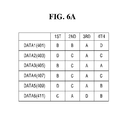
- FIGS. 6A to 6C are schematic views for explaining a data deduplication method based on another embodiment of the present inventive concept
- FIG. 7A is a schematic view for explaining a data deduplication method based on still another embodiment of the present inventive concept
- FIG. 7B is a schematic view for explaining a data deduplication method based on still another embodiment of the present inventive concept
- FIG. 8 is a schematic view for explaining a data deduplication method based on still another embodiment of the present inventive concept
- FIGS. 9A and 9B are schematic views for explaining a data deduplication method based on still another embodiment of the present inventive concept.
- FIGS. 10 and 11 are flowcharts for explaining a data deduplication method based on an exemplary embodiment of the present inventive concept
- FIG. 12 is a schematic block diagram for explaining an electronic system that includes a semiconductor device based on an exemplary embodiment of the present inventive concept.
- FIG. 13 is a schematic block diagram for explaining an application example of a storage system that includes a semiconductor device based on an exemplary embodiment of the present inventive concept.
- first, second, etc. may be used herein to describe various elements, components, regions, layers and/or sections, these elements, components, regions, layers and/or sections should not be limited by these terms. These terms are only used to distinguish one element, component, region, layer or section from another region, layer or section. Thus, a first element, component, region, layer or section discussed below could be termed a second element, component, region, layer or section without departing from the teachings of the present inventive concept.
- spatially relative terms such as “beneath”, “below”, “lower”, “above”, “upper”, and the like, may be used herein for ease of description to describe one element or feature's relationship to another element(s) or feature(s) as illustrated in the figures. It will be understood that the spatially relative terms are intended to encompass different orientations of the device in use or operation in addition to the orientation depicted in the figures. For example, if the device in the figures is turned over, elements described as “below” or “beneath” other elements or features would then be oriented “above” the other elements or features. Thus, the exemplary term “below” can encompass both an orientation of above and below. The device may be otherwise oriented (rotated 90 degrees or at other orientations) and the spatially relative descriptors used herein interpreted accordingly.
- Embodiments are described herein with reference to cross-section illustrations that are schematic illustrations of idealized embodiments (and intermediate structures). As such, variations from the shapes of the illustrations as a result, for example, of manufacturing techniques and/or tolerances, are to be expected. Thus, these embodiments should not be construed as limited to the particular shapes of regions illustrated herein but are to include deviations in shapes that result, for example, from manufacturing. For example, an implanted region illustrated as a rectangle will, typically, have rounded or curved features and/or a gradient of implant concentration at its edges rather than a binary change from implanted to non-implanted region. Likewise, a buried region formed by implantation may result in some implantation in the region between the buried region and the surface through which the implantation takes place. Thus, the regions illustrated in the figures are schematic in nature and their shapes are not intended to illustrate the actual shape of a region of a device and are not intended to limit the scope of the present inventive concept.
- the distributed storage device 100 performs data input/output work through reception of a data input/output request from one or more clients 250 , 252 .
- the distributed storage device 100 may store data (i.e., some amount or block of data), for which a write is requested from the one or more clients 250 , 252 , in one or more storage nodes 200 , 202 , 204 , 206 in a distributed manner, and may retrieve data, in response to a read request received from the one or more clients 250 , 252 , from the one or more storage nodes 200 , 202 , 204 , 206 in order to transmit the read data to the clients 250 , 252 .
- data i.e., some amount or block of data
- the distributed storage device 100 may store data (i.e., some amount or block of data), for which a write is requested from the one or more clients 250 , 252 , in one or more storage nodes 200 , 202 , 204 , 206 in a distributed manner, and
- the distributed storage device 100 may be a single server or a multi-server, and the distributed storage device 100 may further include a metadata management server that manages metadata for the data stored in the storage nodes 200 , 202 , 204 , 206 .
- Each of the clients 250 , 252 may be a respective terminal that can access the distributed storage device 100 through a network including, for example, a computer, such as a desk-top computer or a server, or a mobile device, such as a cellular phone, a smart phone, a tablet PC, a notebook computer, or a PDA (Personal Digital Assistants), though not limited to those examples.
- Each of the storage nodes 200 , 202 , 204 , 206 may be, but is not limited to, a storage device, such as a HDD (Hard Disk Drive), a SSD (Solid State Drive), or a NAS (Network Attached Storage), and may include one or more processing units.
- the clients 250 , 252 , the distributed storage device 100 , and the storage nodes 202 , 202 , 204 , 206 may be connected to each other through a wire network, such as a LAN (Local Area Network), a WAN (Wide Area Network), or a wireless network, such as Wi-Fi, Bluetooth, or cellular network for example.
- a wire network such as a LAN (Local Area Network), a WAN (Wide Area Network), or a wireless network, such as Wi-Fi, Bluetooth, or cellular network for example.
- a distributed storage device in some embodiments may include a separator 110 , a position vector generator 120 , and a fingerprint generator 130 .
- the separator 110 may separate the data 105 for which the write is requested into a plurality of data chunks 115 , which may include symbols.
- the divided data chunks 115 may correspond to first through N th positions within the data 105 , where N is a natural number. For example, among the plurality of separated data chunks 115 from the data 105 , the first data chunk may correspond to the first position, the second data chunk may correspond to the second position, and the N th data chunk may correspond to the N th position.
- the first through N th positions are not inherent to specific data.
- positions may also be applied to any data stored in the storage nodes 202 , 202 , 204 , 206 together with the data 105 . Accordingly, other data stored in the storage nodes 202 , 202 , 204 , 206 together with the data 105 may be separated into a plurality of data chunks, each data chunk corresponding to a different position within its respective data.
- the position vector generator 120 may calculate discrimination indices for the first through N th positions that correspond to the positions of the plurality of data chunks 115 of the data 105 , and may arrange the order of the first through N th positions based on values of the discrimination indices. In some embodiments, the position vector generator 120 records the arranged order of the first through N th positions in a position vector 125 .
- the discrimination index indicates the degree of discrimination (differentiation) of the whole data with respect to a part of the data chunks. For example, if it is assumed that two pieces of data (A, B) and (A, C) are stored in the storage (here, A, B, and C mean data chunks or symbols), the data chunks or symbols that are in the first position are both equal to A, and therefore cannot be discriminated (i.e., differentiated) from each other. However, the data chunks or symbols that are in the second position, B and C, are different, and thus the two pieces of data can be discriminated from each other.
- the second position (in which B and C are positioned) has higher discrimination than does the first position, and thus a higher discrimination index can be assigned to the second position than to the first position.
- the details of the method for calculating/assigning a discrimination index will be described below with reference to FIG. 4A .
- the position vector generator 120 determines discrimination indices for the first through N th positions that correspond to the positions of the plurality of data chunks 115 , and assigns higher discrimination index values to positions having higher discrimination. (In other possible embodiments a lower discrimination index value could indicate higher discrimination.) After all the discrimination indices for the first through N th positions are determined, the position vector generator 120 may produce a position vector 125 that will order the first through N th positions based on the order of their discrimination index values. For example, in embodiments where the discrimination index value is set to become larger as the discrimination becomes higher, the first through N th positions may be arranged in descending order of their discrimination index values.
- the first through N th positions may be arranged in ascending order of discrimination index value.
- Yet other possible embodiments could reverse the position vector so that the higher discrimination positions could be at the end.
- this discussion will hereafter describe an exemplary embodiment in which the position vector 125 is arranged in descending order of discrimination index values with high discrimination index values indicating high discrimination.
- the position vector generator 120 After determining discrimination index values for the different positions, the position vector generator 120 records the arranged order of the first through N th positions on the position vector 125 in order of discrimination index value. Accordingly, the position vector 125 may have a plurality of elements corresponding to the first through N th positions, and the order of the elements may correspond to the arranged order of the first through N th positions. For example, a position vector ( 4 , 1 , 2 , 3 ) indicates that the discrimination is highest for the data in the fourth position, and then the first position, the second position, and the third position, in order of descending discrimination values.
- the fingerprint generator 130 may then generate a “fingerprint” through combination of data chunks that correspond to the first through N th positions, based on the arranged order of the first through N th positions.
- the fingerprint generator 130 may generate the fingerprint through combination of the data chunks that correspond to the first through N th positions based on the order of the first through N th positions recorded on the position vectors 125 . For example, if a position vector is (4, 1, 2, 3), the fingerprint may be generated through combination in order of data chunks that correspond to the fourth position, the first position, the second position, and the third position.
- the position vector may be generated as a vector having N elements that include all of the entire first through N th positions, while the fingerprint generation unit 130 uses only M elements (where M is a natural number that is smaller than N) among the elements of the position vector, and based on this, the fingerprint may be generated through combination of only those M data chunks.
- FIG. 3 illustrates an example of this method according to this exemplary embodiment.
- the 105 are separated into a plurality of data chunks corresponding to first through eleventh positions. If, after calculating a respective discrimination index value for each of the first through eleventh positions, it is determined that the discrimination indices of the first through eleventh positions, in descending order, are found in the eleventh position 308 , the sixth position 306 , the third position 302 , and the fifth position 304 , etc., then the position vector generator 120 may generate a position vector 125 of (11, 6, 3, 5, 2, 4, 10, 9, 7, 8, 1) for example, based on those discrimination index values.
- the fingerprint generator 130 may generate a fingerprint 135 through combination of only the four data chunks corresponding to the first four elements ( 11 , 6 , 3 , 5 ) of the position vector 125 . That is, the fingerprint generator 130 may generate the fingerprint 135 through combination of the data chunk 308 that corresponds to the eleventh position, the data chunk 306 that corresponds to the sixth position, the data chunk 302 that corresponds to the third position, and the data chunk 304 that corresponds to the fifth position.
- each piece of data 401 , 403 , 405 , 407 , 409 may be separated into four data chunks.
- the data chunk may include symbols, such as A, B, C, and D.
- Four data chunks that are separated from each piece of data 401 , 403 , 405 , 407 , 409 may correspond to the first through fourth positions.
- first data chunks B, D, B, B, and D that are respectively separated from the data 401 , 403 , 405 , 407 , 409 may correspond to first respective positions
- second data chunks B, C, C, C, and C that are respectively separated from the data 401 , 403 , 405 , 407 , 409 may correspond to second respective positions.
- the third data chunks A, A, A, A, and A that are respectively separated from the data 401 , 403 , 405 , 407 , 409 may correspond to third respective positions
- the fourth data chunks D, C, A, C, and B that are respectively separated from the data 401 , 403 , 405 , 407 , 409 may correspond to fourth respective positions.
- the fourth position has the highest discrimination. Accordingly, the data 401 , 403 , 405 , 407 , 409 can be discriminated by only the data chunks D, C, A, C, and B that correspond to the fourth position, without the necessity of considering the data chunks that correspond to other positions (i.e., first to third positions). On the other hand, the third position has the lowest discrimination.
- the positions in order of descending discrimination are the fourth position, the first position, the second position, and the third position. Accordingly, discrimination indices of 3, 2, 1, and 0 may be respectively given to the fourth position, the first position, the second position, and the third position to indicate the order of the first through fourth positions.
- the discrimination indices may be determined using entropy of information.
- the entropy of information may indicate an amount of information that one symbol can be composed of, and specifically, may be determined using the frequency of duplicate data chunks among data chunks that correspond to the same position in a plurality of pieces of data. For example, if the frequency of the duplicate data chunks among the data chunks that correspond to the fourth position in the plurality of pieces of data is lower than the frequency of the duplicate data chunks among the data chunks that correspond to the first position, then the discrimination index of the fourth position may be determined as higher than the discrimination index of the first position. A detailed process of calculating this will be described later with reference to FIG. 4B .
- the position vector 425 records the order of the first through fourth positions. That is, the position vector 425 may be expressed as (4, 1, 2, 3).
- a frequency matrix generated based on the data 401 , 403 , 405 , 407 , 409 is illustrated on FIG. 4B .
- symbols included in the data 401 , 403 , 405 , 407 , 409 are classified into four kinds (i.e., A, B, C, and D), and the frequency matrix includes four horizontal columns that indicate the first through fourth positions and four vertical columns that indicate the frequencies of the symbols for the first through fourth positions.
- the discrimination indices of the first through fourth positions may be obtained in some embodiments through calculation of Q vectors that express the entropy of information.
- the Q vector Q i of the i th position among the first through fourth positions (where i is a natural number from 1 through 4, inclusive) may be calculated by Equation 1 below.
- Q i ⁇ j F ij ⁇ log F ij (1)
- Equation 1 Q i is a Q vector element of the i th position, and F ij is a value that corresponds to the j th vertical column for the i th horizontal column of the frequency matrix, where j is a natural number from 1 through 4, inclusive.
- Q 1 is an element that corresponds to the first position among the Q vector elements
- (F 11 , F 12 , F 13 , F 14 ) is (0, 3, 0, 2)
- Q 2 is an element that corresponds to the second position among the Q vector elements
- (F 21 , F 22 , F 23 , F 24 ) is (0, 1, 4, 0).
- the Q vector that is calculated by Equation 1 may be (6.755, 8, 11.610, 2).
- the order of the first through fourth positions may be arranged in the ascending order of Q i values.
- the Q vector elements are determined as Q 4 ⁇ Q 1 ⁇ Q 2 ⁇ Q 3
- the first through fourth positions are arranged in the order of fourth, first, second, and third, and the position vector L may be expressed as (4, 1, 2, 3).
- the frequency matrix may be re-calculated. For instance, if F ij value is changed to a different value G ij , the Q vector may be re-calculated by Equation 2 below.
- Q i ′ Q i ⁇ F ij ⁇ log F ij +G ij ⁇ log G ij (2)
- Equation 2 Q i ′ is a new Q vector element, Q i is an existing Q vector element, F ij is an existing value that corresponds to the j th vertical column for the i th horizontal column of the frequency matrix, and G ij is a new value that corresponds to the j th vertical column for the i th horizontal column of the frequency matrix. This will be described later with reference to FIGS. 6A to 6C .
- the order of the first through fourth positions may be determined through calculation of the entropy of information H as calculated by Equation 3 below.
- H i log N ⁇ 1/ N ⁇ Q i (3)
- Equation 3 Q i is a Q vector element of the i th position, N is the total number of symbols for the i th position, and H i is a discrimination index of the i th position.
- the order of the first through fourth positions may be determined through calculation of the entropy of information H as calculated by Equations 4 and 5 below.
- p ij F ij /N (4)
- H i ⁇ j p ij ⁇ log(1/ p ij ) (5)
- Equations 3 and 4 above p ij is a ratio of the j th symbol in the i th position, F ij is a value that corresponds to the j th vertical column for the i th horizontal column of the frequency matrix, N is the total number of symbols for the i th position, and H i is a discrimination index of the i th position.
- the entropy of information H is calculated as (0.971, 0.722, 0, 1.922).
- the first through fourth positions may be arranged in the descending order of H i values. That is, in this embodiment, since the H values are determined as H 4 >H 1 >H 2 >H 3 , the first through fourth positions are arranged in the order of fourth, first, second, third.
- the position vector L may be expressed as (4, 1, 2, 3).
- fingerprints 431 , 433 , 435 , 437 , 439 may be generated from the data 401 , 403 , 405 , 407 , 409 using the position vector 425 .
- the fingerprint 431 may be generated to through combination of the data chunks D, B, B, and A corresponding to the fourth, first, second, and third positions, respectively, based on the position vector 425 , which is (4, 1, 2, 3).
- the fingerprint 433 may be generated through combination of the data chunks C, D, E, and A again corresponding to the fourth, first, second, and third positions, respectively, based on the same position vector 425 of (4, 1, 2, 3).
- the fingerprints 431 , 433 , 435 , 437 , 439 as generated above make it possible to rapidly determine whether the data 401 , 403 , 405 , 407 , 409 are equal to each other.
- FIGS. 6A and 6B illustrate a case in which data 411 is added to data 401 , 403 , 405 , 407 , 409 .
- the new data 411 is added and thus the frequencies of the symbols are changed, it is necessary to re-calculate the frequency matrix.
- the data 411 include symbols C, A, D, and B in the first, second, third, and fourth positions, respectively, the values in the positions indicated by rectangles in FIG. 6B should be updated by increasing them by 1. If the values of the frequency matrix are changed as described above, the Q vectors calculated by Equation 1 may be re-calculated by Equation 2.
- the new Q 4 ′ value may be calculated by Q 4 ⁇ F 42 ⁇ log F 42 +G 42 ⁇ log G 42 .
- F 42 is an existing value (i.e., 1) that corresponds to the second vertical column for the fourth horizontal column of the frequency matrix
- G 42 is the new value (i.e., 2) that corresponds to the second vertical column for the fourth horizontal column of the frequency matrix. Accordingly, the Q 4 ′ value becomes 4. If the magnitude relationship between Q 1 to Q 4 is changed, the position vector L may also be updated.
- FIGS. 6A and 6C illustrate a case in which data 407 is deleted.
- the data 407 since the data 407 is deleted and thus the frequencies of the symbols are changed, it is necessary to re-calculate the frequency matrix.
- the data 407 include symbols B, B, A, and C in the first, second, third, and fourth positions, respectively, the values in the positions indicated by rectangles in FIG. 6C should be updated by decreasing them by 1.
- the Q vectors calculated by Equation 1 may be re-calculated by Equation 2. For example, if a symbol B is deleted from the fourth position, the new Q 1 ′ value may be calculated by Q 1 ⁇ F 12 ⁇ log F 12 +G 12 ⁇ log G 12 .
- F 12 is an existing value (i.e., 3) that corresponds to the second vertical column for the first horizontal column of the frequency matrix
- G 12 is the new value (i.e., 2) that corresponds to the second vertical column for the first horizontal column of the frequency matrix. Accordingly, the Q 1 ′ value becomes 4. If the magnitude relationship between Q 1 to Q 4 is changed, the position vector L may also be updated.
- symbols may include a first symbol and a second symbol, which are different from each other, and the frequency matrix may include a vertical column that indicates a value obtained by adding the frequency of the first symbol to the frequency of the second symbol.
- the frequency matrix illustrated in FIG. 7A includes only two vertical columns that indicate four symbols of A, B, C, and D.
- the first vertical column may include values obtained by adding the frequencies of the symbols B and C to each other
- the second vertical column may include values obtained by adding the frequencies of the symbols A and D.
- symbols that have correlations or high interconnectivity may be handled as one symbol, so that the size of the frequency matrix can be reduced. If the size of the frequency matrix is reduced, memory space for storing the frequency matrix can be saved.
- the frequency matrix may include only K horizontal columns for partial positions among the first through N th positions, where K is a natural number between 1 and N, inclusive.
- the frequency matrix illustrated in FIG. 7B includes only horizontal columns for the first and fourth positions.
- whether the data is duplicated is determined through selection of partial positions having relatively high discrimination. For example, if the first and fourth positions among the first through N th positions have a high data discrimination index (which can substantially help the determination of whether the data is duplicated) but the second and third positions do not have high data discrimination, the data deduplication may be performed considering only the first and fourth positions.
- data deduplication may employ a “lazy update” technique that delays the performance of the re-calculation work of the frequency matrix when the data is added or deleted as described above with reference to FIGS. 6A to 6C .
- a flag may be set with respect to the added data or deleted data before the frequency matrix is re-calculated. Thereafter, recalculation of the frequency matrix may be performed at an appropriate time dictated by a task scheduler.
- flags may be set for only the data 407 and 411 , and the frequency matrix need not be immediately re-calculated.
- FIG. 8 although a flag “n” is set to the added data 411 and a flag “o” is set to the deleted data 407 , the detailed types of the flags are not limited thereto.
- the lengths of data 501 , 503 , 505 , 507 , 509 , 511 may be different from one another.
- the length of the data 501 , 509 , and 511 may include four symbols, whereas the length of the data 505 and 507 may include five symbols.
- a vertical column that indicates a blank symbol ⁇ may be added to the frequency matrix to calculate the discrimination indices from the data 501 , 503 , 505 , 507 , 509 , 511 having different lengths.
- the data 501 , 509 , and 511 each include only four symbols, it may be considered that they include virtual blank symbols in their fifth positions.
- the data 503 include only three symbols, it may be considered that the data include a virtual blank symbol in their fourth and fifth positions.
- the fifth horizontal column becomes (0, 0, 1, 1, 4).
- a data write request may be received from a user or a client 250 (S 701 ), and a fingerprint for the write-requested data may be extracted through construction of a position vector (S 703 ).
- Constructing the position vector may include separating the data into a plurality of data chunks that correspond to first through N th positions (S 803 ), where N is a natural number, and calculating discrimination indices for the first through N th positions.
- the discrimination indices may be determined through calculation of the Q vectors using the above-described frequency matrix or calculation of the entropy of information H using the frequency matrix (S 805 ).
- the constructing the position vector may also include arranging the order of the first through N th positions based on discrimination index values, and recording the order on the position vector (S 807 ).
- extracting the fingerprint may include generating the fingerprint through combination of the data chunks that correspond to the first through N th positions based on the order of the first through N th positions recorded on the position vector.
- the method may further include determining whether two or more pieces of data are duplicate data through comparison of the fingerprints of the two or more pieces of data with each other (S 705 ).
- the two or more pieces of data may include, for example, first data pre-stored in the storage and second data of which a write is requested. If the fingerprints of the first data and the second data are different from each other (S 707 —N), the second data is different from the first data and thus may be stored separately in the storage (S 715 ).
- the fingerprints of the first data and the second data are equal to each other (S 707 —Y)
- whether the first data and the second data are duplicate data may be determined through comparison of the data in the unit of a data chunk based on the order of the first through N th data recorded on the position vector (S 709 ). If the first data and the second data are different from each other (S 711 —N), the second data may be stored separately in the storage (S 715 ). Conversely, if the first data and the second data are equal to each other (S 711 —Y), the second data is not stored in the storage, but instead a link for the first data that is equal to the second data is generated (S 713 ).
- fingerprints for performing the data deduplication may be efficiently generated.
- the entropy of information can be efficiently calculated, and if the data is added or deleted, the position vectors can be re-calculated with superior time complexity of O (M) (where, M is the number of divided data chunks).
- a data deduplication apparatus may include a controller 510 , an interface 520 , an input/output (I/O) device 530 , a memory 540 , a power supply 550 , and a bus 560 .
- I/O input/output
- the controller 510 , the interface 520 , the I/O device 530 , the memory 540 , and the power supply 550 may be connected to each other through the bus 560 .
- the bus 560 corresponds to paths through which data is transferred.
- the controller 510 may include at least one of a microprocessor, a microcontroller, and/or logic devices that can perform functions similar to the functions thereof to process data.
- the interface 520 may function to transfer data to a communication network or to receive the data from the communication network.
- the interface 520 may be of a wired or wireless type.
- the interface 520 may include an antenna or a wire/wireless transceiver.
- the I/O device 530 may include a keypad and a display device to input/output data.
- the memory 540 may store data and/or commands.
- the semiconductor device may be provided as a partial constituent element of the memory 540 .
- the power supply 550 may convert a power input from an outside and provide the converted power to the respective constituent elements 510 to 540 .
- the data deduplication apparatus may include a CPU 610 , an interface 620 , a peripheral device 630 , a main memory 640 , a secondary memory 650 , and a bus 660 .
- the CPU 610 , the interface 620 , the peripheral device 630 , the main memory 640 , and the secondary memory 650 may be connected to each other through the bus 660 .
- the bus 660 corresponds to paths through which data is transferred.
- the CPU 610 may include a controller, an arithmetic-logic unit, and the like, and may execute a program to process data.
- the interface 620 may function to transfer data to a communication network or to receive the data from the communication network.
- the interface 620 may be of a wired or wireless type.
- the interface 620 may include an antenna or a wire/wireless transceiver.
- the peripheral device 630 may include a mouse, a keyboard, a display, and a printer, and may input/output data.
- the main memory 640 may transmit/receive data with the CPU 610 , and may store data and/or commands that are required to execute the program. Based on some embodiments, the semiconductor device may be provided as partial constituent elements of the main memory 640 .
- the secondary memory 650 may include a nonvolatile memory, such as a magnetic tape, a magnetic disc, a floppy disc, a hard disk, or an optical disk, and may store data and/or commands. The secondary memory 650 can store data even in the case where a power of the electronic system is intercepted.
- an electronic system that implements the data deduplication method based on some possible embodiments may be provided as one of various constituent elements of electronic devices, such as a computer, a UMPC (Ultra Mobile PC), a work station, a net-book, a PDA (Personal Digital Assistants), a portable computer, a web tablet, a wireless phone, a mobile phone, a smart phone, an e-book, a PMP (Portable Multimedia Player), a portable game machine, a navigation device, a black box, a digital camera, a 3-dimensional television receiver, a digital audio recorder, a digital audio player, a digital picture recorder, a digital picture player, a digital video recorder, a digital video player, a device that can transmit and receive information in a wireless environment, one of various electronic devices constituting a home network, one of various electronic devices constituting a computer network, one of various electronic devices constituting a telematics network, an RFID device, or one of various constituent elements constituting a computing system
- a “natural number” is a whole number greater than or equal to 1 (e.g., 1, 2, 3, and so on).
Landscapes
- Engineering & Computer Science (AREA)
- Theoretical Computer Science (AREA)
- Data Mining & Analysis (AREA)
- Databases & Information Systems (AREA)
- Physics & Mathematics (AREA)
- General Engineering & Computer Science (AREA)
- General Physics & Mathematics (AREA)
- Information Retrieval, Db Structures And Fs Structures Therefor (AREA)
Abstract
Description
Q i=Σj F ij×log F ij (1)
Q i ′=Q i −F ij×log F ij +G ij×log G ij (2)
H i=log N−1/N×Q i (3)
p ij =F ij /N (4)
H i=Σj p ij×log(1/p ij) (5)
Claims (17)
Q i=Σj F ij×log F ij (1)
Q i ′=Q i −F ij×log F ij +G ij×log G ij (2)
H i=log N−1/N×Q, (3)
p ij =F ij /N (4)
H i=Σj p ij×log(1/p ij) (5)
Q i=Σi F ij×log F ij (6)
Q i ′=Q i −F ij×log F ij +G ij×log G ij (7)
Q i =F ij×log F ij (6)
Applications Claiming Priority (2)
| Application Number | Priority Date | Filing Date | Title |
|---|---|---|---|
| KR1020140060420A KR102172321B1 (en) | 2014-05-20 | 2014-05-20 | Method for data deduplication |
| KR10-2014-0060420 | 2014-05-20 |
Publications (2)
| Publication Number | Publication Date |
|---|---|
| US20150339316A1 US20150339316A1 (en) | 2015-11-26 |
| US10108636B2 true US10108636B2 (en) | 2018-10-23 |
Family
ID=54556203
Family Applications (1)
| Application Number | Title | Priority Date | Filing Date |
|---|---|---|---|
| US14/711,647 Active 2036-10-13 US10108636B2 (en) | 2014-05-20 | 2015-05-13 | Data deduplication method |
Country Status (2)
| Country | Link |
|---|---|
| US (1) | US10108636B2 (en) |
| KR (1) | KR102172321B1 (en) |
Families Citing this family (1)
| Publication number | Priority date | Publication date | Assignee | Title |
|---|---|---|---|---|
| CN111368122B (en) * | 2020-02-14 | 2022-09-30 | 深圳壹账通智能科技有限公司 | Method and device for removing duplicate pictures |
Citations (15)
| Publication number | Priority date | Publication date | Assignee | Title |
|---|---|---|---|---|
| JPH09275349A (en) | 1996-02-09 | 1997-10-21 | Fujitsu Ltd | Data compression device and data decompression device |
| JP2004110606A (en) | 2002-09-20 | 2004-04-08 | Pfu Ltd | Image processing apparatus and method and program |
| KR20080098878A (en) | 2007-05-07 | 2008-11-12 | (주)엔써즈 | Method and apparatus for generating audio fingerprint data and method and apparatus for comparing audio data using same |
| JP2010256951A (en) | 2009-04-21 | 2010-11-11 | Data Henkan Kenkyusho:Kk | Similar data retrieval device and program thereof |
| US20110307447A1 (en) * | 2010-06-09 | 2011-12-15 | Brocade Communications Systems, Inc. | Inline Wire Speed Deduplication System |
| US20120016882A1 (en) * | 2010-07-19 | 2012-01-19 | Quantum Corporation | Delta chunks and delta hashes |
| US8103050B2 (en) | 2006-01-16 | 2012-01-24 | Thomson Licensing | Method for computing a fingerprint of a video sequence |
| JP2012073684A (en) | 2010-09-27 | 2012-04-12 | Fujitsu Ltd | Image recognition method, apparatus and program |
| US8165414B1 (en) | 2010-11-11 | 2012-04-24 | Google Inc. | Vector transformation for indexing, similarity search and classification |
| US20130018853A1 (en) * | 2011-07-11 | 2013-01-17 | Dell Products L.P. | Accelerated deduplication |
| JP2013030104A (en) | 2011-07-29 | 2013-02-07 | Panasonic Corp | Feature amount extraction apparatus and feature amount extraction method |
| US20130318051A1 (en) * | 2011-12-06 | 2013-11-28 | Brocade Communications Systems, Inc. | Shared dictionary between devices |
| US20150019815A1 (en) * | 2013-07-15 | 2015-01-15 | International Business Machines Corporation | Utilizing global digests caching in data deduplication of workloads |
| US20150026135A1 (en) * | 2013-07-17 | 2015-01-22 | International Business Machines Corporation | Adaptive similarity search resolution in a data deduplication system |
| US20150302022A1 (en) * | 2014-04-21 | 2015-10-22 | Samsung Electronics Co., Ltd. | Data deduplication method and apparatus |
Family Cites Families (3)
| Publication number | Priority date | Publication date | Assignee | Title |
|---|---|---|---|---|
| US9811662B2 (en) | 2010-05-03 | 2017-11-07 | Panzura, Inc. | Performing anti-virus checks for a distributed filesystem |
| US8798967B2 (en) | 2011-03-30 | 2014-08-05 | Chevron U.S.A. Inc. | System and method for computations utilizing optimized earth model representations |
| US8484170B2 (en) * | 2011-09-19 | 2013-07-09 | International Business Machines Corporation | Scalable deduplication system with small blocks |
-
2014
- 2014-05-20 KR KR1020140060420A patent/KR102172321B1/en active Active
-
2015
- 2015-05-13 US US14/711,647 patent/US10108636B2/en active Active
Patent Citations (19)
| Publication number | Priority date | Publication date | Assignee | Title |
|---|---|---|---|---|
| US6026198A (en) | 1996-02-09 | 2000-02-15 | Fujitsu Limited | Data compression and restoration system for encoding an input character on the basis of a conditional appearance rate obtained in relation to an immediately preceding character string |
| US6215906B1 (en) | 1996-02-09 | 2001-04-10 | Fujitsu Limited | Data compression and restoration system for encoding an input character on the basis of a conditional appearance rate obtained in relation to an immediately preceding character string |
| JPH09275349A (en) | 1996-02-09 | 1997-10-21 | Fujitsu Ltd | Data compression device and data decompression device |
| JP2004110606A (en) | 2002-09-20 | 2004-04-08 | Pfu Ltd | Image processing apparatus and method and program |
| US8103050B2 (en) | 2006-01-16 | 2012-01-24 | Thomson Licensing | Method for computing a fingerprint of a video sequence |
| KR20080098878A (en) | 2007-05-07 | 2008-11-12 | (주)엔써즈 | Method and apparatus for generating audio fingerprint data and method and apparatus for comparing audio data using same |
| JP2010256951A (en) | 2009-04-21 | 2010-11-11 | Data Henkan Kenkyusho:Kk | Similar data retrieval device and program thereof |
| US20110307447A1 (en) * | 2010-06-09 | 2011-12-15 | Brocade Communications Systems, Inc. | Inline Wire Speed Deduplication System |
| US20120016882A1 (en) * | 2010-07-19 | 2012-01-19 | Quantum Corporation | Delta chunks and delta hashes |
| JP2012073684A (en) | 2010-09-27 | 2012-04-12 | Fujitsu Ltd | Image recognition method, apparatus and program |
| US8165414B1 (en) | 2010-11-11 | 2012-04-24 | Google Inc. | Vector transformation for indexing, similarity search and classification |
| US20120121194A1 (en) | 2010-11-11 | 2012-05-17 | Google Inc. | Vector transformation for indexing, similarity search and classification |
| US20130018853A1 (en) * | 2011-07-11 | 2013-01-17 | Dell Products L.P. | Accelerated deduplication |
| JP2013030104A (en) | 2011-07-29 | 2013-02-07 | Panasonic Corp | Feature amount extraction apparatus and feature amount extraction method |
| US20140164413A1 (en) | 2011-07-29 | 2014-06-12 | Panasonic Corporation | Feature value extraction apparatus and feature value extraction method |
| US20130318051A1 (en) * | 2011-12-06 | 2013-11-28 | Brocade Communications Systems, Inc. | Shared dictionary between devices |
| US20150019815A1 (en) * | 2013-07-15 | 2015-01-15 | International Business Machines Corporation | Utilizing global digests caching in data deduplication of workloads |
| US20150026135A1 (en) * | 2013-07-17 | 2015-01-22 | International Business Machines Corporation | Adaptive similarity search resolution in a data deduplication system |
| US20150302022A1 (en) * | 2014-04-21 | 2015-10-22 | Samsung Electronics Co., Ltd. | Data deduplication method and apparatus |
Also Published As
| Publication number | Publication date |
|---|---|
| KR20150133527A (en) | 2015-11-30 |
| US20150339316A1 (en) | 2015-11-26 |
| KR102172321B1 (en) | 2020-10-30 |
Similar Documents
| Publication | Publication Date | Title |
|---|---|---|
| US8447120B2 (en) | Incremental feature indexing for scalable location recognition | |
| KR102127116B1 (en) | Device and method for storing data in distributed storage system | |
| US11126359B2 (en) | Partitioning graph data for large scale graph processing | |
| US20150302022A1 (en) | Data deduplication method and apparatus | |
| US11100073B2 (en) | Method and system for data assignment in a distributed system | |
| WO2013129580A1 (en) | Approximate nearest neighbor search device, approximate nearest neighbor search method, and program | |
| CN106156755A (en) | Similarity calculating method in a kind of recognition of face and system | |
| CN105608234A (en) | Image retrieval method and device | |
| Song et al. | Combining Models from Multiple Sources for RGB-D Scene Recognition. | |
| WO2017095413A1 (en) | Incremental automatic update of ranked neighbor lists based on k-th nearest neighbors | |
| CN115470190A (en) | A multi-storage pool data classification storage method, system and electronic equipment | |
| EP3343395A1 (en) | Data storage method and apparatus for mobile terminal | |
| CN118964686A (en) | Vector retrieval method, device, equipment and storage medium | |
| US8923626B1 (en) | Image retrieval | |
| WO2017095439A1 (en) | Incremental clustering of a data stream via an orthogonal transform based indexing | |
| US20180285693A1 (en) | Incremental update of a neighbor graph via an orthogonal transform based indexing | |
| US11593412B2 (en) | Providing approximate top-k nearest neighbours using an inverted list | |
| US10108636B2 (en) | Data deduplication method | |
| CN102591903A (en) | Information processing apparatus, information processing method and information processing program | |
| CN104715002B (en) | Space-division method and space divide equipment | |
| WO2025167890A1 (en) | Retrieval method and apparatus, electronic device, and readable storage medium | |
| CN116894964B (en) | Post-processing fusion object image clustering methods, devices, and computer equipment | |
| US20250158799A1 (en) | Homomorphic Encryption-Based Image Encryption And Decryption Method And Device | |
| Khot et al. | Road network compression techniques in spatiotemporal embedded systems: A survey | |
| CN116628280A (en) | A similar data search method, system and electronic equipment based on orientation coding |
Legal Events
| Date | Code | Title | Description |
|---|---|---|---|
| AS | Assignment |
Owner name: SAMSUNG ELECTRONICS CO., LTD., KOREA, REPUBLIC OF Free format text: ASSIGNMENT OF ASSIGNORS INTEREST;ASSIGNORS:GU, BON-CHEOL;LEE, JU-PYUNG;REEL/FRAME:035703/0933 Effective date: 20150119 |
|
| STPP | Information on status: patent application and granting procedure in general |
Free format text: RESPONSE AFTER FINAL ACTION FORWARDED TO EXAMINER |
|
| STCF | Information on status: patent grant |
Free format text: PATENTED CASE |
|
| MAFP | Maintenance fee payment |
Free format text: PAYMENT OF MAINTENANCE FEE, 4TH YEAR, LARGE ENTITY (ORIGINAL EVENT CODE: M1551); ENTITY STATUS OF PATENT OWNER: LARGE ENTITY Year of fee payment: 4 |