US10102649B2 - Iterative image subset processing for image reconstruction - Google Patents
Iterative image subset processing for image reconstruction Download PDFInfo
- Publication number
- US10102649B2 US10102649B2 US14/878,886 US201514878886A US10102649B2 US 10102649 B2 US10102649 B2 US 10102649B2 US 201514878886 A US201514878886 A US 201514878886A US 10102649 B2 US10102649 B2 US 10102649B2
- Authority
- US
- United States
- Prior art keywords
- points
- subsets
- image
- given
- current
- Prior art date
- Legal status (The legal status is an assumption and is not a legal conclusion. Google has not performed a legal analysis and makes no representation as to the accuracy of the status listed.)
- Active, expires
Links
Images
Classifications
-
- G—PHYSICS
- G01—MEASURING; TESTING
- G01S—RADIO DIRECTION-FINDING; RADIO NAVIGATION; DETERMINING DISTANCE OR VELOCITY BY USE OF RADIO WAVES; LOCATING OR PRESENCE-DETECTING BY USE OF THE REFLECTION OR RERADIATION OF RADIO WAVES; ANALOGOUS ARRANGEMENTS USING OTHER WAVES
- G01S13/00—Systems using the reflection or reradiation of radio waves, e.g. radar systems; Analogous systems using reflection or reradiation of waves whose nature or wavelength is irrelevant or unspecified
- G01S13/88—Radar or analogous systems specially adapted for specific applications
- G01S13/89—Radar or analogous systems specially adapted for specific applications for mapping or imaging
-
- G06T11/003—
-
- G—PHYSICS
- G06—COMPUTING OR CALCULATING; COUNTING
- G06T—IMAGE DATA PROCESSING OR GENERATION, IN GENERAL
- G06T12/00—Tomographic reconstruction from projections
-
- G—PHYSICS
- G06—COMPUTING OR CALCULATING; COUNTING
- G06T—IMAGE DATA PROCESSING OR GENERATION, IN GENERAL
- G06T2211/00—Image generation
- G06T2211/40—Computed tomography
- G06T2211/424—Iterative
Definitions
- the invention relates in general to the field of computerized methods and systems for image reconstruction, in particular in the fields of radio interferometry (to recover a sky image), magnetic resonance imaging or ultrasound imaging, and methods to simplify and improve the performances of such computerized methods and systems for image reconstruction.
- Image reconstruction from signals received by sensor arrays is used in many application fields, including radio interferometry, e.g., for astronomical investigations, magnetic resonance imaging, ultrasound imaging and positron emission tomography for medical applications. Iterative reconstruction typically refers to algorithms used to reconstruct 2D and 3D images. Often, iterative reconstruction techniques provide better results but are computationally more expensive.
- the present invention is embodied as computer-implemented methods for recovering an image. Such methods revolve around the following steps, each implemented via one or more processors. First, signal data that represent signals are accessed. Subsets of points, arranged so as to span a region of interest, are identified as current subsets of points. Then, an image is reconstructed, based on current subsets of points, by combining signal data associated to the current subsets of points. One or more signal features are detected in a last image reconstructed.
- one or more subsets (of the current subsets of points) are modified, so as to change a number of points of said one or more subsets, according to a location of said each of the one or more signal features detected.
- new subsets of points are obtained, which will be used as current subsets, when repeating the above steps of reconstructing, detecting and modifying. These steps are repeated as necessary to obtain a reconstructed image that satisfies a given condition.
- a remarkable advantage of the present methods is that the signal features are progressively introduced and refined while iteratively modifying the subsets of points, by changing, at each iteration, the number of points in subsets based on locations of the detected signal features.
- the subsets of points may for instance be modified, so as to increase (for each of the modified subsets), a relative number of points at a location of each of the detected features.
- the relative number of points of a given subset at a given location is defined as the number of points of said given subset at the given location divided by the total number of points of said given subset.
- the modification comprises adding points to one or more of the current subsets of points.
- one may instead progressively subtract points (e.g., points that are far from the locations of the detected features) from subsets and iterate the process as long as the subsequently reconstructed image still satisfies a pre-determined criterion or condition.
- the relative number of points increases at the location of a detected feature, throughout the iterations, and for each of the modified subsets.
- the optimal approach depends on the criteria or conditions chosen. From the viewpoint of the achieved accuracy in the image reconstruction, it is, however, preferred to progressively increase the (whole) number of points per subset.
- the invention is embodied as a system for recovering an image from signal data.
- the system comprises one or more processing units and a memory comprising computerized methods, the latter configured, upon execution by the one or more processing units, for implementing steps of the above methods for recovering an image.
- the invention is embodied as a computer program product, which comprises a computer readable storage medium having program instructions embodied therewith, the program instructions executable by a computerized system, such as the above system, to cause to the steps of present image recovery methods.
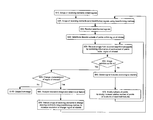
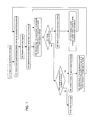
- FIG. 1 is a flowchart illustrating high-level steps of a method for recovering an image, according to embodiments of the invention
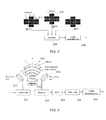
- FIG. 2 is a block diagram schematically illustrating selected components of a radio interferometry system (a radio interferometer with stations and beamforming matrices), according to embodiments;
- FIG. 3 is a block diagram schematically illustrating selected components of a magnetic resonance imaging system, according to embodiments.
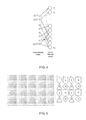
- FIG. 4 is a factor graph representation of a system model, as involved in embodiments.
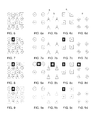
- FIGS. 5-9 d are simplified representations of points and subsets of points, illustrating how subsets can be iteratively modified to increase a relative number of points at a location of a detected feature, as involved in embodiments.
- FIG. 9-9 d illustrate a variant to the embodiment of FIG. 7-8 d;
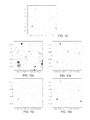
- FIG. 10-10 d are 2D plots illustrating intensity distributions in an illustration example (sky image).
- FIG. 10 illustrates an intensity distribution in a field of view in absence of noise;
- FIG. 10 a - c show images as obtained after successive iterations, while
- FIG. 10 d depicts a superposition of a target sky image and an image as obtained after a 3 rd iteration, according to embodiments;
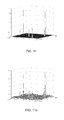
- FIGS. 11 and 11 a respectively show 3D mesh surfaces of source intensities in a noiseless target sky (corresponding to FIG. 10 ) and estimated source intensities from real-like, noisy signals, as obtained after the 3 rd iteration (and corresponding to FIG. 10 c ), according to embodiments;
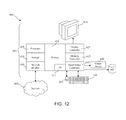
- FIG. 12 schematically represents a general purpose computerized system, suited for implementing one or more method steps as involved in embodiments of the invention.
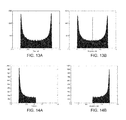
- FIGS. 13A and 13B illustrate distributions of the real and imaginary parts of matrix elements involved in a message passing algorithm used to reconstruct images; and FIGS. 14A and 14B show the real and imaginary parts, respectively, of the elements of retained after pruning of the messages.
- FIG. 1 an aspect of the invention is first described, which concerns computer-implemented methods for recovering an image. Such methods basically rely on the following steps, which are, each, implemented via one or more processors of a computerized system.
- step S 30 signal data that represent signals are accessed, step S 30 in FIG. 1 .
- step S 40 subsets of points, arranged so as to span a region of interest, are identified S 40 as current subsets of points. Note, however, that step S 40 can be performed prior, or in parallel, to step S 30 .
- an image is reconstructed S 50 , based on current subsets of points, by combining signal data associated to the current subsets of points.
- One or more signal features can then be detected S 60 , in a last image reconstructed. This detection is preferably fully automated, although it could involve inputs from a user.
- one or more subsets are modified S 70 , so as to change a number of points of the one or more subsets, i.e., to change a number of points in these subsets, and this, according to a location of said each signal feature detected.
- the relative number of points of a given subset at a given location is defined as the number of points of said given subset at the given location, and divided by the total number of points of said given subset.
- recovering the image is carried out by combining information obtained for each subset of points within a region of interest.
- the process decomposes into sub-processes which operate, each, at a subset level, the overall complexity is substantially reduced. Indeed, the computational effort to reconstruct an image increases more than linearly with the number of points.
- Intermediate image reconstruction steps are preferably carried out using approximate message passing methods in a bipartite factor graph, which are described in sect. 2. However, any image reconstruction can be contemplated at such steps.
- a remarkable advantage of the present methods is that the signal features are progressively introduced and refined while iteratively modifying the subsets of points, by changing, at each iteration, the number of points in subsets based on locations of the detected signal features.
- Increasing the whole number of points at a location of a detected feature is one way to increase the relative number of points.
- the relative number of points increases at the location of a detected feature, throughout the iterations, and for each of the modified subsets.
- the optimal approach depends on the criteria or conditions chosen. From the viewpoint of the achieved accuracy in the image reconstruction, it is, however, preferred to progressively increase the (whole) number of points per subset.
- the present methods preferably progressively increases the number of points in each of the modified subsets.
- This first class of embodiments is now described in reference to FIGS. 1, and 5-8 d .
- points are in this case progressively added S 70 to one or more of the current subsets of points.
- the points added correspond to locations of features that were detected during the previous step S 60 .
- This is illustrated using a simplified example of a 4 ⁇ 4 matrix of points ( FIG. 6 ), e.g., extracted from a region of interest ( FIG. 5 ) which in practice shall likely involve a much larger number of points.
- each subset of points is represented using distinct geometric figures, i.e., circles, triangles, rectangles and diamonds, corresponding to subsets a, b, c and d, which are otherwise separately depicted in FIGS. 6 a , 6 b , 6 c and 6 d , respectively.
- the subsets a, b, c and d preferably form disjoint subsets, which altogether span the region of interest. None of the points overlap, i.e., the points of all subsets match distinct points of said region and the subsets are initially identical under translation, as illustrated in FIGS. 6 a -6 d . This way, the initial definition of the subsets and the subsequent processing are made simpler.
- FIG. 7 illustrates the same subsets after having detected one particular signal feature in the last image reconstructed (step S 60 in FIG. 1 ).
- a given point point 9
- the detection S 60 of signal features is typically performed by scanning the current subsets of points. The detection may simply consists of selecting one or more signal intensities that exceed, each, an intensity threshold. The latter may be modified at each iteration, to refine detection, if necessary.
- present methods shall, in embodiments, and for a given detected signal feature, identify one point of a given subset, which corresponds to said given detected feature, and add one point to each of the remaining n ⁇ 1 subsets, where the added point corresponds to the location of said given detected signal feature. Still, there is no need to add points to subsets that correspond to locations for which a point was already added, so that at most one point shall be added to each subset, at each iteration. The same can be performed for each detected feature. And this process can be repeated, as necessary for an image eventually reconstructed to match a given criterion.
- Adding a point in a subset, which corresponds to a location for which no point was previously assigned results in increasing a relative number of points at said location and this, for each modified subset.
- point 17 was added S 70 to subset a, in correspondence with the location of a previously detected signal feature S 60 .
- the number of points at this location passed from 0 ( FIG. 7 a ) to 1 ( FIG. 8 a ).
- the value of the discrete distribution of points corresponding to subset a has increased at this location.
- the same process S 50 -S 70 can be performed for each previously detected features (subject to overlaps) and repeated, i.e., iterated, until the subsequently reconstructed image satisfies a given condition, S 55 .
- the intensity threshold may be changed with respect to a previous iteration.
- n disjoint (but otherwise identical) subsets and to add, for each detected feature, a point to the n ⁇ 1 subsets.
- variants can be contemplated where non-identical subsets are initially identified (which may possibly overlap) and wherein, independently, points are added to a restricted number of subsets, e.g., to the sole subsets neighboring an identified signal feature. Still, subsets of points would be modified by adding at most one point thereto.
- FIGS. 9-9 d another class of embodiments is now described in reference to FIGS. 9-9 d .
- the subsets a, b, c and d form disjoint subsets, which altogether span the region of interest, as illustrated in FIGS. 6 a -6 d .
- one particular signal feature is assumed to be detected in a last reconstructed image, as illustrated in FIGS. 7-7 d , see the blackened rectangle (point 9 ) of FIG. 7 c .
- the subsets are now modified S 70 so as to subtract points therefrom, as illustrated in FIGS. 9-9 d . In this case, each point that does not correspond to an identified feature may be considered for removal.
- both classes of embodiments can be intermingled, in still other embodiments. I.e., it might be desired to re-introduce points after having removed some, and conversely. In all cases, it is possible to modify S 65 the characteristics of the region of interest at the end of a set of iterations S 50 -S 70 .
- the signal data accessed at step S 30 may be beamformed signal data representing beamformed signals, i.e., signals that have been generated S 20 using beamforming matrices (formed by sensor steering vectors), from signals collected S 10 by arrays of elements, as known per se from beamforming techniques. It is nevertheless possible to modify beamforming parameters and image resolution based on information obtained at the end of a set of iterations S 50 -S 70 , see step S 65 in FIG. 1 . This allows to change characteristics of the region of interest.
- the last reconstructed image may be analyzed S 80 , to detect one or more signal features therein. Then, based on an outcome of this analysis, the sensor steering vectors, which in embodiments determine the matrices used for beamforming, may be instructed S 90 to be changed, so as to generate new beamformed signal data, S 30 . After that, another set of iterations S 50 -S 70 can be performed, as necessary for a subsequently reconstructed image to satisfy S 100 a given condition, which condition may have changed with respect to the previous set of iterations.
- the sensor steering vectors may notably be changed S 90 to generate new beamformed signal data that correspond to, e.g., a modified size of the region of interest and/or a modified resolution of this region.
- the present methods can be applied to radio interferometry, i.e., the beamformed signals are signals received from arrays of antennas 211 , the arrays corresponding to antenna stations 210 .
- a correlator unit 220 is typically involved, which receives (i.e., step S 30 in FIG. 1 ) the beamformed signal data from the arrays 210 and compute a correlation matrix therefrom.
- the correlation matrix comprises the signal data representing the signals, to be subsequently processed by the image reconstruction unit 230 .
- the present methods may, in other embodiments, be applied to beamformed signals received from radiofrequency coils 311 , 312 of a magnetic resonance imaging hardware 311 - 324 .
- the arrays of receiving elements correspond to sets of radiofrequency coils (only one such set is depicted in FIG. 3 , for simplicity).
- the beamformed signals received may be signals from arrays of ultrasound sensors and the image data obtained may be used to reconstruct an ultrasound image.
- the signal samples provided by the receiving elements may, in variants, be directly mapped to the measurement nodes.
- the signal samples initially obtained from the receiving elements may be subject to any suitable pre-processing before being mapped to the measurement nodes.
- the image reconstruction units 230 , 330 of FIGS. 2, 3 can be (functional) parts of a computerized system 600 , such as depicted in FIG. 12 .
- the invention can be embodied as such a system, the latter essentially comprising one or more processing units 605 and a memory 610 .
- the memory is equipped with suitable computerized methods, which are configured for implementing at least some of the steps described earlier (and notably steps S 30 -S 100 ).
- the invention may otherwise be embodied as a computer program product, having a computer readable storage medium with program instructions embodied therewith, the instructions executable by a system such as system 600 to cause to implement the same steps.
- Modern large-scale radio telescope arrays use antenna stations composed of multiple antennas that are closely placed for imaging the sky.
- the signals received by the antennas at a station are combined by beamforming to reduce the amount of data to be processed in the later stages.
- beamforming at antenna stations is typically done by conjugate matched beamforming towards the center of the field of view at all antenna stations. Random beamforming techniques have also been also proposed.
- the signals transmitted by the stations are then correlated to obtain so called visibilities, which roughly correspond to the samples of the Fourier transform of the sky image.
- the reconstruction of the sky image is thus obtained from the inverse Fourier transform of the entire collection of visibility measurements.
- MRI magnetic resonance imaging
- NMR nuclear magnetic resonance
- ⁇ V k ⁇ is a sequence of M ⁇ N measurement matrices, which in general are time varying, and depend on the system physical characteristics.
- the vector s is an N ⁇ 1 vector, whose elements are the amplitudes of hypothetical point signal sources that are located in a given region
- ⁇ k ⁇ is a sequence of M ⁇ 1 measurement noise vectors, modeled as additive white Gaussian noise vectors.
- the dimension M is in general a function of the number m of sensors and L of stations in the array, and of the dimensions of the beamforming matrices.
- the region where the signal sources are located is usually defined as the field of view for 2D imaging or, more generally, as the region of interest.
- BP Basis Pursuit
- BPDN Basis Pursuit De-Noising
- LASSO Least Absolute Shrinkage and Selection Operator
- Bayesian techniques are typically considered. Very often used in practice are techniques leading to image reconstruction by maximization of the posterior probability density function (pdf) p(s
- s), j 1, . . . , M, in the posterior pdf.
- LBP loopy belief propagation
- AMP Approximate message passing
- the AMP algorithm can be equivalently formulated as an iterative thresholding algorithm, thus providing the reconstruction power of the BP and BPDN approaches when sparsity of the solution can be assumed.
- the vector s of hypothetical signal sources entails a large number of elements, especially in the case the region of interest is very large, or images with high resolution are required. For example, sky images with as many as 10 8 pixels are required for specific astronomical investigations. In such cases, the memory and computational requirements for the implementation of algorithms (even with very low complexity, such as the AMP algorithm) become extremely challenging.
- a novel method is presented below for image recovery from signals received by sensor arrays in several application fields, including medical imaging and radio interferometry, based on the iterative scanning of a region of interest. Scanning is achieved by subdividing the region of interest into subsets of points on a grid, applying beamforming to focus on the points of each of the subsets in sequence, and extracting information about source intensities from each subset. The overall image is reconstructed by combining the information recovered from each subset, as described in sect. 1.
- a modified AMP algorithm over a factor graph connecting source intensity nodes and measurement nodes is preferably used to recover (with low computational effort) the intensities associated with sources located at each subset.
- the subsets may be modified to achieve two goals: first, a subset may be augmented with points corresponding to sources identified in previous iterations, to reduce the level of background clutter; second, one or more subsets may be defined on a finer grid to achieve a better image resolution in a portion of the region of interest.
- One advantage of the specific embodiments discussed here is the remarkable reduction of the memory and computational requirements, in comparison to prior-art methods known to the present inventors.
- a further advantage is the capability of efficiently achieving different image resolution in different portions of the region of interest.
- Another advantage is the inclusion of the above iterative imaging technique in a feedback loop, where the information retrieved at the end of a scanning iteration is processed to determine subsets of points in the next iteration that are found to be relevant for the investigation of the region of interest, as discussed in the previous section.
- image reconstruction in radio interferometry is considered.
- a radio interferometer with L antenna stations, where the i-th station comprises L i antennas.
- the antennas receive narrow-band signals centered at the frequency ⁇ 0 .
- a ( i ) ⁇ ( r q ) ( e - j ⁇ ⁇ 2 ⁇ ⁇ ⁇ p 1 ( i ) , r q > ⁇ e - j ⁇ ⁇ 2 ⁇ ⁇ ⁇ ⁇ ⁇ p L i ( i ) , r q ⁇ ) , ( 3 )
- ⁇ p,r> denotes the inner product between the vectors p and r.
- Beamforming at i-th station is equivalent to a linear transformation of the signal x (i) by a beamforming matrix denoted by W (i) , with dimensions L i ⁇ M i , where M i is the number of beamforms used at that station.
- W H denotes the conjugate transpose of the matrix (or vector) W.
- ⁇ s diag(s 1 2 , s 2 2 , . . . , s Q 2 ), plus measurement noise arising from the antenna noise.
- an estimate of R is obtained from a finite number of samples. Therefore an additional disturbance may need to be taken into account, which arises from the deviation from the ideal values of both the correlation matrix estimates ⁇ circumflex over ( ⁇ ) ⁇ s of the source intensities and ⁇ circumflex over ( ⁇ ) ⁇ ⁇ (i) of the antenna noise signals.
- the embodiments discussed in this section are based on the following model of image formation.
- the imaging region referred to as the region of interest, is first subdivided into a collection of hypothetical intensity sources at arbitrary positions, corresponding to the points on a grid in the region of interest. Finer grids yield finer final image resolution, but entail higher computational cost.
- M ⁇ tilde over (M) ⁇ beamforms are used at each of the L stations
- M ⁇ tilde over (M) ⁇ L( ⁇ tilde over (M) ⁇ L+1)/2
- N is the number of points in the grid in the region of interest.
- ⁇ 1 ⁇ 2 ⁇ ⁇ K ( V 1 V 2 ⁇ V K ) ⁇ s + ( ⁇ ⁇ 1 ⁇ ⁇ 2 ⁇ ⁇ ⁇ K ) ( 8 )
- V k is the matrix of responses of point sources with unit intensity that are positioned on the assumed grid in the region of interest
- ⁇ tilde over ( ⁇ ) ⁇ k is the vector of augmented measurement noise terms, modeled as i.i.d. Gaussian random variables having zero mean and variance ⁇ tilde over ( ⁇ ) ⁇ 2
- s is the vector of intensities of hypothetical sources that are located at the grid points of the region of interest.
- the expression (8) poses the problem of image reconstruction in radio interferometry in the form given by (1), thus enabling the application of an AMP algorithm.
- a preferred method is based on the iterative scanning of the fine grid defined over the region of interest.
- scanning is achieved by subdividing the region of interest into a set I (j) of subsets of points on the grid, not necessarily uniform, and extracting information about source intensities in each subset in sequence.
- each matrix W (l,i,j) is formed by randomly selecting ⁇ tilde over (M) ⁇ columns from A (l,i,j) , without repeating the selection of a column corresponding to a direction vector for a certain point in the grid, until all points in the grid have been selected at least once.
- N ( i,j ) ⁇ tilde over (M) ⁇ L.
- the AMP algorithm is applied over the factor graph of FIG. 4 , where the variable nodes are the source intensities and the function nodes represent the measurements obtained from the correlation samples over K STI intervals as expressed in (8). To further reduce memory and computational requirements, the measurements obtained by one STI interval at a time are considered. Let us then consider the application of the AMP algorithm used to extract information about the hypothetical source intensities at the points in the i-th subset during the j-th scanning iteration, ⁇ (i,j), at the k-th STI interval. The estimation of the source intensities ⁇ (i,j) would ideally require to compute the posterior pdf
- MMSE minimum mean-square-error
- the procedure continues over the K STI intervals, until the AMP algorithm is applied within the K-th STI interval, leading to the final MMSE estimate of s n (i,j) , expressed by ⁇ K,n L+1 .
- the AMP algorithm yields the true posterior means, in the limit M, N ⁇ , provided the ratio M/N is fixed, and assuming the elements of V k (i,j) are i.i.d. Gaussian random variables.
- the two following modifications of the considered AMP algorithm are preferably introduced to obviate the above mentioned limitations.
- Pruning As in the considered applications the condition M>>N is usually satisfied, sufficient flow of information within the factor graph is achieved if some of the messages going from the function nodes to the variable nodes are pruned.
- the objective of the pruning is to allow only a subset of the messages ⁇ v g k,m ⁇ n l (s n (i,j) ) ⁇ to be considered for the computation of the estimate of s (i,j) , such that the distribution of the coefficients of the matrix V k (i,j) , which correspond to the allowed connections in the factor graph, is approximately Gaussian.
- the modified AMP algorithm is applied to obtain estimates ⁇ (1,j) , . . . , ⁇ (N(I (j) ),j ) ⁇ at the j-th scanning iteration for the hypothetical point source variables in each of the N(I (j) ) subsets from the observations ⁇ k , spanning K STI intervals.
- N(I (j) ) possibly by averaging estimates of intensities at points that belong to more than one subset ⁇ (i,j), thus completing the j-th iteration of the scanning beamforming method.
- the presence of sources at points of the grid is detected by a threshold operation on the elements of the vector ⁇ (j) .
- the process terminates.
- the present image recovery technique based on iterative scanning beamforming may be included in a feedback loop, where the information retrieved at the end of an iteration is processed to determine subsets of points in the next iteration, which are relevant for the investigation of the region of interest.
- the variance of the measurement noise ⁇ ⁇ (i) is assumed equal to 100.
- the field of view is subdivided into a collection of hypothetical intensity sources at arbitrary positions, corresponding to the uniformly distributed points on a 100 ⁇ 100 grid.
- the subsets are uniformly chosen within the 100 ⁇ 100 grid, i.e., the points in each subset are uniformly distributed over a 10 ⁇ 10 grid, with minimum distance between points that is 10 times the minimum distance between points in the fine grid.
- the estimation of the source intensities for the points of each subset is achieved by the modified AMP algorithm described above. For the estimation of the source intensities within each subset, samples collected over one STI interval are considered, with 32 iterations of the modified AMP algorithm.
- the matrices V k (i,j) in (8) are assumed to be constant over k.
- the time varying characteristic of the antenna steering vectors, and hence of the matrices V k (i,j) needs to be taken into account.
- the modified AMP algorithm is implemented. Therefore random permutation of the function nodes is applied in the factor graph at each message passing iteration. Furthermore, pruning of selected messages going from the function nodes to the variable nodes is also adopted to approximate a Gaussian distribution of the elements of the matrices V k (i,j) .
- a coarse approximation of the desired distribution is achieved by pruning a message from a function node to a variable node if the following condition on the (n,m)-th element v k,m,n (i,j) of the matrix V k (i,j) is not satisfied: Re ⁇ v k,m,n (i,j) ⁇ 0.1 Im ⁇ v k,m,n (i,j) ⁇ > ⁇ 0.1. (15)
- FIGS. 13A and 13B illustrate a typical distribution of the real and imaginary parts, respectively, of the elements of a matrix V k (i,j)
- FIGS. 14A and 14B show the real and imaginary parts, respectively, of the elements of V k (i,j) that are retained after pruning of the messages (thus effectively contributing to the modified AMP algorithm), which amount to about one fourth of the total number of the elements of V k (i,j)
- the final reconstructed image is obtained after three scanning iterations.
- the reconstructed images after each iteration are shown in FIG. 10 a to 10 c , respectively.
- the threshold is set at 1.4, corresponding to about one half the amplitude of the strongest detected source, which leads to the detection of the three strongest sources.
- each subset is augmented to include the three points corresponding to the detected sources, in order to reduce the clutter in the recovered information.
- the threshold is set at 0.6, corresponding to about one fourth the amplitude of the strongest detected source, which leads to the detection of the five strongest sources.
- each subset is then augmented to include the five points corresponding to the five detected sources.
- FIG. 10 d The superposition of the target sky image and the reconstructed sky image after the third scanning iteration is shown in FIG. 10 d .
- the 3-D mesh surfaces of the noiseless target sky and the reconstructed image from noisy signals are shown in FIGS. 11 a and 11 b , respectively, to allow a comparison of the target and estimated intensities of the point sources in the 100 ⁇ 100 grid.
- image reconstruction in magnetic resonance systems is considered.
- MRI and NMR spectroscopy with scaled-down components are considered, because of their numerous non-invasive medical applications, e.g., for point-of-care diagnostics, with small permanent magnets providing up to 1.5 T magnetic fields, which replace large and expensive superconductive magnets generating fields in excess of 10 T, up to 11 T.
- emf electromotive force
- E ⁇ ( t ) - ⁇ V ⁇ ⁇ ⁇ B N ⁇ ( r ) , M ⁇ ( r , t ) ⁇ ⁇ t ⁇ ⁇ d ⁇ ⁇ V ( 16 )
- M(r,t) is the magnetic moment originated by the static magnetization field B 0 in the sample volume V
- B N (r) denotes the magnetic coupling between the sample and the coil, defined as the magnetic field generated by the current of 1 A in the coil at point r in space.
- a main challenge for the extraction of 3-D imaging information in MR systems with small permanent magnets stems from the non-uniform static magnetic fields that are obtained.
- non-uniformity of the static magnetic field has two undesired consequences.
- a sample containing magnetic dipoles e.g., protons with resonance frequency of 42.58 MHz/T, exhibits a wide range of coordinate-dependent resonance frequencies when placed in such a field.
- the transversal relaxation of the dipoles becomes extremely short, resulting in a fast decaying MR signal, in non-uniform magnetic fields.
- Typical resonance frequencies for medical applications with static magnetic fields of about 1 T are in the range from 5 to 50 MHz, with decay maximum rates of about 0.1 ms, requiring a detection bandwidth in excess of 10 kHz to capture a signal before de-phasing. Therefore an MR transceiver for such applications generates wideband excitation signals that are sent to one or more excitation coils 311 ( FIG.
- ⁇ ( k ) ⁇ ( t , r 0 ) - ⁇ ⁇ B N ( k ) ⁇ ( r 0 ) , M N ⁇ ( r 0 , t ) ⁇ ⁇ t ⁇ s ⁇ ( r 0 ) ⁇ ⁇ ⁇ ⁇ V , ( 17 )
- M N (r 0 , t) denotes the normalized magnetic moment
- s(r 0 ) the magnetic dipole density at r 0 .
- the signal ⁇ (k) (t,r 0 ) is narrowband if ⁇ V is small compared to the magnetic gradient in its volume.
- the imaging problem is thus formulated as finding the distribution of the magnetic dipole density s(r) within the region of interest, which is subdivided into the N volumes ⁇ V 1 , . . . , ⁇ V N , centered around the grid points r 1 , . . . , r N . Recalling that at the k-th measurement the magnetic spectrum response is observed at the output of J subchannels centered at the frequencies ⁇ 1 , . . . , ⁇ J , the following linear system is obtained
- E 1 ( k ) E 2 ( k ) ⁇ E J ( k ) ) ( f 1 , 1 ( k ) f 1 , 2 ( k ) ... f 1 , N ( k ) f 2 , 1 ( k ) f 2 , 2 ( k ) ... f 2 , N ( k ) ⁇ ⁇ ⁇ ⁇ f J , 1 ( k ) f J , 2 ( k ) ... f J , N ( k ) ) ⁇ ( s ⁇ ( r 1 ) s ⁇ ( r 2 ) ⁇ s ⁇ ( r N ) ) + ( ⁇ 1 ( k ) ⁇ 2 ( k ) ⁇ ⁇ J ( k ) ) ( 18 )
- E j (k) denotes the amplitude of the induced signal at the j-th subchannel output
- ⁇ j (k) is the corresponding
- f j , n ( k ) ⁇ - ⁇ ⁇ B N ( k ) ⁇ ( r n ) , M N ⁇ ( r n , t ) ⁇ ⁇ t ⁇ ⁇ ⁇ ⁇ V n , if ⁇ ⁇ ⁇ j - ⁇ ⁇ ⁇ ⁇ ⁇ B 0 ⁇ ( r n ) ⁇ ⁇ ⁇ j + ⁇ 0 otherwise . ( 19 )
- the posterior on s n (i,j) i.e., p l+1 (s n (i,j) )
- Computerized devices can be suitably designed for implementing embodiments of the present invention as described herein.
- the methods described herein are largely non-interactive and automated.
- the methods described herein can be implemented either in an interactive, partly-interactive or non-interactive system.
- the methods described herein can be implemented in software (e.g., firmware), hardware, or a combination thereof.
- the methods described herein are implemented in software, as an executable program, the latter executed by suitable digital processing devices. More generally, embodiments of the present invention can be implemented wherein general-purpose digital computers, such as personal computers, workstations, etc., are used.
- the system 600 depicted in FIG. 12 schematically represents a computerized unit 601 , e.g., a general-purpose computer.
- the unit 601 includes a processor 605 , memory 610 coupled to a memory controller 615 , and one or more input and/or output (I/O) devices 640 , 645 , 650 , 655 (or peripherals) that are communicatively coupled via a local input/output controller 635 .
- the input/output controller 635 can be, but is not limited to, one or more buses or other wired or wireless connections, as is known in the art.
- the input/output controller 635 may have additional elements, which are omitted for simplicity, such as controllers, buffers (caches), drivers, repeaters, and receivers, to enable communications. Further, the local interface may include address, control, and/or data connections to enable appropriate communications among the aforementioned components.
- the processor 605 is a hardware device for executing software, particularly that stored in memory 610 .
- the processor 605 can be any custom made or commercially available processor, a central processing unit (CPU), an auxiliary processor among several processors associated with the computer 601 , a semiconductor based microprocessor (in the form of a microchip or chip set), or generally any device for executing software instructions.
- the memory 610 can include any one or combination of volatile memory elements (e.g., random access memory) and nonvolatile memory elements. Moreover, the memory 610 may incorporate electronic, magnetic, optical, and/or other types of storage media. Note that the memory 610 can have a distributed architecture, where various components are situated remote from one another, but can be accessed by the processor 605 .
- the software in memory 610 may include one or more separate programs, each of which comprises an ordered listing of executable instructions for implementing logical functions.
- the software in the memory 610 includes methods described herein in accordance with exemplary embodiments and a suitable operating system (OS) 611 .
- the OS 611 essentially controls the execution of other computer programs, and provides scheduling, input-output control, file and data management, memory management, and communication control and related services.
- the methods described herein may be in the form of a source program, executable program (object code), script, or any other entity comprising a set of instructions to be performed.
- the program When in a source program form, then the program needs to be translated via a compiler, assembler, interpreter, or the like, as known per se, which may or may not be included within the memory 610 , so as to operate properly in connection with the OS 611 .
- the methods can be written as an object oriented programming language, which has classes of data and methods, or a procedure programming language, which has routines, subroutines, and/or functions.
- a conventional keyboard 650 and mouse 655 can be coupled to the input/output controller 635 .
- Other I/O devices 640 - 655 may include other hardware devices.
- the I/O devices 640 - 655 may further include devices that communicate both inputs and outputs.
- the system 600 can further include a display controller 625 coupled to a display 630 .
- the system 600 can further include a network interface or transceiver 660 for coupling to a network 665 .
- the network 665 transmits and receives data between the unit 601 and external systems.
- the network 665 is possibly implemented in a wireless fashion, e.g., using wireless protocols and technologies, such as WiFi, WiMax, etc.
- the network 665 may be a fixed wireless network, a wireless local area network (LAN), a wireless wide area network (WAN) a personal area network (PAN), a virtual private network (VPN), intranet or other suitable network system and includes equipment for receiving and transmitting signals.
- LAN wireless local area network
- WAN wireless wide area network
- PAN personal area network
- VPN virtual private network
- the network 665 can also be an IP-based network for communication between the unit 601 and any external server, client and the like via a broadband connection.
- network 665 can be a managed IP network administered by a service provider.
- the network 665 can be a packet-switched network such as a LAN, WAN, Internet network, etc.
- the software in the memory 610 may further include a basic input output system (BIOS).
- BIOS is stored in ROM so that the BIOS can be executed when the computer 601 is activated.
- the processor 605 When the unit 601 is in operation, the processor 605 is configured to execute software stored within the memory 610 , to communicate data to and from the memory 610 , and to generally control operations of the computer 601 pursuant to the software.
- the methods described herein and the OS 611 in whole or in part are read by the processor 605 , typically buffered within the processor 605 , and then executed.
- the methods described herein are implemented in software, the methods can be stored on any computer readable medium, such as storage 620 , for use by or in connection with any computer related system or method.
- the present invention may be a system, a method, and/or a computer program product.
- the computer program product may include a computer readable storage medium (or media) having computer readable program instructions thereon for causing a processor to carry out aspects of the present invention.
- the computer readable storage medium can be a tangible device that can retain and store instructions for use by an instruction execution device.
- the computer readable storage medium may be, for example, but is not limited to, an electronic storage device, a magnetic storage device, an optical storage device, an electromagnetic storage device, a semiconductor storage device, or any suitable combination of the foregoing.
- a non-exhaustive list of more specific examples of the computer readable storage medium includes the following: a portable computer diskette, a hard disk, a random access memory (RAM), a read-only memory (ROM), an erasable programmable read-only memory (EPROM or Flash memory), a static random access memory (SRAM), a portable compact disc read-only memory (CD-ROM), a digital versatile disk (DVD), a memory stick, a floppy disk, a mechanically encoded device such as punch-cards or raised structures in a groove having instructions recorded thereon, and any suitable combination of the foregoing.
- RAM random access memory
- ROM read-only memory
- EPROM or Flash memory erasable programmable read-only memory
- SRAM static random access memory
- CD-ROM compact disc read-only memory
- DVD digital versatile disk
- memory stick a floppy disk
- a mechanically encoded device such as punch-cards or raised structures in a groove having instructions recorded thereon
- a computer readable storage medium is not to be construed as being transitory signals per se, such as radio waves or other freely propagating electromagnetic waves, electromagnetic waves propagating through a waveguide or other transmission media (e.g., light pulses passing through a fiber-optic cable), or electrical signals transmitted through a wire.
- Computer readable program instructions described herein can be downloaded to respective computing/processing devices from a computer readable storage medium or to an external computer or external storage device via a network, for example, the Internet, a local area network, a wide area network and/or a wireless network.
- the network may comprise copper transmission cables, optical transmission fibers, wireless transmission, routers, firewalls, switches, gateway computers and/or edge servers.
- a network adapter card or network interface in each computing/processing device receives computer readable program instructions from the network and forwards the computer readable program instructions for storage in a computer readable storage medium within the respective computing/processing device.
- Computer readable program instructions for carrying out operations of the present invention may be assembler instructions, instruction-set-architecture (ISA) instructions, machine instructions, machine dependent instructions, microcode, firmware instructions, state-setting data, or either source code or object code written in any combination of one or more programming languages, including an object oriented programming language such as Smalltalk, C++ or the like, and conventional procedural programming languages, such as the C programming language or similar programming languages.
- the computer readable program instructions may execute entirely on the user's computer, partly on the user's computer, as a stand-alone software package, partly on the user's computer and partly on a remote computer or entirely on the remote computer or server.
- the remote computer may be connected to the user's computer through any type of network, including a local area network (LAN) or a wide area network (WAN), or the connection may be made to an external computer (for example, through the Internet using an Internet Service Provider).
- electronic circuitry including, for example, programmable logic circuitry, field-programmable gate arrays (FPGA), or programmable logic arrays (PLA) may execute the computer readable program instructions by utilizing state information of the computer readable program instructions to personalize the electronic circuitry, in order to perform aspects of the present invention.
- These computer readable program instructions may be provided to a processor of a general purpose computer, special purpose computer, or other programmable data processing apparatus to produce a machine, such that the instructions, which execute via the processor of the computer or other programmable data processing apparatus, create means for implementing the functions/acts specified in the flowchart and/or block diagram block or blocks.
- These computer readable program instructions may also be stored in a computer readable storage medium that can direct a computer, a programmable data processing apparatus, and/or other devices to function in a particular manner, such that the computer readable storage medium having instructions stored therein comprises an article of manufacture including instructions which implement aspects of the function/act specified in the flowchart and/or block diagram block or blocks.
- the computer readable program instructions may also be loaded onto a computer, other programmable data processing apparatus, or other device to cause a series of operational steps to be performed on the computer, other programmable apparatus or other device to produce a computer implemented process, such that the instructions which execute on the computer, other programmable apparatus, or other device implement the functions/acts specified in the flowchart and/or block diagram block or blocks.
- each block in the flowchart or block diagrams may represent a module, segment, or portion of instructions, which comprises one or more executable instructions for implementing the specified logical function(s).
- the functions noted in the block may occur out of the order noted in the figures.
- two blocks shown in succession may, in fact, be executed substantially concurrently, or the blocks may sometimes be executed in the reverse order, depending upon the functionality involved.
Landscapes
- Engineering & Computer Science (AREA)
- Remote Sensing (AREA)
- Radar, Positioning & Navigation (AREA)
- Physics & Mathematics (AREA)
- General Physics & Mathematics (AREA)
- Electromagnetism (AREA)
- Computer Networks & Wireless Communication (AREA)
- Theoretical Computer Science (AREA)
- Magnetic Resonance Imaging Apparatus (AREA)
Abstract
Description
-
- They provide higher accuracy and lower computational requirements over imaging methods such as based on gridding and discrete Fourier transforms;
- They further enable imaging also for fast time-varying phenomena; and
- Finally, and where beamforming techniques are involved, embodiments described below make it possible to modify beamforming and image resolution based on information obtained at the end of a set of iterations.
ρk =V k s+η k, (1)
where {ρk} is a sequence of M×1 data vectors, which are obtained at the measurement time instants kT, k=0, 1, . . . , K, {Vk} is a sequence of M×N measurement matrices, which in general are time varying, and depend on the system physical characteristics. The vector s is an N×1 vector, whose elements are the amplitudes of hypothetical point signal sources that are located in a given region, and {ηk} is a sequence of M×1 measurement noise vectors, modeled as additive white Gaussian noise vectors. The dimension M is in general a function of the number m of sensors and L of stations in the array, and of the dimensions of the beamforming matrices. The region where the signal sources are located is usually defined as the field of view for 2D imaging or, more generally, as the region of interest.
x q (i) =a (i)(r q)s q (2)
where a(i)(rq) is the Li×1 antenna array steering vector for the i-th station and direction rq, given by
where <p,r> denotes the inner product between the vectors p and r. Assuming there are Q point sources in the sky, by expressing the signals emitted by the sources as a complex vector sq with dimension Q×1, the overall signal received at the i-th antenna station is given by
x (i) =A (i)(r q)s q+η(i), (4)
where the matrix A(i) with dimensions Li×Q is formed by the column vectors a(i)(rq), q=1, . . . Q, and η(i) denotes the noise vector at the i-th antenna.
x b (i) =W (i)H x (i) =W (i)H(A (i) s q+η(i)), (5)
where WH denotes the conjugate transpose of the matrix (or vector) W. The expected value of the correlator output that uses the beamformed signals from the L stations to produce the visibilities for image reconstruction is given by
where R(i,j) denotes the Mi×Mj, correlation matrix between xb (i) and xb (i), expressed as
R (i,j) =W (i)H(A (i)Σs A (j)H+Ση (i,j))W (j) (7)
and where, in the assumption of independent Gaussian sources generating the received signals and independent Gaussian antenna noise signals, the correlation matrix of the signals emitted by the sources Es is a Q×Q diagonal matrix, and the correlation matrix of the noise signals Ση (i,j)=δ(i,j)Ση (i), where δ(i,j) denotes the Kronecker delta, is a nonzero Li× Li diagonal matrix for i=j, and a zero Li×Lj matrix otherwise. A block diagram of a radio interferometer with L stations and beamforming matrices is shown in
where for the k-th STI ρk denotes the vector of correlation samples, Vk is the matrix of responses of point sources with unit intensity that are positioned on the assumed grid in the region of interest, {tilde over (η)}k is the vector of augmented measurement noise terms, modeled as i.i.d. Gaussian random variables having zero mean and variance {tilde over (σ)}2, and s is the vector of intensities of hypothetical sources that are located at the grid points of the region of interest.
where the vectors s(i,j) of intensities of hypothetical sources satisfy the condition
N(i,j)={tilde over (M)}L. (11)
where
p(ρk,m |s (i,j))≡g k,m(s (i,j) ∝N(ρk,m ;v k,m (i,j)T s (i,j),{tilde over (σ)}2), (13)
where N(x; m, σ2) denotes a Gaussian distribution with mean m and variance σ2, and vk,m (i,j)T is the m-th row of the matrix Vk (i,j). The prior probability of the source intensities at the first STI interval is assumed to have a Bernoulli—Log Normal distribution, that is,
p 1(s n (i,j))=λG(s n (i,j);μs,σ2)+(1−λ)δ(s n (i,j)),λ>0, (14)
with G(x; m, σ2) denoting a Log Normal distribution with mean m and variance σ2. The computation of the minimum mean-square-error (MMSE) estimates of the source intensities μk,n l and their variances χk,n l at the l-th iteration of the AMP algorithm within the k-th STI interval is described in detail in the Appendix subsection.
Re{v k,m,n (i,j)}<0.1

where M(r,t) is the magnetic moment originated by the static magnetization field B0 in the sample volume V, and BN(r) denotes the magnetic coupling between the sample and the coil, defined as the magnetic field generated by the current of 1 A in the coil at point r in space.
where MN (r0, t) denotes the normalized magnetic moment, and s(r0) the magnetic dipole density at r0. The signal ϵ(k)(t,r0) is narrowband if ΔV is small compared to the magnetic gradient in its volume. The center frequency is located around the resonance frequency at r0, expressed as ω(r0)=γ|B0(r0)|, where γ denotes the gyromagnetic ratio. The imaging problem is thus formulated as finding the distribution of the magnetic dipole density s(r) within the region of interest, which is subdivided into the N volumes ΔV1, . . . , ΔVN, centered around the grid points r1, . . . , rN. Recalling that at the k-th measurement the magnetic spectrum response is observed at the output of J subchannels centered at the frequencies ω1, . . . , ωJ, the following linear system is obtained
where Ej (k) denotes the amplitude of the induced signal at the j-th subchannel output, ηj (k) is the corresponding measurement noise, and the function ƒj,n (k) is defined as
E (k) =F (k) s+η, (20)
which reflects the general expression (1), enabling the application of the present method.
yields
where, in general, at the k-th STI interval
are given by
where {circumflex over (σ)}s,k 2 denotes the variance of the prior distribution of the source intensities at the k-th STI interval. After the l-th iteration of the AMP algorithm within the k-th STI interval, the posterior on sn (i,j), i.e., pl+1(sn (i,j))|ρk (i,j)), is estimated as
whose mean and variance determine the l-th iteration MMSE estimate of sn (i,j) and its variance, respectively. Observing (A9) and (A4), these MMSE estimates become
Claims (25)
Priority Applications (1)
| Application Number | Priority Date | Filing Date | Title |
|---|---|---|---|
| US14/878,886 US10102649B2 (en) | 2015-10-08 | 2015-10-08 | Iterative image subset processing for image reconstruction |
Applications Claiming Priority (1)
| Application Number | Priority Date | Filing Date | Title |
|---|---|---|---|
| US14/878,886 US10102649B2 (en) | 2015-10-08 | 2015-10-08 | Iterative image subset processing for image reconstruction |
Publications (2)
| Publication Number | Publication Date |
|---|---|
| US20170103549A1 US20170103549A1 (en) | 2017-04-13 |
| US10102649B2 true US10102649B2 (en) | 2018-10-16 |
Family
ID=58499799
Family Applications (1)
| Application Number | Title | Priority Date | Filing Date |
|---|---|---|---|
| US14/878,886 Active 2037-04-14 US10102649B2 (en) | 2015-10-08 | 2015-10-08 | Iterative image subset processing for image reconstruction |
Country Status (1)
| Country | Link |
|---|---|
| US (1) | US10102649B2 (en) |
Families Citing this family (8)
| Publication number | Priority date | Publication date | Assignee | Title |
|---|---|---|---|---|
| US10049449B2 (en) * | 2015-09-21 | 2018-08-14 | Shanghai United Imaging Healthcare Co., Ltd. | System and method for image reconstruction |
| US10102649B2 (en) * | 2015-10-08 | 2018-10-16 | International Business Machines Corporation | Iterative image subset processing for image reconstruction |
| US10217249B2 (en) * | 2015-10-08 | 2019-02-26 | International Business Machines Corporation | Image reconstruction using approximate message passing methods |
| US10773093B2 (en) * | 2017-05-29 | 2020-09-15 | Elegant Mathematics LLC | Real-time methods for magnetic resonance spectra acquisition, imaging and non-invasive ablation |
| US11536828B2 (en) | 2018-02-21 | 2022-12-27 | Board Of Trustees Of Michigan State University | Methods and systems for distributed radar imaging |
| US11244481B2 (en) | 2018-09-14 | 2022-02-08 | Nview Medical Inc. | Multi-scale image reconstruction of three-dimensional objects |
| CN110335256A (en) * | 2019-06-18 | 2019-10-15 | 广州智睿医疗科技有限公司 | A kind of pathology aided diagnosis method |
| JP7829815B1 (en) * | 2024-12-09 | 2026-03-13 | 三菱電機株式会社 | Signal processing device, signal processing method, and radar device |
Citations (8)
| Publication number | Priority date | Publication date | Assignee | Title |
|---|---|---|---|---|
| US6719696B2 (en) | 1999-11-24 | 2004-04-13 | Her Majesty The Queen In Right Of Canada As Represented By The Minister Of National Defence | High resolution 3D ultrasound imaging system deploying a multi-dimensional array of sensors and method for multi-dimensional beamforming sensor signals |
| US7085405B1 (en) * | 1997-04-17 | 2006-08-01 | Ge Medical Systems Israel, Ltd. | Direct tomographic reconstruction |
| US20130204114A1 (en) | 2010-06-28 | 2013-08-08 | Ming-Xiong Huang | Enhanced multi-core beamformer algorithm for sensor array signal processing |
| US8761477B2 (en) | 2005-09-19 | 2014-06-24 | University Of Virginia Patent Foundation | Systems and method for adaptive beamforming for image reconstruction and/or target/source localization |
| US8818064B2 (en) | 2009-06-26 | 2014-08-26 | University Of Virginia Patent Foundation | Time-domain estimator for image reconstruction |
| US9033884B2 (en) | 2011-10-17 | 2015-05-19 | Butterfly Network, Inc. | Transmissive imaging and related apparatus and methods |
| US20170103549A1 (en) * | 2015-10-08 | 2017-04-13 | International Business Machines Corporation | Iterative image subset processing for image reconstruction |
| US9801591B2 (en) * | 2013-11-01 | 2017-10-31 | Lickenbrock Technologies, LLC | Fast iterative algorithm for superresolving computed tomography with missing data |
-
2015
- 2015-10-08 US US14/878,886 patent/US10102649B2/en active Active
Patent Citations (8)
| Publication number | Priority date | Publication date | Assignee | Title |
|---|---|---|---|---|
| US7085405B1 (en) * | 1997-04-17 | 2006-08-01 | Ge Medical Systems Israel, Ltd. | Direct tomographic reconstruction |
| US6719696B2 (en) | 1999-11-24 | 2004-04-13 | Her Majesty The Queen In Right Of Canada As Represented By The Minister Of National Defence | High resolution 3D ultrasound imaging system deploying a multi-dimensional array of sensors and method for multi-dimensional beamforming sensor signals |
| US8761477B2 (en) | 2005-09-19 | 2014-06-24 | University Of Virginia Patent Foundation | Systems and method for adaptive beamforming for image reconstruction and/or target/source localization |
| US8818064B2 (en) | 2009-06-26 | 2014-08-26 | University Of Virginia Patent Foundation | Time-domain estimator for image reconstruction |
| US20130204114A1 (en) | 2010-06-28 | 2013-08-08 | Ming-Xiong Huang | Enhanced multi-core beamformer algorithm for sensor array signal processing |
| US9033884B2 (en) | 2011-10-17 | 2015-05-19 | Butterfly Network, Inc. | Transmissive imaging and related apparatus and methods |
| US9801591B2 (en) * | 2013-11-01 | 2017-10-31 | Lickenbrock Technologies, LLC | Fast iterative algorithm for superresolving computed tomography with missing data |
| US20170103549A1 (en) * | 2015-10-08 | 2017-04-13 | International Business Machines Corporation | Iterative image subset processing for image reconstruction |
Non-Patent Citations (3)
| Title |
|---|
| Basarab et al., "Medical ultrasound image reconstruction using distributed compressive sampling", 2013 IEEE 10th International Symposium on Biomedical Imaging (ISBI); San Francisco, CA, Apr. 7-11, 2013, pp. 628-631; http://ieeexplore.ieee.org/xpl/login.jsp?tp=&arnumber=6556553&url=http%3A%2F%2Fieeexplore.ieee.org%2Fxpls% 2Fabs_all.jsp%3Farnumber%3D6556553. |
| Vogel et al., "Efficient Parallel Beamforming for 3D Ultrasound Imaging", GLSVLSI'14 Proceedings of the 24th edition of the Great Lakes Symposium on VLSI, May 21-23, 2014, Houston, TX, pp. 175-180; http://dl.acm.org/citation.cfm?id=2591599. |
| Zhou et al., "Compressed Digital Beamformer with asynchronous sampling for ultrasound imaging", 2013 IEEE International Conference on Acoustics, Speech and Signal Processing (ICASSP), Vancouver, BC, May 26-31, 2013, pp. 1056-1606; http://ieeexplore.ieee.org/xpl/login.jsp?tp=&arnumber=6637811&url=http%3A%2F%2Fieeexplore.ieee.org%2Fxpls%2Fabs_all.jsp%3Farnumber%3D6637811. |
Also Published As
| Publication number | Publication date |
|---|---|
| US20170103549A1 (en) | 2017-04-13 |
Similar Documents
| Publication | Publication Date | Title |
|---|---|---|
| US20170103549A1 (en) | Iterative image subset processing for image reconstruction | |
| EP3938799B1 (en) | Deep learning techniques for generating magnetic resonance images from spatial frequency data | |
| US12228629B2 (en) | Deep learning methods for noise suppression in medical imaging | |
| Sun et al. | Deep probabilistic imaging: Uncertainty quantification and multi-modal solution characterization for computational imaging | |
| CN111989039B (en) | Systems and methods for improving magnetic resonance imaging using deep learning | |
| US11348230B2 (en) | Systems and methods for generating and tracking shapes of a target | |
| Ramani et al. | Regularization parameter selection for nonlinear iterative image restoration and MRI reconstruction using GCV and SURE-based methods | |
| US10008770B2 (en) | Blind calibration of sensors of sensor arrays | |
| US10690740B2 (en) | Sparse reconstruction strategy for multi-level sampled MRI | |
| RU2626184C2 (en) | Method, device and system for reconstructing magnetic resonance image | |
| US10746831B2 (en) | System and method for convolution operations for data estimation from covariance in magnetic resonance imaging | |
| US20230116931A1 (en) | Medical information processing apparatus, medical information processing method, and storage medium | |
| US9876555B2 (en) | Managing beamformed signals to optimize transmission rates of sensor arrays | |
| US10217249B2 (en) | Image reconstruction using approximate message passing methods | |
| US10769820B2 (en) | System and method for model-based reconstruction of quantitative images | |
| CN116745803A (en) | Deep learning methods for noise suppression in medical imaging | |
| US20250044389A1 (en) | Parallel transmit radio frequency pulse design with deep learning | |
| Aghabiglou et al. | Toward a Robust R2D2 Paradigm for Radio-interferometric Imaging: Revisiting Deep Neural Network Training and Architecture | |
| KR20220137531A (en) | Quantitative susceptibility mapping image processing method using neural network based on unsupervised learning and apparatus therefor | |
| Lee et al. | Solving Room Impulse Response Inverse Problems Using Flow Matching with Analytic Wiener Denoiser | |
| Cherubini et al. | Iterative image subset scanning for image reconstruction from sensor signals | |
| Kovetz et al. | Cosmic bandits: Exploration versus exploitation in CMB B-mode experiments | |
| Wang et al. | Learning-based probabilistic subarray switching for robust low-cost interferometric imaging | |
| Gou et al. | Lung dynamic MRI deblurring using low‐rank decomposition and dictionary learning | |
| Zhang | Learning-based MRI Reconstruction Method with Coil Sensitivity Estimation and Prior Adaptation |
Legal Events
| Date | Code | Title | Description |
|---|---|---|---|
| AS | Assignment |
Owner name: INTERNATIONAL BUSINESS MACHINES CORPORATION, NEW Y Free format text: ASSIGNMENT OF ASSIGNORS INTEREST;ASSIGNORS:CHERUBINI, GIOVANNI;HURLEY, PAUL;KAZEMI, SANAZ;AND OTHERS;SIGNING DATES FROM 20150924 TO 20150928;REEL/FRAME:036761/0450 |
|
| STCF | Information on status: patent grant |
Free format text: PATENTED CASE |
|
| FEPP | Fee payment procedure |
Free format text: SURCHARGE FOR LATE PAYMENT, LARGE ENTITY (ORIGINAL EVENT CODE: M1554); ENTITY STATUS OF PATENT OWNER: LARGE ENTITY |
|
| MAFP | Maintenance fee payment |
Free format text: PAYMENT OF MAINTENANCE FEE, 4TH YEAR, LARGE ENTITY (ORIGINAL EVENT CODE: M1551); ENTITY STATUS OF PATENT OWNER: LARGE ENTITY Year of fee payment: 4 |