US10100053B2 - Process for the preparation of 8-(4-aminophenoxy)-4H-pyrido[2,3-b]pyrazin-3-one derivatives - Google Patents
Process for the preparation of 8-(4-aminophenoxy)-4H-pyrido[2,3-b]pyrazin-3-one derivatives Download PDFInfo
- Publication number
- US10100053B2 US10100053B2 US15/635,925 US201715635925A US10100053B2 US 10100053 B2 US10100053 B2 US 10100053B2 US 201715635925 A US201715635925 A US 201715635925A US 10100053 B2 US10100053 B2 US 10100053B2
- Authority
- US
- United States
- Prior art keywords
- compound
- formula
- reaction
- meoh
- carbamate
- Prior art date
- Legal status (The legal status is an assumption and is not a legal conclusion. Google has not performed a legal analysis and makes no representation as to the accuracy of the status listed.)
- Active
Links
- 0 [1*]C1=C([2*])C(OC2=C(N)C(N)=NC=C2)=CC=C1C.[1*]C1=C([2*])C(OC2=C3N=CC(=O)NC3=NC=C2)=CC=C1C.[H]C(=O)C(=O)O Chemical compound [1*]C1=C([2*])C(OC2=C(N)C(N)=NC=C2)=CC=C1C.[1*]C1=C([2*])C(OC2=C3N=CC(=O)NC3=NC=C2)=CC=C1C.[H]C(=O)C(=O)O 0.000 description 30
- MXCKDMVUWHBLBN-UHFFFAOYSA-N CC(C)C1=C2N=CC(=O)NC2=NC=C1 Chemical compound CC(C)C1=C2N=CC(=O)NC2=NC=C1 MXCKDMVUWHBLBN-UHFFFAOYSA-N 0.000 description 3
- PGMGQJGSHHZIDT-UHFFFAOYSA-N CC(C)(C)OC(=O)CC1=CC=C(OC2=C3N=CC(=O)NC3=NC=C2)C2=C1C=CC=C2 Chemical compound CC(C)(C)OC(=O)CC1=CC=C(OC2=C3N=CC(=O)NC3=NC=C2)C2=C1C=CC=C2 PGMGQJGSHHZIDT-UHFFFAOYSA-N 0.000 description 2
- GTXUFUUBRCACSY-UHFFFAOYSA-N CC(C)(C)OC(=O)CC1=CC=C(OC2=C3N=CC(=O)NC3=NC=C2)C=C1F Chemical compound CC(C)(C)OC(=O)CC1=CC=C(OC2=C3N=CC(=O)NC3=NC=C2)C=C1F GTXUFUUBRCACSY-UHFFFAOYSA-N 0.000 description 2
- HHLFWLYXYJOTON-UHFFFAOYSA-N [H]C(=O)C(=O)O Chemical compound [H]C(=O)C(=O)O HHLFWLYXYJOTON-UHFFFAOYSA-N 0.000 description 2
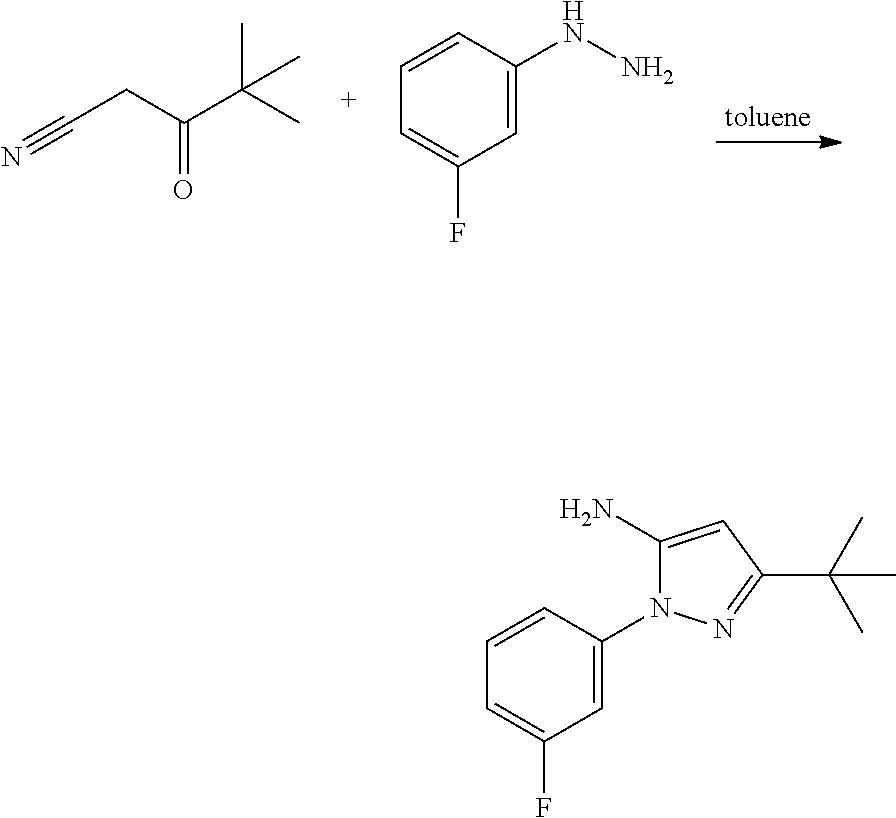
- WTSMYIRXIWGZQE-UHFFFAOYSA-N CC(C)(C)C(=O)CC#N.CC(C)(C)C1=NN(C2=CC(F)=CC=C2)C(N)=C1.NCC1=CC(F)=CC=C1 Chemical compound CC(C)(C)C(=O)CC#N.CC(C)(C)C1=NN(C2=CC(F)=CC=C2)C(N)=C1.NCC1=CC(F)=CC=C1 WTSMYIRXIWGZQE-UHFFFAOYSA-N 0.000 description 1
- RFDVOTTVQSHCMI-UHFFFAOYSA-N CC(C)(C)C1=NN(C2=CC(F)=CC=C2)C(CC(=O)CC2=CC=C(OC3=C4N=CC(=O)NC4=NC=C3)C=C2F)=C1.CC(C)(C)C1=NN(C2=CC(F)=CC=C2)C(NC(=O)OC2=CC=CC=C2)=C1.NC1=CC=C(OC2=C3N=CC(=O)NC3=NC=C2)C=C1F Chemical compound CC(C)(C)C1=NN(C2=CC(F)=CC=C2)C(CC(=O)CC2=CC=C(OC3=C4N=CC(=O)NC4=NC=C3)C=C2F)=C1.CC(C)(C)C1=NN(C2=CC(F)=CC=C2)C(NC(=O)OC2=CC=CC=C2)=C1.NC1=CC=C(OC2=C3N=CC(=O)NC3=NC=C2)C=C1F RFDVOTTVQSHCMI-UHFFFAOYSA-N 0.000 description 1
- DJNATFDTHDNDSA-UHFFFAOYSA-N CC(C)(C)C1=NN(C2=CC(F)=CC=C2)C(N)=C1.CC(C)(C)C1=NN(C2=CC(F)=CC=C2)C(NC(=O)OC2=CC=CC=C2)=C1 Chemical compound CC(C)(C)C1=NN(C2=CC(F)=CC=C2)C(N)=C1.CC(C)(C)C1=NN(C2=CC(F)=CC=C2)C(NC(=O)OC2=CC=CC=C2)=C1 DJNATFDTHDNDSA-UHFFFAOYSA-N 0.000 description 1
- YJPWARFQTWWMIQ-UHFFFAOYSA-N CC(C)(C)C1=NN([Ar])C(N)=C1 Chemical compound CC(C)(C)C1=NN([Ar])C(N)=C1 YJPWARFQTWWMIQ-UHFFFAOYSA-N 0.000 description 1
- HAZHTXLWEYTWKP-UHFFFAOYSA-N CC(C)(C)OC(=O)CC1=CC=C(OC2=C(N)C(N)=NC=C2)C=C1F.CC(C)(C)OC(=O)CC1=CC=C(OC2=C3CC(=O)C=NC3=NC=C2)C=C1F.CC(C)(C)OC(=O)CC1=CC=C(OC2=C3N=CC(=O)NC3=NC=C2)C=C1F.[H]C(=O)C(=O)OCC Chemical compound CC(C)(C)OC(=O)CC1=CC=C(OC2=C(N)C(N)=NC=C2)C=C1F.CC(C)(C)OC(=O)CC1=CC=C(OC2=C3CC(=O)C=NC3=NC=C2)C=C1F.CC(C)(C)OC(=O)CC1=CC=C(OC2=C3N=CC(=O)NC3=NC=C2)C=C1F.[H]C(=O)C(=O)OCC HAZHTXLWEYTWKP-UHFFFAOYSA-N 0.000 description 1
- ORYWGINIYMEFRN-UHFFFAOYSA-N CC(C)(C)OC(=O)CC1=CC=C(OC2=C3CC(=O)C=NC3=NC=C2)C2=C1C=CC=C2 Chemical compound CC(C)(C)OC(=O)CC1=CC=C(OC2=C3CC(=O)C=NC3=NC=C2)C2=C1C=CC=C2 ORYWGINIYMEFRN-UHFFFAOYSA-N 0.000 description 1
- FFSCRJGZZWSJGN-UHFFFAOYSA-N CC(C)(C)OC(=O)CC1=CC=C(OC2=C3CC(=O)C=NC3=NC=C2)C=C1F Chemical compound CC(C)(C)OC(=O)CC1=CC=C(OC2=C3CC(=O)C=NC3=NC=C2)C=C1F FFSCRJGZZWSJGN-UHFFFAOYSA-N 0.000 description 1
- RGQYDRCMLNWKGM-UHFFFAOYSA-N CC(C)(C)OC(=O)CC1=CC=C(OC2=C3N=CC(=O)NC3=NC=C2)C=C1 Chemical compound CC(C)(C)OC(=O)CC1=CC=C(OC2=C3N=CC(=O)NC3=NC=C2)C=C1 RGQYDRCMLNWKGM-UHFFFAOYSA-N 0.000 description 1
- YQIOPJOFPZPSIF-UHFFFAOYSA-N CC(C)(C)OC(=O)NC1=CC=C(O)C=C1F.CC(C)(C)OC(=O)NC1=CC=C(OC2=C([N+](=O)[O-])C(N)=NC=C2)C=C1F.NC1=NC=CC(Cl)=C1[N+](=O)[O-] Chemical compound CC(C)(C)OC(=O)NC1=CC=C(O)C=C1F.CC(C)(C)OC(=O)NC1=CC=C(OC2=C([N+](=O)[O-])C(N)=NC=C2)C=C1F.NC1=NC=CC(Cl)=C1[N+](=O)[O-] YQIOPJOFPZPSIF-UHFFFAOYSA-N 0.000 description 1
- QTGFCAZVKILUOS-UHFFFAOYSA-N CC(C)(C)OC(=O)NC1=CC=C(OC2=C(N)C(N)=NC=C2)C2=C1C=CC=C2.CC(C)(C)OC(=O)NC1=CC=C(OC2=C3N=CC(=O)NC3=NC=C2)C2=C1C=CC=C2 Chemical compound CC(C)(C)OC(=O)NC1=CC=C(OC2=C(N)C(N)=NC=C2)C2=C1C=CC=C2.CC(C)(C)OC(=O)NC1=CC=C(OC2=C3N=CC(=O)NC3=NC=C2)C2=C1C=CC=C2 QTGFCAZVKILUOS-UHFFFAOYSA-N 0.000 description 1
- PBHZZMQECAVBPW-UHFFFAOYSA-N CC(C)(C)OC(=O)NC1=CC=C(OC2=C(N)C(N)=NC=C2)C=C1F.CC(C)(C)OC(=O)NC1=CC=C(OC2=C([N+](=O)[O-])C(N)=NC=C2)C=C1F Chemical compound CC(C)(C)OC(=O)NC1=CC=C(OC2=C(N)C(N)=NC=C2)C=C1F.CC(C)(C)OC(=O)NC1=CC=C(OC2=C([N+](=O)[O-])C(N)=NC=C2)C=C1F PBHZZMQECAVBPW-UHFFFAOYSA-N 0.000 description 1
- XSUKGCYFEZFDMU-UHFFFAOYSA-N CC(C)(C)OC(=O)NC1=CC=C(OC2=C(N)C(N)=NC=C2)C=C1F.CC(C)(C)OC(=O)NC1=CC=C(OC2=C3N=CC(=O)NC3=NC=C2)C=C1F Chemical compound CC(C)(C)OC(=O)NC1=CC=C(OC2=C(N)C(N)=NC=C2)C=C1F.CC(C)(C)OC(=O)NC1=CC=C(OC2=C3N=CC(=O)NC3=NC=C2)C=C1F XSUKGCYFEZFDMU-UHFFFAOYSA-N 0.000 description 1
- VDODXBSDWOBQSO-UHFFFAOYSA-N CC(C)(C)OC(=O)NC1=CC=C(OC2=C3N=CC(=O)NC3=NC=C2)C=C1F.NC1=CC=C(OC2=C3N=CC(=O)NC3=NC=C2)C=C1F Chemical compound CC(C)(C)OC(=O)NC1=CC=C(OC2=C3N=CC(=O)NC3=NC=C2)C=C1F.NC1=CC=C(OC2=C3N=CC(=O)NC3=NC=C2)C=C1F VDODXBSDWOBQSO-UHFFFAOYSA-N 0.000 description 1
- OGOCBEZTPYIUFY-UHFFFAOYSA-N CC(C)C1=CC([Y])=CC=C1 Chemical compound CC(C)C1=CC([Y])=CC=C1 OGOCBEZTPYIUFY-UHFFFAOYSA-N 0.000 description 1
- KHAMNADHIXZMMY-UHFFFAOYSA-N CC(C)NC(=O)ON1C(=O)CCC1=O Chemical compound CC(C)NC(=O)ON1C(=O)CCC1=O KHAMNADHIXZMMY-UHFFFAOYSA-N 0.000 description 1
- IKMZGACFMXZAAT-UHFFFAOYSA-N CC1=C([N+](=O)[O-])C(N)=NC=C1 Chemical compound CC1=C([N+](=O)[O-])C(N)=NC=C1 IKMZGACFMXZAAT-UHFFFAOYSA-N 0.000 description 1
- ZIQBKXHUOWZQOL-UHFFFAOYSA-N CC1=CC=C(N2N=C(C(C)(C)C)C=C2CC(=O)CC2=CC=C(OC3=C4N=CC(=O)NC4=NC=C3)C=C2F)C=C1 Chemical compound CC1=CC=C(N2N=C(C(C)(C)C)C=C2CC(=O)CC2=CC=C(OC3=C4N=CC(=O)NC4=NC=C3)C=C2F)C=C1 ZIQBKXHUOWZQOL-UHFFFAOYSA-N 0.000 description 1
- FMDABLKUCDRWMQ-UHFFFAOYSA-N CC1=CC=C(OC2=C(N)C(N)=NC=C2)C2=C1C=CC=C2 Chemical compound CC1=CC=C(OC2=C(N)C(N)=NC=C2)C2=C1C=CC=C2 FMDABLKUCDRWMQ-UHFFFAOYSA-N 0.000 description 1
- GWSMVRWCCFZTLK-UHFFFAOYSA-N CCC.CN1C(=O)C2=CC=CC=C2C1=O Chemical compound CCC.CN1C(=O)C2=CC=CC=C2C1=O GWSMVRWCCFZTLK-UHFFFAOYSA-N 0.000 description 1
- CFNZIBQLXSMNSX-UHFFFAOYSA-N CCC.CNC(=O)C(F)(F)F Chemical compound CCC.CNC(=O)C(F)(F)F CFNZIBQLXSMNSX-UHFFFAOYSA-N 0.000 description 1
- UHGXAIXLHGRHKQ-UHFFFAOYSA-N CCC.CNC(=O)OC(C)(C)C Chemical compound CCC.CNC(=O)OC(C)(C)C UHGXAIXLHGRHKQ-UHFFFAOYSA-N 0.000 description 1
- PNASMKYMASDOJS-UHFFFAOYSA-N CCC.CNS(=O)(=O)C1=CC=C(C)C=C1 Chemical compound CCC.CNS(=O)(=O)C1=CC=C(C)C=C1 PNASMKYMASDOJS-UHFFFAOYSA-N 0.000 description 1
- RIBRSEXZCKDPIQ-UHFFFAOYSA-N CSC1=CC(OC2=C3N=CC(=O)NC3=NC=C2)=CC=C1CC(=O)OC(C)(C)C Chemical compound CSC1=CC(OC2=C3N=CC(=O)NC3=NC=C2)=CC=C1CC(=O)OC(C)(C)C RIBRSEXZCKDPIQ-UHFFFAOYSA-N 0.000 description 1
- IISZPWSPJQKVAX-UHFFFAOYSA-N NC1=CC=C(OC2=C3N=CC(=O)NC3=NC=C2)C(Cl)=C1Cl Chemical compound NC1=CC=C(OC2=C3N=CC(=O)NC3=NC=C2)C(Cl)=C1Cl IISZPWSPJQKVAX-UHFFFAOYSA-N 0.000 description 1
Classifications
-
- C—CHEMISTRY; METALLURGY
- C07—ORGANIC CHEMISTRY
- C07D—HETEROCYCLIC COMPOUNDS
- C07D471/00—Heterocyclic compounds containing nitrogen atoms as the only ring hetero atoms in the condensed system, at least one ring being a six-membered ring with one nitrogen atom, not provided for by groups C07D451/00 - C07D463/00
- C07D471/02—Heterocyclic compounds containing nitrogen atoms as the only ring hetero atoms in the condensed system, at least one ring being a six-membered ring with one nitrogen atom, not provided for by groups C07D451/00 - C07D463/00 in which the condensed system contains two hetero rings
- C07D471/04—Ortho-condensed systems
Definitions
- the present invention pertains generally to the field of organic chemical synthesis, and in particular to certain methods for the synthesis of 8-(4-aminophenyoxy)-4H-pyrido[2,3-b]pyrazin-3-one and related compounds (denoted herein as (3)) from 4-(4-aminophenyoxy)pyridine-2,3-diamine and related compounds (denoted herein as (1)), by reaction with glyoxylic acid (denoted herein as (2)).
- the compounds (3) are useful in the synthesis of known anti-cancer agents, such as 1-(5-tert-butyl-2-(4-methyl-phenyl)-pyrazol-3-yl)-3-[2-fluoro-4-[(3-oxo-4H-pyrido[2,3-b]pyrazin-8-yl)oxy]phenyl]urea.
- Ranges are often expressed herein as from “about” one particular value, and/or to “about” another particular value. When such a range is expressed, another embodiment includes from the one particular value and/or to the other particular value. Similarly, when values are expressed as approximations, by the use of the antecedent “about,” it will be understood that the particular value forms another embodiment.
- the 3-oxo-4H-pyrido[2,3-b]pyrazin-8-yl group is formed in a mixture of two regioisomers (the 2-oxo and 3-oxo regioisomers) by a cyclisation reaction of a 2,3-diamino-4-oxy-pyridyl compound with ethyl glyoxylate, as illustrated in the following scheme (drawn from Synthesis 27 therein).
- Method D1 is described in the context of Synthesis 25 therein as: “tert-butyl 4-(2,3-diaminopyridin-4-yloxy)phenylcarbamate (0.86 g, 2.71 mmol) was dissolved in 15 ml of dry ethanol; 0.8 ml (4 mmol) of a 50% ethyl glyoxylate solution in toluene were added and the solution was stirred overnight at room temperature under Argon atmosphere.
- the present inventors have determined that the synthetic method can be very greatly improved (e.g., higher yield; preferential formation of desired regioisomer) by employing a different reagent (i.e., glyoxylic acid), especially under certain reaction conditions, including, in particular, a large excess of glyoxylic acid (i.e., a molar excess of at least about 2).
- a different reagent i.e., glyoxylic acid
- glyoxylic acid especially under certain reaction conditions, including, in particular, a large excess of glyoxylic acid (i.e., a molar excess of at least about 2).
- Ballell et al., 2008 describes the same synthesis in water, where the undesired 7-bromopyrido[2,3-b]pyrazin-2(1H)-one is obtained as the major isomer in 66% yield. Similarly, the undesired 7-fluoropyrido[2,3-b]pyrazin-2(1H)-one was obtained as the major isomer in 54% yield.
- One aspect of the invention pertains to a method of preparing a compound of Formula (3), as described herein:
- Another aspect of the present invention pertains to a compound of Formula (3) obtained by a method of synthesis as described herein, or a method comprising a method of synthesis as described herein.
- Another aspect of the invention pertains to method of chemical synthesis which include, as part of the chemical synthesis, a method of preparing a compound of Formula (3), as described herein.
- Another aspect of the present invention pertains to novel intermediates, as described herein, which are suitable for use in the methods of synthesis described herein.
- Another aspect of the present invention pertains to the use of such novel intermediates, as described herein, in the methods of synthesis described herein.
- the present inventors have determined that the synthesis of 8-(4-aminophenyoxy)-4H-pyrido[2,3-b]pyrazin-3-one and related compounds (denoted herein as (3)) from 4-(4-aminophenyoxy)pyridine-2,3-diamine and related compounds (denoted herein as (1)) can be very greatly improved (e.g., higher yield; preferential formation of the desired regioisomer) by employing a different reagent (i.e., glyoxylic acid; denoted herein as (2)) under certain reaction conditions, including, in particular, a large excess of glyoxylic acid (i.e., a molar excess of at least about 2).
- a different reagent i.e., glyoxylic acid; denoted herein as (2)
- One aspect of the present invention is a method of preparing a compound of Formula (3):
- ratio of the amount of the compound of Formula (2) to the amount of the compound of Formula (1), on a molar basis, is at least about 2;
- n-propyl is abbreviated as -nPr; iso-propyl is abbreviated as -iPr; n-butyl is abbreviated as -nBu; iso-butyl is abbreviated as -iBu; sec-butyl is abbreviated as -sBu; tert-butyl is abbreviated as -tBu; and phenyl is abbreviated as -Ph.
- —R 1 is —H.
- —R 1 is —R 1A .
- —R 2 is —H.
- —R 2 is —R 2A .
- —R 1A if present, is independently —F, —Cl, —Br, or —I;
- —R 1A if present, is —F.
- —R 1A if present, is —Cl.
- —R 1A if present, is —Br.
- —R 1A if present, is —I.
- —R 1A if present, is independently —OH or —OR X .
- —R 1A if present, is —OH.
- —R 1A if present, is —OR X .
- —R 1A if present, is —SR X .
- —R 2A if present, is independently —F, —Cl, —Br, or —I;
- —R 2A if present, is —F.
- —R 2A if present, is —Cl.
- —R 2A if present, is —Br.
- —R 2A if present, is —I.
- —R 2A if present, is independently —OH or —OR X .
- —R 2A if present, is —OH.
- —R 2A if present, is —OR X .
- —R 2A if present, is —SR X .
- each —R X is independently -Me, -Et, -nPr, -iPr, -nBu, -iBu, -sBu, or -tBu.
- each —R X is independently -Me, -Et, -nPr, or -iPr.
- each —R X if present, is independently -Me or -Et.
- each —R X if present, is -Me.
- —R 1 and —R 2 together form —CH ⁇ CH—CH ⁇ CH—, —N ⁇ CH—CH ⁇ CH—, —CH ⁇ N—CH ⁇ CH—, —CH ⁇ CH—N ⁇ CH—, or —CH ⁇ CH—CH ⁇ N—.
- —R 1 and —R 2 together form —CH ⁇ CH—CH ⁇ CH—, for example, as in:
- —R 1 and —R 2 together form —N ⁇ CH—CH ⁇ CH—, —CH ⁇ N—CH ⁇ CH—, —CH ⁇ CH—N ⁇ CH—, or —CH ⁇ CH—CH ⁇ N—.
- the protected amino group, -NPG is a protected amino group which is stable to said cyclisation conditions.
- the protected amino group, -NPG is a protected amino group which is stable to mildly acidic conditions (e.g., glyoxylic acid in organic solvent, e.g., MeOH) and unreactive for nucleophilic addition towards a carbonyl group (e.g., the aldehyde moiety of glyoxylic acid and ethyl glyoxylate).
- a carbonyl group e.g., the aldehyde moiety of glyoxylic acid and ethyl glyoxylate.
- -NPG is independently a protected amino group in the form of: a carbamate; an amide; an imide; or a sulfonamide.
- -NPG is a protected amino group in the form of a carbamate.
- -NPG is independently:
- -NPG is t-butyl carbamate.
- -NPG is a protected amino group in the form of an amide.
- -NPG is independently:
- -NPG is a protected amino group in the form of an imide.
- -NPG is independently:
- -NPG is a protected amino group in the form of a sulfonamide.
- -NPG is independently:
- -NPG is a protected amino group which, additionally is stable to strong basic conditions (e.g., K 2 CO 3 in DMF) and reductive conditions (e.g., H 2 on Pd/C).
- strong basic conditions e.g., K 2 CO 3 in DMF
- reductive conditions e.g., H 2 on Pd/C
- the compound of Formula (2) is glyoxylic acid.
- Glyoxylic acid also known as oxoacetic acid; oxoethanoic acid; and formylformic acid
- OCHCO 2 H has the chemical formula OCHCO 2 H and a molecular weight of 74.04 g/mol. It is often handled as the monohydrate, OCHCO 2 H.H 2 O, which has a molecular weight of 92.05 g/mol. Both are solids at room temperature.
- the ratio of the amount of the compound of Formula (2) to the amount of the compound of Formula (1), on a molar basis is at least about 2.
- the ratio is from about 2 to about 25.
- the ratio is from about 2 to about 20.
- the ratio is from about 2 to about 15.
- the ratio is from about 2 to about 10.
- the ratio is from about 5 to about 25.
- the ratio is from about 5 to about 20.
- the ratio is from about 5 to about 15.
- the ratio is from about 5 to about 10.
- the ratio is about 10.
- the compound of Formula (1) and the compound of Formula (2) are combined over an addition time of at least about 30 minutes to form the reaction mixture.
- the term “over” in the phrase “over an addition time” is used in this context to mean that the combining occurs substantially continuously throughout substantially all of the duration of the addition time; the term is intended to include, for example, dropwise addition, continuous flow addition, etc.
- the addition time is from about 30 minutes to about 24 hours.
- the addition time is from about 1 hour to about 24 hours.
- the addition time is from about 2 hours to about 24 hours.
- the addition time is from about 3 hours to about 24 hours.
- the addition time is from about 30 minutes to about 18 hours.
- the addition time is from about 1 hour to about 18 hours.
- the addition time is from about 2 hours to about 18 hours.
- the addition time is from about 3 hours to about 18 hours.
- the addition time is from about 30 minutes to about 12 hours.
- the addition time is from about 1 hour to about 12 hours.
- the addition time is from about 2 hours to about 12 hours.
- the addition time is from about 3 hours to about 12 hours.
- the addition time is from about 30 minutes to about 6 hours.
- the addition time is from about 1 hour to about 6 hours.
- the addition time is from about 2 hours to about 6 hours.
- the addition time is from about 3 hours to about 6 hours.
- the addition time is about 30 minutes.
- the addition time is about 1 hour.
- the addition time is about 2 hours.
- the addition time is about 3 hours.
- the addition time is about 6 hours.
- the reaction is allowed to continue for a further reaction time, for example, at the reaction temperature, optionally with stirring (i.e., of the reaction mixture).
- the further reaction time is from about 1 hour to about 48 hours.
- the further reaction time is from about 1 hour to about 36 hours.
- the further reaction time is from about 1 hour to about 24 hours.
- the further reaction time is from about 1 hour to about 12 hours.
- the further reaction time is from about 3 hours to about 48 hours.
- the further reaction time is from about 3 hours to about 36 hours.
- the further reaction time is from about 3 hours to about 24 hours.
- the further reaction time is from about 3 hours to about 12 hours.
- the further reaction time is from about 6 hours to about 48 hours.
- the further reaction time is from about 6 hours to about 36 hours.
- the further reaction time is from about 6 hours to about 24 hours.
- the further reaction time is from about 6 hours to about 12 hours.
- the reaction mixture is stirred during the further reaction time.
- the reaction mixture further comprises a reaction solvent.
- reaction solvent is an organic solvent.
- the reaction solvent is an aprotic organic solvent.
- the reaction solvent is, or comprises, an organic nitrile (e.g., acetonitrile).
- the reaction solvent is, or comprises, an organic ester (e.g., ethyl acetate).
- the reaction solvent is, or comprises, a sulfoxide (e.g., dimethylsulfoxide (DMSO)).
- a sulfoxide e.g., dimethylsulfoxide (DMSO)
- the reaction solvent is, or comprises, an organic amide (e.g., dimethylformamide (DMF), dimethylacetamide (DMA), N-methyl-2-pyrrolidone (NMP), or a mixture of thereof).
- organic amide e.g., dimethylformamide (DMF), dimethylacetamide (DMA), N-methyl-2-pyrrolidone (NMP), or a mixture of thereof.
- the reaction solvent is, or comprises, an aromatic organic solvent (e.g., toluene, xylene, or a mixture thereof).
- aromatic organic solvent e.g., toluene, xylene, or a mixture thereof.
- the reaction solvent is, or comprises, a linear or branched ether (e.g., diethyl ether, tert-butyl methyl ether, or a mixture of thereof).
- a linear or branched ether e.g., diethyl ether, tert-butyl methyl ether, or a mixture of thereof.
- the reaction solvent is, or comprises, a cyclic ether (e.g., tetrahydrofuran (THF)).
- a cyclic ether e.g., tetrahydrofuran (THF)
- reaction solvent is, or comprises, an alcohol.
- the reaction solvent is, or comprises, a C 1-6 alkyl alcohol, or a mixture of two or more C 1-6 alkyl alcohols.
- the reaction solvent is, or comprises, a C 1-4 alkyl alcohol, or a mixture of two or more C 1-4 alkyl alcohols.
- the reaction solvent is, or comprises, MeOH, EtOH, or THF, or a mixture thereof.
- the reaction solvent is MeOH, EtOH, or THF, or a mixture thereof.
- the reaction solvent is, or comprises, MePH, EtOH, or a mixture of MeOH and EtOH.
- the reaction solvent is MeOH, EtOH, or a mixture of MeOH and EtOH.
- reaction solvent is MeOH
- reaction solvent is EtOH.
- reaction solvent is THF.
- the volume of reaction solvent in the reaction mixture is from about 5 to about 50 L per kg of compound of Formula (1).
- the volume of reaction solvent measured in liters, is from about 5 to about 50 times the weight of the compound of Formula (1), measured in kilograms.
- the volume of reaction solvent in the reaction mixture is from about 10 to about 30 L per kg of compound of Formula (1).
- the volume of reaction solvent in the reaction mixture is from about 15 to about 25 L per kg of compound of Formula (1).
- the volume of reaction solvent in the reaction mixture is about 20 L per kg of compound of Formula (1).
- the compound of Formula (1) is tert-butyl N-[4-[(2,3-diamino-4-pyridyl)oxy]-2-fluoro-phenyl]carbamate, which has an empirical formula of C 16 H 19 FN 4 O 3 and a molecular weight of 334.34 g/mol, one kilogram contains about 3 moles of compound of Formula (1). Consequently, when the volume of reaction solvent is from about 5 to about 50 L per kg of compound of Formula (1), the concentration of the compound of Formula (1) in the reaction mixture is from about 3 mol/5 L to about 3 mol/50 L, or from about 0.6 to about 0.06 M.
- the concentration of the compound of Formula (1) in the reaction mixture is from about 3 mol/20 L or about 0.15 M.
- concentration in the reaction mixture is the theoretical concentration based on the amount of compound of Formula (1) and the amount of solvent used to form the reaction mixture, rather than any actual instantaneous concentration of the compound of Formula (1) in the reaction mixture during the reaction process.
- the concentration of the compound of Formula (1) in the reaction mixture is from about 0.01 to about 1 M.
- the concentration of the compound of Formula (1) in the reaction mixture is from about 0.02 to about 0.5 M.
- the concentration of the compound of Formula (1) in the reaction mixture is from about 0.05 to about 0.3 M.
- the concentration of the compound of Formula (1) in the reaction mixture is from about 0.05 to about 0.2 M.
- the concentration of the compound of Formula (1) in the reaction mixture is about 0.10 M.
- the concentration of the compound of Formula (1) in the reaction mixture is about 0.15 M.
- the compound of Formula (1) is dissolved in a first solvent to form a starting material solution before being combined with the compound of Formula (2) to form the reaction mixture, wherein said first solvent is, or forms part of, the reaction solvent.
- the compound of Formula (2) is dissolved in a second solvent to form a glyoxylic acid reagent solution before being combined with the compound of Formula (1) to form the reaction mixture, wherein said first solvent is, or forms part of, the reaction solvent.
- the first solvent and the second solvent are the same (e.g., both methanol).
- the first solvent and the second solvent are different.
- said starting material solution is combined with said glyoxylic acid reagent solution by adding said starting material solution to said glyoxylic acid reagent solution.
- said starting material solution is combined with said glyoxylic acid reagent solution by adding said glyoxylic acid reagent solution to said starting material solution.
- said adding i.e., adding said starting material solution to said glyoxylic acid reagent solution; adding said glyoxylic acid reagent solution to said starting material solution
- said adding is adding continuously (e.g., over the addition time).
- said adding is adding continuously is by dropwise addition.
- said adding is adding continuously is by continuous flow addition.
- the compound of Formula (2) is added as a solid to said starting material solution.
- the compound of Formula (2) is added as a solid to said starting material solution continuously (e.g., over the addition time).
- the compound of Formula (1) is added as a solid to said glyoxylic acid reagent solution.
- the compound of Formula (1) is added as a solid to said glyoxylic acid reagent solution continuously (e.g., over the addition time).
- the temperature of the reaction mixture during the reaction is, or is maintained at, a temperature of from about 0° C. to about the reflux temperature of the reaction mixture.
- the temperature of the reaction mixture during the reaction is a temperature of from about 0° C. to about the reflux temperature of the reaction mixture.
- the temperature of the reaction mixture during the reaction is maintained at a temperature of from about 0° C. to about the reflux temperature of the reaction mixture.
- the temperature range is from about 0° C. to about 78° C.
- the temperature range is from about 0° C. to about 30° C.
- the temperature range is from about 0° C. to about 25° C.
- the temperature range is from about 5° C. to about 30° C.
- the temperature range is from about 5° C. to about 25° C.
- the temperature range is from about 10° C. to about 30° C.
- the temperature range is from about 10° C. to about 25° C.
- the temperature range is from about 15° C. to about 25° C.
- the temperature is about 20° C.
- the method further comprises a subsequent step (a “deprotection step”) of deprotecting the protected amino group, for example, deprotecting a compound of Formula (3):
- the method further comprises a subsequent step (a “urea formation step”) of reacting the resulting amino group with a suitable 5-activated-3-tert-butyl-1-aryl-pyrazole, for example, reacting a compound of Formula (4):
- the method further comprises subsequent steps (an “amino activation step” followed by a “urea formation step”) of activating the resulting amino group, followed by reaction with a 5-amino-3-tert-butyl-1-aryl-pyrazole, for example, activating a compound of Formula (4):
- —Ar is phenyl or pyridyl, and is optionally substituted with one or more groups —Y.
- —Ar is phenyl, and is optionally substituted with one or more groups —Y.
- —Ar is phenyl, and is optionally substituted with one group —Y.
- —Ar is phenyl, and is optionally substituted with one group —Y at the meta-position (e.g., as shown below).
- —Ar is phenyl (i.e., unsubstituted phenyl).
- —Y (or each —Y, if there is more than one) is independently selected from —F, -Me, —CF 3 , —OH, and —OMe.
- -A is a carbamate group (i.e., —NH—C( ⁇ O)OR).
- -A is —NH—C( ⁇ O)O-Ph.
- -A is —NH—C( ⁇ O)O-(4-nitrophenyl).
- -A is —NH—C( ⁇ O)O—C(CH 3 ) ⁇ CH 2 .
- -A is —NH—C( ⁇ O)O—(N-succinimidyl) (shown below).
- Suitable carbamates can be obtained, for example, by the reaction of the corresponding amine with a suitable chloroformate (e.g., phenyl chloroformate, 4-nitrophenyl chloroformate, 1-methylvinylchloroformate, etc.) or a suitable carbonate (e.g., N, N-disuccinimidyl carbonate).
- a suitable chloroformate e.g., phenyl chloroformate, 4-nitrophenyl chloroformate, 1-methylvinylchloroformate, etc.
- a suitable carbonate e.g., N, N-disuccinimidyl carbonate
- -A is an isocyanate group (i.e., —NCO).
- Suitable isocyanates can be obtained, for example, by the conversion of the corresponding amine using, for example, phosgene, triphosgene, or their derivatives, or by conversion of the corresponding carboxylic acid to acyl azides using, for example, diphenyl phosphoryl azide, followed by a Curtius rearrangement.
- the method further comprises a preceding step (a “nitro reduction step”) of reducing a nitro group to form an amino group, for example, reducing a compound of Formula (9):
- the method further comprises a preceding step (a “coupling step”) of coupling a suitable 4-activated-N-protected-aniline with a suitable 4-activated-2-amino-3-nitropyridine, for example, reacting a compound of Formula (10):
- -A 1 and -A 2 are activating groups suitable for reaction with each other to form an ether group, for example, in suitable reaction conditions.
- -A 1 is —OH.
- -A 2 is halogen (e.g., —F, —Cl, —Br, —I), cyano (i.e., —CN), acyloxy (e.g., —OC( ⁇ O)Me), sulfonate (e.g., —OS( ⁇ O) 2 Me, —OS( ⁇ O) 2 CF 3 , —OS( ⁇ O) 2 Ph, —OS( ⁇ O) 2 (4-methylphenyl), etc.), sulfonyl (e.g., —S( ⁇ O) 2 Me), sulfinyl (e.g., —S( ⁇ O)Me), nitro (i.e., —NO 2 ), a diazonium salt (i.e., —N(+) ⁇ N), or an ammonium salt (e.g., —N(+)Me 3 ).
- halogen e.g., —F, —Cl,
- -A 1 is —OH and -A 2 is halogen (e.g., —F, —Cl, —Br, —I).
- halogen e.g., —F, —Cl, —Br, —I
- -A 1 is —OH and -A 2 is —Cl.
- the cyclisation method described herein forms part of a multi-step synthesis, as illustrated in the following schemes, to give target compounds which are useful, for example, as anti-cancer agents.
- SM denotes “starting material”
- GA denotes “glyoxylic acid”
- DR denotes desired regioiosmer (i.e., 3-oxo regioisomer)
- UR denotes undesired regioisomer (i.e., 2-oxo regioisomer).
- Reagent A 500 mg of tert-butyl N-[4-[(2,3-diamino-4-pyridyl)oxy]-2-fluoro-phenyl]carbamate (“starting material”, denoted SM) was dissolved in a solvent (denoted SM solvent), specifically, a volume (denoted SM solvent volume, SMSV) of the SM solvent. The mixture was warmed if necessary, and then allowed to cool to room temperature.
- a solvent denoted SM solvent
- SMSV volume (denoted SM solvent volume, SMSV)
- Reagent B An amount of glyoxylic acid (denoted GA), handled as glyoxylic acid monohydrate, was provided. Either it was used as the solid (without solvent), or it was dissolved in the same solvent (i.e., the SM solvent), specifically, a volume (denoted GA solvent volume, GASV) of the SM solvent, and stirred at room temperature to provide a colourless solution.
- glyoxylic acid denoted GA
- Reagent B was added to Reagent A over an addition time (denoted AT), while the resulting reaction mixture was maintained at a reaction temperature (denoted XT).
- Reagent A was added to Reagent B over an addition time (denoted AT), while the resulting reaction mixture was maintained at a reaction temperature (denoted XT).
- SM starting material
- DR desired regioisomer
- UR undesired regioisomer
- the solvent volume i.e., the SM solvent volume and GA solvent volume
- volumes the numerical equivalent, in liters, of the weight of the starting material, SM, in kilograms.
- the SM is tert-butyl N-[4-[(2,3-diamino-4-pyridyl)oxy]-2-fluoro-phenyl]carbamate, which has an empirical formula of C 16 H 19 FN 4 O 3 and a molecular weight of 334.34 g/mol; consequently, one kilogram contains about 3 moles of SM.
- the theoretical concentration of SM in the reaction mixture is about 1.5 mmol in 13 mL, or about 0.115 M.
- the theoretical concentration of SM in the reaction mixture is about 1.5 mol in 10 L, or about 0.15 M.
- Glyoxylic acid added in one portion over 30 seconds.
- Anhydrous MgSO 4 250 mg) added to remove water.
- MeOH was anhydrous MeOH.
- e AcOH (10 eq.) also added.
- f AcOH (5 eq.) also added.
- g Concentrated H 2 SO 4 (10 eq.) also added.
- MeOH was “drum” MeOH.
- Glyoxylic acid was oven-dried overnight before use.
- Study 32 A further study on a larger scale (50 g), based on the conditions used in Study 22, gave a spectroscopic yield of 83%. Different work-ups of the product were then studied in separate runs to optimize the isolated yield (i.e., the yield after work-up and purification). Work-up 1: Concentration of the reaction mixture in vacuo and an EtOH recrystallisation (10 vols) gave a 48% yield. Work-up 2: Concentration of the reaction mixture in vacuo and a MEOH slurry (3 vols) gave a 64% yield. Work-up 3: Cooling of the reaction mixture to 0° C. for 1 hour before filtering gave a 60% yield.
- HPLC (220 nm) showed 89% product, 10% regioisomer, ⁇ 1% starting material.
- the reaction mixture was stripped to approximately one-half volume on a rotavapor at 40° C., before being cooled to 0° C. for 1 hour.
- the solids were filtered off, washed with cold MEOH (500 mL), and then water (500 mL) to remove any residual glyoxylic acid monohydrate.
- the solid was dried overnight in a vacuum oven at 45° C. to provide 414 g of the title compound in 74% yield (purity>97% by NMR, >99% by HPLC).
- the product was combined with two crude batches of product obtained using 50 g and 500 g tert-butyl N-[4-[(2,3-diamino-4-pyridyl)oxy]-2-fluoro-phenyl]carbamate and adsorbed onto silica (1400 g).
- the material was purified by column chromatography on silica (4 kg) eluting with 30% THF/DCM (40 L) then 40% THF/DCM (40 L).
- the product fractions were combined and concentrated to give 906 g product. This was slurried in 1:1 Et 2 O: heptane (8 L) for 1 hour at room temperature before being filtered off and washed with heptane (1 L).
- reaction mixture was concentrated and the solid recovered by filtration and washed with 10 mL cold MeOH, and then with water. The cake was dried to afford the desired regioisomer (according to NMR, as compared to reported literature compound), yield 627 mg (50%).
- the methods described herein provide a substantially improved yield, as compared to the known method, for example, an increase from 25% to 67-74% and an increase from 7% to 50%.
Landscapes
- Chemical & Material Sciences (AREA)
- Organic Chemistry (AREA)
- Nitrogen Condensed Heterocyclic Rings (AREA)
- Pharmaceuticals Containing Other Organic And Inorganic Compounds (AREA)
Abstract

Description


| Reported | ||
| Compound | Yield | Citation |
 |
21% | Springer et al., 2009 (Synthesis 24) (pages 104-105) |
 |
25% | Springer et al., 2009 (Synthesis 27) (pages 106-107) |
 |
15% | Springer et al., 2009 (Synthesis 26) (pages 105-106) |
 |
7% (1) | Zambon et al., 2010 (Compound 7h) (page S8) |
 |
24% | Murray et al. 2011 (Intermediate D2) (page 44) |
| (1) Note that there is an error in the publication; the reported yield of 240 mg corresponds to a 7% yield, not a 9% yield. | ||


-
- —R1 is independently —H or —R1A;
- —R2 is independently —H or —R2A;
- —R1A is independently —F, —Cl, —Br, —I, —RX, —OH, —ORX, or —SRX;
- —R2A is independently —F, —Cl, —Br, —I, —RX, —OH, —ORX, or —SRX;
- each —RX is independently linear or branched saturated C1-4alkyl;
- or —R1 and —R2 together form —CH═CH—CH═CH—, —N═CH—CH═CH—, —CH═N—CH═CH—, —CH═CH—N═CH—, or —CH═CH—CH═N—; and
- -NPG is a protected amino group which is stable to said cyclisation conditions.

is a tautomer of


| -NPG | Example | |
| a carbamate |
 |
|
| an amide |
 |
|
| an imide |
 |
|
| a sulfonamide |
 |
|
-
- methyl carbamate;
- ethyl carbamate;
- 9-fluorenylmethyl carbamate (Fmoc-NR2);
- 9-(2,7-dibromo)fluorenylmethyl carbamate;
- 2-chloro-3-indenylmethyl carbamate (Climoc-NR2);
- benz[f]inden-3-ylmethyl carbamate (Bimoc-NR2);
- 2,7-Di-t-Butyl[9-(10,10-dioxo-10,10,10,10-tetrahydrothioxanthyl)]methyl carbamate (DBD-Tmoc-NR2);
- 2-trimethylsilylethyl carbamate (Teoc-NR2)
- 2,2,2-trichloroethyl carbamate;
- 1,1-dimethylpropynyl carbamate;
- 1,1-dimethyl-2-haloethyl carbamate;
- 1,1-dimethyl-2-cyanoethyl carbamate;
- t-butyl carbamate;
- cyclobutyl carbamate;
- vinyl carbamate;
- 8-quinolyl carbamate;
- N-hydroxypiperidinyl carbamate;
- 4,5-di phenyl-3-oxazolin-2-one;
- benzyl carbamate (Cbz-NR2);
- p-nitrobenzyl carbamate;
- 3,4-dimethoxy-6-nitrobenzyl carbamate;
- 2,4-dichlorobenzyl carbamate;
- 5-benzisoxazolylmethyl carbamate;
- 9-anthrylmethyl carbamate;
- isonicotinyl carbamate; or
- S-benzyl carbamate.
-
- N-formyl amide;
- N-acetyl amide;
- N-chloroacetyl amide;
- N-trichloroacetyl amide;
- N-trifluoroacetyl amide;
- N-o-nitrophenylacetyl amide;
- N-o-nitrophenoxyacetyl amide;
- N-3-phenylpropionyl amide;
- N-3-(p-hydroxyphenyl)propionyl amide;
- N-2-methyl-2-(o-phenylazophenoxy)propionyl amide;
- N-4-chlorobutyryl amide;
- N-o-nitrocinnamoyl amide;
- N-picolinoyl amide;
- N—(N′-acetylmethionyl) amide; or
- N-benzoyl amide.
-
- N-phthalimide;
- N-tetrachlorophthalimide;
- 4-nitro-N-phthalimide;
- N-2,3-diphenylmaleimide; or
- N-dithiasuccinoylimide.
-
- p-toluenesulfonamide; or
- benzenesulfonamide.
-
- the compound of Formula (1) is dissolved in a first solvent to form a starting material solution before being combined with the compound of Formula (2) to form the reaction mixture, wherein said first solvent forms part of the reaction solvent; and
- the compound of Formula (2) is dissolved in a second solvent to form a glyoxylic acid reagent solution before being combined with the compound of Formula (1) to form the reaction mixture, wherein said second solvent forms part of the reaction solvent.


-
- -A is an activating group suitable for reaction with —NH2 to form a urea group; and
- —Ar is phenyl, pyridyl, or naphthyl, and is optionally substituted with one or more groups —Y, wherein each —Y is independently selected from halo (e.g., —F, —Cl, —Br, or —I); linear or branched saturated C1-4alkyl (e.g., -Me, -Et); linear or branched saturated C1-4haloalkyl (e.g., —CF3); —OH; linear or branched saturated C1-4alkoxy (e.g., —OMe, -OEt); and linear or branched saturated C1-4haloalkoxy (e.g., —OCF3).


-
- -A is an activating group suitable for reaction with —NH2 to form a urea group; and
- —Ar is phenyl, pyridyl, or naphthyl, and is optionally substituted with one or more groups —Y, wherein each —Y is independently selected from halo (e.g., —F, —Cl, —Br, or —I); linear or branched saturated C1-4alkyl (e.g., -Me, -Et); linear or branched saturated C1-4haloalkyl (e.g., —CF3); —OH; linear or branched saturated C1-4alkoxy (e.g., —OMe, -OEt); and linear or branched saturated C1-4haloalkoxy (e.g., —OCF3).


| Study | SM | SMSV | GASV | GA | XT | SM | DR | UR | ||
| No. | solv. | (vol.) | (vol.) | (eq.) | (° C.) | AT | Notes | % | % | % |
| 1 | MeOH | 25 | none | 2 | 20 | 30 | sec | (a) | 4 | 43 | 52 |
| 2 | EtOH | 25 | none | 2 | 20 | 30 | sec | (a) | 2 | 34 | 60 |
| 3 | THF | 25 | none | 2 | 20 | 30 | sec | (a) | 5 | 25 | 66 |
| 4 | MeOH | 25 | none | 10 | 20 | 30 | sec | (a) | 4 | 77 | 19 |
| 5 | EtOH | 25 | none | 10 | 20 | 30 | sec | (a) | 3 | 55 | 40 |
| 6 | THF | 25 | none | 10 | 20 | 30 | sec | (a) | <0.5 | 83 | 17 |
| 7 | MeOH | 25 | 1 | 2 | 65 | 30 | sec | (a) | <0.5 | 35 | 63 |
| 8 | EtOH | 25 | 1 | 2 | 78 | 30 | sec | (a) | <0.5 | 25 | 70 |
| 9 | MeOH | 10 | 10 | 5 | 20 | 30 | min | 3 | 66 | 31 | |
| 10 | MeOH | 10 | 10 | 5 | 0 | 30 | min | <1 | 71 | 29 | |
| 11 | MeOH | 10 | 10 | 5 | 60 | 30 | min | <1 | 60 | 40 | |
| 12 | MeOH | 10 | 10 | 10 | 20 | 30 | min | 3 | 78 | 19 | |
| 13 | MeOH | 10 | 10 | 10 | 20 | 30 | min | (b) | <1 | 71 | 17 |
| 14 | MeOH | 10 | 10 | 2 | 65 | 30 | min | <1 | 35 | 63 | |
| 15 | EtOH | 10 | 10 | 2 | 78 | 30 | min | <1 | 25 | 70 | |
| 16 | MeOH | 10 | 10 | 10 | 20 | 30 | min | (c) | 19 | 66 | 19 |
| 17 | MeOH | 4 | 4 | 10 | 20 | 30 | min | 11 | 70 | 18 | |
| 18 | MeOH | 10 | 10 | 10 | 20 | 3 | hr | 3 | 87 | 10 | |
| 19 | MeOH | 10 | 10 | 10 | 20 | 3 | hr | (d) | <1 | 88 | 11 |
| 20 | MeOH | 8 | 2 | 10 | 20 | 3 | hr | 5 | 78 | 18 | |
| 21 | MeOH | 8 | 2 | 10 | 20 | 6 | hr | <1 | 74 | 25 | |
| 22 | MeOH | 10 | 10 | 10 | 20 | 6 | hr | <1 | 89 | 10 | |
| 23 | MeOH | 10 | 10 | 5 | 20 | 30 | min | 3 | 66 | 31 | |
| 24 | MeOH | 10 | 10 | 5 | 0 | 30 | min | <1 | 71 | 29 | |
| 25 | MeOH | 10 | 10 | 5 | 60 | 30 | min | <1 | 60 | 39 | |
| 26 | MeOH | 10 | 10 | 2 | 20 | 2 | hr | (e) | <1 | 26 | 72 |
| 27 | MeOH | 10 | 10 | 5 | 20 | 3 | hr | (f) | <1 | 79 | 19 |
| 28 | MeOH | 10 | 10 | 2 | 20 | 2 | hr | (g) | 79 | 10 | 9 |
| 29 | MeOH | 10 | 10 | 10 | 20 | 3 | hr | (h) | <1 | 85 | 13 |
| 30 | MeOH | 15 | 10 | 10 | 20 | 3 | hr | (h) | 1.6 | 83 | 14 |
| 31 | MeOH | 10 | 10 | 10 | 20 | 3 | hr | (i) | 1 | 83 | 14 |
| 32 | MeOH | 10 | 10 | 10 | 20 | 4.5 | hr | (h), (j) | <1 | 83 | 15 |
| 33 | MeOH | 10 | 10 | 10 | 20 | 6.5 | hr | (h), (k) | <1 | 89 | 10 |
| 34 | MeOH | 10 | 10 | 10 | 20 | 6.0 | hr | (h), (k) | <1 | 89 | 10 |
| Legend and Notes: | |||||||||||
| SM = starting material. | |||||||||||
| GA = glyoxylic acid. | |||||||||||
| SMSV = starting material solvent volume. | |||||||||||
| GASV = glyoxylic acid solvent volume. | |||||||||||
| DR = desired regioisomer. | |||||||||||
| UR = undesired regioisomer. | |||||||||||
| XT = reaction temperature. | |||||||||||
| AT = addition time. | |||||||||||
| (a) Glyoxylic acid added in one portion over 30 seconds. | |||||||||||
| (b) Glyoxylic acid stripped out with EtOH (2 × 10 mL) to remove water. | |||||||||||
| (c) Anhydrous MgSO4 (250 mg) added to remove water. | |||||||||||
| (d) MeOH was anhydrous MeOH. | |||||||||||
| (e) AcOH (10 eq.) also added. | |||||||||||
| (f) AcOH (5 eq.) also added. | |||||||||||
| (g) Concentrated H2SO4 (10 eq.) also added. | |||||||||||
| (h) MeOH was “drum” MeOH. | |||||||||||
| (i) Glyoxylic acid was oven-dried overnight before use. | |||||||||||
| (j) Performed on a larger scale, with 50 g of SM. | |||||||||||
| (k) Performed on a larger scale, with 500 g of SM. | |||||||||||

| Batch no. | Carbamate Reagent | Product | Yield | |
| 1 | 2840 g active | 4100 g active | 90% | |
| 2 | 2678 g active | 3828 g active | 89% | |
| 3 | 1609 g active | 2503 g active | 97% | |
| TOTAL | 7127 g active | 10431 g active | 91% | |

| Batch no. | Nitro Reagent | Product | Yield | |
| 1 | 2560 g active | 2355 g | 100% | |
| 2 | 1540 g active | 1392 g | 98% | |
| 3 | 6331 g active | 5731 g | 99% | |
| TOTAL | 10431 g active | 9478 g | 99% | |


| Batch no. | Protected Reagent | Product | Yield | ||
| 1 | 783 g active | 415 g | 72% | ||
| 2 | 735 g active | 379.5 g | 71% | ||
| 3 | 699 g active | 414 g | 81% | ||
| TOTAL | 2217 g active | 1208.5 g | 75% | ||


| Comparison 1 |
| Desired Regioisomer | Undesired Regioisomer | ||
 |
 |
||
| Known | Spect. | Not determined | Not determined |
| method (1) | Yield | ||
| Isolated | 25% | 69% | |
| Yield | |||
| Present | Spect. | 89% | 10% |
| method (2) | Yield | ||
| Isolated | 74%/67% | Not isolated | |
| Yield | |||
(1): Zambon et al., 2010: To a solution of tert-butyl 4-(2,3-diaminopyridin-4-yloxy)-2-fluorophenylcarbamate (3.50 g, 10.5 mmol) in dry EtOH were added consecutively molecular sieves (3  |
|||
| (2): See synthesis 3 above. | |||
| Comparison 2 |
| Desired Regioisomer | Undesired Regioisomer | ||
 |
 |
||
| Known | Spect. | Not determined | Not determined |
| method(3) | Yield | ||
| Isolated | 7% | 42% | |
| Yield | |||
| Present | Spect. | Not determined | Not determined |
| method (4) | Yield | ||
| Isolated | 50% | Not isolated | |
| Yield | |||
| (3): Zambon et al., 2010: To a solution of tert-butyl 4-(2,3-diaminopyridin-4-yloxy)naphthalen-1-ylcarbamate (3.1 g, 8.2 mmol) in dry EtOH were added consecutively molecular sieves (3 |
|||
| (4): See Synthesis 8 above. | |||
- Abosolo et al., 1990, “Kinetic study on the anelation of heterocycles. 2. pyrido[2,3-b]pyrazine and pyrido[3,4-b]pyrazine derivatives synthesized by the hinsberg reaction”, J. Heterocyclic Chem., Vol. 27, No. 2, pp. 157-162.
- Ballell et al., 2008, “Derivatives and analogs of N-ethylquinolines and N-ethylazaquinolones”, international (PCT) patent application publication number WO 2008/009700 A1, published 24 Jan. 2008.
- Bates et al., 1990, “A New Synthesis of Pyrazino[2,3-c]isoquinolines”, Australian J. Chem., Vol. 43, No. 1, pp. 179-184.
- Bekerman, 1992, “Comparative Kinetic Studies on the Synthesis of. Quinoxalinone Derivatives and Pyrido[2,3-b]pyrazinone. Derivatives by the Hinsberg Reaction”, J. Heterocyclic Chem. Vol. 29, No. 1, pp. 129-133.
- Bergman et al., 1996, “Synthesis of pyridopyrazino[2,3-b]indoles and 10H-indolo[3,2-g]pteridins”, Recueil des Travaux Chimiques des Pays-Bas, Vol. 115, No. 1, pp. 31-36.
- Clark-Lewis et al., 1957, “Quinoxaline derivatives. Part IV. Dihydro-oxo-1:4:5-triazanaphthalenecarboxyureides and related spirohydantoins”, J. Chem. Soc., pp. 430-437.
- Cushman et al., 1992, “19F NMR Studies on the Mechanism of Riboflavin Synthase. Synthesis of 6-(Trifluoromethyl)-7-oxo-8-(D-ribityl)lumazine and 6-(Trifluoromethyl)-7-methyl-8-(D-ribityl)lumazine”, J. Org. Chem., Vol. 57, No. 21, pp. 5630-5643.
- Dettner et al., 1996, “Chemical defense of giant springtail Tetrodontophora bielanensis (Waga) (Insecta: Collembola)”, J. Chem. Ecology, Vol. 22, No. 5, pp. 1051-1074.
- Dubey et al., 2001, “Structure and reactions of monoanils obtained from 2,3-pyridinediamines”, Indian J. Chem, Section B, Org. Chem. including Med. Chem., Vol. 40, No. 5, pp. 361-367.
- Hoekstra et al., 2012, “Metalloenzyme inhibitor compounds”, international (PCT) patent application publication number WO 2012/177725 A1, published 27 Dec. 2012.
- Leese et al., 1955, “Polyazanaphthalenes. Part I. Some derivatives of 1:4:5-triazanaphthalene and quinoxaline”, J. Chem. Soc., pp. 303-309.
- Mashelkar et al., 2006, “Synthesis of some novel 4-substituted coumarins having potential biological activity (Part II)”, Indian J. Chem., Section B, Org. Chem. including Med. Chem., Vol. 45, No. 4, pp. 967-971.
- McKillop et al., 1997, “Applications of Ethyl Carboethoxyformimidate to Heterocyclic Synthesis: Preparation of Condensed Pyrazinones and 1,4-Oxazinones”, Synthesis, No. 3, pp. 301-304.
- Menard et al., 2009, “Novel Potent BRAF Inhibitors: Toward 1 nM Compounds through Optimization of the Central Phenyl Ring”, J. Med. Chem., Vol. 52, No. 13, pp. 3881-3891.
- Milbank et al., 2011, “Hepatis C virus inhibitors”, international (PCT) patent application publication number WO 2011/004276 A1, published 13 Jan. 2011.
- Murray et al., 2011, “Respiratory formulations and compounds for use therein”, international (PCT) patent application publication number WO 2011/158044 A2, published 22 Dec. 2011.
- Properties of BRAF Inhibitors”, J. Med. Chem., Vol. 53, pp. 5639-5655.
- Reck et al., 2011, “Novel N-Linked Aminopiperidine Inhibitors of Bacterial Topoisomerase Type II: Broad-Spectrum Antibacterial Agents with Reduced hERG Activity”, J. Med. Chem., Vol. 54, No. 22, pp. 7834-7847.
- Remli et al., 1989, “Reaction of o-arylenediamines with ethyl 3-fluoro 2-ketoesters synthesis of quinoxaline derivatives”, J. Fluorine Chem. Vol. 44, pp. 15-24.
- Rudy et al., 1938, “Zweikernige Alloxan-Abkommlinge von 2.3-Diamino-pyridinen”, Chemische Berichte Vol. 71, pp. 1323-1330.
- Saari et al., 1978, “3-(1-Piperazinyl)-pyrido[2,3-b]pyrazines”, U.S. Pat. No. 4,082,845 granted 4 Apr. 1978.
- Seki et al., 1995, “Reaction products of dialkyl acetylenedicarboxylates with 2,3-diaminopyridine”, J. Heterocyclic Chem. Vol. 32, No. 3, pp. 1071-1074.
- Sherman et al., 2007, “Synthesis of unsymmetrical and regio-defined 2,3,6-quinoxaline and 2,3,7-pyridopyrazine derivatives”, Tetrahedron Letters Vol. 48, No. 51, pp. 8943-8946.
- Springer et al., 2009, “Pyrido[2,3-b]pyrazine-8-substituted compounds and their use”, international (PCT) patent application publication number WO 2009/077766 A1, published 25 Jun. 2009.
- Zambon et al., 2010, “Novel Hinge Binder Improves Activity and Pharmacokinetic Activity and Pharmacokinetic Properties of BRAF Inhibitors”, J. Med. Chem., Vol. 53, pp. 5639-5655.
- Ziegler et al., 1949, “Some 9-Aza-alloxazines”, J. Am. Chem. Soc., Vol. 71, pp. 1891-1893.
Claims (2)


Priority Applications (1)
| Application Number | Priority Date | Filing Date | Title |
|---|---|---|---|
| US15/635,925 US10100053B2 (en) | 2013-11-25 | 2017-06-28 | Process for the preparation of 8-(4-aminophenoxy)-4H-pyrido[2,3-b]pyrazin-3-one derivatives |
Applications Claiming Priority (5)
| Application Number | Priority Date | Filing Date | Title |
|---|---|---|---|
| GBGB1320732.9A GB201320732D0 (en) | 2013-11-25 | 2013-11-25 | Methods of chemical synthesis |
| GB1320732.9 | 2013-11-25 | ||
| PCT/GB2014/053489 WO2015075482A1 (en) | 2013-11-25 | 2014-11-25 | Process for the preparation of 8-(4-aminophenoxy)-4h-pyrido[2,3-b]pyrazin-3-one derivatives |
| US201615038337A | 2016-05-20 | 2016-05-20 | |
| US15/635,925 US10100053B2 (en) | 2013-11-25 | 2017-06-28 | Process for the preparation of 8-(4-aminophenoxy)-4H-pyrido[2,3-b]pyrazin-3-one derivatives |
Related Parent Applications (2)
| Application Number | Title | Priority Date | Filing Date |
|---|---|---|---|
| US15/038,337 Continuation US9708317B2 (en) | 2013-11-25 | 2014-11-25 | Process for the preparation of 8-(4-aminophenoxy)-4H-pyrido[2,3-B]pyrazin-3-one derivatives |
| PCT/GB2014/053489 Continuation WO2015075482A1 (en) | 2013-11-25 | 2014-11-25 | Process for the preparation of 8-(4-aminophenoxy)-4h-pyrido[2,3-b]pyrazin-3-one derivatives |
Publications (2)
| Publication Number | Publication Date |
|---|---|
| US20170298065A1 US20170298065A1 (en) | 2017-10-19 |
| US10100053B2 true US10100053B2 (en) | 2018-10-16 |
Family
ID=49918126
Family Applications (2)
| Application Number | Title | Priority Date | Filing Date |
|---|---|---|---|
| US15/038,337 Expired - Fee Related US9708317B2 (en) | 2013-11-25 | 2014-11-25 | Process for the preparation of 8-(4-aminophenoxy)-4H-pyrido[2,3-B]pyrazin-3-one derivatives |
| US15/635,925 Active US10100053B2 (en) | 2013-11-25 | 2017-06-28 | Process for the preparation of 8-(4-aminophenoxy)-4H-pyrido[2,3-b]pyrazin-3-one derivatives |
Family Applications Before (1)
| Application Number | Title | Priority Date | Filing Date |
|---|---|---|---|
| US15/038,337 Expired - Fee Related US9708317B2 (en) | 2013-11-25 | 2014-11-25 | Process for the preparation of 8-(4-aminophenoxy)-4H-pyrido[2,3-B]pyrazin-3-one derivatives |
Country Status (5)
| Country | Link |
|---|---|
| US (2) | US9708317B2 (en) |
| EP (1) | EP3074395B1 (en) |
| CN (1) | CN105745210B (en) |
| GB (1) | GB201320732D0 (en) |
| WO (1) | WO2015075482A1 (en) |
Families Citing this family (1)
| Publication number | Priority date | Publication date | Assignee | Title |
|---|---|---|---|---|
| GB201320732D0 (en) * | 2013-11-25 | 2014-01-08 | Cancer Rec Tech Ltd | Methods of chemical synthesis |
Citations (88)
| Publication number | Priority date | Publication date | Assignee | Title |
|---|---|---|---|---|
| US4082845A (en) | 1977-04-25 | 1978-04-04 | Merck & Co., Inc. | 3-(1-Piperazinyl)-pyrido[2,3-b]pyrazines |
| JPS5665863A (en) | 1979-10-31 | 1981-06-03 | Tokyo Organ Chem Ind Ltd | Novel aniline derivative, its preparation and pesticide containing the same |
| JPS5738777A (en) | 1980-08-19 | 1982-03-03 | Sogo Yatsukou Kk | 2-sufanilamidopyrathyn derivative |
| US4666828A (en) | 1984-08-15 | 1987-05-19 | The General Hospital Corporation | Test for Huntington's disease |
| US4683202A (en) | 1985-03-28 | 1987-07-28 | Cetus Corporation | Process for amplifying nucleic acid sequences |
| US4801531A (en) | 1985-04-17 | 1989-01-31 | Biotechnology Research Partners, Ltd. | Apo AI/CIII genomic polymorphisms predictive of atherosclerosis |
| US5192659A (en) | 1989-08-25 | 1993-03-09 | Genetype Ag | Intron sequence analysis method for detection of adjacent and remote locus alleles as haplotypes |
| US5272057A (en) | 1988-10-14 | 1993-12-21 | Georgetown University | Method of detecting a predisposition to cancer by the use of restriction fragment length polymorphism of the gene for human poly (ADP-ribose) polymerase |
| US5521073A (en) | 1994-10-07 | 1996-05-28 | Regeneron Pharmaceuticals, Inc. | TIE-2 ligand, and method of making |
| WO1998013350A1 (en) | 1996-09-25 | 1998-04-02 | Zeneca Limited | Qinoline derivatives inhibiting the effect of growth factors such as vegf |
| US5877020A (en) | 1994-09-22 | 1999-03-02 | Helsinki University Licensing, Ltd. | Promoter for the receptor tyrosine kinase, Tie |
| US5879672A (en) | 1994-10-07 | 1999-03-09 | Regeneron Pharmaceuticals, Inc. | Tie-2 ligand 1 |
| US5882864A (en) | 1995-07-31 | 1999-03-16 | Urocor Inc. | Biomarkers and targets for diagnosis, prognosis and management of prostate disease |
| WO1999016438A1 (en) | 1997-09-26 | 1999-04-08 | Asta Medica Aktiengesellschaft | Azabenzimidazole-based compounds for modulating serine/threonine protein kinase function |
| WO1999021859A1 (en) | 1997-10-10 | 1999-05-06 | Glaxo Group Limited | Azaoxindole derivatives |
| US6030831A (en) | 1997-09-19 | 2000-02-29 | Genetech, Inc. | Tie ligand homologues |
| WO2000035436A2 (en) | 1998-12-16 | 2000-06-22 | Warner-Lambert Company | Treatment of arthritis with mek inhibitors |
| WO2000040235A2 (en) | 1999-01-07 | 2000-07-13 | Warner-Lambert Company | Treatment of asthma with mek inhibitors |
| WO2000045435A1 (en) | 1999-01-29 | 2000-08-03 | The University Of Akron | Polyimides used as microelectronic coatings |
| WO2001005392A2 (en) | 1999-07-16 | 2001-01-25 | Warner-Lambert Company | Method for treating chronic pain using mek inhibitors |
| US6218529B1 (en) | 1995-07-31 | 2001-04-17 | Urocor, Inc. | Biomarkers and targets for diagnosis, prognosis and management of prostate, breast and bladder cancer |
| WO2001036383A1 (en) | 1999-11-18 | 2001-05-25 | Eli Lilly And Company | Process for the preparation of sulfamides |
| WO2001046196A1 (en) | 1999-12-21 | 2001-06-28 | Sugen, Inc. | 4-substituted 7-aza-indolin-2-ones and their use as protein kinase inhibitors |
| US6258809B1 (en) | 1996-03-26 | 2001-07-10 | Dupont Pharmaceuticals Company | 6-aryloxy and arylthiopurines |
| US6492529B1 (en) | 2000-01-18 | 2002-12-10 | Boehringer Ingelheim Pharmaceuticals, Inc. | Bis pyrazole-1H-pyrazole intermediates and their synthesis |
| WO2002102367A1 (en) | 2001-06-19 | 2002-12-27 | Tg Biotech, Inc. | Pharmaceutical composition for prevention and treatment of joint arthritis and a screening method thereof |
| WO2003056036A2 (en) | 2001-12-21 | 2003-07-10 | The Wellcome Trust | Genes |
| WO2004014300A2 (en) | 2002-08-09 | 2004-02-19 | Merck & Co., Inc. | Tyrosine kinase inhibitors |
| US20040082583A1 (en) | 2000-11-29 | 2004-04-29 | Mui Cheung | Chemical compounds |
| WO2004083458A1 (en) | 2003-03-20 | 2004-09-30 | Universite Catholique De Louvain | Medical use of ras antagonists for the treatment of capillary malformation |
| WO2004110452A1 (en) | 2003-06-13 | 2004-12-23 | Novartis Ag | 2-aminopyrimidine derivatives as raf kinase inhibitors |
| WO2006003378A1 (en) | 2004-07-01 | 2006-01-12 | Astrazeneca Ab | Azine-carboxamides as anti-cancer agent |
| WO2006024834A1 (en) | 2004-08-31 | 2006-03-09 | Astrazeneca Ab | Quinazolinone derivatives and their use as b-raf inhibitors |
| WO2006040568A1 (en) | 2004-10-15 | 2006-04-20 | Astrazeneca Ab | Quinoxalines as b raf inhibitors |
| WO2006043090A1 (en) | 2004-10-22 | 2006-04-27 | Cancer Research Technology Limited | Imidazo[4,5-b]pyridin-2-one and oxazolo[4,5-b]pyridin-2-one compounds and analogs thereof as therapeutic compounds |
| WO2006067466A2 (en) | 2004-12-22 | 2006-06-29 | The Wellcome Trust Limited | Pyrazines and pyridines and derivatives thereof as therapeutic compounds |
| EP1724268A1 (en) | 2004-02-20 | 2006-11-22 | Kirin Beer Kabushiki Kaisha | Compound having tgf-beta inhibitory activity and pharmaceutical composition containing same |
| WO2007059202A2 (en) | 2005-11-15 | 2007-05-24 | Bayer Healthcare Ag | Pyrazolyl urea derivatives useful in the treatment of cancer |
| WO2007064872A2 (en) | 2005-12-01 | 2007-06-07 | Bayer Healthcare Llc | Urea compounds useful in the treatment of cancer |
| WO2007067444A1 (en) | 2005-12-08 | 2007-06-14 | Millennium Pharmaceuticals, Inc. | Bicyclic compounds with kinase inhibitory activity |
| WO2007076092A2 (en) | 2005-12-23 | 2007-07-05 | Amgen Inc. | Nitrogen- containing bicyclic hetroaryl compounds for the treatment of raf protein kinase-mediated diseases |
| WO2007125330A1 (en) | 2006-04-26 | 2007-11-08 | Cancer Research Technology Limited | Imidazo[4, 5-b]pyridin-2-one and oxazolo[4, 5-b]pyridin-2-one compounds and analogs thereof as cancer therapeutic compounds |
| WO2008009700A1 (en) | 2006-07-20 | 2008-01-24 | Glaxo Group Limited | Derivatives and analogs of n-ethylquinolones and n-ethylazaquinolones |
| WO2008044688A1 (en) | 2006-10-11 | 2008-04-17 | Daiichi Sankyo Company, Limited | Urea derivative |
| US20080113967A1 (en) | 2004-12-23 | 2008-05-15 | Deciphera Pharmaceuticals, Llc | Enzyme modulators and treatments |
| WO2009007934A2 (en) | 2007-07-10 | 2009-01-15 | Neurim Pharmaceuticals (1991) Ltd. | Cd44 splice variants in neurodegenerative diseases |
| WO2009077766A1 (en) | 2007-12-19 | 2009-06-25 | Cancer Research Technology Limited | Pyrido[2,3-b]pyrazine-8-substituted compounds and their use |
| WO2009130487A1 (en) | 2008-04-25 | 2009-10-29 | Cancer Research Technology Limited | Aryl-quinolyl compounds and their use |
| WO2010038085A2 (en) | 2008-10-02 | 2010-04-08 | Respivert Limited | P38 mapk kinase inhibitor |
| WO2010038086A2 (en) | 2008-10-02 | 2010-04-08 | Respivert Limited | Novel compounds |
| WO2010067131A1 (en) | 2008-12-11 | 2010-06-17 | Respivert Limited | P38 map kinase inhibitors |
| WO2010112936A1 (en) | 2009-04-03 | 2010-10-07 | Respivert Limited | P38map kinase inhibitor |
| WO2011004276A1 (en) | 2009-07-06 | 2011-01-13 | Pfizer Limited | Hepatitis c virus inhibitors |
| WO2011028540A1 (en) | 2009-08-24 | 2011-03-10 | Genentech, Inc. | Determining sensitivity of cells to b-raf inhibitor treatment by detecting kras mutation and rtk expression levels |
| WO2011048111A1 (en) | 2009-10-19 | 2011-04-28 | Respivert Limited | Compounds |
| WO2011070369A1 (en) | 2009-12-11 | 2011-06-16 | Respivert Limited | Inhibitors of hemopoietic cell kinase (p59-hck) and their use in the treatment of influenza infection |
| WO2011070368A1 (en) | 2009-12-11 | 2011-06-16 | Respivert Limited | Antiviral use of urea compounds |
| WO2011092469A1 (en) | 2010-02-01 | 2011-08-04 | Cancer Research Technology Limited | 1-(5-tert-butyl-2-phenyl-2h-pyrazol-3-yl)-3-[2-fluoro-4-(1-methyl-2-oxo-2,3-dihydro-1h-imidazo[4,5-b]pyridin-7-yloxy)-phenyl]-urea and related compounds and their use in therapy |
| WO2011121366A1 (en) | 2010-04-01 | 2011-10-06 | Respivert Limited | Pyrazole p38 map kinase inhibitors |
| WO2011124930A1 (en) | 2010-04-08 | 2011-10-13 | Respivert Limited | P38 map kinase inhibitors |
| WO2011124923A2 (en) | 2010-04-08 | 2011-10-13 | Respivert Limited | Novel compounds |
| WO2011158042A2 (en) | 2010-06-17 | 2011-12-22 | Respivert Limited | Methods |
| WO2011158039A1 (en) | 2010-06-17 | 2011-12-22 | Respivert Limited | Ureido-pyrazole derivatives for use in the treatment of rhinovirus infections |
| WO2011158044A2 (en) | 2010-06-17 | 2011-12-22 | Respivert Limited | Respiratory formulations and compounds for use therein |
| WO2012008564A1 (en) | 2010-07-16 | 2012-01-19 | 協和発酵キリン株式会社 | Nitrogenated aromatic heterocyclic ring derivative |
| WO2012052753A1 (en) | 2010-10-18 | 2012-04-26 | Respivert Limited | Quinazolin-4 (3h) -one derivatives used as pi3 kinase inhibitors |
| WO2012149547A1 (en) | 2011-04-28 | 2012-11-01 | Duke University | Methods of treating hemoglobinopathies |
| WO2012177725A1 (en) | 2011-06-23 | 2012-12-27 | Viamet Pharmaceuticals, Inc. | Metalloenzyme inhibitor compounds |
| WO2013001372A2 (en) | 2011-06-30 | 2013-01-03 | University Of Oslo | Methods and compositions for inhibition of activation of regulatory t cells |
| WO2013033133A1 (en) | 2011-09-01 | 2013-03-07 | Novartis Ag | Use of organic compound for the treatment of noonan syndrome |
| WO2013050757A1 (en) | 2011-10-03 | 2013-04-11 | Respivert Limited | 1-pyrazolyl-3- (4- ( (2 -anilinopyrimidin- 4 - yl) oxy) napththalen- 1 - yl) ureas as p38 map kinase inhibitors |
| WO2013050756A1 (en) | 2011-10-03 | 2013-04-11 | Respivert Limited | L-pyrazolyl-3- (4- ( (2 -anilinopyrimidin- 4 - yl) oxy) napththalen- 1 - yl) ureas as p3i map kinase inhibitors |
| WO2014027209A1 (en) | 2012-08-17 | 2014-02-20 | Respivert Limited | Pyrazolyl-ureas as kinase inhibitors |
| WO2014033449A1 (en) | 2012-08-29 | 2014-03-06 | Respivert Limited | Kinase inhibitors |
| WO2014033446A1 (en) | 2012-08-29 | 2014-03-06 | Respivert Limited | Kinase inhibitors |
| WO2014033447A2 (en) | 2012-08-29 | 2014-03-06 | Respivert Limited | Kinase inhibitors |
| WO2014033448A1 (en) | 2012-08-29 | 2014-03-06 | Respivert Limted | Pyrazole derivatives as p38 map inhibitors |
| WO2014076484A1 (en) | 2012-11-16 | 2014-05-22 | Respivert Limited | Kinase inhibitors |
| WO2014140582A1 (en) | 2013-03-14 | 2014-09-18 | Respivert Limited | Kinase inhibitors |
| WO2014140597A1 (en) | 2013-03-15 | 2014-09-18 | Respivert Limited | 2-((4-amino-3-(3-fluoro-5-hydroxyphenyl)-1h-pyrazolo[3,4-d]pyrimidin-1 -yl)methyl)-3-(2-(trifluoromet hyl)benzyl)quinazolin-4(3h)-one derivatives and their use as phosphoinositide 3-kinase inhibitors |
| WO2014162122A1 (en) | 2013-04-02 | 2014-10-09 | Respivert Limited | Kinase inhibitor |
| WO2014162121A1 (en) | 2013-04-02 | 2014-10-09 | Topivert Pharma Limited | Kinase inhibitors based upon n-alkyl pyrazoles |
| WO2015075483A1 (en) | 2013-11-25 | 2015-05-28 | Cancer Research Technology Limited | 1 -(5-tert-butyl-2-aryl-pyrazol-3-yl)-3-[2-fluoro-4-[(3-oxo-4h-pyrido[2, 3-b]pyrazin-8-yl)oxy]phenyl]urea derivatives as raf inhibitors for the treatment of cancer |
| WO2015092423A1 (en) | 2013-12-20 | 2015-06-25 | Respivert Limited | Urea derivatives useful as kinase inhibitors |
| WO2015121444A1 (en) | 2014-02-14 | 2015-08-20 | Respivert Limited | Aromatic heterocyclic compounds as antiinflammatory compounds |
| WO2016051186A1 (en) | 2014-10-01 | 2016-04-07 | Respivert Limited | N-phenyl-3-quinazolin-6-yl-benzamide derivatives as p38 kinase inhibitors |
| WO2016051188A1 (en) | 2014-10-01 | 2016-04-07 | Respivert Limited | 4-(4-(4-phenylureido-naphthalen-1-yl)oxy-pyridin-2-yl)amino-benzoic acid derivative as p38 kinase inhibitor |
| US9708317B2 (en) * | 2013-11-25 | 2017-07-18 | Cancer Research Technology Limited | Process for the preparation of 8-(4-aminophenoxy)-4H-pyrido[2,3-B]pyrazin-3-one derivatives |
-
2013
- 2013-11-25 GB GBGB1320732.9A patent/GB201320732D0/en not_active Ceased
-
2014
- 2014-11-25 CN CN201480061874.6A patent/CN105745210B/en active Active
- 2014-11-25 EP EP14803234.5A patent/EP3074395B1/en active Active
- 2014-11-25 US US15/038,337 patent/US9708317B2/en not_active Expired - Fee Related
- 2014-11-25 WO PCT/GB2014/053489 patent/WO2015075482A1/en not_active Ceased
-
2017
- 2017-06-28 US US15/635,925 patent/US10100053B2/en active Active
Patent Citations (113)
| Publication number | Priority date | Publication date | Assignee | Title |
|---|---|---|---|---|
| US4082845A (en) | 1977-04-25 | 1978-04-04 | Merck & Co., Inc. | 3-(1-Piperazinyl)-pyrido[2,3-b]pyrazines |
| JPS5665863A (en) | 1979-10-31 | 1981-06-03 | Tokyo Organ Chem Ind Ltd | Novel aniline derivative, its preparation and pesticide containing the same |
| JPS5738777A (en) | 1980-08-19 | 1982-03-03 | Sogo Yatsukou Kk | 2-sufanilamidopyrathyn derivative |
| US4666828A (en) | 1984-08-15 | 1987-05-19 | The General Hospital Corporation | Test for Huntington's disease |
| US4683202B1 (en) | 1985-03-28 | 1990-11-27 | Cetus Corp | |
| US4683202A (en) | 1985-03-28 | 1987-07-28 | Cetus Corporation | Process for amplifying nucleic acid sequences |
| US4801531A (en) | 1985-04-17 | 1989-01-31 | Biotechnology Research Partners, Ltd. | Apo AI/CIII genomic polymorphisms predictive of atherosclerosis |
| US5272057A (en) | 1988-10-14 | 1993-12-21 | Georgetown University | Method of detecting a predisposition to cancer by the use of restriction fragment length polymorphism of the gene for human poly (ADP-ribose) polymerase |
| US5192659A (en) | 1989-08-25 | 1993-03-09 | Genetype Ag | Intron sequence analysis method for detection of adjacent and remote locus alleles as haplotypes |
| US5877020A (en) | 1994-09-22 | 1999-03-02 | Helsinki University Licensing, Ltd. | Promoter for the receptor tyrosine kinase, Tie |
| US5521073A (en) | 1994-10-07 | 1996-05-28 | Regeneron Pharmaceuticals, Inc. | TIE-2 ligand, and method of making |
| US5879672A (en) | 1994-10-07 | 1999-03-09 | Regeneron Pharmaceuticals, Inc. | Tie-2 ligand 1 |
| US6218529B1 (en) | 1995-07-31 | 2001-04-17 | Urocor, Inc. | Biomarkers and targets for diagnosis, prognosis and management of prostate, breast and bladder cancer |
| US5882864A (en) | 1995-07-31 | 1999-03-16 | Urocor Inc. | Biomarkers and targets for diagnosis, prognosis and management of prostate disease |
| US6258809B1 (en) | 1996-03-26 | 2001-07-10 | Dupont Pharmaceuticals Company | 6-aryloxy and arylthiopurines |
| WO1998013350A1 (en) | 1996-09-25 | 1998-04-02 | Zeneca Limited | Qinoline derivatives inhibiting the effect of growth factors such as vegf |
| US6030831A (en) | 1997-09-19 | 2000-02-29 | Genetech, Inc. | Tie ligand homologues |
| WO1999016438A1 (en) | 1997-09-26 | 1999-04-08 | Asta Medica Aktiengesellschaft | Azabenzimidazole-based compounds for modulating serine/threonine protein kinase function |
| WO1999021859A1 (en) | 1997-10-10 | 1999-05-06 | Glaxo Group Limited | Azaoxindole derivatives |
| WO2000035436A2 (en) | 1998-12-16 | 2000-06-22 | Warner-Lambert Company | Treatment of arthritis with mek inhibitors |
| WO2000040235A2 (en) | 1999-01-07 | 2000-07-13 | Warner-Lambert Company | Treatment of asthma with mek inhibitors |
| WO2000045435A1 (en) | 1999-01-29 | 2000-08-03 | The University Of Akron | Polyimides used as microelectronic coatings |
| WO2001005392A2 (en) | 1999-07-16 | 2001-01-25 | Warner-Lambert Company | Method for treating chronic pain using mek inhibitors |
| WO2001036383A1 (en) | 1999-11-18 | 2001-05-25 | Eli Lilly And Company | Process for the preparation of sulfamides |
| WO2001046196A1 (en) | 1999-12-21 | 2001-06-28 | Sugen, Inc. | 4-substituted 7-aza-indolin-2-ones and their use as protein kinase inhibitors |
| US6492529B1 (en) | 2000-01-18 | 2002-12-10 | Boehringer Ingelheim Pharmaceuticals, Inc. | Bis pyrazole-1H-pyrazole intermediates and their synthesis |
| US20040082583A1 (en) | 2000-11-29 | 2004-04-29 | Mui Cheung | Chemical compounds |
| WO2002102367A1 (en) | 2001-06-19 | 2002-12-27 | Tg Biotech, Inc. | Pharmaceutical composition for prevention and treatment of joint arthritis and a screening method thereof |
| WO2003056036A2 (en) | 2001-12-21 | 2003-07-10 | The Wellcome Trust | Genes |
| WO2004014300A2 (en) | 2002-08-09 | 2004-02-19 | Merck & Co., Inc. | Tyrosine kinase inhibitors |
| WO2004083458A1 (en) | 2003-03-20 | 2004-09-30 | Universite Catholique De Louvain | Medical use of ras antagonists for the treatment of capillary malformation |
| WO2004110452A1 (en) | 2003-06-13 | 2004-12-23 | Novartis Ag | 2-aminopyrimidine derivatives as raf kinase inhibitors |
| EP1724268A1 (en) | 2004-02-20 | 2006-11-22 | Kirin Beer Kabushiki Kaisha | Compound having tgf-beta inhibitory activity and pharmaceutical composition containing same |
| WO2006003378A1 (en) | 2004-07-01 | 2006-01-12 | Astrazeneca Ab | Azine-carboxamides as anti-cancer agent |
| WO2006024834A1 (en) | 2004-08-31 | 2006-03-09 | Astrazeneca Ab | Quinazolinone derivatives and their use as b-raf inhibitors |
| WO2006040568A1 (en) | 2004-10-15 | 2006-04-20 | Astrazeneca Ab | Quinoxalines as b raf inhibitors |
| CN101084217A (en) | 2004-10-22 | 2007-12-05 | 癌症研究技术有限公司 | Imidazo[4,5-b]pyridin-2-one and oxazolo[4,5-b]pyridin-2-one compounds and analogs thereof as therapeutic compounds |
| WO2006043090A1 (en) | 2004-10-22 | 2006-04-27 | Cancer Research Technology Limited | Imidazo[4,5-b]pyridin-2-one and oxazolo[4,5-b]pyridin-2-one compounds and analogs thereof as therapeutic compounds |
| US20070287838A1 (en) | 2004-10-22 | 2007-12-13 | Cancer Research Technology Limited | Imidazo[4,5-B]Pyridin-2-One and Oxazolo[4,5-B]Pyridin-2-One Compounds and Analogs Thereof as Therapeutic Compounds |
| NZ555005A (en) | 2004-10-22 | 2010-10-29 | Cancer Rec Tech Ltd | Imidazo[4,5-B]pyridin-2-one and oxazolo[4,5-B]pyridin-2-one compounds and analogs thereof as therapeutic compounds |
| US7625922B2 (en) | 2004-10-22 | 2009-12-01 | Cancer Research Technology Limited | Imidazo[4,5-b]pyridin-2-one and oxazolo[4,5-b]pyridin-2-one compounds and analogs thereof as therapeutic compounds |
| WO2006067466A2 (en) | 2004-12-22 | 2006-06-29 | The Wellcome Trust Limited | Pyrazines and pyridines and derivatives thereof as therapeutic compounds |
| US20080113967A1 (en) | 2004-12-23 | 2008-05-15 | Deciphera Pharmaceuticals, Llc | Enzyme modulators and treatments |
| WO2007059202A2 (en) | 2005-11-15 | 2007-05-24 | Bayer Healthcare Ag | Pyrazolyl urea derivatives useful in the treatment of cancer |
| WO2007064872A2 (en) | 2005-12-01 | 2007-06-07 | Bayer Healthcare Llc | Urea compounds useful in the treatment of cancer |
| WO2007067444A1 (en) | 2005-12-08 | 2007-06-14 | Millennium Pharmaceuticals, Inc. | Bicyclic compounds with kinase inhibitory activity |
| WO2007076092A2 (en) | 2005-12-23 | 2007-07-05 | Amgen Inc. | Nitrogen- containing bicyclic hetroaryl compounds for the treatment of raf protein kinase-mediated diseases |
| WO2007125330A1 (en) | 2006-04-26 | 2007-11-08 | Cancer Research Technology Limited | Imidazo[4, 5-b]pyridin-2-one and oxazolo[4, 5-b]pyridin-2-one compounds and analogs thereof as cancer therapeutic compounds |
| US7951819B2 (en) | 2006-04-26 | 2011-05-31 | Cancer Research Technology Limited | Imidazo[4, 5-B]pyridin-2-one and oxazolo[4, 5-B] pyridin-2-one compounds and analogs thereof as cancer therapeutic compounds |
| US20090325945A1 (en) | 2006-04-26 | 2009-12-31 | Dan Niculescu-Duvaz | Imidazo[4, 5-b]pyridin-2-one and oxazolo[4, 5-b]pyridin-2-one compounds and analogs thereof as cancer therapeutic compounds |
| WO2008009700A1 (en) | 2006-07-20 | 2008-01-24 | Glaxo Group Limited | Derivatives and analogs of n-ethylquinolones and n-ethylazaquinolones |
| WO2008044688A1 (en) | 2006-10-11 | 2008-04-17 | Daiichi Sankyo Company, Limited | Urea derivative |
| WO2009007934A2 (en) | 2007-07-10 | 2009-01-15 | Neurim Pharmaceuticals (1991) Ltd. | Cd44 splice variants in neurodegenerative diseases |
| US8198279B2 (en) | 2007-12-19 | 2012-06-12 | Institute Of Cancer Research: Royal Cancer Hospital (The) | Pyrido[2,3-b]pyrazin-8-substituted compounds and their use |
| WO2009077766A1 (en) | 2007-12-19 | 2009-06-25 | Cancer Research Technology Limited | Pyrido[2,3-b]pyrazine-8-substituted compounds and their use |
| US20160002230A1 (en) | 2007-12-19 | 2016-01-07 | Institute Of Cancer Research: Royal Cancer Hospital (The) | Pyrido[2,3-b]pyrazin-8-substituted compounds and their use |
| US20120238568A1 (en) | 2007-12-19 | 2012-09-20 | Institute Of Cancer Research: Royal Cancer Hospital (The) | Pyrido[2,3-b]pyrazin-8-substituted Compounds and Their Use |
| US9155737B2 (en) | 2007-12-19 | 2015-10-13 | Institute Of Cancer Research: Royal Cancer Hospital (The) | Pyrido[2,3-B]pyrazin-8-substituted compounds and their use |
| US8546387B2 (en) | 2007-12-19 | 2013-10-01 | Cancer Research Technology Limited | Pyrido[2,3-b]pyrazin-8-substituted compounds and their use |
| US20150182526A1 (en) | 2007-12-19 | 2015-07-02 | Institute Of Cancer Research: Royal Cancer Hospital (The) | Pyrido[2,3-b]pyrazin-8-substituted compounds and their use |
| US20140121212A1 (en) | 2007-12-19 | 2014-05-01 | Institute Of Cancer Research: Royal Cancer Hospital (The) | Pyrido[2,3-b]pyrazin-8-substituted Compounds and Their Use |
| US8912191B2 (en) | 2007-12-19 | 2014-12-16 | Cancer Research Technology Limited | Pyrido[2,3-B]pyrazin-8-substituted compounds and their use |
| US20110053946A1 (en) | 2008-04-25 | 2011-03-03 | Cancer Research Technology Limited | Aryl-Quinolyl Compounds and Their Use |
| WO2009130487A1 (en) | 2008-04-25 | 2009-10-29 | Cancer Research Technology Limited | Aryl-quinolyl compounds and their use |
| US8383816B2 (en) | 2008-04-25 | 2013-02-26 | Cancer Research Technology Limited | Aryl-quinolyl compounds and their use |
| WO2010038086A2 (en) | 2008-10-02 | 2010-04-08 | Respivert Limited | Novel compounds |
| WO2010038085A2 (en) | 2008-10-02 | 2010-04-08 | Respivert Limited | P38 mapk kinase inhibitor |
| WO2010067130A1 (en) | 2008-12-11 | 2010-06-17 | Respivert Limited | P38 map kinase inhibitors |
| WO2010067131A1 (en) | 2008-12-11 | 2010-06-17 | Respivert Limited | P38 map kinase inhibitors |
| WO2010112936A1 (en) | 2009-04-03 | 2010-10-07 | Respivert Limited | P38map kinase inhibitor |
| WO2011004276A1 (en) | 2009-07-06 | 2011-01-13 | Pfizer Limited | Hepatitis c virus inhibitors |
| WO2011028540A1 (en) | 2009-08-24 | 2011-03-10 | Genentech, Inc. | Determining sensitivity of cells to b-raf inhibitor treatment by detecting kras mutation and rtk expression levels |
| WO2011048111A1 (en) | 2009-10-19 | 2011-04-28 | Respivert Limited | Compounds |
| WO2011070369A1 (en) | 2009-12-11 | 2011-06-16 | Respivert Limited | Inhibitors of hemopoietic cell kinase (p59-hck) and their use in the treatment of influenza infection |
| WO2011070368A1 (en) | 2009-12-11 | 2011-06-16 | Respivert Limited | Antiviral use of urea compounds |
| WO2011092469A1 (en) | 2010-02-01 | 2011-08-04 | Cancer Research Technology Limited | 1-(5-tert-butyl-2-phenyl-2h-pyrazol-3-yl)-3-[2-fluoro-4-(1-methyl-2-oxo-2,3-dihydro-1h-imidazo[4,5-b]pyridin-7-yloxy)-phenyl]-urea and related compounds and their use in therapy |
| US20140357663A1 (en) | 2010-02-01 | 2014-12-04 | Cancer Research Technology Limited | 1-(5-tert-butyl-2-phenyl-2h-pyrazol-3-yl)-3-[2-fluoro-4-(1-methyl- 2-oxo-2,3-dihydro-1h-imidazo[4,5-b]pyridin-7-yloxy)-phenyl]-urea and related compounds and their use in therapy |
| US8815896B2 (en) | 2010-02-01 | 2014-08-26 | The Institute Of Cancer Research: Royal Cancer Hospital | 1-(5-tert-butyl-2-phenyl-2H-pyrazol-3-yl)-3-[2-fluoro-4-(1-methyl-2-oxo-2,3-dihydro-1H-imidazo[4,5-B]pyridin-7-yloxy)-phenyl]-urea and related compounds and their use in therapy |
| US20160030405A1 (en) | 2010-02-01 | 2016-02-04 | Cancer Research Technology Limited | 1-(5-tert-butyl-2-phenyl-2h-pyrazol-3-yl)-3-[2-fluoro-4-(1-methyl-2-oxo-2,3-dihydro-1h-imidazo[4,5-b]pyridin-7-yloxy)-phenyl]-urea and related compounds and their use in therapy |
| US9120789B2 (en) | 2010-02-01 | 2015-09-01 | Cancer Research Technology Limited | 1-(5-tert-butyl-2-phenyl-2H-pyrazol-3-yl)-3-[2-fluoro-4-(1-methyl-2-oxo-2,3-dihydro-1H-imidazo[4,5-b]pyridin-7-yloxy)-phenyl]-urea and related compounds and their use in therapy |
| WO2011121366A1 (en) | 2010-04-01 | 2011-10-06 | Respivert Limited | Pyrazole p38 map kinase inhibitors |
| WO2011124930A1 (en) | 2010-04-08 | 2011-10-13 | Respivert Limited | P38 map kinase inhibitors |
| WO2011124923A2 (en) | 2010-04-08 | 2011-10-13 | Respivert Limited | Novel compounds |
| WO2011158044A2 (en) | 2010-06-17 | 2011-12-22 | Respivert Limited | Respiratory formulations and compounds for use therein |
| WO2011158039A1 (en) | 2010-06-17 | 2011-12-22 | Respivert Limited | Ureido-pyrazole derivatives for use in the treatment of rhinovirus infections |
| WO2011158042A2 (en) | 2010-06-17 | 2011-12-22 | Respivert Limited | Methods |
| WO2012008564A1 (en) | 2010-07-16 | 2012-01-19 | 協和発酵キリン株式会社 | Nitrogenated aromatic heterocyclic ring derivative |
| WO2012052753A1 (en) | 2010-10-18 | 2012-04-26 | Respivert Limited | Quinazolin-4 (3h) -one derivatives used as pi3 kinase inhibitors |
| WO2012149547A1 (en) | 2011-04-28 | 2012-11-01 | Duke University | Methods of treating hemoglobinopathies |
| WO2012177725A1 (en) | 2011-06-23 | 2012-12-27 | Viamet Pharmaceuticals, Inc. | Metalloenzyme inhibitor compounds |
| WO2013001372A2 (en) | 2011-06-30 | 2013-01-03 | University Of Oslo | Methods and compositions for inhibition of activation of regulatory t cells |
| WO2013033133A1 (en) | 2011-09-01 | 2013-03-07 | Novartis Ag | Use of organic compound for the treatment of noonan syndrome |
| WO2013050757A1 (en) | 2011-10-03 | 2013-04-11 | Respivert Limited | 1-pyrazolyl-3- (4- ( (2 -anilinopyrimidin- 4 - yl) oxy) napththalen- 1 - yl) ureas as p38 map kinase inhibitors |
| WO2013050756A1 (en) | 2011-10-03 | 2013-04-11 | Respivert Limited | L-pyrazolyl-3- (4- ( (2 -anilinopyrimidin- 4 - yl) oxy) napththalen- 1 - yl) ureas as p3i map kinase inhibitors |
| WO2014027209A1 (en) | 2012-08-17 | 2014-02-20 | Respivert Limited | Pyrazolyl-ureas as kinase inhibitors |
| WO2014033449A1 (en) | 2012-08-29 | 2014-03-06 | Respivert Limited | Kinase inhibitors |
| WO2014033448A1 (en) | 2012-08-29 | 2014-03-06 | Respivert Limted | Pyrazole derivatives as p38 map inhibitors |
| WO2014033447A2 (en) | 2012-08-29 | 2014-03-06 | Respivert Limited | Kinase inhibitors |
| WO2014033446A1 (en) | 2012-08-29 | 2014-03-06 | Respivert Limited | Kinase inhibitors |
| WO2014076484A1 (en) | 2012-11-16 | 2014-05-22 | Respivert Limited | Kinase inhibitors |
| WO2014140582A1 (en) | 2013-03-14 | 2014-09-18 | Respivert Limited | Kinase inhibitors |
| WO2014140597A1 (en) | 2013-03-15 | 2014-09-18 | Respivert Limited | 2-((4-amino-3-(3-fluoro-5-hydroxyphenyl)-1h-pyrazolo[3,4-d]pyrimidin-1 -yl)methyl)-3-(2-(trifluoromet hyl)benzyl)quinazolin-4(3h)-one derivatives and their use as phosphoinositide 3-kinase inhibitors |
| WO2014162126A1 (en) | 2013-04-02 | 2014-10-09 | Respivert Limited | Urea derivatives useful as kinase inhibitors |
| WO2014162121A1 (en) | 2013-04-02 | 2014-10-09 | Topivert Pharma Limited | Kinase inhibitors based upon n-alkyl pyrazoles |
| WO2014162122A1 (en) | 2013-04-02 | 2014-10-09 | Respivert Limited | Kinase inhibitor |
| WO2015075483A1 (en) | 2013-11-25 | 2015-05-28 | Cancer Research Technology Limited | 1 -(5-tert-butyl-2-aryl-pyrazol-3-yl)-3-[2-fluoro-4-[(3-oxo-4h-pyrido[2, 3-b]pyrazin-8-yl)oxy]phenyl]urea derivatives as raf inhibitors for the treatment of cancer |
| US9708317B2 (en) * | 2013-11-25 | 2017-07-18 | Cancer Research Technology Limited | Process for the preparation of 8-(4-aminophenoxy)-4H-pyrido[2,3-B]pyrazin-3-one derivatives |
| WO2015092423A1 (en) | 2013-12-20 | 2015-06-25 | Respivert Limited | Urea derivatives useful as kinase inhibitors |
| WO2015121444A1 (en) | 2014-02-14 | 2015-08-20 | Respivert Limited | Aromatic heterocyclic compounds as antiinflammatory compounds |
| WO2015121660A1 (en) | 2014-02-14 | 2015-08-20 | Respivert Limited | Pyrazolyl-ureas as kinase inhibitors |
| WO2016051186A1 (en) | 2014-10-01 | 2016-04-07 | Respivert Limited | N-phenyl-3-quinazolin-6-yl-benzamide derivatives as p38 kinase inhibitors |
| WO2016051188A1 (en) | 2014-10-01 | 2016-04-07 | Respivert Limited | 4-(4-(4-phenylureido-naphthalen-1-yl)oxy-pyridin-2-yl)amino-benzoic acid derivative as p38 kinase inhibitor |
| WO2016051187A1 (en) | 2014-10-01 | 2016-04-07 | Respivert Limited | Diaryl urea derivatives as p38 kinase inhibitors |
Non-Patent Citations (280)
Also Published As
| Publication number | Publication date |
|---|---|
| US20160297814A1 (en) | 2016-10-13 |
| CN105745210B (en) | 2018-03-02 |
| EP3074395A1 (en) | 2016-10-05 |
| CN105745210A (en) | 2016-07-06 |
| US9708317B2 (en) | 2017-07-18 |
| WO2015075482A1 (en) | 2015-05-28 |
| GB201320732D0 (en) | 2014-01-08 |
| US20170298065A1 (en) | 2017-10-19 |
| EP3074395B1 (en) | 2018-08-22 |
Similar Documents
| Publication | Publication Date | Title |
|---|---|---|
| AU2022202936B2 (en) | Improved process for preparing aminopyrimidine derivatives | |
| US7342019B2 (en) | 5, 6-diaryl-pyrazine-2-amide derivatives as CB1 antagonists | |
| US9012645B2 (en) | Process for the preparation of 6-(7-((1-aminocyclopropyl)methoxy)-6-methoxyquinolin-4-yloxy)-N-methyl-1-naphthamide and synthetic intermediates thereof | |
| KR102684954B1 (en) | Novel intermediates useful for the synthesis of aminopyrimidine derivatives, process for preparing the same, and process for preparing aminopyrimidine derivatives using the same | |
| TW201609696A (en) | Process for the preparation of 3-(3-chloro-1H-pyrazol-1-yl)pyridine | |
| US9663490B2 (en) | Process for making reverse transcriptase inhibitors | |
| US9708317B2 (en) | Process for the preparation of 8-(4-aminophenoxy)-4H-pyrido[2,3-B]pyrazin-3-one derivatives | |
| HUP0301183A2 (en) | Process for the preparation of pyrazolopyrimidinones | |
| FI82456C (en) | Process for the preparation of novel therapeutically useful 1-phenyl-1,2,4-thiadiazine-1-oxide derivatives | |
| EP3386984B1 (en) | Hexahydropyrazinotriazinone derivatives as kinase inhibitors | |
| EP3833666B1 (en) | Processes for the preparation of boc-linagliptin | |
| EP3604288B1 (en) | Regioselective one-step process for synthesizing 2-hydroxyquinoxaline | |
| Sarkate et al. | Copper-Catalyzed Convenient Synthesis and SAR Studies of Substituted-1, 2, 3-Triazole as Antimicrobial Agents | |
| CN116693533A (en) | Five-membered heteroaromatic ring type gin-MLL interaction inhibitor, preparation method and medical application thereof | |
| WO2007117009A1 (en) | 2,2-dialkoxyethylamine compound and method for producing same |
Legal Events
| Date | Code | Title | Description |
|---|---|---|---|
| FEPP | Fee payment procedure |
Free format text: ENTITY STATUS SET TO UNDISCOUNTED (ORIGINAL EVENT CODE: BIG.); ENTITY STATUS OF PATENT OWNER: LARGE ENTITY |
|
| AS | Assignment |
Owner name: ONYX SCIENTIFIC LIMITED, UNITED KINGDOM Free format text: ASSIGNMENT OF ASSIGNORS INTEREST;ASSIGNORS:ZAMBON, ALFONSO;NICULESCU-DUVAZ, DAN;CHUBB, RICHARD;AND OTHERS;SIGNING DATES FROM 20141210 TO 20150122;REEL/FRAME:044876/0625 Owner name: CANCER RESEARCH TECHNOLOGY LIMITED, UNITED KINGDOM Free format text: ASSIGNMENT OF ASSIGNORS INTEREST;ASSIGNORS:ZAMBON, ALFONSO;NICULESCU-DUVAZ, DAN;CHUBB, RICHARD;AND OTHERS;SIGNING DATES FROM 20141210 TO 20150122;REEL/FRAME:044876/0625 Owner name: INSTITUTE OF CANCER RESEARCH: ROYAL CANCER HOSPITA Free format text: ASSIGNMENT OF ASSIGNORS INTEREST;ASSIGNORS:ZAMBON, ALFONSO;NICULESCU-DUVAZ, DAN;CHUBB, RICHARD;AND OTHERS;SIGNING DATES FROM 20141210 TO 20150122;REEL/FRAME:044876/0625 |
|
| AS | Assignment |
Owner name: CANCER RESEARCH TECHNOLOGY LIMITED, UNITED KINGDOM Free format text: ASSIGNMENT OF ASSIGNORS INTEREST;ASSIGNOR:INSTITUTE OF CANCER RESEARCH: ROYAL CANCER HOSPITAL (THE);REEL/FRAME:046267/0620 Effective date: 20150121 Owner name: INSTITUTE OF CANCER RESEARCH: ROYAL CANCER HOSPITA Free format text: ASSIGNMENT OF ASSIGNORS INTEREST;ASSIGNOR:ONYX SCIENTIFIC LIMITED;REEL/FRAME:046365/0035 Effective date: 20150122 Owner name: INSTITUTE OF CANCER RESEARCH: ROYAL CANCER HOSPITA Free format text: CORRECTIVE ASSIGNMENT TO CORRECT THE CONVEYING AND RECEIVING PARTIES PREVIOUSLY RECORDED AT REEL: 044876 FRAME: 0625. ASSIGNOR(S) HEREBY CONFIRMS THE ASSIGNMENT;ASSIGNORS:ZAMBON, ALFONSO;NICULESCU-DUVAZ, DAN;SPRINGER, CAROLINE JOY;SIGNING DATES FROM 20141210 TO 20141211;REEL/FRAME:047115/0457 Owner name: ONYX SCIENTIFIC LIMITED, UNITED KINGDOM Free format text: ASSIGNMENT OF ASSIGNORS INTEREST;ASSIGNOR:CHUBB, RICHARD;REEL/FRAME:047208/0400 Effective date: 20150122 |
|
| STCF | Information on status: patent grant |
Free format text: PATENTED CASE |
|
| MAFP | Maintenance fee payment |
Free format text: PAYMENT OF MAINTENANCE FEE, 4TH YEAR, LARGE ENTITY (ORIGINAL EVENT CODE: M1551); ENTITY STATUS OF PATENT OWNER: LARGE ENTITY Year of fee payment: 4 |
|
| FEPP | Fee payment procedure |
Free format text: 7.5 YR SURCHARGE - LATE PMT W/IN 6 MO, LARGE ENTITY (ORIGINAL EVENT CODE: M1555); ENTITY STATUS OF PATENT OWNER: LARGE ENTITY |
|
| MAFP | Maintenance fee payment |
Free format text: PAYMENT OF MAINTENANCE FEE, 8TH YEAR, LARGE ENTITY (ORIGINAL EVENT CODE: M1552); ENTITY STATUS OF PATENT OWNER: LARGE ENTITY Year of fee payment: 8 |