US10092546B2 - Imidazole derivatives - Google Patents
Imidazole derivatives Download PDFInfo
- Publication number
- US10092546B2 US10092546B2 US15/866,444 US201815866444A US10092546B2 US 10092546 B2 US10092546 B2 US 10092546B2 US 201815866444 A US201815866444 A US 201815866444A US 10092546 B2 US10092546 B2 US 10092546B2
- Authority
- US
- United States
- Prior art keywords
- tert
- carboxamide
- pyridine
- butyl
- imidazol
- Prior art date
- Legal status (The legal status is an assumption and is not a legal conclusion. Google has not performed a legal analysis and makes no representation as to the accuracy of the status listed.)
- Expired - Fee Related
Links
- 0 *C([1*])(C)N([H])C(=O)C1=CC(N2C=CN=C2[2*])=NC(C2=CC([4*])=C([3*])C=C2)=C1 Chemical compound *C([1*])(C)N([H])C(=O)C1=CC(N2C=CN=C2[2*])=NC(C2=CC([4*])=C([3*])C=C2)=C1 0.000 description 31
- HXENFLWIAITFSB-UHFFFAOYSA-N CC(C)(C)NC(=O)C1=CC(C2=CC=C(F)C=C2)=NC(N2C=CN=C2C(C)(C)C)=C1 Chemical compound CC(C)(C)NC(=O)C1=CC(C2=CC=C(F)C=C2)=NC(N2C=CN=C2C(C)(C)C)=C1 HXENFLWIAITFSB-UHFFFAOYSA-N 0.000 description 3
- GTCJESHVTXBXMY-UHFFFAOYSA-N CC(C)(C)NC(=O)C1=CC(N2C=CN=C2CO)=NC(C2=CC=C(Cl)C=C2)=C1 Chemical compound CC(C)(C)NC(=O)C1=CC(N2C=CN=C2CO)=NC(C2=CC=C(Cl)C=C2)=C1 GTCJESHVTXBXMY-UHFFFAOYSA-N 0.000 description 3
- RKOIYXIFBNQGJK-UHFFFAOYSA-N CC(C)(C)NC(=O)C1=CC(N2C=CN=C2CO)=NC(C2=CC=C(F)C=C2)=C1 Chemical compound CC(C)(C)NC(=O)C1=CC(N2C=CN=C2CO)=NC(C2=CC=C(F)C=C2)=C1 RKOIYXIFBNQGJK-UHFFFAOYSA-N 0.000 description 3
- VLAXRVONLAICJX-UHFFFAOYSA-N CC(C)C1=NC=CN1C1=NC(C2=CC=C(Cl)C=C2)=CC(C(=O)NC(C)(C)C)=C1 Chemical compound CC(C)C1=NC=CN1C1=NC(C2=CC=C(Cl)C=C2)=CC(C(=O)NC(C)(C)C)=C1 VLAXRVONLAICJX-UHFFFAOYSA-N 0.000 description 3
- IDBMBGBEIOCDAY-UHFFFAOYSA-N CC(C)C1=NC=CN1C1=NC(C2=CC=C(F)C=C2)=CC(C(=O)NC(C)(C)C)=C1 Chemical compound CC(C)C1=NC=CN1C1=NC(C2=CC=C(F)C=C2)=CC(C(=O)NC(C)(C)C)=C1 IDBMBGBEIOCDAY-UHFFFAOYSA-N 0.000 description 3
- ZQEIRTKHTRNJAS-UHFFFAOYSA-N CC1=C(F)C=CC(C2=NC(N3C=CN=C3C(C)(C)C)=CC(C(=O)NC(C)(C)C)=C2)=C1 Chemical compound CC1=C(F)C=CC(C2=NC(N3C=CN=C3C(C)(C)C)=CC(C(=O)NC(C)(C)C)=C2)=C1 ZQEIRTKHTRNJAS-UHFFFAOYSA-N 0.000 description 3
- OOWTVNLNDRCKRN-UHFFFAOYSA-N CC(C)(C#N)NC(=O)C1=CC(C2=CC=C(Cl)C=C2)=NC(N2C=CN=C2C(C)(C)C)=C1 Chemical compound CC(C)(C#N)NC(=O)C1=CC(C2=CC=C(Cl)C=C2)=NC(N2C=CN=C2C(C)(C)C)=C1 OOWTVNLNDRCKRN-UHFFFAOYSA-N 0.000 description 2
- IFIMWGHIQNHGIK-UHFFFAOYSA-N CC(C)(C)C1=NC=CN1C1=CC(C(=O)NC(C)(C)C(F)(F)F)=CC(C2=CC=C(Cl)C=C2)=N1 Chemical compound CC(C)(C)C1=NC=CN1C1=CC(C(=O)NC(C)(C)C(F)(F)F)=CC(C2=CC=C(Cl)C=C2)=N1 IFIMWGHIQNHGIK-UHFFFAOYSA-N 0.000 description 2
- YCCIOOFJZWUKLL-UHFFFAOYSA-N CC(C)(C)NC(=O)C1=CC(Br)=NC(C2=CC=C(Cl)C(F)=C2)=C1 Chemical compound CC(C)(C)NC(=O)C1=CC(Br)=NC(C2=CC=C(Cl)C(F)=C2)=C1 YCCIOOFJZWUKLL-UHFFFAOYSA-N 0.000 description 2
- GFMPNNZDDPXUFT-UHFFFAOYSA-N CC(C)(C)NC(=O)C1=CC(C2=CC(F)=C(F)C=C2)=NC(N2C=CN=C2C(C)(C)C)=C1 Chemical compound CC(C)(C)NC(=O)C1=CC(C2=CC(F)=C(F)C=C2)=NC(N2C=CN=C2C(C)(C)C)=C1 GFMPNNZDDPXUFT-UHFFFAOYSA-N 0.000 description 2
- IFIUURDCHAZRFE-UHFFFAOYSA-N CC(C)(C)NC(=O)C1=CC(C2=CC=C(C#N)C=C2)=NC(N2C=CN=C2C(C)(C)C)=C1 Chemical compound CC(C)(C)NC(=O)C1=CC(C2=CC=C(C#N)C=C2)=NC(N2C=CN=C2C(C)(C)C)=C1 IFIUURDCHAZRFE-UHFFFAOYSA-N 0.000 description 2
- AWLFYQUUWQYTEU-UHFFFAOYSA-N CC(C)(C)NC(=O)C1=CC(C2=CC=C(C(F)(F)F)C=C2)=NC(N2C=CN=C2C(C)(C)C)=C1 Chemical compound CC(C)(C)NC(=O)C1=CC(C2=CC=C(C(F)(F)F)C=C2)=NC(N2C=CN=C2C(C)(C)C)=C1 AWLFYQUUWQYTEU-UHFFFAOYSA-N 0.000 description 2
- UNNIRJPIUCLSDQ-UHFFFAOYSA-N CC(C)(C)NC(=O)C1=CC(C2=CC=C(C(F)(F)F)C=C2)=NC(N2C=CN=C2C(C)(C)O)=C1 Chemical compound CC(C)(C)NC(=O)C1=CC(C2=CC=C(C(F)(F)F)C=C2)=NC(N2C=CN=C2C(C)(C)O)=C1 UNNIRJPIUCLSDQ-UHFFFAOYSA-N 0.000 description 2
- QHRHEUMMTJBESD-UHFFFAOYSA-N CC(C)(C)NC(=O)C1=CC(C2=CC=C(C3CC3)C=C2)=NC(N2C=CN=C2C(C)(C)C)=C1 Chemical compound CC(C)(C)NC(=O)C1=CC(C2=CC=C(C3CC3)C=C2)=NC(N2C=CN=C2C(C)(C)C)=C1 QHRHEUMMTJBESD-UHFFFAOYSA-N 0.000 description 2
- ZKVUEOBTQGYCRM-UHFFFAOYSA-N CC(C)(C)NC(=O)C1=CC(C2=CC=C(Cl)C=C2)=NC(N2C=CN=C2C(C)(C)C)=C1 Chemical compound CC(C)(C)NC(=O)C1=CC(C2=CC=C(Cl)C=C2)=NC(N2C=CN=C2C(C)(C)C)=C1 ZKVUEOBTQGYCRM-UHFFFAOYSA-N 0.000 description 2
- YDGOEZKVOFMXSE-UHFFFAOYSA-N CC(C)(C)NC(=O)C1=CC(C2=CC=C(Cl)C=C2)=NC(N2C=CN=C2C(C)(C)O)=C1 Chemical compound CC(C)(C)NC(=O)C1=CC(C2=CC=C(Cl)C=C2)=NC(N2C=CN=C2C(C)(C)O)=C1 YDGOEZKVOFMXSE-UHFFFAOYSA-N 0.000 description 2
- CAPLNBVZLXDIHH-UHFFFAOYSA-N CC(C)(C)NC(=O)C1=CC(C2=CC=C(F)C=C2)=NC(N2C=CN=C2C(C)(C)O)=C1 Chemical compound CC(C)(C)NC(=O)C1=CC(C2=CC=C(F)C=C2)=NC(N2C=CN=C2C(C)(C)O)=C1 CAPLNBVZLXDIHH-UHFFFAOYSA-N 0.000 description 2
- QIUXREXFRLCFRN-UHFFFAOYSA-N CC(C)(C)NC(=O)C1=CC(N2C=CN=C2)=NC(C2=CC=C(Cl)C=C2)=C1 Chemical compound CC(C)(C)NC(=O)C1=CC(N2C=CN=C2)=NC(C2=CC=C(Cl)C=C2)=C1 QIUXREXFRLCFRN-UHFFFAOYSA-N 0.000 description 2
- OPGXLLBLLNBXAT-UHFFFAOYSA-N CC(C)(C)NC(=O)C1=CC(N2C=CN=C2)=NC(C2=CC=C(F)C=C2)=C1 Chemical compound CC(C)(C)NC(=O)C1=CC(N2C=CN=C2)=NC(C2=CC=C(F)C=C2)=C1 OPGXLLBLLNBXAT-UHFFFAOYSA-N 0.000 description 2
- MBUSKGJPXAOPAT-UHFFFAOYSA-N CC(C)(C)NC(=O)C1=CC(N2C=CN=C2C2CC2)=NC(C2=CC=C(C(F)(F)F)C=C2)=C1 Chemical compound CC(C)(C)NC(=O)C1=CC(N2C=CN=C2C2CC2)=NC(C2=CC=C(C(F)(F)F)C=C2)=C1 MBUSKGJPXAOPAT-UHFFFAOYSA-N 0.000 description 2
- WMVICNBHNNQBCW-UHFFFAOYSA-N CC(C)(C)NC(=O)C1=CC(N2C=CN=C2C2CC2)=NC(C2=CC=C(Cl)C=C2)=C1 Chemical compound CC(C)(C)NC(=O)C1=CC(N2C=CN=C2C2CC2)=NC(C2=CC=C(Cl)C=C2)=C1 WMVICNBHNNQBCW-UHFFFAOYSA-N 0.000 description 2
- KSBOMSNKJALWMO-UHFFFAOYSA-N CC(C)(C)NC(=O)C1=CC(N2C=CN=C2C2CC2)=NC(C2=CC=C(F)C=C2)=C1 Chemical compound CC(C)(C)NC(=O)C1=CC(N2C=CN=C2C2CC2)=NC(C2=CC=C(F)C=C2)=C1 KSBOMSNKJALWMO-UHFFFAOYSA-N 0.000 description 2
- CWIHYKZHKSMTND-UHFFFAOYSA-N CC(C)(NC(=O)C1=CC(N2C=CN=C2C2CC2)=NC(C2=CC=C(Cl)C=C2)=C1)C(F)(F)F Chemical compound CC(C)(NC(=O)C1=CC(N2C=CN=C2C2CC2)=NC(C2=CC=C(Cl)C=C2)=C1)C(F)(F)F CWIHYKZHKSMTND-UHFFFAOYSA-N 0.000 description 2
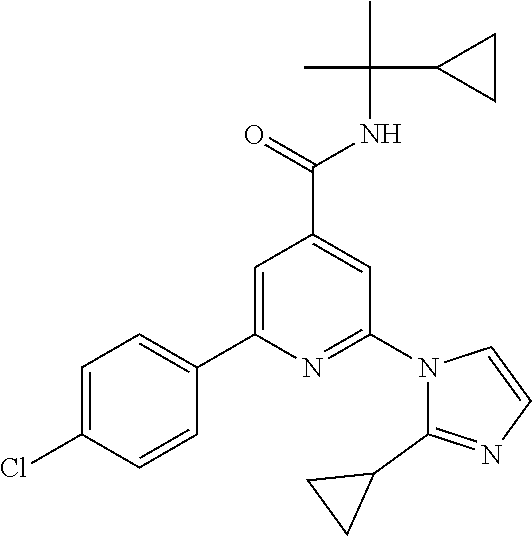
- FEEXIWSMBGAWCA-UHFFFAOYSA-N CC(C)(NC(=O)C1=CC(N2C=CN=C2C2CC2)=NC(C2=CC=C(Cl)C=C2)=C1)C1CC1 Chemical compound CC(C)(NC(=O)C1=CC(N2C=CN=C2C2CC2)=NC(C2=CC=C(Cl)C=C2)=C1)C1CC1 FEEXIWSMBGAWCA-UHFFFAOYSA-N 0.000 description 2
- DTRMACRVXPICJP-UHFFFAOYSA-N CC(C)(O)C1=NC=CN1C1=CC(C(=O)NC(C)(C)C(F)(F)F)=CC(C2=CC=C(Cl)C=C2)=N1 Chemical compound CC(C)(O)C1=NC=CN1C1=CC(C(=O)NC(C)(C)C(F)(F)F)=CC(C2=CC=C(Cl)C=C2)=N1 DTRMACRVXPICJP-UHFFFAOYSA-N 0.000 description 2
- ZMQZHTSBLZCBRQ-UHFFFAOYSA-N CC(C)(O)C1=NC=CN1C1=CC(C(=O)NC(C)(C)C2CC2)=CC(C2=CC=C(Cl)C=C2)=N1 Chemical compound CC(C)(O)C1=NC=CN1C1=CC(C(=O)NC(C)(C)C2CC2)=CC(C2=CC=C(Cl)C=C2)=N1 ZMQZHTSBLZCBRQ-UHFFFAOYSA-N 0.000 description 2
- SFDDIBFNYMGORA-UHFFFAOYSA-N CC(C)C1=NC=CN1C1=CC(C(=O)NC(C)(C)C#N)=CC(C2=CC=C(Cl)C=C2)=N1 Chemical compound CC(C)C1=NC=CN1C1=CC(C(=O)NC(C)(C)C#N)=CC(C2=CC=C(Cl)C=C2)=N1 SFDDIBFNYMGORA-UHFFFAOYSA-N 0.000 description 2
- ZAWMJXWBDZBBPF-UHFFFAOYSA-N CC(C)C1=NC=CN1C1=NC(C2=CC=C(C(F)(F)F)C=C2)=CC(C(=O)NC(C)(C)C)=C1 Chemical compound CC(C)C1=NC=CN1C1=NC(C2=CC=C(C(F)(F)F)C=C2)=CC(C(=O)NC(C)(C)C)=C1 ZAWMJXWBDZBBPF-UHFFFAOYSA-N 0.000 description 2
- JFOPFKWCKYMTTL-UHFFFAOYSA-N CC(C)C1=NC=CN1C1=NC(C2=CC=C(Cl)C=C2)=CC(C(=O)NC(C)(C)C(F)(F)F)=C1 Chemical compound CC(C)C1=NC=CN1C1=NC(C2=CC=C(Cl)C=C2)=CC(C(=O)NC(C)(C)C(F)(F)F)=C1 JFOPFKWCKYMTTL-UHFFFAOYSA-N 0.000 description 2
- XAMZLKVXALTGAW-UHFFFAOYSA-N CC(C)C1=NC=CN1C1=NC(C2=CC=C(Cl)C=C2)=CC(C(=O)NC(C)(C)C2CC2)=C1 Chemical compound CC(C)C1=NC=CN1C1=NC(C2=CC=C(Cl)C=C2)=CC(C(=O)NC(C)(C)C2CC2)=C1 XAMZLKVXALTGAW-UHFFFAOYSA-N 0.000 description 2
- NQNIXIKJUSZKAW-UHFFFAOYSA-N CC(C)C1=NC=CN1C1=NC(C2=CC=C(Cl)C=C2)=CC(C(=O)NC(C)(C)CO)=C1 Chemical compound CC(C)C1=NC=CN1C1=NC(C2=CC=C(Cl)C=C2)=CC(C(=O)NC(C)(C)CO)=C1 NQNIXIKJUSZKAW-UHFFFAOYSA-N 0.000 description 2
- NGSBCYFSKQTDTN-UHFFFAOYSA-N CC(C)C1=NC=CN1C1=NC(C2=CC=C(F)C=C2)=CC(C(=O)CC2(C)CCS(=O)(=O)C2)=C1 Chemical compound CC(C)C1=NC=CN1C1=NC(C2=CC=C(F)C=C2)=CC(C(=O)CC2(C)CCS(=O)(=O)C2)=C1 NGSBCYFSKQTDTN-UHFFFAOYSA-N 0.000 description 2
- DGYKMEWUJCSFQA-UHFFFAOYSA-N CC1=CC=C(C2=NC(N3C=CN=C3C(C)(C)C)=CC(C(=O)NC(C)(C)C)=C2)C=C1 Chemical compound CC1=CC=C(C2=NC(N3C=CN=C3C(C)(C)C)=CC(C(=O)NC(C)(C)C)=C2)C=C1 DGYKMEWUJCSFQA-UHFFFAOYSA-N 0.000 description 2
- WWDOEICMPMXXFP-UHFFFAOYSA-N CC1=NC=CN1C1=NC(C2=CC=C(Cl)C=C2)=CC(C(=O)NC(C)(C)C)=C1 Chemical compound CC1=NC=CN1C1=NC(C2=CC=C(Cl)C=C2)=CC(C(=O)NC(C)(C)C)=C1 WWDOEICMPMXXFP-UHFFFAOYSA-N 0.000 description 2
- KLFVEPGPQWDUCR-UHFFFAOYSA-N CC1=NC=CN1C1=NC(C2=CC=C(F)C=C2)=CC(C(=O)NC(C)(C)C)=C1 Chemical compound CC1=NC=CN1C1=NC(C2=CC=C(F)C=C2)=CC(C(=O)NC(C)(C)C)=C1 KLFVEPGPQWDUCR-UHFFFAOYSA-N 0.000 description 2
- DVVULQWNBUPJHR-UHFFFAOYSA-N CCC(C)(C)NC(=O)C1=CC(N2C=CN=C2C(C)C)=NC(C2=CC=C(F)C=C2)=C1 Chemical compound CCC(C)(C)NC(=O)C1=CC(N2C=CN=C2C(C)C)=NC(C2=CC=C(F)C=C2)=C1 DVVULQWNBUPJHR-UHFFFAOYSA-N 0.000 description 2
- CIENUFCVCXXBOT-UHFFFAOYSA-N CCC1=NC=CN1C1=NC(C2=CC=C(Cl)C=C2)=CC(C(=O)NC(C)(C)C)=C1 Chemical compound CCC1=NC=CN1C1=NC(C2=CC=C(Cl)C=C2)=CC(C(=O)NC(C)(C)C)=C1 CIENUFCVCXXBOT-UHFFFAOYSA-N 0.000 description 2
- WUKBLURZPXJTPK-UHFFFAOYSA-N CCC1=NC=CN1C1=NC(C2=CC=C(F)C=C2)=CC(C(=O)NC(C)(C)C)=C1 Chemical compound CCC1=NC=CN1C1=NC(C2=CC=C(F)C=C2)=CC(C(=O)NC(C)(C)C)=C1 WUKBLURZPXJTPK-UHFFFAOYSA-N 0.000 description 2
- IIMGPCNRMVRWHB-UHFFFAOYSA-N COC1=CC=C(C2=NC(N3C=CN=C3C(C)(C)C)=CC(C(=O)NC(C)(C)C)=C2)C=C1 Chemical compound COC1=CC=C(C2=NC(N3C=CN=C3C(C)(C)C)=CC(C(=O)NC(C)(C)C)=C2)C=C1 IIMGPCNRMVRWHB-UHFFFAOYSA-N 0.000 description 2
- PTTZZYRNMYRVJE-UHFFFAOYSA-N CC(C)(C#N)NC(=O)C1=CC(C2=CC=C(Cl)C=C2)=NC(Br)=C1 Chemical compound CC(C)(C#N)NC(=O)C1=CC(C2=CC=C(Cl)C=C2)=NC(Br)=C1 PTTZZYRNMYRVJE-UHFFFAOYSA-N 0.000 description 1
- DZMIKYGCHAKDHF-UHFFFAOYSA-N CC(C)(C#N)NC(=O)C1=CC(I)=NC(C2=CC=C(Cl)C=C2)=C1 Chemical compound CC(C)(C#N)NC(=O)C1=CC(I)=NC(C2=CC=C(Cl)C=C2)=C1 DZMIKYGCHAKDHF-UHFFFAOYSA-N 0.000 description 1
- QVMMLCIIIJIEIU-UHFFFAOYSA-N CC(C)(C)C1=NC=CN1C1=CC(C(=O)NC(C)(C)C2CC2)=CC(C2=CC=C(Cl)C=C2)=N1 Chemical compound CC(C)(C)C1=NC=CN1C1=CC(C(=O)NC(C)(C)C2CC2)=CC(C2=CC=C(Cl)C=C2)=N1 QVMMLCIIIJIEIU-UHFFFAOYSA-N 0.000 description 1
- OGJCKZJHPCZPPN-UHFFFAOYSA-N CC(C)(C)NC(=O)C1=CC(Br)=NC(C2=CC=C(C(F)(F)F)C=C2)=C1 Chemical compound CC(C)(C)NC(=O)C1=CC(Br)=NC(C2=CC=C(C(F)(F)F)C=C2)=C1 OGJCKZJHPCZPPN-UHFFFAOYSA-N 0.000 description 1
- GQUXAWWXOVIETG-UHFFFAOYSA-N CC(C)(C)NC(=O)C1=CC(Br)=NC(C2=CC=C(C3CC3)C=C2)=C1 Chemical compound CC(C)(C)NC(=O)C1=CC(Br)=NC(C2=CC=C(C3CC3)C=C2)=C1 GQUXAWWXOVIETG-UHFFFAOYSA-N 0.000 description 1
- GSUOBYSVBZIWSY-UHFFFAOYSA-N CC(C)(C)NC(=O)C1=CC(Br)=NC(C2=CC=C(Cl)C=C2)=C1 Chemical compound CC(C)(C)NC(=O)C1=CC(Br)=NC(C2=CC=C(Cl)C=C2)=C1 GSUOBYSVBZIWSY-UHFFFAOYSA-N 0.000 description 1
- AYOZOJWRFAQQBI-UHFFFAOYSA-N CC(C)(C)NC(=O)C1=CC(Br)=NC(C2=CC=C(F)C(F)=C2)=C1 Chemical compound CC(C)(C)NC(=O)C1=CC(Br)=NC(C2=CC=C(F)C(F)=C2)=C1 AYOZOJWRFAQQBI-UHFFFAOYSA-N 0.000 description 1
- XDARFQOZVDJQIC-UHFFFAOYSA-N CC(C)(C)NC(=O)C1=CC(Br)=NC(C2=CC=C(F)C=C2)=C1 Chemical compound CC(C)(C)NC(=O)C1=CC(Br)=NC(C2=CC=C(F)C=C2)=C1 XDARFQOZVDJQIC-UHFFFAOYSA-N 0.000 description 1
- AZDHFLVITSEPGV-UHFFFAOYSA-N CC(C)(C)NC(=O)C1=CC(Br)=NC(N2C=CN=C2C(C)(C)C)=C1 Chemical compound CC(C)(C)NC(=O)C1=CC(Br)=NC(N2C=CN=C2C(C)(C)C)=C1 AZDHFLVITSEPGV-UHFFFAOYSA-N 0.000 description 1
- DQXZGPZGWWZQPP-UHFFFAOYSA-N CC(C)(C)NC(=O)C1=CC(I)=NC(C2=CC=C(C(F)(F)F)C=C2)=C1 Chemical compound CC(C)(C)NC(=O)C1=CC(I)=NC(C2=CC=C(C(F)(F)F)C=C2)=C1 DQXZGPZGWWZQPP-UHFFFAOYSA-N 0.000 description 1
- YFEVIBJTDIDSLR-UHFFFAOYSA-N CC(C)(C)NC(=O)C1=CC(I)=NC(C2=CC=C(Cl)C=C2)=C1 Chemical compound CC(C)(C)NC(=O)C1=CC(I)=NC(C2=CC=C(Cl)C=C2)=C1 YFEVIBJTDIDSLR-UHFFFAOYSA-N 0.000 description 1
- CMIBGJKXBDABPC-UHFFFAOYSA-N CC(C)(CO)NC(=O)C1=CC(C2=CC=C(Cl)C=C2)=NC(Br)=C1 Chemical compound CC(C)(CO)NC(=O)C1=CC(C2=CC=C(Cl)C=C2)=NC(Br)=C1 CMIBGJKXBDABPC-UHFFFAOYSA-N 0.000 description 1
- XHCLFCICWBREPP-UHFFFAOYSA-N CC(C)(NC(=O)C1=CC(Br)=NC(C2=CC=C(Cl)C=C2)=C1)C1CC1 Chemical compound CC(C)(NC(=O)C1=CC(Br)=NC(C2=CC=C(Cl)C=C2)=C1)C1CC1 XHCLFCICWBREPP-UHFFFAOYSA-N 0.000 description 1
- WFNQOCYTSIFJKP-UHFFFAOYSA-N CC(C)(NC(=O)C1=CC(C2=CC=C(Cl)C=C2)=NC(Br)=C1)C(F)(F)F Chemical compound CC(C)(NC(=O)C1=CC(C2=CC=C(Cl)C=C2)=NC(Br)=C1)C(F)(F)F WFNQOCYTSIFJKP-UHFFFAOYSA-N 0.000 description 1
- LAABDIGBOGTSJJ-UHFFFAOYSA-N CC(C)(NC(=O)C1=CC(I)=NC(C2=CC=C(Cl)C=C2)=C1)C(F)(F)F Chemical compound CC(C)(NC(=O)C1=CC(I)=NC(C2=CC=C(Cl)C=C2)=C1)C(F)(F)F LAABDIGBOGTSJJ-UHFFFAOYSA-N 0.000 description 1
- VCFUACCCKZEWRL-UHFFFAOYSA-N CC(C)(NC(=O)C1=CC(I)=NC(C2=CC=C(Cl)C=C2)=C1)C1CC1 Chemical compound CC(C)(NC(=O)C1=CC(I)=NC(C2=CC=C(Cl)C=C2)=C1)C1CC1 VCFUACCCKZEWRL-UHFFFAOYSA-N 0.000 description 1
- PLEANPSVYFLJAS-UHFFFAOYSA-N CC1(CC(=O)C2=CC(Br)=NC(C3=CC=C(F)C=C3)=C2)CCS(=O)(=O)C1 Chemical compound CC1(CC(=O)C2=CC(Br)=NC(C3=CC=C(F)C=C3)=C2)CCS(=O)(=O)C1 PLEANPSVYFLJAS-UHFFFAOYSA-N 0.000 description 1
- ZZONWWKTLOHSSR-UHFFFAOYSA-N CC1=CC(C2=CC(C(=O)NC(C)(C)C)=CC(Br)=N2)=CC=C1F Chemical compound CC1=CC(C2=CC(C(=O)NC(C)(C)C)=CC(Br)=N2)=CC=C1F ZZONWWKTLOHSSR-UHFFFAOYSA-N 0.000 description 1
- KLPCBJMXJWTYBT-UHFFFAOYSA-N CC1=CC=C(C2=CC(C(=O)NC(C)(C)C)=CC(Br)=N2)C=C1 Chemical compound CC1=CC=C(C2=CC(C(=O)NC(C)(C)C)=CC(Br)=N2)C=C1 KLPCBJMXJWTYBT-UHFFFAOYSA-N 0.000 description 1
- RJCWMJVJFBBDJV-UHFFFAOYSA-N CC1=CC=C(C2=CC(C(=O)NC(C)(C)C)=CC(Br)=N2)C=C1F Chemical compound CC1=CC=C(C2=CC(C(=O)NC(C)(C)C)=CC(Br)=N2)C=C1F RJCWMJVJFBBDJV-UHFFFAOYSA-N 0.000 description 1
- CATPGKFRSFKLCR-UHFFFAOYSA-N CC1=NC=CN1C1=NC(C2=CC=C(C(F)(F)F)C=C2)=CC(C(=O)NC(C)(C)C)=C1 Chemical compound CC1=NC=CN1C1=NC(C2=CC=C(C(F)(F)F)C=C2)=CC(C(=O)NC(C)(C)C)=C1 CATPGKFRSFKLCR-UHFFFAOYSA-N 0.000 description 1
- WLEPOZAKLCLSLT-UHFFFAOYSA-N CCC(C)(C)NC(=O)C1=CC(Br)=NC(C2=CC=C(F)C=C2)=C1 Chemical compound CCC(C)(C)NC(=O)C1=CC(Br)=NC(C2=CC=C(F)C=C2)=C1 WLEPOZAKLCLSLT-UHFFFAOYSA-N 0.000 description 1
Classifications
-
- A—HUMAN NECESSITIES
- A61—MEDICAL OR VETERINARY SCIENCE; HYGIENE
- A61K—PREPARATIONS FOR MEDICAL, DENTAL OR TOILETRY PURPOSES
- A61K31/00—Medicinal preparations containing organic active ingredients
- A61K31/33—Heterocyclic compounds
- A61K31/395—Heterocyclic compounds having nitrogen as a ring hetero atom, e.g. guanethidine or rifamycins
- A61K31/41—Heterocyclic compounds having nitrogen as a ring hetero atom, e.g. guanethidine or rifamycins having five-membered rings with two or more ring hetero atoms, at least one of which being nitrogen, e.g. tetrazole
- A61K31/4164—1,3-Diazoles
- A61K31/4178—1,3-Diazoles not condensed 1,3-diazoles and containing further heterocyclic rings, e.g. pilocarpine, nitrofurantoin
-
- A—HUMAN NECESSITIES
- A61—MEDICAL OR VETERINARY SCIENCE; HYGIENE
- A61P—SPECIFIC THERAPEUTIC ACTIVITY OF CHEMICAL COMPOUNDS OR MEDICINAL PREPARATIONS
- A61P25/00—Drugs for disorders of the nervous system
- A61P25/18—Antipsychotics, i.e. neuroleptics; Drugs for mania or schizophrenia
-
- A—HUMAN NECESSITIES
- A61—MEDICAL OR VETERINARY SCIENCE; HYGIENE
- A61P—SPECIFIC THERAPEUTIC ACTIVITY OF CHEMICAL COMPOUNDS OR MEDICINAL PREPARATIONS
- A61P25/00—Drugs for disorders of the nervous system
- A61P25/30—Drugs for disorders of the nervous system for treating abuse or dependence
-
- C—CHEMISTRY; METALLURGY
- C07—ORGANIC CHEMISTRY
- C07B—GENERAL METHODS OF ORGANIC CHEMISTRY; APPARATUS THEREFOR
- C07B43/00—Formation or introduction of functional groups containing nitrogen
- C07B43/04—Formation or introduction of functional groups containing nitrogen of amino groups
-
- C—CHEMISTRY; METALLURGY
- C07—ORGANIC CHEMISTRY
- C07D—HETEROCYCLIC COMPOUNDS
- C07D401/00—Heterocyclic compounds containing two or more hetero rings, having nitrogen atoms as the only ring hetero atoms, at least one ring being a six-membered ring with only one nitrogen atom
- C07D401/02—Heterocyclic compounds containing two or more hetero rings, having nitrogen atoms as the only ring hetero atoms, at least one ring being a six-membered ring with only one nitrogen atom containing two hetero rings
- C07D401/04—Heterocyclic compounds containing two or more hetero rings, having nitrogen atoms as the only ring hetero atoms, at least one ring being a six-membered ring with only one nitrogen atom containing two hetero rings directly linked by a ring-member-to-ring-member bond
-
- C—CHEMISTRY; METALLURGY
- C07—ORGANIC CHEMISTRY
- C07D—HETEROCYCLIC COMPOUNDS
- C07D403/00—Heterocyclic compounds containing two or more hetero rings, having nitrogen atoms as the only ring hetero atoms, not provided for by group C07D401/00
- C07D403/02—Heterocyclic compounds containing two or more hetero rings, having nitrogen atoms as the only ring hetero atoms, not provided for by group C07D401/00 containing two hetero rings
- C07D403/04—Heterocyclic compounds containing two or more hetero rings, having nitrogen atoms as the only ring hetero atoms, not provided for by group C07D401/00 containing two hetero rings directly linked by a ring-member-to-ring-member bond
-
- C—CHEMISTRY; METALLURGY
- C07—ORGANIC CHEMISTRY
- C07D—HETEROCYCLIC COMPOUNDS
- C07D409/00—Heterocyclic compounds containing two or more hetero rings, at least one ring having sulfur atoms as the only ring hetero atoms
- C07D409/14—Heterocyclic compounds containing two or more hetero rings, at least one ring having sulfur atoms as the only ring hetero atoms containing three or more hetero rings
-
- C—CHEMISTRY; METALLURGY
- C07—ORGANIC CHEMISTRY
- C07B—GENERAL METHODS OF ORGANIC CHEMISTRY; APPARATUS THEREFOR
- C07B2200/00—Indexing scheme relating to specific properties of organic compounds
- C07B2200/07—Optical isomers
Definitions
- the present invention relates to novel compounds of formula I, as described herein, having pharmaceutical activity, their manufacture, pharmaceutical compositions containing them and their potential use as medicaments.
- EAAT3 The excitatory amino acid transporter 3 (EAAT3), also referred to in human studies as solute carrier family 1, member 1 (systematic gene name: SLC1A1) and in rodents as excitatory amino acid carrier 1 (EAAC1), is a high-affinity anionic amino acid transporter found in neurons throughout the cortex and in the hippocampus, basal ganglia (striatum, thalamus), and the olfactory bulb. EAAT3 functions to buffer local glutamate concentrations at excitatory synapses, for example in the hippocampus, and modulates the differential recruitment of glutamate receptor subtypes at extrasynaptic sites. Furthermore, EAAT3 is thought to be involved in facilitating GABA and glutathione biosynthesis.
- EAAT3 is a member of the EAAT family that mediates the uptake of glutamate into neuronal and glial cells of the mammalian CNS.
- Two transporters expressed primarily in glia, EAAT1 and EAAT2 are crucial for glutamate homeostasis in the adult mammalian brain and for rapid clearance of glutamate from the synaptic cleft.
- Three neuronal transporters (EAAT3, EAAT4, and EAAT5) appear to have additional functions in regulating and processing cellular excitability with EAAT3 being abundantly expressed throughout the CNS (EAAT4 is unique to Purkinje cells of the cerebellum and EAAT5 is expressed in rod photoreceptor and bipolar cells of the retina).
- EAATs are assembled as trimers, and the existence of multiple isoforms raises the question of whether certain isoforms can form hetero-oligomers.
- the specificity of excitatory synaptic transmission depends on rapid diffusion of glutamate away from active synapses and the powerful uptake capacity of glutamate transporters in astrocytes.
- the extent to which neuronal glutamate transporters influence the lifetime of glutamate in the extracellular space remains unclear, but it is thought to be minor.
- EAAT3 the predominant neuronal glutamate transporter at excitatory synapses in hippocampal area CA1, buffers glutamate released during synaptic events and prolongs the time course of its clearance by astrocytes.
- EAAT3 does not significantly alter activation of receptors in the synaptic cleft. Instead, it reduces recruitment of perisynaptic/extrasynaptic NR2B-containing NMDARs, thereby facilitating induction of long-term potentiation by short bursts of high-frequency stimulation.
- Specific EAAT3 inhibitors may have the potential to locally and specifically strengthen particular synapses.
- Obsessive-compulsive disorder is among the most common mental disorders (prevalence 1-3%), and is at least as prevalent as schizophrenia and bipolar disorder. In the United States, one in 50 adults suffers from OCD. OCD affects children and adolescents as well as adults. Roughly one third to one half of adults with OCD reports a childhood onset of the disorder, and the disorder is typically chronic in nature. Treatment consists of predominantly serotonergic TCAs (clomipramine) or SSRIs in combination with cognitive-behavioral therapy (CBT). Overall, response to these interventions is of some but still limited benefit (approximately comparable to antidepressant response in MDD), and given the chronicity of OCD, the unmet medical need remains very high. OCD has been linked to serotonin and glutamate abnormalities. The hypothesis of glutamate signaling dysfunction in OCD is based on findings from neuroimaging, animal models, positional cloning and treatment studies.
- the obsessive-compulsive symptomatology in OCD has considerable phenomenological, epidemiological and possibly (aetio)-pathophysiological overlap with a core autism spectrum disorder criterion: “restricted, repetitive patterns of behavior, interests, or activities” (taken from proposed DSM-5 revision).
- aetio core autism spectrum disorder criterion: “restricted, repetitive patterns of behavior, interests, or activities” (taken from proposed DSM-5 revision).
- human genetics studies have linked both the serotonin transporter and EAAT3 (SLC1A1) genes to autism spectrum disorder (ASD) or rigid-compulsive behavior in ASD and to OCD.
- EAAT3 EAAT3 gene variants.
- Post-mortem brain studies have shown that both classic and atypical antipsychotics reduce EAAT3, suggesting an involvement of this transporter in neuroleptic mechanisms beyond dopamine and serotonin modulation.
- genetic variation in the human gene EAAT3 (SLC1A1) has been associated with antipsychotic drug response.
- EAAT3 is a key pathophysiological element in OCD and rigid-compulsive behavior in autism and in schizophrenia: A. A. Jensen et al., Curr. Opin. Pharmacol. 20, 116-123, 2015; L. A. Jarzylo abd H-Y. Man, J. Neurosci., 32, 2552-2563, 2012; A. Scimemi et al., J. Neurosci 29, 14581-14595, 2009; J. R. Wendland et al. Arch. Gen. Psychiatry, 66, 408-416, 2009; R. Bridges and C. S. Esslinger, Pharmacol.
- the present invention relates to compounds of formula I wherein:
- Compounds of formula I are distinguished by having valuable therapeutic properties. They can be used in the treatment or prevention of disorders, relating to EAAT3 inhibitors.
- the most preferred indications for compounds which are EAAT3 inhibitors are psychiatric disorders such as schizophrenia, bipolar disorder, obsessive-compulsive disorder or autism spectrum disorder.
- the present invention relates to compounds of formula I and to their pharmaceutically acceptable salts, to their use in the treatment of psychiatric disorders such as schizophrenia, bipolar disorder, obsessive-compulsive disorder or autism spectrum disorder, to compounds of formulas I, IA, IB, IC, ID, IE, IF and IG as pharmaceutically active substances, to the processes for their production as well as to their use in the treatment or prevention of disorders, relating to EAAT3 inhibitors, such as schizophrenia, bipolar disorder, obsessive-compulsive disorder or autism spectrum disorder and to pharmaceutical compositions containing the compounds of formula IA
- a further object of the present invention is a method for the treatment or prophylaxis of psychiatric disorder such as schizophrenia, bipolar disorder, obsessive-compulsive disorder or autism spectrum disorder, which method comprises administering an effective amount of a compound of formula I to a mammal in need.
- psychiatric disorder such as schizophrenia, bipolar disorder, obsessive-compulsive disorder or autism spectrum disorder
- the invention includes all racemic mixtures, all their corresponding enantiomers and/or optical isomers, or analogues containing isotopes of hydrogen, fluorine, carbon, oxygen or nitrogen.
- One object of the present invention are novel compounds of formula IA,
- the compounds of formulas IA, IB, IC, ID, IE, IF and IG can be manufactured by the methods given below, by the methods given in the examples or by analogous methods.
- Appropriate reaction conditions for the individual reaction steps are known to a person skilled in the art.
- the reaction sequence is not limited to the one displayed in the schemes, however, depending on the starting materials and their respective reactivity the sequence of reaction steps can be freely altered.
- Starting materials are either commercially available or can be prepared by methods analogous to the methods given below, by methods described in references cited in the description or in the examples, or by methods known in the art.
- the present compounds of IA, IB, IC, ID, IE, IF and IG and their pharmaceutically acceptable salts may be prepared by methods, known in the art, for example by the process variant described below, which process comprises
- the imidazole derivatives I can either be prepared from the intermediate bromo derivatives II by substitution reaction with commercially available imidazoles III
- the bromo derivatives II can be prepared starting from commercially available 2,6-dibromo-isonicotinic acid VI. Amide formation with the commercially available amines VII using standard conditions leads to the amides VIII which can be coupled with commercially available boronic acid derivatives V to yield the final building blocks II.
- An alternative route for the synthesis of the bromo derivatives II can start from commercially available methyl 2-bromo-isonicotinate IX which can be coupled with the commercially available boronic acid derivatives V to yield the 2-aryl-pyridine derivatives X which can be transformed by standard procedures into the bromo derivatives XI. Saponification and subsequent amide formation with the commercially available amines VII yield the building blocks II.
- the synthesis of the bromo derivatives IV can be performed starting from the above described amides VIII which can be reacted with the commercially available imidazoles III to yield after reverse phase HPLC separation of the obtained product mixture the pure building blocks IV.
- the sequence of steps used to synthesize the compounds of formula I can also be modified in certain cases.
- the compounds of formula I and their pharmaceutically usable addition salts possess valuable pharmaceutical properties.
- the compounds of the present invention are EAAT3 inhibitors for use in the treatment of schizophrenia, bipolar disorder, obsessive-compulsive disorder or autism spectrum disorders. The compounds were investigated in accordance with the test given hereinafter.
- HEK-293 cells stably expressing human EAAT3 were seeded at 55 000 cells/well in growth medium (DMEM glutamate free (Invitrogen 11960-044), 1% Pen Strep (10 ml/l GIBCO BRL No 15140-023), 10% FCS non dialysed heat inactivated, 5 mg/l puromycin) in poly-D-lysine treated 96-well black microtiter plates with clear-bottom.
- growth medium DMEM glutamate free (Invitrogen 11960-044), 1% Pen Strep (10 ml/l GIBCO BRL No 15140-023), 10% FCS non dialysed heat inactivated, 5 mg/l puromycin
- the cells were then loaded by adding 100 ⁇ l/well FMP assay dye (FLIPR Membrane Potential assay reagent, Molecular Devices).
- the 96-well plates were then incubated at 37° C. for 1 h. The depolarization of the cells will cause more dye to enter in the cells, where it will bind to intracellular proteins and lipids and cause an increase in the fluorescence signal.
- Antagonist potency at human EAAT3 was determined by using L-glutamate as agonist at a concentration which gives 80% of the maximum response. The antagonists were applied 15 min before the application of the agonist L-glutamate. The assays were performed at room temperature and measurements done by using a Fluorometric Imaging Plate Reader (FLIPR, Molecular Devices) and filter #2. Responses were measured as peak increase in fluorescence minus basal (i.e. fluorescence without addition of L-glutamate).
- FLIPR Fluorometric Imaging Plate Reader
- the pharmaceutical preparations can be administered orally, e.g. in the form of tablets, coated tablets, dragées, hard and soft gelatine capsules, solutions, emulsions or suspensions.
- the administration can also be effected rectally, e.g. in the form of suppositories, or parenterally, e.g. in the form of injection solutions.
- the compounds of formula (I) and pharmaceutically acceptable salts thereof can be processed with pharmaceutically inert, inorganic or organic carriers for the production of pharmaceutical preparations.
- Lactose, corn starch or derivatives thereof, talc, stearic acid or its salts and the like can be used, for example, as such carriers for tablets, coated tablets, dragées and hard gelatin capsules.
- Suitable carriers for soft gelatin capsules are, for example, vegetable oils, waxes, fats, semi-solid and liquid polyols and the like; depending on the nature of the active substance no carriers are, however, usually required in the case of soft gelatin capsules.
- Suitable carriers for the production of solutions and syrups are, for example, water, polyols, sucrose, invert sugar, glucose and the like.
- Adjuvants such as alcohols, polyols, glycerol, vegetable oils and the like, can be used for aqueous injection solutions of water-soluble salts of compounds of formula (I), but as a rule are not necessary.
- Suitable carriers for suppositories are, for example, natural or hardened oils, waxes, fats, semi-liquid or liquid polyols and the like.
- the pharmaceutical preparations can contain preservatives, solubilizers, stabilizers, wetting agents, emulsifiers, sweeteners, colorants, flavorants, salts for varying the osmotic pressure, buffers, masking agents or antioxidants. They can also contain still other therapeutically valuable substances.
- medicaments containing a compound of formula (I) or pharmaceutically acceptable salts thereof and a therapeutically inert excipient are also an object of the present invention, as is a process for the production of such medicaments which comprises bringing one or more compounds of formula I or pharmaceutically acceptable salts thereof and, if desired, one or more other therapeutically valuable substances into a galenical dosage form together with one or more therapeutically inert carriers.
- the dosage can vary within wide limits and will, of course, be fitted to the individual requirements in each particular case.
- the effective dosage for oral or parenteral administration is between 0.01-20 mg/kg/day, with a dosage of 0.1-10 mg/kg/day being preferred for all of the indications described.
- mg/capsule ingredient 5 25 100 500 Compound of formula I 5 25 100 500 Hydrous Lactose 159 123 148 — Corn Starch 25 35 40 70 Talk 10 15 10 25 Magnesium Stearate 1 2 2 5 Total 200 200 300 600
- a compound of formula I lactose and corn starch are firstly mixed in a mixer and then in a comminuting machine. The mixture is returned to the mixer; the talc is added thereto and mixed thoroughly. The mixture is filled by machine into suitable capsules, e.g. hard gelatin capsules.
- a compound of formula I is dissolved in a mixture of Polyethylene Glycol 400 and water for injection (part). The pH is adjusted to 5.0 by acetic acid. The volume is adjusted to 1.0 ml by addition of the residual amount of water. The solution is filtered, filled into vials using an appropriate overage and sterilized.
- step D To a stirred solution of 2-bromo-6-(4-chlorophenyl)-pyridine-4-carboxylic acid (intermediate 5, step D) (313 mg, 1.0 mmol) in THF (7.2 ml) was added at room temperature N,N-diisopropylethylamine (323 mg, 437 ⁇ l, 2.5 mmol), commercially available 2-amino-2-methylpropan-1-ol (134 mg, 144 ⁇ l, 1.5 mmol) and TBTU (514 mg, 1.6 mmol).
- a microwave tube was charged with 2,6-dibromo-N-tert-butylpyridine-4-carboxamide (intermediate 1, step A) (0.84 g, 2.5 mmol), 2-(tert-butyl)-1H-imidazole (310 mg, 2.5 mmol), potassium phosphate (1.06 g, 5 mmol) and tetrabutylammoniumbromide (403 mg, 1.25 mmol), DMSO (5 ml) was added, the reaction mixture purged with argon for 5 min in an ultrasonic bath, copper(I)iodide (47.6 mg, 250 ⁇ mol) and 4,7-dihydroxy-1,10-phenanthroline (106 mg, 500 ⁇ mol) were added, the tube was sealed and the reaction mixture was allowed to stir for 20 h at 120° C.
Landscapes
- Chemical & Material Sciences (AREA)
- Organic Chemistry (AREA)
- Health & Medical Sciences (AREA)
- Life Sciences & Earth Sciences (AREA)
- Bioinformatics & Cheminformatics (AREA)
- Pharmacology & Pharmacy (AREA)
- Animal Behavior & Ethology (AREA)
- General Health & Medical Sciences (AREA)
- Public Health (AREA)
- Veterinary Medicine (AREA)
- Medicinal Chemistry (AREA)
- Engineering & Computer Science (AREA)
- Psychiatry (AREA)
- Biomedical Technology (AREA)
- Neurology (AREA)
- Neurosurgery (AREA)
- Chemical Kinetics & Catalysis (AREA)
- General Chemical & Material Sciences (AREA)
- Nuclear Medicine, Radiotherapy & Molecular Imaging (AREA)
- Epidemiology (AREA)
- Addiction (AREA)
- Pharmaceuticals Containing Other Organic And Inorganic Compounds (AREA)
- Plural Heterocyclic Compounds (AREA)
Abstract
Description
EAATs are assembled as trimers, and the existence of multiple isoforms raises the question of whether certain isoforms can form hetero-oligomers. In the mammalian brain, the specificity of excitatory synaptic transmission depends on rapid diffusion of glutamate away from active synapses and the powerful uptake capacity of glutamate transporters in astrocytes. The extent to which neuronal glutamate transporters influence the lifetime of glutamate in the extracellular space remains unclear, but it is thought to be minor. EAAT3, the predominant neuronal glutamate transporter at excitatory synapses in hippocampal area CA1, buffers glutamate released during synaptic events and prolongs the time course of its clearance by astrocytes. EAAT3 does not significantly alter activation of receptors in the synaptic cleft. Instead, it reduces recruitment of perisynaptic/extrasynaptic NR2B-containing NMDARs, thereby facilitating induction of long-term potentiation by short bursts of high-frequency stimulation. Specific EAAT3 inhibitors may have the potential to locally and specifically strengthen particular synapses.

- R1′ is CH3;
- R1 is methyl, ethyl, CF3, CH2OH, cyclopropyl or cyano, or
- R1′ and R1 may form together a 1,1-dioxo-tetrahydro-thiophen-3-yl ring;
- R2 is hydrogen, methyl, ethyl, isopropyl, tertbutyl, cyclopropyl, hydroxmethyl, or 2-propyl-2-ol;
- R3 is Cl, F, CF3, methyl, methoxy, isopropyl, cyano or cyclopropyl;
- R4 is hydrogen, methyl, F or Cl;
or to a pharmaceutically acceptable salt or acid addition salt, to a racemic mixture, or to its corresponding enantiomer and/or optical isomer and/or stereoisomer thereof.
The compounds of formula I may be used in the treatment of psychiatric disorders such as schizophrenia, bipolar disorder, obsessive-compulsive disorder or autism spectrum disorder.

wherein
- R2 is hydrogen, methyl, ethyl, isopropyl, tertbutyl, cyclopropyl, hydroxmethyl, or 2-propyl-2-ol;
- R3 is Cl, F, CF3, methyl, methoxy, isopropyl, cyano or cyclopropyl;
- R4 is hydrogen, methyl, F or Cl;
or a pharmaceutically acceptable salt or acid addition salt, a racemic mixture, or its corresponding enantiomer and/or optical isomer and/or stereoisomer thereof, for example the following compounds: - N-tert-Butyl-2-(4-chlorophenyl)-6-(2-propan-2-yl-imidazol-1-yl)-pyridine-4-carboxamide
- N-tert-Butyl-2-(4-fluorophenyl)-6-(2-propan-2-yl-imidazol-1-yl)-pyridine-4-carboxamide
- N-tert-Butyl-2-(2-propan-2-yl-imidazol-1-yl)-6-[4-(trifluoromethyl)-phenyl]-pyridine-4-carboxamide
- N-tert-Butyl-2-(2-cyclopropyl-imidazol-1-yl)-6-(4-fluorophenyl)-pyridine-4-carboxamide
- N-tert-Butyl-2-(4-chlorophenyl)-6-(2-cyclopropyl-imidazol-1-yl)-pyridine-4-carboxamide
- N-tert-Butyl-2-(4-fluorophenyl)-6-imidazol-1-yl-pyridine-4-carboxamide
- N-tert-Butyl-2-(4-fluorophenyl)-6-(2-methyl-imidazol-1-yl)-pyridine-4-carboxamide
- N-tert-Butyl-2-(2-ethyl-imidazol-1-yl)-6-(4-fluorophenyl)-pyridine-4-carboxamide
- N-tert-Butyl-2-(4-chlorophenyl)-6-imidazol-1-yl-pyridine-4-carboxamide
- N-tert-Butyl-2-(4-chlorophenyl)-6-(2-methyl-imidazol-1-yl)-pyridine-4-carboxamide
- N-tert-Butyl-2-(4-chlorophenyl)-6-(2-ethyl-imidazol-1-yl)-pyridine-4-carboxamide
- N-tert-Butyl-2-(2-tert-butyl-imidazol-1-yl)-6-(4-chlorophenyl)-pyridine-4-carboxamide
- N-tert-Butyl-2-(2-tert-butyl-imidazol-1-yl)-6-(4-fluorophenyl)-pyridine-4-carboxamide
- N-tert-Butyl-2-(4-fluorophenyl)-6-[2-(hydroxymethyl)-imidazol-1-yl]-pyridine-4-carboxamide
- N-tert-Butyl-2-(4-fluorophenyl)-6-[2-(2-hydroxypropan-2-yl)-imidazol-1-yl]-pyridine-4-carboxamide
- N-tert-Butyl-2-(2-tert-butylimidazol-1-yl)-6-[4-(trifluoromethyl)-phenyl]-pyridine-4-carboxamide
- N-tert-Butyl-2-(2-cyclopropyl-imidazol-1-yl)-6-[4-(trifluoromethyl)-phenyl]-pyridine-4-carboxamide
- N-tert-Butyl-2-(2-methyl-imidazol-1-yl)-6-[4-(trifluoromethyl)-phenyl]-pyridine-4-carboxamide
- N-tert-Butyl-2-(4-chlorophenyl)-6-[2-(hydroxymethyl)-imidazol-1-yl]-pyridine-4-carboxamide
- N-tert-Butyl-2-(2-tert-butyl-imidazol-1-yl)-6-(3,4-difluorophenyl)-pyridine-4-carboxamide
- N-tert-Butyl-2-(2-tert-butyl-imidazol-1-yl)-6-(4-methylphenyl)-pyridine-4-carboxamide
- N-tert-Butyl-2-(2-tert-butyl-imidazol-1-yl)-6-(4-cyclopropyl-phenyl)-pyridine-4-carboxamide
- N-tert-Butyl-2-(2-tert-butyl-imidazol-1-yl)-6-(4-fluoro-3-methyl-phenyl)-pyridine-4-carboxamide
- N-tert-Butyl-2-(2-tert-butyl-imidazol-1-yl)-6-(4-methoxy-phenyl)-pyridine-4-carboxamide
- N-tert-Butyl-2-(2-tert-butyl-imidazol-1-yl)-6-(4-cyano-phenyl)-pyridine-4-carboxamide
- N-tert-Butyl-2-(4-chlorophenyl)-6-[2-(2-hydroxypropan-2-yl)-imidazol-1-yl]-pyridine-4-carboxamide or
- N-tert-Butyl-2-[2-(2-hydroxypropan-2-yl)-imidazol-1-yl]-6-[4-(trifluoromethyl)-phenyl]-pyridine-4-carboxamide.
One further object of the present invention are novel compounds of formula IB,

wherein
- R2 is hydrogen, methyl, ethyl, isopropyl, tertbutyl, cyclopropyl, hydroxmethyl, or 2-propyl-2-ol;
- R3 is Cl, F, CF3, methyl, methoxy, isopropyl, cyano or cyclopropyl;
- R4 is hydrogen, methyl, F or Cl;
or a pharmaceutically acceptable salt or acid addition salt, a racemic mixture, or its corresponding enantiomer and/or optical isomer and/or stereoisomer thereof, for example the compound 2-(4-Fluorophenyl)-N-(2-methylbutan-2-yl)-6-(2-propan-2-ylimidazol-1-yl)-pyridine-4-carboxamide.
One object of the present invention are novel compounds of formula IC,

wherein
- R2 is hydrogen, methyl, ethyl, isopropyl, tertbutyl, cyclopropyl, hydroxmethyl, or 2-propyl-2-ol;
- R3 is Cl, F, CF3, methyl, methoxy, isopropyl, cyano or cyclopropyl;
- R4 is hydrogen, methyl, F or Cl;
or a pharmaceutically acceptable salt or acid addition salt, a racemic mixture, or its corresponding enantiomer and/or optical isomer and/or stereoisomer thereof, for example the compounds - 2-(4-Chlorophenyl)-6-(2-propan-2-yl-imidazol-1-yl)-N-(1,1,1-trifluoro-2-methylpropan-2-yl)-pyridine-4-carboxamide
- 2-(4-Chlorophenyl)-6-(2-cyclopropyl-imidazol-1-yl)-N-(1,1,1-trifluoro-2-methylpropan-2-yl)-pyridine-4-carboxamide
- 2-(2-tert-Butylimidazol-1-yl)-6-(4-chlorophenyl)-N-(1,1,1-trifluoro-2-methylpropan-2-yl)-pyridine-4-carboxamide
- 2-(4-Chlorophenyl)-6-[2-(2-hydroxypropan-2-yl)-imidazol-1-yl]-N-(1,1,1-trifluoro-2-methylpropan-2-yl)-pyridine-4-carboxamide.
One object of the present invention are novel compounds of formula ID,

wherein
- R2 is hydrogen, methyl, ethyl, isopropyl, tertbutyl, cyclopropyl, hydroxmethyl, or 2-propyl-2-ol;
- R3 is Cl, F, CF3, methyl, methoxy, isopropyl, cyano or cyclopropyl;
- R4 is hydrogen, methyl, F or Cl;
or a pharmaceutically acceptable salt or acid addition salt, a racemic mixture, or its corresponding enantiomer and/or optical isomer and/or stereoisomer thereof, for example the compounds - 2-(4-Chlorophenyl)-N-(2-cyclopropylpropan-2-yl)-6-(2-propan-2-yl-imidazol-1-yl)-pyridine-4-carboxamide
- 2-(4-Chlorophenyl)-6-(2-cyclopropyl-imidazol-1-yl)-N-(2-cyclopropyl-propan-2-yl)-pyridine-4-carboxamide
- 2-(2-tert-Butylimidazol-1-yl)-6-(4-chlorophenyl)-N-(2-cyclopropyl-propan-2-yl)-pyridine-4-carboxamide or
- 2-(4-Chlorophenyl)-N-(2-cyclopropylpropan-2-yl)-6-[2-(2-hydroxypropan-2-yl)-imidazol-1-yl]-pyridine-4-carboxamide.
One further object of the invention are compounds of formula IE,

wherein
- R2 is hydrogen, methyl, ethyl, isopropyl, tertbutyl, cyclopropyl, hydroxmethyl, or 2-propyl-2-ol;
- R3 is Cl, F, CF3, methyl, methoxy, isopropyl, cyano or cyclopropyl;
- R4 is hydrogen, methyl, F or Cl;
or a pharmaceutically acceptable salt or acid addition salt, a racemic mixture, or its corresponding enantiomer and/or optical isomer and/or stereoisomer thereof, for example the compound (RS)-2-(4-Fluorophenyl)-N-(3-methyl-1,1-dioxothiolan-3-yl)-6-(2-propan-2-ylimidazol-1-yl)-pyridine-4-carboxamide.
One further object of the invention are compounds of formula IF,

wherein
- R2 is hydrogen, methyl, ethyl, isopropyl, tertbutyl, cyclopropyl, hydroxmethyl, or 2-propyl-2-ol;
- R3 is Cl, F, CF3, methyl, methoxy, isopropyl, cyano or cyclopropyl;
- R4 is hydrogen, methyl, F or Cl;
or a pharmaceutically acceptable salt or acid addition salt, a racemic mixture, or its corresponding enantiomer and/or optical isomer and/or stereoisomer thereof, for example the compound 2-(4-Chlorophenyl)-N-(1-hydroxy-2-methylpropan-2-yl)-6-(2-propan-2-yl-imidazol-1-yl)-pyridine-4-carboxamide.
One further object of the invention are compounds of formula IG,

wherein
- R2 is hydrogen, methyl, ethyl, isopropyl, tertbutyl, cyclopropyl, hydroxmethyl, or 2-propyl-2-ol;
- R3 is Cl, F, CF3, methyl, methoxy, isopropyl, cyano or cyclopropyl;
- R4 is hydrogen, methyl, F or Cl;
or a pharmaceutically acceptable salt or acid addition salt, a racemic mixture, or its corresponding enantiomer and/or optical isomer and/or stereoisomer thereof, for example the compounds - 2-(2-tert-Butylimidazol-1-yl)-6-(4-chlorophenyl)-N-(2-cyanopropan-2-yl)-pyridine-4-carboxamide or
- 2-(4-Chlorophenyl)-N-(2-cyanopropan-2-yl)-6-(2-propan-2-yl-imidazol-1-yl)-pyridine-4-carboxamide.

with a compound of formula

to a compound of formula I

wherein the substituents are as described above, or
if desired, converting the compounds obtained into pharmaceutically acceptable acid addition salts.

with a compound of formula

to a compound of formula I

wherein the substituents are described above, or
if desired, converting the compounds obtained into pharmaceutically acceptable acid addition salts.

or by coupling reaction of the bromo derivatives IV with commercially available boronic acid derivatives V.

The bromo derivatives II can be prepared starting from commercially available 2,6-dibromo-isonicotinic acid VI. Amide formation with the commercially available amines VII using standard conditions leads to the amides VIII which can be coupled with commercially available boronic acid derivatives V to yield the final building blocks II.

An alternative route for the synthesis of the bromo derivatives II can start from commercially available methyl 2-bromo-isonicotinate IX which can be coupled with the commercially available boronic acid derivatives V to yield the 2-aryl-pyridine derivatives X which can be transformed by standard procedures into the bromo derivatives XI. Saponification and subsequent amide formation with the commercially available amines VII yield the building blocks II.

The synthesis of the bromo derivatives IV can be performed starting from the above described amides VIII which can be reacted with the commercially available imidazoles III to yield after reverse phase HPLC separation of the obtained product mixture the pure building blocks IV.

Generally speaking, the sequence of steps used to synthesize the compounds of formula I can also be modified in certain cases.
The compounds of formula I and their pharmaceutically usable addition salts possess valuable pharmaceutical properties. Specifically, it has been found that the compounds of the present invention are EAAT3 inhibitors for use in the treatment of schizophrenia, bipolar disorder, obsessive-compulsive disorder or autism spectrum disorders.
The compounds were investigated in accordance with the test given hereinafter.
| EAAT3 | |||
| Kb | |||
| Structure | Compound name | [uM] | |
| 1 |  | N-tert-Butyl-2-(4-chlorophenyl)-6-(2- propan-2-yl-imidazol-1-yl)-pyridine-4- carboxamide | 0.14 |
| 2 |  | N-tert-Butyl-2-(4-fluorophenyl)-6-(2- propan-2-yl-imidazol-1-yl)-pyridine-4- carboxamide | 0.11 |
| 3 |  | N-tert-Butyl-2-(2-propan-2-yl-imidazol- 1-yl)-6-[4-(trifluoromethyl)-phenyl]- pyridine-4-carboxamide | 0.46 |
| 4 |  | N-tert-Butyl-2-(2-cyclopropyl-imidazol- 1-yl)-6-(4-fluorophenyl)-pyridine-4- carboxamide | 0.16 |
| 5 |  | N-tert-Butyl-2-(4-chlorophenyl)-6-(2- cyclopropyl-imidazol-1-yl)-pyridine-4- carboxamide | 0.12 |
| 6 |  | N-tert-Butyl-2-(4-fluorophenyl)-6- imidazol-1-yl-pyridine-4-carboxamide | 1.0 |
| 7 |  | N-tert-Butyl-2-(4-fluorophenyl)-6-(2- methyl-imidazol-1-yl)-pyridine-4- carboxamide | 0.43 |
| 8 |  | N-tert-Butyl-2-(2-ethyl-imidazol-1-yl)- 6-(4-fluorophenyl)-pyridine-4- carboxamide | 0.21 |
| 9 |  | N-tert-Butyl-2-(4-chlorophenyl)-6- imidazol-1-yl-pyridine-4-carboxamide | 0.6 |
| 10 |  | N-tert-Butyl-2-(4-chlorophenyl)-6-(2- methyl-imidazol-1-yl)-pyridine-4- carboxamide | 0.3 |
| 11 |  | N-tert-Butyl-2-(4-chlorophenyl)-6-(2- ethyl-imidazol-1-yl)-pyridine-4- carboxamide | 0.25 |
| 12 |  | N-tert-Butyl-2-(2-tert-butyl-imidazol-1- yl)-6-(4-chlorophenyl)-pyridine-4- carboxamide | 0.063 |
| 13 |  | N-tert-Butyl-2-(2-tert-butyl-imidazol-1- yl)-6-(4-fluorophenyl)-pyridine-4- carboxamide | 0.058 |
| 14 |  | N-tert-Butyl-2-(4-fluorophenyl)-6-[2- (hydroxymethyl)-imidazol-1-yl]- pyridine-4-carboxamide | 0.37 |
| 15 |  | 2-(4-Chlorophenyl)-N-(2- cyclopropylpropan-2-yl)-6-(2-propan-2- yl-imidazol-1-yl)-pyridine-4- carboxamide | 0.15 |
| 16 |  | 2-(4-Chlorophenyl)-6-(2-cyclopropyl- imidazol-1-yl)-N-(2-cyclopropyl- propan-2-yl)-pyridine-4-carboxamide | 0.3 |
| 17 |  | 2-(2-tert-Butylimidazol-1-yl)-6-(4- chlorophenyl)-N-(2-cyclopropyl- propan-2-yl)-pyridine-4-carboxamide | 0.28 |
| 18 |  | N-tert-Butyl-2-(4-fluorophenyl)-6-[2-(2- hydroxypropan-2-yl)-imidazol-1-yl]- pyridine-4-carboxamide | 0.1 |
| 19 |  | N-tert-Butyl-2-(2-tert-butylimidazol-1- yl)-6-[4-(trifluoromethyl)-phenyl]- pyridine-4-carboxamide | 0.18 |
| 20 |  | N-tert-Butyl-2-(2-cyclopropyl-imidazol- 1-yl)-6-[4-(trifluoromethyl)-phenyl]- pyridine-4-carboxamide | 0.29 |
| 21 |  | N-tert-Butyl-2-(2-methyl-imidazol-1- yl)-6-[4-(trifluoromethyl)-phenyl]- pyridine-4-carboxamide | 0.65 |
| 22 |  | N-tert-Butyl-2-(4-chlorophenyl)-6-[2- (hydroxymethyl)-imidazol-1-yl]- pyridine-4-carboxamide | 0.5 |
| 23 |  | 2-(4-Chlorophenyl)-6-(2-propan-2-yl- imidazol-1-yl)-N-(1,1,1-trifluoro-2- methylpropan-2-yl)-pyridine-4- carboxamide | 0.32 |
| 24 |  | 2-(4-Chlorophenyl)-6-(2-cyclopropyl- imidazol-1-yl)-N-(1,1,1-trifluoro-2- methylpropan-2-yl)-pyridine-4- carboxamide | 0.51 |
| 25 |  | 2-(2-tert-Butylimidazol-1-yl)-6-(4- chlorophenyl)-N-(1,1,1-trifluoro-2- methylpropan-2-yl)-pyridine-4- carboxamide | 0.26 |
| 26 |  | N-tert-Butyl-2-(2-tert-butyl-imidazol-1- yl)-6-(3,4-difluorophenyl)-pyridine-4- carboxamide | 0.37 |
| 27 |  | N-tert-Butyl-2-(2-tert-butyl-imidazol-1- yl)-6-(4-methylphenyl)-pyridine-4- carboxamide | 0.11 |
| 28 |  | N-tert-Butyl-2-(2-tert-butyl-imidazol-1- yl)-6-(4-cyclopropyl-phenyl)-pyridine- 4-carboxamide | 0.67 |
| 29 |  | N-tert-Butyl-2-(2-tert-butyl-imidazol-1- yl)-6-(4-fluoro-3-methyl-phenyl)- pyridine-4-carboxamide | 0.15 |
| 30 |  | 2-(4-Chlorophenyl)-N-(1-hydroxy-2- methylpropan-2-yl)-6-(2-propan-2-yl- imidazol-1-yl)-pyridine-4-carboxamide | 0.19 |
| 31 |  | N-tert-Butyl-2-(2-tert-butyl-imidazol-1- yl)-6-(4-methoxy-phenyl)-pyridine-4- carboxamide | 0.24 |
| 32 |  | N-tert-Butyl-2-(2-tert-butyl-imidazol-1- yl)-6-(4-cyano-phenyl)-pyridine-4- carboxamide | 0.29 |
| 33 |  | N-tert-Butyl-2-(4-chlorophenyl)-6-[2- (2-hydroxypropan-2-yl)-imidazol-1-yl]- pyridine-4-carboxamide | 0.17 |
| 34 |  | N-tert-Butyl-2-[2-(2-hydroxypropan-2- yl)-imidazol-1-yl]-6-[4- (trifluoromethyl)-phenyl]-pyridine-4- carboxamide | 0.24 |
| 35 |  | 2-(4-Chlorophenyl)-N-(2- cyclopropylpropan-2-yl)-6-[2-(2- hydroxypropan-2-yl)-imidazol-1-yl]- pyridine-4-carboxamide | 0.15 |
| 36 |  | 2-(4-Chlorophenyl)-6-[2-(2- hydroxypropan-2-yl)-imidazol-1-yl]-N- (1,1,1-trifluoro-2-methylpropan-2-yl)- pyridine-4-carboxamide | 0.078 |
| 37 |  | 2-(2-tert-Butylimidazol-1-yl)-6-(4- chlorophenyl)-N-(2-cyanopropan-2-yl)- pyridine-4-carboxamide | 0.096 |
| 38 |  | (RS)-2-(4-Fluorophenyl)-N-(3-methyl- 1,1-dioxothiolan-3-yl)-6-(2-propan-2- ylimidazol-1-yl)-pyridine-4- carboxamide | 0.14 |
| 39 |  | 2-(4-Fluorophenyl)-N-(2-methylbutan- 2-yl)-6-(2-propan-2-ylimidazol-1-yl)- pyridine-4-carboxamide | 0.069 |
| 40 |  | 2-(4-Chlorophenyl)-N-(2-cyanopropan- 2-yl)-6-(2-propan-2-yl-imidazol-1-yl)- pyridine-4-carboxamide | 0.36 |
The compounds of formula (I) and pharmaceutically acceptable salts thereof can be used as medicaments, e.g. in the form of pharmaceutical preparations. The pharmaceutical preparations can be administered orally, e.g. in the form of tablets, coated tablets, dragées, hard and soft gelatine capsules, solutions, emulsions or suspensions. However, the administration can also be effected rectally, e.g. in the form of suppositories, or parenterally, e.g. in the form of injection solutions.
| mg/tablet | ||
| ingredient | 5 | 25 | 100 | 500 | |
| Compound of formula I | 5 | 25 | 100 | 500 | |
| Lactose Anhydrous DTG | 125 | 105 | 30 | 150 | |
| Sta-Rx 1500 | 6 | 6 | 6 | 60 | |
| Microcrystalline Cellulose | 30 | 30 | 30 | 450 | |
| Magnesium Stearate | 1 | 1 | 1 | 1 | |
| Total | 167 | 167 | 167 | 831 | |
| mg/capsule | ||
| ingredient | 5 | 25 | 100 | 500 | |
| Compound of formula I | 5 | 25 | 100 | 500 | |
| Hydrous Lactose | 159 | 123 | 148 | — | |
| Corn Starch | 25 | 35 | 40 | 70 | |
| Talk | 10 | 15 | 10 | 25 | |
| Magnesium Stearate | 1 | 2 | 2 | 5 | |
| Total | 200 | 200 | 300 | 600 | |
| ingredient | mg/injection solution. | |
| Compound of formula I | 3 | |
| Polyethylene Glycol 400 | 150 | |
| acetic acid | q.s. ad pH 5.0 | |
| water for injection solutions | ad 1.0 ml | |

Step A


Step A

Step A


Step A

Step A




Claims (18)


Applications Claiming Priority (4)
| Application Number | Priority Date | Filing Date | Title |
|---|---|---|---|
| EP15176652.4 | 2015-07-14 | ||
| EP15176652 | 2015-07-14 | ||
| EP15176652 | 2015-07-14 | ||
| PCT/EP2016/066388 WO2017009274A1 (en) | 2015-07-14 | 2016-07-11 | 2-phenyl-6-imidazolyl-pyridine-4-carboxamide derivatives and their use as eaat3 inhibitors |
Related Parent Applications (1)
| Application Number | Title | Priority Date | Filing Date |
|---|---|---|---|
| PCT/EP2016/066388 Continuation WO2017009274A1 (en) | 2015-07-14 | 2016-07-11 | 2-phenyl-6-imidazolyl-pyridine-4-carboxamide derivatives and their use as eaat3 inhibitors |
Publications (2)
| Publication Number | Publication Date |
|---|---|
| US20180125823A1 US20180125823A1 (en) | 2018-05-10 |
| US10092546B2 true US10092546B2 (en) | 2018-10-09 |
Family
ID=53757994
Family Applications (1)
| Application Number | Title | Priority Date | Filing Date |
|---|---|---|---|
| US15/866,444 Expired - Fee Related US10092546B2 (en) | 2015-07-14 | 2018-01-09 | Imidazole derivatives |
Country Status (7)
| Country | Link |
|---|---|
| US (1) | US10092546B2 (en) |
| EP (1) | EP3322699B1 (en) |
| JP (1) | JP6846363B2 (en) |
| CN (1) | CN107709311B (en) |
| AR (1) | AR105327A1 (en) |
| TW (1) | TW201713639A (en) |
| WO (1) | WO2017009274A1 (en) |
Cited By (3)
| Publication number | Priority date | Publication date | Assignee | Title |
|---|---|---|---|---|
| US10457663B2 (en) * | 2016-02-02 | 2019-10-29 | Hoffmann-La Roche Inc. | Pyrazol-pyridine derivatives |
| US10556870B2 (en) | 2016-10-14 | 2020-02-11 | Hoffmann-La Roche Inc. | Imidazole compounds as EAAT3 inhibitors |
| US10577332B2 (en) | 2015-04-23 | 2020-03-03 | Hoffmann-La Roche Inc. | Tetrazole derivatives |
Families Citing this family (1)
| Publication number | Priority date | Publication date | Assignee | Title |
|---|---|---|---|---|
| EP3322699B1 (en) * | 2015-07-14 | 2019-05-15 | H. Hoffnabb-La Roche Ag | 2-phenyl-6-imidazolyl-pyridine-4-carboxamide derivatives and their use as eaat3 inhibitors |
Citations (3)
| Publication number | Priority date | Publication date | Assignee | Title |
|---|---|---|---|---|
| WO2010033168A2 (en) | 2008-09-18 | 2010-03-25 | Renovis, Inc. | Amide compounds, compositions and uses thereof |
| WO2010051188A1 (en) | 2008-10-31 | 2010-05-06 | Merck Sharp & Dohme Corp. | P2x3, receptor antagonists for treatment of pain |
| WO2017009274A1 (en) * | 2015-07-14 | 2017-01-19 | F. Hoffmann-La Roche Ag | 2-phenyl-6-imidazolyl-pyridine-4-carboxamide derivatives and their use as eaat3 inhibitors |
Family Cites Families (4)
| Publication number | Priority date | Publication date | Assignee | Title |
|---|---|---|---|---|
| US8110681B2 (en) * | 2006-03-17 | 2012-02-07 | The United States Of America As Represented By The Secretary, Department Of Health And Human Services | Compounds for the treatment of spinal muscular atrophy and other uses |
| US20080021024A1 (en) * | 2006-06-29 | 2008-01-24 | Alantos Pharmaceuticals Holding, Inc. | Metalloprotease inhibitors |
| US20100041891A1 (en) * | 2008-08-12 | 2010-02-18 | Takeda Pharmaceutical Company Limited | Amide compound |
| WO2014078377A1 (en) * | 2012-11-14 | 2014-05-22 | Agenebio, Inc. | Methods and compositions for treating schizophrenia |
-
2016
- 2016-07-11 EP EP16736493.4A patent/EP3322699B1/en not_active Not-in-force
- 2016-07-11 WO PCT/EP2016/066388 patent/WO2017009274A1/en not_active Ceased
- 2016-07-11 CN CN201680037743.3A patent/CN107709311B/en not_active Expired - Fee Related
- 2016-07-11 JP JP2017566096A patent/JP6846363B2/en not_active Expired - Fee Related
- 2016-07-12 AR ARP160102101A patent/AR105327A1/en unknown
- 2016-07-13 TW TW105122106A patent/TW201713639A/en unknown
-
2018
- 2018-01-09 US US15/866,444 patent/US10092546B2/en not_active Expired - Fee Related
Patent Citations (3)
| Publication number | Priority date | Publication date | Assignee | Title |
|---|---|---|---|---|
| WO2010033168A2 (en) | 2008-09-18 | 2010-03-25 | Renovis, Inc. | Amide compounds, compositions and uses thereof |
| WO2010051188A1 (en) | 2008-10-31 | 2010-05-06 | Merck Sharp & Dohme Corp. | P2x3, receptor antagonists for treatment of pain |
| WO2017009274A1 (en) * | 2015-07-14 | 2017-01-19 | F. Hoffmann-La Roche Ag | 2-phenyl-6-imidazolyl-pyridine-4-carboxamide derivatives and their use as eaat3 inhibitors |
Non-Patent Citations (5)
| Title |
|---|
| Andres Jensen , Excitory amino acid transporters (Year: 2015). * |
| George Patani , Bioisosterism (Year: 1996). * |
| ISR of PCT/EP2016/066388 (dated Sep. 5, 2016). |
| Larissa Jarzylo et al , Parasynaptic NMDA receptor Signaling Couples Neuronal Glutamate Transpoter Function to AMPA Receptor Synaptic Distribution and Stability. (Year: 2012). * |
| Robert McCullumsmith et al , Striatal Excitatory Amino Acid Transporter Transcript Expression in Schizophrenia, Bipolar Disorder and major Depressive Disorder. (Year: 2002). * |
Cited By (3)
| Publication number | Priority date | Publication date | Assignee | Title |
|---|---|---|---|---|
| US10577332B2 (en) | 2015-04-23 | 2020-03-03 | Hoffmann-La Roche Inc. | Tetrazole derivatives |
| US10457663B2 (en) * | 2016-02-02 | 2019-10-29 | Hoffmann-La Roche Inc. | Pyrazol-pyridine derivatives |
| US10556870B2 (en) | 2016-10-14 | 2020-02-11 | Hoffmann-La Roche Inc. | Imidazole compounds as EAAT3 inhibitors |
Also Published As
| Publication number | Publication date |
|---|---|
| US20180125823A1 (en) | 2018-05-10 |
| CN107709311A (en) | 2018-02-16 |
| HK1250028A1 (en) | 2018-11-23 |
| JP6846363B2 (en) | 2021-03-24 |
| EP3322699B1 (en) | 2019-05-15 |
| JP2018520135A (en) | 2018-07-26 |
| AR105327A1 (en) | 2017-09-27 |
| TW201713639A (en) | 2017-04-16 |
| WO2017009274A1 (en) | 2017-01-19 |
| CN107709311B (en) | 2020-09-25 |
| EP3322699A1 (en) | 2018-05-23 |
Similar Documents
| Publication | Publication Date | Title |
|---|---|---|
| US10005736B1 (en) | Pyridine and pyrimidine derivatives | |
| US10577332B2 (en) | Tetrazole derivatives | |
| US10029989B2 (en) | Imidazole derivatives | |
| US10155741B2 (en) | Pyridine or pyrimidine derivatives | |
| US20180125823A1 (en) | Imidazole derivatives | |
| US10457663B2 (en) | Pyrazol-pyridine derivatives | |
| US10273217B2 (en) | Triazole derivatives | |
| US10457644B2 (en) | Pyrazol compounds as EAAT3 inhibitors | |
| US10556870B2 (en) | Imidazole compounds as EAAT3 inhibitors |
Legal Events
| Date | Code | Title | Description |
|---|---|---|---|
| FEPP | Fee payment procedure |
Free format text: ENTITY STATUS SET TO UNDISCOUNTED (ORIGINAL EVENT CODE: BIG.); ENTITY STATUS OF PATENT OWNER: LARGE ENTITY |
|
| AS | Assignment |
Owner name: F. HOFFMANN-LA ROCHE AG, SWITZERLAND Free format text: ASSIGNMENT OF ASSIGNORS INTEREST;ASSIGNORS:HOENER, MARIUS;WICHMANN, JUERGEN;REEL/FRAME:045082/0494 Effective date: 20150716 Owner name: HOFFMANN-LA ROCHE INC., NEW JERSEY Free format text: ASSIGNMENT OF ASSIGNORS INTEREST;ASSIGNOR:F. HOFFMANN-LA ROCHE AG;REEL/FRAME:045082/0521 Effective date: 20150731 |
|
| STCF | Information on status: patent grant |
Free format text: PATENTED CASE |
|
| FEPP | Fee payment procedure |
Free format text: MAINTENANCE FEE REMINDER MAILED (ORIGINAL EVENT CODE: REM.); ENTITY STATUS OF PATENT OWNER: LARGE ENTITY |
|
| LAPS | Lapse for failure to pay maintenance fees |
Free format text: PATENT EXPIRED FOR FAILURE TO PAY MAINTENANCE FEES (ORIGINAL EVENT CODE: EXP.); ENTITY STATUS OF PATENT OWNER: LARGE ENTITY |
|
| STCH | Information on status: patent discontinuation |
Free format text: PATENT EXPIRED DUE TO NONPAYMENT OF MAINTENANCE FEES UNDER 37 CFR 1.362 |
|
| FP | Lapsed due to failure to pay maintenance fee |
Effective date: 20221009 |