US10091835B2 - System and method for improved emergency messaging - Google Patents
System and method for improved emergency messaging Download PDFInfo
- Publication number
- US10091835B2 US10091835B2 US15/233,704 US201615233704A US10091835B2 US 10091835 B2 US10091835 B2 US 10091835B2 US 201615233704 A US201615233704 A US 201615233704A US 10091835 B2 US10091835 B2 US 10091835B2
- Authority
- US
- United States
- Prior art keywords
- wfbs
- given
- customer
- master
- subnet
- Prior art date
- Legal status (The legal status is an assumption and is not a legal conclusion. Google has not performed a legal analysis and makes no representation as to the accuracy of the status listed.)
- Active, expires
Links
Images



Classifications
-
- H—ELECTRICITY
- H04—ELECTRIC COMMUNICATION TECHNIQUE
- H04W—WIRELESS COMMUNICATION NETWORKS
- H04W76/00—Connection management
- H04W76/50—Connection management for emergency connections
-
- H—ELECTRICITY
- H04—ELECTRIC COMMUNICATION TECHNIQUE
- H04L—TRANSMISSION OF DIGITAL INFORMATION, e.g. TELEGRAPHIC COMMUNICATION
- H04L12/00—Data switching networks
- H04L12/02—Details
- H04L12/16—Arrangements for providing special services to substations
- H04L12/18—Arrangements for providing special services to substations for broadcast or conference, e.g. multicast
- H04L12/1886—Arrangements for providing special services to substations for broadcast or conference, e.g. multicast with traffic restrictions for efficiency improvement, e.g. involving subnets or subdomains
-
- H—ELECTRICITY
- H04—ELECTRIC COMMUNICATION TECHNIQUE
- H04L—TRANSMISSION OF DIGITAL INFORMATION, e.g. TELEGRAPHIC COMMUNICATION
- H04L12/00—Data switching networks
- H04L12/02—Details
- H04L12/16—Arrangements for providing special services to substations
- H04L12/18—Arrangements for providing special services to substations for broadcast or conference, e.g. multicast
- H04L12/1895—Arrangements for providing special services to substations for broadcast or conference, e.g. multicast for short real-time information, e.g. alarms, notifications, alerts, updates
-
- H—ELECTRICITY
- H04—ELECTRIC COMMUNICATION TECHNIQUE
- H04L—TRANSMISSION OF DIGITAL INFORMATION, e.g. TELEGRAPHIC COMMUNICATION
- H04L43/00—Arrangements for monitoring or testing data switching networks
- H04L43/10—Active monitoring, e.g. heartbeat, ping or trace-route
-
- H—ELECTRICITY
- H04—ELECTRIC COMMUNICATION TECHNIQUE
- H04L—TRANSMISSION OF DIGITAL INFORMATION, e.g. TELEGRAPHIC COMMUNICATION
- H04L67/00—Network arrangements or protocols for supporting network services or applications
- H04L67/01—Protocols
- H04L67/10—Protocols in which an application is distributed across nodes in the network
- H04L67/104—Peer-to-peer [P2P] networks
- H04L67/1044—Group management mechanisms
- H04L67/1051—Group master selection mechanisms
-
- H—ELECTRICITY
- H04—ELECTRIC COMMUNICATION TECHNIQUE
- H04M—TELEPHONIC COMMUNICATION
- H04M3/00—Automatic or semi-automatic exchanges
- H04M3/42—Systems providing special services or facilities to subscribers
- H04M3/42382—Text-based messaging services in telephone networks such as PSTN/ISDN, e.g. User-to-User Signalling or Short Message Service for fixed networks
-
- H—ELECTRICITY
- H04—ELECTRIC COMMUNICATION TECHNIQUE
- H04W—WIRELESS COMMUNICATION NETWORKS
- H04W4/00—Services specially adapted for wireless communication networks; Facilities therefor
- H04W4/06—Selective distribution of broadcast services, e.g. multimedia broadcast multicast service [MBMS]; Services to user groups; One-way selective calling services
-
- H—ELECTRICITY
- H04—ELECTRIC COMMUNICATION TECHNIQUE
- H04W—WIRELESS COMMUNICATION NETWORKS
- H04W4/00—Services specially adapted for wireless communication networks; Facilities therefor
- H04W4/12—Messaging; Mailboxes; Announcements
-
- H04W4/22—
-
- H—ELECTRICITY
- H04—ELECTRIC COMMUNICATION TECHNIQUE
- H04W—WIRELESS COMMUNICATION NETWORKS
- H04W4/00—Services specially adapted for wireless communication networks; Facilities therefor
- H04W4/90—Services for handling of emergency or hazardous situations, e.g. earthquake and tsunami warning systems [ETWS]
-
- H—ELECTRICITY
- H04—ELECTRIC COMMUNICATION TECHNIQUE
- H04L—TRANSMISSION OF DIGITAL INFORMATION, e.g. TELEGRAPHIC COMMUNICATION
- H04L2101/00—Indexing scheme associated with group H04L61/00
- H04L2101/60—Types of network addresses
- H04L2101/668—Internet protocol [IP] address subnets
-
- H—ELECTRICITY
- H04—ELECTRIC COMMUNICATION TECHNIQUE
- H04L—TRANSMISSION OF DIGITAL INFORMATION, e.g. TELEGRAPHIC COMMUNICATION
- H04L61/00—Network arrangements, protocols or services for addressing or naming
- H04L61/09—Mapping addresses
- H04L61/25—Mapping addresses of the same type
- H04L61/2503—Translation of Internet protocol [IP] addresses
- H04L61/2514—Translation of Internet protocol [IP] addresses between local and global IP addresses
-
- H04L61/6068—
-
- H—ELECTRICITY
- H04—ELECTRIC COMMUNICATION TECHNIQUE
- H04M—TELEPHONIC COMMUNICATION
- H04M2242/00—Special services or facilities
- H04M2242/04—Special services or facilities for emergency applications
-
- H—ELECTRICITY
- H04—ELECTRIC COMMUNICATION TECHNIQUE
- H04W—WIRELESS COMMUNICATION NETWORKS
- H04W76/00—Connection management
- H04W76/10—Connection setup
- H04W76/11—Allocation or use of connection identifiers
-
- H—ELECTRICITY
- H04—ELECTRIC COMMUNICATION TECHNIQUE
- H04W—WIRELESS COMMUNICATION NETWORKS
- H04W84/00—Network topologies
- H04W84/02—Hierarchically pre-organised networks, e.g. paging networks, cellular networks, WLAN [Wireless Local Area Network] or WLL [Wireless Local Loop]
- H04W84/10—Small scale networks; Flat hierarchical networks
- H04W84/12—WLAN [Wireless Local Area Networks]
Definitions
- the claimed system and method improve the ability to deliver emergency alert messages to a group of users.
- the method manages communications between a backend server and a set of devices to execute operations which improve the efficiency of alert message delivery to a group of users.
- This application incorporates by reference provisional patent application No. 62/203,505 filed Aug. 11, 2015 and entitled, “Wi-Fi Broadcast System Messaging.”
- WFBS Wi-Fi Broadcast System
- FIG. 1 represents a flow chart showing a list of steps performed by the disclosed method
- FIG. 2 illustrates the steps taken by the given WFBS to process the customer identification number received from peer WFBS
- FIG. 3 depicts a block diagram of the manner in which the customer identification number is generated and broadcasted to the peer WFBS;
- FIG. 4 shows a flow chart illustrating the communication between a master and a backend server
- FIG. 5 illustrates manner in which backend server may process broadcast received from masters at given time integral
- FIG. 6 shows an example of broadcast from the master to the backend server when map private network option is not selected
- FIG. 7 indicates an example of broadcast from the master to the backend server when map private network option is selected
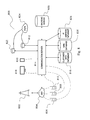
- FIG. 8 illustrates an integrated communications network 800 according to the preferred embodiment of the disclosed invention.
- FIG. 9 a block diagram showing an embodiment of a communication system that can implement any of the embodiments of the disclosed system that are described herein.
- WFBS Wi-Fi Broadcast System
- each device comprises a customer account number and a Wi-Fi Broadcast System (WFBS).
- WFBS Wi-Fi Broadcast System
- the WFBS code may be supported on several device types.
- the disclosed invention may be used on various mobile devices, for example, the disclosed invention may be embedded on Google's Android® and Apple's iOS® operating systems used primarily in mobile technologies.
- the disclosed method may generate at a given WFBS, a customer identification number (CIN) for each customer account. The manner in which the CIN is generated is further described in detail in conjunction with FIG. 3 .
- the disclosed method may broadcast the customer identification number generated in step 100 to each WFBS on the subnet of the given WFBS.
- the customer identification number is broadcasted to a designated WFBS port on the subnet of the given WFBS.
- the disclosed method may receive the customer identification number from each WFBS on the subnet of the given WFBS.
- the disclosed method may process the received customer identification number at the given WFBS. This process is further described in conjunction with FIG. 2 .
- the disclosed method may determine if the given WFBS satisfies a predetermined criterion.
- the predetermined criterion may be that the WFBS with the integer closest to zero is designated as the master for its subnet/account for the given time integral or at that moment in time. Furthermore, up to three masters may broadcast their availability to work as a master to the backend server. The set of operations performed by the master are referred to as a set of master operations. In the preferred embodiment of the disclosed invention, the predetermined criterion is WFBS with the integer closest to zero is designated as the master for its subnet/account at that moment in time and wherein up to three masters broadcast their availability to work as a master to the backend server.
- the disclosed method at block 150 determines that the given WFBS satisfies a predetermined criterion, then the given WFBS may be designated as master at block 150 .
- the designated WFBS may start performing a set of master operations at block 160 .
- the disclosed method designates the given WFBS as a master WFBS for a given time integral if the given WFBS satisfies a predetermined criterion before performing a set of master operations.
- the set of master operations is further described in conjunction with FIG. 4 .
- Each peer WFBS may receive the broadcast sent by the given WFBS.
- the lowest three WFBS that is the WFBS with the integer closest to zero) are considered the masters for its subnet/account at that moment in time.
- up to three masters may broadcast their availability to work as a master to the backend server.
- the assumption is that up to three masters will broadcast their availability as a master to the SWN backend.
- FIG. 2 illustrates the steps taken by the given WFBS to process the customer identification number received from peer WFBS.
- the process may initialize the time variable to zero. As described above, every N seconds each WFBS may conduct a broadcast on its subnet via the defined WFBS port. In the preferred embodiment of the disclosed invention, the disclosed method may determine which port the given WFBS may use for broadcast.
- each WFBS may broadcast the customer identification number to the designated WFBS port on the subnet of the given WFBS every 30 seconds. Additionally, any other time integral such as 20 seconds, 40 seconds or 50 seconds and the like may be configured as the broadcast time integral by the disclosed method.
- the disclosed method may increment the time variable by one, and determine if the value of the given time variable is equal to the defined time integral value at block 220 . This is done to ensure that a broadcast is received every N time integrals, thus the disclosed method may increment the time variable by one, and determine if the value of the given time variable is equal to the defined time integral value at block 220 .
- the method may return to bock 210 to increment the time variable by one if the value of the given time variable is not equal to the defined time integral value. This process may continue until the value of the given time variable is equal to the defined time integral value.
- the method may proceed to block 230 , where the method may receive CIN from each WFBS on the subnet of the given WFBS.
- the method may process the received customer identification number at the given WFBS. This processing further comprises the given WFBS selectively keeping track of broadcasts for customer account associated with the given WFBS. Thus, at block 230 , the method may determine if the received broadcast pertains to CIN of the given WFBS.
- the method may proceed to block 250 to update customer account information at the given WFBS, otherwise the method may process to block 260 to set the value of the time variable to zero. From block 260 the process may return to block 200 . This way, for each N seconds the method may receive CIN and update the customer account information at the given WFBS if the received broadcast pertains to the CIN of the given WFBS.
- FIG. 3 depicts a block diagram of the manner in which the customer identification number is generated and broadcasted to the peer WFBS.
- the customer identification number for each customer account is generated by combining a random number and a customer account number.
- the broadcast may include a random number generated (RNG) on the broadcasting device and the customer account identifier.
- RNG random number generated
- the given WFBS may generate a random integer number (RIN) for each customer account.
- the given WFBS may generate a CIN by concatenating the RIN generated in block 300 to customer account number.
- the given WFBS may broadcast the CIN generated at block 310 to each WFBS on the subnet of the given WFBS via a designated port.
- the disclosed method may use an approach for generating a random number generation that will work for both Apple® and Android® devices.
- the disclosed approach will ensure that the number generation mechanism is portable and will reasonably guarantee that the generated numbers will be random, unique and can easily be compared over the period of time.
- Each device with a WFBS may broadcast a CIN to each peer WFBS on the subnet.
- a CIN which is a combination of the random number plus the customer account number: 4545445454544343 XYZ-ACCOUNT
- 4545445454544343 is the random number generated at a given WFBS and XYZ is the account number.
- the disclosed method is for managing operations between a backend server and a set of devices, each device comprising a customer account number and a Wi-Fi Broadcast System.
- one customer account number may have several devices and thus several WFBS associated with the customer account.
- a university may have one customer account, with account number 12345.
- the customer account number 12345 may have several devices that belong to several departments of the university such as department of arts, business, engineering, science and mathematics, law and the like.
- Each device associated with the account number 12345 may have a WFBS associated with it.
- each WFBS associated with the each device associated with the customer account number 12345 may keep track of broadcasts for the customer account that is associated with the WFBS—in the above example, the 12345 ACCOUNT.
- the given WFBS may selectively keep track of broadcasts for customer account associated with the given WFBS.
- the customer identification number for each customer account may be generated by concatenating a random number, customer initials, and a customer account number.
- the customer identification number for each customer account may be generated by concatenating a random number, customer zip code, and a customer account number.
- each received CIN broadcast may not be pertinent to the given WFBS.
- each WFBS may selectively keep track of broadcasts for customer account associated with the given WFBS.
- processing the received customer identification number at the given WFBS may further comprise the given WFBS selectively keeping track of broadcasts for customer account associated with the given WFBS.
- the step of processing the received customer identification number at the given WFBS further comprises the given WFBS selectively keeping track of broadcasts for customer account associated with the given WFBS.
- an additional fault tolerant server may be used to keep track of each broadcast received at each WFBS and to verify that each WFBS has accurately kept track of each received pertinent broadcast.
- a flow chart illustrating the communication between a master and a backend server is shown in FIG. 4 .
- the given WFBS may determine whether the given WFBS designated as master. If the given WFBS designated as master, then the method may proceed to block 410 to communicate the master WFBS designation of the given WFBS to the backend server.
- the given WFBS may at block 420 determine if a map private network option is selected.
- the method may generate a second message, the second message comprising an account name, the public IP address, the private IP address and the number of devices the master knows of from the subnet.
- the method may broadcast the generated second message to the backend server at block 450 .
- the method may generate a first message to the backend server, the first message comprising an account name, the public IP address, and the number of devices the master knows of from the subnet.
- the method may broadcast the generated first message to the backend server at block 460 .
- map private network option is selected by an authorized administrator via an administrative interface.
- the administrator may selectively send alert messages to certain subnets.
- FIG. 5 illustrates manner in which backend server may process broadcast received from masters at given time integral.
- a backend server may receive a broadcast from masters.
- the content of the broadcast message may depend upon option selected by the customer.
- Each message passed to the backend from a master may include an account name, the number of devices the master knows of from the subnet given that each WFBS has made itself visible.
- the customer may select to turn on a private network option, which may be displayed on the administrative interface for customer's authorized administrators. This option may be a radio button, or a toggle switch displayed on the administrative interface for the customer.
- the administrators may be able to label private networks that the method has discovered if they choose to only send messages to certain subnets and not the entire set of subnets that the method has captured information on.
- the option of labeling subnets may only be visible with the map private network option is selected.
- the map private network on/off setting will be passed to WFBS devices via heartbeat messaging. If an alert sender then sends an alert they can they select subnets they wish to send a message to from a drop down list of all of the labels associated with the discovered WFBS. It would be appreciated that the method may not have to MAP the private network space of customer unless the customer has selected to turn on the map private network option.
- the method may determine at block 510 if the map private option is selected by the customer. In the event that the customer has selected the map private network option then the method may proceed to block 520 , at this junction, the administrator may select labels corresponding to specific networks where the message is to be dispatched to. This phenomenon is described in conjunction with FIGS. 6 and 7 .
- the method may proceed to block 530 to broadcast message to each master in the descending order.
- the descending order aspect of the disclosed invention is described in conjunction with FIG. 7 .
- the list of masters may be continually changing and dynamic. In the preferred embodiment of the disclosed invention the list of masters may change frequently as devices, hence the WFBS move to/from various subnets overtime.
- the IP address received on the backend server may be a public IP associated with the network address translationed (Nat'ed) private address for that specific WFSB master.
- the relationship between a WFBS and backend server will be maintained using the public IP of the WFBS.
- This mapping between a WFBS and backend server may be dynamic, continuous, and ongoing.
- a list of N number of IP addresses may be available on the backend server for an account xyz corresponding to each subnet for which a master is currently present. The list may be very dynamic and masters may expire every N seconds.
- FIG. 6 shows table 600 showing an example of broadcast from the master to the backend server when map private network option is not selected.
- Column 610 may indicate customer account number.
- the public IP address may be indicated in column 620 and the number of WFBS on subnet may be shown in column 630 .
- 17 WFBS are visible on public IP address 192.9.201.14 for account XYZ.
- 96 WFBS are visible on public IP address 192.9.202.17 for account XYZ.
- 197 WFBS are visible on public IP address 192.9.203.24 for account XYZ.
- the aggregate number of subnets and WFBS may be displayed on the various send alert pages.
- the following statistics may be displayed on the customer account information: Sub-nets discovered: 211, Devices: 47,519, Average Devices/Sub-net: 225.
- FIG. 7 indicates a table 700 showing an example of broadcast from the master to the backend server when map private network option is selected.
- Column 710 may indicate customer account number.
- the public IP address may be indicated in column 720 and the private network IP address may be displayed in column 730 .
- the number of WFBS on subnet may be shown in column 740 .
- 17 WFBS are visible on public IP address 192.9.201.14, private IP 10.100.x.x, and for account XYZ.
- 96 WFBS are visible on public IP address 192.9.202.17, private IP 10.101.x.x for account XYZ.
- 197 WFBS are visible on public IP address 192.9.203.24, private IP 10.102.x.x., for account XYZ.
- This information may be stored on the backend server.
- the administrator of the customer may be able to map private IP address to a specific entity.
- the private IP address 10.100.x.x maybe mapped to the college of engineering, 10.101.x.x. maybe be mapped to the college of arts, 10.102.x.x maybe mapped to the college of law and the like.
- the disclosed method may display a drop down list displaying the mapping between the private IP address and the name of facility on the administrator interface.
- the administrator may select a specific site or a group of specific sites from the drop down list and selectively send an alert to the selected specific sites if the map private network option is selected by the customer.
- the backend server of the disclosed method may dispatch alert to each master in descending order.
- the backend server may send alert to address 192.9.203.24 first since there are has 197 WFBS or devices located on that address.
- the backend server may send alerts to 192.9.202.17 since the address has 96 WFBS or devices.
- the backend server may send alerts to 192.9.201.14 since the address has 17 WFBS or devices.
- the prioritization of alerts m sent by the backend may be determined by the number of WFBS associated to a given Public IP address. Those Public IPs addresses with the highest counts of WFPBS could be delivered first.
- the backend server may accept a selection of labels indicating specific networks where the message is to be dispatched, if the map private option is selected by the customer. Further, the backend server may prioritize the order in which the message is to be delivered based upon the number of WFBS per IP Address before broadcasting message to the selected network.
- each Master may receive the message via the master's public IP address.
- the master may immediately re-broadcast the alert to all other WFBS on its subnet using a unique identifier for making sure the alert is only displayed once.
- the alert may be an express voice mail or an express messenger alert. This feature of the disclosed invention may ensure that suppression is in place.
- FIG. 8 illustrates an integrated communications network 800 according to the preferred embodiment of the disclosed invention.
- the network includes a base station 802 coupled to a mobile switching center (MSC) 804 , mobile terminals 806 , 808 , and 810 .
- the network 800 also includes a communication server 814 , personal computer 818 , a computing device 820 such as an iPad®, a landline telephones 812 and 822 , and PSTN 824 .
- some of the aforementioned communication devices may have the disclosed system application installed, which may enable the devices to exchange voice and data with other computing devices in real-time.
- FIG. 8 illustrates several databases such as a customer information database 816 , a MPN database 828 , and an IP address database 826 in communication link with the communications network 814 .
- Many other databases may be included in the disclosed system to facilitate communication as disclosed herein.
- the masters at the given time integral of the disclosed system may use a customer information database 816 , a MPN database 828 , IP address database 826 to offer services, such as, to send messages via the email, text, or instant messaging to the WFBS in its subnet.
- the Network 814 may be configured to execute server side instructions for the disclosed method.
- computing devices such as the personal computer 818 , the tablet 820 , and the cellular telephones 806 , 808 , and 810 may be configured to execute the client side instructions for the disclosed method.
- the client side computing devices may comprise non-transitory computer readable medium containing computer instructions configured to operate with electronic computer hardware to manage operations between a backend server 830 and a set of devices, like cellular telephones 806 , 808 , and 810 .
- each of these devices may comprise a customer account number and an embedded Wi-Fi broadcast system of the disclosed invention.
- FIG. 9 depicting a block diagram showing an embodiment of a communication system 900 that can implement any of the embodiments of the disclosed system that are described herein.
- the computer system 900 may include a processing unit 908 (CPU), a system memory 924 , and a system bus 926 that couples the processing unit 908 to the various components of the computer system 900 .
- a communication server 928 may be used to connect the computer system 900 with m number of devices hosting M number of WFBS, and with the backend server 916 .
- the processing unit 908 may typically include one or more processors, each of which may be in the form of any one of various commercially available processors.
- a user input output unit not shown in FIG. 9 may work in conjunction with the computer system 900 to accept input from and to display output to the administrator.
- the system memory 924 may typically include a read only memory (ROM) that stores a basic input/output system (BIOS) that contains start-up routines for the computer system 900 and a random access memory (RAM).
- the system bus 926 may be a memory bus, a peripheral bus or a local bus, and may be compatible with any of a variety of bus protocols.
- the computer system 900 also may include a storage memory, not shown in FIG. 9 (e.g., a hard drive, a floppy drive, a CD ROM drive, magnetic tape drives, flash memory devices, and digital video disks) that is connected to the system bus 926 and contains one or more computer-readable media disks that provide non-volatile or persistent storage for data, data structures and computer-executable instructions.
- An identification generator 902 may be used to generate at a given WFBS, a customer identification number for each customer account.
- a broadcast unit 904 may be coupled to the identification generator 902 for broadcasting the customer identification number to each WFBS on the subnet of the given WFBS, wherein the customer identification number may be broadcasted to a designated WFBS port on the subnet of the given WFBS.
- the broadcast unit 904 may be configured to broadcast every 30 seconds, the customer identification number to the designated WFBS port on the subnet of the given WFBS.
- a receiving unit 906 may be used for receiving the customer identification number from each WFBS on the subnet of the given WFBS. As described above, the customer identification information may be transmitted every N time integrals.
- a processing unit 908 coupled to the receiving unit may be employed for processing the received customer identification number at the given WFBS.
- a receipt unit 906 may be coupled to a designation unit 910 for receiving broadcast from each WFBS on the subnet of the given WFBS.
- the disclosed system may use the designation unit 910 coupled to the processing unit 908 for designating the given WFBS as a master WFBS for a given time integral if the given WFBS satisfies a predetermined criterion.
- an operation unit 912 may be used for performing a set of master operations.
- the designation unit may be coupled with a router 914 for communicating the master WFBS designation of the given WFBS to the backend server.
- the router 914 may be coupled to a customer configuration unit 918 .
- the customer configuration unit 918 may be used for determining if a map private network option is selected.
- a first unit 920 may be coupled to the router for broadcasting a first message to the backend server if the map private network option is not selected, the first message comprising an account name, the public internet protocol (IP) address, and the number of devices the master knows of from the subnet.
- IP public internet protocol
- a second unit 922 may be coupled to the router broadcasting a second message to the backend server if a map private network option is selected, the second message comprising an account name, the public IP address, the private IP address and the number of devices the master knows of from the subnet.
- the map private network option may be selected by an authorized administrator via an administrative interface. Using the map private network option, the administrators can selectively send alert messages to certain subnets after selecting map private network option.
- each WFBS may communicate the selection of map private network option to other WFBS devices via heartbeat messaging.
- a backend processor 924 may be coupled to the backend server 916 , the backend processor 924 may be configured to receive the broadcast at the backend server 916 from at least one master and to determine if the map private option is selected by the customer. Furthermore, the backend processor 924 may be configured prompt the customer/administrator to select labels corresponding to specific networks where the message is to be dispatched before broadcasting message to the selected network if the map private option is selected by the customer. Likewise, the backend processor 924 may be configured to broadcast message to each master in the descending order if the customer did not select the map private network option.
- a customer may have to send fewer alert messages.
- the resultant savings can be financially advantageous to the customer.
- sending fewer alerts may be efficient in the emergency situations.
- the following statistics may be displayed on the customer account information: Sub-nets discovered: 211, Devices: 47,519, Average Devices/Sub-net: 225. This means that 47,519 subscriber devices are present in the 211 subnets at that specific time.
- the disclosed system can instead send 211 Express Voice/Express Messenger messages to 211 master re-broadcasters without suffering any diminishment in reporting or tracking capabilities. For example, while issuing an earthquake warning to the residents of a high rise building, it would be extremely beneficial to send fewer alerts and to verify which residents have received the issued alerts and are taking steps to evacuate the building premises.
- resources are of essence in the emergency situations. Sending 211 alert messages for example, may save valuable network resources which may otherwise be needed to communicate with the 47,519 customers. Further, having an acknowledgement that the recipient has received the alert message may be extremely helpful in the emergency situations. Because time is of essence in the emergency situations, knowing the precise time when the alert was received by the recipient can similarly be very helpful in taking measures to resolve the emergency situations.
- the disclosed system may be able to identify when an alert was received and by whom the alert was received. This feature may be very crucial in the emergency situations. But the disclosed system can send these 47,519 recipients a message and have it be received by the target recipient in 10 seconds or less.
- the disclosed invention may be anonymously download the disclosed application via QR codes for example and receive emergency alerts from the disclosed application. Each anonymously downloaded application may be assigned a stub user ID when the app is downloaded—such as app_user_nyu_1234. This feature may allow alerts sent by the disclosed system to be the fastest, most cost effective way of sending notifications to the interested parties—like residents of the building, employees of a company, travelers on a cruise, visitors to a hospital and the like.
Landscapes
- Engineering & Computer Science (AREA)
- Computer Networks & Wireless Communication (AREA)
- Signal Processing (AREA)
- Health & Medical Sciences (AREA)
- Public Health (AREA)
- Business, Economics & Management (AREA)
- Emergency Management (AREA)
- Environmental & Geological Engineering (AREA)
- Multimedia (AREA)
- Physics & Mathematics (AREA)
- Computing Systems (AREA)
- Mathematical Physics (AREA)
- Theoretical Computer Science (AREA)
- Cardiology (AREA)
- General Health & Medical Sciences (AREA)
- Data Exchanges In Wide-Area Networks (AREA)
Abstract
Description
4545445454544343 XYZ-ACCOUNT
Claims (21)
Priority Applications (1)
| Application Number | Priority Date | Filing Date | Title |
|---|---|---|---|
| US15/233,704 US10091835B2 (en) | 2015-08-11 | 2016-08-10 | System and method for improved emergency messaging |
Applications Claiming Priority (2)
| Application Number | Priority Date | Filing Date | Title |
|---|---|---|---|
| US201562203505P | 2015-08-11 | 2015-08-11 | |
| US15/233,704 US10091835B2 (en) | 2015-08-11 | 2016-08-10 | System and method for improved emergency messaging |
Publications (2)
| Publication Number | Publication Date |
|---|---|
| US20170048895A1 US20170048895A1 (en) | 2017-02-16 |
| US10091835B2 true US10091835B2 (en) | 2018-10-02 |
Family
ID=57994539
Family Applications (1)
| Application Number | Title | Priority Date | Filing Date |
|---|---|---|---|
| US15/233,704 Active 2036-10-07 US10091835B2 (en) | 2015-08-11 | 2016-08-10 | System and method for improved emergency messaging |
Country Status (1)
| Country | Link |
|---|---|
| US (1) | US10091835B2 (en) |
Citations (3)
| Publication number | Priority date | Publication date | Assignee | Title |
|---|---|---|---|---|
| US20070115868A1 (en) * | 2005-11-22 | 2007-05-24 | Wai Chen | Group-header based method to organize local peer group of vehicles for inter-vehicle communication |
| US20130083684A1 (en) * | 2011-09-30 | 2013-04-04 | Electronics And Telecommunications Research Institute | Methods of device to device communication |
| US20150349917A1 (en) * | 2014-05-28 | 2015-12-03 | Fedex Corporate Services, Inc. | Methods and Node Apparatus for Adaptive Node Communication within a Wireless Node Network |
-
2016
- 2016-08-10 US US15/233,704 patent/US10091835B2/en active Active
Patent Citations (3)
| Publication number | Priority date | Publication date | Assignee | Title |
|---|---|---|---|---|
| US20070115868A1 (en) * | 2005-11-22 | 2007-05-24 | Wai Chen | Group-header based method to organize local peer group of vehicles for inter-vehicle communication |
| US20130083684A1 (en) * | 2011-09-30 | 2013-04-04 | Electronics And Telecommunications Research Institute | Methods of device to device communication |
| US20150349917A1 (en) * | 2014-05-28 | 2015-12-03 | Fedex Corporate Services, Inc. | Methods and Node Apparatus for Adaptive Node Communication within a Wireless Node Network |
Also Published As
| Publication number | Publication date |
|---|---|
| US20170048895A1 (en) | 2017-02-16 |
Similar Documents
| Publication | Publication Date | Title |
|---|---|---|
| US8868661B2 (en) | Message management based on metadata | |
| US9215217B2 (en) | Auto-discovery of diverse communications devices for alert broadcasting | |
| US8094594B2 (en) | Method for creating a peer-to-peer immediate messaging solution without using an instant messenging server | |
| US20110230210A1 (en) | Wireless User Based Notification System | |
| US12500946B2 (en) | Custom content insertion for user groups | |
| US20100087173A1 (en) | Inter-threading Indications of Different Types of Communication | |
| US20230018003A1 (en) | System and method for delivery and receipt of electronic communications | |
| US20100331021A1 (en) | Method and system for interworking between instant messaging service and short message service | |
| CA2623084A1 (en) | Method, system, and computer program product for anonymously / privately exchanging text messages | |
| US11146649B2 (en) | Computer-implemented method and computer system for distributing push notifications | |
| US12256043B2 (en) | Call center mobile messaging | |
| EA020669B1 (en) | A communication device | |
| US20160366077A1 (en) | E-mail processing | |
| US10091835B2 (en) | System and method for improved emergency messaging | |
| EP3306899B1 (en) | Methods circuits devices systems and functionally associated computer executable code to support location based services to a wireless devices communicatively coupled to a communication network | |
| US20150074208A1 (en) | Exposed group of recipients for text message | |
| US8165274B1 (en) | System for digitally notifying customers of a utility | |
| CN104022941A (en) | Meeting instant communication system and implementation method thereof | |
| WO2010075546A2 (en) | Mobile safety and alert system | |
| US10419385B2 (en) | Systems and methods for use in transmitting electronic messages between different protocols | |
| KR102560546B1 (en) | System for providing message service using mobile general directory number and method therreof | |
| CN106954194A (en) | Method and device for mass sending of short messages | |
| US11172067B1 (en) | Call center mobile messaging | |
| US20190297192A1 (en) | Dynamic communication management system | |
| GB2471915A (en) | A method of associating a response message with a sent message based on the use of intermediate devices. |
Legal Events
| Date | Code | Title | Description |
|---|---|---|---|
| AS | Assignment |
Owner name: SWN COMMUNICATIONS, INC., NEW JERSEY Free format text: ASSIGNMENT OF ASSIGNORS INTEREST;ASSIGNORS:TSEPETIS, ALEXANDROS;SCHMITZ, ANTHONY F.;REEL/FRAME:041935/0887 Effective date: 20160810 |
|
| AS | Assignment |
Owner name: ARES CAPITAL CORPORATION, NEW YORK Free format text: SECURITY INTEREST;ASSIGNORS:EMERGENCY COMMUNICATIONS NETWORK, LLC;SWN COMMUNICATIONS INC.;REEL/FRAME:042576/0342 Effective date: 20170601 |
|
| STCF | Information on status: patent grant |
Free format text: PATENTED CASE |
|
| MAFP | Maintenance fee payment |
Free format text: PAYMENT OF MAINTENANCE FEE, 4TH YR, SMALL ENTITY (ORIGINAL EVENT CODE: M2551); ENTITY STATUS OF PATENT OWNER: SMALL ENTITY Year of fee payment: 4 |
|
| AS | Assignment |
Owner name: ONSOLVE, LLC, FLORIDA Free format text: MERGER;ASSIGNOR:SWN COMMUNICATIONS INC.;REEL/FRAME:064172/0645 Effective date: 20191230 |
|
| AS | Assignment |
Owner name: ONSOLVE, LLC (F/K/A EMERGENCY COMMUNICATIONS NETWORK, LLC AND SUCCESSOR-BY-MERGER TO SWN COMMUNICATIONS INC.), GEORGIA Free format text: RELEASE OF SECURITY INTEREST IN PATENTS PREVIOUSLY RECORDED AT REEL/FRAME (042576/0342);ASSIGNOR:ARES CAPITAL CORPORATION, AS COLLATERAL AGENT;REEL/FRAME:068237/0782 Effective date: 20240730 |
|
| AS | Assignment |
Owner name: COMPUTERSHARE TRUST COMPANY, N.A., MINNESOTA Free format text: SECURITY INTEREST;ASSIGNORS:CRISIS24, INC.;TIDEL ENGINEERING, L.P.;ONSOLVE, LLC;AND OTHERS;REEL/FRAME:073606/0402 Effective date: 20251117 |