US10089455B2 - Electronic device and method for controlling locking of electronic device - Google Patents

Electronic device and method for controlling locking of electronic device Download PDF

Info

Publication number
US10089455B2
US10089455B2 US14/916,123 US201414916123A US10089455B2 US 10089455 B2 US10089455 B2 US 10089455B2 US 201414916123 A US201414916123 A US 201414916123A US 10089455 B2 US10089455 B2 US 10089455B2
Authority
US
United States
Prior art keywords
electronic device
short
range communication
value
mobile terminal
Prior art date
Legal status (The legal status is an assumption and is not a legal conclusion. Google has not performed a legal analysis and makes no representation as to the accuracy of the status listed.)
Active
Application number
US14/916,123
Other versions
US20160224778A1 (en
Inventor
Ihl-Ho KIM
Jun-Sik KWON
Joo-hyung Lee
Eui-Bum HAN
Ji-Seon HONG
Veerabhadrappa CHILAKANTI
Current Assignee (The listed assignees may be inaccurate. Google has not performed a legal analysis and makes no representation or warranty as to the accuracy of the list.)
Samsung Electronics Co Ltd
Original Assignee
Samsung Electronics Co Ltd
Priority date (The priority date is an assumption and is not a legal conclusion. Google has not performed a legal analysis and makes no representation as to the accuracy of the date listed.)
Filing date
Publication date
Application filed by Samsung Electronics Co Ltd filed Critical Samsung Electronics Co Ltd
Publication of US20160224778A1 publication Critical patent/US20160224778A1/en
Assigned to SAMSUNG ELECTRONICS CO., LTD. reassignment SAMSUNG ELECTRONICS CO., LTD. ASSIGNMENT OF ASSIGNORS INTEREST (SEE DOCUMENT FOR DETAILS). Assignors: CHILAKANTI, Veerabhadrappa, HAN, EUI-BUM, HONG, Ji-Seon, KIM, IHI-HO, KWON, JUN-SIK, LEE, JOO-HYUNG
Application granted granted Critical
Publication of US10089455B2 publication Critical patent/US10089455B2/en
Active legal-status Critical Current
Anticipated expiration legal-status Critical

Links

Images

Classifications

    • GPHYSICS
    • G06COMPUTING OR CALCULATING; COUNTING
    • G06FELECTRIC DIGITAL DATA PROCESSING
    • G06F21/00Security arrangements for protecting computers, components thereof, programs or data against unauthorised activity
    • G06F21/30Authentication, i.e. establishing the identity or authorisation of security principals
    • G06F21/31User authentication
    • G06F21/34User authentication involving the use of external additional devices, e.g. dongles or smart cards
    • G06F21/35User authentication involving the use of external additional devices, e.g. dongles or smart cards communicating wirelessly
    • GPHYSICS
    • G06COMPUTING OR CALCULATING; COUNTING
    • G06FELECTRIC DIGITAL DATA PROCESSING
    • G06F13/00Interconnection of, or transfer of information or other signals between, memories, input/output devices or central processing units
    • G06F13/14Handling requests for interconnection or transfer
    • HELECTRICITY
    • H04ELECTRIC COMMUNICATION TECHNIQUE
    • H04BTRANSMISSION
    • H04B17/00Monitoring; Testing
    • H04B17/30Monitoring; Testing of propagation channels
    • H04B17/309Measuring or estimating channel quality parameters
    • H04B17/318Received signal strength
    • HELECTRICITY
    • H04ELECTRIC COMMUNICATION TECHNIQUE
    • H04WWIRELESS COMMUNICATION NETWORKS
    • H04W12/00Security arrangements; Authentication; Protecting privacy or anonymity
    • H04W12/08Access security
    • HELECTRICITY
    • H04ELECTRIC COMMUNICATION TECHNIQUE
    • H04WWIRELESS COMMUNICATION NETWORKS
    • H04W4/00Services specially adapted for wireless communication networks; Facilities therefor
    • H04W4/80Services using short range communication, e.g. near-field communication [NFC], radio-frequency identification [RFID] or low energy communication
    • HELECTRICITY
    • H04ELECTRIC COMMUNICATION TECHNIQUE
    • H04WWIRELESS COMMUNICATION NETWORKS
    • H04W12/00Security arrangements; Authentication; Protecting privacy or anonymity
    • H04W12/30Security of mobile devices; Security of mobile applications
    • H04W12/33Security of mobile devices; Security of mobile applications using wearable devices, e.g. using a smartwatch or smart-glasses
    • HELECTRICITY
    • H04ELECTRIC COMMUNICATION TECHNIQUE
    • H04WWIRELESS COMMUNICATION NETWORKS
    • H04W12/00Security arrangements; Authentication; Protecting privacy or anonymity
    • H04W12/60Context-dependent security
    • H04W12/63Location-dependent; Proximity-dependent

Definitions

  • the present disclosure generally relates to electronic devices and methods for controlling the locking of electronic devices, and more particularly, to electronic devices and methods that conveniently lock or unlock the electronic devices.
  • An electronic device may be set with a locking function at the request of the user to maintain the security of the electronic device.
  • the locking function may include entering a pattern or password. To release the locking function set in the electronic device, a preset pattern or password should be entered.
  • an electronic device and method for controlling the locking of the electronic device are provided that conveniently lock or unlock the electronic device.
  • an electronic device and method for controlling the locking of the electronic device are provided that lock or unlock the electronic device without the user's input while the electronic device is in a short-range communication range.
  • the electronic device and method for controlling the locking of the electronic device may provide convenience and security by allowing the electronic device to be locked or unlocked without the user's input.
  • an electronic device includes a short-range communication unit for performing short-range communication and a controller for controlling locking of the electronic device using an RSSI value of a counterpart electronic device which is connected through the short-range communication unit and the transmit strength value of the counterpart electronic device to control the locking of the electronic device.
  • an electronic device includes a short-range communication unit and if an RSSI value of a counterpart electronic device connected via short-range communication is less than a preset RSSI reference range, transmits a message indicating that the RSSI value of the counterpart electronic device is less than the lowest RSSI value to a controller, and a controller when receiving the message indicating that the RSSI value of the counterpart electronic device is less than the lowest RSSI value from the short-range communication unit, sends a request for a transmit strength value to the counterpart electronic device through the short-range communication unit, and when a transmit strength value received from the counterpart electronic device is greater than a preset transmit strength reference value, locks the electronic device.
  • a method for controlling locking of an electronic device includes performing short-range communication with a counterpart electronic device through a short-range communication unit and controlling the locking of the electronic device using an RSSI value of the short-range communication connected counterpart electronic device and a transmit strength value of the counterpart electronic device.
  • a method for controlling locking of an electronic device includes performing short-range communication with a counterpart electronic device through a short-range communication unit, an operation in which if the RSSI value of the counterpart electronic device is not more than a lowest RSSI value of a preset RSSI reference range, the short-range communication unit transmits a message indicating that the RSSI value of the counterpart electronic device is not more than the lowest RSSI value to the controller, an operation in which upon receiving the message that the RSSI value of the counterpart electronic device is not more than the lowest RS SI value of the preset RSSI reference range from the short-range communication unit, the controller sends a request for a transmit strength value to the counterpart electronic device through the short-range communication unit, and an operation in which if the transmit strength value from the counterpart electronic device is not less than a preset transmit strength reference value, the controller sets the locking of the electronic device.
  • a method for controlling locking of an electronic device includes performing short-range communication with a counterpart electronic device through a short-range communication unit, transmitting, by the short-range communication unit, a message indicating that the RSSI value of the counterpart electronic device is less than the lowest RSSI value to the controller, if the RSSI value of the counterpart electronic device is less than a lowest RSSI value of a preset RSSI reference range, sending, by the controller, a request for a transmit strength value to the counterpart electronic device through the short-range communication unit, upon receiving the message that the RSSI value of the counterpart electronic device is less than the lowest RSSI value of the preset RSSI reference range from the short-range communication unit, and locking, by the controller, the electronic device if the transmit strength value from the counterpart electronic device is greater than a preset transmit strength reference value.
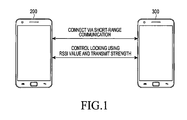
  • FIG. 1 is a view illustrating a locking control operation while electronic devices are in short-range communication according to various embodiments of the present disclosure
  • FIG. 2 is a view illustrating a configuration of an electronic device according to various embodiments of the present disclosure
  • FIG. 3 is a flowchart illustrating a locking control operation while an electronic device is in short-range communication according to an embodiment of the present disclosure.
  • FIG. 4 is a flowchart illustrating a locking control operation while an electronic device is in short-range communication according to another embodiment of the present disclosure.
  • an electronic device as disclosed herein may be a device with a communication function.
  • the electronic device may be one of various devices or a combination of a smartphone, a tablet personal computer (PC), a mobile phone, a video phone, an e-book reader, a desktop personal computer, a laptop personal computer, a netbook computer, a personal digital assistant (PDA), a portable multimedia player (PMP), an MP3 player, a mobile medical device, an electronic bracelet, an electronic necklace, an electronic appcessory, a camera, a wearable device, an electronic clock, a wrist watch, a home appliance (e.g., a refrigerator, an air conditioner, an oven, a microwave oven, a washer, or an air purifier), an artificial intelligence robot, a TV, a digital video disk (DVD) player, an audio player, various medical devices (e.g., a magnetic resonance angiography (MRA), a magnetic resonance imaging (MRI), a computed tomography (CT), an
  • MRA magnetic resonance angiography
  • FIG. 1 is a view illustrating a locking control operation while electronic devices are in a short-range communication according to various embodiments of the present disclosure.
  • the electronic device 200 may include a short-range communication unit that performs first short-range communication, and a counterpart electronic device (hereinafter, a “second electronic device”) 300 that may perform short-range communication with the first electronic device 200 .
  • the first electronic device 200 may control the locking of the first electronic device 200 using an RSSI value of the second electronic device 300 and a transmit strength value (Tx power) of the second electronic device 300 .
  • the second electronic device 300 may transmit a current transmit strength value to the first electronic device 200 at the request of the first electronic device 200 .
  • FIG. 2 is a view illustrating a configuration of an electronic device according to various embodiments of the present disclosure.
  • the first electronic device 200 and the second electronic device 300 may have the same configuration as shown in FIG. 2 .
  • the RF unit 123 performs a radio communication function of the electronic device.
  • the RF unit 123 includes an RF transmitter up-converting the frequency and amplifying the signal transmitted and an RF receiver with a low-noise amplifier receiving a signal and down-converting the frequency of the signal.
  • the data processor 120 may include a transmitter for coding and modulating a signal to be transmitted and a receiver for decoding and demodulating the received signal.
  • the data processor 120 may include a modem and a codec.
  • the codec may include a data codec for processing packet data and an audio codec for processing audio signals such as voices.
  • the audio processor 125 may perform a function of providing an audio signal output from the audio codec of the data processor 120 to a speaker or providing an audio signal generated from a microphone to the audio codec of the data processor 120 .
  • the key input unit 127 may have keys for inputting numerical and character information and function keys for configuring various functions.
  • the memory 130 may include a program memory and data memory.
  • the program memory may store programs for controlling general operation of the electronic device and programs for controlling the locking of the electronic device 200 using the RSSI value and transmit strength value while in short-range communication. Further, the data memory may temporarily store data generated while executing the programs.
  • the memory 130 may store a preset RSSI reference range to control the locking of the first electronic device 200 according to various embodiments of the present disclosure.
  • the RSSI reference range may include a highest RSSI value for unlocking the electronic device and a lowest RSSI value for locking of the electronic device.
  • the memory 130 may include a transmit strength reference value for comparison with a transmit strength value of the second electronic device in the short-range communication linkage in order to set the locking of the first electronic device 200 according to various embodiments of the present disclosure.
  • the controller 110 functions to control the overall operation of the first electronic device 200 .
  • the controller 110 may control the locking of the first electronic device 200 using the RSSI value of the second electronic device 300 in short-range communication through the short-range communication unit 170 and the transmit strength value of the second electronic device 300 according to various embodiments of the present disclosure.
  • the controller 110 upon receiving a message indicating that the RSSI value of the second electronic device 300 is less than the lowest RSSI value of the preset RSSI reference range from the short-range communication unit 170 according to various embodiments of the present disclosure, may send a request for a transmit strength value to the second electronic device 300 through the short-range communication unit 170 .
  • the controller 110 upon receiving the transmit strength value from the second electronic device 300 through the short-range communication unit 170 , may compare the received transmit strength value with a preset transmit strength reference value, and when the received transmit strength value is greater than the preset transmit strength reference value, may lock the first electronic device 200 .
  • the controller 110 upon receiving a message indicating that the RSSI value of the second electronic device 300 is greater than the highest RSSI value of the preset RSSI reference range from the short-range communication unit 170 according to various embodiments of the present disclosure, may identify the locking state of the electronic device, and if the first electronic device 200 is locked, may unlock the first electronic device 200 .
  • the camera unit 140 may include a camera sensor that captures an optical image signal and converts a captured optical image signal into an electrical signal and a signal processor that converts an optical image signal captured by the camera sensor into digital data.
  • the camera sensor may include a charge coupled device (CCD) or complementary metal oxide semiconductor (CMOS) sensor, and the signal processor may be implemented as a digital signal processor (DSP). Further, the camera sensor and the signal processor may be implemented in a single unit or may be implemented separately.
  • the image processor 150 performs image signal processing (ISP) to display an image signal output from the camera unit 140 to the display unit 160 , and the ISP performs functions such as gamma correction, interpolation, spatial variation, image effects, image scaling, automatic white balance (AWB), auto exposure (AE), or auto focus (AF). Accordingly, the image processor 150 processes an image signal output from the camera unit 140 on a per-frame basis and outputs the frame image data fitting into the characteristics and size of the display unit 160 . Further, the image processor 150 includes an image codec and compresses the frame image data displayed on the display unit 160 in a preset manner and restores the compressed frame image data to the original frame image data.
  • ISP image signal processing
  • the image codec may be, e.g., a joint photographic experts group (JPEG) codec, a moving pictures expert group (MPEG) codec, or a Wavelet codec.
  • the image processor 150 assumes an on-screen display (OSD) function and may output OSD data according to the size of the screen displayed under the control of the controller 110 .
  • OSD on-screen display
  • the display unit 160 may display an image signal output from the image processor 150 on the screen and may display user data output from the controller 110 .
  • the display unit 160 may be a liquid crystal display (LCD).
  • the display unit 160 may include an LCD controller, a memory for storing image data, and an LCD display device.
  • the LCD When the LCD is implemented in a touchscreen manner, the LCD may be operated as an input unit, and the display unit 160 may display keys such as the key input unit 127 .
  • the touchscreen unit may include a touchscreen panel (TSP) including a plurality of sensor panels, and the plurality of sensor panels may include a capacitive sensor panel that may recognize a hand touch and an electromagnetic induction sensor panel that may sense a fine touch such as a touch pen.
  • TSP touchscreen panel
  • the plurality of sensor panels may include a capacitive sensor panel that may recognize a hand touch and an electromagnetic induction sensor panel that may sense a fine touch such as a touch pen.
  • the short-range communication unit 170 may provide a short-range radio communication function.
  • the short-range communication unit 170 may include Bluetooth communication, low-power Bluetooth low energy (BLE) communication, infrared (IR) communication, near field communication (NFC), or wireless fidelity (Wi-Fi) communication.
  • BLE Bluetooth low-power Bluetooth low energy
  • IR infrared
  • NFC near field communication
  • Wi-Fi wireless fidelity
  • the short-range communication unit 170 may detect the RSSI value of the second electronic device 300 connected through short-range communication, and if the detected RSSI value is less than the lowest RSSI value of the preset RSSI reference range, may transmit a message indicating that the RSSI value of the second electronic device 300 is less than the lowest RSSI value to the controller 110 .
  • the short-range communication unit 170 may detect the RSSI value of the second electronic device 300 connected through short-range communication, and if the detected RSSI value is greater than the highest RSSI value of the preset RSSI reference range, may transmit a message indicating that the RSSI value of the second electronic device 300 is greater than the highest RSSI value to the controller 110 .
  • the short-range communication unit 170 may transmit the current transmit strength value of the first electronic device 200 to the second electronic device 300 .
  • first electronic device 200 and the second electronic device 300 each include the controller 110 and the short-range communication unit 170 as shown in FIG. 2 , an example in which the first electronic device 200 includes a controller A and a short-range communication unit A, and the second electronic device 300 includes a short-range communication unit B, is described in the same configuration in a differentiated manner.
  • FIG. 3 is a flowchart illustrating a locking control operation while an electronic device is in short-range communication according to an embodiment of the present disclosure.
  • the first embodiment of the present disclosure is described in detail with reference to FIGS. 1 and 2 .
  • step 301 in which the first electronic device 200 and the second electronic device 300 are connected through the short-range communication unit A of the first electronic device 200 and the short-range communication unit B of the second electronic device 300 , the short-range communication unit A performs step 302 of detecting the RSSI value of the second electronic device 300 connected via the short-range communication at predetermined times periods.
  • the short-range communication unit A determines whether the RSSI value of the second electronic device 300 detected in step 302 is outside a preset RSSI reference range.
  • the short-range communication unit A Upon determining in step 303 that the RSSI value of the second electronic device 300 is outside the RSSI reference range and is less the lowest RSSI value of the RSSI reference range, the short-range communication unit A transmits, to the controller A, a message indicating that the RSSI value of the second electronic device 300 is less than the lowest RSSI value of the RSSI reference range in step 304 .
  • the controller A Upon receiving the message indicating that the RSSI value of the second electronic device 300 is less than the lowest RSSI value of the RSSI reference range, the controller A switches from a sleep mode to a wake-up mode. The controller A sends a request for a transmit strength value (Tx power) to the short-range communication unit B of the second electronic device 300 through the short-range communication unit A in step 305 .
  • Tx power transmit strength value
  • the short-range communication unit B of the second electronic device 300 transmits the current transmit strength value (Tx power) of the second electronic device 300 through the short-range communication unit A to the controller A in the first electronic device 200 in step 306 .
  • the controller A Upon receiving the transmit strength value from the short-range communication unit B of the second electronic device 300 through the short-range communication unit A in step 306 , the controller A compares the received transmit strength value of the second electronic device 300 with a preset transmit strength reference value in step 307 .
  • step 307 Upon determining in step 307 that the transmit strength value of the second electronic device 300 is greater than the preset transmit strength reference value, the controller A performs step 308 of locking the first electronic device 200 .
  • the short-range communication unit A may request the RSSI value of the second electronic device 300 or the transmit strength value of the second electronic device 300 and may transmit the RSSI value of the second electronic device 300 or the transmit strength value of the second electronic device 300 at the request of the controller A. In the operations shown in FIG.
  • the distance between the first electronic device 200 and the second electronic device 300 connected with the first electronic device 200 via short-range communication may be determined using the RSSI value and the transmit strength value, and in case the second electronic device 300 is a farther distance away than a predetermined range, the first electronic device 200 may be automatically locked, providing increased security to the user of the first electronic device 200 .
  • FIG. 4 is a flowchart illustrating a locking control operation while an electronic device is in short-range communication according to another embodiment of the present disclosure.
  • the second embodiment of the present disclosure is described in detail with reference to FIGS. 1 and 2 .
  • step 401 where the first electronic device 200 and the second electronic device 300 are connected through the short-range communication unit A of the first electronic device 200 and the short-range communication unit B of the second electronic device 300 , the short-range communication unit A performs step 402 of detecting the RSSI value of the second electronic device 300 connected via the short-range communication at predetermined time periods.
  • the short-range communication unit A determines whether the RSSI value of the second electronic device 300 detected in step 402 is outside a preset RSSI reference range.
  • the short-range communication unit A Upon determining in step 403 that the RSSI value of the second electronic device 300 is outside the RSSI reference range and is greater than the highest RSSI value of the RSSI reference range, the short-range communication unit A transmits, to the controller A, a message indicating that the RSSI value of the second electronic device 300 is greater than the highest RSSI value of the RSSI reference range in step 404 .
  • the controller A Upon receiving the message indicating that the RSSI value of the second electronic device 300 is greater than the highest RSSI value of the RSSI reference range, the controller A switches from a sleep mode to a wake-up mode.
  • the controller A may identify the locking state of the first electronic device 200 . If it is determined that the first electronic device 200 is locked in step 405 , the controller A performs step 406 of unlocking the first electronic device 200 .
  • the distance between the first electronic device 200 and the second electronic device 300 connected with the first electronic device 200 via short-range communication may be determined using the RSSI value, and in case the authenticated second electronic device 300 is positioned close to the first electronic device 200 , the first electronic device 200 may be automatically unlocked, providing increased user convenience.
  • the electronic device and method for controlling the locking of the electronic device may be implemented as codes in a computer-readable recording medium.
  • the computer-readable recording medium includes all types of recording devices storing data readable by a computer system. Examples of the recording medium include a ROM, a RAM, an optical disk, a magnetic tape, a floppy disk, a non-volatile memory, or carrier wave-type implementations (e.g., transmissions through the Internet). Further, the computer-readable recording medium may be distributed to computer systems connected via a network, and computer-readable codes may be stored and executed in a distributed manner.

Landscapes

  • Engineering & Computer Science (AREA)
  • Computer Security & Cryptography (AREA)
  • Computer Networks & Wireless Communication (AREA)
  • Theoretical Computer Science (AREA)
  • Signal Processing (AREA)
  • Physics & Mathematics (AREA)
  • General Engineering & Computer Science (AREA)
  • General Physics & Mathematics (AREA)
  • Computer Hardware Design (AREA)
  • Software Systems (AREA)
  • Electromagnetism (AREA)
  • Quality & Reliability (AREA)
  • Telephone Function (AREA)
  • Lock And Its Accessories (AREA)
  • Selective Calling Equipment (AREA)

Abstract

An electronic device and method for controlling locking of an electronic device are disclosed. An electronic device includes a short-range communication unit for performing short-range communication and a controller for controlling locking of the electronic device by using an RSSI value of a counterpart electronic device connected by short-range communication through the short-range communication unit and a transmission strength value of the counterpart electronic device to control the locking of the electronic device.

Description

PRIORITY
This application is a National Phase Entry of PCT International Application No. PCT/KR2014/008213, which was filed on Sep. 2, 2014, and claims priority to Korean Patent Application No. 10-2013-0104813, which was filed on Sep. 2, 2013, the contents of each of which are incorporated herein by reference.
BACKGROUND
1. Field of the Disclosure
The present disclosure generally relates to electronic devices and methods for controlling the locking of electronic devices, and more particularly, to electronic devices and methods that conveniently lock or unlock the electronic devices.
2. Description of the Related Art
An electronic device may be set with a locking function at the request of the user to maintain the security of the electronic device. The locking function may include entering a pattern or password. To release the locking function set in the electronic device, a preset pattern or password should be entered.
However, such locking functions, although for the purpose of enhancing security, may be a trade-off between security and user convenience because it requires the user to enter the preset pattern or password whenever the electronic device requires unlocking.
SUMMARY
According to various aspects of the present disclosure, an electronic device and method for controlling the locking of the electronic device are provided that conveniently lock or unlock the electronic device.
According to various aspects of the present disclosure, an electronic device and method for controlling the locking of the electronic device are provided that lock or unlock the electronic device without the user's input while the electronic device is in a short-range communication range.
According to various aspects of the present disclosure, the electronic device and method for controlling the locking of the electronic device may provide convenience and security by allowing the electronic device to be locked or unlocked without the user's input.
According to various aspects of the present disclosure, an electronic device includes a short-range communication unit for performing short-range communication and a controller for controlling locking of the electronic device using an RSSI value of a counterpart electronic device which is connected through the short-range communication unit and the transmit strength value of the counterpart electronic device to control the locking of the electronic device.
According to various aspects of the present disclosure, an electronic device includes a short-range communication unit and if an RSSI value of a counterpart electronic device connected via short-range communication is less than a preset RSSI reference range, transmits a message indicating that the RSSI value of the counterpart electronic device is less than the lowest RSSI value to a controller, and a controller when receiving the message indicating that the RSSI value of the counterpart electronic device is less than the lowest RSSI value from the short-range communication unit, sends a request for a transmit strength value to the counterpart electronic device through the short-range communication unit, and when a transmit strength value received from the counterpart electronic device is greater than a preset transmit strength reference value, locks the electronic device.
According to various aspects of the present disclosure, a method for controlling locking of an electronic device includes performing short-range communication with a counterpart electronic device through a short-range communication unit and controlling the locking of the electronic device using an RSSI value of the short-range communication connected counterpart electronic device and a transmit strength value of the counterpart electronic device.
According to various aspects of the present disclosure, a method for controlling locking of an electronic device includes performing short-range communication with a counterpart electronic device through a short-range communication unit, an operation in which if the RSSI value of the counterpart electronic device is not more than a lowest RSSI value of a preset RSSI reference range, the short-range communication unit transmits a message indicating that the RSSI value of the counterpart electronic device is not more than the lowest RSSI value to the controller, an operation in which upon receiving the message that the RSSI value of the counterpart electronic device is not more than the lowest RS SI value of the preset RSSI reference range from the short-range communication unit, the controller sends a request for a transmit strength value to the counterpart electronic device through the short-range communication unit, and an operation in which if the transmit strength value from the counterpart electronic device is not less than a preset transmit strength reference value, the controller sets the locking of the electronic device.
According to various aspects of the present disclosure a method for controlling locking of an electronic device includes performing short-range communication with a counterpart electronic device through a short-range communication unit, transmitting, by the short-range communication unit, a message indicating that the RSSI value of the counterpart electronic device is less than the lowest RSSI value to the controller, if the RSSI value of the counterpart electronic device is less than a lowest RSSI value of a preset RSSI reference range, sending, by the controller, a request for a transmit strength value to the counterpart electronic device through the short-range communication unit, upon receiving the message that the RSSI value of the counterpart electronic device is less than the lowest RSSI value of the preset RSSI reference range from the short-range communication unit, and locking, by the controller, the electronic device if the transmit strength value from the counterpart electronic device is greater than a preset transmit strength reference value.
BRIEF DESCRIPTION OF THE DRAWINGS
The above and other aspects, features and advantages of embodiments of the present disclosure will be more apparent from the following detailed description taken in conjunction with the accompanying drawings, in which:
FIG. 1 is a view illustrating a locking control operation while electronic devices are in short-range communication according to various embodiments of the present disclosure;
FIG. 2 is a view illustrating a configuration of an electronic device according to various embodiments of the present disclosure;
FIG. 3 is a flowchart illustrating a locking control operation while an electronic device is in short-range communication according to an embodiment of the present disclosure; and
FIG. 4 is a flowchart illustrating a locking control operation while an electronic device is in short-range communication according to another embodiment of the present disclosure.
DETAILED DESCRIPTION
Hereinafter, various embodiments of the present disclosure are described in detail with reference to the accompanying drawings. It should be noted that similar reference numerals refer to similar elements throughout the specification.
According to various embodiments of the present disclosure, an electronic device as disclosed herein may be a device with a communication function. For example, the electronic device may be one of various devices or a combination of a smartphone, a tablet personal computer (PC), a mobile phone, a video phone, an e-book reader, a desktop personal computer, a laptop personal computer, a netbook computer, a personal digital assistant (PDA), a portable multimedia player (PMP), an MP3 player, a mobile medical device, an electronic bracelet, an electronic necklace, an electronic appcessory, a camera, a wearable device, an electronic clock, a wrist watch, a home appliance (e.g., a refrigerator, an air conditioner, an oven, a microwave oven, a washer, or an air purifier), an artificial intelligence robot, a TV, a digital video disk (DVD) player, an audio player, various medical devices (e.g., a magnetic resonance angiography (MRA), a magnetic resonance imaging (MRI), a computed tomography (CT), an imaging device, or ultrasonic device), a navigation device, a global positioning system (GPS) receiver, an event data recorder (EDR), a flight data recorder (FDR), a set-top box, a TV box (e.g., Samsung HomeSync™, AppleTV™, or GoogleTV™), an electronic dictionary, a car infotainment device, electronic equipment for ships (e.g., navigators for ships or gyrocompasses), avionics, a security device, electronic clothes, an electronic key, a camcorder, a game console, a head-mounted display (HMD), a flat panel display device, an electronic picture frame, an electronic album, part of furniture or building/structure with a communication function, an electronic board, an electronic signature receiving device, a wearable device, or a projector. According to various embodiments of the present disclosure, the electronic device is not limited to the above-listed devices.
FIG. 1 is a view illustrating a locking control operation while electronic devices are in a short-range communication according to various embodiments of the present disclosure.
Referring to FIG. 1, the electronic device (hereinafter, a “first electronic device”) 200 may include a short-range communication unit that performs first short-range communication, and a counterpart electronic device (hereinafter, a “second electronic device”) 300 that may perform short-range communication with the first electronic device 200.
While performing short-range communication with the second electronic device 300 through the short-range communication unit, the first electronic device 200 may control the locking of the first electronic device 200 using an RSSI value of the second electronic device 300 and a transmit strength value (Tx power) of the second electronic device 300.
While performing short-range communication with the first electronic device 200 through the short-range communication unit, the second electronic device 300 may transmit a current transmit strength value to the first electronic device 200 at the request of the first electronic device 200.
FIG. 2 is a view illustrating a configuration of an electronic device according to various embodiments of the present disclosure. The first electronic device 200 and the second electronic device 300 may have the same configuration as shown in FIG. 2.
Referring to FIG. 2, the RF unit 123 performs a radio communication function of the electronic device. The RF unit 123 includes an RF transmitter up-converting the frequency and amplifying the signal transmitted and an RF receiver with a low-noise amplifier receiving a signal and down-converting the frequency of the signal. The data processor 120 may include a transmitter for coding and modulating a signal to be transmitted and a receiver for decoding and demodulating the received signal. The data processor 120 may include a modem and a codec. The codec may include a data codec for processing packet data and an audio codec for processing audio signals such as voices. The audio processor 125 may perform a function of providing an audio signal output from the audio codec of the data processor 120 to a speaker or providing an audio signal generated from a microphone to the audio codec of the data processor 120.
The key input unit 127 may have keys for inputting numerical and character information and function keys for configuring various functions.
The memory 130 may include a program memory and data memory. The program memory may store programs for controlling general operation of the electronic device and programs for controlling the locking of the electronic device 200 using the RSSI value and transmit strength value while in short-range communication. Further, the data memory may temporarily store data generated while executing the programs.
The memory 130 may store a preset RSSI reference range to control the locking of the first electronic device 200 according to various embodiments of the present disclosure. The RSSI reference range may include a highest RSSI value for unlocking the electronic device and a lowest RSSI value for locking of the electronic device.
Further, the memory 130 may include a transmit strength reference value for comparison with a transmit strength value of the second electronic device in the short-range communication linkage in order to set the locking of the first electronic device 200 according to various embodiments of the present disclosure.
The controller 110 functions to control the overall operation of the first electronic device 200.
The controller 110 may control the locking of the first electronic device 200 using the RSSI value of the second electronic device 300 in short-range communication through the short-range communication unit 170 and the transmit strength value of the second electronic device 300 according to various embodiments of the present disclosure.
Further, the controller 110, upon receiving a message indicating that the RSSI value of the second electronic device 300 is less than the lowest RSSI value of the preset RSSI reference range from the short-range communication unit 170 according to various embodiments of the present disclosure, may send a request for a transmit strength value to the second electronic device 300 through the short-range communication unit 170. The controller 110, upon receiving the transmit strength value from the second electronic device 300 through the short-range communication unit 170, may compare the received transmit strength value with a preset transmit strength reference value, and when the received transmit strength value is greater than the preset transmit strength reference value, may lock the first electronic device 200.
Further, the controller 110, upon receiving a message indicating that the RSSI value of the second electronic device 300 is greater than the highest RSSI value of the preset RSSI reference range from the short-range communication unit 170 according to various embodiments of the present disclosure, may identify the locking state of the electronic device, and if the first electronic device 200 is locked, may unlock the first electronic device 200.
The camera unit 140 may include a camera sensor that captures an optical image signal and converts a captured optical image signal into an electrical signal and a signal processor that converts an optical image signal captured by the camera sensor into digital data. The camera sensor may include a charge coupled device (CCD) or complementary metal oxide semiconductor (CMOS) sensor, and the signal processor may be implemented as a digital signal processor (DSP). Further, the camera sensor and the signal processor may be implemented in a single unit or may be implemented separately.
The image processor 150 performs image signal processing (ISP) to display an image signal output from the camera unit 140 to the display unit 160, and the ISP performs functions such as gamma correction, interpolation, spatial variation, image effects, image scaling, automatic white balance (AWB), auto exposure (AE), or auto focus (AF). Accordingly, the image processor 150 processes an image signal output from the camera unit 140 on a per-frame basis and outputs the frame image data fitting into the characteristics and size of the display unit 160. Further, the image processor 150 includes an image codec and compresses the frame image data displayed on the display unit 160 in a preset manner and restores the compressed frame image data to the original frame image data. Here, the image codec may be, e.g., a joint photographic experts group (JPEG) codec, a moving pictures expert group (MPEG) codec, or a Wavelet codec. The image processor 150 assumes an on-screen display (OSD) function and may output OSD data according to the size of the screen displayed under the control of the controller 110.
The display unit 160 may display an image signal output from the image processor 150 on the screen and may display user data output from the controller 110. The display unit 160, may be a liquid crystal display (LCD). In such a case, the display unit 160 may include an LCD controller, a memory for storing image data, and an LCD display device. When the LCD is implemented in a touchscreen manner, the LCD may be operated as an input unit, and the display unit 160 may display keys such as the key input unit 127.
Further, in case the display unit 160 is implemented in a touchscreen manner and is used as a touchscreen unit, the touchscreen unit may include a touchscreen panel (TSP) including a plurality of sensor panels, and the plurality of sensor panels may include a capacitive sensor panel that may recognize a hand touch and an electromagnetic induction sensor panel that may sense a fine touch such as a touch pen.
The short-range communication unit 170 may provide a short-range radio communication function. The short-range communication unit 170 may include Bluetooth communication, low-power Bluetooth low energy (BLE) communication, infrared (IR) communication, near field communication (NFC), or wireless fidelity (Wi-Fi) communication.
According to various embodiments of the present disclosure, the short-range communication unit 170 may detect the RSSI value of the second electronic device 300 connected through short-range communication, and if the detected RSSI value is less than the lowest RSSI value of the preset RSSI reference range, may transmit a message indicating that the RSSI value of the second electronic device 300 is less than the lowest RSSI value to the controller 110.
According to various embodiments of the present disclosure, the short-range communication unit 170 may detect the RSSI value of the second electronic device 300 connected through short-range communication, and if the detected RSSI value is greater than the highest RSSI value of the preset RSSI reference range, may transmit a message indicating that the RSSI value of the second electronic device 300 is greater than the highest RSSI value to the controller 110.
According to various embodiments of the present disclosure, when a request for the current transmit strength value (Tx Power) is sent to the first electronic device 200 connected via the short-range communication, the short-range communication unit 170 may transmit the current transmit strength value of the first electronic device 200 to the second electronic device 300. A locking control operation of the first electronic device 200 while the first electronic device 200 and the second electronic device 300, having the above-described configuration, are connected via short-range communication, is described in detail with reference to FIGS. 3 and 4.
Although the first electronic device 200 and the second electronic device 300 each include the controller 110 and the short-range communication unit 170 as shown in FIG. 2, an example in which the first electronic device 200 includes a controller A and a short-range communication unit A, and the second electronic device 300 includes a short-range communication unit B, is described in the same configuration in a differentiated manner.
FIG. 3 is a flowchart illustrating a locking control operation while an electronic device is in short-range communication according to an embodiment of the present disclosure. Hereinafter, the first embodiment of the present disclosure is described in detail with reference to FIGS. 1 and 2.
Referring to FIG. 3, in step 301 in which the first electronic device 200 and the second electronic device 300 are connected through the short-range communication unit A of the first electronic device 200 and the short-range communication unit B of the second electronic device 300, the short-range communication unit A performs step 302 of detecting the RSSI value of the second electronic device 300 connected via the short-range communication at predetermined times periods.
The short-range communication unit A determines whether the RSSI value of the second electronic device 300 detected in step 302 is outside a preset RSSI reference range.
Upon determining in step 303 that the RSSI value of the second electronic device 300 is outside the RSSI reference range and is less the lowest RSSI value of the RSSI reference range, the short-range communication unit A transmits, to the controller A, a message indicating that the RSSI value of the second electronic device 300 is less than the lowest RSSI value of the RSSI reference range in step 304.
Upon receiving the message indicating that the RSSI value of the second electronic device 300 is less than the lowest RSSI value of the RSSI reference range, the controller A switches from a sleep mode to a wake-up mode. The controller A sends a request for a transmit strength value (Tx power) to the short-range communication unit B of the second electronic device 300 through the short-range communication unit A in step 305.
In response to the request for the transmit strength value (Tx power) in step 305, the short-range communication unit B of the second electronic device 300 transmits the current transmit strength value (Tx power) of the second electronic device 300 through the short-range communication unit A to the controller A in the first electronic device 200 in step 306.
Upon receiving the transmit strength value from the short-range communication unit B of the second electronic device 300 through the short-range communication unit A in step 306, the controller A compares the received transmit strength value of the second electronic device 300 with a preset transmit strength reference value in step 307.
Upon determining in step 307 that the transmit strength value of the second electronic device 300 is greater than the preset transmit strength reference value, the controller A performs step 308 of locking the first electronic device 200.
Although it is described with reference to FIG. 3, that the controller A performs the step of requesting the RSSI value of the second electronic device 300 or the transmit strength value of the second electronic device 300, the short-range communication unit A may request the RSSI value of the second electronic device 300 or the transmit strength value of the second electronic device 300 and may transmit the RSSI value of the second electronic device 300 or the transmit strength value of the second electronic device 300 at the request of the controller A. In the operations shown in FIG. 3, the distance between the first electronic device 200 and the second electronic device 300 connected with the first electronic device 200 via short-range communication may be determined using the RSSI value and the transmit strength value, and in case the second electronic device 300 is a farther distance away than a predetermined range, the first electronic device 200 may be automatically locked, providing increased security to the user of the first electronic device 200.
FIG. 4 is a flowchart illustrating a locking control operation while an electronic device is in short-range communication according to another embodiment of the present disclosure. Hereinafter, the second embodiment of the present disclosure is described in detail with reference to FIGS. 1 and 2.
Referring to FIG. 4, in step 401 where the first electronic device 200 and the second electronic device 300 are connected through the short-range communication unit A of the first electronic device 200 and the short-range communication unit B of the second electronic device 300, the short-range communication unit A performs step 402 of detecting the RSSI value of the second electronic device 300 connected via the short-range communication at predetermined time periods.
The short-range communication unit A determines whether the RSSI value of the second electronic device 300 detected in step 402 is outside a preset RSSI reference range.
Upon determining in step 403 that the RSSI value of the second electronic device 300 is outside the RSSI reference range and is greater than the highest RSSI value of the RSSI reference range, the short-range communication unit A transmits, to the controller A, a message indicating that the RSSI value of the second electronic device 300 is greater than the highest RSSI value of the RSSI reference range in step 404.
Upon receiving the message indicating that the RSSI value of the second electronic device 300 is greater than the highest RSSI value of the RSSI reference range, the controller A switches from a sleep mode to a wake-up mode. The controller A may identify the locking state of the first electronic device 200. If it is determined that the first electronic device 200 is locked in step 405, the controller A performs step 406 of unlocking the first electronic device 200.
In the operations shown in FIG. 4, the distance between the first electronic device 200 and the second electronic device 300 connected with the first electronic device 200 via short-range communication may be determined using the RSSI value, and in case the authenticated second electronic device 300 is positioned close to the first electronic device 200, the first electronic device 200 may be automatically unlocked, providing increased user convenience.
The electronic device and method for controlling the locking of the electronic device according to various embodiments of the present disclosure may be implemented as codes in a computer-readable recording medium. The computer-readable recording medium includes all types of recording devices storing data readable by a computer system. Examples of the recording medium include a ROM, a RAM, an optical disk, a magnetic tape, a floppy disk, a non-volatile memory, or carrier wave-type implementations (e.g., transmissions through the Internet). Further, the computer-readable recording medium may be distributed to computer systems connected via a network, and computer-readable codes may be stored and executed in a distributed manner.
Although the present disclosure has been described in connection with various embodiments thereof as illustrated in the drawings, these are merely examples, and it will be appreciated by one skilled in the art that various changes and other equivalents thereof may be made. Accordingly, the scope of the present disclosure should be determined by the appended claims and their equivalents.

Claims (6)

The invention claimed is:
1. A mobile terminal, comprising:
a short-range communication unit configured to perform a short-range communication;
a touch screen configured to recognize a user input for the short-range communication with a wrist-worn wearable device;
a memory configured to store a predetermined received signal strength indicator (RSSI) value; and
a controller configured to:
determine an RSSI value of a signal received at the mobile terminal through the short-range communication from the wrist-worn wearable device,
change a locking state of the mobile terminal from a locked state to an unlocked state in response to detecting that the RSSI value of the signal is greater than the predetermined RSSI value, and
change the locking state of the mobile terminal from the unlocked state to the locked state in response to detecting that the RSSI value of the signal is less than the predetermined RSSI value,
wherein the wrist-worn wearable device is a device which is authenticated in the mobile terminal, and
wherein the controller is configured to obtain a transmit strength value of the signal transmitted by the wrist-worn wearable device through the short-range communication from the wrist-worn wearable device when the RSSI value is less than a preset RSSI value and control the locking state of the mobile terminal using the transmit strength value of the wrist-worn wearable device.
2. The mobile terminal of claim 1, wherein the short-range communication unit comprises a short-wavelength ultra high frequency (UHF) radio wave low energy communication unit.
3. The mobile terminal of claim 1, wherein the controller is configured to maintain the locking state of the mobile terminal when the transmit strength value is greater than a preset strength value.
4. A method for controlling locking of a mobile terminal, the method comprising:
establishing a short-range communication with a wrist-worn wearable device;
setting a predetermined received signal strength indicator (RSSI) value;
determining an RSSI value of a signal received through the short-range communication from the wrist-worn wearable device;
changing a locking state of the mobile terminal from a locked state to an unlocked state in response to detecting that the RSSI value of the signal is greater than the predetermined RSSI value;
changing the locking state of the mobile terminal of the mobile terminal from the unlocked state to the locked state in response to detecting that the RSSI value of the signal is less than the predetermined RSSI value;
obtaining a transmit strength value of the signal transmitted by the wrist-worn wearable device through the short-range communication from the wrist-worn wearable device when the RSSI value is less than a preset RSSI value; and
controlling the locking state of the mobile terminal using the transmit strength value of the wrist-worn wearable device,
wherein the wrist-worn wearable device is a device which is authenticated in the mobile terminal.
5. The method of claim 4, wherein the short-range communication unit comprises a short-wavelength ultra high frequency (UHF) radio wave low energy communication unit.
6. The method of claim 4, further comprising:
maintaining the locking state of the mobile terminal when the transmit strength value is greater than a preset strength value.
US14/916,123 2013-09-02 2014-09-02 Electronic device and method for controlling locking of electronic device Active US10089455B2 (en)

Applications Claiming Priority (3)

Application Number Priority Date Filing Date Title
KR20130104813A KR20150026247A (en) 2013-09-02 2013-09-02 Electronic device and method for controlling lock in electronic device
KR10-2013-0104813 2013-09-02
PCT/KR2014/008213 WO2015030565A1 (en) 2013-09-02 2014-09-02 Electronic device and method for controlling locking of electronic device

Publications (2)

Publication Number Publication Date
US20160224778A1 US20160224778A1 (en) 2016-08-04
US10089455B2 true US10089455B2 (en) 2018-10-02

Family

ID=52587008

Family Applications (1)

Application Number Title Priority Date Filing Date
US14/916,123 Active US10089455B2 (en) 2013-09-02 2014-09-02 Electronic device and method for controlling locking of electronic device

Country Status (5)

Country Link
US (1) US10089455B2 (en)
EP (1) EP3043277A4 (en)
KR (1) KR20150026247A (en)
CN (1) CN105518691A (en)
WO (1) WO2015030565A1 (en)

Families Citing this family (3)

* Cited by examiner, † Cited by third party
Publication number Priority date Publication date Assignee Title
WO2016017970A1 (en) * 2014-07-31 2016-02-04 Samsung Electronics Co., Ltd. Method and device for encrypting or decrypting content
JP6685963B2 (en) * 2017-03-27 2020-04-22 京セラ株式会社 Electronic device, electronic device control method, and control program
JP6939626B2 (en) * 2018-02-16 2021-09-22 カシオ計算機株式会社 Communication device and communication control method

Citations (16)

* Cited by examiner, † Cited by third party
Publication number Priority date Publication date Assignee Title
US5821854A (en) 1997-06-16 1998-10-13 Motorola, Inc. Security system for a personal computer
US20040203895A1 (en) 2002-12-16 2004-10-14 Senaka Balasuriya Locking of communication device based on proximity
US20070135045A1 (en) 2005-12-12 2007-06-14 Samsung Electronics Co., Ltd. Method for log management during bluetooth communication and mobile terminal device employing the same
US7257374B1 (en) 2004-12-10 2007-08-14 Cingular Wireless Ii, Llc Automatic security locking method and system for wireless-enabled devices
KR20070097368A (en) 2006-03-28 2007-10-04 가부시키가이샤 엔.티.티.도코모 Privacy method and mobile terminal
KR20090120967A (en) 2008-05-21 2009-11-25 임승엽 Method to contorl a motor car using smart mobile key
US20110195665A1 (en) * 2010-02-08 2011-08-11 Daniel Friedlaender Method, apparatus, and use of presence detection
US20110218709A1 (en) 2010-03-03 2011-09-08 Stefan Hermann Method for controlling a door of a vehicle
US20120040623A1 (en) * 2010-08-12 2012-02-16 Industrial Technology Research Institute Method and system for triggering corresponding functions of electronic devices
KR20120086428A (en) 2011-01-26 2012-08-03 이무상 Method and apparatus for wireless lock of a personal computer
KR20130010975A (en) 2011-07-20 2013-01-30 엘지전자 주식회사 Mobile terminal and control method therof
US20130154843A1 (en) 2011-12-15 2013-06-20 Fih (Hong Kong) Limited Wireless alert device, communication device and alert method
US20130298208A1 (en) * 2012-05-06 2013-11-07 Mourad Ben Ayed System for mobile security
US20140049361A1 (en) * 2012-08-16 2014-02-20 Schlage Lock Company Llc Wireless reader system
EP2738706A1 (en) 2012-12-03 2014-06-04 Samsung Electronics Co., Ltd Method and mobile terminal for controlling screen lock
WO2014143916A2 (en) 2013-03-15 2014-09-18 Bodhi Technology Ventures Llc Facilitating transactions with a user account using a wireless device

Patent Citations (19)

* Cited by examiner, † Cited by third party
Publication number Priority date Publication date Assignee Title
US5821854A (en) 1997-06-16 1998-10-13 Motorola, Inc. Security system for a personal computer
US20040203895A1 (en) 2002-12-16 2004-10-14 Senaka Balasuriya Locking of communication device based on proximity
US7257374B1 (en) 2004-12-10 2007-08-14 Cingular Wireless Ii, Llc Automatic security locking method and system for wireless-enabled devices
US20070135045A1 (en) 2005-12-12 2007-06-14 Samsung Electronics Co., Ltd. Method for log management during bluetooth communication and mobile terminal device employing the same
CN1984411A (en) 2005-12-12 2007-06-20 三星电子株式会社 Method and mobile terminal for log management during bluetooth communication
KR20070097368A (en) 2006-03-28 2007-10-04 가부시키가이샤 엔.티.티.도코모 Privacy method and mobile terminal
US20070232270A1 (en) 2006-03-28 2007-10-04 Ntt Docomo, Inc. Personal information protecting method and mobile terminal
KR20090120967A (en) 2008-05-21 2009-11-25 임승엽 Method to contorl a motor car using smart mobile key
US20110195665A1 (en) * 2010-02-08 2011-08-11 Daniel Friedlaender Method, apparatus, and use of presence detection
US20110218709A1 (en) 2010-03-03 2011-09-08 Stefan Hermann Method for controlling a door of a vehicle
KR20110100157A (en) 2010-03-03 2011-09-09 콘티넨탈 오토모티브 게엠베하 Method for controlling vehicle door
US20120040623A1 (en) * 2010-08-12 2012-02-16 Industrial Technology Research Institute Method and system for triggering corresponding functions of electronic devices
KR20120086428A (en) 2011-01-26 2012-08-03 이무상 Method and apparatus for wireless lock of a personal computer
KR20130010975A (en) 2011-07-20 2013-01-30 엘지전자 주식회사 Mobile terminal and control method therof
US20130154843A1 (en) 2011-12-15 2013-06-20 Fih (Hong Kong) Limited Wireless alert device, communication device and alert method
US20130298208A1 (en) * 2012-05-06 2013-11-07 Mourad Ben Ayed System for mobile security
US20140049361A1 (en) * 2012-08-16 2014-02-20 Schlage Lock Company Llc Wireless reader system
EP2738706A1 (en) 2012-12-03 2014-06-04 Samsung Electronics Co., Ltd Method and mobile terminal for controlling screen lock
WO2014143916A2 (en) 2013-03-15 2014-09-18 Bodhi Technology Ventures Llc Facilitating transactions with a user account using a wireless device

Non-Patent Citations (3)

* Cited by examiner, † Cited by third party
Title
Chinese Office Action dated Jan. 11, 2018 issued in counterpart application No. 201480048434.7, 22 pages.
European Search Report dated Jan. 31, 2017 issued in counterpart application No. 14840960.0-1870, 5 pages.
PCT/ISA/210 Search Report issued on PCT/KR2014/008213 (pp. 3).

Also Published As

Publication number Publication date
CN105518691A (en) 2016-04-20
KR20150026247A (en) 2015-03-11
WO2015030565A1 (en) 2015-03-05
US20160224778A1 (en) 2016-08-04
EP3043277A1 (en) 2016-07-13
EP3043277A4 (en) 2017-03-01

Similar Documents

Publication Publication Date Title
KR102099204B1 (en) Electronic device and method for connecting communication for electronic device
KR102193274B1 (en) Unlock method and apparatus
EP3493412A1 (en) Method and apparatus for eliminating interference signal
US10009765B2 (en) Electronic device and method for discovering network in electronic device
KR102247343B1 (en) Electronic apparatus and method for network temporary unlock
KR20150094039A (en) Method and apparatus for reconnection in short-range wireless communication
KR102143441B1 (en) Electronic device and method for updating authentication information in electronic device
US20150319614A1 (en) Electronic device and method for providing service information
KR102406695B1 (en) Apparatus and method for transmitting and receiving data based on sound signal in wireless communication system
US10089455B2 (en) Electronic device and method for controlling locking of electronic device
WO2023030169A1 (en) Method and apparatus for sharing device
KR20150027459A (en) Content transmission method and apparatus
US20150146705A1 (en) Electronic device and method for providing data service in electronic device
EP2835755A1 (en) Image display apparatus and operating method thereof
KR20150029254A (en) Electronic device and mtthod for operating of electronic device
US9696824B2 (en) Electronic device, input device, and method for controlling electronic device using the input device
KR20160115699A (en) Apparatus and method for transmitting device to device discovery message in communication system supporting device to device scheme
CN105701369A (en) Electronic whiteboard and electronic whiteboard control method

Legal Events

Date Code Title Description
AS Assignment

Owner name: SAMSUNG ELECTRONICS CO., LTD., KOREA, REPUBLIC OF

Free format text: ASSIGNMENT OF ASSIGNORS INTEREST;ASSIGNORS:KIM, IHI-HO;KWON, JUN-SIK;LEE, JOO-HYUNG;AND OTHERS;REEL/FRAME:045978/0410

Effective date: 20180328

STCF Information on status: patent grant

Free format text: PATENTED CASE

MAFP Maintenance fee payment

Free format text: PAYMENT OF MAINTENANCE FEE, 4TH YEAR, LARGE ENTITY (ORIGINAL EVENT CODE: M1551); ENTITY STATUS OF PATENT OWNER: LARGE ENTITY

Year of fee payment: 4