US10088952B2 - Systems and methods for using hover information to predict touch locations and reduce or eliminate touchdown latency - Google Patents
Systems and methods for using hover information to predict touch locations and reduce or eliminate touchdown latency Download PDFInfo
- Publication number
- US10088952B2 US10088952B2 US14/859,185 US201514859185A US10088952B2 US 10088952 B2 US10088952 B2 US 10088952B2 US 201514859185 A US201514859185 A US 201514859185A US 10088952 B2 US10088952 B2 US 10088952B2
- Authority
- US
- United States
- Prior art keywords
- user input
- current user
- touch
- input according
- event
- Prior art date
- Legal status (The legal status is an assumption and is not a legal conclusion. Google has not performed a legal analysis and makes no representation as to the accuracy of the status listed.)
- Expired - Fee Related
Links
Images



Classifications
-
- G—PHYSICS
- G06—COMPUTING OR CALCULATING; COUNTING
- G06F—ELECTRIC DIGITAL DATA PROCESSING
- G06F3/00—Input arrangements for transferring data to be processed into a form capable of being handled by the computer; Output arrangements for transferring data from processing unit to output unit, e.g. interface arrangements
- G06F3/01—Input arrangements or combined input and output arrangements for interaction between user and computer
- G06F3/03—Arrangements for converting the position or the displacement of a member into a coded form
- G06F3/041—Digitisers, e.g. for touch screens or touch pads, characterised by the transducing means
- G06F3/0416—Control or interface arrangements specially adapted for digitisers
- G06F3/0418—Control or interface arrangements specially adapted for digitisers for error correction or compensation, e.g. based on parallax, calibration or alignment
-
- G—PHYSICS
- G06—COMPUTING OR CALCULATING; COUNTING
- G06F—ELECTRIC DIGITAL DATA PROCESSING
- G06F3/00—Input arrangements for transferring data to be processed into a form capable of being handled by the computer; Output arrangements for transferring data from processing unit to output unit, e.g. interface arrangements
- G06F3/01—Input arrangements or combined input and output arrangements for interaction between user and computer
- G06F3/03—Arrangements for converting the position or the displacement of a member into a coded form
- G06F3/041—Digitisers, e.g. for touch screens or touch pads, characterised by the transducing means
- G06F3/0416—Control or interface arrangements specially adapted for digitisers
-
- G—PHYSICS
- G06—COMPUTING OR CALCULATING; COUNTING
- G06F—ELECTRIC DIGITAL DATA PROCESSING
- G06F3/00—Input arrangements for transferring data to be processed into a form capable of being handled by the computer; Output arrangements for transferring data from processing unit to output unit, e.g. interface arrangements
- G06F3/01—Input arrangements or combined input and output arrangements for interaction between user and computer
- G06F3/048—Interaction techniques based on graphical user interfaces [GUI]
- G06F3/0487—Interaction techniques based on graphical user interfaces [GUI] using specific features provided by the input device, e.g. functions controlled by the rotation of a mouse with dual sensing arrangements, or of the nature of the input device, e.g. tap gestures based on pressure sensed by a digitiser
- G06F3/0488—Interaction techniques based on graphical user interfaces [GUI] using specific features provided by the input device, e.g. functions controlled by the rotation of a mouse with dual sensing arrangements, or of the nature of the input device, e.g. tap gestures based on pressure sensed by a digitiser using a touch-screen or digitiser, e.g. input of commands through traced gestures
- G06F3/04883—Interaction techniques based on graphical user interfaces [GUI] using specific features provided by the input device, e.g. functions controlled by the rotation of a mouse with dual sensing arrangements, or of the nature of the input device, e.g. tap gestures based on pressure sensed by a digitiser using a touch-screen or digitiser, e.g. input of commands through traced gestures for inputting data by handwriting, e.g. gesture or text
-
- G—PHYSICS
- G06—COMPUTING OR CALCULATING; COUNTING
- G06N—COMPUTING ARRANGEMENTS BASED ON SPECIFIC COMPUTATIONAL MODELS
- G06N5/00—Computing arrangements using knowledge-based models
- G06N5/04—Inference or reasoning models
-
- G—PHYSICS
- G06—COMPUTING OR CALCULATING; COUNTING
- G06N—COMPUTING ARRANGEMENTS BASED ON SPECIFIC COMPUTATIONAL MODELS
- G06N7/00—Computing arrangements based on specific mathematical models
-
- G—PHYSICS
- G06—COMPUTING OR CALCULATING; COUNTING
- G06F—ELECTRIC DIGITAL DATA PROCESSING
- G06F2203/00—Indexing scheme relating to G06F3/00 - G06F3/048
- G06F2203/041—Indexing scheme relating to G06F3/041 - G06F3/045
- G06F2203/04101—2.5D-digitiser, i.e. digitiser detecting the X/Y position of the input means, finger or stylus, also when it does not touch, but is proximate to the digitiser's interaction surface and also measures the distance of the input means within a short range in the Z direction, possibly with a separate measurement setup
Definitions
- the present invention relates in general to the field of user input, and in particular to systems and methods that include a facility for predicting user input.
- FIG. 1 shows a side view illustrating phases of a touch motion above a touch surface.
- FIG. 2 shows a graph illustrating overlay of all the pre-touch approaches to a northwest target.
- the blue rectangle represents the interactive surface used in the study.
- FIG. 3 shows a graph illustrating a side view overlay of all trials, normalized to start and end positions.
- FIG. 4 shows a trajectory for the eight directions of movement, normalized to start at the same location (center).
- FIG. 5 shows a graph illustrating final finger approach, as seen from the approaching direction.
- FIG. 6 shows a graph illustrating trajectory prediction for line, parabola, circle and vertical fits. Future points of the actual trajectory (dots) fit a parabola best.
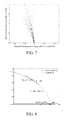
- FIG. 7 shows a graph illustrating final finger approach, as seen from the side of the approaching direction.
- FIG. 8 shows a graph illustrating a parabola fitted in the drop-down plane with (1) an initial point, (2) the angle of movement, (3) and the intersection is orthogonal with the display.
- FIG. 9 shows a graph illustrating a preference curve for each observed trend and average latency preference for all participants.
- FIG. 10 shows a state diagraph illustrating transitions between three states of touch input that model the starting and stopping of actions, based on prediction input.
- a method for reducing the perceived latency of touch input by employing a model to predict touch events before the finger reaches the touch surface is proposed.
- a corpus of 3D finger movement data was collected, and used to develop a model capable of three granularities at different phases of movement: initial direction, final touch location, time of touchdown.
- the model predicts the location and time of a touch. Parameters of the model are tuned to the latency of the device to maximize accuracy while guaranteeing performance.
- a user study of different levels of latency reveals a strong preference for unperceivable latency touchdown feedback.
- a form of ‘soft’ feedback is disclosed, as well as other performance-enhancing uses for this prediction model.
- a system for reducing or eliminating the apparent latency of an interactive system.
- apparent latency as the time between an input and the system's soft feedback to that input, which serves only to show a quick response to the user (e.g.: pointer movement, UI buttons being depressed), as distinct from the time required to show the hard feedback of an application actually responding to that same input.
- Methods are disclosed herein for eliminating the apparent latency of tapping actions on a large touchscreen through the development and use of a model of finger movement.
- the model is used to track the path of a user's finger as it approaches the display and predict the location and time of its landing.
- the method then signals the application of the impending touch so that it can pre-buffer its response to the touchdown event.
- a visual response to the touch is triggered at the predicted point before the finger lands on the screen.
- the timing of the trigger is tuned to the system's processing and display latency, so the feedback is shown to the user at the moment they touch the display. The result is an improvement in the apparent latency as touch and feedback occur simultaneously.
- a number of sensing techniques have been employed to detect the position of the user prior to touching a display.
- hover sensing is often simulated using optical tracking tools such as the Vicon motion capture system, as we have done in this work.
- the user is required to wear or hold objects augmented with markers, as well as the need to deploy stationary cameras.
- markerless hover sensing has been demonstrated using optical techniques, including through the use of an array of time-of-flight based range finders as well as stereo and optical cameras.
- Non-optical tracking has also been demonstrated using a number of technologies.
- acoustic-based sensors such as the “Flock of Birds” tracking employed by Fitzmaurice et al., which enables six degrees of freedom (DOF) position and orientation sensing of physical handheld objects.
- DOF degrees of freedom
- EMR electro-magnetic resonance
- EMR is commonly used to track the position and orientation of styli in relation to a digitizer, and employed in creating pen-based user input. Although typically limited to a small range beyond the digitizer in commercial applications, tracking with EMR has been used in much larger volumes.
- touch sensors employed today are based on projective capacitance. Fundamentally, the technique is capable of sensing the user's presence centimeters away from the digitizer, as is done with the Theremin. Such sensors employed today are augmented with a ground plane, purposefully added to eliminate their ability to detect a user's finger prior to touch. More recently, sensors have been further augmented to include the ability to not only detect the user's finger above the device, but also to detect its distance from the digitizer.
- Hover has long been the domain of pen-operated devices.
- Subramanian et al. suggest that the 3D position of a pointing device affects the interaction on the surface.
- the authors propose a multi-layer application, with an active usage of the space above the display, where users purposefully distance the pen from the display to activate actions.
- Grossman et al. present a technique that utilizes the hover state of pen-based systems to navigate through a hover-only command layer.
- Spindler et al. propose that the space above the surface be divided into stacked layers, with layer specific interactions—this is echoed by Grossman et al., who divided the space around a volumetric display into two spherical ‘layers’ with subtly differentiated interaction.
- Ng et al. studied the user perception of latency for touch input. For dragging actions with a direct touch device, users were able to detect latency levels as low as 6 ms. Jota et al. studied the user performance of latency for touch input and found that dragging task performance is affected if latency levels are above 25 ms. In the present disclosure, we focus on eliminating latency of the touchdown moment when the user first touches the screen. Jota et al. found that users are unable to perceive latency of responses to tapping that occur in less than 24 ms—we use prediction of touch location to provide soft touchdown feedback within this critical time, effectively eliminating perceptible latency.
- Biomechanists and neuroscientists are actively engaged in the capture and analysis of 3D human hand motion. Their interest lies primarily in the understanding of various kinematic features, such as muscle actuation and joint torques, as well as cognitive planning during the hand movement. Flash modeled the unconstrained point-to-point arm movement by defining an objective function and running an optimization algorithm. They found that the minimization of hand jerk movements generates an acceptable trajectory. Following the same approach, Uno optimizes for another kinematic feature, torque, to generate the hand trajectory. While informative, these models are unsuitable to our goal of reducing latency, as they are computationally intensive and cannot be computed in real-time (for our purposes, as in little as 30 ms).
- the flow of the experiment was controlled by a separate PC, which received sensing information from both the Surface touch system and the Vicon tracking system, while triggering visual feedback on the Surface display.
- the experiment was implemented in python and shown to the user on the Surface table. It was designed to (1) present instructions and apparatus to the participant, (2) record the position and rotation of the tracked finger, (3) receive current touch events from the Surface, (4) issue commands to the display, and (5) log all of the data.
- a target point would appear for participants to tap.
- the target size of 2.3 cm was selected as a trade-off between our need to specify end-position while minimizing corrective movements.
- Participants were asked to complete a consent form and a questionnaire to collect demographic information. They then received instruction on how to interact with the apparatus and successfully completed 30 training trials. After the execution of each trial, a text block at the top right corner of the screen would update the cumulative error rate (shown as %). Participants were instructed to slow down if the error rate was above 5%, but were not given any instructions regarding their pre-touch movement.
- Tasks were designed according to two independent variables: target direction (8 cardinal directions) and target distance (20.8 cm and 30.1 cm). The combination of these two variables produces 16 unique gestures. There were four repetitions for each combination of direction and distance. Therefore, a session included a total of 64 actions. The ordering of the trials was randomized within each session. Participants completed 3 sessions and were given a 5-minute break between sessions.
- FIG. 2 shows an overlay of all the pre-touch approaches to a northwest target.
- the rectangle represents the interactive surface used in the study.
- Time & Goals participants completed each trial with an mean movement time of 416 ms (std.: 121 ms).
- Our system had an average end-to-end latency of 80 ms: 70 ms from the Vicon system, 8 ms from the display, and 2 ms of processing.
- our goal was to remove at least ⁇ 56 ms via prediction. Applying our work to other systems will require additional tuning.
- FIG. 3 shows that all the trajectories have one peak, with a constant climb before, and a constant decline after. However, we did not find the peak to be at the same place in-between trajectories. Instead the majority of trajectories are asymmetrical, 2.2% have a peak before 30% of the total path, 47.9% have a peak between 30-50% of the total path, 47.1% have a peak between 50-70% of the total path, and 2.8% have a peak after 80% of the trajectory completed path.
- lift-off which is characterized by a positive change in height
- continuation which begins as the user's finger starts to dip vertically
- drop-down the final plunge towards the screen.
- FIG. 4 shows trajectory for the eight directions of movement, normalized to start at the same location (center).
- the solid lines represent the straight-line approach to each target.
- lift-off direction as might be expected
- the direction of movement of the user's hand above the plane of the screen is roughly co-linear to the target direction, as shown in the figure.
- Fitting a straight line to this movement the angle of that line to a straight line from starting point to the target is, on average, 4.78°, with a standard deviation of 4.51°.
- this information alone is sufficient to eliminate several potential touch targets.
- FIG. 5 and FIG. 7 show the trajectory of final approach towards the screen.
- the direction of movement in the drop-down phase roughly fits a vertical drop to the screen.
- the final approach when viewed from the side is roughly parabolic. It is clear when examining FIG. 7 that a curve, constrained to intersect on a normal to the plane, will provide a rough fit.
- a parabola constrained to intersect the screen at a normal, and fit to the hover path, would provide the best fit.
- Lift-off begins with a user lifting a finger off the touch surface and ends at the highest point of the trajectory (peak). As we discussed, above, this often ends before the user has reached the halfway point towards their desired target. As is also described, the direction of movement along the plane of the screen can be used to coarsely predict a line along which their intended target is likely to fall. At this early stage, our model provides this line, allowing elimination of targets outside of its bounds.
- FIG. 8 shows the parabola fitted in the drop-down plane with (1) an initial point, (2) the angle of movement, (3) and the intersection is orthogonal with the display.
- This parabola is constrained as follows: (1) the plane is fit to the (nearly planar) drop-down trajectory of the touch; (2) the position of the finger at the time of the fit is on the parabola; (3) the angle of movement at the time of the fit is made a tangent to the parabola; (4) the angle of intersection with the display is orthogonal.
- the parabola is fit to the data, and constrained by these parameters, its intersection with the display comprises the predicted touch point.
- the fit is made when the drop-down phase begins. This is characterized by two conditions: (1) the finger's proximity to the screen; and (2) the angle to xy plane is higher than a threshold.
- the tapping location is predicted.
- we first fit a vertical plane to the trajectory. Given the angle d and (x 0 , z 0 ), we predict the landing point, (x p , z p ), by fitting a parabola: x az 2 +bz+c Based on the derivatives at (x 0 , z 0 ) and (x p , z p ):
- the timing of this phase is tuned based on the overall latency of the system, including that of the hover sensor: the later the prediction is made, the more accurate it will be, but the less time will be available for the system to respond.
- the goal is to tune the system so that the prediction arrives at the application so that it can respond immediately, and have its response shown on the screen at the precise moment the user touches.
- target direction (8 cardinal directions), target distance (25.5 cm, 32.4 cm, and 39.4 cm), and target size (1.6 cm, 2.1 cm, and 2.6 cm).
- target size 1.6 cm, 2.1 cm, and 2.6 cm. The combination of these three variables produces 72 unique tasks.
- the order of target size and distance was randomized, with target direction always starting with the south position, and going clockwise for each combination of target size and distance. Participants completed 3 sessions and were given a break after each session.
- Prediction 1 On average, the final touch point was within 4.25° of the straight-line prediction provided by our model (std.: 4.61°). On average, this was made available 186 ms (mean; std.: 77 ms) before the user touched the display. We found no significant effect for target size, direction, or distance on prediction accuracy.
- Prediction 2 On average, our model predicted a touch location with an accuracy of 1.05 cm (std.: 0.81 cm). The finger was, on average, 2.87 cm (std.: 1.37 cm) away from the display when the prediction was made. The model is able to predict, on average, 128 ms (std.: 63 ms) before touching the display, allowing us to significantly reduce latency. We found no significant effect for target size, direction, or distance on prediction accuracy.
- Tasks were designed with one independent variable, response latency. To limit combinatorial explosion, we decided to provide widget feedback under five different conditions: immediately as a finger prediction is made (0 ms after prediction) and then artificially added latencies of 40, 80, 120, and 160 ms to the predicted time, resulting in 10 unique pairs of latency. To remove the possible preference for buttons placed to the left or right, we also flipped the order of the buttons, resulting in 20 total pairs. The ordering of the 20 pairs was randomized within each session. Latency level was also randomly generated. Participants completed 7 sessions of 20 pairs and were given a 1-minute break between sessions, for a total of 2240 total trials.
- the response time is calculated by artificially adding to the time of prediction some latency (between 0 and 160 ms).
- some latency between 0 and 160 ms.
- touch time we consider when the Surface detected the touch and subtract a known Surface latency of 137 ms.
- the effective latency is the difference between the response time and the touch time.
- Visible Latency Four participants preferred visible latency. When asked about the feeling of immediate response, they expressed that they were not yet confident regarding the predictive model and felt that an immediate response wasn't indicative of a successful recognition. Visible latency gave them a feeling of being in control of the system and, therefore, they preferred it to immediate response. This was true even for trials where prediction was employed.
- touch-controlled applications execute arbitrary application logic in response to input.
- a 128-200 ms prediction horizon provides system designers with the intriguing possibility of kicking-off time consuming programmatic responses to input before the input occurs.
- a web-browser coupled with our input prediction model would gain a 128-200 ms head-start on loading linked pages.
- Recent analysis has suggested that the median web-page loading time for desktop systems is 2.45 s. As such, a head-start could represent a 5-8% improvement in page loading time, without increasing bandwidth usage or server burden.
- Similar examples include the loading of launched applications and the caching of the contents of a directory.
- FIG. 10 shows this model: in State 1, related actions can be issued by the input system as predictions (direction, location, and time) of a possible action are received.
- the input system will stop all actions.
- the actual touch target turns out not to be the predicted one, the system may also stop all actions but this will not add extra latency compared to the traditional three-state model.
- the touch sensor confirms the predicted action, the latency of the touch sensor, network, rendering, and all the procedure related parts will be reduced.
- Our prediction model is not constrained to only solving latency.
- the approach is rich in motion data and can be used to enrich many UIs.
- the velocity of a finger can be mapped to pressure, or the approach direction can be mapped to different gestures.
- Equally important, perhaps, is the possibility to predict when a finger is leaving a display but not landing again inside the interaction surface, effectively indicating that the user is stopping interaction. This can be useful, for example, to remove UI elements from a video application when the user is leaving the interaction region.
- the model relies on a high fidelity 3D tracking system, currently unavailable for most commercial products.
- a Vicon tracking system running at 120 Hz, to capture the pre-touch data.
- this high frequency tracking is not realistic for most commercial products, we tested the model at 60 Hz, slower than most commercial sensors.
- prediction is delayed 8 ms on average, the later fit has the benefit of increasing prediction accuracy, because the finger is closer to the display.
- accurate hover sensing technique such as Wacom Intuos with EMR-based sensor and Lea
- touch may be used to describe events or periods of time in which a user's finger, a stylus, an object or a body part is detected by the sensor. In some embodiments, these detections occur only when the user is in physical contact with a sensor, or a device in which it is embodied. In other embodiments, the sensor may be tuned to allow the detection of “touches” or “contacts” that are hovering a distance above the touch surface or otherwise separated from the touch sensitive device.
- touch event and the word “touch” when used as a noun include a near touch and a near touch event, or any other gesture that can be identified using a sensor.
Landscapes
- Engineering & Computer Science (AREA)
- Theoretical Computer Science (AREA)
- General Engineering & Computer Science (AREA)
- Physics & Mathematics (AREA)
- General Physics & Mathematics (AREA)
- Human Computer Interaction (AREA)
- Data Mining & Analysis (AREA)
- Artificial Intelligence (AREA)
- Evolutionary Computation (AREA)
- Computing Systems (AREA)
- Mathematical Physics (AREA)
- Software Systems (AREA)
- Computational Linguistics (AREA)
- Algebra (AREA)
- Computational Mathematics (AREA)
- Mathematical Analysis (AREA)
- Mathematical Optimization (AREA)
- Pure & Applied Mathematics (AREA)
- User Interface Of Digital Computer (AREA)
Abstract
Description
x=az 2 +bz+c
Based on the derivatives at (x0, z0) and (xp, zp):
we calculate a, b, and c as follows:
The landing point in this plane is defined as:
(x p ,z p)=(c,0)
Claims (41)
Priority Applications (3)
| Application Number | Priority Date | Filing Date | Title |
|---|---|---|---|
| US14/859,185 US10088952B2 (en) | 2014-09-18 | 2015-09-18 | Systems and methods for using hover information to predict touch locations and reduce or eliminate touchdown latency |
| US16/008,236 US10592049B2 (en) | 2014-09-18 | 2018-06-14 | Systems and methods for using hover information to predict touch locations and reduce or eliminate touchdown latency |
| US16/008,332 US10592050B2 (en) | 2014-09-18 | 2018-06-14 | Systems and methods for using hover information to predict touch locations and reduce or eliminate touchdown latency |
Applications Claiming Priority (2)
| Application Number | Priority Date | Filing Date | Title |
|---|---|---|---|
| US201462052323P | 2014-09-18 | 2014-09-18 | |
| US14/859,185 US10088952B2 (en) | 2014-09-18 | 2015-09-18 | Systems and methods for using hover information to predict touch locations and reduce or eliminate touchdown latency |
Related Child Applications (2)
| Application Number | Title | Priority Date | Filing Date |
|---|---|---|---|
| US16/008,332 Division US10592050B2 (en) | 2014-09-18 | 2018-06-14 | Systems and methods for using hover information to predict touch locations and reduce or eliminate touchdown latency |
| US16/008,236 Continuation US10592049B2 (en) | 2014-09-18 | 2018-06-14 | Systems and methods for using hover information to predict touch locations and reduce or eliminate touchdown latency |
Publications (2)
| Publication Number | Publication Date |
|---|---|
| US20160188112A1 US20160188112A1 (en) | 2016-06-30 |
| US10088952B2 true US10088952B2 (en) | 2018-10-02 |
Family
ID=55533938
Family Applications (3)
| Application Number | Title | Priority Date | Filing Date |
|---|---|---|---|
| US14/859,185 Expired - Fee Related US10088952B2 (en) | 2014-09-18 | 2015-09-18 | Systems and methods for using hover information to predict touch locations and reduce or eliminate touchdown latency |
| US16/008,332 Expired - Fee Related US10592050B2 (en) | 2014-09-18 | 2018-06-14 | Systems and methods for using hover information to predict touch locations and reduce or eliminate touchdown latency |
| US16/008,236 Expired - Fee Related US10592049B2 (en) | 2014-09-18 | 2018-06-14 | Systems and methods for using hover information to predict touch locations and reduce or eliminate touchdown latency |
Family Applications After (2)
| Application Number | Title | Priority Date | Filing Date |
|---|---|---|---|
| US16/008,332 Expired - Fee Related US10592050B2 (en) | 2014-09-18 | 2018-06-14 | Systems and methods for using hover information to predict touch locations and reduce or eliminate touchdown latency |
| US16/008,236 Expired - Fee Related US10592049B2 (en) | 2014-09-18 | 2018-06-14 | Systems and methods for using hover information to predict touch locations and reduce or eliminate touchdown latency |
Country Status (2)
| Country | Link |
|---|---|
| US (3) | US10088952B2 (en) |
| WO (1) | WO2016044807A1 (en) |
Cited By (1)
| Publication number | Priority date | Publication date | Assignee | Title |
|---|---|---|---|---|
| US20230350969A1 (en) * | 2019-12-13 | 2023-11-02 | Prine Strategy Co., Ltd. | Automatic display control method for web content |
Families Citing this family (19)
| Publication number | Priority date | Publication date | Assignee | Title |
|---|---|---|---|---|
| US9715282B2 (en) * | 2013-03-29 | 2017-07-25 | Microsoft Technology Licensing, Llc | Closing, starting, and restarting applications |
| AU2015387254B2 (en) * | 2015-03-13 | 2019-03-14 | Telefonaktiebolaget Lm Ericsson (Publ) | Device for handheld operation and method thereof |
| US9948742B1 (en) * | 2015-04-30 | 2018-04-17 | Amazon Technologies, Inc. | Predictive caching of media content |
| US10552752B2 (en) * | 2015-11-02 | 2020-02-04 | Microsoft Technology Licensing, Llc | Predictive controller for applications |
| US10042550B2 (en) * | 2016-03-28 | 2018-08-07 | International Business Machines Corporation | Displaying virtual target window on mobile device based on directional gesture |
| US10091344B2 (en) | 2016-03-28 | 2018-10-02 | International Business Machines Corporation | Displaying virtual target window on mobile device based on user intent |
| US10353478B2 (en) * | 2016-06-29 | 2019-07-16 | Google Llc | Hover touch input compensation in augmented and/or virtual reality |
| US10353493B2 (en) | 2016-09-30 | 2019-07-16 | Microsoft Technology Licensing, Llc | Apparatus and method of pen detection at a digitizer |
| US10395412B2 (en) * | 2016-12-30 | 2019-08-27 | Microsoft Technology Licensing, Llc | Morphing chart animations in a browser |
| US11086498B2 (en) | 2016-12-30 | 2021-08-10 | Microsoft Technology Licensing, Llc. | Server-side chart layout for interactive web application charts |
| US10304225B2 (en) | 2016-12-30 | 2019-05-28 | Microsoft Technology Licensing, Llc | Chart-type agnostic scene graph for defining a chart |
| US11354969B2 (en) * | 2019-12-20 | 2022-06-07 | Igt | Touch input prediction using gesture input at gaming devices, and related devices, systems, and methods |
| US20210390483A1 (en) * | 2020-06-10 | 2021-12-16 | Tableau Software, LLC | Interactive forecast modeling based on visualizations |
| EP4204929A1 (en) * | 2020-08-28 | 2023-07-05 | Apple Inc. | Detecting user-to-object contacts using physiological data |
| US12099645B2 (en) | 2021-03-03 | 2024-09-24 | Guardian Glass, LLC | Systems and/or methods for creating and passively detecting changes in electrical fields |
| US11620019B1 (en) * | 2021-10-25 | 2023-04-04 | Amazon Technologies. Inc. | Adaptive predictions of contact points on a screen |
| JP7284844B1 (en) * | 2022-03-08 | 2023-05-31 | レノボ・シンガポール・プライベート・リミテッド | Information processing device and control method |
| TWI843345B (en) * | 2022-12-20 | 2024-05-21 | 大陸商北京集創北方科技股份有限公司 | Lagrangian touch trajectory simulation method, touch module and information processing device |
| CN115904140A (en) * | 2022-12-27 | 2023-04-04 | 维沃移动通信有限公司 | Touch panel, electronic device, touch method and device |
Citations (1)
| Publication number | Priority date | Publication date | Assignee | Title |
|---|---|---|---|---|
| US20110175832A1 (en) * | 2010-01-19 | 2011-07-21 | Sony Corporation | Information processing apparatus, operation prediction method, and operation prediction program |
Family Cites Families (7)
| Publication number | Priority date | Publication date | Assignee | Title |
|---|---|---|---|---|
| US9354804B2 (en) * | 2010-12-29 | 2016-05-31 | Microsoft Technology Licensing, Llc | Touch event anticipation in a computing device |
| AU2012222413A1 (en) | 2011-03-01 | 2013-10-24 | Printechnologics Gmbh | Input element for operating a touch-screen |
| US10452188B2 (en) * | 2012-01-13 | 2019-10-22 | Microsoft Technology Licensing, Llc | Predictive compensation for a latency of an input device |
| US20130222329A1 (en) * | 2012-02-29 | 2013-08-29 | Lars-Johan Olof LARSBY | Graphical user interface interaction on a touch-sensitive device |
| KR101867494B1 (en) * | 2012-10-05 | 2018-07-17 | 텍추얼 랩스 컴퍼니 | Hybrid systems and methods for low-latency user input processing and feedback |
| US9430067B2 (en) * | 2013-01-11 | 2016-08-30 | Sony Corporation | Device and method for touch detection on a display panel |
| US20140240242A1 (en) * | 2013-02-26 | 2014-08-28 | Honeywell International Inc. | System and method for interacting with a touch screen interface utilizing a hover gesture controller |
-
2015
- 2015-09-18 WO PCT/US2015/051085 patent/WO2016044807A1/en not_active Ceased
- 2015-09-18 US US14/859,185 patent/US10088952B2/en not_active Expired - Fee Related
-
2018
- 2018-06-14 US US16/008,332 patent/US10592050B2/en not_active Expired - Fee Related
- 2018-06-14 US US16/008,236 patent/US10592049B2/en not_active Expired - Fee Related
Patent Citations (1)
| Publication number | Priority date | Publication date | Assignee | Title |
|---|---|---|---|---|
| US20110175832A1 (en) * | 2010-01-19 | 2011-07-21 | Sony Corporation | Information processing apparatus, operation prediction method, and operation prediction program |
Cited By (1)
| Publication number | Priority date | Publication date | Assignee | Title |
|---|---|---|---|---|
| US20230350969A1 (en) * | 2019-12-13 | 2023-11-02 | Prine Strategy Co., Ltd. | Automatic display control method for web content |
Also Published As
| Publication number | Publication date |
|---|---|
| US20160188112A1 (en) | 2016-06-30 |
| US20180292946A1 (en) | 2018-10-11 |
| US10592050B2 (en) | 2020-03-17 |
| WO2016044807A1 (en) | 2016-03-24 |
| US20180292945A1 (en) | 2018-10-11 |
| US10592049B2 (en) | 2020-03-17 |
Similar Documents
| Publication | Publication Date | Title |
|---|---|---|
| US10592050B2 (en) | Systems and methods for using hover information to predict touch locations and reduce or eliminate touchdown latency | |
| Xia et al. | Zero-latency tapping: using hover information to predict touch locations and eliminate touchdown latency | |
| US10545574B2 (en) | Determining gaze target based on facial features | |
| Wang et al. | Detecting and leveraging finger orientation for interaction with direct-touch surfaces | |
| US8466934B2 (en) | Touchscreen interface | |
| US9477324B2 (en) | Gesture processing | |
| TWI569171B (en) | Gesture recognition | |
| US8842084B2 (en) | Gesture-based object manipulation methods and devices | |
| Bi et al. | Predicting finger-touch accuracy based on the dual Gaussian distribution model | |
| US20150134572A1 (en) | Systems and methods for providing response to user input information about state changes and predicting future user input | |
| US20160364138A1 (en) | Front touchscreen and back touchpad operated user interface employing semi-persistent button groups | |
| US20130120282A1 (en) | System and Method for Evaluating Gesture Usability | |
| TWI768407B (en) | Prediction control method, input system and computer readable recording medium | |
| US9958946B2 (en) | Switching input rails without a release command in a natural user interface | |
| US12216833B1 (en) | System for improving user input recognition on touch surfaces | |
| Ikematsu et al. | Predictaps: Latency reduction technique for single-taps based on recognition for single-tap or double-tap | |
| US10860120B2 (en) | Method and system to automatically map physical objects into input devices in real time | |
| CN119002693A (en) | Interactive method, device, electronic equipment, storage medium, system and computer program product executed by electronic equipment | |
| Ens et al. | Characterizing user performance with assisted direct off-screen pointing | |
| US10133346B2 (en) | Gaze based prediction device and method | |
| US20150268734A1 (en) | Gesture recognition method for motion sensing detector | |
| Giordano et al. | An investigation of multimodal kinematic template matching for ray pointing prediction for target selection in VR | |
| Ramadan et al. | A novel control system for a laptop with gestures recognition | |
| US20160274667A1 (en) | Apparatus and method for inputting character | |
| Lee et al. | Data preloading technique using intention prediction |
Legal Events
| Date | Code | Title | Description |
|---|---|---|---|
| AS | Assignment |
Owner name: THE GOVERNING COUNCIL OF THE UNIVERSITY OF TORONTO Free format text: ASSIGNMENT OF ASSIGNORS INTEREST;ASSIGNORS:JOTA COSTA, RICARDO JORGE;SINGH, KARAN;WIGDOR, DANIEL;AND OTHERS;SIGNING DATES FROM 20170418 TO 20170610;REEL/FRAME:043596/0360 |
|
| AS | Assignment |
Owner name: TACTUAL LABS CO., NEW YORK Free format text: ASSIGNMENT OF ASSIGNORS INTEREST;ASSIGNOR:THE GOVERNING COUNCIL OF THE UNIVERSITY OF TORONTO;REEL/FRAME:043601/0058 Effective date: 20170613 |
|
| AS | Assignment |
Owner name: TACTUAL LABS CO., NEW YORK Free format text: ASSIGNMENT OF ASSIGNORS INTEREST;ASSIGNOR:FORLINES, CLIFTON;REEL/FRAME:043641/0437 Effective date: 20170915 |
|
| AS | Assignment |
Owner name: GPB DEBT HOLDINGS II, LLC, NEW YORK Free format text: SECURITY INTEREST;ASSIGNOR:TACTUAL LABS CO.;REEL/FRAME:044570/0616 Effective date: 20171006 |
|
| FEPP | Fee payment procedure |
Free format text: ENTITY STATUS SET TO UNDISCOUNTED (ORIGINAL EVENT CODE: BIG.); ENTITY STATUS OF PATENT OWNER: SMALL ENTITY Free format text: ENTITY STATUS SET TO UNDISCOUNTED (ORIGINAL EVENT CODE: BIG.); ENTITY STATUS OF PATENT OWNER: LARGE ENTITY |
|
| STCF | Information on status: patent grant |
Free format text: PATENTED CASE |
|
| FEPP | Fee payment procedure |
Free format text: PETITION RELATED TO MAINTENANCE FEES GRANTED (ORIGINAL EVENT CODE: PTGR); ENTITY STATUS OF PATENT OWNER: SMALL ENTITY Free format text: PETITION RELATED TO MAINTENANCE FEES GRANTED (ORIGINAL EVENT CODE: PTGR); ENTITY STATUS OF PATENT OWNER: LARGE ENTITY |
|
| AS | Assignment |
Owner name: TACTUAL LABS CO., NEW YORK Free format text: RELEASE BY SECURED PARTY;ASSIGNOR:GPB DEBT HOLDINGS II, LLC;REEL/FRAME:056540/0807 Effective date: 20201030 |
|
| FEPP | Fee payment procedure |
Free format text: ENTITY STATUS SET TO SMALL (ORIGINAL EVENT CODE: SMAL); ENTITY STATUS OF PATENT OWNER: SMALL ENTITY |
|
| FEPP | Fee payment procedure |
Free format text: MAINTENANCE FEE REMINDER MAILED (ORIGINAL EVENT CODE: REM.); ENTITY STATUS OF PATENT OWNER: SMALL ENTITY |
|
| LAPS | Lapse for failure to pay maintenance fees |
Free format text: PATENT EXPIRED FOR FAILURE TO PAY MAINTENANCE FEES (ORIGINAL EVENT CODE: EXP.); ENTITY STATUS OF PATENT OWNER: SMALL ENTITY |
|
| STCH | Information on status: patent discontinuation |
Free format text: PATENT EXPIRED DUE TO NONPAYMENT OF MAINTENANCE FEES UNDER 37 CFR 1.362 |
|
| FP | Lapsed due to failure to pay maintenance fee |
Effective date: 20221002 |