US10087714B2 - Tubular assembly including a sliding sleeve having a degradable locking element - Google Patents

Tubular assembly including a sliding sleeve having a degradable locking element Download PDF

Info

Publication number
US10087714B2
US10087714B2 US15/458,237 US201715458237A US10087714B2 US 10087714 B2 US10087714 B2 US 10087714B2 US 201715458237 A US201715458237 A US 201715458237A US 10087714 B2 US10087714 B2 US 10087714B2
Authority
US
United States
Prior art keywords
slidable sleeve
tubular
degradable
locking member
biasing member
Prior art date
Legal status (The legal status is an assumption and is not a legal conclusion. Google has not performed a legal analysis and makes no representation as to the accuracy of the status listed.)
Active
Application number
US15/458,237
Other versions
US20170183937A1 (en
Inventor
Jason M. Harper
James G. King
James Scott Sanchez
Current Assignee (The listed assignees may be inaccurate. Google has not performed a legal analysis and makes no representation or warranty as to the accuracy of the list.)
Baker Hughes Holdings LLC
Original Assignee
Baker Hughes Inc
Priority date (The priority date is an assumption and is not a legal conclusion. Google has not performed a legal analysis and makes no representation as to the accuracy of the date listed.)
Filing date
Publication date
Priority claimed from US14/487,812 external-priority patent/US10337287B2/en
Application filed by Baker Hughes Inc filed Critical Baker Hughes Inc
Priority to US15/458,237 priority Critical patent/US10087714B2/en
Assigned to BAKER HUGHES INCORPORATED reassignment BAKER HUGHES INCORPORATED ASSIGNMENT OF ASSIGNORS INTEREST (SEE DOCUMENT FOR DETAILS). Assignors: HARPER, JASON M., KING, JAMES G., SANCHEZ, JAMES SCOTT
Publication of US20170183937A1 publication Critical patent/US20170183937A1/en
Application granted granted Critical
Publication of US10087714B2 publication Critical patent/US10087714B2/en
Assigned to BAKER HUGHES HOLDINGS LLC reassignment BAKER HUGHES HOLDINGS LLC CHANGE OF NAME (SEE DOCUMENT FOR DETAILS). Assignors: BAKER HUGHES, A GE COMPANY, LLC, BAKER HUGHES INCORPORATED
Active legal-status Critical Current
Anticipated expiration legal-status Critical

Links

Images

Classifications

    • EFIXED CONSTRUCTIONS
    • E21EARTH OR ROCK DRILLING; MINING
    • E21BEARTH OR ROCK DRILLING; OBTAINING OIL, GAS, WATER, SOLUBLE OR MELTABLE MATERIALS OR A SLURRY OF MINERALS FROM WELLS
    • E21B34/00Valve arrangements for boreholes or wells
    • E21B34/06Valve arrangements for boreholes or wells in wells
    • E21B34/14Valve arrangements for boreholes or wells in wells operated by movement of tools, e.g. sleeve valves operated by pistons or wire line tools
    • EFIXED CONSTRUCTIONS
    • E21EARTH OR ROCK DRILLING; MINING
    • E21BEARTH OR ROCK DRILLING; OBTAINING OIL, GAS, WATER, SOLUBLE OR MELTABLE MATERIALS OR A SLURRY OF MINERALS FROM WELLS
    • E21B23/00Apparatus for displacing, setting, locking, releasing or removing tools, packers or the like in boreholes or wells
    • E21B23/004Indexing systems for guiding relative movement between telescoping parts of downhole tools
    • E21B2034/007
    • EFIXED CONSTRUCTIONS
    • E21EARTH OR ROCK DRILLING; MINING
    • E21BEARTH OR ROCK DRILLING; OBTAINING OIL, GAS, WATER, SOLUBLE OR MELTABLE MATERIALS OR A SLURRY OF MINERALS FROM WELLS
    • E21B2200/00Special features related to earth drilling for obtaining oil, gas or water
    • E21B2200/06Sleeve valves
    • EFIXED CONSTRUCTIONS
    • E21EARTH OR ROCK DRILLING; MINING
    • E21BEARTH OR ROCK DRILLING; OBTAINING OIL, GAS, WATER, SOLUBLE OR MELTABLE MATERIALS OR A SLURRY OF MINERALS FROM WELLS
    • E21B2200/00Special features related to earth drilling for obtaining oil, gas or water
    • E21B2200/08Down-hole devices using materials which decompose under well-bore conditions

Definitions

  • Hydrocarbon drilling and recovery systems employ strings of tubulars that extend downhole. Often times one or more of the tubulars include openings. The openings may be selectively exposed to allow downhole fluids to pass into the string of tubulars.
  • a sliding sleeve is deployed to expose the openings. More specifically, the string of tubulars is positioned downhole and, at a desired time, the sliding sleeve is shifted to expose the openings. Once opened, the sleeve may be locked in place by a locking mechanism. The lock allows, for example, coiled tubing to be run downhole through the tubular without inadvertently closing the sleeve. Once locked, the sleeve may not be closed. Accordingly, improvements in sleeve locking and retaining devices are well received by the industry.
  • a tubular assembly includes a tubular having at least one opening.
  • a slidable sleeve is slidingly mounted relative to the tubular. The slidable sleeve is shiftable between a first position, and a second position.
  • a biasing member selectively biases the slidable sleeve in one of the first position and the second position.
  • a degradable locking member is mounted relative to one of the tubular and the slidable sleeve. The degradable locking member selectively retains the slidable sleeve in the other of the first position and the second position.
  • the degradable locking member is configured to degrade when exposed to a downhole fluid allowing the biasing member to shift the slidable sleeve back to the one of the first position and the second position.
  • a resource recovery and exploration system includes a surface system, a wellbore formed in a formation, and a tubular assembly extending down the wellbore into the formation.
  • the tubular assembly includes a tubular having at least one opening.
  • a slidable sleeve is slidingly mounted relative to the tubular. The slidable sleeve is shiftable between a first position, and a second position.
  • a biasing member selectively biases the slidable sleeve in one of the first position and the second position.
  • a degradable locking member is mounted relative to one of the tubular and the slidable sleeve. The degradable locking member selectively retaining the slidable sleeve in the other of the first position and the second position.
  • the degradable locking member is configured to degrade when exposed to a downhole fluid allowing the biasing member to shift the slidable sleeve back to the one of the first position and the second position.
  • a method of operating a downhole slidable sleeve includes running a tubular assembly including a tubular having a slidable sleeve into a wellbore, shifting the slidable sleeve relative to the tubular from a first position to a second position, loading a biasing member with the slidable sleeve in the second position, locking the slidable sleeve in the second position with a degradable locking member, and exposing the degradable locking member to a downhole fluid causing the degradable locking member to degrade.
  • FIG. 1 depicts a resource extraction system including a tubular assembly having a slidable sleeve with a degradable locking member, in accordance with an aspect of an exemplary embodiment
  • FIG. 2 depicts the tubular assembly of FIG. 1 with the slidable sleeve in a closed configuration
  • FIG. 3 depicts the tubular assembly with the slidable sleeve locked in an open configuration through the degradable locking member of FIG. 1 ;
  • FIG. 4 depicts a degradable locking member, in accordance with an aspect of an exemplary embodiment
  • FIG. 5 depicts a degradable locking member, in accordance with another aspect of an exemplary embodiment
  • FIG. 6 depicts a degradable locking member, in accordance with yet another aspect of an exemplary embodiment
  • FIG. 7 depicts a system of tubulars including a slidable sleeve with a degradable locking member, in accordance with another aspect of an exemplary embodiment
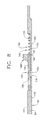
  • FIG. 8 depicts the slidable sleeve positioned in a first configuration, in accordance with an aspect of an exemplary embodiment
  • FIG. 9 depicts a drop ball engaging a ball seat of the slidable sleeve of FIG. 8 ;
  • FIG. 10 depicts the slidable sleeve shifted to a second configuration against a biasing member and being locked in place by the degradable locking member, in accordance with an aspect of an exemplary embodiment
  • FIG. 11 depicts the biasing member shifting the slidable sleeve back to the first configuration following degradation of the degradable locking member, in accordance with an aspect of an exemplary embodiment.
  • Resource extraction system 2 includes a surface system 4 operatively connected to a downhole system 6 .
  • Surface system 4 may include a platform 7 that supports pumps 8 that aid in completion and/or extraction processes as well as fluid storage 10 .
  • Fluid storage 10 may contain a completion fluid that is introduced into downhole system 6 . It is to be understood that surface system 4 may take on a variety of forms and should not be limited to the particular depiction presented in FIG. 1 .
  • Downhole system 6 may include a downhole string of tubulars 20 that is extended into a wellbore 21 formed in formation 22 .
  • a well casing 23 extends down wellbore 21 to provide stability.
  • Downhole string of tubulars 20 may include a tubular 24 and a slidable sleeve 30 .
  • Slidable sleeve 30 may be selectively shifted from a first or closed configuration ( FIG. 2 ) to a second or open configuration ( FIG. 3 ) exposing a plurality of openings 33 formed in tubular 24 .
  • the first configuration could represent an open configuration and the second configuration could represent a closed configuration.
  • Slidable sleeve 30 is shifted from one configuration to another as will be detailed herein.
  • Openings 33 allow fluid to pass from wellbore 21 into an interior portion 35 of tubular string 20 and vice versa.
  • slidable sleeve 30 is arranged radially inwardly of tubular 24 .
  • the relative position of slidable sleeve 30 and tubular 24 may vary.
  • a degradable locking member 40 retains slidable sleeve 30 in the open configuration.
  • locking member 40 is positioned radially outwardly of an outer surface (not separately labeled) of slidable sleeve 30 .
  • degradable locking member 40 nests within an annular groove 44 formed in the outer surface of slidable sleeve 30 .
  • annular groove 44 When nested within annular groove 44 , slidable sleeve 30 is prevented from shifting from the open configuration.
  • degradable locking member 40 will, over time, mechanically and/or chemically degrade. When degraded to a particular degree, slidable sleeve 30 may be shifted against degradable locking member 40 . Further shifting will cause degradable locking member 40 to release. At such time, slidable sleeve 30 may be freely shifted from the open configuration to the closed configuration.
  • degradable locking member 40 may take the form of a degradable snap ring 50 , illustrated in FIG. 4 .
  • Degradable snap ring 50 extends from a first end 52 to a second end 54 through a degradable intermediate portion 56 .
  • First end 52 may be spaced from second end 54 defining a discontinuity 58 .
  • locking member 40 may take the form of a body lock ring 68 , illustrated in FIG. 5 .
  • Body lock ring 68 may include a plurality of teeth 69 that meshingly engage with another plurality of teeth 71 formed on an outer surface (not separately labeled) of a slidable sleeve 74 .
  • degradable locking member 40 may take the form of a collet 80 arranged radially outwardly of tubular 24 .
  • Collet 80 includes a degradable locking portion 82 that, once degraded, allows slidable sleeve 30 to return to a closed configuration.
  • a system of tubulars 90 extends into wellbore 21 .
  • System of tubulars 20 includes at least one tubular assembly 92 having at least one tubular 94 .
  • a plurality of zones 96 A, 96 B, and 96 C separated by a corresponding plurality of packers 98 A, 98 B, and 98 C may be defined along system of tubulars. It is to be understood that the number and relative position of the zones along system of tubulars 94 as well as the number and location of the packers may vary.
  • FIG. 8 in describing zone 96 A with an understanding that zones 96 B and 96 C may include similar structure.
  • tubular 94 includes an outer surface 110 and an inner surface 111 having a recess 113 . At zone 96 A at least one opening 116 extends through tubular 94 in recess 113 . It is to be understood that the number and relative position of openings may vary.
  • Tubular 94 is also shown to include an annular groove 120 arranged in recess 113 . Annular groove 120 , as will be described herein, is selectively receptive of degradable locking member 40 .
  • Tubular 94 also includes a slidable sleeve 130 arranged in recess 113 . Specifically, slidable sleeve is shiftable between a first position, as shown in FIG. 8 and a second position as shown in FIG. 10 .
  • Slidable sleeve 130 includes an outer surface portion 134 and an inner surface portion 135 .
  • An at least one opening portion 138 extends through slidable sleeve 130 .
  • At least one opening portion 138 in slidable sleeve 130 selectively registers with at least one opening 116 in recess 113 allowing fluid to flow out of and/or into tubular 94 . It is to be understood that the particular orientation of slidable sleeve shown in FIG. 8 is but an exemplar.
  • Slidable sleeve could be configured to shift from the first position in which at least one opening 116 in recess 113 and at least one opening portion 138 are aligned to a second position in which at least one opening 116 and at least one opening portion 138 are misaligned thereby preventing fluid flow into and/or out of tubular 94 .
  • Slidable sleeve 130 also includes an annular groove portion 140 that may be receptive of degradable locking member 40 .
  • Slidable sleeve 130 may be also provided with a ball seat 144 .
  • degradable locking member 40 may nest within annular groove 120 in recess 113 . In this manner, slidable sleeve may be temporarily locked in place.
  • slidable sleeve may load a biasing member 148 provided in recess 113 .
  • Biasing member 148 may take the form of a spring 150 having one or more coils 152 that apply a force to slidable sleeve 130 . It is to be understood that the particular form of spring 150 may vary.
  • Slidable sleeve 130 may be shifted by fluid pressure introduced into system of tubulars 20 .
  • surface system 4 may include a pump ( FIG. 7 ) that may be operated to introduce a fluid (not shown) into system of tubulars 20 .
  • the fluid guides a drop ball 162 onto ball seat 144 as shown in FIG. 9 .
  • Fluid pressure is increased by pump 160 against drop ball 162 causing slidable sleeve 130 to shift from the first position ( FIG. 8 ) to the second position ( FIG. 10 ) loading biasing member 148 .
  • degradable locking member 40 nests within annular grove 120 temporarily fixing slidable sleeve 130 in place.
  • slidable sleeve 130 in the second position, at least one opening portion 138 in slidable sleeve 130 registers with at least one opening 116 in tubular 94 allowing fluid flow therebetween.
  • Drop ball 162 may be allowed to dissolve, may be pressured passed ball seat 144 or may be flowed out of wellbore 21 .
  • slidable sleeve 130 may be selectively secured to tubular 94 through one or more shear screws (not shown). Alternatively, slidable sleeve 130 may be secured to tubular 94 by a collet (also not shown).
  • degradable locking ring may dissolve as shown in FIG. 11 unlocking slidable sleeve 130 from tubular 94 .
  • biasing member 148 shifts slidable sleeve 130 back to the first position.
  • slidable sleeve 120 may be selectively secured in place by a collet (not shown).
  • downhole fluid may include fluids entering tubular 94 from wellbore 21 and/or formation 22 or fluids that are pumped into system of tubulars 20 .
  • degradable locking ring 40 need not fully dissolve before slidable sleeve is unlocked.
  • Degradable locking member 40 may partially dissolve and subsequently fracture allowing biasing member 148 to shift slidable sleeve back to the first position.
  • degradable locking member 40 may be formed in whole, or in part, from a material that disintegrates when exposed to downhole fluids. As will be discussed more fully below, degradable locking member 40 may be provided with a coating that may delay disintegration of degradable locking member 40 for a period of time. As will be discussed more fully below, coatings and underlying body materials may take on a variety of forms.
  • degradable locking member 40 may be formed from materials that are degradable by exposure to a variety of fluids capable of being pumped, present, or delivered downhole such as water, acid, oil, etc.
  • the degradable material could be a metal, a composite, a polymer, etc., or any other material that is suitably degradable and that can withstand the loads during run-in, etc.
  • the degradable locking member 40 may be manufactured from a high strength controlled electrolytic metallic material and is degradable by brine, acid, or aqueous fluid.
  • materials appropriate for the purpose of degradable locking member 40 described herein are lightweight, high-strength metallic materials.
  • suitable materials e.g., high strength controlled electrolytic metallic materials, and their methods of manufacture are given in United States Patent Publication No. 2011/0135953 (Xu, et al.), which Patent Publication is hereby incorporated by reference in its entirety.
  • These lightweight, high-strength, selectively and controllably degradable materials include fully-dense, sintered powder compacts formed from coated powder materials that include various lightweight particle cores and core materials having various single layer and multilayer nanoscale coatings.
  • These powder compacts are made from coated metallic powders that include various electrochemically-active (e.g., having relatively higher standard oxidation potentials) lightweight, high-strength particle cores and core materials, such as electrochemically active metals, that are dispersed within a cellular nanomatrix formed from the various nanoscale metallic coating layers of metallic coating materials, and are particularly useful in borehole applications.
  • various electrochemically-active e.g., having relatively higher standard oxidation potentials
  • lightweight, high-strength particle cores and core materials such as electrochemically active metals
  • Suitable core materials include electrochemically active metals having a standard oxidation potential greater than or equal to that of Zn, including Mg, Al, Mn or Zn or alloys or combinations thereof.
  • tertiary Mg—Al—X alloys may include, by weight, up to about 85% Mg, up to about 15% Al and up to about 5% X, where X is another material.
  • the core material may also include a rare earth element such as Sc, Y, La, Ce, Pr, Nd or Er, or a combination of rare earth elements. In other embodiments, the materials could include other metals having a standard oxidation potential less than that of Zn.
  • suitable non-metallic materials include ceramics, glasses (e.g., hollow glass microspheres), carbon, or a combination thereof.
  • the material has a substantially uniform average thickness between dispersed particles of about 50 nm to about 5000 nm.
  • the coating layers may be formed from Al, Ni, W or Al 2 O 3 , or combinations thereof.
  • the coating may be a multi-layer coating, for example, comprising a first Al layer, an Al 2 O 3 layer, and a second Al layer. In some embodiments, the coating may have a thickness of about 25 nm to about 2500 nm.
  • the fluids may include any number of ionic fluids or highly polar fluids, such as those that contain various chlorides. Examples include fluids comprising potassium chloride (KCl), hydrochloric acid (HCl), calcium chloride (CaCl 2 ), calcium bromide (CaBr 2 ) or zinc bromide (ZnBr 2 ).
  • KCl potassium chloride
  • HCl hydrochloric acid
  • CaCl 2 calcium chloride
  • CaBr 2 calcium bromide
  • ZnBr 2 zinc bromide
  • the particle core and coating layers of these powders may be selected to provide sintered powder compacts suitable for use as high strength engineered materials having a compressive strength and shear strength comparable to various other engineered materials, including carbon, stainless and alloy steels, but which also have a low density comparable to various polymers, elastomers, low-density porous ceramics and composite materials.
  • a tubular assembly comprising: a tubular including at least one opening; a slidable sleeve slidingly mounted relative to the tubular, the slidable sleeve being shiftable between a first position, and a second position; a biasing member selectively biasing the slidable sleeve in one of the first position and the second position; and a degradable locking member mounted relative to one of the tubular and the slidable sleeve, the degradable locking member selectively retaining the slidable sleeve in the other of the first position and the second position, the degradable locking member being configured to degrade when exposed to a downhole fluid allowing the biasing member to shift the slidable sleeve back to the one of the first position and the second position.
  • the biasing member comprises a spring having one or more coils.
  • tubular assembly according to embodiment 1, wherein the tubular includes an outer surface and an inner surface, the inner surface including an annular groove.
  • the slidable sleeve includes an outer surface portion and an inner surface portion, the outer surface portion including an annular groove portion, the degradable locking member being carried in the annular groove of the one of the tubular and the slidable sleeve in the first position and nested within the annular groove of the tubular and the slidable sleeve in the second position.
  • a resource recovery and exploration system comprising: a surface system; a wellbore formed in a formation; and a tubular assembly extending down the wellbore into the formation, the tubular assembly comprising: a tubular including at least one opening; a slidable sleeve slidingly mounted relative to the tubular, the slidable sleeve being shiftable between a first position, and a second position; a biasing member selectively biasing the slidable sleeve in one of the first position and the second position; and a degradable locking member mounted relative to one of the tubular and the slidable sleeve, the degradable locking member selectively retaining the slidable sleeve in the other of the first position and the second position, the degradable locking member being configured to degrade when exposed to a downhole fluid allowing the biasing member to shift the slidable sleeve back to the one of the first position and the second position.
  • biasing member comprises a spring having one or more coils.
  • the slidable sleeve includes at least one opening portion, in the second position the at least one opening portion registers with the at least one opening in the tubular.
  • tubular includes an outer surface and an inner surface, the inner surface including an annular groove.
  • the slidable sleeve includes an outer surface portion and an inner surface portion, the outer surface portion including an annular groove portion, the degradable locking member being carried in the annular groove of the one of the tubular and the slidable sleeve in the first position and nested within the annular groove of the tubular and the slidable sleeve in the second position.
  • degradable locking member comprises a degradable snap ring.
  • degradable snap ring extends from a first end to a second end through a degradable intermediate portion, the first end being spaced from the second end defining a discontinuity in the degradable snap ring.
  • a method of operating a downhole slidable sleeve comprising: running a tubular assembly including a tubular having a slidable sleeve into a wellbore; shifting the slidable sleeve relative to the tubular from a first position to a second position; loading a biasing member with the slidable sleeve in the second position; locking the slidable sleeve in the second position with a degradable locking member; and exposing the degradable locking member to a downhole fluid causing the degradable locking member to degrade.

Landscapes

  • Life Sciences & Earth Sciences (AREA)
  • Engineering & Computer Science (AREA)
  • Geology (AREA)
  • Mining & Mineral Resources (AREA)
  • Physics & Mathematics (AREA)
  • Environmental & Geological Engineering (AREA)
  • Fluid Mechanics (AREA)
  • General Life Sciences & Earth Sciences (AREA)
  • Geochemistry & Mineralogy (AREA)
  • Quick-Acting Or Multi-Walled Pipe Joints (AREA)
  • Earth Drilling (AREA)

Abstract

A tubular assembly includes a tubular having at least one opening. A slidable sleeve is slidingly mounted relative to the tubular. The slidable sleeve is shiftable between a first position, and a second position. A biasing member selectively biases the slidable sleeve in one of the first position and the second position. A degradable locking member is mounted relative to one of the tubular and the slidable sleeve. The degradable locking member selectively retains the slidable sleeve in the other of the first position and the second position. The degradable locking member is configured to degrade when exposed to a downhole fluid allowing the biasing member to shift the slidable sleeve back to the one of the first position and the second position.

Description

CROSS-REFERENCE TO PRIOR APPLICATIONS
This application is a continuation-in-part of U.S. patent application Ser. No. 14/487,812, filed on Sep. 16, 2014, which is hereby expressly incorporated herein by reference in its entirety.
BACKGROUND
Hydrocarbon drilling and recovery systems employ strings of tubulars that extend downhole. Often times one or more of the tubulars include openings. The openings may be selectively exposed to allow downhole fluids to pass into the string of tubulars. In some cases, a sliding sleeve is deployed to expose the openings. More specifically, the string of tubulars is positioned downhole and, at a desired time, the sliding sleeve is shifted to expose the openings. Once opened, the sleeve may be locked in place by a locking mechanism. The lock allows, for example, coiled tubing to be run downhole through the tubular without inadvertently closing the sleeve. Once locked, the sleeve may not be closed. Accordingly, improvements in sleeve locking and retaining devices are well received by the industry.
SUMMARY
A tubular assembly includes a tubular having at least one opening. A slidable sleeve is slidingly mounted relative to the tubular. The slidable sleeve is shiftable between a first position, and a second position. A biasing member selectively biases the slidable sleeve in one of the first position and the second position. A degradable locking member is mounted relative to one of the tubular and the slidable sleeve. The degradable locking member selectively retains the slidable sleeve in the other of the first position and the second position. The degradable locking member is configured to degrade when exposed to a downhole fluid allowing the biasing member to shift the slidable sleeve back to the one of the first position and the second position.
A resource recovery and exploration system includes a surface system, a wellbore formed in a formation, and a tubular assembly extending down the wellbore into the formation. The tubular assembly includes a tubular having at least one opening. A slidable sleeve is slidingly mounted relative to the tubular. The slidable sleeve is shiftable between a first position, and a second position. A biasing member selectively biases the slidable sleeve in one of the first position and the second position. A degradable locking member is mounted relative to one of the tubular and the slidable sleeve. The degradable locking member selectively retaining the slidable sleeve in the other of the first position and the second position. The degradable locking member is configured to degrade when exposed to a downhole fluid allowing the biasing member to shift the slidable sleeve back to the one of the first position and the second position.
A method of operating a downhole slidable sleeve includes running a tubular assembly including a tubular having a slidable sleeve into a wellbore, shifting the slidable sleeve relative to the tubular from a first position to a second position, loading a biasing member with the slidable sleeve in the second position, locking the slidable sleeve in the second position with a degradable locking member, and exposing the degradable locking member to a downhole fluid causing the degradable locking member to degrade.
BRIEF DESCRIPTION OF THE DRAWINGS
Referring now to the drawings wherein like elements are numbered alike in the several Figures:
FIG. 1 depicts a resource extraction system including a tubular assembly having a slidable sleeve with a degradable locking member, in accordance with an aspect of an exemplary embodiment;
FIG. 2 depicts the tubular assembly of FIG. 1 with the slidable sleeve in a closed configuration;
FIG. 3 depicts the tubular assembly with the slidable sleeve locked in an open configuration through the degradable locking member of FIG. 1;
FIG. 4 depicts a degradable locking member, in accordance with an aspect of an exemplary embodiment;
FIG. 5 depicts a degradable locking member, in accordance with another aspect of an exemplary embodiment;
FIG. 6 depicts a degradable locking member, in accordance with yet another aspect of an exemplary embodiment;
FIG. 7 depicts a system of tubulars including a slidable sleeve with a degradable locking member, in accordance with another aspect of an exemplary embodiment;
FIG. 8 depicts the slidable sleeve positioned in a first configuration, in accordance with an aspect of an exemplary embodiment;
FIG. 9 depicts a drop ball engaging a ball seat of the slidable sleeve of FIG. 8;
FIG. 10 depicts the slidable sleeve shifted to a second configuration against a biasing member and being locked in place by the degradable locking member, in accordance with an aspect of an exemplary embodiment; and
FIG. 11 depicts the biasing member shifting the slidable sleeve back to the first configuration following degradation of the degradable locking member, in accordance with an aspect of an exemplary embodiment.
DETAILED DESCRIPTION
A resource recovery and exploration system, in accordance with an exemplary embodiment, is indicated generally at 2, in FIG. 1. Resource extraction system 2 includes a surface system 4 operatively connected to a downhole system 6. Surface system 4 may include a platform 7 that supports pumps 8 that aid in completion and/or extraction processes as well as fluid storage 10. Fluid storage 10 may contain a completion fluid that is introduced into downhole system 6. It is to be understood that surface system 4 may take on a variety of forms and should not be limited to the particular depiction presented in FIG. 1.
Downhole system 6 may include a downhole string of tubulars 20 that is extended into a wellbore 21 formed in formation 22. A well casing 23 extends down wellbore 21 to provide stability. Downhole string of tubulars 20 may include a tubular 24 and a slidable sleeve 30. Slidable sleeve 30 may be selectively shifted from a first or closed configuration (FIG. 2) to a second or open configuration (FIG. 3) exposing a plurality of openings 33 formed in tubular 24. Of course, it is to be understood that the first configuration could represent an open configuration and the second configuration could represent a closed configuration. Slidable sleeve 30 is shifted from one configuration to another as will be detailed herein. Openings 33 allow fluid to pass from wellbore 21 into an interior portion 35 of tubular string 20 and vice versa. In the exemplary embodiment shown, slidable sleeve 30 is arranged radially inwardly of tubular 24. However, it should be understood that the relative position of slidable sleeve 30 and tubular 24 may vary.
In accordance with an aspect of an exemplary embodiment, a degradable locking member 40 retains slidable sleeve 30 in the open configuration. In the exemplary embodiment shown, locking member 40 is positioned radially outwardly of an outer surface (not separately labeled) of slidable sleeve 30. When in the open configuration, degradable locking member 40 nests within an annular groove 44 formed in the outer surface of slidable sleeve 30. When nested within annular groove 44, slidable sleeve 30 is prevented from shifting from the open configuration. In this manner, operators may introduce components, such as various tools, coiled tubing and the like, into downhole tubular string 20 without inadvertently shifting slidable sleeve 30 to the closed configuration. In previous systems, slidable sleeve 30 was forever prevented from being closed. In accordance with the exemplary embodiment, degradable locking member 40 will, over time, mechanically and/or chemically degrade. When degraded to a particular degree, slidable sleeve 30 may be shifted against degradable locking member 40. Further shifting will cause degradable locking member 40 to release. At such time, slidable sleeve 30 may be freely shifted from the open configuration to the closed configuration.
In accordance with one aspect of an exemplary embodiment, degradable locking member 40 may take the form of a degradable snap ring 50, illustrated in FIG. 4. Degradable snap ring 50 extends from a first end 52 to a second end 54 through a degradable intermediate portion 56. First end 52 may be spaced from second end 54 defining a discontinuity 58. In accordance with another aspect of an exemplary embodiment, locking member 40 may take the form of a body lock ring 68, illustrated in FIG. 5. Body lock ring 68 may include a plurality of teeth 69 that meshingly engage with another plurality of teeth 71 formed on an outer surface (not separately labeled) of a slidable sleeve 74. In accordance with yet another aspect of an exemplary embodiment, degradable locking member 40 may take the form of a collet 80 arranged radially outwardly of tubular 24. Collet 80 includes a degradable locking portion 82 that, once degraded, allows slidable sleeve 30 to return to a closed configuration.
Reference will now follow to FIGS. 7-11 in describing an implementation of degradable locking member 40 in accordance with an aspect of an exemplary embodiment. In FIG. 7, a system of tubulars 90 extends into wellbore 21. System of tubulars 20 includes at least one tubular assembly 92 having at least one tubular 94. A plurality of zones 96A, 96B, and 96C separated by a corresponding plurality of packers 98A, 98B, and 98C may be defined along system of tubulars. It is to be understood that the number and relative position of the zones along system of tubulars 94 as well as the number and location of the packers may vary. Reference will now follow to FIG. 8 in describing zone 96A with an understanding that zones 96B and 96C may include similar structure.
As shown in FIG. 8, tubular 94 includes an outer surface 110 and an inner surface 111 having a recess 113. At zone 96A at least one opening 116 extends through tubular 94 in recess 113. It is to be understood that the number and relative position of openings may vary. Tubular 94 is also shown to include an annular groove 120 arranged in recess 113. Annular groove 120, as will be described herein, is selectively receptive of degradable locking member 40. Tubular 94 also includes a slidable sleeve 130 arranged in recess 113. Specifically, slidable sleeve is shiftable between a first position, as shown in FIG. 8 and a second position as shown in FIG. 10.
Slidable sleeve 130 includes an outer surface portion 134 and an inner surface portion 135. An at least one opening portion 138 extends through slidable sleeve 130. At least one opening portion 138 in slidable sleeve 130 selectively registers with at least one opening 116 in recess 113 allowing fluid to flow out of and/or into tubular 94. It is to be understood that the particular orientation of slidable sleeve shown in FIG. 8 is but an exemplar. Slidable sleeve could be configured to shift from the first position in which at least one opening 116 in recess 113 and at least one opening portion 138 are aligned to a second position in which at least one opening 116 and at least one opening portion 138 are misaligned thereby preventing fluid flow into and/or out of tubular 94.
Slidable sleeve 130 also includes an annular groove portion 140 that may be receptive of degradable locking member 40. Slidable sleeve 130 may be also provided with a ball seat 144. As will be detailed herein, when slidable sleeve 130 is shifted, degradable locking member 40 may nest within annular groove 120 in recess 113. In this manner, slidable sleeve may be temporarily locked in place. Upon shifting, slidable sleeve may load a biasing member 148 provided in recess 113. Biasing member 148 may take the form of a spring 150 having one or more coils 152 that apply a force to slidable sleeve 130. It is to be understood that the particular form of spring 150 may vary. Once degradable locking member 40 begins to disintegrate, biasing member 148 returns slidable sleeve 130 to the first position.
Slidable sleeve 130 may be shifted by fluid pressure introduced into system of tubulars 20. For example, in place of a platform, surface system 4 may include a pump (FIG. 7) that may be operated to introduce a fluid (not shown) into system of tubulars 20. The fluid guides a drop ball 162 onto ball seat 144 as shown in FIG. 9. Fluid pressure is increased by pump 160 against drop ball 162 causing slidable sleeve 130 to shift from the first position (FIG. 8) to the second position (FIG. 10) loading biasing member 148. In the second position, degradable locking member 40 nests within annular grove 120 temporarily fixing slidable sleeve 130 in place. In the configuration shown, in the second position, at least one opening portion 138 in slidable sleeve 130 registers with at least one opening 116 in tubular 94 allowing fluid flow therebetween. Drop ball 162 may be allowed to dissolve, may be pressured passed ball seat 144 or may be flowed out of wellbore 21. It is to be understood that slidable sleeve 130 may be selectively secured to tubular 94 through one or more shear screws (not shown). Alternatively, slidable sleeve 130 may be secured to tubular 94 by a collet (also not shown).
After a period of time and exposure to downhole fluids, degradable locking ring may dissolve as shown in FIG. 11 unlocking slidable sleeve 130 from tubular 94. Once unlocked, biasing member 148 shifts slidable sleeve 130 back to the first position. When shifted back to the first position, it is to be understood that slidable sleeve 120 may be selectively secured in place by a collet (not shown). It is to be understood that the term “downhole fluid” may include fluids entering tubular 94 from wellbore 21 and/or formation 22 or fluids that are pumped into system of tubulars 20. It is also to be understood that degradable locking ring 40 need not fully dissolve before slidable sleeve is unlocked. Degradable locking member 40 may partially dissolve and subsequently fracture allowing biasing member 148 to shift slidable sleeve back to the first position.
At this point, it should be understood that degradable locking member 40 may be formed in whole, or in part, from a material that disintegrates when exposed to downhole fluids. As will be discussed more fully below, degradable locking member 40 may be provided with a coating that may delay disintegration of degradable locking member 40 for a period of time. As will be discussed more fully below, coatings and underlying body materials may take on a variety of forms.
In accordance with an aspect of an exemplary embodiment, degradable locking member 40 may be formed from materials that are degradable by exposure to a variety of fluids capable of being pumped, present, or delivered downhole such as water, acid, oil, etc. The degradable material could be a metal, a composite, a polymer, etc., or any other material that is suitably degradable and that can withstand the loads during run-in, etc. In one embodiment, the degradable locking member 40 may be manufactured from a high strength controlled electrolytic metallic material and is degradable by brine, acid, or aqueous fluid.
That is, materials appropriate for the purpose of degradable locking member 40 described herein are lightweight, high-strength metallic materials. Examples of suitable materials, e.g., high strength controlled electrolytic metallic materials, and their methods of manufacture are given in United States Patent Publication No. 2011/0135953 (Xu, et al.), which Patent Publication is hereby incorporated by reference in its entirety. These lightweight, high-strength, selectively and controllably degradable materials include fully-dense, sintered powder compacts formed from coated powder materials that include various lightweight particle cores and core materials having various single layer and multilayer nanoscale coatings. These powder compacts are made from coated metallic powders that include various electrochemically-active (e.g., having relatively higher standard oxidation potentials) lightweight, high-strength particle cores and core materials, such as electrochemically active metals, that are dispersed within a cellular nanomatrix formed from the various nanoscale metallic coating layers of metallic coating materials, and are particularly useful in borehole applications.
Suitable core materials include electrochemically active metals having a standard oxidation potential greater than or equal to that of Zn, including Mg, Al, Mn or Zn or alloys or combinations thereof. For example, tertiary Mg—Al—X alloys may include, by weight, up to about 85% Mg, up to about 15% Al and up to about 5% X, where X is another material. The core material may also include a rare earth element such as Sc, Y, La, Ce, Pr, Nd or Er, or a combination of rare earth elements. In other embodiments, the materials could include other metals having a standard oxidation potential less than that of Zn. Also, suitable non-metallic materials include ceramics, glasses (e.g., hollow glass microspheres), carbon, or a combination thereof. In one embodiment, the material has a substantially uniform average thickness between dispersed particles of about 50 nm to about 5000 nm. In one embodiment, the coating layers may be formed from Al, Ni, W or Al2O3, or combinations thereof. In one embodiment, the coating may be a multi-layer coating, for example, comprising a first Al layer, an Al2O3 layer, and a second Al layer. In some embodiments, the coating may have a thickness of about 25 nm to about 2500 nm.
These powder compacts provide a unique and advantageous combination of mechanical strength properties, such as compression and shear strength, low density and selectable and controllable corrosion properties, particularly rapid and controlled dissolution in various borehole fluids. The fluids may include any number of ionic fluids or highly polar fluids, such as those that contain various chlorides. Examples include fluids comprising potassium chloride (KCl), hydrochloric acid (HCl), calcium chloride (CaCl2), calcium bromide (CaBr2) or zinc bromide (ZnBr2). For example, the particle core and coating layers of these powders may be selected to provide sintered powder compacts suitable for use as high strength engineered materials having a compressive strength and shear strength comparable to various other engineered materials, including carbon, stainless and alloy steels, but which also have a low density comparable to various polymers, elastomers, low-density porous ceramics and composite materials.
Embodiment 1
A tubular assembly comprising: a tubular including at least one opening; a slidable sleeve slidingly mounted relative to the tubular, the slidable sleeve being shiftable between a first position, and a second position; a biasing member selectively biasing the slidable sleeve in one of the first position and the second position; and a degradable locking member mounted relative to one of the tubular and the slidable sleeve, the degradable locking member selectively retaining the slidable sleeve in the other of the first position and the second position, the degradable locking member being configured to degrade when exposed to a downhole fluid allowing the biasing member to shift the slidable sleeve back to the one of the first position and the second position.
Embodiment 2
The tubular assembly according to embodiment 1, wherein the biasing member comprises a spring having one or more coils.
Embodiment 3
The tubular assembly according to embodiment 1, wherein the slidable sleeve includes at least one opening portion, in the second position the at least one opening portion registers with the at least one opening in the tubular.
Embodiment 4
The tubular assembly according to embodiment 1, wherein the slidable sleeve includes a ball seat.
Embodiment 5
The tubular assembly according to embodiment 1, wherein the tubular includes an outer surface and an inner surface, the inner surface including an annular groove.
Embodiment 6
The tubular assembly according to embodiment 5, wherein the slidable sleeve includes an outer surface portion and an inner surface portion, the outer surface portion including an annular groove portion, the degradable locking member being carried in the annular groove of the one of the tubular and the slidable sleeve in the first position and nested within the annular groove of the tubular and the slidable sleeve in the second position.
Embodiment 7
The tubular assembly according to embodiment 1, wherein the degradable locking member comprises a degradable snap ring.
Embodiment 8
The tubular assembly according to embodiment 7, wherein the degradable snap ring extends from a first end to a second end through a degradable intermediate portion, the first end being spaced from the second end defining a discontinuity in the degradable snap ring.
Embodiment 9
A resource recovery and exploration system comprising: a surface system; a wellbore formed in a formation; and a tubular assembly extending down the wellbore into the formation, the tubular assembly comprising: a tubular including at least one opening; a slidable sleeve slidingly mounted relative to the tubular, the slidable sleeve being shiftable between a first position, and a second position; a biasing member selectively biasing the slidable sleeve in one of the first position and the second position; and a degradable locking member mounted relative to one of the tubular and the slidable sleeve, the degradable locking member selectively retaining the slidable sleeve in the other of the first position and the second position, the degradable locking member being configured to degrade when exposed to a downhole fluid allowing the biasing member to shift the slidable sleeve back to the one of the first position and the second position.
Embodiment 10
The resource exploration and recovery system according to embodiment 9, wherein the biasing member comprises a spring having one or more coils.
Embodiment 11
The resource exploration and recovery system according to embodiment 9, wherein the slidable sleeve includes at least one opening portion, in the second position the at least one opening portion registers with the at least one opening in the tubular.
Embodiment 12
The resource exploration and recovery system according to embodiment 9, wherein the slidable sleeve includes a ball seat.
Embodiment 13
The resource exploration and recovery system according to embodiment 9, wherein the tubular includes an outer surface and an inner surface, the inner surface including an annular groove.
Embodiment 14
The resource exploration and recovery system according to embodiment 13, wherein the slidable sleeve includes an outer surface portion and an inner surface portion, the outer surface portion including an annular groove portion, the degradable locking member being carried in the annular groove of the one of the tubular and the slidable sleeve in the first position and nested within the annular groove of the tubular and the slidable sleeve in the second position.
Embodiment 15
The resource exploration and recovery system according to embodiment 9, wherein the degradable locking member comprises a degradable snap ring.
Embodiment 16
The resource exploration and recovery system according to embodiment 15, wherein the degradable snap ring extends from a first end to a second end through a degradable intermediate portion, the first end being spaced from the second end defining a discontinuity in the degradable snap ring.
Embodiment 17
A method of operating a downhole slidable sleeve comprising: running a tubular assembly including a tubular having a slidable sleeve into a wellbore; shifting the slidable sleeve relative to the tubular from a first position to a second position; loading a biasing member with the slidable sleeve in the second position; locking the slidable sleeve in the second position with a degradable locking member; and exposing the degradable locking member to a downhole fluid causing the degradable locking member to degrade.
Embodiment 18
The method of embodiment 17, further comprising: biasing the slidable sleeve back to the first position with the biasing member following the degradable locking member substantially degrading.
Embodiment 19
The method of embodiment 18, wherein shifting the slidable sleeve from the first position to the second position aligns at least one opening formed in the tubular with at least one opening portion formed in the slidable sleeve.
Embodiment 20
The method of embodiment 19, wherein shifting the slidable sleeve back to the first position with the biasing member misaligns the at least one opening and the at least one opening portion.
While one or more embodiments have been shown and described, modifications and substitutions may be made thereto without departing from the spirit and scope of the invention. Accordingly, it is to be understood that the present invention has been described by way of illustrations and not limitation.

Claims (19)

The invention claimed is:
1. A tubular assembly comprising:
a tubular including at least one opening;
a slidable sleeve slidingly mounted relative to the tubular, the slidable sleeve being shiftable between a first position, and a second position;
a biasing member mounted between the tubular and the slidable sleeve in a substantially unbiased configuration, the biasing member selectively biasing the slidable sleeve in one of the first position and the second position; and
a degradable locking member mounted to the slidable sleeve, the degradable locking member selectively retaining the slidable sleeve in the other of the first position and the second position, the degradable locking member being configured to degrade when exposed to a downhole fluid allowing the biasing member to shift the slidable sleeve back to the one of the first position and the second position.
2. The tubular assembly according to claim 1, wherein the biasing member comprises a spring having one or more coils.
3. The tubular assembly according to claim 1, wherein the slidable sleeve includes at least one opening portion, in the second position the at least one opening portion registers with the at least one opening in the tubular.
4. The tubular assembly according to claim 1, wherein the slidable sleeve includes a ball seat.
5. The tubular assembly according to claim 1, wherein the tubular includes an outer surface and an inner surface, the inner surface including an annular groove.
6. The tubular assembly according to claim 5, wherein the slidable sleeve includes an outer surface portion and an inner surface portion, the outer surface portion including an annular groove portion, the degradable locking member being carried in the annular groove of the slidable sleeve in the first position and nested within the annular groove of the tubular in the second position.
7. The tubular assembly according to claim 1, wherein the degradable locking member comprises a degradable snap ring.
8. The tubular assembly according to claim 7, wherein the degradable snap ring extends from a first end to a second end through a degradable intermediate portion, the first end being spaced from the second end defining a discontinuity in the degradable snap ring.
9. A resource recovery and exploration system comprising:
a surface system;
a wellbore formed in a formation; and
a tubular assembly extending down the wellbore into the formation, the tubular assembly comprising:
a tubular including at least one opening;
a slidable sleeve slidingly mounted relative to the tubular, the slidable sleeve being shiftable between a first position, and a second position;
a biasing member mounted between the tubular and the slidable sleeve in a substantially unbiased configuration, the biasing member selectively biasing the slidable sleeve in one of the first position and the second position; and
a degradable locking member mounted to the slidable sleeve, the degradable locking member selectively retaining the slidable sleeve in the other of the first position and the second position, the degradable locking member being configured to degrade when exposed to a downhole fluid allowing the biasing member to shift the slidable sleeve back to the one of the first position and the second position.
10. The resource exploration and recovery system according to claim 9, wherein the biasing member comprises a spring having one or more coils.
11. The resource exploration and recovery system according to claim 9, wherein the slidable sleeve includes at least one opening portion, in the second position the at least one opening portion registers with the at least one opening in the tubular.
12. The resource exploration and recovery system according to claim 9, wherein the slidable sleeve includes a ball seat.
13. The resource exploration and recovery system according to claim 9, wherein the tubular includes an outer surface and an inner surface, the inner surface including an annular groove.
14. The resource exploration and recovery system according to claim 13, wherein the slidable sleeve includes an outer surface portion and an inner surface portion, the outer surface portion including an annular groove portion, the degradable locking member being carried in the annular groove of the slidable sleeve in the first position and nested within the annular groove of the tubular in the second position.
15. The resource exploration and recovery system according to claim 9, wherein the degradable locking member comprises a degradable snap ring.
16. The resource exploration and recovery system according to claim 15, wherein the degradable snap ring extends from a first end to a second end through a degradable intermediate portion, the first end being spaced from the second end defining a discontinuity in the degradable snap ring.
17. A method of operating a downhole slidable sleeve comprising:
running a tubular assembly including a tubular having a slidable sleeve into a wellbore;
shifting the slidable sleeve relative to the tubular from a first position to a second position;
loading a biasing member with the slidable sleeve in the second position;
locking the slidable sleeve in the second position with a degradable locking member;
exposing the degradable locking member to a downhole fluid causing the degradable locking member to degrade; and biasing the slidable sleeve back to the first position with the biasing member following the degradable locking member substantially degrading.
18. The method of claim 17, wherein shifting the slidable sleeve from the first position to the second position aligns at least one opening formed in the tubular with at least one opening portion formed in the slidable sleeve.
19. The method of claim 18, wherein shifting the slidable sleeve back to the first position with the biasing member misaligns the at least one opening and the at least one opening portion.
US15/458,237 2014-09-16 2017-03-14 Tubular assembly including a sliding sleeve having a degradable locking element Active US10087714B2 (en)

Priority Applications (1)

Application Number Priority Date Filing Date Title
US15/458,237 US10087714B2 (en) 2014-09-16 2017-03-14 Tubular assembly including a sliding sleeve having a degradable locking element

Applications Claiming Priority (2)

Application Number Priority Date Filing Date Title
US14/487,812 US10337287B2 (en) 2014-09-16 2014-09-16 Tubular assembly including a sliding sleeve having a degradable locking element
US15/458,237 US10087714B2 (en) 2014-09-16 2017-03-14 Tubular assembly including a sliding sleeve having a degradable locking element

Related Parent Applications (1)

Application Number Title Priority Date Filing Date
US14/487,812 Continuation-In-Part US10337287B2 (en) 2014-09-16 2014-09-16 Tubular assembly including a sliding sleeve having a degradable locking element

Publications (2)

Publication Number Publication Date
US20170183937A1 US20170183937A1 (en) 2017-06-29
US10087714B2 true US10087714B2 (en) 2018-10-02

Family

ID=59087731

Family Applications (1)

Application Number Title Priority Date Filing Date
US15/458,237 Active US10087714B2 (en) 2014-09-16 2017-03-14 Tubular assembly including a sliding sleeve having a degradable locking element

Country Status (1)

Country Link
US (1) US10087714B2 (en)

Cited By (2)

* Cited by examiner, † Cited by third party
Publication number Priority date Publication date Assignee Title
US20190249510A1 (en) * 2016-12-20 2019-08-15 Baker Hughes, A Ge Company, Llc One-way energy retention device, method and system
US11015409B2 (en) 2017-09-08 2021-05-25 Baker Hughes, A Ge Company, Llc System for degrading structure using mechanical impact and method

Families Citing this family (6)

* Cited by examiner, † Cited by third party
Publication number Priority date Publication date Assignee Title
US10648287B2 (en) 2017-09-26 2020-05-12 Dreco Energy Services Ulc Actuable downhole tools for attachment to tubular strings
US10329871B2 (en) * 2017-11-09 2019-06-25 Baker Hughes, A Ge Company, Llc Distintegrable wet connector cover
WO2020219080A1 (en) * 2019-04-26 2020-10-29 Halliburton Energy Services, Inc. Float equipment assemblies and methods to isolate downhole strings
US11118423B1 (en) 2020-05-01 2021-09-14 Halliburton Energy Services, Inc. Downhole tool for use in a borehole
US11549323B2 (en) 2020-05-20 2023-01-10 Halliburton Energy Services, Inc. Systems and methods for bonding a downhole tool to a borehole tubular
US11339621B2 (en) 2020-05-20 2022-05-24 Halliburton Energy Services, Inc. Systems and methods for bonding a downhole tool to a surface within the borehole

Citations (16)

* Cited by examiner, † Cited by third party
Publication number Priority date Publication date Assignee Title
US3970147A (en) * 1975-01-13 1976-07-20 Halliburton Company Method and apparatus for annulus pressure responsive circulation and tester valve manipulation
US4828037A (en) 1988-05-09 1989-05-09 Lindsey Completion Systems, Inc. Liner hanger with retrievable ball valve seat
US5709269A (en) 1994-12-14 1998-01-20 Head; Philip Dissolvable grip or seal arrangement
US20030019630A1 (en) 2000-06-09 2003-01-30 Weatherford/Lamb. Port Collar assembly for use in a wellbore
US6834726B2 (en) 2002-05-29 2004-12-28 Weatherford/Lamb, Inc. Method and apparatus to reduce downhole surge pressure using hydrostatic valve
US20060042798A1 (en) * 2004-08-30 2006-03-02 Badalamenti Anthony M Casing shoes and methods of reverse-circulation cementing of casing
US20060124310A1 (en) * 2004-12-14 2006-06-15 Schlumberger Technology Corporation System for Completing Multiple Well Intervals
US20080066923A1 (en) 2006-09-18 2008-03-20 Baker Hughes Incorporated Dissolvable downhole trigger device
US20090025940A1 (en) 2007-07-25 2009-01-29 Schlumberger Technology Corporation latch assembly for wellbore operations
US20090139726A1 (en) 2007-11-30 2009-06-04 Baker Hughes Incorporated High Differential Shifting Tool
US20110135953A1 (en) 2009-12-08 2011-06-09 Zhiyue Xu Coated metallic powder and method of making the same
US20110253383A1 (en) 2009-08-11 2011-10-20 Halliburton Energy Services, Inc. System and method for servicing a wellbore
US20120111574A1 (en) 2010-09-22 2012-05-10 Packers Plus Energy Services Inc. Delayed opening wellbore tubular port closure
US20130043047A1 (en) 2011-08-16 2013-02-21 Baker Hughes Incorporated Degradable no-go component
US20140246208A1 (en) 2008-04-29 2014-09-04 Packers Plus Energy Services Inc. Downhole sub with hydraulically actuable sleeve valve
US20160076337A1 (en) 2014-09-16 2016-03-17 Baker Hughes Incorporated Tubular assembly including a sliding sleeve having a degradable locking element

Patent Citations (16)

* Cited by examiner, † Cited by third party
Publication number Priority date Publication date Assignee Title
US3970147A (en) * 1975-01-13 1976-07-20 Halliburton Company Method and apparatus for annulus pressure responsive circulation and tester valve manipulation
US4828037A (en) 1988-05-09 1989-05-09 Lindsey Completion Systems, Inc. Liner hanger with retrievable ball valve seat
US5709269A (en) 1994-12-14 1998-01-20 Head; Philip Dissolvable grip or seal arrangement
US20030019630A1 (en) 2000-06-09 2003-01-30 Weatherford/Lamb. Port Collar assembly for use in a wellbore
US6834726B2 (en) 2002-05-29 2004-12-28 Weatherford/Lamb, Inc. Method and apparatus to reduce downhole surge pressure using hydrostatic valve
US20060042798A1 (en) * 2004-08-30 2006-03-02 Badalamenti Anthony M Casing shoes and methods of reverse-circulation cementing of casing
US20060124310A1 (en) * 2004-12-14 2006-06-15 Schlumberger Technology Corporation System for Completing Multiple Well Intervals
US20080066923A1 (en) 2006-09-18 2008-03-20 Baker Hughes Incorporated Dissolvable downhole trigger device
US20090025940A1 (en) 2007-07-25 2009-01-29 Schlumberger Technology Corporation latch assembly for wellbore operations
US20090139726A1 (en) 2007-11-30 2009-06-04 Baker Hughes Incorporated High Differential Shifting Tool
US20140246208A1 (en) 2008-04-29 2014-09-04 Packers Plus Energy Services Inc. Downhole sub with hydraulically actuable sleeve valve
US20110253383A1 (en) 2009-08-11 2011-10-20 Halliburton Energy Services, Inc. System and method for servicing a wellbore
US20110135953A1 (en) 2009-12-08 2011-06-09 Zhiyue Xu Coated metallic powder and method of making the same
US20120111574A1 (en) 2010-09-22 2012-05-10 Packers Plus Energy Services Inc. Delayed opening wellbore tubular port closure
US20130043047A1 (en) 2011-08-16 2013-02-21 Baker Hughes Incorporated Degradable no-go component
US20160076337A1 (en) 2014-09-16 2016-03-17 Baker Hughes Incorporated Tubular assembly including a sliding sleeve having a degradable locking element

Non-Patent Citations (2)

* Cited by examiner, † Cited by third party
Title
International Search Report dated Oct. 23, 2015 in corresponding International Application No. PCT/US2015/044949, 3 pages.
Written Opinion of the International Search Authority dated Oct. 23, 2015 in corresponding International Application No. PCT/US2015/044949, 7 pages.

Cited By (3)

* Cited by examiner, † Cited by third party
Publication number Priority date Publication date Assignee Title
US20190249510A1 (en) * 2016-12-20 2019-08-15 Baker Hughes, A Ge Company, Llc One-way energy retention device, method and system
US10865617B2 (en) * 2016-12-20 2020-12-15 Baker Hughes, A Ge Company, Llc One-way energy retention device, method and system
US11015409B2 (en) 2017-09-08 2021-05-25 Baker Hughes, A Ge Company, Llc System for degrading structure using mechanical impact and method

Also Published As

Publication number Publication date
US20170183937A1 (en) 2017-06-29

Similar Documents

Publication Publication Date Title
US10087714B2 (en) Tubular assembly including a sliding sleeve having a degradable locking element
US10337287B2 (en) Tubular assembly including a sliding sleeve having a degradable locking element
US9033055B2 (en) Selectively degradable passage restriction and method
RU2585773C2 (en) Apparatus and method for controlling flow
US20120211239A1 (en) Apparatus and method for controlling gas lift assemblies
CN107849907B (en) Top-landing degradable wellbore isolation device
US11655686B2 (en) Degradable plug device for a pipe
US20200182013A1 (en) Downhole drop plugs, downhole valves, frac tools, and related methods of use
US9915116B2 (en) Delivering an agent into a well using an untethered object
US20160341002A1 (en) Plug-actuated sub
US20150129239A1 (en) Degradable packing element
US20130020084A1 (en) Affixation and release assembly for a mill and method
NO20131664A1 (en) Selective hydraulic fracturing tool and associated method.
NO349033B1 (en) Degradable wellbore isolation devices with large flow areas
US9212547B2 (en) Monitoring device for plug assembly
US20140374123A1 (en) Corrodible triggering elements for use with subterranean borehole tools having expandable members and related methods
CN103038443A (en) Method and apparatus for a well employing the use of an activation ball
US20140338925A1 (en) Wiper plug having disintegrable flow passage obstructing portion and method of using same
US20130025849A1 (en) Actuated packer arrangement having a degradable layer for a seal
GB2555714A (en) Packer setting during high flow rate
US20130025887A1 (en) Degradable layer for temporarily protecting a seal
US20160138370A1 (en) Mechanical diverter

Legal Events

Date Code Title Description
AS Assignment

Owner name: BAKER HUGHES INCORPORATED, TEXAS

Free format text: ASSIGNMENT OF ASSIGNORS INTEREST;ASSIGNORS:HARPER, JASON M.;KING, JAMES G.;SANCHEZ, JAMES SCOTT;REEL/FRAME:042010/0894

Effective date: 20170308

STCF Information on status: patent grant

Free format text: PATENTED CASE

MAFP Maintenance fee payment

Free format text: PAYMENT OF MAINTENANCE FEE, 4TH YEAR, LARGE ENTITY (ORIGINAL EVENT CODE: M1551); ENTITY STATUS OF PATENT OWNER: LARGE ENTITY

Year of fee payment: 4

AS Assignment

Owner name: BAKER HUGHES HOLDINGS LLC, TEXAS

Free format text: CHANGE OF NAME;ASSIGNORS:BAKER HUGHES INCORPORATED;BAKER HUGHES, A GE COMPANY, LLC;SIGNING DATES FROM 20170703 TO 20200413;REEL/FRAME:060073/0589