US10087465B2 - Trans-acting elements for intracellular delivery of nucleic acid sequences - Google Patents
Trans-acting elements for intracellular delivery of nucleic acid sequences Download PDFInfo
- Publication number
- US10087465B2 US10087465B2 US15/265,436 US201615265436A US10087465B2 US 10087465 B2 US10087465 B2 US 10087465B2 US 201615265436 A US201615265436 A US 201615265436A US 10087465 B2 US10087465 B2 US 10087465B2
- Authority
- US
- United States
- Prior art keywords
- compound
- moiety
- methyl
- pna
- cells
- Prior art date
- Legal status (The legal status is an assumption and is not a legal conclusion. Google has not performed a legal analysis and makes no representation as to the accuracy of the status listed.)
- Active
Links
- 0 CC([*@]([C@@]1OC[C@](*)C1)C=C(C)C(C)=O)=O Chemical compound CC([*@]([C@@]1OC[C@](*)C1)C=C(C)C(C)=O)=O 0.000 description 8
- DMADEISUIMNVIG-BEINCFMNSA-N C=C1NC(=O)C(C)=CN1[C@H]1CC(O)[C@@H](COP(=S)(OCCCN(C)C)OC2C[C@H](N3C=C(C)C(=O)NC3=O)O[C@@H]2COP(=S)(OCCCN(C)C)OC2C[C@H](N3C=C(C)C(=O)NC3=O)O[C@@H]2COP(=S)(OCCCN(C)C)OC2C[C@H](N3C=C(C)C(=O)NC3=O)O[C@@H]2COP(=S)(OCCCN(C)C)OC2C[C@H](N3C=C(C)C(=O)NC3=O)O[C@@H]2COP(=S)(OCCCN(C)C)OC2C[C@H](N3C=C(C)C(=O)NC3=O)O[C@@H]2COP(=S)(OCCCN(C)C)OC2C[C@H](N3C=C(C)C(=O)NC3=O)O[C@@H]2COP(=S)(OCCCCCCCC)OC2C[C@H](N3C=C(C)C(=O)NC3=O)O[C@@H]2CO)O1 Chemical compound C=C1NC(=O)C(C)=CN1[C@H]1CC(O)[C@@H](COP(=S)(OCCCN(C)C)OC2C[C@H](N3C=C(C)C(=O)NC3=O)O[C@@H]2COP(=S)(OCCCN(C)C)OC2C[C@H](N3C=C(C)C(=O)NC3=O)O[C@@H]2COP(=S)(OCCCN(C)C)OC2C[C@H](N3C=C(C)C(=O)NC3=O)O[C@@H]2COP(=S)(OCCCN(C)C)OC2C[C@H](N3C=C(C)C(=O)NC3=O)O[C@@H]2COP(=S)(OCCCN(C)C)OC2C[C@H](N3C=C(C)C(=O)NC3=O)O[C@@H]2COP(=S)(OCCCN(C)C)OC2C[C@H](N3C=C(C)C(=O)NC3=O)O[C@@H]2COP(=S)(OCCCCCCCC)OC2C[C@H](N3C=C(C)C(=O)NC3=O)O[C@@H]2CO)O1 DMADEISUIMNVIG-BEINCFMNSA-N 0.000 description 4
- KTFAZNVGJUIWJM-UHFFFAOYSA-N CP(C)(C)=S Chemical compound CP(C)(C)=S KTFAZNVGJUIWJM-UHFFFAOYSA-N 0.000 description 4
- VYRUPCZGYKKHSC-SGWDCJDHSA-N C=C1N=C(N)C=CN1[C@H]1CC(O)[C@@H](COP(=S)(OCCCCCCCC)OC2C[C@H](N3C=CC(N)=NC3=O)O[C@@H]2COP(=S)(OCCCCCCCC)OC2C[C@H](N3C=CC(N)=NC3=O)O[C@@H]2COP(=S)(OCCCN(C)C)OC2C[C@H](N3C=CC(N)=NC3=O)O[C@@H]2COP(=S)(OCCCN(C)C)OC2C[C@H](N3C=CC(N)=NC3=O)O[C@@H]2COP(=S)(OCCCN(C)C)OC2C[C@H](N3C=CC(N)=NC3=O)O[C@@H]2COP(=S)(OCCCCCCCC)OC2C[C@H](N3C=CC(N)=NC3=O)O[C@@H]2COP(=S)(OCCCCCCCC)OC2C[C@H](N3C=CC(N)=NC3=O)O[C@@H]2CO)O1 Chemical compound C=C1N=C(N)C=CN1[C@H]1CC(O)[C@@H](COP(=S)(OCCCCCCCC)OC2C[C@H](N3C=CC(N)=NC3=O)O[C@@H]2COP(=S)(OCCCCCCCC)OC2C[C@H](N3C=CC(N)=NC3=O)O[C@@H]2COP(=S)(OCCCN(C)C)OC2C[C@H](N3C=CC(N)=NC3=O)O[C@@H]2COP(=S)(OCCCN(C)C)OC2C[C@H](N3C=CC(N)=NC3=O)O[C@@H]2COP(=S)(OCCCN(C)C)OC2C[C@H](N3C=CC(N)=NC3=O)O[C@@H]2COP(=S)(OCCCCCCCC)OC2C[C@H](N3C=CC(N)=NC3=O)O[C@@H]2COP(=S)(OCCCCCCCC)OC2C[C@H](N3C=CC(N)=NC3=O)O[C@@H]2CO)O1 VYRUPCZGYKKHSC-SGWDCJDHSA-N 0.000 description 1
- VYRUPCZGYKKHSC-XVDUCLLDSA-N C=C1N=C(N)C=CN1[C@H]1C[C@@H](O)[C@@H](COP(=S)(OCCCCCCCC)O[C@@H]2C[C@H](N3C=CC(N)=NC3=O)O[C@@H]2COP(=S)(OCCCCCCCC)O[C@@H]2C[C@H](N3C=CC(N)=NC3=O)O[C@@H]2COP(=S)(OCCCN(C)C)O[C@@H]2C[C@H](N3C=CC(N)=NC3=O)O[C@@H]2COP(=S)(OCCCN(C)C)O[C@@H]2C[C@H](N3C=CC(N)=NC3=O)O[C@@H]2COP(=S)(OCCCN(C)C)O[C@@H]2C[C@H](N3C=CC(N)=NC3=O)O[C@@H]2COP(=S)(OCCCCCCCC)O[C@@H]2C[C@H](N3C=CC(N)=NC3=O)O[C@@H]2COP(=S)(OCCCCCCCC)O[C@@H]2C[C@H](N3C=CC(N)=NC3=O)O[C@@H]2CO)O1 Chemical compound C=C1N=C(N)C=CN1[C@H]1C[C@@H](O)[C@@H](COP(=S)(OCCCCCCCC)O[C@@H]2C[C@H](N3C=CC(N)=NC3=O)O[C@@H]2COP(=S)(OCCCCCCCC)O[C@@H]2C[C@H](N3C=CC(N)=NC3=O)O[C@@H]2COP(=S)(OCCCN(C)C)O[C@@H]2C[C@H](N3C=CC(N)=NC3=O)O[C@@H]2COP(=S)(OCCCN(C)C)O[C@@H]2C[C@H](N3C=CC(N)=NC3=O)O[C@@H]2COP(=S)(OCCCN(C)C)O[C@@H]2C[C@H](N3C=CC(N)=NC3=O)O[C@@H]2COP(=S)(OCCCCCCCC)O[C@@H]2C[C@H](N3C=CC(N)=NC3=O)O[C@@H]2COP(=S)(OCCCCCCCC)O[C@@H]2C[C@H](N3C=CC(N)=NC3=O)O[C@@H]2CO)O1 VYRUPCZGYKKHSC-XVDUCLLDSA-N 0.000 description 1
- XYHDQLGHAMAPSS-JMWOSBNRSA-N C=C1NC(=O)C(C)=CN1[C@@H]1O[C@H](COP(=S)(OCCCCCCCC)OC2[C@H](OC)[C@H](N3C=C(C)C(=O)NC3=O)O[C@@H]2COP(=S)(OCCCCCCCC)OC2[C@H](OC)[C@H](N3C=C(C)C(=O)NC3=O)O[C@@H]2COP(=S)(OCCCN(C)C)OC2[C@H](OC)[C@H](N3C=C(C)C(=O)NC3=O)O[C@@H]2COP(=S)(OCCCN(C)C)OC2[C@H](OC)[C@H](N3C=C(C)C(=O)NC3=O)O[C@@H]2COP(=S)(OCCCN(C)C)OC2[C@H](OC)[C@H](N3C=C(C)C(=O)NC3=O)O[C@@H]2COP(=S)(OCCCCCCCC)OC2[C@H](OC)[C@H](N3C=C(C)C(=O)NC3=O)O[C@@H]2COP(=S)(OCCCCCCCC)OC2[C@H](OC)[C@H](N3C=C(C)C(=O)NC3=O)O[C@@H]2CO)C(O)[C@@H]1OC Chemical compound C=C1NC(=O)C(C)=CN1[C@@H]1O[C@H](COP(=S)(OCCCCCCCC)OC2[C@H](OC)[C@H](N3C=C(C)C(=O)NC3=O)O[C@@H]2COP(=S)(OCCCCCCCC)OC2[C@H](OC)[C@H](N3C=C(C)C(=O)NC3=O)O[C@@H]2COP(=S)(OCCCN(C)C)OC2[C@H](OC)[C@H](N3C=C(C)C(=O)NC3=O)O[C@@H]2COP(=S)(OCCCN(C)C)OC2[C@H](OC)[C@H](N3C=C(C)C(=O)NC3=O)O[C@@H]2COP(=S)(OCCCN(C)C)OC2[C@H](OC)[C@H](N3C=C(C)C(=O)NC3=O)O[C@@H]2COP(=S)(OCCCCCCCC)OC2[C@H](OC)[C@H](N3C=C(C)C(=O)NC3=O)O[C@@H]2COP(=S)(OCCCCCCCC)OC2[C@H](OC)[C@H](N3C=C(C)C(=O)NC3=O)O[C@@H]2CO)C(O)[C@@H]1OC XYHDQLGHAMAPSS-JMWOSBNRSA-N 0.000 description 1
- XYHDQLGHAMAPSS-RYSJRTJZSA-N C=C1NC(=O)C(C)=CN1[C@@H]1O[C@H](COP(=S)(OCCCCCCCC)O[C@@H]2C(OC)[C@H](N3C=C(C)C(=O)NC3=O)O[C@@H]2COP(=S)(OCCCCCCCC)O[C@@H]2C(OC)[C@H](N3C=C(C)C(=O)NC3=O)O[C@@H]2COP(=S)(OCCCN(C)C)O[C@@H]2C(OC)[C@H](N3C=C(C)C(=O)NC3=O)O[C@@H]2COP(=S)(OCCCN(C)C)O[C@@H]2C(OC)[C@H](N3C=C(C)C(=O)NC3=O)O[C@@H]2COP(=S)(OCCCN(C)C)O[C@@H]2C(OC)[C@H](N3C=C(C)C(=O)NC3=O)O[C@@H]2COP(=S)(OCCCCCCCC)O[C@@H]2C(OC)[C@H](N3C=C(C)C(=O)NC3=O)O[C@@H]2COP(=S)(OCCCCCCCC)O[C@@H]2C(OC)[C@H](N3C=C(C)C(=O)NC3=O)O[C@@H]2CO)[C@H](O)C1OC Chemical compound C=C1NC(=O)C(C)=CN1[C@@H]1O[C@H](COP(=S)(OCCCCCCCC)O[C@@H]2C(OC)[C@H](N3C=C(C)C(=O)NC3=O)O[C@@H]2COP(=S)(OCCCCCCCC)O[C@@H]2C(OC)[C@H](N3C=C(C)C(=O)NC3=O)O[C@@H]2COP(=S)(OCCCN(C)C)O[C@@H]2C(OC)[C@H](N3C=C(C)C(=O)NC3=O)O[C@@H]2COP(=S)(OCCCN(C)C)O[C@@H]2C(OC)[C@H](N3C=C(C)C(=O)NC3=O)O[C@@H]2COP(=S)(OCCCN(C)C)O[C@@H]2C(OC)[C@H](N3C=C(C)C(=O)NC3=O)O[C@@H]2COP(=S)(OCCCCCCCC)O[C@@H]2C(OC)[C@H](N3C=C(C)C(=O)NC3=O)O[C@@H]2COP(=S)(OCCCCCCCC)O[C@@H]2C(OC)[C@H](N3C=C(C)C(=O)NC3=O)O[C@@H]2CO)[C@H](O)C1OC XYHDQLGHAMAPSS-RYSJRTJZSA-N 0.000 description 1
- UTKKSIPXFUXJPB-UXGJIVNMSA-N C=C1NC(=O)C(C)=CN1[C@H]1CC(O)[C@@H](COP(=S)(OCCCCCCCC)OC2C[C@H](N3C=C(C)C(=O)NC3=O)O[C@@H]2COP(=S)(OCCCCCCCC)OC2C[C@H](N3C=C(C)C(=O)NC3=O)O[C@@H]2COP(=S)(OCCCN(C)C)OC2C[C@H](N3C=C(C)C(=O)NC3=O)O[C@@H]2COP(=S)(OCCCN(C)C)OC2C[C@H](N3C=C(C)C(=O)NC3=O)O[C@@H]2COP(=S)(OCCCN(C)C)OC2C[C@H](N3C=C(C)C(=O)NC3=O)O[C@@H]2COP(=S)(OCCCCCCCC)OC2C[C@H](N3C=C(C)C(=O)NC3=O)O[C@@H]2COP(=S)(OCCCCCCCC)OC2C[C@H](N3C=C(C)C(=O)NC3=O)O[C@@H]2CO)O1 Chemical compound C=C1NC(=O)C(C)=CN1[C@H]1CC(O)[C@@H](COP(=S)(OCCCCCCCC)OC2C[C@H](N3C=C(C)C(=O)NC3=O)O[C@@H]2COP(=S)(OCCCCCCCC)OC2C[C@H](N3C=C(C)C(=O)NC3=O)O[C@@H]2COP(=S)(OCCCN(C)C)OC2C[C@H](N3C=C(C)C(=O)NC3=O)O[C@@H]2COP(=S)(OCCCN(C)C)OC2C[C@H](N3C=C(C)C(=O)NC3=O)O[C@@H]2COP(=S)(OCCCN(C)C)OC2C[C@H](N3C=C(C)C(=O)NC3=O)O[C@@H]2COP(=S)(OCCCCCCCC)OC2C[C@H](N3C=C(C)C(=O)NC3=O)O[C@@H]2COP(=S)(OCCCCCCCC)OC2C[C@H](N3C=C(C)C(=O)NC3=O)O[C@@H]2CO)O1 UTKKSIPXFUXJPB-UXGJIVNMSA-N 0.000 description 1
- UTKKSIPXFUXJPB-XQTQOYOLSA-N C=C1NC(=O)C(C)=CN1[C@H]1C[C@@H](O)[C@@H](COP(=S)(OCCCCCCCC)O[C@@H]2C[C@H](N3C=C(C)C(=O)NC3=O)O[C@@H]2COP(=S)(OCCCCCCCC)O[C@@H]2C[C@H](N3C=C(C)C(=O)NC3=O)O[C@@H]2COP(=S)(OCCCN(C)C)O[C@@H]2C[C@H](N3C=C(C)C(=O)NC3=O)O[C@@H]2COP(=S)(OCCCN(C)C)O[C@@H]2C[C@H](N3C=C(C)C(=O)NC3=O)O[C@@H]2COP(=S)(OCCCN(C)C)O[C@@H]2C[C@H](N3C=C(C)C(=O)NC3=O)O[C@@H]2COP(=S)(OCCCCCCCC)O[C@@H]2C[C@H](N3C=C(C)C(=O)NC3=O)O[C@@H]2COP(=S)(OCCCCCCCC)O[C@@H]2C[C@H](N3C=C(C)C(=O)NC3=O)O[C@@H]2CO)O1 Chemical compound C=C1NC(=O)C(C)=CN1[C@H]1C[C@@H](O)[C@@H](COP(=S)(OCCCCCCCC)O[C@@H]2C[C@H](N3C=C(C)C(=O)NC3=O)O[C@@H]2COP(=S)(OCCCCCCCC)O[C@@H]2C[C@H](N3C=C(C)C(=O)NC3=O)O[C@@H]2COP(=S)(OCCCN(C)C)O[C@@H]2C[C@H](N3C=C(C)C(=O)NC3=O)O[C@@H]2COP(=S)(OCCCN(C)C)O[C@@H]2C[C@H](N3C=C(C)C(=O)NC3=O)O[C@@H]2COP(=S)(OCCCN(C)C)O[C@@H]2C[C@H](N3C=C(C)C(=O)NC3=O)O[C@@H]2COP(=S)(OCCCCCCCC)O[C@@H]2C[C@H](N3C=C(C)C(=O)NC3=O)O[C@@H]2COP(=S)(OCCCCCCCC)O[C@@H]2C[C@H](N3C=C(C)C(=O)NC3=O)O[C@@H]2CO)O1 UTKKSIPXFUXJPB-XQTQOYOLSA-N 0.000 description 1
- KERCIDKSASWAOD-AKLSJJEQSA-N C=C1NC(=O)C(C)=CN1[C@H]1C[C@@H](O)[C@@H](COP(=S)(OCCCN(C)C)O[C@@H]2C[C@H](N3C=C(C)C(=O)NC3=O)O[C@@H]2COP(=S)(OCCCN(C)C)O[C@@H]2C[C@H](N3C=C(C)C(=O)NC3=O)O[C@@H]2COP(=S)(OCCCN(C)C)O[C@@H]2C[C@H](N3C=C(C)C(=O)NC3=O)O[C@@H]2COP(=S)(OCCCN(C)C)O[C@@H]2C[C@H](N3C=C(C)C(=O)NC3=O)O[C@@H]2COP(=S)(OCCCN(C)C)O[C@@H]2C[C@H](N3C=C(C)C(=O)NC3=O)O[C@@H]2COP(=S)(OCCCN(C)C)O[C@@H]2C[C@H](N3C=C(C)C(=O)NC3=O)O[C@@H]2COP(=S)(OCCCN(C)C)O[C@@H]2C[C@H](N3C=C(C)C(=O)NC3=O)O[C@@H]2COP(=S)(OCCCCCCCC)O[C@@H]2C[C@H](N3C=C(C)C(=O)NC3=O)O[C@@H]2COP(=S)(OCCCCCCCC)O[C@@H]2C[C@H](N3C=C(C)C(=O)NC3=O)O[C@@H]2COP(=S)(OCCCCCCCC)O[C@@H]2C[C@H](N3C=C(C)C(=O)NC3=O)O[C@@H]2COP(=S)(OCCCCCCCC)O[C@@H]2C[C@H](N3C=C(C)C(=O)NC3=O)O[C@@H]2CO)O1 Chemical compound C=C1NC(=O)C(C)=CN1[C@H]1C[C@@H](O)[C@@H](COP(=S)(OCCCN(C)C)O[C@@H]2C[C@H](N3C=C(C)C(=O)NC3=O)O[C@@H]2COP(=S)(OCCCN(C)C)O[C@@H]2C[C@H](N3C=C(C)C(=O)NC3=O)O[C@@H]2COP(=S)(OCCCN(C)C)O[C@@H]2C[C@H](N3C=C(C)C(=O)NC3=O)O[C@@H]2COP(=S)(OCCCN(C)C)O[C@@H]2C[C@H](N3C=C(C)C(=O)NC3=O)O[C@@H]2COP(=S)(OCCCN(C)C)O[C@@H]2C[C@H](N3C=C(C)C(=O)NC3=O)O[C@@H]2COP(=S)(OCCCN(C)C)O[C@@H]2C[C@H](N3C=C(C)C(=O)NC3=O)O[C@@H]2COP(=S)(OCCCN(C)C)O[C@@H]2C[C@H](N3C=C(C)C(=O)NC3=O)O[C@@H]2COP(=S)(OCCCCCCCC)O[C@@H]2C[C@H](N3C=C(C)C(=O)NC3=O)O[C@@H]2COP(=S)(OCCCCCCCC)O[C@@H]2C[C@H](N3C=C(C)C(=O)NC3=O)O[C@@H]2COP(=S)(OCCCCCCCC)O[C@@H]2C[C@H](N3C=C(C)C(=O)NC3=O)O[C@@H]2COP(=S)(OCCCCCCCC)O[C@@H]2C[C@H](N3C=C(C)C(=O)NC3=O)O[C@@H]2CO)O1 KERCIDKSASWAOD-AKLSJJEQSA-N 0.000 description 1
- KXEDBGLQXQNFPQ-AMYWUYDXSA-N C=C1NC(=O)C(C)=CN1[C@H]1C[C@@H](O)[C@@H](COP(=S)(OCCCN(C)C)O[C@@H]2C[C@H](N3C=C(C)C(=O)NC3=O)O[C@@H]2COP(=S)(OCCCN(C)C)O[C@@H]2C[C@H](N3C=C(C)C(=O)NC3=O)O[C@@H]2COP(=S)(OCCCN(C)C)O[C@@H]2C[C@H](N3C=C(C)C(=O)NC3=O)O[C@@H]2COP(=S)(OCCCN(C)C)O[C@@H]2C[C@H](N3C=C(C)C(=O)NC3=O)O[C@@H]2COP(=S)(OCCCN(C)C)O[C@@H]2C[C@H](N3C=C(C)C(=O)NC3=O)O[C@@H]2COP(=S)(OCCCN(C)C)O[C@@H]2C[C@H](N3C=C(C)C(=O)NC3=O)O[C@@H]2COP(=S)(OCCCN(C)C)O[C@@H]2C[C@H](N3C=C(C)C(=O)NC3=O)O[C@@H]2COP(=S)(OCCCN(C)C)O[C@@H]2C[C@H](N3C=C(C)C(=O)NC3=O)O[C@@H]2COP(=S)(OCCCN(C)C)O[C@@H]2C[C@H](N3C=C(C)C(=O)NC3=O)O[C@@H]2COP(=S)(OCCCCCCCC)O[C@@H]2C[C@H](N3C=C(C)C(=O)NC3=O)O[C@@H]2COP(=S)(OCCCCCCCC)O[C@@H]2C[C@H](N3C=C(C)C(=O)NC3=O)O[C@@H]2COP(=S)(OCCCCCCCC)O[C@@H]2C[C@H](N3C=C(C)C(=O)NC3=O)O[C@@H]2COP(=S)(OCCCCCCCC)O[C@@H]2C[C@H](N3C=C(C)C(=O)NC3=O)O[C@@H]2CO)O1 Chemical compound C=C1NC(=O)C(C)=CN1[C@H]1C[C@@H](O)[C@@H](COP(=S)(OCCCN(C)C)O[C@@H]2C[C@H](N3C=C(C)C(=O)NC3=O)O[C@@H]2COP(=S)(OCCCN(C)C)O[C@@H]2C[C@H](N3C=C(C)C(=O)NC3=O)O[C@@H]2COP(=S)(OCCCN(C)C)O[C@@H]2C[C@H](N3C=C(C)C(=O)NC3=O)O[C@@H]2COP(=S)(OCCCN(C)C)O[C@@H]2C[C@H](N3C=C(C)C(=O)NC3=O)O[C@@H]2COP(=S)(OCCCN(C)C)O[C@@H]2C[C@H](N3C=C(C)C(=O)NC3=O)O[C@@H]2COP(=S)(OCCCN(C)C)O[C@@H]2C[C@H](N3C=C(C)C(=O)NC3=O)O[C@@H]2COP(=S)(OCCCN(C)C)O[C@@H]2C[C@H](N3C=C(C)C(=O)NC3=O)O[C@@H]2COP(=S)(OCCCN(C)C)O[C@@H]2C[C@H](N3C=C(C)C(=O)NC3=O)O[C@@H]2COP(=S)(OCCCN(C)C)O[C@@H]2C[C@H](N3C=C(C)C(=O)NC3=O)O[C@@H]2COP(=S)(OCCCCCCCC)O[C@@H]2C[C@H](N3C=C(C)C(=O)NC3=O)O[C@@H]2COP(=S)(OCCCCCCCC)O[C@@H]2C[C@H](N3C=C(C)C(=O)NC3=O)O[C@@H]2COP(=S)(OCCCCCCCC)O[C@@H]2C[C@H](N3C=C(C)C(=O)NC3=O)O[C@@H]2COP(=S)(OCCCCCCCC)O[C@@H]2C[C@H](N3C=C(C)C(=O)NC3=O)O[C@@H]2CO)O1 KXEDBGLQXQNFPQ-AMYWUYDXSA-N 0.000 description 1
- QLVFJKZLQXBTHZ-ZKOHWXAUSA-N C=C1NC(=O)C(C)=CN1[C@H]1C[C@@H](O)[C@@H](COP(=S)(OCCCN(C)C)O[C@@H]2C[C@H](N3C=C(C)C(=O)NC3=O)O[C@@H]2COP(=S)(OCCCN(C)C)O[C@@H]2C[C@H](N3C=C(C)C(=O)NC3=O)O[C@@H]2COP(=S)(OCCCN(C)C)O[C@@H]2C[C@H](N3C=C(C)C(=O)NC3=O)O[C@@H]2COP(=S)(OCCCN(C)C)O[C@@H]2C[C@H](N3C=C(C)C(=O)NC3=O)O[C@@H]2COP(=S)(OCCCN(C)C)O[C@@H]2C[C@H](N3C=C(C)C(=O)NC3=O)O[C@@H]2COP(=S)(OCCCN(C)C)O[C@@H]2C[C@H](N3C=C(C)C(=O)NC3=O)O[C@@H]2COP(=S)(OCCCN(C)C)O[C@@H]2C[C@H](N3C=C(C)C(=O)NC3=O)O[C@@H]2COP(=S)(OCCCN(C)C)O[C@@H]2C[C@H](N3C=C(C)C(=O)NC3=O)O[C@@H]2COP(=S)(OCCCN(C)C)O[C@@H]2C[C@H](N3C=C(C)C(=O)NC3=O)O[C@@H]2COP(=S)(OCCCN(C)C)O[C@@H]2C[C@H](N3C=C(C)C(=O)NC3=O)O[C@@H]2COP(=S)(OCCCN(C)C)O[C@@H]2C[C@H](N3C=C(C)C(=O)NC3=O)O[C@@H]2COP(=S)(OCCCCCCCC)O[C@@H]2C[C@H](N3C=C(C)C(=O)NC3=O)O[C@@H]2COP(=S)(OCCCCCCCC)O[C@@H]2C[C@H](N3C=C(C)C(=O)NC3=O)O[C@@H]2COP(=S)(OCCCCCCCC)O[C@@H]2C[C@H](N3C=C(C)C(=O)NC3=O)O[C@@H]2COP(=S)(OCCCCCCCC)O[C@@H]2C[C@H](N3C=C(C)C(=O)NC3=O)O[C@@H]2CO)O1 Chemical compound C=C1NC(=O)C(C)=CN1[C@H]1C[C@@H](O)[C@@H](COP(=S)(OCCCN(C)C)O[C@@H]2C[C@H](N3C=C(C)C(=O)NC3=O)O[C@@H]2COP(=S)(OCCCN(C)C)O[C@@H]2C[C@H](N3C=C(C)C(=O)NC3=O)O[C@@H]2COP(=S)(OCCCN(C)C)O[C@@H]2C[C@H](N3C=C(C)C(=O)NC3=O)O[C@@H]2COP(=S)(OCCCN(C)C)O[C@@H]2C[C@H](N3C=C(C)C(=O)NC3=O)O[C@@H]2COP(=S)(OCCCN(C)C)O[C@@H]2C[C@H](N3C=C(C)C(=O)NC3=O)O[C@@H]2COP(=S)(OCCCN(C)C)O[C@@H]2C[C@H](N3C=C(C)C(=O)NC3=O)O[C@@H]2COP(=S)(OCCCN(C)C)O[C@@H]2C[C@H](N3C=C(C)C(=O)NC3=O)O[C@@H]2COP(=S)(OCCCN(C)C)O[C@@H]2C[C@H](N3C=C(C)C(=O)NC3=O)O[C@@H]2COP(=S)(OCCCN(C)C)O[C@@H]2C[C@H](N3C=C(C)C(=O)NC3=O)O[C@@H]2COP(=S)(OCCCN(C)C)O[C@@H]2C[C@H](N3C=C(C)C(=O)NC3=O)O[C@@H]2COP(=S)(OCCCN(C)C)O[C@@H]2C[C@H](N3C=C(C)C(=O)NC3=O)O[C@@H]2COP(=S)(OCCCCCCCC)O[C@@H]2C[C@H](N3C=C(C)C(=O)NC3=O)O[C@@H]2COP(=S)(OCCCCCCCC)O[C@@H]2C[C@H](N3C=C(C)C(=O)NC3=O)O[C@@H]2COP(=S)(OCCCCCCCC)O[C@@H]2C[C@H](N3C=C(C)C(=O)NC3=O)O[C@@H]2COP(=S)(OCCCCCCCC)O[C@@H]2C[C@H](N3C=C(C)C(=O)NC3=O)O[C@@H]2CO)O1 QLVFJKZLQXBTHZ-ZKOHWXAUSA-N 0.000 description 1
- ZSQNPIOBKRXEST-SMGILFLESA-N C=C1NC(=O)C(C)=CN1[C@H]1C[C@@H](O)[C@@H](COP(=S)(OCCCNC)O[C@@H]2C[C@H](N3C=C(C)C(=O)NC3=O)O[C@@H]2COP(=S)(OCCCN(C)C)O[C@@H]2C[C@H](N3C=C(C)C(=O)NC3=O)O[C@@H]2COP(=S)(OCCCN(C)C)O[C@@H]2C[C@H](N3C=C(C)C(=O)NC3=O)O[C@@H]2COP(=S)(OCCCN(C)C)O[C@@H]2C[C@H](N3C=C(C)C(=O)NC3=O)O[C@@H]2COP(=S)(OCCCN(C)C)O[C@@H]2C[C@H](N3C=C(C)C(=O)NC3=O)O[C@@H]2COP(=S)(OCCCCCCCC)O[C@@H]2C[C@H](N3C=C(C)C(=O)NC3=O)O[C@@H]2COP(=S)(OCCCCCCCC)O[C@@H]2C[C@H](N3C=C(C)C(=O)NC3=O)O[C@@H]2COP(=S)(OCCCCCCCC)O[C@@H]2C[C@H](N3C=C(C)C(=O)NC3=O)O[C@@H]2COP(=S)(OCCCCCCCC)O[C@@H]2C[C@H](N3C=C(C)C(=O)NC3=O)O[C@@H]2CO)O1 Chemical compound C=C1NC(=O)C(C)=CN1[C@H]1C[C@@H](O)[C@@H](COP(=S)(OCCCNC)O[C@@H]2C[C@H](N3C=C(C)C(=O)NC3=O)O[C@@H]2COP(=S)(OCCCN(C)C)O[C@@H]2C[C@H](N3C=C(C)C(=O)NC3=O)O[C@@H]2COP(=S)(OCCCN(C)C)O[C@@H]2C[C@H](N3C=C(C)C(=O)NC3=O)O[C@@H]2COP(=S)(OCCCN(C)C)O[C@@H]2C[C@H](N3C=C(C)C(=O)NC3=O)O[C@@H]2COP(=S)(OCCCN(C)C)O[C@@H]2C[C@H](N3C=C(C)C(=O)NC3=O)O[C@@H]2COP(=S)(OCCCCCCCC)O[C@@H]2C[C@H](N3C=C(C)C(=O)NC3=O)O[C@@H]2COP(=S)(OCCCCCCCC)O[C@@H]2C[C@H](N3C=C(C)C(=O)NC3=O)O[C@@H]2COP(=S)(OCCCCCCCC)O[C@@H]2C[C@H](N3C=C(C)C(=O)NC3=O)O[C@@H]2COP(=S)(OCCCCCCCC)O[C@@H]2C[C@H](N3C=C(C)C(=O)NC3=O)O[C@@H]2CO)O1 ZSQNPIOBKRXEST-SMGILFLESA-N 0.000 description 1
- AIWCGKPKZYBDNX-NMHRFSDZSA-N CCCCCCCCOP(=S)(OC[C@H]1O[C@@H](N2C=NC3=C2N=CN=C3N)CC1OP(=S)(OCCCCCCCC)OC[C@H]1O[C@@H](N2C=NC3=C2N=CN=C3N)CC1OP(=S)(OCCCN(C)C)OC[C@H]1O[C@@H](N2C=NC3=C2N=CN=C3N)CC1OP(=S)(OCCCN(C)C)OC[C@H]1O[C@@H](N2C=NC3=C2N=CN=C3N)CC1OP(=S)(OCCCN(C)C)OC[C@H]1O[C@@H](N2C=NC3=C2N=CN=C3N)CC1OP(=S)(OCCCCCCCC)OC[C@H]1O[C@@H](N2C=NC3=C2N=CN=C3N)CC1OP(=S)(OCCCCCCCC)OC[C@H]1O[C@@H](N2C=NC3=C2N=CC=C3N)CC1O)OC1C[C@H](N2C=NC3=C2N=CN=C3N)O[C@@H]1CO Chemical compound CCCCCCCCOP(=S)(OC[C@H]1O[C@@H](N2C=NC3=C2N=CN=C3N)CC1OP(=S)(OCCCCCCCC)OC[C@H]1O[C@@H](N2C=NC3=C2N=CN=C3N)CC1OP(=S)(OCCCN(C)C)OC[C@H]1O[C@@H](N2C=NC3=C2N=CN=C3N)CC1OP(=S)(OCCCN(C)C)OC[C@H]1O[C@@H](N2C=NC3=C2N=CN=C3N)CC1OP(=S)(OCCCN(C)C)OC[C@H]1O[C@@H](N2C=NC3=C2N=CN=C3N)CC1OP(=S)(OCCCCCCCC)OC[C@H]1O[C@@H](N2C=NC3=C2N=CN=C3N)CC1OP(=S)(OCCCCCCCC)OC[C@H]1O[C@@H](N2C=NC3=C2N=CC=C3N)CC1O)OC1C[C@H](N2C=NC3=C2N=CN=C3N)O[C@@H]1CO AIWCGKPKZYBDNX-NMHRFSDZSA-N 0.000 description 1
- AIWCGKPKZYBDNX-SKRWYLNLSA-N CCCCCCCCOP(=S)(OC[C@H]1O[C@@H](N2C=NC3=C2N=CN=C3N)C[C@H]1OP(=S)(OCCCCCCCC)OC[C@H]1O[C@@H](N2C=NC3=C2N=CN=C3N)C[C@H]1OP(=S)(OCCCN(C)C)OC[C@H]1O[C@@H](N2C=NC3=C2N=CN=C3N)C[C@H]1OP(=S)(OCCCN(C)C)OC[C@H]1O[C@@H](N2C=NC3=C2N=CN=C3N)C[C@H]1OP(=S)(OCCCN(C)C)OC[C@H]1O[C@@H](N2C=NC3=C2N=CN=C3N)C[C@H]1OP(=S)(OCCCCCCCC)OC[C@H]1O[C@@H](N2C=NC3=C2N=CN=C3N)C[C@H]1OP(=S)(OCCCCCCCC)OC[C@H]1O[C@@H](N2C=NC3=C2N=CC=C3N)C[C@H]1O)O[C@@H]1C[C@H](N2C=NC3=C2N=CN=C3N)O[C@@H]1CO Chemical compound CCCCCCCCOP(=S)(OC[C@H]1O[C@@H](N2C=NC3=C2N=CN=C3N)C[C@H]1OP(=S)(OCCCCCCCC)OC[C@H]1O[C@@H](N2C=NC3=C2N=CN=C3N)C[C@H]1OP(=S)(OCCCN(C)C)OC[C@H]1O[C@@H](N2C=NC3=C2N=CN=C3N)C[C@H]1OP(=S)(OCCCN(C)C)OC[C@H]1O[C@@H](N2C=NC3=C2N=CN=C3N)C[C@H]1OP(=S)(OCCCN(C)C)OC[C@H]1O[C@@H](N2C=NC3=C2N=CN=C3N)C[C@H]1OP(=S)(OCCCCCCCC)OC[C@H]1O[C@@H](N2C=NC3=C2N=CN=C3N)C[C@H]1OP(=S)(OCCCCCCCC)OC[C@H]1O[C@@H](N2C=NC3=C2N=CC=C3N)C[C@H]1O)O[C@@H]1C[C@H](N2C=NC3=C2N=CN=C3N)O[C@@H]1CO AIWCGKPKZYBDNX-SKRWYLNLSA-N 0.000 description 1
- DPIPEUBYRNVDCI-WUJGYXKRSA-N CP=S.CP=S.[H]N(CC)CCCOP(=S)(O[3H]O)O[3H]OP(=S)(O[3H]OP(=S)(O[3H]OP(=S)(O[3H]OP(=S)(O[3H]OP(=S)(O[3H]OP(=S)(O[3H]O)OCCCCCCCC)OCCCN([H])CC)OCCCN([H])CC)OCCCN([H])CC)OCCCN([H])CC)OCCCN([H])CC.[H]N(CC)CCCOP(=S)(O[3H]O)O[3H]OP(=S)(O[3H]OP(=S)(O[3H]OP(=S)(O[3H]OP(=S)(O[3H]OP(=S)(O[3H]OP(=S)(O[3H]O)OCCCCCCCC)OCCCN([H])CC)OCCCN([H])CC)OCCCN([H])CC)OCCCN([H])CC)OCCCN([H])CC Chemical compound CP=S.CP=S.[H]N(CC)CCCOP(=S)(O[3H]O)O[3H]OP(=S)(O[3H]OP(=S)(O[3H]OP(=S)(O[3H]OP(=S)(O[3H]OP(=S)(O[3H]OP(=S)(O[3H]O)OCCCCCCCC)OCCCN([H])CC)OCCCN([H])CC)OCCCN([H])CC)OCCCN([H])CC)OCCCN([H])CC.[H]N(CC)CCCOP(=S)(O[3H]O)O[3H]OP(=S)(O[3H]OP(=S)(O[3H]OP(=S)(O[3H]OP(=S)(O[3H]OP(=S)(O[3H]OP(=S)(O[3H]O)OCCCCCCCC)OCCCN([H])CC)OCCCN([H])CC)OCCCN([H])CC)OCCCN([H])CC)OCCCN([H])CC DPIPEUBYRNVDCI-WUJGYXKRSA-N 0.000 description 1
- XQZMTCCZOMSPCC-UHFFFAOYSA-N [H]N(CC)CCCOP(=S)(ONOP(=S)(OCCCCCCCC)ONOP(=S)(OCCCCCCCC)ONO)ONOP(=S)(OCCCN([H])CC)ONOP(=S)(OCCCN([H])CC)ONOP(=S)(OCCCCCCCC)ONOP(=S)(OCCCCCCCC)ONO Chemical compound [H]N(CC)CCCOP(=S)(ONOP(=S)(OCCCCCCCC)ONOP(=S)(OCCCCCCCC)ONO)ONOP(=S)(OCCCN([H])CC)ONOP(=S)(OCCCN([H])CC)ONOP(=S)(OCCCCCCCC)ONOP(=S)(OCCCCCCCC)ONO XQZMTCCZOMSPCC-UHFFFAOYSA-N 0.000 description 1
Images


Classifications
-
- C—CHEMISTRY; METALLURGY
- C12—BIOCHEMISTRY; BEER; SPIRITS; WINE; VINEGAR; MICROBIOLOGY; ENZYMOLOGY; MUTATION OR GENETIC ENGINEERING
- C12N—MICROORGANISMS OR ENZYMES; COMPOSITIONS THEREOF; PROPAGATING, PRESERVING, OR MAINTAINING MICROORGANISMS; MUTATION OR GENETIC ENGINEERING; CULTURE MEDIA
- C12N15/00—Mutation or genetic engineering; DNA or RNA concerning genetic engineering, vectors, e.g. plasmids, or their isolation, preparation or purification; Use of hosts therefor
- C12N15/09—Recombinant DNA-technology
- C12N15/87—Introduction of foreign genetic material using processes not otherwise provided for, e.g. co-transformation
- C12N15/90—Stable introduction of foreign DNA into chromosome
- C12N15/902—Stable introduction of foreign DNA into chromosome using homologous recombination
- C12N15/907—Stable introduction of foreign DNA into chromosome using homologous recombination in mammalian cells
-
- C—CHEMISTRY; METALLURGY
- C07—ORGANIC CHEMISTRY
- C07H—SUGARS; DERIVATIVES THEREOF; NUCLEOSIDES; NUCLEOTIDES; NUCLEIC ACIDS
- C07H21/00—Compounds containing two or more mononucleotide units having separate phosphate or polyphosphate groups linked by saccharide radicals of nucleoside groups, e.g. nucleic acids
- C07H21/04—Compounds containing two or more mononucleotide units having separate phosphate or polyphosphate groups linked by saccharide radicals of nucleoside groups, e.g. nucleic acids with deoxyribosyl as saccharide radical
-
- C—CHEMISTRY; METALLURGY
- C12—BIOCHEMISTRY; BEER; SPIRITS; WINE; VINEGAR; MICROBIOLOGY; ENZYMOLOGY; MUTATION OR GENETIC ENGINEERING
- C12N—MICROORGANISMS OR ENZYMES; COMPOSITIONS THEREOF; PROPAGATING, PRESERVING, OR MAINTAINING MICROORGANISMS; MUTATION OR GENETIC ENGINEERING; CULTURE MEDIA
- C12N15/00—Mutation or genetic engineering; DNA or RNA concerning genetic engineering, vectors, e.g. plasmids, or their isolation, preparation or purification; Use of hosts therefor
- C12N15/09—Recombinant DNA-technology
- C12N15/11—DNA or RNA fragments; Modified forms thereof; Non-coding nucleic acids having a biological activity
-
- C—CHEMISTRY; METALLURGY
- C12—BIOCHEMISTRY; BEER; SPIRITS; WINE; VINEGAR; MICROBIOLOGY; ENZYMOLOGY; MUTATION OR GENETIC ENGINEERING
- C12N—MICROORGANISMS OR ENZYMES; COMPOSITIONS THEREOF; PROPAGATING, PRESERVING, OR MAINTAINING MICROORGANISMS; MUTATION OR GENETIC ENGINEERING; CULTURE MEDIA
- C12N15/00—Mutation or genetic engineering; DNA or RNA concerning genetic engineering, vectors, e.g. plasmids, or their isolation, preparation or purification; Use of hosts therefor
- C12N15/09—Recombinant DNA-technology
- C12N15/11—DNA or RNA fragments; Modified forms thereof; Non-coding nucleic acids having a biological activity
- C12N15/113—Non-coding nucleic acids modulating the expression of genes, e.g. antisense oligonucleotides; Antisense DNA or RNA; Triplex- forming oligonucleotides; Catalytic nucleic acids, e.g. ribozymes; Nucleic acids used in co-suppression or gene silencing
-
- C—CHEMISTRY; METALLURGY
- C12—BIOCHEMISTRY; BEER; SPIRITS; WINE; VINEGAR; MICROBIOLOGY; ENZYMOLOGY; MUTATION OR GENETIC ENGINEERING
- C12N—MICROORGANISMS OR ENZYMES; COMPOSITIONS THEREOF; PROPAGATING, PRESERVING, OR MAINTAINING MICROORGANISMS; MUTATION OR GENETIC ENGINEERING; CULTURE MEDIA
- C12N15/00—Mutation or genetic engineering; DNA or RNA concerning genetic engineering, vectors, e.g. plasmids, or their isolation, preparation or purification; Use of hosts therefor
- C12N15/09—Recombinant DNA-technology
- C12N15/87—Introduction of foreign genetic material using processes not otherwise provided for, e.g. co-transformation
-
- C—CHEMISTRY; METALLURGY
- C12—BIOCHEMISTRY; BEER; SPIRITS; WINE; VINEGAR; MICROBIOLOGY; ENZYMOLOGY; MUTATION OR GENETIC ENGINEERING
- C12N—MICROORGANISMS OR ENZYMES; COMPOSITIONS THEREOF; PROPAGATING, PRESERVING, OR MAINTAINING MICROORGANISMS; MUTATION OR GENETIC ENGINEERING; CULTURE MEDIA
- C12N2310/00—Structure or type of the nucleic acid
- C12N2310/10—Type of nucleic acid
- C12N2310/14—Type of nucleic acid interfering nucleic acids [NA]
-
- C—CHEMISTRY; METALLURGY
- C12—BIOCHEMISTRY; BEER; SPIRITS; WINE; VINEGAR; MICROBIOLOGY; ENZYMOLOGY; MUTATION OR GENETIC ENGINEERING
- C12N—MICROORGANISMS OR ENZYMES; COMPOSITIONS THEREOF; PROPAGATING, PRESERVING, OR MAINTAINING MICROORGANISMS; MUTATION OR GENETIC ENGINEERING; CULTURE MEDIA
- C12N2310/00—Structure or type of the nucleic acid
- C12N2310/30—Chemical structure
- C12N2310/31—Chemical structure of the backbone
- C12N2310/318—Chemical structure of the backbone where the PO2 is completely replaced, e.g. MMI or formacetal
- C12N2310/3181—Peptide nucleic acid, PNA
-
- C—CHEMISTRY; METALLURGY
- C12—BIOCHEMISTRY; BEER; SPIRITS; WINE; VINEGAR; MICROBIOLOGY; ENZYMOLOGY; MUTATION OR GENETIC ENGINEERING
- C12N—MICROORGANISMS OR ENZYMES; COMPOSITIONS THEREOF; PROPAGATING, PRESERVING, OR MAINTAINING MICROORGANISMS; MUTATION OR GENETIC ENGINEERING; CULTURE MEDIA
- C12N2310/00—Structure or type of the nucleic acid
- C12N2310/30—Chemical structure
- C12N2310/32—Chemical structure of the sugar
- C12N2310/323—Chemical structure of the sugar modified ring structure
- C12N2310/3233—Morpholino-type ring
Definitions
- the disclosure is related to trans-acting elements for intracellular delivery of nucleic acids.
- Oligonucleotide-based drugs show promise as a novel form of chemotherapy.
- hurdles that have to be overcome on the way of applicable nucleic acid therapeutics, inefficient cellular uptake and subsequent release from endosomes to cytoplasm appear to be the most severe ones.
- nucleic acids e.g., antisense oligonucleotides and their peptide nucleic acid or phosphorodiamidate morpholino analogues, plasmid DNA, RNA such as mRNA, tRNA and siRNA
- RNA such as mRNA, tRNA and siRNA
- Watson-Crick base-pairing of nucleic acid sequences with key sequences of mRNA targets has been shown to inhibit the ability of these mRNAs to interact with the cellular machinery required for protein synthesis.
- the interaction of nucleic acid sequences with the initiation codon or splicing sequences of mRNA targets can alter the transcription of these mRNAs and expression of the encoded proteins.
- most human genes undergo alternative splicing events, which are triggered by an intricate and highly regulated machinery requiring the sequence-specific binding of several proteins to nuclear pre-mRNAs.
- RNA interference has broad potential for silencing any gene.
- delivery materials are required to transport short negatively charged double-stranded interfering RNAs (siRNAs) to the site of action in the cells of target tissues.
- siRNAs short negatively charged double-stranded interfering RNAs
- DPC dynamic polyconjugates
- siRNAs are attached to a membrane-disrupting polymer by a hydrolysable disulfide linker; the polymer is shielded by polyethylene glycol (PEG), which is designed to be cleaved in an acidic endosomal environment and expose the membrane-disrupting polymer for endosomal release.
- PEG polyethylene glycol
- the siRNAs are cleaved from the polymer and trigger the RNAi machinery.
- DPC systems have been shown effective at silencing two different genes when administered intravenously. However, the complexity of DPC systems creates problems in the scale-up of their manufacturing protocols where tightly controlled mixing steps are required to achieve consistent quality of the polyconjugates.
- DNA and RNA can be used, under gene therapy settings, to tackle various acquired or heritable diseases, where natural immunity is aberrant or lacking.
- Gene therapy is based on the underlying principle that disease can be addressed by introduction of exogenous genetic material into somatic cells of patients for the purpose of modulating gene expression of desired proteins.
- nucleic acids e.g., plasmid DNA, DNA/RNA oligonucleotides including siRNAs, short hairpin RNAs and microRNAs
- analogues e.g., plasmid DNA, DNA/RNA oligonucleotides including siRNAs, short hairpin RNAs and microRNAs
- the present disclosure concerns, inter alia, efficient and cost effective agents for in vitro cellular transfection of neutral and charged DNA/RNA oligonucleotides and their analogues, as well as methods for utilizing such agents and kits containing such agents.
- the ratio of neutral linkages to positively charged linkages is from 0.3 to 1.5.
- (Z) x is (dT) x , (dU) x , (dA) x , (dI) x , (dC) x , d( 5-Me C) x , d( 7-deaza G) x , (2′-O-methyl U) x , (2′-O-methyl A) x , (2′-O-methyl C) x , (2′-O-methyl 5-Me C) x , (2′-O-methyl 5-Me U) x or (2′-O-methyl 7-deaza G) x .
- (Z) x is (dT) x , (dA) x , or (dC) x , or (2′-O-methyl U) x .
- R 1 is C 4 -C 10 alkyl.
- n is an integer 2 to 4.
- Certain preferred embodiments have R 1 as 1-octyl and n is 4.
- Preferred compounds include those designated PS-dT 8 [3+], PS-dA 8 [3+], PS-dC 8 [3+], PS-dT 11 [6+], PS-dT 13 [8+], PS-dT 15 [10+] and PS-dT 17 [12+] schematically presented below.
- T 2′-deoxythymidinyl
- A 2′-deoxyadenosinyl
- C 2′-deoxycytidinyl
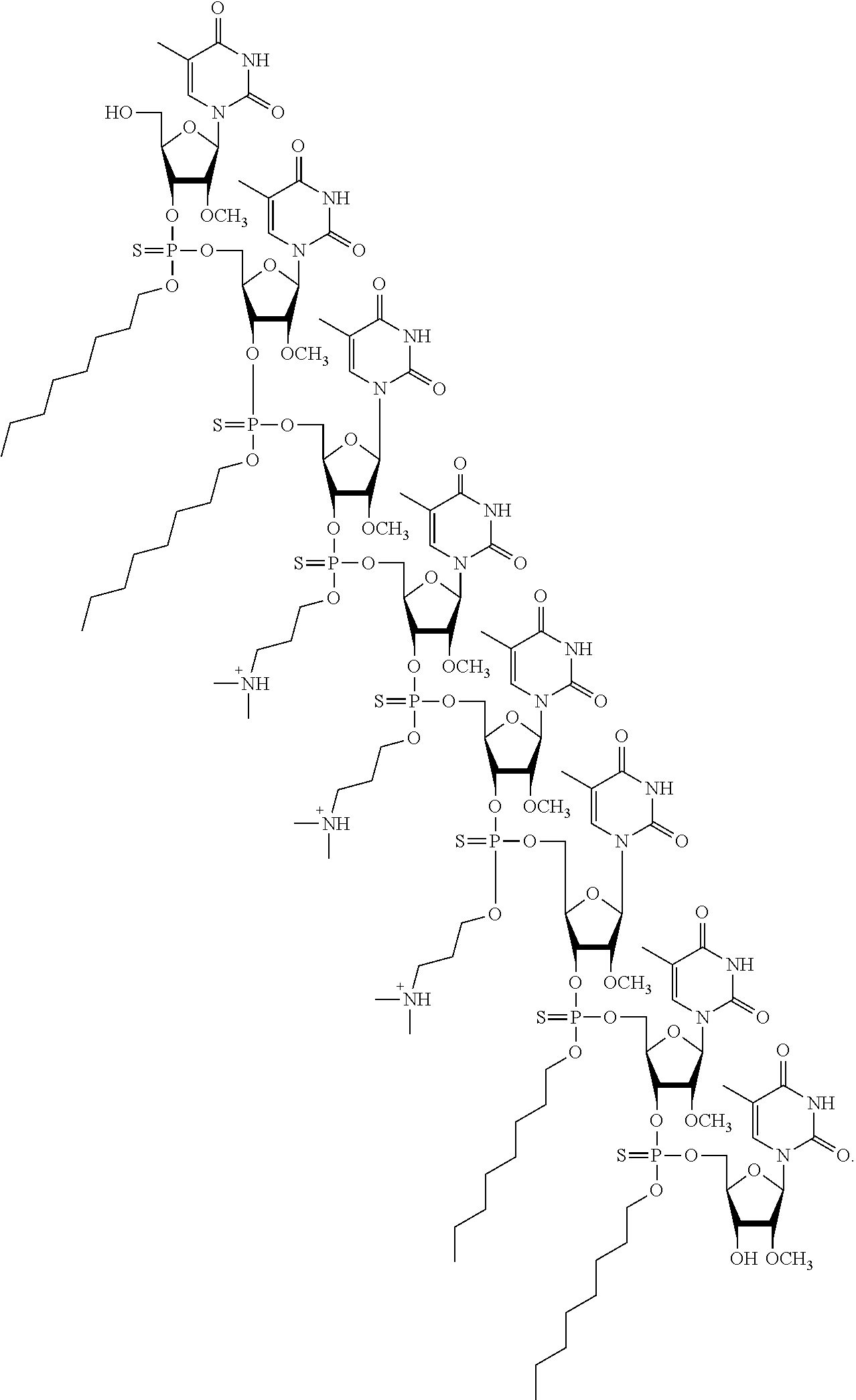
- An additional preferred compound is PS-2′-OMeU 8 [3+] as shown in FIG. 28 .
- the invention concerns methods of introducing a nucleic acid into a cell by utilizing a compound described herein as a transfection agent.
- the method comprises (i) contacting said nucleic acid with a transfection agent described herein to form a complex; and (ii) contacting the complex with said cell.
- the nucleic acid can be charged or uncharged. Some preferred nucleic acids have a negative charge.
- Preferred nucleic acids include is peptide nucleic acids (PNA) and morpholino phosphorodiamidate (PMO), phosphorothioate DNA sequences, DNA plasmids and siRNA sequences.
- the methods have a threshold percentage delivery of nucleic acid to a target cell is at least 20%.
- the compound is delivered to the cell in a medium and said compound did not induce cytotoxicity of more than 15% higher than that of the medium in the absence of said compound.
- the invention concerns a kit comprising a transfection agent described herein and a nucleic acid.
- the invention concerns phosphoramidite monomers disclosed herein (including those in FIG. 9 ) and oligomers of such monomers.
- FIG. 1 presents schematic representations of the compounds designated PS-dT 8 [3+], PS-dA 8 [3+], PS-dC 8 [3+], PS-dT 11 [6+], PS-dT 13 [8+], PS-dT 15 [10+] and PS-dT 17 [12+].
- FIG. 2 presents a chemical structure of PS-dT 8 [3+].
- FIG. 3 presents a chemical structure of PS-dA 8 [3+].
- FIG. 4 presents a chemical structure of PS-dC 8 [3+].
- FIG. 5 presents a chemical structure of PS-dT 11 [6+].
- FIG. 6 presents a chemical structure of PS-dT 13 [8+].
- FIG. 7 presents a chemical structure of PS-dT 15 [10+].
- FIG. 8 presents a chemical structure of PS-dT 17 [12+].
- FIG. 9 presents schematic representations of the deoxyribonucleoside phosphoramidites used in the solid-phase synthesis PS-dT 8 [3+], PS-dA 8 [3+], PS-dC 8 [3+], PS-dT 11 [6+], PS-dT 13 [8+], PS-dT 15 [10+] and PS-dT 17 [12+].
- FIG. 10 presents the chemical structures of the deoxyribonucleoside phosphoramidites used in the solid-phase synthesis PS-dT 8 [3+], PS-dA 8 [3+], PS-dC 8 [3+], PS-dT 11 [6+], PS-dT 13 [8+], PS-dT 15 [10+] and PS-dT 17 [12+].
- FIG. 11 illustrates internalization of the PS-dT 8 [3+]:PNA oligomer complexes in live cells.
- the concentration of PNA oligomer 7, 8, or 9 is 1 M.
- FIG. 12 shows concentration-dependence of splice correction activity upon PS-dT 8 [3+]-mediated delivery of the PNA oligomer 10 in HeLa pLuc 705 cells.
- concentration of PS-dT 8 [3+] is 2 ⁇ M.
- FIG. 13 shows comparative splice correction activity between the PS-dT 8 [3+]-assisted delivery of PNA oligomers 10, 11, 12 and the LipofectamineTM 2000-mediated delivery of the 2′-OMe RNA sequences 13 and 14 at the indicated concentrations while the concentration of PS-dT 8 [3+] and Lipofectamine 2000 was kept at 2 ⁇ M and 2 ⁇ L/mL, respectively in all experiments.
- FIG. 14 illustrates the relevance of the concentration of PS-dT 8 [3+] to the production of luminescence upon transfection of the polyA-tailed PNA oligomer 10 into HeLa pLuc705 cells.
- concentration of the PNA oligomer 10 is 1 ⁇ M.
- RLU relative light unit
- M medium.
- FIG. 15 shows the relevance of the spatial arrangement and recognition of the polyA-stretch for efficient PS-dT 8 [3+]-assisted uptake of PNA oligomers 10, 15-17 in HeLa pLuc705 cells.
- concentration of PS-dT 8 [3+] is 2 ⁇ M.
- RLU relative light unit
- M medium.
- FIG. 16 shows concentration-dependence of splice correction activity upon PS-dAs[3+]-mediated delivery of the PNA oligomer 15.
- concentration of the PNA oligomer 10 and PS-dA 8 [3+] is 1 M and 2.0 ⁇ M, respectively.
- FIG. 17 shows internalization of the PS-dT 8 [3+]:PMO oligomer complexes in live cells.
- the concentration of PMO oligomer 18 or 19 is 1 ⁇ M.
- the concentration of PS-dT 8 [3+] is 2 ⁇ M.
- FIG. 18 shows the relevance of the recognition of the polyA-stretch for efficient PS-dT 8 [3+]-assisted internalization of PMO oligomers 21-24 (1 ⁇ M) in HeLa pLuc705 cells.
- concentration of PS-dT 8 [3+] is 2 ⁇ M.
- RLU relative light unit.
- FIG. 19 shows the relevance of the concentration of PS-dT 8 [3+] to the production of luminescence upon transfection of the polyA-tailed PMO oligomer 21 (1 ⁇ M) into HeLa pLuc705 cells.
- RLU relative light unit
- M medium.
- FIG. 20 shows the concentration dependence of the cytotoxicity of PS-dT 8 [3+] and PS-dA 8 [3+] in HeLa pLuc705 cells.
- M medium
- FIG. 21 shows dose-response relationship, in serum-containing medium, between the inhibition of eGFP production and the external concentration of siRNA being used for internalization in Vero cells. The data is presented as the percentage of cells expressing eGFP.
- FIG. 22 presents data on the uptake of 20 nM Cy3.0 labeled control siRNA in various mammalian cell lines.
- M medium.
- FIG. 23 shows delivery of plasmid in HeLa pLuc cells in the absence of serum (A) and in the presence of 10% FBS (B) using PS-dT 11 [6+] (4 ⁇ M) as the transfection reagent.
- FIG. 24 shows delivery of commercial eGFP expressing plasmid in CHO cells in the absence of serum using (A) PS-dT 11 [6+], (B) PS-dT 13 [8+], (C) PS-dT 15 [10+] or (D) PS-dT 17 [12+] as the transfection reagent, the concentration of which is 5 ⁇ M.
- FIG. 25 shows delivery of commercial eGFP expressing plasmid in GC-2 cells in the absence of serum using (A) PS-dT 11 [6+], (B) PS-dT 13 [8+], (C) PS-dTs 15 [10+] or (D) PS-dT 17 [12+] as the transfection reagent, the concentration of which is 5 ⁇ M.
- FIG. 26 shows delivery of commercial eGFP expressing plasmid in HEK 293 cells in the absence of serum using (A) PS-dT 11 [6+], (B) PS-dT 13 [8+], (C) PS-dT 15 [10+] or (D) PS-dT 17 [12+] as the transfection reagent the concentration of which is 5 ⁇ M.
- FIG. 27 shows delivery of commercial eGFP expressing plasmid in HeLa cells in the absence of serum using (A) PS-dT 11 [6+], (B) PS-dT 13 [8+], (C) PS-dTs 5 [10+] or (D) PS-dT 17 [12+] as the transfection reagent the concentration of which is 5 ⁇ M.
- FIG. 28 presents a chemical structure of PS-2′-OMeU 8 [3+].
- FIG. 29 shows the concentration-dependence of the 2′-OMeU 8 [3+]-mediated delivery of PMOpA SCO sequence (PMO sequence 16, Table 1) on luciferase activity in serum-containing media.
- the concentration of the 2′-OMeU 8 [3+] was kept at 2.0 ⁇ M in all experiments. Error bars represent the mean ⁇ SD of three independent experiments. RLU, relative light unit.
- the present disclosure concerns, inter alia, use of trans-acting phosphorothioate DNA elements (PS-dT 8 [3+], PS-dC 8 [3+], PS-dA 8 [3+], PS-dT 11 [6+], PS-dT 13 [8+], PS-dT 15 [10+], PS-dT 17 [12+], PS-2′-OMeU 8 [3+], and mixed constructs) for the transfection of charged and uncharged species such as PNA, PMO, RNA, DNA oligomers.
- PS-dT 8 [3+], PS-dC 8 [3+], PS-dA 8 [3+], PS-dT 11 [6+], PS-dT 13 [8+], PS-dT 15 [10+], PS-dT 17 [12+], PS-2′-OMeU 8 [3+], and mixed constructs for the transfection of charged and uncharged species such as PNA, PMO, RNA, DNA oligomers.
- PS-dT 8 [3+], PS-dC 8 [3+] and PS-dA 8 [3+] have been developed for the transfection of uncharged PNA and PMO oligomers targeting the defective luciferase gene in the well-studied HeLa pLuc705 cell line.
- the structural design of PS-dT 8 [3+], PS-dC 8 [3+] and PS-dA 8 [3+] is based on earlier observations of the increased cellular uptake of an uncharged thermosensitive DNA oligonucleotide prodrug in Vero cells upon replacement of four neutral thiophosphate triester functions with four positively charged ones.
- Hydrophobic groups were incorporated into the DNA elements to impart amphiphilicity, which is known to facilitate in vitro cellular delivery of nucleic acids.
- the objectives were to: (i) demonstrate the efficiency of PS-dT 8 [3+]-, PS-dC 8 [3+]- or PS-dA 8 [3+]-mediated internalization of appropriately designed PNA and PMO oligomers in various cell lines, and (ii) confirm the functionality of these oligomers through alternate splicing of the pre-mRNA luciferase gene in the HeLa pLuc705 cell line.
- the schematic representation of a DNA element is shown below. “ONO” represents 2′-deoxythymidynyl-, 2′-deoxycytidinyl- or 2′-deoxyadenosinyl- or 2′-O-methyluridinyl-.
- the instant oligomers provide novel structures and utility over oligomers known in the art. Rather than DNA based oligomers like those of the instant disclosure, commercial transfection products focus on the use of cationic lipids or naturally positively charged peptides.
- the state of the art product is Lipofectamine®, a cationic lipid.
- DNA based oligomers have not been able to be used as transfection agents.
- the compounds of the instant invention are effective transfection agents and are advantageous over current state of the art products.
- transfection reagents The two major classes of transfection reagents are cationic lipids (Lipofectamine®, DOTAP, DOTMA, DOSPA, DC-Chol and the like) and cell-penetrating peptides.
- cationic lipids Many cationic lipids are commercially available but suffer from low transfection efficiencies and cytotoxicities. There is also difficulty in the manufacturing of these cationic lipids by automated techniques, unlike the instant positively charged DNA-based tranfection elements.
- the transfection efficiency of cationic lipids is outweighed by their cytoxicity and in many cases by the presence of serum-containing media.
- cationic lipid cannot deliver in trans uncharged PNA or morpholino oligomers in mammalian cells even if the uncharged oligomers are polyA-tailed.
- Our DNA-based transfection elements can deliver efficiently uncharged polyA-tailed PNA and PMO oligomers in mammalian cells with minimal cytotoxicity in serum-free or serum containing media.
- the inventors have observed that a cationic guanidinium-based transfection reagent conjugated to a PMO oligomer is be 10-times less efficient than our DNA-based transfection elements for the delivery of the polyA-tailed PMO sequence in HeLa cells.
- Lipofectamine® is the state of the art lipid transfection reagent and is commercially available at a high cost.
- the instantly described DNA-based transfection elements are economically prepared using standard laboratory techniques.
- Lipofectamine® functions well as a transfection agent for certain compounds but mainly in serum free media.
- the DNA-based transfection agents described herein work well in both serum-free and serum-containing media.
- the cytotoxicity of Lipofectamine® is by far greater than our DNA-based transfection elements.
- CPPs cell-penetrating peptides
- these peptides require conjugation to the oligomers (uncharged PNAs/PMOs or negatively charged nucleic acids) for transfection; CPPs do not work in trans like the DNA-based transfection elements described herein.
- the conjugation of CPPs to oligomers is a very tedious and relatively inefficient process.
- CPPs have been found effective as transfecting reagents, they were shown, upon conjugation, to negatively affect the aqueous solubility of the oligomers and prevent them to perform their intended functions.
- a major limitation of CPPs is that one CPP must be conjugated to each uncharged or negatively charged oligomer sequence for delivery into mammalian cells.
- one DNA-based transfection element can deliver efficiently any uncharged polyA-tailed PNA and PMO oligomer sequence or negatively charged nucleic acid into mammalian cells.
- the oligomers of the instant disclosure are cheaper and more flexible in use (both serum conditions and charge of the element to be transported) than the state of the art products.
- PS-dT 8 [3+], PS-dC 8 [3+] and PS-dA 8 [3+] or mixed compositions is easily performed using standard solid-phase techniques and appropriate deoxyribonucleoside phosphoramidites ( FIG. 9 , below). The detailed preparation of these phosphoramidites is described herein.
- B P Thy, R ⁇ CH 2 CH 2 CH 2 N(CH 3 ) 2 1
- B P Thy, R ⁇ CH 2 (CH 2 ) 6 CH 3 2
- B P Ade Bz , R ⁇ CH 2 CH 2 CH 2 N(CH 3 ) 2 3
- B P Ade Bz , R ⁇ CH 2 (CH 2 ) 6 CH 3 4
- B P Cyt Bz , R ⁇ CH 2 CH 2 CH 2 N(CH 3 ) 2 5
- B P Cyt Bz , R ⁇ CH 2 (CH 2 ) 6 CH 3 6
- FIG. 12 A concentration-dependence of splice correction activity by PS-dT 8 [3+]-mediated internalization of the PNA oligomer 10 in HeLa pLuc705 cells is shown in FIG. 12 .
- FIG. 13 shows a comparative splice correction activity between the PS-dT 8 [3+]-assisted deliveries of PNA oligomers (11 and 12) and 2′-OMe RNA sequences (13 and 14).
- FIG. 12 Clearly demonstrated in FIG. 12 is the efficiency with which the polyA-tailed PNA oligomer 10 is internalized into HeLa pLuc705 cells when using the trans-acting DNA element PS-dT 8 [3+] as a carrier.
- the PNA oligomer 12 which is 10 lacking the polyA stretch, did not restore luciferase activity, because PS-dT 8 [3+] failed to efficiently internalize its fluoresceinated conjugate 9 into HeLa pLuc705 cells ( FIG. 11 ).
- the negatively charged positive control 2′-OMe RNA sequences 13 which was transfected into HeLa pLuc705 cells using LipofectamineTM 2000 as the carrier, showed comparable luciferase activity as that produced by the PS-dT 8 [3+]-assisted transfection of the polyA-tailed PNA oligomer 10 at a two-fold higher concentration.
- FIG. 15 shows that moving the polyA stretch from the N-terminus of 10 to its C-terminus did not significantly affect the PS-dT 8 [3+]-assisted transfection efficiency of PNA oligomer 17 under similar conditions.
- replacing the polyA stretch of 10 with a polyT or a polyC stretch at the N-terminus did not lead to the production of luciferase activity due to poor PS-dT 8 [3+]-mediated cellular internalization of PNA oligomers 15 and 16 in HeLa pLuc705 cells.
- PS-dT 8 [3+] concentration was also investigated. Similar to the study performed with the PNA oligomer 10, the PS-dT 8 [3+]-mediated delivery of the PMO oligomer 21 into HeLa PLuc 705 cells was found optimal, in terms of luciferase activity production, when the concentration of PS-dT 8 [3+] was in the range of 2-3 ⁇ M. At a PS-dT 8 [3+] concentration exceeding 3.5 ⁇ M, the production of luciferase activity decreased, presumably because of increased PS-dT 8 [3+] cytotoxicity at such concentrations ( FIG. 19 ).
- alkyl refers to both straight- and branched-chain saturated aliphatic hydrocarbon groups having at least one carbon atoms, e.g., 1 to 12, 1 to 8 or 1 to 6 carbon atoms.
- saturated hydrocarbon alkyl moieties include, but are not limited to, chemical groups such as methyl, ethyl, n-propyl, isopropyl, n-butyl, tert-butyl, isobutyl, sec-butyl; higher homologs such as n-pentyl, n-hexyl, n-heptyl, n-octyl, and the like.
- cycloalkyl employed alone or in combination with other terms, is defined herein as, unless otherwise stated, a monocyclic, bicyclic, tricyclic, fused, bridged, or spiro monovalent saturated hydrocarbon moiety of 3-10 carbon atoms, wherein the carbon atoms are located inside or outside of the ring system. Any suitable ring position of the cycloalkyl moiety may be covalently linked to the defined chemical structure.
- cycloalkyl moieties include, but are not limited to, chemical groups such as cyclopropyl, cyclopropylmethyl, cyclobutyl, cyclopentyl, cyclohexyl, cyclohexylmethyl, cyclohexylethyl, cycloheptyl, norbornyl, adamantyl, spiro[4.5]decanyl, and homologs, isomers, and the like.
- Alkenyl is intended to include both straight- and branched-chain alkyl group with at least one carbon-carbon double bond, e.g., having 2-12, 2-8 or 2-6 carbon atoms. Such hydrocarbon alkenyl moieties may be mono or polyunsaturated, and may exist in the E or Z configurations. The compounds of this invention are meant to include all possible E and Z configurations.
- Examples of mono or polyunsaturated hydrocarbon alkenyl moieties include, but are not limited to, chemical groups such as vinyl, 2-propenyl, isopropenyl, crotyl, 2-isopentenyl, butadienyl, 2-(butadienyl), 2,4-pentadienyl, 3-(1,4-pentadienyl), and higher homologs, isomers, and the like.
- cycloalkenyl employed alone or in combination with other terms, is defined herein as, unless otherwise stated, a monocyclic, bicyclic, tricyclic, fused, bridged, or spiro monovalent unsaturated hydrocarbon moiety of 3-10 carbon atoms containing at least one double bond, wherein the carbon atoms are located inside or outside of the ring system. Any suitable ring position of the cycloalkenyl moiety may be covalently linked to the defined chemical structure.
- cycloalkenyl moieties include, but are not limited to, chemical groups such as cyclopropenyl, cyclopropenylmethyl cyclobutenyl, cyclopentenyl, cyclohexenyl, cyclohexenylmethyl, cyclohexenylethyl, cycloheptenyl, norbornenyl, and homologs, isomers, and the like.
- Alkynyl is intended to cover both straight- and branched-chain alkyl group with at least one carbon-carbon triple bond, e.g., having 2-12, 2-8 or 2-6 carbon atoms.
- alkyl ether and “alkyl thioether” are intended to include alkyl chains, either in a straight or branched configuration, with an oxygen or sulfur atom respectively having two points of attachment (i.e., is a diradical) in the chain.
- cycloalkyl ether and “cycloalkyl thioether” refer to cycloalkyl groups having at least one oxygen or sulfur atom, respectively, in the cycloalkyl ring.
- alkylpolyether refers to an alkyl group containing a polyether group either within the alkyl chain or at the terminus of the alkyl group.
- cholesteryl refers to steroidal hydrocarbon moieties derived from, or structurally similar to cholesterol.
- dT refers to a 2′-deoxythymidinyl moiety
- dA refers to a 2′-deoxyadenosinyl moiety.
- N 6 -benzoyl-5′-O-(4,4′-dimethoxytrityl)-2′-deoxyadenosine and N 4 -benzoyl-5′-O-(4,4′-dimethoxytrityl)-2′-deoxycytidine were purchased from ChemGenes and were used as received.
- All ancillary reagents commonly used in solid-phase DNA/RNA synthesis including 3H-1,2-benzodithiol-3-one 1,1-dioxide, 3-(dimethylaminomethylidene)amino-3H-1,2,4-dithiazole-3-thione and succinylated long chain alkylamine controlled-pore glass (CPG) support functionalized with either 2′-deoxythymidine, N 6 -benzoyl-2′-deoxyadenosine or N 4 -benzoyl-2′-deoxycytidine, as the leader nucleoside, were obtained from Glen Research and used without further purification.
- the PNA and PMO oligomers listed in Table 1 were purchased from PNA Bio Inc. and Gene Tools LLC, respectively, and were used as received.
- DMEM Dulbecco's Minimum Essential Medium
- Phenol red MEM medium, Phenol red-free MEM medium and 0.4% Trypan Blue were purchased from MediaTech. Monensin (Sigma) was kindly provided by Dr. James Keller (CBER, FDA).
- the frozen material was lyophilized under high vacuum to give the phosphordiamidite as a viscous oil (1.10 g, 3.29 mmol, 88%), which was of sufficient purity to be used without further purification in the preparation of the deoxyribonucleoside phosphoramidites 1, 3 and 5.
- N,N,N′,N′-tetraisopropyl-O-[octan-1-yl]phosphordiamidite was performed at the same scale, under similar conditions, using 1-octanol (583 ⁇ L, 3.70 mmol) instead of 3-(N,N-dimethylamino)propan-1-ol.
- the phosphordiamidite was isolated as a viscous oil in a similar yield, after silica gel purification, and used directly in the preparation of the deoxyribonucleoside phosphoramidites 2, 4 and 6.
- reaction mixture was stirred for 18 h at ⁇ 25° C.
- the reaction mixture was then concentrated under reduced pressure to a gummy material; the crude phosphoramidite was purified by chromatography on silica gel ( ⁇ 25 g), which was equilibrated in a solution of hexane:Et 3 N (95:5 v/v).
- the product was eluted from the column using a gradient of CH 2 Cl 2 (0 ⁇ 95%) in hexane: Et 3 N (95:5 v/v).
- Fractions containing the pure phosphoramidite, as indicated by TLC were pooled together and were evaporated to dryness under low pressure.
- the foamy material was dissolved in dry benzene (5 mL) and the resulting solution was manually stirred in a dry ice-acetone bath. The frozen material was then lyophilized under high vacuum to give the phosphoramidite 1-6 as a white powder, the yields of which were in the range of (75-85%).
- Solid-phase synthesis of PS-dT 8 [3+], PS-dT 11 [6+], PS-dT 13 [8+], PS-dT 15 [10+], PS-dT 17 [12+], PS-dA 8 [3+] and PS-dC 8 [3+] Solid-phase synthesis of PS-dT 8 [3+], PS-dT 11 [6+], PS-dT 13 [8+], PS-dT 15 [10+], PS-dT 17 [12+], PS-dA 8 [3+] and PS-dC 8 [3+] was performed on a 0.2 ⁇ mole scale using a succinylated long chain alkylamine controlled-pore glass support loaded with either 5′-O-(4,4′-dimethoxytrityl)-2′-deoxythymidine, 5′-O-(4,4′-dimethoxytrityl)-N 6 -benzoyl-2′-deoxyadenosine or 5′-O-(4,4′-dime
- the syntheses were carried out using an ABI 394 DNA/RNA synthesizer and phosphoramidites 1-6 as 0.1 M solutions in dry MeCN.
- the coupling reactions were effected in the presence of 1H-tetrazole over a period of 600 s. All ancillary reagents necessary for the preparation of the DNA sequences were purchased and utilized as recommended by the instrument's manufacturer.
- the oxidation step of the synthesis cycle was performed using 3-(dimethylaminomethylidene)amino-3H-1,2,4-dithiazole-3-thione (0.05 M in pyridine-MeCN (4:6 v/v). This sulfurization step was performed before the capping step and the reaction time for these steps was 600 s and 120 s, respectively.
- the iterative cleavage of the 5′-DMTr group was carried out over a period of 60 s.
- the PS-dT 8 [3+], PS-dT 11 [6+], PS-dT 13 [8+], PS-dT 15 [10+], PS-dT 17 [12+], PS-dA 8 [3+] and PS-dC 8 [3+] sequences the PS-dT 8 [3+], PS-dT 11 [6+], PS-dT 13 [8+], PS-dT 15 [10+], PS-dT 17 [12+] synthesis columns were placed into a stainless steel pressure vessel and exposed to pressurized methylamine gas ( ⁇ 2.5 bar at 25° C.) over a period of 3 min, whereas the PS-dA 8 [3+] and PS-dC 8 [3+] synthesis columns were subjected to pressurized ammonia gas ( ⁇ 10 bar at 25° C.) over a period of 12 h.
- PS-dT 8 [3+], PS-dT 11 [6+], PS-dT 13 [8+], PS-dT 15 [10+], PS-dT 17 [12+], PS-dA 8 [3+] and PS-dC 8 [3+] sequences were individually eluted off their respective synthesis columns using a solution (0.5 mL) of Et 3 N:MeCN:H 2 O (1:60:39 v/v/v).
- PS-dT 8 [3+], PS-dT 11 [6+], PS-dT 13 [8+], PS-dT 15 [10+], PS-dT 17 [12+], PS-dA 8 [3+] or PS-dC 8 [3+] solution was evaporated to dryness using a stream of air.
- Crude PS-dT 8 [3+], PS-dT 11 [6+], PS-dT 13 [8+], PS-dT 15 [10+], PS-dT 17 [12+], PS-dA 8 [3+] and PS-dC 8 [3+] sequences were each stored at ⁇ 20° C. and used without purification.
- Thermal denaturation protocol dTtaPS was mixed with the polyA-tailed PNA oligomer 10 in either 1 ⁇ PBS buffer (pH 7.4) or 1.0 M NaCl in 1 ⁇ PBS buffer while keeping the total strand concentration at ca. 2 ⁇ M.
- Thermal denaturation profiles (absorbance vs temperature) of the dTtaPS:10 complex was measured at 260 nm using a UV/Vis spectrophotometer equipped with a Peltier temperature controller and interfaced with a personal computer. Denaturation of the complex was performed over a temperature range of ⁇ 5 to 60° C. The temperature was ramped at the rate of 1° C./min; temperature measurements were recorded at every 1° C. with an equilibration time of 30 s between each measurement. Heating and cooling profiles were recorded.
- HEK293 ATCC® CRL-1573′
- HeLa ATCC® CCL-2TM
- MCF7 ATCC® HTB-22TM
- CHO-K1 ATCC® CCL-61TM
- GC-2spd(ts) ATCC® CRL-2196TM
- SK—N—SH ATCC® HTB-11TM
- Rudolph Juliano (University of North Carolina, Chapel Hill), was exponentially grown in Dulbecco's Minimum Essential Medium (DMEM) supplemented with 10% heat-inactivated fetal calf serum (FBS), 1.5 mM L-glutamine, 1.0 mM sodium pyruvate, 100 U penicillin, 100 ⁇ g/mL streptomycin and 200 ⁇ g/mL hygromycin, and maintained at 37° C. in a humidified-incubator under 5% CO 2 .
- DMEM Dulbecco's Minimum Essential Medium
- FBS heat-inactivated fetal calf serum
- FBS heat-inactivated fetal calf serum
- 1.5 mM L-glutamine 1.5 mM L-glutamine
- 1.0 mM sodium pyruvate 100 U penicillin, 100 ⁇ g/mL streptomycin and 200 ⁇ g/mL hygromycin, and maintained at 37° C. in a humidified-in
- Flow cytometry analysis of cellular uptake in live cells The internalization of fluorescently-labeled PNA or PMO sequences (Table 1) in HEK 293, HeLa, MCF7 and SK—N—SH cells was assessed by flow cytometry.
- Cells were seeded in a 96-well plate (10 4 cells/well) and allowed to grow at 37° C. for 24 h in 10% FBS-MEM. The culture medium of each well was then replaced with fresh medium (100 ⁇ l) containing any of the fluorescently-labeled PNA or PMO sequences, the final concentration of which was 1 ⁇ M.
- Luciferase assay protocol HeLa pLuc 705 cells were seeded in a 96-well plate (2 ⁇ 10 4 cells/well) and allowed to grow at 37° C. for 18 h in 10% FBS-DMEM. The culture medium of each well was then replaced with either fresh serum-free or 20% serum-containing OptiMEMTM (50 ⁇ l) for experiments intended to be performed in serum-free or in 10% serum-containing media. A 2 ⁇ solution of PNA or PMO oligomer:dTtaPS or dAtaPS complexes (50 ⁇ l) was added to the cells in order to achieve pre-determined complex concentrations, as indicated in the Figures.
- OptiMEMTM 20% FBS in OptiMEMTM (100 ⁇ l was added to serum-free experiments and cells were incubated for an additional 18 h at 37° C.
- the media was then removed by suction and the cells were mixed with a cell lysis reagent (50 ⁇ l) and agitated at ambient temperature for 10 minutes.
- the cell lysate (30 ⁇ l) was placed in a white 96-well plate and Bright-GloTM reagent (20 ⁇ l) was added. Luciferase activity was measured using a microplate reader. For each well, luminescence was integrated over a period of 1 sec and recorded as relative light units (RLU). Luminescence measurements were normalized to the amount of protein present in the test sample.
- Protein concentration measurements Protein concentrations were determined from cell lysates (5 ⁇ L), which were obtained using a lysis reagent that is compatible with the CoomassieTM (Bradford) reagent, as per the manufacturer's instructions.
- HeLa pLuc 705 cells were seeded in a 96-well plate (2 ⁇ 10 4 cells/well) and allowed to grow at 37° C. for 18 h in 10% FBS-DMEM. While the cell culture was maintained at 37° C. or 4° C., a 2 ⁇ solution of a PNA oligomer 10:dTtaPS complex was prepared as described above. The cell culture medium was replaced with the PNA oligomer:dTtaPS complex solution to provide an oligomer and dTtaPS final concentration of 1.0 M and 2.0 M, respectively. After an incubation of 1 h at 37° C.
- luciferase activity was measured as described above in the Luciferase assay protocol. Luminescence measurements were normalized to the amounts of protein present in the test samples and reported as percent luminescence remaining relative to that of the experiment performed at 37° C.
- Endocytic pathway assays HeLa pLuc 705 cells were seeded in a 96-well plate and grown in 10% FBS-DMEM as described above. The cell culture was then pre-incubated for 30 min at 37° C. in the presence of chlorpromazine, nystatin or 5-(N-ethyl-N-isopropyl)amiloride (EIPA), the final concentration of which was 30 ⁇ M, 50 ⁇ M or 1 mM, respectively. A 2 ⁇ solution of PNA oligomer 10:dTtaPS complex was added to the cells to provide an oligomer and dTtaPS final concentration of 1.0 ⁇ M and 2.0 ⁇ M, respectively.
- EIPA 5-(N-ethyl-N-isopropyl)amiloride
- luciferase activity was measured as described above in the Luciferase assay protocol. Luminescence measurements were normalized to the amounts of protein present in the test samples and reported as percent luminescence remaining relative to that of the experiment performed in the absence of endocytic pathway inhibitors.
- HeLa pLuc 705 cells were seeded in a 96-well plate and grown in 10% FBS-DMEM as described above.
- Predetermined amounts of polyA-tailed PNA oligomer 10 and octathymidilyl DNA phosphorothioate (PS-dT 8 ) were placed in individual microfuge tubes so that the molar ratio of PNA:PS-dT 8 in each tube was 1:1, 1:2 or 1:4.
- OptiMEMTM (20 ⁇ l) was added to each of the three tubes, which were then placed in a heating block pre-heated to 60° C.
- dTtaPS was added to the mixture of oligomers of each tube to achieve a concentration that is equimolar to that of the PNA oligomer 10. After a 30 min incubation at 37° C., the PNA/PS-dT 8 :dTtaPS complexes were stored at 4° C. for 15 minutes or until used.
- HeLa pLuc 705 cells (5 ⁇ 10 4 cells/well) were seeded in 8-well chambered slides and cultured for 24 h at 37° C. in 10% FBS-MEM (200 ⁇ l). The culture medium of each well was then replaced with 20% FBS containing fresh medium (200 ⁇ l) and the fluoresceinated PNA or PMO oligomer:dTtaPS complex that was prepared as described above to provide an oligomer and dTtaPS final concentration of 1.0 M and 2.0 ⁇ M, respectively.
- PNA/PMO oligomers were diluted in OptiMEMTM (20 ⁇ L) to achieve the concentration of 1 ⁇ M or as indicated in the Figures.
- PS-dT 8 [3+] or PS-dAs[3+] was added to the above oligomer solutions.
- the PNA/PMO oligomer:PS-dT 8 [3+] or PS-dA 8 [3+] complexes were removed and kept at 4° C. for 15 minutes or until used.
- Stock solutions of the complexes were made by adding OptiMEMTM to appropriate volumes.
- Luciferase Assay Prior to performing experiments, HeLa pLuc 705 cells were seeded in a 96-well plate (2 ⁇ 10 4 cells/well) and allowed to grow at 37° C. for 18 h in 10% FBS DMEM. The culture medium of each well was then replaced with either fresh 50 ⁇ L serum free or 20% serum-containing OptiMEMTM for experiments intended to be performed in serum free or in 10% serum-containing media. A 2 ⁇ solution of the PNA/PMO oligomer:PS-dT 8 [3+] or PS-dAs[3+] complexes (50 ⁇ L) was added to the cells in order to achieve a pre-determined concentration as indicated in the figures.
- Protein concentrations were determined from cell lysates (5 ⁇ L), which were obtained using a lysis reagent that is compatible with the CoomassieTM (Bradford) reagent, as per manufacturer's instructions.
- a trans-acting DNA transfection element (PS-dT 11 [6+]) has been engineered for the delivery of a commercial siRNA (Ambion®Silencer® GFP) targeting the short half-life eGFP mRNA in Vero cells and to demonstrate the cellular internalization and functional activity of the siRNA at inhibiting the production of eGFP.
- siRNA Ambion®Silencer® GFP
- siRNA stock solution typically, an appropriate volume of a 20 ⁇ M siRNA stock solution was added to OptiMEMTM (20 ⁇ L).
- the required volume of a 1 mM stock solution of trans-acting DNA transfection element (PS-dT 11 [6+]) was added to each siRNA solution.
- the resulting siRNA/PS-dT 11 [6+] solutions were incubated for 30 min at ambient temperature.
- the siRNA:PS-dT 11 [6+] complexes were then diluted with OptiMEMTM to get twice (2 ⁇ ) the desired concentration.
- Live Vero pdleGFP cells were seeded in a 96-well plate (2 ⁇ 10 4 cells/well) and allowed to grow at 37° C. for 18 h in 10% FBS DMEM. The culture medium of each well was then replaced with fresh serum-free or 20% FBS OptiMEMTM (50 ⁇ L) medium. The 2 ⁇ solution of siRNA:PS-dT 11 [6+] complexes (50 ⁇ L) was added to the cells to produce final concentrations of 5 to 40 nM siRNA and 1 M PS-dT 11 [6+] per well. After a 4-h serum-free incubation, 20% FBS in OptiMEMTM (100 ⁇ L) was added to each well and the cell cultures were incubated at 37° C.
- the trans-acting DNA transfection element PS-dT 11 [6+] was also shown to deliver plasmids in HeLa pLuc cells.
- OptiMEMTM 20 ⁇ L
- the appropriate amount of trans-acting DNA transfection element PS-dT 11 [6+], PS-dT 13 [8+], PS-dT 15 [10+] or PS-dT 17 [12+] was added to the plasmid DNA solution.
- the resulting plasmid:PS-dT 11 [6+], PS-dT 13 [8+], PS-dT 15 [10+] or PS-dT 17 [12+] solution was incubated for 30 min at room temperature.
- PS-dT 11 [6+], PS-dT 13 [8+], PS-dT 15 [10+] or PS-dT 17 [12+] complexes were diluted with OptiMEMTM to get twice (2 ⁇ ) the desired concentration.
- Live HeLa pLuc 705, CHO, GC-2, HEK 293 or Hela cells were seeded in a 96-well plate (2 ⁇ 10 4 cells/well) and allowed to grow at 37° C. for 18 h in 10% FBS DMEM. The culture medium of each well was then replaced with fresh serum-free OptiMEMTM (50 ⁇ L) medium.
- PS-dT 11 [6+], PS-dT 13 [8+], PS-dT 15 [10+] or PS-dT 17 [12+] complex 50 ⁇ L was added to each well in order to provide 100 ng plasmid and a concentration of 5 M PS-dT 11 [6+], PS-dT 13 [8+], PS-dT 15 [10+] or PS-dT 17 [12+] per well.
- 20% FBS in OptiMEMTM 100 ⁇ L was added and the cell cultures were incubated for an additional 18 h at 37° C.
- Examples 2 and 3 are repeated using PS-dC 8 [3+] or PS-dC [6+], PS-dA 8 [3+] or PS-dA 11 [6+], where appropriate, or transfection elements composed of PS-dT, -dC and -dA moieties.
- the solid-phase synthesis of dTtaPS and dAtaPS begins with the preparation of the phosphordiamidites, which are required for the preparation of the deoxyribonucleoside phosphoramidites 3-6 ( FIG. 9 ).
- the reaction of an equimolar amount of commercial bis(N,N-diisopropylamino)chlorophosphine with either 3-(N,N-dimethylamino)propan-1-ol or 1-octanol produced the phosphordiamidite in a yield exceeding 85% after purification on silica gel.
- Example 6 A Short PNA-polyA Stretch is Necessary and Sufficient for dTtaPS-Mediated Internalization and Bioactivity of PNA Oligomers in Live Mammalian Cells
- the concentration-dependence of luciferase activity production on the dTtaPS-mediated internalization of PNA oligomer 10 in the proposed cell line is shown in FIG. 12 and compared with the luciferase activities measured either from the dTtaPS-assisted deliveries of PNA oligomers 11 and 12 or 2′-OMe RNA sequences 13 and 14 ( FIG. 13 ).
- the PNA oligomer 10 induced splice correction of the pre-mRNA encoding luciferase, in a dose-dependent manner, in the nucleus of the cells.
- dTtaPS was absent, no luciferase activity was detected.
- FIG. 4B shows that the polyA-tailed PNA oligomer 11 failed, as expected for a negative control, to restore luciferase activity.
- the PNA oligomer 12 which is 10 lacking the polyA stretch, did not restore luciferase activity, because dTtaPS failed to efficiently internalize its fluoresceinated congener 9 in HeLa pLuc 705 cells ( FIG. 11 ).
- the positive control 2′-OMe RNA sequences 13 was transfected in HeLa pLuc 705 cells using LipofectamineTM 2000 as the carrier in serum-free medium ( FIG. 4B ). Under these conditions, the production of luciferase activity was comparable to that produced by the dTtaPS-assisted transfection of the polyA-tailed PNA oligomer 10 in serum-containing medium.
- dTtaPS-assisted internalization of oligomer 7 was performed over a period of 12 hours, this period of time might not have been sufficient to permit optimal release of oligomer 7 from endosomal sequestration and production of a larger number of cells with nuclear fluorescence.
- the confocal magnification of 63 ⁇ instead of routine 20 ⁇ was used to provide clear evidence of nuclear fluorescence at the expense of a lesser number of cells that can be viewed at this level of magnification.
- the results of the confocal microscopy analysis confirmed the quantitative luminescence data measured upon splicing-redirection activity triggered by dTtaPS-mediated transfection of the polyA-tailed PNA oligomer 10.
- the spatial arrangement and criticality of the polyA stretch of PNA oligomer 10 in terms of requirements for recognition by dTtaPS and cellular internalization were evaluated. This was achieved by moving the polyA stretch from the N-terminus of 10 to its C-terminus or replacing the polyA stretch with a polyT or a polyC stretch at the N-terminus. The consequences of these structural changes were monitored by measuring luciferase activity upon dTtaPS-mediated transfection of these modified PNA oligomers (15-17) in HeLa pLuc 705 cells.
- FIG. 15 shows that moving the polyA stretch from the N-terminus of 10 to its C-terminus did not significantly affect the dTtaPS-assisted transfection efficiency of PNA oligomer 17 under similar conditions.
- endocytic pathway inhibitors were employed for this purpose, namely, chlorpromazine for inhibition of clathrin-coated pits-mediated endocytosis, nystatin for inhibition of caveolae-mediated endocytosis and 5-(N-ethyl-N-isopropyl)amiloride (EIPA) for inhibition of macropinocytosis.
- EIPA 5-(N-ethyl-N-isopropyl)amiloride
- Nystatin did not inhibit luciferase production, whereas chlorpromazine and EIPA inhibited luciferase production to the extent of ⁇ 40% and ⁇ 95%, respectively.
- the clathrin-coated pits-mediated endocytosis pathway is used to some extent for the dTtaPS-assisted internalization of PNA oligomer 10 in HeLa pLuc 705 cells, macropinocytosis clearly appears to be the prevailing endocytic pathway used for this internalization process.
- Example 9 A Short PMO-polyA Stretch is Necessary and Sufficient for dTtaPS-Mediated Internalization and Bioactivity of PMO Oligomers in Live Mammalian Cells
- dTtaPS The applicability of dTtaPS to the delivery of a different class of uncharged nucleic acid sequences in several mammalian cell lines was carried out using PMO oligomers under experimental conditions similar to those used for PNA oligomers.
- FACS analyses confirmed the dTtaPS-assisted delivery of the polyA-tailed PMO oligomers 18 and 19 in HEK 293, HeLa, HeLa pLuc 705, and SK—N—SH cell lines.
- the dTtaPS-assisted internalization of PMO oligomer 21 in HeLa pLuc 705 cells FIG.
- dTtaPS is less competent at internalizing PMO oligomers than PNA oligomers and are in agreement with the measurements of mean fluorescence intensity (MFI) obtained from FACS analysis of the dTtaPS-mediated uptake of fluoresceinated PNA and PMO oligomer 7 and 18; the MFI determined after internalization of oligomer 7 is ⁇ 10-fold greater than that of oligomer 18.
- MFI mean fluorescence intensity
- the replacement of one PMO-A residue with a PMO-T in the polyA tail of PMO oligomer 21 did not significantly decrease the ability of dTtaPS to internalize 24 in HeLa pLuc 705 cells on the basis of luciferase activity production ( FIG. 9B ).
- one A ⁇ T modification in the polyA tail of 24 is not sufficient to prevent its recognition and cellular internalization by dTtaPS.
- the internalization of PMO oligomer 21 is reduced to that of the negative control 22 or that of the positive control 23 lacking the polyA tail.
- the effect of dTtaPS concentration on the cellular uptake of PMO oligomer 21 in HeLa pLuc 705 cells was also investigated.
- the dTtaPS-mediated delivery of PMO oligomer 21 was found optimal, in terms of luciferase activity production, at a dTtaPS concentration in the range of 2.0-3.0 ⁇ M.
- Confocal microscopy analysis of the dTtaPS-assisted internalization of the fluorescently-labeled PMO oligomer 18 in HeLa pLuc 705 cells revealed endosomal sequestration of 18 and modest nuclear fluorescence, which is consistent with the level of luminescence measured upon splicing correction activity effected by dTtaPS-mediated transfection of the polyA-tailed PMO oligomer 21 ( FIG. 18 ).
- the cytotoxicity of PNA oligomer 10:dTtaPS and PMO oligomer 21:dTtaPS complexes in HeLa pLuc 705 cells was evaluated over a period of 18 h using a commercial cell-counting kit. Increasing the concentration of 10 or 21 from 1.0 ⁇ M to 2.5 M while keeping the concentration of dTtaPS at 2.0 ⁇ M did not induce significant cytotoxicity when compared to that of the medium or in the absence of dTtaPS. Similarly, the cytotoxicity of dTtaPS and dAtaPS to HeLa pLuc 705 cells was found to be minimal at concentrations optimal for transfection efficiency.
- each Z is independently selected from a 2′-deoxythymidinyl moiety, a 2′-deoxyuridinyl moiety, a 2′-deoxyadenosinyl moiety, a 2′-deoxyinosinyl moiety, a 2′-deoxycytidinyl moiety, a 5-methyl-2′-deoxycytidinyl moiety, a 7-deaza 2′-deoxyguanosinyl moiety, and a corresponding 2′-O-methyl ribonucleosidyl counterpart, in particular 2′-O-methyl uridinyl, and x is an integer from 5-20.
- the Z moieties are connected by thiophosphate triester linkages, 3-12 of said thiophosphate triester linkages being positively charged linkages of the formula:
- n is an integer from 2 to 6 and the remainder of said thiophosphate triester linkages are neutral linkages of the formula:
- each R 1 is, independently, selected from alkyl, cycloalkyl, alkenyl, cycloalkenyl, alkynyl, alkyl ether, cycloalkyl ether, alkyl thioether, cycloalkyl thioether, alkylpolyether, a nitrogen-containing or a nitrogen and oxygen-containing heterocyclic alkylyl group containing 6-28 carbons and cholesteryl.
- the number of positively charged linkages is 3
- the number of positively charged linkages is 3-4
- the number of positively charged linkages is 9 to 12
- the number of positively charged linkages is 3-10
- x is 13 to 20
- the number of positively charged linkages is 4-12.
- Oligomers are synthesized using standard DNA synthesis protocols. The oligomers are able to assist in transport a variety of polyA-tailed PNA or PMO oligomers into live cells.
- the amphipathic trans-acting phosphorothioate DNA elements dTtaPS and dAtaPS are the first DNA-based transporters ever used for the delivery of uncharged nucleic acid sequences in mammalian cells. These DNA elements were easily prepared through solid-phase DNA synthesis protocols using appropriate deoxyribonucleoside phosphoramidites. dTtaPS was found to efficiently internalize polyA-tailed PNA or PMO oligomers in HEK 293, HeLa and SK—N—SH cells. The polyA stretch of either PNA or PMO oligomers is necessary and sufficient for the dTtaPS-assisted delivery of these oligomers in live cells.
- dTtaPS failed to internalize PNA or PMO oligomers in live HeLa pLuc 705 cells and abolished the production of luciferase activity.
- dAtaPS was also found competent in internalizing specifically the polyT-tailed PNA oligomer 15 in HeLa pLuc 705 cells and restoring luciferase activity.
- the phosphorothioate DNA elements dTtaPS and dAtaPS performed comparably in both serum-free and serum-containing media while exhibiting little cytotoxicity at optimal transfection concentrations.
- FIG. 28 Complex formation between PNA or PMO oligomers and dTtaPS or PS-2′-OMeU 8 [3+]: PS-2′-OMeU 8 [3+] is shown in FIG. 28 .
- Appropriate amounts of PNA or PMO oligomers were solubilized in serum-free OptiMEMTM (20 ⁇ l); dTtaPS or PS-2′-OMeU 8 [3+] was added to the solution to achieve a final concentration that is twice that of the oligomer. After a 30 min incubation at 37° C., the PNA or PMO oligomer:dTtaPS or PS-2′-OMeU 8 [3+] complexes were stored at 4° C. for 15 minutes or until used. Stock solutions (2 ⁇ ) of the complexes were made by adding OptiMEMTM to appropriate volumes.
- Luciferase assay protocol HeLa pLuc 705 cells were seeded in a 96-well plate (2 ⁇ 10 4 cells/well) and allowed to grow at 37° C. for 18 h in 10% FBS-DMEM (100 ⁇ l). For each dose-dependence experiment, the culture medium of each well was replaced with either fresh serum-free (50 ⁇ l) or 20% serum-containing OptiMEMTM (50 ⁇ l) for experiments intended to be performed in serum-free or in 10% serum-containing medium.
- the cell lysate (30 ⁇ l) was placed in a white 96-well plate and was followed by the addition of Bright-GloTM reagent (20 ⁇ l); Luciferase activity was then measured using a microplate reader. For each well, luminescence was integrated over a period of 1 sec and recorded as relative light units (RLU). Luminescence measurements are reported based on the amount of total protein present in the test sample.
- FIG. 29 shows the concentration-dependence of the PS-2′-OMeU 8 [3+]-mediated delivery of PMOpA SCO sequence (PMO sequence 16, Table 1) on luciferase activity in serum-containing media.
Landscapes
- Health & Medical Sciences (AREA)
- Life Sciences & Earth Sciences (AREA)
- Genetics & Genomics (AREA)
- Engineering & Computer Science (AREA)
- Chemical & Material Sciences (AREA)
- Organic Chemistry (AREA)
- Molecular Biology (AREA)
- Biomedical Technology (AREA)
- Biotechnology (AREA)
- General Engineering & Computer Science (AREA)
- Bioinformatics & Cheminformatics (AREA)
- Wood Science & Technology (AREA)
- Zoology (AREA)
- Biochemistry (AREA)
- General Health & Medical Sciences (AREA)
- Biophysics (AREA)
- Microbiology (AREA)
- Plant Pathology (AREA)
- Physics & Mathematics (AREA)
- Cell Biology (AREA)
- Mycology (AREA)
- Medicines That Contain Protein Lipid Enzymes And Other Medicines (AREA)
- Pharmaceuticals Containing Other Organic And Inorganic Compounds (AREA)
- Medicinal Preparation (AREA)
Abstract
(Z)x
-
- wherein: each Z is independently selected from 2′-deoxythymidinyl moiety, 2′-deoxyadenosinyl moiety, and a 2′-deoxycytidinyl moiety, x is an integer from 5-20, wherein said 2′-deoxythymidinyl moieties are connected by thiophosphate triester linkages, and 3-12 of said thiophosphate triester linkages being positively charged linkages of the formula:

-
- where n is an integer from 2 to 6; and the remainder of the thiophosphate triester linkages are neutral linkages of the formula:

-
- provided that when x is 5-6, the number of positively charged linkages is 3, when x is 7-8, the number of positively charged linkages is 3-4, when x is 9-12, the number of positively charged linkages is 3-10, and when x is 13-20, the number of positively charged linkages is 4-12.
Description
(Z)x
wherein:
-
- each Z is independently selected from 2′-deoxythymidinyl, 2′-deoxyuridinyl, 2′-deoxyadenosinyl, 2′-deoxycytidinyl, 5-methyl-2′-deoxycytidinyl, 2′-deoxyinosinyl or 7-deaza, 2′-deoxyguanosinyl) moiety, and their corresponding 2′-O-methyl ribonucleosidyl counterparts, in particular 2′-O-methyl uridinyl,
- x is an integer from 5-20, wherein said 2′-deoxythymidinyl, 2′-deoxyuridinyl, 2′-deoxyadenosinyl, 2′-deoxycytidinyl, 5-methyl-2′-deoxycytidinyl, 2′-deoxyinosinyl or 7-deaza-2′-deoxyguanosinyl) moieties and their corresponding 2′-O-methyl ribonucleosidyl counterparts are connected by thiophosphate triester linkages,
- 3-12 of said thiophosphate triester linkages being positively charged linkages of the formula:

-
- wherein n is an integer from 2 to 6;
- the remainder of said thiophosphate triester linkages, where applicable, are neutral linkages of the formula:

-
- wherein each R1 is, independently, an alkyl, cycloalkyl, alkenyl, cycloalkenyl, alkynyl, alkyl ether, cycloalkyl ether alkyl thioether, cycloalkyl thioether, alkylpolyether, a nitrogen-containing or a nitrogen and oxygen-containing heterocyclic alkylyl group containing 6-28 carbons or cholesteryl;
- provided that when x is 5-6, the number of positively charged linkages is 3, when x is 7-8, the number of positively charged linkages is 3-4, when x is 9-12, the number of positively charged linkages is 3-10, and when x is 13 to 20, the number of positively charged linkages is 4-12.


BP=Thy, R═CH2CH2CH2N(CH3)2 1
BP=Thy, R═CH2(CH2)6
BP=AdeBz, R═CH2CH2CH2N(CH3)2 3
BP=AdeBz, R═CH2(CH2)6
BP=CytBz, R═CH2CH2CH2N(CH3)2 5
BP=CytBz, R═CH2(CH2)6
| TABLE 1 |
| Sequence of commercial PNA and PMO oligomers |
| Oligomer | SEQ | |||
| Number | ID NO. | | Sequence | [a] |
| 7 | 1 | PNA | F1-CCTCTTACCTCAGTTACA-AAAAAA- |
|
| 8 | 2 | PNA | F1-GTGGCCGTTTACGTCGCC-AAAAAA-NH2 | |
| 9 | 3 | PNA | F1-CCTCTTACCTCAGTTACA- |
|
| 10 | 4 | PNA | H-CCTCTTACCTCAGTTACA-AAAAAA- |
|
| 11 | 5 | PNA | H-GTGGCCGTTTACGTCGCC-AAAAAA- |
|
| 12 | 6 | PNA | H-CCTCTTACCTCAGTTACA- |
|
| 13 | 7 | 2′- |
5′-C•C•U•C•U•U•A•C•C•U•C•A•G•U•U•A•C•A | |
| 14 | 8 | 2′- |
5′-G•U•G•G•C•C•G•U•U•U•A•C•G•U•C•G•C• |
|
| 15 | 9 | PNA | H-CCTCTTACCTCAGTTACA-TTTTTT- |
|
| 16 | 10 | PNA | H-CCTCTTACCTCAGTTACA-CCCCCC- |
|
| 17 | 11 | PNA | H-AAAAAA-CCTCTTACCTCAGTTACA- |
|
| 18 | 12 | PMO | CCTCTTACCTCAGTTACA-AAAAAA- |
|
| 19 | 13 | PMO | GTGGCCGTTTACGTCGCC-AAAAAA- |
|
| 20 | 14 | PMO | CCTCTTACCTCAGTTACA- |
|
| 21 | 15 | PMO | CCTCTTACCTCAGTTACA- |
|
| 22 | 16 | PMO | GTGGCCGTTTACGTCGCC- |
|
| 23 | 17 | | CCTCTTACCTCAGTTACA | |
| 24 | 18 | PMO | CCTCTTACCTCAGTTACA-AATAAA | |
| [a]F1, fluorescein; phosphorothioate diester | ||||

-
- PS-dT8[3+]: +ESI-MS: calculated for C127H205N19O47P7S7 [M+H]+ 3189, found 3189.
- PS-dT11[6+]:+ESI-MS: calculated for C172H280N28O65P10S10 [M+2H]+22203, found 2203.
- PS-dT13[8+]:+ESI-MS: calculated for C202H330N34O77P12S12 [M+2H]+22609, found 2608
- PS-dT15[10+]:+ESI-MS: calculated for C232H380N40O89P14S14 [M+2H]+2 3015, found 3014
- PS-dT17[12+]:+ESI-MS: calculated for C262H430N46O101P16S16 [M+2H]+2 3421, found 3419
- PS-dA8[3+]: +ESI-MS: calculated for C127H196N43O31P7S7 [M+H]+ 3261, found 3261.
- PS-dC8[3+]: +ESI-MS: calculated for C119H196N27O39P7S7 [M]+3068, found 3068.


Claims (23)
(Z)x




Priority Applications (1)
| Application Number | Priority Date | Filing Date | Title |
|---|---|---|---|
| US15/265,436 US10087465B2 (en) | 2014-03-14 | 2016-09-14 | Trans-acting elements for intracellular delivery of nucleic acid sequences |
Applications Claiming Priority (3)
| Application Number | Priority Date | Filing Date | Title |
|---|---|---|---|
| US201461952928P | 2014-03-14 | 2014-03-14 | |
| PCT/US2015/020402 WO2015138868A1 (en) | 2014-03-14 | 2015-03-13 | Trans-acting elements for intracellular delivery of nucleic acid sequences |
| US15/265,436 US10087465B2 (en) | 2014-03-14 | 2016-09-14 | Trans-acting elements for intracellular delivery of nucleic acid sequences |
Related Parent Applications (1)
| Application Number | Title | Priority Date | Filing Date |
|---|---|---|---|
| PCT/US2015/020402 Continuation-In-Part WO2015138868A1 (en) | 2014-03-14 | 2015-03-13 | Trans-acting elements for intracellular delivery of nucleic acid sequences |
Publications (2)
| Publication Number | Publication Date |
|---|---|
| US20170130246A1 US20170130246A1 (en) | 2017-05-11 |
| US10087465B2 true US10087465B2 (en) | 2018-10-02 |
Family
ID=52774595
Family Applications (1)
| Application Number | Title | Priority Date | Filing Date |
|---|---|---|---|
| US15/265,436 Active US10087465B2 (en) | 2014-03-14 | 2016-09-14 | Trans-acting elements for intracellular delivery of nucleic acid sequences |
Country Status (2)
| Country | Link |
|---|---|
| US (1) | US10087465B2 (en) |
| WO (1) | WO2015138868A1 (en) |
Families Citing this family (2)
| Publication number | Priority date | Publication date | Assignee | Title |
|---|---|---|---|---|
| WO2015138868A1 (en) | 2014-03-14 | 2015-09-17 | The United States Of America, As Represented By The Secretary, Department Of Health & Human Services | Trans-acting elements for intracellular delivery of nucleic acid sequences |
| WO2026082078A1 (en) * | 2024-10-15 | 2026-04-23 | 成都先衍生物技术有限公司 | Phosphoramidite lipid molecule and use thereof in rnai molecule |
Citations (1)
| Publication number | Priority date | Publication date | Assignee | Title |
|---|---|---|---|---|
| WO2015138868A9 (en) | 2014-03-14 | 2015-11-19 | The United States Of America, As Represented By The Secretary, Department Of Health & Human Services | Trans-acting elements for intracellular delivery of nucleic acid sequences |
-
2015
- 2015-03-13 WO PCT/US2015/020402 patent/WO2015138868A1/en not_active Ceased
-
2016
- 2016-09-14 US US15/265,436 patent/US10087465B2/en active Active
Patent Citations (1)
| Publication number | Priority date | Publication date | Assignee | Title |
|---|---|---|---|---|
| WO2015138868A9 (en) | 2014-03-14 | 2015-11-19 | The United States Of America, As Represented By The Secretary, Department Of Health & Human Services | Trans-acting elements for intracellular delivery of nucleic acid sequences |
Non-Patent Citations (6)
| Title |
|---|
| Cieślak et al. (#1) , Thermolytic 4-Methylthio-1-butyl Group for Phosphate/Thiophosphate Protection in Solid-Phase Synthesis of DNA Oligonucleotides, J. Org. Chem., 69: 2509-2515 (2004). * |
| Cieślak et al. (#2) Thermolytic Properties of a 3-(2-Pyridyl)-1-propyl and 2[N-Methyl N (2-pyridyl)] aminoethyl Phosphate/Thiophosphate Protecting Groups in Solid-Phase Synthesis of Oligodeoxyribunonucleotides, J. Org. Chem., 68: 10123-10129 (2003). * |
| Grajkowski, The 2-N-Formyl-N-methyl)aminoethyl Group as a Potential Phosphate/Thiophosphate Protecting Group in Solid-Phase Oligodeoxyribonucleotide Synthesis, Org. Lett., 3: 1287-1290 (2001). * |
| International Search Report and Written Opinion: International Application No. PCT/US2015/020402; International Filing Date Mar. 13, 2015; dated Jun. 2, 2015; 9 pages. |
| Jain et al ; "Assessment of the Cellular Internalization of Thermolytic Phosphorothioate DNA Oligonucleotide Prodrugs"; Bioorganic & Medicinal Chemistry; 21; pp. 6224-6232; (2013). |
| Jain et al. / Bioorg. Med. Chem. 21 (2013) 6224-6232. * |
Also Published As
| Publication number | Publication date |
|---|---|
| WO2015138868A9 (en) | 2015-11-19 |
| US20170130246A1 (en) | 2017-05-11 |
| WO2015138868A1 (en) | 2015-09-17 |
Similar Documents
| Publication | Publication Date | Title |
|---|---|---|
| US20200095605A1 (en) | Compositions and methods for nucleic acid and/or protein payload delivery | |
| US20250092003A1 (en) | Lipid compound, composition containing same and use | |
| Turner et al. | RNA targeting with peptide conjugates of oligonucleotides, siRNA and PNA | |
| Järver et al. | Peptide-mediated cell and in vivo delivery of antisense oligonucleotides and siRNA | |
| US20230323401A1 (en) | Methods and compositions for genome editing | |
| US12043639B2 (en) | Polycationic methyl phospholipids for improved delivery of nucleic acids to eukaryotic cells | |
| US20080199960A1 (en) | Methods for the Delivery of Oligomeric Compounds | |
| Zheng et al. | A novel gemini-like cationic lipid for the efficient delivery of siRNA | |
| EP2491952A1 (en) | A system for cargo delivery into the cells | |
| US20200208177A1 (en) | Methods and compositions for genome editing | |
| CZ2021345A3 (en) | Cyclohexane lipidoids for nucleic acid transfection and their use | |
| WO2023236976A1 (en) | Lipid compound and preparation method therefor, and use thereof | |
| Hoyer et al. | Knockdown of a G protein-coupled receptor through efficient peptide-mediated siRNA delivery | |
| Clausse et al. | Thyclotides, tetrahydrofuran-modified peptide nucleic acids that efficiently penetrate cells and inhibit microRNA-21 | |
| EP4022058A2 (en) | Compositions for transfer of cargo to cells | |
| US20170130246A1 (en) | Trans-acting elements for intracellular delivery of nucleic acid sequences | |
| US11479769B2 (en) | Technique for treating cancer using structurally-reinforced S-TuD | |
| Grijalvo et al. | Stepwise synthesis of oligonucleotide–peptide conjugates containing guanidinium and lipophilic groups in their 3′-termini | |
| Jain et al. | Amphipathic trans-acting phosphorothioate DNA elements mediate the delivery of uncharged nucleic acid sequences in mammalian cells | |
| US20260102345A1 (en) | Polyoxyalkylene-1,2-dimyristoyl-glycerol compounds, wherein the polyoxyalkylene is a poly(ethylene oxide) having c1 to c3-alkyloxymethyl side chains | |
| WO2025182865A1 (en) | Lipid particle | |
| US20250270249A1 (en) | Nucleic acid for transfection | |
| Han | Cationic Spherical Nucleic Acids for Intracellular Delivery of an Immunomodulant | |
| Wu et al. | Evaluation of pentaerythritol-based and trimethylolpropane-based cationic lipidic materials for gene delivery | |
| KR20250107904A (en) | Lipids conjugated with poly(ethylene oxide) having C1 to C3-alkyloxymethyl side chains |
Legal Events
| Date | Code | Title | Description |
|---|---|---|---|
| AS | Assignment |
Owner name: THE UNITED STATES OF AMERICA, AS REPRESENTED BY TH Free format text: ASSIGNMENT OF ASSIGNORS INTEREST;ASSIGNORS:BEAUCAGE, SERGE L.;JAIN, HARSH V.;SIGNING DATES FROM 20170420 TO 20170425;REEL/FRAME:042177/0343 |
|
| STCF | Information on status: patent grant |
Free format text: PATENTED CASE |
|
| MAFP | Maintenance fee payment |
Free format text: PAYMENT OF MAINTENANCE FEE, 4TH YEAR, LARGE ENTITY (ORIGINAL EVENT CODE: M1551); ENTITY STATUS OF PATENT OWNER: LARGE ENTITY Year of fee payment: 4 |
|
| MAFP | Maintenance fee payment |
Free format text: PAYMENT OF MAINTENANCE FEE, 8TH YEAR, LARGE ENTITY (ORIGINAL EVENT CODE: M1552); ENTITY STATUS OF PATENT OWNER: LARGE ENTITY Year of fee payment: 8 |