US10087204B2 - Methods and compositions for substituted alpha-aminophosphonate analogues - Google Patents
Methods and compositions for substituted alpha-aminophosphonate analogues Download PDFInfo
- Publication number
- US10087204B2 US10087204B2 US15/436,608 US201715436608A US10087204B2 US 10087204 B2 US10087204 B2 US 10087204B2 US 201715436608 A US201715436608 A US 201715436608A US 10087204 B2 US10087204 B2 US 10087204B2
- Authority
- US
- United States
- Prior art keywords
- alkyl
- independently selected
- further aspect
- aryl
- hydrogen
- Prior art date
- Legal status (The legal status is an assumption and is not a legal conclusion. Google has not performed a legal analysis and makes no representation as to the accuracy of the status listed.)
- Active
Links
- 238000000034 method Methods 0.000 title claims abstract description 53
- 239000000203 mixture Substances 0.000 title description 22
- 150000001875 compounds Chemical class 0.000 claims description 188
- 125000000041 C6-C10 aryl group Chemical group 0.000 claims description 187
- 229910052739 hydrogen Inorganic materials 0.000 claims description 161
- 239000001257 hydrogen Substances 0.000 claims description 161
- 125000001072 heteroaryl group Chemical group 0.000 claims description 125
- 125000000753 cycloalkyl group Chemical group 0.000 claims description 117
- 125000004435 hydrogen atom Chemical group [H]* 0.000 claims description 107
- 125000000592 heterocycloalkyl group Chemical group 0.000 claims description 106
- 125000004169 (C1-C6) alkyl group Chemical group 0.000 claims description 81
- 150000003839 salts Chemical class 0.000 claims description 77
- 125000003118 aryl group Chemical group 0.000 claims description 69
- 125000006273 (C1-C3) alkyl group Chemical group 0.000 claims description 65
- 125000000882 C2-C6 alkenyl group Chemical group 0.000 claims description 64
- 125000003601 C2-C6 alkynyl group Chemical group 0.000 claims description 64
- 125000000171 (C1-C6) haloalkyl group Chemical group 0.000 claims description 63
- 125000004429 atom Chemical group 0.000 claims description 54
- 229910052760 oxygen Inorganic materials 0.000 claims description 53
- UFHFLCQGNIYNRP-UHFFFAOYSA-N Hydrogen Chemical compound [H][H] UFHFLCQGNIYNRP-UHFFFAOYSA-N 0.000 claims description 47
- 125000004178 (C1-C4) alkyl group Chemical group 0.000 claims description 45
- 229910052717 sulfur Inorganic materials 0.000 claims description 42
- 125000000449 nitro group Chemical group [O-][N+](*)=O 0.000 claims description 34
- 229910052736 halogen Inorganic materials 0.000 claims description 26
- 150000002367 halogens Chemical class 0.000 claims description 26
- 125000006274 (C1-C3)alkoxy group Chemical group 0.000 claims description 25
- 239000003153 chemical reaction reagent Substances 0.000 claims description 23
- 125000001188 haloalkyl group Chemical group 0.000 claims description 23
- 229910052799 carbon Inorganic materials 0.000 claims description 22
- 125000006656 (C2-C4) alkenyl group Chemical group 0.000 claims description 15
- 125000006650 (C2-C4) alkynyl group Chemical group 0.000 claims description 14
- 239000007795 chemical reaction product Substances 0.000 claims description 12
- 125000006559 (C1-C3) alkylamino group Chemical group 0.000 claims description 11
- 125000006698 (C1-C3) dialkylamino group Chemical group 0.000 claims description 11
- 125000004209 (C1-C8) alkyl group Chemical group 0.000 claims description 11
- 125000004001 thioalkyl group Chemical group 0.000 claims description 11
- 125000006677 (C1-C3) haloalkoxy group Chemical group 0.000 claims description 10
- 125000006699 (C1-C3) hydroxyalkyl group Chemical group 0.000 claims description 10
- 125000004966 cyanoalkyl group Chemical group 0.000 claims description 10
- 125000004104 aryloxy group Chemical group 0.000 claims description 9
- 238000004519 manufacturing process Methods 0.000 claims description 3
- 150000002431 hydrogen Chemical class 0.000 claims 9
- 125000002485 formyl group Chemical class [H]C(*)=O 0.000 claims 5
- 238000002360 preparation method Methods 0.000 abstract description 8
- 238000006664 bond formation reaction Methods 0.000 abstract 1
- 125000002496 methyl group Chemical group [H]C([H])([H])* 0.000 description 106
- 125000001495 ethyl group Chemical group [H]C([H])([H])C([H])([H])* 0.000 description 86
- 238000006243 chemical reaction Methods 0.000 description 66
- 125000000217 alkyl group Chemical group 0.000 description 58
- 125000004432 carbon atom Chemical group C* 0.000 description 55
- 239000000543 intermediate Substances 0.000 description 54
- 125000001997 phenyl group Chemical group [H]C1=C([H])C([H])=C(*)C([H])=C1[H] 0.000 description 54
- 238000003786 synthesis reaction Methods 0.000 description 52
- 230000015572 biosynthetic process Effects 0.000 description 49
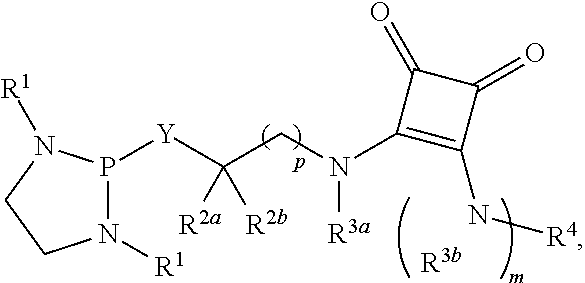
- 0 *C1C(*C)C(*[Y])C(B)P1[Y]C(*)(*)CN(*)CN(*)* Chemical compound *C1C(*C)C(*[Y])C(B)P1[Y]C(*)(*)CN(*)CN(*)* 0.000 description 43
- XYFCBTPGUUZFHI-UHFFFAOYSA-N Phosphine Chemical compound P XYFCBTPGUUZFHI-UHFFFAOYSA-N 0.000 description 40
- -1 α-aminophosphonates Chemical class 0.000 description 39
- 125000004093 cyano group Chemical group *C#N 0.000 description 32
- 125000001449 isopropyl group Chemical group [H]C([H])([H])C([H])(*)C([H])([H])[H] 0.000 description 32
- 125000004123 n-propyl group Chemical group [H]C([H])([H])C([H])([H])C([H])([H])* 0.000 description 32
- 239000002585 base Substances 0.000 description 30
- ZMANZCXQSJIPKH-UHFFFAOYSA-N Triethylamine Chemical compound CCN(CC)CC ZMANZCXQSJIPKH-UHFFFAOYSA-N 0.000 description 27
- 125000000113 cyclohexyl group Chemical group [H]C1([H])C([H])([H])C([H])([H])C([H])(*)C([H])([H])C1([H])[H] 0.000 description 26
- 239000002904 solvent Substances 0.000 description 25
- 239000007787 solid Substances 0.000 description 24
- 229910000073 phosphorus hydride Inorganic materials 0.000 description 23
- 238000001644 13C nuclear magnetic resonance spectroscopy Methods 0.000 description 22
- 238000004679 31P NMR spectroscopy Methods 0.000 description 22
- 238000005160 1H NMR spectroscopy Methods 0.000 description 21
- 239000011734 sodium Substances 0.000 description 21
- 150000001299 aldehydes Chemical class 0.000 description 20
- 125000000956 methoxy group Chemical group [H]C([H])([H])O* 0.000 description 18
- 150000001412 amines Chemical class 0.000 description 16
- 239000002253 acid Substances 0.000 description 15
- 125000001797 benzyl group Chemical group [H]C1=C([H])C([H])=C(C([H])=C1[H])C([H])([H])* 0.000 description 15
- 239000000047 product Substances 0.000 description 15
- 125000000999 tert-butyl group Chemical group [H]C([H])([H])C(*)(C([H])([H])[H])C([H])([H])[H] 0.000 description 14
- LFQSCWFLJHTTHZ-UHFFFAOYSA-N Ethanol Chemical compound CCO LFQSCWFLJHTTHZ-UHFFFAOYSA-N 0.000 description 13
- 125000004108 n-butyl group Chemical group [H]C([H])([H])C([H])([H])C([H])([H])C([H])([H])* 0.000 description 13
- 125000001424 substituent group Chemical group 0.000 description 13
- 230000009466 transformation Effects 0.000 description 13
- 125000006552 (C3-C8) cycloalkyl group Chemical group 0.000 description 12
- WEVYAHXRMPXWCK-UHFFFAOYSA-N Acetonitrile Chemical compound CC#N WEVYAHXRMPXWCK-UHFFFAOYSA-N 0.000 description 12
- YMWUJEATGCHHMB-UHFFFAOYSA-N Dichloromethane Chemical compound ClCCl YMWUJEATGCHHMB-UHFFFAOYSA-N 0.000 description 12
- YNAVUWVOSKDBBP-UHFFFAOYSA-N Morpholine Chemical compound C1COCCN1 YNAVUWVOSKDBBP-UHFFFAOYSA-N 0.000 description 12
- 125000002914 sec-butyl group Chemical group [H]C([H])([H])C([H])([H])C([H])(*)C([H])([H])[H] 0.000 description 12
- 125000000623 heterocyclic group Chemical group 0.000 description 11
- 229910052751 metal Inorganic materials 0.000 description 11
- 239000002184 metal Substances 0.000 description 11
- TYJFSUYUXGOXGB-UHFFFAOYSA-N CC(C)C1=C(C(C)C)C(=O)C1=O Chemical compound CC(C)C1=C(C(C)C)C(=O)C1=O TYJFSUYUXGOXGB-UHFFFAOYSA-N 0.000 description 10
- XEKOWRVHYACXOJ-UHFFFAOYSA-N Ethyl acetate Chemical compound CCOC(C)=O XEKOWRVHYACXOJ-UHFFFAOYSA-N 0.000 description 10
- HEDRZPFGACZZDS-MICDWDOJSA-N Trichloro(2H)methane Chemical compound [2H]C(Cl)(Cl)Cl HEDRZPFGACZZDS-MICDWDOJSA-N 0.000 description 10
- 125000006575 electron-withdrawing group Chemical group 0.000 description 10
- 125000000959 isobutyl group Chemical group [H]C([H])([H])C([H])(C([H])([H])[H])C([H])([H])* 0.000 description 10
- OKKJLVBELUTLKV-UHFFFAOYSA-N Methanol Chemical compound OC OKKJLVBELUTLKV-UHFFFAOYSA-N 0.000 description 9
- ABLZXFCXXLZCGV-UHFFFAOYSA-N Phosphorous acid Chemical compound OP(O)=O ABLZXFCXXLZCGV-UHFFFAOYSA-N 0.000 description 9
- KWYUFKZDYYNOTN-UHFFFAOYSA-M Potassium hydroxide Chemical compound [OH-].[K+] KWYUFKZDYYNOTN-UHFFFAOYSA-M 0.000 description 9
- RWRDLPDLKQPQOW-UHFFFAOYSA-N Pyrrolidine Chemical compound C1CCNC1 RWRDLPDLKQPQOW-UHFFFAOYSA-N 0.000 description 9
- HEMHJVSKTPXQMS-UHFFFAOYSA-M Sodium hydroxide Chemical compound [OH-].[Na+] HEMHJVSKTPXQMS-UHFFFAOYSA-M 0.000 description 9
- 125000002147 dimethylamino group Chemical group [H]C([H])([H])N(*)C([H])([H])[H] 0.000 description 9
- IJGRMHOSHXDMSA-UHFFFAOYSA-N nitrogen Substances N#N IJGRMHOSHXDMSA-UHFFFAOYSA-N 0.000 description 9
- QTBSBXVTEAMEQO-UHFFFAOYSA-N Acetic acid Chemical compound CC(O)=O QTBSBXVTEAMEQO-UHFFFAOYSA-N 0.000 description 8
- KFZMGEQAYNKOFK-UHFFFAOYSA-N Isopropanol Chemical compound CC(C)O KFZMGEQAYNKOFK-UHFFFAOYSA-N 0.000 description 8
- 125000005842 heteroatom Chemical group 0.000 description 8
- 229910052757 nitrogen Inorganic materials 0.000 description 8
- 238000006467 substitution reaction Methods 0.000 description 8
- JGFZNNIVVJXRND-UHFFFAOYSA-N N,N-Diisopropylethylamine (DIPEA) Chemical compound CCN(C(C)C)C(C)C JGFZNNIVVJXRND-UHFFFAOYSA-N 0.000 description 7
- WYURNTSHIVDZCO-UHFFFAOYSA-N Tetrahydrofuran Chemical compound C1CCOC1 WYURNTSHIVDZCO-UHFFFAOYSA-N 0.000 description 7
- 125000002947 alkylene group Chemical group 0.000 description 7
- 239000000463 material Substances 0.000 description 7
- 230000000269 nucleophilic effect Effects 0.000 description 7
- 239000008194 pharmaceutical composition Substances 0.000 description 7
- 239000000376 reactant Substances 0.000 description 7
- 125000006413 ring segment Chemical group 0.000 description 7
- 239000000126 substance Substances 0.000 description 7
- 238000010189 synthetic method Methods 0.000 description 7
- WSLDOOZREJYCGB-UHFFFAOYSA-N 1,2-Dichloroethane Chemical compound ClCCCl WSLDOOZREJYCGB-UHFFFAOYSA-N 0.000 description 6
- OISVCGZHLKNMSJ-UHFFFAOYSA-N 2,6-dimethylpyridine Chemical compound CC1=CC=CC(C)=N1 OISVCGZHLKNMSJ-UHFFFAOYSA-N 0.000 description 6
- RTZKZFJDLAIYFH-UHFFFAOYSA-N Diethyl ether Chemical compound CCOCC RTZKZFJDLAIYFH-UHFFFAOYSA-N 0.000 description 6
- VEXZGXHMUGYJMC-UHFFFAOYSA-N Hydrochloric acid Chemical compound Cl VEXZGXHMUGYJMC-UHFFFAOYSA-N 0.000 description 6
- SJRJJKPEHAURKC-UHFFFAOYSA-N N-Methylmorpholine Chemical compound CN1CCOCC1 SJRJJKPEHAURKC-UHFFFAOYSA-N 0.000 description 6
- CDBYLPFSWZWCQE-UHFFFAOYSA-L Sodium Carbonate Chemical compound [Na+].[Na+].[O-]C([O-])=O CDBYLPFSWZWCQE-UHFFFAOYSA-L 0.000 description 6
- YXFVVABEGXRONW-UHFFFAOYSA-N Toluene Chemical compound CC1=CC=CC=C1 YXFVVABEGXRONW-UHFFFAOYSA-N 0.000 description 6
- DTQVDTLACAAQTR-UHFFFAOYSA-N Trifluoroacetic acid Chemical compound OC(=O)C(F)(F)F DTQVDTLACAAQTR-UHFFFAOYSA-N 0.000 description 6
- 150000007513 acids Chemical class 0.000 description 6
- HSFWRNGVRCDJHI-UHFFFAOYSA-N alpha-acetylene Natural products C#C HSFWRNGVRCDJHI-UHFFFAOYSA-N 0.000 description 6
- 238000013459 approach Methods 0.000 description 6
- 230000008901 benefit Effects 0.000 description 6
- DERZBLKQOCDDDZ-JLHYYAGUSA-N cinnarizine Chemical compound C1CN(C(C=2C=CC=CC=2)C=2C=CC=CC=2)CCN1C\C=C\C1=CC=CC=C1 DERZBLKQOCDDDZ-JLHYYAGUSA-N 0.000 description 6
- 229960000876 cinnarizine Drugs 0.000 description 6
- 239000003814 drug Substances 0.000 description 6
- 125000002534 ethynyl group Chemical group [H]C#C* 0.000 description 6
- 125000000524 functional group Chemical group 0.000 description 6
- 125000005843 halogen group Chemical group 0.000 description 6
- 238000004128 high performance liquid chromatography Methods 0.000 description 6
- 238000004895 liquid chromatography mass spectrometry Methods 0.000 description 6
- 238000004949 mass spectrometry Methods 0.000 description 6
- 125000002816 methylsulfanyl group Chemical group [H]C([H])([H])S[*] 0.000 description 6
- 125000006239 protecting group Chemical group 0.000 description 6
- GETQZCLCWQTVFV-UHFFFAOYSA-N trimethylamine Chemical compound CN(C)C GETQZCLCWQTVFV-UHFFFAOYSA-N 0.000 description 6
- 125000000391 vinyl group Chemical group [H]C([*])=C([H])[H] 0.000 description 6
- ZMXDDKWLCZADIW-UHFFFAOYSA-N N,N-Dimethylformamide Chemical compound CN(C)C=O ZMXDDKWLCZADIW-UHFFFAOYSA-N 0.000 description 5
- 238000005481 NMR spectroscopy Methods 0.000 description 5
- OAICVXFJPJFONN-UHFFFAOYSA-N Phosphorus Chemical compound [P] OAICVXFJPJFONN-UHFFFAOYSA-N 0.000 description 5
- JUJWROOIHBZHMG-UHFFFAOYSA-N Pyridine Chemical group C1=CC=NC=C1 JUJWROOIHBZHMG-UHFFFAOYSA-N 0.000 description 5
- VYPSYNLAJGMNEJ-UHFFFAOYSA-N Silicium dioxide Chemical compound O=[Si]=O VYPSYNLAJGMNEJ-UHFFFAOYSA-N 0.000 description 5
- NINIDFKCEFEMDL-UHFFFAOYSA-N Sulfur Chemical group [S] NINIDFKCEFEMDL-UHFFFAOYSA-N 0.000 description 5
- QAOWNCQODCNURD-UHFFFAOYSA-N Sulfuric acid Chemical compound OS(O)(=O)=O QAOWNCQODCNURD-UHFFFAOYSA-N 0.000 description 5
- 239000000654 additive Substances 0.000 description 5
- 125000000304 alkynyl group Chemical group 0.000 description 5
- QVGXLLKOCUKJST-UHFFFAOYSA-N atomic oxygen Chemical group [O] QVGXLLKOCUKJST-UHFFFAOYSA-N 0.000 description 5
- 125000001559 cyclopropyl group Chemical group [H]C1([H])C([H])([H])C1([H])* 0.000 description 5
- SMANXXCATUTDDT-QPJJXVBHSA-N flunarizine Chemical compound C1=CC(F)=CC=C1C(C=1C=CC(F)=CC=1)N1CCN(C\C=C\C=2C=CC=CC=2)CC1 SMANXXCATUTDDT-QPJJXVBHSA-N 0.000 description 5
- 229960000326 flunarizine Drugs 0.000 description 5
- 230000007246 mechanism Effects 0.000 description 5
- 230000001404 mediated effect Effects 0.000 description 5
- 239000001301 oxygen Chemical group 0.000 description 5
- 239000000546 pharmaceutical excipient Substances 0.000 description 5
- 238000005954 phosphonylation reaction Methods 0.000 description 5
- 229910052698 phosphorus Inorganic materials 0.000 description 5
- 239000011574 phosphorus Substances 0.000 description 5
- 230000008569 process Effects 0.000 description 5
- 125000001436 propyl group Chemical group [H]C([*])([H])C([H])([H])C([H])([H])[H] 0.000 description 5
- 239000007858 starting material Substances 0.000 description 5
- 239000011593 sulfur Chemical group 0.000 description 5
- 238000004809 thin layer chromatography Methods 0.000 description 5
- GQHTUMJGOHRCHB-UHFFFAOYSA-N 2,3,4,6,7,8,9,10-octahydropyrimido[1,2-a]azepine Chemical compound C1CCCCN2CCCN=C21 GQHTUMJGOHRCHB-UHFFFAOYSA-N 0.000 description 4
- 239000007848 Bronsted acid Substances 0.000 description 4
- HEDRZPFGACZZDS-UHFFFAOYSA-N Chloroform Chemical compound ClC(Cl)Cl HEDRZPFGACZZDS-UHFFFAOYSA-N 0.000 description 4
- 238000006683 Mannich reaction Methods 0.000 description 4
- UIIMBOGNXHQVGW-UHFFFAOYSA-M Sodium bicarbonate Chemical compound [Na+].OC([O-])=O UIIMBOGNXHQVGW-UHFFFAOYSA-M 0.000 description 4
- XSQUKJJJFZCRTK-UHFFFAOYSA-N Urea Chemical compound NC(N)=O XSQUKJJJFZCRTK-UHFFFAOYSA-N 0.000 description 4
- 125000003342 alkenyl group Chemical group 0.000 description 4
- 238000004587 chromatography analysis Methods 0.000 description 4
- 125000001995 cyclobutyl group Chemical group [H]C1([H])C([H])([H])C([H])(*)C1([H])[H] 0.000 description 4
- 125000001511 cyclopentyl group Chemical group [H]C1([H])C([H])([H])C([H])([H])C([H])(*)C1([H])[H] 0.000 description 4
- 235000019439 ethyl acetate Nutrition 0.000 description 4
- 238000011065 in-situ storage Methods 0.000 description 4
- 239000007788 liquid Substances 0.000 description 4
- 125000002950 monocyclic group Chemical group 0.000 description 4
- 239000012038 nucleophile Substances 0.000 description 4
- 238000010534 nucleophilic substitution reaction Methods 0.000 description 4
- UEZVMMHDMIWARA-UHFFFAOYSA-M phosphonate Chemical compound [O-]P(=O)=O UEZVMMHDMIWARA-UHFFFAOYSA-M 0.000 description 4
- PTMHPRAIXMAOOB-UHFFFAOYSA-N phosphoramidic acid Chemical class NP(O)(O)=O PTMHPRAIXMAOOB-UHFFFAOYSA-N 0.000 description 4
- FAIAAWCVCHQXDN-UHFFFAOYSA-N phosphorus trichloride Chemical compound ClP(Cl)Cl FAIAAWCVCHQXDN-UHFFFAOYSA-N 0.000 description 4
- 239000000843 powder Substances 0.000 description 4
- 150000003335 secondary amines Chemical class 0.000 description 4
- 125000000472 sulfonyl group Chemical group *S(*)(=O)=O 0.000 description 4
- 150000003512 tertiary amines Chemical class 0.000 description 4
- UMGDCJDMYOKAJW-UHFFFAOYSA-N thiourea Chemical compound NC(N)=S UMGDCJDMYOKAJW-UHFFFAOYSA-N 0.000 description 4
- 238000000844 transformation Methods 0.000 description 4
- 125000000876 trifluoromethoxy group Chemical group FC(F)(F)O* 0.000 description 4
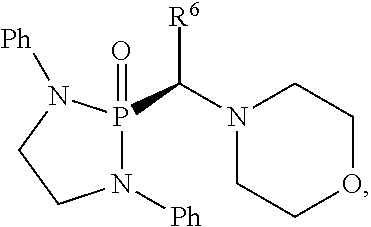
- PZCWRRLFZGYJDJ-UHFFFAOYSA-N 2-(morpholin-4-ylmethyl)-1,3-diphenyl-1,3,2lambda5-diazaphospholidine 2-oxide Chemical compound O1CCN(CC1)CP1(N(CCN1C1=CC=CC=C1)C1=CC=CC=C1)=O PZCWRRLFZGYJDJ-UHFFFAOYSA-N 0.000 description 3
- HSLQVHKWOVOQNP-UHFFFAOYSA-N CC1=CC(Br)=C(C(N2CCOCC2)P2(=O)N(C3=CC=CC=C3)CCN2C2=CC=CC=C2)C=C1 Chemical compound CC1=CC(Br)=C(C(N2CCOCC2)P2(=O)N(C3=CC=CC=C3)CCN2C2=CC=CC=C2)C=C1 HSLQVHKWOVOQNP-UHFFFAOYSA-N 0.000 description 3
- WWZKQHOCKIZLMA-UHFFFAOYSA-N Caprylic acid Natural products CCCCCCCC(O)=O WWZKQHOCKIZLMA-UHFFFAOYSA-N 0.000 description 3
- VGGSQFUCUMXWEO-UHFFFAOYSA-N Ethene Chemical class C=C VGGSQFUCUMXWEO-UHFFFAOYSA-N 0.000 description 3
- WSFSSNUMVMOOMR-UHFFFAOYSA-N Formaldehyde Chemical compound O=C WSFSSNUMVMOOMR-UHFFFAOYSA-N 0.000 description 3
- WHXSMMKQMYFTQS-UHFFFAOYSA-N Lithium Chemical compound [Li] WHXSMMKQMYFTQS-UHFFFAOYSA-N 0.000 description 3
- WMFOQBRAJBCJND-UHFFFAOYSA-M Lithium hydroxide Chemical compound [Li+].[OH-] WMFOQBRAJBCJND-UHFFFAOYSA-M 0.000 description 3
- QZNMDVLKURWYQN-UHFFFAOYSA-N O=P1(C(C2=CC=C(C(F)(F)F)C=C2)N2CCOCC2)N(C2=CC=CC=C2)CCN1C1=CC=CC=C1 Chemical compound O=P1(C(C2=CC=C(C(F)(F)F)C=C2)N2CCOCC2)N(C2=CC=CC=C2)CCN1C1=CC=CC=C1 QZNMDVLKURWYQN-UHFFFAOYSA-N 0.000 description 3
- VZDGDSYZMMKWRV-UHFFFAOYSA-N O=P1(C(C2=CC=C(Cl)C=C2)N2CCOCC2)N(C2=CC=CC=C2)CCN1C1=CC=CC=C1 Chemical compound O=P1(C(C2=CC=C(Cl)C=C2)N2CCOCC2)N(C2=CC=CC=C2)CCN1C1=CC=CC=C1 VZDGDSYZMMKWRV-UHFFFAOYSA-N 0.000 description 3
- WKRMQWKDOUINKR-UHFFFAOYSA-N O=P1(C(C2=CC=C(F)C=C2)N2CCOCC2)N(C2=CC=CC=C2)CCN1C1=CC=CC=C1 Chemical compound O=P1(C(C2=CC=C(F)C=C2)N2CCOCC2)N(C2=CC=CC=C2)CCN1C1=CC=CC=C1 WKRMQWKDOUINKR-UHFFFAOYSA-N 0.000 description 3
- UQBPAYDLHWVLCJ-UHFFFAOYSA-N O=P1(C(C2=CC=CC=C2)N2CCOCC2)N(C2=CC=CC=C2)CCN1C1=CC=CC=C1 Chemical compound O=P1(C(C2=CC=CC=C2)N2CCOCC2)N(C2=CC=CC=C2)CCN1C1=CC=CC=C1 UQBPAYDLHWVLCJ-UHFFFAOYSA-N 0.000 description 3
- NQRYJNQNLNOLGT-UHFFFAOYSA-N Piperidine Chemical compound C1CCNCC1 NQRYJNQNLNOLGT-UHFFFAOYSA-N 0.000 description 3
- 229910006074 SO2NH2 Inorganic materials 0.000 description 3
- 230000002378 acidificating effect Effects 0.000 description 3
- 239000004480 active ingredient Substances 0.000 description 3
- 150000001408 amides Chemical class 0.000 description 3
- 125000003277 amino group Chemical class 0.000 description 3
- 125000002393 azetidinyl group Chemical group 0.000 description 3
- 238000009835 boiling Methods 0.000 description 3
- 238000010523 cascade reaction Methods 0.000 description 3
- 125000003636 chemical group Chemical group 0.000 description 3
- 239000003795 chemical substances by application Substances 0.000 description 3
- RVJBOIPTJJXRCT-UHFFFAOYSA-N diazaphospholidine Chemical class C1CPNN1 RVJBOIPTJJXRCT-UHFFFAOYSA-N 0.000 description 3
- 238000006073 displacement reaction Methods 0.000 description 3
- 229940079593 drug Drugs 0.000 description 3
- 239000012039 electrophile Substances 0.000 description 3
- 238000009472 formulation Methods 0.000 description 3
- 238000007429 general method Methods 0.000 description 3
- 125000004438 haloalkoxy group Chemical group 0.000 description 3
- 125000005647 linker group Chemical group 0.000 description 3
- 150000007522 mineralic acids Chemical class 0.000 description 3
- CYQYCASVINMDFD-UHFFFAOYSA-N n,n-ditert-butyl-2-methylpropan-2-amine Chemical compound CC(C)(C)N(C(C)(C)C)C(C)(C)C CYQYCASVINMDFD-UHFFFAOYSA-N 0.000 description 3
- 238000005580 one pot reaction Methods 0.000 description 3
- 238000005457 optimization Methods 0.000 description 3
- 150000007524 organic acids Chemical class 0.000 description 3
- 238000006053 organic reaction Methods 0.000 description 3
- AQSJGOWTSHOLKH-UHFFFAOYSA-N phosphite(3-) Chemical class [O-]P([O-])[O-] AQSJGOWTSHOLKH-UHFFFAOYSA-N 0.000 description 3
- 229910000029 sodium carbonate Inorganic materials 0.000 description 3
- 239000000243 solution Substances 0.000 description 3
- 241000894007 species Species 0.000 description 3
- YLQBMQCUIZJEEH-UHFFFAOYSA-N tetrahydrofuran Natural products C=1C=COC=1 YLQBMQCUIZJEEH-UHFFFAOYSA-N 0.000 description 3
- 125000001544 thienyl group Chemical group 0.000 description 3
- IMFACGCPASFAPR-UHFFFAOYSA-N tributylamine Chemical compound CCCCN(CCCC)CCCC IMFACGCPASFAPR-UHFFFAOYSA-N 0.000 description 3
- RKBCYCFRFCNLTO-UHFFFAOYSA-N triisopropylamine Chemical compound CC(C)N(C(C)C)C(C)C RKBCYCFRFCNLTO-UHFFFAOYSA-N 0.000 description 3
- LWIHDJKSTIGBAC-UHFFFAOYSA-K tripotassium phosphate Chemical compound [K+].[K+].[K+].[O-]P([O-])([O-])=O LWIHDJKSTIGBAC-UHFFFAOYSA-K 0.000 description 3
- YFTHZRPMJXBUME-UHFFFAOYSA-N tripropylamine Chemical compound CCCN(CCC)CCC YFTHZRPMJXBUME-UHFFFAOYSA-N 0.000 description 3
- ZTWTYVWXUKTLCP-UHFFFAOYSA-N vinylphosphonic acid Chemical class OP(O)(=O)C=C ZTWTYVWXUKTLCP-UHFFFAOYSA-N 0.000 description 3
- XLYOFNOQVPJJNP-UHFFFAOYSA-N water Substances O XLYOFNOQVPJJNP-UHFFFAOYSA-N 0.000 description 3
- KWGRBVOPPLSCSI-WPRPVWTQSA-N (-)-ephedrine Chemical compound CN[C@@H](C)[C@H](O)C1=CC=CC=C1 KWGRBVOPPLSCSI-WPRPVWTQSA-N 0.000 description 2
- XWKFPIODWVPXLX-UHFFFAOYSA-N 2-methyl-5-methylpyridine Natural products CC1=CC=C(C)N=C1 XWKFPIODWVPXLX-UHFFFAOYSA-N 0.000 description 2
- VRJHQPZVIGNGMX-UHFFFAOYSA-N 4-piperidinone Chemical compound O=C1CCNCC1 VRJHQPZVIGNGMX-UHFFFAOYSA-N 0.000 description 2
- NSPMIYGKQJPBQR-UHFFFAOYSA-N 4H-1,2,4-triazole Chemical compound C=1N=CNN=1 NSPMIYGKQJPBQR-UHFFFAOYSA-N 0.000 description 2
- ZTQSAGDEMFDKMZ-UHFFFAOYSA-N Butyraldehyde Chemical compound CCCC=O ZTQSAGDEMFDKMZ-UHFFFAOYSA-N 0.000 description 2
- FERIUCNNQQJTOY-UHFFFAOYSA-N Butyric acid Chemical compound CCCC(O)=O FERIUCNNQQJTOY-UHFFFAOYSA-N 0.000 description 2
- IZUHUYJZJCZEBT-UHFFFAOYSA-N CC(C)(CNC(=S)NC1=CC=CC=C1)OP1N(C2=CC=CC=C2)CCN1C1=CC=CC=C1.CNC1=C(NCC(C)(C)OP2N(C3=CC=CC=C3)CCN2C2=CC=CC=C2)C(=O)C1=O Chemical compound CC(C)(CNC(=S)NC1=CC=CC=C1)OP1N(C2=CC=CC=C2)CCN1C1=CC=CC=C1.CNC1=C(NCC(C)(C)OP2N(C3=CC=CC=C3)CCN2C2=CC=CC=C2)C(=O)C1=O IZUHUYJZJCZEBT-UHFFFAOYSA-N 0.000 description 2
- HWOQMEUBAPIHPL-UHFFFAOYSA-N CC1=C(C(N2CCOCC2)P2(=O)N(C3=CC=CC=C3)CCN2C2=CC=CC=C2)C=CC=C1 Chemical compound CC1=C(C(N2CCOCC2)P2(=O)N(C3=CC=CC=C3)CCN2C2=CC=CC=C2)C=CC=C1 HWOQMEUBAPIHPL-UHFFFAOYSA-N 0.000 description 2
- RPWHZTCLWNGXQZ-UHFFFAOYSA-N CC1=CC=C(C(C2=CC=C(F)C=C2)N2CCN(C(C3=CC=CC=C3)P3(=O)N(C4=CC=CC=C4)CCN3C3=CC=CC=C3)CC2)C=C1.N#CC1=CC=C(C(N2CCCCC2)P2(=O)N(C3=CC=CC=C3)CCN2C2=CC=CC=C2)C=C1.O=P1(C(C2=C3C=CC=CC3=CC=C2)N2CCCCC2)N(C2=CC=CC=C2)CCN1C1=CC=CC=C1.O=P1(C(C2=CC=CC=C2)N2CCCCC2)N(C2=CC=CC=C2)CCN1C1=CC=CC=C1.O=P1(C(C2=CC=CC=C2)N2CCN(C(C3=CC=CC=C3)C3=CC=CC=C3)CC2)N(C2=CC=CC=C2)CCN1C1=CC=CC=C1.O=P1(C(C2=CC=CC=N2)N2CCCCC2)N(C2=CC=CC=C2)CCN1C1=CC=CC=C1.O=P1(C(C2=CC=NC=C2)N2CCCCC2)N(C2=CC=CC=C2)CCN1C1=CC=CC=C1.O=P1(C(CC2=CC=CC=C2)N2CCCCC2)N(C2=CC=CC=C2)CCN1C1=CC=CC=C1 Chemical compound CC1=CC=C(C(C2=CC=C(F)C=C2)N2CCN(C(C3=CC=CC=C3)P3(=O)N(C4=CC=CC=C4)CCN3C3=CC=CC=C3)CC2)C=C1.N#CC1=CC=C(C(N2CCCCC2)P2(=O)N(C3=CC=CC=C3)CCN2C2=CC=CC=C2)C=C1.O=P1(C(C2=C3C=CC=CC3=CC=C2)N2CCCCC2)N(C2=CC=CC=C2)CCN1C1=CC=CC=C1.O=P1(C(C2=CC=CC=C2)N2CCCCC2)N(C2=CC=CC=C2)CCN1C1=CC=CC=C1.O=P1(C(C2=CC=CC=C2)N2CCN(C(C3=CC=CC=C3)C3=CC=CC=C3)CC2)N(C2=CC=CC=C2)CCN1C1=CC=CC=C1.O=P1(C(C2=CC=CC=N2)N2CCCCC2)N(C2=CC=CC=C2)CCN1C1=CC=CC=C1.O=P1(C(C2=CC=NC=C2)N2CCCCC2)N(C2=CC=CC=C2)CCN1C1=CC=CC=C1.O=P1(C(CC2=CC=CC=C2)N2CCCCC2)N(C2=CC=CC=C2)CCN1C1=CC=CC=C1 RPWHZTCLWNGXQZ-UHFFFAOYSA-N 0.000 description 2
- ZXGUEVWKGWYLNF-UHFFFAOYSA-N CC1=CC=C(C(N2CCOCC2)P2(=O)N(C3=CC=CC=C3)CCN2C2=CC=CC=C2)C=C1 Chemical compound CC1=CC=C(C(N2CCOCC2)P2(=O)N(C3=CC=CC=C3)CCN2C2=CC=CC=C2)C=C1 ZXGUEVWKGWYLNF-UHFFFAOYSA-N 0.000 description 2
- CHOSQXQNVROODL-UHFFFAOYSA-N CC1=CC=C(S(=O)(=O)CCCP2N(C3=CC=CC=C3)CCN2C2=CC=CC=C2)C=C1 Chemical compound CC1=CC=C(S(=O)(=O)CCCP2N(C3=CC=CC=C3)CCN2C2=CC=CC=C2)C=C1 CHOSQXQNVROODL-UHFFFAOYSA-N 0.000 description 2
- SMHCJDNLLWZNCL-UHFFFAOYSA-N CC1COCC(C)N1C(C1=CC=CC=C1)P1(=O)N(C2=CC=CC=C2)CCN1C1=CC=CC=C1 Chemical compound CC1COCC(C)N1C(C1=CC=CC=C1)P1(=O)N(C2=CC=CC=C2)CCN1C1=CC=CC=C1 SMHCJDNLLWZNCL-UHFFFAOYSA-N 0.000 description 2
- GBJWLCDVLDMODZ-UHFFFAOYSA-N CCCC(N1CCOCC1)P1(=O)N(C2=CC=CC=C2)CCN1C1=CC=CC=C1 Chemical compound CCCC(N1CCOCC1)P1(=O)N(C2=CC=CC=C2)CCN1C1=CC=CC=C1 GBJWLCDVLDMODZ-UHFFFAOYSA-N 0.000 description 2
- CAEKGBDYHXUWGI-UHFFFAOYSA-N CN1CCN(C(C2=CC=CC=C2)P2(=O)N(C3=CC=CC=C3)CCN2C2=CC=CC=C2)CC1 Chemical compound CN1CCN(C(C2=CC=CC=C2)P2(=O)N(C3=CC=CC=C3)CCN2C2=CC=CC=C2)CC1 CAEKGBDYHXUWGI-UHFFFAOYSA-N 0.000 description 2
- KESMBUJKIHTRIT-UHFFFAOYSA-N COC1=CC=C(C(N2CCOCC2)P2(=O)N(C3=CC=CC=C3)CCN2C2=CC=CC=C2)C=C1 Chemical compound COC1=CC=C(C(N2CCOCC2)P2(=O)N(C3=CC=CC=C3)CCN2C2=CC=CC=C2)C=C1 KESMBUJKIHTRIT-UHFFFAOYSA-N 0.000 description 2
- 229940127291 Calcium channel antagonist Drugs 0.000 description 2
- FEWJPZIEWOKRBE-JCYAYHJZSA-N Dextrotartaric acid Chemical compound OC(=O)[C@H](O)[C@@H](O)C(O)=O FEWJPZIEWOKRBE-JCYAYHJZSA-N 0.000 description 2
- ROSDSFDQCJNGOL-UHFFFAOYSA-N Dimethylamine Chemical compound CNC ROSDSFDQCJNGOL-UHFFFAOYSA-N 0.000 description 2
- OTFQKHHTKRHTSH-UHFFFAOYSA-N FC(F)(F)C1=CC(NC(=S)NCCOP2N(C3=CC=CC=C3)CCN2C2=CC=CC=C2)=CC(C(F)(F)F)=C1 Chemical compound FC(F)(F)C1=CC(NC(=S)NCCOP2N(C3=CC=CC=C3)CCN2C2=CC=CC=C2)=CC(C(F)(F)F)=C1 OTFQKHHTKRHTSH-UHFFFAOYSA-N 0.000 description 2
- 238000006130 Horner-Wadsworth-Emmons olefination reaction Methods 0.000 description 2
- 238000004566 IR spectroscopy Methods 0.000 description 2
- DGAQECJNVWCQMB-PUAWFVPOSA-M Ilexoside XXIX Chemical compound C[C@@H]1CC[C@@]2(CC[C@@]3(C(=CC[C@H]4[C@]3(CC[C@@H]5[C@@]4(CC[C@@H](C5(C)C)OS(=O)(=O)[O-])C)C)[C@@H]2[C@]1(C)O)C)C(=O)O[C@H]6[C@@H]([C@H]([C@@H]([C@H](O6)CO)O)O)O.[Na+] DGAQECJNVWCQMB-PUAWFVPOSA-M 0.000 description 2
- 239000002841 Lewis acid Substances 0.000 description 2
- AFVFQIVMOAPDHO-UHFFFAOYSA-N Methanesulfonic acid Chemical compound CS(O)(=O)=O AFVFQIVMOAPDHO-UHFFFAOYSA-N 0.000 description 2
- BAVYZALUXZFZLV-UHFFFAOYSA-N Methylamine Chemical compound NC BAVYZALUXZFZLV-UHFFFAOYSA-N 0.000 description 2
- 238000005654 Michaelis-Arbuzov synthesis reaction Methods 0.000 description 2
- LRHPLDYGYMQRHN-UHFFFAOYSA-N N-Butanol Chemical compound CCCCO LRHPLDYGYMQRHN-UHFFFAOYSA-N 0.000 description 2
- CTQNGGLPUBDAKN-UHFFFAOYSA-N O-Xylene Chemical compound CC1=CC=CC=C1C CTQNGGLPUBDAKN-UHFFFAOYSA-N 0.000 description 2
- ZJALZVHVNZLTPW-UHFFFAOYSA-N O=C1CCN(C(C2=CC=CC=C2)P2(=O)N(C3=CC=CC=C3)CCN2C2=CC=CC=C2)CC1 Chemical compound O=C1CCN(C(C2=CC=CC=C2)P2(=O)N(C3=CC=CC=C3)CCN2C2=CC=CC=C2)CC1 ZJALZVHVNZLTPW-UHFFFAOYSA-N 0.000 description 2
- RKHYVCYPGIKCGW-UHFFFAOYSA-N O=P1(C(C2=C(Br)C=C(Cl)C=C2)N2CCOCC2)N(C2=CC=CC=C2)CCN1C1=CC=CC=C1 Chemical compound O=P1(C(C2=C(Br)C=C(Cl)C=C2)N2CCOCC2)N(C2=CC=CC=C2)CCN1C1=CC=CC=C1 RKHYVCYPGIKCGW-UHFFFAOYSA-N 0.000 description 2
- ZDPZILVMCQLKOK-UHFFFAOYSA-N O=P1(C(C2=C(Cl)C=C(Cl)C=C2)N2CCOCC2)N(C2=CC=CC=C2)CCN1C1=CC=CC=C1 Chemical compound O=P1(C(C2=C(Cl)C=C(Cl)C=C2)N2CCOCC2)N(C2=CC=CC=C2)CCN1C1=CC=CC=C1 ZDPZILVMCQLKOK-UHFFFAOYSA-N 0.000 description 2
- XFCCRWLSQHAMNL-UHFFFAOYSA-N O=P1(C(C2=C(F)C=CC=C2)N2CCOCC2)N(C2=CC=CC=C2)CCN1C1=CC=CC=C1 Chemical compound O=P1(C(C2=C(F)C=CC=C2)N2CCOCC2)N(C2=CC=CC=C2)CCN1C1=CC=CC=C1 XFCCRWLSQHAMNL-UHFFFAOYSA-N 0.000 description 2
- HNYFOTVAOKUMSP-UHFFFAOYSA-N O=P1(C(C2=CC=C(Br)C=C2)N2CCOCC2)N(C2=CC=CC=C2)CCN1C1=CC=CC=C1 Chemical compound O=P1(C(C2=CC=C(Br)C=C2)N2CCOCC2)N(C2=CC=CC=C2)CCN1C1=CC=CC=C1 HNYFOTVAOKUMSP-UHFFFAOYSA-N 0.000 description 2
- JTASJMVZIDMYPI-UHFFFAOYSA-N O=P1(C(C2=CC=CC=C2)N2CCN(C(C3=CC=CC=C3)C3=CC=CC=C3)CC2)N(C2=CC=CC=C2)CCN1C1=CC=CC=C1 Chemical compound O=P1(C(C2=CC=CC=C2)N2CCN(C(C3=CC=CC=C3)C3=CC=CC=C3)CC2)N(C2=CC=CC=C2)CCN1C1=CC=CC=C1 JTASJMVZIDMYPI-UHFFFAOYSA-N 0.000 description 2
- WCZVRWFVWOKNHP-UHFFFAOYSA-N O=P1(C(C2=CC=CC=C2)N2CCN(C3CCCCC3)CC2)N(C2=CC=CC=C2)CCN1C1=CC=CC=C1 Chemical compound O=P1(C(C2=CC=CC=C2)N2CCN(C3CCCCC3)CC2)N(C2=CC=CC=C2)CCN1C1=CC=CC=C1 WCZVRWFVWOKNHP-UHFFFAOYSA-N 0.000 description 2
- OELQSXXIPMDNFJ-UHFFFAOYSA-N O=P1(C(C2=CC=CC=C2)N2CCSCC2)N(C2=CC=CC=C2)CCN1C1=CC=CC=C1 Chemical compound O=P1(C(C2=CC=CC=C2)N2CCSCC2)N(C2=CC=CC=C2)CCN1C1=CC=CC=C1 OELQSXXIPMDNFJ-UHFFFAOYSA-N 0.000 description 2
- QYJMMGZYFWOWTD-UHFFFAOYSA-N O=P1(C(C2=CC=CO2)N2CCOCC2)N(C2=CC=CC=C2)CCN1C1=CC=CC=C1 Chemical compound O=P1(C(C2=CC=CO2)N2CCOCC2)N(C2=CC=CC=C2)CCN1C1=CC=CC=C1 QYJMMGZYFWOWTD-UHFFFAOYSA-N 0.000 description 2
- BJCWXBFGOYFMPH-UHFFFAOYSA-N O=P1(C(C2=CC=CS2)N2CCOCC2)N(C2=CC=CC=C2)CCN1C1=CC=CC=C1 Chemical compound O=P1(C(C2=CC=CS2)N2CCOCC2)N(C2=CC=CC=C2)CCN1C1=CC=CC=C1 BJCWXBFGOYFMPH-UHFFFAOYSA-N 0.000 description 2
- NBIIXXVUZAFLBC-UHFFFAOYSA-N Phosphoric acid Chemical compound OP(O)(O)=O NBIIXXVUZAFLBC-UHFFFAOYSA-N 0.000 description 2
- PMZURENOXWZQFD-UHFFFAOYSA-L Sodium Sulfate Chemical compound [Na+].[Na+].[O-]S([O-])(=O)=O PMZURENOXWZQFD-UHFFFAOYSA-L 0.000 description 2
- FEWJPZIEWOKRBE-UHFFFAOYSA-N Tartaric acid Natural products [H+].[H+].[O-]C(=O)C(O)C(O)C([O-])=O FEWJPZIEWOKRBE-UHFFFAOYSA-N 0.000 description 2
- GUGOEEXESWIERI-UHFFFAOYSA-N Terfenadine Chemical compound C1=CC(C(C)(C)C)=CC=C1C(O)CCCN1CCC(C(O)(C=2C=CC=CC=2)C=2C=CC=CC=2)CC1 GUGOEEXESWIERI-UHFFFAOYSA-N 0.000 description 2
- 125000005073 adamantyl group Chemical group C12(CC3CC(CC(C1)C3)C2)* 0.000 description 2
- 230000000996 additive effect Effects 0.000 description 2
- 239000000443 aerosol Substances 0.000 description 2
- 239000000556 agonist Substances 0.000 description 2
- 150000004703 alkoxides Chemical class 0.000 description 2
- 125000003545 alkoxy group Chemical group 0.000 description 2
- 238000005804 alkylation reaction Methods 0.000 description 2
- 150000001413 amino acids Chemical class 0.000 description 2
- 125000006598 aminocarbonylamino group Chemical group 0.000 description 2
- 125000004397 aminosulfonyl group Chemical group NS(=O)(=O)* 0.000 description 2
- 239000003242 anti bacterial agent Substances 0.000 description 2
- 230000001387 anti-histamine Effects 0.000 description 2
- 239000000739 antihistaminic agent Substances 0.000 description 2
- 150000004982 aromatic amines Chemical class 0.000 description 2
- HUMNYLRZRPPJDN-UHFFFAOYSA-N benzaldehyde Chemical compound O=CC1=CC=CC=C1 HUMNYLRZRPPJDN-UHFFFAOYSA-N 0.000 description 2
- 125000005605 benzo group Chemical group 0.000 description 2
- WPYMKLBDIGXBTP-UHFFFAOYSA-N benzoic acid Chemical compound OC(=O)C1=CC=CC=C1 WPYMKLBDIGXBTP-UHFFFAOYSA-N 0.000 description 2
- 230000000975 bioactive effect Effects 0.000 description 2
- GDTBXPJZTBHREO-UHFFFAOYSA-N bromine Chemical compound BrBr GDTBXPJZTBHREO-UHFFFAOYSA-N 0.000 description 2
- 229910052794 bromium Inorganic materials 0.000 description 2
- 125000000484 butyl group Chemical group [H]C([*])([H])C([H])([H])C([H])([H])C([H])([H])[H] 0.000 description 2
- 125000003917 carbamoyl group Chemical group [H]N([H])C(*)=O 0.000 description 2
- 150000001720 carbohydrates Chemical class 0.000 description 2
- 235000014633 carbohydrates Nutrition 0.000 description 2
- 239000011203 carbon fibre reinforced carbon Substances 0.000 description 2
- 125000002915 carbonyl group Chemical group [*:2]C([*:1])=O 0.000 description 2
- 150000001735 carboxylic acids Chemical class 0.000 description 2
- 229910052801 chlorine Inorganic materials 0.000 description 2
- 238000010511 deprotection reaction Methods 0.000 description 2
- 239000012973 diazabicyclooctane Substances 0.000 description 2
- JQVDAXLFBXTEQA-UHFFFAOYSA-N dibutylamine Chemical compound CCCCNCCCC JQVDAXLFBXTEQA-UHFFFAOYSA-N 0.000 description 2
- XBDQKXXYIPTUBI-UHFFFAOYSA-N dimethylselenoniopropionate Natural products CCC(O)=O XBDQKXXYIPTUBI-UHFFFAOYSA-N 0.000 description 2
- 230000000694 effects Effects 0.000 description 2
- 150000002148 esters Chemical class 0.000 description 2
- 125000004705 ethylthio group Chemical group C(C)S* 0.000 description 2
- 229910052731 fluorine Inorganic materials 0.000 description 2
- 238000010575 fractional recrystallization Methods 0.000 description 2
- 238000007710 freezing Methods 0.000 description 2
- 230000008014 freezing Effects 0.000 description 2
- IXCSERBJSXMMFS-UHFFFAOYSA-N hydrogen chloride Substances Cl.Cl IXCSERBJSXMMFS-UHFFFAOYSA-N 0.000 description 2
- 229910000041 hydrogen chloride Inorganic materials 0.000 description 2
- 230000007062 hydrolysis Effects 0.000 description 2
- 238000006460 hydrolysis reaction Methods 0.000 description 2
- 150000002466 imines Chemical class 0.000 description 2
- 239000012535 impurity Substances 0.000 description 2
- 229960004592 isopropanol Drugs 0.000 description 2
- JVTAAEKCZFNVCJ-UHFFFAOYSA-N lactic acid Chemical compound CC(O)C(O)=O JVTAAEKCZFNVCJ-UHFFFAOYSA-N 0.000 description 2
- 150000007517 lewis acids Chemical class 0.000 description 2
- 229910052744 lithium Inorganic materials 0.000 description 2
- UPRXAOPZPSAYHF-UHFFFAOYSA-N lithium;cyclohexyl(propan-2-yl)azanide Chemical compound CC(C)N([Li])C1CCCCC1 UPRXAOPZPSAYHF-UHFFFAOYSA-N 0.000 description 2
- HQKMJHAJHXVSDF-UHFFFAOYSA-L magnesium stearate Chemical compound [Mg+2].CCCCCCCCCCCCCCCCCC([O-])=O.CCCCCCCCCCCCCCCCCC([O-])=O HQKMJHAJHXVSDF-UHFFFAOYSA-L 0.000 description 2
- 239000002609 medium Substances 0.000 description 2
- 229910052987 metal hydride Inorganic materials 0.000 description 2
- 150000004681 metal hydrides Chemical class 0.000 description 2
- 238000006452 multicomponent reaction Methods 0.000 description 2
- DAZXVJBJRMWXJP-UHFFFAOYSA-N n,n-dimethylethylamine Chemical compound CCN(C)C DAZXVJBJRMWXJP-UHFFFAOYSA-N 0.000 description 2
- VLKZOEOYAKHREP-UHFFFAOYSA-N n-Hexane Chemical class CCCCCC VLKZOEOYAKHREP-UHFFFAOYSA-N 0.000 description 2
- UTLDDSNRFHWERZ-UHFFFAOYSA-N n-ethyl-n-methylpropan-2-amine Chemical compound CCN(C)C(C)C UTLDDSNRFHWERZ-UHFFFAOYSA-N 0.000 description 2
- 125000004433 nitrogen atom Chemical group N* 0.000 description 2
- FBUKVWPVBMHYJY-UHFFFAOYSA-N nonanoic acid Chemical compound CCCCCCCCC(O)=O FBUKVWPVBMHYJY-UHFFFAOYSA-N 0.000 description 2
- 231100000252 nontoxic Toxicity 0.000 description 2
- 230000003000 nontoxic effect Effects 0.000 description 2
- 239000002674 ointment Substances 0.000 description 2
- 235000005985 organic acids Nutrition 0.000 description 2
- 230000008520 organization Effects 0.000 description 2
- 230000003647 oxidation Effects 0.000 description 2
- 238000007254 oxidation reaction Methods 0.000 description 2
- 238000007911 parenteral administration Methods 0.000 description 2
- 150000003003 phosphines Chemical class 0.000 description 2
- 125000003386 piperidinyl group Chemical group 0.000 description 2
- 125000003367 polycyclic group Chemical group 0.000 description 2
- BWHMMNNQKKPAPP-UHFFFAOYSA-L potassium carbonate Chemical compound [K+].[K+].[O-]C([O-])=O BWHMMNNQKKPAPP-UHFFFAOYSA-L 0.000 description 2
- 159000000001 potassium salts Chemical class 0.000 description 2
- 150000003141 primary amines Chemical class 0.000 description 2
- 125000002924 primary amino group Chemical group [H]N([H])* 0.000 description 2
- 125000004368 propenyl group Chemical group C(=CC)* 0.000 description 2
- 125000002568 propynyl group Chemical group [*]C#CC([H])([H])[H] 0.000 description 2
- 238000000746 purification Methods 0.000 description 2
- 125000003226 pyrazolyl group Chemical group 0.000 description 2
- UMJSCPRVCHMLSP-UHFFFAOYSA-N pyridine Natural products COC1=CC=CN=C1 UMJSCPRVCHMLSP-UHFFFAOYSA-N 0.000 description 2
- 125000004076 pyridyl group Chemical group 0.000 description 2
- SBYHFKPVCBCYGV-UHFFFAOYSA-N quinuclidine Chemical compound C1CC2CCN1CC2 SBYHFKPVCBCYGV-UHFFFAOYSA-N 0.000 description 2
- 238000004007 reversed phase HPLC Methods 0.000 description 2
- 238000007363 ring formation reaction Methods 0.000 description 2
- 238000012216 screening Methods 0.000 description 2
- 238000000926 separation method Methods 0.000 description 2
- 239000000377 silicon dioxide Substances 0.000 description 2
- DHNUAKOQUGJUGA-UHFFFAOYSA-N silicon;sulfane Chemical compound [Si].S DHNUAKOQUGJUGA-UHFFFAOYSA-N 0.000 description 2
- 229910052708 sodium Inorganic materials 0.000 description 2
- 229910000030 sodium bicarbonate Inorganic materials 0.000 description 2
- 229910052938 sodium sulfate Inorganic materials 0.000 description 2
- 238000002798 spectrophotometry method Methods 0.000 description 2
- 239000000758 substrate Substances 0.000 description 2
- 125000004089 sulfido group Chemical group [S-]* 0.000 description 2
- 239000000829 suppository Substances 0.000 description 2
- 238000001308 synthesis method Methods 0.000 description 2
- 230000002194 synthesizing effect Effects 0.000 description 2
- 239000006188 syrup Substances 0.000 description 2
- 235000020357 syrup Nutrition 0.000 description 2
- 239000011975 tartaric acid Substances 0.000 description 2
- 235000002906 tartaric acid Nutrition 0.000 description 2
- 238000012360 testing method Methods 0.000 description 2
- CXWXQJXEFPUFDZ-UHFFFAOYSA-N tetralin Chemical compound C1=CC=C2CCCCC2=C1 CXWXQJXEFPUFDZ-UHFFFAOYSA-N 0.000 description 2
- JOXIMZWYDAKGHI-UHFFFAOYSA-N toluene-4-sulfonic acid Chemical compound CC1=CC=C(S(O)(=O)=O)C=C1 JOXIMZWYDAKGHI-UHFFFAOYSA-N 0.000 description 2
- 231100000331 toxic Toxicity 0.000 description 2
- 230000002588 toxic effect Effects 0.000 description 2
- 230000001052 transient effect Effects 0.000 description 2
- 230000007704 transition Effects 0.000 description 2
- BDZBKCUKTQZUTL-UHFFFAOYSA-N triethyl phosphite Chemical compound CCOP(OCC)OCC BDZBKCUKTQZUTL-UHFFFAOYSA-N 0.000 description 2
- IMNIMPAHZVJRPE-UHFFFAOYSA-N triethylenediamine Chemical compound C1CN2CCN1CC2 IMNIMPAHZVJRPE-UHFFFAOYSA-N 0.000 description 2
- ODHXBMXNKOYIBV-UHFFFAOYSA-N triphenylamine Chemical compound C1=CC=CC=C1N(C=1C=CC=CC=1)C1=CC=CC=C1 ODHXBMXNKOYIBV-UHFFFAOYSA-N 0.000 description 2
- NQPDZGIKBAWPEJ-UHFFFAOYSA-N valeric acid Chemical compound CCCCC(O)=O NQPDZGIKBAWPEJ-UHFFFAOYSA-N 0.000 description 2
- 239000008096 xylene Substances 0.000 description 2
- FMCGSUUBYTWNDP-ONGXEEELSA-N (1R,2S)-2-(dimethylamino)-1-phenyl-1-propanol Chemical compound CN(C)[C@@H](C)[C@H](O)C1=CC=CC=C1 FMCGSUUBYTWNDP-ONGXEEELSA-N 0.000 description 1
- QBYIENPQHBMVBV-HFEGYEGKSA-N (2R)-2-hydroxy-2-phenylacetic acid Chemical compound O[C@@H](C(O)=O)c1ccccc1.O[C@@H](C(O)=O)c1ccccc1 QBYIENPQHBMVBV-HFEGYEGKSA-N 0.000 description 1
- DNISEZBAYYIQFB-PHDIDXHHSA-N (2r,3r)-2,3-diacetyloxybutanedioic acid Chemical compound CC(=O)O[C@@H](C(O)=O)[C@H](C(O)=O)OC(C)=O DNISEZBAYYIQFB-PHDIDXHHSA-N 0.000 description 1
- 125000006583 (C1-C3) haloalkyl group Chemical group 0.000 description 1
- MIOPJNTWMNEORI-GMSGAONNSA-N (S)-camphorsulfonic acid Chemical compound C1C[C@@]2(CS(O)(=O)=O)C(=O)C[C@@H]1C2(C)C MIOPJNTWMNEORI-GMSGAONNSA-N 0.000 description 1
- BJEPYKJPYRNKOW-REOHCLBHSA-N (S)-malic acid Chemical compound OC(=O)[C@@H](O)CC(O)=O BJEPYKJPYRNKOW-REOHCLBHSA-N 0.000 description 1
- 125000005919 1,2,2-trimethylpropyl group Chemical group 0.000 description 1
- 125000004502 1,2,3-oxadiazolyl group Chemical group 0.000 description 1
- 125000004511 1,2,3-thiadiazolyl group Chemical group 0.000 description 1
- 125000001399 1,2,3-triazolyl group Chemical group N1N=NC(=C1)* 0.000 description 1
- 125000004504 1,2,4-oxadiazolyl group Chemical group 0.000 description 1
- 125000004514 1,2,4-thiadiazolyl group Chemical group 0.000 description 1
- 125000001376 1,2,4-triazolyl group Chemical group N1N=C(N=C1)* 0.000 description 1
- 125000001781 1,3,4-oxadiazolyl group Chemical group 0.000 description 1
- 125000004520 1,3,4-thiadiazolyl group Chemical group 0.000 description 1
- OELQSXXIPMDNFJ-VWLOTQADSA-N 1,3-diphenyl-2-[(S)-phenyl(thiomorpholin-4-yl)methyl]-1,3,2lambda5-diazaphospholidine 2-oxide Chemical compound C1(=CC=CC=C1)N1P(N(CC1)C1=CC=CC=C1)([C@H](N1CCSCC1)C1=CC=CC=C1)=O OELQSXXIPMDNFJ-VWLOTQADSA-N 0.000 description 1
- OGYGFUAIIOPWQD-UHFFFAOYSA-N 1,3-thiazolidine Chemical compound C1CSCN1 OGYGFUAIIOPWQD-UHFFFAOYSA-N 0.000 description 1
- YRWHLUWINUKMFB-UHFFFAOYSA-N 1-[2-[(1,3-diphenyl-1,3,2-diazaphospholidin-2-yl)oxy]-2-methylpropyl]-3-phenylthiourea Chemical compound C1(=CC=CC=C1)N1P(N(CC1)C1=CC=CC=C1)OC(CNC(=S)NC1=CC=CC=C1)(C)C YRWHLUWINUKMFB-UHFFFAOYSA-N 0.000 description 1
- GYSCBCSGKXNZRH-UHFFFAOYSA-N 1-benzothiophene-2-carboxamide Chemical compound C1=CC=C2SC(C(=O)N)=CC2=C1 GYSCBCSGKXNZRH-UHFFFAOYSA-N 0.000 description 1
- DNTQTNXUBQIWFE-UHFFFAOYSA-N 1-sulfanylpiperazine Chemical compound SN1CCNCC1 DNTQTNXUBQIWFE-UHFFFAOYSA-N 0.000 description 1
- QWENRTYMTSOGBR-UHFFFAOYSA-N 1H-1,2,3-Triazole Chemical compound C=1C=NNN=1 QWENRTYMTSOGBR-UHFFFAOYSA-N 0.000 description 1
- RAXXELZNTBOGNW-UHFFFAOYSA-N 1H-imidazole Chemical compound C1=CNC=N1 RAXXELZNTBOGNW-UHFFFAOYSA-N 0.000 description 1
- YBYIRNPNPLQARY-UHFFFAOYSA-N 1H-indene Natural products C1=CC=C2CC=CC2=C1 YBYIRNPNPLQARY-UHFFFAOYSA-N 0.000 description 1
- LFHLEABTNIQIQO-UHFFFAOYSA-N 1H-isoindole Chemical compound C1=CC=C2CN=CC2=C1 LFHLEABTNIQIQO-UHFFFAOYSA-N 0.000 description 1
- UZYQSNQJLWTICD-UHFFFAOYSA-N 2-(n-benzoylanilino)-2,2-dinitroacetic acid Chemical compound C=1C=CC=CC=1N(C(C(=O)O)([N+]([O-])=O)[N+]([O-])=O)C(=O)C1=CC=CC=C1 UZYQSNQJLWTICD-UHFFFAOYSA-N 0.000 description 1
- GBJWLCDVLDMODZ-QFIPXVFZSA-N 2-[(1S)-1-morpholin-4-ylbutyl]-1,3-diphenyl-1,3,2lambda5-diazaphospholidine 2-oxide Chemical compound O1CCN(CC1)[C@H](CCC)P1(N(CCN1C1=CC=CC=C1)C1=CC=CC=C1)=O GBJWLCDVLDMODZ-QFIPXVFZSA-N 0.000 description 1
- ZDPZILVMCQLKOK-VWLOTQADSA-N 2-[(S)-(2,4-dichlorophenyl)-morpholin-4-ylmethyl]-1,3-diphenyl-1,3,2lambda5-diazaphospholidine 2-oxide Chemical compound ClC1=C(C=CC(=C1)Cl)[C@H](P1(N(CCN1C1=CC=CC=C1)C1=CC=CC=C1)=O)N1CCOCC1 ZDPZILVMCQLKOK-VWLOTQADSA-N 0.000 description 1
- RKHYVCYPGIKCGW-VWLOTQADSA-N 2-[(S)-(2-bromo-4-chlorophenyl)-morpholin-4-ylmethyl]-1,3-diphenyl-1,3,2lambda5-diazaphospholidine 2-oxide Chemical compound BrC1=C(C=CC(=C1)Cl)[C@H](P1(N(CCN1C1=CC=CC=C1)C1=CC=CC=C1)=O)N1CCOCC1 RKHYVCYPGIKCGW-VWLOTQADSA-N 0.000 description 1
- HSLQVHKWOVOQNP-SANMLTNESA-N 2-[(S)-(2-bromo-4-methylphenyl)-morpholin-4-ylmethyl]-1,3-diphenyl-1,3,2lambda5-diazaphospholidine 2-oxide Chemical compound BrC1=C(C=CC(=C1)C)[C@H](P1(N(CCN1C1=CC=CC=C1)C1=CC=CC=C1)=O)N1CCOCC1 HSLQVHKWOVOQNP-SANMLTNESA-N 0.000 description 1
- XFCCRWLSQHAMNL-VWLOTQADSA-N 2-[(S)-(2-fluorophenyl)-morpholin-4-ylmethyl]-1,3-diphenyl-1,3,2lambda5-diazaphospholidine 2-oxide Chemical compound FC1=C(C=CC=C1)[C@H](P1(N(CCN1C1=CC=CC=C1)C1=CC=CC=C1)=O)N1CCOCC1 XFCCRWLSQHAMNL-VWLOTQADSA-N 0.000 description 1
- HWOQMEUBAPIHPL-SANMLTNESA-N 2-[(S)-(2-methylphenyl)-morpholin-4-ylmethyl]-1,3-diphenyl-1,3,2lambda5-diazaphospholidine 2-oxide Chemical compound O1CCN(CC1)[C@@H](P1(N(CCN1C1=CC=CC=C1)C1=CC=CC=C1)=O)C1=C(C=CC=C1)C HWOQMEUBAPIHPL-SANMLTNESA-N 0.000 description 1
- SMHCJDNLLWZNCL-GMKWRKAISA-N 2-[(S)-(3,5-dimethylmorpholin-4-yl)-phenylmethyl]-1,3-diphenyl-1,3,2lambda5-diazaphospholidine 2-oxide Chemical compound CC1COCC(N1[C@@H](P1(N(CCN1C1=CC=CC=C1)C1=CC=CC=C1)=O)C1=CC=CC=C1)C SMHCJDNLLWZNCL-GMKWRKAISA-N 0.000 description 1
- JTASJMVZIDMYPI-LHEWISCISA-N 2-[(S)-(4-benzhydrylpiperazin-1-yl)-phenylmethyl]-1,3-diphenyl-1,3,2lambda5-diazaphospholidine 2-oxide Chemical compound C(C1=CC=CC=C1)(C1=CC=CC=C1)N1CCN(CC1)[C@@H](P1(N(CCN1C1=CC=CC=C1)C1=CC=CC=C1)=O)C1=CC=CC=C1 JTASJMVZIDMYPI-LHEWISCISA-N 0.000 description 1
- HNYFOTVAOKUMSP-VWLOTQADSA-N 2-[(S)-(4-bromophenyl)-morpholin-4-ylmethyl]-1,3-diphenyl-1,3,2lambda5-diazaphospholidine 2-oxide Chemical compound BrC1=CC=C(C=C1)[C@H](P1(N(CCN1C1=CC=CC=C1)C1=CC=CC=C1)=O)N1CCOCC1 HNYFOTVAOKUMSP-VWLOTQADSA-N 0.000 description 1
- VZDGDSYZMMKWRV-VWLOTQADSA-N 2-[(S)-(4-chlorophenyl)-morpholin-4-ylmethyl]-1,3-diphenyl-1,3,2lambda5-diazaphospholidine 2-oxide Chemical compound ClC1=CC=C(C=C1)[C@H](P1(N(CCN1C1=CC=CC=C1)C1=CC=CC=C1)=O)N1CCOCC1 VZDGDSYZMMKWRV-VWLOTQADSA-N 0.000 description 1
- WCZVRWFVWOKNHP-HKBQPEDESA-N 2-[(S)-(4-cyclohexylpiperazin-1-yl)-phenylmethyl]-1,3-diphenyl-1,3,2lambda5-diazaphospholidine 2-oxide Chemical compound C1(CCCCC1)N1CCN(CC1)[C@@H](P1(N(CCN1C1=CC=CC=C1)C1=CC=CC=C1)=O)C1=CC=CC=C1 WCZVRWFVWOKNHP-HKBQPEDESA-N 0.000 description 1
- WKRMQWKDOUINKR-VWLOTQADSA-N 2-[(S)-(4-fluorophenyl)-morpholin-4-ylmethyl]-1,3-diphenyl-1,3,2lambda5-diazaphospholidine 2-oxide Chemical compound FC1=CC=C(C=C1)[C@H](P1(N(CCN1C1=CC=CC=C1)C1=CC=CC=C1)=O)N1CCOCC1 WKRMQWKDOUINKR-VWLOTQADSA-N 0.000 description 1
- KESMBUJKIHTRIT-SANMLTNESA-N 2-[(S)-(4-methoxyphenyl)-morpholin-4-ylmethyl]-1,3-diphenyl-1,3,2lambda5-diazaphospholidine 2-oxide Chemical compound COC1=CC=C(C=C1)[C@H](P1(N(CCN1C1=CC=CC=C1)C1=CC=CC=C1)=O)N1CCOCC1 KESMBUJKIHTRIT-SANMLTNESA-N 0.000 description 1
- ZXGUEVWKGWYLNF-SANMLTNESA-N 2-[(S)-(4-methylphenyl)-morpholin-4-ylmethyl]-1,3-diphenyl-1,3,2lambda5-diazaphospholidine 2-oxide Chemical compound O1CCN(CC1)[C@@H](P1(N(CCN1C1=CC=CC=C1)C1=CC=CC=C1)=O)C1=CC=C(C=C1)C ZXGUEVWKGWYLNF-SANMLTNESA-N 0.000 description 1
- QYJMMGZYFWOWTD-QHCPKHFHSA-N 2-[(S)-furan-2-yl(morpholin-4-yl)methyl]-1,3-diphenyl-1,3,2lambda5-diazaphospholidine 2-oxide Chemical compound O1C(=CC=C1)[C@H](P1(N(CCN1C1=CC=CC=C1)C1=CC=CC=C1)=O)N1CCOCC1 QYJMMGZYFWOWTD-QHCPKHFHSA-N 0.000 description 1
- UQBPAYDLHWVLCJ-VWLOTQADSA-N 2-[(S)-morpholin-4-yl(phenyl)methyl]-1,3-diphenyl-1,3,2lambda5-diazaphospholidine 2-oxide Chemical compound O1CCN(CC1)[C@@H](P1(N(CCN1C1=CC=CC=C1)C1=CC=CC=C1)=O)C1=CC=CC=C1 UQBPAYDLHWVLCJ-VWLOTQADSA-N 0.000 description 1
- BJCWXBFGOYFMPH-QHCPKHFHSA-N 2-[(S)-morpholin-4-yl(thiophen-2-yl)methyl]-1,3-diphenyl-1,3,2lambda5-diazaphospholidine 2-oxide Chemical compound O1CCN(CC1)[C@@H](P1(N(CCN1C1=CC=CC=C1)C1=CC=CC=C1)=O)C=1SC=CC=1 BJCWXBFGOYFMPH-QHCPKHFHSA-N 0.000 description 1
- QZNMDVLKURWYQN-VWLOTQADSA-N 2-[(S)-morpholin-4-yl-[4-(trifluoromethyl)phenyl]methyl]-1,3-diphenyl-1,3,2lambda5-diazaphospholidine 2-oxide Chemical compound O1CCN(CC1)[C@@H](P1(N(CCN1C1=CC=CC=C1)C1=CC=CC=C1)=O)C1=CC=C(C=C1)C(F)(F)F QZNMDVLKURWYQN-VWLOTQADSA-N 0.000 description 1
- IJXJGQCXFSSHNL-UHFFFAOYSA-N 2-amino-2-phenylethanol Chemical compound OCC(N)C1=CC=CC=C1 IJXJGQCXFSSHNL-UHFFFAOYSA-N 0.000 description 1
- KMGUEILFFWDGFV-UHFFFAOYSA-N 2-benzoyl-2-benzoyloxy-3-hydroxybutanedioic acid Chemical compound C=1C=CC=CC=1C(=O)C(C(C(O)=O)O)(C(O)=O)OC(=O)C1=CC=CC=C1 KMGUEILFFWDGFV-UHFFFAOYSA-N 0.000 description 1
- ZFFBIQMNKOJDJE-UHFFFAOYSA-N 2-bromo-1,2-diphenylethanone Chemical compound C=1C=CC=CC=1C(Br)C(=O)C1=CC=CC=C1 ZFFBIQMNKOJDJE-UHFFFAOYSA-N 0.000 description 1
- AUVALWUPUHHNQV-UHFFFAOYSA-N 2-hydroxy-3-propylbenzoic acid Chemical class CCCC1=CC=CC(C(O)=O)=C1O AUVALWUPUHHNQV-UHFFFAOYSA-N 0.000 description 1
- 125000004493 2-methylbut-1-yl group Chemical group CC(C*)CC 0.000 description 1
- CMWKITSNTDAEDT-UHFFFAOYSA-N 2-nitrobenzaldehyde Chemical class [O-][N+](=O)C1=CC=CC=C1C=O CMWKITSNTDAEDT-UHFFFAOYSA-N 0.000 description 1
- VHMICKWLTGFITH-UHFFFAOYSA-N 2H-isoindole Chemical compound C1=CC=CC2=CNC=C21 VHMICKWLTGFITH-UHFFFAOYSA-N 0.000 description 1
- MDKHWJFKHDRFFZ-UHFFFAOYSA-N 3,5-dimethylmorpholine Chemical compound CC1COCC(C)N1 MDKHWJFKHDRFFZ-UHFFFAOYSA-N 0.000 description 1
- BMYNFMYTOJXKLE-UHFFFAOYSA-N 3-azaniumyl-2-hydroxypropanoate Chemical compound NCC(O)C(O)=O BMYNFMYTOJXKLE-UHFFFAOYSA-N 0.000 description 1
- 125000004172 4-methoxyphenyl group Chemical group [H]C1=C([H])C(OC([H])([H])[H])=C([H])C([H])=C1* 0.000 description 1
- OTLNPYWUJOZPPA-UHFFFAOYSA-N 4-nitrobenzoic acid Chemical compound OC(=O)C1=CC=C([N+]([O-])=O)C=C1 OTLNPYWUJOZPPA-UHFFFAOYSA-N 0.000 description 1
- AWQSAIIDOMEEOD-UHFFFAOYSA-N 5,5-Dimethyl-4-(3-oxobutyl)dihydro-2(3H)-furanone Chemical compound CC(=O)CCC1CC(=O)OC1(C)C AWQSAIIDOMEEOD-UHFFFAOYSA-N 0.000 description 1
- 102000040125 5-hydroxytryptamine receptor family Human genes 0.000 description 1
- 108091032151 5-hydroxytryptamine receptor family Proteins 0.000 description 1
- 125000006163 5-membered heteroaryl group Chemical group 0.000 description 1
- ZCYVEMRRCGMTRW-UHFFFAOYSA-N 7553-56-2 Chemical compound [I] ZCYVEMRRCGMTRW-UHFFFAOYSA-N 0.000 description 1
- HBAQYPYDRFILMT-UHFFFAOYSA-N 8-[3-(1-cyclopropylpyrazol-4-yl)-1H-pyrazolo[4,3-d]pyrimidin-5-yl]-3-methyl-3,8-diazabicyclo[3.2.1]octan-2-one Chemical class C1(CC1)N1N=CC(=C1)C1=NNC2=C1N=C(N=C2)N1C2C(N(CC1CC2)C)=O HBAQYPYDRFILMT-UHFFFAOYSA-N 0.000 description 1
- 244000215068 Acacia senegal Species 0.000 description 1
- 235000006491 Acacia senegal Nutrition 0.000 description 1
- GUBGYTABKSRVRQ-XLOQQCSPSA-N Alpha-Lactose Chemical compound O[C@@H]1[C@@H](O)[C@@H](O)[C@@H](CO)O[C@H]1O[C@@H]1[C@@H](CO)O[C@H](O)[C@H](O)[C@H]1O GUBGYTABKSRVRQ-XLOQQCSPSA-N 0.000 description 1
- 241000416162 Astragalus gummifer Species 0.000 description 1
- 239000005711 Benzoic acid Substances 0.000 description 1
- WKBOTKDWSSQWDR-UHFFFAOYSA-N Bromine atom Chemical compound [Br] WKBOTKDWSSQWDR-UHFFFAOYSA-N 0.000 description 1
- RTMUTKBBHLOSCV-UHFFFAOYSA-N C.C.C1CCOC1.CC(C)N1CCN(C(C)C)P1CCCNC(=S)NC1=CC=C(F)C=C1.FC1=CC=C(N=C=S)C=C1.NCCCCl.[H]P1N(C(C)C)CCN1C(C)C Chemical compound C.C.C1CCOC1.CC(C)N1CCN(C(C)C)P1CCCNC(=S)NC1=CC=C(F)C=C1.FC1=CC=C(N=C=S)C=C1.NCCCCl.[H]P1N(C(C)C)CCN1C(C)C RTMUTKBBHLOSCV-UHFFFAOYSA-N 0.000 description 1
- TUZKPNVBXMDDAV-ZZRXFVGDSA-N C.C.C1CCOC1.CCCC[Ni](CCCC)C(=O)[C@@H](NC(=S)NCCCP1N(C(C)C)CCN1C(C)C)OC(C)(C)C.CCCC[Ni](CCCC)C(=O)[C@H](N=C=S)OC(C)(C)C.NCCCCl.[H]P1N(C(C)C)CCN1C(C)C Chemical compound C.C.C1CCOC1.CCCC[Ni](CCCC)C(=O)[C@@H](NC(=S)NCCCP1N(C(C)C)CCN1C(C)C)OC(C)(C)C.CCCC[Ni](CCCC)C(=O)[C@H](N=C=S)OC(C)(C)C.NCCCCl.[H]P1N(C(C)C)CCN1C(C)C TUZKPNVBXMDDAV-ZZRXFVGDSA-N 0.000 description 1
- ITDCIYHWZVFUGN-ZCXAJCLBSA-N C.C.C1CCOC1.C[C@@H](C1=CC=CC=C1)N1CCN([C@@H](C)C2=CC=CC=C2)P1CCCNC(=S)NC1=CC=CC=C1.NCCCCl.S=C=NC1=CC=CC=C1.[H]P1N([C@@H](C)C2=CC=CC=C2)CCN1[C@@H](C)C1=CC=CC=C1 Chemical compound C.C.C1CCOC1.C[C@@H](C1=CC=CC=C1)N1CCN([C@@H](C)C2=CC=CC=C2)P1CCCNC(=S)NC1=CC=CC=C1.NCCCCl.S=C=NC1=CC=CC=C1.[H]P1N([C@@H](C)C2=CC=CC=C2)CCN1[C@@H](C)C1=CC=CC=C1 ITDCIYHWZVFUGN-ZCXAJCLBSA-N 0.000 description 1
- NKXJEEOSTLPLHX-PDXMGLETSA-N C.C.C1CCOC1.C[C@@H](CCNC(=S)NC1=CC=CC=C1)P1N(C2=CC=CC=C2)CCN1C1=CC=CC=C1.C[C@H](Cl)CCN.S=C=NCC1=CC=CC=C1.[H]P1N(C2=CC=CC=C2)CCN1C1=CC=CC=C1 Chemical compound C.C.C1CCOC1.C[C@@H](CCNC(=S)NC1=CC=CC=C1)P1N(C2=CC=CC=C2)CCN1C1=CC=CC=C1.C[C@H](Cl)CCN.S=C=NCC1=CC=CC=C1.[H]P1N(C2=CC=CC=C2)CCN1C1=CC=CC=C1 NKXJEEOSTLPLHX-PDXMGLETSA-N 0.000 description 1
- QFUPXIORBUVKHW-UHFFFAOYSA-N C.C1CCOCC1.O=P1(C(C2=CC=CC=C2)N2CCOCC2)N(C2=CC=CC=C2)CCN1C1=CC=CC=C1.S=C(NCCOP1N(C2=CC=CC=C2)CCN1C1=CC=CC=C1)NC1=CC=CC=C1.[H]C(=O)C1=CC=CC=C1 Chemical compound C.C1CCOCC1.O=P1(C(C2=CC=CC=C2)N2CCOCC2)N(C2=CC=CC=C2)CCN1C1=CC=CC=C1.S=C(NCCOP1N(C2=CC=CC=C2)CCN1C1=CC=CC=C1)NC1=CC=CC=C1.[H]C(=O)C1=CC=CC=C1 QFUPXIORBUVKHW-UHFFFAOYSA-N 0.000 description 1
- WWDNFXOUPLNZJR-VIIMOKPPSA-N C1=CC=C(C[C@H]2COC(C3=N[C@@H](CC4=CC=CC=C4)CO3)=N2)C=C1.[H]P1N2/C(=C3/OC[C@H](CC4=CC=CC=C4)N31)OC[C@@H]2CC1=CC=CC=C1 Chemical compound C1=CC=C(C[C@H]2COC(C3=N[C@@H](CC4=CC=CC=C4)CO3)=N2)C=C1.[H]P1N2/C(=C3/OC[C@H](CC4=CC=CC=C4)N31)OC[C@@H]2CC1=CC=CC=C1 WWDNFXOUPLNZJR-VIIMOKPPSA-N 0.000 description 1
- RKQDIGMWIOWUKL-UHFFFAOYSA-N C1=CC=C(N2CCN(C3=CC=CC=C3)P2CCCC2=NC3=C(C=CC=C3)C2)C=C1.C=C1C(=O)C(CCCP2N(C3=CC=CC=C3)CCN2C2=CC=CC=C2)=C1C1=CC=CC=C1.CCCCP1N(C2=CC=CC=C2)CCN1C1=CC=CC=C1.CP(=O)(CCCP1N(C2=CC=CC=C2)CCN1C1=CC=CC=C1)C1=CC=CC=C1.CP(=O)(CCCP1N(C2=CC=CC=C2)CCN1C1=CC=CC=C1)OC1=CC=CC=C1.O=C(CCCP1N(C2=CC=CC=C2)CCN1C1=CC=CC=C1)CC1=CC=CC=C1.O=C(CCCP1N(C2=CC=CC=C2)CCN1C1=CC=CC=C1)OC1=CC=CC=C1.O=S(=O)(CCCP1N(C2=CC=CC=C2)CCN1C1=CC=CC=C1)C1=CC=CC=C1.O=S(=O)(CCCP1N(C2=CC=CC=C2)CCN1C1=CC=CC=C1)C1=CC=CC=C1.O=S(CCCP1N(C2=CC=CC=C2)CCN1C1=CC=CC=C1)C1=CC=CC=C1.S=C(CCCP1N(C2=CC=CC=C2)CCN1C1=CC=CC=C1)CC1=CC=CC=C1 Chemical compound C1=CC=C(N2CCN(C3=CC=CC=C3)P2CCCC2=NC3=C(C=CC=C3)C2)C=C1.C=C1C(=O)C(CCCP2N(C3=CC=CC=C3)CCN2C2=CC=CC=C2)=C1C1=CC=CC=C1.CCCCP1N(C2=CC=CC=C2)CCN1C1=CC=CC=C1.CP(=O)(CCCP1N(C2=CC=CC=C2)CCN1C1=CC=CC=C1)C1=CC=CC=C1.CP(=O)(CCCP1N(C2=CC=CC=C2)CCN1C1=CC=CC=C1)OC1=CC=CC=C1.O=C(CCCP1N(C2=CC=CC=C2)CCN1C1=CC=CC=C1)CC1=CC=CC=C1.O=C(CCCP1N(C2=CC=CC=C2)CCN1C1=CC=CC=C1)OC1=CC=CC=C1.O=S(=O)(CCCP1N(C2=CC=CC=C2)CCN1C1=CC=CC=C1)C1=CC=CC=C1.O=S(=O)(CCCP1N(C2=CC=CC=C2)CCN1C1=CC=CC=C1)C1=CC=CC=C1.O=S(CCCP1N(C2=CC=CC=C2)CCN1C1=CC=CC=C1)C1=CC=CC=C1.S=C(CCCP1N(C2=CC=CC=C2)CCN1C1=CC=CC=C1)CC1=CC=CC=C1 RKQDIGMWIOWUKL-UHFFFAOYSA-N 0.000 description 1
- SGPLWXJLKSNERR-WWIKBJRASA-N C1=CC=C(N[C@H](C2=CC=CC=C2)[C@H](NC2=CC=CC=C2)C2=CC=CC=C2)C=C1.ClP1N(C2=CC=CC=C2)[C@H](C2=CC=CC=C2)[C@@H](C2=CC=CC=C2)N1C1=CC=CC=C1.[H]P1N(C2=CC=CC=C2)[C@H](C2=CC=CC=C2)[C@@H](C2=CC=CC=C2)N1C1=CC=CC=C1 Chemical compound C1=CC=C(N[C@H](C2=CC=CC=C2)[C@H](NC2=CC=CC=C2)C2=CC=CC=C2)C=C1.ClP1N(C2=CC=CC=C2)[C@H](C2=CC=CC=C2)[C@@H](C2=CC=CC=C2)N1C1=CC=CC=C1.[H]P1N(C2=CC=CC=C2)[C@H](C2=CC=CC=C2)[C@@H](C2=CC=CC=C2)N1C1=CC=CC=C1 SGPLWXJLKSNERR-WWIKBJRASA-N 0.000 description 1
- YHHFTVVDKUZWIE-LDWSSDELSA-N C1=CC=C([C@H]2COC(C3=N[C@@H](C4=CC=CC=C4)CO3)=N2)C=C1.[H]P1N2/C(=C3/OC[C@H](C4=CC=CC=C4)N31)OC[C@@H]2C1=CC=CC=C1 Chemical compound C1=CC=C([C@H]2COC(C3=N[C@@H](C4=CC=CC=C4)CO3)=N2)C=C1.[H]P1N2/C(=C3/OC[C@H](C4=CC=CC=C4)N31)OC[C@@H]2C1=CC=CC=C1 YHHFTVVDKUZWIE-LDWSSDELSA-N 0.000 description 1
- OKJSEPKJLHZEHL-LMWUXQKCSA-N C1CCOC1.C[C@@H](C1=CC=CC=C1)N1CCN([C@@H](C)C2=CC=CC=C2)P1Cl.C[C@H](NCCN[C@@H](C)C1=CC=CC=C1)C1=CC=CC=C1.ClCCl.[AlH3].[H]P1N([C@@H](C)C2=CC=CC=C2)CCN1[C@@H](C)C1=CC=CC=C1.[LiH] Chemical compound C1CCOC1.C[C@@H](C1=CC=CC=C1)N1CCN([C@@H](C)C2=CC=CC=C2)P1Cl.C[C@H](NCCN[C@@H](C)C1=CC=CC=C1)C1=CC=CC=C1.ClCCl.[AlH3].[H]P1N([C@@H](C)C2=CC=CC=C2)CCN1[C@@H](C)C1=CC=CC=C1.[LiH] OKJSEPKJLHZEHL-LMWUXQKCSA-N 0.000 description 1
- LIIWGGZSYNOZJW-UHFFFAOYSA-N C1COCCN1.O=CC1=CC=CC=C1.O=P1(C(C2=CC=CC=C2)N2CCOCC2)N(C2=CC=CC=C2)CCN1C1=CC=CC=C1 Chemical compound C1COCCN1.O=CC1=CC=CC=C1.O=P1(C(C2=CC=CC=C2)N2CCOCC2)N(C2=CC=CC=C2)CCN1C1=CC=CC=C1 LIIWGGZSYNOZJW-UHFFFAOYSA-N 0.000 description 1
- JLUHFZRUAVBXAR-UHFFFAOYSA-N C1COCCN1.O=CC1=CC=CC=C1.S=C(NCCOP1N(C2=CC=CC=C2)CCN1C1=CC=CC=C1)NC1=CC=CC=C1 Chemical compound C1COCCN1.O=CC1=CC=CC=C1.S=C(NCCOP1N(C2=CC=CC=C2)CCN1C1=CC=CC=C1)NC1=CC=CC=C1 JLUHFZRUAVBXAR-UHFFFAOYSA-N 0.000 description 1
- 125000004648 C2-C8 alkenyl group Chemical group 0.000 description 1
- 125000004649 C2-C8 alkynyl group Chemical group 0.000 description 1
- NNSKTIYLCUSQOJ-AFLKFOJYSA-N C=C1C(=O)C(NCC(C)(C)OP2N(C)CCN2C)=C1NC1=CC=CC=C1.C=C1C(=O)C(NCC(C)(C)OP2N(C3=CC=CC=C3)[C@@H]3CCCC[C@H]3N2C2=CC=CC=C2)=C1NC1=CC=CC=C1.C=C1C(=O)C(NCC(C)(C)OP2N(C3=CC=CC=C3)[C@H](C)[C@@H](C)N2C2=CC=CC=C2)=C1NC1=CC=CC=C1.C=C1C(=O)C(NCC(C)(C)OP2N(C3=CC=CC=C3)[C@H](C3=CC=CC=C3)[C@@H](C3=CC=CC=C3)N2C2=CC=CC=C2)=C1NC1=CC=CC=C1.CNC(=S)NCC(C)(C)OP1N(C)CCN1C.CNC(=S)NCC(C)(C)OP1N(C2=CC=CC=C2)[C@@H]2CCCC[C@H]2N1C1=CC=CC=C1.CNC(=S)NCC(C)(C)OP1N(C2=CC=CC=C2)[C@H](C)[C@@H](C)N1C1=CC=CC=C1.CNC(=S)NCC(C)(C)OP1N(C2=CC=CC=C2)[C@H](C2=CC=CC=C2)[C@@H](C2=CC=CC=C2)N1C1=CC=CC=C1 Chemical compound C=C1C(=O)C(NCC(C)(C)OP2N(C)CCN2C)=C1NC1=CC=CC=C1.C=C1C(=O)C(NCC(C)(C)OP2N(C3=CC=CC=C3)[C@@H]3CCCC[C@H]3N2C2=CC=CC=C2)=C1NC1=CC=CC=C1.C=C1C(=O)C(NCC(C)(C)OP2N(C3=CC=CC=C3)[C@H](C)[C@@H](C)N2C2=CC=CC=C2)=C1NC1=CC=CC=C1.C=C1C(=O)C(NCC(C)(C)OP2N(C3=CC=CC=C3)[C@H](C3=CC=CC=C3)[C@@H](C3=CC=CC=C3)N2C2=CC=CC=C2)=C1NC1=CC=CC=C1.CNC(=S)NCC(C)(C)OP1N(C)CCN1C.CNC(=S)NCC(C)(C)OP1N(C2=CC=CC=C2)[C@@H]2CCCC[C@H]2N1C1=CC=CC=C1.CNC(=S)NCC(C)(C)OP1N(C2=CC=CC=C2)[C@H](C)[C@@H](C)N1C1=CC=CC=C1.CNC(=S)NCC(C)(C)OP1N(C2=CC=CC=C2)[C@H](C2=CC=CC=C2)[C@@H](C2=CC=CC=C2)N1C1=CC=CC=C1 NNSKTIYLCUSQOJ-AFLKFOJYSA-N 0.000 description 1
- WTYJMFCRPUXNTL-QTYLSVONSA-N C=C1C(=O)C(NCC(C)(C)OP2N(C)[C@@H]3CCCC[C@H]3N2C)=C1NC1=CC=CC=C1.C=C1C(=O)C(NCC(C)(C)OP2N(C)[C@H](C)[C@@H](C)N2C)=C1NC1=CC=CC=C1.C=C1C(=O)C(NCC(C)(C)OP2N(C)[C@H](C3=CC=CC=C3)[C@@H](C3=CC=CC=C3)N2C)=C1NC1=CC=CC=C1.CNC(=S)NCC(C)(C)OP1N(C)[C@@H]2CCCC[C@H]2N1C.CNC(=S)NCC(C)(C)OP1N(C)[C@H](C)[C@@H](C)N1C.CNC(=S)NCC(C)(C)OP1N(C)[C@H](C2=CC=CC=C2)[C@@H](C2=CC=CC=C2)N1C Chemical compound C=C1C(=O)C(NCC(C)(C)OP2N(C)[C@@H]3CCCC[C@H]3N2C)=C1NC1=CC=CC=C1.C=C1C(=O)C(NCC(C)(C)OP2N(C)[C@H](C)[C@@H](C)N2C)=C1NC1=CC=CC=C1.C=C1C(=O)C(NCC(C)(C)OP2N(C)[C@H](C3=CC=CC=C3)[C@@H](C3=CC=CC=C3)N2C)=C1NC1=CC=CC=C1.CNC(=S)NCC(C)(C)OP1N(C)[C@@H]2CCCC[C@H]2N1C.CNC(=S)NCC(C)(C)OP1N(C)[C@H](C)[C@@H](C)N1C.CNC(=S)NCC(C)(C)OP1N(C)[C@H](C2=CC=CC=C2)[C@@H](C2=CC=CC=C2)N1C WTYJMFCRPUXNTL-QTYLSVONSA-N 0.000 description 1
- LINFCAAHWBARCM-UHFFFAOYSA-N C=C1CCN(C(C2=C(Br)C=C(C)C=C2)P2(=O)N(C3=CC=CC=C3)CCN2C2=CC=CC=C2)CC1.C=C1CCN(C(C2=C(Br)C=C(Cl)C=C2)P2(=O)N(C3=CC=CC=C3)CCN2C2=CC=CC=C2)CC1.C=C1CCN(C(C2=C(C)C=CC=C2)P2(=O)N(C3=CC=CC=C3)CCN2C2=CC=CC=C2)CC1.C=C1CCN(C(C2=C(Cl)C=C(Cl)C=C2)P2(=O)N(C3=CC=CC=C3)CCN2C2=CC=CC=C2)CC1.C=C1CCN(C(C2=C(F)C=CC=C2)P2(=O)N(C3=CC=CC=C3)CCN2C2=CC=CC=C2)CC1.C=C1CCN(C(C2=CC=C(Br)C=C2)P2(=O)N(C3=CC=CC=C3)CCN2C2=CC=CC=C2)CC1.C=C1CCN(C(C2=CC=C(C)C=C2)P2(=O)N(C3=CC=CC=C3)CCN2C2=CC=CC=C2)CC1.C=C1CCN(C(C2=CC=C(Cl)C=C2)P2(=O)N(C3=CC=CC=C3)CCN2C2=CC=CC=C2)CC1.C=C1CCN(C(C2=CC=C(F)C=C2)P2(=O)N(C3=CC=CC=C3)CCN2C2=CC=CC=C2)CC1.C=C1CCN(C(C2=CC=C(OC)C=C2)P2(=O)N(C3=CC=CC=C3)CCN2C2=CC=CC=C2)CC1.C=C1CCN(C(C2=CC=CC=C2)P2(=O)N(C3=CC=CC=C3)CCN2C2=CC=CC=C2)C(C)C1.C=C1CCN(C(C2=CC=NC=C2)P2(=O)N(C3=CC=CC=C3)CCN2C2=CC=CC=C2)CC1 Chemical compound C=C1CCN(C(C2=C(Br)C=C(C)C=C2)P2(=O)N(C3=CC=CC=C3)CCN2C2=CC=CC=C2)CC1.C=C1CCN(C(C2=C(Br)C=C(Cl)C=C2)P2(=O)N(C3=CC=CC=C3)CCN2C2=CC=CC=C2)CC1.C=C1CCN(C(C2=C(C)C=CC=C2)P2(=O)N(C3=CC=CC=C3)CCN2C2=CC=CC=C2)CC1.C=C1CCN(C(C2=C(Cl)C=C(Cl)C=C2)P2(=O)N(C3=CC=CC=C3)CCN2C2=CC=CC=C2)CC1.C=C1CCN(C(C2=C(F)C=CC=C2)P2(=O)N(C3=CC=CC=C3)CCN2C2=CC=CC=C2)CC1.C=C1CCN(C(C2=CC=C(Br)C=C2)P2(=O)N(C3=CC=CC=C3)CCN2C2=CC=CC=C2)CC1.C=C1CCN(C(C2=CC=C(C)C=C2)P2(=O)N(C3=CC=CC=C3)CCN2C2=CC=CC=C2)CC1.C=C1CCN(C(C2=CC=C(Cl)C=C2)P2(=O)N(C3=CC=CC=C3)CCN2C2=CC=CC=C2)CC1.C=C1CCN(C(C2=CC=C(F)C=C2)P2(=O)N(C3=CC=CC=C3)CCN2C2=CC=CC=C2)CC1.C=C1CCN(C(C2=CC=C(OC)C=C2)P2(=O)N(C3=CC=CC=C3)CCN2C2=CC=CC=C2)CC1.C=C1CCN(C(C2=CC=CC=C2)P2(=O)N(C3=CC=CC=C3)CCN2C2=CC=CC=C2)C(C)C1.C=C1CCN(C(C2=CC=NC=C2)P2(=O)N(C3=CC=CC=C3)CCN2C2=CC=CC=C2)CC1 LINFCAAHWBARCM-UHFFFAOYSA-N 0.000 description 1
- CRSNOSXNOCPQNO-UHFFFAOYSA-N C=C1CCN(C(C2=C3C=CC=CC3=CC=C2)P2(=O)N(C3=CC=CC=C3)CCN2C2=CC=CC=C2)CC1.C=C1CCN(C(C2=CC=C(C#N)C=C2)P2(=O)N(C3=CC=CC=C3)CCN2C2=CC=CC=C2)CC1.C=C1CCN(C(C2=CC=C(C(F)(F)F)C=C2)P2(=O)N(C3=CC=CC=C3)CCN2C2=CC=CC=C2)CC1.C=C1CCN(C(C2=CC=C([N+](=O)[O-])C=C2)P2(=O)N(C3=CC=CC=C3)CCN2C2=CC=CC=C2)CC1.C=C1CCN(C(C2=CC=CC=N2)P2(=O)N(C3=CC=CC=C3)CCN2C2=CC=CC=C2)CC1.C=C1CCN(C(C2=CC=CO2)P2(=O)N(C3=CC=CC=C3)CCN2C2=CC=CC=C2)CC1.C=C1CCN(C(C2=CC=CS2)P2(=O)N(C3=CC=CC=C3)CCN2C2=CC=CC=C2)CC1.C=C1CCN(C(CC2=CC=CC=C2)P2(=O)N(C3=CC=CC=C3)CCN2C2=CC=CC=C2)CC1.C=C1CCN(C(CCC)P2(=O)N(C3=CC=CC=C3)CCN2C2=CC=CC=C2)CC1.C=C1CCN(CP2(=O)N(C3=CC=CC=C3)CCN2C2=CC=CC=C2)CC1 Chemical compound C=C1CCN(C(C2=C3C=CC=CC3=CC=C2)P2(=O)N(C3=CC=CC=C3)CCN2C2=CC=CC=C2)CC1.C=C1CCN(C(C2=CC=C(C#N)C=C2)P2(=O)N(C3=CC=CC=C3)CCN2C2=CC=CC=C2)CC1.C=C1CCN(C(C2=CC=C(C(F)(F)F)C=C2)P2(=O)N(C3=CC=CC=C3)CCN2C2=CC=CC=C2)CC1.C=C1CCN(C(C2=CC=C([N+](=O)[O-])C=C2)P2(=O)N(C3=CC=CC=C3)CCN2C2=CC=CC=C2)CC1.C=C1CCN(C(C2=CC=CC=N2)P2(=O)N(C3=CC=CC=C3)CCN2C2=CC=CC=C2)CC1.C=C1CCN(C(C2=CC=CO2)P2(=O)N(C3=CC=CC=C3)CCN2C2=CC=CC=C2)CC1.C=C1CCN(C(C2=CC=CS2)P2(=O)N(C3=CC=CC=C3)CCN2C2=CC=CC=C2)CC1.C=C1CCN(C(CC2=CC=CC=C2)P2(=O)N(C3=CC=CC=C3)CCN2C2=CC=CC=C2)CC1.C=C1CCN(C(CCC)P2(=O)N(C3=CC=CC=C3)CCN2C2=CC=CC=C2)CC1.C=C1CCN(CP2(=O)N(C3=CC=CC=C3)CCN2C2=CC=CC=C2)CC1 CRSNOSXNOCPQNO-UHFFFAOYSA-N 0.000 description 1
- BDXGPDRUEOAYAO-UHFFFAOYSA-N C=C1CCN(C(C2=CC=CC=C2)P2(=O)N(C3=CC=CC=C3)CCN2C2=CC=CC=C2)CC1.CC(C1=CC=CC=C1)N1CCN(C(C2=CC=CC=C2)P2(=O)N(C3=CC=CC=C3)CCN2C2=CC=CC=C2)CC1.CCCC(N1CCCCC1)P1(=O)N(C2=CC=CC=C2)CCN1C1=CC=CC=C1.CN1CCN(C(C2=CC=CC=C2)P2(=O)N(C3=CC=CC=C3)CCN2C2=CC=CC=C2)CC1.O=P1(C(C2=CC=C(C(F)(F)F)C=C2)N2CCCCC2)N(C2=CC=CC=C2)CCN1C1=CC=CC=C1.O=P1(C(C2=CC=CC=C2)N2CCCCC2)N(C2=CC=CC=C2)CCN1C1=CC=CC=C1.O=P1(C(C2=CC=CC=C2)N2CCN(C3CCCCC3)CC2)N(C2=CC=CC=C2)CCN1C1=CC=CC=C1.O=P1(C(C2=CC=CO2)N2CCCCC2)N(C2=CC=CC=C2)CCN1C1=CC=CC=C1.O=P1(C(C2=CC=CS2)N2CCCCC2)N(C2=CC=CC=C2)CCN1C1=CC=CC=C1.O=P1(CN2CCCCC2)N(C2=CC=CC=C2)CCN1C1=CC=CC=C1.O=[N+]([O-])C1=CC=C(C(N2CCCCC2)P2(=O)N(C3=CC=CC=C3)CCN2C2=CC=CC=C2)C=C1 Chemical compound C=C1CCN(C(C2=CC=CC=C2)P2(=O)N(C3=CC=CC=C3)CCN2C2=CC=CC=C2)CC1.CC(C1=CC=CC=C1)N1CCN(C(C2=CC=CC=C2)P2(=O)N(C3=CC=CC=C3)CCN2C2=CC=CC=C2)CC1.CCCC(N1CCCCC1)P1(=O)N(C2=CC=CC=C2)CCN1C1=CC=CC=C1.CN1CCN(C(C2=CC=CC=C2)P2(=O)N(C3=CC=CC=C3)CCN2C2=CC=CC=C2)CC1.O=P1(C(C2=CC=C(C(F)(F)F)C=C2)N2CCCCC2)N(C2=CC=CC=C2)CCN1C1=CC=CC=C1.O=P1(C(C2=CC=CC=C2)N2CCCCC2)N(C2=CC=CC=C2)CCN1C1=CC=CC=C1.O=P1(C(C2=CC=CC=C2)N2CCN(C3CCCCC3)CC2)N(C2=CC=CC=C2)CCN1C1=CC=CC=C1.O=P1(C(C2=CC=CO2)N2CCCCC2)N(C2=CC=CC=C2)CCN1C1=CC=CC=C1.O=P1(C(C2=CC=CS2)N2CCCCC2)N(C2=CC=CC=C2)CCN1C1=CC=CC=C1.O=P1(CN2CCCCC2)N(C2=CC=CC=C2)CCN1C1=CC=CC=C1.O=[N+]([O-])C1=CC=C(C(N2CCCCC2)P2(=O)N(C3=CC=CC=C3)CCN2C2=CC=CC=C2)C=C1 BDXGPDRUEOAYAO-UHFFFAOYSA-N 0.000 description 1
- ZYSNQODGEVTRDG-UHFFFAOYSA-N C=C1CCN(C(C2=CC=CC=C2)P2(=O)N(C3=CC=CC=C3)CCN2C2=CC=CC=C2)CC1.O=P1(C(C2=CC=CC=C2)N2CCCCC2)N(C2=CC=CC=C2)CCN1C1=CC=CC=C1.O=P1(CN2CCCCC2)N(C2=CC=CC=C2)CCN1C1=CC=CC=C1 Chemical compound C=C1CCN(C(C2=CC=CC=C2)P2(=O)N(C3=CC=CC=C3)CCN2C2=CC=CC=C2)CC1.O=P1(C(C2=CC=CC=C2)N2CCCCC2)N(C2=CC=CC=C2)CCN1C1=CC=CC=C1.O=P1(CN2CCCCC2)N(C2=CC=CC=C2)CCN1C1=CC=CC=C1 ZYSNQODGEVTRDG-UHFFFAOYSA-N 0.000 description 1
- XJIFYKRQHOIWQP-PYFDTEQJSA-N CC(C)(C)/N=C/C(=N/C(C)(C)C)C1=CC=CC=C1.CC(C)(C)N.O=CC(=O)C1=CC=CC=C1.[H]P1N(C(C)(C)C)C=C(C2=CC=CC=C2)N1C(C)(C)C Chemical compound CC(C)(C)/N=C/C(=N/C(C)(C)C)C1=CC=CC=C1.CC(C)(C)N.O=CC(=O)C1=CC=CC=C1.[H]P1N(C(C)(C)C)C=C(C2=CC=CC=C2)N1C(C)(C)C XJIFYKRQHOIWQP-PYFDTEQJSA-N 0.000 description 1
- GLSZQSXHVVOENR-VOLLDKSYSA-N CC(C)(C)N1[C@@H]2CCCC[C@H]2N(C(C)(C)C)P1Cl.CC(C)(C)N[C@@H]1CCCC[C@H]1NC(C)(C)C.[H]P1N(C(C)(C)C)[C@@H]2CCCC[C@H]2N1C(C)(C)C Chemical compound CC(C)(C)N1[C@@H]2CCCC[C@H]2N(C(C)(C)C)P1Cl.CC(C)(C)N[C@@H]1CCCC[C@H]1NC(C)(C)C.[H]P1N(C(C)(C)C)[C@@H]2CCCC[C@H]2N1C(C)(C)C GLSZQSXHVVOENR-VOLLDKSYSA-N 0.000 description 1
- AGTMECXUVXAYNO-PNDYWEEQSA-N CC(C)(C)[C@H]1COC(C2=N[C@@H](C(C)(C)C)CO2)=N1.[H]P1N2C(=C3OC[C@H](C(C)(C)C)N31)OC[C@@H]2C(C)(C)C Chemical compound CC(C)(C)[C@H]1COC(C2=N[C@@H](C(C)(C)C)CO2)=N1.[H]P1N2C(=C3OC[C@H](C(C)(C)C)N31)OC[C@@H]2C(C)(C)C AGTMECXUVXAYNO-PNDYWEEQSA-N 0.000 description 1
- ZETYSBFVROEZTO-UHFFFAOYSA-N CC(C)N.CN1C(=O)C(=O)C2=CC=CC=C21.[H]P1N(C(C)C)C2=C(N(C)C3=CC=CC=C32)N1C(C)C Chemical compound CC(C)N.CN1C(=O)C(=O)C2=CC=CC=C21.[H]P1N(C(C)C)C2=C(N(C)C3=CC=CC=C32)N1C(C)C ZETYSBFVROEZTO-UHFFFAOYSA-N 0.000 description 1
- WITPJFINUSKTDP-NXDTZSNZSA-N CC(C)[C@@H](CC1=CC=CC=C1)/N=C/C(=N/[C@H](CC1=CC=CC=C1)C(C)C)C1=CC=C(F)C=C1.CC(C)[C@@H](N)CC1=CC=CC=C1.O=CC(=O)C1=CC=C(F)C=C1.[H]P1N([C@H](CC2=CC=CC=C2)C(C)C)C=C(C2=CC=C(F)C=C2)N1[C@H](CC1=CC=CC=C1)C(C)C Chemical compound CC(C)[C@@H](CC1=CC=CC=C1)/N=C/C(=N/[C@H](CC1=CC=CC=C1)C(C)C)C1=CC=C(F)C=C1.CC(C)[C@@H](N)CC1=CC=CC=C1.O=CC(=O)C1=CC=C(F)C=C1.[H]P1N([C@H](CC2=CC=CC=C2)C(C)C)C=C(C2=CC=C(F)C=C2)N1[C@H](CC1=CC=CC=C1)C(C)C WITPJFINUSKTDP-NXDTZSNZSA-N 0.000 description 1
- CPDDVEAMWNUKMH-CLPQONAQSA-N CC(C)[C@H](N)C1=CC=CC=C1.CN1C(=O)C(=O)C2=CC=CC=C21.[H]P1N([C@H](C2=CC=CC=C2)C(C)C)C2=C(N(C)C3=CC=CC=C32)N1[C@H](C1=CC=CC=C1)C(C)C Chemical compound CC(C)[C@H](N)C1=CC=CC=C1.CN1C(=O)C(=O)C2=CC=CC=C21.[H]P1N([C@H](C2=CC=CC=C2)C(C)C)C2=C(N(C)C3=CC=CC=C32)N1[C@H](C1=CC=CC=C1)C(C)C CPDDVEAMWNUKMH-CLPQONAQSA-N 0.000 description 1
- ZUIWICRPLDVZQN-PNDYWEEQSA-N CC(C)[C@H]1COC(C2=N[C@@H](C(C)C)CO2)=N1.[H]P1N2/C(=C3/OC[C@H](C(C)C)N31)OC[C@@H]2C(C)C Chemical compound CC(C)[C@H]1COC(C2=N[C@@H](C(C)C)CO2)=N1.[H]P1N2/C(=C3/OC[C@H](C(C)C)N31)OC[C@@H]2C(C)C ZUIWICRPLDVZQN-PNDYWEEQSA-N 0.000 description 1
- BADIIAKKNVSNIO-UHFFFAOYSA-N CC(C1=CC=CC=C1)N1CCN(C(C2=CC=CC=C2)P2(=O)N(C3=CC=CC=C3)CCN2C2=CC=CC=C2)CC1.CC1=CC=C(C(N2CCCCC2)P2(=O)N(C3=CC=CC=C3)CCN2C2=CC=CC=C2)C=C1.CCCC(N1CCCCC1)P1(=O)N(C2=CC=CC=C2)CCN1C1=CC=CC=C1.CN1CCN(C(C2=CC=CC=C2)P2(=O)N(C3=CC=CC=C3)CCN2C2=CC=CC=C2)CC1.COC1=CC=C(C(N2CCCCC2)P2(=O)N(C3=CC=CC=C3)CCN2C2=CC=CC=C2)C=C1.O=P1(C(C2=CC=C(C(F)(F)F)C=C2)N2CCCCC2)N(C2=CC=CC=C2)CCN1C1=CC=CC=C1.O=P1(C(C2=CC=CC=C2)N2CCN(C3CCCCC3)CC2)N(C2=CC=CC=C2)CCN1C1=CC=CC=C1.O=P1(C(C2=CC=CO2)N2CCCCC2)N(C2=CC=CC=C2)CCN1C1=CC=CC=C1.O=P1(C(C2=CC=CS2)N2CCCCC2)N(C2=CC=CC=C2)CCN1C1=CC=CC=C1.O=[N+]([O-])C1=CC=C(C(N2CCCCC2)P2(=O)N(C3=CC=CC=C3)CCN2C2=CC=CC=C2)C=C1 Chemical compound CC(C1=CC=CC=C1)N1CCN(C(C2=CC=CC=C2)P2(=O)N(C3=CC=CC=C3)CCN2C2=CC=CC=C2)CC1.CC1=CC=C(C(N2CCCCC2)P2(=O)N(C3=CC=CC=C3)CCN2C2=CC=CC=C2)C=C1.CCCC(N1CCCCC1)P1(=O)N(C2=CC=CC=C2)CCN1C1=CC=CC=C1.CN1CCN(C(C2=CC=CC=C2)P2(=O)N(C3=CC=CC=C3)CCN2C2=CC=CC=C2)CC1.COC1=CC=C(C(N2CCCCC2)P2(=O)N(C3=CC=CC=C3)CCN2C2=CC=CC=C2)C=C1.O=P1(C(C2=CC=C(C(F)(F)F)C=C2)N2CCCCC2)N(C2=CC=CC=C2)CCN1C1=CC=CC=C1.O=P1(C(C2=CC=CC=C2)N2CCN(C3CCCCC3)CC2)N(C2=CC=CC=C2)CCN1C1=CC=CC=C1.O=P1(C(C2=CC=CO2)N2CCCCC2)N(C2=CC=CC=C2)CCN1C1=CC=CC=C1.O=P1(C(C2=CC=CS2)N2CCCCC2)N(C2=CC=CC=C2)CCN1C1=CC=CC=C1.O=[N+]([O-])C1=CC=C(C(N2CCCCC2)P2(=O)N(C3=CC=CC=C3)CCN2C2=CC=CC=C2)C=C1 BADIIAKKNVSNIO-UHFFFAOYSA-N 0.000 description 1
- MUHCFTJEPMFZES-QWEZAPQZSA-N CC.O=S=O.O=S=O.O=S=O.[H]P1N(C(C)C)C(C2=CC=CC=C2)=CN1[C@@H](C)C1=CC=CC=C1.[H]P1N(C(C2=CC=CC=C2)C2=CC=CC=C2)C=C(OC2=CC=C(C)C=C2)N1[C@H](C)C1=CC=CC=C1.[H]P1N(C)C(C2=CC=CC=C2)=CN1C(C)(C)C.[H]P1N(C)C=C(C2=CC=CC=C2)N1C.[H]P1N(C)[C@@H]2CCCC[C@H]2N1C.[H]P1N(C)[C@@H]2CCCC[C@H]2N1C(C)(C)C.[H]P1N(C)[C@H](C)[C@@H](C)N1C.[H]P1N(C)[C@H](C2=CC=CC=C2)[C@@H](C2=CC=CC=C2)N1C.[H]P1N(C)[C@H](C2=CC=CC=C2)[C@@H](C2=CC=CC=C2)N1C.[H]P1N(C)[C@H](C2=CC=CC=C2)[C@@H](C2=CC=CC=C2)N1C1=CC=CC=C1.[H]P1N([C@H](CC2=CC=CC=C2)C(C)C)C=C(C2=CC=C(F)C=C2)N1[C@H](C)C(C)C.[H]P1N2C(=C3OC[C@H](C(C)(C)C)N31)OC[C@@H]2C.[H]P1N2C(=C3OC[C@H](C)N31)OC[C@@H]2C.[H]P1N2C(=C3OC[C@H](C4=CC=CC=C4)N31)OC[C@@H]2C.[H]P1N2C(=C3OC[C@H](CC4=CC=CC=C4)N31)OC[C@@H]2C Chemical compound CC.O=S=O.O=S=O.O=S=O.[H]P1N(C(C)C)C(C2=CC=CC=C2)=CN1[C@@H](C)C1=CC=CC=C1.[H]P1N(C(C2=CC=CC=C2)C2=CC=CC=C2)C=C(OC2=CC=C(C)C=C2)N1[C@H](C)C1=CC=CC=C1.[H]P1N(C)C(C2=CC=CC=C2)=CN1C(C)(C)C.[H]P1N(C)C=C(C2=CC=CC=C2)N1C.[H]P1N(C)[C@@H]2CCCC[C@H]2N1C.[H]P1N(C)[C@@H]2CCCC[C@H]2N1C(C)(C)C.[H]P1N(C)[C@H](C)[C@@H](C)N1C.[H]P1N(C)[C@H](C2=CC=CC=C2)[C@@H](C2=CC=CC=C2)N1C.[H]P1N(C)[C@H](C2=CC=CC=C2)[C@@H](C2=CC=CC=C2)N1C.[H]P1N(C)[C@H](C2=CC=CC=C2)[C@@H](C2=CC=CC=C2)N1C1=CC=CC=C1.[H]P1N([C@H](CC2=CC=CC=C2)C(C)C)C=C(C2=CC=C(F)C=C2)N1[C@H](C)C(C)C.[H]P1N2C(=C3OC[C@H](C(C)(C)C)N31)OC[C@@H]2C.[H]P1N2C(=C3OC[C@H](C)N31)OC[C@@H]2C.[H]P1N2C(=C3OC[C@H](C4=CC=CC=C4)N31)OC[C@@H]2C.[H]P1N2C(=C3OC[C@H](CC4=CC=CC=C4)N31)OC[C@@H]2C MUHCFTJEPMFZES-QWEZAPQZSA-N 0.000 description 1
- GIYRLRWYMPIREI-UHFFFAOYSA-N CC1=C(C(N2CCCCC2)P2(=O)N(C3=CC=CC=C3)CCN2C2=CC=CC=C2)C=CC=C1.CC1=CC(Br)=C(C(N2CCCCC2)P2(=O)N(C3=CC=CC=C3)CCN2C2=CC=CC=C2)C=C1.CC1=CC=C(C(N2CCCCC2)P2(=O)N(C3=CC=CC=C3)CCN2C2=CC=CC=C2)C=C1.CC1CCCC(C)N1C(C1=CC=CC=C1)P1(=O)N(C2=CC=CC=C2)CCN1C1=CC=CC=C1.COC1=CC=C(C(N2CCCCC2)P2(=O)N(C3=CC=CC=C3)CCN2C2=CC=CC=C2)C=C1.O=P1(C(C2=C(Br)C=C(Cl)C=C2)N2CCCCC2)N(C2=CC=CC=C2)CCN1C1=CC=CC=C1.O=P1(C(C2=C(Cl)C=C(Cl)C=C2)N2CCCCC2)N(C2=CC=CC=C2)CCN1C1=CC=CC=C1.O=P1(C(C2=C(F)C=CC=C2)N2CCCCC2)N(C2=CC=CC=C2)CCN1C1=CC=CC=C1.O=P1(C(C2=CC=C(Br)C=C2)N2CCCCC2)N(C2=CC=CC=C2)CCN1C1=CC=CC=C1.O=P1(C(C2=CC=C(Cl)C=C2)N2CCCCC2)N(C2=CC=CC=C2)CCN1C1=CC=CC=C1.O=P1(C(C2=CC=C(F)C=C2)N2CCCCC2)N(C2=CC=CC=C2)CCN1C1=CC=CC=C1.O=P1(C(C2=CC=CC=C2)N2CCCCC2)N(C2=CC=CC=C2)CCN1C1=CC=CC=C1 Chemical compound CC1=C(C(N2CCCCC2)P2(=O)N(C3=CC=CC=C3)CCN2C2=CC=CC=C2)C=CC=C1.CC1=CC(Br)=C(C(N2CCCCC2)P2(=O)N(C3=CC=CC=C3)CCN2C2=CC=CC=C2)C=C1.CC1=CC=C(C(N2CCCCC2)P2(=O)N(C3=CC=CC=C3)CCN2C2=CC=CC=C2)C=C1.CC1CCCC(C)N1C(C1=CC=CC=C1)P1(=O)N(C2=CC=CC=C2)CCN1C1=CC=CC=C1.COC1=CC=C(C(N2CCCCC2)P2(=O)N(C3=CC=CC=C3)CCN2C2=CC=CC=C2)C=C1.O=P1(C(C2=C(Br)C=C(Cl)C=C2)N2CCCCC2)N(C2=CC=CC=C2)CCN1C1=CC=CC=C1.O=P1(C(C2=C(Cl)C=C(Cl)C=C2)N2CCCCC2)N(C2=CC=CC=C2)CCN1C1=CC=CC=C1.O=P1(C(C2=C(F)C=CC=C2)N2CCCCC2)N(C2=CC=CC=C2)CCN1C1=CC=CC=C1.O=P1(C(C2=CC=C(Br)C=C2)N2CCCCC2)N(C2=CC=CC=C2)CCN1C1=CC=CC=C1.O=P1(C(C2=CC=C(Cl)C=C2)N2CCCCC2)N(C2=CC=CC=C2)CCN1C1=CC=CC=C1.O=P1(C(C2=CC=C(F)C=C2)N2CCCCC2)N(C2=CC=CC=C2)CCN1C1=CC=CC=C1.O=P1(C(C2=CC=CC=C2)N2CCCCC2)N(C2=CC=CC=C2)CCN1C1=CC=CC=C1 GIYRLRWYMPIREI-UHFFFAOYSA-N 0.000 description 1
- LBARAAGGTRQHNP-UHFFFAOYSA-N CC1=C(C(N2CCCCC2)P2(=O)N(C3=CC=CC=C3)CCN2C2=CC=CC=C2)C=CC=C1.CC1=CC(Br)=C(C(N2CCCCC2)P2(=O)N(C3=CC=CC=C3)CCN2C2=CC=CC=C2)C=C1.CC1=CC=C(C(N2CCCCC2)P2(=O)N(C3=CC=CC=C3)CCN2C2=CC=CC=C2)C=C1.CC1CCCCN1C(C1=CC=CC=C1)P1(=O)N(C2=CC=CC=C2)CCN1C1=CC=CC=C1.COC1=CC=C(C(N2CCCCC2)P2(=O)N(C3=CC=CC=C3)CCN2C2=CC=CC=C2)C=C1.O=P1(C(C2=C(Br)C=C(Cl)C=C2)N2CCCCC2)N(C2=CC=CC=C2)CCN1C1=CC=CC=C1.O=P1(C(C2=C(Cl)C=C(Cl)C=C2)N2CCCCC2)N(C2=CC=CC=C2)CCN1C1=CC=CC=C1.O=P1(C(C2=C(F)C=CC=C2)N2CCCCC2)N(C2=CC=CC=C2)CCN1C1=CC=CC=C1.O=P1(C(C2=CC=C(Br)C=C2)N2CCCCC2)N(C2=CC=CC=C2)CCN1C1=CC=CC=C1.O=P1(C(C2=CC=C(Cl)C=C2)N2CCCCC2)N(C2=CC=CC=C2)CCN1C1=CC=CC=C1.O=P1(C(C2=CC=C(F)C=C2)N2CCCCC2)N(C2=CC=CC=C2)CCN1C1=CC=CC=C1.O=P1(C(C2=CC=NC=C2)N2CCCCC2)N(C2=CC=CC=C2)CCN1C1=CC=CC=C1 Chemical compound CC1=C(C(N2CCCCC2)P2(=O)N(C3=CC=CC=C3)CCN2C2=CC=CC=C2)C=CC=C1.CC1=CC(Br)=C(C(N2CCCCC2)P2(=O)N(C3=CC=CC=C3)CCN2C2=CC=CC=C2)C=C1.CC1=CC=C(C(N2CCCCC2)P2(=O)N(C3=CC=CC=C3)CCN2C2=CC=CC=C2)C=C1.CC1CCCCN1C(C1=CC=CC=C1)P1(=O)N(C2=CC=CC=C2)CCN1C1=CC=CC=C1.COC1=CC=C(C(N2CCCCC2)P2(=O)N(C3=CC=CC=C3)CCN2C2=CC=CC=C2)C=C1.O=P1(C(C2=C(Br)C=C(Cl)C=C2)N2CCCCC2)N(C2=CC=CC=C2)CCN1C1=CC=CC=C1.O=P1(C(C2=C(Cl)C=C(Cl)C=C2)N2CCCCC2)N(C2=CC=CC=C2)CCN1C1=CC=CC=C1.O=P1(C(C2=C(F)C=CC=C2)N2CCCCC2)N(C2=CC=CC=C2)CCN1C1=CC=CC=C1.O=P1(C(C2=CC=C(Br)C=C2)N2CCCCC2)N(C2=CC=CC=C2)CCN1C1=CC=CC=C1.O=P1(C(C2=CC=C(Cl)C=C2)N2CCCCC2)N(C2=CC=CC=C2)CCN1C1=CC=CC=C1.O=P1(C(C2=CC=C(F)C=C2)N2CCCCC2)N(C2=CC=CC=C2)CCN1C1=CC=CC=C1.O=P1(C(C2=CC=NC=C2)N2CCCCC2)N(C2=CC=CC=C2)CCN1C1=CC=CC=C1 LBARAAGGTRQHNP-UHFFFAOYSA-N 0.000 description 1
- XYKQXYHNHOZQDE-UHFFFAOYSA-N CC1=C(C(N2CCCCC2)P2(=O)N(C3=CC=CC=C3)CCN2C2=CC=CC=C2)C=CC=C1.CC1=CC(Br)=C(C(N2CCCCC2)P2(=O)N(C3=CC=CC=C3)CCN2C2=CC=CC=C2)C=C1.CC1CCCC(C)N1C(C1=CC=CC=C1)P1(=O)N(C2=CC=CC=C2)CCN1C1=CC=CC=C1.O=P1(C(C2=C(Br)C=C(Cl)C=C2)N2CCCCC2)N(C2=CC=CC=C2)CCN1C1=CC=CC=C1.O=P1(C(C2=C(Cl)C=C(Cl)C=C2)N2CCCCC2)N(C2=CC=CC=C2)CCN1C1=CC=CC=C1.O=P1(C(C2=C(F)C=CC=C2)N2CCCCC2)N(C2=CC=CC=C2)CCN1C1=CC=CC=C1.O=P1(C(C2=CC=C(Br)C=C2)N2CCCCC2)N(C2=CC=CC=C2)CCN1C1=CC=CC=C1.O=P1(C(C2=CC=C(Cl)C=C2)N2CCCCC2)N(C2=CC=CC=C2)CCN1C1=CC=CC=C1.O=P1(C(C2=CC=C(F)C=C2)N2CCCCC2)N(C2=CC=CC=C2)CCN1C1=CC=CC=C1.O=P1(C(C2=CC=CC=C2)N2CCCCC2)N(C2=CC=CC=C2)CCN1C1=CC=CC=C1 Chemical compound CC1=C(C(N2CCCCC2)P2(=O)N(C3=CC=CC=C3)CCN2C2=CC=CC=C2)C=CC=C1.CC1=CC(Br)=C(C(N2CCCCC2)P2(=O)N(C3=CC=CC=C3)CCN2C2=CC=CC=C2)C=C1.CC1CCCC(C)N1C(C1=CC=CC=C1)P1(=O)N(C2=CC=CC=C2)CCN1C1=CC=CC=C1.O=P1(C(C2=C(Br)C=C(Cl)C=C2)N2CCCCC2)N(C2=CC=CC=C2)CCN1C1=CC=CC=C1.O=P1(C(C2=C(Cl)C=C(Cl)C=C2)N2CCCCC2)N(C2=CC=CC=C2)CCN1C1=CC=CC=C1.O=P1(C(C2=C(F)C=CC=C2)N2CCCCC2)N(C2=CC=CC=C2)CCN1C1=CC=CC=C1.O=P1(C(C2=CC=C(Br)C=C2)N2CCCCC2)N(C2=CC=CC=C2)CCN1C1=CC=CC=C1.O=P1(C(C2=CC=C(Cl)C=C2)N2CCCCC2)N(C2=CC=CC=C2)CCN1C1=CC=CC=C1.O=P1(C(C2=CC=C(F)C=C2)N2CCCCC2)N(C2=CC=CC=C2)CCN1C1=CC=CC=C1.O=P1(C(C2=CC=CC=C2)N2CCCCC2)N(C2=CC=CC=C2)CCN1C1=CC=CC=C1 XYKQXYHNHOZQDE-UHFFFAOYSA-N 0.000 description 1
- CWSYBXAUKMUSLD-UHFFFAOYSA-N CC1=C(C(N2CCCCC2)P2(=O)N(C3=CC=CC=C3)CCN2C2=CC=CC=C2)C=CC=C1.CC1=CC(Br)=C(C(N2CCCCC2)P2(=O)N(C3=CC=CC=C3)CCN2C2=CC=CC=C2)C=C1.CC1CCCCN1C(C1=CC=CC=C1)P1(=O)N(C2=CC=CC=C2)CCN1C1=CC=CC=C1.O=P1(C(C2=C(Br)C=C(Cl)C=C2)N2CCCCC2)N(C2=CC=CC=C2)CCN1C1=CC=CC=C1.O=P1(C(C2=C(Cl)C=C(Cl)C=C2)N2CCCCC2)N(C2=CC=CC=C2)CCN1C1=CC=CC=C1.O=P1(C(C2=C(F)C=CC=C2)N2CCCCC2)N(C2=CC=CC=C2)CCN1C1=CC=CC=C1.O=P1(C(C2=CC=C(Br)C=C2)N2CCCCC2)N(C2=CC=CC=C2)CCN1C1=CC=CC=C1.O=P1(C(C2=CC=C(Cl)C=C2)N2CCCCC2)N(C2=CC=CC=C2)CCN1C1=CC=CC=C1.O=P1(C(C2=CC=C(F)C=C2)N2CCCCC2)N(C2=CC=CC=C2)CCN1C1=CC=CC=C1.O=P1(C(C2=CC=NC=C2)N2CCCCC2)N(C2=CC=CC=C2)CCN1C1=CC=CC=C1 Chemical compound CC1=C(C(N2CCCCC2)P2(=O)N(C3=CC=CC=C3)CCN2C2=CC=CC=C2)C=CC=C1.CC1=CC(Br)=C(C(N2CCCCC2)P2(=O)N(C3=CC=CC=C3)CCN2C2=CC=CC=C2)C=C1.CC1CCCCN1C(C1=CC=CC=C1)P1(=O)N(C2=CC=CC=C2)CCN1C1=CC=CC=C1.O=P1(C(C2=C(Br)C=C(Cl)C=C2)N2CCCCC2)N(C2=CC=CC=C2)CCN1C1=CC=CC=C1.O=P1(C(C2=C(Cl)C=C(Cl)C=C2)N2CCCCC2)N(C2=CC=CC=C2)CCN1C1=CC=CC=C1.O=P1(C(C2=C(F)C=CC=C2)N2CCCCC2)N(C2=CC=CC=C2)CCN1C1=CC=CC=C1.O=P1(C(C2=CC=C(Br)C=C2)N2CCCCC2)N(C2=CC=CC=C2)CCN1C1=CC=CC=C1.O=P1(C(C2=CC=C(Cl)C=C2)N2CCCCC2)N(C2=CC=CC=C2)CCN1C1=CC=CC=C1.O=P1(C(C2=CC=C(F)C=C2)N2CCCCC2)N(C2=CC=CC=C2)CCN1C1=CC=CC=C1.O=P1(C(C2=CC=NC=C2)N2CCCCC2)N(C2=CC=CC=C2)CCN1C1=CC=CC=C1 CWSYBXAUKMUSLD-UHFFFAOYSA-N 0.000 description 1
- NATQGTZKPZRCDR-UHFFFAOYSA-N CC1=C(C(N2CCN(C)CC2)P2(=O)N(C3=CC=CC=C3)CCN2C2=CC=CC=C2)C=CC=C1.CC1=CC(Br)=C(C(N2CCN(C)CC2)P2(=O)N(C3=CC=CC=C3)CCN2C2=CC=CC=C2)C=C1.CC1=CC=C(C(N2CCN(C)CC2)P2(=O)N(C3=CC=CC=C3)CCN2C2=CC=CC=C2)C=C1.CC1CN(C)CC(C)N1C(C1=CC=CC=C1)P1(=O)N(C2=CC=CC=C2)CCN1C1=CC=CC=C1.CN1CCN(C(C2=C(Br)C=C(Cl)C=C2)P2(=O)N(C3=CC=CC=C3)CCN2C2=CC=CC=C2)CC1.CN1CCN(C(C2=C(Cl)C=C(Cl)C=C2)P2(=O)N(C3=CC=CC=C3)CCN2C2=CC=CC=C2)CC1.CN1CCN(C(C2=C(F)C=CC=C2)P2(=O)N(C3=CC=CC=C3)CCN2C2=CC=CC=C2)CC1.CN1CCN(C(C2=CC=C(Br)C=C2)P2(=O)N(C3=CC=CC=C3)CCN2C2=CC=CC=C2)CC1.CN1CCN(C(C2=CC=C(Cl)C=C2)P2(=O)N(C3=CC=CC=C3)CCN2C2=CC=CC=C2)CC1.CN1CCN(C(C2=CC=C(F)C=C2)P2(=O)N(C3=CC=CC=C3)CCN2C2=CC=CC=C2)CC1.CN1CCN(C(C2=CC=NC=C2)P2(=O)N(C3=CC=CC=C3)CCN2C2=CC=CC=C2)CC1.COC1=CC=C(C(N2CCN(C)CC2)P2(=O)N(C3=CC=CC=C3)CCN2C2=CC=CC=C2)C=C1 Chemical compound CC1=C(C(N2CCN(C)CC2)P2(=O)N(C3=CC=CC=C3)CCN2C2=CC=CC=C2)C=CC=C1.CC1=CC(Br)=C(C(N2CCN(C)CC2)P2(=O)N(C3=CC=CC=C3)CCN2C2=CC=CC=C2)C=C1.CC1=CC=C(C(N2CCN(C)CC2)P2(=O)N(C3=CC=CC=C3)CCN2C2=CC=CC=C2)C=C1.CC1CN(C)CC(C)N1C(C1=CC=CC=C1)P1(=O)N(C2=CC=CC=C2)CCN1C1=CC=CC=C1.CN1CCN(C(C2=C(Br)C=C(Cl)C=C2)P2(=O)N(C3=CC=CC=C3)CCN2C2=CC=CC=C2)CC1.CN1CCN(C(C2=C(Cl)C=C(Cl)C=C2)P2(=O)N(C3=CC=CC=C3)CCN2C2=CC=CC=C2)CC1.CN1CCN(C(C2=C(F)C=CC=C2)P2(=O)N(C3=CC=CC=C3)CCN2C2=CC=CC=C2)CC1.CN1CCN(C(C2=CC=C(Br)C=C2)P2(=O)N(C3=CC=CC=C3)CCN2C2=CC=CC=C2)CC1.CN1CCN(C(C2=CC=C(Cl)C=C2)P2(=O)N(C3=CC=CC=C3)CCN2C2=CC=CC=C2)CC1.CN1CCN(C(C2=CC=C(F)C=C2)P2(=O)N(C3=CC=CC=C3)CCN2C2=CC=CC=C2)CC1.CN1CCN(C(C2=CC=NC=C2)P2(=O)N(C3=CC=CC=C3)CCN2C2=CC=CC=C2)CC1.COC1=CC=C(C(N2CCN(C)CC2)P2(=O)N(C3=CC=CC=C3)CCN2C2=CC=CC=C2)C=C1 NATQGTZKPZRCDR-UHFFFAOYSA-N 0.000 description 1
- KARRGXCPYDVJNC-WELBLZDUSA-N CC1=C(NC2=CC=CC=C2)C(=O)C1=O.CCOC1=C(C)C(=O)C1=O.C[C@@H](C1=CC=CC=C1)N1CCN([C@@H](C)C2=CC=CC=C2)P1CCNC1=C(NC2=CC=CC=C2)C(=O)C1=O.NC1=CC=CC=C1.NCCCl.O=C1C(=O)C(NC2=CC=CC=C2)=C1NCCCl.[H]P1N(C(C)C)CCN1[C@@H](C)C1=CC=CC=C1 Chemical compound CC1=C(NC2=CC=CC=C2)C(=O)C1=O.CCOC1=C(C)C(=O)C1=O.C[C@@H](C1=CC=CC=C1)N1CCN([C@@H](C)C2=CC=CC=C2)P1CCNC1=C(NC2=CC=CC=C2)C(=O)C1=O.NC1=CC=CC=C1.NCCCl.O=C1C(=O)C(NC2=CC=CC=C2)=C1NCCCl.[H]P1N(C(C)C)CCN1[C@@H](C)C1=CC=CC=C1 KARRGXCPYDVJNC-WELBLZDUSA-N 0.000 description 1
- FCVPQXMCNZJMSV-BJXKXINVSA-N CC1=CC(C)=C(/N=C/C(=N/C2=C(C)C=C(C)C=C2C)C2=CC=CC=C2)C(C)=C1.CC1=CC(C)=C(N)C(C)=C1.O=CC(=O)C1=CC=CC=C1.[H]P1N(C2=C(C)C=C(C)C=C2C)C=C(C2=CC=CC=C2)N1C1=C(C)C=C(C)C=C1C Chemical compound CC1=CC(C)=C(/N=C/C(=N/C2=C(C)C=C(C)C=C2C)C2=CC=CC=C2)C(C)=C1.CC1=CC(C)=C(N)C(C)=C1.O=CC(=O)C1=CC=CC=C1.[H]P1N(C2=C(C)C=C(C)C=C2C)C=C(C2=CC=CC=C2)N1C1=C(C)C=C(C)C=C1C FCVPQXMCNZJMSV-BJXKXINVSA-N 0.000 description 1
- CZTZBCWMLLLPMY-SGPQXZNOSA-N CC1=CC(C)=C(N2[C@H](C)[C@@H](C)N(C3=C(C)C=C(C)C=C3C)P2Cl)C(C)=C1.CC1=CC(C)=C(N[C@H](C)[C@@H](C)NC2=C(C)C=C(C)C=C2C)C(C)=C1.[H]P1N(C2=C(C)C=C(C)C=C2C)[C@H](C)[C@@H](C)N1C1=C(C)C=C(C)C=C1C Chemical compound CC1=CC(C)=C(N2[C@H](C)[C@@H](C)N(C3=C(C)C=C(C)C=C3C)P2Cl)C(C)=C1.CC1=CC(C)=C(N[C@H](C)[C@@H](C)NC2=C(C)C=C(C)C=C2C)C(C)=C1.[H]P1N(C2=C(C)C=C(C)C=C2C)[C@H](C)[C@@H](C)N1C1=C(C)C=C(C)C=C1C CZTZBCWMLLLPMY-SGPQXZNOSA-N 0.000 description 1
- PNGVMYSNGKXZDY-KYRITAMRSA-N CC1=CC(C)=C(N2[C@H](C3=CC=CC=C3)[C@@H](C3=CC=CC=C3)N(C3=C(C)C=C(C)C=C3C)P2Cl)C(C)=C1.CC1=CC(C)=C(N[C@H](C2=CC=CC=C2)[C@H](NC2=C(C)C=C(C)C=C2C)C2=CC=CC=C2)C(C)=C1.[H]P1N(C2=C(C)C=C(C)C=C2C)[C@H](C2=CC=CC=C2)[C@@H](C2=CC=CC=C2)N1C1=C(C)C=C(C)C=C1C Chemical compound CC1=CC(C)=C(N2[C@H](C3=CC=CC=C3)[C@@H](C3=CC=CC=C3)N(C3=C(C)C=C(C)C=C3C)P2Cl)C(C)=C1.CC1=CC(C)=C(N[C@H](C2=CC=CC=C2)[C@H](NC2=C(C)C=C(C)C=C2C)C2=CC=CC=C2)C(C)=C1.[H]P1N(C2=C(C)C=C(C)C=C2C)[C@H](C2=CC=CC=C2)[C@@H](C2=CC=CC=C2)N1C1=C(C)C=C(C)C=C1C PNGVMYSNGKXZDY-KYRITAMRSA-N 0.000 description 1
- PCXDOOGRBOKNKG-ZHKXFILZSA-N CC1=CC=C(C(/C=N/C(C2=CC=CC=C2)C2=CC=CC=C2)=N\C(C2=CC=CC=C2)C2=CC=CC=C2)C=C1.CC1=CC=C(C(=O)C=O)C=C1.NC(C1=CC=CC=C1)C1=CC=CC=C1.[H]P1N(C(C2=CC=CC=C2)C2=CC=CC=C2)C=C(C2=CC=C(C)C=C2)N1C(C1=CC=CC=C1)C1=CC=CC=C1 Chemical compound CC1=CC=C(C(/C=N/C(C2=CC=CC=C2)C2=CC=CC=C2)=N\C(C2=CC=CC=C2)C2=CC=CC=C2)C=C1.CC1=CC=C(C(=O)C=O)C=C1.NC(C1=CC=CC=C1)C1=CC=CC=C1.[H]P1N(C(C2=CC=CC=C2)C2=CC=CC=C2)C=C(C2=CC=C(C)C=C2)N1C(C1=CC=CC=C1)C1=CC=CC=C1 PCXDOOGRBOKNKG-ZHKXFILZSA-N 0.000 description 1
- RDCSCMHOPOEXDU-UHFFFAOYSA-N CC1=CC=C(C(N2CCCCC2)P2(=O)N(C3=CC=CC=C3)CCN2C2=CC=CC=C2)C=C1.CCCC(N1CCCCC1)P1(=O)N(C2=CC=CC=C2)CCN1C1=CC=CC=C1.COC1=CC=C(C(N2CCCCC2)P2(=O)N(C3=CC=CC=C3)CCN2C2=CC=CC=C2)C=C1.N#CC1=CC=C(C(N2CCCCC2)P2(=O)N(C3=CC=CC=C3)CCN2C2=CC=CC=C2)C=C1.O=P1(C(C2=C3C=CC=CC3=CC=C2)N2CCCCC2)N(C2=CC=CC=C2)CCN1C1=CC=CC=C1.O=P1(C(C2=CC=C(C(F)(F)F)C=C2)N2CCCCC2)N(C2=CC=CC=C2)CCN1C1=CC=CC=C1.O=P1(C(C2=CC=CC=N2)N2CCCCC2)N(C2=CC=CC=C2)CCN1C1=CC=CC=C1.O=P1(C(C2=CC=CO2)N2CCCCC2)N(C2=CC=CC=C2)CCN1C1=CC=CC=C1.O=P1(C(C2=CC=CS2)N2CCCCC2)N(C2=CC=CC=C2)CCN1C1=CC=CC=C1.O=P1(C(CC2=CC=CC=C2)N2CCCCC2)N(C2=CC=CC=C2)CCN1C1=CC=CC=C1.O=P1(CN2CCCCC2)N(C2=CC=CC=C2)CCN1C1=CC=CC=C1.O=[N+]([O-])C1=CC=C(C(N2CCCCC2)P2(=O)N(C3=CC=CC=C3)CCN2C2=CC=CC=C2)C=C1 Chemical compound CC1=CC=C(C(N2CCCCC2)P2(=O)N(C3=CC=CC=C3)CCN2C2=CC=CC=C2)C=C1.CCCC(N1CCCCC1)P1(=O)N(C2=CC=CC=C2)CCN1C1=CC=CC=C1.COC1=CC=C(C(N2CCCCC2)P2(=O)N(C3=CC=CC=C3)CCN2C2=CC=CC=C2)C=C1.N#CC1=CC=C(C(N2CCCCC2)P2(=O)N(C3=CC=CC=C3)CCN2C2=CC=CC=C2)C=C1.O=P1(C(C2=C3C=CC=CC3=CC=C2)N2CCCCC2)N(C2=CC=CC=C2)CCN1C1=CC=CC=C1.O=P1(C(C2=CC=C(C(F)(F)F)C=C2)N2CCCCC2)N(C2=CC=CC=C2)CCN1C1=CC=CC=C1.O=P1(C(C2=CC=CC=N2)N2CCCCC2)N(C2=CC=CC=C2)CCN1C1=CC=CC=C1.O=P1(C(C2=CC=CO2)N2CCCCC2)N(C2=CC=CC=C2)CCN1C1=CC=CC=C1.O=P1(C(C2=CC=CS2)N2CCCCC2)N(C2=CC=CC=C2)CCN1C1=CC=CC=C1.O=P1(C(CC2=CC=CC=C2)N2CCCCC2)N(C2=CC=CC=C2)CCN1C1=CC=CC=C1.O=P1(CN2CCCCC2)N(C2=CC=CC=C2)CCN1C1=CC=CC=C1.O=[N+]([O-])C1=CC=C(C(N2CCCCC2)P2(=O)N(C3=CC=CC=C3)CCN2C2=CC=CC=C2)C=C1 RDCSCMHOPOEXDU-UHFFFAOYSA-N 0.000 description 1
- RHOBIHNIUKWSRS-ZNXIIEIVSA-N CCC(=S)CCCP1N(C(C)(C)C)C=C(C2=CC=CC=C2)N1C(C)(C)C.CCC(=S)CCCP1N(C)[C@H](C2=CC=CC=C2)[C@@H](C2=CC=CC=C2)N1C.CCC(=S)CCCP1N(C2=C(C)C=C(C)C=C2C)C=C(C2=CC=CC=C2)N1C1=C(C)C=C(C)C=C1C.CCC(=S)CCCP1N(C2=C(C)C=C(C)C=C2C)[C@H](C2=CC=CC=C2)[C@@H](C2=CC=CC=C2)N1C1=C(C)C=C(C)C=C1C.CCC(=S)CCCP1N(C2=CC=CC=C2)[C@H](C2=CC=CC=C2)[C@@H](C2=CC=CC=C2)N1C1=CC=CC=C1.CCC(=S)CCCP1N([C@@H](C)C2=CC=CC=C2)C=C(C2=CC=C(C)C=C2)N1[C@@H](C)C1=CC=CC=C1.CCC(=S)CCCP1N([C@@H](C)C2=CC=CC=C2)C=C(C2=CC=C(F)C=C2)N1[C@@H](C)C1=CC=CC=C1.CCC(=S)CCCP1N([C@@H](C)C2=CC=CC=C2)C=C(C2=CC=CC=C2)N1[C@@H](C)C1=CC=CC=C1 Chemical compound CCC(=S)CCCP1N(C(C)(C)C)C=C(C2=CC=CC=C2)N1C(C)(C)C.CCC(=S)CCCP1N(C)[C@H](C2=CC=CC=C2)[C@@H](C2=CC=CC=C2)N1C.CCC(=S)CCCP1N(C2=C(C)C=C(C)C=C2C)C=C(C2=CC=CC=C2)N1C1=C(C)C=C(C)C=C1C.CCC(=S)CCCP1N(C2=C(C)C=C(C)C=C2C)[C@H](C2=CC=CC=C2)[C@@H](C2=CC=CC=C2)N1C1=C(C)C=C(C)C=C1C.CCC(=S)CCCP1N(C2=CC=CC=C2)[C@H](C2=CC=CC=C2)[C@@H](C2=CC=CC=C2)N1C1=CC=CC=C1.CCC(=S)CCCP1N([C@@H](C)C2=CC=CC=C2)C=C(C2=CC=C(C)C=C2)N1[C@@H](C)C1=CC=CC=C1.CCC(=S)CCCP1N([C@@H](C)C2=CC=CC=C2)C=C(C2=CC=C(F)C=C2)N1[C@@H](C)C1=CC=CC=C1.CCC(=S)CCCP1N([C@@H](C)C2=CC=CC=C2)C=C(C2=CC=CC=C2)N1[C@@H](C)C1=CC=CC=C1 RHOBIHNIUKWSRS-ZNXIIEIVSA-N 0.000 description 1
- WAPLDNCBFOMRNE-JLQWKNFWSA-N CCC(=S)CCCP1N(C(C)(C)C)[C@@H]2CCCC[C@H]2N1C(C)(C)C.CCC(=S)CCCP1N(C)[C@@H]2CCCC[C@H]2N1C.CCC(=S)CCCP1N(C2=C(C)C=C(C)C=C2C)[C@H](C)[C@@H](C)N1C1=C(C)C=C(C)C=C1C.CCC(=S)CCCP1N2C(=C3OC[C@H](C(C)(C)C)N31)OC[C@@H]2C(C)(C)C.CCC(=S)CCCP1N2C(=C3OC[C@H](C(C)C)N31)OC[C@@H]2C(C)C.CCC(=S)CCCP1N2C(=C3OC[C@H](C)N31)OC[C@@H]2C.CCC(=S)CCCP1N2C(=C3OC[C@H](C4=CC=CC=C4)N31)OC[C@@H]2C1=CC=CC=C1.CCC(=S)CCCP1N2C(=C3OC[C@H](CC4=CC=CC=C4)N31)OC[C@@H]2CC1=CC=CC=C1 Chemical compound CCC(=S)CCCP1N(C(C)(C)C)[C@@H]2CCCC[C@H]2N1C(C)(C)C.CCC(=S)CCCP1N(C)[C@@H]2CCCC[C@H]2N1C.CCC(=S)CCCP1N(C2=C(C)C=C(C)C=C2C)[C@H](C)[C@@H](C)N1C1=C(C)C=C(C)C=C1C.CCC(=S)CCCP1N2C(=C3OC[C@H](C(C)(C)C)N31)OC[C@@H]2C(C)(C)C.CCC(=S)CCCP1N2C(=C3OC[C@H](C(C)C)N31)OC[C@@H]2C(C)C.CCC(=S)CCCP1N2C(=C3OC[C@H](C)N31)OC[C@@H]2C.CCC(=S)CCCP1N2C(=C3OC[C@H](C4=CC=CC=C4)N31)OC[C@@H]2C1=CC=CC=C1.CCC(=S)CCCP1N2C(=C3OC[C@H](CC4=CC=CC=C4)N31)OC[C@@H]2CC1=CC=CC=C1 WAPLDNCBFOMRNE-JLQWKNFWSA-N 0.000 description 1
- SJJXQCQMSLOXBZ-PYVOKJIVSA-N CCC(=S)CCCP1N([C@@H](C)C2=CC=CC=C2)C2=C(N(C)C3=C2C=CC=C3)N1[C@@H](C)C1=CC=CC=C1.CCC(=S)CCCP1N([C@@H](C)CC2=CC=CC=C2)C2=C(N(C)C3=C2C=CC=C3)N1[C@@H](C)CC1=CC=CC=C1.CCC(=S)CCCP1N([C@H](C2=CC=CC=C2)C(C)C)C2=C(N(C)C3=C2C=CC=C3)N1[C@H](C1=CC=CC=C1)C(C)C Chemical compound CCC(=S)CCCP1N([C@@H](C)C2=CC=CC=C2)C2=C(N(C)C3=C2C=CC=C3)N1[C@@H](C)C1=CC=CC=C1.CCC(=S)CCCP1N([C@@H](C)CC2=CC=CC=C2)C2=C(N(C)C3=C2C=CC=C3)N1[C@@H](C)CC1=CC=CC=C1.CCC(=S)CCCP1N([C@H](C2=CC=CC=C2)C(C)C)C2=C(N(C)C3=C2C=CC=C3)N1[C@H](C1=CC=CC=C1)C(C)C SJJXQCQMSLOXBZ-PYVOKJIVSA-N 0.000 description 1
- DQBCGKQBWCGPHZ-UHFFFAOYSA-N CCCC(N1CCCCC1)P1(=O)N(C2=CC=CC=C2)CCN1C1=CC=CC=C1.N#CC1=CC=C(C(N2CCCCC2)P2(=O)N(C3=CC=CC=C3)CCN2C2=CC=CC=C2)C=C1.O=P1(C(C2=C3C=CC=CC3=CC=C2)N2CCCCC2)N(C2=CC=CC=C2)CCN1C1=CC=CC=C1.O=P1(C(C2=CC=C(C(F)(F)F)C=C2)N2CCCCC2)N(C2=CC=CC=C2)CCN1C1=CC=CC=C1.O=P1(C(C2=CC=CC=N2)N2CCCCC2)N(C2=CC=CC=C2)CCN1C1=CC=CC=C1.O=P1(C(C2=CC=CO2)N2CCCCC2)N(C2=CC=CC=C2)CCN1C1=CC=CC=C1.O=P1(C(C2=CC=CS2)N2CCCCC2)N(C2=CC=CC=C2)CCN1C1=CC=CC=C1.O=P1(C(CC2=CC=CC=C2)N2CCCCC2)N(C2=CC=CC=C2)CCN1C1=CC=CC=C1.O=P1(CN2CCCCC2)N(C2=CC=CC=C2)CCN1C1=CC=CC=C1.O=[N+]([O-])C1=CC=C(C(N2CCCCC2)P2(=O)N(C3=CC=CC=C3)CCN2C2=CC=CC=C2)C=C1 Chemical compound CCCC(N1CCCCC1)P1(=O)N(C2=CC=CC=C2)CCN1C1=CC=CC=C1.N#CC1=CC=C(C(N2CCCCC2)P2(=O)N(C3=CC=CC=C3)CCN2C2=CC=CC=C2)C=C1.O=P1(C(C2=C3C=CC=CC3=CC=C2)N2CCCCC2)N(C2=CC=CC=C2)CCN1C1=CC=CC=C1.O=P1(C(C2=CC=C(C(F)(F)F)C=C2)N2CCCCC2)N(C2=CC=CC=C2)CCN1C1=CC=CC=C1.O=P1(C(C2=CC=CC=N2)N2CCCCC2)N(C2=CC=CC=C2)CCN1C1=CC=CC=C1.O=P1(C(C2=CC=CO2)N2CCCCC2)N(C2=CC=CC=C2)CCN1C1=CC=CC=C1.O=P1(C(C2=CC=CS2)N2CCCCC2)N(C2=CC=CC=C2)CCN1C1=CC=CC=C1.O=P1(C(CC2=CC=CC=C2)N2CCCCC2)N(C2=CC=CC=C2)CCN1C1=CC=CC=C1.O=P1(CN2CCCCC2)N(C2=CC=CC=C2)CCN1C1=CC=CC=C1.O=[N+]([O-])C1=CC=C(C(N2CCCCC2)P2(=O)N(C3=CC=CC=C3)CCN2C2=CC=CC=C2)C=C1 DQBCGKQBWCGPHZ-UHFFFAOYSA-N 0.000 description 1
- NDBCRFIWMSEHRS-UHFFFAOYSA-N CCOP1N(C2=CC=CC=C2)CCN1C1=CC=CC=C1 Chemical compound CCOP1N(C2=CC=CC=C2)CCN1C1=CC=CC=C1 NDBCRFIWMSEHRS-UHFFFAOYSA-N 0.000 description 1
- VJTDYTHRBDMBTN-UHFFFAOYSA-N CN(CCOP1N(C2=CC=CC=C2)CCN1C1=CC=CC=C1)C(=O)C1=CC=CC=C1 Chemical compound CN(CCOP1N(C2=CC=CC=C2)CCN1C1=CC=CC=C1)C(=O)C1=CC=CC=C1 VJTDYTHRBDMBTN-UHFFFAOYSA-N 0.000 description 1
- XSHFBDAAMHDTNH-UHFFFAOYSA-N CN(CCOP1N(C2=CC=CC=C2)CCN1C1=CC=CC=C1)C(=S)NC1=CC=CC=C1 Chemical compound CN(CCOP1N(C2=CC=CC=C2)CCN1C1=CC=CC=C1)C(=S)NC1=CC=CC=C1 XSHFBDAAMHDTNH-UHFFFAOYSA-N 0.000 description 1
- NJHJKTCULQZCRT-CHVWUYEJSA-N CN1[C@@H]2CCCC[C@H]2N(C)P1Cl.CN[C@@H]1CCCC[C@H]1NC.[H]P1N(C)[C@@H]2CCCC[C@H]2N1C Chemical compound CN1[C@@H]2CCCC[C@H]2N(C)P1Cl.CN[C@@H]1CCCC[C@H]1NC.[H]P1N(C)[C@@H]2CCCC[C@H]2N1C NJHJKTCULQZCRT-CHVWUYEJSA-N 0.000 description 1
- CDVSELCBJBQJOB-FAQAUKQXSA-N CN1[C@H](C2=CC=CC=C2)[C@@H](C2=CC=CC=C2)N(C)P1Cl.CN[C@H](C1=CC=CC=C1)[C@H](NC)C1=CC=CC=C1.[H]P1N(C)[C@H](C2=CC=CC=C2)[C@@H](C2=CC=CC=C2)N1C Chemical compound CN1[C@H](C2=CC=CC=C2)[C@@H](C2=CC=CC=C2)N(C)P1Cl.CN[C@H](C1=CC=CC=C1)[C@H](NC)C1=CC=CC=C1.[H]P1N(C)[C@H](C2=CC=CC=C2)[C@@H](C2=CC=CC=C2)N1C CDVSELCBJBQJOB-FAQAUKQXSA-N 0.000 description 1
- MKUWFARIHIQQKE-UHFFFAOYSA-N CNC(=S)NCC(C)(C)OP1N(C2=CC=CC=C2)CCN1C1=CC=CC=C1 Chemical compound CNC(=S)NCC(C)(C)OP1N(C2=CC=CC=C2)CCN1C1=CC=CC=C1 MKUWFARIHIQQKE-UHFFFAOYSA-N 0.000 description 1
- PJKVZXKUCUJNBJ-UHFFFAOYSA-N CNC1=C(NCC(C)(C)OP2N(C3=CC=CC=C3)CCN2C2=CC=CC=C2)C(=O)C1=O Chemical compound CNC1=C(NCC(C)(C)OP2N(C3=CC=CC=C3)CCN2C2=CC=CC=C2)C(=O)C1=O PJKVZXKUCUJNBJ-UHFFFAOYSA-N 0.000 description 1
- GBJSUBLHZVMQDQ-UHFFFAOYSA-N COC1=CC=C(NC(=S)NCCOP2N(C3=CC=CC=C3)CCN2C2=CC=CC=C2)C=C1 Chemical compound COC1=CC=C(NC(=S)NCCOP2N(C3=CC=CC=C3)CCN2C2=CC=CC=C2)C=C1 GBJSUBLHZVMQDQ-UHFFFAOYSA-N 0.000 description 1
- WIJSTXIAIQRQOT-BVWSTTRLSA-N C[C@@H](C1=CC=CC=C1)N1CCN([C@@H](C)C2=CC=CC=C2)P1CCCN.C[C@@H](C1=CC=CC=C1)N1CCN([C@@H](C)C2=CC=CC=C2)P1CCCNC(=S)NC1=CC=CC=C1.S=C=NC1=CC=CC=C1 Chemical compound C[C@@H](C1=CC=CC=C1)N1CCN([C@@H](C)C2=CC=CC=C2)P1CCCN.C[C@@H](C1=CC=CC=C1)N1CCN([C@@H](C)C2=CC=CC=C2)P1CCCNC(=S)NC1=CC=CC=C1.S=C=NC1=CC=CC=C1 WIJSTXIAIQRQOT-BVWSTTRLSA-N 0.000 description 1
- WQTIWYNGZSXLNT-OHDWMGDZSA-N C[C@@H](C1=CC=CC=C1)N1CCN([C@@H](C)C2=CC=CC=C2)P1CCCN.NCCCCl.[H]P1N([C@@H](C)C2=CC=CC=C2)CCN1[C@@H](C)C1=CC=CC=C1 Chemical compound C[C@@H](C1=CC=CC=C1)N1CCN([C@@H](C)C2=CC=CC=C2)P1CCCN.NCCCCl.[H]P1N([C@@H](C)C2=CC=CC=C2)CCN1[C@@H](C)C1=CC=CC=C1 WQTIWYNGZSXLNT-OHDWMGDZSA-N 0.000 description 1
- XHGYGLACYTUCDM-LNKRRMPFSA-N C[C@@H](C1=CC=CC=C1)N1CCN([C@@H](C)C2=CC=CC=C2)P1CCN/C1=N/C2=C(C=CC=C2)N1.ClC1=NC2=CC=CC=C2C1.ClCCNC1=NC2=CC=CC=C2C1.NCCCl.[H]P1N([C@@H](C)C2=CC=CC=C2)CCN1[C@@H](C)C1=CC=CC=C1 Chemical compound C[C@@H](C1=CC=CC=C1)N1CCN([C@@H](C)C2=CC=CC=C2)P1CCN/C1=N/C2=C(C=CC=C2)N1.ClC1=NC2=CC=CC=C2C1.ClCCNC1=NC2=CC=CC=C2C1.NCCCl.[H]P1N([C@@H](C)C2=CC=CC=C2)CCN1[C@@H](C)C1=CC=CC=C1 XHGYGLACYTUCDM-LNKRRMPFSA-N 0.000 description 1
- NNPYTSKFPMYDQQ-XYRHUGKWSA-N C[C@@H](N)C1=CC=CC=C1.C[C@H](/N=C/C(=N/[C@@H](C)C1=CC=CC=C1)C1=CC=CC=C1)C1=CC=CC=C1.O=CC(=O)C1=CC=CC=C1.[H]P1N([C@@H](C)C2=CC=CC=C2)C=C(C2=CC=CC=C2)N1[C@@H](C)C1=CC=CC=C1 Chemical compound C[C@@H](N)C1=CC=CC=C1.C[C@H](/N=C/C(=N/[C@@H](C)C1=CC=CC=C1)C1=CC=CC=C1)C1=CC=CC=C1.O=CC(=O)C1=CC=CC=C1.[H]P1N([C@@H](C)C2=CC=CC=C2)C=C(C2=CC=CC=C2)N1[C@@H](C)C1=CC=CC=C1 NNPYTSKFPMYDQQ-XYRHUGKWSA-N 0.000 description 1
- HMCLIJSVHJPFRS-ABDKWBODSA-N C[C@@H](N)C1=CC=CC=C1.O=C1C(=O)N(C2=CC=CC=C2)C2=CC=CC=C12.[H]P1N([C@@H](C)C2=CC=CC=C2)C2=C(N(C3=CC=CC=C3)C3=CC=CC=C32)N1[C@@H](C)C1=CC=CC=C1 Chemical compound C[C@@H](N)C1=CC=CC=C1.O=C1C(=O)N(C2=CC=CC=C2)C2=CC=CC=C12.[H]P1N([C@@H](C)C2=CC=CC=C2)C2=C(N(C3=CC=CC=C3)C3=CC=CC=C32)N1[C@@H](C)C1=CC=CC=C1 HMCLIJSVHJPFRS-ABDKWBODSA-N 0.000 description 1
- QRXLBJSSUGLXJD-SQKYVIFCSA-N C[C@@H](N)CC1=CC=CC=C1.O=C1C(=O)N(C2=CC=CC=C2)C2=CC=CC=C12.[H]P1N([C@@H](C)CC2=CC=CC=C2)C2=C(N(C3=CC=CC=C3)C3=CC=CC=C32)N1[C@@H](C)CC1=CC=CC=C1 Chemical compound C[C@@H](N)CC1=CC=CC=C1.O=C1C(=O)N(C2=CC=CC=C2)C2=CC=CC=C12.[H]P1N([C@@H](C)CC2=CC=CC=C2)C2=C(N(C3=CC=CC=C3)C3=CC=CC=C32)N1[C@@H](C)CC1=CC=CC=C1 QRXLBJSSUGLXJD-SQKYVIFCSA-N 0.000 description 1
- QNRDRUSRAVTKBH-HOTGVXAUSA-N C[C@@H](c1ccccc1)N(CC1)PN1[C@@H](C)c1ccccc1 Chemical compound C[C@@H](c1ccccc1)N(CC1)PN1[C@@H](C)c1ccccc1 QNRDRUSRAVTKBH-HOTGVXAUSA-N 0.000 description 1
- OGJOGVAKQZXPLG-KKWNJKKUSA-N C[C@@H](c1ccccc1)N(CCN1C(C)c2ccccc2)P1Cl Chemical compound C[C@@H](c1ccccc1)N(CCN1C(C)c2ccccc2)P1Cl OGJOGVAKQZXPLG-KKWNJKKUSA-N 0.000 description 1
- LVJYSFUNASCGCN-HOTGVXAUSA-N C[C@@H](c1ccccc1)NCCN[C@@H](C)c1ccccc1 Chemical compound C[C@@H](c1ccccc1)NCCN[C@@H](C)c1ccccc1 LVJYSFUNASCGCN-HOTGVXAUSA-N 0.000 description 1
- ZUQNJDVCGKANHZ-CKCBUVOCSA-N C[C@H]1COC(C2=N[C@@H](C)CO2)=N1.[H]P1N2/C(=C3/OC[C@H](C)N31)OC[C@@H]2C Chemical compound C[C@H]1COC(C2=N[C@@H](C)CO2)=N1.[H]P1N2/C(=C3/OC[C@H](C)N31)OC[C@@H]2C ZUQNJDVCGKANHZ-CKCBUVOCSA-N 0.000 description 1
- 229910000975 Carbon steel Inorganic materials 0.000 description 1
- 206010065559 Cerebral arteriosclerosis Diseases 0.000 description 1
- 206010008190 Cerebrovascular accident Diseases 0.000 description 1
- ZXQIQYAHFBCEPX-UHFFFAOYSA-N ClP1N(C2=CC=CC=C2)CCN1C1=CC=CC=C1.OCCNC(=S)NC1=CC=CC=C1.S=C(NCCOP1N(C2=CC=CC=C2)CCN1C1=CC=CC=C1)NC1=CC=CC=C1 Chemical compound ClP1N(C2=CC=CC=C2)CCN1C1=CC=CC=C1.OCCNC(=S)NC1=CC=CC=C1.S=C(NCCOP1N(C2=CC=CC=C2)CCN1C1=CC=CC=C1)NC1=CC=CC=C1 ZXQIQYAHFBCEPX-UHFFFAOYSA-N 0.000 description 1
- 125000006605 Cn-m alkenyl group Chemical group 0.000 description 1
- XDTMQSROBMDMFD-UHFFFAOYSA-N Cyclohexane Chemical compound C1CCCCC1 XDTMQSROBMDMFD-UHFFFAOYSA-N 0.000 description 1
- FBPFZTCFMRRESA-FSIIMWSLSA-N D-Glucitol Natural products OC[C@H](O)[C@H](O)[C@@H](O)[C@H](O)CO FBPFZTCFMRRESA-FSIIMWSLSA-N 0.000 description 1
- FBPFZTCFMRRESA-KVTDHHQDSA-N D-Mannitol Chemical compound OC[C@@H](O)[C@@H](O)[C@H](O)[C@H](O)CO FBPFZTCFMRRESA-KVTDHHQDSA-N 0.000 description 1
- FBPFZTCFMRRESA-JGWLITMVSA-N D-glucitol Chemical compound OC[C@H](O)[C@@H](O)[C@H](O)[C@H](O)CO FBPFZTCFMRRESA-JGWLITMVSA-N 0.000 description 1
- GHVNFZFCNZKVNT-UHFFFAOYSA-N Decanoic acid Natural products CCCCCCCCCC(O)=O GHVNFZFCNZKVNT-UHFFFAOYSA-N 0.000 description 1
- YZCKVEUIGOORGS-OUBTZVSYSA-N Deuterium Chemical compound [2H] YZCKVEUIGOORGS-OUBTZVSYSA-N 0.000 description 1
- QUSNBJAOOMFDIB-UHFFFAOYSA-N Ethylamine Chemical compound CCN QUSNBJAOOMFDIB-UHFFFAOYSA-N 0.000 description 1
- 108010010803 Gelatin Proteins 0.000 description 1
- WQZGKKKJIJFFOK-GASJEMHNSA-N Glucose Natural products OC[C@H]1OC(O)[C@H](O)[C@@H](O)[C@@H]1O WQZGKKKJIJFFOK-GASJEMHNSA-N 0.000 description 1
- 229920000084 Gum arabic Polymers 0.000 description 1
- 238000007341 Heck reaction Methods 0.000 description 1
- 241000282414 Homo sapiens Species 0.000 description 1
- GUBGYTABKSRVRQ-QKKXKWKRSA-N Lactose Natural products OC[C@H]1O[C@@H](O[C@H]2[C@H](O)[C@@H](O)C(O)O[C@@H]2CO)[C@H](O)[C@@H](O)[C@H]1O GUBGYTABKSRVRQ-QKKXKWKRSA-N 0.000 description 1
- 229930195725 Mannitol Natural products 0.000 description 1
- 241001465754 Metazoa Species 0.000 description 1
- 229920000168 Microcrystalline cellulose Polymers 0.000 description 1
- 208000019695 Migraine disease Diseases 0.000 description 1
- 102100026933 Myelin-associated neurite-outgrowth inhibitor Human genes 0.000 description 1
- FMCGSUUBYTWNDP-UHFFFAOYSA-N N-Methylephedrine Natural products CN(C)C(C)C(O)C1=CC=CC=C1 FMCGSUUBYTWNDP-UHFFFAOYSA-N 0.000 description 1
- LIWAQLJGPBVORC-UHFFFAOYSA-N N-ethyl-N-methylamine Natural products CCNC LIWAQLJGPBVORC-UHFFFAOYSA-N 0.000 description 1
- GVWISOJSERXQBM-UHFFFAOYSA-N N-methyl-N-n-propylamine Natural products CCCNC GVWISOJSERXQBM-UHFFFAOYSA-N 0.000 description 1
- QCOGKXLOEWLIDC-UHFFFAOYSA-N N-n-butyl-N-methylamine Natural products CCCCNC QCOGKXLOEWLIDC-UHFFFAOYSA-N 0.000 description 1
- 150000001204 N-oxides Chemical class 0.000 description 1
- FULZLIGZKMKICU-UHFFFAOYSA-N N-phenylthiourea Chemical group NC(=S)NC1=CC=CC=C1 FULZLIGZKMKICU-UHFFFAOYSA-N 0.000 description 1
- BCXBKOQDEOJNRH-UHFFFAOYSA-N NOP(O)=O Chemical class NOP(O)=O BCXBKOQDEOJNRH-UHFFFAOYSA-N 0.000 description 1
- 239000007832 Na2SO4 Substances 0.000 description 1
- 229910020889 NaBH3 Inorganic materials 0.000 description 1
- GRYLNZFGIOXLOG-UHFFFAOYSA-N Nitric acid Chemical compound O[N+]([O-])=O GRYLNZFGIOXLOG-UHFFFAOYSA-N 0.000 description 1
- WAQUOOQNNPDALQ-UHFFFAOYSA-N O=P(C(c1ccccc1)N1CCOCC1)(N(CC1C[O]2CCNCC2)c2ccccc2)N1c1ccccc1 Chemical compound O=P(C(c1ccccc1)N1CCOCC1)(N(CC1C[O]2CCNCC2)c2ccccc2)N1c1ccccc1 WAQUOOQNNPDALQ-UHFFFAOYSA-N 0.000 description 1
- DHYXCMLLGNXFMU-UHFFFAOYSA-N O=[N+]([O-])C1=CC=C(C(N2CCOCC2)P2(=O)N(C3=CC=CC=C3)CCN2C2=CC=CC=C2)C=C1 Chemical compound O=[N+]([O-])C1=CC=C(C(N2CCOCC2)P2(=O)N(C3=CC=CC=C3)CCN2C2=CC=CC=C2)C=C1 DHYXCMLLGNXFMU-UHFFFAOYSA-N 0.000 description 1
- OIXZSTGDMALYOD-UHFFFAOYSA-N OP(OCN1CCNCC1)=O Chemical class OP(OCN1CCNCC1)=O OIXZSTGDMALYOD-UHFFFAOYSA-N 0.000 description 1
- VHPFRBAECVPAKA-UHFFFAOYSA-N OP(OCN1CCSCC1)=O Chemical class OP(OCN1CCSCC1)=O VHPFRBAECVPAKA-UHFFFAOYSA-N 0.000 description 1
- CJXGDWDDLMZNBC-UHFFFAOYSA-N P(O)(O)=O.P(O)(O)O Chemical compound P(O)(O)=O.P(O)(O)O CJXGDWDDLMZNBC-UHFFFAOYSA-N 0.000 description 1
- 229910019142 PO4 Inorganic materials 0.000 description 1
- WTKZEGDFNFYCGP-UHFFFAOYSA-N Pyrazole Chemical compound C=1C=NNC=1 WTKZEGDFNFYCGP-UHFFFAOYSA-N 0.000 description 1
- IWYDHOAUDWTVEP-UHFFFAOYSA-N R-2-phenyl-2-hydroxyacetic acid Natural products OC(=O)C(O)C1=CC=CC=C1 IWYDHOAUDWTVEP-UHFFFAOYSA-N 0.000 description 1
- YHIQPOONSMPLPJ-UHFFFAOYSA-N S=C(NCCOP1N(C2=CC=CC=C2)CCN1C1=CC=CC=C1)NC1=CC=CC=C1 Chemical compound S=C(NCCOP1N(C2=CC=CC=C2)CCN1C1=CC=CC=C1)NC1=CC=CC=C1 YHIQPOONSMPLPJ-UHFFFAOYSA-N 0.000 description 1
- 229910006069 SO3H Inorganic materials 0.000 description 1
- KEAYESYHFKHZAL-UHFFFAOYSA-N Sodium Chemical compound [Na] KEAYESYHFKHZAL-UHFFFAOYSA-N 0.000 description 1
- UIIMBOGNXHQVGW-DEQYMQKBSA-M Sodium bicarbonate-14C Chemical compound [Na+].O[14C]([O-])=O UIIMBOGNXHQVGW-DEQYMQKBSA-M 0.000 description 1
- 229920002472 Starch Polymers 0.000 description 1
- 208000006011 Stroke Diseases 0.000 description 1
- CZMRCDWAGMRECN-UGDNZRGBSA-N Sucrose Chemical compound O[C@H]1[C@H](O)[C@@H](CO)O[C@@]1(CO)O[C@@H]1[C@H](O)[C@@H](O)[C@H](O)[C@@H](CO)O1 CZMRCDWAGMRECN-UGDNZRGBSA-N 0.000 description 1
- 229930006000 Sucrose Natural products 0.000 description 1
- 229920001615 Tragacanth Polymers 0.000 description 1
- YZCKVEUIGOORGS-NJFSPNSNSA-N Tritium Chemical compound [3H] YZCKVEUIGOORGS-NJFSPNSNSA-N 0.000 description 1
- CWRWOECVPKDZIC-UHFFFAOYSA-N [3,5-bis(trifluoromethyl)phenyl]thiourea Chemical compound NC(=S)NC1=CC(C(F)(F)F)=CC(C(F)(F)F)=C1 CWRWOECVPKDZIC-UHFFFAOYSA-N 0.000 description 1
- QFGIYORRLNRKLW-WLIDIOCWSA-N [H]P1N(C(C)C)C2=C(C3=C(C=CC=C3)N2C)N1[C@@H](C)C1=CC=CC=C1.[H]P1N(C(C)C)C2=C(C3=C(C=CC=C3)N2C)N1[C@@H](C)CC1=CC=CC=C1.[H]P1N(C(C)C)C2=C(N(C)C3=C2C=CC=C3)N1C(C)C.[H]P1N([C@H](C2=CC=CC=C2)C(C)C)C2=C(N(C)C3=C2C=CC=C3)N1[C@H](C)C(C)C.[H]P1N2C(=C3OC[C@H](C(C)C)N31)OC[C@@H]2C Chemical compound [H]P1N(C(C)C)C2=C(C3=C(C=CC=C3)N2C)N1[C@@H](C)C1=CC=CC=C1.[H]P1N(C(C)C)C2=C(C3=C(C=CC=C3)N2C)N1[C@@H](C)CC1=CC=CC=C1.[H]P1N(C(C)C)C2=C(N(C)C3=C2C=CC=C3)N1C(C)C.[H]P1N([C@H](C2=CC=CC=C2)C(C)C)C2=C(N(C)C3=C2C=CC=C3)N1[C@H](C)C(C)C.[H]P1N2C(=C3OC[C@H](C(C)C)N31)OC[C@@H]2C QFGIYORRLNRKLW-WLIDIOCWSA-N 0.000 description 1
- 235000010489 acacia gum Nutrition 0.000 description 1
- OIPILFWXSMYKGL-UHFFFAOYSA-N acetylcholine Chemical compound CC(=O)OCC[N+](C)(C)C OIPILFWXSMYKGL-UHFFFAOYSA-N 0.000 description 1
- 229960004373 acetylcholine Drugs 0.000 description 1
- 239000008186 active pharmaceutical agent Substances 0.000 description 1
- 150000001298 alcohols Chemical class 0.000 description 1
- 235000010443 alginic acid Nutrition 0.000 description 1
- 229920000615 alginic acid Polymers 0.000 description 1
- 239000003513 alkali Substances 0.000 description 1
- 125000004453 alkoxycarbonyl group Chemical group 0.000 description 1
- 150000003973 alkyl amines Chemical class 0.000 description 1
- 125000004949 alkyl amino carbonyl amino group Chemical group 0.000 description 1
- 125000003282 alkyl amino group Chemical group 0.000 description 1
- 125000004471 alkyl aminosulfonyl group Chemical group 0.000 description 1
- 125000005115 alkyl carbamoyl group Chemical group 0.000 description 1
- 125000003806 alkyl carbonyl amino group Chemical group 0.000 description 1
- 125000004448 alkyl carbonyl group Chemical group 0.000 description 1
- 150000001350 alkyl halides Chemical class 0.000 description 1
- 125000004644 alkyl sulfinyl group Chemical group 0.000 description 1
- 125000004390 alkyl sulfonyl group Chemical group 0.000 description 1
- 125000004656 alkyl sulfonylamino group Chemical group 0.000 description 1
- 125000004414 alkyl thio group Chemical group 0.000 description 1
- 150000001361 allenes Chemical class 0.000 description 1
- 208000026935 allergic disease Diseases 0.000 description 1
- 125000000746 allylic group Chemical group 0.000 description 1
- OBETXYAYXDNJHR-UHFFFAOYSA-N alpha-ethylcaproic acid Natural products CCCCC(CC)C(O)=O OBETXYAYXDNJHR-UHFFFAOYSA-N 0.000 description 1
- BJEPYKJPYRNKOW-UHFFFAOYSA-N alpha-hydroxysuccinic acid Natural products OC(=O)C(O)CC(O)=O BJEPYKJPYRNKOW-UHFFFAOYSA-N 0.000 description 1
- 229910000147 aluminium phosphate Inorganic materials 0.000 description 1
- 238000004458 analytical method Methods 0.000 description 1
- 125000002178 anthracenyl group Chemical group C1(=CC=CC2=CC3=CC=CC=C3C=C12)* 0.000 description 1
- 230000003466 anti-cipated effect Effects 0.000 description 1
- 230000000078 anti-malarial effect Effects 0.000 description 1
- 229940088710 antibiotic agent Drugs 0.000 description 1
- 125000002029 aromatic hydrocarbon group Chemical group 0.000 description 1
- 239000012298 atmosphere Substances 0.000 description 1
- ZSIQJIWKELUFRJ-UHFFFAOYSA-N azepane Chemical compound C1CCCNCC1 ZSIQJIWKELUFRJ-UHFFFAOYSA-N 0.000 description 1
- 125000003725 azepanyl group Chemical group 0.000 description 1
- XYOVOXDWRFGKEX-UHFFFAOYSA-N azepine Chemical compound N1C=CC=CC=C1 XYOVOXDWRFGKEX-UHFFFAOYSA-N 0.000 description 1
- 125000004567 azetidin-3-yl group Chemical group N1CC(C1)* 0.000 description 1
- 150000003935 benzaldehydes Chemical class 0.000 description 1
- SRSXLGNVWSONIS-UHFFFAOYSA-N benzenesulfonic acid Chemical compound OS(=O)(=O)C1=CC=CC=C1 SRSXLGNVWSONIS-UHFFFAOYSA-N 0.000 description 1
- 229940092714 benzenesulfonic acid Drugs 0.000 description 1
- 235000010233 benzoic acid Nutrition 0.000 description 1
- GONOPSZTUGRENK-UHFFFAOYSA-N benzyl(trichloro)silane Chemical compound Cl[Si](Cl)(Cl)CC1=CC=CC=C1 GONOPSZTUGRENK-UHFFFAOYSA-N 0.000 description 1
- WQZGKKKJIJFFOK-VFUOTHLCSA-N beta-D-glucose Chemical compound OC[C@H]1O[C@@H](O)[C@H](O)[C@@H](O)[C@@H]1O WQZGKKKJIJFFOK-VFUOTHLCSA-N 0.000 description 1
- 230000004071 biological effect Effects 0.000 description 1
- HQABUPZFAYXKJW-UHFFFAOYSA-N butan-1-amine Chemical compound CCCCN HQABUPZFAYXKJW-UHFFFAOYSA-N 0.000 description 1
- 239000006227 byproduct Substances 0.000 description 1
- 239000000480 calcium channel blocker Substances 0.000 description 1
- 239000001506 calcium phosphate Substances 0.000 description 1
- 229910000389 calcium phosphate Inorganic materials 0.000 description 1
- 235000011010 calcium phosphates Nutrition 0.000 description 1
- 239000000378 calcium silicate Substances 0.000 description 1
- 229910052918 calcium silicate Inorganic materials 0.000 description 1
- 229960003340 calcium silicate Drugs 0.000 description 1
- 235000012241 calcium silicate Nutrition 0.000 description 1
- OYACROKNLOSFPA-UHFFFAOYSA-N calcium;dioxido(oxo)silane Chemical compound [Ca+2].[O-][Si]([O-])=O OYACROKNLOSFPA-UHFFFAOYSA-N 0.000 description 1
- MIOPJNTWMNEORI-UHFFFAOYSA-N camphorsulfonic acid Chemical class C1CC2(CS(O)(=O)=O)C(=O)CC1C2(C)C MIOPJNTWMNEORI-UHFFFAOYSA-N 0.000 description 1
- 239000002775 capsule Substances 0.000 description 1
- 239000004202 carbamide Substances 0.000 description 1
- 150000001721 carbon Chemical group 0.000 description 1
- 239000010962 carbon steel Substances 0.000 description 1
- 125000003178 carboxy group Chemical group [H]OC(*)=O 0.000 description 1
- 239000003054 catalyst Substances 0.000 description 1
- 238000006555 catalytic reaction Methods 0.000 description 1
- 239000001913 cellulose Substances 0.000 description 1
- 235000010980 cellulose Nutrition 0.000 description 1
- 229920002678 cellulose Polymers 0.000 description 1
- 230000002490 cerebral effect Effects 0.000 description 1
- 150000001805 chlorine compounds Chemical class 0.000 description 1
- 238000004440 column chromatography Methods 0.000 description 1
- 238000012790 confirmation Methods 0.000 description 1
- 239000012059 conventional drug carrier Substances 0.000 description 1
- 238000007796 conventional method Methods 0.000 description 1
- 230000007797 corrosion Effects 0.000 description 1
- 238000005260 corrosion Methods 0.000 description 1
- 230000008878 coupling Effects 0.000 description 1
- 238000010168 coupling process Methods 0.000 description 1
- 238000005859 coupling reaction Methods 0.000 description 1
- 239000006071 cream Substances 0.000 description 1
- 238000006880 cross-coupling reaction Methods 0.000 description 1
- 239000012043 crude product Substances 0.000 description 1
- 125000002188 cycloheptatrienyl group Chemical group C1(=CC=CC=CC1)* 0.000 description 1
- 125000000582 cycloheptyl group Chemical group [H]C1([H])C([H])([H])C([H])([H])C([H])([H])C([H])(*)C([H])([H])C1([H])[H] 0.000 description 1
- 125000003678 cyclohexadienyl group Chemical group C1(=CC=CCC1)* 0.000 description 1
- SSJXIUAHEKJCMH-UHFFFAOYSA-N cyclohexane-1,2-diamine Chemical compound NC1CCCCC1N SSJXIUAHEKJCMH-UHFFFAOYSA-N 0.000 description 1
- 125000000596 cyclohexenyl group Chemical group C1(=CCCCC1)* 0.000 description 1
- 125000002433 cyclopentenyl group Chemical group C1(=CCCC1)* 0.000 description 1
- KWGRBVOPPLSCSI-UHFFFAOYSA-N d-ephedrine Natural products CNC(C)C(O)C1=CC=CC=C1 KWGRBVOPPLSCSI-UHFFFAOYSA-N 0.000 description 1
- 238000000354 decomposition reaction Methods 0.000 description 1
- 230000002950 deficient Effects 0.000 description 1
- 230000005595 deprotonation Effects 0.000 description 1
- 238000010537 deprotonation reaction Methods 0.000 description 1
- 238000013461 design Methods 0.000 description 1
- 229910052805 deuterium Inorganic materials 0.000 description 1
- 238000011161 development Methods 0.000 description 1
- 239000008121 dextrose Substances 0.000 description 1
- AQEFLFZSWDEAIP-UHFFFAOYSA-N di-tert-butyl ether Chemical class CC(C)(C)OC(C)(C)C AQEFLFZSWDEAIP-UHFFFAOYSA-N 0.000 description 1
- 125000005265 dialkylamine group Chemical group 0.000 description 1
- 125000004986 diarylamino group Chemical group 0.000 description 1
- HPNMFZURTQLUMO-UHFFFAOYSA-N diethylamine Chemical compound CCNCC HPNMFZURTQLUMO-UHFFFAOYSA-N 0.000 description 1
- GLUUGHFHXGJENI-UHFFFAOYSA-N diethylenediamine Natural products C1CNCCN1 GLUUGHFHXGJENI-UHFFFAOYSA-N 0.000 description 1
- 239000003085 diluting agent Substances 0.000 description 1
- WEHWNAOGRSTTBQ-UHFFFAOYSA-N dipropylamine Chemical compound CCCNCCC WEHWNAOGRSTTBQ-UHFFFAOYSA-N 0.000 description 1
- DLNKOYKMWOXYQA-UHFFFAOYSA-N dl-pseudophenylpropanolamine Natural products CC(N)C(O)C1=CC=CC=C1 DLNKOYKMWOXYQA-UHFFFAOYSA-N 0.000 description 1
- 239000002552 dosage form Substances 0.000 description 1
- 239000006196 drop Substances 0.000 description 1
- 239000003937 drug carrier Substances 0.000 description 1
- 238000010828 elution Methods 0.000 description 1
- 239000012156 elution solvent Substances 0.000 description 1
- 239000003995 emulsifying agent Substances 0.000 description 1
- 230000001804 emulsifying effect Effects 0.000 description 1
- 239000000839 emulsion Substances 0.000 description 1
- 230000003511 endothelial effect Effects 0.000 description 1
- 229960002179 ephedrine Drugs 0.000 description 1
- 238000002474 experimental method Methods 0.000 description 1
- 239000003063 flame retardant Substances 0.000 description 1
- 239000000796 flavoring agent Substances 0.000 description 1
- 125000001153 fluoro group Chemical group F* 0.000 description 1
- 235000013355 food flavoring agent Nutrition 0.000 description 1
- 235000003599 food sweetener Nutrition 0.000 description 1
- 238000001640 fractional crystallisation Methods 0.000 description 1
- 125000002541 furyl group Chemical group 0.000 description 1
- HNJBEVLQSNELDL-UHFFFAOYSA-N gamma-butyrolactam Natural products O=C1CCCN1 HNJBEVLQSNELDL-UHFFFAOYSA-N 0.000 description 1
- 239000000499 gel Substances 0.000 description 1
- 239000008273 gelatin Substances 0.000 description 1
- 229920000159 gelatin Polymers 0.000 description 1
- 229940014259 gelatin Drugs 0.000 description 1
- 239000007903 gelatin capsule Substances 0.000 description 1
- 235000019322 gelatine Nutrition 0.000 description 1
- 235000011852 gelatine desserts Nutrition 0.000 description 1
- 230000014509 gene expression Effects 0.000 description 1
- DMEGYFMYUHOHGS-UHFFFAOYSA-N heptamethylene Natural products C1CCCCCC1 DMEGYFMYUHOHGS-UHFFFAOYSA-N 0.000 description 1
- 150000004677 hydrates Chemical class 0.000 description 1
- BHEPBYXIRTUNPN-UHFFFAOYSA-N hydridophosphorus(.) (triplet) Chemical compound [PH] BHEPBYXIRTUNPN-UHFFFAOYSA-N 0.000 description 1
- 150000002430 hydrocarbons Chemical group 0.000 description 1
- 238000007037 hydroformylation reaction Methods 0.000 description 1
- XLYOFNOQVPJJNP-UHFFFAOYSA-M hydroxide Chemical compound [OH-] XLYOFNOQVPJJNP-UHFFFAOYSA-M 0.000 description 1
- 125000002632 imidazolidinyl group Chemical group 0.000 description 1
- 125000002883 imidazolyl group Chemical group 0.000 description 1
- 125000003392 indanyl group Chemical group C1(CCC2=CC=CC=C12)* 0.000 description 1
- 125000003454 indenyl group Chemical group C1(C=CC2=CC=CC=C12)* 0.000 description 1
- 230000006698 induction Effects 0.000 description 1
- 238000001802 infusion Methods 0.000 description 1
- 239000003112 inhibitor Substances 0.000 description 1
- 238000002347 injection Methods 0.000 description 1
- 239000007924 injection Substances 0.000 description 1
- 229910052500 inorganic mineral Inorganic materials 0.000 description 1
- 239000002917 insecticide Substances 0.000 description 1
- QWXYZCJEXYQNEI-OSZHWHEXSA-N intermediate I Chemical compound COC(=O)[C@@]1(C=O)[C@H]2CC=[N+](C\C2=C\C)CCc2c1[nH]c1ccccc21 QWXYZCJEXYQNEI-OSZHWHEXSA-N 0.000 description 1
- 238000001361 intraarterial administration Methods 0.000 description 1
- 238000007917 intracranial administration Methods 0.000 description 1
- 201000005851 intracranial arteriosclerosis Diseases 0.000 description 1
- 238000007918 intramuscular administration Methods 0.000 description 1
- 238000007912 intraperitoneal administration Methods 0.000 description 1
- 238000007913 intrathecal administration Methods 0.000 description 1
- 238000001990 intravenous administration Methods 0.000 description 1
- 238000007914 intraventricular administration Methods 0.000 description 1
- 229910052740 iodine Inorganic materials 0.000 description 1
- 239000011630 iodine Substances 0.000 description 1
- 230000007794 irritation Effects 0.000 description 1
- 238000006317 isomerization reaction Methods 0.000 description 1
- 125000000555 isopropenyl group Chemical group [H]\C([H])=C(\*)C([H])([H])[H] 0.000 description 1
- 125000003253 isopropoxy group Chemical group [H]C([H])([H])C([H])(O*)C([H])([H])[H] 0.000 description 1
- 125000004628 isothiazolidinyl group Chemical group S1N(CCC1)* 0.000 description 1
- 125000001786 isothiazolyl group Chemical group 0.000 description 1
- 150000002540 isothiocyanates Chemical class 0.000 description 1
- 125000003965 isoxazolidinyl group Chemical group 0.000 description 1
- 125000000842 isoxazolyl group Chemical group 0.000 description 1
- 150000002576 ketones Chemical class 0.000 description 1
- 239000004310 lactic acid Substances 0.000 description 1
- 235000014655 lactic acid Nutrition 0.000 description 1
- 239000008101 lactose Substances 0.000 description 1
- 239000011344 liquid material Substances 0.000 description 1
- AFRJJFRNGGLMDW-UHFFFAOYSA-N lithium amide Chemical compound [Li+].[NH2-] AFRJJFRNGGLMDW-UHFFFAOYSA-N 0.000 description 1
- XGZVUEUWXADBQD-UHFFFAOYSA-L lithium carbonate Chemical compound [Li+].[Li+].[O-]C([O-])=O XGZVUEUWXADBQD-UHFFFAOYSA-L 0.000 description 1
- 229910052808 lithium carbonate Inorganic materials 0.000 description 1
- 229910000103 lithium hydride Inorganic materials 0.000 description 1
- 239000006210 lotion Substances 0.000 description 1
- 239000007937 lozenge Substances 0.000 description 1
- 239000000314 lubricant Substances 0.000 description 1
- 235000019359 magnesium stearate Nutrition 0.000 description 1
- 239000002122 magnetic nanoparticle Substances 0.000 description 1
- 239000001630 malic acid Substances 0.000 description 1
- 235000011090 malic acid Nutrition 0.000 description 1
- 229960002510 mandelic acid Drugs 0.000 description 1
- 239000000594 mannitol Substances 0.000 description 1
- 235000010355 mannitol Nutrition 0.000 description 1
- 150000002739 metals Chemical class 0.000 description 1
- 229940098779 methanesulfonic acid Drugs 0.000 description 1
- 229920000609 methyl cellulose Polymers 0.000 description 1
- 239000001923 methylcellulose Substances 0.000 description 1
- 235000010981 methylcellulose Nutrition 0.000 description 1
- 235000019813 microcrystalline cellulose Nutrition 0.000 description 1
- 239000008108 microcrystalline cellulose Substances 0.000 description 1
- 229940016286 microcrystalline cellulose Drugs 0.000 description 1
- 206010027599 migraine Diseases 0.000 description 1
- 238000013508 migration Methods 0.000 description 1
- 230000005012 migration Effects 0.000 description 1
- 239000011707 mineral Substances 0.000 description 1
- 235000010755 mineral Nutrition 0.000 description 1
- 239000002480 mineral oil Substances 0.000 description 1
- 235000010446 mineral oil Nutrition 0.000 description 1
- 239000002808 molecular sieve Substances 0.000 description 1
- 125000001064 morpholinomethyl group Chemical group [H]C([H])(*)N1C([H])([H])C([H])([H])OC([H])([H])C1([H])[H] 0.000 description 1
- 201000003152 motion sickness Diseases 0.000 description 1
- 210000004400 mucous membrane Anatomy 0.000 description 1
- NOUUUQMKVOUUNR-UHFFFAOYSA-N n,n'-diphenylethane-1,2-diamine Chemical compound C=1C=CC=CC=1NCCNC1=CC=CC=C1 NOUUUQMKVOUUNR-UHFFFAOYSA-N 0.000 description 1
- 125000004370 n-butenyl group Chemical group [H]\C([H])=C(/[H])C([H])([H])C([H])([H])* 0.000 description 1
- AGVKXDPPPSLISR-UHFFFAOYSA-N n-ethylcyclohexanamine Chemical compound CCNC1CCCCC1 AGVKXDPPPSLISR-UHFFFAOYSA-N 0.000 description 1
- FUZZWVXGSFPDMH-UHFFFAOYSA-N n-hexanoic acid Natural products CCCCCC(O)=O FUZZWVXGSFPDMH-UHFFFAOYSA-N 0.000 description 1
- 125000001280 n-hexyl group Chemical group C(CCCCC)* 0.000 description 1
- RIWRFSMVIUAEBX-UHFFFAOYSA-N n-methyl-1-phenylmethanamine Chemical compound CNCC1=CC=CC=C1 RIWRFSMVIUAEBX-UHFFFAOYSA-N 0.000 description 1
- 229940073569 n-methylephedrine Drugs 0.000 description 1
- 125000000740 n-pentyl group Chemical group [H]C([H])([H])C([H])([H])C([H])([H])C([H])([H])C([H])([H])* 0.000 description 1
- 125000003506 n-propoxy group Chemical group [H]C([H])([H])C([H])([H])C([H])([H])O* 0.000 description 1
- 125000001624 naphthyl group Chemical group 0.000 description 1
- 239000006199 nebulizer Substances 0.000 description 1
- 230000007935 neutral effect Effects 0.000 description 1
- 229910017604 nitric acid Inorganic materials 0.000 description 1
- 150000002825 nitriles Chemical class 0.000 description 1
- QJGQUHMNIGDVPM-UHFFFAOYSA-N nitrogen group Chemical group [N] QJGQUHMNIGDVPM-UHFFFAOYSA-N 0.000 description 1
- 239000012457 nonaqueous media Substances 0.000 description 1
- 125000002868 norbornyl group Chemical group C12(CCC(CC1)C2)* 0.000 description 1
- 125000005482 norpinyl group Chemical group 0.000 description 1
- 238000005935 nucleophilic addition reaction Methods 0.000 description 1
- 238000006772 olefination reaction Methods 0.000 description 1
- 239000003960 organic solvent Substances 0.000 description 1
- 150000002903 organophosphorus compounds Chemical class 0.000 description 1
- 125000000160 oxazolidinyl group Chemical group 0.000 description 1
- 125000002971 oxazolyl group Chemical group 0.000 description 1
- 125000003566 oxetanyl group Chemical group 0.000 description 1
- QNGNSVIICDLXHT-UHFFFAOYSA-N para-ethylbenzaldehyde Natural products CCC1=CC=C(C=O)C=C1 QNGNSVIICDLXHT-UHFFFAOYSA-N 0.000 description 1
- RGSFGYAAUTVSQA-UHFFFAOYSA-N pentamethylene Natural products C1CCCC1 RGSFGYAAUTVSQA-UHFFFAOYSA-N 0.000 description 1
- 125000003538 pentan-3-yl group Chemical group [H]C([H])([H])C([H])([H])C([H])(*)C([H])([H])C([H])([H])[H] 0.000 description 1
- 230000010412 perfusion Effects 0.000 description 1
- 125000001792 phenanthrenyl group Chemical group C1(=CC=CC=2C3=CC=CC=C3C=CC12)* 0.000 description 1
- DLNKOYKMWOXYQA-APPZFPTMSA-N phenylpropanolamine Chemical compound C[C@@H](N)[C@H](O)C1=CC=CC=C1 DLNKOYKMWOXYQA-APPZFPTMSA-N 0.000 description 1
- 229960000395 phenylpropanolamine Drugs 0.000 description 1
- REJGOFYVRVIODZ-UHFFFAOYSA-N phosphanium;chloride Chemical compound P.Cl REJGOFYVRVIODZ-UHFFFAOYSA-N 0.000 description 1
- 235000021317 phosphate Nutrition 0.000 description 1
- 150000003013 phosphoric acid derivatives Chemical class 0.000 description 1
- IPNPIHIZVLFAFP-UHFFFAOYSA-N phosphorus tribromide Chemical group BrP(Br)Br IPNPIHIZVLFAFP-UHFFFAOYSA-N 0.000 description 1
- 239000006187 pill Substances 0.000 description 1
- 150000004885 piperazines Chemical class 0.000 description 1
- 125000004193 piperazinyl group Chemical group 0.000 description 1
- 239000002798 polar solvent Substances 0.000 description 1
- 125000004585 polycyclic heterocycle group Chemical group 0.000 description 1
- 229920000642 polymer Polymers 0.000 description 1
- 239000001267 polyvinylpyrrolidone Substances 0.000 description 1
- 235000013855 polyvinylpyrrolidone Nutrition 0.000 description 1
- 229920000036 polyvinylpyrrolidone Polymers 0.000 description 1
- 229910000027 potassium carbonate Inorganic materials 0.000 description 1
- NTTOTNSKUYCDAV-UHFFFAOYSA-N potassium hydride Chemical compound [KH] NTTOTNSKUYCDAV-UHFFFAOYSA-N 0.000 description 1
- 229910000105 potassium hydride Inorganic materials 0.000 description 1
- 229910000160 potassium phosphate Inorganic materials 0.000 description 1
- 235000011009 potassium phosphates Nutrition 0.000 description 1
- LPNYRYFBWFDTMA-UHFFFAOYSA-N potassium tert-butoxide Chemical compound [K+].CC(C)(C)[O-] LPNYRYFBWFDTMA-UHFFFAOYSA-N 0.000 description 1
- 230000003389 potentiating effect Effects 0.000 description 1
- 239000002243 precursor Substances 0.000 description 1
- 239000003755 preservative agent Substances 0.000 description 1
- 108090000765 processed proteins & peptides Proteins 0.000 description 1
- 235000019260 propionic acid Nutrition 0.000 description 1
- WGYKZJWCGVVSQN-UHFFFAOYSA-N propylamine Chemical compound CCCN WGYKZJWCGVVSQN-UHFFFAOYSA-N 0.000 description 1
- 230000005588 protonation Effects 0.000 description 1
- 230000002685 pulmonary effect Effects 0.000 description 1
- 125000004309 pyranyl group Chemical group O1C(C=CC=C1)* 0.000 description 1
- 125000003373 pyrazinyl group Chemical group 0.000 description 1
- 125000003072 pyrazolidinyl group Chemical group 0.000 description 1
- 125000002098 pyridazinyl group Chemical group 0.000 description 1
- 125000000714 pyrimidinyl group Chemical group 0.000 description 1
- HNJBEVLQSNELDL-YZRHJBSPSA-N pyrrolidin-2-one Chemical group O=C1CC[14CH2]N1 HNJBEVLQSNELDL-YZRHJBSPSA-N 0.000 description 1
- 125000000719 pyrrolidinyl group Chemical group 0.000 description 1
- 125000000168 pyrrolyl group Chemical group 0.000 description 1
- IUVKMZGDUIUOCP-BTNSXGMBSA-N quinbolone Chemical compound O([C@H]1CC[C@H]2[C@H]3[C@@H]([C@]4(C=CC(=O)C=C4CC3)C)CC[C@@]21C)C1=CCCC1 IUVKMZGDUIUOCP-BTNSXGMBSA-N 0.000 description 1
- 230000009257 reactivity Effects 0.000 description 1
- 230000009467 reduction Effects 0.000 description 1
- 230000004044 response Effects 0.000 description 1
- 238000012552 review Methods 0.000 description 1
- 238000007142 ring opening reaction Methods 0.000 description 1
- 229930195734 saturated hydrocarbon Natural products 0.000 description 1
- 239000013535 sea water Substances 0.000 description 1
- 239000012056 semi-solid material Substances 0.000 description 1
- 239000000741 silica gel Substances 0.000 description 1
- 229910002027 silica gel Inorganic materials 0.000 description 1
- URGAHOPLAPQHLN-UHFFFAOYSA-N sodium aluminosilicate Chemical compound [Na+].[Al+3].[O-][Si]([O-])=O.[O-][Si]([O-])=O URGAHOPLAPQHLN-UHFFFAOYSA-N 0.000 description 1
- ODZPKZBBUMBTMG-UHFFFAOYSA-N sodium amide Chemical compound [NH2-].[Na+] ODZPKZBBUMBTMG-UHFFFAOYSA-N 0.000 description 1
- 235000017557 sodium bicarbonate Nutrition 0.000 description 1
- BEOOHQFXGBMRKU-UHFFFAOYSA-N sodium cyanoborohydride Chemical compound [Na+].[B-]C#N BEOOHQFXGBMRKU-UHFFFAOYSA-N 0.000 description 1
- 239000012312 sodium hydride Substances 0.000 description 1
- 229910000104 sodium hydride Inorganic materials 0.000 description 1
- 235000011152 sodium sulphate Nutrition 0.000 description 1
- 239000011343 solid material Substances 0.000 description 1
- 239000012453 solvate Substances 0.000 description 1
- 239000000600 sorbitol Substances 0.000 description 1
- 235000010356 sorbitol Nutrition 0.000 description 1
- 230000002269 spontaneous effect Effects 0.000 description 1
- 239000007921 spray Substances 0.000 description 1
- 235000019698 starch Nutrition 0.000 description 1
- 239000012058 sterile packaged powder Substances 0.000 description 1
- 238000007920 subcutaneous administration Methods 0.000 description 1
- 239000005720 sucrose Substances 0.000 description 1
- 125000000446 sulfanediyl group Chemical group *S* 0.000 description 1
- 125000000565 sulfonamide group Chemical group 0.000 description 1
- 125000001273 sulfonato group Chemical group [O-]S(*)(=O)=O 0.000 description 1
- 150000003463 sulfur Chemical class 0.000 description 1
- 239000000375 suspending agent Substances 0.000 description 1
- 239000000725 suspension Substances 0.000 description 1
- 239000003765 sweetening agent Substances 0.000 description 1
- 208000024891 symptom Diseases 0.000 description 1
- 229940066771 systemic antihistamines piperazine derivative Drugs 0.000 description 1
- 230000009885 systemic effect Effects 0.000 description 1
- 239000003826 tablet Substances 0.000 description 1
- 239000000454 talc Substances 0.000 description 1
- 229910052623 talc Inorganic materials 0.000 description 1
- 235000012222 talc Nutrition 0.000 description 1
- 238000003419 tautomerization reaction Methods 0.000 description 1
- 125000004213 tert-butoxy group Chemical group [H]C([H])([H])C(O*)(C([H])([H])[H])C([H])([H])[H] 0.000 description 1
- DHHKPEUQJIEKOA-UHFFFAOYSA-N tert-butyl 2-[6-(nitromethyl)-6-bicyclo[3.2.0]hept-3-enyl]acetate Chemical compound C1C=CC2C(CC(=O)OC(C)(C)C)(C[N+]([O-])=O)CC21 DHHKPEUQJIEKOA-UHFFFAOYSA-N 0.000 description 1
- 125000003718 tetrahydrofuranyl group Chemical group 0.000 description 1
- 125000005958 tetrahydrothienyl group Chemical group 0.000 description 1
- 125000003831 tetrazolyl group Chemical group 0.000 description 1
- 125000001984 thiazolidinyl group Chemical group 0.000 description 1
- 125000000335 thiazolyl group Chemical group 0.000 description 1
- 239000002562 thickening agent Substances 0.000 description 1
- DKWYDVSKHNNTKP-UHFFFAOYSA-N thiomorpholin-4-ylmethylphosphonic acid Chemical compound OP(O)(=O)CN1CCSCC1 DKWYDVSKHNNTKP-UHFFFAOYSA-N 0.000 description 1
- 150000003585 thioureas Chemical class 0.000 description 1
- 210000001519 tissue Anatomy 0.000 description 1
- 238000011200 topical administration Methods 0.000 description 1
- 230000000699 topical effect Effects 0.000 description 1
- 231100000419 toxicity Toxicity 0.000 description 1
- 230000001988 toxicity Effects 0.000 description 1
- 235000010487 tragacanth Nutrition 0.000 description 1
- 239000000196 tragacanth Substances 0.000 description 1
- 229940116362 tragacanth Drugs 0.000 description 1
- 125000004306 triazinyl group Chemical group 0.000 description 1
- QORWJWZARLRLPR-UHFFFAOYSA-H tricalcium bis(phosphate) Chemical compound [Ca+2].[Ca+2].[Ca+2].[O-]P([O-])([O-])=O.[O-]P([O-])([O-])=O QORWJWZARLRLPR-UHFFFAOYSA-H 0.000 description 1
- 125000000026 trimethylsilyl group Chemical group [H]C([H])([H])[Si]([*])(C([H])([H])[H])C([H])([H])[H] 0.000 description 1
- 229910000404 tripotassium phosphate Inorganic materials 0.000 description 1
- 229910052722 tritium Inorganic materials 0.000 description 1
- HGBOYTHUEUWSSQ-UHFFFAOYSA-N valeric aldehyde Natural products CCCCC=O HGBOYTHUEUWSSQ-UHFFFAOYSA-N 0.000 description 1
- 239000003981 vehicle Substances 0.000 description 1
- 229920002554 vinyl polymer Polymers 0.000 description 1
- 239000000080 wetting agent Substances 0.000 description 1
Images
Classifications
-
- C—CHEMISTRY; METALLURGY
- C07—ORGANIC CHEMISTRY
- C07F—ACYCLIC, CARBOCYCLIC OR HETEROCYCLIC COMPOUNDS CONTAINING ELEMENTS OTHER THAN CARBON, HYDROGEN, HALOGEN, OXYGEN, NITROGEN, SULFUR, SELENIUM OR TELLURIUM
- C07F9/00—Compounds containing elements of Groups 5 or 15 of the Periodic Table
- C07F9/02—Phosphorus compounds
- C07F9/547—Heterocyclic compounds, e.g. containing phosphorus as a ring hetero atom
- C07F9/6564—Heterocyclic compounds, e.g. containing phosphorus as a ring hetero atom having phosphorus atoms, with or without nitrogen, oxygen, sulfur, selenium or tellurium atoms, as ring hetero atoms
- C07F9/6581—Heterocyclic compounds, e.g. containing phosphorus as a ring hetero atom having phosphorus atoms, with or without nitrogen, oxygen, sulfur, selenium or tellurium atoms, as ring hetero atoms having phosphorus and nitrogen atoms with or without oxygen or sulfur atoms, as ring hetero atoms
- C07F9/6584—Heterocyclic compounds, e.g. containing phosphorus as a ring hetero atom having phosphorus atoms, with or without nitrogen, oxygen, sulfur, selenium or tellurium atoms, as ring hetero atoms having phosphorus and nitrogen atoms with or without oxygen or sulfur atoms, as ring hetero atoms having one phosphorus atom as ring hetero atom
- C07F9/65848—Cyclic amide derivatives of acids of phosphorus, in which two nitrogen atoms belong to the ring
Definitions
- Aminophosphonates have attracted great attention among scientists including chemists, biochemists, and biologists due to their broad spectrum of biomedical applications. They are well known as pharmaceutically and biologically important compounds. Due to intensive studies on aminophosphonate derivatives in medicinal chemistry, various aminophosphonate derivatives including ⁇ -aminophosphonates, ⁇ -aminophosphonates, and ⁇ -aminophosphonates have been synthesized over the past several decades (Palacios et al. (2005) Chemical Reviews 105(3): 899-932; Bhagat et al. (2007) The Journal of Organic Chemistry 72(4): 1263-1270; Ordonez et al. (2009) Tetrahedron 65(1): 17-49; Mucha et al.
- ⁇ -N-heterocyclic phosphonic acids and their derivatives such as morpholine (Ghosh et al. (2004) J. Med. Chem. 47: 175-187; Yang et al. (2004) Bioorg. Med. Chem. Lett. 14: 3017-3025), piperazinyl (Yang et al. (2004) Bioorg. Med. Chem. Lett. 14: 3017-3025; Chaudhary et al. (2006) Bioorg. Med. Chem. 14: 1819-1826; Younes (1994) J. Pharm. Belg. 49: 119-125), or thiomorpholino-methyl phosphonates (Amar et al. (2008) Mater. Chem. Phys.
- dialkyl phosphonates are activated by Lewis acids (Bhagat and Chakraborti (2007) J. Org. Chem. 72: 1263-1270) or magnetic nanoparticles (Reddy et al. (2015) New J. Chem. 39: 9605-9610; Ma'mani et al. (2009) Curr. Org. Chem.
- the invention in one aspect, relates to N-heterocyclic phosphines and methods of using these complexes for the preparation of, for example, vinylphosphonates.
- each of X A and X B is independently selected from NR 1 , O, and S; wherein each occurrence of R 1 , when present, is independently selected from hydrogen, C1-C6 alkyl, C1-C6 haloalkyl, C2-C6 alkenyl, C2-C6 alkynyl, C3-C10 cycloalkyl, 4-10 membered heterocycloalkyl, C6-C10 aryl, —(C1-C3 alkyl)(C6-C10 aryl), and 4-10 membered heteroaryl, and wherein each occurrence of R 1 , when present, is independently substituted with 0, 1, 2, 3, or 4 independently selected R 5 groups; wherein each occurrence of R 5 , when present, is independently selected from halogen, —NO 2 , —CN, —OH, —SH, —NH 2 , C1
- m is selected from 0 and 1; wherein p is selected from 0, 1, 2, 3, 4, and 5; wherein Y is selected from CH 2 , CH(CH 3 ), O, and S; wherein each of X A and X B is independently selected from NR 1 , O, and S; wherein each occurrence of R 1 , when present, is independently selected from hydrogen, C1-C6 alkyl, C1-C6 haloalkyl, C2-C6 alkenyl, C2-C6 alkynyl, C3-C10 cycloalkyl, 4-10 membered heterocycloalkyl, C6-C10 aryl, —(C1-C3 alkyl)(C6-C10 aryl), and 4-10 membered heteroaryl, and wherein each occurrence of R 1 , when present, is independently substituted with 0, 1, 2, 3, or 4 independently selected R 5 groups; wherein each occurrence of R 5 , when present, is independently selected from halogen, —NO 2
- each of R 2a and R 2b is independently selected from hydrogen, C1-C6 alkyl, C1-C6 haloalkyl, C2-C6 alkenyl, C2-C6 alkynyl, C3-C10 cycloalkyl, 4-10 membered heterocycloalkyl, C6-C10 aryl, —(C1-C3 alkyl)(C6-C10 aryl), and 4-10 membered heteroaryl, and substituted with 0, 1, 2, 3, or 4 independently selected R 5 groups; wherein each of R 3a and R 3b , when present, is independently selected from hydrogen, C1-C6 alkyl, C1-C6 haloalkyl, C2-C6 alkenyl, C2-C6 alkynyl, C3-C10 cycloalkyl, 4-10 membered heterocycloalkyl, C6-C10 aryl, —(C1-C3 alkyl)(C6-C10 aryl),
- each of R 2a and R 2b is not hydrogen, or a salt thereof.
- compositions comprising the disclosed compounds.
- FIG. 1A-C show a representative image of the tautomeric equilibria of H-phosphonates without ( 1 A) and with ( 1 B) additive and a NHP-thiourea reagent ( 1 C).
- FIG. 2 shows a representative schematic of a proposed reaction sequence.
- Ranges can be expressed herein as from “about” one particular value, and/or to “about” another particular value. When such a range is expressed, a further aspect includes from the one particular value and/or to the other particular value. Similarly, when values are expressed as approximations, by use of the antecedent “about,” it will be understood that the particular value forms a further aspect. It will be further understood that the endpoints of each of the ranges are significant both in relation to the other endpoint, and independently of the other endpoint. It is also understood that there are a number of values disclosed herein, and that each value is also herein disclosed as “about” that particular value in addition to the value itself. For example, if the value “10” is disclosed, then “about 10” is also disclosed. It is also understood that each unit between two particular units are also disclosed. For example, if 10 and 15 are disclosed, then 11, 12, 13, and 14 are also disclosed.
- references in the specification and concluding claims to parts by weight of a particular element or component in a composition denotes the weight relationship between the element or component and any other elements or components in the composition or article for which a part by weight is expressed.
- X and Y are present at a weight ratio of 2:5, and are present in such ratio regardless of whether additional components are contained in the compound.
- a weight percent (wt. %) of a component is based on the total weight of the formulation or composition in which the component is included.
- the terms “optional” or “optionally” means that the subsequently described event or circumstance can or cannot occur, and that the description includes instances where said event or circumstance occurs and instances where it does not.
- All compounds, and salts thereof can be found together with other substances such as water and solvents (e.g., hydrates and solvates).
- Tautomeric forms result from the swapping of a single bond with an adjacent double bond together with the concomitant migration of a proton.
- Tautomeric forms include prototropic tautomers that are isomeric protonation states having the same empirical formula and total charge.
- Example prototropic tautomers include ketone-enol pairs, amide-imidic acid pairs, lactam-lactim pairs, enamine-imine pairs, and annular forms where a proton can occupy two or more positions of a heterocyclic system, for example, 1H- and 3H-imidazole, 1H-, 2H- and 4H-1,2,4-triazole, 1H- and 2H-isoindole, and 1H- and 2H-pyrazole.
- Tautomeric forms can be in equilibrium or sterically locked into one form by appropriate substitution.
- Compounds provided herein can also include all isotopes of atoms occurring in the intermediates or final compounds.
- Isotopes include those atoms having the same atomic number but different mass numbers.
- isotopes of hydrogen include hydrogen, tritium, and deuterium.
- phrases “pharmaceutically acceptable” is employed herein to refer to those compounds, materials, compositions, and/or dosage forms that are, within the scope of sound medical judgment, suitable for use in contact with the tissues of human beings and animals without excessive toxicity, irritation, allergic response, or other problem or complication, commensurate with a reasonable benefit/risk ratio.
- pharmaceutically acceptable salts of the compounds described herein refers to derivatives of the disclosed compounds wherein the parent compound is modified by converting an existing acid or base moiety to its salt form.
- pharmaceutically acceptable salts include, but are not limited to, mineral or organic acid salts of basic residues such as amines; alkali or organic salts of acidic residues such as carboxylic acids; and the like.
- the pharmaceutically acceptable salts of the compounds provided herein include the conventional non-toxic salts of the parent compound formed, for example, from non-toxic inorganic or organic acids.
- the pharmaceutically acceptable salts of the compounds provided herein can be synthesized from the parent compound that contains a basic or acidic moiety by conventional chemical methods. Generally, such salts can be prepared by reacting the free acid or base forms of these compounds with a stoichiometric amount of the appropriate base or acid in water or in an organic solvent, or in a mixture of the two. In various aspects, a non-aqueous media like ether, ethyl acetate, alcohols (e.g., methanol, ethanol, iso-propanol, or butanol) or acetonitrile (ACN) can be used.
- a non-aqueous media like ether, ethyl acetate, alcohols (e.g., methanol, ethanol, iso-propanol, or butanol) or acetonitrile (ACN) can be used.
- the compounds provided herein, or salts thereof are substantially isolated.
- substantially isolated is meant that the compound is at least partially or substantially separated from the environment in which it was formed or detected.
- Partial separation can include, for example, a composition enriched in the compounds provided herein.
- Substantial separation can include compositions containing at least about 50%, at least about 60%, at least about 70%, at least about 80%, at least about 90%, at least about 95%, at least about 97%, or at least about 99% by weight of the compounds provided herein, or salt thereof. Methods for isolating compounds and their salts are routine in the art.
- chemical structures that contain one or more stereocenters depicted with dashed and bold bonds are meant to indicate absolute stereochemistry of the stereocenter(s) present in the chemical structure.
- bonds symbolized by a simple line do not indicate a stereo-preference.
- chemical structures, which include one or more stereocenters, illustrated herein without indicating absolute or relative stereochemistry encompass all possible stereoisomeric forms of the compound (e.g., diastereomers and enantiomers) and mixtures thereof. Structures with a single bold or dashed line, and at least one additional simple line, encompass a single enantiomeric series of all possible diastereomers.
- An exemplary method includes fractional recrystallization using a chiral resolving acid that is an optically active, salt-forming organic acid.
- Suitable resolving agents for fractional recrystallization methods are, for example, optically active acids, such as the D and L forms of tartaric acid, diacetyltartaric acid, dibenzoyltartaric acid, mandelic acid, malic acid, lactic acid, or the various optically active camphorsulfonic acids such as camphorsulfonic acid.
- resolving agents suitable for fractional crystallization methods include stereoisomerically pure forms of methylbenzylamine (e.g., S and R forms, or diastereomerically pure forms), 2-phenylglycinol, norephedrine, ephedrine, N-methylephedrine, cyclohexylethylamine, 1,2-diaminocyclohexane, and the like.
- Resolution of racemic mixtures can also be carried out by elution on a column packed with an optically active resolving agent (e.g., dinitrobenzoylphenylglycine).
- an optically active resolving agent e.g., dinitrobenzoylphenylglycine
- Suitable elution solvent compositions can be determined by one skilled in the art.
- ambient temperature and “room temperature” as used herein are understood in the art and refer generally to a temperature, e.g., a reaction temperature, that is about the temperature of the room in which the reaction is carried out, for example, a temperature from about 20° C. to about 30° C.
- divalent linking substituents are described. It is specifically intended that each divalent linking substituent include both the forward and backward forms of the linking substituent.
- —NR(CR′R′′) n — includes both —NR(CR′R′′) n — and —(CR′R′′) n NR—.
- the Markush variables listed for that group are understood to be linking groups.
- n-membered where n is an integer typically describes the number of ring-forming atoms in a moiety where the number of ring-forming atoms is n.
- piperidinyl is an example of a 6-membered heterocycloalkyl ring
- pyrazolyl is an example of a 5-membered heteroaryl ring
- pyridyl is an example of a 6-membered heteroaryl ring
- 1,2,3,4-tetrahydro-naphthalene is an example of a 10-membered cycloalkyl group.
- the phrase “optionally substituted” means unsubstituted or substituted.
- substituted means that a hydrogen atom is removed and replaced by a substituent. It is to be understood that substitution at a given atom is limited by valency.
- C n-m indicates a range that includes the endpoints, wherein n and m are integers and indicate the number of carbons. Examples include C 1-4 , C 1-6 , and the like.
- C n-m alkyl refers to a saturated hydrocarbon group that may be straight-chain or branched, having n to m carbons.
- alkyl moieties include, but are not limited to, chemical groups such as methyl, ethyl, n-propyl, isopropyl, n-butyl, tert-butyl, isobutyl, sec-butyl; higher homologs such as 2-methyl-1-butyl, n-pentyl, 3-pentyl, n-hexyl, 1,2,2-trimethylpropyl, and the like.
- the alkyl group contains from 1 to 6 carbon atoms, from 1 to 4 carbon atoms, from 1 to 3 carbon atoms, or 1 to 2 carbon atoms.
- C n-m alkenyl refers to an alkyl group having one or more double carbon-carbon bonds and having n to m carbons.
- Example alkenyl groups include, but are not limited to, ethenyl, n-propenyl, isopropenyl, n-butenyl, sec-butenyl, and the like.
- the alkenyl moiety contains 2 to 6, 2 to 4, or 2 to 3 carbon atoms.
- C n-m alkynyl refers to an alkyl group having one or more triple carbon-carbon bonds and having n to m carbons.
- Example alkynyl groups include, but are not limited to, ethynyl, propyn-1-yl, propyn-2-yl, and the like.
- the alkynyl moiety contains 2 to 6, 2 to 4, or 2 to 3 carbon atoms.
- C n-m alkylene refers to a divalent alkyl linking group having n to m carbons.
- alkylene groups include, but are not limited to, ethan-1,2-diyl, propan-1,3-diyl, propan-1,2-diyl, butan-1,4-diyl, butan-1,3-diyl, butan-1,2-diyl, 2-methyl-propan-1,3-diyl, and the like.
- the alkylene moiety contains 2 to 6, 2 to 4, 2 to 3, 1 to 6, 1 to 4, or 1 to 2 carbon atoms.
- C n-m alkoxy refers to a group of formula —O-alkyl, wherein the alkyl group has n to m carbons.
- Example alkoxy groups include methoxy, ethoxy, propoxy (e.g., n-propoxy and isopropoxy), tert-butoxy, and the like.
- the alkyl group has 1 to 6, 1 to 4, or 1 to 3 carbon atoms.
- C n-m alkylamino refers to a group of formula —NH(alkyl), wherein the alkyl group has n to m carbon atoms. In various aspects, the alkyl group has 1 to 6, 1 to 4, or 1 to 3 carbon atoms.
- C n-m alkoxycarbonyl refers to a group of formula —C(O)O-alkyl, wherein the alkyl group has n to m carbon atoms. In various aspects, the alkyl group has 1 to 6, 1 to 4, or 1 to 3 carbon atoms.
- C n-m alkylcarbonyl refers to a group of formula —C(O)-alkyl, wherein the alkyl group has n to m carbon atoms. In various aspects, the alkyl group has 1 to 6, 1 to 4, or 1 to 3 carbon atoms.
- C n-m alkylcarbonylamino refers to a group of formula —NHC(O)-alkyl, wherein the alkyl group has n to m carbon atoms. In various aspects, the alkyl group has 1 to 6, 1 to 4, or 1 to 3 carbon atoms.
- C n-m alkylsulfonylamino refers to a group of formula —NHS(O) 2 -alkyl, wherein the alkyl group has n to m carbon atoms. In various aspects, the alkyl group has 1 to 6, 1 to 4, or 1 to 3 carbon atoms.
- aminosulfonyl refers to a group of formula —S(O) 2 NH 2 .
- C n-m alkylaminosulfonyl refers to a group of formula —S(O) 2 NH(alkyl), wherein the alkyl group has n to m carbon atoms. In various aspects, the alkyl group has 1 to 6, 1 to 4, or 1 to 3 carbon atoms.
- di(C n-m alkyl)aminosulfonyl refers to a group of formula —S(O) 2 N(alkyl) 2 , wherein each alkyl group independently has n to m carbon atoms. In various aspects, each alkyl group has, independently, 1 to 6, 1 to 4, or 1 to 3 carbon atoms.
- aminosulfonylamino refers to a group of formula —NHS(O) 2 NH 2 .
- C n-m alkylaminosulfonylamino refers to a group of formula —NHS(O) 2 NH(alkyl), wherein the alkyl group has n to m carbon atoms. In various aspects, the alkyl group has 1 to 6, 1 to 4, or 1 to 3 carbon atoms.
- di(C n-m alkyl)aminosulfonylamino refers to a group of formula —NHS(O) 2 N(alkyl) 2 , wherein each alkyl group independently has n to m carbon atoms. In various aspects, each alkyl group has, independently, 1 to 6, 1 to 4, or 1 to 3 carbon atoms.
- aminocarbonylamino employed alone or in combination with other terms, refers to a group of formula —NHC(O)NH 2 .
- C n-m alkylaminocarbonylamino refers to a group of formula —NHC(O)NH(alkyl), wherein the alkyl group has n to m carbon atoms. In various aspects, the alkyl group has 1 to 6, 1 to 4, or 1 to 3 carbon atoms.
- di(C n-m alkyl)aminocarbonylamino refers to a group of formula —NHC(O)N(alkyl) 2 , wherein each alkyl group independently has n to m carbon atoms. In various aspects, each alkyl group has, independently, 1 to 6, 1 to 4, or 1 to 3 carbon atoms.
- C n-m alkylcarbamyl refers to a group of formula —C(O)—NH(alkyl), wherein the alkyl group has n to m carbon atoms. In various aspects, the alkyl group has 1 to 6, 1 to 4, or 1 to 3 carbon atoms.
- thio refers to a group of formula —SH.
- C n-m alkylthio refers to a group of formula —S-alkyl, wherein the alkyl group has n to m carbon atoms. In various aspects, the alkyl group has 1 to 6, 1 to 4, or 1 to 3 carbon atoms.
- C n-m alkylsulfinyl refers to a group of formula —S(O)-alkyl, wherein the alkyl group has n to m carbon atoms. In various aspects, the alkyl group has 1 to 6, 1 to 4, or 1 to 3 carbon atoms.
- C n-m alkylsulfonyl refers to a group of formula —S(O) 2 -alkyl, wherein the alkyl group has n to m carbon atoms. In various aspects, the alkyl group has 1 to 6, 1 to 4, or 1 to 3 carbon atoms.
- amino refers to a group of formula —NH 2 .
- carbonyl employed alone or in combination with other terms, refers to a —C( ⁇ O)— group, which may also be written as C(O).
- cyano-C 1-3 alkyl refers to a group of formula —(C 1-3 alkylene)-CN.
- HO—C 1-3 alkyl refers to a group of formula —(C 1-3 alkylene)-OH.
- C 1-3 alkoxy-C 1-3 alkyl refers to a group of formula —(C 1-3 alkylene)-O(C 1-3 alkyl).
- carboxy refers to a group of formula —C(O)OH.
- di(C n-m -alkyl)amino refers to a group of formula —N(alkyl) 2 , wherein the two alkyl groups each has, independently, n to m carbon atoms. In various aspects, each alkyl group independently has 1 to 6, 1 to 4, or 1 to 3 carbon atoms.
- di(C n-m -alkyl)carbamyl refers to a group of formula —C(O)N(alkyl) 2 , wherein the two alkyl groups each has, independently, n to m carbon atoms. In various aspects, each alkyl group independently has 1 to 6, 1 to 4, or 1 to 3 carbon atoms.
- halo refers to F, Cl, Br, or I. In various aspects, the halo group is F or Cl.
- C n-m haloalkoxy refers to a group of formula —O-haloalkyl having n to m carbon atoms.
- An example haloalkoxy group is OCF 3 .
- the haloalkoxy group is fluorinated only.
- the alkyl group has 1 to 6, 1 to 4, or 1 to 3 carbon atoms.
- C n-m haloalkyl refers to an alkyl group having from one halogen atom to 2s+1 halogen atoms which may be the same or different, where “s” is the number of carbon atoms in the alkyl group, wherein the alkyl group has n to m carbon atoms.
- the haloalkyl group is fluorinated only.
- the alkyl group has 1 to 6, 1 to 4, or 1 to 3 carbon atoms.
- amine base refers to a mono-substituted amine group (i.e., primary amine base), di-substituted amine group (i.e., secondary amine base), or a tri-substituted amine group (i.e., tertiary amine base).
- Example mono-substituted amine bases include methyl amine, ethyl amine, propyl amine, butyl amine, and the like.
- Example di-substituted amine bases include dimethylamine, diethylamine, dipropylamine, dibutylamine, pyrrolidine, piperidine, azepane, morpholine, and the like.
- the tertiary amine has the formula N(R′) 3 , wherein each R′ is independently C 1-6 alkyl, 3-10 member cycloalkyl, 4-10 membered heterocycloalkyl, 1-10 membered heteroaryl, and 5-10 membered aryl, wherein the 3-10 member cycloalkyl, 4-10 membered heterocycloalkyl, 1-10 membered heteroaryl, and 5-10 membered aryl are optionally substituted by 1, 2, 3, 4, 5, or 6 C 1-6 alkyl groups.
- Example tertiary amine bases include trimethylamine, triethylamine, tripropylamine, triisopropylamine, tributylamine, tri-tert-butylamine, N,N-dimethylethanamine, N-ethyl-N-methylpropan-2-amine, N-ethyl-N-isopropylpropan-2-amine, morpholine, N-methylmorpholine, and the like.
- the term “tertiary amine base” refers to a group of formula N(R) 3 , wherein each R is independently a linear or branched C 1-6 alkyl group.
- cycloalkyl refers to non-aromatic cyclic hydrocarbons including cyclized alkyl and/or alkenyl groups.
- Cycloalkyl groups can include mono- or polycyclic (e.g., having 2, 3 or 4 fused rings) groups and spirocycles. Cycloalkyl groups can have 3, 4, 5, 6, 7, 8, 9, or 10 ring-forming carbons (C 3-10 ). Ring-forming carbon atoms of a cycloalkyl group can be optionally substituted by oxo or sulfido (e.g., C(O) or C(S)). Cycloalkyl groups also include cycloalkylidenes.
- Example cycloalkyl groups include cyclopropyl, cyclobutyl, cyclopentyl, cyclohexyl, cycloheptyl, cyclopentenyl, cyclohexenyl, cyclohexadienyl, cycloheptatrienyl, norbornyl, norpinyl, norcamyl, and the like.
- cycloalkyl is cyclopropyl, cyclobutyl, cyclopentyl, cyclohexyl, cyclopentyl, or adamantyl.
- the cycloalkyl has 6-10 ring-forming carbon atoms.
- cycloalkyl is cyclohexyl or adamantyl. Also included in the definition of cycloalkyl are moieties that have one or more aromatic rings fused (i.e., having a bond in common with) to the cycloalkyl ring, for example, benzo or thienyl derivatives of cyclopentane, cyclohexane, and the like.
- a cycloalkyl group containing a fused aromatic ring can be attached through any ring-forming atom including a ring-forming atom of the fused aromatic ring.
- heterocycloalkyl refers to non-aromatic monocyclic or polycyclic heterocycles having one or more ring-forming heteroatoms selected from O, N, or S. Included in heterocycloalkyl are monocyclic 4-, 5-, 6-, and 7-membered heterocycloalkyl groups. Heterocycloalkyl groups can also include spirocycles.
- Example heterocycloalkyl groups include pyrrolidin-2-one, 1,3-isoxazolidin-2-one, pyranyl, tetrahydropuran, oxetanyl, azetidinyl, morpholino, thiomorpholino, piperazinyl, tetrahydrofuranyl, tetrahydrothienyl, piperidinyl, pyrrolidinyl, isoxazolidinyl, isothiazolidinyl, pyrazolidinyl, oxazolidinyl, thiazolidinyl, imidazolidinyl, azepanyl, benzazapene, and the like.
- Ring-forming carbon atoms and heteroatoms of a heterocycloalkyl group can be optionally substituted by oxo or sulfido (e.g., C(O), S(O), C(S), or S(O) 2 , etc.).
- the heterocycloalkyl group can be attached through a ring-forming carbon atom or a ring-forming heteroatom.
- the heterocycloalkyl group contains 0 to 3 double bonds.
- the heterocycloalkyl group contains 0 to 2 double bonds.
- heterocycloalkyl moieties that have one or more aromatic rings fused (i.e., having a bond in common with) to the cycloalkyl ring, for example, benzo or thienyl derivatives of piperidine, morpholine, azepine, etc.
- a heterocycloalkyl group containing a fused aromatic ring can be attached through any ring-forming atom including a ring-forming atom of the fused aromatic ring.
- the heterocycloalkyl has 4-10, 4-7 or 4-6 ring atoms with 1 or 2 heteroatoms independently selected from nitrogen, oxygen, or sulfur and having one or more oxidized ring members.
- aryl refers to an aromatic hydrocarbon group, which may be monocyclic or polycyclic (e.g., having 2, 3 or 4 fused rings).
- C n-m aryl refers to an aryl group having from n to m ring carbon atoms.
- Aryl groups include, e.g., phenyl, naphthyl, anthracenyl, phenanthrenyl, indanyl, indenyl, and the like.
- aryl groups have from 6 to about 20 carbon atoms, from 6 to about 15 carbon atoms, or from 6 to about 10 carbon atoms.
- the aryl group is a substituted or unsubstituted phenyl.
- heteroaryl refers to a monocyclic or polycyclic aromatic heterocycle having at least one heteroatom ring member selected from sulfur, oxygen, and nitrogen.
- the heteroaryl ring has 1, 2, 3, or 4 heteroatom ring members independently selected from nitrogen, sulfur and oxygen.
- any ring-forming N in a heteroaryl moiety can be an N-oxide.
- the heteroaryl has 5-10 ring atoms and 1, 2, 3 or 4 heteroatom ring members independently selected from nitrogen, sulfur and oxygen.
- the heteroaryl has 5-6 ring atoms and 1 or 2 heteroatom ring members independently selected from nitrogen, sulfur and oxygen.
- the heteroaryl is a five-membered or six-membered heteroaryl ring.
- a five-membered heteroaryl ring is a heteroaryl with a ring having five ring atoms wherein one or more (e.g., 1, 2, or 3) ring atoms are independently selected from N, O, and S.
- Exemplary five-membered ring heteroaryls are thienyl, furyl, pyrrolyl, imidazolyl, thiazolyl, oxazolyl, pyrazolyl, isothiazolyl, isoxazolyl, 1,2,3-triazolyl, tetrazolyl, 1,2,3-thiadiazolyl, 1,2,3-oxadiazolyl, 1,2,4-triazolyl, 1,2,4-thiadiazolyl, 1,2,4-oxadiazolyl, 1,3,4-triazolyl, 1,3,4-thiadiazolyl, and 1,3,4-oxadiazolyl.
- a six-membered heteroaryl ring is a heteroaryl with a ring having six ring atoms wherein one or more (e.g., 1, 2, or 3) ring atoms are independently selected from N, O, and S.
- Exemplary six-membered ring heteroaryls are pyridyl, pyrazinyl, pyrimidinyl, triazinyl and pyridazinyl.
- the definitions or aspects refer to specific rings (e.g., an azetidine ring, a pyridine ring, etc.). Unless otherwise indicated, these rings can be attached to any ring member provided that the valency of the atom is not exceeded. For example, an azetidine ring may be attached at any position of the ring, whereas an azetidin-3-yl ring is attached at the 3-position.
- rings e.g., an azetidine ring, a pyridine ring, etc.
- EWG electron withdrawing group
- Example electron withdrawing groups include, but are not limited to, halo groups (e.g., fluoro, chloro, bromo, iodo), nitriles (e.g., —CN), carbonyl groups (e.g., aldehydes, ketones, carboxylic acids, acid chlorides, esters, and the like), nitro groups (e.g., —NO 2 ), haloalkyl groups (e.g., —CH 2 F, —CHF 2 , —CF 3 , and the like), alkenyl groups (e.g., vinyl), alkynyl groups (e.g., ethynyl), sulfonyl groups (e.g., S(O)R, S(O) 2 R), sulfonate groups (e.g., —SO 3 H), and sulfonamide groups (e.g., S(O)N(R) 2 , S(O) 2 N(R)
- the electron withdrawing group is selected from the group consisting of halo, C 2-6 alkenyl, C 2-6 alkynyl, C 1-3 haloalkyl, CN, NO 2 , C( ⁇ O)OR a1 , C( ⁇ O)R b1 , C( ⁇ O)NR c1 R d1 , C( ⁇ O)SR e1 , —NR c1 S(O)R e1 , —NR c1 S(O) 2 R e1 , S( ⁇ O)R e1 , S( ⁇ O) 2 R e1 , S( ⁇ O)NR c1 R d1 , S( ⁇ O) 2 NR c1 R d1 , and P(O)(OR a1 ) 2 .
- the electron withdrawing group is selected from the group consisting of C( ⁇ O)OR a1 , C( ⁇ O)R b1 , C( ⁇ O)NR c1 R d1 , C( ⁇ O)SR e1 , S( ⁇ O)R e1 , S( ⁇ O) 2 R e1 , S( ⁇ O)NR c1 R d1 , and S( ⁇ O) 2 NR c1 R d1 .
- the electron withdrawing group is C( ⁇ O)OR a1 .
- the electron withdrawing group is C( ⁇ O)OR a1 , wherein R a1 is C 1-6 alkyl or (C 6-10 aryl)-C 1-3 alkylene. In various aspects, the electron withdrawing group is an ester.
- Example acids can be inorganic or organic acids and include, but are not limited to, strong and weak acids.
- Example acids include, but are not limited to, hydrochloric acid, hydrobromic acid, sulfuric acid, phosphoric acid, p-toluenesulfonic acid, 4-nitrobenzoic acid, methanesulfonic acid, benzenesulfonic acid, trifluoroacetic acid, and nitric acid.
- Example weak acids include, but are not limited to, acetic acid, propionic acid, butanoic acid, benzoic acid, tartaric acid, pentanoic acid, hexanoic acid, heptanoic acid, octanoic acid, nonanoic acid, and decanoic acid.
- Example bases include, without limitation, lithium hydroxide, sodium hydroxide, potassium hydroxide, lithium carbonate, sodium carbonate, potassium carbonate, sodium bicarbonate, and amine bases.
- Example strong bases include, but are not limited to, hydroxide, alkoxides, metal amides, metal hydrides, metal dialkylamides and arylamines, wherein; alkoxides include lithium, sodium and potassium salts of methyl, ethyl and t-butyl oxides; metal amides include sodium amide, potassium amide and lithium amide; metal hydrides include sodium hydride, potassium hydride and lithium hydride; and metal dialkylamides include lithium, sodium, and potassium salts of methyl, ethyl, n-propyl, iso-propyl, n-butyl, t-butyl, trimethylsilyl and cyclohexyl substituted amides (e.g., lithium N-isopropylcyclohexylamide).
- alkoxides include lithium, sodium and potassium salts of methyl, ethyl and t-butyl oxides
- metal amides include sodium amide,
- the invention relates to ⁇ -aminophosphonates useful as intermediates in, for example, the synthesis of cinnarizine and flunarizine, known antihistamine and antivertiginous pharmaceuticals, respectively.
- ⁇ -aminophosphonates useful as intermediates in, for example, the synthesis of cinnarizine and flunarizine, known antihistamine and antivertiginous pharmaceuticals, respectively.
- the use of the disclosed ⁇ -aminophosphonates as intermediates in the synthesis of other pharmaceutically active compounds is also envisioned.
- each disclosed derivative can be optionally further substituted. It is also contemplated that any one or more derivative can be optionally omitted from the invention. It is understood that a disclosed compound can be provided by the disclosed methods. It is also understood that the disclosed compounds can be employed in the disclosed methods of using.
- each of X A and X B is independently selected from NR 1 , O, and S; wherein each occurrence of R 1 , when present, is independently selected from hydrogen, C1-C6 alkyl, C1-C6 haloalkyl, C2-C6 alkenyl, C2-C6 alkynyl, C3-C10 cycloalkyl, 4-10 membered heterocycloalkyl, C6-C10 aryl, —(C1-C3 alkyl)(C6-C10 aryl), and 4-10 membered heteroaryl, and wherein each occurrence of R 1 , when present, is independently substituted with 0, 1, 2, 3, or 4 independently selected R 5 groups; wherein each occurrence of R 5 , when present, is independently selected from halogen, —NO 2 , —CN, —OH, —SH, —NH 2 , C1
- the compound has a structure represented by a formula selected from:
- the compound has a structure represented by a formula:
- the compound has a structure represented by a formula selected from:
- the compound has a structure represented by a formula:
- the compound has a structure represented by a formula selected from:
- the compound has a structure represented by a formula:
- Q is selected from O, S, C ⁇ O, S ⁇ O, SO 2 , and NR 1 .
- Q is selected from O, S, C ⁇ O, S ⁇ O, and SO 2 .
- Q is selected from O, S, C ⁇ O, and S ⁇ O.
- Q is selected from O, S, and C ⁇ O.
- Q is selected from O and S.
- Q is NR 1 .
- Q is SO 2 .
- Q is S ⁇ O.
- Q is C ⁇ O.
- Q is S.
- Q is O.
- each of X A and X B is independently selected from NR 1 , O, and S. In a further aspect, each of X A and X B is independently selected from NR 1 and O. In a still further aspect, each of X A and X B is independently selected from NR 1 and S. In yet a further aspect, each of X A and X B is independently selected from O and S. In an even further aspect, each of X A and X B is NR 1 . In a still further aspect, each of X A and X B is O. In yet a further aspect, each of X A and X B is S.
- each occurrence of R 1 when present, independently selected from hydrogen, C1-C6 alkyl, C1-C6 haloalkyl, C2-C6 alkenyl, C2-C6 alkynyl, C3-C10 cycloalkyl, 4-10 membered heterocycloalkyl, C6-C10 aryl, —(C1-C3 alkyl)(C6-C10 aryl), and 4-10 membered heteroaryl, and wherein each occurrence of R 1 , when present, is independently substituted with 0, 1, 2, 3, or 4 independently selected R 5 groups.
- each occurrence of R 1 when present, is independently selected from hydrogen, C1-C3 alkyl, C1-C3 haloalkyl, C2-C4 alkenyl, C2-C4 alkynyl, C3-C8 cycloalkyl, 4-8 membered heterocycloalkyl, C6-C8 aryl, —(C1-C3 alkyl)(C6-C8 aryl), and 4-8 membered heteroaryl, and wherein each occurrence of R 1 , when present, is independently substituted with 0, 1, 2, 3, or 4 independently selected R 5 groups.
- each occurrence of R 1 is H.
- each occurrence of R 1 when present, is independently selected from hydrogen, C1-C6 alkyl, C1-C6 haloalkyl, C2-C6 alkenyl, C2-C6 alkynyl, C3-C10 cycloalkyl, 4-10 membered heterocycloalkyl, C6-C10 aryl, —(C1-C3 alkyl)(C6-C10 aryl), and 4-10 membered heteroaryl, and wherein each occurrence of R 1 , when present, is independently substituted with 0, 1, 2, or 3 independently selected R 5 groups.
- each occurrence of R 1 when present, is independently selected from hydrogen, C1-C6 alkyl, C1-C6 haloalkyl, C2-C6 alkenyl, C2-C6 alkynyl, C3-C10 cycloalkyl, 4-10 membered heterocycloalkyl, C6-C10 aryl, —(C1-C3 alkyl)(C6-C10 aryl), and 4-10 membered heteroaryl, and wherein each occurrence of R 1 , when present, is independently substituted with 0, 1, or 2 independently selected R 5 groups.
- each occurrence of R 1 when present, is independently selected from hydrogen, C1-C6 alkyl, C1-C6 haloalkyl, C2-C6 alkenyl, C2-C6 alkynyl, C3-C10 cycloalkyl, 4-10 membered heterocycloalkyl, C6-C10 aryl, —(C1-C3 alkyl)(C6-C10 aryl), and 4-10 membered heteroaryl, and wherein each occurrence of R 1 , when present, is independently substituted with 0 or 1 R 5 group.
- each occurrence of R 1 when present, is independently selected from hydrogen, C1-C6 alkyl, C1-C6 haloalkyl, C2-C6 alkenyl, C2-C6 alkynyl, C3-C10 cycloalkyl, 4-10 membered heterocycloalkyl, C6-C10 aryl, —(C1-C3 alkyl)(C6-C10 aryl), and 4-10 membered heteroaryl, and wherein each occurrence of R′, when present, is independently monosubstituted with a R 5 group.
- each occurrence of R 1 when present, is independently selected from hydrogen, C1-C6 alkyl, C1-C6 haloalkyl, C2-C6 alkenyl, C2-C6 alkynyl, C3-C10 cycloalkyl, 4-10 membered heterocycloalkyl, C6-C10 aryl, —(C1-C3 alkyl)(C6-C10 aryl), and 4-10 membered heteroaryl, and wherein each occurrence of R 1 , when present, is unsubstituted.
- each occurrence of R 1 when present, is C6-C10 aryl substituted with 0, 1, 2, 3, or 4 independently selected R 5 groups. In a still further aspect, each occurrence of R 1 , when present, is C6-C10 aryl substituted with 0, 1, 2, or 3 independently selected R 5 groups. In yet a further aspect, each occurrence of R 1 , when present, is C6-C10 aryl substituted with 0, 1, or 2 independently selected R 5 groups. In an even further aspect, each occurrence of R 1 , when present, is C6-C10 aryl substituted with 0 or 1 R 5 groups.
- each occurrence of R′ when present, is C6-C10 aryl monosubstituted with a R 5 groups.
- each occurrence of R 1 when present, is unsubstituted C6-C10 aryl.
- each occurrence of R 1 when present, is phenyl substituted with 0, 1, 2, 3, or 4 independently selected R 5 groups. In a still further aspect, each occurrence of R 1 , when present, is phenyl substituted with 0, 1, 2, or 3 independently selected R 5 groups. In yet a further aspect, each occurrence of R 1 , when present, is phenyl substituted with 0, 1, or 2 independently selected R 5 groups. In an even further aspect, each occurrence of R 1 , when present, is phenyl substituted with 0 or 1 R 5 groups. In a still further aspect, each occurrence of R 1 , when present, is phenyl monosubstituted with a R 5 groups. In yet a further aspect, each occurrence of R 1 , when present, is unsubstituted phenyl.
- each occurrence of R 1 when present, is independently selected from C1-C6 alkyl, C3-C10 cycloalkyl, C6-C10 aryl, and —(C1-C3 alkyl)(C6-C10 aryl).
- each occurrence of R 1 when present, is independently selected from C1-C4 alkyl, C3-C8 cycloalkyl, C6-C8 aryl, and —(C1-C3 alkyl)(C6-C8 aryl).
- each occurrence of R 1 when present, is independently selected from methyl, ethyl, n-propyl, i-propyl, cyclohexyl, phenyl, and benzyl. In a still further aspect, each occurrence of R 1 , when present, is independently selected from methyl, ethyl, cyclohexyl, phenyl and benzyl. In yet a further aspect, each occurrence of R 1 , when present, is independently selected from methyl, cyclohexyl, phenyl, and benzyl.
- each occurrence of R 1 when present, is independently selected from cyclohexyl, phenyl, and benzyl. In a still further aspect, each occurrence of R 1 , when present, is cyclohexyl. In yet a further aspect, each occurrence of R 1 , when present, is phenyl. In an even further aspect, each occurrence of R 1 , when present, is benzyl.
- each occurrence of R 1 when present, is independently selected from hydrogen, C1-C6 alkyl, and C6-C10 aryl. In a still further aspect, each occurrence of R 1 , when present, is independently selected from hydrogen, C1-C4 alkyl, and C6-C8 aryl. In yet a further aspect, each occurrence of R 1 , when present, is independently selected from hydrogen, methyl, ethyl, n-propyl, i-propyl, and phenyl. In an even further aspect, each occurrence of R 1 , when present, is independently selected from hydrogen, methyl, ethyl, and phenyl. In a still further aspect, each occurrence of R 1 , when present, is independently selected from hydrogen, methyl and phenyl.
- each occurrence of R 1 when present, is independently selected from C1-C6 alkyl and C6-C10 aryl. In a still further aspect, each occurrence of R 1 , when present, is independently selected from C1-C4 alkyl and C6-C8 aryl. In yet a further aspect, each occurrence of when present, is independently selected from methyl, ethyl, n-propyl, i-propyl, and phenyl. In an even further aspect, each occurrence of when present, is independently selected from methyl, ethyl, and phenyl. In a still further aspect, each occurrence of when present, is independently selected from ethyl and phenyl. In yet a further aspect, each occurrence of when present, is independently selected from methyl and phenyl.
- each occurrence of R 1 when present, is independently selected from hydrogen and C1-C6 alkyl. In a still further aspect, each occurrence of when present, is independently selected from hydrogen, methyl, ethyl, n-propyl, i-propyl, n-butyl, butyl, s-butyl, and t-butyl. In yet a further aspect, each occurrence of when present, is independently selected from hydrogen, methyl, ethyl, n-propyl, and i-propyl. In an even further aspect, each occurrence of when present, is independently selected from hydrogen, methyl, and ethyl. In a still further aspect, each occurrence of R 1 , when present, is independently selected from hydrogen and ethyl. In yet a further aspect, each occurrence of R 1 when present, is independently selected from hydrogen and methyl.
- each occurrence of R 1 when present, is independently C1-C6 alkyl. In a still further aspect, each occurrence of R 1 , when present, is independently selected from methyl, ethyl, n-propyl, i-propyl, n-butyl, i-butyl, s-butyl, and t-butyl. In yet a further aspect, each occurrence of R 1 , when present, is independently selected from methyl, ethyl, n-propyl, and i-propyl. In an even further aspect, each occurrence of when present, is independently selected from methyl and ethyl. In a still further aspect, each occurrence of R 1 when present, is ethyl. In yet a further aspect, each occurrence of when present, is methyl.
- each occurrence of R 5 when present, is independently selected from halogen, —NO 2 , —CN, —OH, —SH, —NH 2 , C1-C4 alkyl, C2-C4 alkenyl, C2-C4 alkynyl, C1-C3 haloalkyl, C1-C3 cyanoalkyl, C1-C3 hydroxyalkyl, C1-C3 haloalkoxy, C1-C3 alkoxy, C1-C3 thioalkyl, C1-C3 alkyl(C1-C3 alkoxy), C1-C3 alkylamino, (C1-C3)(C1-C3) dialkylamino, C3-C7 cycloalkyl, optionally substituted C6-C10 aryl, —(C ⁇ O)(C1-C3 alkyl), —(S ⁇ O)(C1-C3 alkyl), —SO 2 (C
- each occurrence of R 5 when present, is independently selected from —F, —Cl, —NO 2 , —CN, —OH, —SH, —NH 2 , methyl, ethyl, propyl, ethenyl, propenyl, ethynyl, propynyl, —CH 2 F, —CHF 2 , —CF 3 , —CH 2 CH 2 F, —CH 2 Cl, —CHCl 2 , —CCl 3 , —CH 2 CH 2 Cl, —CH 2 CN, —CH 2 CH 2 CN, —CH 2 OH, —CH 2 CH 2 OH, —OCH 2 F, —OCHF 2 , —OCF 3 , —OCH 3 , —OCH 2 CH 3 , —SCH 3 , —SCH 2 CH 3 , —CH 2 OCH 3 , —CH 2 CH 2 OCH 2 CH 3 , —SCH 3 , —
- each occurrence of R 5 when present, is independently selected from —F, —NO 2 , —CN, —OH, —SH, —NH 2 , methyl, ethyl, ethenyl, ethynyl, —CH 2 F, —CHF 2 , —CF 3 , —CH 2 Cl, —CHCl 2 , —CCl 3 , —CH 2 CN, —CH 2 OH, —OCH 2 F, —OCHF 2 , —OCF 3 , —OCH 3 , —SCH 3 , —CH 2 OCH 3 , —NHCH 3 , —N(CH 3 ) 2 , cyclopropyl, cyclobutyl, optionally substituted phenyl, —(C ⁇ O)CH 3 , —(S ⁇ O)CH 3 , —SO 2 CH 3 , —CO 2 CH 3 , —(C ⁇
- each occurrence of R 5 when present, is independently selected from —F, —Cl, —NO 2 , —CN, —OH, —SH, —NH 2 , methyl, —CH 2 F, —CHF 2 , —CF 3 , —CH 2 Cl, —CHCl 2 , —CCl 3 , —CH 2 CN, —CH 2 OH, —OCH 2 F, —OCHF 2 , —OCF 3 , —OCH 3 , —SCH 3 , —CH 2 OCH 3 , —NHCH 3 , —N(CH 3 ) 2 , cyclopropyl, optionally substituted phenyl, —(C ⁇ O)CH 3 , —(S ⁇ O)CH 3 , —SO 2 CH 3 , —CO 2 CH 3 , —(C ⁇ O)NH 2 , —(C ⁇ O)NHCH 3 , —(C ⁇ O)NHCH 3 ,
- each occurrence of R 5 when present, is optionally substituted C6-C10 aryl.
- each occurrence of R 5 when present, is C6-C10 aryl substituted with 0, 1, 2, or 3 groups independently selected from halogen, —NO 2 , —CN, —OH, —SH, —NH 2 , and C1-C4 alkyl.
- each occurrence of R 5 when present, is C6-C10 aryl substituted with 0, 1, or 2 groups independently selected from halogen, —NO 2 , —CN, —OH, —SH, —NH 2 , and C1-C4 alkyl.
- each occurrence of R 5 when present, is C6-C10 aryl substituted with 0 or 1 group selected from halogen, —NO 2 , —CN, —OH, —SH, —NH 2 , and C1-C4 alkyl.
- each occurrence of R 5 when present, is C6-C10 aryl monosubstituted with a group selected from halogen, —NO 2 , —CN, —OH, —SH, —NH 2 , and C1-C4 alkyl.
- each occurrence of R 5 when present, is unsubstituted C6-C10 aryl.
- each occurrence of R 5 when present, is optionally substituted phenyl.
- each occurrence of R 5 when present, is phenyl substituted with 0, 1, 2, or 3 groups independently selected from halogen, —NO 2 , —CN, —OH, —SH, —NH 2 , and C1-C4 alkyl.
- each occurrence of R 5 when present, is phenyl substituted with 0, 1, or 2 groups independently selected from halogen, —NO 2 , —CN, —OH, —SH, —NH 2 , and C1-C4 alkyl.
- each occurrence of R 5 when present, is phenyl substituted with 0 or 1 group selected from halogen, —NO 2 , —CN, —OH, —SH, —NH 2 , and C1-C4 alkyl.
- each occurrence of R 5 when present, is phenyl monosubstituted with a group selected from halogen, —NO 2 , —CN, —OH, —SH, —NH 2 , and C1-C4 alkyl.
- each occurrence of R 5 when present, is unsubstituted phenyl.
- each occurrence of R 5 when present, is independently selected from halogen, —NO 2 , —CN, —OH, —SH, —NH 2 , C1-C4 alkyl, C1-C3 haloalkyl, C1-C3 alkoxy, C1-C3 thioalkyl, C1-C3 alkyl(C1-C3 alkoxy), C1-C3 alkylamino, and (C1-C3)(C1-C3) dialkylamino.
- each occurrence of R 5 when present, is independently selected from —F, —Cl, —NO 2 , —CN, —OH, —SH, —NH 2 , methyl, ethyl, propyl, —CH 2 F, —CHF 2 , —CF 3 , —CH 2 CH 2 F, —CH 2 Cl, —CHCl 2 , —CCl 3 , —CH 2 CH 2 Cl, —OCH 3 , —OCH 2 CH 3 , —SCH 3 , —SCH 2 CH 3 , —CH 2 OCH 3 , —CH 2 CH 2 OCH 2 CH 3 , —NHCH 3 , —NHCH 2 CH 3 , —N(CH 3 ) 2 , and —NH(CH 2 CH 3 ) 2 .
- each occurrence of R 5 when present, is independently selected from —F, —Cl, —NO 2 , —CN, —OH, —SH, —NH 2 , methyl, ethyl, —CH 2 F, —CHF 2 , —CF 3 , —CH 2 Cl, —CHCl 2 , —CCl 3 , —OCH 3 , —SCH 3 , —CH 2 OCH 3 , —NHCH 3 , and —N(CH 3 ) 2 .
- each occurrence of R 5 when present, is independently selected from —F, —Cl, —NO 2 , —CN, —OH, —SH, —NH 2 , methyl, —CH 2 F, —CHF 2 , —CF 3 , —CH 2 Cl, —CHCl 2 , —CCl 3 , —OCH 3 , —SCH 3 , —CH 2 OCH 3 , —NHCH 3 , and —N(CH 3 ) 2 .
- each occurrence of R 5 when present, is independently selected from halogen, —NO 2 , —CN, —OH, —SH, —NH 2 , C1-C4 alkyl, C1-C3 haloalkyl, and C1-C3 alkoxy.
- each occurrence of R 5 when present, is independently selected from —F, —Cl, —NO 2 , —CN, —OH, —SH, —NH 2 , methyl, ethyl, propyl, —CH 2 F, —CHF 2 , —CF 3 , —CH 2 CH 2 F, —CH 2 Cl, —CHCl 2 , —CCl 3 , —CH 2 CH 2 Cl, —OCH 3 , and —OCH 2 CH 3 .
- each occurrence of R 5 when present, is independently selected from —F, —Cl, —NO 2 , —CN, —OH, —SH, —NH 2 , methyl, ethyl, —CH 2 F, —CHF 2 , —CF 3 , —CH 2 Cl, —CHCl 2 , —CCl 3 , and —OCH 3 .
- each occurrence of R 5 when present, is independently selected from —F, —Cl, —NO 2 , —CN, —OH, —SH, —NH 2 , methyl, —CH 2 F, —CHF 2 , —CF 3 , —CH 2 Cl, —CHCl 2 , —CCl 3 , and —OCH 3 .
- each occurrence of R 5 when present, is independently selected from C1-C4 alkyl, C1-C3 haloalkyl, and C1-C3 alkoxy. In a further aspect, each occurrence of R 5 , when present, is independently selected from methyl, ethyl, propyl, —CH 2 F, —CHF 2 , —CF 3 , —CH 2 CH 2 F, —CH 2 Cl, —CHCl 2 , —CCl 3 , —CH 2 CH 2 Cl, —OCH 3 , and —OCH 2 CH 3 .
- each occurrence of R 5 when present, is independently selected from methyl, ethyl, —CH 2 F, —CHF 2 , —CF 3 , —CH 2 Cl, —CHCl 2 , —CCl 3 , and —OCH 3 .
- each occurrence of R 5 when present, is independently selected from methyl, —CH 2 F, —CHF 2 , —CF 3 , —CH 2 Cl, —CHCl 2 , —CCl 3 , and —OCH 3 .
- each occurrence of R 5 when present, is independently selected from C1-C4 alkyl and C1-C3 alkoxy. In a further aspect, each occurrence of R 5 , when present, is independently selected from methyl, ethyl, propyl, —OCH 3 , and —OCH 2 CH 3 . In a still further aspect, each occurrence of R 5 , when present, is independently selected from methyl, ethyl, and —OCH 3 . In yet a further aspect, each occurrence of R 5 , when present, is independently selected from methyl and —OCH 3 .
- each occurrence of R 5 when present, is C1-C3 haloalkyl. In a further aspect, each occurrence of R 5 , when present, is independently selected from —CH 2 F, —CHF 2 , —CF 3 , —CH 2 CH 2 F, —CH 2 Cl, —CHCl 2 , —CCl 3 , and —CH 2 CH 2 Cl. In a still further aspect, each occurrence of R 5 , when present, is independently selected from —CH 2 F, —CHF 2 , —CF 3 , —CH 2 Cl, —CHCl 2 , and —CCl 3 .
- each occurrence of R 5 when present, is independently selected from —CHF 2 , —CF 3 , —CHCl 2 , and —CCl 3 . In an even further aspect, each occurrence of R 5 , when present, is independently selected from —CF 3 and —CCl 3 . In a still further aspect, each occurrence of R 5 , when present, is —CF 3 . In yet a further aspect, each occurrence of R 5 , when present, is —CCl 3 .
- each occurrence of R 5 when present, is independently selected from —OCH 3 , —OCH 2 CH 3 , —OCH 2 CH 2 CH 3 , and —OCH(CH 3 ) 2 .
- each occurrence of R 5 when present, is independently selected from —OCH 3 and —OCH 2 CH 3 .
- each occurrence of R 5 when present, is —OCH 2 CH 2 CH 3 .
- each occurrence of R 5 when present, is —OCH(CH 3 ) 2 .
- each occurrence of R 5 when present, is —OCH 2 CH 3 .
- each occurrence of R 5 when present, is —OCH 3 .
- each occurrence of R 5 when present, is independently selected from methyl, ethyl, n-propyl, i-propyl, n-butyl, i-butyl, s-butyl, and t-butyl. In a still further aspect, each occurrence of R 5 , when present, is independently selected from methyl, ethyl, n-propyl, and i-propyl. In yet a further aspect, R 5 , when present, is independently selected from methyl and ethyl. In an even further aspect, each occurrence of R 5 , when present, is ethyl. In a still further aspect, each occurrence of R 5 , when present, is methyl.
- each occurrence of R 11 when present, is independently selected from hydrogen and C1-C4 alkyl. In a further aspect, each occurrence of R 11 , when present, is independently selected from hydrogen, methyl, ethyl, n-propyl, and i-propyl. In a still further aspect, each occurrence of R 11 , when present, is independently selected from hydrogen, methyl, and ethyl. In yet a further aspect, each occurrence of R 11 , when present, is independently selected from hydrogen and ethyl. In an even further aspect, each occurrence of R 11 , when present, is independently selected from hydrogen and methyl. In a still further aspect, each occurrence of R 11 , when present, is ethyl. In yet a further aspect, each occurrence of R 11 , when present, is methyl. In an even further aspect, each occurrence of R 11 , when present, is hydrogen.
- each occurrence of R 12a and R 12b when present, is independently selected from hydrogen and C1-C3 alkyl. In a further aspect, each occurrence of R 12a and R 12b , when present, is independently selected from hydrogen, methyl, and ethyl. In a still further aspect, each occurrence of R 12a and R 12b , when present, is independently selected from hydrogen and ethyl. In yet a further aspect, each occurrence of R 12a and R 12b , when present, is independently selected from hydrogen and methyl. In an even further aspect, each occurrence of R 12a and R 12b , when present, is ethyl. In a still further aspect, each occurrence of R 12a and R 12b , when present, is methyl. In yet a further aspect, each occurrence of R 12a and R 12b , when present, is hydrogen.
- each of R X and R Y is independently selected from hydrogen, C1-C8 alkyl, C6-C10 aryloxy, C6-C10 aryl, and 4-10 membered heteroaryl, or wherein each of R X and R Y are optionally covalently bonded together and, together with the intermediate atoms, comprise a 5- to 7-membered cycloalkyl, a 5- to 7-membered heterocycloalkyl, a 5- to 7-membered aryl, or a 5- to 7-membered heteroaryl and are substituted with 0, 1, 2, 3, or 4 independently selected R 5 groups.
- each of R X and R Y is hydrogen.
- each of R X and R Y are optionally covalently bonded together and, together with the intermediate atoms, comprise a 5- to 7-membered cycloalkyl, a 5- to 7-membered heterocycloalkyl, a 5- to 7-membered aryl, or a 5- to 7-membered heteroaryl and are substituted with 0, 1, 2, 3, or 4 independently selected R 5 groups.
- each of R X and R Y are optionally covalently bonded together and, together with the intermediate atoms, comprise a 5- to 7-membered cycloalkyl, a 5- to 7-membered heterocycloalkyl, a 5- to 7-membered aryl, or a 5- to 7-membered heteroaryl and are substituted with 0, 1, 2, or 3 independently selected R 5 groups.
- each of R X and R Y are optionally covalently bonded together and, together with the intermediate atoms, comprise a 5- to 7-membered cycloalkyl, a 5- to 7-membered heterocycloalkyl, a 5- to 7-membered aryl, or a 5- to 7-membered heteroaryl and are substituted with 0, 1, or 2 independently selected R 5 groups.
- each of R X and R Y are optionally covalently bonded together and, together with the intermediate atoms, comprise a 5- to 7-membered cycloalkyl, a 5- to 7-membered heterocycloalkyl, a 5- to 7-membered aryl, or a 5- to 7-membered heteroaryl and are substituted with 0 or 1 R 5 groups.
- each of R X and R Y are optionally covalently bonded together and, together with the intermediate atoms, comprise a 5- to 7-membered cycloalkyl, a 5- to 7-membered heterocycloalkyl, a 5- to 7-membered aryl, or a 5- to 7-membered heteroaryl and are monosubstituted with a R 5 group.
- each of R X and R Y are optionally covalently bonded together and, together with the intermediate atoms, comprise a 5- to 7-membered cycloalkyl, a 5- to 7-membered heterocycloalkyl, a 5- to 7-membered aryl, or a 5- to 7-membered heteroaryl and are unsubstituted.
- each of R X and R Y are optionally covalently bonded together and, together with the intermediate atoms, comprise a 5- to 7-membered cycloalkyl or a 5- to 7-membered heterocycloalkyl and are substituted with 0, 1, 2, 3, or 4 independently selected R 5 groups.
- each of R X and R Y are optionally covalently bonded together and, together with the intermediate atoms, comprise a 5- to 7-membered cycloalkyl or a 5- to 7-membered heterocycloalkyl and are substituted with 0, 1, 2, or 3 independently selected R 5 groups.
- each of R X and R Y are optionally covalently bonded together and, together with the intermediate atoms, comprise a 5- to 7-membered cycloalkyl or a 5- to 7-membered heterocycloalkyl and are substituted with 0, 1, or 2 independently selected R 5 groups.
- each of R X and R Y are optionally covalently bonded together and, together with the intermediate atoms, comprise a 5- to 7-membered cycloalkyl or a 5- to 7-membered heterocycloalkyl and are substituted with 0 or 1 R 5 groups.
- each of R X and R Y are optionally covalently bonded together and, together with the intermediate atoms, comprise a 5- to 7-membered cycloalkyl or a 5- to 7-membered heterocycloalkyl and are monosubstituted with a R 5 group.
- each of R X and R Y are optionally covalently bonded together and, together with the intermediate atoms, comprise a 5- to 7-membered cycloalkyl or a 5- to 7-membered heterocycloalkyl and are unsubstituted.
- each of R X and R Y are optionally covalently bonded together and, together with the intermediate atoms, comprise a 5- to 7-membered cycloalkyl substituted with 0, 1, 2, 3, or 4 independently selected R 5 groups.
- each of R X and R Y are optionally covalently bonded together and, together with the intermediate atoms, comprise a 5- to 7-membered cycloalkyl substituted with 0, 1, 2, or 3 independently selected R 5 groups.
- each of R X and R Y are optionally covalently bonded together and, together with the intermediate atoms, comprise a 5- to 7-membered cycloalkyl substituted with 0, 1, or 2 independently selected R 5 groups.
- each of R X and R Y are optionally covalently bonded together and, together with the intermediate atoms, comprise a 5- to 7-membered cycloalkyl substituted with 0 or 1 R 5 groups.
- each of R X and R Y are optionally covalently bonded together and, together with the intermediate atoms, comprise a 5- to 7-membered cycloalkyl monosubstituted with a R 5 group.
- each of R X and R Y are optionally covalently bonded together and, together with the intermediate atoms, comprise an unsubstituted 5- to 7-membered cycloalkyl.
- each of R X and R Y are optionally covalently bonded together and, together with the intermediate atoms, comprise a cyclohexyl substituted with 0, 1, 2, 3, or 4 independently selected R 5 groups.
- each of R X and R Y are optionally covalently bonded together and, together with the intermediate atoms, comprise a cyclohexyl substituted with 0, 1, 2, or 3 independently selected R 5 groups.
- each of R X and R Y are optionally covalently bonded together and, together with the intermediate atoms, comprise a cyclohexyl substituted with 0, 1, or 2 independently selected R 5 groups.
- each of R X and R Y are optionally covalently bonded together and, together with the intermediate atoms, comprise a cyclohexyl substituted with 0 or 1 R 5 groups.
- each of R X and R Y are optionally covalently bonded together and, together with the intermediate atoms, comprise a cyclohexyl monosubstituted with a R 5 group.
- each of R X and R Y are optionally covalently bonded together and, together with the intermediate atoms, comprise an unsubstituted cyclohexyl.
- each of R X and R Y are optionally covalently bonded together and, together with the intermediate atoms, comprise a 5- to 7-membered aryl or a 5- to 7-membered heteroaryl and are substituted with 0, 1, 2, 3, or 4 independently selected R 5 groups.
- each of R X and R Y are optionally covalently bonded together and, together with the intermediate atoms, comprise a 5- to 7-membered aryl or a 5- to 7-membered heteroaryl and are substituted with 0, 1, 2, or 3 independently selected R 5 groups.
- each of R X and R Y are optionally covalently bonded together and, together with the intermediate atoms, comprise a 5- to 7-membered aryl or a 5- to 7-membered heteroaryl and are substituted with 0, 1, or 2 independently selected R 5 groups.
- each of R X and R Y are optionally covalently bonded together and, together with the intermediate atoms, comprise a 5- to 7-membered aryl or a 5- to 7-membered heteroaryl and are substituted with 0 or 1 R 5 groups.
- each of R X and R Y are optionally covalently bonded together and, together with the intermediate atoms, comprise a 5- to 7-membered aryl or a 5- to 7-membered heteroaryl and are monosubstituted with a R 5 group.
- each of R X and R Y are optionally covalently bonded together and, together with the intermediate atoms, comprise a 5- to 7-membered aryl or a 5- to 7-membered heteroaryl and are unsubstituted.
- each of R X and R Y are optionally covalently bonded together and, together with the intermediate atoms, comprise a 5- to 7-membered aryl substituted with 0, 1, 2, 3, or 4 independently selected R 5 groups.
- each of R X and R Y are optionally covalently bonded together and, together with the intermediate atoms, comprise a 5- to 7-membered aryl substituted with 0, 1, 2, or 3 independently selected R 5 groups.
- each of R X and R Y are optionally covalently bonded together and, together with the intermediate atoms, comprise a 5- to 7-membered aryl substituted with 0, 1, or 2 independently selected R 5 groups.
- each of R X and R Y are optionally covalently bonded together and, together with the intermediate atoms, comprise a 5- to 7-membered aryl substituted with 0 or 1 R 5 groups.
- each of R X and R Y are optionally covalently bonded together and, together with the intermediate atoms, comprise a 5- to 7-membered aryl monosubstituted with a R 5 group.
- each of R X and R Y are optionally covalently bonded together and, together with the intermediate atoms, comprise an unsubstituted 5- to 7-membered aryl.
- each of R X and R Y is independently selected from hydrogen, C1-C8 alkyl, C6-C10 aryloxy, C6-C10 aryl, and 4-10 membered heteroaryl. In a still further aspect, each of R X and R Y is independently selected from hydrogen, C1-C4 alkyl, C6-C8 aryloxy, C6-C8 aryl, and 4-8 membered heteroaryl. In yet a further aspect, each of R X and R Y is independently selected from hydrogen, —OPh, phenyl, and cyclohexyl. In an even further aspect, each of R X and R Y is hydrogen.
- each of R X and R Y is phenyl. In yet a further aspect, each of R X and R Y is cyclohexyl. In an even further aspect, each of R X and R Y is phenyl. In yet a further aspect, each of R X and R Y is —OPh.
- each of R X and R Y is independently C1-C8 alkyl. In a still further aspect, each of R X and R Y is independently C1-C4 alkyl. In yet a further aspect, each of R X and R Y is independently selected from methyl, ethyl, n-propyl, and i-propyl. In an even further aspect, each of R X and R Y is independently selected from methyl and ethyl. In a still further aspect, each of R X and R Y is ethyl. In yet a further aspect, each of R X and R Y is methyl.
- R 6 is selected from hydrogen, C1-C6 alkyl, C1-C6 haloalkyl, C2-C6 alkenyl, C2-C6 alkynyl, C3-C10 cycloalkyl, 4-10 membered heterocycloalkyl, C6-C10 aryl, —(C1-C3 alkyl)(C6-C10 aryl), and 4-10 membered heteroaryl, and substituted with 0, 1, 2, 3, or 4 independently selected R 5 groups.
- each occurrence of R 1 when present, is independently selected from hydrogen, C1-C3 alkyl, C1-C3 haloalkyl, C2-C4 alkenyl, C2-C4 alkynyl, C3-C8 cycloalkyl, 4-8 membered heterocycloalkyl, C6-C8 aryl, —(C1-C3 alkyl)(C6-C8 aryl), and 4-8 membered heteroaryl, and substituted with 0, 1, 2, 3, or 4 independently selected R 5 groups.
- R 6 is H.
- R 6 is selected from hydrogen, C1-C6 alkyl, C1-C6 haloalkyl, C2-C6 alkenyl, C2-C6 alkynyl, C3-C10 cycloalkyl, 4-10 membered heterocycloalkyl, C6-C10 aryl, —(C1-C3 alkyl)(C6-C10 aryl), and 4-10 membered heteroaryl, and substituted with 0, 1, 2, or 3 independently selected R 5 groups.
- R 6 is selected from hydrogen, C1-C6 alkyl, C1-C6 haloalkyl, C2-C6 alkenyl, C2-C6 alkynyl, C3-C10 cycloalkyl, 4-10 membered heterocycloalkyl, C6-C10 aryl, —(C1-C3 alkyl)(C6-C10 aryl), and 4-10 membered heteroaryl, and substituted with 0, 1, or 2 independently selected R 5 groups.
- R 6 is selected from hydrogen, C1-C6 alkyl, C1-C6 haloalkyl, C2-C6 alkenyl, C2-C6 alkynyl, C3-C10 cycloalkyl, 4-10 membered heterocycloalkyl, C6-C10 aryl, —(C1-C3 alkyl)(C6-C10 aryl), and 4-10 membered heteroaryl, and substituted with 0 or 1 R 5 group.
- R 6 is selected from hydrogen, C1-C6 alkyl, C1-C6 haloalkyl, C2-C6 alkenyl, C2-C6 alkynyl, C3-C10 cycloalkyl, 4-10 membered heterocycloalkyl, C6-C10 aryl, —(C1-C3 alkyl)(C6-C10 aryl), and 4-10 membered heteroaryl, and monosubstituted with a R 5 group.
- R 6 is selected from hydrogen, C1-C6 alkyl, C1-C6 haloalkyl, C2-C6 alkenyl, C2-C6 alkynyl, C3-C10 cycloalkyl, 4-10 membered heterocycloalkyl, C6-C10 aryl, —(C1-C3 alkyl)(C6-C10 aryl), and 4-10 membered heteroaryl, and unsubstituted.
- R 6 is selected from C6-C10 aryl and 4-10 membered heteroaryl and substituted with 0, 1, 2, 3, or 4 independently selected R 5 groups. In a still further aspect, R 6 is selected from C6-C10 aryl and 4-10 membered heteroaryl and substituted with 0, 1, 2, or 3 independently selected R 5 groups. In yet a further aspect, R 6 is selected from C6-C10 aryl and 4-10 membered heteroaryl and substituted with 0, 1, or 2 independently selected R 5 groups. In an even further aspect, R 6 is selected from C6-C10 aryl and 4-10 membered heteroaryl and substituted with 0 or 1 R 5 group. In a still further aspect, R 6 is selected from C6-C10 aryl and 4-10 membered heteroaryl and unsubstituted.
- R 6 is C6-C10 aryl substituted with 0, 1, 2, 3, or 4 independently selected R 5 groups. In a still further aspect, R 6 is C6-C10 aryl substituted with 0, 1, 2, or 3 independently selected R 5 groups. In yet a further aspect, R 6 is C6-C10 aryl substituted with 0, 1, or 2 independently selected R 5 groups. In an even further aspect, R 6 is C6-C10 aryl substituted with 0 or 1 R 5 groups. In a still further aspect, R 6 is C6-C10 aryl monosubstituted with a R 5 groups. In yet a further aspect, R 6 is unsubstituted C6-C10 aryl.
- R 6 is phenyl substituted with 0, 1, 2, 3, or 4 independently selected R 5 groups. In a still further aspect, R 6 is phenyl substituted with 0, 1, 2, or 3 independently selected R 5 groups. In yet a further aspect, R 6 is phenyl substituted with 0, 1, or 2 independently selected R 5 groups. In an even further aspect, R 6 is phenyl substituted with 0 or 1 R 5 groups. In a still further aspect, R 6 is phenyl monosubstituted with a R 5 groups. In yet a further aspect, R 6 is unsubstituted phenyl.
- R 6 is selected from C1-C6 alkyl, C3-C10 cycloalkyl, C6-C10 aryl, and —(C1-C3 alkyl)(C6-C10 aryl). In a still further aspect, R 6 is selected from C1-C4 alkyl, C3-C8 cycloalkyl, C6-C8 aryl, and —(C1-C3 alkyl)(C6-C8 aryl). In yet a further aspect, R 6 is selected from methyl, ethyl, n-propyl, i-propyl, cyclohexyl, phenyl, and benzyl.
- R 6 is selected from methyl, ethyl, cyclohexyl, phenyl and benzyl. In yet a further aspect, R 6 is selected from methyl, cyclohexyl, phenyl, and benzyl. In an even further aspect, R 6 is selected from cyclohexyl, phenyl, and benzyl. In a still further aspect, R 6 is cyclohexyl. In yet a further aspect, R 6 is phenyl. In an even further aspect, R 6 is benzyl.
- R 6 is selected from hydrogen, C1-C6 alkyl, and C6-C10 aryl. In a still further aspect, R 6 is selected from hydrogen, C1-C4 alkyl, and C6-C8 aryl. In yet a further aspect, R 6 is selected from hydrogen, methyl, ethyl, n-propyl, i-propyl, and phenyl. In an even further aspect, R 6 is selected from hydrogen, methyl, ethyl, and phenyl. In a still further aspect, R 6 is selected from hydrogen, methyl and phenyl.
- R 6 is selected from C1-C6 alkyl and C6-C10 aryl. In a still further aspect, R 6 is selected from C1-C4 alkyl and C6-C8 aryl. In yet a further aspect, R 6 is selected from methyl, ethyl, n-propyl, i-propyl, and phenyl. In an even further aspect, R 6 is selected from methyl, ethyl, and phenyl. In a still further aspect, R 6 is selected from ethyl and phenyl. In yet a further aspect, R 6 is selected from methyl and phenyl.
- R 6 is selected from hydrogen and C1-C6 alkyl. In a still further aspect, R 6 is selected from hydrogen, methyl, ethyl, n-propyl, i-propyl, n-butyl, butyl, s-butyl, and t-butyl. In yet a further aspect, R 6 is selected from hydrogen, methyl, ethyl, n-propyl, and i-propyl. In an even further aspect, R 6 is selected from hydrogen, methyl, and ethyl. In a still further aspect, R 6 is selected from hydrogen and ethyl. In yet a further aspect, R 6 is selected from hydrogen and methyl.
- R 6 is C1-C6 alkyl. In a still further aspect, R 6 is selected from methyl, ethyl, n-propyl, i-propyl, n-butyl, i-butyl, s-butyl, and t-butyl. In yet a further aspect, R 6 is selected from methyl, ethyl, n-propyl, and i-propyl. In an even further aspect, R 6 is selected from methyl and ethyl. In a still further aspect, R 6 is ethyl. In yet a further aspect, R 6 is methyl.
- each of R 10a and R 10b is independently selected from hydrogen and C1-C4 alkyl. In a further aspect, each of R 10a and R 10b is hydrogen.
- each of R 10a and R 10b is independently selected from hydrogen, methyl, ethyl, n-propyl, i-propyl, n-butyl, i-butyl, s-butyl, and t-butyl. In a still further aspect, each of R 10a and R 10b is independently selected from hydrogen, methyl, ethyl, n-propyl, and i-propyl. In yet a further aspect, each of R 10a and R 10b is independently selected from hydrogen, methyl, and ethyl. In an even further aspect, each of R 10a and R 10b is independently selected from hydrogen and ethyl. In a still further aspect, each of R 10a and R 10b is independently selected from hydrogen and methyl.
- each of R 10a and R 10b is independently selected from methyl, ethyl, n-propyl, i-propyl, n-butyl, i-butyl, s-butyl, and t-butyl. In a still further aspect, each of R 10a and R 10b is independently selected from methyl, ethyl, n-propyl, and i-propyl. In yet a further aspect, each of R 10a and R 10b is independently selected from methyl, and ethyl. In an even further aspect, each of R 10a and R 10b is ethyl. In a still further aspect, each of R 10a and R 10b is methyl.
- a compound is selected from:
- a compound can be selected from:
- the invention relates to compounds useful in C—C and C—P bond-forming techniques. More specifically, in one aspect, the present invention relates to compounds useful in chemical reactions including, but not limited to, hydroformylations, Heck reactions, cross-coupling reactions, allylic substitutions, Pudovik-type reactions, Michael-type reactions, Michaelis-Arbuzov reactions, and Mannich-Arbuzov reactions. The present invention further relates to compounds useful in the preparation of vinylphosphonates.
- NHPs N-heterocyclic phosphines
- ⁇ -aminophosphonates one application of NHPs in organic synthesis is the formation of ⁇ -aminophosphonates.
- the reaction of an appropriately substituted aldehyde, an appropriately substituted amine, and an NHP compound can promote a Manich Arbuzov cascade reaction to generate ⁇ -aminophosphonates.
- a further application of NHPs in organic synthesis is the formation of ⁇ -aminophosphonates.
- the reaction of an appropriately substituted heterocycloalkane and an NHP compound can promote a ring-opening reaction to generate ⁇ -aminophosphonates.
- Forming phosphorus-carbon bonds under metal-free reaction conditions is also useful in, for example, polymer synthesis, where metal impurities may impart undesirable material or thermal properties.
- Organophosphorus compounds i.e., compounds having a P—C bond
- each disclosed derivative can be optionally further substituted. It is also contemplated that any one or more derivative can be optionally omitted from the invention. It is understood that a disclosed compound can be provided by the disclosed methods. It is also understood that the disclosed compounds can be employed in the disclosed methods of using.
- m is selected from 0 and 1; wherein p is selected from 0, 1, 2, 3, 4, and 5; wherein Y is selected from CH 2 , CH(CH 3 ), O, and S; wherein each of X A and X B is independently selected from NR 1 , O, and S; wherein each occurrence of R 1 , when present, is independently selected from hydrogen, C1-C6 alkyl, C1-C6 haloalkyl, C2-C6 alkenyl, C2-C6 alkynyl, C3-C10 cycloalkyl, 4-10 membered heterocycloalkyl, C6-C10 aryl, —(C1-C3 alkyl)(C6-C10 aryl), and 4-10 membered heteroaryl, and wherein each occurrence of R 1 , when present, is independently substituted with 0, 1, 2, 3, or 4 independently selected R 5 groups; wherein each occurrence of R 5 , when present, is independently selected from halogen, —NO 2
- each of R 2a and R 2b is independently selected from hydrogen, C1-C6 alkyl, C1-C6 haloalkyl, C2-C6 alkenyl, C2-C6 alkynyl, C3-C10 cycloalkyl, 4-10 membered heterocycloalkyl, C6-C10 aryl, —(C1-C3 alkyl)(C6-C10 aryl), and 4-10 membered heteroaryl, and substituted with 0, 1, 2, 3, or 4 independently selected R 5 groups; wherein each of R 3a and R 3b , when present, is independently selected from hydrogen, C1-C6 alkyl, C1-C6 haloalkyl, C2-C6 alkenyl, C2-C6 alkynyl, C3-C10 cycloalkyl, 4-10 membered heterocycloalkyl, C6-C10 aryl, —(C1-C3 alkyl)(C6-C10 aryl),
- each of R 2a and R 2b is not hydrogen, or a salt thereof.
- each of X A and X B is independently selected from NR 1 , O, and S; wherein each occurrence of R 1 , when present, is independently selected from hydrogen, C1-C6 alkyl, C1-C6 haloalkyl, C2-C6 alkenyl, C2-C6 alkynyl, C3-C10 cycloalkyl, 4-10 membered heterocycloalkyl, C6-C10 aryl, —(C1-C3 alkyl)(C6-C10 aryl), and 4-10 membered heteroaryl, and wherein each occurrence of R 1 , when present, is independently substituted with 0, 1, 2, 3, or 4 independently selected R 5 groups; wherein each occurrence of R 5 , when present, is independently selected from halogen, —NO 2 , —CN, —OH, —SH, —NH 2 , C1-C3 alkyl, C2-C4 alkenyl, C
- R 20 when present, is selected from C1-C8 alkyl, C1-C8 alkylamine, (C1-C8)(C1-C8) dialkylamine, C6-C10 arylamine, (C6-C10)(C6-C10) diarylamino, (C6-C10)(C1-C8) aryalkylamine, and C6-C10 aryl and substituted with 0, 1, 2, or 3 groups independently selected from halogen, —NO 2 , —CN, —OH, —SH, —NH 2 , and C1-C4 alkyl; and wherein each of R 21a and R 21b , when present, is independently selected from C1-C8 alkyl and C6-C10 aryl and substituted with 0, 1, 2, or 3 groups independently selected from halogen, —NO 2 , —CN, —OH, —SH, —NH 2 , and C1-C4 alkyl, or a salt thereof.
- the compound has a structure represented by a formula selected from:
- the compound has a structure represented by a formula:
- the compound is selected from:
- the compound is:
- the compound is:
- the compound has a structure represented by a formula:
- the compound is:
- n is selected from 0 and 1. In a still further aspect, m is 0. In yet a further aspect, m is 1.
- p is selected from 0, 1, 2, 3, 4, and 5. In a still further aspect, p is selected from 0, 1, 2, 3, and 4. In yet a further aspect, p is selected from 0, 1, 2, and 3. In an even further aspect, p is selected from 0, 1, and 2. In a still further aspect, p is selected from 0 and 1. In yet a further aspect, p is selected from 1 and 2. In an even further aspect, p is 5. In a still further aspect, p is 4. In yet a further aspect, p is 3. In an even further aspect, p is 2. In a still further aspect, p is 1. In yet a further aspect, p is 0.
- Y is selected from CH 2 , CH(CH 3 ), O, and S. In a further aspect, Y is selected from CH 2 , O, and S. In a still further aspect, Y is selected from O and S. In yet a further aspect, Y is CH 2 . In an even further aspect, Y is CH(CH 3 ). In a still further aspect, Y is O. In yet a further aspect, Y is S.
- Z is selected from C ⁇ O, C ⁇ S, S ⁇ O, SO 2 , and a structure represented by a formula:
- Z is selected from C ⁇ O, C ⁇ S, S ⁇ O, and SO 2 . In a further aspect, Z is selected from C ⁇ O, C ⁇ S and SO 2 . In a still further aspect, Z is selected from C ⁇ O, C ⁇ S and S ⁇ O. In yet a further aspect, Z is selected from C ⁇ O and C ⁇ S. In an even further aspect, Z is selected from C ⁇ O and S ⁇ O. In a still further aspect, Z is selected from C ⁇ O and SO 2 . In yet a further aspect, Z is selected from C ⁇ S and S ⁇ O. In an even further aspect, Z is selected from C ⁇ S and SO 2 . In a still further aspect, Z is selected from S ⁇ O and SO 2 . In yet a further aspect, Z is C ⁇ O. In an even further aspect, Z is C ⁇ S. In an even further aspect, Z is C ⁇ S. In a still further aspect, Z is S ⁇ O. In yet a further aspect, Z is C ⁇ O. In an even further aspect, Z is C ⁇ S. In
- Z is a structure represented by a formula:
- each of R 2a and R 2b is independently selected from hydrogen, C1-C6 alkyl, C1-C6 haloalkyl, C2-C6 alkenyl, C2-C6 alkynyl, C3-C10 cycloalkyl, 4-10 membered heterocycloalkyl, C6-C10 aryl, —(C1-C3 alkyl)(C6-C10 aryl), and 4-10 membered heteroaryl, and substituted with 0, 1, 2, 3, or 4 independently selected R 5 groups.
- each of R 2a and R 2b is independently selected from hydrogen, C1-C3 alkyl, C1-C3 haloalkyl, C2-C4 alkenyl, C2-C4 alkynyl, C3-C8 cycloalkyl, 4-8 membered heterocycloalkyl, C6-C8 aryl, —(C1-C3 alkyl)(C6-C8 aryl), and 4-8 membered heteroaryl, and substituted with 0, 1, 2, 3, or 4 independently selected R 5 groups.
- each of R 2a and R 2b is hydrogen.
- each of R 2a and R 2b is independently selected from hydrogen, C1-C6 alkyl, C1-C6 haloalkyl, C2-C6 alkenyl, C2-C6 alkynyl, C3-C10 cycloalkyl, 4-10 membered heterocycloalkyl, C6-C10 aryl, —(C1-C3 alkyl)(C6-C10 aryl), and 4-10 membered heteroaryl and substituted with 0, 1, 2, or 3 independently selected R 5 groups.
- each of R 2a and R 2b is independently selected from hydrogen, C1-C6 alkyl, C1-C6 haloalkyl, C2-C6 alkenyl, C2-C6 alkynyl, C3-C10 cycloalkyl, 4-10 membered heterocycloalkyl, C6-C10 aryl, —(C1-C3 alkyl)(C6-C10 aryl), and 4-10 membered heteroaryl and substituted with 0, 1, or 2 independently selected R 5 groups.
- each of R 2a and R 2b is independently selected from hydrogen, C1-C6 alkyl, C1-C6 haloalkyl, C2-C6 alkenyl, C2-C6 alkynyl, C3-C10 cycloalkyl, 4-10 membered heterocycloalkyl, C6-C10 aryl, —(C1-C3 alkyl)(C6-C10 aryl), and 4-10 membered heteroaryl and substituted with 0 or 1 R 5 group.
- each of R 2a and R 2b is independently selected from hydrogen, C1-C6 alkyl, C1-C6 haloalkyl, C2-C6 alkenyl, C2-C6 alkynyl, C3-C10 cycloalkyl, 4-10 membered heterocycloalkyl, C6-C10 aryl, —(C1-C3 alkyl)(C6-C10 aryl), and 4-10 membered heteroaryl and monosubstituted with a R 5 group.
- each of R 2a and R 2b is independently selected from hydrogen, C1-C6 alkyl, C1-C6 haloalkyl, C2-C6 alkenyl, C2-C6 alkynyl, C3-C10 cycloalkyl, 4-10 membered heterocycloalkyl, C6-C10 aryl, —(C1-C3 alkyl)(C6-C10 aryl), and 4-10 membered heteroaryl, and unsubstituted.
- each of R 2a and R 2b is independently selected from C1-C6 alkyl, C1-C6 haloalkyl, C2-C6 alkenyl, C2-C6 alkynyl, C3-C10 cycloalkyl, 4-10 membered heterocycloalkyl, C6-C10 aryl, —(C1-C3 alkyl)(C6-C10 aryl), and 4-10 membered heteroaryl, and substituted with 0, 1, 2, 3, or 4 independently selected R 5 groups.
- each of R 2a and R 2b is independently selected from C1-C6 alkyl, C1-C6 haloalkyl, C2-C6 alkenyl, C2-C6 alkynyl, C3-C10 cycloalkyl, 4-10 membered heterocycloalkyl, C6-C10 aryl, —(C1-C3 alkyl)(C6-C10 aryl), and 4-10 membered heteroaryl.
- each of R 2a and R 2b is independently selected from C1-C3 alkyl, C1-C3 haloalkyl, C2-C4 alkenyl, C2-C3 C4 alkynyl, C3-C8 cycloalkyl, 4-8 membered heterocycloalkyl, C6-C8 aryl, —(C1-C3 alkyl)(C6-C8 aryl), and 4-8 membered heteroaryl.
- each of R 2a and R 2b is independently selected from methyl, ethyl, —CH 2 F, —CHF 2 , —CF 3 , —CH 2 CH 2 F, —CH 2 Cl, —CHCl 2 , —CCl 3 , —CH 2 CH 2 Cl, ethenyl, propenyl, ethynyl, propynyl, C3-C8 cycloalkyl, 4-8 membered heterocycloalkyl, C6-C8 aryl, —(C1-C3 alkyl)(C6-C8 aryl), and 4-8 membered heteroaryl.
- each of R 2a and R 2b is independently selected from methyl, ethyl, —CH 2 F, —CHF 2 , —CF 3 , —CH 2 CH 2 F, —CH 2 Cl, —CHCl 2 , —CCl 3 , —CH 2 CH 2 Cl, ethenyl, ethynyl, C3-C8 cycloalkyl, 4-8 membered heterocycloalkyl, C6-C8 aryl, —(C1-C3 alkyl)(C6-C8 aryl), and 4-8 membered heteroaryl.
- each of R 2a and R 2b is independently selected from methyl, —CH 2 F, —CHF 2 , —CF 3 , —CH 2 Cl, —CHCl 2 , —CCl 3 , C3-C8 cycloalkyl, 4-8 membered heterocycloalkyl, C6-C8 aryl, —(C1-C3 alkyl)(C6-C8 aryl), and 4-8 membered heteroaryl.
- each of R 2a and R 2b is independently selected from hydrogen and C1-C6 alkyl. In a still further aspect, each of R 2a and R 2b is independently selected from hydrogen, methyl, ethyl, n-propyl, i-propyl, n-butyl, i-butyl, s-butyl, and t-butyl. In yet a further aspect, each of R 2a and R 2b is independently selected from hydrogen, methyl, ethyl, n-propyl, and i-propyl. In an even further aspect, each of R 2a and R 2b is independently selected from hydrogen, methyl and ethyl. In a still further aspect, each of R 2a and R 2b is independently selected from hydrogen and ethyl. In yet a further aspect each of R 2a and R 2b is independently selected from hydrogen and methyl.
- each of R 2a and R 2b is C1-C6 alkyl. In a still further aspect, each of R 2a and R 2b is independently selected from methyl, ethyl, n-propyl, i-propyl, n-butyl, i-butyl, s-butyl, and t-butyl. In yet a further aspect, each of R 2a and R 2b is independently selected from methyl, ethyl, n-propyl, and i-propyl. In an even further aspect, each of R 2a and R 2b is independently selected from methyl and ethyl. In a still further aspect, each of R 2a and R 2b is ethyl. In yet a further aspect, each of R 2a and R 2b is methyl.
- each of R 3a and R 3b when present, is independently selected from hydrogen, C1-C6 alkyl, C1-C6 haloalkyl, C2-C6 alkenyl, C2-C6 alkynyl, C3-C10 cycloalkyl, 4-10 membered heterocycloalkyl, C6-C10 aryl, —(C1-C3 alkyl)(C6-C10 aryl), and 4-10 membered heteroaryl, and wherein each of R 3a and R 3b is independently substituted with 0, 1, 2, 3, or 4 independently selected R 5 groups.
- each of R 3a and R 3b when present, is independently selected from hydrogen, C1-C3 alkyl, C1-C3 haloalkyl, C2-C8 alkenyl, C2-C8 alkynyl, C3-C8 cycloalkyl, 4-8 membered heterocycloalkyl, C6-C8 aryl, —(C1-C3 alkyl)(C6-C8 aryl), and 4-8 membered heteroaryl, and wherein each of R 3a and R 3b is independently substituted with 0, 1, 2, 3, or 4 independently selected R 5 groups.
- each of R 3a and R 3b when present, is hydrogen.
- each of R 3a and R 3b when present, is independently selected from hydrogen, C1-C6 alkyl, C1-C6 haloalkyl, C2-C6 alkenyl, C2-C6 alkynyl, C3-C10 cycloalkyl, 4-10 membered heterocycloalkyl, C6-C10 aryl, —(C1-C3 alkyl)(C6-C10 aryl), and 4-10 membered heteroaryl, and wherein each of R 3a and R 3b is independently substituted with 0, 1, 2, or 3 independently selected R 5 groups.
- each of R 3a and R 3b when present, is independently selected from hydrogen, C1-C6 alkyl, C1-C6 haloalkyl, C2-C6 alkenyl, C2-C6 alkynyl, C3-C10 cycloalkyl, 4-10 membered heterocycloalkyl, C6-C10 aryl, —(C1-C3 alkyl)(C6-C10 aryl), and 4-10 membered heteroaryl, and wherein each of R 3a and R 3b is independently substituted with 0, 1, or 2 independently selected R 5 groups.
- each of R 3a and R 3b when present, is independently selected from hydrogen, C1-C6 alkyl, C1-C6 haloalkyl, C2-C6 alkenyl, C2-C6 alkynyl, C3-C10 cycloalkyl, 4-10 membered heterocycloalkyl, C6-C10 aryl, —(C1-C3 alkyl)(C6-C10 aryl), and 4-10 membered heteroaryl, and wherein each of R 3a and R 3b is independently substituted with 0 or 1 R 5 group.
- each of R 3a and R 3b when present, is independently selected from hydrogen, C1-C6 alkyl, C1-C6 haloalkyl, C2-C6 alkenyl, C2-C6 alkynyl, C3-C10 cycloalkyl, 4-10 membered heterocycloalkyl, C6-C10 aryl, —(C1-C3 alkyl)(C6-C10 aryl), and 4-10 membered heteroaryl, and wherein each of R 3a and R 3b is independently monosubstituted with a R 5 group.
- each of R 3a and R 3b when present, is independently selected from hydrogen, C1-C6 alkyl, C1-C6 haloalkyl, C2-C6 alkenyl, C2-C6 alkynyl, C3-C10 cycloalkyl, 4-10 membered heterocycloalkyl, C6-C10 aryl, —(C1-C3 alkyl)(C6-C10 aryl), and 4-10 membered heteroaryl, and wherein each of R 3a and R ab is unsubstituted.
- each of R 1a and R 3b when present, is independently selected from hydrogen and C1-C6 alkyl. In a still further aspect, each of R 3a and R 3b , when present, is independently selected from hydrogen, methyl, ethyl, n-propyl, i-propyl, n-butyl, i-butyl, s-butyl, and t-butyl. In yet a further aspect, each of R 3a and R 3b , when present, is independently selected from hydrogen, methyl, ethyl, n-propyl, and i-propyl. In an even further aspect, each R 3 is independently selected from H, methyl, and ethyl. In a still further aspect, each of R 3a and R 3b , when present, is independently selected from hydrogen and ethyl. In yet a further aspect, each of R 3a and R 3b , when present, is independently selected from hydrogen and methyl.
- each of R 3a and R 3b when present, is independently C1-C6 alkyl. In a still further aspect, each of R 3a and R 3b , when present, is independently selected from methyl, ethyl, n-propyl, i-propyl, n-butyl, i-butyl, s-butyl, and t-butyl. In yet a further aspect, each of R 3a and R 3b , when present, is independently selected from methyl, ethyl, n-propyl, and i-propyl. In an even further aspect, each of R 1a and R 3b , when present, is independently selected from methyl and ethyl. In a still further aspect, each of R 1a and R 3b , when present, is ethyl. In yet a further aspect, each of R 1a and R 3b , when present, is methyl.
- R 4 is selected from hydrogen, C1-C6 alkyl, C1-C6 haloalkyl, C2-C6 alkenyl, C2-C6 alkynyl, C3-C10 cycloalkyl, 4-10 membered heterocycloalkyl, C6-C10 aryl, 4-10 membered heteroaryl, and —(C1-C3 alkyl)(C6-C10 aryl), and substituted with 0, 1, 2, 3, or 4 independently selected R 5 groups.
- R 4 is selected from hydrogen, C1-C3 alkyl, C1-C3 haloalkyl, C2-C4 alkenyl, C2-C4 alkynyl, C3-C8 cycloalkyl, 4-8 membered heterocycloalkyl, C6-C8 aryl, and 4-8 membered heteroaryl, and —(C1-C3 alkyl)(C6-C8 aryl), and wherein R 4 is substituted with 0, 1, 2, 3, or 4 independently selected R 5 groups.
- R 4 is selected from hydrogen, C1-C6 alkyl, C1-C6 haloalkyl, C2-C6 alkenyl, C2-C6 alkynyl, C3-C10 cycloalkyl, 4-10 membered heterocycloalkyl, C6-C10 aryl, 4-10 membered heteroaryl, and —(C1-C3 alkyl)(C6-C10 aryl), and substituted with 0, 1, 2, or 3 independently selected R 5 groups.
- R 4 is selected from hydrogen, C1-C6 alkyl, C1-C6 haloalkyl, C2-C6 alkenyl, C2-C6 alkynyl, C3-C10 cycloalkyl, 4-10 membered heterocycloalkyl, C6-C10 aryl, 4-10 membered heteroaryl, and —(C1-C3 alkyl)(C6-C10 aryl), and substituted with 0, 1, or 2 independently selected R 5 groups.
- R 4 is selected from hydrogen, C1-C6 alkyl, C1-C6 haloalkyl, C2-C6 alkenyl, C2-C6 alkynyl, C3-C10 cycloalkyl, 4-10 membered heterocycloalkyl, C6-C10 aryl, 4-10 membered heteroaryl, and —(C1-C3 alkyl)(C6-C10 aryl), and substituted with 0 or 1 R 5 group.
- R 4 is selected from hydrogen, C1-C6 alkyl, C1-C6 haloalkyl, C2-C6 alkenyl, C2-C6 alkynyl, C3-C10 cycloalkyl, 4-10 membered heterocycloalkyl, C6-C10 aryl, 4-10 membered heteroaryl, and —(C1-C3 alkyl)(C6-C10 aryl), and monosubstituted with a R 5 group.
- R 4 is selected from hydrogen, C1-C6 alkyl, C1-C6 haloalkyl, C2-C6 alkenyl, C2-C6 alkynyl, C3-C10 cycloalkyl, 4-10 membered heterocycloalkyl, C6-C10 aryl, 4-10 membered heteroaryl, and —(C1-C3 alkyl)(C6-C10 aryl), and unsubstituted.
- R 4 is selected from C3-C10 cycloalkyl, C6-C10 aryl, and —(C1-C3 alkyl)(C6-C10 aryl). In a still further aspect, R 4 is selected from C3-C8 cycloalkyl, C6-C8 aryl, and —(C1-C3 alkyl)(C6-C8 aryl). In yet a further aspect, R 4 is selected from cyclohexyl, phenyl, and benzyl. In an even further aspect, R 4 is selected from cyclohexyl and phenyl. In a still further aspect, R 4 is selected from cyclohexyl and benzyl.
- R 4 is selected from phenyl and benzyl. In an even further aspect, R 4 is cyclohexyl. In a still further aspect, R 4 is phenyl. In an even further aspect, R 4 is benzyl.
- a compound can be selected from:
- the invention relates to methods of making N-heterocyclic phosphines useful in the preparation of ⁇ -aminophosphonates.
- the ⁇ -aminophosphonates of this invention can be prepared by employing reactions as shown in the following schemes, in addition to other standard manipulations that are known in the literature, exemplified in the experimental sections or clear to one skilled in the art. For clarity, examples having a single substituent are shown where multiple substituents are allowed under the definitions disclosed herein.
- each of X A and X B is independently selected from NR 1 , O, and S; wherein each occurrence of R 1 , when present, is independently selected from hydrogen, C1-C6 alkyl, C1-C6 haloalkyl, C2-C6 alkenyl, C2-C6 alkynyl, C3-C10 cycloalkyl, 4-10 membered heterocycloalkyl, C6-C10 aryl, —(C1-C3 alkyl)(C6-C10 aryl), and 4-10 membered heteroaryl, and wherein each occurrence of R 1 , when present, is independently substituted with 0, 1, 2, 3, or 4 independently selected R 5 groups; wherein each occurrence of R 5 , when present, is independently selected from halogen, —NO 2 , —CN, —OH, —SH, —NH 2 , C1-C4
- m is selected from 0 and 1; wherein p is selected from 0, 1, 2, 3, 4, and 5; wherein Z is selected from C ⁇ O, C ⁇ S, S ⁇ O, SO 2 , and a structure represented by a formula:
- each of R 2a and R 2b is independently selected from hydrogen, C1-C6 alkyl, C1-C6 haloalkyl, C2-C6 alkenyl, C2-C6 alkynyl, C3-C10 cycloalkyl, 4-10 membered heterocycloalkyl, C6-C10 aryl, —(C1-C3 alkyl)(C6-C10 aryl), and 4-10 membered heteroaryl, and substituted with 0, 1, 2, 3, or 4 independently selected R 5 groups; wherein each of R 3a and R 3b , when present, is independently selected from hydrogen, C1-C6 alkyl, C1-C6 haloalkyl, C2-C6 alkenyl, C2-C6 alkynyl, C3-C10 cycloalkyl, 4-10 membered heterocycloalkyl, C6-C10 aryl, —(C1-C3 alkyl)(C6-C10 aryl),
- the aldehyde, the heterocycloalkane, and the reagent are simultaneously reacted.
- the aldehyde and the heterocycloalkane react to form a reaction product and wherein the reaction product reacts with the reagent.
- the aldehyde and the reagent react to form a reaction product and wherein the reaction product reacts with the heterocycloalkane.
- the heterocycloalkane and the reagent react to form a reaction product and wherein the reaction product reacts with the aldehyde.
- bioactive compounds having a phosphorus-carbon bond can be prepared.
- bioactive compounds that can be prepared includes, for example, antibiotics (e.g., dehydrophos; see PNAS, 2010, 107, 17557-17562).
- ⁇ -aminophosphonates can be prepared as shown below.
- the synthesis of ⁇ -aminophosphonates can begin with an aldehyde.
- Aldehydes are commercially available or readily prepared by one skilled in the art.
- compounds of type 1.3, and similar compounds can be prepared according to reaction Scheme 1B above.
- Compounds of type 1.8 can be prepared by a Mannich Arbuzov cascade reaction of an appropriate aldehyde derivative, e.g., 1.5 as shown above, and an appropriate N-heterocyclic phosphine, e.g., 1.7 as shown above.
- the Mannich Arbuzov cascade reaction is carried out in the presence of an appropriate amine, e.g., 1.6 as shown above, in an appropriate solvent, e.g., 1,2-dichloroethane, at an appropriate temperature, e.g., 85° C., for an appropriate period of time, e.g., 14 hours.
- an appropriate amine e.g., 1.6 as shown above
- an appropriate solvent e.g., 1,2-dichloroethane
- an appropriate temperature e.g. 85° C.
- an appropriate period of time e.g. 14 hours.
- the above reaction provides an example of a generalized approach wherein compounds similar in structure to the specific reactants above (compounds similar to compounds of type 1.1, 1.2, and 1.3), can be substituted in the reaction to provide substituted ⁇ -aminophosphonates similar to Formula 1.4.
- m is selected from 0 and 1; wherein p is selected from 0, 1, 2, 3, 4, and 5; wherein Y is selected from CH 2 , CH(CH 3 ), O, and S; wherein each of X A and X B is independently selected from NR 1 , O, and S; wherein each occurrence of R 1 , when present, is independently selected from hydrogen, C1-C6 alkyl, C1-C6 haloalkyl, C2-C6 alkenyl, C2-C6 alkynyl, C3-C10 cycloalkyl, 4-10 membered heterocycloalkyl, C6-C10 aryl, —(C1-C3 alkyl)(C6-C10 aryl), and 4-10 membered heteroaryl, and wherein each occurrence of R 1 , when present, is independently substituted with 0, 1, 2, 3, or 4 independently selected R 5 groups; wherein each occurrence of R 5 , when present, is independently selected from halogen, —NO 2
- each of R 2a and R 2b is independently selected from hydrogen, C1-C6 alkyl, C1-C6 haloalkyl, C2-C6 alkenyl, C2-C6 alkynyl, C3-C10 cycloalkyl, 4-10 membered heterocycloalkyl, C6-C10 aryl, —(C1-C3 alkyl)(C6-C10 aryl), and 4-10 membered heteroaryl, and substituted with 0, 1, 2, 3, or 4 independently selected R 5 groups; wherein each of R 3a and R 3b , when present, is independently selected from hydrogen, C1-C6 alkyl, C1-C6 haloalkyl, C2-C6 alkenyl, C2-C6 alkynyl, C3-C10 cycloalkyl, 4-10 membered heterocycloalkyl, C6-C10 aryl, —(C1-C3 alkyl)(C6-C10 aryl),
- each of R 2a and R 2b is not hydrogen, or a salt thereof, the method comprising: (a) providing a first compound having a structure represented by a formula:
- X 1 is halogen, or a derivative thereof; and (b) reacting with a second compound having a structure represented by a formula:
- the base is an amine base.
- the base is selected from trimethylamine, tripropylamine, triisopropylamine, tri-tert-butylamine, N,N-dimethylethanamine, N-ethyl-N-methylpropan-2-amine, N-ethyl-N-isopropylpropan-2-amine, morpholine, N-methylmorpholine, diisopropylethylamine, DABCO, triphenylamine, quinuclidine, trimethylamine, tripropylamine, triisopropylamine, tri-tert-butylamine, pyrrolidine, pyridine, 2,6-lutidine, 1,8-diazabicyclo[5.4.0]undec-7-ene, tributylamine, and triethylamine.
- the base is triethylamine.
- providing comprises reacting a compound having a structure represented by a formula:
- the phosphine is a trihalophosphine. In a still further aspect, the phosphine is selected from tribromophosphine and trichlorophosphine. In yet a further aspect, the phosphine is trichlorophosphine.
- the base is an amine base.
- the base is selected from diisopropylethylamine, DABCO, triphenylamine, quinuclidine, pyrrolidine, pyridine, 2,6-lutidine, 1,8-diazabicyclo[5.4.0]undec-7-ene, Hunig's base, tributylamine, and triethylamine.
- the base is triethylamine.
- the compounds provided herein, including salts thereof, can be prepared using known organic synthesis techniques and can be synthesized according to any of numerous possible synthetic routes.
- the reactions for preparing the compounds provided herein can be carried out in suitable solvents that can be readily selected by one of skill in the art of organic synthesis.
- suitable solvents can be substantially non-reactive with the starting materials (reactants), the intermediates, or products at the temperatures at which the reactions are carried out, e.g., temperatures which can range from the solvent's freezing temperature to the solvent's boiling temperature.
- a given reaction can be carried out in one solvent or a mixture of more than one solvent.
- suitable solvents for a particular reaction step can be selected by the skilled artisan.
- Preparation of the compounds provided herein can involve the protection and deprotection of various chemical groups.
- the chemistry of protecting groups can be found, for example, in Protecting Group Chemistry, 1 st Ed., Oxford University Press, 2000 ; March's Advanced Organic Chemistry: Reactions, Mechanisms, and Structure, 5 th Ed., Wiley-Interscience Publication, 2001; and Peturssion, S. et al., “ Protecting Groups in Carbohydrate Chemistry,” J. Chem. Educ., 74(11), 1297 (1997).
- Reactions can be monitored using an appropriate method.
- product formation can be monitored by spectroscopic means, such as nuclear magnetic resonance spectroscopy (e.g., 1 H or 13 C), infrared spectroscopy, spectrophotometry (e.g., UV-visible), mass spectrometry, or by chromatographic methods such as high performance liquid chromatography (HPLC), liquid chromatography-mass spectroscopy (LCMS), or thin layer chromatography (TLC).
- HPLC high performance liquid chromatography
- LCMS liquid chromatography-mass spectroscopy
- TLC thin layer chromatography
- Compounds can be purified using appropriate methods such as high performance liquid chromatography (HPLC) (“ Preparative LC - MS Purification: Improved Compound Specific Method Optimization ” K. F. Blom, et al., J. Combi. Chem. 6(6), 874 (2004)) and normal phase silica chromatography.
- substituted N-heterocyclic phosphine halide intermediates can be prepared as shown below.
- N-heterocyclic phosphine halide intermediates can begin with an ethylene derivative.
- Ethylene derivatives are commercially available or readily prepared by one skilled in the art.
- compounds of type 2.6, and similar compounds can be prepared according to reaction Scheme 2B above.
- Compounds of type 2.6 can be prepared by a cyclization reaction of an appropriate ethylene derivative, e.g., 2.4 as shown above. The cyclization reaction is carried out in the presence of an appropriate phosphorous trihalide, e.g., 2.5 as shown above, and an appropriate base, e.g., triethylamine, in an appropriate solvent, e.g., dichloromethane.
- the above reaction provides an example of a generalized approach wherein compounds similar in structure to the specific reactants above (compounds similar to compounds of type 2.1 and 2.2), can be substituted in the reaction to provide substituted N-heterocyclic phosphine halide intermediates similar to Formula 2.3.
- substituted N-heterocyclic phosphine analogs can be prepared as shown below.
- N-heterocyclic phosphine analogs can begin with an N-heterocyclic phosphine halide.
- N-heterocyclic phosphine halides are commercially available or readily prepared by one skilled in the art.
- compounds of type 1.7, and similar compounds can be prepared according to reaction Scheme 3B above.
- Compounds of type 1.7 can be prepared by a substitution reaction of an appropriate N-heterocyclic phosphine halide, e.g., 3.3 as shown above.
- the substitution reaction is carried out in the presence of an appropriate urea, thiourea, sulfonyl, or sulfonyl derivative, e.g., 3.4 as shown above, and an appropriate base, e.g., triethylamine, in an appropriate solvent, e.g., dichloromethane.
- an appropriate urea, thiourea, sulfonyl, or sulfonyl derivative e.g., 3.4 as shown above
- an appropriate base e.g., triethylamine
- an appropriate solvent e.g., dichloromethane.
- the above reaction provides an example of a generalized approach wherein compounds similar in structure to the specific reactants above (compounds similar to compounds of type 2.3 and 3.1), can be substituted in the reaction to provide substituted N-heterocyclic phosphine analogs similar to Formula 1.3.
- substituted N-heterocyclic phosphine analogs can be prepared as shown below.
- N-heterocyclic phosphine analogs can begin with a substituted diazaphospholidine.
- Substituted diazaphospholidines are commercially available or readily prepared by one skilled in the art.
- compounds of type 4.6, and similar compounds can be prepared according to reaction Scheme 4B above.
- Compounds of type 4.6 can be prepared by an alkylation reaction of an appropriate diazaphospholidine, e.g., 4.4 as shown above. The alkylation reaction is carried out in the presence of an appropriate alkyl halide, e.g., 4.5 as shown above, and an appropriate base, e.g., potassium tert-butoxide, in an appropriate solvent, e.g., tetrahydrofuran.
- the above reaction provides an example of a generalized approach wherein compounds similar in structure to the specific reactants above (compounds similar to compounds of type 4.1 and 5.2), can be substituted in the reaction to provide substituted N-heterocyclic phosphine analogs similar to Formula 4.3.
- substituted N-heterocyclic phosphine analogs can be prepared as shown below.
- N-heterocyclic phosphine analogs can begin with an amine.
- Amines are commercially available or readily prepared by one skilled in the art.
- compounds of type 5.4, and similar compounds can be prepared according to reaction Scheme 5B above.
- Compounds of type 5.4 can be prepared by nucleophilic addition of an appropriate amine, e.g., 4.6 as shown above, to an appropriate isothiocyanate, e.g., 5.3 as shown above.
- the above reaction provides an example of a generalized approach wherein compounds similar in structure to the specific reactants above (compounds similar to compounds of type 4.3 and 5.1), can be substituted in the reaction to provide substituted N-heterocyclic phosphine analogs similar to Formula 5.2.
- chiral N-heterocyclic phosphines in one aspect, disclosed are methods of making chiral N-heterocyclic phosphines.
- the compounds provided herein, including salts thereof, can be prepared using known organic synthesis techniques and can be synthesized according to any of numerous possible synthetic routes.
- the reactions for preparing the compounds provided herein can be carried out in suitable solvents that can be readily selected by one of skill in the art of organic synthesis.
- suitable solvents can be substantially non-reactive with the starting materials (reactants), the intermediates, or products at the temperatures at which the reactions are carried out, e.g., temperatures which can range from the solvent's freezing temperature to the solvent's boiling temperature.
- a given reaction can be carried out in one solvent or a mixture of more than one solvent.
- suitable solvents for a particular reaction step can be selected by the skilled artisan.
- Preparation of the compounds provided herein can involve the protection and deprotection of various chemical groups.
- the chemistry of protecting groups can be found, for example, in Protecting Group Chemistry, 1 st Ed., Oxford University Press, 2000; March's Advanced Organic Chemistry: Reactions, Mechanisms, and Structure, 5 th Ed., Wiley-Interscience Publication, 2001; and Peturssion, S. et al., “ Protecting Groups in Carbohydrate Chemistry,” J. Chem. Educ., 74(11), 1297 (1997).
- Reactions can be monitored using an appropriate method.
- product formation can be monitored by spectroscopic means, such as nuclear magnetic resonance spectroscopy (e.g., 1 H or 13 C), infrared spectroscopy, spectrophotometry (e.g., UV-visible), mass spectrometry, or by chromatographic methods such as high performance liquid chromatography (HPLC), liquid chromatography-mass spectroscopy (LCMS), or thin layer chromatography (TLC).
- HPLC high performance liquid chromatography
- LCMS liquid chromatography-mass spectroscopy
- TLC thin layer chromatography
- Compounds can be purified using appropriate methods such as high performance liquid chromatography (HPLC) (“ Preparative LC - MS Purification: Improved Compound Specific Method Optimization ” K. F. Blom, et al., J. Combi. Chem. 6(6), 874 (2004)) and normal phase silica chromatography.
- substituted chiral N-heterocyclic phosphine reagents can be prepared as shown below.
- Cinnarizine is an antihistamine pharmaceutical used to treat seasickness, cerebral arteriosclerosis, and cerebral apoplexy (Towse, G. (1980) The Journal of Laryngology & Otology 94(9): 1009-1015; Singh, B. N. (1986) British Journal of Clinical Pharmacology 21(52): 109S-121S; Shupak et al. (1994) Clinical Pharmacology & Therapeutics 55(6): 670-680).
- Flunarizine is one of the most popular antivertiginous drugs (Rascol et al. (1989) Fundamental & Clinical Pharmacology 3(S1): 79s-87s; Wilder-Smith et al.
- compositions When employed as pharmaceuticals, the compounds provided herein can be administered in the form of pharmaceutical compositions. These compositions can be prepared as described herein or elsewhere, and can be administered by a variety of routes, depending upon whether local or systemic treatment is desired and upon the area to be treated. Administration may be topical (including, for example, transdermal, epidermal, ophthalmic and to mucous membranes including, for example, intranasal, vaginal and rectal delivery), pulmonary (e.g., by inhalation or insufflation of powders or aerosols, including by nebulizer; intratracheal or intranasal), oral or parenteral.
- topical including, for example, transdermal, epidermal, ophthalmic and to mucous membranes including, for example, intranasal, vaginal and rectal delivery
- pulmonary e.g., by inhalation or insufflation of powders or aerosols, including by nebulizer; intratracheal or intrana
- Parenteral administration includes intravenous, intraarterial, subcutaneous, intraperitoneal intramuscular or injection or infusion; or intracranial (e.g., intrathecal or intraventricular, administration).
- Parenteral administration can be in the form of a single bolus dose, or may be, for example, by a continuous perfusion pump.
- Pharmaceutical compositions and formulations for topical administration may include transdermal patches, ointments, lotions, creams, gels, drops, suppositories, sprays, liquids, and powders. Conventional pharmaceutical carriers, aqueous, powder or oily bases, thickeners, and the like may be necessary or desirable.
- compositions that contain, as the active ingredient, a compound provided herein (e.g., a compound of Formula (IIa) or Formula (IIb)) or a pharmaceutically acceptable salt thereof, in combination with one or more pharmaceutically acceptable carriers (excipients).
- the active ingredient is typically mixed with an excipient, diluted by an excipient or enclosed within such a carrier in the form of, for example, a capsule, sachet, paper, or other container.
- the excipient serves as a diluent, it can be a solid, semi-solid, or liquid material, which acts as a vehicle, carrier or medium for the active ingredient.
- compositions can be in the form of tablets, pills, powders, lozenges, sachets, cachets, elixirs, suspensions, emulsions, solutions, syrups, aerosols (as a solid or in a liquid medium), ointments, soft and hard gelatin capsules, suppositories, sterile injectable solutions, and sterile packaged powders.
- excipients include, without limitation, lactose, dextrose, sucrose, sorbitol, mannitol, starches, gum acacia, calcium phosphate, alginates, tragacanth, gelatin, calcium silicate, microcrystalline cellulose, polyvinylpyrrolidone, cellulose, water, syrup, and methyl cellulose.
- the formulations can additionally include, without limitation, lubricating agents such as talc, magnesium stearate, and mineral oil; wetting agents; emulsifying and suspending agents; preserving agents such as methyl- and propylhydroxy-benzoates; sweetening agents; flavoring agents, or combinations thereof.
- the active compound can be effective over a wide dosage range and is generally administered in a pharmaceutically effective amount. It will be understood, however, that the amount of the compound actually administered will usually be determined by a physician, according to the relevant circumstances, including the condition to be treated, the chosen route of administration, the actual compound administered, the age, weight, and response of the individual patient, the severity of the patient's symptoms, and the like.
- NHP-thiourea 0.1 mmol, 1.0 equiv
- aldehyde 0.2 mmol, 2.0 equiv
- secondary amine 0.2 mmol, 2 equiv
- 4A molecular sieves 4A molecular sieves
- a highly reactive phosphorus nucleophile is key to achieving mild and efficient phosphonylation of ⁇ -aminophosphonates employing amines and aldehydes.
- additives are typically required to facilitate phosphonate-phosphite tautomerization because non-nucleophilic phosphonates are the predominant form under neutral conditions ( FIG. 1A and FIG. 1B ) (Suyama et al. (2010) Angew. Chem. Int. Ed. 49: 797-799; Mastryukova et al. (1980) Pure Appl. Chem. 52: 945-957; Hammond (1962) J. Chem. Soc. 1365-1369).
- FIG. 1C the design and synthesis of highly nucleophilic phosphite derivatives is desirable.
- N-heterocyclic phosphine (NHP)-thiourea has demonstrated a strong nucleophilicity toward allene electrophiles affording vinyldiazaphosphonates via phospha-Michael/intramolecular nucleophilic displacement under mild reaction conditions (Mulla et al. (2015) J. Org. Chem .).
- an effective phosphonylation reagent for tertiary ⁇ -aminophosphonates would contain: (a) an N-heterocyclic phosphine (NHP) as a strong phosphorus nucleophile in favor of phospha-Mannich process and (b) a Br ⁇ nsted acid motif to accelerate the intramolecular nucleophilic displacement in the absence of additives.
- NEP N-heterocyclic phosphine
- FIG. 2 Based on the experiment results and previous report (Mulla et al. (2016) J. Org. Chem .), a proposed reaction sequence is illustrated in FIG. 2 .
- the treatment of aldehyde 1a with amine 2a generated a transient iminium intermediate, which rapidly underwent phospha-Mannich reaction with the NHP-thiourea 3a to generate a diazaphosphonium intermediate I.
- a sequential deprotonation/intramolecular nucleophilic substitution reaction ultimately furnished the ⁇ -N-heterocyclic phosphonate 4a and the thiazolidine byproduct, which contributed critically to the mechanism analysis.
Landscapes
- Chemical & Material Sciences (AREA)
- Organic Chemistry (AREA)
- Health & Medical Sciences (AREA)
- Life Sciences & Earth Sciences (AREA)
- Biochemistry (AREA)
- General Health & Medical Sciences (AREA)
- Molecular Biology (AREA)
- Pharmaceuticals Containing Other Organic And Inorganic Compounds (AREA)
Abstract
Provided herein are α-aminophosphonates and methods for making same. Also provided are N-heterocyclic phosphines (NHPs) useful in metal-free phosphorus-carbon bond forming reactions such as, for example, in the preparation of α-aminophosphonates. This abstract is intended as a scanning tool for purposes of searching in the particular art and is not intended to be limiting of the present invention.
Description
This application claims the benefit of U.S. Provisional Application No. 62/309,674, filed on Mar. 17, 2016, which is incorporated herein fully by reference in its' entirety.
Aminophosphonates have attracted great attention among scientists including chemists, biochemists, and biologists due to their broad spectrum of biomedical applications. They are well known as pharmaceutically and biologically important compounds. Due to intensive studies on aminophosphonate derivatives in medicinal chemistry, various aminophosphonate derivatives including α-aminophosphonates, β-aminophosphonates, and γ-aminophosphonates have been synthesized over the past several decades (Palacios et al. (2005) Chemical Reviews 105(3): 899-932; Bhagat et al. (2007) The Journal of Organic Chemistry 72(4): 1263-1270; Ordonez et al. (2009) Tetrahedron 65(1): 17-49; Mucha et al. (2011) Journal of Medicinal Chemistry 54(17): 5955-5980; Naydenova et al. (2007) Amino Acids 33(4): 695-702; Lavielle et al. (1991) Journal of Medicinal Chemistry 34(7): 1998-2003).
α-N-heterocyclic phosphonic acids and their derivatives such as morpholine (Ghosh et al. (2004) J. Med. Chem. 47: 175-187; Yang et al. (2004) Bioorg. Med. Chem. Lett. 14: 3017-3025), piperazinyl (Yang et al. (2004) Bioorg. Med. Chem. Lett. 14: 3017-3025; Chaudhary et al. (2006) Bioorg. Med. Chem. 14: 1819-1826; Younes (1994) J. Pharm. Belg. 49: 119-125), or thiomorpholino-methyl phosphonates (Amar et al. (2008) Mater. Chem. Phys. 110: 1-6) are an important class of amino phosphonate compounds. They have received considerable interest from a number of areas, ranging from medicinal chemistry to materials sciences. Morpholino-methyl bisphosphonic acid has shown antimalarial activity (Ghosh et al. (2004) J. Med. Chem. 47: 175-187) and the morpholino-aryl-methyl phosphonate has been realized as an effective agonist of endothelial target for acetylcholine (ETA) (Yang et al. (2004) Bioorg. Med. Chem. Lett. 14: 3017-3025). Piperazinyl-methyl phosphonate derivatives have proven to be potent active pharmaceutical ingredients such as agonists of ETA (Yang et al. (2004) Bioorg. Med. Chem. Lett. 14: 3017-3025), antibacterial agents (Chaudhary et al. (2006) Bioorg. Med. Chem. 14: 1819-1826), calcium antagonists (Younes (1994) J. Pharm. Belg. 49: 119-125), and serotonin receptors (Lewkowski et al. (2015) Heteroat. Chem. 26: 290-298). These significant biological activities of α-amino phosphonates are associated with the structural analogues of the corresponding amino acids and mimics of the transition state of peptide hydrolysis (Kafarski and Lejczak (1991) Phosphorus, Sulfur Silicon Relat. Elem. 63: 193-215; Allen et al. (1978) Nature 272: 56-58). In addition, thiomorpholino-methyl phosphonic acid is known as an effective corrosion inhibitor for carbon steel in seawater (Amar et al. (2008) Mater. Chem. Phys. 110: 1-6).
Since the pioneering early work by Kabachnick and Fields in 1952 (Fields (1952) J. Am. Chem. Soc. 74: 1528-1531; Kabachnik and Medved (1952) Doklady Akademii Nauk SSSR 83: 689-692), the multicomponent reaction involving amine, aldehyde, and dialkyl phosphonate has emerged as a straightforward protocol towards α-aminophosphonic acid esters. This transformation proceeds via an in-situ imine formation, followed by phospha-Mannich reaction (Pudovik reaction) (Pudovik and Konovalova (1979) Synthesis 81-96) between phosphite nucleophile and imine electrophile, constructing an N-C-P motif. This method offers important advantages such as a simple one-pot process and a rapid increase of molecular complexity using readily available starting materials. Recently, with the surging interest in the application of α-N-heterocyclic phosphonate derivatives to medicinal and materials chemistry, a considerable emphasis has been placed on the reaction system that utilizes cyclic secondary amines. Phospha-Mannich reaction employing primary amine has been well exploited (Ordonez et al. (2009) Tetrahedron 65: 17-49; Azizi et al. (2014) Tet. Lett. 55: 7236-7239; Qian and Huang (1998) J. Org. Chem. 63: 4125-4128; Kasthuraiah et al. (2007) Heteroat. Chem. 18: 2-8), however, secondary amine involved reactions are scarcely developed. Dialkyl phosphonates stable towards hydrolysis and oxidation due to the lack of lone pair electrons have been extensively used for this phosphonylation to form a C—P bond (Stawinski and Kraszewski (2002) Acc. Chem. Res. 35: 952-960; Doak and Freedman (1961) Chem. Rev. 61: 31-44; Ma (2006) Chem. Soc. Rev. 35: 630-636; Kumar et al. (2014) Tetrahedron 70: 7044-7049; Suyama et al. (2010) Angew. Chem. Int. Ed. 49: 797-799; Sobhani et al. (2014) RSC Adv. 4: 15797-15806). They, however, are unreactive phosphorus species. On the other hand, trialkyl phosphites are highly reactive nucleophiles but they are susceptible to spontaneous aerobic oxidation to form inactive phosphates (Stawinski and Kraszewski (2002) Acc. Chem. Res. 35: 952-960; Doak and Freedman (1961) Chem. Rev. 61: 31-44; Ma (2006) Chem. Soc. Rev. 35: 630-636). Thus, strategies for generating highly nucleophilic phosphite species in-situ using dialkyl phosphonates for phospha-Mannich reaction have been developed over the past decades. The dialkyl phosphonates are activated by Lewis acids (Bhagat and Chakraborti (2007) J. Org. Chem. 72: 1263-1270) or magnetic nanoparticles (Reddy et al. (2015) New J. Chem. 39: 9605-9610; Ma'mani et al. (2009) Curr. Org. Chem. 13: 758-762; Reddy et al. (2011) Tetrahedron Lett. 52: 1359-1362; Nazish et al. (2014) Chem Plus Chem 79: 1753-1760; Sheykhan et al. (2011) J. Mol. Catal. A: Chem. 335: 253-261) to generate the nucleophilic dialkyl phosphites, which rapidly react with imminium intermediates to ultimately construct the α-N-heterocyclic phosphonates. Brønsted acid-catalyzed reaction with dialkyl phosphonates (Malamiri et al. (2014) J. Chem. Sci. 126: 807; Prauda et al. (2007) Synth. Commun. 37: 317-322; Zakharov et al. (2004) Russ. J. Gen. Chem. 74: 873-881) and Lewis acid-mediated transformation involving trialkyl phosphites (Makarov et al. (2015) Mendeleev Commun. 25: 232-233; Azizi and Saidi (2003) Tetrahedron 59: 5329-5332; Malhiac et al. (1996) Phosphorus, Sulfur Silicon Relat. Elem. 113: 299-301) are important alternative routes for the synthesis of tertiary α-aminophosphonates.
Despite the great efforts devoted to the synthesis of biologically significant α-N-heterocyclic phosphonates, there remain limitations such as the use of toxic metals, low product yields with especially secondary amines, and harsh reaction conditions (elevated temperatures and basic conditions). Consequently, the development of a general and direct method of phosphonylation for accessing various α-aminophosphonates under metal-free mild reaction conditions is highly desirable in synthetic organic chemistry. These needs and others are met by the present invention.
In accordance with the purpose(s) of the invention, as embodied and broadly described herein, the invention, in one aspect, relates to N-heterocyclic phosphines and methods of using these complexes for the preparation of, for example, vinylphosphonates.
Disclosed are compounds having a structure represented by a formula:
wherein Q is selected from O, S, C═O, S═O, SO2, and NR1; wherein each of XA and XB is independently selected from NR1, O, and S; wherein each occurrence of R1, when present, is independently selected from hydrogen, C1-C6 alkyl, C1-C6 haloalkyl, C2-C6 alkenyl, C2-C6 alkynyl, C3-C10 cycloalkyl, 4-10 membered heterocycloalkyl, C6-C10 aryl, —(C1-C3 alkyl)(C6-C10 aryl), and 4-10 membered heteroaryl, and wherein each occurrence of R1, when present, is independently substituted with 0, 1, 2, 3, or 4 independently selected R5 groups; wherein each occurrence of R5, when present, is independently selected from halogen, —NO2, —CN, —OH, —SH, —NH2, C1-C4 alkyl, C2-C4 alkenyl, C2-C4 alkynyl, C1-C3 haloalkyl, C1-C3 cyanoalkyl, C1-C3 hydroxyalkyl, C1-C3 haloalkoxy, C1-C3 alkoxy, C1-C3 thioalkyl, C1-C3 alkyl(C1-C3 alkoxy), C1-C3 alkylamino, (C1-C3)(C1-C3) dialkylamino, C3-C7 cycloalkyl, optionally substituted C6-C10 aryl, —(C═O)(C1-C3 alkyl), —(S═O)(C1-C3 alkyl), —SO2(C1-C3 alkyl), —CO2R11, —(C═O)NR12aR12b, —SO2NR12aR12b, —O(C═O)NR12aR12b, —NHSO2NR12aR12b, and —NH(C═O)NR12aR12b; wherein each occurrence of R11, when present, is independently selected from hydrogen and C1-C4 alkyl; wherein each occurrence of R12a and R12b, when present, is independently selected from hydrogen and C1-C3 alkyl; wherein each of RX and RY is independently selected from hydrogen, C1-C8 alkyl, C6-C10 aryloxy, C6-C10 aryl, and 4-10 membered heteroaryl, or wherein each of RX and RY are optionally covalently bonded together and, together with the intermediate atoms, comprise a 5- to 7-membered cycloalkyl, a 5- to 7-membered heterocycloalkyl, a 5- to 7-membered aryl, or a 5- to 7-membered heteroaryl and are substituted with 0, 1, 2, 3, or 4 independently selected R5 groups; wherein R6 is selected from hydrogen, C1-C6 alkyl, C1-C6 haloalkyl, C2-C6 alkenyl, C2-C6 alkynyl, C3-C10 cycloalkyl, 4-10 membered heterocycloalkyl, C6-C10 aryl, —(C1-C3 alkyl)(C6-C10 aryl), and 4-10 membered heteroaryl, and substituted with 0, 1, 2, 3, or 4 independently selected R5 groups; and wherein each of R10a and R10b is independently selected from hydrogen and C1-C4 alkyl, or a salt thereof.
Also disclosed are compounds having a structure represented by a formula:
wherein m is selected from 0 and 1; wherein p is selected from 0, 1, 2, 3, 4, and 5; wherein Y is selected from CH2, CH(CH3), O, and S; wherein each of XA and XB is independently selected from NR1, O, and S; wherein each occurrence of R1, when present, is independently selected from hydrogen, C1-C6 alkyl, C1-C6 haloalkyl, C2-C6 alkenyl, C2-C6 alkynyl, C3-C10 cycloalkyl, 4-10 membered heterocycloalkyl, C6-C10 aryl, —(C1-C3 alkyl)(C6-C10 aryl), and 4-10 membered heteroaryl, and wherein each occurrence of R1, when present, is independently substituted with 0, 1, 2, 3, or 4 independently selected R5 groups; wherein each occurrence of R5, when present, is independently selected from halogen, —NO2, —CN, —OH, —SH, —NH2, C1-C3 alkyl, C2-C4 alkenyl, C2-C4 alkynyl, C1-C3 haloalkyl, C1-C3 cyanoalkyl, C1-C3 hydroxyalkyl, C1-C3 haloalkoxy, C1-C3 alkoxy, C1-C3 thioalkyl, C1-C3 alkyl(C1-C3 alkoxy), C1-C3 alkylamino, (C1-C3)(C1-C3) dialkylamino, C3-C7 cycloalkyl, C6-C10 aryl, —(C═O)(C1-C3 alkyl), —(S═O)(C1-C3 alkyl), —SO2(C1-C3 alkyl), —CO2R11, —(C═O)NR12aR12b, —SO2NR12aR12b, —(C═O)NR12aR12b, —NHSO2NR12aR12b, and —NH(C═O)NR12aR12b; wherein each occurrence of R11, when present, is independently selected from hydrogen and C1-C4 alkyl; wherein each occurrence of R12a and R12b, when present, is independently selected from hydrogen and C1-C3 alkyl; wherein Z is selected from C═O, C═S, S═O, SO2, and a structure represented by a formula:
wherein each of R2a and R2b is independently selected from hydrogen, C1-C6 alkyl, C1-C6 haloalkyl, C2-C6 alkenyl, C2-C6 alkynyl, C3-C10 cycloalkyl, 4-10 membered heterocycloalkyl, C6-C10 aryl, —(C1-C3 alkyl)(C6-C10 aryl), and 4-10 membered heteroaryl, and substituted with 0, 1, 2, 3, or 4 independently selected R5 groups; wherein each of R3a and R3b, when present, is independently selected from hydrogen, C1-C6 alkyl, C1-C6 haloalkyl, C2-C6 alkenyl, C2-C6 alkynyl, C3-C10 cycloalkyl, 4-10 membered heterocycloalkyl, C6-C10 aryl, —(C1-C3 alkyl)(C6-C10 aryl), and 4-10 membered heteroaryl, and wherein each of R3a and R3b is independently substituted with 0, 1, 2, 3, or 4 independently selected R5 groups; and wherein R4 is selected from hydrogen, C1-C6 alkyl, C1-C6 haloalkyl, C2-C6 alkenyl, C2-C6 alkynyl, C3-C10 cycloalkyl, 4-10 membered heterocycloalkyl, C6-C10 aryl, and 4-10 membered heteroaryl, and —(C1-C3 alkyl)(C6-C10 aryl), and substituted with 0, 1, 2, 3, or 4 independently selected R5 groups, provided that Z is a structure represented by a formula:
Also disclosed are methods of making a disclosed compound.
Also disclosed are pharmaceutical compositions comprising the disclosed compounds.
While aspects of the present invention can be described and claimed in a particular statutory class, such as the system statutory class, this is for convenience only and one of skill in the art will understand that each aspect of the present invention can be described and claimed in any statutory class. Unless otherwise expressly stated, it is in no way intended that any method or aspect set forth herein be construed as requiring that its steps be performed in a specific order. Accordingly, where a method claim does not specifically state in the claims or descriptions that the steps are to be limited to a specific order, it is no way intended that an order be inferred, in any respect. This holds for any possible non-express basis for interpretation, including matters of logic with respect to arrangement of steps or operational flow, plain meaning derived from grammatical organization or punctuation, or the number or type of aspects described in the specification.
The accompanying figures, which are incorporated in and constitute a part of this specification, illustrate several aspects and together with the description serve to explain the principles of the invention.
Additional advantages of the invention will be set forth in part in the description which follows, and in part will be obvious from the description, or can be learned by practice of the invention. The advantages of the invention will be realized and attained by means of the elements and combinations particularly pointed out in the appended claims. It is to be understood that both the foregoing general description and the following detailed description are exemplary and explanatory only and are not restrictive of the invention, as claimed.
The present invention can be understood more readily by reference to the following detailed description of the invention and the Examples included therein.
Before the present compounds, compositions, articles, systems, devices, and/or methods are disclosed and described, it is to be understood that they are not limited to specific synthetic methods unless otherwise specified, or to particular reagents unless otherwise specified, as such may, of course, vary. It is also to be understood that the terminology used herein is for the purpose of describing particular aspects only and is not intended to be limiting. Although any methods and materials similar or equivalent to those described herein can be used in the practice or testing of the present invention, example methods and materials are now described.
While aspects of the present invention can be described and claimed in a particular statutory class, such as the system statutory class, this is for convenience only and one of skill in the art will understand that each aspect of the present invention can be described and claimed in any statutory class. Unless otherwise expressly stated, it is in no way intended that any method or aspect set forth herein be construed as requiring that its steps be performed in a specific order. Accordingly, where a method claim does not specifically state in the claims or descriptions that the steps are to be limited to a specific order, it is no way intended that an order be inferred, in any respect. This holds for any possible non-express basis for interpretation, including matters of logic with respect to arrangement of steps or operational flow, plain meaning derived from grammatical organization or punctuation, or the number or type of aspects described in the specification.
Throughout this application, various publications are referenced. The disclosures of these publications in their entireties are hereby incorporated by reference into this application in order to more fully describe the state of the art to which this pertains. The references disclosed are also individually and specifically incorporated by reference herein for the material contained in them that is discussed in the sentence in which the reference is relied upon. Nothing herein is to be construed as an admission that the present invention is not entitled to antedate such publication by virtue of prior invention. Further, the dates of publication provided herein may be different from the actual publication dates, which can require independent confirmation.
As used in the specification and the appended claims, the singular forms “a,” “an” and “the” include plural referents unless the context clearly dictates otherwise. Thus, for example, reference to “a functional group,” “an alkyl,” or “a residue” includes mixtures of two or more such functional groups, alkyls, or residues, and the like.
Ranges can be expressed herein as from “about” one particular value, and/or to “about” another particular value. When such a range is expressed, a further aspect includes from the one particular value and/or to the other particular value. Similarly, when values are expressed as approximations, by use of the antecedent “about,” it will be understood that the particular value forms a further aspect. It will be further understood that the endpoints of each of the ranges are significant both in relation to the other endpoint, and independently of the other endpoint. It is also understood that there are a number of values disclosed herein, and that each value is also herein disclosed as “about” that particular value in addition to the value itself. For example, if the value “10” is disclosed, then “about 10” is also disclosed. It is also understood that each unit between two particular units are also disclosed. For example, if 10 and 15 are disclosed, then 11, 12, 13, and 14 are also disclosed.
References in the specification and concluding claims to parts by weight of a particular element or component in a composition denotes the weight relationship between the element or component and any other elements or components in the composition or article for which a part by weight is expressed. Thus, in a compound containing 2 parts by weight of component X and 5 parts by weight component Y, X and Y are present at a weight ratio of 2:5, and are present in such ratio regardless of whether additional components are contained in the compound.
A weight percent (wt. %) of a component, unless specifically stated to the contrary, is based on the total weight of the formulation or composition in which the component is included.
As used herein, the terms “optional” or “optionally” means that the subsequently described event or circumstance can or cannot occur, and that the description includes instances where said event or circumstance occurs and instances where it does not.
It is appreciated that certain features of the disclosure, which are, for clarity, described in the context of separate aspects, can also be provided in combination in a single aspect. Conversely, various features of the disclosure which are, for brevity, described in the context of a single aspect, can also be provided separately or in any suitable subcombination.
For the terms “for example” and “such as,” and grammatical equivalences thereof, the phrase “and without limitation” is understood to follow unless explicitly stated otherwise.
The term “compound” as used herein is meant to include all stereoisomers, geometric isomers, tautomers, and isotopes of the structures depicted. Compounds herein identified by name or structure as one particular tautomeric form are intended to include other tautomeric forms unless otherwise specified.
All compounds, and salts thereof (e.g., pharmaceutically acceptable salts), can be found together with other substances such as water and solvents (e.g., hydrates and solvates).
Compounds provided herein also can include tautomeric forms. Tautomeric forms result from the swapping of a single bond with an adjacent double bond together with the concomitant migration of a proton. Tautomeric forms include prototropic tautomers that are isomeric protonation states having the same empirical formula and total charge. Example prototropic tautomers include ketone-enol pairs, amide-imidic acid pairs, lactam-lactim pairs, enamine-imine pairs, and annular forms where a proton can occupy two or more positions of a heterocyclic system, for example, 1H- and 3H-imidazole, 1H-, 2H- and 4H-1,2,4-triazole, 1H- and 2H-isoindole, and 1H- and 2H-pyrazole. Tautomeric forms can be in equilibrium or sterically locked into one form by appropriate substitution.
Compounds provided herein can also include all isotopes of atoms occurring in the intermediates or final compounds. Isotopes include those atoms having the same atomic number but different mass numbers. For example, isotopes of hydrogen include hydrogen, tritium, and deuterium.
The phrase “pharmaceutically acceptable” is employed herein to refer to those compounds, materials, compositions, and/or dosage forms that are, within the scope of sound medical judgment, suitable for use in contact with the tissues of human beings and animals without excessive toxicity, irritation, allergic response, or other problem or complication, commensurate with a reasonable benefit/risk ratio.
Also provided herein are pharmaceutically acceptable salts of the compounds described herein. As used herein, the term “pharmaceutically acceptable salts” refers to derivatives of the disclosed compounds wherein the parent compound is modified by converting an existing acid or base moiety to its salt form. Examples of pharmaceutically acceptable salts include, but are not limited to, mineral or organic acid salts of basic residues such as amines; alkali or organic salts of acidic residues such as carboxylic acids; and the like. The pharmaceutically acceptable salts of the compounds provided herein include the conventional non-toxic salts of the parent compound formed, for example, from non-toxic inorganic or organic acids. The pharmaceutically acceptable salts of the compounds provided herein can be synthesized from the parent compound that contains a basic or acidic moiety by conventional chemical methods. Generally, such salts can be prepared by reacting the free acid or base forms of these compounds with a stoichiometric amount of the appropriate base or acid in water or in an organic solvent, or in a mixture of the two. In various aspects, a non-aqueous media like ether, ethyl acetate, alcohols (e.g., methanol, ethanol, iso-propanol, or butanol) or acetonitrile (ACN) can be used. Lists of suitable salts are found in Remington's Pharmaceutical Sciences, 17th ed., Mack Publishing Company, Easton, Pa., 1985, p. 1418 and Journal of Pharmaceutical Science, 66, 2 (1977). Conventional methods for preparing salt forms are described, for example, in Handbook of Pharmaceutical Salts: Properties, Selection, and Use, Wiley-VCH, 2002.
In various aspects, the compounds provided herein, or salts thereof, are substantially isolated. By “substantially isolated” is meant that the compound is at least partially or substantially separated from the environment in which it was formed or detected. Partial separation can include, for example, a composition enriched in the compounds provided herein. Substantial separation can include compositions containing at least about 50%, at least about 60%, at least about 70%, at least about 80%, at least about 90%, at least about 95%, at least about 97%, or at least about 99% by weight of the compounds provided herein, or salt thereof. Methods for isolating compounds and their salts are routine in the art.
As used herein, chemical structures that contain one or more stereocenters depicted with dashed and bold bonds (i.e., ) are meant to indicate absolute stereochemistry of the stereocenter(s) present in the chemical structure. As used herein, bonds symbolized by a simple line do not indicate a stereo-preference. Unless otherwise indicated to the contrary, chemical structures, which include one or more stereocenters, illustrated herein without indicating absolute or relative stereochemistry encompass all possible stereoisomeric forms of the compound (e.g., diastereomers and enantiomers) and mixtures thereof. Structures with a single bold or dashed line, and at least one additional simple line, encompass a single enantiomeric series of all possible diastereomers.
Resolution of racemic mixtures of compounds can be carried out using appropriate methods. An exemplary method includes fractional recrystallization using a chiral resolving acid that is an optically active, salt-forming organic acid. Suitable resolving agents for fractional recrystallization methods are, for example, optically active acids, such as the D and L forms of tartaric acid, diacetyltartaric acid, dibenzoyltartaric acid, mandelic acid, malic acid, lactic acid, or the various optically active camphorsulfonic acids such as camphorsulfonic acid. Other resolving agents suitable for fractional crystallization methods include stereoisomerically pure forms of methylbenzylamine (e.g., S and R forms, or diastereomerically pure forms), 2-phenylglycinol, norephedrine, ephedrine, N-methylephedrine, cyclohexylethylamine, 1,2-diaminocyclohexane, and the like.
Resolution of racemic mixtures can also be carried out by elution on a column packed with an optically active resolving agent (e.g., dinitrobenzoylphenylglycine). Suitable elution solvent compositions can be determined by one skilled in the art.
The expressions “ambient temperature” and “room temperature” as used herein are understood in the art and refer generally to a temperature, e.g., a reaction temperature, that is about the temperature of the room in which the reaction is carried out, for example, a temperature from about 20° C. to about 30° C.
At various places in the present specification, divalent linking substituents are described. It is specifically intended that each divalent linking substituent include both the forward and backward forms of the linking substituent. For example, —NR(CR′R″)n— includes both —NR(CR′R″)n— and —(CR′R″)nNR—. Where the structure clearly requires a linking group, the Markush variables listed for that group are understood to be linking groups.
The term “n-membered” where n is an integer typically describes the number of ring-forming atoms in a moiety where the number of ring-forming atoms is n. For example, piperidinyl is an example of a 6-membered heterocycloalkyl ring, pyrazolyl is an example of a 5-membered heteroaryl ring, pyridyl is an example of a 6-membered heteroaryl ring, and 1,2,3,4-tetrahydro-naphthalene is an example of a 10-membered cycloalkyl group.
As used herein, the phrase “optionally substituted” means unsubstituted or substituted. As used herein, the term “substituted” means that a hydrogen atom is removed and replaced by a substituent. It is to be understood that substitution at a given atom is limited by valency.
Throughout the definitions, the term “Cn-m” indicates a range that includes the endpoints, wherein n and m are integers and indicate the number of carbons. Examples include C1-4, C1-6, and the like.
As used herein, the term “Cn-m alkyl,” employed alone or in combination with other terms, refers to a saturated hydrocarbon group that may be straight-chain or branched, having n to m carbons. Examples of alkyl moieties include, but are not limited to, chemical groups such as methyl, ethyl, n-propyl, isopropyl, n-butyl, tert-butyl, isobutyl, sec-butyl; higher homologs such as 2-methyl-1-butyl, n-pentyl, 3-pentyl, n-hexyl, 1,2,2-trimethylpropyl, and the like. In various aspects, the alkyl group contains from 1 to 6 carbon atoms, from 1 to 4 carbon atoms, from 1 to 3 carbon atoms, or 1 to 2 carbon atoms.
As used herein, “Cn-m alkenyl” refers to an alkyl group having one or more double carbon-carbon bonds and having n to m carbons. Example alkenyl groups include, but are not limited to, ethenyl, n-propenyl, isopropenyl, n-butenyl, sec-butenyl, and the like. In various aspects, the alkenyl moiety contains 2 to 6, 2 to 4, or 2 to 3 carbon atoms.
As used herein, “Cn-m alkynyl” refers to an alkyl group having one or more triple carbon-carbon bonds and having n to m carbons. Example alkynyl groups include, but are not limited to, ethynyl, propyn-1-yl, propyn-2-yl, and the like. In various aspects, the alkynyl moiety contains 2 to 6, 2 to 4, or 2 to 3 carbon atoms.
As used herein, the term “Cn-m alkylene,” employed alone or in combination with other terms, refers to a divalent alkyl linking group having n to m carbons. Examples of alkylene groups include, but are not limited to, ethan-1,2-diyl, propan-1,3-diyl, propan-1,2-diyl, butan-1,4-diyl, butan-1,3-diyl, butan-1,2-diyl, 2-methyl-propan-1,3-diyl, and the like. In various aspects, the alkylene moiety contains 2 to 6, 2 to 4, 2 to 3, 1 to 6, 1 to 4, or 1 to 2 carbon atoms.
As used herein, the term “Cn-m alkoxy,” employed alone or in combination with other terms, refers to a group of formula —O-alkyl, wherein the alkyl group has n to m carbons. Example alkoxy groups include methoxy, ethoxy, propoxy (e.g., n-propoxy and isopropoxy), tert-butoxy, and the like. In various aspects, the alkyl group has 1 to 6, 1 to 4, or 1 to 3 carbon atoms.
As used herein, the term “Cn-m alkylamino” refers to a group of formula —NH(alkyl), wherein the alkyl group has n to m carbon atoms. In various aspects, the alkyl group has 1 to 6, 1 to 4, or 1 to 3 carbon atoms.
As used herein, the term “Cn-m alkoxycarbonyl” refers to a group of formula —C(O)O-alkyl, wherein the alkyl group has n to m carbon atoms. In various aspects, the alkyl group has 1 to 6, 1 to 4, or 1 to 3 carbon atoms.
As used herein, the term “Cn-m alkylcarbonyl” refers to a group of formula —C(O)-alkyl, wherein the alkyl group has n to m carbon atoms. In various aspects, the alkyl group has 1 to 6, 1 to 4, or 1 to 3 carbon atoms.
As used herein, the term “Cn-m alkylcarbonylamino” refers to a group of formula —NHC(O)-alkyl, wherein the alkyl group has n to m carbon atoms. In various aspects, the alkyl group has 1 to 6, 1 to 4, or 1 to 3 carbon atoms.
As used herein, the term “Cn-m alkylsulfonylamino” refers to a group of formula —NHS(O)2-alkyl, wherein the alkyl group has n to m carbon atoms. In various aspects, the alkyl group has 1 to 6, 1 to 4, or 1 to 3 carbon atoms.
As used herein, the term “aminosulfonyl” refers to a group of formula —S(O)2NH2.
As used herein, the term “Cn-m alkylaminosulfonyl” refers to a group of formula —S(O)2NH(alkyl), wherein the alkyl group has n to m carbon atoms. In various aspects, the alkyl group has 1 to 6, 1 to 4, or 1 to 3 carbon atoms.
As used herein, the term “di(Cn-m alkyl)aminosulfonyl” refers to a group of formula —S(O)2N(alkyl)2, wherein each alkyl group independently has n to m carbon atoms. In various aspects, each alkyl group has, independently, 1 to 6, 1 to 4, or 1 to 3 carbon atoms.
As used herein, the term “aminosulfonylamino” refers to a group of formula —NHS(O)2NH2.
As used herein, the term “Cn-m alkylaminosulfonylamino” refers to a group of formula —NHS(O)2NH(alkyl), wherein the alkyl group has n to m carbon atoms. In various aspects, the alkyl group has 1 to 6, 1 to 4, or 1 to 3 carbon atoms.
As used herein, the term “di(Cn-m alkyl)aminosulfonylamino” refers to a group of formula —NHS(O)2N(alkyl)2, wherein each alkyl group independently has n to m carbon atoms. In various aspects, each alkyl group has, independently, 1 to 6, 1 to 4, or 1 to 3 carbon atoms.
As used herein, the term “aminocarbonylamino,” employed alone or in combination with other terms, refers to a group of formula —NHC(O)NH2.
As used herein, the term “Cn-m alkylaminocarbonylamino” refers to a group of formula —NHC(O)NH(alkyl), wherein the alkyl group has n to m carbon atoms. In various aspects, the alkyl group has 1 to 6, 1 to 4, or 1 to 3 carbon atoms.
As used herein, the term “di(Cn-m alkyl)aminocarbonylamino” refers to a group of formula —NHC(O)N(alkyl)2, wherein each alkyl group independently has n to m carbon atoms. In various aspects, each alkyl group has, independently, 1 to 6, 1 to 4, or 1 to 3 carbon atoms.
As used herein, the term “Cn-m alkylcarbamyl” refers to a group of formula —C(O)—NH(alkyl), wherein the alkyl group has n to m carbon atoms. In various aspects, the alkyl group has 1 to 6, 1 to 4, or 1 to 3 carbon atoms.
As used herein, the term “thio” refers to a group of formula —SH.
As used herein, the term “Cn-m alkylthio” refers to a group of formula —S-alkyl, wherein the alkyl group has n to m carbon atoms. In various aspects, the alkyl group has 1 to 6, 1 to 4, or 1 to 3 carbon atoms.
As used herein, the term “Cn-m alkylsulfinyl” refers to a group of formula —S(O)-alkyl, wherein the alkyl group has n to m carbon atoms. In various aspects, the alkyl group has 1 to 6, 1 to 4, or 1 to 3 carbon atoms.
As used herein, the term “Cn-m alkylsulfonyl” refers to a group of formula —S(O)2-alkyl, wherein the alkyl group has n to m carbon atoms. In various aspects, the alkyl group has 1 to 6, 1 to 4, or 1 to 3 carbon atoms.
As used herein, the term “amino” refers to a group of formula —NH2.
As used herein, the term “carbamyl” to a group of formula —C(O)NH2.
As used herein, the term “carbonyl,” employed alone or in combination with other terms, refers to a —C(═O)— group, which may also be written as C(O).
As used herein, the term “cyano-C1-3 alkyl” refers to a group of formula —(C1-3 alkylene)-CN.
As used herein, the term “HO—C1-3 alkyl” refers to a group of formula —(C1-3 alkylene)-OH.
As used herein, the term “C1-3 alkoxy-C1-3 alkyl” refers to a group of formula —(C1-3 alkylene)-O(C1-3 alkyl).
As used herein, the term “carboxy” refers to a group of formula —C(O)OH.
As used herein, the term “di(Cn-m-alkyl)amino” refers to a group of formula —N(alkyl)2, wherein the two alkyl groups each has, independently, n to m carbon atoms. In various aspects, each alkyl group independently has 1 to 6, 1 to 4, or 1 to 3 carbon atoms.
As used herein, the term “di(Cn-m-alkyl)carbamyl” refers to a group of formula —C(O)N(alkyl)2, wherein the two alkyl groups each has, independently, n to m carbon atoms. In various aspects, each alkyl group independently has 1 to 6, 1 to 4, or 1 to 3 carbon atoms.
As used herein, “halo” refers to F, Cl, Br, or I. In various aspects, the halo group is F or Cl.
As used herein, “Cn-m haloalkoxy” refers to a group of formula —O-haloalkyl having n to m carbon atoms. An example haloalkoxy group is OCF3. In various aspects, the haloalkoxy group is fluorinated only. In various aspects, the alkyl group has 1 to 6, 1 to 4, or 1 to 3 carbon atoms.
As used herein, the term “Cn-m haloalkyl,” employed alone or in combination with other terms, refers to an alkyl group having from one halogen atom to 2s+1 halogen atoms which may be the same or different, where “s” is the number of carbon atoms in the alkyl group, wherein the alkyl group has n to m carbon atoms. In various aspects, the haloalkyl group is fluorinated only. In various aspects, the alkyl group has 1 to 6, 1 to 4, or 1 to 3 carbon atoms.
As used herein, the term “amine base” refers to a mono-substituted amine group (i.e., primary amine base), di-substituted amine group (i.e., secondary amine base), or a tri-substituted amine group (i.e., tertiary amine base). Example mono-substituted amine bases include methyl amine, ethyl amine, propyl amine, butyl amine, and the like. Example di-substituted amine bases include dimethylamine, diethylamine, dipropylamine, dibutylamine, pyrrolidine, piperidine, azepane, morpholine, and the like. In various aspects, the tertiary amine has the formula N(R′)3, wherein each R′ is independently C1-6 alkyl, 3-10 member cycloalkyl, 4-10 membered heterocycloalkyl, 1-10 membered heteroaryl, and 5-10 membered aryl, wherein the 3-10 member cycloalkyl, 4-10 membered heterocycloalkyl, 1-10 membered heteroaryl, and 5-10 membered aryl are optionally substituted by 1, 2, 3, 4, 5, or 6 C1-6 alkyl groups. Example tertiary amine bases include trimethylamine, triethylamine, tripropylamine, triisopropylamine, tributylamine, tri-tert-butylamine, N,N-dimethylethanamine, N-ethyl-N-methylpropan-2-amine, N-ethyl-N-isopropylpropan-2-amine, morpholine, N-methylmorpholine, and the like. In various aspects, the term “tertiary amine base” refers to a group of formula N(R)3, wherein each R is independently a linear or branched C1-6 alkyl group.
As used herein, “cycloalkyl” refers to non-aromatic cyclic hydrocarbons including cyclized alkyl and/or alkenyl groups. Cycloalkyl groups can include mono- or polycyclic (e.g., having 2, 3 or 4 fused rings) groups and spirocycles. Cycloalkyl groups can have 3, 4, 5, 6, 7, 8, 9, or 10 ring-forming carbons (C3-10). Ring-forming carbon atoms of a cycloalkyl group can be optionally substituted by oxo or sulfido (e.g., C(O) or C(S)). Cycloalkyl groups also include cycloalkylidenes. Example cycloalkyl groups include cyclopropyl, cyclobutyl, cyclopentyl, cyclohexyl, cycloheptyl, cyclopentenyl, cyclohexenyl, cyclohexadienyl, cycloheptatrienyl, norbornyl, norpinyl, norcamyl, and the like. In various aspects, cycloalkyl is cyclopropyl, cyclobutyl, cyclopentyl, cyclohexyl, cyclopentyl, or adamantyl. In various aspects, the cycloalkyl has 6-10 ring-forming carbon atoms. In various aspects, cycloalkyl is cyclohexyl or adamantyl. Also included in the definition of cycloalkyl are moieties that have one or more aromatic rings fused (i.e., having a bond in common with) to the cycloalkyl ring, for example, benzo or thienyl derivatives of cyclopentane, cyclohexane, and the like. A cycloalkyl group containing a fused aromatic ring can be attached through any ring-forming atom including a ring-forming atom of the fused aromatic ring.
As used herein, “heterocycloalkyl” refers to non-aromatic monocyclic or polycyclic heterocycles having one or more ring-forming heteroatoms selected from O, N, or S. Included in heterocycloalkyl are monocyclic 4-, 5-, 6-, and 7-membered heterocycloalkyl groups. Heterocycloalkyl groups can also include spirocycles. Example heterocycloalkyl groups include pyrrolidin-2-one, 1,3-isoxazolidin-2-one, pyranyl, tetrahydropuran, oxetanyl, azetidinyl, morpholino, thiomorpholino, piperazinyl, tetrahydrofuranyl, tetrahydrothienyl, piperidinyl, pyrrolidinyl, isoxazolidinyl, isothiazolidinyl, pyrazolidinyl, oxazolidinyl, thiazolidinyl, imidazolidinyl, azepanyl, benzazapene, and the like. Ring-forming carbon atoms and heteroatoms of a heterocycloalkyl group can be optionally substituted by oxo or sulfido (e.g., C(O), S(O), C(S), or S(O)2, etc.). The heterocycloalkyl group can be attached through a ring-forming carbon atom or a ring-forming heteroatom. In various aspects, the heterocycloalkyl group contains 0 to 3 double bonds. In various aspects, the heterocycloalkyl group contains 0 to 2 double bonds. Also included in the definition of heterocycloalkyl are moieties that have one or more aromatic rings fused (i.e., having a bond in common with) to the cycloalkyl ring, for example, benzo or thienyl derivatives of piperidine, morpholine, azepine, etc. A heterocycloalkyl group containing a fused aromatic ring can be attached through any ring-forming atom including a ring-forming atom of the fused aromatic ring. In various aspects, the heterocycloalkyl has 4-10, 4-7 or 4-6 ring atoms with 1 or 2 heteroatoms independently selected from nitrogen, oxygen, or sulfur and having one or more oxidized ring members.
As used herein, the term “aryl,” employed alone or in combination with other terms, refers to an aromatic hydrocarbon group, which may be monocyclic or polycyclic (e.g., having 2, 3 or 4 fused rings). The term “Cn-m aryl” refers to an aryl group having from n to m ring carbon atoms. Aryl groups include, e.g., phenyl, naphthyl, anthracenyl, phenanthrenyl, indanyl, indenyl, and the like. In various aspects, aryl groups have from 6 to about 20 carbon atoms, from 6 to about 15 carbon atoms, or from 6 to about 10 carbon atoms. In various aspects, the aryl group is a substituted or unsubstituted phenyl.
As used herein, “heteroaryl” refers to a monocyclic or polycyclic aromatic heterocycle having at least one heteroatom ring member selected from sulfur, oxygen, and nitrogen. In various aspects, the heteroaryl ring has 1, 2, 3, or 4 heteroatom ring members independently selected from nitrogen, sulfur and oxygen. In various aspects, any ring-forming N in a heteroaryl moiety can be an N-oxide. In various aspects, the heteroaryl has 5-10 ring atoms and 1, 2, 3 or 4 heteroatom ring members independently selected from nitrogen, sulfur and oxygen. In various aspects, the heteroaryl has 5-6 ring atoms and 1 or 2 heteroatom ring members independently selected from nitrogen, sulfur and oxygen. In various aspects, the heteroaryl is a five-membered or six-membered heteroaryl ring. A five-membered heteroaryl ring is a heteroaryl with a ring having five ring atoms wherein one or more (e.g., 1, 2, or 3) ring atoms are independently selected from N, O, and S. Exemplary five-membered ring heteroaryls are thienyl, furyl, pyrrolyl, imidazolyl, thiazolyl, oxazolyl, pyrazolyl, isothiazolyl, isoxazolyl, 1,2,3-triazolyl, tetrazolyl, 1,2,3-thiadiazolyl, 1,2,3-oxadiazolyl, 1,2,4-triazolyl, 1,2,4-thiadiazolyl, 1,2,4-oxadiazolyl, 1,3,4-triazolyl, 1,3,4-thiadiazolyl, and 1,3,4-oxadiazolyl. A six-membered heteroaryl ring is a heteroaryl with a ring having six ring atoms wherein one or more (e.g., 1, 2, or 3) ring atoms are independently selected from N, O, and S. Exemplary six-membered ring heteroaryls are pyridyl, pyrazinyl, pyrimidinyl, triazinyl and pyridazinyl.
At certain places, the definitions or aspects refer to specific rings (e.g., an azetidine ring, a pyridine ring, etc.). Unless otherwise indicated, these rings can be attached to any ring member provided that the valency of the atom is not exceeded. For example, an azetidine ring may be attached at any position of the ring, whereas an azetidin-3-yl ring is attached at the 3-position.
As used herein, the term “electron withdrawing group” (EWG), employed alone or in combination with other terms, refers to an atom or group of atoms substituted onto a 7C-system (e.g., substituted onto an aryl or heteroaryl ring) that draws electron density away from the π-system through induction (e.g., withdrawing electron density about a σ-bond) or resonance (e.g., withdrawing electron density about a π-bond or π-system). Example electron withdrawing groups include, but are not limited to, halo groups (e.g., fluoro, chloro, bromo, iodo), nitriles (e.g., —CN), carbonyl groups (e.g., aldehydes, ketones, carboxylic acids, acid chlorides, esters, and the like), nitro groups (e.g., —NO2), haloalkyl groups (e.g., —CH2F, —CHF2, —CF3, and the like), alkenyl groups (e.g., vinyl), alkynyl groups (e.g., ethynyl), sulfonyl groups (e.g., S(O)R, S(O)2R), sulfonate groups (e.g., —SO3H), and sulfonamide groups (e.g., S(O)N(R)2, S(O)2N(R)2). In various aspects, the electron withdrawing group is selected from the group consisting of halo, C2-6 alkenyl, C2-6 alkynyl, C1-3 haloalkyl, CN, NO2, C(═O)ORa1, C(═O)Rb1, C(═O)NRc1Rd1, C(═O)SRe1, —NRc1S(O)Re1, —NRc1S(O)2Re1, S(═O)Re1, S(═O)2Re1, S(═O)NRc1Rd1, S(═O)2NRc1Rd1, and P(O)(ORa1)2. In various aspects, the electron withdrawing group is selected from the group consisting of C(═O)ORa1, C(═O)Rb1, C(═O)NRc1Rd1, C(═O)SRe1, S(═O)Re1, S(═O)2Re1, S(═O)NRc1Rd1, and S(═O)2NRc1Rd1. In various aspects, the electron withdrawing group is C(═O)ORa1. In various aspects, the electron withdrawing group is C(═O)ORa1, wherein Ra1 is C1-6 alkyl or (C6-10 aryl)-C1-3 alkylene. In various aspects, the electron withdrawing group is an ester.
Preparation of the compounds described herein can involve a reaction in the presence of an acid or a base. Example acids can be inorganic or organic acids and include, but are not limited to, strong and weak acids. Example acids include, but are not limited to, hydrochloric acid, hydrobromic acid, sulfuric acid, phosphoric acid, p-toluenesulfonic acid, 4-nitrobenzoic acid, methanesulfonic acid, benzenesulfonic acid, trifluoroacetic acid, and nitric acid. Example weak acids include, but are not limited to, acetic acid, propionic acid, butanoic acid, benzoic acid, tartaric acid, pentanoic acid, hexanoic acid, heptanoic acid, octanoic acid, nonanoic acid, and decanoic acid. Example bases include, without limitation, lithium hydroxide, sodium hydroxide, potassium hydroxide, lithium carbonate, sodium carbonate, potassium carbonate, sodium bicarbonate, and amine bases. Example strong bases include, but are not limited to, hydroxide, alkoxides, metal amides, metal hydrides, metal dialkylamides and arylamines, wherein; alkoxides include lithium, sodium and potassium salts of methyl, ethyl and t-butyl oxides; metal amides include sodium amide, potassium amide and lithium amide; metal hydrides include sodium hydride, potassium hydride and lithium hydride; and metal dialkylamides include lithium, sodium, and potassium salts of methyl, ethyl, n-propyl, iso-propyl, n-butyl, t-butyl, trimethylsilyl and cyclohexyl substituted amides (e.g., lithium N-isopropylcyclohexylamide).
The following abbreviations may be used herein: AcOH (acetic acid); aq. (aqueous); atm. (atmosphere(s)); Br2 (bromine); Bn (benzyl); calc. (calculated); d (doublet); dd (doublet of doublets); DCM (dichloromethane); DMF (N,N-dimethylformamide); Et (ethyl); Et2O (diethyl ether); EtOAc (ethyl acetate); EtOH (ethanol); EWG (electron withdrawing group); g (gram(s)); h (hour(s)); H2 (hydrogen gas); HCl (hydrochloric acid/hydrogen chloride); HPLC (high performance liquid chromatography); H2SO4 (sulfuric acid); Hz (hertz); I2 (iodine); IPA (isopropyl alcohol); J (coupling constant); KOH (potassium hydroxide); K3PO4 (potassium phosphate); LCMS (liquid chromatography—mass spectrometry); LiICA (lithium N-isopropylcyclohexylamide); m (multiplet); M (molar); MS (Mass spectrometry); Me (methyl); MeCN (acetonitrile); MeOH (methanol); mg (milligram(s)); min. (minutes(s)); mL (milliliter(s)); mmol (millimole(s)); N (normal); NaBH3CN (sodium cyanoborohydride); NHP (N-heterocyclic phosphine); NHP—Cl (N-heterocyclic phosphine chloride); Na2CO3 (sodium carbonate); NaHCO3 (sodium bicarbonate); NaOH (sodium hydroxide); Na2SO4 (sodium sulfate); nM (nanomolar); NMR (nuclear magnetic resonance spectroscopy); PCl3 (trichlorophosphine); PMP (4-methoxyphenyl); RP-HPLC (reverse phase high performance liquid chromatography); t (triplet or tertiary); t-Bu (tert-butyl); TEA (triethylamine); TFA (trifluoroacetic acid); THF (tetrahydrofuran); TLC (thin layer chromatography); μg (microgram(s)); μL (microliter(s)); μM (micromolar); wt % (weight percent).
In one aspect, the invention relates to α-aminophosphonates useful as intermediates in, for example, the synthesis of cinnarizine and flunarizine, known antihistamine and antivertiginous pharmaceuticals, respectively. The use of the disclosed α-aminophosphonates as intermediates in the synthesis of other pharmaceutically active compounds is also envisioned.
It is contemplated that each disclosed derivative can be optionally further substituted. It is also contemplated that any one or more derivative can be optionally omitted from the invention. It is understood that a disclosed compound can be provided by the disclosed methods. It is also understood that the disclosed compounds can be employed in the disclosed methods of using.
1. Structure
In one aspect, disclosed are compounds having a structure represented by a formula:
wherein Q is selected from O, S, C═O, S═O, SO2, and NR1; wherein each of XA and XB is independently selected from NR1, O, and S; wherein each occurrence of R1, when present, is independently selected from hydrogen, C1-C6 alkyl, C1-C6 haloalkyl, C2-C6 alkenyl, C2-C6 alkynyl, C3-C10 cycloalkyl, 4-10 membered heterocycloalkyl, C6-C10 aryl, —(C1-C3 alkyl)(C6-C10 aryl), and 4-10 membered heteroaryl, and wherein each occurrence of R1, when present, is independently substituted with 0, 1, 2, 3, or 4 independently selected R5 groups; wherein each occurrence of R5, when present, is independently selected from halogen, —NO2, —CN, —OH, —SH, —NH2, C1-C4 alkyl, C2-C4 alkenyl, C2-C4 alkynyl, C1-C3 haloalkyl, C1-C3 cyanoalkyl, C1-C3 hydroxyalkyl, C1-C3 haloalkoxy, C1-C3 alkoxy, C1-C3 thioalkyl, C1-C3 alkyl(C1-C3 alkoxy), C1-C3 alkylamino, (C1-C3)(C1-C3) dialkylamino, C3-C7 cycloalkyl, optionally substituted C6-C10 aryl, —(C═O)(C1-C3 alkyl), —S═O)(C1-C3 alkyl), —SO2(C1-C3 alkyl), —CO2R11, —(C═O)NR12aR12b, —SO2NR12aR12b, —O(C═O)NR12aR12b, —NHSO2NR12aR12b, and —NH(C═O)NR12aR12b; wherein each occurrence of R11, when present, is independently selected from hydrogen and C1-C4 alkyl; wherein each occurrence of R12a and R12b, when present, is independently selected from hydrogen and C1-C3 alkyl; wherein each of RX and RY is independently selected from hydrogen, C1-C8 alkyl, C6-C10 aryloxy, C6-C10 aryl, and 4-10 membered heteroaryl, or wherein each of RX and RY are optionally covalently bonded together and, together with the intermediate atoms, comprise a 5- to 7-membered cycloalkyl, a 5- to 7-membered heterocycloalkyl, a 5- to 7-membered aryl, or a 5- to 7-membered heteroaryl and are substituted with 0, 1, 2, 3, or 4 independently selected R5 groups; wherein R6 is selected from hydrogen, C1-C6 alkyl, C1-C6 haloalkyl, C2-C6 alkenyl, C2-C6 alkynyl, C3-C10 cycloalkyl, 4-10 membered heterocycloalkyl, C6-C10 aryl, —(C1-C3 alkyl)(C6-C10 aryl), and 4-10 membered heteroaryl, and substituted with 0, 1, 2, 3, or 4 independently selected R5 groups; and wherein each of R10a and R10b is independently selected from hydrogen and C1-C4 alkyl, or a salt thereof.
In a further aspect, the compound has a structure represented by a formula selected from:
In a further aspect, the compound has a structure represented by a formula:
In a further aspect, the compound has a structure represented by a formula selected from:
In a further aspect, the compound has a structure represented by a formula:
In a further aspect, the compound has a structure represented by a formula selected from:
In a further aspect, the compound has a structure represented by a formula:
a. Q Groups
In one aspect, Q is selected from O, S, C═O, S═O, SO2, and NR1. In a further aspect, Q is selected from O, S, C═O, S═O, and SO2. In a still further aspect, Q is selected from O, S, C═O, and S═O. In yet a further aspect, Q is selected from O, S, and C═O. In an even further aspect, Q is selected from O and S. In a still further aspect, Q is NR1. In yet a further aspect, Q is SO2. In an even further aspect, Q is S═O. In a still further aspect, Q is C═O. In yet a further aspect, Q is S. In an even further aspect, Q is O.
b. XA and XB Groups
In one aspect, each of XA and XB is independently selected from NR1, O, and S. In a further aspect, each of XA and XB is independently selected from NR1 and O. In a still further aspect, each of XA and XB is independently selected from NR1 and S. In yet a further aspect, each of XA and XB is independently selected from O and S. In an even further aspect, each of XA and XB is NR1. In a still further aspect, each of XA and XB is O. In yet a further aspect, each of XA and XB is S.
c. R1 Groups
In one aspect, each occurrence of R1, when present, independently selected from hydrogen, C1-C6 alkyl, C1-C6 haloalkyl, C2-C6 alkenyl, C2-C6 alkynyl, C3-C10 cycloalkyl, 4-10 membered heterocycloalkyl, C6-C10 aryl, —(C1-C3 alkyl)(C6-C10 aryl), and 4-10 membered heteroaryl, and wherein each occurrence of R1, when present, is independently substituted with 0, 1, 2, 3, or 4 independently selected R5 groups. In a further aspect, each occurrence of R1, when present, is independently selected from hydrogen, C1-C3 alkyl, C1-C3 haloalkyl, C2-C4 alkenyl, C2-C4 alkynyl, C3-C8 cycloalkyl, 4-8 membered heterocycloalkyl, C6-C8 aryl, —(C1-C3 alkyl)(C6-C8 aryl), and 4-8 membered heteroaryl, and wherein each occurrence of R1, when present, is independently substituted with 0, 1, 2, 3, or 4 independently selected R5 groups. In a still further aspect, each occurrence of R1 is H.
In a further aspect, each occurrence of R1, when present, is independently selected from hydrogen, C1-C6 alkyl, C1-C6 haloalkyl, C2-C6 alkenyl, C2-C6 alkynyl, C3-C10 cycloalkyl, 4-10 membered heterocycloalkyl, C6-C10 aryl, —(C1-C3 alkyl)(C6-C10 aryl), and 4-10 membered heteroaryl, and wherein each occurrence of R1, when present, is independently substituted with 0, 1, 2, or 3 independently selected R5 groups. In a still further aspect, each occurrence of R1, when present, is independently selected from hydrogen, C1-C6 alkyl, C1-C6 haloalkyl, C2-C6 alkenyl, C2-C6 alkynyl, C3-C10 cycloalkyl, 4-10 membered heterocycloalkyl, C6-C10 aryl, —(C1-C3 alkyl)(C6-C10 aryl), and 4-10 membered heteroaryl, and wherein each occurrence of R1, when present, is independently substituted with 0, 1, or 2 independently selected R5 groups. In yet a further aspect, each occurrence of R1, when present, is independently selected from hydrogen, C1-C6 alkyl, C1-C6 haloalkyl, C2-C6 alkenyl, C2-C6 alkynyl, C3-C10 cycloalkyl, 4-10 membered heterocycloalkyl, C6-C10 aryl, —(C1-C3 alkyl)(C6-C10 aryl), and 4-10 membered heteroaryl, and wherein each occurrence of R1, when present, is independently substituted with 0 or 1 R5 group. In an even further aspect, each occurrence of R1, when present, is independently selected from hydrogen, C1-C6 alkyl, C1-C6 haloalkyl, C2-C6 alkenyl, C2-C6 alkynyl, C3-C10 cycloalkyl, 4-10 membered heterocycloalkyl, C6-C10 aryl, —(C1-C3 alkyl)(C6-C10 aryl), and 4-10 membered heteroaryl, and wherein each occurrence of R′, when present, is independently monosubstituted with a R5 group. In a still further aspect, each occurrence of R1, when present, is independently selected from hydrogen, C1-C6 alkyl, C1-C6 haloalkyl, C2-C6 alkenyl, C2-C6 alkynyl, C3-C10 cycloalkyl, 4-10 membered heterocycloalkyl, C6-C10 aryl, —(C1-C3 alkyl)(C6-C10 aryl), and 4-10 membered heteroaryl, and wherein each occurrence of R1, when present, is unsubstituted.
In a further aspect, each occurrence of R1, when present, is C6-C10 aryl substituted with 0, 1, 2, 3, or 4 independently selected R5 groups. In a still further aspect, each occurrence of R1, when present, is C6-C10 aryl substituted with 0, 1, 2, or 3 independently selected R5 groups. In yet a further aspect, each occurrence of R1, when present, is C6-C10 aryl substituted with 0, 1, or 2 independently selected R5 groups. In an even further aspect, each occurrence of R1, when present, is C6-C10 aryl substituted with 0 or 1 R5 groups. In a still further aspect, each occurrence of R′, when present, is C6-C10 aryl monosubstituted with a R5 groups. In yet a further aspect, each occurrence of R1, when present, is unsubstituted C6-C10 aryl.
In a further aspect, each occurrence of R1, when present, is phenyl substituted with 0, 1, 2, 3, or 4 independently selected R5 groups. In a still further aspect, each occurrence of R1, when present, is phenyl substituted with 0, 1, 2, or 3 independently selected R5 groups. In yet a further aspect, each occurrence of R1, when present, is phenyl substituted with 0, 1, or 2 independently selected R5 groups. In an even further aspect, each occurrence of R1, when present, is phenyl substituted with 0 or 1 R5 groups. In a still further aspect, each occurrence of R1, when present, is phenyl monosubstituted with a R5 groups. In yet a further aspect, each occurrence of R1, when present, is unsubstituted phenyl.
In a further aspect, each occurrence of R1, when present, is independently selected from C1-C6 alkyl, C3-C10 cycloalkyl, C6-C10 aryl, and —(C1-C3 alkyl)(C6-C10 aryl). In a still further aspect, each occurrence of R1, when present, is independently selected from C1-C4 alkyl, C3-C8 cycloalkyl, C6-C8 aryl, and —(C1-C3 alkyl)(C6-C8 aryl). In yet a further aspect, each occurrence of R1, when present, is independently selected from methyl, ethyl, n-propyl, i-propyl, cyclohexyl, phenyl, and benzyl. In a still further aspect, each occurrence of R1, when present, is independently selected from methyl, ethyl, cyclohexyl, phenyl and benzyl. In yet a further aspect, each occurrence of R1, when present, is independently selected from methyl, cyclohexyl, phenyl, and benzyl. In an even further aspect, each occurrence of R1, when present, is independently selected from cyclohexyl, phenyl, and benzyl. In a still further aspect, each occurrence of R1, when present, is cyclohexyl. In yet a further aspect, each occurrence of R1, when present, is phenyl. In an even further aspect, each occurrence of R1, when present, is benzyl.
In a further aspect, each occurrence of R1, when present, is independently selected from hydrogen, C1-C6 alkyl, and C6-C10 aryl. In a still further aspect, each occurrence of R1, when present, is independently selected from hydrogen, C1-C4 alkyl, and C6-C8 aryl. In yet a further aspect, each occurrence of R1, when present, is independently selected from hydrogen, methyl, ethyl, n-propyl, i-propyl, and phenyl. In an even further aspect, each occurrence of R1, when present, is independently selected from hydrogen, methyl, ethyl, and phenyl. In a still further aspect, each occurrence of R1, when present, is independently selected from hydrogen, methyl and phenyl.
In a further aspect, each occurrence of R1, when present, is independently selected from C1-C6 alkyl and C6-C10 aryl. In a still further aspect, each occurrence of R1, when present, is independently selected from C1-C4 alkyl and C6-C8 aryl. In yet a further aspect, each occurrence of when present, is independently selected from methyl, ethyl, n-propyl, i-propyl, and phenyl. In an even further aspect, each occurrence of when present, is independently selected from methyl, ethyl, and phenyl. In a still further aspect, each occurrence of when present, is independently selected from ethyl and phenyl. In yet a further aspect, each occurrence of when present, is independently selected from methyl and phenyl.
In a further aspect, each occurrence of R1, when present, is independently selected from hydrogen and C1-C6 alkyl. In a still further aspect, each occurrence of when present, is independently selected from hydrogen, methyl, ethyl, n-propyl, i-propyl, n-butyl, butyl, s-butyl, and t-butyl. In yet a further aspect, each occurrence of when present, is independently selected from hydrogen, methyl, ethyl, n-propyl, and i-propyl. In an even further aspect, each occurrence of when present, is independently selected from hydrogen, methyl, and ethyl. In a still further aspect, each occurrence of R1, when present, is independently selected from hydrogen and ethyl. In yet a further aspect, each occurrence of R1 when present, is independently selected from hydrogen and methyl.
In a further aspect, each occurrence of R1, when present, is independently C1-C6 alkyl. In a still further aspect, each occurrence of R1, when present, is independently selected from methyl, ethyl, n-propyl, i-propyl, n-butyl, i-butyl, s-butyl, and t-butyl. In yet a further aspect, each occurrence of R1, when present, is independently selected from methyl, ethyl, n-propyl, and i-propyl. In an even further aspect, each occurrence of when present, is independently selected from methyl and ethyl. In a still further aspect, each occurrence of R1 when present, is ethyl. In yet a further aspect, each occurrence of when present, is methyl.
d. R5 Groups
In one aspect, each occurrence of R5, when present, is independently selected from halogen, —NO2, —CN, —OH, —SH, —NH2, C1-C4 alkyl, C2-C4 alkenyl, C2-C4 alkynyl, C1-C3 haloalkyl, C1-C3 cyanoalkyl, C1-C3 hydroxyalkyl, C1-C3 haloalkoxy, C1-C3 alkoxy, C1-C3 thioalkyl, C1-C3 alkyl(C1-C3 alkoxy), C1-C3 alkylamino, (C1-C3)(C1-C3) dialkylamino, C3-C7 cycloalkyl, optionally substituted C6-C10 aryl, —(C═O)(C1-C3 alkyl), —(S═O)(C1-C3 alkyl), —SO2(C1-C3 alkyl), —CO2R11, —(C═O)NR12aR12b, —SO2NR12aR12b, —O(C═O)NR12aR12b, —NHSO2NR12aR12b, and —NH(C═O)NR12aR12b.
In a further aspect, each occurrence of R5, when present, is independently selected from —F, —Cl, —NO2, —CN, —OH, —SH, —NH2, methyl, ethyl, propyl, ethenyl, propenyl, ethynyl, propynyl, —CH2F, —CHF2, —CF3, —CH2CH2F, —CH2Cl, —CHCl2, —CCl3, —CH2CH2Cl, —CH2CN, —CH2CH2CN, —CH2OH, —CH2CH2OH, —OCH2F, —OCHF2, —OCF3, —OCH3, —OCH2CH3, —SCH3, —SCH2CH3, —CH2OCH3, —CH2CH2OCH2CH3, —NHCH3, —NHCH2CH3, —N(CH3)2, —NH(CH2CH3)2, cyclopropyl, cyclobutyl, cyclopentyl, optionally substituted phenyl, —(C═O)CH3, —(C═O)CH2CH3, —(S═O)CH3, —(S═O)CH2CH3, —SO2CH3, —SO2CH2CH3, —CO2CH3, —CO2CH2CH3, —(C═O)NH2, —(C═O)NHCH3, —(C═O)N(CH3)2, —SO2NH2, —SO2NHCH3, —SO2N(CH3)2, —O(C═O)NH2, —O(C═O)NHCH3, —O(C═O)N(CH3)2, —NHSO2NH2, —NHSO2NHCH3, —NHSO2N(CH3)2, —NH(C═O)NH2, —NH(C═O)NHCH3, and —NH(C═O)N(CH3)2. In a still further aspect, each occurrence of R5, when present, is independently selected from —F, —NO2, —CN, —OH, —SH, —NH2, methyl, ethyl, ethenyl, ethynyl, —CH2F, —CHF2, —CF3, —CH2Cl, —CHCl2, —CCl3, —CH2CN, —CH2OH, —OCH2F, —OCHF2, —OCF3, —OCH3, —SCH3, —CH2OCH3, —NHCH3, —N(CH3)2, cyclopropyl, cyclobutyl, optionally substituted phenyl, —(C═O)CH3, —(S═O)CH3, —SO2CH3, —CO2CH3, —(C═O)NH2, —(C═O)NHCH3, —(C═O)N(CH3)2, —SO2NH2, —SO2NHCH3, —SO2N(CH3)2, —O(C═O)NH2, —O(C═O)NHCH3, —O(C═O)N(CH3)2, —NHSO2NH2, —NHSO2NHCH3, —NHSO2N(CH3)2, —NH(C═O)NH2, —NH(C═O)NHCH3, and —NH(C═O)N(CH3)2. In yet a further aspect, each occurrence of R5, when present, is independently selected from —F, —Cl, —NO2, —CN, —OH, —SH, —NH2, methyl, —CH2F, —CHF2, —CF3, —CH2Cl, —CHCl2, —CCl3, —CH2CN, —CH2OH, —OCH2F, —OCHF2, —OCF3, —OCH3, —SCH3, —CH2OCH3, —NHCH3, —N(CH3)2, cyclopropyl, optionally substituted phenyl, —(C═O)CH3, —(S═O)CH3, —SO2CH3, —CO2CH3, —(C═O)NH2, —(C═O)NHCH3, —(C═O)N(CH3)2, —SO2NH2, —SO2NHCH3, —SO2N(CH3)2, —O(C═O)NH2, —O(C═O)NHCH3, —O(C═O)N(CH3)2, —NHSO2NH2, —NHSO2NHCH3, —NHSO2N(CH3)2, —NH(C═O)NH2, —NH(C═O)NHCH3, and —NH(C═O)N(CH3)2.
In a further aspect, each occurrence of R5, when present, is optionally substituted C6-C10 aryl. In a still further aspect, each occurrence of R5, when present, is C6-C10 aryl substituted with 0, 1, 2, or 3 groups independently selected from halogen, —NO2, —CN, —OH, —SH, —NH2, and C1-C4 alkyl. In yet a further aspect, each occurrence of R5, when present, is C6-C10 aryl substituted with 0, 1, or 2 groups independently selected from halogen, —NO2, —CN, —OH, —SH, —NH2, and C1-C4 alkyl. In a still further aspect, each occurrence of R5, when present, is C6-C10 aryl substituted with 0 or 1 group selected from halogen, —NO2, —CN, —OH, —SH, —NH2, and C1-C4 alkyl. In yet a further aspect, each occurrence of R5, when present, is C6-C10 aryl monosubstituted with a group selected from halogen, —NO2, —CN, —OH, —SH, —NH2, and C1-C4 alkyl. In an even further aspect, each occurrence of R5, when present, is unsubstituted C6-C10 aryl.
In a further aspect, each occurrence of R5, when present, is optionally substituted phenyl. In a still further aspect, each occurrence of R5, when present, is phenyl substituted with 0, 1, 2, or 3 groups independently selected from halogen, —NO2, —CN, —OH, —SH, —NH2, and C1-C4 alkyl. In yet a further aspect, each occurrence of R5, when present, is phenyl substituted with 0, 1, or 2 groups independently selected from halogen, —NO2, —CN, —OH, —SH, —NH2, and C1-C4 alkyl. In a still further aspect, each occurrence of R5, when present, is phenyl substituted with 0 or 1 group selected from halogen, —NO2, —CN, —OH, —SH, —NH2, and C1-C4 alkyl. In yet a further aspect, each occurrence of R5, when present, is phenyl monosubstituted with a group selected from halogen, —NO2, —CN, —OH, —SH, —NH2, and C1-C4 alkyl. In an even further aspect, each occurrence of R5, when present, is unsubstituted phenyl.
In a further aspect, each occurrence of R5, when present, is independently selected from halogen, —NO2, —CN, —OH, —SH, —NH2, C1-C4 alkyl, C1-C3 haloalkyl, C1-C3 alkoxy, C1-C3 thioalkyl, C1-C3 alkyl(C1-C3 alkoxy), C1-C3 alkylamino, and (C1-C3)(C1-C3) dialkylamino. In a further aspect, each occurrence of R5, when present, is independently selected from —F, —Cl, —NO2, —CN, —OH, —SH, —NH2, methyl, ethyl, propyl, —CH2F, —CHF2, —CF3, —CH2CH2F, —CH2Cl, —CHCl2, —CCl3, —CH2CH2Cl, —OCH3, —OCH2CH3, —SCH3, —SCH2CH3, —CH2OCH3, —CH2CH2OCH2CH3, —NHCH3, —NHCH2CH3, —N(CH3)2, and —NH(CH2CH3)2. In a still further aspect, each occurrence of R5, when present, is independently selected from —F, —Cl, —NO2, —CN, —OH, —SH, —NH2, methyl, ethyl, —CH2F, —CHF2, —CF3, —CH2Cl, —CHCl2, —CCl3, —OCH3, —SCH3, —CH2OCH3, —NHCH3, and —N(CH3)2. In yet a further aspect, each occurrence of R5, when present, is independently selected from —F, —Cl, —NO2, —CN, —OH, —SH, —NH2, methyl, —CH2F, —CHF2, —CF3, —CH2Cl, —CHCl2, —CCl3, —OCH3, —SCH3, —CH2OCH3, —NHCH3, and —N(CH3)2.
In a further aspect, each occurrence of R5, when present, is independently selected from halogen, —NO2, —CN, —OH, —SH, —NH2, C1-C4 alkyl, C1-C3 haloalkyl, and C1-C3 alkoxy. In a further aspect, each occurrence of R5, when present, is independently selected from —F, —Cl, —NO2, —CN, —OH, —SH, —NH2, methyl, ethyl, propyl, —CH2F, —CHF2, —CF3, —CH2CH2F, —CH2Cl, —CHCl2, —CCl3, —CH2CH2Cl, —OCH3, and —OCH2CH3. In a still further aspect, each occurrence of R5, when present, is independently selected from —F, —Cl, —NO2, —CN, —OH, —SH, —NH2, methyl, ethyl, —CH2F, —CHF2, —CF3, —CH2Cl, —CHCl2, —CCl3, and —OCH3. In yet a further aspect, each occurrence of R5, when present, is independently selected from —F, —Cl, —NO2, —CN, —OH, —SH, —NH2, methyl, —CH2F, —CHF2, —CF3, —CH2Cl, —CHCl2, —CCl3, and —OCH3.
In a further aspect, each occurrence of R5, when present, is independently selected from C1-C4 alkyl, C1-C3 haloalkyl, and C1-C3 alkoxy. In a further aspect, each occurrence of R5, when present, is independently selected from methyl, ethyl, propyl, —CH2F, —CHF2, —CF3, —CH2CH2F, —CH2Cl, —CHCl2, —CCl3, —CH2CH2Cl, —OCH3, and —OCH2CH3. In a still further aspect, each occurrence of R5, when present, is independently selected from methyl, ethyl, —CH2F, —CHF2, —CF3, —CH2Cl, —CHCl2, —CCl3, and —OCH3. In yet a further aspect, each occurrence of R5, when present, is independently selected from methyl, —CH2F, —CHF2, —CF3, —CH2Cl, —CHCl2, —CCl3, and —OCH3.
In a further aspect, each occurrence of R5, when present, is independently selected from C1-C4 alkyl and C1-C3 alkoxy. In a further aspect, each occurrence of R5, when present, is independently selected from methyl, ethyl, propyl, —OCH3, and —OCH2CH3. In a still further aspect, each occurrence of R5, when present, is independently selected from methyl, ethyl, and —OCH3. In yet a further aspect, each occurrence of R5, when present, is independently selected from methyl and —OCH3.
In a further aspect, each occurrence of R5, when present, is C1-C3 haloalkyl. In a further aspect, each occurrence of R5, when present, is independently selected from —CH2F, —CHF2, —CF3, —CH2CH2F, —CH2Cl, —CHCl2, —CCl3, and —CH2CH2Cl. In a still further aspect, each occurrence of R5, when present, is independently selected from —CH2F, —CHF2, —CF3, —CH2Cl, —CHCl2, and —CCl3. In yet a further aspect, each occurrence of R5, when present, is independently selected from —CHF2, —CF3, —CHCl2, and —CCl3. In an even further aspect, each occurrence of R5, when present, is independently selected from —CF3 and —CCl3. In a still further aspect, each occurrence of R5, when present, is —CF3. In yet a further aspect, each occurrence of R5, when present, is —CCl3.
In a further aspect, each occurrence of R5, when present, is independently selected from —OCH3, —OCH2CH3, —OCH2CH2CH3, and —OCH(CH3)2. In a still further aspect, each occurrence of R5, when present, is independently selected from —OCH3 and —OCH2CH3. In yet a further aspect, each occurrence of R5, when present, is —OCH2CH2CH3. In an even further aspect, each occurrence of R5, when present, is —OCH(CH3)2. In a still further aspect, each occurrence of R5, when present, is —OCH2CH3. In yet a further aspect, each occurrence of R5, when present, is —OCH3.
In a further aspect, each occurrence of R5, when present, is independently selected from methyl, ethyl, n-propyl, i-propyl, n-butyl, i-butyl, s-butyl, and t-butyl. In a still further aspect, each occurrence of R5, when present, is independently selected from methyl, ethyl, n-propyl, and i-propyl. In yet a further aspect, R5, when present, is independently selected from methyl and ethyl. In an even further aspect, each occurrence of R5, when present, is ethyl. In a still further aspect, each occurrence of R5, when present, is methyl.
e. R11 Groups
In one aspect, each occurrence of R11, when present, is independently selected from hydrogen and C1-C4 alkyl. In a further aspect, each occurrence of R11, when present, is independently selected from hydrogen, methyl, ethyl, n-propyl, and i-propyl. In a still further aspect, each occurrence of R11, when present, is independently selected from hydrogen, methyl, and ethyl. In yet a further aspect, each occurrence of R11, when present, is independently selected from hydrogen and ethyl. In an even further aspect, each occurrence of R11, when present, is independently selected from hydrogen and methyl. In a still further aspect, each occurrence of R11, when present, is ethyl. In yet a further aspect, each occurrence of R11, when present, is methyl. In an even further aspect, each occurrence of R11, when present, is hydrogen.
f. R12A and R12b Groups
In one aspect, each occurrence of R12a and R12b, when present, is independently selected from hydrogen and C1-C3 alkyl. In a further aspect, each occurrence of R12a and R12b, when present, is independently selected from hydrogen, methyl, and ethyl. In a still further aspect, each occurrence of R12a and R12b, when present, is independently selected from hydrogen and ethyl. In yet a further aspect, each occurrence of R12a and R12b, when present, is independently selected from hydrogen and methyl. In an even further aspect, each occurrence of R12a and R12b, when present, is ethyl. In a still further aspect, each occurrence of R12a and R12b, when present, is methyl. In yet a further aspect, each occurrence of R12a and R12b, when present, is hydrogen.
g. RX and RY Groups
In one aspect, each of RX and RY is independently selected from hydrogen, C1-C8 alkyl, C6-C10 aryloxy, C6-C10 aryl, and 4-10 membered heteroaryl, or wherein each of RX and RY are optionally covalently bonded together and, together with the intermediate atoms, comprise a 5- to 7-membered cycloalkyl, a 5- to 7-membered heterocycloalkyl, a 5- to 7-membered aryl, or a 5- to 7-membered heteroaryl and are substituted with 0, 1, 2, 3, or 4 independently selected R5 groups. In a further aspect, each of RX and RY is hydrogen.
In a further aspect, each of RX and RY are optionally covalently bonded together and, together with the intermediate atoms, comprise a 5- to 7-membered cycloalkyl, a 5- to 7-membered heterocycloalkyl, a 5- to 7-membered aryl, or a 5- to 7-membered heteroaryl and are substituted with 0, 1, 2, 3, or 4 independently selected R5 groups. In a still further aspect, each of RX and RY are optionally covalently bonded together and, together with the intermediate atoms, comprise a 5- to 7-membered cycloalkyl, a 5- to 7-membered heterocycloalkyl, a 5- to 7-membered aryl, or a 5- to 7-membered heteroaryl and are substituted with 0, 1, 2, or 3 independently selected R5 groups. In yet a further aspect, each of RX and RY are optionally covalently bonded together and, together with the intermediate atoms, comprise a 5- to 7-membered cycloalkyl, a 5- to 7-membered heterocycloalkyl, a 5- to 7-membered aryl, or a 5- to 7-membered heteroaryl and are substituted with 0, 1, or 2 independently selected R5 groups. In an even further aspect, each of RX and RY are optionally covalently bonded together and, together with the intermediate atoms, comprise a 5- to 7-membered cycloalkyl, a 5- to 7-membered heterocycloalkyl, a 5- to 7-membered aryl, or a 5- to 7-membered heteroaryl and are substituted with 0 or 1 R5 groups. In a still further aspect, each of RX and RY are optionally covalently bonded together and, together with the intermediate atoms, comprise a 5- to 7-membered cycloalkyl, a 5- to 7-membered heterocycloalkyl, a 5- to 7-membered aryl, or a 5- to 7-membered heteroaryl and are monosubstituted with a R5 group. In yet a further aspect, each of RX and RY are optionally covalently bonded together and, together with the intermediate atoms, comprise a 5- to 7-membered cycloalkyl, a 5- to 7-membered heterocycloalkyl, a 5- to 7-membered aryl, or a 5- to 7-membered heteroaryl and are unsubstituted.
In a further aspect, each of RX and RY are optionally covalently bonded together and, together with the intermediate atoms, comprise a 5- to 7-membered cycloalkyl or a 5- to 7-membered heterocycloalkyl and are substituted with 0, 1, 2, 3, or 4 independently selected R5 groups. In a still further aspect, each of RX and RY are optionally covalently bonded together and, together with the intermediate atoms, comprise a 5- to 7-membered cycloalkyl or a 5- to 7-membered heterocycloalkyl and are substituted with 0, 1, 2, or 3 independently selected R5 groups. In yet a further aspect, each of RX and RY are optionally covalently bonded together and, together with the intermediate atoms, comprise a 5- to 7-membered cycloalkyl or a 5- to 7-membered heterocycloalkyl and are substituted with 0, 1, or 2 independently selected R5 groups. In an even further aspect, each of RX and RY are optionally covalently bonded together and, together with the intermediate atoms, comprise a 5- to 7-membered cycloalkyl or a 5- to 7-membered heterocycloalkyl and are substituted with 0 or 1 R5 groups. In a still further aspect, each of RX and RY are optionally covalently bonded together and, together with the intermediate atoms, comprise a 5- to 7-membered cycloalkyl or a 5- to 7-membered heterocycloalkyl and are monosubstituted with a R5 group. In yet a further aspect, each of RX and RY are optionally covalently bonded together and, together with the intermediate atoms, comprise a 5- to 7-membered cycloalkyl or a 5- to 7-membered heterocycloalkyl and are unsubstituted.
In a further aspect, each of RX and RY are optionally covalently bonded together and, together with the intermediate atoms, comprise a 5- to 7-membered cycloalkyl substituted with 0, 1, 2, 3, or 4 independently selected R5 groups. In a still further aspect, each of RX and RY are optionally covalently bonded together and, together with the intermediate atoms, comprise a 5- to 7-membered cycloalkyl substituted with 0, 1, 2, or 3 independently selected R5 groups. In yet a further aspect, each of RX and RY are optionally covalently bonded together and, together with the intermediate atoms, comprise a 5- to 7-membered cycloalkyl substituted with 0, 1, or 2 independently selected R5 groups. In an even further aspect, each of RX and RY are optionally covalently bonded together and, together with the intermediate atoms, comprise a 5- to 7-membered cycloalkyl substituted with 0 or 1 R5 groups. In a still further aspect, each of RX and RY are optionally covalently bonded together and, together with the intermediate atoms, comprise a 5- to 7-membered cycloalkyl monosubstituted with a R5 group. In yet a further aspect, each of RX and RY are optionally covalently bonded together and, together with the intermediate atoms, comprise an unsubstituted 5- to 7-membered cycloalkyl.
In a further aspect, each of RX and RY are optionally covalently bonded together and, together with the intermediate atoms, comprise a cyclohexyl substituted with 0, 1, 2, 3, or 4 independently selected R5 groups. In a still further aspect, each of RX and RY are optionally covalently bonded together and, together with the intermediate atoms, comprise a cyclohexyl substituted with 0, 1, 2, or 3 independently selected R5 groups. In yet a further aspect, each of RX and RY are optionally covalently bonded together and, together with the intermediate atoms, comprise a cyclohexyl substituted with 0, 1, or 2 independently selected R5 groups. In an even further aspect, each of RX and RY are optionally covalently bonded together and, together with the intermediate atoms, comprise a cyclohexyl substituted with 0 or 1 R5 groups. In a still further aspect, each of RX and RY are optionally covalently bonded together and, together with the intermediate atoms, comprise a cyclohexyl monosubstituted with a R5 group. In yet a further aspect, each of RX and RY are optionally covalently bonded together and, together with the intermediate atoms, comprise an unsubstituted cyclohexyl.
In a further aspect, each of RX and RY are optionally covalently bonded together and, together with the intermediate atoms, comprise a 5- to 7-membered aryl or a 5- to 7-membered heteroaryl and are substituted with 0, 1, 2, 3, or 4 independently selected R5 groups. In a still further aspect, each of RX and RY are optionally covalently bonded together and, together with the intermediate atoms, comprise a 5- to 7-membered aryl or a 5- to 7-membered heteroaryl and are substituted with 0, 1, 2, or 3 independently selected R5 groups. In yet a further aspect, each of RX and RY are optionally covalently bonded together and, together with the intermediate atoms, comprise a 5- to 7-membered aryl or a 5- to 7-membered heteroaryl and are substituted with 0, 1, or 2 independently selected R5 groups. In an even further aspect, each of RX and RY are optionally covalently bonded together and, together with the intermediate atoms, comprise a 5- to 7-membered aryl or a 5- to 7-membered heteroaryl and are substituted with 0 or 1 R5 groups. In a still further aspect, each of RX and RY are optionally covalently bonded together and, together with the intermediate atoms, comprise a 5- to 7-membered aryl or a 5- to 7-membered heteroaryl and are monosubstituted with a R5 group. In yet a further aspect, each of RX and RY are optionally covalently bonded together and, together with the intermediate atoms, comprise a 5- to 7-membered aryl or a 5- to 7-membered heteroaryl and are unsubstituted.
In a further aspect, each of RX and RY are optionally covalently bonded together and, together with the intermediate atoms, comprise a 5- to 7-membered aryl substituted with 0, 1, 2, 3, or 4 independently selected R5 groups. In a still further aspect, each of RX and RY are optionally covalently bonded together and, together with the intermediate atoms, comprise a 5- to 7-membered aryl substituted with 0, 1, 2, or 3 independently selected R5 groups. In yet a further aspect, each of RX and RY are optionally covalently bonded together and, together with the intermediate atoms, comprise a 5- to 7-membered aryl substituted with 0, 1, or 2 independently selected R5 groups. In an even further aspect, each of RX and RY are optionally covalently bonded together and, together with the intermediate atoms, comprise a 5- to 7-membered aryl substituted with 0 or 1 R5 groups. In a still further aspect, each of RX and RY are optionally covalently bonded together and, together with the intermediate atoms, comprise a 5- to 7-membered aryl monosubstituted with a R5 group. In yet a further aspect, each of RX and RY are optionally covalently bonded together and, together with the intermediate atoms, comprise an unsubstituted 5- to 7-membered aryl.
In a further aspect, each of RX and RY is independently selected from hydrogen, C1-C8 alkyl, C6-C10 aryloxy, C6-C10 aryl, and 4-10 membered heteroaryl. In a still further aspect, each of RX and RY is independently selected from hydrogen, C1-C4 alkyl, C6-C8 aryloxy, C6-C8 aryl, and 4-8 membered heteroaryl. In yet a further aspect, each of RX and RY is independently selected from hydrogen, —OPh, phenyl, and cyclohexyl. In an even further aspect, each of RX and RY is hydrogen. In a still further aspect, each of RX and RY is phenyl. In yet a further aspect, each of RX and RY is cyclohexyl. In an even further aspect, each of RX and RY is phenyl. In yet a further aspect, each of RX and RY is —OPh.
In a further aspect, each of RX and RY is independently C1-C8 alkyl. In a still further aspect, each of RX and RY is independently C1-C4 alkyl. In yet a further aspect, each of RX and RY is independently selected from methyl, ethyl, n-propyl, and i-propyl. In an even further aspect, each of RX and RY is independently selected from methyl and ethyl. In a still further aspect, each of RX and RY is ethyl. In yet a further aspect, each of RX and RY is methyl.
h. R6 Groups
In one aspect, R6 is selected from hydrogen, C1-C6 alkyl, C1-C6 haloalkyl, C2-C6 alkenyl, C2-C6 alkynyl, C3-C10 cycloalkyl, 4-10 membered heterocycloalkyl, C6-C10 aryl, —(C1-C3 alkyl)(C6-C10 aryl), and 4-10 membered heteroaryl, and substituted with 0, 1, 2, 3, or 4 independently selected R5 groups. In a further aspect, each occurrence of R1, when present, is independently selected from hydrogen, C1-C3 alkyl, C1-C3 haloalkyl, C2-C4 alkenyl, C2-C4 alkynyl, C3-C8 cycloalkyl, 4-8 membered heterocycloalkyl, C6-C8 aryl, —(C1-C3 alkyl)(C6-C8 aryl), and 4-8 membered heteroaryl, and substituted with 0, 1, 2, 3, or 4 independently selected R5 groups. In a still further aspect, R6 is H.
In a further aspect, R6 is selected from hydrogen, C1-C6 alkyl, C1-C6 haloalkyl, C2-C6 alkenyl, C2-C6 alkynyl, C3-C10 cycloalkyl, 4-10 membered heterocycloalkyl, C6-C10 aryl, —(C1-C3 alkyl)(C6-C10 aryl), and 4-10 membered heteroaryl, and substituted with 0, 1, 2, or 3 independently selected R5 groups. In a still further aspect, R6 is selected from hydrogen, C1-C6 alkyl, C1-C6 haloalkyl, C2-C6 alkenyl, C2-C6 alkynyl, C3-C10 cycloalkyl, 4-10 membered heterocycloalkyl, C6-C10 aryl, —(C1-C3 alkyl)(C6-C10 aryl), and 4-10 membered heteroaryl, and substituted with 0, 1, or 2 independently selected R5 groups. In yet a further aspect, R6 is selected from hydrogen, C1-C6 alkyl, C1-C6 haloalkyl, C2-C6 alkenyl, C2-C6 alkynyl, C3-C10 cycloalkyl, 4-10 membered heterocycloalkyl, C6-C10 aryl, —(C1-C3 alkyl)(C6-C10 aryl), and 4-10 membered heteroaryl, and substituted with 0 or 1 R5 group. In an even further aspect, R6 is selected from hydrogen, C1-C6 alkyl, C1-C6 haloalkyl, C2-C6 alkenyl, C2-C6 alkynyl, C3-C10 cycloalkyl, 4-10 membered heterocycloalkyl, C6-C10 aryl, —(C1-C3 alkyl)(C6-C10 aryl), and 4-10 membered heteroaryl, and monosubstituted with a R5 group. In a still further aspect, R6 is selected from hydrogen, C1-C6 alkyl, C1-C6 haloalkyl, C2-C6 alkenyl, C2-C6 alkynyl, C3-C10 cycloalkyl, 4-10 membered heterocycloalkyl, C6-C10 aryl, —(C1-C3 alkyl)(C6-C10 aryl), and 4-10 membered heteroaryl, and unsubstituted.
In a further aspect, R6 is selected from C6-C10 aryl and 4-10 membered heteroaryl and substituted with 0, 1, 2, 3, or 4 independently selected R5 groups. In a still further aspect, R6 is selected from C6-C10 aryl and 4-10 membered heteroaryl and substituted with 0, 1, 2, or 3 independently selected R5 groups. In yet a further aspect, R6 is selected from C6-C10 aryl and 4-10 membered heteroaryl and substituted with 0, 1, or 2 independently selected R5 groups. In an even further aspect, R6 is selected from C6-C10 aryl and 4-10 membered heteroaryl and substituted with 0 or 1 R5 group. In a still further aspect, R6 is selected from C6-C10 aryl and 4-10 membered heteroaryl and unsubstituted.
In a further aspect, R6 is C6-C10 aryl substituted with 0, 1, 2, 3, or 4 independently selected R5 groups. In a still further aspect, R6 is C6-C10 aryl substituted with 0, 1, 2, or 3 independently selected R5 groups. In yet a further aspect, R6 is C6-C10 aryl substituted with 0, 1, or 2 independently selected R5 groups. In an even further aspect, R6 is C6-C10 aryl substituted with 0 or 1 R5 groups. In a still further aspect, R6 is C6-C10 aryl monosubstituted with a R5 groups. In yet a further aspect, R6 is unsubstituted C6-C10 aryl.
In a further aspect, R6 is phenyl substituted with 0, 1, 2, 3, or 4 independently selected R5 groups. In a still further aspect, R6 is phenyl substituted with 0, 1, 2, or 3 independently selected R5 groups. In yet a further aspect, R6 is phenyl substituted with 0, 1, or 2 independently selected R5 groups. In an even further aspect, R6 is phenyl substituted with 0 or 1 R5 groups. In a still further aspect, R6 is phenyl monosubstituted with a R5 groups. In yet a further aspect, R6 is unsubstituted phenyl.
In a further aspect, R6 is selected from C1-C6 alkyl, C3-C10 cycloalkyl, C6-C10 aryl, and —(C1-C3 alkyl)(C6-C10 aryl). In a still further aspect, R6 is selected from C1-C4 alkyl, C3-C8 cycloalkyl, C6-C8 aryl, and —(C1-C3 alkyl)(C6-C8 aryl). In yet a further aspect, R6 is selected from methyl, ethyl, n-propyl, i-propyl, cyclohexyl, phenyl, and benzyl. In a still further aspect, R6 is selected from methyl, ethyl, cyclohexyl, phenyl and benzyl. In yet a further aspect, R6 is selected from methyl, cyclohexyl, phenyl, and benzyl. In an even further aspect, R6 is selected from cyclohexyl, phenyl, and benzyl. In a still further aspect, R6 is cyclohexyl. In yet a further aspect, R6 is phenyl. In an even further aspect, R6 is benzyl.
In a further aspect, R6 is selected from hydrogen, C1-C6 alkyl, and C6-C10 aryl. In a still further aspect, R6 is selected from hydrogen, C1-C4 alkyl, and C6-C8 aryl. In yet a further aspect, R6 is selected from hydrogen, methyl, ethyl, n-propyl, i-propyl, and phenyl. In an even further aspect, R6 is selected from hydrogen, methyl, ethyl, and phenyl. In a still further aspect, R6 is selected from hydrogen, methyl and phenyl.
In a further aspect, R6 is selected from C1-C6 alkyl and C6-C10 aryl. In a still further aspect, R6 is selected from C1-C4 alkyl and C6-C8 aryl. In yet a further aspect, R6 is selected from methyl, ethyl, n-propyl, i-propyl, and phenyl. In an even further aspect, R6 is selected from methyl, ethyl, and phenyl. In a still further aspect, R6 is selected from ethyl and phenyl. In yet a further aspect, R6 is selected from methyl and phenyl.
In a further aspect, R6 is selected from hydrogen and C1-C6 alkyl. In a still further aspect, R6 is selected from hydrogen, methyl, ethyl, n-propyl, i-propyl, n-butyl, butyl, s-butyl, and t-butyl. In yet a further aspect, R6 is selected from hydrogen, methyl, ethyl, n-propyl, and i-propyl. In an even further aspect, R6 is selected from hydrogen, methyl, and ethyl. In a still further aspect, R6 is selected from hydrogen and ethyl. In yet a further aspect, R6 is selected from hydrogen and methyl.
In a further aspect, R6 is C1-C6 alkyl. In a still further aspect, R6 is selected from methyl, ethyl, n-propyl, i-propyl, n-butyl, i-butyl, s-butyl, and t-butyl. In yet a further aspect, R6 is selected from methyl, ethyl, n-propyl, and i-propyl. In an even further aspect, R6 is selected from methyl and ethyl. In a still further aspect, R6 is ethyl. In yet a further aspect, R6 is methyl.
i. R10A and R10B Groups
In one aspect, each of R10a and R10b is independently selected from hydrogen and C1-C4 alkyl. In a further aspect, each of R10a and R10b is hydrogen.
In a further aspect, each of R10a and R10b is independently selected from hydrogen, methyl, ethyl, n-propyl, i-propyl, n-butyl, i-butyl, s-butyl, and t-butyl. In a still further aspect, each of R10a and R10b is independently selected from hydrogen, methyl, ethyl, n-propyl, and i-propyl. In yet a further aspect, each of R10a and R10b is independently selected from hydrogen, methyl, and ethyl. In an even further aspect, each of R10a and R10b is independently selected from hydrogen and ethyl. In a still further aspect, each of R10a and R10b is independently selected from hydrogen and methyl.
In a further aspect, each of R10a and R10b is independently selected from methyl, ethyl, n-propyl, i-propyl, n-butyl, i-butyl, s-butyl, and t-butyl. In a still further aspect, each of R10a and R10b is independently selected from methyl, ethyl, n-propyl, and i-propyl. In yet a further aspect, each of R10a and R10b is independently selected from methyl, and ethyl. In an even further aspect, each of R10a and R10b is ethyl. In a still further aspect, each of R10a and R10b is methyl.
2. α-Aminophosphonates Examples
In one aspect, a compound is selected from:
The following compound examples are prophetic, and can be prepared using the synthesis methods described herein above and other general methods as needed as would be known to one skilled in the art. Thus, in one aspect, a compound can be selected from:
In one aspect, a compound can be selected from:
In one aspect, the invention relates to compounds useful in C—C and C—P bond-forming techniques. More specifically, in one aspect, the present invention relates to compounds useful in chemical reactions including, but not limited to, hydroformylations, Heck reactions, cross-coupling reactions, allylic substitutions, Pudovik-type reactions, Michael-type reactions, Michaelis-Arbuzov reactions, and Mannich-Arbuzov reactions. The present invention further relates to compounds useful in the preparation of vinylphosphonates.
The disclosed N-heterocyclic phosphines (NHPs) are useful in, for example, generating phosphorus-carbon bonds under metal-free reaction conditions. As provided herein, one application of NHPs in organic synthesis is the formation of α-aminophosphonates. In various aspects, the reaction of an appropriately substituted aldehyde, an appropriately substituted amine, and an NHP compound can promote a Manich Arbuzov cascade reaction to generate α-aminophosphonates. A further application of NHPs in organic synthesis is the formation of β-aminophosphonates. In various aspects, the reaction of an appropriately substituted heterocycloalkane and an NHP compound can promote a ring-opening reaction to generate β-aminophosphonates. Forming phosphorus-carbon bonds under metal-free reaction conditions is also useful in, for example, polymer synthesis, where metal impurities may impart undesirable material or thermal properties. Organophosphorus compounds (i.e., compounds having a P—C bond) are also useful, for example, as fire retardants and insecticides, and the production of these compounds via metal-free reactions is desirable.
It is contemplated that each disclosed derivative can be optionally further substituted. It is also contemplated that any one or more derivative can be optionally omitted from the invention. It is understood that a disclosed compound can be provided by the disclosed methods. It is also understood that the disclosed compounds can be employed in the disclosed methods of using.
1. Structure
In one aspect, disclosed are compounds having a structure represented by a formula:
wherein m is selected from 0 and 1; wherein p is selected from 0, 1, 2, 3, 4, and 5; wherein Y is selected from CH2, CH(CH3), O, and S; wherein each of XA and XB is independently selected from NR1, O, and S; wherein each occurrence of R1, when present, is independently selected from hydrogen, C1-C6 alkyl, C1-C6 haloalkyl, C2-C6 alkenyl, C2-C6 alkynyl, C3-C10 cycloalkyl, 4-10 membered heterocycloalkyl, C6-C10 aryl, —(C1-C3 alkyl)(C6-C10 aryl), and 4-10 membered heteroaryl, and wherein each occurrence of R1, when present, is independently substituted with 0, 1, 2, 3, or 4 independently selected R5 groups; wherein each occurrence of R5, when present, is independently selected from halogen, —NO2, —CN, —OH, —SH, —NH2, C1-C3 alkyl, C2-C4 alkenyl, C2-C4 alkynyl, C1-C3 haloalkyl, C1-C3 cyanoalkyl, C1-C3 hydroxyalkyl, C1-C3 haloalkoxy, C1-C3 alkoxy, C1-C3 thioalkyl, C1-C3 alkyl(C1-C3 alkoxy), C1-C3 alkylamino, (C1-C3)(C1-C3) dialkylamino, C3-C7 cycloalkyl, C6-C10 aryl, —(C═O)(C1-C3 alkyl), —(S═O)(C1-C3 alkyl), —SO2(C1-C3 alkyl), —CO2R11, —(C═O)NR12aR12b), —SO2NR12aR12b, —O(C═O)NR12aR12b, —NHSO2NR12aR12b, and —NR(C═O)NR12aR12b; wherein each occurrence of R11, when present, is independently selected from hydrogen and C1-C4 alkyl; wherein each occurrence of R12a and R12b, when present, is independently selected from hydrogen and C1-C3 alkyl; wherein Z is selected from C═O, C═S, S═O, SO2, and a structure represented by a formula:
wherein each of R2a and R2b is independently selected from hydrogen, C1-C6 alkyl, C1-C6 haloalkyl, C2-C6 alkenyl, C2-C6 alkynyl, C3-C10 cycloalkyl, 4-10 membered heterocycloalkyl, C6-C10 aryl, —(C1-C3 alkyl)(C6-C10 aryl), and 4-10 membered heteroaryl, and substituted with 0, 1, 2, 3, or 4 independently selected R5 groups; wherein each of R3a and R3b, when present, is independently selected from hydrogen, C1-C6 alkyl, C1-C6 haloalkyl, C2-C6 alkenyl, C2-C6 alkynyl, C3-C10 cycloalkyl, 4-10 membered heterocycloalkyl, C6-C10 aryl, —(C1-C3 alkyl)(C6-C10 aryl), and 4-10 membered heteroaryl, and wherein each of R3a and R3b is independently substituted with 0, 1, 2, 3, or 4 independently selected R5 groups; and wherein R4 is selected from hydrogen, C1-C6 alkyl, C1-C6 haloalkyl, C2-C6 alkenyl, C2-C6 alkynyl, C3-C10 cycloalkyl, 4-10 membered heterocycloalkyl, C6-C10 aryl, and 4-10 membered heteroaryl, and —(C1-C3 alkyl)(C6-C10 aryl), and substituted with 0, 1, 2, 3, or 4 independently selected R5 groups, provided that Z is a structure represented by a formula:
In one aspect, disclosed are compounds having a structure represented by a formula:
wherein q is selected from 1 and 2; wherein each of XA and XB is independently selected from NR1, O, and S; wherein each occurrence of R1, when present, is independently selected from hydrogen, C1-C6 alkyl, C1-C6 haloalkyl, C2-C6 alkenyl, C2-C6 alkynyl, C3-C10 cycloalkyl, 4-10 membered heterocycloalkyl, C6-C10 aryl, —(C1-C3 alkyl)(C6-C10 aryl), and 4-10 membered heteroaryl, and wherein each occurrence of R1, when present, is independently substituted with 0, 1, 2, 3, or 4 independently selected R5 groups; wherein each occurrence of R5, when present, is independently selected from halogen, —NO2, —CN, —OH, —SH, —NH2, C1-C3 alkyl, C2-C4 alkenyl, C2-C4 alkynyl, C1-C3 haloalkyl, C1-C3 cyanoalkyl, C1-C3 hydroxyalkyl, C1-C3 haloalkoxy, C1-C3 alkoxy, C1-C3 thioalkyl, C1-C3 alkyl(C1-C3 alkoxy), C1-C3 alkylamino, (C1-C3)(C1-C3) dialkylamino, C3-C7 cycloalkyl, optionally substituted C6-C10 aryl, —(C═O)(C1-C3 alkyl), —(S═O)(C1-C3 alkyl), —SO2(C1-C3 alkyl), —CO2R11, —(C═O)NR12aR12b, —SO2NR12aR12b, —O(C═O)NR12aE12b, —NHSO2NR12aR12b, and —NH(C═O)NR12aR12b; wherein each occurrence of R11, when present, is independently selected from hydrogen and C1-C4 alkyl; wherein each occurrence of R12a and R12b, when present, is independently selected from hydrogen and C1-C3 alkyl; wherein each of RX and RY is independently selected from hydrogen, C1-C8 alkyl, C6-C10 aryloxy, C6-C10 aryl, and 4-10 membered heteroaryl, or wherein each of RX and RY are optionally covalently bonded together and, together with the intermediate carbon atoms, comprise a 5- to 7-membered cycloalkyl, a 5- to 7-membered heterocycloalkyl, a 5- to 7-membered aryl, or a 5- to 7-membered heteroaryl and are substituted with 0, 1, 2, 3, or 4 independently selected R5 groups; wherein each of R7a and R7b is independently selected from hydrogen, C1-C6 alkyl, C1-C6 haloalkyl, C2-C6 alkenyl, C2-C6 alkynyl, C3-C10 cycloalkyl, 4-10 membered heterocycloalkyl, C6-C10 aryl, —(C1-C3 alkyl)(C6-C10 aryl), and 4-10 membered heteroaryl, and wherein each of R7a and R7b is independently substituted with 0, 1, 2, 3, or 4 independently selected R5 groups; wherein each of R8a and R8b is independently selected from hydrogen, C1-C6 alkyl, C1-C6 haloalkyl, C2-C6 alkenyl, C2-C6 alkynyl, C3-C10 cycloalkyl, 4-10 membered heterocycloalkyl, C6-C10 aryl, —(C1-C3 alkyl)(C6-C10 aryl), and 4-10 membered heteroaryl, and wherein each of R8a and R8b is independently substituted with 0, 1, 2, 3, or 4 independently selected R5 groups; wherein R9 is selected from —CN, —SOR20, —SO2R20, —SO3R20, —COR20, —CO2R20, —CSNHR20, —PO(OR21a)(OR21b), —PO(R21a)(R21b), and a compound having a structure represented by a formula:
wherein R20, when present, is selected from C1-C8 alkyl, C1-C8 alkylamine, (C1-C8)(C1-C8) dialkylamine, C6-C10 arylamine, (C6-C10)(C6-C10) diarylamino, (C6-C10)(C1-C8) aryalkylamine, and C6-C10 aryl and substituted with 0, 1, 2, or 3 groups independently selected from halogen, —NO2, —CN, —OH, —SH, —NH2, and C1-C4 alkyl; and wherein each of R21a and R21b, when present, is independently selected from C1-C8 alkyl and C6-C10 aryl and substituted with 0, 1, 2, or 3 groups independently selected from halogen, —NO2, —CN, —OH, —SH, —NH2, and C1-C4 alkyl, or a salt thereof.
In a further aspect, the compound has a structure represented by a formula selected from:
In a further aspect, the compound has a structure represented by a formula:
In a further aspect, the compound is selected from:
In a further aspect, the compound is:
In a further aspect, the compound has a structure represented by a formula:
In a further aspect, the compound is:
In a further aspect, m is selected from 0 and 1. In a still further aspect, m is 0. In yet a further aspect, m is 1.
In a further aspect, p is selected from 0, 1, 2, 3, 4, and 5. In a still further aspect, p is selected from 0, 1, 2, 3, and 4. In yet a further aspect, p is selected from 0, 1, 2, and 3. In an even further aspect, p is selected from 0, 1, and 2. In a still further aspect, p is selected from 0 and 1. In yet a further aspect, p is selected from 1 and 2. In an even further aspect, p is 5. In a still further aspect, p is 4. In yet a further aspect, p is 3. In an even further aspect, p is 2. In a still further aspect, p is 1. In yet a further aspect, p is 0.
a. Y Groups
In one aspect, Y is selected from CH2, CH(CH3), O, and S. In a further aspect, Y is selected from CH2, O, and S. In a still further aspect, Y is selected from O and S. In yet a further aspect, Y is CH2. In an even further aspect, Y is CH(CH3). In a still further aspect, Y is O. In yet a further aspect, Y is S.
b. Z Groups
In one aspect, Z is selected from C═O, C═S, S═O, SO2, and a structure represented by a formula:
In one aspect, Z is selected from C═O, C═S, S═O, and SO2. In a further aspect, Z is selected from C═O, C═S and SO2. In a still further aspect, Z is selected from C═O, C═S and S═O. In yet a further aspect, Z is selected from C═O and C═S. In an even further aspect, Z is selected from C═O and S═O. In a still further aspect, Z is selected from C═O and SO2. In yet a further aspect, Z is selected from C═S and S═O. In an even further aspect, Z is selected from C═S and SO2. In a still further aspect, Z is selected from S═O and SO2. In yet a further aspect, Z is C═O. In an even further aspect, Z is C═S. In a still further aspect, Z is S═O. In yet a further aspect, Z is SO2.
In a further aspect, Z is a structure represented by a formula:
c. R2A and R2B Groups
In one aspect, each of R2a and R2b is independently selected from hydrogen, C1-C6 alkyl, C1-C6 haloalkyl, C2-C6 alkenyl, C2-C6 alkynyl, C3-C10 cycloalkyl, 4-10 membered heterocycloalkyl, C6-C10 aryl, —(C1-C3 alkyl)(C6-C10 aryl), and 4-10 membered heteroaryl, and substituted with 0, 1, 2, 3, or 4 independently selected R5 groups. In a further aspect, each of R2a and R2b is independently selected from hydrogen, C1-C3 alkyl, C1-C3 haloalkyl, C2-C4 alkenyl, C2-C4 alkynyl, C3-C8 cycloalkyl, 4-8 membered heterocycloalkyl, C6-C8 aryl, —(C1-C3 alkyl)(C6-C8 aryl), and 4-8 membered heteroaryl, and substituted with 0, 1, 2, 3, or 4 independently selected R5 groups. In a still further aspect, each of R2a and R2b is hydrogen.
In a further aspect, each of R2a and R2b is independently selected from hydrogen, C1-C6 alkyl, C1-C6 haloalkyl, C2-C6 alkenyl, C2-C6 alkynyl, C3-C10 cycloalkyl, 4-10 membered heterocycloalkyl, C6-C10 aryl, —(C1-C3 alkyl)(C6-C10 aryl), and 4-10 membered heteroaryl and substituted with 0, 1, 2, or 3 independently selected R5 groups. In a still further aspect, each of R2a and R2b is independently selected from hydrogen, C1-C6 alkyl, C1-C6 haloalkyl, C2-C6 alkenyl, C2-C6 alkynyl, C3-C10 cycloalkyl, 4-10 membered heterocycloalkyl, C6-C10 aryl, —(C1-C3 alkyl)(C6-C10 aryl), and 4-10 membered heteroaryl and substituted with 0, 1, or 2 independently selected R5 groups. In yet a further aspect, each of R2a and R2b is independently selected from hydrogen, C1-C6 alkyl, C1-C6 haloalkyl, C2-C6 alkenyl, C2-C6 alkynyl, C3-C10 cycloalkyl, 4-10 membered heterocycloalkyl, C6-C10 aryl, —(C1-C3 alkyl)(C6-C10 aryl), and 4-10 membered heteroaryl and substituted with 0 or 1 R5 group. In an even further aspect, each of R2a and R2b is independently selected from hydrogen, C1-C6 alkyl, C1-C6 haloalkyl, C2-C6 alkenyl, C2-C6 alkynyl, C3-C10 cycloalkyl, 4-10 membered heterocycloalkyl, C6-C10 aryl, —(C1-C3 alkyl)(C6-C10 aryl), and 4-10 membered heteroaryl and monosubstituted with a R5 group. In a still further aspect, each of R2a and R2b is independently selected from hydrogen, C1-C6 alkyl, C1-C6 haloalkyl, C2-C6 alkenyl, C2-C6 alkynyl, C3-C10 cycloalkyl, 4-10 membered heterocycloalkyl, C6-C10 aryl, —(C1-C3 alkyl)(C6-C10 aryl), and 4-10 membered heteroaryl, and unsubstituted.
In a further aspect, each of R2a and R2b is independently selected from C1-C6 alkyl, C1-C6 haloalkyl, C2-C6 alkenyl, C2-C6 alkynyl, C3-C10 cycloalkyl, 4-10 membered heterocycloalkyl, C6-C10 aryl, —(C1-C3 alkyl)(C6-C10 aryl), and 4-10 membered heteroaryl, and substituted with 0, 1, 2, 3, or 4 independently selected R5 groups. In a still further aspect, each of R2a and R2b is independently selected from C1-C6 alkyl, C1-C6 haloalkyl, C2-C6 alkenyl, C2-C6 alkynyl, C3-C10 cycloalkyl, 4-10 membered heterocycloalkyl, C6-C10 aryl, —(C1-C3 alkyl)(C6-C10 aryl), and 4-10 membered heteroaryl. In yet a further aspect, each of R2a and R2b is independently selected from C1-C3 alkyl, C1-C3 haloalkyl, C2-C4 alkenyl, C2-C3 C4 alkynyl, C3-C8 cycloalkyl, 4-8 membered heterocycloalkyl, C6-C8 aryl, —(C1-C3 alkyl)(C6-C8 aryl), and 4-8 membered heteroaryl. In an even further aspect, each of R2a and R2b is independently selected from methyl, ethyl, —CH2F, —CHF2, —CF3, —CH2CH2F, —CH2Cl, —CHCl2, —CCl3, —CH2CH2Cl, ethenyl, propenyl, ethynyl, propynyl, C3-C8 cycloalkyl, 4-8 membered heterocycloalkyl, C6-C8 aryl, —(C1-C3 alkyl)(C6-C8 aryl), and 4-8 membered heteroaryl. In a still further aspect, each of R2a and R2b is independently selected from methyl, ethyl, —CH2F, —CHF2, —CF3, —CH2CH2F, —CH2Cl, —CHCl2, —CCl3, —CH2CH2Cl, ethenyl, ethynyl, C3-C8 cycloalkyl, 4-8 membered heterocycloalkyl, C6-C8 aryl, —(C1-C3 alkyl)(C6-C8 aryl), and 4-8 membered heteroaryl. In yet a further aspect, each of R2a and R2b is independently selected from methyl, —CH2F, —CHF2, —CF3, —CH2Cl, —CHCl2, —CCl3, C3-C8 cycloalkyl, 4-8 membered heterocycloalkyl, C6-C8 aryl, —(C1-C3 alkyl)(C6-C8 aryl), and 4-8 membered heteroaryl.
In a further aspect, each of R2a and R2b is independently selected from hydrogen and C1-C6 alkyl. In a still further aspect, each of R2a and R2b is independently selected from hydrogen, methyl, ethyl, n-propyl, i-propyl, n-butyl, i-butyl, s-butyl, and t-butyl. In yet a further aspect, each of R2a and R2b is independently selected from hydrogen, methyl, ethyl, n-propyl, and i-propyl. In an even further aspect, each of R2a and R2b is independently selected from hydrogen, methyl and ethyl. In a still further aspect, each of R2a and R2b is independently selected from hydrogen and ethyl. In yet a further aspect each of R2a and R2b is independently selected from hydrogen and methyl.
In a further aspect, each of R2a and R2b is C1-C6 alkyl. In a still further aspect, each of R2a and R2b is independently selected from methyl, ethyl, n-propyl, i-propyl, n-butyl, i-butyl, s-butyl, and t-butyl. In yet a further aspect, each of R2a and R2b is independently selected from methyl, ethyl, n-propyl, and i-propyl. In an even further aspect, each of R2a and R2b is independently selected from methyl and ethyl. In a still further aspect, each of R2a and R2b is ethyl. In yet a further aspect, each of R2a and R2b is methyl.
d. R3A AND R3B GROUPS
In one aspect, each of R3a and R3b, when present, is independently selected from hydrogen, C1-C6 alkyl, C1-C6 haloalkyl, C2-C6 alkenyl, C2-C6 alkynyl, C3-C10 cycloalkyl, 4-10 membered heterocycloalkyl, C6-C10 aryl, —(C1-C3 alkyl)(C6-C10 aryl), and 4-10 membered heteroaryl, and wherein each of R3a and R3b is independently substituted with 0, 1, 2, 3, or 4 independently selected R5 groups. In a further aspect, each of R3a and R3b, when present, is independently selected from hydrogen, C1-C3 alkyl, C1-C3 haloalkyl, C2-C8 alkenyl, C2-C8 alkynyl, C3-C8 cycloalkyl, 4-8 membered heterocycloalkyl, C6-C8 aryl, —(C1-C3 alkyl)(C6-C8 aryl), and 4-8 membered heteroaryl, and wherein each of R3a and R3b is independently substituted with 0, 1, 2, 3, or 4 independently selected R5 groups. In a still further aspect, each of R3a and R3b, when present, is hydrogen.
In a further aspect, each of R3a and R3b, when present, is independently selected from hydrogen, C1-C6 alkyl, C1-C6 haloalkyl, C2-C6 alkenyl, C2-C6 alkynyl, C3-C10 cycloalkyl, 4-10 membered heterocycloalkyl, C6-C10 aryl, —(C1-C3 alkyl)(C6-C10 aryl), and 4-10 membered heteroaryl, and wherein each of R3a and R3b is independently substituted with 0, 1, 2, or 3 independently selected R5 groups. In a still further aspect, each of R3a and R3b, when present, is independently selected from hydrogen, C1-C6 alkyl, C1-C6 haloalkyl, C2-C6 alkenyl, C2-C6 alkynyl, C3-C10 cycloalkyl, 4-10 membered heterocycloalkyl, C6-C10 aryl, —(C1-C3 alkyl)(C6-C10 aryl), and 4-10 membered heteroaryl, and wherein each of R3a and R3b is independently substituted with 0, 1, or 2 independently selected R5 groups. In yet a further aspect, each of R3a and R3b, when present, is independently selected from hydrogen, C1-C6 alkyl, C1-C6 haloalkyl, C2-C6 alkenyl, C2-C6 alkynyl, C3-C10 cycloalkyl, 4-10 membered heterocycloalkyl, C6-C10 aryl, —(C1-C3 alkyl)(C6-C10 aryl), and 4-10 membered heteroaryl, and wherein each of R3a and R3b is independently substituted with 0 or 1 R5 group. In an even further aspect, each of R3a and R3b, when present, is independently selected from hydrogen, C1-C6 alkyl, C1-C6 haloalkyl, C2-C6 alkenyl, C2-C6 alkynyl, C3-C10 cycloalkyl, 4-10 membered heterocycloalkyl, C6-C10 aryl, —(C1-C3 alkyl)(C6-C10 aryl), and 4-10 membered heteroaryl, and wherein each of R3a and R3b is independently monosubstituted with a R5 group. In a still further aspect, each of R3a and R3b, when present, is independently selected from hydrogen, C1-C6 alkyl, C1-C6 haloalkyl, C2-C6 alkenyl, C2-C6 alkynyl, C3-C10 cycloalkyl, 4-10 membered heterocycloalkyl, C6-C10 aryl, —(C1-C3 alkyl)(C6-C10 aryl), and 4-10 membered heteroaryl, and wherein each of R3a and Rab is unsubstituted.
In a further aspect, each of R1a and R3b, when present, is independently selected from hydrogen and C1-C6 alkyl. In a still further aspect, each of R3a and R3b, when present, is independently selected from hydrogen, methyl, ethyl, n-propyl, i-propyl, n-butyl, i-butyl, s-butyl, and t-butyl. In yet a further aspect, each of R3a and R3b, when present, is independently selected from hydrogen, methyl, ethyl, n-propyl, and i-propyl. In an even further aspect, each R3 is independently selected from H, methyl, and ethyl. In a still further aspect, each of R3a and R3b, when present, is independently selected from hydrogen and ethyl. In yet a further aspect, each of R3a and R3b, when present, is independently selected from hydrogen and methyl.
In a further aspect, each of R3a and R3b, when present, is independently C1-C6 alkyl. In a still further aspect, each of R3a and R3b, when present, is independently selected from methyl, ethyl, n-propyl, i-propyl, n-butyl, i-butyl, s-butyl, and t-butyl. In yet a further aspect, each of R3a and R3b, when present, is independently selected from methyl, ethyl, n-propyl, and i-propyl. In an even further aspect, each of R1a and R3b, when present, is independently selected from methyl and ethyl. In a still further aspect, each of R1a and R3b, when present, is ethyl. In yet a further aspect, each of R1a and R3b, when present, is methyl.
e. R4 Groups
In one aspect, R4 is selected from hydrogen, C1-C6 alkyl, C1-C6 haloalkyl, C2-C6 alkenyl, C2-C6 alkynyl, C3-C10 cycloalkyl, 4-10 membered heterocycloalkyl, C6-C10 aryl, 4-10 membered heteroaryl, and —(C1-C3 alkyl)(C6-C10 aryl), and substituted with 0, 1, 2, 3, or 4 independently selected R5 groups. In a further aspect, R4 is selected from hydrogen, C1-C3 alkyl, C1-C3 haloalkyl, C2-C4 alkenyl, C2-C4 alkynyl, C3-C8 cycloalkyl, 4-8 membered heterocycloalkyl, C6-C8 aryl, and 4-8 membered heteroaryl, and —(C1-C3 alkyl)(C6-C8 aryl), and wherein R4 is substituted with 0, 1, 2, 3, or 4 independently selected R5 groups.
In a further aspect, R4 is selected from hydrogen, C1-C6 alkyl, C1-C6 haloalkyl, C2-C6 alkenyl, C2-C6 alkynyl, C3-C10 cycloalkyl, 4-10 membered heterocycloalkyl, C6-C10 aryl, 4-10 membered heteroaryl, and —(C1-C3 alkyl)(C6-C10 aryl), and substituted with 0, 1, 2, or 3 independently selected R5 groups. In a still further aspect, R4 is selected from hydrogen, C1-C6 alkyl, C1-C6 haloalkyl, C2-C6 alkenyl, C2-C6 alkynyl, C3-C10 cycloalkyl, 4-10 membered heterocycloalkyl, C6-C10 aryl, 4-10 membered heteroaryl, and —(C1-C3 alkyl)(C6-C10 aryl), and substituted with 0, 1, or 2 independently selected R5 groups. In yet a further aspect, R4 is selected from hydrogen, C1-C6 alkyl, C1-C6 haloalkyl, C2-C6 alkenyl, C2-C6 alkynyl, C3-C10 cycloalkyl, 4-10 membered heterocycloalkyl, C6-C10 aryl, 4-10 membered heteroaryl, and —(C1-C3 alkyl)(C6-C10 aryl), and substituted with 0 or 1 R5 group. In an even further aspect, R4 is selected from hydrogen, C1-C6 alkyl, C1-C6 haloalkyl, C2-C6 alkenyl, C2-C6 alkynyl, C3-C10 cycloalkyl, 4-10 membered heterocycloalkyl, C6-C10 aryl, 4-10 membered heteroaryl, and —(C1-C3 alkyl)(C6-C10 aryl), and monosubstituted with a R5 group. In a still further aspect, R4 is selected from hydrogen, C1-C6 alkyl, C1-C6 haloalkyl, C2-C6 alkenyl, C2-C6 alkynyl, C3-C10 cycloalkyl, 4-10 membered heterocycloalkyl, C6-C10 aryl, 4-10 membered heteroaryl, and —(C1-C3 alkyl)(C6-C10 aryl), and unsubstituted.
In a further aspect, R4 is selected from C3-C10 cycloalkyl, C6-C10 aryl, and —(C1-C3 alkyl)(C6-C10 aryl). In a still further aspect, R4 is selected from C3-C8 cycloalkyl, C6-C8 aryl, and —(C1-C3 alkyl)(C6-C8 aryl). In yet a further aspect, R4 is selected from cyclohexyl, phenyl, and benzyl. In an even further aspect, R4 is selected from cyclohexyl and phenyl. In a still further aspect, R4 is selected from cyclohexyl and benzyl. In yet a further aspect, R4 is selected from phenyl and benzyl. In an even further aspect, R4 is cyclohexyl. In a still further aspect, R4 is phenyl. In an even further aspect, R4 is benzyl.
2. Prophetic Compound Examples
The following compound examples are prophetic, and can be prepared using the synthesis methods described herein above and other general methods as needed as would be known to one skilled in the art. It is anticipated that the prophetic compounds would be useful in the preparation of vinylphosphonates, and such utility can be determined using the synthetic methods described herein below.
In one aspect, a compound can be selected from:
or a derivative thereof.
In one aspect, a compound can be selected from:
In one aspect, the invention relates to methods of making N-heterocyclic phosphines useful in the preparation of α-aminophosphonates. The α-aminophosphonates of this invention can be prepared by employing reactions as shown in the following schemes, in addition to other standard manipulations that are known in the literature, exemplified in the experimental sections or clear to one skilled in the art. For clarity, examples having a single substituent are shown where multiple substituents are allowed under the definitions disclosed herein.
Thus, in one aspect, disclosed are methods of making a compound having a structure represented by a formula:
wherein Q is selected from O, S, C═O, S═O, SO2, and NW; wherein each of XA and XB is independently selected from NR1, O, and S; wherein each occurrence of R1, when present, is independently selected from hydrogen, C1-C6 alkyl, C1-C6 haloalkyl, C2-C6 alkenyl, C2-C6 alkynyl, C3-C10 cycloalkyl, 4-10 membered heterocycloalkyl, C6-C10 aryl, —(C1-C3 alkyl)(C6-C10 aryl), and 4-10 membered heteroaryl, and wherein each occurrence of R1, when present, is independently substituted with 0, 1, 2, 3, or 4 independently selected R5 groups; wherein each occurrence of R5, when present, is independently selected from halogen, —NO2, —CN, —OH, —SH, —NH2, C1-C4 alkyl, C2-C4 alkenyl, C2-C4 alkynyl, C1-C3 haloalkyl, C1-C3 cyanoalkyl, C1-C3 hydroxyalkyl, C1-C3 haloalkoxy, C1-C3 alkoxy, C1-C3 thioalkyl, C1-C3 alkyl(C1-C3 alkoxy), C1-C3 alkylamino, (C1-C3)(C1-C3) dialkylamino, C3-C7 cycloalkyl, optionally substituted C6-C10 aryl, —(C═O)(C1-C3 alkyl), —(S═O)(C1-C3 alkyl), —SO2(C1-C3 alkyl), —CO2R11, —(C═O)NR12aR12b, —SO2NR12aR12b, —O(C═O)NR12aR12b, —NHSO2NR12aR12b, and —NH(C═O)NR12aR12b; wherein each occurrence of R11, when present, is independently selected from hydrogen and C1-C4 alkyl; wherein each occurrence of R12a and R12b, when present, is independently selected from hydrogen and C1-C3 alkyl; wherein each of RX and RY is independently selected from hydrogen, C1-C8 alkyl, C6-C10 aryloxy, C6-C10 aryl, and 4-10 membered heteroaryl, or wherein each of RX and RY are optionally covalently bonded together and, together with the intermediate atoms, comprise a 5- to 7-membered cycloalkyl, a 5- to 7-membered heterocycloalkyl, a 5- to 7-membered aryl, or a 5- to 7-membered heteroaryl and are substituted with 0, 1, 2, 3, or 4 independently selected R5 groups; wherein R6 is selected from hydrogen, C1-C6 alkyl, C1-C6 haloalkyl, C2-C6 alkenyl, C2-C6 alkynyl, C3-C10 cycloalkyl, 4-10 membered heterocycloalkyl, C6-C10 aryl, —(C1-C3 alkyl)(C6-C10 aryl), and 4-10 membered heteroaryl, and substituted with 0, 1, 2, 3, or 4 independently selected R5 groups; and wherein each of R10a and R10b is independently selected from hydrogen and C1-C4 alkyl, or a salt thereof, the method comprising the step of reacting an aldehyde having a structure represented by a formula:
wherein m is selected from 0 and 1; wherein p is selected from 0, 1, 2, 3, 4, and 5; wherein Z is selected from C═O, C═S, S═O, SO2, and a structure represented by a formula:
wherein each of R2a and R2b is independently selected from hydrogen, C1-C6 alkyl, C1-C6 haloalkyl, C2-C6 alkenyl, C2-C6 alkynyl, C3-C10 cycloalkyl, 4-10 membered heterocycloalkyl, C6-C10 aryl, —(C1-C3 alkyl)(C6-C10 aryl), and 4-10 membered heteroaryl, and substituted with 0, 1, 2, 3, or 4 independently selected R5 groups; wherein each of R3a and R3b, when present, is independently selected from hydrogen, C1-C6 alkyl, C1-C6 haloalkyl, C2-C6 alkenyl, C2-C6 alkynyl, C3-C10 cycloalkyl, 4-10 membered heterocycloalkyl, C6-C10 aryl, —(C1-C3 alkyl)(C6-C10 aryl), and 4-10 membered heteroaryl, and wherein each of R3a and R3b is independently substituted with 0, 1, 2, 3, or 4 independently selected R5 groups; and wherein R4 is selected from hydrogen, C1-C6 alkyl, C1-C6 haloalkyl, C2-C6 alkenyl, C2-C6 alkynyl, C3-C10 cycloalkyl, 4-10 membered heterocycloalkyl, C6-C10 aryl, and 4-10 membered heteroaryl, and —(C1-C3 alkyl)(C6-C10 aryl), and substituted with 0, 1, 2, 3, or 4 independently selected R5 groups, or a salt thereof
In a further aspect, the aldehyde, the heterocycloalkane, and the reagent are simultaneously reacted. In a still further aspect, the aldehyde and the heterocycloalkane react to form a reaction product and wherein the reaction product reacts with the reagent. In yet a further aspect, the aldehyde and the reagent react to form a reaction product and wherein the reaction product reacts with the heterocycloalkane. In an even further aspect, the heterocycloalkane and the reagent react to form a reaction product and wherein the reaction product reacts with the aldehyde.
In various aspects, the process provided herein can be used to prepare bioactive compounds having a phosphorus-carbon bond. A non-limiting list of bioactive compounds that can be prepared includes, for example, antibiotics (e.g., dehydrophos; see PNAS, 2010, 107, 17557-17562).
1. Route I
In one aspect, α-aminophosphonates can be prepared as shown below.
Compounds are represented in generic form, with substituents as noted in compound descriptions elsewhere herein. A more specific example is set forth below.
In one aspect, the synthesis of α-aminophosphonates can begin with an aldehyde. Aldehydes are commercially available or readily prepared by one skilled in the art. Thus, compounds of type 1.3, and similar compounds, can be prepared according to reaction Scheme 1B above. Compounds of type 1.8 can be prepared by a Mannich Arbuzov cascade reaction of an appropriate aldehyde derivative, e.g., 1.5 as shown above, and an appropriate N-heterocyclic phosphine, e.g., 1.7 as shown above. The Mannich Arbuzov cascade reaction is carried out in the presence of an appropriate amine, e.g., 1.6 as shown above, in an appropriate solvent, e.g., 1,2-dichloroethane, at an appropriate temperature, e.g., 85° C., for an appropriate period of time, e.g., 14 hours. As can be appreciated by one skilled in the art, the above reaction provides an example of a generalized approach wherein compounds similar in structure to the specific reactants above (compounds similar to compounds of type 1.1, 1.2, and 1.3), can be substituted in the reaction to provide substituted α-aminophosphonates similar to Formula 1.4.
In one aspect, disclosed are methods of making a compound having a structure represented by a formula:
wherein m is selected from 0 and 1; wherein p is selected from 0, 1, 2, 3, 4, and 5; wherein Y is selected from CH2, CH(CH3), O, and S; wherein each of XA and XB is independently selected from NR1, O, and S; wherein each occurrence of R1, when present, is independently selected from hydrogen, C1-C6 alkyl, C1-C6 haloalkyl, C2-C6 alkenyl, C2-C6 alkynyl, C3-C10 cycloalkyl, 4-10 membered heterocycloalkyl, C6-C10 aryl, —(C1-C3 alkyl)(C6-C10 aryl), and 4-10 membered heteroaryl, and wherein each occurrence of R1, when present, is independently substituted with 0, 1, 2, 3, or 4 independently selected R5 groups; wherein each occurrence of R5, when present, is independently selected from halogen, —NO2, —CN, —OH, —SH, —NH2, C1-C3 alkyl, C2-C4 alkenyl, C2-C4 alkynyl, C1-C3 haloalkyl, C1-C3 cyanoalkyl, C1-C3 hydroxyalkyl, C1-C3 haloalkoxy, C1-C3 alkoxy, C1-C3 thioalkyl, C1-C3 alkyl(C1-C3 alkoxy), C1-C3 alkylamino, (C1-C3)(C1-C3) dialkylamino, C3-C7 cycloalkyl, C6-C10 aryl, —(C═O)(C1-C3 alkyl), —(S═O)(C1-C3 alkyl), —SO2(C1-C3 alkyl), —CO2R11, —(C═O)NR12aR12b, —SO2NR12aR12b, —O(C═O)NR12aR12b, —NHSO2NR21aR12b, and —NH(C═O)NR12aR12b; wherein each occurrence of R11, when present, is independently selected from hydrogen and C1-C4 alkyl; wherein each occurrence of R12a and R12b, when present, is independently selected from hydrogen and C1-C3 alkyl; wherein Z is selected from C═O, C═S, S═O, SO2, and a structure represented by a formula:
wherein each of R2a and R2b is independently selected from hydrogen, C1-C6 alkyl, C1-C6 haloalkyl, C2-C6 alkenyl, C2-C6 alkynyl, C3-C10 cycloalkyl, 4-10 membered heterocycloalkyl, C6-C10 aryl, —(C1-C3 alkyl)(C6-C10 aryl), and 4-10 membered heteroaryl, and substituted with 0, 1, 2, 3, or 4 independently selected R5 groups; wherein each of R3a and R3b, when present, is independently selected from hydrogen, C1-C6 alkyl, C1-C6 haloalkyl, C2-C6 alkenyl, C2-C6 alkynyl, C3-C10 cycloalkyl, 4-10 membered heterocycloalkyl, C6-C10 aryl, —(C1-C3 alkyl)(C6-C10 aryl), and 4-10 membered heteroaryl, and wherein each of R3a and R3b is independently substituted with 0, 1, 2, 3, or 4 independently selected R5 groups; and wherein R4 is selected from hydrogen, C1-C6 alkyl, C1-C6 haloalkyl, C2-C6 alkenyl, C2-C6 alkynyl, C3-C10 cycloalkyl, 4-10 membered heterocycloalkyl, C6-C10 aryl, and 4-10 membered heteroaryl, and —(C1-C3 alkyl)(C6-C10 aryl), and substituted with 0, 1, 2, 3, or 4 independently selected R5 groups, provided that Z is a structure represented by a formula:
or
provided that each of R2a and R2b is not hydrogen, or a salt thereof, the method comprising: (a) providing a first compound having a structure represented by a formula:
wherein X1 is halogen, or a derivative thereof; and (b) reacting with a second compound having a structure represented by a formula:
In a further aspect, the base is an amine base. In a still further aspect, the base is selected from trimethylamine, tripropylamine, triisopropylamine, tri-tert-butylamine, N,N-dimethylethanamine, N-ethyl-N-methylpropan-2-amine, N-ethyl-N-isopropylpropan-2-amine, morpholine, N-methylmorpholine, diisopropylethylamine, DABCO, triphenylamine, quinuclidine, trimethylamine, tripropylamine, triisopropylamine, tri-tert-butylamine, pyrrolidine, pyridine, 2,6-lutidine, 1,8-diazabicyclo[5.4.0]undec-7-ene, tributylamine, and triethylamine. In yet a further aspect, the base is triethylamine.
In a further aspect, providing comprises reacting a compound having a structure represented by a formula:
In a further aspect, the phosphine is a trihalophosphine. In a still further aspect, the phosphine is selected from tribromophosphine and trichlorophosphine. In yet a further aspect, the phosphine is trichlorophosphine.
In a further aspect, the base is an amine base. In a still further aspect, the base is selected from diisopropylethylamine, DABCO, triphenylamine, quinuclidine, pyrrolidine, pyridine, 2,6-lutidine, 1,8-diazabicyclo[5.4.0]undec-7-ene, Hunig's base, tributylamine, and triethylamine. In yet a further aspect, the base is triethylamine.
The compounds provided herein, including salts thereof, can be prepared using known organic synthesis techniques and can be synthesized according to any of numerous possible synthetic routes.
The reactions for preparing the compounds provided herein can be carried out in suitable solvents that can be readily selected by one of skill in the art of organic synthesis. Suitable solvents can be substantially non-reactive with the starting materials (reactants), the intermediates, or products at the temperatures at which the reactions are carried out, e.g., temperatures which can range from the solvent's freezing temperature to the solvent's boiling temperature. A given reaction can be carried out in one solvent or a mixture of more than one solvent. Depending on the particular reaction step, suitable solvents for a particular reaction step can be selected by the skilled artisan.
Preparation of the compounds provided herein can involve the protection and deprotection of various chemical groups. The chemistry of protecting groups can be found, for example, in Protecting Group Chemistry, 1st Ed., Oxford University Press, 2000; March's Advanced Organic Chemistry: Reactions, Mechanisms, and Structure, 5th Ed., Wiley-Interscience Publication, 2001; and Peturssion, S. et al., “Protecting Groups in Carbohydrate Chemistry,” J. Chem. Educ., 74(11), 1297 (1997).
Reactions can be monitored using an appropriate method. For example, product formation can be monitored by spectroscopic means, such as nuclear magnetic resonance spectroscopy (e.g., 1H or 13C), infrared spectroscopy, spectrophotometry (e.g., UV-visible), mass spectrometry, or by chromatographic methods such as high performance liquid chromatography (HPLC), liquid chromatography-mass spectroscopy (LCMS), or thin layer chromatography (TLC). Compounds can be purified using appropriate methods such as high performance liquid chromatography (HPLC) (“Preparative LC-MS Purification: Improved Compound Specific Method Optimization” K. F. Blom, et al., J. Combi. Chem. 6(6), 874 (2004)) and normal phase silica chromatography.
It will be appreciated by one skilled in the art that the processes described are not the exclusive means by which compounds of the invention may be synthesized and that a broad repertoire of synthetic organic reactions is available to be potentially employed in synthesizing compounds of the invention. The person skilled in the art knows how to select and implement appropriate synthetic routes. Suitable synthetic methods of starting materials, intermediates and products may be identified by reference to the literature, including reference sources such as: Advances in Heterocyclic Chemistry, Vols. 1-107 (Elsevier, 1963-2012); Journal of Heterocyclic Chemistry Vols. 1-49 (Journal of Heterocyclic Chemistry, 1964-2012); Carreira, et al. (Ed.) Science of Synthesis, Vols. 1-48 (2001-2010) and Knowledge Updates KU2010/1-4; 2011/1-4; 2012/1-2 (Thieme, 2001-2012); Katritzky, et al. (Ed.) Comprehensive Organic Functional Group Transformations, (Pergamon Press, 1996); Katritzky et al. (Ed.); Comprehensive Organic Functional Group Transformations II (Elsevier, 2nd Edition, 2004); Katritzky et al. (Ed.), Comprehensive Heterocyclic Chemistry (Pergamon Press, 1984); Katritzky et al., Comprehensive Heterocyclic Chemistry II, (Pergamon Press, 1996); Smith et al., March's Advanced Organic Chemistry: Reactions, Mechanisms, and Structure, 6th Ed. (Wiley, 2007); Trost et al. (Ed.), Comprehensive Organic Synthesis (Pergamon Press, 1991).
1. Route
In one aspect, substituted N-heterocyclic phosphine halide intermediates can be prepared as shown below.
Compounds are represented in generic form, with substituents as noted in compound descriptions elsewhere herein and wherein X1 is halogen. A more specific example is set forth below.
In one aspect, the synthesis of N-heterocyclic phosphine halide intermediates can begin with an ethylene derivative. Ethylene derivatives are commercially available or readily prepared by one skilled in the art. Thus, compounds of type 2.6, and similar compounds, can be prepared according to reaction Scheme 2B above. Compounds of type 2.6 can be prepared by a cyclization reaction of an appropriate ethylene derivative, e.g., 2.4 as shown above. The cyclization reaction is carried out in the presence of an appropriate phosphorous trihalide, e.g., 2.5 as shown above, and an appropriate base, e.g., triethylamine, in an appropriate solvent, e.g., dichloromethane. As can be appreciated by one skilled in the art, the above reaction provides an example of a generalized approach wherein compounds similar in structure to the specific reactants above (compounds similar to compounds of type 2.1 and 2.2), can be substituted in the reaction to provide substituted N-heterocyclic phosphine halide intermediates similar to Formula 2.3.
2. Route II
In one aspect, substituted N-heterocyclic phosphine analogs can be prepared as shown below.
Compounds are represented in generic form, with substituents as noted in compound descriptions elsewhere herein, wherein X1 is halogen. A more specific example is set forth below.
In one aspect, the synthesis of N-heterocyclic phosphine analogs can begin with an N-heterocyclic phosphine halide. N-heterocyclic phosphine halides are commercially available or readily prepared by one skilled in the art. Thus, compounds of type 1.7, and similar compounds, can be prepared according to reaction Scheme 3B above. Compounds of type 1.7 can be prepared by a substitution reaction of an appropriate N-heterocyclic phosphine halide, e.g., 3.3 as shown above. The substitution reaction is carried out in the presence of an appropriate urea, thiourea, sulfonyl, or sulfonyl derivative, e.g., 3.4 as shown above, and an appropriate base, e.g., triethylamine, in an appropriate solvent, e.g., dichloromethane. As can be appreciated by one skilled in the art, the above reaction provides an example of a generalized approach wherein compounds similar in structure to the specific reactants above (compounds similar to compounds of type 2.3 and 3.1), can be substituted in the reaction to provide substituted N-heterocyclic phosphine analogs similar to Formula 1.3.
3. Route III
In one aspect, substituted N-heterocyclic phosphine analogs can be prepared as shown below.
Compounds are represented in generic form, with substituents as noted in compound descriptions elsewhere herein. A more specific example is set forth below.
In one aspect, the synthesis of N-heterocyclic phosphine analogs can begin with a substituted diazaphospholidine. Substituted diazaphospholidines are commercially available or readily prepared by one skilled in the art. Thus, compounds of type 4.6, and similar compounds, can be prepared according to reaction Scheme 4B above. Compounds of type 4.6 can be prepared by an alkylation reaction of an appropriate diazaphospholidine, e.g., 4.4 as shown above. The alkylation reaction is carried out in the presence of an appropriate alkyl halide, e.g., 4.5 as shown above, and an appropriate base, e.g., potassium tert-butoxide, in an appropriate solvent, e.g., tetrahydrofuran. As can be appreciated by one skilled in the art, the above reaction provides an example of a generalized approach wherein compounds similar in structure to the specific reactants above (compounds similar to compounds of type 4.1 and 5.2), can be substituted in the reaction to provide substituted N-heterocyclic phosphine analogs similar to Formula 4.3.
4. Route IV
In one aspect, substituted N-heterocyclic phosphine analogs can be prepared as shown below.
Compounds are represented in generic form, with substituents as noted in compound descriptions elsewhere herein. A more specific example is set forth below.
In one aspect, the synthesis of N-heterocyclic phosphine analogs can begin with an amine. Amines are commercially available or readily prepared by one skilled in the art. Thus, compounds of type 5.4, and similar compounds, can be prepared according to reaction Scheme 5B above. Compounds of type 5.4 can be prepared by nucleophilic addition of an appropriate amine, e.g., 4.6 as shown above, to an appropriate isothiocyanate, e.g., 5.3 as shown above. As can be appreciated by one skilled in the art, the above reaction provides an example of a generalized approach wherein compounds similar in structure to the specific reactants above (compounds similar to compounds of type 4.3 and 5.1), can be substituted in the reaction to provide substituted N-heterocyclic phosphine analogs similar to Formula 5.2.
In one aspect, disclosed are methods of making chiral N-heterocyclic phosphines. The compounds provided herein, including salts thereof, can be prepared using known organic synthesis techniques and can be synthesized according to any of numerous possible synthetic routes.
The reactions for preparing the compounds provided herein can be carried out in suitable solvents that can be readily selected by one of skill in the art of organic synthesis. Suitable solvents can be substantially non-reactive with the starting materials (reactants), the intermediates, or products at the temperatures at which the reactions are carried out, e.g., temperatures which can range from the solvent's freezing temperature to the solvent's boiling temperature. A given reaction can be carried out in one solvent or a mixture of more than one solvent. Depending on the particular reaction step, suitable solvents for a particular reaction step can be selected by the skilled artisan.
Preparation of the compounds provided herein can involve the protection and deprotection of various chemical groups. The chemistry of protecting groups can be found, for example, in Protecting Group Chemistry, 1st Ed., Oxford University Press, 2000; March's Advanced Organic Chemistry: Reactions, Mechanisms, and Structure, 5th Ed., Wiley-Interscience Publication, 2001; and Peturssion, S. et al., “Protecting Groups in Carbohydrate Chemistry,” J. Chem. Educ., 74(11), 1297 (1997).
Reactions can be monitored using an appropriate method. For example, product formation can be monitored by spectroscopic means, such as nuclear magnetic resonance spectroscopy (e.g., 1H or 13C), infrared spectroscopy, spectrophotometry (e.g., UV-visible), mass spectrometry, or by chromatographic methods such as high performance liquid chromatography (HPLC), liquid chromatography-mass spectroscopy (LCMS), or thin layer chromatography (TLC). Compounds can be purified using appropriate methods such as high performance liquid chromatography (HPLC) (“Preparative LC-MS Purification: Improved Compound Specific Method Optimization” K. F. Blom, et al., J. Combi. Chem. 6(6), 874 (2004)) and normal phase silica chromatography.
It will be appreciated by one skilled in the art that the processes described are not the exclusive means by which compounds of the invention may be synthesized and that a broad repertoire of synthetic organic reactions is available to be potentially employed in synthesizing compounds of the invention. The person skilled in the art knows how to select and implement appropriate synthetic routes. Suitable synthetic methods of starting materials, intermediates and products may be identified by reference to the literature, including reference sources such as: Advances in Heterocyclic Chemistry, Vols. 1-107 (Elsevier, 1963-2012); Journal of Heterocyclic Chemistry Vols. 1-49 (Journal of Heterocyclic Chemistry, 1964-2012); Carreira, et al. (Ed.) Science of Synthesis, Vols. 1-48 (2001-2010) and Knowledge Updates KU2010/1-4; 2011/1-4; 2012/1-2 (Thieme, 2001-2012); Katritzky, et al. (Ed.) Comprehensive Organic Functional Group Transformations, (Pergamon Press, 1996); Katritzky et al. (Ed.); Comprehensive Organic Functional Group Transformations II (Elsevier, 2nd Edition, 2004); Katritzky et al. (Ed.), Comprehensive Heterocyclic Chemistry(Pergamon Press, 1984); Katritzky et al., Comprehensive Heterocyclic Chemistry II, (Pergamon Press, 1996); Smith et al., March's Advanced Organic Chemistry: Reactions, Mechanisms, and Structure, 6th Ed. (Wiley, 2007); Trost et al. (Ed.), Comprehensive Organic Synthesis (Pergamon Press, 1991).
1. Route
In one aspect, substituted chiral N-heterocyclic phosphine reagents can be prepared as shown below.
Cinnarizine is an antihistamine pharmaceutical used to treat seasickness, cerebral arteriosclerosis, and cerebral apoplexy (Towse, G. (1980) The Journal of Laryngology & Otology 94(9): 1009-1015; Singh, B. N. (1986) British Journal of Clinical Pharmacology 21(52): 109S-121S; Shupak et al. (1994) Clinical Pharmacology & Therapeutics 55(6): 670-680). Flunarizine is one of the most popular antivertiginous drugs (Rascol et al. (1989) Fundamental &Clinical Pharmacology 3(S1): 79s-87s; Wilder-Smith et al. (1991) Acta Oncologica 30(6): 731-734) and a class IV calcium antagonist for a treatment of migraine (Todd and Benfield (1989) Drugs 38(4): 481-499). Many synthetic approaches toward the synthesis of Cinnarizine have been reported over the past decades. These synthetic methods utilized metal reagents such as Pd (Xie et al. (2012) Journal of the American Chemical Society 134(51): 20613-20616; Beck et al. (2013) RSC Advances 3(43): 20708-20718) and Fe (Shakhmaev et al. (2015) Russ. J. Org. Chem. 51(1): 95-97). In pharmaceutical industries, the removal of impurities such as toxic metal catalysts is a challenging task and significantly related to the cost of drugs. In this context, transition metal-free synthetic methods are highly desirable. The synthetic method disclosed herein below for Cinnarizine and Flunarizine avoids the use of metal reagents. Without wishing to be bound by theory, this transformation can demonstrate the continued importance of NHP's in the production of pharmaceutically interesting precursors. Preliminary data for the synthesis of α-aminophosphonates provided the desired products in 78-87% yield (see Scheme 8). The Horner-Wadsworth-Emmons (HWE)-type olefination (Wadsworth, W. S. (1977) Organic Reactions 73-253) and the base-promoted isomerization reaction (Bartrum et al. (2013) Tetrahedron 69(10): 2276-2282) would complete the synthesis of Cinnarizine and Flunarizine (Scheme 15).
When employed as pharmaceuticals, the compounds provided herein can be administered in the form of pharmaceutical compositions. These compositions can be prepared as described herein or elsewhere, and can be administered by a variety of routes, depending upon whether local or systemic treatment is desired and upon the area to be treated. Administration may be topical (including, for example, transdermal, epidermal, ophthalmic and to mucous membranes including, for example, intranasal, vaginal and rectal delivery), pulmonary (e.g., by inhalation or insufflation of powders or aerosols, including by nebulizer; intratracheal or intranasal), oral or parenteral. Parenteral administration includes intravenous, intraarterial, subcutaneous, intraperitoneal intramuscular or injection or infusion; or intracranial (e.g., intrathecal or intraventricular, administration). Parenteral administration can be in the form of a single bolus dose, or may be, for example, by a continuous perfusion pump. Pharmaceutical compositions and formulations for topical administration may include transdermal patches, ointments, lotions, creams, gels, drops, suppositories, sprays, liquids, and powders. Conventional pharmaceutical carriers, aqueous, powder or oily bases, thickeners, and the like may be necessary or desirable.
Also provided are pharmaceutical compositions that contain, as the active ingredient, a compound provided herein (e.g., a compound of Formula (IIa) or Formula (IIb)) or a pharmaceutically acceptable salt thereof, in combination with one or more pharmaceutically acceptable carriers (excipients). In making the compositions provided herein, the active ingredient is typically mixed with an excipient, diluted by an excipient or enclosed within such a carrier in the form of, for example, a capsule, sachet, paper, or other container. When the excipient serves as a diluent, it can be a solid, semi-solid, or liquid material, which acts as a vehicle, carrier or medium for the active ingredient. Thus, the compositions can be in the form of tablets, pills, powders, lozenges, sachets, cachets, elixirs, suspensions, emulsions, solutions, syrups, aerosols (as a solid or in a liquid medium), ointments, soft and hard gelatin capsules, suppositories, sterile injectable solutions, and sterile packaged powders.
Some examples of suitable excipients include, without limitation, lactose, dextrose, sucrose, sorbitol, mannitol, starches, gum acacia, calcium phosphate, alginates, tragacanth, gelatin, calcium silicate, microcrystalline cellulose, polyvinylpyrrolidone, cellulose, water, syrup, and methyl cellulose. The formulations can additionally include, without limitation, lubricating agents such as talc, magnesium stearate, and mineral oil; wetting agents; emulsifying and suspending agents; preserving agents such as methyl- and propylhydroxy-benzoates; sweetening agents; flavoring agents, or combinations thereof.
The active compound can be effective over a wide dosage range and is generally administered in a pharmaceutically effective amount. It will be understood, however, that the amount of the compound actually administered will usually be determined by a physician, according to the relevant circumstances, including the condition to be treated, the chosen route of administration, the actual compound administered, the age, weight, and response of the individual patient, the severity of the patient's symptoms, and the like.
The following examples are put forth so as to provide those of ordinary skill in the art with a complete disclosure and description of how the compounds, and/or methods disclosed herein are made and evaluated, and are intended to be purely exemplary of the invention and are not intended to limit the scope of what the inventors regard as their invention. Efforts have been made to ensure accuracy with respect to numbers (e.g., amounts, temperature, etc.), but some errors and deviations should be accounted for. Unless indicated otherwise, parts are parts by weight, temperature is in ° C. or is at ambient temperature, and pressure is at or near atmospheric.
The Examples are provided herein to illustrate the invention, and should not be construed as limiting the invention in any way. Examples are provided herein to illustrate the invention and should not be construed as limiting the invention in any way.
To a solution NHP-thiourea (0.1 mmol, 1.0 equiv) and aldehyde (0.2 mmol, 2.0 equiv) in 1,2-dichloroethane (0.43 mL) was added secondary amine (0.2 mmol, 2 equiv) followed by 4A molecular sieves and the mixture was stirred at 85° C. for about 14 h. The solvent was removed under vacuo to obtain crude product which was purified by column chromatography over silica gel, eluting with 25-35% EtOAc/hexanes to yield the corresponding aminophosphonates as solids.
Colorless solid (39.1 mg. 0.090 mmol, 90%). mp: 209-210° C. IR (Neat, cm−1): 3059, 2962, 2852, 1599, 1498, 1273, 1129, 1033; 1H NMR (400 MHz CDCl3): δ 7.54 (d, J=8.6 Hz, 2H), 7.36 (q, J=7.4 Hz, 4H), 7.25-7.16 (m, 5H), 7.07 (q, J=7.6 Hz, 2H), 6.90 (d, J=7.4 Hz, 2H), 4.07 (d, J=9.2 Hz, 1H), 3.69-3.59 (m, 5H), 3.27 (dq, J=8.6, 2.5 Hz, 1H), 3.03-2.95 (m, 3H), 2.49-2.44 (m, 2H), 2.19 (dq, J=8.4, 2.1 Hz, 1H); 13C NMR (100 MHz, CDCl3): δ 142.1 (dd, J=38.1, 7.5 Hz), 134.3 (d, J=5.9 Hz), 130.3 (d, J=7.5 Hz), 129.4 (d, J=30.7 Hz), 128.3 (d, J=3.0 Hz), 128.1 (d, J=2.2 Hz), 122.3 (d, J=47.6 Hz), 117.8 (dd, J=198.9, 3.7 Hz), 72.1 (d, J=129.0 Hz), 67.4, 53.9 (d, J=8.2 Hz), 43.4 (dd, J=57.6, 6.7 Hz); 31P NMR (162 MHz CDCI3): δ 25.03 ppm; HRMS (ESI) calcd for C25H28N3O2P [M+Na]+: 456.1811; found: 456.1810.
Colorless solid (41.7 mg, 0.083 mmol, 83%). mp: 202-204° C. IR (Neat, cm−1): 3059, 2960, 2858, 1599, 1504, 1269, 1166, 1033; 1H NMR (400 MHz, CDCI3): δ 7.50-7.43 (m, 4H), 7.39-7.34 (m, 4H), 7.24 (d, J−8.2 Hz, 2H), 7.12-7.06 (m, 4H), 4.15 (d, J=10.9, Hz, 1H), 3.72-3.57 (m, 5H), 3.36 (dq, J=8.8, 3.1 Hz, 1H), 1H), 3.12-2.94 (m, 3H), 2.47-2.42 (m, 2H), 2.36 (dq, J=8.4, 3.1 Hz, 1H); 13C NMR (100 MHz, CDCI3): δ 141.8 (dd, J=45.6, 7.5 Hz), 138.6 (d, J=4.5 Hz), 130.6 (d, J=6.7 Hz), 130.3 (d, J=3.0 Hz), 129.5 (d, J=34.4 Hz), 125.3, 124.9 (t, J=3.7 Hz), 122.8 (d, J=55.3 Hz), 118.1 (dd, J=219, 4.5 Hz), 71.8 (d, J−128.6 Hz), 67.2, 53.8 (d, J−8.2 Hz), 43.9 (dd, J−56.8, 7.5 Hz); 31P NMR (162 MHz, CDCI3): δ 24.86 ppm (d, J=1.9 Hz); HRMS (ESI) calcd for C26H27F3N3O2P [M+Na]+: 524.1685; found 524.1702.
Off-white solid (40.2, 0.086 mmol, 86%). mp: 185-186° C. IR (Neat, cm−1): 3057, 2958, 2852, 1599, 1494, 1269, 1116, 1033, 1H NMR (400 MHz, CDCI3): δ 7.51 (app d, J=8.6 Hz 2H) 6.87-6.83 (m, 2H), 7.39-7.33 (m, 4H), 7.23 (d, J=8.2 Hz, 2H), 7.16 (d, J=8.4 Hz, 2H) 7.09 (q, J=7.4 Hz, 2H), 4.05 (d, J=9.9 Hz, 1H), 3.73-3.57 (m, 5H), 3.35 (dq, J 9.0, 2.3 Hz, 1H), 3.12-2.94 (m, 3H), 2.46-2.40 (m, 2H), 2.35 (dq, J=8.4, 2.7 Hz, 1H); 13C NMR (100 MHz, CDCI3): δ 141.8 (dd, J=41.9, 7.5 Hz), 134.1 (d, J=3.7 Hz), 132.9 (d, J=5.2 Hz), 131.5 (d, J=6.2 Hz), 129.4 (d, J=31.7 Hz), 128.3 (d, J=2.2 Hz), 122.4 (d, J 47.1 Hz), 117.9 (dd, J=207.1, 3.7 Hz), 71.4 (d, J=128.6 Hz), 67.3, 53.9 (d, J=8.2 Hz), 43.7 (dd, J=47.9, 7.5 Hz); 31P NMR (162 MHz, CDCI3): δ 25.80 ppm; HRMS (ESI) calcd for C26H27CIN3O2P [M+Na]+: 490.1422; found: 490.1424.
Pale brown solid (46.4, 0.091 mmol, 91%). mp: 169-172° C. IR (Neat, cm−1): 3057, 2852, 1599, 1504, 1269, 1163, 1008; 1H NMR (400 MHz, CDCI3): δ 7.50 (d, J=8.0 Hz, 2H), 7.38-7.31 (m, 6H), 7.22 (d, J=8.0 Hz, 2H), 7.08 (q, J=7.8 Hz, 2H), 6.79 (d, J=8.2 Hz, 2H), 4.04 (d, J=9.9 Hz, 1H), 3.72-3.57 (m, 5H), 3.34 (q, J=11.1, 2.5 Hz, 1H), 3.11-2.99 (m, 3H), 2.44-2.32 (m, 3H): 13C NMR (100 MHz, CDCI3): δ 141.8 (dd, J=41.4, 7.5 Hz), 133.4 (d, J=5.4 Hz), 133.4 (d, J=5.4 Hz), 131.8 (d, J=6.7 Hz), 131.2 (d, J=2.2 Hz), 129.4 (d, J=32.2 Hz), 122.6 (d, J=46.4 Hz), 122.3 (d, J=4.5 Hz), 117.9 (dd, J=206.4, 3.7 Hz), 71.4 (d, J=128.6 Hz), 67.2, 53.8 (d, J=7.5 Hz), 43.6 (dd, J=46.4, 6.7 Hz); 31P NMR (162 MHz, CDCI3): δ 25.64 ppm; HRMS (ESI) calcd for C26H27BRN3N3O2P [M+Na]+: 534.0916; found: 534.0925.
Colorless solid (43.8 mg, 0.087 mmol, 87%). mp: 168-170° C. IR (Neat, cm−1): 3072, 2968, 2852, 1599, 1502, 1269, 1114, 1033; 1H NMR (400 MHz, CDCI3): δ 7.42-7.31 (m, 5H), 7.26-7.16 (m, 5H), 7.07 (t, J 7.2 Hz, 1H), 7.00-6.95 (m, 2H), 4.78 (d, J 17.8, Hz, 1H), 3.72-3.58 (m, 3H), 3.47-3.38 (m, 5H), 2.66-2.57 (m, 4H); 13C NMR (100 MHz, CDCI3): δ 142.1 (dd, J 101.7, 6.7 Hz), 136.4 (d, J 11.9 Hz), 134.5 (d, J 3.0 Hz), 133.5 (d, J=4.5 Hz), 129.4, 129.2 (d, J=28.4 Hz), 129.0 (d, J=3.0 Hz), 126.4 (d, J=1.5 Hz), 122.9 (d, J=6.0 Hz), 118.9 (dd, J=52.4, 3.7 Hz), 67.1, 65.7 (d, J=136.1 Hz), 52.4 (d, J 8.2 Hz), 44.2 (dd, J=13.5, 8.2 HZ); 31P NMR (162 MHz, CDCI3): δ 23.80 ppm; HRMS (ESI) calcd for C25H26CI2N3O2P [M+Na]+: 524.1032; found: 524.1032.
Colorless solid (48.9 mg, 0.093 mmol, 93%). mp: 169-171° C. IR (Neat, cm−1): 3059, 2957, 2854, 1599, 1494, 1269, 1116, 1037; 1H NMR (400 MHz, CDCI3): δ 7.39 (d, J=7.8 Hz, 2H), 7.34-7.25 (m, 5H), 7.21-7.16 (m, 3H), 7.05 (t, J=8.2 Hz, 1H), 6.94 (t, J=7.2 Hz, 1H), 6.83 (d, J=8.0 Hz, 1H), 4.85 (d, J=18.1 Hz, 1H), 3.71-3.54 (m, 3H), 3.48 (t, J 8.8, Hz, 4H), 3.47-3.27 (m, 1H), 2.65 (bs, 4H), 2.20 (s, 3H); 13C NMR (100 MHz, CDCI3): δ 142.3 (dd, J=95.7, 6.7 Hz), 139.8 (d, J=2.2 Hz), 133.5, 132.5 (d, J=4.5 Hz), 129.1 (d, J 32.9 Hz), 128.8 (d, J=3.0 Hz), 127.5 (d, J=2.0 Hz), 126.9 (d, J=11.9 Hz), 122.5 (d, J 13.5 Hz), 118.5 9 (dd, J=50.1, 3.7 Hz), 69.2 (d, J=216.0 Hz), 67.2, 52.4 (d, J=8.9 Hz), 44.0 (dd, J=21.7, 8.2 Hz), 20.7; 31P NMR (162 MHz CDCI3): δ 25.00 ppm; HRMS (ESI) calcd for C26H29BrN3O2P [M+Na]+: found: 548.1070.
Colorless solid (30.3 mg, 0.069 mmol, 69%. mp: 207-209° C. IR (Neat, cm−1): 3059, 2918, 2848, 1599, 1496, 1273, 1112, 1033; 1H NMR (400 MHz CDCI3): δ 7.50 (d, J 7.6 Hz, 2H), 7.36-7.26 (m, 6H), 7.19 (d, J=5.1 Hz, 1H), 7.07 (t, J=7.2 Hz, 2H), 6.86 (d, J=4.5 Hz, 1H), 6.58 (bs, 1H), 4.38 (d, J=15.1 Hz, 1H), 3.79 (m, 1H), 3.59-3.43 (m, 6H), 2.91-2.84 (m, 1H), 2.70 (bs, 2H) 2.54-2.49 (m. 2H): 13C NMR (100 MHz, CDCI3): δ 142.0 (dd, J=62.1, 7.5 Hz), 135.3 (d, J=1.5 Hz), 129.3 (d, J=26.2 Hz), 128.9 (d, J=8.2 Hz), 126.6 (d, J=2.2 Hz), 126.2 (d, J=3.0 Hz), 122.8 (d, J=57.6 Hz), 118.7 (dd, J=223.6, 3.6 Hz), 67.2, 66.1 (d, J=136.1 Hz), 52.9 (d, J=7.5 Hz), 44.4 (dd, J=94.2, 6.7 Hz), 31P NMR (162 MHz, CDCI3): δ 24.71 ppm; HRMS (ESI) calcd for C23H26N3O2PS [M+Na]+: 462.1376; found: 462.1378.
Off-white solid (25.0 mg, 0.063 mmol, 63%), mp: 165-167° C. IR (Neat, cm−1): 3059, 2957, 2870, 1599, 1502, 1271, 1116, 1033; 1H NMR (400 MHz, CDCI3): δ 7.34-7.29 (m, 8H), 7.03-7.00 (m, 2H), 4.10-4.03 (m, 1H), 3.84-3.80 (m, 3H), 3.53-3.46 (m, 4H), 3.25-2.17 (m, 1H), 2.54-2.52 (m, 2H), 2.19-2.17 (m, 2H), 2.02-1.93 (m, 1H), 1.85-1.71 (m, 1H), 1.56-1.26 (m, 2H), 0.88 (t, J=6.1 Hz, 3H); 13C NMR (100 MHz, CDCI3): δ 142.8 (dd, J=34.4, 8.2 Hz), 129.5 (d, J=3.0 Hz), 122.1 (d, J=12.7 Hz), 117.0 (dd, J=29.9, 4.5 Hz), 67.7, 63.6 (d, J=129.0 Hz), 51.0, 44.3 (dd, J=83.8, 5.9 Hz), 28.9 (d, J=5.9 Hz), 23.2 (d, J=17.2 Hz), 13.9 (d, J=1.5 Hz); 31P NMR (162 MHz, CDCI3): δ 32.52 ppm; HRMS (ESI) calcd for C22H30N3O2P [M+Na]|: found 422.1975.
Colorless solid (39.8 mg, 0.088 mmol, 88%). mp: 178-179° C. IR (Neat, cm−1): 3055, 2966, 2854, 1600, 1494, 1269, 1114, 1033; 1H NMR (400 MHz, CDCI3): δ 7.37-7.23 (m, 9H), 7.19-7.13 (m, 1H), 7.09-7.05 (m, 1H), 7.00 (t, J=7.2 Hz, 1H), 6.94-6.87 (m, 2H), 4.57 (d, J=16.0 Hz, 1H) 3.71 (quint, J=8.0 Hz, 1H), 3.58-3.41 (m, 6H), 3.15-3.08 (m, 1H), 2.62-2.53 (m, 4H); 13C NMR (100 MHz, CDCI3): δ 161.3 (dd, J=247.6, 9.7 Hz), 142.4 (dd, J=68.8, 7.5 Hz), 132.4 (dd, J=4.5, 3.0 Hz), 129.8 (dd, J=8.2, 2.2 Hz), 129.2 (d, J=17.9 Hz), 123.5 (dd, J=3.7, 2.2 Hz), 122.7 (d, J=10.5 Hz), 120.0 (d, J=14.9 Hz), 118.5 (dd, J=84.5, 3.7 Hz), 115.4 (d, J=23.2 Hz), 67.2, 62.5 (d, J=136.9 Hz), 52.8 (d, J=7.5 Hz), 44.1 (dd, J=17.2, 7.5 Hz); 31P NMR (162 MHz, CDCI3): δ 25.14 ppm (d, J=7.1 Hz); HRMS (ESI) calcd for C25H27FN3N3O2P [M+Na]+: found: 474.1720.
Colorless solid (39.1 mg, 0.087 mmol, 87%). mp: 194-196° C. IR (Neat, cm−1): 3059, 2976, 2854, 1600, 1504, 1273, 1114, 1033; 1H NMR (400 MHz, CDCI3): δ 7.51 (d, J=8.0 Hz, 2H), 7.38-7.33 (m, 4H), 7.22 (d, J=8.0 Hz, 2H), 7.08 (q, J=7.2 Hz, 2H), 6.88 (d, J=7.2 Hz, 4H), 4.05 (d, J=9.8 Hz, 1H), 3.72-3.58 (m, 5H), 3.33 (q, J=8.6 Hz, 1H), 3.11-2.98 (m, 3H), 2.46-2.30 (m, 3H); 13C NMR (100 MHz, CDCI3): δ 162.5 (dd, J=248.3, 3.0 Hz), 142.4 (dd, J=42.6, 7.5 Hz), 131.8 (t, J=7.5 Hz), 130.1 (t, J=3.0 Hz), 129.3 (d, J=30.7 Hz), 122.5 (d, J=44.9 Hz), 117.9 (dd, J=203.4, 3.7 Hz), 115.1 (dd, J=21.7, 2.2 Hz), 71.2 (d, J=129.4 Hz), 67.3, 53.8 (d, J=8.2 Hz), 43.6 (dd, J=51.6, 7.5 Hz); 31P NMR (162 MHz, CDCI3): δ 26.33 ppm (d, J=4.9 Hz); HRMS (ESI) calcd for C25H27FN3O2P [M+Na]+: 474.1717; found: 474.1718.
Off-white solid (37.2 mg, 0.083 mmol, 83%). mp: 189-190° C. IR (Neat, cm−1): 3055, 2957, 2850, 1599, 1496, 1271, 1116, 1033; 1H NMR (400 MHz, CDCI3): δ 7.54 (d, J=8.0 Hz, 2H), 7.36 (q, J=7.4 Hz, 4H), 7.22 (d, J=8.0 Hz, 2H), 7.08 (q, J=7.2 Hz, 2H), 6.98 (d, J=7.8 Hz, 2H), 6.78 (d, J=6.3 Hz, 2H), 4.03 (d, J=9.2 Hz, 1H), 3.69-3.60 (m, 5H), 3.27 (q, J=10.8 Hz, 1H), 3.05-2.96 (m, 3H), 2.48-2.42 (m, 2H), 2.29 (s, 3H), 2.21 (q, J=7.2 Hz, 1H); 13C NMR (100 MHz, CDCI3): δ 142.1 (dd, J=38.1, 7.5 Hz), 138.1 (d, J=3.7 Hz), 131.1 (d, J=5.2 Hz), 130.2 (d, J=7.5 Hz), 129.3 (d, J=29.9 Hz), 128.8 (d, J=3.0 Hz), 122.2 (d, J=31.4 Hz), 117.7 (dd, J=178.0, 4.5 Hz), 72.2 (d, J=129.4 Hz), 67.4, 53.9 (d, J=8.2 Hz), 43.4 (dd, J=41.4, 6.7 Hz), 21.3; 31P NMR (162 MHz, CDCI3): δ 27.14 ppm; HRMS (ESI) calcd for C26H30N3O2P [M+Na]+: 470.1968; found: 470.1964.
Off-white solid (35.3 mg, 0.079 mmol, 79%). mp: 199-201° C. IR (Neat, cm−1): 3057, 2957, 2850, 1599, 1494, 1271, 1116, 1033; 1H NMR (400 MHz, CDCI3): δ 7.57 (d, J=8.2 Hz, 2H), 7.39-7.28 (m, 5H), 7.19 (d, J=8.2 Hz, 2H), 7.14-7.01 (m, 5H), 4.44 (d, J=10.6 Hz, 1H), 3.75-3.55 (m, 5H), 3.34-3.01 (m, 4H), 2.48-2.44 (m, 2H), 2.31 (q, J=8.2 Hz, 1H), 1.59 (s, 3H); 13C NMR (100 MHz, CDCI3): δ 142.3 (dd, J=58.3, 7.5 Hz), 138.4 (d, J=8.9 Hz), 132.0 (d, J=3.7 Hz), 130.8 (d, J=1.5 Hz), 130.7, 128.7 (d, J=36.6 Hz), 127.8 (d, J=2.2 Hz), 125.3 (d, J=3.0 Hz), 122.3 (d, J=36.6 Hz), 117.8 (dd, J=205.7, 3.7 Hz), 67.4, 53.7 (d, J=8.9 Hz), 43.9 (d, J=7.5 Hz), 43.2 (d, J=6.7 Hz), 19.6; 31P NMR (162 MHz, CDCI3): δ 27.72 ppm; HRMS (ESI) calcd for C26H30N3O2P [M+Na: 470.1968; found: 470.1973.
Off-white solid (34.1 mg, 0.074 mmol, 74%). mp: 178-180° C. IR (Neat, cm−1): 3059, 2960, 2854, 1600, 1504, 1271, 1116, 1033; 1H NMR (400 MHz, CDCI3): δ 7.54 (d, J=7.8 Hz, 2H), 7.39-7.33 (m, 4H), 7.22 (d, J=8.4 Hz, 2H), 7.08 (q, J=7.2 Hz, 2H), 6.83-6.79 (m, 2H), 6.71 (d, J=2.7 Hz, 2H), 4.02 (d, J=8.8 Hz, 1H), 3.77 (s, 3H), 3.73-3.61 (m, 5H), 3.31 (dq, J=8.6, 2.5 Hz, 1H), 3.09-3.02 (m, 3H), 2.47-2.42 (m, 2H), 2.30 (dq, J=8.6, 2.5 Hz, 1H); 13C NMR (100 MHz, CDCI3): δ 159.5 (d, J=2.2 Hz), 142.2 (dd, J=40.4, 7.5 Hz), 131.5 (d, J=6.7 Hz), 129.3 (d, J=29.9 Hz), 126.2 (d, J=5.2 Hz), 122.3 (d, J=32.9 Hz), 117.8 (dd, J=180.3, 4.5 Hz), 113.5 (d, J=2.2 Hz), 71.3 (d, J=130.1 Hz), 67.4, 55.4, 53.8 (d, J=8.2 Hz), 43.6 (dd, J=37.4, 6.7 Hz); 31P NMR (162 MHz, CDCI3): δ 27.40 ppm; HRMS (ESI) calcd for C26H30N3O3P [M+Na]+486.1917; found: 486.1925.
Off-white solid (45.4 mg, 0.083 mmol, 83%). mp: 176-178° C. IR (Neat, cm−1): 3061, 2962, 2854, 1599, 1504, 1267, 1116, 1035; 1H NMR (400 MHz, CDCI3): δ 7.43-7.31 (m, 6H), 7.22 (d, J=7.8 Hz, 2H), 7.16 (t, J=8.6 Hz, 2H), 7.07 (t, J=6.3 Hz, 1H), 7.02-6.93 (m, 2H), 4.80 (d, J=18.2 Hz, 1H), 3.72-3.62 (m, 3H), 3.48-3.41 (m, 5H), 2.69-2.56 (m, 4H); 13C NMR (100 MHz, CDCI3): δ 142.4 (dd, J=108.4, 6.7 Hz), 134.6 (d, J=2.2 Hz), 133.5 (d, J=3.7 Hz), 132.5, 130.6 (d, J=3.7 Hz), 129.2 (d, J=29.9 Hz), 127.2 (d, J=11.9 Hz), 126.9 (d, J=2.2 Hz), 122.9, 118.9 (dd, J=40.4, 3.7 Hz), 68.5 (d, J=135.4 Hz), 67.1, 52.2 (d, J=7.5 Hz), 44.2 (dd, J=17.2, 9.0 Hz); 31P NMR (162 MHz, CDCI3): δ 23.68 ppm; HRMS (ESI) calcd for C25H26BrCIN3O2P [M+Na]+: 568.0527; found: 568.0534.
Pale brown solid (14.1 mg, 0.033 mmol, 33 o/o). mp: 180-183° C. IR (Neat, cm−1): 3059, 2958, 2854, 1599, 1496, 1273, 1112, 1033; 1H NMR (400 MHz, CDCI3): δ 7.44-7.41 (m, 2H), 7.37-7.30 (m, 6H), 7.24-7.23 (m, 1H), 7.09-7.03 (m, 2H), 6.24 (q, J=1.4 Hz, 1H), 6.06 (q, J=1.4 Hz, 1H), 4.23 (d, J=20.5 Hz, 1H), 3.82-3.66 (m, 3H), 3.56-3.47 (m, 5H), 2.57-2.52 (m, 2H), 2.34-2.29 (m, 2H); 13C NMR (100 MHz, CDCI3): δ 147.6 (d, J=2.2 Hz), 142.7 (d, J=2.2 Hz), 142.2 (dd, J=7.5 Hz), 129.3 (d, J=3.0 Hz), 122.7 (d, J=8.9 Hz), 118.5 (dd, J=13.5, 4.5 Hz), 122.9, 111.9 (d, J=7.5 Hz), 110.6 (d, J=135.4 Hz), 67.3, 63.3 (d, J=139.1 Hz), 52.4 (d, J=6.7 Hz), 44.1 (d, J=7.5 Hz); 31P NMR (162 MHz, CDCI3): δ 24.29 ppm; HRMS (ESI) calcd for C23H26N3O3P [M+Na]+: 446.1604; found: 446.1603.
Off-white solid (25.9 mg, 0.059 mmol, 59%). mp: 175-177° C. IR (Neat, cm−1): 3059, 2933, 2839, 1599, 1494, 1269, 1126, 1035; 1NMR (400 MHz, CDCI3): δ 7.52-7.49 (m, 2H), 7.38-7.33 (m, 4H), 7.24-7.16 (m, 5H), 7.10-7.05 (m, 2H), 6.90-6.88 (m, 2H), 4.10 (d, J=9.8 Hz, 1H), 3.65 (dq, J=8.2, 2.7 Hz, 1H), 3.29 (dq, J=8.6, 2.7 Hz, 1H), 3.01 (dq, J=8.4, 2.7 Hz, 1H), 2.58-2.56 (m, 7H), 2.35 (s, 3H), 2.23 (dq, J=8.4, 2.5 Hz, 2H); 13C NMR (100 MHz, CDCI3): δ 142.1 (dd, J=24.7, 7.5 Hz), 134.4 (d1J=4.5 Hz), 130.2 (d, J=6.7 Hz), 129.4 (d, J=34.4 Hz), 128.4 (d, J=3.0 Hz), 128.1 (d, J=2.2 Hz), 122.3 (d, J=27.7 Hz), 117.8 (dd, J=185.5, 4.5 Hz), 72.0 (d, J=129.4 Hz), 55.2, 52.1, 45.3, 43.4 (dd, J=57.8, 6.7 Hz); 31P NMR (162 MHz, CDCI3): δ 25.11 ppm; HRMS (ESI) calcd for C26H31,N4OP [M+Na]+: 469.2128; found: 469.2126.
Off-white solid (35.2 mg, 0.068 mmol, 68%). mp: 180-182° C. IR (Neat, cm−1): 3059, 2931, 2856, 1599, 1494, 1269, 1124, 1035; 1H NMR (400 MHz, CDCI3): δ 7.48 (d, J=8.4 Hz, 2H), 7.37-7.31 (m, 4H), 7.25-7.16 (m, 5H), 7.08 (t, J=7.4 Hz, 2H), 6.86 (d, J=7.6 Hz, 2H), 4.16 (d, J=9.4 Hz, 1H), 3.62 (dq, J=7.8, 2.7 Hz, 1H), 3.30 (dq, J=8.6, 2.7 Hz, 1H), 3.03-2.66 (m, 8H), 2.27 (dq, J=8.4, 2.5 Hz, 1H), 2.05 (d, J=10.4 Hz, 2H), 1.85 (d, J=12.9 Hz, 2H), 1.67 (d, J=12.7 Hz, 2H), 1.39-1.08 (m, 6H); 13C NMR (100 MHz, CDCI3): δ 142.0 (dd, J=11.9, 8.2 Hz), 133.8 (d, J=5.2 Hz), 130.1 (d, J=6.7 Hz), 129.4 (d, J=48.6 Hz), 128.5 (d, J=3.0 Hz), 128.2 (d, J=2.2 Hz), 122.4 (d, J=11.9 Hz), 117.7 (dd, J=189.9, 3.7 Hz), 70.9 (d, J=130.2 Hz), 64.7, 50.8, 49.0, 43.5 (dd, J=72.5, 6.7 Hz), 27.6, 25.4, 25.3; 31P NMR (162 MHz, CDCI3): δ 26.29 ppm; HRMS (ESI) calcd for C31H39N4OP [M+Na]+: 515.2934; found: 515.2951.
Colorless solid (52.1 mg, 0.052 mmol, 87%). mp: 176-178° C. IR (Neat, cm−1): 3059, 2962, 2808, 1599, 1494, 1269, 1128, 1033; 1H NMR (400 MHz, CDCI3): δ 7.47 (d, J=7.8 Hz, 2H), 7.38 (d, J=7.8 Hz, 2H), 7.37-7.29 (m, 6H), 7.24-7.02 (m, 13H), 6.87 (d, J=6.3 Hz, 2H), 4.14 (s, 1H), 4.10 (d, J=11.3 Hz, 1H), 3.64 (dq, J=7.8, 2.9 Hz, 1H), 3.28 (dq, J=8.6, 2.7 Hz, 1H), 3.07 (dq, J=8.7, 3.0 Hz, 1H), 2.51-2.31 (m, 9H); 13C NMR (100 MHz, CDCI3): δ 142.8 (d, J=3.7 Hz), 142.2 (dd, J=53.1, 7.5 Hz), 134.4 (d, J=3.7 Hz), 130.4 (d, J=7.5 Hz), 129.3 (d, J=23.2 Hz), 128.5 (d, J=6.7 Hz), 128.1 (d, J=3.0 Hz), 128.0, 127.9 (d, J=3.0 Hz, 1H), 122.1 (d, J=19.5 Hz), 117.8 (dd, J=137.6, 3.7 Hz), 76.2, 71.8 (d, J=129.4 Hz), 53.3, 52.3, 43.5 (dd, J=24.7, 6.7 Hz); 31P NMR (162 MHz, CDCI3): δ 27.21 ppm; HRMS (ESI) calcd for C38H39N4OP [M+Na]+: 621.2754; found: 621.2763.
Off-white solid (22.1 mg, 0.049 mmol, 49%). mp: 191-193° C. IR (Neat, cm−1): 3057, 2951, 2883, 1599, 1494, 1271, 1114, 1033; 1H NMR (400 MHz, CDCI3): δ 7.45 (d, J=7.8 Hz, 2H), 7.35 (q, J=6.4 Hz, 4H), 7.28-7.16 (m, 5H), 7.08 (qt, J=7.4, 1.2 Hz, 2H), 6.93 (d, J=6.8 Hz, 2H), 4.18 (d, J=7.3 Hz, 1H), 3.70-3.63 (m, 1H), 3.38 (dq, J=8.2, 2.7 Hz, 1H), 3.23 (dq, J=8.6, 2.7 Hz, 1H), 3.08-3.03 (m, 2H), 2.86-2.80 (m, 2H), 2.61-2.51 (m, 5H); 13C NMR (100 MHz, CDCI3): δ 142.0 (dd, J=43.4, 7.5 Hz), 133.7 (d, J=2.2 Hz), 130.3 (d, J=7.5 Hz), 129.2 (d, J=23.2 Hz), 128.1 (d, J=3.0 Hz), 127.9 (d, J=1.5 Hz), 122.4 (d, J=38.1 Hz), 118.1 (dd, J=158.6, 3.7 Hz), 72.1 (d, J=130.1 Hz), 54.6 (d, J=8.2 Hz), 43.7 (dd, J=73.3, 6.7 Hz), 27.9; 31P NMR (162 MHz, CDCI3): δ 26.51 ppm; HRMS (ESI) calcd for C25H28N3OPS [M+Na]+: 472.1583; found: 472.1589.
Off-white solid (40.4 mg, 0.087 mmol, 87%). mp: 188-189° C. IR (Neat, cm−1): 3061, 2972, 2874, 1599, 1494, 1269, 1126, 1035; 1H NMR (400 MHz, CDCI3): δ 7.52 (d, J=8.6 Hz, 2H), 7.34 (t, J=8.2 Hz, 4H), 7.25-7.16 (m, 5H), 7.06 (q, J=7.2 Hz, 2H), 6.91-6.89 (m, 2H), 4.09-4.05 (m, 2H), 3.70-3.62 (m, 2H), 3.56-3.50 (m, 1H), 3.29 (dq, J=8.8, 2.7 Hz, 1H), 3.07 (dq, J=8.4, 2.7 Hz, 1H), 2.50 (d, J=11.3 Hz, 1H), 2.24 (dq, J=8.4, 2.5 Hz, 1H), 2.00 (t, J=10.7 Hz, 1H), 1.39 (t, J=10.7 Hz, 1H), 1.18 (d, J=6.3 Hz, 3H), 0.93 (t, J=6.3 Hz, 3H); 13C NMR (100 MHz, CDCI3): δ 142.1 (dd, J=39.6, 7.5 Hz), 134.3 (d, J=4.5 Hz), 130.3 (d, J=7.5 Hz), 129.3 (d, J=29.2 Hz), 128.2 (d, J=3.0 Hz), 128.1 (d, J=2.2 Hz), 122.4 (d, J=52.3 Hz), 117.9 (dd, J=216.9, 3.7 Hz), 71.9 (d, J=6.7 Hz), 71.8 (d, J=128.6 Hz), 60.1 (d, J=2.2 Hz), 58.2 (d, J=13.5 Hz), 43.6 (dd, J=74.8, 6.7 Hz), 19.3 (d, J=14.9 Hz); 31P NMR (162 MHz, CDCI3): δ 26.66 ppm; HRMS (ESI) calcd for C27H32N3O2P [M+Nat]+: 484.2124; found: 484.2126.
Off-white solid (19.3 mg, 0.043 mmol, 43%). mp: 151-154° C. IR (Neat, cm−1): 3059, 2970, 2887, 1716, 1599, 1504, 1271, 1118, 1035; 1H NMR (400 MHz, CDCI3): δ 7.50 (d, J=8.4 Hz, 2H), 7.37-7.15 (m, 9H), 7.10-6.96 (m, 4H), 4.23 (d, J=11.3 Hz, 1H), 3.66 (dq, J=8.0, 3.1 Hz, 1H), 3.34 (dq, J=8.8, 3.2 Hz, 1H), 3.22 (quint, J=5.6 Hz, 2H), 3.15 (dq, J=8.4, 4.7 Hz, 1H), 2.86 (quint, J=7.0 Hz, 2H), 2.42-2.24 (m, 5H); 13C NMR (100 MHz, CDCI3): δ 209.2, 142.1 (dd, J=27.7, 7.5 Hz), 134.7 (d, J=3.7 Hz), 130.0 (d, J=6.7 Hz), 129.3 (d, J=27.7 Hz), 128.5 (d, J=2.2 Hz), 128.3 (d, J=2.2 Hz), 122.5 (d, J=59.8 Hz), 118.1 (dd, J=214.7, 5.3 Hz), 70.8 (d, J=129.4 Hz), 52.6 (d, J=8.2 Hz), 43.8 (dd, J=106.2, 7.5 Hz), 41.4; 31P NMR (162 MHz, CDCl3): δ 26.03 ppm; HRMS (ESI) calcd for C26H28N3O2P [M+Nat]+: 468.1811; found: 468.1814.
Off-white solid (25.5 mg, 0.071 mmol, 71%). mp: 170-172° C. IR (Neat, cm−1): 3061, 2957,2850, 1599, 1494, 1271, 1116, 1033; 1H NMR (400 MHz, CDCI3): δ 7.36-7.27 (m, 8H), 7.03 (app t, J=5.9 Hz, 2H), 3.92-3.86 (m, 4H), 3.48-3.46 (m, 4H), 3.12 (d, J=8.0 Hz, 2H), 2.18-2.16 (m, 4H); 13C NMR (100 MHz, CDCI3): δ 142.0 (d, J=8.2 Hz), 129.7, 122.1, 116.5 (d, J=4.5 Hz), 67.3, 54.9 (d, J=8.2 Hz), 54.2 (d, J=137.6 Hz), 44.0 (d, J=6.0 Hz); 31P NMR (162 MHz, CDCI3): δ 29.86 ppm; HRMS (ESI) calcd for C19H24N3O2P [M+Nat]+: 380.1498; found: 380.1492.
1H (CDCl3, 400 MHZ): δ 7.91 (bs, 1H), 7.46-6.88 (m, 15H), 6.24 (bs, 1H), 3.51-3.40 (m, 6H), 1.24 (s, 6H); 13C (CDCl3, 100.5 MHZ): δ 180.3, 144.6 (d, J=17.1 Hz), 130.3, 129.9, 129.3, 126.9, 125.0, 120.1, 115.9 (d, J=14.1 Hz), 56.3, 46.2 (d, J=8.6 Hz), 26.7 (d, J=9.7 Hz).
3. Optimization of Reaction Conditions
A highly reactive phosphorus nucleophile is key to achieving mild and efficient phosphonylation of α-aminophosphonates employing amines and aldehydes. To generate the active phosphite species in-situ, additives are typically required to facilitate phosphonate-phosphite tautomerization because non-nucleophilic phosphonates are the predominant form under neutral conditions (FIG. 1A and FIG. 1B ) (Suyama et al. (2010) Angew. Chem. Int. Ed. 49: 797-799; Mastryukova et al. (1980) Pure Appl. Chem. 52: 945-957; Hammond (1962) J. Chem. Soc. 1365-1369). Hence, the design and synthesis of highly nucleophilic phosphite derivatives is desirable (FIG. 1C ).
A recent study on a previously unknown N-heterocyclic phosphine (NHP)-thiourea has demonstrated a strong nucleophilicity toward allene electrophiles affording vinyldiazaphosphonates via phospha-Michael/intramolecular nucleophilic displacement under mild reaction conditions (Mulla et al. (2015) J. Org. Chem.). Without wishing to be bound by theory, it is therefore hypothesized that an effective phosphonylation reagent for tertiary α-aminophosphonates would contain: (a) an N-heterocyclic phosphine (NHP) as a strong phosphorus nucleophile in favor of phospha-Mannich process and (b) a Brønsted acid motif to accelerate the intramolecular nucleophilic displacement in the absence of additives.
To test this hypothesis, a one-pot multicomponent reaction among benzaldehyde 1a, morpholine 2a, and NHP-thiourea 3a without base or metal additives was explored (Table 1). An initial reaction in THF provided a moderate yield of the α-N-heterocyclic phosphonates (entry 1, 48%). Sequential screening of polar solvents such as CH3CN and EtOH generated the desired product in high yields at elevated temperatures (entries 2-3, 69-83%). Further increase in reaction temperature using high boiling point solvents such as toluene and xylene (entries 4, 5) was found to cause significant decomposition of NHP to ethylenedianiline, resulting in lowered yields (41-69%). Next, halogenated solvents such as CHCl3 and 1,2-DCE were investigated (entries 6, 7). Exploring the chlorinated solvents provided an optimum solvent of 1,2-DCE for this transformation, yielding the desired product in 90% (entry 7).
| TABLE 1 |
|
|
|
|
| entry | solvent | t (° C.) | product/yield (%)[b] | |
| 1 | THF | 66 | 4a/48 | |
| 2 | CH3CN | 69 | 4a/69 | |
| 3 | EtOH | 82 | 4a/83 | |
| 4 | toluene | 110 | 4a/69 | |
| 5 | xylene | 140 | 4a/41 | |
| 6 | CHCl3 | 65 | 4a/84 | |
| 7 | 1,2-DCE | 85 | 4a/90 | |
| 8[c] | 1,2-DCE | 85 | 4a/75 | |
4. Screening of N-heterocyclic Phosphines
The effect of the Brøee nsted acid motif on this transformation was then explored (Table 2). First, variations of the pKa values of Brønsted acids were screened. The parent NHP-phenyl-thiourea provided α-N-heterocyclic phosphonate 4a in excellent yield (entry 1, 90%). Replacement of the phenyl-thiourea moiety with a lower pKa valued group, 3,5-bis(trifluoromethyl)phenyl-thiourea, led to a significant reduction in the yield of 4a (entry 1 vs 2). The less acidic 4-methoxylphenyl-thioure, on the other hand, did not show any better performance than the parent thiourea (entry 3, 72%). Further variation of the Brønsted acid with a methyl substitution on the nitrogen atom significantly lowered their reactivity (entries 4, 5), presumably preventing the intramolecular nucleophilic substitution reaction sequence. Without wishing to be bound by theory, these low-yielding reactions may be attributed to the slower intermolecular substitution reaction compared with the intramolecular nucleophilic displacement, which can be experimentally supported by a comparison of NHP-thiourea and NHP—N-methylated thiourea reactions (entry 1, 90% vs 4, 48%). Moreover, the NHP-ethanol-mediated reaction, which provided a significantly reduced yield (entry 6, 31%), proved the Brønsted acid motif as an accelerator for this substitution reaction. Lastly, it should be noted that the use of triethyl phosphite P(OEt)3 gave a relatively lower yield of 79%, although it has been widely applied in the additive-mediated synthesis of α-aminophosphonates.
5. Aldehyde Scope of One-Pot Synthesis of α-N-Heterocyclic Phosphonate
With the optimized reaction conditions established, the scope of the reaction was explored in terms of aldehyde substrates (Table 3). A wide range of aldehydes with different substituents underwent clean reactions to afford α-N-heterocyclic phosphonates in moderate to excellent yields (33-93% yields). Ortho and/or para-halogenated benzaldehydes were transformed into the corresponding products (4b-4h) in high to excellent yields, attesting to a high steric tolerance. In particular, a sterically hindered 3,5-dimethylmorpholine was well tolerated under the reaction conditions and afforded the desired product in high yield (4i, 87%). The electronic effects of the aldehyde electrophiles were also explored. Attachment of electron-donating groups to aldehydes (4j-4l) had a negligible influence on this reaction; however, a sharp decrease in product yields was observed when electron-deficient groups were present in the aldehydes such as nitro-benzaldehydes (4n, 43%), presumably due to the instability of in-situ generated transient iminium intermediates. In addition, heteroaromatic aldehydes provided the target compounds in moderate to high yields (4o, 33% and 4p, 69%). Finally, the aliphatic aldehydes such as butyraldehyde and formaldehyde were found to undergo effective transformation (4q, 63% and 4r, 71%).
Next, the scope of the N-heterocyclic amines that would be tolerated in this transformation was explored (Table 3). Piperazine derivatives with various substituents at the nitrogen atom were similarly tolerated in this protocol (entries 4s-4u). Similarly, thiopiperazine, a sulfur analogue of piperazine, has proven effective under the standard reaction conditions (4v). In addition, 4-piperidinone turned out to be a viable amine for this transformation (4w), which showed a high tolerance to a wide range of cyclic secondary amines, found in numerous biologically active molecules (FIG. 2 ).
6. Proposed Reaction Sequence
Based on the experiment results and previous report (Mulla et al. (2016) J. Org. Chem.), a proposed reaction sequence is illustrated in FIG. 2 . The treatment of aldehyde 1a with amine 2a generated a transient iminium intermediate, which rapidly underwent phospha-Mannich reaction with the NHP-thiourea 3a to generate a diazaphosphonium intermediate I. A sequential deprotonation/intramolecular nucleophilic substitution reaction ultimately furnished the α-N-heterocyclic phosphonate 4a and the thiazolidine byproduct, which contributed critically to the mechanism analysis.
Accordingly, a novel N-heterocyclic phosphine-mediated phospha-Mannich/intramolecular nucleophilic substitution reaction as a general method for making tertiary α-aminophosphonates has been developed. This transformation provides a rapid access to α-N-heterocyclic phosphonates, having the advantages of moderate to excellent yields for various substrates (33-93%) and metal-free mild reaction conditions. This method would be a useful alternative to the classical metal-mediated synthesis of α-N-heterocyclic phosphonates, which is typically challenging and low-yielding. Moreover, this study, for the first time, demonstrated the critical role of Brønsted acid motif as an accelerator of the sequential intramolecular nucleophilic substitution process in the phosphonylation such as the Kabachnick and Fields reaction.
- Ghosh, S.; Chan, J. M. W.; Lea, C. R.; Meints, G. A.; Lewis, J. C.; Tovian, Z. S.; Flessner, R. M.; Loftus, T. C.; Bruchhaus, I.; Kendrick, H.; Croft, S. L.; Kemp, R. G.; Kobayashi, S.; Nozaki, T.; Oldfield, E., J. Med. Chem. 2004, 47, 175-187.
- Yang, R.; Zhao, R.; Chen, D.; Shan, L.; Yun, L.; Wang, H., Bioorg. Med. Chem. Lett. 2004, 14, 3017-3025.
- Chaudhary, P.; Kumar, R.; Verma, A. K.; Singh, D.; Yadav, V.; Chhillar, A. K.; Sharma, G. L.; Chandra, R., Bioorg. Med. Chem. 2006, 14, 1819-1826.
- Younes, S., J. Pharm. Belg. 1994, 49 N∝2 MARS AVRIL, 119-125.
- Amar, H.; Braisaz, T.; Villemin, D.; Moreau, B., Mater. Chem. Phys. 2008, 110, 1-6.
- Lewkowski, J.; Jóźwiak, A.; Tokarz, P.; Zagórski, P. M.; Hamera, R.; Cal, D.; Satala, G.; Bojarski, A. J., Heteroat. Chem. 2015, 26, 290-298.
- Kafarski, P.; Lejczak, B., Phosphorus, Sulfur Silicon Relat. Elem. 1991, 63, 193-215.
- Allen, J. G.; Atherton, F. R.; Hall, M. J.; Hassall, C. H.; Holmes, S. W.; Lambert, R. W.; Nisbet, L. J.; Ringrose, P. S., Nature 1978, 272, 56-58.
- Fields, E. K., J. Am. Chem. Soc. 1952, 74, 1528-1531.
- Kabachnik, M.; Medved, T., Doklady Akademii Nauk SSSR 1952, 83, 689-692.
- Pudovik, A.; Konovalova, I., Synthesis 1979, 81-96.
- Ordóñiez, M.; Rojas-Cabrera, H.; Cativiela, C., Tetrahedron 2009, 65, 17-49.
- Azizi, K.; Karimi, M.; Heydari, A., Tetrahedron Lett. 2014, 55, 7236-7239.
- Qian, C.; Huang, T., J. Org. Chem. 1998, 63, 4125-4128.
- Kasthuraiah, M.; Kumar, K. A.; Reddy, C. S.; Reddy, C. D., Heteroat. Chem. 2007, 18, 2-8.
- Stawinski, J.; Kraszewski, A., Acc. Chem. Res. 2002, 35, 952-960.
- Doak, G. O.; Freedman, L. D., Chem. Rev. 1961, 61, 31-44.
- Ma, J.-A., Chem. Soc. Rev. 2006, 35, 630-636.
- Kumar, A.; Sharma, V.; Kaur, J.; Kumar, V.; Mahajan, S.; Kumar, N.; Chimni, S. S., Tetrahedron 2014, 70, 7044-7049.
- Suyama, K.; Sakai, Y.; Matsumoto, K.; Saito, B.; Katsuki, T., Angew. Chem. Int. Ed. 2010, 49, 797-799.
- Sobhani, S.; Falatooni, Z. M.; Honarmand, M., RSC Adv. 2014, 4, 15797-15806.
- Bhagat, S.; Chakraborti, A. K., J. Org. Chem. 2007, 72, 1263-1270.
- Reddy, B. R. P.; Reddy, P. V. G.; Reddy, B. N., New J. Chem. 2015, 39, 9605-9610.
- Ma'mani, L.; Heydari, A.; Shiroodi, R. K., Curr. Org. Chem. 2009, 13, 758-762.
- Reddy, B. V. S.; Krishna, A. S.; Ganesh, A. V.; Kumar, G. G. K. S. N., Tetrahedron Lett. 2011, 52, 1359-1362.
- Nazish, M.; Saravanan, S.; Khan, N.-u. H.; Kumari, P.; Kureshy, R. I.; Abdi, S. H. R.; Bajaj, H. C., Chem Plus Chem 2014, 79, 1753-1760.
- Sheykhan, M.; Ma'mani, L.; Ebrahimi, A.; Heydari, A., J. Mol. Catal. A: Chem. 2011, 335, 253-261.
- Malamiri, F.; Khaksar, S., J. Chem. Sci. 2014, 126, 807.
- Prauda, I.; Greiner, I.; Ludányi, K.; Keglevich, G., Synth. Commun. 2007, 37, 317-322.
- Zakharov, S. V.; Nuriazdanova, G. K.; Garifzyanov, A. R.; Galkin, V. I.; Cherkasov, R. A., Russ. J. Gen. Chem. 2004, 74, 873-881.
- Makarov, M. V.; Skvortsov, E. A.; Brel, V. K., Mendeleev Commun. 2015, 25, 232-233.
- Azizi, N.; Saidi, M. R., Tetrahedron 2003, 59, 5329-5332.
- Malhiac, C.; Combret, J.-C.; Boussad, K.; Klein, J.-L., Phosphorus, Sulfur Silicon Relat. Elem. 1996,113, 299-301.
- Mastryukova, T.; Aladzheva, I.; Leont'eva, I.; Petrovski, P.; Fedin, E.; Kabachnik, M., Pure Appl. Chem. 1980, 52, 945-957.
- Hammond, P., J. Chem. Soc. 1962, 1365-1369.
- Mulla, K.; Aleshire, K. L.; Forster, P. M.; Kang, J.-Y., J. Org. Chem. 2016, 81, 77-88.
It will be apparent to those skilled in the art that various modifications and variations can be made in the present invention without departing from the scope or spirit of the invention. Other aspects of the invention will be apparent to those skilled in the art from consideration of the specification and practice of the invention disclosed herein. It is intended that the specification and examples be considered as exemplary only, with a true scope and spirit of the invention being indicated by the following claims.
Claims (19)
1. A compound having a structure represented by a formula:
wherein Q is selected from O, S, C═O, S═O, SO2, and NR1;
wherein each of XA and XB is independently NR1;
wherein each occurrence of R1 is independently selected from hydrogen, C1-C6 alkyl, C1-C6 haloalkyl, C2-C6 alkenyl, C2-C6 alkynyl, C3-C10 cycloalkyl, 4-10 membered heterocycloalkyl, C6-C10 aryl, —(C1-C3 alkyl)(C6-C10 aryl), and 4-10 membered heteroaryl, and wherein each occurrence of R1 is independently substituted with 0, 1, 2, 3, or 4 independently selected R5 groups;
wherein each occurrence of R5, when present, is independently selected from halogen, —NO2, —CN, —OH, —SH, —NH2, C1-C4 alkyl, C2-C4 alkenyl, C2-C4 alkynyl, C1-C3 haloalkyl, C1-C3 cyanoalkyl, C1-C3 hydroxyalkyl, C1-C3 haloalkoxy, C1-C3 alkoxy, C1-C3 thioalkyl, C1-C3 alkyl(C1-C3 alkoxy), C1-C3 alkylamino, (C1-C3)(C1-C3) dialkylamino, C3-C7 cycloalkyl, optionally substituted C6-C10 aryl, —(C═O)(C1-C3 alkyl), —(S═O)(C1-C3 alkyl), —SO2(C1-C3 alkyl), —CO2R11, —(C═O)NR12aR12b, —SO2NR12aR12b, —O(C═O)NR12aR12b, —NHSO2NR12aR12b, and —NH(C═O)NR12aR12b;
wherein each occurrence of R11, when present, is independently selected from hydrogen and C1-C4 alkyl;
wherein each occurrence of R12a and R12b, when present, is independently selected from hydrogen and C1-C3 alkyl;
wherein each of RX and RY is independently selected from hydrogen, C1-C8 alkyl, C6-C10 aryloxy, C6-C10 aryl, and 4-10 membered heteroaryl, or wherein each of Rx and RY are optionally covalently bonded together and, together with the intermediate atoms, comprise a 5- to 7-membered cycloalkyl, a 5- to 7-membered heterocycloalkyl, a 5- to 7-membered aryl, or a 5- to 7-membered heteroaryl and are substituted with 0, 1, 2, 3, or 4 independently selected R5 groups;
wherein R6 is selected from hydrogen, C1-C6 alkyl, C1-C6 haloalkyl, C2-C6 alkenyl, C2-C6 alkynyl, C3-C10 cycloalkyl, 4-10 membered heterocycloalkyl, C6-C10 aryl, —(C1-C3 alkyl)(C6-C10 aryl), and 4-10 membered heteroaryl, and substituted with 0, 1, 2, 3, or 4 independently selected R5 groups; and
wherein each of R10a and R10b is independently selected from hydrogen and C1-C4 alkyl,
or a salt thereof.
2. The compound of claim 1 , wherein each of RX and RY is hydrogen.
3. The compound of claim 1 , wherein R5 is C6-C10 aryl substituted with 0, 1, 2, or 3 groups independently selected from halogen, —NO2, —CN, —OH, —SH, —NH2, and C1-C4 alkyl.
4. The compound of claim 1 , wherein each of R10a and R10b is hydrogen.
11. A method of making a compound having a structure represented by a formula:
wherein Q is selected from O, S, C═O, S═O, SO2, and NR1;
wherein each of XA and XB is independently selected from NR1, O, and S;
wherein each occurrence of R1, when present, is independently selected from hydrogen, C1-C6 alkyl, C1-C6 haloalkyl, C2-C6 alkenyl, C2-C6 alkynyl, C3-C10 cycloalkyl, 4-10 membered heterocycloalkyl, C6-C10 aryl, —(C1-C3 alkyl)(C6-C10 aryl), and 4-10 membered heteroaryl, and wherein each occurrence of R1, when present, is independently substituted with 0, 1, 2, 3, or 4 independently selected R5 groups;
wherein each occurrence of R5, when present, is independently selected from halogen, —NO2, —CN, —OH, —SH, —NH2, C1-C4 alkyl, C2-C4 alkenyl, C2-C4 alkynyl, C1-C3 haloalkyl, C1-C3 cyanoalkyl, C1-C3 hydroxyalkyl, C1-C3 haloalkoxy, C1-C3 alkoxy, C1-C3 thioalkyl, C1-C3 alkyl(C1-C3 alkoxy), C1-C3 alkylamino, (C1-C3)(C1-C3) dialkylamino, C3-C7 cycloalkyl, optionally substituted C6-C10 aryl, —(C═O)(C1-C3 alkyl), —(S═O)(C1-C3 alkyl), —SO2(C1-C3 alkyl), —CO2R, —(C═O)NR12aR12b, —SO2NR12aR12b, —O(C═O)NR12aR12b, —NHSO2NR12aR12b, and —NH(C═O)NR12aR12b;
wherein each occurrence of R11, when present, is independently selected from hydrogen and C1-C4 alkyl;
wherein each occurrence of R12a and R12b, when present, is independently selected from hydrogen and C1-C3 alkyl;
wherein each of RX and RY is independently selected from hydrogen, C1-C8 alkyl, C6-C10 aryloxy, C6-C10 aryl, and 4-10 membered heteroaryl, or wherein each of RX and RY are optionally covalently bonded together and, together with the intermediate atoms, comprise a 5- to 7-membered cycloalkyl, a 5- to 7-membered heterocycloalkyl, a 5- to 7-membered aryl, or a 5- to 7-membered heteroaryl and are substituted with 0, 1, 2, 3, or 4 independently selected R5 groups;
wherein R6 is selected from hydrogen, C1-C6 alkyl, C1-C6 haloalkyl, C2-C6 alkenyl, C2-C6 alkynyl, C3-C10 cycloalkyl, 4-10 membered heterocycloalkyl, C6-C10 aryl, —(C1-C3 alkyl)(C6-C10 aryl), and 4-10 membered heteroaryl, and substituted with 0, 1, 2, 3, or 4 independently selected R5 groups; and
wherein each of R10a and R10b is independently selected from hydrogen and C1-C4 alkyl,
or a salt thereof, the method comprising the step of reacting an aldehyde having a structure represented by a formula:
wherein m is selected from 0 and 1;
wherein p is selected from 0, 1, 2, 3, 4, and 5;
wherein Z is selected from C═O, C═S, S═O, SO2, and a structure represented by a formula:
wherein each of R2a and R2b is independently selected from hydrogen, C1-C6 alkyl, C1-C6 haloalkyl, C2-C6 alkenyl, C2-C6 alkynyl, C3-C10 cycloalkyl, 4-10 membered heterocycloalkyl, C6-C10 aryl, —(C1-C3 alkyl)(C6-C10 aryl), and 4-10 membered heteroaryl, and substituted with 0, 1, 2, 3, or 4 independently selected R5 groups;
wherein each of R3a and R3b, when present, is independently selected from hydrogen, C1-C6 alkyl, C1-C6 haloalkyl, C2-C6 alkenyl, C2-C6 alkynyl, C3-C10 cycloalkyl, 4-10 membered heterocycloalkyl, C6-C10 aryl, —(C1-C3 alkyl)(C6-C10 aryl), and 4-10 membered heteroaryl, and wherein each of R3a and R3b is independently substituted with 0, 1, 2, 3, or 4 independently selected R5 groups; and
wherein R4 is selected from hydrogen, C1-C6 alkyl, C1-C6 haloalkyl, C2-C6 alkenyl, C2-C6 alkynyl, C3-C10 cycloalkyl, 4-10 membered heterocycloalkyl, C6-C10 aryl, and 4-10 membered heteroaryl, and —(C1-C3 alkyl)(C6-C10 aryl), and substituted with 0, 1, 2, 3, or 4 independently selected R5 groups,
or a salt thereof.
12. The method of claim 11 , wherein the aldehyde, the heterocycloalkane, and the reagent are simultaneously reacted.
13. The method of claim 11 , wherein the aldehyde and the heterocycloalkane react to form a reaction product and wherein the reaction product reacts with the reagent.
14. The method of claim 11 , wherein the aldehyde and the reagent react to form a reaction product and wherein the reaction product reacts with the heterocycloalkane.
15. The method of claim 11 , wherein the heterocycloalkane and the reagent react to form a reaction product and wherein the reaction product reacts with the aldehyde.
16. The compound of claim 1 , wherein R6 is selected from C6-C10 aryl, —(C1-C3 alkyl)(C6-C10 aryl), and 4-10 membered heteroaryl, and substituted with 0, 1, 2, 3, or 4 independently selected R5 groups.
17. The compound of claim 1 , wherein R6 is selected from C6-C10 aryl, —(C1-C3 alkyl)(C6-C10 aryl), and 4-10 membered heteroaryl, and substituted with 0 or 1 R5 group.
18. The compound of claim 1 , wherein each occurrence of R1 is independently selected from C6-C10 aryl and 4-10 membered heteroaryl and wherein each occurrence of R1 is independently substituted with 0, 1, 2, 3, or 4 independently selected R5 groups.
19. A The compound of claim 1 , wherein each occurrence of R1 is unsubstituted C6-C10 aryl.
Priority Applications (2)
| Application Number | Priority Date | Filing Date | Title |
|---|---|---|---|
| US15/436,608 US10087204B2 (en) | 2016-03-17 | 2017-02-17 | Methods and compositions for substituted alpha-aminophosphonate analogues |
| US16/144,717 US20190031695A1 (en) | 2016-03-17 | 2018-09-27 | Methods and Compositions for Substituted Alpha-Aminophosphonate Analogues |
Applications Claiming Priority (2)
| Application Number | Priority Date | Filing Date | Title |
|---|---|---|---|
| US201662309674P | 2016-03-17 | 2016-03-17 | |
| US15/436,608 US10087204B2 (en) | 2016-03-17 | 2017-02-17 | Methods and compositions for substituted alpha-aminophosphonate analogues |
Related Child Applications (1)
| Application Number | Title | Priority Date | Filing Date |
|---|---|---|---|
| US16/144,717 Division US20190031695A1 (en) | 2016-03-17 | 2018-09-27 | Methods and Compositions for Substituted Alpha-Aminophosphonate Analogues |
Publications (2)
| Publication Number | Publication Date |
|---|---|
| US20170267707A1 US20170267707A1 (en) | 2017-09-21 |
| US10087204B2 true US10087204B2 (en) | 2018-10-02 |
Family
ID=59848238
Family Applications (2)
| Application Number | Title | Priority Date | Filing Date |
|---|---|---|---|
| US15/436,608 Active US10087204B2 (en) | 2016-03-17 | 2017-02-17 | Methods and compositions for substituted alpha-aminophosphonate analogues |
| US16/144,717 Abandoned US20190031695A1 (en) | 2016-03-17 | 2018-09-27 | Methods and Compositions for Substituted Alpha-Aminophosphonate Analogues |
Family Applications After (1)
| Application Number | Title | Priority Date | Filing Date |
|---|---|---|---|
| US16/144,717 Abandoned US20190031695A1 (en) | 2016-03-17 | 2018-09-27 | Methods and Compositions for Substituted Alpha-Aminophosphonate Analogues |
Country Status (1)
| Country | Link |
|---|---|
| US (2) | US10087204B2 (en) |
-
2017
- 2017-02-17 US US15/436,608 patent/US10087204B2/en active Active
-
2018
- 2018-09-27 US US16/144,717 patent/US20190031695A1/en not_active Abandoned
Non-Patent Citations (66)
| Title |
|---|
| Allen et al. (1978) Phosphonopeptides, a New Class of Synthetic Antibacterial Agents. Nature. 272:56-8. |
| Amar, H. et al. (2008) Thiomorpholin-4-ylmethyl-phosphonic Acid and Morpholin-4-methyl-phosphonic Acid as Corrosion Inhibitors for Carbon Steel in Natural Seawater. Mater Chem Phys. 110(1):1-6. |
| Azizi, K. et al. (2014) A Catalyst-Free Synthesis of α-Aminophosphonates in Glycerol. Tet Lett. 55(52):7236-9. |
| Azizi, N. and M.R. Saidi (2003) Synthesis of Tertiary α-Amino Phosphonate by One-Pot Three-Component Coupling Mediated by LPDE. Tetrahedron. 59(28):5329-32. |
| Bartrum, H.E. et al. (2013) Continuous-Flow Generation of Diazoesters and Their Direct Use in S-H and P-H Insertion Reactions: Synthesis of α-Sulfanyl, α-Sulfonyl, and α-Phosphono Carboxylates. Tetrahedron. 69(10):2276-82. |
| Bartrum, H.E. et al. (2013) Continuous-Flow Generation of Diazoesters and Their Direct Use in S—H and P—H Insertion Reactions: Synthesis of α-Sulfanyl, α-Sulfonyl, and α-Phosphono Carboxylates. Tetrahedron. 69(10):2276-82. |
| Beck, J.F. et al. (2013) Palladium Catalyzed Intermolecular Hydroamination of 1-Substituted Allenes: an Atom-Economical Method for the Synthesis of N-Allylamines. RSC Advances. 3(43):20708-18. |
| Berge, S.M. et al. (1977) Pharmaceutical Salts. J Pharm Sci. 66(1):1-19; p. 2. |
| Bhagat, S. and A.K. Chakraborti (2007) An Extremely Efficient Three-Component Reaction of Aldehydes/Ketones, Amins, and Phosphites (Kabachnik-Fields Reaction) for the Synthesis of α-Aminophosphonates Catalyzed by Magnesium Perchlorate. J Org Chem. 72(4)1 263-70. |
| Blom, K.F. et al. (2004) Preparative LC-MS Purification: Improved Compound Specific Method Optimization. J Combi Chem. 6(6):874-83. |
| Chaudhary, P. et al. (2006) Synthesis and Antimicrobial Activity of N-Alkyl and N-Aryl Piperazine Derivatives. Bioorg Med Chem. 14(6):1819-26. |
| Doak, G.O. and L.D. Freedman (1961) The Structure and Properties of the Dialkyl Phosphonates. Chem Rev. 61(1):31-44. |
| Fields, E.K. (1952) The Synthesis of Esters of Substituted Amino Phosphonic Acids. J Am Chem Soc. 74(6):1528-31. |
| Ghosh, S. et al. (2004) Effects of Bisphosphonates on the Growth of Entamoeba histolytica and Plasmodium Species in Vitro and in Vivo. J Med Chem. 47(1):175-87. |
| Hammond, P.R. (1962) 258. Ionisation of the P-H Bond. Deuterium-Exchange Studies with Diethyl and Ethyl Hydrogen Phosphonate. J Chem Soc. 0:1365-9. |
| Hammond, P.R. (1962) 258. Ionisation of the P—H Bond. Deuterium-Exchange Studies with Diethyl and Ethyl Hydrogen Phosphonate. J Chem Soc. 0:1365-9. |
| Handbook of Pharmaceutical Salts: Properties, Selection, and Use, Wiley-VCH, 2002. |
| Kabachnik and Medved (1952) Dokl Akad Nauk SSSR. 83(1):689-92. |
| Kafarski, P. and B. Lejczak (1991) Biological Activity of Aminophosphonic Acids. Phosphorus, Sulfur Silicon Relat Elem. 63:193-215. |
| Kasthuraiah, M. et al. (2007) Syntheses, Spectral Property, and Antimicrobial Activities of 6-a-Amino Dibenzo [d,f][1,2,3] Dioxaphosphepin 6-Oxides. Heteroat Chem. 18(1):2-8. |
| Kumar, A. et al. (2014) Cinchona-Derived Thiourea Catalyzed Hydrophosphonylation of Ketimines-an Enantioselective Synthesis of α-Amino Phosphonates. Tetrahedron. 70(39):7044-9. |
| Kumar, A. et al. (2014) Cinchona-Derived Thiourea Catalyzed Hydrophosphonylation of Ketimines—an Enantioselective Synthesis of α-Amino Phosphonates. Tetrahedron. 70(39):7044-9. |
| Lavielle, G. et al. (1991) New a-Amino Phosphonic Acid Derivatives of Vinblastine: Chemistry and Antitumor Activity. J Med Chem. 34(7):1998-2003. |
| Lee, J.H. (2010) Characterization and Structure of Dhlp, a Phosphonate O-Methyltranferase Involved in DehydrophosBiosynthesis. Proc Natl Acad Sci USA. 107(41):17557-62. |
| Lewkowski, J. et al. (2015) Synthesis of Some Aminophosphonates Bearing N-(Fluorophenyl)-piperazynyl Moiety and Their Activity Toward Serotonin Receptors. Heteroat Chem. 26(4):290-8. |
| Ma, J.A. (2006) Catalytic Asymmetric Synthesis of α- and β-Amino Phosphonic Acid Derivatives. Chem Soc Rev. 35(7):630-6. |
| Makarov, M.V. et al. (2015) Synthesis of Diethyl (aryl)(4-oxopiperidin-1-yl)methylphosphonates. Mendeleev Commun. 25(3):232-3. |
| Malamari, F. and S. Khaksar (2014) Pentafluorophenylammonium triflate (PFPAT): A New Organocatalyst for the One-Pot Three-Component Synthesis of α-Aminophosphonates. J Chem Sci. 126(3):807-11. |
| Malhiac et al. (1996) A Convenient Direct Synthesis of α-N,N-Dialkylaminophosphonates Under Aprotic Conditions. Phosphorus, Sulfur Silicon Relat Elem. 113(1-4):299-301. |
| Ma'mani, L. et al. (2009) Nanohydroxyapatite Micropheres as a Biocompatible and Recoverable Catalyst for Synthesis of Carbon-Phosphorous Bond Formation. Curr Org Chem. 13(7):758-62. |
| Ma'mani, L. et al. (2009) Nanohydroxyapatite Micropheres as a Biocompatible and Recoverable Catalyst for Synthesis of Carbon—Phosphorous Bond Formation. Curr Org Chem. 13(7):758-62. |
| March's Advanced Organic Chemistry: Reactions, Mechanisms, and Structure, 5th ed., Wiley-Interscience Publication, 2001. |
| Mastryukova, T.A. et al. (1980) Dyadic Phosphorus-Carbon Tautomerism. Pure Appl Chem. 52(4):945-57. |
| Mucha, A. et al. (2011) Remarkable Potential of the α-Aminophosphonate/Phosphinate Structural Motif in Medicinal Chemistry. J Med Chem. 54(17):5955-80. |
| Mulla, K. et al. (2016) Utility of Bifunctional N-Heterocyclic Phosphine (NHP)-Thioureas for Metal-Free Carbon-Phosphorus Bond Construction Toward Regio- and Steroselective Formation of Vinylphosphonates. J Org Chem. 81(1):77-88. |
| Naydenova, E. et al. (2007) Synthesis, Cytotoxicity and Clastogenicity of Novel α-Aminophosphonic Acids. Amino Acids. 33(4):695-702. |
| Nazish, M. et al. (2014) Magnetic Fe3O4 Nanoparticle-Supported Phosphotungstic Acid as a Recyclable Catalyst for the Kabachnik-Fields Reaction of Isatins, Imines, and Aldehydes under Solvent-Free Conditions. ChemPlusChem. 79(12):1753-60. |
| Ordóñez, M. et al. (2009) An Overview of Seteroselective Synthesis of α-Aminophosphonic Acids and Derivatives. Tetrahedron. 65(1):17-49. |
| Ovchinnikov et al. Zhurnal Obshchei Khimii (1984), 54(8), 1916-17. * |
| Palacios, F. et al. (2005) Synthesis of β-Aminophosphonates and -Phosphinates. Chem Rev. 105(3):899-932. |
| Petrusson, S. et al. (1997) Protecting Groups in Carbohydrate Chemistry. J Chem Educ. 74(11):1297. |
| Prauda, I. et al. (2007) Efficient Synthesis of Phosphono- and Phosphinoxidomethylated N-Heterocycles Under Solvent-Free Microwave Conditions. Synth Commun. 37(2):317-22. |
| Protecting Group Chemistry, 1st Ed., Oxford University Press. 2000. |
| Pudovik, A.N. and I.V. Konoalova (1979) Addition Reactions of Esters of Phosphorus(III) Acids with Unsaturated Systems. Synthesis. 1979(2):81-96. |
| Qian, C. and T. Huang (1998) One-Pot Synthesis of α-Amino Phosphonates from Aldehydes Using Lanthenide Triflate as a Catalyst. J Org Chem. 63(12):4125-8. |
| Rascol, O. et al. (1989) Calcium Antagonists and the Vestibular System: A Critical Review of Flunarizine as an Antivertigo Drug. Fundamental Clin Pharmacol. 3(S1):79s-87s. |
| Reddy, B.R.P. et al. (2015) Efficient Solvent Free Synthesis of Tertiary α-Aminophosphonates Using H2Ti3O7 Nanotubes as a Reusable Solid-Acid Catalyst. New J Chem. 39:9605-10. |
| Reddy, B.V.S. et al. (2011) Nano Fe3O4 as Magnetically Recyclable Catalyst for the Synthesis of α-Aminophosphonates in Solvent-Free Conditions. Tetrahedron Lett. 52(12):1359-62. |
| Remington's Pharmaceutical Sciences, 17th ed. Mack Publishing Company, Easton, PA, 1985, p. 1418. |
| Shakhmaev, R.N. et al. (2015) Iron-Catalyzed Synthesis of Cinnarizine. Rus J Org Chem. 51(1):95-7. |
| Sheykhan et al. (2011) Sulfamic Acid Heterogenized on Hydroxyapatite-Encapsulated γ-Fe2O3 Nanoparticles as a Magnetic Green Interphase Catalyst. J Mol Catal A: Chem. 335(1-2):253-61. |
| Shupak, A. et al. (1994) Cinnarizine in the Prophylaxis of Seasickness: Laboratory Vestibular Evaluation and Sea Study. Clin Pharmacol Ther. 55(6):670-80. |
| Singh, B.N. (1986) The Mechanism of Action of Calcium Antagonists Relative to Their Clinical Applications. Br J Clin Pharmac. 21(Suppl 2):109S-21S. |
| Sobhani, S. et al. (2014) Synthesis of Phosphoric Acid Supported on Magnetic Core-Shell Nanoparticles: a Novel Recyclable Heterogeneous Catalyst for Kabachnik-Fields Reaction in Water. RSC Adv. 4(30):15797-806. |
| Stawinski, J. and A. Kraszewski (2002) How to Get the Most Out of Two Phosphorus Chemistries. Studies on H-Phosphonates. Acc Chem Res. 35(11):952-60. |
| Suyama, K. et al. (2010) Highly Enantioselective Hydrophosphonylation of Aldehydes: Base-Enhanced Aluminum-salalen Catalysis. Angew Chem Int Ed. 49(4):797-9. |
| Todd, P.A. and P. Benfield (1989) Flunarizine. A Reappraisal of Its Pharmacological Properties and Therapeutic Use in Neurological Disorders. Drugs. 38(4):481-99. |
| Towse, G. (1980) Cinnarizine-A Labyrinthine Sedative. J Laryngol Otol. 94(9):1009-15. |
| Towse, G. (1980) Cinnarizine—A Labyrinthine Sedative. J Laryngol Otol. 94(9):1009-15. |
| U.S. Appl. No. 62/309,674, filed Mar. 17, 2016, Jun Yong Kang et al. |
| Wadsworth, W.S. (1977) Synthetic Applications of Phosphoryl-Stabilized Anions. Org React. 73-253. |
| Wilder-Smith, C.H. et al. (1991) Cinnarizine for Prevention of Nausea and Vomiting During Platin Chemotherapy. Acta Oncologica. 30(6):731-4. |
| Xie, Y. et al. (2012) Palladium-Catalyzed Vinylation of Animals with Simple Alkenes: A New Strategy to Construct Allylamines. J Amer Chem Soc. 134(51):20613-6. |
| Yang, R. et al. (2004) Discovering Selective Agonists of Endothelial Target for Acetylcholine (ETA) via Diversity-Guided Pharmacophore Simplification and Simulation. Bioorg Med Chem Lett. 14(12):3017-25. |
| Younes, S. (1994) Diethyl Benzylpiperazinomethyl and Benzylpiperazinomethylbenzyl Phosphonates as Calcium Inhibitors. J Pharm Belg. 49(2):119-25 (Abstract included; 1 page). |
| Zakharov, S.V. et al. (2004) Synthesis and Acid-Base Properties of a-Aminophosphoryl Compounds. Russ J Gen Chem. 74(6):873-81. |
Also Published As
| Publication number | Publication date |
|---|---|
| US20190031695A1 (en) | 2019-01-31 |
| US20170267707A1 (en) | 2017-09-21 |
Similar Documents
| Publication | Publication Date | Title |
|---|---|---|
| ES2956288T3 (en) | Methods and intermediates for preparing a therapeutic compound useful in the treatment of Retroviridae viral infection | |
| US8680096B2 (en) | Diphenyl-pyrazolopyridine derivatives, preparation thereof, and use thereof as nuclear receptor not modulators | |
| TWI803467B (en) | Fused tricyclic pyridazinone compounds useful to treat orthomyxovirus infections | |
| US20100256366A1 (en) | Methods and intermediates for preparing pharmaceutical agents | |
| US20150183783A1 (en) | Processes for the preparation of an apoptosis-inducing agent | |
| US10633403B2 (en) | N-heterocyclic phosphines | |
| US9481680B2 (en) | Process for the preparation of key intermediates of omarigliptin | |
| CN1481386A (en) | Process for the preparation of sulfonamide substituted imidazotriazinones | |
| US11873315B2 (en) | Chiral n-heterocyclic phosphorodiamidic acids (NHPAS) and derivatives as novel Brønsted acid catalysts | |
| Fang et al. | Fused ring aziridines as a facile entry into triazole fused tricyclic and bicyclic heterocycles | |
| US10087204B2 (en) | Methods and compositions for substituted alpha-aminophosphonate analogues | |
| ES2993277T3 (en) | 10-(di(phenyl)methyl)-4-hydroxy-8,9,9a,10-tetrahydro-7h-pyrrolo[1',2':4,5]pyrazino[1,2-b]pyridazine-3,5-dione derivatives and related compounds as inhibitors of the orthomyxovirus replication for treating influenza | |
| US10927135B2 (en) | Metal-free direct arylation of dialkyl phosphonates for the synthesis of mixed alkyl aryl phosphonates | |
| US11174278B2 (en) | Functionalized phosphonates via Michael addition | |
| US9969735B2 (en) | Process for making tricyclic lactam compounds | |
| US7534882B2 (en) | Method for preparing pyrrolotriazine compounds via in situ amination of pyrroles | |
| US10618892B2 (en) | Processes for the preparation of a BACE inhibitor | |
| Hu et al. | Efficient Iminophosphorane‐Mediated Preparation of Benzofuro [3, 2‐d] pyrimidin‐4 (3H)‐ones and Unexpected Ring Opening Products | |
| Polygalova et al. | Reaction of enamino amides in the 1, 2, 3, 4-tetrahydrobenzo [f] isoquinoline series with acryloyl chloride. | |
| HK40098132A (en) | Methods and intermediates for preparing a therapeutic compound useful in the treatment of retroviridae viral infection | |
| Pevzner | Aminomethylation of 2-and 3-(Diethoxyphosphorylmethyl) furans | |
| HK40037319A (en) | Process for making tricyclic lactam compounds | |
| Bobrov et al. | Unusual scission of 3, 7-dichlorobisisothiazolo [4, 5-b: 4", 5"-e] pyrazine by nucleophiles | |
| US20060281756A1 (en) | Synthesis of 3-amino-4-substituted pyrazole derivatives | |
| BR122023025728A2 (en) | DERIVATIVES OF 10-(DI(PHENYL)METHYL)-4-HYDROXY-8,9,9A-10-TETRAHYDRO-7HPIRROL[1',2':4,5]PYRAZINE[1,2-B]PYRIDAZINE- 3,5-DIONE AND RELATED COMPOUNDS AS INHIBITORS OF ORTOMYXOVIRUS REPLICATION, THEIR USES FOR TREATMENT OF INFLUENZA, PHARMACEUTICAL COMPOSITION, AND COMBINATION |
Legal Events
| Date | Code | Title | Description |
|---|---|---|---|
| AS | Assignment |
Owner name: THE BOARD OF REGENTS OF THE NEVADA SYSTEM OF HIGHE Free format text: ASSIGNMENT OF ASSIGNORS INTEREST;ASSIGNORS:KANG, JUN YONG;MULLA, KARIMULLA;SIGNING DATES FROM 20170412 TO 20170510;REEL/FRAME:043061/0324 |
|
| STCF | Information on status: patent grant |
Free format text: PATENTED CASE |
|
| MAFP | Maintenance fee payment |
Free format text: PAYMENT OF MAINTENANCE FEE, 4TH YR, SMALL ENTITY (ORIGINAL EVENT CODE: M2551); ENTITY STATUS OF PATENT OWNER: SMALL ENTITY Year of fee payment: 4 |