US10087133B2 - Process for providing dihalogen substituted salicylic acid derivatives - Google Patents
Process for providing dihalogen substituted salicylic acid derivatives Download PDFInfo
- Publication number
- US10087133B2 US10087133B2 US15/102,353 US201415102353A US10087133B2 US 10087133 B2 US10087133 B2 US 10087133B2 US 201415102353 A US201415102353 A US 201415102353A US 10087133 B2 US10087133 B2 US 10087133B2
- Authority
- US
- United States
- Prior art keywords
- formula
- present
- reaction
- compound
- alkyl
- Prior art date
- Legal status (The legal status is an assumption and is not a legal conclusion. Google has not performed a legal analysis and makes no representation as to the accuracy of the status listed.)
- Expired - Fee Related
Links
- 238000000034 method Methods 0.000 title claims abstract description 35
- 229940058287 salicylic acid derivative anticestodals Drugs 0.000 title abstract description 9
- 150000003872 salicylic acid derivatives Chemical class 0.000 title abstract description 9
- 150000001875 compounds Chemical class 0.000 claims description 59
- 239000003054 catalyst Substances 0.000 claims description 43
- 125000004178 (C1-C4) alkyl group Chemical group 0.000 claims description 31
- 239000007800 oxidant agent Substances 0.000 claims description 23
- WXHIJDCHNDBCNY-UHFFFAOYSA-N palladium dihydride Chemical compound [PdH2] WXHIJDCHNDBCNY-UHFFFAOYSA-N 0.000 claims description 23
- 230000001590 oxidative effect Effects 0.000 claims description 20
- 125000003178 carboxy group Chemical group [H]OC(*)=O 0.000 claims description 19
- 229910052723 transition metal Inorganic materials 0.000 claims description 17
- 150000003624 transition metals Chemical class 0.000 claims description 17
- LFQSCWFLJHTTHZ-UHFFFAOYSA-N Ethanol Chemical compound CCO LFQSCWFLJHTTHZ-UHFFFAOYSA-N 0.000 claims description 14
- 229910052739 hydrogen Chemical group 0.000 claims description 14
- 239000001257 hydrogen Chemical group 0.000 claims description 14
- -1 peroxyacetic acid ester Chemical class 0.000 claims description 11
- 229910004882 Na2S2O8 Inorganic materials 0.000 claims description 6
- 125000004435 hydrogen atom Chemical group [H]* 0.000 claims description 6
- CHQMHPLRPQMAMX-UHFFFAOYSA-L sodium persulfate Chemical compound [Na+].[Na+].[O-]S(=O)(=O)OOS([O-])(=O)=O CHQMHPLRPQMAMX-UHFFFAOYSA-L 0.000 claims description 6
- MYMOFIZGZYHOMD-UHFFFAOYSA-N Dioxygen Chemical compound O=O MYMOFIZGZYHOMD-UHFFFAOYSA-N 0.000 claims description 4
- 229910002567 K2S2O8 Inorganic materials 0.000 claims description 4
- 229910001882 dioxygen Inorganic materials 0.000 claims description 4
- KFSLWBXXFJQRDL-UHFFFAOYSA-N peroxyacetic acid Substances CC(=O)OO KFSLWBXXFJQRDL-UHFFFAOYSA-N 0.000 claims description 4
- JPVYNHNXODAKFH-UHFFFAOYSA-N Cu2+ Chemical compound [Cu+2] JPVYNHNXODAKFH-UHFFFAOYSA-N 0.000 claims description 3
- CWYNVVGOOAEACU-UHFFFAOYSA-N Fe2+ Chemical compound [Fe+2] CWYNVVGOOAEACU-UHFFFAOYSA-N 0.000 claims description 3
- 238000004519 manufacturing process Methods 0.000 claims description 2
- 238000006243 chemical reaction Methods 0.000 description 58
- 0 *OC1=C([1*])C(C)=CC=C1C Chemical compound *OC1=C([1*])C(C)=CC=C1C 0.000 description 31
- IWEDIXLBFLAXBO-UHFFFAOYSA-N dicamba Chemical compound COC1=C(Cl)C=CC(Cl)=C1C(O)=O IWEDIXLBFLAXBO-UHFFFAOYSA-N 0.000 description 28
- 239000005504 Dicamba Substances 0.000 description 23
- ZMXDDKWLCZADIW-UHFFFAOYSA-N N,N-Dimethylformamide Chemical compound CN(C)C=O ZMXDDKWLCZADIW-UHFFFAOYSA-N 0.000 description 15
- 150000001558 benzoic acid derivatives Chemical class 0.000 description 15
- PBKONEOXTCPAFI-UHFFFAOYSA-N 1,2,4-trichlorobenzene Chemical compound ClC1=CC=C(Cl)C(Cl)=C1 PBKONEOXTCPAFI-UHFFFAOYSA-N 0.000 description 12
- HEMHJVSKTPXQMS-UHFFFAOYSA-M Sodium hydroxide Chemical compound [OH-].[Na+] HEMHJVSKTPXQMS-UHFFFAOYSA-M 0.000 description 12
- QAEDZJGFFMLHHQ-UHFFFAOYSA-N trifluoroacetic anhydride Chemical compound FC(F)(F)C(=O)OC(=O)C(F)(F)F QAEDZJGFFMLHHQ-UHFFFAOYSA-N 0.000 description 12
- LNGWRTKJZCBXGT-UHFFFAOYSA-N 2,5-dichlorobenzonitrile Chemical compound ClC1=CC=C(Cl)C(C#N)=C1 LNGWRTKJZCBXGT-UHFFFAOYSA-N 0.000 description 10
- 239000002585 base Substances 0.000 description 9
- 238000005805 hydroxylation reaction Methods 0.000 description 9
- 239000002904 solvent Substances 0.000 description 9
- DTQVDTLACAAQTR-UHFFFAOYSA-N trifluoroacetic acid Substances OC(=O)C(F)(F)F DTQVDTLACAAQTR-UHFFFAOYSA-N 0.000 description 9
- IAZDPXIOMUYVGZ-UHFFFAOYSA-N Dimethylsulphoxide Chemical compound CS(C)=O IAZDPXIOMUYVGZ-UHFFFAOYSA-N 0.000 description 8
- LXNAVEXFUKBNMK-UHFFFAOYSA-N acetic acid;palladium Chemical compound [Pd].CC(O)=O.CC(O)=O LXNAVEXFUKBNMK-UHFFFAOYSA-N 0.000 description 8
- KWYUFKZDYYNOTN-UHFFFAOYSA-M Potassium hydroxide Chemical compound [OH-].[K+] KWYUFKZDYYNOTN-UHFFFAOYSA-M 0.000 description 7
- 230000015572 biosynthetic process Effects 0.000 description 7
- 150000002431 hydrogen Chemical group 0.000 description 7
- 125000002496 methyl group Chemical group [H]C([H])([H])* 0.000 description 7
- WEVYAHXRMPXWCK-UHFFFAOYSA-N Acetonitrile Chemical compound CC#N WEVYAHXRMPXWCK-UHFFFAOYSA-N 0.000 description 6
- 150000008064 anhydrides Chemical class 0.000 description 6
- 150000008366 benzophenones Chemical class 0.000 description 6
- 238000003786 synthesis reaction Methods 0.000 description 6
- JFDZBHWFFUWGJE-UHFFFAOYSA-N benzenecarbonitrile Natural products N#CC1=CC=CC=C1 JFDZBHWFFUWGJE-UHFFFAOYSA-N 0.000 description 5
- 150000008359 benzonitriles Chemical class 0.000 description 5
- 150000001732 carboxylic acid derivatives Chemical class 0.000 description 5
- WSLDOOZREJYCGB-UHFFFAOYSA-N 1,2-Dichloroethane Chemical compound ClCCCl WSLDOOZREJYCGB-UHFFFAOYSA-N 0.000 description 4
- SECXISVLQFMRJM-UHFFFAOYSA-N N-Methylpyrrolidone Chemical compound CN1CCCC1=O SECXISVLQFMRJM-UHFFFAOYSA-N 0.000 description 4
- 150000001350 alkyl halides Chemical class 0.000 description 4
- 238000009835 boiling Methods 0.000 description 4
- NEHMKBQYUWJMIP-UHFFFAOYSA-N chloromethane Chemical group ClC NEHMKBQYUWJMIP-UHFFFAOYSA-N 0.000 description 4
- RIOQSEWOXXDEQQ-UHFFFAOYSA-N triphenylphosphine Chemical compound C1=CC=CC=C1P(C=1C=CC=CC=1)C1=CC=CC=C1 RIOQSEWOXXDEQQ-UHFFFAOYSA-N 0.000 description 4
- AZQWKYJCGOJGHM-UHFFFAOYSA-N 1,4-benzoquinone Chemical compound O=C1C=CC(=O)C=C1 AZQWKYJCGOJGHM-UHFFFAOYSA-N 0.000 description 3
- OCJBOOLMMGQPQU-UHFFFAOYSA-N 1,4-dichlorobenzene Chemical compound ClC1=CC=C(Cl)C=C1 OCJBOOLMMGQPQU-UHFFFAOYSA-N 0.000 description 3
- IOHPVZBSOKLVMN-UHFFFAOYSA-N 2-(2-phenylethyl)benzoic acid Chemical compound OC(=O)C1=CC=CC=C1CCC1=CC=CC=C1 IOHPVZBSOKLVMN-UHFFFAOYSA-N 0.000 description 3
- FKIKPQHMWFZFEB-UHFFFAOYSA-N 3,6-dichloro-2-hydroxybenzoic acid Chemical compound OC(=O)C1=C(O)C(Cl)=CC=C1Cl FKIKPQHMWFZFEB-UHFFFAOYSA-N 0.000 description 3
- OKKJLVBELUTLKV-UHFFFAOYSA-N Methanol Chemical compound OC OKKJLVBELUTLKV-UHFFFAOYSA-N 0.000 description 3
- FXHOOIRPVKKKFG-UHFFFAOYSA-N N,N-Dimethylacetamide Chemical compound CN(C)C(C)=O FXHOOIRPVKKKFG-UHFFFAOYSA-N 0.000 description 3
- QAOWNCQODCNURD-UHFFFAOYSA-N Sulfuric acid Chemical compound OS(O)(=O)=O QAOWNCQODCNURD-UHFFFAOYSA-N 0.000 description 3
- 150000008044 alkali metal hydroxides Chemical class 0.000 description 3
- DOBRDRYODQBAMW-UHFFFAOYSA-N copper(i) cyanide Chemical compound [Cu+].N#[C-] DOBRDRYODQBAMW-UHFFFAOYSA-N 0.000 description 3
- 239000006184 cosolvent Substances 0.000 description 3
- 230000003301 hydrolyzing effect Effects 0.000 description 3
- 239000000203 mixture Substances 0.000 description 3
- 125000002560 nitrile group Chemical group 0.000 description 3
- XLYOFNOQVPJJNP-UHFFFAOYSA-N water Substances O XLYOFNOQVPJJNP-UHFFFAOYSA-N 0.000 description 3
- RYHBNJHYFVUHQT-UHFFFAOYSA-N 1,4-Dioxane Chemical compound C1COCCO1 RYHBNJHYFVUHQT-UHFFFAOYSA-N 0.000 description 2
- QVTQYSFCFOGITD-UHFFFAOYSA-N 2,5-dichlorobenzoic acid Chemical compound OC(=O)C1=CC(Cl)=CC=C1Cl QVTQYSFCFOGITD-UHFFFAOYSA-N 0.000 description 2
- RANCECPPZPIPNO-UHFFFAOYSA-N 2,5-dichlorophenol Chemical compound OC1=CC(Cl)=CC=C1Cl RANCECPPZPIPNO-UHFFFAOYSA-N 0.000 description 2
- HIXDQWDOVZUNNA-UHFFFAOYSA-N 2-(3,4-dimethoxyphenyl)-5-hydroxy-7-methoxychromen-4-one Chemical compound C=1C(OC)=CC(O)=C(C(C=2)=O)C=1OC=2C1=CC=C(OC)C(OC)=C1 HIXDQWDOVZUNNA-UHFFFAOYSA-N 0.000 description 2
- DJBMIALLCPJLNE-UHFFFAOYSA-N 3,6-dichloro-2-methoxybenzonitrile Chemical compound ClC=1C(=C(C#N)C(=CC1)Cl)OC DJBMIALLCPJLNE-UHFFFAOYSA-N 0.000 description 2
- WFDIJRYMOXRFFG-UHFFFAOYSA-N Acetic anhydride Chemical compound CC(=O)OC(C)=O WFDIJRYMOXRFFG-UHFFFAOYSA-N 0.000 description 2
- JGPWBCCCAIVETG-UHFFFAOYSA-N ClC1=CC=C(Cl)C(Cl)=C1.N#CC1=CC(Cl)=CC=C1Cl Chemical compound ClC1=CC=C(Cl)C(Cl)=C1.N#CC1=CC(Cl)=CC=C1Cl JGPWBCCCAIVETG-UHFFFAOYSA-N 0.000 description 2
- WMFOQBRAJBCJND-UHFFFAOYSA-M Lithium hydroxide Chemical compound [Li+].[OH-] WMFOQBRAJBCJND-UHFFFAOYSA-M 0.000 description 2
- ZBIKORITPGTTGI-UHFFFAOYSA-N [acetyloxy(phenyl)-$l^{3}-iodanyl] acetate Chemical compound CC(=O)OI(OC(C)=O)C1=CC=CC=C1 ZBIKORITPGTTGI-UHFFFAOYSA-N 0.000 description 2
- 239000002253 acid Substances 0.000 description 2
- VSCWAEJMTAWNJL-UHFFFAOYSA-K aluminium trichloride Chemical compound Cl[Al](Cl)Cl VSCWAEJMTAWNJL-UHFFFAOYSA-K 0.000 description 2
- 239000007864 aqueous solution Substances 0.000 description 2
- 150000001555 benzenes Chemical class 0.000 description 2
- ZPWVASYFFYYZEW-UHFFFAOYSA-L dipotassium hydrogen phosphate Chemical compound [K+].[K+].OP([O-])([O-])=O ZPWVASYFFYYZEW-UHFFFAOYSA-L 0.000 description 2
- 229910000396 dipotassium phosphate Inorganic materials 0.000 description 2
- RTZKZFJDLAIYFH-UHFFFAOYSA-N ether Substances CCOCC RTZKZFJDLAIYFH-UHFFFAOYSA-N 0.000 description 2
- 125000001495 ethyl group Chemical group [H]C([H])([H])C([H])([H])* 0.000 description 2
- 229910052736 halogen Inorganic materials 0.000 description 2
- 150000002367 halogens Chemical class 0.000 description 2
- 230000002363 herbicidal effect Effects 0.000 description 2
- 239000004009 herbicide Substances 0.000 description 2
- 230000007062 hydrolysis Effects 0.000 description 2
- 238000006460 hydrolysis reaction Methods 0.000 description 2
- 230000033444 hydroxylation Effects 0.000 description 2
- 150000002576 ketones Chemical class 0.000 description 2
- SPJQBGGHUDNAIC-UHFFFAOYSA-N methyl 2,5-dichlorobenzoate Chemical compound COC(=O)C1=CC(Cl)=CC=C1Cl SPJQBGGHUDNAIC-UHFFFAOYSA-N 0.000 description 2
- 229940050176 methyl chloride Drugs 0.000 description 2
- 239000003960 organic solvent Substances 0.000 description 2
- SCVFZCLFOSHCOH-UHFFFAOYSA-M potassium acetate Chemical compound [K+].CC([O-])=O SCVFZCLFOSHCOH-UHFFFAOYSA-M 0.000 description 2
- 239000000243 solution Substances 0.000 description 2
- 239000011877 solvent mixture Substances 0.000 description 2
- YNJBWRMUSHSURL-UHFFFAOYSA-N trichloroacetic acid Chemical compound OC(=O)C(Cl)(Cl)Cl YNJBWRMUSHSURL-UHFFFAOYSA-N 0.000 description 2
- MEFKFJOEVLUFAY-UHFFFAOYSA-N (2,2,2-trichloroacetyl) 2,2,2-trichloroacetate Chemical compound ClC(Cl)(Cl)C(=O)OC(=O)C(Cl)(Cl)Cl MEFKFJOEVLUFAY-UHFFFAOYSA-N 0.000 description 1
- UFDULEKOJAEIRI-UHFFFAOYSA-N (2-acetyloxy-3-iodophenyl) acetate Chemical compound CC(=O)OC1=CC=CC(I)=C1OC(C)=O UFDULEKOJAEIRI-UHFFFAOYSA-N 0.000 description 1
- LAXRNWSASWOFOT-UHFFFAOYSA-J (cymene)ruthenium dichloride dimer Chemical compound [Cl-].[Cl-].[Cl-].[Cl-].[Ru+2].[Ru+2].CC(C)C1=CC=C(C)C=C1.CC(C)C1=CC=C(C)C=C1 LAXRNWSASWOFOT-UHFFFAOYSA-J 0.000 description 1
- 239000005873 2,5-Dichlorobenzoic acid methylester Substances 0.000 description 1
- QVTQYSFCFOGITD-UHFFFAOYSA-M 2,5-dichlorobenzoate Chemical compound [O-]C(=O)C1=CC(Cl)=CC=C1Cl QVTQYSFCFOGITD-UHFFFAOYSA-M 0.000 description 1
- NHQDETIJWKXCTC-UHFFFAOYSA-N 3-chloroperbenzoic acid Chemical compound OOC(=O)C1=CC=CC(Cl)=C1 NHQDETIJWKXCTC-UHFFFAOYSA-N 0.000 description 1
- QTBSBXVTEAMEQO-UHFFFAOYSA-M Acetate Chemical compound CC([O-])=O QTBSBXVTEAMEQO-UHFFFAOYSA-M 0.000 description 1
- 238000006220 Baeyer-Villiger oxidation reaction Methods 0.000 description 1
- WPYMKLBDIGXBTP-UHFFFAOYSA-N Benzoic acid Natural products OC(=O)C1=CC=CC=C1 WPYMKLBDIGXBTP-UHFFFAOYSA-N 0.000 description 1
- 239000005711 Benzoic acid Substances 0.000 description 1
- ITVFRMJLPBKKAS-UHFFFAOYSA-N CC(=O)C1=C(O)C(Cl)=CC=C1Cl.CC(=O)C1=CC(Cl)=CC=C1Cl.COC1=C(C(=O)O)C(Cl)=CC=C1Cl.COC1=C(C(C)=O)C(Cl)=CC=C1Cl.ClC1=CC=C(Cl)C=C1 Chemical compound CC(=O)C1=C(O)C(Cl)=CC=C1Cl.CC(=O)C1=CC(Cl)=CC=C1Cl.COC1=C(C(=O)O)C(Cl)=CC=C1Cl.COC1=C(C(C)=O)C(Cl)=CC=C1Cl.ClC1=CC=C(Cl)C=C1 ITVFRMJLPBKKAS-UHFFFAOYSA-N 0.000 description 1
- GEGQUAAZIXYBEN-UHFFFAOYSA-N CC(c(c(OC)c(cc1)Cl)c1Cl)=O Chemical compound CC(c(c(OC)c(cc1)Cl)c1Cl)=O GEGQUAAZIXYBEN-UHFFFAOYSA-N 0.000 description 1
- RGTXCBDJCJZIJH-UHFFFAOYSA-N CC1=CC=C(C)C(C#N)=C1.CC1=CC=C(C)C(C(=O)O)=C1 Chemical compound CC1=CC=C(C)C(C#N)=C1.CC1=CC=C(C)C(C(=O)O)=C1 RGTXCBDJCJZIJH-UHFFFAOYSA-N 0.000 description 1
- KCTKMQIFOKTHQE-UHFFFAOYSA-N CC1=CC=C(C)C(C#N)=C1.CC1=CC=C(C)C(C)=C1 Chemical compound CC1=CC=C(C)C(C#N)=C1.CC1=CC=C(C)C(C)=C1 KCTKMQIFOKTHQE-UHFFFAOYSA-N 0.000 description 1
- DQRDOWMORCGITR-UHFFFAOYSA-N CC1=CC=C(C)C(C(=O)O)=C1.CC1=CC=C(C)C(C(=O)O)=C1O Chemical compound CC1=CC=C(C)C(C(=O)O)=C1.CC1=CC=C(C)C(C(=O)O)=C1O DQRDOWMORCGITR-UHFFFAOYSA-N 0.000 description 1
- SDQFDFFLPQFIHQ-UHFFFAOYSA-N CC1=CC=C(C)C(C(=O)O)=C1O Chemical compound CC1=CC=C(C)C(C(=O)O)=C1O SDQFDFFLPQFIHQ-UHFFFAOYSA-N 0.000 description 1
- WPKVHGNPOYMFAV-UHFFFAOYSA-N CCCCOc1c(C(O)=O)c(Cl)ccc1Cl Chemical compound CCCCOc1c(C(O)=O)c(Cl)ccc1Cl WPKVHGNPOYMFAV-UHFFFAOYSA-N 0.000 description 1
- 125000006519 CCH3 Chemical group 0.000 description 1
- XOBAGXVENOEVAC-UHFFFAOYSA-N COC(=O)C1=C(O)C(Cl)=CC=C1Cl.COC(=O)C1=CC(Cl)=CC=C1Cl.COC1=C(C(=O)O)C(Cl)=CC=C1Cl.COC1=C(C(C)=O)C(Cl)=CC=C1Cl Chemical compound COC(=O)C1=C(O)C(Cl)=CC=C1Cl.COC(=O)C1=CC(Cl)=CC=C1Cl.COC1=C(C(=O)O)C(Cl)=CC=C1Cl.COC1=C(C(C)=O)C(Cl)=CC=C1Cl XOBAGXVENOEVAC-UHFFFAOYSA-N 0.000 description 1
- RWVAEQFJDGZLEO-UHFFFAOYSA-N COC(c(c(O)c(cc1)Cl)c1Cl)=O Chemical compound COC(c(c(O)c(cc1)Cl)c1Cl)=O RWVAEQFJDGZLEO-UHFFFAOYSA-N 0.000 description 1
- NBVCDRRZGKZDBA-UHFFFAOYSA-N COC1=C(C#N)C(Cl)=CC=C1Cl.COC1=C(C(=O)O)C(Cl)=CC=C1Cl Chemical compound COC1=C(C#N)C(Cl)=CC=C1Cl.COC1=C(C(=O)O)C(Cl)=CC=C1Cl NBVCDRRZGKZDBA-UHFFFAOYSA-N 0.000 description 1
- TVORWJGNTLITOC-UHFFFAOYSA-N COC1=C(C#N)C(Cl)=CC=C1Cl.N#CC1=CC(Cl)=CC=C1Cl Chemical compound COC1=C(C#N)C(Cl)=CC=C1Cl.N#CC1=CC(Cl)=CC=C1Cl TVORWJGNTLITOC-UHFFFAOYSA-N 0.000 description 1
- QDBAIOZNYHCSQS-UHFFFAOYSA-N COC1=C(C(=O)O)C(Cl)=CC=C1Cl.O=C(O)C1=C(O)C(Cl)=CC=C1Cl Chemical compound COC1=C(C(=O)O)C(Cl)=CC=C1Cl.O=C(O)C1=C(O)C(Cl)=CC=C1Cl QDBAIOZNYHCSQS-UHFFFAOYSA-N 0.000 description 1
- 241000196324 Embryophyta Species 0.000 description 1
- 238000005863 Friedel-Crafts acylation reaction Methods 0.000 description 1
- UFHFLCQGNIYNRP-UHFFFAOYSA-N Hydrogen Chemical compound [H][H] UFHFLCQGNIYNRP-UHFFFAOYSA-N 0.000 description 1
- 238000007065 Kolbe-Schmitt synthesis reaction Methods 0.000 description 1
- 239000002841 Lewis acid Substances 0.000 description 1
- MTNXBKDIGCYTKZ-UHFFFAOYSA-N N#CC1=CC(Cl)=CC=C1Cl.O=C(O)C1=CC(Cl)=CC=C1Cl Chemical compound N#CC1=CC(Cl)=CC=C1Cl.O=C(O)C1=CC(Cl)=CC=C1Cl MTNXBKDIGCYTKZ-UHFFFAOYSA-N 0.000 description 1
- WSDVUUCRXQEEML-UHFFFAOYSA-N O=C(O)C1=C(O)C(Cl)=CC=C1Cl.O=C(O)C1=CC(Cl)=CC=C1Cl Chemical compound O=C(O)C1=C(O)C(Cl)=CC=C1Cl.O=C(O)C1=CC(Cl)=CC=C1Cl WSDVUUCRXQEEML-UHFFFAOYSA-N 0.000 description 1
- YNHIGQDRGKUECZ-UHFFFAOYSA-L PdCl2(PPh3)2 Substances [Cl-].[Cl-].[Pd+2].C1=CC=CC=C1P(C=1C=CC=CC=1)C1=CC=CC=C1.C1=CC=CC=C1P(C=1C=CC=CC=1)C1=CC=CC=C1 YNHIGQDRGKUECZ-UHFFFAOYSA-L 0.000 description 1
- VMHLLURERBWHNL-UHFFFAOYSA-M Sodium acetate Chemical compound [Na+].CC([O-])=O VMHLLURERBWHNL-UHFFFAOYSA-M 0.000 description 1
- 240000006394 Sorghum bicolor Species 0.000 description 1
- 241000209140 Triticum Species 0.000 description 1
- 235000021307 Triticum Nutrition 0.000 description 1
- DRGVLUZIGUIMLB-UHFFFAOYSA-N acetic acid;rhodium Chemical compound [Rh].[Rh].CC(O)=O.CC(O)=O.CC(O)=O.CC(O)=O DRGVLUZIGUIMLB-UHFFFAOYSA-N 0.000 description 1
- RBYGDVHOECIAFC-UHFFFAOYSA-L acetonitrile;palladium(2+);dichloride Chemical compound [Cl-].[Cl-].[Pd+2].CC#N.CC#N RBYGDVHOECIAFC-UHFFFAOYSA-L 0.000 description 1
- CUJRVFIICFDLGR-UHFFFAOYSA-N acetylacetonate Chemical compound CC(=O)[CH-]C(C)=O CUJRVFIICFDLGR-UHFFFAOYSA-N 0.000 description 1
- 230000002378 acidificating effect Effects 0.000 description 1
- 239000011260 aqueous acid Substances 0.000 description 1
- 239000012736 aqueous medium Substances 0.000 description 1
- 235000010233 benzoic acid Nutrition 0.000 description 1
- RWCCWEUUXYIKHB-UHFFFAOYSA-N benzophenone Chemical compound C=1C=CC=CC=1C(=O)C1=CC=CC=C1 RWCCWEUUXYIKHB-UHFFFAOYSA-N 0.000 description 1
- 239000006227 byproduct Substances 0.000 description 1
- 230000021523 carboxylation Effects 0.000 description 1
- 238000006473 carboxylation reaction Methods 0.000 description 1
- 150000001735 carboxylic acids Chemical class 0.000 description 1
- 238000006555 catalytic reaction Methods 0.000 description 1
- NEHMKBQYUWJMIP-NJFSPNSNSA-N chloro(114C)methane Chemical compound [14CH3]Cl NEHMKBQYUWJMIP-NJFSPNSNSA-N 0.000 description 1
- DHCWLIOIJZJFJE-UHFFFAOYSA-L dichlororuthenium Chemical compound Cl[Ru]Cl DHCWLIOIJZJFJE-UHFFFAOYSA-L 0.000 description 1
- 230000032050 esterification Effects 0.000 description 1
- 238000005886 esterification reaction Methods 0.000 description 1
- 150000002170 ethers Chemical class 0.000 description 1
- 238000005911 haloform reaction Methods 0.000 description 1
- 125000002887 hydroxy group Chemical group [H]O* 0.000 description 1
- ICIWUVCWSCSTAQ-UHFFFAOYSA-N iodic acid Chemical compound OI(=O)=O ICIWUVCWSCSTAQ-UHFFFAOYSA-N 0.000 description 1
- 150000007517 lewis acids Chemical class 0.000 description 1
- 239000002609 medium Substances 0.000 description 1
- LULAYUGMBFYYEX-UHFFFAOYSA-N metachloroperbenzoic acid Natural products OC(=O)C1=CC=CC(Cl)=C1 LULAYUGMBFYYEX-UHFFFAOYSA-N 0.000 description 1
- 230000001035 methylating effect Effects 0.000 description 1
- 230000011987 methylation Effects 0.000 description 1
- 238000007069 methylation reaction Methods 0.000 description 1
- MBHINSULENHCMF-UHFFFAOYSA-N n,n-dimethylpropanamide Chemical compound CCC(=O)N(C)C MBHINSULENHCMF-UHFFFAOYSA-N 0.000 description 1
- 238000006396 nitration reaction Methods 0.000 description 1
- 150000002825 nitriles Chemical class 0.000 description 1
- 230000003647 oxidation Effects 0.000 description 1
- 238000007254 oxidation reaction Methods 0.000 description 1
- 230000020477 pH reduction Effects 0.000 description 1
- JKDRQYIYVJVOPF-FDGPNNRMSA-L palladium(ii) acetylacetonate Chemical compound [Pd+2].C\C([O-])=C\C(C)=O.C\C([O-])=C\C(C)=O JKDRQYIYVJVOPF-FDGPNNRMSA-L 0.000 description 1
- 150000002978 peroxides Chemical class 0.000 description 1
- 125000001997 phenyl group Chemical group [H]C1=C([H])C([H])=C(*)C([H])=C1[H] 0.000 description 1
- 239000000376 reactant Substances 0.000 description 1
- 238000007127 saponification reaction Methods 0.000 description 1
- JQWHASGSAFIOCM-UHFFFAOYSA-M sodium periodate Chemical compound [Na+].[O-]I(=O)(=O)=O JQWHASGSAFIOCM-UHFFFAOYSA-M 0.000 description 1
- 239000007858 starting material Substances 0.000 description 1
- SWAXTRYEYUTSAP-UHFFFAOYSA-N tert-butyl ethaneperoxoate Chemical compound CC(=O)OOC(C)(C)C SWAXTRYEYUTSAP-UHFFFAOYSA-N 0.000 description 1
- 150000003512 tertiary amines Chemical class 0.000 description 1
- 230000007704 transition Effects 0.000 description 1
Classifications
-
- C—CHEMISTRY; METALLURGY
- C07—ORGANIC CHEMISTRY
- C07C—ACYCLIC OR CARBOCYCLIC COMPOUNDS
- C07C51/00—Preparation of carboxylic acids or their salts, halides or anhydrides
- C07C51/347—Preparation of carboxylic acids or their salts, halides or anhydrides by reactions not involving formation of carboxyl groups
- C07C51/367—Preparation of carboxylic acids or their salts, halides or anhydrides by reactions not involving formation of carboxyl groups by introduction of functional groups containing oxygen only in singly bound form
-
- C—CHEMISTRY; METALLURGY
- C07—ORGANIC CHEMISTRY
- C07C—ACYCLIC OR CARBOCYCLIC COMPOUNDS
- C07C253/00—Preparation of carboxylic acid nitriles
- C07C253/30—Preparation of carboxylic acid nitriles by reactions not involving the formation of cyano groups
-
- C—CHEMISTRY; METALLURGY
- C07—ORGANIC CHEMISTRY
- C07C—ACYCLIC OR CARBOCYCLIC COMPOUNDS
- C07C255/00—Carboxylic acid nitriles
- C07C255/49—Carboxylic acid nitriles having cyano groups bound to carbon atoms of six-membered aromatic rings of a carbon skeleton
- C07C255/54—Carboxylic acid nitriles having cyano groups bound to carbon atoms of six-membered aromatic rings of a carbon skeleton containing cyano groups and etherified hydroxy groups bound to the carbon skeleton
-
- C—CHEMISTRY; METALLURGY
- C07—ORGANIC CHEMISTRY
- C07C—ACYCLIC OR CARBOCYCLIC COMPOUNDS
- C07C45/00—Preparation of compounds having >C = O groups bound only to carbon or hydrogen atoms; Preparation of chelates of such compounds
- C07C45/61—Preparation of compounds having >C = O groups bound only to carbon or hydrogen atoms; Preparation of chelates of such compounds by reactions not involving the formation of >C = O groups
- C07C45/64—Preparation of compounds having >C = O groups bound only to carbon or hydrogen atoms; Preparation of chelates of such compounds by reactions not involving the formation of >C = O groups by introduction of functional groups containing oxygen only in singly bound form
-
- C—CHEMISTRY; METALLURGY
- C07—ORGANIC CHEMISTRY
- C07C—ACYCLIC OR CARBOCYCLIC COMPOUNDS
- C07C49/00—Ketones; Ketenes; Dimeric ketenes; Ketonic chelates
- C07C49/76—Ketones containing a keto group bound to a six-membered aromatic ring
- C07C49/82—Ketones containing a keto group bound to a six-membered aromatic ring containing hydroxy groups
- C07C49/825—Ketones containing a keto group bound to a six-membered aromatic ring containing hydroxy groups all hydroxy groups bound to the ring
-
- C—CHEMISTRY; METALLURGY
- C07—ORGANIC CHEMISTRY
- C07C—ACYCLIC OR CARBOCYCLIC COMPOUNDS
- C07C51/00—Preparation of carboxylic acids or their salts, halides or anhydrides
- C07C51/08—Preparation of carboxylic acids or their salts, halides or anhydrides from nitriles
-
- C—CHEMISTRY; METALLURGY
- C07—ORGANIC CHEMISTRY
- C07C—ACYCLIC OR CARBOCYCLIC COMPOUNDS
- C07C65/00—Compounds having carboxyl groups bound to carbon atoms of six—membered aromatic rings and containing any of the groups OH, O—metal, —CHO, keto, ether, groups, groups, or groups
- C07C65/01—Compounds having carboxyl groups bound to carbon atoms of six—membered aromatic rings and containing any of the groups OH, O—metal, —CHO, keto, ether, groups, groups, or groups containing hydroxy or O-metal groups
- C07C65/03—Compounds having carboxyl groups bound to carbon atoms of six—membered aromatic rings and containing any of the groups OH, O—metal, —CHO, keto, ether, groups, groups, or groups containing hydroxy or O-metal groups monocyclic and having all hydroxy or O-metal groups bound to the ring
- C07C65/05—Compounds having carboxyl groups bound to carbon atoms of six—membered aromatic rings and containing any of the groups OH, O—metal, —CHO, keto, ether, groups, groups, or groups containing hydroxy or O-metal groups monocyclic and having all hydroxy or O-metal groups bound to the ring o-Hydroxy carboxylic acids
-
- C—CHEMISTRY; METALLURGY
- C07—ORGANIC CHEMISTRY
- C07C—ACYCLIC OR CARBOCYCLIC COMPOUNDS
- C07C67/00—Preparation of carboxylic acid esters
- C07C67/30—Preparation of carboxylic acid esters by modifying the acid moiety of the ester, such modification not being an introduction of an ester group
- C07C67/31—Preparation of carboxylic acid esters by modifying the acid moiety of the ester, such modification not being an introduction of an ester group by introduction of functional groups containing oxygen only in singly bound form
-
- C—CHEMISTRY; METALLURGY
- C07—ORGANIC CHEMISTRY
- C07C—ACYCLIC OR CARBOCYCLIC COMPOUNDS
- C07C69/00—Esters of carboxylic acids; Esters of carbonic or haloformic acids
- C07C69/76—Esters of carboxylic acids having a carboxyl group bound to a carbon atom of a six-membered aromatic ring
- C07C69/84—Esters of carboxylic acids having a carboxyl group bound to a carbon atom of a six-membered aromatic ring of monocyclic hydroxy carboxylic acids, the hydroxy groups and the carboxyl groups of which are bound to carbon atoms of a six-membered aromatic ring
Definitions
- the present invention relates to a process for providing dihalogen substituted salicylic acid derivatives.
- the present invention provides an improved process for the production of the herbicide dicamba (3,6-dichloro-2-methoxybenzoic acid).
- Dicamba is a selective herbicide currently used for treating e.g. corn, wheat or grassland. It kills broadleaf weeds before and after they sprout.
- the trivial name dicamba refers to the compound 3,6-dichloro-2-methoxybenzoic acid.
- the estimated global demand for dicamba in 2012 was about 12.000 metric tons per year. However, it is expected that the global demand for dicamba will increase significantly.
- Dicamba is typically produced on an industrial scale from 2,5-dichlorophenol using carboxylation under Kolbe-Schmitt conditions, methylation and subsequently saponification/acidification.
- 2,5-Dichorophenol in turn can be obtained from 1,4-dichlorobenzene or 1,2,4-trichlorobenzene.
- the synthetic route via 1,4-dichlorobenzene involves nitration and subsequent diazotation, and, therefore is undesired for use on an industrial scale.
- the synthetic route via 1,2,4-trichlorobenzene suffers from limited availability of this starting material and from the formation of several byproducts which are formed in the synthesis of 2,5-dichlorophenol.
- the object of the present invention is to meet the above needs. It is a further object of the present invention to implement the improved process for the synthesis of dicamba on an industrial scale. A further object of the present invention is the provision of a cost effective process for the synthesis of dicamba.
- the present invention relates to an improved process for providing dihalogen substituted salicylic acid derivatives involving ortho-alkoxylation or ortho-hydroxylation of dihalogen substituted benzoic acid derivatives or benzonitrile derivatives using transition metal catalyzed oxidation, such as Pd(II) catalysis.
- the present invention relates to a process for providing a compound of formula (II):
- R 1 is —CN, —COOH or —COR 3
- R 2 is —(C 1 -C 4 )alkyl or hydrogen
- R 3 is —O(C 1 -C 4 )alkyl, —(C 1 -C 4 )alkyl or —(C 6 -C 10 )aryl
- Hal is independently selected from —F, —Cl, —Br, or —I, the process comprising the step of: Reacting a compound of formula (I)
- the catalysts is a transition metal catalyst, such as a Pd(II) catalyst.
- the process involves ortho-alkoxylation of benzonitrile derivatives.
- R 1 is —CN
- R 2 is —(C 1 -C 4 )alkyl.
- the step of reacting the compound of formula (I) is carried out in the further presence of an alcohol of formula HOR 2 and preferably of an oxidant such as Na 2 S 2 O 8 .
- R 2 is —(C 1 -C 4 )alkyl, and Hal is as defined above.
- the process involves ortho-hydroxylation of benzoic acid derivatives.
- R 1 is —COOH
- R 2 is hydrogen
- the step of reacting the compound of formula (I) is carried out in the presence of an oxidizing agent such as molecular oxygen (O 2 ).
- O 2 molecular oxygen
- R 2 is —(C 1 -C 4 )alkyl, and Hal is independently as defined above.
- the process involves ortho-hydroxylation of benzoic acid esters or ketones.
- the alternative embodiments relate to processes as defined above, wherein R 1 is —COR 3 , wherein R 3 is as defined above, and R 2 is hydrogen, and the step of reacting the compound of formula (I) is carried out in the further presence of an oxidant and a carboxylic acid and a corresponding anhydride.
- R 1 is —COR 3
- R 3 is as defined above
- R 2 is hydrogen
- the step of reacting the compound of formula (I) is carried out in the further presence of an oxidant and a carboxylic acid and a corresponding anhydride.
- R 2 is —(C 1 -C 4 )alkyl, and Hal is independently selected from —F, —Cl, —Br, or —I.
- R 1 is —COOH, and Hal is independently selected from —F, —Cl, —Br, or —I.
- R 2 is selected from hydrogen, methyl and ethyl, more preferably methyl.
- the transition is selected from a Pd(II), Ru(II), Rh(II), Cu(II), or Fe(II) catalyst. More preferably, a Pd(II) catalyst is selected as the transition metal catalyst. Even more preferably, Pd(OAc) 2 is used as the Pd(II) catalyst in the step of reacting a compound of formula (I) to obtain a compound of formula (II).
- the processes according to the present invention are employed in the synthesis of dicamba.
- the compound of formula (II) is
- Hal or “halogen” when used in the context of the present invention refers to —F, —Cl, —Br or —I.
- the halogen is —Cl or —Br, more preferably —Cl.
- OAc refers in the context of the present invention to an acetate ion —O(O)C—CH 3 .
- TFA means according to the present invention trifluoroacetic acid. In the context of the present invention, the term “TFAA” refers to trifluoroacetic anhydride.
- acac means acetylacetate.
- PPh 3 means triphenylphosphine.
- transition metal catalyst refers in the context of the present invention to a catalyst comprising Pd(II), Ru(II), Rh(II), Cu(II), or Fe(II).
- the present invention relates to a process of ortho-alkoxylation or ortho-hydroxylation of dihalogen substituted benzonitrile, benzoic acid derivatives, benzoic acid esters or corresponding ketones in the presence of a transition metal catalyst such as a Pd(II) catalyst.
- the Pd(II) catalyst may be selected from Pd(OAc) 2 , Pd(TFA) 2 , PdCl 2 (CH 3 CN) 2 , Pd(acac) 2 or PdCl 2 (PPh 3 ) 2 .
- Pd(OAc) 2 is employed in the present invention as the Pd(II) catalyst.
- the present invention relates to a process of ortho-alkoxylating 2,5-dihalogen substituted benzonitriles in the presence of a transition metal catalyst such as a Pd(II) catalyst (e.g. Pd(OAc)), wherein R 2 is —(C 1 -C 4 )alkyl and Hal is as defined above.
- a transition metal catalyst such as a Pd(II) catalyst (e.g. Pd(OAc)
- R 2 is —(C 1 -C 4 )alkyl and Hal is as defined above.
- reaction conditions are e.g. described in W. Li et al., J. Org. Chem. 2012, 77, 8362-8366.
- the reaction according to this embodiment of the present invention is typically carried out in the presence of an alcohol of the formula HO—R 2 , wherein R 2 is as defined above.
- the alcohol of formula HO—R 2 in addition to undergoing a reaction, serves as a solvent.
- the alcohol HO—R 2 may be the only solvent present in the reaction.
- a co-solvent in addition to the alcohol of formula HO—R 2 is present.
- Suitable co-solvents include organic solvents, preferably selected from dioxane, 1,2-dichloroethane (DCE), acetonitrile, dimethylsulfoxide (DMSO), N,N-dimethylformamide (DMF), or N-methylpyrrolidone (NMP).
- organic solvents preferably selected from dioxane, 1,2-dichloroethane (DCE), acetonitrile, dimethylsulfoxide (DMSO), N,N-dimethylformamide (DMF), or N-methylpyrrolidone (NMP).
- no co-solvent is used so that the alcohol of formula HO—R 2 is both a reactant and the solvent.
- the alcohol of formula HO—R 2 as well as any co-solvent, if present, is used in anhydrous form.
- the alcohol of formula HO—R 2 is present in an amount of about 2 to about 4 liter, based on one mol of the compound of formula (I). More preferably, the alcohol of formula HO—R 2 is present in the reaction in an amount of about 2.5 to about 3.5 liter per one mol of the compound of formula (I), such as 3 liter per one mol of the compound of formula (I).
- the presence of a transition metal catalyst such as a Pd(II) catalyst is an essential requirement according to the present invention.
- the amount of e.g. the Pd(II) catalyst present in the reaction is preferably about 0.05 molar equivalents to about 0.2 molar equivalents per one equivalent of the compound of formula (I). More preferably, about 0.08 to about 0.12 molar equivalents, most preferably about 0.1 molar equivalent, of the catalyst are used per one molar equivalent of the compound of formula (I).
- the preferred Pd(II) catalyst to be employed according to the present invention is Pd(OAc) 2 .
- the above reaction is preferably carried out in the additional presence of an oxidant.
- Suitable oxidants may be selected from K 2 S 2 O 8 , Na 2 S 2 O 8 , O 2 , or a peroxyacetic acid ester, such as peroxyacetic acid tert-butyl ester.
- Na 2 S 2 O 8 is used as an oxidant.
- the oxidant is preferably present in an amount of about 4 to about 6 molar equivalents per one molar equivalent of the compound of formula (I). More preferably, the oxidant is present in an amount of about 4.5 to about 5.5 molar equivalents per one molar equivalent of the compound of formula (I). Most preferably, the oxidant is present in an amount of about 5 molar equivalents per one molar equivalent of the compound of formula (I).
- the reaction can be carried out at a temperature ranging from about 20° C. to the boiling point of the solvent or solvent mixture used. In a preferred embodiment, the reaction is carried out at a temperature of about 20° C. to about 70° C. More preferably, the temperature is gradually raised during the reaction. Thus, in a preferred embodiment, the reaction is carried out at about 20° C. to about 25° C. for about 6 to about 10 hours, such as about 8 hours, and then the temperature is raised to about 60° C. to about 70° C. for additional about 14 to about 18 hours, such as about 16 hours.
- the alkoxylated benzonitrile of formula (II), in which R 1 is —CN, R 2 is —(C 1 -C 4 )alkyl, and Hal is as defined above, is hydrolyzed to obtain the corresponding benzoic acid derivatives of formula (II), wherein R 1 is —COOH, and R 2 and Hal are as defined above.
- Suitable reaction conditions for the above hydrolysis include hydrolysis in an aqueous base or an aqueous acid.
- the nitrile of formula (II), wherein R 1 is —CN may be treated with an alkali metal hydroxide such as NaOH, LiOH, or KOH, e.g. 15% NaOH, in water or a water/alcohol mixture such as water and ethanol, at temperatures in the range of about 80° C. to about 105° C. to obtain the corresponding benzoic acid derivative of formula (II), wherein R 1 is —COOH.
- the conversion can be accomplished in an aqueous medium using an acid such as H 2 SO 4 at about 80° C. to about 105° C.
- the compounds of formula (I), in which R 1 is —CN may be obtained by processes known in the art. For example, about one equivalent of 1,2,4-trihalobenzene as shown below, wherein Hal is as defined above, may be reacted at a temperature of about 200° C. to about 240° C. with about one equivalent of CuCN and about 1 to about 5 equivalents of a tertiary amine having a boiling point which is higher than the reaction temperature (e.g. higher than 200° C.), to obtain the compound of formula (I), in which R 1 is —CN.
- Suitable reaction conditions are e.g. described in DE 2001289.
- Scheme I shows an overview of the reaction sequence for obtaining 3,6-dihalogen substituted salicylic acid derivatives starting from 1,2,4-trihalogen substituted benzene derivatives according to the above embodiment.
- Hal is —Cl
- R 2 is methyl.
- the present invention provides an improved reaction sequence for obtaining dicamba.
- 1,2,4-trichlorobenzene is reacted with CuCN as described above for obtaining 2,5-dichlorobenzonitrile.
- 2,5-Dichlorobenzonitrile is a compound according to formula (I) of the present invention in which Hal is —Cl and R 1 is —CN.
- Hal is —Cl
- R 1 is —CN.
- 2,5-dichlorobenzonitrile is provided in this way. Rather, it is understood that 2,5-dichlorobenzonitrile irrespective of its method of synthesis can be used for the following reaction step.
- 3,6-Dichloro-2-methoxybenzonitrile is a compound according to formula (II) of the present invention in which Hal is —Cl, R 1 is —CN, and R 2 is methyl.
- dicamba is obtained by hydrolyzing the nitrile group to the corresponding benzoic acid derivative under conditions as described above.
- the present invention relates to a process of ortho-hydroxylating 2,5-dihalogen substituted benzoic acid derivatives in the presence of a transition metal catalyst such as a Pd(II) catalyst (e.g. Pd(OAc) 2 ).
- a transition metal catalyst such as a Pd(II) catalyst (e.g. Pd(OAc) 2 ).
- reaction conditions are e.g. described in Y.-H-Zhang et al., J. Am. Chem. Soc. 2009, 131, 14654-14655.
- the reaction according to this embodiment of the present invention is carried out in the further presence of molecular oxygen (O 2 ).
- the reaction can be carried out by providing O 2 or air at atmospheric pressure.
- the obtained yield may be improved by providing O 2 or air at elevated pressure.
- the present invention relates to a process as defined above carried out in the presence of O 2 at a pressure of about 101.3 kPa to about 506.6 kPa.
- Suitable solvents include organic solvents, preferably selected from dioxane, 1,2-dichloroethane (DCE), acetonitrile, dimethylsulfoxide (DMSO), dimethylformamide (DMF), N-methylpyrrolidone (NMP), N,N-dimethylacetamide (DMA), N,N-dimethylpropionamide (DMP), or any mixtures thereof, preferably DMF, DMA, DMP, or any mixtures thereof.
- organic solvents preferably selected from dioxane, 1,2-dichloroethane (DCE), acetonitrile, dimethylsulfoxide (DMSO), dimethylformamide (DMF), N-methylpyrrolidone (NMP), N,N-dimethylacetamide (DMA), N,N-dimethylpropionamide (DMP), or any mixtures thereof, preferably DMF, DMA, DMP, or any mixtures thereof.
- the presence of a transition metal catalyst such as a Pd(II) catalyst is also an essential requirement according to this aspect of the present invention.
- the amount of e.g. the Pd(II) catalyst present in the reaction is preferably about 0.05 equivalents to about 0.2 molar equivalents per one molar equivalent of the compound of formula (I). More preferably, about 0.08 to about 0.12 molar equivalents, most preferably about 0.1 molar equivalent, of e.g. Pd(II) catalyst are used per one molar equivalent of the compound of formula (I).
- the preferred Pd(II) catalyst according to the present invention is Pd(OAc) 2 .
- the reaction is typically carried out in the presence of a base.
- Suitable bases are preferably selected from KOAc, NaOAc, K 2 HPO 4 , CsOAc, or combinations thereof. Of these bases, KOAc, K 2 HPO 4 , CsOAc, or combinations thereof are more preferred.
- the base is typically present in an amount of about 1 to about 3 molar equivalents per one molar equivalent of the compound of formula (I). More preferably, the base is present in an amount of about 1.5 to about 2.5 molar equivalents, such as about 2 molar equivalents, per one molar equivalent of the compound of formula (I).
- the above reaction may be carried out in the presence of an oxidant, although the presence of an oxidant is not crucial according to this aspect of the invention.
- a suitable oxidant according to this aspect of the invention is e.g. benzoquinone.
- the oxidant such as benzoquinone may be present in an amount of about 0.2 to about 1 molar equivalent per one molar equivalent of the compound of formula (I).
- the yields are increased in the presence of an oxidant such as benzoquinone.
- the reaction can be carried out at a temperature ranging from about 20° C. to the boiling point of the solvent or solvent mixture used. In a preferred embodiment, the reaction is carried out at a temperature of about 20° C. to about 150° C. More preferably, the temperature is carried out at elevated temperature such as about 80° C. to about 150° C., more preferably about 100° C. to about 130° C.
- the hydroxylated benzoic acid derivative of formula (II), in which R 1 is —COOH, R 2 is hydrogen, and Hal is as defined above, is converted to a corresponding ether of formula (II), wherein R 1 is —COOH, R 2 is —(C 1 -C 4 )alkyl, and Hal is as defined above
- the reaction is accomplished by reacting the compound of formula (II) in which is hydrogen with a (C 1 -C 4 )alkyl halide of the formula Y—R 2 , wherein Y is —Cl, —Br or —I, preferably —Cl or —Br, more preferably —Cl, and R 2 is —(C 1 -C 4 )alkyl.
- the alkyl halide is methyl chloride.
- the reaction can be carried out in aqueous solution. During the reaction, the pH, temperature and pressure may be controlled such that the reaction is carried out at a pH of 8-12, a temperature of about 80° C. to about 100° C. and a pressure of about 500 to about 1050 kPa. An excess of alkyl halide is typically used.
- the compounds of formula (I), in which R 1 is —COOH may be obtained by processes known in the art, e.g. by means of hydrolyzing the nitrile group of compounds of formula (I), in which R 1 is —CN, as described above. Suitable reaction conditions for hydrolyzing the nitrile group to obtain benzoic acid derivatives are described above in connection with hydrolyzation of nitrile compounds of formula (II).
- Scheme II shows an overview of the reaction sequence for obtaining 3,6-dihalogen substituted salicylic acid derivatives starting from 1,2,4-trihalogen substituted benzene derivatives according to the above embodiment.
- Hal is —Cl
- R 2 is methyl.
- the present invention provides an improved reaction sequence according to the second aspect for obtaining dicamba.
- 1,2,4-trichlorobenzene is reacted with CuCN as described above for obtaining 2,5-dichlorobenzonitrile.
- 2,5-Dichlorobenzonitrile is a compound according to formula (I) of the present invention in which Hal is —Cl and R 1 is —CN.
- Hal is —Cl
- R 1 is —CN.
- 2,5-dichlorobenzonitrile is provided in this way. Rather, it is understood that 2,5-dichlorobenzonitrile irrespective of its method of synthesis can be used for the following reaction step.
- 2,5-dichlorobenzonitrile is hydrolyzed to the corresponding benzoic acid derivative under conditions as described above to obtain 2,5-dichlorobenzoic acid.
- 2,5-Dichlorobenzoic acid is a compound of formula (I) according to the invention in which R 1 is —COOH and Hal is —Cl.
- 2,5-dichlorobenzoate is ortho-hydroxylated under the conditions described above in the presence of molecular oxygen (O 2 ) to obtain 3,6-dichloro-2-hydroxybenzoic acid.
- 3,6-Dichloro-2-hydroxybenzoic acid is a compound according to formula (II) of the present invention in which Hal is —Cl, R 1 is —COOH, and R 2 is hydrogen.
- dicamba is obtained by methylating the hydroxyl group of 3,6-dichloro-2-hydroxybenzoic acid under conditions as described above.
- the present invention relates to a process of ortho-hydroxylating 2,5-dihalogen substituted benzoic acid esters or phenylketones in the presence of a transition metal catalyst.
- Preferred catalysts include e.g. a Rh(II), Ru(II) or Pd(II) catalyst (e.g. Pd(OAc) 2 ).
- R 1 is —COR 3 , wherein R 3 is as defined above.
- the step of reacting the compound of formula (I) is carried out in the further presence of an oxidant and a carboxylic acid and a corresponding anhydride.
- an oxidant and a carboxylic acid and a corresponding anhydride are e.g. described in G. Shan et al., Angew. Chem. Int. Ed. 2012, 51, 13070-13074; Y. Yang et al., Org. Lett., Vol. 14, No. 11, 2012; or G. Shan et al., Org. Biomol. Chem., 2013, 11, 2318-2322.
- Preferred examples of —(C 1 -C 4 )alkyl in —O(C 1 -C 4 )alkyl or —(C 1 -C 4 )alkyl of R 3 include methyl and ethyl.
- Preferred examples of —(C 6 -C 10 )aryl in R 3 include phenyl.
- the reaction according to this embodiment of the present invention is carried out in the further presence of an oxidant.
- Suitable oxidants may be selected from K 2 S 2 O 8 , Na 2 S 2 O 8 , KIO 4 , NaIO 4 , HIO 3 , bis(acetoxy)iodobenzene (PhI(OAc) 2 ), or H 2 O 2 .
- K 2 S 2 O 8 , or PhI(OAc) 2 is used as the oxidant.
- the oxidant is preferably present in an amount of about 1 to about 3 molar equivalents per one molar equivalent of the compound of formula (I). More preferably, the oxidant is present in an amount of about 1.1 to about 2.0 molar equivalents per one molar equivalent of the compound of formula (I).
- the hydroxylation reaction according to this aspect of the present invention is carried out in solution in an acidic medium comprising a carboxylic acid and a corresponding anhydride.
- Suitable carboxylic acids and corresponding anhydrides include trichloroacetic acid and trichloroacetic anhydride (TCA/TCAA), or trifluoroacetic acid and trifluoroacetic anhydride (TFA/TFAA).
- TFA/TFAA is used.
- the ratio of carboxylic acid, such as TFA, to the corresponding anhydride, such as TFAA is preferably 5:1 to 13:1, more preferably 8:1 to 10:1.
- a transition metal catalyst such as a Rh(II), Ru(II) or Pd(II) catalyst is also an essential requirement according to this aspect of the present invention.
- a transition metal catalyst such as a Rh(II), Ru(II) or Pd(II) catalyst
- preferred Ru(II) catalysts include [RuCl 2 (p-cymene)] 2 , RuCl 2 (PPh) 3 and Ru(CO)HCl(PPh) 3 .
- preferred Rh(II) catalysts include Rh 2 (OAc) 4 .
- preferred Pd(II) catalysts include (Pd(OAc) 2 .
- the amount of the transition metal catalyst present in the reaction depends on the transition metal applied.
- the amount is preferably about 0.01 molar equivalents to about 0.25 molar equivalents per one molar equivalent of the compound of formula (I).
- Ru(II) catalysts are applied in an amount of about 0.01 to about 0.03 molar equivalents
- Rh(II) catalysts are applied in an amount of about 0.04 to about 0.06 molar equivalents
- Pd(II) catalysts are applied in an amount about 0.04 to about 0.12 molar equivalents per one molar equivalent of the compound of formula (I).
- the reaction can be carried out at a temperature ranging from about 20° C. to the boiling point of the carboxylic acid and corresponding anhydride used as a solvent system. In a preferred embodiment, the reaction is carried out at a temperature of about 20° C. to about 100° C. More preferably, the temperature is carried out at a temperature of about 70° C. to about 100° C.
- the hydroxylated benzoic acid ester or phenylketone of formula (II), in which R 1 is —COR 3 , R 3 is as defined above, R 2 is hydrogen, and Hal is as defined above, is converted to a corresponding ether of formula (II), wherein R 3 is as defined above, R 2 is —(C 1 -C 4 )alkyl, and Hal is as defined above.
- the reaction is accomplished by reacting the above compound of formula (II) in which R 2 is hydrogen with a (C 1 -C 4 )alkyl halide of the formula Y—R 2 , wherein Y is —Cl, —Br or —I, preferably —Cl or —Br, more preferably —Cl, and R 2 is —(C 1 -C 4 )alkyl.
- the alkyl halide is methyl chloride.
- the reaction can be carried out in aqueous solution. During the reaction, the pH, temperature and pressure may be controlled such that the reaction is carried out at a pH of about 8 to about 12, a temperature of about 80° C. to about 100° C. and a pressure of about 500 to about 1050 kPa. An excess of alkyl halide is typically used.
- the compounds of formula (I), in which R 1 is —COR 3 may be obtained by processes known in the art.
- benzoic acid ester derivatives of formula (I), in which R 1 is —COR 3 , and R 3 is —O(C 1 -C 4 )alkyl are obtained by means of esterification the —COOH group of the above-described compounds of formula (I), in which R 1 is —COOH.
- the reaction can be carried out by reacting the compound of formula (I), in which R 1 is —COOH, with an alcohol HO—(C 1 -C 4 )alkyl in the presence of an acid such as HCl or H 2 SO 4 at elevated temperature.
- the compound of formula (I), in which R 1 is —COOH may be reacted with a —(C 1 -C 4 )alkyl halide, such as methyl chloride, in the presence of a base, such as an alkali metal hydroxide e.g. KOH, at room temperature to elevated temperature.
- a base such as an alkali metal hydroxide e.g. KOH
- the benzoic acid esters of formula (II), in which R 1 is —COR 3 , and R 3 is —O(C 1 -C 4 )alkyl, obtained as described in detail above, can be converted to compounds of formula (II), in which R 1 is —COOH under basic conditions using a suitable base.
- a suitable base for example, alkali metal hydroxides such as NaOH may be employed here.
- Scheme III shows an overview of the reaction sequence for obtaining 3,6-dihalogen substituted salicylic acid derivatives starting from 2,5-dihalogen substituted benzoic acid esters according to the above embodiment.
- phenylketones of formula (I), in which R 1 is —COR 3 , and R 3 is —(C 1 -C 4 )alkyl or —(C 6 -C 10 )aryl are obtained by means of Friedel-Crafts acylation of 1,4-dihalobenzene.
- the reaction can be carried out by reaction 1,4-dihalobenzene with XCOR 3 , wherein X is —Cl, —Br, —OC(O)R 3 , or —OH, and R 3 is —(C 1 -C 4 )alkyl or —(C 6 -C 10 )aryl, in the presence of a Lewis acid such as AlCl 3 .
- phenylketones of formula (I), in which R 1 is —COR 3 , and R 3 is —(C 1 -C 4 )alkyl or —(C 6 -C 10 )aryl, are subjected to transition metal catalyzed ortho-hydroxylation as described in detail above.
- Scheme IV shows an overview of the reaction sequence for obtaining 3,6-dihalogen substituted salicylic acid derivatives starting from 2,5-dihalogen substituted phenylketones according to the above embodiment.
- Hal is —Cl
- R 2 is methyl.
- the present invention provides an improved reaction sequences according to the third aspect for obtaining dicamba.
- a specific embodiment of a reaction sequence for obtaining dicamba according to the third aspect of the invention starting from 1,4-dichlorobenzene is shown below.
Landscapes
- Chemical & Material Sciences (AREA)
- Organic Chemistry (AREA)
- Chemical Kinetics & Catalysis (AREA)
- Engineering & Computer Science (AREA)
- Oil, Petroleum & Natural Gas (AREA)
- Organic Low-Molecular-Weight Compounds And Preparation Thereof (AREA)
Abstract

Description

wherein R1 is —CN, —COOH or —COR3, R2 is —(C1-C4)alkyl or hydrogen, R3 is —O(C1-C4)alkyl, —(C1-C4)alkyl or —(C6-C10)aryl, and Hal is independently selected from —F, —Cl, —Br, or —I, the process comprising the step of:
Reacting a compound of formula (I)

wherein R1 and Hal are defined as above, in the presence of a transition metal catalyst. In a preferred embodiment, the catalysts is a transition metal catalyst, such as a Pd(II) catalyst.

can be converted to compounds of formula (II) in which R1 is —COOH

wherein R2 is —(C1-C4)alkyl, and Hal is as defined above.

can be converted to compounds of formula (II)
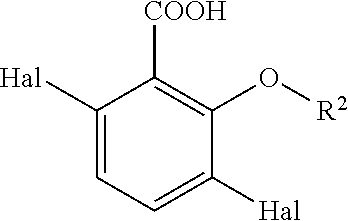
wherein R2 is —(C1-C4)alkyl, and Hal is independently as defined above.

to obtain a compound of formula (II)

wherein R2 is —(C1-C4)alkyl, and Hal is independently selected from —F, —Cl, —Br, or —I.

can be converted to compounds of formula (II)

wherein R1 is —COOH, and Hal is independently selected from —F, —Cl, —Br, or —I.


Hydroxylation of Dihalogen Substituted Benzoic Acid Derivatives


Hydroxylation of Dihalogen Substituted Benzoic Acid Esters or Phenylketones


Claims (7)


Priority Applications (1)
| Application Number | Priority Date | Filing Date | Title |
|---|---|---|---|
| US15/102,353 US10087133B2 (en) | 2013-12-11 | 2014-12-10 | Process for providing dihalogen substituted salicylic acid derivatives |
Applications Claiming Priority (6)
| Application Number | Priority Date | Filing Date | Title |
|---|---|---|---|
| US201361914399P | 2013-12-11 | 2013-12-11 | |
| EP14150312 | 2014-01-07 | ||
| EP14150312.8 | 2014-01-07 | ||
| EP14150312 | 2014-01-07 | ||
| PCT/EP2014/077266 WO2015086698A1 (en) | 2013-12-11 | 2014-12-10 | Process for providing dihalogen substituted salicylic acid derivatives |
| US15/102,353 US10087133B2 (en) | 2013-12-11 | 2014-12-10 | Process for providing dihalogen substituted salicylic acid derivatives |
Publications (2)
| Publication Number | Publication Date |
|---|---|
| US20160311747A1 US20160311747A1 (en) | 2016-10-27 |
| US10087133B2 true US10087133B2 (en) | 2018-10-02 |
Family
ID=49885158
Family Applications (1)
| Application Number | Title | Priority Date | Filing Date |
|---|---|---|---|
| US15/102,353 Expired - Fee Related US10087133B2 (en) | 2013-12-11 | 2014-12-10 | Process for providing dihalogen substituted salicylic acid derivatives |
Country Status (3)
| Country | Link |
|---|---|
| US (1) | US10087133B2 (en) |
| CN (1) | CN105939989A (en) |
| WO (1) | WO2015086698A1 (en) |
Families Citing this family (12)
| Publication number | Priority date | Publication date | Assignee | Title |
|---|---|---|---|---|
| CN105593196A (en) | 2013-10-04 | 2016-05-18 | 巴斯夫欧洲公司 | Selective hydrolysis and alcoholysis of chlorobenzene |
| US10087133B2 (en) | 2013-12-11 | 2018-10-02 | Basf Se | Process for providing dihalogen substituted salicylic acid derivatives |
| CN106232604A (en) | 2014-04-17 | 2016-12-14 | 巴斯夫欧洲公司 | Substituted pyridine compounds with herbicidal activity |
| AR100506A1 (en) | 2014-05-19 | 2016-10-12 | Basf Se | PROCESS OF OBTAINING THE DICAMBA HERBICIDE |
| US10167297B2 (en) | 2014-10-24 | 2019-01-01 | Basf Se | Substituted pyridine compounds having herbicidal activity |
| WO2016180642A1 (en) | 2015-05-08 | 2016-11-17 | BASF Agro B.V. | A process for the preparation of terpinolene epoxide |
| WO2016180614A1 (en) | 2015-05-08 | 2016-11-17 | Basf Se | A process for the preparation of limonene-4-ol |
| CN105294419A (en) * | 2015-11-18 | 2016-02-03 | 江苏联化科技有限公司 | Synthesis methods of 3, 6-dichloro-2-methoxybenzoic acid and its intermediate |
| KR20190017924A (en) | 2016-06-15 | 2019-02-20 | 바스프 아그로 비.브이. | Epoxidation method of tetra-substituted alkene |
| ES2877169T3 (en) | 2016-06-15 | 2021-11-16 | Basf Agro Bv | Procedure for the epoxidation of a tetra-substituted alkene |
| CN109180439A (en) * | 2018-10-22 | 2019-01-11 | 江苏长青农化股份有限公司 | A kind of synthetic method of dicamba |
| CN114163325B (en) * | 2020-09-11 | 2024-06-28 | 江苏优嘉植物保护有限公司 | Method for synthesizing dicamba by using continuous flow reactor |
Citations (24)
| Publication number | Priority date | Publication date | Assignee | Title |
|---|---|---|---|---|
| US2799714A (en) | 1955-01-24 | 1957-07-16 | Dow Chemical Co | Method of hydrolyzing di-and trichlorobenzenes |
| US3013054A (en) | 1958-08-04 | 1961-12-12 | Velsicol Chemical Corp | 2-methoxy-3, 6-dichlorobenzoates |
| US3399034A (en) | 1965-12-06 | 1968-08-27 | Aquitaine Organico Soc | Process for the preparation of nitrosyl sulphuric acid |
| US3726929A (en) | 1968-02-09 | 1973-04-10 | Coalite And Chem Prod Ltd | Process for the production of dihalophenols |
| GB1404435A (en) | 1972-03-03 | 1975-08-28 | Dynamit Nobel Ag | Preparation of phenyl ethers and phenols |
| DE2509407A1 (en) | 1974-03-07 | 1975-09-11 | Hodogaya Chemical Co Ltd | PROCESS FOR PRODUCING MULTIPLE HALOGENATED PHENOLS |
| US4094913A (en) | 1977-01-07 | 1978-06-13 | Velsicol Chemical Corporation | Process for the preparation of 2,5-dichlorophenol |
| US4161611A (en) | 1976-02-23 | 1979-07-17 | Veesicol Chemical Corporation | Process for the production of 2-methoxy-3,6-dichlorobenzoic acid |
| US4232172A (en) | 1977-03-05 | 1980-11-04 | Celamerck Gmbh & Co. Kg | Process for the preparation of 3,6-dichloro-salicyclic |
| DE3512877C1 (en) | 1985-04-11 | 1986-11-27 | Joachim 2000 Hamburg Falenski | Process for the recovery of 2,5-dichlorophenol from a mixture of isomers with 2,4-dichlorophenol |
| JPH01149715A (en) | 1987-12-08 | 1989-06-12 | Lion Corp | Skin-cleaning agent composition |
| WO2001083417A1 (en) | 2000-05-03 | 2001-11-08 | Bayer Cropscience Ag | Method for producing 2-alkyl-3-chlorophenols |
| CN102125035A (en) | 2010-12-13 | 2011-07-20 | 上海力智生化科技有限公司 | Preparation process of herbicide dicamba |
| CN102295552A (en) | 2011-07-11 | 2011-12-28 | 华东理工大学 | Method for increasing yield of 3,6-dichloro-2-hydroxybenzoic acid |
| CN102516072A (en) | 2011-12-13 | 2012-06-27 | 江苏长青农化股份有限公司 | Preparation method of benzoic acid herbicide dicamba |
| CN102838457A (en) | 2012-09-20 | 2012-12-26 | 山东潍坊润丰化工有限公司 | Synthesis method of 2, 5-dichlorophenol |
| WO2015049360A1 (en) | 2013-10-04 | 2015-04-09 | Basf Se | Selective hydrolysis and alcoholysis of chlorinated benzenes |
| WO2015049160A1 (en) | 2013-10-04 | 2015-04-09 | Basf Se | Process for hydrolyzing 1,2,4-trihalobenzene |
| WO2015067494A1 (en) | 2013-11-08 | 2015-05-14 | Basf Se | Process for providing dihalogen substituted salicylic acid derivatives |
| WO2015082415A1 (en) | 2013-12-04 | 2015-06-11 | Basf Se | Process for purifying 2,5-dichlorophenol |
| WO2015082422A2 (en) | 2013-12-04 | 2015-06-11 | Basf Se | Process for reacting chemical compounds |
| WO2015086698A1 (en) | 2013-12-11 | 2015-06-18 | Basf Se | Process for providing dihalogen substituted salicylic acid derivatives |
| WO2015095284A1 (en) | 2013-12-18 | 2015-06-25 | Monsanto Technology Llc | Processes for the diazotization of 2,5-dichloroanilines |
| WO2015124651A1 (en) | 2014-02-21 | 2015-08-27 | Basf Se | Process for producing 2,5-dihalophenolethers |
-
2014
- 2014-12-10 US US15/102,353 patent/US10087133B2/en not_active Expired - Fee Related
- 2014-12-10 CN CN201480074645.8A patent/CN105939989A/en active Pending
- 2014-12-10 WO PCT/EP2014/077266 patent/WO2015086698A1/en not_active Ceased
Patent Citations (25)
| Publication number | Priority date | Publication date | Assignee | Title |
|---|---|---|---|---|
| US2799714A (en) | 1955-01-24 | 1957-07-16 | Dow Chemical Co | Method of hydrolyzing di-and trichlorobenzenes |
| US3013054A (en) | 1958-08-04 | 1961-12-12 | Velsicol Chemical Corp | 2-methoxy-3, 6-dichlorobenzoates |
| US3399034A (en) | 1965-12-06 | 1968-08-27 | Aquitaine Organico Soc | Process for the preparation of nitrosyl sulphuric acid |
| US3726929A (en) | 1968-02-09 | 1973-04-10 | Coalite And Chem Prod Ltd | Process for the production of dihalophenols |
| GB1404435A (en) | 1972-03-03 | 1975-08-28 | Dynamit Nobel Ag | Preparation of phenyl ethers and phenols |
| DE2509407A1 (en) | 1974-03-07 | 1975-09-11 | Hodogaya Chemical Co Ltd | PROCESS FOR PRODUCING MULTIPLE HALOGENATED PHENOLS |
| US4005151A (en) | 1974-03-07 | 1977-01-25 | Hodogaya Chemical Co., Ltd. | Process for producing polyhalogenated phenols |
| US4161611A (en) | 1976-02-23 | 1979-07-17 | Veesicol Chemical Corporation | Process for the production of 2-methoxy-3,6-dichlorobenzoic acid |
| US4094913A (en) | 1977-01-07 | 1978-06-13 | Velsicol Chemical Corporation | Process for the preparation of 2,5-dichlorophenol |
| US4232172A (en) | 1977-03-05 | 1980-11-04 | Celamerck Gmbh & Co. Kg | Process for the preparation of 3,6-dichloro-salicyclic |
| DE3512877C1 (en) | 1985-04-11 | 1986-11-27 | Joachim 2000 Hamburg Falenski | Process for the recovery of 2,5-dichlorophenol from a mixture of isomers with 2,4-dichlorophenol |
| JPH01149715A (en) | 1987-12-08 | 1989-06-12 | Lion Corp | Skin-cleaning agent composition |
| WO2001083417A1 (en) | 2000-05-03 | 2001-11-08 | Bayer Cropscience Ag | Method for producing 2-alkyl-3-chlorophenols |
| CN102125035A (en) | 2010-12-13 | 2011-07-20 | 上海力智生化科技有限公司 | Preparation process of herbicide dicamba |
| CN102295552A (en) | 2011-07-11 | 2011-12-28 | 华东理工大学 | Method for increasing yield of 3,6-dichloro-2-hydroxybenzoic acid |
| CN102516072A (en) | 2011-12-13 | 2012-06-27 | 江苏长青农化股份有限公司 | Preparation method of benzoic acid herbicide dicamba |
| CN102838457A (en) | 2012-09-20 | 2012-12-26 | 山东潍坊润丰化工有限公司 | Synthesis method of 2, 5-dichlorophenol |
| WO2015049360A1 (en) | 2013-10-04 | 2015-04-09 | Basf Se | Selective hydrolysis and alcoholysis of chlorinated benzenes |
| WO2015049160A1 (en) | 2013-10-04 | 2015-04-09 | Basf Se | Process for hydrolyzing 1,2,4-trihalobenzene |
| WO2015067494A1 (en) | 2013-11-08 | 2015-05-14 | Basf Se | Process for providing dihalogen substituted salicylic acid derivatives |
| WO2015082415A1 (en) | 2013-12-04 | 2015-06-11 | Basf Se | Process for purifying 2,5-dichlorophenol |
| WO2015082422A2 (en) | 2013-12-04 | 2015-06-11 | Basf Se | Process for reacting chemical compounds |
| WO2015086698A1 (en) | 2013-12-11 | 2015-06-18 | Basf Se | Process for providing dihalogen substituted salicylic acid derivatives |
| WO2015095284A1 (en) | 2013-12-18 | 2015-06-25 | Monsanto Technology Llc | Processes for the diazotization of 2,5-dichloroanilines |
| WO2015124651A1 (en) | 2014-02-21 | 2015-08-27 | Basf Se | Process for producing 2,5-dihalophenolethers |
Non-Patent Citations (27)
| Title |
|---|
| Cresp et al., "Synthesis of Piloquinone, a Metabolite of Streptomyces Pilosus Ettlinger," Journal of the Chemical Society, 1974, pp 2435-2447. |
| Decrauw, TH. "The principle of induced alternating polarity in connection with the reacions of derivatives of p-dichlorobenzene and other compounds with sodium methylate", Recueil des travaux chimiques des pays-Bas, Elsevier science Publishes. Amerdam, NL, Jan. 1, 1931, vol. 50, p. 753-792. |
| Final Office Action, issued in co-pending U.S. Appl. No. 15/026,878, dated May 24, 2017. |
| Finger et al., "Aromatic Fluorine Compounds. VIII. Plant Growth Regulators and Intermediates," Journal of the American Chemical Society, vol. 81, (1959), pp. 94-101. |
| Hashimoto et al., "Hydrolysis of 1,2,4-Trichlorobenzene," The Doshisha Engineering Review, vol. 8, No. 2, (1957), pp. 76-79. |
| HOLLEMAN M. A. F.: "Les trois trichlorobenzènes et leur réaction avec le méthylate de sodium", RECUEIL DES TRAVAUX CHIMIQUES DES PAYS-BAS, ELSEVIER SCIENCE PUBLISHERS, AMSTERDAM, NL, vol. 37, no. 7, 1 January 1918 (1918-01-01), Amsterdam, NL, pages 195 - 204, XP002723298, ISSN: 0165-0513, DOI: 10.1002/recl.19180370703 |
| Holleman, "Les Trois Trichlorobenzenes et Leur Reactoin avec le Methylate de Sodium," Recueil des Travaux Chimiques des Pays-Bas et de la Belique, vol. 37, (1918), pp. 195-204 (XP-002723298). |
| Holleman, M.A.F., "Les trois trichorobenzenes et leur reaction avea le methylate de sodium", Recueil des travaux chimiques des pays-bas et de la belique, 1918, p. 195-204, vol. 37. |
| International Preliminary Report on Patentability, issued in PCT/EP2014/077266, dated Jun. 14, 2016. |
| International Search Report, issued in PCT/EP2014/077266, dated Feb. 19, 2015. |
| Kraay, G.M. "L'action du methylate de sodium sur quelques derivres de l'orthodichlorobenzene" Recueil des travaux chimiques des pays-bas, Elsevier Science Publishers, Jan. 1931, p. 753-792, vol. 50. |
| Li et al., "Pd(OAc)2-Catalyzed Alkoxylation of Arylnitriles via sp2 C-H Bond Activation Using Cyano as the Directing Group," The Journal of Organic Chemistry, vol. 77, No. 18, (2012), pp. 8362-8366. |
| Li et al., "Preparation of Monofluorophenols via the Reaction of Difluorobenzene Derivatives with Potassium Trimethylsilanoate," SynLett, vol. 2009, No. 4, (2009), pp. 633-637. |
| Lin et al., "Synthesis of Chlorinated and Non-Chlorinated Biphenyl-2,3- and 3,4-catechols and Their [2H3]-isotopomers," Org. Biomol. Chem., vol. 2, (2004), pp. 2624-2629. |
| Methoxide Catalysts in Biodiesel Production, (2012), retrieved from http://articles.extension.org/pages/26615/methoxide-catalysts-in-biodiesel-production, pp. 1-3. |
| Noelting et al., "Zur Kenntniss des Amido-p-dichlorbenzols," Berichte der Deutschen Chemischen Gesellschaft, (1905), p. 3506. |
| Office Action, issued in co-pending U.S. Appl. No. 15/026,878, dated Dec. 11, 2017. |
| Office Action, issued in co-pending U.S. Appl. No. 15/026,878, dated Jan. 9, 2017. |
| Office Action, issued in co-pending U.S. Appl. No. 15/311,951, dated Jul. 26, 2017. |
| Office Action, issued in corresponding CN Application No. 201480074645.8, dated 2016. |
| Ouellet, S. et al., "Regioselective SNAr reactions of substituted diflourobenzene derivatives: practical synthesis of fluoroaryl ethers and substituted resorcinols", Tetrahedron Letters, Jul. 8, 2009, p. 3776-3779, vol. 50, No. 27. |
| Schmitz et al., "Ortho-Specific Bromination of Phenols," Journal für praktische Chemie, 1985, vol. 327, No. 6, pp. 998-1006. |
| Shan et al., "Pd-Catalyzed C-H Oxygenation with TFA/TFAA: Expedient Access to Oxygen-Containing Heterocycles and Late-Stage Drug Modification," Angew. Chem. Int. Ed., vol. 51, (2012), pp. 13070-13074. |
| Smith, M.S. et al., "March's Advanced Organic Chemistry" 5th Edition, 2001, p. 860-861, John Wiley & Sons, Inc. , New York, USA. |
| Testaferri, L., et al., "The reactions of unactivated aryl halides with sodium methoxide in HPMA", Tetrahedron, 1983, p. 193-197, vol. 29, No. 1. |
| Verloop et al., "Use of Linear Free Energy Related and Other Parameters in the Study of Fungicidal Selectivity," Pesticide Science, vol. 7, No. 4, (1976), pp. 379-390. |
| Zhang et al., "Pd(II)-Catalyzed Hydroxylation of Arenes with 1 atm of O2 or Air," Journal of the American Chemical Society, vol. 131, No. 41, (2009), pp. 14654-14655. |
Also Published As
| Publication number | Publication date |
|---|---|
| CN105939989A (en) | 2016-09-14 |
| US20160311747A1 (en) | 2016-10-27 |
| WO2015086698A1 (en) | 2015-06-18 |
Similar Documents
| Publication | Publication Date | Title |
|---|---|---|
| US20160311747A1 (en) | Process for Providing Dihalogen Substituted Salicylic Acid Derivatives | |
| CN103687831B (en) | Process for preparing 2,2-difluoroethanol | |
| Krylov et al. | Cross-dehydrogenative coupling for the intermolecular C–O bond formation | |
| JP3921238B2 (en) | Benzoyl derivatives and their synthesis | |
| EP3052462B1 (en) | Selective hydrolysis and alcoholysis of chlorinated benzenes | |
| US9643909B2 (en) | Process for hydrolyzing 1,2,4-trihalobenzene | |
| JP4705593B2 (en) | Process for producing α-hydroxycarboxylic acids and esters thereof | |
| US8067597B2 (en) | Synthetic route to 14-hydroxyl opiates through 1-halo-thebaine or analogs | |
| US9920004B2 (en) | Method for producing phenolic compound | |
| CN102863319A (en) | Novel carboxylic acid compound, use thereof, and process for producing the same | |
| CN101208288B (en) | The manufacture method of substituted cyclopentanone | |
| WO2019047654A1 (en) | Method for preparing substituted phenylacetic acid derivative | |
| JP6669962B2 (en) | Method for producing α, α-difluoroacetaldehyde | |
| CN100408544C (en) | The synthetic method of glycolate | |
| JPH05246943A (en) | Method for preparation of 1-fluoro-cyclopropane-1-carboxylic acid | |
| JP2008528529A5 (en) | ||
| EP0975569A1 (en) | Process for the hydroxylation of 1,4-dichlorobenzene | |
| US7342138B2 (en) | Process for producing aromatic aldehyde | |
| JP4783519B2 (en) | Method for producing 3-acyl-2-butanone | |
| KR101359230B1 (en) | Process for preparing 4-aminomethylcyclohexane carbocylic acid | |
| JP5232335B1 (en) | Process for producing 1-substituted-3-fluoroalkylpyrazole-4-carboxylic acid ester | |
| JP5036243B2 (en) | Method for producing 3,5-bis (1,1,1,3,3,3-hexafluoro-2-hydroxyisopropyl) phenol | |
| JP4979170B2 (en) | Process for producing 5-[(4-chlorophenyl) methyl] -2,2-dimethylcyclopentanone | |
| KR100408806B1 (en) | Process for Preparing 3-Hydroxy Propionic Acid and Salt from Exopide Derivative | |
| WO2008001826A1 (en) | Process for production of halogen-substituted benzenedimethanol |
Legal Events
| Date | Code | Title | Description |
|---|---|---|---|
| AS | Assignment |
Owner name: BASF SE, GERMANY Free format text: ASSIGNMENT OF ASSIGNORS INTEREST;ASSIGNORS:KLAUBER, ERIC GEORGE;RACK, MICHAEL;ZIERKE, THOMAS;AND OTHERS;SIGNING DATES FROM 20141210 TO 20150120;REEL/FRAME:038832/0235 |
|
| STCF | Information on status: patent grant |
Free format text: PATENTED CASE |
|
| FEPP | Fee payment procedure |
Free format text: MAINTENANCE FEE REMINDER MAILED (ORIGINAL EVENT CODE: REM.); ENTITY STATUS OF PATENT OWNER: LARGE ENTITY |
|
| LAPS | Lapse for failure to pay maintenance fees |
Free format text: PATENT EXPIRED FOR FAILURE TO PAY MAINTENANCE FEES (ORIGINAL EVENT CODE: EXP.); ENTITY STATUS OF PATENT OWNER: LARGE ENTITY |
|
| STCH | Information on status: patent discontinuation |
Free format text: PATENT EXPIRED DUE TO NONPAYMENT OF MAINTENANCE FEES UNDER 37 CFR 1.362 |
|
| FP | Lapsed due to failure to pay maintenance fee |
Effective date: 20221002 |