US10086910B2 - Battery system for boats - Google Patents
Battery system for boats Download PDFInfo
- Publication number
- US10086910B2 US10086910B2 US15/583,179 US201715583179A US10086910B2 US 10086910 B2 US10086910 B2 US 10086910B2 US 201715583179 A US201715583179 A US 201715583179A US 10086910 B2 US10086910 B2 US 10086910B2
- Authority
- US
- United States
- Prior art keywords
- battery
- panels
- battery panels
- inflatable boat
- connector
- Prior art date
- Legal status (The legal status is an assumption and is not a legal conclusion. Google has not performed a legal analysis and makes no representation as to the accuracy of the status listed.)
- Active
Links
- 238000004891 communication Methods 0.000 claims description 16
- 239000000463 material Substances 0.000 claims description 4
- WHXSMMKQMYFTQS-UHFFFAOYSA-N Lithium Chemical compound [Li] WHXSMMKQMYFTQS-UHFFFAOYSA-N 0.000 claims description 3
- HBBGRARXTFLTSG-UHFFFAOYSA-N Lithium ion Chemical compound [Li+] HBBGRARXTFLTSG-UHFFFAOYSA-N 0.000 claims description 3
- OJIJEKBXJYRIBZ-UHFFFAOYSA-N cadmium nickel Chemical compound [Ni].[Cd] OJIJEKBXJYRIBZ-UHFFFAOYSA-N 0.000 claims description 3
- 229910052744 lithium Inorganic materials 0.000 claims description 3
- 229910001416 lithium ion Inorganic materials 0.000 claims description 3
- 229910052987 metal hydride Inorganic materials 0.000 claims description 3
- 229920000642 polymer Polymers 0.000 claims description 3
- VNWKTOKETHGBQD-UHFFFAOYSA-N methane Chemical compound C VNWKTOKETHGBQD-UHFFFAOYSA-N 0.000 description 9
- 239000003345 natural gas Substances 0.000 description 4
- 230000005236 sound signal Effects 0.000 description 3
- 238000010586 diagram Methods 0.000 description 2
- 230000007613 environmental effect Effects 0.000 description 2
- 239000002253 acid Substances 0.000 description 1
- 230000005540 biological transmission Effects 0.000 description 1
- 230000005611 electricity Effects 0.000 description 1
- 238000005516 engineering process Methods 0.000 description 1
- 239000000446 fuel Substances 0.000 description 1
- 239000007789 gas Substances 0.000 description 1
- 230000003993 interaction Effects 0.000 description 1
- 230000013011 mating Effects 0.000 description 1
- 238000012986 modification Methods 0.000 description 1
- 230000004048 modification Effects 0.000 description 1
- 239000012858 resilient material Substances 0.000 description 1
- 230000000007 visual effect Effects 0.000 description 1
- XLYOFNOQVPJJNP-UHFFFAOYSA-N water Substances O XLYOFNOQVPJJNP-UHFFFAOYSA-N 0.000 description 1
Images
Classifications
-
- B—PERFORMING OPERATIONS; TRANSPORTING
- B63—SHIPS OR OTHER WATERBORNE VESSELS; RELATED EQUIPMENT
- B63B—SHIPS OR OTHER WATERBORNE VESSELS; EQUIPMENT FOR SHIPPING
- B63B7/00—Collapsible, foldable, inflatable or like vessels
- B63B7/06—Collapsible, foldable, inflatable or like vessels having parts of non-rigid material
- B63B7/08—Inflatable
- B63B7/082—Inflatable having parts of rigid material
-
- B—PERFORMING OPERATIONS; TRANSPORTING
- B63—SHIPS OR OTHER WATERBORNE VESSELS; RELATED EQUIPMENT
- B63H—MARINE PROPULSION OR STEERING
- B63H20/00—Outboard propulsion units, e.g. outboard motors or Z-drives; Arrangements thereof on vessels
- B63H20/007—Trolling propulsion units
-
- H—ELECTRICITY
- H01—ELECTRIC ELEMENTS
- H01M—PROCESSES OR MEANS, e.g. BATTERIES, FOR THE DIRECT CONVERSION OF CHEMICAL ENERGY INTO ELECTRICAL ENERGY
- H01M10/00—Secondary cells; Manufacture thereof
- H01M10/42—Methods or arrangements for servicing or maintenance of secondary cells or secondary half-cells
- H01M10/425—Structural combination with electronic components, e.g. electronic circuits integrated to the outside of the casing
-
- H—ELECTRICITY
- H01—ELECTRIC ELEMENTS
- H01M—PROCESSES OR MEANS, e.g. BATTERIES, FOR THE DIRECT CONVERSION OF CHEMICAL ENERGY INTO ELECTRICAL ENERGY
- H01M10/00—Secondary cells; Manufacture thereof
- H01M10/42—Methods or arrangements for servicing or maintenance of secondary cells or secondary half-cells
- H01M10/48—Accumulators combined with arrangements for measuring, testing or indicating the condition of cells, e.g. the level or density of the electrolyte
- H01M10/482—Accumulators combined with arrangements for measuring, testing or indicating the condition of cells, e.g. the level or density of the electrolyte for several batteries or cells simultaneously or sequentially
-
- H01M2/1077—
-
- H01M2/1083—
-
- H01M2/206—
-
- H—ELECTRICITY
- H01—ELECTRIC ELEMENTS
- H01M—PROCESSES OR MEANS, e.g. BATTERIES, FOR THE DIRECT CONVERSION OF CHEMICAL ENERGY INTO ELECTRICAL ENERGY
- H01M50/00—Constructional details or processes of manufacture of the non-active parts of electrochemical cells other than fuel cells, e.g. hybrid cells
- H01M50/20—Mountings; Secondary casings or frames; Racks, modules or packs; Suspension devices; Shock absorbers; Transport or carrying devices; Holders
- H01M50/249—Mountings; Secondary casings or frames; Racks, modules or packs; Suspension devices; Shock absorbers; Transport or carrying devices; Holders specially adapted for aircraft or vehicles, e.g. cars or trains
-
- H—ELECTRICITY
- H01—ELECTRIC ELEMENTS
- H01M—PROCESSES OR MEANS, e.g. BATTERIES, FOR THE DIRECT CONVERSION OF CHEMICAL ENERGY INTO ELECTRICAL ENERGY
- H01M50/00—Constructional details or processes of manufacture of the non-active parts of electrochemical cells other than fuel cells, e.g. hybrid cells
- H01M50/50—Current conducting connections for cells or batteries
- H01M50/502—Interconnectors for connecting terminals of adjacent batteries; Interconnectors for connecting cells outside a battery casing
-
- H—ELECTRICITY
- H01—ELECTRIC ELEMENTS
- H01M—PROCESSES OR MEANS, e.g. BATTERIES, FOR THE DIRECT CONVERSION OF CHEMICAL ENERGY INTO ELECTRICAL ENERGY
- H01M10/00—Secondary cells; Manufacture thereof
- H01M10/42—Methods or arrangements for servicing or maintenance of secondary cells or secondary half-cells
- H01M10/425—Structural combination with electronic components, e.g. electronic circuits integrated to the outside of the casing
- H01M2010/4271—Battery management systems including electronic circuits, e.g. control of current or voltage to keep battery in healthy state, cell balancing
-
- H—ELECTRICITY
- H01—ELECTRIC ELEMENTS
- H01M—PROCESSES OR MEANS, e.g. BATTERIES, FOR THE DIRECT CONVERSION OF CHEMICAL ENERGY INTO ELECTRICAL ENERGY
- H01M10/00—Secondary cells; Manufacture thereof
- H01M10/42—Methods or arrangements for servicing or maintenance of secondary cells or secondary half-cells
- H01M10/425—Structural combination with electronic components, e.g. electronic circuits integrated to the outside of the casing
- H01M2010/4278—Systems for data transfer from batteries, e.g. transfer of battery parameters to a controller, data transferred between battery controller and main controller
-
- H—ELECTRICITY
- H01—ELECTRIC ELEMENTS
- H01M—PROCESSES OR MEANS, e.g. BATTERIES, FOR THE DIRECT CONVERSION OF CHEMICAL ENERGY INTO ELECTRICAL ENERGY
- H01M2220/00—Batteries for particular applications
- H01M2220/20—Batteries in motive systems, e.g. vehicle, ship, plane
-
- H—ELECTRICITY
- H01—ELECTRIC ELEMENTS
- H01M—PROCESSES OR MEANS, e.g. BATTERIES, FOR THE DIRECT CONVERSION OF CHEMICAL ENERGY INTO ELECTRICAL ENERGY
- H01M50/00—Constructional details or processes of manufacture of the non-active parts of electrochemical cells other than fuel cells, e.g. hybrid cells
- H01M50/20—Mountings; Secondary casings or frames; Racks, modules or packs; Suspension devices; Shock absorbers; Transport or carrying devices; Holders
- H01M50/271—Lids or covers for the racks or secondary casings
-
- Y—GENERAL TAGGING OF NEW TECHNOLOGICAL DEVELOPMENTS; GENERAL TAGGING OF CROSS-SECTIONAL TECHNOLOGIES SPANNING OVER SEVERAL SECTIONS OF THE IPC; TECHNICAL SUBJECTS COVERED BY FORMER USPC CROSS-REFERENCE ART COLLECTIONS [XRACs] AND DIGESTS
- Y02—TECHNOLOGIES OR APPLICATIONS FOR MITIGATION OR ADAPTATION AGAINST CLIMATE CHANGE
- Y02E—REDUCTION OF GREENHOUSE GAS [GHG] EMISSIONS, RELATED TO ENERGY GENERATION, TRANSMISSION OR DISTRIBUTION
- Y02E60/00—Enabling technologies; Technologies with a potential or indirect contribution to GHG emissions mitigation
- Y02E60/10—Energy storage using batteries
Definitions
- the disclosed embodiments relates generally to electrical systems for boats. More particularly, the invention relates to battery systems for rigid inflatable boats (RIBs).
- RIBs rigid inflatable boats
- RIBs rigid inflatable hulls and conventional boats exist in different configurations and are used for recreation, military and search and rescue missions and include outboard motors attached to a transom.
- Outboard motors for RIBs and other boats are typically powered by gasoline, kerosene-type jet fuels, diesel, and biodiesels.
- the latest development in outboard motor technology includes a total electric outboard motor.
- Marine battery systems provide power for outboard motors, as well as for other electric powered accessories, including GPS, radar, and radio systems. Marine batteries are typically heavy and bulky, and the number of battery cells required to power the new totally electric outboard motors makes placement of the batteries in the boat critical so as not to place the weight in one area of the boat.
- FIG. 1 is an environmental view of a battery system mounted in a RIB according to examples of the present disclosure.
- FIG. 2 illustrates a top down view of the RIB and battery system depicted in FIG. 1 .
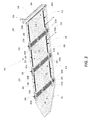
- FIG. 3 illustrates a hard deck that includes the battery system depicted in FIG. 1 .
- FIGS. 4A and 4B illustrate interconnection between adjacent battery panels according to the battery system depicted in FIG. 1 .
- FIG. 5 is an environmental view of an RIB with stacked battery panels according to the battery system depicted in FIG. 1 .
- FIG. 6 illustrates a block diagram of components of the battery system depicted in FIG. 1 .
- FIG. 1 is a perspective view of a battery system 100 that forms a hard deck 102 within a RIB 106 .
- the hard deck 102 is formed by three interlocking battery panels 110 (hereinafter “panels 110 ”) that when lock together, create a firm surface that may support personnel and equipment.
- panels 110 include a grid of interconnected rechargeable battery cells 302 , as shown in the cutaway section of panel 110 in FIG. 3 .
- the composition of battery cells 302 includes material such as Nickel Cadmium (NiCd), Nickel-Metal Hydride (NiMH), lead acid, Lithium Ion, and Lithium Polymer type batteries.
- FIG. 2 depicts a top down view of the RIB 106 and the battery system 100 depicted in FIG. 1 .
- panels 110 provide electric power to an electric outboard motor 126 and tiller control unit 210 .
- one or more of panels 110 stores natural gas which is supplied to a natural gas driven outboard motor (not shown).
- the gas filled panels 110 includes fill, relief, and output ports for the natural gas.
- FIG. 3 depicts three panels 110 interconnected via connection plate 304 to form hard deck 102 .
- Each panel 110 is formed of interconnected battery cells 302 .
- recessed edges of panels 110 are wedged into opposing sides of connection plate 304 .
- connection plate 304 is formed of a resilient material to provide flexibility in the hard deck 102 .
- a surface of connection plate 304 is textured to provide a non-skid surface.
- waterproof interconnect cables 202 provide electrical continuity and distribute status information between panels 110 via a power management system 206 that includes connectors 208 and at least one channel 220 disposed beneath or flush with the surface of the hard deck 102 .
- connectors 208 are integrated into the panels 110 and are connected to the power management system 206 .
- Connectors 208 are disposed at convenient locations in panels 110 and in an example include electric power outlets to provide electricity at a specific voltage and power.
- Connectors 208 provide one or more output voltage, e.g., 12 VDC, 24 VDC, or other voltage, directly to deck locations where the voltage is required. Connectors 208 include a communication interface to allow personnel to communicate with each other from different locations within the RIB 106 .
- the hard deck 102 include an outer covering 204 made of a waterproof and flexible material that seals each panel 110 against the marine environment and physical damage.
- outer covering 204 includes a skid proof or carpeting material.
- the hard deck 102 is expandable to support batteries of various physical types and characteristics.
- the panels 110 expand from approximately 1 ⁇ 2 inch to over one inch in depth to support different battery types.
- FIGS. 4A and 4B depict two examples of the interconnection between adjacent panels 110 .
- a connection plate 405 receives recessed edges 416 of adjacent panels 110 such that an upper surface of the connection panel lies flush with upper surfaces 412 of the panels 110 .
- FIG. 4A depicts one end 202 a of interconnect cable 202 keyed to mate with a positive battery terminal 402 a disposed within panel 110 , and a second end 202 b of interconnect cable 202 mating with a negative battery terminal 402 b of panel 110 .
- two adjacent panels 110 may be connected positive battery terminal to negative battery terminal or negative battery terminal to positive battery terminal.
- channels 410 are recessed in the upper surfaces 412 of panels 110 to receive interconnect cables 202 and 408 and connector plate 405 so that the hard deck 102 presents no protrusions that might create a tripping hazard.
- FIG. 4B depicts an example in which an interconnect cable 408 a includes two of a same connector 202 a to provide connectivity between a positive battery terminal 402 a of one panel 110 and a positive battery terminal 402 a of an adjacent panel 110 .
- Interconnect cable 408 b includes two connectors 202 b to provide connectivity between two negative battery terminals on adjacent panels 110 .
- different configurations of interconnect cables 202 , 408 a , and 408 b allow panels 110 to be interconnected in series and/or in parallel to provide one or more required voltages and power requirements.
- the positive ( 402 a ) and negative ( 402 b ) battery terminals in panel 110 may be generic and require a same connector type, thus permitting a single panel interconnect cable type to be used for all configurations.
- FIG. 5 depicts panels 110 folded or stacked within RIB 106 .
- the battery system 100 including panels 110 , are easily disassembled, stored, transported, and reassembled in another RIB 106 .
- the power management system 206 includes at least one status indicator 212 to provide status information, e.g., full, medium, and low, for the battery system 100 , including status information for each of the panels 110 .
- FIG. 6 depicts a block diagram of the battery system 100 incorporated into the hard deck 102 .
- the battery system 100 supports a charging system 606 connected to the power management system 206 .
- charging system 606 includes a conventional AC/DC battery charger, a generator, and/or an array of solar cells.
- a DC/AC converter 408 is connected to the power management system 206 to provide AC power to AC driven equipment.
- FIG. 6 depicts the battery system 100 providing power to the following devices.
- Electric start and throttle control 610 to start and control outboard motor 126 .
- Rechargeable devices 612 including, e.g., phones, computers, etc.
- a sonar system 614 built into an underneath portion of the hard deck 102 .
- Communications system 615 includes a computer 616 , one or more radio systems 618 to communicate with a diver or other personnel within the RIB 106 , and a Global Positioning System (GPS) receiver 620 or other location determining device, e.g., an Inertial Navigation System (INS).
- GPS Global Positioning System
- INS Inertial Navigation System
- communication system 615 includes a wired and/or wireless interface to allow communication with personnel within the RIB 106 via a communication channel integrated within the power and status distribution system 206 .
- an automated pilot system 622 is integrated into the communication system 615 .
- the automated pilot system 622 includes a heading sensor, e.g., a fluxgate compass, and either a dedicated course computer or an interface to computer 616 .
- the automated pilot system 622 is connected to the tiller control unit 210 , e.g., a motor, hydraulic pump, or lead screw mechanism, the tiller control unit 210 to move a tiller of the outboard motor 126 based upon commands from of the automated pilot system 622 .
- an underwater hydrophone 626 and a waterproof acoustic pinging device (“pinger”) 624 allow for tracking of a diver.
- the pinger 624 is removably inserted into the communications system 615 .
- the computer 616 is continuously updated with the location of the RIB based on data from the GPS receiver 620 .
- the computer 616 records the location at which the pinger 624 was removed, allowing the RIB 106 to return to the recorded location.
- the pinger 624 is activated automatically when submerged in water, and sends out an audio signal at specific intervals to aid a diver in underwater navigation.
- the pinger 624 transmits an audio signal in the mid-frequency range (20-50 kHz), or in the low-frequency range (11-16 kHz) depending upon the required transmission range.
- the audio signal is picked up by the underwater hydrophone 626 , which in an example is mounted to the RIB 106 or carried by a diver.
- the hydrophone 626 relays decibel intensity to a user via a visual or audible interface.
- the battery system 100 allows the RIB 106 to automatically navigate away from a recorded location after dropping off a diver and pinging device 624 .
- computer 616 is programmed to cause the RIB 106 to automatically return to the location without user interaction after a predetermined amount of time or upon receipt of a signal from the diver via radio system 618 .
Landscapes
- Engineering & Computer Science (AREA)
- Chemical & Material Sciences (AREA)
- General Chemical & Material Sciences (AREA)
- Chemical Kinetics & Catalysis (AREA)
- Electrochemistry (AREA)
- Mechanical Engineering (AREA)
- Combustion & Propulsion (AREA)
- Ocean & Marine Engineering (AREA)
- Manufacturing & Machinery (AREA)
- Microelectronics & Electronic Packaging (AREA)
- Aviation & Aerospace Engineering (AREA)
- Charge And Discharge Circuits For Batteries Or The Like (AREA)
- Battery Mounting, Suspending (AREA)
Abstract
A battery system for providing electric power to a boat includes a hard deck that includes a plurality of interconnected battery panels and output power connectors. Each of the battery panels includes an array of interconnected battery cells. A connection plate receives recessed edges of adjacent battery panels and interconnect cables connect battery terminals of the adjacent battery panels.
Description
The present Application for Patent claims priority to U.S. Provisional Application No. 62/329,558 entitled “Battery Electric System for Boats” filed Apr. 29, 2016, assigned to the assignee hereof and hereby expressly incorporated by reference herein.
The disclosed embodiments relates generally to electrical systems for boats. More particularly, the invention relates to battery systems for rigid inflatable boats (RIBs).
RIBs, rigid inflatable hulls and conventional boats exist in different configurations and are used for recreation, military and search and rescue missions and include outboard motors attached to a transom.
Outboard motors for RIBs and other boats are typically powered by gasoline, kerosene-type jet fuels, diesel, and biodiesels. The latest development in outboard motor technology includes a total electric outboard motor.
Marine battery systems provide power for outboard motors, as well as for other electric powered accessories, including GPS, radar, and radio systems. Marine batteries are typically heavy and bulky, and the number of battery cells required to power the new totally electric outboard motors makes placement of the batteries in the boat critical so as not to place the weight in one area of the boat.
The embodiments are described in detail in the following description with reference to the following figures. The figures illustrate examples of the embodiments.
For simplicity and illustrative purposes, the principles of the embodiments are described by referring mainly to examples thereof. In the following description, numerous specific details are set forth in order to provide a thorough understanding of the embodiments. It is apparent that the embodiments may be practiced without limitation to all the specific details.
When panels 110 are interlocked, waterproof interconnect cables 202 provide electrical continuity and distribute status information between panels 110 via a power management system 206 that includes connectors 208 and at least one channel 220 disposed beneath or flush with the surface of the hard deck 102. In an example, connectors 208 are integrated into the panels 110 and are connected to the power management system 206. Connectors 208 are disposed at convenient locations in panels 110 and in an example include electric power outlets to provide electricity at a specific voltage and power.
The hard deck 102 include an outer covering 204 made of a waterproof and flexible material that seals each panel 110 against the marine environment and physical damage. In an example, outer covering 204 includes a skid proof or carpeting material. The hard deck 102 is expandable to support batteries of various physical types and characteristics. In an example, the panels 110 expand from approximately ½ inch to over one inch in depth to support different battery types.
In one example, FIG. 4A depicts one end 202 a of interconnect cable 202 keyed to mate with a positive battery terminal 402 a disposed within panel 110, and a second end 202 b of interconnect cable 202 mating with a negative battery terminal 402 b of panel 110. As such, depending on the orientation of connectors 202 a and 202 b on interconnect cable 202, two adjacent panels 110 may be connected positive battery terminal to negative battery terminal or negative battery terminal to positive battery terminal.
In an example, channels 410 are recessed in the upper surfaces 412 of panels 110 to receive interconnect cables 202 and 408 and connector plate 405 so that the hard deck 102 presents no protrusions that might create a tripping hazard.
Still further, FIG. 4B depicts an example in which an interconnect cable 408 a includes two of a same connector 202 a to provide connectivity between a positive battery terminal 402 a of one panel 110 and a positive battery terminal 402 a of an adjacent panel 110. Interconnect cable 408 b includes two connectors 202 b to provide connectivity between two negative battery terminals on adjacent panels 110. As such, different configurations of interconnect cables 202, 408 a, and 408 b allow panels 110 to be interconnected in series and/or in parallel to provide one or more required voltages and power requirements. Still further, in another example (not shown), the positive (402 a) and negative (402 b) battery terminals in panel 110 may be generic and require a same connector type, thus permitting a single panel interconnect cable type to be used for all configurations.
In an example, FIG. 6 depicts the battery system 100 providing power to the following devices.
Electric start and throttle control 610 to start and control outboard motor 126.
A sonar system 614 built into an underneath portion of the hard deck 102.
In an example, an automated pilot system 622 is integrated into the communication system 615. In an example, the automated pilot system 622 includes a heading sensor, e.g., a fluxgate compass, and either a dedicated course computer or an interface to computer 616. The automated pilot system 622 is connected to the tiller control unit 210, e.g., a motor, hydraulic pump, or lead screw mechanism, the tiller control unit 210 to move a tiller of the outboard motor 126 based upon commands from of the automated pilot system 622.
In an example, an underwater hydrophone 626 and a waterproof acoustic pinging device (“pinger”) 624 allow for tracking of a diver. The pinger 624 is removably inserted into the communications system 615. In an example, while the pinger 624 is inserted in the communications system 615, the computer 616 is continuously updated with the location of the RIB based on data from the GPS receiver 620. When the pinger 624 is removed from the communication system 615, the computer 616 records the location at which the pinger 624 was removed, allowing the RIB 106 to return to the recorded location. In an example, the pinger 624 is activated automatically when submerged in water, and sends out an audio signal at specific intervals to aid a diver in underwater navigation. In an example, the pinger 624 transmits an audio signal in the mid-frequency range (20-50 kHz), or in the low-frequency range (11-16 kHz) depending upon the required transmission range. The audio signal is picked up by the underwater hydrophone 626, which in an example is mounted to the RIB 106 or carried by a diver. The hydrophone 626 relays decibel intensity to a user via a visual or audible interface.
In an example, under control of computer 616, the tiller control unit 210, and the electric start and throttle control 610, the battery system 100 allows the RIB 106 to automatically navigate away from a recorded location after dropping off a diver and pinging device 624. In an example, computer 616 is programmed to cause the RIB 106 to automatically return to the location without user interaction after a predetermined amount of time or upon receipt of a signal from the diver via radio system 618.
While the foregoing disclosure shows illustrative embodiments, it should be noted that various changes and modifications could be made herein without departing from the scope of the described embodiments as defined by the appended claims.
Furthermore, although elements of the described embodiments may be described or claimed in the singular, the plural is contemplated unless limitation to the singular is explicitly stated.
Claims (13)
1. An inflatable boat comprising:
A deck disposed in a bottom of the boat formed from a plurality of interlocking battery panels, wherein each battery panel of the plurality of battery panels includes an array of interconnected battery cells, wherein each battery panel includes at least two battery terminals to provide a DC output voltage, and wherein at least one of the at least two battery terminals of adjacent battery panels is a positive terminal and another of the at least two battery terminals is a negative terminal;
a connection plate to receive a recessed edge of adjacent battery panels of the plurality of battery panels, wherein the connection plate lies flush with upper and lower surfaces of the plurality of battery panels; and
a power management system, including:
interconnect cables to interconnect the battery terminals of the adjacent battery panels, wherein each interconnect cable of the interconnect cables comprises a first connector and a second connector different from the first connector, wherein the first connector is keyed to connect to the positive terminal and the second connector is keyed to connect to the negative terminal, and
wherein channels are recessed within the adjacent battery panels, and the interconnect cables are disposed within the channels and lay flush with an upper surface of the adjacent battery panels;
at least one electric power outlet disposed in the deck; and
a battery status indicator interface to receive and output status information from each of the plurality of battery panels.
2. The inflatable boat according to claim 1 , wherein the boat is a rigid inflatable boat and the plurality of battery panels are expandable from ½ inch to over one inch in depth.
3. The inflatable boat according to claim 1 , wherein the power management system includes a status indicator to provide status information for each of the plurality of battery panels.
4. The inflatable boat according to claim 1 , further comprising a communication system, the communication system including a computer, a radio system, a GPS receiver, and an automated pilot system.
5. The inflatable boat according to claim 4 , further comprising a tiller control unit connected to the communication system.
6. The inflatable boat according to claim 5 , further comprising a waterproof acoustic pinging device removeably inserted into the communication system, wherein the computer records a current location of the boat in response to an indication that the pinging device is removed from the communication system.
7. The inflatable boat according to claim 1 , wherein the deck further comprising a plurality of electric power outlets to provide at least one DC voltage to at least one electrical device.
8. The inflatable boat according to claim 1 , wherein the array of interconnected battery cells comprise at least one of Nickel Cadmium (NiCd), Nickel-Metal Hydride (NiMH), Lithium Ion, and Lithium Polymer type batteries cells.
9. The inflatable boat according to claim 1 , wherein the deck comprises an outer covering of a skid proof material.
10. An inflatable boat, comprising:
a deck comprising a plurality of battery panels disposed in a bottom of the inflatable boat, wherein each battery panel of the plurality of battery panels includes:
an array of interconnected battery cells;
recessed edges to be received by a connection plate;
at least two battery terminals to provide a DC output voltage, wherein at least one of the at least two battery terminals of the adjacent battery panels is a positive terminal and another of the at least two battery terminals is a negative terminal;
at least one electrical and communication channel recessed within the battery panel; and
at least one output power connector;
a connection plate to receive the recessed edges of adjacent battery panels of the plurality of battery panels; and
a power management system, including:
interconnect cables to interconnect the battery terminals of the adjacent battery panels, wherein the interconnect cables are to lie flush with upper surfaces of the adjacent battery panels, wherein each interconnect cable of the interconnect cables comprises a first connector and a second connector different from the first connector, wherein the first connector is keyed to connect to the positive terminal and the second connector is keyed to connect to the negative terminal, and
wherein channels are recessed within the adjacent battery panels, and the interconnect cables are disposed within the channels and lay flush with an upper surface of the adjacent battery panels;
at least one electric power outlet disposed in at least one of the plurality of battery panels; and
a status indicator interface to receive and output status information from each of the plurality of battery panels.
11. The inflatable boat according to claim 10 , wherein the plurality of battery panels are expandable from ½ inch to over one inch in depth.
12. The inflatable boat according to claim 10 , wherein the deck further comprising a plurality of electric power outlets to provide at least one DC voltage to at least one electrical device.
13. The inflatable boat according to claim 10 , wherein the array of interconnected battery cells comprise at least one of Nickel Cadmium (NiCd), Nickel-Metal Hydride (NiMH), Lithium Ion, and Lithium Polymer type batteries cells.
Priority Applications (1)
| Application Number | Priority Date | Filing Date | Title |
|---|---|---|---|
| US15/583,179 US10086910B2 (en) | 2016-04-29 | 2017-05-01 | Battery system for boats |
Applications Claiming Priority (2)
| Application Number | Priority Date | Filing Date | Title |
|---|---|---|---|
| US201662329558P | 2016-04-29 | 2016-04-29 | |
| US15/583,179 US10086910B2 (en) | 2016-04-29 | 2017-05-01 | Battery system for boats |
Publications (2)
| Publication Number | Publication Date |
|---|---|
| US20170313387A1 US20170313387A1 (en) | 2017-11-02 |
| US10086910B2 true US10086910B2 (en) | 2018-10-02 |
Family
ID=60158054
Family Applications (1)
| Application Number | Title | Priority Date | Filing Date |
|---|---|---|---|
| US15/583,179 Active US10086910B2 (en) | 2016-04-29 | 2017-05-01 | Battery system for boats |
Country Status (1)
| Country | Link |
|---|---|
| US (1) | US10086910B2 (en) |
Cited By (1)
| Publication number | Priority date | Publication date | Assignee | Title |
|---|---|---|---|---|
| EP4157714A1 (en) * | 2020-05-27 | 2023-04-05 | NAVAL Group | Device for attaching battery packs, power supply device and associated partitions |
Families Citing this family (5)
| Publication number | Priority date | Publication date | Assignee | Title |
|---|---|---|---|---|
| AU201714671S (en) * | 2017-02-16 | 2017-08-29 | Sealegs International Ltd | Amphibious Vehicle |
| CN109895942A (en) * | 2019-02-26 | 2019-06-18 | 金华起航智能设备制造有限公司 | A kind of allotype aluminum alloy stern transom plate and processing method |
| CN109760780A (en) * | 2019-02-26 | 2019-05-17 | 金华起航智能设备制造有限公司 | A kind of multidimensional aluminium alloy stern transom plate and processing method with bayonet slot girder |
| IT202100025562A1 (en) * | 2021-10-07 | 2023-04-07 | Moreno Folino | ELECTRIFIED COVERING SYSTEM FOR BOATS |
| CN116552751A (en) * | 2023-04-24 | 2023-08-08 | 江苏百舟安全科技有限公司 | A double structure inflatable lifeboat |
Citations (6)
| Publication number | Priority date | Publication date | Assignee | Title |
|---|---|---|---|---|
| US5378555A (en) | 1993-12-27 | 1995-01-03 | General Motors Corporation | Electric vehicle battery pack |
| US5567544A (en) | 1995-05-26 | 1996-10-22 | Boundless Corp. | Battery |
| US20090139781A1 (en) * | 2007-07-18 | 2009-06-04 | Jeffrey Brian Straubel | Method and apparatus for an electrical vehicle |
| US20120125702A1 (en) * | 2009-08-05 | 2012-05-24 | Thomas Bergfjord | Battery Pack, an Electric Vehicle and a Method |
| US20170015397A1 (en) * | 2015-07-13 | 2017-01-19 | Cedar Marine Propulsion, Inc. | Electric Propulsion System for Marine Applications and Method of Use |
| US20170253313A1 (en) * | 2016-03-03 | 2017-09-07 | Jacob Easterling | Autonomous underwater vehicle for aiding a scuba diver |
-
2017
- 2017-05-01 US US15/583,179 patent/US10086910B2/en active Active
Patent Citations (6)
| Publication number | Priority date | Publication date | Assignee | Title |
|---|---|---|---|---|
| US5378555A (en) | 1993-12-27 | 1995-01-03 | General Motors Corporation | Electric vehicle battery pack |
| US5567544A (en) | 1995-05-26 | 1996-10-22 | Boundless Corp. | Battery |
| US20090139781A1 (en) * | 2007-07-18 | 2009-06-04 | Jeffrey Brian Straubel | Method and apparatus for an electrical vehicle |
| US20120125702A1 (en) * | 2009-08-05 | 2012-05-24 | Thomas Bergfjord | Battery Pack, an Electric Vehicle and a Method |
| US20170015397A1 (en) * | 2015-07-13 | 2017-01-19 | Cedar Marine Propulsion, Inc. | Electric Propulsion System for Marine Applications and Method of Use |
| US20170253313A1 (en) * | 2016-03-03 | 2017-09-07 | Jacob Easterling | Autonomous underwater vehicle for aiding a scuba diver |
Cited By (1)
| Publication number | Priority date | Publication date | Assignee | Title |
|---|---|---|---|---|
| EP4157714A1 (en) * | 2020-05-27 | 2023-04-05 | NAVAL Group | Device for attaching battery packs, power supply device and associated partitions |
Also Published As
| Publication number | Publication date |
|---|---|
| US20170313387A1 (en) | 2017-11-02 |
Similar Documents
| Publication | Publication Date | Title |
|---|---|---|
| US10086910B2 (en) | Battery system for boats | |
| Allen et al. | Autonomous docking demonstrations with enhanced REMUS technology | |
| US9531199B2 (en) | Underwater charging station | |
| JP6975247B2 (en) | Submarine earthquake observation equipment and systems based on the Internet of Things on the seafloor | |
| US10011152B1 (en) | Modular submersible survey vehicle | |
| Stokey et al. | Enabling technologies for REMUS docking: an integral component of an autonomous ocean-sampling network | |
| US20190061885A1 (en) | Modular Floating Microgrid Energy Platforms | |
| US10523047B2 (en) | Autonomous ROVs with offshore power source that can return to recharge | |
| US20210101503A1 (en) | Adaptive vehicle power system | |
| US20180013115A1 (en) | Battery case for light-weight watercraft | |
| CN114825668A (en) | Wireless charging receiving end, AUV, wireless charging shelter and autonomous underwater detection system | |
| EP3902743B1 (en) | An energy management system and method of a rov | |
| EP3638534B1 (en) | Systems and methods for reducing parasitic power losses by an energy source | |
| EP3429918B1 (en) | Rechargeable autonomous rovs with an offshore power source | |
| Payne | Understanding boat batteries and battery charging | |
| CN218022072U (en) | Acoustic buoy device capable of implementing active detection of deepening | |
| Woolsey et al. | Integration of pressure-tolerant lithium ion battery modules within the Mola Mola AUV | |
| US20250033502A1 (en) | Ev charging dock system | |
| CN206070477U (en) | A kind of solar energy electric boat landing with charging pile | |
| CN223897787U (en) | Modularized control system of unmanned monitoring boat | |
| CN114777780B (en) | An underwater energy security device | |
| RU2778717C1 (en) | Geophysical laboratory for ocean-bottom seismograph stations | |
| Fan | A potential method for underwater charging | |
| Bayer | The duckling project: Design and manufacturing of autonomous surface vehicles for various application areas | |
| NO347380B1 (en) | A power source assembly |
Legal Events
| Date | Code | Title | Description |
|---|---|---|---|
| AS | Assignment |
Owner name: RAIDER OUTBOARDS, INC., FLORIDA Free format text: ASSIGNMENT OF ASSIGNORS INTEREST;ASSIGNOR:WOODRUFF, GEORGE;REEL/FRAME:042324/0604 Effective date: 20170429 |
|
| STCF | Information on status: patent grant |
Free format text: PATENTED CASE |
|
| MAFP | Maintenance fee payment |
Free format text: PAYMENT OF MAINTENANCE FEE, 4TH YR, SMALL ENTITY (ORIGINAL EVENT CODE: M2551); ENTITY STATUS OF PATENT OWNER: SMALL ENTITY Year of fee payment: 4 |