US10086074B2 - Compositions and method for light triggered release of materials from nanovesicles - Google Patents
Compositions and method for light triggered release of materials from nanovesicles Download PDFInfo
- Publication number
- US10086074B2 US10086074B2 US14/654,085 US201314654085A US10086074B2 US 10086074 B2 US10086074 B2 US 10086074B2 US 201314654085 A US201314654085 A US 201314654085A US 10086074 B2 US10086074 B2 US 10086074B2
- Authority
- US
- United States
- Prior art keywords
- pop
- liposomes
- nanovesicles
- release
- cargo
- Prior art date
- Legal status (The legal status is an assumption and is not a legal conclusion. Google has not performed a legal analysis and makes no representation as to the accuracy of the status listed.)
- Active, expires
Links
- JIIVLLKZDHECNK-UHFFFAOYSA-N CCCCCCCCCCCCCCCC(=O)OCC(COP(=O)([O-])OCC[N+](C)(C)C)OC(=O)CCC1/C2=C3\CC(=O)C4=C(C)/C(=C/C5=C(CC)C(C)=C(/C=C6\N=C(/C=C(\N2)C1C)C(C)=C6C(C)OCCCCCC)N5)N=C43 Chemical compound CCCCCCCCCCCCCCCC(=O)OCC(COP(=O)([O-])OCC[N+](C)(C)C)OC(=O)CCC1/C2=C3\CC(=O)C4=C(C)/C(=C/C5=C(CC)C(C)=C(/C=C6\N=C(/C=C(\N2)C1C)C(C)=C6C(C)OCCCCCC)N5)N=C43 JIIVLLKZDHECNK-UHFFFAOYSA-N 0.000 description 2
- 0 [1*]OC(C)C1=C(C)C2=N/C1=C\C1=C(C)C(CC)=C(/C=C3\N=C4C(=C3C)C(=O)C/C4=C3/N/C(=C\2)C(C)C3CCC(=O)OC(COC(=O)CCCCCCCCC)COP(=O)([O-])OCC[N+](C)(C)C)N1 Chemical compound [1*]OC(C)C1=C(C)C2=N/C1=C\C1=C(C)C(CC)=C(/C=C3\N=C4C(=C3C)C(=O)C/C4=C3/N/C(=C\2)C(C)C3CCC(=O)OC(COC(=O)CCCCCCCCC)COP(=O)([O-])OCC[N+](C)(C)C)N1 0.000 description 2
- ZMOPXTDQARITPL-UHFFFAOYSA-N CCCCCCCCCCCCCCCC(=O)OCC(COP(=O)([O-])OCC[N+](C)(C)C)OC(=O)CCC1/C2=C3\CC(=O)C4=C(C)/C(=C/C5=C(CC)C(C)=C(/C=C6\N=C(/C=C(\N2)C1C)C(C)=C6C(C)OCCCCCC)N5)N=C43.CCCCCCCCCCCCCCCC(=O)OCC(COP(=O)([O-])OCC[N+](C)(C)C)OC(=O)CCC1/C2=C3\CC(=O)C4=C(C)/C(=C/C5=C(CC)C(C)=C(/C=C6\N=C(/C=C(\N2)C1C)C(C)=C6C(C)OCCCCCCCC)N5)N=C43 Chemical compound CCCCCCCCCCCCCCCC(=O)OCC(COP(=O)([O-])OCC[N+](C)(C)C)OC(=O)CCC1/C2=C3\CC(=O)C4=C(C)/C(=C/C5=C(CC)C(C)=C(/C=C6\N=C(/C=C(\N2)C1C)C(C)=C6C(C)OCCCCCC)N5)N=C43.CCCCCCCCCCCCCCCC(=O)OCC(COP(=O)([O-])OCC[N+](C)(C)C)OC(=O)CCC1/C2=C3\CC(=O)C4=C(C)/C(=C/C5=C(CC)C(C)=C(/C=C6\N=C(/C=C(\N2)C1C)C(C)=C6C(C)OCCCCCCCC)N5)N=C43 ZMOPXTDQARITPL-UHFFFAOYSA-N 0.000 description 1
- YNPBICGJEMVBFJ-UHFFFAOYSA-N CCCCCCCCCCCCCCCC(=O)OCC(COP(=O)([O-])OCC[N+](C)(C)C)OC(=O)CCC1/C2=C3\CC(=O)C4=C(C)/C(=C/C5=C(CC)C(C)=C(/C=C6\N=C(/C=C(\N2)C1C)C(C)=C6C(C)OCCCCCC)N5)N=C43.CCCCCCCCCCCCCCCC(=O)OCC(COP(=O)([O-])OCC[N+](C)(C)C)OC(=O)CCC1/C2=C3\CC(=O)C4=C(C)/C(=C/C5=C(CC)C(C)=C(/C=C6\N=C(/C=C(\N2)C1C)C(C)=C6C(C)OCCCCCCCC)N5)N=C43.CCCCCCCCCCCCCCCC(=O)OCC(COP(=O)([O-])OCC[N+](C)(C)C)OC(=O)CCC1/C2=C3\CC(=O)C4=C(C)/C(=C/C5=C(CC)C(C)=C(/C=C6\N=C(/C=C(\N2)C1C)C(C)=C6C(C)OCCCCCCCCCC)N5)N=C43 Chemical compound CCCCCCCCCCCCCCCC(=O)OCC(COP(=O)([O-])OCC[N+](C)(C)C)OC(=O)CCC1/C2=C3\CC(=O)C4=C(C)/C(=C/C5=C(CC)C(C)=C(/C=C6\N=C(/C=C(\N2)C1C)C(C)=C6C(C)OCCCCCC)N5)N=C43.CCCCCCCCCCCCCCCC(=O)OCC(COP(=O)([O-])OCC[N+](C)(C)C)OC(=O)CCC1/C2=C3\CC(=O)C4=C(C)/C(=C/C5=C(CC)C(C)=C(/C=C6\N=C(/C=C(\N2)C1C)C(C)=C6C(C)OCCCCCCCC)N5)N=C43.CCCCCCCCCCCCCCCC(=O)OCC(COP(=O)([O-])OCC[N+](C)(C)C)OC(=O)CCC1/C2=C3\CC(=O)C4=C(C)/C(=C/C5=C(CC)C(C)=C(/C=C6\N=C(/C=C(\N2)C1C)C(C)=C6C(C)OCCCCCCCCCC)N5)N=C43 YNPBICGJEMVBFJ-UHFFFAOYSA-N 0.000 description 1
- MQODYUKNKZZGCG-UHFFFAOYSA-N CCCCCCCCCCCCCCCC(=O)OCC(COP(=O)([O-])OCC[N+](C)(C)C)OC(=O)CCC1/C2=C3\CC(=O)C4=C(C)/C(=C/C5=C(CC)C(C)=C(/C=C6\N=C(/C=C(\N2)C1C)C(C)=C6C(C)OCCCCCCCCCC)N5)N=C43 Chemical compound CCCCCCCCCCCCCCCC(=O)OCC(COP(=O)([O-])OCC[N+](C)(C)C)OC(=O)CCC1/C2=C3\CC(=O)C4=C(C)/C(=C/C5=C(CC)C(C)=C(/C=C6\N=C(/C=C(\N2)C1C)C(C)=C6C(C)OCCCCCCCCCC)N5)N=C43 MQODYUKNKZZGCG-UHFFFAOYSA-N 0.000 description 1
Images


Classifications
-
- A—HUMAN NECESSITIES
- A61—MEDICAL OR VETERINARY SCIENCE; HYGIENE
- A61K—PREPARATIONS FOR MEDICAL, DENTAL OR TOILETRY PURPOSES
- A61K41/00—Medicinal preparations obtained by treating materials with wave energy or particle radiation ; Therapies using these preparations
- A61K41/0028—Disruption, e.g. by heat or ultrasounds, sonophysical or sonochemical activation, e.g. thermosensitive or heat-sensitive liposomes, disruption of calculi with a medicinal preparation and ultrasounds
-
- A—HUMAN NECESSITIES
- A61—MEDICAL OR VETERINARY SCIENCE; HYGIENE
- A61K—PREPARATIONS FOR MEDICAL, DENTAL OR TOILETRY PURPOSES
- A61K31/00—Medicinal preparations containing organic active ingredients
- A61K31/70—Carbohydrates; Sugars; Derivatives thereof
- A61K31/7028—Compounds having saccharide radicals attached to non-saccharide compounds by glycosidic linkages
- A61K31/7034—Compounds having saccharide radicals attached to non-saccharide compounds by glycosidic linkages attached to a carbocyclic compound, e.g. phloridzin
- A61K31/704—Compounds having saccharide radicals attached to non-saccharide compounds by glycosidic linkages attached to a carbocyclic compound, e.g. phloridzin attached to a condensed carbocyclic ring system, e.g. sennosides, thiocolchicosides, escin, daunorubicin
-
- A—HUMAN NECESSITIES
- A61—MEDICAL OR VETERINARY SCIENCE; HYGIENE
- A61K—PREPARATIONS FOR MEDICAL, DENTAL OR TOILETRY PURPOSES
- A61K31/00—Medicinal preparations containing organic active ingredients
- A61K31/70—Carbohydrates; Sugars; Derivatives thereof
- A61K31/7042—Compounds having saccharide radicals and heterocyclic rings
- A61K31/7048—Compounds having saccharide radicals and heterocyclic rings having oxygen as a ring hetero atom, e.g. leucoglucosan, hesperidin, erythromycin, nystatin, digitoxin or digoxin
-
- A—HUMAN NECESSITIES
- A61—MEDICAL OR VETERINARY SCIENCE; HYGIENE
- A61K—PREPARATIONS FOR MEDICAL, DENTAL OR TOILETRY PURPOSES
- A61K41/00—Medicinal preparations obtained by treating materials with wave energy or particle radiation ; Therapies using these preparations
- A61K41/0057—Photodynamic therapy with a photosensitizer, i.e. agent able to produce reactive oxygen species upon exposure to light or radiation, e.g. UV or visible light; photocleavage of nucleic acids with an agent
- A61K41/0071—PDT with porphyrins having exactly 20 ring atoms, i.e. based on the non-expanded tetrapyrrolic ring system, e.g. bacteriochlorin, chlorin-e6, or phthalocyanines
-
- A—HUMAN NECESSITIES
- A61—MEDICAL OR VETERINARY SCIENCE; HYGIENE
- A61K—PREPARATIONS FOR MEDICAL, DENTAL OR TOILETRY PURPOSES
- A61K9/00—Medicinal preparations characterised by special physical form
- A61K9/10—Dispersions; Emulsions
- A61K9/127—Synthetic bilayered vehicles, e.g. liposomes or liposomes with cholesterol as the only non-phosphatidyl surfactant
-
- A—HUMAN NECESSITIES
- A61—MEDICAL OR VETERINARY SCIENCE; HYGIENE
- A61K—PREPARATIONS FOR MEDICAL, DENTAL OR TOILETRY PURPOSES
- A61K9/00—Medicinal preparations characterised by special physical form
- A61K9/10—Dispersions; Emulsions
- A61K9/127—Synthetic bilayered vehicles, e.g. liposomes or liposomes with cholesterol as the only non-phosphatidyl surfactant
- A61K9/1271—Non-conventional liposomes, e.g. PEGylated liposomes or liposomes coated or grafted with polymers
-
- A—HUMAN NECESSITIES
- A61—MEDICAL OR VETERINARY SCIENCE; HYGIENE
- A61N—ELECTROTHERAPY; MAGNETOTHERAPY; RADIATION THERAPY; ULTRASOUND THERAPY
- A61N5/00—Radiation therapy
- A61N5/06—Radiation therapy using light
- A61N5/0613—Apparatus adapted for a specific treatment
- A61N5/062—Photodynamic therapy, i.e. excitation of an agent
-
- C—CHEMISTRY; METALLURGY
- C07—ORGANIC CHEMISTRY
- C07D—HETEROCYCLIC COMPOUNDS
- C07D487/00—Heterocyclic compounds containing nitrogen atoms as the only ring hetero atoms in the condensed system, not provided for by groups C07D451/00 - C07D477/00
- C07D487/22—Heterocyclic compounds containing nitrogen atoms as the only ring hetero atoms in the condensed system, not provided for by groups C07D451/00 - C07D477/00 in which the condensed system contains four or more hetero rings
-
- A—HUMAN NECESSITIES
- A61—MEDICAL OR VETERINARY SCIENCE; HYGIENE
- A61N—ELECTROTHERAPY; MAGNETOTHERAPY; RADIATION THERAPY; ULTRASOUND THERAPY
- A61N5/00—Radiation therapy
- A61N5/06—Radiation therapy using light
- A61N2005/0658—Radiation therapy using light characterised by the wavelength of light used
Definitions
- Nanovesicles comprising the porphyrin-phospholipid compounds of the present disclosure also referred to herein as porphyrin-phospholipid nanovesicles (“PoP-NVs”) or porphyrin-phospholipid liposomes (“PoP-liposomes) provide stable cargo retention in the absence of near infrared (NIR) irradiation (650-1000 nm) radiation, and controlled release of cargo upon exposure to NIR irradiation.
- NIR near infrared
- FIG. 1 5. C LQ-BIC solar cells with R A monomer for porphyrin bilayer capable of stable cargo loading. a) Chemical structures of pyro-lipid and HPPH (Pyropheophorbide-a hexyl ether) phospolipid. b) Absorption spectra of isolated nanovesicles formed from either monomer and loaded with calcein. c) Stable cargo retention from bilayers of HPPH phospholipid (also referred to as HPPH-lipid in this disclosure), but not pyro-lipid. Both monomers were synthesized, and assembled into nanovesicles loaded with calcein at self-quenching concentrations. Nanovesicles were separated from unentrapped calcein prior to assessing fluorescence. Fluorescence emission of retained calcein in nanovesicles is shown prior or following addition of 0.25% Triton X-100 (Det.).
- FIG. 4 Demonstration of permeabilization occurs without bulk solution heating.
- FIG. 10 Example of a) HPPH phospolipid and pyro-lipid density (excluding water contribution) post 150-ns MD (molecular dynamics) simulation. b) Evolution of hydrogen bonds formed during 500 ns MD simulation. Intra- and inter-molecular hydrogen bonds for each type of porphyrin-lipid are indicated. c) Chain order parameter (Szz) for porphyrin-lipids following 500 ns MD simulation. Szz indicates order of lipid chain with respect to bilayer normal vector.
- FIG. 11 Demonstration that porphyrin-phospholipid doping enables NIR-mediated liposomal cargo unloading in the absence of bulk or nanoscale heating.
- ESR Electron spin resonance
- a) Electron spin resonance (ESR) of a PoP-liposome sample containing 1 molar % 5-DSA as a spin label, recorded at 50° C.
- b) Temperature dependence of ESR spectra of 5-DSA containing PoP-liposomes.
- 5-DSA 5-doxyl steric acid
- FIG. 13 Example of spatial and temporal control of PoP-liposome permeabilization
- b) Temporal control of cargo release in Panc-1 xenografts. Mice were imaged following intratumoral injection of 5 nmol of either free sulforhodamine B or sulforhodamine B entrapped at self-quenching concentrations in PoP-liposomes. Representative images are shown of the indicated time points and conditions. Laser activation was performed after 2 hours. Representative results shown with n 3 mice per treatment group.
- FIG. 14 Example of tunable, on-demand release of an actively loaded drug (doxorubicin) in PoP-liposomes.
- doxorubicin actively loaded drug
- a) Gel filtration demonstrating active doxorubin loading in PoP-liposomes. Over 95% of the doxorubicin was loaded in dox-PoP-liposomes using a 10:1 lipid to drug ratio at 60° C. for 1 hour.
- b) Gel filtration of liposomes following laser irradiation showing effective light-triggered release.
- FIG. 20 Example of half-life of PoP-liposomes in mice following intravenous injection.
- FIG. 22 Example of doxorubicin release from PoP-liposomes in Panc-1 cells.
- Panc-1 cells were seeded in chamber slides and incubated for 3 hours in 10% serum with 10 ⁇ g/mL doxorubicin in either free or PoP-liposomal form prior to confocal imaging.
- Laser treatment occurred at the beginning of the incubation period (658 nm, 200 mW/cm 2 , 5 minute treatment). 50 ⁇ m scale bar is shown.
- PoP-NVs porphyrin-phospholipid nanovesicles
- NIR near infrared
- the present disclosure is based on the surprising observation that a structural modification to porphyrin-phospholipid compounds imparted both 1) stable loading and 2) controlled- release properties to nanovesicles prepared from the compounds.
- the PoP-NVs of the present disclosure provide a stable bilayer and display cargo retention even at 90° C.
- rapid and controlled release was induced upon exposure to mild NIR irradiation.
- release occurred in the absence of any bulk solution photothermal heating or chemical reactions. Induced permeability can be used for both loading and unloading cargo and could be modulated by varying porphyrin doping or laser irradiation intensity and duration.
- the present disclosure provides nanovesicles and compositions comprising nanovesicles.
- the bilayer of the nanovesicles comprises porphyrin conjugates.
- the porphyrin conjugate making up some or all of the bilayer of the nanovesicles comprises porphyrins, porphyrin derivatives, porphyrin analogs, or combinations thereof.
- Exemplary porphyrins include hematoporphyrin, protoporphyrin, and tetraphenylporphyrin.
- Exemplary porphyrin derivatives include pyropheophorbides, bacteriochlorophylls, Chlorophyll A, benzoporphyrin derivatives, tetrahydroxyphenyl chlorins, purpurins, benzochlorins, naphthochlorins, verdins, rhodins, keto chlorins, azachlorins, bacteriochlorins, tolyporphyrins, and benzobacteriochlorins.
- phospholipid is a lipid having a hydrophilic head group having a phosphate group connected via a glycerol backbone to a hydrophobic lipid tail.
- the phospholipid comprises an acyl side chain of 6 to 22 carbons, including all integer number of carbons and ranges therebetween.
- the phospholipid in the porphyrin conjugate is 1-palmitoyl-2-hydroxy-sn-glycero-3-phosphocholine.
- the bilayer of the self-assembled nanovesicle further comprises PEG or PEG-lipid.
- the PEG or PEG-lipid can be DSPE-PEG such as DSPE-PEG-2000, DSPE-PEG-5000 or other sizes of DSPE-PEG.
- the PEG-lipid is present in an amount of 0-15 mol. % including all integers therebetween. In certain embodiments it is 1 to 15 mol. %, 2 to 10 mol. %, 4 to 6 mol. %. In one embodiment, it is 5 mol. %.
- the bilayer of the nanovesicles also comprises other phospholipids.
- the fatty acid chains of these phospholipids may contain a suitable number of carbon atoms to form bilayer.
- the fatty acid chain may contain 12, 14, 16, 18 or 20 carbon atoms.
- the bilayer may comprise phosphatidylcholine, phosphatidylethanoloamine, phosphatidylserine and/or phosphatidylinositol.
- the nanovesicles may include lipids or phospholipids covalently modified with polyethylene glycol (PEG).
- PEG polyethylene glycol
- This PEG-lipid may be present from 0.1 to 20 mol. % and all values to the tenth decimal place therebetween and ranges therebetween in the nanovesicles.
- the average molecular weight of the PEG moiety can be between 500 and 5000 Daltons and all integer values and ranges therebetween.
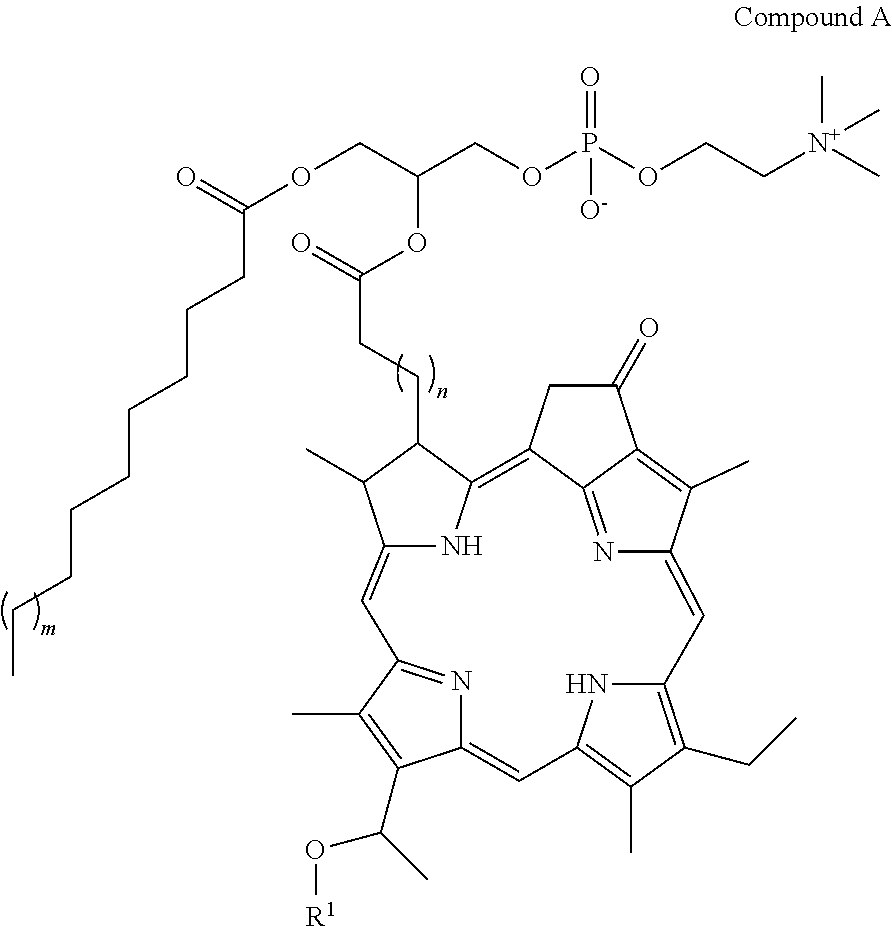
- the present disclosure provides a porphyrin phospholipid conjugate having the following structure:
- This compound is referred to herein as Compound A, where m is an integer from 1 to 12, n is an integer from 1 to 12, and R 1 is a hydrogen atom, a branched or liner alkyl group having from 2 to 20 carbon atoms. In an embodiment, R 1 is not a hydrogen atom.
- the present disclosure provides a porphyrin conjugate having the following structure—referred to herein as PC-HPPH-C16 or Compound B (also referred to herein as 16-HPPH-C16).
- the nanovesicles are substantially spherical and have a size of from 30 nm at 250 nm in diameter and all integer to the nm and ranges therebetween. In one embodiment, the size of the nanovesicles is from 100-175 nm. In one embodiment, at least 50%, 60%, 70%, 80%, 85%, 90%, 95%, 99%, or 100% of the nanovesicles in the composition have a size of from 30 to 250 nm or from 100 to 175 nm.
- the disclosure provides a composition comprising nanovesicles of the present disclosure and a sterile, suitable carrier for administration to individuals including humans—such as a physiological buffer such as sucrose, dextrose, saline, pH buffering (such as from pH 5 to 9, from pH 7 to 8, from pH 7.2 to 7.6, (e.g., 7.4)) element such as histidine, citrate, or phosphate.
- a physiological buffer such as sucrose, dextrose, saline
- pH buffering such as from pH 5 to 9, from pH 7 to 8, from pH 7.2 to 7.6, (e.g., 7.4)
- element such as histidine, citrate, or phosphate.
- the composition comprises at least 0.1% (w/v) PoP-NVs of the present disclosure.
- the composition comprises from 0.1 to 100% PoP-NVs.
- a part of the agent molecule (cargo) may be embedded in the bilayer.
- An example of hydrophobic cargo loaded into the bilayer is Amphotericin B.
- the ratio of lipid to drug (or any other cargo agent) ratio is from 10:1 to 5:1. In various embodiments, the ratio of lipid to drug/cargo ratio is 10:1, 9:1, 8:1, 7:1, 6:1, or 5:1.
- therapeutic agent refers to any chemical moiety that is a biologically, physiologically, or pharmacologically active substance.
- therapeutic agents also referred to as “drugs”
- drugs are described in well-known literature references such as the Merck Index, the Physicians Desk Reference, and The Pharmacological Basis of Therapeutics, and they include, without limitation, medicaments; vitamins; mineral supplements; substances used for the treatment, prevention, diagnosis, cure or mitigation of a disease or illness; substances which affect the structure or function of the body; or pro-drugs, which become biologically active or more active after they have been placed in a physiological environment.
- a therapeutic agent may be used which are capable of being released from the subject composition into adjacent tissues or fluids upon administration to a subject.
- Drugs that are known be loaded via active gradients include doxorubicin, daunorubicin, gemcitabine, epirubicin, topotecan, vincristine, mitoxantrone, ciprofloxacin and cisplatin.
- Therapeutic cargo also includes various antibiotics (such as gentamicin) or other agents effective against infections caused by bacteria, fungi, parasites, or other organisms. These drugs can be loaded and released in PoP-NVs.
- diagnostic agents are any chemical moiety that may be used for diagnosis.
- diagnostic agents include imaging agents, such as those containing radioisotopes such as indium or technetium; contrasting agents containing iodine or gadolinium;
- enzymes such as horse radish peroxidase, GFP, alkaline phosphatase, or .beta.-galactosidase; fluorescent substances such as europium derivatives; luminescent substances such as N-methylacrydium derivatives or the like.
- the disclosure provides a method of preparing a nanovesicle comprising mixing a porphyrin-phospholipid conjugate in buffer, wherein the porphyrin-phospholipid conjugates are as described herein, and extruding the mixture to yield a porphyrin-phospholipid bilayer nanovesicle comprising a bilayer of the desired amount of the porphyrin-phospholipid conjugate.
- other phospholipids or lipids may be included in the mixture to make the PoP-NVs.
- DSPE-PEG-2K e.g. 5 mol %)
- cholesterol e.g. 35 mol
- lipid e.g.
- Propyrin-phospholipid conjugate may be prepared by esterifying a carboxylic acid-bearing tetrapyrrole to a lyso-phospholipid.
- HPPH can be esterified at room temperature with 1-palmitoyl-2-hydroxy-sn-glycero-3-phosphocholine (lyso-C16-PC), Avanti #855675P) using EDC and 4-dimethylaminopyridine (DMAP, Disher #AC14827-0250) in chloroform at a 1:1:2:2 lyso-C16-PCIIPPH:EDC:DMAP molar ratio.
- a hydrating solution of 125 mM ammonium sulfate, pH 5.5 can be used. Free ammonium sulfate can be removed by gel filtration or dialysis and the active agent can be actively loaded into the PoP-NVs using, for example, a 10:1 lipid:drug ratio. Loading efficacy and entrapment of both calcein and active agents can be assessed by examing the included and excluded gel filtration fractions.
- loading can be monitored using a fluorescence reader, comparing the fluorescence of the PoP-NV sample to the initially loaded PoP-NVs as well as PoP-NVs permeabilized with Triton X-100 detergent (such as 0.5%).
- Calcein and active agent can be detected by appropriate excitation and emission wavelengths. For example, 485 nm excitation and 525 nm emission can be used for the calcein and 480 nm excitation and 590 nm emission is used to detect active agent such as doxorubicin.
- PoP-NV self-assembly status and elution position can also tracked without interference by using 420 nm excitation and 670 nm emission for porphyrins.
- the disclosure provides a method of delivery of agents contained as cargo in the nanovesicles to desired locations.
- cargo is described as drug in the disclosure, the description is equally applicable to any agent contained for treatment and/or delivery to a desired location, and the term “drug” is intended to refer to any agent.
- the agent may be contained, in whole or in part, within or in the PoP-NVs—whether present in the aqueous compartment, the bilyer or both.
- the disclosure provides a method for delivery of cargo of a nanovesicle comprising the steps of: 1) providing a composition comprising nanovesicles of the present disclosure comprising the cargo (such as an active agent); 2) allowing the nanovesicles to reach a selected or desired destination; 3) irradiating the nanovesicle with radiation having a wavelength of near-infrared under conditions such that at least a portion of the cargo is released from the nanovesicle.
- the method of the present disclosure can be carried out in vitro or in vivo.
- the irradiation with near-infrared radiation is such that the temperature of the surrounding tissue does not increase more than 10 degrees Celsius.
- the temperature of the surrounding tissue does not increase more than 5, 6, 7, 8, 9 and 10, 11 and 12 degree Celsius.
- the temperature of surrounding tissue increases by less than 5 degrees Celsius.
- the method of the present disclosure can be used in any individual of any age including animals and humans.
- the nanovesicles are irradiated with near-infrared light from a laser of power 50 to 1000 mW/cm 2 , including all integer values to the mW/cm 2 and ranges therebetween, at a wavelength of from 650 to 1000 nm, including all integer values to the nm and ranges therebetween.
- the wavelength is from 650 to 800 nm, including all integer values to the nm and all ranges therebetween.
- the extent of release of cargo is also dependent upon the exposure time. Generally, a time of up to 30 minutes or less is sufficient.
- the nanovesicles in vitro or in vivo may be irradiated from 0.5 to 30 minutes and all values to the tenth decimal place therebetween.
- the nanovesicles are irradiated with a 658 nm laser diode for up to 10 minutes.
- the nanovesicles are irradiated with wavelengths of 665 or 671 nm.
- the infrared radiation can be delivered to the desired area directly by shining laser light on the area or fiber optic probes may be used.
- the fiber optic probe can be inserted into the tumor (i.e., via a catheter or endoscopic device) to provide irradiation to a localized area.
- the nanovesicles may be resealed. In this manner, the opening and closing of the nanovesicles is reversible.
- Resealing enables new applications such as capturing contents of tumor vasculature containing tumor-specific small molecules and larger molecules like proteins. This could enable downstream analysis of tumor contents. Also, resealing prevents aggregation so the liposomes may effectively deposit their cargo. Additionally, retrieval of the re-sealed nanovesicles by blood draw or biopsy could be accomplished for assessing treatment progress.
- a useful property of the nanovesicles of the present disclosure is there is minimal release (i.e., less than 1% release of contents per hour) of the active agent until near-infrared light is shined at the nanovesicle.
- 100% of the active agent (cargo) that is irradiated in the target tissue with sufficient laser power is released from the nanovesicle.
- the temperature of the surrounding tissue does not increase significantly.
- the intensity of the NIR applied the amount of cargo released at a given location or given time can be controlled.
- the release of cargo is achieved in one or more steps. For example, pulses of NIR exposure may be used at desired time intervals so that the cargo is released in steps.
- PoP-NVs function through nanoscale heating, rather than bulk heating. Nanoscale heating allows effective release from the PoP-NVs without any significant heating of the surrounding tissue. Thus, in an example, rapid release of the entire cargo in three minutes upon (0.1 W) NIR laser irradiation was achieved. These same PoP-NVs showed minimal release over 30 minutes at 45° C. (a temperature higher what is required for Temperature sensitive liposomes (TS-liposomes) to rapidly release their entire contents) and do not even completely release their entire cargo when heated to the extreme temperature of 95° C. for 30 minutes. Thus, PoP-NVs are unique because they demonstrate extremely effective light-induced release, yet are exceptionally stable at elevated temperatures. At least these two attributes combine to form the basis of a precisely triggered drug release mechanism.
- the serum stability of the PoP-NVs enables longer time point options for triggered release (less stable delivery systems must be triggered immediately following administration).
- the present disclosure provides a nanovesicle comprising a bilayer of at least 1 mol. %, from 1 to 14 mol. %, 7 to 13 mol. %, 8 to 12 mol. %, 9 to 11 mol. %, or 9.5 to 10.5 mol. % porphyrin phospholipid conjugate, wherein the porphyrin phospholipid conjugate has the structure of Compound A.
- the present disclosure provides a nanovesicle comprising a bilayer of at least 1 mol. %, 1 to 14 mol. %, 7 to 13 mol. %, 8 to 12 mol. %, 9 to 11 mol.
- compositions comprising the nanovesicles in a suitable carrier.
- the present disclosure provides a method of delivering an agent to a desired site comprising the steps of: loading the agent as a cargo in the PoP-NVs of the present disclosure, administering the PoP-NVs to an individual, causing the release of the cargo (agent) at desired sites by shining near infra-red radiation as the nanovesicles are passing through the vasculature at the desired site such that the cargo from the nanovesicles is released.
- the cargo (agent) release is achieved when the nanovesicles are moving through small blood vessels (such as capillaries).
- the cargo upon shining the NIR radiation, the cargo is released when the blood flow is from 0.5 to 10 mm/sec. In this manner, drug release may be confined only to smaller vessels in the target tissues and not nearby larger blood vessels.
- This example describes the synthesis of PoP-NVs, and loading and release of cargo.
- HPPH Pyropheophorbide-a hexyl ether
- HPPH phospholipid was synthesized using commercially available HPPH and esterifying it 1-palmitoyl-2-hydroxy-sn-glycero-3-phosphocholine (lyso-C16-PC, Avanti # 855675P) using EDC and 4-Dimethylaminopyridine (DMAP; Fisher # AC14827-0250) in chloroform at a 1:1:2:2 Tyco-C16-PC:HPPH:EDC:DMAP molar ratio.
- DMAP 4-Dimethylaminopyridine
- HPPH phospholipid was purified with diol silica gel and freeze dried in a 80% t-butanol (Sigma, #360538), 20% water solution. Purity was confirmed with TLC (>90% pure) and identity confirmed with mass spectrometry.
- TLC mass spectrometry.
- To generate PoP-NVs a 0.5-2 mg solution comprising the lipids was created in chloroform, evaporated, re-hydrated with phosphate buffered saline, subjected to 5 freeze-thaw cycles and sonicated for 10 minutes. In the case of extrusion, the solution was subjected to 11 passes through a 100 nm polycarbonate membrane.
- Calcein loading was achieved by hydrating PoP-NVs with a 100 mM calcein solution (Sigma# 21030) and subsequent gel-filtration separation over a Sephadex G-75 column (VWR# 95016-784).
- Doxorubicin loading was achieved by extruding a lipid film with a high pressure lipid extruder (Lipex) with a 150 mM ammonium sulfate solution. Free ammonium sulfate was removed using a Sephadex G-75 column and doxorubicin (LCLabs# D-4000) was loaded by adding a 1:10 ratio of drug:lipid and incubating at 60° C. for 1 hour.
- Free doxorubicin was removed using a Sephadex G-75 column
- PoP-NV solutions of 0.5-2 mg/mL were generally diluted by a factor of 50-100 for calcein experiments, and 10-20 times for doxorubicin release, to a point where light could pass freely through the solution.
- HPPH pyropheophorbide-C16-phosphtatidylcholine monomer
- HPPH-C16-PC The structure of pyropheophorbide-C16-phosphtatidylcholine monomer and HPPH-C16-PC are shown in FIG. 1 a .
- HPPH is related to the pyro structure, but appears to generate greater balance between sidechains and also is a clinically approved porphyrin therapeutic.
- HPPH-C16-PC was synthesized and the behavior of nanovesicles formed from 95% of either porphyrin monomer along with 5% PEG-lipid was examined. As shown in FIG.
- FIG. 1 c demonstrates that calcein maintains self-quenching concentration in the HPPH NVs, but no retained calcein was detectable in the pyro-NVs.
- the 10 molar % HPPH phospholipid conferred thermal stability because without it, liposomes exhibited significantly higher release at 60 and 90° C. Because optimal doping in PoP-NVs used only 10 molar % porphyrin, it was possible to directly compare NVs composed nearly identically, with the only difference being the inclusion of 10 molar percent of either free HPPH or HPPH phospholipid. Both types of nanovesicles could be formed and stably entrapped calcein. Both types of nanovesicles also exhibited nearly complete quenching of HPPH fluorescence. Although liposomes formed with free HPPH displayed some light specific release, as shown in FIG.
- FIG. 6 a demonstrates that when incubated with 10% fetal bovine serum, free HPPH readily transfers from liposomes to serum proteins whereas PoP-NVs remain self-quenched indicated a lack of exchange.
- doxorubicin could be loaded using an ammonium sulfate gradient with over 95% efficacy.
- FIG. 7 b when dox-PoP-NVs were irradiated with varying powers of laser in a buffer including 10% serum, release occurred in a laser dose dependent manner. This controllable release has direct utility for controlling the release in vivo to achieve maximal release in the tumor microenvironment.
- FIG. 8 the velocity of flow through capillaries had a direct effect on the light-induced release from PoP-NVs.
- the data in FIG. 9 shows laser exposure can trigger a significant increase the rate of release of entrapped doxorubicin (in this case a 20,000 fold increase) in physiological conditions (in this case 10% serum, 37 C).
- PoP-NVs represent a robust nanosystem to achieve light-induced release. Permeabilization occurred in the absence of checmial reactions or bulk solution heating. By varying the laser power, the amount of release could readily be tuned. Unlike release systems that rely directly or indirectly on heating through phase transitions, PoP-NVs offer a high level of control over permeabilization. It is considered that PoP-NVs will be useful in stimuli driven release for treatment of various indications including cancer.
- Liposomes re-sealed following laser exposure and permeability could be modulated by varying porphyrin-lipid doping, irradiation intensity or irradiation duration.
- PoP-liposomes demonstrated spatial control of release of entrapped gentamicin and temporal control of release of entrapped fluorophores following intratumoral injection.
- laser irradiation enhanced deposition of actively-loaded doxorubicin in mouse xenografts, enabling an effective single-treatment anti-tumor therapy.
- Molecular dynamic simulations Membranes made of two different porphyrin-lipid molecules were simulated using molecular dynamics (MD). Each bilayer system was composed of 128 molecules of either the pyro or HPPH variant of the porphyrin-lipids. 9640 water molecules were added to achieve full hydration.
- the GROMACS software package was used. Starting with the standard united atom force field, the lipid models were defined by removing the sn-2 tail from DPPC and replacing it with the heme available in the force field database. GROMOS 53a6 force-field was used to build the final structures and to modify the heme. This force-field has been shown to perform well in simulations of lipids and peptides.
- Partial charges were chosen from analagous moities in the force field database.
- the simple point charge (SPC) model was used for water. Bond lengths were constrained using the SETTLE algorithm for water and LINCS for the lipids. Lennard-Jones interactions were treated with a switching algorithm that started at 0.8 nm and used a cutoff of 0.9 nm. Electrostatics were treated with the particle-mesh Ewald method using a real space cutoff of 1.4 nm, beta spline interpolation (of order 4), and a direct sum tolerance of 1E-6. Periodic boundaries were used in all three dimensions and a time step of 2 fs was used. The systems were set up by arranging 64 lipids per leaflet on a rectangular lattice.
- HPPH phospholipid was purified with diol silica gel and freeze dried in a 80% t-butanol (Sigma #360538), 20% water solution. Purity was confirmed with TLC (>95% pure) and identity confirmed with mass spectrometry (expected 1114.7; found: 1114.7) and 1H NMR on a Varian Inova 500 MHz spectrometer.
- films were prepared by drying chloroform solutions containing 1,2-distearoyl-sn-glycero-3-phosphocholine (DSPC; Avanti #850365P), 1,2-distearoyl-sn-glycero-3-phosphoethanolamine-N-[methoxy(polyethylene glycol)-2000 (DSPE-PEG2K; Avanti #880120P), HPPH phospholipid and cholesterol (Avanti #700000P) in the indicated molar ratios.
- the general formulation for PoP-liposomes was based on 50 mol. % DSPC, 35 mol. % cholesterol, 10 mol. % HPPH phospholipid and 5 mol. % DSPE-PEG2K.
- Liposomes incorporating 10 mol. % free HPPH were formed analogously.
- the chloroform was evaporated using either a stream of argon gas or a rotary evaporator followed by further drying in a dessicator vacuum chamber.
- the film was re-hydrated with phosphate buffered saline (pH 7.4) and sonicated for 30 minutes.
- PoP-liposomes Self-quenching dye loading was achieved by hydrating and sonicating PoP-liposomes with a 100 mM calcein solution (Sigma #21030) or sulforhodamine B solution (VWR #89139-502) and subsequent gel-filtration separation over a Sephadex G-75 column (VWR #95016-784).
- Doxorubicin loading was achieved by extruding a lipid film with a high pressure lipid extruder (Northern Lipids) with a 250 mM ammonium sulfate solution.
- Polycarbonate membranes of 0.2, 0.1 and 0.08 ⁇ m pore size were sequentially stacked and solution was passed through the extruder 10 times at 60° C. Free ammonium sulfate was removed by overnight dialysis in a 10% sucrose solution with 10 mM HEPES pH 7.4. Doxorubicin (LC Labs #D-4000) was then loaded by adding a 1:10 ratio of drug:lipid and incubating at 60° C. for 1 hour. Free doxorubicin was removed by dialysis.
- PoP-liposome solutions of 0.5-2 mg/mL were generally diluted by a factor of 50-100 for calcein experiments, and 10-20 times for doxorubicin release, and light could pass freely through the solution without inner filter effects.
- Release experiments were performed using a hand-held laser diode outputting 120 mW at 658 nm or a tunable 658 nm 500 mW laser diode (LaserGlow) and irradiations were performed as indicated.
- fetal bovine serum was used (VWR #16777-532). Temperature was measured by inserting a K-type thermocouple probe directly into the solution during irradiation.
- Amphotericin B (VWR # 97061-610) liposomes were formed using the thin film method using a lipid formulations of the indicated molar ratios composed of 1,2-distearoyl-sn-glycero-3-phospho-(1′-rac-glycerol) (DSPG; Avanti #840465X), hydrogenated soy phosphatidylcholine (Avanti #840058P), HPPH phospholipid and cholesterol.
- DSPG 1,2-distearoyl-sn-glycero-3-phospho-(1′-rac-glycerol)
- Alvanti #840058P hydrogenated soy phosphatidylcholine
- Viability was calculated by measuring absorption at 450 nm subtracting a 630 nm background reading and normalizing to untreated control cells using a Safire plate reader (TECAN).
- Electron spin resonance PoP-liposomes were formed with the inclusion 1% 5-Doxyl steric acid (Sigma #253634) into the standard formulation using the thin film hydration method.
- a Bruker ER-200 ESR X-band spectrometer was used with a TE102 rectangular cavity and with a Bruker B-VT-1000 nitrogen flow temperature controller.
- the ESR frequency was 9.44 GHz, field modulation of 1.9 Gauss, and microwave power of 0.64 mWatt.
- the sample size was approximately 20 ⁇ L in a 1 mm inner diameter quartz tube at the indicated temperatures. Samples were irradiated using a 658 nm 200 mW laser that was focused on the ESR sample through light slots on the Bruker X-band ESR cavity, which are conditions that induce PoP-liposome permeabilization.
- the plates were poured with about 5 mL of bacteria-drug-agar per plate. Following solidification, the plates were irradiated with a 1.2 cm spot diameter with 200 mW/cm 2 for 10 minutes using a 658 nm laser. The plate was photographed 24 hours later.
- KB cells Hela subline
- dox-PoP-liposomes 10 mg/kg dox
- an equivalent dose of empty PoP-liposomes were injected via tail-vein. 10-15 minutes later, tumors were irradiated for 12.5 minutes with a 200 mW/cm 2 laser (150 J/cm 2 ).
- mice were sacrificed 24 hours later, tissues homogenized, extracted overnight in acidic isopropanol and dox (Doxorubicin) biodistribution was determined via fluorescence measurements with 480 nm excitation and 590 nm emission.
- dox Doxorubicin
- mice Male BALB/c mice were injected via tail vein with empty PoP-liposomes (15 mg/kg HPPH phospholipid). Small blood volumes were sampled at sub-mandibular and retro-orbital locations at the indicated time points and serum was analyzed for HPPH content using fluorescence with 400 nm excitation and 660 nm emission following dilution into a 0.25% Triton-X100 solution to prevent any self-quenching.
- PoP can self-assemble into liposome-like porphysome nanovesicles formed entirely from a porphyrin bilayer with intrinsic biophotonic character, nanoscale optical properties, biocompatibility and biodegradability.
- porphysome monomers cannot assemble into nanovesicles that stably load and retain cargo without addition of cholesterol.
- sn-1-palmitoyl sn-2-pyropheophorbide phosphtatidylcholine (pyro-lipid) monomer was examined.
- the bilayer density plot revealed that the HPPH phospholipid did not give rise to a bilayer with greater maximum density, but rather a thicker bilayer (3.2 vs 2.9 nm with the Gibbs-Luzzati criterion).
- MD simulations showed the hexyl ether moiety provides space filling between the two bilayer leaflets compared to the pyro-lipid bilayer which had the central portion of the bilayer filled only with palmitoyl chains.
- the porphyrins in the pyro-lipid bilayer appeared to align into stacks of H-aggregates, which may contribute to instability.
- 5-doxyl steric acid spin label 5-DSA
- ESR electron spin resonance
- PoP-liposomes Following intravenous administration in BALB/c mice, PoP-liposomes exhibited a long single compartment circulation half-life of 14.4 hours ( FIG. 20 ). This is similar to previously observed 12-13 hour one compartment circulation half-life of porphysome nanovesicles containing 60 molar % pyro-lipid, yet somewhat shorter than some formulations of sterically-stabilized PEGylated liposomes for doxorubicin delivery, which can exhibit 20 hour circulation half-lives in mice.
- FIG. 14 d demonstrates that in vitro, there was minimal release from doxorubicin loaded PoP-liposomes throughout the course of a 48 hour incubation in physiological conditions. However, when the sample was subjected to 300 mW, 658 nm laser irradiation, complete release occurred in just 4 minutes. This compares favorably to phase transition-based systems such as thermally-triggered liposomes, which generally exhibit a ⁇ 10 fold acceleration in release in physiological conditions when comparing the “on” vs.
- FIG. 14 e demonstrates that dox-PoP-liposomes could be used to induce light-triggered inhibition of viability of Panc-1 cells.
- Laser treatment in the presence or absence of empty PoP-liposomes had no effect on cell viability.
- Without light treatment dox-PoP-liposomes, incubated with the cells for 24 hours in 10% serum at 37 ° C., induced a small amount ( ⁇ 15%) of inhibition of cell viability. This was likely due to some uptake of the drug-loaded liposomes in the extended duration incubation.
- dox-PoP-liposomes for systemically-administered therapy was assessed in nude mice bearing subcutaneous KB tumors. Mice were injected with doses of 10 mg/kg dox-PoP-liposomes. 15 minutes following IV injection, tumors were irradiated with 658 nm laser light at 200 mW/cm 2 for 12.5 minutes (150 J/cm 2 ), or were not irradiated as a control. 24 hours later, organs were collected and doxorubicin biodistribution was assessed. As shown in FIG.
- the observed enhancement in tumor doxorubicin deposition could have been influenced by other factors including enhanced tumor permeability due to vascular damage induced by initial drug release and also from photosensitizing effects of the PoP-liposomes during irradiation. It has been demonstrated that PDT using HPPH enhanced tumor deposition of DOXIL® in a murine colon carcinoma model. Future studies will seek to better understand how these multiple factors contribute to enhanced tumor deposition of doxorubicin in PoP-liposomes. Based on the favorable biodistribution results, a survival study was performed based on a single intravenous treatment of dox-PoP-liposomes (10 mg/kg doxorubicin dose).
- mice were divided into 4 groups: (1) dox-PoP-liposomes with laser treatment, (2) empty-PoP-liposomes with laser treatment, (3) dox-PoP-liposomes without laser treatment; and (4) saline control.
- FIG. 16 b only the dox-PoP-liposomes with laser treatment effectively cured tumors. 4 out of the 5 mice treated had tumors permanently cured with no regrowth after 90 days.
- both dox-PoP-liposomes and empty-PoP-liposomes induced eschar formation on the skin of the tumor, demonstrating that PoP-liposomes themselves have photosensitizing properties.
- PoP-NVs as described herein form a robust system which achieved thermostable cargo retention as well as effective release upon exposure to clinically-relevant doses of NIR radiation. Release could be tuned by varying porphyrin doping, laser irradiation time and laser irradiation power. This represents a departure from externally-triggered release systems which rely on heating to a few degrees above body temperature and may have issues with stability at physiological temperatures.
- PoP-NVs of the present disclosure released their cargo with robust spatial and temporal control and when loaded with appropriate agents provide effective treatment and diagnostic options.
Landscapes
- Health & Medical Sciences (AREA)
- Chemical & Material Sciences (AREA)
- Life Sciences & Earth Sciences (AREA)
- Animal Behavior & Ethology (AREA)
- General Health & Medical Sciences (AREA)
- Public Health (AREA)
- Veterinary Medicine (AREA)
- Medicinal Chemistry (AREA)
- Pharmacology & Pharmacy (AREA)
- Epidemiology (AREA)
- Molecular Biology (AREA)
- Organic Chemistry (AREA)
- Dispersion Chemistry (AREA)
- Engineering & Computer Science (AREA)
- Biomedical Technology (AREA)
- Biochemistry (AREA)
- Biophysics (AREA)
- Pathology (AREA)
- Nuclear Medicine, Radiotherapy & Molecular Imaging (AREA)
- Radiology & Medical Imaging (AREA)
- Medicinal Preparation (AREA)
- Pharmaceuticals Containing Other Organic And Inorganic Compounds (AREA)
- Medicines Containing Antibodies Or Antigens For Use As Internal Diagnostic Agents (AREA)
Abstract
Description
This compound is referred to herein as Compound A, where m is an integer from 1 to 12, n is an integer from 1 to 12, and R1 is a hydrogen atom, a branched or liner alkyl group having from 2 to 20 carbon atoms. In an embodiment, R1 is not a hydrogen atom.


Claims (15)


Priority Applications (1)
| Application Number | Priority Date | Filing Date | Title |
|---|---|---|---|
| US14/654,085 US10086074B2 (en) | 2012-12-19 | 2013-12-19 | Compositions and method for light triggered release of materials from nanovesicles |
Applications Claiming Priority (3)
| Application Number | Priority Date | Filing Date | Title |
|---|---|---|---|
| US201261739503P | 2012-12-19 | 2012-12-19 | |
| US14/654,085 US10086074B2 (en) | 2012-12-19 | 2013-12-19 | Compositions and method for light triggered release of materials from nanovesicles |
| PCT/US2013/076471 WO2014100379A1 (en) | 2012-12-19 | 2013-12-19 | Compositions and method for light triggered release of materials from nanovesicles |
Publications (2)
| Publication Number | Publication Date |
|---|---|
| US20150297716A1 US20150297716A1 (en) | 2015-10-22 |
| US10086074B2 true US10086074B2 (en) | 2018-10-02 |
Family
ID=50979207
Family Applications (1)
| Application Number | Title | Priority Date | Filing Date |
|---|---|---|---|
| US14/654,085 Active 2034-08-27 US10086074B2 (en) | 2012-12-19 | 2013-12-19 | Compositions and method for light triggered release of materials from nanovesicles |
Country Status (5)
| Country | Link |
|---|---|
| US (1) | US10086074B2 (en) |
| EP (1) | EP2934303B1 (en) |
| CN (1) | CN105072981B (en) |
| ES (1) | ES2764090T3 (en) |
| WO (1) | WO2014100379A1 (en) |
Families Citing this family (6)
| Publication number | Priority date | Publication date | Assignee | Title |
|---|---|---|---|---|
| US20150359912A1 (en) * | 2013-01-29 | 2015-12-17 | University Health Network | J-Aggregate Forming Nanoparticle |
| US10918599B2 (en) | 2015-04-02 | 2021-02-16 | The Research Foundation For The State University Of New York | Serum-stable compositions and methods for light-triggered release of materials |
| CN107847444A (en) * | 2015-05-26 | 2018-03-27 | 通用医疗公司 | Liposome nanostructures and methods of making and using same |
| CN107158377B (en) * | 2016-03-07 | 2021-02-05 | 中国科学院上海药物研究所 | Light-controlled temperature-sensitive liposome and preparation method and application thereof |
| US11154619B2 (en) | 2017-02-17 | 2021-10-26 | Creighton University | Liposomal compositions with light illumination-induced drug release |
| FR3151482A1 (en) * | 2023-07-28 | 2025-01-31 | Centre National De La Recherche Scientifique | Self-assembling cyclic tetrapyrrole derivatives |
Citations (12)
| Publication number | Priority date | Publication date | Assignee | Title |
|---|---|---|---|---|
| US5013556A (en) | 1989-10-20 | 1991-05-07 | Liposome Technology, Inc. | Liposomes with enhanced circulation time |
| US5192549A (en) | 1988-09-28 | 1993-03-09 | Yissum Research Development Company Of The Hebrew University Of Jerusalem | Method of amphiphatic drug loading in liposomes by pH gradient |
| CN1088210A (en) | 1992-07-26 | 1994-06-22 | 耶达研究及发展有限公司 | Chlorophyll, bacteriochlorophyll derivatives, their preparation and pharmaceutical compositions containing them |
| US20050019265A1 (en) | 2003-07-25 | 2005-01-27 | Hammer Daniel A. | Polymersomes incorporating highly emissive probes |
| WO2009111439A2 (en) | 2008-03-04 | 2009-09-11 | The Trustees Of The University Of Pennsylvania | In vivo detection of phospholipase activation |
| CN101573141A (en) | 2006-05-15 | 2009-11-04 | 麻省理工学院 | Polymers for functional particles |
| US20100247447A1 (en) | 2001-04-11 | 2010-09-30 | Ronald Erwin Boch | Drug delivery system for hydrophobic drugs |
| US20110052671A1 (en) * | 2008-01-30 | 2011-03-03 | The Regents Of The University Of California | Near infra-red pulsed laser triggered drug release from hollow nanoshell disrupted vesicles and vesosomes |
| WO2011044671A1 (en) | 2009-10-16 | 2011-04-21 | University Health Network | Porphyrin nanovesicles |
| US8048448B2 (en) | 2006-06-15 | 2011-11-01 | Abbott Cardiovascular Systems Inc. | Nanoshells for drug delivery |
| US20110318415A1 (en) | 2009-03-09 | 2011-12-29 | Chun Li | Hollow Gold Nanospheres (HAuNSs) and HAuNSs-Loaded Microspheres Useful in Drug Delivery |
| WO2012167350A1 (en) | 2011-06-06 | 2012-12-13 | University Health Network | Method for the synthesis of porphyrin-phospholipid conjugates |
-
2013
- 2013-12-19 CN CN201380073297.8A patent/CN105072981B/en active Active
- 2013-12-19 US US14/654,085 patent/US10086074B2/en active Active
- 2013-12-19 WO PCT/US2013/076471 patent/WO2014100379A1/en not_active Ceased
- 2013-12-19 EP EP13865112.0A patent/EP2934303B1/en active Active
- 2013-12-19 ES ES13865112T patent/ES2764090T3/en active Active
Patent Citations (14)
| Publication number | Priority date | Publication date | Assignee | Title |
|---|---|---|---|---|
| US5192549A (en) | 1988-09-28 | 1993-03-09 | Yissum Research Development Company Of The Hebrew University Of Jerusalem | Method of amphiphatic drug loading in liposomes by pH gradient |
| US5013556A (en) | 1989-10-20 | 1991-05-07 | Liposome Technology, Inc. | Liposomes with enhanced circulation time |
| CN1088210A (en) | 1992-07-26 | 1994-06-22 | 耶达研究及发展有限公司 | Chlorophyll, bacteriochlorophyll derivatives, their preparation and pharmaceutical compositions containing them |
| US20100247447A1 (en) | 2001-04-11 | 2010-09-30 | Ronald Erwin Boch | Drug delivery system for hydrophobic drugs |
| US20050019265A1 (en) | 2003-07-25 | 2005-01-27 | Hammer Daniel A. | Polymersomes incorporating highly emissive probes |
| CN101573141A (en) | 2006-05-15 | 2009-11-04 | 麻省理工学院 | Polymers for functional particles |
| US8048448B2 (en) | 2006-06-15 | 2011-11-01 | Abbott Cardiovascular Systems Inc. | Nanoshells for drug delivery |
| US20110052671A1 (en) * | 2008-01-30 | 2011-03-03 | The Regents Of The University Of California | Near infra-red pulsed laser triggered drug release from hollow nanoshell disrupted vesicles and vesosomes |
| WO2009111439A2 (en) | 2008-03-04 | 2009-09-11 | The Trustees Of The University Of Pennsylvania | In vivo detection of phospholipase activation |
| US20110318415A1 (en) | 2009-03-09 | 2011-12-29 | Chun Li | Hollow Gold Nanospheres (HAuNSs) and HAuNSs-Loaded Microspheres Useful in Drug Delivery |
| WO2011044671A1 (en) | 2009-10-16 | 2011-04-21 | University Health Network | Porphyrin nanovesicles |
| CN102573914A (en) | 2009-10-16 | 2012-07-11 | 大学健康网络 | Porphyrin nanovesicles |
| US9072774B2 (en) * | 2009-10-16 | 2015-07-07 | University Health Network | Porphyrin nanovesicles |
| WO2012167350A1 (en) | 2011-06-06 | 2012-12-13 | University Health Network | Method for the synthesis of porphyrin-phospholipid conjugates |
Non-Patent Citations (5)
| Title |
|---|
| Lovell, J.F., et al., Enzymatic Regioselection for the Synthesis of Biodegradation of Porphysome Nanovesicles, Angewandte Chemie International Edition, 2012, vol. 51, pp. 2429-2433. |
| Lovell, J.F., et al., Enzymatic Regioselection for the Synthesis of Biodegradation of Porphysome Nanovesicles, Angewandte Chemie, 2012, vol. 124, pp. 2479-2483. |
| Noiseux et al. J. Biomed. Opt. 2008, 48, 041313-1-041313-11. * |
| Volodkin et al. Angew. Chem. Int. Ed. 2009, 48, 1807-1809. * |
| You, J., et al., Exceptionally High Payload of Doxorubicin in Hollow Gold Nanospheres for Near-Infrared Light-Triggered Drug Release, ACS Nano, 2010, vol. 4, No. 2, pp. 1033-1041. |
Also Published As
| Publication number | Publication date |
|---|---|
| EP2934303A1 (en) | 2015-10-28 |
| WO2014100379A1 (en) | 2014-06-26 |
| EP2934303B1 (en) | 2019-09-04 |
| US20150297716A1 (en) | 2015-10-22 |
| CN105072981B (en) | 2017-10-24 |
| ES2764090T3 (en) | 2020-06-02 |
| CN105072981A (en) | 2015-11-18 |
| EP2934303A4 (en) | 2016-08-10 |
Similar Documents
| Publication | Publication Date | Title |
|---|---|---|
| Fu et al. | Precise design strategies of nanomedicine for improving cancer therapeutic efficacy using subcellular targeting | |
| CN102573914B (en) | Porphyrin nanovesicles | |
| Yang et al. | Photoresponsive drug delivery systems: challenges and progress | |
| Carter et al. | Porphyrin–phospholipid liposomes permeabilized by near-infrared light | |
| JP7372672B2 (en) | Complex of active pharmaceutical ingredients | |
| Luo et al. | Intrabilayer 64Cu labeling of photoactivatable, doxorubicin-loaded stealth liposomes | |
| Ng et al. | Self-assembled porphyrin nanodiscs with structure-dependent activation for phototherapy and photodiagnostic applications | |
| Thakur et al. | Co-administration of zinc phthalocyanine and quercetin via hybrid nanoparticles for augmented photodynamic therapy | |
| EP2934303B1 (en) | Compositions and method for light triggered release of materials from nanovesicles | |
| Fuse et al. | Effective light-triggered contents release from helper lipid-incorporated liposomes co-encapsulating gemcitabine and a water-soluble photosensitizer | |
| EP3283056B1 (en) | Nanostructures comprising cobalt porphyrin-phospholipid conjugates and polyhistidine-tags | |
| Wang et al. | Supramolecularly engineered phospholipids constructed by nucleobase molecular recognition: upgraded generation of phospholipids for drug delivery | |
| Zhou et al. | Oxidation and reduction dual-responsive polymeric prodrug micelles co-delivery precisely prescribed paclitaxel and honokiol for laryngeal carcinoma combination therapy | |
| EP3210626B1 (en) | Conjugates of porphyrinoid photosensitizers and glycerol-based polymers for photodynamic therapy | |
| Xu et al. | pH-Responsive nanomicelles for breast cancer near-infrared fluorescence imaging and chemo/photothermal therapy | |
| Shah et al. | A Physiochemical, In Vitro, and In Vivo Comparative Analysis of Verteporfin–Lipid Conjugate Formulations: Solid Lipid Nanoparticles and Liposomes | |
| Ma et al. | Novel theranostic zinc phthalocyanine–phospholipid complex self-assembled nanoparticles for imaging-guided targeted photodynamic treatment with controllable ROS production and shape-assisted enhanced cellular uptake | |
| US10918599B2 (en) | Serum-stable compositions and methods for light-triggered release of materials | |
| de Freitas et al. | Lipid-based nanoparticles in photodynamic therapy | |
| Murugan et al. | Porphysomes and porphyrin-based nanomaterials for drug delivery system | |
| Amirinejad et al. | Structural Design and Modification of Porphyrin-Based Nanovesicles for Enhanced Biomedical Functionality | |
| Inglut | Light Activatable Pure Porphyrin Nanoparticles for the Photodynamic Opening of the Blood-Brain Barrier and Glioblastoma Treatment | |
| Frischkorn | Preparation of Supramolecular Amphiphilic Cyclodextrin Bilayer Vesicles for Pharmaceutical Applications | |
| Massiot | Design of photoactivatable drug delivery systems made of lipids and porphyrins or lipid-porphyrin conjugates for the controlled release of active pharmaceutical ingredients | |
| CN118852183A (en) | A drug compound with protein corona regulation function and its application |
Legal Events
| Date | Code | Title | Description |
|---|---|---|---|
| AS | Assignment |
Owner name: THE RESEARCH FOUNDATION FOR THE STATE UNIVERSITY O Free format text: ASSIGNMENT OF ASSIGNORS INTEREST;ASSIGNORS:LOVELL, JONATHAN FRANKLIN;CARTER, KEVIN ANTHONY;SHAO, SHUAI;REEL/FRAME:036143/0393 Effective date: 20150327 Owner name: HEALTH RESEARCH, INC., NEW YORK Free format text: ASSIGNMENT OF ASSIGNORS INTEREST;ASSIGNOR:PANDEY, RAVINDRA K.;REEL/FRAME:036143/0413 Effective date: 20150714 |
|
| STCF | Information on status: patent grant |
Free format text: PATENTED CASE |
|
| MAFP | Maintenance fee payment |
Free format text: PAYMENT OF MAINTENANCE FEE, 4TH YR, SMALL ENTITY (ORIGINAL EVENT CODE: M2551); ENTITY STATUS OF PATENT OWNER: SMALL ENTITY Year of fee payment: 4 |
|
| MAFP | Maintenance fee payment |
Free format text: PAYMENT OF MAINTENANCE FEE, 8TH YR, SMALL ENTITY (ORIGINAL EVENT CODE: M2552); ENTITY STATUS OF PATENT OWNER: SMALL ENTITY Year of fee payment: 8 |