US10083709B2 - Transformer noise suppression method - Google Patents
Transformer noise suppression method Download PDFInfo
- Publication number
- US10083709B2 US10083709B2 US15/323,407 US201515323407A US10083709B2 US 10083709 B2 US10083709 B2 US 10083709B2 US 201515323407 A US201515323407 A US 201515323407A US 10083709 B2 US10083709 B2 US 10083709B2
- Authority
- US
- United States
- Prior art keywords
- noise
- particle
- neural network
- digital signal
- iteration
- Prior art date
- Legal status (The legal status is an assumption and is not a legal conclusion. Google has not performed a legal analysis and makes no representation as to the accuracy of the status listed.)
- Active
Links
Images




Classifications
-
- G—PHYSICS
- G10—MUSICAL INSTRUMENTS; ACOUSTICS
- G10L—SPEECH ANALYSIS TECHNIQUES OR SPEECH SYNTHESIS; SPEECH RECOGNITION; SPEECH OR VOICE PROCESSING TECHNIQUES; SPEECH OR AUDIO CODING OR DECODING
- G10L21/00—Speech or voice signal processing techniques to produce another audible or non-audible signal, e.g. visual or tactile, in order to modify its quality or its intelligibility
- G10L21/02—Speech enhancement, e.g. noise reduction or echo cancellation
- G10L21/0208—Noise filtering
- G10L21/0216—Noise filtering characterised by the method used for estimating noise
- G10L21/0232—Processing in the frequency domain
-
- G—PHYSICS
- G10—MUSICAL INSTRUMENTS; ACOUSTICS
- G10K—SOUND-PRODUCING DEVICES; METHODS OR DEVICES FOR PROTECTING AGAINST, OR FOR DAMPING, NOISE OR OTHER ACOUSTIC WAVES IN GENERAL; ACOUSTICS NOT OTHERWISE PROVIDED FOR
- G10K11/00—Methods or devices for transmitting, conducting or directing sound in general; Methods or devices for protecting against, or for damping, noise or other acoustic waves in general
- G10K11/16—Methods or devices for protecting against, or for damping, noise or other acoustic waves in general
- G10K11/175—Methods or devices for protecting against, or for damping, noise or other acoustic waves in general using interference effects; Masking sound
- G10K11/178—Methods or devices for protecting against, or for damping, noise or other acoustic waves in general using interference effects; Masking sound by electro-acoustically regenerating the original acoustic waves in anti-phase
- G10K11/1781—Methods or devices for protecting against, or for damping, noise or other acoustic waves in general using interference effects; Masking sound by electro-acoustically regenerating the original acoustic waves in anti-phase characterised by the analysis of input or output signals, e.g. frequency range, modes, transfer functions
- G10K11/17821—Methods or devices for protecting against, or for damping, noise or other acoustic waves in general using interference effects; Masking sound by electro-acoustically regenerating the original acoustic waves in anti-phase characterised by the analysis of input or output signals, e.g. frequency range, modes, transfer functions characterised by the analysis of the input signals only
- G10K11/17825—Error signals
-
- G—PHYSICS
- G06—COMPUTING OR CALCULATING; COUNTING
- G06F—ELECTRIC DIGITAL DATA PROCESSING
- G06F17/00—Digital computing or data processing equipment or methods, specially adapted for specific functions
- G06F17/10—Complex mathematical operations
- G06F17/11—Complex mathematical operations for solving equations, e.g. nonlinear equations, general mathematical optimization problems
-
- G—PHYSICS
- G06—COMPUTING OR CALCULATING; COUNTING
- G06N—COMPUTING ARRANGEMENTS BASED ON SPECIFIC COMPUTATIONAL MODELS
- G06N3/00—Computing arrangements based on biological models
- G06N3/004—Artificial life, i.e. computing arrangements simulating life
- G06N3/006—Artificial life, i.e. computing arrangements simulating life based on simulated virtual individual or collective life forms, e.g. social simulations or particle swarm optimisation [PSO]
-
- G—PHYSICS
- G06—COMPUTING OR CALCULATING; COUNTING
- G06N—COMPUTING ARRANGEMENTS BASED ON SPECIFIC COMPUTATIONAL MODELS
- G06N3/00—Computing arrangements based on biological models
- G06N3/02—Neural networks
-
- G—PHYSICS
- G06—COMPUTING OR CALCULATING; COUNTING
- G06N—COMPUTING ARRANGEMENTS BASED ON SPECIFIC COMPUTATIONAL MODELS
- G06N3/00—Computing arrangements based on biological models
- G06N3/02—Neural networks
- G06N3/04—Architecture, e.g. interconnection topology
-
- G—PHYSICS
- G06—COMPUTING OR CALCULATING; COUNTING
- G06N—COMPUTING ARRANGEMENTS BASED ON SPECIFIC COMPUTATIONAL MODELS
- G06N3/00—Computing arrangements based on biological models
- G06N3/02—Neural networks
- G06N3/04—Architecture, e.g. interconnection topology
- G06N3/0499—Feedforward networks
-
- G—PHYSICS
- G06—COMPUTING OR CALCULATING; COUNTING
- G06N—COMPUTING ARRANGEMENTS BASED ON SPECIFIC COMPUTATIONAL MODELS
- G06N3/00—Computing arrangements based on biological models
- G06N3/02—Neural networks
- G06N3/08—Learning methods
-
- G—PHYSICS
- G06—COMPUTING OR CALCULATING; COUNTING
- G06N—COMPUTING ARRANGEMENTS BASED ON SPECIFIC COMPUTATIONAL MODELS
- G06N3/00—Computing arrangements based on biological models
- G06N3/02—Neural networks
- G06N3/08—Learning methods
- G06N3/084—Backpropagation, e.g. using gradient descent
-
- G—PHYSICS
- G06—COMPUTING OR CALCULATING; COUNTING
- G06N—COMPUTING ARRANGEMENTS BASED ON SPECIFIC COMPUTATIONAL MODELS
- G06N3/00—Computing arrangements based on biological models
- G06N3/02—Neural networks
- G06N3/08—Learning methods
- G06N3/09—Supervised learning
-
- G—PHYSICS
- G06—COMPUTING OR CALCULATING; COUNTING
- G06N—COMPUTING ARRANGEMENTS BASED ON SPECIFIC COMPUTATIONAL MODELS
- G06N3/00—Computing arrangements based on biological models
- G06N3/02—Neural networks
- G06N3/08—Learning methods
- G06N3/0985—Hyperparameter optimisation; Meta-learning; Learning-to-learn
-
- G—PHYSICS
- G06—COMPUTING OR CALCULATING; COUNTING
- G06N—COMPUTING ARRANGEMENTS BASED ON SPECIFIC COMPUTATIONAL MODELS
- G06N5/00—Computing arrangements using knowledge-based models
- G06N5/04—Inference or reasoning models
-
- G—PHYSICS
- G06—COMPUTING OR CALCULATING; COUNTING
- G06N—COMPUTING ARRANGEMENTS BASED ON SPECIFIC COMPUTATIONAL MODELS
- G06N7/00—Computing arrangements based on specific mathematical models
- G06N7/01—Probabilistic graphical models, e.g. probabilistic networks
-
- G—PHYSICS
- G10—MUSICAL INSTRUMENTS; ACOUSTICS
- G10K—SOUND-PRODUCING DEVICES; METHODS OR DEVICES FOR PROTECTING AGAINST, OR FOR DAMPING, NOISE OR OTHER ACOUSTIC WAVES IN GENERAL; ACOUSTICS NOT OTHERWISE PROVIDED FOR
- G10K11/00—Methods or devices for transmitting, conducting or directing sound in general; Methods or devices for protecting against, or for damping, noise or other acoustic waves in general
- G10K11/16—Methods or devices for protecting against, or for damping, noise or other acoustic waves in general
- G10K11/175—Methods or devices for protecting against, or for damping, noise or other acoustic waves in general using interference effects; Masking sound
- G10K11/178—Methods or devices for protecting against, or for damping, noise or other acoustic waves in general using interference effects; Masking sound by electro-acoustically regenerating the original acoustic waves in anti-phase
- G10K11/1785—Methods, e.g. algorithms; Devices
-
- G—PHYSICS
- G10—MUSICAL INSTRUMENTS; ACOUSTICS
- G10K—SOUND-PRODUCING DEVICES; METHODS OR DEVICES FOR PROTECTING AGAINST, OR FOR DAMPING, NOISE OR OTHER ACOUSTIC WAVES IN GENERAL; ACOUSTICS NOT OTHERWISE PROVIDED FOR
- G10K11/00—Methods or devices for transmitting, conducting or directing sound in general; Methods or devices for protecting against, or for damping, noise or other acoustic waves in general
- G10K11/16—Methods or devices for protecting against, or for damping, noise or other acoustic waves in general
- G10K11/175—Methods or devices for protecting against, or for damping, noise or other acoustic waves in general using interference effects; Masking sound
- G10K11/178—Methods or devices for protecting against, or for damping, noise or other acoustic waves in general using interference effects; Masking sound by electro-acoustically regenerating the original acoustic waves in anti-phase
- G10K11/1785—Methods, e.g. algorithms; Devices
- G10K11/17853—Methods, e.g. algorithms; Devices of the filter
- G10K11/17854—Methods, e.g. algorithms; Devices of the filter the filter being an adaptive filter
-
- G—PHYSICS
- G10—MUSICAL INSTRUMENTS; ACOUSTICS
- G10K—SOUND-PRODUCING DEVICES; METHODS OR DEVICES FOR PROTECTING AGAINST, OR FOR DAMPING, NOISE OR OTHER ACOUSTIC WAVES IN GENERAL; ACOUSTICS NOT OTHERWISE PROVIDED FOR
- G10K11/00—Methods or devices for transmitting, conducting or directing sound in general; Methods or devices for protecting against, or for damping, noise or other acoustic waves in general
- G10K11/16—Methods or devices for protecting against, or for damping, noise or other acoustic waves in general
- G10K11/175—Methods or devices for protecting against, or for damping, noise or other acoustic waves in general using interference effects; Masking sound
- G10K11/178—Methods or devices for protecting against, or for damping, noise or other acoustic waves in general using interference effects; Masking sound by electro-acoustically regenerating the original acoustic waves in anti-phase
- G10K11/1785—Methods, e.g. algorithms; Devices
- G10K11/17855—Methods, e.g. algorithms; Devices for improving speed or power requirements
-
- G—PHYSICS
- G10—MUSICAL INSTRUMENTS; ACOUSTICS
- G10K—SOUND-PRODUCING DEVICES; METHODS OR DEVICES FOR PROTECTING AGAINST, OR FOR DAMPING, NOISE OR OTHER ACOUSTIC WAVES IN GENERAL; ACOUSTICS NOT OTHERWISE PROVIDED FOR
- G10K11/00—Methods or devices for transmitting, conducting or directing sound in general; Methods or devices for protecting against, or for damping, noise or other acoustic waves in general
- G10K11/16—Methods or devices for protecting against, or for damping, noise or other acoustic waves in general
- G10K11/175—Methods or devices for protecting against, or for damping, noise or other acoustic waves in general using interference effects; Masking sound
- G10K11/178—Methods or devices for protecting against, or for damping, noise or other acoustic waves in general using interference effects; Masking sound by electro-acoustically regenerating the original acoustic waves in anti-phase
- G10K11/1787—General system configurations
- G10K11/17879—General system configurations using both a reference signal and an error signal
- G10K11/17881—General system configurations using both a reference signal and an error signal the reference signal being an acoustic signal, e.g. recorded with a microphone
-
- H—ELECTRICITY
- H01—ELECTRIC ELEMENTS
- H01F—MAGNETS; INDUCTANCES; TRANSFORMERS; SELECTION OF MATERIALS FOR THEIR MAGNETIC PROPERTIES
- H01F27/00—Details of transformers or inductances, in general
- H01F27/33—Arrangements for noise damping
-
- H—ELECTRICITY
- H04—ELECTRIC COMMUNICATION TECHNIQUE
- H04R—LOUDSPEAKERS, MICROPHONES, GRAMOPHONE PICK-UPS OR LIKE ACOUSTIC ELECTROMECHANICAL TRANSDUCERS; ELECTRIC HEARING AIDS; PUBLIC ADDRESS SYSTEMS
- H04R3/00—Circuits for transducers
- H04R3/005—Circuits for transducers for combining the signals of two or more microphones
-
- H—ELECTRICITY
- H04—ELECTRIC COMMUNICATION TECHNIQUE
- H04R—LOUDSPEAKERS, MICROPHONES, GRAMOPHONE PICK-UPS OR LIKE ACOUSTIC ELECTROMECHANICAL TRANSDUCERS; ELECTRIC HEARING AIDS; PUBLIC ADDRESS SYSTEMS
- H04R3/00—Circuits for transducers
- H04R3/04—Circuits for transducers for correcting frequency response
-
- G—PHYSICS
- G10—MUSICAL INSTRUMENTS; ACOUSTICS
- G10K—SOUND-PRODUCING DEVICES; METHODS OR DEVICES FOR PROTECTING AGAINST, OR FOR DAMPING, NOISE OR OTHER ACOUSTIC WAVES IN GENERAL; ACOUSTICS NOT OTHERWISE PROVIDED FOR
- G10K2210/00—Details of active noise control [ANC] covered by G10K11/178 but not provided for in any of its subgroups
- G10K2210/10—Applications
- G10K2210/125—Transformers
-
- G—PHYSICS
- G10—MUSICAL INSTRUMENTS; ACOUSTICS
- G10K—SOUND-PRODUCING DEVICES; METHODS OR DEVICES FOR PROTECTING AGAINST, OR FOR DAMPING, NOISE OR OTHER ACOUSTIC WAVES IN GENERAL; ACOUSTICS NOT OTHERWISE PROVIDED FOR
- G10K2210/00—Details of active noise control [ANC] covered by G10K11/178 but not provided for in any of its subgroups
- G10K2210/30—Means
- G10K2210/301—Computational
- G10K2210/3026—Feedback
-
- G—PHYSICS
- G10—MUSICAL INSTRUMENTS; ACOUSTICS
- G10K—SOUND-PRODUCING DEVICES; METHODS OR DEVICES FOR PROTECTING AGAINST, OR FOR DAMPING, NOISE OR OTHER ACOUSTIC WAVES IN GENERAL; ACOUSTICS NOT OTHERWISE PROVIDED FOR
- G10K2210/00—Details of active noise control [ANC] covered by G10K11/178 but not provided for in any of its subgroups
- G10K2210/30—Means
- G10K2210/301—Computational
- G10K2210/3027—Feedforward
-
- G—PHYSICS
- G10—MUSICAL INSTRUMENTS; ACOUSTICS
- G10K—SOUND-PRODUCING DEVICES; METHODS OR DEVICES FOR PROTECTING AGAINST, OR FOR DAMPING, NOISE OR OTHER ACOUSTIC WAVES IN GENERAL; ACOUSTICS NOT OTHERWISE PROVIDED FOR
- G10K2210/00—Details of active noise control [ANC] covered by G10K11/178 but not provided for in any of its subgroups
- G10K2210/30—Means
- G10K2210/301—Computational
- G10K2210/3038—Neural networks
-
- H—ELECTRICITY
- H04—ELECTRIC COMMUNICATION TECHNIQUE
- H04R—LOUDSPEAKERS, MICROPHONES, GRAMOPHONE PICK-UPS OR LIKE ACOUSTIC ELECTROMECHANICAL TRANSDUCERS; ELECTRIC HEARING AIDS; PUBLIC ADDRESS SYSTEMS
- H04R2410/00—Microphones
- H04R2410/05—Noise reduction with a separate noise microphone
Definitions
- the invention relates to a method for suppressing transformer noise, in particular to a transformer noise suppression method based on improved particle BP neural network, and belongs to the technical field of power supply.
- Transformer body noise mainly from the core vibration caused by the magnetostriction of silicon steel sheet and the electromagnetic force generated by the current flowing through the winding.
- the energy is mainly concentrated in the integer multiple frequency of fundamental frequency (100 Hz) below 500 Hz. It has the characteristics of strong penetrating ability, slow decay and so on.
- Transformer cooling system noise is mainly due to the fan and oil pump running vibration. The energy is mainly concentrated in the high frequency part above 500 HZ. This part of noise attenuation is fast.
- Transformer low frequency noise is the main cause of environmental pollution, control of this part of the noise is necessary.
- Chinese patent CN102355233A uses fixed-frequency sine and cosine signals synthesized using direct digital synthesis as the reference signal which frequency value corresponds to the rated frequency of harmonic noise.
- CN102176668A directly digitally synthesizes a corresponding reference signal according to the fundamental frequency component of the picked-up primary noise.
- the above patents use digital direct synthesize reference signal, can only reduce the noise of some frequency components.
- the traditional F-XLMS filter algorithm can suppress all the frequency components of noise, but it cannot deal with time-varying, nonlinear noise.
- BP neural network has the ability of nonlinear processing, self-adaptability and robustness. Therefore, scholars apply the BP neural network algorithm to the noise reduction field.
- Traditional BP neural network inherent convergence speed is slow and is easy to fall into the local minimum, so that the effect of noise control is not ideal. Therefore, we need to find a better filtering algorithm to achieve better noise reduction effect.
- the object of the present invention is to disclose a transformer noise suppressing method which can effectively reduce noise.
- the transformer noise suppression method of the present invention builds a system composed mainly of a controller including an intelligent chip and an initial noise measuring microphone, a residual noise measuring microphone, and a loudspeaker, the controller performs noise suppression in the following steps:
- the first step is to receive an initial noise digital signal transmitted and converted by the initial noise measurement microphone in the vicinity of the noise source as an input signal of the BP (Back Propagation) neural network.
- BP Back Propagation
- the second step is to process the input signal by BP neural network to generate a secondary digital signal whose phase is deviated from the input signal.
- the third step is to convert the secondary digital signal into an analog signal, amplify and output the secondary signal to the loudspeaker to generate a secondary noise having an inhibitory effect on the initial noise.
- the fourth step is to receive the initial noise picked up by the residual noise measurement microphone and the residual noise digital signal superimposed and converted by the secondary noise to determine whether the amplitude of the residual noise digital signal has been continuously set the number of times unchanged, if so, the secondary digital signal output is kept, otherwise proceed to the next step.
- the fifth step is to minimize the residual noise digital signal amplitude as the principle of optimization to optimize and adjust the BP neural network parameters, the initial noise digital signal of the next time as the new BP neural network input signal, and then repeat the second step.
- the invention can effectively reduce the noise of the transformer and other noise sources in the substation by setting up a complete set of single channel transformer noise reduction system.
- the invention can rapidly suppress the noise in a certain range of the noise source such as the transformer by means of BP neural network and solve the problems of high cost, poor effect and poor portability of the traditional noise reduction method.
- FIG. 1 is schematic structural view of an embodiment of the present invention.
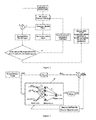
- FIG. 2 is a flowchart of a digital signal basic processing procedure of the embodiment in FIG. 1 .
- FIG. 3 is a system block diagram of an improved particle BP neural network of the embodiment in FIG. 1 .
- FIG. 4 is a time-domain comparison of the residual noise measurement microphone pick-up signals before and after noise reduction of the embodiment in FIG. 1 .
- FIG. 5 is a frequency domain diagram of the residual noise measurement microphone pickup signal before the noise reduction of the embodiment of FIG. 1 .
- FIG. 6 is a frequency domain diagram of a residual noise measurement microphone pickup signal after noise reduction in the embodiment of FIG. 1 .
- the present embodiment is a transformer noise suppression method based on an improved particle BP neural network. It will not only effectively suppress noise, but also further to overcome the drawback that BP neural network convergence rate is slow and easy to fall into the local minimum.
- main components of the system include: the controller which contains TMS320VC5509DSP smart chip, 2 PCM6110 microphones as initial noise measuring microphone and residual noise measuring microphone respectively, Swans S6.5 low frequency speaker.
- the initial noise measurement microphone and the residual noise measurement microphone are connected with the corresponding input port of DSP chip via the automatic gain adjustment module of the sound processing chip and A/D converter module.
- the output port of the DSP chip is connected with the speaker via the D/A conversion module of the sound processing chip and the power amplifier.
- TLV320AIC23 audio chip is a sound processing chip, which contains the automatic gain module, A/D converter module and D/A converter module.
- the signal acquisition frequency is set to 5000 Hz.
- the BP neural network structure is set as a 2-10-1 filtering algorithm, the excitation functions of the hidden layer and the output layer are Sigmoid function and Purelin function.
- the size of the particle group is 30, the maximum genetic algebra is 10. According to the way particle coding, the dimension of the particle is 78.
- the distance between initial noise measuring microphone and transformer is 10 cm.
- the distance between speaker and transformer is 30 cm.
- the distance between residual noise measuring microphone and transformer is 20 cm.
- the controller follows the steps below to achieve noise suppression in operation (see FIG. 2 ):
- the first step is to receive the initial noise digital signal transmitted and converted by the initial noise measurement microphone in the vicinity of the noise source as the input signal of the BP (Back Propagation) neural network.
- the second step is to process the input signal by BP neural network to generate the secondary digital signal whose phase is deviated from the input signal.
- the third step is to convert the secondary digital signal into an analog signal, amplify and output the secondary signal to the loudspeaker to generate a secondary noise having an inhibitory effect on the initial noise.
- the fourth step is to receive the initial noise picked up by the residual noise measurement microphone and the residual noise digital signal superimposed and converted by the secondary noise to determine whether the amplitude of the residual noise digital signal has been continuously set the number of times unchanged, if so, the secondary digital signal output is kept, otherwise proceed to the next step.
- the fifth step is to minimize the residual noise digital signal amplitude as the principle of optimization to optimize and adjust the BP neural network parameters, the initial noise digital signal of the next time as the new BP neural network input signal, and then repeat the second step.
- optimizing and adjusting the parameters of BP neural network in the fifth step of transformer noise suppression method in the embodiment is carried out by the improved particle swarm optimization algorithm which follow the procedures below:
- Step 1 According to the structure of BP neural network, we can determine the dimension of particles and generate N initial particles randomly.
- Step 2 The weight coefficient ⁇ hi (n) between the input layer neuron i and the hidden layer neuron h in the neural network, the weight coefficient W h (n) between the hidden layer neuron h and the output layer, the threshold value GE h (n) of hidden layer neuron h and the threshold value ge (n) of output layer neuron at the nth time are real-number encoded according to the predetermined order, and the corresponding real number particles are formed. Each particle corresponds to a group of network parameters.
- the encoding format is:
- Step 3 Select the residual noise signal e(n) of the system as the judgment criterion of network parameters, and use the following fitness function F(n) as the particle position coding and formula:
- x(n) is the initial noise digital signal input at the nth time
- H 1 (z) and H 2 (z) are the transfer functions of the primary channel and the secondary channel respectively
- y(n) is the digital signal of the network output at the n-th time
- K denotes the total number of neurons in the input layer
- J denotes the total number of neurons in the hidden layer.
- Step 5 If the iteration times has reached the maximum iteration number, stop the iteration and decode the optimal position of the particle swarm to get the corresponding BP neural network parameters. Otherwise, proceed to the next step.
- Step 6 Define the evolution degree of particle swarm:
- ⁇ ⁇ ( k ) abs ( f gbest ⁇ ( k ) - f avg ⁇ ( k ) f gbest ⁇ ( 1 ) - f avg ⁇ ( 1 ) ) [ 3 ]
- f gbest (k) and f avg (k) are respectively the global optimal fitness value and average fitness value of the particle group at the kth iteration.
- the inertia factor of the dynamic change is defined as:
- w 0 is the initial value.
- p m (k) is the mutation probability
- v id ( k+ 1) w ( k ) v id ( k )+ c 1 r 1 ( p id ( k ) ⁇ x id ( k ))+ c 2 r 2 ( p gd ( k ) ⁇ x id ( k )) [7]
- X i ( k+ 1) X i ( k )+ p m ( k )( X R 1 ( k ) ⁇ X R 2 ( k ))+ V i ( k ) [8]
- v id (k) is the velocity of the dth dimension of the particle i in the kth iteration
- V i (k) is the velocity vector of the particle i in the kth iteration
- p id (k) is the best position of the dth dimension of the kth iteration of the particle i;
- Step 7 Firstly, calculate the inertia factor and particle mutation rate of this iteration by the above formulas [4] and [5], and then update the velocity and position of all the particles by using formulas [7] and [8] to generate new generation particles group and return to step four.
- the new weight coefficient and threshold coefficient corresponding to the BP neural network at the nth time we can get the new weight coefficient and threshold coefficient corresponding to the BP neural network at the nth time, and then replace these original parameters with the new parameters.
- the initial noise digital signal x(n+1) at the (n+1)-th time is input to the controller, it is filtered through an updated BP neural network to obtain a new output value.
- the output value becomes s(n+1). That is, the secondary digital signal at the (n+1) th time.
- FIG. 4 , FIG. 5 and FIG. 6 show the comparison of the signal picked up by the residual noise measurement microphone before and after noise reduction. It can be seen that, the effect is very significant.
- the present embodiment not only constructs a reasonable transformer noise suppression system, but also integrates the particle swarm optimization algorithm on the basis of BP neural network filtering to improve the correction ways of weights and thresholds in BP neural network by using improved particle swarm optimization algorithm. It overcomes the inherent defects of the algorithms such as gradient descent optimization, and can effectively suppress the noise of all frequency components of the transformer.
Landscapes
- Engineering & Computer Science (AREA)
- Physics & Mathematics (AREA)
- Theoretical Computer Science (AREA)
- General Physics & Mathematics (AREA)
- Mathematical Physics (AREA)
- Acoustics & Sound (AREA)
- Data Mining & Analysis (AREA)
- General Engineering & Computer Science (AREA)
- Software Systems (AREA)
- Health & Medical Sciences (AREA)
- Artificial Intelligence (AREA)
- Evolutionary Computation (AREA)
- Computing Systems (AREA)
- Multimedia (AREA)
- Computational Linguistics (AREA)
- General Health & Medical Sciences (AREA)
- Biomedical Technology (AREA)
- Biophysics (AREA)
- Life Sciences & Earth Sciences (AREA)
- Molecular Biology (AREA)
- Signal Processing (AREA)
- Pure & Applied Mathematics (AREA)
- Mathematical Optimization (AREA)
- Mathematical Analysis (AREA)
- Computational Mathematics (AREA)
- Power Engineering (AREA)
- Algebra (AREA)
- Otolaryngology (AREA)
- Probability & Statistics with Applications (AREA)
- Quality & Reliability (AREA)
- Audiology, Speech & Language Pathology (AREA)
- Human Computer Interaction (AREA)
- Operations Research (AREA)
- Databases & Information Systems (AREA)
- Soundproofing, Sound Blocking, And Sound Damping (AREA)
Abstract
Description
| ω11 | ω12 | . . . | ωK | W1 | GE1 | . . . | ωJ1 | ωJ2 | . . . | ωJK | WJ | GEJ | ge |
where pm(k) is the mutation probability of the kth iteration of the particle swarm; pmmax and pmmim are the maximum and minimum values of the mutation rate respectively; fi(k) is the fitness value of the kth iteration of the particle I; εis the constant.
v id(k+1)=w(k)v id(k)+c 1 r 1(p id(k)−x id(k))+c 2 r 2(p gd(k)−x id(k)) [7]
X i(k+1)=X i(k)+p m(k)(X R
where vid(k) is the velocity of the dth dimension of the particle i in the kth iteration; Vi(k) is the velocity vector of the particle i in the kth iteration; pid(k) is the best position of the dth dimension of the kth iteration of the particle i; pgd(k) is the best position of the dth dimension of the kth iteration of the whole population; xid(k) is the position of the dth dimension of the particle i in the kth iteration; Xi(k) is the position vector of the kth iteration of particle i; c1 and c2 are nonnegative acceleration constants; r1 and r2 are random numbers transformed in the range [0,1]; R1 and R2 are unequal positive integers, in the range [1, N].
Claims (5)
v id(k+1)=w(k)v id(k)+c 1 r 1 (p id(k)−x id(k))+c 2 r 2(p gd(k)−x id(k)) [7]
X i(k+1)=X i(k)+p m(k)(X R
Applications Claiming Priority (4)
| Application Number | Priority Date | Filing Date | Title |
|---|---|---|---|
| CN201410189040.5A CN103971908B (en) | 2014-05-06 | 2014-05-06 | A kind of transformer noise suppressing method |
| CN201410189040 | 2014-05-06 | ||
| CN201410189040.5 | 2014-05-06 | ||
| PCT/CN2015/070735 WO2015169109A1 (en) | 2014-05-06 | 2015-01-15 | A transformer noise suppression method |
Publications (2)
| Publication Number | Publication Date |
|---|---|
| US20170249955A1 US20170249955A1 (en) | 2017-08-31 |
| US10083709B2 true US10083709B2 (en) | 2018-09-25 |
Family
ID=51241291
Family Applications (1)
| Application Number | Title | Priority Date | Filing Date |
|---|---|---|---|
| US15/323,407 Active US10083709B2 (en) | 2014-05-06 | 2015-01-15 | Transformer noise suppression method |
Country Status (3)
| Country | Link |
|---|---|
| US (1) | US10083709B2 (en) |
| CN (1) | CN103971908B (en) |
| WO (1) | WO2015169109A1 (en) |
Families Citing this family (38)
| Publication number | Priority date | Publication date | Assignee | Title |
|---|---|---|---|---|
| CN103971908B (en) * | 2014-05-06 | 2016-03-09 | 国家电网公司 | A kind of transformer noise suppressing method |
| CN104821166A (en) * | 2015-01-10 | 2015-08-05 | 哈尔滨工业大学(威海) | Active noise control method based on particle swarm optimization algorithm |
| CN106340290A (en) * | 2016-11-09 | 2017-01-18 | 国家电网公司 | Active noise reduction method and device |
| CN107070802B (en) * | 2016-12-21 | 2021-01-12 | 吉林大学 | Wireless sensor network congestion control method based on PID controller |
| KR20180111271A (en) * | 2017-03-31 | 2018-10-11 | 삼성전자주식회사 | Method and device for removing noise using neural network model |
| CN106910606B (en) * | 2017-04-18 | 2019-02-15 | 江西明正变电设备有限公司 | A transformer active noise reduction device and control method |
| CN107219763A (en) * | 2017-06-07 | 2017-09-29 | 安徽师范大学 | A kind of secondary channel line modeling method declined based on gradient |
| CN107240404B (en) * | 2017-06-08 | 2020-05-01 | 中国电建集团福建省电力勘测设计院有限公司 | Noise reduction method for prefabricated cabin type transformer substation |
| CN107393545B (en) * | 2017-07-17 | 2020-12-08 | 会听声学科技(北京)有限公司 | Feedback type active noise reduction system and method with flexible gain |
| JP6748304B2 (en) * | 2017-08-04 | 2020-08-26 | 日本電信電話株式会社 | Signal processing device using neural network, signal processing method using neural network, and signal processing program |
| CN107734433B (en) * | 2017-09-08 | 2021-11-02 | 中国飞行试验研究院 | Star-shaped stereo microphone array optimization method based on improved particle swarm optimization |
| CN107768119B (en) * | 2017-11-01 | 2020-12-11 | 国网山西省电力公司电力科学研究院 | An active noise reduction system for UHV power transformers |
| CN107871157B (en) * | 2017-11-08 | 2020-06-09 | 广东工业大学 | Data prediction method, system and related device based on BP and PSO |
| CN108593093B (en) * | 2018-03-14 | 2021-07-02 | 中国电力科学研究院有限公司 | On-site measurement method of sound power of UHV transformers |
| CN108646598B (en) * | 2018-05-04 | 2022-02-08 | 南京大学 | Low-order analog feedback controller suitable for miniaturization and design method thereof |
| CN108733924B (en) * | 2018-05-21 | 2022-05-10 | 东南大学 | Intelligent design method of digital coding metamaterial unit |
| CN110709921A (en) * | 2018-05-28 | 2020-01-17 | 深圳市大疆创新科技有限公司 | Noise reduction method, device and drone |
| CN109856969B (en) * | 2018-11-06 | 2023-10-03 | 皖西学院 | A fault prediction method and prediction system based on BP neural network model |
| CN110008633B (en) * | 2019-04-19 | 2023-04-14 | 中国石油大学(华东) | Road noise suppression method and system based on artificial intelligence deep neural network |
| KR102263250B1 (en) * | 2019-08-22 | 2021-06-14 | 엘지전자 주식회사 | Engine sound cancellation device and engine sound cancellation method |
| KR102225975B1 (en) * | 2019-08-26 | 2021-03-10 | 엘지전자 주식회사 | Engine sound synthesis device and engine sound synthesis method |
| CN111091805B (en) * | 2019-11-15 | 2023-05-26 | 佳禾智能科技股份有限公司 | Feedback type noise reduction method based on neural network |
| CN111063528B (en) * | 2019-11-25 | 2021-08-31 | 深圳供电局有限公司 | Transformer active noise reduction equipment and transformer noise online monitoring system |
| CN111640415B (en) * | 2020-06-03 | 2023-04-07 | 吉林大学 | Active noise reduction algorithm parameter optimization method based on particle swarm optimization |
| CN111899710A (en) * | 2020-07-10 | 2020-11-06 | 广东电网有限责任公司 | Method and device for actively reducing noise of power distribution room based on analytic hierarchy process |
| CN112151249B (en) * | 2020-08-26 | 2024-04-02 | 国网安徽省电力有限公司检修分公司 | Active noise reduction method and system for transformer and storage medium |
| CN112163274B (en) * | 2020-09-25 | 2021-08-06 | 中车长春轨道客车股份有限公司 | Low-noise optimization design method and system in vehicle |
| CN112365074B (en) * | 2020-11-18 | 2023-08-18 | 贵州电网有限责任公司 | Artificial intelligence decision-making method based on power grid regulation and control data |
| CN112665581A (en) * | 2020-12-04 | 2021-04-16 | 山东省计算中心(国家超级计算济南中心) | Combined navigation method based on BP neural network assisted Kalman filtering |
| CN112727704B (en) * | 2020-12-15 | 2021-11-30 | 北京天泽智云科技有限公司 | Method and system for monitoring corrosion of leading edge of blade |
| CN112785522B (en) * | 2021-01-21 | 2024-02-20 | 国网山西省电力公司电力科学研究院 | An adaptive PCNN image denoising method based on GWO and BEMD optimization |
| CN112883628A (en) * | 2021-03-23 | 2021-06-01 | 上海交通大学 | Method and system for positioning abnormal sound source of transformer substation equipment |
| CN113076516A (en) * | 2021-04-16 | 2021-07-06 | 上海欣影电力科技股份有限公司 | PSO-EMMD-ICA-based transformer vibration signal online separation method |
| CN113630098B (en) * | 2021-08-11 | 2023-08-15 | 深圳远虑科技有限公司 | Gain control method and device of audio amplifier and electronic equipment |
| CN113963713A (en) * | 2021-10-11 | 2022-01-21 | 稿定(厦门)科技有限公司 | Audio noise reduction method and device |
| CN115169218B (en) * | 2022-05-30 | 2026-02-10 | 上海大学 | Gear vibration and noise prediction method based on deep belief network |
| CN116360254A (en) * | 2023-03-03 | 2023-06-30 | 武汉理工大学 | An Auto-tuning Method of Fractional PID Controller Parameters Based on MPSO-BP Algorithm |
| CN118737667B (en) * | 2024-06-26 | 2025-11-28 | 无锡普天铁心股份有限公司 | Method, device, equipment and medium for controlling iron core noise |
Citations (10)
| Publication number | Priority date | Publication date | Assignee | Title |
|---|---|---|---|---|
| US3693749A (en) | 1971-04-26 | 1972-09-26 | Gen Electric | Reduction of gas turbine engine noise annoyance by modulation |
| US5293578A (en) * | 1989-07-19 | 1994-03-08 | Fujitso Ten Limited | Noise reducing device |
| US5315661A (en) * | 1992-08-12 | 1994-05-24 | Noise Cancellation Technologies, Inc. | Active high transmission loss panel |
| US5381485A (en) * | 1992-08-29 | 1995-01-10 | Adaptive Control Limited | Active sound control systems and sound reproduction systems |
| US5386689A (en) * | 1992-10-13 | 1995-02-07 | Noises Off, Inc. | Active gas turbine (jet) engine noise suppression |
| US20090097679A1 (en) * | 2007-10-15 | 2009-04-16 | Fujitsu Ten Limited | Acoustic system for providing individual acoustic environment |
| DE102008061552A1 (en) | 2008-12-11 | 2010-07-01 | Areva Energietechnik Gmbh | Method for reducing noise of electrical transformer, involves determining current operating point of transformer and providing measurement protocol for characterizing operating point dependent behavior of transformer |
| CN102208263A (en) | 2011-02-24 | 2011-10-05 | 南京大学 | Multi-channel active noise control system for power transformer |
| CN103475336A (en) | 2013-09-06 | 2013-12-25 | 深圳供电局有限公司 | Power transformer noise control method based on inverse control technology |
| CN103971988A (en) | 2014-05-26 | 2014-08-06 | 宁波黎明继电器有限公司 | Pressure relay |
Family Cites Families (4)
| Publication number | Priority date | Publication date | Assignee | Title |
|---|---|---|---|---|
| US6763339B2 (en) * | 2000-06-26 | 2004-07-13 | The Regents Of The University Of California | Biologically-based signal processing system applied to noise removal for signal extraction |
| AU2005100274A4 (en) * | 2004-03-31 | 2005-06-23 | Kapur, Ruchika Ms | Method and apparatus for analyising sound |
| CN102013090A (en) * | 2010-11-23 | 2011-04-13 | 电子科技大学 | Passive millimetre wave image strip noise suppression method |
| CN103971908B (en) * | 2014-05-06 | 2016-03-09 | 国家电网公司 | A kind of transformer noise suppressing method |
-
2014
- 2014-05-06 CN CN201410189040.5A patent/CN103971908B/en active Active
-
2015
- 2015-01-15 US US15/323,407 patent/US10083709B2/en active Active
- 2015-01-15 WO PCT/CN2015/070735 patent/WO2015169109A1/en not_active Ceased
Patent Citations (10)
| Publication number | Priority date | Publication date | Assignee | Title |
|---|---|---|---|---|
| US3693749A (en) | 1971-04-26 | 1972-09-26 | Gen Electric | Reduction of gas turbine engine noise annoyance by modulation |
| US5293578A (en) * | 1989-07-19 | 1994-03-08 | Fujitso Ten Limited | Noise reducing device |
| US5315661A (en) * | 1992-08-12 | 1994-05-24 | Noise Cancellation Technologies, Inc. | Active high transmission loss panel |
| US5381485A (en) * | 1992-08-29 | 1995-01-10 | Adaptive Control Limited | Active sound control systems and sound reproduction systems |
| US5386689A (en) * | 1992-10-13 | 1995-02-07 | Noises Off, Inc. | Active gas turbine (jet) engine noise suppression |
| US20090097679A1 (en) * | 2007-10-15 | 2009-04-16 | Fujitsu Ten Limited | Acoustic system for providing individual acoustic environment |
| DE102008061552A1 (en) | 2008-12-11 | 2010-07-01 | Areva Energietechnik Gmbh | Method for reducing noise of electrical transformer, involves determining current operating point of transformer and providing measurement protocol for characterizing operating point dependent behavior of transformer |
| CN102208263A (en) | 2011-02-24 | 2011-10-05 | 南京大学 | Multi-channel active noise control system for power transformer |
| CN103475336A (en) | 2013-09-06 | 2013-12-25 | 深圳供电局有限公司 | Power transformer noise control method based on inverse control technology |
| CN103971988A (en) | 2014-05-26 | 2014-08-06 | 宁波黎明继电器有限公司 | Pressure relay |
Non-Patent Citations (2)
| Title |
|---|
| Machines translation of CN103475336. |
| Solar Turbines. Noise prediction guidelines for industrial gas turbine. table 1 on p. 8. |
Also Published As
| Publication number | Publication date |
|---|---|
| CN103971908A (en) | 2014-08-06 |
| US20170249955A1 (en) | 2017-08-31 |
| WO2015169109A1 (en) | 2015-11-12 |
| CN103971908B (en) | 2016-03-09 |
Similar Documents
| Publication | Publication Date | Title |
|---|---|---|
| US20170249955A1 (en) | A transformer noise suppression method | |
| CN101903941A (en) | Noise cancellation system with low rate emulation | |
| US8611552B1 (en) | Direction-aware active noise cancellation system | |
| EP2677765B1 (en) | Headphone for active noise suppression | |
| CN110010116A (en) | A kind of active noise control system based on momentum FxLMS algorithm | |
| CN103474060B (en) | Power equipment noise active suppression method based on internal model control | |
| CN105489225A (en) | Feedforward narrow band active noise control system with online secondary path identification | |
| US9443533B2 (en) | Measuring and improving speech intelligibility in an enclosure | |
| US11277685B1 (en) | Cascaded adaptive interference cancellation algorithms | |
| CN113096629B (en) | Relative path virtual sensing method for single-channel feedback active noise control system | |
| CN101902674B (en) | Self-excitation eliminating method of high gain public address system based on space counteracting | |
| CN107393545A (en) | A kind of reaction type active noise reduction system and method with flexible gain | |
| CN103841496A (en) | Self-adaption indoor transformer noise elimination device and implement method thereof | |
| CN100535991C (en) | Parameter optimization method for simulating control sound source and control circuit in feedback active anti-noise system | |
| EP2641346B1 (en) | Systems and methods for reducing unwanted sounds in signals received from an arrangement of microphones | |
| CN106203386A (en) | The anti-interference adaptive algorithm of power transformer Active noise control using based on compress speech μ rule function | |
| CN106340290A (en) | Active noise reduction method and device | |
| CN112581931A (en) | Indoor noise reduction method and system applied to thermal power plant | |
| CN112270915A (en) | Active noise reduction method for indoor space | |
| CN118098189B (en) | Intelligent motor noise reduction method | |
| US9214163B2 (en) | Speech processing apparatus and method | |
| WO2024169940A1 (en) | Apparatus and method for echo cancellation without reference loop | |
| CN114974195B (en) | Method for tracking and inhibiting water bed effect of adaptive feedback active control system | |
| CN101867853A (en) | Speech signal processing method and device based on microphone array | |
| CN214043069U (en) | Indoor noise reduction system applied to thermal power plant |
Legal Events
| Date | Code | Title | Description |
|---|---|---|---|
| AS | Assignment |
Owner name: STATE GRID COMPANY CORPORATION OF CHINA, CHINA Free format text: ASSIGNMENT OF ASSIGNORS INTEREST;ASSIGNORS:JIANG, NING;MA, HONGZHONG;LI, KAI;AND OTHERS;REEL/FRAME:041293/0539 Effective date: 20161222 Owner name: STATE GRID JIANGSU ELECTRIC POWER COMPANY NANJING Free format text: ASSIGNMENT OF ASSIGNORS INTEREST;ASSIGNORS:JIANG, NING;MA, HONGZHONG;LI, KAI;AND OTHERS;REEL/FRAME:041293/0539 Effective date: 20161222 Owner name: STATE GRID JIANGSU ELECTRIC POWER COMPANY, CHINA Free format text: ASSIGNMENT OF ASSIGNORS INTEREST;ASSIGNORS:JIANG, NING;MA, HONGZHONG;LI, KAI;AND OTHERS;REEL/FRAME:041293/0539 Effective date: 20161222 Owner name: HOHAI UNIVERSITY, CHINA Free format text: ASSIGNMENT OF ASSIGNORS INTEREST;ASSIGNORS:JIANG, NING;MA, HONGZHONG;LI, KAI;AND OTHERS;REEL/FRAME:041293/0539 Effective date: 20161222 |
|
| STCF | Information on status: patent grant |
Free format text: PATENTED CASE |
|
| MAFP | Maintenance fee payment |
Free format text: PAYMENT OF MAINTENANCE FEE, 4TH YEAR, LARGE ENTITY (ORIGINAL EVENT CODE: M1551); ENTITY STATUS OF PATENT OWNER: LARGE ENTITY Year of fee payment: 4 |
|
| MAFP | Maintenance fee payment |
Free format text: PAYMENT OF MAINTENANCE FEE, 8TH YEAR, LARGE ENTITY (ORIGINAL EVENT CODE: M1552); ENTITY STATUS OF PATENT OWNER: LARGE ENTITY Year of fee payment: 8 |