US10081006B2 - Adsorptive desulfurization - Google Patents
Adsorptive desulfurization Download PDFInfo
- Publication number
- US10081006B2 US10081006B2 US14/972,339 US201514972339A US10081006B2 US 10081006 B2 US10081006 B2 US 10081006B2 US 201514972339 A US201514972339 A US 201514972339A US 10081006 B2 US10081006 B2 US 10081006B2
- Authority
- US
- United States
- Prior art keywords
- manganese oxide
- oxide adsorbent
- doped manganese
- doped
- sulfur
- Prior art date
- Legal status (The legal status is an assumption and is not a legal conclusion. Google has not performed a legal analysis and makes no representation as to the accuracy of the status listed.)
- Active, expires
Links
- 238000006477 desulfuration reaction Methods 0.000 title description 7
- 230000023556 desulfurization Effects 0.000 title description 7
- 230000000274 adsorptive effect Effects 0.000 title description 3
- AMWRITDGCCNYAT-UHFFFAOYSA-L hydroxy(oxo)manganese;manganese Chemical compound [Mn].O[Mn]=O.O[Mn]=O AMWRITDGCCNYAT-UHFFFAOYSA-L 0.000 claims abstract description 198
- 239000003463 adsorbent Substances 0.000 claims abstract description 65
- 238000000034 method Methods 0.000 claims abstract description 49
- XEEYBQQBJWHFJM-UHFFFAOYSA-N Iron Chemical compound [Fe] XEEYBQQBJWHFJM-UHFFFAOYSA-N 0.000 claims abstract description 43
- NINIDFKCEFEMDL-UHFFFAOYSA-N Sulfur Chemical compound [S] NINIDFKCEFEMDL-UHFFFAOYSA-N 0.000 claims abstract description 37
- 229910052717 sulfur Inorganic materials 0.000 claims abstract description 37
- 239000011593 sulfur Substances 0.000 claims abstract description 37
- 229910052742 iron Inorganic materials 0.000 claims abstract description 25
- 239000012530 fluid Substances 0.000 claims abstract description 24
- 230000008569 process Effects 0.000 claims abstract description 23
- 239000011148 porous material Substances 0.000 claims abstract description 19
- 229910017052 cobalt Inorganic materials 0.000 claims abstract description 17
- 239000010941 cobalt Substances 0.000 claims abstract description 17
- GUTLYIVDDKVIGB-UHFFFAOYSA-N cobalt atom Chemical compound [Co] GUTLYIVDDKVIGB-UHFFFAOYSA-N 0.000 claims abstract description 17
- 150000001875 compounds Chemical class 0.000 claims abstract description 15
- 238000011065 in-situ storage Methods 0.000 claims abstract description 8
- 239000000463 material Substances 0.000 claims description 76
- 238000001179 sorption measurement Methods 0.000 claims description 20
- 239000011230 binding agent Substances 0.000 claims description 18
- 238000005486 sulfidation Methods 0.000 claims description 17
- 239000002594 sorbent Substances 0.000 claims description 15
- RWSOTUBLDIXVET-UHFFFAOYSA-N Dihydrogen sulfide Chemical compound S RWSOTUBLDIXVET-UHFFFAOYSA-N 0.000 claims description 11
- 229910000037 hydrogen sulfide Inorganic materials 0.000 claims description 10
- 238000006243 chemical reaction Methods 0.000 claims description 7
- 239000002808 molecular sieve Substances 0.000 claims description 3
- URGAHOPLAPQHLN-UHFFFAOYSA-N sodium aluminosilicate Chemical compound [Na+].[Al+3].[O-][Si]([O-])=O.[O-][Si]([O-])=O URGAHOPLAPQHLN-UHFFFAOYSA-N 0.000 claims description 3
- 150000003573 thiols Chemical class 0.000 claims description 3
- 125000000217 alkyl group Chemical group 0.000 claims 1
- 238000005349 anion exchange Methods 0.000 claims 1
- 230000001172 regenerating effect Effects 0.000 claims 1
- 150000003568 thioethers Chemical class 0.000 claims 1
- 229930192474 thiophene Natural products 0.000 claims 1
- 150000003577 thiophenes Chemical class 0.000 claims 1
- 238000004519 manufacturing process Methods 0.000 abstract description 3
- 229910016978 MnOx Inorganic materials 0.000 description 37
- 239000002243 precursor Substances 0.000 description 25
- 229910052751 metal Inorganic materials 0.000 description 23
- 239000002184 metal Substances 0.000 description 23
- 239000000203 mixture Substances 0.000 description 16
- 239000007789 gas Substances 0.000 description 13
- XLOMVQKBTHCTTD-UHFFFAOYSA-N Zinc monoxide Chemical compound [Zn]=O XLOMVQKBTHCTTD-UHFFFAOYSA-N 0.000 description 8
- 239000002019 doping agent Substances 0.000 description 8
- PPNAOCWZXJOHFK-UHFFFAOYSA-N manganese(2+);oxygen(2-) Chemical group [O-2].[Mn+2] PPNAOCWZXJOHFK-UHFFFAOYSA-N 0.000 description 6
- 229910052723 transition metal Inorganic materials 0.000 description 6
- 150000003624 transition metals Chemical class 0.000 description 6
- -1 M(NO3)x.yH2O (M=Mn Chemical class 0.000 description 5
- 230000015572 biosynthetic process Effects 0.000 description 5
- 229910044991 metal oxide Inorganic materials 0.000 description 5
- 150000004706 metal oxides Chemical class 0.000 description 5
- 229910052725 zinc Inorganic materials 0.000 description 5
- 239000011701 zinc Substances 0.000 description 5
- 238000003917 TEM image Methods 0.000 description 4
- 229910052783 alkali metal Inorganic materials 0.000 description 4
- 150000001340 alkali metals Chemical class 0.000 description 4
- 229910052784 alkaline earth metal Inorganic materials 0.000 description 4
- 150000001342 alkaline earth metals Chemical class 0.000 description 4
- 229910052802 copper Inorganic materials 0.000 description 4
- 229910052748 manganese Inorganic materials 0.000 description 4
- 239000011572 manganese Substances 0.000 description 4
- 230000004048 modification Effects 0.000 description 4
- 238000012986 modification Methods 0.000 description 4
- 238000003786 synthesis reaction Methods 0.000 description 4
- 239000011787 zinc oxide Substances 0.000 description 4
- 229910002651 NO3 Inorganic materials 0.000 description 3
- 230000008901 benefit Effects 0.000 description 3
- 239000004927 clay Substances 0.000 description 3
- 229910001429 cobalt ion Inorganic materials 0.000 description 3
- XLJKHNWPARRRJB-UHFFFAOYSA-N cobalt(2+) Chemical compound [Co+2] XLJKHNWPARRRJB-UHFFFAOYSA-N 0.000 description 3
- 230000000694 effects Effects 0.000 description 3
- 238000002474 experimental method Methods 0.000 description 3
- 238000010348 incorporation Methods 0.000 description 3
- 229910021645 metal ion Inorganic materials 0.000 description 3
- 229910052759 nickel Inorganic materials 0.000 description 3
- 238000010992 reflux Methods 0.000 description 3
- 238000003756 stirring Methods 0.000 description 3
- XKRFYHLGVUSROY-UHFFFAOYSA-N Argon Chemical compound [Ar] XKRFYHLGVUSROY-UHFFFAOYSA-N 0.000 description 2
- IJGRMHOSHXDMSA-UHFFFAOYSA-N Atomic nitrogen Chemical compound N#N IJGRMHOSHXDMSA-UHFFFAOYSA-N 0.000 description 2
- OKTJSMMVPCPJKN-UHFFFAOYSA-N Carbon Chemical compound [C] OKTJSMMVPCPJKN-UHFFFAOYSA-N 0.000 description 2
- CURLTUGMZLYLDI-UHFFFAOYSA-N Carbon dioxide Chemical compound O=C=O CURLTUGMZLYLDI-UHFFFAOYSA-N 0.000 description 2
- UQSXHKLRYXJYBZ-UHFFFAOYSA-N Iron oxide Chemical compound [Fe]=O UQSXHKLRYXJYBZ-UHFFFAOYSA-N 0.000 description 2
- GRYLNZFGIOXLOG-UHFFFAOYSA-N Nitric acid Chemical compound O[N+]([O-])=O GRYLNZFGIOXLOG-UHFFFAOYSA-N 0.000 description 2
- BOTDANWDWHJENH-UHFFFAOYSA-N Tetraethyl orthosilicate Chemical compound CCO[Si](OCC)(OCC)OCC BOTDANWDWHJENH-UHFFFAOYSA-N 0.000 description 2
- 229910052793 cadmium Inorganic materials 0.000 description 2
- 229910052799 carbon Inorganic materials 0.000 description 2
- 229910052804 chromium Inorganic materials 0.000 description 2
- 239000000470 constituent Substances 0.000 description 2
- 230000003247 decreasing effect Effects 0.000 description 2
- 238000003795 desorption Methods 0.000 description 2
- 238000010790 dilution Methods 0.000 description 2
- 239000012895 dilution Substances 0.000 description 2
- 238000009826 distribution Methods 0.000 description 2
- 238000001035 drying Methods 0.000 description 2
- 229910052737 gold Inorganic materials 0.000 description 2
- 229910052741 iridium Inorganic materials 0.000 description 2
- MVFCKEFYUDZOCX-UHFFFAOYSA-N iron(2+);dinitrate Chemical compound [Fe+2].[O-][N+]([O-])=O.[O-][N+]([O-])=O MVFCKEFYUDZOCX-UHFFFAOYSA-N 0.000 description 2
- 229910052747 lanthanoid Inorganic materials 0.000 description 2
- 229910052746 lanthanum Inorganic materials 0.000 description 2
- 229910052753 mercury Inorganic materials 0.000 description 2
- 229910001507 metal halide Inorganic materials 0.000 description 2
- 150000005309 metal halides Chemical class 0.000 description 2
- 229910052752 metalloid Inorganic materials 0.000 description 2
- 150000002738 metalloids Chemical class 0.000 description 2
- 229910052750 molybdenum Inorganic materials 0.000 description 2
- 229910017604 nitric acid Inorganic materials 0.000 description 2
- 229910052762 osmium Inorganic materials 0.000 description 2
- 229910052763 palladium Inorganic materials 0.000 description 2
- 229910052697 platinum Inorganic materials 0.000 description 2
- 229910001848 post-transition metal Inorganic materials 0.000 description 2
- 238000001144 powder X-ray diffraction data Methods 0.000 description 2
- 239000011541 reaction mixture Substances 0.000 description 2
- 229910052702 rhenium Inorganic materials 0.000 description 2
- 229910052703 rhodium Inorganic materials 0.000 description 2
- 229910052707 ruthenium Inorganic materials 0.000 description 2
- 229910052710 silicon Inorganic materials 0.000 description 2
- 229910052709 silver Inorganic materials 0.000 description 2
- 239000007858 starting material Substances 0.000 description 2
- 229910052713 technetium Inorganic materials 0.000 description 2
- LFQCEHFDDXELDD-UHFFFAOYSA-N tetramethyl orthosilicate Chemical compound CO[Si](OC)(OC)OC LFQCEHFDDXELDD-UHFFFAOYSA-N 0.000 description 2
- VXUYXOFXAQZZMF-UHFFFAOYSA-N titanium(IV) isopropoxide Chemical compound CC(C)O[Ti](OC(C)C)(OC(C)C)OC(C)C VXUYXOFXAQZZMF-UHFFFAOYSA-N 0.000 description 2
- 229910052721 tungsten Inorganic materials 0.000 description 2
- XLYOFNOQVPJJNP-UHFFFAOYSA-N water Substances O XLYOFNOQVPJJNP-UHFFFAOYSA-N 0.000 description 2
- 229910004631 Ce(NO3)3.6H2O Inorganic materials 0.000 description 1
- 229910052684 Cerium Inorganic materials 0.000 description 1
- 229910052692 Dysprosium Inorganic materials 0.000 description 1
- 229910052691 Erbium Inorganic materials 0.000 description 1
- 229910052693 Europium Inorganic materials 0.000 description 1
- 229910052688 Gadolinium Inorganic materials 0.000 description 1
- 229910005560 Gd(NO3)3.6H2O Inorganic materials 0.000 description 1
- 229910003865 HfCl4 Inorganic materials 0.000 description 1
- 229910052689 Holmium Inorganic materials 0.000 description 1
- 229910052765 Lutetium Inorganic materials 0.000 description 1
- 229910016287 MxOy Inorganic materials 0.000 description 1
- 229910052779 Neodymium Inorganic materials 0.000 description 1
- 229910052777 Praseodymium Inorganic materials 0.000 description 1
- 239000012494 Quartz wool Substances 0.000 description 1
- 229910052772 Samarium Inorganic materials 0.000 description 1
- 229910021116 Sm(NO3)3.6H2O Inorganic materials 0.000 description 1
- 229910052771 Terbium Inorganic materials 0.000 description 1
- 229910052775 Thulium Inorganic materials 0.000 description 1
- 229910052769 Ytterbium Inorganic materials 0.000 description 1
- HCHKCACWOHOZIP-UHFFFAOYSA-N Zinc Chemical compound [Zn] HCHKCACWOHOZIP-UHFFFAOYSA-N 0.000 description 1
- 150000001242 acetic acid derivatives Chemical class 0.000 description 1
- 150000004703 alkoxides Chemical class 0.000 description 1
- 229910052782 aluminium Inorganic materials 0.000 description 1
- 229910052787 antimony Inorganic materials 0.000 description 1
- 229910052786 argon Inorganic materials 0.000 description 1
- 229910052785 arsenic Inorganic materials 0.000 description 1
- 229910052789 astatine Inorganic materials 0.000 description 1
- QVGXLLKOCUKJST-UHFFFAOYSA-N atomic oxygen Chemical compound [O] QVGXLLKOCUKJST-UHFFFAOYSA-N 0.000 description 1
- 229910052797 bismuth Inorganic materials 0.000 description 1
- 229910052796 boron Inorganic materials 0.000 description 1
- BSDOQSMQCZQLDV-UHFFFAOYSA-N butan-1-olate;zirconium(4+) Chemical compound [Zr+4].CCCC[O-].CCCC[O-].CCCC[O-].CCCC[O-] BSDOQSMQCZQLDV-UHFFFAOYSA-N 0.000 description 1
- 229910002092 carbon dioxide Inorganic materials 0.000 description 1
- 239000001569 carbon dioxide Substances 0.000 description 1
- 230000008859 change Effects 0.000 description 1
- UFMZWBIQTDUYBN-UHFFFAOYSA-N cobalt dinitrate Chemical compound [Co+2].[O-][N+]([O-])=O.[O-][N+]([O-])=O UFMZWBIQTDUYBN-UHFFFAOYSA-N 0.000 description 1
- 229910001981 cobalt nitrate Inorganic materials 0.000 description 1
- 239000000356 contaminant Substances 0.000 description 1
- 230000007423 decrease Effects 0.000 description 1
- 239000008367 deionised water Substances 0.000 description 1
- 229910021641 deionized water Inorganic materials 0.000 description 1
- 230000001419 dependent effect Effects 0.000 description 1
- 238000007865 diluting Methods 0.000 description 1
- 239000000446 fuel Substances 0.000 description 1
- 229910052733 gallium Inorganic materials 0.000 description 1
- 229910052732 germanium Inorganic materials 0.000 description 1
- 229910052735 hafnium Inorganic materials 0.000 description 1
- PDPJQWYGJJBYLF-UHFFFAOYSA-J hafnium tetrachloride Chemical compound Cl[Hf](Cl)(Cl)Cl PDPJQWYGJJBYLF-UHFFFAOYSA-J 0.000 description 1
- 238000010438 heat treatment Methods 0.000 description 1
- 229910052734 helium Inorganic materials 0.000 description 1
- 239000001307 helium Substances 0.000 description 1
- SWQJXJOGLNCZEY-UHFFFAOYSA-N helium atom Chemical compound [He] SWQJXJOGLNCZEY-UHFFFAOYSA-N 0.000 description 1
- 229910052738 indium Inorganic materials 0.000 description 1
- 239000007924 injection Substances 0.000 description 1
- 238000002347 injection Methods 0.000 description 1
- 235000014413 iron hydroxide Nutrition 0.000 description 1
- NCNCGGDMXMBVIA-UHFFFAOYSA-L iron(ii) hydroxide Chemical compound [OH-].[OH-].[Fe+2] NCNCGGDMXMBVIA-UHFFFAOYSA-L 0.000 description 1
- NLYAJNPCOHFWQQ-UHFFFAOYSA-N kaolin Chemical compound O.O.O=[Al]O[Si](=O)O[Si](=O)O[Al]=O NLYAJNPCOHFWQQ-UHFFFAOYSA-N 0.000 description 1
- 229910052622 kaolinite Inorganic materials 0.000 description 1
- 150000002602 lanthanoids Chemical class 0.000 description 1
- 229910052745 lead Inorganic materials 0.000 description 1
- 239000007788 liquid Substances 0.000 description 1
- IPJKJLXEVHOKSE-UHFFFAOYSA-L manganese dihydroxide Chemical compound [OH-].[OH-].[Mn+2] IPJKJLXEVHOKSE-UHFFFAOYSA-L 0.000 description 1
- OZOAXHQNOFIFGD-UHFFFAOYSA-N manganese(2+) oxygen(2-) Chemical class [O-2].[O-2].[Mn+2].[Mn+2] OZOAXHQNOFIFGD-UHFFFAOYSA-N 0.000 description 1
- SQQMAOCOWKFBNP-UHFFFAOYSA-L manganese(II) sulfate Chemical compound [Mn+2].[O-]S([O-])(=O)=O SQQMAOCOWKFBNP-UHFFFAOYSA-L 0.000 description 1
- 229910000357 manganese(II) sulfate Inorganic materials 0.000 description 1
- 229910001960 metal nitrate Inorganic materials 0.000 description 1
- 229910001463 metal phosphate Inorganic materials 0.000 description 1
- 150000002739 metals Chemical class 0.000 description 1
- 238000002156 mixing Methods 0.000 description 1
- 229910052758 niobium Inorganic materials 0.000 description 1
- 229910052757 nitrogen Inorganic materials 0.000 description 1
- 229910052760 oxygen Inorganic materials 0.000 description 1
- 239000001301 oxygen Substances 0.000 description 1
- 239000008188 pellet Substances 0.000 description 1
- 239000005518 polymer electrolyte Substances 0.000 description 1
- 239000012286 potassium permanganate Substances 0.000 description 1
- 238000010248 power generation Methods 0.000 description 1
- 238000002360 preparation method Methods 0.000 description 1
- XPGAWFIWCWKDDL-UHFFFAOYSA-N propan-1-olate;zirconium(4+) Chemical compound [Zr+4].CCC[O-].CCC[O-].CCC[O-].CCC[O-] XPGAWFIWCWKDDL-UHFFFAOYSA-N 0.000 description 1
- 238000000746 purification Methods 0.000 description 1
- 239000010453 quartz Substances 0.000 description 1
- 239000000376 reactant Substances 0.000 description 1
- 230000009467 reduction Effects 0.000 description 1
- 150000003839 salts Chemical class 0.000 description 1
- 238000005070 sampling Methods 0.000 description 1
- 229910052706 scandium Inorganic materials 0.000 description 1
- 238000000926 separation method Methods 0.000 description 1
- VYPSYNLAJGMNEJ-UHFFFAOYSA-N silicon dioxide Inorganic materials O=[Si]=O VYPSYNLAJGMNEJ-UHFFFAOYSA-N 0.000 description 1
- 229910001220 stainless steel Inorganic materials 0.000 description 1
- 239000010935 stainless steel Substances 0.000 description 1
- 239000010421 standard material Substances 0.000 description 1
- 229910052715 tantalum Inorganic materials 0.000 description 1
- 238000010998 test method Methods 0.000 description 1
- 238000012360 testing method Methods 0.000 description 1
- 229910052716 thallium Inorganic materials 0.000 description 1
- 229910052718 tin Inorganic materials 0.000 description 1
- 229910052719 titanium Inorganic materials 0.000 description 1
- 239000010936 titanium Substances 0.000 description 1
- 230000005641 tunneling Effects 0.000 description 1
- 229910052720 vanadium Inorganic materials 0.000 description 1
- 229910052727 yttrium Inorganic materials 0.000 description 1
- UGZADUVQMDAIAO-UHFFFAOYSA-L zinc hydroxide Chemical compound [OH-].[OH-].[Zn+2] UGZADUVQMDAIAO-UHFFFAOYSA-L 0.000 description 1
- 229940007718 zinc hydroxide Drugs 0.000 description 1
- 229910021511 zinc hydroxide Inorganic materials 0.000 description 1
- 229910052726 zirconium Inorganic materials 0.000 description 1
Images




Classifications
-
- B—PERFORMING OPERATIONS; TRANSPORTING
- B01—PHYSICAL OR CHEMICAL PROCESSES OR APPARATUS IN GENERAL
- B01J—CHEMICAL OR PHYSICAL PROCESSES, e.g. CATALYSIS OR COLLOID CHEMISTRY; THEIR RELEVANT APPARATUS
- B01J20/00—Solid sorbent compositions or filter aid compositions; Sorbents for chromatography; Processes for preparing, regenerating or reactivating thereof
- B01J20/02—Solid sorbent compositions or filter aid compositions; Sorbents for chromatography; Processes for preparing, regenerating or reactivating thereof comprising inorganic material
- B01J20/06—Solid sorbent compositions or filter aid compositions; Sorbents for chromatography; Processes for preparing, regenerating or reactivating thereof comprising inorganic material comprising oxides or hydroxides of metals not provided for in group B01J20/04
-
- B—PERFORMING OPERATIONS; TRANSPORTING
- B01—PHYSICAL OR CHEMICAL PROCESSES OR APPARATUS IN GENERAL
- B01D—SEPARATION
- B01D53/00—Separation of gases or vapours; Recovering vapours of volatile solvents from gases; Chemical or biological purification of waste gases, e.g. engine exhaust gases, smoke, fumes, flue gases, aerosols
- B01D53/02—Separation of gases or vapours; Recovering vapours of volatile solvents from gases; Chemical or biological purification of waste gases, e.g. engine exhaust gases, smoke, fumes, flue gases, aerosols by adsorption, e.g. preparative gas chromatography
-
- B—PERFORMING OPERATIONS; TRANSPORTING
- B01—PHYSICAL OR CHEMICAL PROCESSES OR APPARATUS IN GENERAL
- B01J—CHEMICAL OR PHYSICAL PROCESSES, e.g. CATALYSIS OR COLLOID CHEMISTRY; THEIR RELEVANT APPARATUS
- B01J20/00—Solid sorbent compositions or filter aid compositions; Sorbents for chromatography; Processes for preparing, regenerating or reactivating thereof
- B01J20/30—Processes for preparing, regenerating, or reactivating
- B01J20/3042—Use of binding agents; addition of materials ameliorating the mechanical properties of the produced sorbent
-
- C—CHEMISTRY; METALLURGY
- C01—INORGANIC CHEMISTRY
- C01G—COMPOUNDS CONTAINING METALS NOT COVERED BY SUBCLASSES C01D OR C01F
- C01G45/00—Compounds of manganese
- C01G45/12—Complex oxides containing manganese and at least one other metal element
- C01G45/1221—Manganates or manganites with trivalent manganese, tetravalent manganese or mixtures thereof
-
- B—PERFORMING OPERATIONS; TRANSPORTING
- B01—PHYSICAL OR CHEMICAL PROCESSES OR APPARATUS IN GENERAL
- B01D—SEPARATION
- B01D2253/00—Adsorbents used in seperation treatment of gases and vapours
- B01D2253/10—Inorganic adsorbents
- B01D2253/112—Metals or metal compounds not provided for in B01D2253/104 or B01D2253/106
- B01D2253/1124—Metal oxides
-
- B—PERFORMING OPERATIONS; TRANSPORTING
- B01—PHYSICAL OR CHEMICAL PROCESSES OR APPARATUS IN GENERAL
- B01D—SEPARATION
- B01D2253/00—Adsorbents used in seperation treatment of gases and vapours
- B01D2253/10—Inorganic adsorbents
- B01D2253/116—Molecular sieves other than zeolites
-
- B—PERFORMING OPERATIONS; TRANSPORTING
- B01—PHYSICAL OR CHEMICAL PROCESSES OR APPARATUS IN GENERAL
- B01D—SEPARATION
- B01D2253/00—Adsorbents used in seperation treatment of gases and vapours
- B01D2253/25—Coated, impregnated or composite adsorbents
-
- B—PERFORMING OPERATIONS; TRANSPORTING
- B01—PHYSICAL OR CHEMICAL PROCESSES OR APPARATUS IN GENERAL
- B01D—SEPARATION
- B01D2253/00—Adsorbents used in seperation treatment of gases and vapours
- B01D2253/30—Physical properties of adsorbents
- B01D2253/302—Dimensions
-
- B—PERFORMING OPERATIONS; TRANSPORTING
- B01—PHYSICAL OR CHEMICAL PROCESSES OR APPARATUS IN GENERAL
- B01D—SEPARATION
- B01D2257/00—Components to be removed
- B01D2257/30—Sulfur compounds
- B01D2257/304—Hydrogen sulfide
-
- B—PERFORMING OPERATIONS; TRANSPORTING
- B01—PHYSICAL OR CHEMICAL PROCESSES OR APPARATUS IN GENERAL
- B01D—SEPARATION
- B01D2257/00—Components to be removed
- B01D2257/30—Sulfur compounds
- B01D2257/306—Organic sulfur compounds, e.g. mercaptans
-
- B—PERFORMING OPERATIONS; TRANSPORTING
- B01—PHYSICAL OR CHEMICAL PROCESSES OR APPARATUS IN GENERAL
- B01D—SEPARATION
- B01D2258/00—Sources of waste gases
- B01D2258/02—Other waste gases
- B01D2258/0283—Flue gases
-
- B—PERFORMING OPERATIONS; TRANSPORTING
- B01—PHYSICAL OR CHEMICAL PROCESSES OR APPARATUS IN GENERAL
- B01D—SEPARATION
- B01D2259/00—Type of treatment
- B01D2259/12—Methods and means for introducing reactants
- B01D2259/128—Solid reactants
-
- B—PERFORMING OPERATIONS; TRANSPORTING
- B01—PHYSICAL OR CHEMICAL PROCESSES OR APPARATUS IN GENERAL
- B01D—SEPARATION
- B01D2259/00—Type of treatment
- B01D2259/40—Further details for adsorption processes and devices
- B01D2259/40083—Regeneration of adsorbents in processes other than pressure or temperature swing adsorption
- B01D2259/40088—Regeneration of adsorbents in processes other than pressure or temperature swing adsorption by heating
-
- B—PERFORMING OPERATIONS; TRANSPORTING
- B01—PHYSICAL OR CHEMICAL PROCESSES OR APPARATUS IN GENERAL
- B01D—SEPARATION
- B01D53/00—Separation of gases or vapours; Recovering vapours of volatile solvents from gases; Chemical or biological purification of waste gases, e.g. engine exhaust gases, smoke, fumes, flue gases, aerosols
- B01D53/02—Separation of gases or vapours; Recovering vapours of volatile solvents from gases; Chemical or biological purification of waste gases, e.g. engine exhaust gases, smoke, fumes, flue gases, aerosols by adsorption, e.g. preparative gas chromatography
- B01D53/04—Separation of gases or vapours; Recovering vapours of volatile solvents from gases; Chemical or biological purification of waste gases, e.g. engine exhaust gases, smoke, fumes, flue gases, aerosols by adsorption, e.g. preparative gas chromatography with stationary adsorbents
- B01D53/0407—Constructional details of adsorbing systems
- B01D53/0423—Beds in columns
-
- C—CHEMISTRY; METALLURGY
- C01—INORGANIC CHEMISTRY
- C01P—INDEXING SCHEME RELATING TO STRUCTURAL AND PHYSICAL ASPECTS OF SOLID INORGANIC COMPOUNDS
- C01P2002/00—Crystal-structural characteristics
- C01P2002/50—Solid solutions
-
- C—CHEMISTRY; METALLURGY
- C01—INORGANIC CHEMISTRY
- C01P—INDEXING SCHEME RELATING TO STRUCTURAL AND PHYSICAL ASPECTS OF SOLID INORGANIC COMPOUNDS
- C01P2002/00—Crystal-structural characteristics
- C01P2002/50—Solid solutions
- C01P2002/52—Solid solutions containing elements as dopants
-
- C—CHEMISTRY; METALLURGY
- C01—INORGANIC CHEMISTRY
- C01P—INDEXING SCHEME RELATING TO STRUCTURAL AND PHYSICAL ASPECTS OF SOLID INORGANIC COMPOUNDS
- C01P2002/00—Crystal-structural characteristics
- C01P2002/70—Crystal-structural characteristics defined by measured X-ray, neutron or electron diffraction data
-
- C—CHEMISTRY; METALLURGY
- C01—INORGANIC CHEMISTRY
- C01P—INDEXING SCHEME RELATING TO STRUCTURAL AND PHYSICAL ASPECTS OF SOLID INORGANIC COMPOUNDS
- C01P2004/00—Particle morphology
- C01P2004/01—Particle morphology depicted by an image
- C01P2004/04—Particle morphology depicted by an image obtained by TEM, STEM, STM or AFM
Definitions
- This disclosure relates to doped manganese oxide adsorbent materials useful in adsorptive desulfurization.
- this disclosure relates to doped manganese oxide adsorbent materials and processes for preparing the doped manganese oxide materials having tunable properties, for example, tunable surface area, pore size and pore volume.
- Metal oxides and mixtures are generally chosen as desulfurization sorbents for hot gas desulfurization processes.
- the problem with these largely existing materials is that they suffer from low performance and thermally instability.
- zinc oxide materials are widely used, and they have been investigated for practical applications.
- the main drawback of using zinc oxide is the fact that reduction of zinc oxide to metallic zinc occurs around 700° C., largely decreasing the sulfur adsorption capacity.
- other materials, such as carbon or metal doped carbon are much lower in price, they have a much lower capacity than metal oxide based material. Therefore, there is a need for new sulfur adsorbents with both high performance and low cost.
- High sulfur sorption capacity materials are high in demand, having already been investigated due to their potential applications in conventional power generation, polymer electrolyte fuel cells and other processes requiring desulfurization.
- Manganese oxide octahedral molecular sieves (OMS) materials are promising, having shown to be among the best in terms of performance for desulfurization processes. It would be desirable to increase the sulfur capacity and lower the cost of material.
- This disclosure relates to doped manganese oxide adsorbent materials useful in adsorptive desulfurization.
- this disclosure relates to doped manganese oxide adsorbent materials and processes for preparing the doped manganese oxide materials having tunable properties, for example, tunable surface area, pore size and pore volume.
- This disclosure also relates in part to a method for removing sulfur-containing compounds from a fluid.
- the method involves adding manganese oxide to the fluid; doping the manganese oxide in situ with iron, cobalt, or combinations thereof to give a doped manganese oxide adsorbent; and contacting the fluid with a selected amount of the doped manganese oxide adsorbent and at a selected temperature and pressure sufficient for the doped manganese oxide adsorbent to preferentially adsorb the sulfur-containing compounds in the fluid.
- This disclosure further relates in part to a process for preparing an adsorbent material.
- the process involves adding manganese oxide to the fluid; doping the manganese oxide in situ with iron, cobalt, or combinations thereof to give a doped manganese oxide adsorbent; and contacting the fluid with a selected amount of the doped manganese oxide adsorbent and at a selected temperature and pressure and for a period of time sufficient to prepare a doped manganese oxide adsorbent material.
- This disclosure yet further relates in part adsorbent material prepared by a process.
- the process involves adding manganese oxide to the fluid; doping the manganese oxide in situ with iron, cobalt, or combinations thereof to give a doped manganese oxide adsorbent; and contacting the fluid with a selected amount of the doped manganese oxide adsorbent and at a selected temperature and pressure and for a period of time sufficient to prepare a doped manganese oxide adsorbent material.
- This disclosure also relates in part to a method for tuning structural properties of an adsorbent material.
- the method involves adding manganese oxide to a fluid; doping the manganese oxide in situ with iron, cobalt, or combinations thereof to give a doped manganese oxide adsorbent; and contacting the fluid with a selected amount of the doped manganese oxide adsorbent and at a selected temperature and pressure and for a selected period of time sufficient to tune the structural properties (e.g., surface area, pore size and pore volume) of the doped manganese oxide adsorbent.
- the structural properties e.g., surface area, pore size and pore volume
- compositions comprising at least one derivative, doped or reduced compound of the formula MMn 8 O 16 wherein M is an alkali metal or an alkaline earth metal.
- the composition comprises at least one derivative, doped or reduced compound of the formula KMn 8 O 16 or at least one derivative, doped or reduced compound of the formula M v Co x Fe y Mn z O 16 wherein M is an alkali metal or an alkaline earth metal, and v , x , y , and z independently have a value from 0 to 8.
- the composition has a Birnessite type structure or a Cryptomelane type structure.
- FIG. 1 shows powder x-ray diffraction (PXRD) patterns of metal doped manganese oxide materials after the drying process in accordance with Example 1.
- FIG. 2 shows measured surface areas and Barrett-Joyner-Halenda (BJH) desorption pore size distributions of synthesized manganese oxide materials in accordance with Example 2.
- BJH Barrett-Joyner-Halenda
- FIG. 3 shows transmission electron microscopy (TEM) images of 10%-Fe-MnOx material in accordance with Example 3.
- FIG. 4 shows TEM images of 10%-Co-MnOx material in accordance with Example 4.
- FIG. 5 depicts a schematic representation of the experimental setup (GC: gas chromatograph, FPD: flame photometric detector, MFC: mass flow controller, TC: thermocouple, 3-WV: 3-way valve, CV: check valve, M: manometer) in accordance with Example 5.
- GC gas chromatograph
- FPD flame photometric detector
- MFC mass flow controller
- TC thermocouple
- 3-WV 3-way valve
- CV check valve
- M manometer
- FIG. 6 shows breakthrough curves for the various evaluated Fe-MnOx sorbents in accordance with Example 5.
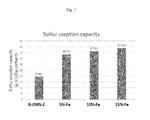
- FIG. 7 graphically depicts the sulfur sorption capacities of Fe-MnOx after sulfidation at 300° C. in accordance with Example 5.
- FIG. 8 shows breakthrough curves for the various evaluated Co-MnOx sorbents in accordance with Example 5.
- FIG. 9 graphically depicts the sulfur sorption capacities of Co-MnOx after sulfidation at 300° C. in accordance with Example 5.
- FIG. 10 shows breakthrough curves for the various evaluated for Fe-MnOx and Co-MnOx with binders as sorbents in accordance with Example 6.
- FIG. 11 graphically shows sulfur sorption capacities of Fe-MnOx and Co-MnOx with binders after sulfidation at 300° C. in accordance with Example 6.
- This disclosure provides iron and cobalt doped manganese oxide materials which function as efficient sulfur adsorbents.
- Different doping amounts of iron and cobalt into manganese oxide can be used in accordance with this disclosure.
- Creation of high surface area properties can be achieved by controlling the reaction conditions and temperature.
- the iron and cobalt doped manganese oxide materials preserved the adsorption capacities even with dilution of clay binders.
- These iron and cobalt doped manganese oxide manganese oxides possess excellent properties for gas phase hydrogen sulfide removal.
- This disclosure provides a method for in situ metal doping into manganese oxide system.
- the method creates a change in the final structure of manganese oxide with different incorporated metals.
- Physicochemical properties, such as surface area, pore size, and pore volume can also be adjusted by changing the amount of metal doping.
- Gas phase H 2 S sulfur adsorption tests show that the metal doped manganese oxide materials of this disclosure have a much higher sulfur capacity than regular K-OMS-2 materials. Additionally, the metal doped manganese oxide materials of this disclosure were diluted with binders to lower the cost, with the performance only showing only minor decline even under higher percentage dilution.
- the doped manganese oxide adsorbent materials prepared by the process of this disclosure have tunable properties, for example, tunable surface area, pore size and pore volume.
- the doped manganese oxide adsorbents of this disclosure have a high sulfur sorption capacity, for example, from about 20 to about 80 g-S/100 g sorbent after sulfidation at 300° C., preferably from about 25 to about 70 g-S/100 g sorbent after sulfidation at 300° C., and more preferably from about 30 to about 60 g-S/100 g sorbent after sulfidation at 300° C.
- the doped manganese oxide+binder adsorbents of this disclosure have a high sulfur sorption capacity, for example from about 20 to about 80 g-S/100 g sorbent after sulfidation at 300° C., preferably from about 25 to about 70 g-S/100 g sorbent after sulfidation at 300° C., and more preferably from about 30 to about 60 g-S/100 g sorbent after sulfidation at 300° C.
- the manganese oxide is preferably a manganese oxide octahedral molecular sieve (OMS) material.
- the iron doped manganese oxide adsorbent preferably has a Birnessite type structure.
- the cobalt doped manganese oxide adsorbent preferably has a Cryptomelane type structure.
- the iron in the iron doped manganese oxide adsorbent is present in an amount of from about 0.1 weight percent to about 25 weight percent.
- the cobalt in the cobalt doped manganese oxide adsorbent is present in an amount of from about 0.1 weight percent to about 25 weight percent.
- the doped manganese oxide adsorbent can include a binder material, for example, a clay binder, and still retain adsorption capacity.
- a binder material for example, a clay binder
- the use of binders contributes to low cost for the adsorbent materials.
- the metal oxide adsorbent material useful in the process of this disclosure removes sulfur contaminants, including oxides of sulfur, hydrogen sulfide, and thiols from the contaminated fluid, preferably gas.
- the presence of the metal oxide adsorbent material ensures that the product begins to work immediately after being placed in a contaminated environment.
- the metal oxide adsorbent can be manganese oxide, manganese hydroxide, iron oxide, iron hydroxide, zinc oxide, zinc hydroxide, and combinations thereof. The use of manganese oxide is preferred.
- the concentration of the manganese oxide used in the process of this disclosure can vary over a wide range and need only be at a concentration sufficient to form the manganese oxide adsorbent materials.
- the manganese oxide can be present in a molar concentration ratio of from about 1 M to about 10 M, preferably from about 1 M to about 5 M, and more preferably from about 0.5 M to about 1 M (based on a total volume).
- One or more metal dopant precursors are useful in the processes of this disclosure.
- Physicochemical properties of the manganese oxide adsorbent materials of this disclosure can be controlled by the use of metal dopant precursors in the synthesis thereof.
- the metal dopant precursors useful in this disclosure makes the tuning of physicochemical properties of the manganese oxide adsorbent materials possible by controlling surface area, pore size and pore volume.
- Illustrative metal dopant precursors include, for example, metal halides, metal phosphates, metal acetates, metal nitrates, metal alkoxides, and M x O y oxides that are capable of dissolving in HNO 3 .
- the metal dopant precursors useful in the process of this disclosure include precursors of transition metals, Lanthanide metals, post-transition metals, metalloids, and mixtures thereof.
- the transition metal precursors comprise Group 3-12 transition metal precursors, in particular, Sc, Y, La, Ti, Zr, Hf, V, Nb, Ta, Cr, Mo, W, Mn, Tc, Re, Fe, Ru, Os, Co, Rh, Ir, Ni, Pd, Pt, Cu, Ag, Au, Zn, Cd and Hg precursors.
- the transition metal precursors are selected from Group 6-12 transition metal precursors including Cr, Mo, W, Mn, Tc, Re, Fe, Ru, Os, Co, Rh, Ir, Ni, Pd, Pt, Cu, Ag, Au, Zn, Cd and Hg precursors.
- the Group 6-12 transition metal precursors include Mn, Fe, Co, Ni, Cu and Zn precursors.
- the Lanthanide metal precursors include La, Ce, Pr, Nd, Pm, Sm, Eu, Gd, Tb, Dy, Ho, Er, Tm, Yb and Lu precursors, or any mixture thereof.
- the post-transition metal precursors include Al, Ga, In, Tl, Sn, Pb and Bi precursors, or any mixture thereof.
- the metalloid precursors include B, Si, Ge, As, Sb, Te, Po and At precursors, or any mixture thereof.
- the concentration of the metal dopant precursors used in the process of this disclosure can vary over a wide range and need only be at a concentration sufficient to form the manganese oxide adsorbent materials.
- the metal precursors can be present in a molar concentration ratio of from about 1 ⁇ 10 ⁇ 2 M to about 10 M, preferably from about 1 ⁇ 10 ⁇ 1 M to about 5 M, and more preferably from about 5 ⁇ 10 ⁇ 1 M to about 1 M (based on a total volume).
- the reaction mixture is heated at a temperature and for a period of time sufficient to form the doped manganese oxide adsorbent materials.
- the heating may be in air, or in some other gas, for example, oxygen, nitrogen, carbon dioxide, helium, argon or a mixture of any two or more of these.
- the process of this disclosure can be conducted at a pressure sufficient to form the doped manganese oxide adsorbent materials.
- Positive or negative pressures may be useful in the process of this disclosure.
- Suitable combinations of pressure, temperature and contact time may be employed in the process of this disclosure, in particular, temperature-pressure relationships that give doped manganese oxide adsorbent materials having desired properties and/or characteristics.
- the pressure may range between about ambient and about 50 atmospheres, preferably between about ambient to about 40 atmospheres, and more preferably between about ambient to about 25 atmospheres. Normally the process is carried out at ambient pressure.
- the process conditions for doping the manganese oxide with the metal dopant precursor may vary greatly and any suitable combination of such conditions may be employed herein. In a preferred embodiment, the process conditions are sufficient to tune the structural properties of the doped manganese oxide adsorbent.
- the reaction temperature may be between about ⁇ 80° C. to about 150° C., and most preferably between about 20° C. to about 80° C. Normally the reaction is carried out under ambient pressure and the contact time may vary from a matter of seconds or minutes to a few hours or greater.
- the reactants can be added to the reaction mixture or combined in any order.
- the stir time employed can range from about 0.1 to about 400 hours, preferably from about 1 to 75 hours, and more preferably from about 4 to 16 hours.
- compositions prepared in accordance with this disclosure include, for example, at least one derivative, doped or reduced compound of the formula MMn 8 O 16 wherein M is an alkali metal or an alkaline earth metal.
- the composition comprises at least one derivative, doped or reduced compound of the formula KMn 8 O 16 or at least one derivative, doped or reduced compound of the formula M v Co x Fe y Mn z O 16 wherein M is an alkali metal or an alkaline earth metal, and v , x , y , and z independently have a value from 0 to 8.
- the composition has a Birnessite type structure or a Cryptomelane type structure.
- the doped manganese oxide adsorbent materials can be used to treat fluids, preferably gas, by passing the gas over and through the product.
- fluids include liquids, gases and mixtures thereof.
- the doped manganese oxide adsorbent materials work in ambient temperature and pressure. As the gas comes in contact with the doped manganese oxide adsorbent material, the undesirable sulfur of the gas is adsorbed with the doped manganese oxide adsorbent materials, thereby reducing the total amount of sulfur.
- the doped manganese oxide adsorbent material can be placed in a vessel constructed to allow the sulfur-containing fluid to pass through the vessel and contact the doped manganese oxide adsorbent material, thereby treating and decontaminating the contaminated fluid.
- the method of making the doped manganese oxide adsorbent materials involves mixing all the constituents in ambient temperature to achieve a homogenous mix.
- the amount of each constituent can be varied within the ranges disclosed above, depending on the hydrogen sulfide levels of the fluids. Any of a variety of devices can be used to stir or mix the products, including paddle mixers, tumblers, and a variety of other stirrers or mixers.
- Iron and cobalt nitrate were selected as metal ion sources for in situ doping with manganese oxide via the following procedure.
- FIG. 1 shows PXRD patterns of metal doped manganese oxide materials after the drying process.
- the incorporation of iron or cobalt ions affects the formation of the final manganese oxide structure.
- the Birnessite type manganese oxide structure was obtained after a 24 hour reflux.
- cobalt ions the final tunneling Cryptomelane-type manganese oxide structures were obtained.
- FIG. 3 shows TEM images of 10%-Fe-MnOx material.
- the images show spherical-like morphology of the material.
- the higher magnification image indicates the fact that the material is formed by aggregated plate-like structures, which can be denoted as several layers of Birnessite-type manganese oxide structure units.
- FIG. 4 shows TEM images of 10%-Co-MnOx material.
- the images show the typical Cryptomelane-type manganese oxide rod-like morphology.
- the uniformity in the diameter of the rods (15 ⁇ 20 nm) demonstrates the controlled synthesis of cobalt doped manganese oxide materials.
- FIG. 5 depicts the analytical system that was comprised of a SRI 8610C GC equipped with a flame photometric detector (FPD).
- FPD flame photometric detector
- a GS-GasPro capillary column (30 m ⁇ 0.32 mm I.D.) was used for the separation.
- a 10-port sampling valve with an electronic actuator was used to make automatic injections into the GC every 10 min. All of the tubing and fittings were stainless steel throughout.
- ⁇ 0.1 g of manganese oxide sorbent was placed into the reactor supported by quartz wool.
- a furnace with PID control was used to hold a constant temperature inside the reactor.
- the thermocouple was placed at the top of the manganese oxide bed.
- FIG. 5 depicts a schematic representation of the experimental setup.
- GC gas chromatograph
- FPD flame photometric detector
- MFC mass flow controller
- TC thermocouple
- 3-WV 3-way valve
- CV check valve
- M manometer
- the Fe-MnOx samples were tested for sulfidation under 300° C. using H 2 S gas as the sulfur source.
- the breakthrough times (defined as the time when the outlet H 2 S concentration reaches 50 ppm) of the Fe-MnOx materials are shown in FIG. 6 .
- These measured breakthrough times of the manganese oxide materials are proportional to the increased amounts of iron nitrate added as well as the surface area of the materials.
- the breakthrough time of 5%-Fe-MnOx is 8.9 hours, 10%-Fe-MnOx is 10.2 hours, and 15%-Fe-MnOx is 10.7 hours.
- the pure Cryptomelane-type K-OMS-2 material is selected as standard material for comparison.
- FIG. 7 graphically depicts the sulfur sorption capacities of Fe-MnOx after sulfidation at 300° C.
- Co doped manganese oxides were also tested for sulfidation as shown in FIG. 8 .
- the Co-MnOx series materials have lower surface areas than Fe-MnOx materials, but their breakthrough times were higher, especially for the 15%-Co-MnOx (12.8 hours).
- the synthesized Co-MnOx materials have Cryptomelane-type structure which is analogous to the standard K-OMS-2 material.
- the cobalt ions incorporated into Cryptomelane-type structure not only increase the surface area, but also helped adsorb more sulfur during sulfidation.
- FIG. 9 graphically depicts the sulfur sorption capacities of Co-MnOx after sulfidation at 300° C.
- 10% Fe-MnOx and Co-MnOx were chosen as the starting materials for diluting with binders.
- Kaoline or kaolinite was selected as a binder in this system. The preparation was accomplished by adding 70% weight ratio of binders into the reaction after completing the reflux. The materials were filtered and transformed into pellets. The diluted materials named 10%-Fe-MnOx-B and 10%-Co-MnOx-B were also tested for H 2 S sorption. The breakthrough time and capacity of 10% Fe-MnOx with the binder is 8.6 hours and 37 hours, respectively.
- 10%-Fe-MnOx-B with binders showed only minor performance loss even with a high percentage of clay added.
- the breakthrough time and capacity loss is slightly higher than in the case of 10%-Co-MnOx
- FIG. 10 shows breakthrough curves for the various evaluated for Fe-MnOx and Co-MnOx with binders as sorbents.
- FIG. 11 graphically shows sulfur sorption capacities of Fe-MnOx and Co-MnOx with binders after sulfidation at 300° C.
Landscapes
- Chemical & Material Sciences (AREA)
- Organic Chemistry (AREA)
- Analytical Chemistry (AREA)
- Chemical Kinetics & Catalysis (AREA)
- Inorganic Chemistry (AREA)
- Engineering & Computer Science (AREA)
- General Chemical & Material Sciences (AREA)
- Oil, Petroleum & Natural Gas (AREA)
- Solid-Sorbent Or Filter-Aiding Compositions (AREA)
Abstract
The disclosure relates to a method for removing sulfur-containing compounds from a fluid. The method involves adding manganese oxide to the fluid; doping the manganese oxide in situ with iron, cobalt, or combinations thereof to give a doped manganese oxide adsorbent; and contacting the fluid with a selected amount of the doped manganese oxide adsorbent and at a selected temperature and pressure sufficient for the doped manganese oxide adsorbent to preferentially adsorb the sulfur-containing compounds in the fluid. The disclosure also relates to a process for preparing a doped manganese oxide adsorbent, and a doped manganese oxide adsorbent prepared by the process. The disclosure further relates to a method for tuning structural properties (e.g., surface area, pore size and pore volume) of a doped manganese oxide adsorbent.
Description
This application claims the benefit of U.S. Provisional Application Ser. No. 62/093,196, filed on Dec. 17, 2014, which is incorporated herein by reference in its entirety.
1. Field of the Disclosure
This disclosure relates to doped manganese oxide adsorbent materials useful in adsorptive desulfurization. In particular, this disclosure relates to doped manganese oxide adsorbent materials and processes for preparing the doped manganese oxide materials having tunable properties, for example, tunable surface area, pore size and pore volume.
2. Discussion of the Background Art
Metal oxides and mixtures are generally chosen as desulfurization sorbents for hot gas desulfurization processes. However, the problem with these largely existing materials is that they suffer from low performance and thermally instability. For example, zinc oxide materials are widely used, and they have been investigated for practical applications. The main drawback of using zinc oxide is the fact that reduction of zinc oxide to metallic zinc occurs around 700° C., largely decreasing the sulfur adsorption capacity. Although other materials, such as carbon or metal doped carbon, are much lower in price, they have a much lower capacity than metal oxide based material. Therefore, there is a need for new sulfur adsorbents with both high performance and low cost.
High sulfur sorption capacity materials are high in demand, having already been investigated due to their potential applications in conventional power generation, polymer electrolyte fuel cells and other processes requiring desulfurization. Manganese oxide octahedral molecular sieves (OMS) materials are promising, having shown to be among the best in terms of performance for desulfurization processes. It would be desirable to increase the sulfur capacity and lower the cost of material.
The present disclosure provides many advantages over the prior art, which shall become apparent as described below.
This disclosure relates to doped manganese oxide adsorbent materials useful in adsorptive desulfurization. In particular, this disclosure relates to doped manganese oxide adsorbent materials and processes for preparing the doped manganese oxide materials having tunable properties, for example, tunable surface area, pore size and pore volume.
This disclosure also relates in part to a method for removing sulfur-containing compounds from a fluid. The method involves adding manganese oxide to the fluid; doping the manganese oxide in situ with iron, cobalt, or combinations thereof to give a doped manganese oxide adsorbent; and contacting the fluid with a selected amount of the doped manganese oxide adsorbent and at a selected temperature and pressure sufficient for the doped manganese oxide adsorbent to preferentially adsorb the sulfur-containing compounds in the fluid.
This disclosure further relates in part to a process for preparing an adsorbent material. The process involves adding manganese oxide to the fluid; doping the manganese oxide in situ with iron, cobalt, or combinations thereof to give a doped manganese oxide adsorbent; and contacting the fluid with a selected amount of the doped manganese oxide adsorbent and at a selected temperature and pressure and for a period of time sufficient to prepare a doped manganese oxide adsorbent material.
This disclosure yet further relates in part adsorbent material prepared by a process. The process involves adding manganese oxide to the fluid; doping the manganese oxide in situ with iron, cobalt, or combinations thereof to give a doped manganese oxide adsorbent; and contacting the fluid with a selected amount of the doped manganese oxide adsorbent and at a selected temperature and pressure and for a period of time sufficient to prepare a doped manganese oxide adsorbent material.
This disclosure also relates in part to a method for tuning structural properties of an adsorbent material. The method involves adding manganese oxide to a fluid; doping the manganese oxide in situ with iron, cobalt, or combinations thereof to give a doped manganese oxide adsorbent; and contacting the fluid with a selected amount of the doped manganese oxide adsorbent and at a selected temperature and pressure and for a selected period of time sufficient to tune the structural properties (e.g., surface area, pore size and pore volume) of the doped manganese oxide adsorbent.
This disclosure also relates in part to a composition comprising at least one derivative, doped or reduced compound of the formula
MMn8O16
wherein M is an alkali metal or an alkaline earth metal. In an embodiment, the composition comprises at least one derivative, doped or reduced compound of the formula
KMn8O16
or at least one derivative, doped or reduced compound of the formula
MvCoxFeyMnzO16
wherein M is an alkali metal or an alkaline earth metal, and v, x, y, and z independently have a value from 0 to 8. In an embodiment, the composition has a Birnessite type structure or a Cryptomelane type structure.
MMn8O16
wherein M is an alkali metal or an alkaline earth metal. In an embodiment, the composition comprises at least one derivative, doped or reduced compound of the formula
KMn8O16
or at least one derivative, doped or reduced compound of the formula
MvCoxFeyMnzO16
wherein M is an alkali metal or an alkaline earth metal, and v, x, y, and z independently have a value from 0 to 8. In an embodiment, the composition has a Birnessite type structure or a Cryptomelane type structure.
Further objects, features and advantages of the present disclosure will be understood by reference to the following drawings and detailed description.
All numerical values within the detailed description and the claims herein are modified by “about” or “approximately” the indicated value, and take into account experimental error and variations that would be expected by a person having ordinary skill in the art.
This disclosure provides iron and cobalt doped manganese oxide materials which function as efficient sulfur adsorbents. Different doping amounts of iron and cobalt into manganese oxide can be used in accordance with this disclosure. Creation of high surface area properties can be achieved by controlling the reaction conditions and temperature. The iron and cobalt doped manganese oxide materials preserved the adsorption capacities even with dilution of clay binders. These iron and cobalt doped manganese oxide manganese oxides possess excellent properties for gas phase hydrogen sulfide removal.
This disclosure provides a method for in situ metal doping into manganese oxide system. The method creates a change in the final structure of manganese oxide with different incorporated metals. Physicochemical properties, such as surface area, pore size, and pore volume can also be adjusted by changing the amount of metal doping. Gas phase H2S sulfur adsorption tests show that the metal doped manganese oxide materials of this disclosure have a much higher sulfur capacity than regular K-OMS-2 materials. Additionally, the metal doped manganese oxide materials of this disclosure were diluted with binders to lower the cost, with the performance only showing only minor decline even under higher percentage dilution.
The doped manganese oxide adsorbent materials prepared by the process of this disclosure have tunable properties, for example, tunable surface area, pore size and pore volume.
The doped manganese oxide adsorbents of this disclosure have a high sulfur sorption capacity, for example, from about 20 to about 80 g-S/100 g sorbent after sulfidation at 300° C., preferably from about 25 to about 70 g-S/100 g sorbent after sulfidation at 300° C., and more preferably from about 30 to about 60 g-S/100 g sorbent after sulfidation at 300° C. Also, the doped manganese oxide+binder adsorbents of this disclosure have a high sulfur sorption capacity, for example from about 20 to about 80 g-S/100 g sorbent after sulfidation at 300° C., preferably from about 25 to about 70 g-S/100 g sorbent after sulfidation at 300° C., and more preferably from about 30 to about 60 g-S/100 g sorbent after sulfidation at 300° C.
The manganese oxide is preferably a manganese oxide octahedral molecular sieve (OMS) material. The iron doped manganese oxide adsorbent preferably has a Birnessite type structure. The cobalt doped manganese oxide adsorbent preferably has a Cryptomelane type structure.
The iron in the iron doped manganese oxide adsorbent is present in an amount of from about 0.1 weight percent to about 25 weight percent.
The cobalt in the cobalt doped manganese oxide adsorbent is present in an amount of from about 0.1 weight percent to about 25 weight percent.
The doped manganese oxide adsorbent can include a binder material, for example, a clay binder, and still retain adsorption capacity. The use of binders contributes to low cost for the adsorbent materials.
The metal oxide adsorbent material useful in the process of this disclosure removes sulfur contaminants, including oxides of sulfur, hydrogen sulfide, and thiols from the contaminated fluid, preferably gas. The presence of the metal oxide adsorbent material ensures that the product begins to work immediately after being placed in a contaminated environment. The metal oxide adsorbent can be manganese oxide, manganese hydroxide, iron oxide, iron hydroxide, zinc oxide, zinc hydroxide, and combinations thereof. The use of manganese oxide is preferred.
The concentration of the manganese oxide used in the process of this disclosure can vary over a wide range and need only be at a concentration sufficient to form the manganese oxide adsorbent materials. The manganese oxide can be present in a molar concentration ratio of from about 1 M to about 10 M, preferably from about 1 M to about 5 M, and more preferably from about 0.5 M to about 1 M (based on a total volume).
One or more metal dopant precursors are useful in the processes of this disclosure. Physicochemical properties of the manganese oxide adsorbent materials of this disclosure can be controlled by the use of metal dopant precursors in the synthesis thereof. The metal dopant precursors useful in this disclosure makes the tuning of physicochemical properties of the manganese oxide adsorbent materials possible by controlling surface area, pore size and pore volume.
Illustrative metal dopant precursors include, for example, metal halides, metal phosphates, metal acetates, metal nitrates, metal alkoxides, and MxOy oxides that are capable of dissolving in HNO3. More particularly, metal precursors include, for example, metal halides such as M(NO3)x.yH2O (M=Mn, Fe, Co, Cu, Zn, Si), HfCl4 or NbCl4, tetraethyl orthosilicate (TEOS), tetramethyl orthosilicate (TMOS), titanium isopropoxide, zirconium n-propoxide, zirconium butoxide, Ce(NO3)3.6H2O, Gd(NO3)3.6H2O, Sm(NO3)3.6H2O, and the like.
The metal dopant precursors useful in the process of this disclosure include precursors of transition metals, Lanthanide metals, post-transition metals, metalloids, and mixtures thereof. For example, the transition metal precursors comprise Group 3-12 transition metal precursors, in particular, Sc, Y, La, Ti, Zr, Hf, V, Nb, Ta, Cr, Mo, W, Mn, Tc, Re, Fe, Ru, Os, Co, Rh, Ir, Ni, Pd, Pt, Cu, Ag, Au, Zn, Cd and Hg precursors. In an embodiment, the transition metal precursors are selected from Group 6-12 transition metal precursors including Cr, Mo, W, Mn, Tc, Re, Fe, Ru, Os, Co, Rh, Ir, Ni, Pd, Pt, Cu, Ag, Au, Zn, Cd and Hg precursors. Preferably, the Group 6-12 transition metal precursors include Mn, Fe, Co, Ni, Cu and Zn precursors. The Lanthanide metal precursors include La, Ce, Pr, Nd, Pm, Sm, Eu, Gd, Tb, Dy, Ho, Er, Tm, Yb and Lu precursors, or any mixture thereof. The post-transition metal precursors include Al, Ga, In, Tl, Sn, Pb and Bi precursors, or any mixture thereof. The metalloid precursors include B, Si, Ge, As, Sb, Te, Po and At precursors, or any mixture thereof.
The concentration of the metal dopant precursors used in the process of this disclosure can vary over a wide range and need only be at a concentration sufficient to form the manganese oxide adsorbent materials. The metal precursors can be present in a molar concentration ratio of from about 1×10⁻²M to about 10 M, preferably from about 1×10⁻¹M to about 5 M, and more preferably from about 5×10⁻¹M to about 1 M (based on a total volume).
Preferred metal dopant precursors include M(NO3)x (M=Fe, Co, or combinations thereof).
In accordance with the process of this disclosure, the reaction mixture is heated at a temperature and for a period of time sufficient to form the doped manganese oxide adsorbent materials. The heating may be in air, or in some other gas, for example, oxygen, nitrogen, carbon dioxide, helium, argon or a mixture of any two or more of these.
The process of this disclosure can be conducted at a pressure sufficient to form the doped manganese oxide adsorbent materials. Positive or negative pressures may be useful in the process of this disclosure. Suitable combinations of pressure, temperature and contact time may be employed in the process of this disclosure, in particular, temperature-pressure relationships that give doped manganese oxide adsorbent materials having desired properties and/or characteristics. The pressure may range between about ambient and about 50 atmospheres, preferably between about ambient to about 40 atmospheres, and more preferably between about ambient to about 25 atmospheres. Normally the process is carried out at ambient pressure.
The process conditions for doping the manganese oxide with the metal dopant precursor, such as temperature, pressure and contact time, may vary greatly and any suitable combination of such conditions may be employed herein. In a preferred embodiment, the process conditions are sufficient to tune the structural properties of the doped manganese oxide adsorbent. The reaction temperature may be between about −80° C. to about 150° C., and most preferably between about 20° C. to about 80° C. Normally the reaction is carried out under ambient pressure and the contact time may vary from a matter of seconds or minutes to a few hours or greater. The reactants can be added to the reaction mixture or combined in any order. The stir time employed can range from about 0.1 to about 400 hours, preferably from about 1 to 75 hours, and more preferably from about 4 to 16 hours.
Preferred compositions prepared in accordance with this disclosure include, for example, at least one derivative, doped or reduced compound of the formula
MMn8O16
wherein M is an alkali metal or an alkaline earth metal. In an embodiment, the composition comprises at least one derivative, doped or reduced compound of the formula
KMn8O16
or at least one derivative, doped or reduced compound of the formula
MvCoxFeyMnzO16
wherein M is an alkali metal or an alkaline earth metal, and v, x, y, and z independently have a value from 0 to 8. In an embodiment, the composition has a Birnessite type structure or a Cryptomelane type structure.
MMn8O16
wherein M is an alkali metal or an alkaline earth metal. In an embodiment, the composition comprises at least one derivative, doped or reduced compound of the formula
KMn8O16
or at least one derivative, doped or reduced compound of the formula
MvCoxFeyMnzO16
wherein M is an alkali metal or an alkaline earth metal, and v, x, y, and z independently have a value from 0 to 8. In an embodiment, the composition has a Birnessite type structure or a Cryptomelane type structure.
The doped manganese oxide adsorbent materials can be used to treat fluids, preferably gas, by passing the gas over and through the product. As used herein, fluids include liquids, gases and mixtures thereof. The doped manganese oxide adsorbent materials work in ambient temperature and pressure. As the gas comes in contact with the doped manganese oxide adsorbent material, the undesirable sulfur of the gas is adsorbed with the doped manganese oxide adsorbent materials, thereby reducing the total amount of sulfur. The doped manganese oxide adsorbent material can be placed in a vessel constructed to allow the sulfur-containing fluid to pass through the vessel and contact the doped manganese oxide adsorbent material, thereby treating and decontaminating the contaminated fluid.
The method of making the doped manganese oxide adsorbent materials involves mixing all the constituents in ambient temperature to achieve a homogenous mix. The amount of each constituent can be varied within the ranges disclosed above, depending on the hydrogen sulfide levels of the fluids. Any of a variety of devices can be used to stir or mix the products, including paddle mixers, tumblers, and a variety of other stirrers or mixers.
In the above detailed description, the specific embodiments of this disclosure have been described in connection with its preferred embodiments. However, to the extent that the above description is specific to a particular embodiment or a particular use of this disclosure, this is intended to be illustrative only and merely provides a concise description of the exemplary embodiments. Accordingly, the disclosure is not limited to the specific embodiments described above, but rather, the disclosure includes all alternatives, modifications, and equivalents falling within the true scope of the appended claims. Various modifications and variations of this disclosure will be obvious to a worker skilled in the art and it is to be understood that such modifications and variations are to be included within the purview of this application and the spirit and scope of the claims.
All reactions in the following examples were performed using as-received starting materials without any purification.
Different Metal Ion and Concentration Doping Effects
Iron and cobalt nitrate were selected as metal ion sources for in situ doping with manganese oxide via the following procedure. Various amounts of M(NO3)x.yH2O (M=Fe, Co), KMnO4 (14 g), MnSO4 (20 g), and 0.096 mol HNO3 (6 g) were dissolved in 300 mL of water in a 500 mL round bottom flask and homogenized by stirring at room temperature. The mixture was heated under reflux for 24 hours. Synthesized materials were washed with deionized water several times to remove any unreacted metal salts before being overnight dried in an oven running at 60° C.
Physicochemical Parameters for Synthesized Manganese Oxide Materials
Measured surface areas and BJH desorption pore size distributions of synthesized manganese oxide materials prepared in accordance with Example 1 are given in FIG. 2 . The incorporation of metal ions into the synthesis procedure affects the physicochemical properties obtained from the materials. In the case of Fe-MnOx material, the surface area increases with the increasing amount of iron nitrate present in the reaction. However, the pore size and diameter decreased from 0.39 cc/g, 6.1 nm to 0.28 cc/g, 3.5 nm. Similar trend was also observed for the cobalt doped system, with the surface area increasing from 112 to 138 m2/g.
H2S Sorption Measurements for the Synthesized Doped Manganese Oxides
The H2S sorption experiments were performed below 300° C. and equipped with a vertical fixed-bed quartz tubular reactor with an internal diameter of 2 mm. In each experiment, the sorbent was heated to the desired temperature with a He downflow of 36 SCCM and held for 1 hour before the beginning of the sulfidation. FIG. 5 depicts the analytical system that was comprised of a SRI 8610C GC equipped with a flame photometric detector (FPD). A GS-GasPro capillary column (30 m×0.32 mm I.D.) was used for the separation. A 10-port sampling valve with an electronic actuator was used to make automatic injections into the GC every 10 min. All of the tubing and fittings were stainless steel throughout. In each experiment, ˜0.1 g of manganese oxide sorbent was placed into the reactor supported by quartz wool. A furnace with PID control was used to hold a constant temperature inside the reactor. The thermocouple was placed at the top of the manganese oxide bed.
The Fe-MnOx samples were tested for sulfidation under 300° C. using H2S gas as the sulfur source. The breakthrough times (defined as the time when the outlet H2S concentration reaches 50 ppm) of the Fe-MnOx materials are shown in FIG. 6 . These measured breakthrough times of the manganese oxide materials are proportional to the increased amounts of iron nitrate added as well as the surface area of the materials. The breakthrough time of 5%-Fe-MnOx is 8.9 hours, 10%-Fe-MnOx is 10.2 hours, and 15%-Fe-MnOx is 10.7 hours. The pure Cryptomelane-type K-OMS-2 material is selected as standard material for comparison. From the obtained results, 15%-Fe-MnOx material exhibits the highest breakthrough time, more than double (4.6 hours and 10.7 hours) the time of K-OMS-2 material. FIG. 7 graphically depicts the sulfur sorption capacities of Fe-MnOx after sulfidation at 300° C.
Similar to Fe-MnOx materials, Co doped manganese oxides were also tested for sulfidation as shown in FIG. 8 . Surprisingly, the Co-MnOx series materials have lower surface areas than Fe-MnOx materials, but their breakthrough times were higher, especially for the 15%-Co-MnOx (12.8 hours). The synthesized Co-MnOx materials have Cryptomelane-type structure which is analogous to the standard K-OMS-2 material. The cobalt ions incorporated into Cryptomelane-type structure not only increase the surface area, but also helped adsorb more sulfur during sulfidation. FIG. 9 graphically depicts the sulfur sorption capacities of Co-MnOx after sulfidation at 300° C.
The sulfur sorption capacity at breakthrough for the material sulfided at various temperatures was determined as shown below:
where WHSV is the weight hourly space velocity in mLh−1 g−1, M is the atomic weight of sulfur (32 g mol−1), Vmol is the molar volume in L mol−1 under standard conditions of 298 K and 1 atm (24.5 L mol−1), Cin and Cout are the inlet and outlet concentrations (%), respectively, and t is the breakthrough time (BT) in hours. The sulfur sorption capacities were determined using the equation presented above.
Effects of Adding Binders into Fe-MnOx and Co-MnOx Materials
To investigate the effects of binders for sulfur sorption capacities, 10% Fe-MnOx and Co-MnOx were chosen as the starting materials for diluting with binders. Kaoline or kaolinite was selected as a binder in this system. The preparation was accomplished by adding 70% weight ratio of binders into the reaction after completing the reflux. The materials were filtered and transformed into pellets. The diluted materials named 10%-Fe-MnOx-B and 10%-Co-MnOx-B were also tested for H2S sorption. The breakthrough time and capacity of 10% Fe-MnOx with the binder is 8.6 hours and 37 hours, respectively. Compared to 10% Fe-MnOx, 10%-Fe-MnOx-B with binders showed only minor performance loss even with a high percentage of clay added. In the case of 10%-Co-MnOx-B material, the breakthrough time and capacity loss is slightly higher than in the case of 10%-Co-MnOx
All patents and patent applications, test procedures (such as ASTM methods, UL methods, and the like), and other documents cited herein are fully incorporated by reference to the extent such disclosure is not inconsistent with this disclosure and for all jurisdictions in which such incorporation is permitted.
When numerical lower limits and numerical upper limits are listed herein, ranges from any lower limit to any upper limit are contemplated. While the illustrative embodiments of the disclosure have been described with particularity, it will be understood that various other modifications will be apparent to and can be readily made by those skilled in the art without departing from the spirit and scope of the disclosure. Accordingly, it is not intended that the scope of the claims appended hereto be limited to the examples and descriptions set forth herein but rather that the claims be construed as encompassing all the features of patentable novelty which reside in the present disclosure, including all features which would be treated as equivalents thereof by those skilled in the art to which the disclosure pertains.
The present disclosure has been described above with reference to numerous embodiments and specific examples. Many variations will suggest themselves to those skilled in this art in light of the above detailed description. All such obvious variations are within the full intended scope of the appended claims. Also, the subject matter of the appended dependent claims is within the full intended scope of all appended independent claims.
Claims (12)
1. A method for removing sulfur-containing compounds from a fluid, the method comprising:
adding manganese oxide to the fluid;
doping the manganese oxide in situ with iron, cobalt, or combinations thereof to give a doped manganese oxide adsorbent; and
contacting the fluid with a selected amount of the doped manganese oxide adsorbent and at a selected temperature and pressure sufficient for the doped manganese oxide adsorbent to preferentially adsorb the sulfur-containing compounds in the fluid.
2. The method of claim 1 , wherein the contacting is conducted at a temperature of 300° C. or less.
3. The method of claim 1 , wherein the manganese oxide is a manganese oxide octahedral molecular sieve (OMS) material.
4. The method of claim 1 , wherein the iron doped manganese oxide adsorbent has a Birnessite type structure or a Cryptomelane type structure.
5. The method of claim 1 , wherein the sulfur-containing compounds comprises hydrogen sulfide, thiols (mercaptans), and/or derivatives thereof.
6. The method of claim 1 , wherein iron in the iron doped manganese oxide adsorbent is present in an amount of from about 0.1 weight percent to about 25 weight percent, and wherein cobalt in the cobalt doped manganese oxide adsorbent is present in an amount of from about 0.1 weight percent to about 25 weight percent.
7. The method of claim 1 , wherein the doped manganese oxide adsorbent includes a binder material.
8. The method of claim 1 , further comprising regenerating the doped manganese oxide adsorbent by anion exchange at a temperature and for a period to time sufficient to substantially remove the sulfur-containing compounds.
9. The method of claim 1 , wherein the doped manganese oxide adsorbent is adapted to adsorb sulfur-containing compounds comprising thiols, sulfides, thiophenes and alkyl derivatives thereof.
10. The method of claim 1 , wherein the doped manganese oxide adsorbent has a sulfur sorption capacity of from about 30 to about 60 g-S/100 g sorbent after sulfidation at 300° C.
11. The method of claim 1 , further comprising conducting the process under reaction conditions sufficient to tune the structural properties of the doped manganese oxide adsorbent.
12. The method of claim 11 , wherein the structural properties comprise surface area, pore size and pore volume.
Priority Applications (1)
| Application Number | Priority Date | Filing Date | Title |
|---|---|---|---|
| US14/972,339 US10081006B2 (en) | 2014-12-17 | 2015-12-17 | Adsorptive desulfurization |
Applications Claiming Priority (2)
| Application Number | Priority Date | Filing Date | Title |
|---|---|---|---|
| US201462093196P | 2014-12-17 | 2014-12-17 | |
| US14/972,339 US10081006B2 (en) | 2014-12-17 | 2015-12-17 | Adsorptive desulfurization |
Publications (2)
| Publication Number | Publication Date |
|---|---|
| US20160175806A1 US20160175806A1 (en) | 2016-06-23 |
| US10081006B2 true US10081006B2 (en) | 2018-09-25 |
Family
ID=56128360
Family Applications (1)
| Application Number | Title | Priority Date | Filing Date |
|---|---|---|---|
| US14/972,339 Active 2036-09-21 US10081006B2 (en) | 2014-12-17 | 2015-12-17 | Adsorptive desulfurization |
Country Status (1)
| Country | Link |
|---|---|
| US (1) | US10081006B2 (en) |
Families Citing this family (19)
| Publication number | Priority date | Publication date | Assignee | Title |
|---|---|---|---|---|
| CN108002444B (en) * | 2017-11-30 | 2019-07-02 | 湘潭大学 | A kind of preparation method of KMn8O16 positive electrode material |
| US11000821B2 (en) | 2017-12-20 | 2021-05-11 | Uop Llc | Enhancement of reduction resistance for manganese oxide adsorbents |
| CN108744953B (en) * | 2018-05-22 | 2020-06-30 | 中南大学 | A kind of application method of OMS-2 and/or metal-doped OMS-2 catalyzing flue gas denitrification |
| CN113522011B (en) * | 2020-04-14 | 2023-09-05 | 中国石油化工股份有限公司 | Method for removing hydrogen sulfide |
| CN113522347B (en) * | 2020-04-14 | 2023-12-12 | 中国石油化工股份有限公司 | Desulfanization catalyst and preparation method thereof and method for demercaptanization |
| CN113522302B (en) * | 2020-04-14 | 2024-02-09 | 中国石油化工股份有限公司 | Hydrogen sulfide removal agent and its preparation method and application |
| CN113893872B (en) * | 2020-06-22 | 2024-05-17 | 中国石油化工股份有限公司 | Method for regenerating catalyst containing manganese oxide molecular sieve |
| CN113893885B (en) * | 2020-06-22 | 2024-05-17 | 中国石油化工股份有限公司 | Regeneration method of dehydrogen sulfide catalyst |
| CN114425363B (en) * | 2020-10-14 | 2023-08-29 | 中国石油化工股份有限公司 | Catalyst for producing low-carbon olefin by one-step method, and preparation method and application thereof |
| CN115678590B (en) * | 2021-07-30 | 2024-10-11 | 中国石油化工股份有限公司 | Pretreatment method of sulfur-containing carbon four raw oil for alkylation |
| CN115678614B (en) * | 2021-07-30 | 2024-10-11 | 中国石油化工股份有限公司 | Refinery gas desulfurization method |
| CN115678629A (en) * | 2021-07-30 | 2023-02-03 | 中国石油化工股份有限公司 | A method for producing ultra-low sulfur content liquefied gas |
| CN115672255B (en) * | 2021-07-30 | 2024-05-17 | 中国石油化工股份有限公司 | A mercaptan remover and a method for deodorizing aviation kerosene |
| CN115678592B (en) * | 2021-07-30 | 2024-10-11 | 中国石油化工股份有限公司 | Method for removing mercaptan from gasoline at lower temperature |
| CN115678591B (en) * | 2021-07-30 | 2024-10-11 | 中国石油化工股份有限公司 | Light naphtha sweetening method |
| CN113813915B (en) * | 2021-10-22 | 2023-10-20 | 青岛创启迈沃环境科技有限公司 | A bifunctional adsorbent and its preparation method and application |
| CN115463540A (en) * | 2022-09-26 | 2022-12-13 | 广东青扬环保科技有限公司 | Micro-object dynamic catalytic desulfurization, denitration and whitening integrated device |
| CN115770582B (en) * | 2022-11-23 | 2024-04-05 | 厦门理工学院 | A manganese-based bismuth-cobalt catalyst and its preparation and application in degrading quinolone antibiotic wastewater |
| CN117563556B (en) * | 2024-01-16 | 2024-04-02 | 北京北大先锋科技股份有限公司 | Renewable load-type desulfurizing agent and preparation method thereof |
Citations (9)
| Publication number | Priority date | Publication date | Assignee | Title |
|---|---|---|---|---|
| US4072586A (en) * | 1975-12-10 | 1978-02-07 | Diamond Shamrock Technologies S.A. | Manganese dioxide electrodes |
| US20020182135A1 (en) * | 1998-08-04 | 2002-12-05 | M-I L.L.C. | Process and composition for increasing the reactivity of sulfur scavenging oxides |
| US20050169826A1 (en) * | 2004-02-04 | 2005-08-04 | Liyu Li | Sulfur oxide adsorbents and emissions control |
| US20080121584A1 (en) * | 2005-10-14 | 2008-05-29 | Inframat Corporation | Methods of making water treatment compositions |
| US7700517B2 (en) * | 2004-02-04 | 2010-04-20 | Battelle Memorial Institute | Octahedral molecular sieve sorbents and catalysts |
| US8211212B2 (en) * | 2009-04-29 | 2012-07-03 | Ifp | Mixed iron-manganese oxides for high-temperature oxygen production |
| CN101711990B (en) * | 2009-10-15 | 2012-12-05 | 清华大学 | Metal oxide-loaded molecular sieve catalyst and preparation method thereof |
| US20140255805A1 (en) * | 2013-03-06 | 2014-09-11 | Fuelcell Energy, Inc. | Manganese oxide containing materials for use in oxidative desulfurization in fuel cell systems |
| WO2014141199A1 (en) * | 2013-03-14 | 2014-09-18 | Johnson Matthey Public Limited Company | Aluminosilicate or silicoaluminophosphate molecular sieve/manganese octahedral molecular sieve as catalysts for treating exhaust gas |
-
2015
- 2015-12-17 US US14/972,339 patent/US10081006B2/en active Active
Patent Citations (9)
| Publication number | Priority date | Publication date | Assignee | Title |
|---|---|---|---|---|
| US4072586A (en) * | 1975-12-10 | 1978-02-07 | Diamond Shamrock Technologies S.A. | Manganese dioxide electrodes |
| US20020182135A1 (en) * | 1998-08-04 | 2002-12-05 | M-I L.L.C. | Process and composition for increasing the reactivity of sulfur scavenging oxides |
| US20050169826A1 (en) * | 2004-02-04 | 2005-08-04 | Liyu Li | Sulfur oxide adsorbents and emissions control |
| US7700517B2 (en) * | 2004-02-04 | 2010-04-20 | Battelle Memorial Institute | Octahedral molecular sieve sorbents and catalysts |
| US20080121584A1 (en) * | 2005-10-14 | 2008-05-29 | Inframat Corporation | Methods of making water treatment compositions |
| US8211212B2 (en) * | 2009-04-29 | 2012-07-03 | Ifp | Mixed iron-manganese oxides for high-temperature oxygen production |
| CN101711990B (en) * | 2009-10-15 | 2012-12-05 | 清华大学 | Metal oxide-loaded molecular sieve catalyst and preparation method thereof |
| US20140255805A1 (en) * | 2013-03-06 | 2014-09-11 | Fuelcell Energy, Inc. | Manganese oxide containing materials for use in oxidative desulfurization in fuel cell systems |
| WO2014141199A1 (en) * | 2013-03-14 | 2014-09-18 | Johnson Matthey Public Limited Company | Aluminosilicate or silicoaluminophosphate molecular sieve/manganese octahedral molecular sieve as catalysts for treating exhaust gas |
Non-Patent Citations (5)
| Title |
|---|
| Centi, et al., "Behaviour of SOx-traps derived from ternary Cu/Mg/Al hydrotalcite materials", Catalysis Today, 2007, 127, 219-229. |
| Li, et al., "High-Capacity Sulfur Dioxide Absorbents for Diesel Emissions Control", Ind. Eng. Chem. Res., 2005, 44, 168-177. |
| Machine-generated English translation of CN 101711990 B, published Dec. 2012. * |
| Polato, et al.,"High Surface Area Mn,Mg,Al-Spinels as Catalyst Additives for Sox Abatement in Fluid Catalytic Cracking Units", Ind. Eng. Chem. Res., 2010, 49, 1252-1258. |
| Schreier, et al., "Powder and Monolith-Supported Sulphur Trap Materials Based on Modified Hydrotalcite-Derived Supports", Catal. Lett., 2007, 117, 53-61. |
Also Published As
| Publication number | Publication date |
|---|---|
| US20160175806A1 (en) | 2016-06-23 |
Similar Documents
| Publication | Publication Date | Title |
|---|---|---|
| US20160175806A1 (en) | Adsorptive desulfurization | |
| Asgari et al. | Nd-BTC metal-organic framework (MOF); synthesis, characterization and investigation on its adsorption behavior toward cesium and strontium ions | |
| Li et al. | Selective catalytic reduction of NO with NH 3 over novel iron–tungsten mixed oxide catalyst in a broad temperature range | |
| Tian et al. | High surface area La 2 Sn 2 O 7 pyrochlore as a novel, active and stable support for Pd for CO oxidation | |
| Liu et al. | Modifying Hopcalite catalyst by SnO2 addition: An effective way to improve its moisture tolerance and activity for low temperature CO oxidation | |
| Montazerolghaem et al. | A metal–organic framework MIL-101 doped with metal nanoparticles (Ni & Cu) and its effect on CO 2 adsorption properties | |
| US20110189070A1 (en) | Method of Producing Amorphous Aluminum Silicate, Amorphous Aluminum Silicate Obtained with said Method, and Adsorbent using the same | |
| JP5478120B2 (en) | Metal complex and method for producing the same | |
| Liu et al. | Perovskite LaMnO3/ZSM-5 composites for H2S reactive adsorption at high temperature | |
| Zheng et al. | Favorably adjusting the pore characteristics of copper sulfide by template regulation for vapor-phase elemental mercury immobilization | |
| CN114588879A (en) | IL @ MOFs composite material and preparation method and application thereof | |
| US11896951B2 (en) | Mixed-metal strategy for the fast synthesis of metal-organic frameworks under ambient conditions | |
| Li et al. | Ordered mesoporous Cu-Mn-Ce ternary metal oxide catalysts for low temperature water-gas shift reaction | |
| Ullah et al. | Cation–anion double hydrolysis derived mesoporous mixed oxides for reactive adsorption desulfurization | |
| Rosid et al. | Characterization and modelling optimization on methanation activity using Box-Behnken design through cerium doped catalysts | |
| Li et al. | Insights into the effects of metal-ion doping on the structure and hot-coal-gas desulfurization properties of Zn-based sorbents supported on SBA-15 | |
| Li et al. | In situ preparation of mesoporous iron titanium catalysts by a CTAB-assisted process for NO reduction with NH3 | |
| Deng et al. | Preparation, characterization, and catalytic properties of NdSrCu1− xCoxO4− δ and Sm1. 8Ce0. 2Cu1− xCoxO4+ δ (x= 0, 0.2 and 0.4) for methane combustion | |
| Liu et al. | Insights into the role of strontium in catalytic combustion of toluene over La 1− x Sr x CoO 3 perovskite catalysts | |
| Wang et al. | Synergistic effect of bimetal in isoreticular Zn–Cu–1, 3, 5-benzenetricarboxylate on room temperature gaseous sulfides removal | |
| Duan et al. | Dendritic fibrous nanosilica supported Zn-based sorbents towards enhanced hot-coal-gas desulfurization: Structural design and metal modification | |
| Li et al. | The introduction of Mn component improves the selectivity of NO adsorption separation in simulated flue gas of Co‐MOF‐74 at ambient conditions | |
| Gomez-Largo et al. | Study of cobalt-iron mixed oxides and catalytic behavior for decomposition of hydrogen peroxide | |
| Korake et al. | Capture of carbon dioxide over porous solid adsorbents lithium silicate, lithium aluminate and magnesium aluminate at pre-combustion temperatures | |
| US20240216890A1 (en) | The organic compound adsorbent and gas blower comprising the same |
Legal Events
| Date | Code | Title | Description |
|---|---|---|---|
| AS | Assignment |
Owner name: UNIVERSITY OF CONNECTICUT, CONNECTICUT Free format text: ASSIGNMENT OF ASSIGNORS INTEREST;ASSIGNORS:SUIB, STEVEN L.;PAHALAGEDARA, LAKSHITHA R.;KUO, CHUNG-HAO;REEL/FRAME:037910/0505 Effective date: 20151230 |
|
| STCF | Information on status: patent grant |
Free format text: PATENTED CASE |
|
| MAFP | Maintenance fee payment |
Free format text: PAYMENT OF MAINTENANCE FEE, 4TH YR, SMALL ENTITY (ORIGINAL EVENT CODE: M2551); ENTITY STATUS OF PATENT OWNER: SMALL ENTITY Year of fee payment: 4 |