US10077596B2 - Smoke or fire barrier - Google Patents
Smoke or fire barrier Download PDFInfo
- Publication number
- US10077596B2 US10077596B2 US15/029,482 US201415029482A US10077596B2 US 10077596 B2 US10077596 B2 US 10077596B2 US 201415029482 A US201415029482 A US 201415029482A US 10077596 B2 US10077596 B2 US 10077596B2
- Authority
- US
- United States
- Prior art keywords
- curtain
- smoke
- jaws
- fire barrier
- edges
- Prior art date
- Legal status (The legal status is an assumption and is not a legal conclusion. Google has not performed a legal analysis and makes no representation as to the accuracy of the status listed.)
- Active
Links
Images



Classifications
-
- E—FIXED CONSTRUCTIONS
- E06—DOORS, WINDOWS, SHUTTERS, OR ROLLER BLINDS IN GENERAL; LADDERS
- E06B—FIXED OR MOVABLE CLOSURES FOR OPENINGS IN BUILDINGS, VEHICLES, FENCES OR LIKE ENCLOSURES IN GENERAL, e.g. DOORS, WINDOWS, BLINDS, GATES
- E06B5/00—Doors, windows, or like closures for special purposes; Border constructions therefor
- E06B5/10—Doors, windows, or like closures for special purposes; Border constructions therefor for protection against air-raid or other war-like action; for other protective purposes
- E06B5/16—Fireproof doors or similar closures; Adaptations of fixed constructions therefor
-
- A—HUMAN NECESSITIES
- A62—LIFE-SAVING; FIRE-FIGHTING
- A62C—FIRE-FIGHTING
- A62C2/00—Fire prevention or containment
- A62C2/06—Physical fire-barriers
- A62C2/10—Fire-proof curtains
-
- A—HUMAN NECESSITIES
- A62—LIFE-SAVING; FIRE-FIGHTING
- A62C—FIRE-FIGHTING
- A62C2/00—Fire prevention or containment
- A62C2/06—Physical fire-barriers
- A62C2/24—Operating or controlling mechanisms
- A62C2/241—Operating or controlling mechanisms having mechanical actuators and heat sensitive parts
-
- E—FIXED CONSTRUCTIONS
- E06—DOORS, WINDOWS, SHUTTERS, OR ROLLER BLINDS IN GENERAL; LADDERS
- E06B—FIXED OR MOVABLE CLOSURES FOR OPENINGS IN BUILDINGS, VEHICLES, FENCES OR LIKE ENCLOSURES IN GENERAL, e.g. DOORS, WINDOWS, BLINDS, GATES
- E06B9/00—Screening or protective devices for wall or similar openings, with or without operating or securing mechanisms; Closures of similar construction
- E06B9/56—Operating, guiding or securing devices or arrangements for roll-type closures; Spring drums; Tape drums; Counterweighting arrangements therefor
- E06B9/58—Guiding devices
- E06B9/581—Means to prevent or induce disengagement of shutter from side rails
Definitions
- the present invention relates to a smoke or fire barrier.
- Smoke or fire barriers are intended to contain smoke, fire or smoke and fire. In certain applications fire barriers are required. In others the fire barrier must also stop smoke. Whereas in others still, the lower temperature task of restricting smoke flow flowing throughout a building or other construction is adequate. Insofar as heat and smoke rises it may not be necessary for a smoke barrier to extend from a ceiling all the way to the floor. For instance at an atrium, a smoke curtain dropping from the ceilings around the atrium can be extracted at a higher level. However, where the barrier is a fire barrier, it must extend all the way to the floor. In addition, the barrier must prevent smoke and fire from passing around its edges.
- Many fire curtains are provided on one or more rollers, which are used to hold the curtain when not in use, and from which the curtain can be unwound for use.
- Providing the curtain on a roller protects the curtain from damage during storage, and provides for ease of deployment.
- the speed of rotation of the roller can be controlled to control the descent of the curtain.
- the roller for the curtain and the mechanism for deploying and retracting the curtain add considerably to the overall weight of the barrier.
- Such barriers are provided with side guides, which trap the edges of the curtain on deployment and hold them in a fixed position so that they cannot be moved by a fire draft or the like.
- curtains which are pleated for storage are also used. These are generally lighter than curtains with rollers and thus can be used in situations where weight is an issue. As such curtains are stored in a pleated state, when they are deployed a slight pleat is retained in the curtain. As a result of this and the way such curtains are deployed, namely that they drop down on lines, conventional side guides, having in-turned lips to retain projections on the edges of the curtain, are not suitable.
- Such curtains are generally used in closed systems, where the curtain extends around an area, for example an atrium. In these systems there are no edges to the curtains.
- the object of the present invention is to provide an improved smoke or fire barrier.
- a smoke or fire barrier for closing an opening in a building, the barrier including:
- the jaws In use, when the curtain is in the retracted position, the jaws are spaced apart to allow passage of the edges of the curtain therebetween. On full deployment of the curtain the means for moving the jaws moves at least one of the jaws towards the other, retaining the curtain between the jaws. This prevents the curtain from being pulled out of the guide means, for example by a fire draft, and reduces flow of smoke around the edges of the curtain.
- the jaws may be in the form of plates arranged parallel to each other.
- one of the jaws may be fixed, with the other jaw being movable. In other embodiments both the jaws may be movable. Usually the jaws are linked together for movement. The links may enable translational movement of one or both jaws. Alternatively the jaws may be hinged together for pivotal movement of one with respect to the other.
- the barrier may further include a switch connected to the means for moving the or each jaw to activate movement of the or each jaw to retain the curtain.
- the switch may be provided at the bottom of the guide means such that when a lower end of the curtain contacts the switch, when the curtain has reached the full extent of its deployment, the switch is activated to move at least one jaw towards the other to close the jaws.
- the base of the curtain will be provided with a bottom bar, which weighs the curtain for descent.
- the switch will be activated by contact with the bottom bar.
- the barrier further includes doors for covering the guide means when the curtain is fully withdrawn, to hide the guide means when not in use.
- doors will be pivotally connected to the guide means.
- the doors may be connected to springs to urge the doors into an open position in which the doors are not covering the guide means.
- electromagnets may be connected to the doors and/or the guide means to hold the doors in a closed position, in which the door is covering the guide means. The electromagnets will be stronger than the springs to hold the doors in the closed position.
- the barrier may be adapted to deploy the curtain in response to an alarm signal.
- the response to the alarm signal may include means for switching off the electromagnets. This will result in opening of the doors under the action of the springs.
- the barrier may also include a switch for retraction of the curtain after use.
- the retraction switch may also be adapted to initially cause the means for moving the or each jaw to move at least one of the jaws away from the other, releasing the curtain.
- the retraction switch may also be adapted to turn on the electromagnets. This will allow the doors to be held in the closed position. However, the doors remain open until closed by a user after the curtain has been withdrawn.
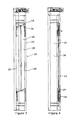
- FIG. 1 is a front view of a smoke or fire barrier according to the invention
- FIG. 2 is a cross-sectional view through the barrier of FIG. 1 ;
- FIG. 3 is a front view of an edge channel according to the invention, with the edge plates open;
- FIG. 4 is a front view of the edge channel of FIG. 3 , with the edge plates closed;
- FIG. 5 is a front view of the edge channel having a door in the closed position
- FIG. 6 is a front view of the edge channel of FIG. 5 , with the door open.
- the smoke or fire barrier 1 comprises a curtain 2 contained in a headbox 4 mounted at the top of an opening 6 in a wall or the like in a building.
- the curtain is stored pleated.
- the curtain is also provided with a bottom bar 8 , to weigh the curtain for descent.
- a number of wires 10 are provided attached to loops 12 at the ends of the pleats 14 and to the bottom bar 8 .
- the wires are attached to spindles 15 , which rotate under power to control the deployment and retraction of the curtain.
- a side guide 17 along each edge 16 of the opening 6 is provided a side guide 17 . As shown it is provided in a channel 22 in the edge of the opening, the channel having two sides 23 and a back 25 . Alternatively the side guide 17 as such could be mounted on the edge 16 of the opening.
- the side guide 16 includes a pair of edge plates 18 , 20 for clamping the curtain after deployment.
- the plates are long strips, typically of metal, in particular steel, although they could be of high temperature resistant plastics materials.
- the plates form the sides of an open channel 28 into which the edge of the curtain passes on deployment.
- the edge plates are connected together at their inner edges by diagonal cross members 24 .
- One of the edge plates 18 is secured to the channel 28 , while the other one 20 is connected to the first via the cross-members 24 .
- the movable plate 20 is connected to a motor, which when switched on urges the second plate into a position flat against the first plate. When the curtain is deployed this will clamp the curtain between the first and second plates, which will prevent removal of the curtain from the guide, for example as a result of a fire draft, and also prevent the passage of smoke around the edges of the curtain.
- the channel When the curtain is withdrawn and held in within the headbox, the channel is open, with the edge plates arranged on either side of the channel 28 .
- the curtain On activation of an alarm condition, the curtain is deployed, with the edges of the bottom bar 8 and the curtain 2 passing down the channel.
- the bottom bar When the bottom bar reaches the floor, or bottom extent of its deployment, it triggers a switch, typically by depressing a plunger, which activates the motor to urge the movable plate 20 against the fixed plate 18 , clamping the curtain therebetween.
- the edge plates close in the manner of a trellis, with the movable plate 20 moving across with respect to the fixed plate 18 .
- the edge plate could slide directly across the channel on runners. This prevents, or significantly reduces, smoke from passing around the edge of the curtain.
- a user has to press a switch 26 . This may be after a test or a false alarm. Pressing of the switch causes the motor to open the edge plates to release the curtain. It also causes the curtain motor to withdraw the curtain by rolling the wires on the spindles.
- the channel 28 may be provided with a door 30 , which can close the channel when the curtain is fully withdrawn, concealing the channel.
- the door 30 is hingedly 31 connected to the fixed plate 18 and when the curtain is fully withdrawn can be closed.
- the door is held in an open position by a spring 32 , or a series of springs along the length of the door.
- the door can also be held closed by a series of electromagnets 34 . These may be provided at intervals along the length of the door, or a single magnetic may be provided. The magnets are stronger than the spring, such that while the electromagnets are switched on the door remains closed.
- power to the electromagnets is switched off, causing the door to open under action of the spring(s) 32 .
- the curtain can then descend with its edge passing down the channel 28 .
- a user presses a withdrawal switch. In additional to opening the edge plates and withdrawing the curtain, this switch also turns the electromagnets back on. Once the curtain has been fully withdrawn the user can then manually close the door, which will be held in place by the electromagnets.
- the power to the electromagnets 34 is switched off, which results in opening of the door, and opening the channel.
- the curtain can then descend. Usually this will be as a result of release of a brake, allowing the weight of the curtain and bottom bar to cause the curtain to fall. However, the descent may be powered.
- the curtain Once the curtain reached the bottom of the channel, it activates a switch which closes the edge plates 18 , 20 , clamping the edges of the curtain between them.
- a withdrawal switch For withdrawal of the curtain, a user pressed a withdrawal switch, which initially opens the edge plates 18 , 20 .
- the curtain motor is activated with withdraw the curtain, but drawing the wires up onto the spindle.
- the brake On full withdrawal of the curtain, the brake is then activated to hold the curtain in the withdrawn position.
- the power to the electromagnets 34 is also turned on.
- the invention is not intended to be restricted to the details of the above-described embodiment.
- the side plates are described with reference to a pleated or concertina curtain, they could also be used with a curtain provided on a roller, or in any other way.
- the jaws are not plates but at least one edge which clamps the curtain either against the side of a channel forming the side guide, or two edges clamping the curtain therebetween.
- the jaws may be provided with soft flexible edges for improved contact with the jaw and the curtain to further minimise smoke passing around the edge of the curtain.
Landscapes
- Health & Medical Sciences (AREA)
- Public Health (AREA)
- Business, Economics & Management (AREA)
- Emergency Management (AREA)
- Engineering & Computer Science (AREA)
- Structural Engineering (AREA)
- Civil Engineering (AREA)
- Mechanical Engineering (AREA)
- Architecture (AREA)
- Special Wing (AREA)
- Operating, Guiding And Securing Of Roll- Type Closing Members (AREA)
- Curtains And Furnishings For Windows Or Doors (AREA)
Abstract
-
- a curtain for closing the opening;
- means arrangeable at a head of the opening for deploying the curtain and for retracting the curtain;
- guide means at sides of the opening for retaining edges of the curtain after deployment and for reducing flow of smoke past the edges of the curtain, the guide means including:
- a pair of jaws for holding the edges of the deployed curtain, at least one of the jaws being movable towards the other and
- means for moving the or each movable jaw after deployment of the curtain.
Description
-
- a curtain for closing the opening;
- means arrangeable at a head of the opening for deploying the curtain and for retracting the curtain;
- guide means at sides of the opening for retaining edges of the curtain after deployment and for reducing flow of smoke past the edges of the curtain, the guide means including:
- a pair of jaws for holding the edges of the deployed curtain, at least one of the jaws being movable towards the other and
- means for moving the or each movable jaw after deployment of the curtain.
Claims (9)
Applications Claiming Priority (3)
| Application Number | Priority Date | Filing Date | Title |
|---|---|---|---|
| GB201318172A GB201318172D0 (en) | 2013-10-14 | 2013-10-14 | Fire or Smoke Barrier |
| GB1318172.2 | 2013-10-14 | ||
| PCT/GB2014/053071 WO2015055990A2 (en) | 2013-10-14 | 2014-10-13 | Smoke or fire barrier |
Publications (2)
| Publication Number | Publication Date |
|---|---|
| US20160265269A1 US20160265269A1 (en) | 2016-09-15 |
| US10077596B2 true US10077596B2 (en) | 2018-09-18 |
Family
ID=49680024
Family Applications (1)
| Application Number | Title | Priority Date | Filing Date |
|---|---|---|---|
| US15/029,482 Active US10077596B2 (en) | 2013-10-14 | 2014-10-13 | Smoke or fire barrier |
Country Status (11)
| Country | Link |
|---|---|
| US (1) | US10077596B2 (en) |
| EP (1) | EP3057668B9 (en) |
| AU (1) | AU2014335924B2 (en) |
| CA (1) | CA2927465A1 (en) |
| DK (1) | DK3057668T3 (en) |
| ES (1) | ES2643325T3 (en) |
| GB (2) | GB201318172D0 (en) |
| NO (1) | NO3057668T3 (en) |
| PT (1) | PT3057668T (en) |
| SG (1) | SG11201602963VA (en) |
| WO (1) | WO2015055990A2 (en) |
Families Citing this family (5)
| Publication number | Priority date | Publication date | Assignee | Title |
|---|---|---|---|---|
| GB201612575D0 (en) * | 2016-07-20 | 2016-08-31 | Coopers Fire Ltd | Concertina smoke or fire barrier |
| MX2019011464A (en) | 2017-03-27 | 2019-11-01 | Cornellcookson Llc | Fire rated door. |
| TWI665375B (en) * | 2017-12-13 | 2019-07-11 | 光超建材工業有限公司 | Smoke-stop rolling curtain |
| KR102703364B1 (en) * | 2023-10-11 | 2024-09-05 | 주식회사 거산이앤지 | Screen-type electric vehicle fire suppression device |
| EP4541430A1 (en) * | 2023-10-18 | 2025-04-23 | Coopers Fire Limited | Side guide for fire and/or smoke curtains |
Citations (30)
| Publication number | Priority date | Publication date | Assignee | Title |
|---|---|---|---|---|
| US848853A (en) * | 1906-06-21 | 1907-04-02 | Ralph Raymond Reed | Fire-shutter. |
| US1330224A (en) * | 1914-10-07 | 1920-02-10 | John W Whitson | Collapsible fireproof shutter |
| US1751950A (en) * | 1925-12-02 | 1930-03-25 | Belknap Mclaughlin | Clamping mechanism for rolling screens |
| US1756496A (en) * | 1929-04-23 | 1930-04-29 | Warnick Philip | Window screen |
| US2820516A (en) * | 1953-05-15 | 1958-01-21 | Cookson Company | Door construction |
| US3027937A (en) * | 1960-11-18 | 1962-04-03 | Foster M Wilson | Weather strip for sliding closures |
| US3237682A (en) * | 1964-03-31 | 1966-03-01 | Guy E Davis | Curtain holding assembly |
| US3646877A (en) * | 1969-12-22 | 1972-03-07 | Rixson Inc | Closure operator |
| US3687185A (en) * | 1970-06-22 | 1972-08-29 | Singer Safety Products Inc | Fire fighting apparatus |
| US3796249A (en) * | 1971-09-07 | 1974-03-12 | Cabe F Mc | Resettable fire damper |
| US3960216A (en) * | 1974-01-28 | 1976-06-01 | Mineo Isobe | Fire-extingushing equipment |
| US3977456A (en) * | 1975-01-20 | 1976-08-31 | Mccabe Francis J | Volume controlled damper |
| US4077474A (en) * | 1975-02-14 | 1978-03-07 | Tadashi Hattori | Flame and smoke shutoff system |
| FR2586355A1 (en) * | 1985-08-26 | 1987-02-27 | Fechoz Ste Nle Equip Sceniques | Fire protection assembly with flexible retractable barrier |
| US4690195A (en) * | 1985-11-14 | 1987-09-01 | Cooper Cliff Door Manufacturing (1980) Ltd. | Apparatus for opening and closing industrial door |
| US4727919A (en) * | 1984-11-07 | 1988-03-01 | Nergeco | Safety and emergency actuator device for a concertina type door |
| US4880046A (en) * | 1988-09-26 | 1989-11-14 | Jerry Gesy | Door sealing apparatus |
| US5025847A (en) * | 1989-06-27 | 1991-06-25 | Rytec Corporation | Apparatus for accommodating application of a force in excess of a predetermined magnitude and closure employing such apparatus |
| US5383510A (en) * | 1991-08-12 | 1995-01-24 | Allen; Thomas H. | Apparatus and method for rapidly and reliably sealing off certain openings in response to smoke, noxious fumes or contaminated air |
| US5809699A (en) * | 1995-11-20 | 1998-09-22 | Societe D'exploitation Du Parc Des Expositions De La Ville De Paris | Fire curtain |
| US5848631A (en) * | 1997-03-04 | 1998-12-15 | Alpine Overhead Doors, Inc. | Movable closure with load resistant lateral locks |
| US7000668B2 (en) * | 2001-08-27 | 2006-02-21 | Smoke Guard Corporation | System and method for sealing openings in response to smoke, noxious fumes, or contaminated air using a roll-down barrier |
| JP2007111207A (en) | 2005-10-19 | 2007-05-10 | Taisei Corp | Fire protection compartment forming device with heat shield sheet |
| US7299848B2 (en) * | 2005-04-12 | 2007-11-27 | Smoke Guard, Inc. | Closure member control systems, including door control systems for barrier housings, and associated methods |
| EP2143470A1 (en) * | 2008-07-10 | 2010-01-13 | Stöbich Brandschutz GmbH | Fire partition |
| EP2169173A1 (en) | 2007-07-17 | 2010-03-31 | Amiserru, S.L. | Fire door |
| US7735539B2 (en) * | 2007-12-28 | 2010-06-15 | Nohara Guard System Co. Ltd. | Fire-resistant smoke-suppressant device |
| WO2011131799A1 (en) | 2010-04-22 | 2011-10-27 | Construcciones Metálicas Juan Grases, S.A. | Fire prevention mechanism |
| US20150361703A1 (en) * | 2014-06-11 | 2015-12-17 | Advanced Systems, Inc. | Wind resistant door assembly |
| US20150361714A1 (en) * | 2012-12-19 | 2015-12-17 | Airbus Defence & Space Sas | Dry containment curtain device |
Family Cites Families (2)
| Publication number | Priority date | Publication date | Assignee | Title |
|---|---|---|---|---|
| DE19906628A1 (en) * | 1999-02-17 | 2000-08-24 | Raesontec N V By Rabobank Trus | Smoke protection closure |
| GB201210485D0 (en) * | 2012-06-12 | 2012-07-25 | Cooper Fire Ltd | Fire and smoke barrier |
-
2013
- 2013-10-14 GB GB201318172A patent/GB201318172D0/en not_active Ceased
-
2014
- 2014-10-13 US US15/029,482 patent/US10077596B2/en active Active
- 2014-10-13 DK DK14796842.4T patent/DK3057668T3/en active
- 2014-10-13 AU AU2014335924A patent/AU2014335924B2/en active Active
- 2014-10-13 CA CA2927465A patent/CA2927465A1/en not_active Abandoned
- 2014-10-13 PT PT147968424T patent/PT3057668T/en unknown
- 2014-10-13 WO PCT/GB2014/053071 patent/WO2015055990A2/en not_active Ceased
- 2014-10-13 EP EP14796842.4A patent/EP3057668B9/en active Active
- 2014-10-13 GB GB1418087.1A patent/GB2520623B/en active Active
- 2014-10-13 ES ES14796842.4T patent/ES2643325T3/en active Active
- 2014-10-13 SG SG11201602963VA patent/SG11201602963VA/en unknown
- 2014-10-13 NO NO14796842A patent/NO3057668T3/no unknown
Patent Citations (30)
| Publication number | Priority date | Publication date | Assignee | Title |
|---|---|---|---|---|
| US848853A (en) * | 1906-06-21 | 1907-04-02 | Ralph Raymond Reed | Fire-shutter. |
| US1330224A (en) * | 1914-10-07 | 1920-02-10 | John W Whitson | Collapsible fireproof shutter |
| US1751950A (en) * | 1925-12-02 | 1930-03-25 | Belknap Mclaughlin | Clamping mechanism for rolling screens |
| US1756496A (en) * | 1929-04-23 | 1930-04-29 | Warnick Philip | Window screen |
| US2820516A (en) * | 1953-05-15 | 1958-01-21 | Cookson Company | Door construction |
| US3027937A (en) * | 1960-11-18 | 1962-04-03 | Foster M Wilson | Weather strip for sliding closures |
| US3237682A (en) * | 1964-03-31 | 1966-03-01 | Guy E Davis | Curtain holding assembly |
| US3646877A (en) * | 1969-12-22 | 1972-03-07 | Rixson Inc | Closure operator |
| US3687185A (en) * | 1970-06-22 | 1972-08-29 | Singer Safety Products Inc | Fire fighting apparatus |
| US3796249A (en) * | 1971-09-07 | 1974-03-12 | Cabe F Mc | Resettable fire damper |
| US3960216A (en) * | 1974-01-28 | 1976-06-01 | Mineo Isobe | Fire-extingushing equipment |
| US3977456A (en) * | 1975-01-20 | 1976-08-31 | Mccabe Francis J | Volume controlled damper |
| US4077474A (en) * | 1975-02-14 | 1978-03-07 | Tadashi Hattori | Flame and smoke shutoff system |
| US4727919A (en) * | 1984-11-07 | 1988-03-01 | Nergeco | Safety and emergency actuator device for a concertina type door |
| FR2586355A1 (en) * | 1985-08-26 | 1987-02-27 | Fechoz Ste Nle Equip Sceniques | Fire protection assembly with flexible retractable barrier |
| US4690195A (en) * | 1985-11-14 | 1987-09-01 | Cooper Cliff Door Manufacturing (1980) Ltd. | Apparatus for opening and closing industrial door |
| US4880046A (en) * | 1988-09-26 | 1989-11-14 | Jerry Gesy | Door sealing apparatus |
| US5025847A (en) * | 1989-06-27 | 1991-06-25 | Rytec Corporation | Apparatus for accommodating application of a force in excess of a predetermined magnitude and closure employing such apparatus |
| US5383510A (en) * | 1991-08-12 | 1995-01-24 | Allen; Thomas H. | Apparatus and method for rapidly and reliably sealing off certain openings in response to smoke, noxious fumes or contaminated air |
| US5809699A (en) * | 1995-11-20 | 1998-09-22 | Societe D'exploitation Du Parc Des Expositions De La Ville De Paris | Fire curtain |
| US5848631A (en) * | 1997-03-04 | 1998-12-15 | Alpine Overhead Doors, Inc. | Movable closure with load resistant lateral locks |
| US7000668B2 (en) * | 2001-08-27 | 2006-02-21 | Smoke Guard Corporation | System and method for sealing openings in response to smoke, noxious fumes, or contaminated air using a roll-down barrier |
| US7299848B2 (en) * | 2005-04-12 | 2007-11-27 | Smoke Guard, Inc. | Closure member control systems, including door control systems for barrier housings, and associated methods |
| JP2007111207A (en) | 2005-10-19 | 2007-05-10 | Taisei Corp | Fire protection compartment forming device with heat shield sheet |
| EP2169173A1 (en) | 2007-07-17 | 2010-03-31 | Amiserru, S.L. | Fire door |
| US7735539B2 (en) * | 2007-12-28 | 2010-06-15 | Nohara Guard System Co. Ltd. | Fire-resistant smoke-suppressant device |
| EP2143470A1 (en) * | 2008-07-10 | 2010-01-13 | Stöbich Brandschutz GmbH | Fire partition |
| WO2011131799A1 (en) | 2010-04-22 | 2011-10-27 | Construcciones Metálicas Juan Grases, S.A. | Fire prevention mechanism |
| US20150361714A1 (en) * | 2012-12-19 | 2015-12-17 | Airbus Defence & Space Sas | Dry containment curtain device |
| US20150361703A1 (en) * | 2014-06-11 | 2015-12-17 | Advanced Systems, Inc. | Wind resistant door assembly |
Also Published As
| Publication number | Publication date |
|---|---|
| EP3057668B1 (en) | 2017-08-23 |
| PT3057668T (en) | 2017-11-22 |
| AU2014335924B2 (en) | 2017-09-14 |
| GB2520623B (en) | 2016-04-20 |
| NO3057668T3 (en) | 2018-01-20 |
| EP3057668A2 (en) | 2016-08-24 |
| HK1223321A1 (en) | 2017-07-28 |
| GB201418087D0 (en) | 2014-11-26 |
| CA2927465A1 (en) | 2015-04-23 |
| SG11201602963VA (en) | 2016-05-30 |
| US20160265269A1 (en) | 2016-09-15 |
| ES2643325T3 (en) | 2017-11-22 |
| WO2015055990A3 (en) | 2015-07-02 |
| DK3057668T3 (en) | 2017-11-20 |
| GB2520623A (en) | 2015-05-27 |
| EP3057668B9 (en) | 2018-07-25 |
| WO2015055990A2 (en) | 2015-04-23 |
| GB201318172D0 (en) | 2013-11-27 |
Similar Documents
| Publication | Publication Date | Title |
|---|---|---|
| US10077596B2 (en) | Smoke or fire barrier | |
| AU2014335924A1 (en) | Smoke or fire barrier | |
| EP2107205B1 (en) | Smoke curtain apparatus | |
| CN108601963A (en) | Fire prevention or smoke barrier | |
| US5642767A (en) | Up closing fire door | |
| JP4013389B2 (en) | Shutter device | |
| HK1223321B (en) | Smoke or fire barrier | |
| JP5292174B2 (en) | Sleeve door interlock fire and smoke shutter device | |
| NL2005632C2 (en) | Curtain draw back system for an emergency exit, an assembly of an emergency exit and such a curtain draw back system and a method to adapt a curtain rail into such a curtain draw back system. | |
| JP4686511B2 (en) | Shutter device | |
| EP3067509B1 (en) | Shutter locking mechanism | |
| JP5632939B2 (en) | Shutter device | |
| JP5755323B2 (en) | Shutter device | |
| EP4541430A1 (en) | Side guide for fire and/or smoke curtains | |
| JP5755322B2 (en) | Shutter device | |
| JP5793602B2 (en) | Shutter device | |
| JP5311603B2 (en) | Shutter device | |
| JP5748834B2 (en) | Shutter device | |
| JP2016196813A (en) | Shutter device | |
| JP5311602B2 (en) | Shutter device | |
| JP5755320B2 (en) | Shutter device | |
| JP5755319B2 (en) | Shutter device | |
| JP5544378B2 (en) | Shutter device | |
| JP6006844B2 (en) | Shutter device | |
| JP2017210869A (en) | Shutter device |
Legal Events
| Date | Code | Title | Description |
|---|---|---|---|
| AS | Assignment |
Owner name: COOPERS FIRE LIMITED, UNITED KINGDOM Free format text: ASSIGNMENT OF ASSIGNORS INTEREST;ASSIGNORS:COOPER, ANDREW P.;JAMES, WILLIAM CHARLES;SIGNING DATES FROM 20160520 TO 20161025;REEL/FRAME:043445/0137 |
|
| STCF | Information on status: patent grant |
Free format text: PATENTED CASE |
|
| MAFP | Maintenance fee payment |
Free format text: PAYMENT OF MAINTENANCE FEE, 4TH YR, SMALL ENTITY (ORIGINAL EVENT CODE: M2551); ENTITY STATUS OF PATENT OWNER: SMALL ENTITY Year of fee payment: 4 |
|
| MAFP | Maintenance fee payment |
Free format text: PAYMENT OF MAINTENANCE FEE, 8TH YR, SMALL ENTITY (ORIGINAL EVENT CODE: M2552); ENTITY STATUS OF PATENT OWNER: SMALL ENTITY Year of fee payment: 8 |