US10075136B2 - Power amplifier - Google Patents

Power amplifier Download PDF

Info

Publication number
US10075136B2
US10075136B2 US15/823,159 US201715823159A US10075136B2 US 10075136 B2 US10075136 B2 US 10075136B2 US 201715823159 A US201715823159 A US 201715823159A US 10075136 B2 US10075136 B2 US 10075136B2
Authority
US
United States
Prior art keywords
terminal
coupled
bias component
transistor
turned
Prior art date
Legal status (The legal status is an assumption and is not a legal conclusion. Google has not performed a legal analysis and makes no representation as to the accuracy of the status listed.)
Active
Application number
US15/823,159
Other versions
US20180152152A1 (en
Inventor
Chien-I Chou
Ka-Un Chan
Current Assignee (The listed assignees may be inaccurate. Google has not performed a legal analysis and makes no representation or warranty as to the accuracy of the list.)
Realtek Semiconductor Corp
Original Assignee
Realtek Semiconductor Corp
Priority date (The priority date is an assumption and is not a legal conclusion. Google has not performed a legal analysis and makes no representation as to the accuracy of the date listed.)
Filing date
Publication date
Application filed by Realtek Semiconductor Corp filed Critical Realtek Semiconductor Corp
Assigned to REALTEK SEMICONDUCTOR CORPORATION reassignment REALTEK SEMICONDUCTOR CORPORATION ASSIGNMENT OF ASSIGNORS INTEREST (SEE DOCUMENT FOR DETAILS). Assignors: CHAN, KA-UN, CHOU, CHIEN-I
Publication of US20180152152A1 publication Critical patent/US20180152152A1/en
Application granted granted Critical
Publication of US10075136B2 publication Critical patent/US10075136B2/en
Active legal-status Critical Current
Anticipated expiration legal-status Critical

Links

Images

Classifications

    • HELECTRICITY
    • H03ELECTRONIC CIRCUITRY
    • H03FAMPLIFIERS
    • H03F1/00Details of amplifiers with only discharge tubes, only semiconductor devices or only unspecified devices as amplifying elements
    • H03F1/30Modifications of amplifiers to reduce influence of variations of temperature or supply voltage or other physical parameters
    • H03F1/303Modifications of amplifiers to reduce influence of variations of temperature or supply voltage or other physical parameters using a switching device
    • HELECTRICITY
    • H03ELECTRONIC CIRCUITRY
    • H03FAMPLIFIERS
    • H03F1/00Details of amplifiers with only discharge tubes, only semiconductor devices or only unspecified devices as amplifying elements
    • H03F1/02Modifications of amplifiers to raise the efficiency, e.g. gliding Class A stages, use of an auxiliary oscillation
    • H03F1/0205Modifications of amplifiers to raise the efficiency, e.g. gliding Class A stages, use of an auxiliary oscillation in transistor amplifiers
    • H03F1/0211Modifications of amplifiers to raise the efficiency, e.g. gliding Class A stages, use of an auxiliary oscillation in transistor amplifiers with control of the supply voltage or current
    • H03F1/0216Continuous control
    • H03F1/0222Continuous control by using a signal derived from the input signal
    • H03F1/0227Continuous control by using a signal derived from the input signal using supply converters
    • HELECTRICITY
    • H03ELECTRONIC CIRCUITRY
    • H03FAMPLIFIERS
    • H03F1/00Details of amplifiers with only discharge tubes, only semiconductor devices or only unspecified devices as amplifying elements
    • H03F1/02Modifications of amplifiers to raise the efficiency, e.g. gliding Class A stages, use of an auxiliary oscillation
    • H03F1/0205Modifications of amplifiers to raise the efficiency, e.g. gliding Class A stages, use of an auxiliary oscillation in transistor amplifiers
    • H03F1/0261Modifications of amplifiers to raise the efficiency, e.g. gliding Class A stages, use of an auxiliary oscillation in transistor amplifiers with control of the polarisation voltage or current, e.g. gliding Class A
    • HELECTRICITY
    • H03ELECTRONIC CIRCUITRY
    • H03FAMPLIFIERS
    • H03F1/00Details of amplifiers with only discharge tubes, only semiconductor devices or only unspecified devices as amplifying elements
    • H03F1/02Modifications of amplifiers to raise the efficiency, e.g. gliding Class A stages, use of an auxiliary oscillation
    • H03F1/0205Modifications of amplifiers to raise the efficiency, e.g. gliding Class A stages, use of an auxiliary oscillation in transistor amplifiers
    • H03F1/0277Selecting one or more amplifiers from a plurality of amplifiers
    • HELECTRICITY
    • H03ELECTRONIC CIRCUITRY
    • H03FAMPLIFIERS
    • H03F1/00Details of amplifiers with only discharge tubes, only semiconductor devices or only unspecified devices as amplifying elements
    • H03F1/30Modifications of amplifiers to reduce influence of variations of temperature or supply voltage or other physical parameters
    • H03F1/307Modifications of amplifiers to reduce influence of variations of temperature or supply voltage or other physical parameters in push-pull amplifiers
    • H03F1/308Modifications of amplifiers to reduce influence of variations of temperature or supply voltage or other physical parameters in push-pull amplifiers using MOSFET
    • HELECTRICITY
    • H03ELECTRONIC CIRCUITRY
    • H03FAMPLIFIERS
    • H03F3/00Amplifiers with only discharge tubes or only semiconductor devices as amplifying elements
    • H03F3/189High-frequency amplifiers, e.g. radio frequency amplifiers
    • H03F3/19High-frequency amplifiers, e.g. radio frequency amplifiers with semiconductor devices only
    • H03F3/193High-frequency amplifiers, e.g. radio frequency amplifiers with semiconductor devices only with field-effect devices
    • HELECTRICITY
    • H03ELECTRONIC CIRCUITRY
    • H03FAMPLIFIERS
    • H03F3/00Amplifiers with only discharge tubes or only semiconductor devices as amplifying elements
    • H03F3/20Power amplifiers, e.g. Class B amplifiers, Class C amplifiers
    • HELECTRICITY
    • H03ELECTRONIC CIRCUITRY
    • H03FAMPLIFIERS
    • H03F3/00Amplifiers with only discharge tubes or only semiconductor devices as amplifying elements
    • H03F3/20Power amplifiers, e.g. Class B amplifiers, Class C amplifiers
    • H03F3/21Power amplifiers, e.g. Class B amplifiers, Class C amplifiers with semiconductor devices only
    • H03F3/217Class D power amplifiers; Switching amplifiers
    • HELECTRICITY
    • H03ELECTRONIC CIRCUITRY
    • H03FAMPLIFIERS
    • H03F3/00Amplifiers with only discharge tubes or only semiconductor devices as amplifying elements
    • H03F3/20Power amplifiers, e.g. Class B amplifiers, Class C amplifiers
    • H03F3/24Power amplifiers, e.g. Class B amplifiers, Class C amplifiers of transmitter output stages
    • H03F3/245Power amplifiers, e.g. Class B amplifiers, Class C amplifiers of transmitter output stages with semiconductor devices only
    • HELECTRICITY
    • H03ELECTRONIC CIRCUITRY
    • H03FAMPLIFIERS
    • H03F3/00Amplifiers with only discharge tubes or only semiconductor devices as amplifying elements
    • H03F3/30Single-ended push-pull [SEPP] amplifiers; Phase-splitters therefor
    • H03F3/3001Single-ended push-pull [SEPP] amplifiers; Phase-splitters therefor with field-effect transistors
    • H03F3/3022CMOS common source output SEPP amplifiers
    • H03F3/3028CMOS common source output SEPP amplifiers with symmetrical driving of the end stage
    • HELECTRICITY
    • H03ELECTRONIC CIRCUITRY
    • H03FAMPLIFIERS
    • H03F3/00Amplifiers with only discharge tubes or only semiconductor devices as amplifying elements
    • H03F3/72Gated amplifiers, i.e. amplifiers which are rendered operative or inoperative by means of a control signal
    • HELECTRICITY
    • H03ELECTRONIC CIRCUITRY
    • H03FAMPLIFIERS
    • H03F2200/00Indexing scheme relating to amplifiers
    • H03F2200/451Indexing scheme relating to amplifiers the amplifier being a radio frequency amplifier

Definitions

  • the present invention relates to an amplifier, especially to a power amplifier.
  • an inverter-type power amplifier consumes less power while a common source power amplifier has higher output power.
  • the two kinds of amplifiers are suitable for different applications.
  • a power amplifier consuming a lot of power in a radio-frequency (RF) transceiver if the RF transceiver takes the issue of power consumption as the first priority, the inverter-type power amplifier will be the better choice, and if the RF transceiver takes the operation performance (e.g., the maximum distance of transmission) as the first priority, the common source power amplifier will be preferable.
  • RF radio-frequency
  • An object of the present invention is to provide a power amplifier capable of adaptively operating in one of an energy efficient mode and a high output power mode.
  • the present invention discloses a power amplifier capable of operating in one of an energy efficient mode and a high output power mode.
  • An embodiment of the power amplifier comprises a first transistor, a second transistor, a first bias component, a second bias component, a third bias component, a first switch, a second switch, a third switch, a fourth switch, a fifth switch, a sixth switch and a seventh switch.
  • the first transistor includes a first high voltage terminal, a first low voltage terminal and a first control terminal, in which the first high voltage terminal is coupled to a first high voltage supply terminal and the first low voltage terminal is coupled to a signal output terminal.
  • the second transistor includes a second high voltage terminal, a second low voltage terminal and a second control terminal, in which the second high voltage terminal is coupled to the signal output terminal, the second low voltage terminal is coupled to a low voltage supply terminal, and the second control terminal is coupled to a signal input terminal.
  • the first bias component is coupled to a first load bias terminal.
  • the second bias component is coupled to a second load bias terminal.
  • the first switch is coupled between the high voltage supply terminal and the first control terminal, and configured to be turned off according to a control signal in the energy efficient mode and turned on according to the control signal in the high output power mode.
  • the second switch is coupled between the signal input terminal and the first control terminal, and configured to be turned on according to the control signal in the energy efficient mode and turned off according to the control signal in the high output power mode.
  • the third switch is coupled between the signal input terminal and the third bias component, and configured to be turned on according to the control signal in the energy efficient mode and turned off according to the control signal in the high output power mode.
  • the fourth switch is coupled between the third bias component and the signal output terminal, and configured to be turned on according to the control signal in the energy efficient mode and turned off according to the control signal in the high output power mode.
  • the fifth switch is coupled between the second control terminal and a transistor bias terminal, and configured to be turned off according to the control signal in the energy efficient mode and turned on according to the control signal in the high output power mode.
  • the sixth switch is coupled between the first bias component and the signal output terminal, and configured to be turned off according to the control signal in the energy efficient mode and turned on according to the control signal in the high output power mode.
  • the seventh switch is coupled between the signal output terminal and the second bias component, and configured to be turned on according to the control signal in the energy efficient mode and turned off according to the control signal in the high output power mode. Accordingly, the power amplifier acts as an inverter-type power amplifier in the energy efficient mode, and acts as a common source/emitter power amplifier in the high output power mode.
  • the aforementioned power amplifier comprises a first transistor, a second transistor, a first bias component, a second bias component, a third bias component and a plurality of switches.
  • the first transistor includes a first high voltage terminal, a first low voltage terminal and a first control terminal, in which the first high voltage terminal is coupled to a high voltage supply terminal, the first low voltage terminal is coupled to a signal output terminal, and the first control terminal is coupled to a signal input terminal in the energy efficient mode.
  • the second transistor includes a second high voltage terminal, a second low voltage terminal and a second control terminal, in which the second high voltage terminal is coupled to the signal output terminal, the second low voltage terminal is coupled to a low voltage supply terminal, and the second control terminal is coupled to the signal input terminal.
  • the first bias component is coupled to a first load bias terminal, in which the first bias component is not coupled to the signal output terminal in the energy efficient mode and coupled to the signal output terminal in the high output power mode.
  • the second bias component is coupled to a second load bias terminal, in which the second bias component is coupled to the signal output terminal in the energy efficient mode and not coupled to the signal output terminal in the high output power mode.
  • the third bias component is coupled between the signal input terminal and the signal output terminal in the energy efficient mode, and not coupled to the signal input terminal and the signal output terminal in the high output power mode.
  • Each of the plurality of switches is turned on or off according to a control signal in the energy efficient mode, and turned on or off according to the control signal in the high output power mode; these switches allow the first transistor, the second transistor, the second bias component and the third bias component to act as an inverter-type power amplifier in the energy efficient mode, and allow the second transistor and the first bias component to act as a common source amplifier or a common emitter amplifier in the high output power mode.
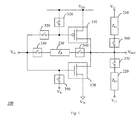
  • FIG. 1 illustrates a circuit diagram of a power amplifier according to an embodiment of the present invention.
  • FIG. 2 illustrates an equivalent circuit diagram of the power amplifier of FIG. 1 in an energy efficient mode.
  • FIG. 3 illustrates another equivalent circuit diagram of the power amplifier of FIG. 1 in the energy efficient mode.
  • FIG. 4 illustrates an equivalent circuit diagram of the power amplifier of FIG. 1 in a high output power mode.
  • FIG. 5 illustrates another equivalent circuit diagram of the power amplifier of FIG. 1 in the high output power mode.
  • connection between two components in the disclosed embodiments can be direct or indirect provided that these embodiments are practicable under such connection.
  • Said “indirect” means that an intermediate component is existed between the two components.
  • shape, size, and ratio of any component in the disclosed drawings are just exemplary for understanding, not for limiting the scope of the present invention.
  • the present invention discloses a power amplifier capable of adaptively operating in one of an energy efficient mode and a high output power mode. More specifically, the power amplifier is capable of operating in the energy efficient mode for power saving and operating in the high output power mode for operation performance.
  • the first transistor 110 includes a first high voltage terminal, a first low voltage terminal and a first control terminal.
  • the first high voltage terminal is coupled to a high voltage supply terminal V DD
  • the first low voltage terminal is coupled to a signal output terminal V OUT .
  • the second transistor 120 includes a second high voltage terminal, a second low voltage terminal and a second control terminal.
  • the second high voltage terminal is coupled to the signal output terminal V OUT
  • the second low voltage terminal is coupled to a low voltage supply terminal V SS which could be a grounding terminal or a non-grounding terminal
  • the second control terminal is coupled to a signal input terminal V IN .
  • an example of the first transistor 110 is a PMOS (p-type metal-oxide-semiconductor) transistor or a BJT (bipolar junction transistor), and an example of the second transistor 120 is an NMOS (n-type metal-oxide-semiconductor) transistor or a BJT.
  • PMOS p-type metal-oxide-semiconductor
  • BJT bipolar junction transistor
  • NMOS n-type metal-oxide-semiconductor
  • the first bias component 210 is coupled to a first load bias terminal V L1 , and coupled to the signal output terminal V OUT through the sixth switch 360 .
  • the second bias component 220 is coupled to a second load bias terminal V L2 (e.g., a terminal of any DC voltage that can be zero volt), and coupled to the signal output terminal V OUT through the seventh switch 370 .
  • the third bias component 230 is coupled to the signal input terminal V IN through the third switch 330 , and coupled to the signal output terminal V OUT through the fourth switch 340 .
  • each of the bias components 210 ⁇ 230 includes one of an inductor, a capacitor and a resistor.
  • each of the first bias component 210 and the second bias component 220 is an inductor or a capacitor, while the third bias component 230 is a resistor.
  • the first switch 310 is coupled between the high voltage supply terminal V DD and the first control terminal of the first transistor 110 , and configured to be turned off according to a control signal in the energy efficient mode and turned on according to the control signal in the high output power mode, so as to switch off the first transistor 110 in the high output power mode.
  • a control signal is a signal generated by a digital control circuit capable of controlling the switches 310 ⁇ 370 according to predetermined setting (e.g., at least one of a user setting, a real-time detection result, and an operation state) and allowing the power amplifier 100 to operate in one of the energy efficient mode and the high output power mode.
  • the second switch 320 is coupled between the signal input terminal V IN and the first control terminal of the first transistor 110 , and configured to be turned on according to the control signal in the energy efficient mode and turned off according to the control signal in the high output power mode.
  • the third switch 330 is coupled between the signal input terminal V IN and the third bias component 230 , and configured to be turned on according to the control signal in the energy efficient mode and turned off according to the control signal in the high output power mode.
  • the fourth switch 340 is coupled between the third bias component 230 and the signal output terminal V OUT , and configured to be turned on according to the control signal in the energy efficient mode and turned off according to the control signal in the high output power mode.
  • the fifth switch 350 is coupled between the control terminal of the second transistor 120 and a transistor bias terminal V B , and configured to be turned off according to the control signal in the energy efficient mode and turned on according to the control signal in the high output power mode, so as to provide a proper bias for the second transistor 120 .
  • the sixth switch 360 is coupled between the first bias component 210 and the signal output terminal V OUT , and configured to be turned off according to the control signal in the energy efficient mode and turned on according to the control signal in the high output power mode.
  • the seventh switch 370 is coupled between the signal output terminal V OUT and the second bias component 220 , and configured to be turned on according to the control signal in the energy efficient mode and turned off according to the control signal in the high output power mode.
  • each of the switches 310 ⁇ 370 includes one of an NMOS transistor, a PMOS transistor, a CMOS transmission-gate and a BJT.
  • the circuit diagram of the power amplifier 100 can be simplified to be the equivalent as shown in FIG. 2 and FIG. 3 , in which FIG. 3 omits the showing of the switches.
  • the power amplifier 100 includes the first transistor 110 , the second transistor 120 , the second bias component 220 and the third bias component 230 which jointly act as an inverter-type power amplifier.
  • the circuit diagram of the power amplifier can be simplified to be the equivalent as shown in FIG. 4 and FIG. 5 , in which FIG. 5 omits the showing of the switches and the first transistor 110 that is turned off.
  • the power amplifier 100 includes the second transistor 120 and the first bias component 210 which jointly act as a common source amplifier or a common emitter amplifier.
  • the voltage at each of the aforementioned voltage supply terminals can be determined by people of ordinary skill in the art in accordance with their demands.
  • the voltage at each of the aforementioned bias terminals can be determined by those of ordinary skill in the art in accordance with their demands.
  • the power amplifier of the present invention is capable of operating in the energy efficient mode when power saving has high priority, and capable of operating in the high output power mode when high output power has high priority.
  • the power amplifier acts as an inverter-type power amplifier in the energy efficient mode for power saving, and acts as a common source/emitter amplifier in the high output power mode for operation performance.
  • the power amplifier of the present invention has both the features of power saving and high output power.

Landscapes

  • Engineering & Computer Science (AREA)
  • Power Engineering (AREA)
  • Amplifiers (AREA)

Abstract

The present invention discloses a power amplifier capable of adaptively operating in one of an energy efficient mode and a high output power mode. An embodiment of the power amplifier includes a first transistor, a second transistor, a first bias element, a second bias element, a third bias element and a plurality of switches. In the energy efficient mode, by the control over the on/off states of the switches, an inverter type power amplifier is realized with the first transistor, the second transistor, the second bias element and the third bias element. In the high output power mode, by the control over the on/off states of the switches, a common source amplifier or a common emitter amplifier is realized with the second transistor and the first bias element.

Description

BACKGROUND OF THE INVENTION 1. Field of the Invention
The present invention relates to an amplifier, especially to a power amplifier.
2. Description of Related Art
Generally, an inverter-type power amplifier consumes less power while a common source power amplifier has higher output power. The two kinds of amplifiers are suitable for different applications. Regarding a power amplifier consuming a lot of power in a radio-frequency (RF) transceiver, if the RF transceiver takes the issue of power consumption as the first priority, the inverter-type power amplifier will be the better choice, and if the RF transceiver takes the operation performance (e.g., the maximum distance of transmission) as the first priority, the common source power amplifier will be preferable.
This industrial field looks forward to a circuit having the advantages of the aforementioned two kinds of amplifiers.
People who are interested in the inverter-type power amplifier may refer to the following literature:
    • (1) Jan Prummel et al., “A 10 mW Bluetooth Low-Energy transceiver with onchip matching”, IEEE J. Solid-State Circuits, vol. 50, no. 12, pp. 3077-3088, December 2015.
People who are interested in the common source power amplifier may refer to the following literature:
    • (1) Alan Wong et al., “A 1V 5 mA multimode IEEE 802.15.6/Bluetooth low-energy WBAN transceiver for biotelemetry applications”, IEEE ISSCC Dig. Tech. Papers, 2012, pp. 300-301.
SUMMARY OF THE INVENTION
An object of the present invention is to provide a power amplifier capable of adaptively operating in one of an energy efficient mode and a high output power mode.
The present invention discloses a power amplifier capable of operating in one of an energy efficient mode and a high output power mode. An embodiment of the power amplifier comprises a first transistor, a second transistor, a first bias component, a second bias component, a third bias component, a first switch, a second switch, a third switch, a fourth switch, a fifth switch, a sixth switch and a seventh switch. The first transistor includes a first high voltage terminal, a first low voltage terminal and a first control terminal, in which the first high voltage terminal is coupled to a first high voltage supply terminal and the first low voltage terminal is coupled to a signal output terminal. The second transistor includes a second high voltage terminal, a second low voltage terminal and a second control terminal, in which the second high voltage terminal is coupled to the signal output terminal, the second low voltage terminal is coupled to a low voltage supply terminal, and the second control terminal is coupled to a signal input terminal. The first bias component is coupled to a first load bias terminal. The second bias component is coupled to a second load bias terminal. The first switch is coupled between the high voltage supply terminal and the first control terminal, and configured to be turned off according to a control signal in the energy efficient mode and turned on according to the control signal in the high output power mode. The second switch is coupled between the signal input terminal and the first control terminal, and configured to be turned on according to the control signal in the energy efficient mode and turned off according to the control signal in the high output power mode. The third switch is coupled between the signal input terminal and the third bias component, and configured to be turned on according to the control signal in the energy efficient mode and turned off according to the control signal in the high output power mode. The fourth switch is coupled between the third bias component and the signal output terminal, and configured to be turned on according to the control signal in the energy efficient mode and turned off according to the control signal in the high output power mode. The fifth switch is coupled between the second control terminal and a transistor bias terminal, and configured to be turned off according to the control signal in the energy efficient mode and turned on according to the control signal in the high output power mode. The sixth switch is coupled between the first bias component and the signal output terminal, and configured to be turned off according to the control signal in the energy efficient mode and turned on according to the control signal in the high output power mode. The seventh switch is coupled between the signal output terminal and the second bias component, and configured to be turned on according to the control signal in the energy efficient mode and turned off according to the control signal in the high output power mode. Accordingly, the power amplifier acts as an inverter-type power amplifier in the energy efficient mode, and acts as a common source/emitter power amplifier in the high output power mode.
Another embodiment of the aforementioned power amplifier comprises a first transistor, a second transistor, a first bias component, a second bias component, a third bias component and a plurality of switches. The first transistor includes a first high voltage terminal, a first low voltage terminal and a first control terminal, in which the first high voltage terminal is coupled to a high voltage supply terminal, the first low voltage terminal is coupled to a signal output terminal, and the first control terminal is coupled to a signal input terminal in the energy efficient mode. The second transistor includes a second high voltage terminal, a second low voltage terminal and a second control terminal, in which the second high voltage terminal is coupled to the signal output terminal, the second low voltage terminal is coupled to a low voltage supply terminal, and the second control terminal is coupled to the signal input terminal. The first bias component is coupled to a first load bias terminal, in which the first bias component is not coupled to the signal output terminal in the energy efficient mode and coupled to the signal output terminal in the high output power mode. The second bias component is coupled to a second load bias terminal, in which the second bias component is coupled to the signal output terminal in the energy efficient mode and not coupled to the signal output terminal in the high output power mode. The third bias component is coupled between the signal input terminal and the signal output terminal in the energy efficient mode, and not coupled to the signal input terminal and the signal output terminal in the high output power mode. Each of the plurality of switches is turned on or off according to a control signal in the energy efficient mode, and turned on or off according to the control signal in the high output power mode; these switches allow the first transistor, the second transistor, the second bias component and the third bias component to act as an inverter-type power amplifier in the energy efficient mode, and allow the second transistor and the first bias component to act as a common source amplifier or a common emitter amplifier in the high output power mode.
These and other objectives of the present invention will no doubt become obvious to those of ordinary skill in the art after reading the following detailed description of the preferred embodiments that are illustrated in the various figures and drawings.
BRIEF DESCRIPTION OF THE DRAWINGS
FIG. 1 illustrates a circuit diagram of a power amplifier according to an embodiment of the present invention.
FIG. 2 illustrates an equivalent circuit diagram of the power amplifier of FIG. 1 in an energy efficient mode.
FIG. 3 illustrates another equivalent circuit diagram of the power amplifier of FIG. 1 in the energy efficient mode.
FIG. 4 illustrates an equivalent circuit diagram of the power amplifier of FIG. 1 in a high output power mode.
FIG. 5 illustrates another equivalent circuit diagram of the power amplifier of FIG. 1 in the high output power mode.
DETAILED DESCRIPTION OF THE PREFERRED EMBODIMENTS
The following description is written by referring to terms acknowledged in this industrial field. If any term is defined in the description, such term should be explained accordingly. Besides, the connection between two components in the disclosed embodiments can be direct or indirect provided that these embodiments are practicable under such connection. Said “indirect” means that an intermediate component is existed between the two components. Furthermore, the shape, size, and ratio of any component in the disclosed drawings are just exemplary for understanding, not for limiting the scope of the present invention.
The present invention discloses a power amplifier capable of adaptively operating in one of an energy efficient mode and a high output power mode. More specifically, the power amplifier is capable of operating in the energy efficient mode for power saving and operating in the high output power mode for operation performance.
FIG. 1 shows an embodiment of the power amplifier of the present invention. The power amplifier 100 of FIG. 1 includes a first transistor 110, a second transistor 120, a first bias component (i.e., ZL1 in FIG. 1) 210, a second bias component (i.e., ZL2 in FIG. 1) 220, a third bias component (i.e., ZB in FIG. 1) 230, a first switch 310, a second switch 320, a third switch 330, a fourth switch 340, a fifth switch 350, a sixth switch 360 and a seventh switch 370.
Please refer to FIG. 1. The first transistor 110 includes a first high voltage terminal, a first low voltage terminal and a first control terminal. The first high voltage terminal is coupled to a high voltage supply terminal VDD, and the first low voltage terminal is coupled to a signal output terminal VOUT. The second transistor 120 includes a second high voltage terminal, a second low voltage terminal and a second control terminal. The second high voltage terminal is coupled to the signal output terminal VOUT, the second low voltage terminal is coupled to a low voltage supply terminal VSS which could be a grounding terminal or a non-grounding terminal, and the second control terminal is coupled to a signal input terminal VIN. In this embodiment, an example of the first transistor 110 is a PMOS (p-type metal-oxide-semiconductor) transistor or a BJT (bipolar junction transistor), and an example of the second transistor 120 is an NMOS (n-type metal-oxide-semiconductor) transistor or a BJT.
Please refer to FIG. 1. The first bias component 210 is coupled to a first load bias terminal VL1, and coupled to the signal output terminal VOUT through the sixth switch 360. The second bias component 220 is coupled to a second load bias terminal VL2 (e.g., a terminal of any DC voltage that can be zero volt), and coupled to the signal output terminal VOUT through the seventh switch 370. The third bias component 230 is coupled to the signal input terminal VIN through the third switch 330, and coupled to the signal output terminal VOUT through the fourth switch 340. In this embodiment, each of the bias components 210˜230 includes one of an inductor, a capacitor and a resistor. In another embodiment, each of the first bias component 210 and the second bias component 220 is an inductor or a capacitor, while the third bias component 230 is a resistor.
Please refer to FIG. 1. The first switch 310 is coupled between the high voltage supply terminal VDD and the first control terminal of the first transistor 110, and configured to be turned off according to a control signal in the energy efficient mode and turned on according to the control signal in the high output power mode, so as to switch off the first transistor 110 in the high output power mode. An example of the control signal is a signal generated by a digital control circuit capable of controlling the switches 310˜370 according to predetermined setting (e.g., at least one of a user setting, a real-time detection result, and an operation state) and allowing the power amplifier 100 to operate in one of the energy efficient mode and the high output power mode. Since the digital control circuit and the way to implement the predetermined setting are well known in this industrial field, the details are omitted here. The second switch 320 is coupled between the signal input terminal VIN and the first control terminal of the first transistor 110, and configured to be turned on according to the control signal in the energy efficient mode and turned off according to the control signal in the high output power mode. The third switch 330 is coupled between the signal input terminal VIN and the third bias component 230, and configured to be turned on according to the control signal in the energy efficient mode and turned off according to the control signal in the high output power mode. The fourth switch 340 is coupled between the third bias component 230 and the signal output terminal VOUT, and configured to be turned on according to the control signal in the energy efficient mode and turned off according to the control signal in the high output power mode. The fifth switch 350 is coupled between the control terminal of the second transistor 120 and a transistor bias terminal VB, and configured to be turned off according to the control signal in the energy efficient mode and turned on according to the control signal in the high output power mode, so as to provide a proper bias for the second transistor 120. The sixth switch 360 is coupled between the first bias component 210 and the signal output terminal VOUT, and configured to be turned off according to the control signal in the energy efficient mode and turned on according to the control signal in the high output power mode. The seventh switch 370 is coupled between the signal output terminal VOUT and the second bias component 220, and configured to be turned on according to the control signal in the energy efficient mode and turned off according to the control signal in the high output power mode. In this embodiment, each of the switches 310˜370 includes one of an NMOS transistor, a PMOS transistor, a CMOS transmission-gate and a BJT.
In light of the above, when the power amplifier 100 of FIG. 1 operates in the energy efficient mode, the circuit diagram of the power amplifier 100 can be simplified to be the equivalent as shown in FIG. 2 and FIG. 3, in which FIG. 3 omits the showing of the switches. In FIGS. 2 and 3, the power amplifier 100 includes the first transistor 110, the second transistor 120, the second bias component 220 and the third bias component 230 which jointly act as an inverter-type power amplifier. When the power amplifier 100 of FIG. 1 operates in the high output power mode, the circuit diagram of the power amplifier can be simplified to be the equivalent as shown in FIG. 4 and FIG. 5, in which FIG. 5 omits the showing of the switches and the first transistor 110 that is turned off. In FIG. 4 and FIG. 5, the power amplifier 100 includes the second transistor 120 and the first bias component 210 which jointly act as a common source amplifier or a common emitter amplifier.
The voltage at each of the aforementioned voltage supply terminals can be determined by people of ordinary skill in the art in accordance with their demands. Similarly, the voltage at each of the aforementioned bias terminals can be determined by those of ordinary skill in the art in accordance with their demands.
To sum up, the power amplifier of the present invention is capable of operating in the energy efficient mode when power saving has high priority, and capable of operating in the high output power mode when high output power has high priority. In other words, the power amplifier acts as an inverter-type power amplifier in the energy efficient mode for power saving, and acts as a common source/emitter amplifier in the high output power mode for operation performance. As a result, the power amplifier of the present invention has both the features of power saving and high output power.
The aforementioned descriptions represent merely the preferred embodiments of the present invention, without any intention to limit the scope of the present invention thereto. Various equivalent changes, alterations, or modifications based on the claims of present invention are all consequently viewed as being embraced by the scope of the present invention.

Claims (10)

What is claimed is:
1. A power amplifier capable of operating in one of an energy efficient mode and a high output power mode, the power amplifier comprising:
a first transistor including a first high voltage terminal, a first low voltage terminal and a first control terminal, in which the first high voltage terminal is coupled to a first high voltage supply terminal and the first low voltage terminal is coupled to a signal output terminal;
a second transistor including a second high voltage terminal, a second low voltage terminal and a second control terminal, in which the second high voltage terminal is coupled to the signal output terminal, the second low voltage terminal is coupled to a low voltage supply terminal, and the second control terminal is coupled to a signal input terminal;
a first bias component coupled to a first load bias terminal;
a second bias component coupled to a second load bias terminal;
a third bias component;
a first switch coupled between the high voltage supply terminal and the first control terminal, and configured to be turned off according to a control signal in the energy efficient mode and turned on according to the control signal in the high output power mode;
a second switch coupled between the signal input terminal and the first control terminal, and configured to be turned on according to the control signal in the energy efficient mode and turned off according to the control signal in the high output power mode;
a third switch coupled between the signal input terminal and the third bias component, and configured to be turned on according to the control signal in the energy efficient mode and turned off according to the control signal in the high output power mode;
a fourth switch coupled between the third bias component and the signal output terminal, and configured to be turned on according to the control signal in the energy efficient mode and turned off according to the control signal in the high output power mode;
a fifth switch coupled between the second control terminal and a transistor bias terminal, and configured to be turned off according to the control signal in the energy efficient mode and turned on according to the control signal in the high output power mode;
a sixth switch coupled between the first bias component and the signal output terminal, and configured to be turned off according to the control signal in the energy efficient mode and turned on according to the control signal in the high output power mode; and
a seventh switch coupled between the signal output terminal and the second bias component, and configured to be turned on according to the control signal in the energy efficient mode and turned off according to the control signal in the high output power mode.
2. The power amplifier of claim 1, wherein the first transistor is a PMOS transistor or a first bipolar junction transistor (BJT), and the second transistor is an NMOS transistor or a second BJT.
3. The power amplifier of claim 1, wherein each of the first switch, the second switch, the third switch, the fourth switch, the fifth switch, the sixth switch and the seventh switch includes one of an NMOS transistor, a PMOS transistor, a CMOS transmission-gate and a BJT.
4. The power amplifier of claim 1, wherein each of the first bias component, the second bias component and the third bias component includes one of an inductor, a capacitor and a resistor.
5. The power amplifier of claim 4, wherein each of the first bias component and the second bias component is one of an inductor and a capacitor, and the third bias component is a resistor.
6. The power amplifier of claim 1, wherein the power amplifier acts as an inverter-type power amplifier in the energy efficient mode, and acts as a common source amplifier or a common emitter amplifier in the high output power mode.
7. A power amplifier capable of operating one of an energy efficient mode and a high output power mode, the power amplifier comprising:
a first transistor including a first high voltage terminal, a first low voltage terminal and a first control terminal, in which the first high voltage terminal is coupled to a high voltage supply terminal, the first low voltage terminal is coupled to a signal output terminal, and the first control terminal is coupled to a signal input terminal in the energy efficient mode and decoupled from the signal input terminal in the high output power mode;
a second transistor including a second high voltage terminal, a second low voltage terminal and a second control terminal, in which the second high voltage terminal is coupled to the signal output terminal, the second low voltage terminal is coupled to a low voltage supply terminal, and the second control terminal is coupled to the signal input terminal;
a first bias component coupled to a first load bias terminal, in which the first bias component is not coupled to the signal output terminal in the energy efficient mode and coupled to the signal output terminal in the high output power mode;
a second bias component coupled to a second load bias terminal, in which the second bias component is coupled to the signal output terminal in the energy efficient mode and not coupled to the signal output terminal in the high output power mode;
a third bias component coupled between the signal input terminal and the signal output terminal in the energy efficient mode, and not coupled to the signal input terminal and the signal output terminal in the high output power mode; and
a plurality of switches, in which each of the switches is turned on or turned off according to a control signal in the energy efficient mode, each of the switches is turned on or turned off according to the control signal in the high output power mode, the switches allow the first transistor, the second transistor, the second bias component and the third bias component to act as an inverter-type power amplifier in the energy efficient mode, and the switches allow the second transistor and the first bias component to act as a common source amplifier or a common emitter amplifier in the high output power mode.
8. The power amplifier of claim 7, wherein the first transistor is one of a PMOS transistor and a first BJT, and the second transistor is one of an NMOS transistor and a second BJT.
9. The power amplifier of claim 7, wherein each of the switches includes one of an NMOS transistor, a PMOS transistor, a CMOS transmission-gate and a BJT.
10. The power amplifier of claim 7, wherein each of the first bias component, the second bias component and the third bias component includes one of an inductor, a capacitor and a resistor.
US15/823,159 2016-11-29 2017-11-27 Power amplifier Active US10075136B2 (en)

Applications Claiming Priority (3)

Application Number Priority Date Filing Date Title
TW105139173 2016-11-29
TW105139173A 2016-11-29
TW105139173A TWI619345B (en) 2016-11-29 2016-11-29 Power amplifier

Publications (2)

Publication Number Publication Date
US20180152152A1 US20180152152A1 (en) 2018-05-31
US10075136B2 true US10075136B2 (en) 2018-09-11

Family

ID=62189428

Family Applications (1)

Application Number Title Priority Date Filing Date
US15/823,159 Active US10075136B2 (en) 2016-11-29 2017-11-27 Power amplifier

Country Status (2)

Country Link
US (1) US10075136B2 (en)
TW (1) TWI619345B (en)

Citations (9)

* Cited by examiner, † Cited by third party
Publication number Priority date Publication date Assignee Title
US20070018719A1 (en) * 2005-07-08 2007-01-25 National Semiconductor Corporation Class AB-D audio power amplifier
US7498876B2 (en) * 2005-06-20 2009-03-03 Agere Systems Inc. Amplifier having half-wave tracking power rails
US20100130249A1 (en) * 2008-11-25 2010-05-27 Ching Yu John Tam Wireless electronic device with multimode audio amplifier
US20110043278A1 (en) * 2009-08-24 2011-02-24 Fender Musical Instruments Corporation Method and apparatus for biasing an amplifier
US20110065413A1 (en) * 2008-01-28 2011-03-17 Cambridge Silicon Radio Limited Power-Saving Receiver
US20140009233A1 (en) * 2012-07-09 2014-01-09 George Cabrera Push-pull amplification systems and methods
US20150049883A1 (en) * 2012-03-20 2015-02-19 Mi Audio Pty Limited Amplifier
US20150236651A1 (en) * 2014-02-14 2015-08-20 Research & Business Foundation Sungkyunkwan University Multi-mode bias modulator and envelope tracking power amplifier using the same
US20170133989A1 (en) * 2012-12-28 2017-05-11 Peregrine Semiconductor Corporation Bias Control for Stacked Transistor Configuration

Family Cites Families (2)

* Cited by examiner, † Cited by third party
Publication number Priority date Publication date Assignee Title
US5424656A (en) * 1993-05-07 1995-06-13 Microelectronics And Computer Technology Corporation Continuous superconductor to semiconductor converter circuit
US8754712B2 (en) * 2012-06-29 2014-06-17 Infineon Technologies Ag System and method for a cascoded amplifier

Patent Citations (9)

* Cited by examiner, † Cited by third party
Publication number Priority date Publication date Assignee Title
US7498876B2 (en) * 2005-06-20 2009-03-03 Agere Systems Inc. Amplifier having half-wave tracking power rails
US20070018719A1 (en) * 2005-07-08 2007-01-25 National Semiconductor Corporation Class AB-D audio power amplifier
US20110065413A1 (en) * 2008-01-28 2011-03-17 Cambridge Silicon Radio Limited Power-Saving Receiver
US20100130249A1 (en) * 2008-11-25 2010-05-27 Ching Yu John Tam Wireless electronic device with multimode audio amplifier
US20110043278A1 (en) * 2009-08-24 2011-02-24 Fender Musical Instruments Corporation Method and apparatus for biasing an amplifier
US20150049883A1 (en) * 2012-03-20 2015-02-19 Mi Audio Pty Limited Amplifier
US20140009233A1 (en) * 2012-07-09 2014-01-09 George Cabrera Push-pull amplification systems and methods
US20170133989A1 (en) * 2012-12-28 2017-05-11 Peregrine Semiconductor Corporation Bias Control for Stacked Transistor Configuration
US20150236651A1 (en) * 2014-02-14 2015-08-20 Research & Business Foundation Sungkyunkwan University Multi-mode bias modulator and envelope tracking power amplifier using the same

Non-Patent Citations (2)

* Cited by examiner, † Cited by third party
Title
Prummel et al., A 10 mW Bluetooth Low-Energy transceiver with onchip matching, J. Solid-State Circuits, vol. 50, No. 12, pp. 3077-3088, Dec. 2015.
Wong et al., A 1V 5mA multimode IEEE 802.15.6/Bluetooth low-energy WBAN transceiver for biotelemetry applications, IEEE ISSCC Dig. Tech. Papers, 2012, pp. 300-301.

Also Published As

Publication number Publication date
US20180152152A1 (en) 2018-05-31
TW201820774A (en) 2018-06-01
TWI619345B (en) 2018-03-21

Similar Documents

Publication Publication Date Title
US20190319596A1 (en) Low voltage inverter-based amplifier
US7852154B2 (en) High precision follower device with zero power, zero noise slew enhancement circuit
TWI683539B (en) Amplifier having a switchable current bias circuit
EP3301606B1 (en) A bandgap with system sleep mode
CN107241068A (en) Amplifier
KR102208799B1 (en) Reference voltage circuit
US10075136B2 (en) Power amplifier
US9692415B2 (en) Semiconductor device having low power consumption
US9240785B2 (en) Analog signal compatible CMOS switch as an integrated peripheral to a standard microcontroller
Rosli et al. Design of RF to DC conversion circuit for energy harvesting in CMOS 0.13-μm technology
US9520838B2 (en) Inverter type power amplifier
US8917121B2 (en) Output stage circuit
CN108155875B (en) power amplifier
JP2006157132A (en) Analog switch circuit
US20110279106A1 (en) Threshold voltage generating circuit
US6445250B1 (en) Circuit topology for better supply immunity in a cascaded Gm/Gm amplifier
JP2015159462A (en) Voltage follower circuit
US9088252B2 (en) Fixed voltage generating circuit
US9400535B2 (en) Power supply circuit for central processing unit
JP5114226B2 (en) Semiconductor switch circuit
US8593178B2 (en) CMOS logic circuit
US20200366303A1 (en) Circuit having analog-to-digital conversion function and electronic device
US20160112005A1 (en) Method and apparatus for an integrated pn-junction oscillator
JP2013046457A (en) Power-supply switching circuit
TWI519063B (en) Circuit of operational amplifier

Legal Events

Date Code Title Description
AS Assignment

Owner name: REALTEK SEMICONDUCTOR CORPORATION, TAIWAN

Free format text: ASSIGNMENT OF ASSIGNORS INTEREST;ASSIGNORS:CHOU, CHIEN-I;CHAN, KA-UN;REEL/FRAME:044227/0883

Effective date: 20170517

FEPP Fee payment procedure

Free format text: ENTITY STATUS SET TO UNDISCOUNTED (ORIGINAL EVENT CODE: BIG.); ENTITY STATUS OF PATENT OWNER: LARGE ENTITY

STCF Information on status: patent grant

Free format text: PATENTED CASE

MAFP Maintenance fee payment

Free format text: PAYMENT OF MAINTENANCE FEE, 4TH YEAR, LARGE ENTITY (ORIGINAL EVENT CODE: M1551); ENTITY STATUS OF PATENT OWNER: LARGE ENTITY

Year of fee payment: 4

MAFP Maintenance fee payment

Free format text: PAYMENT OF MAINTENANCE FEE, 8TH YEAR, LARGE ENTITY (ORIGINAL EVENT CODE: M1552); ENTITY STATUS OF PATENT OWNER: LARGE ENTITY

Year of fee payment: 8