US10074927B1 - Electrical connector and method for manufacturing electrical connector - Google Patents

Electrical connector and method for manufacturing electrical connector Download PDF

Info

Publication number
US10074927B1
US10074927B1 US15/681,438 US201715681438A US10074927B1 US 10074927 B1 US10074927 B1 US 10074927B1 US 201715681438 A US201715681438 A US 201715681438A US 10074927 B1 US10074927 B1 US 10074927B1
Authority
US
United States
Prior art keywords
housing
shell member
contact
protruding portion
electrical connector
Prior art date
Legal status (The legal status is an assumption and is not a legal conclusion. Google has not performed a legal analysis and makes no representation as to the accuracy of the status listed.)
Expired - Fee Related
Application number
US15/681,438
Other versions
US20180261950A1 (en
Inventor
Naoyuki Ono
Current Assignee (The listed assignees may be inaccurate. Google has not performed a legal analysis and makes no representation or warranty as to the accuracy of the list.)
SMK Corp
Original Assignee
SMK Corp
Priority date (The priority date is an assumption and is not a legal conclusion. Google has not performed a legal analysis and makes no representation as to the accuracy of the date listed.)
Filing date
Publication date
Application filed by SMK Corp filed Critical SMK Corp
Assigned to SMK CORPORATION reassignment SMK CORPORATION ASSIGNMENT OF ASSIGNORS INTEREST (SEE DOCUMENT FOR DETAILS). Assignors: ONO, NAOYUKI
Application granted granted Critical
Publication of US10074927B1 publication Critical patent/US10074927B1/en
Publication of US20180261950A1 publication Critical patent/US20180261950A1/en
Expired - Fee Related legal-status Critical Current
Anticipated expiration legal-status Critical

Links

Images

Classifications

    • HELECTRICITY
    • H01ELECTRIC ELEMENTS
    • H01RELECTRICALLY-CONDUCTIVE CONNECTIONS; STRUCTURAL ASSOCIATIONS OF A PLURALITY OF MUTUALLY-INSULATED ELECTRICAL CONNECTING ELEMENTS; COUPLING DEVICES; CURRENT COLLECTORS
    • H01R13/00Details of coupling devices of the kinds covered by groups H01R12/70 or H01R24/00 - H01R33/00
    • H01R13/46Bases; Cases
    • H01R13/52Dustproof, splashproof, drip-proof, waterproof, or flameproof cases
    • H01R13/5202Sealing means between parts of housing or between housing part and a wall, e.g. sealing rings
    • HELECTRICITY
    • H01ELECTRIC ELEMENTS
    • H01RELECTRICALLY-CONDUCTIVE CONNECTIONS; STRUCTURAL ASSOCIATIONS OF A PLURALITY OF MUTUALLY-INSULATED ELECTRICAL CONNECTING ELEMENTS; COUPLING DEVICES; CURRENT COLLECTORS
    • H01R13/00Details of coupling devices of the kinds covered by groups H01R12/70 or H01R24/00 - H01R33/00
    • H01R13/40Securing contact members in or to a base or case; Insulating of contact members
    • H01R13/405Securing in non-demountable manner, e.g. moulding, riveting
    • HELECTRICITY
    • H01ELECTRIC ELEMENTS
    • H01RELECTRICALLY-CONDUCTIVE CONNECTIONS; STRUCTURAL ASSOCIATIONS OF A PLURALITY OF MUTUALLY-INSULATED ELECTRICAL CONNECTING ELEMENTS; COUPLING DEVICES; CURRENT COLLECTORS
    • H01R13/00Details of coupling devices of the kinds covered by groups H01R12/70 or H01R24/00 - H01R33/00
    • H01R13/46Bases; Cases
    • H01R13/502Bases; Cases composed of different pieces
    • H01R13/504Bases; Cases composed of different pieces different pieces being moulded, cemented, welded, e.g. ultrasonic, or swaged together
    • HELECTRICITY
    • H01ELECTRIC ELEMENTS
    • H01RELECTRICALLY-CONDUCTIVE CONNECTIONS; STRUCTURAL ASSOCIATIONS OF A PLURALITY OF MUTUALLY-INSULATED ELECTRICAL CONNECTING ELEMENTS; COUPLING DEVICES; CURRENT COLLECTORS
    • H01R13/00Details of coupling devices of the kinds covered by groups H01R12/70 or H01R24/00 - H01R33/00
    • H01R13/46Bases; Cases
    • H01R13/52Dustproof, splashproof, drip-proof, waterproof, or flameproof cases
    • H01R13/5216Dustproof, splashproof, drip-proof, waterproof, or flameproof cases characterised by the sealing material, e.g. gels or resins
    • HELECTRICITY
    • H01ELECTRIC ELEMENTS
    • H01RELECTRICALLY-CONDUCTIVE CONNECTIONS; STRUCTURAL ASSOCIATIONS OF A PLURALITY OF MUTUALLY-INSULATED ELECTRICAL CONNECTING ELEMENTS; COUPLING DEVICES; CURRENT COLLECTORS
    • H01R24/00Two-part coupling devices, or either of their cooperating parts, characterised by their overall structure
    • H01R24/60Contacts spaced along planar side wall transverse to longitudinal axis of engagement
    • HELECTRICITY
    • H01ELECTRIC ELEMENTS
    • H01RELECTRICALLY-CONDUCTIVE CONNECTIONS; STRUCTURAL ASSOCIATIONS OF A PLURALITY OF MUTUALLY-INSULATED ELECTRICAL CONNECTING ELEMENTS; COUPLING DEVICES; CURRENT COLLECTORS
    • H01R43/00Apparatus or processes specially adapted for manufacturing, assembling, maintaining, or repairing of line connectors or current collectors or for joining electric conductors
    • H01R43/20Apparatus or processes specially adapted for manufacturing, assembling, maintaining, or repairing of line connectors or current collectors or for joining electric conductors for assembling or disassembling contact members with insulating base, case or sleeve
    • HELECTRICITY
    • H01ELECTRIC ELEMENTS
    • H01RELECTRICALLY-CONDUCTIVE CONNECTIONS; STRUCTURAL ASSOCIATIONS OF A PLURALITY OF MUTUALLY-INSULATED ELECTRICAL CONNECTING ELEMENTS; COUPLING DEVICES; CURRENT COLLECTORS
    • H01R43/00Apparatus or processes specially adapted for manufacturing, assembling, maintaining, or repairing of line connectors or current collectors or for joining electric conductors
    • H01R43/20Apparatus or processes specially adapted for manufacturing, assembling, maintaining, or repairing of line connectors or current collectors or for joining electric conductors for assembling or disassembling contact members with insulating base, case or sleeve
    • H01R43/24Assembling by moulding on contact members
    • BPERFORMING OPERATIONS; TRANSPORTING
    • B05SPRAYING OR ATOMISING IN GENERAL; APPLYING FLUENT MATERIALS TO SURFACES, IN GENERAL
    • B05DPROCESSES FOR APPLYING FLUENT MATERIALS TO SURFACES, IN GENERAL
    • B05D1/00Processes for applying liquids or other fluent materials
    • B05D1/36Successively applying liquids or other fluent materials, e.g. without intermediate treatment
    • CCHEMISTRY; METALLURGY
    • C07ORGANIC CHEMISTRY
    • C07FACYCLIC, CARBOCYCLIC OR HETEROCYCLIC COMPOUNDS CONTAINING ELEMENTS OTHER THAN CARBON, HYDROGEN, HALOGEN, OXYGEN, NITROGEN, SULFUR, SELENIUM OR TELLURIUM
    • C07F7/00Compounds containing elements of Groups 4 or 14 of the Periodic Table
    • C07F7/02Silicon compounds
    • C07F7/08Compounds having one or more C—Si linkages
    • C07F7/18Compounds having one or more C—Si linkages as well as one or more C—O—Si linkages
    • HELECTRICITY
    • H01ELECTRIC ELEMENTS
    • H01RELECTRICALLY-CONDUCTIVE CONNECTIONS; STRUCTURAL ASSOCIATIONS OF A PLURALITY OF MUTUALLY-INSULATED ELECTRICAL CONNECTING ELEMENTS; COUPLING DEVICES; CURRENT COLLECTORS
    • H01R13/00Details of coupling devices of the kinds covered by groups H01R12/70 or H01R24/00 - H01R33/00
    • H01R13/46Bases; Cases
    • H01R13/52Dustproof, splashproof, drip-proof, waterproof, or flameproof cases
    • H01R13/521Sealing between contact members and housing, e.g. sealing insert
    • HELECTRICITY
    • H01ELECTRIC ELEMENTS
    • H01RELECTRICALLY-CONDUCTIVE CONNECTIONS; STRUCTURAL ASSOCIATIONS OF A PLURALITY OF MUTUALLY-INSULATED ELECTRICAL CONNECTING ELEMENTS; COUPLING DEVICES; CURRENT COLLECTORS
    • H01R13/00Details of coupling devices of the kinds covered by groups H01R12/70 or H01R24/00 - H01R33/00
    • H01R13/648Protective earth or shield arrangements on coupling devices, e.g. anti-static shielding  
    • H01R13/658High frequency shielding arrangements, e.g. against EMI [Electro-Magnetic Interference] or EMP [Electro-Magnetic Pulse]
    • H01R13/6581Shield structure
    • HELECTRICITY
    • H01ELECTRIC ELEMENTS
    • H01RELECTRICALLY-CONDUCTIVE CONNECTIONS; STRUCTURAL ASSOCIATIONS OF A PLURALITY OF MUTUALLY-INSULATED ELECTRICAL CONNECTING ELEMENTS; COUPLING DEVICES; CURRENT COLLECTORS
    • H01R2107/00Four or more poles

Definitions

  • the present invention relates to an electrical connector having a watertight function and a method for manufacturing the electrical connector.
  • an electrical connector attached to electronic devices have been required to have a watertight function of making the interior of the electronic devices watertight from outside.
  • an electrical connector includes a fitting portion exposed to outside the casing of the electronic device. Gaps between conductive contacts arranged on the fitting portion and an insulating housing holding the contacts need to be made watertight.
  • an electrical connector is formed by integrally molding a housing and contacts, the housing and the contacts are not in close contact with each other. There are gaps between the housing and the contacts, and a desired watertight effect is not available. If contacts having fine grooves in the surface and a housing are integrally molded to form an electrical connector, a desired watertight effect can be obtained. However, the need to machine the contacts increases product and manufacturing costs.
  • Patent Literature 1 discloses a configuration of an electrical connector having a watertight function, in which a rear end portion of a housing is provided with a sealing material formed by filling and curing a resin material such as a potting material.
  • the electrical connector according to Patent Literature 1 can be made watertight by sealing gaps between the housing and terminals arranged on the housing with the sealing material provided in the rear end portion of the housing.
  • Patent Literature 1 Japanese Patent Application Laid-Open No. 2015-111524
  • the electrical connector needs to be held so that the sealing material will not drip on unwanted portions during filling of the sealing material. There is also a need to wait for the sealing material to cure.
  • the electrical connector thus has a problem that its complex assembly steps complicate the assembly and cause an increase in manufacturing cost.
  • An object of the present invention is to provide an electrical connector which can be made watertight, of which assembly can be simplified, and of which an increase in manufacturing cost can be suppressed, and a method for manufacturing the electrical connector.
  • An electrical connector includes: an insulating housing; and a conductive contact held by the housing, the contact including a connection portion that is exposed on a front side of the housing and connects to a mating contact of a mating connector, and a terminal portion that protrudes behind the housing, a portion of the housing in close contact with the contact along an outer periphery of the contact containing a silane coupling agent.
  • a method for manufacturing an electrical connector is a method for manufacturing an electrical connector, the electrical connector including an insulating housing and a conductive contact held by the housing, the contact including a connection portion that is exposed on a front side of the housing and connects to a mating contact of a mating connector, and a terminal portion that protrudes behind the housing, the method including: integrally molding the housing and the contact, the housing being formed of a first housing containing a silane coupling agent and a second housing containing no silane coupling agent, and simultaneously forming the first housing holding the contact at a predetermined temperature; and melting the first housing, after formed, again at a temperature higher than the predetermined temperature so that the first housing makes close contact with the contact along an outer periphery of the contact.
  • the electrical connector can thus be made watertight without special machining on the contact and without using a sealing material such as a potting material.
  • an electrical connector can be made watertight, assembly can be simplified, and an increase in manufacturing cost can be suppressed.
  • FIG. 1 is a perspective view of an electrical connector according to a first embodiment of the present invention.
  • FIG. 2 is a plan view of the electrical connector according to the first embodiment of the present invention.
  • FIG. 3 is a cross-sectional view taken along line A-A of FIG. 2 .
  • FIG. 4 is a perspective view of a primary molded article constituting the electrical connector according to the first embodiment of the present invention.
  • FIG. 5 is a plan view of the primary molded article constituting the electrical connector according to the first embodiment of the present invention.
  • FIG. 6 is a cross-sectional view taken along line B-B of FIG. 5 .
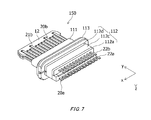
  • FIG. 7 is a perspective view of a secondary molded article constituting the electrical connector according to the first embodiment of the present invention.
  • FIG. 8 is a plan view of the secondary molded article constituting the electrical connector according to the first embodiment of the present invention.
  • FIG. 9 is a cross-sectional view taken along line C-C of FIG. 8 .
  • FIG. 10 is a cross-sectional view of an electrical connector according to a second embodiment of the present invention.
  • an x-axis, a y-axis, and a z-axis constitute a three-axis orthogonal coordinate system.
  • a positive direction of the y-axis will be referred to as a front direction
  • a negative direction of the y-axis as a rear direction
  • the direction of the x-axis as a horizontal direction
  • a positive direction of the z-axis as an upward direction
  • a negative direction of the z-axis as a downward direction.
  • a configuration of an electrical connector 1 according to a first embodiment of the present invention will be described in detail below with reference to FIGS. 1 to 3 .
  • the electrical connector 1 includes a housing 10 , contacts 20 , a front shell member 30 , a rear shell member 40 , an external watertight member 50 , and a shielding plate 60 .
  • the housing 10 is formed of an insulating material and holds the contacts 20 .
  • a portion of the housing 10 in close contact with the contacts 20 along the outer peripheries of the contacts 20 contains a silane coupling agent.
  • the housing 10 contains no silane coupling agent in its rear end portion where the contacts 20 protrude to the rear.
  • the silane coupling agent includes reaction groups chemically bondable to an inorganic material and reaction groups chemically bondable to an organic material, and has a property capable of bonding an organic material to an inorganic material.
  • the housing 10 includes a main body portion 11 and a plate-like portion 12 .
  • the main body portion 11 includes a front protruding portion 111 , a rear protruding portion 112 , and an outward protruding portion 113 .
  • the front protruding portion 111 holds the contacts 20 and protrudes to the front.
  • the rear protruding portion 112 protrudes to the rear.
  • the outward protruding portion 113 lies between the front protruding portion 111 and the rear protruding portion 112 , and protrudes outward compared to the front protruding portion 111 and the rear protruding portion 112 .
  • the outward protruding portion 113 includes a step portion 114 .
  • the rear protruding portion 112 includes a front end portion 112 d , a rear end portion 112 a , and a watertight resin portion 112 c .
  • the front end portion 112 d protrudes to the rear from the rear end of the outward protruding portion 113 and contains no silane coupling agent.
  • the rear end portion 112 a is arranged at the rear end of the housing 10 and contains no silane coupling agent.
  • the watertight resin portion 112 c is arranged between the front end portion 112 d and the rear end portion 112 a and contains the silane coupling agent.
  • the watertight resin portion 112 c is in close contact with the contacts 20 along the outer peripheries of the contacts 20 .
  • the resin constituting the watertight resin portion 112 c is of different type from that constituting the plate-like portion 12 , the front protruding portion 111 , the rear end portion 112 a , the front end portion 112 d , and the outward protruding portion 113 .
  • the resin has a property that its melting temperature is lower than that of the resin constituting the plate-like portion 12 , the front protruding portion 111 , the rear end portion 112 a , the front end portion 112 d , and the outward protruding portion 113 .
  • FIG. 3 clearly shows the boundaries between the front end portion 112 d , the rear end portion 112 a , and the watertight resin portion 112 c .
  • the boundaries are vague since the junction between the front end portion 112 d and the watertight resin portion 112 c is melted and bonded in a manufacturing step to be described later, and the junction between the rear end portion 112 a and the watertight resin portion 112 c is melted and bonded in the manufacturing step to be described later.
  • the plate-like portion 12 has a plate-like shape and protrudes in front of the main body portion 11 .
  • the front end side of the plate-like portion 12 protrudes in front of the front shell member 30 .
  • the contacts 20 are formed of a conductive material and held by the housing 10 .
  • the contacts 20 include first contacts 20 a and second contacts 20 b arranged below the first contacts 20 a .
  • the first contacts 20 a and the second contacts 20 b are insulated from each other by the housing 10 .
  • the first contacts 20 a each include a connection portion 21 a and a terminal portion 22 a .
  • the connection portion 21 a is exposed on the front side of the housing 10 and exposed in a top surface of the plate-like member 12 , and connects to a mating contact of a not-shown mating connector.
  • the terminal portion 22 a protrudes behind the housing 10 and is welded to a conductive portion of a not-shown substrate.
  • a part of the first contact 20 a between the connection portion 21 a and the terminal portion 22 a is embedded in the front protruding portion 111 , the rear protruding portion 112 , and the outward protruding portion 113 .
  • the first contact 20 a is in close contact with the watertight resin portion 112 c along its outer periphery.
  • the part of the first contact 20 a in close contact with the watertight resin portion 112 c is shaped to bend horizontally and upward.
  • the second contacts 20 b each include a connection portion 21 b and a terminal portion 22 b .
  • the connection portion 21 b is exposed on the front side of the housing 10 and exposed in a bottom surface of the plate-like portion 12 , and connects to a mating contact of the not-shown mating connector.
  • the terminal portion 22 b protrudes behind the housing 10 and is welded to the not-shown substrate.
  • a part of the second contact 20 b between the connection portion 21 b and the terminal portion 22 b is embedded in the front protruding portion 111 , the rear protruding portion 112 , and the outward protruding portion 113 .
  • the second contact 20 b is in close contact with the watertight resin portion 112 c along its outer periphery.
  • the part of the second contact 20 b in close contact with the watertight resin portion 112 c is shaped to bend horizontally and downward.
  • the front shell member 30 is formed of a conductive material and has a cylindrical shape extending in a front-to-rear direction.
  • the front shell member 30 includes a fitting portion 31 to which the not-shown mating connector can be fitted from the front.
  • the plate-like portion 12 and the front protruding portion 111 are arranged in the fitting portion 31 .
  • the rear end of the front shell member 30 is in contact with the step portion 114 and held on the front side of the outward protruding portion 113 .
  • the rear shell member 40 is made of a conductive material and has a cylindrical shape extending in the front-to-rear direction.
  • the rear shell member 40 includes a large diameter portion 41 and a small diameter portion 42 , and has a narrowed shape toward the rear.
  • the large diameter portion 41 is held on the rear side of the outward protruding portion 113 .
  • the small diameter portion 42 is continuously formed behind the large diameter portion 41 , and has a diameter smaller than that of the large diameter portion 41 .
  • the small diameter portion 42 is in close contact with the watertight resin portion 112 c along its inner periphery.
  • the external watertight member 50 is formed of an elastic insulating material in an annular shape, and arranged at the front end of the front shell member 30 .
  • the shielding plate 60 is formed of a conductive material and has a plate-like shape.
  • the shielding plate 60 is embedded in the housing 10 .
  • the shielding plate 60 is arranged between the first contacts 20 a and the second contacts 20 b in a state of being insulated from the first contacts 20 a and the second contacts 20 b.
  • a method for manufacturing the electrical connector 1 according to the first embodiment of the present invention will be described in detail below with reference to FIGS. 1 to 9 .
  • the contacts 20 and the shielding plate 60 formed in advance are initially set in a not-shown mold.
  • a resin containing no silane coupling agent is injected into the mold at a predetermined injection molding temperature, followed by curing.
  • a primary molded article 100 shown in FIGS. 4 to 6 is formed.
  • the primary molded article 100 includes the plate-like portion 12 , the contacts 20 , the front protruding portion 111 , the outward protruding portion 113 , the front end portion 112 d , the rear end portion 112 a , and the shielding plate 60 .
  • An example of the injection molding temperature is 300° C.
  • the primary molded particle 100 has a space 112 b between the front end portion 112 d and the rear end portion 112 a .
  • the front end portion 112 d and the rear end portion 112 a are opposed to each other.
  • part of the first contacts 20 a and part of the second contacts 20 b are exposed to outside.
  • the primary molded article 100 is set in a not-shown mold.
  • a resin containing the silane coupling agent is injected into the space 112 b at a predetermined temperature, followed by curing.
  • a secondary molded article 150 shown in FIGS. 7 to 9 is formed.
  • the secondary molded article 150 includes the primary molded article 100 and the watertight resin portion 112 c .
  • the secondary molded article 150 is configured by adding the watertight resin portion 112 c to the primary molded article 100 .
  • the resin poured into the space 112 b is of different type from that constituting the plate-like portion 12 , the front protruding portion 111 , the rear end portion 112 a , the front end portion 112 d , and the outward protruding portion 113 of the primary molded article 100 .
  • the resin has a property that its melting point is lower than that of the resin constituting the plate-like portion 12 , the front protruding portion 111 , the rear end portion 112 a , the front end portion 112 d , and the outward protruding portion 113 of the primary molded article 100 .
  • the temperature in forming the secondary molded article 150 is thus set to be lower than the injection molding temperature in forming the primary molded article 100 .
  • An example of the temperature in molding the secondary molded article 150 is 150° C.
  • the temperature in forming the secondary molded article 150 is set to be lower than the injection molding temperature, the resin constituting the plate-like portion 12 , the front protruding portion 111 , the rear end portion 112 a , the front end portion 112 d , and the outward protruding portion 113 will not melt when the secondary molded article 150 is formed.
  • the contacts 20 can thus be securely held by the plate-like portion 12 , the front protruding portion 111 , the rear end portion 112 a , the front end portion 112 d , and the outward protruding portion 113 .
  • the contacts 20 can be securely held by the rear end portion 112 a .
  • the protruding positions of the terminal portions 22 a and 22 b from the rear end portion 112 a can thus be prevented from shifting when the secondary molded article 150 is formed. This can prevent poor connection of the terminal portions 22 a and 22 b with the conductive portions of the substrate.
  • the secondary molded article 150 is covered with the front shell member 30 from the front and covered with the rear shell member 40 from behind.
  • the front shell member 30 and the rear shell member 40 are attached to the secondary molded article 150 by welding the rear end of the front shell member 30 and the front end of the rear shell member 40 .
  • the external watertight member 50 is attached to the front end of the front shell member 30 .
  • the secondary molded article 150 to which the front shell member 30 and the rear shell member 40 are attached is heated to a temperature higher than that in forming the watertight resin portion 112 c , whereby the watertight resin portion 112 c is melted again.
  • the temperature to which the secondary molded article 150 having the front shell member 30 and the rear shell member 40 attached thereto is heated may be the same as or different from the injection molding temperature in forming the primary molded article 100 .
  • the part of the watertight resin portion 112 c in contact with the outer peripheries of the contacts 20 is melted and bonded to the outer peripheries of the contacts 20 by the bonding action of the silane coupling agent contained in the watertight resin portion 112 c .
  • the part of the watertight resin portion 112 c in contact with the inner periphery of the rear shell member 40 is melted and bonded to the inner periphery of the rear shell member 40 by the bonding action of the silane coupling agent contained in the watertight resin portion 112 c .
  • the watertight resin portion 112 c and the outer peripheries of the contacts 20 are thereby put in close contact with each other, and the watertight resin portion 112 c and the inner periphery of the rear shell member 40 are put in close contact with each other.
  • Heating the secondary molded article 150 to which the front shell member 30 and the rear shell member 40 are attached to a temperature higher than that in forming the watertight resin portion 112 c can melt at least the watertight resin portion 112 c again, whereby the watertight resin portion 112 c can be firmly adhered to the rear end portion 112 a and the front end portion 112 d.
  • the watertight resin portion 112 c thus has adhesiveness to the contacts 20 made of metal and the rear and front end portions 112 a and 112 d made of a resin material.
  • the secondary molded article 150 to which the front shell member 30 and the rear shell member 40 are attached is cooled to complete the electrical connector 1 .
  • the watertight resin portion 112 c containing the silane coupling agent makes close contact with the outer peripheries of the contacts 20 to seal the gaps between the watertight resin portion 112 c and the contacts 20 .
  • the interior of an electronic device to which the electrical connector 1 is attached can thus be sealed off from the gaps between the housing 10 and the contacts 20 and made watertight.
  • the watertight resin portion 112 c containing the silane coupling agent makes close contact with the inner periphery of the rear shell member 40 to seal the gap between the watertight resin portion 112 c and the rear shell member 40 .
  • the interior of the electronic device to which the electrical connector 1 is attached can thus be sealed off from the gap between the housing 10 and the rear shell member 40 and made watertight.
  • the watertight resin portion 112 c is formed before the front shell member 30 and the rear shell member 40 are provided.
  • the front shell member 30 and the rear shell member 40 may be provided before the formation of the watertight resin portion 112 c .
  • a resin containing the silane coupling agent may be injected into the space 112 b through a gap of the rear shell member 40 and then heated to form the watertight resin portion 112 c.
  • a portion of the housing 10 in close contact with the contacts 20 along the outer peripheries of the contacts 20 contains the silane coupling agent.
  • the gaps between the housing 10 and the contacts 20 can thus be made watertight. This can eliminate the need for elastic parts and potting agents for sealing to simplify assembly. An increase in manufacturing cost can be suppressed as well.
  • a portion of the housing 10 in close contact with the rear shell member 40 along the inner periphery of the rear shell member 40 contains the silane coupling agent.
  • the gap between the housing 10 and the rear shell member 40 can thus be made watertight. This can simplify assembly and suppress an increase in manufacturing cost.
  • the present embodiment includes the external watertight member 50 , the external watertight member 50 does not need to be provided.
  • two types of contacts namely, the first contacts 20 a and the second contacts 20 b are arranged on the housing 10 .
  • one type of contacts may be arranged on the housing.
  • the shielding plate 60 does not need to be provided.
  • the housing 10 may have any shape as long as the silane coupling agent-containing part of the housing makes close contact along the outer peripheries of the contacts 20 and makes close contact along the inner periphery of the rear shell member 40 .
  • the front shell member 30 and the rear shell member 40 are formed of a conductive material.
  • either one or both of the front and rear shell members 30 and 40 may be formed of an insulating material.
  • the shell member includes two members, namely, the front shell member 30 and the rear shell member 40 .
  • the shell member may be configured as a single member.
  • a configuration of an electrical connector 2 according to a second embodiment of the present invention will be described in detail below with reference to FIG. 10 .
  • the electrical connector 2 includes a housing 210 , contacts 220 , and a shell member 230 .
  • the housing 210 is formed of an insulating material and holds the contacts 220 .
  • the housing 210 contains a silane coupling agent in its watertight resin portion R 1 which is a portion to make close contact with the contacts 220 along the outer peripheries of the contacts 220 .
  • the housing 210 includes a plate-like portion 212 of plate-like shape protruding to the front.
  • the contacts 220 are formed of a conductive material and held by the housing 210 .
  • the contacts 220 each include a connection portion 221 and a terminal portion 222 .
  • the connection portion 221 is exposed to the front and exposed in a top surface of the plate-like portion 212 .
  • the connection portion 221 connects to a mating contact of a not-shown mating connector.
  • the terminal portion 222 protrudes behind the housing 210 and is welded to a conductive portion of a not-shown substrate. A part of the contact 220 between the connection portion 221 and the terminal portion 222 is embedded in the housing 210 and makes close contact with the portion R 1 .
  • the shell member 230 is formed of a conductive material and has a cylindrical shape extending in a front-to-rear direction.
  • the shell member 230 includes a fitting part 231 in which the plate-like portion 212 is arranged and to which the not-shown mating connector can be fitted from the front.
  • the rear end of the shell member 230 is held by the housing 210 .
  • the contacts 220 and the watertight resin portion R 1 containing the silane coupling agent are integrally molded at a predetermined temperature to form a primary molded article.
  • a predetermined temperature is 150° C.
  • the primary molded article and the shell member 230 are set in a not-shown mold.
  • a resin containing no silane coupling agent is injected into the mold at a predetermined injection molding temperature, followed by curing.
  • the electrical connector 2 is formed.
  • An example of the injection molding temperature is 300° C.
  • the injection molding temperature is higher than the predetermined temperature in forming the foregoing primary molded article.
  • the part of the watertight resin portion R 1 in contact with the outer peripheries of the contacts 220 is thus melted again and bonded to the outer peripheries of the contacts 220 by the bonding action of the silane coupling agent contained in the watertight resin portion R 1 .
  • the watertight resin portion R 1 and the outer peripheries of the contacts 220 are thereby put in close contact with each other. Melting the watertight resin portion R 1 again firmly adheres the watertight resin portion R 1 to the portions of the housing 210 other than the watertight resin portion R 1 .
  • the watertight resin portion R 1 thus has adhesiveness to the metal contacts 220 and the portions of the resin housing 210 other than the watertight resin portion R 1 .
  • the watertight resin portion R 1 containing the silane coupling agent makes close contact with the outer peripheries of the contacts 220 to seal the gaps between the watertight resin portions R 1 and the contacts 220 .
  • the interior of an electronic device to which the electrical connector 2 is attached can thus be sealed off from the gaps between the housing 210 and the contacts 220 and made watertight.
  • the portion of the housing 210 in close contact with the contacts 220 along the outer peripheries of the contacts 220 contains the silane coupling agent.
  • the gaps between the housing 210 and the contacts 220 can thus be made watertight. This can eliminate the need for elastic parts and potting agents for sealing to simplify assembly. An increase in manufacturing cost can be suppressed as well.
  • the watertight resin portion R 1 can provide the watertight effect in the step of integrally molding the primary molded article and the shell member 230 .
  • Such a configuration can simplify the assembly steps to facilitate manufacturing, with a reduction in manufacturing cost.
  • the embodiment of the present invention is suitable for an electrical connector having a watertight function and a method for manufacturing the electrical connector.

Landscapes

  • Engineering & Computer Science (AREA)
  • Manufacturing & Machinery (AREA)
  • Chemical & Material Sciences (AREA)
  • Dispersion Chemistry (AREA)
  • Connector Housings Or Holding Contact Members (AREA)
  • Manufacturing Of Electrical Connectors (AREA)
  • Lining Or Joining Of Plastics Or The Like (AREA)

Abstract

An electrical connector and a method for manufacturing the electrical connector are provided to make the electrical connector watertight, simplify assembly, and suppress an increase in manufacturing cost. The electrical connector includes an insulating housing, and conductive contacts held by the housing. The conductive contacts including connection portions that are exposed on a front side of the housing and connect to mating contacts of a mating connector, and terminal portions that protrude behind the housing. A portion of the housing in close contact with the contacts along the outer peripheries of the contacts contains a silane coupling agent.

Description

CROSS REFERENCE TO RELATED APPLICATION
The contents of the following Japanese patent application are incorporated herein by reference,
Japanese Patent Application No. 2017-46887 filed on Mar. 13, 2017.
FIELD
The present invention relates to an electrical connector having a watertight function and a method for manufacturing the electrical connector.
BACKGROUND
Conventionally, electrical connectors attached to electronic devices have been required to have a watertight function of making the interior of the electronic devices watertight from outside. To fit to a mating connector, such an electrical connector includes a fitting portion exposed to outside the casing of the electronic device. Gaps between conductive contacts arranged on the fitting portion and an insulating housing holding the contacts need to be made watertight.
If an electrical connector is formed by integrally molding a housing and contacts, the housing and the contacts are not in close contact with each other. There are gaps between the housing and the contacts, and a desired watertight effect is not available. If contacts having fine grooves in the surface and a housing are integrally molded to form an electrical connector, a desired watertight effect can be obtained. However, the need to machine the contacts increases product and manufacturing costs.
Under the circumstances, Patent Literature 1 discloses a configuration of an electrical connector having a watertight function, in which a rear end portion of a housing is provided with a sealing material formed by filling and curing a resin material such as a potting material. The electrical connector according to Patent Literature 1 can be made watertight by sealing gaps between the housing and terminals arranged on the housing with the sealing material provided in the rear end portion of the housing.
CITATION LIST Patent Literature
Patent Literature 1: Japanese Patent Application Laid-Open No. 2015-111524
SUMMARY Technical Problem
According to Patent Literature 1, the electrical connector needs to be held so that the sealing material will not drip on unwanted portions during filling of the sealing material. There is also a need to wait for the sealing material to cure. The electrical connector thus has a problem that its complex assembly steps complicate the assembly and cause an increase in manufacturing cost.
Solution to Problem
An object of the present invention is to provide an electrical connector which can be made watertight, of which assembly can be simplified, and of which an increase in manufacturing cost can be suppressed, and a method for manufacturing the electrical connector.
An electrical connector according to one aspect of the present invention includes: an insulating housing; and a conductive contact held by the housing, the contact including a connection portion that is exposed on a front side of the housing and connects to a mating contact of a mating connector, and a terminal portion that protrudes behind the housing, a portion of the housing in close contact with the contact along an outer periphery of the contact containing a silane coupling agent.
A method for manufacturing an electrical connector according to another aspect of the present invention is a method for manufacturing an electrical connector, the electrical connector including an insulating housing and a conductive contact held by the housing, the contact including a connection portion that is exposed on a front side of the housing and connects to a mating contact of a mating connector, and a terminal portion that protrudes behind the housing, the method including: integrally molding the housing and the contact, the housing being formed of a first housing containing a silane coupling agent and a second housing containing no silane coupling agent, and simultaneously forming the first housing holding the contact at a predetermined temperature; and melting the first housing, after formed, again at a temperature higher than the predetermined temperature so that the first housing makes close contact with the contact along an outer periphery of the contact.
A liquid intruding from outside from the front into a rear portion through a gap between the contact and the housing is blocked by the silane coupling agent-containing portion of the housing in close contact with the contact along the outer periphery of the contact. The electrical connector can thus be made watertight without special machining on the contact and without using a sealing material such as a potting material.
According to the aspect(s) of the present invention, an electrical connector can be made watertight, assembly can be simplified, and an increase in manufacturing cost can be suppressed.
BRIEF DESCRIPTION OF DRAWINGS
FIG. 1 is a perspective view of an electrical connector according to a first embodiment of the present invention.
FIG. 2 is a plan view of the electrical connector according to the first embodiment of the present invention.
FIG. 3 is a cross-sectional view taken along line A-A of FIG. 2.
FIG. 4 is a perspective view of a primary molded article constituting the electrical connector according to the first embodiment of the present invention.
FIG. 5 is a plan view of the primary molded article constituting the electrical connector according to the first embodiment of the present invention.
FIG. 6 is a cross-sectional view taken along line B-B of FIG. 5.
FIG. 7 is a perspective view of a secondary molded article constituting the electrical connector according to the first embodiment of the present invention.
FIG. 8 is a plan view of the secondary molded article constituting the electrical connector according to the first embodiment of the present invention.
FIG. 9 is a cross-sectional view taken along line C-C of FIG. 8.
FIG. 10 is a cross-sectional view of an electrical connector according to a second embodiment of the present invention.
DESCRIPTION OF EMBODIMENTS
Electrical connectors according to embodiments of the present invention will be described in detail below with reference to the drawings as appropriate. In the drawings, an x-axis, a y-axis, and a z-axis constitute a three-axis orthogonal coordinate system. In the following description, a positive direction of the y-axis will be referred to as a front direction, a negative direction of the y-axis as a rear direction, the direction of the x-axis as a horizontal direction, a positive direction of the z-axis as an upward direction, and a negative direction of the z-axis as a downward direction.
First Embodiment
<Configuration of Electrical Connector>
A configuration of an electrical connector 1 according to a first embodiment of the present invention will be described in detail below with reference to FIGS. 1 to 3.
The electrical connector 1 according to the present embodiment includes a housing 10, contacts 20, a front shell member 30, a rear shell member 40, an external watertight member 50, and a shielding plate 60.
The housing 10 is formed of an insulating material and holds the contacts 20. A portion of the housing 10 in close contact with the contacts 20 along the outer peripheries of the contacts 20 contains a silane coupling agent. The housing 10 contains no silane coupling agent in its rear end portion where the contacts 20 protrude to the rear. The silane coupling agent includes reaction groups chemically bondable to an inorganic material and reaction groups chemically bondable to an organic material, and has a property capable of bonding an organic material to an inorganic material.
The housing 10 includes a main body portion 11 and a plate-like portion 12.
The main body portion 11 includes a front protruding portion 111, a rear protruding portion 112, and an outward protruding portion 113. The front protruding portion 111 holds the contacts 20 and protrudes to the front. The rear protruding portion 112 protrudes to the rear. The outward protruding portion 113 lies between the front protruding portion 111 and the rear protruding portion 112, and protrudes outward compared to the front protruding portion 111 and the rear protruding portion 112. The outward protruding portion 113 includes a step portion 114.
The rear protruding portion 112 includes a front end portion 112 d, a rear end portion 112 a, and a watertight resin portion 112 c. The front end portion 112 d protrudes to the rear from the rear end of the outward protruding portion 113 and contains no silane coupling agent. The rear end portion 112 a is arranged at the rear end of the housing 10 and contains no silane coupling agent. The watertight resin portion 112 c is arranged between the front end portion 112 d and the rear end portion 112 a and contains the silane coupling agent.
The watertight resin portion 112 c is in close contact with the contacts 20 along the outer peripheries of the contacts 20. The resin constituting the watertight resin portion 112 c is of different type from that constituting the plate-like portion 12, the front protruding portion 111, the rear end portion 112 a, the front end portion 112 d, and the outward protruding portion 113. The resin has a property that its melting temperature is lower than that of the resin constituting the plate-like portion 12, the front protruding portion 111, the rear end portion 112 a, the front end portion 112 d, and the outward protruding portion 113.
For convenience of description, FIG. 3 clearly shows the boundaries between the front end portion 112 d, the rear end portion 112 a, and the watertight resin portion 112 c. In fact, the boundaries are vague since the junction between the front end portion 112 d and the watertight resin portion 112 c is melted and bonded in a manufacturing step to be described later, and the junction between the rear end portion 112 a and the watertight resin portion 112 c is melted and bonded in the manufacturing step to be described later.
The plate-like portion 12 has a plate-like shape and protrudes in front of the main body portion 11. The front end side of the plate-like portion 12 protrudes in front of the front shell member 30.
The contacts 20 are formed of a conductive material and held by the housing 10. The contacts 20 include first contacts 20 a and second contacts 20 b arranged below the first contacts 20 a. The first contacts 20 a and the second contacts 20 b are insulated from each other by the housing 10.
The first contacts 20 a each include a connection portion 21 a and a terminal portion 22 a. The connection portion 21 a is exposed on the front side of the housing 10 and exposed in a top surface of the plate-like member 12, and connects to a mating contact of a not-shown mating connector. The terminal portion 22 a protrudes behind the housing 10 and is welded to a conductive portion of a not-shown substrate. A part of the first contact 20 a between the connection portion 21 a and the terminal portion 22 a is embedded in the front protruding portion 111, the rear protruding portion 112, and the outward protruding portion 113. The first contact 20 a is in close contact with the watertight resin portion 112 c along its outer periphery. The part of the first contact 20 a in close contact with the watertight resin portion 112 c is shaped to bend horizontally and upward.
The second contacts 20 b each include a connection portion 21 b and a terminal portion 22 b. The connection portion 21 b is exposed on the front side of the housing 10 and exposed in a bottom surface of the plate-like portion 12, and connects to a mating contact of the not-shown mating connector. The terminal portion 22 b protrudes behind the housing 10 and is welded to the not-shown substrate. A part of the second contact 20 b between the connection portion 21 b and the terminal portion 22 b is embedded in the front protruding portion 111, the rear protruding portion 112, and the outward protruding portion 113. The second contact 20 b is in close contact with the watertight resin portion 112 c along its outer periphery. The part of the second contact 20 b in close contact with the watertight resin portion 112 c is shaped to bend horizontally and downward. The lower ends of the terminal portions 22 a and the lower ends of the terminal portions 22 b are vertically at the same height.
The front shell member 30 is formed of a conductive material and has a cylindrical shape extending in a front-to-rear direction. The front shell member 30 includes a fitting portion 31 to which the not-shown mating connector can be fitted from the front. The plate-like portion 12 and the front protruding portion 111 are arranged in the fitting portion 31. The rear end of the front shell member 30 is in contact with the step portion 114 and held on the front side of the outward protruding portion 113.
The rear shell member 40 is made of a conductive material and has a cylindrical shape extending in the front-to-rear direction. The rear shell member 40 includes a large diameter portion 41 and a small diameter portion 42, and has a narrowed shape toward the rear. The large diameter portion 41 is held on the rear side of the outward protruding portion 113. The small diameter portion 42 is continuously formed behind the large diameter portion 41, and has a diameter smaller than that of the large diameter portion 41. The small diameter portion 42 is in close contact with the watertight resin portion 112 c along its inner periphery.
The external watertight member 50 is formed of an elastic insulating material in an annular shape, and arranged at the front end of the front shell member 30.
The shielding plate 60 is formed of a conductive material and has a plate-like shape. The shielding plate 60 is embedded in the housing 10. The shielding plate 60 is arranged between the first contacts 20 a and the second contacts 20 b in a state of being insulated from the first contacts 20 a and the second contacts 20 b.
<Method for Manufacturing Electrical Connector>
A method for manufacturing the electrical connector 1 according to the first embodiment of the present invention will be described in detail below with reference to FIGS. 1 to 9.
The contacts 20 and the shielding plate 60 formed in advance are initially set in a not-shown mold. A resin containing no silane coupling agent is injected into the mold at a predetermined injection molding temperature, followed by curing. By such integral molding, a primary molded article 100 shown in FIGS. 4 to 6 is formed. The primary molded article 100 includes the plate-like portion 12, the contacts 20, the front protruding portion 111, the outward protruding portion 113, the front end portion 112 d, the rear end portion 112 a, and the shielding plate 60. An example of the injection molding temperature is 300° C.
The primary molded particle 100 has a space 112 b between the front end portion 112 d and the rear end portion 112 a. The front end portion 112 d and the rear end portion 112 a are opposed to each other. In the space 112 b, part of the first contacts 20 a and part of the second contacts 20 b are exposed to outside.
Next, the primary molded article 100 is set in a not-shown mold. A resin containing the silane coupling agent is injected into the space 112 b at a predetermined temperature, followed by curing. By such integral molding, a secondary molded article 150 shown in FIGS. 7 to 9 is formed. The secondary molded article 150 includes the primary molded article 100 and the watertight resin portion 112 c. In other words, the secondary molded article 150 is configured by adding the watertight resin portion 112 c to the primary molded article 100.
The resin poured into the space 112 b is of different type from that constituting the plate-like portion 12, the front protruding portion 111, the rear end portion 112 a, the front end portion 112 d, and the outward protruding portion 113 of the primary molded article 100. The resin has a property that its melting point is lower than that of the resin constituting the plate-like portion 12, the front protruding portion 111, the rear end portion 112 a, the front end portion 112 d, and the outward protruding portion 113 of the primary molded article 100. The temperature in forming the secondary molded article 150 is thus set to be lower than the injection molding temperature in forming the primary molded article 100. An example of the temperature in molding the secondary molded article 150 is 150° C.
Since the temperature in forming the secondary molded article 150 is set to be lower than the injection molding temperature, the resin constituting the plate-like portion 12, the front protruding portion 111, the rear end portion 112 a, the front end portion 112 d, and the outward protruding portion 113 will not melt when the secondary molded article 150 is formed. In forming the secondary molded article 150, the contacts 20 can thus be securely held by the plate-like portion 12, the front protruding portion 111, the rear end portion 112 a, the front end portion 112 d, and the outward protruding portion 113. In particular, the contacts 20 can be securely held by the rear end portion 112 a. The protruding positions of the terminal portions 22 a and 22 b from the rear end portion 112 a can thus be prevented from shifting when the secondary molded article 150 is formed. This can prevent poor connection of the terminal portions 22 a and 22 b with the conductive portions of the substrate.
Next, the secondary molded article 150 is covered with the front shell member 30 from the front and covered with the rear shell member 40 from behind.
Next, the front shell member 30 and the rear shell member 40 are attached to the secondary molded article 150 by welding the rear end of the front shell member 30 and the front end of the rear shell member 40.
Next, the external watertight member 50 is attached to the front end of the front shell member 30.
Next, the secondary molded article 150 to which the front shell member 30 and the rear shell member 40 are attached is heated to a temperature higher than that in forming the watertight resin portion 112 c, whereby the watertight resin portion 112 c is melted again. The temperature to which the secondary molded article 150 having the front shell member 30 and the rear shell member 40 attached thereto is heated may be the same as or different from the injection molding temperature in forming the primary molded article 100.
Here, the part of the watertight resin portion 112 c in contact with the outer peripheries of the contacts 20 is melted and bonded to the outer peripheries of the contacts 20 by the bonding action of the silane coupling agent contained in the watertight resin portion 112 c. The part of the watertight resin portion 112 c in contact with the inner periphery of the rear shell member 40 is melted and bonded to the inner periphery of the rear shell member 40 by the bonding action of the silane coupling agent contained in the watertight resin portion 112 c. The watertight resin portion 112 c and the outer peripheries of the contacts 20 are thereby put in close contact with each other, and the watertight resin portion 112 c and the inner periphery of the rear shell member 40 are put in close contact with each other.
Heating the secondary molded article 150 to which the front shell member 30 and the rear shell member 40 are attached to a temperature higher than that in forming the watertight resin portion 112 c can melt at least the watertight resin portion 112 c again, whereby the watertight resin portion 112 c can be firmly adhered to the rear end portion 112 a and the front end portion 112 d.
The watertight resin portion 112 c thus has adhesiveness to the contacts 20 made of metal and the rear and front end portions 112 a and 112 d made of a resin material.
Next, the secondary molded article 150 to which the front shell member 30 and the rear shell member 40 are attached is cooled to complete the electrical connector 1.
In the electrical connector 1 manufactured by the foregoing manufacturing method, the watertight resin portion 112 c containing the silane coupling agent makes close contact with the outer peripheries of the contacts 20 to seal the gaps between the watertight resin portion 112 c and the contacts 20. The interior of an electronic device to which the electrical connector 1 is attached can thus be sealed off from the gaps between the housing 10 and the contacts 20 and made watertight. In the electrical connector 1, the watertight resin portion 112 c containing the silane coupling agent makes close contact with the inner periphery of the rear shell member 40 to seal the gap between the watertight resin portion 112 c and the rear shell member 40. The interior of the electronic device to which the electrical connector 1 is attached can thus be sealed off from the gap between the housing 10 and the rear shell member 40 and made watertight.
In the foregoing manufacturing method, the watertight resin portion 112 c is formed before the front shell member 30 and the rear shell member 40 are provided. However, the front shell member 30 and the rear shell member 40 may be provided before the formation of the watertight resin portion 112 c. A resin containing the silane coupling agent may be injected into the space 112 b through a gap of the rear shell member 40 and then heated to form the watertight resin portion 112 c.
As described above, according to the present embodiment, a portion of the housing 10 in close contact with the contacts 20 along the outer peripheries of the contacts 20 contains the silane coupling agent. The gaps between the housing 10 and the contacts 20 can thus be made watertight. This can eliminate the need for elastic parts and potting agents for sealing to simplify assembly. An increase in manufacturing cost can be suppressed as well.
According to the present embodiment, a portion of the housing 10 in close contact with the rear shell member 40 along the inner periphery of the rear shell member 40 contains the silane coupling agent. The gap between the housing 10 and the rear shell member 40 can thus be made watertight. This can simplify assembly and suppress an increase in manufacturing cost.
While the present embodiment includes the external watertight member 50, the external watertight member 50 does not need to be provided.
In the present embodiment, two types of contacts, namely, the first contacts 20 a and the second contacts 20 b are arranged on the housing 10. However, one type of contacts may be arranged on the housing.
While the present embodiment includes the shielding plate 60, the shielding plate 60 does not need to be provided.
In the present embodiment, the housing 10 may have any shape as long as the silane coupling agent-containing part of the housing makes close contact along the outer peripheries of the contacts 20 and makes close contact along the inner periphery of the rear shell member 40.
In the present embodiment, the front shell member 30 and the rear shell member 40 are formed of a conductive material. However, either one or both of the front and rear shell members 30 and 40 may be formed of an insulating material.
In the present embodiment, the shell member includes two members, namely, the front shell member 30 and the rear shell member 40. However, the shell member may be configured as a single member.
Second Embodiment
<Configuration of Electrical Connector>
A configuration of an electrical connector 2 according to a second embodiment of the present invention will be described in detail below with reference to FIG. 10.
The electrical connector 2 according to the present embodiment includes a housing 210, contacts 220, and a shell member 230.
The housing 210 is formed of an insulating material and holds the contacts 220. The housing 210 contains a silane coupling agent in its watertight resin portion R1 which is a portion to make close contact with the contacts 220 along the outer peripheries of the contacts 220. The housing 210 includes a plate-like portion 212 of plate-like shape protruding to the front.
The contacts 220 are formed of a conductive material and held by the housing 210. The contacts 220 each include a connection portion 221 and a terminal portion 222. The connection portion 221 is exposed to the front and exposed in a top surface of the plate-like portion 212. The connection portion 221 connects to a mating contact of a not-shown mating connector. The terminal portion 222 protrudes behind the housing 210 and is welded to a conductive portion of a not-shown substrate. A part of the contact 220 between the connection portion 221 and the terminal portion 222 is embedded in the housing 210 and makes close contact with the portion R1.
The shell member 230 is formed of a conductive material and has a cylindrical shape extending in a front-to-rear direction. The shell member 230 includes a fitting part 231 in which the plate-like portion 212 is arranged and to which the not-shown mating connector can be fitted from the front. The rear end of the shell member 230 is held by the housing 210.
<Method for Manufacturing Electrical Connector>
A method for manufacturing the electrical connector 2 according to the second embodiment of the present invention will be described in detail below.
Initially, the contacts 220 and the watertight resin portion R1 containing the silane coupling agent are integrally molded at a predetermined temperature to form a primary molded article. An example of the predetermined temperature is 150° C.
Next, the primary molded article and the shell member 230 are set in a not-shown mold. A resin containing no silane coupling agent is injected into the mold at a predetermined injection molding temperature, followed by curing. By such integral molding, the electrical connector 2 is formed. An example of the injection molding temperature is 300° C.
The injection molding temperature is higher than the predetermined temperature in forming the foregoing primary molded article. The part of the watertight resin portion R1 in contact with the outer peripheries of the contacts 220 is thus melted again and bonded to the outer peripheries of the contacts 220 by the bonding action of the silane coupling agent contained in the watertight resin portion R1. The watertight resin portion R1 and the outer peripheries of the contacts 220 are thereby put in close contact with each other. Melting the watertight resin portion R1 again firmly adheres the watertight resin portion R1 to the portions of the housing 210 other than the watertight resin portion R1.
The watertight resin portion R1 thus has adhesiveness to the metal contacts 220 and the portions of the resin housing 210 other than the watertight resin portion R1.
In the electrical connector 2 manufactured by the foregoing manufacturing method, the watertight resin portion R1 containing the silane coupling agent makes close contact with the outer peripheries of the contacts 220 to seal the gaps between the watertight resin portions R1 and the contacts 220. The interior of an electronic device to which the electrical connector 2 is attached can thus be sealed off from the gaps between the housing 210 and the contacts 220 and made watertight.
As described above, according to the present embodiment, the portion of the housing 210 in close contact with the contacts 220 along the outer peripheries of the contacts 220 contains the silane coupling agent. The gaps between the housing 210 and the contacts 220 can thus be made watertight. This can eliminate the need for elastic parts and potting agents for sealing to simplify assembly. An increase in manufacturing cost can be suppressed as well.
According to the present embodiment, the watertight resin portion R1 can provide the watertight effect in the step of integrally molding the primary molded article and the shell member 230. Such a configuration can simplify the assembly steps to facilitate manufacturing, with a reduction in manufacturing cost.
The present invention is not limited to the foregoing embodiments in terms of the types, arrangement, numbers, or the like of the members. It will be understood that appropriate modifications may be made without departing from the gist of the invention. For example, the components may be replaced with ones having similar operations and effects as appropriate.
The embodiment of the present invention is suitable for an electrical connector having a watertight function and a method for manufacturing the electrical connector.
REFERENCE SIGNS LIST
    • 1 electrical connector
    • 2 electrical connector
    • 10 housing
    • 11 main body portion
    • 12 plate-like portion
    • 20 contact
    • 20 a first contact
    • 20 b second contact
    • 21 a connection portion
    • 21 b connection portion
    • 22 a terminal portion
    • 22 b terminal portion
    • 30 front shell member
    • 31 fitting portion
    • 40 rear shell member
    • 41 large diameter portion
    • 42 small diameter portion
    • 50 external watertight member
    • 60 shielding plate
    • 100 primary molded article
    • 111 front protruding portion
    • 112 rear protruding portion
    • 112 a rear end portion
    • 112 b space
    • 112 c watertight resin portion
    • 112 d front end portion
    • 113 outward protruding portion
    • 114 step portion
    • 150 secondary molded article
    • 210 housing
    • 212 plate-like portion
    • 220 contact
    • 221 connection portion
    • 222 terminal portion
    • 230 shell member
    • 231 fitting part
    • R1 watertight resin portion

Claims (6)

The invention claimed is:
1. An electrical connector comprising:
an insulating housing; and
a conductive contact held by the housing, the contact including a connection portion that is exposed on a front side of the housing and connects to a mating contact of a mating connector, and a terminal portion that protrudes behind the housing,
two adjacent portions of the housing being in close contact with the contact along an outer periphery of the contact, one of the two adjacent portions of the housing containing a silane coupling agent, and the other one of the two adjacent portions not containing a silane coupling agent.
2. The electrical connector according to claim 1, further comprising a cylindrical shell member configured to cover a periphery of the housing, wherein
the one of the two adjacent portions of the housing is in close contact with the shell member along an inner periphery of the shell member.
3. The electrical connector according to claim 1, wherein
a third portion of the housing is adjacent to the first one of the two adjacent portions of the housing, the third portion of the housing not containing a silane coupling agent, the third portion of the housing being in a rear end portion thereof where the contact protrudes rearward.
4. A method for manufacturing an electrical connector, the electrical connector including an insulating housing and a conductive contact held by the housing, the contact including a connection portion that is exposed on a front side of the housing and connects to a mating contact of a mating connector, and a terminal portion that protrudes behind the housing, the method comprising:
integrally molding the housing and the contact, the housing being formed of a first housing containing a silane coupling agent and a second housing containing no silane coupling agent, and simultaneously forming the first housing holding the contact at a predetermined temperature; and
melting the first housing, after formed, again at a temperature higher than the predetermined temperature so that the first housing makes close contact with the contact along an outer periphery of the contact.
5. An electrical connector comprising:
an insulating housing including a front protruding portion that protrudes to front, a rear protruding portion that protrudes to rear, and an outward protruding portion that lies between the front protruding portion and the rear protruding portion and protrudes outward compared to the front protruding portion and the rear protruding portion;
a conductive contact held by the housing, the contact including a connection portion that is exposed on a front side of the housing and connects to a mating contact of a mating connector, and a terminal portion that protrudes behind the housing; and
a cylindrical shell member configured to cover a periphery of the housing, wherein
the shell member is configured with a front shell member and a rear shell member, the front shell member including a fitting portion to which the mating connector is fitted from the front and being held on the front side of the outward protruding portion, and the rear shell member being held on the rear side of the outward protruding portion, and
the rear shell member includes a large diameter portion that is held on the rear side of the outward protruding portion and a small diameter portion that is continuously formed behind the large diameter portion and has a diameter smaller than a diameter of the large diameter portion.
6. A method for manufacturing an electrical connector, the electrical connector including (i) an insulating housing including a front protruding portion that protrudes to front, a rear protruding portion that protrudes to rear, and an outward protruding portion that lies between the front protruding portion and the rear protruding portion and protrudes outward compared to the front protruding portion and the rear protruding portion; (ii) a conductive contact held by the housing, the contact including a connection portion that is exposed on a front side of the housing and connects to a mating contact of a mating connector, and a terminal portion that protrudes behind the housing; and (iii) a cylindrical shell member configured to cover a periphery of the housing, wherein the shell member is configured with a front shell member and a rear shell member, the front shell member including a fitting portion to which the mating connector is fitted from the front and being held on the front side of the outward protruding portion, and the rear shell member being held on the rear side of the outward protruding portion, and the rear shell member includes a large diameter portion that is held on the rear side of the outward protruding portion and a small diameter portion that is continuously formed behind the large diameter portion and has a diameter smaller than a diameter of the large diameter portion, the method comprising:
attaching the front shell member and the rear shell member to the housing by covering the housing with the front shell member from the front and covering the housing with the rear shell member from behind.
US15/681,438 2017-03-13 2017-08-21 Electrical connector and method for manufacturing electrical connector Expired - Fee Related US10074927B1 (en)

Applications Claiming Priority (2)

Application Number Priority Date Filing Date Title
JP2017046887A JP6217876B1 (en) 2017-03-13 2017-03-13 Electrical connector and electrical connector manufacturing method
JP2017-46887 2017-03-13

Publications (2)

Publication Number Publication Date
US10074927B1 true US10074927B1 (en) 2018-09-11
US20180261950A1 US20180261950A1 (en) 2018-09-13

Family

ID=60156745

Family Applications (1)

Application Number Title Priority Date Filing Date
US15/681,438 Expired - Fee Related US10074927B1 (en) 2017-03-13 2017-08-21 Electrical connector and method for manufacturing electrical connector

Country Status (4)

Country Link
US (1) US10074927B1 (en)
JP (1) JP6217876B1 (en)
CN (1) CN108574179B (en)
TW (1) TW201834327A (en)

Cited By (5)

* Cited by examiner, † Cited by third party
Publication number Priority date Publication date Assignee Title
US10367293B1 (en) * 2018-02-06 2019-07-30 Smk Corporation Electrical connector
US10439332B2 (en) * 2014-02-21 2019-10-08 Lotes Co., Ltd Electrical connector with central shield
US11271354B2 (en) * 2018-03-02 2022-03-08 Hirose Electric Co., Ltd. Electric connector manufacturing method and electric connector
US11276978B2 (en) 2018-03-02 2022-03-15 Hirose Electric Co., Ltd. Electric connector manufacturing method and electric connector
US20220224055A1 (en) * 2019-10-18 2022-07-14 Mitsumi Electric Co., Ltd. Electrical connector and electronic device

Families Citing this family (2)

* Cited by examiner, † Cited by third party
Publication number Priority date Publication date Assignee Title
JP7128696B2 (en) * 2018-09-18 2022-08-31 日本航空電子工業株式会社 connector
CN113871944B (en) * 2020-06-30 2024-02-23 富士康(昆山)电脑接插件有限公司 Electric connector

Citations (15)

* Cited by examiner, † Cited by third party
Publication number Priority date Publication date Assignee Title
US3922477A (en) * 1971-08-30 1975-11-25 Viking Industries Through-wall conductor seal
US6210226B1 (en) * 1999-10-14 2001-04-03 Hon Hai Precision Ind. Co., Ltd. Electrical connector having enhanced sideward impact resisting structure
US6554648B2 (en) * 2000-06-08 2003-04-29 Hon Hai Precision Ind. Co., Ltd. Universal serial bus receptacle connector
US7568932B2 (en) * 2006-08-18 2009-08-04 Delphi Technologies, Inc. Electronic connector and method of attachment
US7931497B2 (en) * 2009-09-04 2011-04-26 Hon Hai Precision Ind. Co., Ltd. Electrical connector with an improved metal shell
US8512074B2 (en) * 2010-10-22 2013-08-20 Baker Hughes Incorporated Apparatus and methods of sealing and fastening pothead to power cable
JP2015111524A (en) 2013-12-06 2015-06-18 矢崎総業株式会社 connector
US9716349B1 (en) * 2016-08-15 2017-07-25 Allsmartlite Technology Co., Ltd. Electric connector
US9742121B2 (en) * 2015-08-07 2017-08-22 Smk Corporation Electric connector
US9768535B1 (en) * 2016-07-13 2017-09-19 Cheng Uei Precision Industry Co., Ltd. Receptacle connector with improved fastening and clamping components
US20170338585A1 (en) * 2016-05-20 2017-11-23 Foxconn Interconnect Technology Limited Waterproof electrical connector having a shielding shell with a stepped and recessed structure
US20170373442A1 (en) * 2016-06-22 2017-12-28 Foxconn Interconnect Technology Limited Electrical connector
US20180048088A1 (en) * 2016-08-10 2018-02-15 Smk Corporation Electrical connector and method for manufacturing same
US9917405B2 (en) * 2014-02-21 2018-03-13 Lotes Co., Ltd. Electrical connector with central shield
US20180175559A1 (en) * 2016-12-21 2018-06-21 Foxconn Interconnect Technology Limited Electrical connector having separate front and rear shielding shells

Family Cites Families (4)

* Cited by examiner, † Cited by third party
Publication number Priority date Publication date Assignee Title
JPS60105078U (en) * 1983-12-22 1985-07-17 住友電気工業株式会社 connector
JPH0629021U (en) * 1992-09-21 1994-04-15 アルプス電気株式会社 Terminal mounting structure for electrical parts
JP5051442B2 (en) * 2007-09-10 2012-10-17 住友電装株式会社 connector
CN101707310B (en) * 2009-09-30 2012-01-04 中航光电科技股份有限公司 Sealed switching connector

Patent Citations (15)

* Cited by examiner, † Cited by third party
Publication number Priority date Publication date Assignee Title
US3922477A (en) * 1971-08-30 1975-11-25 Viking Industries Through-wall conductor seal
US6210226B1 (en) * 1999-10-14 2001-04-03 Hon Hai Precision Ind. Co., Ltd. Electrical connector having enhanced sideward impact resisting structure
US6554648B2 (en) * 2000-06-08 2003-04-29 Hon Hai Precision Ind. Co., Ltd. Universal serial bus receptacle connector
US7568932B2 (en) * 2006-08-18 2009-08-04 Delphi Technologies, Inc. Electronic connector and method of attachment
US7931497B2 (en) * 2009-09-04 2011-04-26 Hon Hai Precision Ind. Co., Ltd. Electrical connector with an improved metal shell
US8512074B2 (en) * 2010-10-22 2013-08-20 Baker Hughes Incorporated Apparatus and methods of sealing and fastening pothead to power cable
JP2015111524A (en) 2013-12-06 2015-06-18 矢崎総業株式会社 connector
US9917405B2 (en) * 2014-02-21 2018-03-13 Lotes Co., Ltd. Electrical connector with central shield
US9742121B2 (en) * 2015-08-07 2017-08-22 Smk Corporation Electric connector
US20170338585A1 (en) * 2016-05-20 2017-11-23 Foxconn Interconnect Technology Limited Waterproof electrical connector having a shielding shell with a stepped and recessed structure
US20170373442A1 (en) * 2016-06-22 2017-12-28 Foxconn Interconnect Technology Limited Electrical connector
US9768535B1 (en) * 2016-07-13 2017-09-19 Cheng Uei Precision Industry Co., Ltd. Receptacle connector with improved fastening and clamping components
US20180048088A1 (en) * 2016-08-10 2018-02-15 Smk Corporation Electrical connector and method for manufacturing same
US9716349B1 (en) * 2016-08-15 2017-07-25 Allsmartlite Technology Co., Ltd. Electric connector
US20180175559A1 (en) * 2016-12-21 2018-06-21 Foxconn Interconnect Technology Limited Electrical connector having separate front and rear shielding shells

Non-Patent Citations (1)

* Cited by examiner, † Cited by third party
Title
Office Action issued for counterpart Japanese Application 2017-046887, issued by the Japan Patent Office dated Jun. 21, 2017.

Cited By (9)

* Cited by examiner, † Cited by third party
Publication number Priority date Publication date Assignee Title
US10439332B2 (en) * 2014-02-21 2019-10-08 Lotes Co., Ltd Electrical connector with central shield
US10367293B1 (en) * 2018-02-06 2019-07-30 Smk Corporation Electrical connector
US11271354B2 (en) * 2018-03-02 2022-03-08 Hirose Electric Co., Ltd. Electric connector manufacturing method and electric connector
US11276978B2 (en) 2018-03-02 2022-03-15 Hirose Electric Co., Ltd. Electric connector manufacturing method and electric connector
US20220224055A1 (en) * 2019-10-18 2022-07-14 Mitsumi Electric Co., Ltd. Electrical connector and electronic device
US20220224056A1 (en) * 2019-10-18 2022-07-14 Mitsumi Electric Co., Ltd. Electrical connector and electronic device
US11670896B2 (en) * 2019-10-18 2023-06-06 Mitsumi Electric Co., Ltd. Electrical connector and electronic device
US11670895B2 (en) * 2019-10-18 2023-06-06 Mitsumi Electric Co., Ltd. Electrical connector and electronic device
US11929579B2 (en) 2019-10-18 2024-03-12 Mitsumi Electric Co., Ltd. Electrical connector and electronic device

Also Published As

Publication number Publication date
US20180261950A1 (en) 2018-09-13
CN108574179A (en) 2018-09-25
TW201834327A (en) 2018-09-16
JP2018152209A (en) 2018-09-27
CN108574179B (en) 2020-10-02
JP6217876B1 (en) 2017-10-25

Similar Documents

Publication Publication Date Title
US10074927B1 (en) Electrical connector and method for manufacturing electrical connector
CN205429282U (en) Electric connector
JP5905977B1 (en) Connector manufacturing method and connector
US20190173224A1 (en) Connector
US10164370B2 (en) Electrical connector
US7632110B2 (en) Electric junction box
US10446972B2 (en) Electrical connector
CN107453108A (en) Electric connector and its manufacture method
CN110800093B (en) Circuit device, method for manufacturing circuit device, and connector
CN108574180B (en) Assembly structure of electric connector and manufacturing method of electric connector module
EP3188315A1 (en) Cable connector
US10367293B1 (en) Electrical connector
US20180244017A1 (en) Fastening Structure
US10644434B2 (en) Connector, ingress protection assembly for a connector and method for producing a connector
US9735496B1 (en) Electronics unit
JP2021048268A (en) Manufacturing method of circuit unit, electrical junction box and circuit unit
JP2014135131A (en) Connector and method of manufacturing connector
US20160036158A1 (en) Resin molded product and waterproof shielded connector
JP6230906B2 (en) Functional molded parts
JP2018152324A (en) Electrical connector and method of manufacturing electrical connector
JP2006179377A (en) Connector for electric fuse ignition device
US20250096541A1 (en) Electrical junction box
JP7664556B2 (en) Capacitor
CN106329209A (en) Waterproof connector and electronic equipment

Legal Events

Date Code Title Description
AS Assignment

Owner name: SMK CORPORATION, JAPAN

Free format text: ASSIGNMENT OF ASSIGNORS INTEREST;ASSIGNOR:ONO, NAOYUKI;REEL/FRAME:043619/0855

Effective date: 20170821

STCF Information on status: patent grant

Free format text: PATENTED CASE

FEPP Fee payment procedure

Free format text: MAINTENANCE FEE REMINDER MAILED (ORIGINAL EVENT CODE: REM.); ENTITY STATUS OF PATENT OWNER: LARGE ENTITY

LAPS Lapse for failure to pay maintenance fees

Free format text: PATENT EXPIRED FOR FAILURE TO PAY MAINTENANCE FEES (ORIGINAL EVENT CODE: EXP.); ENTITY STATUS OF PATENT OWNER: LARGE ENTITY

STCH Information on status: patent discontinuation

Free format text: PATENT EXPIRED DUE TO NONPAYMENT OF MAINTENANCE FEES UNDER 37 CFR 1.362

FP Lapsed due to failure to pay maintenance fee

Effective date: 20220911