US10074908B1 - Method for beam steering an omnidirectional periodically-spaced phased array of electrolytic fluid antennas - Google Patents
Method for beam steering an omnidirectional periodically-spaced phased array of electrolytic fluid antennas Download PDFInfo
- Publication number
- US10074908B1 US10074908B1 US15/902,346 US201815902346A US10074908B1 US 10074908 B1 US10074908 B1 US 10074908B1 US 201815902346 A US201815902346 A US 201815902346A US 10074908 B1 US10074908 B1 US 10074908B1
- Authority
- US
- United States
- Prior art keywords
- electrolytic fluid
- phased array
- antennas
- electrolytic
- fluid
- Prior art date
- Legal status (The legal status is an assumption and is not a legal conclusion. Google has not performed a legal analysis and makes no representation as to the accuracy of the status listed.)
- Active
Links
Images




Classifications
-
- H—ELECTRICITY
- H01—ELECTRIC ELEMENTS
- H01Q—ANTENNAS, i.e. RADIO AERIALS
- H01Q1/00—Details of, or arrangements associated with, antennas
- H01Q1/27—Adaptation for use in or on movable bodies
-
- H—ELECTRICITY
- H01—ELECTRIC ELEMENTS
- H01Q—ANTENNAS, i.e. RADIO AERIALS
- H01Q21/00—Antenna arrays or systems
- H01Q21/06—Arrays of individually energised antenna units similarly polarised and spaced apart
- H01Q21/061—Two dimensional planar arrays
- H01Q21/062—Two dimensional planar arrays using dipole aerials
-
- H—ELECTRICITY
- H01—ELECTRIC ELEMENTS
- H01Q—ANTENNAS, i.e. RADIO AERIALS
- H01Q1/00—Details of, or arrangements associated with, antennas
- H01Q1/27—Adaptation for use in or on movable bodies
- H01Q1/28—Adaptation for use in or on aircraft, missiles, satellites, or balloons
- H01Q1/286—Adaptation for use in or on aircraft, missiles, satellites, or balloons substantially flush mounted with the skin of the craft
-
- H—ELECTRICITY
- H01—ELECTRIC ELEMENTS
- H01Q—ANTENNAS, i.e. RADIO AERIALS
- H01Q1/00—Details of, or arrangements associated with, antennas
- H01Q1/27—Adaptation for use in or on movable bodies
- H01Q1/34—Adaptation for use in or on ships, submarines, buoys or torpedoes
-
- H—ELECTRICITY
- H01—ELECTRIC ELEMENTS
- H01Q—ANTENNAS, i.e. RADIO AERIALS
- H01Q1/00—Details of, or arrangements associated with, antennas
- H01Q1/36—Structural form of radiating elements, e.g. cone, spiral, umbrella; Particular materials used therewith
- H01Q1/364—Structural form of radiating elements, e.g. cone, spiral, umbrella; Particular materials used therewith using a particular conducting material, e.g. superconductor
-
- H—ELECTRICITY
- H01—ELECTRIC ELEMENTS
- H01Q—ANTENNAS, i.e. RADIO AERIALS
- H01Q21/00—Antenna arrays or systems
- H01Q21/0087—Apparatus or processes specially adapted for manufacturing antenna arrays
-
- H—ELECTRICITY
- H01—ELECTRIC ELEMENTS
- H01Q—ANTENNAS, i.e. RADIO AERIALS
- H01Q21/00—Antenna arrays or systems
- H01Q21/06—Arrays of individually energised antenna units similarly polarised and spaced apart
- H01Q21/20—Arrays of individually energised antenna units similarly polarised and spaced apart the units being spaced along or adjacent to a curvilinear path
-
- H—ELECTRICITY
- H01—ELECTRIC ELEMENTS
- H01Q—ANTENNAS, i.e. RADIO AERIALS
- H01Q21/00—Antenna arrays or systems
- H01Q21/06—Arrays of individually energised antenna units similarly polarised and spaced apart
- H01Q21/20—Arrays of individually energised antenna units similarly polarised and spaced apart the units being spaced along or adjacent to a curvilinear path
- H01Q21/205—Arrays of individually energised antenna units similarly polarised and spaced apart the units being spaced along or adjacent to a curvilinear path providing an omnidirectional coverage
-
- H—ELECTRICITY
- H01—ELECTRIC ELEMENTS
- H01Q—ANTENNAS, i.e. RADIO AERIALS
- H01Q3/00—Arrangements for changing or varying the orientation or the shape of the directional pattern of the waves radiated from an antenna or antenna system
- H01Q3/26—Arrangements for changing or varying the orientation or the shape of the directional pattern of the waves radiated from an antenna or antenna system varying the relative phase or relative amplitude of energisation between two or more active radiating elements; varying the distribution of energy across a radiating aperture
-
- H—ELECTRICITY
- H01—ELECTRIC ELEMENTS
- H01Q—ANTENNAS, i.e. RADIO AERIALS
- H01Q3/00—Arrangements for changing or varying the orientation or the shape of the directional pattern of the waves radiated from an antenna or antenna system
- H01Q3/26—Arrangements for changing or varying the orientation or the shape of the directional pattern of the waves radiated from an antenna or antenna system varying the relative phase or relative amplitude of energisation between two or more active radiating elements; varying the distribution of energy across a radiating aperture
- H01Q3/2605—Array of radiating elements provided with a feedback control over the element weights, e.g. adaptive arrays
- H01Q3/2611—Means for null steering; Adaptive interference nulling
- H01Q3/2617—Array of identical elements
- H01Q3/2623—Array of identical elements composed of two antennas
-
- H—ELECTRICITY
- H01—ELECTRIC ELEMENTS
- H01Q—ANTENNAS, i.e. RADIO AERIALS
- H01Q9/00—Electrically-short antennas having dimensions not more than twice the operating wavelength and consisting of conductive active radiating elements
- H01Q9/04—Resonant antennas
- H01Q9/16—Resonant antennas with feed intermediate between the extremities of the antenna, e.g. centre-fed dipole
- H01Q9/18—Vertical disposition of the antenna
-
- H—ELECTRICITY
- H01—ELECTRIC ELEMENTS
- H01Q—ANTENNAS, i.e. RADIO AERIALS
- H01Q9/00—Electrically-short antennas having dimensions not more than twice the operating wavelength and consisting of conductive active radiating elements
- H01Q9/04—Resonant antennas
- H01Q9/16—Resonant antennas with feed intermediate between the extremities of the antenna, e.g. centre-fed dipole
- H01Q9/20—Two collinear substantially straight active elements; Substantially straight single active elements
- H01Q9/22—Rigid rod or equivalent tubular element or elements
-
- H—ELECTRICITY
- H01—ELECTRIC ELEMENTS
- H01Q—ANTENNAS, i.e. RADIO AERIALS
- H01Q9/00—Electrically-short antennas having dimensions not more than twice the operating wavelength and consisting of conductive active radiating elements
- H01Q9/04—Resonant antennas
- H01Q9/30—Resonant antennas with feed to end of elongated active element, e.g. unipole
- H01Q9/32—Vertical arrangement of element
Definitions
- This invention relates to the field of phased array antennas.
- Typical phased arrays operate in environments where line of sight and secure communication is preferred. Spacing of half a wavelength is typically used amongst the elements spanning from a few elements to tens to hundreds or even thousands of elements. Essentially, periodic spacing between elements allow for progressive phase shifts in the feed (current) of each element in the array. Behavior in this manner results in radiation characteristics containing: a high gain/directive steerable main beam with low sidelobe levels. There is a need for an improved phased array antenna.
- a phased array of electrolytic fluid antennas comprising a center conduit, a current probe, and a plurality of electrolytic fluid antennas.
- the center conduit is filled with electrolytic fluid.
- the current probe has a central hole and the center conduit is disposed within the central hole.
- the plurality of electrolytic fluid antennas is composed of free-standing streams of electrolytic fluid circularly-distributed about the center conduit.
- Each electrolytic fluid antenna is fluidically coupled to the center conduit by a fluid transmission line of a desired length.
- Each electrolytic fluid antenna is configured to turn on or off in real time to change the characteristics of the phased array.
- the phased array of electrolytic fluid antennas may be dynamically beam-steered according to the following steps.
- One step provides for positioning a current probe having a toroidal-shaped core of ferromagnetic material around a nonconductive, electrolytic-fluid-filled center conduit that is disposed substantially parallel to a z-axis of an x-y-z mutually orthogonal axes coordinate system such that the center conduit is disposed within a central hole of the current probe's core, and such that the current probe is not in physical contact with the electrolytic fluid.
- Another step provides for fluidically coupling a plurality of electrolytic fluid antennas (each comprising a column of electrolytic fluid) to the electrolytic fluid in the center conduit.
- the columns of electrolytic fluid are substantially parallel to the z-axis and spaced apart from each other in the x-y plane by 0.5 wavelengths.
- Another step provides for connecting the current probe to a transceiver.
- Another step provides for feeding the columns of electrolytic fluid with the current probe via magnetic induction to create the phased array antenna.
- Another step provides for altering the height of each of the columns of electrolytic fluid in real time by adjusting the pressure of the electrolytic fluid in the center conduit thereby altering the operating frequency of the phased array.
- the phased array of electrolytic fluid antennas may also be dynamically beam-steered by performing the following steps.
- On step provides for positioning a current probe having a toroidal-shaped core of ferromagnetic material around a nonconductive, electrolytic-fluid-filled center conduit that is disposed substantially parallel to a z-axis of an x-y-z mutually orthogonal axes coordinate system such that the center conduit is disposed within a central hole of the current probe's core, and such that the current probe is not in physical contact with the electrolytic fluid.
- Another step provides for fluidically coupling a plurality of electrolytic fluid antennas (each comprising a nozzle from which exits a free-standing stream or column of electrolytic fluid) to the electrolytic fluid in the center conduit.
- the columns of electrolytic fluid are substantially parallel to the z-axis and spaced apart from each other in the x-y plane by 0.5 wavelengths.
- Another step provides for connecting the current probe to a transceiver.
- Another step provides for feeding the columns of electrolytic fluid with the current probe via magnetic induction to create the phased array antenna.
- Another step provides for dynamically changing the operating frequency of the phased array in real time by opening a given set of nozzles and closing other nozzles, thereby effectively changing the length l of an electrolytic fluid transmission line between the center conduit and each nozzle.
- FIG. 1 is an illustration of an example embodiment of phased array antenna.
- FIG. 2 is an illustration of an equivalent sum ( ⁇ ) beam circuit of an embodiment of a phased array antenna.
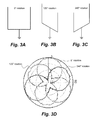
- FIGS. 3A, 3B, and 3C depict various orientations of an embodiment of a phased array antenna.
- FIG. 3D is a plot of the measured antenna pattern of an embodiment of a phased array antenna.
- FIG. 4A is an illustration of a traditional series feed arrangement for a phased array antenna.
- FIG. 4B is an illustration of an embodiment of a phased array antenna.
- FIG. 5A shows the element pattern for a four-element array in spherical coordinates.
- FIG. 5B shows the element pattern for a four-element array in Cartesian coordinates.
- FIG. 6A is a plot of the total pattern of a theoretical four-element array in a spherical (r, ⁇ , ⁇ ) coordinate system.
- FIG. 6B is a plot of the array pattern of a theoretical four-element array in a spherical (r, ⁇ , ⁇ ) coordinate system.
- FIG. 6C is a plot of the total pattern of a theoretical four-element array in a Cartesian (x, y, z) coordinate system.
- FIG. 6D is a plot of the array pattern of a theoretical four-element array in a Cartesian (x, y, z) coordinate system.
- FIG. 7 is an illustration of an embodiment of a phased array antenna.
- FIG. 8 is a flowchart of a method for providing a phased array antenna.
- FIG. 9A is a top view illustration of an embodiment of a phased array antenna.
- FIG. 9B is a cross-sectional, side view illustration of an embodiment of a phased array antenna.
- FIG. 10A is a top view illustration of an embodiment of a phased array antenna.
- FIG. 10B is a cross-sectional, side view illustration of an embodiment of a phased array antenna.
- a phased array antenna 10 that comprises, consists of, or consists essentially of a center conduit 12 , a current probe 14 , and at least two electrolytic fluid antennas 16 .
- the center conduit 12 is configured to be filled with electrolytic fluid 18 (Not shown in FIG. 1 , but depicted in FIG. 2 ).
- the electrolytic fluid 18 may be any electrically-conducting solution.
- a suitable example of the electrolytic fluid 18 includes, but is not limited to, seawater, which has an average conductivity that is 5 Siemens per meter at 25° Celsius. It is to be understood that the electrolytic fluid 18 used with the phased array antenna 10 is not limited to seawater, but that seawater is just one embodiment of the electrolytic fluid 18 .
- the center conduit 12 may be any non-conductive conduit capable of containing the electrolytic fluid 18 .
- the electrolytic fluid antennas 16 are fluidically coupled to the electrolytic fluid 18 contained within the center conduit 12 , and the electrolytic fluid antennas 16 have radiating portions that are parallel to each other.
- fluids that are “fluidically coupled” means that the fluids are in physical contact with each other without barriers or membranes separating the fluids.
- the current probe 14 may be any device capable of feeding the electrolytic antennas 16 via magnetic induction without coming into physical contact with the electrolytic fluid 18 .
- the current probe 14 has a shape that is topologically equivalent to a toroid having a central hole 20 therein.
- the center conduit 12 is disposed within the central hole 20 .
- the current probe 14 may be any toroidal current transformer having a single coil and having any desired size and shape.
- a suitable example of the current probe 14 is the current injection device disclosed in U.S. Pat. No. 6,492,956 to Fischer et al., which is incorporated herein by reference.
- the current probe 14 may have a solid, ferromagnetic, toroidal core or the core may be split into two or more sections to allow it to be clamped around the center conduit 12 without cutting into or penetrating the center conduit 12 .
- FIG. 1 is an illustration of an example embodiment of phased array antenna 10 .
- the phased array antenna 10 consists of two electrolytic antennas 16 each of which is comprised of a volume of static electrolytic fluid 18 held in L-shaped polyvinyl chloride (PVC) pipe.
- the center conduit 12 is also comprised of PVC pipe. While PVC pipe is described herein, it is to be understood that PVC pipe is not the only material that may be used—the electrolytic antennas 16 may be held in any non-conductive tubing or may even be free-standing streams of electrolytic fluid.
- PVC polyvinyl chloride
- the two L-shaped PVC pipes housing the electrolytic antennas 16 are connected to the center conduit 12 via a T-shaped coupler so as to form a field-goal-shaped embodiment of the phased array antenna 10 .
- the distance d between the upright sections 22 of the L-shaped pipes in this embodiment is equal to approximately 1 ⁇ 2 the center wavelength f 0 of the phased array antenna 10 .
- “approximately 1 ⁇ 2 of the center wavelength” means no greater than 0.55 and no less than 0.45 of the center wavelength. For example, if the center wavelength f 0 were 150 MHz, the distance d between the upright sections 22 would be approximately 1 meter (i.e., between 0.9 meters and 1.1 meters).
- the electrolytic fluid antennas 16 are similar in operation to a traditional dipole antenna and similarly produce an equivalent omnidirectional radiation pattern.
- Each electrolytic fluid antenna 16 is an equivalent dipole (monopole over a ground plane) and, as a consequence, has an omnidirectional pattern. This type of pattern is useful for applications in phased array applications since it is capable of providing coverage in a 360 degree sector.
- FIG. 2 is an illustration of an equivalent sum ( ⁇ ) beam circuit of the embodiment of the phased array antenna 10 shown in FIG. 1 mounted on a semi perfect lossy earth which results in the equivalent of a four-element array.
- Electrolytic fluid antennas provide a number of exclusive capabilities of which are not available in traditional antennas. These antennas provide low probability interception and low probability deception (LPI/LPD) capabilities by decreasing the antennas overall footprint in situations where real estate is scarce. For example, electrolytic fluid antennas can provide decoy capability and can disappear from the landscape when turned off. They eliminate the need for unsightly metallic antenna structures and reduce cost. They also provide multiband capabilities by being able to generate frequencies and bandwidths dependent upon overall height and width of the column of electrolytic fluid 18 in the electrolytic fluid antenna 16 .
- LPI/LPD low probability interception and low probability deception
- electrolytic fluid antennas can be enhanced in a distributed or ad-hoc generated phased antenna array in order to provide greater performance capabilities.
- These include, but not limited to being able to generate multiple simultaneous beams by the means of digital-beam-forming (DBF) (multiple tracking); ultra-low sidelobes ( ⁇ 45 dB) and narrow beams (for low probability intercept LPI capability and minimal interference effects), pattern control and null positioning in the direction of noise jammers, adaptive beamwidth and data rate reconfiguration (for tracking purposes) and clutter suppression (or range degradation).
- DBF digital-beam-forming
- ⁇ 45 dB ultra-low sidelobes
- narrow beams for low probability intercept LPI capability and minimal interference effects
- pattern control and null positioning in the direction of noise jammers adaptive beamwidth and data rate reconfiguration (for tracking purposes) and clutter suppression (or range degradation).
- the phased array 10 is multifunctional and may be used in many applications such as communications, data-links, radar (search and track), and electronic warfare (EW).
- FIGS. 3A, 3B, and 3C depict various orientations of the field-goal embodiment of the phased array antenna 10 as depicted in FIG. 1 as the uprights 22 are rotated about the axis of the center conduit 12 .
- FIG. 3D is the measured antenna pattern of the field goal embodiment of the phased array antenna 10 .
- the electrolytic fluid antenna 16 array position was positioned at 0° (see FIG. 3A ), at 120° (see FIG. 3B ), and at 240° (see FIG. 3C )(all positions relative to a boresight position of a receiving antenna) and excited for transmission.
- the radiation pattern shown in FIG. 3D was measured at each position (i.e., as depicted in FIGS. 3A, 3B, and 3C ) and the results of the measurement show encouraging agreement with theoretical pattern behavior such as is described below.
- FIG. 4A is an illustration of a traditional series feed arrangement for a phased array antenna.
- FIG. 4B is an illustration of an embodiment of the phased array antenna 10 where various electrolytic fluid antennas 16 are connected to the center conduit 12 via lengths of hose/tubing/conduit 23 , each connecting hose/tubing/conduit 23 having a specified length. If the beam is to point in a direction ⁇ 0 , the phase difference between elements should be sink d ⁇ 0 , where d is the spacing between each antenna element and where k is the wavenumber 2 ⁇ f. In scanned arrays, usually an integral number of 2 ⁇ radians is added. This permits a scan angle to be obtained with a smaller frequency change. Equating phase difference to phase shift obtained from a line/hose of length l gives:
- the array factor AF ⁇ -beam for a four-element array in sum mode AF ⁇ -beam is provided by the equation (5) below:
- FIGS. 5A and 5B show the element pattern for a four-element array in spherical and Cartesian coordinates. Illustrations of the array pattern of the theoretical four-element array are shown in FIGS. 6A and 6C . Illustrations of the total pattern of the theoretical four-element array are shown in FIGS. 6B and 6D .
- FIGS. 6A and 6B are respectively representations of the total pattern and the array of the theoretical four-element array in a spherical (r, ⁇ , ⁇ ) coordinate system.
- FIGS. 6C and 6D are respectively representations of the total pattern and the array of the theoretical four-element array in a Cartesian (x, y, z) coordinate system.
- FIG. 7 is an illustration of an embodiment of the phased array antenna 10 where each of the electrolytic fluid antennas 16 comprises a free-standing stream of electrolytic fluid 18 .
- the height h of the free-standing streams of electrolytic fluid 18 may be changed in real time by adjusting the pressure of the electrolytic fluid in the center conduit 12 thereby altering the operating frequency of the phased array antenna 10 .
- the electrolytic fluid 18 is pumped into the center conduit 12 by a pump assembly 24 .
- the bandwidth of the electrolytic fluid antennas 16 may be increased by increasing the diameter of the stream of electrolytic fluid 18 exiting nozzles 26 .
- the current probe 14 may be connected to any desired transmitter, receiver, or transceiver. In FIG. 7 , the current probe 14 is shown as being connected to a transceiver 28 .
- steerable directive patterns may be constructed from an assortment of identical electrolytic fluid antennas 16 fed with an equal amount of power for the elements in addition to an appropriate progressive phase shift. This may be expanded to applications requiring wide bandwidths.
- an embodiment of the phased array antenna 10 may comprise a plurality of electrolytic fluid antenna elements arranged in a concentric ring configuration using multiple jet spray heads such as the nozzles 26 . In this fashion the electrolytic fluid antennas 16 are selected to operate based upon the frequency of operation of the phased array antenna 10 such that the operating elements are determined in a fashion that maintains the lambda over two spacing between elements.
- FIG. 8 is a flowchart of a method 30 for providing the phased array antenna 10 that comprises the following steps.
- the first step 30 a provides for positioning a current probe having a toroidal-shaped core of ferromagnetic material around a nonconductive, electrolytic-fluid-filled center conduit that is disposed substantially parallel to a z-axis of an x-y-z mutually orthogonal axes coordinate system such that the center conduit is disposed within a central hole of the current probe's core, and such that the current probe is not in physical contact with the electrolytic fluid.
- the next step 30 b provides for fluidically coupling two columns of electrolytic fluid to the electrolytic fluid in the center conduit, wherein the two columns of electrolytic fluid are substantially parallel to the z-axis and spaced apart from each other in the x-y plane by 0.5 wavelengths.
- the next step 30 c provides for connecting the current probe to a transceiver.
- the next step 30 d provides for feeding the columns of electrolytic fluid with the current probe via magnetic induction to create a phased array antenna. Multiple simultaneous beams may be generated by means of digital-beam-forming.
- FIGS. 9A and 9B are respectively top view and cross-sectional, side view illustrations of an embodiment of the phased array antenna 10 .
- the phased array antenna 10 comprises a plurality of nozzles 26 arranged in a concentric rings formation. As pressurized electrolytic fluid 18 exits the nozzles 26 , it forms at least two electrolytic fluid antennas 16 as shown in FIG. 9B .
- the operating frequency of the phased array antenna 10 may be changed dynamically and in real time by opening a given set of nozzles and closing the others. In another embodiment, all the nozzles may be opened simultaneously. The distance between the nozzles in FIGS. 9A and 9B are not drawn to scale.
- the phased array antenna 10 is not limited to the number of nozzles 26 depicted in FIGS. 9A and 9B but may have any desired number of nozzles 26 .
- the nozzles 26 may optionally be computer controlled such that they may be opened or closed in real time to change the characteristics of the phased array antenna 10 .
- FIG. 9B one of the nozzles 26 is shown as being communicatively coupled to a computer 32 .
- the phased array antenna 10 may also comprise optional internal valves 34 configured to control the flow of electrolytic fluid 18 to the various nozzles 26 .
- the internal valves 34 may be computer-controlled.
- FIGS. 10A and 10B are respectively top view and cross-sectional, side view illustrations of an embodiment of the phased array antenna 10 .
- This embodiment of the phased array antenna 10 comprises a plurality of nozzles 26 arranged in a concentric rings formation where each ring 36 is a fluid channel connected to the center conduit 12 via a corresponding internal valve 34 .
- the internal valves 34 may be computer controlled to allow dynamic, real-time adjustment of the characteristics of the phased array antenna 10 .
- computer-controlled nozzles 26 may be used to alter the characteristics of the phased array antenna 10 .
- phased array antenna 10 From the above description of the phased array antenna 10 , it is manifest that various techniques may be used for implementing the concepts of the phased array antenna 10 without departing from the scope of the claims.
- the described embodiments are to be considered in all respects as illustrative and not restrictive.
- the method/apparatus disclosed herein may be practiced in the absence of any element that is not specifically claimed and/or disclosed herein.
- the phased array antenna 10 is not limited to the particular embodiments described herein, but is capable of many embodiments without departing from the scope of the claims.
Landscapes
- Engineering & Computer Science (AREA)
- Physics & Mathematics (AREA)
- Astronomy & Astrophysics (AREA)
- Aviation & Aerospace Engineering (AREA)
- General Physics & Mathematics (AREA)
- Remote Sensing (AREA)
- Manufacturing & Machinery (AREA)
- Variable-Direction Aerials And Aerial Arrays (AREA)
- Radar Systems Or Details Thereof (AREA)
Abstract
A phased array of electrolytic fluid antennas comprising: a center conduit filled with electrolytic fluid; a current probe having a central hole therein, wherein the center conduit is disposed within the central hole; and a plurality of electrolytic fluid antennas composed of free-standing streams of electrolytic fluid circularly-distributed about the center conduit, wherein each electrolytic fluid antenna is fluidically coupled to the center conduit by a fluid transmission line of a desired length, and wherein each electrolytic fluid antenna is configured to turn on or off in real time to change the characteristics of the phased array.
Description
This application is a continuation of prior U.S. application Ser. No. 15/707,049, filed 18 Sep. 2017, titled “Omnidirectional Periodically-Spaced Phased Array Using Electrolytic Fluid Antennas” (Navy Case #104762).
The United States Government has ownership rights in this invention. Licensing and technical inquiries may be directed to the Office of Research and Technical Applications, Space and Naval Warfare Systems Center, Pacific, Code 72120, San Diego, Calif., 92152; voice (619) 553-5118; ssc_pac_t2@navy.mil. Reference Navy Case Number 104709.
This invention relates to the field of phased array antennas. Typical phased arrays operate in environments where line of sight and secure communication is preferred. Spacing of half a wavelength is typically used amongst the elements spanning from a few elements to tens to hundreds or even thousands of elements. Essentially, periodic spacing between elements allow for progressive phase shifts in the feed (current) of each element in the array. Behavior in this manner results in radiation characteristics containing: a high gain/directive steerable main beam with low sidelobe levels. There is a need for an improved phased array antenna.
Disclosed herein is a phased array of electrolytic fluid antennas comprising a center conduit, a current probe, and a plurality of electrolytic fluid antennas. The center conduit is filled with electrolytic fluid. The current probe has a central hole and the center conduit is disposed within the central hole. The plurality of electrolytic fluid antennas is composed of free-standing streams of electrolytic fluid circularly-distributed about the center conduit. Each electrolytic fluid antenna is fluidically coupled to the center conduit by a fluid transmission line of a desired length. Each electrolytic fluid antenna is configured to turn on or off in real time to change the characteristics of the phased array.
The phased array of electrolytic fluid antennas may be dynamically beam-steered according to the following steps. One step provides for positioning a current probe having a toroidal-shaped core of ferromagnetic material around a nonconductive, electrolytic-fluid-filled center conduit that is disposed substantially parallel to a z-axis of an x-y-z mutually orthogonal axes coordinate system such that the center conduit is disposed within a central hole of the current probe's core, and such that the current probe is not in physical contact with the electrolytic fluid. Another step provides for fluidically coupling a plurality of electrolytic fluid antennas (each comprising a column of electrolytic fluid) to the electrolytic fluid in the center conduit. The columns of electrolytic fluid are substantially parallel to the z-axis and spaced apart from each other in the x-y plane by 0.5 wavelengths. Another step provides for connecting the current probe to a transceiver. Another step provides for feeding the columns of electrolytic fluid with the current probe via magnetic induction to create the phased array antenna. Another step provides for altering the height of each of the columns of electrolytic fluid in real time by adjusting the pressure of the electrolytic fluid in the center conduit thereby altering the operating frequency of the phased array.
The phased array of electrolytic fluid antennas may also be dynamically beam-steered by performing the following steps. On step provides for positioning a current probe having a toroidal-shaped core of ferromagnetic material around a nonconductive, electrolytic-fluid-filled center conduit that is disposed substantially parallel to a z-axis of an x-y-z mutually orthogonal axes coordinate system such that the center conduit is disposed within a central hole of the current probe's core, and such that the current probe is not in physical contact with the electrolytic fluid. Another step provides for fluidically coupling a plurality of electrolytic fluid antennas (each comprising a nozzle from which exits a free-standing stream or column of electrolytic fluid) to the electrolytic fluid in the center conduit. The columns of electrolytic fluid are substantially parallel to the z-axis and spaced apart from each other in the x-y plane by 0.5 wavelengths. Another step provides for connecting the current probe to a transceiver. Another step provides for feeding the columns of electrolytic fluid with the current probe via magnetic induction to create the phased array antenna. Another step provides for dynamically changing the operating frequency of the phased array in real time by opening a given set of nozzles and closing other nozzles, thereby effectively changing the length l of an electrolytic fluid transmission line between the center conduit and each nozzle.
Throughout the several views, like elements are referenced using like references. The elements in the figures are not drawn to scale and some dimensions are exaggerated for clarity.
The disclosed antenna and method below may be described generally, as well as in terms of specific examples and/or specific embodiments. For instances where references are made to detailed examples and/or embodiments, it should be appreciated that any of the underlying principles described are not to be limited to a single embodiment, but may be expanded for use with any of the other methods and systems described herein as will be understood by one of ordinary skill in the art unless otherwise stated specifically.
Described herein is a phased array antenna 10 that comprises, consists of, or consists essentially of a center conduit 12, a current probe 14, and at least two electrolytic fluid antennas 16. The center conduit 12 is configured to be filled with electrolytic fluid 18 (Not shown in FIG. 1 , but depicted in FIG. 2 ). The electrolytic fluid 18 may be any electrically-conducting solution. A suitable example of the electrolytic fluid 18 includes, but is not limited to, seawater, which has an average conductivity that is 5 Siemens per meter at 25° Celsius. It is to be understood that the electrolytic fluid 18 used with the phased array antenna 10 is not limited to seawater, but that seawater is just one embodiment of the electrolytic fluid 18. The center conduit 12 may be any non-conductive conduit capable of containing the electrolytic fluid 18. The electrolytic fluid antennas 16 are fluidically coupled to the electrolytic fluid 18 contained within the center conduit 12, and the electrolytic fluid antennas 16 have radiating portions that are parallel to each other. As used herein, fluids that are “fluidically coupled” means that the fluids are in physical contact with each other without barriers or membranes separating the fluids. The current probe 14 may be any device capable of feeding the electrolytic antennas 16 via magnetic induction without coming into physical contact with the electrolytic fluid 18. The current probe 14 has a shape that is topologically equivalent to a toroid having a central hole 20 therein. The center conduit 12 is disposed within the central hole 20. The current probe 14 may be any toroidal current transformer having a single coil and having any desired size and shape. A suitable example of the current probe 14 is the current injection device disclosed in U.S. Pat. No. 6,492,956 to Fischer et al., which is incorporated herein by reference. The current probe 14 may have a solid, ferromagnetic, toroidal core or the core may be split into two or more sections to allow it to be clamped around the center conduit 12 without cutting into or penetrating the center conduit 12.
When the phased array antenna 10 is mounted on a semi perfect lossy earth, on a ship, and/or over a body of water, the electrolytic fluid antennas 16 are similar in operation to a traditional dipole antenna and similarly produce an equivalent omnidirectional radiation pattern. Each electrolytic fluid antenna 16 is an equivalent dipole (monopole over a ground plane) and, as a consequence, has an omnidirectional pattern. This type of pattern is useful for applications in phased array applications since it is capable of providing coverage in a 360 degree sector.
To establish the basic technique of transmission lines, consider an electromagnetic wave of frequency f propagating through a transmission line of length l with a velocity of v. The electromagnetic wave experiences a phase shift ϕ as follows:
ϕ=2πfl/v (1)
Therefore, a wave that propagates at constant velocity change can introduce a phase shift as seen in equation (1) by inducing a frequency or transmission line length change. In this manner, an electronic phase shift ψ may be generated. Since no phase shifting devices are required under the afore-mentioned conditions, there is no insertion loss due to phase shifters.
ϕ=2πfl/v (1)
Therefore, a wave that propagates at constant velocity change can introduce a phase shift as seen in equation (1) by inducing a frequency or transmission line length change. In this manner, an electronic phase shift ψ may be generated. Since no phase shifting devices are required under the afore-mentioned conditions, there is no insertion loss due to phase shifters.
Where m is an integer number and λ is the wavelength. When θ0=0°, which corresponds to the broadside beam direction, equation (3) results in m=l/λ0, where λ0 corresponds to the wavelength and f0 is the center frequency at the broadside direction.
In theory, the array factor AFΣ-beam for a four-element array in sum mode AFΣ-beam is provided by the equation (5) below:
Where k is the wave number and dx and dz represent the spacing between elements in an x and z axis respectively.
In an embodiment of the phased array antenna 10, steerable directive patterns may be constructed from an assortment of identical electrolytic fluid antennas 16 fed with an equal amount of power for the elements in addition to an appropriate progressive phase shift. This may be expanded to applications requiring wide bandwidths. For example, an embodiment of the phased array antenna 10 may comprise a plurality of electrolytic fluid antenna elements arranged in a concentric ring configuration using multiple jet spray heads such as the nozzles 26. In this fashion the electrolytic fluid antennas 16 are selected to operate based upon the frequency of operation of the phased array antenna 10 such that the operating elements are determined in a fashion that maintains the lambda over two spacing between elements.
From the above description of the phased array antenna 10, it is manifest that various techniques may be used for implementing the concepts of the phased array antenna 10 without departing from the scope of the claims. The described embodiments are to be considered in all respects as illustrative and not restrictive. The method/apparatus disclosed herein may be practiced in the absence of any element that is not specifically claimed and/or disclosed herein. It should also be understood that the phased array antenna 10 is not limited to the particular embodiments described herein, but is capable of many embodiments without departing from the scope of the claims.
Claims (15)
1. A phased array of electrolytic fluid antennas comprising:
a center conduit filled with electrolytic fluid;
a current probe having a central hole therein, wherein the center conduit is disposed within the central hole; and
a plurality of electrolytic fluid antennas composed of free-standing streams of electrolytic fluid circularly-distributed about the center conduit, wherein each electrolytic fluid antenna is fluidically coupled to the center conduit by a fluid transmission line of a desired length, and wherein each electrolytic fluid antenna is configured to turn on or off in real time to change the characteristics of the phased array.
2. The phased array of electrolytic fluid antennas of claim 1 , wherein each electrolytic fluid antenna comprises a computer-controlled valve which allows the each electrolytic fluid antenna to be turned on or off.
3. The phased array of electrolytic fluid antennas of claim 2 , wherein the plurality of electrolytic fluid antennas are selected to operate based upon a frequency of operation of the phased array such that lambda over two spacing is maintained between electrolytic fluid antennas that are turned on, where lambda is an operating wavelength.
4. The phased array of electrolytic fluid antennas of claim 3 , wherein the electrolytic fluid antennas that are turned on are identical and are fed with an equal amount of power and an appropriate progressive phase shift thereby enabling the construction of steerable directive patterns.
5. The phased array of electrolytic fluid antennas of claim 2 , wherein the fluid transmission lines comprise internal control valves configured to control the flow of electrolytic fluid to the plurality of electrolytic fluid antennas such that the length of each fluid transmission line may be adjusted in real time.
6. The phased array of electrolytic fluid antennas of claim 5 , wherein the internal control valves are computer-controlled.
7. A method for dynamically beam steering a phased array of electrolytic fluid antennas comprising:
positioning a current probe having a toroidal-shaped core of ferromagnetic material around a nonconductive, electrolytic-fluid-filled center conduit that is disposed substantially parallel to a z-axis of an x-y-z mutually orthogonal axes coordinate system such that the center conduit is disposed within a central hole of the current probe's core, and such that the current probe is not in physical contact with the electrolytic fluid;
fluidically coupling a plurality of electrolytic fluid antennas (each comprising a column of electrolytic fluid) to the electrolytic fluid in the center conduit, wherein the columns of electrolytic fluid are substantially parallel to the z-axis and spaced apart from each other in the x-y plane by 0.5 wavelengths;
connecting the current probe to a transceiver;
feeding the columns of electrolytic fluid with the current probe via magnetic induction to create the phased array antenna; and
altering the height of each of the columns of electrolytic fluid in real time by adjusting the pressure of the electrolytic fluid in the center conduit thereby altering the operating frequency of the phased array.
8. The method of claim 7 , wherein each of the columns of electrolytic fluid is a free-standing stream of electrolytic fluid.
9. A method for dynamically beam steering a phased array of electrolytic fluid antennas comprising:
positioning a current probe having a toroidal-shaped core of ferromagnetic material around a nonconductive, electrolytic-fluid-filled center conduit that is disposed substantially parallel to a z-axis of an x-y-z mutually orthogonal axes coordinate system such that the center conduit is disposed within a central hole of the current probe's core, and such that the current probe is not in physical contact with the electrolytic fluid;
fluidically coupling a plurality of electrolytic fluid antennas (each comprising a nozzle from which exits a free-standing stream or column of electrolytic fluid) to the electrolytic fluid in the center conduit, wherein the columns of electrolytic fluid are substantially parallel to the z-axis and spaced apart from each other in the x-y plane by 0.5 wavelengths;
connecting the current probe to a transceiver;
feeding the columns of electrolytic fluid with the current probe via magnetic induction to create the phased array antenna; and
dynamically changing the operating frequency of the phased array in real time by opening a given set of nozzles and closing other nozzles, thereby effectively changing the length l of an electrolytic fluid transmission line between the center conduit and each nozzle.
10. The method of claim 8 , further comprising equating phase difference to phase shift obtained from a given electrolytic fluid transmission line of length l such that
where d is the spacing between each electrolytic fluid antenna, m is an integer number and A is an operating wavelength.
11. The method of claim 10 , wherein each nozzle is a computer-controlled valve which allows the each electrolytic fluid antenna to be turned on or off.
12. The method of claim 11 , wherein the plurality of electrolytic fluid antennas are selected to operate based upon a frequency of operation of the phased array such that lambda A over two spacing is maintained between electrolytic fluid antennas that are turned on.
13. The method of claim 9 , further comprising feeding the electrolytic fluid antennas that are turned on with an equal amount of power and an appropriate progressive phase shift thereby enabling the construction of steerable directive patterns.
14. The method of claim 11 , further comprising altering the length l of a given electrolytic fluid transmission line in real time with control valves that are internal to the fluid transmission lines.
15. The method of claim 14 , wherein the internal control valves are computer-controlled and further comprising using a computer to control the internal control valves to adjust the lengths l of the electrolytic fluid transmission lines in real time.
Priority Applications (1)
| Application Number | Priority Date | Filing Date | Title |
|---|---|---|---|
| US15/902,346 US10074908B1 (en) | 2017-09-18 | 2018-02-22 | Method for beam steering an omnidirectional periodically-spaced phased array of electrolytic fluid antennas |
Applications Claiming Priority (2)
| Application Number | Priority Date | Filing Date | Title |
|---|---|---|---|
| US15/707,049 US10050352B1 (en) | 2017-09-18 | 2017-09-18 | Omnidirectional periodically-spaced phased array using electrolytic fluid antennas |
| US15/902,346 US10074908B1 (en) | 2017-09-18 | 2018-02-22 | Method for beam steering an omnidirectional periodically-spaced phased array of electrolytic fluid antennas |
Related Parent Applications (1)
| Application Number | Title | Priority Date | Filing Date |
|---|---|---|---|
| US15/707,049 Continuation US10050352B1 (en) | 2017-09-18 | 2017-09-18 | Omnidirectional periodically-spaced phased array using electrolytic fluid antennas |
Publications (1)
| Publication Number | Publication Date |
|---|---|
| US10074908B1 true US10074908B1 (en) | 2018-09-11 |
Family
ID=63078765
Family Applications (2)
| Application Number | Title | Priority Date | Filing Date |
|---|---|---|---|
| US15/707,049 Active US10050352B1 (en) | 2017-09-18 | 2017-09-18 | Omnidirectional periodically-spaced phased array using electrolytic fluid antennas |
| US15/902,346 Active US10074908B1 (en) | 2017-09-18 | 2018-02-22 | Method for beam steering an omnidirectional periodically-spaced phased array of electrolytic fluid antennas |
Family Applications Before (1)
| Application Number | Title | Priority Date | Filing Date |
|---|---|---|---|
| US15/707,049 Active US10050352B1 (en) | 2017-09-18 | 2017-09-18 | Omnidirectional periodically-spaced phased array using electrolytic fluid antennas |
Country Status (1)
| Country | Link |
|---|---|
| US (2) | US10050352B1 (en) |
Cited By (1)
| Publication number | Priority date | Publication date | Assignee | Title |
|---|---|---|---|---|
| US20240322426A1 (en) * | 2023-03-20 | 2024-09-26 | United States Of America As Represented By The Secretary Of The Navy | Phased Array of Electrolytic Fluid Antennas and a Method for Dynamically Beam Steering the Same |
Families Citing this family (1)
| Publication number | Priority date | Publication date | Assignee | Title |
|---|---|---|---|---|
| CN111244606B (en) * | 2020-02-21 | 2022-07-05 | 京东方科技集团股份有限公司 | Transmitting antenna system, receiving antenna system and communication equipment |
Family Cites Families (2)
| Publication number | Priority date | Publication date | Assignee | Title |
|---|---|---|---|---|
| US7898484B1 (en) | 2008-05-12 | 2011-03-01 | The United States Of America As Represented By The Secretary Of The Navy | Electrolytic fluid antenna |
| US7969370B1 (en) | 2009-02-23 | 2011-06-28 | The United States Of America As Repesented By The Secretary Of The Navy | Liquid antennas |
-
2017
- 2017-09-18 US US15/707,049 patent/US10050352B1/en active Active
-
2018
- 2018-02-22 US US15/902,346 patent/US10074908B1/en active Active
Non-Patent Citations (6)
| Title |
|---|
| Baizert, P.; Hale, T.B.; Temple, M.A.; Wicks, M.C.; "Forward-looking radar GMTI benefits using a linear frequency diverse array", Electronics Letters, vol. 42, Issue 22, Oct. 26, 2006 pp. 1311-1312. |
| Huang et al.; Frequency Diverse Array with Beam Scanning Feature; IEEE, 2008. |
| Jones, A.M.; Rigling, B.D., "Planar frequency diverse array receiver architecture;" Radar Conference (RADAR), 2012 IEEE, vol., No., pp. 0145,0150, May 7-11, 2012. |
| P. Antonik, M.C. Wicks, H.D. Griffiths, C.J. Baker, "Frequency Diverse Array Radars", IEEE 2006. |
| P. Antonik, M.C. Wicks, H.D. Griffiths, C.J. Baker, "Multi-Mission Multi-Mode Waveform Diversity"; IEEE, 2006. |
| Secmen et al.; Frequency Diverse Array Antenna with Periodic Time Modulated Pattern in Range and Angle; IEEE 2007. |
Cited By (2)
| Publication number | Priority date | Publication date | Assignee | Title |
|---|---|---|---|---|
| US20240322426A1 (en) * | 2023-03-20 | 2024-09-26 | United States Of America As Represented By The Secretary Of The Navy | Phased Array of Electrolytic Fluid Antennas and a Method for Dynamically Beam Steering the Same |
| US12388176B2 (en) * | 2023-03-20 | 2025-08-12 | The United States Of America, As Represented By The Secretary Of The Navy | Phased array of electrolytic fluid antennas and a method for dynamically beam steering the same |
Also Published As
| Publication number | Publication date |
|---|---|
| US10050352B1 (en) | 2018-08-14 |
Similar Documents
| Publication | Publication Date | Title |
|---|---|---|
| Goudos | Antenna design using binary differential evolution: Application to discrete-valued design problems | |
| Sharawi et al. | Design and implementation of embedded printed antenna arrays in small UAV wing structures | |
| Smolders et al. | Low side-lobe circularly-polarized phased arrays using a random sequential rotation technique | |
| Aboul-Seoud et al. | A conformal conical phased array antenna for modern radars | |
| CN117060079A (en) | A programmable dual circularly polarized metasurface reflection array | |
| US10074908B1 (en) | Method for beam steering an omnidirectional periodically-spaced phased array of electrolytic fluid antennas | |
| Van Luyen et al. | BAT algorithm based beamformer for interference suppression by controlling the complex weight | |
| Islamov et al. | Design, modelling and research of an antenna system for transmitting and receiving information in satellite systems | |
| Nechaev et al. | Evaluation of the influence of directivity factor of directive elements of conformal antenna arrays on the performances of azimuth-elevation DOA estimation | |
| Im et al. | Design of a compact log periodic dipole array antenna for broadband and high-power beam synthesis using superposition | |
| Sharifi et al. | Development a new algorithm to reduce SLL of an equally spaced linear array | |
| US10811787B1 (en) | Systems and methods for wavelength scaled array layout optimization | |
| Pappula et al. | Large array synthesis using invasive weed optimization | |
| US11189939B2 (en) | Dual-polarized wide-bandwidth antenna | |
| Rupcic et al. | Reduction of sidelobes by nonuniform elements spacing of a spherical antenna array | |
| Li et al. | Direction of arrival estimation using amplitude and phase information in low-profile MIMO arrays | |
| US11923612B2 (en) | Systems and methods for circular-polarized beam forming and steering based on the superposition of circular modes for communication and radar systems | |
| Balanis | Evolution of Antenna Technology: Arrays, linear, planar, and circular | |
| Nechaev et al. | The Research of the Digital Beamforming Algorithm for Optimal Noise Reduction in a Cylindrical Antenna Array with Directive Radiators | |
| US12388176B2 (en) | Phased array of electrolytic fluid antennas and a method for dynamically beam steering the same | |
| Zuniga et al. | Effect of a central antenna element on the directivity, half-power beamwidth and side-lobe level of circular antenna arrays | |
| Jabbar | New elements concentrated planar fractal antenna arrays for celestial surveillance and wireless communications | |
| Rezazadeh et al. | GPS anti-jamming performance of multimode microstrip antennas | |
| Gafarov et al. | The GNSS helix antenna for high precision application | |
| Erokhin et al. | Horizon Nulling Backfire Helix Antenna for Interference-Resistant GNSS Applications |
Legal Events
| Date | Code | Title | Description |
|---|---|---|---|
| FEPP | Fee payment procedure |
Free format text: ENTITY STATUS SET TO UNDISCOUNTED (ORIGINAL EVENT CODE: BIG.); ENTITY STATUS OF PATENT OWNER: LARGE ENTITY |
|
| STCF | Information on status: patent grant |
Free format text: PATENTED CASE |
|
| MAFP | Maintenance fee payment |
Free format text: PAYMENT OF MAINTENANCE FEE, 4TH YEAR, LARGE ENTITY (ORIGINAL EVENT CODE: M1551); ENTITY STATUS OF PATENT OWNER: LARGE ENTITY Year of fee payment: 4 |