US10073930B2 - Computerised method and system for modelling aeraulic flows, in particular for the quantitative assessment of the risk of airborne contamination - Google Patents
Computerised method and system for modelling aeraulic flows, in particular for the quantitative assessment of the risk of airborne contamination Download PDFInfo
- Publication number
- US10073930B2 US10073930B2 US14/400,249 US201314400249A US10073930B2 US 10073930 B2 US10073930 B2 US 10073930B2 US 201314400249 A US201314400249 A US 201314400249A US 10073930 B2 US10073930 B2 US 10073930B2
- Authority
- US
- United States
- Prior art keywords
- environment
- aeraulic
- study environment
- model
- study
- Prior art date
- Legal status (The legal status is an assumption and is not a legal conclusion. Google has not performed a legal analysis and makes no representation as to the accuracy of the status listed.)
- Active, expires
Links
Images


Classifications
-
- G06F17/5018—
-
- G—PHYSICS
- G06—COMPUTING OR CALCULATING; COUNTING
- G06F—ELECTRIC DIGITAL DATA PROCESSING
- G06F30/00—Computer-aided design [CAD]
- G06F30/20—Design optimisation, verification or simulation
- G06F30/23—Design optimisation, verification or simulation using finite element methods [FEM] or finite difference methods [FDM]
-
- G—PHYSICS
- G06—COMPUTING OR CALCULATING; COUNTING
- G06F—ELECTRIC DIGITAL DATA PROCESSING
- G06F17/00—Digital computing or data processing equipment or methods, specially adapted for specific functions
- G06F17/10—Complex mathematical operations
- G06F17/11—Complex mathematical operations for solving equations, e.g. nonlinear equations, general mathematical optimization problems
-
- G—PHYSICS
- G06—COMPUTING OR CALCULATING; COUNTING
- G06F—ELECTRIC DIGITAL DATA PROCESSING
- G06F2111/00—Details relating to CAD techniques
- G06F2111/10—Numerical modelling
-
- G06F2217/16—
Definitions
- the invention relates to a computerized process and system for modeling aeraulic flows in an environment in particular for the evaluation of the risks of airborne contamination.
- the applications for such a process relate in particular to defense, the protection of sensitive installations, hospitals, clean rooms, sites with a controlled environment, and the following industries: chemical, pharmaceutical, cosmetic, electronic, agricultural, and mechanical.
- Experimental simulation can only provide a vision of the reality of the flows remaining dependant upon conditions of experience (nature of the tracer, processes for releasing tracer into the environment, aeraulic and operational conditions in the environment being considered at the time of the experiment). Also, if experimental simulation can provide advantageous teaching on the qualitative representation of aeraulic flows, it remains linked to the conditions of experience and should not be extrapolated to other conditions. Moreover, the margin of error of experimental simulation in the case of isolated quantitative study remains very significant and can often be underestimated by the experimenters.
- CFD Computational Fluid Dynamics
- V ⁇ ⁇ ( ⁇ ⁇ V ⁇ ) - 1 p ⁇ ⁇ P + v ⁇ ⁇ 2 ⁇ V ⁇ + g ⁇ ⁇ ⁇ ⁇ ⁇ ( T - T 0 ) + F int
- V ⁇ ⁇ ( ⁇ ⁇ T ) k ⁇ ⁇ ⁇ C p ⁇ ⁇ 2 ⁇ T + S T ⁇ ⁇ ⁇ C p .
- the model k- ⁇ is based on two equations that take into account the turbulent kinetic energy (k) and the dissipation of the turbulence ( ⁇ ).
- the turbulent viscosity is determined in an empirical manner by the equation:
- the foundation of the modeling by calculation then relies on a principle of discretization of space and indexing of equations of state modified by the introduction of empirical values.
- the calculation area is meshed into a finite number of volumes called mesh M whose sum provides the entirety of this range.
- mesh M a finite number of volumes
- the algebraic equation can then be resolved at point A of the mesh M for knowing the value of the calculated variable.
- this equation requires knowledge of values of the calculated variables in the adjacent meshes. This interdependence of all of the meshes for building the final result in the calculation area requires the implementation of an iterative process for refining the values in each volume based on values calculated in the adjacent cells until stabilized general solutions are obtained.
- SIMPLE Semi-Implicit Method for Pressure Linked Equations
- SIMPLER Semi-Implicit Method for Pressure Linked Equations
- MAC MAC
- SOLA SOLA
- the implementation requires the introduction of data making it possible to “turn around” the calculation. These data consist of initial conditions and boundary conditions of the calculation area.
- the algorithm is deployed from meshes in which the values of the primitive variables (V, P, T) are known and are diffused toward all of the adjacent meshes while having to satisfy the boundary conditions defined at the boundaries of this range.
- the boundary conditions pose the value of the velocity module at the boundary of the range (in general, zero velocity) and develop toward the interior of the range according to the models of Dirichlet or Neumann.
- the algorithm of a conventional CFD code is then activated until the time when the convergence conditions (or stability of the solution) are satisfied.
- the conventional CFD codes do not use means that are capable of assessing the relevance of the calculated solution. This means that the relevance of the result of the calculation is primarily conditioned by the CFD expert during the selection of the most suitable code for the modeling type to be carried out and, for a given code, by the selection of models and values of the variables as well as by the introduction of the initial conditions.
- the object of this invention is to provide a process making it possible to model the a somehowlic flows in an environment that is occupied by a primary fluid that is reliable while being less complex than the known processes as much from the standpoint of necessary technical resources as from the standpoint of knowledge required for a user for its implementation.
- the process according to this invention has as its object to make possible the evaluation of the risks of airborne contamination in said area.
- Another object of this invention is to provide a computerized system and a device for implementing said process.
- This invention has as its object a process for modeling aeraulic flows in an environment according to Claim 1 .
- the process according to the invention is distinguished from any other method of digital calculation of solutions close to the Navier-Stokes equations (case of the conventional CFD “Computational Fluid Dynamics”) by the fact that it draws on the better part of the current technical knowledge to integrate it in a mathematical model and thus to considerably reduce the number of iterations necessary for obtaining an acceptable solution in a context of evaluating the risk of airborne contamination.
- the principle of the process according to the invention consists in considering that in a given individual volume or mesh, defined as fairly small, the final values of the primitive variables (V, P, T) are the result of their primary values calculated in an irrotational field composed of a “pressure-velocity” coupling with a turbulence model adapted to Newtonian and incompressible fluids belonging to the range of validity of the process.
- the process according to the invention leads to obtaining highly relevant solutions to the extent that they are calculated in an environment that is faithful to the configuration of the interfaces that they model.
- the process according to the invention can be integrated in a system that is computerized and designed to be usable by a population that is much more vast than that of the experts to whom the conventional CFD software is addressed.
- This invention therefore also has as its object a computer program according to Claim 15 and a device according to Claim 16 or 17 .
- the process and the computerized system according to the invention make possible, in their application, a routine use of modeling by calculation of a somehowlic flows when the data obtained by experimental simulation are difficult to generalize or when the conventional CFD processes implemented by computer prove too resource-intensive (memory, performance of the processor, . . . ) to be able to be applied effectively and to offer fast results.
- the process according to the invention is in particular particularly well suited for optimizing the design or the performance of a system for extracting and blowing air or an HVAC (HVAC: Heating Ventilation and Air-Conditioning) system in a building having strict specifications in terms of air treatment or for control of the risk of airborne contamination.
- HVAC Heating Ventilation and Air-Conditioning
- these two objectives are poorly adapted, for reasons of cost or safety, for treatment by experimentation or the implementation of calculation means that are cumbersome and not very accessible to technicians who are directly responsible for problems facing them, whereas one skilled in the art knows that the accumulation of interfaces with different expertise levels in technologies can take away from the relevance of the global nature of the process or else even have a negative impact on the preservation of the confidentiality of the information.
- the process according to the invention After having modeled the aeraulic flows of the study environment, the process according to the invention also makes it possible to calculate the conditional probability (called likelihood) of having a quantity of contaminant, for example a collection of particles or a concentration of gas, present in a given volume of the environment at a given time.
- likelihood conditional probability
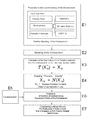
- FIG. 1 is a diagram illustrating the stages of the process according to the invention.
- FIG. 2 a illustrates the result of a sweep or scan of the study environment using a 3D laser scanner in four different positions and orientations.
- FIG. 2 b illustrates a modeling of the study environment in the form of a cloud of points obtained from the result of FIG. 2 a.
- FIG. 3 illustrates an example of a meshed study environment by a finite number of individual volumes called meshes and whose sum forms the entirety of the environment.
- FIG. 4 illustrates the forces being exerted on a particle P of a contaminant dispersed into the primary fluid occupying the study environment.
- FIGS. 5 a to 5 d illustrate a display example of the results obtained by the process according to the invention.
- FIG. 5 a illustrates a qualitative dispersion profile of an airborne substance in a study environment, with the profile being represented by a set of points.
- FIG. 5 b illustrates the same qualitative dispersion profile as the one of FIG. 5 a but this time being represented by a volume in three dimensions or “cloud.”
- FIGS. 5 c and 5 d always illustrate the same qualitative dispersion profile as the one illustrated in FIG. 5 b but superimposed on a modeling of a Vogellic flows in the study environment.
- the process according to the invention comprises stages E 1 to E 7 .
- the first stage E 1 of the process according to the invention consists in parameterizing and in modeling the study environment in which it is desired to model the aeraulic flows.
- These data comprise in particular the physical and dynamic characteristics of the environment such as the installation of solid surfaces, the materials that are used, the thermal balance, or the local thermal insularities.
- These data can be acquired by telemetry, by scanning the environment by means of a 3D laser scanner or by any other suitable sensor, for example, or from preestablished environmental plans that are contained in, for example, a CAD (computer-aided design) file. These data are then used to produce a faithful three-dimensional model of the study environment.
- Said environment can be, for example, a laboratory, a clean room, an office, a public site such as a hospital or an airport concourse, or any other environment in which it is desired to model the aeraulic flows.
- the study environment is an inside environment and that the fluid occupying this environment is air.
- FIGS. 2 a and 2 b illustrate a portion of this first stage E 1 for an office-type study environment.
- a series of scans/sweeps are produced, for example, using a 3D laser scanner from various positions and in various orientations as illustrated in FIG. 2 a .
- a model of the environment that consists of a cloud of points in three dimensions is then reconstructed using any suitable software as illustrated in, for example, FIG. 2 b for the environment of FIG. 2 a.
- This first stage E 1 for modeling the study environment is well known to one skilled in the art and also constitutes an essential stage in the conventional CFD processes.
- the technical characteristics of the system for blowing and extracting fluid from the environment also called an HVAC (heating, ventilation and air-conditioning) system—are then determined.
- Said system consists of aeraulic interfaces, with the term aeraulic interface referring to any element having a direct influence on the aeraulic flow in the study environment.
- the aeraulic interfaces in the study environment comprise in particular:
- the technical characteristics of the blowing and extraction system comprise in particular the list of aeraulic interfaces that are present and influential in the study environment, the installation of said aeraulic interfaces in the environment, and the aeraulic and climatic characteristics of said aeraulic interfaces.
- the characteristics relating to the primary fluid occupying the study environment are also determined. In the case of air, these characteristics depend in particular on the location of the environment: altitude, pollution levels . . . . One skilled in the art will easily identify said characteristics.
- stage E 1 of the process according to the invention has been described as a series of sub-stages that have to be carried out, the order of these sub-stages does not, of course, have any significance. It would be possible in particular to begin by summarizing the characteristics of the primary fluid before modeling the study environment.
- the study environment constitutes the calculation area in which the a Vogellic flows should be modeled, i.e., in which the flow variables of the fluid should be calculated.
- the second stage E 2 of the process according to the invention consists in creating in the study environment at least one mesh network called a matrix.
- the term “mesh” refers to an individual volume-type element in which the values of the primitive variables (V, T, P) (velocity, temperature, pressure) are calculated.
- V, T, P primitive variables
- the term “meshing” refers to the space formed by the union of all of the meshes.
- a network of cells called a grid is also created.
- the grid is a network of cells in two dimensions covering the surfaces of the environment and its infrastructures.
- This grid can be generated by any suitable method, for example from the cloud of points provided by the 3D laser scanner after sweeps of the environment.
- the structural characteristics of the environment and a Vogellic interfaces are associated with the grid.
- the environment is then meshed by at least one network of a finite number of meshes whose sum provides the entirety of the study environment. This meshing will be called matrix below.
- two meshings are generated in the study environment, with said meshings being of different sizes and not stackable.
- the matrix then refers to these two meshings. It will clearly appear below that although the latter is not necessary for implementing the process, there is an advantage in working with two separate meshings, in particular in that during calculations, the second meshing is used as a control for the solution obtained in the first meshing and vice versa.
- the meshing(s) can be hexahedral or tetrahedral according to the shape of the mesh comprising them.
- a meshing or a grid in an environment can be obtained in particular by using Delaunay triangulation.
- exclusion zones in the interior or on the periphery of the latter.
- These exclusion zones constitute zones in which neither calculation nor modeling will be carried out. It may involve in particular a closed volume placed inside the environment such as a cabinet, a cornerstone or any other infrastructure.
- the object of the process according to the invention is therefore to evaluate the primitive variables in each of the meshes comprising the matrix. According to the process that is the object of the invention, this evaluation is done in two phases described below in detail as third and fourth stages E 3 and E 4 of the process.
- the primitive values (V, P, T) are first calculated in each of the meshes of the matrix in an irrotational field for a fluid that is assumed to be complete and incompressible.
- X M refers to a primary primitive variable that can be calculated in the mesh M at point A.
- X M is determined by the infrastructures of the study environment.
- point A is the center of the mesh M, but A can be any point of the mesh M.
- X′ M ( X M ) where is the function calculating the value X′ M of the primary primitive variable X M in an irrotational field for a fluid that is assumed to be complete.
- the function is specific to the process according to the invention. For each mesh M of the matrix, it expresses for this mesh M the aeraulic result that is perceived as a weighted linear combination of all of the aeraulic interfaces of the environment that can influence this result.
- This third stage E 3 of the process according to the invention makes it possible, for any mesh M of the calculation area, to determine a raw value X′ M of the desired primitive variables. These values should then be refined by a calculation coupling the respective interactions between all of the a Vogellic interfaces by this time no longer considering a complete and incompressible fluid but the primary fluid whose characteristics were determined in stage E 1 . This refining is done in a fourth stage E 4 of the process according to the invention.
- the matrix consists of two or more meshings that are of a distinct size and that are not stackable, then the calculation of the third stage E 3 of the process is carried out (simultaneously or not) in each of these meshings.
- this offers a possibility for control of the solution obtained at this stage.
- the convergence of the solutions that are obtained in each of the meshings makes it possible to ensure cohesion of the solution while the divergence of the solutions that are obtained can indicate that an error has occurred in the calculation.
- the fourth stage E 4 of the process according to the invention therefore consists in refining the raw value of the primitive variables X′ M determined in the preceding stage E 3 .
- the selected model therefore depends on the primary fluid being considered.
- the model that is used in the case of air or a Newtonian fluid is based on the Navier-Stokes equations.
- the function is comparable to the one integrated in the conventional CFD codes.
- the function is a digitization of the Navier-Stokes equations managing the calculation of Newtonian and incompressible fluids and adapted to the matrix developed in the second stage E 2 of the process.
- This coupling stage first of all considers the equation for preserving the quantity of movement
- each of these equations is discretized on the matrix, preferably on each of the two mesh networks constituting it, with said networks acting on the first order and on the second order.
- This calculation is an iterative process for refining the values in each mesh based on the values calculated in the adjacent meshes until stabilized overall solutions are obtained.
- the process according to the invention therefore makes it possible to initiate the standard phase for calculation of the CFD conventional solution by the function , a phase that constitutes the fourth stage E 4 of the process according to the invention, on an approximate solution obtained by the function developed on each mesh of the matrix constituting the calculation area.
- the process thus makes it possible to considerably reduce the number of iterations necessary to satisfy the criteria of acceptance of the solution and limits the risk of divergence of the calculation.
- the values of the primitive variables in a given mesh are conditioned only by the system of initial conditions and boundary conditions as well as by the code-specific models for which the user never has sufficient knowledge to be able to parameterize them adequately.
- the first calculation stage E 3 of the process according to the invention involving the function makes it possible to obtain an enriched matrix providing improved initial conditions for launching the algorithm of the function .
- the grid conditions transposed in the enriched matrix are reflected by the process according to the invention into initial dynamic characteristics in each mesh (stage E 3 ).
- the principles of preserving the mass and of preserving the quantity of movement are then introduced into the calculation according to an iterative mode of coupling to close neighbors (stage E 4 ); it should be noted that the process according to the invention makes a distinction between the neighbors of the first order and the neighbors of the upper order for increasing the convergence velocity of the solution. The iterative calculation is continued until a stable solution with the required precision is obtained.
- the contaminant is an airborne substance.
- the process according to the invention also comprises a fifth stage E 5 that consists of the acquisition of data relative to the contaminant.
- the primary parameters having to be taken into account are the nature of the contaminant, the point of emission defined relative to the meshings, the emission conditions (velocity, direction . . . ) as well as the contamination threshold or concentration boundary value, i.e., the level of contaminant presence in the primary fluid from which it is believed that there is contamination.
- the sixth stage E 6 of the process according to the invention consists in determining a qualitative diffusion profile of the contaminant in the environment knowing the modeling of the aeraulic flows in the environment obtained in the fourth stage E 4 of the process.
- a new meshing is generated to follow the trajectories of the particles. This meshing of the contaminant only takes into account meshes of the matrix in which the contaminant has an impact.
- the property inherent to the process according to the invention to create an “auto-adaptive” meshing around the contaminant i.e., a meshing whose boundaries are not predetermined, ensures that the solution will not remain confined in an imposed volume before launching the calculation but that only the grid representing the physical environment will limit its expansion.
- the process according to the invention makes possible the calculation of a dissemination of the airborne substance from a source determined by the user (including the uncertainty on the position of the point of origin) with the definition of concentration boundary value providing a risk of exposure in each mesh M of the matrix, for the zones inside the boundary envelope (i.e., for all of the zones except for the exclusion zones defined in stage E 1 ).
- the process according to the invention produces a coupling of the Euler-Lagrange descriptions of the movement of particles of the airborne substance in the vector fluid.
- the process according to the invention determines the zones and the voracity profiles of the aeraulic flow.
- the process according to the invention records these singularities obtained during stage E 4 and reintroduces them during stage E 6 into the description by Lagrange for tracking boundary trajectories of the envelope of probability of the presence of the contaminant at the determined concentration threshold. For each singularity (voracity or knot of uncertainty), the process according to the invention determines the most unfavorable trajectory (i.e., the one that at most disperses the contaminating substance by remaining above the defined concentration threshold) and thus introduces the concept of the likelihood of contamination. Within the context of the process according to the invention, the likelihood is distinguished from the probability by the following concepts:
- the process according to the invention integrates these schemes of uncertainty in the algorithm in the description by Lagrange for the determination of the envelope of risk produced.
- the process according to the invention opens up the concept of the roCFD (roCFD: risk-oriented Computational Fluid Dynamics).
- stages E 1 to E 6 makes it possible to determine a qualitative diffusion profile of the airborne substance with the likelihood of contamination.
- the process according to the invention makes it possible for the user to construct—wherever he desires in the study environment—a virtual volume in which the process according to the invention will make it possible to evaluate the quantity of stagnant material or material that passes through at a given instant as well as the likelihood of contamination on the basis of results obtained in stages E 4 for the aeraulic flow and E 6 for the diffusion profile of the contaminant.
- a virtual volume in which the process according to the invention will make it possible to evaluate the quantity of stagnant material or material that passes through at a given instant as well as the likelihood of contamination on the basis of results obtained in stages E 4 for the a Vogellic flow and E 6 for the diffusion profile of the contaminant.
- a virtual volume at the position of the worker's head.
- the evaluation of the quantity of airborne substance that is stagnant or that passes through said volume will correspond to an evaluation of the quantity of substance inhaled by said worker. On the basis of this evaluation, it will be possible to determine whether or not it is necessary to test or to treat said worker.
- the process according to the invention is preferably designed to model the aeraulic flows and the transport of airborne substances in a range of validity defined in the following manner:
- the process according to the invention is specifically parameterized to provide reliable results in this range of validity, provided that the conceptual basis of the process according to the invention is not limited to this single range.
- Other applications can actually be considered, such as water, nanoparticles, mixtures inside a reactor . . . . It is enough to consider the equations of the state of corresponding fluid dynamics for and on behalf of Navier-Stokes.
- the process according to the invention can advantageously be implemented by computer.
- the invention also has as its object a computer program or a set of computer programs or a computerized system for, once the program is implemented in a processor, modeling the aeraulic flows in an environment.
- Said program comprises in particular the instructions that are necessary for implementing the process according to the invention described above.
- the program or the set of programs can comprise in particular
- the program or the set of programs can also comprise
- the invention also has as its object a device for modeling aeraulic flows in an environment that comprises a processor that is programmed for implementing the process according to the invention.
- the computer program as well as the device can also comprise display means for displaying the result obtained by the process according to the invention.
- Any suitable display mode of aeraulic flows can be implemented.
- the modeling of the aeraulic flow in the environment can be represented by, for example, graphic elements indicating the calculation point, the direction, and the velocity of the flow.
- FIGS. 5 a to 5 d illustrate an application example of the process according to the invention implemented by computer.
- the computerized system is suitable for parameterizing and processing input data necessary for the calculation: data relative to the environment, to the aeraulic interfaces, to the primary fluid and optionally to the contaminant, boundaries of the calculation area.
- FIGS. 5 a to 5 d a profile for dispersion of an airborne substance was determined after calculation of the aeraulic flows in the study environment.
- the results of the calculations can be displayed by the computerized system in different forms.
- FIG. 5 a illustrates the diffusion profile of the airborne substance at a given instant in the form of a cloud of points from the source of the substance S.
- FIG. 5 b illustrates a diffusion profile of the same substance but this time in the form of a volume in three dimensions representing the dispersion over time and whose interior is evaluated as having a substance concentration that is higher than the fixed boundary threshold.
- said volume is superimposed on the cloud of points of FIG. 5 a .
- FIGS. 5 c and 5 d the dispersion profile of the airborne substance is superimposed on the model of aeraulic flow of the environment.
- the flow model is represented by graphic elements bearing the following information:
- FIGS. 5 c and 5 d lie in the number of points at which the a Vogellic flows were calculated: there are more points in FIG. 5 c.
- the process according to the invention was described in the case where the study environment is an inside environment. However, the process according to the invention is also applicable for an outside environment provided that the conditions that have an influence on the aeraulic flows are known and controlled.
- the process according to the invention is applicable to the case where the contaminant is diffused from several sources provided that the containment flows are adequately diluted. Actually, it is then possible to assume that the total flow of contaminant at point A is equal to the sum of the flows coming from different sources at this point.
- the applications of such a process relate in particular to defense, the protection of sensitive installations, hospitals, clean rooms, sites with a controlled environment, and the following industries: chemical, pharmaceutical, cosmetic, electronic, agricultural, and mechanical.
Landscapes
- Engineering & Computer Science (AREA)
- Physics & Mathematics (AREA)
- Theoretical Computer Science (AREA)
- General Physics & Mathematics (AREA)
- Mathematical Physics (AREA)
- General Engineering & Computer Science (AREA)
- Data Mining & Analysis (AREA)
- Mathematical Analysis (AREA)
- Pure & Applied Mathematics (AREA)
- Computational Mathematics (AREA)
- Mathematical Optimization (AREA)
- Computer Hardware Design (AREA)
- Evolutionary Computation (AREA)
- Geometry (AREA)
- Databases & Information Systems (AREA)
- Software Systems (AREA)
- Operations Research (AREA)
- Algebra (AREA)
- Management, Administration, Business Operations System, And Electronic Commerce (AREA)
- Measuring Fluid Pressure (AREA)
Abstract
Description
-
- 1. Selection of the Equations of State of Fluid Dynamics Adapted to the Problem that is to be Solved
-
- Newtonian and incompressible fluid
- Constant physical properties
- Buoyancy effect controlled by the Boussinesq approximation
- Ignored viscous dissipation
- Ignored radiation
- One-phase fluid
- One-component fluid.
-
- Law of conservation of mass
∇·{right arrow over (V)}=0 - Law of conservation of the quantity of movement
- Law of conservation of mass
-
- Law of Conservation of Energy:
-
- 2. Linearization of the Equations of State with Provision of Approximation Models
an equation in which Cμ is a constant (generally 0.09).
-
- 3. Discretization of the Calculation Area for Generating Algebraic Systems that are Capable of Providing—by an Iterative Method—Solutions that are Close to the Equations of these Systems
-
- 4. Transcription of the Iterative Process in Algorithms that can be Treated by a Computerized System
-
- 5. Introduction of Initial Conditions and Boundary Conditions Satisfying Both Requirements of Algorithms and of the Problem Posed
-
- 6. System Resolution
-
- The blowing openings of a ventilation system;
- The openings for extraction or accommodation of a ventilation system;
- The surfaces of the environment having a significant thermal differential with the ambient temperature in the environment.
X′ M=

where

∇2Φ=div

an equation in which (xi)M is the value of the primary primitive variable XM at point A in the mesh M subjected to the influence of the aeraulic interface i; pi represents the weighting factor of the aeraulic interface i in the mesh M.
whereas the equation of conservation of mass ∇·u=0 is adopted for a control condition on which the convergence criterion relies.
-
- An airborne substance can break down into a finite number of individual components called particles;
- The flow model of the carrier fluid (primary fluid) is known in the vicinity of the particle. Actually, this model is obtained following stage E4 of the process according to the invention;
- The movement of the particle is written as being the result of forces being applied on it; the force exerted by the carrier fluid is only one of them, and its intensity will depend on the physical characteristics of the particle.
FIG. 4 illustrates said forces being exerted on a particle P:- g represents gravity,
- f represents friction,
- e represents a possible electrostatic force,
- a refers to buoyancy;
- p refers to the thrust exerted by the aeraulic flow V in the environment on the particle;
- i refers to an inertial force.
-
- An initial state based on the result obtained in stage E4;
- A meshing size and shape of the “auto-adaptive” contaminant providing precision close to the particle and less refined values beyond the direct sphere of influence of the airborne substance.
-
- Probability expresses the fraction of certainty (for example on a scale of 0 to 1 or else on a scale of 0% to 100%) of having a quantity of product present at a given point;
- Likelihood corresponds to a combination of conditional probabilities whose final result is a covering of the space of the study zone when the different parametric systems influencing the calculation of the probability have been compiled.
-
- The primary fluid is a Newtonian and incompressible gas;
- The airborne substances are present in a small concentration, preferably less than 5% by mass in the primary fluid, and are:
- Either miscible with the fluid (then considered as a Newtonian and incompressible gas);
- Or heterogeneous and in this case, the substance should be such that the size of the particles comprising the airborne substance is:
- Fairly large, preferably greater than 0.1 μm, so that the fluid can be considered as continuous on its scale;
- Fairly small, preferably less than 1.000 μm, so that the trajectory of the substance can be influenced by the characteristics of the fluid in movement in which this substance is found.
-
- The algorithms making it possible to model the study environment starting from essential data of the environment transmitted to the program by the user,
- The algorithms that make it possible to generate the grid and the matrix in the study environment according to the conditions that are defined by the user, and
- The algorithms for calculation making it possible to evaluate the primitive variables in the matrix according to the process and in particular stages E3 and E4 described above.
-
- The algorithms that are designed to evaluate the risks of contamination by a previously defined airborne substance and to define a qualitative diffusion profile of said substance, and
- The instructions or algorithms that make it possible for the user to determine a virtual volume in the environment and to evaluate the quantities of airborne substances that are stagnant or that pass through into said virtual volume at a given instant.
-
- The point of the environment in which the aeraulic flow was calculated,
- The direction of said flow,
- The velocity of said flow determined by a color scale.
-
- By the optimal use of memory blocks and by the reduction in the number of iterations necessary to solve the singularity equations, the process according to the invention implemented by computer reduces the calculating time while also meeting the objective of risk management;
- By the introduction of the concept of likelihood, the process according to the invention meets specifically the expectations of individuals responsible for safety and the prevention of the risk of airborne contamination by determining the zones that are certainly not contaminated, and therefore safe, by subtracting the zones of likelihood of presence.
-
- Of calculating speed by the reduction in the number of iterations necessary for satisfying convergence criteria;
- Of controlling the purely mathematical solution by the integration of available technical knowledge;
- Of the explicit nature for the user of parameterizations required by the code for defining the calculating environment;
- Of the automatic adaptation of the spatial volume in which the likelihood of presence and the associated concentration for a given contaminant in each individual mesh of the area are quantified.
Claims (19)
Priority Applications (1)
| Application Number | Priority Date | Filing Date | Title |
|---|---|---|---|
| US14/400,249 US10073930B2 (en) | 2012-05-11 | 2013-04-10 | Computerised method and system for modelling aeraulic flows, in particular for the quantitative assessment of the risk of airborne contamination |
Applications Claiming Priority (5)
| Application Number | Priority Date | Filing Date | Title |
|---|---|---|---|
| US201261645753P | 2012-05-11 | 2012-05-11 | |
| CH00670/12A CH706502A2 (en) | 2012-05-11 | 2012-05-11 | Process and computerized system for modeling air flow, in particular for the quantitative assessment of the risk of airborne contamination. |
| CH00670/12 | 2012-05-11 | ||
| US14/400,249 US10073930B2 (en) | 2012-05-11 | 2013-04-10 | Computerised method and system for modelling aeraulic flows, in particular for the quantitative assessment of the risk of airborne contamination |
| PCT/IB2013/000645 WO2013167942A2 (en) | 2012-05-11 | 2013-04-10 | Computerised method and system for modelling aeraulic flows, in particular for the quantitative assessment of the risk of airborne contamination |
Publications (2)
| Publication Number | Publication Date |
|---|---|
| US20150073758A1 US20150073758A1 (en) | 2015-03-12 |
| US10073930B2 true US10073930B2 (en) | 2018-09-11 |
Family
ID=49551390
Family Applications (1)
| Application Number | Title | Priority Date | Filing Date |
|---|---|---|---|
| US14/400,249 Active 2035-09-29 US10073930B2 (en) | 2012-05-11 | 2013-04-10 | Computerised method and system for modelling aeraulic flows, in particular for the quantitative assessment of the risk of airborne contamination |
Country Status (4)
| Country | Link |
|---|---|
| US (1) | US10073930B2 (en) |
| EP (1) | EP2847714A2 (en) |
| CH (1) | CH706502A2 (en) |
| WO (1) | WO2013167942A2 (en) |
Families Citing this family (14)
| Publication number | Priority date | Publication date | Assignee | Title |
|---|---|---|---|---|
| US20130246008A1 (en) * | 2012-03-15 | 2013-09-19 | Chao-Hsin Lin | Cabin airflow modeling |
| CN106918119B (en) * | 2017-03-23 | 2019-04-19 | 天津锋尚智慧能源科技发展有限公司 | A kind of central air conditioner system that operation risk is low |
| US11734477B2 (en) * | 2018-03-08 | 2023-08-22 | Concurrent Technologies Corporation | Location-based VR topological extrusion apparatus |
| US10907847B2 (en) * | 2018-09-28 | 2021-02-02 | United States Of America As Reprsented By The Secretary Of The Army | Intelligent heating, ventilation, and air conditioning system |
| CN109992740B (en) * | 2019-02-14 | 2023-07-14 | 北京市环境保护监测中心 | A Method of Calculating the Actual Discharge Level of Pollution Sources Based on Database |
| CN112036039B (en) * | 2020-09-01 | 2022-12-23 | 内蒙古科技大学 | A high-precision numerical analysis method for thermal properties of conjugated heat transfer materials |
| CN112884310B (en) * | 2021-02-04 | 2022-11-15 | 中山大学 | Computer-aided assessment method, system and device for pollutant diffusion rule |
| CN114978189A (en) * | 2021-02-27 | 2022-08-30 | 华为技术有限公司 | A data encoding method and related equipment |
| CN113723023B (en) * | 2021-08-30 | 2023-11-24 | 贵州乌江水电开发有限责任公司 | A CFD-based simulation analysis method for the ventilation effect of underground powerhouses in hydropower stations |
| CN114841066B (en) * | 2022-04-29 | 2025-05-30 | 浙江工业大学 | A dust particle drift trajectory model and modeling method thereof |
| CN117455224B (en) * | 2023-08-21 | 2025-01-03 | 南通中远海运川崎船舶工程有限公司 | Dangerous gas risk assessment method based on CFD numerical simulation |
| CN117272866B (en) * | 2023-09-28 | 2024-03-22 | 中国科学技术大学 | Variable grid simulation method and equipment for mass concentration of particle size segmented sand dust |
| CN118010934B (en) * | 2024-03-11 | 2025-02-25 | 广东派道嗅辨科技有限公司 | A portable rapid car health detection device using olfactory chips |
| CN120509616B (en) * | 2025-07-22 | 2025-09-26 | 北京克力爱尔生物实验室工程有限公司 | Biosafety laboratory airflow risk monitoring methods, equipment, media and products |
Citations (2)
| Publication number | Priority date | Publication date | Assignee | Title |
|---|---|---|---|---|
| US6009741A (en) * | 1990-12-05 | 2000-01-04 | The United States Of America As Represented By The Secretary Of The Navy | Method of predicting steady incompressible fluid flow |
| US20120253769A1 (en) * | 2011-03-31 | 2012-10-04 | Shirdish Poondru | Systems and Methods for Airborne Particle Contamination Control |
-
2012
- 2012-05-11 CH CH00670/12A patent/CH706502A2/en not_active Application Discontinuation
-
2013
- 2013-04-10 US US14/400,249 patent/US10073930B2/en active Active
- 2013-04-10 EP EP13724358.0A patent/EP2847714A2/en not_active Withdrawn
- 2013-04-10 WO PCT/IB2013/000645 patent/WO2013167942A2/en not_active Ceased
Patent Citations (2)
| Publication number | Priority date | Publication date | Assignee | Title |
|---|---|---|---|---|
| US6009741A (en) * | 1990-12-05 | 2000-01-04 | The United States Of America As Represented By The Secretary Of The Navy | Method of predicting steady incompressible fluid flow |
| US20120253769A1 (en) * | 2011-03-31 | 2012-10-04 | Shirdish Poondru | Systems and Methods for Airborne Particle Contamination Control |
Non-Patent Citations (6)
Also Published As
| Publication number | Publication date |
|---|---|
| WO2013167942A2 (en) | 2013-11-14 |
| WO2013167942A3 (en) | 2014-03-13 |
| EP2847714A2 (en) | 2015-03-18 |
| CH706502A2 (en) | 2013-11-15 |
| US20150073758A1 (en) | 2015-03-12 |
Similar Documents
| Publication | Publication Date | Title |
|---|---|---|
| US20150073758A1 (en) | Computerised method and system for modelling aeraulic flows, in particular for the quantitative assessment of the risk of airborne contamination | |
| Tantet et al. | Crisis of the chaotic attractor of a climate model: a transfer operator approach | |
| Brynjarsdóttir et al. | Learning about physical parameters: The importance of model discrepancy | |
| Smolarkiewicz et al. | A class of nonhydrostatic global models | |
| Fang et al. | Reduced order modelling of an unstructured mesh air pollution model and application in 2D/3D urban street canyons | |
| Neyrinck | Quantifying distortions of the Lagrangian dark-matter mesh in cosmology | |
| Crouse et al. | Indoor air flow analysis based on lattice Boltzmann methods | |
| Logg et al. | Finite element simulation of physical systems in augmented reality | |
| US20150347651A1 (en) | System and Method for Determining Heat and Fluid Flow in or Around Objects | |
| Ilinca et al. | A finite element immersed boundary method for fluid flow around rigid objects | |
| Nugraha Bahar et al. | CAD data workflow toward the thermal simulation and visualization in virtual reality | |
| Aftab et al. | Enabling self-aware smart buildings by augmented reality | |
| Demeyer et al. | Surrogate model based sequential sampling estimation of conformance probability for computationally expensive systems: application to fire safety science | |
| Bernardin et al. | Stochastic downscaling method: application to wind refinement | |
| Lakaemper et al. | Integrating robot mapping and augmented building simulation | |
| Andrian et al. | Stochastic models of ventilation driven by opposing wind and buoyancy | |
| Ahmad et al. | Application of the multidimensional positive definite advection transport algorithm (MPDATA) to environmental modelling on adaptive unstructured grids | |
| Cowie | Numerical Optimisation of Building Thermal and Energy Performance in Hospitals | |
| Ruckdeschel et al. | Pricing American options in the Heston model: a close look on incorporating correlation | |
| Garcia | Analysis of the surface layer and the entrainment zone of a convective boundary layer using direct numerical simulation | |
| Kalua | Framework for Integrated Multi-Scale CFD Simulations in Architectural Design | |
| Mohammadi et al. | Generalized moving least squares and moving kriging least squares approximations for solving the transport equation on the sphere | |
| Tölke et al. | Computational steering in civil engineering | |
| Mesgari Sohani et al. | Mesoscopic-based finite volume solutions for waterhammer flows | |
| Neusius et al. | A Cartesian cut-cell method for the isothermal compressible viscous Navier-Stokes Equations |
Legal Events
| Date | Code | Title | Description |
|---|---|---|---|
| AS | Assignment |
Owner name: HYGIE-TECH SA, SWITZERLAND Free format text: ASSIGNMENT OF ASSIGNORS INTEREST;ASSIGNORS:LE GOFF, PHILIPPE;HUGEL-LE GOFF, CATHERINE;REEL/FRAME:034485/0334 Effective date: 20141112 |
|
| STCF | Information on status: patent grant |
Free format text: PATENTED CASE |
|
| AS | Assignment |
Owner name: GLASSHOUSE SA, SWITZERLAND Free format text: ASSIGNMENT OF ASSIGNORS INTEREST;ASSIGNOR:HYGIE-TECH SA;REEL/FRAME:056218/0161 Effective date: 20210510 |
|
| MAFP | Maintenance fee payment |
Free format text: PAYMENT OF MAINTENANCE FEE, 4TH YR, SMALL ENTITY (ORIGINAL EVENT CODE: M2551); ENTITY STATUS OF PATENT OWNER: SMALL ENTITY Year of fee payment: 4 |
|
| MAFP | Maintenance fee payment |
Free format text: PAYMENT OF MAINTENANCE FEE, 8TH YR, SMALL ENTITY (ORIGINAL EVENT CODE: M2552); ENTITY STATUS OF PATENT OWNER: SMALL ENTITY Year of fee payment: 8 |