US10072162B2 - Method of making a cord and polymer jacket assembly having a flame retardant in the polymer jacket material - Google Patents
Method of making a cord and polymer jacket assembly having a flame retardant in the polymer jacket material Download PDFInfo
- Publication number
- US10072162B2 US10072162B2 US13/913,711 US201313913711A US10072162B2 US 10072162 B2 US10072162 B2 US 10072162B2 US 201313913711 A US201313913711 A US 201313913711A US 10072162 B2 US10072162 B2 US 10072162B2
- Authority
- US
- United States
- Prior art keywords
- flame retardant
- jacket
- melamine
- polymer
- retardant material
- Prior art date
- Legal status (The legal status is an assumption and is not a legal conclusion. Google has not performed a legal analysis and makes no representation as to the accuracy of the status listed.)
- Active, expires
Links
Images



Classifications
-
- C—CHEMISTRY; METALLURGY
- C09—DYES; PAINTS; POLISHES; NATURAL RESINS; ADHESIVES; COMPOSITIONS NOT OTHERWISE PROVIDED FOR; APPLICATIONS OF MATERIALS NOT OTHERWISE PROVIDED FOR
- C09D—COATING COMPOSITIONS, e.g. PAINTS, VARNISHES OR LACQUERS; FILLING PASTES; CHEMICAL PAINT OR INK REMOVERS; INKS; CORRECTING FLUIDS; WOODSTAINS; PASTES OR SOLIDS FOR COLOURING OR PRINTING; USE OF MATERIALS THEREFOR
- C09D5/00—Coating compositions, e.g. paints, varnishes or lacquers, characterised by their physical nature or the effects produced; Filling pastes
- C09D5/18—Fireproof paints including high temperature resistant paints
- C09D5/185—Intumescent paints
-
- B—PERFORMING OPERATIONS; TRANSPORTING
- B66—HOISTING; LIFTING; HAULING
- B66B—ELEVATORS; ESCALATORS OR MOVING WALKWAYS
- B66B23/00—Component parts of escalators or moving walkways
- B66B23/22—Balustrades
- B66B23/24—Handrails
-
- B—PERFORMING OPERATIONS; TRANSPORTING
- B66—HOISTING; LIFTING; HAULING
- B66B—ELEVATORS; ESCALATORS OR MOVING WALKWAYS
- B66B7/00—Other common features of elevators
- B66B7/06—Arrangements of ropes or cables
-
- B—PERFORMING OPERATIONS; TRANSPORTING
- B66—HOISTING; LIFTING; HAULING
- B66B—ELEVATORS; ESCALATORS OR MOVING WALKWAYS
- B66B7/00—Other common features of elevators
- B66B7/06—Arrangements of ropes or cables
- B66B7/062—Belts
-
- C—CHEMISTRY; METALLURGY
- C08—ORGANIC MACROMOLECULAR COMPOUNDS; THEIR PREPARATION OR CHEMICAL WORKING-UP; COMPOSITIONS BASED THEREON
- C08K—Use of inorganic or non-macromolecular organic substances as compounding ingredients
- C08K5/00—Use of organic ingredients
- C08K5/54—Silicon-containing compounds
- C08K5/549—Silicon-containing compounds containing silicon in a ring
-
- D—TEXTILES; PAPER
- D07—ROPES; CABLES OTHER THAN ELECTRIC
- D07B—ROPES OR CABLES IN GENERAL
- D07B1/00—Constructional features of ropes or cables
- D07B1/16—Ropes or cables with an enveloping sheathing or inlays of rubber or plastics
-
- D—TEXTILES; PAPER
- D07—ROPES; CABLES OTHER THAN ELECTRIC
- D07B—ROPES OR CABLES IN GENERAL
- D07B1/00—Constructional features of ropes or cables
- D07B1/16—Ropes or cables with an enveloping sheathing or inlays of rubber or plastics
- D07B1/162—Ropes or cables with an enveloping sheathing or inlays of rubber or plastics characterised by a plastic or rubber enveloping sheathing
-
- D—TEXTILES; PAPER
- D07—ROPES; CABLES OTHER THAN ELECTRIC
- D07B—ROPES OR CABLES IN GENERAL
- D07B1/00—Constructional features of ropes or cables
- D07B1/22—Flat or flat-sided ropes; Sets of ropes consisting of a series of parallel ropes
-
- C—CHEMISTRY; METALLURGY
- C08—ORGANIC MACROMOLECULAR COMPOUNDS; THEIR PREPARATION OR CHEMICAL WORKING-UP; COMPOSITIONS BASED THEREON
- C08K—Use of inorganic or non-macromolecular organic substances as compounding ingredients
- C08K5/00—Use of organic ingredients
- C08K5/0008—Organic ingredients according to more than one of the "one dot" groups of C08K5/01 - C08K5/59
- C08K5/0066—Flame-proofing or flame-retarding additives
-
- D—TEXTILES; PAPER
- D07—ROPES; CABLES OTHER THAN ELECTRIC
- D07B—ROPES OR CABLES IN GENERAL
- D07B2201/00—Ropes or cables
- D07B2201/20—Rope or cable components
- D07B2201/2083—Jackets or coverings
- D07B2201/2087—Jackets or coverings being of the coated type
-
- D—TEXTILES; PAPER
- D07—ROPES; CABLES OTHER THAN ELECTRIC
- D07B—ROPES OR CABLES IN GENERAL
- D07B2201/00—Ropes or cables
- D07B2201/20—Rope or cable components
- D07B2201/2083—Jackets or coverings
- D07B2201/2092—Jackets or coverings characterised by the materials used
-
- D—TEXTILES; PAPER
- D07—ROPES; CABLES OTHER THAN ELECTRIC
- D07B—ROPES OR CABLES IN GENERAL
- D07B2205/00—Rope or cable materials
- D07B2205/20—Organic high polymers
- D07B2205/2003—Thermoplastics
-
- D—TEXTILES; PAPER
- D07—ROPES; CABLES OTHER THAN ELECTRIC
- D07B—ROPES OR CABLES IN GENERAL
- D07B2205/00—Rope or cable materials
- D07B2205/20—Organic high polymers
- D07B2205/2064—Polyurethane resins
-
- D—TEXTILES; PAPER
- D07—ROPES; CABLES OTHER THAN ELECTRIC
- D07B—ROPES OR CABLES IN GENERAL
- D07B2401/00—Aspects related to the problem to be solved or advantage
- D07B2401/20—Aspects related to the problem to be solved or advantage related to ropes or cables
- D07B2401/202—Environmental resistance
- D07B2401/2035—High temperature resistance
-
- D—TEXTILES; PAPER
- D07—ROPES; CABLES OTHER THAN ELECTRIC
- D07B—ROPES OR CABLES IN GENERAL
- D07B2801/00—Linked indexing codes associated with indexing codes or classes of D07B
- D07B2801/22—Jacket or covering
-
- Y—GENERAL TAGGING OF NEW TECHNOLOGICAL DEVELOPMENTS; GENERAL TAGGING OF CROSS-SECTIONAL TECHNOLOGIES SPANNING OVER SEVERAL SECTIONS OF THE IPC; TECHNICAL SUBJECTS COVERED BY FORMER USPC CROSS-REFERENCE ART COLLECTIONS [XRACs] AND DIGESTS
- Y10—TECHNICAL SUBJECTS COVERED BY FORMER USPC
- Y10T—TECHNICAL SUBJECTS COVERED BY FORMER US CLASSIFICATION
- Y10T428/00—Stock material or miscellaneous articles
- Y10T428/23—Sheet including cover or casing
-
- Y—GENERAL TAGGING OF NEW TECHNOLOGICAL DEVELOPMENTS; GENERAL TAGGING OF CROSS-SECTIONAL TECHNOLOGIES SPANNING OVER SEVERAL SECTIONS OF THE IPC; TECHNICAL SUBJECTS COVERED BY FORMER USPC CROSS-REFERENCE ART COLLECTIONS [XRACs] AND DIGESTS
- Y10—TECHNICAL SUBJECTS COVERED BY FORMER USPC
- Y10T—TECHNICAL SUBJECTS COVERED BY FORMER US CLASSIFICATION
- Y10T428/00—Stock material or miscellaneous articles
- Y10T428/23—Sheet including cover or casing
- Y10T428/239—Complete cover or casing
Definitions
- elongated flexible assemblies such as for elevator load bearing members or roping arrangements, drive belts for machines such as a passenger conveyor and handrails for passenger conveyors, for example.
- Such assemblies may be designed with a plurality of cords covered by a polyurethane jacket.
- U.S. Pat. Nos. 6,295,799 and 6,739,433 show belts for use in suspending an elevator car and counterweight within an elevator system.
- An example passenger conveyor handrail construction is shown in U.S. Pat. No. 4,982,829.
- An example passenger conveyor drive belt is shown in U.S. Pat. No. 6,540,060.
- the jacket could burn when in an environment that could instigate combustion such as exposure to flames. Providing an ability to resist or minimize any burning of the jacket would be useful.
- One challenge when considering making such a jacket flame-resistant is keeping the desired qualities of the jacket material. The examples mentioned above all need a certain flexibility to follow a path of movement while the assembly is in use. It is also desirable to have proper surface characteristics for the intended use of the assembly.
- An illustrative method of making an elevator load bearing member having at least one elongated tension member at least partially covered by a jacket includes mixing a flame retardant with a polymer material.
- the flame retardant is selected from a group consisting of (i) a halogen-free melamine based intumescent comprising melamine cyanurate, melamine-phosphate, melamine pyrophosphate or melamine polyphosphate in an amount up to about 20% by weight of the thermoplastic polymer or (ii) a filled polymer having a nanoscale filler chemically bonded to a matrix phase. Applying the mixed flame retardant and polymer material to the tension member forms a jacket of a desired shape.
- FIG. 1 schematically illustrates selected portions of an elevator system including a load bearing member designed according to an embodiment of this invention.
- FIG. 2 is an end view schematically showing one example elevator load bearing member assembly.
- FIG. 3 is an end view schematically illustrating another example elevator load bearing assembly.
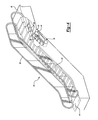
- FIG. 4 diagrammatically illustrates a passenger conveyor including a drive belt and a handrail designed according to an embodiment of this invention.
- FIG. 5 schematically shows an example drive belt configuration.
- FIG. 6 schematically shows an example handrail configuration.
- FIG. 7 schematically illustrates an example method of making an assembly designed according to an embodiment of this invention.
- Assemblies designed according to embodiments of this invention include a flame retardant within a polymer jacket material.
- flame retardant means inhibiting or resisting the spread of fire. In some circumstances, the flame retardant inhibits or resists the spread of fire by self-extinguishing. The ability to stop a fire completely may depend on the amount of exposure to a flame source. In most circumstances, the flame retardant will at least form a char surface and dilute oxygen content in surrounding air to limit or retard any spread of fire otherwise associated with the jacket burning.
- FIG. 1 schematically shows selected portions of an example elevator system 20 .
- An elevator car 22 and counterweight 24 are suspended by a load bearing assembly 26 .
- the load bearing assembly 26 comprises a plurality of flat belts.
- the load bearing assembly 26 comprises a plurality of round ropes.
- Other elevator system components are not illustrated or described as they are not necessary for understanding the disclosed example embodiments of this invention.
- the load bearing assembly 26 supports the weight of the elevator car 22 and the counterweight 24 and facilitates movement of the elevator car 22 into desired positions by moving along sheaves 28 and 30 .
- One of the sheaves will be a traction sheave that is moved by an elevator machine in a known manner to cause the desired movement and placement of the elevator car 22 .
- the other sheave in this example is an idler sheave. It is necessary for the load bearing assembly 26 to bend and wrap partially around the sheaves 28 and 30 when the assembly 26 moves responsive to movement of the traction sheave.
- FIG. 2 is an end view schematically showing one example flat belt configuration of the example load bearing assembly 26 .
- the flat belt includes a plurality of elongated cord tension members 32 and a polymer jacket 34 that contacts the tension members 32 .
- the jacket 34 encases the tension members 32 .
- the jacket 34 at least partially covers the tension members 32 .
- the tension members 32 comprise wound metallic cords, such as steel.
- the polymer jacket 34 in one example comprises a thermoplastic elastomer.
- the jacket 34 comprises a thermoplastic polyurethane.
- FIG. 3 Another example is schematically shown in FIG. 3 .
- An end view of a rope used as part of the load bearing assembly 26 includes at least one tension member 32 and a polymer jacket 34 .
- the same materials can be used as those mentioned above.
- the load on the example load bearing assemblies 26 is carried by the tension members 32 .
- the interaction between the jacket 34 and the sheaves 28 , 30 requires a desired amount of friction to achieve sufficient traction, for example. Maintaining the desired coefficient of friction ensures consistent system performance.
- the interface between the tension members 32 and the jacket 34 must also include a sufficient bond at the interface. An adequate bond facilitates load transfer between the jacket 34 and the tension members 32 . A stronger bond yields a stronger load bearing capacity.
- FIG. 4 schematically illustrates an example passenger conveyor 40 .
- a plurality of steps 42 move in a known manner to carry passengers between landings 44 and 46 .
- a handrail 48 is provided for passengers to grasp while traveling on the conveyor 40 .
- the handrail 48 includes a plurality of tension members 32 such as steel cords at least partially covered by a polymer jacket 34 .
- the polymer jacket in this example establishes the gripping surface and the body of the handrail 48 .
- FIG. 4 includes a drive arrangement 50 for propelling the steps 42 in a desired direction.
- a motor 52 rotates a drive sheave 54 to cause movement of a drive belt 56 .
- the example drive belt 56 has a plurality of elongated cord tension members 32 covered by a jacket 34 .
- the jacket material establishes teeth 57 that interact with a corresponding surface on the drive sheave 54 .
- a step chain 58 ( FIG. 4 ) is engaged by teeth 59 on the drive belt 56 to cause the desired movement of the steps 42 .
- the flame retardant in the polymer material of the jacket comprises one of a halogen-free melamine-based intumescent or a filled polymer having a nanoscale filler chemically bonded to a matrix phase.
- the flame retardant comprises a melamine salt.
- One example flame retardant comprises melamine cyanurate.
- Another example comprises melamine-phosphate.
- Another example comprises melamine-pyrophosphate.
- Another example comprises melamine-polyphosphate.
- Each of these example flame retardants have good compatibility with the base resin of the polymer jacket material. These example flame retardants also have good thermal stability, high flame retardancy based on multi-functional retarding mechanisms and good compatibility with the tension members 32 within the assembly. Additionally, these example flame retardants have good compatibility with other components such as traction sheaves in an elevator system. Additionally, these example flame retardants do not interfere with the flexibility characteristics of the jacket as required for a particular installation.
- the example flame retardants function by interfering with one of three components that initiate or support combustion, namely heat, fuel and oxygen.
- the working mechanism of the example flame retardants includes combined functions as a fuel diluter (as the flame retardant releases inert gas), an oxygen scavenger and a heat blocker.
- the halogen-free melamine-based intumescent examples can retard ignition by causing a heat sink through endothermic dissociation in case of a melamine salt followed by endothermic sublimation of the melamine itself at approximately 350° C. Another, even larger, heat sink effect is generated by the subsequent decomposition of the melamine vapors.
- Melamine-based intumescents can be regarded as poor fuel for a fire having a heat combustion of only approximately forty percent of that of hydrocarbons. Furthermore, the nitrogen produced by combustion acts as an inert diluent. Another source of inert diluent is the ammonia which is released during breakdown of the melamine or self-condensation of the melamine fraction which does not sublimate.
- Melamine-based intumescents also have the characteristic of showing considerable contribution to the formation of a char layer in the intumescent process.
- the char layer acts as a barrier between oxygen and polymeric decomposition gases. Char stability is enhanced by multi-ring structures formed during self-condensation of melamine. In combination with phosphorous synergists, melamine can further increase char stability through formation of nitrogen-phosphorous substances. Additionally, melamine can act as a blowing agent for the char, enhancing the heat barrier functionality of the char layer.
- the phosphate is a good forming agent for a char to provide a physical bather of fuel and heat to block the combustion process. Therefore, the example flame retardants are highly efficient yet relatively simple to incorporate into a polymer jacket material of the type used in the example assemblies.
- the example jackets become flame retarding as the flame retardant is compounded with the jacket material.
- the flame retardant is mixed in with the base resin of the jacket material. Unlike other flame retardant technologies that require synergistic interaction of multiple flame retardants, one composition such as those mentioned above is effective to render the jacket material flame retardant.
- the example flame retardants have good compatibility with the base resin of the jacket material because of their chemical composition.
- the flame retardants have polar, nitrogen and oxygen rich compounds that are similar to those of the jacket resin. This provides an efficiency and simplicity as the chemical bonds of the polymer base resins and the flame retardant are chemically compatible, which promotes mixing.
- example flame retardants have good hydrolytic stability because they have a relatively low hydrophilicity and they possess low water solubility. Additionally, the example flame retardants have good thermal stability during processing such as the procedure for forming the jacket.
- a flame retardant comprising a filled polymer having a nanoscale filler chemically bonded to a matrix phase.
- a flame retardant is a silicon-based additive material that is suitable for providing a fire, flame or smoke retarding effect.
- POSS molecules can be thought of as the smallest particles of silica that are possible to manufacture. Unlike silica or modified clays, however, each POSS molecule contains covalently bonded reactive functionalities suitable for polymerization or grafting POSS monomers to polymer chains such as those within the jacket material (e.g.,. TPU).
- POSS molecule contains non-reactive organic functionalities for solubility and compatibility of the POSS segments and the various polymer systems used in the example assemblies mentioned above.
- the chemical diversity of POSS technology is very broad and a large number of POSS monomers and polymers are currently available in liquid or solid form. POSS monomers are typically soluble in common solvents. POSS technology, therefore, can be used in the same manner as common organics in a monomer or polymeric (i.e., resin) form.
- a flame retardant including POSS molecules is readily useable in that POSS chemical feed stocks can be added to nearly all polymer types without introducing manufacturing complexities. Enhancement from the physical properties of polymers that include POSS segments result from the ability of the POSS to control motion of the polymer chains while still maintaining the processability and mechanical properties of the base resin. This is a direct result of POSS's nanoscopic size and its relationship to polymer dimensions.
- Polymers containing POSS additives provide delayed combustion and reduction in heat evolution compared to some other flame retardant plastics. Incorporating a POSS additive into the jacket material also has the effect of increasing the useable temperature range for the finished product.
- Some of the features that render POSS systems advantageous compared to others include the POSS particle size, hygroscopic nature, oxygen permeability, high temperature stability, chemical reactivity, polymer blending, interfacial properties, mechanical properties and corrosion resistance.
- the POSS-based flame retardant is added in the synthesis stream of the processing of the jacket material.
- the amount of POSS components within the finished jacket material is less than ten weight percent.
- Another example flame retardant comprises carbon nanotubes. Carbon nanofibers or nanotubes are believed to provide superior flame retardant performance over nanoclays, for example. Carbon nanofibers also increase the mechanical strength of a polyurethane and potentially provide friction benefits.
- having as little as 0.5 weight percentage of carbon nanotubes within a polymer jacket material reduces the magnitude of heat release, extends the time of heat release or both. In other words, the presence of carbon nanotubes provides a more fire retardant material.
- the metal material may be uncoated, coated, or plated with a protective metal.
- a base ferrous metal may be coated or plated with zinc, tin or copper.
- FIG. 7 schematically illustrates a method at 60 of making an assembly such as an elevator load bearing member, a passenger conveyor handrail or a drive belt such as that used for a passenger conveyor.
- a flame retardant 62 is mixed with a supply of base polymer resin 64 in a master batch mixer 66 .
- the amount of flame retardant selected will depend, in part, on the selection of flame retardant material.
- the master batch may include between about 20% and about 50% (by weight) of the selected flame retardant.
- the eventual jacket material in some examples includes between 0.2% and 20% by weight flame retardant within the jacket material.
- the final jacket material in some examples includes less than 10% by weight of the flame retardant.
- carbon nanotubes are used as the flame retardant, between about 0.5% and about 10% by weight of the jacket material comprises the flame retardant.
- a base polymer material 68 is mixed with the master batch material from the mixer 66 using a jacket material mixer 70 .
- the mixed material from the master batch mixer 66 is compounded with the polymer base material 68 .
- the jacket material is formed in a jacket forming station 72 such as a molding device to provide the desired geometry of the jacket.
- a plurality of spools 74 supply tension members 32 to the jacket forming station 72 where the jacket is molded onto at least one exterior surface of the tension members 32 resulting in the desired assembly.
- the resulting assembly is an elevator load bearing member 26 .
- the presence of the flame retardant does not interfere with or adversely change other properties of the jacket material such as the flexibility of the base polymer material so that the jacket functions as desired for its particular application (e.g., is able to follow a guidance when the assembly comprises a passenger conveyor handrail, is able to transmit a sufficient drive force when the assembly comprises a drive member such as a belt or is able to wrap around sheaves and achieve sufficient traction for moving an elevator car when the assembly comprises an elevator load bearing member).
- the ability to mold the jacket into a desired shape and to maintain good adhesion between the jacket 34 and the tension members 32 is not compromised. In fact, adhesion between the material of the jacket 34 and the tension members 32 is improved by the presence of the flame retardant in the jacket material in some examples.
- the jacket of an assembly also has good thermal stability, hydrolytic stability, low hydrophilic characteristics and good compatibility to interact with other components such as an elevator sheave or a passenger conveyor step chain.
- the flame retardant material is incorporated into the assembly without being mixed directly into the jacket material.
- at least one of the above example flame retardant materials is incorporated into the jacket by inserting the flame retardant material into voids in a preformed jacket. This may be done on a macro or nano scale.
- the flame retardant material is chemically bonded to the preformed jacket material.
- the flame retardant material is not chemically bonded to the jacket material but is held in place by its location within the appropriate voids in the preformed jacket.
- At least one void in the preformed jacket extends along at least selected lengths of the assembly and is filled with flame retardant material such as those described above.
- a void extends along the length of the assembly parallel to the tension members and is filled with flame retardant material.
Landscapes
- Chemical & Material Sciences (AREA)
- Organic Chemistry (AREA)
- Life Sciences & Earth Sciences (AREA)
- Engineering & Computer Science (AREA)
- Materials Engineering (AREA)
- Wood Science & Technology (AREA)
- Medicinal Chemistry (AREA)
- Chemical Kinetics & Catalysis (AREA)
- Health & Medical Sciences (AREA)
- Polymers & Plastics (AREA)
- Compositions Of Macromolecular Compounds (AREA)
- Lift-Guide Devices, And Elevator Ropes And Cables (AREA)
- Escalators And Moving Walkways (AREA)
- Ropes Or Cables (AREA)
- Fireproofing Substances (AREA)
- Sliding-Contact Bearings (AREA)
Abstract
An illustrative method of making an elevator load bearing member having at least one elongated tension member at least partially covered by a jacket includes mixing a flame retardant with a polymer material. The flame retardant is selected from a group consisting of (i) a halogen-free melamine based intumescent comprising melamine cyanurate, melamine-phosphate, melamine pyrophosphate or melamine polyphosphate in an amount up to about 20% by weight of the thermoplastic polymer or (ii) a filled polymer having a nanoscale filler chemically bonded to a matrix phase. Applying the mixed flame retardant and polymer material to the tension member forms a jacket of a desired shape.
Description
This is a divisional application of U.S. patent application Ser. No. 13/002,355 dated Jan. 3, 2011 (now U.S. Pat. No. 8,479,887), which is the national stage application of PCT/US2008/073236 dated 15 Aug. 2008.
There are various uses for elongated flexible assemblies such as for elevator load bearing members or roping arrangements, drive belts for machines such as a passenger conveyor and handrails for passenger conveyors, for example. Such assemblies may be designed with a plurality of cords covered by a polyurethane jacket. For example, U.S. Pat. Nos. 6,295,799 and 6,739,433 show belts for use in suspending an elevator car and counterweight within an elevator system. An example passenger conveyor handrail construction is shown in U.S. Pat. No. 4,982,829. An example passenger conveyor drive belt is shown in U.S. Pat. No. 6,540,060.
One aspect of such assemblies is that the jacket could burn when in an environment that could instigate combustion such as exposure to flames. Providing an ability to resist or minimize any burning of the jacket would be useful. One challenge when considering making such a jacket flame-resistant is keeping the desired qualities of the jacket material. The examples mentioned above all need a certain flexibility to follow a path of movement while the assembly is in use. It is also desirable to have proper surface characteristics for the intended use of the assembly.
Flame retardant polyurethane compositions have been suggested. For example, U.S. Pat. No. 4,542,170 uses a pentate salt and a phosphate combination to provide flame retarding properties. Not all flame retardants are compatible with the requirements for the example assemblies mentioned above.
An illustrative method of making an elevator load bearing member having at least one elongated tension member at least partially covered by a jacket includes mixing a flame retardant with a polymer material. The flame retardant is selected from a group consisting of (i) a halogen-free melamine based intumescent comprising melamine cyanurate, melamine-phosphate, melamine pyrophosphate or melamine polyphosphate in an amount up to about 20% by weight of the thermoplastic polymer or (ii) a filled polymer having a nanoscale filler chemically bonded to a matrix phase. Applying the mixed flame retardant and polymer material to the tension member forms a jacket of a desired shape.
The various features and advantages of the disclosed examples will become apparent to those skilled in the art from the following detailed description. The drawings that accompany the detailed description can be briefly described as follows.
Assemblies designed according to embodiments of this invention include a flame retardant within a polymer jacket material. As used in this description, flame retardant means inhibiting or resisting the spread of fire. In some circumstances, the flame retardant inhibits or resists the spread of fire by self-extinguishing. The ability to stop a fire completely may depend on the amount of exposure to a flame source. In most circumstances, the flame retardant will at least form a char surface and dilute oxygen content in surrounding air to limit or retard any spread of fire otherwise associated with the jacket burning.
The load bearing assembly 26 supports the weight of the elevator car 22 and the counterweight 24 and facilitates movement of the elevator car 22 into desired positions by moving along sheaves 28 and 30. One of the sheaves will be a traction sheave that is moved by an elevator machine in a known manner to cause the desired movement and placement of the elevator car 22. The other sheave in this example is an idler sheave. It is necessary for the load bearing assembly 26 to bend and wrap partially around the sheaves 28 and 30 when the assembly 26 moves responsive to movement of the traction sheave.
Another example is schematically shown in FIG. 3 . An end view of a rope used as part of the load bearing assembly 26 includes at least one tension member 32 and a polymer jacket 34. In the example of FIG. 3 , the same materials can be used as those mentioned above.
The load on the example load bearing assemblies 26 is carried by the tension members 32. The interaction between the jacket 34 and the sheaves 28, 30 requires a desired amount of friction to achieve sufficient traction, for example. Maintaining the desired coefficient of friction ensures consistent system performance. The interface between the tension members 32 and the jacket 34 must also include a sufficient bond at the interface. An adequate bond facilitates load transfer between the jacket 34 and the tension members 32. A stronger bond yields a stronger load bearing capacity.
As shown in FIG. 6 , the handrail 48 includes a plurality of tension members 32 such as steel cords at least partially covered by a polymer jacket 34. The polymer jacket in this example establishes the gripping surface and the body of the handrail 48.
The example of FIG. 4 includes a drive arrangement 50 for propelling the steps 42 in a desired direction. A motor 52 rotates a drive sheave 54 to cause movement of a drive belt 56. As shown in FIG. 5 , the example drive belt 56 has a plurality of elongated cord tension members 32 covered by a jacket 34. The jacket material establishes teeth 57 that interact with a corresponding surface on the drive sheave 54. A step chain 58 (FIG. 4 ) is engaged by teeth 59 on the drive belt 56 to cause the desired movement of the steps 42.
The flame retardant in the polymer material of the jacket comprises one of a halogen-free melamine-based intumescent or a filled polymer having a nanoscale filler chemically bonded to a matrix phase.
In examples where the flame retardant is a halogen-free melamine based intumescent, the flame retardant comprises a melamine salt. One example flame retardant comprises melamine cyanurate. Another example comprises melamine-phosphate. Another example comprises melamine-pyrophosphate. Another example comprises melamine-polyphosphate.
Each of these example flame retardants have good compatibility with the base resin of the polymer jacket material. These example flame retardants also have good thermal stability, high flame retardancy based on multi-functional retarding mechanisms and good compatibility with the tension members 32 within the assembly. Additionally, these example flame retardants have good compatibility with other components such as traction sheaves in an elevator system. Additionally, these example flame retardants do not interfere with the flexibility characteristics of the jacket as required for a particular installation.
The example flame retardants function by interfering with one of three components that initiate or support combustion, namely heat, fuel and oxygen. The working mechanism of the example flame retardants includes combined functions as a fuel diluter (as the flame retardant releases inert gas), an oxygen scavenger and a heat blocker. In an initial stage, the halogen-free melamine-based intumescent examples can retard ignition by causing a heat sink through endothermic dissociation in case of a melamine salt followed by endothermic sublimation of the melamine itself at approximately 350° C. Another, even larger, heat sink effect is generated by the subsequent decomposition of the melamine vapors.
Melamine-based intumescents can be regarded as poor fuel for a fire having a heat combustion of only approximately forty percent of that of hydrocarbons. Furthermore, the nitrogen produced by combustion acts as an inert diluent. Another source of inert diluent is the ammonia which is released during breakdown of the melamine or self-condensation of the melamine fraction which does not sublimate.
Melamine-based intumescents also have the characteristic of showing considerable contribution to the formation of a char layer in the intumescent process. The char layer acts as a barrier between oxygen and polymeric decomposition gases. Char stability is enhanced by multi-ring structures formed during self-condensation of melamine. In combination with phosphorous synergists, melamine can further increase char stability through formation of nitrogen-phosphorous substances. Additionally, melamine can act as a blowing agent for the char, enhancing the heat barrier functionality of the char layer.
In the above examples including a phosphate component, the phosphate is a good forming agent for a char to provide a physical bather of fuel and heat to block the combustion process. Therefore, the example flame retardants are highly efficient yet relatively simple to incorporate into a polymer jacket material of the type used in the example assemblies. The example jackets become flame retarding as the flame retardant is compounded with the jacket material. As described below, in some examples the flame retardant is mixed in with the base resin of the jacket material. Unlike other flame retardant technologies that require synergistic interaction of multiple flame retardants, one composition such as those mentioned above is effective to render the jacket material flame retardant.
The example flame retardants have good compatibility with the base resin of the jacket material because of their chemical composition. The flame retardants have polar, nitrogen and oxygen rich compounds that are similar to those of the jacket resin. This provides an efficiency and simplicity as the chemical bonds of the polymer base resins and the flame retardant are chemically compatible, which promotes mixing.
Another feature of the example flame retardants is that they have good hydrolytic stability because they have a relatively low hydrophilicity and they possess low water solubility. Additionally, the example flame retardants have good thermal stability during processing such as the procedure for forming the jacket.
Other examples include a flame retardant comprising a filled polymer having a nanoscale filler chemically bonded to a matrix phase. One such example includes polyhedral oligomeric silsequioxanes (POSS). Such a flame retardant is a silicon-based additive material that is suitable for providing a fire, flame or smoke retarding effect. POSS molecules can be thought of as the smallest particles of silica that are possible to manufacture. Unlike silica or modified clays, however, each POSS molecule contains covalently bonded reactive functionalities suitable for polymerization or grafting POSS monomers to polymer chains such as those within the jacket material (e.g.,. TPU). Each POSS molecule contains non-reactive organic functionalities for solubility and compatibility of the POSS segments and the various polymer systems used in the example assemblies mentioned above. The chemical diversity of POSS technology is very broad and a large number of POSS monomers and polymers are currently available in liquid or solid form. POSS monomers are typically soluble in common solvents. POSS technology, therefore, can be used in the same manner as common organics in a monomer or polymeric (i.e., resin) form.
A flame retardant including POSS molecules is readily useable in that POSS chemical feed stocks can be added to nearly all polymer types without introducing manufacturing complexities. Enhancement from the physical properties of polymers that include POSS segments result from the ability of the POSS to control motion of the polymer chains while still maintaining the processability and mechanical properties of the base resin. This is a direct result of POSS's nanoscopic size and its relationship to polymer dimensions.
Polymers containing POSS additives provide delayed combustion and reduction in heat evolution compared to some other flame retardant plastics. Incorporating a POSS additive into the jacket material also has the effect of increasing the useable temperature range for the finished product. Some of the features that render POSS systems advantageous compared to others include the POSS particle size, hygroscopic nature, oxygen permeability, high temperature stability, chemical reactivity, polymer blending, interfacial properties, mechanical properties and corrosion resistance.
As described in connection with FIG. 7 below, the POSS-based flame retardant is added in the synthesis stream of the processing of the jacket material.
In some examples, the amount of POSS components within the finished jacket material is less than ten weight percent.
Another example flame retardant comprises carbon nanotubes. Carbon nanofibers or nanotubes are believed to provide superior flame retardant performance over nanoclays, for example. Carbon nanofibers also increase the mechanical strength of a polyurethane and potentially provide friction benefits.
In some examples, having as little as 0.5 weight percentage of carbon nanotubes within a polymer jacket material reduces the magnitude of heat release, extends the time of heat release or both. In other words, the presence of carbon nanotubes provides a more fire retardant material.
While a variety of different flame retardants are described above that can each be used individually within a polymer jacket material, it is possible to combine more than one of them within a single formulation.
When a metal is used for the any of the example tension members 32, the metal material may be uncoated, coated, or plated with a protective metal. For example, a base ferrous metal may be coated or plated with zinc, tin or copper.
The amount of flame retardant selected will depend, in part, on the selection of flame retardant material. In the case of a halogen-free melamine intumescent, the master batch may include between about 20% and about 50% (by weight) of the selected flame retardant. The eventual jacket material in some examples includes between 0.2% and 20% by weight flame retardant within the jacket material. In the case of a POSS-based flame retardant, the final jacket material in some examples includes less than 10% by weight of the flame retardant. When carbon nanotubes are used as the flame retardant, between about 0.5% and about 10% by weight of the jacket material comprises the flame retardant.
In the example of FIG. 7 , a base polymer material 68 is mixed with the master batch material from the mixer 66 using a jacket material mixer 70. In this example, the mixed material from the master batch mixer 66 is compounded with the polymer base material 68.
Referring to FIG. 7 , the jacket material is formed in a jacket forming station 72 such as a molding device to provide the desired geometry of the jacket. In the illustrated example, a plurality of spools 74 supply tension members 32 to the jacket forming station 72 where the jacket is molded onto at least one exterior surface of the tension members 32 resulting in the desired assembly. In the case of FIG. 7 , the resulting assembly is an elevator load bearing member 26.
The presence of the flame retardant does not interfere with or adversely change other properties of the jacket material such as the flexibility of the base polymer material so that the jacket functions as desired for its particular application (e.g., is able to follow a guidance when the assembly comprises a passenger conveyor handrail, is able to transmit a sufficient drive force when the assembly comprises a drive member such as a belt or is able to wrap around sheaves and achieve sufficient traction for moving an elevator car when the assembly comprises an elevator load bearing member). Additionally, the ability to mold the jacket into a desired shape and to maintain good adhesion between the jacket 34 and the tension members 32 is not compromised. In fact, adhesion between the material of the jacket 34 and the tension members 32 is improved by the presence of the flame retardant in the jacket material in some examples.
With the example flame retardants, the jacket of an assembly also has good thermal stability, hydrolytic stability, low hydrophilic characteristics and good compatibility to interact with other components such as an elevator sheave or a passenger conveyor step chain.
In another example, the flame retardant material is incorporated into the assembly without being mixed directly into the jacket material. In one example, at least one of the above example flame retardant materials is incorporated into the jacket by inserting the flame retardant material into voids in a preformed jacket. This may be done on a macro or nano scale. In one such example, the flame retardant material is chemically bonded to the preformed jacket material. In another example, the flame retardant material is not chemically bonded to the jacket material but is held in place by its location within the appropriate voids in the preformed jacket.
In some examples, at least one void in the preformed jacket extends along at least selected lengths of the assembly and is filled with flame retardant material such as those described above. In one such example a void extends along the length of the assembly parallel to the tension members and is filled with flame retardant material.
The preceding description is exemplary rather than limiting in nature. Variations and modifications to the disclosed examples may become apparent to those skilled in the art that do not necessarily depart from the essence of this invention. The scope of legal protection given to this invention can only be determined by studying the following claims.
Claims (4)
1. A method of making an elevator load bearing member, the method comprising:
applying a thermoplastic polymer material to at least one elongated tension member to form a jacket of a desired shape, wherein the formed jacket includes a plurality of voids in the formed jacket; and
at least partially filling the plurality of voids in the formed jacket with a flame retardant material, wherein the flame retardant material comprises at least one of a halogen-free melamine based intumescent, a nanoscale filler, carbon nanotubes, and carbon nanofibers.
2. The method of claim 1 , wherein the flame retardant material comprises the halogen-free melamine based intumescent and the flame retardant material comprises at least one of melamine cyanurate, melamine-phosphate, melamine pyrophosphate or melamine polyphosphate.
3. The method of claim 1 , wherein the flame retardant material comprises the nanoscale filler and the flame retardant material comprises polyhedral oligomeric silsesquioxane.
4. The method of claim 1 , comprising chemically bonding the flame retardant material to the formed jacket.
Priority Applications (1)
| Application Number | Priority Date | Filing Date | Title |
|---|---|---|---|
| US13/913,711 US10072162B2 (en) | 2008-08-15 | 2013-06-10 | Method of making a cord and polymer jacket assembly having a flame retardant in the polymer jacket material |
Applications Claiming Priority (3)
| Application Number | Priority Date | Filing Date | Title |
|---|---|---|---|
| PCT/US2008/073236 WO2010019151A1 (en) | 2008-08-15 | 2008-08-15 | Cord and polymer jacket assembly having a flame retardant in the polymer jacket material |
| US201113002355A | 2011-01-03 | 2011-01-03 | |
| US13/913,711 US10072162B2 (en) | 2008-08-15 | 2013-06-10 | Method of making a cord and polymer jacket assembly having a flame retardant in the polymer jacket material |
Related Parent Applications (3)
| Application Number | Title | Priority Date | Filing Date |
|---|---|---|---|
| PCT/US2008/073236 Division WO2010019151A1 (en) | 2008-08-15 | 2008-08-15 | Cord and polymer jacket assembly having a flame retardant in the polymer jacket material |
| US13/002,355 Division US8479887B2 (en) | 2008-08-15 | 2008-08-15 | Cord and polymer jacket assembly having a flame retardant in the polymer jacket material |
| US201113002355A Division | 2008-08-15 | 2011-01-03 |
Publications (2)
| Publication Number | Publication Date |
|---|---|
| US20130274388A1 US20130274388A1 (en) | 2013-10-17 |
| US10072162B2 true US10072162B2 (en) | 2018-09-11 |
Family
ID=40481840
Family Applications (2)
| Application Number | Title | Priority Date | Filing Date |
|---|---|---|---|
| US13/002,355 Expired - Fee Related US8479887B2 (en) | 2008-08-15 | 2008-08-15 | Cord and polymer jacket assembly having a flame retardant in the polymer jacket material |
| US13/913,711 Active 2030-04-12 US10072162B2 (en) | 2008-08-15 | 2013-06-10 | Method of making a cord and polymer jacket assembly having a flame retardant in the polymer jacket material |
Family Applications Before (1)
| Application Number | Title | Priority Date | Filing Date |
|---|---|---|---|
| US13/002,355 Expired - Fee Related US8479887B2 (en) | 2008-08-15 | 2008-08-15 | Cord and polymer jacket assembly having a flame retardant in the polymer jacket material |
Country Status (9)
| Country | Link |
|---|---|
| US (2) | US8479887B2 (en) |
| EP (3) | EP2337892B1 (en) |
| JP (1) | JP5507561B2 (en) |
| KR (1) | KR101339056B1 (en) |
| CN (1) | CN102124158B (en) |
| BR (1) | BRPI0823030A2 (en) |
| ES (3) | ES2440516T3 (en) |
| RU (1) | RU2500849C2 (en) |
| WO (1) | WO2010019151A1 (en) |
Families Citing this family (26)
| Publication number | Priority date | Publication date | Assignee | Title |
|---|---|---|---|---|
| DE102010016872A1 (en) | 2010-05-11 | 2011-11-17 | Contitech Antriebssysteme Gmbh | Belt for drive technology, in particular belt-like tension element for elevator technology, with fire-retardant properties |
| US9555579B2 (en) * | 2011-01-03 | 2017-01-31 | Otis Elevator Company | Tension member and polymer jacket assembly including a geometry stabilizer in the jacket |
| US9056980B2 (en) * | 2011-02-04 | 2015-06-16 | Saco Polymers, Inc. | Flame retardant compositions |
| WO2013055328A1 (en) * | 2011-10-12 | 2013-04-18 | Otis Elevator Company | Flame retardant tension member |
| ES2594003T3 (en) * | 2011-10-13 | 2016-12-15 | Bekaert Advanced Cords Aalter Nv | A load assembly comprising a steel cable and a liner |
| FI124582B (en) | 2012-03-22 | 2014-10-31 | Kone Corp | Basket cable for a lift and lift |
| DE112012006381T5 (en) * | 2012-05-16 | 2015-01-29 | Otis Elevator Company | Pulley for an elevator system |
| WO2014014456A1 (en) * | 2012-07-18 | 2014-01-23 | Otis Elevator Company | Fire-retardant belt |
| EP2878563B1 (en) * | 2013-11-29 | 2017-03-22 | KONE Corporation | A rope terminal assembly and an elevator |
| US10054176B2 (en) | 2015-02-25 | 2018-08-21 | Rock Exotica Llc | Lift systems, line brakes, and methods of vertically moving loads |
| US9873593B2 (en) * | 2015-05-07 | 2018-01-23 | Otis Elevator Company | Fire resistant coated steel belt |
| US10336579B2 (en) * | 2016-03-29 | 2019-07-02 | Otis Elevator Company | Metal coating of load bearing member for elevator system |
| US10029887B2 (en) * | 2016-03-29 | 2018-07-24 | Otis Elevator Company | Electroless metal coating of load bearing member for elevator system |
| US10472210B2 (en) * | 2016-11-07 | 2019-11-12 | Otis Elevator Company | Load bearing member for an elevator system having a metalized polymer coating |
| US10974929B2 (en) * | 2016-11-07 | 2021-04-13 | Otis Elevator Company | Load bearing member for an elevator system having an elastomer and phosphonate blended bonding agent |
| KR102558412B1 (en) | 2017-04-03 | 2023-07-24 | 오티스 엘리베이터 컴파니 | Elevator belt with additive layer |
| AU2018202655B2 (en) | 2017-04-20 | 2023-12-07 | Otis Elevator Company | Tension member for elevator system belt |
| AU2018202595B2 (en) * | 2017-04-20 | 2020-01-30 | Otis Elevator Company | Fire-resistant synthetic tension members |
| US11274017B2 (en) * | 2017-08-25 | 2022-03-15 | Otis Elevator Company | Belt with self-extinguishing layer and method of making |
| US20190062114A1 (en) * | 2017-08-25 | 2019-02-28 | Otis Elevator Company | Self-extinguishing load bearing member for elevator system |
| US10549952B2 (en) * | 2017-08-25 | 2020-02-04 | Otis Elevator Company | Self-extinguishing fabric belt for elevator system |
| KR102623974B1 (en) * | 2017-11-10 | 2024-01-11 | 오티스 엘리베이터 컴파니 | Elevator system belt |
| US11014783B2 (en) * | 2018-02-08 | 2021-05-25 | Otis Elevator Company | Protective sleeve for elevator belt |
| EP3938435B1 (en) | 2019-03-14 | 2023-02-08 | Basf Se | A composition comprising a thermoplastic polyisocyanate polyaddition product and a flame retardant |
| CN110357370A (en) * | 2019-08-23 | 2019-10-22 | 许燕玲 | A kind of sanitary sewage break oxidizing process denitrogenation and sludge age dephosphorization cleaning equipment |
| US20260000066A1 (en) * | 2024-07-01 | 2026-01-01 | Otis Elevator Company | Elevator suspension member with rodent deterrent additive |
Citations (34)
| Publication number | Priority date | Publication date | Assignee | Title |
|---|---|---|---|---|
| GB1408133A (en) | 1971-08-04 | 1975-10-01 | Fenner Co Ltd J H | Fire retardant compositions |
| US3916016A (en) * | 1972-10-10 | 1975-10-28 | Koppers Co Inc | Self-extinguishing polymer compositions containing brominated aryl butanes |
| US4542170A (en) | 1985-01-22 | 1985-09-17 | The B. F. Goodrich Company | Intumescent flame retarded polyurethane compositions |
| JPS6391119U (en) | 1986-12-03 | 1988-06-13 | ||
| US4824719A (en) * | 1986-01-31 | 1989-04-25 | Recticel | Fire-resistant intermediate layer for covering articles of seating furniture, and articles of seating furniture which are provided with a covering containing such an intermediate layer |
| JPH0452893A (en) | 1990-06-15 | 1992-02-20 | Sumitomo Electric Ind Ltd | Counter for the number of entering/exiting persons |
| WO2000037738A1 (en) | 1998-12-22 | 2000-06-29 | Otis Elevator Company | Tension member for an elevator |
| WO2000056840A1 (en) | 1999-03-22 | 2000-09-28 | Dsm N.V. | Flame-retarding composition and process for the preparation thereof |
| JP2002327062A (en) | 2001-04-27 | 2002-11-15 | Asahi Kasei Corp | Cage-like silsesquioxane-containing polycarbonate resin composition |
| US20030089551A1 (en) | 2000-03-15 | 2003-05-15 | Kensuke Kato | Rope and elecvator using the same |
| WO2003070821A2 (en) | 2002-02-20 | 2003-08-28 | Electrovac Fabrikation Elektrotechnischer Speziala | Flame retardant polymer composites and method of fabrication |
| US6739433B1 (en) | 1998-02-26 | 2004-05-25 | Otis Elevator Company | Tension member for an elevator |
| JP2004219815A (en) | 2003-01-16 | 2004-08-05 | Mitsubishi Rayon Co Ltd | Flame retardant optical fiber coating material and flame retardant optical fiber cable |
| US20040216959A1 (en) | 2001-11-23 | 2004-11-04 | Ach Ernst Friedrich | Elevator system |
| US20050165151A1 (en) * | 2002-02-06 | 2005-07-28 | Sekisui Chemical Co., Ltd. | Resin composition |
| US6933345B1 (en) | 2000-03-24 | 2005-08-23 | Hybrid Plastics, Llp | Reactive grafting and compatibilization of polyhedral oligomeric silsesquioxanes |
| EP1060305B1 (en) | 1998-02-26 | 2006-01-25 | Otis Elevator Company | Elevator Systems |
| EP1655741A1 (en) | 2003-07-30 | 2006-05-10 | Sumitomo Electric Industries, Ltd. | Nonhalogenated flame resistant cable |
| US20060100335A1 (en) * | 2002-10-17 | 2006-05-11 | Selim Yalvac | Highly filled polymer compositions |
| US20060128870A1 (en) * | 2004-12-10 | 2006-06-15 | Marx Ryan E | Filled polymer composites |
| US20060182967A1 (en) | 2005-02-17 | 2006-08-17 | Kazunari Kosaka | Poly(arylene ether) composition and articles |
| WO2006094250A1 (en) | 2005-03-03 | 2006-09-08 | Union Carbide Chemicals & Plastics Technology Corporation | Plenum cable-flame retardant layer/component with exlellent aging properties |
| FR2888255A1 (en) | 2005-07-06 | 2007-01-12 | Saint Gobain Vetrotex | REINFORCING YARNS AND COMPOSITES HAVING IMPROVED FIRE PROTECTION |
| US20070084671A1 (en) | 2004-01-06 | 2007-04-19 | Ernst Ach | Lift system |
| WO2007050069A1 (en) | 2005-10-27 | 2007-05-03 | Otis Elevator Company | Elevator load bearing assembly having a jacket with multiple polymer compositions |
| GB2433831A (en) | 2005-12-26 | 2007-07-04 | Ind Tech Res Inst | Fire resistant cable |
| US7265194B1 (en) | 2003-10-16 | 2007-09-04 | Hybrid Plastics Inc. | Polyhedral oligomeric silsesquinoxanes and polyhedral oligomeric silicates bearing surfactant functionalities |
| CN101070387A (en) | 2007-06-06 | 2007-11-14 | 北京化工大学 | Low-dielectric resin containing low-poly-sesqui-silicone and its preparing method |
| WO2007130407A1 (en) | 2006-05-03 | 2007-11-15 | Dow Global Technologies Inc. | Halogen-free, flame-retardant wire-and-cable composition and related articles |
| WO2008011941A1 (en) | 2006-07-28 | 2008-01-31 | Dsm Ip Assets B.V. | Flame retardant thermoplastic composition |
| CA2596716A1 (en) | 2006-08-11 | 2008-02-11 | Inventio Ag | Belt for a lift installation, production method for such a belt and lift installation with such a belt |
| WO2008061229A1 (en) | 2006-11-16 | 2008-05-22 | Appliced Nanotech Holdings, Inc. | Buffer layer for strings |
| EP1927608A1 (en) | 2006-11-30 | 2008-06-04 | Bayer MaterialScience AG | Self-extinguishing thermal plastic polyurethanes, method for their manufacture and their application |
| US20080171823A1 (en) | 2006-08-08 | 2008-07-17 | The Research Foundation Of State University Of New York | Single component flame retardant additive for polymers using nanotubes |
Family Cites Families (10)
| Publication number | Priority date | Publication date | Assignee | Title |
|---|---|---|---|---|
| JPS59190019U (en) * | 1983-06-06 | 1984-12-17 | 住友電気工業株式会社 | Flame retardant, low smoke coaxial cable |
| US4652946A (en) | 1985-04-12 | 1987-03-24 | Ampex Corporation | Fast deploying tape transport |
| US4982829A (en) | 1990-01-04 | 1991-01-08 | Otis Elevator Company | Flexible escalator handrail |
| DE4309194A1 (en) | 1993-03-22 | 1994-09-29 | Elastogran Gmbh | Self-extinguishing thermoplastic polyurethanes and processes for their production |
| JP4913278B2 (en) * | 1998-12-22 | 2012-04-11 | オーチス エレベータ カンパニー | Elevator tension member |
| NL1011631C2 (en) * | 1999-03-22 | 2000-09-27 | Dsm Nv | Flame-retardant composition and method for its preparation. |
| US6295799B1 (en) | 1999-09-27 | 2001-10-02 | Otis Elevator Company | Tension member for an elevator |
| FR2807341B1 (en) | 2000-04-07 | 2002-07-12 | Gilson Sa | PIPETTE FOR COLLECTING LIQUID SAMPLES WITH REMOVABLE EJECTOR |
| US6540060B1 (en) | 2001-10-30 | 2003-04-01 | Otis Elevator Company | Belt drive assembly for a passenger conveyor |
| US6777466B2 (en) | 2002-02-08 | 2004-08-17 | Noveon Ip Holdings Corp. | Flame retardant thermoplastic polyurethane containing melamine cyanurate |
-
2008
- 2008-08-15 US US13/002,355 patent/US8479887B2/en not_active Expired - Fee Related
- 2008-08-15 CN CN200880130806.5A patent/CN102124158B/en active Active
- 2008-08-15 BR BRPI0823030-7A patent/BRPI0823030A2/en not_active IP Right Cessation
- 2008-08-15 JP JP2011522956A patent/JP5507561B2/en not_active Expired - Fee Related
- 2008-08-15 ES ES08797936.5T patent/ES2440516T3/en active Active
- 2008-08-15 KR KR1020117006053A patent/KR101339056B1/en active Active
- 2008-08-15 WO PCT/US2008/073236 patent/WO2010019151A1/en not_active Ceased
- 2008-08-15 EP EP08797936.5A patent/EP2337892B1/en active Active
- 2008-08-15 ES ES14154869T patent/ES2856889T3/en active Active
- 2008-08-15 RU RU2010151779/12A patent/RU2500849C2/en not_active IP Right Cessation
- 2008-08-15 EP EP14154869.3A patent/EP2733259B1/en active Active
- 2008-08-15 ES ES13176455.7T patent/ES2595035T3/en active Active
- 2008-08-15 EP EP13176455.7A patent/EP2672003B1/en not_active Revoked
-
2013
- 2013-06-10 US US13/913,711 patent/US10072162B2/en active Active
Patent Citations (37)
| Publication number | Priority date | Publication date | Assignee | Title |
|---|---|---|---|---|
| GB1408133A (en) | 1971-08-04 | 1975-10-01 | Fenner Co Ltd J H | Fire retardant compositions |
| US3916016A (en) * | 1972-10-10 | 1975-10-28 | Koppers Co Inc | Self-extinguishing polymer compositions containing brominated aryl butanes |
| US4542170A (en) | 1985-01-22 | 1985-09-17 | The B. F. Goodrich Company | Intumescent flame retarded polyurethane compositions |
| US4824719A (en) * | 1986-01-31 | 1989-04-25 | Recticel | Fire-resistant intermediate layer for covering articles of seating furniture, and articles of seating furniture which are provided with a covering containing such an intermediate layer |
| JPS6391119U (en) | 1986-12-03 | 1988-06-13 | ||
| JPH0452893A (en) | 1990-06-15 | 1992-02-20 | Sumitomo Electric Ind Ltd | Counter for the number of entering/exiting persons |
| US6739433B1 (en) | 1998-02-26 | 2004-05-25 | Otis Elevator Company | Tension member for an elevator |
| EP1060305B1 (en) | 1998-02-26 | 2006-01-25 | Otis Elevator Company | Elevator Systems |
| WO2000037738A1 (en) | 1998-12-22 | 2000-06-29 | Otis Elevator Company | Tension member for an elevator |
| DE29924773U1 (en) | 1998-12-22 | 2005-07-07 | Otis Elevator Co., Farmington | Tension member for providing lifting force to car of elevator system includes cords formed from metallic material encased within coating layer formed from non-metallic material |
| WO2000056840A1 (en) | 1999-03-22 | 2000-09-28 | Dsm N.V. | Flame-retarding composition and process for the preparation thereof |
| US20030089551A1 (en) | 2000-03-15 | 2003-05-15 | Kensuke Kato | Rope and elecvator using the same |
| US6933345B1 (en) | 2000-03-24 | 2005-08-23 | Hybrid Plastics, Llp | Reactive grafting and compatibilization of polyhedral oligomeric silsesquioxanes |
| JP2002327062A (en) | 2001-04-27 | 2002-11-15 | Asahi Kasei Corp | Cage-like silsesquioxane-containing polycarbonate resin composition |
| US20040216959A1 (en) | 2001-11-23 | 2004-11-04 | Ach Ernst Friedrich | Elevator system |
| US20040262087A1 (en) | 2001-11-23 | 2004-12-30 | Ach Ernst Friedrich | Elevator with belt-like transmisson means, particularly with wedge-ribbed belt, as support means and/or drive means |
| US20050165151A1 (en) * | 2002-02-06 | 2005-07-28 | Sekisui Chemical Co., Ltd. | Resin composition |
| WO2003070821A2 (en) | 2002-02-20 | 2003-08-28 | Electrovac Fabrikation Elektrotechnischer Speziala | Flame retardant polymer composites and method of fabrication |
| US20060100335A1 (en) * | 2002-10-17 | 2006-05-11 | Selim Yalvac | Highly filled polymer compositions |
| JP2004219815A (en) | 2003-01-16 | 2004-08-05 | Mitsubishi Rayon Co Ltd | Flame retardant optical fiber coating material and flame retardant optical fiber cable |
| EP1655741A1 (en) | 2003-07-30 | 2006-05-10 | Sumitomo Electric Industries, Ltd. | Nonhalogenated flame resistant cable |
| US7518064B2 (en) | 2003-07-30 | 2009-04-14 | Sumitomo Electric Industries, Ltd. | Halogen free flame retardant cable |
| US7265194B1 (en) | 2003-10-16 | 2007-09-04 | Hybrid Plastics Inc. | Polyhedral oligomeric silsesquinoxanes and polyhedral oligomeric silicates bearing surfactant functionalities |
| US20070084671A1 (en) | 2004-01-06 | 2007-04-19 | Ernst Ach | Lift system |
| US20060128870A1 (en) * | 2004-12-10 | 2006-06-15 | Marx Ryan E | Filled polymer composites |
| US20060182967A1 (en) | 2005-02-17 | 2006-08-17 | Kazunari Kosaka | Poly(arylene ether) composition and articles |
| WO2006094250A1 (en) | 2005-03-03 | 2006-09-08 | Union Carbide Chemicals & Plastics Technology Corporation | Plenum cable-flame retardant layer/component with exlellent aging properties |
| FR2888255A1 (en) | 2005-07-06 | 2007-01-12 | Saint Gobain Vetrotex | REINFORCING YARNS AND COMPOSITES HAVING IMPROVED FIRE PROTECTION |
| WO2007050069A1 (en) | 2005-10-27 | 2007-05-03 | Otis Elevator Company | Elevator load bearing assembly having a jacket with multiple polymer compositions |
| GB2433831A (en) | 2005-12-26 | 2007-07-04 | Ind Tech Res Inst | Fire resistant cable |
| WO2007130407A1 (en) | 2006-05-03 | 2007-11-15 | Dow Global Technologies Inc. | Halogen-free, flame-retardant wire-and-cable composition and related articles |
| WO2008011941A1 (en) | 2006-07-28 | 2008-01-31 | Dsm Ip Assets B.V. | Flame retardant thermoplastic composition |
| US20080171823A1 (en) | 2006-08-08 | 2008-07-17 | The Research Foundation Of State University Of New York | Single component flame retardant additive for polymers using nanotubes |
| CA2596716A1 (en) | 2006-08-11 | 2008-02-11 | Inventio Ag | Belt for a lift installation, production method for such a belt and lift installation with such a belt |
| WO2008061229A1 (en) | 2006-11-16 | 2008-05-22 | Appliced Nanotech Holdings, Inc. | Buffer layer for strings |
| EP1927608A1 (en) | 2006-11-30 | 2008-06-04 | Bayer MaterialScience AG | Self-extinguishing thermal plastic polyurethanes, method for their manufacture and their application |
| CN101070387A (en) | 2007-06-06 | 2007-11-14 | 北京化工大学 | Low-dielectric resin containing low-poly-sesqui-silicone and its preparing method |
Non-Patent Citations (12)
| Title |
|---|
| Anonymous: "Melamine derivatives," (Oct. 22, 2007). Retrieved from the Internet. URL:http://web.archive.org/web/20071022175659/http://specialchem4polymers.com/tc/Melamine-Flame-Retardants/index.aspx?id=4004. |
| Anonymous: "Melamine derivatives," (Oct. 22, 2007). Retrieved from the Internet: URL:http://web.archive.org/web/20071022175659/http://specialchem4polymers.com/tc/Melamine-Flame-Retardants/index.aspx?id=4002. |
| Extended European Search Report for Application No. EP 13 17 6455 dated Jan. 15, 2014. |
| Hybrid Plastics Inc., "POSS Enhanced Thermosets". |
| International Preliminary Report on Patentability for International Application No. PCT/US2008/073236 dated Feb. 24, 2011. |
| International Search Report and Written Opinion of the International Searching Authority for International application No. PCT/US08/73236 dated Jul. 26, 2009. |
| Lu et al., "Recent Developments in the Chemistry of Halogen-Free Flame Retardant Polymers", Progress in Polymer Science, vol. 27, (2002), pp. 1661-1712. * |
| MOLKOW M: "WIRE ROPES AND NEW SUSPENSION MEANS DESIGN, USE, SAFETY, HANDLING AND CARE, DISCARD CRITERIA", LIFT-REPORT, RRD GMBH, DORTMUND, DE, vol. 27, no. 05, 1 September 2001 (2001-09-01), Dortmund, DE, pages 14 + 16 + 18 - 20, XP001092527, ISSN: 0341-3721 |
| Molkow M: "Wire Ropes and New Suspension Means-Design, Use, Safety, Handling and Care, Discard Criteria," Lift-Report, VFX Verlag, Dortmunt, DE, vol. 27, No. 5 (Sep. 1, 2001); pp. 14, 16, 18-20, XP001092527, ISSN: 0341-3721. |
| Ou Yuxiang, et al., Flame-Retardant-Properties, Manufacturing and Application, 1st edition, pp. 243-253, ISBN 7-5025-7989-3. |
| Specialchem.Com: "Flame Retardants Center—Melamine Compounds—Why use melamine based FR?" Aug. 28, 2007, XP055086553, Retried from the Internet: URL:http://web.archive.org/web/20070828025312fw/ http://www.specialchem4polymers.com/tc/Melamine-Flame-Retardants. |
| Supplementary Search, Chinese Application No. 200880130806.5 dated Apr. 28, 2014. |
Also Published As
| Publication number | Publication date |
|---|---|
| BRPI0823030A2 (en) | 2015-07-28 |
| ES2595035T3 (en) | 2016-12-27 |
| EP2672003A3 (en) | 2014-02-12 |
| CN102124158B (en) | 2016-03-30 |
| CN102124158A (en) | 2011-07-13 |
| KR20110045060A (en) | 2011-05-03 |
| ES2440516T3 (en) | 2014-01-29 |
| ES2856889T3 (en) | 2021-09-28 |
| EP2337892B1 (en) | 2013-10-02 |
| KR101339056B1 (en) | 2013-12-09 |
| EP2672003A2 (en) | 2013-12-11 |
| JP2012500168A (en) | 2012-01-05 |
| EP2337892A1 (en) | 2011-06-29 |
| JP5507561B2 (en) | 2014-05-28 |
| US8479887B2 (en) | 2013-07-09 |
| RU2010151779A (en) | 2012-09-20 |
| RU2500849C2 (en) | 2013-12-10 |
| WO2010019151A1 (en) | 2010-02-18 |
| EP2733259A2 (en) | 2014-05-21 |
| EP2733259A3 (en) | 2015-03-11 |
| EP2733259B1 (en) | 2020-12-09 |
| US20110100759A1 (en) | 2011-05-05 |
| HK1159707A1 (en) | 2012-08-03 |
| US20130274388A1 (en) | 2013-10-17 |
| EP2672003B1 (en) | 2016-07-27 |
Similar Documents
| Publication | Publication Date | Title |
|---|---|---|
| US8479887B2 (en) | Cord and polymer jacket assembly having a flame retardant in the polymer jacket material | |
| EP2337891B2 (en) | Use of a melemine based compound as a geometry stabilizer in an assembly comprising an elongated tension member and a jacket covering the tension member. | |
| ES2435422T3 (en) | Use of an adhesion enhancer in a polymer jacket material of a metal cable and corresponding manufacturing process of a cable assembly comprising a jacket | |
| KR102359095B1 (en) | Fire-resistant synthetic tension members | |
| GB2433831A (en) | Fire resistant cable | |
| EP3392028B1 (en) | Polymer jacket material blends with improved flame resistance | |
| KR101350870B1 (en) | Cord and polymer jacket assembly having a friction stabilizer in the polymer jacket material | |
| CN104696439B (en) | Elevator device and its manufacture method | |
| HK1211333B (en) | Elevator system and method of production thereof | |
| HK1159707B (en) | Cord and polymer jacket assembly having a flame retardant in the polymer jacket material | |
| CN118004859A (en) | Elevator load-bearing suspension member including corrosion inhibitor in jacket | |
| WO2013055328A1 (en) | Flame retardant tension member | |
| RU2452679C1 (en) | Module comprising geometrical size stabiliser, and method of its production |
Legal Events
| Date | Code | Title | Description |
|---|---|---|---|
| STCF | Information on status: patent grant |
Free format text: PATENTED CASE |
|
| MAFP | Maintenance fee payment |
Free format text: PAYMENT OF MAINTENANCE FEE, 4TH YEAR, LARGE ENTITY (ORIGINAL EVENT CODE: M1551); ENTITY STATUS OF PATENT OWNER: LARGE ENTITY Year of fee payment: 4 |
|
| FEPP | Fee payment procedure |
Free format text: MAINTENANCE FEE REMINDER MAILED (ORIGINAL EVENT CODE: REM.); ENTITY STATUS OF PATENT OWNER: LARGE ENTITY |