US10071941B2 - Terpene-derived compounds and methods for preparing and using same - Google Patents
Terpene-derived compounds and methods for preparing and using same Download PDFInfo
- Publication number
- US10071941B2 US10071941B2 US15/317,642 US201515317642A US10071941B2 US 10071941 B2 US10071941 B2 US 10071941B2 US 201515317642 A US201515317642 A US 201515317642A US 10071941 B2 US10071941 B2 US 10071941B2
- Authority
- US
- United States
- Prior art keywords
- formula
- compound
- mixture
- trimethyloct
- composition
- Prior art date
- Legal status (The legal status is an assumption and is not a legal conclusion. Google has not performed a legal analysis and makes no representation as to the accuracy of the status listed.)
- Active
Links
- 0 [1*]OC(=C)C(C)CCCC(C)(C)O[2*] Chemical compound [1*]OC(=C)C(C)CCCC(C)(C)O[2*] 0.000 description 19
- YPAAGNGUSYSCJR-UHFFFAOYSA-N C=CC(C)CCCC(C)(C)C Chemical compound C=CC(C)CCCC(C)(C)C YPAAGNGUSYSCJR-UHFFFAOYSA-N 0.000 description 2
- RCUCXWNSWSOEBZ-UHFFFAOYSA-N C=C(C)CCCC(C)C(C)(C)O Chemical compound C=C(C)CCCC(C)C(C)(C)O RCUCXWNSWSOEBZ-UHFFFAOYSA-N 0.000 description 1
- QULMRTMEGPEPQN-UHFFFAOYSA-N C=C(C)CCCC(C)C(C)=O.C=C(OC)C(C)CCCC(C)(C)O.C=C(OC)C(C)CCCC(C)(C)OC.C=CCOC(=O)C(C)CCC=C(C)C.C=CCOC(=O)C(C)CCCC(=C)C.C=CCOC(=O)C(C)CCCC(C)(C)O.C=CCOC(=O)C(C)CCCC(C)(C)OC.CC(=O)C(C)CCCC(C)(C)O.CC(CCCC(C)(C)O)C(=O)O.CCOC(C)(C)CCCC(C)C(C)=O.COC(C)(C)CCCC(C)C(=O)O.COC(C)(C)CCCC(C)C(C)=O Chemical compound C=C(C)CCCC(C)C(C)=O.C=C(OC)C(C)CCCC(C)(C)O.C=C(OC)C(C)CCCC(C)(C)OC.C=CCOC(=O)C(C)CCC=C(C)C.C=CCOC(=O)C(C)CCCC(=C)C.C=CCOC(=O)C(C)CCCC(C)(C)O.C=CCOC(=O)C(C)CCCC(C)(C)OC.CC(=O)C(C)CCCC(C)(C)O.CC(CCCC(C)(C)O)C(=O)O.CCOC(C)(C)CCCC(C)C(C)=O.COC(C)(C)CCCC(C)C(=O)O.COC(C)(C)CCCC(C)C(C)=O QULMRTMEGPEPQN-UHFFFAOYSA-N 0.000 description 1
- HLEDFRWLWRZWGO-UHFFFAOYSA-N CC(C)=CCCC(C)C(C)(C)O Chemical compound CC(C)=CCCC(C)C(C)(C)O HLEDFRWLWRZWGO-UHFFFAOYSA-N 0.000 description 1
Images


Classifications
-
- C—CHEMISTRY; METALLURGY
- C07—ORGANIC CHEMISTRY
- C07C—ACYCLIC OR CARBOCYCLIC COMPOUNDS
- C07C29/00—Preparation of compounds having hydroxy or O-metal groups bound to a carbon atom not belonging to a six-membered aromatic ring
- C07C29/36—Preparation of compounds having hydroxy or O-metal groups bound to a carbon atom not belonging to a six-membered aromatic ring increasing the number of carbon atoms by reactions with formation of hydroxy groups, which may occur via intermediates being derivatives of hydroxy, e.g. O-metal
-
- C—CHEMISTRY; METALLURGY
- C07—ORGANIC CHEMISTRY
- C07C—ACYCLIC OR CARBOCYCLIC COMPOUNDS
- C07C29/00—Preparation of compounds having hydroxy or O-metal groups bound to a carbon atom not belonging to a six-membered aromatic ring
- C07C29/132—Preparation of compounds having hydroxy or O-metal groups bound to a carbon atom not belonging to a six-membered aromatic ring by reduction of an oxygen containing functional group
- C07C29/136—Preparation of compounds having hydroxy or O-metal groups bound to a carbon atom not belonging to a six-membered aromatic ring by reduction of an oxygen containing functional group of >C=O containing groups, e.g. —COOH
- C07C29/147—Preparation of compounds having hydroxy or O-metal groups bound to a carbon atom not belonging to a six-membered aromatic ring by reduction of an oxygen containing functional group of >C=O containing groups, e.g. —COOH of carboxylic acids or derivatives thereof
-
- C—CHEMISTRY; METALLURGY
- C07—ORGANIC CHEMISTRY
- C07C—ACYCLIC OR CARBOCYCLIC COMPOUNDS
- C07C33/00—Unsaturated compounds having hydroxy or O-metal groups bound to acyclic carbon atoms
- C07C33/02—Acyclic alcohols with carbon-to-carbon double bonds
- C07C33/025—Acyclic alcohols with carbon-to-carbon double bonds with only one double bond
Definitions
- Ozonolysis of terpenes and analogs thereof can produce aldehydes that are used as ingredients in flavors and fragrances. See, e.g., U.S. Pat. Nos. 3,023,244, 3,699,169 and 6,545,186, and WO 2013/053102.
- This invention relates to cost-efficient isolation of the acid product and application thereof in the industry of, e.g., flavors, fragrances, and preservatives.
- the invention relates to a method of producing a compound of formula I or a salt thereof:
- R 1 is H, unsubstituted or substituted C 1 -C 10 alkyl, or unsubstituted or substituted C 2 -C 10 alkenyl
- R 2 is H, unsubstituted or substituted C 1 -C 10 alkyl, or COR a , in which R a is H or unsubstituted or substituted C 1 -C 10 alkyl.
- the method includes reacting a compound having the formula IB
- the method includes (1) reacting a compound having the formula IB
- the invention relates to a method of producing a compound of formula I or a salt thereof, the method including
- the aqueous mixture comprising the compound of formula (I) and the compound of formula (IC) is obtained by ozonolysis of a compound having the formula IB
- the invention also relates to a compound of formula I, II, III, IV, V, VI, or VII below or a salt thereof:
- each of R 1 , R 4 , and R 5 independently, is H, unsubstituted or substituted C 1 -C 10 alkyl, or unsubstituted or substituted C 2 -C 10 alkenyl, R 2 is H, unsubstituted or substituted C 1 -C 10 alkyl, or COR a , in which R a is H or unsubstituted or substituted C 1 -C 10 alkyl, and R 3 is unsubstituted or substituted C 1 -C 10 alkyl.
- the salt of a compound of any of formulae described herein is formed by reacting a —COOH group of the compound with a base to form an alkali metal salt such as Na + , K + , Li + , an alkali earth metal salt such as Mg 2 ⁇ or Ca 2+ , an organic amine salt, or an organic phosphonium salt.
- an alkali metal salt such as Na + , K + , Li +
- an alkali earth metal salt such as Mg 2 ⁇ or Ca 2+
- an organic amine salt such as an organic phosphonium salt.
- the invention also relates to a compound of formula I, II III, IV, V, VI, or VII, or a salt thereof, generated by the methods described herein.
- FIG. 1 is a 1 H NMR spectrum of 6-methoxy-2,6-dimethylheptanoic acid.
- FIG. 2 is a 1 H NMR spectrum of methyl 6-methoxy-2,6-dimethylheptanoate.
- FIG. 3 is a 1 H NMR spectrum of a mixture of ethyl 2,6-dimethylhept-5-enoate and ethyl 2,6-dimethylhept-6-enoate.
- FIG. 4 is a 1 H NMR spectrum of a mixture of 2,3,7-trimethyloct-6-en-2-ol and 2,3,7-trimethyloct-7-en-2-ol.
- Over-oxidation is observed in almost all ozonolysis procedures for generating aldehydes.
- the over-oxidized product e.g., the corresponding acid
- This invention relates to a cost-efficient isolation process of the acid product and use of the acid to offset or even reverse the negative impact mentioned above.
- the invention relates to methods of producing acids and esters from terpenes or terpene analogs.
- this invention relates to ozonolysis of hydroxy- and alkoxy-citronellenes (e.g., 2,6-dimethyloct-7-en-2-ol and 7-methoxy-3,7-dimethyloct-1-ene) and producing an acid from either a reductive or oxidative ozonolysis procedure.
- This invention further relates to the derivatization of the acid to produce an ester, an unsaturated acid, or ester thereof.
- the compounds produced by the methods described herein can be used in, for example, flavors and fragrances due to their unique aroma properties.
- the invention relates to a method of synthesizing a compound formula I or a salt thereof:
- R 1 is H, unsubstituted or substituted C 1 -C 10 alkyl, or unsubstituted or substituted C 2 -C 10 alkenyl
- R 2 is H, unsubstituted or substituted C 1 -C 10 alkyl, or COR a , in which R a is H or unsubstituted or substituted C 1 -C 10 alkyl.
- the method includes
- the invention relates to a method of producing a compound of formula I or a salt thereof, the method including
- the aqueous mixture comprising the compound of formula (I) and the compound of formula (IC) is obtained by ozonolysis of a compound having the formula IB
- the reaction of the compound of formula IB with ozone or the ozonolysis of the compound of formula IB is carried out in the presence of a solvent.
- the solvent comprises water, an organic solvent or a mixture there of.
- the solvent comprises water and one or more organic solvents.
- the organic solvent is an acid or alcohol or a mixture thereof.
- the organic solvent is acetic acid, nonanoic acid, propanoic acid, palmitic acid, myristic acid, lauric acid, octanoic acid, methanol, isopropanol, ethanol, or a mixture thereof.
- reaction of the compound of formula IB with ozone is carried out in the absence of a solvent such as water and an organic solvent.
- the mixture comprising the compound of formula (I) wherein R 1 is H and the compound of formula (IC) is an aqueous mixture.
- separating the compound of formula (I) from the compound of formula (IC) is performed by:
- an oxidant e.g., a peroxide
- a peroxide is added to the first aqueous phase before the pH is adjusted to not greater than 5 (e.g., not greater than 4, such as a pH value between 0 and 4).
- the method further includes reacting the compound of formula I wherein R 1 is H, with an alcohol R b OH wherein R b is unsubstituted or substituted C 1 -C 10 alkyl or unsubstituted or substituted C 2 -C 10 alkenyl, to produce a compound of formula I wherein R 1 is unsubstituted or substituted C 1 -C 10 alkyl, or unsubstituted or substituted C 2 -C 10 alkenyl.
- the method further includes performing an elimination reaction on the compound of formula I to obtain a compound of formula II or III or a mixture thereof:
- R 1 is H, unsubstituted or substituted C 1 -C 10 alkyl, or unsubstituted or substituted C 2 -C 10 alkenyl.
- the elimination reaction is performed in a solvent comprising an alcohol (e.g., methanol, ethanol, isopropanol, butanol and the like) and an acid (e.g., p-toluenesulfonic acid or tosic acid) at, e.g., room temperature.
- an alcohol e.g., methanol, ethanol, isopropanol, butanol and the like
- an acid e.g., p-toluenesulfonic acid or tosic acid
- the oxidant used in the method is a peroxide (e.g., hydrogen peroxide).
- the reductant used in the method is a reducing agent suitable for producing an aldehyde in a reductive ozonolysis process.
- the reductant is H 2 in the presence or absence of a suitable catalyst, such as Pd, Ni, Rh, Pt, or Ru.
- a suitable catalyst such as Pd, Ni, Rh, Pt, or Ru.
- the reductant is sodium bisulfite (NaHSO 3 ).
- the reductant is triphenylphosphine, thiourea, zinc dust, or dimethyl sulfide.
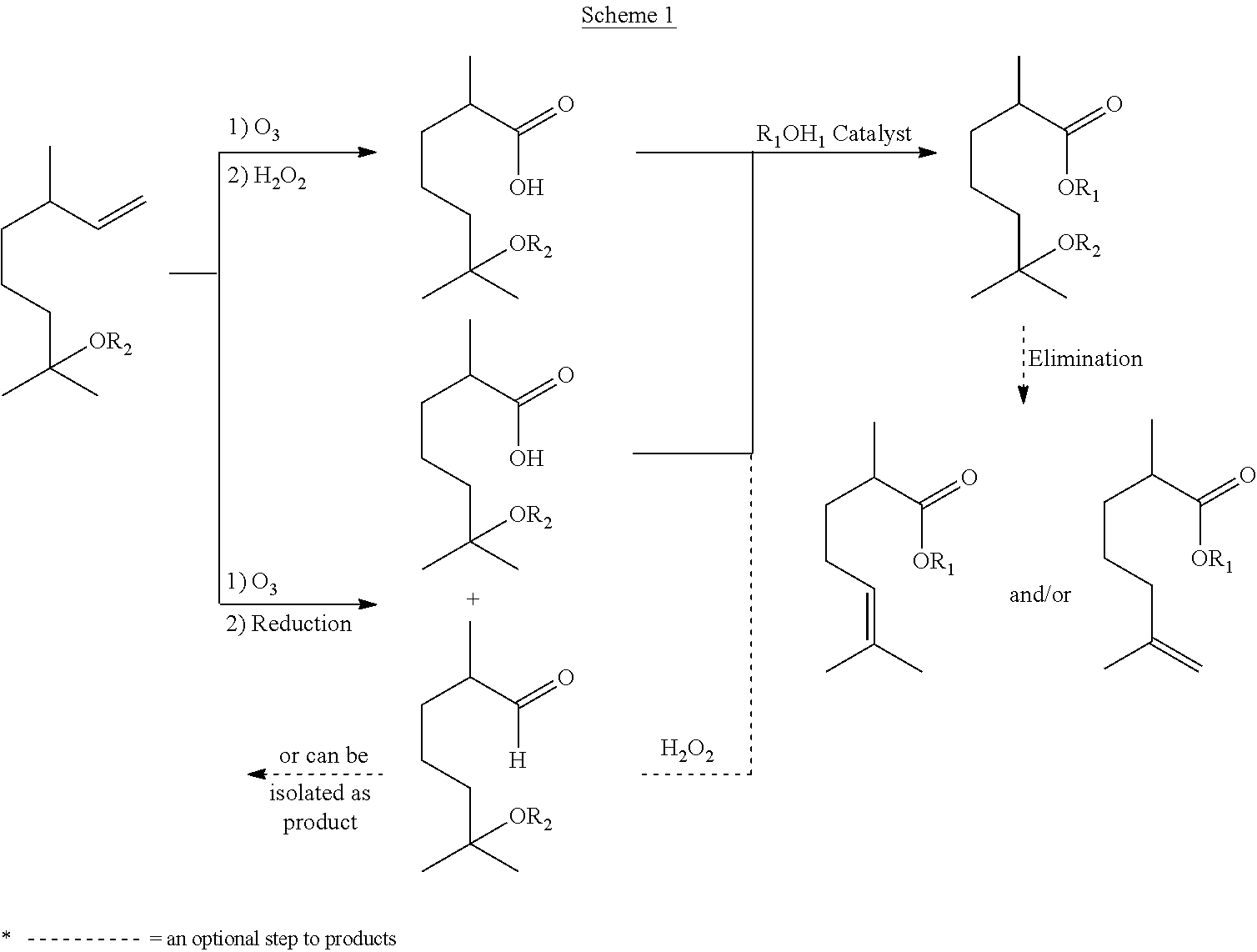
- the terpene-derived acid or ester product can be formed via either oxidative (top route) or reductive (bottom route) ozonolysis of methoxycitronellene, hydroxycitronellene, acetoxycitronellene, or alkoxycitronellene.
- the acid and the corresponding aldehyde are formed in the reductive ozonolysis procedure (bottom route)
- the acid can be separated from the aldehydic product by bringing the pH to between 6 and 10 (e.g., between 7 and 10) to form the salts of the terpene-derived acids (see, e.g., Scheme 2 below).
- the reductive ozonolysis is performed in an aqueous mixture without a buffer, and the pH value of the resultant reaction mixture is quite low (e.g., about 1-3).
- An alkaline compound e.g., NaHCO 3 , Na 2 CO 3 , NaOH, K 2 CO 3 , KOH, and/or dibasic phosphate, or other inexpensive base
- the reaction mixture is phase separated in the presence of water to give an organic phase comprising the aldehyde, and an aqueous phase comprising the salt of the acid, as illustrated in Scheme 2, above.
- hydrogen peroxide or any other suitable oxidant
- the pH value of the aqueous phase can be adjusted such that the target acid is formed and phase separated from the aqueous phase. Additional organic extraction can be performed if needed to obtain additional amount of the target acid.
- esters As illustrated in Scheme 1 above, the acids obtained can then be esterified to generate esters. Additionally, these esters can undergo subsequent or tandem elimination reaction in the presence of an acid to generate ester-olefins, such as compounds of formulae II and III.
- methoxycitronellene i.e., 7-methoxy-3,7-dimethyloct-1-ene
- water cooled to, e.g., about 10° C. while stirring rapidly in, e.g., a jacketed glass reactor equipped with overhead stirrer and controlled gas diffusion.
- Ozone e.g., 5-7% by weight in oxygen
- the reaction vessel is then purged with N 2 and the mixture is transferred into a high-pressure reactor and charged with palladium black (e.g., 0.2% by weight).
- the reaction mixture is then stirred under hydrogen atmosphere (e.g., 300 psi) at e.g., about 75° C. for e.g., about 2.5 hours until the peroxide value of the reaction mixture approaches zero.
- the mixture is then filtered to remove the catalyst and placed in a separatory funnel.
- the organic phase is separated and washed with deionized water to afford a solution containing methoxymelonal and its corresponding acid, i.e., 6-methoxy-2,6-dimethylheptanoic acid.
- the organic phase is further extracted with a basic aqueous solution, e.g., 10% (aq.) Na 2 CO 3 , to separate any residual acid byproduct from the aldehyde.
- the aqueous phase is charged with a peroxide (e.g., hydrogen peroxide).
- a peroxide e.g., hydrogen peroxide
- an acid e.g., NaHSO 3
- the aqueous mixture is then acidified to a pH ⁇ 2-3 by e.g., adding 6N (aq.) HCl.
- an organic phase is obtained, which contains 6-methoxy-2,6-dimethylheptanoic acid.
- the acidic aqueous phase can be further extracted using, e.g., EtOAc to obtain an additional amount of the desired acid product after evaporation.
- 6-methoxy-2,6-dimethylheptanoic acid is dissolved in methanol and an acid, e.g., conc. H 2 SO 4 , is added to the stirring reaction mixture.
- the mixture is stirred at room temperature overnight, then heated to e.g., about 50° C. for about 2 hours, and refluxed for an additional 3 hours.
- the solvent is removed via evaporation and the resulting crude residue is dissolved in EtOAc.
- the organic solution is washed with e.g., 10% (aq.) Na 2 CO 3 and then evaporated to afford methyl 6-methoxy-2,6-dimethylheptanoate.
- 6-methoxy-2,6-dimethylheptanoic acid is dissolved in EtOH and charged with an acid, e.g., Tosic Acid.
- the reaction mixture is stirred at e.g., room temperature for 3 days until all the starting material is consumed.
- the reaction mixture is concentrated in the presence of silica gel to obtain a mixture of ethyl 2,6-dimethylhept-5-enoate and ethyl 2,6-dimethylhept-6-enoate.
- the acid or ester product from the method of the invention can be >80% pure (e.g., >90%, >95%, >98%, or >99% pure).
- 1 H NMR and gas chromatography can be used to characterize the desired acid or ester product.
- the acid or ester product is free of aldehydic material or starting material.
- the impurities e.g., the starting material terpenes such as methoxycitronellene, hydroxycitronellene, acetoxycitronellene, and alkoxycitronellenes, or aldehydic product such as methoxymelonal
- the impurities in the acid or ester product is less than 20% (e.g., ⁇ 10%, ⁇ 5%, ⁇ 2%, or ⁇ 1%).
- the invention also relates to a process of separation of an acid and an aldehyde following a reductive ozonolysis of an olefin (e.g., a terpene).
- a reductive ozonolysis of an olefin e.g., a terpene.
- the ozone used in the ozonolysis is generated by electrolyzing water.
- the methods described herein further include derivatizing the compound of formula II or III described herein, such as reduction, conversion to an amide, a nitrile (e.g., via the dehydration of an amide with SOCl 2 or P 2 O 5 ), or conversion to a tertiary alcohol through alkyl addition.
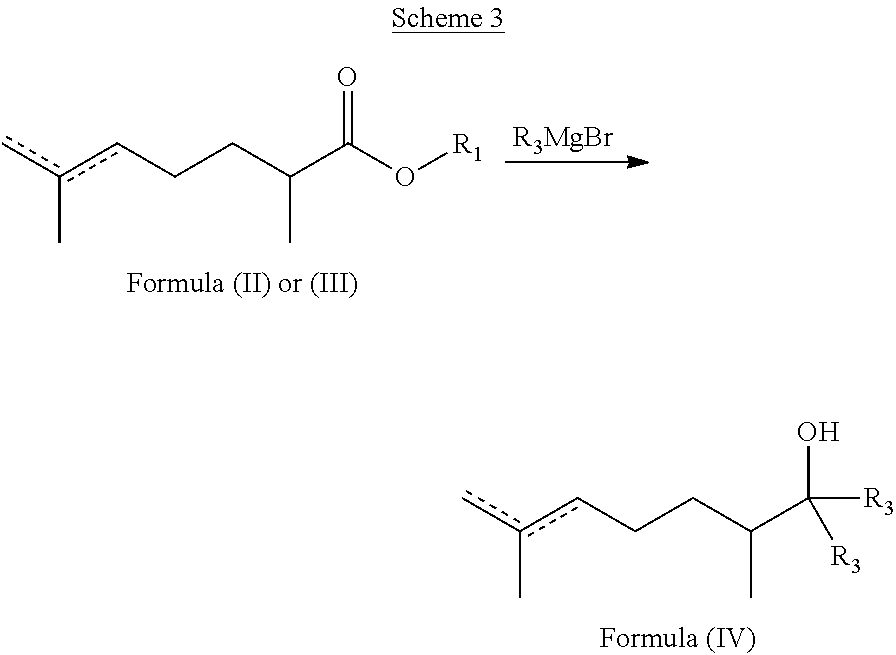
- the compounds of formula II or III described herein are converted to an alcohol of formula IV via a reaction depicted in Scheme 3 below.
- R 1 and R 2 are as defined herein for formula I unless otherwise specified, and R 3 is unsubstituted or substituted C 1 -C 10 alkyl, e.g., methyl or ethyl.
- a solution of R 3 MgBr e.g., methylmagnesium bromide (e.g., in THF) is added (e.g., slowly) into a solution of a compound of formula II or III, e.g., sec-butyl 2,6-dimethylhept-5-enoate (e.g., in THF) at a first temperature, e.g., 0° C., for e.g., about 30 minutes.
- the reaction mixture After stirring for e.g., 30 minutes at 0° C., the reaction mixture is stirred at a temperature greater than the first temperature, e.g., room temperature for, e.g., another 14 hours, or until all the starting material is consumed.
- the reaction mixture is then cooled down to, e.g., 0° C. and quenched, e.g., with saturated NH 4 Cl in H 2 O. All organic solvent (e.g., THF) is then removed, e.g., by evaporation.
- an acid e.g., acetic acid (e.g., 15% in water) is added to the residue.
- the aqueous layer is then extracted with an organic solvent, e.g., ethyl acetate and the organic fractions containing the product, a compound of formula IV, are combined.
- the compound of formula IV e.g., 2,3,7-trimethyloct-6-en-2-ol, 2,3,7-trimethyloct-7-en-2-ol, or a mixture thereof, is then purified by, e.g., removal of the solvent and column chromatography (e.g., Silica gel, EtOAc/heptane: 5-10%).
- the product of the method of the invention has an overall yield of no less than 60%, e.g., no less than 70%, no less than 80%, or no less than 90%.
- the product of the method of the invention contains more than 80% of compound of formula I. In some embodiments, the product of the method of the invention contains more than 85%, 90%, 92%, 95%, 97%, 98%, 98.5%, or 99% of compound of formula I. For example, the product is free of undesired byproduct or starting material.
- the impurities e.g., undesired byproduct or starting material such as methoxycitronellene, hydroxycitronellene, acetoxycitronellene, and alkoxycitronellenes
- the impurities in the acid or ester product is less than 20% (e.g., ⁇ 15%, ⁇ 10%, ⁇ 8%, ⁇ 5%, ⁇ 3%, ⁇ 2%, ⁇ 1.5%, or ⁇ 1%).
- the product of the method of the invention contains more than 80% of compound of formula II and/or III. In some embodiments, the product of the method of the invention contains more than 85%, 90%, 92%, 95%, 97%, 98%, 98.5%, or 99% of compound of formula II and/or III. For example, the product is free of undesired byproduct or starting material.
- the impurities e.g., undesired byproduct or starting material such as methoxycitronellene, hydroxycitronellene, acetoxycitronellene, and alkoxycitronellenes
- the impurities in the acid/ester-olefin product is less than 20% (e.g., ⁇ 15%, ⁇ 10%, ⁇ 8%, ⁇ 5%, ⁇ 3%, ⁇ 2%, ⁇ 1.5%, or ⁇ 1%).
- the product of the method of the invention contains more than 80% of compound of formula IV. In some embodiments, the product of the method of the invention contains more than 85%, 90%, 92%, 95%, 97%, 98%, 98.5%, or 99% of compound of formula IV.
- the product is free of undesired byproduct or starting material.
- the impurities e.g., undesired byproduct or ester-olefin starting material such as sec-butyl 2,6-dimethylhept-5-enoate
- the product is less than 20% (e.g., ⁇ 15%, ⁇ 10%, ⁇ 8%, ⁇ 5%, ⁇ 3%, ⁇ 2%, ⁇ 1.5%, or ⁇ 1%).
- the methods disclosed herein are suitable for both large-scale and small-scale preparations of the desired compounds.
- the compounds of formula I (or compounds of formula II, III, IV, V, VI, or VII) may be prepared on a large scale, for example on an industrial production scale rather than on an experimental/laboratory scale.
- the methods of the disclosure allow the preparation of batches of at least 1 g, or at least 5 g, or at least 10 g, or at least 100 g, or at least 1 kg, or at least 10 kg, or at least 100 kg of product.
- the invention also relates to a compound of formula I, II, III, IV, V, VI, or VII below or a salt thereof:
- each of R 1 , R 4 , and R 5 independently, is H, unsubstituted or substituted C 1 -C 10 alkyl, or unsubstituted or substituted C 2 -C 10 alkenyl, R 2 is H, unsubstituted or substituted C 1 -C 10 alkyl, or COR a , in which R a is H or unsubstituted or substituted C 1 -C 10 alkyl, and R 3 is unsubstituted or substituted C 1 -C 10 alkyl.
- R 1 is substituted or unsubstituted alkyl having 1, 2, 3, 4, 5, 6, 7, 8, 9, or 10 carbon atoms
- R 1 is substituted or unsubstituted alkenyl having 2, 3, 4, 5, 6, 7, 8, 9, or 10 carbon atoms and one, two, or three carbon-carbon double bonds.
- R 2 is H or substituted or unsubstituted alkyl having 1, 2, 3, 4, 5, 6, 7, 8, 9, or 10 carbon atoms.
- R 2 is COR a , in which R a is H or unsubstituted or substituted alkyl having 1, 2, 3, 4, 5, 6, 7, 8, 9, or 10 carbon atoms.
- R 1 is unsubstituted C 1 -C 3 alkyl (e.g., alkyl having 1, 2, or 3 carbon atoms) or unsubstituted C 2 -C 3 alkenyl (e.g., alkenyl having 2 or 3 carbon atoms such as allyl).
- R 1 is unsubstituted C 3 -C 9 alkyl (e.g., alkyl having 3, 4, 5, 6, 7, 8, or 9 carbon atoms).
- R 2 is unsubstituted C 1 -C 3 alkyl (e.g., alkyl having 1, 2, or 3 carbon atoms) or COCH 3 .
- R 2 is unsubstituted C 3 -C 9 alkyl (e.g., alkyl having 3, 4, 5, 6, 7, 8, or 9 carbon atoms).
- the compounds of formula I, II, or III include
- R 3 is substituted or unsubstituted alkyl having 1, 2, 3, 4, 5, 6, 7, 8, 9, or 10 carbon atoms, e.g., unsubstituted C 1 -C 3 alkyl (e.g., alkyl having 1, 2, or 3 carbon atoms).
- the compound of formula IV includes 2,3,7-trimethyloct-6-en-2-ol and 2,3,7-trimethyloct-7-en-2-ol.
- each of R 4 and R 5 is independently, H, substituted or unsubstituted alkyl having 1, 2, 3, 4, 5, 6, 7, 8, 9, or 10 carbon atoms, or substituted or unsubstituted alkenyl having 2, 3, 4, 5, 6, 7, 8, 9, or 10 carbon atoms and one, two, or three carbon-carbon double bonds.
- each of R 4 and R 5 is independently, H or unsubstituted alkyl having 1, 2, 3, 4, 5, 6, 7, 8, 9, or 10 carbon atoms.
- a reactant includes not only a single reactant but also a combination or mixture of two or more different reactant
- a substituent includes a single substituent as well as two or more substituents, and the like.
- the phrases “for example,” “for instance,” “such as,” or “including” are meant to introduce examples that further clarify more general subject matter. These examples are provided only as an aid for understanding the disclosure, and are not meant to be limiting in any fashion.
- the terms “may,” “optional,” “optionally,” or “may optionally” mean that the subsequently described circumstance may or may not occur, so that the description includes instances where the circumstance occurs and instances where it does not.
- the phrase “optionally present” means that an object may or may not be present, and, thus, the description includes instances wherein the object is present and instances wherein the object is not present.
- “Isomerism” means compounds that have identical molecular formulae but differ in the sequence of bonding of their atoms or in the arrangement of their atoms in space. Isomers that differ in the arrangement of their atoms in space are termed “stereoisomers”. Stereoisomers that are not mirror images of one another are termed “diastereoisomers”, and stereoisomers that are non-superimposable mirror images of each other are termed “enantiomers” or sometimes optical isomers. A mixture containing equal amounts of individual enantiomeric forms of opposite chirality is termed a “racemic mixture”.
- a carbon atom bonded to four nonidentical substituents is termed a “chiral center.”
- Chiral isomer means a compound with at least one chiral center. Compounds with more than one chiral center may exist either as an individual diastereomer or as a mixture of diastereomers, termed “diastereomeric mixture.” When one chiral center is present, a stereoisomer may be characterized by the absolute configuration (R or S) of that chiral center. Absolute configuration refers to the arrangement in space of the substituents attached to the chiral center. The substituents attached to the chiral center under consideration are ranked in accordance with the Sequence Rule of Cahn, Ingold and Prelog. (Cahn et al., Angew. Chem. Inter. Edit.
- “Geometric isomer” means the diastereomers that owe their existence to hindered rotation about double bonds. These configurations are differentiated in their names by the prefixes cis and trans, or Z and E, which indicate that the groups are on the same or opposite side of the double bond in the molecule according to the Cahn-Ingold-Prelog rules.
- Some compounds of the present invention can exist in a tautomeric form which is also intended to be encompassed within the scope of the present invention.
- “Tautomers” refers to compounds whose structures differ markedly in arrangement of atoms, but which exist in easy and rapid equilibrium. It is to be understood that the compounds of the invention may be depicted as different tautomers. It should also be understood that when compounds have tautomeric forms, all tautomeric forms are intended to be within the scope of the invention, and the naming of the compounds does not exclude any tautomeric form. Further, even though one tautomer may be described, the present invention includes all tautomers of the present compounds.
- salt can include acid addition salts including hydrochlorides, hydrobromides, phosphates, sulfates, hydrogen sulfates, alkylsulfonates, arylsulfonates, acetates, benzoates, citrates, maleates, fumarates, succinates, lactates, and tartrates; alkali metal cations such as Na + , K + , Li + , alkali earth metal salts such as Mg 2+ or Ca 2+ , or organic amine salts, or organic phosphonium salts.
- alkyl refers to a branched or unbranched saturated hydrocarbon group typically although not necessarily containing 1 to about 10 carbon atoms, such as methyl, ethyl, n-propyl, isopropyl, n-butyl, isobutyl, t-butyl, octyl, and the like.
- alkenyl refers to a branched or unbranched unsaturated hydrocarbon group typically although not necessarily containing 2 to about 10 carbon atoms and 1-8 carbon-carbon double bonds, such as ethylene, n-propylene, isopropylene, n-butylene, isobutylene, t-butylene, octylene, and the like.
- substituted as in “substituted alkyl,” “substituted alkenyl,” and the like, it is meant that in the alkyl, alkenyl, or other moiety, at least one hydrogen atom bound to a carbon atom is replaced with one or more non-hydrogen substituents, e.g., by a functional group.
- Examples of functional groups include, without limitation: halo, hydroxyl, sulfhydryl, C 1 -C 24 alkoxy, C 2 -C 24 alkenyloxy, C 2 -C 24 alkynyloxy, C 5 -C 20 aryloxy, acyl (including C 2 -C 24 alkylcarbonyl (—CO-alkyl) and C 6 -C 20 arylcarbonyl (—CO-aryl)), acyloxy (—O-acyl), C 2 -C 24 alkoxycarbonyl (—(CO)—O-alkyl), C 6 -C 20 aryloxycarbonyl (—(CO)—O-aryl), halocarbonyl (—CO)—X where X is halo), C 2 -C 24 alkylcarbonato (—O—(CO)—O-alkyl), C 6 -C 20 arylcarbonato (—O—(CO)—O-aryl), carboxy (—COOH),
- the structural formula of the compound represents a certain isomer for convenience in some cases, but the present invention includes all isomers, such as geometrical isomers, optical isomers based on an asymmetrical carbon, stereoisomers, tautomers, and the like.
- a crystal polymorphism may be present for the compounds represented by the formula. It is noted that any crystal form, crystal form mixture, or anhydride or hydrate thereof is included in the scope of the present invention.
- Methoxycitronellene i.e., 7-methoxy-3,7-dimethyloct-1-ene, 350 g, 0.486 mol
- water 700 g
- ozone in oxygen was diffused into the mixture at a flow rate of 10 L/min over 110 minutes until all of the starting material was consumed, while maintaining a reaction temperature below 22° C.
- the reaction vessel was then purged with N 2 and the mixture was transferred into a high-pressure reactor and charged with palladium black (0.2% by weight).
- the reaction mixture was stirred under hydrogen atmosphere (300 psi) at 75° C.
- the organic phase was further extracted with 10% (aq.) Na 2 CO 3 to remove any residual acid byproduct.
- the phases were separated and the organic phase contained clean methoxymelonal (275 g).
- the aqueous phase was charged with hydrogen peroxide (2.4 g, 30 wt. %) and stirred at room temperature overnight. The next day, NaHSO 3 was added to the reaction mixture until no excess peroxide could be measured with KI starch strips.
- the aqueous mixture was acidified to a pH ⁇ 2-3 with the slow addition of 6N (aq.) HCl. Following the pH adjustment, an organic phase separated out, which contained almost exclusively the corresponding terpene-derived acid, 6-methoxy-2,6-dimethylheptanoic acid (45.1 g). 1 H NMR for this material can be seen in FIG. 1 .
- the acidic aqueous phase was extracted again using EtOAc to obtain an additional amount (4.5 g) of the desired acid product after evaporation.
- 6-methoxy-2,6-dimethylheptanoic acid (1.7 g, 0.9 mmol) was dissolved in MeOH (10 mL) and 2 drops of conc. H 2 SO 4 were added to the stirring reaction mixture. The mixture was stirred at room temperature overnight, then heated to 50° C. for 2 hours, and refluxed for an additional 3 hours. The solvent was removed via evaporation and the resulting crude residue was dissolved in EtOAc (50 mL). The organic solution was washed with 10% (aq.) Na 2 CO 3 (50 ml of 10% by weight in water) and then evaporated to afford the methyl ester, i.e., methyl 6-methoxy-2,6-dimethylheptanoate (1.6 g). 1 H NMR of this material is shown in FIG. 2 .
- 6-methoxy-2,6-dimethylheptanoic acid (4.0 g) was dissolved in EtOH (20 mL) and charged with Tosic Acid (400 mg). The reaction mixture was stirred at room temperature for 3 days until all the starting material was consumed. The reaction mixture was concentrated in the presence of silica gel, which was used in silica gel chromatography (2-5% gradient of EtOAc in Heptane) to obtain a mixture of ethyl 2,6-dimethylhept-5-enoate and ethyl 2,6-dimethylhept-6-enoate (1.5 g). 1 H NMR of the product is shown in FIG. 3 (note the presence of the methyl ester in the mixture, likely due to methanol present in the EtOH as an EtOH denaturant).
- 6-Hydroxy-2,6-dimethylheptanoic acid was prepared in a fashion similar to that described in Example 1, using hydroxycitronellene (i.e., 2,6-dimethyloct-7-en-2-ol) as a starting material.
- hydroxycitronellene i.e., 2,6-dimethyloct-7-en-2-ol
- ester derivatives of 6-hydroxy-2,6-dimethylheptanoic acid were also prepared in a fashion similar to that described in Example 1.
Landscapes
- Chemical & Material Sciences (AREA)
- Organic Chemistry (AREA)
- Chemical Kinetics & Catalysis (AREA)
- Organic Low-Molecular-Weight Compounds And Preparation Thereof (AREA)
Abstract
Description


with ozone and subsequently with an oxidant different from ozone to obtain the compound of formula (I) wherein R1 is H.

with ozone and subsequently with a reductant to obtain a mixture comprising the compound of formula (I) wherein R1 is H and a compound of formula (IC):

and (2) separating the compound of formula (I) wherein R1 is H from the compound of formula (IC).


wherein


In this formula, R1 is H, unsubstituted or substituted C1-C10 alkyl, or unsubstituted or substituted C2-C10 alkenyl, and R2 is H, unsubstituted or substituted C1-C10 alkyl, or CORa, in which Ra is H or unsubstituted or substituted C1-C10 alkyl.
The method includes

with ozone and subsequently with an oxidant (i.e., an oxidizing agent) different from ozone to obtain the compound of formula (I) wherein R1 is H

and


wherein R1 is H, unsubstituted or substituted C1-C10 alkyl, or unsubstituted or substituted C2-C10 alkenyl. For example, the elimination reaction is performed in a solvent comprising an alcohol (e.g., methanol, ethanol, isopropanol, butanol and the like) and an acid (e.g., p-toluenesulfonic acid or tosic acid) at, e.g., room temperature.


wherein

and salts thereof.

* one of the


Claims (19)


Priority Applications (1)
| Application Number | Priority Date | Filing Date | Title |
|---|---|---|---|
| US15/317,642 US10071941B2 (en) | 2014-06-10 | 2015-06-10 | Terpene-derived compounds and methods for preparing and using same |
Applications Claiming Priority (3)
| Application Number | Priority Date | Filing Date | Title |
|---|---|---|---|
| US201462010407P | 2014-06-10 | 2014-06-10 | |
| US15/317,642 US10071941B2 (en) | 2014-06-10 | 2015-06-10 | Terpene-derived compounds and methods for preparing and using same |
| PCT/US2015/035097 WO2015191706A1 (en) | 2014-06-10 | 2015-06-10 | Terpene-derived compounds and methods for preparing and using same |
Publications (2)
| Publication Number | Publication Date |
|---|---|
| US20170113988A1 US20170113988A1 (en) | 2017-04-27 |
| US10071941B2 true US10071941B2 (en) | 2018-09-11 |
Family
ID=54834242
Family Applications (1)
| Application Number | Title | Priority Date | Filing Date |
|---|---|---|---|
| US15/317,642 Active US10071941B2 (en) | 2014-06-10 | 2015-06-10 | Terpene-derived compounds and methods for preparing and using same |
Country Status (2)
| Country | Link |
|---|---|
| US (1) | US10071941B2 (en) |
| WO (1) | WO2015191706A1 (en) |
Cited By (1)
| Publication number | Priority date | Publication date | Assignee | Title |
|---|---|---|---|---|
| US11814350B2 (en) | 2018-10-19 | 2023-11-14 | P2 Science, Inc. | Methods for disproportionation quenching of ozonides |
Families Citing this family (6)
| Publication number | Priority date | Publication date | Assignee | Title |
|---|---|---|---|---|
| EP3094615A4 (en) | 2014-01-13 | 2017-11-08 | P2 Science, Inc. | Terpene-derived acids and esters and methods for preparing and using same |
| WO2015191706A1 (en) | 2014-06-10 | 2015-12-17 | P2 Science, Inc. | Terpene-derived compounds and methods for preparing and using same |
| JP6687547B2 (en) | 2014-06-20 | 2020-04-22 | ピー2 サイエンス,インコーポレイティド | Membrane ozonolysis in tubular or multitubular reactors |
| ES2774937T3 (en) * | 2015-07-27 | 2020-07-23 | Givaudan Sa | 2,4,7-trimethyloct-6-in-1-ol as a fragrance ingredient |
| EP3472124A4 (en) | 2016-06-21 | 2020-03-04 | P2 Science, Inc. | FLOW REACTORS FOR CONTINUOUSLY QUARKING PEROXIDE MIXTURES AND METHODS THEREOF |
| WO2018053289A1 (en) | 2016-09-16 | 2018-03-22 | P2 Science, Inc. | Uses of vanadium to oxidize aldehydes and ozonides |
Citations (11)
| Publication number | Priority date | Publication date | Assignee | Title |
|---|---|---|---|---|
| US3023244A (en) | 1959-04-02 | 1962-02-27 | Givaudan Corp | Process for making pinonic aldehyde |
| US3699169A (en) | 1967-09-15 | 1972-10-17 | Givaudan Corp | Process for preparation of terpene flavorants |
| EP0761629A1 (en) | 1995-09-06 | 1997-03-12 | Haarmann & Reimer Gmbh | Aliphatic unsaturated compounds, process for their preparation as well as their use as fragrances |
| US6395695B1 (en) | 1997-06-27 | 2002-05-28 | The Procter & Gamble Company | Pro-fragrance linear acetals and ketals |
| US6545186B2 (en) | 2000-12-14 | 2003-04-08 | DSM Fine Chemicals Austria Nfg GmbH & Co., KG | Process for the purification of ketones obtained from the corresponding terpenes by ozonolysis and reduction |
| US20040186042A1 (en) | 2001-07-09 | 2004-09-23 | Gerhard Schmaus | Iso-$g(b)-bisabolol as fragrance and aroma substance |
| WO2009061806A2 (en) | 2007-11-05 | 2009-05-14 | University Of Kansas | Ozonolysis reactions in liquid co2 and co2-expanded solvents |
| WO2013053102A1 (en) | 2011-10-11 | 2013-04-18 | Givaudan Sa | Improvements in or relating to organic compounds |
| US20130338150A1 (en) | 2011-03-08 | 2013-12-19 | Sanofi | Di and tri - substituted oxathiazine derivatives, method for the production, method for the production thereof, use thereof as medicine and drug containing said derivatives and use thereof |
| WO2015106293A1 (en) | 2014-01-13 | 2015-07-16 | P2 Science, Inc. | Terpene-derived acids and esters and methods for preparing and using same |
| WO2015191706A1 (en) | 2014-06-10 | 2015-12-17 | P2 Science, Inc. | Terpene-derived compounds and methods for preparing and using same |
-
2015
- 2015-06-10 WO PCT/US2015/035097 patent/WO2015191706A1/en not_active Ceased
- 2015-06-10 US US15/317,642 patent/US10071941B2/en active Active
Patent Citations (13)
| Publication number | Priority date | Publication date | Assignee | Title |
|---|---|---|---|---|
| US3023244A (en) | 1959-04-02 | 1962-02-27 | Givaudan Corp | Process for making pinonic aldehyde |
| US3699169A (en) | 1967-09-15 | 1972-10-17 | Givaudan Corp | Process for preparation of terpene flavorants |
| EP0761629A1 (en) | 1995-09-06 | 1997-03-12 | Haarmann & Reimer Gmbh | Aliphatic unsaturated compounds, process for their preparation as well as their use as fragrances |
| US5756821A (en) | 1995-09-06 | 1998-05-26 | Haarmann & Reimer Gmbh | Open-chain olefinically unsaturated compounds, processes for their preparation and their use as aroma substances |
| US6395695B1 (en) | 1997-06-27 | 2002-05-28 | The Procter & Gamble Company | Pro-fragrance linear acetals and ketals |
| US6545186B2 (en) | 2000-12-14 | 2003-04-08 | DSM Fine Chemicals Austria Nfg GmbH & Co., KG | Process for the purification of ketones obtained from the corresponding terpenes by ozonolysis and reduction |
| US20040186042A1 (en) | 2001-07-09 | 2004-09-23 | Gerhard Schmaus | Iso-$g(b)-bisabolol as fragrance and aroma substance |
| WO2009061806A2 (en) | 2007-11-05 | 2009-05-14 | University Of Kansas | Ozonolysis reactions in liquid co2 and co2-expanded solvents |
| US20130338150A1 (en) | 2011-03-08 | 2013-12-19 | Sanofi | Di and tri - substituted oxathiazine derivatives, method for the production, method for the production thereof, use thereof as medicine and drug containing said derivatives and use thereof |
| WO2013053102A1 (en) | 2011-10-11 | 2013-04-18 | Givaudan Sa | Improvements in or relating to organic compounds |
| WO2015106293A1 (en) | 2014-01-13 | 2015-07-16 | P2 Science, Inc. | Terpene-derived acids and esters and methods for preparing and using same |
| US20160332952A1 (en) | 2014-01-13 | 2016-11-17 | P2 Science, Inc. | Terpene-derived acids and esters and methods for preparing and using same |
| WO2015191706A1 (en) | 2014-06-10 | 2015-12-17 | P2 Science, Inc. | Terpene-derived compounds and methods for preparing and using same |
Non-Patent Citations (10)
| Title |
|---|
| Cahn, R. S. "An Introduction to the Sequence Rule. A System for the Specification of Absolute Configuration" Journal of Chemical Education 1964 (London), vol. 41, No. 3, p. 116-125. |
| Cahn, R. S. and Ingold, C. K. "Specification of Configuration About Quadricovalent Asymmetric Atoms" J. Chem. Soc. 1951 (London), p. 612-622. |
| Cahn, R. S. et al. "Specification of Molecular Chirality" Angew. Chem. Inter. Edit. 1966, vol. 5, No. 4, p. 385-415. |
| Cahn, R. S. et al. "The Specification of Asymmetric Configuration in Organic Chemistry" Experientia 1956, vol. 12, p. 81-94. |
| Chen M. et al. "A Predictably Selective Aliphatic C-H Oxidation Reaction for Complex Molecule Synthesis", Science, vol. 318, 2007, pp. 783-787. |
| Chen M. et al. "A Predictably Selective Aliphatic C—H Oxidation Reaction for Complex Molecule Synthesis", Science, vol. 318, 2007, pp. 783-787. |
| Competition Science Vision Aug. 2000, Pratiyogita Darpan, vol. 3, No. 30, p. 799. |
| Gross, R. A., Jr. "Ozonolysis Problems That Promote Student Reasoning" Journal of Chemical Education, vol. 83, No. 4, 2006, p. 604-609. |
| PubChem-CID-107500001, Oct. 26, 2006, 17 pages. |
| Willand-Charnley, R. et al. "Pyridine is an Organocatalyst for the Reductive Ozonolysis of Alkenes" Org Lett. vol. 14, No. 9, May 2012, p. 2242-2245. |
Cited By (1)
| Publication number | Priority date | Publication date | Assignee | Title |
|---|---|---|---|---|
| US11814350B2 (en) | 2018-10-19 | 2023-11-14 | P2 Science, Inc. | Methods for disproportionation quenching of ozonides |
Also Published As
| Publication number | Publication date |
|---|---|
| WO2015191706A1 (en) | 2015-12-17 |
| US20170113988A1 (en) | 2017-04-27 |
Similar Documents
| Publication | Publication Date | Title |
|---|---|---|
| US10071941B2 (en) | Terpene-derived compounds and methods for preparing and using same | |
| US10011582B2 (en) | Substituted delta-lactones and methods of preparing same | |
| US10059801B2 (en) | Polyethers, polyamines, polythioethers, and methods for making same | |
| CZ302497B6 (en) | 3,3-Diphenylpropylamine derivatives, process for their preparation and use | |
| US20170247314A1 (en) | Fragrances from the esters of fatty acids | |
| US10280131B2 (en) | Terpene-derived acids and esters and methods for preparing and using same | |
| US9840449B2 (en) | Guerbet alcohols and methods for preparing and using same | |
| JP2019524770A (en) | Process for producing spiroketal substituted cyclic ketoenols | |
| EP3498695A1 (en) | Method for synthesizing 3-(difluoromethyl)-1-methyl-1h-pyrazole-4-carboxylic acid, and intermediates thereof | |
| JPH0432063B2 (en) | ||
| US20080221340A1 (en) | Process for the Production of Nebivolol | |
| FI84347B (en) | FOERFARANDE FOER FRAMSTAELLNING AV 4- ACETYL-2-SUBSTITUERAD-IMIDAZOLER. | |
| EP4622952A1 (en) | Production of panthenol | |
| JP3581721B2 (en) | Method for producing N-substituted-3-iodopropioamide and its synthetic intermediate | |
| JP4058960B2 (en) | Indazole derivatives and process for producing the same | |
| HU207711B (en) | Process for producing glutaric acid derivatives | |
| JP2000063321A (en) | Production of long-chain beta-hydroxycarboxylic acid of high optical purity | |
| HU202240B (en) | Process for producing optically active carbacycline intermediates | |
| CN103781773A (en) | Process for producing 2-oxo-2H-cyclohepta[b]furan analogs | |
| CN121627513A (en) | Preparation method of 3, 3-dimethoxy cyclobutane-1, 1-dicarboxylic acid isopropyl ester | |
| JP2009542617A (en) | Gabapentin preparation process | |
| JPH11152280A (en) | Method for producing 3-methyl-4-hydroxy-2-butenolide | |
| JPH066564B2 (en) | Optically active carboxylic acid ester compound | |
| KR19980065188A (en) | New synthetic intermediates of moussecon and preparation method thereof | |
| JPH03112976A (en) | Optically active delta-lactone compound |
Legal Events
| Date | Code | Title | Description |
|---|---|---|---|
| AS | Assignment |
Owner name: P2 SCIENCE, INC., CONNECTICUT Free format text: ASSIGNMENT OF ASSIGNORS INTEREST;ASSIGNORS:FOLEY, PATRICK;YANG, YONGHUA;REEL/FRAME:040699/0352 Effective date: 20140806 |
|
| AS | Assignment |
Owner name: P2 SCIENCE, INC., CONNECTICUT Free format text: ASSIGNMENT OF ASSIGNORS INTEREST;ASSIGNORS:FOLEY, PATRICK;YANG, YONGHUA;REEL/FRAME:040748/0931 Effective date: 20140806 |
|
| STCF | Information on status: patent grant |
Free format text: PATENTED CASE |
|
| CC | Certificate of correction | ||
| AS | Assignment |
Owner name: WEBSTER BANK, NATIONAL ASSOCIATION, CONNECTICUT Free format text: SECURITY INTEREST;ASSIGNOR:P2 SCIENCE, INC.;REEL/FRAME:052678/0391 Effective date: 20200513 |
|
| MAFP | Maintenance fee payment |
Free format text: PAYMENT OF MAINTENANCE FEE, 4TH YR, SMALL ENTITY (ORIGINAL EVENT CODE: M2551); ENTITY STATUS OF PATENT OWNER: SMALL ENTITY Year of fee payment: 4 |
|
| AS | Assignment |
Owner name: HG VENTURES LLC, INDIANA Free format text: SECURITY INTEREST;ASSIGNOR:P2 SCIENCE, INC.;REEL/FRAME:062050/0152 Effective date: 20221118 |
|
| AS | Assignment |
Owner name: P2 SCIENCE, INC., CONNECTICUT Free format text: RELEASE BY SECURED PARTY;ASSIGNOR:HG VENTURES LLC;REEL/FRAME:062650/0301 Effective date: 20230131 Owner name: P2 SCIENCE, INC., CONNECTICUT Free format text: RELEASE OF SECURITY INTEREST;ASSIGNOR:HG VENTURES LLC;REEL/FRAME:062650/0301 Effective date: 20230131 |
|
| MAFP | Maintenance fee payment |
Free format text: PAYMENT OF MAINTENANCE FEE, 8TH YR, SMALL ENTITY (ORIGINAL EVENT CODE: M2552); ENTITY STATUS OF PATENT OWNER: SMALL ENTITY Year of fee payment: 8 |