US10070651B2 - Synthesis and characterization of antimicrobial non-color forming silver-silica nanocomposite - Google Patents
Synthesis and characterization of antimicrobial non-color forming silver-silica nanocomposite Download PDFInfo
- Publication number
- US10070651B2 US10070651B2 US15/292,523 US201615292523A US10070651B2 US 10070651 B2 US10070651 B2 US 10070651B2 US 201615292523 A US201615292523 A US 201615292523A US 10070651 B2 US10070651 B2 US 10070651B2
- Authority
- US
- United States
- Prior art keywords
- silver
- dielectric
- nanoparticle
- ionic
- nanocomposite material
- Prior art date
- Legal status (The legal status is an assumption and is not a legal conclusion. Google has not performed a legal analysis and makes no representation as to the accuracy of the status listed.)
- Active
Links
- 239000002114 nanocomposite Substances 0.000 title claims abstract description 134
- 230000000845 anti-microbial effect Effects 0.000 title claims description 43
- VYPSYNLAJGMNEJ-UHFFFAOYSA-N silicon dioxide Inorganic materials O=[Si]=O VYPSYNLAJGMNEJ-UHFFFAOYSA-N 0.000 title description 104
- 239000000377 silicon dioxide Substances 0.000 title description 51
- 230000015572 biosynthetic process Effects 0.000 title description 24
- 238000003786 synthesis reaction Methods 0.000 title description 15
- 238000012512 characterization method Methods 0.000 title description 6
- 229910052709 silver Inorganic materials 0.000 claims abstract description 380
- 239000004332 silver Substances 0.000 claims abstract description 378
- BQCADISMDOOEFD-UHFFFAOYSA-N Silver Chemical compound [Ag] BQCADISMDOOEFD-UHFFFAOYSA-N 0.000 claims abstract description 236
- 239000002105 nanoparticle Substances 0.000 claims abstract description 139
- 239000000463 material Substances 0.000 claims abstract description 107
- FOIXSVOLVBLSDH-UHFFFAOYSA-N Silver ion Chemical compound [Ag+] FOIXSVOLVBLSDH-UHFFFAOYSA-N 0.000 claims abstract description 45
- 239000003989 dielectric material Substances 0.000 claims abstract description 40
- 239000011159 matrix material Substances 0.000 claims abstract description 37
- 239000000203 mixture Substances 0.000 claims abstract description 31
- 238000000034 method Methods 0.000 claims abstract description 29
- 238000010521 absorption reaction Methods 0.000 claims abstract description 6
- 239000002245 particle Substances 0.000 claims description 67
- -1 silver ions Chemical class 0.000 claims description 32
- 239000003795 chemical substances by application Substances 0.000 claims description 28
- 239000002243 precursor Substances 0.000 claims description 20
- 238000013268 sustained release Methods 0.000 claims description 11
- 239000012730 sustained-release form Substances 0.000 claims description 11
- 230000002401 inhibitory effect Effects 0.000 claims description 10
- 238000011282 treatment Methods 0.000 claims description 7
- 230000000844 anti-bacterial effect Effects 0.000 claims description 6
- 238000005538 encapsulation Methods 0.000 claims description 6
- 230000006911 nucleation Effects 0.000 claims description 6
- 238000010899 nucleation Methods 0.000 claims description 6
- 230000000813 microbial effect Effects 0.000 claims description 5
- 230000002776 aggregation Effects 0.000 claims description 4
- 238000004220 aggregation Methods 0.000 claims description 4
- 238000002156 mixing Methods 0.000 claims description 4
- 230000009920 chelation Effects 0.000 claims description 3
- 239000000758 substrate Substances 0.000 claims 1
- SQGYOTSLMSWVJD-UHFFFAOYSA-N silver(1+) nitrate Chemical compound [Ag+].[O-]N(=O)=O SQGYOTSLMSWVJD-UHFFFAOYSA-N 0.000 description 58
- 239000000243 solution Substances 0.000 description 26
- 238000003917 TEM image Methods 0.000 description 23
- 238000003756 stirring Methods 0.000 description 20
- 238000000576 coating method Methods 0.000 description 18
- LFQSCWFLJHTTHZ-UHFFFAOYSA-N Ethanol Chemical compound CCO LFQSCWFLJHTTHZ-UHFFFAOYSA-N 0.000 description 16
- 238000006243 chemical reaction Methods 0.000 description 16
- 239000011248 coating agent Substances 0.000 description 16
- 229910001961 silver nitrate Inorganic materials 0.000 description 15
- 241000894006 Bacteria Species 0.000 description 14
- KRKNYBCHXYNGOX-UHFFFAOYSA-K Citrate Chemical compound [O-]C(=O)CC(O)(CC([O-])=O)C([O-])=O KRKNYBCHXYNGOX-UHFFFAOYSA-K 0.000 description 13
- 229910017745 AgNP Inorganic materials 0.000 description 12
- 241000588724 Escherichia coli Species 0.000 description 12
- BOTDANWDWHJENH-UHFFFAOYSA-N Tetraethyl orthosilicate Chemical compound CCO[Si](OCC)(OCC)OCC BOTDANWDWHJENH-UHFFFAOYSA-N 0.000 description 12
- 230000009467 reduction Effects 0.000 description 11
- XLYOFNOQVPJJNP-UHFFFAOYSA-N water Substances O XLYOFNOQVPJJNP-UHFFFAOYSA-N 0.000 description 11
- 230000008859 change Effects 0.000 description 10
- VHUUQVKOLVNVRT-UHFFFAOYSA-N Ammonium hydroxide Chemical compound [NH4+].[OH-] VHUUQVKOLVNVRT-UHFFFAOYSA-N 0.000 description 9
- 239000004599 antimicrobial Substances 0.000 description 9
- 238000012360 testing method Methods 0.000 description 9
- WQZGKKKJIJFFOK-GASJEMHNSA-N Glucose Natural products OC[C@H]1OC(O)[C@H](O)[C@@H](O)[C@@H]1O WQZGKKKJIJFFOK-GASJEMHNSA-N 0.000 description 7
- 239000007864 aqueous solution Substances 0.000 description 7
- 239000000306 component Substances 0.000 description 7
- 239000001509 sodium citrate Substances 0.000 description 7
- HRXKRNGNAMMEHJ-UHFFFAOYSA-K trisodium citrate Chemical compound [Na+].[Na+].[Na+].[O-]C(=O)CC(O)(CC([O-])=O)C([O-])=O HRXKRNGNAMMEHJ-UHFFFAOYSA-K 0.000 description 7
- 229940038773 trisodium citrate Drugs 0.000 description 7
- 230000001332 colony forming effect Effects 0.000 description 6
- 239000012154 double-distilled water Substances 0.000 description 6
- 239000008103 glucose Substances 0.000 description 6
- 244000005700 microbiome Species 0.000 description 6
- 239000011541 reaction mixture Substances 0.000 description 6
- 229910000077 silane Inorganic materials 0.000 description 6
- 239000012279 sodium borohydride Substances 0.000 description 6
- 229910000033 sodium borohydride Inorganic materials 0.000 description 6
- 239000000126 substance Substances 0.000 description 6
- 238000002371 ultraviolet--visible spectrum Methods 0.000 description 6
- 210000004027 cell Anatomy 0.000 description 5
- 239000008367 deionised water Substances 0.000 description 5
- 229910021641 deionized water Inorganic materials 0.000 description 5
- 239000000843 powder Substances 0.000 description 5
- 230000008569 process Effects 0.000 description 5
- 235000012239 silicon dioxide Nutrition 0.000 description 5
- CSCPPACGZOOCGX-UHFFFAOYSA-N Acetone Chemical compound CC(C)=O CSCPPACGZOOCGX-UHFFFAOYSA-N 0.000 description 4
- 229920001817 Agar Polymers 0.000 description 4
- 241000195493 Cryptophyta Species 0.000 description 4
- 241000589516 Pseudomonas Species 0.000 description 4
- BLRPTPMANUNPDV-UHFFFAOYSA-N Silane Chemical compound [SiH4] BLRPTPMANUNPDV-UHFFFAOYSA-N 0.000 description 4
- 239000008272 agar Substances 0.000 description 4
- 238000004458 analytical method Methods 0.000 description 4
- 238000010790 dilution Methods 0.000 description 4
- 239000012895 dilution Substances 0.000 description 4
- 238000004108 freeze drying Methods 0.000 description 4
- 238000011534 incubation Methods 0.000 description 4
- 150000002500 ions Chemical class 0.000 description 4
- 239000000047 product Substances 0.000 description 4
- 239000000523 sample Substances 0.000 description 4
- 241000589562 Brucella Species 0.000 description 3
- 241000233866 Fungi Species 0.000 description 3
- PLXBWHJQWKZRKG-UHFFFAOYSA-N Resazurin Chemical compound C1=CC(=O)C=C2OC3=CC(O)=CC=C3[N+]([O-])=C21 PLXBWHJQWKZRKG-UHFFFAOYSA-N 0.000 description 3
- 241000191940 Staphylococcus Species 0.000 description 3
- 241000607734 Yersinia <bacteria> Species 0.000 description 3
- 239000000908 ammonium hydroxide Substances 0.000 description 3
- 230000001580 bacterial effect Effects 0.000 description 3
- KRKNYBCHXYNGOX-UHFFFAOYSA-N citric acid Chemical compound OC(=O)CC(O)(C(O)=O)CC(O)=O KRKNYBCHXYNGOX-UHFFFAOYSA-N 0.000 description 3
- 238000002474 experimental method Methods 0.000 description 3
- 239000000499 gel Substances 0.000 description 3
- 239000011521 glass Substances 0.000 description 3
- 230000002147 killing effect Effects 0.000 description 3
- 239000007788 liquid Substances 0.000 description 3
- 238000004519 manufacturing process Methods 0.000 description 3
- 229910052751 metal Inorganic materials 0.000 description 3
- 239000002184 metal Substances 0.000 description 3
- 150000002739 metals Chemical class 0.000 description 3
- 239000003960 organic solvent Substances 0.000 description 3
- 230000010355 oscillation Effects 0.000 description 3
- 238000000746 purification Methods 0.000 description 3
- 239000012429 reaction media Substances 0.000 description 3
- 241000894007 species Species 0.000 description 3
- 238000004611 spectroscopical analysis Methods 0.000 description 3
- 229910052717 sulfur Inorganic materials 0.000 description 3
- 231100000747 viability assay Toxicity 0.000 description 3
- 238000003026 viability measurement method Methods 0.000 description 3
- 241000186046 Actinomyces Species 0.000 description 2
- IJGRMHOSHXDMSA-UHFFFAOYSA-N Atomic nitrogen Chemical compound N#N IJGRMHOSHXDMSA-UHFFFAOYSA-N 0.000 description 2
- 241000606660 Bartonella Species 0.000 description 2
- 241001148534 Brachyspira Species 0.000 description 2
- 241000589567 Brucella abortus Species 0.000 description 2
- 241000589876 Campylobacter Species 0.000 description 2
- OKTJSMMVPCPJKN-UHFFFAOYSA-N Carbon Chemical compound [C] OKTJSMMVPCPJKN-UHFFFAOYSA-N 0.000 description 2
- 241000606161 Chlamydia Species 0.000 description 2
- 241000193403 Clostridium Species 0.000 description 2
- RYGMFSIKBFXOCR-UHFFFAOYSA-N Copper Chemical compound [Cu] RYGMFSIKBFXOCR-UHFFFAOYSA-N 0.000 description 2
- 241001445332 Coxiella <snail> Species 0.000 description 2
- 241000605716 Desulfovibrio Species 0.000 description 2
- 241000605314 Ehrlichia Species 0.000 description 2
- 241000194033 Enterococcus Species 0.000 description 2
- 241000588722 Escherichia Species 0.000 description 2
- 241000588748 Klebsiella Species 0.000 description 2
- 241000589248 Legionella Species 0.000 description 2
- 241001467578 Microbacterium Species 0.000 description 2
- 241000186367 Mycobacterium avium Species 0.000 description 2
- 241000186366 Mycobacterium bovis Species 0.000 description 2
- 229920002274 Nalgene Polymers 0.000 description 2
- 241000187654 Nocardia Species 0.000 description 2
- 241000606860 Pasteurella Species 0.000 description 2
- 241000206591 Peptococcus Species 0.000 description 2
- 241000191992 Peptostreptococcus Species 0.000 description 2
- 241000186429 Propionibacterium Species 0.000 description 2
- 241000187603 Pseudonocardia Species 0.000 description 2
- 241001453443 Rothia <bacteria> Species 0.000 description 2
- 241000607142 Salmonella Species 0.000 description 2
- 241000607768 Shigella Species 0.000 description 2
- 241000191967 Staphylococcus aureus Species 0.000 description 2
- 241000194017 Streptococcus Species 0.000 description 2
- 241000607598 Vibrio Species 0.000 description 2
- 241000043486 Yokenella Species 0.000 description 2
- 239000003242 anti bacterial agent Substances 0.000 description 2
- 238000004630 atomic force microscopy Methods 0.000 description 2
- 230000008901 benefit Effects 0.000 description 2
- 238000002815 broth microdilution Methods 0.000 description 2
- 229940056450 brucella abortus Drugs 0.000 description 2
- 229910052799 carbon Inorganic materials 0.000 description 2
- 239000013522 chelant Substances 0.000 description 2
- 239000003153 chemical reaction reagent Substances 0.000 description 2
- 239000003638 chemical reducing agent Substances 0.000 description 2
- 150000001875 compounds Chemical class 0.000 description 2
- 238000012790 confirmation Methods 0.000 description 2
- 229910052802 copper Inorganic materials 0.000 description 2
- 239000010949 copper Substances 0.000 description 2
- 239000008358 core component Substances 0.000 description 2
- 239000013078 crystal Substances 0.000 description 2
- 230000001419 dependent effect Effects 0.000 description 2
- 238000009826 distribution Methods 0.000 description 2
- 238000005516 engineering process Methods 0.000 description 2
- 239000000835 fiber Substances 0.000 description 2
- 235000013305 food Nutrition 0.000 description 2
- 238000003384 imaging method Methods 0.000 description 2
- 230000003100 immobilizing effect Effects 0.000 description 2
- 150000007529 inorganic bases Chemical class 0.000 description 2
- 230000000670 limiting effect Effects 0.000 description 2
- 238000011068 loading method Methods 0.000 description 2
- 238000005259 measurement Methods 0.000 description 2
- 238000002161 passivation Methods 0.000 description 2
- 239000002953 phosphate buffered saline Substances 0.000 description 2
- 230000000704 physical effect Effects 0.000 description 2
- 229920000642 polymer Polymers 0.000 description 2
- 238000012545 processing Methods 0.000 description 2
- 238000009877 rendering Methods 0.000 description 2
- 150000003839 salts Chemical class 0.000 description 2
- RMAQACBXLXPBSY-UHFFFAOYSA-N silicic acid Chemical compound O[Si](O)(O)O RMAQACBXLXPBSY-UHFFFAOYSA-N 0.000 description 2
- 239000002904 solvent Substances 0.000 description 2
- 238000007669 thermal treatment Methods 0.000 description 2
- 230000000007 visual effect Effects 0.000 description 2
- JJRVRELEASDUMY-JXMROGBWSA-N (5e)-5-[[4-(dimethylamino)phenyl]methylidene]-2-sulfanylidene-1,3-thiazolidin-4-one Chemical compound C1=CC(N(C)C)=CC=C1\C=C\1C(=O)NC(=S)S/1 JJRVRELEASDUMY-JXMROGBWSA-N 0.000 description 1
- UHPMCKVQTMMPCG-UHFFFAOYSA-N 5,8-dihydroxy-2-methoxy-6-methyl-7-(2-oxopropyl)naphthalene-1,4-dione Chemical compound CC1=C(CC(C)=O)C(O)=C2C(=O)C(OC)=CC(=O)C2=C1O UHPMCKVQTMMPCG-UHFFFAOYSA-N 0.000 description 1
- 241000201860 Abiotrophia Species 0.000 description 1
- 241000590020 Achromobacter Species 0.000 description 1
- 241000604451 Acidaminococcus Species 0.000 description 1
- 241000726119 Acidovorax Species 0.000 description 1
- 241000589291 Acinetobacter Species 0.000 description 1
- 241001019659 Acremonium <Plectosphaerellaceae> Species 0.000 description 1
- 241000606750 Actinobacillus Species 0.000 description 1
- 241000606748 Actinobacillus pleuropneumoniae Species 0.000 description 1
- 241001291962 Actinobaculum Species 0.000 description 1
- 241000187362 Actinomadura Species 0.000 description 1
- 241000186041 Actinomyces israelii Species 0.000 description 1
- 241000193798 Aerococcus Species 0.000 description 1
- 241000607534 Aeromonas Species 0.000 description 1
- 241000190801 Afipia Species 0.000 description 1
- 241000589158 Agrobacterium Species 0.000 description 1
- 229910017982 Ag—Si Inorganic materials 0.000 description 1
- 241000588986 Alcaligenes Species 0.000 description 1
- 241000186033 Alloiococcus Species 0.000 description 1
- 241000590031 Alteromonas Species 0.000 description 1
- 241000187643 Amycolatopsis Species 0.000 description 1
- 241000192542 Anabaena Species 0.000 description 1
- 241000149144 Anabaenopsis Species 0.000 description 1
- 241000246073 Anaerorhabdus Species 0.000 description 1
- 241000192660 Aphanizomenon Species 0.000 description 1
- 241001135699 Arcanobacterium Species 0.000 description 1
- 241001135163 Arcobacter Species 0.000 description 1
- 241000186063 Arthrobacter Species 0.000 description 1
- 240000002900 Arthrospira platensis Species 0.000 description 1
- 235000016425 Arthrospira platensis Nutrition 0.000 description 1
- 241000228212 Aspergillus Species 0.000 description 1
- 241000193818 Atopobium Species 0.000 description 1
- 241000193830 Bacillus <bacterium> Species 0.000 description 1
- 235000014469 Bacillus subtilis Nutrition 0.000 description 1
- 241000606126 Bacteroidaceae Species 0.000 description 1
- 241000606125 Bacteroides Species 0.000 description 1
- 241000606124 Bacteroides fragilis Species 0.000 description 1
- 241001277519 Balneatrix Species 0.000 description 1
- 241000611351 Bergeyella Species 0.000 description 1
- 241000186000 Bifidobacterium Species 0.000 description 1
- 241001495171 Bilophila Species 0.000 description 1
- 241000588807 Bordetella Species 0.000 description 1
- 241000589968 Borrelia Species 0.000 description 1
- 241001536303 Botryococcus braunii Species 0.000 description 1
- 241000123649 Botryotinia Species 0.000 description 1
- 241000555281 Brevibacillus Species 0.000 description 1
- 241000186146 Brevibacterium Species 0.000 description 1
- 241000131407 Brevundimonas Species 0.000 description 1
- 241001453380 Burkholderia Species 0.000 description 1
- 241000589513 Burkholderia cepacia Species 0.000 description 1
- 241001136175 Burkholderia pseudomallei Species 0.000 description 1
- 241001622847 Buttiauxella Species 0.000 description 1
- 241000605902 Butyrivibrio Species 0.000 description 1
- 241001468265 Candidatus Phytoplasma Species 0.000 description 1
- 241000190890 Capnocytophaga Species 0.000 description 1
- 241000207206 Cardiobacterium Species 0.000 description 1
- 241000159556 Catonella Species 0.000 description 1
- 241000046135 Cedecea Species 0.000 description 1
- 241000186321 Cellulomonas Species 0.000 description 1
- 241001633683 Centipeda <firmicute> Species 0.000 description 1
- 241000745493 Chilomastix Species 0.000 description 1
- 241001647378 Chlamydia psittaci Species 0.000 description 1
- 241000195585 Chlamydomonas Species 0.000 description 1
- 241000588881 Chromobacterium Species 0.000 description 1
- 241000223782 Ciliophora Species 0.000 description 1
- 241000588923 Citrobacter Species 0.000 description 1
- 241001478778 Cladophora Species 0.000 description 1
- 241000222290 Cladosporium Species 0.000 description 1
- 241000193155 Clostridium botulinum Species 0.000 description 1
- 241000193449 Clostridium tetani Species 0.000 description 1
- 241001464956 Collinsella Species 0.000 description 1
- 241000589519 Comamonas Species 0.000 description 1
- 241000186216 Corynebacterium Species 0.000 description 1
- 241000199912 Crypthecodinium cohnii Species 0.000 description 1
- 241001657377 Cryptobacterium Species 0.000 description 1
- 241000186427 Cutibacterium acnes Species 0.000 description 1
- 241000192700 Cyanobacteria Species 0.000 description 1
- 241001299740 Cylindrospermopsis Species 0.000 description 1
- 241000206749 Cylindrotheca sp. Species 0.000 description 1
- 230000005778 DNA damage Effects 0.000 description 1
- 231100000277 DNA damage Toxicity 0.000 description 1
- 241001600129 Delftia Species 0.000 description 1
- 241001508502 Dermabacter Species 0.000 description 1
- 241000187831 Dermatophilus Species 0.000 description 1
- 241001535083 Dialister Species 0.000 description 1
- 241000606006 Dichelobacter Species 0.000 description 1
- RWSOTUBLDIXVET-UHFFFAOYSA-N Dihydrogen sulfide Chemical class S RWSOTUBLDIXVET-UHFFFAOYSA-N 0.000 description 1
- 241000264374 Dolichospermum affine Species 0.000 description 1
- 241000694878 Dolosicoccus Species 0.000 description 1
- 241001147751 Dolosigranulum Species 0.000 description 1
- 241001560459 Dunaliella sp. Species 0.000 description 1
- 241000607473 Edwardsiella <enterobacteria> Species 0.000 description 1
- 241001657509 Eggerthella Species 0.000 description 1
- 241000606675 Ehrlichia ruminantium Species 0.000 description 1
- 241000588877 Eikenella Species 0.000 description 1
- 241000611354 Empedobacter Species 0.000 description 1
- 241000224431 Entamoeba Species 0.000 description 1
- 241000146407 Entamoeba coli Species 0.000 description 1
- 241000588914 Enterobacter Species 0.000 description 1
- 241000305071 Enterobacterales Species 0.000 description 1
- 241000588921 Enterobacteriaceae Species 0.000 description 1
- 241000194029 Enterococcus hirae Species 0.000 description 1
- 241000588698 Erwinia Species 0.000 description 1
- 241000186811 Erysipelothrix Species 0.000 description 1
- 241000362749 Ettlia oleoabundans Species 0.000 description 1
- 241000186394 Eubacterium Species 0.000 description 1
- 241000195620 Euglena Species 0.000 description 1
- 241000131486 Ewingella Species 0.000 description 1
- 241001468125 Exiguobacterium Species 0.000 description 1
- 241000936945 Facklamia Species 0.000 description 1
- CWYNVVGOOAEACU-UHFFFAOYSA-N Fe2+ Chemical compound [Fe+2] CWYNVVGOOAEACU-UHFFFAOYSA-N 0.000 description 1
- 241000178967 Filifactor Species 0.000 description 1
- 241000192125 Firmicutes Species 0.000 description 1
- 241000589565 Flavobacterium Species 0.000 description 1
- 241000589601 Francisella Species 0.000 description 1
- 241000589602 Francisella tularensis Species 0.000 description 1
- 241000223218 Fusarium Species 0.000 description 1
- 241000605909 Fusobacterium Species 0.000 description 1
- 241000207202 Gardnerella Species 0.000 description 1
- 241000193789 Gemella Species 0.000 description 1
- 241000224467 Giardia intestinalis Species 0.000 description 1
- 241000720942 Globicatella Species 0.000 description 1
- 241001464794 Gloeobacter Species 0.000 description 1
- 206010018612 Gonorrhoea Diseases 0.000 description 1
- 241000203751 Gordonia <actinomycete> Species 0.000 description 1
- 241000606790 Haemophilus Species 0.000 description 1
- 241000606768 Haemophilus influenzae Species 0.000 description 1
- 241000588731 Hafnia Species 0.000 description 1
- 241000350665 Hapalosiphon Species 0.000 description 1
- 241001430278 Helcococcus Species 0.000 description 1
- 241000589989 Helicobacter Species 0.000 description 1
- 241000862469 Holdemania Species 0.000 description 1
- 241000028682 Ignavigranum Species 0.000 description 1
- 241000124105 Isochrysis sp. Species 0.000 description 1
- 241000159562 Johnsonella Species 0.000 description 1
- 241001454354 Kingella Species 0.000 description 1
- 241000579722 Kocuria Species 0.000 description 1
- 241000186809 Kurthia Species 0.000 description 1
- 241000579706 Kytococcus Species 0.000 description 1
- 241000186660 Lactobacillus Species 0.000 description 1
- 241000194036 Lactococcus Species 0.000 description 1
- 241000217859 Lautropia Species 0.000 description 1
- 241001647840 Leclercia Species 0.000 description 1
- 241000589242 Legionella pneumophila Species 0.000 description 1
- 208000007764 Legionnaires' Disease Diseases 0.000 description 1
- 241000222740 Leishmania braziliensis Species 0.000 description 1
- 241001622839 Leminorella Species 0.000 description 1
- 241000589902 Leptospira Species 0.000 description 1
- 241001453171 Leptotrichia Species 0.000 description 1
- 241000192132 Leuconostoc Species 0.000 description 1
- 241000186781 Listeria Species 0.000 description 1
- 241000186780 Listeria ivanovii Species 0.000 description 1
- 241000186779 Listeria monocytogenes Species 0.000 description 1
- 208000016604 Lyme disease Diseases 0.000 description 1
- 241001134698 Lyngbya Species 0.000 description 1
- 241001344133 Magnaporthe Species 0.000 description 1
- 241001293418 Mannheimia haemolytica Species 0.000 description 1
- 241000604449 Megasphaera Species 0.000 description 1
- LSDPWZHWYPCBBB-UHFFFAOYSA-N Methanethiol Chemical compound SC LSDPWZHWYPCBBB-UHFFFAOYSA-N 0.000 description 1
- 241000589323 Methylobacterium Species 0.000 description 1
- 241000192041 Micrococcus Species 0.000 description 1
- 241000192701 Microcystis Species 0.000 description 1
- 241000192709 Microcystis sp. Species 0.000 description 1
- 240000005551 Micromelum minutum Species 0.000 description 1
- 241000509624 Mitsuokella Species 0.000 description 1
- 241000203736 Mobiluncus Species 0.000 description 1
- 241000043364 Moellerella Species 0.000 description 1
- 241000588621 Moraxella Species 0.000 description 1
- 241000588771 Morganella <proteobacterium> Species 0.000 description 1
- 241000235395 Mucor Species 0.000 description 1
- 241000186359 Mycobacterium Species 0.000 description 1
- 241001467553 Mycobacterium africanum Species 0.000 description 1
- 241000186364 Mycobacterium intracellulare Species 0.000 description 1
- 241000186363 Mycobacterium kansasii Species 0.000 description 1
- 241000187492 Mycobacterium marinum Species 0.000 description 1
- 241000187479 Mycobacterium tuberculosis Species 0.000 description 1
- 241000187917 Mycobacterium ulcerans Species 0.000 description 1
- 241000204031 Mycoplasma Species 0.000 description 1
- 241000202934 Mycoplasma pneumoniae Species 0.000 description 1
- 241001291960 Myroides Species 0.000 description 1
- 241000196305 Nannochloris Species 0.000 description 1
- 241000509521 Nannochloropsis sp. Species 0.000 description 1
- 241000588653 Neisseria Species 0.000 description 1
- 241000486043 Nitzschia sp. (in: Bacillariophyta) Species 0.000 description 1
- 241000187678 Nocardia asteroides Species 0.000 description 1
- 241000203622 Nocardiopsis Species 0.000 description 1
- 241000059630 Nodularia <Cyanobacteria> Species 0.000 description 1
- 241000192656 Nostoc Species 0.000 description 1
- 241000588843 Ochrobactrum Species 0.000 description 1
- 241000293010 Oligella Species 0.000 description 1
- 241000221871 Ophiostoma Species 0.000 description 1
- 241000984031 Orientia Species 0.000 description 1
- 241000179039 Paenibacillus Species 0.000 description 1
- 241000520272 Pantoea Species 0.000 description 1
- 241001647379 Parachlamydia Species 0.000 description 1
- 208000026681 Paratuberculosis Diseases 0.000 description 1
- 241000606856 Pasteurella multocida Species 0.000 description 1
- 241000192001 Pediococcus Species 0.000 description 1
- 241000228143 Penicillium Species 0.000 description 1
- 241000224539 Pentatrichomonas hominis Species 0.000 description 1
- 241000206744 Phaeodactylum tricornutum Species 0.000 description 1
- ISWSIDIOOBJBQZ-UHFFFAOYSA-N Phenol Chemical compound OC1=CC=CC=C1 ISWSIDIOOBJBQZ-UHFFFAOYSA-N 0.000 description 1
- 241000192608 Phormidium Species 0.000 description 1
- 241000607568 Photobacterium Species 0.000 description 1
- 241001148062 Photorhabdus Species 0.000 description 1
- 241000233614 Phytophthora Species 0.000 description 1
- 241000342009 Pithophora Species 0.000 description 1
- 241000530769 Planktothrix Species 0.000 description 1
- 241000223801 Plasmodium knowlesi Species 0.000 description 1
- 241000223810 Plasmodium vivax Species 0.000 description 1
- 241000607000 Plesiomonas Species 0.000 description 1
- 241001302393 Porphyridium sp. Species 0.000 description 1
- 241000605861 Prevotella Species 0.000 description 1
- 241000588769 Proteus <enterobacteria> Species 0.000 description 1
- 241000588768 Providencia Species 0.000 description 1
- 241001491792 Prymnesium Species 0.000 description 1
- 241000192511 Pseudanabaena Species 0.000 description 1
- 241000947836 Pseudomonadaceae Species 0.000 description 1
- 241000589517 Pseudomonas aeruginosa Species 0.000 description 1
- 241000184247 Pseudoramibacter Species 0.000 description 1
- 241000588671 Psychrobacter Species 0.000 description 1
- 241000221535 Pucciniales Species 0.000 description 1
- 241001478280 Rahnella Species 0.000 description 1
- 241000232299 Ralstonia Species 0.000 description 1
- 241000235527 Rhizopus Species 0.000 description 1
- 241000316848 Rhodococcus <scale insect> Species 0.000 description 1
- 241000606701 Rickettsia Species 0.000 description 1
- 241000572738 Roseomonas Species 0.000 description 1
- 241000192031 Ruminococcus Species 0.000 description 1
- DFPOZTRSOAQFIK-UHFFFAOYSA-N S,S-dimethyl-beta-propiothetin Chemical compound C[S+](C)CCC([O-])=O DFPOZTRSOAQFIK-UHFFFAOYSA-N 0.000 description 1
- 241001466077 Salina Species 0.000 description 1
- 241000293871 Salmonella enterica subsp. enterica serovar Typhi Species 0.000 description 1
- 241000195663 Scenedesmus Species 0.000 description 1
- 241000598397 Schizochytrium sp. Species 0.000 description 1
- 241000970913 Schizothrix Species 0.000 description 1
- 241000605036 Selenomonas Species 0.000 description 1
- 241000607720 Serratia Species 0.000 description 1
- 241001478200 Simkania Species 0.000 description 1
- 241001657520 Slackia Species 0.000 description 1
- 239000004115 Sodium Silicate Substances 0.000 description 1
- 239000005708 Sodium hypochlorite Substances 0.000 description 1
- 241001136275 Sphingobacterium Species 0.000 description 1
- 241000736131 Sphingomonas Species 0.000 description 1
- 241000605008 Spirillum Species 0.000 description 1
- 241000196294 Spirogyra Species 0.000 description 1
- 241000202917 Spiroplasma Species 0.000 description 1
- 241001279361 Stachybotrys Species 0.000 description 1
- 241000191963 Staphylococcus epidermidis Species 0.000 description 1
- 241000122971 Stenotrophomonas Species 0.000 description 1
- 241001478878 Streptobacillus Species 0.000 description 1
- 241000193985 Streptococcus agalactiae Species 0.000 description 1
- 241000193996 Streptococcus pyogenes Species 0.000 description 1
- 241000187747 Streptomyces Species 0.000 description 1
- 241001648295 Succinivibrio Species 0.000 description 1
- NINIDFKCEFEMDL-UHFFFAOYSA-N Sulfur Chemical compound [S] NINIDFKCEFEMDL-UHFFFAOYSA-N 0.000 description 1
- 241000123710 Sutterella Species 0.000 description 1
- 241000722075 Suttonella Species 0.000 description 1
- 241000192589 Synechococcus elongatus PCC 7942 Species 0.000 description 1
- 241001622829 Tatumella Species 0.000 description 1
- 241000196321 Tetraselmis Species 0.000 description 1
- 241000131405 Tissierella Species 0.000 description 1
- 241000043398 Trabulsiella Species 0.000 description 1
- 241000589886 Treponema Species 0.000 description 1
- 241000192118 Trichodesmium Species 0.000 description 1
- 241000224527 Trichomonas vaginalis Species 0.000 description 1
- 239000007983 Tris buffer Substances 0.000 description 1
- 241000203807 Tropheryma Species 0.000 description 1
- 241000223105 Trypanosoma brucei Species 0.000 description 1
- 241000223109 Trypanosoma cruzi Species 0.000 description 1
- 241001288658 Turicella Species 0.000 description 1
- 241000196252 Ulva Species 0.000 description 1
- 241001520827 Umezakia Species 0.000 description 1
- 241000202898 Ureaplasma Species 0.000 description 1
- 241000207194 Vagococcus Species 0.000 description 1
- 241000200212 Vaucheria Species 0.000 description 1
- 241001148134 Veillonella Species 0.000 description 1
- 241000607626 Vibrio cholerae Species 0.000 description 1
- 241000607493 Vibrionaceae Species 0.000 description 1
- 241000700605 Viruses Species 0.000 description 1
- 241000190866 Weeksella Species 0.000 description 1
- 241000605941 Wolinella Species 0.000 description 1
- 241000589634 Xanthomonas Species 0.000 description 1
- 241000607757 Xenorhabdus Species 0.000 description 1
- 241000607479 Yersinia pestis Species 0.000 description 1
- DGEZNRSVGBDHLK-UHFFFAOYSA-N [1,10]phenanthroline Chemical compound C1=CN=C2C3=NC=CC=C3C=CC2=C1 DGEZNRSVGBDHLK-UHFFFAOYSA-N 0.000 description 1
- 241000606834 [Haemophilus] ducreyi Species 0.000 description 1
- 238000000862 absorption spectrum Methods 0.000 description 1
- 230000004931 aggregating effect Effects 0.000 description 1
- 238000013019 agitation Methods 0.000 description 1
- 150000001343 alkyl silanes Chemical class 0.000 description 1
- 150000001412 amines Chemical class 0.000 description 1
- 229940088710 antibiotic agent Drugs 0.000 description 1
- 230000008033 biological extinction Effects 0.000 description 1
- 230000005540 biological transmission Effects 0.000 description 1
- 239000001273 butane Substances 0.000 description 1
- 230000015556 catabolic process Effects 0.000 description 1
- 230000030833 cell death Effects 0.000 description 1
- 230000033077 cellular process Effects 0.000 description 1
- 239000000919 ceramic Substances 0.000 description 1
- 239000002738 chelating agent Substances 0.000 description 1
- 150000001860 citric acid derivatives Chemical class 0.000 description 1
- 229910052681 coesite Inorganic materials 0.000 description 1
- 230000000052 comparative effect Effects 0.000 description 1
- 230000000536 complexating effect Effects 0.000 description 1
- 239000002772 conduction electron Substances 0.000 description 1
- 238000013270 controlled release Methods 0.000 description 1
- 238000010411 cooking Methods 0.000 description 1
- 229910052906 cristobalite Inorganic materials 0.000 description 1
- 230000034994 death Effects 0.000 description 1
- 230000018044 dehydration Effects 0.000 description 1
- 238000006297 dehydration reaction Methods 0.000 description 1
- 230000008021 deposition Effects 0.000 description 1
- 239000000645 desinfectant Substances 0.000 description 1
- 230000001066 destructive effect Effects 0.000 description 1
- 239000008121 dextrose Substances 0.000 description 1
- 239000012470 diluted sample Substances 0.000 description 1
- 238000007865 diluting Methods 0.000 description 1
- LOKCTEFSRHRXRJ-UHFFFAOYSA-I dipotassium trisodium dihydrogen phosphate hydrogen phosphate dichloride Chemical compound P(=O)(O)(O)[O-].[K+].P(=O)(O)([O-])[O-].[Na+].[Na+].[Cl-].[K+].[Cl-].[Na+] LOKCTEFSRHRXRJ-UHFFFAOYSA-I 0.000 description 1
- 238000002845 discoloration Methods 0.000 description 1
- 239000003814 drug Substances 0.000 description 1
- 229940079593 drug Drugs 0.000 description 1
- 238000002149 energy-dispersive X-ray emission spectroscopy Methods 0.000 description 1
- 230000002708 enhancing effect Effects 0.000 description 1
- 210000003527 eukaryotic cell Anatomy 0.000 description 1
- 230000005284 excitation Effects 0.000 description 1
- 208000030533 eye disease Diseases 0.000 description 1
- 239000004744 fabric Substances 0.000 description 1
- 238000001914 filtration Methods 0.000 description 1
- 238000009408 flooring Methods 0.000 description 1
- 239000005003 food packaging material Substances 0.000 description 1
- 229940118764 francisella tularensis Drugs 0.000 description 1
- 230000008014 freezing Effects 0.000 description 1
- 238000007710 freezing Methods 0.000 description 1
- 239000012520 frozen sample Substances 0.000 description 1
- 239000007789 gas Substances 0.000 description 1
- 229940085435 giardia lamblia Drugs 0.000 description 1
- 208000001786 gonorrhea Diseases 0.000 description 1
- 239000010438 granite Substances 0.000 description 1
- 229940047650 haemophilus influenzae Drugs 0.000 description 1
- CJNBYAVZURUTKZ-UHFFFAOYSA-N hafnium(IV) oxide Inorganic materials O=[Hf]=O CJNBYAVZURUTKZ-UHFFFAOYSA-N 0.000 description 1
- 210000005260 human cell Anatomy 0.000 description 1
- 239000007943 implant Substances 0.000 description 1
- 230000005764 inhibitory process Effects 0.000 description 1
- 239000000543 intermediate Substances 0.000 description 1
- 229940039696 lactobacillus Drugs 0.000 description 1
- 239000010985 leather Substances 0.000 description 1
- 229940115932 legionella pneumophila Drugs 0.000 description 1
- 231100000053 low toxicity Toxicity 0.000 description 1
- 239000002932 luster Substances 0.000 description 1
- 238000012792 lyophilization process Methods 0.000 description 1
- 239000004579 marble Substances 0.000 description 1
- 235000013372 meat Nutrition 0.000 description 1
- 230000007246 mechanism Effects 0.000 description 1
- 230000001404 mediated effect Effects 0.000 description 1
- 239000012528 membrane Substances 0.000 description 1
- 229910001092 metal group alloy Inorganic materials 0.000 description 1
- 229910044991 metal oxide Inorganic materials 0.000 description 1
- 150000004706 metal oxides Chemical class 0.000 description 1
- 230000003641 microbiacidal effect Effects 0.000 description 1
- IJDNQMDRQITEOD-UHFFFAOYSA-N n-butane Chemical compound CCCC IJDNQMDRQITEOD-UHFFFAOYSA-N 0.000 description 1
- OFBQJSOFQDEBGM-UHFFFAOYSA-N n-pentane Natural products CCCCC OFBQJSOFQDEBGM-UHFFFAOYSA-N 0.000 description 1
- 229910052757 nitrogen Inorganic materials 0.000 description 1
- 239000003921 oil Substances 0.000 description 1
- 229920000620 organic polymer Polymers 0.000 description 1
- 229940051027 pasteurella multocida Drugs 0.000 description 1
- 239000008188 pellet Substances 0.000 description 1
- 125000004437 phosphorous atom Chemical group 0.000 description 1
- 239000004033 plastic Substances 0.000 description 1
- 229920003023 plastic Polymers 0.000 description 1
- 229920001432 poly(L-lactide) Polymers 0.000 description 1
- 229920000515 polycarbonate Polymers 0.000 description 1
- 239000004417 polycarbonate Substances 0.000 description 1
- 229920002959 polymer blend Polymers 0.000 description 1
- 239000002861 polymer material Substances 0.000 description 1
- 230000003389 potentiating effect Effects 0.000 description 1
- 244000144977 poultry Species 0.000 description 1
- 235000013594 poultry meat Nutrition 0.000 description 1
- 230000002035 prolonged effect Effects 0.000 description 1
- 229940055019 propionibacterium acne Drugs 0.000 description 1
- 108090000623 proteins and genes Proteins 0.000 description 1
- 102000004169 proteins and genes Human genes 0.000 description 1
- 239000010453 quartz Substances 0.000 description 1
- 230000005855 radiation Effects 0.000 description 1
- 230000002829 reductive effect Effects 0.000 description 1
- 230000010076 replication Effects 0.000 description 1
- 230000035806 respiratory chain Effects 0.000 description 1
- 238000004626 scanning electron microscopy Methods 0.000 description 1
- 238000009771 scanning electron microscopy-energy dispersive analysis Methods 0.000 description 1
- 238000005201 scrubbing Methods 0.000 description 1
- SCPYDCQAZCOKTP-UHFFFAOYSA-N silanol Chemical compound [SiH3]O SCPYDCQAZCOKTP-UHFFFAOYSA-N 0.000 description 1
- 125000005372 silanol group Chemical group 0.000 description 1
- 229940100890 silver compound Drugs 0.000 description 1
- 150000003379 silver compounds Chemical class 0.000 description 1
- 229960003600 silver sulfadiazine Drugs 0.000 description 1
- UEJSSZHHYBHCEL-UHFFFAOYSA-N silver(1+) sulfadiazinate Chemical compound [Ag+].C1=CC(N)=CC=C1S(=O)(=O)[N-]C1=NC=CC=N1 UEJSSZHHYBHCEL-UHFFFAOYSA-N 0.000 description 1
- SUKJFIGYRHOWBL-UHFFFAOYSA-N sodium hypochlorite Chemical compound [Na+].Cl[O-] SUKJFIGYRHOWBL-UHFFFAOYSA-N 0.000 description 1
- NTHWMYGWWRZVTN-UHFFFAOYSA-N sodium silicate Chemical compound [Na+].[Na+].[O-][Si]([O-])=O NTHWMYGWWRZVTN-UHFFFAOYSA-N 0.000 description 1
- 229910052911 sodium silicate Inorganic materials 0.000 description 1
- 239000007787 solid Substances 0.000 description 1
- 238000000527 sonication Methods 0.000 description 1
- 230000003595 spectral effect Effects 0.000 description 1
- 238000002798 spectrophotometry method Methods 0.000 description 1
- 238000001228 spectrum Methods 0.000 description 1
- 229940082787 spirulina Drugs 0.000 description 1
- 229910052682 stishovite Inorganic materials 0.000 description 1
- 239000011550 stock solution Substances 0.000 description 1
- 239000004575 stone Substances 0.000 description 1
- 238000003860 storage Methods 0.000 description 1
- 229940031003 streptococcus viridans group Drugs 0.000 description 1
- 108700024661 strong silver Proteins 0.000 description 1
- 239000011593 sulfur Substances 0.000 description 1
- 239000006228 supernatant Substances 0.000 description 1
- 230000002459 sustained effect Effects 0.000 description 1
- 230000009182 swimming Effects 0.000 description 1
- UBCKGWBNUIFUST-YHYXMXQVSA-N tetrachlorvinphos Chemical compound COP(=O)(OC)O\C(=C/Cl)C1=CC(Cl)=C(Cl)C=C1Cl UBCKGWBNUIFUST-YHYXMXQVSA-N 0.000 description 1
- LFQCEHFDDXELDD-UHFFFAOYSA-N tetramethyl orthosilicate Chemical compound CO[Si](OC)(OC)OC LFQCEHFDDXELDD-UHFFFAOYSA-N 0.000 description 1
- 239000004753 textile Substances 0.000 description 1
- 229920001169 thermoplastic Polymers 0.000 description 1
- 239000004416 thermosoftening plastic Substances 0.000 description 1
- 150000003573 thiols Chemical class 0.000 description 1
- 230000036962 time dependent Effects 0.000 description 1
- 238000011200 topical administration Methods 0.000 description 1
- 238000012876 topography Methods 0.000 description 1
- 238000004627 transmission electron microscopy Methods 0.000 description 1
- 229910052905 tridymite Inorganic materials 0.000 description 1
Images
Classifications
-
- A—HUMAN NECESSITIES
- A01—AGRICULTURE; FORESTRY; ANIMAL HUSBANDRY; HUNTING; TRAPPING; FISHING
- A01N—PRESERVATION OF BODIES OF HUMANS OR ANIMALS OR PLANTS OR PARTS THEREOF; BIOCIDES, e.g. AS DISINFECTANTS, AS PESTICIDES OR AS HERBICIDES; PEST REPELLANTS OR ATTRACTANTS; PLANT GROWTH REGULATORS
- A01N25/00—Biocides, pest repellants or attractants, or plant growth regulators, characterised by their forms, or by their non-active ingredients or by their methods of application, e.g. seed treatment or sequential application; Substances for reducing the noxious effect of the active ingredients to organisms other than pests
- A01N25/26—Biocides, pest repellants or attractants, or plant growth regulators, characterised by their forms, or by their non-active ingredients or by their methods of application, e.g. seed treatment or sequential application; Substances for reducing the noxious effect of the active ingredients to organisms other than pests in coated particulate form
- A01N25/28—Microcapsules or nanocapsules
-
- A—HUMAN NECESSITIES
- A01—AGRICULTURE; FORESTRY; ANIMAL HUSBANDRY; HUNTING; TRAPPING; FISHING
- A01N—PRESERVATION OF BODIES OF HUMANS OR ANIMALS OR PLANTS OR PARTS THEREOF; BIOCIDES, e.g. AS DISINFECTANTS, AS PESTICIDES OR AS HERBICIDES; PEST REPELLANTS OR ATTRACTANTS; PLANT GROWTH REGULATORS
- A01N59/00—Biocides, pest repellants or attractants, or plant growth regulators containing elements or inorganic compounds
- A01N59/16—Heavy metals; Compounds thereof
-
- B22F1/0018—
-
- B22F1/0044—
-
- B22F1/02—
-
- B—PERFORMING OPERATIONS; TRANSPORTING
- B22—CASTING; POWDER METALLURGY
- B22F—WORKING METALLIC POWDER; MANUFACTURE OF ARTICLES FROM METALLIC POWDER; MAKING METALLIC POWDER; APPARATUS OR DEVICES SPECIALLY ADAPTED FOR METALLIC POWDER
- B22F1/00—Metallic powder; Treatment of metallic powder, e.g. to facilitate working or to improve properties
- B22F1/05—Metallic powder characterised by the size or surface area of the particles
- B22F1/054—Nanosized particles
-
- B—PERFORMING OPERATIONS; TRANSPORTING
- B22—CASTING; POWDER METALLURGY
- B22F—WORKING METALLIC POWDER; MANUFACTURE OF ARTICLES FROM METALLIC POWDER; MAKING METALLIC POWDER; APPARATUS OR DEVICES SPECIALLY ADAPTED FOR METALLIC POWDER
- B22F1/00—Metallic powder; Treatment of metallic powder, e.g. to facilitate working or to improve properties
- B22F1/07—Metallic powder characterised by particles having a nanoscale microstructure
-
- B—PERFORMING OPERATIONS; TRANSPORTING
- B22—CASTING; POWDER METALLURGY
- B22F—WORKING METALLIC POWDER; MANUFACTURE OF ARTICLES FROM METALLIC POWDER; MAKING METALLIC POWDER; APPARATUS OR DEVICES SPECIALLY ADAPTED FOR METALLIC POWDER
- B22F1/00—Metallic powder; Treatment of metallic powder, e.g. to facilitate working or to improve properties
- B22F1/16—Metallic particles coated with a non-metal
-
- B—PERFORMING OPERATIONS; TRANSPORTING
- B22—CASTING; POWDER METALLURGY
- B22F—WORKING METALLIC POWDER; MANUFACTURE OF ARTICLES FROM METALLIC POWDER; MAKING METALLIC POWDER; APPARATUS OR DEVICES SPECIALLY ADAPTED FOR METALLIC POWDER
- B22F9/00—Making metallic powder or suspensions thereof
- B22F9/16—Making metallic powder or suspensions thereof using chemical processes
- B22F9/18—Making metallic powder or suspensions thereof using chemical processes with reduction of metal compounds
- B22F9/24—Making metallic powder or suspensions thereof using chemical processes with reduction of metal compounds starting from liquid metal compounds, e.g. solutions
-
- B—PERFORMING OPERATIONS; TRANSPORTING
- B82—NANOTECHNOLOGY
- B82Y—SPECIFIC USES OR APPLICATIONS OF NANOSTRUCTURES; MEASUREMENT OR ANALYSIS OF NANOSTRUCTURES; MANUFACTURE OR TREATMENT OF NANOSTRUCTURES
- B82Y30/00—Nanotechnology for materials or surface science, e.g. nanocomposites
-
- C—CHEMISTRY; METALLURGY
- C01—INORGANIC CHEMISTRY
- C01B—NON-METALLIC ELEMENTS; COMPOUNDS THEREOF; METALLOIDS OR COMPOUNDS THEREOF NOT COVERED BY SUBCLASS C01C
- C01B33/00—Silicon; Compounds thereof
- C01B33/113—Silicon oxides; Hydrates thereof
- C01B33/12—Silica; Hydrates thereof, e.g. lepidoic silicic acid
- C01B33/18—Preparation of finely divided silica neither in sol nor in gel form; After-treatment thereof
-
- C—CHEMISTRY; METALLURGY
- C09—DYES; PAINTS; POLISHES; NATURAL RESINS; ADHESIVES; COMPOSITIONS NOT OTHERWISE PROVIDED FOR; APPLICATIONS OF MATERIALS NOT OTHERWISE PROVIDED FOR
- C09C—TREATMENT OF INORGANIC MATERIALS, OTHER THAN FIBROUS FILLERS, TO ENHANCE THEIR PIGMENTING OR FILLING PROPERTIES ; PREPARATION OF CARBON BLACK ; PREPARATION OF INORGANIC MATERIALS WHICH ARE NO SINGLE CHEMICAL COMPOUNDS AND WHICH ARE MAINLY USED AS PIGMENTS OR FILLERS
- C09C1/00—Treatment of specific inorganic materials other than fibrous fillers; Preparation of carbon black
- C09C1/28—Compounds of silicon
- C09C1/30—Silicic acid
- C09C1/3045—Treatment with inorganic compounds
- C09C1/3054—Coating
-
- C—CHEMISTRY; METALLURGY
- C09—DYES; PAINTS; POLISHES; NATURAL RESINS; ADHESIVES; COMPOSITIONS NOT OTHERWISE PROVIDED FOR; APPLICATIONS OF MATERIALS NOT OTHERWISE PROVIDED FOR
- C09D—COATING COMPOSITIONS, e.g. PAINTS, VARNISHES OR LACQUERS; FILLING PASTES; CHEMICAL PAINT OR INK REMOVERS; INKS; CORRECTING FLUIDS; WOODSTAINS; PASTES OR SOLIDS FOR COLOURING OR PRINTING; USE OF MATERIALS THEREFOR
- C09D5/00—Coating compositions, e.g. paints, varnishes or lacquers, characterised by their physical nature or the effects produced; Filling pastes
- C09D5/14—Paints containing biocides, e.g. fungicides, insecticides or pesticides
Definitions
- Silver as an antimicrobial agent, continues to be a growing area of interest across many industries such as, medicinal, pharmaceutical and aeronautical, although silver has traditionally been valued for its ductility and luster. For instance, silver nitrate has been used for treating eye diseases in infants, while silver sulfadiazine has been used for topical administration in the healthcare industry. As understood, these compounds take advantage of enhanced potency of the silver (Ag + ) ion against microbes, while leaving eukaryotic cells unharmed when applied topically at microbicidal concentrations.
- silver (Ag + ) ion binds to sulfur and/or phosphorus atoms within a cell, disrupting protein and DNA structures, which, for instance, leads to inhibition of essential cellular processes, membrane disruption, and DNA damage. This, for instance, eventually results in the death of the cell. In another example, silver also induces decoupling of the respiratory chain, leading to cell death.
- silver or silver-containing products are often utilized as antimicrobial coatings over surfaces, such as, toilet handles, pens, door knobs, and aircraft surfaces, to minimize fomite-mediated transmission of microbes.
- silver coatings cause discolorations, (for example, unpleasant dark brown to grey color) of such surfaces, due to aggregation of silver particles which, for instance, leads to a strong plasmon signal.
- metallic silver exhibits high plasmonic efficiency, due to collective oscillation of valence electrons of silver, when an incident photon matches the resonant frequencies of the valence electrons, leading to emission of that energy as a photon which, for instance, can be confirmed by a strong silver peak in its corresponding UV-Visible spectrum.
- the present invention is directed to, inter alia, a composition having a dielectric-silver nanocomposite material having antimicrobial characteristics, a nanocomposite material, and a method for preparing a nanocomposite material of the same.
- the dielectric-silver nanocomposite material includes a silver nanoparticle that is co-loaded with ionic silver, where the silver from each of the silver nanoparticle and the ionic silver chelates with a dielectric material, such as, silica.
- a surface plasmon band absorption of the dielectric-silver nanocomposite material lies outside a range of a visible region, resulting in its transparency.
- a sustained release of each of the silver nanoparticle and the ionic silver from the dielectric-silver nanocomposite particle promotes its antimicrobial characteristics, without affecting the transparency of the dielectric-silver nanocomposite material.
- a composition including: a dielectric-silver nanocomposite material, the dielectric-silver nanocomposite material including a silver nanoparticle that is co-loaded with an ionic silver, and a dielectric material encapsulating each of the silver nanoparticle and the ionic silver, wherein silver from each of the silver nanoparticle and the ionic silver chelates with a matrix of the dielectric material, and a surface plasmon band absorption of the dielectric-silver nanocomposite material lies outside a range of a visible region.
- a nanocomposite material including: a silver nanoparticle that is co-loaded with an ionic silver, and a dielectric material encapsulating each of the silver nanoparticle and the ionic silver to form a dielectric-silver nanocomposite material, wherein silver from each of the silver nanoparticle and the ionic silver chelates with a matrix of the dielectric material, and a surface plasmon band absorption of the dielectric-silver nanocomposite material lies outside a range of a visible region.
- a method for preparing a nanocomposite material including: mixing an aqueous solution of a silver-precursor with an aqueous solution of a capping-agent precursor in presence of a reducing agent at 0° C.
- a mixture I comprising a capping-agent-coated silver nanoparticle and an ionic silver
- a dielectric-material precursor in an organic solvent
- the dielectric-silver nanocomposite material including the capping-agent-coated silver nanoparticle that is co-loaded with the ionic silver, and a dielectric material encapsulating each of the capping-agent-coated silver nanoparticle and the ionic silver, wherein silver from each of the capping-agent-coated silver nanoparticle and the ionic silver chelates with a matrix of a dielectric material, and a surface plasmon band absorption of the dielectric-silver nanocomposite material lies outside a range of a visible region.
- FIG. 1 illustrates a schematic representation of preparing a dielectric-silver nanocomposite material which includes, for instance, a dielectric-silver nanocomposite particle, and a dielectric-silver nanocomposite gel, in accordance with one or more aspects of the present invention.
- FIGS. 2A-2B illustrate one example of a transmission electron micrograph (TEM) of the silver nanoparticle, prior to the coating with a silica matrix, and shows particle size distribution of each of the citrate-coated silver nanoparticle, in accordance with one or more aspects of the present invention.
- TEM transmission electron micrograph
- FIGS. 3 illustrates another example transmission electron micrograph (TEM) of the citrate-coated silver nanoparticle, prior to the coating with the silver matrix, and shows crystalline lattice structure of the silver nanoparticle, in accordance with one or more aspects of the present invention.
- TEM transmission electron micrograph
- FIG. 4 illustrates one example of a visual confirmation of successful coating of silver nanoparticle and silver ions with silica matrix, as evident by a change in color of a solution containing silica-silver nanocomposite particle, prior to and subsequent to the addition of ammonium hydroxide (NH 4 OH), in accordance with one or more aspects of the present invention.
- NH 4 OH ammonium hydroxide
- FIGS. 5A-5B illustrates another example transmission electron micrograph (TEM) of the silver nanoparticle and silver ions present within the silica-silver nanocomposite material, and shows increased electron density to further confirm the presence of each of the silver nanoparticle and the ionic silver, in accordance with one or more aspects of the present invention.
- TEM transmission electron micrograph
- FIGS. 6A-6B illustrates another example transmission electron micrograph (TEM) of the silver nanoparticle present within the silica-silver nanocomposite material, and reveals spherical morphology of the silver nanoparticle disposed therein, in accordance with one or more aspects of the present invention.
- TEM transmission electron micrograph
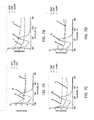
- FIGS. 7A-7D depict representative spectrograms obtained by UV-Visible spectroscopic analysis of the dielectric-silver nanocomposite material, (and in particular, silica-silver nanocomposite material) comparable to those of a silver nanoparticle lacking a silica matrix, and a silica nanoparticle lacking the silver nanoparticle, respectively, in accordance with one or more aspects of the present invention.
- FIG. 8 depicts representative example of Zeta potential of the silica-silver nanocomposite material relative to that of the silver nanoparticle lacking the silica matrix and the silica nanoparticle, respectively, in accordance with one or more aspects of the present invention.
- FIGS. 9A-9H depict comparative examples of color passivation testing of the silica-silver nanocomposite material, that is subjected to thermal and UV treatments relative to those of the controls, in accordance with one or more aspects of the present invention.
- FIGS. 10A-10D illustrate a graphical representation of one embodiment of antimicrobial efficacy of the silica-silver nanocomposite material relative to that of the silver nanoparticle lacking the silica matrix and the silica nanoparticle, respectively, for a Gram Positive cocci, (for example, S. aureus ), in accordance with one or more aspects of the present invention.
- a Gram Positive cocci for example, S. aureus
- FIGS. 11A-11D illustrate a graphical representation of one embodiment of antimicrobial efficacy of the silica-silver nanocomposite material relative to that of the silver nanoparticle lacking the silica matrix and the silica nanoparticle, respectively, for a Gram Negative rod, (for example, E. coli ), in accordance with one or more aspects of the present invention.
- a Gram Negative rod for example, E. coli
- FIGS. 12A-12B show a graphical representation of one embodiment of a colony forming unit (CFU) study of the silica-silver nanocomposite material with respect to the Gram Positive cocci, (for example, S. aureus ), in accordance with one or more aspects of the present invention.
- CFU colony forming unit
- FIGS. 13A-13D show a graphical representation of one embodiment of colony forming unit (CFU) study of the silica-silver nanocomposite material with respect to the Gram Negative rod (for instance, E. coli ), in accordance with one or more aspects of the present invention.
- CFU colony forming unit
- FIG. 14 illustrates a schematic representation of forming a silver nanoparticle, prior to being coated with a dielectric material, in accordance with one or more aspects of the present invention.
- Embodiments of the present disclosure will employ, unless otherwise indicated, techniques of chemistry, polymer chemistry, biology, and the like, which are within the skill of the art. Such techniques are explained fully in the literature.
- antimicrobial characteristic refers to the ability to kill and/or inhibit the growth of microorganisms.
- a substance having an antimicrobial characteristic may be harmful to microorganisms (e.g., bacteria, fungi, protozoans, algae, and the like).
- a substance having an antimicrobial characteristic can kill the microorganism and/or prevent or substantially prevent or inhibit the growth or reproduction of the microorganism.
- antibacterial characteristic refers to the ability to kill and/or inhibit the growth of bacteria.
- a substance having an antibacterial characteristic may be harmful to bacteria.
- a substance having an antibacterial characteristic can kill the bacteria and/or prevent or substantially prevent or inhibit the replication or reproduction of the bacteria.
- bacteria include, but are not limited to, Gram positive and Gram negative bacteria.
- Bacteria can include, but are not limited to, Abiotrophia, Achromobacter, Acidaminococcus, Acidovorax, Acinetobacter, Actinobacillus, Actinobaculum, Actinomadura, Actinomyces, Aerococcus, Aeromonas, Afipia, Agrobacterium, Alcaligenes, Alloiococcus, Alteromonas, Amycolata, Amycolatopsis, Anaerobospirillum, Anabaena affinis and other cyanobacteria (including the Anabaena, Anabaenopsis, Aphanizomenon, Camesiphon, Cylindrospermopsis, Gloeobacter Hapalosiphon, Lyngbya, Microcystis, Nodularia, Nostoc, Phormidium, Planktothrix, Pseudoanabaena
- bacterium examples include Mycobacterium tuberculosis, M. bovis, M. typhimurium, M. bovis strain BCG, BCG substrains, M. avium, M. intracellulare, M. africanum, M. kansasii, M. marinum, M. ulcerans, M. avium subspecies paratuberculosis, Staphylococcus aureus, Staphylococcus epidermidis, Staphylococcus equi, Streptococcus pyogenes, Streptococcus agalactiae, Listeria monocytogenes, Listeria ivanovii, Bacillus anthraces, B.
- subtilis Nocardia asteroides, and other Nocardia species, Streptococcus viridans group, Peptococcus species, Peptostreptococcus species, Actinomyces israelii and other Actinomyces species, and Propionibacterium acnes, Clostridium tetani, Clostridium botulinum, other Clostridium species, Pseudomonas aeruginosa, other Pseudomonas species, Campylobacter species, Vibrio cholera, Ehrlichia species, Actinobacillus pleuropneumoniae, Pasteurella haemolytica, Pasteurella multocida, other Pasteurella species, Legionella pneumophila, other Legionella species, Salmonella typhi, other Salmonella species, Shigella species Brucella abortus, other Brucella species, Chlamydi trachomatis, Chlamydia psittaci, Coxiella
- the Gram-positive bacteria may include, but is not limited to, Gram positive Cocci (e.g., Streptococcus, Staphylococcus, and Enterococcus ).
- the Gram-negative bacteria may include, but is not limited to, Gram negative rods (e.g., Bacteroidaceae, Enterobacteriaceae, Vibrionaceae, Pasteurellae and Pseudomonadaceae).
- Gram negative rods e.g., Bacteroidaceae, Enterobacteriaceae, Vibrionaceae, Pasteurellae and Pseudomonadaceae.
- the bacteria can include Mycoplasma pneumoniae.
- protozoan as used herein includes, without limitations flagellates (e.g., Giardia lamblia ), amoeboids (e.g., Entamoeba histolitica ), and sporozoans (e.g., Plasmodium knowlesi ) as well as ciliates (e.g., B. coli ).
- flagellates e.g., Giardia lamblia
- amoeboids e.g., Entamoeba histolitica
- sporozoans e.g., Plasmodium knowlesi
- ciliates e.g., B. coli
- Protozoan can include, but it is not limited to, Entamoeba coli, Entamoeabe histolitica, Iodoamoeba buetschlii, Chilomastix meslini, Trichomonas vaginalis, Pentatrichomonas homini, Plasmodium vivax, Leishmania braziliensis, Trypanosoma cruzi, Trypanosoma brucei, and Myxoporidia.
- algae includes, without limitations microalgae and filamentous algae such as Anacystis nidulans, Scenedesmus sp., Chlamydomonas sp., Clorella sp., Dunaliella sp., Euglena so., Prymnesium sp., Porphyridium sp., Synechoccus sp., Botryococcus braunii, Crypthecodinium cohnii, Cylindrotheca sp., Microcystis sp., Isochrysis sp., Monallanthus salina, M.
- Anacystis nidulans Scenedesmus sp., Chlamydomonas sp., Clorella sp., Dunaliella sp., Euglena so., Prymnesium sp., Porphyridium sp., Synechoccus sp., Botryoc
- fungi includes, without limitations, a plurality of organisms such as molds, mildews and rusts and include species in the Penicillium, Aspergillus, Acremonium, Cladosporium, Fusarium, Mucor, Nerospora, Rhizopus, Tricophyton, Botryotinia, Phytophthora, Ophiostoma, Magnaporthe, Stachybotrys and Uredinalis genera.
- the present invention relates to, inter alia, a composition including a dielectric-silver nanocomposite material, methods of preparing and using such compositions.
- metallic silver and silver-containing products have been found to be potent antibacterial agents, with an enhanced antibacterial efficacy relative to that of commonly used disinfectants, such as, sodium hypochlorite and phenol.
- disinfectants such as, sodium hypochlorite and phenol.
- silver for instance, either as a silver nanoparticle or in ionic form
- ionic silver e.g. (Ag + ) ions
- silver ions are shown to be more effective against a number of microorganisms including fungi, viruses, and bacteria. This may be due to the fact that these microorganisms develop low resistance against silver (Ag + ) ions.
- silver for instance, either as silver nanoparticles or ionic silver
- This increase in the loading efficiency of silver within the delivery matrix facilitates enhancing the chemical and the thermal stabilities of silver disposed therein.
- enhanced stabilities of silver allow a sustained release of the silver nanoparticle from the delivery matrix, thereby facilitating a sustained and prolonged increase in its antimicrobial efficacy.
- silver ions have traditionally been loaded onto organic polymeric materials, such as, poly (L-lactide) fibers, for instance, during the fabrication of certain thermoplastic-based products that require high-temperature (e.g. >300° C.) processing conditions.
- dielectric materials such as, silica
- the dielectric materials may also be employed as an attractive alternative to the traditional organic polymer materials, owing to their chemical inertness and outstanding thermal stability.
- the dielectric materials, such as, silica matrix are also considered as biocompatible and environmentally-friendly materials.
- compositions that includes a dielectric-silver nanocomposite material in which a silver nanoparticle that has been co-loaded with ionic silver is encapsulated within a dielectric material, such as, for instance, silica material.
- a dielectric material such as, for instance, silica material.
- the dielectric-silver nanocomposite material can be formed either as a nanoparticle (referred to herein as a “dielectric-silver nanocomposite particle”) or as a gel-like matrix (referred to herein as “dielectric-silver nanocomposite gel”).
- the silver for instance, silver from either the silver nanoparticle and/or the ionic silver
- the dielectric material refers to silicon dioxide (referred to herein as “silica”) for ease of understanding.
- such an immobilization of silver advantageously, minimizes or inhibits electronic oscillations of the valence electrons of the trapped silver, resulting in shifting the plasmon resonance out of the visible region (i.e., from 390 nm to 500 nm), thereby rendering the dielectric-silver nanocomposite material (referred to herein as “silica-silver nanocomposite particle”) transparent.
- a sustained release of silver for example, as a silver nanoparticle and/or ionic silver, facilitates the silica-silver nanocomposite material/particle to function as an antimicrobial agent that eliminates and/or inhibits the formation of microbes over surfaces.
- the antimicrobial characteristics of the composition that includes the silica-silver nanocomposite material/particle may be such that the composition may eliminate and/or kill about 70% to about 99% of microbes, or minimize the growth of microbes from a surface by an order of about 70% to about 99% relative to that of an untreated surface.
- the composition including the silica-silver nanocomposite material/particle can also be used as an antimicrobial coating over surfaces of structures, such as, but are not limited to, textile fabrics, cooking counters, food processing facilities (e.g., food, meat, poultry and the like), airplane interiors, kitchen utensils, food packaging materials, swimming pools, metals (e.g., metal oxides, metal alloys and the like), drug vials, medical instruments, medical implants, yarns, fibers, gloves, furniture, plastic devices (including, for instance, polymer and/or polymer blends), toys, diapers, leather, tiles, filters or filtration units (e.g., HEPA for air and water), glass or glass like structures, flooring metals (e.g., stone, ceramic, marble, granite and the like) and the combination thereof.
- structures such as, but are not limited to, textile fabrics, cooking counters, food processing facilities (e.g., food, meat, poultry and the like), airplane interiors, kitchen utensils, food packaging materials,
- the silica-silver nanocomposite material/particle may be synthesized as illustrated in FIG. 1 .
- the reaction process discussed below can be performed using a single reaction vessel or can use multiple reaction vessels.
- a capping-agent precursor (not shown) is dissolved in an aqueous solution and chilled to approximately 0° C.
- the aqueous solution of the capping-agent precursor is agitated till a clear solution is obtained, to which an aqueous solution of silver-precursor is added and the reaction mixture is further agitated until dissolved.
- a freshly prepared solution of a reducing agent in deionized water is added to the above mixture at 0° C. and stirred vigorously.
- a rapid color change of the reaction mixture is observed from an initial transparent solution to translucent dark yellow solution, followed by a gradual color change to transparent brilliant yellow solution indicating a progression in the reaction process.
- the reaction mixture was then allowed to stir for 2 hours at 0° C. till completion of the reaction, resulting in the formation of a capping-agent coated silver nanoparticle (referred to herein as “silver nanoparticle”).
- silver nanoparticle a capping-agent coated silver nanoparticle
- ionic silver in the form of excess silver-precursor may also be present along with the silver nanoparticle in the reaction mixture.
- capping-agent precursor may be or include, but are not limited to, citric acid, or a citrate salt thereof
- silver-precursor may include, but are not limited to, silver nitrate salt, a silver chelate (e.g., chelating agent such as, p-dimethylaminobenzalrhodanine, tris(phenanthroline) Fe(II) and the like, and thiol silver complexing chelates (mercaptans, such as, dimethylsulfoniopropanoate, mercaptomethane and the like)).
- a silver chelate e.g., chelating agent such as, p-dimethylaminobenzalrhodanine, tris(phenanthroline) Fe(II) and the like
- thiol silver complexing chelates mercaptans, such as, dimethylsulfoniopropanoate, mercaptomethane and the like
- a silver nanoparticle i.e., citrate-coated silver nanoparticle
- a borohydride reduction method in which silver ions are reduced to metallic silver which, for instance, undergoes a nucleation process by aggregating each of the metallic silver particles, followed by a growth process to form silver nanoparticles.
- the formation of the silver nanoparticles may be summarized, as depicted in FIG. 14 .
- the size and the diameter of each of the silver nanoparticles can be controlled during the nucleation process by using the capping-agent, such as, citrate, during the borohydride reduction method.
- the citrate capping-agent adsorbs/coats a surface of each of the silver nanoparticles which, for instance, allows controlling the nucleation process, thereby controlling the particle size of each of the silver nanoparticle.
- the size and the diameter of each of the silver nanoparticles can be varied and controlled by adjusting parameters, such as, ratios of the silver precursor and the capping-agent precursor, polarity of the reaction medium, time of reaction, and the like.
- each silver nanoparticle may have a diameter within a range of about 3 nm to about 15 nm.
- each of the silver nanoparticles has a diameter of about 6 nm, as verified using transmission electron micrograph (TEM) image and imageJ software for analysis of the silver nanoparticles.
- TEM transmission electron micrograph
- FIGS. 2A-2B each of the citrate-coated silver nanoparticles have been found to be spherical in shape, and an estimation of size distribution of each of the citrate-coated silver nanoparticles has been obtained by measuring the diameter of the particles in the TEM image. As depicted in FIG.
- the average size of the citrate-coated silver nanoparticles has been calculated to be about 6. 51 nm, with a standard deviation of about 2.62 nm.
- the silver nanoparticles may have a crystalline lattice structure (for instance, a face-centered cubic configuration) as indicated by the regularity of constructive and destructive interferences forming the TEM image depicted in FIG. 3 .
- the silver nanoparticle that has been coated with the capping agent and any of the remaining unreacted silver ions are then incorporated into the silica nanoparticles, for instance, employing a Stober synthesis mechanism, using an inorganic base in presence of an organic solvent, resulting in a silica-silver nanocomposite particle, in accordance with one or more aspects of the present invention.
- the silica-coated silver nanocomposite particle may be formed by further diluting the silver nanoparticle that has been coated with capping agent to form an aqueous solution, to which a dielectric-material precursor in an organic solvent, such as, ethanol, is added and stirred at room temperature.
- the dielectric-material precursor may be or include, a silane precursor such as, for example, a silane compound (e.g., alkyl silane, tetraethoxysilane (TEOS), tetramethoxysilane, sodium silicate, or any silane precursor that can produce silicic acid or silicic acid like intermediates and a combination of these silane compounds).
- a silane precursor such as, for example, a silane compound (e.g., alkyl silane, tetraethoxysilane (TEOS), tetramethoxysilane, sodium silicate, or any silane precursor that can produce silicic acid or silicic acid like intermediates and a combination of these silane compounds).
- TEOS tetraethoxysilane
- sodium silicate tetramethoxysilane
- an inorganic base such as, ammonium hydroxide (NH 4 OH) is added and the reaction mixture is allowed to stir at room temperature for
- an excess dielectric-material precursor may be added to the reaction mixture so as to coat any unreacted silver nanoparticle (i.e., citrate-coated silver nanoparticle) and the ionic silver.
- an initial yellow color of the solution is converted to a milky white solution, indicating successful coating of the silver nanoparticles and the ionic silver, as confirmed by the solutions depicted in FIG. 4 .
- FIG. 4 reveals the visual confirmation of successful coating as observed by a change in the color of the solution containing silica-silver nanocomposite particle, before and after the addition of NH 4 OH.
- the silica-silver nanocomposite material may be obtained either as a nanoparticle or a gel-like matrix, depending upon the reaction conditions employed.
- the silica-silver nanocomposite material obtained as a nanoparticle may include, for instance, a silver nanoparticle being formed as a core component and the silica matrix surrounding the silver nanoparticle being formed as a corresponding shell component.
- the silver ions may be interspersed within the shell component and surrounding the silver nanoparticle core component.
- the silica-silver nanocomposite material obtained as a gel-like matrix may include, for instance, silica particles being interconnected to one another as an amorphous gel.
- the silver nanoparticles and the silver ions may be interspersed randomly within the gel-like silica matrix and/or attached to one or more silica particles.
- the amorphous silica gel has no defined structure, unlike its crystalline counterpart, and may have amorphous structural composition.
- the average size of the silica particles has been found to be about 30 nm.
- the solution containing the silica-silver nanocomposite material may further be subjected to lyophilization, to obtain the silica-silver nanocomposite particle.
- lyophilization refers to a dehydration process in which moisture and/or other organic volatile solvents, such as, ethanol, amines, etc., are removed from the silica-silver nanocomposite particle by freezing the particle under vacuum, without damaging its crystallinity.
- the citrate that is adsorbed over the surface of the silver nanoparticle may also be removed from the silica-silver nanocomposite particle.
- each particle of the silica-silver nanocomposite particle may be within a range of about 2 nm to about 50 nm.
- each particle of the silica-silver nanocomposite particle has a diameter of about 2 nm (see FIG. 5B ), as confirmed by its transmission electron micrograph (TEM) image depicted in FIGS. 5A-5B .
- TEM transmission electron micrograph
- each particle of the silver nanoparticle may be attributed to the formation of a silver-amine complex obtained during the silica coating step, and subsequent deposition of the silver into the silica matrix during lyophilization, for instance, resulting in redistributing the overall silver content without any significant loss of the silver.
- the size and the diameter of each particle of the silica-silver nanocomposite particle can be varied from a few nanometers to hundreds of nanometers by appropriately adjusting synthesis parameters, such as, amounts of silane precursor, polarity of the reaction medium, pH, time of reaction and the like.
- silver present in the silica-silver nanocomposite particle may be within a range of about 1000 ng/mL to about 25000 ng/mL by weight percent of the silica-silver nanocomposite particle. In a specific example, silver present in the silica-silver nanocomposite particle may be about 2500 ng/mL. In one embodiment, the concentration of silver, subsequent to lyophilization and reconstitution, within the silica-silver nanocomposite particle has mathematically been found to be about 25.4 ⁇ g/mL.
- an increase in the electron density confirms the presence of the silver ions along with the silver nanoparticles.
- the concentration of the silver ions may also be controlled by appropriately adjusting the synthesis parameters, such as, amounts of silane precursor, polarity of the reaction medium, pH, time of reaction and the like.
- the TEM image of FIGS. 5A-5B additionally reveals the crystalline structure of the silver nanoparticle disposed within the silica-silver nanocomposite particle. Still further, the TEM image of the silica-silver nanocomposite particle reveals the presence of the silver nanoparticle along with the ionic silver indicated by the spherical morphology, depicted in FIGS. 6A-6B .
- the silica-silver nanocomposite material either as a nanoparticle or a gel-like matrix, has been observed to be transparent and colorless.
- metals such as, silver, absorb light by creating plasmons, which are particle-like collective excitations of conduction electrons at a metallic surface, that, for instance, can be confirmed by corresponding signals and/or peaks in UV-Visible spectroscopic analysis thereof.
- a UV-Visible spectroscopic analysis of the silica-silver nanocomposite material as depicted in FIGS.
- each of the samples has same concentrations of silver (if present).
- each of the silver nanoparticle, the silica-silver nanocomposite material and the silica nanoparticle have been prepared in three separate batches on three separate days in order to verify the robustness of the protocol, and the UV-Visible spectra of each of the samples have been analyzed, as depicted in FIGS. 7B-7D , while the UV-Visible spectrum, as depicted in FIG. 7A , reveals an average spectrum of the corresponding materials.
- the absence of the silver plasmon peak in the UV-visible spectrum of the silica-silver nanocomposite particle (C) relative to the presence of the peak centered at 398 nm for the silver nanoparticle (B) confirms a successful coating of the silver nanoparticle and the silver ions with silica matrix.
- Such successful coating of the silver nanoparticle and the silver ions with silica could result in silver, from each of the silver nanoparticles and the ionic silver, for instance, being chelated by the silanol (Si—OH) groups present in the silica matrix to form a weak Ag—Si complex.
- the chelation of silver by the silanol groups results in immobilizing silver from both the silver nanoparticles and the silver ions; thereby minimizing or inhibiting electronic oscillations of the valence electrons of the trapped silver.
- This results in shifting the plasmon resonance (i.e., blue shifting the plasmon) out of the visible region (i.e., from 390 nm to 500 nm) and also rendering the silica-silver nanocomposite particle transparent.
- the “blue shifting of the plasmon” refers to a spectral shift towards lower wavelengths (i.e., higher energy and higher frequency) as confirmed by the absence of the silver plasmon peak in the UV-Visible spectrum depicted in FIGS. 7A-7D . This observation is also consistent with the absence of the silver peak in the UV-Visible spectrum of the silica nanoparticle (A) lacking the silver components.
- the shift in the plasmon peak in one embodiment, could depend on the thickness of the silica material encapsulating the silver nanoparticles and the silver ions of the silica-silver nanocomposite particle.
- zeta potential refers to the potential difference existing between the surface of a solid particle immersed in a conducting liquid and the bulk of the liquid. Note that, as depicted in FIG. 8 , Zeta potential of the silica-silver nanocomposite particle (B) lies between that of the silver nanoparticle and the silica nanoparticle, respectively.
- the Zeta potential of the silica-silver nanocomposite particle is within a range of about ⁇ 30 mV to ⁇ 40 mV.
- the Zeta potential further, reveals a high degree of colloidal stability of the resultant silica-silver nanocomposite particle (SiAgNP).
- color passivity of the silica-silver nanocomposite particle has been further confirmed by subjecting tiles that have been coated with the silica-silver nanocomposite particle to thermal and UV treatments, as depicted in FIGS. 9A-9H .
- tiles for instance, that have been coated with silver nitrate (AgNO 3 ) (see FIGS. 9A & 9B ) and silver nanoparticle (AgNP) (see FIGS. 9C & 9D ), have been used as controls, and have also been subjected to the thermal and the UV treatments, respectively.
- FIGS. 9A-9H shows that have been coated with silver nitrate (AgNO 3 )
- AgNP silver nanoparticle
- the tiles that have been coated with silver nitrate do not show formation of color before the thermal treatment ( 9 A), and subsequent to the thermal treatment ( 9 B), show a dark brown/black color.
- tiles coated with silver nanoparticle (AgNP) show formation of color immediately upon coating ( FIG. 9C ), and no noticeable change ( FIG. 9D ) after thermal and UV treatments, respectively.
- tiles coated with silica nanoparticle (SiNP) which also have been used as a control, do not show formation of color before ( FIG. 9E ) or after ( FIG. 9F ) the thermal and UV treatments.
- FIGS. 9G & 9H tiles coated with silica-silver nanocomposite particle (SiAgNP) shows no formation of color before ( FIG. 9G ) or after ( FIG. 9H ) the thermal and UV treatments.
- the silica-silver nanocomposite particle has been observed to have enhanced antimicrobial efficacy relative to that of an isolated silver nanoparticle lacking the dielectric material encapsulation.
- an enhanced antimicrobial efficacy may be attributed to a sustained release of silver, for example, either as a nanoparticle and/or its ionic form.
- antimicrobial efficacy of the silica-silver nanocomposite particle was evaluated relative to that of the silver nanoparticle (AgNP) lacking the dielectric material encapsulation and aqueous silver nitrate (AgNO 3 ) solutions, respectively, at equivalent concentrations of silver (if present).
- the silver nanoparticle and the silver nitrate in this example, have been used as a positive growth control, while the silica nanoparticle (SiNP) lacking silver components, has been used as a negative growth control.
- Further antimicrobial characterization of the silica-silver nanocomposite particle for instance, using a bacterial viability assay revealed a time-dependent killing trend in the silica-silver nanocomposite particle (SiAgNP) that suggests a controlled release of ionic silver (Ag + ) from within the silica matrix.
- Antimicrobial efficacy of the silica-silver nanocomposite particle SiAgNP was determined to lie between that silver nitrate (which, for instance, is a most effective antimicrobial form of silver) and that of silver nanoparticle (AgNP) (which, for instance, has a least effective antimicrobial form of silver).
- the antimicrobial efficacy of the silica-silver nanocomposite particle has been studied by subjecting the silica-silver nanocomposite particle to minimum inhibitory concentration (MIC) studies which, for instance, may be performed by exposing two normal human flora organisms, namely, a Gram Negative rod, such as, E. coli, that is commonly found in the gut, and a Gram Positive cocci, such as, S. aureus, found on skin surfaces, to the silica-silver nanocomposite particle over a period of time, i.e., for 1, 4, and 8 hours of exposure.
- MIC minimum inhibitory concentration
- FIGS. 10A-10C depict a graphical representation of the antimicrobial efficacy of the silica-silver nanocomposite particle with respect to Gram Positive cocci, such as, S. aureus over a period of time, i.e., for 1, 4 and 8 hours of exposure, respectively, while FIG.
- FIG. 10D depicts a graphical representation of the time of exposure and dosage-dependent killing trend of the silica-silver nanocomposite particle against the Gram Positive cocci (for example, S. aureus ).
- the silica-silver nanocomposite particle having concentration of silver is about 0.050 ⁇ g/mL for about 8 hours of exposure to bacteria exhibits optimal antimicrobial efficacy against the Gram Positive cocci (for example, S. aureus ).
- FIGS. 11A-11C depict a graphical representation of the antimicrobial efficacy of the silica-silver nanocomposite particle with respect to the Gram Negative rod, such as, E. Coli over a period of time, i.e., for 1, 4 and 8 hrs of exposure, respectively
- FIG. 11D depicts a graphical representation of the time of exposure and dosage-dependent killing trend of the silica-silver nanocomposite particle against the Gram Negative rod (for example, E. Coli ).
- silver nanoparticle and silver nitrate were employed as positive growth controls, while silica nanoparticle was used as negative growth control, as similar to as described above in connection with FIGS. 10A-10C .
- silica-silver nanocomposite particle when tested against E. coli exhibits an antimicrobial efficacy which lies between that of the silver nanoparticle (AgNP), an initially metallic form of Ag, and silver nitrate (AgNO 3 ) solution, an initially ionic form of Ag, as evident from the FIGS. 11A-11C .
- the efficacy of the silica-silver nanocomposite particle approached the efficacy of AgNO 3 .
- a similar conclusion can be drawn from testing using S. aureus, however higher quality data would allow for better analysis.
- FIGS. 12A-12B depicts a graphical representation of a reduction in colony-forming units (CFU) of the Gram Positive cocci (for example, S. aureus ) as observed at five concentrations of silver ranging from about 0.1 ⁇ g/mL to about 0.6 ⁇ g/mL.
- CFU colony-forming units
- FIGS. 13A-13D depicts a graphical representation of a reduction in colony-forming units (CFU) of the Gram Negative rod (for example, E. Coli ) as observed at five concentration of silver ranging from about 0.1 ⁇ g/mL to about 0.6 ⁇ g/mL.
- CFU colony-forming units
- the reduction in the CFU has been measured upon exposure over a period of time, namely, 1 hour of exposure ( FIG. 13A ), 4 hours of exposure ( FIG. 13B ), respectively.
- FIG. 13A which, for instance, has been exposed for 1 hr
- FIG. 13D which, for instance, has been exposed for 4 hrs respectively.
- time points were selected by analyzing MIC data, and noting a pronounced change in reduction of Alamar Blue between 1 and 4 hours, while a much smaller change was noted from 4 to 8 hours of incubation.
- Ag concentrations were selected to include MICs for each material, allowing for comparison of relative efficacy.
- Reagents used for synthesis were purchased from commercial vendors and used as received, with no additional purification.
- Silver nitrate (AgNO 3 , obtained from Acros Organics), sodium borohydride (NaBH 4 ), and trisodium citrate (TSC, obtained from Fisher Biotech) were utilized in the synthesis of silver nanoparticles for testing.
- Tetraethyl orthosilicate (TEOS, obtained from Gelest Inc.) ammonium hydroxide (NH 4 OH, obtained from Fisher), and 95% ethanol (EtOH, obtained from Fisher) were utilized in the coating of the synthesized silver nanoparticles.
- Muller Hinton II (MH 2 ) agar and broth were purchased from Fluka, and prepared as directed in the literature using a Tuttnauer EZ10 autoclave. 10 ⁇ phosphate buffered saline was purchased from Life Technologies and diluted to 1 ⁇ using deionized water (Nanopure; Barnstead Model #D11911), and filter sterilized using a 0.2 micron Nalgene filter. M9 minimal salts+1% glucose media was generated from M9 minimal salts (obtained from Sigma) and dextrose powder (obtained from Fluka) using deionized water, and filter sterilized using a 0.2 micron Nalgene filter.
- Escherichia coli ATC C #10536
- Staphylococcus aureus ATCC #25923
- Alamar blue obtained from Life Technologies, Cat #DA L1100
- Carbon coated 400 mesh copper TEM grids were purchased from Electron Microscope Sciences.
- Citrate capped silver nanoparticles having a concentration of silver of about 0.29 mM, were synthesized, using a borohydride reduction protocol. For each synthesis, a rectangular glass bottle, having a total volume approximately 120 mL, was washed with a small volume of acetone to remove manufacturing residues, and allowed to dry. About 100 mL of deionized water, at room temperature, was then placed in the bottle, to which about 31.2 mg trisodium citrate (TSC) was added. The bottle was shaken to dissolve the TSC and then chilled to approximately 0° Celsius, as indicated by the formation of small ice crystals in the solution. Further agitation was utilized until it was observed that the ice crystals were no longer visible.
- TSC trisodium citrate
- Fresh silver nitrate solution having a molarity of about 5 mM was prepared using about 10 mL of room temperature ddH 2 O and about 8.5 mg silver nitrate powder, and shaken until dissolved. About 6.25 mL of this solution was added to the chilled, stirring TSC solution.
- Fresh sodium borohydride solution was mixed immediately before use by adding about 37.8 mg NaBH 4 to about 10 mL of room temperature deionized water, and shaking vigorously. About 625 ⁇ L of the NaBH 4 was then added at a rate of approximately 60 ⁇ L/30 seconds to the vigorously stirring 0° C.
- the citrate capped silver nanoparticles were diluted to a final concentration of about 0.24 mM by adding about 16.117 mL AgNP stock to about 3.519 mL ddH 2 O. This stock solution was then added to about 79 mL of 95% ethanol, and placed on a stir plate at 400 rpm. The color of the solution was noted to be bright yellow. About 223 ⁇ L tetraethylorthosilicate (TEOS) was added and allowed to fully dissolve into the ethanol solution under stirring. To initiate the coating reaction, about 933 ⁇ L of NH 4 OH was added, and allowed to stir for about 12-15 hours (i.e., overnight).
- TEOS tetraethylorthosilicate
- TEOS tetraethyl ortho silicate
- each of the silver nanoparticles (AgNP), silica nanoparticles (SiNP) and silica-silver nanoparticle (SiAgNP) were characterized to establish the physical and antimicrobial properties of each, with a silver nitrate (AgNO 3 ) solution of equivalent silver concentration being used as a control.
- AgNO 3 silver nitrate
- the absorbance spectrum of each material i.e., silver nanoparticle (AgNP), silica nanoparticle (SiNP), silica-silver nanoparticle (SiAgNP) and silver nitrate (AgNO 3 ) was collected in the range of about 200 to about 800 nm at a bandwidth of about 0.5 nm, utilizing a Cary UV-Vis spectrophotometer. Two quartz cuvettes were used, with a water blank in the reference cell. An initial background subtraction was taken after zeroing the machine, and all samples were disbursed in ddH 2 O for measurements at synthesized concentrations. Cuvettes were briefly sonicated immediately prior to measurements to minimize the presence of aggregates.
- TEM imaging was carried out on the silver nanoparticle AgNP and silica-silver nanoparticle SiAgNP. About 15 ⁇ L aliquots of freshly sonicated material was drop coated onto ultrathin carbon coated copper TEM grids, and allowed to dry for 1 hour at room conditions. TEM grids were then transferred to separate microcentrifuge tubes and placed under 0.024 mBar conditions for 1 hour to remove any trace water. Grids were stored overnight in ambient conditions prior to imaging studies.
- White tiles were purchased from Home Depot, and scrubbed with acetone and Kim wipes to remove any oils which would inhibit materials from adhering well. After scrubbing and allowing the tiles to dry, about 50 ⁇ L samples of each material were spread over an area approximately 3cm by 3cm, and allowed to dry under ambient conditions. A picture was taken, and then tiles were exposed to long and shortwave UV radiation for 5 minutes, and briefly heated using a butane torch, and photographed again to observe the change in color of each material.
- Organisms were grown for 12 hours in 40 mL of MH2 broth at 37° C. on an orbital shaker in 50 mL conical tubes, loosely capped to allow gas exchange. Prior to testing, each organism was spun down at 4500 g for 3 minutes, and the supernatant discarded. The pellet was resuspended in 40 mL of warm M9/1% glucose broth and incubated further for 2 hours on the orbital shaker. While incubating in M 9/1% glucose media, plates were prepared by pipetting 100 ⁇ L M9/1% glucose into each well.
- Row A was then filled with 100 ⁇ L of each material in triplicate, AgNP, SiAgNP, AgNO 3 , and serial diluted by transferring 100 ⁇ L of each row down one successive row until 8 dilutions were achieved. 100 ⁇ L were discarded from row H, leaving a total volume per well of 100 ⁇ L of broth and diluted antimicrobial agent. SiNP was treated similarly, but was diluted three times, utilizing columns 11 and 12. Positive and negative growth controls were included in triplicate in column 1. For each organism, 1 plate was prepared for each time point, 1 hour, 4 hours, and 8 hours.
Landscapes
- Chemical & Material Sciences (AREA)
- Life Sciences & Earth Sciences (AREA)
- Engineering & Computer Science (AREA)
- General Health & Medical Sciences (AREA)
- Organic Chemistry (AREA)
- Health & Medical Sciences (AREA)
- Nanotechnology (AREA)
- Plant Pathology (AREA)
- Wood Science & Technology (AREA)
- Inorganic Chemistry (AREA)
- Environmental Sciences (AREA)
- Dentistry (AREA)
- Zoology (AREA)
- Pest Control & Pesticides (AREA)
- Agronomy & Crop Science (AREA)
- Materials Engineering (AREA)
- Crystallography & Structural Chemistry (AREA)
- Toxicology (AREA)
- General Physics & Mathematics (AREA)
- Condensed Matter Physics & Semiconductors (AREA)
- Composite Materials (AREA)
- Physics & Mathematics (AREA)
- Chemical Kinetics & Catalysis (AREA)
- General Chemical & Material Sciences (AREA)
- Agricultural Chemicals And Associated Chemicals (AREA)
Abstract
The present invention relates to, inter alia, a composition, a nanocomposite material, and a method for preparing the nanocomposite material. The nanocomposite material includes: a dielectric-silver nanocomposite material, the dielectric-silver nanocomposite material including a silver nanoparticle having a silver ion, and a dielectric material encapsulating the silver nanoparticle, where the silver ion chelates with a matrix of the dielectric material, and a surface plasmon band absorption of the dielectric-silver nanocomposite material lies outside a range of a visible region.
Description
The embodiments as disclosed herein and the invention as claimed herein were funded by the United States National Science Foundation under Grant Number 0506560. The United States Government has rights in the invention as claimed herein.
This application is related to, and derives from, U.S. Provisional Patent Application Ser. No. 62/240,849, filed 13 Oct. 2015 and titled “Synthesis And Characterization of Antimicrobial Non-Color Forming Silver-Silica Nanocomposite.”
Silver, as an antimicrobial agent, continues to be a growing area of interest across many industries such as, medicinal, pharmaceutical and aeronautical, although silver has traditionally been valued for its ductility and luster. For instance, silver nitrate has been used for treating eye diseases in infants, while silver sulfadiazine has been used for topical administration in the healthcare industry. As understood, these compounds take advantage of enhanced potency of the silver (Ag+) ion against microbes, while leaving eukaryotic cells unharmed when applied topically at microbicidal concentrations. For instance, silver (Ag+) ion binds to sulfur and/or phosphorus atoms within a cell, disrupting protein and DNA structures, which, for instance, leads to inhibition of essential cellular processes, membrane disruption, and DNA damage. This, for instance, eventually results in the death of the cell. In another example, silver also induces decoupling of the respiratory chain, leading to cell death.
Additionally, owing to their antimicrobial characteristics, silver or silver-containing products are often utilized as antimicrobial coatings over surfaces, such as, toilet handles, pens, door knobs, and aircraft surfaces, to minimize fomite-mediated transmission of microbes. Disadvantageously, silver coatings cause discolorations, (for example, unpleasant dark brown to grey color) of such surfaces, due to aggregation of silver particles which, for instance, leads to a strong plasmon signal. As understood, metallic silver exhibits high plasmonic efficiency, due to collective oscillation of valence electrons of silver, when an incident photon matches the resonant frequencies of the valence electrons, leading to emission of that energy as a photon which, for instance, can be confirmed by a strong silver peak in its corresponding UV-Visible spectrum.
Accordingly, there exists a continuing need for developing novel silver-containing products that remain colorless (for instance, visibly indistinguishable from an untreated surface, upon coating), without compromising its antimicrobial efficacy.
The present invention is directed to, inter alia, a composition having a dielectric-silver nanocomposite material having antimicrobial characteristics, a nanocomposite material, and a method for preparing a nanocomposite material of the same. The dielectric-silver nanocomposite material includes a silver nanoparticle that is co-loaded with ionic silver, where the silver from each of the silver nanoparticle and the ionic silver chelates with a dielectric material, such as, silica. A surface plasmon band absorption of the dielectric-silver nanocomposite material lies outside a range of a visible region, resulting in its transparency. Further, a sustained release of each of the silver nanoparticle and the ionic silver from the dielectric-silver nanocomposite particle promotes its antimicrobial characteristics, without affecting the transparency of the dielectric-silver nanocomposite material.
In one aspect of the present application, a composition including: a dielectric-silver nanocomposite material, the dielectric-silver nanocomposite material including a silver nanoparticle that is co-loaded with an ionic silver, and a dielectric material encapsulating each of the silver nanoparticle and the ionic silver, wherein silver from each of the silver nanoparticle and the ionic silver chelates with a matrix of the dielectric material, and a surface plasmon band absorption of the dielectric-silver nanocomposite material lies outside a range of a visible region.
In another aspect of the present application, a nanocomposite material including: a silver nanoparticle that is co-loaded with an ionic silver, and a dielectric material encapsulating each of the silver nanoparticle and the ionic silver to form a dielectric-silver nanocomposite material, wherein silver from each of the silver nanoparticle and the ionic silver chelates with a matrix of the dielectric material, and a surface plasmon band absorption of the dielectric-silver nanocomposite material lies outside a range of a visible region. In yet another aspect of the present application, a method for preparing a nanocomposite material, the method including: mixing an aqueous solution of a silver-precursor with an aqueous solution of a capping-agent precursor in presence of a reducing agent at 0° C. to form a mixture I, the mixture I comprising a capping-agent-coated silver nanoparticle and an ionic silver; and mixing an aqueous solution of the mixture I with a dielectric-material precursor in an organic solvent to form a dielectric-silver nanocomposite material, the dielectric-silver nanocomposite material including the capping-agent-coated silver nanoparticle that is co-loaded with the ionic silver, and a dielectric material encapsulating each of the capping-agent-coated silver nanoparticle and the ionic silver, wherein silver from each of the capping-agent-coated silver nanoparticle and the ionic silver chelates with a matrix of a dielectric material, and a surface plasmon band absorption of the dielectric-silver nanocomposite material lies outside a range of a visible region.
Other compositions, methods, features, and advantages will be, or become, apparent to one with skill in the art upon examination of the following drawings and detailed description.
Many aspects of this disclosure can be better understood with reference to the following drawings. The components in the drawings are not necessarily to scale, emphasis instead being placed upon clearly illustrating the principles of the present disclosure. Moreover, in the drawings, like reference numerals designate corresponding parts throughout the several views.
Before the present disclosure is described in greater detail, it is to be understood that this disclosure is not limited to particular embodiments described, and as such may, of course, vary. It is also to be understood that the terminology used herein is for the purpose of describing particular embodiments only, and is not intended to be limiting, since the scope of the present disclosure will be limited only by the appended claims.
Unless defined otherwise, all technical and scientific terms used herein have the same meaning as commonly understood by one of ordinary skill in the art to which this disclosure belongs. Although any methods and materials similar or equivalent to those described herein can also be used in the practice or testing of the present disclosure, the preferred methods and materials are now described.
All publications and patents cited in this specification are herein incorporated by reference as if each individual publication or patent were specifically and individually indicated to be incorporated by reference and are incorporated herein by reference to disclose and describe the methods and/or materials in connection with which the publications are cited. The citation of any publication is for its disclosure prior to the filing date and should not be construed as an admission that the present disclosure is not entitled to antedate such publication by virtue of prior disclosure. Further, the dates of publication provided could be different from the actual publication dates that may need to be independently confirmed.
As will be apparent to those of skill in the art upon reading this disclosure, each of the individual embodiments described and illustrated herein has discrete components and features that may be readily separated from or combined with the features of any of the other several embodiments without departing from the scope or spirit of the present disclosure. Any recited method can be carried out in the order of events recited or in any other order that is logically possible.
Embodiments of the present disclosure will employ, unless otherwise indicated, techniques of chemistry, polymer chemistry, biology, and the like, which are within the skill of the art. Such techniques are explained fully in the literature.
The following examples are put forth so as to provide those of ordinary skill in the art with a complete disclosure and description of how to perform the methods and use the compositions and compounds disclosed and claimed herein. Efforts have been made to ensure accuracy with respect to numbers (e.g., amounts, temperature, etc.), but some errors and deviations should be accounted for. Unless indicated otherwise, parts are parts by weight, temperature is in ° C., and pressure is in atmospheres. Standard temperature and pressure are defined as 25° C. and 1 atmosphere.
Before the embodiments of the present disclosure are described in detail, it is to be understood that, unless otherwise indicated, the present disclosure is not limited to particular materials, reagents, reaction materials, manufacturing processes, or the like, as such can vary. It is also to be understood that the terminology used herein is for purposes of describing particular embodiments only, and is not intended to be limiting. It is also possible in the present disclosure that steps can be executed in different sequence where this is logically possible.
It must be noted that, as used in the specification and the appended claims, the singular forms “a,” “an,” and “the” include plural referents unless the context clearly dictates otherwise. Thus, for example, reference to “a support” includes a plurality of supports. In this specification and in the claims that follow, reference will be made to a number of terms that shall be defined to have the following meanings unless a contrary intention is apparent.
Definitions (Which Are Not Necessarily Limited to the Present Disclosure):
The term “antimicrobial characteristic” refers to the ability to kill and/or inhibit the growth of microorganisms. A substance having an antimicrobial characteristic may be harmful to microorganisms (e.g., bacteria, fungi, protozoans, algae, and the like). A substance having an antimicrobial characteristic can kill the microorganism and/or prevent or substantially prevent or inhibit the growth or reproduction of the microorganism.
The term “antibacterial characteristic” refers to the ability to kill and/or inhibit the growth of bacteria. A substance having an antibacterial characteristic may be harmful to bacteria. A substance having an antibacterial characteristic can kill the bacteria and/or prevent or substantially prevent or inhibit the replication or reproduction of the bacteria.
The terms “bacteria” or “bacterium” include, but are not limited to, Gram positive and Gram negative bacteria. Bacteria can include, but are not limited to, Abiotrophia, Achromobacter, Acidaminococcus, Acidovorax, Acinetobacter, Actinobacillus, Actinobaculum, Actinomadura, Actinomyces, Aerococcus, Aeromonas, Afipia, Agrobacterium, Alcaligenes, Alloiococcus, Alteromonas, Amycolata, Amycolatopsis, Anaerobospirillum, Anabaena affinis and other cyanobacteria (including the Anabaena, Anabaenopsis, Aphanizomenon, Camesiphon, Cylindrospermopsis, Gloeobacter Hapalosiphon, Lyngbya, Microcystis, Nodularia, Nostoc, Phormidium, Planktothrix, Pseudoanabaena, Schizothrix, Spirulina, Trichodesmium, and Umezakia genera) Anaerorhabdus, Arachnia, Arcanobacterium, Arcobacter, Arthrobacter, Atopobium, Aureobacterium, Bacteroides, Balneatrix, Bartonella, Bergeyella, Bifidobacterium, Bilophila Branhamella, Borrelia, Bordetella, Brachyspira, Brevibacillus, Brevibacterium, Brevundimonas, Brucella, Burkholderia, Buttiauxella, Butyrivibrio, Calymmatobacterium, Campylobacter, Capnocytophaga, Cardiobacterium, Catonella, Cedecea, Cellulomonas, Centipeda, Chlamydia, Chlamydophila, Chromobacterium, Chyseobacterium, Chryseomonas, Citrobacter, Clostridium, Collinsella, Comamonas, Corynebacterium, Coxiella, Cryptobacterium, Delftia, Dermabacter, Dermatophilus, Desulfomonas, Desulfovibrio, Dialister, Dichelobacter, Dolosicoccus, Dolosigranulum, Edwardsiella, Eggerthella, Ehrlichia, Eikenella, Empedobacter, Enterobacter, Enterococcus, Erwinia, Erysipelothrix, Escherichia, Eubacterium, Ewingella, Exiguobacterium, Facklamia, Filifactor, Flavimonas, Flavobacterium, Francisella, Fusobacterium, Gardnerella, Gemella, Globicatella, Gordona, Haemophilus, Hafnia, Helicobacter, Helococcus, Holdemania Ignavigranum, Johnsonella, Kingella, Klebsiella, Kocuria, Koserella, Kurthia, Kytococcus, Lactobacillus, Lactococcus, Lautropia, Leclercia, Legionella, Leminorella, Leptospira, Leptotrichia, Leuconostoc, Listeria, Listonella, Megasphaera, Methylobacterium, Microbacterium, Micrococcus, Mitsuokella, Mobiluncus, Moellerella, Moraxella, Morganella, Mycobacterium, Mycoplasma, Myroides, Neisseria, Nocardia, Nocardiopsis, Ochrobactrum, Oeskovia, Oligella, Orientia, Paenibacillus, Pantoea, Parachlamydia, Pasteurella, Pediococcus, Peptococcus, Peptostreptococcus, Photobacterium, Photorhabdus, Phytoplasma, Plesiomonas, Porphyrimonas, Prevotella, Propionibacterium, Proteus, Providencia, Pseudomonas, Pseudonocardia, Pseudoramibacter, Psychrobacter, Rahnella, Ralstonia, Rhodococcus, Rickettsia Rochalimaea Roseomonas, Rothia, Ruminococcus, Salmonella, Selenomonas, Serpulina, Serratia, Shewenella, Shigella, Simkania, Slackia, Sphingobacterium, Sphingomonas, Spirillum, Spiroplasma, Staphylococcus, Stenotrophomonas, Stomatococcus, Streptobacillus, Streptococcus, Streptomyces, Succinivibrio, Sutterella, Suttonella, Tatumella, Tissierella, Trabulsiella, Treponema, Tropheryma, Tsakamurella, Turicella, Ureaplasma, Vagococcus, Veillonella, Vibrio, Weeksella, Wolinella, Xanthomonas, Xenorhabdus, Yersinia, and Yokenella. Other examples of bacterium include Mycobacterium tuberculosis, M. bovis, M. typhimurium, M. bovis strain BCG, BCG substrains, M. avium, M. intracellulare, M. africanum, M. kansasii, M. marinum, M. ulcerans, M. avium subspecies paratuberculosis, Staphylococcus aureus, Staphylococcus epidermidis, Staphylococcus equi, Streptococcus pyogenes, Streptococcus agalactiae, Listeria monocytogenes, Listeria ivanovii, Bacillus anthraces, B. subtilis, Nocardia asteroides, and other Nocardia species, Streptococcus viridans group, Peptococcus species, Peptostreptococcus species, Actinomyces israelii and other Actinomyces species, and Propionibacterium acnes, Clostridium tetani, Clostridium botulinum, other Clostridium species, Pseudomonas aeruginosa, other Pseudomonas species, Campylobacter species, Vibrio cholera, Ehrlichia species, Actinobacillus pleuropneumoniae, Pasteurella haemolytica, Pasteurella multocida, other Pasteurella species, Legionella pneumophila, other Legionella species, Salmonella typhi, other Salmonella species, Shigella species Brucella abortus, other Brucella species, Chlamydi trachomatis, Chlamydia psittaci, Coxiella burnetti, Escherichia coli, Neiserria meningitidis, Neiserria gonorrhea, Haemophilus influenzae, Haemophilus ducreyi, other Hemophilus species, Yersinia pestis, Yersinia enterolitica, other Yersinia species, Escherichia coli, E. hirae and other Escherichia species, as well as other Enterobacteria, Brucella abortus and other Brucella species, Burkholderia cepacia, Burkholderia pseudomallei, Francisella tularensis, Bacteroides fragilis, Fudobascterium nucleatum, Provetella species, and Cowdria ruminantium, or any strain or variant thereof. The Gram-positive bacteria may include, but is not limited to, Gram positive Cocci (e.g., Streptococcus, Staphylococcus, and Enterococcus). The Gram-negative bacteria may include, but is not limited to, Gram negative rods (e.g., Bacteroidaceae, Enterobacteriaceae, Vibrionaceae, Pasteurellae and Pseudomonadaceae). In an embodiment, the bacteria can include Mycoplasma pneumoniae.
The term “protozoan” as used herein includes, without limitations flagellates (e.g., Giardia lamblia), amoeboids (e.g., Entamoeba histolitica), and sporozoans (e.g., Plasmodium knowlesi) as well as ciliates (e.g., B. coli). Protozoan can include, but it is not limited to, Entamoeba coli, Entamoeabe histolitica, Iodoamoeba buetschlii, Chilomastix meslini, Trichomonas vaginalis, Pentatrichomonas homini, Plasmodium vivax, Leishmania braziliensis, Trypanosoma cruzi, Trypanosoma brucei, and Myxoporidia.
The term “algae” as used herein includes, without limitations microalgae and filamentous algae such as Anacystis nidulans, Scenedesmus sp., Chlamydomonas sp., Clorella sp., Dunaliella sp., Euglena so., Prymnesium sp., Porphyridium sp., Synechoccus sp., Botryococcus braunii, Crypthecodinium cohnii, Cylindrotheca sp., Microcystis sp., Isochrysis sp., Monallanthus salina, M. minutum, Nannochloris sp., Nannochloropsis sp., Neochloris oleoabundans, Nitzschia Sp., Phaeodactylum tricornutum, Schizochytrium sp., Senedesmus obliquus, and Tetraselmis sueica as well as algae belonging to any of Spirogyra, Cladophora, Vaucheria, Pithophora and Enteromorpha genera.
The term “fungi” as used herein includes, without limitations, a plurality of organisms such as molds, mildews and rusts and include species in the Penicillium, Aspergillus, Acremonium, Cladosporium, Fusarium, Mucor, Nerospora, Rhizopus, Tricophyton, Botryotinia, Phytophthora, Ophiostoma, Magnaporthe, Stachybotrys and Uredinalis genera.
Discussion:
The present invention relates to, inter alia, a composition including a dielectric-silver nanocomposite material, methods of preparing and using such compositions. In one aspect, and as described above, metallic silver and silver-containing products have been found to be potent antibacterial agents, with an enhanced antibacterial efficacy relative to that of commonly used disinfectants, such as, sodium hypochlorite and phenol. Owing to its enhanced antibacterial properties, there is a continuing demand to utilize silver (for instance, either as a silver nanoparticle or in ionic form) as an antimicrobial agent as well. For instance, ionic silver (e.g. (Ag+) ions) has been found to have low toxicity to human cells. In comparison with traditional antibiotics, silver ions are shown to be more effective against a number of microorganisms including fungi, viruses, and bacteria. This may be due to the fact that these microorganisms develop low resistance against silver (Ag+) ions.
As the advances in biological applications of silver continue to increase, it may be desirable to increase loading efficiency of silver (for instance, either as silver nanoparticles or ionic silver) within a delivery matrix. This increase in the loading efficiency of silver within the delivery matrix, for instance, facilitates enhancing the chemical and the thermal stabilities of silver disposed therein. Advantageously, such enhanced stabilities of silver, in turn, allow a sustained release of the silver nanoparticle from the delivery matrix, thereby facilitating a sustained and prolonged increase in its antimicrobial efficacy. As known, silver ions have traditionally been loaded onto organic polymeric materials, such as, poly (L-lactide) fibers, for instance, during the fabrication of certain thermoplastic-based products that require high-temperature (e.g. >300° C.) processing conditions. In such cases, dielectric materials such as, silica, may also be employed as an attractive alternative to the traditional organic polymer materials, owing to their chemical inertness and outstanding thermal stability. Further, the dielectric materials, such as, silica matrix, are also considered as biocompatible and environmentally-friendly materials.
Disclosed herein, in part, is a composition that includes a dielectric-silver nanocomposite material in which a silver nanoparticle that has been co-loaded with ionic silver is encapsulated within a dielectric material, such as, for instance, silica material. In one aspect, the dielectric-silver nanocomposite material can be formed either as a nanoparticle (referred to herein as a “dielectric-silver nanocomposite particle”) or as a gel-like matrix (referred to herein as “dielectric-silver nanocomposite gel”). In such an embodiment, the silver (for instance, silver from either the silver nanoparticle and/or the ionic silver) chelates with a silica matrix surrounding each of the silver nanoparticle and the ionic silver which, for instance, results in immobilizing the trapped silver. Note that, as used herein “dielectric material” refers to a material such as, silicon dioxide or any dielectric material with a dielectric constant K greater than about 3.9 (note that K=3.9 for SiO2) that can chelate with silver, either in its nanoparticle form and/or ionic form. In the present disclosure, the dielectric material refers to silicon dioxide (referred to herein as “silica”) for ease of understanding. Further, such an immobilization of silver, advantageously, minimizes or inhibits electronic oscillations of the valence electrons of the trapped silver, resulting in shifting the plasmon resonance out of the visible region (i.e., from 390 nm to 500 nm), thereby rendering the dielectric-silver nanocomposite material (referred to herein as “silica-silver nanocomposite particle”) transparent. Additionally, a sustained release of silver, for example, as a silver nanoparticle and/or ionic silver, facilitates the silica-silver nanocomposite material/particle to function as an antimicrobial agent that eliminates and/or inhibits the formation of microbes over surfaces. In one example, the antimicrobial characteristics of the composition that includes the silica-silver nanocomposite material/particle may be such that the composition may eliminate and/or kill about 70% to about 99% of microbes, or minimize the growth of microbes from a surface by an order of about 70% to about 99% relative to that of an untreated surface.
By way of example, the composition including the silica-silver nanocomposite material/particle can also be used as an antimicrobial coating over surfaces of structures, such as, but are not limited to, textile fabrics, cooking counters, food processing facilities (e.g., food, meat, poultry and the like), airplane interiors, kitchen utensils, food packaging materials, swimming pools, metals (e.g., metal oxides, metal alloys and the like), drug vials, medical instruments, medical implants, yarns, fibers, gloves, furniture, plastic devices (including, for instance, polymer and/or polymer blends), toys, diapers, leather, tiles, filters or filtration units (e.g., HEPA for air and water), glass or glass like structures, flooring metals (e.g., stone, ceramic, marble, granite and the like) and the combination thereof.
In exemplary embodiment, the silica-silver nanocomposite material/particle may be synthesized as illustrated in FIG. 1 . As one skilled in the art will understand, the reaction process discussed below can be performed using a single reaction vessel or can use multiple reaction vessels. By way of an example, a capping-agent precursor (not shown) is dissolved in an aqueous solution and chilled to approximately 0° C. The aqueous solution of the capping-agent precursor is agitated till a clear solution is obtained, to which an aqueous solution of silver-precursor is added and the reaction mixture is further agitated until dissolved. A freshly prepared solution of a reducing agent in deionized water is added to the above mixture at 0° C. and stirred vigorously. A rapid color change of the reaction mixture is observed from an initial transparent solution to translucent dark yellow solution, followed by a gradual color change to transparent brilliant yellow solution indicating a progression in the reaction process. The reaction mixture was then allowed to stir for 2 hours at 0° C. till completion of the reaction, resulting in the formation of a capping-agent coated silver nanoparticle (referred to herein as “silver nanoparticle”). Although not intending to be bound by theory, ionic silver in the form of excess silver-precursor may also be present along with the silver nanoparticle in the reaction mixture. Examples of capping-agent precursor may be or include, but are not limited to, citric acid, or a citrate salt thereof, and the examples of silver-precursor may include, but are not limited to, silver nitrate salt, a silver chelate (e.g., chelating agent such as, p-dimethylaminobenzalrhodanine, tris(phenanthroline) Fe(II) and the like, and thiol silver complexing chelates (mercaptans, such as, dimethylsulfoniopropanoate, mercaptomethane and the like)).
By way of an example, and in one embodiment, a silver nanoparticle (i.e., citrate-coated silver nanoparticle) has been synthesized using a borohydride reduction method in which silver ions are reduced to metallic silver which, for instance, undergoes a nucleation process by aggregating each of the metallic silver particles, followed by a growth process to form silver nanoparticles. In one example, the formation of the silver nanoparticles may be summarized, as depicted in FIG. 14 .
The size and the diameter of each of the silver nanoparticles can be controlled during the nucleation process by using the capping-agent, such as, citrate, during the borohydride reduction method. Advantageously, the citrate capping-agent adsorbs/coats a surface of each of the silver nanoparticles which, for instance, allows controlling the nucleation process, thereby controlling the particle size of each of the silver nanoparticle. Further, in one embodiment, the size and the diameter of each of the silver nanoparticles can be varied and controlled by adjusting parameters, such as, ratios of the silver precursor and the capping-agent precursor, polarity of the reaction medium, time of reaction, and the like. In one example, each silver nanoparticle may have a diameter within a range of about 3 nm to about 15 nm. In a specific example, each of the silver nanoparticles has a diameter of about 6 nm, as verified using transmission electron micrograph (TEM) image and imageJ software for analysis of the silver nanoparticles. For instance, as depicted in FIGS. 2A-2B , each of the citrate-coated silver nanoparticles have been found to be spherical in shape, and an estimation of size distribution of each of the citrate-coated silver nanoparticles has been obtained by measuring the diameter of the particles in the TEM image. As depicted in FIG. 2B , the average size of the citrate-coated silver nanoparticles has been calculated to be about 6. 51 nm, with a standard deviation of about 2.62 nm. Further, the silver nanoparticles may have a crystalline lattice structure (for instance, a face-centered cubic configuration) as indicated by the regularity of constructive and destructive interferences forming the TEM image depicted in FIG. 3 .
Continuing further with FIG. 1 , the silver nanoparticle that has been coated with the capping agent and any of the remaining unreacted silver ions are then incorporated into the silica nanoparticles, for instance, employing a Stober synthesis mechanism, using an inorganic base in presence of an organic solvent, resulting in a silica-silver nanocomposite particle, in accordance with one or more aspects of the present invention. By way of example, the silica-coated silver nanocomposite particle may be formed by further diluting the silver nanoparticle that has been coated with capping agent to form an aqueous solution, to which a dielectric-material precursor in an organic solvent, such as, ethanol, is added and stirred at room temperature. By way of example, the dielectric-material precursor may be or include, a silane precursor such as, for example, a silane compound (e.g., alkyl silane, tetraethoxysilane (TEOS), tetramethoxysilane, sodium silicate, or any silane precursor that can produce silicic acid or silicic acid like intermediates and a combination of these silane compounds). To initiate the coating reaction, an inorganic base, such as, ammonium hydroxide (NH4OH) is added and the reaction mixture is allowed to stir at room temperature for a period of about 12 to 15 hours, i.e., overnight. After about 12 to 15 hours, an excess dielectric-material precursor may be added to the reaction mixture so as to coat any unreacted silver nanoparticle (i.e., citrate-coated silver nanoparticle) and the ionic silver. As the reaction progresses, an initial yellow color of the solution is converted to a milky white solution, indicating successful coating of the silver nanoparticles and the ionic silver, as confirmed by the solutions depicted in FIG. 4 . As depicted, FIG. 4 reveals the visual confirmation of successful coating as observed by a change in the color of the solution containing silica-silver nanocomposite particle, before and after the addition of NH4OH. Note that, although not described in detail, in one example, one skilled in the art will understand that various analytical techniques, such as, Scanning Electron Microscopy (SEM) and Atomic Force Microscopy (AFM) techniques may be employed to image the silver-silica nanocomposite material. In such an example, both of these techniques will provide surface topography (also referred to as “surface morphology”) of the particles. In another example, Scanning Electron Microscopy-Energy Dispersive Spectroscopy (SEM-EDS and/or SEM-EDAX) may also be employed to estimate elemental composition (i.e., percentage of silica to silver).
In one embodiment, and as described above, the silica-silver nanocomposite material may be obtained either as a nanoparticle or a gel-like matrix, depending upon the reaction conditions employed. In one example, the silica-silver nanocomposite material obtained as a nanoparticle may include, for instance, a silver nanoparticle being formed as a core component and the silica matrix surrounding the silver nanoparticle being formed as a corresponding shell component. In such an example, the silver ions may be interspersed within the shell component and surrounding the silver nanoparticle core component. As one skilled in the art will understand, and in another example, the silica-silver nanocomposite material obtained as a gel-like matrix may include, for instance, silica particles being interconnected to one another as an amorphous gel. In such an example, the silver nanoparticles and the silver ions may be interspersed randomly within the gel-like silica matrix and/or attached to one or more silica particles. As understood, the amorphous silica gel has no defined structure, unlike its crystalline counterpart, and may have amorphous structural composition. In one embodiment, the average size of the silica particles has been found to be about 30 nm.
By way of an example, the solution containing the silica-silver nanocomposite material may further be subjected to lyophilization, to obtain the silica-silver nanocomposite particle. As used herein, the “lyophilization” refers to a dehydration process in which moisture and/or other organic volatile solvents, such as, ethanol, amines, etc., are removed from the silica-silver nanocomposite particle by freezing the particle under vacuum, without damaging its crystallinity. Note that the citrate that is adsorbed over the surface of the silver nanoparticle may also be removed from the silica-silver nanocomposite particle. Alternatively, even if the citrate is present, it has been found to be non-selective to the antimicrobial characteristics and/or transparency of the silica-silver nanocomposite particle, as evident from the various experimental analyses of the silica-silver nanocomposite particle. The silver nanoparticle, during the lyophilization process, forms a white powder, while the silica-silver nanocomposite particle forms a slightly-off white powder. In one example, the diameter of each particle of the silica-silver nanocomposite particle may be within a range of about 2 nm to about 50 nm. In a specific example, each particle of the silica-silver nanocomposite particle has a diameter of about 2 nm (see FIG. 5B ), as confirmed by its transmission electron micrograph (TEM) image depicted in FIGS. 5A-5B .
Note that there is a decrease in the size of the silver nanoparticle, prior to and subsequent to being coated with the silica matrix. This decrease in the size of each particle of the silver nanoparticle may be attributed to the formation of a silver-amine complex obtained during the silica coating step, and subsequent deposition of the silver into the silica matrix during lyophilization, for instance, resulting in redistributing the overall silver content without any significant loss of the silver. The size and the diameter of each particle of the silica-silver nanocomposite particle can be varied from a few nanometers to hundreds of nanometers by appropriately adjusting synthesis parameters, such as, amounts of silane precursor, polarity of the reaction medium, pH, time of reaction and the like. In one embodiment, silver present in the silica-silver nanocomposite particle may be within a range of about 1000 ng/mL to about 25000 ng/mL by weight percent of the silica-silver nanocomposite particle. In a specific example, silver present in the silica-silver nanocomposite particle may be about 2500 ng/mL. In one embodiment, the concentration of silver, subsequent to lyophilization and reconstitution, within the silica-silver nanocomposite particle has mathematically been found to be about 25.4 μg/mL.
As further revealed by the TEM image of FIGS. 5A-5B , an increase in the electron density (for instance, indicated by the dark spots in the TEM image) confirms the presence of the silver ions along with the silver nanoparticles. Note that, in one embodiment, the concentration of the silver ions may also be controlled by appropriately adjusting the synthesis parameters, such as, amounts of silane precursor, polarity of the reaction medium, pH, time of reaction and the like. The TEM image of FIGS. 5A-5B additionally reveals the crystalline structure of the silver nanoparticle disposed within the silica-silver nanocomposite particle. Still further, the TEM image of the silica-silver nanocomposite particle reveals the presence of the silver nanoparticle along with the ionic silver indicated by the spherical morphology, depicted in FIGS. 6A-6B .
Further, in one aspect of the present invention, the silica-silver nanocomposite material, either as a nanoparticle or a gel-like matrix, has been observed to be transparent and colorless. As one skilled in the art will understand, metals, such as, silver, absorb light by creating plasmons, which are particle-like collective excitations of conduction electrons at a metallic surface, that, for instance, can be confirmed by corresponding signals and/or peaks in UV-Visible spectroscopic analysis thereof. A UV-Visible spectroscopic analysis of the silica-silver nanocomposite material, as depicted in FIGS. 7A-7D , has been performed with silver nanoparticle lacking the silica matrix and the silica nanoparticle lacking the silver components, respectively, as controls. Each of the samples, for instance, has same concentrations of silver (if present). By way of example, each of the silver nanoparticle, the silica-silver nanocomposite material and the silica nanoparticle have been prepared in three separate batches on three separate days in order to verify the robustness of the protocol, and the UV-Visible spectra of each of the samples have been analyzed, as depicted in FIGS. 7B-7D , while the UV-Visible spectrum, as depicted in FIG. 7A , reveals an average spectrum of the corresponding materials.
As evident, the absence of the silver plasmon peak in the UV-visible spectrum of the silica-silver nanocomposite particle (C) relative to the presence of the peak centered at 398 nm for the silver nanoparticle (B) confirms a successful coating of the silver nanoparticle and the silver ions with silica matrix. Such successful coating of the silver nanoparticle and the silver ions with silica, in turn, could result in silver, from each of the silver nanoparticles and the ionic silver, for instance, being chelated by the silanol (Si—OH) groups present in the silica matrix to form a weak Ag—Si complex. Advantageously, the chelation of silver by the silanol groups results in immobilizing silver from both the silver nanoparticles and the silver ions; thereby minimizing or inhibiting electronic oscillations of the valence electrons of the trapped silver. This, for instance, results in shifting the plasmon resonance (i.e., blue shifting the plasmon) out of the visible region (i.e., from 390 nm to 500 nm) and also rendering the silica-silver nanocomposite particle transparent. As used herein, the “blue shifting of the plasmon” refers to a spectral shift towards lower wavelengths (i.e., higher energy and higher frequency) as confirmed by the absence of the silver plasmon peak in the UV-Visible spectrum depicted in FIGS. 7A-7D . This observation is also consistent with the absence of the silver peak in the UV-Visible spectrum of the silica nanoparticle (A) lacking the silver components. As understood, the shift in the plasmon peak, in one embodiment, could depend on the thickness of the silica material encapsulating the silver nanoparticles and the silver ions of the silica-silver nanocomposite particle. Note that, as described above, the presence of the silver nanoparticle and the silver ions in the silica-silver nanocomposite particle has been confirmed by the TEM images, as depicted in FIGS. 5A-5B and FIGS. 6A-6B .
Additionally, the successful coating of the silver nanoparticle and the silver ions by the silica matrix is further confirmed by a difference in zeta potentials of the silica-silver nanoparticle (SiAgNP) and silica nanoparticle (SiNP), depicted in FIG. 8 . As used herein, “Zeta potential” refers to the potential difference existing between the surface of a solid particle immersed in a conducting liquid and the bulk of the liquid. Note that, as depicted in FIG. 8 , Zeta potential of the silica-silver nanocomposite particle (B) lies between that of the silver nanoparticle and the silica nanoparticle, respectively. In a specific example, the Zeta potential of the silica-silver nanocomposite particle is within a range of about −30 mV to −40 mV. The Zeta potential, further, reveals a high degree of colloidal stability of the resultant silica-silver nanocomposite particle (SiAgNP).
In an enhanced embodiment, color passivity of the silica-silver nanocomposite particle has been further confirmed by subjecting tiles that have been coated with the silica-silver nanocomposite particle to thermal and UV treatments, as depicted in FIGS. 9A-9H . In one embodiment, tiles, for instance, that have been coated with silver nitrate (AgNO3) (see FIGS. 9A & 9B ) and silver nanoparticle (AgNP) (see FIGS. 9C & 9D ), have been used as controls, and have also been subjected to the thermal and the UV treatments, respectively. As evident, in FIGS. 9A & 9B , the tiles that have been coated with silver nitrate do not show formation of color before the thermal treatment (9A), and subsequent to the thermal treatment (9B), show a dark brown/black color. As depicted in FIGS. 9C & 9D , tiles coated with silver nanoparticle (AgNP) show formation of color immediately upon coating (FIG. 9C ), and no noticeable change (FIG. 9D ) after thermal and UV treatments, respectively. As evident in FIGS. 9E & 9F , tiles coated with silica nanoparticle (SiNP), which also have been used as a control, do not show formation of color before (FIG. 9E ) or after (FIG. 9F ) the thermal and UV treatments. Referring to FIGS. 9G & 9H , tiles coated with silica-silver nanocomposite particle (SiAgNP) shows no formation of color before (FIG. 9G ) or after (FIG. 9H ) the thermal and UV treatments.
Still further, in another embodiment of the present invention, the silica-silver nanocomposite particle has been observed to have enhanced antimicrobial efficacy relative to that of an isolated silver nanoparticle lacking the dielectric material encapsulation. Such an enhanced antimicrobial efficacy, for instance, may be attributed to a sustained release of silver, for example, either as a nanoparticle and/or its ionic form. By way of example, antimicrobial efficacy of the silica-silver nanocomposite particle was evaluated relative to that of the silver nanoparticle (AgNP) lacking the dielectric material encapsulation and aqueous silver nitrate (AgNO3) solutions, respectively, at equivalent concentrations of silver (if present). Note that, the silver nanoparticle and the silver nitrate, in this example, have been used as a positive growth control, while the silica nanoparticle (SiNP) lacking silver components, has been used as a negative growth control. Further antimicrobial characterization of the silica-silver nanocomposite particle, for instance, using a bacterial viability assay revealed a time-dependent killing trend in the silica-silver nanocomposite particle (SiAgNP) that suggests a controlled release of ionic silver (Ag+) from within the silica matrix. Antimicrobial efficacy of the silica-silver nanocomposite particle SiAgNP was determined to lie between that silver nitrate (which, for instance, is a most effective antimicrobial form of silver) and that of silver nanoparticle (AgNP) (which, for instance, has a least effective antimicrobial form of silver).
By way of example, the antimicrobial efficacy of the silica-silver nanocomposite particle has been studied by subjecting the silica-silver nanocomposite particle to minimum inhibitory concentration (MIC) studies which, for instance, may be performed by exposing two normal human flora organisms, namely, a Gram Negative rod, such as, E. coli, that is commonly found in the gut, and a Gram Positive cocci, such as, S. aureus, found on skin surfaces, to the silica-silver nanocomposite particle over a period of time, i.e., for 1, 4, and 8 hours of exposure. Alamar Blue has been used as an indicator of microbial growth, and it has been determined that the efficacy of silica-silver nanocomposite particle (SiAgNP) increased with an increase in time of exposure, suggesting a gradual release of antimicrobial silver compounds. By way of example, FIGS. 10A-10C depict a graphical representation of the antimicrobial efficacy of the silica-silver nanocomposite particle with respect to Gram Positive cocci, such as, S. aureus over a period of time, i.e., for 1, 4 and 8 hours of exposure, respectively, while FIG. 10D depicts a graphical representation of the time of exposure and dosage-dependent killing trend of the silica-silver nanocomposite particle against the Gram Positive cocci (for example, S. aureus). As depicted in FIGS. 10A-10C , silver nanoparticle and silver nitrate were employed as positive growth controls, while silica nanoparticle has been used as negative growth control. Note that, as depicted in FIG. 10D , and in a specific example, the silica-silver nanocomposite particle having concentration of silver is about 0.050 μg/mL for about 8 hours of exposure to bacteria exhibits optimal antimicrobial efficacy against the Gram Positive cocci (for example, S. aureus). Note that, as depicted, due to availability of equipment, readings for S. aureus MIC studies were taken after 48 hours of incubation, leading to breakdown of Alamar Blue, as described in the literature. However, at higher concentrations of Ag, and as described below, it can be observed that the levels of reduction in colony-forming unit (CFU) never exceeded those of the positive growth control, indicating that microbial populations were controlled in the wells corresponding to concentrations greater than about 0.792 μg/mL.
By way of example, FIGS. 11A-11C depict a graphical representation of the antimicrobial efficacy of the silica-silver nanocomposite particle with respect to the Gram Negative rod, such as, E. Coli over a period of time, i.e., for 1, 4 and 8 hrs of exposure, respectively, while FIG. 11D depicts a graphical representation of the time of exposure and dosage-dependent killing trend of the silica-silver nanocomposite particle against the Gram Negative rod (for example, E. Coli). In this example, silver nanoparticle and silver nitrate were employed as positive growth controls, while silica nanoparticle was used as negative growth control, as similar to as described above in connection with FIGS. 10A-10C . It was determined that the novel material, silica-silver nanocomposite particle (SiAgNP), when tested against E. coli exhibits an antimicrobial efficacy which lies between that of the silver nanoparticle (AgNP), an initially metallic form of Ag, and silver nitrate (AgNO3) solution, an initially ionic form of Ag, as evident from the FIGS. 11A-11C . As time of exposure is increased from 1 to 4 to 8 hours, the efficacy of the silica-silver nanocomposite particle (SiAgNP) approached the efficacy of AgNO3. A similar conclusion can be drawn from testing using S. aureus, however higher quality data would allow for better analysis.
To better understand the antimicrobial effects of the material, a bacterial viability assay was carried out at silver (Ag) concentrations ranging from 0.725 to 0.05 μg/mL in each material, as well as undiluted silica nanoparticle (SiNP) for time points 1 and 4 hours, and as depicted in FIGS. 12A-12B and 13A-13D , respectively. By way of example, FIGS. 12A-12B depicts a graphical representation of a reduction in colony-forming units (CFU) of the Gram Positive cocci (for example, S. aureus) as observed at five concentrations of silver ranging from about 0.1 μg/mL to about 0.6 μg/mL. As depicted, the antimicrobial efficacy of the silica-silver nanocomposite particle consistently fell between that of the metallic silver (for example, AgNP) and the ionic silver (for instance, AgNO3) upon exposure over a period of time, namely, 1 hour of exposure (FIG. 12A ) and 4 hours of exposure (FIG. 12B ), respectively. Similarly, FIGS. 13A-13D depicts a graphical representation of a reduction in colony-forming units (CFU) of the Gram Negative rod (for example, E. Coli) as observed at five concentration of silver ranging from about 0.1 μg/mL to about 0.6 μg/mL. As depicted, the reduction in the CFU has been measured upon exposure over a period of time, namely, 1 hour of exposure (FIG. 13A ), 4 hours of exposure (FIG. 13B ), respectively. Note that, the experiment has been repeated to prove the consistency, as depicted in FIG. 13C (which, for instance, has been exposed for 1 hr) and FIG. 13D (which, for instance, has been exposed for 4 hrs) respectively. These time points were selected by analyzing MIC data, and noting a pronounced change in reduction of Alamar Blue between 1 and 4 hours, while a much smaller change was noted from 4 to 8 hours of incubation. Ag concentrations were selected to include MICs for each material, allowing for comparison of relative efficacy.
96 well plates were prepared in an identical fashion to MIC studies for time points 1 and 4 hours, and incubated at 37° C. for the allotted time. After incubation, 10 μL samples were drawn off after thoroughly mixing each well, then diluted and spotted onto MH2 agar plates as described above. Plates were incubated at 37° C. for 12 to 14 hours, and observed for growth. Reduction of CFU for each material at the selected concentrations at each time point can be seen in FIGS. 12A-12B and 13A-13D .
Materials
Reagents used for synthesis were purchased from commercial vendors and used as received, with no additional purification. Silver nitrate (AgNO3, obtained from Acros Organics), sodium borohydride (NaBH4), and trisodium citrate (TSC, obtained from Fisher Biotech) were utilized in the synthesis of silver nanoparticles for testing. Tetraethyl orthosilicate (TEOS, obtained from Gelest Inc.), ammonium hydroxide (NH4OH, obtained from Fisher), and 95% ethanol (EtOH, obtained from Fisher) were utilized in the coating of the synthesized silver nanoparticles. Muller Hinton II (MH2) agar and broth were purchased from Fluka, and prepared as directed in the literature using a Tuttnauer EZ10 autoclave. 10× phosphate buffered saline was purchased from Life Technologies and diluted to 1× using deionized water (Nanopure; Barnstead Model #D11911), and filter sterilized using a 0.2 micron Nalgene filter. M9 minimal salts+1% glucose media was generated from M9 minimal salts (obtained from Sigma) and dextrose powder (obtained from Fluka) using deionized water, and filter sterilized using a 0.2 micron Nalgene filter. Escherichia coli (ATC C #10536) and Staphylococcus aureus (ATCC #25923) were purchased from the American Type Culture Collection and maintained on MH2 agar plates for the following experiments, and grown for 12-14 hours in MH2 broth prior to broth micro dilution testing. Alamar blue (obtained from Life Technologies, Cat #DA L1100) was utilized as received. Carbon coated 400 mesh copper TEM grids were purchased from Electron Microscope Sciences.
Citrate capped silver nanoparticles, having a concentration of silver of about 0.29 mM, were synthesized, using a borohydride reduction protocol. For each synthesis, a rectangular glass bottle, having a total volume approximately 120 mL, was washed with a small volume of acetone to remove manufacturing residues, and allowed to dry. About 100 mL of deionized water, at room temperature, was then placed in the bottle, to which about 31.2 mg trisodium citrate (TSC) was added. The bottle was shaken to dissolve the TSC and then chilled to approximately 0° Celsius, as indicated by the formation of small ice crystals in the solution. Further agitation was utilized until it was observed that the ice crystals were no longer visible. The chilled bottle was then placed in an ice bath on a stir plate, a small stir bar was added, setting to stir at approximately 800 rpm. Fresh silver nitrate solution having a molarity of about 5 mM was prepared using about 10 mL of room temperature ddH2O and about 8.5 mg silver nitrate powder, and shaken until dissolved. About 6.25 mL of this solution was added to the chilled, stirring TSC solution. Fresh sodium borohydride solution was mixed immediately before use by adding about 37.8 mg NaBH4 to about 10 mL of room temperature deionized water, and shaking vigorously. About 625 μL of the NaBH4 was then added at a rate of approximately 60 μL/30 seconds to the vigorously stirring 0° C. silver nitrate/TSC solution. A rapid initial color change from transparent and colorless to translucent dark yellow was observed, followed by a gradual color change to transparent brilliant yellow as the reaction progressed. After the entire volume, about 625 μL, of NaBH4 solution was added, taking approximately 5 minutes, the reaction was left to stir for two hours at 0° C. After two hours, the bottle was transferred to a refrigerator at 4° C. for storage.
After synthesis, the citrate capped silver nanoparticles (AgNP) were diluted to a final concentration of about 0.24 mM by adding about 16.117 mL AgNP stock to about 3.519 mL ddH2O. This stock solution was then added to about 79 mL of 95% ethanol, and placed on a stir plate at 400 rpm. The color of the solution was noted to be bright yellow. About 223 μL tetraethylorthosilicate (TEOS) was added and allowed to fully dissolve into the ethanol solution under stirring. To initiate the coating reaction, about 933 μL of NH4OH was added, and allowed to stir for about 12-15 hours (i.e., overnight). After stirring for about 12-15 hours, an additional 100 μL of TEOS was added, and allowed to stir for another 1 hour. An additional 100 μL of TEOS was then added and allowed to stir for 1 more hour. After synthesis, the initial yellow color of the solution was replaced by a milky white, indicating successful coating of the silver nanoparticles.
About 19.636 mL of ddH2O was added to 79 mL of 95% ethanol, and placed on a stir plate at 400 rpm. About 223 μL tetraethyl ortho silicate (TEOS) were added and allowed to fully dissolve into the ethanol solution under stirring. To initiate the reaction, about 933 μL of NH4OH was added, and allowed to stir for about 12-15 hours (i.e., overnight). After stirring for about 12-15 hours, an additional 100 μL of TEOS was added, and allowed to stir for another 1 hour. An additional 100 μL of TEOS was then added and allowed to stir for 1 more hour. After synthesis, the solution was noted to be transparent.
10 mL aliquots of each of the silver nanoparticle (SiNP), and the silica-silver nanoparticle (SiAgNP) were placed into about 15 mL conical tubes and snap frozen in liquid nitrogen. The frozen samples were then lyophilized for approximately 12 hours (i.e., overnight) until only a fine white powder remained of each sample. Each sample was then reconstituted using about 2 mL ddH2O, followed by sonication for approximately 5 minutes to break up the aggregates. The molarity of each of the samples with respect to silver was about 0.235 mM.
After synthesis and purification, each of the silver nanoparticles (AgNP), silica nanoparticles (SiNP) and silica-silver nanoparticle (SiAgNP) were characterized to establish the physical and antimicrobial properties of each, with a silver nitrate (AgNO3) solution of equivalent silver concentration being used as a control.
Characterization of Physical Properties:
The absorbance spectrum of each material, i.e., silver nanoparticle (AgNP), silica nanoparticle (SiNP), silica-silver nanoparticle (SiAgNP) and silver nitrate (AgNO3) was collected in the range of about 200 to about 800 nm at a bandwidth of about 0.5 nm, utilizing a Cary UV-Vis spectrophotometer. Two quartz cuvettes were used, with a water blank in the reference cell. An initial background subtraction was taken after zeroing the machine, and all samples were disbursed in ddH2O for measurements at synthesized concentrations. Cuvettes were briefly sonicated immediately prior to measurements to minimize the presence of aggregates.
10× diluted samples were loaded into polycarbonate folded zeta potential cells, and placed in the zeta potential machine. Experiment parameters regarding refractive index, extinction coefficient of the material being tested, and solvent viscosity were input, and testing was auto-optimized by the software. An average zeta potential value was calculated from the aggregated results of each run. The cell was flushed twice with approximately 5 mL of ddH2O between each sample.
TEM imaging was carried out on the silver nanoparticle AgNP and silica-silver nanoparticle SiAgNP. About 15 μL aliquots of freshly sonicated material was drop coated onto ultrathin carbon coated copper TEM grids, and allowed to dry for 1 hour at room conditions. TEM grids were then transferred to separate microcentrifuge tubes and placed under 0.024 mBar conditions for 1 hour to remove any trace water. Grids were stored overnight in ambient conditions prior to imaging studies.
White tiles were purchased from Home Depot, and scrubbed with acetone and Kim wipes to remove any oils which would inhibit materials from adhering well. After scrubbing and allowing the tiles to dry, about 50 μL samples of each material were spread over an area approximately 3cm by 3cm, and allowed to dry under ambient conditions. A picture was taken, and then tiles were exposed to long and shortwave UV radiation for 5 minutes, and briefly heated using a butane torch, and photographed again to observe the change in color of each material.
Characterization of Antimicrobial Properties
MIC studies were carried out using broth microdilution in a 96 well plate format. Organisms were grown for 12 hours in 40 mL of MH2 broth at 37° C. on an orbital shaker in 50 mL conical tubes, loosely capped to allow gas exchange. Prior to testing, each organism was spun down at 4500 g for 3 minutes, and the supernatant discarded. The pellet was resuspended in 40 mL of warm M9/1% glucose broth and incubated further for 2 hours on the orbital shaker. While incubating in M 9/1% glucose media, plates were prepared by pipetting 100 μL M9/1% glucose into each well. Row A was then filled with 100 μL of each material in triplicate, AgNP, SiAgNP, AgNO3, and serial diluted by transferring 100 μL of each row down one successive row until 8 dilutions were achieved. 100 μL were discarded from row H, leaving a total volume per well of 100 μL of broth and diluted antimicrobial agent. SiNP was treated similarly, but was diluted three times, utilizing columns 11 and 12. Positive and negative growth controls were included in triplicate in column 1. For each organism, 1 plate was prepared for each time point, 1 hour, 4 hours, and 8 hours.
After incubating each organism for two hours in M 9/1% glucose, the turbidity was adjusted to match a 0.5 MacFarland standard, corresponding to roughly 1.5×10⁸ CFU/mL for testing purposes, using warm M9/1% glucose. 100 μL of 0.5 MacFarland standard organism was then pipetted into each well for testing, and incubated at 37° C. on an orbital shaker for the designated time. After incubation for the prescribed time, 10 μL of alamar blue was added to each well, and each plate was incubated a further 24 hours. End point readings of alamar blue were taken at 570/600 nm, and reduction relative to the positive growth control calculated. Plates containing E. coli were incubated 48 hours before reading, while S. aureus plates were incubated 24 hours, due to availability of the equipment.
In order to gain a better understanding of the antimicrobial efficacy of each material, we carried out a colony forming unit study over two time points, 1 and 4 hours. 96 well plates were prepared and incubated as described for M IC studies, and 10 μL samples from wells containing the concentrations of antimicrobial agents were taken at each time point. Each sample was then transferred to row A of a 96 well plate containing 90 μL sterile 1× PBS per well, for a final volume of 100 μL and dilution factor of 10−1. 10 μL of row A was then transferred to row B, and this dilution was carried out a gradient of concentrations ranging from 10−1 to 10−8 were established. 10 μL were discarded from row H, leaving a total volume of 90 μL per well. MH2 agar plates labeled by material and time point were then spotted with five 10 μL drops from each well at each concentration, allowed to dry in the sterile conditions of a biosafety cabinet, and then incubated 12-14 hours before colonies were counted. Colony counts were then used to calculate initial CFU/mL values for each well at each time point, based on dilution factor. Relative CFU reduction compared to positive growth controls over time was calculated using this data.
Claims (21)
1. A composition comprising:
a dielectric-silver nanocomposite material, the dielectric-silver nanocomposite material comprising a silver nanoparticle that is co-loaded with an ionic silver, and a dielectric material encapsulating each of the silver nanoparticle and the ionic silver, the silver from each of the silver nanoparticle and the ionic silver having a first plasmon resonance;
wherein silver from each of the silver nanoparticle and the ionic silver chelates with a matrix of the dielectric material, such that the silver from each of the silver nanoparticle and the ionic silver has a second plasmon resonance upon chelation; and
wherein the second plasmon resonance is less than the first plasmon resonance such that the dielectric-silver nanocomposite material is colorless.
2. The composition of claim 1 , wherein the dielectric material surrounding each of the silver nanoparticle and the ionic silver renders the dielectric-silver nanocomposite material transparent.
3. The composition of claim 1 , wherein the dielectric-silver nanocomposite material is a dielectric-silver nanocomposite particle, and the ionic silver is an ionic silver of a plurality of silver ions, wherein each of the plurality of silver ions discretely surround the silver nanoparticle, and are dispersed homogenously within the matrix of the dielectric material.
4. The composition of claim 3 , wherein the silver nanoparticle is a silver nanoparticle of a plurality of silver nanoparticles, and a capping agent adsorbs a surface of each of the plurality of silver nanoparticles, wherein the capping agent controls nucleation of each of the plurality of silver nanoparticles within the matrix of the dielectric material to inhibit aggregation thereof.
5. The composition of claim 3 , wherein antimicrobial characteristic and color passivity of the dielectric-silver nanocomposite material is non-selective to the capping agent.
6. The composition of claim 3 , wherein the dielectric-silver nanocomposite material is a dielectric-silver nanocomposite gel, wherein each of the plurality of silver ions and the plurality of silver nanoparticles are homogenously dispersed within the matrix of the dielectric material.
7. The composition of claim 1 , wherein the silver nanoparticle is a sustained-release silver nanoparticle and the ionic silver is a sustained-release silver ion, wherein a sustained-release of each of the silver-nanoparticle and the ionic silver promotes antimicrobial characteristics, without affecting transparency of the dielectric-silver nanocomposite material.
8. The composition of claim 7 , wherein the dielectric-silver nanocomposite material has a first antimicrobial minimal inhibitory concentration and an isolated silver nanoparticle lacking the dielectric material encapsulation has a second antimicrobial minimal inhibitory concentration, which is greater than the first microbial minimal inhibitory concentration.
9. The composition of claim 7 , wherein the dielectric-silver nanocomposite material has a first antimicrobial minimal inhibitory concentration to at least one of Gram Positive cocci and a Gram Negative rod and an isolated silver nanoparticle lacking the dielectric material encapsulation has a second antimicrobial minimal inhibitory concentration to at least one of Gram Positive cocci and a Gram Negative rod, wherein the second microbial minimal inhibitory concertation is greater than the first microbial minimal inhibitory concentration.
10. The composition of claim 9 , wherein the antimicrobial efficacy of dielectric-silver nanocomposite material for the Gram Negative rod lies between that of a metallic form of silver, and an ionic form of silver.
11. The composition of claim 1 , wherein the dielectric-silver nanocomposite material has a less negative Zeta potential relative to that of an isolated silver nanoparticle lacking the dielectric material encapsulation, wherein the Zeta potential of the dielectric-silver nanocomposite material is between −30 mV and −40 mV.
12. A nanocomposite material comprising:
a silver nanoparticle that is co-loaded with an ionic silver, the silver from each of the silver nanoparticle and the ionic silver having a first plasmon resonance, and a dielectric material encapsulating each of the silver nanoparticle and the ionic silver to form a dielectric-silver nanocomposite material;
wherein silver from each of the silver nanoparticle and the ionic silver chelates with a matrix of the dielectric material, such that the silver from each of the silver nanoparticle and the ionic silver has a second plasmon resonance upon chelation; and
wherein the second plasmon resonance is less than the first plasmon resonance such that the dielectric-silver nanocomposite material is colorless.
13. The nanocomposite material of claim 12 , wherein the dielectric material surrounding each of the silver nanoparticle and the ionic silver renders the dielectric-silver nanocomposite material transparent.
14. The nanocomposite material of claim 12 , wherein the silver nanoparticle is a silver nanoparticle of a plurality of silver nanoparticles, and a capping agent adsorbs a surface of each of the plurality of silver nanoparticles, wherein the capping agent controls nucleation of each of the plurality of silver nanoparticles within the matrix of the dielectric material to inhibit aggregation thereof.
15. The nanocomposite material of claim 12 , wherein the silver nanoparticle is a sustained-release silver nanoparticle, and the ionic silver is a sustained-release silver ion, wherein a sustained-release of each of the silver-nanoparticle and the ionic silver promotes antimicrobial characteristics, without affecting transparency of the dielectric-silver nanocomposite material.
16. A method for preparing the nanocomposite material of claim 12 , the method comprising: forming from a silver-precursor mixture comprising a silver nanoparticle and an ionic silver; and mixing the mixture with a dielectric-material precursor to form a dielectric-silver nanocomposite material, the dielectric-silver nanocomposite material comprising the silver nanoparticle that is co-loaded with the ionic silver, wherein silver from each of the silver nanoparticle and the ionic silver chelates with a matrix of a dielectric material, and a surface plasmon band absorption of the dielectric-silver nanocomposite material lies outside a range of a visible region.
17. The method of claim 16 , wherein the dielectric material surrounding each of the capping-agent-coated silver nanoparticle and the ionic silver renders the dielectric-silver nanocomposite material transparent.
18. The method of claim 16 , wherein the capping-agent-coated silver nanoparticle is a capping-agent-coated silver nanoparticle of a plurality of capping-agent-coated silver nanoparticles, and a capping agent adsorbs a surface of each of the plurality of capping-agent-coated silver nanoparticles, wherein the capping agent controls nucleation of each of the plurality of capping-agent-coated silver nanoparticles within a matrix of the dielectric material to inhibit aggregation thereof.
19. The method of claim 16 , wherein a sustained-release of each of the capping-agent-coated silver-nanoparticle and the ionic silver promotes antimicrobial characteristics, without affecting transparency of the dielectric-silver nanocomposite material.
20. The method of claim 16 , wherein the dielectric-silver nanocomposite material has enhanced Zeta potential relative to that of an isolated silver nanoparticle lacking the dielectric material encapsulation, wherein the Zeta potential of the dielectric-silver nanocomposite material is between 30 mV and 40 mV.
21. A treatment method comprising applying a composition in accordance with claim 1 to a substrate for antibacterial purposes.
Priority Applications (1)
| Application Number | Priority Date | Filing Date | Title |
|---|---|---|---|
| US15/292,523 US10070651B2 (en) | 2015-10-13 | 2016-10-13 | Synthesis and characterization of antimicrobial non-color forming silver-silica nanocomposite |
Applications Claiming Priority (2)
| Application Number | Priority Date | Filing Date | Title |
|---|---|---|---|
| US201562240849P | 2015-10-13 | 2015-10-13 | |
| US15/292,523 US10070651B2 (en) | 2015-10-13 | 2016-10-13 | Synthesis and characterization of antimicrobial non-color forming silver-silica nanocomposite |
Publications (2)
| Publication Number | Publication Date |
|---|---|
| US20170099842A1 US20170099842A1 (en) | 2017-04-13 |
| US10070651B2 true US10070651B2 (en) | 2018-09-11 |
Family
ID=58498334
Family Applications (1)
| Application Number | Title | Priority Date | Filing Date |
|---|---|---|---|
| US15/292,523 Active US10070651B2 (en) | 2015-10-13 | 2016-10-13 | Synthesis and characterization of antimicrobial non-color forming silver-silica nanocomposite |
Country Status (1)
| Country | Link |
|---|---|
| US (1) | US10070651B2 (en) |
Families Citing this family (3)
| Publication number | Priority date | Publication date | Assignee | Title |
|---|---|---|---|---|
| CN110253033A (en) * | 2019-07-30 | 2019-09-20 | 三明学院 | A method for rapid preparation of triangular silver nanosheets at room temperature |
| EP3914050B1 (en) * | 2020-05-22 | 2023-08-02 | Chang Hoon Lee | System and method for preserving cut-flowers using an atmospheric pressure plasma generator |
| CN113020591A (en) * | 2021-03-04 | 2021-06-25 | 沈阳大学 | Preparing silver-silicon dioxide core-shell nanoparticles with different shell thicknesses by quantitatively and uniformly adding tetraethoxysilane through peristaltic pump |
Citations (3)
| Publication number | Priority date | Publication date | Assignee | Title |
|---|---|---|---|---|
| US20130108678A1 (en) * | 2011-11-01 | 2013-05-02 | Swadeshmukul Santra | Ag loaded silica nanoparticle/nanogel formulation, methods of making, and methods of use |
| US9247734B2 (en) | 2014-05-23 | 2016-02-02 | Robert Sabin | Potentiation of fixed coppers and other pesticides containing copper and supplementing plant nutrition |
| US9718739B2 (en) | 2014-05-23 | 2017-08-01 | Robert Sabin | Potentiation of fixed coppers and other pesticides containing copper and supplementing plant nutrition |
-
2016
- 2016-10-13 US US15/292,523 patent/US10070651B2/en active Active
Patent Citations (4)
| Publication number | Priority date | Publication date | Assignee | Title |
|---|---|---|---|---|
| US20130108678A1 (en) * | 2011-11-01 | 2013-05-02 | Swadeshmukul Santra | Ag loaded silica nanoparticle/nanogel formulation, methods of making, and methods of use |
| US9247734B2 (en) | 2014-05-23 | 2016-02-02 | Robert Sabin | Potentiation of fixed coppers and other pesticides containing copper and supplementing plant nutrition |
| US9718739B2 (en) | 2014-05-23 | 2017-08-01 | Robert Sabin | Potentiation of fixed coppers and other pesticides containing copper and supplementing plant nutrition |
| US9717251B2 (en) | 2014-05-23 | 2017-08-01 | Robert Sabin | Potentiation of fixed coppers and other pesticides containing copper and supplementing plant nutrition |
Non-Patent Citations (9)
| Title |
|---|
| Egger et al., "Antimicrobial Properties of a Novel Silver-Silica Nanocomposite Material", Applied and Environmental Microbiology, May 2009, pp. 2973-2976. * |
| EL Badawy et al., "Key Factors Controlling the Transport of Silver Nanoparticles in Porous Media", Environmental science & technology, American Chemical Society, 2013, pp. 4039-4045. * |
| Hebert, John Environmental Protection Agency Letter to HeiQ Materials AG dated Dec. 17, 2013; 4 pages. |
| Jaiswal et al., "Enhancement of the antibacterial properties of silver nanoparticles using beta-cyclodextrin as a capping agent", International Journal of Antimicrobial Agents 36 (2010) 280-283. * |
| Morita, Makoto, et al., Silver Nitrate Impregnation of Preparative Silica Gel Columns for Liquid Chromatography, Anal. Chem. 1983, 55, 412-414. |
| Sigma Aldrich Product Catalog, Silver Nitrate on Silica gel extent of labeling, http://www.sigmaaldrich.com/catalog/product/aldrich/248762?lang=en®ion=US, as of Oct. 13, 2016, pp. 1-4. |
| Xu et al., "Fabrication of antibacterial monodispersed Ag-SiO2 core-shell nanoparticles with high concentration", Materials Letters 63 (2009) 31-33. * |
| Xu et al., "Fabrication of antibacterial monodispersed Ag—SiO2 core-shell nanoparticles with high concentration", Materials Letters 63 (2009) 31-33. * |
| Young, Mikaeel, et al.; Multimodal generally Recognized as Safe ZnO/Nanocopper Composite: A Novel Antimicrobial Material for the Management of Citrus Phytopathogens; Journal of Agriculture and Food Chemistry; Publication Date (Web) Aug. 23, 2017; Copyright 2017 American Chemical Society; 7 pages. |
Also Published As
| Publication number | Publication date |
|---|---|
| US20170099842A1 (en) | 2017-04-13 |
Similar Documents
| Publication | Publication Date | Title |
|---|---|---|
| US9491946B2 (en) | Ag loaded silica nanoparticle/nanogel formulation, methods of making, and methods of use | |
| US20130108702A1 (en) | Copper/silica nanoparticles, methods of making, and methods of use | |
| US11065344B2 (en) | Nanocluster capped mesoporous nanoparticles, methods of making and use | |
| US10070651B2 (en) | Synthesis and characterization of antimicrobial non-color forming silver-silica nanocomposite | |
| US11910798B2 (en) | Compositions including a vacancy-engineered (VE)-ZnO nanocomposite, methods of making the compositions and methods of using the compositions | |
| EP3816239B1 (en) | Substrate treated with antimicrobial coating agent and method for producing same | |
| US9781936B2 (en) | Compositions, methods of making a composition, and methods of use | |
| EP3102540B1 (en) | Compositions including a vacancy-engineered (ve)-zno nanocomposite, methods of making a composition, methods of using a composition | |
| US20230380419A1 (en) | Nanocomposite compositions comprising multi-valent metal material and immobilized quat material, methods of making the compositions and methods of using the compositions | |
| JP2017513827A (en) | Composition, composition preparation method and method of use thereof | |
| US11083201B2 (en) | Agrichemical compositions and methods of making and using same | |
| WO2024233513A2 (en) | Superhydrophobic antifouling coating compositions for releasing nitric oxide and applications thereof |
Legal Events
| Date | Code | Title | Description |
|---|---|---|---|
| AS | Assignment |
Owner name: UNIVERSITY OF CENTRAL FLORIDA RESEARCH FOUNDATION, Free format text: ASSIGNMENT OF ASSIGNORS INTEREST;ASSIGNORS:SANTRA, SWADESHMUKUL;BAZATA, JOSHUA J.;SIGNING DATES FROM 20151214 TO 20161011;REEL/FRAME:040006/0273 |
|
| STCF | Information on status: patent grant |
Free format text: PATENTED CASE |
|
| MAFP | Maintenance fee payment |
Free format text: PAYMENT OF MAINTENANCE FEE, 4TH YR, SMALL ENTITY (ORIGINAL EVENT CODE: M2551); ENTITY STATUS OF PATENT OWNER: SMALL ENTITY Year of fee payment: 4 |