US10069564B2 - Laser-induced plasma filaments for communication - Google Patents
Laser-induced plasma filaments for communication Download PDFInfo
- Publication number
- US10069564B2 US10069564B2 US15/052,722 US201615052722A US10069564B2 US 10069564 B2 US10069564 B2 US 10069564B2 US 201615052722 A US201615052722 A US 201615052722A US 10069564 B2 US10069564 B2 US 10069564B2
- Authority
- US
- United States
- Prior art keywords
- laser
- optically
- induced plasma
- transparent medium
- filament
- Prior art date
- Legal status (The legal status is an assumption and is not a legal conclusion. Google has not performed a legal analysis and makes no representation as to the accuracy of the status listed.)
- Active, expires
Links
Images




Classifications
-
- H—ELECTRICITY
- H04—ELECTRIC COMMUNICATION TECHNIQUE
- H04B—TRANSMISSION
- H04B10/00—Transmission systems employing electromagnetic waves other than radio-waves, e.g. infrared, visible or ultraviolet light, or employing corpuscular radiation, e.g. quantum communication
- H04B10/11—Arrangements specific to free-space transmission, i.e. transmission through air or vacuum
- H04B10/112—Line-of-sight transmission over an extended range
- H04B10/1123—Bidirectional transmission
-
- G—PHYSICS
- G02—OPTICS
- G02B—OPTICAL ELEMENTS, SYSTEMS OR APPARATUS
- G02B27/00—Optical systems or apparatus not provided for by any of the groups G02B1/00 - G02B26/00, G02B30/00
- G02B27/10—Beam splitting or combining systems
-
- H—ELECTRICITY
- H04—ELECTRIC COMMUNICATION TECHNIQUE
- H04B—TRANSMISSION
- H04B10/00—Transmission systems employing electromagnetic waves other than radio-waves, e.g. infrared, visible or ultraviolet light, or employing corpuscular radiation, e.g. quantum communication
- H04B10/80—Optical aspects relating to the use of optical transmission for specific applications, not provided for in groups H04B10/03 - H04B10/70, e.g. optical power feeding or optical transmission through water
-
- G—PHYSICS
- G02—OPTICS
- G02F—OPTICAL DEVICES OR ARRANGEMENTS FOR THE CONTROL OF LIGHT BY MODIFICATION OF THE OPTICAL PROPERTIES OF THE MEDIA OF THE ELEMENTS INVOLVED THEREIN; NON-LINEAR OPTICS; FREQUENCY-CHANGING OF LIGHT; OPTICAL LOGIC ELEMENTS; OPTICAL ANALOGUE/DIGITAL CONVERTERS
- G02F1/00—Devices or arrangements for the control of the intensity, colour, phase, polarisation or direction of light arriving from an independent light source, e.g. switching, gating or modulating; Non-linear optics
- G02F1/35—Non-linear optics
- G02F1/3511—Self-focusing or self-trapping of light; Light-induced birefringence; Induced optical Kerr-effect
Definitions
- Free-space laser communications systems experience performance degradation in certain scenarios, such as when heavy fog or smoke obscures the line of sight.
- FIG. 1 shows a block diagram of an embodiment of a system in accordance with the Laser-Induced Plasma Filaments for Communication.
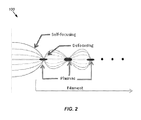
- FIG. 2 shows a diagram illustrating the formation and evolution of a laser-induced plasma filament.
- FIG. 3 shows a graph illustrating laser pulse propagation through a high-loss optical medium without the use of a laser-induced plasma filament.
- FIG. 4 shows a graph illustrating laser pulse propagation through a high-loss optical medium with the assistance of a laser-induced plasma filament.
- FIG. 5 shows a flowchart of an embodiment of a method in accordance with the Laser-Induced Plasma Filaments for Communication.
- Coupled and “connected” along with their derivatives.
- some embodiments may be described using the term “coupled” to indicate that two or more elements are in direct physical or electrical contact.
- the term “coupled,” however, may also mean that two or more elements are not in direct contact with each other, but yet still co-operate or interact with each other.
- the embodiments are not limited in this context.
- the terms “comprises,” “comprising,” “includes,” “including,” “has,” “having” or any other variation thereof, are intended to cover a non-exclusive inclusion.
- a process, method, article, or apparatus that comprises a list of elements is not necessarily limited to only those elements but may include other elements not expressly listed or inherent to such process, method, article, or apparatus.
- “or” refers to an inclusive or and not to an exclusive or.
- a laser beam propagating through the atmosphere is affected by absorption and scattering of radiation from fog, clouds, rain, snow, smoke, dust, etc. Atmospheric attenuation is typically dominated by fog and clouds and is, therefore, the primary focus of the research proposed here.
- the amount of light transmitted through fog and clouds will affect the link, first degrading the bit error rate and then at some higher attenuation level the laser communication system will cease to operate.
- the system proposed here could be used under those adverse conditions, and other adverse conditions specific to other operating environments, to improve and/or to restore a compromised communication link.
- FIG. 1 shows a block diagram of an embodiment of a system 10 in accordance with the Laser-Induced Filaments for Communication.
- System 10 includes a transmitter 20 separated by a receiver 60 by an optically-transparent medium 50 .
- optically-transparent medium 50 may be a liquid or a gas.
- Transmitter system 20 includes a first laser 22 , second laser 24 , signal combiner 26 , focusing lens 28 , and collimating lens 30 .
- First laser 23 is configured to generate a laser-induced plasma filament 40 within optically-transparent medium 50 .
- first laser 22 is configured to generate the laser-induced plasma filament using a plurality of high-power, ultra-short pulses.
- first laser 22 is an excimer laser.
- Second laser 24 is configured to generate a communication signal 25 for transmission to receiver 60 .
- communication signal 25 is an optical signal and receiver 60 is an optical receiver.
- communication signal 25 is an electromagnetic signal and receiver 60 is an electromagnetic receiver.
- Receiver 60 is separated from first laser 22 and second laser 24 by optically-transparent medium 50 and is configured to receive communication signal 25 .
- Signal combiner 26 is positioned within the path of both first laser 22 and second laser 24 such that communication signal 25 is directed by signal combiner 26 through laser-induced plasma filament 40 to receiver 60 .
- System 10 offers benefits such as an increase in the bit rate and an extension of the communication range of a link. Further, system 10 is not affected by changes and/or fluctuations in any of the optically-transparent medium parameters, such as flow, turbulence, particulates, dopants, etc.
- FIG. 2 shows a diagram 100 illustrating the formation and evolution of a laser-induced plasma filament.
- Laser-beam propagation through optically transparent media is influenced by many parameters such as, the laser pulse energy, the temporal and spatial beam profile, the wavelength, the repetition rate, and the physical properties of the propagating media.
- Two competing physical processes are involved: self-focusing due to optical Kerr effect and optical diffraction.
- the index of refraction of an optically transparent media is affected by the presence of an intense electromagnetic field associated with the laser beam; the process is highly localized and has an almost instantaneous response time.
- the net result is a “lens like” effect and the laser beam will be focused because the wave front is changing the index of refraction of its propagating media.
- the generated laser-induced plasma will increase the dispersion of the laser beam as the high density of electrons and ions in the plasma leads to a diverging (defocused) laser beam.
- the process will be re-initiated and the overall effect it is an array of focusing-defocusing cycles (as shown in FIG. 2 ), what is called a “filament”.
- the plasma channel that is created which is actually a long filament that can extend a few hundreds of meters, can be used as a low-loss propagating media for a second laser beam, in this case the “communication laser”.
- Point-to-point free-space laser communication is directly affected by the transmission of laser beams through fog and clouds.
- the “atmospheric channel” is subjected to many physical processes like scattering (Rayleigh, Mie), absorption, scintillation, dispersion, and turbulence, which all contribute to the degradation of the communication link.
- An attractive way of overcoming all those usual atmospheric optical limitations is to use laser-induced filaments as a conduit for the communication beam.
- n 0 is the linear refractive index
- n 2 is the non-linear refractive index
- n 2 1.0 ⁇ 10 ⁇ 34 cm 2 /W.
- filaments begin to develop and could propagate for distances varying from a few centimeters to a few kilometers.
- the filamentation regime possible from the propagation of high-power, ultra-short laser pulses in air is very attractive for atmospheric applications because it allows for conveying high optical intensities at long distances. Further, a precise control of the onset of filamentation can be achieved through simple strategies. It is possible to generate a filament at the desired location even at distances from the laser source of the order of hundreds of meters or even a few kilometers.
- filamentation exhibits remarkable robustness against typical atmospheric perturbations of the refractive index.
- One of the key advantages of filaments in the context of atmospheric applications is their pronounced resistance to adverse conditions, particularly to air turbulence, that induces refracting index gradients. It has been shown that filaments can propagate through localized strongly turbulent regions up to five orders of magnitude above typical atmospheric conditions. They are thus almost unaffected by the perturbations they have encountered. This suggests that refractive-index gradients are not the limiting factors for atmospheric propagation of filaments.
- FIG. 1 shows a high-loss optical medium with and without the laser-induced plasma filaments.
- the high-loss optical medium was a glass cell with fused silica windows, with the length of the cell being 50 ⁇ 10 ⁇ 2 m and the length of the filament being about 5 ⁇ 10 ⁇ 2 m.
- FIGS. 3 and 4 show a graph 200 illustrating laser pulse propagation through the experimental high-loss optical medium without the use of a laser-induced plasma filament and
- FIG. 4 shows a graph 300 illustrating laser pulse propagation with the assistance of a laser-induced plasma filament.
- line 210 represents the amplitude of the signal transmitted through optically absorbing media, without the presence and contribution of the laser induced plasma filament
- line 220 represents the reference signal
- line 310 represents the amplitude of the signal transmitted through optically absorbing media, with the contribution of and in the presence of the laser-induced plasma filament
- Line 320 represents the reference signal, which is the same as the reference signal 220 shown in FIG. 3 .
- Line 310 in FIG. 4 represents about a 5% increase in the detected pulse amplitude, as compared to line 210 , resulting from the use of the laser-induced plasma filament.
- the laser-induced plasma filament length is one-tenth of the total optical path length (emitter to receiver). In an ideal case, where there is no attenuation through the laser-induced plasma filament, an increase of the received signal (line 310 , FIG. 3 ) of about 12% may be seen. The measurements demonstrate that a laser-induced plasma filament was generated having the right density that allows for the communication laser beam to propagate through optically absorbing media.
- first laser 22 was configured with a pulse duration in the nanosecond regime, in some embodiments first laser 22 may be configured with an ultra-short pulse duration in the femtosecond regime.
- FIG. 5 shows a flowchart of an embodiment of a method in accordance with the Laser-Induced Filaments for Communication.
- method 400 may be performed by system 10 as shown in FIG. 1 and will be discussed with reference thereto.
- FIG. 5 shows one embodiment of method 400 to include steps 410 - 430
- other embodiments of method 400 may contain fewer or more steps.
- the steps of method 400 may be performed as shown in FIG. 5
- the steps may be performed in a different order, or certain steps may occur simultaneously with one or more other steps.
- Method 400 may begin with step 410 , which involves using a first laser 22 to generate a laser-induced plasma filament 40 within an optically-transparent medium 50 .
- Method 400 may then proceed to step 420 , which involves using a second laser 24 to generate a communication signal 25 for transmission to a receiver 60 within optically-transparent medium 50 .
- Method 400 may then proceed to step 430 , which involves using a signal combiner 26 positioned within the path of both first laser 22 and second laser 24 to direct communication signal 25 through laser-induced plasma filament 40 to receiver 60 .
Landscapes
- Physics & Mathematics (AREA)
- Electromagnetism (AREA)
- Engineering & Computer Science (AREA)
- Computer Networks & Wireless Communication (AREA)
- Signal Processing (AREA)
- General Physics & Mathematics (AREA)
- Optics & Photonics (AREA)
- Nonlinear Science (AREA)
- Lasers (AREA)
- Plasma Technology (AREA)
Abstract
Description
where n0 is the linear refractive index, n2 is the non-linear refractive index, and is the wavelength of the laser source, such as
z c=0.184(w 0)2 k 0/{[(P/P cr)1/2−0.853]2−0.0219}−1/2, (Eq. 2)
or
z c=0.367πn 0(w 0)2{[(P/P cr)1/2−0.853]2−0.0219}−1/2, (Eq. 3)
This expression provides a good estimation of the onset of filamentation for a Gaussian beam in the single-filament regime and gives flexibility to adjust the position of the laser-induced plasma filament. To achieve the self-guided propagation of a collimated beam, which defines the filamentation regime, a dynamical balance between the focusing and the defocusing effects must be established.
∇n r˜9.1×10⁻⁵×(T s /T×Δr), (Eq. 4)
and the one generated by the process of filamentation,
∇n fil ˜n 2 I/d, (Eq. 5)
where I=1014 W/cm2 is the typical intensity within the filament, d˜100 μm is the diameter of the filament, and Ts=293 K is the standard room temperature.
Claims (6)
Priority Applications (1)
| Application Number | Priority Date | Filing Date | Title |
|---|---|---|---|
| US15/052,722 US10069564B2 (en) | 2015-02-27 | 2016-02-24 | Laser-induced plasma filaments for communication |
Applications Claiming Priority (2)
| Application Number | Priority Date | Filing Date | Title |
|---|---|---|---|
| US201562126135P | 2015-02-27 | 2015-02-27 | |
| US15/052,722 US10069564B2 (en) | 2015-02-27 | 2016-02-24 | Laser-induced plasma filaments for communication |
Publications (2)
| Publication Number | Publication Date |
|---|---|
| US20160254865A1 US20160254865A1 (en) | 2016-09-01 |
| US10069564B2 true US10069564B2 (en) | 2018-09-04 |
Family
ID=56798425
Family Applications (1)
| Application Number | Title | Priority Date | Filing Date |
|---|---|---|---|
| US15/052,722 Active 2036-03-26 US10069564B2 (en) | 2015-02-27 | 2016-02-24 | Laser-induced plasma filaments for communication |
Country Status (1)
| Country | Link |
|---|---|
| US (1) | US10069564B2 (en) |
Cited By (9)
| Publication number | Priority date | Publication date | Assignee | Title |
|---|---|---|---|---|
| US20200244028A1 (en) * | 2019-01-30 | 2020-07-30 | Seoul National University R&Db Foundation | Device and method for adjusting laser pulse width using laser-induced plasma shutter |
| US11024950B2 (en) | 2018-11-30 | 2021-06-01 | United States Of America As Represented By The Secretary Of The Navy | Wideband laser-induced plasma filament antenna with modulated conductivity |
| US20240012153A1 (en) * | 2020-10-25 | 2024-01-11 | David Cohen | Atmosphere-penetrating laser |
| US11942679B2 (en) | 2022-08-24 | 2024-03-26 | Usa As Represented By The Secretary Of The Navy | Antenna extended with a laser induced plasma |
| US12401425B2 (en) | 2022-12-16 | 2025-08-26 | The Boeing Company | Radio frequency communications using laser optical breakdowns |
| US12407420B2 (en) | 2022-12-16 | 2025-09-02 | The Boeing Company | Pulse noise modulation to encode data |
| US12476710B2 (en) | 2022-12-16 | 2025-11-18 | The Boeing Company | Analog amplitude noise modulation to communicate information |
| US12652747B2 (en) | 2024-03-29 | 2026-06-09 | The United States Of America, As Represented By The Secretary Of The Navy | Wireless transmission by induced plasma |
| US12676680B2 (en) | 2022-12-16 | 2026-07-07 | The Boeing Company | Digital amplitude noise shift keying to communicate information |
Families Citing this family (4)
| Publication number | Priority date | Publication date | Assignee | Title |
|---|---|---|---|---|
| JP6788480B2 (en) * | 2016-11-09 | 2020-11-25 | 三菱重工業株式会社 | Laser optical communication system and laser optical communication method |
| WO2019038585A1 (en) * | 2017-08-21 | 2019-02-28 | Université De Genève | Method and apparatus for transmitting optical information through fog or clouds |
| US10508889B1 (en) * | 2018-06-15 | 2019-12-17 | United States Of America As Represented By The Secretary Of The Navy | Method and apparatus for laser-induced plasma filaments for agile counter-directed energy weapon applications |
| US12580650B2 (en) * | 2023-04-04 | 2026-03-17 | United States Of America As Represented By The Secretary Of The Navy | Indirect optical communication |
Citations (22)
| Publication number | Priority date | Publication date | Assignee | Title |
|---|---|---|---|---|
| US6483077B1 (en) * | 1999-04-22 | 2002-11-19 | The Ohio State University | Method and apparatus for initiating, directing and constricting electrical discharge arcs |
| US7391557B1 (en) * | 2003-03-28 | 2008-06-24 | Applied Photonics Worldwide, Inc. | Mobile terawatt femtosecond laser system (MTFLS) for long range spectral sensing and identification of bioaerosols and chemical agents in the atmosphere |
| US7453552B1 (en) * | 2004-07-16 | 2008-11-18 | Lockheed Martin Corporation | Laser amplification methods and apparatuses |
| US7729044B2 (en) * | 2005-10-20 | 2010-06-01 | Universite Laval | Method and devices for generating stable and tunable light pulses |
| US7732351B2 (en) * | 2006-09-21 | 2010-06-08 | Semiconductor Energy Laboratory Co., Ltd. | Manufacturing method of semiconductor device and laser processing apparatus |
| US20110003461A1 (en) * | 2007-10-10 | 2011-01-06 | Semiconductor Energy Laboratory Co., Ltd. | Method for manufacturing semiconductor substrate and method for manufacturing semiconductor device |
| US7903698B1 (en) * | 2003-08-14 | 2011-03-08 | Applied Energetics, Inc | Controlled optical filament generation and energy propagation |
| US20120114007A1 (en) * | 2010-11-10 | 2012-05-10 | The Government Of The United States Of America, As Represented By The Secretary Of The Navy | Underwater Laser-Guided Discharge |
| US20120170599A1 (en) * | 2010-12-29 | 2012-07-05 | The Government Of The United States Of America, As Represented By The Secretary Of The Navy | Remotely Induced Atmospheric Lasing |
| US8319435B1 (en) * | 2007-04-17 | 2012-11-27 | Lockheed Martin Corp. | Method and apparatus for optical filament launch |
| US20130148685A1 (en) * | 2011-12-13 | 2013-06-13 | Theodore G. Jones | Two-Laser Generation of Extended Underwater Plasma |
| US20140056028A1 (en) * | 2011-03-09 | 2014-02-27 | Flex Lighting Ii, Llc | Light emitting device with adjustable light output profile |
| US8772128B2 (en) * | 2007-10-10 | 2014-07-08 | Semiconductor Energy Laboratory Co., Ltd. | Method for manufacturing semiconductor device |
| US8772974B2 (en) | 2009-10-31 | 2014-07-08 | Glenn Lane Family Limited Liability Limited Partnership | Wireless transmission of energy through concentric laser-induced plasma channels in atmosphere |
| US20150003104A1 (en) * | 2013-07-01 | 2015-01-01 | E Ink Holdings Inc. | Display device |
| US9268194B2 (en) * | 2006-10-02 | 2016-02-23 | PM & AM Research | Method and technique to control laser effects through tuning of parameters such as repetition rate |
| US20160097616A1 (en) * | 2011-11-25 | 2016-04-07 | Dr. Adam Mark Weigold | Laser Guided and Laser Powered Energy Discharge Device |
| US20160266466A1 (en) * | 2013-11-07 | 2016-09-15 | University Of Maryland, College Park | Waveguides, and systems and methods for forming and using such waveguides |
| US9484702B2 (en) * | 2011-03-23 | 2016-11-01 | Institut National De La Recherche Scientifique | System and method for agile remote generation of a broadband tunable short-pulse emission |
| US9544065B2 (en) * | 2013-07-11 | 2017-01-10 | Technion Research & Development Foundation Limited | Method and system for transmitting light |
| US9575309B2 (en) * | 2012-09-10 | 2017-02-21 | Her Majesty The Queen In Right Of Canada, As Represented By The Minister Of National Defence | Telescopic control of high power laser propagation |
| US9897548B2 (en) * | 2015-08-11 | 2018-02-20 | The United States Of America As Represented By Secretary Of The Navy | Method and apparatus for detection of contaminants in air by laser-induced filamentation |
-
2016
- 2016-02-24 US US15/052,722 patent/US10069564B2/en active Active
Patent Citations (23)
| Publication number | Priority date | Publication date | Assignee | Title |
|---|---|---|---|---|
| US6483077B1 (en) * | 1999-04-22 | 2002-11-19 | The Ohio State University | Method and apparatus for initiating, directing and constricting electrical discharge arcs |
| US7391557B1 (en) * | 2003-03-28 | 2008-06-24 | Applied Photonics Worldwide, Inc. | Mobile terawatt femtosecond laser system (MTFLS) for long range spectral sensing and identification of bioaerosols and chemical agents in the atmosphere |
| US7903698B1 (en) * | 2003-08-14 | 2011-03-08 | Applied Energetics, Inc | Controlled optical filament generation and energy propagation |
| US7453552B1 (en) * | 2004-07-16 | 2008-11-18 | Lockheed Martin Corporation | Laser amplification methods and apparatuses |
| US7729044B2 (en) * | 2005-10-20 | 2010-06-01 | Universite Laval | Method and devices for generating stable and tunable light pulses |
| US7732351B2 (en) * | 2006-09-21 | 2010-06-08 | Semiconductor Energy Laboratory Co., Ltd. | Manufacturing method of semiconductor device and laser processing apparatus |
| US9268194B2 (en) * | 2006-10-02 | 2016-02-23 | PM & AM Research | Method and technique to control laser effects through tuning of parameters such as repetition rate |
| US8319435B1 (en) * | 2007-04-17 | 2012-11-27 | Lockheed Martin Corp. | Method and apparatus for optical filament launch |
| US8772128B2 (en) * | 2007-10-10 | 2014-07-08 | Semiconductor Energy Laboratory Co., Ltd. | Method for manufacturing semiconductor device |
| US20110003461A1 (en) * | 2007-10-10 | 2011-01-06 | Semiconductor Energy Laboratory Co., Ltd. | Method for manufacturing semiconductor substrate and method for manufacturing semiconductor device |
| US8772974B2 (en) | 2009-10-31 | 2014-07-08 | Glenn Lane Family Limited Liability Limited Partnership | Wireless transmission of energy through concentric laser-induced plasma channels in atmosphere |
| US20120114007A1 (en) * | 2010-11-10 | 2012-05-10 | The Government Of The United States Of America, As Represented By The Secretary Of The Navy | Underwater Laser-Guided Discharge |
| US20120170599A1 (en) * | 2010-12-29 | 2012-07-05 | The Government Of The United States Of America, As Represented By The Secretary Of The Navy | Remotely Induced Atmospheric Lasing |
| US8665923B2 (en) * | 2010-12-29 | 2014-03-04 | The United States Of America, As Represented By The Secretary Of The Navy | Remotely induced atmospheric lasing |
| US20140056028A1 (en) * | 2011-03-09 | 2014-02-27 | Flex Lighting Ii, Llc | Light emitting device with adjustable light output profile |
| US9484702B2 (en) * | 2011-03-23 | 2016-11-01 | Institut National De La Recherche Scientifique | System and method for agile remote generation of a broadband tunable short-pulse emission |
| US20160097616A1 (en) * | 2011-11-25 | 2016-04-07 | Dr. Adam Mark Weigold | Laser Guided and Laser Powered Energy Discharge Device |
| US20130148685A1 (en) * | 2011-12-13 | 2013-06-13 | Theodore G. Jones | Two-Laser Generation of Extended Underwater Plasma |
| US9575309B2 (en) * | 2012-09-10 | 2017-02-21 | Her Majesty The Queen In Right Of Canada, As Represented By The Minister Of National Defence | Telescopic control of high power laser propagation |
| US20150003104A1 (en) * | 2013-07-01 | 2015-01-01 | E Ink Holdings Inc. | Display device |
| US9544065B2 (en) * | 2013-07-11 | 2017-01-10 | Technion Research & Development Foundation Limited | Method and system for transmitting light |
| US20160266466A1 (en) * | 2013-11-07 | 2016-09-15 | University Of Maryland, College Park | Waveguides, and systems and methods for forming and using such waveguides |
| US9897548B2 (en) * | 2015-08-11 | 2018-02-20 | The United States Of America As Represented By Secretary Of The Navy | Method and apparatus for detection of contaminants in air by laser-induced filamentation |
Non-Patent Citations (10)
| Title |
|---|
| Ackermann, R., "Laser filaments generated and transmitted in highly turbulent air", Optics Letters, vol. 31, No. 1, pp. 86-89, 2006. |
| Apostol, I. et al., "Laser Produced Cadmium Plasma as a Laser Source", Proc. SPIE 1033, Trends in Quantum Electronics, vol. 2, May 1989. |
| Braun, A., et al., "Self channeling of high peak power femtosecond laser pulses in air", Optics Letters, vol. 20, No. 1, pp. 73-75, 1995. |
| Couairon, A, et al., "Viewpoint: A Waveguide Made of Hot Air", Physics, American Physical Society, vol. 7, No. 21, Feb. 2014. |
| Couairon, A., "Filamentation length of powerful laser pulses", Appl. Phys. B, vol. 76, pp. 789-792, 2003. |
| Hammer, Daniel X., "Experimental investigations of ultrashort pulse-laser unduced breakdown thresholds in aqueous media", IEEE Journal of Quantum Electronics, vol. 32, No. 4, pp. 670-678, Apr. 1996. |
| Helle, M.H., et al., "Formation and Propagation of Meter-Scale Laser Filaments in Water", Applied Physics Letters, vol. 103, 121101, 2013. |
| Jhajj, N. et al., "Demonstration of Long-Lived High-Power Optical Waveguides in Air", Physical Review X, American Physical Society, vol. 4, pp. 1-8, Feb. 2014. |
| Turcu, I.C.E, et al., "Spatial Coherence Measurements and X-Ray Holographic Imaging Using a Laser-Generated Plasma X-Ray Source in the Water Window Spectral Region", J. Appl. Phys., vol. 73, 8081, 1993. |
| Ursu, I., et al., "Threshold conditions for the air plasma initiation near solid surfaces under the action of powerful pulsed CO2 laser radiation", J. of Appl. Phys., vol. 58, pp. 1765-1771, 1985. |
Cited By (10)
| Publication number | Priority date | Publication date | Assignee | Title |
|---|---|---|---|---|
| US11024950B2 (en) | 2018-11-30 | 2021-06-01 | United States Of America As Represented By The Secretary Of The Navy | Wideband laser-induced plasma filament antenna with modulated conductivity |
| US20200244028A1 (en) * | 2019-01-30 | 2020-07-30 | Seoul National University R&Db Foundation | Device and method for adjusting laser pulse width using laser-induced plasma shutter |
| US11855405B2 (en) * | 2019-01-30 | 2023-12-26 | Seoul National University R&DBFoundation | Device and method for adjusting laser pulse width using laser-induced plasma shutter |
| US20240012153A1 (en) * | 2020-10-25 | 2024-01-11 | David Cohen | Atmosphere-penetrating laser |
| US11942679B2 (en) | 2022-08-24 | 2024-03-26 | Usa As Represented By The Secretary Of The Navy | Antenna extended with a laser induced plasma |
| US12401425B2 (en) | 2022-12-16 | 2025-08-26 | The Boeing Company | Radio frequency communications using laser optical breakdowns |
| US12407420B2 (en) | 2022-12-16 | 2025-09-02 | The Boeing Company | Pulse noise modulation to encode data |
| US12476710B2 (en) | 2022-12-16 | 2025-11-18 | The Boeing Company | Analog amplitude noise modulation to communicate information |
| US12676680B2 (en) | 2022-12-16 | 2026-07-07 | The Boeing Company | Digital amplitude noise shift keying to communicate information |
| US12652747B2 (en) | 2024-03-29 | 2026-06-09 | The United States Of America, As Represented By The Secretary Of The Navy | Wireless transmission by induced plasma |
Also Published As
| Publication number | Publication date |
|---|---|
| US20160254865A1 (en) | 2016-09-01 |
Similar Documents
| Publication | Publication Date | Title |
|---|---|---|
| US20160254865A1 (en) | Laser-Induced Plasma Filaments for Communication | |
| Ghalaii et al. | Quantum communications in a moderate-to-strong turbulent space | |
| Boluda-Ruiz et al. | Impulse response modeling of underwater optical scattering channels for wireless communication | |
| Prokeš | Modeling of atmospheric turbulence effect on terrestrial FSO link | |
| Wang et al. | Atmospheric effects on continuous-variable quantum key distribution | |
| Malik et al. | Free space optics: current applications and future challenges | |
| Abd Ali et al. | Effect of atmospheric attenuation on laser communications for visible and infrared wavelengths | |
| Yong et al. | Non-line-of-sight ultraviolet communication performance in atmospheric turbulence | |
| Kaur et al. | Effect of atmospheric conditions and aperture averaging on capacity of free space optical links | |
| Winick | Atmospheric turbulence-induced signal fades on optical heterodyne communication links | |
| Ali et al. | Effect of environmental parameters on the performance of optical wireless communications | |
| El-Mashade et al. | Performance evaluation of FSO system with MIMO technique in different operating environments | |
| Alkholidi et al. | Climate effects on performance of free space optical communication systems in Yemen | |
| Ashraf et al. | Effect of fog and scintillation on performance of vertical free‐space optical link from Earth to low Earth orbit satellite | |
| Demir et al. | Investigation of the atmospheric attenuation factors in FSO communication systems using the Taguchi method | |
| Gebhardt | Atmospheric effects modeling for high-energy laser systems | |
| Elahee et al. | Performance analysis of terrestrial FSO communication under typical rain-affected environment of Bangladesh | |
| Dong et al. | Research on underwater wireless dynamic optical communication system based on PPM modulation | |
| Zou et al. | Improving the NLOS optical scattering channel via beam reshaping | |
| Zhang et al. | The characterization of non-line-of-sight ultraviolet communication in non-common-scattering volume | |
| Belov | Optical communication on scattered or reflected laser radiation | |
| Yi et al. | Influence of angle-of-arrival fluctuations on ground-to-satellite laser uplink communication system | |
| Mustafa | Effect of rain attenuations on free space optic transmission in kuala lumpur | |
| Mehra et al. | Wavelength-dependent performance of OAM-based optical communication in foggy conditions | |
| Kumar et al. | Study of nonlinearities in FSO communication system: A detailed review |
Legal Events
| Date | Code | Title | Description |
|---|---|---|---|
| AS | Assignment |
Owner name: UNITED STATES OF AMERICA AS REPRESENTED BY THE SEC Free format text: ASSIGNMENT OF ASSIGNORS INTEREST;ASSIGNORS:HENING, ALEXANDRU;WAYNE, DAVID T.;LOVERN, MICHAEL G.;SIGNING DATES FROM 20160223 TO 20160224;REEL/FRAME:037819/0126 |
|
| STCF | Information on status: patent grant |
Free format text: PATENTED CASE |
|
| MAFP | Maintenance fee payment |
Free format text: PAYMENT OF MAINTENANCE FEE, 4TH YEAR, LARGE ENTITY (ORIGINAL EVENT CODE: M1551); ENTITY STATUS OF PATENT OWNER: LARGE ENTITY Year of fee payment: 4 |
|
| MAFP | Maintenance fee payment |
Free format text: PAYMENT OF MAINTENANCE FEE, 8TH YEAR, LARGE ENTITY (ORIGINAL EVENT CODE: M1552); ENTITY STATUS OF PATENT OWNER: LARGE ENTITY Year of fee payment: 8 |