US10066471B2 - Method for enhancing hydrocarbon recovery from tight formations - Google Patents
Method for enhancing hydrocarbon recovery from tight formations Download PDFInfo
- Publication number
- US10066471B2 US10066471B2 US14/976,102 US201414976102A US10066471B2 US 10066471 B2 US10066471 B2 US 10066471B2 US 201414976102 A US201414976102 A US 201414976102A US 10066471 B2 US10066471 B2 US 10066471B2
- Authority
- US
- United States
- Prior art keywords
- injectate
- wettability
- initial
- flowback
- modified
- Prior art date
- Legal status (The legal status is an assumption and is not a legal conclusion. Google has not performed a legal analysis and makes no representation as to the accuracy of the status listed.)
- Active
Links
Images




Classifications
-
- E—FIXED CONSTRUCTIONS
- E21—EARTH OR ROCK DRILLING; MINING
- E21B—EARTH OR ROCK DRILLING; OBTAINING OIL, GAS, WATER, SOLUBLE OR MELTABLE MATERIALS OR A SLURRY OF MINERALS FROM WELLS
- E21B43/00—Methods or apparatus for obtaining oil, gas, water, soluble or meltable materials or a slurry of minerals from wells
- E21B43/25—Methods for stimulating production
- E21B43/26—Methods for stimulating production by forming crevices or fractures
-
- E—FIXED CONSTRUCTIONS
- E21—EARTH OR ROCK DRILLING; MINING
- E21B—EARTH OR ROCK DRILLING; OBTAINING OIL, GAS, WATER, SOLUBLE OR MELTABLE MATERIALS OR A SLURRY OF MINERALS FROM WELLS
- E21B41/00—Equipment or details not covered by groups E21B15/00 - E21B40/00
-
- C—CHEMISTRY; METALLURGY
- C09—DYES; PAINTS; POLISHES; NATURAL RESINS; ADHESIVES; COMPOSITIONS NOT OTHERWISE PROVIDED FOR; APPLICATIONS OF MATERIALS NOT OTHERWISE PROVIDED FOR
- C09K—MATERIALS FOR MISCELLANEOUS APPLICATIONS, NOT PROVIDED FOR ELSEWHERE
- C09K8/00—Compositions for drilling of boreholes or wells; Compositions for treating boreholes or wells, e.g. for completion or for remedial operations
- C09K8/58—Compositions for enhanced recovery methods for obtaining hydrocarbons, i.e. for improving the mobility of the oil, e.g. displacing fluids
-
- C—CHEMISTRY; METALLURGY
- C09—DYES; PAINTS; POLISHES; NATURAL RESINS; ADHESIVES; COMPOSITIONS NOT OTHERWISE PROVIDED FOR; APPLICATIONS OF MATERIALS NOT OTHERWISE PROVIDED FOR
- C09K—MATERIALS FOR MISCELLANEOUS APPLICATIONS, NOT PROVIDED FOR ELSEWHERE
- C09K8/00—Compositions for drilling of boreholes or wells; Compositions for treating boreholes or wells, e.g. for completion or for remedial operations
- C09K8/60—Compositions for stimulating production by acting on the underground formation
- C09K8/62—Compositions for forming crevices or fractures
- C09K8/66—Compositions based on water or polar solvents
-
- C—CHEMISTRY; METALLURGY
- C09—DYES; PAINTS; POLISHES; NATURAL RESINS; ADHESIVES; COMPOSITIONS NOT OTHERWISE PROVIDED FOR; APPLICATIONS OF MATERIALS NOT OTHERWISE PROVIDED FOR
- C09K—MATERIALS FOR MISCELLANEOUS APPLICATIONS, NOT PROVIDED FOR ELSEWHERE
- C09K8/00—Compositions for drilling of boreholes or wells; Compositions for treating boreholes or wells, e.g. for completion or for remedial operations
- C09K8/60—Compositions for stimulating production by acting on the underground formation
- C09K8/84—Compositions based on water or polar solvents
-
- E21B41/0092—
-
- E—FIXED CONSTRUCTIONS
- E21—EARTH OR ROCK DRILLING; MINING
- E21B—EARTH OR ROCK DRILLING; OBTAINING OIL, GAS, WATER, SOLUBLE OR MELTABLE MATERIALS OR A SLURRY OF MINERALS FROM WELLS
- E21B43/00—Methods or apparatus for obtaining oil, gas, water, soluble or meltable materials or a slurry of minerals from wells
- E21B43/16—Enhanced recovery methods for obtaining hydrocarbons
-
- E—FIXED CONSTRUCTIONS
- E21—EARTH OR ROCK DRILLING; MINING
- E21B—EARTH OR ROCK DRILLING; OBTAINING OIL, GAS, WATER, SOLUBLE OR MELTABLE MATERIALS OR A SLURRY OF MINERALS FROM WELLS
- E21B43/00—Methods or apparatus for obtaining oil, gas, water, soluble or meltable materials or a slurry of minerals from wells
- E21B43/25—Methods for stimulating production
- E21B43/26—Methods for stimulating production by forming crevices or fractures
- E21B43/27—Methods for stimulating production by forming crevices or fractures by use of eroding chemicals, e.g. acids
-
- E—FIXED CONSTRUCTIONS
- E21—EARTH OR ROCK DRILLING; MINING
- E21B—EARTH OR ROCK DRILLING; OBTAINING OIL, GAS, WATER, SOLUBLE OR MELTABLE MATERIALS OR A SLURRY OF MINERALS FROM WELLS
- E21B49/00—Testing the nature of borehole walls; Formation testing; Methods or apparatus for obtaining samples of soil or well fluids, specially adapted to earth drilling or wells
- E21B49/08—Obtaining fluid samples or testing fluids, in boreholes or wells
Definitions
- a method of increasing recovery of liquid hydrocarbons from subsurface reservoirs, and particularly from those located in tight formations is disclosed.
- One aspect includes calculating the in situ fractured formation wettability from real-time measurement of flowback volume and composition.
- Another aspect includes determining the composition of the fracturing fluid, the overflush or both, that will achieve higher liquid hydrocarbon recovery by increasing the water wettability of rock surfaces within the reservoir.
- Monitoring of rock-surface wettability through flowback volume and composition profiles allows the above mentioned injectates to be adjusted in the field to achieve maximal recovery.
- Other methods, apparatuses, and systems are disclosed.
- Production of liquid hydrocarbons from reservoirs is controlled by natural forces, such as solution gas expansion and natural water drive, or by engineered forces during enhanced oil recovery (EOR), such as injection of steam, surfactants, solvents or CO 2 , or the creation of differential water pressures such as in a waterflood operation.
- Steam injection decreases liquid hydrocarbon viscosity.
- Surfactant injection decreases liquid hydrocarbon-water interfacial tension.
- CO 2 injection simultaneously reduces liquid hydrocarbon-water interfacial tension and enhances formation pressure.
- Polymer injection is a physical EOR technique that improves waterflood sweep efficiency by blocking zones whereby water would otherwise bypass liquid hydrocarbons.
- Primary liquid hydrocarbon recovery relies on natural forces; secondary and tertiary recovery rely on engineered forces. Traditionally, primary recovery is followed by secondary recovery (waterflooding), then tertiary recovery.
- the analysis described herein differs from the traditional approach to liquid hydrocarbon recovery because it develops an up-front understanding of the chemical forces that hold the liquid hydrocarbon in the particular reservoir to begin with, then uses that understanding to design an overall liquid hydrocarbon recovery strategy that maximizes recovery of liquid hydrocarbons.
- the techniques envisioned herein implement a novel chemical recovery method for separating liquid hydrocarbons from their source rock. Whereas traditional EOR techniques focus on improving physical movement of water, liquid hydrocarbon properties, or both, the techniques envisioned herein break the chemical bonds that hold liquid hydrocarbons to reservoir surfaces. By adding the important component of reservoir surface chemistry, the analysis and techniques described herein are intended to work independently, or in conjunction with most other EOR methods.
- Embodiments of the invention relate generally to the recovery of liquid hydrocarbons from subterranean reservoirs in tight underground liquid hydrocarbon-bearing formations that are hydrofractured (“fractured”).
- Liquid hydrocarbon recovery from hydrofractured tight formations is typically less than 10% of the original liquid hydrocarbon in place. A fraction of the remaining liquid hydrocarbon is located in restricted spaces that natural and engineered fractures will never drain.
- the clays and carbonate minerals found in unstimulated sandstone and limestone reservoirs are present in tight formations as well.
- chemical methods for increasing water wettability of unstimulated sandstone and limestone reservoirs in waterflooding may be modified to increase the water wettability of tight formations.
- tight formations cannot easily be waterflooded because of their low permeabilities, tight formations are exposed to large volumes of water in the slickwater fracturing, proppant placement, and overflush, stages of well development.
- the method described herein modifies the chemistry of the slickwater, or an overflush, or both, to make the tight formation more water wet.
- the method described herein also provides a real-time measure of recoverable liquid hydrocarbon from flowback volume and chemistry measurements by calculating a correlation between liquid hydrocarbon recovery and retained water chemistry.
- the ability to anticipate liquid hydrocarbon recovery allows rapid adjustment of injectate chemistry in the field to maximize recovery.
- the method also allows low value waters, such as saline produced waters, to be more widely used for fracturing, instead of high value fresh waters.
- FIG. 1 is a schematic of a fracturing job in a horizontal borehole.
- FIG. 2 shows the stages of a fracturing job in a single fracture.
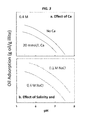
- FIGS. 3 a and 3 b show measured liquid hydrocarbon adsorption to illite in a 0.01M NaCl solution.
- FIG. 4 is a schematic of liquid hydrocarbon mobilization through countercurrent imbibition by designer injectate.
- FIG. 5 shows liquid hydrocarbon desorption from a fracture wall by water addition and double layer expansion (water molecules not to scale).
- FIG. 6 shows calculated oil adhesion for illite and calcite-containing reservoir.
- FIG. 7 is a flowchart illustrating steps of the invention.
- FIG. 1 four fracture stages in a horizontal well through a tight formation are shown.
- a well 101 has been drilled from the surface 102 of the earth 100 , which includes a wellbore 103 that ultimately horizontally penetrates a liquid hydrocarbon-bearing formation 104 .
- Hydraulic fracturing equipment 105 is used to produce and pump a hydraulic fracturing fluid 106 into several frac stages 107 and 108 .
- the flowback 110 is then pumped back to a flowback monitoring unit 109 .
- FIG. 2 illustrates a typical sequence of hybrid fracturing: a.) slickwater fracturing and water being retained, followed by b.) emplacement of a proppant by a gel, followed by c.) breaking of the gel, and d.) optional overflush of the fracture surfaces with a designer injectate as described more fully herein. Often as much as 80% of the water injected in a fracturing job is not recovered back up the borehole and is referred to as retained water. Some of the retained water resides in the fracture network and a lesser amount imbibes into the rock matrix.
- FIG. 3 schematically illustrates laboratory confirmed trends of measured adsorption of a high base, low acid, liquid hydrocarbon onto illite clay as a function of pH.
- Illite, fluid, and oil were equilibrated in ⁇ 1:100:10 volumetric ratios, then the illite separated from the mixture by centrifugation and freezing. Oil sorbed to the illite was extracted with hexane and quantified with a spectrophotometer.
- FIG. 3 a shows that added Ca decreases oil adsorption.
- FIGS. 3 a and 3 b show that increased pH decreases oil adsorption.
- FIG. 3 b shows that increased salinity decreases oil adsorption to illite.
- high base, low acid oil sorption on illite, increased salinity decreases the number of oppositely charged oil and rock surface species to decrease oil sorption more than increased salinity favors oil adsorption by decreasing water layer thickness.
- FIG. 4 shows liquid hydrocarbon mobilization by countercurrent imbibition of liquid hydrocarbon out of a microfracture.
- FIG. 5 shows liquid hydrocarbon mobilization from a macrofractured rock surface by water layer expansion due to decreased salinity and/or a decrease in the number of oppositely charged sites on oil and rock surfaces.
- FIG. 6 shows the effect of fracturing fluid composition on oil adhesion and water wettability for a high base, low acid oil in a tight formation containing illite and calcite.
- the brine was 0.4M NaCl+25 mmol/L CaCl 2 +25 mmol/L MgCl 2 .
- Fresh water was 20 mmol/L NaCl.
- Temperature was 115° C.
- FIG. 7 is a flowchart showing steps involved in an exemplary embodiment of the method of the invention, which is described in detail below.
- Box 110 shows the initial measurement of pH, Ca/Mg and salinity effect on liquid hydrocarbon adsorption onto the reservoir.
- Box 112 shows that a surface complexation model for the reservoir can be calibrated.
- Box 114 shows that a predictive model described in detail below can be used to predict oil adhesion for injectates.
- Box 116 shows that a candidate injectate can be selected that is designed to achieve low liquid hydrocarbon adhesion and high water wettability in the reservoir.
- Box 118 shows that the injectate can be applied or pumped into the reservoir as slickwater and/or overflush.
- the predictive model can be undated, shown box 122 . If a determination is made that water wettability can be increased in the reservoir, shown at 124 , the injectate composition and volume that will increase water wettability can be calculated, illustrated in box 126 , which is applied or pumped into the reservoir as shown in box 118 .
- the model referred to in boxes 112 , 114 and 122 can be a predictive model of the type discussed in detail in U.S. Pat. No. 8,812,271, the entirety of which is incorporated by reference herein as though it was fully set forth, which is executed by a processing system such as, for example, a control system on a platform, which can comprise conventional operating system and storage components such as a system bus connecting a central processing unit (CPU), a hard disk, a random access memory (RAM), I/O and network adaptors facilitating connection to user input/output devices and interconnection with other devices on a network.
- the Random Access Memory (RAM) can contain operating system software, which controls in a known manner low-level operation of the processing system.
- Data to be inputted can be received by a known type of receiving means for such systems are based on measured chemical characteristics of the liquid hydrocarbon, connate water, water available for injection, and/or analogous well experience underground rock.
- the measurement data may comprise specific measured chemical values as directly measured by suitably positioned measurement equipment, or ratios of values of chemical characteristics, or may comprise values derived from a number of separate chemical characteristic measurements, according to known techniques. Therefore, the raw measured chemical characteristics may, if necessary or preferred, be manipulated by appropriate software, executed by the CPU of the system, in order to generate data that are suitable for inputting into the predictive model. Such manipulation may simply comprise a measurement unit conversion or the creation of a required ratio of measured values.
- Liquid Hydrocarbon Release Fracturing fluids chemically aid liquid hydrocarbon recovery by imbibing into, and expanding, the thin layers of water separating oil from the rock ( FIG. 5 ). Water imbibing into small fractures and connected pores via chemical reactions, through osmosis (the diffusion of water from the dilute water flood into the more saline connate water in the pores or fractures), and by adsorptive forces can prompt “countercurrent imbibition”—a roughly 1:1 volumetric replacement of liquid hydrocarbon in the microfracture by injectate.
- Liquid hydrocarbon release from both macrofractures and microfractures can be increased by altering the injectate composition to increase water wettability in the retained water zone. The method by which this is done is shown schematically in FIG. 7 . Increased water wettability is linked with liquid hydrocarbon release from fracture surfaces, and from increased countercurrent imbibition release of liquid hydrocarbons from microfractures. Identifying the chemical conditions under which tight formations become more water wet can be done by calibrating a surface complexation calculation for the primary minerals in the formation, such as for example using the technique described in U.S. Pat. No.
- the Ca/Na ratio of the flowback measures the extent of the calcite dissolution and ion exchange reactions with the matrix clays: CaCO 3 +H + ⁇ Ca +2 +HCO 3 ⁇ 2>Na+Ca +2 ⁇ >Ca+2Na + where “>” denotes an ion exchange site on a clay. Measuring Ca, Na, Cl, pH, and HCO 3 ⁇ levels in the flowback allows the extent of dilution and chemical reaction to be quantified at each point in time.
- FIG. 3 is a compilation of experimentally observed trends that shows that increasing pH causes high base, low acid (AN/BN ⁇ 0.33) liquid hydrocarbon to be released from illite. Increased salinity, and higher Ca and Mg levels also increase liquid hydrocarbon release from illite. Clay minerals, when present, are typically the reservoir mineral that liquid hydrocarbons adhere to.
- FIG. 6 shows calculated high base, low acid oil adhesion for pH-modified brine and freshwaters. Adhesion is calculated in moles/L of oppositely charged oil-reservoir surface pairs.
- connate brine was first theoretically equilibrated with an oil-bearing reservoir material containing illite and calcite. The consequences of an acid flush were then calculated.
- the pH after reaction of the acid with the reservoir was 6.25 (dissolution of calcite raised the pH).
- injectate was theoretically added to the reservoir material and oil adhesion calculated.
- the circles are the conditions after one pore volume of injectate had been injected.
- the arrows mark the conditions after a second pore volume of slickwater had been injected.
- FIG. 6 shows that, in this embodiment, injectate brines increase water wettability more than low salinity injectate for a given pH. This will be advantageous in some locations where fresh water is limited or costly. Water wettability of brine, and fresh water, is lowest (adhesion is highest) at pH 7. Brine at pH 4, or pH 10, has higher water wettability (lower adhesion), higher than brine at pH 7. Fresh water at pH 4, or pH 10, has higher water wettability (lower adhesion), higher than fresh water at pH 7. In other embodiments, that consider different oil chemistries and reservoir mineralogies, the injectate-wettability trends will be different.
- subsequent connate mixing decreases oil adhesion further; the connate adhesion endpoint depends upon the composition of the injectate flush that preceded it.
- the pre-fracking calculated connate adhesion is 6-7 mol/L; the post acid flush calculated adhesion is much higher because of the lower pH (not shown on graph).
- pH 10 brine causes the greatest drop in liquid hydrocarbon adhesion. pH 10 fresh water is less effective than pH 10 brine. pH 4 brine is also less effective, yet still decreases liquid hydrocarbon adhesion by roughly half compared to the base case pH 7 fresh water injectate.
- the choice of injectate will be made based on the tradeoff between high recovery for pH 10 injectates vs. a higher potential of calcite scale formation and the cost of anti-scalant.
- the pH 4 brine injectate would likely not require anti-scalant because of the lower final pH. A separate calculation is done to establish the potential for scale formation. pH 4 injectate has the additional advantage that it dissolves calcite, thereby releasing any liquid hydrocarbons adsorbed to calcite, while also increasing formation permeability.
- the pH 4 brine is used below to show how the amount of extra oil that will be recovered by modifying the injectate from the base case is estimated.
- the amount of liquid hydrocarbon recovered by unaltered slickwater injectate is 30% of the accessible Original Oil In Place (OOIP) because that percentage is roughly the amount of oil that is accessible for production during primary recovery of un-fracked conventional reservoirs. But because unaltered slickwater injectate recovers only ⁇ 6% of the OOIP in tight formations, the total accessible oil may be inferred to be only ⁇ 20% (6% divided by 30%) of the total. The remaining 80% of the tight formation liquid hydrocarbon is unaccessible and unreachable by fracturing fluids.
- OOIP Original Oil In Place
- the amount of acid needed to achieve low pHs and high Ca (and Mg) in injectates is initially calculated from laboratory tests with core.
- the amount of base needed to achieve high pHs in injectates is initially calculated from laboratory tests with core.
- the method described herein may require a period of shut-in of the well after injection to allow greater reaction of the injectate with the rock and oil.
- the largest benefits will arise if the method is applied during the fracturing of a horizontal or vertical well. Specifically, the first slickwater going into the formation should be optimized for recovery. Less additional oil is likely to be recovered in secondary mode, i.e. in the footsteps of a previous slickwater or overflush. By the same token, a modified overflush will recover less additional oil than a modified slickwater.
Landscapes
- Engineering & Computer Science (AREA)
- Life Sciences & Earth Sciences (AREA)
- Mining & Mineral Resources (AREA)
- Chemical & Material Sciences (AREA)
- Geology (AREA)
- General Life Sciences & Earth Sciences (AREA)
- Geochemistry & Mineralogy (AREA)
- Fluid Mechanics (AREA)
- Physics & Mathematics (AREA)
- Environmental & Geological Engineering (AREA)
- Materials Engineering (AREA)
- Organic Chemistry (AREA)
- Oil, Petroleum & Natural Gas (AREA)
- Chemical Kinetics & Catalysis (AREA)
- General Chemical & Material Sciences (AREA)
- Production Of Liquid Hydrocarbon Mixture For Refining Petroleum (AREA)
- General Engineering & Computer Science (AREA)
- Operations Research (AREA)
Abstract
Description
- Tight Reservoir or Tight Formation—A relatively impermeable reservoir rock from which hydrocarbon production is difficult, and production is economically feasible only through inducing fractures.
- Flow Back—Fluid flowing from a well following a treatment such as fracturing.
- Overflush—The injection of a solution for introducing chemicals for enhancing reservoir water wettability into a fracture and retained water zone, either during gel removal or any time thereafter.
- Huff and Puff—A cyclic process in which a well is injected with a recovery enhancement fluid and, after a soak period, the well is put back on production.
- Retained Water—Fluid pumped into a well that not does not return because it remains in the formation.
- Injectate—Fluid injected into a well.
- Waterflooding—Injecting water into a well to displace residual oil from adjacent well(s).
- Slickwater—Water combined with a friction-reducing chemical with or without proppants.
- Fracturing Fluid—A fluid injected into a well as part of a stimulation operation to create fractures in the underground formation thereby increasing the productivity of the well.
- Rock—An aggregate of minerals and/or non-crystalline solids, with or without organic matter, including but not limited to sandstones, shales and limestones.
- Wettability—The preference of a solid surface for water or oil in a water-oil mixture. In a water wet system (e.g., “water wettability”), oil adhesion is minimal because of a relative absence of oil-solid electrostatic attraction and/or the presence of a very thick water surface layer between the two. Conversely, oil wetting occurs (e.g., “oil wettability”) when electrostatic adhesion of oil for a solid surface is high and/or when the water layer separating the two is very thin.
CaCO3+H+↔Ca+2+HCO3 −
2>Na+Ca+2↔>Ca+2Na+
where “>” denotes an ion exchange site on a clay. Measuring Ca, Na, Cl, pH, and HCO3 − levels in the flowback allows the extent of dilution and chemical reaction to be quantified at each point in time.
Claims (38)
Applications Claiming Priority (1)
| Application Number | Priority Date | Filing Date | Title |
|---|---|---|---|
| PCT/US2014/072209 WO2016105395A1 (en) | 2014-12-23 | 2014-12-23 | Method for enhancing hydrocarbon recovery from tight formations |
Publications (2)
| Publication Number | Publication Date |
|---|---|
| US20170356281A1 US20170356281A1 (en) | 2017-12-14 |
| US10066471B2 true US10066471B2 (en) | 2018-09-04 |
Family
ID=56151194
Family Applications (1)
| Application Number | Title | Priority Date | Filing Date |
|---|---|---|---|
| US14/976,102 Active US10066471B2 (en) | 2014-12-23 | 2014-12-23 | Method for enhancing hydrocarbon recovery from tight formations |
Country Status (2)
| Country | Link |
|---|---|
| US (1) | US10066471B2 (en) |
| WO (1) | WO2016105395A1 (en) |
Cited By (1)
| Publication number | Priority date | Publication date | Assignee | Title |
|---|---|---|---|---|
| US11180689B2 (en) * | 2013-10-09 | 2021-11-23 | Esal, Llc | Optimized salinity for enhanced water flood applications |
Families Citing this family (10)
| Publication number | Priority date | Publication date | Assignee | Title |
|---|---|---|---|---|
| CN108005634B (en) * | 2017-11-29 | 2020-08-11 | 中国石油大学(北京) | Oil and gas reservoir physical model and wettability global quantitative simulation method thereof |
| US11420214B2 (en) | 2018-06-15 | 2022-08-23 | Esal, Llc | Modified flotation test with in-situ reservoir conditions |
| CN109359692A (en) * | 2018-10-23 | 2019-02-19 | 中国石油大学(北京) | An online measurement model of crude oil water content and its construction method and application |
| CN109372487A (en) * | 2018-12-27 | 2019-02-22 | 中国石油集团川庆钻探工程有限公司 | An intermittent volume fracturing method for tight reservoirs |
| US11573164B2 (en) | 2020-04-27 | 2023-02-07 | Saudi Arabian Oil Company | Methods of determining cation exchange sites occupied by crude oil and the wettability of cation exchange sites in rock core samples in a preserved state |
| CN114135257B (en) * | 2020-08-13 | 2023-11-21 | 中国石油化工股份有限公司 | CO 2 Method for manufacturing drive injection production coupling time rate plate |
| US11814937B2 (en) | 2021-03-22 | 2023-11-14 | Saudi Arabian Oil Company | Methodology for modeling electrokinetic effects and identifying carbonated water injection parameters |
| US11834942B2 (en) * | 2021-04-15 | 2023-12-05 | Iven Terez | Simultaneous gas-solid chemical stimulation of hydraulically fractured oil wells and gas-condensate wells in shales |
| CN113468826B (en) * | 2021-06-17 | 2024-05-28 | 西南石油大学 | Shale gas horizontal well critical carrying flow prediction method based on real liquid film distribution |
| CN114278257B (en) * | 2021-12-24 | 2023-12-15 | 中海石油(中国)有限公司 | Synchronous device and method for offshore oil field production and supercritical carbon dioxide storage |
Citations (6)
| Publication number | Priority date | Publication date | Assignee | Title |
|---|---|---|---|---|
| US20090308609A1 (en) * | 2006-03-27 | 2009-12-17 | Michael Alvin Curole | Water injection systems and methods |
| US20120138316A1 (en) * | 2009-08-10 | 2012-06-07 | Andreas Nicholas Matzakos | Enhanced oil recovery systems and methods |
| US20120227975A1 (en) * | 2009-11-02 | 2012-09-13 | Ayirala Subhash Chandra Bose | Water injection systems and methods |
| US8812271B1 (en) | 2011-09-06 | 2014-08-19 | Sandia Corporation | Waterflooding injectate design systems and methods |
| US20140311750A1 (en) | 2013-03-14 | 2014-10-23 | Nrg Systems Inc. | Financial methods for waterflooding injectate design |
| US9518449B1 (en) * | 2011-09-06 | 2016-12-13 | Sandia Corporation | Waterflooding injectate design systems and methods |
Family Cites Families (3)
| Publication number | Priority date | Publication date | Assignee | Title |
|---|---|---|---|---|
| US20070199712A1 (en) * | 2006-02-27 | 2007-08-30 | Grant Hocking | Enhanced hydrocarbon recovery by steam injection of oil sand formations |
| WO2008029131A1 (en) * | 2006-09-08 | 2008-03-13 | Bp Exploration Operating Company Limited | Hydrocarbon recovery |
| CN102272415B (en) * | 2008-09-26 | 2015-07-01 | 西里斯能源公司 | Method for evaluation, design and optimization of in-situ bioconversion processes |
-
2014
- 2014-12-23 US US14/976,102 patent/US10066471B2/en active Active
- 2014-12-23 WO PCT/US2014/072209 patent/WO2016105395A1/en not_active Ceased
Patent Citations (6)
| Publication number | Priority date | Publication date | Assignee | Title |
|---|---|---|---|---|
| US20090308609A1 (en) * | 2006-03-27 | 2009-12-17 | Michael Alvin Curole | Water injection systems and methods |
| US20120138316A1 (en) * | 2009-08-10 | 2012-06-07 | Andreas Nicholas Matzakos | Enhanced oil recovery systems and methods |
| US20120227975A1 (en) * | 2009-11-02 | 2012-09-13 | Ayirala Subhash Chandra Bose | Water injection systems and methods |
| US8812271B1 (en) | 2011-09-06 | 2014-08-19 | Sandia Corporation | Waterflooding injectate design systems and methods |
| US9518449B1 (en) * | 2011-09-06 | 2016-12-13 | Sandia Corporation | Waterflooding injectate design systems and methods |
| US20140311750A1 (en) | 2013-03-14 | 2014-10-23 | Nrg Systems Inc. | Financial methods for waterflooding injectate design |
Cited By (1)
| Publication number | Priority date | Publication date | Assignee | Title |
|---|---|---|---|---|
| US11180689B2 (en) * | 2013-10-09 | 2021-11-23 | Esal, Llc | Optimized salinity for enhanced water flood applications |
Also Published As
| Publication number | Publication date |
|---|---|
| WO2016105395A1 (en) | 2016-06-30 |
| US20170356281A1 (en) | 2017-12-14 |
Similar Documents
| Publication | Publication Date | Title |
|---|---|---|
| US20170356281A1 (en) | Method for enhancing hydrocarbon recovery from tight formations | |
| King | Thirty years of gas shale fracturing: what have we learned? | |
| King | 60 years of multi-fractured vertical, deviated and horizontal wells: What have we learned? | |
| Sheng | Comparison of the effects of wettability alteration and IFT reduction on oil recovery in carbonate reservoirs | |
| Roozshenas et al. | Water production problem in gas reservoirs: concepts, challenges, and practical solutions | |
| Wei et al. | CO2 huff-n-puff after surfactant-assisted imbibition to enhance oil recovery for tight oil reservoirs | |
| Mackay et al. | Integrated risk analysis for scale management in deepwater developments | |
| CA2971910A1 (en) | Methods of producing hydrocarbons from a wellbore utilizing optimized water injection | |
| Seales et al. | Development of a halite dissolution numerical model for hydraulically fractured shale formations (Part I) | |
| AU2017358594A1 (en) | Diffusion flux inclusion for a reservoir simulation for hydrocarbon recovery | |
| Vazquez et al. | Post-frac flowback water chemistry matching in a shale development | |
| Hoffman | Enhanced oil recovery in unconventional reservoirs | |
| Chapman et al. | Polymer flooding for EOR in the Schiehallion Field-porous flow rheological studies of high molecular weight polymers | |
| Abou-Sayed et al. | Well stimulation technology for thick, middle east carbonate reservoirs | |
| Mackay et al. | Reservoir simulation, ion reactions, and near-wellbore modeling to aid scale management in a subsea gulf of mexico field | |
| RU2713047C1 (en) | Method for proppant hydraulic fracturing of oil formation | |
| Nagar et al. | Effective Wellbore Cleanup and Improvement of Injection Performance and Conformance Using Coil Tubing Conveyed Tool for Waveform Dominated Fluid Dispersion and Pin-Point Chemical Placement During Well Stimulation | |
| Abou-Sayed et al. | Well stimulation technology for thick carbonate reservoirs | |
| Lakatos et al. | Application of silicate/polymer water shut-off treatment in faulted reservoirs with extreme high permeability | |
| Alarcon et al. | Implementing a Solids-Free, Non-Damaging Loss Control Solution to Enable Overbalanced Workover Interventions: Case Studies and Applications from 80+ Wells in Iraq | |
| Abouie et al. | Simulation Study of Scale Management during Hydraulic Fracturing in Unconventional Reservoirs | |
| Saxena | Low salinity water alternate gas injection process for Alaskan viscous oil EOR | |
| Yousuf et al. | High-Rate High Volume a Novel Technique for Uniform Matrix Stimulation of Naturally Fractured Low-Pressure Reservoirs | |
| Sagyndikov et al. | Downhole Oil-Water Segregation in Production Wells: Review, Design, Simulation and Field Trials | |
| Kazempour et al. | Assessing the Performance of Thermally Active Polymer as an In-Depth Conformance Technology in a Mature Waterflooded Reservoir: A Recent Field-Scale Case Study Utilizing Interwell Tracers in Argentina's Largest Oil Producing Field |
Legal Events
| Date | Code | Title | Description |
|---|---|---|---|
| AS | Assignment |
Owner name: U.S. DEPARTMENT OF ENERGY, DISTRICT OF COLUMBIA Free format text: CONFIRMATORY LICENSE;ASSIGNOR:SANDIA CORPORATION;REEL/FRAME:043541/0914 Effective date: 20160112 |
|
| AS | Assignment |
Owner name: NATIONAL TECHNOLOGY & ENGINEERING SOLUTIONS OF SAN Free format text: ASSIGNMENT OF ASSIGNORS INTEREST;ASSIGNORS:BRADY, PATRICK R.;RYAN, CHARLES R.;REEL/FRAME:043860/0036 Effective date: 20170912 |
|
| STCF | Information on status: patent grant |
Free format text: PATENTED CASE |
|
| MAFP | Maintenance fee payment |
Free format text: PAYMENT OF MAINTENANCE FEE, 4TH YEAR, LARGE ENTITY (ORIGINAL EVENT CODE: M1551); ENTITY STATUS OF PATENT OWNER: LARGE ENTITY Year of fee payment: 4 |
|
| MAFP | Maintenance fee payment |
Free format text: PAYMENT OF MAINTENANCE FEE, 8TH YEAR, LARGE ENTITY (ORIGINAL EVENT CODE: M1552); ENTITY STATUS OF PATENT OWNER: LARGE ENTITY Year of fee payment: 8 |