US10066115B2 - Magnetic actuated-milled pigment dispersions and process for making thereof - Google Patents
Magnetic actuated-milled pigment dispersions and process for making thereof Download PDFInfo
- Publication number
- US10066115B2 US10066115B2 US15/351,116 US201615351116A US10066115B2 US 10066115 B2 US10066115 B2 US 10066115B2 US 201615351116 A US201615351116 A US 201615351116A US 10066115 B2 US10066115 B2 US 10066115B2
- Authority
- US
- United States
- Prior art keywords
- magnetic
- pigment
- particles
- abrasive particles
- pigment dispersion
- Prior art date
- Legal status (The legal status is an assumption and is not a legal conclusion. Google has not performed a legal analysis and makes no representation as to the accuracy of the status listed.)
- Active, expires
Links
Images




Classifications
-
- C—CHEMISTRY; METALLURGY
- C09—DYES; PAINTS; POLISHES; NATURAL RESINS; ADHESIVES; COMPOSITIONS NOT OTHERWISE PROVIDED FOR; APPLICATIONS OF MATERIALS NOT OTHERWISE PROVIDED FOR
- C09D—COATING COMPOSITIONS, e.g. PAINTS, VARNISHES OR LACQUERS; FILLING PASTES; CHEMICAL PAINT OR INK REMOVERS; INKS; CORRECTING FLUIDS; WOODSTAINS; PASTES OR SOLIDS FOR COLOURING OR PRINTING; USE OF MATERIALS THEREFOR
- C09D17/00—Pigment pastes, e.g. for mixing in paints
- C09D17/001—Pigment pastes, e.g. for mixing in paints in aqueous medium
-
- B—PERFORMING OPERATIONS; TRANSPORTING
- B02—CRUSHING, PULVERISING, OR DISINTEGRATING; PREPARATORY TREATMENT OF GRAIN FOR MILLING
- B02C—CRUSHING, PULVERISING, OR DISINTEGRATING IN GENERAL; MILLING GRAIN
- B02C17/00—Disintegrating by tumbling mills, i.e. mills having a container charged with the material to be disintegrated with or without special disintegrating members such as pebbles or balls
- B02C17/005—Disintegrating by tumbling mills, i.e. mills having a container charged with the material to be disintegrated with or without special disintegrating members such as pebbles or balls the charge being turned over by magnetic forces
-
- C—CHEMISTRY; METALLURGY
- C09—DYES; PAINTS; POLISHES; NATURAL RESINS; ADHESIVES; COMPOSITIONS NOT OTHERWISE PROVIDED FOR; APPLICATIONS OF MATERIALS NOT OTHERWISE PROVIDED FOR
- C09D—COATING COMPOSITIONS, e.g. PAINTS, VARNISHES OR LACQUERS; FILLING PASTES; CHEMICAL PAINT OR INK REMOVERS; INKS; CORRECTING FLUIDS; WOODSTAINS; PASTES OR SOLIDS FOR COLOURING OR PRINTING; USE OF MATERIALS THEREFOR
- C09D17/00—Pigment pastes, e.g. for mixing in paints
- C09D17/003—Pigment pastes, e.g. for mixing in paints containing an organic pigment
Definitions
- Pigments are typically the more costly components of ink and toner.
- the cost of the conventional pigment dispersion process in some instances, can reach as high as about 50% of the total cost of the pigment dispersion.
- Conventional pigment dispersion processes are very costly and energy intensive, which is time consuming and require frequent parts replacement and instrument maintenance.
- the disclosure provides a cost effective process to prepare pigment dispersion by employing a method and system for magnetic actuated mixing which use magnetic particles and electromagnetic field to facilitate milling of different materials.
- the magnetic actuated mixing method can prepare ultrafine pigment dispersions having a pigment particle size of less than 100 nm.
- the color strength is an essential property of pigments. It defines the amount of pigment necessary to obtain a desired color shade. To reduce cost, the industry tends to achieve the most color strength from using the least possible amount of pigments. Thus, pigment loading can be reduced by using smaller particles pigment. Smaller pigment particles also provide better saturation, gloss, hiding power, dispersion, flow, and help prevent print head congestion. Thus, it is desirable to reduce the size of the pigment dispersions.
- the mixing of materials uses the step of milling.
- Milling is the process of breaking down material and thus involves particle size reduction.
- the magnetic particles act as milling media.
- the system includes non-magnetic abrasive particles in the milling media to facilitate the milling.
- the present embodiments may be used in many different applications, including for example, preparing toners, inks, wax, pigment dispersions, paints, photoreceptor materials and the like.
- the present embodiments may be used for any application that requires the preparation of small-sized particles at either the micro or nano scale.
- the milling step is one of most critical steps to determine the overall performance of the process. For example, in applications where small-sized particles are produced, achieving the small scale and uniform distribution of the particles is determined by the milling step.
- the present disclosure provides a pigment dispersion comprising a milled pigment having an average particle size of from about 10 nm to about 500 nm dispersed in an aqueous medium, wherein the pigment dispersion is prepared from the method comprising contacting a pigment with magnetic particles and non-magnetic abrasive particles; agitating the pigment, and non-magnetic abrasive particles; applying a constant magnetic field to the magnetic particles; milling the pigment with the magnetic and the non-magnetic abrasive particles until the average particle size is within the desired range of from about 10 nm to about 500 nm.
- the disclosure provides a pigment dispersion comprising a milled yellow pigment having an average particle size of from about 10 nm to about 100 nm dispersed in an aqueous medium, wherein the pigment dispersion is prepared from the method comprising contacting a yellow pigment with magnetic particles and non-magnetic abrasive particles; applying a constant magnetic field to the magnetic particles; milling the yellow pigment with the magnetic and the non-magnetic abrasive particles until the average particle size is less than 100 nm.
- FIG. 1 is a diagram of a magnetic actuated mixing system in accordance with the present embodiments
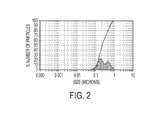
- FIG. 2 is a graph illustrating the particle size and particle size distribution of a pigment dispersion prior to magnetic milling in accordance with the present embodiments
- FIG. 3 is a Transmission Electron Microscopy (TEM) image of a pigment dispersion prior to magnetic milling in accordance with the present embodiments
- FIG. 4 is a graph illustrating the change of particle size of a pigment dispersion during the magnetic milling in accordance with the present embodiments
- FIG. 5 is a graph illustrating the particle size and particle size distribution of a pigment dispersion after the magnetic milling in accordance with the present embodiments
- FIG. 6 is a TEM image of a pigment dispersion after the magnetic milling in accordance with the present embodiments.
- FIG. 7 is a graph illustrating the particle size and particle size distribution of a pigment dispersion (scale up) after the magnetic milling in accordance with the present embodiments.
- FIG. 8 is a graph illustrating the particle size and particle size distribution of a two-month old pigment dispersion (scale up) after the magnetic milling in accordance with the present embodiments.
- D50 refers to the 50th percentile of the particle size distribution, wherein 50% of the particles in the distribution are greater than the D50 particle size value and the other 50% of the particles in the distribution are less than the D50 value.
- Average particle size data can be measured by methods that use light scattering technology to infer particle size, such as Dynamic Light Scattering.
- the present embodiments provide pigment dispersions prepared by employing a magnetic actuated milling process and system which use magnetic particles, non-magnetic abrasive particles and a magnetic field to facilitate the milling.
- the magnetic actuated milling process and system of the embodiments employ a constant magnetic field across a mixing vessel that contains pigments, magnetic particles, and non-magnetic abrasive particles in a medium (e.g., solvents) with agitation.
- a medium e.g., solvents
- a mixing system 45 comprising magnetic particles 50 and non-magnetic abrasive particles 75 loaded in a solution containing pigments 55 which is moved to actuate milling by a constant magnetic field 60 applied to the magnetic particles 50 .
- the magnetic particles may be pre-loaded or filled into the milling vessel 70 when milling is needed.
- a constant magnetic field 60 may be applied through one or more electromagnets, or a permanent magnet 65 on either side of the milling vessel 70 .
- the magnetic fields may be stationary or moving.
- the magnetic field may have a strength of from about 10 Gauss to about 50,000 Gauss, or from about 50 Gauss to about 20,000 Gauss, from about 100 Gauss to about 15,000 or from about 200 Gauss to about 10,000 Gauss.
- the pigment and the non-magnetic abrasive particles 75 may be agitated during parts of or during the entire milling process. During agitation, the magnetic particles 50 may be relatively stationary due to the influence of the constant magnetic field 60 . However, the magnetic particles 50 may be bounced and moved slightly by the motion of the other particles in the solution. The magnetic particles 50 may collide with the pigment particles 55 and the non-magnetic abrasive particles 75 .
- the mixing system 45 achieves intense micro mixing zone 75 uniformly throughout the mixing vessel 70 .
- the agitation may be performed in any suitable agitating means.
- the vessel 70 may be spun or shaken, or a stirrer may be added to the vessel 70 to mix the pigment dispersion.
- the agitation may be performed in the range of from about 50 to about 10,000 rpm, or from about 100 to about 5,000 rpm.
- the magnetic particles can be successfully collected and recycled by electromagnets for subsequent applications.
- the non-magnetic particles may be removed by any method including filtering, centrifuging, and the like.
- the magnetic particles may be include diamagnetic, paramagnetic, ferrimagnetic, ferromagnetic or antiferromagnetic materials such that the overall magnetic particle is paramagnetic, ferrimagnetic, ferromagnetic or antiferromagnetic.
- the magnetic particles may comprise Fe, Fe 2 O 3 , Ni, CrO 2 , or Cs.
- the magnetic particles include carbonyl iron and carbonyl nickel.
- the magnetic particles may have a non-magnetic coating.
- the magnetic particles can also be encapsulated with a shell, for example, a polymeric shell comprising, in embodiments, polystyrene, polyvinyl chloride, TEFLON®, PMMA, and the like and mixtures thereof.
- the magnetic particles may have a diameter of from about 5 nm to about 1000 ⁇ m, or from about 10 nm to about 500 ⁇ m, or from about 100 nm to about 100 ⁇ m.
- the size of magnetic particles can be chosen based on different applications or processes.
- the volume percentage of magnetic particles used for mixing may also vary depending on the different application or process for which the particles are being used. For example, from about 5% to about 80%, or from about 10% to about 50%, or from about 15% to about 25% magnetic particles may be added to the vessel.
- non-magnetic abrasive particles like those used as polishing abrasives in the magnetorheological finishing industry, are hard micron-sized materials responsible for material size reduction (for example, see Nanoindentation Hardness of Particles Used in Magnetorheological Finishing (MRF) Aric B. Shorey, Kevin M. Kwong, Kerry M. Johnson, and Stephen D. Jacobs Applied Optics, Volume 39, Issue 28 (2000)). These abrasive particles have hardness values that exceed those of magnetic particles.
- MRF Nanoindentation Hardness of Particles Used in Magnetorheological Finishing
- the non-magnetic abrasive particles When used in conjunction with the magnetic particles, the non-magnetic abrasive particles provide even more effective results in solid particle size reduction, especially in grinding certain pigment particles.
- the collision and shearing between the magnetic particles and non-magnetic abrasive particles and not only achieve the desired small scale and uniform distribution of the mixed particles, but to do so quickly.
- the non-magnetic particles may be later removed by any method including filtering, screening, centrifuging, and the like. While the use of the non-magnetic abrasive particles does add to the system components and process steps, the smaller particle sizes achieved outweigh any drawbacks.
- the non-magnetic abrasive particles may comprise one or more of aluminum oxide, silicon carbide, cerium oxide, zirconium oxide, ferric oxide, bauxite, cubic zirconia and diamond powder, and the like and mixtures thereof.
- the abrasive particles may have a diameter of less than 1 mm.
- the abrasive particles may have a diameter of from about 5 nm to about 1000 ⁇ m, or from about 10 nm to about 500 ⁇ m, or from about 100 nm to about 100 ⁇ m.
- the size of non-magnetic abrasive particles can be chosen based on different applications or processes.
- the non-magnetic abrasive particles have a nano indentation hardness value of at least 4.9, or from about 5 to about 50, or from about 7.5 to about 50 GPa.
- the non-magnetic abrasive particles may have any regular or irregular shape including spherical, cubic, hexagonal, rod-shaped, granular, elliptical, flake, and the like and mixtures thereof.
- the volume percentage of non-magnetic abrasive particles (based on the total dry volume of the milling media) used for milling may also vary depending on the different application or process for which the particles are being used. For example, from about 5% to about 95%, or from about 10% to about 80%, or from about 20% to about 70% non-magnetic abrasive particles may be added to the vessel.
- a weight ratio of magnetic particles to non-magnetic abrasive particles may be in a range of from about 0.5:10 to about 10:0.5, or from about 1:10 to about 10:1, or from about 2:10 to about 10:2.
- a volume ratio of the total milling media (magnetic particles and non-magnetic abrasive particles) to the material to be mixed may be in a range of from about 0.5:10 to about 10:0.5, or from about 1:10 to about 10:1, or from about 2:10 to about 10:2.
- the resulting particles sizes of the pigment dispersions achieved by the actuated milling are from about 10 nm to about 500 nm, from about 20 nm to about 400 nm, or from 50 nm to about 300 nm. In embodiments, certain pigments may achieve even smaller particles sizes of less than 100 nm, for example, from about 10 nm to about 100 nm, from about 30 nm to about 95 nm, from about 40 nm to about 95 nm, or from about 50 nm to about 95 nm.
- micro sized magnetic particles are used, due to the large surface contact area between micro magnetic particles and the solution, micro milling due to enhanced local diffusion significantly produces homogeneous and global milling.
- the present embodiments thus provide small particles on the nano to micro scale and uniform distribution.
- the present embodiments also provide for the potential of higher viscosity (for example, a viscosity of from about 0.1 cP to about 100,000 cP, from about 0.5 cP to about 50000 cP, or from about 1 cP to about 10000 cP at 25° C.) milling if the exposed magnetic field is large.
- Another advantage of the present method and system is the fact that it is free of mechanical components and thus maintenance, which significantly reduces the cost of the system.
- the present embodiments are also free of noise.
- the present embodiments may be used in many different applications, including solids dispersions for example, preparing toners, inks, wax, pigment dispersions and the like.
- the present embodiments may be used for any application that requires the preparation of small-sized particles at either the micro or nano scale.
- Pigment dispersions are often used in the preparation of EA toners or inks.
- Conventional milling methods used for preparing pigment dispersions suffer from many drawbacks.
- the use of conventional milling methods consume lengthy periods of time to prepare the pigment dispersions, often exceeding four hours.
- the present embodiments provide for the use of magnetic actuating motion of magnetic particles to prepare pigment dispersions as provided by milling capabilities at nano or micro scale. These embodiments apply a constant magnetic field to align the magnetic particles.
- the magnetic particles may be agitated by moving the magnetic field, where the magnetic source may be arranged in a movable manner (e.g., rotatable or tiltable manner)
- the motion of pigment particles and non-magnetic abrasive particles may be driven by agitation via, for example, stirring or homogenizing the solution, spinning or shaking of the vessel.
- the pigment particles and the non-magnetic abrasive particles may be agitated, while the magnetic particles may be stationary. In one embodiment, the pigment particles and the non-magnetic abrasive particles may be stationary, while the magnetic particles may be agitated. In one embodiment, the pigment particles and the non-magnetic abrasive particles may be agitated (by stirring or homogenize the solution, or spinning or shaking motion of the vessel), while the magnetic particles may be agitated (by influence of the movement of the magnetic field).
- Different motions of magnetic particles and non-magnetic particles provide consistent nano or micro scale collision and shearing throughout the entire vessel, thus providing uniform dispersion of materials within a very short time frame (e.g., minutes).
- a dry pigment may be loaded in a solvent (i.e., pigment/solvent mixture), such as water, an organic solvent, or mixtures thereof, into the vessel.
- a solvent i.e., pigment/solvent mixture
- the pigment may include a blue pigment, a black pigment, a cyan pigment, a brown pigment, a green pigment, a white pigment, a violet pigment, a magenta pigment, a red pigment, an orange pigment, a yellow pigment, or mixtures thereof.
- Suitable pigments include those comprising carbon black, such as, REGAL 330® and Nipex 35. Colored pigments, such as, cyan, magenta, yellow, red, orange, green, brown, blue or mixtures thereof can be used. The additional pigment or pigments can be used as water-based pigment dispersions.
- pigments examples include SUNSPERSE 6000, FLEXIVERSE and AQUATONE, water-based pigment dispersions from SUN Chemicals; HELIOGEN BLUE L6900TM, D6840TM, D7080TM, D7020TM, PYLAM OIL BLUETM, PYLAM OIL YELLOWTM and PIGMENT BLUE ITM available from Paul Uhlich & Company, Inc.; PIGMENT VIOLET ITM, PIGMENT RED 48TM, LEMON CHROME YELLOW DCC IO26TM, TOLUIDINE REDTM and BON RED CTM available from Dominion Color Corporation, Ltd., Toronto, Ontario; NOVAPERM YELLOW FGLTM and HOSTAPERM PINK ETM from Hoechst; CINQUASIA MAGENTATM available from E.I. DuPont de Nemours & Co., and the like.
- magenta pigments examples include 2,9-dimethyl-substituted quinacridone, an anthraquinone dye identified in the Color Index as CI 60710, CI Dispersed Red 15, a diazo dye identified in the Color Index as CI 26050, CI Solvent Red 19 and the like.
- cyan pigments include copper tetra(octadecylsulfonamido) phthalocyanine, a copper phthalocyanine pigment listed in the Color Index as CI 74160, CI Pigment Blue, Pigment Blue 15:3, Pigment Blue 15:4, an Anthrazine Blue identified in the Color Index as CI 69810, Special Blue X-2137 and the like.
- yellow pigments are diarylide yellow 3,3-dichlorobenzidene acetoacetanilide, a monoazo pigment identified in the Color Index as CI 12700, CI Solvent Yellow 16, a nitrophenyl amine sulfonamide identified in the Color Index as Foron Yellow SE/GLN, CI Disperse Yellow 3, 2,5-dimethoxy-4-sulfonanilide phenylazo-4′-chloro-2,5-dimethoxy acetoacetanilide and Permanent Yellow FGL.
- Colorants can be used, such as, Levanyl Black A-SF (Miles, Bayer) and Sunsperse Carbon Black LHD 9303 (Sun Chemicals), and colored dyes, such as, Neopen Blue (BASF), Sudan Blue OS (BASF), PV Fast Blue B2G 01 (American Hoechst), Sunsperse Blue BHD 6000 (Sun Chemicals), Irgalite Blue BCA (CibaGeigy), Paliogen Blue 6470 (BASF), Sudan III (Matheson, Coleman, Bell), Sudan II (Matheson, Coleman, Bell), Sudan IV (Matheson, Coleman, Bell), Sudan Orange G (Aldrich), Sudan Orange 220 (BASF), Paliogen Orange 3040 (BASF), Ortho Orange OR 2673 (Paul Uhlich), Paliogen Yellow 152, 1560 (BASF), Lithol Fast Yellow 0991 K (BASF), Paliotol Yellow 1840 (BASF), Neopen Yellow (BASF), Novoperm Yellow FG 1 (Hoechst),
- Toluidine Red (Aldrich), Lithol Rubine Toner (Paul Uhlich), Lithol Scarlet 4440 (BASF), Bon Red C (Dominion Color Company), Royal Brilliant Red RD-8192 (Paul Uhlich), Oracet Pink RF (Ciba-Geigy), Paliogen Red 3871 K (BASF), Paliogen Red 3340 (BASF), Lithol Fast Scarlet L4300 (BASF), combinations of the foregoing and the like.
- Pigment Yellow 74 (2-((2-methoxy-4-nitrophenyl)azo)-n-(2-methoxyphenyl)-3-oxo-butanamid)
- Pigment Yellow 14 Pigment yellow 93
- Pigment yellow 34 Pigment yellow 180
- Pigment yellow 83 Pigment yellow 139
- Pigment yellow 151 Pigment yellow 13, Pigment yellow 191, Pigment Orange 34
- the weight ratio of the pigment to solvent in the pigment/solvent mixture may be from about 5/95 to about 80/20, from about 10/90 to about 50/50, or from about 15/85 to about 20/80.
- the weight of the milled pigment is from about 1 to about 50%, from about 3 to about 45%, from about 5 to about 40%, by weight based on the pigment dispersion.
- a surfactant may be added to and mixed with the pigment/solvent mixture in the vessel.
- the surfactant can be water-soluble polymers, or water-soluble surfactants.
- the surfactant is added in an amount of from 1% to about 30%, or from about 3% to about 15%, or from about 5% to about 12% by weight of the total weight of the mixture in the vessel.
- any type of surfactant may be used, with anionic, cationic or nonionic surfactants being utilized in some embodiments.
- nonionic surfactants include, for example, polyacrylic acid, methalose, methyl cellulose, ethyl cellulose, propyl cellulose, hydroxy ethyl cellulose, carboxy methyl cellulose, polyoxyethylene cetyl ether, polyoxyethylene lauryl ether, polyoxyethylene octyl ether, polyoxyethylene octylphenyl ether, polyoxyethylene oleyl ether, polyoxyethylene sorbitan monolaurate, polyoxyethylene stearyl ether, polyoxyethylene nonylphenyl ether, dialkylphenoxy poly(ethyleneoxy) ethanol, available from Rhone-Poulenc Industries SA as IGEPAL CA-210TM, IGEPAL CA-520TM, IGEPAL CA-720TM, IGEPAL CO-890TM, IGEPAL CO-720TM, IGEPAL CO-290TM
- Anionic surfactants which may be utilized include sulfates and sulfonates, sodium dodecylsulfate (SDS), sodium dodecylbenzene sulfonate, sodium dodecylnaphthalene sulfate, dialkyl benzenealkyl sulfates and sulfonates, acids such as abitic acid available from Aldrich, NEOGEN RTM, NEOGEN SCTM obtained from Daiichi Kogyo Seiyaku Co. Ltd., combinations thereof, and the like.
- SDS sodium dodecylsulfate
- sodium dodecylbenzene sulfonate sodium dodecylnaphthalene sulfate
- dialkyl benzenealkyl sulfates and sulfonates acids such as abitic acid available from Aldrich, NEOGEN RTM, NEOGEN SCTM obtained from Daiichi Kogyo Seiyaku Co
- anionic surfactants include, in embodiments, DOWFAXTM 2A1, an alkyldiphenyloxide disulfonate from The Dow Chemical Company, and/or TAYCAPOWER BN2060 from Tayca Corporation, which are branched sodium dodecyl benzene sulfonates. Combinations of these surfactants and any of the foregoing anionic surfactants may be utilized in embodiments.
- cationic surfactants which are usually positively charged, include, for example, alkylbenzyl dimethyl ammonium chloride, dialkyl benzenealkyl ammonium chloride, lauryl trimethyl ammonium chloride, alkylbenzyl methyl ammonium chloride, alkyl benzyl dimethyl ammonium bromide, benzalkonium chloride, cetyl pyridinium bromide, C 12 , C 15 , C 17 trimethyl ammonium bromides, halide salts of quaternized polyoxyethylalkylamines, dodecylbenzyl triethyl ammonium chloride, MIRAPOLTM and ALKAQUATTM, available from Alkaril Chemical Company, SANIZOLTM (benzalkonium chloride), available from Kao Corporation, and the like, and mixtures thereof.
- alkylbenzyl dimethyl ammonium chloride dialkyl benzenealkyl ammonium chloride, lauryl trimethyl ammoni
- an ultrafine pigment dispersions having an average particle size of less than 100 nm can be prepared using the magnetic actuated milling method and system of the present disclosure.
- a magnetic field can be generated and applied to the mixture and magnetic particles in the vessel.
- the magnetic field for preparing ultrafine pigment dispersions may have a strength of from about 200 Gauss to about 10,000 Gauss, or from about 100 Gauss to about 10,000 Gauss.
- a pigment dispersion with the desired particle size can be then achieved by different motions of the magnetic particles nonmagnetic particles under the magnetic field and agitation. A reduction in pigment particles can be achieved.
- the duration and speed of milling may be dependent on the pigment color and pigment particle size desired.
- the duration of milling may range from about 0.01 to about 5000 hours, from about 0.1 to about 2000 hours, or from about 0.2 to about 1000 hours. A longer milling may in some cases be necessary or desirable but the process can in any particular instance be controlled by periodic examination of a sample to ascertain when a product having the desired particle characteristics and the like has been obtained.
- the rate of the agitation may range from about 50 to about 20,000 rpm, range from about 100 to about 10,000 rpm.
- the magnetic particles and non-magnetic abrasives abrasive particles can then be collected for re-use.
- Magnetic milling was conducted with magnetic particles and non-magnetic abrasives.
- the abrasive concentrations were calculated as follows:
- Abrasive ⁇ ⁇ concentration Abrasive ⁇ ⁇ Dry ⁇ ⁇ Volume Total ⁇ ⁇ Dry ⁇ ⁇ Volume ⁇ ⁇ of ⁇ ⁇ Milling ⁇ ⁇ Media
- the vial was then spinned using an agitator at 250 rpm beside a permanent magnet having magnetic field about 400 mT.
- the particle size of pigment was then measured at different time interval.
- Table 1 summarizes the mean diameter of the yellow pigment over the duration of the magnetic milling, and FIG. 4 shows the change of particle size in time over the duration of the magnetic milling.
- the particle size and particle size distribution of the yellow pigment dispersion after magnetic milling is shown in FIG. 5 .
- the TEM image of the yellow pigment dispersion after magnetic milling is shown in FIG. 6 .
- Magnetic milling was conducted with magnetic particles and non-magnetic abrasives.
- Into a 85 ml glass bottle was added 45.8 g of the wetted pigment dispersion obtained in Example 1, and 27.28 g of 35 micron iron oxide magnetic particles and 13.22 g of nonmagnetic abrasives Al 2 O 3 ( ⁇ 10 micron) at about 50:50 abrasive concentration.
- the vial was then spinned using an agitator at 75 rpm beside a permanent magnet having magnetic field about 400 mT.
- the particle size of pigment was then measured after spun overnight.
- the particle size and particle size distribution of the resulting yellow pigment dispersion are shown in FIG. 7 .
- the data indicated that the D50 of resulting yellow pigment dispersion is 85.9 nm, with 95% of the particles smaller than 214.1 nm.
- TEM image also indicated that the original rod shaped pigment particles were broken into smaller particles
- Example 2 After 2 months of storage in a sealed jar at room temperature, the yellow pigment dispersion of Example 2 was remixed and measured again. The particle size and particle size distribution are shown in FIG. 8 .
- the D50 of 2-month old yellow pigment dispersion was measured to be 93.7 nm and 95% of particles were smaller than 251 nm, which demonstrates good pigment stability.
- the vial was then spun using an agitator at 400 rpm beside a permanent magnet having magnetic field about 400 mT.
- the particle size of pigment was then measured at different time interval until particle size stabilized.
- Comparative Examples 5 and 6 were prepared according to the method described for Example 4, except that Cyan pigment PB15:3 and magenta pigment PR122 was used respectively instead of carbon black pigment. Table 2 shows the
Landscapes
- Chemical & Material Sciences (AREA)
- Engineering & Computer Science (AREA)
- Life Sciences & Earth Sciences (AREA)
- Materials Engineering (AREA)
- Wood Science & Technology (AREA)
- Organic Chemistry (AREA)
- Food Science & Technology (AREA)
- Pigments, Carbon Blacks, Or Wood Stains (AREA)
- Developing Agents For Electrophotography (AREA)
Abstract
Description
| TABLE 1 | |||
| Time (h) | Mean Diameter (micron) | ||
| 0.0 | 0.211.1 | ||
| 0.25 | 0.1889 | ||
| 0.50 | 0.1758 | ||
| 1.00 | 0.1421 | ||
| 2.00 | 0.119 | ||
| 3.00 | 0.1064 | ||
| 4.50 | 0.0901 | ||
| 6.00 | 0.0814 | ||
| 16.00 | 0.0674 | ||
| TABLE 2 | ||
| Mean Diameter (micron) of pigment dispersions | ||
| Time (h) | Carbon black (regal 330) | Cyan (PB15:3) | Magenta (PR122) |
| 0.00 | 0.1861 | 0.2459 | 0.3150 |
| 0.04 | 0.1588 | ||
| 0.08 | 0.1411 | 0.1777 | 0.2506 |
| 0.17 | 0.1396 | ||
| 0.25 | 0.1349 | 0.1626 | 0.2176 |
| 0.33 | 0.1356 | ||
| 0.42 | 0.1316 | ||
| 0.50 | 0.1317 | 0.1542 | 0.2001 |
| 1.00 | 0.1333 | 0.1328 | 0.1954 |
| 1.50 | 0.1338 | ||
| 2.00 | 0.1297 | 0.1349 | 0.1682 |
| 2.50 | 0.1259 | ||
| 3.00 | 0.1291 | 0.1351 | 0.1756 |
| 16.00 | 0.1883 | ||
Claims (17)
Priority Applications (1)
| Application Number | Priority Date | Filing Date | Title |
|---|---|---|---|
| US15/351,116 US10066115B2 (en) | 2014-07-10 | 2016-11-14 | Magnetic actuated-milled pigment dispersions and process for making thereof |
Applications Claiming Priority (2)
| Application Number | Priority Date | Filing Date | Title |
|---|---|---|---|
| US14/328,625 US20160008820A1 (en) | 2014-07-10 | 2014-07-10 | Magnetic actuated-milled pigment dispersions and process for making thereof |
| US15/351,116 US10066115B2 (en) | 2014-07-10 | 2016-11-14 | Magnetic actuated-milled pigment dispersions and process for making thereof |
Related Parent Applications (1)
| Application Number | Title | Priority Date | Filing Date |
|---|---|---|---|
| US14/328,625 Continuation US20160008820A1 (en) | 2014-07-10 | 2014-07-10 | Magnetic actuated-milled pigment dispersions and process for making thereof |
Publications (2)
| Publication Number | Publication Date |
|---|---|
| US20170066942A1 US20170066942A1 (en) | 2017-03-09 |
| US10066115B2 true US10066115B2 (en) | 2018-09-04 |
Family
ID=55066758
Family Applications (2)
| Application Number | Title | Priority Date | Filing Date |
|---|---|---|---|
| US14/328,625 Abandoned US20160008820A1 (en) | 2014-07-10 | 2014-07-10 | Magnetic actuated-milled pigment dispersions and process for making thereof |
| US15/351,116 Active 2034-08-23 US10066115B2 (en) | 2014-07-10 | 2016-11-14 | Magnetic actuated-milled pigment dispersions and process for making thereof |
Family Applications Before (1)
| Application Number | Title | Priority Date | Filing Date |
|---|---|---|---|
| US14/328,625 Abandoned US20160008820A1 (en) | 2014-07-10 | 2014-07-10 | Magnetic actuated-milled pigment dispersions and process for making thereof |
Country Status (1)
| Country | Link |
|---|---|
| US (2) | US20160008820A1 (en) |
Cited By (1)
| Publication number | Priority date | Publication date | Assignee | Title |
|---|---|---|---|---|
| US11154828B2 (en) * | 2018-09-14 | 2021-10-26 | Uchicago Argonne, Llc | Turbulent mixing by microscopic self-assembled spinners |
Families Citing this family (1)
| Publication number | Priority date | Publication date | Assignee | Title |
|---|---|---|---|---|
| CN109266136B (en) * | 2018-08-06 | 2020-09-29 | 山西大学 | A kind of beige magnetic absorbing paint and preparation method thereof |
Citations (49)
| Publication number | Priority date | Publication date | Assignee | Title |
|---|---|---|---|---|
| US3590000A (en) | 1967-06-05 | 1971-06-29 | Xerox Corp | Solid developer for latent electrostatic images |
| US3644263A (en) | 1967-03-09 | 1972-02-22 | Burke Oliver W Jun | High polymer latices and methods and means for producing same |
| US3800588A (en) | 1971-04-30 | 1974-04-02 | Mts System Corp | Multiple axis control system for vibration test apparatus |
| US3879327A (en) | 1969-04-18 | 1975-04-22 | Exxon Research Engineering Co | Formation of a latex from an organic solvent dispersion of a water insoluble polymer |
| US4243566A (en) | 1975-01-08 | 1981-01-06 | Exxon Research And Engineering Company | Preparation of latex from solvent dispersed polymer composition |
| US4298672A (en) | 1978-06-01 | 1981-11-03 | Xerox Corporation | Toners containing alkyl pyridinium compounds and their hydrates |
| US4338390A (en) | 1980-12-04 | 1982-07-06 | Xerox Corporation | Quarternary ammonium sulfate or sulfonate charge control agents for electrophotographic developers compatible with viton fuser |
| US5026427A (en) | 1988-10-12 | 1991-06-25 | E. I. Dupont De Nemours And Company | Process for making pigmented ink jet inks |
| US5028142A (en) | 1989-04-06 | 1991-07-02 | Biotrack, Inc. | Reciprocal mixer |
| US5085698A (en) | 1990-04-11 | 1992-02-04 | E. I. Du Pont De Nemours And Company | Aqueous pigmented inks for ink jet printers |
| US5183214A (en) * | 1989-05-03 | 1993-02-02 | E. I. Du Pont De Nemours And Company | Process of magnetic media milling |
| US5346797A (en) | 1993-02-25 | 1994-09-13 | Xerox Corporation | Toner processes |
| US5364729A (en) | 1993-06-25 | 1994-11-15 | Xerox Corporation | Toner aggregation processes |
| US5403693A (en) | 1993-06-25 | 1995-04-04 | Xerox Corporation | Toner aggregation and coalescence processes |
| US5418108A (en) | 1993-06-25 | 1995-05-23 | Xerox Corporation | Toner emulsion aggregation process |
| US5417747A (en) | 1993-01-22 | 1995-05-23 | Mikuni Shikiso Kabushiki Kaisha | Waterbased ink composition for ink-jet printing |
| US5500331A (en) * | 1994-05-25 | 1996-03-19 | Eastman Kodak Company | Comminution with small particle milling media |
| US5501935A (en) | 1995-01-17 | 1996-03-26 | Xerox Corporation | Toner aggregation processes |
| US5527658A (en) | 1995-03-13 | 1996-06-18 | Xerox Corporation | Toner aggregation processes using water insoluble transition metal containing powder |
| US5585215A (en) | 1996-06-13 | 1996-12-17 | Xerox Corporation | Toner compositions |
| US5650255A (en) | 1996-09-03 | 1997-07-22 | Xerox Corporation | Low shear toner aggregation processes |
| US5650256A (en) | 1996-10-02 | 1997-07-22 | Xerox Corporation | Toner processes |
| US5835329A (en) | 1995-06-05 | 1998-11-10 | Solid Phase Sciences Corporation | Apparatus for agitation separation of magnetic particles |
| US5853943A (en) | 1998-01-09 | 1998-12-29 | Xerox Corporation | Toner processes |
| US5916725A (en) | 1998-01-13 | 1999-06-29 | Xerox Corporation | Surfactant free toner processes |
| US6063827A (en) | 1998-07-22 | 2000-05-16 | Xerox Corporation | Polyester process |
| US6120967A (en) | 2000-01-19 | 2000-09-19 | Xerox Corporation | Sequenced addition of coagulant in toner aggregation process |
| US6187270B1 (en) | 1994-07-07 | 2001-02-13 | Roche Diagnostics Gmbh | Device and method for the separation of magnetic microparticles |
| US6214507B1 (en) | 1998-08-11 | 2001-04-10 | Xerox Corporation | Toner compositions |
| US6593049B1 (en) | 2001-03-26 | 2003-07-15 | Xerox Corporation | Toner and developer compositions |
| US6756176B2 (en) | 2002-09-27 | 2004-06-29 | Xerox Corporation | Toner processes |
| US6764859B1 (en) | 1999-07-19 | 2004-07-20 | Biomerieux, B.V. | Device and method for mixing magnetic particles with a fluid |
| US6830860B2 (en) | 2003-01-22 | 2004-12-14 | Xerox Corporation | Toner compositions and processes thereof |
| US20060063084A1 (en) | 2004-09-22 | 2006-03-23 | Xerox Corporation | Emulsion aggregation toner containing pigment having a small particle size |
| US20060222991A1 (en) | 2005-03-31 | 2006-10-05 | Xerox Corporation | Toner compositions and process thereof |
| US20070207272A1 (en) | 2006-03-03 | 2007-09-06 | Puri Ishwar K | Method and apparatus for magnetic mixing in micron size droplets |
| US20090047431A1 (en) * | 2007-08-14 | 2009-02-19 | Shigeo Hatada | Inkjet ink, and ink cartridge, inkjet recording method, inkjet recording apparatus and ink record using the same |
| US7517457B2 (en) | 1995-02-21 | 2009-04-14 | Iqbal Waheed Siddiqi | Method of mixing magnetic particles |
| US7683142B2 (en) | 2005-10-11 | 2010-03-23 | Xerox Corporation | Latex emulsion polymerizations in spinning disc reactors or rotating tubular reactors |
| US7947761B2 (en) | 2006-01-31 | 2011-05-24 | Cabot Corporation | Inkjet ink compositions comprising polymeric dispersants having attached chromophore groups |
| US7977024B2 (en) | 2005-12-16 | 2011-07-12 | Xerox Corporation | Solvent-free toner making process using phase inversion |
| US8124309B2 (en) | 2009-04-20 | 2012-02-28 | Xerox Corporation | Solvent-free emulsion process |
| US8163459B2 (en) | 2010-03-01 | 2012-04-24 | Xerox Corporation | Bio-based amorphous polyester resins for emulsion aggregation toners |
| US8168699B2 (en) | 2010-06-21 | 2012-05-01 | Xerox Corporation | Solvent-assisted continuous emulsification processes for producing polyester latexes |
| WO2013099730A1 (en) | 2011-12-28 | 2013-07-04 | 大日精化工業株式会社 | C.i. pigment yellow 74 (insoluble azo pigment), and coloring composition using same |
| US8871420B1 (en) | 2013-04-10 | 2014-10-28 | Xerox Corporation | Method and system for magnetic actuated mixing to prepare latex emulsion |
| US20150131405A1 (en) | 2013-11-08 | 2015-05-14 | Xerox Corporation | Magnetic mixing for continuous latex preparation |
| US20150251186A1 (en) | 2014-03-10 | 2015-09-10 | Xerox Corporation | Method and system for magnetic actuated mixing |
| US9234090B2 (en) | 2013-04-10 | 2016-01-12 | Xerox Corporation | Method and system for magnetic actuated milling for pigment dispersions |
-
2014
- 2014-07-10 US US14/328,625 patent/US20160008820A1/en not_active Abandoned
-
2016
- 2016-11-14 US US15/351,116 patent/US10066115B2/en active Active
Patent Citations (51)
| Publication number | Priority date | Publication date | Assignee | Title |
|---|---|---|---|---|
| US3644263A (en) | 1967-03-09 | 1972-02-22 | Burke Oliver W Jun | High polymer latices and methods and means for producing same |
| US3590000A (en) | 1967-06-05 | 1971-06-29 | Xerox Corp | Solid developer for latent electrostatic images |
| US3879327A (en) | 1969-04-18 | 1975-04-22 | Exxon Research Engineering Co | Formation of a latex from an organic solvent dispersion of a water insoluble polymer |
| US3800588A (en) | 1971-04-30 | 1974-04-02 | Mts System Corp | Multiple axis control system for vibration test apparatus |
| US4243566A (en) | 1975-01-08 | 1981-01-06 | Exxon Research And Engineering Company | Preparation of latex from solvent dispersed polymer composition |
| US4298672A (en) | 1978-06-01 | 1981-11-03 | Xerox Corporation | Toners containing alkyl pyridinium compounds and their hydrates |
| US4338390A (en) | 1980-12-04 | 1982-07-06 | Xerox Corporation | Quarternary ammonium sulfate or sulfonate charge control agents for electrophotographic developers compatible with viton fuser |
| US5026427A (en) | 1988-10-12 | 1991-06-25 | E. I. Dupont De Nemours And Company | Process for making pigmented ink jet inks |
| US5028142A (en) | 1989-04-06 | 1991-07-02 | Biotrack, Inc. | Reciprocal mixer |
| US5183214A (en) * | 1989-05-03 | 1993-02-02 | E. I. Du Pont De Nemours And Company | Process of magnetic media milling |
| US5085698A (en) | 1990-04-11 | 1992-02-04 | E. I. Du Pont De Nemours And Company | Aqueous pigmented inks for ink jet printers |
| US5417747A (en) | 1993-01-22 | 1995-05-23 | Mikuni Shikiso Kabushiki Kaisha | Waterbased ink composition for ink-jet printing |
| US5346797A (en) | 1993-02-25 | 1994-09-13 | Xerox Corporation | Toner processes |
| US5364729A (en) | 1993-06-25 | 1994-11-15 | Xerox Corporation | Toner aggregation processes |
| US5418108A (en) | 1993-06-25 | 1995-05-23 | Xerox Corporation | Toner emulsion aggregation process |
| US5403693A (en) | 1993-06-25 | 1995-04-04 | Xerox Corporation | Toner aggregation and coalescence processes |
| US5500331A (en) * | 1994-05-25 | 1996-03-19 | Eastman Kodak Company | Comminution with small particle milling media |
| US6187270B1 (en) | 1994-07-07 | 2001-02-13 | Roche Diagnostics Gmbh | Device and method for the separation of magnetic microparticles |
| US5501935A (en) | 1995-01-17 | 1996-03-26 | Xerox Corporation | Toner aggregation processes |
| US7517457B2 (en) | 1995-02-21 | 2009-04-14 | Iqbal Waheed Siddiqi | Method of mixing magnetic particles |
| US5527658A (en) | 1995-03-13 | 1996-06-18 | Xerox Corporation | Toner aggregation processes using water insoluble transition metal containing powder |
| US5835329A (en) | 1995-06-05 | 1998-11-10 | Solid Phase Sciences Corporation | Apparatus for agitation separation of magnetic particles |
| US5585215A (en) | 1996-06-13 | 1996-12-17 | Xerox Corporation | Toner compositions |
| US5650255A (en) | 1996-09-03 | 1997-07-22 | Xerox Corporation | Low shear toner aggregation processes |
| US5650256A (en) | 1996-10-02 | 1997-07-22 | Xerox Corporation | Toner processes |
| US5853943A (en) | 1998-01-09 | 1998-12-29 | Xerox Corporation | Toner processes |
| US5916725A (en) | 1998-01-13 | 1999-06-29 | Xerox Corporation | Surfactant free toner processes |
| US6063827A (en) | 1998-07-22 | 2000-05-16 | Xerox Corporation | Polyester process |
| US6214507B1 (en) | 1998-08-11 | 2001-04-10 | Xerox Corporation | Toner compositions |
| US6764859B1 (en) | 1999-07-19 | 2004-07-20 | Biomerieux, B.V. | Device and method for mixing magnetic particles with a fluid |
| US6120967A (en) | 2000-01-19 | 2000-09-19 | Xerox Corporation | Sequenced addition of coagulant in toner aggregation process |
| US6593049B1 (en) | 2001-03-26 | 2003-07-15 | Xerox Corporation | Toner and developer compositions |
| US6756176B2 (en) | 2002-09-27 | 2004-06-29 | Xerox Corporation | Toner processes |
| US6830860B2 (en) | 2003-01-22 | 2004-12-14 | Xerox Corporation | Toner compositions and processes thereof |
| US20060063084A1 (en) | 2004-09-22 | 2006-03-23 | Xerox Corporation | Emulsion aggregation toner containing pigment having a small particle size |
| US20060222991A1 (en) | 2005-03-31 | 2006-10-05 | Xerox Corporation | Toner compositions and process thereof |
| US7683142B2 (en) | 2005-10-11 | 2010-03-23 | Xerox Corporation | Latex emulsion polymerizations in spinning disc reactors or rotating tubular reactors |
| US7977024B2 (en) | 2005-12-16 | 2011-07-12 | Xerox Corporation | Solvent-free toner making process using phase inversion |
| US7947761B2 (en) | 2006-01-31 | 2011-05-24 | Cabot Corporation | Inkjet ink compositions comprising polymeric dispersants having attached chromophore groups |
| US20070207272A1 (en) | 2006-03-03 | 2007-09-06 | Puri Ishwar K | Method and apparatus for magnetic mixing in micron size droplets |
| US20090047431A1 (en) * | 2007-08-14 | 2009-02-19 | Shigeo Hatada | Inkjet ink, and ink cartridge, inkjet recording method, inkjet recording apparatus and ink record using the same |
| US8124309B2 (en) | 2009-04-20 | 2012-02-28 | Xerox Corporation | Solvent-free emulsion process |
| US8163459B2 (en) | 2010-03-01 | 2012-04-24 | Xerox Corporation | Bio-based amorphous polyester resins for emulsion aggregation toners |
| US8168699B2 (en) | 2010-06-21 | 2012-05-01 | Xerox Corporation | Solvent-assisted continuous emulsification processes for producing polyester latexes |
| WO2013099730A1 (en) | 2011-12-28 | 2013-07-04 | 大日精化工業株式会社 | C.i. pigment yellow 74 (insoluble azo pigment), and coloring composition using same |
| US20140335358A1 (en) | 2011-12-28 | 2014-11-13 | Dainichiseika Color & Chemicals Mfg. Co., Ltd. | C.i. pigment yellow 74 (insoluble azo pigment), and coloring composition using same |
| JPWO2013099730A1 (en) | 2011-12-28 | 2015-05-07 | 大日精化工業株式会社 | Insoluble azo pigment C.I. Pigment Yellow 74 and coloring composition using the same |
| US8871420B1 (en) | 2013-04-10 | 2014-10-28 | Xerox Corporation | Method and system for magnetic actuated mixing to prepare latex emulsion |
| US9234090B2 (en) | 2013-04-10 | 2016-01-12 | Xerox Corporation | Method and system for magnetic actuated milling for pigment dispersions |
| US20150131405A1 (en) | 2013-11-08 | 2015-05-14 | Xerox Corporation | Magnetic mixing for continuous latex preparation |
| US20150251186A1 (en) | 2014-03-10 | 2015-09-10 | Xerox Corporation | Method and system for magnetic actuated mixing |
Non-Patent Citations (5)
| Title |
|---|
| Jain, V.K., Sidpara, A. Sankar, M.R. and Das, M., Proceedings of the Institution of Mechanical Engineers, Part C: Journal of Mechanical Engineering Science, Oct. 26, 2011; pp. 326-346. |
| Martin, et al., "Strong intrinsic mixing in vortex magnetic fields" Physical Review E 80, 016312 (pp. 1-6) (2009). |
| Rida, et al., "Manipulation of Self-Assembled Structures of Magnetic Beads for Microfluidic Mixing and Assaying" Anal. Chem. (2004) 76, 6239-6246. |
| Shorey, Aric Bruce, Mechanisms of Material Removal in Magnetorheological Finishing (MRF) of Glass, 2000; pp. 88-100. |
| Wang, et al., "A rapid magnetic particle driven micromixer" Microfluid Nanofluid (2008) 4:375-389. |
Cited By (1)
| Publication number | Priority date | Publication date | Assignee | Title |
|---|---|---|---|---|
| US11154828B2 (en) * | 2018-09-14 | 2021-10-26 | Uchicago Argonne, Llc | Turbulent mixing by microscopic self-assembled spinners |
Also Published As
| Publication number | Publication date |
|---|---|
| US20160008820A1 (en) | 2016-01-14 |
| US20170066942A1 (en) | 2017-03-09 |
Similar Documents
| Publication | Publication Date | Title |
|---|---|---|
| US5849456A (en) | Toner for developing electrostatic charge image, production method thereof, and image formation method | |
| EP2150859B1 (en) | Method for producing polymerized toner, polymerized toner, method for producing binder resin for toner and binder resin for toner | |
| US7358022B2 (en) | Control of particle growth with complexing agents | |
| BRPI0902371A2 (en) | toner process | |
| US5998078A (en) | Method of preparing toner for electrostatic charge image development, toner for electrostatic charge image development, electrostatic charge image developer, and image forming method | |
| CN101025584B (en) | Toner and its manufacturing method | |
| JP2023020961A (en) | Toner and toner manufacturing method | |
| JP2004220005A (en) | Method for finely pulverizing charge control agent for toner, and method for producing toner for electrostatic image development using the method | |
| JP4220538B2 (en) | Toner and method for producing the same | |
| JP2001305797A (en) | Toner for development of electrostatic charge image, method for manufacturing the same, electrostatic charge image developer and method for forming image | |
| US20170066942A1 (en) | Magnetic actuated-milled pigment dispersions and process for making thereof | |
| JP7665374B2 (en) | Toner manufacturing method | |
| JP5730046B2 (en) | Method for producing toner particles | |
| JP4730112B2 (en) | Electrostatic charge developing toner, electrostatic charge developer, and method for producing electrostatic charge developing toner | |
| JPH0820764B2 (en) | Electrophotographic toner | |
| JP3970085B2 (en) | Method for producing polymerization toner | |
| JP5305926B2 (en) | Method for producing polymerized toner | |
| JP2011075704A (en) | Toner for developing electrostatic charge image | |
| JP7009221B2 (en) | Toner manufacturing method | |
| JP2011164296A (en) | Method for producing toner for electrostatic charge image development | |
| JP4335748B2 (en) | Toner production method | |
| JP5489865B2 (en) | Method for producing polymerized toner | |
| JP4441359B2 (en) | Toner production method | |
| JP3530904B2 (en) | Electrostatic latent image developing toner and method of manufacturing the same | |
| CN101329522B (en) | Toner particle, manufacturing method thereof, tow-component developer, developing device and image forming apparatus |
Legal Events
| Date | Code | Title | Description |
|---|---|---|---|
| AS | Assignment |
Owner name: XEROX CORPORATION, CONNECTICUT Free format text: ASSIGNMENT OF ASSIGNORS INTEREST;ASSIGNORS:ZHOU, KE;LEE, FRANK PING HAY;LATCHMAN, HARRY;AND OTHERS;SIGNING DATES FROM 20140709 TO 20140710;REEL/FRAME:040313/0202 |
|
| STCF | Information on status: patent grant |
Free format text: PATENTED CASE |
|
| MAFP | Maintenance fee payment |
Free format text: PAYMENT OF MAINTENANCE FEE, 4TH YEAR, LARGE ENTITY (ORIGINAL EVENT CODE: M1551); ENTITY STATUS OF PATENT OWNER: LARGE ENTITY Year of fee payment: 4 |
|
| AS | Assignment |
Owner name: CITIBANK, N.A., AS AGENT, DELAWARE Free format text: SECURITY INTEREST;ASSIGNOR:XEROX CORPORATION;REEL/FRAME:062740/0214 Effective date: 20221107 |
|
| AS | Assignment |
Owner name: XEROX CORPORATION, CONNECTICUT Free format text: RELEASE OF SECURITY INTEREST IN PATENTS AT R/F 062740/0214;ASSIGNOR:CITIBANK, N.A., AS AGENT;REEL/FRAME:063694/0122 Effective date: 20230517 |
|
| AS | Assignment |
Owner name: CITIBANK, N.A., AS COLLATERAL AGENT, NEW YORK Free format text: SECURITY INTEREST;ASSIGNOR:XEROX CORPORATION;REEL/FRAME:064760/0389 Effective date: 20230621 |
|
| AS | Assignment |
Owner name: JEFFERIES FINANCE LLC, AS COLLATERAL AGENT, NEW YORK Free format text: SECURITY INTEREST;ASSIGNOR:XEROX CORPORATION;REEL/FRAME:065628/0019 Effective date: 20231117 |
|
| AS | Assignment |
Owner name: XEROX CORPORATION, CONNECTICUT Free format text: TERMINATION AND RELEASE OF SECURITY INTEREST IN PATENTS RECORDED AT RF 064760/0389;ASSIGNOR:CITIBANK, N.A., AS COLLATERAL AGENT;REEL/FRAME:068261/0001 Effective date: 20240206 Owner name: CITIBANK, N.A., AS COLLATERAL AGENT, NEW YORK Free format text: SECURITY INTEREST;ASSIGNOR:XEROX CORPORATION;REEL/FRAME:066741/0001 Effective date: 20240206 |
|
| AS | Assignment |
Owner name: U.S. BANK TRUST COMPANY, NATIONAL ASSOCIATION, AS COLLATERAL AGENT, CONNECTICUT Free format text: FIRST LIEN NOTES PATENT SECURITY AGREEMENT;ASSIGNOR:XEROX CORPORATION;REEL/FRAME:070824/0001 Effective date: 20250411 |
|
| AS | Assignment |
Owner name: U.S. BANK TRUST COMPANY, NATIONAL ASSOCIATION, AS COLLATERAL AGENT, CONNECTICUT Free format text: SECOND LIEN NOTES PATENT SECURITY AGREEMENT;ASSIGNOR:XEROX CORPORATION;REEL/FRAME:071785/0550 Effective date: 20250701 |
|
| MAFP | Maintenance fee payment |
Free format text: PAYMENT OF MAINTENANCE FEE, 8TH YEAR, LARGE ENTITY (ORIGINAL EVENT CODE: M1552); ENTITY STATUS OF PATENT OWNER: LARGE ENTITY Year of fee payment: 8 |