US10066068B2 - Polymeric ion conductor with improved thermal characteristics - Google Patents
Polymeric ion conductor with improved thermal characteristics Download PDFInfo
- Publication number
- US10066068B2 US10066068B2 US15/204,370 US201615204370A US10066068B2 US 10066068 B2 US10066068 B2 US 10066068B2 US 201615204370 A US201615204370 A US 201615204370A US 10066068 B2 US10066068 B2 US 10066068B2
- Authority
- US
- United States
- Prior art keywords
- cooh
- alkyl
- nitro
- independently
- alkoxy
- Prior art date
- Legal status (The legal status is an assumption and is not a legal conclusion. Google has not performed a legal analysis and makes no representation as to the accuracy of the status listed.)
- Active
Links
- 239000010416 ion conductor Substances 0.000 title abstract 2
- 229920000642 polymer Polymers 0.000 claims abstract description 107
- 229910018828 PO3H2 Inorganic materials 0.000 claims description 167
- 125000003178 carboxy group Chemical group [H]OC(*)=O 0.000 claims description 158
- 229910006069 SO3H Inorganic materials 0.000 claims description 155
- 125000004093 cyano group Chemical group *C#N 0.000 claims description 114
- 125000000449 nitro group Chemical group [O-][N+](*)=O 0.000 claims description 88
- 125000005843 halogen group Chemical group 0.000 claims description 87
- -1 methoxy, methylthio Chemical group 0.000 claims description 69
- 125000000753 cycloalkyl group Chemical group 0.000 claims description 55
- 125000004169 (C1-C6) alkyl group Chemical group 0.000 claims description 50
- 125000000882 C2-C6 alkenyl group Chemical group 0.000 claims description 48
- 125000003601 C2-C6 alkynyl group Chemical group 0.000 claims description 48
- 125000002887 hydroxy group Chemical group [H]O* 0.000 claims description 48
- 125000004191 (C1-C6) alkoxy group Chemical group 0.000 claims description 42
- 125000002496 methyl group Chemical group [H]C([H])([H])* 0.000 claims description 42
- 125000006700 (C1-C6) alkylthio group Chemical group 0.000 claims description 39
- 125000000041 C6-C10 aryl group Chemical group 0.000 claims description 39
- 125000001153 fluoro group Chemical group F* 0.000 claims description 38
- 125000002023 trifluoromethyl group Chemical group FC(F)(F)* 0.000 claims description 37
- 125000001997 phenyl group Chemical group [H]C1=C([H])C([H])=C(*)C([H])=C1[H] 0.000 claims description 31
- 125000006273 (C1-C3) alkyl group Chemical group 0.000 claims description 28
- 125000004455 (C1-C3) alkylthio group Chemical group 0.000 claims description 28
- 125000006274 (C1-C3)alkoxy group Chemical group 0.000 claims description 28
- 125000003837 (C1-C20) alkyl group Chemical group 0.000 claims description 22
- 125000006823 (C1-C6) acyl group Chemical group 0.000 claims description 22
- 125000006736 (C6-C20) aryl group Chemical group 0.000 claims description 22
- 125000005110 aryl thio group Chemical group 0.000 claims description 21
- 150000003457 sulfones Chemical class 0.000 claims description 21
- 125000003860 C1-C20 alkoxy group Chemical group 0.000 claims description 19
- 125000003358 C2-C20 alkenyl group Chemical group 0.000 claims description 19
- 125000004104 aryloxy group Chemical group 0.000 claims description 19
- 125000005913 (C3-C6) cycloalkyl group Chemical group 0.000 claims description 11
- 239000012528 membrane Substances 0.000 claims description 6
- 125000000472 sulfonyl group Chemical group *S(*)(=O)=O 0.000 claims description 6
- 229920001519 homopolymer Polymers 0.000 claims description 4
- 229920001577 copolymer Polymers 0.000 claims description 2
- 239000000446 fuel Substances 0.000 abstract description 9
- 125000000217 alkyl group Chemical group 0.000 description 38
- 125000003118 aryl group Chemical group 0.000 description 37
- 125000001424 substituent group Chemical group 0.000 description 28
- 125000000623 heterocyclic group Chemical group 0.000 description 22
- 125000001183 hydrocarbyl group Chemical group 0.000 description 18
- 125000001072 heteroaryl group Chemical group 0.000 description 17
- 0 CC(C)(C)*c1cc(*c2cc(C(C)(C)C)ccc2)ncn1 Chemical compound CC(C)(C)*c1cc(*c2cc(C(C)(C)C)ccc2)ncn1 0.000 description 15
- 125000004429 atom Chemical group 0.000 description 15
- 125000003342 alkenyl group Chemical group 0.000 description 14
- 125000000304 alkynyl group Chemical group 0.000 description 13
- 125000005842 heteroatom Chemical group 0.000 description 13
- 238000006116 polymerization reaction Methods 0.000 description 12
- 125000003545 alkoxy group Chemical group 0.000 description 11
- 125000004432 carbon atom Chemical group C* 0.000 description 11
- 238000006243 chemical reaction Methods 0.000 description 11
- 229920006395 saturated elastomer Polymers 0.000 description 11
- 229910052739 hydrogen Inorganic materials 0.000 description 10
- 239000001257 hydrogen Substances 0.000 description 10
- IAZDPXIOMUYVGZ-UHFFFAOYSA-N Dimethylsulphoxide Chemical compound CS(C)=O IAZDPXIOMUYVGZ-UHFFFAOYSA-N 0.000 description 9
- UFHFLCQGNIYNRP-UHFFFAOYSA-N Hydrogen Chemical compound [H][H] UFHFLCQGNIYNRP-UHFFFAOYSA-N 0.000 description 9
- OKKJLVBELUTLKV-UHFFFAOYSA-N Methanol Chemical compound OC OKKJLVBELUTLKV-UHFFFAOYSA-N 0.000 description 9
- 125000002252 acyl group Chemical group 0.000 description 9
- 229910052799 carbon Inorganic materials 0.000 description 9
- 238000000746 purification Methods 0.000 description 9
- 125000001495 ethyl group Chemical group [H]C([H])([H])C([H])([H])* 0.000 description 8
- 125000000524 functional group Chemical group 0.000 description 8
- 125000001449 isopropyl group Chemical group [H]C([H])([H])C([H])(*)C([H])([H])[H] 0.000 description 8
- 125000004414 alkyl thio group Chemical group 0.000 description 7
- 125000003710 aryl alkyl group Chemical group 0.000 description 7
- 125000002915 carbonyl group Chemical group [*:2]C([*:1])=O 0.000 description 7
- 125000004122 cyclic group Chemical group 0.000 description 7
- 125000001436 propyl group Chemical group [H]C([*])([H])C([H])([H])C([H])([H])[H] 0.000 description 7
- 150000003839 salts Chemical class 0.000 description 7
- 125000000547 substituted alkyl group Chemical group 0.000 description 7
- ZQWGRBCDRGHFDK-UHFFFAOYSA-N (3,5-dihydroxyphenyl)phosphonic acid Chemical compound OC1=CC(O)=CC(P(O)(O)=O)=C1 ZQWGRBCDRGHFDK-UHFFFAOYSA-N 0.000 description 6
- YMWUJEATGCHHMB-UHFFFAOYSA-N Dichloromethane Chemical compound ClCCl YMWUJEATGCHHMB-UHFFFAOYSA-N 0.000 description 6
- RTZKZFJDLAIYFH-UHFFFAOYSA-N Diethyl ether Chemical compound CCOCC RTZKZFJDLAIYFH-UHFFFAOYSA-N 0.000 description 6
- LFQSCWFLJHTTHZ-UHFFFAOYSA-N Ethanol Chemical compound CCO LFQSCWFLJHTTHZ-UHFFFAOYSA-N 0.000 description 6
- UFWIBTONFRDIAS-UHFFFAOYSA-N Naphthalene Chemical compound C1=CC=CC2=CC=CC=C21 UFWIBTONFRDIAS-UHFFFAOYSA-N 0.000 description 6
- ABLZXFCXXLZCGV-UHFFFAOYSA-N Phosphorous acid Chemical compound OP(O)=O ABLZXFCXXLZCGV-UHFFFAOYSA-N 0.000 description 6
- 125000004423 acyloxy group Chemical group 0.000 description 6
- JFDZBHWFFUWGJE-UHFFFAOYSA-N benzonitrile Chemical compound N#CC1=CC=CC=C1 JFDZBHWFFUWGJE-UHFFFAOYSA-N 0.000 description 6
- 125000002619 bicyclic group Chemical group 0.000 description 6
- 210000004027 cell Anatomy 0.000 description 6
- 229910052736 halogen Inorganic materials 0.000 description 6
- 150000002367 halogens Chemical class 0.000 description 6
- 238000000034 method Methods 0.000 description 6
- 239000000178 monomer Substances 0.000 description 6
- BWHMMNNQKKPAPP-UHFFFAOYSA-L potassium carbonate Chemical compound [K+].[K+].[O-]C([O-])=O BWHMMNNQKKPAPP-UHFFFAOYSA-L 0.000 description 6
- 238000006467 substitution reaction Methods 0.000 description 6
- XLYOFNOQVPJJNP-UHFFFAOYSA-N water Chemical compound O XLYOFNOQVPJJNP-UHFFFAOYSA-N 0.000 description 6
- KAOKFLIDDVHXGN-UHFFFAOYSA-N COC1=CC(P(=O)(O)O)=CC(OC2=CC(OC)=NC=N2)=C1 Chemical compound COC1=CC(P(=O)(O)O)=CC(OC2=CC(OC)=NC=N2)=C1 KAOKFLIDDVHXGN-UHFFFAOYSA-N 0.000 description 5
- OKTJSMMVPCPJKN-UHFFFAOYSA-N Carbon Chemical compound [C] OKTJSMMVPCPJKN-UHFFFAOYSA-N 0.000 description 5
- CZPWVGJYEJSRLH-UHFFFAOYSA-N Pyrimidine Chemical compound C1=CN=CN=C1 CZPWVGJYEJSRLH-UHFFFAOYSA-N 0.000 description 5
- 239000002253 acid Substances 0.000 description 5
- QVGXLLKOCUKJST-UHFFFAOYSA-N atomic oxygen Chemical group [O] QVGXLLKOCUKJST-UHFFFAOYSA-N 0.000 description 5
- 125000000392 cycloalkenyl group Chemical group 0.000 description 5
- 229910052760 oxygen Inorganic materials 0.000 description 5
- 239000001301 oxygen Substances 0.000 description 5
- 125000002924 primary amino group Chemical group [H]N([H])* 0.000 description 5
- 239000000126 substance Substances 0.000 description 5
- RGSFGYAAUTVSQA-UHFFFAOYSA-N Cyclopentane Chemical compound C1CCCC1 RGSFGYAAUTVSQA-UHFFFAOYSA-N 0.000 description 4
- JUJWROOIHBZHMG-UHFFFAOYSA-N Pyridine Chemical compound C1=CC=NC=C1 JUJWROOIHBZHMG-UHFFFAOYSA-N 0.000 description 4
- QAOWNCQODCNURD-UHFFFAOYSA-N Sulfuric acid Chemical compound OS(O)(=O)=O QAOWNCQODCNURD-UHFFFAOYSA-N 0.000 description 4
- 125000004183 alkoxy alkyl group Chemical group 0.000 description 4
- 125000003277 amino group Chemical group 0.000 description 4
- 125000004103 aminoalkyl group Chemical group 0.000 description 4
- 125000004452 carbocyclyl group Chemical group 0.000 description 4
- 150000001721 carbon Chemical group 0.000 description 4
- 239000003480 eluent Substances 0.000 description 4
- 150000002170 ethers Chemical class 0.000 description 4
- 238000007306 functionalization reaction Methods 0.000 description 4
- 239000000203 mixture Substances 0.000 description 4
- 150000002894 organic compounds Chemical class 0.000 description 4
- 238000003756 stirring Methods 0.000 description 4
- BDHFUVZGWQCTTF-UHFFFAOYSA-M sulfonate Chemical compound [O-]S(=O)=O BDHFUVZGWQCTTF-UHFFFAOYSA-M 0.000 description 4
- CXWXQJXEFPUFDZ-UHFFFAOYSA-N tetralin Chemical compound C1=CC=C2CCCCC2=C1 CXWXQJXEFPUFDZ-UHFFFAOYSA-N 0.000 description 4
- 125000003396 thiol group Chemical group [H]S* 0.000 description 4
- UYEMGAFJOZZIFP-UHFFFAOYSA-N 3,5-dihydroxybenzoic acid Chemical compound OC(=O)C1=CC(O)=CC(O)=C1 UYEMGAFJOZZIFP-UHFFFAOYSA-N 0.000 description 3
- XTPRJRYOVQDBID-UHFFFAOYSA-N 4,6-dichloropyrimidine-2-carboxylic acid Chemical compound OC(=O)C1=NC(Cl)=CC(Cl)=N1 XTPRJRYOVQDBID-UHFFFAOYSA-N 0.000 description 3
- IJGRMHOSHXDMSA-UHFFFAOYSA-N Atomic nitrogen Chemical compound N#N IJGRMHOSHXDMSA-UHFFFAOYSA-N 0.000 description 3
- GLLWREVSLBTGCY-UHFFFAOYSA-N CC(C)(C)OC1=NC=NC(OC2=CC(C(C)(C)C)=CC(P(=O)(O)O)=C2)=C1 Chemical compound CC(C)(C)OC1=NC=NC(OC2=CC(C(C)(C)C)=CC(P(=O)(O)O)=C2)=C1 GLLWREVSLBTGCY-UHFFFAOYSA-N 0.000 description 3
- WSMKNYKAZOTKJA-UHFFFAOYSA-N COC1=CC(C(=O)O)=CC(OC2=C(C#N)C(OC)=CC=C2)=C1 Chemical compound COC1=CC(C(=O)O)=CC(OC2=C(C#N)C(OC)=CC=C2)=C1 WSMKNYKAZOTKJA-UHFFFAOYSA-N 0.000 description 3
- DZAHRNMWUFDNKL-UHFFFAOYSA-N COC1=CC(C(=O)O)=CC(OC2=CC(OC)=NC=N2)=C1 Chemical compound COC1=CC(C(=O)O)=CC(OC2=CC(OC)=NC=N2)=C1 DZAHRNMWUFDNKL-UHFFFAOYSA-N 0.000 description 3
- FFNFVZOUSVTAKY-UHFFFAOYSA-N COC1=CC(P(=O)(O)O)=CC(OC2=C(C#N)C(OC)=CC=C2)=C1 Chemical compound COC1=CC(P(=O)(O)O)=CC(OC2=C(C#N)C(OC)=CC=C2)=C1 FFNFVZOUSVTAKY-UHFFFAOYSA-N 0.000 description 3
- GQDLFEOMWMXXMN-UHFFFAOYSA-N COC1=CC(S(=O)(=O)O)=CC(OC2=C(C#N)C(OC)=CC=C2)=C1 Chemical compound COC1=CC(S(=O)(=O)O)=CC(OC2=C(C#N)C(OC)=CC=C2)=C1 GQDLFEOMWMXXMN-UHFFFAOYSA-N 0.000 description 3
- PUHDMCLZEXSPKT-UHFFFAOYSA-N COC1=CC(S(=O)(=O)O)=CC(OC2=CC(OC)=NC=N2)=C1 Chemical compound COC1=CC(S(=O)(=O)O)=CC(OC2=CC(OC)=NC=N2)=C1 PUHDMCLZEXSPKT-UHFFFAOYSA-N 0.000 description 3
- XEKOWRVHYACXOJ-UHFFFAOYSA-N Ethyl acetate Chemical compound CCOC(C)=O XEKOWRVHYACXOJ-UHFFFAOYSA-N 0.000 description 3
- MLTGGWNPOYITEF-UHFFFAOYSA-N OC=1C=C(CP(O)(O)=O)C=C(C=1)O Chemical compound OC=1C=C(CP(O)(O)=O)C=C(C=1)O MLTGGWNPOYITEF-UHFFFAOYSA-N 0.000 description 3
- RWRDLPDLKQPQOW-UHFFFAOYSA-N Pyrrolidine Chemical compound C1CCNC1 RWRDLPDLKQPQOW-UHFFFAOYSA-N 0.000 description 3
- VYPSYNLAJGMNEJ-UHFFFAOYSA-N Silicium dioxide Chemical compound O=[Si]=O VYPSYNLAJGMNEJ-UHFFFAOYSA-N 0.000 description 3
- QAOWNCQODCNURD-UHFFFAOYSA-L Sulfate Chemical compound [O-]S([O-])(=O)=O QAOWNCQODCNURD-UHFFFAOYSA-L 0.000 description 3
- YXFVVABEGXRONW-UHFFFAOYSA-N Toluene Chemical compound CC1=CC=CC=C1 YXFVVABEGXRONW-UHFFFAOYSA-N 0.000 description 3
- 230000002378 acidificating effect Effects 0.000 description 3
- 125000001931 aliphatic group Chemical group 0.000 description 3
- 125000003368 amide group Chemical group 0.000 description 3
- 125000004397 aminosulfonyl group Chemical group NS(=O)(=O)* 0.000 description 3
- 125000002837 carbocyclic group Chemical group 0.000 description 3
- 125000005884 carbocyclylalkyl group Chemical group 0.000 description 3
- 239000012043 crude product Substances 0.000 description 3
- 150000002148 esters Chemical class 0.000 description 3
- 238000003818 flash chromatography Methods 0.000 description 3
- 125000004475 heteroaralkyl group Chemical group 0.000 description 3
- 125000004435 hydrogen atom Chemical group [H]* 0.000 description 3
- 125000002768 hydroxyalkyl group Chemical group 0.000 description 3
- RAXXELZNTBOGNW-UHFFFAOYSA-N imidazole Natural products C1=CNC=N1 RAXXELZNTBOGNW-UHFFFAOYSA-N 0.000 description 3
- 150000002500 ions Chemical class 0.000 description 3
- 125000002950 monocyclic group Chemical group 0.000 description 3
- 230000000269 nucleophilic effect Effects 0.000 description 3
- ACVYVLVWPXVTIT-UHFFFAOYSA-M phosphinate Chemical compound [O-][PH2]=O ACVYVLVWPXVTIT-UHFFFAOYSA-M 0.000 description 3
- UEZVMMHDMIWARA-UHFFFAOYSA-M phosphonate Chemical compound [O-]P(=O)=O UEZVMMHDMIWARA-UHFFFAOYSA-M 0.000 description 3
- LFGREXWGYUGZLY-UHFFFAOYSA-N phosphoryl Chemical group [P]=O LFGREXWGYUGZLY-UHFFFAOYSA-N 0.000 description 3
- 230000000704 physical effect Effects 0.000 description 3
- 229910000027 potassium carbonate Inorganic materials 0.000 description 3
- 238000002360 preparation method Methods 0.000 description 3
- 238000010992 reflux Methods 0.000 description 3
- GHMLBKRAJCXXBS-UHFFFAOYSA-N resorcinol Chemical compound OC1=CC=CC(O)=C1 GHMLBKRAJCXXBS-UHFFFAOYSA-N 0.000 description 3
- 239000000741 silica gel Substances 0.000 description 3
- 229910002027 silica gel Inorganic materials 0.000 description 3
- 125000003808 silyl group Chemical group [H][Si]([H])([H])[*] 0.000 description 3
- 239000000243 solution Substances 0.000 description 3
- 125000005420 sulfonamido group Chemical group S(=O)(=O)(N*)* 0.000 description 3
- 150000003568 thioethers Chemical class 0.000 description 3
- BDZBKCUKTQZUTL-UHFFFAOYSA-N triethyl phosphite Chemical compound CCOP(OCC)OCC BDZBKCUKTQZUTL-UHFFFAOYSA-N 0.000 description 3
- LXJJIZGCZNOCRE-UHFFFAOYSA-N 1-diethoxyphosphoryl-3,5-dimethoxybenzene Chemical compound CCOP(=O)(OCC)C1=CC(OC)=CC(OC)=C1 LXJJIZGCZNOCRE-UHFFFAOYSA-N 0.000 description 2
- BNBRIFIJRKJGEI-UHFFFAOYSA-N 2,6-difluorobenzonitrile Chemical compound FC1=CC=CC(F)=C1C#N BNBRIFIJRKJGEI-UHFFFAOYSA-N 0.000 description 2
- XMIFJNSWKWHUIP-UHFFFAOYSA-N 3,5-dichloro-2H-pyrimidine-4-carbonitrile Chemical compound ClN1CN=CC(=C1C#N)Cl XMIFJNSWKWHUIP-UHFFFAOYSA-N 0.000 description 2
- KYBQHRJTFDLLFL-UHFFFAOYSA-N 3,5-dihydroxybenzenesulfonic acid Chemical compound OC1=CC(O)=CC(S(O)(=O)=O)=C1 KYBQHRJTFDLLFL-UHFFFAOYSA-N 0.000 description 2
- FIMUTBLUWQGTIJ-UHFFFAOYSA-N 4,6-dichloro-2-methylpyrimidine Chemical compound CC1=NC(Cl)=CC(Cl)=N1 FIMUTBLUWQGTIJ-UHFFFAOYSA-N 0.000 description 2
- XJPZKYIHCLDXST-UHFFFAOYSA-N 4,6-dichloropyrimidine Chemical compound ClC1=CC(Cl)=NC=N1 XJPZKYIHCLDXST-UHFFFAOYSA-N 0.000 description 2
- PAYRUJLWNCNPSJ-UHFFFAOYSA-N Aniline Chemical compound NC1=CC=CC=C1 PAYRUJLWNCNPSJ-UHFFFAOYSA-N 0.000 description 2
- MYRIJIMHWIDWRJ-UHFFFAOYSA-N CC.CC.CC(C)(C)OC1=CN=CC(OC2=CC(C(C)(C)C)=CC=C2)=C1 Chemical compound CC.CC.CC(C)(C)OC1=CN=CC(OC2=CC(C(C)(C)C)=CC=C2)=C1 MYRIJIMHWIDWRJ-UHFFFAOYSA-N 0.000 description 2
- AHGKGPBRDDHBGZ-UHFFFAOYSA-N CC.CC.CC(C)(C)OC1=NC=NC(OC2=CC(C(C)(C)C)=CC=C2)=C1 Chemical compound CC.CC.CC(C)(C)OC1=NC=NC(OC2=CC(C(C)(C)C)=CC=C2)=C1 AHGKGPBRDDHBGZ-UHFFFAOYSA-N 0.000 description 2
- NKJJXTHIZCKDQN-UHFFFAOYSA-N CC.CC.CC.CC.CC(C)(C)OC1=CC=NC(OC2=CC(C(C)(C)C)=CC=C2)=C1.CC(C)(C)OC1=NC=CC(OC2=CC(C(C)(C)C)=CC=C2)=C1 Chemical compound CC.CC.CC.CC.CC(C)(C)OC1=CC=NC(OC2=CC(C(C)(C)C)=CC=C2)=C1.CC(C)(C)OC1=NC=CC(OC2=CC(C(C)(C)C)=CC=C2)=C1 NKJJXTHIZCKDQN-UHFFFAOYSA-N 0.000 description 2
- KXDHJXZQYSOELW-UHFFFAOYSA-M Carbamate Chemical compound NC([O-])=O KXDHJXZQYSOELW-UHFFFAOYSA-M 0.000 description 2
- BVKZGUZCCUSVTD-UHFFFAOYSA-L Carbonate Chemical compound [O-]C([O-])=O BVKZGUZCCUSVTD-UHFFFAOYSA-L 0.000 description 2
- XDTMQSROBMDMFD-UHFFFAOYSA-N Cyclohexane Chemical compound C1CCCCC1 XDTMQSROBMDMFD-UHFFFAOYSA-N 0.000 description 2
- YLQBMQCUIZJEEH-UHFFFAOYSA-N Furan Chemical compound C=1C=COC=1 YLQBMQCUIZJEEH-UHFFFAOYSA-N 0.000 description 2
- YNAVUWVOSKDBBP-UHFFFAOYSA-N Morpholine Chemical compound C1COCCN1 YNAVUWVOSKDBBP-UHFFFAOYSA-N 0.000 description 2
- 238000005481 NMR spectroscopy Methods 0.000 description 2
- 229910021586 Nickel(II) chloride Inorganic materials 0.000 description 2
- 229910019142 PO4 Inorganic materials 0.000 description 2
- KDLHZDBZIXYQEI-UHFFFAOYSA-N Palladium Chemical compound [Pd] KDLHZDBZIXYQEI-UHFFFAOYSA-N 0.000 description 2
- ISWSIDIOOBJBQZ-UHFFFAOYSA-N Phenol Chemical compound OC1=CC=CC=C1 ISWSIDIOOBJBQZ-UHFFFAOYSA-N 0.000 description 2
- NBIIXXVUZAFLBC-UHFFFAOYSA-N Phosphoric acid Chemical compound OP(O)(O)=O NBIIXXVUZAFLBC-UHFFFAOYSA-N 0.000 description 2
- GLUUGHFHXGJENI-UHFFFAOYSA-N Piperazine Chemical compound C1CNCCN1 GLUUGHFHXGJENI-UHFFFAOYSA-N 0.000 description 2
- NQRYJNQNLNOLGT-UHFFFAOYSA-N Piperidine Chemical compound C1CCNCC1 NQRYJNQNLNOLGT-UHFFFAOYSA-N 0.000 description 2
- KYQCOXFCLRTKLS-UHFFFAOYSA-N Pyrazine Chemical compound C1=CN=CC=N1 KYQCOXFCLRTKLS-UHFFFAOYSA-N 0.000 description 2
- KAESVJOAVNADME-UHFFFAOYSA-N Pyrrole Chemical compound C=1C=CNC=1 KAESVJOAVNADME-UHFFFAOYSA-N 0.000 description 2
- NINIDFKCEFEMDL-UHFFFAOYSA-N Sulfur Chemical compound [S] NINIDFKCEFEMDL-UHFFFAOYSA-N 0.000 description 2
- YTPLMLYBLZKORZ-UHFFFAOYSA-N Thiophene Chemical compound C=1C=CSC=1 YTPLMLYBLZKORZ-UHFFFAOYSA-N 0.000 description 2
- 125000004442 acylamino group Chemical group 0.000 description 2
- ORILYTVJVMAKLC-UHFFFAOYSA-N adamantane Chemical compound C1C(C2)CC3CC1CC2C3 ORILYTVJVMAKLC-UHFFFAOYSA-N 0.000 description 2
- 125000004453 alkoxycarbonyl group Chemical group 0.000 description 2
- 125000003282 alkyl amino group Chemical group 0.000 description 2
- 150000001408 amides Chemical class 0.000 description 2
- 150000001409 amidines Chemical class 0.000 description 2
- 150000001412 amines Chemical class 0.000 description 2
- 125000000852 azido group Chemical group *N=[N+]=[N-] 0.000 description 2
- 230000015572 biosynthetic process Effects 0.000 description 2
- 150000001732 carboxylic acid derivatives Chemical class 0.000 description 2
- 210000000170 cell membrane Anatomy 0.000 description 2
- HGCIXCUEYOPUTN-UHFFFAOYSA-N cyclohexene Chemical compound C1CCC=CC1 HGCIXCUEYOPUTN-UHFFFAOYSA-N 0.000 description 2
- NNBZCPXTIHJBJL-UHFFFAOYSA-N decalin Chemical compound C1CCCC2CCCCC21 NNBZCPXTIHJBJL-UHFFFAOYSA-N 0.000 description 2
- 239000012153 distilled water Substances 0.000 description 2
- 238000009826 distribution Methods 0.000 description 2
- 125000002485 formyl group Chemical group [H]C(*)=O 0.000 description 2
- 125000001188 haloalkyl group Chemical group 0.000 description 2
- 238000010438 heat treatment Methods 0.000 description 2
- DMEGYFMYUHOHGS-UHFFFAOYSA-N heptamethylene Natural products C1CCCCCC1 DMEGYFMYUHOHGS-UHFFFAOYSA-N 0.000 description 2
- 125000004415 heterocyclylalkyl group Chemical group 0.000 description 2
- 230000036571 hydration Effects 0.000 description 2
- 238000006703 hydration reaction Methods 0.000 description 2
- 150000002466 imines Chemical class 0.000 description 2
- 238000005259 measurement Methods 0.000 description 2
- AWIJRPNMLHPLNC-UHFFFAOYSA-N methanethioic s-acid Chemical compound SC=O AWIJRPNMLHPLNC-UHFFFAOYSA-N 0.000 description 2
- 230000004048 modification Effects 0.000 description 2
- 238000012986 modification Methods 0.000 description 2
- UHOVQNZJYSORNB-UHFFFAOYSA-N monobenzene Natural products C1=CC=CC=C1 UHOVQNZJYSORNB-UHFFFAOYSA-N 0.000 description 2
- 238000006386 neutralization reaction Methods 0.000 description 2
- QMMRZOWCJAIUJA-UHFFFAOYSA-L nickel dichloride Chemical compound Cl[Ni]Cl QMMRZOWCJAIUJA-UHFFFAOYSA-L 0.000 description 2
- 229910052757 nitrogen Inorganic materials 0.000 description 2
- 125000004433 nitrogen atom Chemical group N* 0.000 description 2
- QJGQUHMNIGDVPM-UHFFFAOYSA-N nitrogen group Chemical group [N] QJGQUHMNIGDVPM-UHFFFAOYSA-N 0.000 description 2
- 125000001147 pentyl group Chemical group C(CCCC)* 0.000 description 2
- YNPNZTXNASCQKK-UHFFFAOYSA-N phenanthrene Chemical compound C1=CC=C2C3=CC=CC=C3C=CC2=C1 YNPNZTXNASCQKK-UHFFFAOYSA-N 0.000 description 2
- NBIIXXVUZAFLBC-UHFFFAOYSA-K phosphate Chemical compound [O-]P([O-])([O-])=O NBIIXXVUZAFLBC-UHFFFAOYSA-K 0.000 description 2
- 239000010452 phosphate Substances 0.000 description 2
- 125000003367 polycyclic group Polymers 0.000 description 2
- 230000000135 prohibitive effect Effects 0.000 description 2
- UMJSCPRVCHMLSP-UHFFFAOYSA-N pyridine Natural products COC1=CC=CN=C1 UMJSCPRVCHMLSP-UHFFFAOYSA-N 0.000 description 2
- 238000011160 research Methods 0.000 description 2
- 229910052717 sulfur Inorganic materials 0.000 description 2
- 239000011593 sulfur Substances 0.000 description 2
- 238000003786 synthesis reaction Methods 0.000 description 2
- 150000007970 thio esters Chemical class 0.000 description 2
- DUYAAUVXQSMXQP-UHFFFAOYSA-M thioacetate Chemical compound CC([S-])=O DUYAAUVXQSMXQP-UHFFFAOYSA-M 0.000 description 2
- 125000002813 thiocarbonyl group Chemical group *C(*)=S 0.000 description 2
- ZVPAJILXQHMKMT-UHFFFAOYSA-N 1,2,4,5-tetrafluoro-3-(trifluoromethyl)benzene Chemical compound FC1=CC(F)=C(F)C(C(F)(F)F)=C1F ZVPAJILXQHMKMT-UHFFFAOYSA-N 0.000 description 1
- VYXHVRARDIDEHS-UHFFFAOYSA-N 1,5-cyclooctadiene Chemical compound C1CC=CCCC=C1 VYXHVRARDIDEHS-UHFFFAOYSA-N 0.000 description 1
- 239000004912 1,5-cyclooctadiene Substances 0.000 description 1
- BTHIGJGJAPYFSJ-UHFFFAOYSA-N 1-(bromomethyl)-3,5-dimethoxybenzene Chemical compound COC1=CC(CBr)=CC(OC)=C1 BTHIGJGJAPYFSJ-UHFFFAOYSA-N 0.000 description 1
- VYWCMXXBAOVBSJ-UHFFFAOYSA-N 1-(diethoxyphosphorylmethyl)-3,5-dimethoxybenzene Chemical compound CCOP(=O)(OCC)CC1=CC(OC)=CC(OC)=C1 VYWCMXXBAOVBSJ-UHFFFAOYSA-N 0.000 description 1
- KRWRFIMBWRVMKE-UHFFFAOYSA-N 1-bromo-3,5-dimethoxybenzene Chemical compound COC1=CC(Br)=CC(OC)=C1 KRWRFIMBWRVMKE-UHFFFAOYSA-N 0.000 description 1
- 125000004206 2,2,2-trifluoroethyl group Chemical group [H]C([H])(*)C(F)(F)F 0.000 description 1
- HRZTZLCMURHWFY-UHFFFAOYSA-N 2-bromo-1,3-difluorobenzene Chemical compound FC1=CC=CC(F)=C1Br HRZTZLCMURHWFY-UHFFFAOYSA-N 0.000 description 1
- SBABHFKIFZWWAE-UHFFFAOYSA-N 2-diethoxyphosphoryl-1,3-difluorobenzene Chemical compound CCOP(=O)(OCC)C1=C(F)C=CC=C1F SBABHFKIFZWWAE-UHFFFAOYSA-N 0.000 description 1
- 125000004105 2-pyridyl group Chemical group N1=C([*])C([H])=C([H])C([H])=C1[H] 0.000 description 1
- QSVDFJNXDKTKTJ-UHFFFAOYSA-N 4,5,6,7-tetrahydro-1h-indene Chemical compound C1CCCC2=C1CC=C2 QSVDFJNXDKTKTJ-UHFFFAOYSA-N 0.000 description 1
- OMIHGPLIXGGMJB-UHFFFAOYSA-N 7-oxabicyclo[4.1.0]hepta-1,3,5-triene Chemical compound C1=CC=C2OC2=C1 OMIHGPLIXGGMJB-UHFFFAOYSA-N 0.000 description 1
- VPCFBVKJTLYJQY-UHFFFAOYSA-N C1CCOC1.CCCCCC1=CC(OC2=CC(OC)=NC(C3=CC=CC=C3)=N2)=CC(C)=C1.CCCCCC1=CC(OC2=CC(OC)=NC(SC)=N2)=CC(C)=C1.OB(O)[Ar].[Ar] Chemical compound C1CCOC1.CCCCCC1=CC(OC2=CC(OC)=NC(C3=CC=CC=C3)=N2)=CC(C)=C1.CCCCCC1=CC(OC2=CC(OC)=NC(SC)=N2)=CC(C)=C1.OB(O)[Ar].[Ar] VPCFBVKJTLYJQY-UHFFFAOYSA-N 0.000 description 1
- MGALWEDKGUNDQM-UHFFFAOYSA-N CC(C)(C)OC1=C(F)C=C(F)C(OC2=CC(C(C)(C)C)=CC(P(=O)(O)O)=C2)=C1C(F)(F)F.CC(C)(C)OC1=CC=CC(OC2=CC(C(C)(C)C)=CC(P(=O)(O)O)=C2)=C1P(=O)(O)O.CC(C)(C)OC1=CC=CC(OC2=CC(C(C)(C)C)=CC=C2)=C1P(=O)(O)O.CC(C)(C)OC1=NC(C(=O)O)=NC(OC2=CC(C(C)(C)C)=CC(P(=O)(O)O)=C2)=C1.CC(C)(C)OC1=NC(C2=CC=CC=C2)=NC(OC2=CC(C(C)(C)C)=CC(P(=O)(O)O)=C2)=C1.CC(C)(C)OC1=NC=NC(OC2=CC(C(C)(C)C)=CC(CP(=O)(O)O)=C2)=C1.CC1=NC(OC2=CC(C(C)(C)C)=CC(P(=O)(O)O)=C2)=CC(OC(C)(C)C)=N1 Chemical compound CC(C)(C)OC1=C(F)C=C(F)C(OC2=CC(C(C)(C)C)=CC(P(=O)(O)O)=C2)=C1C(F)(F)F.CC(C)(C)OC1=CC=CC(OC2=CC(C(C)(C)C)=CC(P(=O)(O)O)=C2)=C1P(=O)(O)O.CC(C)(C)OC1=CC=CC(OC2=CC(C(C)(C)C)=CC=C2)=C1P(=O)(O)O.CC(C)(C)OC1=NC(C(=O)O)=NC(OC2=CC(C(C)(C)C)=CC(P(=O)(O)O)=C2)=C1.CC(C)(C)OC1=NC(C2=CC=CC=C2)=NC(OC2=CC(C(C)(C)C)=CC(P(=O)(O)O)=C2)=C1.CC(C)(C)OC1=NC=NC(OC2=CC(C(C)(C)C)=CC(CP(=O)(O)O)=C2)=C1.CC1=NC(OC2=CC(C(C)(C)C)=CC(P(=O)(O)O)=C2)=CC(OC(C)(C)C)=N1 MGALWEDKGUNDQM-UHFFFAOYSA-N 0.000 description 1
- ZLWOUGCIJIVQLZ-UHFFFAOYSA-N CC(C)(C)OC1=C(F)C=C(F)C(OC2=CC(C(C)(C)C)=CC(P(=O)(O)O)=C2)=C1C(F)(F)F.CC(C)(C)OC1=CC=CC(OC2=CC(C(C)(C)C)=CC=C2)=C1P(=O)(O)O.CC(C)(C)OC1=NC(C(=O)O)=NC(OC2=CC(C(C)(C)C)=CC(P(=O)(O)O)=C2)=C1.CC(C)(C)OC1=NC(C2=CC=CC=C2)=NC(OC2=CC(C(C)(C)C)=CC(P(=O)(O)O)=C2)=C1.CC(C)(C)OC1=NC=NC(OC2=CC(C(C)(C)C)=CC(CP(=O)(O)O)=C2)=C1.CC(C)(C)OC1=NC=NC(OC2=CC(C(C)(C)C)=CC(P(=O)(O)O)=C2)=C1.CC1=NC(OC2=CC(C(C)(C)C)=CC(P(=O)(O)O)=C2)=CC(OC(C)(C)C)=N1 Chemical compound CC(C)(C)OC1=C(F)C=C(F)C(OC2=CC(C(C)(C)C)=CC(P(=O)(O)O)=C2)=C1C(F)(F)F.CC(C)(C)OC1=CC=CC(OC2=CC(C(C)(C)C)=CC=C2)=C1P(=O)(O)O.CC(C)(C)OC1=NC(C(=O)O)=NC(OC2=CC(C(C)(C)C)=CC(P(=O)(O)O)=C2)=C1.CC(C)(C)OC1=NC(C2=CC=CC=C2)=NC(OC2=CC(C(C)(C)C)=CC(P(=O)(O)O)=C2)=C1.CC(C)(C)OC1=NC=NC(OC2=CC(C(C)(C)C)=CC(CP(=O)(O)O)=C2)=C1.CC(C)(C)OC1=NC=NC(OC2=CC(C(C)(C)C)=CC(P(=O)(O)O)=C2)=C1.CC1=NC(OC2=CC(C(C)(C)C)=CC(P(=O)(O)O)=C2)=CC(OC(C)(C)C)=N1 ZLWOUGCIJIVQLZ-UHFFFAOYSA-N 0.000 description 1
- YCKKSAUQPPLBAC-UHFFFAOYSA-N CC(C)(C)OC1=CC=CC(OC2=CC(C(C)(C)C)=CC(C(=O)O)=C2)=C1C#N.CC(C)(C)OC1=CC=CC(OC2=CC(C(C)(C)C)=CC(P(=O)(O)O)=C2)=C1C#N.CC(C)(C)OC1=CC=CC(OC2=CC(C(C)(C)C)=CC(S(=O)(=O)O)=C2)=C1C#N.CC(C)(C)OC1=CN=CC(OC2=CC(C(C)(C)C)=CC(S(=O)(=O)O)=C2)=C1C#N.CC(C)(C)OC1=NC=NC(OC2=CC(C(C)(C)C)=CC(C(=O)O)=C2)=C1.CC(C)(C)OC1=NC=NC(OC2=CC(C(C)(C)C)=CC(P(=O)(O)O)=C2)=C1.CC(C)(C)OC1=NC=NC(OC2=CC(C(C)(C)C)=CC(S(=O)(=O)O)=C2)=C1 Chemical compound CC(C)(C)OC1=CC=CC(OC2=CC(C(C)(C)C)=CC(C(=O)O)=C2)=C1C#N.CC(C)(C)OC1=CC=CC(OC2=CC(C(C)(C)C)=CC(P(=O)(O)O)=C2)=C1C#N.CC(C)(C)OC1=CC=CC(OC2=CC(C(C)(C)C)=CC(S(=O)(=O)O)=C2)=C1C#N.CC(C)(C)OC1=CN=CC(OC2=CC(C(C)(C)C)=CC(S(=O)(=O)O)=C2)=C1C#N.CC(C)(C)OC1=NC=NC(OC2=CC(C(C)(C)C)=CC(C(=O)O)=C2)=C1.CC(C)(C)OC1=NC=NC(OC2=CC(C(C)(C)C)=CC(P(=O)(O)O)=C2)=C1.CC(C)(C)OC1=NC=NC(OC2=CC(C(C)(C)C)=CC(S(=O)(=O)O)=C2)=C1 YCKKSAUQPPLBAC-UHFFFAOYSA-N 0.000 description 1
- ZQRXEXGRRYTGRA-UHFFFAOYSA-N CC(C)(C)OC1=CC=CC(OC2=CC(C(C)(C)C)=CC(C(=O)O)=C2)=C1C#N.CC(C)(C)OC1=CC=CC(OC2=CC(C(C)(C)C)=CC(P(=O)(O)O)=C2)=C1C#N.CC(C)(C)OC1=CC=CC(OC2=CC(C(C)(C)C)=CC(S(=O)(=O)O)=C2)=C1C#N.CC(C)(C)OC1=CN=CC(OC2=CC(C(C)(C)C)=CC(S(=O)(=O)O)=C2)=C1C#N.CC(C)(C)OC1=NC=NC(OC2=CC(C(C)(C)C)=CC(C(=O)O)=C2)=C1.CC(C)(C)OC1=NC=NC(OC2=CC(C(C)(C)C)=CC(S(=O)(=O)O)=C2)=C1 Chemical compound CC(C)(C)OC1=CC=CC(OC2=CC(C(C)(C)C)=CC(C(=O)O)=C2)=C1C#N.CC(C)(C)OC1=CC=CC(OC2=CC(C(C)(C)C)=CC(P(=O)(O)O)=C2)=C1C#N.CC(C)(C)OC1=CC=CC(OC2=CC(C(C)(C)C)=CC(S(=O)(=O)O)=C2)=C1C#N.CC(C)(C)OC1=CN=CC(OC2=CC(C(C)(C)C)=CC(S(=O)(=O)O)=C2)=C1C#N.CC(C)(C)OC1=NC=NC(OC2=CC(C(C)(C)C)=CC(C(=O)O)=C2)=C1.CC(C)(C)OC1=NC=NC(OC2=CC(C(C)(C)C)=CC(S(=O)(=O)O)=C2)=C1 ZQRXEXGRRYTGRA-UHFFFAOYSA-N 0.000 description 1
- BYIANXUGGUVZBO-UHFFFAOYSA-N CC(C)(C)OC1=CC=CC(OC2=CC(C(C)(C)C)=CC(P(=O)(O)O)=C2)=C1P(=O)(O)O Chemical compound CC(C)(C)OC1=CC=CC(OC2=CC(C(C)(C)C)=CC(P(=O)(O)O)=C2)=C1P(=O)(O)O BYIANXUGGUVZBO-UHFFFAOYSA-N 0.000 description 1
- WOYHCVHNRNDFNX-UHFFFAOYSA-N CC.CC.CC(C)(C)CC1=NC=NC(CC2=CC(C(C)(C)C)=CC=C2)=C1 Chemical compound CC.CC.CC(C)(C)CC1=NC=NC(CC2=CC(C(C)(C)C)=CC=C2)=C1 WOYHCVHNRNDFNX-UHFFFAOYSA-N 0.000 description 1
- MPLLMDRMAUDBLO-UHFFFAOYSA-N CCCCCC1=CC(OC2=CC(OC)=NC(C)=N2)=CC(C)=C1.CCCCCC1=CC(OC2=CC(OC)=NC(S(C)(=O)=O)=N2)=CC(C)=C1.CCCCCC1=CC(OC2=CC(OC)=NC(SC)=N2)=CC(C)=C1 Chemical compound CCCCCC1=CC(OC2=CC(OC)=NC(C)=N2)=CC(C)=C1.CCCCCC1=CC(OC2=CC(OC)=NC(S(C)(=O)=O)=N2)=CC(C)=C1.CCCCCC1=CC(OC2=CC(OC)=NC(SC)=N2)=CC(C)=C1 MPLLMDRMAUDBLO-UHFFFAOYSA-N 0.000 description 1
- AWGZPUFOYNHBKX-UHFFFAOYSA-N COC1=CC(C(=O)O)=CC(OC2=C(C#N)C(OC)=CC=C2)=C1.COC1=CC(C(=O)O)=CC(OC2=CC(OC)=NC=N2)=C1.COC1=CC(P(=O)(O)O)=CC(OC2=C(C#N)C(OC)=CC=C2)=C1.COC1=CC(P(=O)(O)O)=CC(OC2=CC(OC)=NC=N2)=C1.COC1=CC(S(=O)(=O)O)=CC(OC2=C(C#N)C(OC)=CC=C2)=C1.COC1=CC(S(=O)(=O)O)=CC(OC2=C(C#N)C(OC)=CN=C2)=C1.COC1=CC(S(=O)(=O)O)=CC(OC2=CC(OC)=NC=N2)=C1 Chemical compound COC1=CC(C(=O)O)=CC(OC2=C(C#N)C(OC)=CC=C2)=C1.COC1=CC(C(=O)O)=CC(OC2=CC(OC)=NC=N2)=C1.COC1=CC(P(=O)(O)O)=CC(OC2=C(C#N)C(OC)=CC=C2)=C1.COC1=CC(P(=O)(O)O)=CC(OC2=CC(OC)=NC=N2)=C1.COC1=CC(S(=O)(=O)O)=CC(OC2=C(C#N)C(OC)=CC=C2)=C1.COC1=CC(S(=O)(=O)O)=CC(OC2=C(C#N)C(OC)=CN=C2)=C1.COC1=CC(S(=O)(=O)O)=CC(OC2=CC(OC)=NC=N2)=C1 AWGZPUFOYNHBKX-UHFFFAOYSA-N 0.000 description 1
- DGNHHEXYYVWUSM-UHFFFAOYSA-N COC1=CC(CP(=O)(O)O)=CC(OC2=CC(OC)=NC=N2)=C1 Chemical compound COC1=CC(CP(=O)(O)O)=CC(OC2=CC(OC)=NC=N2)=C1 DGNHHEXYYVWUSM-UHFFFAOYSA-N 0.000 description 1
- BMYZJPUTGLOLCO-UHFFFAOYSA-N COC1=CC(CP(=O)(O)O)=CC(OC2=CC(OC)=NC=N2)=C1.COC1=CC(P(=O)(O)O)=CC(OC2=C(C(F)(F)F)C(OC)=C(F)C=C2F)=C1.COC1=CC(P(=O)(O)O)=CC(OC2=C(P(=O)(O)O)C(OC)=CC=C2)=C1.COC1=CC(P(=O)(O)O)=CC(OC2=CC(OC)=NC(C(=O)O)=N2)=C1.COC1=CC(P(=O)(O)O)=CC(OC2=CC(OC)=NC(C)=N2)=C1.COC1=CC(P(=O)(O)O)=CC(OC2=CC(OC)=NC(C3=CC=CC=C3)=N2)=C1.COC1=CC=CC(OC2=C(P(=O)(O)O)C(OC)=CC=C2)=C1 Chemical compound COC1=CC(CP(=O)(O)O)=CC(OC2=CC(OC)=NC=N2)=C1.COC1=CC(P(=O)(O)O)=CC(OC2=C(C(F)(F)F)C(OC)=C(F)C=C2F)=C1.COC1=CC(P(=O)(O)O)=CC(OC2=C(P(=O)(O)O)C(OC)=CC=C2)=C1.COC1=CC(P(=O)(O)O)=CC(OC2=CC(OC)=NC(C(=O)O)=N2)=C1.COC1=CC(P(=O)(O)O)=CC(OC2=CC(OC)=NC(C)=N2)=C1.COC1=CC(P(=O)(O)O)=CC(OC2=CC(OC)=NC(C3=CC=CC=C3)=N2)=C1.COC1=CC=CC(OC2=C(P(=O)(O)O)C(OC)=CC=C2)=C1 BMYZJPUTGLOLCO-UHFFFAOYSA-N 0.000 description 1
- DZYBKOTYKVTZIV-UHFFFAOYSA-N COC1=CC(P(=O)(O)O)=CC(OC2=C(C(F)(F)F)C(OC)=C(F)C=C2F)=C1 Chemical compound COC1=CC(P(=O)(O)O)=CC(OC2=C(C(F)(F)F)C(OC)=C(F)C=C2F)=C1 DZYBKOTYKVTZIV-UHFFFAOYSA-N 0.000 description 1
- LNNAGYNFLUSCJP-UHFFFAOYSA-N COC1=CC(P(=O)(O)O)=CC(OC2=C(P(=O)(O)O)C(OC)=CC=C2)=C1 Chemical compound COC1=CC(P(=O)(O)O)=CC(OC2=C(P(=O)(O)O)C(OC)=CC=C2)=C1 LNNAGYNFLUSCJP-UHFFFAOYSA-N 0.000 description 1
- CSGLVTHQJVIDKN-UHFFFAOYSA-N COC1=CC(P(=O)(O)O)=CC(OC2=CC(OC)=NC(C(=O)O)=N2)=C1 Chemical compound COC1=CC(P(=O)(O)O)=CC(OC2=CC(OC)=NC(C(=O)O)=N2)=C1 CSGLVTHQJVIDKN-UHFFFAOYSA-N 0.000 description 1
- QSGJUSPKQZUXDX-UHFFFAOYSA-N COC1=CC(P(=O)(O)O)=CC(OC2=CC(OC)=NC(C)=N2)=C1 Chemical compound COC1=CC(P(=O)(O)O)=CC(OC2=CC(OC)=NC(C)=N2)=C1 QSGJUSPKQZUXDX-UHFFFAOYSA-N 0.000 description 1
- PUJXFTAKJFJYHL-UHFFFAOYSA-N COC1=CC(P(=O)(O)O)=CC(OC2=CC(OC)=NC(C3=CC=CC=C3)=N2)=C1 Chemical compound COC1=CC(P(=O)(O)O)=CC(OC2=CC(OC)=NC(C3=CC=CC=C3)=N2)=C1 PUJXFTAKJFJYHL-UHFFFAOYSA-N 0.000 description 1
- OIBKGHYEJUSQOO-UHFFFAOYSA-N COC1=CC(P(=O)(O)O)=CC(OC2=CC(OC)=NC=N2)=C1.ClC1=CC(Cl)=NC=N1.O=P(O)(O)C1=CC(O)=CC(O)=C1 Chemical compound COC1=CC(P(=O)(O)O)=CC(OC2=CC(OC)=NC=N2)=C1.ClC1=CC(Cl)=NC=N1.O=P(O)(O)C1=CC(O)=CC(O)=C1 OIBKGHYEJUSQOO-UHFFFAOYSA-N 0.000 description 1
- VWJSLWWDUMCCQP-UHFFFAOYSA-N COC1=CC(S(=O)(=O)O)=CC(OC2=C(C#N)C(OC)=CN=C2)=C1 Chemical compound COC1=CC(S(=O)(=O)O)=CC(OC2=C(C#N)C(OC)=CN=C2)=C1 VWJSLWWDUMCCQP-UHFFFAOYSA-N 0.000 description 1
- GLPXTSDMFCDOLJ-UHFFFAOYSA-N COC1=CC=CC(OC2=C(P(=O)(O)O)C(OC)=CC=C2)=C1 Chemical compound COC1=CC=CC(OC2=C(P(=O)(O)O)C(OC)=CC=C2)=C1 GLPXTSDMFCDOLJ-UHFFFAOYSA-N 0.000 description 1
- 229920000557 Nafion® Polymers 0.000 description 1
- ZCQWOFVYLHDMMC-UHFFFAOYSA-N Oxazole Chemical compound C1=COC=N1 ZCQWOFVYLHDMMC-UHFFFAOYSA-N 0.000 description 1
- PCNDJXKNXGMECE-UHFFFAOYSA-N Phenazine Natural products C1=CC=CC2=NC3=CC=CC=C3N=C21 PCNDJXKNXGMECE-UHFFFAOYSA-N 0.000 description 1
- 239000004642 Polyimide Substances 0.000 description 1
- WTKZEGDFNFYCGP-UHFFFAOYSA-N Pyrazole Chemical compound C=1C=NNC=1 WTKZEGDFNFYCGP-UHFFFAOYSA-N 0.000 description 1
- XUIMIQQOPSSXEZ-UHFFFAOYSA-N Silicon Chemical group [Si] XUIMIQQOPSSXEZ-UHFFFAOYSA-N 0.000 description 1
- FZWLAAWBMGSTSO-UHFFFAOYSA-N Thiazole Chemical compound C1=CSC=N1 FZWLAAWBMGSTSO-UHFFFAOYSA-N 0.000 description 1
- 125000000218 acetic acid group Chemical group C(C)(=O)* 0.000 description 1
- 125000002015 acyclic group Chemical group 0.000 description 1
- 150000001299 aldehydes Chemical class 0.000 description 1
- 150000001335 aliphatic alkanes Chemical class 0.000 description 1
- 229920005603 alternating copolymer Polymers 0.000 description 1
- 229910000147 aluminium phosphate Inorganic materials 0.000 description 1
- 150000004945 aromatic hydrocarbons Chemical class 0.000 description 1
- 150000001543 aryl boronic acids Chemical class 0.000 description 1
- 230000000712 assembly Effects 0.000 description 1
- 238000000429 assembly Methods 0.000 description 1
- 230000008901 benefit Effects 0.000 description 1
- JBFDZEJAJZJORO-UHFFFAOYSA-N bicyclo[4.1.0]hept-3-ene Chemical compound C1C=CCC2CC21 JBFDZEJAJZJORO-UHFFFAOYSA-N 0.000 description 1
- DCRRIOWFXXDTHV-UHFFFAOYSA-N bicyclo[4.2.0]oct-3-ene Chemical compound C1C=CCC2CCC21 DCRRIOWFXXDTHV-UHFFFAOYSA-N 0.000 description 1
- RPZUBXWEQBPUJR-UHFFFAOYSA-N bicyclo[4.2.0]octane Chemical compound C1CCCC2CCC21 RPZUBXWEQBPUJR-UHFFFAOYSA-N 0.000 description 1
- 229920001400 block copolymer Polymers 0.000 description 1
- 125000001246 bromo group Chemical group Br* 0.000 description 1
- 239000007853 buffer solution Substances 0.000 description 1
- 150000007942 carboxylates Chemical class 0.000 description 1
- 125000002843 carboxylic acid group Chemical group 0.000 description 1
- 150000001735 carboxylic acids Chemical group 0.000 description 1
- 230000015556 catabolic process Effects 0.000 description 1
- 239000007795 chemical reaction product Substances 0.000 description 1
- 125000001309 chloro group Chemical group Cl* 0.000 description 1
- 150000001875 compounds Chemical class 0.000 description 1
- 229920001940 conductive polymer Polymers 0.000 description 1
- 238000005859 coupling reaction Methods 0.000 description 1
- 150000001925 cycloalkenes Chemical group 0.000 description 1
- 238000006731 degradation reaction Methods 0.000 description 1
- LXCYSACZTOKNNS-UHFFFAOYSA-N diethoxy(oxo)phosphanium Chemical compound CCO[P+](=O)OCC LXCYSACZTOKNNS-UHFFFAOYSA-N 0.000 description 1
- 125000001028 difluoromethyl group Chemical group [H]C(F)(F)* 0.000 description 1
- 230000000694 effects Effects 0.000 description 1
- 239000012039 electrophile Substances 0.000 description 1
- 230000008030 elimination Effects 0.000 description 1
- 238000003379 elimination reaction Methods 0.000 description 1
- 125000001033 ether group Chemical group 0.000 description 1
- 125000001301 ethoxy group Chemical group [H]C([H])([H])C([H])([H])O* 0.000 description 1
- 125000005448 ethoxyethyl group Chemical group [H]C([H])([H])C([H])([H])OC([H])([H])C([H])([H])* 0.000 description 1
- 125000004404 heteroalkyl group Chemical group 0.000 description 1
- 125000004051 hexyl group Chemical group [H]C([H])([H])C([H])([H])C([H])([H])C([H])([H])C([H])([H])C([H])([H])* 0.000 description 1
- 238000001566 impedance spectroscopy Methods 0.000 description 1
- 125000002346 iodo group Chemical group I* 0.000 description 1
- 150000002576 ketones Chemical class 0.000 description 1
- 150000003951 lactams Chemical class 0.000 description 1
- 150000002596 lactones Chemical class 0.000 description 1
- 238000011068 loading method Methods 0.000 description 1
- 125000004108 n-butyl group Chemical group [H]C([H])([H])C([H])([H])C([H])([H])C([H])([H])* 0.000 description 1
- 125000004123 n-propyl group Chemical group [H]C([H])([H])C([H])([H])C([H])([H])* 0.000 description 1
- 150000002825 nitriles Chemical class 0.000 description 1
- 125000006574 non-aromatic ring group Chemical group 0.000 description 1
- UMRZSTCPUPJPOJ-KNVOCYPGSA-N norbornane Chemical compound C1C[C@H]2CC[C@@H]1C2 UMRZSTCPUPJPOJ-KNVOCYPGSA-N 0.000 description 1
- 238000007339 nucleophilic aromatic substitution reaction Methods 0.000 description 1
- 125000002347 octyl group Chemical group [H]C([*])([H])C([H])([H])C([H])([H])C([H])([H])C([H])([H])C([H])([H])C([H])([H])C([H])([H])[H] 0.000 description 1
- 239000003921 oil Substances 0.000 description 1
- 230000001590 oxidative effect Effects 0.000 description 1
- 229910052763 palladium Inorganic materials 0.000 description 1
- 238000010651 palladium-catalyzed cross coupling reaction Methods 0.000 description 1
- 125000006340 pentafluoro ethyl group Chemical group FC(F)(F)C(F)(F)* 0.000 description 1
- 125000000843 phenylene group Chemical group C1(=C(C=CC=C1)*)* 0.000 description 1
- QCDYQQDYXPDABM-UHFFFAOYSA-N phloroglucinol Chemical compound OC1=CC(O)=CC(O)=C1 QCDYQQDYXPDABM-UHFFFAOYSA-N 0.000 description 1
- 150000003009 phosphonic acids Chemical group 0.000 description 1
- 229920001721 polyimide Polymers 0.000 description 1
- 239000005518 polymer electrolyte Substances 0.000 description 1
- 239000002244 precipitate Substances 0.000 description 1
- 230000001376 precipitating effect Effects 0.000 description 1
- 239000000047 product Substances 0.000 description 1
- PBMFSQRYOILNGV-UHFFFAOYSA-N pyridazine Chemical compound C1=CC=NN=C1 PBMFSQRYOILNGV-UHFFFAOYSA-N 0.000 description 1
- 150000003230 pyrimidines Chemical class 0.000 description 1
- 125000000714 pyrimidinyl group Chemical group 0.000 description 1
- 230000035484 reaction time Effects 0.000 description 1
- 230000008707 rearrangement Effects 0.000 description 1
- 238000012552 review Methods 0.000 description 1
- 238000007363 ring formation reaction Methods 0.000 description 1
- 229930195734 saturated hydrocarbon Natural products 0.000 description 1
- 125000002914 sec-butyl group Chemical group [H]C([H])([H])C([H])([H])C([H])(*)C([H])([H])[H] 0.000 description 1
- 238000001542 size-exclusion chromatography Methods 0.000 description 1
- 125000006850 spacer group Chemical group 0.000 description 1
- 229910001220 stainless steel Inorganic materials 0.000 description 1
- 239000010935 stainless steel Substances 0.000 description 1
- 125000005017 substituted alkenyl group Chemical group 0.000 description 1
- 125000004426 substituted alkynyl group Chemical group 0.000 description 1
- 125000000020 sulfo group Chemical group O=S(=O)([*])O[H] 0.000 description 1
- 125000000999 tert-butyl group Chemical group [H]C([H])([H])C(*)(C([H])([H])[H])C([H])([H])[H] 0.000 description 1
- 229930192474 thiophene Natural products 0.000 description 1
- 230000009466 transformation Effects 0.000 description 1
- PXXNTAGJWPJAGM-UHFFFAOYSA-N vertaline Natural products C1C2C=3C=C(OC)C(OC)=CC=3OC(C=C3)=CC=C3CCC(=O)OC1CC1N2CCCC1 PXXNTAGJWPJAGM-UHFFFAOYSA-N 0.000 description 1
Images


Classifications
-
- C—CHEMISTRY; METALLURGY
- C08—ORGANIC MACROMOLECULAR COMPOUNDS; THEIR PREPARATION OR CHEMICAL WORKING-UP; COMPOSITIONS BASED THEREON
- C08J—WORKING-UP; GENERAL PROCESSES OF COMPOUNDING; AFTER-TREATMENT NOT COVERED BY SUBCLASSES C08B, C08C, C08F, C08G or C08H
- C08J5/00—Manufacture of articles or shaped materials containing macromolecular substances
- C08J5/20—Manufacture of shaped structures of ion-exchange resins
- C08J5/22—Films, membranes or diaphragms
- C08J5/2206—Films, membranes or diaphragms based on organic and/or inorganic macromolecular compounds
- C08J5/2218—Synthetic macromolecular compounds
- C08J5/2256—Synthetic macromolecular compounds based on macromolecular compounds obtained by reactions other than those involving carbon-to-carbon bonds, e.g. obtained by polycondensation
-
- B—PERFORMING OPERATIONS; TRANSPORTING
- B01—PHYSICAL OR CHEMICAL PROCESSES OR APPARATUS IN GENERAL
- B01J—CHEMICAL OR PHYSICAL PROCESSES, e.g. CATALYSIS OR COLLOID CHEMISTRY; THEIR RELEVANT APPARATUS
- B01J39/00—Cation exchange; Use of material as cation exchangers; Treatment of material for improving the cation exchange properties
- B01J39/08—Use of material as cation exchangers; Treatment of material for improving the cation exchange properties
- B01J39/16—Organic material
- B01J39/18—Macromolecular compounds
- B01J39/19—Macromolecular compounds obtained otherwise than by reactions only involving unsaturated carbon-to-carbon bonds
-
- C—CHEMISTRY; METALLURGY
- C08—ORGANIC MACROMOLECULAR COMPOUNDS; THEIR PREPARATION OR CHEMICAL WORKING-UP; COMPOSITIONS BASED THEREON
- C08G—MACROMOLECULAR COMPOUNDS OBTAINED OTHERWISE THAN BY REACTIONS ONLY INVOLVING UNSATURATED CARBON-TO-CARBON BONDS
- C08G65/00—Macromolecular compounds obtained by reactions forming an ether link in the main chain of the macromolecule
- C08G65/34—Macromolecular compounds obtained by reactions forming an ether link in the main chain of the macromolecule from hydroxy compounds or their metallic derivatives
- C08G65/38—Macromolecular compounds obtained by reactions forming an ether link in the main chain of the macromolecule from hydroxy compounds or their metallic derivatives derived from phenols
- C08G65/40—Macromolecular compounds obtained by reactions forming an ether link in the main chain of the macromolecule from hydroxy compounds or their metallic derivatives derived from phenols from phenols (I) and other compounds (II), e.g. OH-Ar-OH + X-Ar-X, where X is halogen atom, i.e. leaving group
-
- C—CHEMISTRY; METALLURGY
- C08—ORGANIC MACROMOLECULAR COMPOUNDS; THEIR PREPARATION OR CHEMICAL WORKING-UP; COMPOSITIONS BASED THEREON
- C08G—MACROMOLECULAR COMPOUNDS OBTAINED OTHERWISE THAN BY REACTIONS ONLY INVOLVING UNSATURATED CARBON-TO-CARBON BONDS
- C08G65/00—Macromolecular compounds obtained by reactions forming an ether link in the main chain of the macromolecule
- C08G65/34—Macromolecular compounds obtained by reactions forming an ether link in the main chain of the macromolecule from hydroxy compounds or their metallic derivatives
- C08G65/38—Macromolecular compounds obtained by reactions forming an ether link in the main chain of the macromolecule from hydroxy compounds or their metallic derivatives derived from phenols
- C08G65/40—Macromolecular compounds obtained by reactions forming an ether link in the main chain of the macromolecule from hydroxy compounds or their metallic derivatives derived from phenols from phenols (I) and other compounds (II), e.g. OH-Ar-OH + X-Ar-X, where X is halogen atom, i.e. leaving group
- C08G65/4006—(I) or (II) containing elements other than carbon, oxygen, hydrogen or halogen as leaving group (X)
-
- C—CHEMISTRY; METALLURGY
- C08—ORGANIC MACROMOLECULAR COMPOUNDS; THEIR PREPARATION OR CHEMICAL WORKING-UP; COMPOSITIONS BASED THEREON
- C08G—MACROMOLECULAR COMPOUNDS OBTAINED OTHERWISE THAN BY REACTIONS ONLY INVOLVING UNSATURATED CARBON-TO-CARBON BONDS
- C08G65/00—Macromolecular compounds obtained by reactions forming an ether link in the main chain of the macromolecule
- C08G65/34—Macromolecular compounds obtained by reactions forming an ether link in the main chain of the macromolecule from hydroxy compounds or their metallic derivatives
- C08G65/48—Polymers modified by chemical after-treatment
-
- H—ELECTRICITY
- H01—ELECTRIC ELEMENTS
- H01M—PROCESSES OR MEANS, e.g. BATTERIES, FOR THE DIRECT CONVERSION OF CHEMICAL ENERGY INTO ELECTRICAL ENERGY
- H01M8/00—Fuel cells; Manufacture thereof
- H01M8/10—Fuel cells with solid electrolytes
- H01M8/1016—Fuel cells with solid electrolytes characterised by the electrolyte material
- H01M8/1018—Polymeric electrolyte materials
- H01M8/102—Polymeric electrolyte materials characterised by the chemical structure of the main chain of the ion-conducting polymer
- H01M8/1025—Polymeric electrolyte materials characterised by the chemical structure of the main chain of the ion-conducting polymer having only carbon and oxygen, e.g. polyethers, sulfonated polyetheretherketones [S-PEEK], sulfonated polysaccharides, sulfonated celluloses or sulfonated polyesters
-
- H—ELECTRICITY
- H01—ELECTRIC ELEMENTS
- H01M—PROCESSES OR MEANS, e.g. BATTERIES, FOR THE DIRECT CONVERSION OF CHEMICAL ENERGY INTO ELECTRICAL ENERGY
- H01M8/00—Fuel cells; Manufacture thereof
- H01M8/10—Fuel cells with solid electrolytes
- H01M8/1016—Fuel cells with solid electrolytes characterised by the electrolyte material
- H01M8/1018—Polymeric electrolyte materials
- H01M8/102—Polymeric electrolyte materials characterised by the chemical structure of the main chain of the ion-conducting polymer
- H01M8/1027—Polymeric electrolyte materials characterised by the chemical structure of the main chain of the ion-conducting polymer having carbon, oxygen and other atoms, e.g. sulfonated polyethersulfones [S-PES]
-
- H—ELECTRICITY
- H01—ELECTRIC ELEMENTS
- H01M—PROCESSES OR MEANS, e.g. BATTERIES, FOR THE DIRECT CONVERSION OF CHEMICAL ENERGY INTO ELECTRICAL ENERGY
- H01M8/00—Fuel cells; Manufacture thereof
- H01M8/10—Fuel cells with solid electrolytes
- H01M8/1016—Fuel cells with solid electrolytes characterised by the electrolyte material
- H01M8/1018—Polymeric electrolyte materials
- H01M8/102—Polymeric electrolyte materials characterised by the chemical structure of the main chain of the ion-conducting polymer
- H01M8/1032—Polymeric electrolyte materials characterised by the chemical structure of the main chain of the ion-conducting polymer having sulfur, e.g. sulfonated-polyethersulfones [S-PES]
-
- C—CHEMISTRY; METALLURGY
- C08—ORGANIC MACROMOLECULAR COMPOUNDS; THEIR PREPARATION OR CHEMICAL WORKING-UP; COMPOSITIONS BASED THEREON
- C08G—MACROMOLECULAR COMPOUNDS OBTAINED OTHERWISE THAN BY REACTIONS ONLY INVOLVING UNSATURATED CARBON-TO-CARBON BONDS
- C08G2650/00—Macromolecular compounds obtained by reactions forming an ether link in the main chain of the macromolecule
- C08G2650/28—Macromolecular compounds obtained by reactions forming an ether link in the main chain of the macromolecule characterised by the polymer type
- C08G2650/38—Macromolecular compounds obtained by reactions forming an ether link in the main chain of the macromolecule characterised by the polymer type containing oxygen in addition to the ether group
-
- C—CHEMISTRY; METALLURGY
- C08—ORGANIC MACROMOLECULAR COMPOUNDS; THEIR PREPARATION OR CHEMICAL WORKING-UP; COMPOSITIONS BASED THEREON
- C08G—MACROMOLECULAR COMPOUNDS OBTAINED OTHERWISE THAN BY REACTIONS ONLY INVOLVING UNSATURATED CARBON-TO-CARBON BONDS
- C08G2650/00—Macromolecular compounds obtained by reactions forming an ether link in the main chain of the macromolecule
- C08G2650/28—Macromolecular compounds obtained by reactions forming an ether link in the main chain of the macromolecule characterised by the polymer type
- C08G2650/50—Macromolecular compounds obtained by reactions forming an ether link in the main chain of the macromolecule characterised by the polymer type containing nitrogen, e.g. polyetheramines or Jeffamines(r)
-
- C—CHEMISTRY; METALLURGY
- C08—ORGANIC MACROMOLECULAR COMPOUNDS; THEIR PREPARATION OR CHEMICAL WORKING-UP; COMPOSITIONS BASED THEREON
- C08G—MACROMOLECULAR COMPOUNDS OBTAINED OTHERWISE THAN BY REACTIONS ONLY INVOLVING UNSATURATED CARBON-TO-CARBON BONDS
- C08G2650/00—Macromolecular compounds obtained by reactions forming an ether link in the main chain of the macromolecule
- C08G2650/62—Macromolecular compounds obtained by reactions forming an ether link in the main chain of the macromolecule characterised by the nature of monomer used
- C08G2650/64—Monomer containing functional groups not involved in polymerisation
-
- C—CHEMISTRY; METALLURGY
- C08—ORGANIC MACROMOLECULAR COMPOUNDS; THEIR PREPARATION OR CHEMICAL WORKING-UP; COMPOSITIONS BASED THEREON
- C08J—WORKING-UP; GENERAL PROCESSES OF COMPOUNDING; AFTER-TREATMENT NOT COVERED BY SUBCLASSES C08B, C08C, C08F, C08G or C08H
- C08J2371/00—Characterised by the use of polyethers obtained by reactions forming an ether link in the main chain; Derivatives of such polymers
- C08J2371/08—Polyethers derived from hydroxy compounds or from their metallic derivatives
- C08J2371/10—Polyethers derived from hydroxy compounds or from their metallic derivatives from phenols
-
- H—ELECTRICITY
- H01—ELECTRIC ELEMENTS
- H01M—PROCESSES OR MEANS, e.g. BATTERIES, FOR THE DIRECT CONVERSION OF CHEMICAL ENERGY INTO ELECTRICAL ENERGY
- H01M8/00—Fuel cells; Manufacture thereof
- H01M8/10—Fuel cells with solid electrolytes
- H01M2008/1095—Fuel cells with polymeric electrolytes
-
- Y—GENERAL TAGGING OF NEW TECHNOLOGICAL DEVELOPMENTS; GENERAL TAGGING OF CROSS-SECTIONAL TECHNOLOGIES SPANNING OVER SEVERAL SECTIONS OF THE IPC; TECHNICAL SUBJECTS COVERED BY FORMER USPC CROSS-REFERENCE ART COLLECTIONS [XRACs] AND DIGESTS
- Y02—TECHNOLOGIES OR APPLICATIONS FOR MITIGATION OR ADAPTATION AGAINST CLIMATE CHANGE
- Y02E—REDUCTION OF GREENHOUSE GAS [GHG] EMISSIONS, RELATED TO ENERGY GENERATION, TRANSMISSION OR DISTRIBUTION
- Y02E60/00—Enabling technologies; Technologies with a potential or indirect contribution to GHG emissions mitigation
- Y02E60/30—Hydrogen technology
- Y02E60/50—Fuel cells
Definitions
- Fuel cells continue to garner significant research efforts as a nonpolluting power source for automobiles and other vehicles, as well as portable and stationary electronic devices.
- Polymer electrolyte membranes (PEMs) to be commercially viable, must permit a high rate of proton conductivity while undergoing minimal degradation under the harshly oxidizing operating conditions of the fuel cell over a wide temperature range.
- Existing ion-conductive polymers are not practical for use in fuel cells because they either decompose or do not conduct ions well at high temperatures.
- the present invention provides polymers comprising at least one repeat unit represented by any one of structural formulas (IA)-(IE):
- At least one instance of R 1 , R 2 , or R 3 is R 6 —COOH, R 6 —SO 2 H, R 6 —SO 3 H, R 6 —PO 2 H 2 , or R 6 —PO 3 H 2 .
- the present invention is a fuel cell membrane comprising any one or more of the polymers described herein.
- FIG. 1 is a graph showing the conductivity of example embodiments of polymers of the invention at 85% relative humidity (“RH”) as a function of temperature over the temperature range 40-140° C.
- FIG. 2 is a graph showing the conductivity of example embodiments of polymers of the invention under vacuum as a function of temperature over the temperature range 30-200° C.
- the present invention provides polymers comprising at least one repeat unit represented by one of structural formulas (IA)-(IE):
- n is, for each occurrence independently, 0, 1, 2, 3, or 4. In some embodiments, n is 0. In some embodiments, n is 1. In some embodiments, n is 2. In some embodiments, n is 3. In some embodiments, n is 4. The remainder of the variables in structural formulas (IA)-(IE) are as defined below with respect to the various example embodiments of the first aspect.
- m is, for each occurrence independently, 0, 1, 2, or 3. In some embodiments, m is 0. In some embodiments, m is 1. In some embodiments, m is 2. In some embodiments, m is 3. The remainder of the variables in structural formulas (IA)-(IE) are as defined above and below with respect to the various example embodiments of the first aspect.
- X 1 and X 2 are, each independently, —O—, —S—, or —(NR 7 )—. In some embodiments, X 1 and X 2 are both —O—. In some embodiments, X 1 and X 2 are both —S—. In some embodiments, X 1 and X 2 are both —(NR 7 )—.
- the remainder of the variables in structural formulas (IA)-(IE) are as defined above and below with respect to the first aspect.
- each R 1 is independently selected from R 6 —COOH, R 6 —SO 2 H, R 6 —SO 3 H, R 6 —PO 2 H 2 , R 6 —PO 3 H 2 , —P(O)(OR 4 ) 2 , —S(O 2 )(OR 5 ), a C 1 -C 20 alkyl, a C 2 -C 20 alkenyl, a C 2 -C 20 alkynyl, a C 3 -C 20 cycloalkyl, a 5-20 atom heterocyclyl, a C 6 -C 20 aryl, a 5-20 atom heteroaryl, a C 1 -C 20 alkoxy, a C 6 -C 20 aryloxy, a C 1 -C 20 alkylthio, a C 6 -C 20 arylthio, a C 1 -C 20 sulfone, —(NR 8 R 9 )—, a halo,
- each R 1 is independently, R 6 —COOH, R 6 —SO 2 H, R 6 —SO 3 H, R 6 —PO 2 H 2 , R 6 —PO 3 H 2 , —P(O)(OR 4 ) 2 , a C 1 -C 6 alkyl, a C 2 -C 6 alkenyl, a C 2 -C 6 alkynyl, a C 3 -C 10 cycloalkyl, a 5-10 atom heterocyclyl, a C 6 -C 10 aryl, a 5-10 atom heteroaryl, a C 1 -C 6 alkoxy, a C 1 -C 6 alkylthio, a halo, —CN, or nitro.
- each R 1 is, independently, —COOH, —SO 2 H, —SO 3 H, —PO 3 H 2 , —PO 2 H 2 , —P(O)(OR 4 ) 2 , a C 1 -C 3 alkyl, phenyl, a C 1 -C 3 alkoxy, a C 1 -C 3 alkylthio, a halo, —CN, or nitro.
- each R 1 is, independently, —COOH, —SO 2 H, —SO 3 H, —PO 3 H 2 , —PO 2 H 2 , —P(O)(OCH 2 CH 3 ) 2 , methyl, trifluoromethyl, methoxy, methylthio, —CN, nitro, phenyl, or fluoro.
- at least one instance of R 1 is —COOH, SO 2 H, —SO 3 H, —PO 3 H 2 , or —PO 2 H 2 .
- at least one instance of R 1 is —PO 3 H 2 .
- n is 1, 2, 3, or 4 and R 1 is selected from —COOH, —SO 2 H, —SO 3 H, —PO 3 H 2 , or —PO 2 H 2 .
- R 1 is —COOH.
- n is 1 and R 1 is —SO 2 H.
- n is 1 and R 1 is —SO 3 H.
- n is 1 and R 1 is —PO 3 H 2 .
- n is 1 and R 1 is —PO 2 H 2 .
- the remainder of the variables in structural formulas (IA)-(IE) are as defined above and below with respect to the various example embodiments of the first aspect.
- each R 3 is independently selected from R 6 —COOH, R 6 —SO 2 H, R 6 —SO 3 H, R 6 —PO 2 H 2 , R 6 —PO 3 H 2 , —P(O)(OR 4 ) 2 , —S(O 2 )(OR 5 ), a C 1 -C 20 alkyl, a C 2 -C 20 alkenyl, a C 2 -C 20 alkynyl, a C 3 -C 20 cycloalkyl, a 5-20 atom heterocyclyl, a C 6 -C 20 aryl, a 5-20 atom heteroaryl, a C 1 -C 20 alkoxy, a C 6 -C 20 aryloxy, a C 1 -C 20 alkylthio, a C 6 -C 20 arylthio, a C 1 -C 20 sulfone, —(NR 8 R 9 )—, a halo,
- each R 3 is independently, R 6 —COOH, R 6 —SO 2 H, R 6 —SO 3 H, R 6 —PO 2 H 2 , R 6 —PO 3 H 2 , —P(O)(OR 4 ) 2 , a C 1 -C 6 alkyl, a C 2 -C 6 alkenyl, a C 2 -C 6 alkynyl, a C 3 -C 10 cycloalkyl, a 5-10 atom heterocyclyl, a C 6 -C 10 aryl, a 5-10 atom heteroaryl, a C 1 -C 6 alkoxy, a C 6 -C 10 aryloxy, a C 1 -C 6 alkylthio, a C 6 -C 10 arylthio, a C 1 -C 10 sulfone, —(NR 8 R 9 )—, a halo, hydroxyl, —CN, nitro, or a C 1 -C 6
- each R 3 is independently, R 6 —COOH, R 6 —SO 2 H, R 6 —SO 3 H, R 6 —PO 2 H 2 , R 6 —PO 3 H 2 , —P(O)(OR 4 ) 2 , a C 1 -C 6 alkyl, a C 2 -C 6 alkenyl, a C 2 -C 6 alkynyl, a C 3 -C 10 cycloalkyl, a 5-10 atom heterocyclyl, a C 6 -C 10 aryl, a 5-10 atom heteroaryl, a C 1 -C 6 alkoxy, a C 1 -C 6 alkylthio, a halo, —CN, or nitro.
- each R 3 is, independently, —COOH, —SO 2 H, —SO 3 H, —PO 3 H 2 , —PO 2 H 2 , —P(O)(OR 4 ) 2 , a C 1 -C 3 alkyl, phenyl, a C 1 -C 3 alkoxy, a C 1 -C 3 alkylthio, a halo, —CN, or nitro.
- each R 3 is, independently, —COOH, —SO 2 H, —SO 3 H, —PO 3 H 2 , —PO 2 H 2 , —P(O)(OCH 2 CH 3 ) 2 , methyl, trifluoromethyl, methoxy, methylthio, —CN, nitro, phenyl, or fluoro.
- the remainder of the variables in structural formula I are as defined above and below with respect to the various example embodiments of the first aspect.
- R 2 is R 6 —COOH, R 6 —SO 2 H, R 6 —SO 3 H, R 6 —PO 2 H 2 , R 6 —PO 3 H 2 , —P(O)(OR 4 ) 2 , —S(O 2 )(OR 5 ), a C 1 -C 20 alkyl, a C 2 -C 20 alkenyl, a C 2 -C 20 alkynyl, a C 3 -C 20 cycloalkyl, a 5-20 atom heterocyclyl, a C 6 -C 20 aryl, a 5-20 atom heteroaryl, a C 1 -C 20 alkoxy, a C 6 -C 20 aryloxy, a C 1 -C 20 alkylthio, a C 6 -C 20 arylthio, a C 1 -C 20 sulfone, —(NR 8 R 9 )—, a halo, hydroxyl,
- R 2 is R 6 —COOH, R 6 —SO 2 H, R 6 —SO 3 H, R 6 —PO 2 H 2 , R 6 —PO 3 H 2 , P(O)(OR 4 ) 2 , a C 1 -C 6 alkyl, a C 2 -C 6 alkenyl, a C 2 -C 6 alkynyl, a C 3 -C 10 cycloalkyl, a 5-10 atom heterocyclyl, a C 6 -C 10 aryl, a 5-10 atom heteroaryl, a C 1 -C 6 alkoxy, a C 6 -C 10 aryloxy, a C 1 -C 10 alkylthio, a C 6 -C 10 arylthio, a C 1 -C 10 sulfone, —(NR 8 R 9 )—, a halo, hydroxyl, —CN, nitro, or a C 1 -C 6 sulfone
- R 2 is —COOH, —SO 2 H, —SO 3 H, —PO 3 H 2 , —PO 2 H 2 , —P(O)(OR 4 ) 2 , a C 1 -C 3 alkyl, phenyl, a C 1 -C 3 alkoxy, a C 1 -C 3 alkylthio, a halo, —CN, or nitro.
- R 2 is —COOH, —SO 2 H, —SO 3 H, —PO 3 H 2 , —PO 2 H 2 , —P(O)(OCH 2 CH 3 ) 2 , methyl, trifluoromethyl, methoxy, methylthio, —CN, nitro, phenyl, or fluoro.
- R 2 is R 6 —COOH, R 6 —SO 2 H, R 6 —SO 3 H, R 6 —PO 2 H 2 , R 6 —PO 3 H 2 , P(O)(OR 4 ) 2 , a C 1 -C 6 alkyl, a C 2 -C 6 alkenyl, a C 2 -C 6 alkynyl, a C 3 -C 10 cycloalkyl, a 5-10 atom heterocyclyl, a C 6 -C 10 aryl, a 5-10 atom heteroaryl, a C 1 -C 6 alkoxy, a C 1 -C 6 alkylthio, a halo, hydroxyl, nitro, or a C 1 -C 6 acyl.
- R 2 is —COOH, —SO 2 H, —SO 3 H, —PO 3 H 2 , —PO 2 H 2 , —P(O)(OR 4 ) 2 , a C 1 -C 3 alkyl, phenyl, a C 1 -C 3 alkoxy, a C 1 -C 3 alkylthio, a halo, or nitro.
- R 2 is —COOH, —SO 2 H, —SO 3 H, —PO 3 H 2 , —PO 2 H 2 , —P(O)(OCH 2 CH 3 ) 2 , methyl, trifluoromethyl, methoxy, methylthio, nitro, phenyl, or fluoro.
- the remainder of the variables in structural formulas (IA)-(IE) are as defined above and below with respect to the various example embodiments of the first aspect.
- each R 4 is, independently, a C 1 -C 6 alkyl, a C 2 -C 6 alkenyl, a C 2 -C 6 alkynyl, or a C 3 -C 6 cycloalkyl.
- each R 4 is, independently, methyl, ethyl, propyl, or isopropyl.
- each R 4 is methyl.
- each R 4 is ethyl.
- each R 4 is propyl.
- each R 4 is isopropyl.
- each R 5 is, independently, a C 1 -C 6 alkyl, a C 2 -C 6 alkenyl, a C 2 -C 6 alkynyl, or a C 3 -C 6 cycloalkyl.
- each R 5 is, independently, methyl, ethyl, propyl, or isopropyl.
- each R 5 is methyl.
- each R 5 is ethyl.
- each R 5 is propyl.
- each R 5 is isopropyl.
- each R 6 is, independently, a single bond, a C 1 -C 6 alkyl, a C 2 -C 6 alkenyl, a C 2 -C 6 alkynyl, a C 1 -C 6 alkoxy, or a C 3 -C 6 cycloalkyl.
- each R 6 is, independently, a single bond, methyl, ethyl, propyl, or isopropyl.
- each R 6 is a single bond.
- each R 6 is methyl.
- each R 6 is ethyl.
- each R 6 is propyl.
- each R 6 is isopropyl.
- each R 7 , R 8 , and R 9 is, independently, H, a C 1 -C 20 alkyl, a C 6 -C 20 aryl, a 5-20 atom heteroaryl, a C 1 -C 20 acyl, or sulfonyl.
- each R 7 , R 8 , and R 9 is, independently, H, methyl, ethyl, propyl, or isopropyl.
- each R 7 , R 8 , and R 9 is H.
- the remainder of the variables in structural formula I are as defined above and below with respect to the various example embodiments of the first aspect.
- At least one instance of R 1 , R 2 , or R 3 is R 6 —COOH, R 6 —SO 2 H, R 6 —SO 3 H, R 6 —PO 2 H 2 , or R 6 —PO 3 H 2 .
- at least one instance of R 1 , R 2 , or R 3 is R 6 —COOH.
- at least one instance of R 1 , R 2 , or R 3 is R 6 —SO 2 H.
- at least one instance of R 1 , R 2 , or R 3 is R 6 —SO 3 H.
- At least one instance of R 1 , R 2 , or R 3 is R 6 —PO 2 H 2 . According to example embodiments of the first aspect, at least one instance of R 1 , R 2 , or R 3 is R 6 —PO 3 H 2 .
- the present invention provides polymers according to the first aspect, wherein the repeat unit is represented by structural formula (II):
- n is 0, 1, 2, 3, or 4. In some embodiments, n is 0. In some embodiments, n is 1. In some embodiments, n is 2. In some embodiments, n is 3. In some embodiments, n is 4. The remainder of the variables in structural formula (II) are as defined below with respect to the various example embodiments of the second aspect.
- m is 0, 1, or 2. In some embodiments, m is 0. In some embodiments, m is 1. In some embodiments, m is 2. The remainder of the variables in structural formula (II) are as defined above and below with respect to the various example embodiments of the second aspect.
- each R 1 is independently selected from R 6 —COOH, R 6 —SO 2 H, R 6 —SO 3 H, R 6 —PO 2 H 2 , R 6 —PO 3 H 2 , —P(O)(OR 4 ) 2 , —S(O 2 )(OR 5 ), a C 1 -C 20 alkyl, a C 2 -C 20 alkenyl, a C 2 -C 20 alkynyl, a C 3 -C 20 cycloalkyl, a 5-20 atom heterocyclyl, a C 6 -C 20 aryl, a 5-20 atom heteroaryl, a C 1 -C 20 alkoxy, a C 6 -C 20 aryloxy, a C 1 -C 20 alkylthio, a C 6 -C 20 arylthio, a C 1 -C 20 sulfone, —(NR 8 R 9 )—, a halo,
- each R 1 is, independently, R 6 —COOH, R 6 —SO 2 H, R 6 —SO 3 H, R 6 —PO 2 H 2 , R 6 —PO 3 H 2 , —P(O)(OR 4 ) 2 , a C 1 -C 6 alkyl, a C 2 -C 6 alkenyl, a C 2 -C 6 alkynyl, a C 3 -C 10 cycloalkyl, a 5-10 atom heterocyclyl, a C 6 -C 10 aryl, a 5-10 atom heteroaryl, a C 1 -C 6 alkoxy, a C 1 -C 6 alkylthio, a halo, —CN, or nitro.
- each R 1 is, independently, —COOH, —SO 2 H, —SO 3 H, —PO 3 H 2 , —PO 2 H 2 , —P(O)(OR 4 ) 2 , a C 1 -C 3 alkyl, phenyl, a C 1 -C 3 alkoxy, a C 1 -C 3 alkylthio, a halo, —CN, or nitro.
- each R 1 is, independently, —COOH, —SO 2 H, —SO 3 H, —PO 3 H 2 , —PO 2 H 2 , —P(O)(OCH 2 CH 3 ) 2 , methyl, trifluoromethyl, methoxy, methylthio, —CN, nitro, phenyl, or fluoro.
- at least one instance of R 1 is —COOH, SO 2 H, —SO 3 H, —PO 3 H 2 , or —PO 2 H 2 .
- at least one instance of R 1 is —PO 3 H 2 .
- n is 1 and R 1 is selected from —COOH, —SO 2 H, —SO 3 H, —PO 3 H 2 , or —PO 2 H 2 .
- n is 1 and R 1 is —COOH.
- n is 1 and R 1 is —SO 2 H.
- n is 1 and R 1 is —SO 3 H.
- n is 1 and R 1 is —PO 3 H 2 .
- n is 1 and R 1 is —PO 2 H 2 .
- the remainder of the variables in structural formula (II) are as defined above and below with respect to the various example embodiments of the second aspect.
- each R 3 is independently selected from R 6 —COOH, R 6 —SO 2 H, R 6 —SO 3 H, R 6 —PO 2 H 2 , R 6 —PO 3 H 2 , —P(O)(OR 4 ) 2 , —S(O 2 )(OR 5 ), a C 1 -C 20 alkyl, a C 2 -C 20 alkenyl, a C 2 -C 20 alkynyl, a C 3 -C 20 cycloalkyl, a 5-20 atom heterocyclyl, a C 6 -C 20 aryl, a 5-20 atom heteroaryl, a C 1 -C 20 alkoxy, a C 6 -C 20 aryloxy, a C 1 -C 20 alkylthio, a C 6 -C 20 arylthio, a C 1 -C 20 sulfone, —(NR 8 R 9 )—, a halo,
- each R 3 is, independently, R 6 —COOH, R 6 —SO 2 H, R 6 —SO 3 H, R 6 —PO 2 H 2 , R 6 —PO 3 H 2 , —P(O)(OR 4 ) 2 , a C 1 -C 6 alkyl, a C 2 -C 6 alkenyl, a C 2 -C 6 alkynyl, a C 3 -C 10 cycloalkyl, a 5-10 atom heterocyclyl, a C 6 -C 10 aryl, a 5-10 atom heteroaryl, a C 1 -C 6 alkoxy, a C 6 -C 10 aryloxy, a C 1 -C 10 alkylthio, a C 6 -C 10 arylthio, a C 1 -C 10 sulfone, —(NR 8 R 9 )—, a halo, hydroxyl, —CN, nitro, or a C
- each R 3 is, independently, R 6 —COOH, R 6 —SO 2 H, R 6 —SO 3 H, R 6 —PO 2 H 2 , R 6 —PO 3 H 2 , —P(O)(OR 4 ) 2 , a C 1 -C 6 alkyl, a C 2 -C 6 alkenyl, a C 2 -C 6 alkynyl, a C 3 -C 10 cycloalkyl, a 5-10 atom heterocyclyl, a C 6 -C 10 aryl, a 5-10 atom heteroaryl, a C 1 -C 6 alkoxy, a C 1 -C 6 alkylthio, a halo, —CN, or nitro.
- each R 3 is, independently, —COOH, —SO 2 H, —SO 3 H, —PO 3 H 2 , —PO 2 H 2 , —P(O)(OR 4 ) 2 , a C 1 -C 3 alkyl, phenyl, a C 1 -C 3 alkoxy, a C 1 -C 3 alkylthio, a halo, —CN, or nitro.
- each R 3 is, independently, —COOH, —SO 2 H, —SO 3 H, —PO 3 H 2 , —PO 2 H 2 , —P(O)(OCH 2 CH 3 ) 2 , methyl, trifluoromethyl, methoxy, methylthio, —CN, nitro, phenyl, or fluoro.
- the remainder of the variables in structural formula (II) are as defined above with respect to the various example embodiments of the second aspect.
- the present invention provides polymers according to the first aspect, wherein the repeat unit is represented by structural formula (III):
- n is 0, 1, 2, 3, or 4. In some embodiments, n is 0. In some embodiments, n is 1. In some embodiments, n is 2. In some embodiments, n is 3. In some embodiments, n is 4. The remainder of the variables in structural formula (III) are as defined below with respect to the various example embodiments of the third aspect.
- m is 0, 1, 2, or 3. In some embodiments, m is 0. In some embodiments, m is 1. In some embodiments, m is 2. In some embodiments, m is 3.
- the remainder of the variables in structural formula (III) are as defined above and below with respect to the various example embodiments of the third aspect.
- each Ris independently selected from R 6 —COOH, R 6 —SO 2 H, R 6 —SO 3 H, R 6 —PO 2 H 2 , R 6 —PO 3 H 2 , —P(O)(OR 4 ) 2 , —S(O 2 )(OR 5 ), a C 1 -C 20 alkyl, a C 2 -C 20 alkenyl, a C 2 -C 20 alkynyl, a C 3 -C 20 cycloalkyl, a 5-20 atom heterocyclyl, a C 6 -C 20 aryl, a 5-20 atom heteroaryl, a C 1 -C 20 alkoxy, a C 6 -C 20 aryloxy, a C 1 -C 20 alkylthio, a C 6 -C 20 arylthio, a C 1 -C 20 sulfone, —(NR 8 R 9 )—, a halo, hydroxy
- each R 1 is, independently, R 6 —COOH, R 6 —SO 2 H, R 6 —SO 3 H, R 6 —PO 2 H 2 , R 6 —PO 3 H 2 , —P(O)(OR 4 ) 2 , a C 1 -C 6 alkyl, a C 2 -C 6 alkenyl, a C 2 -C 6 alkynyl, a C 3 -C 10 cycloalkyl, a 5-10 atom heterocyclyl, a C 6 -C 10 aryl, a 5-10 atom heteroaryl, a C 1 -C 6 alkoxy, a C 6 -C 10 aryloxy, a C 1 -C 6 alkylthio, a C 6 -C 10 arylthio, a C 1 -C 10 sulfone, —(NR 8 R 9 )—, a halo, hydroxyl, —CN, nitro, or a C
- each R 1 is, independently, —COOH, —SO 2 H, —SO 3 H, —PO 3 H 2 , —PO 2 H 2 , —P(O)(OR 4 ) 2 , a C 1 -C 3 alkyl, phenyl, a C 1 -C 3 alkoxy, a C 1 -C 3 alkylthio, a halo, —CN, or nitro.
- each R 1 is, independently, —COOH, —SO 2 H, —SO 3 H, —PO 3 H 2 , —PO 2 H 2 , —P(O)(OCH 2 CH 3 ) 2 , methyl, trifluoromethyl, methoxy, methylthio, —CN, nitro, phenyl, or fluoro.
- at least one instance of R 1 is —COOH, SO 2 H, —SO 3 H, —PO 3 H 2 , or —PO 2 H 2 .
- at least one instance of R 1 is —PO 3 H 2 .
- n is 1 and R 1 is selected from —COOH, —SO 2 H, —SO 3 H, —PO 3 H 2 , or —PO 2 H 2 .
- n is 1 and R 1 is —COOH.
- n is 1 and R 1 is —SO 2 H.
- n is 1 and R 1 is —SO 3 H.
- n is 1 and R 1 is —PO 3 H 2 .
- n is 1 and R 1 is —PO 2 H 2 .
- the remainder of the variables in structural formula (III) are as defined above and below with respect to the various example embodiments of the third aspect.
- each R 3 is independently selected from R 6 —COOH, R 6 —SO 2 H, R 6 —SO 3 H, R 6 —PO 2 H 2 , R 6 —PO 3 H 2 , —P(O)(OR 4 2 , —S(O 2 )(OR 5 ), a C 1 -C 20 alkyl, a C 2 -C 20 alkenyl, a C 2 -C 20 alkynyl, a C 3 -C 20 cycloalkyl, a 5-20 atom heterocyclyl, a C 6 -C 20 aryl, a 5-20 atom heteroaryl, a C 1 -C 20 alkoxy, a C 6 -C 20 aryloxy, a C 1 -C 20 alkylthio, a C 6 -C 20 arylthio, a C 1 -C 20 sulfone, —(NR 8 R 9 )—, a halo, hydroxyl
- each R 3 is, independently, R 6 —COOH, R 6 —SO 2 H, R 6 —SO 3 H, R 6 —PO 2 H 2 , R 6 —PO 3 H 2 , —P(O)(OR 4 ) 2 , a C 1 -C 6 alkyl, a C 2 -C 6 alkenyl, a C 2 -C 6 alkynyl, a C 3 -C 10 cycloalkyl, a 5-10 atom heterocyclyl, a C 6 -C 10 aryl, a 5-10 atom heteroaryl, a C 1 -C 6 alkoxy, a C 6 -C 10 aryloxy, a C 1 -C 10 alkylthio, a C 6 -C 10 arylthio, a C 1 -C 10 sulfone, —(NR 8 R 9 )—, a halo, hydroxyl, —CN, nitro, or a C
- each R 3 is, independently, R 6 —COOH, R 6 —SO 2 H, R 6 —SO 3 H, R 6 —PO 2 H 2 , R 6 —PO 3 H 2 , —P(O)(OR 4 ) 2 , a C 1 -C 6 alkyl, a C 2 -C 6 alkenyl, a C 2 -C 6 alkynyl, a C 3 -C 10 cycloalkyl, a 5-10 atom heterocyclyl, a C 6 -C 10 aryl, a 5-10 atom heteroaryl, a C 1 -C 6 alkoxy, a C 1 -C 6 alkylthio, a halo, —CN, or nitro.
- each R 3 is, independently, —COOH, —SO 2 H, —SO 3 H, —PO 3 H 2 , —PO 2 H 2 , —P(O)(OR 4 ) 2 , a C 1 -C 3 alkyl, phenyl, a C 1 -C 3 alkoxy, a C 1 -C 3 alkylthio, a halo, —CN, or nitro.
- each R 3 is, independently, —COOH, —SO 2 H, —SO 3 H, —PO 3 H 2 , —PO 2 H 2 , —P(O)(OCH 2 CH 3 ) 2 , methyl, trifluoromethyl, methoxy, methylthio, —CN, nitro, phenyl, or fluoro.
- the remainder of the variables in structural formula (III) are as defined above with respect to the various example embodiments of the third aspect.
- the present invention provides polymers according to the first aspect, wherein the repeat unit is represented by structural formula (IV) or structural formula (V):
- n is, for each occurrence independently, 0, 1, 2, 3, or 4. In some embodiments, n is 0. In some embodiments, n is 1. In some embodiments, n is 2. In some embodiments, n is 3. In some embodiments, n is 4. The remainder of the variables in structural formulas (IV) and (V) are as defined below with respect to the various example embodiments of the fourth aspect.
- m is, for each occurrence independently, 0, 1, 2, or 3. In some embodiments, m is 0. In some embodiments, m is 1. In some embodiments, m is 2. In some embodiments, m is 3. The remainder of the variables in structural formulas (IV) and (V) are as defined above and below with respect to the various example embodiments of the fourth aspect.
- each R 1 is independently selected from R 6 —COOH, R 6 —SO 2 H, R 6 —SO 3 H, R 6 —PO 2 H 2 , R 6 —PO 3 H 2 , —P(O)(OR 4 ) 2 , —S(O 2 )(OR 5 ), a C 1 -C 20 alkyl, a C 2 -C 20 alkenyl, a C 2 -C 20 alkynyl, a C 3 -C 20 cycloalkyl, a 5-20 atom heterocyclyl, a C 6 -C 20 aryl, a 5-20 atom heteroaryl, a C 1 -C 20 alkoxy, a C 6 -C 20 aryloxy, a C 1 -C 20 alkylthio, a C 6 -C 20 arylthio, a C 1 -C 20 sulfone, —(NR 8 R 9 )—, a halo,
- each R 1 is, independently, R 6 —COOH, R 6 —SO 2 H, R 6 —SO 3 H, R 6 —PO 2 H 2 , R 6 —PO 3 H 2 , —P(O)(OR 4 ) 2 , a C 1 -C 6 alkyl, a C 2 -C 6 alkenyl, a C 2 -C 6 alkynyl, a C 3 -C 10 cycloalkyl, a 5-10 atom heterocyclyl, a C 6 -C 10 aryl, a 5-10 atom heteroaryl, a C 1 -C 6 alkoxy, a C 6 -C 10 aryloxy, a C 1 -C 6 alkylthio, a C 6 -C 10 arylthio, a C 1 -C 10 sulfone, —(NR 8 R 9 )—, a halo, hydroxyl, —CN, nitro, or a C
- each R 1 is, independently, R 6 —COOH, R 6 —SO 2 H, R 6 —SO 3 H, R 6 —PO 2 H 2 , R 6 —PO 3 H 2 , —P(O)(OR 4 ) 2 , a C 1 -C 6 alkyl, a C 2 -C 6 alkenyl, a C 2 -C 6 alkynyl, a C 3 -C 10 cycloalkyl, a 5-10 atom heterocyclyl, a C 6 -C 10 aryl, a 5-10 atom heteroaryl, a C 1 -C 6 alkoxy, a C 1 -C 6 alkylthio, a halo, —CN, or nitro.
- each R 1 is, independently, —COOH, —SO 2 H, —SO 3 H, —PO 3 H 2 , —PO 2 H 2 , —P(O)(OR 4 ) 2 , a C 1 -C 3 alkyl, phenyl, a C 1 -C 3 alkoxy, a C 1 -C 3 alkylthio, a halo, —CN, or nitro.
- each R 1 is, independently, —COOH, —SO 2 H, —SO 3 H, —PO 3 H 2 , —PO 2 H 2 , —P(O)(OCH 2 CH 3 ) 2 , methyl, trifluoromethyl, methoxy, methylthio, —CN, nitro, phenyl, or fluoro.
- at least one instance of R 1 is —COOH, SO 2 H, —SO 3 H, —PO 3 H 2 , or —PO 2 H 2 .
- at least one instance of R 1 is —PO 3 H 2 .
- n is 1 and R 1 is selected from —COOH, —SO 2 H, —SO 3 H, —PO 3 H 2 , or —PO 2 H 2 .
- n is 1 and R 1 is —COOH.
- n is 1 and R 1 is —SO 2 H.
- n is 1 and R 1 is —SO 3 H.
- n is 1 and R 1 is —PO 3 H 2 .
- n is 1 and R 1 is —PO 2 H 2 .
- the remainder of the variables in structural formulas (IV) and (V) are as defined above and below with respect to the various example embodiments of the fourth aspect.
- each R 3 is independently selected from R 6 —COOH, R 6 —SO 2 H, R 6 —SO 3 H, R 6 —PO 2 H 2 , R 6 —PO 3 H 2 , —P(O)(OR 4 ) 2 , —S(O 2 )(OR 5 ), a C 1 -C 20 alkyl, a C 2 -C 20 alkenyl, a C 2 -C 20 alkynyl, a C 3 -C 20 cycloalkyl, a 5-20 atom heterocyclyl, a C 6 -C 20 aryl, a 5-20 atom heteroaryl, a C 1 -C 20 alkoxy, a C 6 -C 20 aryloxy, a C 1 -C 20 alkylthio, a C 6 -C 20 arylthio, a C 1 -C 20 sulfone, —(NR 8 R 9 )—, a halo,
- each R 3 is, independently, R 6 —COOH, R 6 —SO 2 H, R 6 —SO 3 H, R 6 —PO 2 H 2 , R 6 —PO 3 H 2 , —P(O)(OR 4 ) 2 , a C 1 -C 6 alkyl, a C 2 -C 6 alkenyl, a C 2 -C 6 alkynyl, a C 3 -C 10 cycloalkyl, a 5-10 atom heterocyclyl, a C 6 -C 10 aryl, a 5-10 atom heteroaryl, a C 1 -C 6 alkoxy, a C 6 -C 10 aryloxy, a C 1 -C 10 alkylthio, a C 6 -C 10 arylthio, a C 1 -C 10 sulfone, —(NR 8 R 9 )—, a halo, hydroxyl, —CN, nitro, or a C
- each R 3 is, independently, R 6 —COOH, R 6 —SO 2 H, R 6 —SO 3 H, R 6 —PO 2 H 2 , R 6 —PO 3 H 2 , —P(O)(OR 4 ) 2 , a C 1 -C 6 alkyl, a C 2 -C 6 alkenyl, a C 2 -C 6 alkynyl, a C 3 -C 10 cycloalkyl, a 5-10 atom heterocyclyl, a C 6 -C 10 aryl, a 5-10 atom heteroaryl, a C 1 -C 6 alkoxy, a C 1 -C 6 alkylthio, a halo, —CN, or nitro.
- each R 3 is, independently, —COOH, —SO 2 H, —SO 3 H, —PO 3 H 2 , —PO 2 H 2 , —P(O)(OR 4 ) 2 , a C 1 -C 3 alkyl, phenyl, a C 1 -C 3 alkoxy, a C 1 -C 3 alkylthio, a halo, —CN, or nitro.
- each R 3 is, independently, —COOH, —SO 2 H, —SO 3 H, —PO 3 H 2 , —PO 2 H 2 , —P(O)(OCH 2 CH 3 ) 2 , methyl, trifluoromethyl, methoxy, methylthio, —CN, nitro, phenyl, or fluoro.
- the remainder of the variables in structural formulas (IV) and (V) are as defined above with respect to the various example embodiments of the fourth aspect.
- the present invention provides polymers according to the first aspect, wherein the repeat unit is represented by structural formula (VI):
- n is 0, 1, 2, 3, or 4. In some embodiments, n is 0. In some embodiments, n is 1. In some embodiments, n is 2. In some embodiments, n is 3. In some embodiments, n is 4. The remainder of the variables in structural formula (VI) are as defined below with respect to the various example embodiments of the fifth aspect.
- each R 1 is independently selected from R 6 —COOH, R 6 —SO 2 H, R 6 —SO 3 H, R 6 —PO 2 H 2 , R 6 —PO 3 H 2 , —P(O)(OR 4 ) 2 , —S(O 2 )(OR 5 ), a C 1 -C 20 alkyl, a C 2 -C 20 alkenyl, a C 2 -C 20 alkynyl, a C 3 -C 20 cycloalkyl, a 5-20 atom heterocyclyl, a C 6 -C 20 aryl, a 5-20 atom heteroaryl, a C 1 -C 20 alkoxy, a C 6 -C 20 aryloxy, a C 1 -C 20 alkylthio, a C 6 -C 20 arylthio, a C 1 -C 20 sulfone, —(NR 8 R 9 )—, a halo,
- each R 1 is, independently, R 6 —COOH, R 6 —SO 2 H, R 6 —SO 3 H, R 6 —PO 2 H 2 , R 6 —PO 3 H 2 , —P(O)(OR 4 ) 2 , a C 1 -C 6 alkyl, a C 2 -C 6 alkenyl, a C 2 -C 6 alkynyl, a C 3 -C 10 cycloalkyl, a 5-10 atom heterocyclyl, a C 6 -C 10 aryl, a 5-10 atom heteroaryl, a C 1 -C 6 alkoxy, a C 6 -C 10 aryloxy, a C 1 -C 6 alkylthio, a C 6 -C 10 arylthio, a C 1 -C 10 sulfone, —(NR 8 R 9 )—, a halo, hydroxyl, —CN, nitro, or a C
- each R 1 is, independently, R 6 —COOH, R 6 —SO 2 H, R 6 —SO 3 H, R 6 —PO 2 H 2 , R 6 —PO 3 H 2 , —P(O)(OR 4 ) 2 , a C 1 -C 6 alkyl, a C 2 -C 6 alkenyl, a C 2 -C 6 alkynyl, a C 3 -C 10 cycloalkyl, a 5-10 atom heterocyclyl, a C 6 -C 10 aryl, a 5-10 atom heteroaryl, a C 1 -C 6 alkoxy, a C 1 -C 6 alkylthio, a halo, —CN, or nitro.
- each R 1 is, independently, —COOH, —SO 2 H, —SO 3 H, —PO 3 H 2 , —PO 2 H 2 , —P(O)(OR 4 ) 2 , a C 1 -C 3 alkyl, phenyl, a C 1 -C 3 alkoxy, a C 1 -C 3 alkylthio, a halo, —CN, or nitro.
- n is 1 and R 1 is selected from —COOH, —SO 2 H, —SO 3 H, —PO 3 H 2 , or —PO 2 H 2 .
- n is 1 and R 1 is —COOH.
- n is 1 and R 1 is —SO 2 H.
- n is 1 and R 1 is —SO 3 H.
- n is 1 and R 1 is —PO 3 H 2 .
- n is 1 and R 1 is —PO 2 H 2 .
- the remainder of the variables in structural formula (VI) are as defined above and below with respect to the various example embodiments of the fifth aspect.
- R 2 is R 6 —COOH, R 6 —SO 2 H, R 6 —SO 3 H, R 6 —PO 2 H 2 , R 6 —PO 3 H 2 , —P(O)(OR 4 ) 2 , —S(O 2 )(OR 5 ), a C 1 -C 20 alkyl, a C 2 -C 20 alkenyl, a C 2 -C 20 alkynyl, a C 3 -C 20 cycloalkyl, a 5-20 atom heterocyclyl, a C 6 -C 20 aryl, a 5-20 atom heteroaryl, a C 1 -C 20 alkoxy, a C 6 -C 20 aryloxy, a C 1 -C 20 alkylthio, a C 6 -C 20 arylthio, a C 1 -C 20 sulfone, —(NR 8 R 9 )—, a halo, hydroxyl,
- R 2 is R 6 —COOH, R 6 —SO 2 H, R 6 —SO 3 H, R 6 —PO 2 H 2 , R 6 —PO 3 H 2 , P(O)(OR 4 ) 2 , a C 1 -C 6 alkyl, a C 2 -C 6 alkenyl, a C 2 -C 6 alkynyl, a C 3 -C 10 cycloalkyl, a 5-10 atom heterocyclyl, a C 6 -C 10 aryl, a 5-10 atom heteroaryl, a C 1 -C 6 alkoxy, a C 6 -C 10 aryloxy, a C 1 -C 10 alkylthio, a C 6 -C 10 arylthio, a C 1 -C 10 sulfone, —(NR 8 R 9 )—, a halo, hydroxyl, —CN, nitro, or a C 1 -C 6 sulfone
- R 2 is —COOH, —SO 2 H, —SO 3 H, —PO 3 H 2 , —PO 2 H 2 , —P(O)(OR 4 ) 2 , a C 1 -C 3 alkyl, phenyl, a C 1 -C 3 alkoxy, a C 1 -C 3 alkylthio, a halo, —CN, or nitro.
- R 2 is —COOH, —SO 2 H, —SO 3 H, —PO 3 H 2 , —PO 2 H 2 , —P(O)(OCH 2 CH 3 ) 2 , methyl, trifluoromethyl, methoxy, methylthio, —CN, nitro, phenyl, or fluoro.
- R 2 is R 6 —COOH, R 6 —SO 2 H, R 6 —SO 3 H, R 6 —PO 2 H 2 , R 6 —PO 3 H 2 , P(O)(OR 4 ) 2 , a C 1 -C 6 alkyl, a C 2 -C 6 alkenyl, a C 2 -C 6 alkynyl, a C 3 -C 10 cycloalkyl, a 5-10 atom heterocyclyl, a C 6 -C 10 aryl, a 5-10 atom heteroaryl, a C 1 -C 6 alkoxy, a C 1 -C 6 alkylthio, a halo, hydroxyl, nitro, or a C 1 -C 6 acyl.
- R 2 is —COOH, —SO 2 H, —SO 3 H, —PO 3 H 2 , —PO 2 H 2 , —P(O)(OR 4 ) 2 , a C 1 -C 3 alkyl, phenyl, a C 1 -C 3 alkoxy, a C 1 -C 3 alkylthio, a halo, or nitro.
- R 2 is —COOH, —SO 2 H, —SO 3 H, —PO 3 H 2 , —PO 2 H 2 , —P(O)(OCH 2 CH 3 ) 2 , methyl, trifluoromethyl, methoxy, methylthio, nitro, phenyl, or fluoro.
- the remainder of the variables in structural formula (VI) are as defined above with respect to the various example embodiments of the fifth aspect.
- each R 3 is independently selected from R 6 —COOH, R 6 —SO 2 H, R 6 —SO 3 H, R 6 —PO 2 H 2 , R 6 —PO 3 H 2 , —P(O)OR 4 ) 2 , —S(O 2 )(OR 5 ), a C 1 -C 20 alkyl, a C 2 -C 20 alkenyl, a C 2 -C 20 alkynyl, a C 3 -C 20 cycloalkyl, a 5-20 atom heterocyclyl, a C 6 -C 20 aryl, a 5-20 atom heteroaryl, a C 1 -C 20 alkoxy, a C 6 -C 20 aryloxy, a C 1 -C 20 alkylthio, a C 6 -C 20 arylthio, a C 1 -C 20 sulfone, —(NR 8 R 9 )—, a halo, hydroxy
- each R 3 is, independently, R 6 —COOH, R 6 —SO 2 H, R 6 —SO 3 H, R 6 —PO 2 H 2 , R 6 —PO 3 H 2 , —P(O)(OR 4 ) 2 , a C 1 -C 6 alkyl, a C 2 -C 6 alkenyl, a C 2 -C 6 alkynyl, a C 3 -C 10 cycloalkyl, a 5-10 atom heterocyclyl, a C 6 -C 10 aryl, a 5-10 atom heteroaryl, a C 1 -C 6 alkoxy, a C 6 -C 10 aryloxy, a C 1 -C 10 alkylthio, a C 6 -C 10 arylthio, a C 1 -C 10 sulfone, —(NR 8 R 9 )—, a halo, hydroxyl, —CN, nitro, or a C
- each R 3 is, independently, R 6 —COOH, R 6 —SO 2 H, R 6 —SO 3 H, R 6 —PO 2 H 2 , R 6 —PO 3 H 2 , —P(O)(OR 4 ) 2 , a C 1 -C 6 alkyl, a C 2 -C 6 alkenyl, a C 2 -C 6 alkynyl, a C 3 -C 10 cycloalkyl, a 5-10 atom heterocyclyl, a C 6 -C 10 aryl, a 5-10 atom heteroaryl, a C 1 -C 6 alkoxy, a C 1 -C 6 alkylthio, a halo, —CN, or nitro.
- each R 3 is, independently, —COOH, —SO 2 H, —SO 3 H, —PO 3 H 2 , —PO 2 H 2 , —P(O)(OR 4 ) 2 , a C 1 -C 3 alkyl, phenyl, a C 1 -C 3 alkoxy, a C 1 -C 3 alkylthio, a halo, —CN, or nitro.
- each R 3 is, independently, —COOH, —SO 2 H, —SO 3 H, —PO 3 H 2 , —PO 2 H 2 , —P(O)(OCH 2 CH 3 ) 2 , methyl, trifluoromethyl, methoxy, methylthio, —CN, nitro, phenyl, or fluoro.
- the remainder of the variables in structural formula (VI) are as defined above with respect to the various example embodiments of the fifth aspect.
- the present invention provides polymers according to any of the first through fifth aspects, wherein R 1 and R 3 are as defined below with respect to the sixth aspect.
- each R 1 is, independently, R 6 —COOH, R 6 —SO 2 H, R 6 —SO 3 H, R 6 —PO 2 H 2 , R 6 —PO 3 H 2 , —P(O)(OR 4 ) 2 , a C 1 -C 6 alkyl, a C 2 -C 6 alkenyl, a C 2 -C 6 alkynyl, a C 3 -C 10 cycloalkyl, a 5-10 atom heterocyclyl, a C 6 -C 10 aryl, a 5-10 atom heteroaryl, a C 1 -C 6 alkoxy, a C 6 -C 10 aryloxy, a C 1 -C 10 alkylthio, a C 6 -C 10 arylthio, a C 1 -C 10 sulfone, —(NR 8 R 9 )—, a halo, hydroxyl, —CN, nitro, or a
- each R 1 is, independently, R 6 —COOH, R 6 —SO 2 H, R 6 —SO 3 H, R 6 —PO 2 H 2 , R 6 —PO 3 H 2 , —P(O)(OR 4 ) 2 , a C 1 -C 6 alkyl, a C 2 -C 6 alkenyl, a C 2 -C 6 alkynyl, a C 3 -C 10 cycloalkyl, a 5-10 atom heterocyclyl, a C 6 -C 10 aryl, a 5-10 atom heteroaryl, a C 1 -C 6 alkoxy, a C 1 -C 6 alkylthio, a halo, —CN, or nitro.
- each R 1 is, independently, —COOH, —SO 2 H, —SO 3 H, —PO 3 H 2 , —PO 2 H 2 , —P(O)(OR 4 ) 2 , a C 1 -C 3 alkyl, phenyl, a C 1 -C 3 alkoxy, a C 1 -C 3 alkylthio, a halo, —CN, or nitro.
- each R 1 is, independently, —COOH, —SO 2 H, —SO 3 H, —PO 3 H 2 , —PO 2 H 2 , —P(O)(OCH 2 CH 3 ) 2 , methyl, trifluoromethyl, methoxy, methylthio, —CN, nitro, phenyl, or fluoro.
- at least one instance of R 1 is —COOH, SO 2 H, —SO 3 H, —PO 3 H 2 , or —PO 2 H 2 .
- at least one instance of R 1 is —PO 3 H 2 .
- R 1 and R 1 is selected from —COOH, —SO 2 H, —SO 3 H, —PO 3 H 2 , or —PO 2 H 2 .
- there is one instance of R 1 and R 1 is —COOH.
- there is one instance of R 1 and R 1 is —SO 2 H.
- there is one instance of R 1 and R 1 is —SO 3 H.
- there is one instance of R 1 and R 1 is —PO 3 H 2 .
- there is one instance of R 1 and R 1 is —PO 2 H 2 .
- the remainder of the variables are as defined below with respect to the various example embodiments of the sixth aspect.
- each R 3 is, independently, R 6 —COOH, R 6 —SO 2 H, R 6 —SO 3 H, R 6 —PO 2 H 2 , R 6 —PO 3 H 2 , —P(O)(OR 4 ) 2 , a C 1 -C 6 alkyl, a C 2 -C 6 alkenyl, a C 2 -C 6 alkynyl, a C 3 -C 10 cycloalkyl, a 5-10 atom heterocyclyl, a C 6 -C 10 aryl, a 5-10 atom heteroaryl, a C 1 -C 6 alkoxy, a C 6 -C 10 aryloxy, a C 1 -C 10 alkylthio, a C 6 -C 10 arylthio, a C 1 -C 10 sulfone, —(NR 8 R 9 )—, a halo, hydroxyl, —CN, nitro, or a
- each R 3 is, independently, R 6 —COOH, R 6 —SO 2 H, R 6 —SO 3 H, R 6 —PO 2 H 2 , R 6 —PO 3 H 2 , —P(O)(OR 4 ) 2 , a C 1 -C 6 alkyl, a C 2 -C 6 alkenyl, a C 2 -C 6 alkynyl, a C 3 -C 10 cycloalkyl, a 5-10 atom heterocyclyl, a C 6 -C 10 aryl, a 5-10 atom heteroaryl, a C 1 -C 6 alkoxy, a C 1 -C 6 alkylthio, a halo, —CN, or nitro.
- each R 3 is, independently, —COOH, —SO 2 H, —SO 3 H, —PO 3 H 2 , —PO 2 H 2 , —P(O)(OR 4 ) 2 , a C 1 -C 3 alkyl, phenyl, a C 1 -C 3 alkoxy, a C 1 -C 3 alkylthio, a halo, —CN, or nitro.
- each R 3 is, independently, —COOH, —SO 2 H, —SO 3 H, —PO 3 H 2 , —PO 2 H 2 , —P(O)(OCH 2 CH 3 ) 2 , methyl, trifluoromethyl, methoxy, methylthio, —CN, nitro, phenyl, or fluoro.
- the remainder of the variables are as defined above with respect to the various example embodiments of the sixth aspect.
- the present invention provides polymers according to any of the first through sixth aspects, wherein R 1 and R 3 are as defined below with respect to the seventh aspect.
- each R 1 is, independently, R 6 —COOH, R 6 —SO 2 H, R 6 —SO 3 H, R 6 —PO 2 H 2 , R 6 —PO 3 H 2 , —P(O)(OR 4 ) 2 , a C 1 -C 6 alkyl, a C 2 -C 6 alkenyl, a C 2 -C 6 alkynyl, a C 3 -C 10 cycloalkyl, a 5-10 atom heterocyclyl, a C 6 -C 10 aryl, a 5-10 atom heteroaryl, a C 1 -C 6 alkoxy, a C 1 -C 6 alkylthio, a halo, —CN, or nitro.
- each R 1 is, independently, —COOH, —SO 2 H, —SO 3 H, —PO 3 H 2 , —PO 2 H 2 , —P(O)(OR 4 ) 2 , a C 1 -C 3 alkyl, phenyl, a C 1 -C 3 alkoxy, a C 1 -C 3 alkylthio, a halo, —CN, or nitro.
- each R 1 is, independently, —COOH, —SO 2 H, —SO 3 H, 13 PO 3 H 2 , —PO 2 H 2 , —P(O)(OCH 2 CH 3 ) 2 , methyl, trifluoromethyl, methoxy, methylthio, —CN, nitro, phenyl, or fluoro.
- at least one instance of R 1 is —COOH, SO 2 H, —SO 3 H, —PO 3 H 2 , or —PO 2 H 2 .
- at least one instance of R 1 is —PO 3 H 2 .
- R 1 and R 1 is selected from —COOH, —SO 2 H, —SO 3 H, —PO 3 H 2 , or —PO 2 H 2 .
- there is one instance of R 1 and R 1 is —COOH.
- there is one instance of R 1 and R 1 is —SO 2 H.
- there is one instance of R 1 and R 1 is —SO 3 H.
- there is one instance of R 1 and R 1 is —PO 3 H 2 .
- there is one instance of R 1 and R 1 is —PO 2 H 2 .
- the remainder of the variables are as defined below with respect to the various example embodiments of the seventh aspect.
- each R 3 is, independently, R 6 —COOH, R 6 —SO 2 H, R 6 —SO 3 H, R 6 —PO 2 H 2 , R 6 —PO 3 H 2 , —P(O)(OR 4 ) 2 , a C 1 -C 6 alkyl, a C 2 -C 6 alkenyl, a C 2 -C 6 alkynyl, a C 3 -C 10 cycloalkyl, a 5-10 atom heterocyclyl, a C 6 -C 10 aryl, a 5-10 atom heteroaryl, a C 1 -C 6 alkoxy, a C 1 -C 6 alkylthio, a halo, —CN, or nitro.
- each R 3 is, independently, —COOH, —SO 2 H, —SO 3 H, —PO 3 H 2 , —PO 2 H 2 , —P(O)(OR 4 ) 2 , a C 1 -C 3 alkyl, phenyl, a C 1 -C 3 alkoxy, a C 1 -C 3 alkylthio, a halo, —CN, or nitro.
- each R 3 is, independently, —COOH, —SO 2 H, —SO 3 H, —PO 3 H 2 , —PO 2 H 2 , —P(O)(OCH 2 CH 3 ) 2 , methyl, trifluoromethyl, methoxy, methylthio, —CN, nitro, phenyl, or fluoro.
- the remainder of the variables are as defined above with respect to the various example embodiments of the seventh aspect.
- the present invention provides polymers according to any of the first through seventh aspects, wherein R 1 and R 3 are as defined below with respect to the eighth aspect.
- each R 1 is, independently, —COOH, —SO 2 H, —SO 3 H, —PO 3 H 2 , —PO 2 H 2 , —P(O)(OR 4 ) 2 , a C 1 -C 3 alkyl, phenyl, a C 1 -C 3 alkoxy, a C 1 -C 3 alkylthio, a halo, —CN, or nitro.
- each R 1 is, independently, —COOH, —SO 2 H, —SO 3 H, —PO 3 H 2 , —PO 2 H 2 , —P(O)(OCH 2 CH 3 ) 2 , methyl, trifluoromethyl, methoxy, methylthio, —CN, nitro, phenyl, or fluoro.
- at least one instance of R 1 is —COOH, SO 2 H, —SO 3 H, —PO 3 H 2 , or —PO 2 H 2 .
- at least one instance of R 1 is —PO 3 H 2 .
- R 1 and R 1 is selected from —COOH, —SO 2 H, —SO 3 H, —PO 3 H 2 , or —PO 2 H 2 .
- there is one instance of R 1 and R 1 is —COOH.
- there is one instance of R 1 and R 1 is —SO 2 H.
- there is one instance of R 1 and R 1 is —SO 3 H.
- there is one instance of R 1 and R 1 is —PO 3 H 2 .
- there is one instance of R 1 and R 1 is —PO 2 H 2 .
- the remainder of the variables are as defined below with respect to the various example embodiments of the eighth aspect.
- each R 3 is, independently, —COOH, —SO 2 H, —SO 3 H, —PO 3 H 2 , —PO 2 H 2 , —P(O)(OR 4 ) 2 , a C 1 -C 3 alkyl, phenyl, a C 1 -C 3 alkoxy, a C 1 -C 3 alkylthio, a halo, —CN, or nitro.
- each R 3 is, independently, —COOH, —SO 2 H, —SO 3 H, —PO 3 H 2 , —PO 2 H 2 , —P(O)(OCH 2 CH 3 ) 2 , methyl, trifluoromethyl, methoxy, methylthio, —CN, nitro, phenyl, or fluoro.
- the remainder of the variables are as defined above with respect to the various example embodiments of the eighth aspect.
- the present invention provides polymers according to any of the first through eighth aspects, wherein R 1 and R 3 are as defined below with respect to the ninth aspect.
- each R 1 is, independently, —COOH, —SO 2 H, —SO 3 H, —PO 3 H 2 , —PO 2 H 2 , —P(O)(OCH 2 CH 3 ) 2 , methyl, trifluoromethyl, methoxy, methylthio, —CN, nitro, phenyl, or fluoro.
- at least one instance of R 1 is —COOH, SO 2 H, —SO 3 H, —PO 3 H 2 , or —PO 2 H 2 .
- at least one instance of R 1 is —PO 3 H 2 .
- R 1 and R 1 is selected from —COOH, —SO 2 H, —SO 3 H, —PO 3 H 2 , or —PO 2 H 2 .
- there is one instance of R 1 and R 1 is —COOH.
- there is one instance of R 1 and R 1 is —SO 2 H.
- there is one instance of R 1 and R 1 is —SO 3 H.
- there is one instance of R 1 and R 1 is —PO 3 H 2 .
- there is one instance of R 1 and R 1 is —PO 2 H 2 .
- the remainder of the variables are as defined below with respect to the various example embodiments of the ninth aspect.
- each R 3 is, independently, —COOH, —SO 2 H, —SO 3 H, —PO 3 H 2 , —PO 2 H 2 , —P(O)(OCH 2 CH 3 ) 2 , methyl, trifluoromethyl, methoxy, methylthio, —CN, nitro, phenyl, or fluoro.
- the remainder of the variables are as defined above with respect to the various example embodiments of the ninth aspect.
- the present invention provides polymers according to any of the first or fifth aspects, wherein R 2 is R 6 —COOH, R 6 —SO 2 H, R 6 —SO 3 H, R 6 —PO 2 H 2 , R 6 —PO 3 H 2 , P(O)(OR 4 ) 2 , a C 1 -C 6 alkyl, a C 2 -C 6 alkenyl, a C 2 -C 6 alkynyl, a C 3 -C 10 cycloalkyl, a 5-10 atom heterocyclyl, a C 6 -C 10 aryl, a 5-10 atom heteroaryl, a C 1 -C 6 alkoxy, a C 1 -C 6 alkylthio, a halo, hydroxyl, —CN, nitro, or a C 1 -C 6 acyl.
- R 2 is —COOH, —SO 2 H, —SO 3 H, —PO 3 H 2 , —PO 2 H 2 , —P(O)(OR 4 ) 2 , a C 1 -C 3 alkyl, phenyl, a C 1 -C 3 alkoxy, a C 1 -C 3 alkylthio, a halo, —CN, or nitro.
- R 2 is —COOH, —SO 2 H, —SO 3 H, —PO 3 H 2 , —PO 2 H 2 , —P(O)(OCH 2 CH 3 ) 2 , methyl, trifluoromethyl, methoxy, methylthio, —CN, nitro, phenyl, or fluoro.
- R 2 is R 6 —COOH, R 6 —SO 2 H, R 6 —SO 3 H, R 6 —PO 2 H 2 , R 6 —PO 3 H 2 , P(O)(OR 4 ) 2 , a C 1 -C 6 alkyl, a C 2 -C 6 alkenyl, a C 2 —C 6 alkynyl, a C 3 -C 10 cycloalkyl, a 5-10 atom heterocyclyl, a C 6 -C 10 aryl, a 5-10 atom heteroaryl, a C 1 -C 6 alkoxy, a C 1 -C 6 alkylthio, a halo, hydroxyl, nitro, or a C 1 -C 6 acyl.
- R 2 is —COOH, —SO 2 H, —SO 3 H, —PO 3 H 2 , —PO 2 H 2 , —P(O)(OR 4 ) 2 , a C 1 -C 3 alkyl, phenyl, a C 1 -C 3 alkoxy, a C 1 -C 3 alkylthio, a halo, or nitro.
- R 2 is —COOH, —SO 2 H, —SO 3 H, —PO 3 H 2 , —PO 2 H 2 , —P(O)(OCH 2 CH 3 ) 2 , methyl, trifluoromethyl, methoxy, methylthio, nitro, phenyl, or fluoro.
- the present invention provides polymers according to any of the first, fifth, or tenth aspects, wherein R 2 is —COOH, —SO 2 H, —SO 3 H, —PO 3 H 2 , —PO 2 H 2 , —P(O)(OR 4 ) 2 , a C 1 -C 3 alkyl, phenyl, a C 1 -C 3 alkoxy, a C 1 -C 3 alkylthio, a halo, —CN, or nitro.
- R 2 is —COOH, —SO 2 H, —SO 3 H, —PO 3 H 2 , —PO 2 H 2 , —P(O)(OCH 2 CH 3 ) 2 , methyl, trifluoromethyl, methoxy, methylthio, —CN, nitro, phenyl, or fluoro.
- R 2 is —COOH, —SO 2 H, —SO 3 H, —PO 3 H 2 , —PO 2 H 2 , —P(O)(OR 4 ) 2 , a C 1 -C 3 alkyl, phenyl, a C 1 -C 3 alkoxy, a C 1 -C 3 alkylthio, a halo, or nitro.
- R 2 is —COOH, —SO 2 H, —SO 3 H, —PO 3 H 2 , —PO 2 H 2 , —P(O)(OCH 2 CH 3 ) 2 , methyl, trifluoromethyl, methoxy, methylthio, nitro, phenyl, or fluoro.
- the present invention provides polymers according to any of the first, fifth, tenth, or eleventh aspects, wherein R 2 is —COOH, —SO 2 H, —SO 3 H, —PO 3 H 2 , —PO 2 H 2 , —P(O)(OCH 2 CH 3 ) 2 , methyl, trifluoromethyl, methoxy, methylthio, —CN, nitro, phenyl, or fluoro.
- R 2 is —COOH, —SO 2 H, —SO 3 H, —PO 3 H 2 , —PO 2 H 2 , —P(O)(OCH 2 CH 3 ) 2 , methyl, trifluoromethyl, methoxy, methylthio, nitro, phenyl, or fluoro.
- the present invention provides polymers according to any of the first through twelfth aspects, wherein at least one instance of R 1 is —COOH, —SO 2 H, —SO 3 H, —PO 3 H 2 , or —PO 2 H 2 . In some embodiments, at least one instance of R 1 is —PO 3 H 2 .
- the present invention provides polymers according to any of the first, second, or thirteenth aspects, wherein the repeat unit represented is represented by the following structural formula:
- R 1 is selected from R 6 —COOH, R 6 —SO 2 H, R 6 —SO 3 H, R 6 —PO 2 H 2 , R 6 —PO 3 H 2 , —P(O)(OR 4 ) 2 , —S(O 2 )(OR 5 ), a C 1 -C 20 alkyl, a C 2 -C 20 alkenyl, a C 2 -C 20 alkynyl, a C 3 -C 20 cycloalkyl, a 5-20 atom heterocyclyl, a C 6 -C 20 aryl, a 5-20 atom heteroaryl, a C 1 -C 20 alkoxy, a C 6 -C 20 aryloxy, a C 1 -C 20 alkylthio, a C 6 -C 20 arylthio, a C 1 -C 20 sulfone, —(NR 8 R 9 )—, a halo, hydroxy
- R 1 is, R 6 —COOH, R 6 —SO 2 H, R 6 —SO 3 H, R 6 —PO 2 H 2 , R 6 —PO 3 H 2 , —P(O)(OR 4 ) 2 , a C 1 -C 6 alkyl, a C 2 -C 6 alkenyl, a C 2 -C 6 alkynyl, a C 3 -C 10 cycloalkyl, a 5-10 atom heterocyclyl, a C 6 -C 10 aryl, a 5-10 atom heteroaryl, a C 1 -C 6 alkoxy, a C 6 -C 10 aryloxy, a C 1 -C 10 alkylthio, a C 6 -C 10 arylthio, a C 1 -C 10 sulfone, —(NR 8 R 9 )—, a halo, hydroxyl, —CN, nitro, or a C 1 -C 10 alky
- R 1 is R 6 —COOH, R 6 —SO 2 H, R 6 —SO 3 H, R 6 —PO 2 H 2 , R 6 —PO 3 H 2 , —P(O)(OR 4 ) 2 , a C 1 -C 6 alkyl, a C 2 -C 6 alkenyl, a C 2 -C 6 alkynyl, a C 3 -C 10 cycloalkyl, a 5-10 atom heterocyclyl, a C 6 -C 10 aryl, a 5-10 atom heteroaryl, a C 1 -C 6 alkoxy, a C 1 -C 6 alkylthio, a halo, —CN, or nitro.
- R 1 is —COOH, —SO 2 H, —SO 3 H, —PO 3 H 2 , —PO 2 H 2 , —P(O)(OR 4 ) 2 , a C 1 -C 3 alkyl, phenyl, a C 1 -C 3 alkoxy, a C 1 -C 3 alkylthio, a halo, —CN, or nitro.
- R 1 is —COOH, —SO 2 H, —SO 3 H, —PO 3 H 2 , —PO 2 H 2 , —P(O)(OCH 2 CH 3 ) 2 , methyl, trifluoromethyl, methoxy, methylthio, —CN, nitro, phenyl, or fluoro.
- R 1 is —COOH, SO 2 H, —SO 3 H, —PO 3 H 2 or —PO 2 H 2 .
- R 1 is —COOH.
- R 1 is —SO 2 H.
- R 1 is —SO 3 H.
- R 1 is —PO 3 H 2 .
- R 1 is —PO 3 H 2 .
- R 1 is —PO 2 H 2 .
- the present invention provides polymers according to any of the first through fourteenth aspects, wherein at least one instance of R 1 is —PO 3 H 2 .
- the present invention provides polymers according to any of the first through fifteenth aspects, wherein only one instance of R 1 , R 2 , or R 3 is —COOH, SO 2 H, —SO 3 H, PO 3 H 2 or —PO 2 H 2 .
- the present invention provides polymers according to any of the first through sixteenth aspects, wherein the polymers are a homopolymer.
- the polymers have repeat units according to the structure depicted below:
- the present invention provides polymers according to any of the first through seventeenth or nineteenth aspects, wherein the polymers have repeat units according to the structure depicted below:
- the present invention provides ion conducting membranes comprising the polymers described in any of the first through twentieth aspects.
- the ion conducting membrane is a fuel cell membrane.
- the present invention provides fuel cells comprising the ion-conducting membrane described in the twenty-first aspect.
- the present invention provides poly(meta phenylene oxide) polymers including a plurality of aromatic residues.
- the polymers are functionalized with an acidic functional group bound directly to one or more of the plurality of aromatic residues. In some embodiments of the twenty-third aspect, the polymers are functionalized with an acidic functional group bound via a spacer to one or more of the plurality of aromatic residues. In some embodiments, the acidic functional group is phosphonic acid, sulfuric acid, or carboxylic acid.
- the polymers are functionalized with a basic functional group.
- the basic functional group is a pyrimidine or a pyridine.
- the polymers are functionalized with a pendant aromatic group, such as a phenyl group.
- the polymers are functionalized with an alkyl group, such as a methyl group.
- the polymers are functionalized with an alkyl group containing one or more fluorine atoms, such as a trifluoromethyl group.
- the polymers are functionalized with a nitrile.
- the polymers are functionalized with one or more fluorine atoms on one or more of the aromatic residues.
- the polymers are functionalized with the same acid group or a group yielding the same acid group upon post-polymerization modification on consecutive monomers. In some embodiments, the polymers are functionalized with different acid groups or groups yielding the same acid group upon post-polymerization modification on alternating monomers.
- the polymers are alternately functionalized on consecutive monomers. In some embodiments, the polymers are alternately functionalized with an acid and a base on consecutive monomers.
- the polymers are used in forming an ion-conducting membrane
- acyl is art-recognized and refers to a group represented by the general formula hydrocarbylC(O)—, preferably alkylC(O)—.
- acylamino is art-recognized and refers to an amino group substituted with an acyl group and may be represented, for example, by the formula hydrocarbylC(O)NH—.
- acyloxy is art-recognized and refers to a group represented by the general formula hydrocarbylC(O)O—, preferably alkylC(O)O—.
- alkoxy refers to an alkyl group, having an oxygen attached thereto.
- Representative alkoxy groups include methoxy, trifluoromethoxy, ethoxy, propoxy, tert-butoxy and the like.
- alkoxyalkyl refers to an alkyl group substituted with an alkoxy group and may be represented by the general formula alkyl-O-alkyl.
- alkenyl refers to an aliphatic group containing at least one double bond and is intended to include both “unsubstituted alkenyls” and “substituted alkenyls”, the latter of which refers to alkenyl moieties having substituents replacing a hydrogen on one or more carbons of the alkenyl group.
- a straight chained or branched alkenyl group has from 1 to about 20 carbon atoms, preferably from 1 to about 10 unless otherwise defined. Such substituents may occur on one or more carbons that are included or not included in one or more double bonds.
- substituents include all those contemplated for alkyl groups, as discussed below, except where stability is prohibitive.
- substitution of alkenyl groups by one or more alkyl, carbocyclyl, aryl, heterocyclyl, or heteroaryl groups is contemplated.
- alkyl group or “alkane” is a straight chained or branched non-aromatic hydrocarbon which is completely saturated. Typically, a straight chained or branched alkyl group has from 1 to about 20 carbon atoms, preferably from 1 to about 10 unless otherwise defined. Examples of straight chained and branched alkyl groups include methyl, ethyl, n-propyl, iso-propyl, n-butyl, sec-butyl, tert-butyl, pentyl, hexyl, pentyl and octyl.
- alkyl as used throughout the specification, examples, and claims is intended to include both “unsubstituted alkyls” and “substituted alkyls”, the latter of which refers to alkyl moieties having substituents replacing a hydrogen on one or more substitutable carbons of the hydrocarbon backbone.
- substituents can include, for example, a halogen (e.g., fluoro), a hydroxyl, a carbonyl (such as a carboxyl, an alkoxycarbonyl, a formyl, or an acyl), a thiocarbonyl (such as a thioester, a thioacetate, or a thioformate), an alkoxy, a phosphoryl, a phosphate, a phosphonate, a phosphinate, an amino, an amido, an amidine, an imine, a cyano, a nitro, an azido, a sulfhydryl, an alkylthio, a sulfate, a sulfonate, a sulfamoyl, a sulfonamido, a sulfonyl, a heterocyclyl, an aralkyl, or an aromatic or
- a halogen
- the substituents on substituted alkyls are selected from C 1-6 alkyl, C 3-6 cycloalkyl, halogen, carbonyl, cyano, or hydroxyl. In more preferred embodiments, the substituents on substituted alkyls are selected from fluoro, carbonyl, cyano, or hydroxyl. It will be understood by those skilled in the art that the moieties substituted on the hydrocarbon chain can themselves be substituted, if appropriate.
- the substituents of a substituted alkyl may include substituted and unsubstituted forms of amino, azido, imino, amido, phosphoryl (including phosphonate and phosphinate), sulfonyl (including sulfate, sulfonamido, sulfamoyl and sulfonate), and silyl groups, as well as ethers, alkylthios, carbonyls (including ketones, aldehydes, carboxylates, and esters), —CF 3 , —CN and the like. Exemplary substituted alkyls are described below.
- Cycloalkyls can be further substituted with alkyls, alkenyls, alkoxys, alkylthios, aminoalkyls, carbonyl-substituted alkyls, —CF 3 , —CN, and the like.
- C x-y when used in conjunction with a chemical moiety, such as, acyl, acyloxy, alkyl, alkenyl, alkynyl, or alkoxy is meant to include groups that contain from x to y carbons in the chain.
- C x-y alkyl refers to substituted or unsubstituted saturated hydrocarbon groups, including straight-chain alkyl and branched-chain alkyl groups that contain from x to y carbons in the chain, including haloalkyl groups.
- Preferred haloalkyl groups include trifluoromethyl, difluoromethyl, 2,2,2-trifluoroethyl, and pentafluoroethyl.
- C 0 alkyl indicates a hydrogen where the group is in a terminal position, a bond if internal.
- C 2-y alkenyl and C 2-y alkynyl refer to substituted or unsubstituted unsaturated aliphatic groups analogous in length and possible substitution to the alkyls described above, but that contain at least one double or triple bond respectively.
- alkylamino refers to an amino group substituted with at least one alkyl group.
- alkylthio refers to a thiol group substituted with an alkyl group and may be represented by the general formula alkylS—.
- arylthio refers to a thiol group substituted with an alkyl group and may be represented by the general formula arylS—.
- alkynyl refers to an aliphatic group containing at least one triple bond and is intended to include both “unsubstituted alkynyls” and “substituted alkynyls”, the latter of which refers to alkynyl moieties having substituents replacing a hydrogen on one or more carbons of the alkynyl group.
- a straight chained or branched alkynyl group has from 1 to about 20 carbon atoms, preferably from 1 to about 10 unless otherwise defined. Such substituents may occur on one or more carbons that are included or not included in one or more triple bonds.
- substituents include all those contemplated for alkyl groups, as discussed above, except where stability is prohibitive.
- substitution of alkynyl groups by one or more alkyl, carbocyclyl, aryl, heterocyclyl, or heteroaryl groups is contemplated.
- amide refers to a group
- each R A independently represent a hydrogen or hydrocarbyl group, or two R A are taken together with the N atom to which they are attached complete a heterocycle having from 4 to 8 atoms in the ring structure.
- amine and “amino” are art-recognized and refer to both unsubstituted and substituted amines and salts thereof, e.g., a moiety that can be represented by
- each R A independently represents a hydrogen or a hydrocarbyl group, or two R A are taken together with the N atom to which they are attached complete a heterocycle having from 4 to 8 atoms in the ring structure.
- aminoalkyl refers to an alkyl group substituted with an amino group.
- aralkyl refers to an alkyl group substituted with an aryl group.
- aryl as used herein include substituted or unsubstituted single-ring aromatic groups in which each atom of the ring is carbon.
- the ring is a 6- or 20-membered ring, more preferably a 6-membered ring.
- aryl also includes polycyclic ring systems having two or more cyclic rings in which two or more carbons are common to two adjoining rings wherein at least one of the rings is aromatic, e.g., the other cyclic rings can be cycloalkyls, cycloalkenyls, cycloalkynyls, aryls, heteroaryls, and/or heterocyclyls.
- Aryl groups include benzene, naphthalene, phenanthrene, phenol, aniline, and the like.
- carbocycle refers to a saturated or unsaturated ring in which each atom of the ring is carbon.
- a carbocylic group has from 3 to 20 carbon atoms.
- carbocycle includes both aromatic carbocycles and non-aromatic carbocycles.
- Non-aromatic carbocycles include both cycloalkane rings, in which all carbon atoms are saturated, and cycloalkene rings, which contain at least one double bond.
- Carbocycle includes 5-7 membered monocyclic and 8-12 membered bicyclic rings. Each ring of a bicyclic carbocycle may be selected from saturated, unsaturated and aromatic rings.
- Carbocycle includes bicyclic molecules in which one, two or three or more atoms are shared between the two rings.
- the term “fused carbocycle” refers to a bicyclic carbocycle in which each of the rings shares two adjacent atoms with the other ring.
- Each ring of a fused carbocycle may be selected from saturated, unsaturated and aromatic rings.
- an aromatic ring e.g., phenyl
- an aromatic ring e.g., phenyl
- a saturated or unsaturated ring e.g., cyclohexane, cyclopentane, or cyclohexene. Any combination of saturated, unsaturated and aromatic bicyclic rings, as valence permits, is included in the definition of carbocyclic.
- Exemplary “carbocycles” include cyclopentane, cyclohexane, bicyclo[2.2.1]heptane, 1,5-cyclooctadiene, 1,2,3,4-tetrahydronaphthalene, bicyclo[4.2.0]oct-3-ene, naphthalene and adamantane.
- Exemplary fused carbocycles include decalin, naphthalene, 1,2,3,4-tetrahydronaphthalene, bicyclo[4.2.0]octane, 4,5,6,7-tetrahydro-1H-indene and bicyclo[4.1.0]hept-3-ene.
- “Carbocycles” may be susbstituted at any one or more positions capable of bearing a hydrogen atom.
- a “cycloalkyl” group is a cyclic hydrocarbon which is completely saturated.
- “Cycloalkyl” includes monocyclic and bicyclic rings. Preferably, a cycloalkyl group has from 3 to 20 carbon atoms. Typically, a monocyclic cycloalkyl group has from 3 to about 10 carbon atoms, more typically 3 to 8 carbon atoms unless otherwise defined.
- the second ring of a bicyclic cycloalkyl may be selected from saturated, unsaturated and aromatic rings. Cycloalkyl includes bicyclic molecules in which one, two or three or more atoms are shared between the two rings.
- fused cycloalkyl refers to a bicyclic cycloalkyl in which each of the rings shares two adjacent atoms with the other ring.
- the second ring of a fused bicyclic cycloalkyl may be selected from saturated, unsaturated and aromatic rings.
- a “cycloalkenyl” group is a cyclic hydrocarbon containing one or more double bonds.
- Carbocyclylalkyl refers to an alkyl group substituted with a carbocycle group.
- carbonate refers to a group —OCO 2 —R A , wherein R A represents a hydrocarbyl group.
- esters refers to a group —C(O)OR A wherein R A represents a hydrocarbyl group.
- ether refers to a hydrocarbyl group linked through an oxygen to another hydrocarbyl group. Accordingly, an ether substituent of a hydrocarbyl group may be hydrocarbyl-O—. Ethers may be either symmetrical or unsymmetrical. Examples of ethers include, but are not limited to, heterocycle-O-heterocycle and aryl-O-heterocycle. Ethers include “alkoxyalkyl” groups, which may be represented by the general formula alkyl-O-alkyl.
- halo and “halogen” as used herein means halogen and includes chloro, fluoro, bromo, and iodo.
- heteroalkyl and “heteroaralkyl”, as used herein, refers to an alkyl group substituted with a hetaryl group.
- heteroalkyl refers to a saturated or unsaturated chain of carbon atoms and at least one heteroatom, wherein no two heteroatoms are adjacent.
- heteroaryl and “hetaryl” include substituted or unsubstituted aromatic single ring structures, preferably 5- to 20-membered rings, more preferably 5- to 6-membered rings, whose ring structures include at least one heteroatom, preferably one to four heteroatoms, more preferably one or two heteroatoms.
- heteroaryl and “hetaryl” also include polycyclic ring systems having two or more cyclic rings in which two or more carbons are common to two adjoining rings wherein at least one of the rings is heteroaromatic, e.g., the other cyclic rings can be cycloalkyls, cycloalkenyls, cycloalkynyls, aryls, heteroaryls, and/or heterocyclyls.
- Heteroaryl groups include, for example, pyrrole, furan, thiophene, imidazole, oxazole, thiazole, pyrazole, pyridine, pyrazine, pyridazine, and pyrimidine, and the like.
- heteroatom as used herein means an atom of any element other than carbon or hydrogen. Preferred heteroatoms are nitrogen, oxygen, and sulfur.
- heterocyclyl refers to substituted or unsubstituted non-aromatic ring structures, preferably 3- to 20-membered rings, more preferably 3- to 7-membered rings, whose ring structures include at least one heteroatom, preferably one to four heteroatoms, more preferably one or two heteroatoms.
- heterocyclylalkyl refers to an alkyl group substituted with a heterocycle group.
- hydrocarbyl refers to a group that is bonded through a carbon atom, wherein that carbon atom does not have a ⁇ O or ⁇ S substituent. Hydrocarbyls may optionally include heteroatoms. Hydrocarbyl groups include, but are not limited to, alkyl, alkenyl, alkynyl, alkoxyalkyl, aminoalkyl, aralkyl, aryl, aralkyl, carbocyclyl, cycloalkyl, carbocyclylalkyl, heteroaralkyl, heteroaryl groups bonded through a carbon atom, heterocyclyl groups bonded through a carbon atom, heterocyclyl groups bonded through a carbon atom, heterocyclylakyl, or hydroxyalkyl.
- groups like methyl, ethoxyethyl, 2-pyridyl, and trifluoromethyl are hydrocarbyl groups, but substituents such as acetyl (which has a ⁇ O substituent on the linking carbon) and ethoxy (which is linked through oxygen, not carbon) are not.
- hydroxyalkyl refers to an alkyl group substituted with a hydroxy group.
- lower when used in conjunction with a chemical moiety, such as, acyl, acyloxy, alkyl, alkenyl, alkynyl, or alkoxy is meant to include groups where there are six or fewer non-hydrogen atoms in the substituent.
- acyl, acyloxy, alkyl, alkenyl, alkynyl, or alkoxy substituents defined herein are respectively lower acyl, lower acyloxy, lower alkyl, lower alkenyl, lower alkynyl, or lower alkoxy, whether they appear alone or in combination with other substituents, such as in the recitations hydroxyalkyl and aralkyl (in which case, for example, the atoms within the aryl group are not counted when counting the carbon atoms in the alkyl substituent).
- polycyclyl refers to two or more rings (e.g., cycloalkyls, cycloalkenyls, cycloalkynyls, aryls, heteroaryls, and/or heterocyclyls) in which two or more atoms are common to two adjoining rings, e.g., the rings are “fused rings”.
- Each of the rings of the polycycle can be substituted or unsubstituted.
- each ring of the polycycle contains from 3 to 10 atoms in the ring, preferably from 5 to 7.
- poly(meta-phenylene oxides) refers inclusively to 6-membered aryl or 6-membered heteroaryl moieties.
- exemplary poly(meta-phenylene oxides) are described in the first through twentieth aspects of the present disclosure.
- sil refers to a silicon moiety with three hydrocarbyl moieties attached thereto.
- substituted refers to moieties having substituents replacing a hydrogen on one or more carbons of the backbone. It will be understood that “substitution” or “substituted with” includes the implicit proviso that such substitution is in accordance with permitted valence of the substituted atom and the substituent, and that the substitution results in a stable compound, e.g., which does not spontaneously undergo transformation such as by rearrangement, cyclization, elimination, etc.
- Moieties that may be substituted can include any appropriate substituents described herein, for example, acyl, acylamino, acyloxy, alkoxy, alkoxyalkyl, alkenyl, alkyl, alkylamino, alkylthio, arylthio, alkynyl, amide, amino, aminoalkyl, aralkyl, carbamate, carbocyclyl, cycloalkyl, carbocyclylalkyl, carbonate, ester, ether, heteroaralkyl, heterocyclyl, heterocyclylalkyl, hydrocarbyl, silyl, sulfone, or thioether.
- substituents described herein for example, acyl, acylamino, acyloxy, alkoxy, alkoxyalkyl, alkenyl, alkyl, alkylamino, alkylthio, arylthio, alkynyl, amide, amino, aminoalkyl, a
- the term “substituted” is contemplated to include all permissible substituents of organic compounds.
- the permissible substituents include acyclic and cyclic, branched and unbranched, carbocyclic and heterocyclic, aromatic and non-aromatic substituents of organic compounds.
- the permissible substituents can be one or more and the same or different for appropriate organic compounds.
- the heteroatoms such as nitrogen may have hydrogen substituents and/or any permissible substituents of organic compounds described herein which satisfy the valences of the heteroatoms.
- Substituents can include any substituents described herein, for example, a halogen, a hydroxyl, a carbonyl (such as a carboxyl, an alkoxycarbonyl, a formyl, or an acyl), a thiocarbonyl (such as a thioester, a thioacetate, or a thioformate), an alkoxy, a phosphoryl, a phosphate, a phosphonate, a phosphinate, an amino, an amido, an amidine, an imine, a cyano, a nitro, an azido, a sulfhydryl, an alkylthio, a sulfate, a sulfonate, a sulfamoyl, a sulfonamido, a sulfonyl, a heterocyclyl, an aralkyl, or an aromatic or heteroaromatic moiety
- the substituents on substituted alkyls are selected from C 1-6 alkyl, C 3-6 cycloalkyl, halogen, carbonyl, cyano, or hydroxyl. In more preferred embodiments, the substituents on substituted alkyls are selected from fluoro, carbonyl, cyano, or hydroxyl. It will be understood by those skilled in the art that substituents can themselves be substituted, if appropriate. Unless specifically stated as “unsubstituted,” references to chemical moieties herein are understood to include substituted variants. For example, reference to an “aryl” group or moiety implicitly includes both substituted and unsubstituted variants.
- sulfonate is art-recognized and refers to the group SO 3 H, or a pharmaceutically acceptable salt thereof.
- sulfone is art-recognized and refers to the group —S(O) 2 —R A , wherein R A represents a hydrocarbyl.
- thioether is equivalent to an ether, wherein the oxygen is replaced with a sulfur.
- the polymers disclosed herein may be prepared via double S N Ar between a 1,3-dihalide electrophile and a nucleophilic 1,3-diphenol (for instance, the reaction depicted in Scheme 2).
- the polymerization is tolerant of a variety of functional groups on both the electrophilic and nucleophilic monomers.
- Various protogenic groups may be incorporated into these polymers to allow proton transport through them.
- the S N Ar polymerization technique allows precise control over functional group identity and location, as well as the possibility to alternate functional groups down the length of the backbone. Since many other polymerization techniques are incompatible with protogenic moieties such as sulfuric, phosphonic, and carboxylic acids or other hydrogen bonding functionalities, these groups are often added in later steps, yielding incompletely and irregularly functionalized polymers.
- Sulfuric, phosphonic, and carboxylic acid groups have varying effects on the proton conductivity of otherwise identical polymer backbones. Loading of protogenic groups may be varied from 50% of residues (i.e., at least one protogenic group on every other residue) to 100% (i.e., at least one protogenic group on each residue).
- (3,5-dihydroxybenzyl)phosphonic acid (10d) Into a standard 30 mL microwave vial charged with a magnetic stir bar were added: 1-(bromomethyl)-3,5-dimethoxybenzene (17.5 mmol, 4.04 g), and triethyl phosphite (17.5 mmol, 3.0 mL). The vial was irradiated in a CEM discover microwave reactor at 160° C. for 2 hours.
- Resorcinol (10e) purchased from Sigma Aldrich and used with no further purification.
- 2,6-difluorobenzonitrile (11a) purchased from Acros Organics (97%) and used with no further purification.
- Polymers 12a-12o were synthesized as follows. Under an inert atmosphere, 1.35 mmol of the appropriate m-diphenol 10 (1 equiv), 1.35 mmol of the appropriate aryl m-dihalide 11 (1 equiv), and anhydrous DMSO (2.0 mL) were combined. Upon reaching solution homogeneity, 2 g of freshly, finely ground anhydrous K 2 CO 3 (10 equiv) was added, and the flask was immediately placed in an oil bath at 100° C. The reaction was stirred vigorously and quenched after 40-120 minutes by first adding additional DMSO (8 mL) and then precipitating the polymer 1M HCl.
- the water would be removed under reduced pressure and the polymer precipitated from the DMSO solution with a mixture of ethyl acetate, toluene and ethanol.
- the crude reaction product was purified via size exclusion chromatography (BioRad, biogel P10 media) with an eluent of either distilled water, a mixture of THF (up to 20%) in water, or a pH 9.4 buffer solution.
- the conductivity of the polymers synthesized in Example 4 was measured as follows. Films of each polymer were cast onto a stainless steel electrode through a hole punched in capacitive polyimide tape, which was ultimately sandwiched by a second electrode. The electrode assemblies were subjected to electronic impedance spectroscopy (EIS) in a temperature and humidity controlled oven operating from 30-140° C. at 85% relative humidity. The results are provided in Table 3.
- EIS electronic impedance spectroscopy
- Sulfonated polymers (12a and 12e) offer higher conductivities over their phosphonated (12c and 12g) or carboxylated (12b and 12f) analogues under hydrated conditions below 100° C. Above 100° C., and under anhydrous conditions, however, the phosphonated analogues provide the highest conductivities.
- the carboxylic acid functionalized polymers demonstrate conductivities intermediate between their sulfonated and carboxylated counterparts; their conductivities are not highly reliant on hydration, as with the sulfonated polymers, yet they are more capacitive than similar phosphonic acid functionalized polymers.
- Alternating acid-base residues (12d-k) provided surprisingly high conductivities (12g: 4.5 ⁇ 10 ⁇ 2 S/cm @ 140° C. and 95% RH) under a temperature regime close to optimum fuel cell operating conditions. Even under fully anhydrous conditions, this polymer performed extremely well (2.4 ⁇ 10 ⁇ 3 S/cm @ 200° C. and 0% RH).
- FIG. 1 plots their conductivities from 40-140° C. at 85% relative humidity.
- FIG. 2 plots their conductivities from 30-200° C. under vacuum.
- polymers described herein may be prepared using post-polymerization functionalization steps. Many appropriate post-functionalization reactions are known to those of skill in the art. For example, post-polymerization functionalizations allow preparation of polymers with pendant aryl or nucleophilic groups.
- Palladium-catalyzed cross coupling reactions (Liebskind-Srogl, scheme 1) may be used to couple aryl-boronic acids to pyrimidines to prepare polymers containing pendant aryl groups:
- Palladium catalyzed coupling reactions may also be performed on iodo-functionalized polymers.
- Another option is to oxidize pendant thioethers to sulfones, and, optionally, subsequent nucleophilic aromatic substitution.
- This reaction may be used, for example to add pendant amino groups, alkoxy groups, aryloxy groups, alkylthio groups, or arylthio groups.
Landscapes
- Chemical & Material Sciences (AREA)
- Chemical Kinetics & Catalysis (AREA)
- Engineering & Computer Science (AREA)
- Manufacturing & Machinery (AREA)
- Organic Chemistry (AREA)
- General Chemical & Material Sciences (AREA)
- Health & Medical Sciences (AREA)
- Medicinal Chemistry (AREA)
- Polymers & Plastics (AREA)
- Sustainable Development (AREA)
- Crystallography & Structural Chemistry (AREA)
- Life Sciences & Earth Sciences (AREA)
- Sustainable Energy (AREA)
- Electrochemistry (AREA)
- Materials Engineering (AREA)
- Inorganic Chemistry (AREA)
- Organic Low-Molecular-Weight Compounds And Preparation Thereof (AREA)
Abstract
The present disclosure provides polymers comprising at least one repeat unit represented by any one of structural formulas (IA)-(IE) disclosed herein, for example:

Values for the variables are as disclosed herein. The polymers provided can be employed as ion conductors, for example in fuel cells, and have improved thermal characteristics.
Description
This application claims the benefit of U.S. Provisional Application No. 62/189,519, filed on Jul. 7, 2015. The entire teachings of that application are incorporated herein by reference.
Fuel cells continue to garner significant research efforts as a nonpolluting power source for automobiles and other vehicles, as well as portable and stationary electronic devices. Polymer electrolyte membranes (PEMs), to be commercially viable, must permit a high rate of proton conductivity while undergoing minimal degradation under the harshly oxidizing operating conditions of the fuel cell over a wide temperature range. Existing ion-conductive polymers are not practical for use in fuel cells because they either decompose or do not conduct ions well at high temperatures.
The present invention provides polymers comprising at least one repeat unit represented by any one of structural formulas (IA)-(IE):

In structural formulas (IA)-(IE):
- n is, for each occurrence independently, 0, 1, 2, 3, or 4;
- m is, for each occurrence independently, 0, 1, 2, or 3;
- X1 and X2 are, each independently —O—, —S—, or —(NR7)—;
- each instance of R1 is independently selected from R6—COOH, R6—SO2H, R6—SO3H, R6—PO2H2, R6—PO3H2, —P(O)(OR4)2, —S(O2)(OR5), a C1-C20 alkyl, a C2-C20 alkenyl, a C2-C20 alkynyl, a C3-C20 cycloalkyl, a 5-20 atom heterocyclyl, a C6-C20 aryl, a 5-20 atom heteroaryl, a C1-C20 alkoxy, a C6-C20 aryloxy, a C1-C20 alkylthio, a C6-C20 arylthio, a C1-C20 sulfone, —(NR8R9)—, a halo, hydroxyl, —CN, nitro, or a C1-C20 acyl;
- R2 is R6—COOH, R6—SO2H, R6—SO3H, R6—PO2H2, R6—PO3H2, —P(O)(OR4)2, —S(O2)(OR5), a C1-C20 alkyl, a C2-C20 alkenyl, a C2-C20 alkynyl, a C3-C20 cycloalkyl, a 5-20 atom heterocyclyl, a C6-C20 aryl, a 5-20 atom heteroaryl, a C1-C20 alkoxy, a C1-C20 alkylthio, a halo, hydroxyl, —CN, nitro, or a C1-C20 acyl;
- each instance of R3 is independently selected from R6—COOH, R6—SO2H, R6—SO3H, R6—PO2H2, R6—PO3H2, —P(O)(OR4)2, —S(O2)(OR5), a C1-C20 alkyl, a C2-C20 alkenyl, a C2-C20 alkynyl, a C3-C20 cycloalkyl, a 5-20 atom heterocyclyl, a C6-C20 aryl, a 5-20 atom heteroaryl, a C1-C20 alkoxy, a C1-C20 alkylthio, a halo, hydroxyl, —CN, nitro, or a C1-C20 acyl;
- each R4 is, independently, a C1-C6 alkyl, a C2-C6 alkenyl, a C2-C6 alkynyl, or a C3-C6 cycloalkyl;
- each R5 is, independently, a C1-C6 alkyl, a C2-C6 alkenyl, a C2-C6 alkynyl, or a C3-C6 cycloalkyl;
- each R6 is, independently, a bond, a C1-C6 alkyl, a C1-C6 alkoxy, a C2-C6 alkenyl, a C2-C6 alkynyl, or a C3-C6 cycloalkyl;
- R7, R8, and R9, each independently, are H, a C1-C20 alkyl, a C6-C20 aryl, a 5-20 atom heteroaryl, a C1-C20 acyl, or sulfonyl.
In example embodiments, at least one instance of R1, R2, or R3 is R6—COOH, R6—SO2H, R6—SO3H, R6—PO2H2, or R6—PO3H2.
In another embodiment, the present invention is a fuel cell membrane comprising any one or more of the polymers described herein.
In a first aspect, the present invention provides polymers comprising at least one repeat unit represented by one of structural formulas (IA)-(IE):
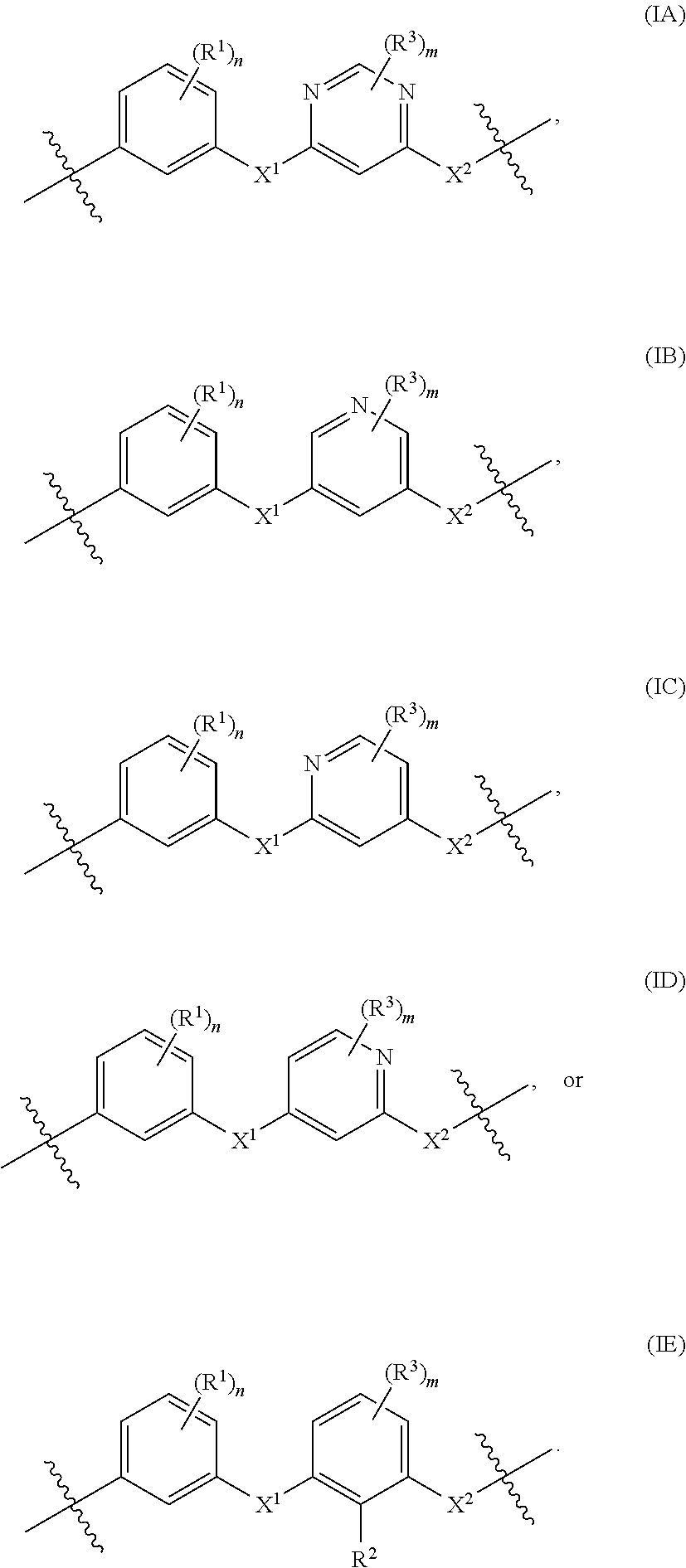
According to the first aspect, n is, for each occurrence independently, 0, 1, 2, 3, or 4. In some embodiments, n is 0. In some embodiments, n is 1. In some embodiments, n is 2. In some embodiments, n is 3. In some embodiments, n is 4. The remainder of the variables in structural formulas (IA)-(IE) are as defined below with respect to the various example embodiments of the first aspect.
According to the first aspect, m is, for each occurrence independently, 0, 1, 2, or 3. In some embodiments, m is 0. In some embodiments, m is 1. In some embodiments, m is 2. In some embodiments, m is 3. The remainder of the variables in structural formulas (IA)-(IE) are as defined above and below with respect to the various example embodiments of the first aspect.
According to the first aspect, X1 and X2 are, each independently, —O—, —S—, or —(NR7)—. In some embodiments, X1 and X2 are both —O—. In some embodiments, X1 and X2 are both —S—. In some embodiments, X1 and X2 are both —(NR7)—. The remainder of the variables in structural formulas (IA)-(IE) are as defined above and below with respect to the first aspect.
According to the first aspect, each R1 is independently selected from R6—COOH, R6—SO2H, R6—SO3H, R6—PO2H2, R6—PO3H2, —P(O)(OR4)2, —S(O2)(OR5), a C1-C20 alkyl, a C2-C20 alkenyl, a C2-C20 alkynyl, a C3-C20 cycloalkyl, a 5-20 atom heterocyclyl, a C6-C20 aryl, a 5-20 atom heteroaryl, a C1-C20 alkoxy, a C6-C20 aryloxy, a C1-C20 alkylthio, a C6-C20 arylthio, a C1-C20 sulfone, —(NR8R9)—, a halo, hydroxyl, —CN, nitro, or a C1-C20 acyl. In some embodiments, each R1 is, independently, R6—COOH, R6—SO2H, R6—SO3H, R6—PO2H2, R6—PO3H2, —P(O)(OR4)2, a C1-C6 alkyl, a C2-C6 alkenyl, a C2-C6 alkynyl, a C3-C10 cycloalkyl, a 5-10 atom heterocyclyl, a C6-C10 aryl, a 5-10 atom heteroaryl, a C1-C6 alkoxy, a C6-C10 aryloxy, a C1-C6 alkylthio, a C6-C10 arylthio, a C1-C10 sulfone, —(NR8R9)—, a halo, hydroxyl, —CN, nitro, or a C1-C6 acyl. In some embodiments, each R1 is independently, R6—COOH, R6—SO2H, R6—SO3H, R6—PO2H2, R6—PO3H2, —P(O)(OR4)2, a C1-C6 alkyl, a C2-C6 alkenyl, a C2-C6 alkynyl, a C3-C10 cycloalkyl, a 5-10 atom heterocyclyl, a C6-C10 aryl, a 5-10 atom heteroaryl, a C1-C6 alkoxy, a C1-C6 alkylthio, a halo, —CN, or nitro. In some embodiments, each R1 is, independently, —COOH, —SO2H, —SO3H, —PO3H2, —PO2H2, —P(O)(OR4)2, a C1-C3 alkyl, phenyl, a C1-C3 alkoxy, a C1-C3 alkylthio, a halo, —CN, or nitro. In some embodiments, each R1 is, independently, —COOH, —SO2H, —SO3H, —PO3H2, —PO2H2, —P(O)(OCH2CH3)2, methyl, trifluoromethyl, methoxy, methylthio, —CN, nitro, phenyl, or fluoro. In some embodiments, at least one instance of R1 is —COOH, SO2H, —SO3H, —PO3H2, or —PO2H2. In some embodiments, at least one instance of R1 is —PO3H2. In some embodiments, n is 1, 2, 3, or 4 and R1 is selected from —COOH, —SO2H, —SO3H, —PO3H2, or —PO2H2. In some embodiments, n is 1 and R1 is —COOH. In some embodiments, n is 1 and R1 is —SO2H. In some embodiments, n is 1 and R1 is —SO3H. In some embodiments, n is 1 and R1 is —PO3H2. In some embodiments, n is 1 and R1 is —PO2H2. The remainder of the variables in structural formulas (IA)-(IE) are as defined above and below with respect to the various example embodiments of the first aspect.
According to the first aspect, each R3 is independently selected from R6—COOH, R6—SO2H, R6—SO3H, R6—PO2H2, R6—PO3H2, —P(O)(OR4)2, —S(O2)(OR5), a C1-C20 alkyl, a C2-C20 alkenyl, a C2-C20 alkynyl, a C3-C20 cycloalkyl, a 5-20 atom heterocyclyl, a C6-C20 aryl, a 5-20 atom heteroaryl, a C1-C20 alkoxy, a C6-C20 aryloxy, a C1-C20 alkylthio, a C6-C20 arylthio, a C1-C20 sulfone, —(NR8R9)—, a halo, hydroxyl, —CN, nitro, or a C1-C20 acyl. In some embodiments, each R3 is independently, R6—COOH, R6—SO2H, R6—SO3H, R6—PO2H2, R6—PO3H2, —P(O)(OR4)2, a C1-C6 alkyl, a C2-C6 alkenyl, a C2-C6 alkynyl, a C3-C10 cycloalkyl, a 5-10 atom heterocyclyl, a C6-C10 aryl, a 5-10 atom heteroaryl, a C1-C6 alkoxy, a C6-C10 aryloxy, a C1-C6 alkylthio, a C6-C10 arylthio, a C1-C10 sulfone, —(NR8R9)—, a halo, hydroxyl, —CN, nitro, or a C1-C6 acyl. In some embodiments, each R3 is independently, R6—COOH, R6—SO2H, R6—SO3H, R6—PO2H2, R6—PO3H2, —P(O)(OR4)2, a C1-C6 alkyl, a C2-C6 alkenyl, a C2-C6 alkynyl, a C3-C10 cycloalkyl, a 5-10 atom heterocyclyl, a C6-C10 aryl, a 5-10 atom heteroaryl, a C1-C6 alkoxy, a C1-C6 alkylthio, a halo, —CN, or nitro. In some embodiments, each R3 is, independently, —COOH, —SO2H, —SO3H, —PO3H2, —PO2H2, —P(O)(OR4)2, a C1-C3 alkyl, phenyl, a C1-C3 alkoxy, a C1-C3 alkylthio, a halo, —CN, or nitro. In some embodiments, each R3 is, independently, —COOH, —SO2H, —SO3H, —PO3H2, —PO2H2, —P(O)(OCH2CH3)2, methyl, trifluoromethyl, methoxy, methylthio, —CN, nitro, phenyl, or fluoro. The remainder of the variables in structural formula I are as defined above and below with respect to the various example embodiments of the first aspect.
According to the first aspect, R2 is R6—COOH, R6—SO2H, R6—SO3H, R6—PO2H2, R6—PO3H2, —P(O)(OR4)2, —S(O2)(OR5), a C1-C20 alkyl, a C2-C20 alkenyl, a C2-C20 alkynyl, a C3-C20 cycloalkyl, a 5-20 atom heterocyclyl, a C6-C20 aryl, a 5-20 atom heteroaryl, a C1-C20 alkoxy, a C6-C20 aryloxy, a C1-C20 alkylthio, a C6-C20 arylthio, a C1-C20 sulfone, —(NR8R9)—, a halo, hydroxyl, —CN, nitro, or a C1-C20 acyl. In some embodiments, R2 is R6—COOH, R6—SO2H, R6—SO3H, R6—PO2H2, R6—PO3H2, P(O)(OR4)2, a C1-C6 alkyl, a C2-C6 alkenyl, a C2-C6 alkynyl, a C3-C10 cycloalkyl, a 5-10 atom heterocyclyl, a C6-C10 aryl, a 5-10 atom heteroaryl, a C1-C6 alkoxy, a C6-C10 aryloxy, a C1-C6 alkylthio, a C6-C10 arylthio, a C1-C10 sulfone, —(NR8R9)—, a halo, hydroxyl, —CN, nitro, or a C1-C6 acyl. In some embodiments, R2 is —COOH, —SO2H, —SO3H, —PO3H2, —PO2H2, —P(O)(OR4)2, a C1-C3 alkyl, phenyl, a C1-C3 alkoxy, a C1-C3 alkylthio, a halo, —CN, or nitro. In some embodiments, R2 is —COOH, —SO2H, —SO3H, —PO3H2, —PO2H2, —P(O)(OCH2CH3)2, methyl, trifluoromethyl, methoxy, methylthio, —CN, nitro, phenyl, or fluoro. In some embodiments, R2 is R6—COOH, R6—SO2H, R6—SO3H, R6—PO2H2, R6—PO3H2, P(O)(OR4)2, a C1-C6 alkyl, a C2-C6 alkenyl, a C2-C6 alkynyl, a C3-C10 cycloalkyl, a 5-10 atom heterocyclyl, a C6-C10 aryl, a 5-10 atom heteroaryl, a C1-C6 alkoxy, a C1-C6 alkylthio, a halo, hydroxyl, nitro, or a C1-C6 acyl. In some embodiments, R2 is —COOH, —SO2H, —SO3H, —PO3H2, —PO2H2, —P(O)(OR4)2, a C1-C3 alkyl, phenyl, a C1-C3 alkoxy, a C1-C3 alkylthio, a halo, or nitro. In some embodiments, R2 is —COOH, —SO2H, —SO3H, —PO3H2, —PO2H2, —P(O)(OCH2CH3)2, methyl, trifluoromethyl, methoxy, methylthio, nitro, phenyl, or fluoro. The remainder of the variables in structural formulas (IA)-(IE) are as defined above and below with respect to the various example embodiments of the first aspect.
According to the first aspect, each R4 is, independently, a C1-C6 alkyl, a C2-C6 alkenyl, a C2-C6 alkynyl, or a C3-C6 cycloalkyl. In some embodiments, each R4 is, independently, methyl, ethyl, propyl, or isopropyl. In some embodiments, each R4 is methyl. In some embodiments, each R4 is ethyl. In some embodiments, each R4 is propyl. In some embodiments, each R4 is isopropyl. The remainder of the variables in structural formula I are as defined above and below with respect to the various example embodiments of the first aspect.
According to the first aspect, each R5 is, independently, a C1-C6 alkyl, a C2-C6 alkenyl, a C2-C6 alkynyl, or a C3-C6 cycloalkyl. In some embodiments, each R5 is, independently, methyl, ethyl, propyl, or isopropyl. In some embodiments, each R5 is methyl. In some embodiments, each R5 is ethyl. In some embodiments, each R5 is propyl. In some embodiments, each R5 is isopropyl. The remainder of the variables in structural formulas (IA)-(IE) are as defined above and below with respect to the various example embodiments of the first aspect.
According to the first aspect, each R6 is, independently, a single bond, a C1-C6 alkyl, a C2-C6 alkenyl, a C2-C6 alkynyl, a C1-C6 alkoxy, or a C3-C6 cycloalkyl. In some embodiments, each R6 is, independently, a single bond, methyl, ethyl, propyl, or isopropyl. In some embodiments, each R6 is a single bond. In some embodiments, each R6 is methyl. In some embodiments, each R6 is ethyl. In some embodiments, each R6 is propyl. In some embodiments, each R6 is isopropyl. The remainder of the variables in structural formulas (IA)-(IE) are as defined above and below with respect to the various example embodiments of the first aspect.
According to the first aspect, each R7, R8, and R9 is, independently, H, a C1-C20 alkyl, a C6-C20 aryl, a 5-20 atom heteroaryl, a C1-C20 acyl, or sulfonyl. In some embodiments, each R7, R8, and R9 is, independently, H, methyl, ethyl, propyl, or isopropyl. In some embodiments, each R7, R8, and R9 is H. The remainder of the variables in structural formula I are as defined above and below with respect to the various example embodiments of the first aspect.
According to example embodiments of the first aspect, at least one instance of R1, R2, or R3 is R6—COOH, R6—SO2H, R6—SO3H, R6—PO2H2, or R6—PO3H2. According to example embodiments of the first aspect, at least one instance of R1, R2, or R3 is R6—COOH. According to example embodiments of the first aspect, at least one instance of R1, R2, or R3 is R6—SO2H. According to example embodiments of the first aspect, at least one instance of R1, R2, or R3 is R6—SO3H. According to example embodiments of the first aspect, at least one instance of R1, R2, or R3 is R6—PO2H2. According to example embodiments of the first aspect, at least one instance of R1, R2, or R3 is R6—PO3H2.
In a second aspect, the present invention provides polymers according to the first aspect, wherein the repeat unit is represented by structural formula (II):

According to the second aspect, n is 0, 1, 2, 3, or 4. In some embodiments, n is 0. In some embodiments, n is 1. In some embodiments, n is 2. In some embodiments, n is 3. In some embodiments, n is 4. The remainder of the variables in structural formula (II) are as defined below with respect to the various example embodiments of the second aspect.
According to the second aspect, m is 0, 1, or 2. In some embodiments, m is 0. In some embodiments, m is 1. In some embodiments, m is 2. The remainder of the variables in structural formula (II) are as defined above and below with respect to the various example embodiments of the second aspect.
According to the second aspect, each R1 is independently selected from R6—COOH, R6—SO2H, R6—SO3H, R6—PO2H2, R6—PO3H2, —P(O)(OR4)2, —S(O2)(OR5), a C1-C20 alkyl, a C2-C20 alkenyl, a C2-C20 alkynyl, a C3-C20 cycloalkyl, a 5-20 atom heterocyclyl, a C6-C20 aryl, a 5-20 atom heteroaryl, a C1-C20 alkoxy, a C6-C20 aryloxy, a C1-C20 alkylthio, a C6-C20 arylthio, a C1-C20 sulfone, —(NR8R9)—, a halo, hydroxyl, —CN, nitro, or a C1-C20 acyl. In some embodiments, each R1 is, independently, R6—COOH, R6—SO2H, R6—SO3H, R6—PO2H2, R6—PO3H2, —P(O)(OR4)2, a C1-C6 alkyl, a C2-C6 alkenyl, a C2-C6 alkynyl, a C3-C10 cycloalkyl, a 5-10 atom heterocyclyl, a C6-C10 aryl, a 5-10 atom heteroaryl, a C1-C6 alkoxy, a C6-C10 aryloxy, a C1-C6 alkylthio, a C6-C10 arylthio, a C1-C10 sulfone, —(NR8R9)—, a halo, hydroxyl, —CN, nitro, or a C1-C6 acyl. In some embodiments, each R1 is, independently, R6—COOH, R6—SO2H, R6—SO3H, R6—PO2H2, R6—PO3H2, —P(O)(OR4)2, a C1-C6 alkyl, a C2-C6 alkenyl, a C2-C6 alkynyl, a C3-C10 cycloalkyl, a 5-10 atom heterocyclyl, a C6-C10 aryl, a 5-10 atom heteroaryl, a C1-C6 alkoxy, a C1-C6 alkylthio, a halo, —CN, or nitro. In some embodiments, each R1 is, independently, —COOH, —SO2H, —SO3H, —PO3H2, —PO2H2, —P(O)(OR4)2, a C1-C3 alkyl, phenyl, a C1-C3 alkoxy, a C1-C3 alkylthio, a halo, —CN, or nitro. In some embodiments, each R1 is, independently, —COOH, —SO2H, —SO3H, —PO3H2, —PO2H2, —P(O)(OCH2CH3)2, methyl, trifluoromethyl, methoxy, methylthio, —CN, nitro, phenyl, or fluoro. In some embodiments, at least one instance of R1 is —COOH, SO2H, —SO3H, —PO3H2, or —PO2H2. In some embodiments, at least one instance of R1 is —PO3H2. In some embodiments, n is 1 and R1 is selected from —COOH, —SO2H, —SO3H, —PO3H2, or —PO2H2. In some embodiments, n is 1 and R1 is —COOH. In some embodiments, n is 1 and R1 is —SO2H. In some embodiments, n is 1 and R1 is —SO3H. In some embodiments, n is 1 and R1 is —PO3H2. In some embodiments, n is 1 and R1 is —PO2H2. The remainder of the variables in structural formula (II) are as defined above and below with respect to the various example embodiments of the second aspect.
According to the second aspect, each R3 is independently selected from R6—COOH, R6—SO2H, R6—SO3H, R6—PO2H2, R6—PO3H2, —P(O)(OR4)2, —S(O2)(OR5), a C1-C20 alkyl, a C2-C20 alkenyl, a C2-C20 alkynyl, a C3-C20 cycloalkyl, a 5-20 atom heterocyclyl, a C6-C20 aryl, a 5-20 atom heteroaryl, a C1-C20 alkoxy, a C6-C20 aryloxy, a C1-C20 alkylthio, a C6-C20 arylthio, a C1-C20 sulfone, —(NR8R9)—, a halo, hydroxyl, —CN, nitro, or a C1-C20 acyl. In some embodiments, each R3 is, independently, R6—COOH, R6—SO2H, R6—SO3H, R6—PO2H2, R6—PO3H2, —P(O)(OR4)2, a C1-C6 alkyl, a C2-C6 alkenyl, a C2-C6 alkynyl, a C3-C10 cycloalkyl, a 5-10 atom heterocyclyl, a C6-C10 aryl, a 5-10 atom heteroaryl, a C1-C6 alkoxy, a C6-C10 aryloxy, a C1-C6 alkylthio, a C6-C10 arylthio, a C1-C10 sulfone, —(NR8R9)—, a halo, hydroxyl, —CN, nitro, or a C1-C6 acyl. In some embodiments, each R3 is, independently, R6—COOH, R6—SO2H, R6—SO3H, R6—PO2H2, R6—PO3H2, —P(O)(OR4)2, a C1-C6 alkyl, a C2-C6 alkenyl, a C2-C6 alkynyl, a C3-C10 cycloalkyl, a 5-10 atom heterocyclyl, a C6-C10 aryl, a 5-10 atom heteroaryl, a C1-C6 alkoxy, a C1-C6 alkylthio, a halo, —CN, or nitro. In some embodiments, each R3 is, independently, —COOH, —SO2H, —SO3H, —PO3H2, —PO2H2, —P(O)(OR4)2, a C1-C3 alkyl, phenyl, a C1-C3 alkoxy, a C1-C3 alkylthio, a halo, —CN, or nitro. In some embodiments, each R3 is, independently, —COOH, —SO2H, —SO3H, —PO3H2, —PO2H2, —P(O)(OCH2CH3)2, methyl, trifluoromethyl, methoxy, methylthio, —CN, nitro, phenyl, or fluoro. The remainder of the variables in structural formula (II) are as defined above with respect to the various example embodiments of the second aspect.
In a third aspect, the present invention provides polymers according to the first aspect, wherein the repeat unit is represented by structural formula (III):

According to the third aspect, n is 0, 1, 2, 3, or 4. In some embodiments, n is 0. In some embodiments, n is 1. In some embodiments, n is 2. In some embodiments, n is 3. In some embodiments, n is 4. The remainder of the variables in structural formula (III) are as defined below with respect to the various example embodiments of the third aspect.
According to the third aspect, m is 0, 1, 2, or 3. In some embodiments, m is 0. In some embodiments, m is 1. In some embodiments, m is 2. In some embodiments, m is 3. The remainder of the variables in structural formula (III) are as defined above and below with respect to the various example embodiments of the third aspect.
According to the third aspect, each Ris independently selected from R6—COOH, R6—SO2H, R6—SO3H, R6—PO2H2, R6—PO3H2, —P(O)(OR4)2, —S(O2)(OR5), a C1-C20 alkyl, a C2-C20 alkenyl, a C2-C20 alkynyl, a C3-C20 cycloalkyl, a 5-20 atom heterocyclyl, a C6-C20 aryl, a 5-20 atom heteroaryl, a C1-C20 alkoxy, a C6-C20 aryloxy, a C1-C20 alkylthio, a C6-C20 arylthio, a C1-C20 sulfone, —(NR8R9)—, a halo, hydroxyl, —CN, nitro, or a C1-C20 acyl. In some embodiments, each R1 is, independently, R6—COOH, R6—SO2H, R6—SO3H, R6—PO2H2, R6—PO3H2, —P(O)(OR4)2, a C1-C6 alkyl, a C2-C6 alkenyl, a C2-C6 alkynyl, a C3-C10 cycloalkyl, a 5-10 atom heterocyclyl, a C6-C10 aryl, a 5-10 atom heteroaryl, a C1-C6 alkoxy, a C6-C10 aryloxy, a C1-C6 alkylthio, a C6-C10 arylthio, a C1-C10 sulfone, —(NR8R9)—, a halo, hydroxyl, —CN, nitro, or a C1-C6 acyl. In some embodiments, each R1 is independently, R6—COOH, R6—SO2H, R6—SO3H, R6—PO2H2, R6—PO3H2, —P(O)(OR4)2, a C1-C6 alkyl, a C2-C6 alkenyl, a C2-C6 alkynyl, a C3-C10 cycloalkyl, a 5-10 atom heterocyclyl, a C6-C10 aryl, a 5-10 atom heteroaryl, a C1-C6 alkoxy, a C1-C6 alkylthio, a halo, —CN, or nitro. In some embodiments, each R1 is, independently, —COOH, —SO2H, —SO3H, —PO3H2, —PO2H2, —P(O)(OR4)2, a C1-C3 alkyl, phenyl, a C1-C3 alkoxy, a C1-C3 alkylthio, a halo, —CN, or nitro. In some embodiments, each R1 is, independently, —COOH, —SO2H, —SO3H, —PO3H2, —PO2H2, —P(O)(OCH2CH3)2, methyl, trifluoromethyl, methoxy, methylthio, —CN, nitro, phenyl, or fluoro. In some embodiments, at least one instance of R1 is —COOH, SO2H, —SO3H, —PO3H2, or —PO2H2. In some embodiments, at least one instance of R1 is —PO3H2. In some embodiments, n is 1 and R1 is selected from —COOH, —SO2H, —SO3H, —PO3H2, or —PO2H2. In some embodiments, n is 1 and R1 is —COOH. In some embodiments, n is 1 and R1 is —SO2H. In some embodiments, n is 1 and R1 is —SO3H. In some embodiments, n is 1 and R1 is —PO3H2. In some embodiments, n is 1 and R1 is —PO2H2. The remainder of the variables in structural formula (III) are as defined above and below with respect to the various example embodiments of the third aspect.
According to the third aspect, each R3 is independently selected from R6—COOH, R6—SO2H, R6—SO3H, R6—PO2H2, R6—PO3H2, —P(O)(OR4 2, —S(O2)(OR5), a C1-C20 alkyl, a C2-C20 alkenyl, a C2-C20 alkynyl, a C3-C20 cycloalkyl, a 5-20 atom heterocyclyl, a C6-C20 aryl, a 5-20 atom heteroaryl, a C1-C20 alkoxy, a C6-C20 aryloxy, a C1-C20 alkylthio, a C6-C20 arylthio, a C1-C20 sulfone, —(NR8R9)—, a halo, hydroxyl, —CN, nitro, or a C1-C20 acyl. In some embodiments, each R3 is, independently, R6—COOH, R6—SO2H, R6—SO3H, R6—PO2H2, R6—PO3H2, —P(O)(OR4)2, a C1-C6 alkyl, a C2-C6 alkenyl, a C2-C6 alkynyl, a C3-C10 cycloalkyl, a 5-10 atom heterocyclyl, a C6-C10 aryl, a 5-10 atom heteroaryl, a C1-C6 alkoxy, a C6-C10 aryloxy, a C1-C6 alkylthio, a C6-C10 arylthio, a C1-C10 sulfone, —(NR8R9)—, a halo, hydroxyl, —CN, nitro, or a C1-C6 acyl. In some embodiments, each R3 is, independently, R6—COOH, R6—SO2H, R6—SO3H, R6—PO2H2, R6—PO3H2, —P(O)(OR4)2, a C1-C6 alkyl, a C2-C6 alkenyl, a C2-C6 alkynyl, a C3-C10 cycloalkyl, a 5-10 atom heterocyclyl, a C6-C10 aryl, a 5-10 atom heteroaryl, a C1-C6 alkoxy, a C1-C6 alkylthio, a halo, —CN, or nitro. In some embodiments, each R3 is, independently, —COOH, —SO2H, —SO3H, —PO3H2, —PO2H2, —P(O)(OR4)2, a C1-C3 alkyl, phenyl, a C1-C3 alkoxy, a C1-C3 alkylthio, a halo, —CN, or nitro. In some embodiments, each R3 is, independently, —COOH, —SO2H, —SO3H, —PO3H2, —PO2H2, —P(O)(OCH2CH3)2, methyl, trifluoromethyl, methoxy, methylthio, —CN, nitro, phenyl, or fluoro. The remainder of the variables in structural formula (III) are as defined above with respect to the various example embodiments of the third aspect.
In a fourth aspect, the present invention provides polymers according to the first aspect, wherein the repeat unit is represented by structural formula (IV) or structural formula (V):

According to the fourth aspect, n is, for each occurrence independently, 0, 1, 2, 3, or 4. In some embodiments, n is 0. In some embodiments, n is 1. In some embodiments, n is 2. In some embodiments, n is 3. In some embodiments, n is 4. The remainder of the variables in structural formulas (IV) and (V) are as defined below with respect to the various example embodiments of the fourth aspect.
According to the fourth aspect, m is, for each occurrence independently, 0, 1, 2, or 3. In some embodiments, m is 0. In some embodiments, m is 1. In some embodiments, m is 2. In some embodiments, m is 3. The remainder of the variables in structural formulas (IV) and (V) are as defined above and below with respect to the various example embodiments of the fourth aspect.
According to the fourth aspect, each R1 is independently selected from R6—COOH, R6—SO2H, R6—SO3H, R6—PO2H2, R6—PO3H2, —P(O)(OR4)2, —S(O2)(OR5), a C1-C20 alkyl, a C2-C20 alkenyl, a C2-C20 alkynyl, a C3-C20 cycloalkyl, a 5-20 atom heterocyclyl, a C6-C20 aryl, a 5-20 atom heteroaryl, a C1-C20 alkoxy, a C6-C20 aryloxy, a C1-C20 alkylthio, a C6-C20 arylthio, a C1-C20 sulfone, —(NR8R9)—, a halo, hydroxyl, —CN, nitro, or a C1-C20 acyl. In some embodiments, each R1 is, independently, R6—COOH, R6—SO2H, R6—SO3H, R6—PO2H2, R6—PO3H2, —P(O)(OR4)2, a C1-C6 alkyl, a C2-C6 alkenyl, a C2-C6 alkynyl, a C3-C10 cycloalkyl, a 5-10 atom heterocyclyl, a C6-C10 aryl, a 5-10 atom heteroaryl, a C1-C6 alkoxy, a C6-C10 aryloxy, a C1-C6 alkylthio, a C6-C10 arylthio, a C1-C10 sulfone, —(NR8R9)—, a halo, hydroxyl, —CN, nitro, or a C1-C6 acyl. In some embodiments, each R1 is, independently, R6—COOH, R6—SO2H, R6—SO3H, R6—PO2H2, R6—PO3H2, —P(O)(OR4)2, a C1-C6 alkyl, a C2-C6 alkenyl, a C2-C6 alkynyl, a C3-C10 cycloalkyl, a 5-10 atom heterocyclyl, a C6-C10 aryl, a 5-10 atom heteroaryl, a C1-C6 alkoxy, a C1-C6 alkylthio, a halo, —CN, or nitro. In some embodiments, each R1 is, independently, —COOH, —SO2H, —SO3H, —PO3H2, —PO2H2, —P(O)(OR4)2, a C1-C3 alkyl, phenyl, a C1-C3 alkoxy, a C1-C3 alkylthio, a halo, —CN, or nitro. In some embodiments, each R1 is, independently, —COOH, —SO2H, —SO3H, —PO3H2, —PO2H2, —P(O)(OCH2CH3)2, methyl, trifluoromethyl, methoxy, methylthio, —CN, nitro, phenyl, or fluoro. In some embodiments, at least one instance of R1 is —COOH, SO2H, —SO3H, —PO3H2, or —PO2H2. In some embodiments, at least one instance of R1 is —PO3H2. In some embodiments, n is 1 and R1 is selected from —COOH, —SO2H, —SO3H, —PO3H2, or —PO2H2. In some embodiments, n is 1 and R1 is —COOH. In some embodiments, n is 1 and R1 is —SO2H. In some embodiments, n is 1 and R1 is —SO3H. In some embodiments, n is 1 and R1 is —PO3H2. In some embodiments, n is 1 and R1 is —PO2H2. The remainder of the variables in structural formulas (IV) and (V) are as defined above and below with respect to the various example embodiments of the fourth aspect.
According to the fourth aspect, each R3 is independently selected from R6—COOH, R6—SO2H, R6—SO3H, R6—PO2H2, R6—PO3H2, —P(O)(OR4)2, —S(O2)(OR5), a C1-C20 alkyl, a C2-C20 alkenyl, a C2-C20 alkynyl, a C3-C20 cycloalkyl, a 5-20 atom heterocyclyl, a C6-C20 aryl, a 5-20 atom heteroaryl, a C1-C20 alkoxy, a C6-C20 aryloxy, a C1-C20 alkylthio, a C6-C20 arylthio, a C1-C20 sulfone, —(NR8R9)—, a halo, hydroxyl, —CN, nitro, or a C1-C20 acyl. In some embodiments, each R3 is, independently, R6—COOH, R6—SO2H, R6—SO3H, R6—PO2H2, R6—PO3H2, —P(O)(OR4)2, a C1-C6 alkyl, a C2-C6 alkenyl, a C2-C6 alkynyl, a C3-C10 cycloalkyl, a 5-10 atom heterocyclyl, a C6-C10 aryl, a 5-10 atom heteroaryl, a C1-C6 alkoxy, a C6-C10 aryloxy, a C1-C6 alkylthio, a C6-C10 arylthio, a C1-C10 sulfone, —(NR8R9)—, a halo, hydroxyl, —CN, nitro, or a C1-C6 acyl. In some embodiments, each R3 is, independently, R6—COOH, R6—SO2H, R6—SO3H, R6—PO2H2, R6—PO3H2, —P(O)(OR4)2, a C1-C6 alkyl, a C2-C6 alkenyl, a C2-C6 alkynyl, a C3-C10 cycloalkyl, a 5-10 atom heterocyclyl, a C6-C10 aryl, a 5-10 atom heteroaryl, a C1-C6 alkoxy, a C1-C6 alkylthio, a halo, —CN, or nitro. In some embodiments, each R3 is, independently, —COOH, —SO2H, —SO3H, —PO3H2, —PO2H2, —P(O)(OR4)2, a C1-C3 alkyl, phenyl, a C1-C3 alkoxy, a C1-C3 alkylthio, a halo, —CN, or nitro. In some embodiments, each R3 is, independently, —COOH, —SO2H, —SO3H, —PO3H2, —PO2H2, —P(O)(OCH2CH3)2, methyl, trifluoromethyl, methoxy, methylthio, —CN, nitro, phenyl, or fluoro. The remainder of the variables in structural formulas (IV) and (V) are as defined above with respect to the various example embodiments of the fourth aspect.
In a fifth aspect, the present invention provides polymers according to the first aspect, wherein the repeat unit is represented by structural formula (VI):

According to the fifth aspect, n is 0, 1, 2, 3, or 4. In some embodiments, n is 0. In some embodiments, n is 1. In some embodiments, n is 2. In some embodiments, n is 3. In some embodiments, n is 4. The remainder of the variables in structural formula (VI) are as defined below with respect to the various example embodiments of the fifth aspect.
According to the fifth aspect, m is 0, 1, 2, or 3. In some embodiments, m is 0. In some embodiments, m is 1. In some embodiments, m is 2. In some embodiments, m is 3. The remainder of the variables in structural formula (VI) are as defined above and below with respect to the various example embodiments of the fifth aspect.
According to the fifth aspect, each R1 is independently selected from R6—COOH, R6—SO2H, R6—SO3H, R6—PO2H2, R6—PO3H2, —P(O)(OR4)2, —S(O2)(OR5), a C1-C20 alkyl, a C2-C20 alkenyl, a C2-C20 alkynyl, a C3-C20 cycloalkyl, a 5-20 atom heterocyclyl, a C6-C20 aryl, a 5-20 atom heteroaryl, a C1-C20 alkoxy, a C6-C20 aryloxy, a C1-C20 alkylthio, a C6-C20 arylthio, a C1-C20 sulfone, —(NR8R9)—, a halo, hydroxyl, —CN, nitro, or a C1-C20 acyl. In some embodiments, each R1 is, independently, R6—COOH, R6—SO2H, R6—SO3H, R6—PO2H2, R6—PO3H2, —P(O)(OR4)2, a C1-C6 alkyl, a C2-C6 alkenyl, a C2-C6 alkynyl, a C3-C10 cycloalkyl, a 5-10 atom heterocyclyl, a C6-C10 aryl, a 5-10 atom heteroaryl, a C1-C6 alkoxy, a C6-C10 aryloxy, a C1-C6 alkylthio, a C6-C10 arylthio, a C1-C10 sulfone, —(NR8R9)—, a halo, hydroxyl, —CN, nitro, or a C1-C6 acyl. In some embodiments, each R1 is, independently, R6—COOH, R6—SO2H, R6—SO3H, R6—PO2H2, R6—PO3H2, —P(O)(OR4)2, a C1-C6 alkyl, a C2-C6 alkenyl, a C2-C6 alkynyl, a C3-C10 cycloalkyl, a 5-10 atom heterocyclyl, a C6-C10 aryl, a 5-10 atom heteroaryl, a C1-C6 alkoxy, a C1-C6 alkylthio, a halo, —CN, or nitro. In some embodiments, each R1 is, independently, —COOH, —SO2H, —SO3H, —PO3H2, —PO2H2, —P(O)(OR4)2, a C1-C3 alkyl, phenyl, a C1-C3 alkoxy, a C1-C3 alkylthio, a halo, —CN, or nitro. In some embodiments, each R1 is, independently, —COOH, —SO2H, —SO3H, —PO3H2, —PO2H2, —P(O)(OCH2CH3)2, methyl, trifluoromethyl, methoxy, methylthio, —CN, nitro, phenyl, or fluoro. In some embodiments, at least one instance of R1 is —COOH, SO2H, —SO3H, —PO3H2, or —PO2H2. In some embodiments, at least one instance of R1 is —PO3H2. In some embodiments, n is 1 and R1 is selected from —COOH, —SO2H, —SO3H, —PO3H2, or —PO2H2. In some embodiments, n is 1 and R1 is —COOH. In some embodiments, n is 1 and R1 is —SO2H. In some embodiments, n is 1 and R1 is —SO3H. In some embodiments, n is 1 and R1 is —PO3H2. In some embodiments, n is 1 and R1 is —PO2H2. The remainder of the variables in structural formula (VI) are as defined above and below with respect to the various example embodiments of the fifth aspect.
According to the fifth aspect, R2 is R6—COOH, R6—SO2H, R6—SO3H, R6—PO2H2, R6—PO3H2, —P(O)(OR4)2, —S(O2)(OR5), a C1-C20 alkyl, a C2-C20 alkenyl, a C2-C20 alkynyl, a C3-C20 cycloalkyl, a 5-20 atom heterocyclyl, a C6-C20 aryl, a 5-20 atom heteroaryl, a C1-C20 alkoxy, a C6-C20 aryloxy, a C1-C20 alkylthio, a C6-C20 arylthio, a C1-C20 sulfone, —(NR8R9)—, a halo, hydroxyl, —CN, nitro, or a C1-C20 acyl. In some embodiments, R2 is R6—COOH, R6—SO2H, R6—SO3H, R6—PO2H2, R6—PO3H2, P(O)(OR4)2, a C1-C6 alkyl, a C2-C6 alkenyl, a C2-C6 alkynyl, a C3-C10 cycloalkyl, a 5-10 atom heterocyclyl, a C6-C10 aryl, a 5-10 atom heteroaryl, a C1-C6 alkoxy, a C6-C10 aryloxy, a C1-C6 alkylthio, a C6-C10 arylthio, a C1-C10 sulfone, —(NR8R9)—, a halo, hydroxyl, —CN, nitro, or a C1-C6 acyl. In some embodiments, R2 is —COOH, —SO2H, —SO3H, —PO3H2, —PO2H2, —P(O)(OR4)2, a C1-C3 alkyl, phenyl, a C1-C3 alkoxy, a C1-C3 alkylthio, a halo, —CN, or nitro. In some embodiments, R2 is —COOH, —SO2H, —SO3H, —PO3H2, —PO2H2, —P(O)(OCH2CH3)2, methyl, trifluoromethyl, methoxy, methylthio, —CN, nitro, phenyl, or fluoro. In some embodiments, R2 is R6—COOH, R6—SO2H, R6—SO3H, R6—PO2H2, R6—PO3H2, P(O)(OR4)2, a C1-C6 alkyl, a C2-C6 alkenyl, a C2-C6 alkynyl, a C3-C10 cycloalkyl, a 5-10 atom heterocyclyl, a C6-C10 aryl, a 5-10 atom heteroaryl, a C1-C6 alkoxy, a C1-C6 alkylthio, a halo, hydroxyl, nitro, or a C1-C6 acyl. In some embodiments, R2 is —COOH, —SO2H, —SO3H, —PO3H2, —PO2H2, —P(O)(OR4)2, a C1-C3 alkyl, phenyl, a C1-C3 alkoxy, a C1-C3 alkylthio, a halo, or nitro. In some embodiments, R2 is —COOH, —SO2H, —SO3H, —PO3H2, —PO2H2, —P(O)(OCH2CH3)2, methyl, trifluoromethyl, methoxy, methylthio, nitro, phenyl, or fluoro. The remainder of the variables in structural formula (VI) are as defined above with respect to the various example embodiments of the fifth aspect.
According to the fifth aspect, each R3 is independently selected from R6—COOH, R6—SO2H, R6—SO3H, R6—PO2H2, R6—PO3H2, —P(O)OR4)2, —S(O2)(OR5), a C1-C20 alkyl, a C2-C20 alkenyl, a C2-C20 alkynyl, a C3-C20 cycloalkyl, a 5-20 atom heterocyclyl, a C6-C20 aryl, a 5-20 atom heteroaryl, a C1-C20 alkoxy, a C6-C20 aryloxy, a C1-C20 alkylthio, a C6-C20 arylthio, a C1-C20 sulfone, —(NR8R9)—, a halo, hydroxyl, —CN, nitro, or a C1-C20 acyl. In some embodiments, each R3 is, independently, R6—COOH, R6—SO2H, R6—SO3H, R6—PO2H2, R6—PO3H2, —P(O)(OR4)2, a C1-C6 alkyl, a C2-C6 alkenyl, a C2-C6 alkynyl, a C3-C10 cycloalkyl, a 5-10 atom heterocyclyl, a C6-C10 aryl, a 5-10 atom heteroaryl, a C1-C6 alkoxy, a C6-C10 aryloxy, a C1-C6 alkylthio, a C6-C10 arylthio, a C1-C10 sulfone, —(NR8R9)—, a halo, hydroxyl, —CN, nitro, or a C1-C6 acyl. In some embodiments, each R3 is, independently, R6—COOH, R6—SO2H, R6—SO3H, R6—PO2H2, R6—PO3H2, —P(O)(OR4)2, a C1-C6 alkyl, a C2-C6 alkenyl, a C2-C6 alkynyl, a C3-C10 cycloalkyl, a 5-10 atom heterocyclyl, a C6-C10 aryl, a 5-10 atom heteroaryl, a C1-C6 alkoxy, a C1-C6 alkylthio, a halo, —CN, or nitro. In some embodiments, each R3 is, independently, —COOH, —SO2H, —SO3H, —PO3H2, —PO2H2, —P(O)(OR4)2, a C1-C3 alkyl, phenyl, a C1-C3 alkoxy, a C1-C3 alkylthio, a halo, —CN, or nitro. In some embodiments, each R3 is, independently, —COOH, —SO2H, —SO3H, —PO3H2, —PO2H2, —P(O)(OCH2CH3)2, methyl, trifluoromethyl, methoxy, methylthio, —CN, nitro, phenyl, or fluoro. The remainder of the variables in structural formula (VI) are as defined above with respect to the various example embodiments of the fifth aspect.
In an sixth aspect, the present invention provides polymers according to any of the first through fifth aspects, wherein R1 and R3 are as defined below with respect to the sixth aspect.
According to the sixth aspect, each R1 is, independently, R6—COOH, R6—SO2H, R6—SO3H, R6—PO2H2, R6—PO3H2, —P(O)(OR4)2, a C1-C6 alkyl, a C2-C6 alkenyl, a C2-C6 alkynyl, a C3-C10 cycloalkyl, a 5-10 atom heterocyclyl, a C6-C10 aryl, a 5-10 atom heteroaryl, a C1-C6 alkoxy, a C6-C10 aryloxy, a C1-C6 alkylthio, a C6-C10 arylthio, a C1-C10 sulfone, —(NR8R9)—, a halo, hydroxyl, —CN, nitro, or a C1-C6 acyl. In some embodiments, each R1 is, independently, R6—COOH, R6—SO2H, R6—SO3H, R6—PO2H2, R6—PO3H2, —P(O)(OR4)2, a C1-C6 alkyl, a C2-C6 alkenyl, a C2-C6 alkynyl, a C3-C10 cycloalkyl, a 5-10 atom heterocyclyl, a C6-C10 aryl, a 5-10 atom heteroaryl, a C1-C6 alkoxy, a C1-C6 alkylthio, a halo, —CN, or nitro. In some embodiments, each R1 is, independently, —COOH, —SO2H, —SO3H, —PO3H2, —PO2H2, —P(O)(OR4)2, a C1-C3 alkyl, phenyl, a C1-C3 alkoxy, a C1-C3 alkylthio, a halo, —CN, or nitro. In some embodiments, each R1 is, independently, —COOH, —SO2H, —SO3H, —PO3H2, —PO2H2, —P(O)(OCH2CH3)2, methyl, trifluoromethyl, methoxy, methylthio, —CN, nitro, phenyl, or fluoro. In some embodiments, at least one instance of R1 is —COOH, SO2H, —SO3H, —PO3H2, or —PO2H2. In some embodiments, at least one instance of R1 is —PO3H2. In some embodiments, there is one instance of R1and R1 is selected from —COOH, —SO2H, —SO3H, —PO3H2, or —PO2H2. In some embodiments, there is one instance of R1 and R1 is —COOH. In some embodiments, there is one instance of R1 and R1 is —SO2H. In some embodiments, there is one instance of R1 and R1 is —SO3H. In some embodiments, there is one instance of R1 and R1 is —PO3H2. In some embodiments, there is one instance of R1 and R1 is —PO2H2. The remainder of the variables are as defined below with respect to the various example embodiments of the sixth aspect.
According to the sixth aspect, each R3 is, independently, R6—COOH, R6—SO2H, R6—SO3H, R6—PO2H2, R6—PO3H2, —P(O)(OR4)2, a C1-C6 alkyl, a C2-C6 alkenyl, a C2-C6 alkynyl, a C3-C10 cycloalkyl, a 5-10 atom heterocyclyl, a C6-C10 aryl, a 5-10 atom heteroaryl, a C1-C6 alkoxy, a C6-C10 aryloxy, a C1-C6 alkylthio, a C6-C10 arylthio, a C1-C10 sulfone, —(NR8R9)—, a halo, hydroxyl, —CN, nitro, or a C1-C6 acyl. In some embodiments, each R3 is, independently, R6—COOH, R6—SO2H, R6—SO3H, R6—PO2H2, R6—PO3H2, —P(O)(OR4)2, a C1-C6 alkyl, a C2-C6 alkenyl, a C2-C6 alkynyl, a C3-C10 cycloalkyl, a 5-10 atom heterocyclyl, a C6-C10 aryl, a 5-10 atom heteroaryl, a C1-C6 alkoxy, a C1-C6 alkylthio, a halo, —CN, or nitro. In some embodiments, each R3 is, independently, —COOH, —SO2H, —SO3H, —PO3H2, —PO2H2, —P(O)(OR4)2, a C1-C3 alkyl, phenyl, a C1-C3 alkoxy, a C1-C3 alkylthio, a halo, —CN, or nitro. In some embodiments, each R3 is, independently, —COOH, —SO2H, —SO3H, —PO3H2, —PO2H2, —P(O)(OCH2CH3)2, methyl, trifluoromethyl, methoxy, methylthio, —CN, nitro, phenyl, or fluoro. The remainder of the variables are as defined above with respect to the various example embodiments of the sixth aspect.
In a seventh aspect, the present invention provides polymers according to any of the first through sixth aspects, wherein R1 and R3 are as defined below with respect to the seventh aspect.
According to the seventh aspect, each R1 is, independently, R6—COOH, R6—SO2H, R6—SO3H, R6—PO2H2, R6—PO3H2, —P(O)(OR4)2, a C1-C6 alkyl, a C2-C6 alkenyl, a C2-C6 alkynyl, a C3-C10 cycloalkyl, a 5-10 atom heterocyclyl, a C6-C10 aryl, a 5-10 atom heteroaryl, a C1-C6 alkoxy, a C1-C6 alkylthio, a halo, —CN, or nitro. In some embodiments, each R1 is, independently, —COOH, —SO2H, —SO3H, —PO3H2, —PO2H2, —P(O)(OR4)2, a C1-C3 alkyl, phenyl, a C1-C3 alkoxy, a C1-C3 alkylthio, a halo, —CN, or nitro. In some embodiments, each R1 is, independently, —COOH, —SO2H, —SO3H, 13 PO3H2, —PO2H2, —P(O)(OCH2CH3)2, methyl, trifluoromethyl, methoxy, methylthio, —CN, nitro, phenyl, or fluoro. In some embodiments, at least one instance of R1 is —COOH, SO2H, —SO3H, —PO3H2, or —PO2H2. In some embodiments, at least one instance of R1 is —PO3H2. In some embodiments, there is one instance of R1 and R1 is selected from —COOH, —SO2H, —SO3H, —PO3H2, or —PO2H2. In some embodiments, there is one instance of R1 and R1 is —COOH. In some embodiments, there is one instance of R1 and R1 is —SO2H. In some embodiments, there is one instance of R1 and R1 is —SO3H. In some embodiments, there is one instance of R1 and R1 is —PO3H2. In some embodiments, there is one instance of R1 and R1 is —PO2H2. The remainder of the variables are as defined below with respect to the various example embodiments of the seventh aspect.
According to the seventh aspect, each R3 is, independently, R6—COOH, R6—SO2H, R6—SO3H, R6—PO2H2, R6—PO3H2, —P(O)(OR4)2, a C1-C6 alkyl, a C2-C6 alkenyl, a C2-C6 alkynyl, a C3-C10 cycloalkyl, a 5-10 atom heterocyclyl, a C6-C10 aryl, a 5-10 atom heteroaryl, a C1-C6 alkoxy, a C1-C6 alkylthio, a halo, —CN, or nitro. In some embodiments, each R3 is, independently, —COOH, —SO2H, —SO3H, —PO3H2, —PO2H2, —P(O)(OR4)2, a C1-C3 alkyl, phenyl, a C1-C3 alkoxy, a C1-C3 alkylthio, a halo, —CN, or nitro. In some embodiments, each R3 is, independently, —COOH, —SO2H, —SO3H, —PO3H2, —PO2H2, —P(O)(OCH2CH3)2, methyl, trifluoromethyl, methoxy, methylthio, —CN, nitro, phenyl, or fluoro. The remainder of the variables are as defined above with respect to the various example embodiments of the seventh aspect.
In a eighth aspect, the present invention provides polymers according to any of the first through seventh aspects, wherein R1 and R3 are as defined below with respect to the eighth aspect.
According to the eighth aspect, each R1 is, independently, —COOH, —SO2H, —SO3H, —PO3H2, —PO2H2, —P(O)(OR4)2, a C1-C3 alkyl, phenyl, a C1-C3 alkoxy, a C1-C3 alkylthio, a halo, —CN, or nitro. In some embodiments, each R1 is, independently, —COOH, —SO2H, —SO3H, —PO3H2, —PO2H2, —P(O)(OCH2CH3)2, methyl, trifluoromethyl, methoxy, methylthio, —CN, nitro, phenyl, or fluoro. In some embodiments, at least one instance of R1 is —COOH, SO2H, —SO3H, —PO3H2, or —PO2H2. In some embodiments, at least one instance of R1 is —PO3H2. In some embodiments, there is one instance of R1 and R1 is selected from —COOH, —SO2H, —SO3H, —PO3H2, or —PO2H2. In some embodiments, there is one instance of R1 and R1 is —COOH. In some embodiments, there is one instance of R1 and R1 is —SO2H. In some embodiments, there is one instance of R1 and R1 is —SO3H. In some embodiments, there is one instance of R1 and R1 is —PO3H2. In some embodiments, there is one instance of R1 and R1 is —PO2H2. The remainder of the variables are as defined below with respect to the various example embodiments of the eighth aspect.
According to the eighth aspect, each R3 is, independently, —COOH, —SO2H, —SO3H, —PO3H2, —PO2H2, —P(O)(OR4)2, a C1-C3 alkyl, phenyl, a C1-C3 alkoxy, a C1-C3 alkylthio, a halo, —CN, or nitro. In some embodiments, each R3 is, independently, —COOH, —SO2H, —SO3H, —PO3H2, —PO2H2, —P(O)(OCH2CH3)2, methyl, trifluoromethyl, methoxy, methylthio, —CN, nitro, phenyl, or fluoro. The remainder of the variables are as defined above with respect to the various example embodiments of the eighth aspect.
In an ninth aspect, the present invention provides polymers according to any of the first through eighth aspects, wherein R1 and R3 are as defined below with respect to the ninth aspect.
According to the ninth aspect, each R1 is, independently, —COOH, —SO2H, —SO3H, —PO3H2, —PO2H2, —P(O)(OCH2CH3)2, methyl, trifluoromethyl, methoxy, methylthio, —CN, nitro, phenyl, or fluoro. In some embodiments, at least one instance of R1 is —COOH, SO2H, —SO3H, —PO3H2, or —PO2H2. In some embodiments, at least one instance of R1 is —PO3H2. In some embodiments, there is one instance of R1 and R1 is selected from —COOH, —SO2H, —SO3H, —PO3H2, or —PO2H2. In some embodiments, there is one instance of R1 and R1 is —COOH. In some embodiments, there is one instance of R1 and R1 is —SO2H. In some embodiments, there is one instance of R1 and R1 is —SO3H. In some embodiments, there is one instance of R1 and R1 is —PO3H2. In some embodiments, there is one instance of R1 and R1 is —PO2H2. The remainder of the variables are as defined below with respect to the various example embodiments of the ninth aspect.
According to the ninth aspect, each R3 is, independently, —COOH, —SO2H, —SO3H, —PO3H2, —PO2H2, —P(O)(OCH2CH3)2, methyl, trifluoromethyl, methoxy, methylthio, —CN, nitro, phenyl, or fluoro. The remainder of the variables are as defined above with respect to the various example embodiments of the ninth aspect.
In a tenth aspect, the present invention provides polymers according to any of the first or fifth aspects, wherein R2 is R6—COOH, R6—SO2H, R6—SO3H, R6—PO2H2, R6—PO3H2, P(O)(OR4)2, a C1-C6 alkyl, a C2-C6 alkenyl, a C2-C6 alkynyl, a C3-C10 cycloalkyl, a 5-10 atom heterocyclyl, a C6-C10 aryl, a 5-10 atom heteroaryl, a C1-C6 alkoxy, a C1-C6 alkylthio, a halo, hydroxyl, —CN, nitro, or a C1-C6 acyl. In some embodiments, R2 is —COOH, —SO2H, —SO3H, —PO3H2, —PO2H2, —P(O)(OR4)2, a C1-C3 alkyl, phenyl, a C1-C3 alkoxy, a C1-C3 alkylthio, a halo, —CN, or nitro. In some embodiments, R2 is —COOH, —SO2H, —SO3H, —PO3H2, —PO2H2, —P(O)(OCH2CH3)2, methyl, trifluoromethyl, methoxy, methylthio, —CN, nitro, phenyl, or fluoro. In some embodiments, R2 is R6—COOH, R6—SO2H, R6—SO3H, R6—PO2H2, R6—PO3H2, P(O)(OR4)2, a C1-C6 alkyl, a C2-C6 alkenyl, a C2—C6 alkynyl, a C3-C10 cycloalkyl, a 5-10 atom heterocyclyl, a C6-C10 aryl, a 5-10 atom heteroaryl, a C1-C6 alkoxy, a C1-C6 alkylthio, a halo, hydroxyl, nitro, or a C1-C6 acyl. In some embodiments, R2 is —COOH, —SO2H, —SO3H, —PO3H2, —PO2H2, —P(O)(OR4)2, a C1-C3 alkyl, phenyl, a C1-C3 alkoxy, a C1-C3 alkylthio, a halo, or nitro. In some embodiments, R2 is —COOH, —SO2H, —SO3H, —PO3H2, —PO2H2, —P(O)(OCH2CH3)2, methyl, trifluoromethyl, methoxy, methylthio, nitro, phenyl, or fluoro.
In a eleventh aspect, the present invention provides polymers according to any of the first, fifth, or tenth aspects, wherein R2 is —COOH, —SO2H, —SO3H, —PO3H2, —PO2H2, —P(O)(OR4)2, a C1-C3 alkyl, phenyl, a C1-C3 alkoxy, a C1-C3 alkylthio, a halo, —CN, or nitro. In some embodiments, R2 is —COOH, —SO2H, —SO3H, —PO3H2, —PO2H2, —P(O)(OCH2CH3)2, methyl, trifluoromethyl, methoxy, methylthio, —CN, nitro, phenyl, or fluoro. In some embodiments, R2 is —COOH, —SO2H, —SO3H, —PO3H2, —PO2H2, —P(O)(OR4)2, a C1-C3 alkyl, phenyl, a C1-C3 alkoxy, a C1-C3 alkylthio, a halo, or nitro. In some embodiments, R2 is —COOH, —SO2H, —SO3H, —PO3H2, —PO2H2, —P(O)(OCH2CH3)2, methyl, trifluoromethyl, methoxy, methylthio, nitro, phenyl, or fluoro.
In a twelfth aspect, the present invention provides polymers according to any of the first, fifth, tenth, or eleventh aspects, wherein R2 is —COOH, —SO2H, —SO3H, —PO3H2, —PO2H2, —P(O)(OCH2CH3)2, methyl, trifluoromethyl, methoxy, methylthio, —CN, nitro, phenyl, or fluoro. In some embodiments, R2 is —COOH, —SO2H, —SO3H, —PO3H2, —PO2H2, —P(O)(OCH2CH3)2, methyl, trifluoromethyl, methoxy, methylthio, nitro, phenyl, or fluoro.
In a thirteenth aspect, the present invention provides polymers according to any of the first through twelfth aspects, wherein at least one instance of R1 is —COOH, —SO2H, —SO3H, —PO3H2, or —PO2H2. In some embodiments, at least one instance of R1 is —PO3H2.
In a fourteenth aspect, the present invention provides polymers according to any of the first, second, or thirteenth aspects, wherein the repeat unit represented is represented by the following structural formula:

According to the fourteenth aspect, R1 is selected from R6—COOH, R6—SO2H, R6—SO3H, R6—PO2H2, R6—PO3H2, —P(O)(OR4)2, —S(O2)(OR5), a C1-C20 alkyl, a C2-C20 alkenyl, a C2-C20 alkynyl, a C3-C20 cycloalkyl, a 5-20 atom heterocyclyl, a C6-C20 aryl, a 5-20 atom heteroaryl, a C1-C20 alkoxy, a C6-C20 aryloxy, a C1-C20 alkylthio, a C6-C20 arylthio, a C1-C20 sulfone, —(NR8R9)—, a halo, hydroxyl, —CN, nitro, or a C1-C20 acyl. In some embodiments, R1 is, R6—COOH, R6—SO2H, R6—SO3H, R6—PO2H2, R6—PO3H2, —P(O)(OR4)2, a C1-C6 alkyl, a C2-C6 alkenyl, a C2-C6 alkynyl, a C3-C10 cycloalkyl, a 5-10 atom heterocyclyl, a C6-C10 aryl, a 5-10 atom heteroaryl, a C1-C6 alkoxy, a C6-C10 aryloxy, a C1-C6 alkylthio, a C6-C10 arylthio, a C1-C10 sulfone, —(NR8R9)—, a halo, hydroxyl, —CN, nitro, or a C1-C6 acyl. In some embodiments, R1 is R6—COOH, R6—SO2H, R6—SO3H, R6—PO2H2, R6—PO3H2, —P(O)(OR4)2, a C1-C6 alkyl, a C2-C6 alkenyl, a C2-C6 alkynyl, a C3-C10 cycloalkyl, a 5-10 atom heterocyclyl, a C6-C10 aryl, a 5-10 atom heteroaryl, a C1-C6 alkoxy, a C1-C6 alkylthio, a halo, —CN, or nitro. In some embodiments, R1 is —COOH, —SO2H, —SO3H, —PO3H2, —PO2H2, —P(O)(OR4)2, a C1-C3 alkyl, phenyl, a C1-C3 alkoxy, a C1-C3 alkylthio, a halo, —CN, or nitro. In some embodiments, R1 is —COOH, —SO2H, —SO3H, —PO3H2, —PO2H2, —P(O)(OCH2CH3)2, methyl, trifluoromethyl, methoxy, methylthio, —CN, nitro, phenyl, or fluoro. In some embodiments, R1 is —COOH, SO2H, —SO3H, —PO3H2 or —PO2H2. In some embodiments, R1 is —COOH. In some embodiments, R1 is —SO2H. In some embodiments, R1 is —SO3H. In some embodiments, R1 is —PO3H2. In some embodiments, R1 is —PO3H2. In some embodiments, R1 is —PO2H2.
In a fifteenth aspect, the present invention provides polymers according to any of the first through fourteenth aspects, wherein at least one instance of R1 is —PO3H2.
In an sixteenth aspect, the present invention provides polymers according to any of the first through fifteenth aspects, wherein only one instance of R1 , R2, or R3 is —COOH, SO2H, —SO3H, PO3H2 or —PO2H2.
In a seventeenth aspect, the present invention provides polymers according to any of the first through sixteenth aspects, wherein the polymers are a homopolymer.
In a eighteenth aspect, the present invention provides polymers according to any of the first through sixteenth aspects, wherein the polymers are copolymers. In some embodiments, the polymers are block copolymers. In some embodiments, the polymers are alternating copolymers.
In a nineteenth aspect, the present invention provides polymers according to any of the first through seventeenth aspects, wherein the polymers are homopolymers having a repeat unit according to any one of the structural formulas depicted below:


In some embodiments, the polymers have repeat units according to the structure depicted below:

In a twentieth aspect, the present invention provides polymers according to any of the first through seventeenth or nineteenth aspects, wherein the polymers have repeat units according to the structure depicted below:

In a twenty-first aspect, the present invention provides ion conducting membranes comprising the polymers described in any of the first through twentieth aspects. In certain embodiments, the ion conducting membrane is a fuel cell membrane.
In a twenty-second aspect, the present invention provides fuel cells comprising the ion-conducting membrane described in the twenty-first aspect.
In a twenty-third aspect, the present invention provides poly(meta phenylene oxide) polymers including a plurality of aromatic residues.
In some embodiments of the twenty-third aspect, the polymers are functionalized with an acidic functional group bound directly to one or more of the plurality of aromatic residues. In some embodiments of the twenty-third aspect, the polymers are functionalized with an acidic functional group bound via a spacer to one or more of the plurality of aromatic residues. In some embodiments, the acidic functional group is phosphonic acid, sulfuric acid, or carboxylic acid.
In some embodiments of the twenty-third aspect, the polymers are functionalized with a basic functional group. In some embodiments, the basic functional group is a pyrimidine or a pyridine.
In some embodiments of the twenty-third aspect, the polymers are functionalized with a pendant aromatic group, such as a phenyl group.
In some embodiments of the twenty-third aspect, the polymers are functionalized with an alkyl group, such as a methyl group.
In some embodiments of the twenty-third aspect, the polymers are functionalized with an alkyl group containing one or more fluorine atoms, such as a trifluoromethyl group.
In some embodiments of the twenty-third aspect, the polymers are functionalized with a nitrile.
In some embodiments of the twenty-third aspect, the polymers are functionalized with one or more fluorine atoms on one or more of the aromatic residues.
In some embodiments of the twenty-third aspect, the polymers are functionalized with the same acid group or a group yielding the same acid group upon post-polymerization modification on consecutive monomers. In some embodiments, the polymers are functionalized with different acid groups or groups yielding the same acid group upon post-polymerization modification on alternating monomers.
In some embodiments of the twenty-third aspect, the polymers are alternately functionalized on consecutive monomers. In some embodiments, the polymers are alternately functionalized with an acid and a base on consecutive monomers.
In some embodiments of the twenty-third aspect, the polymers are used in forming an ion-conducting membrane
Definitions
Unless otherwise defined herein, scientific and technical terms used in this application shall have the meanings that are commonly understood by those of ordinary skill in the art. Generally, nomenclature used in connection with, and techniques of, chemistry described herein, are those well-known and commonly used in the art.
The term “acyl” is art-recognized and refers to a group represented by the general formula hydrocarbylC(O)—, preferably alkylC(O)—.
The term “acylamino” is art-recognized and refers to an amino group substituted with an acyl group and may be represented, for example, by the formula hydrocarbylC(O)NH—.
The term “acyloxy” is art-recognized and refers to a group represented by the general formula hydrocarbylC(O)O—, preferably alkylC(O)O—.
The term “alkoxy” refers to an alkyl group, having an oxygen attached thereto. Representative alkoxy groups include methoxy, trifluoromethoxy, ethoxy, propoxy, tert-butoxy and the like.
The term “alkoxyalkyl” refers to an alkyl group substituted with an alkoxy group and may be represented by the general formula alkyl-O-alkyl.
The term “alkenyl”, as used herein, refers to an aliphatic group containing at least one double bond and is intended to include both “unsubstituted alkenyls” and “substituted alkenyls”, the latter of which refers to alkenyl moieties having substituents replacing a hydrogen on one or more carbons of the alkenyl group. Typically, a straight chained or branched alkenyl group has from 1 to about 20 carbon atoms, preferably from 1 to about 10 unless otherwise defined. Such substituents may occur on one or more carbons that are included or not included in one or more double bonds. Moreover, such substituents include all those contemplated for alkyl groups, as discussed below, except where stability is prohibitive. For example, substitution of alkenyl groups by one or more alkyl, carbocyclyl, aryl, heterocyclyl, or heteroaryl groups is contemplated.
An “alkyl” group or “alkane” is a straight chained or branched non-aromatic hydrocarbon which is completely saturated. Typically, a straight chained or branched alkyl group has from 1 to about 20 carbon atoms, preferably from 1 to about 10 unless otherwise defined. Examples of straight chained and branched alkyl groups include methyl, ethyl, n-propyl, iso-propyl, n-butyl, sec-butyl, tert-butyl, pentyl, hexyl, pentyl and octyl.
Moreover, the term “alkyl” as used throughout the specification, examples, and claims is intended to include both “unsubstituted alkyls” and “substituted alkyls”, the latter of which refers to alkyl moieties having substituents replacing a hydrogen on one or more substitutable carbons of the hydrocarbon backbone. Such substituents, if not otherwise specified, can include, for example, a halogen (e.g., fluoro), a hydroxyl, a carbonyl (such as a carboxyl, an alkoxycarbonyl, a formyl, or an acyl), a thiocarbonyl (such as a thioester, a thioacetate, or a thioformate), an alkoxy, a phosphoryl, a phosphate, a phosphonate, a phosphinate, an amino, an amido, an amidine, an imine, a cyano, a nitro, an azido, a sulfhydryl, an alkylthio, a sulfate, a sulfonate, a sulfamoyl, a sulfonamido, a sulfonyl, a heterocyclyl, an aralkyl, or an aromatic or heteroaromatic moiety. In preferred embodiments, the substituents on substituted alkyls are selected from C1-6 alkyl, C3-6 cycloalkyl, halogen, carbonyl, cyano, or hydroxyl. In more preferred embodiments, the substituents on substituted alkyls are selected from fluoro, carbonyl, cyano, or hydroxyl. It will be understood by those skilled in the art that the moieties substituted on the hydrocarbon chain can themselves be substituted, if appropriate. For instance, the substituents of a substituted alkyl may include substituted and unsubstituted forms of amino, azido, imino, amido, phosphoryl (including phosphonate and phosphinate), sulfonyl (including sulfate, sulfonamido, sulfamoyl and sulfonate), and silyl groups, as well as ethers, alkylthios, carbonyls (including ketones, aldehydes, carboxylates, and esters), —CF3, —CN and the like. Exemplary substituted alkyls are described below. Cycloalkyls can be further substituted with alkyls, alkenyls, alkoxys, alkylthios, aminoalkyls, carbonyl-substituted alkyls, —CF3, —CN, and the like.
The term “Cx-y” when used in conjunction with a chemical moiety, such as, acyl, acyloxy, alkyl, alkenyl, alkynyl, or alkoxy is meant to include groups that contain from x to y carbons in the chain. For example, the term “Cx-y alkyl” refers to substituted or unsubstituted saturated hydrocarbon groups, including straight-chain alkyl and branched-chain alkyl groups that contain from x to y carbons in the chain, including haloalkyl groups. Preferred haloalkyl groups include trifluoromethyl, difluoromethyl, 2,2,2-trifluoroethyl, and pentafluoroethyl. C0 alkyl indicates a hydrogen where the group is in a terminal position, a bond if internal. The terms “C2-y alkenyl” and “C2-y alkynyl” refer to substituted or unsubstituted unsaturated aliphatic groups analogous in length and possible substitution to the alkyls described above, but that contain at least one double or triple bond respectively.
The term “alkylamino”, as used herein, refers to an amino group substituted with at least one alkyl group.
The term “alkylthio”, as used herein, refers to a thiol group substituted with an alkyl group and may be represented by the general formula alkylS—.
The term “arylthio”, as used herein, refers to a thiol group substituted with an alkyl group and may be represented by the general formula arylS—.
The term “alkynyl”, as used herein, refers to an aliphatic group containing at least one triple bond and is intended to include both “unsubstituted alkynyls” and “substituted alkynyls”, the latter of which refers to alkynyl moieties having substituents replacing a hydrogen on one or more carbons of the alkynyl group. Typically, a straight chained or branched alkynyl group has from 1 to about 20 carbon atoms, preferably from 1 to about 10 unless otherwise defined. Such substituents may occur on one or more carbons that are included or not included in one or more triple bonds. Moreover, such substituents include all those contemplated for alkyl groups, as discussed above, except where stability is prohibitive. For example, substitution of alkynyl groups by one or more alkyl, carbocyclyl, aryl, heterocyclyl, or heteroaryl groups is contemplated.
The term “amide”, as used herein, refers to a group

wherein each RA independently represent a hydrogen or hydrocarbyl group, or two RA are taken together with the N atom to which they are attached complete a heterocycle having from 4 to 8 atoms in the ring structure.
The terms “amine” and “amino” are art-recognized and refer to both unsubstituted and substituted amines and salts thereof, e.g., a moiety that can be represented by

wherein each RA independently represents a hydrogen or a hydrocarbyl group, or two RA are taken together with the N atom to which they are attached complete a heterocycle having from 4 to 8 atoms in the ring structure.
The term “aminoalkyl”, as used herein, refers to an alkyl group substituted with an amino group.
The term “aralkyl”, as used herein, refers to an alkyl group substituted with an aryl group.
The term “aryl” as used herein include substituted or unsubstituted single-ring aromatic groups in which each atom of the ring is carbon. Preferably the ring is a 6- or 20-membered ring, more preferably a 6-membered ring. The term “aryl” also includes polycyclic ring systems having two or more cyclic rings in which two or more carbons are common to two adjoining rings wherein at least one of the rings is aromatic, e.g., the other cyclic rings can be cycloalkyls, cycloalkenyls, cycloalkynyls, aryls, heteroaryls, and/or heterocyclyls. Aryl groups include benzene, naphthalene, phenanthrene, phenol, aniline, and the like.
The term “carbamate” is art-recognized and refers to a group

wherein each RA independently represent hydrogen or a hydrocarbyl group, such as an alkyl group, or both RA taken together with the intervening atom(s) complete a heterocycle having from 4 to 8 atoms in the ring structure.
The terms “carbocycle”, and “carbocyclic”, as used herein, refers to a saturated or unsaturated ring in which each atom of the ring is carbon. Preferably, a carbocylic group has from 3 to 20 carbon atoms. The term carbocycle includes both aromatic carbocycles and non-aromatic carbocycles. Non-aromatic carbocycles include both cycloalkane rings, in which all carbon atoms are saturated, and cycloalkene rings, which contain at least one double bond. “Carbocycle” includes 5-7 membered monocyclic and 8-12 membered bicyclic rings. Each ring of a bicyclic carbocycle may be selected from saturated, unsaturated and aromatic rings. Carbocycle includes bicyclic molecules in which one, two or three or more atoms are shared between the two rings. The term “fused carbocycle” refers to a bicyclic carbocycle in which each of the rings shares two adjacent atoms with the other ring. Each ring of a fused carbocycle may be selected from saturated, unsaturated and aromatic rings. In an exemplary embodiment, an aromatic ring, e.g., phenyl, may be fused to a saturated or unsaturated ring, e.g., cyclohexane, cyclopentane, or cyclohexene. Any combination of saturated, unsaturated and aromatic bicyclic rings, as valence permits, is included in the definition of carbocyclic. Exemplary “carbocycles” include cyclopentane, cyclohexane, bicyclo[2.2.1]heptane, 1,5-cyclooctadiene, 1,2,3,4-tetrahydronaphthalene, bicyclo[4.2.0]oct-3-ene, naphthalene and adamantane. Exemplary fused carbocycles include decalin, naphthalene, 1,2,3,4-tetrahydronaphthalene, bicyclo[4.2.0]octane, 4,5,6,7-tetrahydro-1H-indene and bicyclo[4.1.0]hept-3-ene. “Carbocycles” may be susbstituted at any one or more positions capable of bearing a hydrogen atom.
A “cycloalkyl” group is a cyclic hydrocarbon which is completely saturated. “Cycloalkyl” includes monocyclic and bicyclic rings. Preferably, a cycloalkyl group has from 3 to 20 carbon atoms. Typically, a monocyclic cycloalkyl group has from 3 to about 10 carbon atoms, more typically 3 to 8 carbon atoms unless otherwise defined. The second ring of a bicyclic cycloalkyl may be selected from saturated, unsaturated and aromatic rings. Cycloalkyl includes bicyclic molecules in which one, two or three or more atoms are shared between the two rings. The term “fused cycloalkyl” refers to a bicyclic cycloalkyl in which each of the rings shares two adjacent atoms with the other ring. The second ring of a fused bicyclic cycloalkyl may be selected from saturated, unsaturated and aromatic rings. A “cycloalkenyl” group is a cyclic hydrocarbon containing one or more double bonds.
The term “carbocyclylalkyl”, as used herein, refers to an alkyl group substituted with a carbocycle group.
The term “carbonate”, as used herein, refers to a group —OCO2—RA, wherein RA represents a hydrocarbyl group.
The term “carboxy”, as used herein, refers to a group represented by the formula —CO2H.
The term “ester”, as used herein, refers to a group —C(O)ORA wherein RA represents a hydrocarbyl group.
The term “ether”, as used herein, refers to a hydrocarbyl group linked through an oxygen to another hydrocarbyl group. Accordingly, an ether substituent of a hydrocarbyl group may be hydrocarbyl-O—. Ethers may be either symmetrical or unsymmetrical. Examples of ethers include, but are not limited to, heterocycle-O-heterocycle and aryl-O-heterocycle. Ethers include “alkoxyalkyl” groups, which may be represented by the general formula alkyl-O-alkyl.
The terms “halo” and “halogen” as used herein means halogen and includes chloro, fluoro, bromo, and iodo.
The terms “hetaralkyl” and “heteroaralkyl”, as used herein, refers to an alkyl group substituted with a hetaryl group.
The term “heteroalkyl”, as used herein, refers to a saturated or unsaturated chain of carbon atoms and at least one heteroatom, wherein no two heteroatoms are adjacent.
The terms “heteroaryl” and “hetaryl” include substituted or unsubstituted aromatic single ring structures, preferably 5- to 20-membered rings, more preferably 5- to 6-membered rings, whose ring structures include at least one heteroatom, preferably one to four heteroatoms, more preferably one or two heteroatoms. The terms “heteroaryl” and “hetaryl” also include polycyclic ring systems having two or more cyclic rings in which two or more carbons are common to two adjoining rings wherein at least one of the rings is heteroaromatic, e.g., the other cyclic rings can be cycloalkyls, cycloalkenyls, cycloalkynyls, aryls, heteroaryls, and/or heterocyclyls. Heteroaryl groups include, for example, pyrrole, furan, thiophene, imidazole, oxazole, thiazole, pyrazole, pyridine, pyrazine, pyridazine, and pyrimidine, and the like.
The term “heteroatom” as used herein means an atom of any element other than carbon or hydrogen. Preferred heteroatoms are nitrogen, oxygen, and sulfur.
The terms “heterocyclyl”, “heterocycle”, and “heterocyclic” refer to substituted or unsubstituted non-aromatic ring structures, preferably 3- to 20-membered rings, more preferably 3- to 7-membered rings, whose ring structures include at least one heteroatom, preferably one to four heteroatoms, more preferably one or two heteroatoms. The terms “heterocyclyl” and “heterocyclic” also include polycyclic ring systems having two or more cyclic rings in which two or more carbons are common to two adjoining rings wherein at least one of the rings is heterocyclic, e.g., the other cyclic rings can be cycloalkyls, cycloalkenyls, cycloalkynyls, aryls, heteroaryls, and/or heterocyclyls. Heterocyclyl groups include, for example, piperidine, piperazine, pyrrolidine, morpholine, lactones, lactams, and the like.
The term “heterocyclylalkyl”, as used herein, refers to an alkyl group substituted with a heterocycle group.
The term “hydrocarbyl”, as used herein, refers to a group that is bonded through a carbon atom, wherein that carbon atom does not have a ═O or ═S substituent. Hydrocarbyls may optionally include heteroatoms. Hydrocarbyl groups include, but are not limited to, alkyl, alkenyl, alkynyl, alkoxyalkyl, aminoalkyl, aralkyl, aryl, aralkyl, carbocyclyl, cycloalkyl, carbocyclylalkyl, heteroaralkyl, heteroaryl groups bonded through a carbon atom, heterocyclyl groups bonded through a carbon atom, heterocyclylakyl, or hydroxyalkyl. Thus, groups like methyl, ethoxyethyl, 2-pyridyl, and trifluoromethyl are hydrocarbyl groups, but substituents such as acetyl (which has a ═O substituent on the linking carbon) and ethoxy (which is linked through oxygen, not carbon) are not.
The term “hydroxyalkyl”, as used herein, refers to an alkyl group substituted with a hydroxy group.
The term “lower” when used in conjunction with a chemical moiety, such as, acyl, acyloxy, alkyl, alkenyl, alkynyl, or alkoxy is meant to include groups where there are six or fewer non-hydrogen atoms in the substituent. A “lower alkyl”, for example, refers to an alkyl group that contains six or fewer carbon atoms. In certain embodiments, acyl, acyloxy, alkyl, alkenyl, alkynyl, or alkoxy substituents defined herein are respectively lower acyl, lower acyloxy, lower alkyl, lower alkenyl, lower alkynyl, or lower alkoxy, whether they appear alone or in combination with other substituents, such as in the recitations hydroxyalkyl and aralkyl (in which case, for example, the atoms within the aryl group are not counted when counting the carbon atoms in the alkyl substituent).
The terms “polycyclyl”, “polycycle”, and “polycyclic” refer to two or more rings (e.g., cycloalkyls, cycloalkenyls, cycloalkynyls, aryls, heteroaryls, and/or heterocyclyls) in which two or more atoms are common to two adjoining rings, e.g., the rings are “fused rings”. Each of the rings of the polycycle can be substituted or unsubstituted. In certain embodiments, each ring of the polycycle contains from 3 to 10 atoms in the ring, preferably from 5 to 7.
In the phrase “poly(meta-phenylene oxides)”, the term “phenylene” refers inclusively to 6-membered aryl or 6-membered heteroaryl moieties. Exemplary poly(meta-phenylene oxides) are described in the first through twentieth aspects of the present disclosure.
The term “silyl” refers to a silicon moiety with three hydrocarbyl moieties attached thereto.
The term “substituted” refers to moieties having substituents replacing a hydrogen on one or more carbons of the backbone. It will be understood that “substitution” or “substituted with” includes the implicit proviso that such substitution is in accordance with permitted valence of the substituted atom and the substituent, and that the substitution results in a stable compound, e.g., which does not spontaneously undergo transformation such as by rearrangement, cyclization, elimination, etc. Moieties that may be substituted can include any appropriate substituents described herein, for example, acyl, acylamino, acyloxy, alkoxy, alkoxyalkyl, alkenyl, alkyl, alkylamino, alkylthio, arylthio, alkynyl, amide, amino, aminoalkyl, aralkyl, carbamate, carbocyclyl, cycloalkyl, carbocyclylalkyl, carbonate, ester, ether, heteroaralkyl, heterocyclyl, heterocyclylalkyl, hydrocarbyl, silyl, sulfone, or thioether. As used herein, the term “substituted” is contemplated to include all permissible substituents of organic compounds. In a broad aspect, the permissible substituents include acyclic and cyclic, branched and unbranched, carbocyclic and heterocyclic, aromatic and non-aromatic substituents of organic compounds. The permissible substituents can be one or more and the same or different for appropriate organic compounds. For purposes of this invention, the heteroatoms such as nitrogen may have hydrogen substituents and/or any permissible substituents of organic compounds described herein which satisfy the valences of the heteroatoms. Substituents can include any substituents described herein, for example, a halogen, a hydroxyl, a carbonyl (such as a carboxyl, an alkoxycarbonyl, a formyl, or an acyl), a thiocarbonyl (such as a thioester, a thioacetate, or a thioformate), an alkoxy, a phosphoryl, a phosphate, a phosphonate, a phosphinate, an amino, an amido, an amidine, an imine, a cyano, a nitro, an azido, a sulfhydryl, an alkylthio, a sulfate, a sulfonate, a sulfamoyl, a sulfonamido, a sulfonyl, a heterocyclyl, an aralkyl, or an aromatic or heteroaromatic moiety. In preferred embodiments, the substituents on substituted alkyls are selected from C1-6 alkyl, C3-6 cycloalkyl, halogen, carbonyl, cyano, or hydroxyl. In more preferred embodiments, the substituents on substituted alkyls are selected from fluoro, carbonyl, cyano, or hydroxyl. It will be understood by those skilled in the art that substituents can themselves be substituted, if appropriate. Unless specifically stated as “unsubstituted,” references to chemical moieties herein are understood to include substituted variants. For example, reference to an “aryl” group or moiety implicitly includes both substituted and unsubstituted variants.
The term “sulfonate” is art-recognized and refers to the group SO3H, or a pharmaceutically acceptable salt thereof.
The term “sulfone” is art-recognized and refers to the group —S(O)2—RA, wherein RA represents a hydrocarbyl.
The term “thioether”, as used herein, is equivalent to an ether, wherein the oxygen is replaced with a sulfur.
The invention now being generally described, it will be more readily understood by reference to the following examples which are included merely for purposes of illustration of certain aspects and embodiments of the present invention, and are not intended to limit the invention.
The polymers disclosed herein may be prepared via double SNAr between a 1,3-dihalide electrophile and a nucleophilic 1,3-diphenol (for instance, the reaction depicted in Scheme 2).

The polymerization is tolerant of a variety of functional groups on both the electrophilic and nucleophilic monomers.
Various protogenic groups may be incorporated into these polymers to allow proton transport through them. The SNAr polymerization technique allows precise control over functional group identity and location, as well as the possibility to alternate functional groups down the length of the backbone. Since many other polymerization techniques are incompatible with protogenic moieties such as sulfuric, phosphonic, and carboxylic acids or other hydrogen bonding functionalities, these groups are often added in later steps, yielding incompletely and irregularly functionalized polymers.
Sulfuric, phosphonic, and carboxylic acid groups have varying effects on the proton conductivity of otherwise identical polymer backbones. Loading of protogenic groups may be varied from 50% of residues (i.e., at least one protogenic group on every other residue) to 100% (i.e., at least one protogenic group on each residue).
3,5-dihydroxybenzenesulfonic acid (10a): Under an ambient atmosphere in a 50 mL round bottom flask charged with a magnetic stir bar were combined benzene-1,3,5-triol (1 gram, 7.9 mmol), NaS2O5 (5.82 grams, 35 mmol), and distilled water (7.75 ml). The reaction was refluxed for 48 hours. The solution was diluted with ethanol, allowed to stand overnight and filtered. The product was recovered in a 94% yield.
3,5-dihydroxybenzoic acid (10b): purchased from Acros Organics (97%) and used with no further purification.
(3,5-dihydroxyphenyl)phosphonic acid (10c): Into a standard 30 mL microwave vial charged with a magnetic stir bar were added: 1-bromo-3,5-dimethoxybenzene (12.0 mmol, 2.62 g), triethylphosphite (14.4 mmol, 2.6 mL), NiCl2 (1.2 mmol, 154 mg). The vial was irradiated in a CEM discover microwave reactor at 160° C. for 2 hours. After completion of the reaction, the crude product was purified by silica gel flash column chromatography (eluent: step gradient of 3% to 9% MeOH in CH2Cl2) to afford diethyl (3,5-dimethoxyphenyl)phosphonate in a 84% isolated yield. Refluxing in concentrated HBr for 24 hours, followed by neutralization with K2CO3 afforded the (3,5-dihydroxyphenyl)phosphonic acid in a quantitative yield. Removal of water under a reduced pressure provided the (3,5-dihydroxyphenyl)phosphonic acid along with various reaction salts (which were not considered a hindrance to the subsequent polymerization, so were not further separated from the desired product—but they were thoroughly mixed to ensure homogeneity). The percent mass of desired 10c in the 10c/salts mixture was determined by NMR spectroscopy with an internal standard.
(3,5-dihydroxybenzyl)phosphonic acid (10d): Into a standard 30 mL microwave vial charged with a magnetic stir bar were added: 1-(bromomethyl)-3,5-dimethoxybenzene (17.5 mmol, 4.04 g), and triethyl phosphite (17.5 mmol, 3.0 mL). The vial was irradiated in a CEM discover microwave reactor at 160° C. for 2 hours. After completion of the reaction, the crude product was purified by silica gel flash column chromatography (eluent: step gradient of 3% to 9% MeOH in CH2Cl2) to afford diethyl (3,5-dimethoxybenzyl)phosphonate in a 93% isolated yield. Refluxing in concentrated HBr for 24 hours, followed by neutralization with K2CO3 afforded the (3,5-dihydroxybenzyl)phosphonic acid (10d) in a quantitative yield. Removal of water under a reduced pressure provided the (3,5-dihydroxyphenyl)phosphonic acid along with various reaction salts (which were not considered a hindrance to the subsequent polymerization, so were not further separated from the desired product—but they were thoroughly mixed to ensure homogeneity). The percent mass of desired 10d in the 10d/salts mixture was determined by NMR spectroscopy with an internal standard.
Resorcinol (10e): purchased from Sigma Aldrich and used with no further purification.
2,6-difluorobenzonitrile (11a): purchased from Acros Organics (97%) and used with no further purification.
3,5-dichloro-4-pyrimidinecarbonitrile (11b): purchased from Sigma Aldrich (97%) and used with no further purification.
4,6-dichloropyrimidine (11c): purchased from Sigma Aldrich (97%) and used with no further purification.
4,6-dichloro-2-methylpyrimidine (11d): purchased from TCI (98%) and used with no further purification.
Fenchlorim (11e): purchased from Toronto Research Chemicals and used with no further purification.
4,6-dichloropyrimidine-2-carboxylic acid (11f) purchased from Sigma Aldrich and used with no further purification.
2,3,5,6-tetrafluorobenzotrifluoride (11g): purchased from Oakwood Chemicals and used with no further purification.
Diethyl (2,6-difluorophenyl)phosphonate (11f): Into a standard 30 mL microwave vial charged with a magnetic stir bar were added: 2-bromo-1,3-difluorobenzene (18 mmol, 3.8 g), triethylphosphite (21.6 mmol, 3.9 mL), NiCl2 (1.6 mmol, 200 mg). The vial was irradiated in a CEM discover microwave reactor at 160° C. for 2 hours. After completion of the reaction, the crude product was purified by silica gel flash column chromatography (eluent: step gradient of 3% to 9% MeOH in CH2Cl2) to afford diethyl (3,5-dimethoxyphenyl)phosphonate in a 84% isolated yield.


Polymers 12a-12o were synthesized as follows. Under an inert atmosphere, 1.35 mmol of the appropriate m-diphenol 10 (1 equiv), 1.35 mmol of the appropriate aryl m-dihalide 11 (1 equiv), and anhydrous DMSO (2.0 mL) were combined. Upon reaching solution homogeneity, 2 g of freshly, finely ground anhydrous K2CO3 (10 equiv) was added, and the flask was immediately placed in an oil bath at 100° C. The reaction was stirred vigorously and quenched after 40-120 minutes by first adding additional DMSO (8 mL) and then precipitating the polymer 1M HCl. If the polymer did not precipitate, the water would be removed under reduced pressure and the polymer precipitated from the DMSO solution with a mixture of ethyl acetate, toluene and ethanol. In order to separate the polymers from smaller oligomers and reaction salts, the crude reaction product was purified via size exclusion chromatography (BioRad, biogel P10 media) with an eluent of either distilled water, a mixture of THF (up to 20%) in water, or a pH 9.4 buffer solution.
| TABLE 1 |
| Exemplary reaction conditions for polymer synthesis. |
| polymer | aryl m-dihalide | m-diphenols | reaction time | ||
| | 11a | 10a | 120 min | ||
| | 11a | 10b | 120 min | ||
| | 11a | 10c | 120 min | ||
| | 11b | 10a | 120 |
||
| | 11c | 10a | 120 |
||
| | 11c | 10b | 120 |
||
| | 11c | 10c | 120 min | ||
| | 11c | 10d | 60 min | ||
| | 11d | 10c | 120 min | ||
| | 11e | 10c | 120 min | ||
| | 11f | 10c | 120 min | ||
| 12l | | 10c | 120 min | ||
| 12ma | | 10e | 40 min | ||
| 12na | 11f | 10c | 120 min | ||
| aafter polymerization, the diethyl phosphonate from the 11f monomer was cleaved by refluxing the resultant polymer in 37% HCl for 12 hours. | |||||
The molecular weight distributions of certain polymers prepared according to the above procedure are listed in Table 2.
| TABLE 2 |
| Polymer molecular weight distributions |
 |
| Mp: 397949 |
| Mn: 386734 |
| Mw: 591497 |
| Mz: 970891 |
| PD: 1.5295 |
 |
| Mp: 11032 |
| Mn: 9223 |
| Mw: 9844 |
| Mz: 10329 |
| PD: 1.0673 |
 |
| Mp: 24697 |
| Mn: 26880 |
| Mw: 28788 |
| Mz: 31175 |
| PD: 1.071 |
 |
| Mp: 14490 |
| Mn: 17861 |
| Mw: 19737 |
| Mz: 22063 |
| PD: 1.105 |
 |
| Mp: 48868 |
| Mn: 34775 |
| Mw: 38167 |
| Mz: 41572 |
| PD: 1.0975 |
 |
| Mp: 6393 |
| Mn: 5906 |
| Mw: 6689 |
| Mz: 7525 |
| PD: 1.1326 |
The conductivity of the polymers synthesized in Example 4 was measured as follows. Films of each polymer were cast onto a stainless steel electrode through a hole punched in capacitive polyimide tape, which was ultimately sandwiched by a second electrode. The electrode assemblies were subjected to electronic impedance spectroscopy (EIS) in a temperature and humidity controlled oven operating from 30-140° C. at 85% relative humidity. The results are provided in Table 3.
| TABLE 3 |
| Conductivity Measurements |
| polymer | Scm−1 |
 |
8.9 x 10⁻⁵ a 6.4 x 10⁻⁴ b 5.4 x 10⁻⁴ c 1.6 x 10⁻⁶ d 7.1 x 10⁻⁶ e 2.4 x 10⁻⁸ f |
 |
4.8 x 10⁻⁶ a 2.4 x 10⁻⁵ b 6.6 x 10⁻⁵ c 3.2 x 10⁻⁵ d 5.9 x 10⁻⁵ e 7.9 x 10⁻⁵ f |
 |
5.7 x 10⁻⁶ a 1.5 x 10⁻⁵ b 3.8 x 10⁻⁵ c 4.1 x 10⁻⁴ d 5.6 x 10⁻³ e 4.4 x 10⁻⁴ f |
 |
2.8 x 10⁻⁵ a 1.9 x 10⁻⁴ b 3.4 x 10⁻⁴ c 5.6 x 10⁻⁵ d 6.1 x 10⁻⁶ e 3.1 x 10⁻⁸ f |
 |
1.4 x 10⁻⁵ a 2.4 x 10⁻⁵ b 4.2 x 10⁻⁵ c 6.1 x 10⁻⁹ d 1.2 x 10⁻⁷ e 7.4 x 10⁻¹⁰ f |
 |
2.9 x 10⁻⁶ a 6.6 x 10⁻⁶ b 8.4 x 10⁻⁶ c 1.3 x 10⁻⁵ d 4.1 x 10⁻⁵ e 1.1 x 10⁻⁴ f |
 |
2.5 x 10⁻⁶ a 1.8 x 10⁻⁵ b 3.4 x 10⁻⁵ c 8.7 x 10⁻⁴ d 4.5 x 10⁻² e 2.4 x 10⁻³ f |
 |
3.4 x 10⁻⁸ a 5.9 x 10⁻⁸ b 2.2 x 10⁻⁷ c 6.7 x 10⁻⁵ d 3.5 x 10⁻⁴ e 6.4 x 10⁻⁵ f |
 |
4.9 x 10⁻⁶ a 6.3 x 10⁻⁶ b 1.5 x 10⁻⁵ c 3.8 x 10⁻⁵ d 4.3 x 10⁻⁴ e 9.4 x 10⁻⁹ f |
 |
1.9 x 10⁻⁶ a 7.6 x 10⁻⁵ b 3.4 x 10⁻⁵ c 4.9 x 10⁻⁵ d 3.2 x 10⁻⁴ e 7.2 x 10⁻⁹ f |
 |
1.7 x 10⁻⁶ a 8.9 x 10⁻⁶ b 2.1 x 10⁻⁵ c 4.8 x 10⁻⁵ d 3.4 x 10⁻⁴ e 6.4 x 10⁻⁴ f |
 |
9.5 x 10⁻⁶ a 2.3 x 10⁻⁵ b 4.8 x 10⁻⁵ c 7.4 x 10⁻⁵ d 1.6 x 10⁻⁴ e 4.2 x 10⁻⁵ f |
 |
2.7 x 10⁻⁷ a 1.2 x 10⁻⁶ b 6.5 x 10⁻⁶ c 8.8 x 10⁻⁵ d 6.7 x 10⁻⁴ e 3.9 x 10⁻⁵ f |
 |
3.7 x 10⁻⁶ a 7.2 x 10⁻⁶ b 1.4 x 10⁻⁵ c 3.9 x 10⁻⁵ d 5.8 x 10⁻⁴ e 7.3 x 10⁻⁶ f |
 |
7.8 x 10⁻⁷ a 6.4 x 10⁻⁶ b 1.9 x 10⁻⁵ c 5.3 x 10⁻⁴ d 3.8 x 10⁻³ e 5.7 x 10⁻⁴ f |
| Conditions: a 40° C., 85% RH, b 60° C., 85% RH, c 80° C., 85% RH, d 100° C., 85% RH, e 140° C., 85% RH, f 200° C., 0% RH | |
Sulfonated polymers (12a and 12e) offer higher conductivities over their phosphonated (12c and 12g) or carboxylated (12b and 12f) analogues under hydrated conditions below 100° C. Above 100° C., and under anhydrous conditions, however, the phosphonated analogues provide the highest conductivities. The carboxylic acid functionalized polymers demonstrate conductivities intermediate between their sulfonated and carboxylated counterparts; their conductivities are not highly reliant on hydration, as with the sulfonated polymers, yet they are more capacitive than similar phosphonic acid functionalized polymers.
Alternating acid-base residues (12d-k) provided surprisingly high conductivities (12g: 4.5×10⁻² S/cm @ 140° C. and 95% RH) under a temperature regime close to optimum fuel cell operating conditions. Even under fully anhydrous conditions, this polymer performed extremely well (2.4×10⁻³ S/cm @ 200° C. and 0% RH).
Polymers with phosphonic acid groups and pyrimidine moieties on alternating residues were superior to those with phosphonic acid groups as the sole protogenic moiety. The ability to alternate acid-base residues highlights the utility of this polymerization technique, given a) the excellent conductivity of the aryl phosphonic acid/pyrimidine polymer 12g, and b) the fact that the basic nitrogens provide a handle for phosphoric acid doping (12o).
The physical properties of certain polymers are presented in Table 4. FIG. 1 plots their conductivities from 40-140° C. at 85% relative humidity. FIG. 2 plots their conductivities from 30-200° C. under vacuum.
| TABLE 4 |
| Physical properties of polymers. |
| Polymer | Properties |
 |
Mw: 19497 Td5% a: 304° C. Td5% b: 361° C. Tg/Tc/Tm: 73/225/385° C. |
 |
Mw: 19737 Td5% a: 384° C. Td5% b: 402° C. Tg/Tc/Tm: 82/352/—° C. |
 |
Mw: 11032 Td5% a: 204° C. Td5% b: 279° C. Tg/Tc/Tm: 94/—/—° C. |
 |
Mw: 38167 Td5% a: 291 Td5% b: 382 Tg/Tc/Tm: 99/—/—° C. |
 |
Mw: 31175 Td5% a: 315° C. Td5% b: 445° C. Tg/Tc/Tm: 88/295/—° C. |
 |
Mw: 6689 Td5% a: 313° C. Td5% b: 461° C. Tg/Tc/Tm: 95/—/—° C. |
| aDetermined by TGA in air. bDetermined by TGA in N2. | |
Of these polymers 12a displayed the highest proton conductivity under conditions of high RH and under 80° C. (FIG. 1 ). Conductivity peaked at 6.4×10⁻⁴ S/cm and then declined rapidly upon heating to 100° C. as hydration was lost. A similar conductivity pattern was observed for the pyrimidine-containing analogue 12e, although conductivities were consistently lower than the benzonitrile system 12a. At high temperature, both of the sulfonated polymers approached the conductivities displayed for anhydrous proton transport. Conductivities below 80° C. for phosphonated (12g and 12c) or carboxylated (12f and 12b) polymers were reduced relative to the sulfonated systems. However, unlike the sulfonated polymers, conductivity was not lost upon heating above 100° C. Instead, conductivities continued to increase modestly for carboxylic acid-functionalized polymers 12f and 12b and significantly for phosphonic acid-functionalized 12g and 12g over the temperature regime 100-140° C. eventually reaching 2.5×10⁻² S/cm for 12g at 140° C. and 85% RH. This is higher than nearly every reported phosphonated PEM and on par with the industry standard, nafion (1×10⁻¹ S/cm), but under a temperature regime closer to optimum fuel cell operating conditions (140° C. vs. 80° C.).
Conductivity under fully anhydrous conditions was similarly investigated in a vacuum desiccated high temperature oven (FIG. 2 ). Carboxylated systems slightly outperformed the sulfonated analogues. The phosphonic acid systems displayed dramatically higher anhydrous conductivities, and 12g (containing backbone pyrimidine rings) added approximately an order of magnitude to the proton conductivity over the entire temperature range (25-200° C.) compared to the benzonitrile system 12c.
Some of the polymers described herein may be prepared using post-polymerization functionalization steps. Many appropriate post-functionalization reactions are known to those of skill in the art. For example, post-polymerization functionalizations allow preparation of polymers with pendant aryl or nucleophilic groups.
Palladium-catalyzed cross coupling reactions (Liebskind-Srogl, scheme 1) may be used to couple aryl-boronic acids to pyrimidines to prepare polymers containing pendant aryl groups:
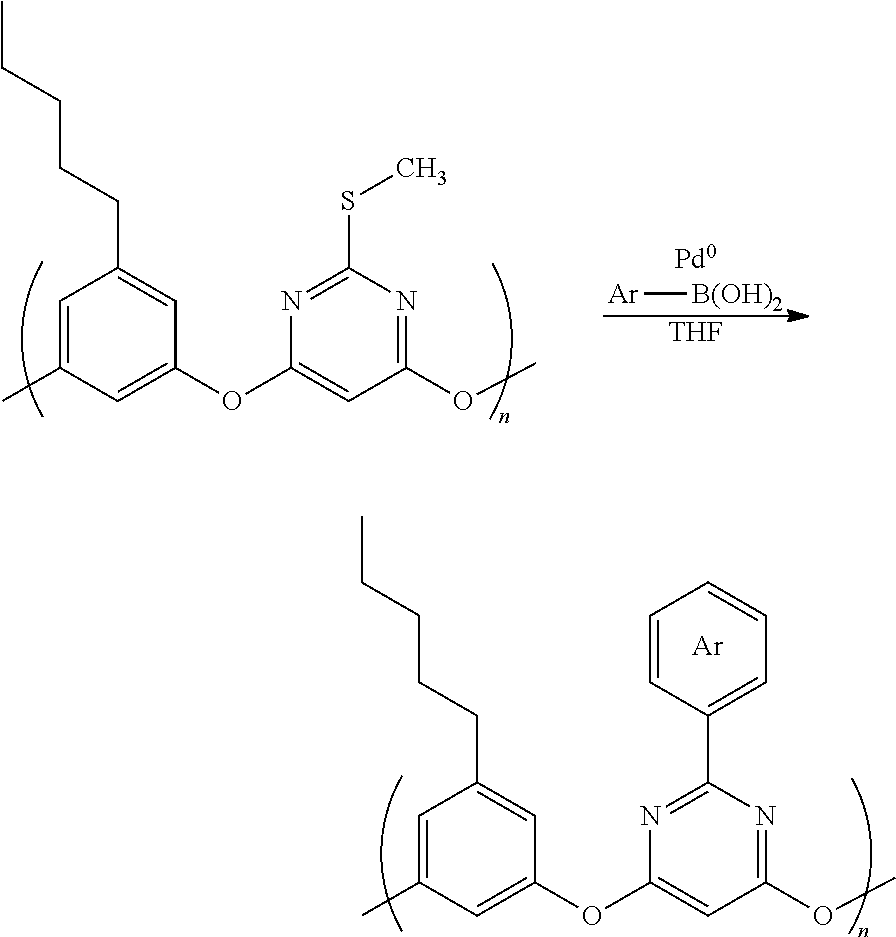
Palladium catalyzed coupling reactions may also be performed on iodo-functionalized polymers.
Another option is to oxidize pendant thioethers to sulfones, and, optionally, subsequent nucleophilic aromatic substitution. This reaction may be used, for example to add pendant amino groups, alkoxy groups, aryloxy groups, alkylthio groups, or arylthio groups.

All publications and patents mentioned herein are hereby incorporated by reference in their entirety as if each individual publication or patent was specifically and individually indicated to be incorporated by reference. In case of conflict, the present application, including any definitions herein, will control.
While specific embodiments of the subject invention have been discussed, the above specification is illustrative and not restrictive. Many variations of the invention will become apparent to those skilled in the art upon review of this specification and the claims below. The full scope of the invention should be determined by reference to the claims, along with their full scope of equivalents, and the specification, along with such variations.
Claims (20)
1. A polymer comprising at least one repeat unit represented by any one of structural formulas (IA)-(IE):

wherein:
n is, for each occurrence independently, 0, 1, 2, 3, or 4;
m is, for each occurrence independently, 0, 1, 2, or 3;
X1 and X2 are, each independently, —O—, —S—, or —(NR7)—;
each instance of R1 is independently selected from R6—COOH, R6—SO2H, R6—SO3H, R6—PO2H2, R6—PO3H2, —P(O)(OR4)2, —S(O2)(OR5), a C1-C20 alkyl, a C2-C20 alkenyl, a C2-C20 alkynyl, a C3-C20 cycloalkyl, a 5-20 atom heterocyclyl, a C6-C20 aryl, a 5-20 atom heteroaryl, a C1-C20 alkoxy, a C6-C20 aryloxy, a C1-C20 alkylthio, a C6-C20 arylthio, a C1-C20 sulfone, —(NR8R9)—, a halo, hydroxyl, —CN, nitro, or a C1-C20 acyl;
R2 is R6—COOH, R6—SO2H, R6—SO3H, R6—PO2H2, R6—PO3H2, —P(O)(OR4)2, —S(O2)(OR5), a C1-C20 alkyl, a C2-C20 alkenyl, a C2-C20 alkynyl, a C3-C20 cycloalkyl, a 5-20 atom heterocyclyl, a C6-C20 aryl, a 5-20 atom heteroaryl, a C1-C20 alkoxy, a C6-C20 aryloxy, a C1-C20 alkylthio, a C6-C20 arylthio, a C1-C20 sulfone, —(NR8R9)—, a halo, hydroxyl, —CN, nitro, or a C1-C20 acyl;
each instance of R3 is independently selected from R6—COOH, R6—SO2H, R6—SO3H, R6—PO2H2, R6—PO3H2, —P(O)(OR4)2, —S(O2)(OR5), a C1-C20 alkyl, a C2-C20 alkenyl, a C2-C20 alkynyl, a C3-C20 cycloalkyl, a 5-20 atom heterocyclyl, a C6-C20 aryl, a 5-20 atom heteroaryl, a C1-C20 alkoxy, a C6-C20 aryloxy, a C1-C20 alkylthio, a C6-C20 arylthio, a C1-C20 sulfone, —(NR8R9)—, a halo, hydroxyl, —CN, nitro, or a C1-C20 acyl;
each R4 is, independently, a C1-C6 alkyl, a C2-C6 alkenyl, a C2-C6 alkynyl, or a C3-C6 cycloalkyl;
each R5 is, independently, a C1-C6 alkyl, a C2-C6 alkenyl, a C2-C6 alkynyl, or a C3-C6 cycloalkyl;
each R6 is, independently, a single bond, a C1-C6 alkyl, a C2-C6 alkenyl, a C2-C6 alkynyl, a C1-C6 alkoxy, or a C3-C6 cycloalkyl;
each R7, R8, and R9 is, independently, H, a C1-C20 alkyl, a C6-C20 aryl, a 5-20 atom heteroaryl, a C1-C20 acyl, or sulfonyl; and
wherein R2, at least one instance of R1, or at least one instance of R3 is R6—COOH, R6—SO2H, R6—SO3H, R6—PO2H2, or R6—PO3H2; and
wherein in formulas IA-ID, at least one of n and m is greater than 0.
2. The polymer of claim 1 , wherein the repeat unit is represented by the following structural formula:

wherein:
n is 0, 1, 2, 3, or 4;
m is 0, 1, or 2; and
at least one of n and m is greater than 0.
3. The polymer of claim 1 , wherein the repeat unit is represented by the following structural formula:

wherein:
n is 0, 1, 2, 3, or 4;
m is 0, 1, 2, or 3; and
at least one of n and m is greater than 0.
4. The polymer of claim 1 , wherein the repeat unit is represented by the following structural formulas:

wherein:
n, for each occurrence independently, is 0, 1, 2, 3, or 4;
m, for each occurrence independently, is 0, 1, 2, or 3; and
in each of formulas (IV) and (V), at least one of n and m is greater than 0.
5. The polymer of claim 1 , wherein the repeat unit is represented by the following structural formula:

wherein:
n is 0, 1, 2, 3, or 4; and
m is 0, 1, 2, or 3.
6. The polymer of claim 1 , wherein:
each R1 is, independently, R6—COOH, R6—SO2H, R6—SO3H, R6—PO2H2, R6—PO3H2, —P(O)(OR4)2, a C1-C6 alkyl, a C2-C6 alkenyl, a C2-C6 alkynyl, a C3-C10 cycloalkyl, a 5-10 atom heterocyclyl, a C6-C10 aryl, a 5-10 atom heteroaryl, a C1-C6 alkoxy, a C6-C10 aryloxy, a C1-C6 alkylthio, a C6-C10 arylthio, a C1-C10 sulfone, —(NR8R9)—, a halo, hydroxyl, —CN, nitro, or a C1-C6 acyl; and
each R3 is, independently, R6—COOH, R6—SO2H, R6—SO3H, R6—PO2H2, R6—PO3H2, —P(O)(OR4)2, a C1-C6 alkyl, a C2-C6 alkenyl, a C2-C6 alkynyl, a C3-C10 cycloalkyl, a 5-10 atom heterocyclyl, a C6-C10 aryl, a 5-10 atom heteroaryl, a C1-C6 alkoxy, a C6-C10 aryloxy, a C1-C6 alkylthio, a C6-C10 arylthio, a C1-C10 sulfone, —(NR8R9)—, a halo, hydroxyl, —CN, nitro, or a C1-C6 acyl.
7. The polymer of claim 6 , wherein:
each R1 is, independently, R6—COOH, R6—SO2H, R6—SO3H, R6—PO2H2, R6—PO3H2, —P(O)(OR4)2, a C1-C6 alkyl, a C2-C6 alkenyl, a C2-C6 alkynyl, a C3-C10 cycloalkyl, a 5-10 atom heterocyclyl, a C6-C10 aryl, a 5-10 atom heteroaryl, a C1-C6 alkoxy, a C1-C6 alkylthio, a halo, —CN, or nitro; and
each R3 is, independently, R6—COOH, R6—SO2H, R6—SO3H, R6—PO2H2, R6—PO3H2, —P(O)(OR4)2, a C1-C6 alkyl, a C2-C6 alkenyl, a C2-C6 alkynyl, a C3-C10 cycloalkyl, a 5-10 atom heterocyclyl, a C6-C10 aryl, a 5-10 atom heteroaryl, a C1-C6 alkoxy, a C1-C6 alkylthio, a halo, —CN, or nitro.
8. The polymer of claim 7 , wherein:
each R1 is, independently, —COOH, —SO2H, —SO3H, —PO3H2, —PO2H2, —P(O)(OR4)2, a C1-C3 alkyl, phenyl, a C1-C3 alkoxy, a C1-C3 alkylthio, a halo, —CN, or nitro;
each R3 is, independently, —COOH, —SO2H, —SO3H, —PO3H2, —PO2H2, —P(O)(OR4)2, a C1-C3 alkyl, phenyl, a C1-C3 alkoxy, a C1-C3 alkylthio, a halo, —CN, or nitro.
9. The polymer of claim 8 , wherein:
each R1 is, independently, —COOH, —SO2H, —SO3H, —PO3H2, —PO2H2, —P(O)(OCH2CH3)2, methyl, trifluoromethyl, methoxy, methylthio, —CN, nitro, phenyl, or fluoro; and
each R3 is, independently, —COOH, —SO2H, —SO3H, —PO3H2, —PO2H2, —P(O)(OCH2CH3)2, methyl, trifluoromethyl, methoxy, methylthio, —CN, nitro, phenyl, or fluoro.
10. The polymer of claim 5 , wherein R2 is R6—COOH, R6—SO2H, R6—SO3H, R6—PO2H2, R6—PO3H2, P(O)(OR4)2, a C1-C6 alkyl, a C2-C6 alkenyl, a C2-C6 alkynyl, a C3-C10 cycloalkyl, a 5-10 atom heterocyclyl, a C6-C10 aryl, a 5-10 atom heteroaryl, a C1-C6 alkoxy, a C6-C10 aryloxy, a C1-C6 alkylthio, a C6-C10 arylthio, a C1-C10 sulfone, —(NR8R9)—, a halo, hydroxyl, —CN, nitro, or a C1-C6 acyl.
11. The polymer of claim 10 , wherein R2 is —COOH, —SO2H, —SO3H, —PO3H2, —PO2H2, —P(O)(OR4)2, a C1-C3 alkyl, phenyl, a C1-C3 alkoxy, a C1-C3 alkylthio, a halo, —CN, or nitro.
12. The polymer of claim 11 , wherein R2 is —COOH, —SO2H, —SO3H, —PO3H2, —PO2H2, —P(O)(OCH2CH3)2, methyl, trifluoromethyl, methoxy, methylthio, —CN, nitro, phenyl, or fluoro.
13. The polymer of claim 1 , wherein n is 1, 2, 3, or 4 and at least one instance of R1 is —COOH, —SO2H, —SO3H, —PO3H2, or —PO2H2.
14. The polymer of claim 13 , wherein the repeat unit is represented by the following structural formula:

15. The polymer of claim 13 , wherein at least one instance of R1 is —PO3H2.
16. The polymer of claim 1 , wherein the polymer is a copolymer.
17. The polymer of claim 1 , wherein the polymer is a homopolymer.
18. The polymer of claim 17 , wherein the polymer is a homopolymer having a repeat unit according to any one of the structural formulas depicted below:


19. The polymer of claim 18 , wherein the repeat unit is represented by the following structural formula:

20. An ion conducting membrane comprising the polymer of claim 1 .
Priority Applications (1)
| Application Number | Priority Date | Filing Date | Title |
|---|---|---|---|
| US15/204,370 US10066068B2 (en) | 2015-07-07 | 2016-07-07 | Polymeric ion conductor with improved thermal characteristics |
Applications Claiming Priority (2)
| Application Number | Priority Date | Filing Date | Title |
|---|---|---|---|
| US201562189519P | 2015-07-07 | 2015-07-07 | |
| US15/204,370 US10066068B2 (en) | 2015-07-07 | 2016-07-07 | Polymeric ion conductor with improved thermal characteristics |
Publications (2)
| Publication Number | Publication Date |
|---|---|
| US20170009032A1 US20170009032A1 (en) | 2017-01-12 |
| US10066068B2 true US10066068B2 (en) | 2018-09-04 |
Family
ID=56511911
Family Applications (1)
| Application Number | Title | Priority Date | Filing Date |
|---|---|---|---|
| US15/204,370 Active US10066068B2 (en) | 2015-07-07 | 2016-07-07 | Polymeric ion conductor with improved thermal characteristics |
Country Status (2)
| Country | Link |
|---|---|
| US (1) | US10066068B2 (en) |
| WO (1) | WO2017007928A1 (en) |
Families Citing this family (2)
| Publication number | Priority date | Publication date | Assignee | Title |
|---|---|---|---|---|
| EP3770202B1 (en) * | 2016-04-20 | 2024-02-21 | JSR Corporation | Polymer, composition, molded article, cured product and laminate |
| EP3684146A4 (en) | 2017-09-15 | 2021-06-02 | JSR Corporation | Circuit board |
Citations (3)
| Publication number | Priority date | Publication date | Assignee | Title |
|---|---|---|---|---|
| US5239107A (en) | 1990-05-28 | 1993-08-24 | Idemitsu Kosan Co., Ltd. | Process for producing polycyanoaryl ether powder |
| US20050159562A1 (en) | 2004-01-16 | 2005-07-21 | Idemitsu Kosan Co., Ltd. | Polyaryl ether copolymer, process for the production thereof, and polymer electrolytic film formed of the same |
| US20070259239A1 (en) | 2006-03-09 | 2007-11-08 | Samsung Sdi Co., Ltd. | Proton-conductive material, proton-conductive electrolyte for fuel cell comprising the material and fuel cell employing the electrolyte |
-
2016
- 2016-07-07 WO PCT/US2016/041325 patent/WO2017007928A1/en not_active Ceased
- 2016-07-07 US US15/204,370 patent/US10066068B2/en active Active
Patent Citations (3)
| Publication number | Priority date | Publication date | Assignee | Title |
|---|---|---|---|---|
| US5239107A (en) | 1990-05-28 | 1993-08-24 | Idemitsu Kosan Co., Ltd. | Process for producing polycyanoaryl ether powder |
| US20050159562A1 (en) | 2004-01-16 | 2005-07-21 | Idemitsu Kosan Co., Ltd. | Polyaryl ether copolymer, process for the production thereof, and polymer electrolytic film formed of the same |
| US20070259239A1 (en) | 2006-03-09 | 2007-11-08 | Samsung Sdi Co., Ltd. | Proton-conductive material, proton-conductive electrolyte for fuel cell comprising the material and fuel cell employing the electrolyte |
Non-Patent Citations (3)
| Title |
|---|
| Hudson, R., "SEES Fellows: Synthesis of a New Class of Thermostable Proton Conducting Materials to Enable High Efficiency Hydrogen Fuel Cells," First Amended Jul. 8, 2014; Last Amended Jul. 5, 2016, <http://www.nsf.gov/awardsearch/showAward?AWD_ID=1415189>. |
| Matsuo, et al., "Synthesis and properties of new crystalline poly(arylene ether nitriles)," J Polym Sci, 31(13): 3439-3446 (1993). |
| Wackerly, et al., "Selective Synthesis of Poly(m-phenylene oxides) over Oxacalixarenes" (2009) Macromolecules, 42, 8181-8186, DOI: 10.1021/ma901518w. |
Also Published As
| Publication number | Publication date |
|---|---|
| WO2017007928A1 (en) | 2017-01-12 |
| US20170009032A1 (en) | 2017-01-12 |
Similar Documents
| Publication | Publication Date | Title |
|---|---|---|
| CN101508675B (en) | Disulfonic acid-type alkylimidazole ionic liquid and its preparation method and application | |
| DE10117687A1 (en) | Proton-conducting membrane and its use | |
| US20120052412A1 (en) | Polyarylene block copolymer having sulfonic acid group and use thereof | |
| US7906608B2 (en) | Nitrogenated aromatic compound, process for production of the same, polymer, and proton conductive membrane | |
| US10066068B2 (en) | Polymeric ion conductor with improved thermal characteristics | |
| KR102441684B1 (en) | Novel polymers containing sulphonamide sodium or lithium salts, production methods thereof and uses of same as electrolytes for batteries | |
| US20200087262A1 (en) | Salts for use in electrolyte compositions or as electrode additives | |
| US7799893B2 (en) | Polybenzazole block copolymer | |
| US10471420B2 (en) | Cation exchange resin, and cation exchange membrane and fuel cell electrolyte membrane using same | |
| US11532819B2 (en) | Electrode binder resin composition, electrode mix paste, and electrode | |
| CN104829813B (en) | A kind of ionomeric polymer containing phosphine, preparation method and anion-exchange membrane | |
| CN102482401B (en) | Biphenyltetrasulfonic acid compound, method for producing same, polymer and polymer electrolyte | |
| JP2010031231A (en) | New aromatic compound and polyarylene-based copolymer having nitrogen-containing aromatic ring | |
| JP6460243B2 (en) | Compound containing aromatic ring, polymer containing the same, and polymer electrolyte membrane using the same | |
| JP5692226B2 (en) | Polyarylene block copolymer having sulfonic acid group and use thereof | |
| JP5347287B2 (en) | Polymer electrolyte for direct methanol fuel cell and its use | |
| US8524895B2 (en) | Method for preparing amide | |
| US10899874B2 (en) | Block polymer and polymer electrolyte membrane including same | |
| US20080070085A1 (en) | Sulfonated Polymer Comprising Nitrile-Type Hydrophobic Block And Solid Polymer Electrolyte | |
| US10727516B2 (en) | Compound and polymer electrolyte membrane using same | |
| JP2008066273A (en) | Polymer electrolyte material and polymer electrolyte molded unit formed of the same, polymer electrolyte membrane, membrane electrode composite, and solid polymer fuel cell | |
| CN102039179A (en) | Catalytic composition for preparing amide and method for preparing amide | |
| JP5396724B2 (en) | Polymer electrolyte for direct methanol fuel cell, method for producing polymer electrolyte membrane for direct methanol fuel cell, and polymer electrolyte membrane | |
| KR102063048B1 (en) | The polymer for separator of fuel battery or redox flow battery and manufacturing thereof | |
| KR20200119933A (en) | Grafted polymer and solid electrolyte composition for secondary battery containing the same |
Legal Events
| Date | Code | Title | Description |
|---|---|---|---|
| STCF | Information on status: patent grant |
Free format text: PATENTED CASE |
|
| MAFP | Maintenance fee payment |
Free format text: PAYMENT OF MAINTENANCE FEE, 4TH YR, SMALL ENTITY (ORIGINAL EVENT CODE: M2551); ENTITY STATUS OF PATENT OWNER: SMALL ENTITY Year of fee payment: 4 |