US10066044B2 - Stereoregular diblock polybutadienes having a 1,4-cis/syndiotactic 1,2 structure from stereospecific polymerization - Google Patents
Stereoregular diblock polybutadienes having a 1,4-cis/syndiotactic 1,2 structure from stereospecific polymerization Download PDFInfo
- Publication number
- US10066044B2 US10066044B2 US15/032,207 US201415032207A US10066044B2 US 10066044 B2 US10066044 B2 US 10066044B2 US 201415032207 A US201415032207 A US 201415032207A US 10066044 B2 US10066044 B2 US 10066044B2
- Authority
- US
- United States
- Prior art keywords
- branched
- groups
- optionally substituted
- linear
- group
- Prior art date
- Legal status (The legal status is an assumption and is not a legal conclusion. Google has not performed a legal analysis and makes no representation as to the accuracy of the status listed.)
- Active, expires
Links
- 0 C[C@@](C*)*#CCCN(C)C Chemical compound C[C@@](C*)*#CCCN(C)C 0.000 description 14
- HGHGMMBDJUFQTQ-DHZHZOJOSA-N CC(=O)C/C(C)=N/C(C)C(C)C Chemical compound CC(=O)C/C(C)=N/C(C)C(C)C HGHGMMBDJUFQTQ-DHZHZOJOSA-N 0.000 description 4
- YAYSRMPMUVLFGH-BFNWXZRRSA-N C/C(=N\C1CCCCC1)C1=CC=CC(/C(C)=N/C2=C(C(C)(C)C)C=CC=C2)=N1 Chemical compound C/C(=N\C1CCCCC1)C1=CC=CC(/C(C)=N/C2=C(C(C)(C)C)C=CC=C2)=N1 YAYSRMPMUVLFGH-BFNWXZRRSA-N 0.000 description 1
- HCWCBGYJGYONAB-URRIPQQHSA-N C=CC(C)CC/C=C\CC.C=CC(CC)CC(C=C)C/C=C\CC Chemical compound C=CC(C)CC/C=C\CC.C=CC(CC)CC(C=C)C/C=C\CC HCWCBGYJGYONAB-URRIPQQHSA-N 0.000 description 1
- FRSDUXCWNIPZBA-RPCRKUJJSA-N CC(=N\c1ccccc1C(C)(C)C)/C(C)=N/c1ccccc1C(C)(C)C Chemical compound CC(=N\c1ccccc1C(C)(C)C)/C(C)=N/c1ccccc1C(C)(C)C FRSDUXCWNIPZBA-RPCRKUJJSA-N 0.000 description 1
- JHTINWQRILLZLO-FMIVXFBMSA-N CC(=O)C/C(C)=N/C1=CC=CC=C1 Chemical compound CC(=O)C/C(C)=N/C1=CC=CC=C1 JHTINWQRILLZLO-FMIVXFBMSA-N 0.000 description 1
- JHAJUHKMVPSRFB-PXLXIMEGSA-N CC(=O)C1=CC=CC(/C(C)=N/C2=C(C(C)C)C=CC=C2C(C)C)=N1 Chemical compound CC(=O)C1=CC=CC(/C(C)=N/C2=C(C(C)C)C=CC=C2C(C)C)=N1 JHAJUHKMVPSRFB-PXLXIMEGSA-N 0.000 description 1
- SABYQVCUNYPPQD-DEDYPNTBSA-N CC(=O)c1cccc(/C(C)=N/c2ccccc2C(C)(C)C)n1 Chemical compound CC(=O)c1cccc(/C(C)=N/c2ccccc2C(C)(C)C)n1 SABYQVCUNYPPQD-DEDYPNTBSA-N 0.000 description 1
- UXJIYFUYXWGMAU-KJSXAQCBSA-L CC(C)=N(C1=C(C(C)(C)C)C=CC=C1)[Co]1(Cl)(Cl)N2=CC=CC=C2C(C)=N1C1CCCCC1 Chemical compound CC(C)=N(C1=C(C(C)(C)C)C=CC=C1)[Co]1(Cl)(Cl)N2=CC=CC=C2C(C)=N1C1CCCCC1 UXJIYFUYXWGMAU-KJSXAQCBSA-L 0.000 description 1
- QKHVAENURJCGJV-MEUQDVFNSA-L CC1=N(C2=C(C(C)C)C=CC=C2C(C)C)[Co]2(Cl)(Cl)/O=C(/C)C3=CC=CC1=N32 Chemical compound CC1=N(C2=C(C(C)C)C=CC=C2C(C)C)[Co]2(Cl)(Cl)/O=C(/C)C3=CC=CC1=N32 QKHVAENURJCGJV-MEUQDVFNSA-L 0.000 description 1
- SCMVLVVUHYHSCJ-HDZVPRFUSA-L CC1=N(c2ccccc2C(C)(C)C)[Co](Cl)(Cl)N(c2ccccc2C(C)(C)C)=C1C Chemical compound CC1=N(c2ccccc2C(C)(C)C)[Co](Cl)(Cl)N(c2ccccc2C(C)(C)C)=C1C SCMVLVVUHYHSCJ-HDZVPRFUSA-L 0.000 description 1
- ZRAWDTSMYZPUDM-MRPQEHAPSA-L CC1=O[Co](Cl)(Cl)N(C2=CC=CC=C2)=C(C)C1 Chemical compound CC1=O[Co](Cl)(Cl)N(C2=CC=CC=C2)=C(C)C1 ZRAWDTSMYZPUDM-MRPQEHAPSA-L 0.000 description 1
- XDHPVNCATVICMV-UHFFFAOYSA-N CCCNCCCCCC1C(C)C1 Chemical compound CCCNCCCCCC1C(C)C1 XDHPVNCATVICMV-UHFFFAOYSA-N 0.000 description 1
Images




Classifications
-
- C—CHEMISTRY; METALLURGY
- C08—ORGANIC MACROMOLECULAR COMPOUNDS; THEIR PREPARATION OR CHEMICAL WORKING-UP; COMPOSITIONS BASED THEREON
- C08F—MACROMOLECULAR COMPOUNDS OBTAINED BY REACTIONS ONLY INVOLVING CARBON-TO-CARBON UNSATURATED BONDS
- C08F295/00—Macromolecular compounds obtained by polymerisation using successively different catalyst types without deactivating the intermediate polymer
-
- C—CHEMISTRY; METALLURGY
- C08—ORGANIC MACROMOLECULAR COMPOUNDS; THEIR PREPARATION OR CHEMICAL WORKING-UP; COMPOSITIONS BASED THEREON
- C08F—MACROMOLECULAR COMPOUNDS OBTAINED BY REACTIONS ONLY INVOLVING CARBON-TO-CARBON UNSATURATED BONDS
- C08F36/00—Homopolymers and copolymers of compounds having one or more unsaturated aliphatic radicals, at least one having two or more carbon-to-carbon double bonds
- C08F36/02—Homopolymers and copolymers of compounds having one or more unsaturated aliphatic radicals, at least one having two or more carbon-to-carbon double bonds the radical having only two carbon-to-carbon double bonds
- C08F36/04—Homopolymers and copolymers of compounds having one or more unsaturated aliphatic radicals, at least one having two or more carbon-to-carbon double bonds the radical having only two carbon-to-carbon double bonds conjugated
- C08F36/06—Butadiene
-
- C—CHEMISTRY; METALLURGY
- C08—ORGANIC MACROMOLECULAR COMPOUNDS; THEIR PREPARATION OR CHEMICAL WORKING-UP; COMPOSITIONS BASED THEREON
- C08F—MACROMOLECULAR COMPOUNDS OBTAINED BY REACTIONS ONLY INVOLVING CARBON-TO-CARBON UNSATURATED BONDS
- C08F4/00—Polymerisation catalysts
- C08F4/42—Metals; Metal hydrides; Metallo-organic compounds; Use thereof as catalyst precursors
- C08F4/44—Metals; Metal hydrides; Metallo-organic compounds; Use thereof as catalyst precursors selected from light metals, zinc, cadmium, mercury, copper, silver, gold, boron, gallium, indium, thallium, rare earths or actinides
- C08F4/60—Metals; Metal hydrides; Metallo-organic compounds; Use thereof as catalyst precursors selected from light metals, zinc, cadmium, mercury, copper, silver, gold, boron, gallium, indium, thallium, rare earths or actinides together with refractory metals, iron group metals, platinum group metals, manganese, rhenium technetium or compounds thereof
- C08F4/602—Component covered by group C08F4/60 with an organo-aluminium compound
- C08F4/6028—Component covered by group C08F4/60 with an organo-aluminium compound with an alumoxane, i.e. a compound containing an -Al-O-Al-group
-
- C—CHEMISTRY; METALLURGY
- C08—ORGANIC MACROMOLECULAR COMPOUNDS; THEIR PREPARATION OR CHEMICAL WORKING-UP; COMPOSITIONS BASED THEREON
- C08F—MACROMOLECULAR COMPOUNDS OBTAINED BY REACTIONS ONLY INVOLVING CARBON-TO-CARBON UNSATURATED BONDS
- C08F4/00—Polymerisation catalysts
- C08F4/42—Metals; Metal hydrides; Metallo-organic compounds; Use thereof as catalyst precursors
- C08F4/44—Metals; Metal hydrides; Metallo-organic compounds; Use thereof as catalyst precursors selected from light metals, zinc, cadmium, mercury, copper, silver, gold, boron, gallium, indium, thallium, rare earths or actinides
- C08F4/60—Metals; Metal hydrides; Metallo-organic compounds; Use thereof as catalyst precursors selected from light metals, zinc, cadmium, mercury, copper, silver, gold, boron, gallium, indium, thallium, rare earths or actinides together with refractory metals, iron group metals, platinum group metals, manganese, rhenium technetium or compounds thereof
- C08F4/70—Iron group metals, platinum group metals or compounds thereof
- C08F4/7001—Iron group metals, platinum group metals or compounds thereof the metallic compound containing a multidentate ligand, i.e. a ligand capable of donating two or more pairs of electrons to form a coordinate or ionic bond
- C08F4/7003—Bidentate ligand
- C08F4/7004—Neutral ligand
- C08F4/7006—NN
-
- C—CHEMISTRY; METALLURGY
- C08—ORGANIC MACROMOLECULAR COMPOUNDS; THEIR PREPARATION OR CHEMICAL WORKING-UP; COMPOSITIONS BASED THEREON
- C08F—MACROMOLECULAR COMPOUNDS OBTAINED BY REACTIONS ONLY INVOLVING CARBON-TO-CARBON UNSATURATED BONDS
- C08F4/00—Polymerisation catalysts
- C08F4/42—Metals; Metal hydrides; Metallo-organic compounds; Use thereof as catalyst precursors
- C08F4/44—Metals; Metal hydrides; Metallo-organic compounds; Use thereof as catalyst precursors selected from light metals, zinc, cadmium, mercury, copper, silver, gold, boron, gallium, indium, thallium, rare earths or actinides
- C08F4/60—Metals; Metal hydrides; Metallo-organic compounds; Use thereof as catalyst precursors selected from light metals, zinc, cadmium, mercury, copper, silver, gold, boron, gallium, indium, thallium, rare earths or actinides together with refractory metals, iron group metals, platinum group metals, manganese, rhenium technetium or compounds thereof
- C08F4/70—Iron group metals, platinum group metals or compounds thereof
- C08F4/7001—Iron group metals, platinum group metals or compounds thereof the metallic compound containing a multidentate ligand, i.e. a ligand capable of donating two or more pairs of electrons to form a coordinate or ionic bond
- C08F4/7003—Bidentate ligand
- C08F4/7004—Neutral ligand
- C08F4/7008—NO
-
- C—CHEMISTRY; METALLURGY
- C08—ORGANIC MACROMOLECULAR COMPOUNDS; THEIR PREPARATION OR CHEMICAL WORKING-UP; COMPOSITIONS BASED THEREON
- C08F—MACROMOLECULAR COMPOUNDS OBTAINED BY REACTIONS ONLY INVOLVING CARBON-TO-CARBON UNSATURATED BONDS
- C08F4/00—Polymerisation catalysts
- C08F4/42—Metals; Metal hydrides; Metallo-organic compounds; Use thereof as catalyst precursors
- C08F4/44—Metals; Metal hydrides; Metallo-organic compounds; Use thereof as catalyst precursors selected from light metals, zinc, cadmium, mercury, copper, silver, gold, boron, gallium, indium, thallium, rare earths or actinides
- C08F4/60—Metals; Metal hydrides; Metallo-organic compounds; Use thereof as catalyst precursors selected from light metals, zinc, cadmium, mercury, copper, silver, gold, boron, gallium, indium, thallium, rare earths or actinides together with refractory metals, iron group metals, platinum group metals, manganese, rhenium technetium or compounds thereof
- C08F4/70—Iron group metals, platinum group metals or compounds thereof
- C08F4/7001—Iron group metals, platinum group metals or compounds thereof the metallic compound containing a multidentate ligand, i.e. a ligand capable of donating two or more pairs of electrons to form a coordinate or ionic bond
- C08F4/7039—Tridentate ligand
- C08F4/704—Neutral ligand
- C08F4/7042—NNN
-
- C—CHEMISTRY; METALLURGY
- C08—ORGANIC MACROMOLECULAR COMPOUNDS; THEIR PREPARATION OR CHEMICAL WORKING-UP; COMPOSITIONS BASED THEREON
- C08F—MACROMOLECULAR COMPOUNDS OBTAINED BY REACTIONS ONLY INVOLVING CARBON-TO-CARBON UNSATURATED BONDS
- C08F4/00—Polymerisation catalysts
- C08F4/42—Metals; Metal hydrides; Metallo-organic compounds; Use thereof as catalyst precursors
- C08F4/44—Metals; Metal hydrides; Metallo-organic compounds; Use thereof as catalyst precursors selected from light metals, zinc, cadmium, mercury, copper, silver, gold, boron, gallium, indium, thallium, rare earths or actinides
- C08F4/60—Metals; Metal hydrides; Metallo-organic compounds; Use thereof as catalyst precursors selected from light metals, zinc, cadmium, mercury, copper, silver, gold, boron, gallium, indium, thallium, rare earths or actinides together with refractory metals, iron group metals, platinum group metals, manganese, rhenium technetium or compounds thereof
- C08F4/70—Iron group metals, platinum group metals or compounds thereof
- C08F4/7001—Iron group metals, platinum group metals or compounds thereof the metallic compound containing a multidentate ligand, i.e. a ligand capable of donating two or more pairs of electrons to form a coordinate or ionic bond
- C08F4/7039—Tridentate ligand
- C08F4/704—Neutral ligand
- C08F4/7044—NNO
Definitions
- the present invention relates to a stereoregular diblock polybutadiene having a 1,4-cis/syndiotactic 1,2 structure.
- the present invention relates to a stereoregular diblock polybutadiene composed of a polybutadiene block having a 1,4-cis structure and a polybutadiene block having a syndiotactic 1,2 structure.
- the present invention also relates to a process for the preparation of a stereoregular diblock polybutadiene composed of a polybutadiene block having a 1,4-cis structure and a polybutadiene block having a syndiotactic 1,2 structure, which comprises subjecting 1,3 butadiene to total or partial stereospecific polymerization in the presence of a catalytic system comprising at least one cobalt complex including at least one imine nitrogen, and subsequently adding at least one monodentate aromatic phosphine and optionally 1,3-butadiene, and continuing said stereospecific polymerization.
- Said stereoregular diblock polybutadiene can be advantageously used in both the footwear industry (for example, in the production of soles for shoes) and in the production of tires for motor vehicles and/or trucks.
- 1,4-cis polybutadiene is a synthetic elastomer generally having a content of 1,4-cis units equal to 96%-97%, a melting point (T m ) of about ⁇ 2° C., a crystallization temperature (T c ) of about ⁇ 25° and a glass transition temperature (T g ) below ⁇ 100° C., whose properties are extremely similar to those of natural rubber and whose main use is in the production of tires for motor vehicles and/or trucks.
- T m melting point
- T c crystallization temperature
- T g glass transition temperature
- 1,4-cis polybutadiene is generally prepared through polymerization processes which use various catalytic systems comprising catalysts based on titanium (Ti), cobalt (Co), nickel (Ni), neodymium (Nd).
- Catalytic systems comprising catalysts based on cobalt have a high catalytic activity and stereospecificity and can be considered as being the most versatile among those listed above as, by varying their formulation, they are capable of giving all the possible stereoisomers of polybutadiene indicated above, as described, for example, in Porri L. et al., “ Comprehensive Polymer Science ” (1989), Eastmond G. C. et al. Eds., Pergamon Press, Oxford, UK, Vol.
- the catalytic system cobalt bis-acetylacetonate/diethylaluminium chloride/water [Co(acac) 2 /AlEt 2 C1/H 2 O], for example, provides a polybutadiene having a content of 1,4-cis units equal to about 97%, and is that normally used for the industrial production of this polymer as described, for example, in Racanelli P. et al., “ European Polymer Journal ” (1970), Vol. 6, pages 751-761.
- the catalytic system cobalt tris-acetylacetonate/methylaluminoxane [Co(acac) 3 /MAO] also provides a polybutadiene having a content of 1,4-cis units equal to about 97%, as described, for example, in Ricci G. et al., “ Polymer Communication ” (1991), Vol. 32, pages 514-517.
- the catalytic system cobalt tris-acetylacetonate/tri-ethylaluminium/water[Co(acac) 3 /AlEt 3 /AlEt 3 /H 2 O] on the other hand, provides a polybutadiene having a mixed 1,4-cis/1,2 equibinary structure as described, for example, in: Furukawa J. et al., “ Polymer Journal ” (1971), Vol. 2, pages 371-378. Said catalytic system, in the presence of carbon disulfide (CS 2 ), however, is used in processes for the industrial production of highly crystalline syndiotactic 1,2-polybutadiene.
- CS 2 carbon disulfide
- An extremely active and stereospecific catalytic system for the preparation of syndiotactic 1,2-polybutadiene can be obtained from the combination of the allyl cobalt complex ( ⁇ 4 -C 4 H 6 ) ( ⁇ 5 -C 8 H 13 ) Co described, for example, in Natta G. et al., “ Chemical Communications ” (1967), Issue 24, pages 1263-1265, with carbon disulfide (CS 2 ), as described, for example, in Ricci G. et al., “ Polymer Communication ” (1988), Vol. 29, pages 305-307.
- This allyl cobalt complex alone is capable of dimerizing 1,3-butadiene at room temperature as described, for example, in American patent U.S. Pat. No.
- Polybutadienes with a syndiotactic 1,2 structure or a mixed 1,4-cis/1,2 structure, having the 1,4-cis and 1,2 units randomly distributed along the polymeric chain can also be produced using catalytic systems obtained by the combination of cobalt dichloride (CoCl 2 ) or of cobalt dibromide (CoBr 2 ) with organic aluminium compounds (e.g., alkyl compounds of aluminium or aluminoxanes), in the presence of phosphines (e.g., triphenylphosphine) as described, for example, in the following American patents: U.S. Pat. No. 5,879,805, U.S. Pat. No. 4,324,939, U.S.
- polybutadienes having an essentially 1,2 structure have been obtained, having a variable content of 1,2 units in relation to the type of complex and the polymerization conditions. It has also been seen that the tacticity of the polybutadienes obtained greatly depends on the type of complex, i.e. the type of phosphine bound to the cobalt atom, and that the syndiotacticity index, expressed as content (i.e. percentage) of syndiotactic triads [(rr) %], determined by the 13 C-NMR spectra, increases with an increase in the steric requirement of the alkyl group bound to the phosphorous atom.
- T m melting point
- Symmetrical or asymmetrical, diblock or triblock polymers based on butadiene are also known in the art, which, however, differ enormously from the stereospecific diblock polybutadiene object of the present invention, from the point of view of both the composition and microstructure, and also of the production method.
- the diblock or triblock polymers known in the art are in fact essentially obtained by post-modification reactions (e.g., grafting) of various homopolymers, or by anionic polymerization, using lithiumalkyls as reagents, or by emulsion polymerization, using radical initiators.
- Said diblock or triblock polymers often consist of the joining of polybutadiene blocks having different structures (prevalently, a 1,4-trans structure, as this is the predominant structure in the anionic or radicalic polymerization of butadiene) with blocks of polyisoprene, styrene or styrene-butadiene.
- a 1,4-trans structure as this is the predominant structure in the anionic or radicalic polymerization of butadiene
- the double bonds are along the main chain
- the block of polybutadiene having a syndiotactic 1,2 structure of the stereoregular diblock polybutadiene object of the present invention the double bonds are outside the main chain.
- anionic or radicalic polymerizations allow the composition of the diblock or triblock polymers obtained to be controlled (i.e. the percentage of comonomers present), they are not able to exert an adequate control on the type of stereoregularity of the blocks (e.g., in the case of butadiene, the 1,4-cis vs. 1,2 vs. 1,4-trans selectivity) contrary to what happen on the stereospecific polymerization.
- the triblock polybutadienes thus obtained were analyzed and showed the following composition: high 1,4-trans-b-low 1,4-cis-b-high 1,4-trans (HTPB-b-LCPB-b-HTPBs).
- Said triblock polybutadienes consisted of an elastic block with a low content of 1,4-cis units chemically bound to blocks with a high content of crystallizable 1,4-trans units.
- the ratio between the (HTPB:LCPB:HTPBs) blocks was the following: 25:50:25.
- the triblock polybutadienes HTPB-b-LCPB-b-HTPBs obtained consisted of the LCPB block with a 1,4-trans content equal to 52.5% and of the HTPB blocks with a 1,4-trans content ranging from 55.9% to 85.8%. These values clearly indicate that the stereoregularity of the blocks is not high.
- the triblock polybutadienes obtained showed a glass transition temperature (T g ) equal to about ⁇ 92° C. and, only in the presence of a 1,4-trans content >70%, a crystallization temperature (T c ) equal to about ⁇ 66° C.
- Ban H. T. et al. obtained, with low yields, a copolymer having a block of syndiotactic polystyrene (content of syndiotactic units >95%) and a block of 1,4-cis polybutadiene (content of 1,4-cis units ⁇ 70%), which showed a melting point (T m ) equal to 270° C., attributed to the block of syndiotactic polystyrene.
- T m melting point
- composition comprising a polybutadiene rubber containing a polymer obtained through the block polymerization or graft polymerization of 1,4-cis polybutadiene with syndiotactic 1,2-polibutadiene, whose microstructure comprises a content of 1,4-cis units ranging from 78% by weight to 93% by weight and a content of syndiotactic 1,2 units ranging from 6% by weight to 20% by weight, at least 40% by weight of said syndiotactic 1,2-polibutadiene being crystallized and having a form of the short-fiber type having an average diameter ranging from 0.05 ⁇ m to 1 ⁇ m and an average length ranging from 0.8 ⁇ m to 10 ⁇ m.
- the polymer obtained probably has multiple junction points: said polymer is consequently completely different from the diblock polybutadiene object of the present invention, obtained by means of stereospecific polymerization and wherein the two blocks, i.e. the block with a 1,4-cis structure and the block with a syndiotactic 1,2 structure, are joined to each other by means of a single junction and not interpenetrated.
- polybutadiene is among the polymers which are most widely-used industrially, in particular for the production of tires
- the study of new polybutadienes is still of great interest.
- the study of a stereoregular diblock polybutadiene with a 1,4-cis/syndiotactic 1,2 structure which could be advantageously used in both the footwear industry (for example, in the production of shoe soles) and in the production of tires for motor vehicles and/or trucks, is of great interest.
- the Applicant has therefore considered the problem of finding a stereoregular diblock polybutadiene having a 1,4-cis/syndiotactic 1,2 structure. More specifically, the Applicant has considered the problem of finding a stereoregular diblock polybutadiene composed of a polybutadiene block having a 1,4-cis structure and a polybutadiene block having a syndiotactic 1,2 structure.
- stereoregular diblock polybutadiene composed of a polybutadiene block having a 1,4-cis structure and a polybutadiene block having a syndiotactic 1,2 structure
- a process which comprises subjecting 1,3-butadiene to total or partial stereospecific polymerization, in the presence of a catalytic system comprising at least one complex of cobalt including at least one imine nitrogen and subsequently adding at least one monodentate aromatic phosphine and optionally 1,3-butadiene, and continuing said stereospecific polymerization.
- the Applicant has found that the use of said complex of cobalt including at least one imine nitrogen allows a polybutadiene with a living 1,4-cis structure to be obtained and that the subsequent stereospecific polymerization of the residual, or optionally added, 1,3-butadiene, in the presence of said monodentate aromatic phosphine, is capable of giving the above stereoregular diblock polybutadiene. Furthermore, the Applicant has found that said process, by varying the addition time of said monodentate aromatic phosphine or the quantity of 1,3-butadiene, allows the length of the two blocks (i.e.
- the block with a 1,4-cis structure and the block with a syndiotactic 1,2 structure) to be modulated in the stereoregular diblock polybutadiene obtained, depending on the characteristics of the end-product to be obtained.
- the Applicant has also found that this process, by varying the type of monodentate aromatic phosphine, allows the crystallinity of the block having a syndiotactic 1,2 structure [i.e. content of syndiotactic triads [(rr) %]] to be modulated, and consequently the melting point (T m ), in the stereoregular diblock polybutadiene obtained, depending on the characteristics of the end-product to be obtained.
- FIG. 1 shows the FT-IR spectrum of the complex CoCl 2 (L2)(GL923)(Example 4) (after subtraction of the nujol bands);
- FIG. 2 shows the FT-IR spectrum of the complex CoCl 2 (L4) (GL924)(Example 8) (after subtraction of the nujol bands);
- FIG. 3 shows the FT-IR spectrum of the polybutadiene of Example 9 (GL661);
- FIG. 4 shows the 13 C-NMR spectrum (on the left) and 1 H-NMR spectrum (on the right) of the polybutadiene of Example 11 (GL962);
- FIG. 5A shows the DSC diagram of the polybutadiene of Example 11 (GL962): crystallization
- FIG. 5B shows the DSC diagram of the polybutadiene of Example 11 (GL962): melting
- FIG. 6 shows the DSC diagrams of the stereoregular diblock polybutadiene of Example 12 (A2)
- FIG. 7 shows the 1 H-NMR spectrum of the stereoregular diblock polybutadiene of Example 12 (A2);
- FIG. 8 shows the 13 C-NMR spectrum of the stereoregular diblock polybutadiene of Example 12 (A2);
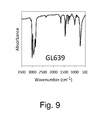
- FIG. 9 shows the FT-IR spectrum of the polybutadiene of Example 13 (GL639)
- FIG. 10A shows the DSC diagram of the polybutadiene of Example 15 (G1169): crystallization
- FIG. 10B shows the DSC diagram of the polybutadiene of Example 15 (C1169): melting;
- FIG. 11 shows the 13 C-NMR spectrum (on the left) and 1 H-NMR spectrum (on the right) of the polybutadiene of Example 15 (GL1169);
- FIG. 12A shows the Elastic moduli (G′) at 130° C. for the reference polybutadiene of Example 15 (G1169), for the stereoregular diblock polybutadienes of Examples 16 (G1131), 17 (G1132) and 18 (G1136) and for the samples of reference polybutadiene Europrene Neocis® BR 40 (BR40) and Buna CB 24 (CB24);
- FIG. 12B shows the Elastic moduli (G′) at 30° C. for the reference polybutadiene of Example 15 (G1169), for the stereoregular diblock polybutadienes of Examples 16 (G1131), 17 (G1132) and 18 (G1136) and for the samples of reference polybutadiene Europrene Neocis® BR 40 (BR40) and Buna CB 24 (CB24);
- FIG. 13 shows the Elastic moduli (G′) at 100 rad/s in relation to the temperature for the reference polybutadiene of Example 15 (G1169), for the diblock stereoregular polybutadienes of Examples 16 (G1131), 17 (G1132) and 18 (G1136) and for the sample of reference polybutadiene Europrene Neocis® BR 40 (BR40);
- FIG. 14A shows the Elastic moduli (G′) at 100 rad/s and at 0.1 rad/s, at 30° C. for the reference polybutadiene of Example 15 (G1169), for the stereoregular diblock polybutadienes of Example 16 (G1131), 17 (G1132) and 18 (G1136) and for the sample of reference polybutadiene Europrene Neocis® BR 40 (BR40);
- FIG. 14B shows the Elastic moduli (G′) at 100 rad/s and at 0.1 rad/s, at 130° C. for the reference polybutadiene of Example 15 (G1169), for the stereoregular diblock polybutadienes of Example 16 (G1131), 17 (G1132) and 18 (G1136) and for the sample of reference polybutadiene Europrene Neocis® BR 40 (BR40);
- FIG. 15 shows the Van Gurp-Palmen diagrams of: a) reference polybutadiene of Example 15 (G1169) and samples of reference polybutadiene Europrene Neocis® BR 40 (BR40) and Buna CB 24 (CB24); b) stereoregular diblock polybutadiene of Example 18 (G1136), reference polybutadiene of Example 15 (G1169) and samples of reference polybutadiene Europrene Neocis® BR 40 (BR40) and Buna CB 24 (CB24): c) stereoregular diblock polybutadiene of Example 17 (G1132), reference polybutadiene of Example 15 (G1169) and samples of reference polybutadiene Europrene Neocis® BR 40 (BR40) and Buna CB 24 (CB24); d) stereoregular diblock polybutadiene of Example 16 (1131), reference polybutadiene of Example 15 (G1169) and samples of reference polybutadiene Europrene
- FIG. 16 shows the FT-IR spectrum of the stereoregular diblock polybutadiene of Example 16 (G1131);
- FIG. 17 shows the DSC diagram of the stereoregular diblock polybutadiene of Example 16 (G1131);
- FIG. 18 shows the 1 H-NMR spectrum of the stereoregular diblock polybutadiene of Example 16 (G1131);
- FIG. 19 shows the 13 C-NMR spectrum of the stereoregular diblock polybutadiene of Example 16 (G1131);
- FIG. 20 shows the FT-IR spectrum of the stereoregular diblock polybutadiene of Example 17 (G1132);
- FIG. 21 relates to Atomic Force Microscopy (AFM) of the stereoregular diblock polybutadiene of Example 17 (G1132);
- FIG. 22 shows the two-dimensional 13 C-NMR spectrum of the stereoregular diblock polybutadiene of Example 17 (G1132);
- FIG. 23 shows the two-dimensional 1 H- 1 H COSY NMR spectrum of the stereoregular diblock polybutadiene of Example 17 (G1132);
- FIG. 24 shows the 1 H-NMR spectrum of the stereoregular diblock polybutadiene of Example 17 (G1132);
- FIG. 25 shows the 13 C-NMR spectrum of the stereoregular diblock polybutadiene of Example 17 (G1132);
- FIG. 26 shows the FT-IR spectrum of the stereoregular diblock polybutadiene of Example 18 (G1136);
- FIG. 27 shows the DSC diagrams of the stereoregular diblock polybutadiene of Example 18 (G1136);
- FIG. 28 shows the FT-IR spectrum of the stereoregular diblock polybutadiene of Example 19 (A4)
- FIG. 29 shows the DSC diagrams of the stereoregular diblock polybutadiene of Example 19 (A4)
- FIG. 30 shows the 1 H-NMR spectrum of the stereoregular diblock polybutadiene of Example 19 (A4);
- FIG. 31 shows the 13 C-NMR spectrum of the stereoregular diblock polybutadiene of Example 19 (A4);
- FIG. 32 shows the 1 H-NMR spectrum of the stereoregular diblock polybutadiene of Example 20 (A5);
- FIG. 33 shows the 13 C-NMR spectrum of the stereoregular diblock polybutadiene of Example 20 (A5);
- FIG. 34 shows the DSC diagrams of the stereoregular diblock polybutadiene of Example 20 (A5);
- FIG. 35 shows the conversion percentage (above) and yield in grams (below) in relation to the polymerization time (Examples 21-25 of Table 1);
- FIG. 36 shows the FT-IR spectra of the polybutadienes obtained: GL694 (Example 21); GL695 (Example 22); GL696 (Example 23); GL697 (Example 24); GL698 (Example 25).
- An object of the present invention therefore relates to a stereoregular diblock polybutadiene composed of a polybutadiene block with a 1,4-cis structure and a polybutadiene block with a syndiotactic 1,2 structure, having the following formula (I): PB 1 —PB 2 (I)
- stereonoregular diblock polybutadiene means a polybutadiene in which only two polybutadiene blocks are present, having a different structure, i.e. a 1,4-cis structure and a syndiotactic 1,2 structure, joined to each other through a single junction and not interpenetrated.
- the term “essentially free of 1,4-trans units” means that, when present, said 1,4-trans units are present in a quantity lower than 3% molar, preferably lower than 1% molar, with respect to the total molar quantity of the butadiene units present in said stereoregular diblock polybutadiene.
- said stereoregular diblock polybutadiene has the following characteristics:
- the wide range within which the melting point (T m ) and the crystallization temperature (T c ) of the block having a 1,2 structure vary can be attributed to the different content of syndiotactic triads [(rr) %] which depends on the type of phosphine used in the polymerization [i.e. the degree of stereoregularity, namely the content of syndiotactic triads [(rr) %] increases with an increase in the steric hindrance of the aromatic phosphine used].
- Said glass transition temperature (T g ), said melting point (T m ) and said crystallization temperature (T c ), were determined by means of DSC thermal analysis (“Differential Scanning calorimetry”) which was carried out as indicated hereunder in the paragraph “Analysis and characterization methods”.
- PDI polydispersion index
- PDI polydispersion index
- PDI polydispersion index
- the isolated fractions i.e. extract soluble in ether and residue insoluble in ether
- the stereoregular diblock polybutadiene object of the present invention to extraction in continuous with diethylether at boiling point, for 4 hours, always have a composition/structure completely analogous to that of the “nascent” starting polymer.
- the stereoregular diblock polybutadiene object of the present invention when subjected to Atomic Force Microscopy (AFM), shows two clearly distinct domains relating to the block with a 1,4-cis structure and to the block with a syndiotactic 1,2 structure and, in particular, a homogeneous distribution of said domains as shown in FIG. 21 provided hereunder.
- AFM Atomic Force Microscopy
- the stereoregular diblock polybutadiene object of the present invention when subjected to Dynamic Mechanical Analysis (DMA), shows a elastic modulus value (G′) higher than that of commercial polybutadienes (i.e. Europrene NEOCIS® BR 40 of Versalis spa and Buna CB 24 of Lanxess) as shown in FIGS. 12-14 provided hereunder.
- DMA Dynamic Mechanical Analysis
- the polybutadiene block having a 1,4-cis structure is amorphous, at room temperature under quiescent conditions (i.e. not subjected to stress), and can have a 1,4-cis content higher than or equal to 96% molar, preferably ranging from 97% molar to 99% molar, with respect to the total molar quantity of butadiene units present in said polybutadiene block having a 1,4-cis structure.
- the complement to 100 i.e. a content lower than or equal to 4% molar, preferably ranging from 1% molar to 3% molar, can be with a 1,2 structure or, if present, with a 1,4-trans structure in the quantities indicated above.
- the polybutadiene block having a syndiotactic 1,2 structure can have a varying degree of crystallinity depending on the content of syndiotactic triads [(rr) %], namely the type of monodentate aromatic phosphine used: in particular, the degree of crystallinity increases with an increase in the content of syndiotactic triads [(rr) %].
- Said content of syndiotactic triads [(rr) %] is preferably higher than or equal to 15%, preferably ranging from 60% to 80%.
- the polybutadiene block having a 1,2 structure is characterized by a low content of syndiotactic triads [(rr) %] (i.e. a content ranging from 15% to 20%) and therefore it proves to be at low crystallinity, tendentially amorphous, the content of 1,2 units always remains higher than or equal to 80%.
- the 1,4-cis/1,2 molar ratio can range from 15:85 to 80:20, preferably ranging from 25:75 to 70:30.
- said stereoregular diblock polybutadiene can have a weight average molecular weight (M w ) ranging from 100,000 g/mol to 800,000 g/mol, preferably ranging from 150,000 g/mol to 600,000 g/mol.
- M w weight average molecular weight
- stereoregular diblock polybutadiene object of the present invention has numerous differences with respect to both commercial polybutadienes with a high 1,4-cis structure, and also the reference homopolymers obtained as described in the following examples, such as, for example:
- both blocks i.e.
- both the polybutadiene block with a syndiotactic 1,2 structure (hard block), and the polybutadiene block with a 1,4-cis structure (soft block), can be crosslinked (for example, in the presence of peroxides and/or sulfur and optionally of adjuvant agents), operating according to procedures known in literature for the crosslinking of diene polymers (in this respect, reference should be made to what is described, for example, in: “ Science and Technology of Rubber ” (2005), Mark J. E., Erman B., Eirich F. R., Eds., 3rd edition, Elsevier; “ Rubber Technology ” (1987), Morton M.
- the present invention also relates to a process for the preparation of a stereoregular diblock polybutadiene composed of a polybutadiene block having a 1,4-cis structure and a polybutadiene block having a syndiotactic 1,2 structure.
- a further object of the present invention therefore relates to a process for the preparation of a stereoregular diblock polybutadiene composed of a polybutadiene block having a 1,4-cis structure and a polybutadiene block having a syndiotactic 1,2 structure, which comprises:
- said imine nitrogen can be part of a pyridine ring.
- said complex of cobalt including at least one imine nitrogen can be selected from bis-imine complexes of cobalt having general formula (I):
- said complex of cobalt including at least one imine nitrogen can be selected from oxo-nitrogenated complexes of cobalt having general formula (Ia):
- said complex of cobalt including at least one imine nitrogen can be selected from oxo-nitrogenated complexes of cobalt having general formula (Ib):
- said complex of cobalt including at least one imine nitrogen can be selected from bis-imine-pyridine complexes of cobalt having general formula (Ic):
- the complex of cobalt including at least one imine nitrogen should be considered as being, in accordance with the present invention, in any physical form such as, for example, isolated and purified solid form, solvated form with a suitable solvent, or supported form on suitable organic or inorganic solids, preferably having a granular or powder physical form.
- said complex of cobalt including at least one imine nitrogen can be prepared in situ, i.e. directly in the polymerization environment.
- said complex of cobalt including at least one imine nitrogen can be prepared by separately introducing the ligand (obtained as described, for example, in the following examples), the compound containing cobalt [for example, cobalt dichloride (CoCl 2 )] and the preselected 1,3-butadiene to be polymerized, operating under the conditions in which the polymerization is carried out.
- said catalytic system can comprise at least one co-catalyst selected from organic compounds of an element M′ different from carbon, said element M′ being selected from elements belonging to groups 2, 12, 13 or 14 of the Periodic Table of the Elements, preferably from: boron, aluminium, zinc, magnesium, gallium, tin, even more preferably from aluminium, boron.
- the formation of the catalytic system comprising the complex of cobalt including at least one imine nitrogen and the co-catalyst is generally and preferably carried out in an inert liquid medium, more preferably in a hydrocarbon solvent.
- the choice of the complex of cobalt including at least one imine nitrogen and of the co-catalyst, as well as the particular method used, can vary in relation to the molecular structures and to the desired result, according to what is analogously described in specific literature available to experts in the field for other complexes of transition metals with imine ligands, as described, for example, by L. K. Johnson et al. in “ Journal of the American Chemical Society ” (1995), Vol. 117, pages 6414-6415, and by G. van Koten et al. in “ Advances in Organometallic Chemistry ” (1982), Vol. 21, pages 151-239.
- said co-catalyst can be selected from aluminium alkyls having general formula (II): Al(X′) n (R 6 ) 3-n (II) wherein X′ represents a halogen atom such as, for example, chlorine, bromine, iodine, fluorine; R 6 is selected from linear or branched C 1 -C 20 alkyl groups, cycloalkyl groups, aryl groups, said groups being optionally substituted with one or more silicon or germanium atoms; and n is an integer ranging from 0 to 2.
- said co-catalyst can be selected from organo-oxygenated compounds of an element M′ different from carbon belonging to groups 13 or 14 of the Periodic Table of the Elements, preferably organo-oxygenated compounds of aluminium, gallium, tin.
- Said organo-oxygenated compounds can be defined as organic compounds of M′, wherein the latter is bound to at least one oxygen atom and to at least one organic group consisting of an alkyl group having from 1 to 6 carbon atoms, preferably methyl.
- said co-catalyst can be selected from organometallic compounds or mixtures of organometallic compounds of an element M′ different from carbon capable of reacting with the complex of cobalt including at least one imine nitrogen selected from complexes of cobalt having general formula (I), (Ia), (Ib) ⁇ (Ic), indicated above, extracting therefrom a substituent X 1 or X 2 ⁇ -bound, to form, on the one hand, at least one neutral compound, and on the other, an ionic compound consisting of a cation containing the metal (Co) coordinated by the ligand, and of a non-coordinating organic anion containing the metal M′, wherein the negative charge is delocalized on a multicentric structure.
- Periodic Table of the Elements refers to the IUPAC version of the “Periodic Table of the Elements” dated Jun. 22, 2007, provided in the following Internet website www.iupac.org/fileadmin/user upload/news/IUPAC Periodic Table-1Jun12.pdf.
- bivalent aromatic group refers to an aromatic carbocyclic group containing one or more aromatic rings. Said bivalent aromatic group can be optionally substituted with one or more groups, the same or different, selected from: halogen atoms such as, for example, fluorine, chlorine, bromine; hydroxyl groups; C 1 -C 12 alkyl groups; C 1 -C 12 alkoxyl groups; cyano groups; amino groups; nitro groups.
- bivalent aromatic group examples include: ortho-phenylene, meta-phenylene, methylphenylene, trimethylphenylene, methoxyphenylene, hydroxyphenylene, phenyloxyphenylene, fluorophenylene, chlorophenylene, bromophenylene, nitrophenylene, dimethylamino-phenylene, naphthylene, phenylnaphthylene, phenanthrenylene, anthracenylene.
- C 1 -C 20 alkyl groups refers to linear or branched alkyl groups having from 1 to 20 carbon atoms. Specific examples of C 1 -C 20 alkyl groups are: methyl, ethyl, n-propyl, iso-propyl, n-butyl, s-butyl, iso-butyl, tert-butyl, pentyl, hexyl, heptyl, octyl, n-nonyl, n-decyl, 2-butyloctyl, 5-methylhexyl, 4-ethylhexyl, 2-ethylheptyl, 2-ethylhexyl.
- C 1 -C 20 alkyl groups optionally halogenated refers to linear or branched alkyl groups having from 1 to 20 carbon atoms, linear or branched, saturated or unsaturated, wherein at least one of the hydrogen atoms is substituted with a halogen atom such as, for example, fluorine, chlorine, bromine, preferably fluorine, chlorine.
- C 1 -C 20 alkyl groups optionally halogenated are: fluoromethyl, difluoromethyl, trifluoromethyl, trichloromethyl, 2,2,2-trifluoroethyl, 2,2,2-trichlororoethyl, 2,2,3,3-tetrafluoropropyl, 2,2,3,3,3-pentafluoropropyl, perfluoropentyl, perfluoroctyl, perfluorodecyl.
- cycloalkyl groups refers to cycloalkyl groups having from 3 to 30 carbon atoms. Said cycloalkyl groups can be optionally substituted with one or more groups, the same or different, selected from: halogen atoms; hydroxyl groups; C 1 -C 12 alkyl groups; C 1 -C 12 alkoxyl groups; cyano groups; amino groups; nitro groups.
- cycloalkyl groups are: cyclopropyl, 2,2-difluorocyclopropyl, cyclobutyl, cyclopentyl, cyclohexyl, hexamethyl-cyclohexyl, pentamethylcyclopentyl, 2-cyclooctylethyl, methylcyclohexyl, methoxycyclohexyl, fluorocyclohexyl, phenylcyclohexyl.
- aryl groups refers to aromatic carbocyclic groups. Said aromatic carbocyclic groups can be optionally substituted with one or more groups, the same or different, selected from: halogen atoms such as, for example, fluorine, chlorine, bromine; hydroxyl groups; C 1 -C 12 alkyl groups; C 1 -C 12 alkoxyl groups, cyano groups; amino groups; nitro groups.
- aryl groups are: phenyl, methylphenyl, trimethylphenyl, methoxyphenyl, hydroxyphenyl, phenyloxyphenyl, fluorophenyl, chlorophenyl, bromophenyl, nitrophenyl, dimethylaminophenyl, naphthyl, phenylnaphthyl, phenanthrene, anthracene.
- cyclo refers to a system containing a ring containing from 3 to 6 carbon atoms or from 4 to 6 carbon atoms, optionally containing, in addition to the nitrogen atom, other heteroatoms selected from nitrogen, oxygen, sulfur, silicon, selenium, phosphorous.
- cyclo are: pyridine, thiadiazole
- room temperature refers to a temperature ranging from 20° C. to 25° C.
- aluminium alkyls having general formula (II) which are particularly useful for the aim of the present invention are: tri-methyl-aluminium, tri-(2,3,3-tri-methyl-butyl)-aluminium, tri-(2,3-di-methyl-hexyl)-aluminium, tri-(2,3-di-methyl-butyl)-aluminium, tri-(2,3-di-methyl-pentyl)-aluminium, tri-(2,3-di-methyl-heptyl)-aluminium, tri-(2-methyl-3-ethyl-pentyl)-aluminium, tri-(2-methyl-3-ethyl-hexyl)-aluminium, tri-(2-methyl-3-ethyl-heptyl)-aluminium, tri-(2-methyl-3-propyl-hexyl)-aluminium, tri-ethyl-aluminium, tri-(2-ethyl
- the aluminium alkyls having general formula (II) can be preferably put in contact with a complex of cobalt including at least one imine nitrogen in such proportions that the molar ratio between the cobalt present in the complex of cobalt including at least one imine nitrogen and the aluminium present in the aluminium alkyls having general formula (II) can range from 5 to 5000, preferably ranging from 10 to 1000.
- the sequence with which the complex of cobalt including at least one imine nitrogen and the aluminium alkyl having general formula (II) are put in contact with each other, is not particularly critical.
- said organo-oxygenated compounds can be selected from aluminoxanes having general formula (III): (R 7 ) 2 —Al—O—[—Al(R 8 )—O—] p —Al—(R 9 ) 2 (III) wherein R 7 , R 8 and R 9 , the same or different, represent a hydrogen atom, a halogen atom such as, for example, chlorine, bromine, iodine, fluorine; or they are selected from linear or branched C 1 -C 20 alkyl groups, cycloalkyl groups, aryl groups, said groups being optionally substituted with one or more silicon or germanium atoms; and p is an integer ranging from 0 to 1,000.
- R 7 , R 8 and R 9 represent a hydrogen atom, a halogen atom such as, for example, chlorine, bromine, iodine, fluorine; or they are selected from linear or branched C 1 -C 20 alkyl groups
- aluminoxanes are compounds containing Al—O—Al bonds, with a variable O/Al ratio, which can be obtained by means of processes known in the art such as, for example, by reaction, under controlled conditions, of an aluminium alkyl, or an aluminium alkyl halide, with water or with other compounds containing predetermined quantities of available water, as, for example, in the case of the reaction of aluminium trimethyl with aluminium sulfate hexahydrate, copper sulfate pentahydrate, or iron sulfate pentahydrate.
- aluminoxanes and in particular methyl aluminoxane (MAO) are compounds which can be obtained by means of known organometallic chemical processes such as, for example, by the addition of aluminium trimethyl to a suspension in hexane of aluminium sulfate hydrate.
- the aluminoxanes having general formula (III) can be preferably put in contact with a complex of cobalt including at least one imine nitrogen, in such proportions that the molar ratio between the aluminium (Al) present in the aluminoxane having general formula (III) and the cobalt present in the complex of cobalt including at least one imine nitrogen is ranging from 10 to 10,000, preferably ranging from 100 to 5,000.
- the sequence with which the complex of cobalt including at least one imine nitrogen and the aluminoxane having general formula (III) are put in contact with each other, is not particularly critical.
- the definition of the compound according to the present invention can also include galloxanes, wherein, in general formula (III), gallium is present in substitution of aluminium, and stannoxanes, wherein, in general formula (III), tin is present in substitution of aluminium, whose use as co-catalysts in the polymerization of olefins in the presence of metallocene complexes, is known. Further details relating to said galloxanes and stannoxanes can be found, for example, in American patents U.S. Pat. No. 5,128,295 and U.S. Pat. No. 5,258,475.
- aluminoxanes having general formula (III) which are particularly useful for the aim of the present invention are: methylaluminoxane (MAO), ethyl-aluminoxane, n-butyl-aluminoxane, tetra-iso-butyl-aluminoxane (TIBAO), tert-butyl-aluminoxane, tetra-(2,4,4-tri-methyl-pentyl)-aluminoxane (TIOAO), tetra-(2,3-di-methyl-butyl)-aluminoxane (TDMBAO), tetra-(2,3,3-tri-methyl-butyl)-aluminoxane (TTMBAO).
- Methylaluminoxane (MAO) is particularly preferred.
- said compounds or mixtures of compounds can be selected from organic compounds of aluminium and especially boron, such as, for example, those represented by the following general formulae (IV), (V) or (VI): [(R C ) W H 4-W ].[B(R D ) 4 ] ⁇ ; B(R D ) 3 ; Al(R D ) 3 ; B(R D ) 3 P; [Ph 3 C] + .[B(R D ) 4 ] ⁇ (IV) [(R C ) 3 PH] + .[B(R D ) 4 ] ⁇ (V) [Li] + .[B(R D ) 4 ] ⁇ ; [Li] + .[Al(R D ) 4 ] ⁇ (VI) wherein w is an integer ranging from 0 to 3, each group R C independently represents an alkyl group or an aryl group having from 1 to 10 carbon atoms and each group R D independently represents an
- the compounds or mixtures of compounds having general formulae (IV), (V) or (VI) can be preferably put in contact with a complex of cobalt including at least one imine nitrogen, in such proportions that the molar ratio between the metal (M′) present in the compounds or mixtures of compounds having general formulae (IV), (V) or (VI) and the cobalt present in the complex of cobalt including at least one imine nitrogen is ranging from 0.1 to 15, preferably ranging from 0.5 to 10, more preferably ranging from 1 to 6.
- the sequence with which the complex of cobalt including at least one imine nitrogen and the compound or mixtures of compounds having general formulae (IV), (V) or (VI), are put in contact with each other, is not particularly critical.
- an aluminoxane having general formula (III) such as, for example, methylaluminoxane (MAO), or, preferably, with an aluminium alkyl having general formula (II), more preferably an aluminium trialkyl having from 1 to 8 carbon
- the term “mole” and “molar ratio” are used with reference to compounds consisting of molecules and also with reference to atoms and ions, omitting, for the latter, the terms gram atom or atomic ratio, even if scientifically more correct.
- Additives and/or components which can be added in the preparation and/or formulation of the above catalytic system are, for example: inert solvents, such as, for example, aliphatic and/or aromatic hydrocarbons; aliphatic and/or aromatic ethers; weakly coordinating additives (e.g., Lewis bases) selected, for example, from non-polymerizable olefins; sterically hindered or electronically poor ethers; halogenating agents such as, for example, silicon halides, halogenated hydrocarbons, preferably chlorinated; or mixtures thereof.
- inert solvents such as, for example, aliphatic and/or aromatic hydrocarbons
- aliphatic and/or aromatic ethers aliphatic and/or aromatic ethers
- weakly coordinating additives e.g., Lewis bases
- halogenating agents such as, for example, silicon halides, halogenated hydrocarbons, preferably chlorinated; or mixtures thereof.
- said catalytic system can be prepared according to methods known in the art.
- Said catalytic system for example, can be prepared separately (preformed) and subsequently introduced into the polymerization environment.
- said catalytic system can be prepared by reacting at least one complex of cobalt including at least one imine nitrogen with at least one co-catalyst, optionally in the presence of other additives or components selected from those listed above, in the presence of a solvent such as, for example, toluene, heptane, at a temperature ranging from 20° C. to 60° C., for a time ranging from 10 seconds to 10 hours, preferably ranging from 30 seconds to 5 hours. Further details on the preparation of said catalytic system can be found in the examples provided hereunder.
- said catalytic system can be prepared in situ, i.e. directly in the polymerization environment.
- said catalytic system can be prepared by introducing the complex of cobalt including at least one imine nitrogen, the co-catalyst and the 1,3-butadiene to be polymerized, separately, operating under the conditions in which the polymerization is carried out.
- said catalytic systems can also be supported on inert solids, preferably consisting of silicon and/or aluminium oxides, such as, for example, silica, alumina or silico-aluminates.
- inert solids preferably consisting of silicon and/or aluminium oxides, such as, for example, silica, alumina or silico-aluminates.
- the known supporting techniques can be used for supporting said catalytic systems, generally comprising contact, in a suitable inert liquid medium, between the carrier, optionally activated by heating to temperatures higher than 200° C., and one or both of the components, i.e. the complex of cobalt including at least one imine nitrogen and the co-catalyst, of the catalytic system, object of the present invention.
- both components it is not necessary for both components to be supported, as either the complex of cobalt including at least one imine nitrogen alone, or the co-catalyst, can be present on the surface of the carrier.
- the missing component on the surface is subsequently put in contact with the supported component, at the moment in which the catalyst active for the polymerization is to be formed.
- the complex of cobalt including at least one imine nitrogen, and the catalytic systems based thereon, which have been supported on a solid by the functionalization of the latter and formation of a covalent bond between the solid and the complex of cobalt including at least one imine nitrogen, are also included in the scope of the present invention.
- the quantity of complex of cobalt including at least one imine nitrogen and of co-catalyst that can be used in the process object of the present invention varies according to the polymerization process to be carried out. Said quantity is in any case such as to obtain a molar ratio between the cobalt present in the complex of cobalt including at least one imine nitrogen and the metal present in the co-catalyst, e.g., aluminium when the co-catalyst is selected from aluminium alkyls having general formula (II) or aluminoxanes having general formula (III), boron when the co-catalyst is selected from compounds or mixtures of compounds having general formulae (IV), (V) or (VI), included within the values indicated above.
- a molar ratio between the cobalt present in the complex of cobalt including at least one imine nitrogen and the metal present in the co-catalyst e.g., aluminium when the co-catalyst is selected from aluminium al
- said monodentate aromatic phosphine can be selected from aromatic phosphines having general formula (VII): P(R) m (Ph) n (VII) wherein:
- R is selected from linear or branched C 1 -C 16 , preferably C 1 -C 8 , alkyl groups, C 3 -C 16 , preferably C 3 -C 8 , cycloalkyl groups, optionally substituted, allyl groups, phenyl optionally substituted;
- said monodentate aromatic phosphine can be selected from: cyclohexyl-diphenylphosphine (PCyPh 2 ), iso-propyl-diphenylphosphine (P i PrPh 2 ), methyl-diphenylphosphine (PMePh 2 ), ethyl-diphenylphosphine (PEtPh 2 ) n-propyl-diphenylphosphine (P n PrPh 2 ) dimethyl-phenylphosphine (PMe 2 Ph), diethyl-phenylphosphine (PEt 2 Ph), dicyclohexyl-phenylphosphine (PCy 2 Ph), tri-phenylphosphine (PPh 3 ). Cyclohexyl-diphenylphosphine (PCyPh 2 ), iso-propyl-diphenylphosphine (P i PrP),
- a monodentate aromatic phosphine with a high steric hindrance such as, for example, cyclohexyl-diphenylphosphine (PCyPh 2 ) having a cone angle ( ⁇ ) equal to 153°, iso-propyl-diphenylphosphine (P i PrPh 2 ) having a cone angle ( ⁇ ) equal to 150°
- a stereoregular diblock polybutadiene is obtained, in which the polybutadiene block having a 1,2 structure has a higher crystallinity degree, i.e.
- a monodentate aromatic phosphine with a lower steric hindrance such as, for example, methyl-diphenylphosphine (PMePh 2 ) having a cone angle ( ⁇ ) equal to 136°, ethyl-diphenylphosphine (PEtPh 2 ) having a cone angle ( ⁇ ) equal to 141°, n-propyl-diphenylphosphine (P n PrPh 2 ) having a cone angle ( ⁇ ) equal to 142°, dimethyl-phenylphosphine (PMe 2 Ph) having a cone angle ( ⁇ ) equal to 127°, diethyl-phenylphosphine (PEt 2 Ph) having a cone angle ( ⁇ ) equal to 136°, a stereoregular diblock polybutadiene is obtained, in which the polybutadiene block having a 1,2 structure has a lower crystallinity degree, i.e.
- said process can be carried out in the presence of an inert organic solvent selected, for example, from: saturated aliphatic hydrocarbons such as butane, pentane, hexane, heptane, or mixtures thereof; saturated cycloaliphatic hydrocarbons such as cyclopentane, cyclohexane, or mixtures thereof; mono-olefins such as 1-butene, 2-butene, or mixtures thereof; aromatic hydrocarbons such as benzene, toluene, xylene, or mixtures thereof; halogenated hydrocarbons such as methylene chloride, chloroform, carbon tetrachloride, trichloroethylene, perchloroethylene, 1,2-dichloroethane, chlorobenzene, bromobenzene, chlorotoluene, or mixtures thereof.
- Said solvent is preferably selected from saturated aliphatic hydrocarbons.
- said process can be carried out using, as solvent, the same 1,3-butadiene to be polymerized, according to the process known as “bulk process”.
- the concentration of 1,3-butadiene to be polymerized in said inert organic solvent can range from 5% by weight to 50% by weight, preferably ranging from 10% by weight to 20% by weight, with respect to the total weight of the mixture of 1,3-butadiene and inert organic solvent.
- said process can be carried out at a temperature ranging from ⁇ 70° C. to +120° C., preferably from ⁇ 20° C. to +100° C.
- the pressure it is preferable to operate at the pressure of the components of the mixture to be polymerized, said pressure differing according to the polymerization temperature used.
- Said process can be carried out either in continuous or batchwise.
- FIG. 1 shows the FT-IR spectrum of the complex CoCl 2 (L2) (GL923) (Example 4) (after subtraction of the nujol bands);
- FIG. 2 shows the FT-IR spectrum of the complex CoCl 2 (L4) (GL924) (Example 8) (after subtraction of the nujol bands);
- FIG. 3 shows the FT-IR spectrum of the polybutadiene of Example 9 (GL661);
- FIG. 4 shows the 13 C-NMR spectrum (on the left) and 1 H-NMR spectrum (on the right) of the polybutadiene of Example 11 (GL962);
- FIGS. 5A and 5B show the DSC diagrams of the polybutadiene of Example 11 (GL962): ( 5 A) crystallization; ( 5 B) melting;
- FIG. 6 shows the DSC diagrams of the stereoregular diblock polybutadiene of Example 12 (A2)
- FIG. 7 shows the 1 H-NMR spectrum of the stereoregular diblock polybutadiene of Example 12 (A2);
- FIG. 8 shows the 13 C-NMR spectrum of the stereoregular diblock polybutadiene of Example 12 (A2);
- FIG. 9 shows the FT-IR spectrum of the polybutadiene of Example 13 (GL639)
- FIGS. 10A and 10B show the DSC diagrams of the polybutadiene of Example 15 (G1169): ( 10 A) crystallization; ( 10 B) melting;
- FIG. 11 shows the 13 C-NMR spectrum (on the left) and 1 H-NMR spectrum (on the right) of the polybutadiene of Example 15 (GL1169);
- FIGS. 12A and 12B show the Elastic moduli (G′) at 130° C. ( 12 A) and at 30° C. ( 12 B) for the reference polybutadiene of Example 15 (G1169), for the stereoregular diblock polybutadienes of Examples 16 (G1131), 17 (G1132) and 18 (G1136) and for the samples of reference polybutadiene Europrene NEOCIS® BR 40 (BR40) and Buna CB 24 (CB24);
- FIG. 13 shows the Elastic moduli (G′) at 100 rad/s in relation to the temperature for the reference polybutadiene of Example 15 (G1169), for the diblock stereoregular polybutadienes of Examples 16 (G1131), 17 (G1132) and 18 (G1136) and for the sample of reference polybutadiene Europrene NEOCIS® BR 40 (BR40);
- FIGS. 14A and 14B show the Elastic moduli (G′) at 100 rad/s and at 0.1 rad/s, at 30° C. ( 14 A) and at 130° C. ( 14 B) for the reference polybutadiene of Example 15 (G1169), for the stereoregular diblock polybutadienes of Example 16 (G1131), 17 (G1132) and 18 (G1136) and for the sample of reference polybutadiene Europrene NEOCIS® BR 40 (BR40);
- FIG. 15 shows the Van Gurp-Palmen diagrams of: a) reference polybutadiene of Example 15 (G1169) and samples of reference polybutadiene Europrene NEOCIS® BR 40 (BR40) and Buna CB 24 (CB24); b) stereoregular diblock polybutadiene of Example 18 (G1136), reference polybutadiene of Example 15 (G1169) and samples of reference polybutadiene Europrene NEOCIS® BR 40 (BR40) and Buna CB 24 (CB24); c) stereoregular diblock polybutadiene of Example 17 (G1132), reference polybutadiene of Example 15 (G1169) and samples of reference polybutadiene Europrene NEOCIS® BR 40 (BR40) and Buna CB 24 (CB24); d) stereoregular diblock polybutadiene of Example 16 (1131), reference polybutadiene of Example 15 (G1169) and samples of reference polybutadiene Europrene N
- FIG. 16 shows the FT-IR spectrum of the stereoregular diblock polybutadiene of Example 16 (G1131);
- FIG. 17 shows the DSC diagram of the stereoregular diblock polybutadiene of Example 16 (G1131);
- FIG. 18 shows the 1 H-NMR spectrum of the stereoregular diblock polybutadiene of Example 16 (G1131);
- FIG. 19 shows the 13 C-NMR spectrum of the stereoregular diblock polybutadiene of Example 16 (G1131);
- FIG. 20 shows the FT-IR spectrum of the stereoregular diblock polybutadiene of Example 17 (G1132);
- FIG. 21 relates to Atomic Force Microscopy (AFM) of the stereoregular diblock polybutadiene of Example 17 (G1132);
- FIG. 22 shows the two-dimensional 13 C-NMR spectrum of the stereoregular diblock polybutadiene of Example 17 (G1132);
- FIG. 23 shows the two-dimensional 1 H- 1 H COSY NMR spectrum of the stereoregular diblock polybutadiene of Example 17 (G1132);
- FIG. 24 shows the 1 H-NMR spectrum of the stereoregular diblock polybutadiene of Example 17 (G1132);
- FIG. 25 shows the 13 C-NMR spectrum of the stereoregular diblock polybutadiene of Example 17 (G1132);
- FIG. 26 shows the FT-IR spectrum of the stereoregular diblock polybutadiene of Example 18 (G1136);
- FIG. 27 shows the DSC diagrams of the stereoregular diblock polybutadiene of Example 18 (G1136);
- FIG. 28 shows the FT-IR spectrum of the stereoregular diblock polybutadiene of Example 19 (A4)
- FIG. 29 shows the DSC diagrams of the stereoregular diblock polybutadiene of Example 19 (A4)
- FIG. 30 shows the 1 H-NMR spectrum of the stereoregular diblock polybutadiene of Example 19 (A4);
- FIG. 31 shows the 13 C-NMR spectrum of the stereoregular diblock polybutadiene of Example 19 (A4);
- FIG. 32 shows the 1 H-NMR spectrum of the stereoregular diblock polybutadiene of Example 20 (A5);
- FIG. 33 shows the 13 C-NMR spectrum of the stereoregular diblock polybutadiene of Example 20 (A5);
- FIG. 34 shows the DSC diagrams of the stereoregular diblock polybutadiene of Example 20 (A5);
- FIG. 35 shows the conversion percentage (above) and yield in grams (below) in relation to the polymerization time (Examples 21-25 of Table 1);
- FIG. 36 shows the FT-IR spectra of the polybutadienes obtained: GL694 (Example 21); GL695 (Example 22); GL696 (Example 23); GL697 (Example 24); GL698 (Example 25).
- the mixture thus obtained was cooled to room temperature (20° C.-25° C.), 1 ml of nitric acid (HNO 3 ) at 70% was added and the mixture was then heated until the re-appearance of fumes. After repeating the sequence a further two times, a limpid, almost colourless solution was obtained. 1 ml of nitric acid (HNO 3 ) and about 15 ml of water were then cold added, and the mixture was then heated to 80° C. for about 30 minutes.
- the sample thus prepared was diluted with water having a MilliQ purity up to a weight of about 50 g, weighed exactly, to obtain a solution on which analytical instrumental determination was carried out using an ICP-OES (optical detection plasma) Thermo Optek IRIS Advantage Duo spectrometer, by comparison with solutions at a known concentration.
- a calibration line was prepared for each analyte, within the range of 0 ppm-10 ppm, measuring solutions having a known titre obtained by dilution by weight of certified solutions.
- samples of the complexes of cobalt used for the aim of the present invention about 30 mg-50 mg, were weighed exactly in 100 ml glasses in a dry-box under a stream of nitrogen. 2 g of sodium carbonate (Na 2 CO 3 ) and, outside the dry-box, 50 ml of MilliQ water, were added. The mixture was brought to boiling point on a plate under magnetic stirring for about 30 minutes. It was left to cool, diluted sulfuric acid (H 2 SO 4 ) 1 ⁇ 5, was added until the reaction became acid and the mixture was titrated with silver nitrate (AgNO 3 ) 0.1 N with a potentiometer titrator.
- H 2 SO 4 diluted sulfuric acid
- the 13 C-HMR and 1 H-HMR spectra were registered by means of a nuclear magnetic resonance spectrometer mod.
- Bruker Avance 400 using deuterated tetrachloroethane (C 2 D 2 Cl 4 ) at 103° C., and hexamethyldisiloxane (HDMS) as internal standard, or using deuterated chloroform (CDCl 3 ), at 25° C., and tetramethylsilane (TMS) as internal standard.
- Polymeric solutions having concentrations equal to 10% by weight with respect to the total weight of the polymeric solution, were used for the purpose.
- microstructure of the polymers i.e. content of 1,4-cis units (%), content of 1,2 units (%) and content of syndiotactic triads [(rr) (%)] was determined by analysis of the above spectra on the basis of what is indicated in literature by Mochel, V. D., in “Journal of Polymer Science Part A-1: Polymer Chemistry” (1972), Vol. 10, Issue 4, pages 1009-1018.
- the two-dimensional 13 C-NMR spectra were registered by means of a nuclear magnetic resonance spectrometer mod.
- Bruker Avance 400 using deuterated tetrachloroethane (C 2 D 2 Cl 4 ) at 103° C., and hexamethyldisiloxane (HDMS) as internal standard.
- Polymeric solutions having concentrations equal to 10% by weight with respect to the total weight of the polymeric solution, were used for the purpose.
- HSQC Heteronuclear Single Quantum Correlation
- HMBC Heteronuclear Multiple Bond Correlation
- FIG. 22 shows the spectra obtained for the stereoregular diblock polybutadiene obtained in Example 17 (G1132) which had the following signals: 30.7 ppm, 25.5 ppm, and 41.6 ppm:
- the two-dimensional 1 H- 1 H COSY (“Correlation Spectroscopy”) NMR technique allowed the chemical shifts of the protons of the adjacent 1,4-cis and 1,2 units (i.e. the junction units indicated with *) “different” from those attributable to the 1,4-cis and 1,2 units inside the respective blocks, to be identified.
- FIG. 23 provided hereunder, for example, shows the spectrum obtained for the stereoregular diblock polybutadiene obtained in Example 17 (G1132).
- the I.R. spectra were registered by means of Thermo Nicolet Nexus 670 and Bruker IFS 48 spectrophotometers.
- the I.R. spectra (FT-IR) of the ligands used in the present invention were obtained by dispersing the ligands to be analyzed in anhydrous potassium bromide (KBr) (disks of KBr), or in a suspension of nujol.
- KBr anhydrous potassium bromide
- the I.R. spectra (FT-IR) of the complexes of cobalt used in the present invention were obtained by dispersing the complex of cobalt to be analyzed in anhydrous potassium bromide (KBr) (disks of KBr), or in a suspension of nujol.
- the I.R. spectra (FT-IR) of the polymers were obtained from polymeric films on tablets of potassium bromide (KBr), said films being obtained by deposition of a solution of the polymer to be analyzed in hot o-dichlorobenzene.
- concentration of the polymeric solutions analyzed was equal to 10% by weight with respect to the total weight of the polymeric solution.
- the DSC (“Differential Scanning calorimetry”) thermal analysis, for determining the melting point (T m ), the glass transition temperature (T g ) and the crystallization temperature (T c ) of the polymers obtained, was carried out using a differential scanning calorimeter DSC Q1000 of TA Instruments.
- Standard DSC (“Differential Scanning calorimetry”—DSC STD) thermal analysis envisages the use of isothermal conditions or a constant variation in the temperature over the whole measurement range. Under these conditions, the interpretation of various transformations, or the quantification of some processes and the energy involved therein, is often complex and at times impossible.
- TMDSC Temperature Modulated Differential Scanning calorimetry
- TDSC Temperature Modulated Differential Scanning calorimetry
- the determination of the molecular weight (MW) of the polymers obtained was carried out by means of GPC (“Gel Permeation Chromatography”) operating under the following conditions:
- M w weight average molecular weight
- PDI polydispersion Index
- a thin film of the stereoregular diblock polybutadiene to be analyzed was prepared, by depositing a solution in chloroform or in toluene, of said stereoregular diblock polybutadiene, by means of spin-coating on a silicon substrate.
- FIG. 21 shows the data obtained for the stereoregular diblock polybutadiene obtained in Example 17 (G1132).
- the Dynamic Mechanical Analysis was carried out using a RMS 800 rheometer of Rheometrics Scientific, equipped with 8 mm parallel plates geometry.
- the samples to be analyzed were charged into the rheometer and thermostat-regulated at 130° C. before being analyzed.
- Four consecutive frequency sweeps were carried out for each sample, at 130° C., at 100 rad/s and at 0.01 rad/s, in order to reach the complete relaxation of the stress connected with the charging and the squeezing of the sample between the plates.
- a further series of frequency sweeps was carried out, on the same sample, downstream of this series of frequency sweeps, from 100 rad/s to 0.1 rad/s, at 110° C., 90° C., 70° C., 50° C. and 30° C., in order to study the response of the sample in relation to both the frequency and the temperature.
- FIGS. 12-14 provided hereunder, for example, show the elastic modulus values (G′) for the stereoregular diblock polybutadienes of Examples 16 (G1131), 17 (G1132) and 18 (G1136) and for the reference samples of polybutadiene of Example 15 (G1169), Europrene NEOCIS® BR 40 (BR40) and Buna CB 24 (CB24).
- the solvent was then removed under vacuum, and the solid residue obtained was dried under vacuum at room temperature, and subsequently charged onto the porous septum of a heated extractor for solids and extracted, in continuous, with pentane at boiling point, for 24 hours, in order to remove the unreacted ligand.
- the residue remaining on the porous septum was subsequently extracted again, in continuous, with dichloromethane at boiling point, for 24 hours, obtaining a green solution.
- the dichloromethane was removed under vacuum and the solid residue remaining on the porous septum was recovered and dried under vacuum, at room temperature, obtaining 1.107 g of a green solid product corresponding to the complex CoCl 2 (L1), equal to a conversion of 81.5% with respect to the cobalt dichloride charged.
- FIG. 1 shows the FT-IR spectrum of the complex CoCl 2 (L2) obtained (after subtraction of the nujol bands).
- the solvent was removed under vacuum and the residue obtained was dried under vacuum, at room temperature, and subsequently charged onto the porous septum of a heated extractor for solids and extracted, in continuous, with pentane at boiling point, for 24 hours, in order to remove the unreacted ligand.
- the residue remaining on the porous septum was then extracted again, in continuous, with dichloromethane at boiling point, for 24 hours, obtaining a green solution.
- the dichloromethane was removed under vacuum and the solid residue remaining on the porous septum was recovered and dried under vacuum at room temperature, obtaining 1.25 g of a dark-green solid product corresponding to the complex CoCl 2 (L3), with a conversion of 89.4% with respect to the cobalt dichloride charged.
- the solvent was then removed under vacuum and the residue obtained was dried under vacuum, at room temperature and subsequently charged onto the porous septum of a heated extractor for solids and was extracted in continuous with pentane at boiling point, for 24 hours, in order to remove the unreacted ligand.
- the residue remaining on the porous septum was subsequently recovered and dried under vacuum, at room temperature, obtaining 0.87 g of an indigo-coloured solid product corresponding to the complex CoCl 2 (L4), with a conversion of 89.1% with respect to the cobalt dichloride charged.
- FIG. 2 shows the FT-IR spectrum of the complex CoCl 2 (L4) obtained (after subtraction of the nujol bands).
- FIG. 3 shows the FT-IR spectrum of the polybutadiene obtained.
- the polymer obtained was then coagulated by the addition of 40 ml of a methanol solution containing 4% of antioxidant Irganox® 1076 (Ciba), obtaining 1,4 g of stereoregular diblock polybutadiene having a block of polybutadiene with a 1,4-cis structure and a block of polybutadiene with a syndiotactic 1,2 structure (molar ratio 59/41): further characteristics of the process and of the stereoregular diblock polybutadiene obtained, are indicated in Table 1.
- FIG. 4 shows the 1 H-NMR and 13 C-NMR spectra of the polybutadiene obtained.
- FIG. 5 shows the DSC diagrams of the polybutadiene obtained.
- the polymer obtained was then coagulated by the addition of 40 ml of a methanol solution containing 4% of antioxidant Irganox® 1076 (Ciba), obtaining 1.4 g of stereoregular diblock polybutadiene having a block of polybutadiene with a 1,4-cis structure and a block of polybutadiene with a syndiotactic 1,2 structure (molar ratio 41/59).
- FIG. 6 shows the DSC diagrams of the stereoregular diblock polybutadiene obtained.
- FIG. 7 and FIG. 8 show the 1 H-NMR and 13 C-NMR spectra of the stereoregular diblock polybutadiene obtained.
- FIG. 9 shows the FT-IR spectrum of the polybutadiene obtained.
- the polymer obtained was then coagulated by the addition of 40 ml of a methanol solution containing 4% of antioxidant Irganox® 1076 (Ciba), obtaining 1.4 g of stereoregular diblock polybutadiene having a block of polybutadiene with a 1,4-cis structure and a block of polybutadiene with a syndiotactic 1,2 structure (molar ratio 49/51).
- FIG. 10 shows the DSC diagrams of the polybutadiene obtained.
- FIG. 11 shows the 1 H-NMR and 13 C-NMR spectra of the polybutadiene obtained.
- FIG. 12 , FIG. 13 and FIG. 14 show the elastic moduli (G′) of the polybutadiene obtained.
- FIG. 15 shows the Van Gurp-Palmen diagram of the polybutadiene obtained.
- the polymer obtained was then coagulated by the addition of 40 ml of a methanol solution containing 4% of antioxidant Irganox® 1076 (Ciba), obtaining 3.5 g of stereoregular diblock polybutadiene having a block of polybutadiene with a 1,4-cis structure and a block of polybutadiene with a syndiotactic 1,2 structure (molar ratio 34/66).
- FIG. 16 shows the FT-IR spectrum of the polybutadiene obtained.
- FIG. 17 shows the DSC diagrams of the stereoregular diblock polybutadiene obtained.
- FIG. 18 and FIG. 19 show the 1 H-NMR and 13 C-NMR spectra of the stereoregular diblock polybutadiene obtained.
- FIG. 12 , FIG. 13 and FIG. 14 show the elastic moduli (G′) of the stereoregular diblock polybutadiene obtained.
- FIG. 15 shows the Van Gurp-Palmen diagram of the stereoregular diblock polybutadiene obtained.
- the polymer obtained was then coagulated by the addition of 40 ml of a methanol solution containing 4% of antioxidant Irganox® 1076 (Ciba), obtaining 3.5 g of stereoregular diblock polybutadiene having a block of polybutadiene with a 1,4-cis structure and a block of polybutadiene with a syndiotactic 1,2 structure (molar ratio 60/40).
- FIG. 20 shows the FT-IR spectrum of the stereoregular diblock polybutadiene obtained.
- FIG. 21 shows the phase image and the profile obtained by means of Atomic Force Microscopy (AFM) of the stereoregular diblock polybutadiene obtained.
- AFM Atomic Force Microscopy
- FIG. 22 shows the two-dimensional 13 C-NMR spectra of the stereoregular diblock polybutadiene obtained.
- FIG. 23 shows the two-dimensional 1 H- 1 H COSY NMR spectrum of the stereoregular diblock polybutadiene obtained.
- FIG. 24 shows the 1 H-NMR of the stereoregular diblock polybutadiene obtained.
- FIG. 25 shows the 13 C-NMR of the stereoregular diblock polybutadiene obtained.
- FIG. 12 , FIG. 13 and FIG. 14 show the elastic moduli (G′) of the stereoregular diblock polybutadiene obtained.
- FIG. 15 shows the Van Gurp-Palmen diagram of the stereoregular diblock polybutadiene obtained.
- the polymer obtained was then coagulated by the addition of 40 ml of a methanol solution containing 4% of antioxidant Irganox® 1076 (Ciba) obtaining 3.5 g of stereoregular diblock polybutadiene having a block of polybutadiene with a 1,4-cis structure and a block of polybutadiene with a syndiotactic 1,2 structure (molar ratio 69/31).
- FIG. 26 shows the FT-IR spectrum of the stereoregular diblock polybutadiene obtained.
- FIG. 27 shows the DSC diagrams of the stereoregular diblock polybutadiene obtained.
- FIG. 12 , FIG. 13 and FIG. 14 show the elastic moduli (G′) of the stereoregular diblock polybutadiene obtained.
- FIG. 15 shows the Van Gurp-Palmen diagram of the stereoregular diblock polybutadiene obtained.
- the polymer obtained was then coagulated by the addition of 40 ml of a methanol solution containing 4% of antioxidant Irganox® 1076 (Ciba) obtaining 2.1 g of stereoregular diblock polybutadiene having a block of polybutadiene with a 1,4-cis structure and a block of polybutadiene with a syndiotactic 1,2 structure (molar ratio 45/55).
- FIG. 28 shows the FT-IR spectrum of the stereoregular diblock polybutadiene obtained.
- FIG. 29 shows the DSC diagrams of the stereoregular diblock polybutadiene obtained.
- FIG. 30 shows the 1 H-NMR spectrum of the stereoregular diblock polybutadiene obtained.
- FIG. 31 shows the 13 C-NMR spectrum of the stereoregular diblock polybutadiene obtained.
- the polymer obtained was then coagulated by the addition of 40 ml of a methanol solution containing 4% of antioxidant Irganox® 1076 (Ciba), obtaining 2.8 g of stereoregular diblock polybutadiene having a block of polybutadiene with a 1,4-cis structure and a block of polybutadiene with a syndiotactic 1,2 structure (molar ratio 26/74).
- FIG. 32 shows the 1 H-NMR spectrum of the stereoregular diblock polybutadiene obtained.
- FIG. 33 shows the 13 C-NMR spectrum of the stereoregular diblock polybutadiene obtained.
- FIG. 34 shows DSC diagrams of the stereoregular diblock polybutadiene obtained.
- FIG. 35 shows:
- FIG. 36 shows the FT-IR spectra of the 1,4-cis polybutadiene obtained in Examples 21-25 indicated above.
Landscapes
- Chemical & Material Sciences (AREA)
- Health & Medical Sciences (AREA)
- Chemical Kinetics & Catalysis (AREA)
- Medicinal Chemistry (AREA)
- Polymers & Plastics (AREA)
- Organic Chemistry (AREA)
- Engineering & Computer Science (AREA)
- Materials Engineering (AREA)
- Transition And Organic Metals Composition Catalysts For Addition Polymerization (AREA)
- Compositions Of Macromolecular Compounds (AREA)
- Addition Polymer Or Copolymer, Post-Treatments, Or Chemical Modifications (AREA)
- Polymerization Catalysts (AREA)
- Footwear And Its Accessory, Manufacturing Method And Apparatuses (AREA)
Abstract
Description
- (a) trialkylaluminium having general formula:
Al(R)3- wherein R represents a linear hydrocarbon radical having from 1 to 6 carbon atoms; and
- (b) dialkoxy molybdenum trichloride having formula:
MoCl3(OR′)2- wherein R′ represents a hydrocarbon radical having from 1 to 6 carbon atoms;
the molar ratio (a)/(b) being not lower than 6. The polybutadiene thus obtained has polybutadiene blocks with a 1,4-cis structure and polybutadiene blocks with a syndiotactic 1,2 structure randomly distributed along the polymeric chain, which means that neither amorphous polybutadiene blocks with a 1,4-cis structure, nor crystalline polybutadiene blocks with a 1,2 structure, are present. Also in this case, therefore, these polymers are completely different from the diblock polybutadiene object of the present invention, obtained by means of stereospecific polymerization and wherein the two blocks, i.e. the block with a 1,4-cis structure and the block with a syndiotactic 1,2 structure, are joined to each other by means of a single junction and not interpenetrated.
- wherein R′ represents a hydrocarbon radical having from 1 to 6 carbon atoms;
PB1—PB2 (I)
-
- PB1 corresponds to the polybutadiene block having a 1,4-cis structure;
- PB2 corresponds to the polybutadiene block having a syndiotactic 1,2 structure;
- essentially free of 1,4-trans units.
-
- upon infrared analysis (FT-IR), bands typical of the 1,4-cis and 1,2 units centered at 737 cm−1 and at 911 cm−1, respectively;
- upon 13C-NMR analysis, signals characteristic of the junctions between the polybutadiene block having a 1,4-cis structure and the polybutadiene block having a 1,2 structure at 30.7 ppm, at 25.5 ppm and at 41.6 ppm.
-
- the block having a 1,4-cis structure can have a glass transition temperature (Tg) lower than or equal to −100° C., preferably ranging from −104° C. to −113° C., a melting point (Tm) lower than or equal to −2° C., preferably ranging from −5° C. to −20° C., and a crystallization temperature (Tc) lower than or equal to −25° C., preferably ranging from −30° C. to −54° C.;
- the block having a syndiotactic 1,2 structure can have a glass transition temperature (Tg) lower than or equal to −10° C., preferably ranging from −14° C. to −24° C., a melting point (Tm) higher than or equal to 70° C., preferably ranging from 95° C. to 140° C., and a crystallization temperature (Tc) higher than or equal to 55° C., preferably ranging from 60° C. to 130° C.
-
- the polybutadiene block with a syndiotactic 1,2 structure (hard block), when present in crystalline form, under conditions in which the polybutadiene with a 1,4-cis structure is amorphous (soft block), i.e. at room temperature under quiescent conditions, can act as a hard filler (see
FIG. 13 andFIG. 14 which provide a comparison with the theoretical trends envisaged by the Guth-Gold and Thomas laws as described, for example, in Eggers E. et al., “Rubber Chemistry and Technology” (1996), Vol. 69, No. 2, pages 253-265 and references indicated therein); - upon high-temperature Dynamic Mechanical Analysis (DMA), in particular at 130° C. (see
FIG. 12 ), the stereoregular diblock polybutadiene shows a behaviour typical of branched systems characterized by phase separation between the hard block and soft block; the block with a syndiotactic 1,2 structure (hard block), in fact, in high-temperature phase separation, mainly acts as a branching point, in particular when it is present in a minority percentage, as long as the temperature remains lower than the order-disorder temperature (ODT) of the stereoregular diblock polybutadiene; furthermore, the presence of phase separation at a temperature lower than the order-disorder temperature (ODT) and, even more so, at a temperature lower than the melting point (Tm) of the polybutadiene block with a syndiotactic 1,2 structure (hard block), gives the stereoregular diblock polybutadiene properties typical of a thermoplastic elastomer [in this respect, reference should be made to what is described, for example, in: “Thermoplastic Elastomers” (2004), 3rd edition, Holden, G., Kricheldorf., H. R., and Quirk, R. P., Eds., Hanser Publishers, Munich; I. W. Hamley, “The Physics of Block Copolymers” (1998), Hamley I. W., Oxford University Press], particularly evident when the polybutadiene block with a 1,4-cis structure (soft block) is present in a higher percentage; - upon low-temperature Dynamic Mechanical Analysis (DMA), i.e. at a temperature lower than the melting point (Tm) of the polybutadiene block with a syndiotactic 1,2 structure (hard block), the stereoregular diblock polybutadiene shows a much higher elastic modulus value (G′) with respect to commercial polybutadienes with a high 1,4-cis content (see
FIG. 13 andFIG. 14 ) mainly due to the hardness of the polybutadiene block with a syndiotactic 1,2 structure (hard block), present in crystalline form.
- the polybutadiene block with a syndiotactic 1,2 structure (hard block), when present in crystalline form, under conditions in which the polybutadiene with a 1,4-cis structure is amorphous (soft block), i.e. at room temperature under quiescent conditions, can act as a hard filler (see
-
- the response to Dynamic Mechanical Analysis (DMA) of stereoregular diblock polybutadiene becomes increasingly more complex from a thermo-rheological point of view (e.g., failure of the time-temperature superposition with an increase in the percentage of the polybutadiene block with a syndiotactic 1,2 structure (hard block) present in said stereoregular diblock polybutadiene (see
FIG. 15 which shows the Van Gurp-Palmen diagrams of various polybutadienes), due to the phase transition (transition of the first order) of said polybutadiene block with a syndiotactic 1,2 structure (hard block); said phase transition allows the dynamic-mechanical characteristics of the stereoregular diblock polybutadiene to vary considerably with a variation in the temperature, thus allowing them to be regulated in relation to the final application; furthermore, said phase transition can be regulated and consequently also the complexity from a thermo-rheological point of view of said stereoregular diblock polybutadiene, and its mechanical performances in general, not only by regulating the stereoregularity of the polybutadiene block with a syndiotactic 1,2 structure (i.e. by varying the content of syndiotactic triads [(rr) %]), but also by regulating both the molecular weight of said polybutadiene block with a syndiotactic 1,2 structure (hard block), and also the percentage of polybutadiene block with a syndiotactic 1,2 structure (hard block) present in said stereoregular diblock polybutadiene [further details relating to these diagrams can be found, for example, in: Van Gurp M. et al., “Rheological Bulletin” (1998), Vol. 67, pages 5-8; Trinckle S. et al., “Rheological Acta” (2001), Vol. 40, pages 322-328; Trinckle S. et al., “Rheological Acta” (2002), Vol. 41, pages 103-113]; - the possibility, in the stereoregular diblock polybutadiene, of selectively cross-linking (for example, in the presence of peroxides and/or sulfur and, optionally, of adjuvant agents), only one of the two blocks, in particular the polybutadiene block with a 1,4-cis structure (soft block), by mixing the cross-linking ingredients with the stereoregular diblock polybutadiene at a temperature lower than the melting point (Tm) of the polybutadiene block with a syndiotactic 1,2 structure (hard block), so as to reduce or even to prevent the dispersion of said ingredients in the polybutadiene block with a syndiotactic 1,2 structure (hard block);
- the possibility of increasing, with respect to a homopolymer having a 1,4-cis structure, the tendency of the polybutadiene block with a 1,4-cis structure (soft block) to crystallize, also at temperatures higher than the melting point (Tm) of said block under quiescent conditions, under the action of a deformation or stress imposed from the outside; thanks to the presence of the polybutadiene block with a syndiotactic 1,2 structure (hard block) that acts as a branching point and consequently increases the viscoelastic memory of the stereoregular diblock polybutadiene (with respect to the positive of the viscoelastic memory on the crystallization induced by the deformation, reference should be made, for example, to Coppola S. et al., “Macromolecules” (2001), Vol. 34, pages 5030-5036); this possibility can allow the stereoregular diblock polybutadiene to be used in elastomeric blends, in particular in elastomeric blends for tire sidewalls, preferably in the presence of 1,4-cis polybutadiene and/or of natural rubber (it is, in fact, known in literature, as described, for example, by Santangelo P. G. et al. in “Rubber Chemistry & Technology” (2003), Vol. 76, No. 4, pages 892-898, that rubbers that have the possibility of crystallizing due to a deformation and/or to a stress imposed from the outside, positively contribute to the fatigue resistance of elastomeric blends).
- the response to Dynamic Mechanical Analysis (DMA) of stereoregular diblock polybutadiene becomes increasingly more complex from a thermo-rheological point of view (e.g., failure of the time-temperature superposition with an increase in the percentage of the polybutadiene block with a syndiotactic 1,2 structure (hard block) present in said stereoregular diblock polybutadiene (see
-
- subjecting 1,3-butadiene to total or partial stereospecific polymerization in the presence of a catalytic system comprising at least one complex of cobalt including at least one imine nitrogen, in order to obtain polybutadiene with a
living 1,4-cis structure; - adding at least one monodentate aromatic phosphine and optionally 1,3-butadiene, and continuing said stereospecific polymerization, in order to obtain said stereoregular diblock polybutadiene composed of a polybutadiene block having a 1,4-cis structure and a polybutadiene block having a 1,2 syndiotactic structure.
- subjecting 1,3-butadiene to total or partial stereospecific polymerization in the presence of a catalytic system comprising at least one complex of cobalt including at least one imine nitrogen, in order to obtain polybutadiene with a

-
- n is 0 or 1;
- Y represents a group —CR′R″ wherein R′ and R″, the same or different, represent a hydrogen atom, or a linear or branched C1-C20, preferably C1-C15, alkyl group; or a divalent aromatic group optionally substituted;
- R1 and R2, the same or different, represent a hydrogen atom, or they are selected from a linear or branched C1-C20, preferably C1-C15, alkyl group optionally halogenated, cycloalkyl groups optionally substituted; or R1 and R2 can be optionally bound to each other to form, together with the other atoms to which they are bound, a cycle containing from 4 to 6 carbon atoms, saturated, unsaturated, or aromatic, optionally substituted with linear or branched C1-C20, preferably C1-C15, alkyl groups, said cycle optionally containing heteroatoms such as, for example, oxygen, sulfur, nitrogen, silicon, phosphorous, selenium;
- R3 and R4, the same or different, represent a hydrogen atom, or they are selected from a linear or branched C1-C20, preferably C1-C15, alkyl group optionally halogenated, cycloalkyl groups optionally substituted; aryl groups optionally substituted;
- or R2 and R4 can be optionally bound to each other to form, together with the other atoms to which they are bound, a cycle containing from 3 to 6 carbon atoms, saturated, unsaturated, or aromatic, optionally substituted with linear or branched C1-C20, preferably C1-C15, alkyl groups, said cycle optionally containing other heteroatoms such as, for example, oxygen, sulfur, nitrogen, silicon, phosphorous, selenium;
- or R1 and R3 can be optionally bound to each other to form, together with the other atoms to which they are bound, a cycle containing from 3 to 6 carbon atoms, saturated, unsaturated, or aromatic, optionally substituted with linear or branched C1-C20, preferably C1-C15, alkyl groups, said cycle optionally containing other heteroatoms such as, for example, oxygen, sulfur, nitrogen, silicon, phosphorous, selenium;
- X1 and X2, the same or different, represent a halogen atom such as chlorine, bromine, iodine; or they are selected from linear or branched C1-C20, preferably C1-C15, alkyl groups, —OCOR5 groups or —OR5 groups wherein R5 is selected from linear or branched C1-C20, preferably C1-C15, alkyl groups.
-
- n is 0;
- R1 and R2, the same or different, are a hydrogen atom, or they are selected from linear or branched C1-C20 alkyl groups, preferably are a methyl group;
- R3 and R4, the same or different, are selected from phenyl groups optionally substituted with linear or branched C1-C20 alkyl groups, preferably substituted with one or more methyl, ethyl, iso-propyl, tert-butyl groups;
- X1 and X2, the same as each other, are a halogen atom such as, for example, chlorine, bromine, iodine, preferably chlorine.
-
- n is 1;
- Y is a CR′R″ group wherein R′ and R″, the same or different, are a hydrogen atom, or they are selected from linear or branched C1-C20 alkyl groups, preferably are a propyl group;
- R1 and R2, the same or different, are a hydrogen atom, or they are selected from linear or branched C1-C20 alkyl groups, preferably are a methyl group;
- R3 and R4, the same or different, are selected from phenyl groups optionally substituted with linear or branched C1-C20 alkyl groups, preferably substituted with one or more methyl, ethyl, iso-propyl, tert-butyl groups;
- X1 and X2, the same as each other, are a halogen atom such as, for example, chlorine, bromine, iodine, preferably chlorine.
-
- n is 0;
- R1 and R3, are bound to each other and, together with the other atoms to which they are bound, form a pyridine;
- R2 is a hydrogen atom, or it is selected from linear or branched C1-C20 alkyl groups, preferably is a methyl group;
- R4 is selected from phenyl groups optionally substituted with linear or branched C1-C20 alkyl groups, preferably a phenyl group substituted with one or more methyl, ethyl, iso-propyl, tert-butyl groups;
- X1 and X2, the same as each other, are a halogen atom such as, for example, chlorine, bromine, iodine, preferably chlorine.
-
- n is 1;
- Y is a bivalent aromatic group optionally substituted, preferably is a meta-phenylene group;
- R1 and R2, the same or different, represent a hydrogen atom, or they are selected from linear or branched C1-C20 alkyl groups, preferably represent a methyl group;
- R3 and R4, the same or different, are selected from phenyl groups optionally substituted with linear or branched C1-C20 alkyl groups, preferably are a phenyl group substituted with a methyl group;
- X1 and X2, the same as each other, are a halogen atom such as, for example, chlorine, bromine, iodine, preferably chlorine.

wherein:
-
- R1 and R2, the same or different, represent a hydrogen atom, or they are selected from linear or branched C1-C20, preferably C1-C15, alkyl groups optionally halogenated, cycloalkyl groups optionally substituted, aryl groups optionally substituted;
- R3 represents a hydrogen atom, or it is selected from linear or branched C1-C20, preferably C1-C15, alkyl groups optionally halogenated, cycloalkyl groups optionally substituted; aryl groups optionally substituted; or R3 represents a ketoimine group having formula:

-
- wherein R′ and R″, the same or different, represent a hydrogen atom, or they are selected from linear or branched C1-C20, preferably C1-C15, alkyl groups, cycloalkyl groups optionally substituted, aryl groups optionally substituted;
- X1 and X2, the same or different, represent a halogen atom such as chlorine, bromine, iodine; or they are selected from linear or branched C1-C20, preferably C1-C15, alkyl groups, —OCOR4 groups or —OR4 groups wherein R4 is selected from linear or branched C1-C20, preferably C1-C15, alkyl groups.
-
- R1 and R2, the same as each other, are a hydrogen atom; or they are selected from linear or branched C1-C20 alkyl groups, preferably are a methyl group;
- R3 is selected from linear or branched C1-C20 alkyl groups or from phenyl groups optionally substituted with linear or branched C1-C20 alkyl groups; preferably substituted with one or more methyl, ethyl, iso-propyl, tert-butyl groups; or R3 represents a ketoimine group having formula:

-
- wherein R′ and R″, the same as each other, represent a hydrogen atom;
- X1 and X2, the same as each other, represent a halogen atom such as, for example, chlorine, bromine, iodine, preferably chlorine.

-
- wherein
- R1 and R2, the same or different, represent a hydrogen atom, or they are selected from linear or branched C1-C20, preferably C1-C15, alkyl groups, optionally halogenated, cycloalkyl groups optionally substituted, aryl groups optionally substituted;
- Y represents an oxygen atom; or a —N—R3 group wherein R3 represents a hydrogen atom, or it is selected from linear or branched C1-C20, preferably C1-C15, alkyl groups optionally halogenated, cycloalkyl groups optionally substituted, aryl groups optionally substituted;
- or, when Y represents a —N—R3 group, R2 and R3 can be optionally bound to each other to form, together with the other atoms to which they are bound, a cycle containing from 3 to 6 carbon atoms, saturated, unsaturated, or aromatic, optionally substituted with linear or branched C1-C20, preferably C1-C15, alkyl groups, said cycle optionally containing heteroatoms such as, for example, oxygen, sulfur, nitrogen, silicon, phosphorous, selenium;
- X1 and X2, the same or different, represent a halogen atom such as chlorine, bromine, iodine; or they are selected from linear or branched C1-C20, preferably C1-C15, alkyl groups, —OCOR4 groups or —OR4 groups wherein R4 is selected from linear or branched C1-C20, preferably C1-C15, alkyl groups.
-
- R1 and R2, the same or different, are a hydrogen atom; or they are selected from linear or branched C1-C20 alkyl groups, preferably are a methyl group;
- Y is an oxygen atom; or it is a —N—R3 group wherein R3 is selected from phenyl groups substituted with linear or branched C1-C20 alkyl groups, preferably substituted with one or more methyl, ethyl, iso-propyl, tert-butyl groups;
- X1 and X2, the same as each other, are a halogen atom such as, for example, chlorine, bromine, iodine, preferably chlorine.

wherein:
-
- R2 and R3, the same or different, represent a hydrogen atom, or they are selected from linear or branched C1-C20, preferably C1-C15, alkyl groups, optionally halogenated, cycloalkyl groups optionally substituted, aryl groups optionally substituted;
- R1 and R4, different from each other, represent a hydrogen atom, or they are selected from linear or branched C1-C20, preferably C1-C15, alkyl groups, optionally halogenated, cycloalkyl groups optionally substituted, aryl groups optionally substituted, arylalkyl groups;
- or R1 and R2 can be optionally bound to each other to form, together with the other atoms to which they are bound, a cycle containing from 3 to 6 carbon atoms, saturated, unsaturated, or aromatic, optionally substituted with linear or branched C1-C20, preferably C1-C15, alkyl groups, said cycle optionally containing other heteroatoms such as, for example, oxygen, sulfur, nitrogen, silicon, phosphorous, selenium;
- or R3 and R4, can be optionally bound to each other to form, together with the other atoms to which they are bound, a cycle containing from 3 to 6 carbon atoms, saturated, unsaturated, or aromatic, optionally substituted with linear or branched C1-C20, preferably C1-C15, alkyl groups, said cycle optionally containing other heteroatoms such as, for example, oxygen, sulfur, nitrogen, silicon, phosphorous, selenium;
- R5, R6 and R7, the same or different, represent a hydrogen atom, or they are selected from linear or branched C1-C20, preferably C1-C15, alkyl groups, optionally halogenated, cycloalkyl groups optionally substituted, aryl groups optionally substituted, arylalkyl groups;
- or R5 and R6, can be optionally bound to each other to form, together with the other atoms to which they are bound, a cycle containing from 3 to 6 carbon atoms, saturated, unsaturated, or aromatic, optionally substituted with linear or branched C1-C20, preferably C1-C15, alkyl groups, said cycle optionally containing other heteroatoms such as, for example, oxygen, sulfur, nitrogen, silicon, phosphorous, selenium;
- or R6 and R7, can be optionally bound to each other to form, together with the other atoms to which they are bound, a cycle containing from 3 to 6 carbon atoms, saturated, unsaturated, or aromatic, optionally substituted with linear or branched C1-C20, preferably C1-C15, alkyl groups, said cycle optionally containing other heteroatoms such as, for example, oxygen, sulfur, nitrogen, silicon, phosphorous, selenium;
- X1 and X2, the same or different, represent a halogen atom such as chlorine, bromine, iodine; or they are selected from linear or branched C1-C20, preferably C1-C15, alkyl groups, —OCOR8 groups or —OR8 groups wherein R8 is selected from linear or branched C1-C20, preferably C1-C15 alkyl groups.
-
- R2 and R3, the same or different, are a hydrogen atom; or they are selected from linear or branched C1-C20 alkyl groups, preferably are a methyl group;
- R1 and R4, different from each other, are a hydrogen atom; or they are selected from linear or branched C1-C20 alkyl groups, preferably methyl, ethyl, n-propyl, iso-propyl, n-butyl, s-butyl, iso-butyl, tert-butyl, cycloalkyl groups optionally substituted, preferably cyclohexyl, phenyl groups optionally substituted with linear or branched C1-C20 alkyl groups, preferably substituted with one or more iso-propyl, tert-butyl groups; arylalkyl groups, preferably benzyl;
- R5, R6 and R7, the same or different, represent a hydrogen atom; or they are selected from linear or branched C1-C20 alkyl groups, preferably methyl, ethyl, n-propyl, iso-propyl, n-butyl, s-butyl, iso-butyl, tert-butyl;
- X1 and X2, the same as each other, are a halogen atom such as, for example, chlorine, bromine, iodine, preferably chlorine.
Al(X′)n(R6)3-n (II)
wherein X′ represents a halogen atom such as, for example, chlorine, bromine, iodine, fluorine; R6 is selected from linear or branched C1-C20 alkyl groups, cycloalkyl groups, aryl groups, said groups being optionally substituted with one or more silicon or germanium atoms; and n is an integer ranging from 0 to 2.
(R7)2—Al—O—[—Al(R8)—O—]p—Al—(R9)2 (III)
wherein R7, R8 and R9, the same or different, represent a hydrogen atom, a halogen atom such as, for example, chlorine, bromine, iodine, fluorine; or they are selected from linear or branched C1-C20 alkyl groups, cycloalkyl groups, aryl groups, said groups being optionally substituted with one or more silicon or germanium atoms; and p is an integer ranging from 0 to 1,000.
[(RC)WH4-W].[B(RD)4]−; B(RD)3; Al(RD)3; B(RD)3P; [Ph3C]+.[B(RD)4]− (IV)
[(RC)3PH]+.[B(RD)4]− (V)
[Li]+.[B(RD)4]−; [Li]+.[Al(RD)4]− (VI)
wherein w is an integer ranging from 0 to 3, each group RC independently represents an alkyl group or an aryl group having from 1 to 10 carbon atoms and each group RD independently represents an aryl group partially or totally, preferably totally, fluorinated, having from 6 to 20 carbon atoms, P represents a pyrrole radical, optionally substituted.
- (m1) contact of a complex of cobalt including at least one imine nitrogen selected from the complexes of cobalt having general formula (I), (Ia), (Ib) or (Ic), indicated above, wherein at least one of X1 and X2 is an alkyl group, with at least one compound or mixtures of compounds having general formulae (IV), (V) or (VI), whose cation is capable of reacting with said alkyl group to form a neutral compound, and whose anion is voluminous, non-coordinating and capable of delocalizing the negative charge;
- (m2) reaction of a complex of cobalt including at least one imine nitrogen selected from the complexes of cobalt having general formula (I), (Ia), (Ib) or (Ic), indicated above, with at least one aluminium alkyl having general formula (II), preferably an aluminium trialkyl, used in a molar excess of 10/1 to 300/1, followed by reaction with a strong Lewis acid selected from compounds or mixtures of compounds having general formulae (IV), (V) or (VI), such as, for example, tris (pentafluorophenyl)boron, in an almost stoichiometric quantity or in slight excess with respect to the cobalt (Co);
- (m3) contact and reaction of a complex of cobalt including at least one imine nitrogen selected from the complexes of cobalt having general formula (I), (Ia), (Ib) or (Ic), indicated above, with a molar excess of 10/1 to 1,000/1, preferably from 100/1 to 500/1, of at least one aluminium trialkyl or of an alkyl aluminium halide represented by the formula AlR′″mZ3-m wherein R′″ is a linear or branched C1-C8 alkyl group, or a mixture thereof, Z is a halogen, preferably chlorine or bromine, and m is a decimal number ranging from 1 to 3, followed by addition, to the composition thus obtained, of at least one compound or mixture of compounds having general formulae (IV), (V) or (VI), in such quantities that the ratio between said compound or mixture of compounds having general formulae (IV), (V) or (VI), or the aluminium of said compound or mixture of compounds having general formulae (IV), (V) or (VI), and the cobalt of the complex of cobalt including at least one imine nitrogen, is ranging from 0.1 to 15, preferably ranging from 1 to 6.
-
- W. Beck et al., “Chemical Reviews” (1988), Vol. 88, pages 1405-1421;
- S. H. Stares, “Chemical Reviews” (1993), Vol. 93, pages 927-942;
- European patent applications EP 277 003, EP 495 375, EP 520 732, EP 427 697, EP 421 659, EP 418044;
- published International patent applications WO 92/00333, WO 92/05208.
P(R)m(Ph)n (VII)
wherein:
-
- Ph is phenyl optionally substituted;
- m and n, different from each other, are 1 or 2, m+n being=3.
-
- aniline (Aldrich): distilled at reduced pressure and preserved in an inert atmosphere;
- cobalt dichloride (CoCl2) (Strem Chemicals): used as such;
- tetrahydrofuran (THF) (Carlo Erba, RPE): kept at reflux temperature on potassium/benzophenone and then distilled under nitrogen;
- formic acid (85%) (Carlo Erba, RPE): used as such;
- 2,4-pentanedione (Aldrich): used as such;
- 2,3-butanedione (Aldrich): used as such;
- 2-tert-butylaniline (Aldrich): distilled at reduced pressure and preserved in an inert atmosphere, or used as such;
- 2,6-di-iso-propylaniline (Aldrich): distilled at reduced pressure and preserved in an inert atmosphere, or used as such;
- benzene (Aldrich): used as such;
- cyclohexylamine (Aldrich): used as such;
- 2,6-diacetylpyridine (Aldrich): used as such;
- toluene (Aldrich): pure, ≥99.5%, distilled on sodium (Na) in an inert atmosphere;
- pentane (Aldrich): pure, ≥99.5%, distilled on sodium (Na) in an inert atmosphere;
- methylaluminoxane (MAO) (toluene solution at 10% by weight) (Aldrich): used as such;
- diethylether (Carlo Erba, RPE): used as such;
- chloroform (Carlo Erba, RPE): used as such;
- 1,3-butadiene (Air Liquide): pure, ≥99.5%, evaporated from the container before each production, dried by passing it through a column packed with molecular sieves and condensed inside the reactor which has been pre-cooled to −20° C.;
- hydrochloric acid in aqueous solution at 37% (Aldrich): used as such;
- sodium carbonate (Na2CO3) (Aldrich): used as such;
- methanol (Carlo Erba, RPE): anhydrified by distillation on magnesium (Mg), or used as such;
- dichloromethane (≥99%) (Aldrich): distilled on diphosphorous pentaoxide (P2O5) in an inert atmosphere, or used as such;
- deuterated tetrachloroethane (C2D2Cl4) (Acros): used as such;
- deuterated chloroform (CDCl3) (Acros): used as such;
- iso-propyl-diphenylphosphine (PiPrPh2) (Strem Chemicals): used as such;
- cyclohexyl-diphenylphosphine (PCyPh2) (Strem Chemicals): used as such.
Analysis and Characterization Methods

dH/dt=Cp(dT/dt)+f(T,t)
wherein:
-
- dH/dt is the total heat flow;
- Cp is the heat capacity;
- (dT/dt) is the heating rate;
- Cp(dT/dt) is the reversing heat flow;
- f(T,t) is the non-reversing heat flow.
-
- conditioning of the sample: heating from T=25° C. to T=155° C. at v=10° C./min in standard scanning followed by a cooling profile from T=155° C. to T=−130° C. at v=3° C./min in a modulation of +/−0.47° C. every 60 seconds with TMDSC (i.e. Modulated DSC) (1St cycle);
- subsequent heating from T=−130° C. to T=155° C. at v=10° C./min (standard scanning) (2nd cycle);
- maintaining the sample at T=155° C. for 2 minutes and subsequent cooling with the same procedure as the 1st cycle (TMDSC) (3rd cycle);
- tail heating T=−130° C. to T=155° C. with the same procedure as the 2nd cycle (standard scanning) (4th cycle).
-
- Agilent 1100 pump;
- I.R. Agilent 1100 detector;
- PL Mixed-A columns;
- solvent/eluent: tetrahydrofuran (THF);
- flow-rate: 1 ml/min;
- temperature: 25° C.;
- molecular mass calculation: Universal Calibration method.


-
- (above) the percentage conversion of the monomer (i.e. 1,3-butadiene) (in the ordinate “butadiene conversion”), in relation to the polymerization time (minutes) (in the abscissa “polymerization time”) of Examples 21-25 (in the abscissa) provided above;
- (below) the polymer yield (i.e. 1,4-cis polybutadiene) (in the ordinate “polymer yield”), in relation to the polymerization time (minutes) (in the abscissa “polymerization time”) of Examples 21-25 (in the abscissa) indicated above;
| TABLE 1 |
| Polymerization of 1,3-butadienebutadiene with catalytic systems comprising cobalt |
| complexes including at least one imine nitrogen with aromatic phosphines |
| T | Time | Yield | Conv. | 1,4cis/1,2 | (rr)(b) | Tm (c) | Tc (d) | Tg (e) | MW | MW/ | |
| Example | (° C.) | (min) | (g) | (%) | Mol. ratio | (%) | (° C.) | (° C.) | (° C.) | g/mol | Mn |
| 9 | 20 | 30 | 1.4 | 100 | 98.1(a) | — | −7.9 | −26.3 | −112 | 287000 | 2.1 |
| (GL661) | |||||||||||
| 10 | 20 | 30 | 1.4 | 100 | 59/41 | 68.2 | −9.1(cs) | −30.1(ds) | −110(es) | 283000 | 1.9 |
| (A1) | 100.7(ch) | 65.0(dh) | −21.3(eh) | ||||||||
| 11 | 20 | 140 | 1.4 | 100 | 98.6(a) | — | −11.9 | −46.0 | −109 | 193000 | 2.0 |
| (GL962) | |||||||||||
| 12 | 20 | 140 | 1.4 | 100 | 41/59 | 73.1 | −12.3(cs) | −43.5(ds) | −107(es) | ||
| (A2) | 112.2(ch) | 81.0(dh) | −19.8(eh) | 192500 | 2.1 | ||||||
| 13 | 20 | 30 | 1.19 | 85 | 97.6(a) | — | −11.9 | −43.2 | −111 | 333300 | 2.2 |
| (GL639) | |||||||||||
| 14 | 20 | 30 | 1.4 | 100 | 49/51 | 71.9 | −13.5(cs) | −48.9(ds) | −108(es) | 335000 | 2.1 |
| (A3) | 107.9(ch) | 76.5(dh) | −18.6(eh) | ||||||||
| 15 | 20 | 95 | 3.4 | 97.2 | 97.2(a) | — | −13 | −48.0 | −108 | 185000 | 2.1 |
| (G1169) | |||||||||||
| 16 | 20 | 310 | 3.5 | 100 | 34/66 | 70.5 | −16.5(cs) | −31.4(ds) | −112(es) | 176000 | 2.0 |
| (G1131) | 104(ch) | 93.0(dh) | −21.6(eh) | ||||||||
| 17 | 20 | 160 | 4.2 | 100 | 60/40 | 70.8 | −19(cs) | −33.0(ds) | −107(es) | 220000 | 2.0 |
| (G1132) | 106(ch) | 95.2(dh) | −23.0(eh) | ||||||||
| 18 | 20 | 160 | 4.9 | 100 | 69/31 | 66.8 | −19(cs) | −38(ds) | −108(es) | 193000 | 2.1 |
| (G1136) | 106.6(ch) | 98(dh) | −24.2(eh) | ||||||||
| 19 | 20 | 45 | 2.1 | 100 | 45/55 | 71.8 | −11.2(cs) | −53.6(ds) | −106(es)- | 220000 | 2.2 |
| (A4) | 109.3(ch) | 76.3(dh) | 23.4(eh) | ||||||||
| 20 | 20 | 60 | 2.8 | 100 | 26/74 | 74 | −9.6(cs) | −34.4(ds) | −111(es) | 165000 | 2.0 |
| (A5) | 123.7(ch) | 106.8(dh) | −15.6(eh) | ||||||||
| 21 | 0 | 60 | 0.133 | 9 | 98(a) | — | −11.7 | −46.2 | n.d. | 490000 | 1.9 |
| (GL694) | |||||||||||
| 22 | 0 | 105 | 0.242 | 17 | 98(a) | — | −11.6 | −46.1 | n.d. | n.d. | n.d. |
| (GL695) | |||||||||||
| 23 | 0 | 145 | 0.377 | 27 | 98(a) | — | −11.7 | −46.3 | n.d. | n.d. | n.d. |
| (GL696) | |||||||||||
| 24 | 0 | 195 | 0.558 | 40 | 98(a) | — | −11.4 | −46.5 | n.d. | n.d. | n.d. |
| (GL697) | |||||||||||
| 25 | 0 | 240 | 0.759 | 54 | 98(a) | — | −10.9 | −45.8 | n.d. | n.d. | n.d. |
| (GL698) | |||||||||||
| (a)% 1,4-cis; | |||||||||||
| (b)content of di syndiotactic triads [(rr) %] in the block of polybutadiene with a 1,2 syndiotactic structure determined by 13C-NMR analysis; | |||||||||||
| (c)melting point; | |||||||||||
| (d)crystallization temperature; | |||||||||||
| (e)glass transition temperature; | |||||||||||
| (cs)melting point of the polybutadiene block having a 1,4-cis structure; | |||||||||||
| (ch)melting point of the polybutadiene block having a 1,2 syndiotactic structure; | |||||||||||
| (ds)crystallization temperature of the polybutadiene block having a 1,4-cis structure; | |||||||||||
| (dh)crystallization temperature of the polybutadiene block having a 1,2 syndiotactic structure; | |||||||||||
| (es)glass transition temperature of the polybutadiene block having a 1,4-cis structure; | |||||||||||
| (eh)glass transition temperature of the polybutadiene block having a 1,2 syndiotactic structure; | |||||||||||
| n.d: not determined | |||||||||||
Claims (13)
PB1—PB2 (I)


Al(X′)n(R6)3-n (II)
(R7)2—Al—O—[—Al(R8)—O—]p—Al—(R9)2 (III)


[(RC)WH4-W].[B(RD)4]−; B(RD)3; Al(RD)3; B(RD)3P; [Ph3C]+.[B(RD)4]− (IV)
[(RC)3PH]+.[B(RD)4]− (V)
[Li]+.[B(RD)4]−; [Li]+.[Al(RD)4]− (VI)
P(R)m(Ph)n (VII)
Applications Claiming Priority (4)
| Application Number | Priority Date | Filing Date | Title |
|---|---|---|---|
| ITMI2013A1830 | 2013-11-05 | ||
| ITMI20131830 ITMI20131830A1 (en) | 2013-11-05 | 2013-11-05 | STEREOREGULAR DI-BLOCK POLYBUTADIENS WITH STRUCTURE 1,4-CIS / 1,2 SINDIOTATTICA BY STEREOSPECIFIC POLYMERIZATION |
| ITMI2013A001830 | 2013-11-05 | ||
| PCT/IB2014/065768 WO2015068095A1 (en) | 2013-11-05 | 2014-11-03 | Stereoregular diblock polybutadienes having a 1,4-cis/syndiotactic 1,2 structure from stereospecific polymerization |
Publications (2)
| Publication Number | Publication Date |
|---|---|
| US20160264706A1 US20160264706A1 (en) | 2016-09-15 |
| US10066044B2 true US10066044B2 (en) | 2018-09-04 |
Family
ID=49683905
Family Applications (1)
| Application Number | Title | Priority Date | Filing Date |
|---|---|---|---|
| US15/032,207 Active 2035-02-09 US10066044B2 (en) | 2013-11-05 | 2014-11-03 | Stereoregular diblock polybutadienes having a 1,4-cis/syndiotactic 1,2 structure from stereospecific polymerization |
Country Status (18)
| Country | Link |
|---|---|
| US (1) | US10066044B2 (en) |
| EP (1) | EP3066140B1 (en) |
| JP (1) | JP6526032B2 (en) |
| KR (1) | KR102209232B1 (en) |
| CN (1) | CN105683231B (en) |
| BR (1) | BR112016009334B1 (en) |
| CA (1) | CA2925377C (en) |
| EA (1) | EA031605B1 (en) |
| ES (1) | ES2903392T3 (en) |
| HU (1) | HUE057995T2 (en) |
| IT (1) | ITMI20131830A1 (en) |
| LT (1) | LT3066140T (en) |
| MX (1) | MX385680B (en) |
| MY (1) | MY172668A (en) |
| PL (1) | PL3066140T3 (en) |
| SG (1) | SG11201603256RA (en) |
| TW (1) | TWI653250B (en) |
| WO (1) | WO2015068095A1 (en) |
Cited By (1)
| Publication number | Priority date | Publication date | Assignee | Title |
|---|---|---|---|---|
| US20210292354A1 (en) * | 2017-01-20 | 2021-09-23 | Versalis S.P.A. | Oxo-Nitrogenated Iron Complex, Catalytic System Comprising Said Oxo-Nitrogenated Iron Complex and Process for the (Co)Polymerization of Conjugated Dienes |
Families Citing this family (7)
| Publication number | Priority date | Publication date | Assignee | Title |
|---|---|---|---|---|
| ITMI20131828A1 (en) * | 2013-11-05 | 2015-05-06 | Versalis Spa | STEREOREGULAR DI-BLOCK POLYBUTADIENS WITH STRUCTURE 1,4-CIS / 1,2 SINDIOTATTICA BY STEREOSPECIFIC POLYMERIZATION |
| PL3428200T3 (en) * | 2016-03-11 | 2022-07-18 | Jsr Corporation | Polymerization catalyst, copolymer, polymer composition, and crosslinked polymer |
| IT201600105530A1 (en) * | 2016-10-20 | 2018-04-20 | Versalis Spa | PROCEDURE FOR THE PREPARATION OF POLIBUTADIENE 1.2 SINDIOTATTICO IN THE PRESENCE OF A CATALYTIC SYSTEM INCLUDING A PYRIDYLUM IRON COMPLEX |
| IT201700059763A1 (en) | 2017-05-31 | 2018-12-01 | Versalis Spa | BUTADIENE-ISOPRENE COPOLYMERS DI-BLOCK AND PROCEDURE FOR THEIR PREPARATION |
| EP4148072B1 (en) * | 2020-05-21 | 2026-06-03 | China Petroleum & Chemical Corporation | Liquid polybutadiene, and preparation method therefor and application thereof, composition, polymer coating, adhesive, and crosslinking agent |
| IT202000028823A1 (en) | 2020-11-27 | 2022-05-27 | Consiglio Nazionale Ricerche | STEREOBLOCK DIENE COPOLYMERS AND RELATED PREPARATION PROCESS. |
| CN115246913B (en) * | 2021-04-27 | 2023-10-10 | 中国石油化工股份有限公司 | Stereoblock polyisoprene and preparation method thereof |
Citations (3)
| Publication number | Priority date | Publication date | Assignee | Title |
|---|---|---|---|---|
| EP0511015A1 (en) | 1991-04-24 | 1992-10-28 | Japan Synthetic Rubber Co., Ltd. | Process for producing polybutadiene |
| EP2028196A1 (en) | 2006-05-22 | 2009-02-25 | Ube Industries, Ltd. | Method for producing polybutadiene |
| WO2015068094A1 (en) | 2013-11-05 | 2015-05-14 | Versalis S.P.A. | Stereoregular diblock polybutadienes having a 1,4-cis/syndiotactic 1,2 structure from stereospecific polymerization |
Family Cites Families (29)
| Publication number | Priority date | Publication date | Assignee | Title |
|---|---|---|---|---|
| US3498963A (en) | 1966-09-26 | 1970-03-03 | Japan Synthetic Rubber Co Ltd | Process for the catalytic preparation of 1,2-polybutadiene having a high percentage of vinyl configuration |
| US3522332A (en) | 1967-06-02 | 1970-07-28 | Japan Synthetic Rubber Co Ltd | Process for the preparation of 1,2-polybutadiene |
| JPS4917666B1 (en) * | 1970-12-25 | 1974-05-02 | ||
| JPS4917667B1 (en) * | 1970-12-25 | 1974-05-02 | ||
| US3817968A (en) | 1972-11-28 | 1974-06-18 | Bridgestone Tire Co Ltd | Method of producing equibinary (cis 1.4-1.2) polybutadiene |
| DE2447203C3 (en) | 1974-10-03 | 1982-03-18 | Chemische Werke Hüls AG, 4370 Marl | Process for the production of polybutadiene |
| JPS53143685A (en) | 1977-05-23 | 1978-12-14 | Japan Synthetic Rubber Co Ltd | Preparation of 1,2-polybutadiene |
| US4255296A (en) | 1977-12-02 | 1981-03-10 | Bridgestone Tire Company Limited | Polybutadiene rubber composition |
| DE2911262A1 (en) | 1979-03-22 | 1980-10-02 | Bayer Ag | CATALYST, THE MANUFACTURE OF IT, AND PROCESS FOR THE POLYMERIZATION OF BUTADIENE |
| DE3000708A1 (en) | 1980-01-10 | 1981-07-16 | Chemische Werke Hüls AG, 4370 Marl | METHOD FOR THE PRODUCTION OF REACTION PRODUCTS FROM CONJUGATED DIOLEFINES AND AROMATIC HYDROCARBONS |
| PL276385A1 (en) | 1987-01-30 | 1989-07-24 | Exxon Chemical Patents Inc | Method for polymerization of olefines,diolefins and acetylene unsaturated compounds |
| IT1231774B (en) | 1989-08-03 | 1991-12-21 | Enichem Anic Spa | CATALYST AND PROCEDURE FOR THE POLYMERIZATION AND COPOLYMERIZATION OF ALFA OLEFINE. |
| US5064802A (en) | 1989-09-14 | 1991-11-12 | The Dow Chemical Company | Metal complex compounds |
| CA2024830A1 (en) | 1989-09-29 | 1991-03-30 | Richard E. Campbell, Jr. | Process for preparation of syndiotactic vinyl aromatic polymers |
| DE69026907T2 (en) | 1989-10-10 | 1996-10-10 | Fina Technology | Metallocene catalyst with Lewis acid and alkyl aluminum |
| EP0672689A1 (en) | 1990-06-22 | 1995-09-20 | Exxon Chemical Patents Inc. | Aluminum-free monocyclopentadienyl metallocene catalysts for olefin polymerization |
| CA2090962A1 (en) | 1990-09-14 | 1992-03-15 | Howard W. Turner | Ionic catalyst for the production of poly-.alpha.-olefins of controlled tacticity |
| US5189192A (en) | 1991-01-16 | 1993-02-23 | The Dow Chemical Company | Process for preparing addition polymerization catalysts via metal center oxidation |
| US5721185A (en) | 1991-06-24 | 1998-02-24 | The Dow Chemical Company | Homogeneous olefin polymerization catalyst by abstraction with lewis acids |
| US5258475A (en) | 1991-07-12 | 1993-11-02 | Mobil Oil Corporation | Catalyst systems for polymerization and copolymerization of olefins |
| US5879805A (en) | 1997-09-09 | 1999-03-09 | Union Carbide Chemicals & Plastics Technology Corporation | Gas phase polymerization of vinylpolybutadiene |
| US6271313B1 (en) | 1998-12-21 | 2001-08-07 | The Goodyear Tire & Rubber Company | Styrene-butadiene block copolymer |
| ITMI20011813A1 (en) | 2001-08-24 | 2003-02-24 | Enichem Spa | COBALT COMPLEX USEFUL IN THE 1,3-BUTADIENE POLYMERIZATION |
| CN1305913C (en) | 2002-07-22 | 2007-03-21 | Jsr株式会社 | Process for producing crystalline 1, 2-polybutadiene |
| WO2011061151A1 (en) | 2009-11-17 | 2011-05-26 | Basell Polyolefine Gmbh | Ethylene copolymers |
| ITMI20122201A1 (en) | 2012-12-20 | 2014-06-21 | Versalis Spa | BONE-AZOTHATE COMPLEX OF COBALT, CATALYTIC SYSTEM INCLUDING THE BONE-AZOTHATE COMPLEX AND PROCEDURE FOR THE (CO) POLYMERISATION OF CONJUGATED DIENES |
| ITMI20122199A1 (en) | 2012-12-20 | 2014-06-21 | Versalis Spa | PROCEDURE FOR THE PREPARATION OF (CO) POLYMERS OF DIENES CONJUGATED IN THE PRESENCE OF A CATALYTIC SYSTEM INCLUDING A BIS-IMMINICO DI COBALTO COMPLEX |
| ITMI20122203A1 (en) | 2012-12-20 | 2014-06-21 | Versalis Spa | PROCEDURE FOR THE PREPARATION OF (CO) POLYMERS OF DIENES CONJUGATED IN THE PRESENCE OF A CATALYTIC SYSTEM INCLUDING A BONE-NITROGEN COBALT COMPLEX |
| ITMI20122206A1 (en) | 2012-12-20 | 2014-06-21 | Versalis Spa | PROCEDURE FOR THE PREPARATION OF (CO) POLYMERS OF DIENES CONJUGATED IN THE PRESENCE OF A CATALYTIC SYSTEM INCLUDING A BIS-IMMINO-PYRIDINE COMPLEX OF COBALT |
-
2013
- 2013-11-05 IT ITMI20131830 patent/ITMI20131830A1/en unknown
-
2014
- 2014-10-30 TW TW103137597A patent/TWI653250B/en active
- 2014-11-03 HU HUE14812613A patent/HUE057995T2/en unknown
- 2014-11-03 SG SG11201603256RA patent/SG11201603256RA/en unknown
- 2014-11-03 WO PCT/IB2014/065768 patent/WO2015068095A1/en not_active Ceased
- 2014-11-03 LT LTEPPCT/IB2014/065768T patent/LT3066140T/en unknown
- 2014-11-03 KR KR1020167015093A patent/KR102209232B1/en active Active
- 2014-11-03 CA CA2925377A patent/CA2925377C/en active Active
- 2014-11-03 MX MX2016005602A patent/MX385680B/en unknown
- 2014-11-03 EP EP14812613.9A patent/EP3066140B1/en active Active
- 2014-11-03 CN CN201480059603.7A patent/CN105683231B/en active Active
- 2014-11-03 ES ES14812613T patent/ES2903392T3/en active Active
- 2014-11-03 EA EA201690624A patent/EA031605B1/en not_active IP Right Cessation
- 2014-11-03 PL PL14812613T patent/PL3066140T3/en unknown
- 2014-11-03 MY MYPI2016000784A patent/MY172668A/en unknown
- 2014-11-03 JP JP2016551097A patent/JP6526032B2/en not_active Expired - Fee Related
- 2014-11-03 BR BR112016009334-8A patent/BR112016009334B1/en active IP Right Grant
- 2014-11-03 US US15/032,207 patent/US10066044B2/en active Active
Patent Citations (6)
| Publication number | Priority date | Publication date | Assignee | Title |
|---|---|---|---|---|
| EP0511015A1 (en) | 1991-04-24 | 1992-10-28 | Japan Synthetic Rubber Co., Ltd. | Process for producing polybutadiene |
| US5548045A (en) | 1991-04-24 | 1996-08-20 | Japan Synthetic Rubber Co., Ltd. | Process for producing polybutadiene |
| EP2028196A1 (en) | 2006-05-22 | 2009-02-25 | Ube Industries, Ltd. | Method for producing polybutadiene |
| US20090143548A1 (en) | 2006-05-22 | 2009-06-04 | Koji Shiba | Method for producing polybutadiene |
| WO2015068094A1 (en) | 2013-11-05 | 2015-05-14 | Versalis S.P.A. | Stereoregular diblock polybutadienes having a 1,4-cis/syndiotactic 1,2 structure from stereospecific polymerization |
| US20160264707A1 (en) * | 2013-11-05 | 2016-09-15 | Versalis S.P.A. | Stereoregular diblock polybutadienes having a 1,4-cis/syndiotactic 1,2 structure from stereospecific polymerization |
Non-Patent Citations (10)
| Title |
|---|
| Dilip Chandra Deb Nath, et al., "Additive Effect of Triphenylphosphine on the Living Polymerization of 1,3-Butadiene with a Cobalt Dichloride-Methylaluminoxane Catalytic System" Macromolecular Chemistry and Physics, vol. 204, No. 16, XP055131078, Nov. 1, 2003, pp. 2017-2022. |
| DILIP CHANDRA DEB NATH, TAKESHI SHIONO, TOMIKI IKEDA: "Additive Effect of Triphenylphosphine on the Living Polymerization of 1,3-Butadiene with a Cobalt Dichloride-Methylaluminoxane Catalytic System", MACROMOLECULAR CHEMISTRY AND PHYSICS, HÜTHIG & WEPF, vol. 204, no. 16, 1 November 2003 (2003-11-01), pages 2017 - 2022, XP055131078, ISSN: 10221352, DOI: 10.1002/macp.200350052 |
| Dirong Gong et al., "Synthesis, Characterization and Butadiene Polymerization Studies of Cobalt (II) Complexes Bearing Bisiminopyridine Ligand", Journal of Organometallic Chemistry, vol. 696, Jan. 21, 2011, pp. 1584-1590. |
| Giovanni Ricci, et al., "Synthesis, Structure, and Butadiene Polymerization Behavior of Alkylphosphine Cobalt(II) Complexes" Journal of Molecular Catalysis A: Chemical, vol. 226, No. 2, XP027658638, Feb. 15, 2005, pp. 235-241. |
| International Search Report dated Mar. 3, 2015 in PCT/IB2014/065768. |
| Renan Cariou et al., "The Effect of the Central Donor in Bis(benzimidazole)-based Cobaltcatalysts for the Selective cis-1,4-polymerization of Butadiene", Dalton Trans., vol. 39, Aug. 20, 2010, submitting Abstract only. |
| RICCI, G. ; FORNI, A. ; BOGLIA, A. ; MOTTA, T.: "Synthesis, structure, and butadiene polymerization behavior of alkylphosphine cobalt(II) complexes", JOURNAL OF MOLECULAR CATALYSIS A: CHEMICAL., ELSEVIER, AMSTERDAM., NL, vol. 226, no. 2, 15 February 2005 (2005-02-15), NL, pages 235 - 241, XP027658638, ISSN: 1381-1169 |
| Suyun Jie, et al., "Highly Active and Stereospecific Polymerization of 1,3-Butadiene Catalyzed by Dinuclear Cobalt(II) Complexes Bearing 3-Aryliminomethy1-2-Hydroxyben-Zaldehydes" Dalton Transactions, vol. 40, No. 41, XP055061366, Jan. 1, 2011, pp. 10975-10982. |
| SUYUN JIE, PENGFEI AI, BO-GENG LI: "Highly active and stereospecific polymerization of 1,3-butadiene catalyzed by dinuclear cobalt(ii) complexes bearing 3-aryliminomethyl-2-hydroxybenzaldehydes", DALTON TRANSACTIONS, vol. 40, no. 41, 1 January 2011 (2011-01-01), pages 10975, XP055061366, ISSN: 14779226, DOI: 10.1039/c1dt11073j |
| Written Opinion dated Mar. 28, 2017 in Singapore Patent Application No. 11201603256R. |
Cited By (2)
| Publication number | Priority date | Publication date | Assignee | Title |
|---|---|---|---|---|
| US20210292354A1 (en) * | 2017-01-20 | 2021-09-23 | Versalis S.P.A. | Oxo-Nitrogenated Iron Complex, Catalytic System Comprising Said Oxo-Nitrogenated Iron Complex and Process for the (Co)Polymerization of Conjugated Dienes |
| US11518776B2 (en) * | 2017-01-20 | 2022-12-06 | Versalis S.P.A. | Oxo-nitrogenated iron complex, catalytic system comprising said oxo-nitrogenated iron complex and process for the (co)polymerization of conjugated dienes |
Also Published As
| Publication number | Publication date |
|---|---|
| TW201522394A (en) | 2015-06-16 |
| EA201690624A1 (en) | 2016-12-30 |
| JP6526032B2 (en) | 2019-06-05 |
| CA2925377A1 (en) | 2015-05-14 |
| BR112016009334B1 (en) | 2022-02-01 |
| PL3066140T3 (en) | 2022-02-28 |
| HK1223387A1 (en) | 2017-07-28 |
| CN105683231B (en) | 2019-06-07 |
| KR102209232B1 (en) | 2021-01-29 |
| MX385680B (en) | 2025-03-18 |
| HUE057995T2 (en) | 2022-06-28 |
| WO2015068095A1 (en) | 2015-05-14 |
| EA031605B1 (en) | 2019-01-31 |
| CN105683231A (en) | 2016-06-15 |
| TWI653250B (en) | 2019-03-11 |
| BR112016009334A2 (en) | 2017-08-01 |
| ES2903392T3 (en) | 2022-04-01 |
| SG11201603256RA (en) | 2016-05-30 |
| KR20160084855A (en) | 2016-07-14 |
| ITMI20131830A1 (en) | 2015-05-06 |
| MX2016005602A (en) | 2016-12-09 |
| LT3066140T (en) | 2022-04-11 |
| JP2016536448A (en) | 2016-11-24 |
| CA2925377C (en) | 2021-10-26 |
| EP3066140A1 (en) | 2016-09-14 |
| EP3066140B1 (en) | 2021-12-29 |
| US20160264706A1 (en) | 2016-09-15 |
| MY172668A (en) | 2019-12-09 |
Similar Documents
| Publication | Publication Date | Title |
|---|---|---|
| EP3066140B1 (en) | Stereoregular diblock polybutadienes having a 1,4-cis/syndiotactic 1,2 structure from stereospecific polymerization | |
| KR102140709B1 (en) | Process for the preparation of (co)polymers of conjugated dienes in the presence of a catalytic system comprising a bis-imine complex of cobalt | |
| JP6357171B2 (en) | Formation process of conjugated diene (co) polymers in the presence of catalyst systems containing cobalt biiminopyridine complexes | |
| JP6407164B2 (en) | Cobalt oxonitride complex, catalyst system containing oxonitride complex, and (co) polymerization process of conjugated dienes | |
| KR102052054B1 (en) | Process for the preparation of (co)polymers of conjugated dienes in the presence of a catalytic system comprising an oxo-nitrogenated complex of cobalt | |
| US10093763B2 (en) | Stereoregular diblock polybutadienes having a 1,4-cis/syndiotactic 1,2 structure from stereospecific polymerization | |
| US20170247397A1 (en) | Pyridine complex of zirconium, catalytic system comprising said pyridine complex of zirconium and process of (co)polymerization of conjugated dienes | |
| HK1223387B (en) | Stereoregular diblock polybutadienes having a 1,4-cis/syndiotactic 1,2 structure from stereospecific polymerization | |
| HK1223386B (en) | Stereoregular diblock polybutadienes having a 1,4-cis/syndiotactic 1,2 structure from stereospecific polymerization |
Legal Events
| Date | Code | Title | Description |
|---|---|---|---|
| AS | Assignment |
Owner name: VERSALIS S.P.A., ITALY Free format text: ASSIGNMENT OF ASSIGNORS INTEREST;ASSIGNORS:MASI, FRANCESCO;SOMMAZZI, ANNA;RICCI, GIOVANNI;AND OTHERS;SIGNING DATES FROM 20160411 TO 20160415;REEL/FRAME:038385/0810 |
|
| STCF | Information on status: patent grant |
Free format text: PATENTED CASE |
|
| MAFP | Maintenance fee payment |
Free format text: PAYMENT OF MAINTENANCE FEE, 4TH YEAR, LARGE ENTITY (ORIGINAL EVENT CODE: M1551); ENTITY STATUS OF PATENT OWNER: LARGE ENTITY Year of fee payment: 4 |
|
| FEPP | Fee payment procedure |
Free format text: MAINTENANCE FEE REMINDER MAILED (ORIGINAL EVENT CODE: REM.); ENTITY STATUS OF PATENT OWNER: LARGE ENTITY |